EP4485620A1 - Energy storage system - Google Patents
Energy storage system Download PDFInfo
- Publication number
- EP4485620A1 EP4485620A1 EP23208468.1A EP23208468A EP4485620A1 EP 4485620 A1 EP4485620 A1 EP 4485620A1 EP 23208468 A EP23208468 A EP 23208468A EP 4485620 A1 EP4485620 A1 EP 4485620A1
- Authority
- EP
- European Patent Office
- Prior art keywords
- cabinet
- module
- structural
- energy storage
- storage system
- Prior art date
- Legal status (The legal status is an assumption and is not a legal conclusion. Google has not performed a legal analysis and makes no representation as to the accuracy of the status listed.)
- Pending
Links
Images




Classifications
-
- H—ELECTRICITY
- H01—ELECTRIC ELEMENTS
- H01M—PROCESSES OR MEANS, e.g. BATTERIES, FOR THE DIRECT CONVERSION OF CHEMICAL ENERGY INTO ELECTRICAL ENERGY
- H01M50/00—Constructional details or processes of manufacture of the non-active parts of electrochemical cells other than fuel cells, e.g. hybrid cells
- H01M50/30—Arrangements for facilitating escape of gases
- H01M50/383—Flame arresting or ignition-preventing means
-
- H—ELECTRICITY
- H01—ELECTRIC ELEMENTS
- H01M—PROCESSES OR MEANS, e.g. BATTERIES, FOR THE DIRECT CONVERSION OF CHEMICAL ENERGY INTO ELECTRICAL ENERGY
- H01M10/00—Secondary cells; Manufacture thereof
- H01M10/42—Methods or arrangements for servicing or maintenance of secondary cells or secondary half-cells
- H01M10/425—Structural combination with electronic components, e.g. electronic circuits integrated to the outside of the casing
-
- H—ELECTRICITY
- H01—ELECTRIC ELEMENTS
- H01M—PROCESSES OR MEANS, e.g. BATTERIES, FOR THE DIRECT CONVERSION OF CHEMICAL ENERGY INTO ELECTRICAL ENERGY
- H01M10/00—Secondary cells; Manufacture thereof
- H01M10/60—Heating or cooling; Temperature control
- H01M10/61—Types of temperature control
- H01M10/613—Cooling or keeping cold
-
- H—ELECTRICITY
- H01—ELECTRIC ELEMENTS
- H01M—PROCESSES OR MEANS, e.g. BATTERIES, FOR THE DIRECT CONVERSION OF CHEMICAL ENERGY INTO ELECTRICAL ENERGY
- H01M10/00—Secondary cells; Manufacture thereof
- H01M10/60—Heating or cooling; Temperature control
- H01M10/62—Heating or cooling; Temperature control specially adapted for specific applications
- H01M10/627—Stationary installations, e.g. power plant buffering or backup power supplies
-
- H—ELECTRICITY
- H01—ELECTRIC ELEMENTS
- H01M—PROCESSES OR MEANS, e.g. BATTERIES, FOR THE DIRECT CONVERSION OF CHEMICAL ENERGY INTO ELECTRICAL ENERGY
- H01M10/00—Secondary cells; Manufacture thereof
- H01M10/60—Heating or cooling; Temperature control
- H01M10/65—Means for temperature control structurally associated with the cells
- H01M10/656—Means for temperature control structurally associated with the cells characterised by the type of heat-exchange fluid
- H01M10/6561—Gases
- H01M10/6563—Gases with forced flow, e.g. by blowers
-
- H—ELECTRICITY
- H01—ELECTRIC ELEMENTS
- H01M—PROCESSES OR MEANS, e.g. BATTERIES, FOR THE DIRECT CONVERSION OF CHEMICAL ENERGY INTO ELECTRICAL ENERGY
- H01M10/00—Secondary cells; Manufacture thereof
- H01M10/60—Heating or cooling; Temperature control
- H01M10/65—Means for temperature control structurally associated with the cells
- H01M10/656—Means for temperature control structurally associated with the cells characterised by the type of heat-exchange fluid
- H01M10/6567—Liquids
-
- H—ELECTRICITY
- H01—ELECTRIC ELEMENTS
- H01M—PROCESSES OR MEANS, e.g. BATTERIES, FOR THE DIRECT CONVERSION OF CHEMICAL ENERGY INTO ELECTRICAL ENERGY
- H01M10/00—Secondary cells; Manufacture thereof
- H01M10/60—Heating or cooling; Temperature control
- H01M10/65—Means for temperature control structurally associated with the cells
- H01M10/658—Means for temperature control structurally associated with the cells by thermal insulation or shielding
-
- H—ELECTRICITY
- H01—ELECTRIC ELEMENTS
- H01M—PROCESSES OR MEANS, e.g. BATTERIES, FOR THE DIRECT CONVERSION OF CHEMICAL ENERGY INTO ELECTRICAL ENERGY
- H01M50/00—Constructional details or processes of manufacture of the non-active parts of electrochemical cells other than fuel cells, e.g. hybrid cells
- H01M50/20—Mountings; Secondary casings or frames; Racks, modules or packs; Suspension devices; Shock absorbers; Transport or carrying devices; Holders
- H01M50/204—Racks, modules or packs for multiple batteries or multiple cells
-
- H—ELECTRICITY
- H01—ELECTRIC ELEMENTS
- H01M—PROCESSES OR MEANS, e.g. BATTERIES, FOR THE DIRECT CONVERSION OF CHEMICAL ENERGY INTO ELECTRICAL ENERGY
- H01M50/00—Constructional details or processes of manufacture of the non-active parts of electrochemical cells other than fuel cells, e.g. hybrid cells
- H01M50/20—Mountings; Secondary casings or frames; Racks, modules or packs; Suspension devices; Shock absorbers; Transport or carrying devices; Holders
- H01M50/204—Racks, modules or packs for multiple batteries or multiple cells
- H01M50/207—Racks, modules or packs for multiple batteries or multiple cells characterised by their shape
- H01M50/209—Racks, modules or packs for multiple batteries or multiple cells characterised by their shape adapted for prismatic or rectangular cells
-
- H—ELECTRICITY
- H01—ELECTRIC ELEMENTS
- H01M—PROCESSES OR MEANS, e.g. BATTERIES, FOR THE DIRECT CONVERSION OF CHEMICAL ENERGY INTO ELECTRICAL ENERGY
- H01M50/00—Constructional details or processes of manufacture of the non-active parts of electrochemical cells other than fuel cells, e.g. hybrid cells
- H01M50/20—Mountings; Secondary casings or frames; Racks, modules or packs; Suspension devices; Shock absorbers; Transport or carrying devices; Holders
- H01M50/233—Mountings; Secondary casings or frames; Racks, modules or packs; Suspension devices; Shock absorbers; Transport or carrying devices; Holders characterised by physical properties of casings or racks, e.g. dimensions
- H01M50/24—Mountings; Secondary casings or frames; Racks, modules or packs; Suspension devices; Shock absorbers; Transport or carrying devices; Holders characterised by physical properties of casings or racks, e.g. dimensions adapted for protecting batteries from their environment, e.g. from corrosion
-
- H—ELECTRICITY
- H01—ELECTRIC ELEMENTS
- H01M—PROCESSES OR MEANS, e.g. BATTERIES, FOR THE DIRECT CONVERSION OF CHEMICAL ENERGY INTO ELECTRICAL ENERGY
- H01M50/00—Constructional details or processes of manufacture of the non-active parts of electrochemical cells other than fuel cells, e.g. hybrid cells
- H01M50/20—Mountings; Secondary casings or frames; Racks, modules or packs; Suspension devices; Shock absorbers; Transport or carrying devices; Holders
- H01M50/244—Secondary casings; Racks; Suspension devices; Carrying devices; Holders characterised by their mounting method
-
- H—ELECTRICITY
- H01—ELECTRIC ELEMENTS
- H01M—PROCESSES OR MEANS, e.g. BATTERIES, FOR THE DIRECT CONVERSION OF CHEMICAL ENERGY INTO ELECTRICAL ENERGY
- H01M50/00—Constructional details or processes of manufacture of the non-active parts of electrochemical cells other than fuel cells, e.g. hybrid cells
- H01M50/30—Arrangements for facilitating escape of gases
-
- H—ELECTRICITY
- H01—ELECTRIC ELEMENTS
- H01M—PROCESSES OR MEANS, e.g. BATTERIES, FOR THE DIRECT CONVERSION OF CHEMICAL ENERGY INTO ELECTRICAL ENERGY
- H01M50/00—Constructional details or processes of manufacture of the non-active parts of electrochemical cells other than fuel cells, e.g. hybrid cells
- H01M50/30—Arrangements for facilitating escape of gases
- H01M50/342—Non-re-sealable arrangements
- H01M50/3425—Non-re-sealable arrangements in the form of rupturable membranes or weakened parts, e.g. pierced with the aid of a sharp member
-
- A—HUMAN NECESSITIES
- A62—LIFE-SAVING; FIRE-FIGHTING
- A62C—FIRE-FIGHTING
- A62C3/00—Fire prevention, containment or extinguishing specially adapted for particular objects or places
- A62C3/16—Fire prevention, containment or extinguishing specially adapted for particular objects or places in electrical installations, e.g. cableways
-
- H—ELECTRICITY
- H01—ELECTRIC ELEMENTS
- H01M—PROCESSES OR MEANS, e.g. BATTERIES, FOR THE DIRECT CONVERSION OF CHEMICAL ENERGY INTO ELECTRICAL ENERGY
- H01M2220/00—Batteries for particular applications
- H01M2220/10—Batteries in stationary systems, e.g. emergency power source in plant
-
- Y—GENERAL TAGGING OF NEW TECHNOLOGICAL DEVELOPMENTS; GENERAL TAGGING OF CROSS-SECTIONAL TECHNOLOGIES SPANNING OVER SEVERAL SECTIONS OF THE IPC; TECHNICAL SUBJECTS COVERED BY FORMER USPC CROSS-REFERENCE ART COLLECTIONS [XRACs] AND DIGESTS
- Y02—TECHNOLOGIES OR APPLICATIONS FOR MITIGATION OR ADAPTATION AGAINST CLIMATE CHANGE
- Y02E—REDUCTION OF GREENHOUSE GAS [GHG] EMISSIONS, RELATED TO ENERGY GENERATION, TRANSMISSION OR DISTRIBUTION
- Y02E60/00—Enabling technologies; Technologies with a potential or indirect contribution to GHG emissions mitigation
- Y02E60/10—Energy storage using batteries
Definitions
- the present application relates to the technical field of a structural layout of equipment, and in particular to an energy storage system.
- the energy storage system mainly includes a structural cabinet, a battery module, a PCS module (that is, an energy storage converter module), a thermal management system, an electrical module and a fire-fighting module in terms of structural modules.
- Layout solutions for the conventional energy storage system are relatively simple, and its PCS module is generally mounted below the battery module.
- a probability of a fire caused by electric arc inside the PCS module is much greater than a probability of a fire caused by thermal runaway of the battery cluster itself from a practical operation situation of the large-scale energy storage system.
- a battery cluster chamber and a PCS chamber are designed for thermal insulation, however, there is still a risk of thermal diffusion to the battery module due to the fire caused by the electric arc in the PCS module.
- an energy storage system is provided according to the present application to solve a problem of thermal diffusion to a battery module due to a fire caused by an electric arc in a PCS module of the energy storage system.
- An energy storage system includes a structural cabinet, a battery module and a PCS module mounted in the structural cabinet, and the PCS module is arranged on top of the battery module or at an end side of the battery module, and a heat insulation layer is arranged between the PCS module and the battery module.
- the structural cabinet is further provided with an explosion-relief assembly for relieving the battery module.
- the explosion-relief assembly is mounted on a front side cabinet wall and/or a back side cabinet wall of the structural cabinet.
- the explosion-relief assembly includes an explosion-relief portion and an explosion-relief guide portion, and the explosion-relief portion is configured for activating the pressure relief when the pressure in the structural cabinet exceeds a preset pressure, and the explosion-relief guide portion is configured for guiding the pressure relief airflow when the explosion-relief portion is activated.
- a thermal management unit is further mounted in the structural cabinet, and the thermal management unit includes a liquid cooling main unit, an air cooling heat dissipation module and a multi-way valve, and the liquid cooling main unit, the air cooling heat dissipation module and the multi-way valve are separately mounted and arranged in the structural cabinet.
- the air cooling heat dissipation module is of a flat structure, and it is arranged at a top portion of the structural cabinet.
- liquid cooling main unit and the multi-way valve are arranged adjacent to each other, and both of the liquid cooling main unit and the multi-way valve are arranged at a same end side of the structural cabinet and adjacent to the air cooling heat dissipation module.
- a fire-fighting module, an electrical cabinet and a wiring cabinet are further mounted in the structural cabinet, and the fire-fighting module, the electrical cabinet, the wiring cabinet, the liquid cooling main unit and the multi-way valve are arranged at the same end side of the structural cabinet.
- the fire-fighting module, the electrical cabinet and the wiring cabinet are arranged along a depth direction of the structural cabinet.
- a liquid cooling mounting region is reserved on top of the fire-fighting module, the electrical cabinet and the wiring cabinet, and the liquid cooling main unit and the multi-way valve are both mounted in this liquid cooling mounting region.
- the air cooling heat dissipation module is arranged on the back side cabinet wall of the structural cabinet, or the air cooling heat dissipation module is arranged on the end side cabinet wall of the structural cabinet, or the air cooling heat dissipation module is arranged on the front side cabinet wall of the structural cabinet.
- the front side cabinet wall of the structural cabinet is provided with at least one openable cabinet door, and the air cooling heat dissipation module is arranged on the cabinet door.
- the number of the cabinet doors is multiple, the number of the air cooling heat dissipation module is also multiple, and the air cooling heat dissipation modules on any two of the cabinet doors are separated from each other.
- the energy storage system described above includes a structural cabinet, and a battery module and a PCS module mounted in the structural cabinet, where the PCS module is arranged on top of the battery module or at an end side of the battery module, and a heat insulation layer is arranged between the PCS module and the battery module.
- the thermal insulation layer is arranged between the PCS module and the battery module, even if an electric arc in the PCS module causes a fire, flame generated by the fire caused by the electric arc in the PCS module mainly spreads in a direction away from the heat insulation layer under an action of the heat insulation layer.
- the PCS module is arranged on top of the battery module or at the end side of the battery module, so that the flame generated by the fire caused by the electric arc in the PCS module can spread upward or toward the end side (that is, toward the outside of the structural cabinet), which greatly reduces the risk of thermal diffusion to the battery module due to the fire caused by the electric arc in the PCS module.
- a core of the present application is to provide an energy storage system to solve a problem of thermal diffusion to a battery module due to a fire caused by an electric arc in a PCS module of the energy storage system.
- an energy storage system including a structural cabinet 1, and a battery module 2 and a PCS module (that is, an energy storage converter module) mounted in the structural cabinet 1.
- the PCS module 3 may be arranged on top of the battery module 2 or at an end side of the battery module 2, and may be selected based on actual requirements in a practical application process.
- a heat insulation layer is generally arranged between the PCS module 3 and the battery module 2 to insulate a battery cluster chamber, where the battery module 2 is located, from a mounting chamber where the PCS module 3 is located.
- a probability of a fire caused by electric arc inside is much greater than a probability of a fire caused by thermal runaway of the battery cluster itself, so arranging the heat insulation layer between the PCS module 3 and the battery module 2 can effectively reduce a risk of the thermal diffusion to the battery module 2 due to the fire caused by the electric arc in the PCS module 3.
- the PCS module 3 is arranged on top of the battery module 2 or at the end side of the battery module 2, so that the flame generated by the fire caused by the electric arc in the PCS module 3 can spread upward or toward the end side (that is, toward outside of the structural cabinet 1), which greatly reduces the risk of thermal diffusion to the battery module 2 due to the fire caused by the electric arc in the PCS module 3.
- a main electrical component loaded in the structural cabinet 1 is the battery module 2, that is, the battery module 2 occupies the largest space in the structural cabinet 1, the end side of the battery module 2 is also the end side of the structural cabinet 1, and the end side of the structural cabinet 1 refers to a left side or a right side of the structural cabinet 1 when a person facing a door-opening side of the structural cabinet 1.
- the end side of the structural cabinet 1 refers to a left side or a right side of the structural cabinet 1 when a person facing a door-opening side of the structural cabinet 1.
- the PCS module 3 when the PCS module 3 is arranged at the end side of the battery module 2, the PCS module 3 is preferably arranged in a stacking manner in a bottom-up direction, thus forming a module-loaded chamber for the corresponding PCS, and are preferably designed between the battery module 2 and an electrical module (for example, a fire-fighting module 6, an electrical cabinet 7 and a wiring cabinet 8), which is relatively convenient for electrical connection.
- an electrical module for example, a fire-fighting module 6, an electrical cabinet 7 and a wiring cabinet 8
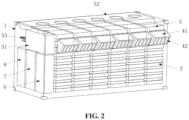
- the above-mentioned explosion-relief assembly 4 may be specifically mounted on a front side cabinet wall of the structural cabinet 1, or it may be mounted on a back side cabinet wall of the structural cabinet 1 as shown in FIG. 2 , or the front side cabinet wall and the back side cabinet wall of the structural cabinet 1 each is provided with the explosion-relief assembly 4.
- the PCS module 3 itself may occupy a dimension of the structural cabinet 1 in its depth direction, and the explosion-relief assembly 4 at this time is certainly not suitable to be mounted to a top side cabinet wall of the structural cabinet 1, so the explosion-relief assembly 4 at this time may be mounted on a front side cabinet wall and/or a back side cabinet wall.
- the explosion-relief assembly 4 into the structural form as described above, it may well adapt to the arrangement of the PCS module 3 being arranged on top of the battery module 2.
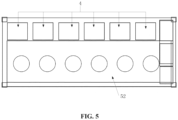
- the explosion-relief assembly 4 may be mounted at the front side cabinet wall of the structural cabinet 1, or at the back side cabinet wall of the structural cabinet 1, or at the top side cabinet wall of the structural cabinet 1, or at other end side cabinet wall of the structural cabinet 1 opposite to the end side where the PCS module 3 is located.
- arrangement may be based on actual needs, which is not specifically limited here.
- an explosion-relief guide structure is mounted at the same time when the front explosion-relief is used, thereby reducing the harm to the items and people caused by explosion-relief.
- the explosion-relief assembly 4 may include an explosion-relief portion 41 and an explosion-relief guide portion 42, and the explosion-relief portion 41 is configured mainly for activating the pressure relief when the pressure in the structural cabinet 1 exceeds a preset pressure, and it may be in a structural form of an explosion-relief plate or other explosion-relief structures commonly used by those skilled in the art, which is not specifically limited here; and the explosion-relief guide portion 42 is configured mainly to guide the pressure-relief airflow when the explosion-relief portion 41 is activated, and it may be a guide plate mounted on the explosion-relief plate or other structures with airflow guidance.
- the explosion-relief portion 41 can be automatically activated for pressure relief, and the explosion-relief guide portion 42 can guide and release the pressurized air flow and flame, thus reducing the explosion hazard and minimizing the harm to surrounding items and people when the system explodes.
- a thermal management unit 5 may further be mounted in the above-mentioned structural cabinet 1, and specifically, the thermal management unit 5 may include a liquid cooling main unit 51, an air cooling heat dissipation module 52 and a multi-way valve 53, and the liquid cooling main unit 51 establishes a circulation loop with a heat exchanger of the battery module 2 through the multi-way valve 53, which thus can adjust a temperature of the battery module 2 to allow it run more stably. Moreover, by arranging the liquid cooling main unit 51, the air cooling heat dissipation module 52, and the multi-way valve 53 in the structural cabinet 1 in a separate and independent mounting manner, the whole thermal management unit 5 is divided into three functional modules.
- the size of a single functional module is greatly reduced, which is relatively convenient for layout and allows full use of the available space of the structural cabinet 1, and ultimately facilitates improving the integration of the whole energy storage system, so that more battery modules 2 can be arranged in a limited space, and thus the power density of the whole energy storage system can be improved.
- the air cooling heat dissipation module 52 may specifically adopt a flat structure, and it is arranged at a top portion of the structural cabinet 1. By designing the air cooling heat dissipation module 52 as a flat structure, the air cooling heat dissipation module 52 can make well use of a top space of the structural cabinet 1.
- the air cooling heat dissipation module 52 does not need to occupy an entire area of the whole top portion of the structural cabinet 1, a certain top region may be reserved at a back end of the structural cabinet 1 in the depth direction for explosion-relief function (at present, through product research, the design end and the client end prefer the top explosion-relief solution, and it is required that there can be no product shielding above the explosion-relief region).
- the air cooling heat dissipation module and the explosion-relief region can be effectively integrated during laying out the top space of the structural cabinet 1, thus the space utilization rate at the top portion can be improved.
- the liquid cooling main unit 51 and the multi-way valve 53 are preferably designed to be arranged adjacently to each other, and both of them are arranged at the same end side of the structural cabinet 1 and adjacent to the air cooling heat dissipation module 52.
- the liquid cooling main unit 51, the air cooling heat dissipation module 52 and the multi-way valve 53 are adjacent to each other, which facilitates a pipeline arrangement and electrical communication arrangement among the functional modules in later stage.
- a fire-fighting module 6, an electrical cabinet 7 and a wiring cabinet 8 may further be mounted in the structural cabinet 1, and the fire-fighting module 6, the electrical cabinet 7, the wiring cabinet 8, the liquid cooling main unit 51 and the multi-way valve 53 are arranged at the same end side of the structural cabinet 1, specifically, at the left end side or the right end side of the structural cabinet 1, and the left end side and the right end side are based on facing the door-opening side of the structural cabinet 1.
- these five are spatially adjacent to each other, which facilitate the pipeline arrangement and electrical communication arrangement between the functional modules in the later stage.
- the fire-fighting module 6, the electrical cabinet 7 and the wiring cabinet 8 may be specifically designed to be arranged along the depth direction of the structural cabinet 1, for example, arranged in sequence along the depth direction of the structural cabinet 1.
- the sequence of the fire-fighting module 6, the electrical cabinet 7 and the wiring cabinet 8 can be changed as required.
- a liquid cooling mounting region may be reserved at top portions of the fire-fighting module 6, the electrical cabinet 7 and the wiring cabinet 8, and the liquid cooling main unit 51 and the multi-way valve 53 are both mounted in this liquid cooling mounting region.
- an arrangement position for the air cooling heat dissipation module 52 may be determined based on the arrangement requirements.
- the air cooling heat dissipation module 52 may be arranged at the top of the structural cabinet 1 with reference to FIG. 1 to FIG. 5 , and may also be arranged at the back side cabinet wall of the structural cabinet 1, as shown in FIG. 7 .
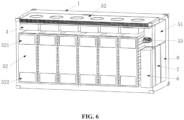
- the air cooling heat dissipation module 52 may be arranged at the end side cabinet wall of the structural cabinet 1, and in addition, the air cooling heat dissipation module 52 may also be arranged at the front side cabinet wall of the structural cabinet 1, as shown in FIG. 6 . In the practical application process, it can be arranged based on the specific needs, which is not specifically limited here.
- the air cooling heat dissipation module 52 generally includes an air inlet 521 and an air outlet 522. Specifically, the air inlet 521 is arranged at an upper portion of the air cooling heat dissipation module 52, and the air outlet 522 is arranged at a lower portion of the air cooling heat dissipation module 52. Alternatively, the air inlet 521 may be arranged at the lower portion of the air cooling heat dissipation module 52, and the air outlet 522 may be arranged at the upper portion of the air cooling heat dissipation module 52. In the practical application process, the arrangement may be determined based on the actual demand, which is not specifically limited here.
- At least one openable cabinet door may be arranged on the front side cabinet wall of the above structural cabinet 1, and the air cooling heat dissipation module 52 is arranged on the cabinet door.
- the number of cabinet doors is multiple, the number of the air cooling heat dissipation module 52 is also multiple, and the air cooling heat dissipation module 52 on any two of the multiple cabinet doors are separated from each other.
- system and/or “module” are used herein, it is merely a method for distinguishing different assemblies, elements, components, parts or fittings at different levels. However, if other words serve the same object, they may be replaced by other expressions.
Landscapes
- Chemical & Material Sciences (AREA)
- Chemical Kinetics & Catalysis (AREA)
- Electrochemistry (AREA)
- General Chemical & Material Sciences (AREA)
- Engineering & Computer Science (AREA)
- Manufacturing & Machinery (AREA)
- Microelectronics & Electronic Packaging (AREA)
- Battery Mounting, Suspending (AREA)
- Cooling Or The Like Of Electrical Apparatus (AREA)
Abstract
An energy storage system includes a structural cabinet, a battery module and a PCS module mounted in the structural cabinet, where the PCS module is arranged on top of the battery module or at an end side of the battery module, and a heat insulation layer is arranged between the PCS module and the battery module. In a practical application process of the energy storage system, since the heat insulation layer is arranged between the PCS module and the battery module, even if an electric arc in the PCS module causes a fire, under an action of the heat insulation layer, flame generated by the electric arc in the PCS module mainly spreads in a direction away from the thermal insulation layer. In addition, compared with the conventional way that the PCS module is arranged below the battery module, the PCS module is arranged above the battery module or at the end side of the battery module, so that the flame generated by the electric arc in the PCS module can spread upwards or towards the end side, which greatly reduces a risk of thermal diffusion to the battery module caused by the electric arc in the PCS module.
Description
- The present application relates to the technical field of a structural layout of equipment, and in particular to an energy storage system.
- With a rapid development of energy storage industry, requirements for the power density of the system are increasing in the development of a large-scale energy storage device. At present, the energy storage system mainly includes a structural cabinet, a battery module, a PCS module (that is, an energy storage converter module), a thermal management system, an electrical module and a fire-fighting module in terms of structural modules. Layout solutions for the conventional energy storage system are relatively simple, and its PCS module is generally mounted below the battery module. Although it is relatively convenient for wiring, a probability of a fire caused by electric arc inside the PCS module is much greater than a probability of a fire caused by thermal runaway of the battery cluster itself from a practical operation situation of the large-scale energy storage system. A battery cluster chamber and a PCS chamber are designed for thermal insulation, however, there is still a risk of thermal diffusion to the battery module due to the fire caused by the electric arc in the PCS module.
- In summary, it is urgent for those skilled in the art to solve the technical problem of the thermal diffusion to the battery module due to the fire caused by the electric arc in the PCS module of the energy storage system.
- In view of this, an energy storage system is provided according to the present application to solve a problem of thermal diffusion to a battery module due to a fire caused by an electric arc in a PCS module of the energy storage system.
- In order to achieve the above object, the following technical solutions are provided according to the present application.
- An energy storage system includes a structural cabinet, a battery module and a PCS module mounted in the structural cabinet, and the PCS module is arranged on top of the battery module or at an end side of the battery module, and a heat insulation layer is arranged between the PCS module and the battery module.
- In an embodiment, the structural cabinet is further provided with an explosion-relief assembly for relieving the battery module.
- In an embodiment, the explosion-relief assembly is mounted on a front side cabinet wall and/or a back side cabinet wall of the structural cabinet.
- In an embodiment, the explosion-relief assembly includes an explosion-relief portion and an explosion-relief guide portion, and the explosion-relief portion is configured for activating the pressure relief when the pressure in the structural cabinet exceeds a preset pressure, and the explosion-relief guide portion is configured for guiding the pressure relief airflow when the explosion-relief portion is activated.
- In an embodiment, a thermal management unit is further mounted in the structural cabinet, and the thermal management unit includes a liquid cooling main unit, an air cooling heat dissipation module and a multi-way valve, and the liquid cooling main unit, the air cooling heat dissipation module and the multi-way valve are separately mounted and arranged in the structural cabinet.
- In an embodiment, the air cooling heat dissipation module is of a flat structure, and it is arranged at a top portion of the structural cabinet.
- In an embodiment, the liquid cooling main unit and the multi-way valve are arranged adjacent to each other, and both of the liquid cooling main unit and the multi-way valve are arranged at a same end side of the structural cabinet and adjacent to the air cooling heat dissipation module.
- In an embodiment, a fire-fighting module, an electrical cabinet and a wiring cabinet are further mounted in the structural cabinet, and the fire-fighting module, the electrical cabinet, the wiring cabinet, the liquid cooling main unit and the multi-way valve are arranged at the same end side of the structural cabinet.
- In an embodiment, the fire-fighting module, the electrical cabinet and the wiring cabinet are arranged along a depth direction of the structural cabinet. A liquid cooling mounting region is reserved on top of the fire-fighting module, the electrical cabinet and the wiring cabinet, and the liquid cooling main unit and the multi-way valve are both mounted in this liquid cooling mounting region.
- In an embodiment, the air cooling heat dissipation module is arranged on the back side cabinet wall of the structural cabinet, or the air cooling heat dissipation module is arranged on the end side cabinet wall of the structural cabinet, or the air cooling heat dissipation module is arranged on the front side cabinet wall of the structural cabinet.
- In an embodiment, the front side cabinet wall of the structural cabinet is provided with at least one openable cabinet door, and the air cooling heat dissipation module is arranged on the cabinet door. When the number of the cabinet doors is multiple, the number of the air cooling heat dissipation module is also multiple, and the air cooling heat dissipation modules on any two of the cabinet doors are separated from each other.
- Compared with the introduction of the background technology, the energy storage system described above includes a structural cabinet, and a battery module and a PCS module mounted in the structural cabinet, where the PCS module is arranged on top of the battery module or at an end side of the battery module, and a heat insulation layer is arranged between the PCS module and the battery module. In the practical application process of the energy storage system, since the thermal insulation layer is arranged between the PCS module and the battery module, even if an electric arc in the PCS module causes a fire, flame generated by the fire caused by the electric arc in the PCS module mainly spreads in a direction away from the heat insulation layer under an action of the heat insulation layer. In addition, compared with the conventional way that the PCS module is arranged below the battery module, the PCS module is arranged on top of the battery module or at the end side of the battery module, so that the flame generated by the fire caused by the electric arc in the PCS module can spread upward or toward the end side (that is, toward the outside of the structural cabinet), which greatly reduces the risk of thermal diffusion to the battery module due to the fire caused by the electric arc in the PCS module.
- For more clearly illustrating embodiments of the present application or technical solutions in the conventional technology, the drawing referred to for describing the embodiments or the conventional technology will be briefly described hereinafter. Apparently, the drawings in the following description are only some examples of the present application, and for those skilled in the art, other drawings may be obtained based on the provided drawing without any creative efforts.
-
FIG. 1 a schematic perspective view showing a structural arrangement of an energy storage system provided according to an embodiment of the present application, in which a PCS module is arranged on top of a battery module, an air cooling heat exchange module is arranged at a top side cabinet wall, and an explosion-relief assembly is arranged at a front side cabinet wall; -
FIG 2 is a schematic perspective view showing a structural arrangement of an energy storage system provided according to an embodiment of the present application, in which a PCS module is arranged on top of a battery module, an air cooling heat exchange module is arranged at a top side cabinet wall, and an explosion-relief assembly is arranged at a back side cabinet wall; -
FIG. 3 is a schematic perspective view showing a structural arrangement of an energy storage system provided according to an embodiment of the present application, in which a PCS module is arranged at an end side of a battery module; -
FIG. 4 is a schematic perspective view showing a structural arrangement of an energy storage system provided according to an embodiment of the present application, in which a PCS module is arranged at another end side of a battery module; -
FIG. 5 is a schematic top view showing a structural arrangement of an energy storage system provided according to an embodiment of the present application, in which an explosion-relief assembly is arranged at a top side cabinet wall; -
FIG 6 is a schematic view showing a structural arrangement of an air cooling heat exchange module being arranged at a front side cabinet wall according to an embodiment of the present application; -
FIG. 7 is a schematic view showing a structural arrangement of an air cooling heat exchange module being arranged at a back side cabinet wall according to an embodiment of the present application. - Reference numerals in
FIG. 1 to FIG. 7 are listed as follows: - 1 structural cabinet;
- 2 battery module;
- 3 PCS module;
- 4 explosion-relief assembly, 41 explosion-relief portion, 42 explosion-relief guide portion;
- 5 thermal management unit, 51 liquid cooling main unit, 52 air cooling heat dissipation module, 521 air inlet, 522 air outlet, 53 multi-way valve;
- 6 fire-fighting module;
- 7 electrical cabinet;
- 8 wiring cabinet.
- A core of the present application is to provide an energy storage system to solve a problem of thermal diffusion to a battery module due to a fire caused by an electric arc in a PCS module of the energy storage system.
- Technical solutions of embodiments of the present application is clearly and completely described hereinafter in conjunction with the drawings of the embodiments according to the present application. Apparently, the embodiments described are only some embodiments of the present application, rather than all embodiments. Based on the embodiments in the present application, all of the other embodiments which are obtained by those skilled in the art without any creative work fall within the protection scope of the present application.
- With reference to
FIG. 1 to FIG. 7 , an energy storage system is provided according to the present application, including astructural cabinet 1, and abattery module 2 and a PCS module (that is, an energy storage converter module) mounted in thestructural cabinet 1. Specifically, thePCS module 3 may be arranged on top of thebattery module 2 or at an end side of thebattery module 2, and may be selected based on actual requirements in a practical application process. In addition, a heat insulation layer is generally arranged between thePCS module 3 and thebattery module 2 to insulate a battery cluster chamber, where thebattery module 2 is located, from a mounting chamber where thePCS module 3 is located. According to a practical operation situation of a large-scale energy storage system, a probability of a fire caused by electric arc inside is much greater than a probability of a fire caused by thermal runaway of the battery cluster itself, so arranging the heat insulation layer between thePCS module 3 and thebattery module 2 can effectively reduce a risk of the thermal diffusion to thebattery module 2 due to the fire caused by the electric arc in thePCS module 3. - In the practical application process of the energy storage system, since the heat insulation layer is arranged between the
PCS module 3 and thebattery module 2, even if the electric arc inside thePCS module 3 causes the fire, flame generated by the fire caused by the electric arc in thePCS module 3 mainly spreads in a direction away from the heat insulation layer under an action of the heat insulation layer. In addition, compared with the conventional way that thePCS module 3 is arranged below thebattery module 2, thePCS module 3 is arranged on top of thebattery module 2 or at the end side of thebattery module 2, so that the flame generated by the fire caused by the electric arc in thePCS module 3 can spread upward or toward the end side (that is, toward outside of the structural cabinet 1), which greatly reduces the risk of thermal diffusion to thebattery module 2 due to the fire caused by the electric arc in thePCS module 3. - It should be noted that those skilled in the art should be able to understand that since a main electrical component loaded in the
structural cabinet 1 is thebattery module 2, that is, thebattery module 2 occupies the largest space in thestructural cabinet 1, the end side of thebattery module 2 is also the end side of thestructural cabinet 1, and the end side of thestructural cabinet 1 refers to a left side or a right side of thestructural cabinet 1 when a person facing a door-opening side of thestructural cabinet 1. In addition, referring toFIG. 3 andFIG. 4 , when thePCS module 3 is arranged at the end side of thebattery module 2, thePCS module 3 is preferably arranged in a stacking manner in a bottom-up direction, thus forming a module-loaded chamber for the corresponding PCS, and are preferably designed between thebattery module 2 and an electrical module (for example, a fire-fighting module 6, anelectrical cabinet 7 and a wiring cabinet 8), which is relatively convenient for electrical connection. - In some specific embodiments, the above-mentioned
structural cabinet 1 may further be provided with an explosion-relief assembly 4 for relieving thebattery module 2, so as to avoid a potential safety hazard that a cabinet door of thestructural cabinet 1 may explode and cause personal injury due to the explosion inside thestructural cabinet 1. - In a further embodiment, as shown in
FIG. 1 , the above-mentioned explosion-relief assembly 4 may be specifically mounted on a front side cabinet wall of thestructural cabinet 1, or it may be mounted on a back side cabinet wall of thestructural cabinet 1 as shown inFIG. 2 , or the front side cabinet wall and the back side cabinet wall of thestructural cabinet 1 each is provided with the explosion-relief assembly 4. Especially in a case that thePCS module 3 is arranged on top of thebattery module 2, thePCS module 3 itself may occupy a dimension of thestructural cabinet 1 in its depth direction, and the explosion-relief assembly 4 at this time is certainly not suitable to be mounted to a top side cabinet wall of thestructural cabinet 1, so the explosion-relief assembly 4 at this time may be mounted on a front side cabinet wall and/or a back side cabinet wall. By designing the explosion-relief assembly 4 into the structural form as described above, it may well adapt to the arrangement of thePCS module 3 being arranged on top of thebattery module 2. Of course, it can be understood that in a case that thePCS module 3 is arranged at the end side of thebattery module 2, the explosion-relief assembly 4 may be mounted at the front side cabinet wall of thestructural cabinet 1, or at the back side cabinet wall of thestructural cabinet 1, or at the top side cabinet wall of thestructural cabinet 1, or at other end side cabinet wall of thestructural cabinet 1 opposite to the end side where thePCS module 3 is located. In the practical application process, arrangement may be based on actual needs, which is not specifically limited here. - It should be noted that the above-mentioned front side cabinet wall and the back side cabinet wall are defined on the basis of the
structural cabinet 1 itself. A door-opening side cabinet wall of thestructural cabinet 1 is the front side cabinet wall, and a cabinet wall opposite to the door-opening side cabinet wall is the back side cabinet wall. In addition, the depth direction of thestructural cabinet 1 is also defined based on the door-opening side of thestructural cabinet 1, and the depth direction refers to a direction in which the door-opening side faces the back door side. - In a further embodiment, since the explosion pressure and flame released to the surrounding environment once the explosion-
relief module 4 is fully activated may cause harm to the surrounding items and people when the front explosion-relief is used, an explosion-relief guide structure is mounted at the same time when the front explosion-relief is used, thereby reducing the harm to the items and people caused by explosion-relief. Specifically, the explosion-relief assembly 4 may include an explosion-relief portion 41 and an explosion-relief guide portion 42, and the explosion-relief portion 41 is configured mainly for activating the pressure relief when the pressure in thestructural cabinet 1 exceeds a preset pressure, and it may be in a structural form of an explosion-relief plate or other explosion-relief structures commonly used by those skilled in the art, which is not specifically limited here; and the explosion-relief guide portion 42 is configured mainly to guide the pressure-relief airflow when the explosion-relief portion 41 is activated, and it may be a guide plate mounted on the explosion-relief plate or other structures with airflow guidance. By designing the explosion-relief assembly 4 into the above-mentioned structural form, when an explosion occurs inside thestructural cabinet 1, the explosion-relief portion 41 can be automatically activated for pressure relief, and the explosion-relief guide portion 42 can guide and release the pressurized air flow and flame, thus reducing the explosion hazard and minimizing the harm to surrounding items and people when the system explodes. - In some specific embodiments, a
thermal management unit 5 may further be mounted in the above-mentionedstructural cabinet 1, and specifically, thethermal management unit 5 may include a liquid coolingmain unit 51, an air coolingheat dissipation module 52 and amulti-way valve 53, and the liquid coolingmain unit 51 establishes a circulation loop with a heat exchanger of thebattery module 2 through themulti-way valve 53, which thus can adjust a temperature of thebattery module 2 to allow it run more stably. Moreover, by arranging the liquid coolingmain unit 51, the air coolingheat dissipation module 52, and themulti-way valve 53 in thestructural cabinet 1 in a separate and independent mounting manner, the wholethermal management unit 5 is divided into three functional modules. Compared with the conventional integrated thermal management unit, the size of a single functional module is greatly reduced, which is relatively convenient for layout and allows full use of the available space of thestructural cabinet 1, and ultimately facilitates improving the integration of the whole energy storage system, so thatmore battery modules 2 can be arranged in a limited space, and thus the power density of the whole energy storage system can be improved. - In a further embodiment, the air cooling
heat dissipation module 52 may specifically adopt a flat structure, and it is arranged at a top portion of thestructural cabinet 1. By designing the air coolingheat dissipation module 52 as a flat structure, the air coolingheat dissipation module 52 can make well use of a top space of thestructural cabinet 1. In addition, when thePCS module 3 is arranged at the end side of thebattery module 2, since the air coolingheat dissipation module 52 does not need to occupy an entire area of the whole top portion of thestructural cabinet 1, a certain top region may be reserved at a back end of thestructural cabinet 1 in the depth direction for explosion-relief function (at present, through product research, the design end and the client end prefer the top explosion-relief solution, and it is required that there can be no product shielding above the explosion-relief region). In this way, the air cooling heat dissipation module and the explosion-relief region can be effectively integrated during laying out the top space of thestructural cabinet 1, thus the space utilization rate at the top portion can be improved. - In other specific embodiments, the liquid cooling
main unit 51 and themulti-way valve 53 are preferably designed to be arranged adjacently to each other, and both of them are arranged at the same end side of thestructural cabinet 1 and adjacent to the air coolingheat dissipation module 52. By such structure, the liquid coolingmain unit 51, the air coolingheat dissipation module 52 and themulti-way valve 53 are adjacent to each other, which facilitates a pipeline arrangement and electrical communication arrangement among the functional modules in later stage. - In other specific embodiments, a fire-fighting
module 6, anelectrical cabinet 7 and awiring cabinet 8 may further be mounted in thestructural cabinet 1, and the fire-fightingmodule 6, theelectrical cabinet 7, thewiring cabinet 8, the liquid coolingmain unit 51 and themulti-way valve 53 are arranged at the same end side of thestructural cabinet 1, specifically, at the left end side or the right end side of thestructural cabinet 1, and the left end side and the right end side are based on facing the door-opening side of thestructural cabinet 1. By arranging these five at the same end side of thestructural cabinet 1, they are spatially adjacent to each other, which facilitate the pipeline arrangement and electrical communication arrangement between the functional modules in the later stage. - In a further embodiment, the fire-fighting
module 6, theelectrical cabinet 7 and thewiring cabinet 8 may be specifically designed to be arranged along the depth direction of thestructural cabinet 1, for example, arranged in sequence along the depth direction of thestructural cabinet 1. Of course, the sequence of the fire-fightingmodule 6, theelectrical cabinet 7 and thewiring cabinet 8 can be changed as required. In addition, a liquid cooling mounting region may be reserved at top portions of the fire-fightingmodule 6, theelectrical cabinet 7 and thewiring cabinet 8, and the liquid coolingmain unit 51 and themulti-way valve 53 are both mounted in this liquid cooling mounting region. By arranging the above-mentioned structural form, the structural arrangement is relatively compact and the space utilization rate is relatively high, so that the mounting capacity of thebattery module 2 in thestructural cabinet 1 with the same size is improved. - In other specific embodiments, an arrangement position for the air cooling
heat dissipation module 52 may be determined based on the arrangement requirements. The air coolingheat dissipation module 52 may be arranged at the top of thestructural cabinet 1 with reference toFIG. 1 to FIG. 5 , and may also be arranged at the back side cabinet wall of thestructural cabinet 1, as shown inFIG. 7 . Alternatively, the air coolingheat dissipation module 52 may be arranged at the end side cabinet wall of thestructural cabinet 1, and in addition, the air coolingheat dissipation module 52 may also be arranged at the front side cabinet wall of thestructural cabinet 1, as shown inFIG. 6 . In the practical application process, it can be arranged based on the specific needs, which is not specifically limited here. It should be noted that the air coolingheat dissipation module 52 generally includes anair inlet 521 and anair outlet 522. Specifically, theair inlet 521 is arranged at an upper portion of the air coolingheat dissipation module 52, and theair outlet 522 is arranged at a lower portion of the air coolingheat dissipation module 52. Alternatively, theair inlet 521 may be arranged at the lower portion of the air coolingheat dissipation module 52, and theair outlet 522 may be arranged at the upper portion of the air coolingheat dissipation module 52. In the practical application process, the arrangement may be determined based on the actual demand, which is not specifically limited here. - In some specific embodiments, at least one openable cabinet door may be arranged on the front side cabinet wall of the above
structural cabinet 1, and the air coolingheat dissipation module 52 is arranged on the cabinet door. When the number of cabinet doors is multiple, the number of the air coolingheat dissipation module 52 is also multiple, and the air coolingheat dissipation module 52 on any two of the multiple cabinet doors are separated from each other. By designing in such structure, the loading space corresponding to each cabinet door can independently meet the requirements of air cooling and heat dissipation, and the maintenance is more convenient. - It should be noted that the embodiments in this specification are described in a progressive way, each of the embodiments emphasizes the differences from others, and the same or similar parts among the embodiments may be referred to each other.
- It should be understood that if "system", and/or "module" are used herein, it is merely a method for distinguishing different assemblies, elements, components, parts or fittings at different levels. However, if other words serve the same object, they may be replaced by other expressions.
- As shown in the present application and the claims, the words "a", "one", "one type" and/or "this" do not specifically refer to the singular, but may also include the plural, unless the context clearly indicates exceptions. Generally speaking, the terms "include" and "comprise" only indicate that the steps and elements that have been clearly identified are included, and these steps and elements do not constitute an exclusive list. Methods or equipment may also contain other steps or elements. The statement "comprising (including) a..." does not exclude the case that other identical elements exist in the process, method, product or device.
- In the description of the embodiments of the present application, unless otherwise specified, "/" means or, for example, A/B can mean A or B; the "and/or" herein is only an association relationship that describes the associated objects, which means that there can be three kinds of relationships, for example, A and/or B means that there are three cases: A alone, A and B at the same time, and B alone. In addition, in the description of the embodiments of the present application, "multiple" refers to two or more.
- The principle and the embodiments of the present application are illustrated herein by specific examples. The above description of the examples is only intended to facilitate the understanding of the concept of the present application. It should be noted that, for the person skilled in the art, many modifications and improvements may be made to the present application without departing from the principle of the present application, and these modifications and improvements are also deemed to fall into the protection scope of the present application defined by the claims.
Claims (11)
- An energy storage system, comprising a structural cabinet (1), a battery module (2) and a PCS module (3) mounted in the structural cabinet (1), wherein the PCS module (3) is arranged on top of the battery module (2) or at an end side of the battery module (2), and a heat insulation layer is arranged between the PCS module (3) and the battery module (2).
- The energy storage system according to claim 1, wherein the structural cabinet (1) is further provided with an explosion-relief assembly (4) for relieving the battery module (2).
- The energy storage system according to claim 2, wherein the explosion-relief assembly (4) is mounted on a front side cabinet wall and/or a back side cabinet wall of the structural cabinet (1).
- The energy storage system according to claim 2, wherein the explosion-relief assembly (4) comprises an explosion-relief portion (41) and an explosion-relief guide portion (42), wherein the explosion-relief part (41) is configured for activating a pressure relief when a pressure in the structural cabinet (1) exceeds a preset pressure, and the explosion-relief guide portion (42) is configured to guide a pressure relief airflow when the explosion-relief portion (41) is activated.
- The energy storage system according to claim 1, wherein a thermal management unit (5) is further mounted in the structural cabinet (1), and the thermal management unit (5) comprises a liquid cooling main unit (51), an air cooling heat dissipation module (52) and a multi-way valve (53), and the liquid cooling main unit (51), the air cooling heat dissipation module (52) and the multi-way valve (53) are separately mounted and arranged in the structural cabinet (1).
- The energy storage system according to claim 5, wherein the air cooling heat dissipation module (52) is in a flat structure, and it is arranged at a top portion of the structural cabinet (1).
- The energy storage system according to claim 5, wherein the liquid cooling main unit (51) and the multi-way valve (53) are arranged adjacent to each other, both of which are arranged at a same end side of the structural cabinet (1) and are arranged adjacent to the air cooling heat dissipation module (52).
- The energy storage system according to claim 5, wherein a fire-fighting module (6), an electrical cabinet (7) and a wiring cabinet (8) are further mounted in the structural cabinet (1), and the fire-fighting module (6), the electrical cabinet (7), the wiring cabinet (8), the liquid cooling main unit (51) and the multi-way valve (53) are arranged at the same end side of the structural cabinet (1).
- The energy storage system according to claim 8, wherein the fire-fighting module (6), the electrical cabinet (7) and the wiring cabinet (8) are arranged along a depth direction of the structural cabinet (1); a liquid cooling mounting region is reserved at top portions of the fire-fighting module (6), the electrical cabinet (7) and the wiring cabinet (8), and the liquid cooling main unit (51) and the multi-way valve (53) are both mounted in the liquid cooling mounting region.
- The energy storage system according to claim 5, wherein the air cooling heat dissipation module (52) is arranged on the back side cabinet wall of the structural cabinet (1); or the air cooling heat dissipation module (52) is arranged on the end side cabinet wall of the structural cabinet (1); or the air cooling heat dissipation module (52) is arranged on the front side cabinet wall of the structural cabinet (1).
- The energy storage system according to claim 5, wherein at least one openable cabinet door is arranged on the front side cabinet wall of the structural cabinet (1), and the air cooling heat dissipation module (52) is arranged on the cabinet door, wherein when a plurality of cabinet doors is provided, a plurality of air cooling heat dissipation modules (52) is provided, and the air cooling heat dissipation modules (52) on any two of the cabinet doors are separated from each other.
Applications Claiming Priority (1)
| Application Number | Priority Date | Filing Date | Title |
|---|---|---|---|
| CN202310778561.3A CN116706344A (en) | 2023-06-28 | 2023-06-28 | Energy storage system |
Publications (1)
| Publication Number | Publication Date |
|---|---|
| EP4485620A1 true EP4485620A1 (en) | 2025-01-01 |
Family
ID=87823835
Family Applications (1)
| Application Number | Title | Priority Date | Filing Date |
|---|---|---|---|
| EP23208468.1A Pending EP4485620A1 (en) | 2023-06-28 | 2023-11-08 | Energy storage system |
Country Status (4)
| Country | Link |
|---|---|
| US (1) | US20250007086A1 (en) |
| EP (1) | EP4485620A1 (en) |
| CN (1) | CN116706344A (en) |
| AU (1) | AU2023263547B2 (en) |
Citations (7)
| Publication number | Priority date | Publication date | Assignee | Title |
|---|---|---|---|---|
| CN109546261A (en) * | 2018-11-19 | 2019-03-29 | 浙江南都电源动力股份有限公司 | The battery thermal management system of container-type energy-storage system |
| CN211530802U (en) * | 2020-03-24 | 2020-09-18 | 安徽海螺新能源有限公司 | Container type energy storage system |
| CN115149655A (en) * | 2022-06-10 | 2022-10-04 | 国网湖北省电力有限公司随州供电公司 | Energy storage device based on low voltage distribution station area |
| CN115764056A (en) * | 2022-11-16 | 2023-03-07 | 阳光储能技术有限公司 | A thermal management system and control method |
| CN218808070U (en) * | 2022-09-26 | 2023-04-07 | 福建时代星云科技有限公司 | Ventilation explosion venting valve for container |
| CN116160915A (en) * | 2022-12-15 | 2023-05-26 | 华为数字能源技术有限公司 | Temperature control system, vehicle, energy storage system and multi-way valve |
| CN116315307A (en) * | 2023-02-10 | 2023-06-23 | 华南理工大学 | Spray-type liquid-cooled battery energy storage cabinet and control method based on inflatable plate |
-
2023
- 2023-06-28 CN CN202310778561.3A patent/CN116706344A/en active Pending
- 2023-11-08 US US18/504,986 patent/US20250007086A1/en active Pending
- 2023-11-08 EP EP23208468.1A patent/EP4485620A1/en active Pending
- 2023-11-10 AU AU2023263547A patent/AU2023263547B2/en active Active
Patent Citations (7)
| Publication number | Priority date | Publication date | Assignee | Title |
|---|---|---|---|---|
| CN109546261A (en) * | 2018-11-19 | 2019-03-29 | 浙江南都电源动力股份有限公司 | The battery thermal management system of container-type energy-storage system |
| CN211530802U (en) * | 2020-03-24 | 2020-09-18 | 安徽海螺新能源有限公司 | Container type energy storage system |
| CN115149655A (en) * | 2022-06-10 | 2022-10-04 | 国网湖北省电力有限公司随州供电公司 | Energy storage device based on low voltage distribution station area |
| CN218808070U (en) * | 2022-09-26 | 2023-04-07 | 福建时代星云科技有限公司 | Ventilation explosion venting valve for container |
| CN115764056A (en) * | 2022-11-16 | 2023-03-07 | 阳光储能技术有限公司 | A thermal management system and control method |
| CN116160915A (en) * | 2022-12-15 | 2023-05-26 | 华为数字能源技术有限公司 | Temperature control system, vehicle, energy storage system and multi-way valve |
| CN116315307A (en) * | 2023-02-10 | 2023-06-23 | 华南理工大学 | Spray-type liquid-cooled battery energy storage cabinet and control method based on inflatable plate |
Also Published As
| Publication number | Publication date |
|---|---|
| US20250007086A1 (en) | 2025-01-02 |
| CN116706344A (en) | 2023-09-05 |
| AU2023263547B2 (en) | 2025-09-04 |
| AU2023263547A1 (en) | 2025-01-16 |
Similar Documents
| Publication | Publication Date | Title |
|---|---|---|
| US11108111B2 (en) | Backplane assembly with power and cooling substructures | |
| EP4407773A1 (en) | Smoke exhaust system for energy storage device, energy storage device, and electrical device | |
| EP0858663B1 (en) | Passive emergency hydrogen mitigation system for water-cooled nuclear reactors | |
| EP4485625A1 (en) | Energy storage system | |
| EP4485620A1 (en) | Energy storage system | |
| CN220306332U (en) | Energy storage container and container body thereof | |
| CN218385513U (en) | Safe efficient energy storage container | |
| CN218385555U (en) | Air-cooled energy storage cabinet | |
| CN223941940U (en) | Explosion-proof battery storage cabinet | |
| CN219553799U (en) | Battery compartment and vehicle | |
| CN214411374U (en) | Battery thermal runaway protection structure and battery pack | |
| CN113138632A (en) | Case and storage device | |
| CN113852155A (en) | A home energy storage system | |
| CN222015487U (en) | A heat sink and energy storage system | |
| CN223309131U (en) | Energy storage system and electricity utilization device | |
| EP4651321A1 (en) | Electrical cabinet and photovoltaic power generation system | |
| CN224191525U (en) | Preassembled transformer substation | |
| CN118413962B (en) | Explosion-proof emergency control box | |
| CN115458857B (en) | Battery module | |
| CN223451023U (en) | Battery clusters and battery energy storage systems | |
| CN223309125U (en) | Mobile emergency energy storage device and energy storage equipment | |
| CN222530694U (en) | Cabinet assembly and energy storage device | |
| CN223167532U (en) | A three-dimensional liquid cooling and heat dissipation component for energy storage batteries | |
| JP7520147B2 (en) | Battery rack and power storage device including the battery rack | |
| EP4571971A2 (en) | Pressure relief bracket assembly and battery module |
Legal Events
| Date | Code | Title | Description |
|---|---|---|---|
| PUAI | Public reference made under article 153(3) epc to a published international application that has entered the european phase |
Free format text: ORIGINAL CODE: 0009012 |
|
| STAA | Information on the status of an ep patent application or granted ep patent |
Free format text: STATUS: REQUEST FOR EXAMINATION WAS MADE |
|
| 17P | Request for examination filed |
Effective date: 20231108 |
|
| AK | Designated contracting states |
Kind code of ref document: A1 Designated state(s): AL AT BE BG CH CY CZ DE DK EE ES FI FR GB GR HR HU IE IS IT LI LT LU LV MC ME MK MT NL NO PL PT RO RS SE SI SK SM TR |
|
| STAA | Information on the status of an ep patent application or granted ep patent |
Free format text: STATUS: EXAMINATION IS IN PROGRESS |
|
| 17Q | First examination report despatched |
Effective date: 20250225 |