EP4485370A2 - Zielobjektidentifizierungsverfahren und -vorrichtung, elektronische vorrichtung und speichermedium - Google Patents
Zielobjektidentifizierungsverfahren und -vorrichtung, elektronische vorrichtung und speichermedium Download PDFInfo
- Publication number
- EP4485370A2 EP4485370A2 EP23775397.5A EP23775397A EP4485370A2 EP 4485370 A2 EP4485370 A2 EP 4485370A2 EP 23775397 A EP23775397 A EP 23775397A EP 4485370 A2 EP4485370 A2 EP 4485370A2
- Authority
- EP
- European Patent Office
- Prior art keywords
- target
- identified
- target object
- model
- feature point
- Prior art date
- Legal status (The legal status is an assumption and is not a legal conclusion. Google has not performed a legal analysis and makes no representation as to the accuracy of the status listed.)
- Pending
Links
Images




Classifications
-
- G—PHYSICS
- G06—COMPUTING OR CALCULATING; COUNTING
- G06T—IMAGE DATA PROCESSING OR GENERATION, IN GENERAL
- G06T17/00—Three-dimensional [3D] modelling for computer graphics
-
- G—PHYSICS
- G06—COMPUTING OR CALCULATING; COUNTING
- G06V—IMAGE OR VIDEO RECOGNITION OR UNDERSTANDING
- G06V20/00—Scenes; Scene-specific elements
- G06V20/20—Scenes; Scene-specific elements in augmented reality scenes
-
- G—PHYSICS
- G06—COMPUTING OR CALCULATING; COUNTING
- G06T—IMAGE DATA PROCESSING OR GENERATION, IN GENERAL
- G06T19/00—Manipulating three-dimensional [3D] models or images for computer graphics
-
- G—PHYSICS
- G06—COMPUTING OR CALCULATING; COUNTING
- G06T—IMAGE DATA PROCESSING OR GENERATION, IN GENERAL
- G06T19/00—Manipulating three-dimensional [3D] models or images for computer graphics
- G06T19/006—Mixed reality
-
- G—PHYSICS
- G06—COMPUTING OR CALCULATING; COUNTING
- G06V—IMAGE OR VIDEO RECOGNITION OR UNDERSTANDING
- G06V10/00—Arrangements for image or video recognition or understanding
- G06V10/40—Extraction of image or video features
-
- G—PHYSICS
- G06—COMPUTING OR CALCULATING; COUNTING
- G06V—IMAGE OR VIDEO RECOGNITION OR UNDERSTANDING
- G06V10/00—Arrangements for image or video recognition or understanding
- G06V10/70—Arrangements for image or video recognition or understanding using pattern recognition or machine learning
- G06V10/74—Image or video pattern matching; Proximity measures in feature spaces
- G06V10/761—Proximity, similarity or dissimilarity measures
-
- G—PHYSICS
- G06—COMPUTING OR CALCULATING; COUNTING
- G06T—IMAGE DATA PROCESSING OR GENERATION, IN GENERAL
- G06T2200/00—Indexing scheme for image data processing or generation, in general
- G06T2200/24—Indexing scheme for image data processing or generation, in general involving graphical user interfaces [GUIs]
-
- G—PHYSICS
- G06—COMPUTING OR CALCULATING; COUNTING
- G06T—IMAGE DATA PROCESSING OR GENERATION, IN GENERAL
- G06T2210/00—Indexing scheme for image generation or computer graphics
- G06T2210/62—Semi-transparency
Definitions
- Embodiments of the present disclosure relate to the technical field of image identification, e.g., to a method and apparatus for identifying a target object, an electronic device, and a storage medium.
- the augmented reality technology can be applied on a large scale. It is inevitable to adopt the data acquisition technology for the large-scale augmented reality technology.
- Data acquisition in the related art mostly involves capturing an image including a target object, but fails to achieve object identification. Consequently, a user cannot obtain corresponding object information timely, and the user's experience is poor.
- the embodiments of the present disclosure provide a method and apparatus for identifying a target object, an electronic device, and a storage medium to achieve the effects of effectively identifying an object and showing a result of identification to enhance the user's experience.
- embodiments of the present disclosure provide a method for identifying a target object, comprising:
- embodiments of the present disclosure provide an apparatus for identifying a target object, comprising:
- embodiments of the present disclosure provide an electronic device, comprising:
- the at least one program when executed by the at least one processor, causes the at least one processor to implement the method for identifying a target object according to any embodiment in the present disclosure.
- embodiments of the present disclosure provide a storage medium comprising computer-executable instructions, wherein the computer-executable instructions are configured to, when executed by a computer processor, implement the method for identifying a target object according to any embodiment in the present disclosure.
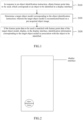
- the method includes the following steps.
- feature point data to be used corresponding to an object to be identified in a display interface is obtained in response to an object identification instruction.
- the object identification instruction may be an instruction generated by a user triggering a control on a mobile terminal. When object identification is needed, a corresponding control may be triggered to generate the object identification instruction. It needs to be noted that a corresponding application may be developed based on the embodiments of the present disclosure, or the method of the embodiment of the present disclosure may be integrated into a corresponding application to enable the application to have an object identification function. Any object in a real environment or a virtual environment may be taken as an object to be identified. An object in the field of view of a terminal device is taken as the object to be identified.
- an image pickup apparatus of the terminal may be started to photograph the object to be identified to obtain an image including the object to be identified and determine the information of the object to be identified.
- the feature point data to be used may be used to characterize feature information of the object to be identified. For an object or a scene, if a plurality of pictures are acquired at different angles, a point corresponding to a common feature is taken as a feature point, and the feature point corresponding to the object to be identified is taken as a feature point to be used.
- the object A may be taken as the object to be identified.
- the user starts a target client and triggers the object identification control on the target client to start a camera.
- the position information of the mobile terminal or the position information of the object to be identified may be adjusted such that the object to be identified is presented in the display interface. While the object to be identified is presented, the feature point data of the object to be identified may be obtained as the feature point data to be used.
- there may be a plurality of ways of generating the object identification instruction optionally, including: detecting that the object identification control is triggered; detecting that a display interface includes an object to be identified; detecting that a capturing control is triggered; and detecting that an object view to be matched in an object identification list is triggered.
- the object identification list includes a plurality of object views to be matched.
- the object views to be matched may be typical and representative object views pre-stored by a developer, or frequently used object views. In practical use, the object views to be matched may be obtained after the user uploads a plurality of object views captured according to an actual need so as to meet the personalized requirement of the user. In order to achieve the effect that the object views to be matched are easily viewed, the plurality of object views to be matched may be taken as a piece of data in the object identification list.
- the way of generating the object identification instruction may be detecting that the object identification control is triggered (a first way).
- the object identification control may be a key on the display interface of the client, e.g., a preset control, or any non-functional region in the display interface. As shown in Fig. 2 , there is a key corresponding to the object identification control in the display interface of the client.
- a second way is detecting that the display interface includes the object to be identified.
- the camera is started when the client is enabled, and the display interface is adjusted such that the display interface includes the object to be identified.
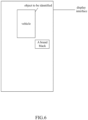
- a marking box is displayed in the display interface to adjust the object to be identified to be displayed in the marking box.
- a shape of the making box may be any regular or irregular shape. The user adjusts a relative position of the mobile terminal and the object to be identified such that the object to be identified is displayed in the marking box, indicating that the object needs to be identified and the object identification instruction is generated.
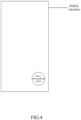
- a third way may be detecting that the capturing control is triggered. As shown in Fig. 4 , after the client is started, an object photographing button in the display interface is tapped to generate the object identification instruction.
- a fourth way may be detecting that the object view to be matched in the object identification list is triggered.
- the user may trigger the object identification list in the display interface of the client.
- the object identification list includes many object views to be matched, and the user may trigger any one object view to be matched thereof and takes the triggering operation as a generation condition for generating the object identification instruction.
- the user selects the view 1 or object identification information 1 in the object identification list by a tapping operation, and the object identification instruction may be generated.
- a target object model corresponding to the object identification instruction is determined.
- the target object model is reconstructed based on an object image obtained in advance.
- the object image obtained in advance may be an image corresponding to a universal object that is captured in advance by the developer, or generated by a view corresponding to a frequently used object, or created based on a view captured and uploaded by the user in practical use.
- the target object model may be a three-dimensional model or an augmented reality (AR) virtual model. If the target object model is the three-dimensional model, views at a plurality of camera angles need to be obtained and are spliced to determine the model. If the target object model is the AR model, it may be determined based on an uploaded view.
- the object identification instruction may include an identifier of an object to be identified.
- the server may receive the object identification instruction and parse the object identification instruction to determine a model identifier carried in the object identification such that the target object model is selected from the plurality of object models based on the model identifier.
- object identification information corresponding to the target object model is displayed in association with the object to be identified in the display interface if the feature point data to be used matches feature point data of the target object model.
- the target object model is also constituted by a plurality of pieces of feature point data.
- the object identification information is pre-edited, and is exemplary information for representing the target object model.
- the target object model is the AR model of a vehicle.
- the object identification information corresponding to the AR model may be any information associated with the vehicle, which is optionally any name given by the user to the vehicle, such as "my car", or may be information such as a color and a brand of the vehicle.
- Displaying in association refers to correspondingly displaying the object to be identified and the object identification information on the display interface. Correspondingly displaying may be overlapping the object identification information over the object to be identified, or displaying the object identification information at a fixed position at a bottom right corner of the object to be identified in the display interface, etc.
- a similarity between the feature point data to be used and the feature point data of the target object model may be calculated by a similarity algorithm. If the similarity reaches a preset similarity threshold, it indicates that the object to be identified in the display interface is consistent with the target object model. At this time, the object identification information corresponding to the target object model may be overlapped over the object to be identified in a display page.
- the benefit of displaying the object identification information is as follows: if the object identification information is edited by the user, it usually represents a feeling or a popular name; and when the object identification information is displayed, it may be substituted into a corresponding case to achieve the effect of scene reproduction.
- the object to be identified is vehicle A
- the target object model is the AR model of vehicle B
- the object identification information is a brand (xx brand) or a color (black) of the vehicle B. If the feature point data matching degree of the vehicle A and the AR model of the vehicle B does not reach a preset matching threshold, the object identification information is not displayed. If the feature point data matching degree reaches the matching degree threshold, the xx brand and black may be displayed in association with the vehicle A.
- the feature point data of the object to be identified on the display interface may be obtained in real time, and the target object model corresponding to the object identification instruction is invoked. If the feature point data is consistent with the feature point data of the target object model, the object identification information is displayed in association with the object to be identified.
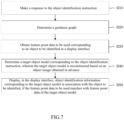
- Fig. 7 is a flowchart of a method for identifying a target object provided by Embodiment II of the present disclosure.
- a guidance graph corresponding to the object identification instruction may also be determined, and is displayed on the display interface semitransparently so that the user track the object to be identified based on the guidance graph displayed on the display interface.
- Technical terms the same as or similar to those in the above embodiment will not be described redundantly here.
- a guidance graph is determined.
- the guidance graph corresponds to the target object model.
- the guidance graph may be a pre-made semitransparent schematic view corresponding to the target object model, or may be a semitransparent view corresponding to the triggered object view to be matched. It may be construed as the trigged object view to be matched from the object list being taken as the target object view to be matched. The transparency of the target object view to be matched may be adjusted to obtain the guidance graph.
- there may be a plurality of ways of determining the guidance graph such as obtaining the target object view to be matched triggered in the object identification list; generating the guidance graph corresponding to the target object view to be matched; or fetching the pre-stored guidance graph corresponding to the target object view to be matched; and displaying the guidance graph in the display interface for a user to identify the corresponding object to be identified based on the guidance graph.
- a first way of determining the guidance graph may be as follows: when the object view to be matched in the object identification list is triggered, the transparency thereof may be adjusted to obtain the guidance graph. In the object identification process, the guidance graph may be displayed on the display interface for the user to browse.
- a second way of determining the guidance graph may be as follows: when an image is uploaded, a guidance graph corresponding to each uploaded view may be made so that the corresponding guidance graph can be fetched upon receiving the object identification instruction.
- the client may generate a semitransparent graph consistent with the cup and display the semitransparent graph in the display interface.
- a target object model corresponding to the object identification instruction is determined, where the target object model is reconstructed based on an object image obtained in advance.
- object identification information corresponding to the target object model is displayed in association with the object to be identified in the display interface if the feature point data to be used matches feature point data of the target object model.
- the target object view to be matched triggered in the object identification list may be obtained, and the corresponding guidance graph is generated based on the target object view to be matched.
- the guidance graph may be displayed on the display interface semitransparently such that the user is guided to photograph the object to be identified based on the semitransparent guidance graph.
- the object to be identified is then determined to match the target object model. The technical effect of object identification guidance is achieved.
- Fig. 8 is a flowchart of a method for identifying a target object provided by Embodiment III of the present disclosure.
- obtaining the feature point data to be used may be refined, and an implementation may be as shown in the technical solution of this embodiment.
- Technical terms the same as or similar to those in the above embodiment will not be repeatedly described here.
- a plurality of pieces of feature point data corresponding to the object to be identified are determined as the feature point data to be used, based on a feature point identification algorithm.
- an object includes a plurality of feature points.
- the client may determine the feature point data of the object to be identified based on the feature point identification algorithm upon detecting that the display interface includes the object to be identified.
- the object identification instruction is sent to a server such that the server invokes the target object model based on an object identifier in the object identification instruction and gives a feedback; or a target object model corresponding to a target object to be matched is invoked based on an object identifier in the object identification instruction.
- the established target object model may be stored on the server, or the target object model may be stored on the client.
- the object identification instruction may be sent to the server for example.
- the server parses the object identification instruction to obtain the object identifier corresponding to the instruction.
- the target object model corresponding to the object identifier is invoked from a database of the server based on the object identifier and fed back to the client. If the object model is stored on the client, the object identification instruction may be identified based on the client, and the corresponding target object model may be invoked based on the object identifier in the object identification instruction.
- a similarity between the feature point data to be used and the feature point data of the target object model may be calculated.
- a value of the similarity reaches a preset similarity threshold, and optionally reaches 95%, it indicates that the object to be identified in the display interface is consistent with the target object model.
- the object to be identified in the display interface may be variable, and the operation of feature point matching may be performed repeatedly as long as a change is detected.
- the object identification information and the object to be identified are displayed on the display interface according to a preset relative display position.
- the preset display position may be as follows: the object identification information is displayed at a top end of the object to be identified, on the left or the right of the object to be identified, or in a preset object identification information display box.
- the target object model corresponding to the object identification instruction may be invoked from the server or the client, and whether the object to be identified is consistent with the target object model may be determined based on the matching processing of the feature point data of the target object model and the feature point data of the object to be identified.
- Fig. 9 is a flowchart of a method for identifying a target object provided by Embodiment IV of the present disclosure.
- a corresponding effect may be added when the object identification information may be displayed in association with the object to be identified.
- An implementation of displaying the object identification information in association with the object to be identified may be as shown in the technical solution of this embodiment.
- Technical terms the same as or similar to those in the above embodiment will not be repeatedly described here.
- feature point data to be used corresponding to an object to be identified in a display interface is obtained in response to an object identification instruction.
- a target object model corresponding to the object identification instruction is determined, where the target object model is reconstructed based on an object image obtained in advance.
- a target effect is added for the object to be identified to obtain a target display image.
- the target effect is used to enrich the display content of the display interface.
- the target effect may be an effect edge frame added for the object to be identified, such as a photo frame, clipart, and wordart.
- the benefit of adding the target effect is that the texture of a display picture can be improved.
- the target effect "a cool summer” may be added for the object to be identified "cola bottle” such that the display interface includes the object to be identified and the target effect "a cool summer”.
- adding the target effect for the object to be identified to obtain the target display image may include: fetching a target effect consistent with an object type of the object to be identified; or obtaining a pre-triggered target effect; and displaying the target effect and the object to be identified in an overlapping manner to obtain the target display image.
- Objects may be divided into a plurality of object classes in a three-level classification way. Different target effects are set for different object classes. After matching is successful, the matched target effect may be fetched according to the object class, i.e., the object type of the object to be identified, and the target effect and the object to be identified are displayed in an overlapping manner. Alternatively, when the user triggers an effect adding control, an effect panel pops up.
- the effect panel includes a plurality of effects to be selected, and the target effect is determined according to a triggering operation for the effects to be selected.
- the target effect After the target effect is determined, the target effect, the object to be identified and the object identification information may be displayed in an overlapping manner to obtain the target display image.
- the effect panel may include a red heart effect, a rose effect, a start effect, a cartoon pattern, a historical figure effect, etc. If the user triggers the red heart effect, after the object to be identified successfully matches the target object model, the red heart effect may be overlapped on the object to be identified. The way and position of overlapping are not defined in this technical solution.
- the object identification information is displayed in association with the target display image in the display interface.
- the object identification information is placed above the target display image and displayed together in the display interface, or the object identification information is displayed in close proximity to the target display image in the display interface.
- the corresponding target effect may be added for the object to be identified.
- the effect of improving the content richness of the display interface is achieved.
- Fig. 10 is a flowchart of a method for identifying a target object provided by an embodiment of the present disclosure.
- the corresponding object view to be matched may be uploaded first, and the object model corresponding to the object view to be matched may be generated for fetching in object identification.
- An implementation may be as shown as in the technical solution of this embodiment.
- Technical terms the same as or similar to those in the above embodiment will not be repeatedly described here.
- an image to be uploaded corresponding to an object to be matched is obtained.
- Object to be matched may be different representative objects photographed by the developer in different scenes.
- the image to be uploaded refers to a captured image of the object to be matched.
- the user or the developer may select different objects in different scenes as the object to be matched in advance.
- These objects may be objects having typical features.
- the object to be matched are photographed to obtain captured images as the images to be uploaded.
- objects such as a cup, a desk, a figurine are photographed to obtain the images to be uploaded.
- the image to be uploaded is uploaded to a server such that the server generates a three-dimensional model or an AR virtual model based on the image to be uploaded.
- the image may be sent to the server in a network communication way.
- the server processes the image to be uploaded by a special image processing technique, such as cropping, segmenting, encoding, and enhancing, thereby generating the three-dimensional model or the AR virtual model of the image to be uploaded. If the three-dimensional model needs to be generated, the images of the object to be matched at different angles are uploaded to the server, and the server generates the three-dimensional model based on the images of the object to be identified at different angles. If the AR virtual model needs to be generated, the AR virtual model can be reconstructed by uploading only one image of the object to be matched.
- the three-dimensional model or the AR virtual model is taken as an object model to be matched to invoke a corresponding target object model from a plurality of object models to be matched in response to the object identification instruction.
- the generated three-dimensional model or the AR virtual model corresponding to each object to be matched is taken as the object model to be matched and stored on the server or the client.
- An object model is selected from the object model to be matched as the target object model according to the object identification instruction.
- object identification information corresponding to the object to be matched in an edit control is obtained, to display, in the display interface, the object identification information corresponding to the target object model in association with the object to be identified, upon determining that the object to be identified matches the target object model.
- the user may edit corresponding text information in the edit control. After a view of the object to be matched is captured, a text corresponding to the view is edited as the object identification information.
- the object identification information may be the information of the object itself, such as name information.
- the object identification information may also be a sentence edited according to a capturing situation, and the sentence is literary or is scene-based to a certain extent.
- the edit control may be triggered to input text information related to the scene or the feature of the object to be matched.
- the text information may be the name of the object, or the scene information of the object, or the thinking and feeling of the user.
- the text information is also taken as the object identification information, and the image to be uploaded and the object identification information are uploaded to the server simultaneously.
- the object identification information may be displayed to achieve the effect of scene reproduction.
- the object identification list is updated based on the image to be uploaded and the corresponding object identification information, and the image to be uploaded is taken as the object view to be matched.
- the object identification list may be updated based on the image to be uploaded.
- the image updated to the object identification list is taken as the object view to be matched.
- the object identification information is stored correspondingly to the object view to be matched.
- the captured object image may be uploaded to the server such that the server reconstructs the object model corresponding to the object image; meanwhile, before the object image is uploaded to the server, the object identification information of the object image may be edited.
- the object identification information and the object view to be matched are correspondingly displayed in the object identification list, and the corresponding object model and the guidance graph may be invoked in response to the object identification instruction.
- Fig. 11 is a structural block diagram of a target object identification apparatus provided by Embodiment VI of the present disclosure.
- the apparatus may perform the method for identifying a target object provided in any embodiment of the present disclosure and has corresponding functional modules for performing the method and corresponding effects.
- the apparatus includes a feature point data obtaining module 610, a target object model determination module 620, and an object to be identified display module 630.
- the feature point data obtaining module 610 is configured to obtain feature point data to be used corresponding to an object to be identified in a display interface in response to an object identification instruction; the target object model determination module 620 is configured to determine a target object model corresponding to the object identification instruction, where the target object model is reconstructed based on an object image obtained in advance; and the object to be identified display module 630 is configured to display object identification information corresponding to the target object model in association with the object to be identified in the display interface if the feature point data to be used matches feature point data of the target object model.
- a way of generating the object identification instruction includes at least one of:
- an object identification control is triggered; detecting that the display interface includes the object to be identified; detecting that a capturing control is triggered; and detecting that an object view to be matched in an object identification list is triggered, where the object identification list is generated based on a plurality of object views to be matched that are captured in advance.
- the feature point data obtaining module 610 includes:
- the feature point data obtaining module 610 includes: a feature point data identification sub-module configured to, upon detecting that the display interface includes the object to be identified, determine, based on a feature point identification algorithm, a plurality of pieces of feature point data corresponding to the object to be identified as the feature point data to be used.
- the target object model determination module 620 includes:
- the object to be identified display module 630 includes:
- the object to be identified display module 630 includes:
- the target effect adding sub-module includes:
- the apparatus further includes:
- the apparatus further includes: an object identification information editing module configured to obtain object identification information corresponding to the object to be matched in an edit control to display the object identification information corresponding to the target object model in association with the object to be identified in the display interface upon determining that the object to be identified matches the target object model.
- an object identification information editing module configured to obtain object identification information corresponding to the object to be matched in an edit control to display the object identification information corresponding to the target object model in association with the object to be identified in the display interface upon determining that the object to be identified matches the target object model.
- the apparatus further includes: an object identification list updating module configured to update the object identification list based on the image to be uploaded and the corresponding object identification information, and take the image to be uploaded as the object view to be matched.
- the feature point data of the object to be identified on the display interface may be obtained in real time, and the target object model corresponding to the object identification instruction is invoked. If the feature point data is consistent with the feature point data of the target object model, the object identification information is displayed in association with the object to be identified. It is realized that the object is effectively identified and the object identification information is shown in association with the object to be identified, and the technical effect of improving the effectiveness and relevance of object identification is achieved.
- the target object identification apparatus provided in the embodiment of the present disclosure may perform the method for identifying a target object provided in any embodiment of the present disclosure and has corresponding functional modules for performing the method and corresponding effects.
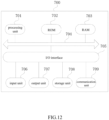
- Fig. 12 is a structural schematic diagram of an electronic device provided by Embodiment VII of the present disclosure.
- the terminal device in this embodiment of the present disclosure may include, but is not limited to, mobile terminals such as a mobile phone, a notebook computer, a digital broadcasting receiver, a personal digital assistant (PDA), a portable Android device (PAD), a portable media player (PMP), and a vehicle-mounted terminal (e.g., a vehicle-mounted navigation terminal), and fixed terminals such as a digital television (TV) and a desktop computer.
- PDA personal digital assistant
- PAD portable Android device
- PMP portable media player
- vehicle-mounted terminal e.g., a vehicle-mounted navigation terminal
- TV digital television
- desktop computer a digital television
- the electronic device shown in Fig. 12 is merely an example, and should not impose any limitation to the functions and the range of use of the embodiments of the present disclosure.
- the electronic device 700 may include a processing unit (e.g., a central processing unit, or a graphics processing unit) 701, which can perform various suitable actions and processing according to a program stored on a read-only memory (ROM) 702 or a program loaded from a storage unit 708 into a random-access memory (RAM) 703.
- the RAM 703 further stores various programs and data required for operations of the electronic device 700.
- the processing unit 701, the ROM 702, and the RAM 703 are interconnected by means of a bus 704.
- An input/output (I/O) interface 705 is also connected to the bus 704.
- the following apparatuses may be connected to the I/O interface 705: an input unit 706 including, for example, a touch screen, a touch pad, a keyboard, a mouse, a camera, a microphone, an accelerometer, and a gyroscope; an output unit 707 including, for example, a liquid crystal display (LCD), a loudspeaker, and a vibrator; a storage unit 708 including, for example, a magnetic tape and a hard disk; and a communication unit 709.
- the communication unit 709 may allow the electronic device 700 to be in wireless or wired communication with other devices to exchange data. While Fig. 12 illustrates the electronic device 700 having various apparatuses, it is to be understood that all the illustrated apparatuses are not necessarily implemented or included. More or less apparatuses may be implemented or included alternatively.
- an embodiment of the present disclosure includes computer-executable Instructions, which include a computer program carried by a non-transitory computer-readable medium.
- the computer program includes a program code for performing the method shown in the flowchart.
- the computer program may be downloaded online through the communication unit 709 and installed, or installed from the storage unit 708, or installed from the ROM 702.
- the processing unit 701 the functions defined in the method of the embodiments of the present disclosure are executed.
- the electronic device provided in this embodiment of the present disclosure and the method for identifying a target object provided in the foregoing embodiments belong to the same inventive concept.
- An embodiment of the present disclosure provides a storage medium for computer-executable instructions.
- the storage medium stores computer-executable instructions which, when executed by a processor, cause implementing the method for identifying a target object provided by the foregoing embodiment.
- the storage medium for computer-executable instructions described above in the present disclosure may be a computer-readable signal medium or a computer-readable storage medium or any combination of both.
- the computer readable storage medium may be, for example, but not limited to, electrical, magnetic, optical, electromagnetic, infrared, or semiconductor systems, apparatuses, or devices, or any combination thereof.
- Examples of the computer-readable storage medium may include, but be not limited to, an electrical connection with at least one wire, a portable computer disk, a hard disk, a random-access memory (RAM), a read-only memory (ROM), an erasable programmable read-only memory (EPROM), a flash memory, an optical fiber, a compact disk read-only memory (CD-ROM), an optical storage device, a magnetic storage device, or any appropriate combination thereof.
- the storage medium for computer-executable instructions may be any tangible medium that contains or stores a program, and the program may be used by or used in combination with an instruction execution system, apparatus, or device.
- the storage medium for computer-executable instructions may include a data signal propagated in a baseband or as a part of a carrier, and computer readable program code is carried therein.
- the propagated data signal may be in various forms, including but not limited to an electromagnetic signal, an optical signal, or any suitable combination thereof.
- the storage medium for computer-executable instructions may also be any computer readable medium except the computer readable medium.
- the storage medium for computer-executable instructions may send, propagate or transmit a program used by or used in combination with an instruction execution system, apparatus or device.
- the program code included on the storage medium for computer-executable instructions may be transmitted by using any suitable medium, including but not limited to an electric wire, a fiber-optic cable, radio frequency (RF) and the like, or any appropriate combination thereof.
- RF radio frequency
- a client and a server may communicate by means of any network protocol currently known or to be developed in future such as HyperText Transfer Protocol (HTTP), and may achieve communication and interconnection with digital data (e.g., a communication network) in any form or of any medium.
- HTTP HyperText Transfer Protocol
- Examples of the communication network include a local area network (LAN), a wide area network (WAN), an internet work (e.g., the Internet), a peer-to-peer network (e.g., ad hoc peer-to-peer network), and any network currently known or to be developed in future.
- the above-mentioned storage medium for computer-executable instructions may be included in the electronic device described above, or may exist alone without being assembled with the electronic device.
- the above-mentioned storage medium for computer-executable instructions may carry at least one program which, when executed by the electronic device, causes the electronic device to:
- a computer program code for performing the operations in the present disclosure may be written in at least one programming language or a combination thereof.
- the programming languages include but are not limited to object-oriented programming languages, such as Java, Smalltalk, and C++, and conventional procedural programming languages, such as C or similar programming languages.
- the program code may be executed fully on a user computer, executed partially on a user computer, executed as an independent software package, executed partially on a user computer and partially on a remote computer, or executed fully on a remote computer or a server.
- the remote computer may be connected to a user computer via any type of network, including a local area network (LAN) or a wide area network (WAN), or may be connected to an external computer (for example, connected via the Internet by using an Internet service provider).
- LAN local area network
- WAN wide area network
- an Internet service provider for example, connected via the Internet by using an Internet service provider.
- each block in the block diagram or flowchart and the combination of the blocks in the block diagram or the flowchart may be implemented by a dedicated hardware-based system that performs a defined function or operation, or may be implemented by a combination of dedicated hardware and computer instructions.
- a unit may be implemented by software, or may be implemented by hardware.
- the name of a unit does not constitute a limitation on the unit itself in a particular case.
- a first obtaining unit may also be described as "a unit for obtaining at least two Internet protocol addresses".
- exemplary types of hardware logic components that can be used without limitations include a field programmable gate array (FPGA), an application specific integrated circuit (ASIC), an application specific standard product (ASSP), a system on chip (SOC), a complex programmable logic device (CPLD), and the like.
- FPGA field programmable gate array
- ASIC application specific integrated circuit
- ASSP application specific standard product
- SOC system on chip
- CPLD complex programmable logic device
- the machine-readable medium may be a tangible medium that may contain or store a program used by or used in combination with an instruction execution system, apparatus or device.
- the machine-readable medium may be a machine-readable signal medium or a machine-readable storage medium.
- the machine-readable medium may include but be not limited to an electronic, magnetic, optical, electromagnetic, infrared, or semiconductor system, apparatus or device, or any appropriate combination thereof.
- Examples of the machine-readable storage medium include: an electrical connection based on at least one wire, a portable computer disk, a hard disk, a RAM, a ROM, an erasable programmable ROM (an EPROM), a flash memory, an optical fiber, a portable compact disc read-only memory (CD-ROM), an optical storage device, a magnetic storage device, or any suitable combination thereof.
- Example 1 provides a method for identifying a target object, including:
- Example 2 provides a method for identifying a target object, further including: a way of generating the object identification instruction including at least one of:
- Example 3 provides a method for identifying a target object, further including:
- Example 4 provides a method for identifying a target object, further including:
- Example 5 provides a method for identifying a target object, further including:
- Example 6 provides a method for identifying a target object, further including:
- Example 7 provides a method for identifying a target object, further including:
- Example 8 provides a method for identifying a target object, further including:
- Example 9 provides a method for identifying a target object, further including:
- Example 10 provides a method for identifying a target object, further including:
- Example 11 provides a method for identifying a target object, further including: optionally, updating the object identification list based on the image to be uploaded and the corresponding object identification information, and taking the image to be uploaded as the object view to be matched.
- Example 12 provides an apparatus for identifying a target object, further including:
Landscapes
- Engineering & Computer Science (AREA)
- Physics & Mathematics (AREA)
- Theoretical Computer Science (AREA)
- General Physics & Mathematics (AREA)
- Software Systems (AREA)
- Computer Graphics (AREA)
- Multimedia (AREA)
- Computer Hardware Design (AREA)
- General Engineering & Computer Science (AREA)
- Computer Vision & Pattern Recognition (AREA)
- Geometry (AREA)
- Health & Medical Sciences (AREA)
- Computing Systems (AREA)
- Databases & Information Systems (AREA)
- Evolutionary Computation (AREA)
- General Health & Medical Sciences (AREA)
- Medical Informatics (AREA)
- Artificial Intelligence (AREA)
- User Interface Of Digital Computer (AREA)
- Stored Programmes (AREA)
Applications Claiming Priority (2)
| Application Number | Priority Date | Filing Date | Title |
|---|---|---|---|
| CN202210306779.4A CN116863359A (zh) | 2022-03-25 | 2022-03-25 | 目标物体的识别方法、装置、电子设备及存储介质 |
| PCT/SG2023/050169 WO2023182932A2 (zh) | 2022-03-25 | 2023-03-16 | 目标物体的识别方法、装置、电子设备及存储介质 |
Publications (2)
| Publication Number | Publication Date |
|---|---|
| EP4485370A2 true EP4485370A2 (de) | 2025-01-01 |
| EP4485370A4 EP4485370A4 (de) | 2025-05-07 |
Family
ID=88102243
Family Applications (1)
| Application Number | Title | Priority Date | Filing Date |
|---|---|---|---|
| EP23775397.5A Pending EP4485370A4 (de) | 2022-03-25 | 2023-03-16 | Zielobjektidentifizierungsverfahren und -vorrichtung, elektronische vorrichtung und speichermedium |
Country Status (4)
| Country | Link |
|---|---|
| US (1) | US20250342691A1 (de) |
| EP (1) | EP4485370A4 (de) |
| CN (1) | CN116863359A (de) |
| WO (1) | WO2023182932A2 (de) |
Family Cites Families (8)
| Publication number | Priority date | Publication date | Assignee | Title |
|---|---|---|---|---|
| CN106097454A (zh) * | 2016-06-06 | 2016-11-09 | 成都天福创造机器人有限公司 | 一种人机交互系统及交互方法 |
| CN106097425A (zh) * | 2016-06-07 | 2016-11-09 | 天津天大求实电力新技术股份有限公司 | 基于增强现实技术的电力设备信息提取与展示方法及系统 |
| CN106713840B (zh) * | 2016-06-28 | 2018-09-04 | 腾讯科技(深圳)有限公司 | 虚拟信息显示方法及装置 |
| CN109062523B (zh) * | 2018-06-14 | 2021-09-24 | 北京三快在线科技有限公司 | 增强现实数据的展示方法、装置、电子设备及存储介质 |
| CN109344923A (zh) * | 2018-08-27 | 2019-02-15 | 百度在线网络技术(北京)有限公司 | 关联物体的显示方法、装置及电子设备 |
| CN110472480A (zh) * | 2019-06-28 | 2019-11-19 | 深圳数马电子技术有限公司 | 物品识别方法、装置及计算机可读存储介质 |
| US11776253B2 (en) * | 2020-03-27 | 2023-10-03 | Snap Inc. | Displaying object names in association with augmented reality content |
| CN113763568A (zh) * | 2021-05-07 | 2021-12-07 | 腾讯科技(深圳)有限公司 | 增强现实的显示处理方法、装置、设备及存储介质 |
-
2022
- 2022-03-25 CN CN202210306779.4A patent/CN116863359A/zh active Pending
-
2023
- 2023-03-16 WO PCT/SG2023/050169 patent/WO2023182932A2/zh not_active Ceased
- 2023-03-16 US US18/851,002 patent/US20250342691A1/en active Pending
- 2023-03-16 EP EP23775397.5A patent/EP4485370A4/de active Pending
Also Published As
| Publication number | Publication date |
|---|---|
| CN116863359A (zh) | 2023-10-10 |
| WO2023182932A2 (zh) | 2023-09-28 |
| EP4485370A4 (de) | 2025-05-07 |
| WO2023182932A3 (zh) | 2023-11-30 |
| US20250342691A1 (en) | 2025-11-06 |
Similar Documents
| Publication | Publication Date | Title |
|---|---|---|
| US20230291980A1 (en) | Method and apparatus for video generation and displaying, device, and medium | |
| US20250209760A1 (en) | Special effect video determination method and apparatus, electronic device and storage medium | |
| CN111399729A (zh) | 图像的绘制方法、装置、可读介质和电子设备 | |
| US12511027B2 (en) | Effect processing method, apparatus, electronic device, and storage medium | |
| US11792494B1 (en) | Processing method and apparatus, electronic device and medium | |
| EP4270186B1 (de) | Bildanzeigeverfahren und -vorrichtung, vorrichtung und medium | |
| US12368815B2 (en) | Video shooting method and apparatus, electronic device and storage medium | |
| CN116264603B (zh) | 直播信息处理方法、装置、设备和存储介质 | |
| CN113190307A (zh) | 控件添加方法、装置、设备及存储介质 | |
| US12271415B2 (en) | Method, apparatus, device, readable storage medium and product for media content processing | |
| US20240386640A1 (en) | Method, apparatus, device and storage medium for generating character style profile image | |
| CN113655933A (zh) | 文本标注方法及装置、存储介质及电子设备 | |
| CN115334367A (zh) | 视频的摘要信息生成方法、装置、服务器以及存储介质 | |
| US20260011058A1 (en) | Image processing method, and device | |
| US20250371877A1 (en) | Video processing method, and electronic device | |
| JP2023538825A (ja) | ピクチャのビデオへの変換の方法、装置、機器および記憶媒体 | |
| US20250068314A1 (en) | Picture sharing method and electronic device | |
| US20250259281A1 (en) | Target element generation method and apparatus, electronic device, and storage medium | |
| WO2023098576A1 (zh) | 图像处理方法、装置、设备及介质 | |
| EP4170588B1 (de) | Videofotografieverfahren und -vorrichtung sowie vorrichtung und speichermedium | |
| CN110377842A (zh) | 语音评论显示方法、系统、介质和电子设备 | |
| EP4485370A2 (de) | Zielobjektidentifizierungsverfahren und -vorrichtung, elektronische vorrichtung und speichermedium | |
| CN119815145A (zh) | 视频生成方法、装置、设备、介质以及产品 | |
| JP2025534478A (ja) | 画像をプレビューする方法、装置、電子機器、及び記憶媒体 | |
| CN114003738B (zh) | 数据处理方法、装置、智能相机、电子设备和存储介质 |
Legal Events
| Date | Code | Title | Description |
|---|---|---|---|
| STAA | Information on the status of an ep patent application or granted ep patent |
Free format text: STATUS: THE INTERNATIONAL PUBLICATION HAS BEEN MADE |
|
| PUAI | Public reference made under article 153(3) epc to a published international application that has entered the european phase |
Free format text: ORIGINAL CODE: 0009012 |
|
| STAA | Information on the status of an ep patent application or granted ep patent |
Free format text: STATUS: REQUEST FOR EXAMINATION WAS MADE |
|
| 17P | Request for examination filed |
Effective date: 20240924 |
|
| AK | Designated contracting states |
Kind code of ref document: A2 Designated state(s): AL AT BE BG CH CY CZ DE DK EE ES FI FR GB GR HR HU IE IS IT LI LT LU LV MC ME MK MT NL NO PL PT RO RS SE SI SK SM TR |
|
| A4 | Supplementary search report drawn up and despatched |
Effective date: 20250403 |
|
| RIC1 | Information provided on ipc code assigned before grant |
Ipc: G06F 18/213 20230101ALI20250328BHEP Ipc: G06T 19/00 20110101ALI20250328BHEP Ipc: G06V 20/20 20220101ALI20250328BHEP Ipc: G06V 10/40 20220101AFI20250328BHEP |
|
| DAV | Request for validation of the european patent (deleted) | ||
| DAX | Request for extension of the european patent (deleted) | ||
| STAA | Information on the status of an ep patent application or granted ep patent |
Free format text: STATUS: EXAMINATION IS IN PROGRESS |
|
| 17Q | First examination report despatched |
Effective date: 20251104 |