EP4485286A1 - Föderiertes lernen für auf intelligentem kopf getragene vorrichtungen - Google Patents
Föderiertes lernen für auf intelligentem kopf getragene vorrichtungen Download PDFInfo
- Publication number
- EP4485286A1 EP4485286A1 EP24177564.2A EP24177564A EP4485286A1 EP 4485286 A1 EP4485286 A1 EP 4485286A1 EP 24177564 A EP24177564 A EP 24177564A EP 4485286 A1 EP4485286 A1 EP 4485286A1
- Authority
- EP
- European Patent Office
- Prior art keywords
- neural network
- head
- worn device
- data
- wearer
- Prior art date
- Legal status (The legal status is an assumption and is not a legal conclusion. Google has not performed a legal analysis and makes no representation as to the accuracy of the status listed.)
- Pending
Links
Images

Classifications
-
- G—PHYSICS
- G06—COMPUTING OR CALCULATING; COUNTING
- G06N—COMPUTING ARRANGEMENTS BASED ON SPECIFIC COMPUTATIONAL MODELS
- G06N3/00—Computing arrangements based on biological models
- G06N3/02—Neural networks
- G06N3/08—Learning methods
- G06N3/098—Distributed learning, e.g. federated learning
-
- G—PHYSICS
- G02—OPTICS
- G02B—OPTICAL ELEMENTS, SYSTEMS OR APPARATUS
- G02B27/00—Optical systems or apparatus not provided for by any of the groups G02B1/00 - G02B26/00, G02B30/00
- G02B27/01—Head-up displays
- G02B27/017—Head mounted
- G02B27/0172—Head mounted characterised by optical features
-
- G—PHYSICS
- G06—COMPUTING OR CALCULATING; COUNTING
- G06F—ELECTRIC DIGITAL DATA PROCESSING
- G06F21/00—Security arrangements for protecting computers, components thereof, programs or data against unauthorised activity
- G06F21/60—Protecting data
- G06F21/62—Protecting access to data via a platform, e.g. using keys or access control rules
- G06F21/6218—Protecting access to data via a platform, e.g. using keys or access control rules to a system of files or objects, e.g. local or distributed file system or database
- G06F21/6245—Protecting personal data, e.g. for financial or medical purposes
-
- G—PHYSICS
- G06—COMPUTING OR CALCULATING; COUNTING
- G06F—ELECTRIC DIGITAL DATA PROCESSING
- G06F3/00—Input arrangements for transferring data to be processed into a form capable of being handled by the computer; Output arrangements for transferring data from processing unit to output unit, e.g. interface arrangements
- G06F3/01—Input arrangements or combined input and output arrangements for interaction between user and computer
- G06F3/011—Arrangements for interaction with the human body, e.g. for user immersion in virtual reality
-
- G—PHYSICS
- G06—COMPUTING OR CALCULATING; COUNTING
- G06F—ELECTRIC DIGITAL DATA PROCESSING
- G06F3/00—Input arrangements for transferring data to be processed into a form capable of being handled by the computer; Output arrangements for transferring data from processing unit to output unit, e.g. interface arrangements
- G06F3/01—Input arrangements or combined input and output arrangements for interaction between user and computer
- G06F3/017—Gesture based interaction, e.g. based on a set of recognized hand gestures
-
- G—PHYSICS
- G06—COMPUTING OR CALCULATING; COUNTING
- G06N—COMPUTING ARRANGEMENTS BASED ON SPECIFIC COMPUTATIONAL MODELS
- G06N3/00—Computing arrangements based on biological models
- G06N3/02—Neural networks
- G06N3/04—Architecture, e.g. interconnection topology
- G06N3/045—Combinations of networks
-
- G—PHYSICS
- G02—OPTICS
- G02B—OPTICAL ELEMENTS, SYSTEMS OR APPARATUS
- G02B27/00—Optical systems or apparatus not provided for by any of the groups G02B1/00 - G02B26/00, G02B30/00
- G02B27/01—Head-up displays
- G02B27/0101—Head-up displays characterised by optical features
- G02B2027/0141—Head-up displays characterised by optical features characterised by the informative content of the display
-
- G—PHYSICS
- G06—COMPUTING OR CALCULATING; COUNTING
- G06N—COMPUTING ARRANGEMENTS BASED ON SPECIFIC COMPUTATIONAL MODELS
- G06N3/00—Computing arrangements based on biological models
- G06N3/02—Neural networks
- G06N3/08—Learning methods
- G06N3/09—Supervised learning
Definitions
- the present invention generally relates to smart head-worn devices and, more particularly, to a communication system, to a head-worn device, to a method for controlling a head-worn device and to a corresponding non-transitory computer-readable storage medium.
- Smart eyewear has evolved to include various active functions designed to enhance wearer comfort, visual acuity, and usability. These active functions can be personalized based on wearer's interactions and preferences, providing a unique, customized user experience. To achieve this, the eyewear often requires substantial data collection, processing, and storage capabilities, which can pose challenges given the resource constraints inherent in wearable devices.
- data from the eyewear is transferred to a smartphone, and then further to a cloud server for processing.
- the processed data often in the form of an updated algorithm or model, is then sent back to the eyewear.
- This approach has several limitations. It requires substantial energy and memory resources, not only for the eyewear and smartphone but also for cloud storage and processing. Moreover, bandwidth limitations can pose challenges for transferring raw data to the cloud, and concerns over data privacy arise from the need to store raw data in the cloud.
- the present disclosure aims at improving the situation.
- the distinct aspects outlined in this disclosure collectively contribute to effectively managing one or more active functionalities of a smart head-worn device based on wearer interactions and/or preferences, thereby addressing the drawbacks associated with conventional approaches.
- Each of these aspects plays a key role in the personalization of active functions tailored to the wearer, while further offering a capacity for generalization across a population of wearers.
- these aspects help to minimize the necessary energy, memory, and data storage resources, reducing the demand for extensive raw data transfers.
- the implementation of these aspects effectively addresses concerns over data privacy.
- a communication system for a head-worn device having an active function comprising:
- the information gathered by the input module ensure a comprehensive understanding of the wearer's needs and preferences.
- the local neural network enables precise control of the active function of the head-worn device.
- the local neural network allows optimizing the functionality of the head-worn device according to the wearer's needs and preferences. Additionally, the local neural network may leverage the information gathered by the input module to proactively anticipate the wearer's needs. For example, the local neural network may dynamically optimize the tint intensity based on changing lighting conditions or proactively adjust the optical power to alleviate visual strain.
- the collective intelligence accumulated by the federated learning process can be leveraged to refine the active function of the head-worn device and provide tailored solutions for specific scenarios. Whether it's adapting to new lighting environments, optimizing for different visual tasks, or addressing specific wearer requirements, the ability to learn and evolve through federated learning ensures the relevance and effectiveness of the communication system in diverse situations.
- a signal from the local neural network encapsulates a set of N local weights, N>1, representing a relationship between training data and their respective labels, wherein the training data are information gathered by the input module and the labels correspond to various states of the active function.
- specific wearer characteristics or preferences may be derived from the training data gathered by the input module and may be reflected by the set of local weights. For this reason, the utilization of the local weights may enable a personalized control of the active function, allowing for a more customized and tailored user experience.
- the set of local weights represents the relationship between training data and their respective labels. Therefore, by encapsulating this relationship in a single signal, the communication system optimizes communication efficiency and reduces overall data transmission requirements.
- a signal from the global neural network encapsulates M global weights, N>M ⁇ 1, and each received global weight is utilized to replace a corresponding weight of the set of local weights.
- this weight replacement mechanism since the number M of global weights encapsulated in the signal from the global neural network is less than the number N of local weights, only a subset of local weights are replaced, leaving others intact.
- This selective replacement offers significant advantages. For instance, it allows the head-worn device to retain local weights that reflect personalized wearer preferences or unique characteristics that are not common or necessary on a global scale. Consequently, it helps to maintain the personalized user experience offered by the device, while integrating enhancements learned from the global network. Moreover, this mechanism allows for gradual adoption of global improvements, providing a smoother transition from locally learned behavior to globally learned behavior. This can be particularly useful in eyewear applications where sudden changes in the active function, like automatic adjustment of optical power or tint intensity, may cause discomfort or confusion for the wearer.
- the present disclosure also describes a head-worn device having an active function and comprising:
- the input module comprises a human-machine interface adapted to receive wearer inputs from the wearer of the head-worn device.
- the human-machine interface allows the wearer to provide inputs directly, enabling intuitive and user-friendly control of the head-worn device. This enhances the overall user experience and simplifies the interaction between the wearer and the device.
- the inputs may include wearer-specific data such as age, gender, laterality, preferences related to transmission intensity, optical power adjustment levels, or desired defocus settings.
- the inputs may also enable the wearer to voluntarily control the active function. This voluntary modification of the active function by the wearer can be interpreted as a means of expressing their satisfaction or dissatisfaction.
- the local neural network can fine-tune the active function to provide a personalized and optimized visual experience. This level of customization ensures that the device adapts to the wearer's unique characteristics and visual requirements, leading to increased wearer satisfaction and comfort.
- the input module comprises a sensing module adapted to sense:
- Posture data may refer to head orientation data.
- the device can dynamically adjust its active function to provide optimal performance during different activities. Whether the wearer is engaged in sports, working at a computer, or simply relaxing, the head-worn device can adapt its functionality to enhance visual comfort and support the wearer's specific needs in each situation.
- the head-worn device can intelligently optimize its active function to provide the best visual experience in various environments. This ensures that wearers receive optimal visual clarity and comfort in situations with bright lighting or varying distances.
- the head-worn device comprises an optical lens and the active function is an optical function of the optical lens.
- the optical function is a transmission function, an optical power function or a defocus function.
- the transmission function may be a tint function.
- the active function becomes directly related to the optical properties of the lens. This integration allows for precise control and optimization of the optical function, enhancing the wearer's visual experience. Whether it's adjusting tint intensity for different lighting conditions, modifying optical power for personalized visual correction, or enabling defocus functionality for specific tasks, the device becomes a comprehensive solution for addressing various optical needs.
- the head-worn device comprises a screen and the active function is a function of the screen.
- the screen may be a light field display.
- the function of the screen may be to magnify some features displayed on the screen such as a font, a luminosity or a color...
- the function of the screen may be also to move a displayed picture within the headset, such as seen in various types of head-worn devices implementing augmented reality, virtual reality, mixed reality or extended reality technologies.
- the present disclosure also describes a method for controlling a head-worn device having an active function, the method comprising:
- the present disclosure also describes a computer-readable storage medium, optionally a non-transitory computer-readable storage medium, having stored thereon a computer program comprising instructions which, when executed by a processor, cause the processor to carry out the method hereby described.
- the storage medium may include hard drives, solid-state drives, CDs, USB drives, etc. In this context, it is being used to refer to whatever medium is storing the computer program that runs the method.
- the present disclosure also describes a computer program comprising instructions that are accessible to a processor and which, when executed by the processor, cause the processor to carry out the method hereby described.
- the present disclosure also describes a device equipped with a processor operably connected to a memory and to a communication interface, the device being configured to carry out any of the methods hereby described.
- the present disclosure also describes a communication interface configured for transmitting and receiving signals between a local neural network module and a global neural network module, wherein:
- a signal from the local neural network module encapsulates a set of N local weights, N>1, representing a relationship between training data and their respective labels, wherein the training data are information gathered by the input module and the labels correspond to various states of the active function.
- a signal from the global neural network module encapsulates M global weights, N>M ⁇ 1, and each received global weight is utilized to replace a corresponding weight of the set of local weights.
- the federated learning process is a personalized federated learning process defined by:
- the present disclosure also describes a head-worn device comprising an optical lens having an optical function which is an active function, the head-worn device comprising:
- the input module comprises a human-machine interface adapted to receive wearer inputs from the wearer of the head-worn device.
- the input module comprises a sensing module adapted to sense:
- the optical function is a transmission function, an optical power function or a defocus function.
- the present disclosure also describes a computer-implemented method for controlling a head-worn device comprising an optical lens having an optical function which is an active function, the method comprising:
- the present disclosure also describes a non-transitory computer-readable storage medium having stored thereon a computer program comprising instructions which, when executed by a processor, cause the processor to carry out the above computer-implemented method.
- the present disclosure is focused on methods and systems that contribute in enabling adaptive, intelligent control of active functions in head-worn devices through personalized machine learning models.
- the main elements disclosed therein relate to a head-worn device, a controller, an input module, local and global neural networks and communication interfaces between the two networks.
- the input module collects relevant data from the wearer's interactions and environment, while the local neural network employs this data to build a local model and generate instructions for the controller to control one or more active functions of the device.
- the local network participates in a federated learning process with the global neural network, allowing both neural networks to refine and update their respective models.
- Federated learning is a machine learning approach where a model is trained across multiple decentralized devices or servers holding local data samples, without exchanging them. This approach maintains data privacy and reduces the need for data centralization.
- the elements of the present disclosure have broad applicability to various types of head-worn devices. For example, they can be used to automatically adjust the tint of eyewear based on lighting conditions, fine-tune the focus for near vision tasks, or manage myopia control in children's eyewear.
- the present disclosure has the potential to greatly enhance user experience across a range of applications in the wearable technology sector.
- Figure 1 provides a general overview of a system designed to control an active function of a head-worn device, in an exemplary embodiment.
- the head-worn device may be any device that is worn on the head. In the context of the present disclosure, this could include but not be limited to, eyeglasses, headsets, helmets, virtual reality devices, augmented reality devices, and so on.
- the head-worn device may comprise one or more optical lenses.
- An optical lens is a piece of transparent substance with curved sides for concentrating or dispersing light.
- the active function may be any dynamically modifiable aspect of the head-worn device. This could include an optical function such as adjusting the tint or focus of eyeglasses, the volume or sound balance of a headset, or the display settings of a VR or AR device, to name just a few examples.
- the system comprises an input module (110) which may include various input sources, such as sensors or human machine interfaces.
- a sensor is a device or part of a device that is able to detect and respond to some type of input from the physical environment.
- the sensors may include ambient light sensors for light condition analysis, proximity sensors for nearby object detection, accelerometers to measure direction and speed of head movement, eye trackers, in particular infrared eye trackers, to identify gazing direction, time of flight sensors to sense gazing distance, cameras to capture images of the wearer or of the environment, etc.
- a human machine interface is a device or software that allows humans to interact with machines.
- human machine interfaces may be adapted to receive for instance tactile inputs or auditory inputs such as voice commands.
- Other examples of suitable human machine interfaces include gesture recognition systems and graphical user interfaces on connected devices.
- Some human-machine interfaces may allow, for instance, providing declarative data about the wearer, such as their age, gender, laterality, facial features, prescription, etc. or retrieving compiled data on the frame of the head-worn device, termed "frame boxing data", all of which may be provided as inputs to the system.
- Some of the input sources listed above may be incorporated into the head-worn device while others may be provided on connected devices for user input.
- the system further comprises a local neural network module (120) with an input interface (122) designed to accommodate the diverse range of inputs from the input module. It also has an output interface (126) responsible for sending instructions to a controller (140) that manages one or more active functions of the head-worn device.
- the local network module can take various forms, such as a dedicated processing circuit built directly into the head-worn device or even integrated into another device used by the wearer, like a smartphone or a tablet.
- the system features a global neural network module (130) which may communicate via a communication link with the local neural network module.
- This communication link is symbolically represented by a pair of communication interfaces (124, 132).
- the global neural network module may be hosted in a remote server or as an application in a cloud-based environment. It may be configured to communicate with other data sources (150), like other local neural networks, cloud databases storing anonymized data from multiple wearers or external APIs providing real-time data on weather.
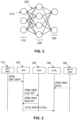
- Figure 2 provides a general structure of an artificial neural network, in an exemplary embodiment.
- This general structure is applicable both to the local neural network and to the global neural network. It is a simplified representation, aiming to convey the key elements of the network structure, rather than an accurate depiction of the network's complexity in real-world applications.
- the illustrated artificial neural network comprises multiple layers of neurons. At the ends, there's an input layer (210) and an output layer (250), with one or more hidden layers (230) sandwiched between them. Each of these layers hosts several neurons (212), interconnected with every neuron in the adjacent layer. These interconnections are referred to as "weights”.
- An artificial neural network is generally used to create and adjust models.
- a training phase involves providing labelled training data as inputs to the input layer.
- the "training data” refers to the raw data that the model learns from
- the "labels” refer to the corresponding outcomes or classes that the model is trained to "predict”.
- the weights are numerical parameters in the neural network that are adjusted during the training phase to improve the predictions output by the output layer.
- the artificial neural network enters production phase, to receive as inputs raw data that is not necessarily labelled and to output corresponding predictions.
- Figure 2 only displays a few layers and a handful of neurons.
- neural networks incorporate significantly more layers, densely populated with a vast number of interconnected neurons, creating a myriad of weights or connections that extend far beyond what is feasibly representable in a single diagram.
- the term "local weight” refers to a connection between two neurons within the local neural network
- a “global weight” analogously refers to a connection within the global neural network.
- there's a one-to-one correspondence between local and global weights implying that the structure of the local neural network (including the number of layers, the number of neurons within each layer, and the function of each neuron) mirrors that of the global neural network.
- this one-to-one correspondence isn't strictly necessary for the operation of the system, as long as the local and global networks share a compatible structure that allows the mapping or transformation of global weights into the local network context.
- Figure 3 provides a communication scheme between the elements represented on Figure 1 , in an exemplary embodiment.
- the head-worn device is worn by the wearer, and that relevant data has previously been collected by the input module (110) as a result of interactions with the human-machine interfaces or from the regular functioning of the sensors.
- the accumulated data is transferred (302) to the input to the local neural network module (120).
- the transmitted data is then employed by the local neural network module to generate or refine a personalized model for the wearer.
- This personalized model is used to control the active function of the device, such as tint changes, optical power adjustments, defocus function modifications, or display settings of AR/VR content, all calibrated according to wearer's usage patterns and preferences.
- the personalized model is generalized across a larger cohort of wearers.
- This generalization process involves a sequence of elementary actions.
- the weights inferred from the local neural network are transmitted (306) to the global neural network module (130).
- the global neural network module (130) also receives (304) pertinent data from other sources (150), such as a centralized database storing demographic information about the wearers, environmental data, or information gleaned from other head-worn devices in the network.
- a generalized model is formulated by the global neural network module (130). This may involve selecting a subgroup of wearers for the generalization step, and computing an average of the neural network weights from the selected devices to establish a global neural network model. Based on federated learning (FL) principles, this model symbolizes the collective intelligence of the chosen subgroup of wearers.
- FL federated learning
- the global weights from the global model are relayed back (308) to the individual wearable devices.
- these weights could be sent either directly to the head-worn device or initially to a connected smartphone or other computing device.
- these global weights are integrated into the local model, thusly forming an updated local model. This may involve selectively replacing certain local weights while retaining others.
- Various methods can be utilized for this, such as transmitting only the global weights designated to replace local ones, or delivering a broader set of global weights and employing a filtering mechanism at the local neural network module to select specific weights for replacement. Either way, the revised local model constitutes a personalized adaptation of the generalized model, preserving aspects that are unique to the wearer while integrating insights from the global neural network.
- the active function (310) is regulated based on the updated local model.
- This model directs the active function of the device to deliver a wearer experience tailored to their individual needs and preferences, yet informed by the collective learning of the larger wearer group. This approach allows the device to remain adapted to specific local preferences while dynamically adapting to new situations, leveraging the collective learning amassed from the broader set of wearers.
- One embodiment revolves around a pair of eyeglasses equipped with optical lenses having an adjustable tint, such as electrochromic eyeglasses.
- Initial data collection involves adjusting the tint based on a deterministic model, a model where output is fully determined by the input, leaving no room for random variation.
- This model could be universally applicable, personalized, or segmented depending on measurements captured in a professional optometry setting.
- Tests have been successfully conducted with a model operating primarily based on ambient light sensor (ALS) values provided by a corresponding sensor. Future tests will be performed by further incorporating other input data such as wearer sensitivity to light, measurements performed by an infrared (IR) sensor or by spectrophotometry.
- ALS ambient light sensor
- IR infrared
- a personalized model is then developed through local computation, based on the wearer's specific interactions.
- This model integrates inputs like ALS, meteorological conditions, and the wearer's activity. Future refinements might consider additional inputs like indoor/outdoor settings, IR, localization, sun angle, and so on.
- the neural network weights are uploaded to a cloud-based environment, and a set of wearers with similar sensitivity levels are chosen to create a generalized model using federated learning strategies. This generalized model is then personalized further by learning certain layers of the neural network based on the wearer's specific data.
- the tint of the eyeglasses is adjusted based on the finalized model, reflecting the predicted preferences of the wearer, which could be influenced by various factors including meteorological conditions, season, GPS localization, ALS, spectrophotometry, IR, etc.
- Another embodiment involves eyewear with an adjustable focus feature, designed to aid near vision tasks.
- the general process similar to the one described above is implemented, but with different parameters specific to near vision assistance.
- the E-Focus power is adjusted based on a primary model, personalized or segmented, for example, through near vision activity distance measurement at an ECP shop.
- the personalized model uses parameters such as a time of flight (ToF) sensor, pitch head angle, and activity status.
- a distinct embodiment focuses on eyewear with an adjustable defocus feature,, specifically tailored for myopia management in children.
- the initial model may manipulate the defocus depending on factors like the distance of near vision activities, reading head angles, the age of the wearer, and particular data related to the eyewear frame's fitting.
- the defocus function isn't consistently active in practical scenarios. It is only invoked when deemed necessary. Additionally, every activation or adjustment of the defocus function necessitates some accommodation time for the wearer's eyes. Consequently, data captured during this period of eye accommodation might not be entirely relevant.
- the input module may be configured to transmit to the local neural network module only the data sensed after a sufficient period has elapsed post the activation or modification of the defocus function.
- the creation of the personalized model followed by its generalization, enables the adjustment of defocus based on the predictions made by this personalized model.
- the personalized and generalized model anticipates the wearer's preferences, adjusting the defocus accordingly.
Landscapes
- Engineering & Computer Science (AREA)
- Theoretical Computer Science (AREA)
- Physics & Mathematics (AREA)
- General Engineering & Computer Science (AREA)
- General Physics & Mathematics (AREA)
- General Health & Medical Sciences (AREA)
- Health & Medical Sciences (AREA)
- Software Systems (AREA)
- Computational Linguistics (AREA)
- Molecular Biology (AREA)
- Mathematical Physics (AREA)
- Computing Systems (AREA)
- Evolutionary Computation (AREA)
- Data Mining & Analysis (AREA)
- Life Sciences & Earth Sciences (AREA)
- Artificial Intelligence (AREA)
- Biomedical Technology (AREA)
- Biophysics (AREA)
- Human Computer Interaction (AREA)
- Bioethics (AREA)
- Computer Security & Cryptography (AREA)
- Medical Informatics (AREA)
- Computer Hardware Design (AREA)
- Databases & Information Systems (AREA)
- Optics & Photonics (AREA)
- User Interface Of Digital Computer (AREA)
- Management, Administration, Business Operations System, And Electronic Commerce (AREA)
Applications Claiming Priority (1)
| Application Number | Priority Date | Filing Date | Title |
|---|---|---|---|
| EP23306034 | 2023-06-27 |
Publications (1)
| Publication Number | Publication Date |
|---|---|
| EP4485286A1 true EP4485286A1 (de) | 2025-01-01 |
Family
ID=87519968
Family Applications (1)
| Application Number | Title | Priority Date | Filing Date |
|---|---|---|---|
| EP24177564.2A Pending EP4485286A1 (de) | 2023-06-27 | 2024-05-23 | Föderiertes lernen für auf intelligentem kopf getragene vorrichtungen |
Country Status (3)
| Country | Link |
|---|---|
| US (1) | US20250005377A1 (de) |
| EP (1) | EP4485286A1 (de) |
| CN (1) | CN119204165A (de) |
Citations (2)
| Publication number | Priority date | Publication date | Assignee | Title |
|---|---|---|---|---|
| US10451895B2 (en) * | 2016-07-25 | 2019-10-22 | Magic Leap, Inc. | Light field processor system |
| US20230128422A1 (en) * | 2021-10-27 | 2023-04-27 | Meta Platforms, Inc. | Voice Command Integration into Augmented Reality Systems and Virtual Reality Systems |
-
2024
- 2024-05-23 EP EP24177564.2A patent/EP4485286A1/de active Pending
- 2024-06-21 US US18/749,720 patent/US20250005377A1/en active Pending
- 2024-06-25 CN CN202410825986.XA patent/CN119204165A/zh active Pending
Patent Citations (2)
| Publication number | Priority date | Publication date | Assignee | Title |
|---|---|---|---|---|
| US10451895B2 (en) * | 2016-07-25 | 2019-10-22 | Magic Leap, Inc. | Light field processor system |
| US20230128422A1 (en) * | 2021-10-27 | 2023-04-27 | Meta Platforms, Inc. | Voice Command Integration into Augmented Reality Systems and Virtual Reality Systems |
Non-Patent Citations (3)
| Title |
|---|
| ALI KASHIF BASHIR ET AL: "A Survey on Federated Learning for the Healthcare Metaverse: Concepts, Applications, Challenges, and Future Directions", ARXIV.ORG, CORNELL UNIVERSITY LIBRARY, 201 OLIN LIBRARY CORNELL UNIVERSITY ITHACA, NY 14853, 2 April 2023 (2023-04-02), XP091474643 * |
| HYUNSUNG CHO ET AL: "FLAME: Federated Learning Across Multi-device Environments", ARXIV.ORG, CORNELL UNIVERSITY LIBRARY, 201 OLIN LIBRARY CORNELL UNIVERSITY ITHACA, NY 14853, 21 September 2022 (2022-09-21), XP091320435, DOI: 10.1145/3550289 * |
| YIQIANG CHEN ET AL: "FedHealth: A Federated Transfer Learning Framework for Wearable Healthcare", ARXIV.ORG, CORNELL UNIVERSITY LIBRARY, 201 OLIN LIBRARY CORNELL UNIVERSITY ITHACA, NY 14853, 11 May 2021 (2021-05-11), XP081948302 * |
Also Published As
| Publication number | Publication date |
|---|---|
| US20250005377A1 (en) | 2025-01-02 |
| CN119204165A (zh) | 2024-12-27 |
Similar Documents
| Publication | Publication Date | Title |
|---|---|---|
| US12401772B2 (en) | Headware with computer and optical element for use therewith and systems utilizing same | |
| US20240045495A1 (en) | Moving windows between a virtual display and an extended reality environment | |
| US11537202B2 (en) | Methods for generating calibration data for head-wearable devices and eye tracking system | |
| US10831268B1 (en) | Systems and methods for using eye tracking to improve user interactions with objects in artificial reality | |
| KR102305380B1 (ko) | 자동 컨텐츠 스크롤링 | |
| US20250203197A1 (en) | Adaptive system for autonomous machine learning and control in wearable augmented reality and virtual reality visual aids | |
| CN112639943A (zh) | 用于改善头戴式显示器的颜色均匀性的凹式颜色校正 | |
| EP3365747A1 (de) | System und verfahren für persönliche netzwerkvorrichtungen | |
| EP3991013A1 (de) | Verfahren, computerprogramm und kopfmontierte vorrichtung zur auslösung einer aktion, verfahren und computerprogramm für eine rechenvorrichtung und rechenvorrichtung | |
| CN106456363A (zh) | 从用户界面访问可安装至眼睛的装置的方法、装置和系统 | |
| US12321510B2 (en) | User interface mechanisms for prediction error recovery | |
| WO2021246134A1 (ja) | デバイス、制御方法及びプログラム | |
| CN116679822A (zh) | 一种头戴式设备的调焦控制方法及相关设备 | |
| EP4485286A1 (de) | Föderiertes lernen für auf intelligentem kopf getragene vorrichtungen | |
| CN120161953B (zh) | 一种用于头戴式显示设备的成像显示方法及系统 | |
| EP4571593A1 (de) | Föderiertes lernen in dienstumgebungen | |
| KR20230125693A (ko) | 증강 현실 서비스 성능 최적화 방법 및 장치 | |
| US20260010008A1 (en) | Techniques for optimizing a display location for displaying augmented-reality (ar) content using ar glasses, and devices and methods of using such techniques | |
| US20250306934A1 (en) | Accelerator context switching | |
| EP4357886B1 (de) | System, verfahren und computerprogramm zur erkennung und bestätigung einer emotion eines benutzers | |
| US20260051109A1 (en) | Successive color fields that display a virtual object in artificial reality | |
| KR20230086225A (ko) | 전기변색유리를 활용한 스마트글래스의 화면 제어 장치 및 방법 | |
| KR20240125157A (ko) | 전기변색유리를 활용한 스마트글래스의 화면 제어 장치 및 방법 | |
| TW202318180A (zh) | 用於對於使用者的通信模型不確定性之系統和方法 | |
| JP2026051350A (ja) | システム |
Legal Events
| Date | Code | Title | Description |
|---|---|---|---|
| PUAI | Public reference made under article 153(3) epc to a published international application that has entered the european phase |
Free format text: ORIGINAL CODE: 0009012 |
|
| STAA | Information on the status of an ep patent application or granted ep patent |
Free format text: STATUS: THE APPLICATION HAS BEEN PUBLISHED |
|
| AK | Designated contracting states |
Kind code of ref document: A1 Designated state(s): AL AT BE BG CH CY CZ DE DK EE ES FI FR GB GR HR HU IE IS IT LI LT LU LV MC ME MK MT NL NO PL PT RO RS SE SI SK SM TR |
|
| STAA | Information on the status of an ep patent application or granted ep patent |
Free format text: STATUS: REQUEST FOR EXAMINATION WAS MADE |
|
| 17P | Request for examination filed |
Effective date: 20250620 |