EP4484411A1 - Organic molecule for optoelectronic device - Google Patents
Organic molecule for optoelectronic device Download PDFInfo
- Publication number
- EP4484411A1 EP4484411A1 EP23760407.9A EP23760407A EP4484411A1 EP 4484411 A1 EP4484411 A1 EP 4484411A1 EP 23760407 A EP23760407 A EP 23760407A EP 4484411 A1 EP4484411 A1 EP 4484411A1
- Authority
- EP
- European Patent Office
- Prior art keywords
- groups
- group
- cyclic
- substituent
- organic molecule
- Prior art date
- Legal status (The legal status is an assumption and is not a legal conclusion. Google has not performed a legal analysis and makes no representation as to the accuracy of the status listed.)
- Pending
Links
Images


Classifications
-
- H—ELECTRICITY
- H10—SEMICONDUCTOR DEVICES; ELECTRIC SOLID-STATE DEVICES NOT OTHERWISE PROVIDED FOR
- H10K—ORGANIC ELECTRIC SOLID-STATE DEVICES
- H10K85/00—Organic materials used in the body or electrodes of devices covered by this subclass
- H10K85/60—Organic compounds having low molecular weight
- H10K85/649—Aromatic compounds comprising a hetero atom
- H10K85/657—Polycyclic condensed heteroaromatic hydrocarbons
- H10K85/6572—Polycyclic condensed heteroaromatic hydrocarbons comprising only nitrogen in the heteroaromatic polycondensed ring system, e.g. phenanthroline or carbazole
-
- C—CHEMISTRY; METALLURGY
- C07—ORGANIC CHEMISTRY
- C07D—HETEROCYCLIC COMPOUNDS
- C07D209/00—Heterocyclic compounds containing five-membered rings, condensed with other rings, with one nitrogen atom as the only ring hetero atom
- C07D209/56—Ring systems containing three or more rings
- C07D209/80—[b, c]- or [b, d]-condensed
- C07D209/82—Carbazoles; Hydrogenated carbazoles
- C07D209/86—Carbazoles; Hydrogenated carbazoles with only hydrogen atoms, hydrocarbon or substituted hydrocarbon radicals, directly attached to carbon atoms of the ring system
-
- C—CHEMISTRY; METALLURGY
- C07—ORGANIC CHEMISTRY
- C07D—HETEROCYCLIC COMPOUNDS
- C07D209/00—Heterocyclic compounds containing five-membered rings, condensed with other rings, with one nitrogen atom as the only ring hetero atom
- C07D209/56—Ring systems containing three or more rings
- C07D209/80—[b, c]- or [b, d]-condensed
- C07D209/82—Carbazoles; Hydrogenated carbazoles
- C07D209/88—Carbazoles; Hydrogenated carbazoles with hetero atoms or with carbon atoms having three bonds to hetero atoms with at the most one bond to halogen, e.g. ester or nitrile radicals, directly attached to carbon atoms of the ring system
-
- C—CHEMISTRY; METALLURGY
- C07—ORGANIC CHEMISTRY
- C07D—HETEROCYCLIC COMPOUNDS
- C07D265/00—Heterocyclic compounds containing six-membered rings having one nitrogen atom and one oxygen atom as the only ring hetero atoms
- C07D265/28—1,4-Oxazines; Hydrogenated 1,4-oxazines
- C07D265/34—1,4-Oxazines; Hydrogenated 1,4-oxazines condensed with carbocyclic rings
- C07D265/38—[b, e]-condensed with two six-membered rings
-
- C—CHEMISTRY; METALLURGY
- C09—DYES; PAINTS; POLISHES; NATURAL RESINS; ADHESIVES; COMPOSITIONS NOT OTHERWISE PROVIDED FOR; APPLICATIONS OF MATERIALS NOT OTHERWISE PROVIDED FOR
- C09K—MATERIALS FOR MISCELLANEOUS APPLICATIONS, NOT PROVIDED FOR ELSEWHERE
- C09K11/00—Luminescent materials, e.g. electroluminescent or chemiluminescent
- C09K11/02—Use of particular materials as binders, particle coatings or suspension media therefor
-
- C—CHEMISTRY; METALLURGY
- C09—DYES; PAINTS; POLISHES; NATURAL RESINS; ADHESIVES; COMPOSITIONS NOT OTHERWISE PROVIDED FOR; APPLICATIONS OF MATERIALS NOT OTHERWISE PROVIDED FOR
- C09K—MATERIALS FOR MISCELLANEOUS APPLICATIONS, NOT PROVIDED FOR ELSEWHERE
- C09K11/00—Luminescent materials, e.g. electroluminescent or chemiluminescent
- C09K11/06—Luminescent materials, e.g. electroluminescent or chemiluminescent containing organic luminescent materials
-
- H—ELECTRICITY
- H10—SEMICONDUCTOR DEVICES; ELECTRIC SOLID-STATE DEVICES NOT OTHERWISE PROVIDED FOR
- H10K—ORGANIC ELECTRIC SOLID-STATE DEVICES
- H10K85/00—Organic materials used in the body or electrodes of devices covered by this subclass
- H10K85/60—Organic compounds having low molecular weight
-
- H—ELECTRICITY
- H10—SEMICONDUCTOR DEVICES; ELECTRIC SOLID-STATE DEVICES NOT OTHERWISE PROVIDED FOR
- H10K—ORGANIC ELECTRIC SOLID-STATE DEVICES
- H10K85/00—Organic materials used in the body or electrodes of devices covered by this subclass
- H10K85/60—Organic compounds having low molecular weight
- H10K85/649—Aromatic compounds comprising a hetero atom
- H10K85/654—Aromatic compounds comprising a hetero atom comprising only nitrogen as heteroatom
-
- H—ELECTRICITY
- H10—SEMICONDUCTOR DEVICES; ELECTRIC SOLID-STATE DEVICES NOT OTHERWISE PROVIDED FOR
- H10K—ORGANIC ELECTRIC SOLID-STATE DEVICES
- H10K85/00—Organic materials used in the body or electrodes of devices covered by this subclass
- H10K85/60—Organic compounds having low molecular weight
- H10K85/649—Aromatic compounds comprising a hetero atom
- H10K85/657—Polycyclic condensed heteroaromatic hydrocarbons
-
- C—CHEMISTRY; METALLURGY
- C09—DYES; PAINTS; POLISHES; NATURAL RESINS; ADHESIVES; COMPOSITIONS NOT OTHERWISE PROVIDED FOR; APPLICATIONS OF MATERIALS NOT OTHERWISE PROVIDED FOR
- C09K—MATERIALS FOR MISCELLANEOUS APPLICATIONS, NOT PROVIDED FOR ELSEWHERE
- C09K2211/00—Chemical nature of organic luminescent or tenebrescent compounds
- C09K2211/10—Non-macromolecular compounds
- C09K2211/1003—Carbocyclic compounds
- C09K2211/1007—Non-condensed systems
-
- C—CHEMISTRY; METALLURGY
- C09—DYES; PAINTS; POLISHES; NATURAL RESINS; ADHESIVES; COMPOSITIONS NOT OTHERWISE PROVIDED FOR; APPLICATIONS OF MATERIALS NOT OTHERWISE PROVIDED FOR
- C09K—MATERIALS FOR MISCELLANEOUS APPLICATIONS, NOT PROVIDED FOR ELSEWHERE
- C09K2211/00—Chemical nature of organic luminescent or tenebrescent compounds
- C09K2211/10—Non-macromolecular compounds
- C09K2211/1003—Carbocyclic compounds
- C09K2211/1014—Carbocyclic compounds bridged by heteroatoms, e.g. N, P, Si or B
-
- C—CHEMISTRY; METALLURGY
- C09—DYES; PAINTS; POLISHES; NATURAL RESINS; ADHESIVES; COMPOSITIONS NOT OTHERWISE PROVIDED FOR; APPLICATIONS OF MATERIALS NOT OTHERWISE PROVIDED FOR
- C09K—MATERIALS FOR MISCELLANEOUS APPLICATIONS, NOT PROVIDED FOR ELSEWHERE
- C09K2211/00—Chemical nature of organic luminescent or tenebrescent compounds
- C09K2211/10—Non-macromolecular compounds
- C09K2211/1018—Heterocyclic compounds
-
- H—ELECTRICITY
- H10—SEMICONDUCTOR DEVICES; ELECTRIC SOLID-STATE DEVICES NOT OTHERWISE PROVIDED FOR
- H10K—ORGANIC ELECTRIC SOLID-STATE DEVICES
- H10K50/00—Organic light-emitting devices
- H10K50/10—OLEDs or polymer light-emitting diodes [PLED]
- H10K50/11—OLEDs or polymer light-emitting diodes [PLED] characterised by the electroluminescent [EL] layers
-
- Y—GENERAL TAGGING OF NEW TECHNOLOGICAL DEVELOPMENTS; GENERAL TAGGING OF CROSS-SECTIONAL TECHNOLOGIES SPANNING OVER SEVERAL SECTIONS OF THE IPC; TECHNICAL SUBJECTS COVERED BY FORMER USPC CROSS-REFERENCE ART COLLECTIONS [XRACs] AND DIGESTS
- Y02—TECHNOLOGIES OR APPLICATIONS FOR MITIGATION OR ADAPTATION AGAINST CLIMATE CHANGE
- Y02E—REDUCTION OF GREENHOUSE GAS [GHG] EMISSIONS, RELATED TO ENERGY GENERATION, TRANSMISSION OR DISTRIBUTION
- Y02E10/00—Energy generation through renewable energy sources
- Y02E10/50—Photovoltaic [PV] energy
- Y02E10/549—Organic PV cells
Definitions
- the present disclosure relates to a pure organic molecule (dye) of Formula A, free of a metal center, and use thereof as an emitter in organic light-emitting diodes (OLEDs) and other optoelectronic components.
- OLEDs organic light-emitting diodes
- screen technology OLEDs are also suitable for flat lighting technology.
- FIG. 1 An example of a simplified structure is illustrated in FIG. 1 .
- the key element of such a device is an emission layer in which a light-emitting molecule is generally embedded in a matrix.
- Energy contained in the excitons can be emitted in the form of light by the corresponding emitter, which is referred to as electroluminescence.
- An overview of the functions of OLEDs is described in, for example, Top. Curr. Chem., 2004, 241, 1, H. Yersin , and " Highly Efficient OLEDs with Phosphorescent Materials," H Yersin; Wiley-VCH, Weinheim, Germany, 2018 .
- transition metal complexes in which a metal is selected from the third-row transition metals are generally used. These are mainly very expensive precious metals such as iridium, platinum, or gold. (With regard to this, see the following: Top. Curr. Chem., 2004, 241, 1, H. Yersin , and Phys. Rev. B 1999, 60, 14422, M. A. Baldo, D. F. O'Brien, M. E. Thompson, S. R. Forrest ).
- the organic molecule according to the present disclosure includes a central basic unit in the form of a ⁇ -system (pi system), i.e., an aromatic (e.g., a heteroaromatic or an aromatic) which is substituted with a functional group having electron donating properties (donor) and a functional group having electron withdrawing properties (acceptor).
- a central basic unit in the form of a ⁇ -system (pi system), i.e., an aromatic (e.g., a heteroaromatic or an aromatic) which is substituted with a functional group having electron donating properties (donor) and a functional group having electron withdrawing properties (acceptor).
- Both groups are located on adjacent atoms of the central basic unit, i.e., at ortho-position relative to each other. Due to the ortho positioning of these groups (donor and acceptor), these groups have to rotate with respect to each other and thus be orthogonal to each other, resulting in electronic separation from each other. This separation may be understood, for example, by quantum mechanical calculations of
- Permitted additional substituents may be alkyl groups or other groups that, for example, have a solubility effect.
- the present disclosure provides an organic molecule comprising or consisting of a structure of Formula A which can be used in optoelectronic devices.
- the organic molecule has a value ⁇ E(S 1 -T 1 ) between the lowest excited singlet (S 1 ) state and a triplet (T 1 ) state therebelow of less than 5000 cm -1 , less than 3000 cm -1 , or less than 2000 cm -1 .
- the organic molecule has an emission lifetime of at most 50 ⁇ s, at most 30 ⁇ s, or at most 20 ⁇ s.
- the organic molecule has both the value ⁇ E(S 1 -T 1 ) presented herein and the emission lifetime presented herein.
- donors include aromatics and heteroaromatics that inherently exhibit electron donating properties and/or are substituted with electron donating groups, and other donors directly attached to the central ⁇ -system (aromatic or heteroaromatic).
- Donors can be:
- acceptors include aromatics and heteroaromatics that inherently exhibit electron accepting properties and/or are substituted with electron accepting groups, and other donors directly attached to the central ⁇ -system (aromatic or heteroaromatic).
- Acceptors can be: -a halogen, -(CO)H, -(CO)-alkyl group, -(CO)O-alkyl group, -(CO)OH, -(CO)CI, - CF 3 , -CN, -S(O) 2 OH, - NH 3 (+), -N(alkyl group) 3 (+), and N(O) 2 .
- the organic molecule may have at least one solubilizing group, for example, at least one alkyl group.
- the solubilizing group increases the solubility of the organic molecule in a given solvent.
- the substituent for increasing solubility may be selected from the group consisting of:
- the organic molecule has a phenyl ring (Formula B) as the central ⁇ -system.
- At least one of the two substituents (i.e. donor and/or acceptor) of the central basic unit includes a heteroatom X, and is bonded to the central basic unit ( ⁇ -system) via the heteroatom.
- the heteroatom X is independently selected from the group consisting of N, S, P, O, and Se.
- the two substituents may each independently be bonded to the central basic unit ( ⁇ -system) via the heteroatom X selected from the group consisting of N, S, P, O, and Se.
- the organic molecule has a structure of Formula C: wherein
- residues R and R 1 may optionally lead to a fused ring system.
- residues R may optionally lead to a fused ring system.
- acceptors include SO 2 R, SO 2 (OR), S(O)R, P(O)RR', P(O)(OR)(OR'), P(O)R(OR'), SeO 2 R, and Se(O)R.
- the organic molecule has a structure of Formula D: wherein
- residue R may optionally lead to a fused ring system.
- residue R may optionally lead to a fused ring system.
- residue R may optionally lead to a fused ring system.
- Ar may also be fused with other aryl and heteroaryl groups to form a larger aromatic system (e.g., phenyl, naphthyl, anthracenyl, tolyl, or the like).
- aryl and heteroaryl groups e.g., phenyl, naphthyl, anthracenyl, tolyl, or the like.
- the organic molecule has a structure of Formula E: wherein R 1 to R 18 are each independently selected from the group consisting of:
- residues R 1 to R 18 may optionally lead to a condensed ring system.
- the present disclosure relates to a method of preparing the above-described organic molecule.
- the method comprises the step of substituting at least one of the three groups, i.e., (Het)Ar, A, and/or D (of Formula A or B) with at least one substituent for increasing solubility, wherein the substituent may be selected from the group consisting of:
- the present disclosure relates to use of the organic molecule as described above as an emitter or absorber in an optoelectronic device, and the optoelectronic device may be selected from the group consisting of:
- the proportion of the organic molecule in an emitter or an absorber is in a range of 1 % to 99 %. In an embodiment of the present disclosure, the proportion of the organic molecule in an emitter or an absorber may be 100 %.
- the proportion of the organic molecule as an emitter in optical light-emitting devices, particularly OLEDs is in a range of 5 % to 80 %.
- the present disclosure relates to an optoelectronic device including the organic molecule as described above.
- the device may be selected from the group consisting of organic light-emitting devices, organic diodes, organic solar cells, organic transistors, organic light-emitting diodes, light-emitting electrochemical cells, organic field-effect transistors, and organic lasers.
- the present disclosure relates to a method of producing an optoelectronic device using the organic molecule as described above.
- Part of this method may be a step of applying the organic molecule according to the present disclosure to a carrier, and the application may optionally be performed by wet-chemical, by colloidal suspension or by sublimation.
- the present disclosure relates to a method of modifying the emission and/or absorption properties of an electronic device, the method including a step of introducing the organic molecule according to the present disclosure into a matrix material for conducting electrons or holes in an optoelectronic device.
- the present disclosure relates to use of the organic molecule as described above in an optoelectronic device, and relates to an optoelectronic device for converting (so-called down conversion) UV radiation or blue light into visible light, particularly green, yellow or red light.
- Diarylsulfide 1A (purity 90 %, 6.81 g, 30 mmol) was dissolved in 150 mL of glacial acetic acid and treated with 15 mL of H 2 O 2 (30 % in water). The mixture was stirred at 100 °C for 2 hours, and then left at room temperature overnight. The reaction solution was poured into 800 mL of water, causing the product to precipitate as a white solid. The solid was filtered and washed with water. The resulting filtrate was dried under vacuum at 50 °C overnight. 5.8 g of diarylsulfone 1B was obtained as a white solid.
- Diarylsulfide 2A (purity 95 %, 5.31 g, 22 mmol) was dissolved in 150 mL of CH 2 Cl 2 .
- Meta-chloroperbenzoic acid (mCPBA) (70 %, 16.3 g, 66 mmol) was added over approximately 10 minutes under ice cooling. Subsequently, the mixture was stirred at room temperature for 16 hours. The reaction solution was washed with 100 mL of a semiconcentrated Na 2 CO 3 solution, and then washed with 50 mL of a saturated NaCl solution and dried over MgSO 4 .
- Carbazole (2.51 g, 15 mmol) was dissolved in 50 mL of dry DMF and NaH (60 % in mineral oil, 1.20 g, 30 mmol) was added. After stirring for 15 minutes, diarylsulfone 2B dissolved in 50 mL of DMF was added and the mixture was stirred at 100 °C for 2 hours. The reaction solution was poured onto 800 mL of ice. After being left overnight, the solid was filtered and washed with water. The solid was purified by column chromatography (eluent: CH 2 Cl 2 ). 3.14 g of product 2 was obtained as a white solid.
Landscapes
- Chemical & Material Sciences (AREA)
- Organic Chemistry (AREA)
- Engineering & Computer Science (AREA)
- Materials Engineering (AREA)
- Physics & Mathematics (AREA)
- Spectroscopy & Molecular Physics (AREA)
- Optics & Photonics (AREA)
- Electroluminescent Light Sources (AREA)
- Heterocyclic Carbon Compounds Containing A Hetero Ring Having Nitrogen And Oxygen As The Only Ring Hetero Atoms (AREA)
- Optical Filters (AREA)
Abstract
Description
- The present disclosure relates to a pure organic molecule (dye) of Formula A, free of a metal center, and use thereof as an emitter in organic light-emitting diodes (OLEDs) and other optoelectronic components.
- Recently, technologies based on organic light-emitting diodes (OLEDs) have settled in the field of display technology, and the first commercial products based on these have emerged. In addition to screen technology, OLEDs are also suitable for flat lighting technology.
- These devices are generally implemented as layered structures mainly consisting of organic materials. For better understanding, an example of a simplified structure is illustrated in
FIG. 1 . The key element of such a device is an emission layer in which a light-emitting molecule is generally embedded in a matrix. In the emission layer, negative charge carriers (electrons) and positive charge carriers (holes) meet and recombine to form so-called excitons (=excited state). Energy contained in the excitons can be emitted in the form of light by the corresponding emitter, which is referred to as electroluminescence. An overview of the functions of OLEDs is described in, for example, Top. Curr. Chem., 2004, 241, 1, H. Yersin, and "Highly Efficient OLEDs with Phosphorescent Materials," H Yersin; Wiley-VCH, Weinheim, Germany, 2018. - Since the first report related to OLEDs (Tang et al. Appl. Phys. Lett. 1987, 51, 913), the above technology has continued to be developed, especially in the field of emitter materials. The first materials based on pure organic molecules can convert up to 25% of excitons into light according to spin statistics, but when phosphorescent compounds are used, this fundamental problem can be avoided. Thus, theoretically, all excitons can be converted into light. However, these materials have drawbacks, particularly in terms of cost and stability of materials used.
- For triplet emitters suitable for triplet harvesting, transition metal complexes in which a metal is selected from the third-row transition metals are generally used. These are mainly very expensive precious metals such as iridium, platinum, or gold. (With regard to this, see the following: Top. Curr. Chem., 2004, 241, 1, H. Yersin, and Phys. Rev. B 1999, 60, 14422, M. A. Baldo, D. F. O'Brien, M. E. Thompson, S. R. Forrest).
- Surprisingly, the above-described drawbacks can be considerably improved or solved by the present disclosure which uses an organic molecule (dye, emitter molecule) of Formula A.
- The organic molecule according to the present disclosure includes a central basic unit in the form of a π-system (pi system), i.e., an aromatic (e.g., a heteroaromatic or an aromatic) which is substituted with a functional group having electron donating properties (donor) and a functional group having electron withdrawing properties (acceptor). Both groups are located on adjacent atoms of the central basic unit, i.e., at ortho-position relative to each other. Due to the ortho positioning of these groups (donor and acceptor), these groups have to rotate with respect to each other and thus be orthogonal to each other, resulting in electronic separation from each other. This separation may be understood, for example, by quantum mechanical calculations of HOMO and LUMO. Therefore, these two frontier orbitals must not overlap or must exhibit only minimal overlap. The π-system of the central basic unit may be mainly part of HOMO or LUMO.
- Other than these groups (donor and acceptor), no group electronically affects the π-system (central basic unit). Permitted additional substituents may be alkyl groups or other groups that, for example, have a solubility effect.
- The present disclosure provides an organic molecule comprising or consisting of a structure of Formula A which can be used in optoelectronic devices.

- In formula A means:
- (Het)Ar = a conjugated organic group selected from the group consisting of unsubstituted and substituted aromatics, unsubstituted and substituted heteroaromatics, and conjugated double bonds fixed against cis-trans isomerization,
- D = a chemically bonded donor group having electron donating properties, and
- A = a chemically bonded acceptor group having electron accepting properties, wherein A and D are bonded to directly adjacent atoms of the conjugated organic group (Het)Ar.
- In an embodiment of the present disclosure, the organic molecule has a value ΔE(S1-T1) between the lowest excited singlet (S1) state and a triplet (T1) state therebelow of less than 5000 cm-1, less than 3000 cm-1, or less than 2000 cm-1.
- In an embodiment of the present disclosure, the organic molecule has an emission lifetime of at most 50 µs, at most 30 µs, or at most 20 µs.
- In another embodiment, the organic molecule has both the value ΔE(S1-T1) presented herein and the emission lifetime presented herein.
- Examples of donors include aromatics and heteroaromatics that inherently exhibit electron donating properties and/or are substituted with electron donating groups, and other donors directly attached to the central π-system (aromatic or heteroaromatic).
- -O(-), -N(H)-alkyl group, -N-(alkyl group)2-NH2, -OH, -O-alkyl group, -NH(CO)-alkyl group, -O(CO)-alkyl group, -alkyl group, -phenyl group, and -(CH)=C-(alkyl group)2.
- Examples of acceptors include aromatics and heteroaromatics that inherently exhibit electron accepting properties and/or are substituted with electron accepting groups, and other donors directly attached to the central π-system (aromatic or heteroaromatic).
- Acceptors can be:
-a halogen, -(CO)H, -(CO)-alkyl group, -(CO)O-alkyl group, -(CO)OH, -(CO)CI, - CF3, -CN, -S(O)2OH, - NH3(+), -N(alkyl group)3(+), and N(O)2. - Optionally, the organic molecule may have at least one solubilizing group, for example, at least one alkyl group. The solubilizing group increases the solubility of the organic molecule in a given solvent.
- In an embodiment, the substituent for increasing solubility (solubilizing group) may be selected from the group consisting of:
- branched or unbranched or cyclic long alkyl chains with a length of C1 to C30;
- branched or unbranched or cyclic alkoxy long chains with a length of C1 to C30;
- branched or unbranched or cyclic long perfluoroalkyl chains with a length of C1 to C30; and
- Short-chain polyethers with a chain length of 3 to 50 repeating units.
- In an embodiment of the present disclosure, the organic molecule has a phenyl ring (Formula B) as the central π-system.

- In another embodiment of the present disclosure, at least one of the two substituents (i.e. donor and/or acceptor) of the central basic unit includes a heteroatom X, and is bonded to the central basic unit (π-system) via the heteroatom.
- The heteroatom X is independently selected from the group consisting of N, S, P, O, and Se.
- In another embodiment of the present disclosure, the two substituents (i.e., donor and acceptor) may each independently be bonded to the central basic unit (π-system) via the heteroatom X selected from the group consisting of N, S, P, O, and Se.
- In another embodiment of the present disclosure, the organic molecule has a structure of Formula C:

- NRR1 may be a donor (corresponding to D of Formula A or B),
- R and R1 may each independently be selected from
- the group consisting of: hydrogen; a halogen; and a substituent bonded via a direct bond, or via oxygen- (-OR), nitrogen- (-NR2), silicon atom- (-SiR3), or a sulfur atom (-SR), and
- the substituent may be selected from the group consisting of:
- alkyl groups (including branched or cyclic), heteroalkyl groups, aryl groups, heteroaryl groups, alkenyl groups, and alkynyl groups;
- alkyl groups (including branched or cyclic), heteroalkyl groups, aryl groups, heteroaryl groups, and alkenyl groups, each substituted with a substituent such as halogens, deuterium, alkyl groups (including branched or cyclic), a heteroalkyl group, an aryl group, or a heteroaryl group; and
- other commonly known donor and acceptor groups such as amines, alcohol and ether groups, carbonyl groups, carboxylates and esters thereof, nitrile groups, and CF3 groups.
- Also, the residues R and R1 may optionally lead to a fused ring system.
- "Oxidized" heteroatom Z(=O)n is an acceptor (corresponding to A of Formula A or B),
- Z may be selected from the group consisting of S and P,
- n may be 1 or 2, to which additional residue R is bonded,
- the residue may each independently be selected from
- the group consisting of: hydrogen; a halogen; and a substituent bonded via a direct bond, or via oxygen- (-OR), nitrogen- (-NR2), silicon- (-SiR3), or a sulfur atom (-SR), and
- the substituent may be selected from the group consisting of:
- alkyl groups (including branched or cyclic), heteroalkyl groups, aryl groups, heteroaryl groups, alkenyl groups, and alkynyl groups;
- alkyl groups (including branched or cyclic), heteroalkyl groups, aryl groups, heteroaryl groups, and alkenyl groups, each substituted with a substituent such as halogens, deuterium, alkyl groups (including branched or cyclic), a heteroalkyl group, an aryl group, or a heteroaryl group; and
- other commonly known donor and acceptor groups such as amines, alcohol and ether groups, carbonyl groups, carboxylates and esters thereof, nitrile groups, and CF3 groups.
- Also, the residues R may optionally lead to a fused ring system.
- Examples of these acceptors include SO2R, SO2(OR), S(O)R, P(O)RR', P(O)(OR)(OR'), P(O)R(OR'), SeO2R, and Se(O)R.
- In another embodiment of the present disclosure, the organic molecule has a structure of Formula D:

- NArAr1 may be a donor (corresponding to D of Formula A or B),
- Ar and Ar1 may each independently be aryl or heteroaryl to which additional residue R is optionally bonded,
- the residue may each independently be selected from
- the group consisting of: hydrogen; a halogen; and a substituent bonded via a direct bond, or via oxygen- (-OR), nitrogen- (-NR2), silicon- (-SiR3), or a sulfur atom (-SR), and
- the substituent may be selected from the group consisting of:
- alkyl groups (including branched or cyclic), heteroalkyl groups, aryl groups, heteroaryl groups, alkenyl groups, and alkynyl groups;
- alkyl groups (including branched or cyclic), heteroalkyl groups, aryl groups, heteroaryl groups, and alkenyl groups, each substituted with a substituent such as halogens, deuterium, alkyl groups (including branched or cyclic), a heteroalkyl group, an aryl group, or a heteroaryl group; and
- other commonly known donor and acceptor groups such as amines, alcohol and ether groups, carbonyl groups, carboxylates and esters thereof, nitrile groups, and CF3 groups.
- Also, the residue R may optionally lead to a fused ring system.
- Ar and Ar1 may also be fused with each other or linked to each other via unit E (e.g., carbazole or phenoxazine),
- E is a direct bond, or
- an organic bridge that is: a substituted or unsubstituted alkylene group, a substituted or unsubstituted alkenylene group, a substituted or unsubstituted alkynylene group, a substituted or unsubstituted arylene group, or a combination thereof;
- -O-, -NR-, -SiR2- -S-, -S(O)-, -S(O)2-, an alkyl group interrupted by O (including branched or cyclic), a heteroalkyl group, an aryl group, a heteroaryl group, an alkenyl group, or a phenyl group;
- or a substituted phenyl unit,
- wherein R may each independently be selected from
- the group consisting of: hydrogen; a halogen; and a substituent bonded via a direct bond, or via oxygen- (-OR), nitrogen- (-NR2), silicon- (-SiR3), or a sulfur atom (-SR), and
- the substituent may be selected from the group consisting of:
- alkyl groups (including branched or cyclic), heteroalkyl groups, aryl groups, heteroaryl groups, alkenyl groups, and alkynyl groups;
- alkyl groups (including branched or cyclic), heteroalkyl groups, aryl groups, heteroaryl groups, and alkenyl groups, each substituted with a substituent such as halogens, deuterium, alkyl groups (including branched or cyclic), a heteroalkyl group, an aryl group, or a heteroaryl group; and
- other commonly known donor and acceptor groups such as amines, alcohol and ether groups, carbonyl groups, carboxylates and esters thereof, nitrile groups, and CF3 groups.
- Also, the residue R may optionally lead to a fused ring system.
- SO2Ar2 is an acceptor (corresponding to A of Formula A or B),
- wherein Ar2 may be aryl or heteroaryl to which additional residue R is optionally bonded,
- the residue may each independently be selected from
- the group consisting of: hydrogen; a halogen; and a substituent bonded via a direct bond, or via oxygen- (-OR), nitrogen- (-NR2), silicon atom- (-SiR3), or a sulfur atom (-SR), and
- the substituent may be selected from the group consisting of:
- alkyl groups (including branched or cyclic), heteroalkyl groups, aryl groups, heteroaryl groups, alkenyl groups, and alkynyl groups;
- alkyl groups (including branched or cyclic), heteroalkyl groups, aryl groups, heteroaryl groups, and alkenyl groups, each substituted with a substituent such as halogens, deuterium, alkyl groups (including branched or cyclic), a heteroalkyl group, an aryl group, or a heteroaryl group; and
- other commonly known donor and acceptor groups such as amines, alcohol and ether groups, carbonyl groups, carboxylates and esters thereof, nitrile groups, and CF3 groups.
- Also, the residue R may optionally lead to a fused ring system.
- Ar may also be fused with other aryl and heteroaryl groups to form a larger aromatic system (e.g., phenyl, naphthyl, anthracenyl, tolyl, or the like).
- In another embodiment of the present disclosure, the organic molecule has a structure of Formula E:

R1 to R18 are each independently selected from the group consisting of: - hydrogen; a halogen; and a substituent bonded via a direct bond, or via oxygen-(-OR), nitrogen- (-NR2), silicon- (-SiR3), or a sulfur atom (-SR) (wherein the residue R is as defined above for R in Formula D), and
- the substituent may be selected from the group consisting of:
- alkyl groups (including branched or cyclic), heteroalkyl groups, aryl groups, heteroaryl groups, alkenyl groups, and alkynyl groups;
- alkyl groups (including branched or cyclic), heteroalkyl groups, aryl groups, heteroaryl groups, and alkenyl groups, each substituted with a substituent such as halogens, deuterium, alkyl groups (including branched or cyclic), a heteroalkyl group, an aryl group, or a heteroaryl group; and
- other commonly known donor and acceptor groups, for example, amines, alcohol and ether groups, carbonyl groups, carboxylates and esters thereof, nitrile groups, and CF3 groups which are optionally further substituted and/or fused.
- Also, the residues R1 to R18 may optionally lead to a condensed ring system.
- According to another aspect, the present disclosure relates to a method of preparing the above-described organic molecule. In an embodiment, the method comprises the step of substituting at least one of the three groups, i.e., (Het)Ar, A, and/or D (of Formula A or B) with at least one substituent for increasing solubility, wherein the substituent may be selected from the group consisting of:
- Long-chain, branched or unbranched or cyclic alkyl chains with a length of C1 to C30;
- Long-chain, branched or unbranched or cyclic alkoxy chains with a length of C1 to C30;
- Branched or unbranched or cyclic perfluoroalkyl chains with a length of C1 to C30; and
- Short-chain polyethers with a chain length of 3 to 50 repeating units.
- According to another aspect, the present disclosure relates to use of the organic molecule as described above as an emitter or absorber in an optoelectronic device, and the optoelectronic device may be selected from the group consisting of:
- organic light-emitting devices (OLEDs),
- light-emitting electrochemical cells,
- OLED sensors, especially in gas and vapor sensors not hermetically externally shielded,
- organic solar cells,
- organic field-effect transistors,
- organic lasers, and
- down-conversion elements.
- The proportion of the organic molecule in an emitter or an absorber is in a range of 1 % to 99 %. In an embodiment of the present disclosure, the proportion of the organic molecule in an emitter or an absorber may be 100 %.
- In an embodiment, the proportion of the organic molecule as an emitter in optical light-emitting devices, particularly OLEDs is in a range of 5 % to 80 %.
- According to another aspect, the present disclosure relates to an optoelectronic device including the organic molecule as described above. In particular, the device may be selected from the group consisting of organic light-emitting devices, organic diodes, organic solar cells, organic transistors, organic light-emitting diodes, light-emitting electrochemical cells, organic field-effect transistors, and organic lasers.
- According to another aspect, the present disclosure relates to a method of producing an optoelectronic device using the organic molecule as described above.
- Part of this method may be a step of applying the organic molecule according to the present disclosure to a carrier, and the application may optionally be performed by wet-chemical, by colloidal suspension or by sublimation.
- According to another aspect, the present disclosure relates to a method of modifying the emission and/or absorption properties of an electronic device, the method including a step of introducing the organic molecule according to the present disclosure into a matrix material for conducting electrons or holes in an optoelectronic device.
- According to another aspect, the present disclosure relates to use of the organic molecule as described above in an optoelectronic device, and relates to an optoelectronic device for converting (so-called down conversion) UV radiation or blue light into visible light, particularly green, yellow or red light.
- The drawings are as follows:
-
FIG. 1 schematically illustrates an example of the structure of an OLED (the device includes at least one anode, a cathode, and an emission layer, and the given thicknesses of layers are provided for illustrative purposes only). -
FIG. 2 is a HOMO/LUMO image of organic molecule 1. -
FIG. 3 is a HOMO/LUMO image of organic molecule 2. -
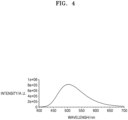
FIG. 4 illustrates the emission spectrum of organic molecule 1 dissolved in toluene (arbitrary units of intensity (a.u.) versus wavelength length (nm)). -



-

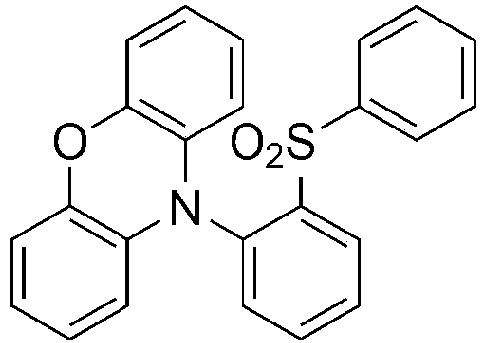
- Copper(I) iodide (479 mg, 2.5 mmol) and potassium carbonate (13.8 g, 100 mmol) were placed in a 100 mL two-necked flask with a reflux condenser and evacuated for 5 minutes. Under atmosphere including nitrogen, 50 mL of 2-propanol, 1-fluoro-2-iodobenzene (12.2 g, 55 mmol), thiophenol (5.1 mL, 50 mmol), and ethylene glycol (5.6 mL, 100 mmol) were added. The mixture was stirred at 90 °C for 1 day. The reaction solution was filtered and the residue was washed with 100 mL of water and 100 mL of EtOAc. After phase separation, the aqueous phase was extracted again with 100 mL of EtOAC. The combined organic phase was washed with a saturated NaCl solution and dried over MgSO4. The solvent was removed under reduced pressure on a rotary evaporator and the residue was filtered through a small amount of silica gel (eluent: CH2Cl2). The solvent was removed again under reduced pressure on a rotary evaporator. 9.8 g of diarylsulfide 1A was obtained as colorless oil that contained approximately 10 % 1-fluoro-2-iodobenzene but could react further without further purification.
- 1H-NMR (500 MHz, CDCl3): δ = 7.41-7.37 (m, 2H), 7.37-7.32 (m, 2H), 7.32-7.27 (m, 3H), 7.16-7.08 (m, 2H).
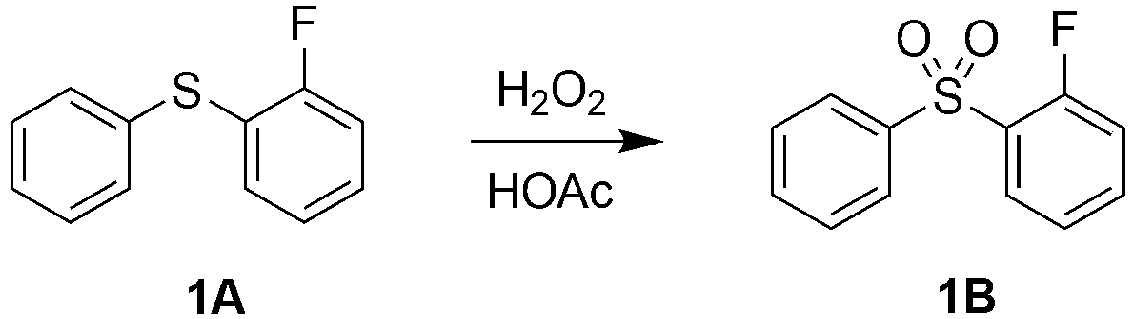
- Diarylsulfide 1A (purity 90 %, 6.81 g, 30 mmol) was dissolved in 150 mL of glacial acetic acid and treated with 15 mL of H2O2 (30 % in water). The mixture was stirred at 100 °C for 2 hours, and then left at room temperature overnight. The reaction solution was poured into 800 mL of water, causing the product to precipitate as a white solid. The solid was filtered and washed with water. The resulting filtrate was dried under vacuum at 50 °C overnight. 5.8 g of diarylsulfone 1B was obtained as a white solid.
- 1H-NMR (500 MHz, CDCl3) δ = 8.11 (td, J = 7.5, 1.8 Hz, 1H), 8.05 - 7.98 (m, 2H), 7.65 - 7.55 (m, 2H), 7.53 (t, J = 7.8 Hz, 2H), 7.32 (t, J = 7.7 Hz, 1H), 7.14 - 7.07 (m, 1H).

- 3,6-dimethoxycarbazole (696 mg, 3 mmol) was dissolved in 10 mL of dry dimethylformamide (DMF) and NaH (60 % in mineral oil, 240 mg, 6 mmol) was added. After stirring for 30 minutes, diarylsulfone 1B dissolved in 10 mL of DMF was added and the mixture was stirred at 100 °C for 2 hours. The reaction solution was poured into 200 mL of ice water. After being left overnight, the solid was filtered and washed with some water. The solid was purified by column chromatography (eluent: CH2Cl2/cyclohexane). 350 mg of product 1 was obtained, which could further be purified by recrystallization from EtOH.
- 1H-NMR (500 MHz, CDCl3) δ = 8.61 (dd, J = 7.8, 1.8 Hz, 1H), 7.74 (dtd, J = 18.7, 7.5, 1.6 Hz, 2H), 7.44 (d, J = 2.5 Hz, 2H), 7.13 (ddt, J = 5.5, 4.0, 2.2 Hz, 2H), 7.11 - 7.07 (m, 2H), 6.88 (t, J = 7.9 Hz, 2H), 6.76 (dd, J = 8.8, 2.5 Hz, 2H), 6.41 (d, J = 8.8 Hz, 2H), 3.92 (s, 6H).
- 13C-NMR (125 MHz, CDCl3) δ = 154.3, 142.7, 139.4, 138.2, 137.1, 135.3, 132.8, 132.8, 130.0, 129.7, 128.4, 127.9, 123.9, 115.0, 111.6, 102.7, 56.3.
-

- 4-iodobenzonitrile (11.5 g, 500 mmol), copper(I) iodide (957 mg, 5 mmol), and potassium carbonate (13.8 g, 100 mmol) were placed in a 250 mL two-necked flask with a reflux condenser and evacuated for 5 minutes. Under nitrogen atmosphere, 100 mL of 2-propanol (iPrOH), 1-fluoro-2-thiobenzene (6.41 g, 50 mmol), and ethylene glycol (5.6 mL, 100 mmol) were added. The mixture was stirred at 90 °C for 1 day. The reaction solution was filtered and the residue was washed with 300 mL of EtOAc. The solvent was removed under reduced pressure on a rotary evaporator, and the residue was dissolved in 100 mL of EtOAc and 100 mL of water. The organic phase was washed once more with 100 mL water, followed by washing with 50 mL of a saturated NaCl solution and drying over MgSO4. The solvent was removed under reduced pressure on a rotary evaporator and the residue was filtered through a small amount of silica gel (eluent: CH2Cl2). The solvent was removed again under reduced pressure on a rotary evaporator. 10.5 g of diarylsulfide 2A was obtained as a white solid, which contains about 5 % 4-iodobenzonitrile but can further be converted without further purification.
- 1H-NMR (500 MHz, CDCl3): δ = 7.57 - 7.43 (m, 4H), 7.25 - 7.19 (m, 2H), 7.19 - 7.15 (m, 2H).
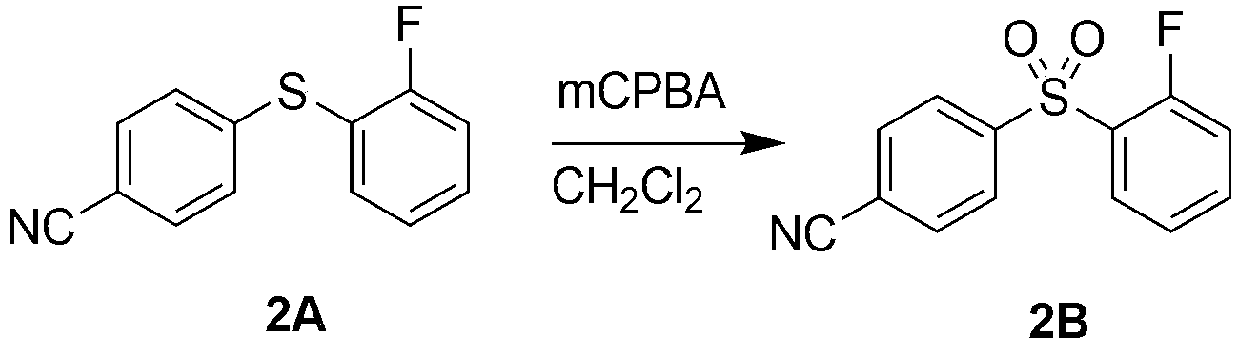
- Diarylsulfide 2A (purity 95 %, 5.31 g, 22 mmol) was dissolved in 150 mL of CH2Cl2. Meta-chloroperbenzoic acid (mCPBA) (70 %, 16.3 g, 66 mmol) was added over approximately 10 minutes under ice cooling. Subsequently, the mixture was stirred at room temperature for 16 hours. The reaction solution was washed with 100 mL of a semiconcentrated Na2CO3 solution, and then washed with 50 mL of a saturated NaCl solution and dried over MgSO4. The solvent was removed under reduced pressure on a rotary evaporator and the residue was filtered through a small amount of silica gel (eluent: CH2Cl2). The solvent was removed again under reduced pressure on a rotary evaporator. 5.2 g of diarylsulfone 2B was obtained as a light yellow solid.
- 1H-NMR (500 MHz, CDCl3): δ = 8.17 - 8.08 (m, 3H), 7.85 - 7.81 (m, 2H), 7.64 (tdd, J = 7.4, 4.9, 1.8 Hz, 1H), 7.37 (t, J = 7.7 Hz, 1H), 7.18 -7.10 (m, 1H).

- Carbazole (2.51 g, 15 mmol) was dissolved in 50 mL of dry DMF and NaH (60 % in mineral oil, 1.20 g, 30 mmol) was added. After stirring for 15 minutes, diarylsulfone 2B dissolved in 50 mL of DMF was added and the mixture was stirred at 100 °C for 2 hours. The reaction solution was poured onto 800 mL of ice. After being left overnight, the solid was filtered and washed with water. The solid was purified by column chromatography (eluent: CH2Cl2). 3.14 g of product 2 was obtained as a white solid.
- 1H-NMR (500 MHz, CDCl3): δ = 8.66 - 8.61 (m, 1H), 8.03 (d, J = 7.7 Hz, 2H), 7.89 - 7.80 (m, 2H), 7.30 - 7.23 (m, 5H), 7.19 (ddd, J = 8.2, 7.1, 1.2 Hz, 2H), 7.11 - 7.01 (m, 4H), 6.53 (d, J = 8.0 Hz, 2H).
- 13C-NMR (125 MHz, CDCl3) δ = 142.8, 141.9, 141.8, 136.1, 136.0, 133.0, 132.0, 130.3, 130.2, 128.1, 126.1, 123.3, 120.8, 120.1, 117.1, 116.2, 110.4.
Claims (21)
- An organic molecule having a structure of Formula A:
 (Het)Ar = a conjugated organic group selected from the group consisting of unsubstituted and substituted aromatics, unsubstituted and substituted heteroaromatics, and conjugated double bonds fixed against cis-trans isomerization,D = a chemically bonded donor group having electron donating properties, A = a chemically bonded acceptor group having electron accepting properties, andA and D are bonded to directly adjacent atoms of the conjugated organic group (Het)Ar.
 - The organic molecule of claim 1, wherein the organic molecule hasa value ΔE(S1-T1) between a lowest excited singlet (S1) state and a triplet (T1) state below the lowest excited singlet (S1) state of less than 5000 cm-1 and/oran emission lifetime of 50 µs or less.
- The organic molecule of claim 1 or 2, wherein (Het)Ar, A, and/or D has at least one substituent increasing solubility of the organic molecule in an organic solvent, wherein the substituent increasing solubility is preferably selected from the group consisting of:- branched or unbranched or cyclic long alkyl chains with a length of C1 to C30;- branched or unbranched or cyclic long alkoxy chains with a length of C1 to C30;- branched or unbranched or cyclic long perfluoroalkyl chains with a length of C1 to C30; and- Short-chain polyethers with a chain length of 3 to 50 repeating units.
- The organic molecule of claims 1 to 3, wherein (Het)Ar is phenyl.
- The organic molecule of claims 1 to 4, wherein at least one of the two substituents A and/or D has a heteroatom X through which the substituent is covalently bonded to (Het)Ar.
- The organic molecule of claim 5, wherein the heteroatom X is selected from the group consisting of N, S, P, O, and Se.
- The organic molecule of claims 1 to 6, wherein the organic molecule has a structure of Formula C:
 NRR1 is a donor,R and R1 are each independently selected fromthe group consisting of: hydrogen; a halogen; and a substituent bonded via a direct bond, or via oxygen- (-OR), nitrogen- (-NR2), silicon- (-SiR3), or a sulfur atom (-SR),the substituent is selected from the group consisting of:alkyl groups (including branched or cyclic), heteroalkyl groups, aryl groups, heteroaryl groups, alkenyl groups, and alkynyl groups;alkyl groups (including branched or cyclic), heteroalkyl groups, aryl groups, heteroaryl groups, and alkenyl groups, each substituted with a substituent such as halogens, deuterium, alkyl groups (including branched or cyclic), a heteroalkyl group, an aryl group, or a heteroaryl group; andother commonly known donor and acceptor groups such as amines, alcohol and ether groups, carbonyl groups, carboxylates and esters thereof, nitrile groups, and CF3 groups,the residues R and R1 optionally lead to a fused ring system,heteroatom Z(=O)n is an acceptor (corresponding to A of Formula A or B), Z is selected from the group consisting of S and P,n is 1 or 2, to which additional residue R is bonded,the residues are each independently selected fromthe group consisting of: hydrogen; halogens; and a substituent bonded via a direct bond, or via oxygen- (-OR), nitrogen- (-NR2), silicon- (-SiR3), or a sulfur atom (-SR),the substituent is selected from the group consisting of:alkyl groups (including branched or cyclic), heteroalkyl groups, aryl groups, heteroaryl groups, alkenyl groups, and alkynyl groups;alkyl groups (including branched or cyclic), heteroalkyl groups, aryl groups, heteroaryl groups, and alkenyl groups, each substituted with a substituent such as halogens, deuterium, alkyl groups (including branched or cyclic), a heteroalkyl group, an aryl group, or a heteroaryl group; andother commonly known donor and acceptor groups such as amines, alcohol and ether groups, carbonyl groups, carboxylates and esters thereof, nitrile groups, and CF3 groups, andthe residues R optionally lead to a fused ring system.
 - The organic molecule of claims 1 to 7, wherein the organic molecule has a structure of Formula D:
 NArAr1 is a donor (corresponding to D of Formula A or B),Ar and Ar1 are each independently aryl or heteroaryl to which an additional residue R is optionally bonded,the residue R is selected fromthe group consisting of: hydrogen; halogens; and a substituent bonded via a direct bond, or via oxygen- (-OR), nitrogen- (-NR2), silicon- (-SiR3), or a sulfur atom (-SR),the substituent is selected from the group consisting of:alkyl groups (branched or cyclic), heteroalkyl groups, aryl groups, heteroaryl groups, alkenyl groups, and alkynyl groups;alkyl groups (including branched or cyclic), heteroalkyl groups, aryl groups, heteroaryl groups, and alkenyl groups, each substituted with a substituent such as halogens, deuterium, alkyl groups (including branched or cyclic), a heteroalkyl group, an aryl group, or a heteroaryl group; andother commonly known donor and acceptor groups such as amines, alcohol and ether groups, carbonyl groups, carboxylates and esters thereof, nitrile groups, and CF3 groups,the residues R optionally lead to a fused ring system,Ar and Ar1 are also fused with each other or linked to each other via unit E,E is a direct bond, oran organic bridge that is: a substituted or unsubstituted alkylene group, a substituted or unsubstituted alkenylene group, a substituted or unsubstituted alkynylene group, a substituted or unsubstituted arylene group, or a combination thereof;-O-, -NR-, -SiR2- -S-, -S(O)-, -S(O)2-, an alkyl group interrupted by O (including branched or cyclic), a heteroalkyl group, an aryl group, a heteroaryl group, an alkenyl group, or a phenyl group;or a substituted phenyl unit,wherein each R is independently selected fromthe group consisting of: hydrogen; halogens; and a substituent bonded via a direct bond, or via oxygen- (-OR), nitrogen- (-NR2), silicon- (-SiR3), or a sulfur atom (-SR),the substituent is selected from the group consisting of:alkyl groups (including branched or cyclic), heteroalkyl groups, aryl groups, heteroaryl groups, alkenyl groups, and alkynyl groups;alkyl groups (including branched or cyclic), heteroalkyl groups, aryl groups, heteroaryl groups, and alkenyl groups, each substituted with a substituent such as halogens, deuterium, alkyl groups (including branched or cyclic), a heteroalkyl group, an aryl group, or a heteroaryl group; andother commonly known donor and acceptor groups such as amines, alcohol and ether groups, carbonyl groups, carboxylates and esters thereof, nitrile groups, and CF3 groups,the residues R optionally lead to a fused ring system,SO2Ar2 is an acceptor (corresponding to A of Formula A or B),wherein Ar2 is aryl or heteroaryl to which an additional residue R is optionally bonded,the residues are each independently selected from the group consisting of: hydrogen; halogens; and a substituent bonded via a direct bond, or via oxygen- (-OR), nitrogen- (-NR2), silicon atom- (-SiR3), or a sulfur atom (-SR),the substituent is selected from the group consisting of:alkyl groups (branched or cyclic), heteroalkyl groups, aryl groups, heteroaryl groups, alkenyl groups, and alkynyl groups;alkyl groups (including branched or cyclic), heteroalkyl groups, aryl groups, heteroaryl groups, and alkenyl groups, each substituted with a substituent such as halogens, deuterium, alkyl groups (including branched or cyclic), a heteroalkyl group, an aryl group, or a heteroaryl group; andother commonly known donor and acceptor groups such as amines, alcohol and ether groups, carbonyl groups, carboxylates and esters thereof, nitrile groups, and CF3 groups,the residues R optionally lead to a fused ring system, andAr is optionally fused with other aryl groups and heteroaryl groups to form a larger aromatic system.
 - The organic molecule of claims 1 to 7, wherein the organic molecule has a structure of Formula E:
 R1 to R18 are each independently selected from the group consisting of: hydrogen; halogens; and a substituent bonded via a direct bond, or via oxygen- (-OR), nitrogen- (-NR2), silicon- (-SiR3), or a sulfur atom (-SR) (wherein the residue R is as defined above for R in Formula D),the substituent is selected from the group consisting of:alkyl groups (including branched or cyclic), heteroalkyl groups, aryl groups, heteroaryl groups, alkenyl groups, and alkynyl groups;alkyl groups (including branched or cyclic), heteroalkyl groups, aryl groups, heteroaryl groups, and alkenyl groups, each substituted with a substituent such as halogens, deuterium, alkyl groups (including branched or cyclic), a heteroalkyl group, an aryl group, or a heteroaryl group; andother commonly known donor and acceptor groups, for example, amines, alcohol and ether groups, carbonyl groups, carboxylates and esters thereof, nitrile groups, and CF3 groups which are optionally further substituted and/or fused, andthe residues R1 to R18 optionally lead to a condensed ring system.
 - A method of preparing the organic molecule according to claims 1 to 9.
- The method of claim 10, further comprising substituting at least one of the three groups (Het)Ar, A and/or D with at least one substituent for increasing solubility, wherein the substituent is selected from the group consisting of:- Long-chain, branched or unbranched or cyclic alkyl chains with a length of C1 to C30;- Long-chain, branched or unbranched or cyclic alkoxy chains with a length of C1 to C30;- Branched or unbranched or cyclic perfluoroalkyl chains with a length of C1 to C30; and- Short-chain polyethers with a chain length of 3 to 50 repeating units.
- Use of the organic molecule according to claims 1 to 9 as an emitter or absorber in an optoelectronic device.
- The use of claim 12, wherein the optoelectronic device is selected from the group consisting of:- organic light-emitting devices (OLEDs),- light-emitting electrochemical cells,- OLED sensors, especially in gas and vapor sensors not hermetically externally shielded,- organic solar cells,- organic field-effect transistors,- organic lasers, and- down-conversion elements.
- The use of claim 12 or 13, wherein a proportion of the organic molecule in an emitter or an absorber is in a range of 1 % to 99 % or 100 %.
- The use of claims 12 to 14, wherein a proportion of the organic molecule as an emitter in an optoelectronic device, particularly an OLED, is in a range of 5 % to 80 %.
- An optoelectronic device comprising the organic molecule according to claims 1 to 9.
- The optoelectronic device of claim 16, wherein the optoelectronic device is formed as a device selected from the group consisting of organic light-emitting devices, organic diodes, organic solar cells, organic transistors, organic light-emitting diodes, light-emitting electrochemical cells, organic field-effect transistors, and organic lasers.
- A method of producing an optoelectronic device using the organic molecule according to claims 1 to 9.
- The method of claim 18, wherein the method comprises applying the organic molecule according to claims 1 to 9 to a carrier, wherein the applying is optionally performed by wet-chemical, by colloidal suspension or by sublimation.
- A method of modifying emission and/or absorption characteristics of an electronic device, the method comprising introducing the organic molecule according to claims 1 to 9 into a matrix material for conducting electrons or holes in an optoelectronic device.
- Use of the organic molecule according to claims 1 to 9 particularly in an optoelectronic device for converting (down-converting) UV radiation or blue light into visible light, particularly green, yellow or red light.
Applications Claiming Priority (2)
| Application Number | Priority Date | Filing Date | Title |
|---|---|---|---|
| EP22158231 | 2022-02-23 | ||
| PCT/KR2023/002624 WO2023163533A1 (en) | 2022-02-23 | 2023-02-23 | Organic molecule for optoelectronic device |
Publications (2)
| Publication Number | Publication Date |
|---|---|
| EP4484411A1 true EP4484411A1 (en) | 2025-01-01 |
| EP4484411A4 EP4484411A4 (en) | 2026-01-07 |
Family
ID=80448912
Family Applications (1)
| Application Number | Title | Priority Date | Filing Date |
|---|---|---|---|
| EP23760407.9A Pending EP4484411A4 (en) | 2022-02-23 | 2023-02-23 | ORGANIC MOLECULE FOR OPTOELECTRONIC DEVICE |
Country Status (6)
| Country | Link |
|---|---|
| US (1) | US20250143182A1 (en) |
| EP (1) | EP4484411A4 (en) |
| JP (1) | JP2025508664A (en) |
| KR (1) | KR20240145452A (en) |
| CN (1) | CN118696030A (en) |
| WO (1) | WO2023163533A1 (en) |
Family Cites Families (6)
| Publication number | Priority date | Publication date | Assignee | Title |
|---|---|---|---|---|
| SU404270A3 (en) * | 1969-02-26 | 1973-10-26 | ||
| US20150141642A1 (en) * | 2012-04-25 | 2015-05-21 | Kyushu University National University Corporation | Light-emitting material and organic light-emitting device |
| EP2749563A1 (en) * | 2012-12-27 | 2014-07-02 | cynora GmbH | Binuclear metal(I) complexes for use in optoelectronics |
| DE112015001925B4 (en) * | 2014-04-24 | 2024-02-01 | Samsung Display Co., Ltd. | Use of a material for the forgery-proof marking of objects, substances or mixtures of substances and methods for forgery-proof marking |
| CN109755415B (en) * | 2017-11-02 | 2020-01-10 | 广东阿格蕾雅光电材料有限公司 | Device of bipolar material containing 4, 6-diphenyl sulfone dibenzofuran |
| CN108484592B (en) * | 2018-04-17 | 2021-10-08 | 中山大学 | TADF materials based on bulky steric space charge transfer and their synthesis methods and applications |
-
2023
- 2023-02-23 EP EP23760407.9A patent/EP4484411A4/en active Pending
- 2023-02-23 US US18/835,320 patent/US20250143182A1/en active Pending
- 2023-02-23 JP JP2024543582A patent/JP2025508664A/en active Pending
- 2023-02-23 CN CN202380021577.8A patent/CN118696030A/en active Pending
- 2023-02-23 KR KR1020247013407A patent/KR20240145452A/en active Pending
- 2023-02-23 WO PCT/KR2023/002624 patent/WO2023163533A1/en not_active Ceased
Also Published As
| Publication number | Publication date |
|---|---|
| WO2023163533A1 (en) | 2023-08-31 |
| JP2025508664A (en) | 2025-04-10 |
| KR20240145452A (en) | 2024-10-07 |
| US20250143182A1 (en) | 2025-05-01 |
| EP4484411A4 (en) | 2026-01-07 |
| CN118696030A (en) | 2024-09-24 |
Similar Documents
| Publication | Publication Date | Title |
|---|---|---|
| KR101120892B1 (en) | Acridine derivative and organic electroluminescence device comprising the same | |
| TWI589562B (en) | Spirobifluorene compounds for light emitting devices | |
| KR101011857B1 (en) | Benzofluoranthene derivatives and organic light emitting device using the same | |
| JP5690636B2 (en) | Aromatic amine derivatives | |
| CN100482023C (en) | Organic electronic devices | |
| KR100430549B1 (en) | New organomattalic complex molecule for the fabrication of organic light emitting diodes | |
| KR100812178B1 (en) | Electroluminescent compounds comprising fluorene group and organic electroluminescent device using the same | |
| KR20090079134A (en) | New imidazole derivatives and organic electronic devices using the same | |
| KR101512544B1 (en) | New compound and organic light emitting device using the same | |
| JP2009269909A (en) | New compound for electronic material and organic electronic device using the same | |
| WO2006056416A1 (en) | Use of phenothiazine-s-oxides and phenothiazine -s,s-dioxides in the form of matrix materials for organic light-emitting diodes | |
| CN115724750B (en) | Spirofluorene derivative and application thereof | |
| KR20200009979A (en) | Novel compound and organic light emitting device comprising the same | |
| KR100925323B1 (en) | Novel compound and organic light emitting device using same | |
| EP2390249A2 (en) | Novel cycloalkene derivatives and organic electronic devices using the same | |
| JP5943467B2 (en) | Diphenylsulfone derivative, host material comprising the same, and organic electroluminescence device using the same | |
| EP4501940A1 (en) | Fused ring carbazole tetradentate metal platinum (ii) complex and use thereof | |
| JP2008288254A (en) | Organic EL device | |
| CN118406084B (en) | Four-tooth ring metal platinum complex phosphorescent material and application thereof | |
| US20250143182A1 (en) | Organic molecule for optoelectronic device | |
| CN111393458A (en) | Heterocyclic compound and organic electroluminescent device thereof | |
| WO2019100914A1 (en) | Spherical organic photoelectric material and method for fabrication thereof and application thereof | |
| JP4612846B2 (en) | Biskinoxaline compound and organic light-emitting device | |
| CN113912636A (en) | Silicon-containing heterocyclic compound and organic electroluminescent element containing the same | |
| KR100665097B1 (en) | Novel zinc-based complex, method for manufacturing the same, and organic light emitting device for low voltage driving using the same |
Legal Events
| Date | Code | Title | Description |
|---|---|---|---|
| STAA | Information on the status of an ep patent application or granted ep patent |
Free format text: STATUS: THE INTERNATIONAL PUBLICATION HAS BEEN MADE |
|
| PUAI | Public reference made under article 153(3) epc to a published international application that has entered the european phase |
Free format text: ORIGINAL CODE: 0009012 |
|
| STAA | Information on the status of an ep patent application or granted ep patent |
Free format text: STATUS: REQUEST FOR EXAMINATION WAS MADE |
|
| 17P | Request for examination filed |
Effective date: 20240814 |
|
| AK | Designated contracting states |
Kind code of ref document: A1 Designated state(s): AL AT BE BG CH CY CZ DE DK EE ES FI FR GB GR HR HU IE IS IT LI LT LU LV MC ME MK MT NL NO PL PT RO RS SE SI SK SM TR |
|
| DAV | Request for validation of the european patent (deleted) | ||
| DAX | Request for extension of the european patent (deleted) | ||
| A4 | Supplementary search report drawn up and despatched |
Effective date: 20251208 |
|
| RIC1 | Information provided on ipc code assigned before grant |
Ipc: C07D 209/86 20060101AFI20251202BHEP Ipc: C07D 209/88 20060101ALI20251202BHEP Ipc: C07D 265/38 20060101ALI20251202BHEP Ipc: H10K 85/60 20230101ALI20251202BHEP Ipc: H10K 50/11 20230101ALI20251202BHEP Ipc: C09K 11/06 20060101ALI20251202BHEP |
|
| P01 | Opt-out of the competence of the unified patent court (upc) registered |
Free format text: CASE NUMBER: UPC_APP_0006868_4484411/2026 Effective date: 20260226 |