EP4483245B1 - System und verfahren zur steuerung eines betriebs eines dampfkompressionszyklus - Google Patents
System und verfahren zur steuerung eines betriebs eines dampfkompressionszyklus Download PDFInfo
- Publication number
- EP4483245B1 EP4483245B1 EP23844378.2A EP23844378A EP4483245B1 EP 4483245 B1 EP4483245 B1 EP 4483245B1 EP 23844378 A EP23844378 A EP 23844378A EP 4483245 B1 EP4483245 B1 EP 4483245B1
- Authority
- EP
- European Patent Office
- Prior art keywords
- model
- vapor compression
- compression cycle
- physics
- observed variables
- Prior art date
- Legal status (The legal status is an assumption and is not a legal conclusion. Google has not performed a legal analysis and makes no representation as to the accuracy of the status listed.)
- Active
Links
Images





Classifications
-
- F—MECHANICAL ENGINEERING; LIGHTING; HEATING; WEAPONS; BLASTING
- F25—REFRIGERATION OR COOLING; COMBINED HEATING AND REFRIGERATION SYSTEMS; HEAT PUMP SYSTEMS; MANUFACTURE OR STORAGE OF ICE; LIQUEFACTION SOLIDIFICATION OF GASES
- F25B—REFRIGERATION MACHINES, PLANTS OR SYSTEMS; COMBINED HEATING AND REFRIGERATION SYSTEMS; HEAT PUMP SYSTEMS
- F25B49/00—Arrangement or mounting of control or safety devices
- F25B49/02—Arrangement or mounting of control or safety devices for compression type machines, plants or systems
- F25B49/022—Compressor control arrangements
-
- G—PHYSICS
- G05—CONTROLLING; REGULATING
- G05B—CONTROL OR REGULATING SYSTEMS IN GENERAL; FUNCTIONAL ELEMENTS OF SUCH SYSTEMS; MONITORING OR TESTING ARRANGEMENTS FOR SUCH SYSTEMS OR ELEMENTS
- G05B13/00—Adaptive control systems, i.e. systems automatically adjusting themselves to have a performance which is optimum according to some preassigned criterion
- G05B13/02—Adaptive control systems, i.e. systems automatically adjusting themselves to have a performance which is optimum according to some preassigned criterion electric
- G05B13/0265—Adaptive control systems, i.e. systems automatically adjusting themselves to have a performance which is optimum according to some preassigned criterion electric the criterion being a learning criterion
- G05B13/027—Adaptive control systems, i.e. systems automatically adjusting themselves to have a performance which is optimum according to some preassigned criterion electric the criterion being a learning criterion using neural networks only
-
- F—MECHANICAL ENGINEERING; LIGHTING; HEATING; WEAPONS; BLASTING
- F24—HEATING; RANGES; VENTILATING
- F24F—AIR-CONDITIONING; AIR-HUMIDIFICATION; VENTILATION; USE OF AIR CURRENTS FOR SCREENING
- F24F11/00—Control or safety arrangements
- F24F11/50—Control or safety arrangements characterised by user interfaces or communication
- F24F11/56—Remote control
-
- F—MECHANICAL ENGINEERING; LIGHTING; HEATING; WEAPONS; BLASTING
- F24—HEATING; RANGES; VENTILATING
- F24F—AIR-CONDITIONING; AIR-HUMIDIFICATION; VENTILATION; USE OF AIR CURRENTS FOR SCREENING
- F24F11/00—Control or safety arrangements
- F24F11/62—Control or safety arrangements characterised by the type of control or by internal processing, e.g. using fuzzy logic, adaptive control or estimation of values
- F24F11/63—Electronic processing
- F24F11/64—Electronic processing using pre-stored data
-
- G—PHYSICS
- G05—CONTROLLING; REGULATING
- G05B—CONTROL OR REGULATING SYSTEMS IN GENERAL; FUNCTIONAL ELEMENTS OF SUCH SYSTEMS; MONITORING OR TESTING ARRANGEMENTS FOR SUCH SYSTEMS OR ELEMENTS
- G05B13/00—Adaptive control systems, i.e. systems automatically adjusting themselves to have a performance which is optimum according to some preassigned criterion
- G05B13/02—Adaptive control systems, i.e. systems automatically adjusting themselves to have a performance which is optimum according to some preassigned criterion electric
- G05B13/04—Adaptive control systems, i.e. systems automatically adjusting themselves to have a performance which is optimum according to some preassigned criterion electric involving the use of models or simulators
- G05B13/042—Adaptive control systems, i.e. systems automatically adjusting themselves to have a performance which is optimum according to some preassigned criterion electric involving the use of models or simulators in which a parameter or coefficient is automatically adjusted to optimise the performance
-
- F—MECHANICAL ENGINEERING; LIGHTING; HEATING; WEAPONS; BLASTING
- F25—REFRIGERATION OR COOLING; COMBINED HEATING AND REFRIGERATION SYSTEMS; HEAT PUMP SYSTEMS; MANUFACTURE OR STORAGE OF ICE; LIQUEFACTION SOLIDIFICATION OF GASES
- F25B—REFRIGERATION MACHINES, PLANTS OR SYSTEMS; COMBINED HEATING AND REFRIGERATION SYSTEMS; HEAT PUMP SYSTEMS
- F25B2500/00—Problems to be solved
- F25B2500/18—Optimization, e.g. high integration of refrigeration components
-
- F—MECHANICAL ENGINEERING; LIGHTING; HEATING; WEAPONS; BLASTING
- F25—REFRIGERATION OR COOLING; COMBINED HEATING AND REFRIGERATION SYSTEMS; HEAT PUMP SYSTEMS; MANUFACTURE OR STORAGE OF ICE; LIQUEFACTION SOLIDIFICATION OF GASES
- F25B—REFRIGERATION MACHINES, PLANTS OR SYSTEMS; COMBINED HEATING AND REFRIGERATION SYSTEMS; HEAT PUMP SYSTEMS
- F25B2500/00—Problems to be solved
- F25B2500/19—Calculation of parameters
-
- F—MECHANICAL ENGINEERING; LIGHTING; HEATING; WEAPONS; BLASTING
- F25—REFRIGERATION OR COOLING; COMBINED HEATING AND REFRIGERATION SYSTEMS; HEAT PUMP SYSTEMS; MANUFACTURE OR STORAGE OF ICE; LIQUEFACTION SOLIDIFICATION OF GASES
- F25B—REFRIGERATION MACHINES, PLANTS OR SYSTEMS; COMBINED HEATING AND REFRIGERATION SYSTEMS; HEAT PUMP SYSTEMS
- F25B2600/00—Control issues
- F25B2600/11—Fan speed control
-
- F—MECHANICAL ENGINEERING; LIGHTING; HEATING; WEAPONS; BLASTING
- F25—REFRIGERATION OR COOLING; COMBINED HEATING AND REFRIGERATION SYSTEMS; HEAT PUMP SYSTEMS; MANUFACTURE OR STORAGE OF ICE; LIQUEFACTION SOLIDIFICATION OF GASES
- F25B—REFRIGERATION MACHINES, PLANTS OR SYSTEMS; COMBINED HEATING AND REFRIGERATION SYSTEMS; HEAT PUMP SYSTEMS
- F25B2600/00—Control issues
- F25B2600/25—Control of valves
- F25B2600/2513—Expansion valves
-
- F—MECHANICAL ENGINEERING; LIGHTING; HEATING; WEAPONS; BLASTING
- F25—REFRIGERATION OR COOLING; COMBINED HEATING AND REFRIGERATION SYSTEMS; HEAT PUMP SYSTEMS; MANUFACTURE OR STORAGE OF ICE; LIQUEFACTION SOLIDIFICATION OF GASES
- F25B—REFRIGERATION MACHINES, PLANTS OR SYSTEMS; COMBINED HEATING AND REFRIGERATION SYSTEMS; HEAT PUMP SYSTEMS
- F25B2700/00—Sensing or detecting of parameters; Sensors therefor
- F25B2700/17—Speeds
- F25B2700/171—Speeds of the compressor
-
- F—MECHANICAL ENGINEERING; LIGHTING; HEATING; WEAPONS; BLASTING
- F25—REFRIGERATION OR COOLING; COMBINED HEATING AND REFRIGERATION SYSTEMS; HEAT PUMP SYSTEMS; MANUFACTURE OR STORAGE OF ICE; LIQUEFACTION SOLIDIFICATION OF GASES
- F25B—REFRIGERATION MACHINES, PLANTS OR SYSTEMS; COMBINED HEATING AND REFRIGERATION SYSTEMS; HEAT PUMP SYSTEMS
- F25B2700/00—Sensing or detecting of parameters; Sensors therefor
- F25B2700/19—Pressures
-
- F—MECHANICAL ENGINEERING; LIGHTING; HEATING; WEAPONS; BLASTING
- F25—REFRIGERATION OR COOLING; COMBINED HEATING AND REFRIGERATION SYSTEMS; HEAT PUMP SYSTEMS; MANUFACTURE OR STORAGE OF ICE; LIQUEFACTION SOLIDIFICATION OF GASES
- F25B—REFRIGERATION MACHINES, PLANTS OR SYSTEMS; COMBINED HEATING AND REFRIGERATION SYSTEMS; HEAT PUMP SYSTEMS
- F25B2700/00—Sensing or detecting of parameters; Sensors therefor
- F25B2700/21—Temperatures
-
- G—PHYSICS
- G05—CONTROLLING; REGULATING
- G05B—CONTROL OR REGULATING SYSTEMS IN GENERAL; FUNCTIONAL ELEMENTS OF SUCH SYSTEMS; MONITORING OR TESTING ARRANGEMENTS FOR SUCH SYSTEMS OR ELEMENTS
- G05B2219/00—Program-control systems
- G05B2219/20—Pc systems
- G05B2219/26—Pc applications
- G05B2219/2614—HVAC, heating, ventillation, climate control
Definitions
- the present disclosure relates to vapor compression cycles and more particularly to a system and a method for controlling an operation of a vapor compression cycle.
- Vapor compression cycles represent a fundamental technology in contemporary society because of their wide use in air-conditioning and space heating applications. Role of the vapor compression cycles is expected to grow in future years as the vapor compression cycles provide an effective means for decarbonizing heating systems and utilizing electrical energy generated by renewable sources, such as photovoltaic or wind power. There is thus widespread interest in further developing vapor compression cycle technology so that they are both energy efficient and satisfy performance requirements related to user health and comfort in buildings.
- a range of control technologies employed in the vapor compression cycles use a model that represents underlying physics/dynamics of the vapor compression cycle, for predicting behavior of the vapor compression cycle and controlling the vapor compression cycle.
- Accurate predictions of the behavior of vapor compression cycle can be used in control technologies, e.g., model predictive control and estimation of performance parameters such as cooling capacity delivered by the heat exchangers (HEXs).
- the model of the vapor compression cycle may also play an important role in development of fault detection and diagnosis algorithms, and are central to emerging digital twin technologies aiming to improve energy efficiency, streamline maintenance, and maximize user comfort.
- Some approaches use a physics-based model for predicting the behavior of the vapor compression cycle.
- the physics-based model is derived from first principles of physics resulting in a high-dimensional set of nonlinear differential algebraic equations for a multiphysical system such as vapor-compression cycle.
- Such a model is generally formulated to satisfy application-specific physics-based or computational requirements and relate to physical processes most relevant to the application. Simplifying assumptions that accompany such requirements, e.g., lumped parameters and finite discretization, often lead to a mismatch between the model predictions and data collected from the system. Addressing the mismatch to improve accuracy of the model predictions is a non-trivial task that may require unjustifiable effort and complexity resulting in comparatively smaller prediction improvements.
- a data driven model may be used for predicting the behavior of the vapor compression cycle.
- the data driven model is developed using data collected from the system.
- the data driven model need large datasets including full-state trajectories to achieve reasonable modeling accuracy. Such large datasets are unavailable due to limited sensor data.
- the data-driven model suffers from a combination of other challenges, such as non-interpretability of the data driven model, large parameter search spaces, and do not explicitly account for fundamental physical laws that govern the system.
- Vedang M Deshpande et al. (DESHPANDE VEDANG M ET AL: "Constrained Smoothers for State Estimation of Vapor Compression Cycles", 2022 AMERICAN CONTROL CONFERENCE (ACC), AMERICAN AUTOMATIC CONTROL COUNCIL, 8 June 2022, pages 2333-2340, XP034179854, DOI: 10.23919/ACC53348.2022.9867269 ) disclose smoothing methods in the extended and ensemble Kalman estimation frameworks that satisfy physical constraints and address practical limitations with standard implementations of these estimators.
- Yuan Yin et al. ( YUAN YIN ET AL: "Augmenting Physical Models with Deep Networks for Complex Dynamics Forecasting", ARXIV.ORG, CORNELL UNIVERSITY LIBRARY, 201 OLIN LIBRARY CORNELL UNIVERSITY ITHACA, NY 14853, 10 May 2022, XP091212488, DOI: 10.1088/1742-5468/AC3AE5 ) disclose the APHYNITY framework, a principled approach for augmenting incomplete physical dynamics described by differential equations with deep data-driven models. It consists of decomposing the dynamics into two components: a physical component accounting for the dynamics for which we have some prior knowledge, and a data-driven component accounting for errors of the physical model. The learning problem is carefully formulated such that the physical model explains as much of the data as possible, while the data-driven component only describes information that cannot be captured by the physical model; no more, no less.
- Mona Buisson-Fenet et al. ( MONA BUISSON-FENET ET AL: "Learning dynamics from partial observations with structured neural ODEs", ARXIV.ORG, CORNELL UNIVERSITY LIBRARY, 201 OLIN LIBRARY CORNELL UNIVERSITY ITHACA, NY 14853, 25 May 2022 , XP091232785) disclose a flexible framework to incorporate a broad spectrum of physical insight into neural ODE-based system identification, giving physical interpretability to the resulting latent space, wherein this insight is either enforced through hard constraints in the optimization problem or added in its cost function.
- the invention is based on the realization that modeling efforts for the vapor compression cycle may benefit from a hybrid modeling paradigm which combines domain expertise represented by the physics-based model with the data-driven model to learn the behavior of the vapor compression cycle. Accordingly, the present disclosure provides the hybrid model of the dynamics of the vapor compression cycle that includes the physics-based model and the data driven model.
- the physics-based model is configured to predict transitions of states of the vapor compression cycle in accordance with observed variables and a control input to the vapor compression cycle based on parameters of the physics-based model.
- the physics-based model includes one or a combination of governing partial differential equations discretized over spatial and temporal domains, look up tables, and interpolation splines for calculating thermodynamic properties of the refrigerant of the vapor compression cycle.
- the data driven model is trained with machine learning to estimate residual errors of the state transitions predicted by the physics-based model.
- the data driven model may include a neural network.
- the physics-based model parameterized by parameter vector ⁇ which includes a number of finite control volumes for discretization of governing partial differential equations, geometric parameters of the vapor compression cycle, properties of materials used in the vapor compression cycle, a total mass of the refrigerant and the like.
- the data driven model e.g. a neural network
- w which includes weights and biases of each artificial neuron as well as parameters that define an architecture of the neural network.
- the model attributes of the hybrid model include parameters of the physics-based model, i.e, parameters ⁇ , and parameters of the data driven model, i.e, parameters w.
- the observed variables include temperatures and pressures measured by sensors installed at different locations in the vapor compression cycle. It is desired that the estimated model attributes are such that contribution of the physics-based model is maximized in the hybrid model while the data driven model is utilized only to correct modeling errors that cannot be otherwise rectified with the physics-based model alone. Therefore, the data driven model is utilized to learn residual dynamics based on mismatches of the physics-based model with respect to the observed variables.
- the parameters of the physics-based model and the data driven model are determined by solving a joint optimization problem that minimizes a cost function comprising penalties on deviations between predicted and real outputs of the vapor compression cycle, and weighted norm of the data driven model outputs.
- the invention is based on the recognition that simultaneously estimating the parameters ⁇ of the physics-based model and the parameters w of the data driven model is a challenging problem because they are fundamentally different variables.
- the parameters ⁇ of the physics-based model in general, has low dimension but derivative with respect to the parameters ⁇ are hard to compute, as they require derivative of a solution of a differential equation.
- the dynamics of the vapor-compression cycle are nonlinear, numerically stiff, and have derivative discontinuities due to phase changes that accompany evaporation or condensation.
- the parameters w have large dimension, but the derivatives can be efficiently computed using standard computing tools such as automatic differentiation.
- the invention is based on a realization that the computational challenges associated with the joint optimization problem can be addressed by decomposing the joint optimization problem into two equivalent tractable unconstrained optimization problems that determine ⁇ and w separately instead of solving the joint optimization problem.
- the joint optimization problem can be decomposed into a first optimization problem of joint estimation of the states of the vapor compression cycle and the parameters ⁇ of the physics-based model, and a second optmization problem of determining the parameters w of the data driven model.
- the invention is based on the realization that the first optimization problem can be interpreted as a joint state and parameter estimation problem based on the physics-based model of the vapor compression cycle. Such an interpretation allows utilization of optimal smoothing formulation to determine a solution.
- an approximate solution to the first optimization problem can be determined efficiently using wide range of nonlinear estimation methods.
- estimation methods do not guarantee that physics-based constraints, such as monotonicity of pressures in refrigerant flow-direction in the vapor compression cycle, will be satisfied. It is important that such physics-based constraints are satisfied to ensure that state estimates are physically realizable.
- the invention uses a constrained Kalman smoother, such as a Constrained Extended Kalman Smoother (C-EKS) or Constrained Ensemble Kalman Smoother (C-EnKS), that is tailored for estimation of the vapor compression cycle and enforces the physics-based constraints during joint estimation of the states of the vapor compression cycle and the parameters of the physics-based model.
- a constrained Kalman smoother such as a Constrained Extended Kalman Smoother (C-EKS) or Constrained Ensemble Kalman Smoother (C-EnKS)
- C-EKS Constrained Extended Kalman Smoother
- C-EnKS Constrained Ensemble Kalman Smoother
- the first optimization problem is solved using the constrained Kalman smoother to estimate the parameters of the physics-based model and the states of the vapor compression cycle.
- the constrained Kalman smoother is executed over the observed variables collected over multiple time instances to estimate the parameters of the physics-based model and the states of the vapor compression cycle.
- the parameters w of the data driven model are determined such that a cumulative learning cost function, which is comprised of a difference between the residual errors and the data driven model outputs corresponding to the same inputs that generated the error residuals at that time instants, is minimized.
- the residual errors are known constants within the scope of the second optimization problem, thus, the data driven model essentially attempts to learn the residual errors for a given input state vector and control input vector.
- some embodiments of the present disclosure are based on the realization that the second optimization problem of determining the parameters of the data driven model is a standard neural network training problem.
- the second optimization problem is solved using stochastic gradient descent to determine the parameters of the data driven model.
- the hybrid model is updated with the parameters of physics-based model estimated by executing the constrained Kalman smoother, and the parameters of the data driven model determined by solving the second optimization problem using the stochastic gradient descent.
- the updated hybrid model includes the physics-based model with the parameters estimated by executing the constrained Kalman smoother and the data driven model with the parameters determined by solving the second optimization problem using the stochastic gradient descent.
- the operation of the vapor compression cycle is controlled using the updated hybrid model. For instance, based on the updated hybrid model, control inputs to actuators of the vapor compression cycle are determined.
- the control inputs for example, include e.g., a speed of a compressor, a speed of a fan, and a position of an expansion valve. The operation of the vapor compression cycle is controlled according to the control inputs.
- the invention discloses a controller for controlling an operation of a vapor compression cycle based on a hybrid model of dynamics of the vapor compression cycle including a physics-based model and a data driven model, wherein the physics-based model is configured to predict transitions of states of the vapor compression cycle in accordance with observed variables and a control input to the vapor compression cycle based on parameters of the physics-based model, and wherein the data driven model is trained with machine learning to estimate residual errors of the state transitions predicted by the physics-based model, the controller comprising: a processor; and a memory having instructions stored thereon that, when executed by the processor, cause the controller to: collect a digital representation of observed variables of the operation of the vapor compression cycle over multiple instances of time; execute a constrained Kalman smoother over the observed variables collected over multiple instances of time to jointly estimate the parameters of the physics-based model and states of the vapor compression cycle to minimize a cost function comprised of residual errors of the state transitions predicted by the physics-based model for the multiple instances of time
- the invention discloses a method for controlling an operation of a vapor compression cycle based on a hybrid model of dynamics of the vapor compression cycle including a physics-based model and a data driven model, wherein the physics-based model is configured to predict transitions of states of the vapor compression cycle in accordance with observed variables and a control input to the vapor compression cycle based on parameters of the physics-based model, and wherein the data driven model is trained with machine learning to estimate residual errors of the state transitions predicted by the physics-based model.
- the method comprises: collecting a digital representation of observed variables of the operation of the vapor compression cycle over multiple instances of time; executing a constrained Kalman smoother over the observed variables collected over multiple instances of time to jointly estimate the parameters of the physics-based model and states of the vapor compression cycle to minimize a cost function comprised of residual errors of the state transitions predicted by the physics-based model for the multiple instances of time, and residual errors between observed variables estimated by the constrained Kalman smoother for the multiple instances of time and the corresponding collected observed variables; updating the data driven model to minimize a difference between the states estimated by executing the constrained Kalman smoother over the observed variables collected over multiple instances of time and the states predicted by the physics-based model; updating the hybrid model with the estimated parameters of the physics-based model and the updated data driven model; and controlling the operation of the vapor compression cycle using the updated hybrid model.
- the invention discloses a non-transitory computer readable storage medium embodied thereon a program executable by a processor for performing a method for controlling an operation of a vapor compression cycle based on a hybrid model of dynamics of the vapor compression cycle including a physics-based model and a data driven model, wherein the physics-based model is configured to predict transitions of states of the vapor compression cycle in accordance with observed variables and a control input to the vapor compression cycle based on parameters of the physics-based model, and wherein the data driven model is trained with machine learning to estimate residual errors of the state transitions predicted by the physics-based model.
- the method comprises: collecting a digital representation of observed variables of the operation of the vapor compression cycle over multiple instances of time; executing a constrained Kalman smoother over the observed variables collected over multiple instances of time to jointly estimate the parameters of the physics-based model and states of the vapor compression cycle to minimize a cost function comprised of residual errors of the state transitions predicted by the physics-based model for the multiple instances of time, and residual errors between observed variables estimated by the constrained Kalman smoother for the multiple instances of time and the corresponding collected observed variables; updating the data driven model to minimize a difference between the states estimated by executing the constrained Kalman smoother over the observed variables collected over multiple instances of time and the states predicted by the physics-based model; updating the hybrid model with the estimated parameters of the physics-based model and the updated data driven model; and controlling the operation of the vapor compression cycle using the updated hybrid model.
- FIG. 1A illustrates a vapor compression cycle 100, according to an embodiment of the present disclosure.
- the vapor compression cycle 100 includes a compressor 101, a condensing heat exchanger 103, an expansion valve 105, and an evaporating heat exchanger 107 located in a space 109. Heat transfer from the condensing heat exchanger 103 is promoted by use of a fan 111, while heat transfer from the evaporating heat exchanger 107 is promoted by use of a fan 113.
- the vapor compression cycle 100 may include variable actuators, such as a variable compressor speed, a variable expansion valve position, and variable fan speeds.
- the compressor 101 compresses a low pressure, low temperature vapor-phase fluid (a refrigerant) to a high pressure, high temperature vapor state, after which it passes into the condensing heat exchanger 103.
- a refrigerant a low pressure, low temperature vapor-phase fluid
- the heat transfer promoted by the fan 111 causes the high-temperature, high pressure refrigerant to transfer its heat to ambient air, which is at a lower temperature.
- the refrigerant gradually condenses until the refrigerant is in a high pressure, low temperature liquid state.
- the refrigerant leaves the condensing heat exchanger 103 and passes through the expansion valve 105, and expands to a low pressure boiling state from which it enters the evaporating heat exchanger 107.
- the refrigerant gradually evaporates as it passes through the evaporating heat exchanger 107.
- the refrigerant leaving the evaporating heat exchanger 107 is at a low pressure, low temperature state. The low pressure, low temperature refrigerant re-enters the compressor 101 and the same cycle is repeated.
- the vapor compression cycle 100 operates at a nominal set of input values for actuators, e.g., a speed of the compressor 101, a speed of the fan 111, a position of the expansion valve 105, a speed of the fan 113, and the like. It is desired or an objective that the vapor compression cycle 100 achieve performance metrics, for example, regulating variables such as a temperature or humidity in the space 109 or regulating process variables such as a temperature or a pressure at one or more points in the vapor compression cycle 100. To achieve such objectives, one or more sensors are installed at various locations in the vapor compression cycle 100 to monitor variables of interest. The variables of interest may include the temperature, the humidity, and/or the pressure.
- Information from the sensors 115, 117, 119, 121, and 123 is input to a controller 125 associated with the vapor compression cycle 100.
- the controller 125 may control an operation of the vapor compression cycle 100.
- the controller 125 may change the input values of the actuators, e.g., the speed of the compressor 101, the speed of the fan 111, the position of the expansion valve 105, and the speed of the fan 113, to achieve desired performance metrics.
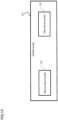
- FIG. 1B shows a block diagram of the controller 125, according to an embodiment of the present disclosure.
- the controller 125 includes a processor 127 and a memory 129.
- the processor 127 may be a single core processor, a multi-core processor, a computing cluster, or any number of other configurations.
- the memory 129 may include random access memory (RAM), read only memory (ROM), flash memory, or any other suitable memory systems. Additionally, in some embodiments, the memory 129 may be implemented using a hard drive, an optical drive, a thumb drive, an array of drives, or any combinations thereof.
- the processor 127 is configured to collect a digital representation of observed variables of an operation of the vapor compression cycle 100 over multiple instances of time. In an embodiment, the processor 127 collects the digital representation of observed variables of the operation of the vapor compression cycle 100 from the sensors 115, 117, 119, 121, and 123.
- the observed variables include, for example, measurements of one or more of the temperature and the pressure at different locations in the vapor compression cycle 100.
- the controller 125 may employ a model that represents underlying physics/dynamics of the vapor compression cycle 100, for predicting behavior of the vapor compression cycle 100. Based on the collected digital representation of observed variables, the model predicts the behavior of the vapor compression cycle 100. Accurate predictions of the behavior of vapor compression cycle 100 can be used in a range of control technologies, e.g., model predictive control and estimation of performance parameters such as cooling capacity delivered by the heat exchangers (HEXs).
- the model of the vapor compression cycle 100 may also play an important role in development of fault detection and diagnosis algorithms, and are central to emerging digital twin technologies aiming to improve energy efficiency, streamline maintenance, and maximize user comfort.
- the model of the vapor compression cycle 100 may be a physics-based model.
- the physics-based model is derived from first principles of physics resulting in a high-dimensional set of nonlinear differential algebraic equations for a metaphysical system such as vapor-compression cycle 100.
- Such a model is generally formulated to satisfy application-specific physics-based or computational requirements and relate to physical processes most relevant to the application. Simplifying assumptions that accompany such requirements, e.g., lumped parameters and finite discretization, often lead to a mismatch between the model predictions and data collected from the system (e.g., Vapor Compression System (VCS)). Addressing the mismatch to improve accuracy of the model predictions is a non-trivial task that may require unjustifiable effort and complexity, resulting in comparatively smaller prediction improvements.
- VCS Vapor Compression System
- the model of the vapor compression cycle 100 may be a data driven model.
- the data driven model is developed using the data collected from the system.
- the data driven model need large datasets including full-state trajectories to achieve reasonable modeling accuracy. Such large datasets are unavailable due to limited sensor data.
- the data-driven model suffers from a combination of other challenges, such as non-interpretability of the data driven model, large parameter search spaces, and do not explicitly account for fundamental physical laws that govern the system.
- Some embodiments are based on the realization that modeling efforts for the vapor compression cycle 100 may benefit from a hybrid modeling paradigm which combines domain expertise represented by the physics-based model with the data-driven model to learn the behavior of the vapor compression cycle 100. Accordingly, the present disclosure provides a hybrid model 131 of the dynamics of the vapor compression cycle 100.
- the hybrid model 131 is stored in the memory 129. The hybrid model 131 is described below in FIG. 1C .
- FIG. 1C illustrates the hybrid model 131 of the dynamics of the vapor compression cycle 100, according to some embodiments of the present disclosure.
- the hybrid model 131 of the dynamics of the vapor compression cycle 100 includes a physics-based model 133 and a data driven model 135.
- the physics-based model 133 is configured to predict transitions of states of the vapor compression cycle 100 in accordance with the observed variables and a control input to the vapor compression cycle 100 based on parameters of the physics-based model 133.
- the physics-based model 133 includes one or a combination of governing partial differential equations discretized over spatial and temporal domains, look up tables, and interpolation splines for calculating thermodynamic properties of the refrigerant of the vapor compression cycle 100.
- the data driven model 135 is trained with machine learning to estimate residual errors of the state transitions predicted by the physics-based model 133.
- the data driven model 135 may include a neural network.
- the vector u k includes the control inputs commanded by the controller 125, such as the speed of the compressor 101, the speed of the fan 111, the position of the expansion valve 105, and the speed of the fan 113. Additionally, the vector u k may also include variables which affect the behavior of the vapor compression cycle 100, such as temperature and relative humidity in the space 109 and ambient outdoor environment.
- F p represents the physics-based model parameterized by parameter vector ⁇ , which includes a number of finite control volumes for discretization of governing partial differential equations, geometric parameters of the vapor compression cycle, properties of materials used in the vapor compression cycle 100, a total mass of the refrigerant and the like.
- F d denotes the data driven model, e.g. a neural network, parameterized by a vector w, which includes weights and biases of each artificial neuron as well as parameters that define an architecture of the neural network.
- model attributes of the hybrid model 131 include parameters of the physics-based model 133, i.e, parameters ⁇ , and parameters of the data driven model 135, i.e, parameters w.
- Measurement model h ( x k , u y , ⁇ ) takes as inputs state vector x k and the control inputs vector u k to predict the observed variables y k , and ⁇ accounts for random disturbances, e.g. sensor noise, that corrupt the measurements.
- the observed variables y k include temperatures and pressures measured by the sensors 115, 117, 119, 121, and 123 installed at different locations in the vapor compression cycle 100.
- First term in the problem (3) directly penalizes contribution of the data driven model F d weighted by a positive definite matrix P, while enforcing equality constraints as defined by the hybrid model (1).
- the choice of the first term in cost function is based on the realization that na ⁇ ve minimization of an obvious cost, e.g. ⁇ x k+1 - F p ( x k , u k , ⁇ ) - F d (x k , u k , w) ⁇ , can lead to undesired solutions.
- the physics-based model F p provides most of the explanation of the behavior of the vapor compression cycle 100 because the physics-based model F p tends to be more robust and generalizes better to new or unseen data.
- Second term in the problem (3) penalizes deviations of the predicted measurements h ( x k , u y , ⁇ ) from the observed variables y k weighted by a covariance matrix R of the sensor noise that corrupts the measurements.
- the last term in problem (3) accounts for initial state uncertainty as initial condition is generally not known and it is assumed to be normally distributed as N ( x 0 , S ).
- superscript i denotes i th trajectory in training data set including a total of N trajectories.
- Some embodiments of the present disclosure are based on a realization that the computational challenges associated with the joint optimization (4) can be addressed by decomposing (4) into two equivalent tractable unconstrained optimization problems that determine ⁇ and w separately instead of solving the joint optimization problem (4), as described below in FIG. 1D .
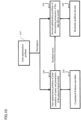
- FIG. 1D shows a schematic illustrating decomposition of the joint optimization problem (4), according to some embodiments of the present disclosure.
- the joint optimization problem (4) 137 is decomposed into a first optimization problem 139 of joint estimation of the states of the vapor compression cycle 100 and the parameters ⁇ of the physics-based model 133, and a second optmization problem 141 of determining the parameters w of the data driven model 135.
- the first optimization problem 139 includes minimizing a cost function comprised of residual errors of the state transitions predicted by the physics-based model 133 for the multiple instances of time, and residual errors between observed variables estimated by the constrained Kalman smoother for the multiple instances of time and the corresponding collected observed variables.
- the first optimization problem (5) 139 is solved to estimate the parameters ⁇ * of the physics-based model 133 and the states x k i ⁇ at all time instances for the observed variables collected.
- Some embodiments are based on the realization that the first optimization problem (5) 139 of joint estimation of the states and the parameters of the physics-based model 133 can be interpreted as a maximum a posteriori estimation of ⁇ and x k i , where the VCS is subject to Gaussian disturbances. Therefore, the first optimization problem (5) 139 can be efficiently solved using 4-dimensional variational (4DVar) data assimilation methods.
- 4DVar 4-dimensional variational
- Kalman smoothing algorithms are non-causal data assimilation methods in which measurement data available at a future time instance is used to improve an estimate of the state in the past using a Kalman estimation framework. Therefore, Kalman smoothers are well-suited for batch processing of measurements or observed variables collected over multiple instances of time. Kalman smoothing methods are guaranteed to be optimal for solving (5) if underlying functions F p and h are linear in optimization variables. While underlying governing equations of the vapor compression cycle 100 are not linear, Kalman smoothing algorithms are still advantageous for obtaining an approximate solution to (5) due to their reasonably well accuracy, computational efficiency and simpler implementations compared to sophisticated solvers that might be otherwise needed to solve (5).
- Kalman smoothers can be customized for specific vapor compression applications for substantially faster solutions that also incorporate physics-based state constraints. For example, refrigerant pressure in a heat exchanger must decrease in a direction of flow to satisfy fundamental physical relationships in the vapor compression cycle 100. If such a constraint on the refrigerant pressure is not satisfied after a state correction is applied at a given time, the solver may not be able to successfully integrate a dynamic model forward over the next time interval because perturbed pressures may cause nonphysical changes in a direction of the flow and violate fundamental assumptions of the dynamic model.
- the first optimization problem (5) 139 is solved using a constrained Kalman smoother 143 to estimate the parameters ⁇ * of the physics-based model 133 and the states x k i ⁇ .
- the processor 127 executes the constrained Kalman smother over the observed variables collected over multiple time instances to estimate the parameters ⁇ * of the physics-based model 133 and the states x k i ⁇ by minimizing the cost function of (5).
- the parameters w of the data driven model 135 are determined such that a cumulative learning cost function, which is comprised of a difference between the residual errors and the data driven model 135 outputs corresponding to the same inputs that generated the error residuals at that time instants, is minimized.
- the residual errors ⁇ k i ⁇ are known constants within the scope of the second optimization problem, thus, the data driven model 135 essentially attempts to learn the residual errors for a given input state vector and control input vector.
- the second optimization problem (6) 141 of determining the parameters w* is a standard neural network training problem.
- the second optimization problem (6) 141 is solved using stochastic gradient descent 145 to determine the parameters w* of the data driven model 135.
- the data driven model 135 is trained with training data set comprising ordered tuples, ( ⁇ k i ⁇ , x k i ⁇ , u k i ).
- Input to the data driven model 135 is ( x k i ⁇ , u k i ) and output of the data driven model 135 is the residual error ⁇ k i ⁇ .
- the processor 127 updates the hybrid model 131 with the parameters ⁇ * of physics-based model 133 and the parameters w*of the data driven model 135.
- the updated hybrid model 131 includes the physics-based model 133 with the parameters ⁇ * and the data driven model 135 with the parameters w*.
- the processor 127 controls the operation of the vapor compression cycle 100 using the updated hybrid model 131. For instance, based on the updated hybrid model 131, the processor 127 determines the control inputs to the actuators of the vapor compression cycle 100, e.g., the speed of the compressor 101, the speed of the fan 111, the position of the expansion valve 105, and the speed of the fan 113. Further, the processor 127 controls the actuators based on the determined control inputs.
- the digital representation of observed variables of the operation of the vapor compression cycle 100 collected from the sensors 115, 117, 119, 121, and 123 is transmitted to a storage medium co-located at the same geographical site where the vapor compression cycle 100 is located.
- FIG. 2 shows a schematic of a system architecture 200 including a storage medium 201, according to some embodiments of the present disclosure.
- the digital representation of observed variables of the operation of the the vapor compression cycle 100 collected over multiple instances of time from the sensors 115, 117, 119, 121, and 123, and control inputs provided by the controller 125 are stored in the storage medium 201.
- other internal information associated with the controller 125 such as internal controller variables, discrete variables from control logic, or other information produced by the controller 125, may be stored in the storage medium 201.
- the storage medium may be co-located at the same geographical site where the vapor compression cycle 100 is located.
- data from the storage medium 201 is periodically provided to the controller 125, either at regular intervals or when there is an event that calls for the updating of the hybrid model 131, for example, when a user requests for information related to the operation of the vapor compression cycle 100.
- the data provided from the storge medium 203 may include the digital representation of observed variables of the operation of the vapor compression cycle collected over multiple instances of time.
- Some embodiments are based on the realization that a part or whole of the data stored in the storage medium 201 may be stored using cloud computing resources, and, in addition, the updating of the hybrid model 131 may be implemented on a remote server. Such an embodiment is described in FIG. 3 .
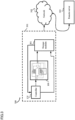
- FIG. 3 shows a schematic of a cloud-based architecture 300, according to some embodiments of the present disclosure.
- the vapor compression cycle 100, the controller 125, and the storage medium 201 is considered to be a system 301.
- the system 301 is in communication with the remote server 303 (also referred to as a cloud computing system) via a network 305.
- the remote server 303 also referred to as a cloud computing system
- a size of the storage medium 201 may vary and, additionally or alternatively, may or may not be present, depending on ability and/or reliability of the remote server 303 to access data from the vapor compression cycle 100.
- the system 301 is configured to transmit a part or whole of data (e.g., the digital representation of the observed variables and control inputs) to the remote server 303 for storage, rather than maintaining the data in the storage medium 201 co-located with the vapor compression cycle 100.
- the remote server 303 may store the model attributes of the hybrid model 131, i.e., the parameters ⁇ of the physics-based model 133, and the parameters w of the data driven model 135.
- the model attributes of the hybrid model 131 stored in the remote server 303 may be updated at regular intervals or when an update triggering event occurs.
- the update triggering event includes a user requests information related to the operation of the vapor compression cycle 100, replacement of a failed component (e.g. compressor, fan) of the vapor compression cycle 100 with a new component, the user requests to update the hybrid model 131, and the like.
- a failed component e.g. compressor, fan
- the specification information of the newly installed component can be used to update the hybrid model 131 on the remote server 303 to mimic the physical vapor compression cycle 100 as closely as possible.
- the remote server 303 updates the data driven model 135 to minimize a difference between the states estimated by executing the constrained Kalman smoother 143 over the observed variables collected over multiple instances of time and the states predicted by the physics-based model 133.
- the remote server 303 further updates the hybrid model with the estimated parameters of the physics-based model 133 and the updated data driven model.
- the cloud-based architecture 300 is advantageous. For example, only limited computational resources are required to be co-located with the vapor compression cycle 100, and appropriate computational resources can be easily adjusted and scaled in the remote server 303, i.e., cloud.
- both the data and the estimates of the states of the vapor compression cycle 100 can be simultaneously used in a variety of different contexts, including but not limited to equipment service or maintenance scheduling, or use in development of next-generation systems.
- the estimates of the states of the vapor compression cycle 100 may indicate a need for equipment maintenance that is not readily apparent from measured data.
- the cloud-based architecture 300 may make such information readily and asynchronously available to service companies so that they can automatically follow-up with a user and schedule a maintenance call.
- the information provided to the service company enables use of precise diagnostics and service tools.
- the constrained Kalman smoother that is executed to estimate the parameters ⁇ * of the physics-based model 133 and the state s x k i ⁇ is a constrained ensemble Kalman smoother.
- the constrained ensemble Kalman smoother is described below in FIG. 4 .
- FIG. 4 shows a block diagram of a method 400 for estimation of the states using the constrained ensemble Kalman smoother, according to some embodiments of the present disclosure.
- the method 400 begins with data 401 from the operation of the vapor compression cycle 100 and a model 403 of the vapor compression cycle 100.
- the data 401 includes a set of control inputs u and measurements, i.e. observed variables y from the sensors installed in the vapor compression cycle 100.
- the model 403 of the vapor compression cycle 100 describes both evolution of state variables via a function f and the measurements as a function of the state variables via a second function h which may be potentially a nonlinear function.
- the data 401 and the model 403 are used to initialize the unconstrained ensemble Kalman smoother with an initial ensemble of states x 1 i ⁇ of size M.
- One approach for initializing the constrained ensemble Kalman smoother is to determine a consistent initialization of the model 403 given a user-specified set of initial conditions, and then perturb initial states with a stochastic set of perturbations with an estimated model covariance.
- the state variables that are transformed into a range of the covariance r ( i ) * are updated over a smoothing window for every measurement in the data 401 by solving the constrained optimization problem.
- the transformed corrections are then transformed back into coordinate system of original state variables to obtain corrected augmented state estimates.
- the solution of the constrained optimization problem in block 407 for every sample at each available data point may be computationally expensive.
- the update step in block 407 can be replaced with a two-stage process, wherein in a first stage, the update is performed without constraints. After this update is applied, in a second stage, the constrained optimization problem in block 407 is solved only if the corrected augmented state estimates obtained in the first stage violate the constraints. The second stage is skipped if the constraints are satisfied after the corrections in the first stage.
- the length of data over which the state estimates will gradually increase as additional data is incorporated until all of the N data points are incorporated, and all of the state variables will be continually updated to reflect the new information provided by the data points that are sequentially added to the growing smoothing window. Increases in the length of the smoothing window as more data points are incorporated may pose serious computational challenges such as prohibitive memory requirements and computation time.
- a final set of smoothed state estimates is output.
- the final set of smoothed state estimates includes the states of the vapor compression cycle 100.
- the constrained ensemble Kalman smoother 400 is adapted to jointly estimate the states and the parameters of the physics-based model.
- the constrained ensemble Kalman smoother 400 estimates an augmented vector which includes both the states and the parameters of the physics-based model, while following a similar general flow of the method of the constrained ensemble Kalman smoother 400.
- FIG. 5A shows a block diagram of a method 500 for controlling the operation of the vapor compression cycle 100, according to an embodiment of the present disclosure.
- the method 500 includes collecting a digital representation of observed variables and control inputs of the operation of the vapor compression cycle 100 over multiple instances of time.
- the method 500 includes executing the constrained Kalman smoother 143 over the observed variables collected over multiple instances of time to jointly estimate the parameters of the physics-based model 133 and the states of the vapor compression cycle 100 to minimize the cost function comprised of the residual errors of the state transitions predicted by the physics-based model 133, and the residual errors between observed variables estimated by the constrained Kalman smoother for the multiple instances of time and the corresponding collected observed variables.
- the method 500 includes updating the data driven model 135 to minimize a difference between the states estimated by executing the constrained Kalman smoother 143 over the observed variables collected over multiple instances of time and the states predicted by the physics-based model 133.
- the method 500 includes updating the hybrid model 131 with the estimated parameters of the physics-based model 133 and the updated data driven model.
- the method 500 includes controlling the operation of the vapor compression cycle 100 using the updated hybrid model.
- FIG. 5B shows a block diagram for controlling the operation of the vapor compression cycle 100 using the updated hybrid model, according to an embodiment of the present disclosure.
- unobserved variables of the vapor compression cycle 100 are determined using the updated hybrid model.
- the unobserved variables correspond to the variables that are difficult to measure or cannot be measured directly.
- the unobserved variables may include the amount of refrigerant in the vapor compression cycle 100, thermal energy delivered by one or more heat exchangers of the vapor compression cycle 100, and a thermodynamic quality of the refrigerant flow at an inlet or outlet of one or more heat exchangers of the vapor compression cycle 100.
- control inputs to the actuators of the vapor compression cycle 100 are determined based on the updated hybrid model and the unobserved variables.
- the control inputs may include one or more of the speed of the compressor 101, the speed of the fan 111, the position of the expansion valve 105, and the speed of the fan 113.
- actuators of the vapor compression cycle 100 are controlled according to the determined control inputs to control the operation of the vapor compression cycle 100.
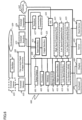
- FIG. 6 shows a schematic diagram of a computing device that can be used for implementing the controller 125 and the method 500 of the present disclosure.
- the computing device 600 includes a power source 601, a processor 603, a memory 605, a storage device 607, all connected to a bus 609. Further, a high-speed interface 611, a low-speed interface 613, high-speed expansion ports 615 and low speed connection ports 617, can be connected to the bus 609. In addition, a low-speed expansion port 619 is in connection with the bus 609. Further, an input interface 621 can be connected via the bus 609 to an external receiver 623 and an output interface 625. A receiver 627 can be connected to an external transmitter 629 and a transmitter 631 via the bus 609.
- NIC network interface controller
- NIC network interface controller
- the memory 605 can store instructions that are executable by the computing device 600 and any data that can be utilized by the methods and systems of the present disclosure.
- the memory 605 can include random access memory (RAM), read only memory (ROM), flash memory, or any other suitable memory systems.
- RAM random access memory
- ROM read only memory
- flash memory or any other suitable memory systems.
- the memory 605 can be a volatile memory unit or units, and/or a non-volatile memory unit or units.
- the memory 605 may also be another form of computer-readable medium, such as a magnetic or optical disk.
- the storage device 607 can be adapted to store supplementary data and/or software modules used by the computer device 600.
- the storage device 607 can include a hard drive, an optical drive, a thumb-drive, an array of drives, or any combinations thereof.
- the storage device 607 can contain a computer-readable medium, such as a floppy disk device, a hard disk device, an optical disk device, or a tape device, a flash memory or other similar solid-state memory device, or an array of devices, including devices in a storage area network or other configurations. Instructions can be stored in an information carrier. The instructions, when executed by one or more processing devices (for example, the processor 603), perform one or more methods, such as those described above.
- the computing device 600 can be linked through the bus 609, optionally, to a display interface or user Interface (HMI) 647 adapted to connect the computing device 600 to a display device 649 and a keyboard 651, wherein the display device 649 can include a computer monitor, camera, television, projector, or mobile device, among others.
- the computer device 600 may include a printer interface to connect to a printing device, wherein the printing device can include a liquid inkjet printer, solid ink printer, large-scale commercial printer, thermal printer, UV printer, or dye-sublimation printer, among others.
- the high-speed interface 611 manages bandwidth-intensive operations for the computing device 600, while the low-speed interface 613 manages lower bandwidth-intensive operations. Such allocation of functions is an example only.
- the high-speed interface 611 can be coupled to the memory 605, the user interface (HMI) 646, and to the keyboard 651 and the display 649 (e.g., through a graphics processor or accelerator), and to the high-speed expansion ports 615, which may accept various expansion cards via the bus 609.
- the low-speed interface 613 is coupled to the storage device 607 and the low-speed expansion ports 617, via the bus 609.
- the low-speed expansion ports 617 which may include various communication ports (e.g., USB, Bluetooth, Ethernet, wireless Ethernet) may be coupled to the one or more input/output devices 641.
- the computing device 600 may be connected to a server 653 and a rack server 655.
- the computing device 600 may be implemented in several different forms. For example, the computing device 600 may be implemented as part of the rack server 655.
- Various methods or processes outlined herein may be coded as software that is executable on one or more processors that employ any one of a variety of operating systems or platforms. Additionally, such software may be written using any of a number of suitable programming languages and/or programming or scripting tools, and also may be compiled as executable machine language code or intermediate code that is executed on a framework or virtual machine. Typically, the functionality of the program modules may be combined or distributed as desired in various embodiments.
- embodiments of the present disclosure and the functional operations described in this specification can be implemented in digital electronic circuitry, in tangibly-embodied computer software or firmware, in computer hardware, including the structures disclosed in this specification and their structural equivalents, or in combinations of one or more of them.
- embodiments of the present disclosure can be implemented as one or more computer programs, i.e., one or more modules of computer program instructions encoded on a tangible non transitory program carrier for execution by, or to control the operation of, data processing apparatus.
- program instructions can be encoded on an artificially generated propagated signal, e.g., a machine-generated electrical, optical, or electromagnetic signal, which is generated to encode information for transmission to suitable receiver apparatus for execution by a data processing apparatus.
- the computer storage medium can be a machine-readable storage device, a machine-readable storage substrate, a random or serial access memory device, or a combination of one or more of them.
- the term "data processing apparatus” can encompass all kinds of apparatus, devices, and machines for processing data, including by way of example a programmable processor, a computer, or multiple processors or computers.
- the apparatus can include special purpose logic circuitry, e.g., an FPGA (field programmable gate array) or an ASIC (application specific integrated circuit).
- the apparatus can also include, in addition to hardware, code that creates an execution environment for the computer program in question, e.g., code that constitutes processor firmware, a protocol stack, a database management system, an operating system, or a combination of one or more of them.
- a computer program (which may also be referred to or described as a program, software, a software application, a module, a software module, a script, or code) can be written in any form of programming language, including compiled or interpreted languages, or declarative or procedural languages, and it can be deployed in any form, including as a stand-alone program or as a module, component, subroutine, or other unit suitable for use in a computing environment.
- a computer program may, but need not, correspond to a file in a file system.
- a program can be stored in a portion of a file that holds other programs or data, e.g., one or more scripts stored in a markup language document, in a single file dedicated to the program in question, or in multiple coordinated files, e.g., files that store one or more modules, sub programs, or portions of code.
- a computer program can be deployed to be executed on one computer or on multiple computers that are located at one site or distributed across multiple sites and interconnected by a communication network.
- Computers suitable for the execution of a computer program include, by way of example, can be based on general or special purpose microprocessors or both, or any other kind of central processing unit.
- a central processing unit will receive instructions and data from a read only memory or a random access memory or both.
- the essential elements of a computer are a central processing unit for performing or executing instructions and one or more memory devices for storing instructions and data.
- a computer will also include, or be operatively coupled to receive data from or transfer data to, or both, one or more mass storage devices for storing data, e.g., magnetic, magneto optical disks, or optical disks.
- mass storage devices for storing data, e.g., magnetic, magneto optical disks, or optical disks.
- a computer need not have such devices.
- a computer can be embedded in another device, e.g., a mobile telephone, a personal digital assistant (PDA), a mobile audio or video player, a game console, a Global Positioning System (GPS) receiver, or a portable storage device, e.g., a universal serial bus (USB) flash drive, to name just a few.
- PDA personal digital assistant
- GPS Global Positioning System
- USB universal serial bus
- a computer having a display device, e.g., a CRT (cathode ray tube) or LCD (liquid crystal display) monitor, for displaying information to the user and a keyboard and a pointing device, e.g., a mouse or a trackball, by which the user can provide input to the computer.
- a display device e.g., a CRT (cathode ray tube) or LCD (liquid crystal display) monitor
- keyboard and a pointing device e.g., a mouse or a trackball
- Other kinds of devices can be used to provide for interaction with a user as well; for example, feedback provided to the user can be any form of sensory feedback, e.g., visual feedback, auditory feedback, or tactile feedback; and input from the user can be received in any form, including acoustic, speech, or tactile input.
- a computer can interact with a user by sending documents to and receiving documents from a device that is used by the user; for example, by sending web pages to a
- Embodiments of the subject matter described in this specification can be implemented in a computing system that includes a back end component, e.g., as a data server, or that includes a middleware component, e.g., an application server, or that includes a front end component, e.g., a client computer having a graphical user interface or a Web browser through which a user can interact with an implementation of the subject matter described in this specification, or any combination of one or more such back end, middleware, or front end components.
- the components of the system can be interconnected by any form or medium of digital data communication, e.g., a communication network. Examples of communication networks include a local area network (“LAN”) and a wide area network (“WAN”), e.g., the Internet.
- LAN local area network
- WAN wide area network
- the computing system can include clients and servers.
- a client and server are generally remote from each other and typically interact through a communication network.
- the relationship of client and server arises by virtue of computer programs running on the respective computers and having a client-server relationship to each other.
Landscapes
- Engineering & Computer Science (AREA)
- Physics & Mathematics (AREA)
- Artificial Intelligence (AREA)
- Mechanical Engineering (AREA)
- General Engineering & Computer Science (AREA)
- Evolutionary Computation (AREA)
- Chemical & Material Sciences (AREA)
- Combustion & Propulsion (AREA)
- Signal Processing (AREA)
- Health & Medical Sciences (AREA)
- Computer Vision & Pattern Recognition (AREA)
- Medical Informatics (AREA)
- Software Systems (AREA)
- General Physics & Mathematics (AREA)
- Automation & Control Theory (AREA)
- Thermal Sciences (AREA)
- Mathematical Physics (AREA)
- Fuzzy Systems (AREA)
- Human Computer Interaction (AREA)
- Feedback Control In General (AREA)
- Air Conditioning Control Device (AREA)
- Separation Of Gases By Adsorption (AREA)
Claims (14)
- Steuereinheit (125) zur Steuerung eines Betriebs eines Dampfkompressionskreislaufs (100) auf der Grundlage eines Hybridmodells (131) von Dynamiken des Dampfkompressionskreislaufs (100), das ein physikbasiertes Modell (133) und ein datengesteuertes Modell (135) enthält, wobei das physikbasierte Modell (133) dazu ausgelegt ist, Übergänge von Zuständen des Dampfkompressionskreislaufs (100) in Übereinstimmung mit beobachteten Variablen und einer Steuereingabe in den Dampfkompressionskreislauf (100) auf der Grundlage von Parametern des physikbasierten Modells (133) vorherzusagen, und wobei das datengesteuerte Modell (135) mit maschinellem Lernen trainiert wird, um Restfehler der Zustandsübergänge zu ermitteln, die durch das physikbasierte Modell (133) vorhergesagt werden, Steuereinheit (125), umfassend: einen Prozessor (127); und einen Arbeitsspeicher (129), in dem Anweisungen gespeichert sind, die, bei Ausführung durch den Prozessor (127), die Steuereinheit (125) dazu veranlassen:eine digitale Darstellung von beobachteten Variablen und Steuereingaben für den Betrieb des Dampfkompressionskreislaufs (100) über mehrere Zeitpunkte hinweg zu erfassen;einen eingeschränkten Kalman-Smoother über die beobachteten Variablen, die über mehrere Zeitpunkte hinweg erfasst wurden, auszuführen, um die Parameter des physikbasierten Modells (133) und Zustände des Dampfkompressionskreislaufs (100) gemeinsam zu ermitteln, indem eine Kostenfunktion minimiert wird, die aus Restfehlern der Zustandsübergänge, die durch das physikbasierte Modell für die mehreren Zeitpunkte vorhergesagt wurden, und aus Restfehlern zwischen beobachteten Variablen, die durch den eingeschränkten Kalman-Smoother für die mehreren Zeitpunkte ermittelt wurden, und den entsprechenden erfassten beobachteten Variablen zusammengesetzt ist;das datengesteuerte Modell (135) zu aktualisieren, um eine Differenz zwischen den Zuständen, die durch Ausführung des eingeschränkten Kalman-Smoothers über die beobachteten Variablen, die über mehrere Zeitpunkte hinweg erfasst wurden, ermittelt wurden, und den Zuständen, die durch das physikbasierte Modell (133) vorhergesagt wurden, zu minimieren;das Hybridmodell (131) mit den ermittelten Parametern des physikbasierten Modells (133) und dem aktualisierten datengesteuerten Modell (135) zu aktualisieren; undden Betrieb des Dampfkompressionskreislaufs (100) unter Verwendung des aktualisierten Hybridmodells (131) zu steuern.
- Steuereinheit (125) nach Anspruch 1, wobei das physikbasierte Modell (133) eine oder eine Kombination von zugrunde liegenden über räumliche und zeitliche Domänen diskretisierten partiellen Differentialgleichungen, Nachschlagetabellen und Interpolationssplines zur Berechnung von thermodynamischen Eigenschaften eines Kältemittels des Dampfkompressionskreislaufs (100) enthält.
- Steuereinheit (125) nach Anspruch 2, wobei die Parameter des physikbasierten Modells (133) eine Anzahl von endlichen Kontrollvolumina zur Diskretisierung der zugrunde liegenden partiellen Differentialgleichungen, geometrische Parameter des Dampfkompressionskreislaufs, Eigenschaften der in dem Dampfkompressionskreislauf (100) verwendeten Materialien und eine Gesamtmasse des Kältemittels umfassen.
- Steuereinheit (125) nach Anspruch 1, wobei das datengesteuerte Modell (135) ein neuronales Netz enthält.
- Steuereinheit (125) nach Anspruch 4, wobei Parameter des datengesteuerten Modells (135) eine Architektur, Gewichtungen und Biases des neuronalen Netzes umfassen.
- Steuereinheit (125) nach Anspruch 1, wobei die beobachteten Variablen Messungen einer oder mehrerer von einer Temperatur und eines Drucks an verschiedenen Stellen des Dampfkompressionskreislaufs (100) umfassen.
- Steuereinheit (125) nach Anspruch 1, wobei die Steuereingabe in den Dampfkompressionskreislauf (100) eine Kompressordrehzahl, eine Lüfterdrehzahl und eine Stellung eines Expansionsventils umfasst.
- Steuereinheit (125) nach Anspruch 1, wobei der Prozessor (127) ferner dazu ausgelegt ist, die digitale Darstellung von beobachteten Variablen und der Steuereingaben für den Betrieb des Dampfkompressionskreislaufs (100) zur Speicherung an einen entfernten Server (303) zu übermitteln.
- Steuereinheit (125) nach Anspruch 8, wobei der entfernte Server (303) dazu ausgelegt ist:den eingeschränkten Kalman-Smoother über die beobachteten Variablen, die über mehrere Zeitpunkte hinweg erfasst wurden, auszuführen, um die Parameter des physikbasierten Modells (133) und die Zustände des Dampfkompressionskreislaufs gemeinsam zu ermitteln, indem eine Kostenfunktion minimiert wird, die aus den Restfehlern der Zustandsübergänge, die durch das physikbasierte Modell (133) für die mehreren Zeitpunkte vorhergesagt wurden, und den Restfehlern zwischen beobachteten Variablen, die durch den eingeschränkten Kalman-Smoother für die mehreren Zeitpunkte ermittelt wurden, und den entsprechenden erfassten beobachteten Variablen zusammengesetzt ist;das datengesteuerte Modell (135) zu aktualisieren, um die Differenz zwischen den Zuständen, die durch Ausführen des eingeschränkten Kalman-Smoothers über die beobachteten Variablen, die über mehrere Zeitpunkte hinweg erfasst wurden, ermittelt wurden, und den Zuständen, die durch das physikbasierte Modell (133) vorhergesagt wurden, zu minimieren;das Hybridmodell (131) mit den ermittelten Parametern des physikbasierten Modells (133) und dem aktualisierten datengesteuerten Modell (135) zu aktualisieren; unddas aktualisierte Hybridmodell (131) zu übermitteln.
- Steuereinheit (125) nach Anspruch 9, wobei der Prozessor (127) ferner dazu ausgelegt ist:das aktualisierte Hybridmodell (131) zu empfangen; undunbeobachtete Variablen des Dampfkompressionskreislaufs mit Hilfe des empfangenen aktualisierten Hybridmodells zu bestimmen (131).
- Steuereinheit (125) nach Anspruch 10, wobei der Prozessor (127) ferner dazu ausgelegt ist, den Betrieb des Dampfkompressionskreislaufs (100) unter Verwendung des empfangenen aktualisierten Hybridmodells (131) zu steuern.
- Verfahren (500) zum Steuern eines Betriebs eines Dampfkompressionskreislaufs (100) auf der Grundlage eines Hybridmodells (131) von Dynamiken des Dampfkompressionskreislaufs (100), das ein physikbasiertes Modell (133) und ein datengesteuertes Modell (135) enthält, wobei das physikbasierte Modell (133) dazu ausgelegt ist, Übergänge von Zuständen des Dampfkompressionskreislaufs (100) in Übereinstimmung mit beobachteten Variablen und einer Steuereingabe in den Dampfkompressionskreislauf (100) auf der Grundlage von Parametern des physikbasierten Modells (133) vorherzusagen, und wobei das datengesteuerte Modell (135) mit maschinellem Lernen trainiert wird, um Restfehler der Zustandsübergänge zu ermitteln, die durch das physikbasierte Modell (133) vorhergesagt werden, wobei das Verfahren (500) einen Prozessor nutzt, der mit gespeicherten Anweisungen gekoppelt ist, die das Verfahren implementieren, wobei die Anweisungen, wenn sie durch den Prozessor ausgeführt werden, Schritte des Verfahrens ausführen, umfassend:Erfassen einer digitalen Darstellung von beobachteten Variablen und Steuereingaben für den Betrieb des Dampfkompressionskreislaufs über mehrere Zeitpunkte (501) hinweg;Ausführen eines eingeschränkten Kalman-Smoothers über die beobachteten Variablen, die über mehrere Zeitpunkte hinweg erfasst wurden, um die Parameter des physikbasierten Modells und Zustände des Dampfkompressionskreislaufs gemeinsam zu ermitteln, indem eine Kostenfunktion minimiert wird, die aus Restfehlern der Zustandsübergänge, die durch das physikbasierte Modell für die mehreren Zeitpunkte vorhergesagt wurden, und aus Restfehlern zwischen beobachteten Variablen, die durch den eingeschränkten Kalman-Smoother für die mehreren Zeitpunkte ermittelt wurden, und den entsprechenden erfassten beobachteten Variablen (503) zusammengesetzt ist;Aktualisieren des datengesteuerten Modells, um eine Differenz zwischen den Zuständen, die durch Ausführen des eingeschränkten Kalman-Smoothers über die beobachteten Variablen, die über mehrere Zeitpunkte hinweg erfasst wurden, ermittelt wurden, und den Zuständen, die durch das physikbasierte Modell (505) vorhergesagt wurden, zu minimieren;Aktualisieren des Hybridmodells mit den ermittelten Parametern des physikbasierten Modells und dem aktualisierten datengesteuerten Modell (507); undSteuern des Betriebs des Dampfkompressionskreislaufs mithilfe des aktualisierten Hybridmodells (509).
- Verfahren (500) nach Anspruch 12, wobei das Verfahren (500) ferner Übermitteln der digitalen Darstellung von beobachteten Variablen und Steuereingaben für den Betrieb des Dampfkompressionskreislaufs (100) zur Speicherung an einen entfernten Server (303) umfasst.
- Nicht-flüchtiges, computerlesbares Speichermedium, in dem ein Programm enthalten ist, das von einem Prozessor (127) ausführbar ist, um ein Verfahren (500) zum Steuern eines Betriebs eines Dampfkompressionskreislaufs (100) auf der Grundlage eines Hybridmodells (131) von Dynamiken des Dampfkompressionskreislaufs (100), das ein physikbasiertes Modell (133) und ein datengesteuertes Modell (135) enthält, durchzuführen, wobei das physikbasierte Modell (133) dazu ausgelegt ist, Übergänge von Zuständen des Dampfkompressionskreislaufs (100) in Übereinstimmung mit beobachteten Variablen und einer Steuereingabe in den Dampfkompressionskreislauf (100) auf der Grundlage von Parametern des physikbasierten Modells (133) vorherzusagen, und wobei das datengesteuerte Modell (135) mit maschinellem Lernen trainiert wird, um Restfehler der Zustandsübergänge zu ermitteln, die durch das physikbasierte Modell (133) vorhergesagt werden, wobei das Verfahren (500) umfasst:Erfassen einer digitalen Darstellung von beobachteten Variablen und Steuereingaben für den Betrieb des Dampfkompressionskreislaufs über mehrere Zeitpunkte (501) hinweg;Ausführen eines eingeschränkten Kalman-Smoothers über die beobachteten Variablen, die über mehrere Zeitpunkte hinweg erfasst wurden, um die Parameter des physikbasierten Modells und Zustände des Dampfkompressionskreislaufs gemeinsam zu ermitteln, indem eine Kostenfunktion minimiert wird, die aus Restfehlern der Zustandsübergänge, die durch das physikbasierte Modell für die mehreren Zeitpunkte vorhergesagt wurden, und aus Restfehlern zwischen beobachteten Variablen, die durch den eingeschränkten Kalman-Smoother für die mehreren Zeitpunkte ermittelt wurden, und den entsprechenden erfassten beobachteten Variablen (503) zusammengesetzt ist;Aktualisieren des datengesteuerten Modells, um eine Differenz zwischen den Zuständen, die durch Ausführen des eingeschränkten Kalman-Smoothers über die beobachteten Variablen, die über mehrere Zeitpunkte hinweg erfasst wurden, ermittelt wurden, und den Zuständen, die durch das physikbasierte Modell (505) vorhergesagt wurden, zu minimieren;Aktualisieren des Hybridmodells mit den ermittelten Parametern des physikbasierten Modells und dem aktualisierten datengesteuerten Modell (507); undSteuern des Betriebs des Dampfkompressionskreislaufs mithilfe des aktualisierten Hybridmodells (509).
Applications Claiming Priority (2)
| Application Number | Priority Date | Filing Date | Title |
|---|---|---|---|
| US18/295,142 US12510278B2 (en) | 2023-04-03 | 2023-04-03 | System and method for controlling an operation of a vapor compression cycle based on a hybrid model of dynamics of the vapor compression cycle |
| PCT/JP2023/046053 WO2024209750A1 (en) | 2023-04-03 | 2023-12-15 | System and method for controlling an operation of a vapor compression cycle |
Publications (2)
| Publication Number | Publication Date |
|---|---|
| EP4483245A1 EP4483245A1 (de) | 2025-01-01 |
| EP4483245B1 true EP4483245B1 (de) | 2025-05-07 |
Family
ID=89707965
Family Applications (1)
| Application Number | Title | Priority Date | Filing Date |
|---|---|---|---|
| EP23844378.2A Active EP4483245B1 (de) | 2023-04-03 | 2023-12-15 | System und verfahren zur steuerung eines betriebs eines dampfkompressionszyklus |
Country Status (6)
| Country | Link |
|---|---|
| US (1) | US12510278B2 (de) |
| EP (1) | EP4483245B1 (de) |
| JP (1) | JP2026504708A (de) |
| CN (1) | CN120883154A (de) |
| ES (1) | ES3032534T3 (de) |
| WO (1) | WO2024209750A1 (de) |
Family Cites Families (5)
| Publication number | Priority date | Publication date | Assignee | Title |
|---|---|---|---|---|
| US6505475B1 (en) | 1999-08-20 | 2003-01-14 | Hudson Technologies Inc. | Method and apparatus for measuring and improving efficiency in refrigeration systems |
| US7680751B2 (en) | 2006-05-31 | 2010-03-16 | Honeywell International Inc. | Neural network based refrigerant charge detection algorithm for vapor compression systems |
| US20180245809A1 (en) * | 2017-02-24 | 2018-08-30 | Honeywell International Inc. | Determining costs associated with an hvac system |
| US11384950B2 (en) * | 2019-01-16 | 2022-07-12 | Airviz Inc. | Proactive building air quality management |
| KR102439453B1 (ko) | 2021-02-22 | 2022-09-01 | 포항공과대학교 산학협력단 | 상호 연결된 인공 신경망과 온라인 학습을 이용한 열 공조 시스템 및 운영 방법 |
-
2023
- 2023-04-03 US US18/295,142 patent/US12510278B2/en active Active
- 2023-12-15 ES ES23844378T patent/ES3032534T3/es active Active
- 2023-12-15 CN CN202380095825.3A patent/CN120883154A/zh active Pending
- 2023-12-15 JP JP2025569150A patent/JP2026504708A/ja active Pending
- 2023-12-15 EP EP23844378.2A patent/EP4483245B1/de active Active
- 2023-12-15 WO PCT/JP2023/046053 patent/WO2024209750A1/en not_active Ceased
Also Published As
| Publication number | Publication date |
|---|---|
| WO2024209750A1 (en) | 2024-10-10 |
| EP4483245A1 (de) | 2025-01-01 |
| CN120883154A (zh) | 2025-10-31 |
| JP2026504708A (ja) | 2026-02-06 |
| US12510278B2 (en) | 2025-12-30 |
| US20240328695A1 (en) | 2024-10-03 |
| ES3032534T3 (en) | 2025-07-21 |
Similar Documents
| Publication | Publication Date | Title |
|---|---|---|
| JP7693120B2 (ja) | シミュレーションの失敗を利用して産業システムモデルを較正するための較正システムおよび方法 | |
| Ruano et al. | The IMBPC HVAC system: A complete MBPC solution for existing HVAC systems | |
| US20220335179A1 (en) | System and Method for Calibrating a Model of Thermal Dynamics | |
| Lu et al. | Multi-step-ahead prediction of thermal load in regional energy system using deep learning method | |
| CN111868639B (zh) | 用于控制空调系统的运行的系统及方法 | |
| US20160146493A1 (en) | Building thermal control techniques | |
| US9760534B2 (en) | Optimal parameter selection and acceleration in ADMM for multi-stage stochastic convex quadratic programs | |
| US12571555B2 (en) | Method and system for physics aware control of HVAC equipment | |
| JP6962042B2 (ja) | シミュレーション装置およびシミュレーション方法 | |
| US20230314031A1 (en) | System and method for modeling, parameter estimation and adaptive control of building heating, ventilation and air conditioning (hvac) system with the aid of a digital computer | |
| US12124241B2 (en) | System and method for indirect data-driven control under constraints | |
| CN119129389A (zh) | 基于时空特征的数据中心建模与运行策略确定方法及装置 | |
| Goldfeder et al. | The smart buildings control suite: A diverse open source benchmark to evaluate and scale hvac control policies for sustainability | |
| US12313276B2 (en) | Time-varying reinforcement learning for robust adaptive estimator design with application to HVAC flow control | |
| EP4483245B1 (de) | System und verfahren zur steuerung eines betriebs eines dampfkompressionszyklus | |
| US20250165679A1 (en) | State Estimation using Physics-Constrained Machine Learning | |
| US20250216824A1 (en) | Data-Driven State Estimation and System Control under Uncertainty | |
| US20250341329A1 (en) | Thermal optimization and control in open-plan spaces using physics-informed graph neural network based optimal controller | |
| US12366395B2 (en) | System and method for monitoring an operation of a vapor compression cycle | |
| Fu et al. | Trajectory optimization for unknown maneuvering target tracking with bearing-only measurements | |
| Aliyu et al. | Digital Twinning of a Pressurized Water Reactor Startup Operation and Partial Computational Offloading in In-network Computing-Assisted Multiaccess Edge Computing | |
| US20250190656A1 (en) | Polytopic Reduced-Order Model for Prediction, Estimation and Control of Partial Differential Equations | |
| US20250323523A1 (en) | System and Method for Controlling an Operation of an Electric Grid | |
| Naug | Deep learning methods applied to modeling and policy optimization in large buildings | |
| WO2025121441A1 (en) | Polytopic reduced-order model for prediction, estimation and control of partial differential equations |
Legal Events
| Date | Code | Title | Description |
|---|---|---|---|
| STAA | Information on the status of an ep patent application or granted ep patent |
Free format text: STATUS: UNKNOWN |
|
| STAA | Information on the status of an ep patent application or granted ep patent |
Free format text: STATUS: THE INTERNATIONAL PUBLICATION HAS BEEN MADE |
|
| PUAI | Public reference made under article 153(3) epc to a published international application that has entered the european phase |
Free format text: ORIGINAL CODE: 0009012 |
|
| STAA | Information on the status of an ep patent application or granted ep patent |
Free format text: STATUS: REQUEST FOR EXAMINATION WAS MADE |
|
| 17P | Request for examination filed |
Effective date: 20240926 |
|
| AK | Designated contracting states |
Kind code of ref document: A1 Designated state(s): AL AT BE BG CH CY CZ DE DK EE ES FI FR GB GR HR HU IE IS IT LI LT LU LV MC ME MK MT NL NO PL PT RO RS SE SI SK SM TR |
|
| GRAP | Despatch of communication of intention to grant a patent |
Free format text: ORIGINAL CODE: EPIDOSNIGR1 |
|
| STAA | Information on the status of an ep patent application or granted ep patent |
Free format text: STATUS: GRANT OF PATENT IS INTENDED |
|
| INTG | Intention to grant announced |
Effective date: 20250114 |
|
| GRAS | Grant fee paid |
Free format text: ORIGINAL CODE: EPIDOSNIGR3 |
|
| GRAA | (expected) grant |
Free format text: ORIGINAL CODE: 0009210 |
|
| STAA | Information on the status of an ep patent application or granted ep patent |
Free format text: STATUS: THE PATENT HAS BEEN GRANTED |
|
| AK | Designated contracting states |
Kind code of ref document: B1 Designated state(s): AL AT BE BG CH CY CZ DE DK EE ES FI FR GB GR HR HU IE IS IT LI LT LU LV MC ME MK MT NL NO PL PT RO RS SE SI SK SM TR |
|
| DAV | Request for validation of the european patent (deleted) | ||
| DAX | Request for extension of the european patent (deleted) | ||
| REG | Reference to a national code |
Ref country code: GB Ref legal event code: FG4D |
|
| REG | Reference to a national code |
Ref country code: CH Ref legal event code: EP |
|
| REG | Reference to a national code |
Ref country code: DE Ref legal event code: R096 Ref document number: 602023003392 Country of ref document: DE |
|
| REG | Reference to a national code |
Ref country code: IE Ref legal event code: FG4D |
|
| REG | Reference to a national code |
Ref country code: ES Ref legal event code: FG2A Ref document number: 3032534 Country of ref document: ES Kind code of ref document: T3 Effective date: 20250721 |
|
| REG | Reference to a national code |
Ref country code: NL Ref legal event code: MP Effective date: 20250507 |
|
| PG25 | Lapsed in a contracting state [announced via postgrant information from national office to epo] |
Ref country code: FI Free format text: LAPSE BECAUSE OF FAILURE TO SUBMIT A TRANSLATION OF THE DESCRIPTION OR TO PAY THE FEE WITHIN THE PRESCRIBED TIME-LIMIT Effective date: 20250507 Ref country code: PT Free format text: LAPSE BECAUSE OF FAILURE TO SUBMIT A TRANSLATION OF THE DESCRIPTION OR TO PAY THE FEE WITHIN THE PRESCRIBED TIME-LIMIT Effective date: 20250908 |
|
| REG | Reference to a national code |
Ref country code: LT Ref legal event code: MG9D |
|
| PG25 | Lapsed in a contracting state [announced via postgrant information from national office to epo] |
Ref country code: NO Free format text: LAPSE BECAUSE OF FAILURE TO SUBMIT A TRANSLATION OF THE DESCRIPTION OR TO PAY THE FEE WITHIN THE PRESCRIBED TIME-LIMIT Effective date: 20250807 Ref country code: GR Free format text: LAPSE BECAUSE OF FAILURE TO SUBMIT A TRANSLATION OF THE DESCRIPTION OR TO PAY THE FEE WITHIN THE PRESCRIBED TIME-LIMIT Effective date: 20250808 |
|
| PG25 | Lapsed in a contracting state [announced via postgrant information from national office to epo] |
Ref country code: PL Free format text: LAPSE BECAUSE OF FAILURE TO SUBMIT A TRANSLATION OF THE DESCRIPTION OR TO PAY THE FEE WITHIN THE PRESCRIBED TIME-LIMIT Effective date: 20250507 Ref country code: NL Free format text: LAPSE BECAUSE OF FAILURE TO SUBMIT A TRANSLATION OF THE DESCRIPTION OR TO PAY THE FEE WITHIN THE PRESCRIBED TIME-LIMIT Effective date: 20250507 |
|
| REG | Reference to a national code |
Ref country code: AT Ref legal event code: MK05 Ref document number: 1793139 Country of ref document: AT Kind code of ref document: T Effective date: 20250507 |
|
| PG25 | Lapsed in a contracting state [announced via postgrant information from national office to epo] |
Ref country code: BG Free format text: LAPSE BECAUSE OF FAILURE TO SUBMIT A TRANSLATION OF THE DESCRIPTION OR TO PAY THE FEE WITHIN THE PRESCRIBED TIME-LIMIT Effective date: 20250507 |
|
| PG25 | Lapsed in a contracting state [announced via postgrant information from national office to epo] |
Ref country code: HR Free format text: LAPSE BECAUSE OF FAILURE TO SUBMIT A TRANSLATION OF THE DESCRIPTION OR TO PAY THE FEE WITHIN THE PRESCRIBED TIME-LIMIT Effective date: 20250507 |
|
| PG25 | Lapsed in a contracting state [announced via postgrant information from national office to epo] |
Ref country code: AT Free format text: LAPSE BECAUSE OF FAILURE TO SUBMIT A TRANSLATION OF THE DESCRIPTION OR TO PAY THE FEE WITHIN THE PRESCRIBED TIME-LIMIT Effective date: 20250507 |
|
| PG25 | Lapsed in a contracting state [announced via postgrant information from national office to epo] |
Ref country code: RS Free format text: LAPSE BECAUSE OF FAILURE TO SUBMIT A TRANSLATION OF THE DESCRIPTION OR TO PAY THE FEE WITHIN THE PRESCRIBED TIME-LIMIT Effective date: 20250807 |
|
| PG25 | Lapsed in a contracting state [announced via postgrant information from national office to epo] |
Ref country code: IS Free format text: LAPSE BECAUSE OF FAILURE TO SUBMIT A TRANSLATION OF THE DESCRIPTION OR TO PAY THE FEE WITHIN THE PRESCRIBED TIME-LIMIT Effective date: 20250907 |
|
| PG25 | Lapsed in a contracting state [announced via postgrant information from national office to epo] |
Ref country code: LV Free format text: LAPSE BECAUSE OF FAILURE TO SUBMIT A TRANSLATION OF THE DESCRIPTION OR TO PAY THE FEE WITHIN THE PRESCRIBED TIME-LIMIT Effective date: 20250507 |
|
| PGFP | Annual fee paid to national office [announced via postgrant information from national office to epo] |
Ref country code: DE Payment date: 20251028 Year of fee payment: 3 |
|
| PG25 | Lapsed in a contracting state [announced via postgrant information from national office to epo] |
Ref country code: DK Free format text: LAPSE BECAUSE OF FAILURE TO SUBMIT A TRANSLATION OF THE DESCRIPTION OR TO PAY THE FEE WITHIN THE PRESCRIBED TIME-LIMIT Effective date: 20250507 Ref country code: SM Free format text: LAPSE BECAUSE OF FAILURE TO SUBMIT A TRANSLATION OF THE DESCRIPTION OR TO PAY THE FEE WITHIN THE PRESCRIBED TIME-LIMIT Effective date: 20250507 |
|
| PG25 | Lapsed in a contracting state [announced via postgrant information from national office to epo] |
Ref country code: CZ Free format text: LAPSE BECAUSE OF FAILURE TO SUBMIT A TRANSLATION OF THE DESCRIPTION OR TO PAY THE FEE WITHIN THE PRESCRIBED TIME-LIMIT Effective date: 20250507 |
|
| PG25 | Lapsed in a contracting state [announced via postgrant information from national office to epo] |
Ref country code: EE Free format text: LAPSE BECAUSE OF FAILURE TO SUBMIT A TRANSLATION OF THE DESCRIPTION OR TO PAY THE FEE WITHIN THE PRESCRIBED TIME-LIMIT Effective date: 20250507 |
|
| PG25 | Lapsed in a contracting state [announced via postgrant information from national office to epo] |
Ref country code: SK Free format text: LAPSE BECAUSE OF FAILURE TO SUBMIT A TRANSLATION OF THE DESCRIPTION OR TO PAY THE FEE WITHIN THE PRESCRIBED TIME-LIMIT Effective date: 20250507 |
|
| REG | Reference to a national code |
Ref country code: DE Ref legal event code: R097 Ref document number: 602023003392 Country of ref document: DE |
|
| PLBE | No opposition filed within time limit |
Free format text: ORIGINAL CODE: 0009261 |
|
| STAA | Information on the status of an ep patent application or granted ep patent |
Free format text: STATUS: NO OPPOSITION FILED WITHIN TIME LIMIT |
|
| PG25 | Lapsed in a contracting state [announced via postgrant information from national office to epo] |
Ref country code: RO Free format text: LAPSE BECAUSE OF FAILURE TO SUBMIT A TRANSLATION OF THE DESCRIPTION OR TO PAY THE FEE WITHIN THE PRESCRIBED TIME-LIMIT Effective date: 20250507 |
|
| REG | Reference to a national code |
Ref country code: CH Ref legal event code: L10 Free format text: ST27 STATUS EVENT CODE: U-0-0-L10-L00 (AS PROVIDED BY THE NATIONAL OFFICE) Effective date: 20260318 |
|
| PGFP | Annual fee paid to national office [announced via postgrant information from national office to epo] |
Ref country code: ES Payment date: 20260108 Year of fee payment: 3 |
|
| 26N | No opposition filed |
Effective date: 20260210 |
|
| PGFP | Annual fee paid to national office [announced via postgrant information from national office to epo] |
Ref country code: IT Payment date: 20251231 Year of fee payment: 3 |