EP4482233A1 - Verfahren und vorrichtung zur bestimmung einer auslöserbedingung sowie ressourcenpartitionkonfigurationsverfahren und -vorrichtung - Google Patents
Verfahren und vorrichtung zur bestimmung einer auslöserbedingung sowie ressourcenpartitionkonfigurationsverfahren und -vorrichtung Download PDFInfo
- Publication number
- EP4482233A1 EP4482233A1 EP22925444.6A EP22925444A EP4482233A1 EP 4482233 A1 EP4482233 A1 EP 4482233A1 EP 22925444 A EP22925444 A EP 22925444A EP 4482233 A1 EP4482233 A1 EP 4482233A1
- Authority
- EP
- European Patent Office
- Prior art keywords
- feature
- rach resource
- random access
- resource
- terminal
- Prior art date
- Legal status (The legal status is an assumption and is not a legal conclusion. Google has not performed a legal analysis and makes no representation as to the accuracy of the status listed.)
- Pending
Links
Images


Classifications
-
- H—ELECTRICITY
- H04—ELECTRIC COMMUNICATION TECHNIQUE
- H04W—WIRELESS COMMUNICATION NETWORKS
- H04W76/00—Connection management
- H04W76/20—Manipulation of established connections
- H04W76/27—Transitions between radio resource control [RRC] states
-
- H—ELECTRICITY
- H04—ELECTRIC COMMUNICATION TECHNIQUE
- H04W—WIRELESS COMMUNICATION NETWORKS
- H04W74/00—Wireless channel access
- H04W74/08—Non-scheduled access, e.g. ALOHA
- H04W74/0833—Random access procedures, e.g. with 4-step access
-
- H—ELECTRICITY
- H04—ELECTRIC COMMUNICATION TECHNIQUE
- H04W—WIRELESS COMMUNICATION NETWORKS
- H04W72/00—Local resource management
- H04W72/02—Selection of wireless resources by user or terminal
-
- H—ELECTRICITY
- H04—ELECTRIC COMMUNICATION TECHNIQUE
- H04W—WIRELESS COMMUNICATION NETWORKS
- H04W72/00—Local resource management
- H04W72/04—Wireless resource allocation
- H04W72/044—Wireless resource allocation based on the type of the allocated resource
- H04W72/0453—Resources in frequency domain, e.g. a carrier in FDMA
-
- H—ELECTRICITY
- H04—ELECTRIC COMMUNICATION TECHNIQUE
- H04W—WIRELESS COMMUNICATION NETWORKS
- H04W72/00—Local resource management
- H04W72/50—Allocation or scheduling criteria for wireless resources
- H04W72/51—Allocation or scheduling criteria for wireless resources based on terminal or device properties
-
- H—ELECTRICITY
- H04—ELECTRIC COMMUNICATION TECHNIQUE
- H04W—WIRELESS COMMUNICATION NETWORKS
- H04W74/00—Wireless channel access
- H04W74/002—Transmission of channel access control information
-
- H—ELECTRICITY
- H04—ELECTRIC COMMUNICATION TECHNIQUE
- H04W—WIRELESS COMMUNICATION NETWORKS
- H04W76/00—Connection management
- H04W76/20—Manipulation of established connections
-
- H—ELECTRICITY
- H04—ELECTRIC COMMUNICATION TECHNIQUE
- H04W—WIRELESS COMMUNICATION NETWORKS
- H04W74/00—Wireless channel access
- H04W74/08—Non-scheduled access, e.g. ALOHA
- H04W74/0866—Non-scheduled access, e.g. ALOHA using a dedicated channel for access
Definitions
- the present disclosure relates to the field of communication technologies, specifically to a method for determining a trigger condition, a method for configuring resource partitions, an apparatus for determining a trigger condition, an apparatus for configuring resource partitions, a communication device and a computer-readable storage medium.
- a network side may configure a specific random access resource, to enable that the network side may recognize the corresponding feature as early as possible according to a specific random access resource used by the terminal for random access.
- the network side may configure a specific random access resource to the feature of the CE, such as a CE specific RACH (random access channel) resource.
- a terminal may perform the random access by using the CE specific RACH resource when random access is triggered by the feature of the CE, so that the network side may determine the corresponding feature as the CE according to the CE specific RACH resource used by the terminal for the random access, and then perform a reasonable configuration for the terminal based on the feature of the CE.
- embodiments of the present disclosure provide a method for determining a trigger condition, a method for configuring resource partitions, an apparatus for determining a trigger condition, an apparatus for configuring resource partitions, a communication device and a computer-readable storage medium.
- a method for determining a trigger condition performed by a terminal.
- the method includes: determining a feature for triggering random access; selecting a random access channel (RACH) resource partition, and determining whether a selected RACH resource supports the feature; determining that a trigger condition of the feature is met in response to the selected RACH resource supporting the feature; and determining that the trigger condition of the feature is not met in response to the selected RACH resource not supporting the feature.
- RACH random access channel
- a method for configuring resource partitions performed by a network side device.
- the method includes: configuring random access channel (RACH) resource partitions for a terminal, to enable the terminal to select a RACH resource partition from configured RACH resource partitions, and determine whether a selected RACH resource supports a feature for triggering random access; in which, in response to the selected RACH resource supporting the feature, the terminal determines that the trigger condition of the feature is met; in response to the selected RACH resource not supporting the feature, the terminal determines that the trigger condition of the feature is not met.
- RACH random access channel
- an apparatus for determining a trigger condition applicable for a terminal.
- the apparatus includes: a processing module, configured to determine a feature for triggering random access; select a random access channel (RACH) resource partition, and determine whether a selected RACH resource supports the feature; determine that a trigger condition of the feature is met in response to the selected RACH resource supporting the feature; and determine that the trigger condition of the feature is not met in response to the selected RACH resource not supporting the feature.
- RACH random access channel
- an apparatus for configuring resource partitions applicable for network side device.
- the apparatus includes: a transmitting module, configured to configure random access channel (RACH) resource partitions for a terminal, to enable the terminal to select a RACH resource partition from configured RACH resource partitions, and determine whether a selected RACH resource supports a feature for triggering random access; in which, in response to the selected RACH resource supporting the feature, the terminal determines that the trigger condition of the feature is met; in response to the selected RACH resource not supporting the feature, the terminal determines that the trigger condition of the feature is not met.
- RACH random access channel
- a communication device includes: a processor; and a memory, configured to store a computer program; in which, when the computer program is executed by the processor, the method for determining the trigger condition as described above is implemented.
- a communication device includes: a processor; and a memory, configured to store a computer program; in which, when the computer program is executed by the processor, the method for configuring resource partitions as described above is implemented.
- a computer-readable storage medium having a computer program stored thereon.
- the computer program is executed by the processor, the method for determining the trigger condition as described above is implemented.
- a computer-readable storage medium having a computer program stored thereon.
- the computer program is executed by the processor, the method for configuring resource partitions as described above is implemented.
- the terminal after determining the feature for triggering the random access, selects the random access channel (RACH) resource, and determines whether the selected RACH resource supports the feature, and then determines that the trigger condition of the feature is met in response to the selected RACH resource supporting the feature; and determines that the trigger condition of the feature is not met in response to the selected RACH resource not supporting the feature.
- RACH random access channel
- the network side device may determine the feature for triggering the random access by the terminal as early as possible.
- first, second and third may be used in embodiments of the present disclosure to describe various information, the information should not be limited to these terms. These terms are only used to distinguish the same type of information from each other.
- the first information may also be referred to as the second information, and similarly, the second information may also be referred to as the first information.
- the term "if' used herein is interpreted as "when” or “upon” or "in response to determining”.
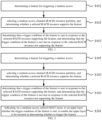
- FIG. 1 is a flowchart illustrating a method for determining a trigger condition according to an embodiment of the present disclosure.
- the method for determining the trigger condition as illustrated in this embodiment may be performed by a terminal.
- the terminal includes, but is not limited to, a mobile phone, a tablet, a wearable device, a sensor, an Internet-of-Things device, and other communication devices.
- the terminal may communicate with a network side device.
- the network side device includes, but is not limited to, a network side device (may be referred to as the network side) in a 4G (4th generation) communication system, a 5G (5th generation) communication system, and a 6G (6th generation) communication system, etc., such as a base station, or a core network, etc.
- the method for determining the trigger condition may include the following steps.
- step S101 a feature for triggering random access is determined.
- a random access channel (RACH) resource partition is selected, and it is determined whether a selected RACH resource supports the feature.
- RACH random access channel
- step S103 it is determined that a trigger condition of the feature is met in response to the selected RACH resource supporting the feature; and it is determined that the trigger condition of the feature is not met in response to the selected RACH resource not supporting the feature.
- the resource in all embodiments of the present disclosure may be a whole block of resource (for example, one frequency band, one channel), or a resource partition (for example, a part of frequency domain resources in one frequency band, or a part of frequency domain resources in one channel).
- the specific random access resource configured by the network side for the terminal may configure respective corresponding specific random access resource for each feature.
- a CE specific RACH resource is configured for a CE feature; a Redcap specific RACH resource is configured for a Redcap (reduced capability) feature. Then, when the feature for triggering the random access is CE, the terminal may directly select the CE specific RACH resource to initiate the random access. When the feature for triggering the random access is Redcap, the terminal may directly select the Redcap specific RACH resource to initiate the random access.
- the specific random access resource configured by the network side for the terminal may also be a specific random access resource configured for a feature combination.
- the specific RACH resource configured by the network side for the terminal includes two feature combination specific RACH resources, namely, a SDT (small data transmission) + Redcap specific RACH resource, and a CE + Redcap specific RACH resource.
- the network side may also configure non-specific RACH resource, such as a traditional legacy RACH resource.
- the feature for triggering the random access by the terminal may be a single feature or a feature combination.
- the feature for triggering the random access includes any one feature that requires the RACH resource.
- the terminal may select the legacy RACH resource to initiate the random access in response to the triggered random access being non-feature random access, and may determine the feature for triggering the random access, for example, called as feature A, in response to the triggered random access being feature random access.
- the terminal can select the legacy RACH resource to initiate the random access.
- the network side device configures the feature specific RACH resources (a specific RACH resource to any one feature, which is not limited to a specific RACH resource to feature A) for the terminal, the terminal may first consider the feature specific RACH resource, and when there is no selectable feature specific RACH resource, then the terminal may select the legacy RACH resource to initiate the random access.
- the terminal selecting the specific RACH resource for the feature includes, but is not limited to, a following process.
- the terminal determines whether a specific RACH resource whose corresponding feature is included in feature A (that is, as a subset of the feature A) is present in the feature specific RACH resource configured by the network side for the terminal. If present, the feature specific RACH resource can be selected to initiate the random access, otherwise, the legacy RACH resources may be selected to initiate the random access.
- the feature for triggering the random access by the terminal is the SDT. Since the feature specific RACH resources configured by the network side for the terminal includes the SDT + Redcap specific RACH resource and the CE + Redcap specific RACH resource, SDT + Redcap is not included in the SDT, and CE + Redcap is not included in the SDT (that is, SDT + Redcap or CE + Redcap is not a subset of the SDT), the terminal may select the legacy RACH resources to initiate the random access.
- the RACH resource includes a feature combination specific RACH resource, where a feature combination includes at least two features.
- the selected RACH resource supporting the feature includes: a feature combination corresponding to the RACH resource including the feature for triggering the random access.
- SDT + Redcap specific RACH resource SDT + Redcap includes the SDT
- the SDT + Redcap specific RACH resource can actually support the feature of SDT.
- the network side may properly configure the terminal according to the random access resource used by the terminal (that is, the SDT + Redcap specific RACH resource).
- the terminal may cause the network side to fail to determine the feature for triggering the random access by the terminal as soon as possible.
- the feature for triggering the random access by the terminal is a feature combination of SDT + CE + Redcap. Since SDT + Redcap is included in SDT + CE + Redcap, CE + Redcap is also included in SDT + CE + Redcap (that is, SDT + Redcap or CE + Redcap is respectively as a subset of SDT + CE + Redcap), the terminal may select the SDT + Redcap specific RACH resource, or the CE + Redcap specific RACH resource. Specifically, whether to select the SDT + Redcap specific RACH resource or the CE + Redcap specific RACH resource can be determined according to a priority of the feature. For example, a selection basis may include that a selection result firstly meets a high-priority feature. For example, a feature priority is Redcap>CE>SDT, and the CE + Redcap specific RACH resource may be selected.
- the terminal after determining the feature for triggering the random access, selects the random access channel (RACH) resource, and determines whether the selected RACH resource supports the feature, and then determines that the trigger condition of the feature is met in response to the selected RACH resource supporting the feature; and determines that the trigger condition of the feature is not met in response to the selected RACH resource not supporting the feature.
- RACH random access channel
- the network side device may determine the feature for triggering the random access by the terminal as early as possible.
- subsequent operations to be performed include, but are not limited to, initiating the random access through the specific RACH resource supporting the feature, and other operations can also be performed, which may explain in the subsequent embodiments.
- the feature includes at least one of:
- FIG. 2 is a flowchart illustrating another method for determining a trigger condition according to an embodiment of the present disclosure. As illustrated in FIG. 2 , the method may further include the following step.
- a medium access control (MAC) layer indicates an upper layer whether the trigger condition of the feature is met, to enable the upper layer to be assisted in determining whether to trigger the feature.
- the feature includes at least: small data transmission (SDT).
- triggering of the first feature is decided by the MAC layer. After determining that the selected RACH resource supports the first feature and the trigger condition of the first feature is met, the terminal may directly initiate the random access through the selected RACH resource.
- the first feature includes, but is not limited to, Redcap, CE, and RAN slicing.
- the triggering of the second feature is decided by the upper layer (such as a radio resource control (RRC) layer).
- the upper layer such as a radio resource control (RRC) layer.
- RRC radio resource control
- an operation to be performed by may be instructing the upper layer through the MAC layer to indicate whether the trigger condition of the second feature is met, to enable the upper layer to be assisted in determining whether to trigger the feature.
- the second characteristic includes, but is not limited to, the SDT.
- the upper layer determines that the trigger condition of the SDT is met according to an indicator of the MAC layer, other factors may also be considered to determine whether to initiate the random access through the selected RACH resource.
- FIG. 3 is a flowchart illustrating yet another method for determining a trigger condition according to an embodiment of the present disclosure. As illustrated in FIG. 3 , the method may further include the following steps.
- step S301 it is determined whether a feature specific RACH resource is configured on a network side.
- step S302 it is determined that the trigger condition of the feature is not met in response to the feature specific RACH resource being not configured.
- Selecting the RACH resource partition, and determining whether the selected RACH resource supports the feature includes:
- step S303 in response to the feature specific RACH resource being configured, selecting the RACH resource, and determining whether the selected RACH resource supports the feature.
- the terminal may first determine whether the network side configures the feature specific RACH resource.
- the feature specific RACH resource refers to a feature corresponding to the specific RACH resource including a feature for triggering random access.
- the feature for triggering the random access is SDT.
- the specific RACH resource configured by the network side for the terminal only including a SDT + Redcap specific RACH resource since SDT + Redcap includes the SDT, it may be determined that the network side configures the specific RACH resource of the feature for triggering the random access.
- the feature for triggering the random access is SDT.
- the specific RACH resource configured by the network side for the terminal only including a CE + Redcap specific RACH resource since CE + Redcap does not include the SDT, it may be determined that the network side does not configure the specific RACH resource of the feature for triggering the random access.
- the RACH resource supporting the feature cannot be selected. It is not necessary to select the random access channel (RACH) resource, and determine whether the selected RACH resource supports the feature, which may avoid unnecessary operations.
- RACH random access channel
- the network side device When it is determined that the network side device is configured with the feature specific RACH resource, it may be determined that the trigger condition of the feature is met, select the random access channel (RACH) resource, and determine whether the selected RACH resource supports the feature.
- RACH random access channel
- the method further includes:
- determining whether the trigger condition of the feature is met according to whether the selected RACH resource supports the feature is just one of optional determined results according to whether the selected RACH resource supports the feature. According to whether the selected RACH resource supports the feature, it may also be determined whether the type of the finally initiated random access is the feature random access.
- the type of the finally initiated random access is the feature random access.
- the type of the finally initiated random access is the non-feature random access.
- the feature for triggering the random access is SDT.
- the type of the finally initiated random access is SDT RACH
- the type of the finally initiated random access is Non-SDT RACH.
- the feature for triggering the random access is Redcap.
- the type of the finally initiated random access is msgl-based Redcap RACH
- the type of the finally initiated random access is Non-msgl-based Redcap RACH.
- the method further includes:
- determining whether the trigger condition of the feature is met according to whether the feature specific RACH resource is configured is just one of optional determined results according to whether the feature specific RACH resource is configured. According to whether the feature specific RACH resource is configured, it may also be determined whether the type of the finally initiated random access is the feature random access.
- the type of the finally initiated random access is the feature random access.
- the type of the finally initiated random access is the non-feature random access.
- the feature for triggering the random access is SDT.
- SDT RACH the type of the finally initiated random access
- Non-SDT RACH the type of the finally initiated random access
- the feature for triggering the random access is Redcap.
- determining that a Redcap specific RACH resource is configured it may be determined that the type of the finally initiated random access is msgl-based Redcap RACH, and when determining that the Redcap specific RACH resource is not configured, it may be determined that the type of the finally initiated random access is Non-msgl-based Redcap RACH.
- no operation may be performed, or an operation may be performed.
- an operation to be performed includes, but is not limited to, determining the trigger condition of the feature is met.
- no operation may be performed, or an operation may be performed.
- an operation to be performed includes, but is not limited to, the trigger condition of the feature is not met.
- FIG. 4 is a flowchart illustrating a method for configuring resource partitions according to an embodiment of the present disclosure.
- the method for configuring resource partitions as illustrated in this embodiment may be performed by a network side device.
- the network side device may communicate with a terminal.
- the network side device includes, but is not limited to, a 4G (4th generation) base station, a 5G (5th generation) base station, and a 6G (6th generation) base station, and other base stations in a communication system.
- the terminal includes, but is not limited to, a mobile phone, a tablet, a wearable device, a sensor, an Internet-of-Things device, and other communication devices.
- the method for configuring resource partitions may include the following step.
- random access channel (RACH) resource partitions are configured for a terminal, to enable the terminal to select a RACH resource partition from configured RACH resource partitions, and determine whether a selected RACH resource supports a feature for triggering random access; in which, in response to the selected RACH resource supporting the feature, the terminal determines that the trigger condition of the feature is met; in response to the selected RACH resource not supporting the feature, the terminal determines that the trigger condition of the feature is not met.
- RACH random access channel
- the resource in all embodiments of the present disclosure may be a whole block of resource (for example, one frequency band, one channel), or a resource partition (for example, a part of frequency domain resources in one frequency band, or a part of frequency domain resources in one channel).
- the specific random access resource configured by the network side for the terminal may configure respective corresponding specific random access resource for each feature.
- a CE specific RACH resource is configured for a CE feature; a Redcap specific RACH resource is configured for a Redcap (reduced capability) feature. Then, when the feature for triggering the random access is CE, the terminal may directly select the CE specific RACH resource to initiate the random access. When the feature for triggering the random access is Redcap, the terminal may directly select the Redcap specific RACH resource to initiate the random access.
- the specific random access resource configured by the network side for the terminal may also be a specific random access resource configured for a feature combination.
- the specific RACH resource configured by the network side for the terminal includes two feature combination specific RACH resources, namely, a SDT (small data transmission) + Redcap specific RACH resource, and a CE + Redcap specific RACH resource.
- the network side may also configure non-specific RACH resource, such as a traditional legacy RACH resource.
- the feature for triggering the random access by the terminal may be a single feature or a feature combination.
- the feature for triggering the random access includes any one feature that requires the RACH resource.
- the terminal may select the legacy RACH resource to initiate the random access in response to the triggered random access being non-feature random access, and may determine the feature for triggering the random access, for example, called as feature A, in response to the triggered random access being feature random access.
- the terminal can select the legacy RACH resource to initiate the random access.
- the network side device configures the feature specific RACH resources (a specific RACH resource to any one feature, which is not limited to a specific RACH resource to feature A) for the terminal, the terminal may first consider the feature specific RACH resource, and when there is no selectable feature specific RACH resource, then the terminal may select the legacy RACH resource to initiate the random access.
- the terminal selecting the specific RACH resource for the feature includes, but is not limited to, a following process.
- the terminal determines whether a specific RACH resource whose corresponding feature is included in feature A (that is, as a subset of the feature A) is present in the feature specific RACH resource configured by the network side for the terminal. If present, the feature specific RACH resource can be selected to initiate the random access, otherwise, the legacy RACH resources may be selected to initiate the random access.
- the feature for triggering the random access by the terminal is the SDT. Since the feature specific RACH resources configured by the network side for the terminal includes the SDT + Redcap specific RACH resource and the CE + Redcap specific RACH resource, SDT + Redcap is not included in the SDT (that is, SDT + Redcap or CE + Redcap is not a subset of the SDT), and CE + Redcap is not included in the SDT, the terminal may select the legacy RACH resources to initiate the random access.
- the RACH resource includes a feature combination specific RACH resource, where a feature combination includes at least two features.
- the selected RACH resource supporting the feature includes: a feature combination corresponding to the RACH resource including the feature for triggering the random access.
- SDT + Redcap specific RACH resource SDT + Redcap includes the SDT
- the SDT + Redcap specific RACH resource can actually support the feature of SDT.
- the network side may properly configure the terminal according to the random access resource used by the terminal (that is, the SDT + Redcap specific RACH resource).
- the terminal may cause the network side to fail to determine the feature for triggering the random access by the terminal as soon as possible.
- the feature for triggering the random access by the terminal is a feature combination of SDT + CE + Redcap. Since SDT + Redcap is included in SDT + CE + Redcap, CE + Redcap is also included in SDT + CE + Redcap (that is, SDT + Redcap or CE + Redcap is respectively as a subset of SDT + CE + Redcap), the terminal may select the SDT + Redcap specific RACH resource, or the CE + Redcap specific RACH resource. Specifically, whether to select the SDT + Redcap specific RACH resource or the CE + Redcap specific RACH resource can be determined according to a priority of the feature. For example, a selection basis may include that a selection result firstly meets a high-priority feature. For example, a feature priority is Redcap>CE>SDT, and the CE + Redcap specific RACH resource may be selected.
- the network side device configures the random access channel (RACH) resource partitions for the terminal. After determining the feature for triggering the random access, the terminal selects the random access channel (RACH) resource, and determines whether the selected RACH resource supports the feature, and then determines that the trigger condition of the feature is met in response to the selected RACH resource supporting the feature; and determines that the trigger condition of the feature is not met in response to the selected RACH resource not supporting the feature.
- RACH random access channel
- the network side device may determine the feature for triggering the random access by the terminal as early as possible.
- the RACH resource partitions configured for the terminal are further configured to cause the terminal to determine whether the network side is configured with a feature specific RACH resource; in which, in response to the feature specific RACH resource being not configured, the terminal determines that the trigger condition of the feature is not met; in response to the feature specific RACH resource being configured, the terminal selects the RACH resource, and determines whether the selected RACH resource supports the feature.
- the terminal may first determine whether the network side configures the feature specific RACH resource.
- the feature specific RACH resource refers to a feature corresponding to the specific RACH resource including a feature for triggering random access.
- the feature for triggering the random access is SDT.
- the specific RACH resource configured by the network side for the terminal only including a SDT + Redcap specific RACH resource since SDT + Redcap includes the SDT, it may be determined that the network side configures the specific RACH resource of the feature for triggering the random access.
- the feature for triggering the random access is SDT.
- the specific RACH resource configured by the network side for the terminal only including a CE + Redcap specific RACH resource since CE + Redcap does not include the SDT, it may be determined that the network side does not configure the specific RACH resource of the feature for triggering the random access.
- the RACH resource supporting the feature cannot be selected. It is not necessary to select the random access channel (RACH) resource, and determine whether the selected RACH resource supports the feature, which may avoid unnecessary operations.
- RACH random access channel
- the network side device When it is determined that the network side device is configured with the feature specific RACH resource, it may be determined that the trigger condition of the feature is met, select the random access channel (RACH) resource, and determine whether the selected RACH resource supports the feature.
- RACH random access channel
- the RACH resource partitions configured for the terminal are further configured to cause the terminal to determine a type of finally initiated random access; in which, in response to the selected RACH resource supporting the feature, the terminal determines that the type of the finally initiated random access is feature random access; in response to the selected RACH resource not supporting the feature, the terminal determines that the type of the finally initiated random access is non-feature random access.
- determining whether the trigger condition of the feature is met according to whether the selected RACH resource supports the feature is just one of optional determined results according to whether the selected RACH resource supports the feature. According to whether the selected RACH resource supports the feature, it may also be determined whether the type of the finally initiated random access is the feature random access.
- the type of the finally initiated random access is the feature random access.
- the type of the finally initiated random access is the non-feature random access.
- the feature for triggering the random access is SDT.
- the type of the finally initiated random access is SDT RACH
- the type of the finally initiated random access is Non-SDT RACH.
- the feature for triggering the random access is Redcap.
- the type of the finally initiated random access is msgl-based Redcap RACH
- the type of the finally initiated random access is Non-msgl-based Redcap RACH.
- the RACH resource partitions configured for the terminal are further configured to cause the terminal to determine whether the network side is configured with a feature specific RACH resource; in which, in response to the feature specific RACH resource being configured, the terminal determines that the type of the finally initiated random access is feature random access; in response to the feature specific RACH resource being not configured, the terminal determines that the type of the finally initiated random access is non-feature random access.
- determining whether the trigger condition of the feature is met according to whether the feature specific RACH resource is configured is just one of optional determined results according to whether the feature specific RACH resource is configured. According to whether the feature specific RACH resource is configured, it may also be determined whether the type of the finally initiated random access is the feature random access.
- the type of the finally initiated random access is the feature random access.
- the type of the finally initiated random access is the non-feature random access.
- the feature for triggering the random access is SDT.
- SDT RACH the type of the finally initiated random access
- Non-SDT RACH the type of the finally initiated random access
- the feature for triggering the random access is Redcap.
- determining that a Redcap specific RACH resource is configured it may be determined that the type of the finally initiated random access is msgl-based Redcap RACH, and when determining that the Redcap specific RACH resource is not configured, it may be determined that the type of the finally initiated random access is Non-msgl-based Redcap RACH.
- the present disclosure also provides embodiments of an apparatus for determining a trigger condition and an apparatus for configuring resource partitions.
- FIG. 5 is a block diagram illustrating an apparatus for determining a trigger condition according to an embodiment of the present disclosure.
- the apparatus for determining the trigger condition as illustrated in this embodiment may be applicable for a terminal.
- the terminal includes, but is not limited to, a mobile phone, a tablet, a wearable device, a sensor, an Internet-of-Things device, and other communication devices.
- the terminal may communicate with a network side device.
- the network side device includes, but is not limited to, a network side device (may be referred to as the network side) in a 4G (4th generation) communication system, a 5G (5th generation) communication system, and a 6G (6th generation) communication system, etc., such as a base station, or a core network, etc.
- the apparatus for determining the trigger condition may include:
- the processing module is configured to, determine whether a feature specific RACH resource is configured on a network side; determine that the trigger condition of the feature is not met in response to the feature specific RACH resource being not configured; in response to the feature specific RACH resource being configured, select the RACH resource, and determine whether the selected RACH resource supports the feature.
- the processing module is configured to, determine that a type of finally initiated random access is feature random access in response to the selected RACH resource supporting the feature; determine that the type of the finally initiated random access is non-feature random access in response to the selected RACH resource not supporting the feature.
- the processing module is configured to, determine whether a feature specific RACH resource is configured on a network side; determine that a type of finally initiated random access is feature random access in response to the feature specific RACH resource being configured; determine that the type of the finally initiated random access is non-feature random access in response to the feature specific RACH resource being not configured.
- the RACH resource includes a feature combination specific RACH resource, and a feature combination includes at least two features.
- the selected RACH resources supporting the feature includes: a feature combination corresponding to the RACH resource including the feature for triggering the random access.
- the feature includes at least one of:
- the processing module is configured to, indicate, by a medium access control (MAC) layer, to an upper layer whether the trigger condition of the feature is met, to enable the upper layer to be assisted in determining whether to trigger the feature.
- MAC medium access control
- the feature includes at least: small data transmission (SDT).
- SDT small data transmission
- FIG. 6 is a block diagram illustrating an apparatus for configuring resource partitions according to an embodiment of the present disclosure.
- the apparatus for configuring resource partitions as illustrated in this embodiment may be applicable for a network side device.
- the network side device may communicate with a terminal.
- the network side device includes, but is not limited to, a 4G (4th generation) base station, a 5G (5th generation) base station, and a 6G (6th generation) base station, and other base stations in a communication system.
- the terminal includes, but is not limited to, a mobile phone, a tablet, a wearable device, a sensor, an Internet-of-Things device, and other communication devices.
- the apparatus for configuring resource partitions may include:
- the RACH resource partitions configured for the terminal are further configured to cause the terminal to determine whether the network side is configured with a feature specific RACH resource; in which, in response to the feature specific RACH resource being not configured, the terminal determines that the trigger condition of the feature is not met; in response to the feature specific RACH resource being configured, the terminal selects the RACH resource, and determines whether the selected RACH resource supports the feature.
- the RACH resource partitions configured for the terminal are further configured to cause the terminal to determine a type of finally initiated random access; in which, in response to the selected RACH resource supporting the feature, the terminal determines that the type of the finally initiated random access is feature random access; in response to the selected RACH resource not supporting the feature, the terminal determines that the type of the finally initiated random access is non-feature random access.
- the RACH resource partitions configured for the terminal are further configured to cause the terminal to determine whether the network side is configured with a feature specific RACH resource; in which, in response to the feature specific RACH resource being configured, the terminal determines that the type of the finally initiated random access is feature random access; in response to the feature specific RACH resource being not configured, the terminal determines that the type of the finally initiated random access is non-feature random access.
- the RACH resource includes a feature combination specific RACH resource, and a feature combination includes at least two features.
- the feature includes at least one of:
- the apparatus embodiments basically correspond to the method embodiments, and the related contents can refer to part of the descriptions of the method embodiments.
- the above-described apparatus embodiments are merely schematic, the modules described above as separate components may or may not be physically separated, and the components displayed as modules may or may not be physical modules, i.e., the components may be located in one area or may be distributed to multiple network modules. Some or all of these modules can be selected according to practical needs to achieve the purpose of the solution of the disclosure. Those skilled in the art can understand and implement the solution without inventive works.
- An embodiment of the disclosure also provides a communication device.
- the communication device includes: a processor; and a memory, configured to store a computer program; in which, when the computer program is executed by the processor, the method for determining the trigger condition as described in any one of the above embodiments is implemented.
- An embodiment of the disclosure also provides a communication device.
- the communication device includes: a processor; and a memory, configured to store a computer program; in which, when the computer program is executed by the processor, the method for configuring resource partitions as described in any one of the above embodiments is implemented.
- An embodiment of the disclosure provides a computer-readable storage medium having computer programs stored thereon.
- the computer program is executed by the processor, the method for determining the trigger condition as described in any one of the above embodiments is implemented.
- An embodiment of the disclosure provides a computer-readable storage medium having computer programs stored thereon.
- the computer program is executed by the processor, the method for configuring resource partitions as described in any one of the above embodiments is implemented.
- FIG. 7 is a block diagram of a device 700 configured to determine a trigger condition according to an embodiment of the present disclosure.
- the device 700 may be provided as a base station.
- the device 700 includes a processing component 722, a wireless transmitter/receiver component 724, an antenna component 726, and a signal processing portion specific to a wireless interface.
- the processing component 722 may include one or more processors.
- One of the processors of the processing component 722 may be configured to implement the method for capability sending according to any one of the above embodiments, and/or the method for configuring resource partitions according to any one of the above embodiments.
- FIG. 8 is a block diagram of a device 800 configured to configure resource partitions according to an embodiment of the disclosure.
- the device 800 may be a cell phone, a computer, a digital broadcast terminal, a message transceiver device, a game console, a tablet device, a medical device, a fitness device and a personal digital assistant.
- the device 800 may include one or more of the following components: a processing component 802, a memory 804, a power component 806, a multimedia component 808, an audio component 810, an input/output (I/O) interface 812, a sensor component 814, and a communication component 816.
- a processing component 802 a memory 804, a power component 806, a multimedia component 808, an audio component 810, an input/output (I/O) interface 812, a sensor component 814, and a communication component 816.
- the processing component 802 typically controls overall operations of the device 800, such as the operations associated with display, telephone calls, data communications, camera operations, and recording operations.
- the processing component 802 may include one or more processors 820 to perform all or part of the steps in the above described method.
- the processing component 802 may include one or more modules which facilitate the interaction between the processing component 802 and other components.
- the processing component 802 may include a multimedia module to facilitate the interaction between the multimedia component 808 and the processing component 802.
- the memory 804 is configured to store various types of data to support the operation of the device 800. Examples of such data include instructions for any applications or methods operated on the device 800, contact data, phonebook data, messages, pictures, video, etc.
- the memory 804 may be implemented using any type of volatile or non-volatile memory devices, or a combination thereof, such as a Static Random Access Memory (SRAM), an Electrically Erasable Programmable Read Only Memory (EEPROM), an Erasable Programmable Read Only Memory (EPROM), a Programmable Read Only Memory (PROM), a Read Only Memory (ROM), a magnetic memory, a flash memory, a magnetic or optical disk.
- SRAM Static Random Access Memory
- EEPROM Electrically Erasable Programmable Read Only Memory
- EPROM Erasable Programmable Read Only Memory
- PROM Programmable Read Only Memory
- ROM Read Only Memory
- the power component 806 provides power to various components of the device 800.
- the power component 806 may include a power management system, one or more power sources, and any other components associated with the generation, management, and distribution of power in the device 800.
- the multimedia component 808 includes a screen providing an output interface between the device 800 and the user.
- the screen may include a Liquid Crystal Display (LCD) and a Touch Panel (TP). If the screen includes the touch panel, the screen may be implemented as a touch screen to receive input signals from the user.
- the touch panel includes one or more touch sensors to sense touches, swipes, and gestures on the touch panel. The touch sensors may not only sense a boundary of a touch or swipe action, but also sense a period of time and a pressure associated with the touch or swipe action.
- the multimedia component 808 includes a front-facing camera and/or a rear-facing camera.
- the front-facing camera and/or the rear-facing camera can receive external multimedia data.
- Each front-facing camera and rear-facing camera may be a fixed optical lens system or has focal length and optical zoom capability.
- the audio component 810 is configured to output and/or input audio signals.
- the audio component 810 includes a microphone (MIC) configured to receive an external audio signal when the device 800 is in an operation mode, such as a call mode, a recording mode, and a voice recognition mode.
- the received audio signal may be further stored in the memory 804 or transmitted via the communication component 816.
- the audio component 810 further includes a speaker to output audio signals.
- the I/O interface 812 provides an interface between the processing component 802 and peripheral interface modules, such as a keyboard, a click wheel, buttons, and the like.
- the buttons may include, but are not limited to, a home button, a volume button, a starting button, and a locking button.
- the sensor component 814 includes one or more sensors to provide status assessments of various aspects of the device 800. For instance, the sensor component 814 may detect an open/closed status of the device 800, relative positioning of components, e.g., the display and the keypad, of the device 800, a change in position of the device 800 or a component of the device 800, a presence or absence of user contact with the device 800, an orientation or an acceleration/deceleration of the device 800, and a change in temperature of the device 800.
- the sensor component 814 may include a proximity sensor configured to detect the presence of nearby objects without any physical contact.
- the sensor component 814 may also include a light sensor, such as a Complementary Metal Oxide Semiconductor (CMOS) or Charge-Coupled Device (CCD) image sensor, for use in imaging applications.
- CMOS Complementary Metal Oxide Semiconductor
- CCD Charge-Coupled Device
- the sensor component 814 may also include an accelerometer sensor, a gyroscope sensor, a magnetic sensor, a pressure sensor, or a temperature sensor.
- the communication component 816 is configured to facilitate communication, wired or wirelessly, between the device 800 and other devices.
- the device 800 can access a wireless network based on a communication standard, such as WiFi, 2G, 3G, 4G LTE, 5G NR or a combination thereof.
- the communication component 816 receives a broadcast signal or broadcast associated information from an external broadcast management system via a broadcast channel.
- the communication component 816 further includes a Near Field Communication (NFC) module to facilitate short-range communication.
- NFC Near Field Communication
- the NFC module may be implemented based on a RF Identification (RFID) technology, an Infrared Data Association (IrDA) technology, an Ultra-Wide Band (UWB) technology, a Blue Tooth (BT) technology, and other technologies.
- RFID RF Identification
- IrDA Infrared Data Association
- UWB Ultra-Wide Band
- BT Blue Tooth
- the device 800 may be implemented with one or more Application Specific Integrated Circuits (ASICs), Digital Signal Processors (DSPs), Digital Signal Processing Devices (DSPDs), Programmable Logic Devices (PLDs), Field Programmable Gate Arrays (FPGAs), controllers, micro-controllers, microprocessors or other electronic components, for performing the above described method.
- ASICs Application Specific Integrated Circuits
- DSPs Digital Signal Processors
- DSPDs Digital Signal Processing Devices
- PLDs Programmable Logic Devices
- FPGAs Field Programmable Gate Arrays
- controllers micro-controllers, microprocessors or other electronic components, for performing the above described method.
- non-transitory computer-readable storage medium including executable instructions, such as the memory 804, executable by the processor 820 in the device 800, for performing the above method.
- the non-transitory computer-readable storage medium may be a ROM, a Random Access Memory (RAM), a CD-ROM, a magnetic tape, a floppy disc, and an optical data storage device.
Landscapes
- Engineering & Computer Science (AREA)
- Computer Networks & Wireless Communication (AREA)
- Signal Processing (AREA)
- Mobile Radio Communication Systems (AREA)
Applications Claiming Priority (1)
| Application Number | Priority Date | Filing Date | Title |
|---|---|---|---|
| PCT/CN2022/076217 WO2023151082A1 (zh) | 2022-02-14 | 2022-02-14 | 触发条件判断、资源分区配置方法和装置 |
Publications (2)
| Publication Number | Publication Date |
|---|---|
| EP4482233A1 true EP4482233A1 (de) | 2024-12-25 |
| EP4482233A4 EP4482233A4 (de) | 2025-04-02 |
Family
ID=82232583
Family Applications (1)
| Application Number | Title | Priority Date | Filing Date |
|---|---|---|---|
| EP22925444.6A Pending EP4482233A4 (de) | 2022-02-14 | 2022-02-14 | Verfahren und vorrichtung zur bestimmung einer auslöserbedingung sowie ressourcenpartitionkonfigurationsverfahren und -vorrichtung |
Country Status (6)
| Country | Link |
|---|---|
| US (1) | US20250151119A1 (de) |
| EP (1) | EP4482233A4 (de) |
| JP (1) | JP7766816B2 (de) |
| KR (1) | KR20240140165A (de) |
| CN (1) | CN114731712B (de) |
| WO (1) | WO2023151082A1 (de) |
Families Citing this family (1)
| Publication number | Priority date | Publication date | Assignee | Title |
|---|---|---|---|---|
| WO2024169662A1 (zh) * | 2023-02-16 | 2024-08-22 | 华为技术有限公司 | 随机接入资源选择方法及通信装置 |
Family Cites Families (17)
| Publication number | Priority date | Publication date | Assignee | Title |
|---|---|---|---|---|
| US6771632B2 (en) * | 2000-12-19 | 2004-08-03 | Interdigital Technology Corporation | Sub-channels for the random access channel in time division duplex |
| CN107872884A (zh) * | 2016-09-26 | 2018-04-03 | 电信科学技术研究院 | 一种随机接入资源分配和随机接入方法、设备 |
| CN110475377B (zh) * | 2018-05-10 | 2021-06-15 | 维沃移动通信有限公司 | Rach资源选择、配置方法、用户设备及网络侧设备 |
| CN112243276A (zh) * | 2019-07-19 | 2021-01-19 | 中国移动通信有限公司研究院 | 随机接入、信息发送、资源配置方法、网络侧设备及终端 |
| WO2021026118A1 (en) * | 2019-08-04 | 2021-02-11 | Convida Wireless, Llc | Apparatus, system and method for performing two-step rach |
| CN111836395B (zh) * | 2019-08-06 | 2023-03-14 | 维沃移动通信有限公司 | 随机接入方法、配置方法、终端及网络侧设备 |
| CN111836280B (zh) * | 2019-08-27 | 2022-02-01 | 维沃移动通信有限公司 | 一种数据传输方法及终端 |
| KR102806818B1 (ko) * | 2020-01-14 | 2025-05-13 | 삼성전자 주식회사 | 랜덤 액세스 절차의 장치 및 방법 |
| JP7352039B2 (ja) * | 2020-04-23 | 2023-09-27 | 鴻穎創新有限公司 | 無線リソース制御(rrc)インアクティブ状態での小規模データ伝送 |
| CN115836578A (zh) * | 2020-05-29 | 2023-03-21 | 弗劳恩霍夫应用研究促进协会 | 支持切片的ue rach资源配置选择功能和资源优先化 |
| US11576215B2 (en) * | 2020-06-30 | 2023-02-07 | Qualcomm Incorporated | Random access resources based on network conditions |
| WO2022015108A1 (en) * | 2020-07-17 | 2022-01-20 | Samsung Electronics Co., Ltd. | Method and apparatus for random access procedure for small data transmission in wireless communication |
| CN114071783A (zh) * | 2020-07-30 | 2022-02-18 | 夏普株式会社 | 由用户设备执行的方法以及用户设备 |
| CN112738906B (zh) * | 2020-12-28 | 2022-05-24 | 中国信息通信研究院 | 一种随机接入初始化方法和设备 |
| WO2022236748A1 (zh) * | 2021-05-12 | 2022-11-17 | 北京小米移动软件有限公司 | 随机接入方法和装置、通信装置和计算机可读存储介质 |
| WO2023067998A1 (ja) * | 2021-10-20 | 2023-04-27 | 日本電気株式会社 | 無線端末、無線アクセスネットワークノード、及びこれらの方法 |
| US20240357662A1 (en) * | 2021-11-08 | 2024-10-24 | Nokia Technologies Oy | Adaptive backoff for random access channel |
-
2022
- 2022-02-14 EP EP22925444.6A patent/EP4482233A4/de active Pending
- 2022-02-14 US US18/837,651 patent/US20250151119A1/en active Pending
- 2022-02-14 CN CN202280000383.5A patent/CN114731712B/zh active Active
- 2022-02-14 WO PCT/CN2022/076217 patent/WO2023151082A1/zh not_active Ceased
- 2022-02-14 KR KR1020247029302A patent/KR20240140165A/ko active Pending
- 2022-02-14 JP JP2024547714A patent/JP7766816B2/ja active Active
Also Published As
| Publication number | Publication date |
|---|---|
| CN114731712A (zh) | 2022-07-08 |
| US20250151119A1 (en) | 2025-05-08 |
| JP7766816B2 (ja) | 2025-11-10 |
| JP2025506048A (ja) | 2025-03-05 |
| CN114731712B (zh) | 2026-01-27 |
| WO2023151082A1 (zh) | 2023-08-17 |
| EP4482233A4 (de) | 2025-04-02 |
| KR20240140165A (ko) | 2024-09-24 |
Similar Documents
| Publication | Publication Date | Title |
|---|---|---|
| EP3771261A1 (de) | Funkrufsynchronisationsanzeigeverfahren und -vorrichtung, funkrufsynchronisationsverfahren sowie vorrichtung und basisstation | |
| EP4195778A1 (de) | Zellbestimmungsverfahren und zellbestimmungsvorrichtung | |
| EP3713325B1 (de) | Verfahren und vorrichtung zur konfiguration von kommunikationsverbindungen | |
| US12096474B2 (en) | Method and device for configuring bandwidth part | |
| US12089101B2 (en) | Cell handover method and apparatus, handover configuration method and apparatus, and user equipment | |
| US20250150876A1 (en) | Measurement method, terminal, and network device and non-transitory computer-readable storage medium | |
| EP3840496A1 (de) | Verfahren und vorrichtung zur einstellung eines bandbreitenteils | |
| EP4564956A1 (de) | Verfahren und vorrichtung zur uplink-übertragungsumschaltung sowie verfahren und vorrichtung zur anzeige einer uplink-übertragungsumschaltung | |
| US11496281B2 (en) | Method and device for indicating transmission direction | |
| EP4482233A1 (de) | Verfahren und vorrichtung zur bestimmung einer auslöserbedingung sowie ressourcenpartitionkonfigurationsverfahren und -vorrichtung | |
| EP3694282B1 (de) | Verfahren zur kommunikationssteuerung und vorrichtung zur kommunikationssteuerung | |
| US12490135B2 (en) | Request sending method and apparatus, and measurement result sending method and apparatus | |
| EP4564996A1 (de) | Verfahren und vorrichtung zum empfangen eines inaktiven multicast-dienstes sowie verfahren und vorrichtung zum senden einer inaktiven multicast-dienstkonfiguration | |
| US12556339B2 (en) | Control signaling detection method, control signaling detection apparatus, and storage medium | |
| US20230269733A1 (en) | Scheduling interval indication method and apparatus | |
| US11910422B2 (en) | Methods and apparatuses for self-interference processing | |
| RU2846944C2 (ru) | Способ и устройство определения условия запуска и способ и устройство конфигурирования разделов ресурсов | |
| EP3751951A1 (de) | Verfahren, vorrichtung und system zur herstellung einer verbindung zwischen einem endgerät und einem kernnetzwerk, auf das zugegriffen werden soll | |
| EP4564957A1 (de) | Verfahren und vorrichtung zur bestimmung der anzahl von uplink-übertragungsverbindungen, kommunikationsvorrichtung und speichermedium | |
| EP3422800A1 (de) | Verfahren, vorrichtung und system zur herstellung einer rufverbindung | |
| US20250039950A1 (en) | Method and apparatus for determining random access occasion resource information, and method and apparatus for indicating random access resource information | |
| EP4482204A1 (de) | Verfahren und vorrichtung zur konfiguration eines bandbreitenteils, vorrichtung und speichermedium | |
| EP4447598A1 (de) | Verfahren und vorrichtung zur bestimmung von direktzugriffsgelegenheitsressourceninformationen sowie verfahren und vorrichtung zur anzeige von direktzugriffsgelegenheitsressourceninformationen | |
| US11943765B2 (en) | Method and apparatus for data transmission |
Legal Events
| Date | Code | Title | Description |
|---|---|---|---|
| STAA | Information on the status of an ep patent application or granted ep patent |
Free format text: STATUS: THE INTERNATIONAL PUBLICATION HAS BEEN MADE |
|
| PUAI | Public reference made under article 153(3) epc to a published international application that has entered the european phase |
Free format text: ORIGINAL CODE: 0009012 |
|
| STAA | Information on the status of an ep patent application or granted ep patent |
Free format text: STATUS: REQUEST FOR EXAMINATION WAS MADE |
|
| 17P | Request for examination filed |
Effective date: 20240912 |
|
| AK | Designated contracting states |
Kind code of ref document: A1 Designated state(s): AL AT BE BG CH CY CZ DE DK EE ES FI FR GB GR HR HU IE IS IT LI LT LU LV MC MK MT NL NO PL PT RO RS SE SI SK SM TR |
|
| REG | Reference to a national code |
Ref country code: DE Ref legal event code: R079 Free format text: PREVIOUS MAIN CLASS: H04W0072040000 Ipc: H04W0072510000 |
|
| A4 | Supplementary search report drawn up and despatched |
Effective date: 20250305 |
|
| RIC1 | Information provided on ipc code assigned before grant |
Ipc: H04W 74/08 20240101ALN20250227BHEP Ipc: H04W 76/27 20180101ALI20250227BHEP Ipc: H04W 72/51 20230101AFI20250227BHEP |
|
| DAV | Request for validation of the european patent (deleted) | ||
| DAX | Request for extension of the european patent (deleted) |