EP4482115A1 - Datenplanungsverfahren, -vorrichtung, -vorrichtung und speichermedium - Google Patents
Datenplanungsverfahren, -vorrichtung, -vorrichtung und speichermedium Download PDFInfo
- Publication number
- EP4482115A1 EP4482115A1 EP23755804.4A EP23755804A EP4482115A1 EP 4482115 A1 EP4482115 A1 EP 4482115A1 EP 23755804 A EP23755804 A EP 23755804A EP 4482115 A1 EP4482115 A1 EP 4482115A1
- Authority
- EP
- European Patent Office
- Prior art keywords
- forwarding
- data
- processing logic
- message processing
- network element
- Prior art date
- Legal status (The legal status is an assumption and is not a legal conclusion. Google has not performed a legal analysis and makes no representation as to the accuracy of the status listed.)
- Withdrawn
Links
Images





Classifications
-
- H—ELECTRICITY
- H04—ELECTRIC COMMUNICATION TECHNIQUE
- H04L—TRANSMISSION OF DIGITAL INFORMATION, e.g. TELEGRAPHIC COMMUNICATION
- H04L47/00—Traffic control in data switching networks
- H04L47/50—Queue scheduling
- H04L47/56—Queue scheduling implementing delay-aware scheduling
-
- H—ELECTRICITY
- H04—ELECTRIC COMMUNICATION TECHNIQUE
- H04L—TRANSMISSION OF DIGITAL INFORMATION, e.g. TELEGRAPHIC COMMUNICATION
- H04L47/00—Traffic control in data switching networks
- H04L47/50—Queue scheduling
-
- H—ELECTRICITY
- H04—ELECTRIC COMMUNICATION TECHNIQUE
- H04L—TRANSMISSION OF DIGITAL INFORMATION, e.g. TELEGRAPHIC COMMUNICATION
- H04L47/00—Traffic control in data switching networks
- H04L47/10—Flow control; Congestion control
- H04L47/18—End to end
-
- H—ELECTRICITY
- H04—ELECTRIC COMMUNICATION TECHNIQUE
- H04L—TRANSMISSION OF DIGITAL INFORMATION, e.g. TELEGRAPHIC COMMUNICATION
- H04L47/00—Traffic control in data switching networks
- H04L47/10—Flow control; Congestion control
- H04L47/20—Traffic policing
-
- H—ELECTRICITY
- H04—ELECTRIC COMMUNICATION TECHNIQUE
- H04W—WIRELESS COMMUNICATION NETWORKS
- H04W40/00—Communication routing or communication path finding
- H04W40/24—Connectivity information management, e.g. connectivity discovery or connectivity update
- H04W40/248—Connectivity information update
-
- H—ELECTRICITY
- H04—ELECTRIC COMMUNICATION TECHNIQUE
- H04L—TRANSMISSION OF DIGITAL INFORMATION, e.g. TELEGRAPHIC COMMUNICATION
- H04L47/00—Traffic control in data switching networks
- H04L47/10—Flow control; Congestion control
- H04L47/28—Flow control; Congestion control in relation to timing considerations
- H04L47/283—Flow control; Congestion control in relation to timing considerations in response to processing delays, e.g. caused by jitter or round trip time [RTT]
-
- H—ELECTRICITY
- H04—ELECTRIC COMMUNICATION TECHNIQUE
- H04W—WIRELESS COMMUNICATION NETWORKS
- H04W40/00—Communication routing or communication path finding
- H04W40/24—Connectivity information management, e.g. connectivity discovery or connectivity update
- H04W40/246—Connectivity information discovery
Definitions
- the present disclosure relates to the technical field of communication technologies, and in particular to a data scheduling method, an apparatus, a device and a storage medium.
- Deterministic Networking can implement the determination of paths for data transmission over Layer 2 bridged and Layer 3 routed segments. According to the paths, worst-case bounds on latency, packet loss, and jitter can be determined, so as to control and reduce the end-to-end latency.
- the sending end will periodically measure the packet loss, latency and jitter of each path, and select a corresponding transmission path for the data flow according to algorithms such as the shortest latency, the smallest packet loss or the smallest jitter, and the transmission path includes at least one forwarding device.
- the forwarding device when forwarding data flow, the forwarding device will insert the data flow into a corresponding queue according to a priority of the data flow, so as to minimize the latency and jitter of the high-priority data flow, while the low-priority data flow will wait in line or be discarded.
- the queuing delay of data flow cannot be determined, it is impossible to determine the latency on the transmission path, and then it is impossible to control the latency.
- the present disclosure provides a data scheduling method, an apparatus, a device, and a storage medium, which are used for ensuring determinacy of data transmission delay in a deterministic network, thereby realizing control of an end-to-end latency in the deterministic network.
- the present disclosure provides a data scheduling method, applied to a network control function network element, the data scheduling method including: acquiring message processing logic of data flow, where the message processing logic is obtained based on a queue configuration rule of a forwarding port of a forwarding device and the queue configuration rule is determined according to a data forwarding period of the forwarding device and a number of queues of message queues supported by the forwarding port of the forwarding device; configuring the message processing logic for a target forwarding device, where the message processing logic is used for forwarding of the corresponding data stream.
- acquiring the message processing logic of the data flow includes: receiving a first data packet sent by the forwarding device; and obtaining the message processing logic based on the first data packet and the queue configuration rule.
- obtaining the message processing logic based on the first data packet and the queue configuration rule includes: parsing the first data packet to obtain demand information of the data flow; and obtaining the message processing logic according to the demand information and the queue configuration rule.
- obtaining the message processing logic according to the demand information and the queue configuration rule includes: sending the demand information to a policy management function network element; receiving a routing-forwarding rule obtained by the policy management function network element according to the demand information and the queue configuration rule; obtaining the message processing logic according to the routing-forwarding rule.
- obtaining the message processing logic based on the first data packet and the queue configuration rule includes: sending the first data packet to a policy management function network element for the policy management function network element to obtain demand information of the data flow according to the first data packet; receiving a routing-forwarding rule obtained by the policy management function network element according to the demand information and the queue configuration rule; obtaining the message processing logic according to the routing-forwarding rule.
- obtaining the message processing logic according to the routing-forwarding rule includes: determining queue information of the data flow according to the routing-forwarding rule, where the queue information is indicative of a queue for sending the data flow; obtaining the message processing logic according to the queue information and the routing-forwarding rule.
- obtaining the message processing logic according to the routing-forwarding rule includes: receiving queue information obtained by the policy management function network element according to the demand information; and obtaining the message processing logic according to the routing-forwarding rule and the queue information.
- obtaining the message processing logic based on the first data packet and the queue configuration rule includes: parsing the first data packet to obtain demand information of the data flow; sending the demand information to a policy management function network element; and receiving the message processing logic obtained by the policy management function network element according to the demand information.
- obtaining the message processing logic based on the first data packet and the queue configuration rule includes: sending the first data packet to a policy management function network element; and receiving the message processing logic obtained by the policy management function network element according to the first data packet.
- the method further includes: determining the queue configuration rule of the forwarding port according to the data forwarding period of the forwarding device and the number of queues of message queues supported by the forwarding port of the forwarding device; or, receiving the queue configuration rule sent by a policy management function network element; where the queue configuration rule is indicative of data forwarding time of each of the message queues in a forwarding period of the forwarding port, and a duration of the data forwarding time is the data forwarding period of the forwarding device.
- the present disclosure provides a data scheduling method, applied to a policy management function network element.
- the data scheduling method includes: acquiring demand information of data flow; determining a routing-forwarding rule according to the demand information and a queue configuration rule, where the queue configuration rule is determined according to a data forwarding period of a forwarding device and a number of queues of message queues supported by a forwarding port of the forwarding device; determining message processing logic of the data flow according to the routing-forwarding rule; sending the message processing logic to a network control function network element, where the message processing logic is used for forwarding of corresponding data flow.
- determining the message processing logic according to the routing-forwarding rule includes: determining, according to the demand information and the queue configuration rule, queue information used for processing the data flow; and determining the message processing logic according to the routing-forwarding rule and the queue information.
- the present disclosure provides a data scheduling method, applied to a policy management function network element.
- the data scheduling method includes: acquiring demand information of data flow; obtaining a routing-forwarding rule according to the demand information and a queue configuration rule, where the queue configuration rule is determined according to a data forwarding period of a forwarding device and a number of queues of message queues supported by a forwarding port of the forwarding device; sending the routing-forwarding rule to a network control function network element, where the routing-forwarding rule is used for determining message processing logic and the message processing logic is used for forwarding of corresponding data flow.
- sending the routing-forwarding rule to the network control function network element includes: determining queue information according to the demand information and the queue configuration rule; sending the queue information and the routing-forwarding rule to the network control function network element for the network control function network element to determine the message processing logic according to the routing-forwarding rule and the queue information.
- acquiring the demand information of the data flow includes: receiving the demand information of the data flow in a first data packet sent by the network control function network element.
- acquiring the demand information of the data flow includes: receiving a first data packet sent by the network control function network element; and parsing the first data packet to obtain the demand information of the data flow.
- the method before acquiring the demand information of the data flow, the method further includes: determining the queue configuration rule of the forwarding port according to the data forwarding period of the forwarding device and the number of queues of message queues supported by the forwarding port of the forwarding device; or, receiving the queue configuration rule sent by the network control function network element; where the queue configuration rule is indicative of data forwarding time of each of the message queues in a forwarding period of the forwarding port, and a duration of the data forwarding time is the data forwarding period of the forwarding device.
- an embodiment of the present disclosure provides a data scheduling method, applied to a forwarding device.
- the data scheduling method includes: in response to receiving data flow to be processed, determining a target queue for forwarding the data flow to be processed based on message processing logic; determining forwarding time of the data flow to be processed based on a queue configuration rule of the forwarding device, where the message processing logic is configured for the forwarding device by a network control function network element; forwarding the data flow to be processed at the forwarding time through the target queue.
- the data scheduling method further includes: sending a first data packet to the network control function network element; and receiving the message processing logic obtained by the network control function network element according to the first data packet.
- an embodiment of the present disclosure provides a data scheduling apparatus, applied to network control function network element.
- the data scheduling apparatus includes: an acquiring module, adapted to acquire message processing logic of data flow, where a queue configuration rule is determined according to a data forwarding period of a forwarding device and a number of queues of message queues supported by a forwarding port of the forwarding device; a configuring module, adapted to configure the message processing logic for a target forwarding device for forwarding of corresponding data flow.
- the acquiring module is specifically adapted to: receive a first data packet sent by the forwarding device; and obtain the message processing logic based on the first data packet and the queue configuration rule.
- the acquiring module is specifically adapted to: parse the first data packet to obtain demand information of the data flow; and obtain the message processing logic according to the demand information and the queue configuration rule.
- the acquiring module is specifically adapted to: send the demand information to a policy management function network element; receive a routing-forwarding rule obtained by the policy management function network element according to the demand information and the queue configuration rule; obtain the message processing logic according to the routing-forwarding rule.
- the acquiring module is specifically adapted to: send the first data packet to a policy management function network element for the policy management function network element to obtain demand information of the data flow according to the first data packet; receive a routing-forwarding rule obtained by the policy management function network element according to the demand information and the queue configuration rule; obtain the message processing logic according to the routing-forwarding rule.
- the acquiring module is specifically adapted to: determine queue information of the data flow according to the routing-forwarding rule, where the queue information is indicative of a queue for sending the data flow; obtain the message processing logic according to the queue information and the routing-forwarding rule.
- the acquiring module is specifically adapted to: receive queue information obtained by the policy management function network element according to the demand information; and obtain the message processing logic according to the routing-forwarding rule and the queue information.
- the acquiring module is specifically adapted to: parse the first data packet to obtain demand information of the data flow; send the demand information to a policy management function network element; and receive the message processing logic obtained by the policy management function network element according to the demand information.
- the acquiring module is specifically adapted to: send the first data packet to a policy management function network element; and receive the message processing logic obtained by the policy management function network element according to the first data packet.
- the data scheduling apparatus further includes: a determining module, adapted to determine the queue configuration rule of the forwarding port according to the data forwarding period of the forwarding device and the number of queues of message queues supported by the forwarding port of the forwarding device; or, a receiving module, adapted to receive the queue configuration rule sent by a policy management function network element; where the queue configuration rule is indicative of data forwarding time of each of the message queues in a forwarding period of the forwarding port, and a duration of the data forwarding time is the data forwarding period of the forwarding device.
- an embodiment of the present disclosure provides a data scheduling apparatus, applied to a policy management function network element.
- the data scheduling apparatus includes: an acquiring module, adapted to acquire demand information of data flow; a determining module, adapted to determine a routing-forwarding rule according to the demand information and a queue configuration rule and determine message processing logic of the data flow according to the routing-forwarding rule, where the queue configuration rule is determined according to a data forwarding period of a forwarding device and a number of queues of message queues supported by a forwarding port of the forwarding device; a sending module, adapted to send the message processing logic to a network control function network element, where the message processing logic is used for forwarding of corresponding data flow.
- the determining module is specifically adapted to: determine, according to the demand information and the queue configuration rule, queue information used for processing the data flow; and determine the message processing logic according to the routing-forwarding rule and the queue information.
- an embodiment of the present disclosure provides a data scheduling apparatus, applied to a policy management function network element.
- the data scheduling apparatus includes: an acquiring module, adapted to acquire demand information of data flow and obtain a routing-forwarding rule according to the demand information and a queue configuration rule, where the queue configuration rule is determined according to a data forwarding period of a forwarding device and the number of queues of message queues supported by a forwarding port of the forwarding device; a sending module, adapted to send the routing-forwarding rule to a network control function network element, where the routing-forwarding rule is used for determining message processing logic and the message processing logic is used for forwarding of corresponding data flow.
- the sending module is specifically adapted to: determine queue information according to the demand information and the queue configuration rule; send the queue information and the routing-forwarding rule to the network control function network element for the network control function network element to determine the message processing logic according to the routing-forwarding rule and the queue information.
- the acquiring module is specifically adapted to: receive the demand information of the data flow in a first data packet sent by the network control function network element.
- the acquiring module is specifically adapted to: receive a first data packet sent by the network control function network element; and parse the first data packet to obtain the demand information of the data flow.
- the data scheduling apparatus further includes: a determining module, adapted to determine the queue configuration rule of the forwarding port according to the data forwarding period of the forwarding device and the number of queues of message queues supported by the forwarding port of the forwarding device; or, receive the queue configuration rule sent by the network control function network element; where the queue configuration rule is indicative of data forwarding time of each of the message queues in a forwarding period of the forwarding port, and a duration of the data forwarding time is the data forwarding period of the forwarding device.
- a determining module adapted to determine the queue configuration rule of the forwarding port according to the data forwarding period of the forwarding device and the number of queues of message queues supported by the forwarding port of the forwarding device; or, receive the queue configuration rule sent by the network control function network element; where the queue configuration rule is indicative of data forwarding time of each of the message queues in a forwarding period of the forwarding port, and a duration of the data forwarding time is the data forwarding period of the forwarding device.
- an embodiment of the present disclosure provides a data scheduling apparatus, applied to a forwarding device.
- the data scheduling apparatus includes: a determining module, adapted to, in response to receiving data flow to be processed, determine a target queue for forwarding the data flow to be processed based on message processing logic and determine forwarding time of the data flow to be processed based on a queue configuration rule of the forwarding device, where the message processing logic is configured for the forwarding device by a network control function network element; a forwarding module, adapted to forward the data flow to be processed at the forwarding time through the target queue.
- the data scheduling apparatus further includes: a sending module, adapted to send a first data packet to the network control function network element; a receiving module, adapted to receive the message processing logic obtained by the network control function network element according to the first data packet.
- an embodiment of the present disclosure provides a network control function network element, including: a memory, adapted to store a computer program; a transceiver, adapted to transmit and receive data under control of a processor; and the processor, adapted to read the computer program in the memory and perform the following operations: acquiring message processing logic of data flow, where the message processing logic is obtained based on a queue configuration rule of a forwarding port of a forwarding device and the queue configuration rule is determined according to a data forwarding period of the forwarding device and a number of queues of message queues supported by the forwarding port of the forwarding device; configuring the message processing logic for a target forwarding device for forwarding of corresponding data flow.
- acquiring the message processing logic of the data flow includes: receiving a first data packet sent by the forwarding device; and obtaining the message processing logic based on the first data packet and the queue configuration rule.
- obtaining the message processing logic based on the first data packet and the queue configuration rule includes: parsing the first data packet to obtain demand information of the data flow; and obtaining the message processing logic according to the demand information and the queue configuration rule.
- obtaining the message processing logic according to the demand information and the queue configuration rule includes: sending the demand information to a policy management function network element; receiving a routing-forwarding rule obtained by the policy management function network element according to the demand information and the queue configuration rule; obtaining the message processing logic according to the routing-forwarding rule.
- obtaining the message processing logic based on the first data packet and the queue configuration rule includes: sending the first data packet to a policy management function network element for the policy management function network element to obtain demand information of the data flow according to the first data packet; receiving a routing-forwarding rule obtained by the policy management function network element according to the demand information and the queue configuration rule; obtaining the message processing logic according to the routing-forwarding rule.
- obtaining the message processing logic according to the routing-forwarding rule includes: determining queue information of the data flow according to the routing-forwarding rule, where the queue information is indicative of a queue for sending the data flow; obtaining the message processing logic according to the queue information and the routing-forwarding rule.
- obtaining the message processing logic according to the routing-forwarding rule includes: receiving queue information obtained by the policy management function network element according to the demand information; and obtaining the message processing logic according to the routing-forwarding rule and the queue information.
- obtaining the message processing logic based on the first data packet and the queue configuration rule includes: parsing the first data packet to obtain demand information of the data flow; sending the demand information to a policy management function network element; receiving the message processing logic obtained by the policy management function network element according to the demand information.
- obtaining the message processing logic based on the first data packet and the queue configuration rule includes: sending the first data packet to a policy management function network element; and receiving the message processing logic obtained by the policy management function network element according to the first data packet.
- the processor is further adapted to: determine the queue configuration rule of the forwarding port according to the data forwarding period of the forwarding device and the number of queues of message queues supported by the forwarding port of the forwarding device; or, receive the queue configuration rule sent by a policy management function network element; where the queue configuration rule is indicative of data forwarding time of each of the message queues in a forwarding period of the forwarding port, and a duration of the data forwarding time is the data forwarding period of the forwarding device.
- an embodiment of the present disclosure provides a policy management function network element, including: a memory, adapted to store a computer program; a transceiver, adapted to transmit and receive data under control of a processor; and the processor, adapted to read the computer program in the memory and perform the following operations: acquiring demand information of data flow; determining a routing-forwarding rule according to the demand information and a queue configuration rule, where the queue configuration rule is determined according to a data forwarding period of a forwarding device and a number of queues of message queues supported by a forwarding port of the forwarding device; determining message processing logic of the data flow according to the routing-forwarding rule; sending the message processing logic to a network control function network element, where the message processing logic is used for forwarding of corresponding data flow.
- determining the message processing logic according to the routing-forwarding rule includes: determining, according to the demand information and the queue configuration rule, queue information used for processing the data flow; determining the message processing logic according to the routing-forwarding rule and the queue information.
- an embodiment of the present disclosure provides a policy management function network element, including: a memory, adapted to store a computer program; a transceiver, adapted to transmit and receive data under control of a processor; and the processor, adapted to read the computer program in the memory and perform the following operations: acquiring demand information of data flow; obtaining a routing-forwarding rule according to the demand information and a queue configuration rule, where the queue configuration rule is determined according to a data forwarding period of a forwarding device and a number of queues of message queues supported by a forwarding port of the forwarding device; sending the routing-forwarding rule to a network control function network element, where the routing-forwarding rule is used for determining message processing logic and the message processing logic is used for forwarding of corresponding data flow.
- sending the routing-forwarding rule to the network control function network element includes: determining queue information according to the demand information and the queue configuration rule; sending the queue information and the routing-forwarding rule to the network control function network element for the network control function network element to determine the message processing logic according to the routing-forwarding rule and the queue information.
- acquiring the demand information of the data flow includes: receiving the demand information of the data flow in a first data packet sent by the network control function network element.
- acquiring the demand information of the data flow includes: receiving a first data packet sent by the network control function network element; and parsing the first data packet to obtain the demand information of the data flow.
- the processor before acquiring the demand information of the data flow, is further adapted to: determine the queue configuration rule of the forwarding port according to the data forwarding period of the forwarding device and the number of queues of message queues supported by the forwarding port of the forwarding device; or, receive the queue configuration rule sent by the network control function network element; where the queue configuration rule is indicative of data forwarding time of each of the message queues in a forwarding period of the forwarding port, and a duration of the data forwarding time is the data forwarding period of the forwarding device.
- an embodiment of the present disclosure provides a forwarding device, including: a memory, adapted to store a computer program; a transceiver, adapted to transmit and receive data under control of a processor; and the processor, adapted to read the computer program in the memory and perform the following operations: in response to receiving data flow to be processed, determining a target queue for forwarding the data flow to be processed based on message processing logic; determining forwarding time of the data flow to be processed based on a queue configuration rule of the forwarding device, where the message processing logic is configured for the forwarding device by a network control function network element; and forwarding the data flow to be processed at the forwarding time through the target queue.
- the processor is further adapted to: send a first data packet to the network control function network element; and receive the message processing logic obtained by the network control function network element according to the first data packet.
- an embodiment of the present disclosure provides a processor-readable storage medium, where the processor-readable storage medium stores a computer program, and the computer program is used to cause a processor to execute the data scheduling method according to any one of the first aspect, the second aspect, the third aspect, and the fourth aspect.
- an embodiment of the present disclosure provides a computer program product including a computer program, where when the computer program is executed by a processor, the data scheduling method according to any one of the first aspect, the second aspect, the third aspect, and the fourth aspect is implemented.
- a network control function network element acquires message processing logic of data flow, and configures the message processing logic for a target forwarding device, for the target forwarding device to forward corresponding data flow based on the message processing logic.
- the message processing logic is obtained based on a queue configuration rule of a forwarding port of the forwarding device, and the queue configuration rule is determined based on a data forwarding period of the forwarding device and the number of queues of message queues supported by the forwarding port of the forwarding device, thus when data flow is forwarded, each data flow is forwarded in a specific queue and in accordance with a specific forwarding time, making it possible to accurately determine a latency in a data transmission process, thus realizing control of an end-to-end latency in a deterministic network.
- the term "and/or” describes an association relationship of associated objects, indicating that there may be three kinds of relationships.
- a and/or B can indicate three cases, i.e., A exists alone, A and B exist at the same time, and B exists alone.
- the character "/” generally indicates that associated objects before and after the character are of an "OR” relationship.
- the term “plurality” refers to two or more, and other quantifiers are similar.
- Application Plane a plane where applications and services that define network behaviors are located.
- Control Plane the control plane decides how one or more network devices forward data packets, and sends these decisions in form of flow table(s) to the network devices for execution.
- Management Plane responsible for monitoring, configuring and maintaining a network device, for example, making decisions on a state of the network device.
- the management plane mainly interacts with an operational plane of the device.
- Forwarding Plane a functional module responsible for processing data packets in the data path according to instructions received from the control plane.
- the operations of the forwarding plane include, but are not limited to, forwarding, dropping and changing data packets.
- Operational Plane responsible for managing an operating state of a network device in which it is located, such as whether the device is active or inactive, the number of available ports, a state of each port, and so on.
- the operational plane is responsible for resources of the network device, such as ports, memory, etc.
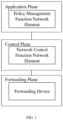
- FIG. 1 is a schematic diagram of an application scenario provided by an embodiment of the present disclosure. As shown in FIG. 1 , this scenario includes a network control function network element, a policy management function network element and a forwarding device.
- the network control function network element is located in a control plane, the policy management function network element is located in an application plane, and the forwarding device is located in a forwarding plane.
- the type of the forwarding device is not specifically limited, for example, the forwarding device may be a network device with a data forwarding function such as a base station. Specifically, it may be a base station and/or a base station controller in a global system for mobile communications (Global System for Mobile communications, GSM) or code division multiple access (Code Division Multiple Access, CDMA); may also be a base station (Node B, NB) and/or a radio network controller (Radio Network Controller, RNC) in wide-band code division multiple access (Wide-band Code Division Multiple Access, WCDMA), or an evolutional network device (Evolutional NodeB, 4G base station or e-NodeB) in a long term evolution (Long Term Evolution, LTE) system, or a relay node or an access point, or a base station (5G base station) in a further 5G network, etc.
- GSM Global System for Mobile communications
- CDMA Code Division Multiple Access
- Node B, NB base station
- RNC Radio Network Controller
- FIG. 1 exemplarily shows a communication scenario of a network control function network element, a policy management function network element and a forwarding device, and optionally, other devices may be included in this scenario, which is not limited in the embodiments of the present disclosure.
- the goal of the DetNet network is to implement the determination of paths for data transmission over Layer 2 bridged and Layer 3 routed segments.
- the paths can provide worst-case bounds on latency, packet loss, and jitter, so as to control and reduce the end-to-end latency.
- a sending end when sending data, a sending end will measure each path, and periodically measure packet loss, delay, and jitter for each path, and establish a pre-estimation model for end-to-end delay and end-to-end packet loss for each path through periodic accumulation.
- a scheduling module When sending a packet at each sending end, a scheduling module performs estimation in accordance with the pre-estimation model for delay and packet loss, and selects one of the paths as a sending path of this packet in accordance with an algorithm of shortest delay/minimum packet loss/minimum jitter.
- the sending end assigns a quality of service (Quality of Service, QoS) class to each data flow.
- QoS Quality of Service
- the forwarding device checks its class and inserts the packet into a corresponding queue in accordance with the class.
- the forwarding device will prioritize a packet with high-priority. If the priorities are consistent, the packets will be processed in the order of entry. At this time, each packet will occupy BUFFER resources in accordance with priority.
- the switch will select a packet with the lowest priority for dropping, and allocate the vacated BUFFER to a new incoming packet with high-priority, so as to ensure a low delay and small jitter of the packet with high-priority as far as possible.
- this method has the following problems: when the deterministic data flow is using a link, if there is a higher-level data flow or a same-level data flow in the traffic sharing the link and node resources of the forwarding device, the queuing delay of the packet(s) in that deterministic data flow cannot be determined, and thus the end-to-end delay cannot be determined, and likewise, the delay jitter of the packet(s) will be relatively larger.
- parameters such as end-to-end delay are monitored through the network, and delay estimation is carried out when path selection is performed, so as to expect to arrive at the receiving end in accordance with an expected end-to-end delay.
- the parameters measured by the network are cumulative parameters, which represent performance of a certain period of time in the past, whereas a condition of the network always changes instantaneously, so this estimation value is inaccurate.
- the lack of control over the behavior of each data packet results in the formation of micro-burst(s) in the queue, or even micro-burst iterations, which will make that the latency in the deterministic network cannot be determined, so that the latency cannot be controlled.
- a network control function network element acquires message processing logic of data flow, and configures the message processing logic for a target forwarding device, for the target forwarding device to forward corresponding data flow based on the message processing logic.
- the message processing logic is obtained based on a queue configuration rule of a forwarding port of the forwarding device, and the queue configuration rule is determined based on a data forwarding period of the forwarding device and the number of queues of message queues supported by the forwarding port of the forwarding device, thus when data flow is forwarded, each data flow is forwarded in a specific queue and in accordance with a specific forwarding time, making it possible to accurately determine a latency in a data transmission process, thus realizing control of an end-to-end latency in a deterministic network.
- an applicable system may be a global system for mobile communications (global system of mobile communication, GSM), code division multiple access (code division multiple access, CDMA) system, wideband code division multiple access (Wideband Code Division Multiple Access, WCDMA) general packet radio service (general packet radio service, GPRS) system, long-term evolution (long term evolution, LTE) system, LTE frequency division duplex (frequency division duplex, FDD) system, LTE time division duplex (time division duplex, TDD) system, long term evolution advanced (long term evolution advanced, LTE-A) system, universal mobile telecommunication system (universal mobile telecommunication system, UMTS), worldwide interoperability for microwave access (worldwide interoperability for microwave access, WiMAX) system, 5G new radio (New Radio, NR) system, etc.
- GSM global system of mobile communication
- CDMA code division multiple access
- WCDMA Wideband Code Division Multiple Access
- general packet radio service general packet radio service
- GPRS general packet radio service
- long-term evolution long term evolution,
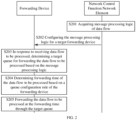
- FIG. 2 is a flowchart of a data scheduling method provided by an embodiment of the present disclosure. As shown in FIG. 2 , the data scheduling method provided by the embodiment of the present disclosure includes the following steps.
- S201 a network control function network element acquires message processing logic of data flow.
- the message processing logic is used for instructing a forwarding device to forward data flow corresponding to the data flow.
- the message processing logic is obtained based on a queue configuration rule of a forwarding port of a forwarding device and the queue configuration rule is determined according to a data forwarding period of the forwarding device and the number of queues of message queues supported by the forwarding port of the forwarding device. And so far the manner of acquiring the queue configuration rule, it is shown in subsequent embodiments.
- the message processing logic includes: a matching domain (e.g., IP six-tuple or IP five-tuple), a priority of the data flow, and an action domain (e.g., a message queue and exit for forwarding the data flow). And so far the manner of acquiring the message processing logic, it is shown in subsequent embodiments.
- a matching domain e.g., IP six-tuple or IP five-tuple
- a priority of the data flow e.g., IP six-tuple or IP five-tuple
- an action domain e.g., a message queue and exit for forwarding the data flow.
- the network control function network element configures the message processing logic for a target forwarding device, for the target forwarding device to forward corresponding data flow based on the message processing logic.
- the network control function network element sends a configuration request to the forwarding device, where the configuration request carries the message processing logic.
- the forwarding device acquires the message processing logic carried therein, and configures each forwarding port according to the message processing logic.
- the forwarding device may send a configuration response to the network control function network element, where the configuration response is used to indicate that the configuration of the message processing logic is completed.
- the forwarding device determines a target queue for forwarding the data flow to be processed based on the message processing logic.
- the forwarding device when the forwarding device receives the data flow to be processed, it first performs message matching according to the configured message processing logic. That is, if the IP six-tuple (or IP five-tuple) of the received data flow to be processed is consistent with a matching domain in a certain configured message processing logic, it puts the data flow to be processed into the target queue indicated in the message processing logic based on a priority and an action domain in the message processing logic, thereby using the target queue to realize forwarding of the data flow to be processed.
- the configured message processing logic That is, if the IP six-tuple (or IP five-tuple) of the received data flow to be processed is consistent with a matching domain in a certain configured message processing logic, it puts the data flow to be processed into the target queue indicated in the message processing logic based on a priority and an action domain in the message processing logic, thereby using the target queue to realize forwarding of the data flow to be processed.
- the data flow to be processed is dropped, or an identification result is reported to the network control function network element.
- the forwarding device determines forwarding time of the data flow to be processed based on the queue configuration rule of the forwarding device.
- the forwarding time corresponding to the target queue is determined to forward this data flow to be processed at this forwarding time.
- the forwarding device forwards the data flow to be processed at the forwarding time through the target queue.
- non-DetNet flow when non-DetNet flow is received, it may also be processed based on the message processing logic, but the priority of the non-DetNet flow is lower than the priority of the DetNet flow on all forwarding ports. That is, the non-DetNet flow is forwarded when there is no DetNet flow in the queue where the non-DetNet flow is located. For the non-DetNet flow that cannot be forwarded, the non-DetNet flow is processed by dropping.
- the message processing logic is obtained based on a queue configuration rule of a forwarding port of the forwarding device, and the queue configuration rule is determined based on a data forwarding period of the forwarding device and the number of queues of message queues supported by the forwarding port of the forwarding device, thus when data flow is forwarded, each data flow is forwarded in a specific queue and in accordance with a specific forwarding time, making it possible to accurately determine a latency in a data transmission process, thus realizing control of an end-to-end latency in a deterministic network.
- step S201 specifically includes the following steps:
- the first data packet is a leading packet received by the forwarding device after configuration of the queue configuration rule is completed, and the first data packet includes demand information of the data flow.
- the message can acquire the demand information of the data flow contained in the first packet, so as to configure the corresponding message processing logic for the data flow according to the demand information.
- the data flow can be processed according to the message processing logic.
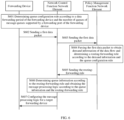
- FIG. 3 is a flowchart 1 of a configuration mode for message processing logic provided by an embodiment of the present disclosure.
- the configuration mode for message processing logic provided by the embodiment of the present disclosure includes the following steps.
- the network control function network element can acquire the queue configuration rule of the forwarding device, and on the other hand, the policy management function network element can also obtain the queue configuration rule of the forwarding device.
- any one of the network control function network element and the policy management function network element can report the queue configuration rule to another network element after acquiring the queue configuration rule.
- the obtaining of the queue configuration rule of the forwarding device by the network control function network element in FIG. 3 is illustrated as an example, but the obtaining is not limited to this.
- a forwarding period of each forwarding device and forwarding time of each message queue can be sent to a corresponding forwarding device for the forwarding device to divide the forwarding time of each message queue.
- the policy management function network element may first send the queue configuration rule to the network management function network element, and the network management function network element will send the queue configuration rule to the forwarding device for configuration.
- the forwarding port of each forwarding device may include a plurality of message queues, and the queue configuration rule is indicative of a data transmission rate (e.g., a maximum transmission rate, a minimum transmission rate and an average transmission rate) of each message queue, the priority of each message queue when forwarding data flow, and corresponding forwarding time of each message queue in the forwarding period.
- a data transmission rate e.g., a maximum transmission rate, a minimum transmission rate and an average transmission rate
- the number of queues of message queues supported by the forwarding port of the forwarding device and the forwarding period of the forwarding port are determined, and at the same time, the data transmission rate of each message queue of the forwarding port and the priority of each message queue when forwarding data flow are obtained.
- the forwarding period is evenly distributed to each message queue, so as to obtain the forwarding time of each message queue in the forwarding period, where the durations of the forwarding times corresponding to respective message queues are the same.
- the queue configuration rule is obtained based on the data transmission rate of each message queue, the priority of each message queue when forwarding data flow and the forwarding time of each message queue in the forwarding period.
- the forwarding device sends a first data packet to the network control function network element.
- the first data packet is a leading packet received by the forwarding device after configuration of the queue configuration rule is completed, and the first data packet includes demand information of the data flow.
- the network control function network element parses the first data packet to obtain demand information of the data flow.
- the demand information of the data flow includes, but is not limited to, any one or more of the following: a DetNet flow characteristic, a DetNet flow service demand, a DetNet flow identifier, etc.
- the DetNet flow identifier includes DetNet flow, a source address and a destination address, a protocol type, a port number and other information.
- the DetNet flow service demand includes a maximum end-to-end latency, jitter, a minimum bandwidth, a packet loss rate, a maximum number of out-of-order packets and other information.
- the DetNet flow characteristic includes an interval, a maximum/minimum payload size, the number of data packets in a maximum/minimum time period, etc.
- the network control function network element sends the demand information to the policy management function network element.
- the manner of sending the demand information is not specifically limited in the embodiments of the present disclosure.
- the network control function network element may send a user plane establishment request to the policy management function network element, and the user plane establishment request carries the demand information.
- the present disclosure will not repeat them one by one.
- the policy management function network element determines a routing-forwarding rule according to the demand information and the queue configuration rule.
- the routing-forwarding rule includes: at least part of the DetNet flow identifier (used to identify the flow and generate the following matching items), a message queue of each forwarding device on the forwarding path used to forward the data flow, a next hop, a priority, a maximum rate and a minimum rate corresponding to each message queue, etc.
- the policy management function network element sends the routing-forwarding rule to the network control function network element.
- the manner of sending the routing-forwarding rule is not specifically limited in the embodiments of the present disclosure.
- the policy management function network element may send a user plane establishment request to the network control function network element, and the user plane establishment request carries the routing-forwarding rule.
- the network control function network element determines queue information according to the routing-forwarding rule and obtains the message processing logic according to the queue information and the routing-forwarding rule.
- the queue information is indicative of the message queue of the forwarding device for sending the data flow.
- the queue information of each forwarding device is acquired from the routing-forwarding rule, so that the message processing logic is generated according to the queue information and the routing-forwarding rule.
- the network control function network element configures the message processing logic for a target forwarding device, for the target forwarding device to forward corresponding data flow based on the message processing logic.
- step S308 and the manner in which the forwarding device forwards the data flow are the same as the solution in the embodiment shown in FIG. 2 , and will not be repeated here.
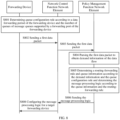
- FIG. 4 is a flowchart 2 of a configuration mode for message processing logic provided by an embodiment of the present disclosure.
- the configuration mode for message processing logic provided by the embodiment of the present disclosure includes the following steps.
- the forwarding device sends a first data packet to the network control function network element.
- the network control function network element parses the first data packet to obtain demand information of the data flow.
- the network control function network element sends the demand information to the policy management function network element.
- steps S401-S404 are similar to those of steps S301-S304 in the embodiment shown in FIG. 3 , for their specific implementations, reference can be made to the embodiment shown in FIG. 3 , which will not be repeated here.
- the policy management function network element determines a routing-forwarding rule and queue information according to the demand information and the queue configuration rule.
- the queue information may be determined by the policy management function network element, and the manner in which it determines the routing-forwarding rule and the manner in which it determines the queue information are similar to that performed by the network control function network element in the embodiment shown in FIG. 3 , which are not repeated here.
- the policy management function network element sends the routing-forwarding rule and the queue information to the network control function network element.
- the manner of sending the routing-forwarding rule and the queue information is not specifically limited in the embodiments of the present disclosure.
- the policy management function network element may send a user plane establishment request to the network control function network element, and the user plane establishment request carries the routing-forwarding rule and the queue information.
- the present disclosure will not repeat them one by one.
- the network control function network element determines the message processing logic according to the routing-forwarding rule and the queue information.
- the network control function network element configures the message processing logic for a target forwarding device, for the target forwarding device to forward corresponding data flow based on the message processing logic.
- steps S407-S408 are similar to those of steps S307-S308 in the embodiment shown in FIG. 3 , for their specific implementations, reference can be made to the embodiment shown in FIG. 3 , which are not repeated here.
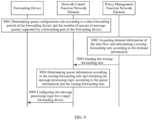
- FIG. 5 is a flowchart 3 of a configuration mode for message processing logic provided by an embodiment of the present disclosure. As shown in FIG. 5 , the configuration mode for message processing logic provided by the embodiment of the present disclosure includes the following steps.
- the forwarding device sends a first data packet to the network control function network element.
- the network control function network element parses the first data packet to obtain demand information of the data flow.
- the network control function network element sends the demand information to the policy management function network element.
- steps S501-S504 are similar to those of steps S301-S304 in the embodiment shown in FIG. 3 , for their specific implementations, reference can be made to the embodiment shown in FIG. 3 , which are not repeated here.
- the policy management function network element determines a routing-forwarding rule and queue information according to the demand information and the queue configuration rule, and determines the message processing logic according to the queue information and the routing-forwarding rule.
- queue information and the message processing logic may be determined by the policy management function network element, and the manner in which it determines the routing-forwarding rule and the manner in which it determines the queue information and the message processing logic are similar to that performed by the network control function network element in the embodiment shown in FIG. 3 , which are not repeated here.
- the policy management function network element sends the message processing logic to the network control function network element.
- the manner of sending the message processing logic is not specifically limited in the embodiments of the present disclosure.
- the policy management function network element may send a user plane establishment request to the network control function network element, and the user plane establishment request carries the message processing logic.
- the present disclosure will not repeat them one by one.
- the network control function network element configures the message processing logic for a target forwarding device, for the target forwarding device to forward corresponding data flow based on the message processing logic.
- step S507 is similar to those of step S308 in the embodiment shown in FIG. 3 , for the detailed implementation, reference can be made to the embodiment shown in FIG. 3 , which will not be repeated here.
- FIG. 6 is a flowchart 4 of a configuration mode for message processing logic provided by an embodiment of the present disclosure.
- the configuration mode for message processing logic provided by the embodiment of the present disclosure includes the following steps.
- the forwarding device sends a first data packet to the network control function network element.
- steps S601-S602 are similar to those of steps S301-S302 in the embodiment shown in FIG. 3 , for their specific implementations, reference can be made to the embodiment shown in FIG. 3 , which are not repeated here.
- the network control function network element sends the first data packet to the policy management function network element.
- the network control function does not parse the first data packet, and may send the first data packet to the policy management function network element through a user plane establishment request.
- the queue configuration rule is acquired by the network control function network element, it is also possible to carry the queue configuration rule, the forwarding period and the forwarding time of each message queue in a user plane establishment request.
- the policy management function network element parses the first data packet to obtain demand information of the data flow and determines a routing-forwarding rule according to the demand information and the queue configuration rule.
- the manner in which the policy management function network element parses the first data packet to acquire the demand information and the manner in which it obtains the routing-forwarding rule according to the demand information and the queue configuration rule are the same as the solution performed by the network control function network element in the embodiment shown in FIG. 3 , which are not repeated here.
- the policy management function network element sends the routing-forwarding rule to the network control function network element.
- the network control function network element determines queue information according to the routing-forwarding rule and obtains the message processing logic according to the queue information and the routing-forwarding rule.
- the network control function network element configures the message processing logic for a target forwarding device, for the target forwarding device to forward corresponding data flow based on the message processing logic.
- steps S605-S606 are similar to those of steps S306-S308 in the embodiment shown in FIG. 3 , for their specific implementations, reference can be made to the embodiment shown in FIG. 3 , which are not repeated here.
- FIG. 7 is a flowchart 5 of a configuration mode for message processing logic provided by an embodiment of the present disclosure.
- the configuration mode for message processing logic provided by the embodiment of the present disclosure includes the following steps.
- the forwarding device sends a first data packet to the network control function network element.
- the network control function network element sends the first data packet to the policy management function network element.
- the policy management function network element parses the first data packet to obtain demand information of the data flow and determines a routing-forwarding rule and queue information according to the demand information and the queue configuration rule.
- the policy management function network element sends the routing-forwarding rule and the queue information to the network control function network element.
- the network control function network element obtains the message processing logic according to the routing-forwarding rule and the queue information.
- the network control function network element configures the message processing logic for a target forwarding device, for the target forwarding device to forward corresponding data flow based on the message processing logic.
- steps S701-S702 are similar to those of steps S301-S302 in the embodiment shown in FIG. 3
- the methods and principles of steps S703-S705 are similar to those of steps S405-S406 in the embodiment shown in FIG. 4
- the methods and principles of steps S706-S707 are similar to those of steps S407-S408 in the embodiment shown in FIG. 4 .
- FIG. 8 is a flowchart 6 of a configuration mode for message processing logic provided by an embodiment of the present disclosure. As shown in FIG. 8 , the configuration mode for message processing logic provided by the embodiment of the present disclosure includes the following steps.
- the forwarding device sends a first data packet to the network control function network element.
- the network control function network element sends the first data packet to the policy management function network element.
- the policy management function network element parses the first data packet to obtain demand information of the data flow.
- the policy management function network element determines a routing-forwarding rule and queue information according to the demand information and the queue configuration rule, and obtains the message processing logic according to the routing-forwarding rule and the queue information.
- the policy management function network element sends the message processing logic to the network control function network element.
- the network control function network element configures the message processing logic for a target forwarding device, for the target forwarding device to forward corresponding data flow based on the message processing logic.
- steps S801-S802 are similar to those of steps S301-S302 in the embodiment shown in FIG. 3
- steps S803-S805 are similar to those of steps S505-S506 in the embodiment shown in FIG. 5
- steps S806-S807 are similar to those of steps S506-S507 in the embodiment shown in FIG. 5 .
- various manners for acquiring the message processing logic are provided, they can be flexibly applied to various network architectures to solve the problem that the latency cannot be determined in the forwarding process of deterministic data flow in different network architectures.
- the demand information of the data flow may be obtained without the first data packet.
- step S201 specifically includes the following solutions:
- FIG. 9 is a a flowchart 7 of a configuration mode for message processing logic provided by an embodiment of the present disclosure. As shown in FIG. 9 , a configuration mode for message processing logic provided by an embodiment of the present disclosure includes the following steps.
- the network control function network element can acquire the queue configuration rule of the forwarding device, and on the other hand, the policy management function network element can also obtain the queue configuration rule of the forwarding device.
- any one of the network control function network element and the policy management function network element can report the queue configuration rule to another network element after acquiring the queue configuration rule.
- a forwarding period of each forwarding device and forwarding time of each message queue can be sent to a corresponding forwarding device for the forwarding device to divide the forwarding time of each message queue.
- the policy management function network element may first send the queue configuration rule to the network management function network element, and the network management function network element will send the queue configuration rule to the forwarding device for configuration.
- the forwarding port of each forwarding device may include a plurality of message queues, and the queue configuration rule is indicative of a data transmission rate (e.g., a maximum transmission rate, a minimum transmission rate and an average transmission rate) of each message queue, the priority of each message queue when forwarding data flow, and corresponding forwarding time of each message queue in the forwarding period.
- a data transmission rate e.g., a maximum transmission rate, a minimum transmission rate and an average transmission rate
- the number of queues of message queues supported by the forwarding port of the forwarding device and the forwarding period of the forwarding port are determined, and at the same time, the data transmission rate of each message queue of the forwarding port and the priority of each message queue when forwarding data flow are obtained.
- the forwarding period is evenly distributed to each message queue, so as to obtain the forwarding time of each message queue in the forwarding period, where the durations of the forwarding times corresponding to respective message queues are the same.
- the queue configuration rule is obtained based on the data transmission rate of each message queue, the priority of each message queue when forwarding data flow and the forwarding time of each message queue in the forwarding period.
- the policy management function network element acquires demand information of the data flow and determines a routing-forwarding rule according to the demand information.
- the policy management function network element may obtain the demand information of the data flow through a business layer and/or an application layer, and the specific acquisition manner is not limited in the embodiment of the present disclosure.
- the policy management function network element sends the routing-forwarding rule to the network control function network element.
- the network control function network element determines queue information according to the routing-forwarding rule and obtains the message processing logic according to the queue information and the routing-forwarding rule.
- steps S902-S904 are similar to those of steps S305-S307 in the embodiment shown in FIG. 3 , for their specific implementations, reference can be made to the embodiment shown in FIG. 3 , which is not repeated here.
- the network control function network element configures the message processing logic for a target forwarding device, for the target forwarding device to forward corresponding data flow based on the message processing logic.
- the network control function network element sends a configuration request to the forwarding device, where the configuration request carries the message processing logic.
- the forwarding device acquires the message processing logic carried therein, and configures each forwarding port according to the message processing logic.
- the forwarding device may send a configuration response to the network control function network element, where the configuration response is used to indicate that the configuration of the message processing logic is completed.
- the network control function network element may also send a user plane establishment response to the policy management function network element.
- the user plane establishment response is used to indicate that the configuration of the message processing logic for the forwarding device is completed.
- FIG. 10 is a flowchart 8 of a configuration mode for message processing logic provided by an embodiment of the present disclosure.
- the configuration mode for message processing logic provided by the embodiment of the present disclosure includes the following steps.
- the policy management function network element acquires demand information of the data flow and determines a routing-forwarding rule and queue information according to the demand information.
- the policy management function network element sends the routing-forwarding rule and the queue information to the network control function network element.
- the network control function network element generates the message processing logic according to the routing-forwarding rule and the queue information.
- steps S1001 are similar to those of step S301 in the embodiment shown in FIG. 3
- steps S1002-S1004 are similar to those of steps S405-S407 in the embodiment shown in FIG. 4 .
- the network control function network element configures the message processing logic for a target forwarding device, for the target forwarding device to forward corresponding data flow based on the message processing logic.
- the network control function network element sends a configuration request to the forwarding device, where the configuration request carries the message processing logic.
- the forwarding device acquires the message processing logic carried therein, and configures each forwarding port according to the message processing logic.
- the forwarding device may send a configuration response to the network control function network element, where the configuration response is used to indicate that the configuration of the message processing logic is complete.
- the network control function network element may also send a user plane establishment response to the policy management function network element.
- the user plane establishment response is used to indicate that the configuration of the message processing logic for the forwarding device is completed.
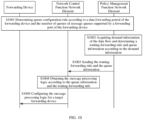
- FIG. 11 is a flowchart 9 of a configuration mode for message processing logic provided by an embodiment of the present disclosure.
- a configuration mode for message processing logic provided by an embodiment of the present disclosure includes the following steps.
- the policy management function network element acquires demand information of the data flow, determines a routing-forwarding rule and queue information according to the demand information, and generates the message processing logic according to the routing-forwarding rule and the queue information.
- the policy management function network element sends the message processing logic to the network control function network element.
- steps 51101 are similar to those of step S301 in the embodiment shown in FIG. 3
- steps S1102-S1003 are similar to those of steps S505-S506 in the embodiment shown in FIG. 5 .
- the network control function network element configures the message processing logic for a target forwarding device, for the target forwarding device to forward corresponding data flow based on the message processing logic.
- the network control function network element sends a configuration request to the forwarding device, where the configuration request carries the message processing logic.
- the forwarding device acquires the message processing logic carried therein, and configures each forwarding port according to the message processing logic.
- the forwarding device may send a configuration response to the network control function network element, where the configuration response is used to indicate that the configuration of the message processing logic is complete.
- the network control function network element may also send a user plane establishment response to the policy management function network element.
- the user plane establishment response is used to indicate that the configuration of the message processing logic for the forwarding device is completed.
- steps in the flowchart in the above embodiment are shown in sequence as indicated by the arrows, these steps are not necessarily executed in the order as indicated by the arrows. Unless explicitly stated herein, the execution of these steps is not strictly limited in order, and they may be executed in other orders. Moreover, at least a portion of the steps in the figure may include a plurality of sub-steps or stages. The sub-steps and the stages may not necessarily be completed at the same moment, but may be executed at different moments, and the order of execution may not necessarily be sequential, but they may be executed in turn or alternately with at least a part of other steps or sub-steps or stages of the other steps.
- FIG. 12 is a structural diagram 1 of a data scheduling apparatus provided by an embodiment of the present disclosure. As shown in FIG. 12 , the data scheduling apparatus 1200 includes:
- the acquiring module 1201 is specifically adapted to: receive a first data packet sent by the forwarding device; and obtain the message processing logic based on the first data packet and the queue configuration rule.
- the acquiring module 1201 is specifically adapted to: parse the first data packet to obtain demand information of the data flow; and obtain the message processing logic according to the demand information and the queue configuration rule.
- the acquiring module 1201 is specifically adapted to: send the demand information to a policy management function network element; receive a routing-forwarding rule obtained by the policy management function network element according to the demand information and the queue configuration rule; obtain the message processing logic according to the routing-forwarding rule.
- the acquiring module 1201 is specifically adapted to: send the first data packet to a policy management function network element for the policy management function network element to obtain demand information of the data flow according to the first data packet; receive a routing-forwarding rule obtained by the policy management function network element according to the demand information and the queue configuration rule; obtain the message processing logic according to the routing-forwarding rule.
- the acquiring module 1201 is specifically adapted to: determine queue information of the data flow according to the routing-forwarding rule, where the queue information is indicative of a queue for sending the data flow; obtain the message processing logic according to the queue information and the routing-forwarding rule.
- the acquiring module 1201 is specifically adapted to: receive queue information obtained by the policy management function network element according to the demand information; and obtain the message processing logic according to the routing-forwarding rule and the queue information.
- the acquiring module 1201 is specifically adapted to: parse the first data packet to obtain demand information of the data flow; send the demand information to a policy management function network element; and receive the message processing logic obtained by the policy management function network element according to the demand information.
- the acquiring module 1201 is specifically adapted to: send the first data packet to a policy management function network element; and receive the message processing logic obtained by the policy management function network element according to the first data packet.
- the data scheduling apparatus 1200 further includes: a determining module 1203, adapted to determine the queue configuration rule of the forwarding port according to the data forwarding period of the forwarding device and the number of queues of message queues supported by the forwarding port of the forwarding device; or, a receiving module 1204, adapted to receive the queue configuration rule sent by a policy management function network element; where the queue configuration rule is indicative of data forwarding time of each of the message queues in a forwarding period of the forwarding port, and a duration of the data forwarding time is the data forwarding period of the forwarding device.
- the data scheduling apparatus 1200 can implement all the steps of the data scheduling method corresponding to the network control function network element in the above method embodiments, and can achieve the same technical effects, so the parts of this embodiment which are same as the method embodiments and the beneficial effects will not be specifically detailed here.
- FIG. 13 is a structural diagram 2 of a data scheduling apparatus provided by an embodiment of the present disclosure. As shown in FIG. 13 , the data scheduling apparatus 1300 includes:
- the determining module 1302 is specifically adapted to: determine, according to the demand information and the queue configuration rule, queue information used for processing the data flow; and determine the message processing logic according to the routing-forwarding rule and the queue information.
- the data scheduling apparatus 1300 can implement all the steps of the data scheduling method corresponding to the policy management function network element in the above method embodiments, and can achieve the same technical effects, so the parts of this embodiment which are same as the method embodiments and the beneficial effects will not be specifically detailed here.
- FIG. 14 is a structural diagram 3 of a data scheduling apparatus provided by an embodiment of the present disclosure. As shown in FIG. 14 , the data scheduling apparatus 1400 includes:
- the sending module 1402 is specifically adapted to: determine queue information according to the demand information and the queue configuration rule; send the queue information and the routing-forwarding rule to the network control function network element for the network control function network element to determine the message processing logic according to the routing-forwarding rule and the queue information.
- the acquiring module 1401 is specifically adapted to: receive the demand information of the data flow in a first data packet sent by the network control function network element.
- the acquiring module 1401 is specifically adapted to: receive a first data packet sent by the network control function network element; and parse the first data packet to obtain the demand information of the data flow.
- the data scheduling apparatus 1400 further includes: a determining module 1403, adapted to determine the queue configuration rule of the forwarding port according to the data forwarding period of the forwarding device and the number of queues of message queues supported by the forwarding port of the forwarding device; or, receive the queue configuration rule sent by the network control function network element; where the queue configuration rule is indicative of data forwarding time of each of the message queues in a forwarding period of the forwarding port, and a duration of the data forwarding time is the data forwarding period of the forwarding device.
- a determining module 1403 adapted to determine the queue configuration rule of the forwarding port according to the data forwarding period of the forwarding device and the number of queues of message queues supported by the forwarding port of the forwarding device; or, receive the queue configuration rule sent by the network control function network element; where the queue configuration rule is indicative of data forwarding time of each of the message queues in a forwarding period of the forwarding port, and a duration of the data forwarding time is the data forwarding period of the forward
- the data scheduling apparatus 1400 can implement all the steps of the data scheduling method corresponding to the policy management function network element in the above method embodiments, and can achieve the same technical effects, so the parts of this embodiment which are same as the method embodiments and the beneficial effects will not be specifically detailed here.
- FIG. 15 is a structural diagram 4 of a data scheduling apparatus provided by an embodiment of the present disclosure.
- the data scheduling apparatus 1500 includes: a determining module 1501, adapted to, in response to receiving data flow to be processed, determine a target queue for forwarding the data flow to be processed based on message processing logic and determine forwarding time of the data flow to be processed based on a queue configuration rule of the forwarding device, where the message processing logic is configured for the forwarding device by a network control function network element; a forwarding module 1502, adapted to forward the data flow to be processed at the forwarding time through the target queue.
- the data scheduling apparatus 1500 further includes: a sending module 1503, adapted to send a first data packet to the network control function network element; a receiving module 1504, adapted to receive the message processing logic obtained by the network control function network element according to the first data packet.
- the data scheduling apparatus 1500 can implement all the steps of the data scheduling method corresponding to the forwarding device in the above method embodiments, and can achieve the same technical effects, so the parts of this embodiment which are same as the method embodiments and the beneficial effects will not be specifically detailed here.
- FIG. 16 is a structural diagram of the network control function network element provided by an embodiment of the present disclosure. As shown in FIG. 16 , the network control function network element includes a transceiver 1601, a processor 1602 and a memory 1603.
- the transceiver 1601 is configured to receive and send data under control of the processor 1602.
- a bus architecture may include any number of interconnected buses and bridges. Specifically, various circuits of one or more processors represented by the processor 1602 and the memory represented by the memory 1603 are linked together. The bus architecture may also link together various other circuits, such as a peripheral device, a voltage regulator and a power management circuit, which are well known in the art and are therefore not described further herein.
- a bus interface provides an interface.
- the transceiver 1601 may be a plurality of elements, that is, including a transmitter and a receiver, and providing units for communicating with various other apparatuses on transmission mediums. These transmission mediums include transmission mediums such as a wireless channel, a wired channel, an optical cable and the like.
- the processor 1602 is responsible for managing the bus architecture and general processing, and the memory 1603 can store data used by the processor 1602 when performing operations.
- the processor 1602 is responsible for managing the bus architecture and general processing, and the memory 1603 can store data used by the processor 1602 when performing operations.
- the processor 1602 can be a central processor unit (central processing unit, CPU), an application-specific integrated circuit (Application Specific Integrated Circuit, ASIC), a field-programmable gate array (Field-Programmable Gate Array, FPGA) or a complex programmable logic device (Complex Programmable Logic Device, CPLD), and the processor may also adopt a multi-core architecture.
- the processor 1602 calls a computer program stored in the memory 1603 to execute any method related to the terminal device provided by the embodiment of the present disclosure according to obtained executable instructions, where the processor and the memory may also be physically arranged separately.
- the processor 1602 is adapted to read the computer program in the memory and perform the following operations: acquiring message processing logic of data flow, where the message processing logic is obtained based on a queue configuration rule of a forwarding port of a forwarding device and the queue configuration rule is determined according to a data forwarding period of the forwarding device and a number of queues of message queues supported by the forwarding port of the forwarding device; configuring the message processing logic for a target forwarding device for forwarding of corresponding data flow.
- acquiring the message processing logic of the data flow includes: receiving a first data packet sent by the forwarding device; and obtaining the message processing logic based on the first data packet and the queue configuration rule.
- obtaining the message processing logic based on the first data packet and the queue configuration rule includes: parsing the first data packet to obtain demand information of the data flow; and obtaining the message processing logic according to the demand information and the queue configuration rule.
- obtaining the message processing logic according to the demand information and the queue configuration rule includes: sending the demand information to a policy management function network element; receiving a routing-forwarding rule obtained by the policy management function network element according to the demand information and the queue configuration rule; obtaining the message processing logic according to the routing-forwarding rule.
- obtaining the message processing logic based on the first data packet and the queue configuration rule includes: sending the first data packet to a policy management function network element for the policy management function network element to obtain demand information of the data flow according to the first data packet; receiving a routing-forwarding rule obtained by the policy management function network element according to the demand information and the queue configuration rule; obtaining the message processing logic according to the routing-forwarding rule.
- obtaining the message processing logic according to the routing-forwarding rule includes: determining queue information of the data flow according to the routing-forwarding rule, where the queue information is indicative of a queue for sending the data flow; obtaining the message processing logic according to the queue information and the routing-forwarding rule.
- obtaining the message processing logic according to the routing-forwarding rule includes: receiving queue information obtained by the policy management function network element according to the demand information; and obtaining the message processing logic according to the routing-forwarding rule and the queue information.
- obtaining the message processing logic based on the first data packet and the queue configuration rule includes: parsing the first data packet to obtain demand information of the data flow; sending the demand information to a policy management function network element; receiving the message processing logic obtained by the policy management function network element according to the demand information.
- obtaining the message processing logic based on the first data packet and the queue configuration rule includes: sending the first data packet to a policy management function network element; and receiving the message processing logic obtained by the policy management function network element according to the first data packet.
- the processor 1602 is further adapted to: determine the queue configuration rule of the forwarding port according to the data forwarding period of the forwarding device and the number of queues of message queues supported by the forwarding port of the forwarding device; or, receive the queue configuration rule sent by a policy management function network element; where the queue configuration rule is indicative of data forwarding time of each of the message queues in a forwarding period of the forwarding port, and a duration of the data forwarding time is the data forwarding period of the forwarding device.
- network control function network element provided by the present disclosure can implement all the method steps implemented by the network control function network element in the above method embodiments, and can achieve the same technical effects, so the parts of this embodiment which are same as the method embodiments and the beneficial effects will not be specifically detailed here.
- FIG. 17 is a structural diagram of the policy management function network element provided by an embodiment of the present disclosure. As shown in FIG. 17 , the policy management function network element includes a transceiver 1701, a processor 1702 and a memory 1703.
- the transceiver 1701 is configured to receive and send data under control of the processor 1702.
- a bus architecture may include any number of interconnected buses and bridges. Specifically, various circuits of one or more processors represented by the processor 1702 and the memory represented by the memory 1703 are linked together. The bus architecture may also link together various other circuits, such as a peripheral device, a voltage regulator and a power management circuit, which are well known in the art and are therefore not described further herein.
- a bus interface provides an interface.
- the transceiver 1701 may be a plurality of elements, that is, including a transmitter and a receiver, and providing units for communicating with various other apparatuses on transmission mediums. These transmission mediums include transmission mediums such as a wireless channel, a wired channel, an optical cable and the like.
- the processor 1702 is responsible for managing the bus architecture and general processing, and the memory 1703 can store data used by the processor 1702 when performing operations.
- the processor 1702 is responsible for managing the bus architecture and general processing, and the memory 1703 can store data used by the processor 1702 when performing operations.
- the processor 1702 can be a central processor unit (central processing unit, CPU), an application-specific integrated circuit (Application Specific Integrated Circuit, ASIC), a field-programmable gate array (Field-Programmable Gate Array, FPGA) or a complex programmable logic device (Complex Programmable Logic Device, CPLD), and the processor may also adopt a multi-core architecture.
- the processor 1702 calls a computer program stored in the memory 1703 to execute any method related to the terminal device provided by the embodiment of the present disclosure according to obtained executable instructions, where the processor and the memory may also be physically arranged separately.
- the processor 1702 is adapted to read the computer program in the memory and perform the following operations: acquiring demand information of data flow; determining a routing-forwarding rule according to the demand information and a queue configuration rule, where the queue configuration rule is determined according to a data forwarding period of a forwarding device and the number of queues of message queues supported by a forwarding port of the forwarding device; determining message processing logic of the data flow according to the routing-forwarding rule; sending the message processing logic to a network control function network element, where the message processing logic is used for forwarding of corresponding data flow.
- determining the message processing logic according to the routing-forwarding rule includes: determining, according to the demand information and the queue configuration rule, queue information used for processing the data flow; and determining the message processing logic according to the routing-forwarding rule and the queue information.
- the processor 1702 is further adapted to read the computer program in the memory and perform the following operations: acquiring demand information of data flow; obtaining a routing-forwarding rule according to the demand information and a queue configuration rule, where the queue configuration rule is determined according to a data forwarding period of a forwarding device and the number of queues of message queues supported by a forwarding port of the forwarding device; and sending the routing-forwarding rule to a network control function network element, where the routing-forwarding rule is used for determining message processing logic and the message processing logic is used for forwarding of corresponding data flow.
- sending the routing-forwarding rule to the network control function network element includes: determining queue information according to the demand information and the queue configuration rule; sending the queue information and the routing-forwarding rule to the network control function network element for the network control function network element to determine the message processing logic according to the routing-forwarding rule and the queue information.
- acquiring the demand information of the data flow includes: receiving the demand information of the data flow in a first data packet sent by the network control function network element.
- acquiring the demand information of the data flow includes: receiving a first data packet sent by the network control function network element; and parsing the first data packet to obtain the demand information of the data flow.
- the processor before acquiring the demand information of the data flow, is further adapted to: determine the queue configuration rule of the forwarding port according to the data forwarding period of the forwarding device and the number of queues of message queues supported by the forwarding port of the forwarding device; or, receive the queue configuration rule sent by the network control function network element; where the queue configuration rule is indicative of data forwarding time of each of the message queues in a forwarding period of the forwarding port, and a duration of the data forwarding time is the data forwarding period of the forwarding device.
- the policy management function network element provided by the present disclosure can implement all the method steps implemented by the policy management function network element in the above method embodiments, and can achieve the same technical effects, so the parts of this embodiment which are same as the method embodiments and the beneficial effects will not be specifically detailed here.
- FIG. 18 is a structural schematic diagram of the forwarding device provided by the embodiment of the present disclosure. As shown in FIG. 18 , the forwarding device 1800 includes a transceiver 1801, a processor 1802 and a memory 1803.
- the transceiver 1801 is configured to receive and send data under control of the processor 1802.
- a bus architecture may include any number of interconnected buses and bridges. Specifically, various circuits of one or more processors represented by the processor 1802 and the memory represented by the memory 1803 are linked together. The bus architecture may also link together various other circuits, such as a peripheral device, a voltage regulator and a power management circuit, which are well known in the art and are therefore not described further herein.
- a bus interface provides an interface.
- the transceiver 1801 may be a plurality of elements, that is, including a transmitter and a receiver, and providing units for communicating with various other apparatuses on transmission mediums. These transmission mediums include transmission mediums such as a wireless channel, a wired channel, an optical cable and the like.
- the processor 1802 is responsible for managing the bus architecture and general processing, and the memory 1803 can store data used by the processor 1802 when performing operations.
- the processor 1802 is responsible for managing the bus architecture and general processing, and the memory 1803 can store data used by the processor 1802 when performing operations.
- the processor 1802 can be a central processor unit (central processing unit, CPU), an application-specific integrated circuit (Application Specific Integrated Circuit, ASIC), a field-programmable gate array (Field-Programmable Gate Array, FPGA) or a complex programmable logic device (Complex Programmable Logic Device, CPLD), and the processor may also adopt a multi-core architecture.
- the processor 1802 calls a computer program stored in the memory 1803 to execute any method related to the terminal device provided by the embodiment of the present disclosure according to obtained executable instructions, where the processor and the memory may also be physically arranged separately.
- the processor 1802 is adapted to read the computer program in the memory and perform the following operations: in response to receiving data flow to be processed, determining a target queue for forwarding the data flow to be processed based on message processing logic; determining forwarding time of the data flow to be processed based on a queue configuration rule of the forwarding device, where the message processing logic is configured for the forwarding device by a network control function network element; forwarding the data flow to be processed at the forwarding time through the target queue.
- the processor is further adapted to: send a first data packet to the network control function network element; and receive the message processing logic obtained by the network control function network element according to the first data packet.
- the forwarding device provided by the present disclosure can implement all the method steps implemented by the forwarding device in the above method embodiments, and can achieve the same technical effects, so the parts of this embodiment that are same as the method embodiments and the beneficial effects will not be specifically detailed here.
- the division of units in the embodiments of the present disclosure is schematic and is only a logical function division, and there may be other division manners in actual implementations.
- the functional units in the embodiments of the present disclosure may be integrated into one processing unit, or each unit may physically exist alone, or two or more units may be integrated into one unit.
- the above-integrated units can be realized either in the form of hardware or in the form of software functional units.
- the integrated units may be stored in a processor-readable storage medium if implemented in the form of software functional units and sold or used as an independent product. Based on this understanding, the essence of the technical solution of the present disclosure, or the part that contributes to the prior art, or all or a part of this technical solution may be embodied in the form of a software product.
- the computer software product is stored in a storage medium and includes several instructions used for a computer device (which may be a personal computer, a server, or a network device, etc.) or a processor (processor) to perform all or part of the steps of the methods described in various embodiments of the present disclosure.
- the above storage medium includes various mediums that can store program code, such as: a USB flash drive, a removable hard disk, a read-only memory (Read-Only Memory, ROM), a random access memory (Random Access Memory, RAM), a magnetic disk or an optical disk.
- program code such as: a USB flash drive, a removable hard disk, a read-only memory (Read-Only Memory, ROM), a random access memory (Random Access Memory, RAM), a magnetic disk or an optical disk.
- Embodiments of the present disclosure provide a processor-readable storage medium, the processor-readable storage medium storing a computer program, where the computer program is used to cause the processor to execute the network energy conservation method provided in the embodiments of the present disclosure, so that the processor can implement all the steps of the network energy conservation method implemented by the network device in the above method embodiments, and can achieve the same technical effects, so the parts of this embodiment which are same as the method embodiments and the beneficial effects will not be specifically detailed here.
- the processor-readable storage medium may be any available medium or data storage device that the processor is able to access, including, but not limited to, a magnetic memory (e.g., a floppy disk, a hard disk, a magnetic tape, a magneto-optical disk (MO), etc.), an optical memory (e.g., a CD, a DVD, a BD, a HVD, etc.), and a semiconductor memory (e.g., a ROM, an EPROM, an EEPROM, a non-volatile memory (NAND FLASH), a solid-state drive (SSD)), etc.
- a magnetic memory e.g., a floppy disk, a hard disk, a magnetic tape, a magneto-optical disk (MO), etc.
- an optical memory e.g., a CD, a DVD, a BD, a HVD, etc.
- semiconductor memory e.g., a ROM, an EPROM, an EEPROM,
- An embodiment of the present disclosure also provides a computer program product containing instructions.
- a computer program is stored in a storage medium, and at least one processor can read the computer program from the storage medium.
- the at least one processor can implement all the steps of the data scheduling method implemented by the network device in the above method embodiments, and can achieve the same technical effect. Therefore, the parts of this embodiment which are same as the method embodiments and the beneficial effects will not be specifically detailed here.
- An embodiment of the present disclosure also provides a communication system including a network device and any one or more of the following: a terminal device, a core network, a centralized unit CU or a distributed unit DU.
- the network device can implement all the method steps in the above data scheduling method embodiments, and can achieve the same technical effects.
- the parts of this embodiment which are same as the method embodiments and the beneficial effects will not be specifically detailed here.
- the embodiments of the present disclosure may be provided as a method, a system, or a computer program product. Therefore, the present disclosure can take the form of an entire hardware embodiment, an entire software embodiment, or an embodiment combining software and hardware aspects. Moreover, the present disclosure may take the form of a computer program product implemented on one or more computer-usable storage mediums (including, but not limited to a magnetic disk memory and an optical memory, etc.) that contain computer-usable program codes therein.
- These computer-executable instructions may be provided to a processor of a general-purpose computer, a special-purpose computer, an embedded processor or other programmable data processing devices to produce a machine, such that the instructions executed by the processor of the computer or the other programmable data processing devices produce an apparatus for implementing the functions specified in one or more flows of the signaling interaction schematic diagrams and/or one or more blocks of the block diagrams.
- processor-executable instructions may also be stored in a processor-readable memory that can direct a computer or other programmable data processing devices to function in a particular manner, such that the instructions stored in the processor-readable memory produce an article of manufacture including an instruction apparatus that implements the functions specified in one or more flows of the signaling interaction schematic diagrams and/or one or more blocks of the block diagrams.
- processor-executable instructions may also be loaded onto a computer or other programmable data processing devices, such that a series of operational steps are performed on the computer or other programmable devices to produce computer-implemented processing, such that the instructions executed on the computer or other programmable devices provide steps for implementing the functions specified in one or more flows of the flowcharts and/or one or more blocks of the signaling interaction schematic diagrams.
Landscapes
- Engineering & Computer Science (AREA)
- Computer Networks & Wireless Communication (AREA)
- Signal Processing (AREA)
- Data Exchanges In Wide-Area Networks (AREA)
- Mobile Radio Communication Systems (AREA)
Applications Claiming Priority (2)
| Application Number | Priority Date | Filing Date | Title |
|---|---|---|---|
| CN202210139235.3A CN116647894A (zh) | 2022-02-15 | 2022-02-15 | 数据调度方法、装置、设备及存储介质 |
| PCT/CN2023/076165 WO2023155802A1 (zh) | 2022-02-15 | 2023-02-15 | 数据调度方法、装置、设备及存储介质 |
Publications (2)
| Publication Number | Publication Date |
|---|---|
| EP4482115A1 true EP4482115A1 (de) | 2024-12-25 |
| EP4482115A4 EP4482115A4 (de) | 2025-05-28 |
Family
ID=87577563
Family Applications (1)
| Application Number | Title | Priority Date | Filing Date |
|---|---|---|---|
| EP23755804.4A Withdrawn EP4482115A4 (de) | 2022-02-15 | 2023-02-15 | Datenplanungsverfahren, -vorrichtung, -vorrichtung und speichermedium |
Country Status (5)
| Country | Link |
|---|---|
| EP (1) | EP4482115A4 (de) |
| JP (1) | JP2025505462A (de) |
| KR (1) | KR20240144293A (de) |
| CN (1) | CN116647894A (de) |
| WO (1) | WO2023155802A1 (de) |
Families Citing this family (2)
| Publication number | Priority date | Publication date | Assignee | Title |
|---|---|---|---|---|
| CN120301792A (zh) * | 2024-01-10 | 2025-07-11 | 华为技术有限公司 | 网络测量方法及相关设备 |
| CN118802779B (zh) * | 2024-03-26 | 2025-11-21 | 中国移动通信集团终端有限公司 | 数据转发的方法及装置、电子设备和存储介质 |
Family Cites Families (10)
| Publication number | Priority date | Publication date | Assignee | Title |
|---|---|---|---|---|
| US7292578B1 (en) * | 2001-06-19 | 2007-11-06 | Cisco Technology, Inc. | Flexible, high performance support for QoS on an arbitrary number of queues |
| CN106656864B (zh) * | 2017-02-21 | 2020-04-28 | 中国联合网络通信集团有限公司 | 一种报文转发调度方法及装置 |
| CN110138813B (zh) * | 2018-02-02 | 2021-11-19 | 华为技术有限公司 | 一种传输数据的方法、通信装置及用户面功能实体 |
| CN115988579A (zh) * | 2019-01-10 | 2023-04-18 | 华为技术有限公司 | 实现业务连续性的方法、装置及系统 |
| CN112532535B (zh) * | 2019-09-17 | 2022-10-04 | 华为技术有限公司 | 一种用于优化网络拥塞的方法和装置 |
| WO2021148152A1 (en) * | 2020-01-23 | 2021-07-29 | Nokia Solutions And Networks Oy | Mechanism to control forwarding of deterministic data flow |
| CN113382442B (zh) * | 2020-03-09 | 2023-01-13 | 中国移动通信有限公司研究院 | 报文传输方法、装置、网络节点及存储介质 |
| CN111431822A (zh) * | 2020-04-19 | 2020-07-17 | 汪勤思 | 一种确定性时延业务智能调度与控制实施方法 |
| WO2022109986A1 (zh) * | 2020-11-27 | 2022-06-02 | 新华三技术有限公司 | 报文转发方法、装置以及电子设备 |
| JP7667879B2 (ja) * | 2021-07-15 | 2025-04-23 | 新華三技術有限公司 | パケット伝送方法及びパケット伝送装置 |
-
2022
- 2022-02-15 CN CN202210139235.3A patent/CN116647894A/zh active Pending
-
2023
- 2023-02-15 KR KR1020247029076A patent/KR20240144293A/ko active Pending
- 2023-02-15 WO PCT/CN2023/076165 patent/WO2023155802A1/zh not_active Ceased
- 2023-02-15 EP EP23755804.4A patent/EP4482115A4/de not_active Withdrawn
- 2023-02-15 JP JP2024547292A patent/JP2025505462A/ja active Pending
Also Published As
| Publication number | Publication date |
|---|---|
| CN116647894A (zh) | 2023-08-25 |
| EP4482115A4 (de) | 2025-05-28 |
| WO2023155802A1 (zh) | 2023-08-24 |
| JP2025505462A (ja) | 2025-02-26 |
| KR20240144293A (ko) | 2024-10-02 |
Similar Documents
| Publication | Publication Date | Title |
|---|---|---|
| KR102620026B1 (ko) | 패킷 처리 방법, 관련 기기 및 컴퓨터 저장 매체 | |
| US20230388239A1 (en) | Packet sending method, network node, and system | |
| US12047291B2 (en) | Packet sending method, network node, and system | |
| US9191282B2 (en) | Service level agreement (SLA) based provisioning and management | |
| US11171862B2 (en) | Multi-subflow network transmission method and apparatus | |
| EP4152703A1 (de) | Netzwerksteuerungsverfahren und -vorrichtung | |
| EP4482115A1 (de) | Datenplanungsverfahren, -vorrichtung, -vorrichtung und speichermedium | |
| EP4432622A1 (de) | Verfahren und vorrichtung zur konstruktion von deterministischem routing und speichermedium | |
| EP3582455B1 (de) | Verfahren und vorrichtung zur mehrfachen subflüssen-netzübertragung | |
| WO2021089018A1 (zh) | 一种通信方法、装置及系统 | |
| CN113055293A (zh) | 软件定义广域网中的选路方法及装置、通信系统 | |
| CN111148147A (zh) | 一种bsr上报方法和中继节点 | |
| US10999210B2 (en) | Load sharing method and network device | |
| EP4311195A1 (de) | Verfahren und vorrichtung zur sicherstellung der deterministischen latenz von netzwerk-slices, speichermedium und produkt | |
| WO2024174085A1 (zh) | 一种数据传输方法及其相关装置 | |
| CN116962218A (zh) | 报文转发方法、装置、设备及存储介质 | |
| Lavén et al. | Latency aware anypath routing and channel scheduling for multi-radio wireless mesh networks | |
| WO2026066598A1 (zh) | 业务处理通道建立方法、装置、设备及存储介质 | |
| CN121240171A (zh) | 一种通信方法和装置 | |
| EP4627784A1 (de) | Bestimmung der latenz in einem system |
Legal Events
| Date | Code | Title | Description |
|---|---|---|---|
| STAA | Information on the status of an ep patent application or granted ep patent |
Free format text: STATUS: THE INTERNATIONAL PUBLICATION HAS BEEN MADE |
|
| PUAI | Public reference made under article 153(3) epc to a published international application that has entered the european phase |
Free format text: ORIGINAL CODE: 0009012 |
|
| STAA | Information on the status of an ep patent application or granted ep patent |
Free format text: STATUS: REQUEST FOR EXAMINATION WAS MADE |
|
| 17P | Request for examination filed |
Effective date: 20240730 |
|
| AK | Designated contracting states |
Kind code of ref document: A1 Designated state(s): AL AT BE BG CH CY CZ DE DK EE ES FI FR GB GR HR HU IE IS IT LI LT LU LV MC ME MK MT NL NO PL PT RO RS SE SI SK SM TR |
|
| DAV | Request for validation of the european patent (deleted) | ||
| DAX | Request for extension of the european patent (deleted) | ||
| A4 | Supplementary search report drawn up and despatched |
Effective date: 20250428 |
|
| RIC1 | Information provided on ipc code assigned before grant |
Ipc: H04W 40/24 20090101ALN20250422BHEP Ipc: H04L 47/56 20220101AFI20250422BHEP |
|
| STAA | Information on the status of an ep patent application or granted ep patent |
Free format text: STATUS: THE APPLICATION HAS BEEN WITHDRAWN |
|
| 18W | Application withdrawn |
Effective date: 20250915 |