EP4482102A1 - Steuerungsvorrichtung, steuerungsverfahren und programm - Google Patents
Steuerungsvorrichtung, steuerungsverfahren und programm Download PDFInfo
- Publication number
- EP4482102A1 EP4482102A1 EP22927099.6A EP22927099A EP4482102A1 EP 4482102 A1 EP4482102 A1 EP 4482102A1 EP 22927099 A EP22927099 A EP 22927099A EP 4482102 A1 EP4482102 A1 EP 4482102A1
- Authority
- EP
- European Patent Office
- Prior art keywords
- amount
- physical
- power consumption
- command value
- network
- Prior art date
- Legal status (The legal status is an assumption and is not a legal conclusion. Google has not performed a legal analysis and makes no representation as to the accuracy of the status listed.)
- Pending
Links
Images



Classifications
-
- H—ELECTRICITY
- H04—ELECTRIC COMMUNICATION TECHNIQUE
- H04L—TRANSMISSION OF DIGITAL INFORMATION, e.g. TELEGRAPHIC COMMUNICATION
- H04L41/00—Arrangements for maintenance, administration or management of data switching networks, e.g. of packet switching networks
- H04L41/08—Configuration management of networks or network elements
- H04L41/0895—Configuration of virtualised networks or elements, e.g. virtualised network function or OpenFlow elements
-
- H—ELECTRICITY
- H04—ELECTRIC COMMUNICATION TECHNIQUE
- H04L—TRANSMISSION OF DIGITAL INFORMATION, e.g. TELEGRAPHIC COMMUNICATION
- H04L41/00—Arrangements for maintenance, administration or management of data switching networks, e.g. of packet switching networks
- H04L41/08—Configuration management of networks or network elements
- H04L41/0803—Configuration setting
- H04L41/0823—Configuration setting characterised by the purposes of a change of settings, e.g. optimising configuration for enhancing reliability
- H04L41/0833—Configuration setting characterised by the purposes of a change of settings, e.g. optimising configuration for enhancing reliability for reduction of network energy consumption
-
- H—ELECTRICITY
- H04—ELECTRIC COMMUNICATION TECHNIQUE
- H04L—TRANSMISSION OF DIGITAL INFORMATION, e.g. TELEGRAPHIC COMMUNICATION
- H04L41/00—Arrangements for maintenance, administration or management of data switching networks, e.g. of packet switching networks
- H04L41/12—Discovery or management of network topologies
- H04L41/122—Discovery or management of network topologies of virtualised topologies, e.g. software-defined networks [SDN] or network function virtualisation [NFV]
-
- H—ELECTRICITY
- H04—ELECTRIC COMMUNICATION TECHNIQUE
- H04L—TRANSMISSION OF DIGITAL INFORMATION, e.g. TELEGRAPHIC COMMUNICATION
- H04L41/00—Arrangements for maintenance, administration or management of data switching networks, e.g. of packet switching networks
- H04L41/14—Network analysis or design
- H04L41/147—Network analysis or design for predicting network behaviour
-
- H—ELECTRICITY
- H04—ELECTRIC COMMUNICATION TECHNIQUE
- H04L—TRANSMISSION OF DIGITAL INFORMATION, e.g. TELEGRAPHIC COMMUNICATION
- H04L41/00—Arrangements for maintenance, administration or management of data switching networks, e.g. of packet switching networks
- H04L41/40—Arrangements for maintenance, administration or management of data switching networks, e.g. of packet switching networks using virtualisation of network functions or resources, e.g. SDN or NFV entities
-
- H—ELECTRICITY
- H04—ELECTRIC COMMUNICATION TECHNIQUE
- H04L—TRANSMISSION OF DIGITAL INFORMATION, e.g. TELEGRAPHIC COMMUNICATION
- H04L43/00—Arrangements for monitoring or testing data switching networks
- H04L43/08—Monitoring or testing based on specific metrics, e.g. QoS, energy consumption or environmental parameters
-
- Y—GENERAL TAGGING OF NEW TECHNOLOGICAL DEVELOPMENTS; GENERAL TAGGING OF CROSS-SECTIONAL TECHNOLOGIES SPANNING OVER SEVERAL SECTIONS OF THE IPC; TECHNICAL SUBJECTS COVERED BY FORMER USPC CROSS-REFERENCE ART COLLECTIONS [XRACs] AND DIGESTS
- Y02—TECHNOLOGIES OR APPLICATIONS FOR MITIGATION OR ADAPTATION AGAINST CLIMATE CHANGE
- Y02D—CLIMATE CHANGE MITIGATION TECHNOLOGIES IN INFORMATION AND COMMUNICATION TECHNOLOGIES [ICT], I.E. INFORMATION AND COMMUNICATION TECHNOLOGIES AIMING AT THE REDUCTION OF THEIR OWN ENERGY USE
- Y02D30/00—Reducing energy consumption in communication networks
- Y02D30/70—Reducing energy consumption in communication networks in wireless communication networks
Definitions
- the present invention relates to a control apparatus, a control method, and a program.
- NFV network function visualization
- VR Virtual Resource
- VNFs virtual network functions
- NPL 1 proposes a virtual network control method which robustly prevents oversupply or undersupply on the assumption that there is uncertainty in the amount of traffic as well as the amount of electricity from renewable energy.
- the method proposed in the above-described NPL 1 does not perform virtual network control under the condition in which any command relating to an amount of power consumption is provided based on the premise of adjusting the closed supply and demand balance within the virtual network.
- the case in which a power system (microgrid) which operates a virtual network cooperates with the power grid and receives a request for demand response is considered.
- the method proposed in the above-described NPL 1 is based on the premise of preventing oversupply, and thus cannot satisfy that request.
- An embodiment of the present invention was made in view of the above points, and an object of the present invention is to implement virtual network control which is robust against the uncertainties of the amount of traffic and the uncertainties of renewable energy and which satisfies commands relating to an amount of power consumption.
- a control apparatus for embedding a virtual network in a physical network, the virtual network enabling service provision, the control apparatus including: a first acquisition part configured to acquire a prediction value of an amount of traffic of a service and a prediction value of an amount of power consumption of a physical node to which a command value relating to the amount of power consumption is not provided, from among physical nodes configuring a physical network; a second acquisition part configured to acquire information relating to the physical network; a third acquisition part configured to acquire the command value provided to at least some of physical nodes configuring the physical network; a solution calculation part configured to calculate an optimal solution to a 2-stage robust optimization problem relating to allocation of virtual nodes configuring the virtual network to physical nodes and determination of paths between the virtual nodes, with a constraint condition that an amount of power consumption of a physical node to which the command value is provided satisfies the command value, based on the prediction value of the amount of traffic, the prediction value of the
- a control apparatus 10 which is capable of realizing virtual network control (VNF allocation and path determination) which is robust against the uncertainties of the amount of traffic and the uncertainties of renewable energy and satisfies commands relating to an amount of power consumption will be described.
- VNF allocation and path determination virtual network control
- a network composed of physical nodes and physical links which require power will also be referred to as a physical network.
- a network in which VNFs are virtual nodes and routes between VNFs are virtual links is also called a virtual network.
- the physical nodes are, for example, bases such as data centers and that command values relating to an amount of power consumption are provided to at least some of the physical nodes in the physical network.
- the command value relating to an amount of power consumption is a command specifying the power consumption of the physical node.
- Such a command value is provided to the physical node, for example, in response to a request for demand response, a request to secure the amount of power to be sold, or the like to secure the amount of power required for satisfying the request.
- a virtual network defined by a combination of a starting point (for example, a site having a user accommodated therein) and an end point (for example, a site in which a server is installed) and a VNF (for example, firewall or the like) used at the time of providing a service is equated with a service provided using this virtual network (service function chaining: SFC) and the problem of embedding N s services into a physical network is considered. That is to say, the problem of embedding N s virtual networks, each providing N s services, into a physical network is considered.
- a virtual link can be divided into any number of paths and can be embedded in one or more physical links connected to a physical node at any ratio.
- N represents a set of physical nodes
- L represents a set of physical links.
- I n ⁇ L is a set of physical links flowing into physical node nGN
- O n ⁇ L is a set of physical links flowing out from physical node nGN.
- S is a set of services and V is a set relating to a type of VNF.
- N r ⁇ N is a set of physical nodes to which a command value relating to an amount of power consumption is provided
- N ⁇ r ⁇ N is a set of physical nodes to which a command value relating to power consumption is not provided
- p n is a command value relating to an amount of power consumption for a physical node n ⁇ N r .
- g, N, L, S, V, and the like should be written in script letters (cursive), unless this would result in misunderstanding, they will be written in normal letters in the text of the specification.
- O n and I n are written in blackboard bold letters (outlined letters), they are shown in normal letters in the text of the specification unless misunderstandings occur. The same applies to other cursive characters and outline characters.
- each service is written as g(V s ,E s ).
- V s ⁇ V is a VNF set of the s-th service and E s is a virtual link set of the sth service. Note that it is assumed that V also includes the start point node and the end point node of the service.
- the virtual link e ⁇ E s of the s-th service is also expressed interchangeably as (v so , v d ).
- v so represents a start node of virtual link e
- v d represents an end node of virtual link e.
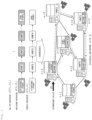
- Fig. 1 shows an example of embedding a service in a physical network.
- the example shown in Fig. 1 shows a case in which a first service g(V 1 , E 1 ) composed of start point ⁇ VNF2 ⁇ VNF3 ⁇ VNF4 ⁇ end point, a second service g(V 2 , E 2 ) composed of start point ⁇ VNF1 ⁇ VNF2 ⁇ VNF3 ⁇ end point, and the like are embedded in a physical network g(N,L).
- the first service g (V 1 , E 1 ) is embedded in physical node 3 ⁇ physical node 5 ⁇ physical node 6 ⁇ physical node 2 ⁇ physical node 4.
- the second service g(V 2 , E 2 ) is embedded in physical node 1 ⁇ physical node 3,physical node 4,physical node 2,physical node 6.
- ⁇ s is an amount of traffic generated by the sth service (hereinafter also referred to as a "service s").
- the amount of traffic ⁇ s includes, for example, the data transfer rate bps.
- the amount of traffic ⁇ s will be obtained as a prediction value using some kind of prediction method. That is to say, it is necessary to consider the embedding problem of the virtual network, based on the uncertainty of the prediction value of the amount of traffic ⁇ s .
- a method of building a time series model such as an autoregressive model which predicts a future amount of traffic from time series data of a past amount of traffic and obtaining a prediction value of a future amount of traffic from this time series model is exemplified.
- a method of using the average and variance of the amount of traffic for the past several days as prediction values can be considered.
- renewable energy and contracted power are assumed to be the power sources supplied to each physical node. Since the amount of power supplied by renewable energy is affected by the natural environment or the like, there is uncertainty in the prediction value. For this reason, there is also uncertainty in the maximum amount of power ⁇ n which is expected to be used by each physical node n (hereinafter referred to as a "maximum amount of power to be used"). That is to say, it is necessary to consider the problem of embedding a virtual network, taking into account the uncertainty of the maximum amount of power to be used ⁇ n . In the following, it is assumed that there is uncertainty in the maximum amount of power consumption of a physical node for which a command value for an amount of power consumption is not provided, that is, ⁇ n n ⁇ N r ⁇
- ⁇ ⁇ s ⁇ R + represents the nominal value of traffic generated using the service s
- ⁇ ⁇ n ⁇ R + represents the nominal value of the maximum amount of power to be used using the physical node n.
- the nominal value refers to a reference value, and for example, a statistical index such as an average value or a median value may be used.
- ⁇ s ⁇ R + is the deviation from the nominal value of the amout of traffic generated using the service s and ⁇ n ⁇ R + is the deviation from the nominal value of the maximum amount of power consumption of the physical node n which are parameters describing uncertainty.
- the parameter ⁇ ⁇ is a parameter which adjusts how much deviation exists from the nominal value.
- the parameter ⁇ ⁇ is a parameter that adjusts how much deviation from the nominal value exists.
- a virtual network embedding problem which minimizes the total cost of the entire virtual network with respect to the uncertainty of the amount of traffic and the uncertainty of the maximum amount of power to be used by physical nodes described by the above uncertainty sets (1) and (2) is formulated as the following 2-stage robust optimization problem.
- x n v,s is a binary variable, which takes 1 in a case in which VNF v ⁇ V s of service s is assigned to the physical node nGN and 0 in the other cases.
- assigning a VNF to a physical node may be expressed as "arranging a VNF on a physical node".
- y l e,s ⁇ R (l is a lowercase letter L) is a continuous variable which takes a value from 0 to 1 and represents the ratio of embedding the virtual link e ⁇ E s of the service s into the physical link lEL.
- f 1 (x n v,s ) and f 2 (y l e,s ) are functions defined below.
- f 1 (x n v,s ) represents the node power congestion rate and f 2 (y l e,s ) represents the link congestion rate.
- Equation (3b) represents the power consumption constraint at a physical node given a command value relating to an amount of power consumption and d n v,s is the power consumption coefficient when VNF v ⁇ V s in service s is assigned to physical node n.
- Expression (3b) is an equation and assumes that the amount of power consumption on the left side completely matches the command value p n , the present invention is not limited thereto.
- the inequality may be provided so that the power consumption on the left side falls within a certain range (that is, falls within certain upper and lower limit values).
- this embodiment can be similarly applied.
- Inequation (3c) represents a constraint on the maximum amount of power to be used in a physical node to which a command value relating to an amount of power consumption is not provided. Equation (3d) expresses that each VNF of each service can only be assigned to one physical node. On the other hand, Inequation (3e) means that a plurality of VNFs cannot be assigned to one physical node in one service. Note that, although the constraint conditions of (3e) are seemingly severe and seems to narrow the scope of practical application, it becomes possible to assign two or more VNFs to one physical node, for example, by treating a combination of two or more VNFs to be assigned to a certain physical node as one new VNF.
- Inequation (5b) is a capacity constraint for physical links and ⁇ l (l is lower case L) represents the maximum capacity of physical link lEL.
- Inequation (5c) is a constraint relating to the delay time required for processing each service s, in which q l e,s represents a delay time coefficient and T represents an upper limit value of delay time.
- VNF allocation x n v,s which minimizes the node power congestion rate f 1 (x n v,s ) is determined for a scenario of a case in which the amount of traffic ⁇ s is unknown and the maximum amount of power to be ⁇ n is the worst.
- the virtual link embedding ratio y l e,s (that is, path) which minimizes the link congestion rate f 2 (y l e,s ) is determined, in which the amount of traffic ⁇ s is known.
- a solution algorithm for the 2-stage robust optimization problem formulated in (3a) to (3f) and (5a) to (5d) is constructed, based on the column-and-constraint generation (C&CG) method.
- This C&CG method is an algorithm which obtains the solution of the original problem by decomposing the original problem into a master problem and a sub-problem and solving them alternately.
- (3a) to (3f) are hereinafter collectively described as (3).
- (5a) to (5d) are collectively described as (5). The same method needs to be used for other formula numbers when a plurality of expression numbers are described together.
- Step K The master problem in Step K is defined as follows. min x n v , s , r 1 > 0 r 1 6 a s . t . r 1 ⁇ 1 ⁇ ⁇ n ⁇ ⁇ n ⁇ s ⁇ S ⁇ v ⁇ V s d n v , s x n v , s + 1 ⁇ l ⁇ s ⁇ S ⁇ e ⁇ E s ⁇ s k y l e , s k , ⁇ n ⁇ N , ⁇ k ⁇ K 6 b ⁇ s ⁇ S ⁇ e ⁇ E s ⁇ s k y l e , s k ⁇ ⁇ l , ⁇ l ⁇ L , ⁇ k ⁇ K 6 c ⁇ l ⁇ L ⁇ e ⁇ E q e , s y l e , c
- ⁇ s (k) is the solution of the subproblem (which will be described later) obtained up to Step K-1.
- the optimal solution of the master problem is x n * v,s (K),r 1 *(K) and the lower bound for the optimal solution of original problems (3) and (5) is ⁇ LB (K).
- ⁇ LB K r 1 ⁇ K is established.
- x n * v,s (K) found in the master problem is used in the sub-problem in Step K.
- y l e,s (k) is also solved as a decision variable.
- Step K the sub-problem in Step K is defined as follows. [Math. 12] max ⁇ s ⁇ ⁇ s min y l e , s ⁇ Y ⁇ s , x n ⁇ v , s K f 2 y l e , s
- the sub-problem (7) above is a bilevel optimization problem and the objective function is not linear. Thus, it is difficult to solve it in of a current form thereof.
- f 2 (y l e,s ) which is the maximum value acquisition function into a linear constraint
- [Math. 13] max ⁇ s ⁇ ⁇ s min y l e , s ⁇ Y ⁇ s , x n ⁇ v , s K , r 2 > 0 r 2 s . t .
- ⁇ 1,l , ⁇ 2,l , ⁇ 3,l , ⁇ n e,s , and ⁇ l e,s represent the constraint conditions of (8), (5b), (5c), (5d), and dual variables for y l e,s ⁇ 1, respectively.
- the optimization problem (9) is a non-linear optimization problem because there is a product of ⁇ s and ⁇ 1,l and a product of ⁇ s and ⁇ 2,l .
- the maximization problem (9) is solved using the principal-dual interior point method.
- the optimal solution to the maximization problem (9) will be ⁇ s *(K) and the objective function value corresponding to this optimal solution will be Q(K).
- FIG. 2 is a diagram illustrating an example of the hardware configuration of the control apparatus 10 according to the present embodiment.
- the control apparatus 10 is realized by the hardware configuration of a general computer or a computer system and includes an input device 101, a display device 102, an external I/F 103, a communication I/F 104, a processor 105, and a memory device 106. Each of these pieces of hardware is communicatively connected using a bus 107.
- the input device 101 is, for example, a keyboard, a mouse, a touch panel, or the like.
- the display device 102 is, for example, a display or the like. Note that the control apparatus 10 may not include, for example, at least one of the input device 101 and the display device 102.
- the external I/F 103 is an interface with an external device such as a recording medium 103a.
- the control apparatus 10 can read and write data on the recording medium 103a via the external I/F 103.
- the recording medium 103a include a compact disc (CD), a digital versatile disk (DVD), a secure digital (SD) memory card), and a universal serial bus (USB) memory card.
- the communication I/F 104 is an interface through which the control apparatus 10 is connected to a communication network.
- the processor 105 include various arithmetic units such as a central processing unit (CPU) and a graphics processing unit (GPU).
- the memory device 106 includes various storage devices such as a hard disk drive (HDD), a solid state drive (SSD), a random access memory (RAM), a read only memory (ROM), and a flash memory.
- control apparatus 10 By providing the hardware configuration illustrated in Fig. 2 , the control apparatus 10 according to the embodiment can realize virtual network control processing which will be described later. Note that the hardware configuration illustrated in Fig. 2 is an example and the control apparatus 10 may have other hardware configurations. For example, the control apparatus 10 may have a plurality of processors 105, have a plurality of memory devices 106, and have various pieces of hardware (not shown).
- FIG. 3 is a diagram illustrating an example of the functional configuration of the control apparatus 10 according to the embodiment.
- the control apparatus 10 has a prediction value collection part 201, a physical network information collection part 202, a command value acquisition part 203, a control solution calculation part 204, and a control part 205.
- Each of these parts is implemented by processing in which one or more programs installed in the control apparatus 10 cause the processor 105 to execute.
- the prediction value collection part 201 collects a prediction value of an amount of traffic of each service and the prediction value of a maximum amount of power to be used in each physical node (here, a physical node to which a command value relating to the amount of power consumption is not provided). That is to say, the prediction value collection part 201 acquires a nominal value of the amount of traffic of each service and a deviation thereof and a nominal value of the maximum amount of power consumption and a deviation thereof in each physical node to which a command value relating to the amount of power consumption is not provided.
- the prediction value of the amount of traffic of each service and the prediction value of the maximum amount of power consumption in each physical node are obtained by a prediction algorithm or the like using a time-series model.
- the prediction value collection part 201 acquires the prediction value of the amount of traffic up to one day ahead and the prediction value of the maximum amount of power consumption using some kind of prediction algorithm.
- these prediction values correspond to an average value and a variance of a certain sampling interval.
- the average value may be set as the nominal value and the variance may be set as the deviation of the nominal value.
- the sampling interval is a time interval such as one minute or one hour which is preset in accordance with control specifications for VNF allocation and path determination.
- the physical network information collection part 202 collects information relating to the topology of the physical network and various parameters (for example, power consumption coefficient or the like).
- control solution calculation part 204 Note that the information and various parameters collected using the physical network information collection part 202 are passed to the control solution calculation part 204.
- the command value acquisition part 203 acquires a command value relating to an amount of power consumption. That is to say, the command value acquisition part 203 acquires information indicating a physical node to which a command value relating to an amount of power consumption is provided and the command value.
- command value acquired using the command value acquisition part 203 is passed to the control solution calculation part 204.
- the control solution calculation part 204 performs an algorithm to solve the 2-stage robust optimization problems (3) and (5) using the information collected using the prediction value collection part 201, the information collected using the physical network information collection part 202, and the command value acquired using the command value acquisition part 203. That is to say, the control solution calculation part 204 calculates the VNF allocation x n v,s by alternately and repeatedly solving the master problem (6) and the sub-problem (9) in the first step, and then calculates the path determination y l e,s by solving the sub-problem (7) in the second stage. Thus, the VNF allocation x n v,s and the path determination y l e,s representing the optimal control solution of the original problems (3) and (5) are obtained.
- the control solution calculation part 204 includes a first problem solving part 211 and a second problem solving part 212.
- the first problem solving part 211 calculates the solution to the master problem (6) and also calculates the lower bounds of the optimal solutions to the original problems (3) and (5).
- the second problem solving part 212 calculates the solutions of the sub-problem (9) and the sub-problem (7) and also calculates the upper bounds of the optimal solutions of the original problems (3) and (5). Note that, for example, when performing the above-mentioned scheduling, the control solution calculation part 204 can divide the 2-stage robust optimization problems (3) and (5) into each sampling time interval, and then perform the solution algorithm for each independently.
- the control part 205 controls the virtual network using the control solution calculated using the control solution calculation part 204.
- the VNF allocation and the path determination represented by the optimal control solution are embedded in the physical network (that is, changed to the optimal VNF allocation and the path determination).
- the VNF allocation and the path determination are scheduled for one day in the future has been described as an example, this is one example of application and is not limited thereto.
- it can be similarly applied when calculating optimal VNF allocation and paths in real time and dynamically controlling a virtual network.
- the control solution calculation part 204 may perform a solution-finding algorithm each time the command value is collected/obtained and the control part 205 may update the VNF allocation and path.
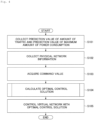
- the prediction value collection part 201 collects a prediction value of the amount of traffic for each service (nominal value and a deviation thereof) and a prediction value of maximum power consumption (nominal value and a deviation thereof) for each physical node (physical nodes for which a command value relating to an amount of power consumption is not provided) (Step S101)
- the physical network information collection part 202 collects information relating to the topology of the physical network and various parameters (for example, power consumption coefficient or the like) (Step S102).
- various parameters for example, power consumption coefficient or the like
- the command value acquisition part 203 acquires the command value for the physical node to which the command value relating to an amount of power consumption has been provided (Step S103).
- control solution calculation part 204 performs an algorithm for solving the 2-stage robust optimization problems (3) and (5) using the information collected or obtained in Steps S101 to S103 above and calculates the optimal control solution (Step S104). Note that details of this step will be described later.
- control part 205 controls the virtual network using the control solution calculated in Step S104 above (Step S105).
- Fig. 5 is a flowchart for describing an example of a flow of control solution calculation processing according to the embodiment.
- the initial value ⁇ s (0) may be set to any value belonging to ⁇ s .
- the parameter ⁇ >0 for determining the end condition of the first stage may be set to a finite value.
- control solution calculation part 204 solves the master problem (6) using the first problem solving part 211 and acquires the optimal solutions x n * v,s (K), r 1 *(K), and ⁇ LB (K) (Step S202).
- control solution calculation part 204 uses a preset parameter ⁇ (or the parameter ⁇ set in Step S201 above) to determine whether ⁇ UB (K)- ⁇ LB (K) ⁇ is satisfied (Step S204).
- Step S204 When it is not determined in Step S204 that ⁇ UB (K)- ⁇ LB (K) ⁇ is satisfied, the control solution calculation part 204 updates Step K by adding 1 to Step K (Step S205) and returns to Step S202. Thus, Steps S202 to S203 are repeatedly performed until ⁇ UB (K)- ⁇ LB (K) ⁇ is satisfied.
- Step S204 when it is determined in Step S204 above that ⁇ UB (K)- ⁇ LB (K) ⁇ is satisfied, the control solution calculation part 204 fixes ⁇ s *(K), and then uses the second problem solving part 212 to solve the sub-problem (7) to acquire the optimal solution y l * e,s (Step S206) .
- the control apparatus 10 can realize virtual network control (VNF allocation and path determination) which robustly satisfies command values against the uncertainties of the amount of traffic and the uncertainties of renewable energy.
- VNF allocation and path determination virtual network control
- VNFs are assigned and paths are determined by taking into account the fact that there are uncertainties in predictions relating to an amount of traffic and an amount of renewable energy power.
- predictions relating to an amount of traffic and an amount of renewable energy power.
- it is possible to robustly prevent deterioration of communication performance and congestion which may occur due to the influence of prediction errors, increased costs due to purchasing insufficient power, and increased environmental burden due to a decline in the utilization rate of renewable energy.
- the directive relating to an amount of power consumption it becomes possible, for example, to respond to demand response requests or to generate the amount of power sold necessary for conducting power market transactions.
- the virtual network control process (particularly the control solution calculation process) according to the embodiment is a solution algorithm based on the theory of mathematical optimization called 2-stage robust optimization.
- This theory performs two-step robust optimization based on a decision-making process and is known to yield solutions with lower conservatism than simple robust optimization. This means that, even if there are errors in predicting an amount of traffic and renewable energy, it is possible to perform low-maintenance VNF allocation and route determination while suppressing the deterioration of communication performance and the occurrence of congestion, as well as preventing the purchase costs of insufficient power and the decline in the utilization rate of renewable energy.
Landscapes
- Engineering & Computer Science (AREA)
- Computer Networks & Wireless Communication (AREA)
- Signal Processing (AREA)
- Data Exchanges In Wide-Area Networks (AREA)
Applications Claiming Priority (1)
| Application Number | Priority Date | Filing Date | Title |
|---|---|---|---|
| PCT/JP2022/006484 WO2023157197A1 (ja) | 2022-02-17 | 2022-02-17 | 制御装置、制御方法及びプログラム |
Publications (2)
| Publication Number | Publication Date |
|---|---|
| EP4482102A1 true EP4482102A1 (de) | 2024-12-25 |
| EP4482102A4 EP4482102A4 (de) | 2026-03-25 |
Family
ID=87577942
Family Applications (1)
| Application Number | Title | Priority Date | Filing Date |
|---|---|---|---|
| EP22927099.6A Pending EP4482102A4 (de) | 2022-02-17 | 2022-02-17 | Steuerungsvorrichtung, steuerungsverfahren und programm |
Country Status (4)
| Country | Link |
|---|---|
| US (1) | US12609872B2 (de) |
| EP (1) | EP4482102A4 (de) |
| JP (1) | JP7700948B2 (de) |
| WO (1) | WO2023157197A1 (de) |
Family Cites Families (3)
| Publication number | Priority date | Publication date | Assignee | Title |
|---|---|---|---|---|
| JP6721921B2 (ja) | 2017-05-30 | 2020-07-15 | 日本電信電話株式会社 | 設備設計装置、設備設計方法、及びプログラム |
| WO2021044596A1 (ja) | 2019-09-05 | 2021-03-11 | 日本電信電話株式会社 | ネットワーク設計装置、ネットワーク設計方法、及びプログラム |
| WO2022168140A1 (ja) * | 2021-02-02 | 2022-08-11 | 日本電信電話株式会社 | 制御装置、制御方法及びプログラム |
-
2022
- 2022-02-17 US US18/832,264 patent/US12609872B2/en active Active
- 2022-02-17 WO PCT/JP2022/006484 patent/WO2023157197A1/ja not_active Ceased
- 2022-02-17 EP EP22927099.6A patent/EP4482102A4/de active Pending
- 2022-02-17 JP JP2024500830A patent/JP7700948B2/ja active Active
Also Published As
| Publication number | Publication date |
|---|---|
| US20250106121A1 (en) | 2025-03-27 |
| JPWO2023157197A1 (de) | 2023-08-24 |
| US12609872B2 (en) | 2026-04-21 |
| JP7700948B2 (ja) | 2025-07-01 |
| WO2023157197A1 (ja) | 2023-08-24 |
| EP4482102A4 (de) | 2026-03-25 |
Similar Documents
| Publication | Publication Date | Title |
|---|---|---|
| US11527889B2 (en) | Congestion control in electric power system under load and uncertainty | |
| Radovanović et al. | Carbon-aware computing for datacenters | |
| EP3844618B1 (de) | Orchestrierung von containerisierten anwendungen | |
| US7552152B2 (en) | Risk-modulated proactive data migration for maximizing utility in storage systems | |
| US11847591B2 (en) | Short-term load forecasting | |
| CN109753356A (zh) | 一种容器资源调度方法、装置及计算机可读存储介质 | |
| Shayan et al. | An innovative two-stage machine learning-based adaptive robust unit commitment strategy for addressing uncertainty in renewable energy systems | |
| Catalão et al. | Mixed-integer nonlinear approach for the optimal scheduling of a head-dependent hydro chain | |
| US20240103959A1 (en) | Intelligent dynamic condition-based infrastructure maintenance scheduling | |
| JP2020092533A (ja) | 電力需給計画装置 | |
| JP7601859B2 (ja) | 電気エネルギー供給網の安定化のための方法 | |
| JP7521616B2 (ja) | 装置、方法、制御装置、制御方法及びプログラム | |
| US20180336579A1 (en) | Systems and methods for scheduling datacenter buildouts | |
| Guerrero‐Mestre et al. | Incorporating energy storage into probabilistic security‐constrained unit commitment | |
| Ujjwal et al. | An efficient framework for ensemble of natural disaster simulations as a service | |
| CN116783569A (zh) | 电力网资源分配 | |
| Xiao et al. | Operating reserve policies with high wind power penetration | |
| US12483478B2 (en) | Control apparatus, control method and program | |
| EP4482102A1 (de) | Steuerungsvorrichtung, steuerungsverfahren und programm | |
| Wang et al. | Statistical estimation of operating reserve requirements using rolling horizon stochastic optimization | |
| Naghdehforoushha et al. | A robust model for spot virtual machine bidding in the cloud market using information gap decision theory (IGDT) | |
| CN114169944B (zh) | 用户需求确定方法、装置、存储介质和电子设备 | |
| Zan et al. | Asymptotically optimal staffing of service systems with joint QoS constraints | |
| Teshome et al. | Stochastic Optimization for Network‐Constrained Power System Scheduling Problem | |
| Kalimulina | Math modeling of the reliability control and monitoring system of complex network platforms |
Legal Events
| Date | Code | Title | Description |
|---|---|---|---|
| STAA | Information on the status of an ep patent application or granted ep patent |
Free format text: STATUS: THE INTERNATIONAL PUBLICATION HAS BEEN MADE |
|
| PUAI | Public reference made under article 153(3) epc to a published international application that has entered the european phase |
Free format text: ORIGINAL CODE: 0009012 |
|
| STAA | Information on the status of an ep patent application or granted ep patent |
Free format text: STATUS: REQUEST FOR EXAMINATION WAS MADE |
|
| 17P | Request for examination filed |
Effective date: 20240802 |
|
| AK | Designated contracting states |
Kind code of ref document: A1 Designated state(s): AL AT BE BG CH CY CZ DE DK EE ES FI FR GB GR HR HU IE IS IT LI LT LU LV MC MK MT NL NO PL PT RO RS SE SI SK SM TR |
|
| DAV | Request for validation of the european patent (deleted) | ||
| DAX | Request for extension of the european patent (deleted) | ||
| RAP3 | Party data changed (applicant data changed or rights of an application transferred) |
Owner name: NTT, INC. |
|
| A4 | Supplementary search report drawn up and despatched |
Effective date: 20260224 |
|
| RIC1 | Information provided on ipc code assigned before grant |
Ipc: H04L 41/0895 20220101AFI20260218BHEP Ipc: H04L 41/0833 20220101ALI20260218BHEP Ipc: H04L 41/122 20220101ALI20260218BHEP Ipc: H04L 41/40 20220101ALI20260218BHEP Ipc: H04L 41/147 20220101ALI20260218BHEP |