EP4481920A1 - Batteriemodul mit verstärkter sicherheit - Google Patents
Batteriemodul mit verstärkter sicherheit Download PDFInfo
- Publication number
- EP4481920A1 EP4481920A1 EP23877673.6A EP23877673A EP4481920A1 EP 4481920 A1 EP4481920 A1 EP 4481920A1 EP 23877673 A EP23877673 A EP 23877673A EP 4481920 A1 EP4481920 A1 EP 4481920A1
- Authority
- EP
- European Patent Office
- Prior art keywords
- plate
- present disclosure
- battery module
- battery
- guiding plate
- Prior art date
- Legal status (The legal status is an assumption and is not a legal conclusion. Google has not performed a legal analysis and makes no representation as to the accuracy of the status listed.)
- Pending
Links
Images




Classifications
-
- H—ELECTRICITY
- H01—ELECTRIC ELEMENTS
- H01M—PROCESSES OR MEANS, e.g. BATTERIES, FOR THE DIRECT CONVERSION OF CHEMICAL ENERGY INTO ELECTRICAL ENERGY
- H01M50/00—Constructional details or processes of manufacture of the non-active parts of electrochemical cells other than fuel cells, e.g. hybrid cells
- H01M50/30—Arrangements for facilitating escape of gases
- H01M50/383—Flame arresting or ignition-preventing means
-
- H—ELECTRICITY
- H01—ELECTRIC ELEMENTS
- H01M—PROCESSES OR MEANS, e.g. BATTERIES, FOR THE DIRECT CONVERSION OF CHEMICAL ENERGY INTO ELECTRICAL ENERGY
- H01M50/00—Constructional details or processes of manufacture of the non-active parts of electrochemical cells other than fuel cells, e.g. hybrid cells
- H01M50/30—Arrangements for facilitating escape of gases
- H01M50/35—Gas exhaust passages comprising elongated, tortuous or labyrinth-shaped exhaust passages
- H01M50/367—Internal gas exhaust passages forming part of the battery cover or case; Double cover vent systems
-
- H—ELECTRICITY
- H01—ELECTRIC ELEMENTS
- H01M—PROCESSES OR MEANS, e.g. BATTERIES, FOR THE DIRECT CONVERSION OF CHEMICAL ENERGY INTO ELECTRICAL ENERGY
- H01M50/00—Constructional details or processes of manufacture of the non-active parts of electrochemical cells other than fuel cells, e.g. hybrid cells
- H01M50/20—Mountings; Secondary casings or frames; Racks, modules or packs; Suspension devices; Shock absorbers; Transport or carrying devices; Holders
- H01M50/204—Racks, modules or packs for multiple batteries or multiple cells
- H01M50/207—Racks, modules or packs for multiple batteries or multiple cells characterised by their shape
- H01M50/209—Racks, modules or packs for multiple batteries or multiple cells characterised by their shape adapted for prismatic or rectangular cells
-
- H—ELECTRICITY
- H01—ELECTRIC ELEMENTS
- H01M—PROCESSES OR MEANS, e.g. BATTERIES, FOR THE DIRECT CONVERSION OF CHEMICAL ENERGY INTO ELECTRICAL ENERGY
- H01M50/00—Constructional details or processes of manufacture of the non-active parts of electrochemical cells other than fuel cells, e.g. hybrid cells
- H01M50/20—Mountings; Secondary casings or frames; Racks, modules or packs; Suspension devices; Shock absorbers; Transport or carrying devices; Holders
- H01M50/204—Racks, modules or packs for multiple batteries or multiple cells
- H01M50/207—Racks, modules or packs for multiple batteries or multiple cells characterised by their shape
- H01M50/211—Racks, modules or packs for multiple batteries or multiple cells characterised by their shape adapted for pouch cells
-
- H—ELECTRICITY
- H01—ELECTRIC ELEMENTS
- H01M—PROCESSES OR MEANS, e.g. BATTERIES, FOR THE DIRECT CONVERSION OF CHEMICAL ENERGY INTO ELECTRICAL ENERGY
- H01M50/00—Constructional details or processes of manufacture of the non-active parts of electrochemical cells other than fuel cells, e.g. hybrid cells
- H01M50/20—Mountings; Secondary casings or frames; Racks, modules or packs; Suspension devices; Shock absorbers; Transport or carrying devices; Holders
- H01M50/233—Mountings; Secondary casings or frames; Racks, modules or packs; Suspension devices; Shock absorbers; Transport or carrying devices; Holders characterised by physical properties of casings or racks, e.g. dimensions
- H01M50/24—Mountings; Secondary casings or frames; Racks, modules or packs; Suspension devices; Shock absorbers; Transport or carrying devices; Holders characterised by physical properties of casings or racks, e.g. dimensions adapted for protecting batteries from their environment, e.g. from corrosion
-
- H—ELECTRICITY
- H01—ELECTRIC ELEMENTS
- H01M—PROCESSES OR MEANS, e.g. BATTERIES, FOR THE DIRECT CONVERSION OF CHEMICAL ENERGY INTO ELECTRICAL ENERGY
- H01M50/00—Constructional details or processes of manufacture of the non-active parts of electrochemical cells other than fuel cells, e.g. hybrid cells
- H01M50/20—Mountings; Secondary casings or frames; Racks, modules or packs; Suspension devices; Shock absorbers; Transport or carrying devices; Holders
- H01M50/249—Mountings; Secondary casings or frames; Racks, modules or packs; Suspension devices; Shock absorbers; Transport or carrying devices; Holders specially adapted for aircraft or vehicles, e.g. cars or trains
-
- H—ELECTRICITY
- H01—ELECTRIC ELEMENTS
- H01M—PROCESSES OR MEANS, e.g. BATTERIES, FOR THE DIRECT CONVERSION OF CHEMICAL ENERGY INTO ELECTRICAL ENERGY
- H01M50/00—Constructional details or processes of manufacture of the non-active parts of electrochemical cells other than fuel cells, e.g. hybrid cells
- H01M50/30—Arrangements for facilitating escape of gases
- H01M50/35—Gas exhaust passages comprising elongated, tortuous or labyrinth-shaped exhaust passages
- H01M50/358—External gas exhaust passages located on the battery cover or case
-
- H—ELECTRICITY
- H01—ELECTRIC ELEMENTS
- H01M—PROCESSES OR MEANS, e.g. BATTERIES, FOR THE DIRECT CONVERSION OF CHEMICAL ENERGY INTO ELECTRICAL ENERGY
- H01M50/00—Constructional details or processes of manufacture of the non-active parts of electrochemical cells other than fuel cells, e.g. hybrid cells
- H01M50/30—Arrangements for facilitating escape of gases
- H01M50/394—Gas-pervious parts or elements
-
- B—PERFORMING OPERATIONS; TRANSPORTING
- B60—VEHICLES IN GENERAL
- B60L—PROPULSION OF ELECTRICALLY-PROPELLED VEHICLES; SUPPLYING ELECTRIC POWER FOR AUXILIARY EQUIPMENT OF ELECTRICALLY-PROPELLED VEHICLES; ELECTRODYNAMIC BRAKE SYSTEMS FOR VEHICLES IN GENERAL; MAGNETIC SUSPENSION OR LEVITATION FOR VEHICLES; MONITORING OPERATING VARIABLES OF ELECTRICALLY-PROPELLED VEHICLES; ELECTRIC SAFETY DEVICES FOR ELECTRICALLY-PROPELLED VEHICLES
- B60L50/00—Electric propulsion with power supplied within the vehicle
- B60L50/50—Electric propulsion with power supplied within the vehicle using propulsion power supplied by batteries or fuel cells
- B60L50/60—Electric propulsion with power supplied within the vehicle using propulsion power supplied by batteries or fuel cells using power supplied by batteries
- B60L50/64—Constructional details of batteries specially adapted for electric vehicles
-
- H—ELECTRICITY
- H01—ELECTRIC ELEMENTS
- H01M—PROCESSES OR MEANS, e.g. BATTERIES, FOR THE DIRECT CONVERSION OF CHEMICAL ENERGY INTO ELECTRICAL ENERGY
- H01M2220/00—Batteries for particular applications
- H01M2220/20—Batteries in motive systems, e.g. vehicle, ship, plane
-
- Y—GENERAL TAGGING OF NEW TECHNOLOGICAL DEVELOPMENTS; GENERAL TAGGING OF CROSS-SECTIONAL TECHNOLOGIES SPANNING OVER SEVERAL SECTIONS OF THE IPC; TECHNICAL SUBJECTS COVERED BY FORMER USPC CROSS-REFERENCE ART COLLECTIONS [XRACs] AND DIGESTS
- Y02—TECHNOLOGIES OR APPLICATIONS FOR MITIGATION OR ADAPTATION AGAINST CLIMATE CHANGE
- Y02E—REDUCTION OF GREENHOUSE GAS [GHG] EMISSIONS, RELATED TO ENERGY GENERATION, TRANSMISSION OR DISTRIBUTION
- Y02E60/00—Enabling technologies; Technologies with a potential or indirect contribution to GHG emissions mitigation
- Y02E60/10—Energy storage using batteries
Definitions
- the present disclosure relates to a battery module and, more specifically, a battery module with enhanced safety using an improved structure for discharging venting gas or the like.
- a battery module in which multiple secondary batteries electrically connected to each other are stored inside a module case is generally applied thereto, and furthermore, a battery pack in which multiple battery modules are electrically connected to each other is also applied to the case where high power or large capacity is required.
- secondary batteries having the above-described advantages are increasingly used in various forms, the behavior of secondary batteries may cause swelling, application of rush current, overheating due to Joule heating, thermal runaway due to decomposition reaction of the electrolyte.
- Battery modules or battery packs may be more vulnerable to thermal events because they contain multiple secondary batteries (battery cells) or multiple cell assemblies that are space-intensively stored therein.
- battery cells secondary batteries
- thermal runaway occurs inside the battery module, high-temperature gas, flame, heat, etc. are generated, and if these fail to be quickly controlled, a chain fire or explosion due to thermal propagation may occur in adj acent battery modules, as well as in the relevant battery module.
- the present disclosure has been designed to solve the problems of the related art, and therefore the present disclosure is directed to providing a battery module with enhanced safety capable of adaptively dealing with a large amount of venting gas by employing an improved structure that effectively secures a sufficient discharge space or area.
- a battery module including: a module case configured to form an inner space; a plurality of battery cells accommodated in the inner space of the module case and arranged in at least one direction; and a guiding plate connected to at least one side surface of the module case and configured to extend in a diagonal direction.
- the module case may include side plates configured to cover both sides of the plurality of battery cells, and the guiding plate may be connected to the side plate and extends in the diagonal direction.
- the guiding plate of the present disclosure may include one or more through-holes through which venting gas is discharged, and in this case, the through-holes of the present disclosure may be preferably formed at an upper end of the guiding plate.
- the guiding plate may include: a first plate extending in a diagonal direction; and a second plate disposed in the horizontal direction so as to be connected to the top of the first plate and configured to face and contact with an upper frame of a pack housing.
- the second plate of the present disclosure may include one or more through-holes formed inward from the first plate.
- the through-hole of the present disclosure is preferably formed to communicate with a venting channel formed inside the upper frame and to correspond to an inlet formed on the lower surface of the upper frame.
- the guiding plate of the present disclosure may have one or more groove lines formed on the inner surface thereof to extend in a horizontal direction, or one or more protrusions protruding outwards from the inner surface.
- a battery pack including the battery module according to the present disclosure.
- a vehicle including the battery module according to the present disclosure.
- a battery module with enhanced safety which has a sufficient space secured for venting gas and flame generated from the battery cell or cell assembly to be discharged, thereby adaptively dealing with a significant thermal event occurring in a short period of time and preventing structural collapse or disintegration of the battery module itself.
- the temperature of venting gas can be naturally lowered and its physical force can weaken in the process in which the venting gas is discharged along the guiding plate by employing a mechanical structure that generates reverse flow and expands the contact area, thereby further increasing the safety of the battery module.
- a structure that is organically combined with the upper frame of the pack housing may be applied to the battery module, thereby increasing the efficiency of a process of packaging the battery module into the pack housing and improving the physical rigidity of the battery pack itself, as well as the structural engineering rigidity of the battery module itself.
- the guiding plate is configured to be organically connected to the venting channel of the pack housing, it is possible to more simply integrate the passages of the battery pack through which venting gas or the like is discharged without adding other structures.
- axis shown in the drawing, terms referring to the axis, and terms referring to directions such as up, down, front, back, vertical, and the like described with respect to the axis are intended to provide relative criteria to describe embodiments of the present disclosure, instead of specifying any direction or location on an absolute basis, so they may also vary relatively depending on the location of a target object, the location of the an observer, viewing directions, or the like.
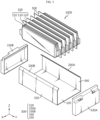
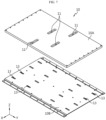
- FIG. 1 is a perspective view illustrating the overall appearance of a battery module 1000 according to an embodiment of the present disclosure
- FIG. 2 is an exploded perspective view illustrating the internal structure of the battery module 1000 shown in FIG. 1
- FIG. 3 is a diagram schematically illustrating the state in which venting gas or the like is discharged from a battery module 1000 according to an embodiment of the present disclosure.
- the battery module 1000 includes a module case 300 that functions as a case, a cell assembly 100 that is stored in an inner space provided by the module case 300 and includes one or more battery cells 110, and a guiding plate 200 (200A or 200B).
- the battery cell 110 indicates a secondary battery including an electrode assembly, an electrolyte, and a battery case, and although a pouch-type secondary battery with high energy density and capable of being easily stacked is shown by way of example in the drawing, a cylindrical or prismatic secondary battery may also be applied to the battery cell 110.
- the cell assembly 100 may be configured such that battery cells 110 having minor axes erected in the vertical direction (the Z-axis in the drawing) are arranged (stacked) side by side in the left and right directions (the X-axis in the drawing).
- the drawing shows an example in which the cell assembly 100 configured in a 1x1 matrix is accommodated in the module case 300, based on the longitudinal (X-axis) and traverse (Y-axis) directions, a cell assembly 100 having various combinations of arrangement such as a 1x2 or 2x3 matrix may be provided in the module case 300 depending on the spatial characteristics, electrical capacity, and power of the applied device.
- leads corresponding to the same polarity of the respective battery cells 110 may be interconnected by well-known methods and means to form a common electrode of the cell assembly 100.
- a heat shield plate 500 in an upright state along the vertical direction may be interposed between the battery cells 110 or the cell assemblies 100.
- This heat shield plate 500 serves to block or reduce the propagation of heat, gas, flame, or the like that may occur between the battery cells 110 or the cell assemblies 100 or to delay the propagation time thereof.
- the heat shield plate 500 may be made of a ceramic material such as mica or a material such as silicon, and may include a core plate made of a metal material to increase rigidity and durability, and a flame-retardant portion provided on the outer sides of the core plate.
- the height (Z-axis direction) of the heat shield plate 500 is configured to be greater than the heights of the respective battery cells 110 in order to effectively suppress thermal events transferring to adjacent battery cells 110.
- the heat shield plate 500 is preferably configured to be longer than the major-axial length (Y-axis direction) of the battery cell 110 or cell assembly 100 in order to suppress the propagation of venting gas or the like generated from the battery cell 110 or cell assembly 100 to the adjacent battery cells 110 or cell assemblies 100 and induce the generated venting gas to move upwards.
- the module case 300 is a configuration for accommodating one or more cell assemblies 100 and, as shown in the drawing, may be configured to include a lower plate 320, an end plate 330, and side plates 340 and 350.
- the end plate 330 and the side plates 340 and 350 may constitute the side surfaces of the module case 300
- the lower plate 320 may be configured to constitute the lower surface of the module case 300.
- the module case 300 of the present disclosure may have a structure in which an upper plate is excluded in order to secure sufficient space for discharge of venting gas or the like and to induce the venting gas or the like to be discharged upwards.
- One or more of the end plate 330, the lower plate 320, and the side plates 340 and 350 may be configured in a plate shape or in the form of a polyhedron (for example, a rectangular parallelepiped) having a predetermined thickness or more, and the side plates 340 and 350 may be disposed such that the respective lower ends thereof are connected to the lower plate 320.
- a polyhedron for example, a rectangular parallelepiped
- At least some of the lower plate 320 and the side plates 340 and 350 may be configured to be integral with each other.
- one or more of the left plate 340 and the right plate 350 may be configured to be integral with the lower plate 320.
- the left plate 340, the right plate 350, and the lower plate 320, which are integrated with each other may be referred to as a U-plate (frame) or the like depending on their shape characteristics.
- the front plate 330A and the rear plate 330B, as the end plates 330, may be connected to the openings of the front and rear ends of the U-plate, respectively.
- the adjacent plates may be coupled by laser welding or ultrasonic welding as well as bolting using flanges.
- One or more of the lower plate 320 and the side plates 340 and 350 may have an inner surface that is made of clad metal or has a flame-retardant material, such as GFRP or the like, attached thereto.
- One or more of the plates 320 to 350 constituting the module case 300 may be made of a metal material such as high-strength SUS (stainless steel), a plastic material such as ABS (acrylonitrile-butadiene-styrene copolymer) resin having high heat resistance, high temperature resistance, and high impact resistance, or another type of plastic material in order to effectively protect the internal components thereof, and may also be made of different materials between parts thereof depending on the embodiment.
- a metal material such as high-strength SUS (stainless steel)
- a plastic material such as ABS (acrylonitrile-butadiene-styrene copolymer) resin having high heat resistance, high temperature resistance, and high impact resistance
- ABS acrylonitrile-butadiene-styrene copolymer
- the module case 300 of the present disclosure may also be implemented in various structures and forms, including the embodiments illustrated in the drawings, depending on the shape, structure, size, number of members to be combined, and the like.
- a guiding plate 200 is provided on at least one side surface of the module case 300.
- the guiding plate 200 may be provided on one or more of the side plates 340 and 350 so as to extend in a diagonal direction while blocking a portion of the left or right side of the module case 300.
- the guiding plate 200 of the present disclosure induces venting gas generated from the battery cell 110 or the cell assembly 100 to be quickly discharged upwards, thereby suppressing spread of the generated venting gas to adjacent battery cells 110 or cell assemblies 100.
- the battery modules 1000 may be disposed along the left and right directions in which the side plates 340 and 350 are provided rather than the front and back directions in which the end plates 330 are provided. Therefore, according to the above implemented configuration of the present disclosure, since the guiding plate 200 is provided on the side plates 340 and 350 so as to extend therefrom, it is possible to suppress the spread of venting gas or the like to adjacent battery modules 1000.
- the guiding plate 200 may be provided by bending the side plates 340 and 350. In this case, the guiding plate 200 may be easily provided by processing the module case 300.
- the guiding plate 200 of the present disclosure is configured to be connected to the left plate 340 or the right plate 350 and extend in a diagonal direction therefrom, sufficient space may be formed in the left or right upper direction as shown in FIG. 3 .
- the guiding plate 200 of the present disclosure is configured in the shape of a plate, the space provided by the guiding plate 200, based on the cell assembly 100, may expand in the longitudinal direction (Y-axis direction), so even if a large amount of venting gas or the like is generated in a short period of time, the venting gas or the like may be effectively discharged to the outside through the sufficiently secured space.
- a plurality of guiding plates 200 may be provided.
- a plurality of guiding plates 200 may be provided to extend from the left plate 340 and the right plate 350, respectively.
- the guiding plates 200 are denoted by reference numerals 200A and 200B, respectively, depending on the positions thereof (left and right sides) (based on the X-axis). Details of the guiding plate 200 of the present disclosure and the configuration of the present disclosure related thereto will be described later.
- the guiding plates 200A and 200B of the present disclosure have inclined surfaces extending inward, thereby producing a narrower separation gap than the internal width (X-axis direction) of the module case 300. Therefore, when mounting the battery cell 110 or cell assembly 100 into the module case 300, it is better to widen the space between them using a jig device or the like and then mount the battery cell 110 or the like into the module case 300 therethrough.
- the guiding plate 200 may be restored to the shape or posture shown in the drawing by the elastic force of the guiding plate 200 made of metal or the like.
- the left guiding plate 200A and the right guiding plate 200B may be configured to be connected to each other by one or more wires (not shown) extending in the longitudinal direction (X-axis direction).
- the wire is preferably configured to be detachably connected to at least one of the left guiding plate 200A or the right guiding plate 200B.
- the wire is preferably implemented using a shape memory alloy (SMA) that deforms in a shrinking direction when the surrounding temperature increases.
- SMA shape memory alloy
- the module case 100 may be physically supported more firmly, thereby suppressing or delaying damage to the module case 100 or collapse thereof.
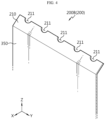
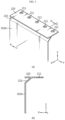
- FIGS. 4 and 5 are diagrams illustrating the overall structure of the guiding plate 200 according to embodiments of the present disclosure
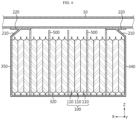
- FIG. 6 is a diagram illustrating the guiding plate 200 of the present disclosure coupled to an upper frame 10 of a pack housing (not shown).
- the detailed structure and operation of the guiding plate 200 of the present disclosure will be described based on the right guiding plate 200B. Since the left guiding plate 200A has a structure corresponding to the right guiding plate 200B, the following description of the right guiding plate 200B may also be applied to the left guiding plate 200A.
- the guiding plate 200 of the present disclosure has one or more through-holes 211 formed thereon to allow venting gas or the like to be discharged therethrough, and the through-holes 211 are preferable formed at the upper end of the guiding plate 200.
- venting gas or the like generated from the battery module 1000 may flow through the through-holes 211, thereby guiding the movement of the venting gas or the like in a specific direction.
- the through-holes 211 are formed at the upper end of the guiding plate 200, it is possible to more effectively implement organic linkage with a venting channel VC provide in an upper frame 10 of a pack housing (not shown) without addition of other complicated configurations or structures. This will be explained later.
- the guiding plate 200 of the present disclosure may include a first plate 210 extending in a diagonal direction and a second plate 220 that is disposed in the horizontal direction so as to be connected to the top of the first plate 210 and faces and contacts with the upper frame 10 of the pack housing (not shown).
- “face and contact with the upper frame” may indicate to come into contact with the upper frame while facing the same, to come into contact with the upper frame while corresponding thereto, to face and come into contact with the upper frame, or the like.
- the contact area with the upper frame 10 of the pack housing may be expanded, so it is possible to improve physical support force of the battery module 1000 and positional fixing force when packaged as a battery pack.
- the guiding plate 200 which is overall structured in a complex manner in the horizontal direction and an oblique vertical direction, physically faces and contacts with or is coupled to the upper frame 10 of the pack housing, it is possible to effectively increase the structural engineering rigidity of the battery pack.
- the second plate 220 may be connected to the first plate 210 so as to extend in both the front direction and the back direction (based on the Y-axis), or may extend in one of the front direction and the back direction depending on the embodiment.
- the second plate 220 is preferably configured to extend or bend in a direction opposite the diagonal direction of the first plate 210, that is, such that the first plate 210 and the second plate 220 form an acute angle therebetween.
- the through-hole 211 which functions as an outlet through which venting gas or the like is discharged, may be formed on the second plate 220 as shown in FIG. 5 .
- the through-hole 211 is preferably formed on the surface of the second plate 220 inward from the first plate 210. If the through-hole 211 is provided inward from the first plate 210 as described above, it is possible to more organically implement the structural connection relationship with the upper frame 10 of the pack housing, as will be described later, and to more effectively guide venting gas or the like to the venting channel VC through the same.
- FIGS. 7 and 8 are diagrams illustrating the structure of an upper frame 10 of a pack housing physically coupled to a guiding plate 200 of the present disclosure
- FIG. 9 is a diagram illustrating a guiding plate coupled to an upper frame 10 of a pack housing according to an embodiment of the present.
- the upper frame 10 of the pack housing (not shown) includes an outlet 11 through which venting gas is discharged and an inlet 13 through which venting gas flows in, and has a venting channel VC, including at least one rib 12 that is a structure installed in a perpendicular direction or the like, formed therein.
- the pack housing indicates a case or housing of a battery pack in which one or more battery modules 1000 are accommodated.
- the upper frame 10 of the pack housing may include a first frame 10A provided in the upper portion and a second frame 10B coupled to the bottom of the first frame 10A in the lower portion.
- the outlet 11 may be formed in the first frame 10A
- the inlet 13 may be formed in the second frame 10B
- the structure forming venting paths including the ribs 12 may be formed below the first frame 10A.
- venting channel VC is formed in the upper frame 10 as described above, the movement path of venting gas expands or extends, so the physical features such as temperature or pressure of venting gas may be lowered during the process of discharging the venting gas, and if flame is emitted along with the venting gas, the flame itself may be weakened by breaking down the flame's behavior, i.e., the strong feature of straight.
- flame factors sparks, particles, or the like
- their movement may be inhibited by the physical structure forming the venting channel VC so that the flame factors may adhere or may be captured, thereby effectively suppressing diffusion of the factors or elements, which may function as ignition sources, according to flying and scattering thereof and more effectively preventing a chain reaction of thermal events.
- the top opening of the battery module 1000 may be covered by the upper frame 10 of the pack housing.
- one or more through-holes 211 formed on the guiding plate 200, specifically, on the second plate 220, are configured to face and contact with the upper frame 10 so as to physically communicate with the inlet 13 formed on the lower surface or the like of the upper frame 10.
- the discharge structure of the respective battery modules 1000 at the sub-level may be integrated into the overall discharge structure of the battery pack only by a simple process of causing the upper frame 10 of the pack housing to face and contact with the guiding plate 200 of the present disclosure.
- FIGS. 10 and 11 are diagrams illustrating the structures of guiding plates 200 according to other embodiments of the present disclosure.
- the guiding plate 200 of the present disclosure may have one or more groove lines 213 formed on the inner surface of the first plate 210 so as to extend in the horizontal and longitudinal direction (Y-axis direction) of the inner surface.
- This groove line 213 may have a shape in which a groove, concavely formed inward from the outer surface, extends in the longitudinal direction, and as shown in the drawing, a plurality of groove lines 213 may be provided at appropriate intervals in the vertical direction (Z-axis direction).
- the groove line 213 may be configured as a single unit continuously extending in the horizontal and longitudinal direction or may be configured as two or more part units.
- the groove lines 213 having a constant arrangement interval and a line (lane) width are shown in the drawing, they may be configured in various other forms as long as eddy and vortex phenomena are induced, as will be described later.
- venting gas or the like has a behavior feature of moving upwards due to its high temperature, and since the guiding plate 200 of the present disclosure is inclined in the diagonal direction, the venting gas or the like generated from the battery cell 110 may more effectively move upwards through the guiding plate 200 of the present disclosure.
- venting gas or the like moves upwards along the surface of the guiding plate 200 of the present disclosure and comes into hydrodynamical contact with the groove of the groove line 213 during the upward movement.
- the venting gas or the like is weakened to a large extent by the eddy or the like formed by the groove line 213, and furthermore, the movement path is expanded by the groove line 213, thereby lowering the temperature due to heat loss according to an increase in the contact area.
- the number, shapes, depths, widths, lengths, and the like of the groove lines 213 are variably designed depending on the specifications of the battery cell 110 or the like, the characteristics of heat to be generated, and attribute information of the guiding plate 200 such as size, material, and thickness thereof.
- the guiding plate 200 of the present disclosure may have one or more protrusions 215 formed to protrude outwards from the inner surface thereof.
- the protrusion 215 is formed on the guiding plate 200, specifically, on the first plate 210 as described above, physical obstruction or blocking of thermal flow may occur complexly, thereby obtaining an effect corresponding to the effect of the above-described groove line 213 of the present disclosure.
- a battery pack according to the present disclosure may include one or more battery modules according to the present disclosure described above.
- the battery pack according to the present disclosure may further include, in addition to the battery module, various other elements such as a BMS, a busbar, a pack case, a relay, a current sensor, or the like, which are known at the time of filing the present disclosure.
- a battery module according to the present disclosure may be applied to vehicles such as electric vehicles or hybrid vehicles. That is, a vehicle according to the present disclosure may include the battery module according to the present disclosure or the battery pack according to the present disclosure. In addition, the vehicle according to the present disclosure may further include various other elements included in the vehicle in addition to the battery module or battery pack. For example, the vehicle according to the present disclosure may further include a vehicle body, a motor, or a control device such as an ECU (electronic control unit), as well as the battery module according to the present disclosure.
- ECU electronic control unit
Landscapes
- Chemical & Material Sciences (AREA)
- Chemical Kinetics & Catalysis (AREA)
- Electrochemistry (AREA)
- General Chemical & Material Sciences (AREA)
- Engineering & Computer Science (AREA)
- Aviation & Aerospace Engineering (AREA)
- Battery Mounting, Suspending (AREA)
- Gas Exhaust Devices For Batteries (AREA)
Applications Claiming Priority (2)
| Application Number | Priority Date | Filing Date | Title |
|---|---|---|---|
| KR1020220130264A KR20240050642A (ko) | 2022-10-12 | 2022-10-12 | 안전성이 강화된 배터리 모듈 |
| PCT/KR2023/015640 WO2024080749A1 (ko) | 2022-10-12 | 2023-10-11 | 안전성이 강화된 배터리 모듈 |
Publications (2)
| Publication Number | Publication Date |
|---|---|
| EP4481920A1 true EP4481920A1 (de) | 2024-12-25 |
| EP4481920A4 EP4481920A4 (de) | 2025-04-16 |
Family
ID=90669934
Family Applications (1)
| Application Number | Title | Priority Date | Filing Date |
|---|---|---|---|
| EP23877673.6A Pending EP4481920A4 (de) | 2022-10-12 | 2023-10-11 | Batteriemodul mit verstärkter sicherheit |
Country Status (5)
| Country | Link |
|---|---|
| US (1) | US20260045634A1 (de) |
| EP (1) | EP4481920A4 (de) |
| KR (1) | KR20240050642A (de) |
| CN (1) | CN118369812A (de) |
| WO (1) | WO2024080749A1 (de) |
Families Citing this family (1)
| Publication number | Priority date | Publication date | Assignee | Title |
|---|---|---|---|---|
| KR20260012521A (ko) * | 2024-07-18 | 2026-01-27 | 주식회사 엘지에너지솔루션 | 배터리용 벤팅 장치 및 이를 포함하는 배터리 팩 |
Family Cites Families (7)
| Publication number | Priority date | Publication date | Assignee | Title |
|---|---|---|---|---|
| JP3059835B2 (ja) * | 1992-08-31 | 2000-07-04 | 三洋電機株式会社 | ポータブル電源 |
| JP2004158393A (ja) * | 2002-11-08 | 2004-06-03 | Nissan Motor Co Ltd | 自動車用電池冷却装置 |
| US9627663B2 (en) * | 2013-04-25 | 2017-04-18 | Samsung Sdi Co., Ltd. | Rechargeable battery pack including pack cover |
| JP6606907B2 (ja) * | 2015-07-30 | 2019-11-20 | 株式会社Gsユアサ | 蓄電装置 |
| EP4234053B1 (de) | 2015-08-03 | 2025-05-21 | Angel Playing Cards Co., Ltd. | Verwaltungssystem für ersatzwährung für spiele |
| KR102755445B1 (ko) * | 2021-01-27 | 2025-01-21 | 코오롱인더스트리 주식회사 | 연료전지 막가습기 및 이를 포함하는 연료전지 시스템 |
| CN114221086A (zh) * | 2021-12-14 | 2022-03-22 | 苏州睿锂物联科技有限公司 | 一种颗粒物分离装置及电池箱 |
-
2022
- 2022-10-12 KR KR1020220130264A patent/KR20240050642A/ko active Pending
-
2023
- 2023-10-11 EP EP23877673.6A patent/EP4481920A4/de active Pending
- 2023-10-11 US US18/848,018 patent/US20260045634A1/en active Pending
- 2023-10-11 WO PCT/KR2023/015640 patent/WO2024080749A1/ko not_active Ceased
- 2023-10-11 CN CN202380014977.6A patent/CN118369812A/zh active Pending
Also Published As
| Publication number | Publication date |
|---|---|
| KR20240050642A (ko) | 2024-04-19 |
| US20260045634A1 (en) | 2026-02-12 |
| WO2024080749A1 (ko) | 2024-04-18 |
| JP2025508417A (ja) | 2025-03-26 |
| CN118369812A (zh) | 2024-07-19 |
| EP4481920A4 (de) | 2025-04-16 |
Similar Documents
| Publication | Publication Date | Title |
|---|---|---|
| CN116491021A (zh) | 具有提高的安全性的电池组 | |
| KR20240008676A (ko) | 안전성이 강화된 배터리 모듈 | |
| EP4481920A1 (de) | Batteriemodul mit verstärkter sicherheit | |
| EP4475311A1 (de) | Batteriepack mit verstärkter sicherheit | |
| US20250329869A1 (en) | Battery pack with enhanced safety | |
| KR102945262B1 (ko) | 안전성이 강화된 배터리 모듈 | |
| JP7806296B2 (ja) | バッテリーパック | |
| JP7793775B2 (ja) | バッテリーパック及びこれを含む自動車 | |
| EP4726894A1 (de) | Batteriepack und fahrzeug damit | |
| KR20240050641A (ko) | 안전성이 강화된 배터리 모듈 | |
| JP7813419B2 (ja) | バッテリーモジュール、それを含むバッテリーパック及び自動車 | |
| JP7841191B2 (ja) | バッテリーパック及び該バッテリーパックを含む自動車 | |
| EP4478509A1 (de) | Batteriepack und vorrichtung damit | |
| EP4730529A1 (de) | Batteriemodul und batteriepack sowie fahrzeug damit | |
| EP4730536A1 (de) | Batteriepack und fahrzeug damit | |
| EP4651286A1 (de) | Batteriemodul und batteriepack sowie fahrzeug damit | |
| KR20240010811A (ko) | 안전성이 강화된 배터리 모듈 | |
| CN121153158A (zh) | 电池模块 | |
| KR20260022809A (ko) | 배터리 팩, 및 이를 포함하는 자동차 | |
| KR20260031307A (ko) | 배터리 모듈, 이를 포함하는 배터리 팩 및 자동차 | |
| CN122003765A (zh) | 电池模块及包括该电池模块的电池组和车辆 |
Legal Events
| Date | Code | Title | Description |
|---|---|---|---|
| STAA | Information on the status of an ep patent application or granted ep patent |
Free format text: STATUS: THE INTERNATIONAL PUBLICATION HAS BEEN MADE |
|
| PUAI | Public reference made under article 153(3) epc to a published international application that has entered the european phase |
Free format text: ORIGINAL CODE: 0009012 |
|
| STAA | Information on the status of an ep patent application or granted ep patent |
Free format text: STATUS: REQUEST FOR EXAMINATION WAS MADE |
|
| 17P | Request for examination filed |
Effective date: 20240919 |
|
| AK | Designated contracting states |
Kind code of ref document: A1 Designated state(s): AL AT BE BG CH CY CZ DE DK EE ES FI FR GB GR HR HU IE IS IT LI LT LU LV MC ME MK MT NL NO PL PT RO RS SE SI SK SM TR |
|
| A4 | Supplementary search report drawn up and despatched |
Effective date: 20250317 |
|
| RIC1 | Information provided on ipc code assigned before grant |
Ipc: H01M 50/209 20210101ALI20250311BHEP Ipc: H01M 50/211 20210101ALI20250311BHEP Ipc: H01M 50/249 20210101ALI20250311BHEP Ipc: H01M 50/367 20210101ALI20250311BHEP Ipc: H01M 50/24 20210101AFI20250311BHEP |
|
| STAA | Information on the status of an ep patent application or granted ep patent |
Free format text: STATUS: EXAMINATION IS IN PROGRESS |
|
| 17Q | First examination report despatched |
Effective date: 20250806 |
|
| DAV | Request for validation of the european patent (deleted) | ||
| DAX | Request for extension of the european patent (deleted) |