EP4481908A1 - Cylindrical secondary battery - Google Patents
Cylindrical secondary battery Download PDFInfo
- Publication number
- EP4481908A1 EP4481908A1 EP24175215.3A EP24175215A EP4481908A1 EP 4481908 A1 EP4481908 A1 EP 4481908A1 EP 24175215 A EP24175215 A EP 24175215A EP 4481908 A1 EP4481908 A1 EP 4481908A1
- Authority
- EP
- European Patent Office
- Prior art keywords
- terminal
- secondary battery
- rotation preventing
- rivet
- electrode
- Prior art date
- Legal status (The legal status is an assumption and is not a legal conclusion. Google has not performed a legal analysis and makes no representation as to the accuracy of the status listed.)
- Pending
Links
Images





Classifications
-
- H—ELECTRICITY
- H01—ELECTRIC ELEMENTS
- H01M—PROCESSES OR MEANS, e.g. BATTERIES, FOR THE DIRECT CONVERSION OF CHEMICAL ENERGY INTO ELECTRICAL ENERGY
- H01M50/00—Constructional details or processes of manufacture of the non-active parts of electrochemical cells other than fuel cells, e.g. hybrid cells
- H01M50/50—Current conducting connections for cells or batteries
- H01M50/543—Terminals
- H01M50/564—Terminals characterised by their manufacturing process
- H01M50/567—Terminals characterised by their manufacturing process by fixing means, e.g. screws, rivets or bolts
-
- H—ELECTRICITY
- H01—ELECTRIC ELEMENTS
- H01M—PROCESSES OR MEANS, e.g. BATTERIES, FOR THE DIRECT CONVERSION OF CHEMICAL ENERGY INTO ELECTRICAL ENERGY
- H01M50/00—Constructional details or processes of manufacture of the non-active parts of electrochemical cells other than fuel cells, e.g. hybrid cells
- H01M50/50—Current conducting connections for cells or batteries
- H01M50/543—Terminals
- H01M50/552—Terminals characterised by their shape
- H01M50/553—Terminals adapted for prismatic, pouch or rectangular cells
-
- H—ELECTRICITY
- H01—ELECTRIC ELEMENTS
- H01M—PROCESSES OR MEANS, e.g. BATTERIES, FOR THE DIRECT CONVERSION OF CHEMICAL ENERGY INTO ELECTRICAL ENERGY
- H01M50/00—Constructional details or processes of manufacture of the non-active parts of electrochemical cells other than fuel cells, e.g. hybrid cells
- H01M50/10—Primary casings; Jackets or wrappings
- H01M50/172—Arrangements of electric connectors penetrating the casing
- H01M50/174—Arrangements of electric connectors penetrating the casing adapted for the shape of the cells
- H01M50/179—Arrangements of electric connectors penetrating the casing adapted for the shape of the cells for cells having curved cross-section, e.g. round or elliptic
-
- H—ELECTRICITY
- H01—ELECTRIC ELEMENTS
- H01M—PROCESSES OR MEANS, e.g. BATTERIES, FOR THE DIRECT CONVERSION OF CHEMICAL ENERGY INTO ELECTRICAL ENERGY
- H01M50/00—Constructional details or processes of manufacture of the non-active parts of electrochemical cells other than fuel cells, e.g. hybrid cells
- H01M50/10—Primary casings; Jackets or wrappings
- H01M50/102—Primary casings; Jackets or wrappings characterised by their shape or physical structure
- H01M50/107—Primary casings; Jackets or wrappings characterised by their shape or physical structure having curved cross-section, e.g. round or elliptic
-
- H—ELECTRICITY
- H01—ELECTRIC ELEMENTS
- H01M—PROCESSES OR MEANS, e.g. BATTERIES, FOR THE DIRECT CONVERSION OF CHEMICAL ENERGY INTO ELECTRICAL ENERGY
- H01M50/00—Constructional details or processes of manufacture of the non-active parts of electrochemical cells other than fuel cells, e.g. hybrid cells
- H01M50/10—Primary casings; Jackets or wrappings
- H01M50/14—Primary casings; Jackets or wrappings for protecting against damage caused by external factors
-
- H—ELECTRICITY
- H01—ELECTRIC ELEMENTS
- H01M—PROCESSES OR MEANS, e.g. BATTERIES, FOR THE DIRECT CONVERSION OF CHEMICAL ENERGY INTO ELECTRICAL ENERGY
- H01M50/00—Constructional details or processes of manufacture of the non-active parts of electrochemical cells other than fuel cells, e.g. hybrid cells
- H01M50/10—Primary casings; Jackets or wrappings
- H01M50/147—Lids or covers
-
- H—ELECTRICITY
- H01—ELECTRIC ELEMENTS
- H01M—PROCESSES OR MEANS, e.g. BATTERIES, FOR THE DIRECT CONVERSION OF CHEMICAL ENERGY INTO ELECTRICAL ENERGY
- H01M50/00—Constructional details or processes of manufacture of the non-active parts of electrochemical cells other than fuel cells, e.g. hybrid cells
- H01M50/10—Primary casings; Jackets or wrappings
- H01M50/147—Lids or covers
- H01M50/166—Lids or covers characterised by the methods of assembling casings with lids
- H01M50/167—Lids or covers characterised by the methods of assembling casings with lids by crimping
-
- H—ELECTRICITY
- H01—ELECTRIC ELEMENTS
- H01M—PROCESSES OR MEANS, e.g. BATTERIES, FOR THE DIRECT CONVERSION OF CHEMICAL ENERGY INTO ELECTRICAL ENERGY
- H01M50/00—Constructional details or processes of manufacture of the non-active parts of electrochemical cells other than fuel cells, e.g. hybrid cells
- H01M50/10—Primary casings; Jackets or wrappings
- H01M50/172—Arrangements of electric connectors penetrating the casing
- H01M50/174—Arrangements of electric connectors penetrating the casing adapted for the shape of the cells
- H01M50/176—Arrangements of electric connectors penetrating the casing adapted for the shape of the cells for prismatic or rectangular cells
-
- H—ELECTRICITY
- H01—ELECTRIC ELEMENTS
- H01M—PROCESSES OR MEANS, e.g. BATTERIES, FOR THE DIRECT CONVERSION OF CHEMICAL ENERGY INTO ELECTRICAL ENERGY
- H01M50/00—Constructional details or processes of manufacture of the non-active parts of electrochemical cells other than fuel cells, e.g. hybrid cells
- H01M50/10—Primary casings; Jackets or wrappings
- H01M50/183—Sealing members
- H01M50/186—Sealing members characterised by the disposition of the sealing members
-
- H—ELECTRICITY
- H01—ELECTRIC ELEMENTS
- H01M—PROCESSES OR MEANS, e.g. BATTERIES, FOR THE DIRECT CONVERSION OF CHEMICAL ENERGY INTO ELECTRICAL ENERGY
- H01M50/00—Constructional details or processes of manufacture of the non-active parts of electrochemical cells other than fuel cells, e.g. hybrid cells
- H01M50/50—Current conducting connections for cells or batteries
- H01M50/531—Electrode connections inside a battery casing
-
- H—ELECTRICITY
- H01—ELECTRIC ELEMENTS
- H01M—PROCESSES OR MEANS, e.g. BATTERIES, FOR THE DIRECT CONVERSION OF CHEMICAL ENERGY INTO ELECTRICAL ENERGY
- H01M50/00—Constructional details or processes of manufacture of the non-active parts of electrochemical cells other than fuel cells, e.g. hybrid cells
- H01M50/50—Current conducting connections for cells or batteries
- H01M50/543—Terminals
- H01M50/547—Terminals characterised by the disposition of the terminals on the cells
- H01M50/55—Terminals characterised by the disposition of the terminals on the cells on the same side of the cell
-
- H—ELECTRICITY
- H01—ELECTRIC ELEMENTS
- H01M—PROCESSES OR MEANS, e.g. BATTERIES, FOR THE DIRECT CONVERSION OF CHEMICAL ENERGY INTO ELECTRICAL ENERGY
- H01M50/00—Constructional details or processes of manufacture of the non-active parts of electrochemical cells other than fuel cells, e.g. hybrid cells
- H01M50/50—Current conducting connections for cells or batteries
- H01M50/543—Terminals
- H01M50/552—Terminals characterised by their shape
- H01M50/559—Terminals adapted for cells having curved cross-section, e.g. round, elliptic or button cells
-
- H—ELECTRICITY
- H01—ELECTRIC ELEMENTS
- H01M—PROCESSES OR MEANS, e.g. BATTERIES, FOR THE DIRECT CONVERSION OF CHEMICAL ENERGY INTO ELECTRICAL ENERGY
- H01M50/00—Constructional details or processes of manufacture of the non-active parts of electrochemical cells other than fuel cells, e.g. hybrid cells
- H01M50/50—Current conducting connections for cells or batteries
- H01M50/543—Terminals
- H01M50/562—Terminals characterised by the material
-
- H—ELECTRICITY
- H01—ELECTRIC ELEMENTS
- H01M—PROCESSES OR MEANS, e.g. BATTERIES, FOR THE DIRECT CONVERSION OF CHEMICAL ENERGY INTO ELECTRICAL ENERGY
- H01M50/00—Constructional details or processes of manufacture of the non-active parts of electrochemical cells other than fuel cells, e.g. hybrid cells
- H01M50/50—Current conducting connections for cells or batteries
- H01M50/543—Terminals
- H01M50/564—Terminals characterised by their manufacturing process
- H01M50/566—Terminals characterised by their manufacturing process by welding, soldering or brazing
-
- Y—GENERAL TAGGING OF NEW TECHNOLOGICAL DEVELOPMENTS; GENERAL TAGGING OF CROSS-SECTIONAL TECHNOLOGIES SPANNING OVER SEVERAL SECTIONS OF THE IPC; TECHNICAL SUBJECTS COVERED BY FORMER USPC CROSS-REFERENCE ART COLLECTIONS [XRACs] AND DIGESTS
- Y02—TECHNOLOGIES OR APPLICATIONS FOR MITIGATION OR ADAPTATION AGAINST CLIMATE CHANGE
- Y02E—REDUCTION OF GREENHOUSE GAS [GHG] EMISSIONS, RELATED TO ENERGY GENERATION, TRANSMISSION OR DISTRIBUTION
- Y02E60/00—Enabling technologies; Technologies with a potential or indirect contribution to GHG emissions mitigation
- Y02E60/10—Energy storage using batteries
Definitions
- Embodiments of the present disclosure relate to a cylindrical secondary battery having an improved terminal structure.
- a cylindrical secondary battery in general, includes a cylindrical electrode assembly, a cylindrical can that accommodates the electrode assembly with an electrolyte, and a cap assembly that seals the can.
- the cap assembly is electrically connected to the electrode assembly and the exterior of the secondary battery.
- bus bars are connected to the upper and lower terminals of the secondary batteries, respectively. Therefore, there are problems in that the battery module may have a complicated structure and the manufacturing process time may be extended.
- a secondary battery having a structure in which a positive electrode terminal in the form of a rivet is provided on one side of the can facing the cap assembly can be used.
- a rivet-type terminal there is a risk that the head or the main body of the rivet may rotate due to an external force or vibration. Therefore, a solution is needed to prevent these problems.
- Embodiments of the present disclosure provide a cylindrical secondary battery having an improved terminal structure.
- a secondary battery includes: an electrode assembly; a can accommodating the electrode assembly; and a terminal portion including a rivet terminal coupled to one side in the longitudinal direction of the can and electrically connected to the electrode assembly and at least one insulator between the can and the rivet terminal to insulate the can and the rivet terminal from each other.
- the secondary battery also includes a rotation preventing portion on at least one of the can and the terminal portion.
- the secondary battery may be a cylindrical secondary battery.
- the can may be a cylindrical can. However, other shapes are also possible.
- the can may include a circular upper surface through which a terminal hole into which the rivet terminal is inserted is formed, and the rivet terminal may include a head disposed on the outside of the upper surface and a main body inserted into the terminal hole and disposed inside the can.
- a first rotation preventing portion may be formed on the upper surface.
- the first rotation preventing portion may be formed by laser engraving.
- the first rotation preventing portion may be a pattern formed of at least one of a dotted line, a straight line, a curve, and a figure.
- the rivet terminal may include a second rotation preventing portion formed on the surface of the head facing the upper surface portion.
- the second rotation preventing portion may be at least one of a plurality of grooves, a plurality of protrusions, and a plurality of ribs.
- the rivet terminal may include a third rotation preventing portion formed on the outer peripheral surface of the main body.
- the third rotation preventing portion may be at least one of a plurality of grooves, a plurality of protrusions, and a plurality of ribs.
- the first to third rotation preventing portions may be provided as a combination of two or more.
- At least one protrusion may be formed to protrude on one of the insulator and the rivet terminal, and an accommodation groove for accommodating the protrusion may be formed on the other one.
- a cylindrical secondary battery may include: an electrode assembly including a first electrode plate, a second electrode plate, and a separator interposed between the first electrode plate and the second electrode plate; a can having a circular upper surface portion through which a terminal hole is formed, and a side portion extending downward from the upper surface, and accommodating the electrode assembly; and a terminal portion including a rivet terminal inserted into the terminal hole and electrically connected to the first electrode plate, and a plurality of insulators insulating between the rivet terminal and the upper surface portion, wherein a rotation preventing portion may be provided on at least one of the can and the terminal portion.
- the rivet terminal may include a head disposed on the outside of the upper surface portion and a main body inserted into the terminal hole and disposed inside the can.
- a first rotation preventing portion may be formed on the upper surface portion.
- the first rotation preventing portion may be formed by laser engraving.
- the first rotation preventing portion may be a pattern formed of at least one of a dotted line, a straight line, a curve, and a figure.
- the rivet terminal may include a second rotation preventing portion formed on the surface of the head facing the upper surface portion.
- the second rotation preventing portion may be at least one of a plurality of grooves, a plurality of protrusions, and a plurality of ribs.
- the rivet terminal may include a third rotation preventing portion formed on the outer peripheral surface of the main body.
- the third rotation preventing portion may be at least one of a plurality of grooves, a plurality of protrusions, and a plurality of ribs.
- the first to third rotation preventing portions may be provided as a combination of two or more.
- At least one protrusion may be formed to protrude on one of the insulator and the rivet terminal, and an accommodation groove for accommodating the protrusion may be formed on the other one.
- the cylindrical secondary battery may further include: a first electrode current collector plate inserted between the rivet terminal and the electrode assembly and electrically connected to the first electrode plate; and a second electrode current collector plate disposed adjacent to an end of the side portion and electrically connected to the second electrode plate and the side portion.
- the cylindrical secondary battery may further include a cap assembly insulated from the can while being coupled to the side portion.
- the side portion may include a beading part that is concavely formed in an upper side of the cap assembly, and a crimping part that is formed by inwardly bending a lower end of the side portion, and the cap assembly may be disposed between the beading part and the crimping part.
- the cap assembly may include a cap plate that seals the side portion, and a gasket inserted between the cap plate and the side portion.
- the edge of the second electrode current collector plate may be inserted between the beading part and the gasket and may be in contact with the beading part.
- first, second, etc. may be used herein to describe various members, elements, regions, layers and/or sections, these members, elements, regions, layers and/or sections should not be limited by these terms. These terms are only used to distinguish one member, element, region, layer and/or section from another. Thus, for example, a first member, a first element, a first region, a first layer and/or a first section discussed below could be termed a second member, a second element, a second region, a second layer and/or a second section without departing from the teachings of the present disclosure.
- spatially relative terms such as “beneath,” “below,” “lower,” “above,” “upper,” and the like, may be used herein for ease of description to describe one element or feature's relationship to another element(s) or feature(s) as illustrated in the figures. It will be understood that the spatially relative terms are intended to encompass different orientations of the device in use or operation in addition to the orientation depicted in the figures. For example, if the element or feature in the figures is turned over, elements described as “below” or “beneath” other elements or features would then be oriented “on” or “above” the other elements or features. Thus, as an example, the term “below” can encompass both an orientation of above and below.
- FIG. 1 is a perspective view of a secondary battery according to an embodiment of the present disclosure.
- FIG. 2 is a cross-sectional view of the cylindrical secondary battery according to FIG. 1 .
- FIG. 3 is a partial cross-sectional view showing a terminal structure according to FIG. 2 .
- FIG. 4 is a partial perspective view showing the terminal structure according to FIG. 2 .
- the secondary battery 10 (e.g., cylindrical secondary battery 10) according to an embodiment of the present disclosure may include a can 100 (e.g., a cylindrical can), an electrode assembly 200 accommodated inside the can 100, a first electrode current collector plate 300, a second electrode current collector plate 400, a terminal portion 500 provided on one side of the can 100, and a cap assembly provided on the other side of the can 100.
- a can 100 e.g., a cylindrical can
- an electrode assembly 200 accommodated inside the can 100 e.g., a cylindrical can
- a first electrode current collector plate 300 e.g., a second electrode current collector plate 400
- a terminal portion 500 provided on one side of the can 100
- a cap assembly provided on the other side of the can 100.
- the can 100 may include a circular upper surface portion 110 and a cylindrical side portion 130 extending downward from the upper surface portion 110. Since the lower side of the side portion 130 is open, the can 100 is shaped of a cylinder having an open lower end.
- a terminal hole 111 may be formed through the center of the upper surface portion 110. A portion of the terminal portion may be exposed to the outside of the secondary battery 10 through the terminal hole 111. A structure to prevent rotation of a rivet terminal to be described later may be provided on the upper surface portion 110.
- the upper end of the side portion 130 is connected to the upper surface portion 110.
- the upper surface portion 110 and the side portion 130 are integrally formed.
- the lower end of the side portion 130 is open, and the cap assembly is provided at the open end.
- a beading part 132 may be formed adjacent to the bottom of the side portion 130.
- the beading part 132 may be inwardly and concavely formed from the side portion 130.
- the end of the side portion 130, spaced apart from (lower than) the beading part 132 may be bent toward the inside of the can 100 to form a crimping part 134.
- the beading part 132 is configured to prevent separation of the electrode assembly 200.
- the cap assembly may be between the beading part 132 and the crimping part 134.
- the crimping part 134 may seal the can 100 by fixing the cap assembly.
- the can 100 having the above-described structure may be made of steel, a steel alloy, aluminum, an aluminum alloy, or equivalents thereof, but the material is not limited thereto.
- the electrode assembly 200, the first electrode current collector plate 300, and the second electrode current collector plate 400 are accommodated within the can 100 together with an electrolyte.
- the electrode assembly 200 may be configured such that a first electrode plate 210, a second electrode plate 220, and a separator 230 interposed therebetween are wound into a cylindrical shape.
- the first electrode plate 210 may be a positive electrode plate
- the second electrode plate 220 may be a negative electrode plate.
- the opposite is also possible (i.e., the first electrode plate 210 may be a negative electrode plate, and the second electrode plate 220 may be a positive electrode plate).
- a positive electrode active material layer may be formed by coating, etc. on at least one surface of an aluminum (Al) foil.
- the positive electrode active material layer may be a transition metal oxide (e.g., LiCoO2, LiNiO2, LiMn2O4, etc.).
- a first electrode uncoated portion in which the positive electrode active material layer is not formed may be provided on the first electrode plate 210.
- a plurality of first electrode substrate tabs may be formed by cutting the first electrode uncoated portion into a certain shape by notching, etc.
- the first electrode substrate tabs may be at or proximate to the upper surface portion 110 of the can 100.
- the first electrode substrate tabs may be electrically connected to the first electrode current collector plate 300.
- the first electrode substrate tabs may be bent in one direction and then coupled to the first electrode current collector plate 300 by welding, which will later be described in detail.
- a negative electrode active material layer may be formed by coating at least one surface of a copper (Cu) or nickel (Ni) foil.
- the negative electrode active material layer may be graphite, carbon, etc.
- a second electrode uncoated portion in which the negative electrode active material layer is not formed may be provided in the second electrode plate.
- a plurality of second electrode substrate tabs may be formed by cutting the second electrode uncoated portion into a certain shape by notching, etc.
- the second electrode substrate tabs may be at or proximate to the lower side of the can 100.
- the second electrode substrate tabs may protrude downward from the separator 230 and may be electrically connected to the second electrode current collector plate 400. Some portions of the second electrode substrate tabs may be electrically connected to the beading part 132 of the can 100.
- the second electrode substrate tabs may be bent in one direction and then coupled to the second electrode current collector plate 400 by welding.
- the separator 230 may be polyethylene (PE) or polypropylene (PP), but the material of the separator 230 is not limited thereto.
- the separator 230 may prevent an electrical short between the first electrode plate 210 and the second electrode plate 220 and only allows movement of lithium ions.
- the separator 230 may have a length sufficient to be in contact with the first electrode current collector plate 400 based on the longitudinal direction of the electrode assembly 200, which will later be described in detail.
- the electrode assembly 200 having the above-described structure is electrically connected to the first electrode current collector plate 300 and the second electrode current collector plate 400, and is electrically connected to the terminal portion 500 and the can 100, respectively.
- the first electrode current collector plate 300 has a circular plate shape and may be made of the same material as the first electrode plate 210.
- the first electrode current collector plate 300 may be made of aluminum or an aluminum alloy.
- the diameter of the first electrode current collector plate 300 may be smaller than the diameter of the can 100. This smaller diameter is configured to prevent the first electrode current collector plate 300 from being electrically connected to the can 100.
- the first electrode current collector plate 300 may be welded in a configuration in which the lower surface thereof is in contact with the first electrode substrate tab. Accordingly, the first electrode current collector plate 300 and the first electrode plate 210 may be electrically connected.
- the upper surface of the first electrode current collector plate 300 may be welded to the rivet terminal 510 of the terminal portion 500, which will be described later. Accordingly, the first electrode current collector plate 300 and the rivet terminal 510 may be electrically connected. Therefore, the first electrode plate 210 and the rivet terminal 510 can be electrically connected by the first electrode current collector plate 300. That is, the first electrode current collector plate 300 becomes a path for current flow between the first electrode plate 210 and the rivet terminal 510.
- the second electrode current collector plate 400 may include a plate surface portion 410 having a circular plate shape and a contact portion 420 extending from the plate surface portion 410.
- the contact portion 420 is an edge area of the second electrode current collector plate 400.
- the upper surface of the plate surface portion 410 may be welded in a configuration in which it is in contact with the second electrode substrate tab. Accordingly, the second electrode current collector plate 400 and the second electrode plate 220 may be electrically connected.
- the second electrode current collector plate 400 may be made of the same material as the second electrode plate 220.
- the second electrode current collector plate 400 may be made of copper.
- the contact portion 420 may extend downward from the edge (e.g., the peripheral edge) of the plate surface portion 410.
- the contact portion 420 may be in close contact with the inner surface of the beading part 132.
- the contact portion 420 may have a curve corresponding to the curve of the beading part 132.
- the contact portion 420 may be welded to and electrically connected to the beading part 132.
- the second electrode current collector plate 400 is not electrically connected to the cap assembly.
- the terminal portion 500 may include a rivet terminal 510 and a plurality of insulators 520, 530, and 540 for insulating the rivet terminal 510.
- the rivet terminal 510 is inserted into a terminal hole 111 formed in the upper surface portion 110 of the can 100.
- the rivet terminal 510 is electrically connected to the first electrode plate 210 through the first electrode current collector plate 300.
- the rivet terminal 510 is a terminal coupled to the upper surface portion 110 of the can 100 by a riveting method.
- the rivet terminal 510 may be inserted into the terminal hole 111 from the outside of the can 100 toward the inside.
- one end of the rivet terminal 510 is outside the can 100, and the other end of the rivet terminal 510 is inside the can 100.
- the end of the rivet terminal 510 outside the can 100 has a hollow circular plate shape and is referred to as a head 512.
- the other end of the rivet terminal 510 is shaped of a hollow cylinder and is referred to as a main body 514.
- the cylindrical main body 514 is mechanically pressed and deformed into an approximately circular plate shape (the shape of the deformed main body 514 is shown in FIG. 4 ).
- a structure for preventing rotation may be provided, which will be described later.
- the rivet terminal 510 In a configuration in which the rivet terminal 510 is inserted into the terminal hole 111, the inner end of the rivet terminal 510 is compressed and deformed by a riveting process, such as pressing or spinning. Accordingly, the rivet terminal 510 may be in close contact with the upper surface portion 110 of the can 100.
- the insulator may include a first insulator 520, a second insulator 530, and a third insulator 540.
- the first insulator 520, the second insulator 530, and the third insulator 540 may be used without limitation in type or kind as long as they are made of an insulating material.
- the first insulator 520 is between the outer end (e.g., the head 512) of the rivet terminal 510 and the upper surface portion 110.
- the first insulator 520 may have a hollow circular plate shape.
- the diameter of the first insulator 520 may be larger than the diameter of the outer end of the rivet terminal 510.
- the second insulator 530 may be shaped to surround the terminal hole 111 formed in the upper surface portion 110. That is, about the terminal hole 111, the second insulator 530 may be shaped to surround the outer and inner surfaces of the upper surface portion 110 and the cross section where the terminal hole 111 is formed.
- the third insulator 540 is shaped of a hollow circular plate and is between the inner surface of the upper surface portion 110 and the inner end of the rivet terminal 510.
- FIG. 3 shows a terminal structure in a configuration in which the rivet terminal 510 faces the upper side of the secondary battery 10.
- FIG. 4 shows a terminal structure in a configuration in which the rivet terminal 510 faces the lower side of the secondary battery 10.
- the third insulator 540 is shaped as an approximately circular plate and has a predetermined thickness.
- the third insulator 540 may include a terminal contact portion 541 that is in contact with the rivet terminal 510, a current collector plate contact portion 543 that is in contact with the first electrode current collector plate 300, and an upper contact portion 545 that is in contact with the upper surface portion 110.
- the terminal contact portion 541 and the current collector plate contact portion 543 are connected by a first inclined portion 542.
- the current collector plate contact portion 543 and the upper contact portion 545 are connected by a second inclined portion 544. That is, the terminal contact portion 541, the current collector plate contact portion 543, and the upper contact portion 545 have a step or ramp with respect to each other.
- the terminal contact portion 541, the first inclined portion 542, the current collector plate contact portion 543, the second inclined portion 544, and the upper contact portion 545 are all integrally formed.
- a plurality of groove portions 546 are formed on the current collector plate contact portion 543 (see FIG. 4 ).
- the terminal contact portion 541 is a circular area having a diameter larger than the inner end diameter of the rivet terminal 510.
- a terminal hole into which the rivet terminal 510 is inserted is formed in the center of the terminal contact portion 541.
- the terminal contact portion 541 is in close contact with the inner surface of the upper surface portion 110 when viewed with reference to the embodiment depicted in FIG. 3 .
- the rivet terminal 510 is coupled in a configuration in which the terminal contact portion 541 is in close contact with the upper surface portion 110.
- the inner end of the rivet terminal 510 is deformed so that the terminal contact portion 541 can be brought into closer contact with the upper surface portion 110.
- the first inclined portion 542 is connected to the terminal contact portion 541.
- the current collector plate contact portion 543 is connected to the edge of the first inclined portion 542.
- the current collector plate contact portion 543 is a portion that occupies most of the area of the third insulator 540.
- the current collector plate contact portion 543 has a circular plate shape, and a terminal contact portion 541 is formed at the center thereof. In the embodiment illustrated in FIG. 3 , the current collector plate contact portion 543 is located on the lower side at a certain distance from the upper surface portion 110.
- the current collector plate contact portion 543 has a step H from the terminal contact portion 541.
- the groove portions 546 are substantially fan-shaped and may be formed on the current collector plate contact portion 543. The grooves 546 may be formed concavely from the surface in the direction of the first electrode current collector plate 300.
- the groove portions 546 are provided for reducing the weight of the third insulator 540 and may be omitted in some embodiments.
- the second inclined portion 544 is connected to the edge of the current collector plate contact portion 543.
- the upper contact portion 545 is connected to the edge of the second inclined portion 544.
- the upper contact portion 545 is an area corresponding to the outer edge of the third insulator 540 when viewed as a whole. In the embodiment illustrated in FIG. 3 , the upper contact portion 545 is in contact with the inner surface of the upper surface portion 110. Accordingly, the upper surface of the upper contact portion 545 may be located on the same line (or plane) as the upper surface of the terminal contact portion 541. In addition, the upper contact portion 545 has a smaller width than the terminal contact portion 541 or the current collector plate contact portion 543. In one or more embodiments, the edge of the third insulator 540 may be formed with the second inclined portion 544 but without the upper contact portion 545.
- a step (H) between the terminal contact portion 541 and the current collector plate contact portion 543 is a height between the lower surface of the terminal contact portion 541 and the lower surface of the current collector plate contact portion 543, as illustrated in FIG. 3 .
- the step H between the terminal contact portion 541 and the current collector plate contact portion 543 is configured to provide an installation space for the rivet terminal 510. To this end, the step (H) between the terminal contact portion 541 and the current collector plate contact portion 543 is provided.
- the step (H) between the terminal contact portion 541 and the current collector plate contact portion 543 is too large (i.e., if the current collector plate contact portion 543 is located too far downward), the current collector plate contact portion 543 presses the first electrode current collector plate 300 toward the electrode assembly 200. Then, the electrode assembly 200 may be pressed, resulting in deformation. To prevent this, the step H between the terminal contact portion 541 and the current collector plate contact portion 543 may be set to be equal to or smaller than the protrusion height of the rivet terminal 510.
- the protrusion height of the rivet terminal 510 refers to a thickness measured from the lower surface of the terminal contact portion 541 to the lower end (the lowermost part, regardless of the location) of the rivet terminal 510 on the basis of FIG. 3 (i.e., the thickness of the circular plate in which the main body 514 of the rivet terminal is deformed). Even if the step (H) between the terminal contact portion 541 and the current collector plate contact portion 543 is smaller than the protrusion height of the rivet terminal 510, the step (H) is preferably not more than 0.5 mm. If the step (H) is too large, the rivet terminal 510 may be prevented from contacting the first electrode current collector 300.
- One end of the second insulator 530 may be in close contact with the inside of the hollow side of the first insulator 520.
- the other end of the second insulator 530 may be in close contact with the inside of the hollow side of the third insulator 540.
- the first to third insulators 520, 530, and 540 may be integrally formed.
- the cap assembly is provided (i.e., the cap assembly and the terminal portion 500 are on opposite ends of the can 100).
- the cap assembly may include a cap plate 610 for sealing the can 100 and a gasket 620 for insulating the can 100 and the cap plate 610 from each other.
- the cap plate 610 may include a plane portion 612 having a circular plate shape, an inclined surface 614 connected to the plane portion 612, and an extension surface 616 connected to the inclined surface 614 (i.e., the inclined surface 614 connects the plane portion 612 to the extension surface 616).
- the plane portion 612 may be approximately parallel to the second electrode current collector plate 400.
- the inclined surface 614 may extend downward and slant outward from the edge of the plane portion 612.
- the extension surface 616 extends from the edge of the inclined surface 614 and may be parallel (or approximately parallel) to the planar portion 612.
- the extension surface 616 may be surrounded by the gasket 620 and be between the beading part 132 and the crimping part 134.
- a notch 612a may be formed on the plane portion 612.
- the notch 612a may be broken when the pressure inside the secondary battery 10 is higher than a certain pressure.
- the gas inside the secondary battery 10 may be discharged when the notch 612a is broken. That is, the notch 612a functions as a vent.
- the gasket 620 is between the lower portion of the beading part 132 and the crimping part 134 and may cover the extension surface 616 of the cap plate 610.
- the gasket 620 may cover part or all of the extension surface 616.
- the side where the gasket 620 and the extension surface 616 are in contact may be defined as the inside, and the side where the gasket 620 is in contact with the beading part 132 may be defined as the outside.
- a portion of the extension portion 420 of the second electrode current collector plate 400 may be between the outer upper portion of the gasket 620 and the beading part 132.
- the extension portion 420 of the second electrode current collector plate 400 and the extension surface 616 of the cap plate 610 are not brought into contact with each other. That is, the gasket 620 may insulate the cap plate 610 and the can 100 from each other, and may insulate the cap plate 610 and the second electrode current collector plate 400 from each other.
- the rivet terminal 510 may have a positive polarity, and the can 100 may have a negative polarity. Accordingly, both the positive rivet terminal 510 of a positive polarity and the negative upper surface portion 110 of a negative polarity may be provided on the upper side of the can 100.
- cylindrical secondary battery of the present disclosure may include a structure for preventing the rivet terminal from rotating along the direction of the plate surface of the upper surface portion of the can.
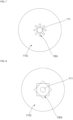
- FIGS. 5 to 10 are plan views showing an upper surface of a can according to various embodiments of the present disclosure.
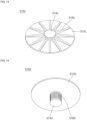
- FIGS. 11 to 13 are plan views showing a lower surface of a head of a rivet terminal according to various embodiments of the present disclosure.
- FIG. 14 is a perspective view showing a main body of a rivet terminal according to an embodiment of the present disclosure.
- FIG. 15 is a partial cross-sectional view showing a terminal structure according to another embodiment of the present disclosure.
- first rotation preventing portions 130a to 130f of various shapes may be provided in the upper surface portions 110a to 110f of the can 100.
- the first rotation preventing portions 130a to 130f may be formed in the surrounding area of the terminal hole 111. Since the rivet terminal 510 is inserted into the terminal hole 111, when a rotational force acts on the rivet terminal 510, the highest pressure is applied to the surrounding area of the terminal hole 111. Therefore, when the rotation prevention structure is formed adjacent to the terminal hole 111, rotation of the rivet terminal 510 can be effectively prevented.
- the first rotation preventing portions 130a to 130f may be formed by engraving patterns of various shapes, such as dotted lines, straight lines, curves, and figures (e.g., irregular shapes), by using a laser, etc.
- the first rotation preventing portions 130a to 130f may appear as simple lines, but when laterally viewed, the first rotation preventing portions 130a to 130f may be grooves that extend to a predetermined depth.
- the first rotation preventing portion 130a may have four straight lines arranged around the terminal hole 111 in a cross shape, as shown in FIG. 5 .
- the first rotation preventing portion 130b may have a plurality of straight lines arranged radially around the terminal hole 111.
- the first rotation preventing portion 130c have a plurality of rectangles arranged radially around the terminal hole 111.
- the first rotation preventing portion 130d may be arranged so that two or more square patterns overlap around the terminal hole 111 (e.g., two or more square patterns that are rotationally offset from each other).
- FIG. 8 the first rotation preventing portion 130d
- the first rotation preventing portion 130e may have a shape in which a number of straight lines extend parallel or substantially parallel to each other and are encircled by a circle (e.g., a number of parallel straight lines inside a circle).
- the first rotation preventing portion 130f may have a shape in which a plurality of straight lines are combined into a grid or the like inside a circle (e.g., a plurality of horizontal lines and vertical lines arranged in a grid pattern and encircled in a circle).
- the above-described shapes are provided by way of examples, and various types of patterns other than those described above may be applied to the first rotation preventing portions 130a to 130f.
- the friction force between the first insulator 520 and the upper surface portions 110a to 110f may be increased. Accordingly, since the first insulator 520 does not rotate due to an external force, the rivet terminal 510 also does not rotate.
- protrusions corresponding to the shapes of the first rotation preventing portions 130a to 130f may be formed on the first insulator 520. Accordingly, the friction force between the first insulator 520 and the upper surface portions 110a to 110f increases significantly, so that the rotation preventing effect of the rivet terminal 510 can be greatly improved.
- second rotation preventing portions 516a to 516c of various shapes are provided on the rivet terminals 510a to 510c rather than the upper surface portion 110 of the can 100.
- the main body of the rivet terminal 510a to 510c is shown in a configuration of being cylindrical before being deformed.
- FIGS. 11 to 13 show configurations in which the lower surfaces (surfaces facing the upper surface portion) of the heads 512a to 512c of the rivet terminals 510a to 510c face upward.
- the second rotation preventing portion 516a may have a plurality of circular rings of different sizes protruding from the lower surface of the head 512a (e.g., the second rotation preventing portion 516a may include a plurality of concentric rings protruding from the lower surface of the head 512a).
- the second rotation preventing portion 516a may be arranged so that the circular rings becomes larger in diameter toward to the side of the main body 514a.
- FIG. 11 show configurations in which the lower surfaces (surfaces facing the upper surface portion) of the heads 512a to 512c of the rivet terminals 510a to 510c face upward.
- the second rotation preventing portion 516a may have a plurality of circular rings of different sizes protruding from the lower surface of the head 512a (e.g., the second rotation
- the second rotation preventing portion 516b may be a plurality of grooves radially arrange on the lower surface of the head 512b around the main body 514b.
- the second rotation preventing portion 516c may be in the form of a plurality of ribs connected from the outside of the main body 514c to the lower edge of the head 512c.
- the second rotation preventing portion 516c may have an inclined shape in which the outer top end of the main body 514c and the lower edge of the head 512c are connected (e.g., the ribs of the second rotation preventing portion 516c may taper from a taller end at the main body 514c to a shorter end at the outer peripheral edge of the head 512b).
- the second rotation preventing portion 516c may be in the form of a straight rib connecting the lower edge of the head 512c at the same height from the outside of the main body 514c.
- the friction force between the first insulator 520 and the heads 512a to 512c of the rivet terminals 510a to 510c may be increased. Accordingly, since the first insulator 520 does not rotate due to an external force, the rivet terminals 510a to 510c also do not rotate.
- protrusions or grooves shaped to correspond to the second rotation preventing portions 516a to 516c may be formed on the first insulator 520.
- the friction force between the first insulator 520 and the heads 512a to 512c of the rivet terminals 510a to 510c increases significantly, so that the rotation preventing effect of the rivet terminals 510a to 510c can be greatly improved.
- a third rotation preventing portion 518d may be provided on the outer peripheral surface of the main body 514d of the rivet terminal 510d rather than on the head 512d of the rivet terminal 510d.
- the third rotation preventing portion 518d may be a plurality of straight grooves concavely formed on the outer peripheral surface of the main body 514d.
- the third rotation preventing portion 518d may be in the form of a protrusion or rib as well as a groove.
- the third rotation preventing portion 518d may also be formed in various patterns.
- the third rotation preventing portion 518d may be formed by using a laser engraving or serration method.
- the friction force between the second insulator 530 and the main body 514 of the rivet terminal 510 may be increased. Accordingly, since the second insulator 530 does not rotate due to an external force, the rivet terminal 510 also does not rotate.
- a protrusion or groove shaped to correspond to the third rotation preventing portion 518d may be formed on the second insulator 530. In such an embodiment, the friction force between the second insulator 530 and the main body 514 of the rivet terminal 510 is greatly increased, so that the rotation prevention effect of the rivet terminal 510 can be greatly improved.
- first to third rotation preventing portions may be provided alone or as a combination of two or more.
- a structure for preventing rotation of the insulator itself may be further included.
- the structure, which will later be described, may also be provided together with the first to third rotation preventing portions or may be provided alone.
- the terminal portion 500 may include fourth rotation preventing portions 516e and 530a.
- the fourth rotation preventing portions 516e and 530a may be provided as protrusions and grooves.
- a rivet terminal 510e may include the above-described protrusion 516e on the lower side in contact with the upper surface of the second insulator 530.
- the protrusion 516e may protrude in a circular shape.
- a plurality of protrusions having, for example, straight, hemispherical, oval, or streamlined shapes, may be arranged at regular intervals.
- a second insulator 530' may include an accommodation groove 530a shaped to correspond to the above-described protrusion 51 0a.
- the protrusion 516e and the accommodation groove 530a may be engaged with each other to prevent the rivet terminal 51 Oe from rotating along the plate surface direction of the upper surface portion 110 in a configuration in which the rivet terminal 510e is coupled to the upper surface portion 110 of the can 100.
- the protrusion 516e may be formed on the second insulator 530', and the accommodation groove 530a may be formed on the rivet terminal 510e.
- the rivet terminal does not rotate due to an external force or vibration. Therefore, the stability and reliability of the secondary battery are improved.
- the rivet terminal since a structure for preventing rotation of the rivet terminal is provided on the upper surface of the can or the rivet head or the main body to which the rivet terminal is fastened, the rivet terminal may not rotate due to an external force or vibration. Therefore, the stability and reliability of the secondary battery can be improved.
Landscapes
- Chemical & Material Sciences (AREA)
- Chemical Kinetics & Catalysis (AREA)
- Electrochemistry (AREA)
- General Chemical & Material Sciences (AREA)
- Engineering & Computer Science (AREA)
- Manufacturing & Machinery (AREA)
- Connection Of Batteries Or Terminals (AREA)
Abstract
A cylindrical secondary battery includes an electrode assembly; a cylindrical can accommodating the electrode assembly; and a terminal portion including a rivet terminal coupled to one side in the longitudinal direction of the can and electrically connected to the electrode assembly and at least one insulator between the can and the rivet terminal to insulate the can and the rivet terminal from each other. The battery also includes a rotation preventing portion on the can and/or the terminal portion. Since a structure for preventing rotation of the rivet terminal is provided on the upper surface of the can or the rivet head or the main body to which the rivet terminal is fastened, the rivet terminal may not rotate due to an external force or vibration. Therefore, the stability and reliability of the secondary battery can be improved.
Description
- Embodiments of the present disclosure relate to a cylindrical secondary battery having an improved terminal structure.
- In general, a cylindrical secondary battery includes a cylindrical electrode assembly, a cylindrical can that accommodates the electrode assembly with an electrolyte, and a cap assembly that seals the can. The cap assembly is electrically connected to the electrode assembly and the exterior of the secondary battery.
- In a battery module that uses a plurality of cylindrical secondary batteries by modularizing the same, bus bars are connected to the upper and lower terminals of the secondary batteries, respectively. Therefore, there are problems in that the battery module may have a complicated structure and the manufacturing process time may be extended. To solve these problems, a secondary battery having a structure in which a positive electrode terminal in the form of a rivet is provided on one side of the can facing the cap assembly can be used. When applying a rivet-type terminal, there is a risk that the head or the main body of the rivet may rotate due to an external force or vibration. Therefore, a solution is needed to prevent these problems.
- The above information disclosed in this Background section is only for enhancement of understanding of the background of the invention and therefore it may contain information that does not constitute prior art.
- Embodiments of the present disclosure provide a cylindrical secondary battery having an improved terminal structure.
- A secondary battery according to an embodiment of the present disclosure includes: an electrode assembly; a can accommodating the electrode assembly; and a terminal portion including a rivet terminal coupled to one side in the longitudinal direction of the can and electrically connected to the electrode assembly and at least one insulator between the can and the rivet terminal to insulate the can and the rivet terminal from each other. The secondary battery also includes a rotation preventing portion on at least one of the can and the terminal portion. The secondary battery may be a cylindrical secondary battery. The can may be a cylindrical can. However, other shapes are also possible.
- The can may include a circular upper surface through which a terminal hole into which the rivet terminal is inserted is formed, and the rivet terminal may include a head disposed on the outside of the upper surface and a main body inserted into the terminal hole and disposed inside the can.
- A first rotation preventing portion may be formed on the upper surface.
- The first rotation preventing portion may be formed by laser engraving.
- The first rotation preventing portion may be a pattern formed of at least one of a dotted line, a straight line, a curve, and a figure.
- The rivet terminal may include a second rotation preventing portion formed on the surface of the head facing the upper surface portion.
- The second rotation preventing portion may be at least one of a plurality of grooves, a plurality of protrusions, and a plurality of ribs.
- The rivet terminal may include a third rotation preventing portion formed on the outer peripheral surface of the main body.
- The third rotation preventing portion may be at least one of a plurality of grooves, a plurality of protrusions, and a plurality of ribs.
- The first to third rotation preventing portions may be provided as a combination of two or more.
- At least one protrusion may be formed to protrude on one of the insulator and the rivet terminal, and an accommodation groove for accommodating the protrusion may be formed on the other one.
- In addition, a cylindrical secondary battery according to embodiments of the present disclosure may include: an electrode assembly including a first electrode plate, a second electrode plate, and a separator interposed between the first electrode plate and the second electrode plate; a can having a circular upper surface portion through which a terminal hole is formed, and a side portion extending downward from the upper surface, and accommodating the electrode assembly; and a terminal portion including a rivet terminal inserted into the terminal hole and electrically connected to the first electrode plate, and a plurality of insulators insulating between the rivet terminal and the upper surface portion, wherein a rotation preventing portion may be provided on at least one of the can and the terminal portion.
- The rivet terminal may include a head disposed on the outside of the upper surface portion and a main body inserted into the terminal hole and disposed inside the can.
- A first rotation preventing portion may be formed on the upper surface portion.
- The first rotation preventing portion may be formed by laser engraving.
- The first rotation preventing portion may be a pattern formed of at least one of a dotted line, a straight line, a curve, and a figure.
- The rivet terminal may include a second rotation preventing portion formed on the surface of the head facing the upper surface portion.
- The second rotation preventing portion may be at least one of a plurality of grooves, a plurality of protrusions, and a plurality of ribs.
- The rivet terminal may include a third rotation preventing portion formed on the outer peripheral surface of the main body.
- The third rotation preventing portion may be at least one of a plurality of grooves, a plurality of protrusions, and a plurality of ribs.
- The first to third rotation preventing portions may be provided as a combination of two or more.
- At least one protrusion may be formed to protrude on one of the insulator and the rivet terminal, and an accommodation groove for accommodating the protrusion may be formed on the other one.
- The cylindrical secondary battery may further include: a first electrode current collector plate inserted between the rivet terminal and the electrode assembly and electrically connected to the first electrode plate; and a second electrode current collector plate disposed adjacent to an end of the side portion and electrically connected to the second electrode plate and the side portion.
- The cylindrical secondary battery may further include a cap assembly insulated from the can while being coupled to the side portion.
- The side portion may include a beading part that is concavely formed in an upper side of the cap assembly, and a crimping part that is formed by inwardly bending a lower end of the side portion, and the cap assembly may be disposed between the beading part and the crimping part.
- The cap assembly may include a cap plate that seals the side portion, and a gasket inserted between the cap plate and the side portion.
- The edge of the second electrode current collector plate may be inserted between the beading part and the gasket and may be in contact with the beading part.
- At least some of the above and other features of the invention are set out in the claims.
-
-
FIG. 1 is a perspective view of a secondary battery according to an embodiment of the present disclosure. -
FIG. 2 is a cross-sectional view of the cylindrical secondary battery according toFIG. 1 . -
FIG. 3 is a partial cross-sectional view showing a terminal structure according toFIG. 2 . -
FIG. 4 is a partial perspective view showing the terminal structure according toFIG. 2 . -
FIGS. 5 to 10 are plan views showing an upper surface of a can according to various embodiments of the present disclosure. -
FIGS. 11 to 13 are plan views showing a lower surface of a head of a rivet terminal according to various embodiments of the present disclosure. -
FIG. 14 is a perspective view showing a main body of a rivet terminal according to an embodiment of the present disclosure. -
FIG. 15 is a partial cross-sectional view showing a terminal structure according to another embodiment of the present disclosure. - Examples of the present disclosure are provided to more completely explain the present disclosure to those skilled in the art, and the following examples may be modified in various other forms. The present disclosure, however, may be embodied in many different forms and should not be construed as being limited to the example embodiments set forth herein. Rather, these example embodiments are provided so that this disclosure will be thorough and complete and will convey the aspects and features of the present disclosure to those skilled in the art.
- In addition, in the accompanying drawings, sizes or thicknesses of various components are exaggerated for brevity and clarity. Like numbers refer to like elements throughout. As used herein, the term "and/or" includes any and all combinations of one or more of the associated listed items. In addition, it will be understood that when an element A is referred to as being "connected to" an element B, the element A can be directly connected to the element B or an intervening element C may be present therebetween such that the element A and the element B are indirectly connected to each other.
- The terminology used herein is for the purpose of describing particular embodiments only and is not intended to be limiting of the disclosure. As used herein, the singular forms are intended to include the plural forms as well, unless the context clearly indicates otherwise. It will be further understood that the terms that the terms "comprise or include" and/or "comprising or including," when used in this specification, specify the presence of stated features, numbers, steps, operations, elements, and/or components, but do not preclude the presence or addition of one or more other features, numbers, steps, operations, elements, components, and/or groups thereof.
- It will be understood that, although the terms first, second, etc. may be used herein to describe various members, elements, regions, layers and/or sections, these members, elements, regions, layers and/or sections should not be limited by these terms. These terms are only used to distinguish one member, element, region, layer and/or section from another. Thus, for example, a first member, a first element, a first region, a first layer and/or a first section discussed below could be termed a second member, a second element, a second region, a second layer and/or a second section without departing from the teachings of the present disclosure.
- Spatially relative terms, such as "beneath," "below," "lower," "above," "upper," and the like, may be used herein for ease of description to describe one element or feature's relationship to another element(s) or feature(s) as illustrated in the figures. It will be understood that the spatially relative terms are intended to encompass different orientations of the device in use or operation in addition to the orientation depicted in the figures. For example, if the element or feature in the figures is turned over, elements described as "below" or "beneath" other elements or features would then be oriented "on" or "above" the other elements or features. Thus, as an example, the term "below" can encompass both an orientation of above and below.
- Hereinafter, a cylindrical secondary battery according to an embodiment of the present invention will be described in detail with reference to the accompanying drawings.
- First, the basic structure of a cylindrical secondary battery will be described with reference to
FIGS. 1 to 4 . -
FIG. 1 is a perspective view of a secondary battery according to an embodiment of the present disclosure.FIG. 2 is a cross-sectional view of the cylindrical secondary battery according toFIG. 1 .FIG. 3 is a partial cross-sectional view showing a terminal structure according toFIG. 2 .FIG. 4 is a partial perspective view showing the terminal structure according toFIG. 2 . - As shown in
FIGS. 1 and2 , the secondary battery 10 (e.g., cylindrical secondary battery 10) according to an embodiment of the present disclosure may include a can 100 (e.g., a cylindrical can), anelectrode assembly 200 accommodated inside thecan 100, a first electrodecurrent collector plate 300, a second electrodecurrent collector plate 400, aterminal portion 500 provided on one side of thecan 100, and a cap assembly provided on the other side of thecan 100. - As shown in
FIG. 1 , thecan 100 may include a circularupper surface portion 110 and acylindrical side portion 130 extending downward from theupper surface portion 110. Since the lower side of theside portion 130 is open, thecan 100 is shaped of a cylinder having an open lower end. - A terminal hole 111 (see
FIGS. 5 to 10 ) may be formed through the center of theupper surface portion 110. A portion of the terminal portion may be exposed to the outside of thesecondary battery 10 through theterminal hole 111. A structure to prevent rotation of a rivet terminal to be described later may be provided on theupper surface portion 110. - The upper end of the
side portion 130 is connected to theupper surface portion 110. In one or more embodiments, theupper surface portion 110 and theside portion 130 are integrally formed. The lower end of theside portion 130 is open, and the cap assembly is provided at the open end. Abeading part 132 may be formed adjacent to the bottom of theside portion 130. Thebeading part 132 may be inwardly and concavely formed from theside portion 130. The end of theside portion 130, spaced apart from (lower than) thebeading part 132, may be bent toward the inside of thecan 100 to form a crimpingpart 134. Thebeading part 132 is configured to prevent separation of theelectrode assembly 200. The cap assembly may be between thebeading part 132 and the crimpingpart 134. The crimpingpart 134 may seal thecan 100 by fixing the cap assembly. - The can 100 having the above-described structure may be made of steel, a steel alloy, aluminum, an aluminum alloy, or equivalents thereof, but the material is not limited thereto. The
electrode assembly 200, the first electrodecurrent collector plate 300, and the second electrodecurrent collector plate 400 are accommodated within thecan 100 together with an electrolyte. - As shown in
FIG. 2 , theelectrode assembly 200 may be configured such that afirst electrode plate 210, asecond electrode plate 220, and aseparator 230 interposed therebetween are wound into a cylindrical shape. In this embodiment, thefirst electrode plate 210 may be a positive electrode plate, and thesecond electrode plate 220 may be a negative electrode plate. However, the opposite is also possible (i.e., thefirst electrode plate 210 may be a negative electrode plate, and thesecond electrode plate 220 may be a positive electrode plate). - In the
first electrode plate 210, a positive electrode active material layer may be formed by coating, etc. on at least one surface of an aluminum (Al) foil. As an example, the positive electrode active material layer may be a transition metal oxide (e.g., LiCoO2, LiNiO2, LiMn2O4, etc.). A first electrode uncoated portion in which the positive electrode active material layer is not formed may be provided on thefirst electrode plate 210. A plurality of first electrode substrate tabs may be formed by cutting the first electrode uncoated portion into a certain shape by notching, etc. In this embodiment, the first electrode substrate tabs may be at or proximate to theupper surface portion 110 of thecan 100. In addition, the first electrode substrate tabs may be electrically connected to the first electrodecurrent collector plate 300. As an example, the first electrode substrate tabs may be bent in one direction and then coupled to the first electrodecurrent collector plate 300 by welding, which will later be described in detail. - In the
second electrode plate 220, a negative electrode active material layer may be formed by coating at least one surface of a copper (Cu) or nickel (Ni) foil. As an example, the negative electrode active material layer may be graphite, carbon, etc. A second electrode uncoated portion in which the negative electrode active material layer is not formed may be provided in the second electrode plate. A plurality of second electrode substrate tabs may be formed by cutting the second electrode uncoated portion into a certain shape by notching, etc. In this embodiment, the second electrode substrate tabs may be at or proximate to the lower side of thecan 100. In addition, the second electrode substrate tabs may protrude downward from theseparator 230 and may be electrically connected to the second electrodecurrent collector plate 400. Some portions of the second electrode substrate tabs may be electrically connected to thebeading part 132 of thecan 100. As an example, the second electrode substrate tabs may be bent in one direction and then coupled to the second electrodecurrent collector plate 400 by welding. - The
separator 230 may be polyethylene (PE) or polypropylene (PP), but the material of theseparator 230 is not limited thereto. Theseparator 230 may prevent an electrical short between thefirst electrode plate 210 and thesecond electrode plate 220 and only allows movement of lithium ions. Theseparator 230 may have a length sufficient to be in contact with the first electrodecurrent collector plate 400 based on the longitudinal direction of theelectrode assembly 200, which will later be described in detail. - The
electrode assembly 200 having the above-described structure is electrically connected to the first electrodecurrent collector plate 300 and the second electrodecurrent collector plate 400, and is electrically connected to theterminal portion 500 and thecan 100, respectively. - As shown in
FIG. 2 , the first electrodecurrent collector plate 300 has a circular plate shape and may be made of the same material as thefirst electrode plate 210. As an example, the first electrodecurrent collector plate 300 may be made of aluminum or an aluminum alloy. The diameter of the first electrodecurrent collector plate 300 may be smaller than the diameter of thecan 100. This smaller diameter is configured to prevent the first electrodecurrent collector plate 300 from being electrically connected to thecan 100. The first electrodecurrent collector plate 300 may be welded in a configuration in which the lower surface thereof is in contact with the first electrode substrate tab. Accordingly, the first electrodecurrent collector plate 300 and thefirst electrode plate 210 may be electrically connected. In addition, the upper surface of the first electrodecurrent collector plate 300 may be welded to therivet terminal 510 of theterminal portion 500, which will be described later. Accordingly, the first electrodecurrent collector plate 300 and therivet terminal 510 may be electrically connected. Therefore, thefirst electrode plate 210 and therivet terminal 510 can be electrically connected by the first electrodecurrent collector plate 300. That is, the first electrodecurrent collector plate 300 becomes a path for current flow between thefirst electrode plate 210 and therivet terminal 510. - As shown in
FIG. 2 , the second electrodecurrent collector plate 400 may include aplate surface portion 410 having a circular plate shape and acontact portion 420 extending from theplate surface portion 410. In one or more embodiments, thecontact portion 420 is an edge area of the second electrodecurrent collector plate 400. The upper surface of theplate surface portion 410 may be welded in a configuration in which it is in contact with the second electrode substrate tab. Accordingly, the second electrodecurrent collector plate 400 and thesecond electrode plate 220 may be electrically connected. To this end, the second electrodecurrent collector plate 400 may be made of the same material as thesecond electrode plate 220. As an example, the second electrodecurrent collector plate 400 may be made of copper. In this embodiment, thecontact portion 420 may extend downward from the edge (e.g., the peripheral edge) of theplate surface portion 410. Thecontact portion 420 may be in close contact with the inner surface of thebeading part 132. To this end, thecontact portion 420 may have a curve corresponding to the curve of thebeading part 132. As an example, thecontact portion 420 may be welded to and electrically connected to thebeading part 132. However, the second electrodecurrent collector plate 400 is not electrically connected to the cap assembly. - Additionally, as shown in
FIGS. 1 to 4 , theterminal portion 500 may include arivet terminal 510 and a plurality ofinsulators rivet terminal 510. - The
rivet terminal 510 is inserted into aterminal hole 111 formed in theupper surface portion 110 of thecan 100. Therivet terminal 510 is electrically connected to thefirst electrode plate 210 through the first electrodecurrent collector plate 300. Therivet terminal 510 is a terminal coupled to theupper surface portion 110 of thecan 100 by a riveting method. Therivet terminal 510 may be inserted into theterminal hole 111 from the outside of thecan 100 toward the inside. In one or more embodiments, one end of therivet terminal 510 is outside thecan 100, and the other end of therivet terminal 510 is inside thecan 100. The end of therivet terminal 510 outside thecan 100 has a hollow circular plate shape and is referred to as ahead 512. The other end of therivet terminal 510 is shaped of a hollow cylinder and is referred to as amain body 514. The cylindricalmain body 514 is mechanically pressed and deformed into an approximately circular plate shape (the shape of the deformedmain body 514 is shown inFIG. 4 ). In thehead 512 and themain body 514 of therivet terminal 510, a structure for preventing rotation may be provided, which will be described later. When therivet terminal 510 is coupled to thecan 110, the first tothird insulators 520 to 540 are inserted between thehead 512 and theupper surface portion 110 of thecan 100 to insulate thecan 100 and therivet terminal 510 from each other. In a configuration in which therivet terminal 510 is inserted into theterminal hole 111, the inner end of therivet terminal 510 is compressed and deformed by a riveting process, such as pressing or spinning. Accordingly, therivet terminal 510 may be in close contact with theupper surface portion 110 of thecan 100. - As an example, the insulator may include a
first insulator 520, asecond insulator 530, and athird insulator 540. Thefirst insulator 520, thesecond insulator 530, and thethird insulator 540 may be used without limitation in type or kind as long as they are made of an insulating material. - The
first insulator 520 is between the outer end (e.g., the head 512) of therivet terminal 510 and theupper surface portion 110. For example, thefirst insulator 520 may have a hollow circular plate shape. The diameter of thefirst insulator 520 may be larger than the diameter of the outer end of therivet terminal 510. - The
second insulator 530 may be shaped to surround theterminal hole 111 formed in theupper surface portion 110. That is, about theterminal hole 111, thesecond insulator 530 may be shaped to surround the outer and inner surfaces of theupper surface portion 110 and the cross section where theterminal hole 111 is formed. - The
third insulator 540 is shaped of a hollow circular plate and is between the inner surface of theupper surface portion 110 and the inner end of therivet terminal 510. -
FIG. 3 shows a terminal structure in a configuration in which therivet terminal 510 faces the upper side of thesecondary battery 10.FIG. 4 shows a terminal structure in a configuration in which therivet terminal 510 faces the lower side of thesecondary battery 10. - Referring to
FIGS. 3 and 4 , thethird insulator 540 is shaped as an approximately circular plate and has a predetermined thickness. Thethird insulator 540 may include aterminal contact portion 541 that is in contact with therivet terminal 510, a current collectorplate contact portion 543 that is in contact with the first electrodecurrent collector plate 300, and anupper contact portion 545 that is in contact with theupper surface portion 110. Theterminal contact portion 541 and the current collectorplate contact portion 543 are connected by a firstinclined portion 542. The current collectorplate contact portion 543 and theupper contact portion 545 are connected by a secondinclined portion 544. That is, theterminal contact portion 541, the current collectorplate contact portion 543, and theupper contact portion 545 have a step or ramp with respect to each other. Theterminal contact portion 541, the firstinclined portion 542, the current collectorplate contact portion 543, the secondinclined portion 544, and theupper contact portion 545 are all integrally formed. A plurality ofgroove portions 546 are formed on the current collector plate contact portion 543 (seeFIG. 4 ). - The
terminal contact portion 541 is a circular area having a diameter larger than the inner end diameter of therivet terminal 510. A terminal hole into which therivet terminal 510 is inserted is formed in the center of theterminal contact portion 541. Theterminal contact portion 541 is in close contact with the inner surface of theupper surface portion 110 when viewed with reference to the embodiment depicted inFIG. 3 . Therivet terminal 510 is coupled in a configuration in which theterminal contact portion 541 is in close contact with theupper surface portion 110. The inner end of therivet terminal 510 is deformed so that theterminal contact portion 541 can be brought into closer contact with theupper surface portion 110. The firstinclined portion 542 is connected to theterminal contact portion 541. The current collectorplate contact portion 543 is connected to the edge of the firstinclined portion 542. - The current collector
plate contact portion 543 is a portion that occupies most of the area of thethird insulator 540. The current collectorplate contact portion 543 has a circular plate shape, and aterminal contact portion 541 is formed at the center thereof. In the embodiment illustrated inFIG. 3 , the current collectorplate contact portion 543 is located on the lower side at a certain distance from theupper surface portion 110. The current collectorplate contact portion 543 has a step H from theterminal contact portion 541. In addition, as shown inFIG. 4 , thegroove portions 546 are substantially fan-shaped and may be formed on the current collectorplate contact portion 543. Thegrooves 546 may be formed concavely from the surface in the direction of the first electrodecurrent collector plate 300. Thegroove portions 546 are provided for reducing the weight of thethird insulator 540 and may be omitted in some embodiments. The secondinclined portion 544 is connected to the edge of the current collectorplate contact portion 543. Theupper contact portion 545 is connected to the edge of the secondinclined portion 544. - The
upper contact portion 545 is an area corresponding to the outer edge of thethird insulator 540 when viewed as a whole. In the embodiment illustrated inFIG. 3 , theupper contact portion 545 is in contact with the inner surface of theupper surface portion 110. Accordingly, the upper surface of theupper contact portion 545 may be located on the same line (or plane) as the upper surface of theterminal contact portion 541. In addition, theupper contact portion 545 has a smaller width than theterminal contact portion 541 or the current collectorplate contact portion 543. In one or more embodiments, the edge of thethird insulator 540 may be formed with the secondinclined portion 544 but without theupper contact portion 545. - In one or more embodiments, a step (H) between the
terminal contact portion 541 and the current collectorplate contact portion 543 is a height between the lower surface of theterminal contact portion 541 and the lower surface of the current collectorplate contact portion 543, as illustrated inFIG. 3 . The step H between theterminal contact portion 541 and the current collectorplate contact portion 543 is configured to provide an installation space for therivet terminal 510. To this end, the step (H) between theterminal contact portion 541 and the current collectorplate contact portion 543 is provided. However, if the step (H) between theterminal contact portion 541 and the current collectorplate contact portion 543 is too large (i.e., if the current collectorplate contact portion 543 is located too far downward), the current collectorplate contact portion 543 presses the first electrodecurrent collector plate 300 toward theelectrode assembly 200. Then, theelectrode assembly 200 may be pressed, resulting in deformation. To prevent this, the step H between theterminal contact portion 541 and the current collectorplate contact portion 543 may be set to be equal to or smaller than the protrusion height of therivet terminal 510. As used herein, the protrusion height of therivet terminal 510 refers to a thickness measured from the lower surface of theterminal contact portion 541 to the lower end (the lowermost part, regardless of the location) of therivet terminal 510 on the basis ofFIG. 3 (i.e., the thickness of the circular plate in which themain body 514 of the rivet terminal is deformed). Even if the step (H) between theterminal contact portion 541 and the current collectorplate contact portion 543 is smaller than the protrusion height of therivet terminal 510, the step (H) is preferably not more than 0.5 mm. If the step (H) is too large, therivet terminal 510 may be prevented from contacting the first electrodecurrent collector 300. - One end of the
second insulator 530 may be in close contact with the inside of the hollow side of thefirst insulator 520. The other end of thesecond insulator 530 may be in close contact with the inside of the hollow side of thethird insulator 540. In one or more embodiments, the first tothird insulators - On the opposite side of the
upper surface portion 110 where theterminal portion 500 having the above-described structure is provided, the cap assembly is provided (i.e., the cap assembly and theterminal portion 500 are on opposite ends of the can 100). - As shown in
FIG. 2 , the cap assembly may include acap plate 610 for sealing thecan 100 and agasket 620 for insulating thecan 100 and thecap plate 610 from each other. - The
cap plate 610 may include aplane portion 612 having a circular plate shape, aninclined surface 614 connected to theplane portion 612, and anextension surface 616 connected to the inclined surface 614 (i.e., theinclined surface 614 connects theplane portion 612 to the extension surface 616). Theplane portion 612 may be approximately parallel to the second electrodecurrent collector plate 400. Theinclined surface 614 may extend downward and slant outward from the edge of theplane portion 612. Theextension surface 616 extends from the edge of theinclined surface 614 and may be parallel (or approximately parallel) to theplanar portion 612. Theextension surface 616 may be surrounded by thegasket 620 and be between thebeading part 132 and the crimpingpart 134. Anotch 612a may be formed on theplane portion 612. Thenotch 612a may be broken when the pressure inside thesecondary battery 10 is higher than a certain pressure. The gas inside thesecondary battery 10 may be discharged when thenotch 612a is broken. That is, thenotch 612a functions as a vent. - The
gasket 620 is between the lower portion of thebeading part 132 and the crimpingpart 134 and may cover theextension surface 616 of thecap plate 610. Thegasket 620 may cover part or all of theextension surface 616. The side where thegasket 620 and theextension surface 616 are in contact may be defined as the inside, and the side where thegasket 620 is in contact with thebeading part 132 may be defined as the outside. In one or more embodiments, a portion of theextension portion 420 of the second electrodecurrent collector plate 400 may be between the outer upper portion of thegasket 620 and thebeading part 132. Therefore, theextension portion 420 of the second electrodecurrent collector plate 400 and theextension surface 616 of thecap plate 610 are not brought into contact with each other. That is, thegasket 620 may insulate thecap plate 610 and thecan 100 from each other, and may insulate thecap plate 610 and the second electrodecurrent collector plate 400 from each other. - By the above-described configuration, the
rivet terminal 510 may have a positive polarity, and thecan 100 may have a negative polarity. Accordingly, both thepositive rivet terminal 510 of a positive polarity and the negativeupper surface portion 110 of a negative polarity may be provided on the upper side of thecan 100. - Additionally, the cylindrical secondary battery of the present disclosure may include a structure for preventing the rivet terminal from rotating along the direction of the plate surface of the upper surface portion of the can.
-
FIGS. 5 to 10 are plan views showing an upper surface of a can according to various embodiments of the present disclosure.FIGS. 11 to 13 are plan views showing a lower surface of a head of a rivet terminal according to various embodiments of the present disclosure.FIG. 14 is a perspective view showing a main body of a rivet terminal according to an embodiment of the present disclosure.FIG. 15 is a partial cross-sectional view showing a terminal structure according to another embodiment of the present disclosure. - As shown in
FIGS. 5 to 10 , firstrotation preventing portions 130a to 130f of various shapes may be provided in theupper surface portions 110a to 110f of thecan 100. The firstrotation preventing portions 130a to 130f may be formed in the surrounding area of theterminal hole 111. Since therivet terminal 510 is inserted into theterminal hole 111, when a rotational force acts on therivet terminal 510, the highest pressure is applied to the surrounding area of theterminal hole 111. Therefore, when the rotation prevention structure is formed adjacent to theterminal hole 111, rotation of therivet terminal 510 can be effectively prevented. The firstrotation preventing portions 130a to 130f may be formed by engraving patterns of various shapes, such as dotted lines, straight lines, curves, and figures (e.g., irregular shapes), by using a laser, etc. In a plan view, the firstrotation preventing portions 130a to 130f may appear as simple lines, but when laterally viewed, the firstrotation preventing portions 130a to 130f may be grooves that extend to a predetermined depth. - The first
rotation preventing portion 130a may have four straight lines arranged around theterminal hole 111 in a cross shape, as shown inFIG. 5 . In addition, as shown inFIG. 6 , the firstrotation preventing portion 130b may have a plurality of straight lines arranged radially around theterminal hole 111. In addition, as shown inFIG. 7 , the firstrotation preventing portion 130c have a plurality of rectangles arranged radially around theterminal hole 111. In addition, as shown inFIG. 8 , the firstrotation preventing portion 130d may be arranged so that two or more square patterns overlap around the terminal hole 111 (e.g., two or more square patterns that are rotationally offset from each other). In addition, as shown inFIG. 9 , the firstrotation preventing portion 130e may have a shape in which a number of straight lines extend parallel or substantially parallel to each other and are encircled by a circle (e.g., a number of parallel straight lines inside a circle). In addition, as shown inFIG. 10 , the firstrotation preventing portion 130f may have a shape in which a plurality of straight lines are combined into a grid or the like inside a circle (e.g., a plurality of horizontal lines and vertical lines arranged in a grid pattern and encircled in a circle). However, the above-described shapes are provided by way of examples, and various types of patterns other than those described above may be applied to the firstrotation preventing portions 130a to 130f. - Due to the first
rotation preventing portions 130a to 130f, the friction force between thefirst insulator 520 and theupper surface portions 110a to 110f may be increased. Accordingly, since thefirst insulator 520 does not rotate due to an external force, therivet terminal 510 also does not rotate. In addition, although not shown in the drawings, protrusions corresponding to the shapes of the firstrotation preventing portions 130a to 130f may be formed on thefirst insulator 520. Accordingly, the friction force between thefirst insulator 520 and theupper surface portions 110a to 110f increases significantly, so that the rotation preventing effect of therivet terminal 510 can be greatly improved. - Additionally, as shown in
FIGS. 11 to 14 , secondrotation preventing portions 516a to 516c of various shapes are provided on therivet terminals 510a to 510c rather than theupper surface portion 110 of thecan 100. For convenience, the main body of therivet terminal 510a to 510c is shown in a configuration of being cylindrical before being deformed. -
FIGS. 11 to 13 show configurations in which the lower surfaces (surfaces facing the upper surface portion) of theheads 512a to 512c of therivet terminals 510a to 510c face upward. As shown inFIG. 11 , the secondrotation preventing portion 516a may have a plurality of circular rings of different sizes protruding from the lower surface of thehead 512a (e.g., the secondrotation preventing portion 516a may include a plurality of concentric rings protruding from the lower surface of thehead 512a). In one or more embodiments, the secondrotation preventing portion 516a may be arranged so that the circular rings becomes larger in diameter toward to the side of themain body 514a. In addition, as shown inFIG. 12 , the secondrotation preventing portion 516b may be a plurality of grooves radially arrange on the lower surface of thehead 512b around themain body 514b. In addition, as shown inFIG. 13 , the secondrotation preventing portion 516c may be in the form of a plurality of ribs connected from the outside of themain body 514c to the lower edge of thehead 512c. Here, the secondrotation preventing portion 516c may have an inclined shape in which the outer top end of themain body 514c and the lower edge of thehead 512c are connected (e.g., the ribs of the secondrotation preventing portion 516c may taper from a taller end at themain body 514c to a shorter end at the outer peripheral edge of the head 512b). In addition, in one or more embodiments, the secondrotation preventing portion 516c may be in the form of a straight rib connecting the lower edge of thehead 512c at the same height from the outside of themain body 514c. - Due to the second
rotation preventing portions 516a to 516c, the friction force between thefirst insulator 520 and theheads 512a to 512c of therivet terminals 510a to 510c may be increased. Accordingly, since thefirst insulator 520 does not rotate due to an external force, therivet terminals 510a to 510c also do not rotate. In addition, in one or more embodiments, protrusions or grooves shaped to correspond to the secondrotation preventing portions 516a to 516c may be formed on thefirst insulator 520. In such an embodiment, the friction force between thefirst insulator 520 and theheads 512a to 512c of therivet terminals 510a to 510c increases significantly, so that the rotation preventing effect of therivet terminals 510a to 510c can be greatly improved. - In addition, as shown in
FIG. 14 , a thirdrotation preventing portion 518d may be provided on the outer peripheral surface of themain body 514d of therivet terminal 510d rather than on thehead 512d of therivet terminal 510d. The thirdrotation preventing portion 518d may be a plurality of straight grooves concavely formed on the outer peripheral surface of themain body 514d. In one or more embodiments, the thirdrotation preventing portion 518d may be in the form of a protrusion or rib as well as a groove. In addition, the thirdrotation preventing portion 518d may also be formed in various patterns. The thirdrotation preventing portion 518d may be formed by using a laser engraving or serration method. - Due to the third
rotation preventing portion 518d, the friction force between thesecond insulator 530 and themain body 514 of therivet terminal 510 may be increased. Accordingly, since thesecond insulator 530 does not rotate due to an external force, therivet terminal 510 also does not rotate. In addition, in one or more embodiments, a protrusion or groove shaped to correspond to the thirdrotation preventing portion 518d may be formed on thesecond insulator 530. In such an embodiment, the friction force between thesecond insulator 530 and themain body 514 of therivet terminal 510 is greatly increased, so that the rotation prevention effect of therivet terminal 510 can be greatly improved. - The above-described first to third rotation preventing portions may be provided alone or as a combination of two or more. In addition, a structure for preventing rotation of the insulator itself may be further included. The structure, which will later be described, may also be provided together with the first to third rotation preventing portions or may be provided alone.
- As shown in
FIG. 15 , theterminal portion 500 may include fourthrotation preventing portions rotation preventing portions rivet terminal 510e may include the above-describedprotrusion 516e on the lower side in contact with the upper surface of thesecond insulator 530. As an example, theprotrusion 516e may protrude in a circular shape. In addition, in one or more embodiments, a plurality of protrusions having, for example, straight, hemispherical, oval, or streamlined shapes, may be arranged at regular intervals. A second insulator 530' may include anaccommodation groove 530a shaped to correspond to the above-described protrusion 51 0a. Theprotrusion 516e and theaccommodation groove 530a may be engaged with each other to prevent the rivet terminal 51 Oe from rotating along the plate surface direction of theupper surface portion 110 in a configuration in which therivet terminal 510e is coupled to theupper surface portion 110 of thecan 100. In one or more embodiments, theprotrusion 516e may be formed on the second insulator 530', and theaccommodation groove 530a may be formed on therivet terminal 510e. - As described above, by including a structure for preventing rotation of the rivet terminal on the upper surface of the can to which the rivet terminal is fastened, or on the rivet head or the main body, the rivet terminal does not rotate due to an external force or vibration. Therefore, the stability and reliability of the secondary battery are improved.
- According to an embodiment of the present disclosure, since a structure for preventing rotation of the rivet terminal is provided on the upper surface of the can or the rivet head or the main body to which the rivet terminal is fastened, the rivet terminal may not rotate due to an external force or vibration. Therefore, the stability and reliability of the secondary battery can be improved.
- While the foregoing embodiment is only one embodiment for carrying out the present disclosure, which is not limited to the embodiment, it will be understood by a person skilled in the art that various changes in form and details may be made therein without departing from the scope of the present disclosure as defined by the following claims.
- Embodiments are set out in the following clauses:
- Clause 1. A cylindrical secondary battery comprising: an electrode assembly; a cylindrical can accommodating the electrode assembly; and a terminal portion including a rivet terminal coupled to one side in the longitudinal direction of the can and electrically connected to the electrode assembly and at least one insulator interposed between the can and the rivet terminal to insulate the can and the rivet terminal from each other, wherein a rotation preventing portion may be provided on at least one of the can and the terminal portion.
- Clause 2. The cylindrical secondary battery as set out in clause 1, wherein the can includes a circular upper surface through which a terminal hole into which the rivet terminal is inserted is formed, and the rivet terminal includes a head disposed on the outside of the upper surface and a main body inserted into the terminal hole and disposed inside the can.
- Clause 3. The cylindrical secondary battery as set out in clause 2, wherein a first rotation preventing portion is formed on the upper surface.
- Clause 4. The cylindrical secondary battery as set out in clause 3, wherein the first rotation preventing portion is formed by laser engraving.
- Clause 5. The cylindrical secondary battery as set out in clause 4, wherein the first rotation preventing portion is a pattern formed of at least one of a dotted line, a straight line, a curve, and a figure.
- Clause 6. The cylindrical secondary battery as set out in clause 5, wherein the rivet terminal includes a second rotation preventing portion formed on the surface of the head facing the upper surface portion.
- Clause 7. The cylindrical secondary battery as set out in clause 6, wherein the second rotation preventing portion is at least one of a plurality of grooves, a plurality of protrusions, and a plurality of ribs.
- Clause 8. The cylindrical secondary battery as set out in clause 7, wherein the rivet terminal includes a third rotation preventing portion formed on the outer peripheral surface of the main body.
- Clause 9. The cylindrical secondary battery as set out in clause 8, wherein the third rotation preventing portion is at least one of a plurality of grooves, a plurality of protrusions, and a plurality of ribs.
-
Clause 10. The cylindrical secondary battery as set out in clause 9, wherein the first to third rotation preventing portions are provided as a combination of two or more. - Clause 11. The cylindrical secondary battery as set out in
clause 1 or 10, wherein at least one protrusion is formed to protrude on one of the insulator and the rivet terminal, and an accommodation groove for accommodating the protrusion is formed on the other one. - Clause 12. A cylindrical secondary battery comprising: an electrode assembly including a first electrode plate, a second electrode plate, and a separator interposed between the first electrode plate and the second electrode plate; a can having a circular upper surface portion through which a terminal hole is formed, and a side portion extending downward from the upper surface, and accommodating the electrode assembly; and a terminal portion including a rivet terminal inserted into the terminal hole and electrically connected to the first electrode plate, and a plurality of insulators insulating between the rivet terminal and the upper surface portion, wherein a rotation preventing portion may be provided on at least one of the can and the terminal portion.
- Clause 13. The cylindrical secondary battery as set out in clause 12, wherein the rivet terminal includes a head disposed on the outside of the upper surface portion and a main body inserted into the terminal hole and disposed inside the can.
- Clause 14. The cylindrical secondary battery as set out in clause 13, wherein a first rotation preventing portion is formed on the upper surface portion.
- Clause 15. The cylindrical secondary battery as set out in clause 14, wherein the first rotation preventing portion is formed by laser engraving.
- Clause 16. The cylindrical secondary battery as set out in clause 15, wherein the first rotation preventing portion is a pattern formed of at least one of a dotted line, a straight line, a curve, and a figure.
- Clause 17. The cylindrical secondary battery as set out in clause 16, wherein the rivet terminal includes a second rotation preventing portion formed on the surface of the head facing the upper surface portion.
- Clause 18. The cylindrical secondary battery as set out in clause 17, wherein the second rotation preventing portion is at least one of a plurality of grooves, a plurality of protrusions, and a plurality of ribs.
- Clause 19. The cylindrical secondary battery as set out in clause 18, wherein the rivet terminal includes a third rotation preventing portion formed on the outer peripheral surface of the main body.
- Clause 20. The cylindrical secondary battery as set out in clause 19, wherein the third rotation preventing portion is at least one of a plurality of grooves, a plurality of protrusions, and a plurality of ribs.
- Clause 21. The cylindrical secondary battery as set out in clause 20, wherein the first to third rotation preventing portions are provided as a combination of two or more.
- Clause 22. The cylindrical secondary battery as set out in clause 12 or 21, wherein at least one protrusion is formed to protrude on one of the insulator and the rivet terminal, and an accommodation groove for accommodating the protrusion may be formed on the other one.
- Clause 23. The cylindrical secondary battery as set out in clause 22, further comprising: a first electrode current collector plate inserted between the rivet terminal and the electrode assembly and electrically connected to the first electrode plate; and a second electrode current collector plate disposed adjacent to an end of the side portion and electrically connected to the second electrode plate and the side portion.
- Clause 24. The cylindrical secondary battery as set out in clause 23, further comprising a cap assembly insulated from the can while being coupled to the side portion.
- Clause 25. The cylindrical secondary battery as set out in clause 24, wherein the side portion includes a beading part that is concavely formed in an upper side of the cap assembly, and a crimping part that is formed by inwardly bending a lower end of the side portion, and the cap assembly may be disposed between the beading part and the crimping part.
- Clause 26. The cylindrical secondary battery as set out in clause 25, wherein the cap assembly includes a cap plate that seals the side portion, and a gasket inserted between the cap plate and the side portion.
- Clause 27. The cylindrical secondary battery as set out in clause 26, wherein the edge of the second electrode current collector plate is inserted between the beading part and the gasket and is in contact with the beading part.
Claims (15)
- A secondary battery comprising:an electrode assembly;a can accommodating the electrode assembly;a terminal portion comprising a rivet terminal coupled to one side in a longitudinal direction of the can and electrically connected to the electrode assembly and at least one insulator between the can and the rivet terminal to insulate the can and the rivet terminal from each other; anda rotation preventing portion on at least one of the can or the terminal portion.
- The secondary battery as claimed in claim 1, wherein the can comprises a circular upper surface and a terminal hole in the circular upper surface, wherein the rivet terminal is in the terminal hole, and wherein the rivet terminal comprises a head on an outside of the upper surface and a main body in the terminal hole and inside the can.
- A secondary battery comprising:an electrode assembly including a first electrode plate, a second electrode plate, and a separator between the first electrode plate and the second electrode plate;a can accommodating the electrode assembly, the can comprising a circular upper surface portion, a terminal hole in the circular upper surface portion, and a side portion extending downward from the upper surface;a terminal portion comprising a rivet terminal in the terminal hole and electrically connected to the first electrode plate, and a plurality of insulators insulating between the rivet terminal and the upper surface portion; anda rotation preventing portion on at least one of the can or the terminal portion.
- The secondary battery as claimed in claim 3, wherein the rivet terminal comprises a head on an outside of the upper surface portion and a main body in the terminal hole and inside the can.
- The secondary battery as claimed in claim 3 or claim 4, further comprising:a first electrode current collector plate between the rivet terminal and the electrode assembly and electrically connected to the first electrode plate; anda second electrode current collector plate adjacent to an end of the side portion and electrically connected to the second electrode plate and the side portion, and optionally wherein the edge of the second electrode current collector plate is between the beading part and the gasket and is in contact with the beading part.
- The secondary battery as claimed in any one of claims 3 to 5, further comprising a cap assembly insulated from the can and coupled to the side portion, and optionally wherein the side portion includes a beading part that is concavely in an upper side of the cap assembly, and a crimping part that is formed by inwardly bending a lower end of the side portion, and the cap assembly between the beading part and the crimping part, and optionally wherein the cap assembly includes a cap plate that seals the side portion, and a gasket between the cap plate and the side portion.
- The secondary battery as claimed in any one of the preceding claims, wherein the rotation preventing portion is a first rotation preventing portion on the upper surface portion.
- The secondary battery as claimed in claim 7, wherein the first rotation preventing portion is a laser engraving.
- The secondary battery as claimed in claim 7 or claim 8, wherein the first rotation preventing portion is a pattern formed of at least one of a dotted line, a straight line, a curve, and a figure.
- The secondary battery as claimed in any one of claims 7 to 9, wherein the rotation preventing portion further comprises a second rotation preventing portion on a surface of the head of the rivet terminal facing the upper surface portion.
- The secondary battery as claimed in claim 10, wherein the second rotation preventing portion is at least one of a plurality of grooves, a plurality of protrusions, and a plurality of ribs.
- The secondary battery as claimed in claim 10 or claim 11, wherein the rotation preventing portion further comprises a third rotation preventing portion on the outer peripheral surface of the main body of the rivet terminal.
- The secondary battery as claimed in claim 12, wherein the third rotation preventing portion is at least one of a plurality of grooves, a plurality of protrusions, and a plurality of ribs.
- The secondary battery as claimed in any one of the preceding claims, wherein the rotation preventing portion comprises a combination of two or more rotation preventing portions.
- The secondary battery as claimed in any one of the preceding claims, further comprising at least one protrusion protruding on one of the insulator and the rivet terminal, and an accommodation groove for accommodating the protrusion on the other one of the insulator and the rivet terminal.
Applications Claiming Priority (1)
| Application Number | Priority Date | Filing Date | Title |
|---|---|---|---|
| KR1020230074063A KR20240174616A (en) | 2023-06-09 | 2023-06-09 | Cylindrical secondary battery |
Publications (1)
| Publication Number | Publication Date |
|---|---|
| EP4481908A1 true EP4481908A1 (en) | 2024-12-25 |
Family
ID=91072650
Family Applications (1)
| Application Number | Title | Priority Date | Filing Date |
|---|---|---|---|
| EP24175215.3A Pending EP4481908A1 (en) | 2023-06-09 | 2024-05-10 | Cylindrical secondary battery |
Country Status (4)
| Country | Link |
|---|---|
| US (1) | US20240413497A1 (en) |
| EP (1) | EP4481908A1 (en) |
| KR (1) | KR20240174616A (en) |
| CN (1) | CN119108722A (en) |
Citations (2)
| Publication number | Priority date | Publication date | Assignee | Title |
|---|---|---|---|---|
| US20110081566A1 (en) * | 2008-05-30 | 2011-04-07 | Keiichiro Kobayashi | Cylindrical battery and method of manufacturing the same |
| US20180205044A1 (en) * | 2017-01-17 | 2018-07-19 | Fdk Corporation | Sealing body of tube-shaped battery and tube-shaped battery |
-
2023
- 2023-06-09 KR KR1020230074063A patent/KR20240174616A/en active Pending
-
2024
- 2024-03-13 US US18/604,388 patent/US20240413497A1/en active Pending
- 2024-05-10 EP EP24175215.3A patent/EP4481908A1/en active Pending
- 2024-05-11 CN CN202410580857.9A patent/CN119108722A/en active Pending
Patent Citations (2)
| Publication number | Priority date | Publication date | Assignee | Title |
|---|---|---|---|---|
| US20110081566A1 (en) * | 2008-05-30 | 2011-04-07 | Keiichiro Kobayashi | Cylindrical battery and method of manufacturing the same |
| US20180205044A1 (en) * | 2017-01-17 | 2018-07-19 | Fdk Corporation | Sealing body of tube-shaped battery and tube-shaped battery |
Also Published As
| Publication number | Publication date |
|---|---|
| KR20240174616A (en) | 2024-12-17 |
| CN119108722A (en) | 2024-12-10 |
| US20240413497A1 (en) | 2024-12-12 |
Similar Documents
| Publication | Publication Date | Title |
|---|---|---|
| EP4199199B1 (en) | Secondary battery | |
| US20260066491A1 (en) | Secondary battery | |
| EP3780136A1 (en) | Cell | |
| EP4191782A1 (en) | Cylindrical secondary battery | |
| EP4340117A1 (en) | Secondary battery | |
| EP4216363A1 (en) | Cylindrical secondary battery | |
| EP4362177A2 (en) | Cylindrical secondary battery | |
| US20250343304A1 (en) | Cylindrical secondary battery, and manufacturing method for secondary battery | |
| EP4372857A2 (en) | Cylindrical secondary battery | |
| EP4362178A1 (en) | Cylindrical secondary battery | |
| EP4597656A1 (en) | Cylindrical secondary battery | |
| EP4593174A2 (en) | Secondary battery | |
| EP4246676A1 (en) | Battery, and battery pack and vehicle comprising same | |
| EP4210139A2 (en) | Secondary battery | |
| EP4481908A1 (en) | Cylindrical secondary battery | |
| KR102853427B1 (en) | Secondary battery | |
| KR102950673B1 (en) | Cylindrical secondary battery | |
| EP4601086A1 (en) | Cylindrical secondary battery | |
| EP4496066A1 (en) | Cylindrical secondary battery | |
| EP4571957A1 (en) | Cylindrical secondary battery | |
| EP4593137A1 (en) | Cylindrical secondary battery | |
| EP4471946A1 (en) | Rechargeable battery | |
| CN119275361A (en) | Rechargeable battery | |
| KR20260049920A (en) | Secondary battery and method for manufacturing same |
Legal Events
| Date | Code | Title | Description |
|---|---|---|---|
| PUAI | Public reference made under article 153(3) epc to a published international application that has entered the european phase |
Free format text: ORIGINAL CODE: 0009012 |
|
| STAA | Information on the status of an ep patent application or granted ep patent |
Free format text: STATUS: REQUEST FOR EXAMINATION WAS MADE |
|
| 17P | Request for examination filed |
Effective date: 20240510 |
|
| AK | Designated contracting states |
Kind code of ref document: A1 Designated state(s): AL AT BE BG CH CY CZ DE DK EE ES FI FR GB GR HR HU IE IS IT LI LT LU LV MC ME MK MT NL NO PL PT RO RS SE SI SK SM TR |