EP4481854A1 - Lithium iron phosphate positive electrode active material, positive electrode sheet, and lithium-ion battery - Google Patents
Lithium iron phosphate positive electrode active material, positive electrode sheet, and lithium-ion battery Download PDFInfo
- Publication number
- EP4481854A1 EP4481854A1 EP23755708.7A EP23755708A EP4481854A1 EP 4481854 A1 EP4481854 A1 EP 4481854A1 EP 23755708 A EP23755708 A EP 23755708A EP 4481854 A1 EP4481854 A1 EP 4481854A1
- Authority
- EP
- European Patent Office
- Prior art keywords
- positive electrode
- iron phosphate
- lithium iron
- active material
- electrode active
- Prior art date
- Legal status (The legal status is an assumption and is not a legal conclusion. Google has not performed a legal analysis and makes no representation as to the accuracy of the status listed.)
- Pending
Links
Images
Classifications
-
- C—CHEMISTRY; METALLURGY
- C01—INORGANIC CHEMISTRY
- C01B—NON-METALLIC ELEMENTS; COMPOUNDS THEREOF; METALLOIDS OR COMPOUNDS THEREOF NOT COVERED BY SUBCLASS C01C
- C01B25/00—Phosphorus; Compounds thereof
- C01B25/16—Oxyacids of phosphorus; Salts thereof
- C01B25/26—Phosphates
- C01B25/45—Phosphates containing plural metal, or metal and ammonium
-
- H—ELECTRICITY
- H01—ELECTRIC ELEMENTS
- H01M—PROCESSES OR MEANS, e.g. BATTERIES, FOR THE DIRECT CONVERSION OF CHEMICAL ENERGY INTO ELECTRICAL ENERGY
- H01M10/00—Secondary cells; Manufacture thereof
- H01M10/05—Accumulators with non-aqueous electrolyte
- H01M10/052—Li-accumulators
- H01M10/0525—Rocking-chair batteries, i.e. batteries with lithium insertion or intercalation in both electrodes; Lithium-ion batteries
-
- H—ELECTRICITY
- H01—ELECTRIC ELEMENTS
- H01M—PROCESSES OR MEANS, e.g. BATTERIES, FOR THE DIRECT CONVERSION OF CHEMICAL ENERGY INTO ELECTRICAL ENERGY
- H01M4/00—Electrodes
- H01M4/02—Electrodes composed of, or comprising, active material
- H01M4/13—Electrodes for accumulators with non-aqueous electrolyte, e.g. for lithium-accumulators; Processes of manufacture thereof
- H01M4/136—Electrodes based on inorganic compounds other than oxides or hydroxides, e.g. sulfides, selenides, tellurides, halogenides or LiCoFy
-
- H—ELECTRICITY
- H01—ELECTRIC ELEMENTS
- H01M—PROCESSES OR MEANS, e.g. BATTERIES, FOR THE DIRECT CONVERSION OF CHEMICAL ENERGY INTO ELECTRICAL ENERGY
- H01M4/00—Electrodes
- H01M4/02—Electrodes composed of, or comprising, active material
- H01M4/36—Selection of substances as active materials, active masses, active liquids
- H01M4/362—Composites
- H01M4/364—Composites as mixtures
-
- H—ELECTRICITY
- H01—ELECTRIC ELEMENTS
- H01M—PROCESSES OR MEANS, e.g. BATTERIES, FOR THE DIRECT CONVERSION OF CHEMICAL ENERGY INTO ELECTRICAL ENERGY
- H01M4/00—Electrodes
- H01M4/02—Electrodes composed of, or comprising, active material
- H01M4/36—Selection of substances as active materials, active masses, active liquids
- H01M4/362—Composites
- H01M4/366—Composites as layered products
-
- H—ELECTRICITY
- H01—ELECTRIC ELEMENTS
- H01M—PROCESSES OR MEANS, e.g. BATTERIES, FOR THE DIRECT CONVERSION OF CHEMICAL ENERGY INTO ELECTRICAL ENERGY
- H01M4/00—Electrodes
- H01M4/02—Electrodes composed of, or comprising, active material
- H01M4/36—Selection of substances as active materials, active masses, active liquids
- H01M4/58—Selection of substances as active materials, active masses, active liquids of inorganic compounds other than oxides or hydroxides, e.g. sulfides, selenides, tellurides, halogenides or LiCoFy; of polyanionic structures, e.g. phosphates, silicates or borates
-
- H—ELECTRICITY
- H01—ELECTRIC ELEMENTS
- H01M—PROCESSES OR MEANS, e.g. BATTERIES, FOR THE DIRECT CONVERSION OF CHEMICAL ENERGY INTO ELECTRICAL ENERGY
- H01M4/00—Electrodes
- H01M4/02—Electrodes composed of, or comprising, active material
- H01M4/36—Selection of substances as active materials, active masses, active liquids
- H01M4/58—Selection of substances as active materials, active masses, active liquids of inorganic compounds other than oxides or hydroxides, e.g. sulfides, selenides, tellurides, halogenides or LiCoFy; of polyanionic structures, e.g. phosphates, silicates or borates
- H01M4/5825—Oxygenated metallic salts or polyanionic structures, e.g. borates, phosphates, silicates, olivines
-
- H—ELECTRICITY
- H01—ELECTRIC ELEMENTS
- H01M—PROCESSES OR MEANS, e.g. BATTERIES, FOR THE DIRECT CONVERSION OF CHEMICAL ENERGY INTO ELECTRICAL ENERGY
- H01M4/00—Electrodes
- H01M4/02—Electrodes composed of, or comprising, active material
- H01M4/62—Selection of inactive substances as ingredients for active masses, e.g. binders, fillers
-
- H—ELECTRICITY
- H01—ELECTRIC ELEMENTS
- H01M—PROCESSES OR MEANS, e.g. BATTERIES, FOR THE DIRECT CONVERSION OF CHEMICAL ENERGY INTO ELECTRICAL ENERGY
- H01M4/00—Electrodes
- H01M4/02—Electrodes composed of, or comprising, active material
- H01M4/62—Selection of inactive substances as ingredients for active masses, e.g. binders, fillers
- H01M4/624—Electric conductive fillers
- H01M4/625—Carbon or graphite
-
- C—CHEMISTRY; METALLURGY
- C01—INORGANIC CHEMISTRY
- C01P—INDEXING SCHEME RELATING TO STRUCTURAL AND PHYSICAL ASPECTS OF SOLID INORGANIC COMPOUNDS
- C01P2004/00—Particle morphology
- C01P2004/60—Particles characterised by their size
- C01P2004/61—Micrometer sized, i.e. from 1-100 micrometer
-
- C—CHEMISTRY; METALLURGY
- C01—INORGANIC CHEMISTRY
- C01P—INDEXING SCHEME RELATING TO STRUCTURAL AND PHYSICAL ASPECTS OF SOLID INORGANIC COMPOUNDS
- C01P2006/00—Physical properties of inorganic compounds
- C01P2006/10—Solid density
-
- C—CHEMISTRY; METALLURGY
- C01—INORGANIC CHEMISTRY
- C01P—INDEXING SCHEME RELATING TO STRUCTURAL AND PHYSICAL ASPECTS OF SOLID INORGANIC COMPOUNDS
- C01P2006/00—Physical properties of inorganic compounds
- C01P2006/40—Electric properties
-
- H—ELECTRICITY
- H01—ELECTRIC ELEMENTS
- H01M—PROCESSES OR MEANS, e.g. BATTERIES, FOR THE DIRECT CONVERSION OF CHEMICAL ENERGY INTO ELECTRICAL ENERGY
- H01M4/00—Electrodes
- H01M4/02—Electrodes composed of, or comprising, active material
- H01M2004/021—Physical characteristics, e.g. porosity, surface area
-
- H—ELECTRICITY
- H01—ELECTRIC ELEMENTS
- H01M—PROCESSES OR MEANS, e.g. BATTERIES, FOR THE DIRECT CONVERSION OF CHEMICAL ENERGY INTO ELECTRICAL ENERGY
- H01M4/00—Electrodes
- H01M4/02—Electrodes composed of, or comprising, active material
- H01M2004/026—Electrodes composed of, or comprising, active material characterised by the polarity
- H01M2004/028—Positive electrodes
-
- Y—GENERAL TAGGING OF NEW TECHNOLOGICAL DEVELOPMENTS; GENERAL TAGGING OF CROSS-SECTIONAL TECHNOLOGIES SPANNING OVER SEVERAL SECTIONS OF THE IPC; TECHNICAL SUBJECTS COVERED BY FORMER USPC CROSS-REFERENCE ART COLLECTIONS [XRACs] AND DIGESTS
- Y02—TECHNOLOGIES OR APPLICATIONS FOR MITIGATION OR ADAPTATION AGAINST CLIMATE CHANGE
- Y02E—REDUCTION OF GREENHOUSE GAS [GHG] EMISSIONS, RELATED TO ENERGY GENERATION, TRANSMISSION OR DISTRIBUTION
- Y02E60/00—Enabling technologies; Technologies with a potential or indirect contribution to GHG emissions mitigation
- Y02E60/10—Energy storage using batteries
Definitions
- the present disclosure relates to the field of lithium ion batteries, and specifically to a lithium iron phosphate positive electrode active material, a positive electrode sheet and a lithium ion battery.
- Lithium iron phosphate material has wide use due to the high safety, low cost, environmental friendliness and other advantages.
- the lithium iron phosphate material also has obvious defects. That is, the compaction density of the lithium iron phosphate material is low, which leads to the low energy density of batteries prepared with the lithium iron phosphate material, so the demand for batteries with long battery life cannot be met.
- a lithium iron phosphate material having high compaction density is needed.
- the compaction density of the lithium iron phosphate material is increased, the electrochemical performance of the battery is often reduced.
- the present disclosure provides a lithium iron phosphate positive electrode active material, which includes:
- a first lithium iron phosphate material and a second lithium iron phosphate material a first lithium iron phosphate material and a second lithium iron phosphate material.
- the corresponding particle size is D 1 v 50 (in ⁇ m).
- the cumulative volume distribution percentage of the second lithium iron phosphate material is 50%, the corresponding particle size is D 2 v 50 (in ⁇ m).
- D 1 v 50 is in the range of 0.3-0.95, and D 2 v 50 is in the range of 1.0-3.5.
- the cumulative volume distribution percentages of the lithium iron phosphate positive electrode active material are 90%, 10%, 50%, the corresponding particle sizes are respectively D v 90 (in ⁇ m), D v 10 (in ⁇ m), and D v 50 (in ⁇ m).
- the corresponding particle size is D n 50 (in ⁇ m).
- the particle size of the lithium iron phosphate positive electrode active material meets the following relation formula: 0.16 ⁇ D v 90 ⁇ D v 10 / D v 50 + D v 50 ⁇ D n 50 ⁇ 31.1 .
- the maximum compaction density is 2.55-2.85 g/cm 3 .
- D 1 v 50 of the first lithium iron phosphate material is in the range of 0.4-0.85, and D 2 v 50 of the second lithium iron phosphate material is in the range of 1.2-3.0.
- (D v 90-D v 10)/D v 50+D v 50 ⁇ D n 50 is in the range of 0.2-31.
- D v 50 ⁇ D n 50 is in the range of 0.05-4.9.
- D v 50 of the lithium iron phosphate positive electrode active material is in the range of 0.25-3.5.
- the mixing weight ratio of the first lithium iron phosphate material and the second lithium iron phosphate material is in the range of 1: (1-9), and further in the range of 1: (1-4).
- the first lithium iron phosphate material has a carbon coating layer on the surface and/or the second lithium iron phosphate material has a carbon coating layer on the surface.
- the present disclosure provides a positive electrode sheet.
- the positive electrode sheet includes a lithium iron phosphate positive electrode active material according to the first aspect of the present disclosure.
- the positive electrode sheet includes a positive electrode current collector and a positive electrode active material layer arranged on a surface of the positive electrode current collector.
- the positive electrode active material layer includes the lithium iron phosphate positive electrode active material, a binder, and a conductive agent.
- the positive electrode active material layer is formed by coating a positive electrode paste including the lithium iron phosphate positive electrode active material, the conductive agent, the binder and a solvent on the positive electrode current collector.
- the present disclosure provides a lithium ion battery.
- the lithium ion battery includes a positive electrode sheet according to the second aspect of the present disclosure.
- the lithium ion battery further includes a negative electrode sheet, and an electrolyte solution and a separator located between the positive electrode sheet and the negative electrode sheet.
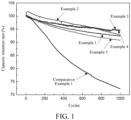
- FIG. 1 shows a cycle performance curve of each pouch battery in Embodiments 1 to 5 and Comparative Embodiment 1 of the present disclosure.
- the present disclosure provides a lithium iron phosphate positive electrode active material, which has increased compaction density, and enables a battery prepared therewith to have good electrochemical performances.
- the present disclosure provides a lithium iron phosphate positive electrode active material, which includes:
- a first lithium iron phosphate material and a second lithium iron phosphate material a first lithium iron phosphate material and a second lithium iron phosphate material.
- the cumulative volume distribution percentage of the first lithium iron phosphate material is 50%
- the corresponding particle size in ⁇ m is D 1 v 50.
- the cumulative volume distribution percentage of the second lithium iron phosphate material is 50%
- the corresponding particle size in ⁇ m is D 2 v 50.
- D 1 v 50 is in the range of 0.3-0.95
- D 2 v 50 is in the range of 1.0-3.5.
- the cumulative volume distribution percentages of the lithium iron phosphate positive electrode active material are 90%, 10%, 50%
- the corresponding particle sizes in ⁇ m are respectively D v 90, D v 10 and D v 50.
- the corresponding particle size in ⁇ m is D n 50.
- the particle size of the lithium iron phosphate positive electrode active material meets the following relation formula: 0.16 ⁇ D v 90 ⁇ D v 10 / D v 50 + D v 50 ⁇ D n 50 ⁇ 31.1 .
- the particle size of the obtained positive electrode active material is made to meet a certain relation formula, to ensure that the positive electrode active material has a high compaction density (2.55 g/cm 3 or higher). This promotes the improvement of the energy density of a battery prepared with the positive electrode active material.
- the battery prepared with the positive electrode active material has excellent electrochemical performance, particularly cycle performance.
- the maximum compaction density of the lithium iron phosphate positive electrode active material is 2.55 g/cm 3 or higher. In some embodiments of the present disclosure, the maximum compaction density is 2.55-2.85 g/cm 3 . It is to be understood that the maximum compaction density of a certain material mentioned in the present disclosure refers to the maximum compaction density obtained by testing the material with a powder compaction densitometer, or the maximum available compaction density of a positive electrode sheet prepared with this material. The maximum compaction density of the positive electrode sheet refers to the corresponding compaction density of the electrode sheet when the active material particles in the positive electrode sheet are crushed under a certain pressure.
- the D 1 v 50 value of the first lithium iron phosphate material and D 2 v 50 value of the second lithium iron phosphate material can be obtained from their respective laser particle size distribution diagrams.
- the test instrument is a laser particle size analyzer (such as Malvern 3000).
- the test method can be found in GB/T 19077-2016/ISO 13320:2009 Particle size analysis-Laser diffraction methods.
- the cumulative volume distribution percentage of a material is 50%, the corresponding particle size is referred to as median particle size of the material.
- the values of the particle size D n 50, D v 90, D v 10, and D v 50 of the lithium iron phosphate positive electrode active material can be obtained by determining the laser particle size distribution of a mixed powder obtained by mixing the first lithium iron phosphate material and the second lithium iron phosphate material.
- D 1 v 50 ⁇ D 2 v 50 D 1 v 50 ⁇ D 2 v 50.
- D 1 v 50 of the lithium iron phosphate material is small, the lithium ion diffusion path is relatively short, and the prepared battery has good electrical performance.
- D 2 v 50 of the lithium iron phosphate material is large, the compaction density of the positive electrode active material can be increased.
- the particle sizes D v 50 of the two materials are in the above ranges, by mixing the two materials, the two lithium iron phosphate materials can be ensured to form a dense mass, thus improving the compaction density of the obtained positive electrode active material without compromising the cycle performance of the battery.
- D 1 v 50 of the first lithium iron phosphate material is in the range of 0.4-0.85
- D 2 v 50 of the second lithium iron phosphate material is in the range of 1.2-3.0.
- the use of the positive electrode active material obtained by mixing the two lithium iron phosphate materials can well ensure the high compaction density of the positive electrode sheet and the good electrochemical performance of the battery.
- (D v 90-D v 10)/D v 50+D v 50 ⁇ D n 50 is in the range of 0.2-31. In some embodiments, (D v 90-D v 10)/D v 50+D v 50 ⁇ D n 50 is in the range of 0.5-30.
- D v 50 x D n 50 is in the range of 0.05-4.9. In this case, the compaction density of the positive electrode active material is high, and the electrochemical performance is excellent. In some embodiments, D v 50 x D n 50 may be in the range of 0.1-4.5. In some embodiments, D v 50 x D n 50 may be in the range of 0.6-4.
- D v 50 of the lithium iron phosphate positive electrode active material is in the range of 0.25-3.5.
- D v 50 represents the corresponding particle size when the cumulative volume distribution percentage of the positive electrode active material is 50%. If the D v 50 value of the positive electrode active material obtained after mixing is in the above range, the positive electrode active material particles can be ensured to be properly piled up, the polarization intensity of the electrode sheet is low, the lithium ion transmission speed is high during the cycle process of the battery, and the energy density of the secondary battery is high.
- the mixing weight ratio of the first lithium iron phosphate material and the second lithium iron phosphate material is not particularly limited, as long as the particle size of the positive electrode active material formed by mixing the two is ensured to meet the above relation formula.
- the mixing weight ratio of the first lithium iron phosphate material and the second lithium iron phosphate material is in the range of 1: (1-9), and further in the range of 1: (1-4).
- the positive electrode active material formed by mixing the two lithium iron phosphate materials can well ensure the high compaction density of the electrode sheet and the good cycle performance of the battery.
- the first lithium iron phosphate material has a carbon coating layer on the surface and/or the second lithium iron phosphate material has a carbon coating layer on the surface.
- the carbon coating layer can be obtained by sequentially sanding, spray drying and sintering a mixed slurry of a phosphorus source, an iron source, a lithium source and a carbon source.
- the specific preparation method of the two lithium iron phosphate materials is not limited. The presence of the carbon coating layer allows the first and the second lithium iron phosphate material to have good electrical conductivity, and less side reactions with the electrolyte solution.
- the positive electrode active material obtained by mixing the two has good electrical conductivity, and the cycle performance of the battery is good.
- the lithium iron phosphate positive electrode active material provided in the first aspect of the present disclosure, by mixing two lithium iron phosphate materials meeting the requirements of specific particle size parameters, it can be ensured that the obtained positive electrode active material has a high compaction density, and a battery prepared with the positive electrode active material has good cycle performance and rate performance.
- the preparation method has simple process, and is easy to operate, thus being suitable for use in large-scale production.
- the present disclosure provides a positive electrode sheet.
- the positive electrode sheet includes a lithium iron phosphate positive electrode active material according to the first aspect of the present disclosure.
- the positive electrode sheet includes a positive electrode current collector and a positive electrode active material layer arranged on a surface of the positive electrode current collector.
- the positive electrode active material layer includes the lithium iron phosphate positive electrode active material, a binder, and a conductive agent.
- the maximum compaction density of the positive electrode sheet is 2.55 g/cm 3 or higher. In some embodiments, the maximum compaction density is 2.55-2.85 g/cm 3 .
- the positive electrode active material layer is formed by coating a positive electrode paste including the lithium iron phosphate positive electrode active material, the conductive agent, the binder and a solvent on the positive electrode current collector.
- the solvent can be one or more of N- methylpyrrolidone (NMP), acetone and dimethyl acetamide (DMAC).
- NMP N- methylpyrrolidone
- DMAC dimethyl acetamide
- the positive electrode current collector includes any one of an aluminum foil, a carbon-coated aluminum foil and a perforated aluminum foil.
- the conductive agent includes, but is not limited to, one or more of carbon nanotubes, graphene carbon black, carbon fiber and the like.
- the binder includes, but is not limited to, one or more of polyvinylidene fluoride (PVDF), polytetrafluoroethylene (PTFE), polyvinyl alcohol (PVA), styrene-butadiene rubber (SBR), polyacrylic acid (PAA), polyacrylate, polyacrylonitrile (PAN), sodium carboxymethyl cellulose (CMC) and sodium alginate.
- PVDF polyvinylidene fluoride
- PTFE polytetrafluoroethylene
- PVA polyvinyl alcohol
- SBR styrene-butadiene rubber
- PAA polyacrylic acid
- PAN polyacrylate
- PAN polyacrylonitrile
- CMC sodium carboxymethyl cellulose
- the present disclosure provides a lithium ion battery.
- the lithium ion battery includes a positive electrode sheet according to the second aspect of the present disclosure.
- the lithium ion battery further includes a negative electrode sheet, and an electrolyte solution and a separator located between the positive electrode sheet and the negative electrode sheet.
- the lithium ion battery using the positive electrode sheet has high energy density and excellent cycle performance.
- a method for preparing a lithium iron phosphate positive electrode active material includes the following steps:
- a first lithium iron phosphate material LFP-1 was used, where when the cumulative volume distribution percentage was 50%, the corresponding particle size determined was 0.56 ⁇ m, that is, D 1 v 50 was 0.56.
- a second lithium iron phosphate material LFP-2 was used, where when the cumulative volume distribution percentage was 50%, the corresponding particle size determined was 1.85 ⁇ m, that is, D 2 v 50 was 1.85.
- the LFP-1 material and the LFP-2 material were mixed at a weight ratio of 2: 8, to obtain a lithium iron phosphate positive electrode active material LFP-3.
- the cumulative volume distribution percentages of the LFP-3 material were 10%, 50%, 90%, the corresponding particle sizes were respectively 0.31 ⁇ m, 0.74 ⁇ m, and 4.97 ⁇ m (that is, D v 10 was 0.31, D v 50 was 0.74, and D v 90 was 4.97).
- the cumulative number distribution percentage was 50%, the corresponding particle size is 0.84 ⁇ m (that is, D n 50 was 0.84).
- the positive electrode active material LFP-3 was prepared into a positive electrode sheet, by mixing the LFP-3 material with a binder (specifically, polyvinylidene fluoride (PVDF)) and conductive carbon black at a weight ratio of 85:5:10, adding an appropriate amount of N-methyl pyrrolidone (NMP), and mixing uniformly, to obtain a positive electrode paste.
- the positive electrode paste was coated on two sides of a carbon-coated aluminum foil, and dried, to obtain a positive electrode sheet.
- the maximum compaction density of the positive electrode sheet without particle breakage was determined.
- the maximum compaction density of the positive electrode sheet was determined to be 2.63 g/cm 3 .
- the positive electrode sheet prepared with the positive electrode active material LFP-3 in Example 1 was used as a positive electrode.
- a graphite electrode sheet was used as a negative electrode.
- a polypropylene film was used as a separator.
- a method for preparing a lithium iron phosphate positive electrode active material includes the following steps: A first lithium iron phosphate material LFP-1 was used, and D 1 v 50 (the concept was as described in Example 1, and would not be repeated here, hereinafter) was determined to be 0.65.
- a second lithium iron phosphate material LFP-2 was used, and D 2 v 50 (the concept was as described in Example 1, and would not be repeated here, hereinafter) was determined to be 2.5.
- the LFP-1 material and the LFP-2 material were mixed at a weight ratio of 3:7, to obtain a lithium iron phosphate positive electrode active material LFP-3.
- the positive electrode active material LFP-3 obtained in Example 2 was prepared into a positive electrode sheet, and assembled into a pouch battery.
- the maximum compaction density of the positive electrode sheet in Example 2 was determined to be 2.67 g/cm 3 .
- a method for preparing a lithium iron phosphate positive electrode active material includes the following steps: A first lithium iron phosphate material LFP-1 was used, and D 1 v 50 was determined to be 0.92.
- a second lithium iron phosphate material LFP-2 was used, and D 2 v 50 was determined to be 3.43.
- the LFP-1 material and the LFP-2 material were mixed at a weight ratio of 4:6, to obtain a lithium iron phosphate positive electrode active material LFP-3.
- the positive electrode active material LFP-3 obtained in Example 3 was prepared into a positive electrode sheet, and assembled into a pouch battery.
- the maximum compaction density of the positive electrode sheet in Example 3 was determined to be 2.60 g/cm 3 .
- a method for preparing a lithium iron phosphate positive electrode active material includes the following steps: A first lithium iron phosphate material LFP-1 was used, and D 1 v 50 was determined to be 0.15.
- a second lithium iron phosphate material LFP-2 was used, and D 2 v 50 was determined to be 1.15.
- the LFP-1 material and the LFP-2 material were mixed at a weight ratio of 3:7, to obtain a lithium iron phosphate positive electrode active material LFP-3.
- the positive electrode active material LFP-3 obtained in Example 4 was prepared into a positive electrode sheet, and assembled into a pouch battery.
- the maximum compaction density of the positive electrode sheet in Example 4 was determined to be 2.79 g/cm 3 .
- a method for preparing a lithium iron phosphate positive electrode active material includes the following steps: A first lithium iron phosphate material LFP-1 was used, and D 1 v 50 was determined to be 0.92.
- a second lithium iron phosphate material LFP-2 was used, and D 2 v 50 was determined to be 1.23.
- the LFP-1 material and the LFP-2 material were mixed at a weight ratio of 1:9, to obtain a lithium iron phosphate positive electrode active material LFP-3.
- the positive electrode active material LFP-3 obtained in Example 5 was prepared into a positive electrode sheet, and assembled into a pouch battery.
- the maximum compaction density of the positive electrode sheet in Example 5 was determined to be 2.83 g/cm 3 .
- a method for preparing a lithium iron phosphate positive electrode active material includes the following steps: A first lithium iron phosphate material LFP-1 was used, and D 1 v 50 was determined to be 0.90.
- a second lithium iron phosphate material LFP-2 was used, and D 2 v 50 was determined to be 1.12.
- the LFP-1 material and the LFP-2 material were mixed at a weight ratio of 1:9, to obtain a lithium iron phosphate positive electrode active material LFP-3.
- the positive electrode active material LFP-3 obtained in Example 6 was prepared into a positive electrode sheet, and assembled into a pouch battery.
- the maximum compaction density of the positive electrode sheet in Example 6 was determined to be 2.62 g/cm 3 .
- a method for preparing a lithium iron phosphate positive electrode active material includes the following steps: A first lithium iron phosphate material LFP-1 was used, and D 1 v 50 was determined to be 0.95.
- a second lithium iron phosphate material LFP-2 was used, and D 2 v 50 was determined to be 3.45.
- the LFP-1 material and the LFP-2 material were mixed at a weight ratio of 1:9, to obtain a lithium iron phosphate positive electrode active material LFP-3.
- the positive electrode active material LFP-3 obtained in Comparative Example 1 was prepared into a positive electrode sheet, and assembled into a pouch battery.
- the maximum compaction density of the positive electrode sheet in Comparative Example 1 was determined to be 2.49 g/cm 3 .
- a method for preparing a lithium iron phosphate positive electrode active material includes the following steps: A first lithium iron phosphate material LFP-1 was used, and D 1 v 50 was determined to be 1.24, which fell outside the range of 0.3-0.95 defined in the present disclosure.
- a second lithium iron phosphate material LFP-2 was used, and D 2 v 50 was determined to be 4.2, which fell outside the range of 1.0-3.5 defined in the present disclosure.
- the LFP-1 material and the LFP-2 material were mixed at a certain weight ratio, to obtain a lithium iron phosphate positive electrode active material LFP-3.
- the positive electrode active material LFP-3 obtained in Comparative Example 2 was prepared into a positive electrode sheet, and assembled into a pouch battery.
- the maximum compaction density of the positive electrode sheet in Comparative Example 2 was determined to be 2.35 g/cm 3 .
- the pouch battery of each example and comparative example were tested for the following electrochemical performance.
- FIG. 1 shows a cycle performance curve of each pouch battery in Embodiments 1 to 5 and Comparative Embodiment 1.
- the first-cycle coulombic efficiency, the capacity retention rate after 1000 cycles, and other data of the batteries of each example and comparative example are summarized in Table 1 below.
- Table 1 Test item First-cycle coulombic efficiency (%) Discharge capacity per gram (mAh/g) Capacity retention rate after 1000 cycles (%)
- Example 1 98.6 149 93.8
- Example 2 98.6 152 92.5
- Example 3 98.9 154 94.6
- the positive electrode active material prepared by the method provided in the present disclosure has higher compaction density, and the battery prepared therewith has excellent electrochemical performances.
- the first-cycle coulombic efficiency can be greater than 96%
- the positive electrode has a high capacity per gram
- the capacity retention rate after 1000 cycles is still above 90%.
- the relation formula of particle size of the positive electrode active material in Comparative Example 1 falls outside the range defined in the present disclosure. Consequently, although the compaction density of the positive electrode sheet is close to 2.5 g/cm 3 , it is still lower than the compaction density of the positive electrode in the present disclosure.
- Comparative Examples 1 the first-cycle coulombic efficiency and cycle performance of the battery in Comparative Examples 1 are poor, and far inferior to the battery according to the present disclosure.
- Comparative Embodiment 2 although the relation formula of particle size of the positive electrode active material falls within the range defined in the present disclosure, the median particle size of the two raw materials forming the positive active material are not within the range required the present disclosure. Therefore, the compaction density of the positive electrode sheet is low, and the cycle performance of the battery is poor.
Landscapes
- Chemical & Material Sciences (AREA)
- Chemical Kinetics & Catalysis (AREA)
- Electrochemistry (AREA)
- General Chemical & Material Sciences (AREA)
- Engineering & Computer Science (AREA)
- Composite Materials (AREA)
- Inorganic Chemistry (AREA)
- Materials Engineering (AREA)
- Crystallography & Structural Chemistry (AREA)
- Organic Chemistry (AREA)
- Manufacturing & Machinery (AREA)
- Battery Electrode And Active Subsutance (AREA)
- Secondary Cells (AREA)
Abstract
Description
- The present disclosure claims priority to
Chinese Patent Application No. 202210139348.3 filed on February 15, 2022 - The present disclosure relates to the field of lithium ion batteries, and specifically to a lithium iron phosphate positive electrode active material, a positive electrode sheet and a lithium ion battery.
- Lithium iron phosphate material has wide use due to the high safety, low cost, environmental friendliness and other advantages. However, the lithium iron phosphate material also has obvious defects. That is, the compaction density of the lithium iron phosphate material is low, which leads to the low energy density of batteries prepared with the lithium iron phosphate material, so the demand for batteries with long battery life cannot be met. To improve the energy density of the battery, a lithium iron phosphate material having high compaction density is needed. However, when the compaction density of the lithium iron phosphate material is increased, the electrochemical performance of the battery is often reduced.
- In a first aspect, the present disclosure provides a lithium iron phosphate positive electrode active material, which includes:
- a first lithium iron phosphate material and a second lithium iron phosphate material. When the cumulative volume distribution percentage of the first lithium iron phosphate material is 50%, the corresponding particle size is D1 v50 (in µm). When the cumulative volume distribution percentage of the second lithium iron phosphate material is 50%, the corresponding particle size is D2 v50 (in µm). D1 v50 is in the range of 0.3-0.95, and D2 v50 is in the range of 1.0-3.5. When the cumulative volume distribution percentages of the lithium iron phosphate positive electrode active material are 90%, 10%, 50%, the corresponding particle sizes are respectively Dv90 (in µm), Dv10 (in µm), and Dv50 (in µm). When the cumulative number distribution percentage of the lithium iron phosphate positive electrode active material is 50%, the corresponding particle size is Dn50 (in µm). The particle size of the lithium iron phosphate positive electrode active material meets the following relation formula:

- In some embodiments of the present disclosure, the maximum compaction density is 2.55-2.85 g/cm3.
- In some embodiments of the present disclosure, D1 v50 of the first lithium iron phosphate material is in the range of 0.4-0.85, and D2 v50 of the second lithium iron phosphate material is in the range of 1.2-3.0.
- In some embodiments of the present disclosure, (Dv90-Dv10)/Dv50+Dv50 × Dn50 is in the range of 0.2-31.
- In some embodiments of the present disclosure, Dv50 × Dn50 is in the range of 0.05-4.9.
- In some embodiments of the present disclosure, Dv50 of the lithium iron phosphate positive electrode active material is in the range of 0.25-3.5.
- In some embodiments of the present disclosure, the mixing weight ratio of the first lithium iron phosphate material and the second lithium iron phosphate material is in the range of 1: (1-9), and further in the range of 1: (1-4).
- In some embodiments of the present disclosure, the first lithium iron phosphate material has a carbon coating layer on the surface and/or the second lithium iron phosphate material has a carbon coating layer on the surface.
- In a second aspect, the present disclosure provides a positive electrode sheet. The positive electrode sheet includes a lithium iron phosphate positive electrode active material according to the first aspect of the present disclosure.
- In some embodiments of the present disclosure, the positive electrode sheet includes a positive electrode current collector and a positive electrode active material layer arranged on a surface of the positive electrode current collector. The positive electrode active material layer includes the lithium iron phosphate positive electrode active material, a binder, and a conductive agent.
- In some embodiments of the present disclosure, the positive electrode active material layer is formed by coating a positive electrode paste including the lithium iron phosphate positive electrode active material, the conductive agent, the binder and a solvent on the positive electrode current collector.
- In a third aspect, the present disclosure provides a lithium ion battery. The lithium ion battery includes a positive electrode sheet according to the second aspect of the present disclosure.
- In some embodiments of the present disclosure, the lithium ion battery further includes a negative electrode sheet, and an electrolyte solution and a separator located between the positive electrode sheet and the negative electrode sheet.
-
FIG. 1 shows a cycle performance curve of each pouch battery inEmbodiments 1 to 5 andComparative Embodiment 1 of the present disclosure. - The foregoing descriptions are some implementations of the present disclosure. It should be noted that several modifications and variations can be made by those of ordinary skill in the art, without departing from the principle of the present disclosure, which shall fall within the protection scope of the present disclosure.
- The present disclosure provides a lithium iron phosphate positive electrode active material, which has increased compaction density, and enables a battery prepared therewith to have good electrochemical performances.
- In a first aspect, the present disclosure provides a lithium iron phosphate positive electrode active material, which includes:
- a first lithium iron phosphate material and a second lithium iron phosphate material. When the cumulative volume distribution percentage of the first lithium iron phosphate material is 50%, the corresponding particle size in µm is D1 v50. When the cumulative volume distribution percentage of the second lithium iron phosphate material is 50%, the corresponding particle size in µm is D2 v50. D1 v50 is in the range of 0.3-0.95, and D2 v50 is in the range of 1.0-3.5. When the cumulative volume distribution percentages of the lithium iron phosphate positive electrode active material are 90%, 10%, 50%, the corresponding particle sizes in µm are respectively
D v90, Dv10 and Dv50. When the cumulative number distribution percentage of the lithium iron phosphate positive electrode active material is 50%, the corresponding particle size in µm is Dn50. The particle size of the lithium iron phosphate positive electrode active material meets the following relation formula:
- In the present disclosure, two lithium iron phosphate materials having different particle sizes are used, and the particle size of the obtained positive electrode active material is made to meet a certain relation formula, to ensure that the positive electrode active material has a high compaction density (2.55 g/cm3 or higher). This promotes the improvement of the energy density of a battery prepared with the positive electrode active material. In addition, the battery prepared with the positive electrode active material has excellent electrochemical performance, particularly cycle performance.
- In some embodiments of the present disclosure, the maximum compaction density of the lithium iron phosphate positive electrode active material is 2.55 g/cm3 or higher. In some embodiments of the present disclosure, the maximum compaction density is 2.55-2.85 g/cm3. It is to be understood that the maximum compaction density of a certain material mentioned in the present disclosure refers to the maximum compaction density obtained by testing the material with a powder compaction densitometer, or the maximum available compaction density of a positive electrode sheet prepared with this material. The maximum compaction density of the positive electrode sheet refers to the corresponding compaction density of the electrode sheet when the active material particles in the positive electrode sheet are crushed under a certain pressure.
- The D1 v50 value of the first lithium iron phosphate material and D2 v50 value of the second lithium iron phosphate material can be obtained from their respective laser particle size distribution diagrams. Specifically, the test instrument is a laser particle size analyzer (such as Malvern 3000). The test method can be found in GB/T 19077-2016/ISO 13320:2009 Particle size analysis-Laser diffraction methods. When the cumulative volume distribution percentage of a material is 50%, the corresponding particle size is referred to as median particle size of the material. Similarly, the values of the particle size Dn50,
D v90, Dv10, and Dv50 of the lithium iron phosphate positive electrode active material can be obtained by determining the laser particle size distribution of a mixed powder obtained by mixing the first lithium iron phosphate material and the second lithium iron phosphate material. - In the present disclosure, D1 v50<D2 v50. When D1 v50 of the lithium iron phosphate material is small, the lithium ion diffusion path is relatively short, and the prepared battery has good electrical performance. When D2 v50 of the lithium iron phosphate material is large, the compaction density of the positive electrode active material can be increased. When the particle sizes Dv50 of the two materials are in the above ranges, by mixing the two materials, the two lithium iron phosphate materials can be ensured to form a dense mass, thus improving the compaction density of the obtained positive electrode active material without compromising the cycle performance of the battery.
- In some embodiments of the present disclosure, D1 v50 of the first lithium iron phosphate material is in the range of 0.4-0.85, and D2 v50 of the second lithium iron phosphate material is in the range of 1.2-3.0. In this case, the use of the positive electrode active material obtained by mixing the two lithium iron phosphate materials can well ensure the high compaction density of the positive electrode sheet and the good electrochemical performance of the battery.
- In some embodiments of the present disclosure, (Dv90-Dv10)/Dv50+Dv50 × Dn50 is in the range of 0.2-31. In some embodiments, (Dv90-Dv10)/Dv50+Dv50 × Dn50 is in the range of 0.5-30.
- In some embodiments of the present disclosure, Dv50 x Dn50 is in the range of 0.05-4.9. In this case, the compaction density of the positive electrode active material is high, and the electrochemical performance is excellent. In some embodiments, Dv50 x Dn50 may be in the range of 0.1-4.5. In some embodiments, Dv50 x Dn50 may be in the range of 0.6-4.
- In some embodiments of the present disclosure, Dv50 of the lithium iron phosphate positive electrode active material is in the range of 0.25-3.5. Dv50 represents the corresponding particle size when the cumulative volume distribution percentage of the positive electrode active material is 50%. If the Dv50 value of the positive electrode active material obtained after mixing is in the above range, the positive electrode active material particles can be ensured to be properly piled up, the polarization intensity of the electrode sheet is low, the lithium ion transmission speed is high during the cycle process of the battery, and the energy density of the secondary battery is high.
- In the present disclosure, the mixing weight ratio of the first lithium iron phosphate material and the second lithium iron phosphate material is not particularly limited, as long as the particle size of the positive electrode active material formed by mixing the two is ensured to meet the above relation formula. In some embodiments of the present disclosure, the mixing weight ratio of the first lithium iron phosphate material and the second lithium iron phosphate material is in the range of 1: (1-9), and further in the range of 1: (1-4). In this case, the positive electrode active material formed by mixing the two lithium iron phosphate materials can well ensure the high compaction density of the electrode sheet and the good cycle performance of the battery.
- In some embodiments of the present disclosure, the first lithium iron phosphate material has a carbon coating layer on the surface and/or the second lithium iron phosphate material has a carbon coating layer on the surface. The carbon coating layer can be obtained by sequentially sanding, spray drying and sintering a mixed slurry of a phosphorus source, an iron source, a lithium source and a carbon source. In the present disclosure, the specific preparation method of the two lithium iron phosphate materials is not limited. The presence of the carbon coating layer allows the first and the second lithium iron phosphate material to have good electrical conductivity, and less side reactions with the electrolyte solution. The positive electrode active material obtained by mixing the two has good electrical conductivity, and the cycle performance of the battery is good.
- According to the lithium iron phosphate positive electrode active material provided in the first aspect of the present disclosure, by mixing two lithium iron phosphate materials meeting the requirements of specific particle size parameters, it can be ensured that the obtained positive electrode active material has a high compaction density, and a battery prepared with the positive electrode active material has good cycle performance and rate performance. The preparation method has simple process, and is easy to operate, thus being suitable for use in large-scale production.
- In a second aspect, the present disclosure provides a positive electrode sheet. The positive electrode sheet includes a lithium iron phosphate positive electrode active material according to the first aspect of the present disclosure.
- In some embodiments of the present disclosure, the positive electrode sheet includes a positive electrode current collector and a positive electrode active material layer arranged on a surface of the positive electrode current collector. The positive electrode active material layer includes the lithium iron phosphate positive electrode active material, a binder, and a conductive agent.
- The maximum compaction density of the positive electrode sheet is 2.55 g/cm3 or higher. In some embodiments, the maximum compaction density is 2.55-2.85 g/cm3.
- In some embodiments of the present disclosure, the positive electrode active material layer is formed by coating a positive electrode paste including the lithium iron phosphate positive electrode active material, the conductive agent, the binder and a solvent on the positive electrode current collector. The solvent can be one or more of N- methylpyrrolidone (NMP), acetone and dimethyl acetamide (DMAC). The positive electrode current collector includes any one of an aluminum foil, a carbon-coated aluminum foil and a perforated aluminum foil. The conductive agent includes, but is not limited to, one or more of carbon nanotubes, graphene carbon black, carbon fiber and the like. The binder includes, but is not limited to, one or more of polyvinylidene fluoride (PVDF), polytetrafluoroethylene (PTFE), polyvinyl alcohol (PVA), styrene-butadiene rubber (SBR), polyacrylic acid (PAA), polyacrylate, polyacrylonitrile (PAN), sodium carboxymethyl cellulose (CMC) and sodium alginate.
- In a third aspect, the present disclosure provides a lithium ion battery. The lithium ion battery includes a positive electrode sheet according to the second aspect of the present disclosure.
- In some embodiments of the present disclosure, the lithium ion battery further includes a negative electrode sheet, and an electrolyte solution and a separator located between the positive electrode sheet and the negative electrode sheet.
- The lithium ion battery using the positive electrode sheet has high energy density and excellent cycle performance.
- In the following, the technical solution of the present disclosure will be described in combination with specific embodiments.
- A method for preparing a lithium iron phosphate positive electrode active material includes the following steps:
- A first lithium iron phosphate material LFP-1 was used, where when the cumulative volume distribution percentage was 50%, the corresponding particle size determined was 0.56 µm, that is, D1 v50 was 0.56.
- A second lithium iron phosphate material LFP-2 was used, where when the cumulative volume distribution percentage was 50%, the corresponding particle size determined was 1.85 µm, that is, D2 v50 was 1.85.
- The LFP-1 material and the LFP-2 material were mixed at a weight ratio of 2: 8, to obtain a lithium iron phosphate positive electrode active material LFP-3. When the cumulative volume distribution percentages of the LFP-3 material were 10%, 50%, 90%, the corresponding particle sizes were respectively 0.31 µm, 0.74 µm, and 4.97 µm (that is, Dv10 was 0.31, Dv50 was 0.74, and
D v90 was 4.97). When the cumulative number distribution percentage was 50%, the corresponding particle size is 0.84 µm (that is, Dn50 was 0.84). As calculated, (Dv90-Dv10)/Dv50+Dv50 × Dn50=6.92, and Dv50 × Dn50=0.6216. - The positive electrode active material LFP-3 was prepared into a positive electrode sheet, by mixing the LFP-3 material with a binder (specifically, polyvinylidene fluoride (PVDF)) and conductive carbon black at a weight ratio of 85:5:10, adding an appropriate amount of N-methyl pyrrolidone (NMP), and mixing uniformly, to obtain a positive electrode paste. The positive electrode paste was coated on two sides of a carbon-coated aluminum foil, and dried, to obtain a positive electrode sheet. The maximum compaction density of the positive electrode sheet without particle breakage was determined. The maximum compaction density of the positive electrode sheet was determined to be 2.63 g/cm3.
- Preparation of pouch lithium ion battery: The positive electrode sheet prepared with the positive electrode active material LFP-3 in Example 1 was used as a positive electrode. A graphite electrode sheet was used as a negative electrode. A polypropylene film was used as a separator. A solution containing 1.0 mol/L LiPF6 in ethylene carbonate (EC): dimethyl carbonate (DMC)=1:1 (volume ratio) was used as an electrolyte solution. After assembly, a pouch battery was obtained.
- A method for preparing a lithium iron phosphate positive electrode active material includes the following steps:
A first lithium iron phosphate material LFP-1 was used, and D1 v50 (the concept was as described in Example 1, and would not be repeated here, hereinafter) was determined to be 0.65. - A second lithium iron phosphate material LFP-2 was used, and D2 v50 (the concept was as described in Example 1, and would not be repeated here, hereinafter) was determined to be 2.5.
- The LFP-1 material and the LFP-2 material were mixed at a weight ratio of 3:7, to obtain a lithium iron phosphate positive electrode active material LFP-3. For the LFP-3 material, Dv10 was 0.19, Dv50 was 1.15,
D v90 was 4.97, Dn50 was 1.89, (Dv90-Dv10)/Dv50+Dv50 x Dn50=6.33, and Dv50 × Dn50=2.1735. - Following the method described in Example 1, the positive electrode active material LFP-3 obtained in Example 2 was prepared into a positive electrode sheet, and assembled into a pouch battery. The maximum compaction density of the positive electrode sheet in Example 2 was determined to be 2.67 g/cm3.
- A method for preparing a lithium iron phosphate positive electrode active material includes the following steps:
A first lithium iron phosphate material LFP-1 was used, and D1 v50 was determined to be 0.92. - A second lithium iron phosphate material LFP-2 was used, and D2 v50 was determined to be 3.43.
- The LFP-1 material and the LFP-2 material were mixed at a weight ratio of 4:6, to obtain a lithium iron phosphate positive electrode active material LFP-3. For the LFP-3 material, Dv10 was 0.31, Dv50 was 0.89,
D v90 was 6.67, Dn50 was 4.31, (Dv90-Dv10)/Dv50+Dv50 × Dn50=10.98, and Dv50 × Dn50=3.8359. - Following the method described in Example 1, the positive electrode active material LFP-3 obtained in Example 3 was prepared into a positive electrode sheet, and assembled into a pouch battery. The maximum compaction density of the positive electrode sheet in Example 3 was determined to be 2.60 g/cm3.
- A method for preparing a lithium iron phosphate positive electrode active material includes the following steps:
A first lithium iron phosphate material LFP-1 was used, and D1 v50 was determined to be 0.15. - A second lithium iron phosphate material LFP-2 was used, and D2 v50 was determined to be 1.15.
- The LFP-1 material and the LFP-2 material were mixed at a weight ratio of 3:7, to obtain a lithium iron phosphate positive electrode active material LFP-3. For the LFP-3 material, Dv10 was 0.17, Dv50 was 0.25,
D v90 was 6.7, Dn50 was 2.77, (Dv90-Dv10)/Dv50+Dv50 × Dn50=26.81, and Dv50 × Dn50=0.6925. - Following the method described in Example 1, the positive electrode active material LFP-3 obtained in Example 4 was prepared into a positive electrode sheet, and assembled into a pouch battery. The maximum compaction density of the positive electrode sheet in Example 4 was determined to be 2.79 g/cm3.
- A method for preparing a lithium iron phosphate positive electrode active material includes the following steps:
A first lithium iron phosphate material LFP-1 was used, and D1 v50 was determined to be 0.92. - A second lithium iron phosphate material LFP-2 was used, and D2 v50 was determined to be 1.23.
- The LFP-1 material and the LFP-2 material were mixed at a weight ratio of 1:9, to obtain a lithium iron phosphate positive electrode active material LFP-3. For the LFP-3 material, Dv10 was 0.25, Dv50 was 0.67,
D v90 was 5.79, Dn50 was 1.32, (Dv90-Dv10)/Dv50+Dv50 × Dn50=9.15, and Dv50 × Dn50=0.8844. - Following the method described in Example 1, the positive electrode active material LFP-3 obtained in Example 5 was prepared into a positive electrode sheet, and assembled into a pouch battery. The maximum compaction density of the positive electrode sheet in Example 5 was determined to be 2.83 g/cm3.
- A method for preparing a lithium iron phosphate positive electrode active material includes the following steps:
A first lithium iron phosphate material LFP-1 was used, and D1 v50 was determined to be 0.90. - A second lithium iron phosphate material LFP-2 was used, and D2 v50 was determined to be 1.12.
- The LFP-1 material and the LFP-2 material were mixed at a weight ratio of 1:9, to obtain a lithium iron phosphate positive electrode active material LFP-3. For the LFP-3 material, Dv10 was 0.8, Dv50 was 3.5,
D v90 was 4.23, Dn50 was 0.23, (Dv90-Dv10)/Dv50+Dv50 × Dn50=1.785, and Dv50 × Dn50=0.805. - Following the method described in Example 1, the positive electrode active material LFP-3 obtained in Example 6 was prepared into a positive electrode sheet, and assembled into a pouch battery. The maximum compaction density of the positive electrode sheet in Example 6 was determined to be 2.62 g/cm3.
- To highlight the beneficial effects of the present disclosure, the following comparative examples are provided.
- A method for preparing a lithium iron phosphate positive electrode active material includes the following steps:
A first lithium iron phosphate material LFP-1 was used, and D1 v50 was determined to be 0.95. - A second lithium iron phosphate material LFP-2 was used, and D2 v50 was determined to be 3.45.
- The LFP-1 material and the LFP-2 material were mixed at a weight ratio of 1:9, to obtain a lithium iron phosphate positive electrode active material LFP-3. For the LFP-3 material, Dv10 was 0.94, Dv50 was 4.55,
D v90 was 7.89, Dn50 was 6.78, and (Dv90-Dv10)/Dv50+Dv50 × Dn50=32.38, which fell outside the range of 0.16-31.1 defined in the present disclosure. - Following the method described in Example 1, the positive electrode active material LFP-3 obtained in Comparative Example 1 was prepared into a positive electrode sheet, and assembled into a pouch battery. The maximum compaction density of the positive electrode sheet in Comparative Example 1 was determined to be 2.49 g/cm3.
- A method for preparing a lithium iron phosphate positive electrode active material includes the following steps:
A first lithium iron phosphate material LFP-1 was used, and D1 v50 was determined to be 1.24, which fell outside the range of 0.3-0.95 defined in the present disclosure. - A second lithium iron phosphate material LFP-2 was used, and D2 v50 was determined to be 4.2, which fell outside the range of 1.0-3.5 defined in the present disclosure.
- The LFP-1 material and the LFP-2 material were mixed at a certain weight ratio, to obtain a lithium iron phosphate positive electrode active material LFP-3. For the LFP-3 material, Dv10 was 0.87, Dv50 was 3.21,
D v90 was 8.32, Dn50 was 3.65, and (Dv90-Dv10)/Dv50+Dv50 × Dn50=14.04. - Following the method described in Example 1, the positive electrode active material LFP-3 obtained in Comparative Example 2 was prepared into a positive electrode sheet, and assembled into a pouch battery. The maximum compaction density of the positive electrode sheet in Comparative Example 2 was determined to be 2.35 g/cm3.
- To provide powerful support for the beneficial effects of the present disclosure, the pouch battery of each example and comparative example were tested for the following electrochemical performance.
- 1) Cycle performance: Each pouch battery was subjected to charge-discharge cycle test at 0.5C/0.5C at 25°C. The voltage range was 2.0-3.8V. During charging, the battery was charged to 3.8 V at a constant current of 0.5C and then charged to a cut-off current of 0.05 C at a constant voltage. The first-cycle coulombic efficiency and the capacity retention rate after 1000 charge-discharge cycles were tested.
- 2) Discharge capacity per gram of positive electrode active material: In a voltage range of 2.0-3.8 V, the positive electrode active material LFP-3 of each example and comparative example was charged to 3.8V at a constant current LFP-3 of 0.1C, and then to a cut-off current of 0.05 C at a constant voltage. Then, the positive electrode active material was discharged to 2.0 V at a constant current of 0.1 C. The charge and discharge process was repeated 3 times. The discharge capacity of the 3rd time was recorded as Co, Co dividing the weight of LFP-3 in each example and comparative example was the capacity per gram of LFP-3.
-
FIG. 1 shows a cycle performance curve of each pouch battery inEmbodiments 1 to 5 andComparative Embodiment 1. The first-cycle coulombic efficiency, the capacity retention rate after 1000 cycles, and other data of the batteries of each example and comparative example are summarized in Table 1 below.Table 1 Test item First-cycle coulombic efficiency (%) Discharge capacity per gram (mAh/g) Capacity retention rate after 1000 cycles (%) Example 1 98.6 149 93.8 Example 2 98.6 152 92.5 Example 3 98.9 154 94.6 Example 4 98.7 153 94.7 Example 5 99.0 157 94.6 Example 6 98.2 148 92.1 Comparative Example 1 90.1 121 65.1 Comparative Example 2 87.9 137 74.3 - As can be seen from
FIG. 1 and Table 1, the positive electrode active material prepared by the method provided in the present disclosure has higher compaction density, and the battery prepared therewith has excellent electrochemical performances. For example, the first-cycle coulombic efficiency can be greater than 96%, the positive electrode has a high capacity per gram, and the capacity retention rate after 1000 cycles is still above 90%. In contrast, the relation formula of particle size of the positive electrode active material in Comparative Example 1 falls outside the range defined in the present disclosure. Consequently, although the compaction density of the positive electrode sheet is close to 2.5 g/cm3, it is still lower than the compaction density of the positive electrode in the present disclosure. Moreover, the first-cycle coulombic efficiency and cycle performance of the battery in Comparative Examples 1 are poor, and far inferior to the battery according to the present disclosure. InComparative Embodiment 2, although the relation formula of particle size of the positive electrode active material falls within the range defined in the present disclosure, the median particle size of the two raw materials forming the positive active material are not within the range required the present disclosure. Therefore, the compaction density of the positive electrode sheet is low, and the cycle performance of the battery is poor. - The foregoing embodiments show only several implementations of the present disclosure and are described in detail, which, however, are not to be construed as a limitation to the scope of the present disclosure. It is to be understood that several variations and improvements can be made by those of ordinary skill in the art without departing from the idea of the present disclosure, which are all contemplated in the protection scope of the present disclosure. Therefore, the protection scope of the present disclosure shall be defined by the appended claims.
Claims (13)
- A lithium iron phosphate positive electrode active material, comprising:a first lithium iron phosphate material and a second lithium iron phosphate material, wherein when the cumulative volume distribution percentage of the first lithium iron phosphate material is 50%, the corresponding particle size in µm is D1 v50, when the cumulative volume distribution percentage of the second lithium iron phosphate material is 50%, the corresponding particle size in µm is D2 v50, D1 v50 is in the range of 0.3-0.95, and D2 v50 is in the range of 1.0-3.5; andwhen the cumulative volume distribution percentages of the lithium iron phosphate positive electrode active material are 90%, 10%, 50%, the corresponding particle sizes in µm are respectively Dv90, Dv10, and Dv50, when the cumulative number distribution percentage of the lithium iron phosphate positive electrode active material is 50%, the corresponding particle size in µm is Dn50, and the particle size of the lithium iron phosphate positive electrode active material meets the following relation formula:

- The lithium iron phosphate positive electrode active material according to claim 1, wherein the maximum compaction density of the lithium iron phosphate positive electrode active material is in the range of 2.55-2.85 g/cm3.
- The lithium iron phosphate positive electrode active material according to claim 1 or 2, wherein D1 v50 of the first lithium iron phosphate material is in the range of 0.4-0.85, and D2 v50 of the second lithium iron phosphate material is in the range of 1.2-3.0.
- The lithium iron phosphate positive electrode active material according to any one of claims 1 to 3, wherein (Dv90-Dv10)/Dv50+Dv50 x Dn50 is in the range of 0.2-31.
- The lithium iron phosphate positive electrode active material according to any one of claims 1 to 4, wherein Dv50 x Dn50 is in the range of 0.05-4.9.
- The lithium iron phosphate positive electrode active material according to any one of claims 1 to 5, wherein Dv50 is in the range of 0.25-3.5.
- The lithium iron phosphate positive electrode active material according to any one of claims 1 to 6, wherein the weight ratio of the first lithium iron phosphate material and the second lithium iron phosphate material is in the range of 1: (1-9).
- The lithium iron phosphate positive electrode active material according to any one of claims 1 to 7, wherein the first lithium iron phosphate material has a carbon coating layer on the surface and/or the second lithium iron phosphate material has a carbon coating layer on the surface.
- A positive electrode sheet, comprising a lithium iron phosphate positive electrode active material according to any one of claims 1 to 8.
- The positive electrode sheet according to claim 9, wherein the positive electrode sheet comprises a positive electrode current collector and a positive electrode active material layer arranged on a surface of the positive electrode current collector, and the positive electrode active material layer comprises the lithium iron phosphate positive electrode active material, a binder, and a conductive agent.
- The positive electrode sheet according to claim 10, wherein the positive electrode active material layer is formed by coating a positive electrode paste comprising the lithium iron phosphate positive electrode active material, the conductive agent, the binder and a solvent on the positive electrode current collector.
- A lithium ion battery, comprising a positive electrode sheet according to any one of claims 9 to 11.
- The lithium ion battery according to claim 12, further comprising a negative electrode sheet, and an electrolyte solution and a separator located between the positive electrode sheet and the negative electrode sheet.
Applications Claiming Priority (2)
| Application Number | Priority Date | Filing Date | Title |
|---|---|---|---|
| CN202210139348.3A CN116646516A (en) | 2022-02-15 | 2022-02-15 | A kind of lithium iron phosphate positive electrode active material, positive pole piece and lithium ion battery |
| PCT/CN2023/074706 WO2023155705A1 (en) | 2022-02-15 | 2023-02-07 | Lithium iron phosphate positive electrode active material, positive electrode sheet, and lithium-ion battery |
Publications (2)
| Publication Number | Publication Date |
|---|---|
| EP4481854A1 true EP4481854A1 (en) | 2024-12-25 |
| EP4481854A4 EP4481854A4 (en) | 2025-11-05 |
Family
ID=87577556
Family Applications (1)
| Application Number | Title | Priority Date | Filing Date |
|---|---|---|---|
| EP23755708.7A Pending EP4481854A4 (en) | 2022-02-15 | 2023-02-07 | LITHIUM IRON PHOSPHATE POSITIVE ELECTRODE ACTIVE MATERIAL, POSITIVE ELECTRODE FILM AND LITHIUM ION BATTERY |
Country Status (6)
| Country | Link |
|---|---|
| US (1) | US20240405217A1 (en) |
| EP (1) | EP4481854A4 (en) |
| JP (1) | JP7796240B2 (en) |
| KR (1) | KR20240144356A (en) |
| CN (1) | CN116646516A (en) |
| WO (1) | WO2023155705A1 (en) |
Families Citing this family (7)
| Publication number | Priority date | Publication date | Assignee | Title |
|---|---|---|---|---|
| KR20250059101A (en) * | 2023-10-24 | 2025-05-02 | (주)포스코퓨처엠 | Cathode active material for lithium secondary battery, manufacturing method of the same and lithium secondary battery comprising the same |
| CN119852394A (en) * | 2024-01-08 | 2025-04-18 | 宁德时代新能源科技股份有限公司 | Positive electrode active material, preparation method thereof, positive electrode plate, secondary battery and electricity utilization device |
| CN117727914B (en) * | 2024-02-07 | 2024-05-14 | 晶科储能科技有限公司 | Positive electrode material and preparation method thereof, and secondary battery |
| WO2025208280A1 (en) * | 2024-04-01 | 2025-10-09 | 宁德时代新能源科技股份有限公司 | Secondary battery and electric device |
| CN118658979A (en) * | 2024-07-10 | 2024-09-17 | 浙江极氪智能科技有限公司 | A composite lithium iron phosphate and its preparation method and application |
| CN118943348B (en) * | 2024-10-15 | 2025-01-10 | 湖南裕能新能源电池材料股份有限公司 | Positive electrode active material, preparation method, positive electrode plate, battery and application |
| CN118970023B (en) * | 2024-10-17 | 2025-03-07 | 浙江锂威能源科技有限公司 | Safety coating and application thereof, electrode plate and lithium ion battery |
Family Cites Families (18)
| Publication number | Priority date | Publication date | Assignee | Title |
|---|---|---|---|---|
| CA2614634C (en) * | 2007-12-14 | 2013-04-30 | Phostech Lithium Inc. | Lithium iron phosphate cathode materials with enhanced energy density and power performance |
| KR101805651B1 (en) * | 2012-12-12 | 2017-12-07 | 삼성에스디아이 주식회사 | Positive active material for rechargeable lithium battery, and positive electrode for rechargeable lithium battery and rechargeable lithium battery including the same |
| WO2015005228A1 (en) * | 2013-07-08 | 2015-01-15 | 新神戸電機株式会社 | Lithium ion battery and manufacturing method therefor |
| CN106356563B (en) * | 2015-07-15 | 2019-02-01 | 丰田自动车株式会社 | Nonaqueous electrolyte secondary battery and method for producing the same |
| JPWO2018047939A1 (en) * | 2016-09-09 | 2019-06-24 | 昭和電工株式会社 | Negative electrode material for lithium ion secondary battery |
| WO2019069668A1 (en) * | 2017-10-05 | 2019-04-11 | 昭和電工株式会社 | Negative electrode material for lithium ion secondary cell, method for producing same, paste for negative electrode, negative electrode sheet, and lithium ion secondary cell |
| CN109665508A (en) * | 2017-10-16 | 2019-04-23 | 中天新兴材料有限公司 | Positive electrode material lithium iron phosphate and preparation method thereof |
| CN112909238B (en) * | 2018-12-29 | 2022-04-22 | 宁德时代新能源科技股份有限公司 | Positive active material, positive pole piece and electrochemical energy storage device |
| KR102803049B1 (en) * | 2019-02-15 | 2025-05-07 | 에스케이온 주식회사 | Lithium secondary battery |
| KR102025119B1 (en) * | 2019-02-15 | 2019-11-04 | 애경유화 주식회사 | Carbonaceous material for additive of negative electrode active material of lithium secondary battery |
| CN113451548B (en) * | 2020-03-25 | 2022-09-09 | 比亚迪股份有限公司 | Lithium iron phosphate positive electrode sheet and preparation method thereof, and lithium iron phosphate lithium ion battery |
| CN113839028B (en) * | 2020-06-24 | 2023-02-10 | 比亚迪股份有限公司 | Positive plate and battery |
| CN113086959B (en) | 2021-02-26 | 2022-03-01 | 云南航开科技有限公司 | High-compaction low-temperature lithium iron phosphate material, lithium battery positive plate and preparation method thereof |
| CN113800493B (en) * | 2021-09-10 | 2023-03-31 | 湖北亿纬动力有限公司 | Lithium iron phosphate positive electrode material and preparation method and application thereof |
| CN113871565B (en) * | 2021-09-22 | 2023-05-26 | 雅迪科技集团有限公司 | Sodium ion battery |
| CN113839084A (en) * | 2021-09-29 | 2021-12-24 | 珠海冠宇电池股份有限公司 | Battery core and battery |
| CN114023952B (en) * | 2021-11-02 | 2023-02-24 | 珠海冠宇电池股份有限公司 | A kind of cathode active material, cathode sheet and lithium ion battery |
| CN115472898B (en) * | 2022-10-27 | 2023-09-15 | 欣旺达动力科技股份有限公司 | A secondary battery and electrical equipment |
-
2022
- 2022-02-15 CN CN202210139348.3A patent/CN116646516A/en active Pending
-
2023
- 2023-02-07 JP JP2024547924A patent/JP7796240B2/en active Active
- 2023-02-07 WO PCT/CN2023/074706 patent/WO2023155705A1/en not_active Ceased
- 2023-02-07 KR KR1020247029763A patent/KR20240144356A/en active Pending
- 2023-02-07 EP EP23755708.7A patent/EP4481854A4/en active Pending
-
2024
- 2024-08-13 US US18/802,786 patent/US20240405217A1/en active Pending
Also Published As
| Publication number | Publication date |
|---|---|
| JP2025506057A (en) | 2025-03-05 |
| WO2023155705A1 (en) | 2023-08-24 |
| EP4481854A4 (en) | 2025-11-05 |
| JP7796240B2 (en) | 2026-01-08 |
| US20240405217A1 (en) | 2024-12-05 |
| KR20240144356A (en) | 2024-10-02 |
| CN116646516A (en) | 2023-08-25 |
Similar Documents
| Publication | Publication Date | Title |
|---|---|---|
| US20240405217A1 (en) | Lithium iron phosphate positive electrode active material, positive electrode sheet and lithium ion battery | |
| CN114464774B (en) | Negative pole piece and application thereof | |
| KR101627013B1 (en) | Lithium secondary battery, method for producing the same, and vehicle including the same | |
| US12199274B2 (en) | Secondary battery and power consumption apparatus including the same preliminary class | |
| JP2023503706A (en) | Negative electrode sheet and manufacturing method thereof, secondary battery, battery module, battery pack and device | |
| US12107261B2 (en) | Negative electrode active material for lithium secondary battery and method for preparing the same | |
| WO2021108981A1 (en) | Secondary battery, device, artificial graphite, and preparation method | |
| CN115101803B (en) | Secondary battery | |
| EP4478452A1 (en) | Positive electrode sheet and lithium-ion battery | |
| EP4481856A1 (en) | Lithium iron phosphate positive electrode active material, preparation method therefor, and lithium ion battery | |
| EP4503173A1 (en) | Negative electrode plate and preparation method therefor, secondary battery, battery module, battery pack, and electric device | |
| EP4712170A1 (en) | Negative electrode material, negative electrode sheet and preparation method therefor, energy storage device and electric device | |
| US20240421301A1 (en) | Lithium iron phosphate positive electrode active material, preparation method thereof, and lithium ion battery | |
| CN116365013A (en) | Secondary battery and electric equipment | |
| US20240387804A1 (en) | Negative electrode active material, and negative electrode plate and battery including negative electrode active material | |
| JP2023538082A (en) | Negative electrode and secondary battery containing the same | |
| KR102778712B1 (en) | Composite artificial graphite, method for producing the same, secondary battery and electric device containing the same | |
| CN105845886A (en) | Negative electrode material for ion battery and preparation method of negative electrode material | |
| US9716264B2 (en) | Electrode for lithium secondary battery, method of manufacturing the electrode, and lithium secondary battery including the electrode | |
| CN115394951A (en) | Negative electrode active material of secondary battery and secondary battery | |
| US12597599B2 (en) | Negative electrode material and electrochemical apparatus and electronic apparatus containing same | |
| CN116417611B (en) | Lithium-ion battery positive electrode additive, positive electrode plate and lithium-ion battery | |
| JPH1167207A (en) | Negative electrode for lithium secondary battery | |
| CN116404148B (en) | Negative electrode material, negative electrode plate and lithium battery | |
| US20250286044A1 (en) | Anode materials, anode sheets and preparation method thereof, and lithium ion batteries and preparation method thereof |
Legal Events
| Date | Code | Title | Description |
|---|---|---|---|
| STAA | Information on the status of an ep patent application or granted ep patent |
Free format text: STATUS: THE INTERNATIONAL PUBLICATION HAS BEEN MADE |
|
| PUAI | Public reference made under article 153(3) epc to a published international application that has entered the european phase |
Free format text: ORIGINAL CODE: 0009012 |
|
| STAA | Information on the status of an ep patent application or granted ep patent |
Free format text: STATUS: REQUEST FOR EXAMINATION WAS MADE |
|
| 17P | Request for examination filed |
Effective date: 20240913 |
|
| AK | Designated contracting states |
Kind code of ref document: A1 Designated state(s): AL AT BE BG CH CY CZ DE DK EE ES FI FR GB GR HR HU IE IS IT LI LT LU LV MC ME MK MT NL NO PL PT RO RS SE SI SK SM TR |
|
| DAV | Request for validation of the european patent (deleted) | ||
| DAX | Request for extension of the european patent (deleted) | ||
| A4 | Supplementary search report drawn up and despatched |
Effective date: 20251007 |
|
| RIC1 | Information provided on ipc code assigned before grant |
Ipc: H01M 4/58 20100101AFI20250930BHEP Ipc: H01M 10/0525 20100101ALI20250930BHEP Ipc: H01M 4/136 20100101ALI20250930BHEP Ipc: H01M 4/36 20060101ALI20250930BHEP Ipc: H01M 4/62 20060101ALI20250930BHEP Ipc: C01B 25/45 20060101ALI20250930BHEP Ipc: H01M 4/02 20060101ALN20250930BHEP |