EP4481068A1 - Method for managing operation of sintering machine, method for manufacturing sintered ore, and control device - Google Patents
Method for managing operation of sintering machine, method for manufacturing sintered ore, and control device Download PDFInfo
- Publication number
- EP4481068A1 EP4481068A1 EP23779362.5A EP23779362A EP4481068A1 EP 4481068 A1 EP4481068 A1 EP 4481068A1 EP 23779362 A EP23779362 A EP 23779362A EP 4481068 A1 EP4481068 A1 EP 4481068A1
- Authority
- EP
- European Patent Office
- Prior art keywords
- raw material
- particle size
- sintering
- granulated particles
- charging
- Prior art date
- Legal status (The legal status is an assumption and is not a legal conclusion. Google has not performed a legal analysis and makes no representation as to the accuracy of the status listed.)
- Pending
Links
Images



Classifications
-
- C—CHEMISTRY; METALLURGY
- C22—METALLURGY; FERROUS OR NON-FERROUS ALLOYS; TREATMENT OF ALLOYS OR NON-FERROUS METALS
- C22B—PRODUCTION AND REFINING OF METALS; PRETREATMENT OF RAW MATERIALS
- C22B1/00—Preliminary treatment of ores or scrap
- C22B1/14—Agglomerating; Briquetting; Binding; Granulating
- C22B1/16—Sintering; Agglomerating
- C22B1/20—Sintering; Agglomerating in sintering machines with movable grates
-
- C—CHEMISTRY; METALLURGY
- C22—METALLURGY; FERROUS OR NON-FERROUS ALLOYS; TREATMENT OF ALLOYS OR NON-FERROUS METALS
- C22B—PRODUCTION AND REFINING OF METALS; PRETREATMENT OF RAW MATERIALS
- C22B1/00—Preliminary treatment of ores or scrap
- C22B1/14—Agglomerating; Briquetting; Binding; Granulating
- C22B1/16—Sintering; Agglomerating
-
- C—CHEMISTRY; METALLURGY
- C22—METALLURGY; FERROUS OR NON-FERROUS ALLOYS; TREATMENT OF ALLOYS OR NON-FERROUS METALS
- C22B—PRODUCTION AND REFINING OF METALS; PRETREATMENT OF RAW MATERIALS
- C22B1/00—Preliminary treatment of ores or scrap
- C22B1/14—Agglomerating; Briquetting; Binding; Granulating
- C22B1/16—Sintering; Agglomerating
- C22B1/20—Sintering; Agglomerating in sintering machines with movable grates
- C22B1/205—Sintering; Agglomerating in sintering machines with movable grates regulation of the sintering process
-
- G—PHYSICS
- G06—COMPUTING OR CALCULATING; COUNTING
- G06Q—INFORMATION AND COMMUNICATION TECHNOLOGY [ICT] SPECIALLY ADAPTED FOR ADMINISTRATIVE, COMMERCIAL, FINANCIAL, MANAGERIAL OR SUPERVISORY PURPOSES; SYSTEMS OR METHODS SPECIALLY ADAPTED FOR ADMINISTRATIVE, COMMERCIAL, FINANCIAL, MANAGERIAL OR SUPERVISORY PURPOSES, NOT OTHERWISE PROVIDED FOR
- G06Q10/00—Administration; Management
- G06Q10/06—Resources, workflows, human or project management; Enterprise or organisation planning; Enterprise or organisation modelling
- G06Q10/063—Operations research, analysis or management
-
- G—PHYSICS
- G06—COMPUTING OR CALCULATING; COUNTING
- G06Q—INFORMATION AND COMMUNICATION TECHNOLOGY [ICT] SPECIALLY ADAPTED FOR ADMINISTRATIVE, COMMERCIAL, FINANCIAL, MANAGERIAL OR SUPERVISORY PURPOSES; SYSTEMS OR METHODS SPECIALLY ADAPTED FOR ADMINISTRATIVE, COMMERCIAL, FINANCIAL, MANAGERIAL OR SUPERVISORY PURPOSES, NOT OTHERWISE PROVIDED FOR
- G06Q50/00—Information and communication technology [ICT] specially adapted for implementation of business processes of specific business sectors, e.g. utilities or tourism
- G06Q50/04—Manufacturing
Definitions
- the present disclosure relates to a method for managing operation of a sintering machine, a method for manufacturing sintered ore, and a control unit.
- Patent Literature (PTL) 1 discloses a method for estimating the particle size distribution of raw material in the height direction in a sintering raw material layer.
- PTL 2 discloses a method for estimating the intra-layer temperature of the sintering layer, which is directly related to the quality of the sintered ore, based on various physical formulas.
- PTL 3 discloses the use of the intra-layer temperature of the sintering layer, which is directly related to the quality of the sintered ore, to manage the operation of the sintering machine.
- PTL 4 discloses technology for improving the prediction accuracy of values representing a predetermined state in the manufacturing process.
- the particle size distribution of the raw material in the height direction in the sintering raw material layer is not data directly related to the quality of the sintered ore.
- PTL 2 uses the ignition temperature of coke and the void ratio of the sintering layer as input data for estimating the intra-layer temperature of the sintering layer, but these data are difficult to measure. Furthermore, PTL 2 does not disclose how to acquire these difficult-to-measure data.
- the method disclosed in PTL 3 actually measures the intra-layer temperature of the sintering layer.
- significant modifications to the sintered ore manufacturing facility are required, and a long period for modification construction is needed to make the modifications.
- the method disclosed in PTL 4 improves accuracy by machine learning using actual manufacturing conditions and actual target variables in predicting values that represent predetermined conditions in the manufacturing process as objective variables.
- the manufacturing process is an aggregate of a plurality of processes
- manufacturing conditions that have no effect whatsoever on changes in the objective variables are also learned, which may lead to false correlations or the like.
- machine learning is superior in responsiveness and accuracy, a system based solely on machine learning cannot be used when using raw materials and methods with no performance data.
- a method for managing operation of a sintering machine is a method for managing operation of a sintering machine that sinters granulated particles produced by adding water to a sintering raw material including an iron-containing raw material and a carbon-containing raw material, the method including:
- a method for manufacturing sintered ore according to an embodiment of the present disclosure includes manufacturing sintered ore using the aforementioned method for managing operation of a sintering machine.
- a control unit is a control unit for controlling a sintering machine that sinters granulated particles produced by adding water to a sintering raw material including an iron-containing raw material and a carbon-containing raw material, the control unit including:
- the method for managing operation of a sintering machine, the method for manufacturing sintered ore, and the control unit according to the present disclosure can easily estimate data directly related to the quality of sintered ore.
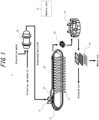
- FIG. 1 is a diagram schematically illustrating an example configuration of a sintering facility 1 according to an embodiment of the present disclosure.
- the sintering facility 1 is a facility capable of manufacturing sintered ore from sintering raw material that includes an iron-containing raw material and a carbon-containing raw material.
- the sintering facility 1 includes a control unit 10, a granulator 20, a sintering machine 30, a crusher 40, a cooler 50, and a sieving apparatus 60.
- the control unit 10 can communicate with the granulator 20, the sintering machine 30, the crusher 40, the cooler 50, and the sieving apparatus 60.
- the control unit 10 controls the granulator 20, the sintering machine 30, the crusher 40, the cooler 50, and the sieving apparatus 60.
- control unit 10 Details on the configuration and functions of the control unit 10 are described below.
- the granulator 20 produces granulated particles from sintering raw material that includes an iron-containing raw material and a carbon-containing raw material. When the granulator 20 produces granulated particles, granulation water is added to the sintering raw material.
- the sintering raw material may further include a calcium oxide (CaO)-containing raw material as a secondary material.
- the granulated particles produced by the granulator 20 are conveyed to the sintering machine 30.
- the granulator 20 may be any granulator capable of producing granulated particles, such as a drum mixer.
- the sintering machine 30 may be any sintering machine that sinters granulated particles, such as a Dwight-Lloyd sintering machine.
- the sintering machine 30 includes a sintering raw material supply apparatus 31, a pallet 32, an ignition furnace 33, and a wind box 34.
- the sintering raw material supply apparatus 31 charges the granulated particles supplied from the granulator 20 onto the pallet 32.
- the pallet 32 is an endless moving pallet.
- a raw material charging layer is formed on the pallet 32.
- the ignition furnace 33 ignites the carbon-containing raw material contained in the surface layer of the raw material charging layer formed on the pallet 32.
- the wind box 34 sucks air downward from the raw material charging layer formed on the pallet 32.
- the combustion and molten material in the raw material charging layer move downward in the raw material charging layer.
- Such movement of the combustion and molten material in the raw material charging layer causes the raw material charging layer to be sintered. As a result, a sinter cake is obtained from the raw material charging layer.
- the crusher 40 crushes the sinter cake supplied from the sintering machine 30.
- the crusher 40 supplies the crushed sinter cake to the cooler 50.
- the cooler 50 cools the crushed sinter cake supplied from the crusher 40.
- the crushed sinter cake, cooled by the cooler 50, is supplied to the sieving apparatus 60.
- the sieving apparatus 60 sieves the crushed sinter cake cooled by the cooler 50 according to the particle size of the crushed material. For example, the sieving apparatus 60 sieves the crushed sinter cake into sintered ore with a particle size of 5 mm or more and return ore with a particle size of less than 5 mm.
- Sintered ore is thus ultimately manufactured as a result of sieving by the sieving apparatus 60.
- the return ore sieved by the sieving apparatus 60 may be mixed with the sintering raw material and used again as a raw material for sintered ore.
- control unit 10 The configuration and functions of the control unit 10 are described next. First, an overview of the functions of the control unit 10 is provided.
- the control unit 10 acquires raw material information, which is information about the raw materials included in the sintering raw material supplied to the granulator 20.
- the control unit 10 acquires granulation conditions including information on the moisture content of the sintering raw material when the granulator 20 produces granulated particles from the sintering raw material.
- the control unit 10 estimates the granulation results for the granulated particles produced by the granulator 20 based on the acquired raw material information and granulation conditions.
- the granulation results estimated by the control unit 10 include the particle size of the granulated particles and the chemical composition at each particle size of the granulated particles.
- the control unit 10 acquires charging conditions for when the sintering raw material supply apparatus 31 charges the granulated particles onto the pallet 32 to form a raw material charging layer.
- control unit 10 estimates the particle size segregation and the component segregation of the granulated particles in the height direction of the raw material charging layer formed on the pallet 32.
- the control unit 10 estimates the sintering temperature and the exhaust gas temperature in the raw material charging layer based on the estimated particle size segregation and component segregation. In this case, the control unit 10 may estimate the sintering temperature and the exhaust gas temperature in the raw material charging layer based on only one of the particle size segregation and the component segregation, rather than on both. Furthermore, instead of estimating both the sintering temperature and the exhaust gas temperature in the raw material charging layer, the control unit 10 may estimate only one of the sintering temperature and the exhaust gas temperature in the raw material charging layer.
- control unit 10 The configuration of the control unit 10 is described next.
- FIG. 2 is a diagram schematically illustrating an example configuration of the control unit 10 according to an embodiment of the present disclosure.
- the control unit 10 may be a general-purpose computer, such as a workstation or personal computer, or may be a dedicated computer configured to function as the control unit 10 of the sintering facility 1.
- the control unit 10 includes a controller 11, an input interface 12, an output interface 13, a memory 14, and a communication interface 15.
- the controller 11 includes at least one processor, at least one dedicated circuit, or a combination thereof.
- the processor is a general-purpose processor such as a Central Processing Unit (CPU) or a Graphics Processing Unit (GPU), or a dedicated processor that is dedicated to specific processing.
- Examples of dedicated circuits can include a Field-Programmable Gate Array (FPGA) and an Application Specific Integrated Circuit (ASIC).
- the controller 11 reads programs, data, and the like stored in the memory 14 and executes various functions.
- the controller 11 controls the granulator 20, the sintering machine 30, the crusher 40, the cooler 50, and the sieving apparatus 60.
- the controller 11 can function as a raw material information acquisition interface 111, a granulation condition acquisition interface 112, a granulation result estimator 113, a charging condition acquisition interface 114, a charging result estimator 115, a firing result estimator 116, and a guidance information acquisition interface 117 by executing a program read from the memory 14.
- the processes performed by the raw material information acquisition interface 111, the granulation condition acquisition interface 112, the granulation result estimator 113, the charging condition acquisition interface 114, the charging result estimator 115, the firing result estimator 116, and the guidance information acquisition interface 117 are described below.
- the input interface 12 includes one or more interfaces for input to detect user input and acquire input information based on user operations.
- the input interface 12 includes a physical key, a capacitive key, a touch screen integrally provided with a display of the output interface 13, or a microphone that accepts voice input.
- the output interface 13 includes one or more interfaces for output to output information and notify the user.
- the output interface 13 includes a display for outputting information in the form of images or a speaker for outputting information in the form of audio.
- the display included in the output interface 13 may, for example, be a Liquid Crystal Display (LCD), a Cathode Ray Tube (CRT) display, or the like.
- the memory 14 is, for example, a flash memory, a hard disk, an optical memory, or the like.
- a portion of the memory 14 may be external to the control unit 10.
- the portion of the memory 14 may be a hard disk, a memory card, or the like connected to the control unit 10 by any interface.
- the memory 14 stores programs for the controller 11 to perform each function, data used by the programs, and the like.
- the communication interface 15 includes at least one of a communication module compatible with wired communication and a communication module compatible with wireless communication.
- the control unit 10 can communicate with other terminal apparatuses and the like via the communication interface 15.
- the raw material information acquisition interface 111 acquires raw material information, which is information about the raw materials included in the sintering raw material supplied to the granulator 20.
- the raw material information includes information on the particle size, the chemical composition, and the mixing ratio of each raw material included in the sintering raw material.
- the sintering raw material includes an iron-containing raw material, a CaO-containing raw material, and a carbon-containing raw material
- the raw material information includes information on the particle size, the chemical composition, and the mixing ratio for each of the iron-containing raw material, the CaO-containing raw material, and the carbon-containing raw material.
- the iron-containing raw material may, for example, be iron ore.
- the CaO-containing raw material may, for example, be limestone.
- the carbon-containing raw material may, for example, be coke breeze.
- the information on the particle size of each raw material may include information on the content ratio of each predetermined particle size classification.
- the information on the chemical composition of each raw material may, for example, include information on at least one of the carbon (C) concentration, the moisture concentration, the calcium oxide (CaO) concentration, and the aluminum oxide (Al 2 O 3 ) concentration.
- the raw material information acquisition interface 111 may acquire the raw material information via an input operation by an operator to the input interface 12. The operator can acquire the raw material information in advance by sieving, chemical analysis, or the like for each raw material. The raw material information acquisition interface 111 may also acquire the raw material information by receiving, via the communication interface 15, raw material information entered by the operator on another terminal apparatus.
- the raw material information acquisition interface 111 outputs the acquired raw material information to the granulation condition acquisition interface 112.
- the granulation condition acquisition interface 112 acquires information on granulation conditions including the moisture content of the sintering raw material when the granulator 20 produces granulated particles from the sintering raw material.
- the granulation condition acquisition interface 112 may acquire the granulation conditions from the granulator 20 or may acquire the granulation conditions via an input operation by an operator to the input interface 12.
- the moisture content of the sintering raw material when the granulator 20 produces granulated particles from the sintering raw material is determined from the moisture content of each raw material included in the sintering raw material and the amount of granulation water added to the granulator 20.
- the moisture content of each raw material can also, for example, be measured using an infrared moisture meter.
- the granulation conditions acquired by the granulation condition acquisition interface 112 may further include information on other conditions set when the granulator 20 produces granulated particles from the sintering raw material.
- the granulation conditions may further include information on the occupation, the rotational speed, and the residence time of the granulator 20.
- the granulation condition acquisition interface 112 outputs the granulation conditions, and the raw material information acquired from the raw material information acquisition interface 111, to the granulation result estimator 113.
- the granulation result estimator 113 estimates the granulation results for the granulated particles produced by the granulator 20 based on the raw material information and granulation conditions acquired from the granulation condition acquisition interface 112.
- the granulation results estimated by the control unit 10 include the particle size of the granulated particles and the chemical composition at each particle size of the granulated particles.
- the granulation result estimator 113 uses a granulation estimation model that includes a particle size estimation model and a component estimation model.
- the particle size estimation model and the component estimation model may be stored in the memory 14.
- the particle size estimation model is a trained machine learning model that takes, as input, the mixing ratio of each raw material included in the sintering raw material and the moisture content of the sintering raw material at the time of granulation and outputs the content of the granulated particles in one particle size classification among a plurality of particle size classifications yielded by classifying the particle size of the granulated particles.
- the granulation result estimator 113 can estimate the content of granulated particles in one particle size classification by inputting the mixing ratio of each raw material and the granulation conditions, including the moisture content of the sintering raw material at the time of granulation, into a particle size estimation model read from the memory 14.
- the content of granulated particles in one particle size classification is an example of the particle size of granulated particles.
- the particle size of granulated particles may be expressed by other indices.
- the particle size classification may, for example, have three levels. In the case of three levels, the particle size may, for example, be classified as over 8 mm, at least 2.8 mm and at most 8.0 mm, and less than 2.8 mm.
- the particle size classification is not limited to three levels, and classification into a greater number of levels may be adopted.
- the granulation result estimator 113 can repeat the same process for other particle size classifications to estimate the content of granulated particles in each particle size classification.
- the granulation result estimator 113 can then determine the particle size distribution of granulated particles by estimating the content of granulated particles in all particle size classifications.
- the component estimation model is a trained machine learning model that takes, as input, the mixing ratio of each raw material included in the sintering raw material and the moisture content of the sintering raw material at the time of granulation and outputs the content of a specific component of the granulated particles in one particle size classification among a plurality of particle size classifications yielded by classifying the particle size of the granulated particles.
- the granulation result estimator 113 can estimate the content of a specific component of the granulated particles in one particle size classification by inputting the mixing ratio of each raw material and the granulation conditions, including the moisture content of the sintering raw material at the time of granulation, into a component estimation model read from the memory 14.
- the granulation result estimator 113 can repeat the same process for other particle size classifications to estimate the content of the specific component of the granulated particles in each particle size classification.
- the granulation result estimator 113 can then determine the content of the specific component of the granulated particles by estimating the content of the specific component of the granulated particles in all particle size classifications.
- the granulation result estimator 113 outputs the estimated content of the granulated particles in each particle size classification and the content of a specific component of the granulated particles in each particle size classification to the charging result estimator 115.
- the particle size estimation model and the component estimation model may be generated in advance by machine learning using a large number of data sets each formed by inputted values and outputted actual values, and the models may be stored in the memory 14.
- the input to the particle size estimation model and the component estimation model may include the particle size of other raw materials.
- the input to the particle size estimation model and the component estimation model may include granulation conditions such as the rotational speed and residence time of the granulator 20.
- each parameter of the multiple regression model may be calculated in advance using a large number of data sets each formed by inputted values and outputted actual values, and the parameters may be stored in the memory 14.
- the particle size estimation model and the component estimation model may be updated by machine learning using later acquired data sets.
- each parameter of the multiple regression models may be updated using later acquired data sets.
- the charging condition acquisition interface 114 acquires charging conditions for when the sintering raw material supply apparatus 31 charges the granulated particles onto the pallet 32 to form a raw material charging layer.
- the charging condition acquisition interface 114 may acquire the charging conditions from the sintering machine 30 or may acquire the charging conditions via an input operation by an operator to the input interface 12.
- the charging conditions acquired by the charging condition acquisition interface 114 may, for example, include information on the speed of the pallet 32, the opening degree of a sub-gate included in the sintering raw material supply apparatus 31, and the angle of a chute included in the sintering raw material supply apparatus 31.
- the charging condition acquisition interface 114 outputs the acquired charging conditions to the charging result estimator 115.
- the memory 14 stores a table indicating, for each particle size distribution of the granulated particles and charging condition, the content ratio of the granulated particles of each particle size in each charging classification yielded by dividing the height direction of the raw material charging layer into a plurality of charging classifications.
- the table indicating the content ratio of the granulated particles of each particle size in each charging classification is an example of a charging estimation model.
- the charging result estimator 115 Upon acquiring the granulation results of the granulated particles from the granulation result estimator 113 and acquiring the charging conditions from the charging condition acquisition interface 114, the charging result estimator 115 reads, from the memory 14, the table that indicates the content ratio of the granulated particles of each particle size in each charging classification yielded by dividing the height of the raw material charging layer into a plurality of charging classifications, the table corresponding to the particle size distribution and charging conditions.
- the granulation results of the granulated particles as acquired from the granulation result estimator 113 refer to the content of the granulated particles in each particle size classification of the granulated particles and the content of a specific component of the granulated particles in each particle size classification of the granulated particles.
- the content ratio of the granulated particles of each particle size in each charging classification, yielded by dividing the height direction of the raw material charging layer into a plurality of charging classifications, can be calculated in advance for each charging classification by running a simulation that simulates the sintering raw material supply apparatus 31 of the sintering machine 30 using the Discrete Element Method (DEM).
- a table calculated in this manner may be stored in advance in the memory 14.
- the DEM is a method that calculates the force exerted on granulated particles when the granulated particles distributed in an estimated particle size distribution collide with each other and calculates the behavior of the granulated particles at each predetermined time interval over the analysis time based on the calculated force.
- the DEM in addition to the particle size distribution of the granulated particles, the speed of the pallet 32, the opening degree of the sub-gate included in the sintering raw material supply apparatus 31, and the angle of the chute included in the sintering raw material supply apparatus 31, the following are used as input information: the spring constant between the granulated particles, the spring constants in the tangential direction and normal direction between the granulated particles and wall elements (the pallet 32, chute, and granulator 20), and the friction coefficients (static friction and rolling friction) between the granulated particles and the wall elements.
- the opening degree of the sub-gate included in the sintering raw material supply apparatus 31, and the angle of the chute included in the sintering raw material supply apparatus 31 data from operations on actual equipment can be used.
- the various constants are set so that the experimental values of the angle of repose at a plurality of raw material mixtures and moisture contents are consistent with the values calculated by DEM.
- Granulated particles that have average particle size are the most numerous, and the number of granulated particles of a certain particle size decreases as that particle size is farther from the average particle size. Therefore, the particle size classification of the granulated particles may be narrowed in particle size classifications close to the average particle size. This can reduce the difference in the number of granulated particles included in each particle classification. Narrowing the overall scope of the particle size classification increases the calculation load, but narrowing only the scope of the particle size classification near the average particle size enables acquisition of more detailed charging data while suppressing an increase in calculation load.
- the charging result estimator 115 estimates the particle size segregation and the component segregation of the granulated particles in the height direction of the raw material charging layer formed on the pallet 32.
- the charging result estimator 115 estimates the particle size segregation of the granulated particles in the height direction of the raw material charging layer using the table indicating the content ratio of the granulated particles of each particle size in each charging classification. Since the chemical composition for each particle size of the granulated particles is estimated by the granulation result estimator 113, the charging result estimator 115 can estimate the component segregation of the granulated particles in the height direction of the raw material charging layer based on the particle size segregation of the granulated particles in the height direction of the raw material charging layer and the component composition of each particle size in each charging classification.
- the charging result estimator 115 may estimate the particle size segregation and the component segregation of the granulated particles in charging classifications divided not only in the height direction of the raw material charging layer but also in the width direction of the raw material charging layer.
- the table indicating the content ratio of the granulated particles of each particle size in each charging classification is an example of a charging estimation model.
- a trained machine learning model or a multiple regression model that takes, as input, the content, chemical composition, and charging conditions of the granulated particles of each particle size classification and outputs the content ratio of the granulated particles of each particle size in each charging classification may be used as a charging estimation model.
- the charging result estimator 115 outputs the estimated particle size segregation and component segregation of granulated particles in the height direction of the raw material charging layer to the firing result estimator 116.
- the firing result estimator 116 estimates the sintering temperature and the exhaust gas temperature in the raw material charging layer by utilizing a heat transfer model that calculates various physical equations based on the particle size segregation and the component segregation of granulated particles in the height direction of the raw material charging layer as acquired from the charging result estimator 115.
- the firing result estimator 116 may estimate the sintering temperature and the exhaust gas temperature in the raw material charging layer based on only one of the particle size segregation and the component segregation, rather than on both.
- the firing result estimator 116 may estimate only one of the sintering temperature and the exhaust gas temperature in the raw material charging layer.
- the firing result estimator 116 may, for example, estimate the sintering temperature and the exhaust gas temperature in the raw material charging layer using the heat transfer model disclosed in Reference 1 below.
- the information to be inputted into the heat transfer model may be the thickness of the raw material charging layer, the speed of the pallet 32, the temperature in the ignition furnace 33, the component concentration in the raw material charging layer, the void ratio in the raw material charging layer, and the exhaust gas flow rate.
- Setting values of the sintering machine 30 may be used for the thickness of the raw material charging layer, the speed of the pallet 32, and the temperature inside the ignition furnace 33.
- the component concentration in the raw material charging layer and the void ratio in the raw material charging layer may be calculated using the grain size segregation and the component segregation estimated by the charging result estimator 115.
- a value measured in the sintering machine 30 may be used for the exhaust gas flow rate. Since the temperature in the ignition furnace is determined by the gas flow rate in the ignition furnace 33, the gas flow rate in the ignition furnace 33 may be inputted to the heat transfer model instead of the temperature in the ignition furnace 33.
- the firing result estimator 116 can calculate the sintering temperature and the exhaust gas temperature at a predetermined position in the raw material charging layer at each set time increment.
- the time increment may, for example, be one second.
- the above-described heat transfer model is an example of a firing estimation model.
- a firing estimation model the physical model disclosed in Reference 2 below may be used.
- the firing result estimator 116 outputs at least one of the estimated sintering temperature and exhaust gas temperature to the guidance information acquisition interface 117.
- the guidance information acquisition interface 117 acquires guidance information including a setting value for setting at least one of the sintering temperature and the exhaust gas temperature as a target value.
- the guidance information may include at least one setting value from among the mixing ratio of the carbon-containing raw material, the particle size of the carbon-containing raw material, the mixing ratio of the CaO-containing raw material, the moisture content at the time of granulation, the occupation in the granulator 20, the rotational speed of the granulator 20, the thickness of the raw material charging layer, the speed of the pallet 32 included in the sintering machine 30, the sub-gate opening degree, the chute angle, and the temperature inside the ignition furnace 33 included in the sintering machine 30.
- the particle size of the carbon-containing raw material can be controlled by changing the throughput of a rod mill.
- the occupation in the granulator 20 can be controlled by changing the amount of sintering raw material conveyed to the granulator 20.
- the temperature inside the ignition furnace 33 can be controlled by changing the gas flow rate and the air-fuel ratio in the ignition furnace 33.
- the target value for at least one of the sintering temperature and the exhaust gas temperature is determined on the condition that the quality of the sintered ore manufactured by the sintering facility 1 satisfies a target sintered ore quality.
- a yield estimation model quality estimation model
- a yield estimation model that takes at least one of the sintering temperature and the exhaust gas temperature as input and that outputs the yield of sintered ore is constructed, and various sintering temperatures and exhaust gas temperatures are inputted to the yield estimation model. It is determined whether the outputted yield of the sintered ore exceeds the target value, and if so, the sintering temperature and the exhaust gas temperature that were inputted at that time are identified as the target values.
- a trained machine learning model or multiple regression model may be used as the yield estimation model.
- the yield of the sintered ore is an example of the quality of the sintered ore.
- the yield of the sintered ore may, for example, be a value calculated by Equation (1) below. (mass of sintered ore with a particle size of 5 mm or more ⁇ 100)/(mass of sintered ore with a particle size of 5 mm or more + mass of return ore with a particle size of less than 5 mm)
- the strength of the sintered ore, the reducibility of the sintered ore, or the like may be used instead of the yield of the sintered ore as the quality of the sintered ore.
- the guidance information acquisition interface 117 Upon identifying the target value of at least one of the sintering temperature and the exhaust gas temperature, the guidance information acquisition interface 117 back-calculates the firing estimation model, the charging estimation model, and the granulation estimation model to acquire at least one setting value that can achieve at least one of the target values of the sintering temperature and the exhaust gas temperature, from among the mixing ratio of the carbon-containing raw material, the particle size of the carbon-containing raw material, the mixing ratio of the CaO-containing raw material, the moisture content at the time of granulation, the occupation in the granulator 20, the rotational speed of the granulator 20, the thickness of the raw material charging layer, the speed of the pallet 32 included in the sintering machine 30, the sub-gate opening degree, the chute angle, and the temperature inside the ignition furnace 33 included in the sintering machine 30.
- the guidance information acquisition interface 117 Upon acquiring at least one setting value from among the mixing ratio of the carbon-containing raw material, the particle size of the carbon-containing raw material, the mixing ratio of the CaO-containing raw material, the moisture content at the time of granulation, the occupation in the granulator 20, the rotational speed of the granulator 20, the thickness of the raw material charging layer, the speed of the pallet 32 included in the sintering machine 30, the sub-gate opening degree, the chute angle, and the temperature inside the ignition furnace 33 included in the sintering machine 30, the guidance information acquisition interface 117 outputs the acquired setting value to the output interface 13.
- the output interface 13 outputs the setting value acquired from the guidance information acquisition interface 117. For example, in a case in which the output interface 13 includes a display, the output interface 13 displays the setting value acquired from the guidance information acquisition interface 117 on the display.
- the operator having viewed the setting value displayed on the display, can adjust the setting value and operate the sintering facility 1 to manufacture sintered ore at the target sintering temperature and exhaust gas temperature.
- the guidance information acquisition interface 117 may automatically set the calculated setting values as the setting values for operating the sintering facility 1. This enables the sintering facility 1 to automatically manufacture sintered ore with the target sintering temperature and exhaust gas temperature.
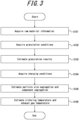
- step S101 the controller 11 of the control unit 10 acquires raw material information including information on the particle size, the chemical composition, and the mixing ratio of each raw material included in the sintering raw material.
- step S102 the controller 11 acquires granulation conditions including information on the moisture content of the sintering raw material when the granulator 20 produces granulated particles from the sintering raw material.
- step S103 the controller 11 estimates granulation results including the particle size of the granulated particles and the chemical composition at each particle size of the granulated particles based on the acquired raw material information and granulation conditions.
- step S104 the controller 11 acquires charging conditions for when the granulated particles are charged into the sintering machine 30 to form a raw material charging layer.
- step S105 based on the estimated granulation results and the acquired charging conditions, the controller 11 estimates the particle size segregation and the component segregation of the granulated particles in the height direction of the raw material charging layer.
- step S106 the controller 11 estimates at least one of the sintering temperature and the exhaust gas temperature in the raw material charging layer based on at least one of the estimated particle size segregation and component segregation.
- the controller 11 may output the estimated sintering temperature and exhaust gas temperature to the output interface 13 for display by the output interface 13.
- FIGS. 4 to 8 Examples of the method for managing operation of the sintering machine 30 in the sintering facility 1 according to the present embodiment are described.
- FIG. 4 is a table illustrating actual values of the particle size distribution of granulated particles and the carbon concentration for each particle size when granulated particles were manufactured under various conditions.
- FIG. 4 illustrates the mixing ratio, coke breeze particle size, and moisture content as conditions.
- the particle size distribution of the granulated particles and the carbon concentration for each particle size are also illustrated as actual values.
- the raw material A is iron ore from South America.
- the raw material B is a different brand of iron ore from South America than the raw material A.
- the raw material C is iron ore from Australia.
- coke breeze particle size “-2 mm” indicates the percentage of coke breeze with a diameter of less than 2 mm, and “-1 mm” indicates the percentage of coke breeze with a diameter of less than 1 mm.
- particle size distribution for granulated particles "+8.0” indicates the percentage of granulated particles with a diameter greater than 8.0 mm.
- the range "2.8 - 8.0” indicates the percentage of granulated particles with a diameter of at least 2.8 mm and at most 8.0 mm, and "-2.8” indicates the percentage of granulated particles with a diameter of less than 2.8 mm.
- “+8.0” indicates the concentration of carbon with a diameter greater than 8.0 mm.
- the range "2.8 - 8.0” indicates the concentration of carbon with a diameter of at least 2.8 mm and at most 8.0 mm, and "-2.8” indicates the concentration of carbon with a diameter of less than 2.8 mm.
- a particle size estimation model and a component estimation model were generated using the actual values illustrated in FIG. 4 , and these models were used to estimate the content of granulated particles in each particle size classification and the carbon concentration for each particle size. In this case, two types of estimations were made, one using a machine learning model and the other using a multiple regression model.
- a particle size estimation model and a component estimation model were used for estimation.
- a model that takes, as inputs, the particle size of coke breeze, the mixing ratio of the sintering raw material, and the moisture content during granulation and that outputs the content of granulated particles in each particle size classification was used.
- a model that takes, as inputs, the particle size of coke breeze, the mixing ratio of the sintering raw material, and the moisture content during granulation and that outputs the carbon concentration for each particle size was used.
- the particle size estimation model was a model in which the particle size of coke breeze, the mixing ratio of the sintering raw material, and the moisture content during granulation are the explanatory variables and the content of granulated particles in each particle size classification is the objective variable.
- the component estimation model was a model in which the particle size of coke breeze, the mixing ratio of the sintering raw material, and the moisture content during granulation are the explanatory variables and the carbon concentration for each particle size is the objective variable.
- FIG. 5 is a table illustrating the correlation coefficients between the estimated values and actual values in the cases of estimation using a machine learning model and estimation using a multiple regression model.
- the correlation coefficients for the case of using a neural network and the correlation coefficients for the case of using a Classification and Regression Tree (C&R) Tree are illustrated.
- the correlation coefficients are high for all models, confirming that the control unit 10 can estimate the particle size of granulated particles and the component concentration of a specific component for each particle size with high accuracy.
- a comparison between the correlation coefficients in the case of using a machine learning model with the correlation coefficients in the case of using a multiple regression model indicates that the correlation coefficients in the case of using a machine learning model were generally larger, confirming that the use of machine learning enables estimation of the particle size of granulated particles and the carbon concentration for each particle size with higher accuracy.
- FIG. 6 is a diagram illustrating an example of a charging estimation model.
- the charging estimation model is a table indicating the content ratio of the granulated particles of each particle size in each charging classification.
- FIG. 6 illustrates the content ratio of granulated particles of each particle size in each charging classification of the raw material charging layer.
- the particle sizes of the granulated particles are indicated by three classifications, "+8.0", “2.8 to 8.0", and “-2.8", where "+8.0” indicates that the particle size of the granulated particles is greater than 8.0 mm, "2.8 to 8.0” indicates that the particle size of the granulated particles is at least 2.8 mm and at most 8.0 mm, and "-2.8” indicates that the particle size of the granulated particles is less than 2.8 mm.
- the table illustrated in FIG. 6 is generated by performing DEM simulations for each particle size distribution and charging condition of granulated particles.
- the generated table indicating the content ratio of the granulated particles of each particle size in each charging classification is stored in the memory 14.
- FIG. 7 is a graph illustrating the correlation between calculated yield and actual yield. As illustrated in FIG. 7 , the correlation between the calculated yield and the actual yield was higher when the maximum exhaust gas temperature position obtained from the heat transfer model was used in the calculation than when estimating using the void ratio in the raw material charging layer. The results confirm that the use of the maximum exhaust gas temperature position, which directly affects sintering, enables estimation of the yield of sintered ore more accurately than use of the void ratio in the raw material charging layer, which does not directly affect sintering.
- the maximum exhaust gas temperature position was adjusted by adjusting the speed of the pallet 32, the thickness of the raw material charging layer, the mixing ratio of coke breeze, and the amount of granulation water added.
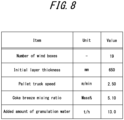
- FIG. 8 illustrates the specifications of the sintering machine 30 used to calculate the maximum exhaust gas temperature position.
- the target value of the maximum exhaust gas temperature position at which the yield of the sintered ore can meet or exceed the target is 18.0
- the maximum exhaust gas temperature position estimated using the granulation estimation model, the charging estimation model, and the sintering estimation model was 18.9.
- the firing estimation model was back-calculated to calculate the speed of the pallet 32 for bringing the maximum exhaust gas temperature position to the target value of 18.0.
- 2.46 m/min was calculated as the setting value of the speed of the pallet 32.
- the maximum exhaust gas temperature position went from 18.9 to 18.1. It was thus confirmed that the maximum exhaust gas temperature position could be brought closer to the target value of 18.0.
- determining the setting value for the added amount of granulation water is synonymous with determining the setting value for the moisture content at the time of granulation.
- the mixing ratio of coke breeze and the added amount of granulation water that would allow the maximum exhaust gas temperature position to reach the target value of 18.0 were calculated to be 5.18 mass% and 13.7 t/h, respectively.
- the control unit 10 acquires raw material information including the particle size, the chemical composition, and the mixing ratio of each raw material included in the sintering raw material, acquires granulation conditions including the moisture content of the sintering raw material when granulated particles are produced from the sintering raw material, estimates granulation results including the particle size of the granulated particles and the chemical composition at each particle size of the granulated particles based on the raw material information and the granulation conditions, acquires charging conditions for when the granulated particles are charged into the sintering machine 30 to form a raw material charging layer, estimates charging results by estimating the particle size segregation and the component segregation of the granulated particles in the height direction of the raw material charging layer based on the granulation results and the charging conditions, and estimates sintering results by estimating at least one of a sintering temperature and an exhaust gas temperature
- control unit 10 can estimate data directly related to the quality of the sintering machine 30, i.e., the sintering temperature and the exhaust gas temperature in the raw material charging layer. Therefore, since there is no need to actually measure the sintering temperature and the exhaust gas temperature in the raw material charging layer, the equipment of the sintering machine 30 need not be significantly modified.
- the method for managing operation of the sintering machine 30 according to the present embodiment and the control unit 10 according to the present embodiment can therefore easily estimate data directly related to the quality of sintered ore.
- the guidance information acquisition interface 117 can acquire guidance information including a setting value for setting at least one of the sintering temperature and the exhaust gas temperature as a target value.
- Sintered ore satisfying the target quality can be manufactured by adjusting the manufacturing conditions of sintered ore by the sintering facility 1 based on the guidance information acquired by the guidance information acquisition interface 117.
- the method of managing operation of the sintering machine 30 according to the present embodiment can acquire guidance information and adjust the manufacturing conditions of sintered ore based on the guidance information, thereby enabling more rapid adjustment. Furthermore, the method for managing operation of the sintering machine 30 according to the present embodiment can estimate the yield with high accuracy, since the yield can be estimated by considering the sintering temperature and the exhaust gas temperature, which are factors that directly affect the quality of the sintered ore. As the accuracy of the yield estimation increases, the accuracy of the guidance information increases accordingly. Adjustments to the manufacturing conditions of sintered ore based on the guidance information can thus be made with higher accuracy. In this way, high-quality sintered ore can be manufactured by manufacturing sintered ore under manufacturing conditions adjusted based on the guidance information.
- the present disclosure is not limited to the embodiments described above.
- a plurality of blocks described in the block diagrams may be integrated, or a block may be divided.
- the plurality of steps may be executed in parallel or in a different order according to the processing capability of the apparatus that executes each step, or as required.
- Other modifications can be made without departing from the spirit of the present disclosure.
- the sintering raw material includes an iron-containing raw material, a CaO-containing raw material, and a carbon-containing raw material
- This configuration is not limiting, however.
- the sintering raw material need only include an iron-containing raw material and a carbon-containing raw material and need not include a CaO-containing raw material.
- the sintering raw material does include an iron-containing raw material, a CaO-containing raw material, and a carbon-containing raw material.
- the controller 11 has the function of the guidance information acquisition interface 117.
- This configuration is not limiting, however, and the controller 11 need not have the function of the guidance information acquisition interface 117.
- the controller 11 if the controller 11 has the function of the guidance information acquisition interface 117, it will be easier to manufacture sintered ore that satisfies the target quality.
- the controller 11 preferably has the function of the guidance information acquisition interface 117.
Landscapes
- Engineering & Computer Science (AREA)
- Chemical & Material Sciences (AREA)
- Business, Economics & Management (AREA)
- Manufacturing & Machinery (AREA)
- Human Resources & Organizations (AREA)
- Geochemistry & Mineralogy (AREA)
- Life Sciences & Earth Sciences (AREA)
- Organic Chemistry (AREA)
- Strategic Management (AREA)
- Metallurgy (AREA)
- Mechanical Engineering (AREA)
- Materials Engineering (AREA)
- Geology (AREA)
- Economics (AREA)
- General Life Sciences & Earth Sciences (AREA)
- Environmental & Geological Engineering (AREA)
- Tourism & Hospitality (AREA)
- General Physics & Mathematics (AREA)
- Marketing (AREA)
- Physics & Mathematics (AREA)
- General Business, Economics & Management (AREA)
- Theoretical Computer Science (AREA)
- Primary Health Care (AREA)
- General Health & Medical Sciences (AREA)
- Health & Medical Sciences (AREA)
- Entrepreneurship & Innovation (AREA)
- Educational Administration (AREA)
- Development Economics (AREA)
- Quality & Reliability (AREA)
- Operations Research (AREA)
- Game Theory and Decision Science (AREA)
- Manufacture And Refinement Of Metals (AREA)
Abstract
Description
- The present disclosure relates to a method for managing operation of a sintering machine, a method for manufacturing sintered ore, and a control unit.
- Conventionally, in management of the operation of a sintering machine that manufactures sintered ore, the operation of the sintering machine is often managed by an operator performing various operations based on data acquired by various sensors.
- However, not all of the data on factors that affect the productivity and quality of sintered ore can be acquired by the various sensors. Such data that cannot be acquired is estimated based on other data that can be acquired, and operation of the sintering machine is managed based on the estimated data.
- Patent Literature (PTL) 1 discloses a method for estimating the particle size distribution of raw material in the height direction in a sintering raw material layer.
PTL 2 discloses a method for estimating the intra-layer temperature of the sintering layer, which is directly related to the quality of the sintered ore, based on various physical formulas.PTL 3 discloses the use of the intra-layer temperature of the sintering layer, which is directly related to the quality of the sintered ore, to manage the operation of the sintering machine.PTL 4 discloses technology for improving the prediction accuracy of values representing a predetermined state in the manufacturing process. -
- PTL 1:
JP 2020-12185 A - PTL 2:
JP 6527306 B - PTL 3:
JP 5729251 B - PTL 4:
JP 2019-87152 A - The particle size distribution of the raw material in the height direction in the sintering raw material layer, as estimated by the method disclosed in
PTL 1, is not data directly related to the quality of the sintered ore. - The method disclosed in
PTL 2 uses the ignition temperature of coke and the void ratio of the sintering layer as input data for estimating the intra-layer temperature of the sintering layer, but these data are difficult to measure. Furthermore,PTL 2 does not disclose how to acquire these difficult-to-measure data. - The method disclosed in
PTL 3 actually measures the intra-layer temperature of the sintering layer. In order to measure the intra-layer temperature of the sintering layer, significant modifications to the sintered ore manufacturing facility are required, and a long period for modification construction is needed to make the modifications. - The method disclosed in
PTL 4 improves accuracy by machine learning using actual manufacturing conditions and actual target variables in predicting values that represent predetermined conditions in the manufacturing process as objective variables. However, in a case in which the manufacturing process is an aggregate of a plurality of processes, manufacturing conditions that have no effect whatsoever on changes in the objective variables are also learned, which may lead to false correlations or the like. In addition, although machine learning is superior in responsiveness and accuracy, a system based solely on machine learning cannot be used when using raw materials and methods with no performance data. - It is an aim of the present disclosure to provide a method for managing operation of a sintering machine, a method for manufacturing sintered ore, and a control unit that can easily estimate data directly related to the quality of sintered ore.
- A method for managing operation of a sintering machine according to an embodiment of the present disclosure is
a method for managing operation of a sintering machine that sinters granulated particles produced by adding water to a sintering raw material including an iron-containing raw material and a carbon-containing raw material, the method including: - acquiring raw material information including a particle size, a chemical composition, and a mixing ratio of each raw material included in the sintering raw material;
- acquiring granulation conditions including a moisture content of the sintering raw material when the granulated particles are produced from the sintering raw material;
- estimating granulation results including a particle size of the granulated particles and a chemical composition at each particle size of the granulated particles, based on the raw material information and the granulation conditions, using a granulation estimation model that includes a particle size estimation model that takes, as input, the particle size of the carbon-containing raw material, the mixing ratio of each raw material included in the sintering raw material, and the moisture content, and outputs a content of the granulated particles in one particle size classification among a plurality of particle size classifications yielded by classifying the particle size of the granulated particles, and a component estimation model that takes, as input, the particle size of the carbon-containing raw material, the mixing ratio of each raw material included in the sintering raw material, and the moisture content, and outputs a content of a specific component of the granulated particles in one particle size classification among a plurality of particle size classifications yielded by classifying the particle size of the granulated particles;
- acquiring charging conditions for when the granulated particles are charged into the sintering machine to form a raw material charging layer;
- estimating charging results by estimating a particle size segregation and a component segregation of the granulated particles in a height direction of the raw material charging layer, based on the granulation results and the charging conditions, using a charging estimation model that indicates a content ratio of the granulated particles of each particle size in each charging classification yielded by dividing the height direction of the raw material charging layer into a plurality of charging classifications; and
- estimating sintering results by estimating at least one of a sintering temperature and an exhaust gas temperature in the raw material charging layer, based on at least one of the particle size segregation and the component segregation, using a firing estimation model that includes a heat transfer model capable of calculating a sintering temperature at a predetermined position in the raw material charging layer.
- A method for manufacturing sintered ore according to an embodiment of the present disclosure includes manufacturing sintered ore using the aforementioned method for managing operation of a sintering machine.
- A control unit according to an embodiment of the present disclosure is
a control unit for controlling a sintering machine that sinters granulated particles produced by adding water to a sintering raw material including an iron-containing raw material and a carbon-containing raw material, the control unit including: - a raw material information acquisition interface configured to acquire raw material information including a particle size, a chemical composition, and a mixing ratio of each raw material included in the sintering raw material;
- a granulation condition acquisition interface configured to acquire granulation conditions including a moisture content of the sintering raw material when the granulated particles are produced from the sintering raw material;
- a granulation result estimator configured to estimate granulation results including a particle size of the granulated particles and a chemical composition at each particle size of the granulated particles, based on the raw material information and the granulation conditions, using a granulation estimation model that includes a particle size estimation model that takes, as input, the particle size of the carbon-containing raw material, the mixing ratio of each raw material included in the sintering raw material, and the moisture content, and outputs a content of the granulated particles in one particle size classification among a plurality of particle size classifications yielded by classifying the particle size of the granulated particles, and a component estimation model that takes, as input, the particle size of the carbon-containing raw material, the mixing ratio of each raw material included in the sintering raw material, and the moisture content, and outputs a content of a specific component of the granulated particles in one particle size classification among a plurality of particle size classifications yielded by classifying the particle size of the granulated particles;
- a charging condition acquisition interface configured to acquire charging conditions for when the granulated particles are charged into the sintering machine to form a raw material charging layer;
- a charging result estimator configured to estimate charging results by estimating a particle size segregation and a component segregation of the granulated particles in a height direction of the raw material charging layer, based on the granulation results and the charging conditions, using a charging estimation model that indicates a content ratio of the granulated particles of each particle size in each charging classification yielded by dividing the height direction of the raw material charging layer into a plurality of charging classifications; and
- a firing result estimator configured to estimate at least one of a sintering temperature and an exhaust gas temperature in the raw material charging layer, based on at least one of the particle size segregation and the component segregation, using a firing estimation model that includes a heat transfer model capable of calculating a sintering temperature at a predetermined position in the raw material charging layer.
- The method for managing operation of a sintering machine, the method for manufacturing sintered ore, and the control unit according to the present disclosure can easily estimate data directly related to the quality of sintered ore.
- In the accompanying drawings:
-
FIG. 1 is a diagram schematically illustrating an example configuration of a sintering facility according to an embodiment of the present disclosure; -
FIG. 2 is a diagram schematically illustrating an example configuration of a control unit according to an embodiment of the present disclosure; -
FIG. 3 is a flowchart illustrating an example of procedures in a method for managing operation of a sintering machine according to an embodiment of the present disclosure; -
FIG. 4 is a diagram illustrating the particle size distribution of granulated particles and the actual values of the carbon concentration at each particle size in the Examples; -
FIG. 5 is a diagram illustrating the correlation between actual values and estimated values in the Examples; -
FIG. 6 is a diagram illustrating an example of a charging estimation model in the Examples; -
FIG. 7 is a graph illustrating the correlation between calculated yield and actual yield in the Examples; and -
FIG. 8 is a diagram illustrating the specifications of a sintering machine in the Examples. - Embodiments of the present disclosure will be described below, with reference to the drawings.
-
FIG. 1 is a diagram schematically illustrating an example configuration of asintering facility 1 according to an embodiment of the present disclosure. Thesintering facility 1 is a facility capable of manufacturing sintered ore from sintering raw material that includes an iron-containing raw material and a carbon-containing raw material. - The
sintering facility 1 includes acontrol unit 10, agranulator 20, a sinteringmachine 30, acrusher 40, a cooler 50, and asieving apparatus 60. - The
control unit 10 can communicate with thegranulator 20, the sinteringmachine 30, thecrusher 40, the cooler 50, and the sievingapparatus 60. Thecontrol unit 10 controls thegranulator 20, the sinteringmachine 30, thecrusher 40, the cooler 50, and the sievingapparatus 60. - Details on the configuration and functions of the
control unit 10 are described below. - The
granulator 20 produces granulated particles from sintering raw material that includes an iron-containing raw material and a carbon-containing raw material. When thegranulator 20 produces granulated particles, granulation water is added to the sintering raw material. The sintering raw material may further include a calcium oxide (CaO)-containing raw material as a secondary material. The granulated particles produced by thegranulator 20 are conveyed to thesintering machine 30. - The
granulator 20 may be any granulator capable of producing granulated particles, such as a drum mixer. - The sintering
machine 30 may be any sintering machine that sinters granulated particles, such as a Dwight-Lloyd sintering machine. The sinteringmachine 30 includes a sintering rawmaterial supply apparatus 31, apallet 32, anignition furnace 33, and awind box 34. - The sintering raw
material supply apparatus 31 charges the granulated particles supplied from thegranulator 20 onto thepallet 32. - The
pallet 32 is an endless moving pallet. When thepallet 32 is charged with granulated particles from the sintering rawmaterial supply apparatus 31, a raw material charging layer is formed on thepallet 32. - The
ignition furnace 33 ignites the carbon-containing raw material contained in the surface layer of the raw material charging layer formed on thepallet 32. - The
wind box 34 sucks air downward from the raw material charging layer formed on thepallet 32. When the air on the raw material charging layer is sucked downward by thewind box 34, the combustion and molten material in the raw material charging layer move downward in the raw material charging layer. Such movement of the combustion and molten material in the raw material charging layer causes the raw material charging layer to be sintered. As a result, a sinter cake is obtained from the raw material charging layer. - The
crusher 40 crushes the sinter cake supplied from the sinteringmachine 30. Thecrusher 40 supplies the crushed sinter cake to the cooler 50. - The cooler 50 cools the crushed sinter cake supplied from the
crusher 40. The crushed sinter cake, cooled by the cooler 50, is supplied to thesieving apparatus 60. - The sieving
apparatus 60 sieves the crushed sinter cake cooled by the cooler 50 according to the particle size of the crushed material. For example, the sievingapparatus 60 sieves the crushed sinter cake into sintered ore with a particle size of 5 mm or more and return ore with a particle size of less than 5 mm. - Sintered ore is thus ultimately manufactured as a result of sieving by the sieving
apparatus 60. The return ore sieved by the sievingapparatus 60 may be mixed with the sintering raw material and used again as a raw material for sintered ore. - The configuration and functions of the
control unit 10 are described next. First, an overview of the functions of thecontrol unit 10 is provided. - The
control unit 10 acquires raw material information, which is information about the raw materials included in the sintering raw material supplied to thegranulator 20. - The
control unit 10 acquires granulation conditions including information on the moisture content of the sintering raw material when thegranulator 20 produces granulated particles from the sintering raw material. - The
control unit 10 estimates the granulation results for the granulated particles produced by thegranulator 20 based on the acquired raw material information and granulation conditions. The granulation results estimated by thecontrol unit 10 include the particle size of the granulated particles and the chemical composition at each particle size of the granulated particles. - The
control unit 10 acquires charging conditions for when the sintering rawmaterial supply apparatus 31 charges the granulated particles onto thepallet 32 to form a raw material charging layer. - Based on the estimated granulation results and the acquired charging conditions, the
control unit 10 estimates the particle size segregation and the component segregation of the granulated particles in the height direction of the raw material charging layer formed on thepallet 32. - The
control unit 10 estimates the sintering temperature and the exhaust gas temperature in the raw material charging layer based on the estimated particle size segregation and component segregation. In this case, thecontrol unit 10 may estimate the sintering temperature and the exhaust gas temperature in the raw material charging layer based on only one of the particle size segregation and the component segregation, rather than on both. Furthermore, instead of estimating both the sintering temperature and the exhaust gas temperature in the raw material charging layer, thecontrol unit 10 may estimate only one of the sintering temperature and the exhaust gas temperature in the raw material charging layer. - The configuration of the
control unit 10 is described next. -
FIG. 2 is a diagram schematically illustrating an example configuration of thecontrol unit 10 according to an embodiment of the present disclosure. Thecontrol unit 10 may be a general-purpose computer, such as a workstation or personal computer, or may be a dedicated computer configured to function as thecontrol unit 10 of thesintering facility 1. - The
control unit 10 includes acontroller 11, aninput interface 12, anoutput interface 13, amemory 14, and acommunication interface 15. - The
controller 11 includes at least one processor, at least one dedicated circuit, or a combination thereof. The processor is a general-purpose processor such as a Central Processing Unit (CPU) or a Graphics Processing Unit (GPU), or a dedicated processor that is dedicated to specific processing. Examples of dedicated circuits can include a Field-Programmable Gate Array (FPGA) and an Application Specific Integrated Circuit (ASIC). - The
controller 11 reads programs, data, and the like stored in thememory 14 and executes various functions. Thecontroller 11 controls thegranulator 20, the sinteringmachine 30, thecrusher 40, the cooler 50, and the sievingapparatus 60. - The
controller 11 can function as a raw materialinformation acquisition interface 111, a granulationcondition acquisition interface 112, agranulation result estimator 113, a chargingcondition acquisition interface 114, a chargingresult estimator 115, a firingresult estimator 116, and a guidanceinformation acquisition interface 117 by executing a program read from thememory 14. - The processes performed by the raw material
information acquisition interface 111, the granulationcondition acquisition interface 112, thegranulation result estimator 113, the chargingcondition acquisition interface 114, the chargingresult estimator 115, the firingresult estimator 116, and the guidanceinformation acquisition interface 117 are described below. - The
input interface 12 includes one or more interfaces for input to detect user input and acquire input information based on user operations. For example, theinput interface 12 includes a physical key, a capacitive key, a touch screen integrally provided with a display of theoutput interface 13, or a microphone that accepts voice input. - The
output interface 13 includes one or more interfaces for output to output information and notify the user. For example, theoutput interface 13 includes a display for outputting information in the form of images or a speaker for outputting information in the form of audio. The display included in theoutput interface 13 may, for example, be a Liquid Crystal Display (LCD), a Cathode Ray Tube (CRT) display, or the like. - The
memory 14 is, for example, a flash memory, a hard disk, an optical memory, or the like. A portion of thememory 14 may be external to thecontrol unit 10. In this case, the portion of thememory 14 may be a hard disk, a memory card, or the like connected to thecontrol unit 10 by any interface. - The
memory 14 stores programs for thecontroller 11 to perform each function, data used by the programs, and the like. - The
communication interface 15 includes at least one of a communication module compatible with wired communication and a communication module compatible with wireless communication. Thecontrol unit 10 can communicate with other terminal apparatuses and the like via thecommunication interface 15. - Next, the processes performed by the raw material
information acquisition interface 111, the granulationcondition acquisition interface 112, thegranulation result estimator 113, the chargingcondition acquisition interface 114, the chargingresult estimator 115, the firingresult estimator 116, and the guidanceinformation acquisition interface 117 are described. - The raw material
information acquisition interface 111 acquires raw material information, which is information about the raw materials included in the sintering raw material supplied to thegranulator 20. The raw material information includes information on the particle size, the chemical composition, and the mixing ratio of each raw material included in the sintering raw material. For example, in a case in which the sintering raw material includes an iron-containing raw material, a CaO-containing raw material, and a carbon-containing raw material, the raw material information includes information on the particle size, the chemical composition, and the mixing ratio for each of the iron-containing raw material, the CaO-containing raw material, and the carbon-containing raw material. The iron-containing raw material may, for example, be iron ore. The CaO-containing raw material may, for example, be limestone. The carbon-containing raw material may, for example, be coke breeze. - The information on the particle size of each raw material may include information on the content ratio of each predetermined particle size classification. The information on the chemical composition of each raw material may, for example, include information on at least one of the carbon (C) concentration, the moisture concentration, the calcium oxide (CaO) concentration, and the aluminum oxide (Al2O3) concentration.
- The raw material
information acquisition interface 111 may acquire the raw material information via an input operation by an operator to theinput interface 12. The operator can acquire the raw material information in advance by sieving, chemical analysis, or the like for each raw material. The raw materialinformation acquisition interface 111 may also acquire the raw material information by receiving, via thecommunication interface 15, raw material information entered by the operator on another terminal apparatus. - The raw material
information acquisition interface 111 outputs the acquired raw material information to the granulationcondition acquisition interface 112. - The granulation
condition acquisition interface 112 acquires information on granulation conditions including the moisture content of the sintering raw material when thegranulator 20 produces granulated particles from the sintering raw material. The granulationcondition acquisition interface 112 may acquire the granulation conditions from thegranulator 20 or may acquire the granulation conditions via an input operation by an operator to theinput interface 12. The moisture content of the sintering raw material when thegranulator 20 produces granulated particles from the sintering raw material is determined from the moisture content of each raw material included in the sintering raw material and the amount of granulation water added to thegranulator 20. The moisture content of each raw material can also, for example, be measured using an infrared moisture meter. - It suffices for the granulation conditions acquired by the granulation
condition acquisition interface 112 to include information on the moisture content of the sintering raw material when thegranulator 20 produces granulated particles from the sintering raw material, but the granulation conditions may further include information on other conditions set when thegranulator 20 produces granulated particles from the sintering raw material. For example, the granulation conditions may further include information on the occupation, the rotational speed, and the residence time of thegranulator 20. - The granulation
condition acquisition interface 112 outputs the granulation conditions, and the raw material information acquired from the raw materialinformation acquisition interface 111, to thegranulation result estimator 113. - The
granulation result estimator 113 estimates the granulation results for the granulated particles produced by thegranulator 20 based on the raw material information and granulation conditions acquired from the granulationcondition acquisition interface 112. The granulation results estimated by thecontrol unit 10 include the particle size of the granulated particles and the chemical composition at each particle size of the granulated particles. - When estimating the granulation results, the
granulation result estimator 113 uses a granulation estimation model that includes a particle size estimation model and a component estimation model. The particle size estimation model and the component estimation model may be stored in thememory 14. - The particle size estimation model is a trained machine learning model that takes, as input, the mixing ratio of each raw material included in the sintering raw material and the moisture content of the sintering raw material at the time of granulation and outputs the content of the granulated particles in one particle size classification among a plurality of particle size classifications yielded by classifying the particle size of the granulated particles.
- The
granulation result estimator 113 can estimate the content of granulated particles in one particle size classification by inputting the mixing ratio of each raw material and the granulation conditions, including the moisture content of the sintering raw material at the time of granulation, into a particle size estimation model read from thememory 14. - The content of granulated particles in one particle size classification is an example of the particle size of granulated particles. The particle size of granulated particles may be expressed by other indices.
- The particle size classification may, for example, have three levels. In the case of three levels, the particle size may, for example, be classified as over 8 mm, at least 2.8 mm and at most 8.0 mm, and less than 2.8 mm. The particle size classification is not limited to three levels, and classification into a greater number of levels may be adopted.
- The
granulation result estimator 113 can repeat the same process for other particle size classifications to estimate the content of granulated particles in each particle size classification. Thegranulation result estimator 113 can then determine the particle size distribution of granulated particles by estimating the content of granulated particles in all particle size classifications. - The component estimation model is a trained machine learning model that takes, as input, the mixing ratio of each raw material included in the sintering raw material and the moisture content of the sintering raw material at the time of granulation and outputs the content of a specific component of the granulated particles in one particle size classification among a plurality of particle size classifications yielded by classifying the particle size of the granulated particles.
- The
granulation result estimator 113 can estimate the content of a specific component of the granulated particles in one particle size classification by inputting the mixing ratio of each raw material and the granulation conditions, including the moisture content of the sintering raw material at the time of granulation, into a component estimation model read from thememory 14. - The
granulation result estimator 113 can repeat the same process for other particle size classifications to estimate the content of the specific component of the granulated particles in each particle size classification. Thegranulation result estimator 113 can then determine the content of the specific component of the granulated particles by estimating the content of the specific component of the granulated particles in all particle size classifications. - The
granulation result estimator 113 outputs the estimated content of the granulated particles in each particle size classification and the content of a specific component of the granulated particles in each particle size classification to the chargingresult estimator 115. - The particle size estimation model and the component estimation model may be generated in advance by machine learning using a large number of data sets each formed by inputted values and outputted actual values, and the models may be stored in the
memory 14. - The input to the particle size estimation model and the component estimation model may include the particle size of other raw materials. The input to the particle size estimation model and the component estimation model may include granulation conditions such as the rotational speed and residence time of the
granulator 20. - The case in which machine learning models are used as the particle size estimation model and the component estimation model has been described, but the particle size estimation model and the component estimation model may be multiple regression models. In this case, the inputs in the machine learning model become the explanatory variables in the multiple regression model, and the outputs in the machine learning model become the objective variables in the multiple regression model. In the multiple regression model as well, each parameter of the multiple regression model may be calculated in advance using a large number of data sets each formed by inputted values and outputted actual values, and the parameters may be stored in the
memory 14. - In a case in which the particle size estimation model and the component estimation model are machine learning models, the particle size estimation model and the component estimation model may be updated by machine learning using later acquired data sets. In a case in which the particle size estimation model and the component estimation models are multiple regression models, each parameter of the multiple regression models may be updated using later acquired data sets.
- The charging
condition acquisition interface 114 acquires charging conditions for when the sintering rawmaterial supply apparatus 31 charges the granulated particles onto thepallet 32 to form a raw material charging layer. The chargingcondition acquisition interface 114 may acquire the charging conditions from the sinteringmachine 30 or may acquire the charging conditions via an input operation by an operator to theinput interface 12. - The charging conditions acquired by the charging
condition acquisition interface 114 may, for example, include information on the speed of thepallet 32, the opening degree of a sub-gate included in the sintering rawmaterial supply apparatus 31, and the angle of a chute included in the sintering rawmaterial supply apparatus 31. - The charging
condition acquisition interface 114 outputs the acquired charging conditions to the chargingresult estimator 115. - The
memory 14 stores a table indicating, for each particle size distribution of the granulated particles and charging condition, the content ratio of the granulated particles of each particle size in each charging classification yielded by dividing the height direction of the raw material charging layer into a plurality of charging classifications. In the present embodiment, the table indicating the content ratio of the granulated particles of each particle size in each charging classification is an example of a charging estimation model. - Upon acquiring the granulation results of the granulated particles from the
granulation result estimator 113 and acquiring the charging conditions from the chargingcondition acquisition interface 114, the chargingresult estimator 115 reads, from thememory 14, the table that indicates the content ratio of the granulated particles of each particle size in each charging classification yielded by dividing the height of the raw material charging layer into a plurality of charging classifications, the table corresponding to the particle size distribution and charging conditions. Here, the granulation results of the granulated particles as acquired from thegranulation result estimator 113 refer to the content of the granulated particles in each particle size classification of the granulated particles and the content of a specific component of the granulated particles in each particle size classification of the granulated particles. - The content ratio of the granulated particles of each particle size in each charging classification, yielded by dividing the height direction of the raw material charging layer into a plurality of charging classifications, can be calculated in advance for each charging classification by running a simulation that simulates the sintering raw
material supply apparatus 31 of the sinteringmachine 30 using the Discrete Element Method (DEM). A table calculated in this manner may be stored in advance in thememory 14. - The DEM is a method that calculates the force exerted on granulated particles when the granulated particles distributed in an estimated particle size distribution collide with each other and calculates the behavior of the granulated particles at each predetermined time interval over the analysis time based on the calculated force.
- In the DEM, in addition to the particle size distribution of the granulated particles, the speed of the
pallet 32, the opening degree of the sub-gate included in the sintering rawmaterial supply apparatus 31, and the angle of the chute included in the sintering rawmaterial supply apparatus 31, the following are used as input information: the spring constant between the granulated particles, the spring constants in the tangential direction and normal direction between the granulated particles and wall elements (thepallet 32, chute, and granulator 20), and the friction coefficients (static friction and rolling friction) between the granulated particles and the wall elements. - For the speed of the
pallet 32, the opening degree of the sub-gate included in the sintering rawmaterial supply apparatus 31, and the angle of the chute included in the sintering rawmaterial supply apparatus 31, data from operations on actual equipment can be used. The various constants are set so that the experimental values of the angle of repose at a plurality of raw material mixtures and moisture contents are consistent with the values calculated by DEM. - Granulated particles that have average particle size are the most numerous, and the number of granulated particles of a certain particle size decreases as that particle size is farther from the average particle size. Therefore, the particle size classification of the granulated particles may be narrowed in particle size classifications close to the average particle size. This can reduce the difference in the number of granulated particles included in each particle classification. Narrowing the overall scope of the particle size classification increases the calculation load, but narrowing only the scope of the particle size classification near the average particle size enables acquisition of more detailed charging data while suppressing an increase in calculation load.
- Based on the granulation results acquired from the
granulation result estimator 113 and the charging conditions acquired from the chargingcondition acquisition interface 114, the chargingresult estimator 115 estimates the particle size segregation and the component segregation of the granulated particles in the height direction of the raw material charging layer formed on thepallet 32. - The charging
result estimator 115 estimates the particle size segregation of the granulated particles in the height direction of the raw material charging layer using the table indicating the content ratio of the granulated particles of each particle size in each charging classification. Since the chemical composition for each particle size of the granulated particles is estimated by thegranulation result estimator 113, the chargingresult estimator 115 can estimate the component segregation of the granulated particles in the height direction of the raw material charging layer based on the particle size segregation of the granulated particles in the height direction of the raw material charging layer and the component composition of each particle size in each charging classification. - The charging
result estimator 115 may estimate the particle size segregation and the component segregation of the granulated particles in charging classifications divided not only in the height direction of the raw material charging layer but also in the width direction of the raw material charging layer. In this case, a table indicating the content ratio of the granulated particles of each particle size in each charging classification, divided not only in the height direction but also in width direction of the raw material charging layer, is stored in thememory 14. - The table indicating the content ratio of the granulated particles of each particle size in each charging classification is an example of a charging estimation model. A trained machine learning model or a multiple regression model that takes, as input, the content, chemical composition, and charging conditions of the granulated particles of each particle size classification and outputs the content ratio of the granulated particles of each particle size in each charging classification may be used as a charging estimation model.
- The charging
result estimator 115 outputs the estimated particle size segregation and component segregation of granulated particles in the height direction of the raw material charging layer to the firingresult estimator 116. - The firing
result estimator 116 estimates the sintering temperature and the exhaust gas temperature in the raw material charging layer by utilizing a heat transfer model that calculates various physical equations based on the particle size segregation and the component segregation of granulated particles in the height direction of the raw material charging layer as acquired from the chargingresult estimator 115. In this case, the firingresult estimator 116 may estimate the sintering temperature and the exhaust gas temperature in the raw material charging layer based on only one of the particle size segregation and the component segregation, rather than on both. Furthermore, instead of estimating both the sintering temperature and the exhaust gas temperature in the raw material charging layer, the firingresult estimator 116 may estimate only one of the sintering temperature and the exhaust gas temperature in the raw material charging layer. - The firing
result estimator 116 may, for example, estimate the sintering temperature and the exhaust gas temperature in the raw material charging layer using the heat transfer model disclosed inReference 1 below. The information to be inputted into the heat transfer model may be the thickness of the raw material charging layer, the speed of thepallet 32, the temperature in theignition furnace 33, the component concentration in the raw material charging layer, the void ratio in the raw material charging layer, and the exhaust gas flow rate. Setting values of the sinteringmachine 30 may be used for the thickness of the raw material charging layer, the speed of thepallet 32, and the temperature inside theignition furnace 33. The component concentration in the raw material charging layer and the void ratio in the raw material charging layer may be calculated using the grain size segregation and the component segregation estimated by the chargingresult estimator 115. A value measured in thesintering machine 30 may be used for the exhaust gas flow rate. Since the temperature in the ignition furnace is determined by the gas flow rate in theignition furnace 33, the gas flow rate in theignition furnace 33 may be inputted to the heat transfer model instead of the temperature in theignition furnace 33. - By using the above-described heat transfer model, the firing
result estimator 116 can calculate the sintering temperature and the exhaust gas temperature at a predetermined position in the raw material charging layer at each set time increment. The time increment may, for example, be one second. - The above-described heat transfer model is an example of a firing estimation model. As a firing estimation model, the physical model disclosed in
Reference 2 below may be used. - The firing
result estimator 116 outputs at least one of the estimated sintering temperature and exhaust gas temperature to the guidanceinformation acquisition interface 117. - The guidance
information acquisition interface 117 acquires guidance information including a setting value for setting at least one of the sintering temperature and the exhaust gas temperature as a target value. The guidance information may include at least one setting value from among the mixing ratio of the carbon-containing raw material, the particle size of the carbon-containing raw material, the mixing ratio of the CaO-containing raw material, the moisture content at the time of granulation, the occupation in thegranulator 20, the rotational speed of thegranulator 20, the thickness of the raw material charging layer, the speed of thepallet 32 included in thesintering machine 30, the sub-gate opening degree, the chute angle, and the temperature inside theignition furnace 33 included in thesintering machine 30. Of these setting values, the particle size of the carbon-containing raw material can be controlled by changing the throughput of a rod mill. The occupation in thegranulator 20 can be controlled by changing the amount of sintering raw material conveyed to thegranulator 20. The temperature inside theignition furnace 33 can be controlled by changing the gas flow rate and the air-fuel ratio in theignition furnace 33. - The target value for at least one of the sintering temperature and the exhaust gas temperature is determined on the condition that the quality of the sintered ore manufactured by the
sintering facility 1 satisfies a target sintered ore quality. Specifically, a yield estimation model (quality estimation model) that takes at least one of the sintering temperature and the exhaust gas temperature as input and that outputs the yield of sintered ore is constructed, and various sintering temperatures and exhaust gas temperatures are inputted to the yield estimation model. It is determined whether the outputted yield of the sintered ore exceeds the target value, and if so, the sintering temperature and the exhaust gas temperature that were inputted at that time are identified as the target values. A trained machine learning model or multiple regression model may be used as the yield estimation model. - The yield of the sintered ore is an example of the quality of the sintered ore. The yield of the sintered ore may, for example, be a value calculated by Equation (1) below.
(mass of sintered ore with a particle size of 5 mm or more × 100)/(mass of sintered ore with a particle size of 5 mm or more + mass of return ore with a particle size of less than 5 mm) - The strength of the sintered ore, the reducibility of the sintered ore, or the like may be used instead of the yield of the sintered ore as the quality of the sintered ore.
- Upon identifying the target value of at least one of the sintering temperature and the exhaust gas temperature, the guidance
information acquisition interface 117 back-calculates the firing estimation model, the charging estimation model, and the granulation estimation model to acquire at least one setting value that can achieve at least one of the target values of the sintering temperature and the exhaust gas temperature, from among the mixing ratio of the carbon-containing raw material, the particle size of the carbon-containing raw material, the mixing ratio of the CaO-containing raw material, the moisture content at the time of granulation, the occupation in thegranulator 20, the rotational speed of thegranulator 20, the thickness of the raw material charging layer, the speed of thepallet 32 included in thesintering machine 30, the sub-gate opening degree, the chute angle, and the temperature inside theignition furnace 33 included in thesintering machine 30. - Upon acquiring at least one setting value from among the mixing ratio of the carbon-containing raw material, the particle size of the carbon-containing raw material, the mixing ratio of the CaO-containing raw material, the moisture content at the time of granulation, the occupation in the
granulator 20, the rotational speed of thegranulator 20, the thickness of the raw material charging layer, the speed of thepallet 32 included in thesintering machine 30, the sub-gate opening degree, the chute angle, and the temperature inside theignition furnace 33 included in thesintering machine 30, the guidanceinformation acquisition interface 117 outputs the acquired setting value to theoutput interface 13. - The
output interface 13 outputs the setting value acquired from the guidanceinformation acquisition interface 117. For example, in a case in which theoutput interface 13 includes a display, theoutput interface 13 displays the setting value acquired from the guidanceinformation acquisition interface 117 on the display. - The operator, having viewed the setting value displayed on the display, can adjust the setting value and operate the
sintering facility 1 to manufacture sintered ore at the target sintering temperature and exhaust gas temperature. - Alternatively, the guidance
information acquisition interface 117 may automatically set the calculated setting values as the setting values for operating thesintering facility 1. This enables thesintering facility 1 to automatically manufacture sintered ore with the target sintering temperature and exhaust gas temperature. - Referring to the flowchart illustrated in
FIG. 3 , the method for managing operation of the sinteringmachine 30 as performed by thesintering facility 1 according to the present embodiment is described. - In step S101, the
controller 11 of thecontrol unit 10 acquires raw material information including information on the particle size, the chemical composition, and the mixing ratio of each raw material included in the sintering raw material. - In step S102, the
controller 11 acquires granulation conditions including information on the moisture content of the sintering raw material when thegranulator 20 produces granulated particles from the sintering raw material. - In step S103, the
controller 11 estimates granulation results including the particle size of the granulated particles and the chemical composition at each particle size of the granulated particles based on the acquired raw material information and granulation conditions. - In step S104, the
controller 11 acquires charging conditions for when the granulated particles are charged into the sinteringmachine 30 to form a raw material charging layer. - In step S105, based on the estimated granulation results and the acquired charging conditions, the
controller 11 estimates the particle size segregation and the component segregation of the granulated particles in the height direction of the raw material charging layer. - In step S106, the
controller 11 estimates at least one of the sintering temperature and the exhaust gas temperature in the raw material charging layer based on at least one of the estimated particle size segregation and component segregation. Thecontroller 11 may output the estimated sintering temperature and exhaust gas temperature to theoutput interface 13 for display by theoutput interface 13. - Referring to
FIGS. 4 to 8 , Examples of the method for managing operation of the sinteringmachine 30 in thesintering facility 1 according to the present embodiment are described. -
FIG. 4 is a table illustrating actual values of the particle size distribution of granulated particles and the carbon concentration for each particle size when granulated particles were manufactured under various conditions. - As illustrated in
FIG. 4 , measurements were performed under 24 conditions from T1 to T24.FIG. 4 illustrates the mixing ratio, coke breeze particle size, and moisture content as conditions. The particle size distribution of the granulated particles and the carbon concentration for each particle size are also illustrated as actual values. - In the mixing ratios illustrated in
FIG. 4 , the raw material A is iron ore from South America. The raw material B is a different brand of iron ore from South America than the raw material A. The raw material C is iron ore from Australia. In the coke breeze particle size, "-2 mm" indicates the percentage of coke breeze with a diameter of less than 2 mm, and "-1 mm" indicates the percentage of coke breeze with a diameter of less than 1 mm. In the particle size distribution for granulated particles, "+8.0" indicates the percentage of granulated particles with a diameter greater than 8.0 mm. The range "2.8 - 8.0" indicates the percentage of granulated particles with a diameter of at least 2.8 mm and at most 8.0 mm, and "-2.8" indicates the percentage of granulated particles with a diameter of less than 2.8 mm. In the carbon concentration for each particle size, "+8.0" indicates the concentration of carbon with a diameter greater than 8.0 mm. The range "2.8 - 8.0" indicates the concentration of carbon with a diameter of at least 2.8 mm and at most 8.0 mm, and "-2.8" indicates the concentration of carbon with a diameter of less than 2.8 mm. - A particle size estimation model and a component estimation model were generated using the actual values illustrated in
FIG. 4 , and these models were used to estimate the content of granulated particles in each particle size classification and the carbon concentration for each particle size. In this case, two types of estimations were made, one using a machine learning model and the other using a multiple regression model. - In the case of estimation using a machine learning model, a particle size estimation model and a component estimation model were used for estimation. For the particle size estimation model, a model that takes, as inputs, the particle size of coke breeze, the mixing ratio of the sintering raw material, and the moisture content during granulation and that outputs the content of granulated particles in each particle size classification was used. For the component estimation model, a model that takes, as inputs, the particle size of coke breeze, the mixing ratio of the sintering raw material, and the moisture content during granulation and that outputs the carbon concentration for each particle size was used.
- In the case of estimation using a multiple regression model, the particle size estimation model was a model in which the particle size of coke breeze, the mixing ratio of the sintering raw material, and the moisture content during granulation are the explanatory variables and the content of granulated particles in each particle size classification is the objective variable. The component estimation model was a model in which the particle size of coke breeze, the mixing ratio of the sintering raw material, and the moisture content during granulation are the explanatory variables and the carbon concentration for each particle size is the objective variable.
-
FIG. 5 is a table illustrating the correlation coefficients between the estimated values and actual values in the cases of estimation using a machine learning model and estimation using a multiple regression model. In the case of using a machine learning model, the correlation coefficients for the case of using a neural network and the correlation coefficients for the case of using a Classification and Regression Tree (C&R) Tree are illustrated. - As is clear from
FIG. 5 , the correlation coefficients are high for all models, confirming that thecontrol unit 10 can estimate the particle size of granulated particles and the component concentration of a specific component for each particle size with high accuracy. - Furthermore, a comparison between the correlation coefficients in the case of using a machine learning model with the correlation coefficients in the case of using a multiple regression model indicates that the correlation coefficients in the case of using a machine learning model were generally larger, confirming that the use of machine learning enables estimation of the particle size of granulated particles and the carbon concentration for each particle size with higher accuracy.
-
FIG. 6 is a diagram illustrating an example of a charging estimation model. The charging estimation model is a table indicating the content ratio of the granulated particles of each particle size in each charging classification. -
FIG. 6 illustrates the content ratio of granulated particles of each particle size in each charging classification of the raw material charging layer. The particle sizes of the granulated particles are indicated by three classifications, "+8.0", "2.8 to 8.0", and "-2.8", where "+8.0" indicates that the particle size of the granulated particles is greater than 8.0 mm, "2.8 to 8.0" indicates that the particle size of the granulated particles is at least 2.8 mm and at most 8.0 mm, and "-2.8" indicates that the particle size of the granulated particles is less than 2.8 mm. - The table illustrated in
FIG. 6 is generated by performing DEM simulations for each particle size distribution and charging condition of granulated particles. The generated table indicating the content ratio of the granulated particles of each particle size in each charging classification is stored in thememory 14. -
FIG. 7 is a graph illustrating the correlation between calculated yield and actual yield. As illustrated inFIG. 7 , the correlation between the calculated yield and the actual yield was higher when the maximum exhaust gas temperature position obtained from the heat transfer model was used in the calculation than when estimating using the void ratio in the raw material charging layer. The results confirm that the use of the maximum exhaust gas temperature position, which directly affects sintering, enables estimation of the yield of sintered ore more accurately than use of the void ratio in the raw material charging layer, which does not directly affect sintering. - Next, the results of adjusting the above-described maximum exhaust gas temperature position to a target maximum exhaust gas temperature position are described. At this time, the maximum exhaust gas temperature position was adjusted by adjusting the speed of the
pallet 32, the thickness of the raw material charging layer, the mixing ratio of coke breeze, and the amount of granulation water added. -
FIG. 8 illustrates the specifications of the sinteringmachine 30 used to calculate the maximum exhaust gas temperature position. - First, the case of calculating the setting value of the speed of the
pallet 32 as guidance information is described. Whereas the target value of the maximum exhaust gas temperature position at which the yield of the sintered ore can meet or exceed the target is 18.0, the maximum exhaust gas temperature position estimated using the granulation estimation model, the charging estimation model, and the sintering estimation model was 18.9. - Here, the firing estimation model was back-calculated to calculate the speed of the
pallet 32 for bringing the maximum exhaust gas temperature position to the target value of 18.0. As a result, 2.46 m/min was calculated as the setting value of the speed of thepallet 32. - When the speed of the
pallet 32 was changed from 2.50 m/min to 2.46 m/min based on these results, the maximum exhaust gas temperature position went from 18.9 to 17.9. It was thus confirmed that the maximum exhaust gas temperature position could be brought closer to the target value of 18.0. - Next, the case of calculating the setting value of the thickness of the raw material charging layer as guidance information is described.
- By back-calculating the firing estimation model and the charging estimation model, a setting value of 623 mm was calculated for the thickness of the raw material charging layer that would allow the maximum exhaust gas temperature position to reach the target value of 18.0.
- When the thickness of the raw material charging layer was changed from 650 mm to 623 mm based on these results, the maximum exhaust gas temperature position went from 18.9 to 18.1. It was thus confirmed that the maximum exhaust gas temperature position could be brought closer to the target value of 18.0.
- Next, the case of calculating the setting values of the mixing ratio of coke breeze and the added amount of granulation water as guidance information is described. Since the moisture content at the time of granulation is calculated by adding the added amount of granulation water to the moisture content of the sintering raw material, determining the setting value for the added amount of granulation water is synonymous with determining the setting value for the moisture content at the time of granulation.
- By back-calculating the firing estimation model, the charging estimation model, and the granulation estimation model, the mixing ratio of coke breeze and the added amount of granulation water that would allow the maximum exhaust gas temperature position to reach the target value of 18.0 were calculated to be 5.18 mass% and 13.7 t/h, respectively.
- When the mixing ratio of coke breeze was changed from 5.10 mass% to 5.18 mass% and the added amount of granulation water was changed from 13.0 t/h to 13.7 t/h based on these results, the maximum exhaust gas temperature position went from 18.9 to 18.1. It was thus confirmed that the maximum exhaust gas temperature position could be brought closer to the target value of 18.0.
- It was thus confirmed that high-quality sintered ore can be manufactured by adjusting the manufacturing conditions of the
sintering facility 1 based on the guidance information acquired by the guidanceinformation acquisition interface 117. - As described above, in the method for managing operation of the sintering
machine 30 according to the present embodiment and thecontrol unit 10 according to the present embodiment, thecontrol unit 10 acquires raw material information including the particle size, the chemical composition, and the mixing ratio of each raw material included in the sintering raw material, acquires granulation conditions including the moisture content of the sintering raw material when granulated particles are produced from the sintering raw material, estimates granulation results including the particle size of the granulated particles and the chemical composition at each particle size of the granulated particles based on the raw material information and the granulation conditions, acquires charging conditions for when the granulated particles are charged into the sinteringmachine 30 to form a raw material charging layer, estimates charging results by estimating the particle size segregation and the component segregation of the granulated particles in the height direction of the raw material charging layer based on the granulation results and the charging conditions, and estimates sintering results by estimating at least one of a sintering temperature and an exhaust gas temperature in the raw material charging layer, based on at least one of the particle size segregation and the component segregation. In this way, thecontrol unit 10 can estimate data directly related to the quality of the sinteringmachine 30, i.e., the sintering temperature and the exhaust gas temperature in the raw material charging layer. Therefore, since there is no need to actually measure the sintering temperature and the exhaust gas temperature in the raw material charging layer, the equipment of the sinteringmachine 30 need not be significantly modified. The method for managing operation of the sinteringmachine 30 according to the present embodiment and thecontrol unit 10 according to the present embodiment can therefore easily estimate data directly related to the quality of sintered ore. - The guidance
information acquisition interface 117 according to the present embodiment can acquire guidance information including a setting value for setting at least one of the sintering temperature and the exhaust gas temperature as a target value. Sintered ore satisfying the target quality can be manufactured by adjusting the manufacturing conditions of sintered ore by thesintering facility 1 based on the guidance information acquired by the guidanceinformation acquisition interface 117. For example, in terms of the yield of sintered ore, it has conventionally been impossible to adjust the manufacturing conditions of sintered ore based on yield until after determining the yield by sieving sintered ore with a particle size of 5 mm or more and return ore with a particle size of less than 5 mm using thesieving apparatus 60. By contrast, the method of managing operation of the sinteringmachine 30 according to the present embodiment can acquire guidance information and adjust the manufacturing conditions of sintered ore based on the guidance information, thereby enabling more rapid adjustment. Furthermore, the method for managing operation of the sinteringmachine 30 according to the present embodiment can estimate the yield with high accuracy, since the yield can be estimated by considering the sintering temperature and the exhaust gas temperature, which are factors that directly affect the quality of the sintered ore. As the accuracy of the yield estimation increases, the accuracy of the guidance information increases accordingly. Adjustments to the manufacturing conditions of sintered ore based on the guidance information can thus be made with higher accuracy. In this way, high-quality sintered ore can be manufactured by manufacturing sintered ore under manufacturing conditions adjusted based on the guidance information. - The present disclosure is not limited to the embodiments described above. For example, a plurality of blocks described in the block diagrams may be integrated, or a block may be divided. Instead of executing a plurality of steps described in the flowcharts in chronological order in accordance with the description, the plurality of steps may be executed in parallel or in a different order according to the processing capability of the apparatus that executes each step, or as required. Other modifications can be made without departing from the spirit of the present disclosure.
- For example, in the above embodiment, the case in which the sintering raw material includes an iron-containing raw material, a CaO-containing raw material, and a carbon-containing raw material has been described as an example. This configuration is not limiting, however. The sintering raw material need only include an iron-containing raw material and a carbon-containing raw material and need not include a CaO-containing raw material. In a case in which the mixing ratio of a CaO-containing raw material is included in the guidance information, however, the sintering raw material does include an iron-containing raw material, a CaO-containing raw material, and a carbon-containing raw material.
- Furthermore, in the above embodiment, the case in which the
controller 11 has the function of the guidanceinformation acquisition interface 117 has been described as an example. This configuration is not limiting, however, and thecontroller 11 need not have the function of the guidanceinformation acquisition interface 117. However, if thecontroller 11 has the function of the guidanceinformation acquisition interface 117, it will be easier to manufacture sintered ore that satisfies the target quality. Hence, thecontroller 11 preferably has the function of the guidanceinformation acquisition interface 117. -
- 1
- Sintering facility
- 10
- Control unit
- 11
- Controller
- 12
- Input interface
- 13
- Output interface
- 14
- Memory
- 15
- Communication interface
- 20
- Granulator
- 30
- Sintering machine
- 31
- Sintering raw material supply apparatus
- 32
- Pallet
- 33
- Ignition furnace
- 34
- Wind box
- 40
- Crusher
- 50
- Cooler
- 60
- Sieving apparatus
- 111
- Raw material information acquisition interface
- 112
- Granulation condition acquisition interface
- 113
- Granulation result estimator
- 114
- Charging condition acquisition interface
- 115
- Charging result estimator
- 116
- Firing result estimator
- 117
- Guidance information acquisition interface
Claims (9)
- A method for managing operation of a sintering machine that sinters granulated particles produced by adding water to a sintering raw material including an iron-containing raw material and a carbon-containing raw material, the method comprising:acquiring raw material information including a particle size, a chemical composition, and a mixing ratio of each raw material included in the sintering raw material;acquiring granulation conditions including a moisture content of the sintering raw material when the granulated particles are produced from the sintering raw material;estimating granulation results including a particle size of the granulated particles and a chemical composition at each particle size of the granulated particles, based on the raw material information and the granulation conditions, using a granulation estimation model that includes a particle size estimation model that takes, as input, the particle size of the carbon-containing raw material, the mixing ratio of each raw material included in the sintering raw material, and the moisture content, and outputs a content of the granulated particles in one particle size classification among a plurality of particle size classifications yielded by classifying the particle size of the granulated particles, and a component estimation model that takes, as input, the particle size of the carbon-containing raw material, the mixing ratio of each raw material included in the sintering raw material, and the moisture content, and outputs a content of a specific component of the granulated particles in one particle size classification among a plurality of particle size classifications yielded by classifying the particle size of the granulated particles;acquiring charging conditions for when the granulated particles are charged into the sintering machine to form a raw material charging layer;estimating charging results by estimating a particle size segregation and a component segregation of the granulated particles in a height direction of the raw material charging layer, based on the granulation results and the charging conditions, using a charging estimation model that indicates a content ratio of the granulated particles of each particle size in each charging classification yielded by dividing the height direction of the raw material charging layer into a plurality of charging classifications; andestimating sintering results by estimating at least one of a sintering temperature and an exhaust gas temperature in the raw material charging layer, based on at least one of the particle size segregation and the component segregation, using a firing estimation model that includes a heat transfer model capable of calculating a sintering temperature at a predetermined position in the raw material charging layer.
- The method for managing operation of a sintering machine according to claim 1, wherein the acquiring of the raw material information includes acquiring at least one of a carbon (C) concentration, a moisture concentration, a calcium oxide (CaO) concentration, and an aluminum oxide (Al2O3) concentration as the chemical composition.
- The method for managing operation of a sintering machine according to claim 1 or 2, wherein the estimating of the charging results includes estimating the particle size segregation and the component segregation using a charging estimation model that indicates a content ratio of the granulated particles of each particle size in each charging classification yielded by dividing a width direction of the raw material charging layer into a plurality of charging classifications.
- The method for managing operation of a sintering machine according to any one of claims 1 to 3, further comprisingacquiring guidance information including a setting value for setting at least one of the sintering temperature and the exhaust gas temperature as a target value, whereinthe guidance information includes at least one setting value from among the mixing ratio of the carbon-containing raw material, the particle size of the carbon-containing raw material, the moisture content, a thickness of the raw material charging layer, a speed of a pallet included in the sintering machine, a sub-gate opening degree, a chute angle, and a temperature inside an ignition furnace included in the sintering machine.
- The method for managing operation of a sintering machine according to claim 4, whereinthe sintering raw material further includes a CaO-containing raw material,the granulation conditions further include a occupation in a granulator and a rotational speed of the granulator, andthe guidance information includes at least one setting value from among the mixing ratio of the carbon-containing raw material, the particle size of the carbon-containing raw material, a mixing ratio of the CaO-containing raw material, the moisture content, the occupation in the granulator, the rotational speed of the granulator, the thickness of the raw material charging layer, the speed of the pallet included in the sintering machine, the sub-gate opening degree, the chute angle, and the temperature inside the ignition furnace included in the sintering machine.
- The method for managing operation of a sintering machine according to claim 4 or 5, wherein the target value is determined on a condition that quality of sintered ore satisfies a target sintered ore quality, using a quality estimation model that takes at least one of the sintering temperature and the exhaust gas temperature as input, and outputs the quality of the sintered ore manufactured by the sintering machine.
- The method for managing operation of a sintering machine according to claim 6, wherein the quality estimation model is updated using at least one of the sintering temperature and the exhaust gas temperature acquired by operation of the sintering machine, and an actual value of the quality of the sintered ore manufactured by the sintering machine.
- A method for manufacturing sintered ore, comprising manufacturing sintered ore using, as manufacturing conditions for the sintered ore, guidance information acquired in the method for managing operation of a sintering machine according to any one of claims 4 to 7.
- A control unit for controlling a sintering machine that sinters granulated particles produced by adding water to a sintering raw material including an iron-containing raw material and a carbon-containing raw material, the control unit comprising:a raw material information acquisition interface configured to acquire raw material information including a particle size, a chemical composition, and a mixing ratio of each raw material included in the sintering raw material;a granulation condition acquisition interface configured to acquire granulation conditions including a moisture content of the sintering raw material when the granulated particles are produced from the sintering raw material;a granulation result estimator configured to estimate granulation results including a particle size of the granulated particles and a chemical composition at each particle size of the granulated particles, based on the raw material information and the granulation conditions, using a granulation estimation model that includes a particle size estimation model that takes, as input, the particle size of the carbon-containing raw material, the mixing ratio of each raw material included in the sintering raw material, and the moisture content, and outputs a content of the granulated particles in one particle size classification among a plurality of particle size classifications yielded by classifying the particle size of the granulated particles, and a component estimation model that takes, as input, the particle size of the carbon-containing raw material, the mixing ratio of each raw material included in the sintering raw material, and the moisture content, and outputs a content of a specific component of the granulated particles in one particle size classification among a plurality of particle size classifications yielded by classifying the particle size of the granulated particles;a charging condition acquisition interface configured to acquire charging conditions for when the granulated particles are charged into the sintering machine to form a raw material charging layer;a charging result estimator configured to estimate charging results by estimating a particle size segregation and a component segregation of the granulated particles in a height direction of the raw material charging layer, based on the granulation results and the charging conditions, using a charging estimation model that indicates a content ratio of the granulated particles of each particle size in each charging classification yielded by dividing the height direction of the raw material charging layer into a plurality of charging classifications; anda firing result estimator configured to estimate at least one of a sintering temperature and an exhaust gas temperature in the raw material charging layer, based on at least one of the particle size segregation and the component segregation, using a firing estimation model that includes a heat transfer model capable of calculating a sintering temperature at a predetermined position in the raw material charging layer.
Applications Claiming Priority (2)
| Application Number | Priority Date | Filing Date | Title |
|---|---|---|---|
| JP2022051807 | 2022-03-28 | ||
| PCT/JP2023/008930 WO2023189335A1 (en) | 2022-03-28 | 2023-03-08 | Method for managing operation of sintering machine, method for manufacturing sintered ore, and control device |
Publications (2)
| Publication Number | Publication Date |
|---|---|
| EP4481068A1 true EP4481068A1 (en) | 2024-12-25 |
| EP4481068A4 EP4481068A4 (en) | 2025-10-22 |
Family
ID=88200649
Family Applications (1)
| Application Number | Title | Priority Date | Filing Date |
|---|---|---|---|
| EP23779362.5A Pending EP4481068A4 (en) | 2022-03-28 | 2023-03-08 | Method for managing the operation of a sintering machine, method for producing sintered ore, and control device |
Country Status (6)
| Country | Link |
|---|---|
| EP (1) | EP4481068A4 (en) |
| JP (1) | JP7571891B2 (en) |
| KR (1) | KR20240141789A (en) |
| CN (1) | CN118786229A (en) |
| TW (1) | TWI848627B (en) |
| WO (1) | WO2023189335A1 (en) |
Families Citing this family (1)
| Publication number | Priority date | Publication date | Assignee | Title |
|---|---|---|---|---|
| JP7768449B1 (en) * | 2024-02-28 | 2025-11-12 | Jfeスチール株式会社 | NOx concentration prediction method, sintered ore manufacturing method and control device |
Family Cites Families (9)
| Publication number | Priority date | Publication date | Assignee | Title |
|---|---|---|---|---|
| JPS5729251U (en) | 1980-07-25 | 1982-02-16 | ||
| JPS5913034A (en) * | 1982-07-14 | 1984-01-23 | Nippon Kokan Kk <Nkk> | Tester for charging condition of raw material in sintering installation |
| JPS59222538A (en) * | 1983-05-31 | 1984-12-14 | Kawasaki Steel Corp | Sintering operation method utilizing estimated grain size distribution of pseudo granule |
| JP2005097658A (en) * | 2003-09-24 | 2005-04-14 | Jfe Steel Kk | Sintered ore main raw material component ratio prediction method, sintered ore main component ratio control method, and sintered ore main raw material component ratio prediction program |
| JP6223058B2 (en) | 2013-08-21 | 2017-11-01 | 三菱電機株式会社 | Lighting lamp and lighting device |
| JP6527306B2 (en) | 2014-01-20 | 2019-06-05 | 日本製鉄株式会社 | Calculation method of sintering temperature history |
| JP6922675B2 (en) | 2017-11-09 | 2021-08-18 | 日本製鉄株式会社 | Manufacturing process state predictors, methods and programs, and manufacturing process control systems |
| JP7070191B2 (en) * | 2018-07-20 | 2022-05-18 | 日本製鉄株式会社 | Height direction raw material distribution estimation device, height direction raw material distribution estimation program, and its method |
| US12516397B2 (en) * | 2019-07-04 | 2026-01-06 | Tata Consultancy Services Limited | Method and system for optimization of agglomeration of ores |
-
2023
- 2023-03-08 KR KR1020247028271A patent/KR20240141789A/en active Pending
- 2023-03-08 EP EP23779362.5A patent/EP4481068A4/en active Pending
- 2023-03-08 WO PCT/JP2023/008930 patent/WO2023189335A1/en not_active Ceased
- 2023-03-08 JP JP2023546363A patent/JP7571891B2/en active Active
- 2023-03-08 CN CN202380020940.4A patent/CN118786229A/en active Pending
- 2023-03-22 TW TW112110543A patent/TWI848627B/en active
Also Published As
| Publication number | Publication date |
|---|---|
| TW202403058A (en) | 2024-01-16 |
| JPWO2023189335A1 (en) | 2023-10-05 |
| KR20240141789A (en) | 2024-09-27 |
| JP7571891B2 (en) | 2024-10-23 |
| TWI848627B (en) | 2024-07-11 |
| EP4481068A4 (en) | 2025-10-22 |
| WO2023189335A1 (en) | 2023-10-05 |
| CN118786229A (en) | 2024-10-15 |
Similar Documents
| Publication | Publication Date | Title |
|---|---|---|
| US20110208341A1 (en) | Method and system for controlling an industrial process | |
| CN106777652B (en) | A Method of Predicting Blast Furnace Gas Permeability | |
| CN110908346A (en) | Multi-process intelligent management and control system, method and equipment | |
| TW202040114A (en) | Particle size distribution monitoring device, particle size distribution monitoring method, computer program, furnace, blast furnace, furnace controlling method, and blast furnace operation method | |
| EP4495278A1 (en) | Method for managing operation of sintering machine, method for manufacturing sintered ore, and control device | |
| EP4343006A1 (en) | Molten iron temperature prediction method, operation guidance method, molten iron production method, molten iron temperature prediction device, operation guidance device, blast furnace operation guidance system, blast furnace operation guidance server, and terminal device | |
| JP7571891B2 (en) | Sintering machine operation management method, sintered ore manufacturing method and control device | |
| JP7549189B2 (en) | Simulation method using a blast furnace mathematical model and blast furnace operation method using the same | |
| JP2012167366A (en) | Phosphorus concentration prediction apparatus, and blowing control method | |
| JP7070191B2 (en) | Height direction raw material distribution estimation device, height direction raw material distribution estimation program, and its method | |
| JP6003909B2 (en) | Blast furnace air permeability prediction apparatus and blast furnace air permeability prediction method | |
| CN113159562B (en) | A method to evaluate the particle size of sinter by using the porosity of the multi-component bulk material layer | |
| CN110760633A (en) | Method and device for controlling distribution of air flow in blast furnace, storage medium and electronic terminal | |
| JP7768449B1 (en) | NOx concentration prediction method, sintered ore manufacturing method and control device | |
| TW202403252A (en) | Sintered ore manufacturing method and control device | |
| Agrawal | Enhanced Stockline Measurement and Burden Descent Monitoring for Sustainable Blast Furnace | |
| EP4545661A1 (en) | Sintering process control method, operation guidance method, sintered ore manufacturing method, sintering process control device, operation guidance device, sintering operation guidance system, and terminal device | |
| WO2025181986A1 (en) | Method for controlling return ore rate, method for manufacturing sintered ore, and return ore rate control device | |
| KR20260003027A (en) | Sintered ore manufacturing device and sintered ore manufacturing method | |
| TWI781626B (en) | Method and system for predicting temperature of metal from furnace | |
| CN120655159A (en) | Sintered product quality tracing method and device, electronic equipment and storage medium | |
| KR100340571B1 (en) | Behavior Prediction Device and Method for Bell-less Blast Charge | |
| JP2024015703A (en) | Sintered ore quality prediction method and sintered ore yield prediction method | |
| WO2023189251A1 (en) | Granulated particle prediction method, granulated particle production method, granulated particle production device, and sintered ore production method | |
| WO2024202882A1 (en) | Return ore control device, return ore control method, and method for manufacturing sintered ore |
Legal Events
| Date | Code | Title | Description |
|---|---|---|---|
| STAA | Information on the status of an ep patent application or granted ep patent |
Free format text: STATUS: THE INTERNATIONAL PUBLICATION HAS BEEN MADE |
|
| PUAI | Public reference made under article 153(3) epc to a published international application that has entered the european phase |
Free format text: ORIGINAL CODE: 0009012 |
|
| STAA | Information on the status of an ep patent application or granted ep patent |
Free format text: STATUS: REQUEST FOR EXAMINATION WAS MADE |
|
| 17P | Request for examination filed |
Effective date: 20240919 |
|
| AK | Designated contracting states |
Kind code of ref document: A1 Designated state(s): AL AT BE BG CH CY CZ DE DK EE ES FI FR GB GR HR HU IE IS IT LI LT LU LV MC ME MK MT NL NO PL PT RO RS SE SI SK SM TR |
|
| DAV | Request for validation of the european patent (deleted) | ||
| DAX | Request for extension of the european patent (deleted) | ||
| REG | Reference to a national code |
Ref country code: DE Ref legal event code: R079 Free format text: PREVIOUS MAIN CLASS: C22B0001200000 Ipc: C22B0001160000 |
|
| A4 | Supplementary search report drawn up and despatched |
Effective date: 20250919 |
|
| RIC1 | Information provided on ipc code assigned before grant |
Ipc: C22B 1/16 20060101AFI20250915BHEP Ipc: C22B 1/20 20060101ALI20250915BHEP Ipc: G06Q 10/063 20230101ALI20250915BHEP |