EP4480585A1 - Electrostatic sorting device - Google Patents
Electrostatic sorting device Download PDFInfo
- Publication number
- EP4480585A1 EP4480585A1 EP22935009.5A EP22935009A EP4480585A1 EP 4480585 A1 EP4480585 A1 EP 4480585A1 EP 22935009 A EP22935009 A EP 22935009A EP 4480585 A1 EP4480585 A1 EP 4480585A1
- Authority
- EP
- European Patent Office
- Prior art keywords
- section
- charge
- sorting device
- resin
- charge amount
- Prior art date
- Legal status (The legal status is an assumption and is not a legal conclusion. Google has not performed a legal analysis and makes no representation as to the accuracy of the status listed.)
- Pending
Links
Images



Classifications
-
- B—PERFORMING OPERATIONS; TRANSPORTING
- B29—WORKING OF PLASTICS; WORKING OF SUBSTANCES IN A PLASTIC STATE IN GENERAL
- B29B—PREPARATION OR PRETREATMENT OF THE MATERIAL TO BE SHAPED; MAKING GRANULES OR PREFORMS; RECOVERY OF PLASTICS OR OTHER CONSTITUENTS OF WASTE MATERIAL CONTAINING PLASTICS
- B29B17/00—Recovery of plastics or other constituents of waste material containing plastics
- B29B17/02—Separating plastics from other materials
-
- B—PERFORMING OPERATIONS; TRANSPORTING
- B03—SEPARATION OF SOLID MATERIALS USING LIQUIDS OR USING PNEUMATIC TABLES OR JIGS; MAGNETIC OR ELECTROSTATIC SEPARATION OF SOLID MATERIALS FROM SOLID MATERIALS OR FLUIDS; SEPARATION BY HIGH-VOLTAGE ELECTRIC FIELDS
- B03C—MAGNETIC OR ELECTROSTATIC SEPARATION OF SOLID MATERIALS FROM SOLID MATERIALS OR FLUIDS; SEPARATION BY HIGH-VOLTAGE ELECTRIC FIELDS
- B03C7/00—Separating solids from solids by electrostatic effect
- B03C7/006—Charging without electricity supply, e.g. by tribo-electricity or pyroelectricity
-
- B—PERFORMING OPERATIONS; TRANSPORTING
- B03—SEPARATION OF SOLID MATERIALS USING LIQUIDS OR USING PNEUMATIC TABLES OR JIGS; MAGNETIC OR ELECTROSTATIC SEPARATION OF SOLID MATERIALS FROM SOLID MATERIALS OR FLUIDS; SEPARATION BY HIGH-VOLTAGE ELECTRIC FIELDS
- B03C—MAGNETIC OR ELECTROSTATIC SEPARATION OF SOLID MATERIALS FROM SOLID MATERIALS OR FLUIDS; SEPARATION BY HIGH-VOLTAGE ELECTRIC FIELDS
- B03C7/00—Separating solids from solids by electrostatic effect
- B03C7/02—Separators
- B03C7/04—Separators with material carriers in the form of trays, troughs, or tables
-
- B—PERFORMING OPERATIONS; TRANSPORTING
- B03—SEPARATION OF SOLID MATERIALS USING LIQUIDS OR USING PNEUMATIC TABLES OR JIGS; MAGNETIC OR ELECTROSTATIC SEPARATION OF SOLID MATERIALS FROM SOLID MATERIALS OR FLUIDS; SEPARATION BY HIGH-VOLTAGE ELECTRIC FIELDS
- B03C—MAGNETIC OR ELECTROSTATIC SEPARATION OF SOLID MATERIALS FROM SOLID MATERIALS OR FLUIDS; SEPARATION BY HIGH-VOLTAGE ELECTRIC FIELDS
- B03C7/00—Separating solids from solids by electrostatic effect
- B03C7/02—Separators
- B03C7/08—Separators with material carriers in the form of belts
-
- B—PERFORMING OPERATIONS; TRANSPORTING
- B03—SEPARATION OF SOLID MATERIALS USING LIQUIDS OR USING PNEUMATIC TABLES OR JIGS; MAGNETIC OR ELECTROSTATIC SEPARATION OF SOLID MATERIALS FROM SOLID MATERIALS OR FLUIDS; SEPARATION BY HIGH-VOLTAGE ELECTRIC FIELDS
- B03C—MAGNETIC OR ELECTROSTATIC SEPARATION OF SOLID MATERIALS FROM SOLID MATERIALS OR FLUIDS; SEPARATION BY HIGH-VOLTAGE ELECTRIC FIELDS
- B03C7/00—Separating solids from solids by electrostatic effect
- B03C7/02—Separators
- B03C7/12—Separators with material falling free
-
- G—PHYSICS
- G01—MEASURING; TESTING
- G01N—INVESTIGATING OR ANALYSING MATERIALS BY DETERMINING THEIR CHEMICAL OR PHYSICAL PROPERTIES
- G01N27/00—Investigating or analysing materials by the use of electric, electrochemical, or magnetic means
- G01N27/60—Investigating or analysing materials by the use of electric, electrochemical, or magnetic means by investigating electrostatic variables, e.g. electrographic flaw testing
-
- B—PERFORMING OPERATIONS; TRANSPORTING
- B03—SEPARATION OF SOLID MATERIALS USING LIQUIDS OR USING PNEUMATIC TABLES OR JIGS; MAGNETIC OR ELECTROSTATIC SEPARATION OF SOLID MATERIALS FROM SOLID MATERIALS OR FLUIDS; SEPARATION BY HIGH-VOLTAGE ELECTRIC FIELDS
- B03C—MAGNETIC OR ELECTROSTATIC SEPARATION OF SOLID MATERIALS FROM SOLID MATERIALS OR FLUIDS; SEPARATION BY HIGH-VOLTAGE ELECTRIC FIELDS
- B03C2201/00—Details of magnetic or electrostatic separation
- B03C2201/24—Details of magnetic or electrostatic separation for measuring or calculating of parameters, e.g. efficiency
-
- B—PERFORMING OPERATIONS; TRANSPORTING
- B03—SEPARATION OF SOLID MATERIALS USING LIQUIDS OR USING PNEUMATIC TABLES OR JIGS; MAGNETIC OR ELECTROSTATIC SEPARATION OF SOLID MATERIALS FROM SOLID MATERIALS OR FLUIDS; SEPARATION BY HIGH-VOLTAGE ELECTRIC FIELDS
- B03C—MAGNETIC OR ELECTROSTATIC SEPARATION OF SOLID MATERIALS FROM SOLID MATERIALS OR FLUIDS; SEPARATION BY HIGH-VOLTAGE ELECTRIC FIELDS
- B03C2201/00—Details of magnetic or electrostatic separation
- B03C2201/32—Checking the quality of the result or the well-functioning of the device
-
- B—PERFORMING OPERATIONS; TRANSPORTING
- B29—WORKING OF PLASTICS; WORKING OF SUBSTANCES IN A PLASTIC STATE IN GENERAL
- B29B—PREPARATION OR PRETREATMENT OF THE MATERIAL TO BE SHAPED; MAKING GRANULES OR PREFORMS; RECOVERY OF PLASTICS OR OTHER CONSTITUENTS OF WASTE MATERIAL CONTAINING PLASTICS
- B29B17/00—Recovery of plastics or other constituents of waste material containing plastics
- B29B17/02—Separating plastics from other materials
- B29B2017/0213—Specific separating techniques
- B29B2017/0262—Specific separating techniques using electrical caracteristics
- B29B2017/0265—Electrostatic separation
-
- Y—GENERAL TAGGING OF NEW TECHNOLOGICAL DEVELOPMENTS; GENERAL TAGGING OF CROSS-SECTIONAL TECHNOLOGIES SPANNING OVER SEVERAL SECTIONS OF THE IPC; TECHNICAL SUBJECTS COVERED BY FORMER USPC CROSS-REFERENCE ART COLLECTIONS [XRACs] AND DIGESTS
- Y02—TECHNOLOGIES OR APPLICATIONS FOR MITIGATION OR ADAPTATION AGAINST CLIMATE CHANGE
- Y02W—CLIMATE CHANGE MITIGATION TECHNOLOGIES RELATED TO WASTEWATER TREATMENT OR WASTE MANAGEMENT
- Y02W30/00—Technologies for solid waste management
- Y02W30/50—Reuse, recycling or recovery technologies
- Y02W30/62—Plastics recycling; Rubber recycling
Definitions
- the present invention relates to an electrostatic sorting device.
- charged mixed resin pieces are caused to fall into an electrostatic field space between high-voltage electrodes and then are displaced by an electrostatic force, thus performing electrostatic sorting to sort the resin pieces on a material basis.
- Patent Document 1 it is proposed that an electrostatic field space is formed between a ground electrode of a roller type and a high-voltage electrode having a flat-plate shape, to electrostatically sort mixed resin pieces.
- Patent Document 1 Japanese Laid-Open Patent Publication JP 2004- 195 303 A (paragraphs [0014] to [0015] and FIG. 1 )
- Patent Document 1 has a problem that a foreign material is mixed due to charging defect of resin pieces.
- the present invention has been made to solve the above problem, and an object of the present invention is to provide an electrostatic sorting device having a function that can measure automatically and in real time the charge amount of each one of picked resin pieces that have just been charged.
- An electrostatic sorting device charges plural kinds of resin pieces and causes the charged resin pieces to fall in the electrostatic field space, to sort the resin pieces, the electrostatic sorting device including a charge amount measurement system which calculates charge amounts of the resin pieces, wherein the charge amount measurement system picks some of the charged resin pieces before the sorting, and calculates the charge amounts of the picked resin pieces.
- a measure such as stopping a line can be taken, whereby it is possible to optimize a sorting condition and prevent a foreign material from being mixed due to charging defect of resin pieces.
- FIG. 1 shows the configuration of an electrostatic sorting device 500 according to Embodiment 1 of the present invention.
- the electrostatic sorting device 500 includes a charging section 120 for agitating a sorting target 100 which is a mixture of flaky resin pieces including plural kinds of materials so as to rub and charge the resin pieces, opposed electrodes 170 composed of a first opposed electrode 3 and a second opposed electrode 4 which form an electrostatic field space between the electrodes facing each other, a conveyance section 130 which is a vibratory feeder for conveying the sorting target 100 charged in the charging section 120 to the electrostatic field space, and a recovery container 140 provided with partitions 150 for sorting and recovering the resin pieces falling while being displaced in the electrostatic field space.
- a charging section 120 for agitating a sorting target 100 which is a mixture of flaky resin pieces including plural kinds of materials so as to rub and charge the resin pieces
- opposed electrodes 170 composed of a first opposed electrode 3 and a second opposed electrode 4 which form an electrostatic field space between the electrodes facing each other
- the first opposed electrode 3 is electrically grounded and is located below the conveyance section 130 and on the charging section 120 side.
- the second opposed electrode 4 is subjected to high voltage applied by a high-voltage power supply 110 and is located below the conveyance section 130.
- the second opposed electrode 4 subjected to high voltage is structurally supported with its both sides fastened by insulators (not shown).
- a resin piece picking section 1 which is a vacuum loader for sucking a resin piece is provided near the conveyance section 130.
- a put-in section 6 for putting a resin piece downward one by one is provided on the downwind side of the resin piece picking section 1.
- An automatic charge amount measurement system 7 which automatically measures the charge amount of a resin piece when the resin piece passes therethrough is provided under the put-in section 6.
- a resin piece discharge section 20 for discharging or discarding the resin piece after charge amount measurement to the upstream side of the charging section is provided under the automatic charge amount measurement system 7.
- FIG. 2 is a configuration diagram showing the details of the automatic charge amount measurement system 7 in the electrostatic sorting device 500 according to Embodiment 1 of the present invention.
- the automatic charge amount measurement system 7 includes a first conductive member 8 which is a metal tube, and a second conductive member 9 which is a one-size larger metal tube surrounding the first conductive member 8.
- the first conductive member 8 and the second conductive member 9 are joined to each other by insulating support parts 13 which are bolts made of polytetrafluoroethylene (PTFE) and have a high insulation resistance.
- the second conductive member 9 is connected to the ground.
- the first conductive member 8 is connected to an electrostatic induction charge waveform measurement section 10 which is an electrometer having an external input/output terminal (not shown), via a shield cable 12.
- the shield cable 12 is branched to be connected to a static elimination section 17 which is a relay connected to the ground.
- An object detection section 18 which is an optical sensor for detecting that a resin piece is put in is provided above the first conductive member 8.
- the external input/output terminal of the electrostatic induction charge waveform measurement section 10 is connected to a control section 15 which is a sequencer, together with an external input/output terminal of the static elimination section 17.
- the control section 15 is connected to a calculation section 16 which is a personal computer (PC), and the object detection section 18.
- the resin materials are rubbed and charged so that one material is charged positively and the other material is charged negatively.
- the rubbed and charged sorting target 100 (resin pieces 100a, 100b) are conveyed by the conveyance section 130 which is a vibratory feeder, to be put toward the opposed electrodes 170.
- the resin pieces 100a, 100b are subjected to an electrostatic force so that the positively charged resin pieces 100a are attracted to the first opposed electrode 3 side (relatively negative electrode) and the negatively charged resin pieces 100b are attracted to the first opposed electrode 4 (relatively positive electrode), and thus the resin pieces 100a, 100b are separated from each other.
- the resin pieces separated as described above are recovered on a material basis in the recovery container 140 under the opposed electrode 170.
- the resin piece picking section 1 which is a vacuum loader.
- the put-in section 6 has a structure tapered downward and is provided with an open/close device. By the open/close device opening and closing at regular time intervals, the resin pieces are put one by one into the downward automatic charge amount measurement system 7 from the put-in section 6.
- the resin piece falling downward is detected by the object detection section 18, and at the same time, in response to a signal from the control section 15, the grounding inside the static elimination section 17 is opened, so that the grounding of the first conductive member 8 is opened.
- the resin piece falls and passes near the first conductive member 8.
- the first conductive member 8 is electrically connected to the ground via the static elimination section 17.
- the charge waveform (waveform of current or voltage) of charge electrostatically induced to the first conductive member 8 by charge of the resin piece is measured by the electrostatic induction charge waveform measurement section 10, and a charge waveform signal is transmitted to the calculation section 16 via the control section 15.
- the calculation section 16 calculates an amplitude value or a time integral value of the charge waveform, and substitutes the calculated value into a linear relational formula with respect to a result of charge amount measurement by a commercial Faraday cup, obtained through an experiment in advance, thereby converting the above value to a charge amount.
- the grounding inside the static elimination section 17 is electrically connected in response to a signal from the control means 15, so that the grounding of the first conductive member 8 is electrically connected.
- the first conductive member 8 is always electrically connected to the ground, whereby measurement accuracy can be prevented from being lowered by the first conductive member 8 being charged up.
- the resin piece that has come out of the first conductive member 8 is sucked by the resin piece discharge section 20 and then is supplied to the charging section 120 again.
- the charge amount of each one of the picked resin pieces can be measured automatically and in real time, and data of the charge amount of each one of the resin pieces is accumulated in the calculation section 16 which is a PC.
- a measure such as stopping a line can be taken, whereby it is possible to optimize a sorting condition and prevent a foreign material from being mixed due to charging defect of resin pieces.
- the electrostatic sorting device 500 charges plural kinds of resin pieces 100 and causes the charged resin pieces 100a, 100b to fall in an electrostatic field space, to sort the resin pieces 100a, 100b, and the electrostatic sorting device 500 includes the automatic charge amount measurement system 7 which calculates the charge amounts of the resin pieces 100a, 100b.
- the automatic charge amount measurement system 7 picks some of the resin pieces 100a, 100b before the sorting, and calculates the charge amounts of the picked resin pieces 100a, 100b.
- a measure such as stopping a line can be taken, whereby it is possible to optimize a sorting condition and prevent a foreign material from being mixed due to charging defect of resin pieces.
- the automatic charge amount measurement system 7 includes the object detection section 18 which detects each picked resin piece 100a, 100b, the electrostatic induction charge waveform measurement section 10 which measures the charge waveform of charge electrostatically induced by charge of the detected resin piece 100a, 100b, and the calculation section 16 which calculates the charge amount on the basis of the charge waveform.
- the charge amount of each one of the picked resin pieces can be measured automatically and in real time.
- the automatic charge amount measurement system 7 includes the tubular first conductive member 8 into which the resin piece 100a, 100b is put, and for the electrostatic induction charge waveform measurement section 10 to measure the charge waveform of the put resin piece 100a, 100b via the first conductive member 8, the first conductive member 8 is provided with the static elimination section 17 for making connection to the ground.
- connection to the ground is opened.
- measurement accuracy can be prevented from being lowered by the first conductive member being charged up.
- Embodiment 1 a case where resin pieces are put one by one into the downward automatic charge amount measurement system 7 from the put-in section 6 has been described.
- Embodiment 2 a case where resin pieces are put in by a conveyer will be described.
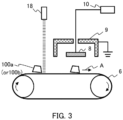
- FIG. 3 is a configuration diagram showing the details of the put-in section 6 of the electrostatic sorting device 500 according to Embodiment 2 of the present invention.
- the put-in section 6 is a conveyer, and the plate-shaped first conductive member 8 is provided above the put-in section 6, and the second conductive member 9 is provided at a certain distance upward from the first conductive member 8 so as to cover the first conductive member 8.
- the other configuration of the electrostatic sorting device 500 according to Embodiment 2 is the same as that of the electrostatic sorting device 500 according to Embodiment 1, and the description thereof is omitted.
- the resin piece 100a (or 100b) sucked by the resin piece picking section 1 is conveyed to be supplied onto the put-in section 6 which is a conveyer, unlike Embodiment 1 in which the resin piece is put into the put-in section tapered downward.
- the resin piece 100a (or 100b) is conveyed in a direction A.
- the resin piece 100a may be thinned out by means such as automatically blowing air to the resin pieces.
- the resin piece passes directly under the object detection section 18 which is an optical sensor, and at the same time, in response to a signal from the control section 15, the grounding inside the static elimination section 17 is opened, so that the grounding of the first conductive member 8 is opened. Thereafter, the resin piece passes near the first conductive member 8 by being conveyed on the conveyer.
- the object detection section 18 which is an optical sensor
- the charge waveform of charge (current or voltage) electrostatically induced to the first conductive member 8 by charge of the resin piece is measured by the electrostatic induction charge waveform measurement section 10, and a charge waveform signal is transmitted to the calculation section 16 via the control section 15.
- the calculation section 16 calculates an amplitude value or a time integral value of the charge waveform, and substitutes the calculated value into a linear relational formula with respect to a result of charge amount measurement by a commercial Faraday cup, obtained through an experiment in advance, thereby converting the above value to a charge amount.
- the grounding inside the static elimination section 17 is electrically connected in response to a signal from the control section 15, so that the grounding of the first conductive member 8 is electrically connected.
- the first conductive member 8 is always electrically connected to the ground, whereby measurement accuracy can be prevented from being lowered by the first conductive member 8 being charged up.
- the resin piece that has passed near the first conductive member 8 is sucked by the resin piece discharge section 20 and then is supplied to the charging section 120 again.
- the charge amount of each one of the picked resin pieces can be measured automatically and in real time, and data of the charge amount of each one of the resin pieces is accumulated in the calculation section 16 which is a PC.
- a measure such as stopping a line can be taken, whereby it is possible to optimize a sorting condition and prevent a foreign material from being mixed due to charging defect of resin pieces.
- the other operation of the electrostatic sorting device 500 according to Embodiment 2 is the same as that of the electrostatic sorting device 500 according to Embodiment 1, and the description thereof is omitted.
- the electrostatic sorting device 500 includes the put-in section 6 for putting the charged resin piece 100a, 100b into the automatic charge amount measurement system 7, and a conveyer is used as the put-in section 6.
- a conveyer is used as the put-in section 6.
- Embodiment 3 a case where the partitions 150 provided to the recovery container 140 are a movable type will be described.
- FIG. 4 shows the configuration of the electrostatic sorting device 500 according to Embodiment 3 of the present invention.
- the partitions 150 provided to the recovery container 140 are a movable type, and a sorting condition control section 160 connected to the automatic charge amount measurement system 7, the high-voltage power supply 110, and the partitions 150, is provided.
- the partitions 150 are provided so as to be movable in a direction B through connection with an actuator (not shown), and output voltage of the high-voltage power supply 110 and movement of the partitions 150 can be controlled by the sorting condition control section 160.
- the other configuration of the electrostatic sorting device 500 according to Embodiment 3 is the same as that of the electrostatic sorting device 500 according to Embodiment 1, and the description thereof is omitted.
- Charge amount data of a mixture of resin pieces measured by the automatic charge amount measurement system 7 is analyzed by the calculation section 16 in the automatic charge amount measurement system 7, a sorting condition is determined in accordance with a charge amount tendency, and a signal is transmitted to the sorting condition control section 160.
- the sorting condition control section 160 controls the high-voltage power supply 110 or the partitions 150, thereby performing sorting under an optimum condition according to the charge amount tendency of resin pieces.
- the partition positions are moved to the first opposed electrode 3 side (relatively negative). Conversely, in a case where a negative charging tendency is strong, the partition positions are moved to the second opposed electrode 4 (relatively positive).
- the sorting condition of the electrostatic sorting device can be optimized, whereby stable sorting performance can be achieved.
- the other operation of the electrostatic sorting device 500 according to Embodiment 3 is the same as that of the electrostatic sorting device 500 according to Embodiment 1, and the description thereof is omitted.
- the electrostatic sorting device 500 includes the recovery container 140 to which the partitions 150 are provided so as to be movable, and the partitions 150 are moved in accordance with the charge amounts of the resin pieces 100a, 100b.
- the sorting condition of the electrostatic sorting device can be optimized, whereby stable sorting performance can be achieved.
- At least one of the constituent components mentioned in at least one of the preferred embodiments may be selected and combined with the constituent components mentioned in another preferred embodiment.
Landscapes
- Chemical & Material Sciences (AREA)
- Engineering & Computer Science (AREA)
- Health & Medical Sciences (AREA)
- General Physics & Mathematics (AREA)
- Electrochemistry (AREA)
- Life Sciences & Earth Sciences (AREA)
- Analytical Chemistry (AREA)
- Biochemistry (AREA)
- General Health & Medical Sciences (AREA)
- Physics & Mathematics (AREA)
- Immunology (AREA)
- Pathology (AREA)
- Chemical Kinetics & Catalysis (AREA)
- Environmental & Geological Engineering (AREA)
- Mechanical Engineering (AREA)
- Electrostatic Separation (AREA)
- Other Investigation Or Analysis Of Materials By Electrical Means (AREA)
- Separation, Recovery Or Treatment Of Waste Materials Containing Plastics (AREA)
Abstract
Description
- The present invention relates to an electrostatic sorting device.
- When a mixture of fragments of plural kinds of materials is, for example, agitated so that the materials are rubbed against each other, they are charged with a charge sign and a charge amount according to the kinds of the materials and the composition of the mixture.
- For example, in a resin recycling process, using the above feature, charged mixed resin pieces are caused to fall into an electrostatic field space between high-voltage electrodes and then are displaced by an electrostatic force, thus performing electrostatic sorting to sort the resin pieces on a material basis.
- For example, as shown in Patent Document 1, it is proposed that an electrostatic field space is formed between a ground electrode of a roller type and a high-voltage electrode having a flat-plate shape, to electrostatically sort mixed resin pieces.
- Patent Document 1: Japanese Laid-Open Patent Publication
JP 2004- 195 303 A FIG. 1 ) - However, the method in Patent Document 1 has a problem that a foreign material is mixed due to charging defect of resin pieces.
- The present invention has been made to solve the above problem, and an object of the present invention is to provide an electrostatic sorting device having a function that can measure automatically and in real time the charge amount of each one of picked resin pieces that have just been charged.
- An electrostatic sorting device according to the present invention charges plural kinds of resin pieces and causes the charged resin pieces to fall in the electrostatic field space, to sort the resin pieces, the electrostatic sorting device including a charge amount measurement system which calculates charge amounts of the resin pieces, wherein the charge amount measurement system picks some of the charged resin pieces before the sorting, and calculates the charge amounts of the picked resin pieces.
- According to the present invention, in a case where a charge amount tendency different from that in a normal case is detected, a measure such as stopping a line can be taken, whereby it is possible to optimize a sorting condition and prevent a foreign material from being mixed due to charging defect of resin pieces.
-
-
FIG. 1 is a configuration diagram showing an electrostatic sorting device according to Embodiment 1. -
FIG. 2 is a configuration diagram of an automatic charge amount measurement system in the electrostatic sorting device according to Embodiment 1. -
FIG. 3 is a configuration diagram showing the details of a put-in section of an electrostatic sorting device according to Embodiment 2. -
FIG. 4 is a configuration diagram showing an electrostatic sorting device according toEmbodiment 3. -
FIG. 1 shows the configuration of anelectrostatic sorting device 500 according to Embodiment 1 of the present invention. As shown inFIG. 1 , theelectrostatic sorting device 500 includes acharging section 120 for agitating asorting target 100 which is a mixture of flaky resin pieces including plural kinds of materials so as to rub and charge the resin pieces, opposedelectrodes 170 composed of a first opposedelectrode 3 and a second opposed electrode 4 which form an electrostatic field space between the electrodes facing each other, aconveyance section 130 which is a vibratory feeder for conveying thesorting target 100 charged in thecharging section 120 to the electrostatic field space, and arecovery container 140 provided withpartitions 150 for sorting and recovering the resin pieces falling while being displaced in the electrostatic field space. - The first opposed
electrode 3 is electrically grounded and is located below theconveyance section 130 and on thecharging section 120 side. The second opposed electrode 4 is subjected to high voltage applied by a high-voltage power supply 110 and is located below theconveyance section 130. The second opposed electrode 4 subjected to high voltage is structurally supported with its both sides fastened by insulators (not shown). - A resin piece picking section 1 which is a vacuum loader for sucking a resin piece is provided near the
conveyance section 130. A put-insection 6 for putting a resin piece downward one by one is provided on the downwind side of the resin piece picking section 1. - An automatic charge
amount measurement system 7 which automatically measures the charge amount of a resin piece when the resin piece passes therethrough is provided under the put-insection 6. - A resin
piece discharge section 20 for discharging or discarding the resin piece after charge amount measurement to the upstream side of the charging section is provided under the automatic chargeamount measurement system 7. -
FIG. 2 is a configuration diagram showing the details of the automatic chargeamount measurement system 7 in theelectrostatic sorting device 500 according to Embodiment 1 of the present invention. As shown inFIG. 2 , the automatic chargeamount measurement system 7 includes a firstconductive member 8 which is a metal tube, and a secondconductive member 9 which is a one-size larger metal tube surrounding the firstconductive member 8. - The first
conductive member 8 and the secondconductive member 9 are joined to each other by insulatingsupport parts 13 which are bolts made of polytetrafluoroethylene (PTFE) and have a high insulation resistance. The secondconductive member 9 is connected to the ground. The firstconductive member 8 is connected to an electrostatic induction chargewaveform measurement section 10 which is an electrometer having an external input/output terminal (not shown), via ashield cable 12. - The
shield cable 12 is branched to be connected to astatic elimination section 17 which is a relay connected to the ground. Anobject detection section 18 which is an optical sensor for detecting that a resin piece is put in is provided above the firstconductive member 8. - The external input/output terminal of the electrostatic induction charge
waveform measurement section 10 is connected to acontrol section 15 which is a sequencer, together with an external input/output terminal of thestatic elimination section 17. Thecontrol section 15 is connected to acalculation section 16 which is a personal computer (PC), and theobject detection section 18. - Next, operation of the
electrostatic sorting device 500 according to Embodiment 1 of the present invention will be described with reference toFIG. 1 andFIG. 2 . In this example, a case where thesorting target 100 is a mixture of fragments of two kinds of resin materials will be described. In addition, it is assumed that positive high voltage is outputted from the high-voltage power supply 110. - First, through agitation in the
charging section 120, the resin materials are rubbed and charged so that one material is charged positively and the other material is charged negatively. - Subsequently, positive high voltage is applied from the high-
voltage power supply 110 to the second opposed electrode 4, whereby an electrostatic field space is formed between theopposed electrodes 170. - Next, the rubbed and charged sorting target 100 (
resin pieces conveyance section 130 which is a vibratory feeder, to be put toward theopposed electrodes 170. At this time, between theopposed electrode 170, theresin pieces charged resin pieces 100a are attracted to the first opposedelectrode 3 side (relatively negative electrode) and the negativelycharged resin pieces 100b are attracted to the first opposed electrode 4 (relatively positive electrode), and thus theresin pieces - The resin pieces separated as described above are recovered on a material basis in the
recovery container 140 under theopposed electrode 170. - Meanwhile, a part of the mixture of the resin pieces that have been rubbed and charged is sucked by the resin piece picking section 1 which is a vacuum loader.
- Subsequently, the mixture of the resin pieces sucked by the resin piece picking section 1 is conveyed to be supplied to the put-in
section 6. The put-insection 6 has a structure tapered downward and is provided with an open/close device. By the open/close device opening and closing at regular time intervals, the resin pieces are put one by one into the downward automatic chargeamount measurement system 7 from the put-insection 6. - Next, the resin piece falling downward is detected by the
object detection section 18, and at the same time, in response to a signal from thecontrol section 15, the grounding inside thestatic elimination section 17 is opened, so that the grounding of the firstconductive member 8 is opened. - Thereafter, the resin piece falls and passes near the first
conductive member 8. Normally, the firstconductive member 8 is electrically connected to the ground via thestatic elimination section 17. - At this time, the charge waveform (waveform of current or voltage) of charge electrostatically induced to the first
conductive member 8 by charge of the resin piece is measured by the electrostatic induction chargewaveform measurement section 10, and a charge waveform signal is transmitted to thecalculation section 16 via thecontrol section 15. - Subsequently, the
calculation section 16 calculates an amplitude value or a time integral value of the charge waveform, and substitutes the calculated value into a linear relational formula with respect to a result of charge amount measurement by a commercial Faraday cup, obtained through an experiment in advance, thereby converting the above value to a charge amount. - After the resin piece has come out of the first
conductive member 8, the grounding inside thestatic elimination section 17 is electrically connected in response to a signal from the control means 15, so that the grounding of the firstconductive member 8 is electrically connected. - As described above, in the period other than when the resin piece is put in, the first
conductive member 8 is always electrically connected to the ground, whereby measurement accuracy can be prevented from being lowered by the firstconductive member 8 being charged up. - Thereafter, the resin piece that has come out of the first
conductive member 8 is sucked by the resinpiece discharge section 20 and then is supplied to thecharging section 120 again. - Through repetition of the above operation, the charge amount of each one of the picked resin pieces can be measured automatically and in real time, and data of the charge amount of each one of the resin pieces is accumulated in the
calculation section 16 which is a PC. - In addition, in a case where a charge amount tendency different from that in a normal case is detected, a measure such as stopping a line can be taken, whereby it is possible to optimize a sorting condition and prevent a foreign material from being mixed due to charging defect of resin pieces.
- As described above, the
electrostatic sorting device 500 according to the present Embodiment 1 charges plural kinds ofresin pieces 100 and causes thecharged resin pieces resin pieces electrostatic sorting device 500 includes the automatic chargeamount measurement system 7 which calculates the charge amounts of theresin pieces - The automatic charge
amount measurement system 7 picks some of theresin pieces resin pieces - In addition, the automatic charge
amount measurement system 7 includes theobject detection section 18 which detects each pickedresin piece waveform measurement section 10 which measures the charge waveform of charge electrostatically induced by charge of the detectedresin piece calculation section 16 which calculates the charge amount on the basis of the charge waveform. Thus, the charge amount of each one of the picked resin pieces can be measured automatically and in real time. - Further, the automatic charge
amount measurement system 7 includes the tubular firstconductive member 8 into which theresin piece waveform measurement section 10 to measure the charge waveform of the putresin piece conductive member 8, the firstconductive member 8 is provided with thestatic elimination section 17 for making connection to the ground. - At the same time as the
resin piece object detection section 18, connection to the ground is opened. Thus, measurement accuracy can be prevented from being lowered by the first conductive member being charged up. - In Embodiment 1, a case where resin pieces are put one by one into the downward automatic charge
amount measurement system 7 from the put-insection 6 has been described. In Embodiment 2, a case where resin pieces are put in by a conveyer will be described. -
FIG. 3 is a configuration diagram showing the details of the put-insection 6 of theelectrostatic sorting device 500 according to Embodiment 2 of the present invention. As shown inFIG. 3 , in Embodiment 2 of the present invention, the put-insection 6 is a conveyer, and the plate-shaped firstconductive member 8 is provided above the put-insection 6, and the secondconductive member 9 is provided at a certain distance upward from the firstconductive member 8 so as to cover the firstconductive member 8. - The other configuration of the
electrostatic sorting device 500 according to Embodiment 2 is the same as that of theelectrostatic sorting device 500 according to Embodiment 1, and the description thereof is omitted. - Next, operation of the
electrostatic sorting device 500 according to Embodiment 2 of the present invention will be described with reference toFIG. 3 . - The
resin piece 100a (or 100b) sucked by the resin piece picking section 1 is conveyed to be supplied onto the put-insection 6 which is a conveyer, unlike Embodiment 1 in which the resin piece is put into the put-in section tapered downward. - Subsequently, through rotation of a belt of the put-in
section 6, theresin piece 100a (or 100b) is conveyed in a direction A. In a case where a large number of resin pieces are put densely, they may be thinned out by means such as automatically blowing air to the resin pieces. - Next, an object is detected when the resin piece passes directly under the
object detection section 18 which is an optical sensor, and at the same time, in response to a signal from thecontrol section 15, the grounding inside thestatic elimination section 17 is opened, so that the grounding of the firstconductive member 8 is opened. Thereafter, the resin piece passes near the firstconductive member 8 by being conveyed on the conveyer. - At this time, the charge waveform of charge (current or voltage) electrostatically induced to the first
conductive member 8 by charge of the resin piece is measured by the electrostatic induction chargewaveform measurement section 10, and a charge waveform signal is transmitted to thecalculation section 16 via thecontrol section 15. - Subsequently, the
calculation section 16 calculates an amplitude value or a time integral value of the charge waveform, and substitutes the calculated value into a linear relational formula with respect to a result of charge amount measurement by a commercial Faraday cup, obtained through an experiment in advance, thereby converting the above value to a charge amount. - After the resin piece has passed near the first
conductive member 8, the grounding inside thestatic elimination section 17 is electrically connected in response to a signal from thecontrol section 15, so that the grounding of the firstconductive member 8 is electrically connected. - As described above, in the period other than when the resin piece passes near the first
conductive member 8, the firstconductive member 8 is always electrically connected to the ground, whereby measurement accuracy can be prevented from being lowered by the firstconductive member 8 being charged up. - Thereafter, the resin piece that has passed near the first
conductive member 8 is sucked by the resinpiece discharge section 20 and then is supplied to thecharging section 120 again. - Through repetition of the above operation, the charge amount of each one of the picked resin pieces can be measured automatically and in real time, and data of the charge amount of each one of the resin pieces is accumulated in the
calculation section 16 which is a PC. - In addition, in a case where a charge amount tendency different from that in a normal case is detected, a measure such as stopping a line can be taken, whereby it is possible to optimize a sorting condition and prevent a foreign material from being mixed due to charging defect of resin pieces.
- The other operation of the
electrostatic sorting device 500 according to Embodiment 2 is the same as that of theelectrostatic sorting device 500 according to Embodiment 1, and the description thereof is omitted. - As described above, the
electrostatic sorting device 500 according to the present Embodiment 2 includes the put-insection 6 for putting the chargedresin piece amount measurement system 7, and a conveyer is used as the put-insection 6. Thus, the same effects as in Embodiment 1 can be provided. - In
Embodiment 3, a case where thepartitions 150 provided to therecovery container 140 are a movable type will be described. -
FIG. 4 shows the configuration of theelectrostatic sorting device 500 according toEmbodiment 3 of the present invention. As shown inFIG. 4 , in theelectrostatic sorting device 500 according toEmbodiment 3 of the present invention, thepartitions 150 provided to therecovery container 140 are a movable type, and a sortingcondition control section 160 connected to the automatic chargeamount measurement system 7, the high-voltage power supply 110, and thepartitions 150, is provided. - The
partitions 150 are provided so as to be movable in a direction B through connection with an actuator (not shown), and output voltage of the high-voltage power supply 110 and movement of thepartitions 150 can be controlled by the sortingcondition control section 160. - The other configuration of the
electrostatic sorting device 500 according toEmbodiment 3 is the same as that of theelectrostatic sorting device 500 according to Embodiment 1, and the description thereof is omitted. - Next, operation of the
electrostatic sorting device 500 according toEmbodiment 3 of the present invention will be described with reference toFIG. 4 . - Charge amount data of a mixture of resin pieces measured by the automatic charge
amount measurement system 7 is analyzed by thecalculation section 16 in the automatic chargeamount measurement system 7, a sorting condition is determined in accordance with a charge amount tendency, and a signal is transmitted to the sortingcondition control section 160. - On the basis of the received signal, the sorting
condition control section 160 controls the high-voltage power supply 110 or thepartitions 150, thereby performing sorting under an optimum condition according to the charge amount tendency of resin pieces. - For example, in a case where resin pieces as a whole have a strong tendency toward positive charging, the partition positions are moved to the first
opposed electrode 3 side (relatively negative). Conversely, in a case where a negative charging tendency is strong, the partition positions are moved to the second opposed electrode 4 (relatively positive). - In a case where there is such a tendency that the charge amounts of resin pieces as a whole are higher than in a normal case, output voltage of the high-
voltage power supply 110 is reduced, and conversely, in a case where there is such a tendency that the charge amounts of resin pieces as a whole are lower than in a normal case, output voltage of the high-voltage power supply 110 is increased. - As described above, in a case where a charge amount tendency different from that in a normal case is detected due to change of the materials of resin pieces or the like, the sorting condition of the electrostatic sorting device can be optimized, whereby stable sorting performance can be achieved.
- The other operation of the
electrostatic sorting device 500 according toEmbodiment 3 is the same as that of theelectrostatic sorting device 500 according to Embodiment 1, and the description thereof is omitted. - As described above, the
electrostatic sorting device 500 according to thepresent Embodiment 3 includes therecovery container 140 to which thepartitions 150 are provided so as to be movable, and thepartitions 150 are moved in accordance with the charge amounts of theresin pieces - Thus, in a case where a charge amount tendency different from that in a normal case is detected due to change of the materials of resin pieces or the like, the sorting condition of the electrostatic sorting device can be optimized, whereby stable sorting performance can be achieved.
- Although the invention is described above in terms of various exemplary embodiments and implementations, it should be understood that the various features, aspects, and functionality described in one or more of the individual embodiments are not limited in their applicability to the particular embodiment with which they are described, but instead can be applied, alone or in various combinations to one or more of the embodiments of the invention.
- It is therefore understood that numerous modifications which have not been exemplified can be devised without departing from the scope of the present invention. For example, at least one of the constituent components may be modified, added, or eliminated.
- At least one of the constituent components mentioned in at least one of the preferred embodiments may be selected and combined with the constituent components mentioned in another preferred embodiment.
-
- 6
- put-in section
- 7
- automatic charge amount measurement system
- 8
- first conductive member
- 9
- second conductive member
- 10
- electrostatic induction charge waveform measurement section
- 16
- calculation section
- 17
- static elimination section
- 18
- object detection section
- 100
- sorting target
- 100a, 100b
- resin piece
- 120
- charging section
- 500
- electrostatic sorting device
Claims (7)
- An electrostatic sorting device which charges plural kinds of resin pieces and causes the charged resin pieces to fall in the electrostatic field space, to sort the resin pieces, the electrostatic sorting device comprising:a charge amount measurement system which calculates charge amounts of the resin pieces,wherein the charge amount measurement system picks some of the charged resin pieces before the sorting, and calculates the charge amounts of the picked resin pieces.
- The electrostatic sorting device
according to claim 1,
wherein the charge amount measurement system includes a detection section which detects each picked resin piece, a measurement section which measures a charge waveform of charge electrostatically induced by charge of the detected resin piece, and a calculation section which calculates the charge amount on the basis of the charge waveform. - The electrostatic sorting device
according to claim 2,
wherein the charge amount measurement system includes a tubular conductive member into which the resin piece is put, and the measurement section measures the charge waveform of the put resin piece via the conductive member. - The electrostatic sorting device
according to claim 3,
wherein the conductive member includes a static elimination section for making connection to a ground, and at the same time as the resin piece is detected by the detection section, connection to the ground is opened. - The electrostatic sorting deviceaccording to any one of claims 2 to 4,
further comprising a put-in section for putting the charged resin piece into the charge amount measurement system, whereinthe put-in section has a shape tapered downward in a vertical direction. - The electrostatic sorting device
according to claim 2,
further comprising a conveyer for putting the charged resin piece into the charge amount measurement system. - The electrostatic sorting deviceaccording to any one of claims 1 to 6,
further comprising a recovery container having a partition provided so as to be movable,wherein the partition is moved in accordance with the charge amounts of the resin pieces.
Applications Claiming Priority (1)
| Application Number | Priority Date | Filing Date | Title |
|---|---|---|---|
| PCT/JP2022/014794 WO2023187854A1 (en) | 2022-03-28 | 2022-03-28 | Electrostatic sorting device |
Publications (2)
| Publication Number | Publication Date |
|---|---|
| EP4480585A1 true EP4480585A1 (en) | 2024-12-25 |
| EP4480585A4 EP4480585A4 (en) | 2025-03-26 |
Family
ID=84887135
Family Applications (1)
| Application Number | Title | Priority Date | Filing Date |
|---|---|---|---|
| EP22935009.5A Pending EP4480585A4 (en) | 2022-03-28 | 2022-03-28 | ELECTROSTATIC SORTING DEVICE |
Country Status (4)
| Country | Link |
|---|---|
| EP (1) | EP4480585A4 (en) |
| JP (1) | JP7203294B1 (en) |
| CN (1) | CN118946410B (en) |
| WO (1) | WO2023187854A1 (en) |
Families Citing this family (1)
| Publication number | Priority date | Publication date | Assignee | Title |
|---|---|---|---|---|
| WO2025210747A1 (en) * | 2024-04-02 | 2025-10-09 | 三菱電機株式会社 | Sorting processing system |
Family Cites Families (12)
| Publication number | Priority date | Publication date | Assignee | Title |
|---|---|---|---|---|
| WO1984002980A1 (en) * | 1983-01-18 | 1984-08-02 | Kanzaki Paper Mfg Co Ltd | Method of detecting and insolating piece of insulating substance between small pieces of conductive substance |
| JP3103812B2 (en) * | 1994-06-10 | 2000-10-30 | センコー工業株式会社 | Friction electrification electrostatic sorter |
| JP3481581B2 (en) * | 2000-05-15 | 2003-12-22 | 日本電気株式会社 | Plastic identification method and apparatus |
| JP2008145347A (en) * | 2006-12-12 | 2008-06-26 | Shimadzu Corp | Faraday cup ammeter and particle measuring device |
| JP5251537B2 (en) * | 2009-01-20 | 2013-07-31 | 三菱電機株式会社 | Electrostatic sorting method and electrostatic sorting apparatus |
| JP5630988B2 (en) * | 2009-12-07 | 2014-11-26 | 三菱電機株式会社 | Electrostatic sorting apparatus and electrostatic sorting method |
| RU2424061C1 (en) * | 2009-12-31 | 2011-07-20 | Государственное образовательное учреждение высшего профессионального образования Иркутский государственный университет | Method of separating diamond-containing materials |
| JP2012225657A (en) * | 2011-04-15 | 2012-11-15 | Canon Inc | Charge amount measuring apparatus and measuring method |
| JP5474001B2 (en) * | 2011-07-15 | 2014-04-16 | 春日電機株式会社 | Charge measurement device |
| JP2014168754A (en) * | 2013-03-04 | 2014-09-18 | Mitsubishi Electric Corp | Electrostatic sorter of resin and method thereof |
| CN107953482B (en) * | 2016-10-17 | 2020-03-10 | 三菱电机株式会社 | Electrostatic sorting device and electrostatic sorting method |
| JP6815570B1 (en) * | 2020-02-20 | 2021-01-20 | 三菱電機株式会社 | Electrostatic sorting device |
-
2022
- 2022-03-28 EP EP22935009.5A patent/EP4480585A4/en active Pending
- 2022-03-28 WO PCT/JP2022/014794 patent/WO2023187854A1/en not_active Ceased
- 2022-03-28 CN CN202280093973.7A patent/CN118946410B/en active Active
- 2022-03-28 JP JP2022556028A patent/JP7203294B1/en active Active
Also Published As
| Publication number | Publication date |
|---|---|
| CN118946410B (en) | 2025-12-30 |
| WO2023187854A1 (en) | 2023-10-05 |
| EP4480585A4 (en) | 2025-03-26 |
| JPWO2023187854A1 (en) | 2023-10-05 |
| JP7203294B1 (en) | 2023-01-12 |
| CN118946410A (en) | 2024-11-12 |
Similar Documents
| Publication | Publication Date | Title |
|---|---|---|
| EP4480585A1 (en) | Electrostatic sorting device | |
| GB1025688A (en) | Method and apparatus for electrostatic sorting | |
| Wenger et al. | Combined characterization of free-moving particles in HVDC-GIS using UHF PD, high-speed imaging, and pulse-sequence analysis | |
| CN107953482B (en) | Electrostatic sorting device and electrostatic sorting method | |
| CA1185566A (en) | Separation of particulate materials using an alternating potential electrostatic field | |
| KR20120095306A (en) | Static electricity removing apparatus and method thereof | |
| JPH07178351A (en) | Electrostatic sorting device for rubber and plastic waste | |
| Foulon et al. | Investigation of the failure mechanism of insulation subjected to repetitive fast voltage surges | |
| EP4475195A1 (en) | Method for processing solar cell module | |
| JP3433004B2 (en) | DC gas insulated busbar | |
| Samuila et al. | Modeling of wire corona electrode operation in electrostatic separation at small and large gaps | |
| Dascalescu et al. | Corona-assisted plate-type electrostatic separation process for granular plastic wastes | |
| US4325820A (en) | High tension electrostatic separators | |
| Chahinez | Recycling of shredded printed circuit boards (PCBs) by two-phase moving wave conveyors | |
| Laksono et al. | Comparison of Partial Discharge Characteristics Detected by RC Detector and Rectangular Antenna | |
| Meng et al. | The characteristics of particle charging and deposition during powder coating processes with coarse powder | |
| Saeki et al. | Electrostatic separation of chopped waste electric cables | |
| Okubo et al. | Partial discharge detection techniques under the condition of metallic particle adhering to solid spacer in SF6 | |
| RU2830663C1 (en) | Electrode for electrostatic separator and electrostatic separator | |
| JP2004101411A (en) | Electrostatic charging test equipment | |
| Korzhenevskiy et al. | Application of a nanosecond corona discharge generator for electrical separation of ores | |
| Zahra et al. | Insulation Conditions Assessment Using Time Series Analysis of Partial Discharge Waveform Characteristics | |
| Berg et al. | Investigations of conductive particles in gas insulated Systems under DC-conditions | |
| US11260402B2 (en) | Electrostatic separation device, and associated separation method and use | |
| Dascalescu et al. | A linear-interaction model for electrostatic separation processes |
Legal Events
| Date | Code | Title | Description |
|---|---|---|---|
| STAA | Information on the status of an ep patent application or granted ep patent |
Free format text: STATUS: THE INTERNATIONAL PUBLICATION HAS BEEN MADE |
|
| PUAI | Public reference made under article 153(3) epc to a published international application that has entered the european phase |
Free format text: ORIGINAL CODE: 0009012 |
|
| STAA | Information on the status of an ep patent application or granted ep patent |
Free format text: STATUS: REQUEST FOR EXAMINATION WAS MADE |
|
| 17P | Request for examination filed |
Effective date: 20240918 |
|
| AK | Designated contracting states |
Kind code of ref document: A1 Designated state(s): AL AT BE BG CH CY CZ DE DK EE ES FI FR GB GR HR HU IE IS IT LI LT LU LV MC MK MT NL NO PL PT RO RS SE SI SK SM TR |
|
| STAA | Information on the status of an ep patent application or granted ep patent |
Free format text: STATUS: EXAMINATION IS IN PROGRESS |
|
| A4 | Supplementary search report drawn up and despatched |
Effective date: 20250226 |
|
| RIC1 | Information provided on ipc code assigned before grant |
Ipc: B03C 7/08 20060101ALI20250220BHEP Ipc: B03C 7/04 20060101ALI20250220BHEP Ipc: B03C 7/00 20060101ALI20250220BHEP Ipc: G01N 27/60 20060101ALI20250220BHEP Ipc: G01R 29/24 20060101ALI20250220BHEP Ipc: B29B 17/02 20060101ALI20250220BHEP Ipc: B03C 7/12 20060101AFI20250220BHEP |
|
| 17Q | First examination report despatched |
Effective date: 20250310 |
|
| DAV | Request for validation of the european patent (deleted) | ||
| DAX | Request for extension of the european patent (deleted) |