EP4480482A2 - Pyrimidines for degrading bruton's tyrosine kinase - Google Patents
Pyrimidines for degrading bruton's tyrosine kinase Download PDFInfo
- Publication number
- EP4480482A2 EP4480482A2 EP24212223.2A EP24212223A EP4480482A2 EP 4480482 A2 EP4480482 A2 EP 4480482A2 EP 24212223 A EP24212223 A EP 24212223A EP 4480482 A2 EP4480482 A2 EP 4480482A2
- Authority
- EP
- European Patent Office
- Prior art keywords
- ethyl
- mmol
- tert
- butyl
- oxadiazole
- Prior art date
- Legal status (The legal status is an assumption and is not a legal conclusion. Google has not performed a legal analysis and makes no representation as to the accuracy of the status listed.)
- Pending
Links
Images

Classifications
-
- A—HUMAN NECESSITIES
- A61—MEDICAL OR VETERINARY SCIENCE; HYGIENE
- A61K—PREPARATIONS FOR MEDICAL, DENTAL OR TOILETRY PURPOSES
- A61K31/00—Medicinal preparations containing organic active ingredients
- A61K31/33—Heterocyclic compounds
- A61K31/395—Heterocyclic compounds having nitrogen as a ring hetero atom, e.g. guanethidine or rifamycins
- A61K31/495—Heterocyclic compounds having nitrogen as a ring hetero atom, e.g. guanethidine or rifamycins having six-membered rings with two or more nitrogen atoms as the only ring heteroatoms, e.g. piperazine or tetrazines
- A61K31/505—Pyrimidines; Hydrogenated pyrimidines, e.g. trimethoprim
- A61K31/506—Pyrimidines; Hydrogenated pyrimidines, e.g. trimethoprim not condensed and containing further heterocyclic rings
-
- A—HUMAN NECESSITIES
- A61—MEDICAL OR VETERINARY SCIENCE; HYGIENE
- A61P—SPECIFIC THERAPEUTIC ACTIVITY OF CHEMICAL COMPOUNDS OR MEDICINAL PREPARATIONS
- A61P35/00—Antineoplastic agents
- A61P35/02—Antineoplastic agents specific for leukemia
-
- C—CHEMISTRY; METALLURGY
- C07—ORGANIC CHEMISTRY
- C07D—HETEROCYCLIC COMPOUNDS
- C07D413/00—Heterocyclic compounds containing two or more hetero rings, at least one ring having nitrogen and oxygen atoms as the only ring hetero atoms
- C07D413/14—Heterocyclic compounds containing two or more hetero rings, at least one ring having nitrogen and oxygen atoms as the only ring hetero atoms containing three or more hetero rings
Definitions
- Btk Bruton's tyrosine kinase
- BCR cell surface B-cell receptor
- Btk is a key regulator of B-cell development, activation, signaling, and survival ( Kurosaki, Curr Op Imm, 2000, 276-281 ; Schaeffer and Schwartzberg, Curr Op Imm 2000, 282-288 ).
- Btk plays a role in other hematopoietic cell signaling pathways, e.g., Toll like receptor (TLR) and cytokine receptor-mediated TNF- ⁇ production in macrophages, IgE receptor (FcepsilonRI) signaling in mast cells, inhibition of Fas/APO-1 apoptotic signaling in B-lineage lymphoid cells, and collagen-stimulated platelet aggregation.
- TLR Toll like receptor
- FcepsilonRI IgE receptor
- Btk inhibitors are being investigated.
- proteolytic degradation of Btk may affect B cell function by not only blocking BCR signaling, but by reducing the presence of the Btk protein from the cell itself. Reduction of the Btk protein would reduce Btk kinase activity as well as reduce any protein interactions or scaffolding functions of Btk. Accordingly, there is a medical need to develop Btk degraders.
- provided herein are compounds that induce the proteolytic degradation of Btk via a ubiquitin proteolysis pathway.
- R 1 is selected from the group consisting of hydrogen, C 1 -C 3 alkyl, CN (cyano), C 1 -C 3 haloalkyl, halo, CH 2 OCH 3 ; CH 2 OH; and CH 2 CN, or a pharmaceutically acceptable salt thereof.
- R 1 is C 1 -C 3 alkyl, or a pharmaceutically acceptable salt thereof.
- R 1 is methyl, or a pharmaceutically acceptable salt thereof.
- R 1 is hydrogen, or a pharmaceutically acceptable salt thereof.
- R 1 is CN, or a pharmaceutically acceptable salt thereof.
- R 1 is C 1 -C 3 haloalkyl, or a pharmaceutically acceptable salt thereof. In certain embodiments, R 1 is CF 3 , or a pharmaceutically acceptable salt thereof. In certain embodiments, R 1 is halo, or a pharmaceutically acceptable salt thereof. In certain embodiments, R 1 is Cl, or a pharmaceutically acceptable salt thereof. In certain embodiments, R 1 is F, or a pharmaceutically acceptable salt thereof. In certain embodiments, R 1 is CH 2 OCH 3 , or a pharmaceutically acceptable salt thereof. In certain embodiments, R 1 is CH 2 OH or a pharmaceutically acceptable salt thereof. In certain embodiments, R 1 is CH 2 CN, or a pharmaceutically acceptable salt thereof.
- R 2 is selected from the group consisting of hydrogen and halo, or a pharmaceutically acceptable salt thereof. In certain embodiments, R 2 is hydrogen, or a pharmaceutically acceptable salt thereof. In certain embodiments, R 2 is halo, or a pharmaceutically acceptable salt thereof. In certain embodiments, R 2 is F, or a pharmaceutically acceptable salt thereof.
- R 3 is selected from the group consisting of hydrogen and halo, or a pharmaceutically acceptable salt thereof. In certain embodiments, R 3 is hydrogen, or a pharmaceutically acceptable salt thereof. In certain embodiments, R 3 is halo, or a pharmaceutically acceptable salt thereof. In certain embodiments, R 3 is F, or a pharmaceutically acceptable salt thereof.
- R 4a and R 4b are each independently selected from the group consisting of hydrogen, C 1 -C 3 alkyl, and CH 2 OCH 3 , or a pharmaceutically acceptable salt thereof.
- R 4a is hydrogen and R 4b is hydrogen, or a pharmaceutically acceptable salt thereof.
- R 4a is hydrogen and R 4b is methyl, or a pharmaceutically acceptable salt thereof.
- R 4a is methyl and R 4b is hydrogen, or a pharmaceutically acceptable salt thereof.
- R 4a is hydrogen and R 4b is ethyl, or a pharmaceutically acceptable salt thereof.
- R 4a is ethyl and R 4b is hydrogen, or a pharmaceutically acceptable salt thereof.
- R 4a is methyl and R 4b is methyl, or a pharmaceutically acceptable salt thereof.
- R 4a is hydrogen and R 4b is isopropyl, or a pharmaceutically acceptable salt thereof.
- R 4a is isopropyl and R 4b is hydrogen, or a pharmaceutically acceptable salt thereof.
- R 4a is hydrogen and R 4b is CH 2 OCH 3 , or a pharmaceutically acceptable salt thereof.
- R 4a is CH 2 OCH 3 and R 4b is hydrogen, or a pharmaceutically acceptable salt thereof.
- R 5 is selected from the group consisting of hydrogen, halo, and C 1 -C 3 alkyl, or a pharmaceutically acceptable salt thereof. In certain embodiments, R 5 is hydrogen, or a pharmaceutically acceptable salt thereof. In certain embodiments, R 5 is halo, or a pharmaceutically acceptable salt thereof. In certain embodiments, R 5 is F, or a pharmaceutically acceptable salt thereof. In certain embodiments, R 5 is Cl, or a pharmaceutically acceptable salt thereof. In certain embodiments, R 5 is methyl, or a pharmaceutically acceptable salt thereof.
- R 1 is methyl and R 2 is hydrogen, or a pharmaceutically acceptable salt thereof.
- R 1 is methyl, R 2 is hydrogen, and R 3 is hydrogen, or a pharmaceutically acceptable salt thereof.
- R 1 is methyl, R 2 is hydrogen, R 3 is hydrogen, R 4a is hydrogen, and R 4b is methyl, or a pharmaceutically acceptable salt thereof.
- R 1 is methyl, R 2 is hydrogen, R 3 is hydrogen, and R 5 is hydrogen, or a pharmaceutically acceptable salt thereof.
- R 1 is methyl, R 4a is hydrogen and R 4b is methyl, or a pharmaceutically acceptable salt thereof.
- R 2 is hydrogen, R 4a is hydrogen and R 4b is methyl, or a pharmaceutically acceptable salt thereof.
- R 3 is hydrogen, R 4a is hydrogen, and R 4b is methyl, or a pharmaceutically acceptable salt thereof.
- R 5 is halo, R 4a is hydrogen, and R 4b is methyl, or a pharmaceutically acceptable salt thereof.
- R 5 is F, R 4a is hydrogen, and R 4b is methyl, or a pharmaceutically acceptable salt thereof.
- R 5 is halo, R 4a is methyl, and R 4b is hydrogen, or a pharmaceutically acceptable salt thereof.
- R 5 is F, R 4a is methyl, and R 4b is hydrogen, or a pharmaceutically acceptable salt thereof.
- R 5 is halo, R 4a is hydrogen, and R 4b is ethyl, or a pharmaceutically acceptable salt thereof.
- compositions comprising a therapeutically effective amount of: a pharmaceutically acceptable salt thereof, in combination with a pharmaceutically acceptable carrier, are provided.
- the compound is 3- tert- butyl -N- [(1 R )-1- ⁇ 4-[6-( ⁇ 5-[(2 S )-4- ⁇ 2-[4-(2,4-dioxo-1,3-diazinan-1-yl)phenyl]ethyl ⁇ -2-methylpiperazin-1-yl]pyridin-2-yl ⁇ amino)pyrimidin-4-yl]-2-methylphenyl ⁇ ethyl]-1,2,4-oxadiazole-5-carboxamide, or a pharmaceutically acceptable salt thereof.
- the compound is 3- tert- butyl- N -[(1 R )-1- ⁇ 4-[6-( ⁇ 5-[(2 S )-4- ⁇ 2-[4-(2,4-dioxo-1,3-diazinan-1 -yl)phenyl] ethyl ⁇ -2-methylpiperazin-1-yl]pyridin-2-yl ⁇ amino)pyrimidin-4-yl]-2-methylphenyl ⁇ ethyl]-1,2,4-oxadiazole-5-carboxamide.
- a method of treating a patient with CLL comprising administering to the patient a compound of formula (I) is provided.
- methods for treating CLL comprising administering to a subject in need thereof a therapeutically effective amount of a compound of formula (I) are provided.
- subject refers to a human.
- human refers to a human.
- patient refers to a human.
- subject refers to a human.
- subject refers to a human.
- human refers to a human.
- subject refers to a human.
- subject refers to a human.
- human refers to a human.
- patient refers to a human.
- subject refers to a human.
- subject refers to a human.
- subject refers to a human.
- treat refers to a method of alleviating or abrogating a disease and/or its attendant symptoms.
- substitution group R 5 on compound 1-1 may be a halo, hydrogen, or C 1 -C 3 alkyl, as described herein.
- Reaction of compound 1-1 with tert- butyldimethylsilyl chloride in the presence of imidazole may provide compound 1-2.
- Reaction of compound 1-2 with acrylic acid using heat may form compound 1-3.
- Compound 1-3 may react with urea in heated acetic acid to yield compound 1-4.
- Compound 1-4 may be treated with aqueous HCl to provide intermediate 1-5.
- Intermediate 1-5 may be treated with iodine followed by Ph 3 P in the presence of imidazole to provide iodo compound 1-6, or it may be treated with CBr 4 followed by Ph 3 P to provide bromo compound 1-6.
- a method for preparing substituted building block 2-7 is illustrated in Scheme 2. Reaction of substituted benzaldehyde 2-1 wherein R 1 , R 2 , and R 3 may be as described herein, with ( S )-2-methylpropane-2-sulfinamide 2-2 may provide compound 2-3. Reacting compound 2-3 with CH 3 MgBr under Grignard reaction conditions may afford intermediate 2-4. Using bis(pinacolato)diboron and a palladium catalyst, intermediate 2- 5 may be synthesized from intermediate 2-4. Amine 2-6 may be prepared from intermediate 2-5 by removing the t- butylsulfinyl group using strong acid or iodine. Heteroaryl carboxamide building block 2-7 may be directly synthesized from amine 2-6 with methyl 3-( tert -butyl)-1,2,4-oxadiazole-5-carboxylate.
- building block 3-4 wherein R 4a and R 4b are as described herein, may be prepared from compound 3-3 by hydrogenation or a nitro reduction reaction.
- Intermediate compound 3-3 may be prepared from 2-nitro-5-halopyridine compound 3-1 and substituted piperazine compound 3-2 by a S N Ar reaction or a Buchwald-Hartwing cross-coupling reaction.
- Exemplary compounds of formula (I) include, but are not limited to, the compounds shown in Table 1 below, and pharmaceutically acceptable salts thereof. Table 1.
- Example 1 3- tert -butyl- N -[(1 R )-1- ⁇ 4-[6-( ⁇ 5-[(2 S )-4- ⁇ 2-[4-(2,4-dioxo-1,3-diazinan-1-yl)phenyl]ethyl ⁇ -2-methylpiperazin-1-yl]pyridin-2-yl ⁇ amino)pyrimidin-4-yl]-2-methylphenyl ⁇ ethyl]-1,2,4-oxadiazole-5-carboxamide
- Example 1C ( S )-2-methyl- N -(( R )-1-(2-methyl-4-(4,4,5,5-tetramethyl-1,3,2-dioxaborolan-2-yl)phenyl)ethyl)propane-2-sulfinamide
- Example 1B 600 g, 1.89 mol
- dioxane 3.6 L
- bis(pinacolato)diboron 600 g, 2.36 mol
- potassium acetate 370 g, 3.77 mol
- Pd(dppf)Cl 2 [1,1'-bis(diphenylphosphino)ferrocene]dichloropalladium(II), 23.0 g, 0.07 mol
- the mixture was degassed with nitrogen and stirred at 85 °C for 8 hours under nitrogen.
- the same reaction was duplicated four times on the same scale.
- Example 1C 250 g, 680 mmol
- ethyl acetate 750 mL
- the mixture was chilled to 0 °C.
- hydrogen chloride in ethyl acetate (4 M, 750 mL) at 0 °C.
- the reaction mixture was stirred for 2 hours at 20 °C.
- the mixture was filtered, and the solid product was triturated in ethyl acetate, filtered, and dried under reduced pressure to afford the crude title compound as a hydrochloride salt.
- Example 1D To a solution of Example 1D (20 g, 77 mmol) and methyl 3-( tert -butyl)-1,2,4-oxadiazole-5-carboxylate (31.0 g, 168 mmol) in ethanol (200 mL) was added triethylamine (64.0 mL, 459 mmol) at 20 °C. The mixture was stirred at 65 °C for 16 hours, and then concentrated under reduced pressure to remove ethanol. Water was added to the mixture, and the mixture was extracted with ethyl acetate (three times). The combined organic layer was washed with saturated ammonium chloride aqueous solution (once) and brine (once), dried with sodium sulfate, and filtered.
- triethylamine 64.0 mL, 459 mmol
- a 3 L reactor was charged with 2-(4-aminophenyl)ethan-1-ol (176 g, 1.28 mol), N , N- dimethylformamide (1.8 L), imidazole (91.7 g, 1.35 mol), and tert -butyldimethylsilyl chloride (222 g, 1.48 mol) at ambient temperature. The mixture was stirred at ambient temperature for 6 hours. To the mixture were added ethyl acetate (500 mL) and water (300 mL).
- Example 1F (196 g, 0.78 mol) was charged into a 3 L reactor. To the mixture were added toluene (1.4 L) and acrylic acid (67.4 g, 0.94 mol). The reaction mixture was stirred at 110 °C for 12 hours under nitrogen. The mixture was concentrated under reduced pressure to dryness to provide crude title compound. MS (ESI) m / z 324.2 (M+H) + .
- Example 1G To crude Example 1G (252 g, 0.78 mol)) were added acetic acid (1.8 L) and urea (46.8 g, 0.78 mol). The reaction mixture was stirred at 110 °C for 12 hours under nitrogen and was cooled to ambient temperature. To the mixture were added water (600 mL) and ethyl acetate (600 mL). The organic phase was separated, and the aqueous phase was extracted with ethyl acetate (600 mL). The combined organic phase was washed with brine, dried with sodium sulfate, filtered and the filtrate was concentrated under reduced pressure to dryness to provide crude title compound. MS (ESI) m / z 277.1 (M+H) + .
- Example 1H 176 g, 0.63 mol was added 6 N aqueous HCl (1.23 L, 7.39 mol), and the mixture was stirred at ambient temperature for 6 hours. The reaction mixture was concentrated under reduced pressure to dryness, and the residue was triturated with ethanol/ethyl acetate (250 mL/250 mL) for 30 minutes. The material was isolated by filtration and dried under vacuum to provide crude title compound. MS (ESI) m / z 235.1 (M+H) + .
- Example 1I (10.0 g, 0.04 mol) and dichloromethane (100 mL).
- iodine (16.3 g, 0.06 mol) was added in small portions, followed by Ph 3 P (16.8 g, 0.06 mol) in small portions, followed by imidazole (4.36 g, 0.06 mol) in small portions.
- the reaction mixture was then stirred at ambient temperature for 3 hours. The same reaction was duplicated seven times in parallel on the same scale.
- the reaction mixtures of the eight batches were combined and poured into a mixture of water (800 mL) and ethyl acetate (800 mL).
- the reaction vessel was evacuated and backfilled with argon three times and palladium(II) acetate (2.124 g, 9.46 mmol) was added in one portion at 20 °C. The vessel was then evacuated and backfilled with argon three times again. The reaction mixture was warmed to 90 °C and stirred at 90 °C for 24 hours under argon atmosphere. The reaction mixture was cooled, filtered through a pad of diatomaceous earth, and washed with ethyl acetate. The filtrate was concentrated under reduced pressure, and the residue was purified by silica flash column (eluted with tetrahydrofuran in petroleum ether from 0% to 50%) to provide the title compound.
- silica flash column eluted with tetrahydrofuran in petroleum ether from 0% to 50%
- Example 1K 70 g, 217 mmol
- the combined reaction mixture was filtered through a pad of diatomaceous earth, and the filtrate was concentrated under reduced pressure to give crude product.
- the material was triturated with petroleum ether and ethyl acetate, the resulting solid was filtered, and the filter cake was dried under vacuum to provide the title compound.
- Example 1E To a mixture of Example 1E (10 g, 24.19 mmol) and 4,6-dichloropyrimidine (7.21 g, 48.4 mmol) in tetrahydrofuran (400 mL) was added a solution of potassium phosphate (10.27 g, 48.4 mmol) in water (100 mL) at 20 °C. The mixture was degassed at ambient temperature using a nitrogen stream, and to the mixture was added [1,1'-bis(diphenylphosphino)ferrocene]dichloro-palladium(II) (0.885 g, 1.210 mmol) under N 2 . The reaction mixture was heated to 80 °C and stirred for 2 hours.
- Example 1M 34.2 g, 86 mmol
- Cs 2 CO 3 55.7 g, 171 mmol
- (9,9-dimethyl-9 H -xanthene- 4, 5-diyl)bis(diphenylphosphine) (4.95 g, 8.55 mmol) at 20 °C.
- the reaction vessel was evacuated and backfilled with argon, and that process was repeated three times. Thereafter (tris(dibenzylidene-acetone)dipalladium(0)) (3.91 g, 4.28 mmol) was added under argon.
- the reaction vessel was evacuated and backfilled with argon, and that process was repeated three times.
- the reaction mixture was heated to 100 °C and stirred at 100 °C for 16 hours.
- the reaction mixture was cooled, filtered through a pad of diatomaceous earth, and washed with ethyl acetate.
- the filtrate was concentrated under reduced pressure and the residue was purified by silica column chromatography, eluting with tetrahydrofuran in petroleum ether to provide the title compound.
- Example 1N 32 g, 48.8 mmol
- dioxane 300 mL
- hydrochloride 4 N in dioxane, 300 mL
- the reaction mixture was stirred at ambient temperature for 2 hours.
- the reaction mixture was filtered to isolate the crude material, which was dried under vacuum.
- the crude material was diluted with water (300 mL), and to the mixture was added saturated sodium bicarbonate aqueous solution to adjust the pH to 8.
- the mixture was extracted with ethyl acetate (twice), dried over anhydrous sodium sulfate, and filtered.
- the filtrate was concentrated under reduced pressure to provide the title compound.
- Example 1P 3- tert -butyl- N -[(1 R )-1- ⁇ 4-[6-( ⁇ 5-[(2 S )-4- ⁇ 2-[4-(2,4-dioxo-1,3-diazinan-1-yl)phenyl]ethyl ⁇ -2-methylpiperazin-1-yl]pyridin-2-yl ⁇ amino)pyrimidin-4-yl]-2-methylphenyl ⁇ ethyl]-1,2,4-oxadiazole-5-carboxamide
- Example 1O To a solution of Example 1O (24.7 g, 44.5 mmol) in acetonitrile (500 mL) were added Example 1J (18.36 g, 53.3 mmol), N , N -diisopropylethylamine (46.6 mL, 267 mmol) and sodium iodide (19.99 g, 133 mmol) at 20 °C. Then the reaction mixture was stirred at 90 °C for 16 hours. The reaction mixture was cooled, poured into ice water, and filtered. The filter cake was triturated with ethyl acetate/tetrahydrofuran (twice). The material was dried under reduced pressure to provide the title compound.
- Example 1J To a solution of Example 1O (24.7 g, 44.5 mmol) in acetonitrile (500 mL) were added Example 1J (18.36 g, 53.3 mmol), N , N -diisopropylethylamine (4
- Example 2D 3-( tert -butyl)- N- ((R)-1-(2-methyl-4-(6-((5-(( R )-2-methylpiperazin-1-yl)pyridin-2-yl)amino)pyrimidin-4-yl)phenyl)ethyl)-1,2,4-oxadiazole-5-carboxamide
- Example 2E 3- tert -butyl- N -[(1 R )-1- ⁇ 4-[6-( ⁇ 5-[(2 R )-4- ⁇ 2-[4-(2,4-dioxo-1,3-diazinan-1-yl)phenyl]ethyl ⁇ -2-methylpiperazin-1-yl]pyridin-2-yl ⁇ amino)pyrimidin-4-yl]-2-methylphenyl ⁇ ethyl]-1,2,4-oxadiazole-5-carboxamide
- Example 3E 3- tert -butyl- N ⁇ (1 R )-1-[4-(6- ⁇ [5-(4- ⁇ 2-[4-(2,4-dioxo-1,3-diazinan-1-yl)phenyl]ethyl ⁇ piperazin-1-yl)pyridin-2-yl] amino ⁇ pyrimidin-4-yl)-2-methylphenyl] ethyl ⁇ -1, 2, 4-oxadiazole-5-carboxamide
- Example 4A (1.00 kg, 4.76 mol) in small portions at ambient temperature. The mixture was stirred at ambient temperature for 12 hours and extracted with 2-methyl tetrahydrofuran (3.0 L ⁇ 7). The combined organic phase was washed with brine (5.0 L) and dried with sodium sulfate. After filtration, the filtrate was concentrated to 10 L in volume under reduced pressure, and chilled in an ice bath. To the mixture was added sodium hydroborate (214 g, 5.68 mol) in small portions in the ice bath, and the reaction mixture was stirred at ambient temperature for 16 hours.
- Example 4B To a mixture of crude Example 4B (660 g, 3.56 mol) and imidazole (364 g, 5.34 mol) in tetrahydrofuran (4.4 L) was added tert -butyldimethylsilyl chloride (804 g, 5.34 mol, 654 mL) in portions at ambient temperature. The mixture was stirred at ambient temperature for 12 hours, quenched by addition of water (3.0 L), and diluted with ethyl acetate (3.0 L). The organic layer was separated, washed with brine (5.0 L), dried over sodium sulfate, and filtered. The filtrate was concentrated under reduced pressure.
- Example 4D 4-(2-(( tert -butyldimethylsilyl)oxy)ethyl)-2-fluoroaniline
- Example 4D To a solution of Example 4D (2.5 g, 9.28 mmol) in toluene (25 mL) was added acrylic acid (0.802 g, 11.13 mmol). The reaction mixture was heated to 120 °C and stirred for 16 hours. The reaction mixture was cooled to 20 °C and was concentrated under reduced pressure to provide crude title compound. MS (ESI) m / z 342.1 (M+H) + .
- Example 4E To a solution of Example 4E (3 g, 8.78 mmol) in acetic acid (30 mL) was added urea (1.583 g, 26.4 mmol). The reaction mixture was heated to 120 °C and stirred for 16 hours. The reaction mixture was cooled to 20 °C and was concentrated under reduced pressure. The crude material was purified by preparative HPLC (Phenomenex Luna ® C18 column, 50*250 mm, 10 ⁇ m, using 0.1% formic acid in water and acetonitrile as mobile phases) to provide the title compound. MS (ESI) m / z 295.1 (M+H) + .
- Example 4F To a solution of Example 4F (1.1 g, 3.74 mmol) in water (1 mL) was added concentrated hydrochloric acid (37%, 1 mL) at 20 °C. The reaction mixture was stirred at 20 °C for 12 hours. The reaction mixture was concentrated under reduced pressure to provide the title compound. MS (ESI) m / z 253.1 (M+H) + .
- Example 4G To a solution of Example 4G (0.3 g, 1.189 mmol) in dichloromethane (20 mL) was added CBr 4 (0.789 g, 2.379 mmol) followed by Ph 3 P (0.624 g, 2.379 mmol) at 0 °C. The reaction mixture was stirred at 20 °C for 12 hours. The reaction mixture was concentrated at 40 °C under reduced pressure. The residue was purified by silica flash column chromatography (ethyl acetate in petroleum ether, 0-100%) to provide the title compound.
- Example 1O 80 mg, 0.14 mmol
- N N -dimethylformamide
- Example 4H 54 mg, 0.17 mmol
- sodium iodide 65 mg, 0.43 mmol
- N,N- diisopropylethylamine 56 mg, 0.43 mmol
- Example 2D 100 mg, 0.18 mmol
- N N- dimethylformamide (2 mL)
- Example 4H 68 mg, 0.22 mmol
- sodium iodide 80 mg, 0.54 mmol
- N,N- diisopropylethylamine 70 mg, 0.54 mmol
- the mixture was stirred at 80 °C for 16 hours.
- the mixture was cooled to ambient temperature and filtered.
- the filtrate was directly subjected to reverse phase preparative HPLC to isolate the title compound (Gilson GX-281 system, Phenomenex Luna ® C18 column, 30 ⁇ 75 mm ⁇ 3 ⁇ m, 0.1% formic acid in water and acetonitrile as mobile phases).
- Example 6A (2.0 g, 5.95 mmol) was dissolved in methanol (200 mL). To the mixture was added Pd/C (10 wt %, 0.32 g, 3.0 mmol). The reaction mixture was hydrogenated using a hydrogen balloon at ambient temperature for 2 days. The mixture was filtered through diatomaceous earth, and the solid cake was washed with methanol and ethyl acetate. The filtrate was concentrated under reduced pressure to afford the crude title compound.
- Example 1E To a solution of Example 1E (300 mg, 0.75 mmol) in 1,4-dioxane (6 mL) were added Example 6B (253 mg, 0.83 mmol), Pd 2 (dba) 3 ( CAS 52409-22-0 , 34 mg, 0.038 mmol), XantPhos ( CAS 161265-03-8 , 43 mg, 0.075 mmol) and cesium carbonate (489 mg, 1.50 mmol). The mixture was degassed using argon stream and stirred at 100 °C for 16 hours. The reaction mixture was cooled, diluted with ethyl acetate, and filtered through diatomaceous earth.
- Example 6D 3-( tert -butyl)-N-(( R )-1-(4-(6-((5-(( S )-2-ethylpiperazin-1-yl)pyridin-2-yl)amino)pyrimidin-4-yl)-2-methylphenyl)ethyl)-1,2,4-oxadiazole-5-carboxamide
- Example 6C To a solution of Example 6C (150 mg, 0.22 mmol) in 1,4-dioxane (3 mL) was added hydrochloride (4N in dioxane, 3 mL) dropwise at ambient temperature. The mixture was stirred for 2 hours, concentrated under reduced pressure, diluted with water (5 mL), and treated with saturated sodium carbonate aqueous solution to adjust the pH to 8. The mixture was extracted with ethyl acetate (15 mL, three times), and organic phase was dried over sodium sulfate and filtered. The filtrate was concentrated under reduced pressure to afford the crude title compound.
- Example 6E 3- tert -butyl- N -[(1 R )-1- ⁇ 4-[6-( ⁇ 5-[(2 S )-4- ⁇ 2-[4-(2,4-dioxo-1,3-diazinan-1-yl)phenyl]ethyl ⁇ -2-ethylpiperazin-1-yl]pyridin-2-yl ⁇ amino)pyrimidin-4-yl]-2-methylphenyl ⁇ ethyl]-1,2,4-oxadiazole-5-carboxamide
- Example 6D (480 mg, 0.79 mmol), Example 1J (327 mg, 0.95 mmol), N,N- diisopropylethylamine (277 ⁇ L, 1.58 mmol) and potassium iodide (657 mg, 3.96 mmol) were mixed in N , N -dimethylformamide (8 mL). The mixture was stirred at 80 °C for 4 hours. The mixture was cooled, quenched with a few drops of formic acid, and directly subjected to reverse phase preparative HPLC to isolate the title compound (Phenomenex Gemini ® AXA C18 column, 30 ⁇ 250 mm ⁇ 5 ⁇ m, 0.1% formic acid in water and acetonitrile as mobile phases).
- Example 7 3- tert -butyl- N -[(1 R )-1- ⁇ 4-[6-( ⁇ 5-[(2 S )-4- ⁇ 2-[4-(2,4-dioxo-1,3-diazinan-1-yl)-3-fluorophenyl]ethyl ⁇ -2-ethylpiperazin-1-yl]pyridin-2-yl ⁇ amino)pyrimidin-4-yl]-2-methylphenyl ⁇ ethyl]-1,2,4-oxadiazole-5-carboxamide
- Example 6D 120 mg, 0.21 mmol
- Example 4H 100 mg, 0.32 mmol
- N,N- diisopropylethylamine 184 ⁇ L, 1.05 mmol
- sodium iodide 95 mg, 0.63 mmol
- the mixture was stirred at 80 °C for 16 hours.
- the mixture was cooled, quenched with a few drops of formic acid, and directly subjected to reverse phase preparative HPLC to isolate the title compound (Phenomenex Luna ® C18 column, 30 ⁇ 75 mm ⁇ 3 ⁇ m, 0.1% formic acid in water and acetonitrile as mobile phases).
- Example 8 3- tert -butyl- N- [(1 R )-1- ⁇ 4-[6-( ⁇ 5-[(2 R )-4- ⁇ 2-[4-(2,4-dioxo-1,3-diazinan-1-yl)phenyl]ethyl ⁇ -2-ethylpiperazin-1-yl]pyridin-2-yl ⁇ amino)pyrimidin-4-yl]-2-methylphenyl ⁇ ethyl]-1,2,4-oxadiazole-5-carboxamide
- Example 6B The title compound was prepared according to the procedure used for Example 6B, substituting Example 8A for Example 6A.
- Example 6C The title compound was prepared according to the procedure used for Example 6C, substituting Example 8B for Example 6B.
- Example 8D 3-( tert -butyl)-N-( (R) -1-(4-(6-((5-((R)-2-ethylpiperazin-1-yl)pyridin-2-yl)amino)pyrimidin-4-yl)-2-methylphenyl)ethyl)-1,2,4-oxadiazole-5-carboxamide
- Example 6D The title compound was prepared according to the procedure used for Example 6D, substituting Example 8C for Example 6C.
- Example 8E 3- tert -butyl- N [(1 R )-1- ⁇ 4-[6-( ⁇ 5-[(2 R )-4- ⁇ 2-[4-(2,4-dioxo-1,3-diazinan-1-yl)phenyl]ethyl ⁇ -2-ethylpiperazin-1-yl]pyridin-2-yl ⁇ amino)pyrimidin-4-yl]-2-methylphenyl ⁇ ethyl]-1,2,4-oxadiazole-5-carboxamide
- Example 9A (1.1 g, 3.27 mmol) was dissolved in methanol (100 mL). To the mixture was added Pd/C (10 wt %, 0.17 g, 1.64 mmol). The reaction mixture was hydrogenated using a hydrogen balloon at ambient temperature for 2 days. The mixture was filtered through diatomaceous earth, and the filter cake was washed with methanol and ethyl acetate. The filtrate was concentrated under reduced pressure to afford the crude title compound. LC/MS (ESI+) m / z 307.2 (M+H) + .
- Example 9B 400 mg, 1.30 mmol
- Example 1E 522 mg, 1.30 mmol
- racemic BINAP-Pd-G3 CAS 2151915-22-7 , 130 mg, 0.13 mmol
- cesium carbonate (1276 mg, 3.92 mmol) in 1,4-dioxane (6.5 mL)
- the mixture was cooled and filtered.
- the filtrate was concentrated under reduced pressure and purified using silica chromatography with ethyl acetate and hexane to provide the title compound.
- Example 9C (845 mg, 1.26 mmol) was dissolved in 1,4-dioxane (3 mL), and to the mixture was added hydrochloride (4 N in 1,4-dioxane, 1.6 mL). The mixture was stirred at ambient temperature for 2 hours and concentrated under reduced pressure to afford the crude title compound as a hydrochloride salt.
- Example 9E 3- tert -butyl- N ⁇ (1 R )-1-[4-(6- ⁇ [5-(4- ⁇ 2-[4-(2,4-dioxo-1,3-diazinan-1-yl)phenyl]ethyl ⁇ -2,2-dimethylpiperazin-1-yl)pyridin-2-yl]amino ⁇ pyrimidin-4-yl)-2-methylphenyl]ethyl ⁇ -1,2,4-oxadiazole-5-carboxamide
- Example 9D 200 mg, 0.35 mmol
- Example 1J 145 mg, 0.42 mmol
- N,N- diisopropylethylamine 123 ⁇ L, 0.70 mmol
- potassium iodide 291 mg, 1.76 mmol
- the mixture was stirred at 80 °C for 4 hours.
- the mixture was cooled, quenched with a few drops of formic acid, and directly subjected to reverse phase preparative HPLC to isolate the title compound (Phenomenex Gemini ® AXA C18 column, 30 ⁇ 250 mm ⁇ 5 ⁇ m, 0.1% formic acid in water and acetonitrile as mobile phases).
- Example 10A 360 g, 1.14 mol
- anhydrous tetrahydrofuran 1.8 L
- iPrMgCl isopropyl magnesium chloride, 2 M in tetrahydrofuran, 572 mL, 1.14 mol
- morpholine-4-carbaldehyde 158 g, 1.37 mol
- the mixture was stirred at 0-5 °C for 4 hours.
- Example 10D ( S )- N -(( R )-1-(4-bromo-3-fluoro-2-methylphenyl)ethyl)-2-methylpropane-2-sulfinamide
- Example 10E ( S )- N -(( R )-1-(3-fluoro-2-methyl-4-(4,4,5,5-tetramethyl-1,3,2-dioxaborolan-2-yl)phenyl)ethyl)-2-methylpropane-2-sulfinamide
- Example 10D To a solution of Example 10D (10.5 g, 30.0 mmol) in 1,4-dioxane (200 mL) were added bis(pinacolato)diboron (9.13 g, 36.0 mmol) and potassium acetate (5.88 g, 60.0 mmol) at 20 °C. The reaction vessel was evacuated and backfilled with nitrogen three times, and then 1,1'-bis(diphenylphosphino)ferrocene-palladium(II)dichloride dichloromethane complex (2.45 g, 3.00 mmol) was added. The reaction vessel was evacuated and backfilled with nitrogen three times again. The reaction mixture was heated to 100 °C and stirred for 16 hours.
- reaction mixture was cooled and filtered through a pad of diatomaceous earth.
- the filtrate was concentrated under reduced pressure, and the residue was purified by column chromatography on silica gel, by eluting with petroleum ether and ethyl acetate to provide the title compound.
- Example 10E To a solution of Example 10E (20.0 g, 52.2 mmol) in methyl tert -butyl ether (400 mL) was added hydrochloride (4 N in methyl tert -butyl ether, 400 mL) dropwise at ambient temperature. The mixture was stirred for 3 hours, concentrated under reduced pressure, and triturated in methyl tert -butyl ether (50 mL). The solid was isolated by filtration and dried under vacuum to give the crude title compound.
- Example 10F To a solution of Example 10F (7.00 g, 21.1 mmol) and methyl 3-( tert -butyl)-1,2,4-oxadiazole-5-carboxylate (9.70 g, 52.7 mmol) in ethanol (140 mL) was added triethylamine (23.5 mL, 169 mmol) at 20 °C. The mixture was stirred at 60 °C for 12 hours, and then concentrated under reduced pressure to remove ethanol. The crude material was purified by column chromatography on silica gel, eluting with petroleum ether and ethyl acetate to provide the title compound.
- Example 10G To a mixture of Example 10G (2.80 g, 6.49 mmol) and 4,6-dichloropyrimidine (1.93 g, 12.98 mmol) in tetrahydrofuran (120 mL) was added a solution of potassium phosphate (2.76 g, 12.98 mmol) in water (30 mL) at 20 °C. The mixture was degassed at ambient temperature using a nitrogen stream, and to the mixture was added [1,1'-bis(diphenylphosphino)ferrocene]dichloro-palladium(II) (265 mg, 0.33 mmol) under N 2 . The reaction mixture was heated to 80 °C and stirred for 2 hours.
- Example 10H 500 mg, 1.20 mmol
- 1,4-dioxane 10 mL
- Example 1L 385 mg, 1.32 mmol
- Pd 2 (dba) 3 CAS 52409-22-0 , 55 mg, 0.06 mmol
- XantPhos CAS 161265-03-8 , 69 mg, 0.12 mmol
- cesium carbonate 780 mg, 2.39 mmol
- Example 10J 3-( tert -butyl)- N -(( R )-1-(3-fluoro-2-methyl-4-(6-((5-(( S )-2-methylpiperazin-1-yl)pyridin-2-yl)amino)pyrimidin-4-yl)phenyl)ethyl)-1,2,4-oxadiazole-5-carboxamide
- Example 10I To a solution of Example 10I (150 mg, 0.223 mmol) in methyl tert -butyl ether (2 mL) was added hydrochloride (4 N in methyl tert -butyl ether, 2 mL) drop-wise. The reaction mixture was stirred at ambient temperature for 2 hours. The reaction mixture was concentrated under reduced pressure to afford the title compound as hydrochloride salt.
- Example 10K 3- tert -butyl- N -[(1 R )-1- ⁇ 4-[6-( ⁇ 5-[(2 S )-4- ⁇ 2-[4-(2,4-dioxo-1,3-diazinan-1-yl)phenyl]ethyl ⁇ -2-methylpiperazin-1-yl]pyridin-2-yl ⁇ amino)pyrimidin-4-yl]-3-fluoro-2-methylphenyl ⁇ ethyl]-1,2,4-oxadiazole-5-carboxamide
- Example 10J 100 mg, 0.17 mmol
- N N -dimethylformamide
- Example 1J 54 mg, 0.17 mmol
- potassium iodide 145 mg, 0.87 mmol
- potassium carbonate 48 mg, 0.35 mmol
- the mixture was stirred at 80 °C for 2 hours.
- the mixture was cooled to ambient temperature, filtered, and directly subjected to reverse phase preparative HPLC to isolate the title compound (Gilson GX-281 system, Phenomenex Gemini ® NX C18 column, 30 ⁇ 75 mm ⁇ 3 ⁇ m, 10 mM ammonium bicarbonate in water and acetonitrile as mobile phases).
- Example 10H To a solution of Example 10H (2.40 g, 5.46 mmol) in 1,4-dioxane (80 mL) were added Example 3B (1.67 g, 6.00 mmol), Pd 2 (dba) 3 ( CAS 52409-22-0 , 250 mg, 0.27 mmol), XantPhos ( CAS 161265-03-8 , 316 mg, 0.32 mmol) and cesium carbonate (3.56 g, 10.91 mmol). The mixture was degassed using nitrogen stream and stirred at 100 °C for 16 hours under nitrogen atmosphere.
- Example 11B ( R )-3-( tert -butyl)- N- (1-(3-fluoro-2-methyl-4-(6-((5-(piperazin-1-yl)pyridin-2-yl)amino)pyrimidin-4-yl)phenyl)ethyl)-1,2,4-oxadiazole-5-carboxamide
- Example 11A To a solution of Example 11A (3.15 g, 4.30 mmol) in 1,4-dioxane (40 mL) was added hydrochloride (4 N in 1,4-dioxane, 40 mL) drop-wise. The reaction mixture was stirred at ambient temperature for 2 hours. The reaction mixture was concentrated under reduced pressure to afford the title compound as hydrochloride salt.
- Example 11C 3- tert -butyl-N ⁇ (1 R )-1-[4-(6- ⁇ [5-(4- ⁇ 2-[4-(2,4-dioxo-1,3-diazinan-1-yl)phenyl]ethyl ⁇ piperazin-1-yl)pyridin-2-yl]amino ⁇ pyrimidin-4-yl)-3-fluoro-2-methylphenyl]ethyl ⁇ -1,2,4-oxadiazole-5-carboxamide
- Example 11B To a solution of Example 11B (130 mg, 0.21 mmol) in N , N -dimethylformamide (1 mL) were added Example 1J (86 mg, 0.25 mmol), sodium bromide (129 mg, 1.25 mmol) and sodium bicarbonate (70 mg, 0.84 mmol). The mixture was stirred at 80 °C for 12 hours. The mixture was cooled to ambient temperature, filtered, and directly subjected to reverse phase preparative HPLC to isolate the title compound (Phenomenex Gemini ® NX C18 column, 40 ⁇ 80mm ⁇ 3 ⁇ m, 10 mM ammonium bicarbonate in water and acetonitrile as mobile phases).
- Example 12 3- tert -butyl- N ⁇ (1 R )-1-[4-(6- ⁇ [5-(4- ⁇ 2-[4-(2,4-dioxo-1,3-diazinan-1-yl)phenyl]ethyl ⁇ piperazin-1 -yl)pyridin-2-yl]amino ⁇ pyrimidin-4-yl)-5-fluoro-2-methylphenyl]ethyl ⁇ -1,2,4-oxadiazole-5-carboxamide
- Example 12A (17.00 g, 78.0 mmol) and dichloromethane (340 mL).
- ( S )-2-methylpropane-2-sulfinamide (10.44 g, 86.0 mmol) and titanium (IV) ethoxide (35.7 g, 157 mmol) at ambient temperature.
- the mixture was stirred for 16 hours, and then quenched at 0 °C with water (36 mL).
- the mixture was filtered, and the filter cake was washed with dichloromethane (three times using 300 mL).
- the filtrate was concentrated under reduced pressure, and the crude material was triturated in hexane (50 mL) for 30 minutes.
- the solid was isolated by filtration, washed with hexane, and dried under high vacuum to afford the title compound.
- Example 12C ( S )- N -(( R )-1-(4-bromo-5-fluoro-2-methylphenyl)ethyl)-2-methylpropane-2-sulfinamide
- Example 12D ( S )- N -(( R )-1-(5-fluoro-2-methyl-4-(4,4,5,5-tetramethyl-1,3,2-dioxaborolan-2-yl)phenyl)ethyl)-2-methylpropane-2-sulfinamide
- Example 12C To a solution of Example 12C (15.0 g, 43.3 mmol) in 1,4-dioxane (300 mL) were added bis(pinacolato)diboron (13.19 g, 51.9 mmol) and potassium acetate (8.49 g, 87.0 mmol) at 20 °C. The reaction vessel was evacuated and backfilled with nitrogen three times, and then 1,1'-bis(diphenylphosphino)ferrocene-palladium(II)dichloride dichloromethane complex (3.53 g, 4.33 mmol) was added. The reaction vessel was evacuated and backfilled with nitrogen three times again. The reaction mixture was heated to 100 °C and stirred for 16 hours.
- reaction mixture was cooled and filtered through a pad of diatomaceous earth.
- the filtrate was concentrated under reduced pressure, and the residue was purified by column chromatography on silica gel, by eluting with petroleum ether and ethyl acetate to provide the title compound.
- Example 12D To a solution of Example 12D (3.00 g, 7.83 mmol) in dichloromethane (10 mL) was added hydrochloride (4 N in 1,4-dioxane, 30 mL) dropwise at ambient temperature. The mixture was stirred for 24 hours and concentrated under reduced pressure to give the crude title compound. MS (ESI) m / z 280.0 (M+H) + .
- Example 12E To a solution of Example 12E (3.80 g, 13.61 mmol) and methyl 3-( tert -butyl)-1,2,4-oxadiazole-5-carboxylate (3.76 g, 20.42 mmol) in tetrahydrofuran (60 mL) was added 2,3,4,6,7,8,9,10-octahydropyrimido[1,2-a]azepine (6.16 mL, 40.80 mmol) at ambient temperature. The reaction mixture was stirred at 85 °C for 16 hours, cooled, concentrated under reduced pressure, and purified by column chromatography on silica gel, and eluted with hexane and ethyl acetate to provide the title compound. MS (ESI) m / z 432.2 (M+H) + .
- Example 3B A stirred mixture of Example 3B (406 mg, 1.46 mmol), Example 12G (435 mg, 1.04 mmol), racemic BINAP-Pd-G3 ( CAS 2151915-22-7 , 99 mg, 0.1 mmol) and cesium carbonate (746 mg, 2.29 mmol) in 1,4-dioxane (6.5 mL) was heated at 110 °C for 4 hours under nitrogen atmosphere. The mixture was cooled, filtered, concentrated under reduced pressure, and the residue was purified using silica chromatography with ethyl acetate and hexane to isolate the title compound. LC/MS (ESI+): m / z 660.4 (M+H) + .
- Example 11B The title compound was prepared according to the procedure used for Example 11B, substituting Example 12H for Example 11A. MS (ESI) m / z 560.4 (M+H) + .
- Example 12J 3- tert -butyl- N - ⁇ (1 R )-1-[4-(6- ⁇ [5-(4- ⁇ 2-[4-(2,4-dioxo-1,3-diazinan-1-yl)phenyl]ethyl ⁇ piperazin-1 -yl)pyridin-2-yl]amino ⁇ pyrimidin-4-yl)-5-fluoro-2-methylphenyl]ethyl ⁇ -1,2,4-oxadiazole-5-carboxamide
- Example 12I 100 mg, 0.17 mmol
- N -dimethylformamide 1.7 mL
- Example 1J 80 mg, 0.24 mmol
- potassium iodide 139 mg, 0.84 mmol
- N , N -diisopropylethylamine 205 ⁇ L, 1.17 mmol
- the mixture was stirred at 80 °C for 2 hours.
- the mixture was cooled to ambient temperature, filtered, and directly subjected to reverse phase preparative HPLC to isolate the title compound (Phenomenex Gemini ® AXA C18 column, 30 ⁇ 250 mm ⁇ 5 ⁇ m, 0.1% formic acid in water and acetonitrile as mobile phases).
- Example 13 3- tert -butyl- N -[(1 R )-1- ⁇ 4-[6-( ⁇ 5-[(2 S )-4- ⁇ 2-[4-(2,4-dioxo-1,3-diazinan-1-yl)phenyl]ethyl ⁇ -2-(propan-2-yl)piperazin-1 -yl]pyridin-2-yl ⁇ amino)pyrimidin-4-yl] -2-methylphenyl ⁇ ethyl]-1 ,2,4-oxadiazole-5-carboxamide
- Example 13A 400 mg, 1.142 mmol at ambient temperature.
- the mixture was hydrogenated using a hydrogen balloon for 2 hours.
- the mixture was filtered through a pad of diatomaceous earth, and the filtrate was concentrated under reduced pressure to provide the crude title compound.
- Example 13B 233 mg, 0.73 mmol
- Pd 2 (dba) 3 CAS 52409-22-0 , 44 mg, 0.049 mmol
- XantPhos CAS 161265-03-8 , 28 mg, 0.049 mmol
- cesium carbonate 316 mg, 0.97 mmol
- Example 13D 3-( tert -butyl)-N-(( R )-1-(4-(6-((5-(( S )-2-isopropylpiperazin-1-yl)pyridin-2-yl)amino)pyrimidin-4-yl)-2-methylphenyl)ethyl)-1,2,4-oxadiazole-5-carboxamide
- Example 13C To a solution of Example 13C (280 mg, 0.372 mmol) in 1,4-dioxane (3 mL) was added hydrochloride (4 N in dioxane, 3 mL) dropwise at ambient temperature. The mixture was stirred for 1 hour and concentrated under reduced pressure to afford the crude title compound as hydrochloride salt.
- Example 13E 3- tert -butyl- N- [(1 R )-1- ⁇ 4-[6-( ⁇ 5-[(2 S )-4- ⁇ 2-[4-(2,4-dioxo-1,3-diazinan-1-yl)phenyl]ethyl ⁇ -2-(propan-2-yl)piperazin-1-yl]pyridin-2-yl ⁇ amino)pyrimidin-4-yl]-2-methylphenyl ⁇ ethyl]-1 ,2,4-oxadiazole-5-carboxamide
- Example 13D To a solution of Example 13D (220 mg, 0.34 mmol) in acetonitrile (5 mL) were added Example 1J (175 mg, 0.51 mmol), sodium iodide (153 mg, 1.02 mmol) and N,N- diisopropylethylamine (296 ⁇ L, 1.70 mmol). The mixture was stirred at 80 °C for 16 hours. The mixture was cooled to ambient temperature, filtered, and directly subjected to reverse phase preparative HPLC to isolate the title compound (Waters TM Xbridge C18 column, 30 x 100 mm x 10 ⁇ m, 10 mM ammonium bicarbonate in water and acetonitrile as mobile phases).
- Example 14 3- tert- butyl- N -[(1 R )-1- ⁇ 2-chloro-4-[6-( ⁇ 5-[(2 S )-4- ⁇ 2-[4-(2,4-dioxo-1,3-diazinan-1-yl)phenyl]ethyl ⁇ -2-methylpiperazin-1-yl]pyridin-2-yl ⁇ amino)pyrimidin-4-yl]phenyl ⁇ ethyl]-1,2,4-oxadiazole-5-carboxamide
- Example 14B To a solution of Example 14B (15.0 g, 40.0 mmol) in 1,4-dioxane (150 mL) were added bis(pinacolato)diboron (10.1 g, 40.0 mmol) and potassium acetate (7.82 g, 80.0 mmol) at 20 °C. The reaction vessel was evacuated and backfilled with nitrogen three times, and 1,1'-bis(diphenylphosphino)ferrocene-palladium(II)dichloride dichloromethane complex (3.26 g, 4.0 mmol) was added. The reaction vessel was evacuated and backfilled with nitrogen three times again. The reaction mixture was heated to 110 °C and stirred for 16 hours.
- Example 14C To a solution of Example 14C (8.00 g, 20.7 mmol) in 1,4-dioxane (100 mL) was added hydrochloride (4 N in 1,4-dioxane, 100 mL) dropwise at ambient temperature. The mixture was stirred for 2 hours and concentrated under reduced pressure to give the crude title compound as hydrochloride salt. MS (ESI) m / z 282.3 (M+H) + .
- Example 14D To a solution of Example 14D (6.60 g, 20.8 mmol) and methyl 3-( tert -butyl)-1,2,4-oxadiazole-5-carboxylate (7.64 g, 41.5 mmol) in ethanol (180 mL) was added triethylamine (17.4 mL, 125 mmol) at 20 °C. The mixture was stirred at 80 °C for 12 hours, and then concentrated under reduced pressure to remove ethanol. The crude material was purified by column chromatography on silica gel, eluting with petroleum ether and ethyl acetate to provide the title compound.
- Example 14E To a mixture of Example 14E (6.00 g, 13.83 mmol) and 4,6-dichloropyrimidine (2.47 g, 16.60 mmol) in 1,4-dioxane (111 mL) and water (28 mL) were added [1,1'-bis(diphenylphosphino)ferrocene]dichloro-palladium(II) (1.13 g, 1.38 mmol) and potassium phosphate (5.87 g, 27.7 mmol). The mixture was degassed at ambient temperature using a nitrogen stream and stirred at 80 °C for 1 hour under nitrogen atmosphere. The mixture was cooled, poured into water, and extracted with ethyl acetate (three times).
- Example 14H To a solution of Example 14H (288 mg, 0.69 mmol) in 1,4-dioxane (6.4 mL) were added Example 1L (240 mg, 0.82 mmol), Pd 2 (dba) 3 ( CAS 52409-22-0 , 38 mg, 0.04 mmol), XantPhos ( CAS 161265-03-8 , 40 mg, 0.07 mmol) and cesium carbonate (447 mg, 1.37 mmol). The mixture was degassed using nitrogen stream and stirred at 100 °C for 16 hours under nitrogen atmosphere.
- Example 14H 3-( tert -butyl)-N-(( R )-1-(2-chloro-4-(6-((5-(( S )-2-methylpiperazin-1-yl)pyridin-2-yl)amino)pyrimidin-4-yl)phenyl)ethyl)-1,2,4-oxadiazole-5-carboxamide
- Example 14G To a solution of Example 14G (258 mg, 0.38 mmol) in 1,4-dioxane (3 mL) was added hydrochloride (4 N in 1,4-dioxane, 3 mL) drop-wise. The reaction mixture was stirred at ambient temperature for 1 hour. The reaction mixture was concentrated under reduced pressure, dissolved in water (10 mL), and basified with saturated sodium bicarbonate aqueous solution to adjust pH to 8. The mixture was extracted with dichloromethane (10 mL, three times), and the combined organic phase was washed with brine (10 mL), dried over sodium sulfate and filtered. The filtrate was concentrated under reduced pressure to afford the title compound.
- Example 14I 3- tert -butyl- N- [(1 R )-1- ⁇ 2-chloro-4-[6-( ⁇ 5-[(2 S )-4- ⁇ 2-[4-(2,4-dioxo-1,3-diazinan-1-yl)phenyl] ethyl ⁇ -2-methylpiperazin-1 -yl]pyridin-2-yl ⁇ amino)pyrimidin-4-yl]phenyl ⁇ ethyl]-1,2,4-oxadiazole-5-carboxamide
- Example 14H To a solution of Example 14H (85 mg, 0.15 mmol) in acetonitrile (2 mL) were added Example 1J (102 mg, 0.30 mmol), sodium iodide (66 mg, 0.44 mmol) and N,N- diisopropylethylamine (129 ⁇ L, 0.74 mmol). The mixture was stirred at 80 °C for 16 hours. The mixture was cooled to ambient temperature, filtered, and directly subjected to reverse phase preparative HPLC to isolate the title compound (Phenomenex Luna ® C18 column, 30 x 75 mm x 3 ⁇ m, 0.1% formic acid in water and acetonitrile as mobile phases).
- Example 15A (2.0 g, 5.71 mmol) was dissolved in dichloromethane (40 mL), and the mixture was chilled to 0 °C. To the mixture were added 1,8-bis(dimethylamino)naphthalene (4.89 g, 22.83 mmol) in one portion and then trimethyloxonium tetrafluoroborate (3.38 g, 22.83 mmol) was added slowly over 5 minutes. The mixture was stirred for 30 minutes at 0 °C, allowed to warm to 20 °C, and stirred for 1 hour. The reaction mixture was extracted with ethyl acetate (five times). The combined organic layer was washed with brine, dried over sodium sulfate, and filtered.
- Example 15B 1.3 g, 3.57 mmol.
- the reaction mixture was hydrogenated using a hydrogen balloon at ambient temperature for 16 hours.
- the mixture was filtered through a pad of diatomaceous earth, and the filtrate was concentrated under reduced pressure to provide the crude title compound.
- Example 15C 800 mg, 3.47 mmol
- N,N- diisopropylethylamine 1.20 mL, 10.42 mmol
- the reaction mixture was heated to 120 °C and stirred for 12 hours.
- the reaction mixture was cooled and poured into water, and the mixture was extracted with ethyl acetate (twice).
- the combined organic layer was washed with brine, dried over sodium sulfate, and filtered.
- Example 15D 1.2 g, 3.41 mmol.
- the reaction mixture was hydrogenated using a hydrogen balloon at ambient temperature for 16 hours.
- the reaction mixture was filtered through a pad of diatomaceous earth, and the filtrate was concentrated under reduced pressure to provide the crude title compound.
- Example 15E To a solution of Example 1E (300 mg, 0.75 mmol) in 1,4-dioxane (5 mL) were added Example 15E (363 mg, 1.13 mmol), Pd 2 (dba) 3 ( CAS 52409-22-0 , 69 mg, 0.075 mmol), XantPhos ( CAS 161265-03-8 , 43 mg, 0.075 mmol) and cesium carbonate (489 mg, 1.50 mmol). The mixture was degassed using argon stream and stirred at 100 °C for 12 hours.
- Example 15G 3-( tert -butyl)-N-(( R )-1-(4-(6-((5-(( R )-2-(methoxymethyl)piperazin-1-yl)pyridin-2-yl)amino)pyrimidin-4-yl)-2-methylphenyl)ethyl)-1,2,4-oxadiazole-5-carboxamide
- Example 15F To a solution of Example 15F (450 mg, 0.66 mmol) in 1,4-dioxane (3 mL) was added hydrochloride (4N in dioxane, 3 mL) dropwise at ambient temperature. The mixture was stirred for 1 hour and concentrated under reduced to afford the crude title compound as hydrochloride salt.
- Example 15G 130 mg, 0.22 mmol
- Example 1J 115 mg, 0.33 mmol
- N,N- diisopropylethylamine (194 ⁇ L, 1.11 mmol) and sodium iodide 100 mg, 0.66 mmol
- acetonitrile 5 mL
- the mixture was stirred at 80 °C for 16 hours.
- the mixture was cooled, quenched with a few drops of formic acid, and directly subjected to reverse phase preparative HPLC to isolate the title compound (Phenomenex Luna ® C18 column, 30 x 75 mm x 3 ⁇ m, 0.1% formic acid in water and acetonitrile as mobile phases).
- Example 16 3 -tert -butyl -N- [(1 R )-1- ⁇ 4-[6-( ⁇ 5-[(2 S )-4- ⁇ 2-[4-(2,4-dioxo-1,3-diazinan-1-yl)phenyl]ethyl ⁇ -2-methylpiperazin-1-yl]pyridin-2-yl ⁇ amino)pyrimidin-4-yl]-2-(trifluoromethyl)phenyl ⁇ ethyl]-1,2,4-oxadiazole-5-carboxamide
- Example 16B ( S )- N -(( R )-1-(4-bromo-2-(trifluoromethyl)phenyl)ethyl)-2-methylpropane-2-sulfinamide
- Example 16C ( S )- N -(( R )-1-(2-trifluoromethyl-4-(4,4,5,5-tetramethyl-1,3,2-dioxaborolan-2-yl)phenyl)ethyl)-2-methylpropane-2-sulfinamide
- Example 16B To a solution of Example 16B (1.00 g, 2.69 mmol) in 1,4-dioxane (20 mL) were added bis(pinacolato)diboron (853 mg, 3.36 mmol) and potassium acetate (527 mg, 5.37 mmol) at 20 °C. The reaction vessel was evacuated and backfilled with nitrogen three times, and then 1,1'-bis(diphenylphosphino)ferrocene-palladium(II)dichloride dichloromethane complex (197 mg, 0.27 mmol) was added. The reaction vessel was evacuated and backfilled with nitrogen three times again. The reaction mixture was heated to 80 °C and stirred for 16 hours.
- reaction mixture was cooled and filtered through a pad of diatomaceous earth.
- the filtrate was concentrated under reduced pressure, and the residue was purified by column chromatography on silica gel, by eluting with petroleum ether and ethyl acetate to provide the title compound.
- Example 16C To a solution of Example 16C (900 mg, 2.15 mmol) in 1,4-dioxane (5 mL) was added hydrochloride (4 N in 1,4-dioxane, 10 mL) dropwise at ambient temperature. The mixture was stirred for 1 hour and then concentrated under reduced pressure to give the crude title compound as hydrochloride salt.
- MS (ESI) m / z 316.2 (M+H) + .
- Example 16D To a solution of Example 16D (360 mg, 1.02 mmol) and methyl 3-( tert -butyl)-1,2,4-oxadiazole-5-carboxylate (471 mg, 2.56 mmol) in ethanol (8 mL) was added triethylamine (622 mg, 6.14 mmol) at 20 °C. The mixture was stirred at 60 °C for 16 hours, and then concentrated under reduced pressure to remove ethanol. The crude material was purified by column chromatography on silica gel, eluting with petroleum ether and ethyl acetate to provide the title compound.
- Example 16E 230 mg, 0.49 mmol
- 4,6-dichloropyrimidine 147 mg, 0.98 mmol
- tetrahydrofuran 10 mL
- a solution of potassium phosphate (209 mg, 0.98 mmol) in water (2.5 mL)
- [1,1'-bis(diphenylphosphino)ferrocene]dichloro-palladium(II) 22 mg, 0.03 mmol.
- the mixture was degassed at ambient temperature using a nitrogen stream and stirred at 80 °C for 2 hours under nitrogen atmosphere.
- the mixture was cooled, poured into water, and extracted with ethyl acetate (three times).
- Example 16F To a solution of Example 16F (170 mg, 0.38 mmol) in 1,4-dioxane (4 mL) were added Example 1L (138 mg, 0.45 mmol), Pd 2 (dba) 3 ( CAS 52409-22-0 , 21 mg, 0.022 mmol), XantPhos ( CAS 161265-03-8 , 22 mg, 0.037 mmol) and cesium carbonate (244 mg, 0.75 mmol). The mixture was degassed using nitrogen stream and stirred at 100 °C for 16 hours under nitrogen atmosphere. The reaction mixture was cooled, diluted with ethyl acetate, and filtered through diatomaceous earth.
- Example 16G To a solution of Example 16G (100 mg, 0.14 mmol) in methanol (20 mL) was added hydrochloride (4 N in methanol, 20 mL) drop-wise. The reaction mixture was stirred at ambient temperature for 2 hours. The reaction mixture was concentrated under reduced pressure to afford the crude title compound as hydrochloride salt.
- Example 16I 3 -tert- butyl -N- [(1 R )-1- ⁇ 4-[6-( ⁇ 5-[(2 S )-4- ⁇ 2-[4-(2,4-dioxo-1,3-diazinan-1-yl)phenyl]ethyl ⁇ -2-methylpiperazin-1-yl]pyridin-2-yl ⁇ amino)pyrimidin-4-yl]-2-(trifluoromethyl)phenyl ⁇ ethyl]-1,2,4-oxadiazole-5-carboxamide
- Example 16H 63 mg, 0.11 mmol
- Example 1J 56 mg, 0.16 mmol
- sodium iodide 65 mg, 0.43 mmol
- N,N- diisopropylethylamine 56 ⁇ L, 0.32 mmol
- the mixture was stirred at 80 °C for 16 hours.
- the mixture was cooled to ambient temperature, filtered, and directly subjected to reverse phase preparative HPLC to isolate the title compound (Waters TM Xbridge C18 column, 30 x 100 mm x 10 ⁇ m, 10 mM ammonium bicarbonate in water and acetonitrile as mobile phases).
- Example 17B 87.0 g, 0.27 mol
- methanol 870 mL
- hydrochloride 4 N in methanol, 435 mL, 1.74 mol
- Example 17C (65.0 g, 0.30 mol), tetrahydrofuran (650 mL) and water (650 mL).
- sodium hydroxide 35.8 g, 0.89 mol
- di-tert-butyl decarbonate 78.1 g, 0.36 mol.
- the reaction was allowed to warm up to the ambient temperature and was stirred for 2 hours.
- the mixture was diluted with water (1.0 L), and the mixture was extracted with ethyl acetate (1.0 L, three times). The combined organic layer was washed with brine (2.0 L), dried over sodium sulfate, and filtered.
- Example 17D To a solution of Example 17D (76.0 g, 0.24 mol) in 1,4-dioxane (760 mL) were added bis(pinacolato)diboron (72.8 g, 0.29 mol) and potassium acetate (46.9 g, 0.48 mol) at 20 °C. The reaction vessel was evacuated and backfilled with nitrogen three times, and then 1,1'-bis(diphenylphosphino)ferrocene-palladium(II)dichloride dichloromethane complex (17.5 g, 0.02 mol) was added. The reaction vessel was evacuated and backfilled with nitrogen three times again. The reaction mixture was heated to 100 °C and stirred for 16 hours under a nitrogen atmosphere.
- Example 17E To a solution of Example 17E (1030 mg, 2.15 mmol) in dichloromethane (20 mL) was added hydrochloride (4 N in 1,4-dioxane, 14 mL) dropwise at ambient temperature. The mixture was stirred for 3 hours and was concentrated under reduced pressure to give the crude title compound as hydrochloride salt.
- Example 17F 850 mg, 2.82 mmol
- methyl 3-( tert -butyl)-1,2,4-oxadiazole-5-carboxylate (779 mg, 4.23 mmol) in 2-methyltetrahydrofuran (10 mL) was added 1,8-diazabicyclo[5.4.0]undec-7-ene (DBU, 1.28 mL, 8.46 mmol) at ambient temperature.
- DBU 1,8-diazabicyclo[5.4.0]undec-7-ene
- the mixture was stirred for 2 hours, and then diluted with ethyl acetate (50 mL) and brine (20 mL).
- the organic phase was separated, and the aqueous phase was extracted with ethyl acetate (20 mL).
- Example 17G To a mixture of Example 17G (762 mg, 1.83 mmol) and 4,6-dichloropyrimidine (326 mg, 2.19 mmol) in 1,4-dioxane (7.3 mL) were added a solution of potassium phosphate (775 mg, 3.65 mmol) in water (2 mL) and [1,1'-bis(diphenylphosphino)ferrocene]dichloro-palladium(II) (149 mg, 0.18 mmol). The mixture was degassed at ambient temperature using a nitrogen stream and stirred at 85 °C for 20 minutes under nitrogen atmosphere. The mixture was cooled, poured into water, and extracted with ethyl acetate (three times).
- Example 17G To a solution of Example 17G (268 mg, 0.66 mmol) in 1,4-dioxane (10 mL) were added Example 1L (349 mg, 1.20 mmol), racemic BINAP-Pd-G3 ( CAS 2151915-22-7 , 66 mg, 0.066 mmol) and cesium carbonate (649 mg, 1.99 mmol). The mixture was heated at 75 °C for 40 minutes under nitrogen atmosphere. The mixture was cooled, filtered, and the filtrate was concentrated under reduced pressure. The residue was purified using silica chromatography with ethyl acetate and hexane to isolate the title compound. LC/MS (ESI+): m/z 660.4 (M+H) + .
- Example 17J 3-( tert -butyl)- N -(( R )-1-(2-fluoro-4-(6-((5-(( S )-2-methylpiperazin-1-yl)pyridin-2-yl)amino)pyrimidin-4-yl)phenyl)ethyl)-1,2,4-oxadiazole-5-carboxamide
- Example 17I To a solution of Example 17I (346 mg, 0.52 mmol) in dichloromethane (10 mL) was added hydrochloride (4 N in 1,4-dioxane, 6.6 mL). The reaction mixture was stirred at ambient temperature for 2 hours. The reaction mixture was concentrated under reduced pressure and purified by silica column chromatography using dichloromethane and methanol (added with 7 N ammonia in methanol) to afford the title compound. LC/MS (ESI+): m / z 560.3 (M+H) + .
- Example 17K 3- tert -butyl -N- [(1 R )-1- ⁇ 4-[6-( ⁇ 5-[(2 S )-4- ⁇ 2-[4-(2,4-dioxo-1,3-diazinan-1-yl)phenyl]ethyl ⁇ -2-methylpiperazin-1 -yl]pyridin-2-yl ⁇ amino)pyrimidin-4-yl] -2-fluorophenyl ⁇ ethyl]-1,2,4-oxadiazole-5-carboxamide
- Example 17J To a solution of Example 17J (80 mg, 0.14 mmol) in N,N-dimethylformamide (1 mL) were added Example 1J (56 mg, 0.16 mmol), potassium iodide (119 mg, 0.72 mmol) and N,N-diisopropylethylamine (50 ⁇ L, 0.29 mmol). The mixture was stirred at 80 °C for 2 hours. It was cooled to ambient temperature, filtered, and the filtrate was directly subjected to reverse phase preparative HPLC to isolate the title compound (Phenomenex Gemini ® NX C18 column, 30 x 250mm x 5 ⁇ m, 0.1% ammonium hydroxide in water and acetonitrile as mobile phases).
- Btk kinase activity was measured in vitro using an electrophoretic mobility shift assay (MSA). The ability of Btk to phosphorylate a fluorescent peptide substrate (FAM-GEEPLYWSFPAKKK-NH 2 ) was measured. The kinase reactions were assembled in a total volume of 25 ⁇ L per well in 384 well plates. The following was added to each well: compound buffer (or control); enzyme buffer; and substrate buffer, as further described below.
- MSA electrophoretic mobility shift assay
- compound buffer or control 5 ⁇ L of 5X compound buffer [(5X compound buffer comprised of: 1X Master Buffer, X ⁇ M test compound in 5% dimethyl sulfoxide; (2X Master Buffer comprised of 200 mM HEPES, pH 7.5, 0.2% BSA, and 0.02% Triton X-100)]; and (2) enzyme buffer: 10 ⁇ L of 2.5X enzyme buffer (1X Master Buffer, 12.5 mM MgCl 2 , 2.5 mM DTT, 25 ⁇ M sodium orthovanadate, 25 ⁇ M beta- glycerophosphate, and 1.25 nM BTK enzyme).
- the final reaction mixture was as follows: 100 mM HEPES, pH 7.5; 0.1% BSA; 0.01% Triton X-100; 1 mM DTT; 5 mM MgCl 2 ; 10 ⁇ M sodium orthovanadate; 10 ⁇ M beta-glycerophosphate; 50 ⁇ M ATP; 1% dimethyl sulfoxide (from compound); 1 ⁇ M fluorescent peptide substrate and 0.5 nM BTK- enzyme.
- the terminated reactions were analyzed using a 12 channel LABCHIP ® 3000 microfluidic detection instrument (available from Caliper Life Sciences, Waltham, MA).
- the enzymatic phosphorylation of the peptide resulted in a change in net charge, which enabled electrophoretic separation of product from substrate peptide.
- Capillary electrophoregrams (RDA acquisition files) were analyzed using HTS Well Analyzer software (available from Caliper Life Sciences, Waltham, MA).
- Activity in each sample was determined as the product to sum ratio (PSR): P/(S+P), where P was the peak height of the product peptide and S was the peak height of the substrate peptide.
- PSR product to sum ratio
- S the peak height of the substrate peptide.
- enzyme activity was measured at various concentrations (12 concentrations of compound spaced by 3x dilution intervals). Negative control samples (0% inhibition in the absence of an active compound) and positive control samples (100% inhibition, in the presence of 20 mM EDTA) were assembled in replicates of four and were used to calculate % inhibition values for each active compound at each concentration.
- PSRinh Percent inhibition
- IC 50 values of active compounds were determined by 4 parameter sigmoidal dose response model fitting of the inhibition curves (Pinh versus inhibitor concentration) using XLfit ® 4 software (IDBS, Boston, MA). The IC 50 values are reported in Table 2 in the BTK IC 50 (nM) column.
- Cereblon binding was measured in vitro using an AlphaLISA ® Human Cereblon Binding Kit (PerkinElmer, Waltham, MA) according to the manufacturer's protocol ("Alpha” refers to Amplified Luminescent Proximity Homogeneous Assay).
- Alpha refers to Amplified Luminescent Proximity Homogeneous Assay.
- donor beads and acceptor beads come into proximity through ligand binding to CRBN protein. Excitation of the donor beads provokes the release of singlet oxygen that triggers a cascade of energy transfer reactions to the acceptor beads, resulting in a sharp peak in light emission at 615 nm.
- nickel chelate acceptor beads (PerkinElmer AL108M) were used to capture a 6XHIS-tagged CRBN protein
- streptavidin-coated donor beads (PerkinElmer 6760002) were used to capture 50 nM biotinylated ligand.
- Test compounds in 100% dimethyl sulfoxide were plated onto white, low volume 384 well plates (PerkinElmer Proxiplate 384 plus # 6008289) using an Labcyte Echo acoustic dispenser, in an 11-point dose curve and 3-fold dilution scheme. This resulted in 10 ⁇ M top dose (starting concentration) and 0.1% DMSO final concentrations after the addition of 10 ⁇ L of an assay mixture containing His-tagged Cereblon/DDB1 complex and 50 ⁇ M biotin-labeled ligand in a buffer (buffer: 10 mM HEPES pH 7.4, 150 mM NaCl, 0.05 % Tween-20 and 10 mM DTT). Plates were incubated for 30 minutes at room temperature.
- Detection 10 ⁇ L detection reagents were added in low light conditions containing nickel chelate acceptor beads and streptavidin donor beads (Perkin Elmer 6760002), resulting in a final concentration 20 ⁇ g/ml. Plates were incubated 1 hour and read on a PerkinElmer TM Envision TM plate reader (680 nm excitation and 570 nM emission settings). The IC 50 of each compound was determined by calculating percent inhibition from no drug and no protein controls, and the K i of each compound was calculated using the Cheng-Prusoff transformation. From the K i , the IC 50 values were determined. The IC 50 values are reported in Table 2 in the CRBN IC 50 (nM) column.
- Btk protein degradation was tested using an Meso Scale Discovery-ELISA system (MSD-ELISA): (1) Test compounds were added to human whole blood; (2) human whole blood cells treated with test compounds were lysed; (3) lysed cells were treated with capture antibody, an antibody to Btk; (4) lysed cells were treated with anti-mouse primary antibody to Btk; and (5) lysed cells were treated with anti-mouse antibody (tagged).
- MSD-ELISA Meso Scale Discovery-ELISA system
- MSD Meso Scale Discovery
- ELISA enzyme-linked immunosorbent assay based assay was used to determine BTK degradation in mouse bone marrow.
- MSD Tris Wash Buffer (10x) (MSD, cat no. R61TX-1); PBS (phosphate-buffered saline); deionized water (diH 2 O); Lysis Buffer [0.2% NP40 in PBS + Protease Inhibitor tablet (1 tablet/10 mL) + PhosphoSTOP tablet (1 tablet/10 mL)]; 3% MSD Blocker A [MSD Blocker A + 450 mL diH 2 O + 50 mL]; and 10x MSD Tris Wash Buffer.
- Lysis buffer [(PBS+0.2% NP40+PI (protease inhibitor)+ PhosphoSTOP)] was prepared and put on ice until it was fully cold. Ice cold lysis buffer (300 ⁇ l) was added to each Precellys ® tube containing beads and bone marrow sample. Sample tubes were transferred into Precellys ® machine and homogenized using 5000 rpm - 2 x 20 seconds. The sample lysates were centrifuged at 14,000 rpm for 20 minutes at 4 °C after homogenizing.
- the protein concentration was determined using Pierce TM BCA Protein Assay Kit following manufacturer's recommended protocol.
- the protein normalized working solution was prepared, using 30 ⁇ g protein per sample lysate for assay.
- a 300 ng/ml working stock solution of recombinant BTK protein in lysis buffer was prepared, and the sample was serially diluted at 3-fold dilution (10-point assay, highest concentration was 300 ng/mL and lowest concentration was 0.015 ng/mL)
- MSD plate coating Coating antibody (biotinylated-BTK mAb) stock solution was prepared at 1 ⁇ g/mL in PBS buffer. 50 ⁇ L/well capture antibody (Biotinylated BTK mAb) solution was added, and the plates were shaken gently at ambient temperature for two hours. The plates were washed 3 times with 1X MSD Tris Wash Buffer in a plate washer (300 ⁇ L/well), and the plates were blocked with 3% MSD Blocker A (150 ⁇ L/well). The plates were incubated for an additional 1-2 hours at ambient temperature with gentle shaking. The plates were washed 3 times with 1X MSD wash buffer using plate washer.
- Bone marrow lysates (30 ⁇ g) at a final volume of 50 ⁇ L/well were added into the plates.
- the serially diluted standard samples were added to the same plates at a final volume of 50 ⁇ L/well.
- the plates were incubated overnight at 4 °C with gentle shaking.
- the plates were washed three times with 1X MSD wash buffer (prepared from 10X concentration buffer) using plate washer.
- Primary detection antibody at 50 ⁇ L/well was added (BTK RpAb; 1:1000 dilution in 1% MSD Blocker A).
- the plates were incubated for two hours at ambient temperature with gentle shaking.
- the plates were washed three times with 1X MSD wash buffer using plate washer.
- Anti-Rabbit-SULFO-TAG secondary antibodies 50 ⁇ l/well) were added, 1:500 diluted in 1% MSD Blocker A, and the plates were incubated for one to two hours at ambient temperature.
- the plates were washed three times with 1X MSD tris wash buffer using plate wash.
- MSD read buffer 150 ⁇ L (1X) was added and the plates were read with MSD machine. Standard curves were generated, and the absolute BTK amounts were used to calculate % remaining BTK in vehicle versus treated samples. The % remaining Btk in the samples is reported in Table 2.
- Compound 1 (Example 1) Controls Circulating Leukemia Burden of a TCLI-driven CLL Bearing BTK C481S Mutation in C57BL / 6 Mice
- E ⁇ -TCL1 CLL transgenic mice (Crogen Pharmaceuticals LLC) were crossed with BTK C481S knock-in mice (AbbVie) to generate E ⁇ -TCL1 transgenic mice carrying the BTK C481S mutation.
- the leukemic splenocytes from these BTK C481S E ⁇ -TCL1 transgenic mice (Passage 1) were transplanted intravenously into C57BL/6 mice, leading to CLL development in the peripheral blood and spleen.
- circulating CLL burden CD5+CD19+ cells as described below
- Passage 2 containing high CLL burden were cryopreserved and used for CLL efficacy studies.
- mice were obtained from Jackson Laboratories and group-housed at 5 per cage under a 14-hour light: 10-hour dark schedule.
- the Passage 2 E ⁇ -TCL1 BTK C481S splenocytes containing high CLL burden were thawed, washed, and filtered through a 70- ⁇ M strainer in cold Hanks' Balanced Salt Solution (HBSS).
- HBSS cold Hanks' Balanced Salt Solution
- 10 x 10 6 splenocytes cells in 0.2 mL HBSS were injected intravenously per mouse into the tail vein of female 8-10-week-old C57BL/6 mice to develop CLL.
- PMBCs murine peripheral blood mononuclear cells
- Circulating leukemic burden was calculated by multiplying absolute/total leukocyte count with the percentage of the leukocytes have the immunophenotype CD19 + CD5 + .
- Compound 1 (Example 1) was formulated at different concentrations in the vehicle containing 10% ethanol, 30% PEG-400 and 60% Phosal-50 MCT. The vehicle contained 10% ethanol, 30% PEG-400, and 60% Phosal-50 MCT.
- mice were treated with the following once daily (QD) for 19 days: Group 1: vehicle; Group 2: Compound 1 Dosage 1; Group 3: Compound 1 Dosage 2; Group 4: Compound 1 Dosage 3; Group 5: Compound 1 Dosage 4.
- QD once daily
- Compound 1 (Example 1) controlled circulating leukemia burden of the TCL1 -driven CLL bearing BTK C481S mutation in C57BL/6 mice in a dose-dependent manner.
- the y-axis shows number of CLL cells (CD19+CD5+) per ⁇ L mouse PMBC.
- Complete CLL burden control i.e., no increase from the initial tumor burden ) was achieved by Compound 1 at Dosage 3 and Dosage 4.
Landscapes
- Chemical & Material Sciences (AREA)
- Organic Chemistry (AREA)
- Health & Medical Sciences (AREA)
- General Health & Medical Sciences (AREA)
- Public Health (AREA)
- Veterinary Medicine (AREA)
- Medicinal Chemistry (AREA)
- Animal Behavior & Ethology (AREA)
- Life Sciences & Earth Sciences (AREA)
- Pharmacology & Pharmacy (AREA)
- Oncology (AREA)
- Nuclear Medicine, Radiotherapy & Molecular Imaging (AREA)
- Hematology (AREA)
- Chemical Kinetics & Catalysis (AREA)
- General Chemical & Material Sciences (AREA)
- Epidemiology (AREA)
- Pharmaceuticals Containing Other Organic And Inorganic Compounds (AREA)
- Plural Heterocyclic Compounds (AREA)
- Nitrogen Condensed Heterocyclic Rings (AREA)
Abstract
Description
- Bruton's tyrosine kinase (Btk) is a key signaling enzyme expressed in hematopoietic cell types. Btk plays an essential role in the B-cell signaling pathway linking cell surface B-cell receptor (BCR) stimulation to downstream intracellular responses. Btk is a key regulator of B-cell development, activation, signaling, and survival (Kurosaki, Curr Op Imm, 2000, 276-281; Schaeffer and Schwartzberg, Curr Op Imm 2000, 282-288). In addition, Btk plays a role in other hematopoietic cell signaling pathways, e.g., Toll like receptor (TLR) and cytokine receptor-mediated TNF-α production in macrophages, IgE receptor (FcepsilonRI) signaling in mast cells, inhibition of Fas/APO-1 apoptotic signaling in B-lineage lymphoid cells, and collagen-stimulated platelet aggregation. See, e.g., C. A. Jeffries, et al., (2003), Journal of Biological Chemistry 278:26258-26264; N. J. Horwood, et al., (2003), The Journal of Experimental Medicine 197:1603-1611; Iwaki et al. (2005), Journal of Biological Chemistry 280(48):40261-40270; Vassilev et al. (1999), Journal of Biological Chemistry 274(3):1646-1656, and Quek et al. (1998), Current Biology 8(20):1137-1140. Currently, Btk inhibitors are being investigated. As an alternative to inhibition, proteolytic degradation of Btk may affect B cell function by not only blocking BCR signaling, but by reducing the presence of the Btk protein from the cell itself. Reduction of the Btk protein would reduce Btk kinase activity as well as reduce any protein interactions or scaffolding functions of Btk. Accordingly, there is a medical need to develop Btk degraders.
- In certain embodiments, provided herein are compounds that induce the proteolytic degradation of Btk via a ubiquitin proteolysis pathway.
- In certain embodiments, compounds of formula (I) are provided:
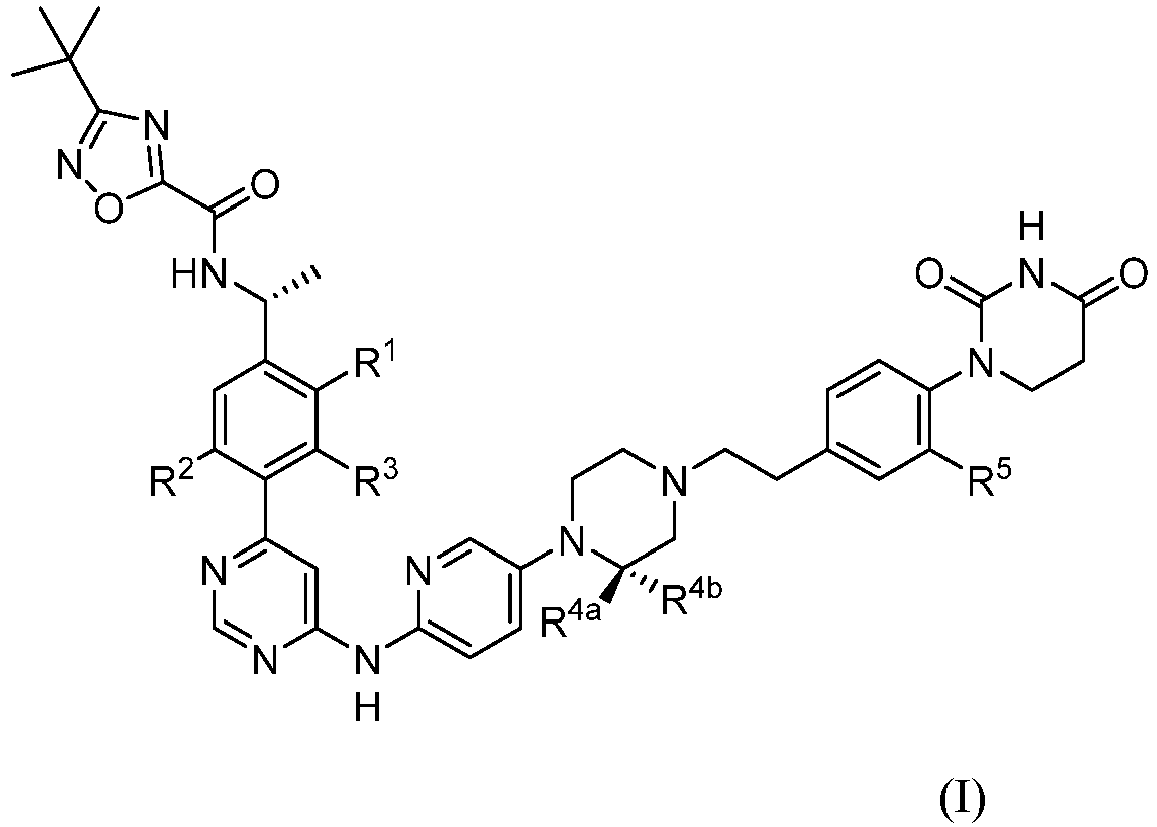
- R1 is selected from the group consisting of hydrogen, C1-C3 alkyl, CN, C1-C3 haloalkyl, halo, CH2OCH3, CH2OH, and CH2CN;
- R2 and R3 are each independently selected from the group consisting of hydrogen and halo;
- R4a and R4b are each independently selected from the group consisting of hydrogen, C1-C3 alkyl, and CH2OCH3; and
- R5 is selected from the group consisting of hydrogen, halo, and C1-C3 alkyl;
- or a pharmaceutically acceptable salt thereof.
- In certain embodiments, R1 is selected from the group consisting of hydrogen, C1-C3 alkyl, CN (cyano), C1-C3 haloalkyl, halo, CH2OCH3; CH2OH; and CH2CN, or a pharmaceutically acceptable salt thereof. In certain embodiments, R1 is C1-C3 alkyl, or a pharmaceutically acceptable salt thereof. In certain embodiments, R1 is methyl, or a pharmaceutically acceptable salt thereof. In certain embodiments, R1 is hydrogen, or a pharmaceutically acceptable salt thereof. In certain embodiments, R1 is CN, or a pharmaceutically acceptable salt thereof. In certain embodiments, R1 is C1-C3 haloalkyl, or a pharmaceutically acceptable salt thereof. In certain embodiments, R1 is CF3, or a pharmaceutically acceptable salt thereof. In certain embodiments, R1 is halo, or a pharmaceutically acceptable salt thereof. In certain embodiments, R1 is Cl, or a pharmaceutically acceptable salt thereof. In certain embodiments, R1 is F, or a pharmaceutically acceptable salt thereof. In certain embodiments, R1 is CH2OCH3, or a pharmaceutically acceptable salt thereof. In certain embodiments, R1 is CH2OH or a pharmaceutically acceptable salt thereof. In certain embodiments, R1 is CH2CN, or a pharmaceutically acceptable salt thereof.
- In certain embodiments, R2 is selected from the group consisting of hydrogen and halo, or a pharmaceutically acceptable salt thereof. In certain embodiments, R2 is hydrogen, or a pharmaceutically acceptable salt thereof. In certain embodiments, R2 is halo, or a pharmaceutically acceptable salt thereof. In certain embodiments, R2 is F, or a pharmaceutically acceptable salt thereof.
- In certain embodiments, R3 is selected from the group consisting of hydrogen and halo, or a pharmaceutically acceptable salt thereof. In certain embodiments, R3 is hydrogen, or a pharmaceutically acceptable salt thereof. In certain embodiments, R3 is halo, or a pharmaceutically acceptable salt thereof. In certain embodiments, R3 is F, or a pharmaceutically acceptable salt thereof.
- In certain embodiments, R4a and R4b are each independently selected from the group consisting of hydrogen, C1-C3 alkyl, and CH2OCH3, or a pharmaceutically acceptable salt thereof. In certain embodiments, R4a is hydrogen and R4b is hydrogen, or a pharmaceutically acceptable salt thereof. In certain embodiments, R4a is hydrogen and R4b is methyl, or a pharmaceutically acceptable salt thereof. In certain embodiments, R4a is methyl and R4b is hydrogen, or a pharmaceutically acceptable salt thereof. In certain embodiments, R4a is hydrogen and R4b is ethyl, or a pharmaceutically acceptable salt thereof. In certain embodiments, R4a is ethyl and R4b is hydrogen, or a pharmaceutically acceptable salt thereof. In certain embodiments, R4a is methyl and R4b is methyl, or a pharmaceutically acceptable salt thereof. In certain embodiments, R4a is hydrogen and R4b is isopropyl, or a pharmaceutically acceptable salt thereof. In certain embodiments, R4a is isopropyl and R4b is hydrogen, or a pharmaceutically acceptable salt thereof. In certain embodiments, R4a is hydrogen and R4b is CH2OCH3, or a pharmaceutically acceptable salt thereof. In certain embodiments, R4a is CH2OCH3 and R4b is hydrogen, or a pharmaceutically acceptable salt thereof.
- In certain embodiments, R5 is selected from the group consisting of hydrogen, halo, and C1-C3 alkyl, or a pharmaceutically acceptable salt thereof. In certain embodiments, R5 is hydrogen, or a pharmaceutically acceptable salt thereof. In certain embodiments, R5 is halo, or a pharmaceutically acceptable salt thereof. In certain embodiments, R5 is F, or a pharmaceutically acceptable salt thereof. In certain embodiments, R5 is Cl, or a pharmaceutically acceptable salt thereof. In certain embodiments, R5 is methyl, or a pharmaceutically acceptable salt thereof.
- In certain embodiments, R1 is methyl and R2 is hydrogen, or a pharmaceutically acceptable salt thereof. In certain embodiments, R1 is methyl, R2 is hydrogen, and R3 is hydrogen, or a pharmaceutically acceptable salt thereof. In certain embodiments, R1 is methyl, R2 is hydrogen, R3 is hydrogen, R4a is hydrogen, and R4b is methyl, or a pharmaceutically acceptable salt thereof. In certain embodiments, R1 is methyl, R2 is hydrogen, R3 is hydrogen, and R5 is hydrogen, or a pharmaceutically acceptable salt thereof. In certain embodiments, R1 is methyl, R4a is hydrogen and R4b is methyl, or a pharmaceutically acceptable salt thereof. In certain embodiments, R2 is hydrogen, R4a is hydrogen and R4b is methyl, or a pharmaceutically acceptable salt thereof. In certain embodiments, R3 is hydrogen, R4a is hydrogen, and R4b is methyl, or a pharmaceutically acceptable salt thereof.
- In certain embodiments, R5 is hydrogen, R4a is hydrogen, and R4b is methyl, or a pharmaceutically acceptable salt thereof. In certain embodiments, R5 is hydrogen, R4a is hydrogen, R4b is methyl, and R3 is hydrogen, or a pharmaceutically acceptable salt thereof. In certain embodiments, R5 is hydrogen, R4a is hydrogen, R4b is methyl, and R3 is hydrogen and R2 is hydrogen, or a pharmaceutically acceptable salt thereof. In certain embodiments, R5 is hydrogen, R4a is hydrogen, R4b is methyl, R3 is hydrogen, and R1 is methyl, or a pharmaceutically acceptable salt thereof.
- In certain embodiments, R1 is methyl and R3 is halo, or a pharmaceutically acceptable salt thereof. In certain embodiments, R1 is methyl and R3 is F, or a pharmaceutically acceptable salt thereof. In certain embodiments, R1 is methyl and R2 is halo, or a pharmaceutically acceptable salt thereof. In certain embodiments, R1 is methyl and R2 is F, or a pharmaceutically acceptable salt thereof.
- In certain embodiments, R5 is halo, R4a is hydrogen, and R4b is methyl, or a pharmaceutically acceptable salt thereof. In certain embodiments, R5 is F, R4a is hydrogen, and R4b is methyl, or a pharmaceutically acceptable salt thereof. In certain embodiments, R5 is halo, R4a is methyl, and R4b is hydrogen, or a pharmaceutically acceptable salt thereof. In certain embodiments, R5 is F, R4a is methyl, and R4b is hydrogen, or a pharmaceutically acceptable salt thereof. In certain embodiments, R5 is halo, R4a is hydrogen, and R4b is ethyl, or a pharmaceutically acceptable salt thereof. In certain embodiments, R5 is F, R4a is hydrogen, and R4b is ethyl, or a pharmaceutically acceptable salt thereof. In certain embodiments, R5 is halo, R4a is ethyl, and R4b is hydrogen, or a pharmaceutically acceptable salt thereof. In certain embodiments, R5 is F, R4a is ethyl, and R4b is hydrogen, or a pharmaceutically acceptable salt thereof.
- In certain embodiments, pharmaceutical compositions comprising a therapeutically effective amount of a compound of formula (I), or a pharmaceutically acceptable salt thereof, in combination with a pharmaceutically acceptable carrier, are provided.
- In certain embodiments, pharmaceutical compositions comprising a therapeutically effective amount of:

- In certain embodiments, the compound is:

- In certain embodiments, the compound is:

- In certain embodiments, the compound is the pharmaceutically acceptable salt of:

- In certain embodiments, the compound is 3-tert-butyl-N-[(1R)-1-{4-[6-({5-[(2S)-4-{2-[4-(2,4-dioxo-1,3-diazinan-1-yl)phenyl]ethyl}-2-methylpiperazin-1-yl]pyridin-2-yl}amino)pyrimidin-4-yl]-2-methylphenyl}ethyl]-1,2,4-oxadiazole-5-carboxamide, or a pharmaceutically acceptable salt thereof.
- In certain embodiments, the compound is 3-tert-butyl-N-[(1R)-1-{4-[6-({5-[(2S)-4-{2-[4-(2,4-dioxo-1,3-diazinan-1 -yl)phenyl] ethyl} -2-methylpiperazin-1-yl]pyridin-2-yl}amino)pyrimidin-4-yl]-2-methylphenyl}ethyl]-1,2,4-oxadiazole-5-carboxamide.
- In certain embodiments, the compound is the pharmaceutically acceptable salt of: In certain embodiments, the compound is 3-tert-butyl-N-[(1R)-1-{4-[6-({5-[(2S)-4-{2-[4-(2,4-dioxo-1,3 -diazinan-1 -yl)phenyl] ethyl } -2-methylpiperazin-1-yl]pyridin-2-yl}amino)pyrimidin-4-yl]-2-methylphenyl}ethyl]-1,2,4-oxadiazole-5-carboxamide.
- In certain embodiments, the compound is selected from the group consisting of:
3-tert-butyl-N-[(1R)-1-{4-[6-({5-[(2S)-4-{2-[4-(2,4-dioxo-1,3-diazinan-1-yl)phenyl]ethyl}-2-methylpiperazin-1-yl]pyridin-2-yl} amino)pyrimidin-4-yl]-2-methylphenyl} ethyl]-1,2,4-oxadiazole-5-carboxamide; - 3-tert-butyl-N-[(1R)-1-{4-[6-({5-[(2R)-4-{2-[4-(2,4-dioxo-1,3-diazinan-1-yl)phenyl]ethyl}-2-methylpiperazin-1-yl]pyridin-2-yl}amino)pyrimidin-4-yl]-2-methylphenyl} ethyl]-1,2,4-oxadiazole-5-carboxamide;
- 3-tert-butyl-N-{(1R)-1-[4-(6-{[5-(4-{2-[4-(2,4-dioxo-1,3-diazinan-1-yl)phenyl]ethyl}piperazin-1-yl)pyridin-2-yl]amino}pyrimidin-4-yl)-2-methylphenyl]ethyl}-1,2,4-oxadiazole-5-carboxamide;
- 3-tert-butyl-N-[(1R)-1-{4-[6-({5-[(2S)-4-{2-[4-(2,4-dioxo-1,3-diazinan-1-yl)-3-fluorophenyl] ethyl} -2-methylpiperazin- 1 -yl]pyridin-2-yl} amino)pyrimidin-4-yl]-2-methylphenyl} ethyl]-1,2,4-oxadiazole-5-carboxamide;
- 3-tert-butyl-N-[(1R)-1-{4-[6-({5-[(2R)-4-{2-[4-(2,4-dioxo-1,3-diazinan-1-yl)-3-fluorophenyl] ethyl} -2-methylpiperazin- 1 -yl]pyridin-2-yl} amino)pyrimidin-4-yl]-2-methylphenyl} ethyl]-1,2,4-oxadiazole-5-carboxamide;
- 3-tert-butyl-N-[(1R)-1-{4-[6-({5-[(2S)-4-{2-[4-(2,4-dioxo-1,3-diazinan-1-yl)phenyl] ethyl } -2-ethylpiperazin-1-yl]pyridin-2-yl} amino)pyrimidin-4-yl]-2-methylphenyl} ethyl]-1,2,4-oxadiazole-5-carboxamide;
- 3-tert-butyl-N-[(1R)-1-{4-[6-({5-[(2S)-4-{2-[4-(2,4-dioxo-1,3-diazinan-1-yl)-3-fluorophenyl]ethyl}-2-ethylpiperazin-1-yl]pyridin-2-yl}amino)pyrimidin-4-yl]-2-methylphenyl}ethyl]-1,2,4-oxadiazole-5-carboxamide;
- 3-tert-butyl-N-[(1R)-1-{4-[6-({5-[(2R)-4-{2-[4-(2,4-dioxo-1,3-diazinan-1-yl)phenyl]ethyl}-2-ethylpiperazin-1-yl]pyridin-2-yl}amino)pyrimidin-4-yl]-2-methylphenyl} ethyl]-1,2,4-oxadiazole-5-carboxamide;
- 3-tert-butyl-N-{(1R)-1-[4-(6-{[5-(4-{2-[4-(2,4-dioxo-1,3-diazinan-1-yl)phenyl]ethyl}-2,2-dimethylpiperazin-1-yl)pyridin-2-yl]amino}pyrimidin-4-yl)-2-methylphenyl]ethyl}-1,2,4-oxadiazole-5-carboxamide;
- 3-tert-butyl-N-[(1R)-1-{4-[6-({5-[(2S)-4-{2-[4-(2,4-dioxo-1,3-diazinan-1-yl)phenyl] ethyl} -2-methylpiperazin-1-yl]pyridin-2-yl}amino)pyrimidin-4-yl]-3 -fluoro-2-methylphenyl} ethyl]-1,2,4-oxadiazole-5-carboxamide;
- 3-tert-butyl-N-{(1R)-1-[4-(6-{[5-(4-{2-[4-(2,4-dioxo-1,3-diazinan-1-yl)phenyl]ethyl}piperazin-1-yl)pyridin-2-yl]amino}pyrimidin-4-yl)-3 -fluoro-2-methylphenyl] ethyl} -1,2,4-oxadiazole-5-carboxamide;
- 3-tert-butyl-N-{(1R)-1-[4-(6-{[5-(4-{2-[4-(2,4-dioxo-1,3-diazinan-1-yl)phenyl] ethyl } piperazin-1 -yl)pyridin-2-yl]amino } pyrimidin-4-yl)- 5-fluoro-2-methylphenyl] ethyl} -1,2,4-oxadiazole-5-carboxamide;
- 3-tert-butyl-N-[(1R)-1-{4-[6-({5-[(2S)-4-{2-[4-(2,4-dioxo-1,3-diazinan-1-yl)phenyl] ethyl } -2-(propan-2-yl)piperazin-1 -yl]pyridin-2-yl} amino)pyrimidin-4-yl]-2-methylphenyl} ethyl]-1,2,4-oxadiazole-5-carboxamide;
- 3-tert-butyl-N-[(1R)-1-{2-chloro-4-[6-({5-[(2S)-4-{2-[4-(2,4-dioxo-1,3-diazinan-1-yl)phenyl] ethyl } -2-methylpiperazin-1 -yl]pyridin-2-yl} amino)pyrimidin-4-yl]phenyl} ethyl]-1,2,4-oxadiazole-5-carboxamide;
- 3-tert-butyl-N[(1R)-1-{4-[6-({5-[(2R)-4-{2-[4-(2,4-dioxo-1,3-diazinan-1-yl)phenyl]ethyl}-2-(methoxymethyl)piperazin-1-yl]pyridin-2-yl}amino)pyrimidin-4-yl]-2-methylphenyl} ethyl]-1,2,4-oxadiazole-5-carboxamide;
- 3-tert-butyl-N-[(1R)-1-{4-[6-({5-[(2S)-4-{2-[4-(2,4-dioxo-1,3-diazinan-1-yl)phenyl] ethyl } -2-methylpiperazin-1 -yl]pyridin-2-yl} amino)pyrimidin-4-yl]-2-(trifluoromethyl)phenyl}ethyl]-1,2,4-oxadiazole-5-carboxamide; and
- 3-tert-butyl-N-[(1R)-1-{4-[6-({5-[(2S)-4-{2-[4-(2,4-dioxo-1,3-diazinan-1-yl)phenyl] ethyl } -2-methylpiperazin-1 -yl]pyridin-2-yl} amino)pyrimidin-4-yl]-2-fluorophenyl}ethyl]-1,2,4-oxadiazole-5-carboxamide; or a pharmaceutically acceptable salt thereof.
- As used in the specification and the appended claims, unless specified to the contrary, the following terms have the meaning indicated.
- It is noted that, as used in this specification and the intended claims, the singular form "a," "an," and "the" include plural referents unless the context clearly dictates otherwise. Thus, for example, reference to "a compound" includes a single compound as well as one or more of the same or different compounds.
- In some instances, the number of carbon atoms in a moiety is indicated by the prefix "Cx-Cy", wherein x is the minimum and y is the maximum number of carbon atoms in the substituent. Thus, for example, "C1-C3 alkyl" means an alkyl substituent containing from 1 to 3 carbon atoms.
- The term "alkyl," as used herein, refers to a saturated, straight, or branched hydrocarbon chain radical having one, two, three, four, five, or six carbon atoms, unless otherwise specified. The term "C1-C3 alkyl" refers to an alkyl having one, two, or three carbon atoms. Examples of alkyls include, but are not limited to, methyl, ethyl, propyl, isopropyl, and the like. In certain embodiments, the alkyl is methyl. In certain embodiments, the alkyl is ethyl. In certain embodiments, the alkyl is propyl. In certain embodiments, the alkyl is isopropyl.
- The term "halo" as used herein, means Cl (chloro), Br (bromo), I (iodo), and F (fluoro). In certain embodiments, halo is selected from the group consisting of Cl or F. In certain embodiments, the halo is Cl. In certain embodiments, the halo is F.
- The term "haloalkyl," as used herein, refers to an alkyl group, as defined herein, in which one or more hydrogen atoms are replaced by a halo group. As an example, the term "C1-C3 haloalkyl" refers to a haloalkyl having one, two, or three carbon atoms. In certain embodiments, one, two or three hydrogen atoms may each be replaced by a fluoro group. An example of a haloalkyl is trifluoromethyl or CF3.
-
Fig. 1 shows in vivo activity of Compound 1 (Example 1) in TCL1-driven CLL bearing BtkC481S mutation in C57BL/6 mice. - In certain embodiments, the compounds disclosed herein comprise two ligands connected via a linker. The first ligand is capable of binding Btk. The second ligand is capable of recruiting a ubiquitin ligase. In certain embodiments, the ubiquitin ligase is an E3 ligase. In certain embodiments, the E3 ubiquitin ligase is cereblon (CRBN) and/or comprises cereblon (CRBN). In certain embodiments, the second ligand is capable of recruiting CRBN. In certain embodiments, the second ligand is capable of binding CRBN. In certain embodiments, the compounds described herein are capable of binding Btk and capable of recruiting a ubiquitin ligase that comprises cereblon. In certain embodiments, the compounds disclosed herein recruit E3 ligase to Btk and cause proximity-induced ubiquitination and degradation of the Btk by the ubiquitin proteasome system (UPS). In certain embodiments, the compounds disclosed herein are capable of binding Btk and reducing the amount of Btk in the cell via degradation.
- In certain embodiments, the compounds disclosed herein are useful in the treatment of chronic lymphocytic leukemia (CLL). For example, the compounds described herein are useful for treating CLL by degrading Btk in patients via a ubiquitin proteolytic pathway.
- In certain embodiments, the compounds disclosed herein degrade BtkC481S protein (Btk protein having the C481 mutation) in cell lines expressing BtkC481S.
- In certain embodiments, a method of treating a patient with CLL comprising administering to the patient a compound of formula (I) is provided.
- In certain embodiments, methods for treating CLL comprising administering to a subject in need thereof a therapeutically effective amount of a compound of formula (I) are provided.
- The phrase "pharmaceutically acceptable salt" refers to those salts which are, within the scope of sound medical judgement, suitable for use in contact with the tissues of humans and lower animals without undue toxicity, irritation, allergic response and the like and are commensurate with a reasonable benefit/risk ratio.
- The term "subject," as used herein, refers to a human. The terms "human," "patient," and "subject" are used interchangeably herein.
- The terms "treat," "treating," and "treatment," as used herein, refer to a method of alleviating or abrogating a disease and/or its attendant symptoms.
- The phrase "therapeutically effective amount" refers to an amount of a compound, or a pharmaceutically acceptable salt thereof, sufficient to prevent the development of or to alleviate to some extent one or more of the symptoms of the condition or disorder being treated when administered for treatment in a particular subject or subject population. In certain embodiments, the amount is effective to degrade Btk in the patient.
- The compounds of the present disclosure can be better understood in connection with the following synthetic schemes and methods which illustrate a means by which the compounds can be prepared. Representative procedures are shown in, but are not limited to, Schemes 1-5. In Schemes 1-5, the variables R1, R2, R3, R4, and R5 may be as described herein. Final compounds of the invention were named by using ACD/Name 2021.1.3 (File Version N15E41, Build 123232, 07 July 2021) software program and/or by using Struct=Name naming algorithm as part of CHEMDRAW® Professional v. 20.1.1.125. Intermediates were named using CHEMDRAW® Professional v. 20.1.1.125.
- Compounds of the present invention may be prepared according to the schemes set forth below.

- Methods for preparing substituted 1-phenyldihydropyrimidine-2,4(1H,3H)-dione building block 1-6 are illustrated in
Scheme 1. The substitution group R5 on compound 1-1 may be a halo, hydrogen, or C1-C3 alkyl, as described herein. Reaction of compound 1-1 with tert-butyldimethylsilyl chloride in the presence of imidazole may provide compound 1-2. Reaction of compound 1-2 with acrylic acid using heat may form compound 1-3. Compound 1-3 may react with urea in heated acetic acid to yield compound 1-4. Compound 1-4 may be treated with aqueous HCl to provide intermediate 1-5. Intermediate 1-5 may be treated with iodine followed by Ph3P in the presence of imidazole to provide iodo compound 1-6, or it may be treated with CBr4 followed by Ph3P to provide bromo compound 1-6.

- A method for preparing substituted building block 2-7 is illustrated in
Scheme 2. Reaction of substituted benzaldehyde 2-1 wherein R1, R2, and R3 may be as described herein, with (S)-2-methylpropane-2-sulfinamide 2-2 may provide compound 2-3. Reacting compound 2-3 with CH3MgBr under Grignard reaction conditions may afford intermediate 2-4. Using bis(pinacolato)diboron and a palladium catalyst, intermediate 2-5 may be synthesized from intermediate 2-4. Amine 2-6 may be prepared from intermediate 2-5 by removing the t-butylsulfinyl group using strong acid or iodine. Heteroaryl carboxamide building block 2-7 may be directly synthesized from amine 2-6 with methyl 3-(tert-butyl)-1,2,4-oxadiazole-5-carboxylate.
- As shown in Scheme 3, building block 3-4, wherein R4a and R4b are as described herein, may be prepared from compound 3-3 by hydrogenation or a nitro reduction reaction. Intermediate compound 3-3 may be prepared from 2-nitro-5-halopyridine compound 3-1 and substituted piperazine compound 3-2 by a SNAr reaction or a Buchwald-Hartwing cross-coupling reaction.
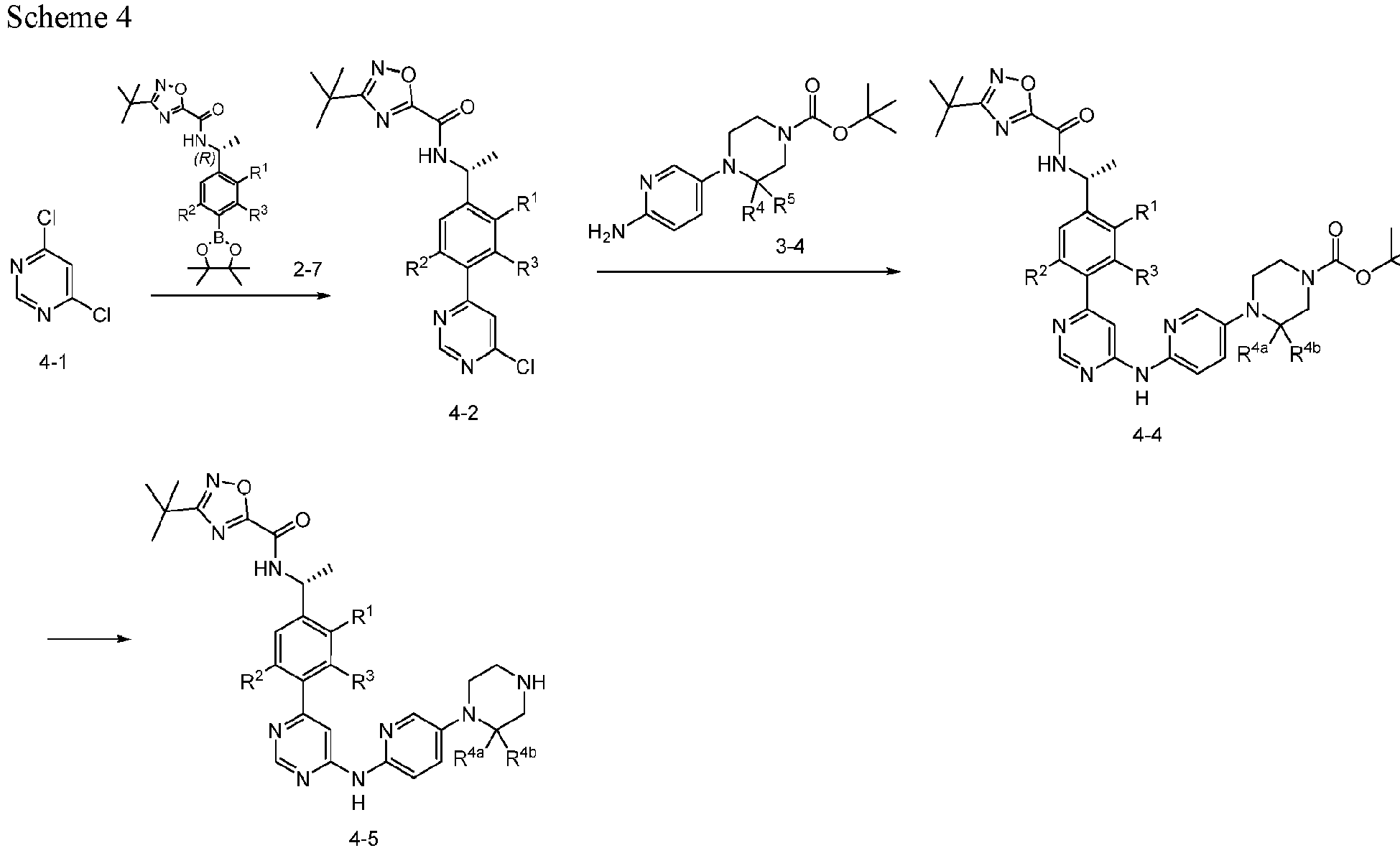
- A general synthesis for intermediates of formula 4-5 is shown in Scheme 4, wherein R1, R2, R3, R4a, and R4b may be as described herein. Intermediate 4-2 may be prepared via a Suzuki reaction of building block 2-7 with 4,6-dicholopyrimidine 4-1. Intermediate 4-4 may be prepared from compound 4-2 via a Buchwald-Hartwing cross-coupling reaction with substituted 2-aminopyridine compound 3-4. The tert-butyloxycarbonyl protecting group may be cleaved using hydrochloric acid or trifluoroacetic acid to afford building block 4-5.


- A general synthesis for target compounds of formula 5-4 is shown in
Scheme 5, wherein R1, R2, R3, R4a, R4b, and R5 may be as described herein. Iodo or bromo building block 1-6 may react with intermediate 4-5 via an alkylation reaction using sodium iodide and a base such as N,N-diisopropylethylamine to provide target compound 5-4. - It can be appreciated that the synthetic schemes and specific examples as illustrated in the Examples section are illustrative and are not to be read as limiting the scope of the present disclosure as it is defined in the appended claims. All alternatives, modifications, and equivalents of the synthetic methods and specific examples are included within the scope of the claims.
- The following Examples may be used for illustrative purposes and should not be deemed to narrow the scope of the present disclosure.
- Exemplary compounds of formula (I) include, but are not limited to, the compounds shown in Table 1 below, and pharmaceutically acceptable salts thereof.
Table 1. Exemplary Compounds EXAMPLE COMPOUND STRUCTURE 1 
2 
3 
4 
5 
6 
7 
8 
9 
10 
11 
12 
13 
14 
15 
16 
17 
18 
19 
-
Abbreviation Definition NMR nuclear magnetic resonance S Singlet br s broad singlet D duplet or doublet br d broad doublet br dd broad doublet of doublets M Multiplet T Triplet br t broad triplet Td triplet of doublets Q Quartet Qd quartet of doublets Dd doublet of doublets Dt doublet of triplets Dq doublet of quartets Ddd doublet of doublet of doublets Dtd doublet of triplet of doublets Quin quintuplet mL milliliter µL microliter L liter G gram Mg milligram Mol moles Mmol millimoles mM millimolar M molarity (moles/liter) µM micromolar N normality (equivalent/liter) Ppm parts per million Psi pounds per square inch HPLC high pressure liquid chromatography LC/MS or LCMS liquid chromatography- mass spectrometry MS mass spectrometry ESI electrospray ionization ATP adenosine triphosphate BSA bovine serum albumin EDTA ethylenediaminetetraacetic acid DTT dithiothreitol HEPES (4-(2-hydroxyethyl)-1-piperazineethanesulfonic acid) IC50 half maximal inhibitory concentration DC50 half maximal degradation concentration UV ultraviolet TLC thin layer chromatography Mm millimeter Mm micrometer (micron) MHz megahertz Nm nanometer °C degrees Celsius m/z mass to charge ratio pH potential of hydrogen Pd/C palladium on carbon - Final compounds obtained through preparative HPLC may have been concentrated through lyophilization. Final Examples were typically purified to ≥95% purity as determined by HPLC and LCMS at 254 nm. 1H NMR spectra were recorded on a Bruker Avance™ III 400 MHz NMR spectrometer, or a Bruker Ascend™ 500 MHz NMR spectrometer. Chemical shifts (δ) were reported as parts per million (ppm) relative to residual undeuterated solvent as an internal reference.
- A 5 L reactor was charged with triisopropyl borate (1.50 L, 6.53 mol), 4-bromo-2-methylbenzaldehyde (1.00 kg, 5.02 mol), and (S)-2-methylpropane-2-sulfinamide (669 g, 5.53 mol) at ambient temperature. The mixture was stirred at 80 °C for 12 hours. The reaction was duplicated twice on the same scale. To the combined reaction mixtures of the three batches was added water (10.0 L), and the mixture was extracted with ethyl acetate (4.0 L × 2), washed with brine (5.0 L), dried with sodium sulfate, and filtered. The filtrate was concentrated under reduced pressure, and the residue was triturated in petroleum ether (5.0 L) for 2 hours and filtered. The filter cake was washed with petroleum ether, and the cake was dried under reduced pressure to provide the title compound. 1H NMR (400 MHz, CDCl3): δ ppm 8.79 (s, 1H), 7.77 (d, J =6.4 Hz, 1H), 7.44 (s, 1H), 7.43 (d, J =6.4 Hz, 1H), 2.59 (s, 3H), 1.27 (s, 9H) ppm.
- A 50 L reactor was charged with dichloromethane (20.0 L) and Example 1A (1.00 kg, 3.31 mol). The mixture was chilled at -20 °C. CH3MgBr (3.0 M in tetrahydrofuran, 1.65 L, 4.96 mol) was added at -20 °C dropwise. The mixture was then stirred at ambient temperature for 16 hours. The reaction mixture was chilled in an ice bath, and to it was added saturated aqueous NH4Cl solution (5.0 L). The organic phase was separated, and the aqueous phase was extracted with dichloromethane (3.0 L × 2). The combined organic phase was washed with brine (5.0 L), dried with sodium sulfate, and filtered. The filtrate was concentrated under reduced pressure and the residue was triturated in petroleum ether. The crude material was isolated by filtration, washed with petroleum ether, and dried under reduced pressure. The same reaction was duplicated five times to provide the title compound. 1H NMR (400 MHz, dimethyl sulfoxide-d 6): δ ppm 7.38-7.31 (m, 3H), 5.33 (d, J =5.2 Hz, 1H), 4.55 (m, 1H), 2.30 (s, 3H), 1.40 (d, J =5.2 Hz, 1H), 1.08 (s, 9H) ppm. MS (ESI) m/z 318.0, 320.0 (M+H)+.
- A 5 L reactor was charged with Example 1B (600 g, 1.89 mol), dioxane (3.6 L), bis(pinacolato)diboron (600 g, 2.36 mol), potassium acetate (370 g, 3.77 mol) and Pd(dppf)Cl2 ([1,1'-bis(diphenylphosphino)ferrocene]dichloropalladium(II), 23.0 g, 0.07 mol) at ambient temperature. The mixture was degassed with nitrogen and stirred at 85 °C for 8 hours under nitrogen. The same reaction was duplicated four times on the same scale. The combined reaction mixtures of the five batches were filtered through diatomaceous earth, and the filter cake was washed with ethyl acetate (0.5 L × 3). The filtrate was concentrated under reduced pressure and the residue was subjected to silica flash column chromatography using petroleum ether and ethyl acetate to provide the title compound. 1H NMR (400 MHz, CDCl3): δ ppm 7.58-7.38 (m, 3H), 5.31 (d, J =4.8 Hz, 1H), 4.60 (m, 1H), 2.31 (s, 3H), 1.40 (d, J =6.8 Hz, 1H), 1.27 (s, 12H), 1.08 (s, 9H) ppm. MS (ESI) m/z 366.2 (M+H)+.
- A 3 L reactor was charged with Example 1C (250 g, 680 mmol) and ethyl acetate (750 mL) at 20 °C. The mixture was chilled to 0 °C. To the mixture was added hydrogen chloride in ethyl acetate (4 M, 750 mL) at 0 °C. The reaction mixture was stirred for 2 hours at 20 °C. The mixture was filtered, and the solid product was triturated in ethyl acetate, filtered, and dried under reduced pressure to afford the crude title compound as a hydrochloride salt. 1H NMR (400 MHz, dimethyl sulfoxide-d 6): 8.62 (br s, 3 H), 7.52-7.60 (m, 3 H), 4.51-4.54 (br d, J = 5.2 Hz, 1 H), 2.35 (s, 3 H), 1.46 (d, J = 6.8 Hz, 3 H), 1.28 (s, 12 H) ppm. MS (ESI) m/z 262.1 (M+H)+.
- To a solution of Example 1D (20 g, 77 mmol) and methyl 3-(tert-butyl)-1,2,4-oxadiazole-5-carboxylate (31.0 g, 168 mmol) in ethanol (200 mL) was added triethylamine (64.0 mL, 459 mmol) at 20 °C. The mixture was stirred at 65 °C for 16 hours, and then concentrated under reduced pressure to remove ethanol. Water was added to the mixture, and the mixture was extracted with ethyl acetate (three times). The combined organic layer was washed with saturated ammonium chloride aqueous solution (once) and brine (once), dried with sodium sulfate, and filtered. The filtrate was concentrated under reduced pressure to provide the crude material. The crude material was purified by column chromatography on silica gel, eluted with petroleum ether and ethyl acetate to provide the title compound. 1H NMR (400 MHz, dimethyl sulfoxide-d 6): δ ppm 9.83 (d, J =7.7 Hz, 1H), 7.53 - 7.43 (m, 3H), 5.28 (quin, J =7.1 Hz, 1H), 2.37 (s, 3H), 1.45 (d, J =7.0 Hz, 3H), 1.35 (s, 9H), 1.27 (s, 12H) ppm. MS (ESI) m/z 414.3 (M+H)+.
- A 3 L reactor was charged with 2-(4-aminophenyl)ethan-1-ol (176 g, 1.28 mol), N,N-dimethylformamide (1.8 L), imidazole (91.7 g, 1.35 mol), and tert-butyldimethylsilyl chloride (222 g, 1.48 mol) at ambient temperature. The mixture was stirred at ambient temperature for 6 hours. To the mixture were added ethyl acetate (500 mL) and water (300 mL). The organic phase was separated, washed with brine (300 mL), dried with sodium sulfate, concentrated under reduced pressure, and the residue was subjected to flash column chromatography (eluted with petroleum ether and ethyl acetate) to provide the title compound. MS (ESI) m/z 252.2 (M+H)+.
- Example 1F (196 g, 0.78 mol) was charged into a 3 L reactor. To the mixture were added toluene (1.4 L) and acrylic acid (67.4 g, 0.94 mol). The reaction mixture was stirred at 110 °C for 12 hours under nitrogen. The mixture was concentrated under reduced pressure to dryness to provide crude title compound. MS (ESI) m/z 324.2 (M+H)+.
- To crude Example 1G (252 g, 0.78 mol)) were added acetic acid (1.8 L) and urea (46.8 g, 0.78 mol). The reaction mixture was stirred at 110 °C for 12 hours under nitrogen and was cooled to ambient temperature. To the mixture were added water (600 mL) and ethyl acetate (600 mL). The organic phase was separated, and the aqueous phase was extracted with ethyl acetate (600 mL). The combined organic phase was washed with brine, dried with sodium sulfate, filtered and the filtrate was concentrated under reduced pressure to dryness to provide crude title compound. MS (ESI) m/z 277.1 (M+H)+.
- To crude Example 1H (176 g, 0.63 mol) was added 6 N aqueous HCl (1.23 L, 7.39 mol), and the mixture was stirred at ambient temperature for 6 hours. The reaction mixture was concentrated under reduced pressure to dryness, and the residue was triturated with ethanol/ethyl acetate (250 mL/250 mL) for 30 minutes. The material was isolated by filtration and dried under vacuum to provide crude title compound. MS (ESI) m/z 235.1 (M+H)+.
- A 250 mL flask was charged with Example 1I (10.0 g, 0.04 mol) and dichloromethane (100 mL). In an ice bath, iodine (16.3 g, 0.06 mol) was added in small portions, followed by Ph3P (16.8 g, 0.06 mol) in small portions, followed by imidazole (4.36 g, 0.06 mol) in small portions. The reaction mixture was then stirred at ambient temperature for 3 hours. The same reaction was duplicated seven times in parallel on the same scale. The reaction mixtures of the eight batches were combined and poured into a mixture of water (800 mL) and ethyl acetate (800 mL). After vigorously stirring, the organic phase was separated, filtered, dried with sodium sulfate, and filtered. The filtrate was concentrated under reduced pressure to provide the title compound. 1H NMR (400 MHz, dimethyl sulfoxide-d 6): δ ppm 10.34 (s, 1H), 7.32-7.24 (m, 4H), 3.75 (m, 2H), 3.49 (m, 2H), 3.13 (m, 2H), 2.72 (m, 2H) ppm. MS (ESI) m/z 345.0 (M+H)+.
- To a solution of 5-chloro-2-nitropyridine (30 g, 189 mmol) in toluene (600 mL) were added (S)-tert-butyl 3-methylpiperazine-1-carboxylate (37.9 g, 189 mmol), potassium phosphate (60.2 g, 284 mmol) and (R)-(+)-2,2'-bis(diphenylphosphino)-1,1'-binaphthyl (5.89 g, 9.46 mmol) at 20 °C. The reaction vessel was evacuated and backfilled with argon three times and palladium(II) acetate (2.124 g, 9.46 mmol) was added in one portion at 20 °C. The vessel was then evacuated and backfilled with argon three times again. The reaction mixture was warmed to 90 °C and stirred at 90 °C for 24 hours under argon atmosphere. The reaction mixture was cooled, filtered through a pad of diatomaceous earth, and washed with ethyl acetate. The filtrate was concentrated under reduced pressure, and the residue was purified by silica flash column (eluted with tetrahydrofuran in petroleum ether from 0% to 50%) to provide the title compound. 1H NMR (400 MHz, dimethyl sulfoxide-d 6): δ ppm 8.11-8.26 (m, 2 H), 7.42 (dd, J=9.38, 3.00 Hz, 1 H), 4.32 (br s, 1 H), 3.93 (br s, 1 H), 3.79 (br d, J=12.76 Hz, 2 H), 3.14-3.29 (m, 2 H), 3.06 (br s, 1 H), 1.42 (s, 9 H), 1.08 (d, J=6.63 Hz, 3 H) ppm. MS (ESI) m/z 323.2 (M+H)+.
- To a suspension of Pd/C (10 wt %, 46.2 g, 43.4 mmol) in tetrahydrofuran (700 mL) was added Example 1K (70 g, 217 mmol), and the reaction mixture was stirred at ambient temperature for 24 hours under hydrogen (15 psi). The same reaction was duplicated on the same scale. The combined reaction mixture was filtered through a pad of diatomaceous earth, and the filtrate was concentrated under reduced pressure to give crude product. The material was triturated with petroleum ether and ethyl acetate, the resulting solid was filtered, and the filter cake was dried under vacuum to provide the title compound. 1H NMR (400 MHz, CDCl3): δ ppm 7.62 (d, J=2.63 Hz, 1 H), 7.20 (dd, J=8.76, 2.63 Hz, 1 H), 6.40 (d, J=8.76 Hz, 1 H), 5.56 (s, 2 H), 3.55 (br d, J=11.38 Hz, 1 H), 3.39 (br d, J=5.13 Hz, 2 H), 3.17 (br s, 2 H), 2.71 - 2.90 (m, 2 H), 1.41 (s, 9 H), 0.75 (d, J=6.25 Hz, 3 H) ppm. MS (ESI) m/z 293.2 (M+H)+.
- To a mixture of Example 1E (10 g, 24.19 mmol) and 4,6-dichloropyrimidine (7.21 g, 48.4 mmol) in tetrahydrofuran (400 mL) was added a solution of potassium phosphate (10.27 g, 48.4 mmol) in water (100 mL) at 20 °C. The mixture was degassed at ambient temperature using a nitrogen stream, and to the mixture was added [1,1'-bis(diphenylphosphino)ferrocene]dichloro-palladium(II) (0.885 g, 1.210 mmol) under N2. The reaction mixture was heated to 80 °C and stirred for 2 hours. The mixture was cooled, poured into water, and extracted with ethyl acetate (three times). The combined organic layer was washed with brine, dried over sodium sulfate, and filtered. The filtrate was concentrated under reduced pressure, and the residue was purified by silica column chromatography, eluting with tetrahydrofuran in petroleum ether to provide crude title compound. 1H NMR (400 MHz, dimethyl sulfoxide-d 6): δ ppm 9.93 (d, J=7.8 Hz, 1H), 9.07 (s, 1H), 8.30 (s, 1H), 8.09 (d, J=7.8 Hz, 1H), 7.63 (d, J=8.5 Hz, 1H), 5.33 (quin, J=7.2 Hz, 1H), 2.48 - 2.47 (m, 1H), 2.47 (s, 2H), 1.50 (d, J=7.0 Hz, 3H), 1.36 (s, 9H) ppm. MS (ESI) m/z 400.1 (M+H)+.
- To a solution of Example 1L (25 g, 86 mmol) in 1,4-dioxane (500 mL) were added Example 1M (34.2 g, 86 mmol), Cs2CO3 (55.7 g, 171 mmol) and (9,9-dimethyl-9H-xanthene- 4, 5-diyl)bis(diphenylphosphine) (4.95 g, 8.55 mmol) at 20 °C. The reaction vessel was evacuated and backfilled with argon, and that process was repeated three times. Thereafter (tris(dibenzylidene-acetone)dipalladium(0)) (3.91 g, 4.28 mmol) was added under argon. The reaction vessel was evacuated and backfilled with argon, and that process was repeated three times. The reaction mixture was heated to 100 °C and stirred at 100 °C for 16 hours. The reaction mixture was cooled, filtered through a pad of diatomaceous earth, and washed with ethyl acetate. The filtrate was concentrated under reduced pressure and the residue was purified by silica column chromatography, eluting with tetrahydrofuran in petroleum ether to provide the title compound. 1H NMR (400 MHz, dimethyl sulfoxide-d 6): δ ppm 10.02 (s, 1 H), 9.89 (d, J=7.88 Hz, 1 H), 8.71 (d, J=0.75 Hz, 1 H), 7.97 - 8.10 (m, 2 H), 7.79 - 7.88 (m, 2 H), 7.71 (br d, J=8.50 Hz, 1 H), 7.61 (d, J=8.63 Hz, 1 H), 7.44 (dd, J=9.13, 2.88 Hz, 1 H), 5.33 (quin, J=7.13 Hz, 1 H), 3.73 - 3.92 (m, 2H), 3.60 (br d, J=11.51 Hz, 1 H), 3.31 (br s, 1 H), 3.16 (br d, J=11.88 Hz, 2H), 2.88 - 3.01 (m, 1 H), 2.47 (s, 3 H), 1.51 (d, J=6.88 Hz, 3 H), 1.42 (s, 9 H), 1.36 (s, 9 H), 0.88 (d, J=6.38 Hz, 3 H) ppm. MS (ESI) m/z 656.2 (M+H)+.
- To a solution of Example 1N (32 g, 48.8 mmol) in dioxane (300 mL) was added hydrochloride (4 N in dioxane, 300 mL) drop-wise. The reaction mixture was stirred at ambient temperature for 2 hours. The reaction mixture was filtered to isolate the crude material, which was dried under vacuum. The crude material was diluted with water (300 mL), and to the mixture was added saturated sodium bicarbonate aqueous solution to adjust the pH to 8. The mixture was extracted with ethyl acetate (twice), dried over anhydrous sodium sulfate, and filtered. The filtrate was concentrated under reduced pressure to provide the title compound. 1H NMR (400 MHz, dimethyl sulfoxide-d 6): δ ppm 10.00 (s, 1 H), 9.88 (d, J=7.78 Hz, 1 H), 8.70 (d, J=0.88 Hz, 1 H), 8.04 (br s, 1 H), 8.00 (d, J=2.89 Hz, 1 H), 7.79-7.89 (m, 2 H), 7.71 (br d, J=8.66 Hz, 1 H), 7.61 (d, J=8.66 Hz, 1 H) 7.43 (dd, J=9.16, 2.89 Hz, 1 H) 5.33 (quin, J=7.12 Hz, 1 H) 3.67-3.81 (m, 2 H), 3.67-3.81 (m, 1 H), 3.67-3.81 (m, 1 H), 3.08-3.17 (m, 1 H), 2.89-3.06 (m, 3 H), 2.74-2.89 (m, 2 H), 2.47 (s, 3 H), 1.51 (d, J=7.03 Hz, 3 H), 1.36 (s, 9 H), 0.96 (d, J=6.53 Hz, 3 H) ppm. MS (ESI) m/z 556.2 (M+H)+.
- To a solution of Example 1O (24.7 g, 44.5 mmol) in acetonitrile (500 mL) were added Example 1J (18.36 g, 53.3 mmol), N,N-diisopropylethylamine (46.6 mL, 267 mmol) and sodium iodide (19.99 g, 133 mmol) at 20 °C. Then the reaction mixture was stirred at 90 °C for 16 hours. The reaction mixture was cooled, poured into ice water, and filtered. The filter cake was triturated with ethyl acetate/tetrahydrofuran (twice). The material was dried under reduced pressure to provide the title compound. 1H NMR (400 MHz, dimethyl sulfoxide-d 6): δ ppm 10.33 (s, 1 H), 9.99 (s, 1 H), 9.89 (d, J=7.78 Hz, 1 H), 8.70 (s, 1 H), 7.96 - 8.09 (m, 2 H), 7.80 - 7.87 (m, 2 H), 7.70 (br d, J=7.65 Hz, 1 H), 7.61 (d, J=8.66 Hz, 1 H), 7.44 (dd, J=9.10, 2.82 Hz, 1 H), 7.19 - 7.32 (m, 4 H), 5.33 (br t, J=7.28 Hz, 1 H), 3.86 (br d, J=6.65 Hz, 1 H), 3.76 (t, J=6.65 Hz, 2 H), 3.21 (br d, J=11.92 Hz, 1 H), 2.99 (br t, J=9.35 Hz, 1 H), 2.84 (br d, J=10.79 Hz, 1 H), 2.77 (br t, J=7.47 Hz, 2 H), 2.69 (br t, J=6.65 Hz, 3 H), 2.56 (br s, 2 H), 2.47 (s, 3 H), 2.44 (br s, 1 H), 2.26 - 2.37 (m, 1 H), 1.51 (d, J=6.90 Hz, 3 H), 1.36 (s, 9 H), 0.99 (d, J=6.27 Hz, 3 H) ppm. MS (ESI) m/z 772.2 (M+H)+.
- The title compound was prepared according to the procedure used for Example 1K, substituting (R)-tert-butyl 3-methylpiperazine-1-carboxylate for (S)-tert-butyl 3-methylpiperazine-1-carboxylate. 1H NMR (400 MHz, dimethyl sulfoxide-d 6): δ ppm 8.13-8.24 (m, 2 H), 7.43 (dd, J=9.32, 3.06 Hz, 1 H), 4.32 (br s, 1 H), 3.85-4.03 (br s, 1 H), 3.79 (br d, J=12.88 Hz, 2 H), 2.97-3.30 (m, 3 H), 1.43 (s, 9 H), 1.08 (d, J=6.50 Hz, 3 H) ppm. MS (ESI) m/z 323.2 (M+H)+.
- The title compound was prepared according to the procedure used for Example 1L, substituting Example 2A for Example 1K. 1H NMR (400 MHz, dimethyl sulfoxide-d 6): δ ppm 7.62 (d, J=2.63 Hz, 1 H), 7.20 (dd, J=8.76, 2.75 Hz, 1 H), 6.40 (d, J=8.76 Hz, 1 H), 5.54 (s, 2 H), 3.56 (br d, J=10.76 Hz, 1 H), 3.40 (br s, 2 H) 3.17 (br s, 2 H), 2.71 - 2.88 (m, 2 H), 1.41 (s, 9 H), 0.76 (d, J=6.13 Hz, 3 H) ppm. MS (ESI) m/z 293.1 (M+H)+.
- The title compound was prepared according to the procedure used for Example 1N, substituting Example 2B for Example 1L. 1H NMR (400 MHz, dimethyl sulfoxide-d 6): δ ppm 9.99 (s, 1 H), 9.87 (d, J=7.78 Hz, 1 H), 8.70 (d, J=1.00 Hz, 1 H), 7.98 - 8.07 (m, 2 H), 7.79 - 7.88 (m, 2 H), 7.71 (br d, J=9.16 Hz, 1 H), 7.60 (d, J=8.66 Hz, 1 H), 7.45 (dd, J=9.10, 2.82 Hz, 1 H), 5.33 (quin, J=7.25 Hz, 1 H), 3.75 - 3.88 (m, 2 H), 3.56 - 3.65 (m, 1 H), 3.11 - 3.22 (m, 2 H), 2.90 (s, 1 H), 2.52 (br s, 1 H), 2.47 (s, 3 H), 1.51 (d, J=7.03 Hz, 3 H), 1.42 (s, 9 H), 1.36 (s, 9 H), 0.89 (d, J=6.40 Hz, 3 H) ppm. MS (ESI) m/z 656.3 (M+H)+.
- The title compound was prepared according to the procedure used for Example 1O, substituting Example 2C for Example 1N. 1H NMR (400 MHz, dimethyl sulfoxide-d 6): δ ppm 9.97 (s, 1 H), 9.87 (d, J=7.78 Hz, 1 H), 8.70 (d, J=1.00 Hz, 1 H), 8.03 (br s, 1 H), 7.98 (d, J=2.76 Hz, 1 H), 7.80 - 7.87 (m, 2 H), 7.69 (br d, J=8.66 Hz, 1 H), 7.60 (d, J=8.66 Hz, 1 H), 7.41 (dd, J=9.16, 2.89 Hz, 1 H), 5.26 - 5.40 (m, 1 H), 3.65 - 3.77 (m, 1 H), 3.01 - 3.15 (m, 1 H), 2.90 - 2.98 (m, 2 H), 2.84 - 2.90 (m, 1 H), 2.69 - 2.79 (m, 2 H), 2.52 (br d, J=1.88 Hz, 1 H), 2.47 (s, 3 H), 1.51 (d, J=6.90 Hz, 3 H), 1.36 (s, 9 H), 0.96 (d, J=6.53 Hz, 3 H) ppm. MS (ESI) m/z 556.4 (M+H)+.
- The title compound was prepared according to the procedure used for Example 1P, substituting Example 2D for Example 1O. 1H NMR (400 MHz, dimethyl sulfoxide-d 6): δ ppm 10.31 (br s, 1 H), 9.97 (s, 1 H), 9.87 (br d, J=6.02 Hz, 1 H), 8.70 (d, J=0.88 Hz, 1 H), 7.94 - 8.10 (m, 2 H), 7.78 - 7.89 (m, 2 H), 7.70 (br d, J=8.03 Hz, 1 H), 7.60 (d, J=8.66 Hz, 1 H), 7.43 (dd, J=9.16, 2.89 Hz, 1 H), 7.18 - 7.32 (m, 4 H), 5.24 - 5.42 (m, 1 H), 3.81 - 3.90 (m, 1 H), 3.76 (t, J=6.65 Hz, 2 H), 3.16 - 3.26 (m, 1 H), 2.93 - 3.05 (m, 1 H), 2.84 (br d, J=10.67 Hz, 1 H), 2.73 - 2.81 (m, 2 H), 2.67 - 2.73 (m, 3 H), 2.53 - 2.62 (m, 2 H), 2.47 (s, 3 H), 2.44 (br s, 1 H), 2.27 - 2.36 (m, 1 H), 1.51 (d, J=7.03 Hz, 3 H), 1.36 (s, 9 H), 0.99 (d, J=6.40 Hz, 3 H) ppm. MS (ESI) m/z 772.2 (M+H)+.
- The title compound was prepared according to the procedure used for Example 1K, substituting tert-butyl piperazine-1-carboxylate for (S)-tert-butyl 3-methylpiperazine-1-carboxylate. MS (ESI) m/z 309.2 (M+H)+.
- The title compound was prepared according to the procedure used for Example 1L, substituting Example 3A for Example 1K. MS (ESI) m/z 279.3 (M+H)+.
- The title compound was prepared according to the procedure used for Example 1N, substituting Example 3B for Example 1L. 1H NMR (400 MHz, dimethyl sulfoxide-d 6): δ ppm 10.03 (s, 1H), 9.90 (d, J= 7.8 Hz, 1H), 8.71 (s, 1H), 8.06 (br d, J= 2.9 Hz, 2H), 7.85 - 7.80 (m, 2H), 7.71 (br d, J = 8.0 Hz, 1H), 7.60 (d, J = 8.6 Hz, 1H), 7.47 (dd, J = 2.9, 9.1 Hz, 1H), 5.38 - 5.28 (m, 1H), 3.46 (br d, J = 4.8 Hz, 4H), 3.12 - 3.02 (m, 4H), 2.47 (s, 3H), 1.51 (d, J = 6.9 Hz, 3H), 1.42 (s, 9H), 1.37 - 1.34 (m, 9H) ppm. MS (ESI) m/z 642.4 (M+H)+.
- The title compound was prepared according to the procedure used for Example 1O, substituting Example 3C for Example 1N. 1H NMR (400 MHz, dimethyl sulfoxide-d 6): δ ppm 10.01 (s, 1H), 9.89 (d, J=7.8 Hz, 1H), 8.71 (s, 1H), 8.14-7.95 (m, 2H), 7.89-7.77 (m, 2H), 7.71 (br d, J=8.4 Hz, 1H), 7.60 (d, J=8.8 Hz, 1H), 7.46 (dd, J=2.9, 9.1 Hz, 1H), 5.33 (quin, J=7.1 Hz, 1H), 3.19-3.11 (m, 4H), 3.05-2.96 (m, 4H), 2.47 (s, 3H), 1.51 (d, J=7.0 Hz, 3H), 1.36 (s, 9H) ppm. MS (ESI) m/z 542.3 (M+H)+.
- The title compound was prepared according to the procedure used for Example 1P, substituting Example 3D for Example 1O. 1H NMR (500 MHz, dimethyl sulfoxide-d 6): δ ppm 10.34 (s, 1H), 9.99 (s, 1H), 9.88 (d, J= 7.8 Hz, 1H), 8.70 (s, 1H), 8.08-8.00 (m, 2H) 7.85-7.80 (m, 2H), 7.69 (brs, 1H), 7.63-7.58 (m, 1H), 7.47 (dd, J= 9.1, 3.0 Hz, 1H), 7.30-7.21 (m, J = 8.3 Hz, 4H), 5.33 (p, J= 7.1 Hz, 1H), 3.76 (t, J= 6.7 Hz, 2H), 3.14 (brs, 4H), 2.79 (brs, 2H), 2.70 (t, J= 6.7 Hz, 2H), 2.61 (brs, 5H), 2.47 (s, 3H), 1.51 (d, J= 7.0 Hz, 3H), 1.36 (s, 9H) ppm. MS (ESI) m/z 758.3 (M+H)+.
- A mixture of 2-fluoro-4-methyl-1-nitrobenzene (1.50 kg, 9.63 mol) and N,N-dimethylformamide-dimethylacetal (1.72 kg, 14.5 mol, 1.92 L) in N,N-dimethylformamide (2.4 L) was degassed and purged with nitrogen three times, and the mixture was stirred at 120 °C (internal reading) for 2 hours under nitrogen. The reaction mixture was concentrated under reduced pressure. The crude material was triturated with petroleum ether/ tert-butyl methyl ether (1:1, 10.0 L) and filtered. The filter cake was washed with petroleum ether/ tert-butyl methyl ether (1: 1, 2.0 L) and dried under vacuum to provide the title compound. 1H NMR (400 MHz, CDCl3): δ ppm 7.92 (t, J= 8.4 Hz, 1 H), 7.03 (d, J= 13.6 Hz, 1H), 6.89-6.84 (m, 2H), 5.05 (d, J = 13.2 Hz, 1H), 2.95 (s, 6H) ppm.
- To aqueous hydrochloric acid (4 M, 7.50 L) was added Example 4A (1.00 kg, 4.76 mol) in small portions at ambient temperature. The mixture was stirred at ambient temperature for 12 hours and extracted with 2-methyl tetrahydrofuran (3.0 L × 7). The combined organic phase was washed with brine (5.0 L) and dried with sodium sulfate. After filtration, the filtrate was concentrated to 10 L in volume under reduced pressure, and chilled in an ice bath. To the mixture was added sodium hydroborate (214 g, 5.68 mol) in small portions in the ice bath, and the reaction mixture was stirred at ambient temperature for 16 hours. The mixture was chilled in an ice bath and quenched with aqueous 0.5 N hydrochloric acid (5.0 L). The organic phase was separated, washed with brine (3.0 L), dried with sodium sulfate, and filtered. The filtrate was concentrated under reduced pressure to provide crude title compound.
- To a mixture of crude Example 4B (660 g, 3.56 mol) and imidazole (364 g, 5.34 mol) in tetrahydrofuran (4.4 L) was added tert-butyldimethylsilyl chloride (804 g, 5.34 mol, 654 mL) in portions at ambient temperature. The mixture was stirred at ambient temperature for 12 hours, quenched by addition of water (3.0 L), and diluted with ethyl acetate (3.0 L). The organic layer was separated, washed with brine (5.0 L), dried over sodium sulfate, and filtered. The filtrate was concentrated under reduced pressure. The residue was subjected to silica flash column chromatography (petroleum ether and ethyl acetate) to provide the title compound. 1H NMR (400 MHz, CDCl3): δ ppm 7.92-8.05 (m, 1H), 7.11-7.20 (m, 2H), 3.79-3.92 (m, 2H), 2.80-2.93 (m, 2H), 0.80 (s, 9H), -0.09 (s, 6H) ppm.
- To a suspension of Pd/C (2.346 g, 2.204 mmol) in tetrahydrofuran (100 mL) was added Example 4C (5.5 g, 18.37 mmol) at 25 °C. The resulting mixture was stirred at 25 °C for 12 hours. The reaction mixture was filtered, and the filtrate was concentrated at 40 °C under reduced pressure to provide the title compound. MS (ESI) m/z 270.1 (M+H)+.
- To a solution of Example 4D (2.5 g, 9.28 mmol) in toluene (25 mL) was added acrylic acid (0.802 g, 11.13 mmol). The reaction mixture was heated to 120 °C and stirred for 16 hours. The reaction mixture was cooled to 20 °C and was concentrated under reduced pressure to provide crude title compound. MS (ESI) m/z 342.1 (M+H)+.
- To a solution of Example 4E (3 g, 8.78 mmol) in acetic acid (30 mL) was added urea (1.583 g, 26.4 mmol). The reaction mixture was heated to 120 °C and stirred for 16 hours. The reaction mixture was cooled to 20 °C and was concentrated under reduced pressure. The crude material was purified by preparative HPLC (Phenomenex Luna® C18 column, 50*250 mm, 10 µm, using 0.1% formic acid in water and acetonitrile as mobile phases) to provide the title compound. MS (ESI) m/z 295.1 (M+H)+.
- To a solution of Example 4F (1.1 g, 3.74 mmol) in water (1 mL) was added concentrated hydrochloric acid (37%, 1 mL) at 20 °C. The reaction mixture was stirred at 20 °C for 12 hours. The reaction mixture was concentrated under reduced pressure to provide the title compound. MS (ESI) m/z 253.1 (M+H)+.
- To a solution of Example 4G (0.3 g, 1.189 mmol) in dichloromethane (20 mL) was added CBr4 (0.789 g, 2.379 mmol) followed by Ph3P (0.624 g, 2.379 mmol) at 0 °C. The reaction mixture was stirred at 20 °C for 12 hours. The reaction mixture was concentrated at 40 °C under reduced pressure. The residue was purified by silica flash column chromatography (ethyl acetate in petroleum ether, 0-100%) to provide the title compound. 1H NMR (400 MHz, dimethyl sulfoxide-d 6): δ ppm 10.47 (s, 1H), 7.37 (t, J= 8.0 Hz, 1H), 7.27 (br d, J= 11.2 Hz, 1H), 7.16 (br d, J= 7.6 Hz, 1H), 3.77 (t, J= 7.2 Hz, 2H), 3.70 (t, J= 6.8 Hz, 2H), 3.16 (t, J= 7.2 Hz, 2H), 2.71 (t, J = 6.8 Hz, 2H) ppm. MS (ESI) m/z 315.0, 317.0 (M+H)+.
- To a solution of Example 1O (80 mg, 0.14 mmol) in N,N-dimethylformamide (1 mL) were added Example 4H (54 mg, 0.17 mmol), sodium iodide (65 mg, 0.43 mmol) and N,N-diisopropylethylamine (56 mg, 0.43 mmol). The mixture was stirred at 80 °C for 16 hours. The mixture was cooled to ambient temperature and filtered. The filtrate was directly subjected to reverse phase preparative HPLC to provide the title compound (Gilson GX-281 system, Waters™ Xbridge C18 column, 30 ×100 mm ×10 µm, 10 mM ammonium bicarbonate in water and acetonitrile as mobile phases). 1H NMR (400 MHz, dimethyl sulfoxide-d 6): δ ppm 10.46 (s, 1 H), 9.99 (s, 1 H), 9.89 (d, J=7.89 Hz, 1 H), 8.70 (d, J=0.66 Hz, 1 H), 7.96 - 8.08 (m, 2 H), 7.80 - 7.86 (m, 2 H), 7.66 - 7.75 (m, 1 H), 7.60 (d, J=8.77 Hz, 1 H), 7.44 (dd, J=9.21, 2.85 Hz, 1 H), 7.33 (t, J=8.11 Hz, 1 H), 7.24 (dd, J=11.62, 1.53 Hz, 1 H), 7.15 (dd, J=8.11, 1.53 Hz, 1 H), 5.33 (t, J=7.34 Hz, 1 H), 3.82 - 3.91 (m, 1 H), 3.69 (t, J=6.69 Hz, 2 H), 3.21 (br d, J=11.84 Hz, 1 H), 2.98 (br t, J=9.32 Hz, 1 H), 2.77 - 2.83 (m, 2 H), 2.69 - 2.72 (m, 2 H), 2.53 - 2.64 (m, 2 H), 2.52 (d, J=1.75 Hz, 2 H), 2.47 (s, 3 H), 2.41 - 2.46 (m, 1 H), 2.26 - 2.32 (m, 1 H), 1.51 (d, J=7.02 Hz, 3 H), 1.36 (s, 9 H), 0.98 (d, J=6.36 Hz, 3 H) ppm. LC/MS (ESI+) m/z 790.3 (M+H)+.
- To a solution of Example 2D (100 mg, 0.18 mmol) in N,N-dimethylformamide (2 mL) were added Example 4H (68 mg, 0.22 mmol), sodium iodide (81 mg, 0.54 mmol) andN,N-diisopropylethylamine (70 mg, 0.54 mmol). The mixture was stirred at 80 °C for 16 hours. The mixture was cooled to ambient temperature and filtered. The filtrate was directly subjected to reverse phase preparative HPLC to isolate the title compound (Gilson GX-281 system, Phenomenex Luna® C18 column, 30 × 75 mm × 3 µm, 0.1% formic acid in water and acetonitrile as mobile phases). 1H NMR (400 MHz, dimethyl sulfoxide-d 6): δ ppm 10.45 (s, 1 H), 9.99 (s, 1 H), 9.88 (d, J=7.82 Hz, 1 H), 8.70 (s, 1 H), 7.98 - 8.07 (m, 2 H), 7.79 - 7.87 (m, 2 H), 7.66 - 7.74 (m, 1 H), 7.60 (d, J=8.68 Hz, 1 H), 7.40 - 7.48 (m, 1 H), 7.33 (t, J=8.19 Hz, 1 H), 7.21 - 7.28 (m, 1 H), 7.15 (d, J=8.31 Hz, 1 H), 5.24 - 5.44 (m, 1 H), 3.76 - 3.97 (m, 1 H), 3.69 (t, J=6.66 Hz, 2 H), 3.13 - 3.26 (m, 2 H), 2.94 - 3.06 (m, 1 H), 2.77 - 2.92 (m, 3 H), 2.71 (t, J=6.66 Hz, 3 H), 2.56 - 2.65 (m, 1 H), 2.47 (s, 3 H), 2.33 - 2.46 (m, 2 H), 1.51 (d, J=6.85 Hz, 3 H), 1.36 (s, 9 H), 0.98 (d, J=6.24 Hz, 3 H) ppm. LC/MS (ESI+): m/z 790.2 (M+H)+.
- 5-Fluoro-2-nitropyridine (1.00 g, 7.04 mmol) and (S)-tert-butyl 3-ethylpiperazine-1-carboxylate (1.96 g, 9.15 mmol) were dissolved in N,N-dimethylformamide, and potassium carbonate (2.92 g, 21.11 mmol) was added. The reaction mixture was stirred at 70 °C for 15 hours and concentrated under reduced pressure to remove most of the solvent. The residue was diluted with dichloromethane, washed with water, dried with sodium sulfate, and filtered. The filtrate was concentrated under reduced pressure to yield the crude title compound. 1H NMR (400 MHz, dimethyl sulfoxide-d 6): δ ppm 8.21 (d, J=2.88 Hz, 1 H), 8.15 (d, J=9.26 Hz, 1 H), 7.42 (dd, J=9.32, 2.94 Hz, 1 H), 3.89 - 4.17 (m, 3 H), 3.82 (br d, J=12.88 Hz, 1 H), 2.90 - 3.27 (m, 3 H), 1.47 - 1.69 (m, 2 H), 1.42 (s, 9 H), 0.90 (br s, 3 H) ppm. LC/MS (ESI+): m/z 337.0 (M+H)+.
- Example 6A (2.0 g, 5.95 mmol) was dissolved in methanol (200 mL). To the mixture was added Pd/C (10 wt %, 0.32 g, 3.0 mmol). The reaction mixture was hydrogenated using a hydrogen balloon at ambient temperature for 2 days. The mixture was filtered through diatomaceous earth, and the solid cake was washed with methanol and ethyl acetate. The filtrate was concentrated under reduced pressure to afford the crude title compound. 1H NMR (400 MHz, dimethyl sulfoxide-d 6): δ ppm 7.59 (br d, J=2.01 Hz, 1 H), 7.12 - 7.21 (m, 1 H), 6.40 (d, J=8.78 Hz, 1 H), 5.46 (br s, 2 H), 3.47 - 3.76 (m, 2 H), 2.98 - 3.23 (m, 2 H), 2.85 (br d, J=4.64 Hz, 2H), 2.52 (br d, J=1.88 Hz, 1 H), 1.41 (s, 9H), 1.35 (s, 1 H), 1.25 (br s, 1 H), 0.77 (br t, J=7.22 Hz, 3 H) ppm. LC/MS (ESI+): m/z 307.2 (M+H)+.
- To a solution of Example 1E (300 mg, 0.75 mmol) in 1,4-dioxane (6 mL) were added Example 6B (253 mg, 0.83 mmol), Pd2(dba)3 (CAS 52409-22-0, 34 mg, 0.038 mmol), XantPhos (CAS 161265-03-8, 43 mg, 0.075 mmol) and cesium carbonate (489 mg, 1.50 mmol). The mixture was degassed using argon stream and stirred at 100 °C for 16 hours. The reaction mixture was cooled, diluted with ethyl acetate, and filtered through diatomaceous earth. The filtrate was concentrated under reduced pressure and purified by silica chromatography using ethyl acetate and petroleum ether to afford the title compound. 1H NMR (400 MHz, dimethyl sulfoxide-d 6): δ ppm 9.98 (s, 1 H), 9.89 (d, J=7.78 Hz, 1 H), 8.70 (s, 1 H), 7.96 - 8.07 (m, 2 H), 7.80 - 7.86 (m, 2 H), 7.66 - 7.74 (m, 1 H), 7.60 (d, J=8.66 Hz, 1 H), 7.38 - 7.48 (m, 1 H), 5.33 (quin, J=7.09 Hz, 1 H), 3.90 (br d, J=11.04 Hz, 2 H), 3.60 (br dd, J=6.53, 3.01 Hz, 1 H), 3.12 - 3.29 (m, 2 H), 2.89 - 3.05 (m, 2 H), 2.47 (s, 3 H), 1.61 (s, 1 H), 1.51 (br d, J=6.90 Hz, 3 H), 1.42 (s, 9 H), 1.36 (s, 9 H), 1.21 - 1.31 (m, 1 H), 0.86 (br s, 3 H) ppm. LC/MS (ESI+): m/z 670.4 (M+H)+.
- To a solution of Example 6C (150 mg, 0.22 mmol) in 1,4-dioxane (3 mL) was added hydrochloride (4N in dioxane, 3 mL) dropwise at ambient temperature. The mixture was stirred for 2 hours, concentrated under reduced pressure, diluted with water (5 mL), and treated with saturated sodium carbonate aqueous solution to adjust the pH to 8. The mixture was extracted with ethyl acetate (15 mL, three times), and organic phase was dried over sodium sulfate and filtered. The filtrate was concentrated under reduced pressure to afford the crude title compound. 1H NMR (400 MHz, dimethyl sulfoxide-d 6): δ ppm 9.94 (s, 1 H), 9.89 (d, J=7.78 Hz, 1 H), 8.69 (s, 1 H), 7.92 - 8.05 (m, 2 H), 7.80 - 7.87 (m, 2 H), 7.63 - 7.72 (m, 1 H), 7.60 (d, J=8.66 Hz, 1 H), 7.37 (dd, J=9.03, 2.89 Hz, 1 H), 5.33 (quin, J=7.09 Hz, 1 H), 3.45 (br dd, J=6.71, 2.45 Hz, 1 H), 3.09 - 3.17 (m, 1 H), 2.80 - 2.94 (m, 4 H), 2.66 - 2.74 (m, 1 H), 2.47 (s, 3 H), 1.75 (ddd, J=13.61, 9.47, 7.40 Hz, 1 H), 1.51 (d, J=6.90 Hz, 3 H), 1.36 (s, 9 H), 1.22 - 1.30 (m, 1 H), 0.79 (t, J=7.47 Hz, 3 H) ppm. LC/MS (ESI+): m/z 570.4 (M+H)+.
- Example 6D (480 mg, 0.79 mmol), Example 1J (327 mg, 0.95 mmol), N,N-diisopropylethylamine (277 µL, 1.58 mmol) and potassium iodide (657 mg, 3.96 mmol) were mixed in N,N-dimethylformamide (8 mL). The mixture was stirred at 80 °C for 4 hours. The mixture was cooled, quenched with a few drops of formic acid, and directly subjected to reverse phase preparative HPLC to isolate the title compound (Phenomenex Gemini® AXA C18 column, 30 × 250 mm × 5 µm, 0.1% formic acid in water and acetonitrile as mobile phases). 1H NMR (500 MHz, dimethyl sulfoxide-d 6): δ ppm 9.89 (s, 1H), 9.53 (s, 1H), 9.38 (d, J = 7.6 Hz, 1H), 8.64 (d, J = 1.1 Hz, 1H), 7.94 (dd, J = 11.8, 2.1 Hz, 2H), 7.84 - 7.78 (m, 2H), 7.64 (d, J = 9.0 Hz, 1H), 7.58 (d, J = 8.8 Hz, 1H), 7.33 (dd, J = 9.1, 3.1 Hz, 1H), 7.28 - 7.18 (m, 4H), 5.34 (p, J = 7.1 Hz, 1H), 3.73 (t, J = 6.7 Hz, 2H), 3.53 (s, 1H), 3.24 (d, J = 12.2 Hz, 1H), 3.10 - 3.02 (m, 1H), 2.79 (ddt, J = 14.1, 7.8, 3.6 Hz, 4H), 2.68 (t, J = 6.7 Hz, 2H), 2.60 (s, 2H), 2.45 (s, 3H), 2.41 - 2.27 (m, 3H), 1.73 - 1.59 (m, 1H), 1.52 (d, J = 7.0 Hz, 3H), 1.35 (s, 9H), 0.79 (t, J = 7.4 Hz, 3H) ppm. LC/MS (ESI+): m/z 786.7 (M+H)+.
- Example 6D (120 mg, 0.21 mmol), Example 4H (100 mg, 0.32 mmol), N,N-diisopropylethylamine (184 µL, 1.05 mmol) and sodium iodide (95 mg, 0.63 mmol) were mixed in acetonitrile (2.4 mL). The mixture was stirred at 80 °C for 16 hours. The mixture was cooled, quenched with a few drops of formic acid, and directly subjected to reverse phase preparative HPLC to isolate the title compound (Phenomenex Luna® C18 column, 30 × 75 mm × 3 µm, 0.1% formic acid in water and acetonitrile as mobile phases). 1H NMR (400 MHz, dimethyl sulfoxide-d 6): δ ppm 10.46 (s, 1 H), 9.96 (s, 1 H), 9.89 (d, J=7.75 Hz, 1 H), 8.69 (s, 1 H), 7.94 - 8.05 (m, 2 H), 7.80 - 7.86 (m, 2 H), 7.64 - 7.73 (m, 1 H), 7.60 (d, J=8.63 Hz, 1 H), 7.37 - 7.44 (m, 1 H), 7.33 (t, J=8.19 Hz, 1 H), 7.21 - 7.28 (m, 1 H), 7.08 - 7.17 (m, 1 H), 5.25 - 5.41 (m, 1 H), 3.68 (t, J=6.63 Hz, 2 H), 3.57 - 3.65 (m, 1 H), 3.00 (br t, J=10.57 Hz, 1 H), 2.86 - 2.95 (m, 2 H), 2.81 (br d, J=6.38 Hz, 2 H), 2.71 (br t, J=6.63 Hz, 2 H), 2.60 - 2.65 (m, 1 H), 2.47 (br s, 5 H), 2.21 - 2.31 (m, 2H), 1.62 - 1.76 (m, 1 H), 1.51 (d, J=7.00 Hz, 3 H), 1.36 (s, 9 H), 1.22 - 1.31 (m, 1 H), 0.81 (br t, J=7.38 Hz, 3 H) ppm. LC/MS (ESI+): m/z 804.3 (M+H)+.
- The title compound was prepared according to the procedure used for Example 6A, substituting (R)-tert-butyl 3-ethylpiperazine-1-carboxylate for (S)-tert-butyl 3-ethylpiperazine-1-carboxylate. LC/MS (ESI+): m/z 337.0 (M+H)+.
- The title compound was prepared according to the procedure used for Example 6B, substituting Example 8A for Example 6A. LC/MS (ESI+): m/z 307.2 (M+H)+.
- The title compound was prepared according to the procedure used for Example 6C, substituting Example 8B for Example 6B. LC/MS (ESI+): m/z 670.1 (M+H)+.
- The title compound was prepared according to the procedure used for Example 6D, substituting Example 8C for Example 6C. LC/MS (ESI+): m/z 570.7 (M+H)+.
- The title compound was prepared according to the procedure used for Example 6E, substituting Example 8D for Example 6D. 1H NMR (400 MHz, dimethyl sulfoxide-d 6): δ 9.95 (s, 1H), 9.79 (s, 1H), 9.40 (d, J = 7.5 Hz, 1H), 8.70 (s, 1H), 8.09 (s, 1H), 7.99 (s, 1H), 7.82 (d, J = 7.8 Hz, 2H), 7.74 (d, J = 8.7 Hz, 1H), 7.59 (d, J = 7.9 Hz, 1H), 7.51 (s, 1H), 7.33-7.28 (m, 4H), 5.34 (p, J = 7.1 Hz, 1H), 3.75 (t, J = 6.7 Hz, 2H), 3.40-3.32 (m, 4H), 3.28 (s, 2H), 3.20 (s, 1H), 3.10-3.03 (m, 1H), 3.00-2.90 (m, 3H), 2.69 (t, J = 6.7 Hz, 2H), 2.46-2.45 (m, 5H), 1.52 (d, J = 6.9 Hz, 3H), 1.35 (s, 9H), 0.83 (t, J = 7.1 Hz, 3H) ppm. LC/MS (ESI+): m/z 786.9 (M+H)+.
- 5-Bromo-2-nitropyridine (5.68 g, 28.0 mmol) and tert-butyl 3,3-dimethylpiperazine-1-carboxylate (3.0 g, 14.00 mmol) were dissolved in dioxane (150 mL). To the mixture were added cesium carbonate (9.12 g, 28.0 mmol), BINAP ((R/S)-2,2'-bis(diphenylphosphino)-1,1'-binaphthyl, 0.872 g, 1.40 mmol) and tris(dibenzylideneacetone)dipalladium(0) (1.282 g, 1.40 mmol). The reaction mixture was stirred 120 °C for 15 hours under nitrogen atmosphere. The mixture was cooled and filtered. The filtrate was concentrated under reduced pressure, and the residue was purified using silica chromatography (ethyl acetate and hexane) to afford the title compound. LC/MS (ESI+) m/z 336.9 (M+H)+.
- Example 9A (1.1 g, 3.27 mmol) was dissolved in methanol (100 mL). To the mixture was added Pd/C (10 wt %, 0.17 g, 1.64 mmol). The reaction mixture was hydrogenated using a hydrogen balloon at ambient temperature for 2 days. The mixture was filtered through diatomaceous earth, and the filter cake was washed with methanol and ethyl acetate. The filtrate was concentrated under reduced pressure to afford the crude title compound. LC/MS (ESI+) m/z 307.2 (M+H)+.
- A stirred mixture of Example 9B (400 mg, 1.30 mmol), Example 1E (522 mg, 1.30 mmol), racemic BINAP-Pd-G3 (CAS 2151915-22-7, 130 mg, 0.13 mmol) and cesium carbonate (1276 mg, 3.92 mmol) in 1,4-dioxane (6.5 mL) was heated at 105 °C in a Biotage™ Initiator+ microwave synthesizer for 2 hours. The mixture was cooled and filtered. The filtrate was concentrated under reduced pressure and purified using silica chromatography with ethyl acetate and hexane to provide the title compound. LC/MS (ESI+): m/z 670.6 (M+H)+.
- Example 9C (845 mg, 1.26 mmol) was dissolved in 1,4-dioxane (3 mL), and to the mixture was added hydrochloride (4 N in 1,4-dioxane, 1.6 mL). The mixture was stirred at ambient temperature for 2 hours and concentrated under reduced pressure to afford the crude title compound as a hydrochloride salt. LC/MS (ESI+): m/z 570.7 (M+H)+.
- Example 9D (200 mg, 0.35 mmol), Example 1J (145 mg, 0.42 mmol), N,N-diisopropylethylamine (123 µL, 0.70 mmol) and potassium iodide (291 mg, 1.76 mmol) were mixed in N,N-dimethylformamide (3.5 mL). The mixture was stirred at 80 °C for 4 hours. The mixture was cooled, quenched with a few drops of formic acid, and directly subjected to reverse phase preparative HPLC to isolate the title compound (Phenomenex Gemini® AXA C18 column, 30 × 250 mm × 5 µm, 0.1% formic acid in water and acetonitrile as mobile phases). 1H NMR (500 MHz, dimethyl sulfoxide-d 6): δ ppm 10.25 (s, 1H), 10.07 (s, 1H), 9.81 (d, J = 7.8 Hz, 1H), 8.68 (d, J = 1.1 Hz, 1H), 8.04 (d, J = 3.0 Hz, 2H), 7.80-7.76 (m, 2H), 7.67 (d, J = 8.8 Hz, 1H), 7.54 (d, J = 8.7 Hz, 1H), 7.50 (dd, J = 8.9, 2.7 Hz, 1H), 7.21 (d, J = 8.6 Hz, 2H), 7.17 (d, J = 8.5 Hz, 2H), 5.27 (p, J = 7.1 Hz, 1H), 3.70 (t, J = 6.7 Hz, 2H), 3.01 (s, 2H), 2.70 (t, J = 7.6 Hz, 2H), 2.64 (td, J = 6.7, 2.6 Hz, 2H), 2.50 - 2.43 (m, 4H), 2.41 (s, 3H), 2.37-2.27 (m, 2H), 1.45 (d, J = 7.0 Hz, 3H), 1.29 (s, 9H), 0.94 (s, 6H). LC/MS (ESI+) m/z 786.9 (M+H)+.
- A 5 L reactor was changed with 1-bromo-2-fluoro-4-iodobenzene (288 g, 0.96 mol) in anhydrous tetrahydrofuran (2.0 L). The mixture was chilled to -60 °C, lithium diisopropylamide (2 M in tetrahydrofuran, 526 mL, 1.05 mol) was added, and the mixture was stirred at -60 °C for 1 hour. Iodomethane (163 g, 1.15 mol) was added, and the mixture was stirred at -60 °C for 12 hours. The reaction mixture was diluted with water (1.0 L) and extracted with methyl tert-butyl ether (1.0 L × 3). The same reaction was duplicated three times on the same scale. The combined organic layer of the four batches was washed with brine, dried with sodium sulfate, and filtered. The filtrate was concentrated under reduced pressure to provide crude title compound. 1H NMR (400 MHz, CDCl3): δ ppm 7.46 (d, J =8.4 Hz, 1H), 7.10 (t, J =7.6 Hz, 1H), 2.41 (s, 3H) ppm.
- A 5 L reactor was charged with Example 10A (360 g, 1.14 mol) and anhydrous tetrahydrofuran (1.8 L), and was chilled to -60 °C. iPrMgCl (isopropyl magnesium chloride, 2 M in tetrahydrofuran, 572 mL, 1.14 mol) was added and the mixture was stirred at -60 °C for 1 hour. To the mixture was added morpholine-4-carbaldehyde (158 g, 1.37 mol) at -60 °C. The mixture was stirred at 0-5 °C for 4 hours. The reaction mixture was diluted with saturated aqueous NH4Cl solution (0.8 L) and extracted with methyl tert-butyl ether (1.7 L × 3). The same reaction was duplicated on the same scale two times. The combined organic layer of the three batches was washed with brine, dried with sodium sulfate, and filtered. The filtrate was concentrated under reduced pressure to provide crude title compound. 1H NMR (400 MHz, CDCl3): δ ppm 10.18 (s, 1H), 7.54 (d, J =8.4 Hz, 1H), 7.45 (d, J =8.4 Hz, 1H), 2.60 (s, 3H) ppm.
- A 3 L reactor was charged with triisopropyl borate (840 g, 4.47 mol) and crude Example 10B (746 g, 3.44 mol), and (S)-2-methylpropane-2-sulfinamide (542 g, 4.47 mol) at ambient temperature. The mixture was stirred at 70 °C for 12 hours. The mixture was cooled to ambient temperature, diluted with water (3.0 L), extracted with dichloromethane (2.0 L ×2), washed with brine, dried with sodium sulfate, and filtered. The filtrate was concentrated under reduced pressure, and the residue was triturated with methyl tert-butyl ether to provide the title compound. 1H NMR (400 MHz, CDCl3): δ ppm 8.78 (s, 1H), 7.60 (d, J =8.4 Hz, 1H), 7.49 (t, J =7.6 Hz, 1H), 2.55 (s, 3 H), 1.28 (s, 9H) ppm. MS (ESI) m/z 320.0, 322.0 (M+H)+.
- A 10 L reactor was charged with anhydrous dichloromethane (4.4 L) and Example 10C (220 g, 0.69 mol). The mixture was chilled to 0 °C. CH3MgBr (3.0 M in tetrahydrofuran 573 mL, 1.72 mol) was added at 0 °C dropwise. The mixture was then stirred at ambient temperature for 12 hours. The reaction mixture was chilled in an ice bath, and to the mixture was added saturated aqueous NH4Cl solution (2.2 L). The organic phase was separated, and the aqueous phase was extracted with dichloromethane (2.2 L × 2). The combined organic layer was washed with brine, dried with sodium sulfate, and filtered. The filtrate was concentrated under reduced pressure, and the residue was triturated in hexane, filtered, and dried under reduced pressure to provide the title compound. 1H NMR (400 MHz, dimethyl sulfoxide): δ ppm 7.52 (t, J =8.0 Hz, 1H), 7.19 (d, J =8.8 Hz, 1H), 5.43 (d, J =5.6 Hz, 1H), 4.59 (m, 1H), 2.26 (s, 3H), 1.42 (d, J =6.8 Hz, 3H), 1.09 (s, 9H) ppm. MS (ESI) m/z 336.0, 338.0 (M+H)+.
- To a solution of Example 10D (10.5 g, 30.0 mmol) in 1,4-dioxane (200 mL) were added bis(pinacolato)diboron (9.13 g, 36.0 mmol) and potassium acetate (5.88 g, 60.0 mmol) at 20 °C. The reaction vessel was evacuated and backfilled with nitrogen three times, and then 1,1'-bis(diphenylphosphino)ferrocene-palladium(II)dichloride dichloromethane complex (2.45 g, 3.00 mmol) was added. The reaction vessel was evacuated and backfilled with nitrogen three times again. The reaction mixture was heated to 100 °C and stirred for 16 hours. The reaction mixture was cooled and filtered through a pad of diatomaceous earth. The filtrate was concentrated under reduced pressure, and the residue was purified by column chromatography on silica gel, by eluting with petroleum ether and ethyl acetate to provide the title compound. 1H NMR (400 MHz, dimethyl sulfoxide-d 6): δ ppm 7.38 - 7.48 (m, 1H), 7.24 (d, J=7.75 Hz, 1H), 5.35 - 5.43 (m, 1H), 4.53 - 4.69 (m, 1H), 2.19 (d, J=2.00 Hz, 3H), 1.42 (d, J=6.63 Hz, 3H), 1.28 (s, 12H), 1.08 (s, 9H) ppm.
- To a solution of Example 10E (20.0 g, 52.2 mmol) in methyl tert-butyl ether (400 mL) was added hydrochloride (4 N in methyl tert-butyl ether, 400 mL) dropwise at ambient temperature. The mixture was stirred for 3 hours, concentrated under reduced pressure, and triturated in methyl tert-butyl ether (50 mL). The solid was isolated by filtration and dried under vacuum to give the crude title compound. 1H NMR (400 MHz, dimethyl sulfoxide-d 6): δ 8.63 (br s, 3H), 7.56 - 7.49 (m, 1H), 7.43 (d, J= 7.9 Hz, 1H), 4.57 (q, J= 6.7 Hz, 1H), 2.22 (d, J= 1.8 Hz, 3H), 1.46 (d, J= 6.6 Hz, 3H), 1.29 (s, 12H) ppm. MS (ESI) m/z 280.0 (M+H)+.
- To a solution of Example 10F (7.00 g, 21.1 mmol) and methyl 3-(tert-butyl)-1,2,4-oxadiazole-5-carboxylate (9.70 g, 52.7 mmol) in ethanol (140 mL) was added triethylamine (23.5 mL, 169 mmol) at 20 °C. The mixture was stirred at 60 °C for 12 hours, and then concentrated under reduced pressure to remove ethanol. The crude material was purified by column chromatography on silica gel, eluting with petroleum ether and ethyl acetate to provide the title compound. 1H NMR (400 MHz, dimethyl sulfoxide-d 6): δ ppm 9.90 (br d, J= 7.6 Hz, 1H), 7.47 (t, J = 6.9 Hz, 1H), 7.38 - 7.22 (m, 1H), 5.28 (br t, J = 7.2 Hz, 1H), 2.33 - 2.18 (m, 3H), 1.46 (br d, J= 6.9 Hz, 3H), 1.42 - 1.19 (m, 21H) ppm. MS (ESI) m/z 432.2 (M+H)+.
- To a mixture of Example 10G (2.80 g, 6.49 mmol) and 4,6-dichloropyrimidine (1.93 g, 12.98 mmol) in tetrahydrofuran (120 mL) was added a solution of potassium phosphate (2.76 g, 12.98 mmol) in water (30 mL) at 20 °C. The mixture was degassed at ambient temperature using a nitrogen stream, and to the mixture was added [1,1'-bis(diphenylphosphino)ferrocene]dichloro-palladium(II) (265 mg, 0.33 mmol) under N2. The reaction mixture was heated to 80 °C and stirred for 2 hours. The mixture was cooled, poured into water, and extracted with ethyl acetate (three times). The combined organic layer was washed with brine, dried over sodium sulfate, and filtered. The filtrate was concentrated under reduced pressure, and the residue was purified by silica column chromatography, eluting with tetrahydrofuran in petroleum ether to provide crude title compound. 1H NMR (400 MHz, dimethyl sulfoxide-d 6): δ ppm 9.93 (d, J=7.8 Hz, 1H), 9.07 (s, 1H), 8.30 (s, 1H), 8.09 (d, J=7.8 Hz, 1H), 7.63 (d, J=8.5 Hz, 1H), 5.33 (quin, J=7.2 Hz, 1H), 2.48 - 2.47 (m, 1H), 2.47 (s, 2H), 1.50 (d, J=7.0 Hz, 3H), 1.36 (s, 9H) ppm. MS (ESI) m/z 418.2 (M+H)+.
- To a solution of Example 10H (500 mg, 1.20 mmol) in 1,4-dioxane (10 mL) were added Example 1L (385 mg, 1.32 mmol), Pd2(dba)3 (CAS 52409-22-0, 55 mg, 0.06 mmol), XantPhos (CAS 161265-03-8, 69 mg, 0.12 mmol) and cesium carbonate (780 mg, 2.39 mmol). The mixture was degassed using nitrogen stream and stirred at 100 °C for 16 hours under nitrogen atmosphere. The reaction mixture was cooled, diluted with ethyl acetate, filtered through diatomaceous earth, concentrated under reduced pressure, and purified by silica chromatography using ethyl acetate and petroleum ether to afford the title compound. LC/MS (ESI+): m/z 674.4 (M+H)+.
- To a solution of Example 10I (150 mg, 0.223 mmol) in methyl tert-butyl ether (2 mL) was added hydrochloride (4 N in methyl tert-butyl ether, 2 mL) drop-wise. The reaction mixture was stirred at ambient temperature for 2 hours. The reaction mixture was concentrated under reduced pressure to afford the title compound as hydrochloride salt. LC/MS (ESI+): m/z 574.4 (M+H)+.
- To a solution of Example 10J (100 mg, 0.17 mmol) in N,N-dimethylformamide (2 mL) were added Example 1J (54 mg, 0.17 mmol), potassium iodide (145 mg, 0.87 mmol) and potassium carbonate (48 mg, 0.35 mmol). The mixture was stirred at 80 °C for 2 hours. The mixture was cooled to ambient temperature, filtered, and directly subjected to reverse phase preparative HPLC to isolate the title compound (Gilson GX-281 system, Phenomenex Gemini® NX C18 column, 30 × 75 mm × 3 µm, 10 mM ammonium bicarbonate in water and acetonitrile as mobile phases). 1H NMR (400 MHz, dimethyl sulfoxide-d 6): δ ppm 10.33 (s, 1H), 10.08 (s, 1H), 9.93 (br d, J = 7.5 Hz, 1H), 8.72 (s, 1H), 7.96 (br d, J = 2.4 Hz, 2H), 7.81 (t, J = 8.0 Hz, 1H), 7.72 (br d, J = 2.0 Hz, 1H), 7.43 (br d, J = 8.3 Hz, 2H), 7.32-7.17 (m, 4H), 5.33 (quin, J = 6.9 Hz, 1H), 3.92-3.83 (m, 1H), 3.76 (t, J = 6.7 Hz, 2H), 3.26-3.16 (m, 1H), 2.98 (br t, J = 9.5 Hz, 1H), 2.85 (br d, J = 10.6 Hz, 1H), 2.81-2.74 (m, 2H), 2.69 (br t, J = 6.7 Hz, 3H), 2.61 - 2.54 (m, 2H), 2.46-2.42 (m, 1H), 2.35 (d, J = 1.8 Hz, 3H), 2.31-2.25 (m, 1H), 1.52 (d, J = 7.0 Hz, 3H), 1.36 (s, 9H), 0.98 (d, J = 6.3 Hz, 3H) ppm. MS (ESI) m/z 790.3 (M+H)+.
- To a solution of Example 10H (2.40 g, 5.46 mmol) in 1,4-dioxane (80 mL) were added Example 3B (1.67 g, 6.00 mmol), Pd2(dba)3 (CAS 52409-22-0, 250 mg, 0.27 mmol), XantPhos (CAS 161265-03-8, 316 mg, 0.32 mmol) and cesium carbonate (3.56 g, 10.91 mmol). The mixture was degassed using nitrogen stream and stirred at 100 °C for 16 hours under nitrogen atmosphere. The reaction mixture was cooled, diluted with ethyl acetate, filtered through diatomaceous earth, concentrated under reduced pressure, and purified by silica chromatography using ethyl acetate and petroleum ether to afford the title compound. 1H NMR (400 MHz, dimethyl sulfoxide-d 6): δ ppm 10.15 (s, 1H), 9.96 (d, J= 7.8 Hz, 1H), 8.75 (s, 1H), 8.08 - 7.94 (m, 2H), 7.87 - 7.68 (m, 2H), 7.52 - 7.40 (m, 2H), 5.41 - 5.29 (m, 1H), 3.48 (br d, J= 4.8 Hz, 4H), 3.14 - 3.03 (m, 4H), 2.37 (d, J= 1.9 Hz, 3H), 1.53 (d, J= 7.0 Hz, 3H), 1.43 (s, 9H), 1.38 (s, 9H) ppm. LC/MS (ESI+): m/z 660.4 (M+H)+.
- To a solution of Example 11A (3.15 g, 4.30 mmol) in 1,4-dioxane (40 mL) was added hydrochloride (4 N in 1,4-dioxane, 40 mL) drop-wise. The reaction mixture was stirred at ambient temperature for 2 hours. The reaction mixture was concentrated under reduced pressure to afford the title compound as hydrochloride salt. 1H NMR (400 MHz, dimethyl sulfoxide-d 6): δ ppm 10.11 (s, 1H), 10.06 - 9.88 (m, 1H), 8.74 (s, 1H), 8.00 (br s, 2H), 7.87 - 7.64 (m, 2H), 7.45 (br d, J= 7.1 Hz, 2H), 5.35 (br t, J= 6.9 Hz, 1H), 3.04 (br s, 4H), 2.86 (br s, 4H), 2.37 (br s, 3H), 1.53 (br d, J= 6.6 Hz, 3H), 1.37 (s, 9H) ppm. LC/MS (ESI+): m/z 560.3 (M+H)+.
- To a solution of Example 11B (130 mg, 0.21 mmol) in N,N-dimethylformamide (1 mL) were added Example 1J (86 mg, 0.25 mmol), sodium bromide (129 mg, 1.25 mmol) and sodium bicarbonate (70 mg, 0.84 mmol). The mixture was stirred at 80 °C for 12 hours. The mixture was cooled to ambient temperature, filtered, and directly subjected to reverse phase preparative HPLC to isolate the title compound (Phenomenex Gemini® NX C18 column, 40 × 80mm × 3 µm, 10 mM ammonium bicarbonate in water and acetonitrile as mobile phases). 1H NMR (400 MHz, dimethyl sulfoxide-d 6): δ ppm 10.34 (s, 1 H), 10.09 (s, 1 H), 9.94 (br d, J=7.63 Hz, 1 H), 8.72 (s, 1 H), 8.01 (br s, 1 H), 7.81 (br t, J=8.07 Hz, 1 H), 7.39-7.49 (m, 2 H), 7.21-7.30 (m, 3 H), 5.33 (br t, J=6.94 Hz, 1 H), 3.76 (t, J=6.63 Hz, 2 H), 3.14 (br s, 5 H), 2.74-2.82 (m, 2 H), 2.69 (br t, J=6.69 Hz, 2 H), 2.52-2.64 (m, 6 H), 2.35 (d, J=1.50 Hz, 3 H), 1.51 (br d, J=6.88 Hz, 3 H), 1.36 (s, 9 H) ppm. MS (ESI) m/z 776.3 (M+H)+.
- A 2 L flask was charged with 1-bromo-2-fluoro-4-iodo-5-methylbenzene (25 g, 79 mmol) and anhydrous tetrahydrofuran (400 mL) and chilled to -25 °C. iPrMgCl (isopropyl magnesium chloride, 1.3 M in tetrahydrofuran, 67.2 mL, 87 mmol) were added, and the mixture was stirred at -25 °C for 30 minutes. To the mixture was added anhydrous N,N-dimethylformamide (7.38 mL, 96 mmol) at -25 °C. The mixture was allowed to warm up to 0-5 °C and stirred for 1.5 hours. The reaction mixture was quenched with 1 N hydrochloric acid (200 mL) carefully, and the mixture was extracted with ethyl acetate (three times). The combined organic phase was dried over sodium sulfate, filtered, and concentrated under reduced pressure to provide crude title compound. 1H NMR (400 MHz, CDCl3): δ ppm 10.21 (d, J =1.7 Hz, 1H), 7.58-7.54 (m, 2H), 2.64 (s, 3H) ppm.
- A 1 L flask was charged with Example 12A (17.00 g, 78.0 mmol) and dichloromethane (340 mL). To this stirred solution were added (S)-2-methylpropane-2-sulfinamide (10.44 g, 86.0 mmol) and titanium (IV) ethoxide (35.7 g, 157 mmol) at ambient temperature. The mixture was stirred for 16 hours, and then quenched at 0 °C with water (36 mL). The mixture was filtered, and the filter cake was washed with dichloromethane (three times using 300 mL). The filtrate was concentrated under reduced pressure, and the crude material was triturated in hexane (50 mL) for 30 minutes. The solid was isolated by filtration, washed with hexane, and dried under high vacuum to afford the title compound.
- A 2 L flask was charged with anhydrous dichloromethane (400 mL) and Example 12B (21.6 g, 67.5 mmol). The mixture was chilled to 0 °C. CH3MgBr (3.0 M in tetrahydrofuran, 56.2 mL, 169 mmol) was added at 0 °C dropwise. The mixture was then stirred at 0 °C for 5 hours. The reaction mixture was quenched with saturated aqueous NH4Cl solution (500 mL). The organic phase was separated, and the aqueous phase was extracted with dichloromethane (100 mL x3). The combined organic layer was washed with brine, dried with sodium sulfate, and filtered. The filtrate was concentrated under reduced pressure, and the residue was purified by silica column chromatography using ethyl acetate and petroleum ether to isolate the title compound. MS (ESI) m/z 335.9, 337.9 (M+H)+.
- To a solution of Example 12C (15.0 g, 43.3 mmol) in 1,4-dioxane (300 mL) were added bis(pinacolato)diboron (13.19 g, 51.9 mmol) and potassium acetate (8.49 g, 87.0 mmol) at 20 °C. The reaction vessel was evacuated and backfilled with nitrogen three times, and then 1,1'-bis(diphenylphosphino)ferrocene-palladium(II)dichloride dichloromethane complex (3.53 g, 4.33 mmol) was added. The reaction vessel was evacuated and backfilled with nitrogen three times again. The reaction mixture was heated to 100 °C and stirred for 16 hours. The reaction mixture was cooled and filtered through a pad of diatomaceous earth. The filtrate was concentrated under reduced pressure, and the residue was purified by column chromatography on silica gel, by eluting with petroleum ether and ethyl acetate to provide the title compound. 1H NMR (400 MHz, dimethyl sulfoxide-d 6): δ ppm 7.51 (d, J=6.0 Hz, 1H), 7.05 (d, J=10.5 Hz, 1H), 4.80 (br d, J=3.4 Hz, 1H), 3.49 (br d, J=2.6 Hz, 1H), 2.34 (s, 3H), 1.50 - 1.44 (m, 3H), 1.36 (s, 12H), 1.23 - 1.19 (m, 9H) ppm.
- To a solution of Example 12D (3.00 g, 7.83 mmol) in dichloromethane (10 mL) was added hydrochloride (4 N in 1,4-dioxane, 30 mL) dropwise at ambient temperature. The mixture was stirred for 24 hours and concentrated under reduced pressure to give the crude title compound. MS (ESI) m/z 280.0 (M+H)+.
- To a solution of Example 12E (3.80 g, 13.61 mmol) and methyl 3-(tert-butyl)-1,2,4-oxadiazole-5-carboxylate (3.76 g, 20.42 mmol) in tetrahydrofuran (60 mL) was added 2,3,4,6,7,8,9,10-octahydropyrimido[1,2-a]azepine (6.16 mL, 40.80 mmol) at ambient temperature. The reaction mixture was stirred at 85 °C for 16 hours, cooled, concentrated under reduced pressure, and purified by column chromatography on silica gel, and eluted with hexane and ethyl acetate to provide the title compound. MS (ESI) m/z 432.2 (M+H)+.
- The title compound was prepared according to the procedure used for Example 10H, substituting Example 12F for Example 10G. MS (ESI) m/z 418.2 (M+H)+.
- A stirred mixture of Example 3B (406 mg, 1.46 mmol), Example 12G (435 mg, 1.04 mmol), racemic BINAP-Pd-G3 (CAS 2151915-22-7, 99 mg, 0.1 mmol) and cesium carbonate (746 mg, 2.29 mmol) in 1,4-dioxane (6.5 mL) was heated at 110 °C for 4 hours under nitrogen atmosphere. The mixture was cooled, filtered, concentrated under reduced pressure, and the residue was purified using silica chromatography with ethyl acetate and hexane to isolate the title compound. LC/MS (ESI+): m/z 660.4 (M+H)+.
- The title compound was prepared according to the procedure used for Example 11B, substituting Example 12H for Example 11A. MS (ESI) m/z 560.4 (M+H)+.
- To a solution of Example 12I (100 mg, 0.17 mmol) in N,N-dimethylformamide (1.7 mL) were added Example 1J (81 mg, 0.24 mmol), potassium iodide (139 mg, 0.84 mmol) and N,N-diisopropylethylamine (205 µL, 1.17 mmol). The mixture was stirred at 80 °C for 2 hours. The mixture was cooled to ambient temperature, filtered, and directly subjected to reverse phase preparative HPLC to isolate the title compound (Phenomenex Gemini® AXA C18 column, 30 × 250 mm × 5 µm, 0.1% formic acid in water and acetonitrile as mobile phases). 1H NMR (500 MHz, dimethyl sulfoxide-d 6): δ ppm 10.34 (s, 1H), 10.11 (s, 1H), 9.87 (d, J= 7.9 Hz, 1H), 8.73 (s, 1H), 8.04-7.95 (m, 2H) 7.83 (d, J = 8.0 Hz, 1H), 7.72 (brs, 1H), 7.50-7.45 (m, 1H), 7.43 (d, J = 12.5 Hz, 1H), 7.30-7.20 (m, 4H), 5.29 (p, J = 7.2 Hz, 1H), 3.76 (t, J = 6.7 Hz, 2H), 3.14 (brs, 4H), 2.81 (brs, 2H), 2.70 (t, J = 6.8 Hz, 2H), 2.67-2.55 (m, 3H), 2.42 (s, 3H), 1.51 (d, J = 7.0 Hz, 3H), 1.37 (s, 9H) ppm. MS (ESI) m/z 776.8 (M+H)+.
- To a mixture of 5-fluoro-2-nitropyridine (467 mg, 3.28 mmol) in dimethyl sulfoxide (10 mL) were added (S)-tert-butyl 3-isopropylpiperazine-1-carboxylate (500 mg, 2.190 mmol) and N,N-diisopropylethylamine (1.147 mL, 6.57 mmol) under N2 at 20° C. The reaction mixture was stirred at 120 °C for 16 hours. The mixture was cooled and poured into ice water (30 mL). The material in the mixture was collected by filtration. The material was triturated in a mixture of ethyl acetate and petroleum ether to form a slurry. The slurry was filtered, and the filter cake was dried under vacuum to provide the title compound. 1H NMR (400 MHz, dimethyl sulfoxide-d6 ): δ ppm 8.25 (d, J=3.00 Hz, 1 H), 8.11 (d, J=9.26 Hz, 1 H), 7.46 (dd, J=9.38, 3.00 Hz, 1 H), 4.02-4.13 (m, 1 H), 3.92 (br d, J=12.26 Hz, 3 H), 3.18 (br s, 1 H), 2.84-3.10 (m, 2 H), 2.01-2.15 (m, 1 H), 1.41 (s, 9 H), 1.05 (br d, J=4.38 Hz, 3 H), 0.73 (d, J=6.75 Hz, 3 H) ppm.
- To a mixture of Pd/C (10 wt %, 121 mg, 0.114 mmol) in ethyl acetate (12 mL) was added Example 13A (400 mg, 1.142 mmol) at ambient temperature. The mixture was hydrogenated using a hydrogen balloon for 2 hours. The mixture was filtered through a pad of diatomaceous earth, and the filtrate was concentrated under reduced pressure to provide the crude title compound. 1H NMR (400 MHz, dimethyl sulfoxide-d 6): δ ppm 7.66 (br s, 1 H), 7.21 (br d, J=7.75 Hz, 1 H), 6.39 (d, J=8.75 Hz, 1 H), 5.49 (br s, 2 H), 3.35-3.65 (m, 2 H), 2.90 (br s, 3 H), 2.51-2.54 (m, 2H), 1.77 (br s, 1 H), 1.41 (s, 9H), 0.70 - 0.91 (m, 6H) ppm.
- To a solution of Example 1M (200 mg, 0.49 mmol) in 1,4-dioxane (5 mL) were added Example 13B (233 mg, 0.73 mmol), Pd2(dba)3 (CAS 52409-22-0, 44 mg, 0.049 mmol), XantPhos (CAS 161265-03-8, 28 mg, 0.049 mmol) and cesium carbonate (316 mg, 0.97 mmol). The mixture was degassed using nitrogen stream and stirred at 100 °C for 12 hours. The reaction mixture was cooled, diluted with ethyl acetate, and filtered through diatomaceous earth. The filtrate was concentrated under reduced pressure, and the residue was purified by silica chromatography using tetrahydrofuran and petroleum ether to afford the title compound. LC/MS (ESI+): m/z 684.5 (M+H)+.
- To a solution of Example 13C (280 mg, 0.372 mmol) in 1,4-dioxane (3 mL) was added hydrochloride (4 N in dioxane, 3 mL) dropwise at ambient temperature. The mixture was stirred for 1 hour and concentrated under reduced pressure to afford the crude title compound as hydrochloride salt. 1H NMR (400 MHz, dimethyl sulfoxide-d 6): δ ppm 9.89 (s, 1 H), 8.67 (s, 1 H), 7.97 (br d, J=2.64 Hz, 2 H), 7.77 - 7.88 (m, 1 H), 7.74 - 7.89 (m, 1 H), 7.55 - 7.69 (m, 2 H), 7.21 - 7.43 (m, 2 H), 5.33 (quin, J=7.12 Hz, 1 H), 3.21 - 3.31 (m, 3 H), 3.00 - 3.11 (m, 1 H), 2.83 - 2.92 (m, 1 H), 2.62 - 2.82 (m, 3 H), 2.47 (s, 3 H), 1.51 (d, J=6.90 Hz, 3 H), 1.36 (s, 9 H), 0.89 (d, J=6.53 Hz, 3 H), 0.75 (d, J=6.78 Hz, 3 H) ppm. LC/MS (ESI+): m/z 584.5 (M+H)+.
- To a solution of Example 13D (220 mg, 0.34 mmol) in acetonitrile (5 mL) were added Example 1J (175 mg, 0.51 mmol), sodium iodide (153 mg, 1.02 mmol) and N,N-diisopropylethylamine (296 µL, 1.70 mmol). The mixture was stirred at 80 °C for 16 hours. The mixture was cooled to ambient temperature, filtered, and directly subjected to reverse phase preparative HPLC to isolate the title compound (Waters™ Xbridge C18 column, 30 x 100 mm x 10 µm, 10 mM ammonium bicarbonate in water and acetonitrile as mobile phases). 1H NMR (400 MHz, dimethyl sulfoxide-d 6): δ ppm 10.35 (s, 1 H), 9.86-10.00 (m, 2 H), 8.68 (s, 1 H), 8.00 (br d, J=2.63 Hz, 2 H), 7.82 (br s, 2 H), 7.60 (br d, J=8.55 Hz, 2 H), 7.36-7.47 (m, 1 H), 7.25 (q, J=8.70 Hz, 4 H), 5.27-5.39 (m, 1 H), 3.69-3.80 (m, 2 H), 3.38-3.43 (m, 2 H), 3.09-3.20 (m, 1 H), 2.88 (br s, 1 H), 2.73-2.79 (m, 2 H), 2.67-2.71 (m, 2 H), 2.52 (d, J=1.75 Hz, 2 H), 2.47 (s, 3 H), 2.28-2.35 (m, 2 H), 2.17-2.26 (m, 2 H), 1.51 (d, J=7.02 Hz, 3 H), 1.36 (s, 9 H), 0.89 (d, J=6.58 Hz, 3 H), 0.76 (d, J=6.80 Hz, 3 H) ppm. MS (ESI) m/z 800.5 (M+H)+.
- A 1 L flask was charged with triisopropyl borate (139 g, 0.74 mol), 4-bromo-2-chlorobenzaldehyde (125 g, 0.57 mol), and (S)-2-methylpropane-2-sulfinamide (90 g, 0.74 mol) at ambient temperature. The mixture was stirred at 70 °C for 12 hours. Water (0.5 L) was added, and the mixture was extracted with dichloromethane (0.5 L x 3), washed with brine (1.0 L), dried with sodium sulfate, and filtered. The filtrate was concentrated under reduced pressure. The reaction was duplicated three times on the same scale. The crude material from all four batches were combined to provide the title compound. MS (ESI) m/z 322.0, 324.0 (M+H)+.
- A 5 L reactor was charged with dichloromethane (3.5 L) and Example 14A (173 g, 0.53 mol). The mixture was chilled at 0 °C. CH3MgBr (3.0 M in tetrahydrofuran, 268 mL, 0.80 mol) was added at 0 °C dropwise. The mixture was stirred at ambient temperature for 12 hours. The reaction mixture was chilled in an ice bath, and to the mixture was added saturated aqueous NH4Cl solution (1.6 L). The organic phase was separated, and the aqueous phase was extracted with dichloromethane (0.5 L x 3). The reaction was duplicated four times on the same scale. The combined organic layer was washed with brine (5.5 L), dried with sodium sulfate, and filtered. The filtrate was concentrated under reduced pressure, and the residue was triturated in hexane to provide crude title compound. MS (ESI) m/z 338.0, 340.0 (M+H)+.
- To a solution of Example 14B (15.0 g, 40.0 mmol) in 1,4-dioxane (150 mL) were added bis(pinacolato)diboron (10.1 g, 40.0 mmol) and potassium acetate (7.82 g, 80.0 mmol) at 20 °C. The reaction vessel was evacuated and backfilled with nitrogen three times, and 1,1'-bis(diphenylphosphino)ferrocene-palladium(II)dichloride dichloromethane complex (3.26 g, 4.0 mmol) was added. The reaction vessel was evacuated and backfilled with nitrogen three times again. The reaction mixture was heated to 110 °C and stirred for 16 hours. The reaction mixture was cooled and filtered through a pad of diatomaceous earth. The filtrate was concentrated under reduced pressure, and the residue was purified by column chromatography on silica gel, by eluting with petroleum ether and ethyl acetate to provide the title compound. MS (ESI) m/z 386.2 (M+H)+.
- To a solution of Example 14C (8.00 g, 20.7 mmol) in 1,4-dioxane (100 mL) was added hydrochloride (4 N in 1,4-dioxane, 100 mL) dropwise at ambient temperature. The mixture was stirred for 2 hours and concentrated under reduced pressure to give the crude title compound as hydrochloride salt. MS (ESI) m/z 282.3 (M+H)+.
- To a solution of Example 14D (6.60 g, 20.8 mmol) and methyl 3-(tert-butyl)-1,2,4-oxadiazole-5-carboxylate (7.64 g, 41.5 mmol) in ethanol (180 mL) was added triethylamine (17.4 mL, 125 mmol) at 20 °C. The mixture was stirred at 80 °C for 12 hours, and then concentrated under reduced pressure to remove ethanol. The crude material was purified by column chromatography on silica gel, eluting with petroleum ether and ethyl acetate to provide the title compound. 1H NMR (400 MHz, dimethyl sulfoxide-d 6): δ ppm 9.95 (d, J=7.5 Hz, 1H), 7.65 - 7.56 (m, 3H), 5.42 (quin, J=7.2 Hz, 1H), 1.48 (d, J=7.1 Hz, 3H), 1.36 (s, 9H), 1.28 (s, 12H) ppm. MS (ESI) m/z 434.4 (M+H)+.
- To a mixture of Example 14E (6.00 g, 13.83 mmol) and 4,6-dichloropyrimidine (2.47 g, 16.60 mmol) in 1,4-dioxane (111 mL) and water (28 mL) were added [1,1'-bis(diphenylphosphino)ferrocene]dichloro-palladium(II) (1.13 g, 1.38 mmol) and potassium phosphate (5.87 g, 27.7 mmol). The mixture was degassed at ambient temperature using a nitrogen stream and stirred at 80 °C for 1 hour under nitrogen atmosphere. The mixture was cooled, poured into water, and extracted with ethyl acetate (three times). The combined organic layer was washed with brine, dried over sodium sulfate, and filtered. The filtrate was concentrated under reduced pressure, and the residue was purified by silica column chromatography, eluting with ethyl acetate in hexane to provide crude title compound. 1H NMR (400 MHz, dimethyl sulfoxide-d 6): δ ppm 10.02 (br d, J=7.63 Hz, 1H), 9.11 (d, J=0.63 Hz, 1H), 8.39 (d, J=0.75Hz, 1H), 8.31 (d, J=1.63 Hz, 1H), 8.23 (dd, J=8.25, 1.63 Hz, 1H), 7.74 (d, J=8.25 Hz, 1H), 5.47 (br t, J=7.19 Hz, 1H), 1.53 (d, J=7.00 Hz, 3H), 1.37 (s, 9H) ppm. MS (ESI) m/z 420.1, 422.1 (M+H)+.
- To a solution of Example 14H (288 mg, 0.69 mmol) in 1,4-dioxane (6.4 mL) were added Example 1L (240 mg, 0.82 mmol), Pd2(dba)3 (CAS 52409-22-0, 38 mg, 0.04 mmol), XantPhos (CAS 161265-03-8, 40 mg, 0.07 mmol) and cesium carbonate (447 mg, 1.37 mmol). The mixture was degassed using nitrogen stream and stirred at 100 °C for 16 hours under nitrogen atmosphere. The reaction mixture was cooled, diluted with ethyl acetate, filtered through diatomaceous earth, concentrated under reduced pressure, and purified by silica chromatography using ethyl acetate and petroleum ether to afford the title compound. 1H NMR (400 MHz, dimethyl sulfoxide-d 6): δ ppm 9.97-10.11 (m, 2H), 7.92-8.11 (m, 4H), 7.72 (d, J=8.11 Hz, 2H), 7.44 (dd, J=9.12, 2.80 Hz, 1H), 5.46 (m, 1H), 3.75-3.89 (m, 2H), 3.61 (br d, J=11.09 Hz, 1H), 3.17 (br d, J=11.80 Hz, 3H), 2.90-3.00 (m, 1H), 1.53 (d, J=7.03 Hz, 3H), 1.41 (s, 9H), 1.37 (s, 9H), 0.88 (d, J=6.32 Hz, 3H) ppm. LC/MS (ESI+): m/z 676.4 (M+H)+.
- To a solution of Example 14G (258 mg, 0.38 mmol) in 1,4-dioxane (3 mL) was added hydrochloride (4 N in 1,4-dioxane, 3 mL) drop-wise. The reaction mixture was stirred at ambient temperature for 1 hour. The reaction mixture was concentrated under reduced pressure, dissolved in water (10 mL), and basified with saturated sodium bicarbonate aqueous solution to adjust pH to 8. The mixture was extracted with dichloromethane (10 mL, three times), and the combined organic phase was washed with brine (10 mL), dried over sodium sulfate and filtered. The filtrate was concentrated under reduced pressure to afford the title compound. 1H NMR (400 MHz, dimethyl sulfoxide-d 6): δ ppm 10.08 (br s, 2H), 8.72 (s, 1H), 7.91-8.10 (m, 4H), 7.71 (br d, J=8.13 Hz, 2H), 7.40 (br dd, J=9.13, 2.75 Hz, 2H), 5.46 (br s, 1H), 3.64-3.80 (m, 1H), 3.01-3.15 (m, 1H), 2.79-2.98 (m, 3H), 2.62-2.77 (m, 2H), 1.53 (br d, J=6.88 Hz, 3H), 1.36 (s, 9H), 0.95 (d, J=6.38 Hz, 3H) ppm. LC/MS (ESI+): m/z 576.3 (M+H)+.
- To a solution of Example 14H (85 mg, 0.15 mmol) in acetonitrile (2 mL) were added Example 1J (102 mg, 0.30 mmol), sodium iodide (66 mg, 0.44 mmol) and N,N-diisopropylethylamine (129 µL, 0.74 mmol). The mixture was stirred at 80 °C for 16 hours. The mixture was cooled to ambient temperature, filtered, and directly subjected to reverse phase preparative HPLC to isolate the title compound (Phenomenex Luna® C18 column, 30 x 75 mm x 3 µm, 0.1% formic acid in water and acetonitrile as mobile phases). 1H NMR (400 MHz, dimethyl sulfoxide-d 6): δ ppm 10.34 (s, 1 H), 9.97-10.13 (m, 2 H), 8.73 (s, 1 H), 7.91-8.11 (m, 4 H), 7.72 (br d, J=8.13 Hz, 2 H), 7.47 (br d, J=8.00 Hz, 1 H), 7.20-7.33 (m, 4 H), 5.46 (quin, J=7.10 Hz, 1 H), 3.80 - 3.95 (m, 1 H), 3.76 (t, J=6.63 Hz, 2 H), 3.16-3.26 (m, 2 H), 2.95-3.10 (m, 2 H), 2.57-2.93 (m, 8 H), 1.53 (d, J=7.00 Hz, 3 H), 1.37 (s, 9 H), 1.00 (br d, J=6.00 Hz, 3 H) ppm. MS (ESI) m/z 792.2 (M+H)+.
- To a solution of (R)-tert-butyl 3-(hydroxymethyl)piperazine-1-carboxylate (1.5 g, 6.94 mmol) in tetrahydrofuran (30 mL) was added a solution of sodium carbonate (2.205 g, 20.81 mmol) in water (6.00 mL) at 20 °C. Benzyl chloroformate (1.775 g, 10.40 mmol) was added dropwise at 0 °C. The reaction mixture was extracted with ethyl acetate (three times), washed with brine, dried over sodium sulfate, and filtered. The filtrate was concentrated under reduced pressure, and the residue was purified by column chromatography on silica gel using ethyl acetate in petroleum ether to provide the title compound. 1H NMR (400 MHz, dimethyl sulfoxide-d 6): δ ppm 7.28-7.39 (m, 5 H), 5.09 (s, 2 H), 4.82 (br t, J=4.63 Hz, 1 H), 3.97 (br d, J=13.63 Hz, 1 H), 3.80 (br d, J=12.76 Hz, 2 H), 3.34-3.49 (m, 2 H), 2.68-3.07 (m, 4 H), 1.99 (s, 1 H), 1.40 (s, 9 H), 1.17 (t, J=7.07 Hz, 1 H) ppm. MS (ESI) m/z 295.2 (M-tBu+H)+.
- Example 15A (2.0 g, 5.71 mmol) was dissolved in dichloromethane (40 mL), and the mixture was chilled to 0 °C. To the mixture were added 1,8-bis(dimethylamino)naphthalene (4.89 g, 22.83 mmol) in one portion and then trimethyloxonium tetrafluoroborate (3.38 g, 22.83 mmol) was added slowly over 5 minutes. The mixture was stirred for 30 minutes at 0 °C, allowed to warm to 20 °C, and stirred for 1 hour. The reaction mixture was extracted with ethyl acetate (five times). The combined organic layer was washed with brine, dried over sodium sulfate, and filtered. The filtrate was concentrated under reduced pressure, and the residue was purified by silica column chromatography using ethyl acetate in petroleum ether to provide the title compound. 1H NMR (400 MHz, dimethyl sulfoxide-d 6): δ ppm 7.27-7.40 (m, 4 H), 5.01-5.17 (m, 2 H), 4.18 (br d, J=0.88 Hz, 1 H), 3.68-3.97 (m, 3 H), 3.32 (d, J=2.26 Hz, 2 H), 3.24 (br s, 3 H), 2.68-3.04 (m, 3 H), 1.40 (s, 9 H) ppm.
- To a suspension of Pd/C (10 wt %, 0.38 g, 0.357 mmol) in ethyl acetate (26 mL) was added Example 15B (1.3 g, 3.57 mmol). The reaction mixture was hydrogenated using a hydrogen balloon at ambient temperature for 16 hours. The mixture was filtered through a pad of diatomaceous earth, and the filtrate was concentrated under reduced pressure to provide the crude title compound. 1H NMR (400 MHz, dimethyl sulfoxide-d 6): δ ppm 3.65-3.87 (m, 2 H), 3.26 (s, 3 H), 3.20-3.22 (m, 1 H), 3.22 (d, J=6.02 Hz, 1 H), 2.83 (br d, J=11.80 Hz, 1 H), 2.59-2.77 (m, 2 H), 2.46-2.56 (m, 2 H), 2.30 (br s, 1 H), 1.40 (s, 9 H) ppm.
- To a mixture of 5-fluoro-2-nitropyridine (740 mg, 5.21 mmol) in dimethyl sulfoxide (16 mL) were added Example 15C (800 mg, 3.47 mmol) and N,N-diisopropylethylamine (1.820 mL, 10.42 mmol) at ambient temperature. The reaction mixture was heated to 120 °C and stirred for 12 hours. The reaction mixture was cooled and poured into water, and the mixture was extracted with ethyl acetate (twice). The combined organic layer was washed with brine, dried over sodium sulfate, and filtered. The filtrate was concentrated under reduced pressure, and the residue was purified by silica column chromatography using ethyl acetate in petroleum ether to provide the title compound. 1H NMR (400 MHz, dimethyl sulfoxide-d 6): δ ppm 8.64 (d, J=2.88 Hz, 1 H), 8.44 (d, J=8.88 Hz, 1 H), 8.22 (d, J=3.00 Hz, 1 H), 8.16 (d, J=9.26 Hz, 1 H), 8.04 (dd, J=8.94, 2.81 Hz, 1 H), 7.44 (dd, J=9.26, 3.00 Hz, 1 H), 4.34 (br s, 1 H), 3.96-4.07 (m, 1 H), 3.90 (br d, J=1.63 Hz, 1 H), 3.80 (br d, J=12.88 Hz, 1 H), 3.36 - 3.48 (m, 2 H), 3.32 (s, 1 H), 3.23 (s, 5 H), 1.42 (s, 9 H) ppm. MS (ESI) m/z 353.3 (M+H)+.
- To a suspension of Pd/C (10 wt %, 362 mg, 0.341 mmol) in ethyl acetate (36 mL) was added Example 15D (1.2 g, 3.41 mmol). The reaction mixture was hydrogenated using a hydrogen balloon at ambient temperature for 16 hours. The reaction mixture was filtered through a pad of diatomaceous earth, and the filtrate was concentrated under reduced pressure to provide the crude title compound. 1H NMR (400 MHz, dimethyl sulfoxide-d 6): δ ppm 7.62 (d, J=2.63 Hz, 1 H), 7.21 (dd, J=8.76, 2.50 Hz, 1 H), 6.40 (d, J=8.76 Hz, 1 H), 5.51 (br s, 2 H), 3.39-3.69 (m, 3 H), 3.01-3.18 (m, 5 H), 2.72-2.94 (m, 2H), 1.41 (s, 9 H) ppm.
- To a solution of Example 1E (300 mg, 0.75 mmol) in 1,4-dioxane (5 mL) were added Example 15E (363 mg, 1.13 mmol), Pd2(dba)3 (CAS 52409-22-0, 69 mg, 0.075 mmol), XantPhos (CAS 161265-03-8, 43 mg, 0.075 mmol) and cesium carbonate (489 mg, 1.50 mmol). The mixture was degassed using argon stream and stirred at 100 °C for 12 hours. The reaction mixture was cooled, diluted with ethyl acetate, filtered through diatomaceous earth, concentrated under reduced pressure, and purified by silica chromatography using ethyl acetate and petroleum ether to afford the title compound. 1H NMR (400 MHz, dimethyl sulfoxide-d 6): δ ppm 10.02 (s, 1 H), 9.91 (d, J=7.89 Hz, 1 H), 8.70 (s, 1 H), 8.02 (br d, J=2.85 Hz, 1 H), 7.79 - 7.87 (m, 2 H), 7.65 - 7.74 (m, 1 H), 7.60 (d, J=8.55 Hz, 1 H), 7.46 (dd, J=9.21, 2.63 Hz, 1 H), 7.25 - 7.35 (m, 1 H), 5.24 - 5.39 (m, 1 H), 3.69 - 4.00 (m, 3 H), 3.24 - 3.33 (m, 2 H), 3.20 (br s, 5 H), 2.89 - 3.10 (m, 2 H), 2.47 (s, 3 H), 1.51 (d, J=6.80 Hz, 3 H), 1.42 (s, 9 H), 1.36 (s, 9 H) ppm. LC/MS (ESI+): m/z 686.5 (M+H) +.
- To a solution of Example 15F (450 mg, 0.66 mmol) in 1,4-dioxane (3 mL) was added hydrochloride (4N in dioxane, 3 mL) dropwise at ambient temperature. The mixture was stirred for 1 hour and concentrated under reduced to afford the crude title compound as hydrochloride salt. 1H NMR (400 MHz, dimethyl sulfoxide-d 6): δ ppm 9.97 (s, 1 H), 9.91 (br d, J=8.11 Hz, 1 H), 8.69 (s, 1 H), 7.95 - 8.00 (m, 1 H), 7.80 - 7.86 (m, 2 H), 7.55 - 7.70 (m, 2 H), 7.38 - 7.43 (m, 1 H), 7.27 - 7.34 (m, 1 H), 5.27 - 5.38 (m, 1 H), 3.67 - 3.81 (m, 2 H), 3.56 (s, 6 H), 3.51 - 3.61 (m, 1 H), 3.34 (s, 3 H), 3.14 - 3.20 (m, 3 H), 3.12 - 3.20 (m, 1 H), 2.92 - 3.05 (m, 1 H), 2.90 - 3.03 (m, 1 H), 2.78 - 2.86 (m, 1 H), 2.65 - 2.74 (m, 1 H), 2.47 (s, 3 H), 1.51 (br d, J=6.80 Hz, 3 H), 1.33 - 1.39 (m, 9 H) ppm. LC/MS (ESI+): m/z 586.4 (M+H)+.
- Example 15G (130 mg, 0.22 mmol), Example 1J (115 mg, 0.33 mmol), N,N-diisopropylethylamine (194 µL, 1.11 mmol) and sodium iodide (100 mg, 0.66 mmol) were mixed in acetonitrile (5 mL). The mixture was stirred at 80 °C for 16 hours. The mixture was cooled, quenched with a few drops of formic acid, and directly subjected to reverse phase preparative HPLC to isolate the title compound (Phenomenex Luna® C18 column, 30 x 75 mm x 3 µm, 0.1% formic acid in water and acetonitrile as mobile phases). 1H NMR (400 MHz, dimethyl sulfoxide-d 6): δ ppm 10.33 (s, 1 H), 9.96 (s, 1 H), 9.88 (br d, J=7.65 Hz, 1 H), 8.70 (s, 1 H), 8.14 (s, 1 H), 8.00 (br d, J=2.38 Hz, 2 H), 7.76-7.91 (m, 2 H), 7.64-7.73 (m, 1 H), 7.60 (br d, J=8.66 Hz, 1 H), 7.44 (br dd, J=8.91, 2.64 Hz, 1 H), 7.18-7.31 (m, 4 H), 5.33 (quin, J=7.09 Hz, 1 H), 3.85-3.96 (m, 1 H), 3.76 (t, J=6.65 Hz, 2 H), 3.51-3.68 (m, 1 H), 3.29 (br s, 1 H), 3.17 (s, 3 H), 2.85-3.08 (m, 3 H), 2.73-2.82 (m, 2 H), 2.69 (br t, J=6.65 Hz, 2 H), 2.51-2.63 (m, 3 H), 2.47 (s, 3 H), 2.17-2.34 (m, 2 H), 1.51 (br d, J=6.90 Hz, 3 H), 1.36 (s, 9 H) ppm. MS (ESI) m/z 802.3 (M+H)+.
- A 500 mL flask was charged with 4-bromo-2-(trifluoromethyl)benzaldehyde (10.00 g, 39.5 mmol) and dichloromethane (100 mL). To the stirred mixture were added (S)-2-methylpropane-2-sulfinamide (6.23 g, 51.4 mmol) and then titanium (IV) ethoxide (18.03 g, 79.0 mmol) at ambient temperature. The mixture was stirred at 30 °C for 12 hours and quenched with ethyl acetate (50 mL) and water (50 mL). The mixture was filtered, and the organic phase was separated. The aqueous phase was extracted with ethyl acetate (100 mL, three times), and the combined organic phase was dried over sodium sulfate and filtered. The filtrate was concentrated under reduced pressure to afford the crude title compound. 1H NMR (400 MHz, CDCl3): δ ppm 8.89 (d, J=1.5 Hz, 1H), 8.09 (d, J=8.4 Hz, 1H), 7.91 (d, J=1.3 Hz, 1H), 7.79 (d, J=8.4 Hz, 1H), 1.31-1.21 (m, 9H) ppm.
- A 250 mL flask was charged with anhydrous toluene (60 mL) and Example 16A (5.40 g, 15.16 mmol). The mixture was chilled to -5 °C. CH3MgBr (3.0 M in tetrahydrofuran, 10.1 mL, 30.3 mmol) was added dropwise. The mixture was then stirred at 0 °C for 3 hours, and saturated aqueous NH4Cl solution (120 mL) was added to quench the reaction. The organic phase was separated, and the aqueous phase was extracted with ethyl acetate (30 mL, three times). The combined organic layer was washed with brine (30 mL), dried over sodium sulfate, and filtered. The filtrate was concentrated under reduced pressure, and the residue was purified by silica column chromatography using ethyl acetate and petroleum ether to afford the title compound. 1H NMR (400 MHz, dimethyl sulfoxide): δ ppm 7.92 (dd, J=8.50, 1.75 Hz, 1 H), 7.81 (d, J=1.88 Hz, 1 H), 7.74 (d, J=8.50 Hz, 1 H), 5.63 (d, J=4.50 Hz, 1 H), 4.69 (quin, J=5.78 Hz, 1 H), 1.44 (d, J=6.63 Hz, 3 H), 1.06 (s, 9 H) ppm. MS (ESI) m/z 372.0, 374.0 (M+H)+.
- To a solution of Example 16B (1.00 g, 2.69 mmol) in 1,4-dioxane (20 mL) were added bis(pinacolato)diboron (853 mg, 3.36 mmol) and potassium acetate (527 mg, 5.37 mmol) at 20 °C. The reaction vessel was evacuated and backfilled with nitrogen three times, and then 1,1'-bis(diphenylphosphino)ferrocene-palladium(II)dichloride dichloromethane complex (197 mg, 0.27 mmol) was added. The reaction vessel was evacuated and backfilled with nitrogen three times again. The reaction mixture was heated to 80 °C and stirred for 16 hours. The reaction mixture was cooled and filtered through a pad of diatomaceous earth. The filtrate was concentrated under reduced pressure, and the residue was purified by column chromatography on silica gel, by eluting with petroleum ether and ethyl acetate to provide the title compound. 1H NMR (400 MHz, dimethyl sulfoxide-d 6): δ ppm 7.93 (br d, J=6.58 Hz, 1 H), 7.71 - 7.89 (m, 2 H), 5.62 (br d, J=3.73 Hz, 1 H), 4.66 - 4.82 (m, 1 H), 1.45 (br d, J=6.14 Hz, 3 H), 1.30 (s, 9 H), 1.06 (br d, J=2.19 Hz, 12 H) ppm. MS (ESI) m/z 420.2 (M+H)+.
- To a solution of Example 16C (900 mg, 2.15 mmol) in 1,4-dioxane (5 mL) was added hydrochloride (4 N in 1,4-dioxane, 10 mL) dropwise at ambient temperature. The mixture was stirred for 1 hour and then concentrated under reduced pressure to give the crude title compound as hydrochloride salt. 1H NMR (400 MHz, dimethyl sulfoxide-d 6): 8.94 (br s, 3 H), 8.01 - 8.15 (m, 2 H), 7.93 (s, 1 H), 4.52 (br d, J=4.75 Hz, 1 H), 1.54 (d, J=6.63 Hz, 3 H), 1.31 (s, 12 H) ppm. MS (ESI) m/z 316.2 (M+H)+.
- To a solution of Example 16D (360 mg, 1.02 mmol) and methyl 3-(tert-butyl)-1,2,4-oxadiazole-5-carboxylate (471 mg, 2.56 mmol) in ethanol (8 mL) was added triethylamine (622 mg, 6.14 mmol) at 20 °C. The mixture was stirred at 60 °C for 16 hours, and then concentrated under reduced pressure to remove ethanol. The crude material was purified by column chromatography on silica gel, eluting with petroleum ether and ethyl acetate to provide the title compound. 1H NMR (400 MHz, dimethyl sulfoxide-d 6): δ ppm 10.04 (d, J=7.23 Hz, 1 H), 7.93 - 8.00 (m, 1 H), 7.84 - 7.92 (m, 2 H), 5.40 (quin, J=6.91 Hz, 1 H), 1.49 (d, J=6.80 Hz, 3 H), 1.36 (s, 9 H), 1.30 (s, 12 H) ppm. MS (ESI) m/z 468.2 (M+H)+.
- To a mixture of Example 16E (230 mg, 0.49 mmol) and 4,6-dichloropyrimidine (147 mg, 0.98 mmol) in tetrahydrofuran (10 mL) was added a solution of potassium phosphate (209 mg, 0.98 mmol) in water (2.5 mL) and [1,1'-bis(diphenylphosphino)ferrocene]dichloro-palladium(II) (22 mg, 0.03 mmol). The mixture was degassed at ambient temperature using a nitrogen stream and stirred at 80 °C for 2 hours under nitrogen atmosphere. The mixture was cooled, poured into water, and extracted with ethyl acetate (three times). The combined organic layer was washed with brine, dried over sodium sulfate, and filtered. The filtrate was concentrated under reduced pressure, and the residue was purified by silica column chromatography, eluting with ethyl acetate in hexane to provide crude title compound. 1H NMR (400 MHz, dimethyl sulfoxide-d 6): δ ppm 10.10 (br d, J=7.23 Hz, 1 H), 9.14 (s, 1 H), 8.52 - 8.59 (m, 2 H), 8.49 (s, 1 H), 8.06 (d, J=8.11 Hz, 1 H), 5.45 (br t, J=6.91 Hz, 1 H), 1.55 (d, J=6.80 Hz, 3 H), 1.37 (d, J=1.32 Hz, 9 H) ppm. MS (ESI) m/z 454.1 (M+H)+.
- To a solution of Example 16F (170 mg, 0.38 mmol) in 1,4-dioxane (4 mL) were added Example 1L (138 mg, 0.45 mmol), Pd2(dba)3 (CAS 52409-22-0, 21 mg, 0.022 mmol), XantPhos (CAS 161265-03-8, 22 mg, 0.037 mmol) and cesium carbonate (244 mg, 0.75 mmol). The mixture was degassed using nitrogen stream and stirred at 100 °C for 16 hours under nitrogen atmosphere. The reaction mixture was cooled, diluted with ethyl acetate, and filtered through diatomaceous earth. The filtrate was concentrated under reduced pressure, and the residue was purified by silica chromatography using ethyl acetate and petroleum ether to afford the title compound. 1H NMR (400 MHz, dimethyl sulfoxide-d 6): δ ppm 10.24 (br s, 1 H), 10.10 (d, J=7.23 Hz, 1 H), 8.78 (s, 1 H), 8.34 (s, 1 H), 8.29 (br d, J=8.33 Hz, 1 H), 7.99 - 8.07 (m, 2 H), 7.67 - 7.78 (m, 1 H), 7.49 (br dd, J=8.99, 2.41 Hz, 1 H), 7.25 - 7.35 (m, 1 H), 5.45 (br t, J=7.13 Hz, 1 H), 3.77 - 3.92 (m, 2 H), 3.56 - 3.69 (m, 1 H), 3.26 - 3.37 (m, 1 H), 3.19 (br d, J=11.18 Hz, 2 H), 2.91 - 3.01 (m, 1 H), 1.56 (br d, J=6.80 Hz, 3 H), 1.42 (s, 9 H), 1.37 (s, 9 H), 0.89 (d, J=6.58 Hz, 3 H) ppm. LC/MS (ESI+): m/z 710.4 (M+H)+.
- To a solution of Example 16G (100 mg, 0.14 mmol) in methanol (20 mL) was added hydrochloride (4 N in methanol, 20 mL) drop-wise. The reaction mixture was stirred at ambient temperature for 2 hours. The reaction mixture was concentrated under reduced pressure to afford the crude title compound as hydrochloride salt. 1H NMR (400 MHz, dimethyl sulfoxide-d 6): δ ppm 9.99 - 10.17 (m, 2H), 8.75 (s, 1 H), 8.35 (s, 1 H), 8.28 (br d, J=8.25 Hz, 1 H), 7.93 - 8.18 (m, 3 H), 7.65 - 7.78 (m, 1 H), 7.41 (dd, J=9.13, 2.75 Hz, 1 H), 7.22 - 7.35 (m, 1 H), 5.45 (quin, J=6.69 Hz, 1 H), 3.68 - 3.78 (m, 1 H), 3.18 - 3.35 (m, 1 H), 3.01 - 3.12 (m, 1 H), 2.81 - 2.98 (m, 3 H), 2.66 - 2.77 (m, 2 H), 1.55 (br d, J=6.88 Hz, 3 H), 1.37 (s, 9 H), 0.96 (d, J=6.38 Hz, 3 H) ppm. LC/MS (ESI+): m/z 610.3 (M+H)+.
- To a solution of Example 16H (63 mg, 0.11 mmol) in acetonitrile (2 mL) were added Example 1J (56 mg, 0.16 mmol), sodium iodide (65 mg, 0.43 mmol) and N,N-diisopropylethylamine (56 µL, 0.32 mmol). The mixture was stirred at 80 °C for 16 hours. The mixture was cooled to ambient temperature, filtered, and directly subjected to reverse phase preparative HPLC to isolate the title compound (Waters™ Xbridge C18 column, 30 x 100 mm x 10 µm, 10 mM ammonium bicarbonate in water and acetonitrile as mobile phases). 1H NMR (400 MHz, dimethyl sulfoxide-d 6): δ ppm 10.34 (br s, 1 H), 10.10 (s, 2 H), 8.75 (s, 1 H), 8.35 (s, 1 H), 8.28 (br d, J=8.25 Hz, 1 H), 8.10 (br s, 1 H), 8.02 (br d, J=10.38 Hz, 2 H), 7.72 (br s, 1 H), 7.39 - 7.54 (m, 1 H), 7.17 - 7.33 (m, 4 H), 5.45 (br d, J=5.88 Hz, 1 H), 3.88 (br d, J=5.13 Hz, 1 H), 3.76 (br t, J=6.57 Hz, 2 H), 3.22 (br d, J=11.88 Hz, 1 H), 2.99 (br t, J=9.38 Hz, 1 H), 2.86 (br d, J=10.76 Hz, 1 H), 2.78 (br t, J=7.32 Hz, 2 H), 2.66 - 2.73 (m, 4 H), 2.44 (br d, J=11.63 Hz, 2 H), 2.31 (br d, J=11.63 Hz, 1 H), 1.56 (br d, J=6.75 Hz, 3 H), 1.37 (s, 9 H), 0.99 (br d, J=6.25 Hz, 3 H) ppm. MS (ESI) m/z 826.4 (M+H)+.
- A 1 L reactor was charged with triisopropyl borate (243 g, 1.29 mol), 4-bromo-2-fluorobenzaldehyde (250 g, 1.23 mol), and (S)-2-methylpropane-2-sulfinamide (179 g, 1.48 mol) at ambient temperature. The mixture was stirred at 70 °C for 12 hours. To the reaction mixture was added water (500 mL), and the mixture was extracted with dichloromethane (500 mL x 3). The combined organic phase was washed with brine (1.0 L), dried with sodium sulfate, and filtered. The filtrate was concentrated under reduced pressure to provide the title compound. 1H NMR (400 MHz, CDCl3): δ ppm 8.82 (s, 1H), 7.81-8.92 (m, 1H), 7.30-7.47 (m, 2H), 1.26 (s, 9H) ppm.
- A 5 L reactor was charged with anhydrous dichloromethane (3.0 L) and Example 16A (150 g, 0.49 mol). The mixture was chilled to 0 °C. CH3MgBr (3.0 M in tetrahydrofuran, 245 mL, 0.73 mol) was added dropwise. The mixture was allowed to warm up to the ambient temperature and stirred for 12 hours, and then saturated aqueous NH4Cl solution (1.0 L) was added to quench the reaction. The organic phase was separated, and the aqueous phase was extracted with dichloromethane (1.0 L, three times). The combined organic layer was washed with brine (2.0 L), dried over sodium sulfate, and filtered. The filtrate was concentrated under reduced pressure to afford the crude title compound. 1H NMR (400 MHz, CDCl3): δ ppm 7.21-7.28 (m, 3H), 4.73-4.90 (m, 1H), 3.33 (d, J=4.03 Hz, 1H), 1.56 (d, J=6.85 Hz, 3H), 1.20 (s, 9H) ppm.
- A 1 L reactor was charged with Example 17B (87.0 g, 0.27 mol) and methanol (870 mL). To the stirred solution at 0 °C was added hydrochloride (4 N in methanol, 435 mL, 1.74 mol). The reaction mixture was stirred at 0 °C for 2 hours and concentrated under reduced pressure to dryness to afford the crude title compound as hydrochloride salt. 1H NMR (400 MHz, dimethyl sulfoxide-d 6): δ ppm 8.80 (s, 3H), 7.59-7.76 (m, 2H), 7.53 (dd, J=8.38, 1.41 Hz, 1H), 4.41-4.63 (m, 1H), 1.44-1.57 (m, 3H) ppm.
- A 3 L reactor was charged with Example 17C (65.0 g, 0.30 mol), tetrahydrofuran (650 mL) and water (650 mL). To the stirred solution at 0 °C, were added sodium hydroxide (35.8 g, 0.89 mol) and di-tert-butyl decarbonate (78.1 g, 0.36 mol). The reaction was allowed to warm up to the ambient temperature and was stirred for 2 hours. The mixture was diluted with water (1.0 L), and the mixture was extracted with ethyl acetate (1.0 L, three times). The combined organic layer was washed with brine (2.0 L), dried over sodium sulfate, and filtered. The filtrate was concentrated under reduced pressure, and the residue was purified by silica column chromatography with ethyl acetate and petroleum to afford the title compound. 1H NMR (400 MHz, CD3OD): δ ppm 7.18-7.39 (m, 3H), 4.88-4.95 (m, 1H), 1.28-1.49 (m, 12H) ppm.
- To a solution of Example 17D (76.0 g, 0.24 mol) in 1,4-dioxane (760 mL) were added bis(pinacolato)diboron (72.8 g, 0.29 mol) and potassium acetate (46.9 g, 0.48 mol) at 20 °C. The reaction vessel was evacuated and backfilled with nitrogen three times, and then 1,1'-bis(diphenylphosphino)ferrocene-palladium(II)dichloride dichloromethane complex (17.5 g, 0.02 mol) was added. The reaction vessel was evacuated and backfilled with nitrogen three times again. The reaction mixture was heated to 100 °C and stirred for 16 hours under a nitrogen atmosphere. The reaction mixture was cooled and filtered through a pad of diatomaceous earth. The filtrate was concentrated under reduced pressure, and the residue was purified by column chromatography on silica gel, by eluting with petroleum ether and ethyl acetate to provide the title compound. 1H NMR (400 MHz, CDCl3): δ ppm 7.54 (d, J = 7.50 Hz, 1H), 7.45 (d, J = 11.03 Hz, 1H), 7.28 - 7.32 (m, 1H), 4.99 (s, 2H), 1.42 (s, 12H), 1.34 (s, 12H) ppm.
- To a solution of Example 17E (1030 mg, 2.15 mmol) in dichloromethane (20 mL) was added hydrochloride (4 N in 1,4-dioxane, 14 mL) dropwise at ambient temperature. The mixture was stirred for 3 hours and was concentrated under reduced pressure to give the crude title compound as hydrochloride salt. 1H NMR (400 MHz, dimethyl sulfoxide-d 6): 8.68 (br s, 3H), 7.64-7.72 (m, 1H), 7.56 (d, J=7.58 Hz, 1H), 7.40 (d, J=10.64, 1H), 4.62 (br s, 1H), 1.52 (d, J=6.85 Hz, 3H), 1.31 (s, 12H) ppm. MS (ESI) m/z 249.2 (M+H)+.
- To a solution of Example 17F (850 mg, 2.82 mmol) and methyl 3-(tert-butyl)-1,2,4-oxadiazole-5-carboxylate (779 mg, 4.23 mmol) in 2-methyltetrahydrofuran (10 mL) was added 1,8-diazabicyclo[5.4.0]undec-7-ene (DBU, 1.28 mL, 8.46 mmol) at ambient temperature. The mixture was stirred for 2 hours, and then diluted with ethyl acetate (50 mL) and brine (20 mL). The organic phase was separated, and the aqueous phase was extracted with ethyl acetate (20 mL). The combined organic phase was dried over sodium sulfate and filtered. The filtrate was concentrated under reduced pressure, and the residue was purified by column chromatography on silica gel, eluting with hexane and ethyl acetate to provide the title compound. 1H NMR (400 MHz, dimethyl sulfoxide-d 6): 9.95 (d, J=7.70 Hz, 1H), 7.49-7.63 (m, 2H), 7.39 (d, J=10.64 Hz, 1H), 5.42 (t, J=7.27 Hz, 1H), 1.56 (d, J=6.97 Hz, 3H), 1.42 (s, 9H), 1.35 (s, 12H) ppm. MS (ESI) m/z 418.2 (M+H)+.
- To a mixture of Example 17G (762 mg, 1.83 mmol) and 4,6-dichloropyrimidine (326 mg, 2.19 mmol) in 1,4-dioxane (7.3 mL) were added a solution of potassium phosphate (775 mg, 3.65 mmol) in water (2 mL) and [1,1'-bis(diphenylphosphino)ferrocene]dichloro-palladium(II) (149 mg, 0.18 mmol). The mixture was degassed at ambient temperature using a nitrogen stream and stirred at 85 °C for 20 minutes under nitrogen atmosphere. The mixture was cooled, poured into water, and extracted with ethyl acetate (three times). The combined organic layer was washed with brine, dried over sodium sulfate, and filtered. The filtrate was concentrated under reduced pressure, and the residue was purified by silica column chromatography, eluting with ethyl acetate in hexane to provide crude title compound. MS (ESI) m/z 404.1 (M+H)+.
- To a solution of Example 17G (268 mg, 0.66 mmol) in 1,4-dioxane (10 mL) were added Example 1L (349 mg, 1.20 mmol), racemic BINAP-Pd-G3 (CAS 2151915-22-7, 66 mg, 0.066 mmol) and cesium carbonate (649 mg, 1.99 mmol). The mixture was heated at 75 °C for 40 minutes under nitrogen atmosphere. The mixture was cooled, filtered, and the filtrate was concentrated under reduced pressure. The residue was purified using silica chromatography with ethyl acetate and hexane to isolate the title compound. LC/MS (ESI+): m/z 660.4 (M+H)+.
- To a solution of Example 17I (346 mg, 0.52 mmol) in dichloromethane (10 mL) was added hydrochloride (4 N in 1,4-dioxane, 6.6 mL). The reaction mixture was stirred at ambient temperature for 2 hours. The reaction mixture was concentrated under reduced pressure and purified by silica column chromatography using dichloromethane and methanol (added with 7 N ammonia in methanol) to afford the title compound. LC/MS (ESI+): m/z 560.3 (M+H)+.
- To a solution of Example 17J (80 mg, 0.14 mmol) in N,N-dimethylformamide (1 mL) were added Example 1J (56 mg, 0.16 mmol), potassium iodide (119 mg, 0.72 mmol) and N,N-diisopropylethylamine (50 µL, 0.29 mmol). The mixture was stirred at 80 °C for 2 hours. It was cooled to ambient temperature, filtered, and the filtrate was directly subjected to reverse phase preparative HPLC to isolate the title compound (Phenomenex Gemini® NX C18 column, 30 x 250mm x 5µm, 0.1% ammonium hydroxide in water and acetonitrile as mobile phases). 1H NMR (500 MHz, dimethyl sulfoxide-d 6): δ ppm 10.30 (s, 1H), 9.98 (s, 1H), 9.86 (d, J = 7.8 Hz, 1H), 8.66 (s, 1H), 8.00 (s, 1H), 7.94 (d, J = 2.9 Hz, 1H), 7.78 (dd, J = 8.1, 1.7 Hz, 1H), 7.71 (dd, J = 11.5, 1.7 Hz, 1H), 7.66 - 7.57 (m, 2H), 7.37 (dd, J = 9.3, 2.9 Hz, 1H), 7.21 (d, J = 8.4 Hz, 2H), 7.17 (d, J = 8.4 Hz, 2H), 5.34 (p, J = 7.2 Hz, 1H), 3.80 (s, 1H), 3.69 (t, J = 6.7 Hz, 2H), 3.15 (d, J = 11.3 Hz, 1H), 2.93 (dd, J = 10.6 Hz, 1H), 2.79 (d, J = 10.4 Hz, 1H), 2.71 (dd, J = 7.7, 7.7 Hz, 2H), 2.66 - 2.59 (m, 2H), 2.55 - 2.42 (m, 2H), 2.38 (d, J = 10.9 Hz, 1H), 2.31 - 2.20 (m, 2H), 1.49 (d, J = 7.0 Hz, 3H), 1.30 (s, 9H), 0.93 (d, J = 6.3 Hz, 3H) ppm. MS (ESI) m/z 776.4 (M+H)+.
- Btk kinase activity was measured in vitro using an electrophoretic mobility shift assay (MSA). The ability of Btk to phosphorylate a fluorescent peptide substrate (FAM-GEEPLYWSFPAKKK-NH2) was measured. The kinase reactions were assembled in a total volume of 25 µL per well in 384 well plates. The following was added to each well: compound buffer (or control); enzyme buffer; and substrate buffer, as further described below.
- Specifically the following was added: (1) compound buffer or control: 5 µL of 5X compound buffer [(5X compound buffer comprised of: 1X Master Buffer, X µM test compound in 5% dimethyl sulfoxide; (2X Master Buffer comprised of 200 mM HEPES, pH 7.5, 0.2% BSA, and 0.02% Triton X-100)]; and (2) enzyme buffer: 10 µL of 2.5X enzyme buffer (1X Master Buffer, 12.5 mM MgCl2, 2.5 mM DTT, 25 µM sodium orthovanadate, 25 µM beta-glycerophosphate, and 1.25 nM BTK enzyme). Human BTK enzyme Nanosyn-293HEK, wild-type, available from Nanosyn, Santa Clara, CA). Enzyme and compound were pre-incubated for 15 minutes. Additionally, the following was added: (3) substrate buffer: 10 µL of 2.5X substrate buffer (1X Master Buffer, 50 µM ATP, and 2.5 µM of the peptide substrate FAM). Each plate was incubated at 25 °C for 3 hours. The reaction was terminated by adding to each well: 45 µL of 1.55X stop buffer (1X Master Buffer and 31 mM EDTA). The final reaction mixture was as follows: 100 mM HEPES, pH 7.5; 0.1% BSA; 0.01% Triton X-100; 1 mM DTT; 5 mM MgCl2; 10 µM sodium orthovanadate; 10 µM beta-glycerophosphate; 50 µM ATP; 1% dimethyl sulfoxide (from compound); 1 µM fluorescent peptide substrate and 0.5 nM BTK- enzyme.
- The terminated reactions were analyzed using a 12 channel LABCHIP® 3000 microfluidic detection instrument (available from Caliper Life Sciences, Waltham, MA). The enzymatic phosphorylation of the peptide resulted in a change in net charge, which enabled electrophoretic separation of product from substrate peptide. As substrate and product peptides were separated, two peaks of fluorescence were observed. Change in the relative fluorescence intensity of the substrate and product peaks was the parameter measured, reflecting enzyme activity. In the presence of an active compound, the ratio between product and substrate was altered. The signal of the product decreased, while the signal of the substrate increased. Capillary electrophoregrams (RDA acquisition files) were analyzed using HTS Well Analyzer software (available from Caliper Life Sciences, Waltham, MA).
- Activity in each sample was determined as the product to sum ratio (PSR): P/(S+P), where P was the peak height of the product peptide and S was the peak height of the substrate peptide. For each compound, enzyme activity was measured at various concentrations (12 concentrations of compound spaced by 3x dilution intervals). Negative control samples (0% inhibition in the absence of an active compound) and positive control samples (100% inhibition, in the presence of 20 mM EDTA) were assembled in replicates of four and were used to calculate % inhibition values for each active compound at each concentration. Percent inhibition (Pinh) was determined using following equation: Pinh = (PSR0% - PSRinh)/(PSRO% - PSR100%)*100, where PSRinh was the product sum ratio in the presence of inhibitor, PSR0% was the average product sum ratio in the absence of active compound and PSR100% was the average product sum ratio in 100%- inhibition control samples.
- The IC50 values of active compounds were determined by 4 parameter sigmoidal dose response model fitting of the inhibition curves (Pinh versus inhibitor concentration) using XLfit® 4 software (IDBS, Boston, MA). The IC50 values are reported in Table 2 in the BTK IC50 (nM) column.
- Cereblon binding was measured in vitro using an AlphaLISA® Human Cereblon Binding Kit (PerkinElmer, Waltham, MA) according to the manufacturer's protocol ("Alpha" refers to Amplified Luminescent Proximity Homogeneous Assay). In this assay, donor beads and acceptor beads come into proximity through ligand binding to CRBN protein. Excitation of the donor beads provokes the release of singlet oxygen that triggers a cascade of energy transfer reactions to the acceptor beads, resulting in a sharp peak in light emission at 615 nm.
- Specifically, nickel chelate acceptor beads (PerkinElmer AL108M) were used to capture a 6XHIS-tagged CRBN protein, and streptavidin-coated donor beads (PerkinElmer 6760002) were used to capture 50 nM biotinylated ligand. Each well included the following: sample or control; HIS-tagged CRBN protein; biotinylated ligand; nickel chelate acceptor beads; and streptavidin donor beads.
- Competition Assay: Test compounds in 100% dimethyl sulfoxide were plated onto white, low volume 384 well plates (PerkinElmer Proxiplate 384 plus # 6008289) using an Labcyte Echo acoustic dispenser, in an 11-point dose curve and 3-fold dilution scheme. This resulted in 10 µM top dose (starting concentration) and 0.1% DMSO final concentrations after the addition of 10 µL of an assay mixture containing His-tagged Cereblon/DDB1 complex and 50 µM biotin-labeled ligand in a buffer (buffer: 10 mM HEPES pH 7.4, 150 mM NaCl, 0.05 % Tween-20 and 10 mM DTT). Plates were incubated for 30 minutes at room temperature.
- Detection: 10 µL detection reagents were added in low light conditions containing nickel chelate acceptor beads and streptavidin donor beads (Perkin Elmer 6760002), resulting in a final concentration 20 µg/ml. Plates were incubated 1 hour and read on a PerkinElmer™ Envision™ plate reader (680 nm excitation and 570 nM emission settings). The IC50 of each compound was determined by calculating percent inhibition from no drug and no protein controls, and the Ki of each compound was calculated using the Cheng-Prusoff transformation. From the Ki, the IC50 values were determined. The IC50 values are reported in Table 2 in the CRBN IC50 (nM) column.
- Btk protein degradation was tested using an Meso Scale Discovery-ELISA system (MSD-ELISA): (1) Test compounds were added to human whole blood; (2) human whole blood cells treated with test compounds were lysed; (3) lysed cells were treated with capture antibody, an antibody to Btk; (4) lysed cells were treated with anti-mouse primary antibody to Btk; and (5) lysed cells were treated with anti-mouse antibody (tagged).
- Specifically, about 80 µl of fresh human whole blood from healthy donors was transferred into each well of a 96-well V-bottom plate (Costar, Cat No.3894). Using a TECAN™ D300e Digital Dispenser (Tecan)), 1:4 serially diluted compounds [(8 pt assay) in DMSO solution (final 0.2%) starting at 3 µM top concentration], were added in duplicate. Thereafter, plates were placed in a 37°C incubator and incubated for 6 hours.
- At the end of incubation, 80 µl of 2X CST lysis buffer (Cell Signaling Technology, Cat No. 9803), prepared from a 10X stock solution, was added per well to lyse the blood. Plates were then sealed with a plate sealer and the samples were frozen overnight at -80°C.
- Total amount of BTK protein remaining in the blood samples after compound treatment was measured using MSD-ELISA. After thawing the frozen plates, blood lysates were mixed thoroughly and transferred to small spot high-bind MSD plates (Meso Scale Discovery, Cat No. L45XB-3) and coated with capturing antibody, rabbit anti-human BTK (D3H5) (Cell Signaling Technology, Cat No. 8547CF). Thereafter, primary detection antibody, mouse anti-human BTK monoclonal antibody, (BD Biosciences, Cat No. 611117) and secondary detection antibody, anti-mouse SULFO-TAG (Meso Scale Discovery, Cat No. R32AC-1) were added. The assay plates were read on an MSD S600 plate reader by the addition of 2X MSD read buffer (Meso Scale Discovery, R92TC-1). All reagent transfers, including blood lysis, was conducted using a Biomed i7 liquid handler. From the dose response curves, DC50 values were calculated by averaging data from duplicate experiments. and Curve fitting was done by non-linear regression using GraphPad Prism. The DC50 values are reported in Table 2 in the hWB BTK DC50 (nM) column The Dmax values represent the maximum amount of BTK degradation observed upon compound treatment compared to DMSO only treated samples. The dMax (%) values are reported in Table 2 in the hWB BTK dMax (%) column.
- Female C57BL/6J mice (Jackson Laboratories) were used for this study. Compounds or vehicle/control were prepped with EtOH; PEG-400; Phosal 53 MCT (10:30:60, v/v). Four mice were tested per compound or vehicle/control. On
Day 1, mice were administered a single dose of Dose A. On Day 2 (after 24 hours), tissue (bone marrow) was collected from one hind leg per mouse. - An MSD (Meso Scale Discovery) ELISA (enzyme-linked immunosorbent assay) based assay was used to determine BTK degradation in mouse bone marrow. The following materials and equipment were used: 10% NP40 solution (nonionic polyoxyethylene surfactant, ThermoFisher, cat no. 28324); protease inhibitor mini tablet (Roche, cat no. 05 892 970 001); PhosphoSTOP™ tablet (Roche, cat no. 04 906 837 001); Pierce™ BCA Protein Assay Kit (Thermofisher, Cat No. 23225);
Precellys ® 2 mL lysing tube with 2.8 mm beads (VWR, cat no. 10032-756); Bertin Precellys® 24/Cryolys® cooling system; 96-well MSD streptavidin precoated plates (MSD, cat no. L15SA-1); MSD Blocker A (MSD, cat no. R93BA-4); capture antibody, biotinylated BTK mAb (BD Biosciences, cat no. 624008; custom order); primary detection antibody, BTK RpAb (rabbit polyclonal antibody, CST, cat no. 8547S, D3H5 clone); secondary detection antibody, anti-Rabbit-Sulfo-Tag (MSD, cat no. R32AB-1); read Buffer, 4X (MSD, cat no. R92TC-1); recombinant BTK protein (Thermofisher, cat no. PR5442A); MSD Tris Wash Buffer (10x) (MSD, cat no. R61TX-1); PBS (phosphate-buffered saline); deionized water (diH2O); Lysis Buffer [0.2% NP40 in PBS + Protease Inhibitor tablet (1 tablet/10 mL) + PhosphoSTOP tablet (1 tablet/10 mL)]; 3% MSD Blocker A [MSD Blocker A + 450 mL diH2O + 50 mL]; and 10x MSD Tris Wash Buffer. - Lysis buffer [(PBS+0.2% NP40+PI (protease inhibitor)+ PhosphoSTOP)] was prepared and put on ice until it was fully cold. Ice cold lysis buffer (300 µl) was added to each Precellys® tube containing beads and bone marrow sample. Sample tubes were transferred into Precellys® machine and homogenized using 5000 rpm - 2 x 20 seconds. The sample lysates were centrifuged at 14,000 rpm for 20 minutes at 4 °C after homogenizing.
- The protein concentration was determined using Pierce™ BCA Protein Assay Kit following manufacturer's recommended protocol. The protein normalized working solution was prepared, using 30 µg protein per sample lysate for assay.
- A 300 ng/ml working stock solution of recombinant BTK protein in lysis buffer was prepared, and the sample was serially diluted at 3-fold dilution (10-point assay, highest concentration was 300 ng/mL and lowest concentration was 0.015 ng/mL)
- MSD plate coating: Coating antibody (biotinylated-BTK mAb) stock solution was prepared at 1 µg/mL in PBS buffer. 50 µL/well capture antibody (Biotinylated BTK mAb) solution was added, and the plates were shaken gently at ambient temperature for two hours. The plates were washed 3 times with 1X MSD Tris Wash Buffer in a plate washer (300 µL/well), and the plates were blocked with 3% MSD Blocker A (150 µL/well). The plates were incubated for an additional 1-2 hours at ambient temperature with gentle shaking. The plates were washed 3 times with 1X MSD wash buffer using plate washer. Bone marrow lysates (30 µg) at a final volume of 50 µL/well were added into the plates. The serially diluted standard samples were added to the same plates at a final volume of 50 µL/well. The plates were incubated overnight at 4 °C with gentle shaking.
- The plates were washed three times with 1X MSD wash buffer (prepared from 10X concentration buffer) using plate washer. Primary detection antibody at 50 µL/well was added (BTK RpAb; 1:1000 dilution in 1% MSD Blocker A). The plates were incubated for two hours at ambient temperature with gentle shaking. The plates were washed three times with 1X MSD wash buffer using plate washer. Anti-Rabbit-SULFO-TAG secondary antibodies (50 µl/well) were added, 1:500 diluted in 1% MSD Blocker A, and the plates were incubated for one to two hours at ambient temperature. The plates were washed three times with 1X MSD tris wash buffer using plate wash. MSD read buffer (150 µL) (1X) was added and the plates were read with MSD machine. Standard curves were generated, and the absolute BTK amounts were used to calculate % remaining BTK in vehicle versus treated samples. The % remaining Btk in the samples is reported in Table 2.
- Assay results for Examples 1-19 are shown in Table 2 in the "Mouse Bone Marrow (%) Column"
Table 2 Example hWB BTK DC50 (nM) hWB BTK dMax (%) BTK IC50 (nM) CRBN IC50 (nM) Mouse Bone Marrow (%) 1 4.08 99.99 0.0977 1260 11 2 5.93 98.84 0.128 749 12 3 2.88 99.24 0.0339 9570 22 4 7.62 99.78 0.141 ≥10000 13 5 6.00 99.26 0.113 648 12 6 2.45 99.79 0.0403 378 19 7 18.7 99.34 0.0979 609 22 8 4.04 98.56 0.0804 3380 30 9 9.61 99.51 0.0988 658 31 10 3.04 98.5 0.106 6310 9 11 4.31 97.67 0.0973 2150 29 12 2.27 99.82 0.0363 2010 17 13 17.3 98.98 0.14 ≥10000 26 14 7.91 99.73 0.053 2330 16 15 4.21 99.91 0.0986 ≥10000 Nd 16 14.22 100.29 0.438 ≥10000 Nd 17 4.13 99.56 0.103 3870 Nd 18 15.6 99.5 0.496 1250 25 19 3 100 0.1 ≥10000 51 Nd = not determined - Eµ-TCL1 CLL transgenic mice (Crogen Pharmaceuticals LLC) were crossed with BTKC481S knock-in mice (AbbVie) to generate Eµ-TCL1 transgenic mice carrying the BTKC481S mutation. The leukemic splenocytes from these BTKC481S Eµ-TCL1 transgenic mice (Passage 1) were transplanted intravenously into C57BL/6 mice, leading to CLL development in the peripheral blood and spleen. When circulating CLL burden (CD5+CD19+ cells as described below) in the recipient mice reached over 90%, their splenocytes (Passage 2) containing high CLL burden were cryopreserved and used for CLL efficacy studies.
- The mouse tumor efficacy study was conducted in compliance with AbbVie's Institutional Animal Care and Use Committee and the National Institutes of Health Guide for Care and Use of Laboratory Animals guidelines in the vivarium at South San Francisco, California. C57BL/6 mice were obtained from Jackson Laboratories and group-housed at 5 per cage under a 14-hour light: 10-hour dark schedule.
- The
Passage 2 Eµ-TCL1 BTKC481S splenocytes containing high CLL burden were thawed, washed, and filtered through a 70-µM strainer in cold Hanks' Balanced Salt Solution (HBSS). 10 x 106 splenocytes cells in 0.2 mL HBSS were injected intravenously per mouse into the tail vein of female 8-10-week-old C57BL/6 mice to develop CLL. - To determine the absolute/total leukocyte numbers, complete blood counts were determined for each mouse using the Genesis™ veterinary hematology analyzer (Oxford Science Inc.).
- Cells isolated from murine peripheral blood mononuclear cells (PMBCs) were collected to determine antigen expression. The PMBCs were stained with antibodies specific for murine CD5, CD19, and CD45 (cells expressing CD5+CD19+ are frequently present in murine B cell leukemias and are considered CLL cells). Cells were gated on CD45+, and thereafter the percentage of cells that were CD5+CD19+ from that subset was calculated. Flow cytometry was carried out on an BD LSRFortessa™ X-20 Cell Analyzer (BD Biosciences).
- Whole blood was collected weekly post tumor implantation via submandibular cheek bleeding. Circulating leukemic burden was calculated by multiplying absolute/total leukocyte count with the percentage of the leukocytes have the immunophenotype CD19+CD5+.
- Beginning 9 days post-inoculation, mice were weighed, bled, and randomized into five groups of N=10 with mean circulating CD19+CD5+ CLL cell counts of 1,525/µL. Compound 1 (Example 1) was formulated at different concentrations in the vehicle containing 10% ethanol, 30% PEG-400 and 60% Phosal-50 MCT. The vehicle contained 10% ethanol, 30% PEG-400, and 60% Phosal-50 MCT.
- Two days after CLL count randomization, mice were treated with the following once daily (QD) for 19 days: Group 1: vehicle; Group 2:
Compound 1Dosage 1; Group 3:Compound 1Dosage 2; Group 4:Compound 1 Dosage 3; Group 5:Compound 1 Dosage 4. - As shown in
Fig. 1 , Compound 1 (Example 1) controlled circulating leukemia burden of the TCL1-driven CLL bearing BTKC481S mutation in C57BL/6 mice in a dose-dependent manner. The y-axis shows number of CLL cells (CD19+CD5+) per µL mouse PMBC. Complete CLL burden control (i.e., no increase from the initial tumor burden ) was achieved byCompound 1 at Dosage 3 and Dosage 4. - All publications and patents mentioned herein are hereby incorporated by reference in their entirety as if each individual publication or patent was specifically and individually indicated to be incorporated by reference.
- It is understood that the foregoing detailed description and accompanying examples are merely illustrative and are not to be taken as limitations upon the scope of the present disclosure, which is defined by the appended claims and their equivalents.
Claims (11)
- A compound of formula (I):
 R1 is selected from the group consisting of hydrogen, C1-C3 alkyl, CN, C1-C3 haloalkyl, halo, CH2OCH3, CH2OH, and CH2CN;R2 and R3 are each independently selected from the group consisting of hydrogen and halo;R4a and R4b are each independently selected from the group consisting of hydrogen, C1-C3 alkyl, and CH2OCH3;R5 is selected from the group consisting of hydrogen, halo, and C1-C3 alkyl;or a pharmaceutically acceptable salt thereof.
 - The compound of claim 1, wherein R4a is H and R4b is methyl, or a pharmaceutically acceptable salt thereof.
- The compound of any one of claims 1-2, wherein R1 is methyl, or a pharmaceutically acceptable salt thereof.
- The compound of any one of claims 1-3, wherein R2 is hydrogen, or a pharmaceutically acceptable salt thereof.
- The compound of any one of claims 1-4, wherein R3 is hydrogen, or a pharmaceutically acceptable salt thereof.
- The compound of any one of claims 1-5, wherein R5 is hydrogen, or a pharmaceutically acceptable salt thereof.
- A compound which is

- A compound, which is a pharmaceutically acceptable salt of

- A compound which is

- The compound of claim 1, selected from the group consisting of3-tert-butyl-N-[(1R)-1-{4-[6-({5-[(2S)-4-{2-[4-(2,4-dioxo-1,3-diazinan-1-yl)phenyl]ethyl}-2-methylpiperazin-1-yl]pyridin-2-yl}amino)pyrimidin-4-yl]-2-methylphenyl} ethyl]-1,2,4-oxadiazole-5-carboxamide;3-tert-butyl-N-[(1R)-1-{4-[6-({5-[(2R)-4-{2-[4-(2,4-dioxo-1,3-diazinan-1-yl)phenyl]ethyl}-2-methylpiperazin-1-yl]pyridin-2-yl}amino)pyrimidin-4-yl]-2-methylphenyl}ethyl]-1,2,4-oxadiazole-5-carboxamide;3-tert-butyl-N-{(1R)-1-[4-(6-{[5-(4-{2-[4-(2,4-dioxo-1,3-diazinan-1-yl)phenyl]ethyl}piperazin-1-yl)pyridin-2-yl]amino}pyrimidin-4-yl)-2-methylphenyl]ethyl}-1,2,4-oxadiazole-5-carboxamide;3-tert-butyl-N-[(1R)-1-{4-[6-({5-[(2S)-4-{2-[4-(2,4-dioxo-1,3-diazinan-1-yl)-3-fluorophenyl] ethyl} -2-methylpiperazin-1-yl]pyridin-2-yl } amino)pyrimidin-4-yl]-2-methylphenyl} ethyl]-1,2,4-oxadiazole-5-carboxamide;3-tert-butyl-N-[(1R)-1-{4-[6-({5-[(2R)-4-{2-[4-(2,4-dioxo-1,3-diazinan-1-yl)-3-fluorophenyl]ethyl}-2-methylpiperazin-1-yl]pyridin-2-yl}amino)pyrimidin-4-yl]-2-methylphenyl} ethyl]-1,2,4-oxadiazole-5-carboxamide;3-tert-butyl-N-[(1R)-1-{4-[6-({5-[(28)-4-{2-[4-(2,4-dioxo-1,3-diazinan-1-yl)phenyl]ethyl}-2-ethylpiperazin-1-yl]pyridin-2-yl}amino)pyrimidin-4-yl]-2-methylphenyl}ethyl]-1,2,4-oxadiazole-5-carboxamide;3-tert-butyl-N-[(1R)-1-{4-[6-({5-[(2S)-4-{2-[4-(2,4-dioxo-1,3-diazinan-1-yl)-3-fluorophenyl]ethyl}-2-ethylpiperazin-1-yl]pyridin-2-yl}amino)pyrimidin-4-yl]-2-methylphenyl}ethyl]-1,2,4-oxadiazole-5-carboxamide;3-tert-butyl-N-[(1R)-1-{4-[6-({5-[(2R)-4-{2-[4-(2,4-dioxo-1,3-diazinan-1-yl)phenyl]ethyl}-2-ethylpiperazin-1-yl]pyridin-2-yl}amino)pyrimidin-4-yl]-2-methylphenyl}ethyl]-1,2,4-oxadiazole-5-carboxamide;3-tert-butyl-N-{(1R)-1-[4-(6-{[5-(4-{2-[4-(2,4-dioxo-1,3-diazinan-1-yl)phenyl]ethyl}-2,2-dimethylpiperazin-1-yl)pyridin-2-yl]amino}pyrimidin-4-yl)-2-methylphenyl]ethyl}-1,2,4-oxadiazole-5-carboxamide;3-tert-butyl-N-[(1R)-1-{4-[6-({5-[(2S)-4-{2-[4-(2,4-dioxo-1,3-diazinan-1-yl)phenyl]ethyl}-2-methylpiperazin-1-yl]pyridin-2-yl}amino)pyrimidin-4-yl]-3-fluoro-2-methylphenyl}ethyl]-1,2,4-oxadiazole-5-carboxamide;3-tert-butyl-N-{(1R)-1-[4-(6-{[5-(4-{2-[4-(2,4-dioxo-1,3-diazinan-1-yl)phenyl]ethyl}piperazin-1-yl)pyridin-2-yl]amino}pyrimidin-4-yl)-3-fluoro-2-methylphenyl]ethyl}-1,2,4-oxadiazole-5-carboxamide;3-tert-butyl-N-{(1R)-1-[4-(6-{[5-(4-{2-[4-(2,4-dioxo-1,3-diazinan-1-yl)phenyl]ethyl}piperazin-1-yl)pyridin-2-yl]amino}pyrimidin-4-yl)-5-fluoro-2-methylphenyl]ethyl}-1,2,4-oxadiazole-5-carboxamide;3-tert-butyl-N-[(1R)-1-{4-[6-({5-[(2S)-4-{2-[4-(2,4-dioxo-1,3-diazinan-1-yl)phenyl]ethyl}-2-(propan-2-yl)piperazin-1-yl]pyridin-2-yl}amino)pyrimidin-4-yl]-2-methylphenyl}ethyl]-1,2,4-oxadiazole-5-carboxamide;3-tert-butyl-N-[(1R)-1-{2-chloro-4-[6-({5-[(2S)-4-{2-[4-(2,4-dioxo-1,3-diazinan-1-yl)phenyl]ethyl}-2-methylpiperazin-1-yl]pyridin-2-yl}amino)pyrimidin-4-yl]phenyl}ethyl]-1,2,4-oxadiazole-5-carboxamide;3-tert-butyl-N[(1R)-1-{4-[6-({5-[(2R)-4-{2-[4-(2,4-dioxo-1,3-diazinan-1-yl)phenyl]ethyl}-2-(methoxymethyl)piperazin-l-yl]pyridin-2-yl}amino)pyrimidin-4-yl]-2-methylphenyl} ethyl]-1,2,4-oxadiazole-5-carboxamide;3-tert-butyl-N-[(1R)-1-{4-[6-({5-[(28)-4-{2-[4-(2,4-dioxo-1,3-diazinan-1-yl)phenyl]ethyl}-2-methylpiperazin-1-yl]pyridin-2-yl}amino)pyrimidin-4-yl]-2-(trifluoromethyl)phenyl}ethyl]-1,2,4-oxadiazole-5-carboxamide; and3-tert-butyl-N-[(1R)-1-{4-[6-({5-[(2S)-4-{2-[4-(2,4-dioxo-1,3-diazinan-1-yl)phenyl]ethyl}-2-methylpiperazin-1-yl]pyridin-2-yl}amino)pyrimidin-4-yl]-2-fluorophenyl}ethyl]-1,2,4-oxadiazole-5-carboxamide; or a pharmaceutically acceptable salt thereof.
- A pharmaceutical composition comprising a therapeutically effective amount of a compound of formula (I) of claim 1, or a pharmaceutically acceptable salt thereof, in combination with a pharmaceutically acceptable carrier.
Applications Claiming Priority (2)
| Application Number | Priority Date | Filing Date | Title |
|---|---|---|---|
| US202263322505P | 2022-03-22 | 2022-03-22 | |
| EP23162731.6A EP4249073B1 (en) | 2022-03-22 | 2023-03-17 | Pyrimidines for degrading bruton's tyrosine kinase |
Related Parent Applications (1)
| Application Number | Title | Priority Date | Filing Date |
|---|---|---|---|
| EP23162731.6A Division EP4249073B1 (en) | 2022-03-22 | 2023-03-17 | Pyrimidines for degrading bruton's tyrosine kinase |
Publications (2)
| Publication Number | Publication Date |
|---|---|
| EP4480482A2 true EP4480482A2 (en) | 2024-12-25 |
| EP4480482A3 EP4480482A3 (en) | 2025-03-26 |
Family
ID=85776045
Family Applications (2)
| Application Number | Title | Priority Date | Filing Date |
|---|---|---|---|
| EP24212223.2A Pending EP4480482A3 (en) | 2022-03-22 | 2023-03-17 | Pyrimidines for degrading bruton's tyrosine kinase |
| EP23162731.6A Active EP4249073B1 (en) | 2022-03-22 | 2023-03-17 | Pyrimidines for degrading bruton's tyrosine kinase |
Family Applications After (1)
| Application Number | Title | Priority Date | Filing Date |
|---|---|---|---|
| EP23162731.6A Active EP4249073B1 (en) | 2022-03-22 | 2023-03-17 | Pyrimidines for degrading bruton's tyrosine kinase |
Country Status (22)
| Country | Link |
|---|---|
| US (2) | US12172992B2 (en) |
| EP (2) | EP4480482A3 (en) |
| JP (2) | JP7805983B2 (en) |
| KR (1) | KR20240163634A (en) |
| CN (1) | CN119072475A (en) |
| AR (1) | AR128842A1 (en) |
| AU (1) | AU2023237882A1 (en) |
| CO (1) | CO2024012427A2 (en) |
| DK (1) | DK4249073T3 (en) |
| ES (1) | ES3014292T3 (en) |
| FI (1) | FI4249073T3 (en) |
| HR (1) | HRP20241722T1 (en) |
| HU (1) | HUE070665T2 (en) |
| IL (1) | IL314260A (en) |
| LT (1) | LT4249073T (en) |
| MX (1) | MX2024011120A (en) |
| PL (1) | PL4249073T3 (en) |
| PT (1) | PT4249073T (en) |
| RS (1) | RS66349B1 (en) |
| SI (1) | SI4249073T1 (en) |
| TW (1) | TW202346287A (en) |
| WO (1) | WO2023183811A1 (en) |
Families Citing this family (2)
| Publication number | Priority date | Publication date | Assignee | Title |
|---|---|---|---|---|
| MX2024008060A (en) * | 2021-12-30 | 2024-07-10 | Beigene Switzerland Gmbh | Degradation of bruton's tyrosine kinase (btk) by conjugation of btk inhibitors with e3 ligase ligand and methods of use. |
| CN121405700A (en) * | 2024-07-26 | 2026-01-27 | 苏州亚盛药业有限公司 | BTK Degrading Agents and Their Uses |
Family Cites Families (84)
| Publication number | Priority date | Publication date | Assignee | Title |
|---|---|---|---|---|
| US5578550A (en) | 1993-10-08 | 1996-11-26 | American Cyanamid Company | Herbicidal oxadiazole carbonamide compounds |
| JP3402153B2 (en) | 1997-10-01 | 2003-04-28 | 凸版印刷株式会社 | Impregnated paper with excellent water resistance and rigidity |
| US7214487B2 (en) | 1998-06-26 | 2007-05-08 | Sunesis Pharmaceuticals, Inc. | Methods for identifying compounds that modulate enzymatic activities by employing covalently bonded target-extender complexes with ligand candidates |
| US6998233B2 (en) | 1998-06-26 | 2006-02-14 | Sunesis Pharmaceuticals, Inc. | Methods for ligand discovery |
| EP1441228B1 (en) | 2000-11-21 | 2006-06-28 | Sunesis Pharmaceuticals, Inc. | An extended tethering approach for rapid identification of ligands |
| US20080220441A1 (en) | 2001-05-16 | 2008-09-11 | Birnbaum Eva R | Advanced drug development and manufacturing |
| US9157875B2 (en) | 2001-05-16 | 2015-10-13 | Benjamin P. Warner | Drug development and manufacturing |
| CA2613414A1 (en) | 2005-06-28 | 2007-01-04 | Sumitomo Chemical Company, Limited | Peroxide decomposition catalyst |
| JP5143841B2 (en) | 2006-10-10 | 2013-02-13 | ロス アラモス ナショナル セキュリティー,エルエルシー | Advanced drug development and manufacturing |
| WO2010072228A1 (en) | 2008-12-22 | 2010-07-01 | Xigen S.A. | Novel transporter constructs and transporter cargo conjugate molecules |
| AR078793A1 (en) | 2009-10-27 | 2011-12-07 | Orion Corp | DERIVATIVES OF NON-STEROID CARBOXAMIDS AND ACIL HYDRAZONE MODULATORS OF ANDROGENIC RECEPTORS OF SELECTIVE FABRIC (SARM), PHARMACEUTICAL COMPOSITIONS CONTAINING THEM AND USE OF THE SAME IN THE TREATMENT OF PROSTATE CANCER BETWEEN OTHERS |
| AU2011292285A1 (en) | 2010-08-16 | 2013-01-31 | Boehringer Ingelheim International Gmbh | Oxadiazole inhibitors of leukotriene production |
| EP2609092B1 (en) | 2010-08-26 | 2015-04-01 | Boehringer Ingelheim International GmbH | Oxadiazole inhibitors of leukotriene production |
| EP2652498B1 (en) | 2010-12-16 | 2018-04-18 | F.Hoffmann-La Roche Ag | Diagnosis and treatments relating to th2 inhibition |
| AR092790A1 (en) | 2012-02-01 | 2015-05-06 | Euro Celtique Sa | BENCIMIDAZOLIC DERIVATIVES OF HYDROXAMIC ACID |
| AR089853A1 (en) | 2012-02-01 | 2014-09-24 | Boehringer Ingelheim Int | OXADIAZOL INHIBITORS FROM THE PRODUCTION OF LEUCOTRIENS FOR COMBINATION THERAPY, PHARMACEUTICAL COMPOSITION, USE |
| WO2013157022A1 (en) * | 2012-04-20 | 2013-10-24 | Advinus Therapeutics Limited | Substituted hetero-bicyclic compounds, compositions and medicinal applications thereof |
| JP6139690B2 (en) | 2012-10-26 | 2017-05-31 | エフ.ホフマン−ラ ロシュ アーゲーF. Hoffmann−La Roche Aktiengesellschaft | Bruton tyrosine kinase inhibitor |
| AU2015210750B2 (en) | 2014-01-31 | 2020-08-20 | Children's Medical Center Corporation | Antibody molecules to TIM-3 and uses thereof |
| WO2015138920A1 (en) | 2014-03-14 | 2015-09-17 | Novartis Ag | Antibody molecules to lag-3 and uses thereof |
| JP6783224B2 (en) | 2014-04-04 | 2020-11-11 | デル マー ファーマシューティカルズ | Use of dianehydrogalactitol and its analogs or derivatives to treat non-small cell lung cancer and ovarian cancer |
| KR101582834B1 (en) | 2014-04-14 | 2016-01-08 | 한국세라믹기술원 | Manufacturing methods of Non-aqueous Graphene Coating Solution |
| KR101635848B1 (en) | 2014-04-14 | 2016-07-05 | 한국세라믹기술원 | Manufacture Method of Basic Ink Containing Carbon-nonbonding Metal Nanoparticles Metal Nanoparticles Particle-dispersed Ink |
| CN107001362A (en) | 2014-10-06 | 2017-08-01 | 默克专利有限公司 | Heteroaryl compound as BTK inhibitor and application thereof |
| US9694084B2 (en) | 2014-12-23 | 2017-07-04 | Dana-Farber Cancer Institute, Inc. | Methods to induce targeted protein degradation through bifunctional molecules |
| GB201506871D0 (en) | 2015-04-22 | 2015-06-03 | Glaxosmithkline Ip Dev Ltd | Novel compounds |
| CA2988436A1 (en) | 2015-07-13 | 2017-01-19 | Arvinas, Inc. | Alanine-based modulators of proteolysis and associated methods of use |
| CN118436801A (en) | 2016-05-20 | 2024-08-06 | 豪夫迈·罗氏有限公司 | PROTAC antibody conjugates and methods of use thereof |
| GB201610147D0 (en) | 2016-06-10 | 2016-07-27 | Glaxosmithkline Ip Dev Ltd | Novel compounds |
| AU2017312970B2 (en) | 2016-08-16 | 2021-08-12 | Merck Patent Gmbh | 2-oxo-imidazopyridines as reversible BTK inhibitors and uses thereof |
| GB201614134D0 (en) | 2016-08-18 | 2016-10-05 | Glaxosmithkline Ip Dev Ltd | Novel compounds |
| US10925967B2 (en) | 2016-11-22 | 2021-02-23 | Dana-Farber Cancer Institute, Inc. | Degradation of Bruton's tyrosine kinase (BTK) by conjugation of BTK inhibitors with E3 ligase ligand and methods of use |
| AU2017363252B2 (en) | 2016-11-22 | 2021-08-19 | Dana-Farber Cancer Institute, Inc. | Degradation of Bruton's tyrosine kinase (BTK) by conjugation of BTK inhibitors with E3 ligase ligand and methods of use |
| UY37559A (en) | 2017-01-06 | 2018-05-31 | Pharmacyclics Llc | PIRAZOLO [3,4-B] PIRIDINE AND PIRROLO [2,3-B] PIRIDINE AS INHIBITORS OF BRUTON TYPOSINE KINASE |
| JP7217712B2 (en) | 2017-01-24 | 2023-02-03 | シーエスピーシー ジョォンチィ ファーマシューティカル テクノロジー (シージアジョァン)カンパニー,リミテッド | LSD1 inhibitor, production method and application thereof |
| SI3609886T1 (en) | 2017-04-14 | 2024-05-31 | Biogen Ma Inc. | BENZOAZEPINE ANALOGUES AS BRUTON'S TYROSINE KINASE INHIBITORS |
| CA3067873A1 (en) | 2017-06-29 | 2019-01-03 | G1 Therapeutics, Inc. | Morphic forms of g1t38 and methods of manufacture thereof |
| CN109422752B (en) | 2017-09-03 | 2023-04-07 | 上海美志医药科技有限公司 | Compound with functions of inhibiting and degrading Bruton tyrosine protein kinase Btk activity |
| EP3700901A1 (en) | 2017-10-24 | 2020-09-02 | Genentech, Inc. | (4-hydroxypyrrolidin-2-yl)-heterocyclic compounds and methods of use thereof |
| WO2019084030A1 (en) | 2017-10-24 | 2019-05-02 | Genentech, Inc. | (4-hydroxypyrrolidin-2-yl)-hydroxamate compounds and methods of use thereof |
| AU2018386223A1 (en) | 2017-12-14 | 2020-06-04 | Dana-Farber Cancer Institute, Inc. | Small molecule degraders that recruit DCAFT15 |
| JP2021512059A (en) | 2018-01-29 | 2021-05-13 | ダナ−ファーバー キャンサー インスティテュート,インコーポレイテッド | Degradation and use of BTK by conjugation of Bruton's tyrosine kinase (BTK) inhibitor with E3 ligase ligand |
| CA3090275A1 (en) | 2018-02-14 | 2019-08-22 | Dana-Farber Cancer Institute, Inc. | Irak degraders and uses thereof |
| KR20200131246A (en) | 2018-02-15 | 2020-11-23 | 누베이션 바이오 인크. | Heterocyclic compounds as kinase inhibitors |
| US20200121684A1 (en) | 2018-03-10 | 2020-04-23 | Yale University | Modulators of btk proteolysis and methods of use |
| US11028088B2 (en) | 2018-03-10 | 2021-06-08 | Yale University | Modulators of BTK proteolysis and methods of use |
| WO2019183523A1 (en) | 2018-03-23 | 2019-09-26 | Genentech, Inc. | Hetero-bifunctional degrader compounds and their use as modulators of targeted ubiquination (vhl) |
| CN118754858A (en) * | 2018-03-26 | 2024-10-11 | 诺华股份有限公司 | N-(3-(7H-pyrrolo[2,3-d]pyrimidin-4-yl)phenyl)benzamide derivatives |
| CN117186108B (en) | 2018-03-26 | 2025-08-19 | 诺华股份有限公司 | Bruton's tyrosine kinase degradation agent |
| CN108379591B (en) | 2018-04-03 | 2022-03-29 | 深圳大学 | Synthesis of immune agonist targeting compound and application thereof |
| EP3793994B1 (en) | 2018-05-14 | 2023-08-23 | Biogen MA Inc. | Inhibiting agents for bruton's tyrosine kinase |
| CA3102996A1 (en) | 2018-07-20 | 2020-01-23 | Dana-Farber Cancer Institute, Inc. | Degraders that target proteins via keap1 |
| JP7728695B2 (en) | 2018-08-28 | 2025-08-25 | メルク パテント ゲゼルシャフト ミット ベシュレンクテル ハフツング | Fused imidazopyridines as reversible inhibitors of Bruton's tyrosine kinase (BTK) |
| CN113412259B (en) | 2018-10-15 | 2024-07-16 | 紐力克斯治疗公司 | Bifunctional compounds that degrade BTK via the ubiquitin proteasome pathway |
| JP7623943B2 (en) | 2018-11-30 | 2025-01-29 | カイメラ セラピューティクス, インコーポレイテッド | IRAK degraders and their uses |
| JP7797198B2 (en) | 2018-12-21 | 2026-01-13 | オーエスイー・イミュノセラピューティクス | Bifunctional molecules against human PD-1 |
| CN113614109A (en) | 2018-12-21 | 2021-11-05 | Ose免疫疗法公司 | Bifunctional anti-PD-1/IL-7 molecules |
| BR112021012040A2 (en) | 2018-12-21 | 2021-11-03 | Ose Immunotherapeutics | Bifunctional anti-PD-1/SIRPA molecule |
| WO2020167518A1 (en) | 2019-02-13 | 2020-08-20 | Nurix Therapeutics, Inc. | Bifunctional compounds for degrading btk via ubiquitin proteosome pathway |
| WO2020165374A1 (en) | 2019-02-14 | 2020-08-20 | Ose Immunotherapeutics | Bifunctional molecule comprising il-15ra |
| CN113727973B (en) | 2019-02-15 | 2025-08-29 | 百时美施贵宝公司 | Substituted amide compounds useful as farnesoid X receptor modulators |
| WO2020206035A1 (en) | 2019-04-01 | 2020-10-08 | G1 Therapeutics, Inc. | Treatment of cdk4/6 inhibitor resistant neoplastic disorders |
| EP3969124A1 (en) | 2019-05-15 | 2022-03-23 | Biogen MA Inc. | Inhibiting agents for bruton's tyrosine kinase |
| WO2020252397A1 (en) | 2019-06-12 | 2020-12-17 | Baylor College Of Medicine | Small molecule proteolysis-targeting chimeras and methods of use thereof |
| EP3986397A4 (en) | 2019-06-24 | 2023-05-10 | Dana-Farber Cancer Institute, Inc. | HCK DEGRADING AGENTS AND THEIR USES |
| CN114174299B (en) * | 2019-07-26 | 2024-10-25 | 百济神州有限公司 | Degradation of Bruton's tyrosine kinase (BTK) by conjugating BTK inhibitors to E3 ligase ligands and methods of use |
| CN114521196A (en) * | 2019-09-16 | 2022-05-20 | 诺华股份有限公司 | Bifunctional group degradation agent and use method thereof |
| EP4051680B1 (en) | 2019-10-30 | 2025-09-03 | Biogen MA Inc. | Condensed bi-heterocycles as inhibiting agents for bruton's tyrosine kinase |
| JP7646671B2 (en) | 2019-12-23 | 2025-03-17 | バイオジェン・エムエイ・インコーポレイテッド | BTK inhibitors |
| WO2021180103A1 (en) | 2020-03-11 | 2021-09-16 | Beigene, Ltd. | Degradation of bruton's tyrosine kinase (btk) by conjugation of btk inhibitors with e3 ligase ligand and methods of use |
| CN121159541A (en) | 2020-04-30 | 2025-12-19 | 百济神州(苏州)生物科技有限公司 | Degradation of Bruton's Tyrosine Kinase (BTK) by conjugation of BTK inhibitors with E3 ligase ligands and methods of use thereof |
| EP4192587A1 (en) | 2020-08-07 | 2023-06-14 | Biogen MA Inc. | Btk inhibitors |
| CN116981675A (en) | 2020-12-31 | 2023-10-31 | 百济神州有限公司 | Degradation of Bruton's tyrosine kinase (BTK) by conjugation of inhibitors to E3 ligase ligands and methods of use |
| BR112023023065A2 (en) | 2021-05-05 | 2024-01-30 | Biogen Ma Inc | COMPOUNDS TO TARGETING THE DEGRADATION OF BRUTON'S TYROSINE KINASE |
| KR20240025529A (en) | 2021-06-21 | 2024-02-27 | 베이진 스위찰랜드 게엠베하 | (R)-Glutarimide CRBN Ligand and Methods of Use |
| WO2023110138A1 (en) | 2021-12-17 | 2023-06-22 | Zedira Gmbh | Inhibitors of transglutaminases |
| SI4192814T1 (en) | 2021-06-30 | 2025-02-28 | Zedira Gmbh | Inhibitors of transglutaminases |
| SI4192813T1 (en) | 2021-06-30 | 2025-03-31 | Zedira Gmbh | Inhibitors of transglutaminases |
| SI4192812T1 (en) | 2021-06-30 | 2025-02-28 | Zedira Gmbh | Inhibitors of transglutaminases |
| KR20240110576A (en) | 2021-10-22 | 2024-07-15 | 글루탁스 테라퓨틱스 (상하이) 씨오., 엘티디. | CRBN E3 ligase ligand compounds, protein degraders developed based on the ligand compounds, and their applications |
| US20250034150A1 (en) | 2021-11-10 | 2025-01-30 | Biogen Ma Inc. | Btk inhibitors |
| CA3240524A1 (en) | 2021-12-08 | 2023-06-15 | Gluetacs Therapeutics (Shanghai) Co., Ltd. | LIGAND COMPOUNDS FOR UBIQUITIN LIGASE E3, PROTEIN DEGRADING AGENTS DEVELOPED ON THE BASIS OF LIGAND COMPOUNDS, AND THEIR USES |
| WO2023125907A1 (en) | 2021-12-30 | 2023-07-06 | Beigene, Ltd. | Degradation of bruton's tyrosine kinase (btk) by conjugation of btk inhibitors with e3 ligase ligand and methods of use |
| MX2024008060A (en) | 2021-12-30 | 2024-07-10 | Beigene Switzerland Gmbh | Degradation of bruton's tyrosine kinase (btk) by conjugation of btk inhibitors with e3 ligase ligand and methods of use. |
-
2023
- 2023-03-16 JP JP2023041655A patent/JP7805983B2/en active Active
- 2023-03-17 LT LTEP23162731.6T patent/LT4249073T/en unknown
- 2023-03-17 EP EP24212223.2A patent/EP4480482A3/en active Pending
- 2023-03-17 DK DK23162731.6T patent/DK4249073T3/en active
- 2023-03-17 FI FIEP23162731.6T patent/FI4249073T3/en active
- 2023-03-17 PT PT231627316T patent/PT4249073T/en unknown
- 2023-03-17 ES ES23162731T patent/ES3014292T3/en active Active
- 2023-03-17 EP EP23162731.6A patent/EP4249073B1/en active Active
- 2023-03-17 PL PL23162731.6T patent/PL4249073T3/en unknown
- 2023-03-17 RS RS20241437A patent/RS66349B1/en unknown
- 2023-03-17 SI SI202330016T patent/SI4249073T1/en unknown
- 2023-03-17 HU HUE23162731A patent/HUE070665T2/en unknown
- 2023-03-17 HR HRP20241722TT patent/HRP20241722T1/en unknown
- 2023-03-21 CN CN202380027808.6A patent/CN119072475A/en active Pending
- 2023-03-21 MX MX2024011120A patent/MX2024011120A/en unknown
- 2023-03-21 AU AU2023237882A patent/AU2023237882A1/en active Pending
- 2023-03-21 KR KR1020247030638A patent/KR20240163634A/en active Pending
- 2023-03-21 US US18/187,489 patent/US12172992B2/en active Active
- 2023-03-21 WO PCT/US2023/064775 patent/WO2023183811A1/en not_active Ceased
- 2023-03-21 IL IL314260A patent/IL314260A/en unknown
- 2023-03-21 TW TW112110487A patent/TW202346287A/en unknown
- 2023-03-22 AR ARP230100693A patent/AR128842A1/en unknown
-
2024
- 2024-09-13 CO CONC2024/0012427A patent/CO2024012427A2/en unknown
- 2024-11-13 US US18/946,855 patent/US20250304568A1/en active Pending
-
2026
- 2026-01-14 JP JP2026004737A patent/JP2026063166A/en active Pending
Non-Patent Citations (7)
| Title |
|---|
| C. A. JEFFRIES ET AL., JOURNAL OF BIOLOGICAL CHEMISTRY, vol. 278, 2003, pages 26258 - 26264 |
| IWAKI ET AL., JOURNAL OF BIOLOGICAL CHEMISTRY, vol. 280, no. 48, 2005, pages 40261 - 40270 |
| N. J. HORWOOD ET AL., THE JOURNAL OF EXPERIMENTAL MEDICINE, vol. 197, 2003, pages 1603 - 1611 |
| no. 2151915-22-7 |
| QUEK ET AL., CURRENT BIOLOGY, vol. 8, no. 20, 1998, pages 1137 - 1140 |
| SCHAEFFERSCHWARTZBERG, CURR OP IMM, 2000, pages 282 - 288 |
| VASSILEV ET AL., JOURNAL OF BIOLOGICAL CHEMISTRY, vol. 274, no. 3, 1999, pages 1646 - 1656 |
Also Published As
| Publication number | Publication date |
|---|---|
| AU2023237882A1 (en) | 2024-08-01 |
| WO2023183811A1 (en) | 2023-09-28 |
| RS66349B1 (en) | 2025-01-31 |
| EP4249073B1 (en) | 2024-12-11 |
| ES3014292T3 (en) | 2025-04-21 |
| JP2026063166A (en) | 2026-04-10 |
| LT4249073T (en) | 2025-01-27 |
| DK4249073T3 (en) | 2025-01-02 |
| US20250304568A1 (en) | 2025-10-02 |
| US20240109877A1 (en) | 2024-04-04 |
| JP2023140319A (en) | 2023-10-04 |
| TW202346287A (en) | 2023-12-01 |
| JP7805983B2 (en) | 2026-01-26 |
| HUE070665T2 (en) | 2025-06-28 |
| CN119072475A (en) | 2024-12-03 |
| EP4249073A1 (en) | 2023-09-27 |
| MX2024011120A (en) | 2024-09-18 |
| KR20240163634A (en) | 2024-11-19 |
| PT4249073T (en) | 2025-01-06 |
| SI4249073T1 (en) | 2025-02-28 |
| HRP20241722T1 (en) | 2025-02-28 |
| EP4480482A3 (en) | 2025-03-26 |
| US12172992B2 (en) | 2024-12-24 |
| IL314260A (en) | 2024-09-01 |
| FI4249073T3 (en) | 2025-02-03 |
| CO2024012427A2 (en) | 2024-09-30 |
| AR128842A1 (en) | 2024-06-19 |
| PL4249073T3 (en) | 2025-03-17 |
Similar Documents
| Publication | Publication Date | Title |
|---|---|---|
| US20250304568A1 (en) | Pyrimidines for degrading bruton's tyrosine kinase | |
| JP5543039B2 (en) | Imidazo [5,1-f] [1,2,4] triazine for the treatment of neurological disorders | |
| JP5701608B2 (en) | Organic compounds | |
| EA027012B1 (en) | Cdc7 inhibitors | |
| UA129208C2 (en) | SUBSTITUTED STRAIGHT CHAIN SPIRODERIVATIVES | |
| WO2016172117A1 (en) | Treatment of chronic graft versus host disease with syk inhibitors | |
| EP3568397B1 (en) | Compounds and their use in the treatment of schistosomiasis | |
| CN116947764B (en) | A pyrimidineamine NUAK inhibitor and its preparation method and use | |
| MX2015003196A (en) | Aminoisoquinoline derivatives as protein kinase inhibitors. | |
| EP2864296A1 (en) | 2h-imidazol-4-amine compounds and their use as bace inhibitors | |
| HK40121269A (en) | Pyrimidines for degrading bruton's tyrosine kinase | |
| HK40101375B (en) | Pyrimidines for degrading bruton's tyrosine kinase | |
| HK40101375A (en) | Pyrimidines for degrading bruton's tyrosine kinase | |
| CA3248245A1 (en) | Pyrimidines for degrading bruton's tyrosine kinase | |
| WO2020016235A1 (en) | Compounds for use in the treatment of fascioliasis | |
| CA3219155A1 (en) | Nicotinamide ripk1 inhibitors | |
| JP2022544174A (en) | JAK inhibitor | |
| EP3089974B1 (en) | Novel imidazolidine-2,4-dione derivatives | |
| WO2025231227A1 (en) | New compounds for medical use | |
| KR20240148680A (en) | Novel Imidazole Derivatives and Use thereof | |
| HK1230615B (en) | Novel imidazolidine-2,4-dione derivatives |
Legal Events
| Date | Code | Title | Description |
|---|---|---|---|
| PUAI | Public reference made under article 153(3) epc to a published international application that has entered the european phase |
Free format text: ORIGINAL CODE: 0009012 |
|
| STAA | Information on the status of an ep patent application or granted ep patent |
Free format text: STATUS: THE APPLICATION HAS BEEN PUBLISHED |
|
| AC | Divisional application: reference to earlier application |
Ref document number: 4249073 Country of ref document: EP Kind code of ref document: P |
|
| AK | Designated contracting states |
Kind code of ref document: A2 Designated state(s): AL AT BE BG CH CY CZ DE DK EE ES FI FR GB GR HR HU IE IS IT LI LT LU LV MC ME MK MT NL NO PL PT RO RS SE SI SK SM TR |
|
| REG | Reference to a national code |
Ref country code: DE Ref legal event code: R079 Free format text: PREVIOUS MAIN CLASS: A61K0031506000 Ipc: A61P0035020000 |
|
| PUAL | Search report despatched |
Free format text: ORIGINAL CODE: 0009013 |
|
| AK | Designated contracting states |
Kind code of ref document: A3 Designated state(s): AL AT BE BG CH CY CZ DE DK EE ES FI FR GB GR HR HU IE IS IT LI LT LU LV MC ME MK MT NL NO PL PT RO RS SE SI SK SM TR |
|
| P01 | Opt-out of the competence of the unified patent court (upc) registered |
Free format text: CASE NUMBER: APP_7568/2025 Effective date: 20250213 |
|
| RIC1 | Information provided on ipc code assigned before grant |
Ipc: A61K 31/506 20060101ALI20250214BHEP Ipc: C07D 413/14 20060101ALI20250214BHEP Ipc: A61P 35/02 20060101AFI20250214BHEP |
|
| REG | Reference to a national code |
Ref country code: HK Ref legal event code: DE Ref document number: 40121269 Country of ref document: HK |
|
| STAA | Information on the status of an ep patent application or granted ep patent |
Free format text: STATUS: REQUEST FOR EXAMINATION WAS MADE |
|
| 17P | Request for examination filed |
Effective date: 20251211 |
|
| RAX | Requested extension states of the european patent have changed |
Extension state: BA Payment date: 20251211 |
|
| STAA | Information on the status of an ep patent application or granted ep patent |
Free format text: STATUS: EXAMINATION IS IN PROGRESS |
|
| 17Q | First examination report despatched |
Effective date: 20260312 |