EP4478294A2 - Ausgabe verzerrter bilder aus erfassten videodaten - Google Patents
Ausgabe verzerrter bilder aus erfassten videodaten Download PDFInfo
- Publication number
- EP4478294A2 EP4478294A2 EP24209928.1A EP24209928A EP4478294A2 EP 4478294 A2 EP4478294 A2 EP 4478294A2 EP 24209928 A EP24209928 A EP 24209928A EP 4478294 A2 EP4478294 A2 EP 4478294A2
- Authority
- EP
- European Patent Office
- Prior art keywords
- images
- sequence
- camera
- image
- camera positions
- Prior art date
- Legal status (The legal status is an assumption and is not a legal conclusion. Google has not performed a legal analysis and makes no representation as to the accuracy of the status listed.)
- Pending
Links
Images









Classifications
-
- G—PHYSICS
- G06—COMPUTING OR CALCULATING; COUNTING
- G06T—IMAGE DATA PROCESSING OR GENERATION, IN GENERAL
- G06T15/00—Three-dimensional [3D] image rendering
- G06T15/10—Geometric effects
- G06T15/20—Perspective computation
- G06T15/205—Image-based rendering
-
- G—PHYSICS
- G06—COMPUTING OR CALCULATING; COUNTING
- G06T—IMAGE DATA PROCESSING OR GENERATION, IN GENERAL
- G06T3/00—Geometric image transformations in the plane of the image
- G06T3/18—Image warping, e.g. rearranging pixels individually
-
- G—PHYSICS
- G06—COMPUTING OR CALCULATING; COUNTING
- G06T—IMAGE DATA PROCESSING OR GENERATION, IN GENERAL
- G06T5/00—Image enhancement or restoration
- G06T5/50—Image enhancement or restoration using two or more images, e.g. averaging or subtraction
-
- G—PHYSICS
- G06—COMPUTING OR CALCULATING; COUNTING
- G06T—IMAGE DATA PROCESSING OR GENERATION, IN GENERAL
- G06T7/00—Image analysis
- G06T7/20—Analysis of motion
- G06T7/246—Analysis of motion using feature-based methods, e.g. the tracking of corners or segments
-
- G—PHYSICS
- G06—COMPUTING OR CALCULATING; COUNTING
- G06T—IMAGE DATA PROCESSING OR GENERATION, IN GENERAL
- G06T7/00—Image analysis
- G06T7/30—Determination of transform parameters for the alignment of images, i.e. image registration
- G06T7/33—Determination of transform parameters for the alignment of images, i.e. image registration using feature-based methods
-
- G—PHYSICS
- G06—COMPUTING OR CALCULATING; COUNTING
- G06T—IMAGE DATA PROCESSING OR GENERATION, IN GENERAL
- G06T7/00—Image analysis
- G06T7/50—Depth or shape recovery
- G06T7/55—Depth or shape recovery from multiple images
-
- G—PHYSICS
- G06—COMPUTING OR CALCULATING; COUNTING
- G06T—IMAGE DATA PROCESSING OR GENERATION, IN GENERAL
- G06T7/00—Image analysis
- G06T7/70—Determining position or orientation of objects or cameras
- G06T7/73—Determining position or orientation of objects or cameras using feature-based methods
-
- G—PHYSICS
- G06—COMPUTING OR CALCULATING; COUNTING
- G06T—IMAGE DATA PROCESSING OR GENERATION, IN GENERAL
- G06T2200/00—Indexing scheme for image data processing or generation, in general
- G06T2200/24—Indexing scheme for image data processing or generation, in general involving graphical user interfaces [GUIs]
-
- G—PHYSICS
- G06—COMPUTING OR CALCULATING; COUNTING
- G06T—IMAGE DATA PROCESSING OR GENERATION, IN GENERAL
- G06T2207/00—Indexing scheme for image analysis or image enhancement
- G06T2207/10—Image acquisition modality
- G06T2207/10016—Video; Image sequence
-
- G—PHYSICS
- G06—COMPUTING OR CALCULATING; COUNTING
- G06T—IMAGE DATA PROCESSING OR GENERATION, IN GENERAL
- G06T2207/00—Indexing scheme for image analysis or image enhancement
- G06T2207/30—Subject of image; Context of image processing
- G06T2207/30244—Camera pose
Definitions
- This disclosure generally relates to outputting a sequence of warped images of an object from captured image data.
- Online shopping has supplanted the brick and mortar shopping experience for many industries, largely due to the convenience of the shopping experience.
- a consumer can browse, purchase, and ship millions of items from online sellers directly to their door without ever having to leave their homes.
- a brick and mortar store consumers can view and physically interact with displays of products.
- a traditional online seller displays their product inventory via uploaded images and text descriptions.
- the accessibility, affordability, and convenience of online shopping has led to millions of products, both new and used, offered for sale online, from a variety of sellers ranging from multi-million dollar retailers to individuals. This variety creates an abundance of options that permit consumers to carefully evaluate one or more products prior to making a purchasing decision. Sellers that provide greater detail on their products may be more appealing to consumers that care about the quality of purchased products.
- a mobile computing device-such as a smartphone, tablet computer, or laptop computer- may include functionality for determining its location, direction, or orientation, such as a GPS receiver, compass, gyroscope, or accelerometer.
- Such a device may also include functionality for wireless communication, such as BLUETOOTH communication, near-field communication (NFC), or infrared (IR) communication or communication with a wireless local area networks (WLANs) or cellular-telephone network.
- Such a device may also include one or more cameras, scanners, touchscreens, microphones, or speakers.
- Mobile computing devices may also execute software applications, such as games, web browsers, or social-networking applications. With social-networking applications, users may connect, communicate, and share information with other users in their social networks.
- Particular embodiments described herein relate to a method for generating a sequence of warped images intended for use by an online seller to provide an interactive actual view of an available product.
- a method for generating a sequence of warped images intended for use by an online seller to provide an interactive actual view of an available product.
- particular embodiments uses one or more of camera positions from a captured sequence of captured images to determine a smooth view path that represents the path of a virtual camera around an object.
- the computing system warps one or more images to represent the perspective from one or more virtual camera positions located along the view path. This results in a sequence of warped images that may be outputted for viewing and interaction on a wireless device.
- Particular embodiments further provide one or more processes for further improving the quality and the production value of the outputted sequence of warped images.
- Such processes may include gap detection, outlier detection, cropping, or inpainting the sequence of images. Inaccuracies in the collected captured sequence of images (caused either by technological limitations or user error) may reduce the quality and likelihood of successfully generating a sequence of warped images.
- One or more of these processes are conducted to improve the reliability and quality by removing or adjusting the captured sequence of images and associated data, including the one or more of camera positions and three-dimensional object features.
- a method comprising, by a computing system: capturing a sequence of images using a camera; determining, for each image in the sequence of images, (1) three-dimensional locations of object features depicted in the image and (2) a first camera position of the camera when the image is captured; determining a view path for a virtual camera based on the first camera positions associated with the sequence of images; determining second camera positions for the virtual camera, the second camera positions being separated by a predetermined interval along the view path; for each of the second camera positions: selecting one of the first camera positions associated with the sequence of images; and warping the image associated with the selected first camera position using the selected first camera position, the second camera position, and the three-dimensional locations of object features depicted in the selected image; and outputting a sequence of the warped images.
- the method may preferably further comprise determining a plurality of control points based on the first camera positions associated with the sequence of images; wherein determining the view path for the virtual camera comprises generating a spline using the plurality of control points.
- the method further comprises: detecting a gap between (1) the first camera positions associated with a first continuous subset of the sequence of images and (2) the first camera positions associated with a second continuous subset of the sequence of images; adjusting the first camera positions associated with the second continuous subset of the sequence of images to close the gap; wherein determining the view path for the virtual camera is based on at least the first camera positions associated with the first continuous subset of the sequence of images and the adjusted first camera positions associated with the second continuous subset of the sequence of images.
- the method further comprises: grouping the three-dimensional locations of object features depicted in the sequence of images into one or more clusters; wherein for each of the warped images, the three-dimensional locations of object features used for the warping are each determined to be within a threshold distance of one of the one or more clusters.
- the method may preferably further comprise: determining, for each of the second camera positions, a corresponding focus point, wherein the focus points are determined based in part on optimizing (1) a smoothness of a path corresponding to the focus points and (2) a compactness of the focus points; wherein for each of the second camera positions, warping the image associated with the selected first camera position for that second camera position further uses the focus point corresponding to the second camera position.
- the method further comprises: determining, for each of the second camera positions, a corresponding focus point, wherein the focus points are determined based in part on optimizing (1) a smoothness of a path corresponding to the focus points and (2) distances between the second camera positions and their respective focus points to be close to a predetermined target distance; wherein for each of the second camera positions, warping of the image associated with the selected first camera position for that second camera position further uses the focus point corresponding to that second camera position.
- the sequence of images may preferably be captured via a user interface on a wireless device, the user interface comprising user instructions to move the wireless device in a curved path for capturing the sequence of images.
- warping the image associated with the selected first camera position may preferably comprise: generating a mesh corresponding to the image associated with the selected first camera position; projecting, based on at least the selected first camera position, the three-dimensional locations of object features depicted in the image onto the mesh to generate a first set of projected points; projecting, based on at least the second camera position, the three-dimensional locations of object features depicted in the image to generate a second set of projected points; generating a warped mesh based on the first set of projected points and the second set of projected points; and generating the warped image based on the image associated with the selected first camera position and the warped mesh.
- the method further comprises: determining scaling factors for scaling the sequence of the warped images to satisfy a target resolution; and in response to determining that the scaling factors exceed a predetermined failing threshold, generate an error message.
- the method further comprises: determining scaling factors for scaling the sequence of the warped images to satisfy a target resolution; and in response to determining that the scaling factors are within a predetermined acceptable range: scale the sequence of the warped images according to the scaling factors; identifying missing pixel information in the scaled sequence of the warped images; and in-painting the missing pixel information.
- the method further comprises: determining scaling factors for scaling the sequence of the warped images to satisfy a target resolution; and in response to determining that the scaling factors are below a predetermined threshold: scale the sequence of the warped images according to the scaling factors; and crop the scaled sequence of the warped images to satisfy the target resolution.
- one or more computer-readable non-transitory storage media embodying software that is operable when executed to: capture a sequence of images using a camera; determine, for each image in the sequence of images, (1) three-dimensional locations of object features depicted in the image and (2) a first camera position of the camera when the image is captured; determine a view path for a virtual camera based on the first camera positions associated with the sequence of images; determine second camera positions for the virtual camera, the second camera positions being separated by a predetermined interval along the view path; for each of the second camera positions: select one of the first camera positions associated with the sequence of images; and warp the image associated with the selected first camera position using the selected first camera position, the second camera position, and the three-dimensional locations of object features depicted in the selected image; and output a sequence of the warped images.
- the software is further operable when executed to: determine a plurality of control points based on the first camera positions associated with the sequence of images; wherein determining the view path for the virtual camera comprises generating a spline using the plurality of control points.
- the software is further operable when executed to: detect a gap between (1) the first camera positions associated with a first continuous subset of the sequence of images and (2) the first camera positions associated with a second continuous subset of the sequence of images; adjust the first camera positions associated with the second continuous subset of the sequence of images to close the gap; wherein determining the view path for the virtual camera is based on at least the first camera positions associated with the first continuous subset of the sequence of images and the adjusted first camera positions associated with the second continuous subset of the sequence of images.
- the software is further operable when executed to: group the three-dimensional locations of object features depicted in the sequence of images into one or more clusters; wherein for each of the warped images, the three-dimensional locations of object features used for the warping are each determined to be within a threshold distance of one of the one or more clusters.
- the software is further operable when executed to: determine, for each of the second camera positions, a corresponding focus point, wherein the focus points are determined based in part on optimizing (1) a smoothness of a path corresponding to the focus points and (2) a compactness of the focus points; wherein for each of the second camera positions, warping the image associated with the selected first camera position for that second camera position further uses the focus point corresponding to the second camera position.
- the one or more processors are further operable when executing the instructions to perform operations comprising: determining a plurality of control points based on the first camera positions associated with the sequence of images; wherein determining the view path for the virtual camera comprises generating a spline using the plurality of control points.
- the one or more processors are further operable when executing the instructions to perform operations comprising: detecting a gap between (1) the first camera positions associated with a first continuous subset of the sequence of images and (2) the first camera positions associated with a second continuous subset of the sequence of images; adjusting the first camera positions associated with the second continuous subset of the sequence of images to close the gap; wherein determining the view path for the virtual camera is based on at least the first camera positions associated with the first continuous subset of the sequence of images and the adjusted first camera positions associated with the second continuous subset of the sequence of images.
- the one or more processors are further operable when executing the instructions to perform operations comprising: grouping the three-dimensional locations of object features depicted in the sequence of images into one or more clusters; wherein for each of the warped images, the three-dimensional locations of object features used for the warping are each determined to be within a threshold distance of one of the one or more clusters.
- a user shopping for a product online is limited by the images and descriptions of the product provided by the seller. These often limit the ability of the consumer to inspect the product in an online environment. For example, a potential buyer may wish to interact with a product from multiple angles, for example by rotating the product to inspect its quality prior to purchasing. This is especially useful when purchasing used products, as viewing a used product from multiple angles may permit a potential buyer to inspect wear and damage that may not be visible from a fixed image.
- Online sellers often wish to provide as much detail of their products as possible to consumers while minimizing the cost required to do so. While many online retailers describe their products using still images and text descriptions, some online retailers have developed interactive depictions of products for online consumers. Traditional methods for providing these interactive depictions of products online prevent challenges to online sellers, especially those with limited resources.
- sellers oftentimes create a rotatable depiction of a product by using some combination of professional camera equipment and operators, ideal lighting environments, expensive modeling software, and skilled computer-graphics technicians in order to create a video with high-quality production value, or alternatively, an interactive three-dimensional model of a product. While appealing, the resources required to produce this media often make this process prohibitively expensive for individual sellers or small retailers. Additionally, these interactive depictions are often an idealized computer-rendered 3D model of the product, rather than an image of the actual product the consumer will be purchasing.
- FIGURE 1 illustrates an example process 100 for capturing and outputting a sequence of warped images, which may involve one or more capture processes and one or more post capture processes for creating the sequence of warped images. Particular embodiments may repeat one or more of the steps depicted in FIGURE 1 , where appropriate.
- this disclosure describes and illustrates particular steps in FIGURE 1 as occurring in a particular order, this disclosure contemplates any suitable steps of FIGURE 1 occurring in any suitable order.
- this disclosure describes and illustrates an example process for outputting a sequence of warped images from a sequence of captured images including the particular processes of FIGURE 1
- this disclosure contemplates any suitable method for outputting a sequence of warped images from a sequence of captured images including any suitable steps, which may include all, some, or none of the steps of FIGURE 1 , where appropriate.
- this disclosure describes and illustrates particular components, devices, or systems carrying out particular steps of FIGURE 1
- this disclosure contemplates any suitable combination of any suitable components, devices, or systems carrying out any suitable steps of FIGURE 1 .
- Example process 100 may be conducted by a computing system comprising a camera and associated user interface 105 ("UX" or "GUI").
- the computing system may be, for example, a mobile computing system-such as a smartphone, tablet computer, or laptop computer.
- This mobile computing system may include functionality for determining its location, direction, or orientation, such as a GPS receiver, compass, gyroscope, or accelerometer.
- Such a device may also include functionality for wireless communication, such as BLUETOOTH communication, near-field communication (NFC), or infrared (IR) communication or communication with a wireless local area networks (WLANs) or cellular-telephone network.
- Such a device may also include one or more cameras, scanners, touchscreens, microphones, or speakers.
- Mobile computing systems may also execute software applications, such as games, web browsers, or social-networking applications. With social-networking applications, users may connect, communicate, and share information with other users in their social networks.
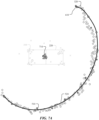
- process 100 may also comprise path smoothing 145, as detailed herein, whereby the computing system renders a smooth view path based on the one or more camera positions.
- this view path may be generated using one or more control points that correspond to one or more camera positions described herein.
- this view path may be fit a predetermined shape (e.g. an arc or semicircle) or a mathematical equation (e.g., an n th degree polynomial equation).
- the computing system may further generate a focus path based on one or more focus points that represent a three-dimensional point in space that a virtual camera would focus towards as detailed herein.
- process 100 may also comprise mesh warping 150, which comprises the computing system warping an image in the sequence of images associated with a selected first camera position as detailed herein.
- mesh warping 150 comprises the computing system warping an image in the sequence of images associated with a selected first camera position as detailed herein.
- the computing system can adjust the image by warping a mesh such that image simulates a viewpoint of the second virtual camera located along the smooth virtual camera path.
- the computing system may repeat this process for each image in the captured sequence of images, resulting in a sequence of warped images.
- the computing system may encode 170 the sequence of warped images to a particular file format.
- the end result of process 100 is an outputted file 175 comprising the outputted warped sequence of images of the subject.
- File 175 may comprise any format suitable for viewing, including for example, .mp4, .mov, .wmv, .flv, or .avi.
- file 175 may be outputted for view on a user interface associated with a client device. This user interface may comprise one or more elements that permit a user to interact with the outputted sequence of warped images on file 175, including for example, rotating the subject of the warped images.
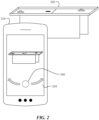
- one or more duplicate images be caused by the user maintaining wireless device 210 in a stationary position for a period of time. This often occurs at the beginning or end of the capture process.
- the computing system may determine multiple images are captured from an identical camera position 320, and select the best image from the multiple images while removing other duplicate images captured from the same camera position 320.
- the computing system may determine in particular embodiments a corresponding camera position 320 of the camera of wireless device 210 when the image is captured.
- the camera position 320 may comprise, for example and not by way of limitation, a pose, including the three-dimensional location (x, y, z, q, etc. coordinates) and orientation (e.g., whether wireless device 210 is facing towards object 220) of the camera located on wireless device 210 when the image in the sequence of images is captured.
- this pose information for each camera position 320 may be determined, for example and not by way of limitation, by using an absolute real-world coordinate system, or relative to one or more other camera positions 320 or one or more objects 220 contained within a scene.
- the camera position may be determined by one or more methods of tracking the location and mapping the pose of the wireless device 210 as it moves throughout a scene, for example and not by way of limitation, Simultaneous Localization and Mapping ("SLAM") Technology 110.
- SLAM Simultaneous Localization and Mapping
- These technologies may utilize data from wireless device 220 and data from one or more images in the sequence of images to determine a corresponding camera position 320 of the wireless device 210 when the image is captured.
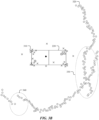
- the computing system may detect one or more gaps that may identify an irregularity between a first set of camera positions associated with a first continuous subset of the path of the spatial distribution of camera positions and a second set of camera positions associated with a second continuous subset. Gaps are problematic for outputting a sequence of warped images, as they may result in sudden changes in a point of view due to jumps between the first continuous subset of the path and a second continuous subset of the path.
- FIGURE 3B illustrates examples of gaps in the spatial distribution of one or more camera positions 320.
- An overlapping gap 330 may occur due to spatial overlap or the crossing of one or more continuous subsets of the path of the spatial distribution camera positions.
- One or more gaps may be caused by the traveled path of a user moving wireless device 220 while capturing the sequence of images. For example, a user may attempt to retrace one or more portions of the path of the spatial distribution of camera positions to ensure sufficient images of object 220 are collected from one or more camera viewpoints 320. However, the user may inadvertently traverse a second traveled path that is slightly different that the first path of the spatial distribution of camera positions, resulting in a spatial distribution of camera positions 320 that comprise one or more overlapping gaps 330.
- one or more gaps may be caused by limitations in location and mapping technologies such as relocalization resulting from SLAM. These limitations may lead to one or more pose inaccuracies in one or more camera positions 320.
- the effect of these one or more pose inaccuracies is a spatial distribution where wireless device 210 suddenly "jumps" from one three-dimensional location to another three-dimensional location. This may result in a spatial distribution of camera positions 320 that comprise one or more parallel gaps 340.
- the computing system may adjust the pose of one or more camera positions 320 associated with a continuous subset of the sequence of images to close the gap.
- FIGURE 3C illustrates examples of the computing system adjusting the pose of one or more camera positions 320 to close one or more gaps.
- the computing system may identify one or more continuous subsets of the path of the spatial distribution of camera positions that comprise part of a gap as described herein.
- the computing system may adjust the pose of one or more camera positions 320 such that one or more poses of the camera positions comprising the continuous subset are moved from original camera position 350 to gap adjusted camera position 360.
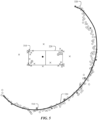
- these gaps may be adjusted such that the spatial distribution of camera positions conform to a particular shape or geometric path, and so the orientation between camera viewpoints is consistent.
- FIGURE 3D illustrates an adjusted spatial distribution of camera positions 320 after adjusting for one or more gaps. The end result is a continuous or nearly continuous spatial distribution of one or more camera positions 320 identified by the computing system.
- the computing system may generate a point cloud from one or more images of the captured sequence of images.
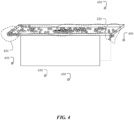
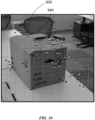
- FIGURE 4 illustrates a point cloud and grouping one or more points representing three-dimensional locations 310 of object features into one or more clusters 420 in an example image 400 of a sequence of images.
- this point cloud may include, for example, the three-dimensional locations 310 of one or more object features contained within the image 400, such as a corner or particular surface of object 220 contained within image 400. Due to inaccuracies with SLAM or a similar technology, one or more points representing three-dimensional locations 310 may be inaccurately positioned within the point cloud.
- the computing system may be particularly impacted by these inaccuracies if they are shallow (e.g., located at an image depth that is too close to the camera position 320) as they can occlude the scene and prevent proper image warping.
- the computing system may identify and remove one or more outlier points 430 representing one or more three-dimensional locations 310 of object features that are inaccurate.
- the computing system may filter the point cloud by grouping and creating clusters 420 of one or more three-dimensional locations 310 of object features depicted in the sequence of images. These clusters may be generated utilizing any density-based clustering technique, for example a DBSCAN algorithm. In particular embodiments these clusters may correspond to, for example, or more features of object 220, such as a corner of a table or particular surface.
- the computing system may next project, based on at least the reference camera position 810, the three-dimensional locations 310 of one or more object features depicted in the image (represented as x i ) onto a two-dimensional frame, which may be divided into a grid by a mesh.
- the one more three-dimensional locations of one or more object features used for the warping are each determined to be within a threshold distance of one of the one or more clusters 420.
- the one or more two-dimensional reference feature points 930 can then be projected onto the frame with mesh 910.
- the computing system may next project, based on at least the virtual camera position 610, the three-dimensional locations of one or more object features depicted in the image (represented as x i' ) onto a two-dimensional frame, which may be divided into a grid by a mesh.
- the one more three-dimensional locations of one or more object features used for the warping are each determined to be within a threshold distance of one of the one or more clusters 420.
- One or more two-dimensional projected virtual feature points 940 can then be projected onto the frame with mesh 910.
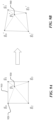
- the system can then warp each image corresponding to reference camera position 810 so that it simulates an image captured from virtual camera position 610.
- FIGURE 9B illustrates warping a mesh so that the two-dimensional reference feature points 930 of reference camera position 810 match the two-dimensional projected virtual feature points 940 of virtual camera position 610. In particular embodiments, this may result in multiple output frames from a single input frame may be warped in different ways. In particular embodiments warping the image associated with the selected reference camera position 810 for the corresponding virtual camera position 610 further uses the focus point 710 corresponding to the virtual camera position 610.
- the worst scaling factor is determined to be below a predetermined minimum threshold.
- the computing system may scale the sequence of warped images according the scaling factors for each image in the outputted sequence of warped images.
- the computing system may also crop one or more of the scaled images in the warped images. This results in a sequence of warped images that meets a predetermined target resolution and a smooth virtual camera path.
- the worst scaling factor is determined to be within a predetermine acceptable range (e.g. equal to or between a predetermined minimum threshold and a failing threshold).
- the computing system may scale the sequence of warped images according the scaling factors for each image in the outputted sequence of warped images.
- the computing system may lock the scaling factor at the minimum threshold for scaling.
- the computing system may identify missing pixel information on one or more scaled images of the sequence of warped images that may resulting from large scaling factors. For example, scaling an image may result in missing pixel information on the outer border of the image. To remedy this missing pixel information, the computing system may subsequently in-paint one or more of the missing pixel information on one or more of the scaled images. In-painting may be conducted by any conventional methods, for example a Criminisi algorithm.
- the computing system may encode the sequence of warped images to a particular file format prior to output.
- the sequence of warped images may be encoded and outputted in a file comprising any format suitable for viewing, including for example, .mp4, .mov, .wmv, .flv, or .avi.
- a file comprising the sequence of warped images may be outputted for view on a user interface associated with a client device.
- the sequence of warped images may be accessible to one or more users of an online platform, for example, the website of an online retailer or on a social networking system, via a user interface on a wireless device 120.
- FIGURE 11A illustrates an example wireframe of a GUI on a wireless device 120 for viewing and interacting with the outputted sequence of warped images.
- a user may view the outputted sequence of the warped images via a GUI.
- the GUI of wireless device 120 may be associated with, for example and not by way of limitation, an online marketplace or a social networking system.
- the GUI of wireless device 120 may include the outputted sequence of warped images 1110, one or more elements 1120 that permit a user of client device to interact with the outputted sequence of warped images 1110, for example and not by way of limitation, arrows. In particular embodiments these interactions may include, for example and not by way of limitation, rotating or zooming in on the outputted sequence of warped images 1110.
- the GUI of wireless device 120 may further include one or more descriptions 1130 of the object 220 depicted in the outputted sequence of warped images 1110 that may be useful in an online shopping environment, such as a name, price, and method of delivery for the object 220 after purchase.
- descriptions 1130 may further include, for example and not by way of limitation, information about the seller (e.g., contact information or a rating), the dimensions or weight of object 220, or the condition of the object 220 (e.g., used or new).
- FIGURE 11B illustrates an example wireframe of a GUI on a wireless device 120 with an altered outputted sequence of the warped images 1140 via an interaction from a user with a GUI of wireless device 120.
- the altered outputted sequence of the warped images 1140 has been rotated via an interaction with a user of the wireless device 120.
- these interactions can include, for example and not by way of limitation, rotating or zooming in on the outputted sequence of warped images.
- the user interface of wireless device 120 may comprising one or more visual effects when interacting with the outputted sequence of warped images 1110, for example and not by way of limitation scroll bouncing (e.g., the outputted sequence of warped images rebounds back when a user reaches the end of the sequence of warped images) or momentum scrolling (e.g., the outputted sequence of warped images keeps moving after an interact from a user as if friction is slowing it down).
- scroll bouncing e.g., the outputted sequence of warped images rebounds back when a user reaches the end of the sequence of warped images
- momentum scrolling e.g., the outputted sequence of warped images keeps moving after an interact from a user as if friction is slowing it down.
- client system 1330 may be an electronic device including hardware, software, or embedded logic components or a combination of two or more such components and capable of carrying out the appropriate functionalities implemented or supported by client system 1330.
- a client system 1330 may include a computer system such as a desktop computer, notebook or laptop computer, netbook, a tablet computer, e-book reader, GPS device, camera, personal digital assistant (PDA), handheld electronic device, cellular telephone, smartphone, augmented/virtual reality device, other suitable electronic device, or any suitable combination thereof.
- PDA personal digital assistant
- client system 1330 may enable a network user at client system 1330 to access network 1310.
- a client system 1330 may enable its user to communicate with other users at other client systems 1330.
- client system 1330 may include a web browser 1332, and may have one or more add-ons, plug-ins, or other extensions.
- a user at client system 1330 may enter a Uniform Resource Locator (URL) or other address directing the web browser 1332 to a particular server (such as server 1362, or a server associated with a third-party system 1370), and the web browser 1332 may generate a Hyper Text Transfer Protocol (HTTP) request and communicate the HTTP request to server.
- the server may accept the HTTP request and communicate to client system 1330 one or more Hyper Text Markup Language (HTML) files responsive to the HTTP request.
- Client system 1330 may render a webpage based on the HTML files from the server for presentation to the user. This disclosure contemplates any suitable webpage files.
- webpages may render from HTML files, Extensible Hyper Text Markup Language (XHTML) files, or Extensible Markup Language (XML) files, according to particular needs.
- XHTML Extensible Hyper Text Markup Language
- XML Extensible Markup Language
- Such pages may also execute scripts, combinations of markup language and scripts, and the like.
- reference to a webpage encompasses one or more corresponding webpage files (which a browser may use to render the webpage) and vice versa, where appropriate.
- social-networking system 1360 may be a network-addressable computing system that can host an online social network. Social-networking system 1360 may generate, store, receive, and send social-networking data, such as, for example, user-profile data, concept-profile data, social-graph information, or other suitable data related to the online social network. Social-networking system 1360 may be accessed by the other components of network environment 1300 either directly or via network 1310.
- Servers 1362 may be of various types, such as, for example and without limitation, web server, news server, mail server, message server, advertising server, file server, application server, exchange server, database server, proxy server, another server suitable for performing functions or processes described herein, or any combination thereof.
- each server 1362 may include hardware, software, or embedded logic components or a combination of two or more such components for carrying out the appropriate functionalities implemented or supported by server 1362.
- social-networking system 1360 may include one or more data stores 1364. Data stores 1364 may be used to store various types of information. In particular embodiments, the information stored in data stores 1364 may be organized according to specific data structures.
- each data store 1364 may be a relational, columnar, correlation, or other suitable database.
- this disclosure describes or illustrates particular types of databases, this disclosure contemplates any suitable types of databases.
- Particular embodiments may provide interfaces that enable a client system 1330, a social-networking system 1360, or a third-party system 1370 to manage, retrieve, modify, add, or delete, the information stored in data store 1364.
- social-networking system 1360 may store one or more social graphs in one or more data stores 1364.
- a social graph may include multiple nodes-which may include multiple user nodes (each corresponding to a particular user) or multiple concept nodes (each corresponding to a particular concept)-and multiple edges connecting the nodes.
- Social-networking system 1360 may provide users of the online social network the ability to communicate and interact with other users.
- users may join the online social network via social-networking system 1360 and then add connections (e.g., relationships) to a number of other users of social-networking system 1360 to whom they want to be connected.
- the term "friend” may refer to any other user of social-networking system 1360 with whom a user has formed a connection, association, or relationship via social-networking system 1360.
- social-networking system 1360 may provide users with the ability to take actions on various types of items or objects, supported by social-networking system 1360.
- the items and objects may include groups or social networks to which users of social-networking system 1360 may belong, events or calendar entries in which a user might be interested, computer-based applications that a user may use, transactions that allow users to buy or sell items via the service, interactions with advertisements that a user may perform, or other suitable items or objects.
- a user may interact with anything that is capable of being represented in social-networking system 1360 or by an external system of third-party system 1370, which is separate from social-networking system 1360 and coupled to social-networking system 1360 via a network 1310.
- social-networking system 1360 may be capable of linking a variety of entities.
- social-networking system 1360 may enable users to interact with each other as well as receive content from third-party systems 1370 or other entities, or to allow users to interact with these entities through an application programming interfaces (API) or other communication channels.
- API application programming interfaces
- a third-party system 1370 may include one or more types of servers, one or more data stores, one or more interfaces, including but not limited to APIs, one or more web services, one or more content sources, one or more networks, or any other suitable components, e.g., that servers may communicate with.
- a third-party system 1370 may be operated by a different entity from an entity operating social-networking system 1360.
- social-networking system 1360 and third-party systems 1370 may operate in conjunction with each other to provide social-networking services to users of social-networking system 1360 or third-party systems 1370.
- social-networking system 1360 may provide a platform, or backbone, which other systems, such as third-party systems 1370, may use to provide social-networking services and functionality to users across the Internet.
- social-networking system 1360 also includes user-generated content objects, which may enhance a user's interactions with social-networking system 1360.
- User-generated content may include anything a user can add, upload, send, or "post" to social-networking system 1360.
- Posts may include data such as status updates or other textual data, location information, photos, videos, links, music or other similar data or media.
- Content may also be added to social-networking system 1360 by a third-party through a "communication channel," such as a newsfeed or stream.
- a connection store may be used for storing connection information about users.
- the connection information may indicate users who have similar or common work experience, group memberships, hobbies, educational history, or are in any way related or share common attributes.
- the connection information may also include user-defined connections between different users and content (both internal and external).
- a web server may be used for linking social-networking system 1360 to one or more client systems 1330 or one or more third-party system 1370 via network 1310.
- the web server may include a mail server or other messaging functionality for receiving and routing messages between social-networking system 1360 and one or more client systems 1330.
- An API-request server may allow a third-party system 1370 to access information from social-networking system 1360 by calling one or more APIs.
- An action logger may be used to receive communications from a web server about a user's actions on or off social-networking system 1360. In conjunction with the action log, a third-party-content-object log may be maintained of user exposures to third-party-content objects.
- a notification controller may provide information regarding content objects to a client system 1330. Information may be pushed to a client system 1330 as notifications, or information may be pulled from client system 1330 responsive to a request received from client system 1330.
- Authorization servers may be used to enforce one or more privacy settings of the users of social-networking system 1360.
- a privacy setting of a user determines how particular information associated with a user can be shared.
- the authorization server may allow users to opt in to or opt out of having their actions logged by social-networking system 1360 or shared with other systems (e.g., third-party system 1370), such as, for example, by setting appropriate privacy settings.
- Third-party-content-object stores may be used to store content objects received from third parties, such as a third-party system 1370.
- Location stores may be used for storing location information received from client systems 1330 associated with users.
- Advertisement-pricing modules may combine social information, the current time, location information, or other suitable information to provide relevant advertisements, in the form of notifications, to a user.
- computer system 1400 may be an embedded computer system, a system-on-chip (SOC), a single-board computer system (SBC) (such as, for example, a computer-on-module (COM) or system-on-module (SOM)), a desktop computer system, a laptop or notebook computer system, an interactive kiosk, a mainframe, a mesh of computer systems, a mobile telephone, a personal digital assistant (PDA), a server, a tablet computer system, an augmented/virtual reality device, or a combination of two or more of these.
- SOC system-on-chip
- SBC single-board computer system
- COM computer-on-module
- SOM system-on-module
- computer system 1400 may include one or more computer systems 1400; be unitary or distributed; span multiple locations; span multiple machines; span multiple data centers; or reside in a cloud, which may include one or more cloud components in one or more networks.
- one or more computer systems 1400 may perform without substantial spatial or temporal limitation one or more steps of one or more methods described or illustrated herein.
- one or more computer systems 1400 may perform in real time or in batch mode one or more steps of one or more methods described or illustrated herein.
- One or more computer systems 1400 may perform at different times or at different locations one or more steps of one or more methods described or illustrated herein, where appropriate.
- this RAM may be dynamic RAM (DRAM) or static RAM (SRAM). Moreover, where appropriate, this RAM may be single-ported or multi-ported RAM. This disclosure contemplates any suitable RAM.
- Memory 1404 may include one or more memories 1404, where appropriate. Although this disclosure describes and illustrates particular memory, this disclosure contemplates any suitable memory.
- this ROM may be mask-programmed ROM, programmable ROM (PROM), erasable PROM (EPROM), electrically erasable PROM (EEPROM), electrically alterable ROM (EAROM), or flash memory or a combination of two or more of these.
- This disclosure contemplates mass storage 1406 taking any suitable physical form.
- Storage 1406 may include one or more storage control units facilitating communication between processor 1402 and storage 1406, where appropriate. Where appropriate, storage 1406 may include one or more storages 1406. Although this disclosure describes and illustrates particular storage, this disclosure contemplates any suitable storage.
- I/O interface 1408 may include one or more device or software drivers enabling processor 1402 to drive one or more of these I/O devices.
- I/O interface 1408 may include one or more I/O interfaces 1408, where appropriate.
- computer system 1400 may communicate with an ad hoc network, a personal area network (PAN), a local area network (LAN), a wide area network (WAN), a metropolitan area network (MAN), or one or more portions of the Internet or a combination of two or more of these.
- PAN personal area network
- LAN local area network
- WAN wide area network
- MAN metropolitan area network
- computer system 1400 may communicate with a wireless PAN (WPAN) (such as, for example, a BLUETOOTH WPAN), a WI-FI network, a WI-MAX network, a cellular telephone network (such as, for example, a Global System for Mobile Communications (GSM) network), or other suitable wireless network or a combination of two or more of these.
- Computer system 1400 may include any suitable communication interface 1410 for any of these networks, where appropriate.
- Communication interface 1410 may include one or more communication interfaces 1410, where appropriate.
- a computer-readable non-transitory storage medium or media may include one or more semiconductor-based or other integrated circuits (ICs) (such, as for example, field-programmable gate arrays (FPGAs) or application-specific ICs (ASICs)), hard disk drives (HDDs), hybrid hard drives (HHDs), optical discs, optical disc drives (ODDs), magneto-optical discs, magneto-optical drives, floppy diskettes, floppy disk drives (FDDs), magnetic tapes, solid-state drives (SSDs), RAM-drives, SECURE DIGITAL cards or drives, any other suitable computer-readable non-transitory storage media, or any suitable combination of two or more of these, where appropriate.
- ICs such, as for example, field-programmable gate arrays (FPGAs) or application-specific ICs (ASICs)
- HDDs hard disk drives
- HHDs hybrid hard drives
- ODDs optical disc drives
- magneto-optical discs magneto-optical drives
Landscapes
- Engineering & Computer Science (AREA)
- Physics & Mathematics (AREA)
- Theoretical Computer Science (AREA)
- General Physics & Mathematics (AREA)
- Computer Vision & Pattern Recognition (AREA)
- Computing Systems (AREA)
- Geometry (AREA)
- Computer Graphics (AREA)
- Multimedia (AREA)
- Processing Or Creating Images (AREA)
- User Interface Of Digital Computer (AREA)
- Testing, Inspecting, Measuring Of Stereoscopic Televisions And Televisions (AREA)
Applications Claiming Priority (2)
| Application Number | Priority Date | Filing Date | Title |
|---|---|---|---|
| US16/882,322 US11651473B2 (en) | 2020-05-22 | 2020-05-22 | Outputting warped images from captured video data |
| EP21171141.1A EP3913584A3 (de) | 2020-05-22 | 2021-04-29 | Ausgabe von verzerrten bildern aus erfassten videodaten |
Related Parent Applications (1)
| Application Number | Title | Priority Date | Filing Date |
|---|---|---|---|
| EP21171141.1A Division EP3913584A3 (de) | 2020-05-22 | 2021-04-29 | Ausgabe von verzerrten bildern aus erfassten videodaten |
Publications (2)
| Publication Number | Publication Date |
|---|---|
| EP4478294A2 true EP4478294A2 (de) | 2024-12-18 |
| EP4478294A3 EP4478294A3 (de) | 2025-07-02 |
Family
ID=75746219
Family Applications (2)
| Application Number | Title | Priority Date | Filing Date |
|---|---|---|---|
| EP21171141.1A Withdrawn EP3913584A3 (de) | 2020-05-22 | 2021-04-29 | Ausgabe von verzerrten bildern aus erfassten videodaten |
| EP24209928.1A Pending EP4478294A3 (de) | 2020-05-22 | 2021-04-29 | Ausgabe verzerrter bilder aus erfassten videodaten |
Family Applications Before (1)
| Application Number | Title | Priority Date | Filing Date |
|---|---|---|---|
| EP21171141.1A Withdrawn EP3913584A3 (de) | 2020-05-22 | 2021-04-29 | Ausgabe von verzerrten bildern aus erfassten videodaten |
Country Status (3)
| Country | Link |
|---|---|
| US (2) | US11651473B2 (de) |
| EP (2) | EP3913584A3 (de) |
| CN (1) | CN113706427A (de) |
Families Citing this family (3)
| Publication number | Priority date | Publication date | Assignee | Title |
|---|---|---|---|---|
| US11514648B2 (en) * | 2020-12-23 | 2022-11-29 | Microsoft Technology Licensing, Llc | Aligning input image data with model input data to generate image annotations |
| CN114690731B (zh) * | 2022-03-09 | 2024-05-24 | 青岛海尔科技有限公司 | 一种关联场景推荐方法、装置、存储介质及电子装置 |
| US20250173815A1 (en) * | 2023-11-29 | 2025-05-29 | Qualcomm Incorporated | Video capture processing and effects |
Family Cites Families (16)
| Publication number | Priority date | Publication date | Assignee | Title |
|---|---|---|---|---|
| US20080243614A1 (en) * | 2007-03-30 | 2008-10-02 | General Electric Company | Adaptive advertising and marketing system and method |
| GB2456802A (en) * | 2008-01-24 | 2009-07-29 | Areograph Ltd | Image capture and motion picture generation using both motion camera and scene scanning imaging systems |
| US9213920B2 (en) * | 2010-05-28 | 2015-12-15 | Zazzle.Com, Inc. | Using infrared imaging to create digital images for use in product customization |
| EP2413286A1 (de) * | 2010-07-29 | 2012-02-01 | LiberoVision AG | Bildverarbeitungsverfahren und Vorrichtung für sofortige Wiederholung |
| US8643746B2 (en) * | 2011-05-18 | 2014-02-04 | Intellectual Ventures Fund 83 Llc | Video summary including a particular person |
| US9460495B2 (en) * | 2012-04-06 | 2016-10-04 | Microsoft Technology Licensing, Llc | Joint video stabilization and rolling shutter correction on a generic platform |
| US20150077560A1 (en) * | 2013-03-22 | 2015-03-19 | GM Global Technology Operations LLC | Front curb viewing system based upon dual cameras |
| EP4206870A1 (de) * | 2014-06-14 | 2023-07-05 | Magic Leap, Inc. | Verfahren zur aktualisierung einer virtuellen welt |
| US9900583B2 (en) * | 2014-12-04 | 2018-02-20 | Futurewei Technologies, Inc. | System and method for generalized view morphing over a multi-camera mesh |
| US9998655B2 (en) * | 2014-12-23 | 2018-06-12 | Quallcomm Incorporated | Visualization for viewing-guidance during dataset-generation |
| US10659768B2 (en) * | 2017-02-28 | 2020-05-19 | Mitsubishi Electric Research Laboratories, Inc. | System and method for virtually-augmented visual simultaneous localization and mapping |
| CN107943072B (zh) * | 2017-11-13 | 2021-04-09 | 深圳大学 | 无人机飞行路径生成方法、装置、存储介质及设备 |
| US10902676B2 (en) * | 2018-03-13 | 2021-01-26 | Canon Kabushiki Kaisha | System and method of controlling a virtual camera |
| US11836885B2 (en) * | 2018-05-07 | 2023-12-05 | Apple Inc. | Dynamic foveated pipeline |
| US10877238B2 (en) * | 2018-07-17 | 2020-12-29 | STMicroelectronics (Beijing) R&D Co. Ltd | Bokeh control utilizing time-of-flight sensor to estimate distances to an object |
| US11610322B2 (en) * | 2019-11-25 | 2023-03-21 | Insurance Services Office, Inc. | Computer vision systems and methods for unsupervised learning for progressively aligning noisy contours |
-
2020
- 2020-05-22 US US16/882,322 patent/US11651473B2/en active Active
-
2021
- 2021-04-29 EP EP21171141.1A patent/EP3913584A3/de not_active Withdrawn
- 2021-04-29 EP EP24209928.1A patent/EP4478294A3/de active Pending
- 2021-05-24 CN CN202110565077.3A patent/CN113706427A/zh active Pending
-
2023
- 2023-04-11 US US18/298,993 patent/US20230252599A1/en not_active Abandoned
Also Published As
| Publication number | Publication date |
|---|---|
| EP3913584A3 (de) | 2022-02-23 |
| CN113706427A (zh) | 2021-11-26 |
| US20210366075A1 (en) | 2021-11-25 |
| EP4478294A3 (de) | 2025-07-02 |
| US20230252599A1 (en) | 2023-08-10 |
| EP3913584A2 (de) | 2021-11-24 |
| US11651473B2 (en) | 2023-05-16 |
Similar Documents
| Publication | Publication Date | Title |
|---|---|---|
| US12272012B2 (en) | Dynamic mixed reality content in virtual reality | |
| US20230252599A1 (en) | Outputting warped images from captured video data | |
| EP4246963A1 (de) | Bereitstellung von umgebungen mit gemeinsamer erweiterter realität in videoanrufen | |
| US10621954B2 (en) | Computerized system and method for automatically creating and applying a filter to alter the display of rendered media | |
| US9569501B2 (en) | Optimizing electronic layouts for media content | |
| CN113366489A (zh) | 检测增强现实目标 | |
| US10789723B1 (en) | Image object extraction and in-painting hidden surfaces for modified viewpoint rendering | |
| US11350030B2 (en) | Flicker detector | |
| US11842442B2 (en) | Camera reprojection for faces | |
| US11783381B2 (en) | Visual inventory rules building system | |
| CN111164653A (zh) | 在社交网络系统上生成动画 | |
| US20230368444A1 (en) | Rendering customized video call interfaces during a video call | |
| US11315301B1 (en) | Rendering post-capture artificial-reality effects based on artificial-reality state information | |
| US20190043166A1 (en) | Composited animation | |
| US10554715B2 (en) | Video icons | |
| US11645761B2 (en) | Adaptive sampling of images | |
| US12542870B2 (en) | Interactive map for providing images for background replacement in a virtual meeting | |
| US20230077164A1 (en) | Efficient Motion-Compensated Spatiotemporal Sampling |
Legal Events
| Date | Code | Title | Description |
|---|---|---|---|
| PUAI | Public reference made under article 153(3) epc to a published international application that has entered the european phase |
Free format text: ORIGINAL CODE: 0009012 |
|
| STAA | Information on the status of an ep patent application or granted ep patent |
Free format text: STATUS: THE APPLICATION HAS BEEN PUBLISHED |
|
| AC | Divisional application: reference to earlier application |
Ref document number: 3913584 Country of ref document: EP Kind code of ref document: P |
|
| AK | Designated contracting states |
Kind code of ref document: A2 Designated state(s): AL AT BE BG CH CY CZ DE DK EE ES FI FR GB GR HR HU IE IS IT LI LT LU LV MC MK MT NL NO PL PT RO RS SE SI SK SM TR |
|
| RIC1 | Information provided on ipc code assigned before grant |
Ipc: G06T 7/33 20170101ALI20250121BHEP Ipc: G06T 15/20 20110101AFI20250121BHEP |
|
| RIC1 | Information provided on ipc code assigned before grant |
Ipc: G06T 7/33 20170101ALI20250318BHEP Ipc: G06T 15/20 20110101AFI20250318BHEP |
|
| PUAL | Search report despatched |
Free format text: ORIGINAL CODE: 0009013 |
|
| AK | Designated contracting states |
Kind code of ref document: A3 Designated state(s): AL AT BE BG CH CY CZ DE DK EE ES FI FR GB GR HR HU IE IS IT LI LT LU LV MC MK MT NL NO PL PT RO RS SE SI SK SM TR |
|
| RIC1 | Information provided on ipc code assigned before grant |
Ipc: G06T 7/33 20170101ALI20250523BHEP Ipc: G06T 15/20 20110101AFI20250523BHEP |
|
| STAA | Information on the status of an ep patent application or granted ep patent |
Free format text: STATUS: REQUEST FOR EXAMINATION WAS MADE |
|
| 17P | Request for examination filed |
Effective date: 20251014 |