EP4478064A1 - Testvorrichtung und verfahren für eine mehrelement-gruppenantenne - Google Patents
Testvorrichtung und verfahren für eine mehrelement-gruppenantenne Download PDFInfo
- Publication number
- EP4478064A1 EP4478064A1 EP24177807.5A EP24177807A EP4478064A1 EP 4478064 A1 EP4478064 A1 EP 4478064A1 EP 24177807 A EP24177807 A EP 24177807A EP 4478064 A1 EP4478064 A1 EP 4478064A1
- Authority
- EP
- European Patent Office
- Prior art keywords
- plane
- antenna
- array
- movable probe
- determined
- Prior art date
- Legal status (The legal status is an assumption and is not a legal conclusion. Google has not performed a legal analysis and makes no representation as to the accuracy of the status listed.)
- Pending
Links
Images





Classifications
-
- G—PHYSICS
- G01—MEASURING; TESTING
- G01R—MEASURING ELECTRIC VARIABLES; MEASURING MAGNETIC VARIABLES
- G01R29/00—Arrangements for measuring or indicating electric quantities not covered by groups G01R19/00 - G01R27/00
- G01R29/08—Measuring electromagnetic field characteristics
- G01R29/10—Radiation diagrams of antennas
Definitions
- the present invention relates generally to testing a multi-element antenna array and particularly, but not exclusively, to a test apparatus and method for determining a far field radiation pattern for a multi-element antenna array.
- Modern wireless communication networks are typically placed under great demands to provide high data capacity within the constraints of the allocated signal frequency spectrum.
- To achieve a high data capacity it is beneficial to transmit and receive signals with a high signal to noise ratio.
- To improve signal to noise ratio increasing use is made of multi-element antenna arrays to form radiation beams to transmit and/or receive signals that provide signal gain to the wanted signals and reject interfering signals, and/or to enable MIMO (multiple input, multiple output) transmission schemes.
- MIMO multiple input, multiple output
- Multi-element antenna arrays typically comprise a number of antenna elements, each of which is configured to transmit and/or receive electromagnetic energy at a respective amplitude and phase appropriate to form a radiation beam or beams.
- Some multi-element antenna arrays have antenna elements each of which is configured to radiate and/or receive at a pre-determined relative amplitude and phase, for example being connected to a transmitter and/or receiver by a feed network of signal tracks having appropriate relative path lengths to provide the required relative phase shifts.
- antenna elements may have individually controllable phase and/or amplitude, to provide configurable beams, and large numbers of antenna elements may be provided in an array, for example 256 or more elements.
- a multi-element antenna array may be tested by measuring a radiation pattern in an anechoic chamber.
- measurement apparatus may measure a radiation pattern of radiation received from the antenna multi-element antenna array by using a probe that is arranged to move in a hemisphere within the radiated field.
- the probe may be at a fixed position and the antenna may be rotated.
- a measurement may be made of the far field pattern, which is the radiation pattern that characterises the radiation from the antenna in the area of coverage of the antenna.
- the distance from the antenna at which the far field pattern may be said to be established depends on various factors such as the size and shape of the antenna.
- the anechoic chamber is smaller, a similar technique may be used, with a probe arranged to move in a hemisphere around the antenna, but the near field is measured.
- the near field typically has an angular field distribution that is dependent on the distance from the antenna.
- a transformation is required which depends on the known distance from the antenna of a near field measurements.
- the near field measurements are taken as far as possible from the antenna within the constraints of the size of the anechoic chamber, since this improves the accuracy of the transformation from near to far field.
- the near field may be measured at a distance of 5 wavelengths or more from the antenna, so that, at each measurement point, a contribution from each of the antenna elements would be included in the measurement.
- use of an anechoic chamber may be costly and inconvenient for testing of antennas in production.
- a method of determining a far field radiation pattern for a multi-element antenna array comprising a plurality of antenna elements disposed in a first plane
- the method comprising providing test apparatus comprising a support member for holding the multi-element array and a movable probe configured to be movable in a second plane parallel to the first plane, causing the movable probe to radiate electromagnetic energy, moving the movable probe in a determined trajectory in the second plane, taking a respective measurement of amplitude and phase of electromagnetic energy received by the multi-element antenna array at each of a plurality of positions on the determined trajectory, and determining the far field radiation pattern from the respective measurements and from a pre-determined radiation pattern for at least one antenna element of the plurality of antenna elements, wherein a distance between the first plane and the second plane is less than a quarter of a wavelength at an operating frequency of the multi-element antenna array.
- This arrangement allows a far field radiation pattern to be determined by using compact test apparatus suitable for factory testing and without the use of an anechoic chamber.
- Configuring the apparatus such that the distance between the first plane and the second plane is less than a quarter of a wavelength at an operating frequency of the multi-element antenna array allows transmission of radiation to each antenna element in turn, while reducing the amount of radiation received from adjacent antenna elements.
- This allows an accurate computation of far field pattern using the pre-determined radiation pattern for at least one antenna element, and reduces the need to shield the multi-element antenna array from multipath radiation, avoiding the use of an anechoic chamber.
- the far field radiation pattern determined by measurement of received radiation at the multi-element antenna array may represent a radiation pattern for both transmission from and reception by the multi-element antenna array.
- the plurality of positions on the determined trajectory in the second plane correspond to positions of the plurality of antenna elements in the first plane.
- the movable probe comprises an open waveguide.
- the open waveguide has a square cross-section.
- Each side of the square cross-section may be substantially half a wavelength at an operating frequency of the multi-element antenna array.
- Each of the plurality of antenna elements may be a patch antenna element.
- Each patch antenna element may be planar having a width of substantially half a wavelength at an operating frequency of the multi-element array.
- This provides efficient coupling between the probe and an antenna element with which it is aligned and reduces coupling with antenna elements with which it is not aligned.
- each patch antenna element may comprise a metallic layer, the metallic layer being disposed in the first plane.
- the metallic layer may be attached to a dielectric substrate, wherein the width of each patch antenna element is substantially half a wavelength in a dielectric material of the substrate at an operating frequency of the multi-element array.
- the open waveguide is provided with two probes at orthogonal polarisations, and the respective measurements are in two polarisations.
- the multi-element array is a two dimensional array and the trajectory is in two dimensions within the second plane.
- the trajectory may be a raster scan.
- the method comprises comparing each measurement with a pre-determined measurement for the respective antenna element to identify a failed antenna element.
- the method comprises taking each measurement for an antenna element at a plurality of setting of a phase shifter in the antenna array for the antenna element and comparing each measurement with a pre-determined measurement for the respective phase setting of the antenna element to identify a failed phase shifter.
- apparatus configured to determine a far field radiation pattern for a multi-element antenna array, the multi-element array comprising a plurality of antenna elements disposed in a first plane, the apparatus comprising a support member configured to hold the multi-element array, an actuator arrangement configured to move a movable probe, the movable probe having an aperture configured to be movable in relation to the support member in a second plane parallel to the first plane, a radio frequency generator configured to provide a radio frequency signal to the movable probe, a radio frequency test set configured to receive the radio frequency signal from an output of the multi-element antenna array.
- One or more processors are configured to cause the actuator arrangement to move the movable probe in a determined trajectory in the second plane, cause the radio frequency test set to take a respective measurement of amplitude and/or phase of the radio frequency signal received by the multi-element antenna array at each of a plurality of positions on the determined trajectory and determine the far field radiation pattern from the respective measurements and from a pre-determined radiation pattern for at least one antenna element of the plurality of antenna elements, wherein a distance between the first plane and the second plane is less than a quarter of a wavelength at an operating frequency of the multi-element antenna array.
- a method of determining a far field radiation pattern for a multi-element antenna array comprising a plurality of antenna elements disposed in a first plane
- the method comprising: providing test apparatus comprising a support member for holding the multi-element array and a movable probe having an aperture configured to be movable in a second plane parallel to the first plane; causing the plurality of antenna elements to radiate electromagnetic energy; moving the movable probe in a determined trajectory in the second plane; taking a respective measurement of amplitude and phase of electromagnetic energy received by the movable probe at each of a plurality of positions on the determined trajectory; and determining the far field radiation pattern from the respective measurements and from a pre-determined radiation pattern for at least one antenna element of the plurality of antenna elements, wherein a distance between the first plane and the second plane is less than a quarter of a wavelength at an operating frequency of the multi-element antenna array.
- apparatus configured to determine a far field radiation pattern for a multi-element antenna array, the multi-element array comprising a plurality of antenna elements disposed in a first plane
- the apparatus comprising: a support member configured to hold the multi-element array; an actuator arrangement configured to move a movable probe, the movable probe having an aperture configured to be movable in relation to the support member in a second plane parallel to the first plane; a radio frequency generator configured to provide a radio frequency signal to an input of the multi-element antenna array; a radio frequency test set configured to receive the radio frequency signal from the movable probe; and one or more processors configured to: cause the actuator arrangement to move the movable probe in a determined trajectory in the second plane; cause the radio frequency test set to take a respective measurement of amplitude and/or phase of the radio frequency signal received by the movable probe at each of a plurality of positions on the determined trajectory; and determine the far field radiation pattern from the respective measurements and from
- embodiments of the invention will now be described in the context of testing a multi-element antenna array for operation in frequency band in the region of 4 - 6 GHz, but it will be understood that embodiments of the invention are not restricted to operation in this range, and antenna arrays designed to operate at higher or lower frequencies may also be tested using the claimed method and apparatus.
- Figure 1 shows illustrates test apparatus to be used in method of determining a far field radiation pattern for a multi-element antenna array 1, the multi-element array 1 comprising a plurality of antenna elements 2a, 2b disposed in a first plane 6.
- the antenna elements 2a, 2b may be patch antenna elements, which are substantially planar metallic patches.
- the patches may be formed as a copper layer deposited on a dielectric substrate, for example.
- the test apparatus comprises a support member 4 for holding the multi-element array 1 and a movable probe 3 configured to have an aperture for transmitting and/or receiving radiation that is movable in a second plane 5 parallel to the first plane 6.
- the test is conducted by causing the movable probe to radiate electromagnetic energy.
- a signal source such as the signal generator of a network analyser
- a receiver such as the receiver of a network analyser may be connected to an output of a feed network within the assembly of the antenna array, that connects the electromagnetic energy received by each antenna element to the output of the feed network.
- the movable probe 3 is moved in a determined trajectory in the second plane 5, and measurements are taken of amplitude and phase of electromagnetic energy received by multi-element array at each of a plurality of positions on the determined trajectory.
- the measurements may be taken, for example, by the receiver section of the network analyser.
- the far field radiation pattern is determined from the respective measurements and from a pre-determined radiation pattern for at least one antenna element of the plurality of antenna elements.
- the distance between the first plane 6 and the second plane 5 is less than a quarter of a wavelength at an operating frequency of the multi-element antenna array. Accordingly, the aperture at the end of the probe is maintained in close proximity to the plane in which the antenna elements are disposed. This short distance between the planes allows the probe to measure the radiation predominantly to a single element in each measurement, with contributions from other elements reduced. This allows the far field pattern to be accurately determined from the measurements, by using the pre-determined radiation pattern for each element and adjusting this by the measured relative amplitude and/or phase for each element.
- the far field pattern may be determined by vectorial combination of the field contributions from each element, given the known position of each element, the field contributions of each element being appropriately adjusted by a factor according to the measured amplitude and phase.
- This approach has the advantage that, because the probe is coupled predominantly to a single element for each measurement, there is no need for an anechoic chamber, and the measurement equipment can be compact and use a simple planar, rather than hemispherical, scanner for the probe.
- a near field pattern is taken as far as possible from the antenna, so that each measurement intentionally includes contributions from multiple elements, and the near field pattern is then transformed to a far field pattern.
- the far field pattern is the pattern that is formed far enough from the antenna that the angular distribution of field does not change with distance.
- each patch antenna element 2a, 2b may comprise a metallic layer, the metallic layer being disposed in the first plane 6.
- the metallic layer may be attached to a dielectric substrate, the width of each patch antenna element 2a, 2b being substantially half a wavelength in a dielectric material of the substrate at an operating frequency of the multi-element array.
- the movable probe comprises an open waveguide, which may have a square cross-section.
- Each side of the square cross-section may be substantially half a wavelength at an operating frequency of the multi-element antenna array. This provides improved coupling between the probe and an antenna element with which it is aligned and reduces coupling with antenna elements with which it is not aligned.
- the positions on the determined trajectory in the second plane correspond to positions of the antenna elements in the first plane. This allows each measurement to accurately represent the radiation from a single element.
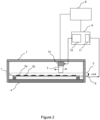
- Figure 2 shows the test comprising an actuator arrangement 7, 14 configured to move the probe 3, a radio frequency test set 9 comprising a radiofrequency generator 10 and a receiver 11, and one or more processors 6 configured to control the test apparatus.
- the actuator arrangement 7, 14 may comprise a frame 7, that can be controlled to move in one dimension, and a probe holder 14 that can be controlled to move along the frame 7 in a second dimension, orthogonal to the first dimension.
- the actuator arrangement 7, 14 and the support member 4 for the array may be adapted from a X-Y scanner.
- the radio frequency test set 9 may be a network analyser, which may be configured to measure a transmission characteristic in amplitude and phase between the radiofrequency generator 10 and the receiver 11.
- the transmission characteristic may be expressed in terms of so-called scattering parameters, such as S 21 which describe the complex signal transmission characteristics, for example in inphase and quadrature components.
- the one or more processors 8 in the control processor which may be, for example, a personal computer (PC), control the actuator arrangement to move the moveable probe 3 to a position corresponding to a selected antenna element by sending control signals to the actuator arrangement, which may be an X-Y scanner.
- the control processor may also send appropriate control signals to the radiofrequency test set 9 to cause it to conduct a measurement of the transmission characteristic in a determined frequency range for signal transmitted to the selected antenna element by the moveable probe.
- the control processor is arranged to store the measurement result in memory.
- the one or more processors retrieve the measurements from memory, and use the measurements to appropriately shift the amplitude and/or phase of the pre-determined antenna element radiation model for each element. The relative spacing of the elements in the multi-element array and the shifted antenna radiation models can then be used to calculate the far field pattern in each required direction by superposition of the calculated radiation for each element in a given direction.
- Figure 3 shows apparatus for testing a dual polar multi-element antenna array.
- a transmit switch 12 is provided to switch the signal generated by the signal generator 11 to either the V or H polarisation elements of the movable probe 3.
- a corresponding receive switch 13 is provided to switch between either a signal received by orthogonal V and H outputs of the multi-element antenna array, for connection to the receiver 11.
- the "V" polarisation is nominally vertical when the antenna array is installed for normal use, and the "H” polarisation is nominally horizontal, but the designations are arbitrary and the absolute orientation of the polarisations are not relevant during test.
- Figure 4 is a schematic diagram showing an oblique view of apparatus for testing a multi-element antenna array. This illustrates that the moveable probe 3 is arranged to move in two dimensions across the multi-element array 1 that is held in place on the support member 4.
- the frame 7 of the actuator arrangement is arranged to move in one dimension (front to back and vice versa in Figure 4 ) and the probe holder 14 is arranged to move along the frame 7 in an orthogonal dimension (side to side in Figure 4 ).
- the probe may be moved in a two dimensional trajectory, such as in a raster scan. Each measurement position may correspond to the position of an element 2a, 2b.
- Each of the plurality of antenna elements 2a, 2b may be a patch antenna element.
- Each patch antenna element may be planar having a width of substantially half a wavelength at an operating frequency of the multi-element array.
- the movable probe 3 may be formed of square cross-section open waveguide as illustrated in Figure 4 .
- the waveguide may have parallel sides, the width w of a side being substantially half a wavelength at an operating frequency of the multi-element antenna array.
- each measurement is compared with a pre-determined measurement for the respective antenna element to identify a failed antenna element.
- pre-determined thresholds may be applied to determine a pass/fail condition for each antenna element. This is useful for production testing, because a failed element can be easily identified and corrected or replaced. By contrast, it would be difficult to identify which element had failed in a conventional testing arrangement of near or far field patterns.
- each measurement for an antenna element may be taken at a number of setting of a phase shifter in the antenna array for the antenna element and each measurement may be compared with a pre-determined measurement for the respective phase setting of the antenna element. Thresholds may be applied to each measurement to identify a failed phase shifter.
- a phase shifter may be configured to shift phase in steps of 60 degrees, or any other value. The test would determine that the intended phase shift, as applied by the one or more processors controlling the test apparatus and the multi-element array, was correct within the pre-determined tolerance.
- Figure 5 shows an example of a far field pattern in azimuth
- Figure 6 shows an example of a far field pattern in elevation
- Figure 7 shows a three-dimensional plot of an example of a far field pattern shown in azimuth and elevation, determined as described herein.
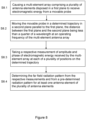
- Figure 8 is a flow diagram of a method of determining a far field pattern according to steps S8.1 to S8.4.
- Figures 2 , 3 illustrate apparatus and methods in which the movable probe is arranged to transmit radiation and the multi-element antenna array is arranged to receive radiation, according to the method of the flow chart of Figure 8 .
- This approach has the advantage of reducing radiation into the test environment, because the multi-element antenna array is not arranged to radiate. Radiation from the movable probe is coupled to an antenna element with which it is aligned and spurious radiation is reduced by the close coupling between the movable probe and the antenna element.
- the far field radiation pattern which applies for both transmit and receive, can be calculated, as described, on the basis of the signals received by each of the antenna elements of the multi-element antenna, assuming reciprocity between transmit and receive.
- the multi-element antenna can be used for transmit, and the movable probe can be used for receive.
- the far field radiation pattern can be calculated on the basis of the signals received at the movable probe from each of the antenna elements of the multi-element antenna. If reciprocity is assumed between transmit and receive, then again a far field pattern can be calculated for both transmit and receive.
- the multi-element antenna array is caused to radiate electromagnetic energy, for example, by connecting a signal source, such as the signal generator of a network analyser, to the input of a feed network, typically within the assembly of the antenna array, that connects the electromagnetic energy received at the input of the feed network to each antenna element in the multi-element antenna array.
- a receiver such as the receiver of a network analyser may be connected to an output of the movable probe.
- the movable probe 3 is moved, as for the alternative example illustrated by Figures 2 and 3 , in a determined trajectory in the second plane 5, and measurements are taken of amplitude and phase of electromagnetic energy received from the multi-element array at each of a plurality of positions on the determined trajectory.
- the measurements may be taken, for example, by the receiver section of the network analyser.
- the far field radiation pattern is determined from the respective measurements and from a pre-determined radiation pattern for at least one antenna element of the plurality of antenna elements.
- a transmit switch 12 may be provided to switch the signal generated by the signal generator 11 to either the V or H polarisation inputs of the multi-element antenna array.
- a corresponding receive switch 13 is provided to switch between either a signal received by orthogonal V and H outputs of the movable probe, for connection to the receiver 11.
- the "V" polarisation is nominally vertical when the antenna array is installed for normal use, and the "H” polarisation is nominally horizontal, but the designations are arbitrary and the absolute orientation of the polarisations are not relevant during test.
Landscapes
- Physics & Mathematics (AREA)
- Electromagnetism (AREA)
- General Physics & Mathematics (AREA)
- Variable-Direction Aerials And Aerial Arrays (AREA)
Applications Claiming Priority (2)
| Application Number | Priority Date | Filing Date | Title |
|---|---|---|---|
| IN202341036487 | 2023-05-26 | ||
| US18/510,262 US12455309B2 (en) | 2023-05-26 | 2023-11-15 | Test apparatus and method for a multi-element antenna array |
Publications (1)
| Publication Number | Publication Date |
|---|---|
| EP4478064A1 true EP4478064A1 (de) | 2024-12-18 |
Family
ID=91247013
Family Applications (1)
| Application Number | Title | Priority Date | Filing Date |
|---|---|---|---|
| EP24177807.5A Pending EP4478064A1 (de) | 2023-05-26 | 2024-05-23 | Testvorrichtung und verfahren für eine mehrelement-gruppenantenne |
Country Status (1)
| Country | Link |
|---|---|
| EP (1) | EP4478064A1 (de) |
Cited By (1)
| Publication number | Priority date | Publication date | Assignee | Title |
|---|---|---|---|---|
| US20240429600A1 (en) * | 2023-06-21 | 2024-12-26 | Hughes Network Systems, Llc | Calibration of multi-element antennas |
Citations (5)
| Publication number | Priority date | Publication date | Assignee | Title |
|---|---|---|---|---|
| US20070285322A1 (en) * | 2006-04-05 | 2007-12-13 | Emscan Corporation | Multichannel absorberless near field measurement system |
| CN103926474A (zh) * | 2014-03-18 | 2014-07-16 | 中国电子科技集团公司第十研究所 | 相控阵天线单元特性近场测量方法 |
| US20190115941A1 (en) * | 2017-10-13 | 2019-04-18 | Anritsu Corporation | Antenna device and measurement method |
| CN105548729B (zh) * | 2016-02-22 | 2019-07-05 | 石家庄世联达科技有限公司 | 一种阵列天线辐射特性的快速测量方法 |
| US20200213016A1 (en) * | 2018-12-26 | 2020-07-02 | Keysight Technologies, Inc. | System and method for obtaining far field radiated power with multiple radiated power measurements in middle field range |
-
2024
- 2024-05-23 EP EP24177807.5A patent/EP4478064A1/de active Pending
Patent Citations (5)
| Publication number | Priority date | Publication date | Assignee | Title |
|---|---|---|---|---|
| US20070285322A1 (en) * | 2006-04-05 | 2007-12-13 | Emscan Corporation | Multichannel absorberless near field measurement system |
| CN103926474A (zh) * | 2014-03-18 | 2014-07-16 | 中国电子科技集团公司第十研究所 | 相控阵天线单元特性近场测量方法 |
| CN105548729B (zh) * | 2016-02-22 | 2019-07-05 | 石家庄世联达科技有限公司 | 一种阵列天线辐射特性的快速测量方法 |
| US20190115941A1 (en) * | 2017-10-13 | 2019-04-18 | Anritsu Corporation | Antenna device and measurement method |
| US20200213016A1 (en) * | 2018-12-26 | 2020-07-02 | Keysight Technologies, Inc. | System and method for obtaining far field radiated power with multiple radiated power measurements in middle field range |
Cited By (2)
| Publication number | Priority date | Publication date | Assignee | Title |
|---|---|---|---|---|
| US20240429600A1 (en) * | 2023-06-21 | 2024-12-26 | Hughes Network Systems, Llc | Calibration of multi-element antennas |
| US12580309B2 (en) * | 2023-06-21 | 2026-03-17 | Hughes Network Systems, Llc | Calibration of multi-element antennas |
Similar Documents
| Publication | Publication Date | Title |
|---|---|---|
| US12095171B2 (en) | Antenna array calibration systems and methods | |
| US11177567B2 (en) | Antenna array calibration systems and methods | |
| US7928906B2 (en) | Antenna measurement systems | |
| US11131701B1 (en) | Multi-probe anechoic chamber for beam performance testing of an active electronically steered array antenna | |
| KR20100053482A (ko) | 흡수재를 구비하지 않은 다중채널 근접장 측정 시스템 | |
| KR101354606B1 (ko) | 안테나 커플러 | |
| EP4478064A1 (de) | Testvorrichtung und verfahren für eine mehrelement-gruppenantenne | |
| CN111953429B (zh) | 相控阵天线测试系统及测试方法 | |
| US11276928B1 (en) | Calibrating/monitoring method and apparatus for phased array antenna employing very near field | |
| US12455309B2 (en) | Test apparatus and method for a multi-element antenna array | |
| US11575198B2 (en) | Systems and methods for automated testing and calibration of phased array antenna systems | |
| CN111953430A (zh) | 相控阵天线系统级测试系统及测试方法 | |
| Dey et al. | Over-the-air test of dipole and patch antenna arrays at 28 GHz by probing them in the reactive near-field | |
| CN111865447A (zh) | 相控阵天线测试系统及测试方法 | |
| CN111865444B (zh) | 相控阵天线校准系统及校准方法 | |
| US11454662B1 (en) | System and method for over-the-air (OTA) testing to detect faulty elements in an active array antenna of an extremely high frequency (EHF) wireless communication device | |
| Galeano et al. | Effect of size on mutual impedance coupling in a smart switched-beam antenna array | |
| Adomnitei et al. | Analysis of a three-quarter wavelength antenna array for UHF satellite communication band | |
| Salazar-Cerreno et al. | A multipurpose and reconfigurable mm-wave scanner system for accurate measurements of passive/active antenna array, array calibration, radome and material characterization | |
| US11916302B2 (en) | Phased array over the air testing | |
| Buechner et al. | Investigation of mutual coupling effects between L-band antennas for the use in accurate transponder devices | |
| CN120639207B (zh) | 相控阵天线系统近场校准装置及其方法 | |
| Yu et al. | Multi-Tone Amplitude-Phase Calibration for Active Phased Array Antennas in a Compact Multi-Probe OTA Chamber | |
| Yoo et al. | Phase Measurement Techniques for Detecting the Defective Elements of an Array Antenna at 28GHz | |
| Albert-Galı | Millimeter-Wave Beam-Formed Array Antenna for Connected Driving Scenarios |
Legal Events
| Date | Code | Title | Description |
|---|---|---|---|
| PUAI | Public reference made under article 153(3) epc to a published international application that has entered the european phase |
Free format text: ORIGINAL CODE: 0009012 |
|
| STAA | Information on the status of an ep patent application or granted ep patent |
Free format text: STATUS: THE APPLICATION HAS BEEN PUBLISHED |
|
| AK | Designated contracting states |
Kind code of ref document: A1 Designated state(s): AL AT BE BG CH CY CZ DE DK EE ES FI FR GB GR HR HU IE IS IT LI LT LU LV MC ME MK MT NL NO PL PT RO RS SE SI SK SM TR |
|
| STAA | Information on the status of an ep patent application or granted ep patent |
Free format text: STATUS: REQUEST FOR EXAMINATION WAS MADE |
|
| 17P | Request for examination filed |
Effective date: 20250618 |