EP4477949A1 - Einspritzung von gasförmigem brennstoff und flüssigem wasser für einen turbinenmotor - Google Patents
Einspritzung von gasförmigem brennstoff und flüssigem wasser für einen turbinenmotor Download PDFInfo
- Publication number
- EP4477949A1 EP4477949A1 EP24170650.6A EP24170650A EP4477949A1 EP 4477949 A1 EP4477949 A1 EP 4477949A1 EP 24170650 A EP24170650 A EP 24170650A EP 4477949 A1 EP4477949 A1 EP 4477949A1
- Authority
- EP
- European Patent Office
- Prior art keywords
- fuel
- passage
- water
- flow
- water mixture
- Prior art date
- Legal status (The legal status is an assumption and is not a legal conclusion. Google has not performed a legal analysis and makes no representation as to the accuracy of the status listed.)
- Pending
Links
Images




Classifications
-
- F—MECHANICAL ENGINEERING; LIGHTING; HEATING; WEAPONS; BLASTING
- F02—COMBUSTION ENGINES; HOT-GAS OR COMBUSTION-PRODUCT ENGINE PLANTS
- F02C—GAS-TURBINE PLANTS; AIR INTAKES FOR JET-PROPULSION PLANTS; CONTROLLING FUEL SUPPLY IN AIR-BREATHING JET-PROPULSION PLANTS
- F02C7/00—Features, components parts, details or accessories, not provided for in, or of interest apart form groups F02C1/00 - F02C6/00; Air intakes for jet-propulsion plants
- F02C7/22—Fuel supply systems
-
- F—MECHANICAL ENGINEERING; LIGHTING; HEATING; WEAPONS; BLASTING
- F23—COMBUSTION APPARATUS; COMBUSTION PROCESSES
- F23K—FEEDING FUEL TO COMBUSTION APPARATUS
- F23K5/00—Feeding or distributing other fuel to combustion apparatus
- F23K5/002—Gaseous fuel
-
- F—MECHANICAL ENGINEERING; LIGHTING; HEATING; WEAPONS; BLASTING
- F23—COMBUSTION APPARATUS; COMBUSTION PROCESSES
- F23L—SUPPLYING AIR OR NON-COMBUSTIBLE LIQUIDS OR GASES TO COMBUSTION APPARATUS IN GENERAL ; VALVES OR DAMPERS SPECIALLY ADAPTED FOR CONTROLLING AIR SUPPLY OR DRAUGHT IN COMBUSTION APPARATUS; INDUCING DRAUGHT IN COMBUSTION APPARATUS; TOPS FOR CHIMNEYS OR VENTILATING SHAFTS; TERMINALS FOR FLUES
- F23L7/00—Supplying non-combustible liquids or gases, other than air, to the fire, e.g. oxygen, steam
- F23L7/002—Supplying water
-
- F—MECHANICAL ENGINEERING; LIGHTING; HEATING; WEAPONS; BLASTING
- F23—COMBUSTION APPARATUS; COMBUSTION PROCESSES
- F23R—GENERATING COMBUSTION PRODUCTS OF HIGH PRESSURE OR HIGH VELOCITY, e.g. GAS-TURBINE COMBUSTION CHAMBERS
- F23R3/00—Continuous combustion chambers using liquid or gaseous fuel
- F23R3/28—Continuous combustion chambers using liquid or gaseous fuel characterised by the fuel supply
-
- F—MECHANICAL ENGINEERING; LIGHTING; HEATING; WEAPONS; BLASTING
- F23—COMBUSTION APPARATUS; COMBUSTION PROCESSES
- F23R—GENERATING COMBUSTION PRODUCTS OF HIGH PRESSURE OR HIGH VELOCITY, e.g. GAS-TURBINE COMBUSTION CHAMBERS
- F23R3/00—Continuous combustion chambers using liquid or gaseous fuel
- F23R3/28—Continuous combustion chambers using liquid or gaseous fuel characterised by the fuel supply
- F23R3/36—Supply of different fuels
-
- F—MECHANICAL ENGINEERING; LIGHTING; HEATING; WEAPONS; BLASTING
- F23—COMBUSTION APPARATUS; COMBUSTION PROCESSES
- F23C—METHODS OR APPARATUS FOR COMBUSTION USING FLUID FUEL OR SOLID FUEL SUSPENDED IN A CARRIER GAS OR AIR
- F23C2900/00—Special features of, or arrangements for combustion apparatus using fluid fuels or solid fuels suspended in air; Combustion processes therefor
- F23C2900/9901—Combustion process using hydrogen, hydrogen peroxide water or brown gas as fuel
Definitions
- the LPC section 34A includes a bladed low pressure compressor (LPC) rotor 48.
- the HPC section 34B includes a bladed high pressure compressor (HPC) rotor 49.
- the HPT section 36A includes a bladed high pressure turbine (HPT) rotor 50.
- the LPT section 36B includes a bladed low pressure turbine (LPT) rotor 51.
- Each of these engine rotors 48-51 includes at least one rotor base (e.g., a disk or a hub) and at least one array (e.g., stage) of rotor blades arranged circumferentially around and connected to the respective rotor base.
- the rotor blades for example, may be formed integral with or mechanically fastened, welded, brazed and/or otherwise attached to the respective rotor base.
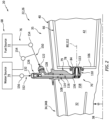
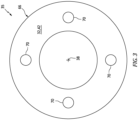
- the swirler structure 78 may be (e.g., movably) mounted to a bulkhead 106 of the combustor 66.
- the flange for example, may be abutted axially against and coupled to the bulkhead 106.
- This coupling between the swirler structure 78 and the bulkhead 106 may be a compliant coupling such that, for example, the swirler structure 78 can shift (e.g., slide) radially and/or circumferentially relative to the bulkhead 106 to facilitate differential thermal expansion between the respective fuel injector assembly 70 and the combustor 66 and its bulkhead 106.
- the fuel injector 79 of FIG. 2 includes a fuel injector stem 108 and a fuel injector nozzle 110.
- the injector stem 108 is configured to support and route fluid to the injector nozzle 110 from an exterior of the engine housing 40.
- the injector nozzle 110 is cantilevered from the injector stem 108.
- the injector nozzle 110 projects along a centerline axis 112 of the injector nozzle 110 into a bore of the swirler structure 78, which nozzle axis 112 may be parallel with (e.g., coaxial to) the swirler axis 80.
- a tip 113 of the injector nozzle 110 may disposed within the swirler bore, or otherwise at the structure downstream end 84.
- the fuel injector 79 and its injector nozzle 110 may be configured to move (e.g., translate) axially along the axis 80, 112 to further facilitate differential thermal expansion between the respective fuel injector assembly 70 and the combustor 66 and its bulkhead 106.
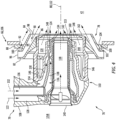
- the first fluid passage 114 (e.g., a gaseous fluid passage) extends longitudinally through the fuel injector 79 from an inlet 122 (see also FIG. 2 ) into the first fluid passage 114 to an outlet 124 from the first fluid passage 114.
- the first fluid passage inlet 122 is disposed at an exterior end 126 (see FIG. 2 ) of the injector stem 108.
- the first fluid passage outlet 124 is disposed at the nozzle tip 113.
- the first fluid passage 114 of FIG. 4 includes a first passage conduit 128 in the injector stem 108 and an annular first passage channel 130 in the injector nozzle 110.
- the first passage conduit 128 fluidly couples the first fluid passage inlet 122 to the first passage channel 130.
- the first passage channel 130 fluidly couples the first passage conduit 128 to the first fluid passage outlet 124.
- the first passage channel 130 of FIG. 4 extends longitudinally within the fuel injector 79 and its injector nozzle 110 from the first passage conduit 128 to the first fluid passage outlet 124.
- This first passage channel 130 extends circumferentially around and may be coaxial with the nozzle axis 112.
- the second fluid passage 116 (e.g., a liquid fluid passage) extends longitudinally through the fuel injector 79 from an inlet 132 (see also FIG. 2 ) into the second fluid passage 116 to an outlet 134 from the second fluid passage 116.
- the second fluid passage inlet 132 is disposed at the exterior end 126 (see FIG. 2 ) of the injector stem 108.
- the second fluid passage outlet 134 is disposed at the nozzle tip 113.
- the second fluid passage 116 of FIG. 4 includes a second passage conduit 136 in the injector stem 108 and an annular second passage channel 138 in the injector nozzle 110.
- the second passage conduit 136 fluidly couples the second fluid passage inlet 132 to the second passage channel 138.
- the second passage channel 138 extends longitudinally within the fuel injector 79 and its injector stem 108 from the second fluid passage inlet 132 to the second passage channel 138.
- the second passage channel 138 fluidly couples the second passage conduit 136 to the second fluid passage outlet 134.
- the second passage channel 138 of FIG. 4 extends longitudinally within the fuel injector 79 and its injector nozzle 110 from the second passage conduit 136 to the second fluid passage outlet 134.
- This second passage channel 138 extends circumferentially around and may be coaxial with the nozzle axis 112.
- the second passage channel 138 and the second fluid passage outlet 134 are respectively radially inboard of the first passage channel 130 and the first fluid passage outlet 124.
- the first fluid passage outlet 124 may also be (e.g., slightly) axially recessed upstream from the second fluid passage outlet 134. At least a downstream end portion of the second fluid passage 116 and its second passage channel 138 radially tapers (e.g., converges) as the second fluid passage 116 extends longitudinally to its second fluid passage outlet 134.
- the inner air passage 118 may be formed by or otherwise include a central bore through the injector nozzle 110.
- the inner air passage 118 extends longitudinally through the injector nozzle 110 from an inlet 140 into the inner air passage 118 to an outlet 142 from the inner air passage 118.
- the inner air passage inlet 140 is disposed at an upstream end of the injector nozzle 110.
- the inner air passage outlet 142 is disposed at the nozzle tip 113, which nozzle tip 113 of FIG. 4 is axially opposite the nozzle upstream end.
- the inner air passage 118 is radially inboard of each of the fluid passages 114 and 116 within the injector nozzle 110.
- the inner air passage 118 may also include an air swirler configured to swirl (e.g., at its inlet 140) air flowing longitudinally within the inner air passage 118 circumferentially about the nozzle axis 112.
- the outer air passage 120 may be formed by or otherwise include an annular air passage channel 144.
- the outer air passage 120 extends longitudinally through the injector nozzle 110 from an inlet 146 into the outer air passage 120 to an outlet 148 from the outer air passage 120.
- the outer air passage inlet 146 is disposed at an outer side of the injector nozzle 110.
- the outer air passage outlet 148 is disposed at the nozzle tip 113.
- the outer air passage 120 is radially outboard of the each of the injector passages 114, 116 and 118.
- the outer air passage 120 may thereby circumscribe each of the injector passages 114, 116, 118.
- At least a downstream end portion of the outer air passage 120 and its air passage channel 144 radially tapers (e.g., converges) as the outer air passage 120 extends longitudinally to its outer air passage outlet 148.
- the outer air passage 120 may also include one or more vanes and/or circumferentially canted inlet orifices (e.g., at its inlet 146) configured to swirl air flowing longitudinally within the outer air passage 120 circumferentially about the swirler axis 80.
- the fluid delivery system 76 includes a first passage circuit 150 and a second passage circuit 152.
- the first passage circuit 150 fluidly couples the fuel source 72 and the water source 74 to the first fluid passage 114 and its first fluid passage inlet 122.
- This first passage circuit 150 may include one or more first flow regulators 154 (e.g., valves, pumps, etc.) configured to control fluid flow (e.g., meter fluid) from each fluid source 72, 74 to the first fluid passage 114.
- the second passage circuit 152 fluidly couples the water source 74 to the second fluid passage 116 and its second fluid passage inlet 132.
- This second passage circuit 152 may include at least one second flow regulator 156 (e.g., valve, pump, etc.) configured to control fluid flow (e.g., meter fluid) from the water source 74 to the second fluid passage 116.
- FIG. 5 is a flow diagram of a method 500 of operation for a powerplant.
- the operating method 500 is described below with reference to the powerplant 20 of FIG. 1 and its fluid system 68 of FIGS. 2-4 .
- the operating method 500 of the present invention is not limited to such an exemplary arrangements as discussed below in further detail.
- the first passage circuit 150 delivers a fuel-water mixture to each fuel injector 79 and its first fluid passage 114.
- the first passage circuit 150 may mix gaseous fuel received from the fuel source 72 with liquid water (e.g., a mist of liquid water) received from the water source 74 within a volume outside of the respective fuel injector 79. This fuel-water mixture may then be directed into the first fluid passage 114 through its respective inlet 122.
- the fuel-water mixture is injected into the combustion chamber 42.
- the fuel-water mixture for example, is directed through the first fluid passage 114 to its respective outlet 124.
- This fuel-water mixture may then be directed out of the injector nozzle 110 through the first fluid passage outlet 124 and into the combustion chamber 42 as an annular flow of the fuel-water mixture.
- the fuel-water mixture directed out of the first fluid passage outlet 124 may still be composed of the liquid water and the gaseous fuel.
- the gaseous fuel may be a non-hydrocarbon fuel such as hydrogen fuel; e.g., hydrogen (H 2 ) gas.
- the second passage circuit 152 delivers additional liquid water to each fuel injector 79 and its second fluid passage 116.
- the second passage circuit 152 for example, directs the additional liquid water from the water source 74 into the second fluid passage 116 through its respective inlet 132.
- step 508 the additional liquid water is injected into the combustion chamber 42.
- the additional liquid water for example, is directed through the second fluid passage 116 to its respective outlet 134.
- This additional liquid water may then be directed out of the injector nozzle 110 through the second fluid passage outlet 134 and into the combustion chamber 42 as an annular flow of the additional liquid water.
- the flow of the additional liquid water is radially inboard of and circumscribed by the flow of the fuel-water mixture.
- each fuel injector assembly 70 directs compressed air into the combustion chamber 42.
- Each passage 90, 92, 118 and 120 directs compressed core air from a plenum 158 surrounding and/or otherwise adjacent the combustor 66 into the combustion chamber 42 as a respective flow of compressed air.
- the flows of the compressed air output from the passages 118 and 120 radially shroud the flow of the fuel-water mixture and the flow of the additional liquid water.
- step 512 the gaseous fuel and the compressed air mix within the combustion chamber 42 to provide the fuel air mixture.
- step 514 the fuel-air mixture is ignited to generate combustion products and power operation of the powerplant 20 and its turbine engine 22 as described above.
- a non-hydrocarbon fuel such as the hydrogen gas may have a relatively quick flame speed.
- the injector nozzle 110 and its nozzle tip 113 therefore may be subject to relatively high temperatures, particular at its face surfaces 160 and 162 (see FIG. 4 ).
- the temperatures of the face surfaces 160 and 162 may be reduced by injecting the liquid water into the combustion chamber 42.
- the water may provide a fluid barrier along the face surface 160, 162, delay combustion of the hydrogen gas and promote, for example, slightly deeper penetration, and/or reduce flame holding at the nozzle tip 113.
- the inclusion of the liquid water in the fuel-water mixture in particular, may reduce the temperature of the outer face surface 162 at the nozzle tip 113. This may facilitate fueling the turbine engine 22 combustion process, for example, completely (e.g., only) with the hydrogen fuel.
- Each fuel injector 79 may inject a first quantity (A) of water into the combustion chamber 42 via the fuel-water mixture flow; e.g., through the first fluid passage 114 and its outlet 124.
- Each fuel injector 79 may inject a second quantity of water (B) into the combustion chamber 42 via the additional liquid water flow; e.g., through the second fluid passage 116 and its outlet 134.
- a ratio of the first quantity of water to the second quantity of water (A/B) may be less than one (1); e.g., A/B ⁇ 1.
- the first quantity of water for example, may account for between thirty percent (30%) and seventy percent (70%) of the water injected into the combustion chamber 42 by the respective fuel injector 79.
- the first quantity of water may account for between forty percent (40%) and sixty percent (60%) of the water injected into the combustion chamber 42 by the respective fuel injector 79.
- the first quantity of water may account for between thirty percent (30%) and forty percent (40%) of the water injected into the combustion chamber 42 by the respective fuel injector 79.
- the present invention is not limited to the foregoing exemplary relationships as cooling parameters may change based on nozzle design.
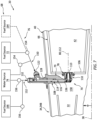
- the fluid system 68 may include a second fuel source 164 (e.g., a fuel reservoir, a fuel pipeline, etc.).
- the second fuel source 164 may provide a hydrocarbon fuel such as gaseous methane (e.g., natural gas).
- the first passage circuit 150 of FIG. 6 may be operated to (e.g., only) mix the hydrogen gas with the liquid water to provide the fuel-water mixture as described above.
- the first passage circuit 150 may be operated to mix both the hydrogen gas and the methane gas with the liquid water to provide the fuel-water mixture.
- the first passage circuit 150 may be operated to (e.g., only) mix the hydrogen gas with the methane gas (without the liquid water) to provide a fuel mixture to the first fluid passage 114 rather than the fuel-water mixture.
- the first passage circuit 150 may be operated to (e.g., only) provide the methane gas to the first fluid passage 114 rather than the fuel-water mixture. In this mode, no water is mixed with the methane gas directed through the first fluid passage 114.
- the second passage circuit 152 may continue to provide the additional liquid water to the second fluid passage 116 as described above.
- the mixture of the hydrogen gas and the methane gas may be selectively tailored.
- the first passage circuit 150 may mix a first quantity (X) of the hydrogen gas with a second quantity (Y) of the methane gas.
- a ratio of the first quantity of the hydrogen gas to the second quantity of the methane gas (e.g., X/Y) may be less or equal to than one (1); e.g., X/Y ⁇ 1.
- the ratio of the first quantity of the hydrogen gas to the second quantity of the methane gas may alternatively be greater than one (1) (e.g., X/Y > 1) to reduce, for example, emission of pollutants generated by combustion of a hydrocarbon fuel.
- X/Y the ratio of the first quantity of the hydrogen gas to the second quantity of the methane gas
- the ratio of X/Y may alternatively be greater than one (1) (e.g., X/Y > 1) to reduce, for example, emission of pollutants generated by combustion of a hydrocarbon fuel.
- the ratio of X/Y increases, the quantity of the liquid water mixed with the gaseous fuel within the first passage circuit 150 also increases to compensate for the higher hydrogen fuel content, which may promote fastener flame speed and/or high combustion temperature.
- the engine core 26 is shown in FIG. 1 with two rotating assemblies 56 and 60. It is contemplated, however, the engine core 26 may alternatively be configured with a single rotating assembly, or with three or more rotating assemblies.
- the engine core 26 of FIG. 8 is configured with an additional turbine rotor 168 (e.g., a power turbine (PT) rotor) coupled to and configured to drive rotation of the driven rotor 28; e.g., power the mechanical load 24.
- the turbine rotor 168 is disposed within a power turbine section 36C of the turbine section 36, which power turbine section 36C is downstream of the turbine section 36B (here, an intermediate turbine section) along the core flowpath 32.
Landscapes
- Engineering & Computer Science (AREA)
- Chemical & Material Sciences (AREA)
- Combustion & Propulsion (AREA)
- Mechanical Engineering (AREA)
- General Engineering & Computer Science (AREA)
Applications Claiming Priority (1)
| Application Number | Priority Date | Filing Date | Title |
|---|---|---|---|
| US18/211,067 US20240418127A1 (en) | 2023-06-16 | 2023-06-16 | Gaseous fuel and liquid water injection for turbine engine |
Publications (1)
| Publication Number | Publication Date |
|---|---|
| EP4477949A1 true EP4477949A1 (de) | 2024-12-18 |
Family
ID=90735170
Family Applications (1)
| Application Number | Title | Priority Date | Filing Date |
|---|---|---|---|
| EP24170650.6A Pending EP4477949A1 (de) | 2023-06-16 | 2024-04-16 | Einspritzung von gasförmigem brennstoff und flüssigem wasser für einen turbinenmotor |
Country Status (2)
| Country | Link |
|---|---|
| US (1) | US20240418127A1 (de) |
| EP (1) | EP4477949A1 (de) |
Cited By (1)
| Publication number | Priority date | Publication date | Assignee | Title |
|---|---|---|---|---|
| EP4517066A1 (de) * | 2023-08-28 | 2025-03-05 | Pratt & Whitney Canada Corp. | Mehrkraftstoff-gasturbinenmotor mit wassereinspritzung |
Citations (5)
| Publication number | Priority date | Publication date | Assignee | Title |
|---|---|---|---|---|
| WO1993022601A1 (en) * | 1992-04-23 | 1993-11-11 | Solar Turbines Incorporated | Premix liquid and gaseous combustion nozzle for use with a gas turbine engine |
| US9523311B2 (en) * | 2007-05-08 | 2016-12-20 | General Electric Technology Gmbh | Method of operating a gas turbine, and gas turbine with water injection |
| US9958152B2 (en) * | 2014-08-14 | 2018-05-01 | Siemens Aktiengesellschaft | Multi-functional fuel nozzle with an atomizer array |
| US10041417B2 (en) * | 2011-11-02 | 2018-08-07 | Kawasaki Jukogyo Kabushiki Kaisha | Gas turbine system with injection water pressurization passage |
| US10228137B2 (en) | 2013-08-30 | 2019-03-12 | United Technologies Corporation | Dual fuel nozzle with swirling axial gas injection for a gas turbine engine |
Family Cites Families (10)
| Publication number | Priority date | Publication date | Assignee | Title |
|---|---|---|---|---|
| US5259184A (en) * | 1992-03-30 | 1993-11-09 | General Electric Company | Dry low NOx single stage dual mode combustor construction for a gas turbine |
| US5669218A (en) * | 1995-05-31 | 1997-09-23 | Dresser-Rand Company | Premix fuel nozzle |
| US7082765B2 (en) * | 2004-09-01 | 2006-08-01 | General Electric Company | Methods and apparatus for reducing gas turbine engine emissions |
| EP2933561A4 (de) * | 2012-12-13 | 2016-08-24 | Kawasaki Heavy Ind Ltd | Multikraftstofffähige gasturbinenbrennkammer |
| JP6395363B2 (ja) * | 2013-10-11 | 2018-09-26 | 川崎重工業株式会社 | ガスタービンの燃料噴射装置 |
| US9964043B2 (en) * | 2014-11-11 | 2018-05-08 | General Electric Company | Premixing nozzle with integral liquid evaporator |
| US20170082024A1 (en) * | 2015-09-17 | 2017-03-23 | Siemens Energy, Inc. | Independently controlled three stage water injection in a diffusion burner |
| JP6722491B2 (ja) * | 2016-04-01 | 2020-07-15 | 川崎重工業株式会社 | ガスタービンの燃焼器 |
| US12429223B2 (en) * | 2022-03-17 | 2025-09-30 | Ge Vernova Infrastructure Technology Llc | Fuel supply system for a combustor |
| GB2602936B (en) * | 2022-04-20 | 2023-02-15 | Derwent Tech Ltd | Propulsion system |
-
2023
- 2023-06-16 US US18/211,067 patent/US20240418127A1/en active Pending
-
2024
- 2024-04-16 EP EP24170650.6A patent/EP4477949A1/de active Pending
Patent Citations (5)
| Publication number | Priority date | Publication date | Assignee | Title |
|---|---|---|---|---|
| WO1993022601A1 (en) * | 1992-04-23 | 1993-11-11 | Solar Turbines Incorporated | Premix liquid and gaseous combustion nozzle for use with a gas turbine engine |
| US9523311B2 (en) * | 2007-05-08 | 2016-12-20 | General Electric Technology Gmbh | Method of operating a gas turbine, and gas turbine with water injection |
| US10041417B2 (en) * | 2011-11-02 | 2018-08-07 | Kawasaki Jukogyo Kabushiki Kaisha | Gas turbine system with injection water pressurization passage |
| US10228137B2 (en) | 2013-08-30 | 2019-03-12 | United Technologies Corporation | Dual fuel nozzle with swirling axial gas injection for a gas turbine engine |
| US9958152B2 (en) * | 2014-08-14 | 2018-05-01 | Siemens Aktiengesellschaft | Multi-functional fuel nozzle with an atomizer array |
Cited By (1)
| Publication number | Priority date | Publication date | Assignee | Title |
|---|---|---|---|---|
| EP4517066A1 (de) * | 2023-08-28 | 2025-03-05 | Pratt & Whitney Canada Corp. | Mehrkraftstoff-gasturbinenmotor mit wassereinspritzung |
Also Published As
| Publication number | Publication date |
|---|---|
| US20240418127A1 (en) | 2024-12-19 |
Similar Documents
| Publication | Publication Date | Title |
|---|---|---|
| US12215870B2 (en) | Method of operating a gas turbine combustor comprising injecting a diluent into the primary and secondary combustion zones | |
| EP4431813A1 (de) | Kraftstoffeinspritzanordnung für gasturbinenmotor | |
| US12169069B2 (en) | System for producing diluent for a gas turbine engine | |
| US12221926B2 (en) | Multi-temperature fuel injectors for a gas turbine engine | |
| EP4477949A1 (de) | Einspritzung von gasförmigem brennstoff und flüssigem wasser für einen turbinenmotor | |
| US20240209791A1 (en) | Staged combustor | |
| US12486982B2 (en) | Combustor having a main chamber and one or more trapped vortex cavities | |
| US12305571B2 (en) | Combustor | |
| EP4431716A1 (de) | Dampfeintrag in die kernluft vor dem diffusorplenum eines turbinenmotors | |
| EP4421388A1 (de) | Kraftstoffeinspritzanordnung für gasturbinenmotor | |
| EP4431809A1 (de) | Modulation des fluidstroms in einem turbinenmotor mittels dampf | |
| US20240209801A1 (en) | Gas turbine operation | |
| US20240209800A1 (en) | Aircraft fuel system | |
| EP4368889A2 (de) | Kraftstoffeinspritzanordnung für gasturbinenmotor | |
| US12392287B2 (en) | Steam cooling turbine stator vane array | |
| US11905837B2 (en) | Sealing system including a seal assembly between components | |
| US12535215B2 (en) | Combustor including a steam injector operably injecting steam into a trapped vortex cavity | |
| US12416258B2 (en) | Asymmetric introduction of steam into turbine engine combustion chamber | |
| EP4431718A1 (de) | Selektive dampfverteilung in dampfgekühlten zonen in einem turbinenmotor |
Legal Events
| Date | Code | Title | Description |
|---|---|---|---|
| PUAI | Public reference made under article 153(3) epc to a published international application that has entered the european phase |
Free format text: ORIGINAL CODE: 0009012 |
|
| STAA | Information on the status of an ep patent application or granted ep patent |
Free format text: STATUS: THE APPLICATION HAS BEEN PUBLISHED |
|
| AK | Designated contracting states |
Kind code of ref document: A1 Designated state(s): AL AT BE BG CH CY CZ DE DK EE ES FI FR GB GR HR HU IE IS IT LI LT LU LV MC ME MK MT NL NO PL PT RO RS SE SI SK SM TR |
|
| STAA | Information on the status of an ep patent application or granted ep patent |
Free format text: STATUS: REQUEST FOR EXAMINATION WAS MADE |
|
| 17P | Request for examination filed |
Effective date: 20250618 |
|
| STAA | Information on the status of an ep patent application or granted ep patent |
Free format text: STATUS: EXAMINATION IS IN PROGRESS |
|
| 17Q | First examination report despatched |
Effective date: 20250807 |
|
| GRAP | Despatch of communication of intention to grant a patent |
Free format text: ORIGINAL CODE: EPIDOSNIGR1 |
|
| STAA | Information on the status of an ep patent application or granted ep patent |
Free format text: STATUS: GRANT OF PATENT IS INTENDED |