EP4477696A1 - Method for decomposing crosslinked rubber - Google Patents
Method for decomposing crosslinked rubber Download PDFInfo
- Publication number
- EP4477696A1 EP4477696A1 EP23752842.7A EP23752842A EP4477696A1 EP 4477696 A1 EP4477696 A1 EP 4477696A1 EP 23752842 A EP23752842 A EP 23752842A EP 4477696 A1 EP4477696 A1 EP 4477696A1
- Authority
- EP
- European Patent Office
- Prior art keywords
- rubber
- decomposition
- crosslinked rubber
- decomposition step
- mass
- Prior art date
- Legal status (The legal status is an assumption and is not a legal conclusion. Google has not performed a legal analysis and makes no representation as to the accuracy of the status listed.)
- Withdrawn
Links
Images

Classifications
-
- C—CHEMISTRY; METALLURGY
- C10—PETROLEUM, GAS OR COKE INDUSTRIES; TECHNICAL GASES CONTAINING CARBON MONOXIDE; FUELS; LUBRICANTS; PEAT
- C10G—CRACKING HYDROCARBON OILS; PRODUCTION OF LIQUID HYDROCARBON MIXTURES, e.g. BY DESTRUCTIVE HYDROGENATION, OLIGOMERISATION, POLYMERISATION; RECOVERY OF HYDROCARBON OILS FROM OIL-SHALE, OIL-SAND, OR GASES; REFINING MIXTURES MAINLY CONSISTING OF HYDROCARBONS; REFORMING OF NAPHTHA; MINERAL WAXES
- C10G1/00—Production of liquid hydrocarbon mixtures from oil-shale, oil-sand, or non-melting solid carbonaceous or similar materials, e.g. wood, coal
- C10G1/10—Production of liquid hydrocarbon mixtures from oil-shale, oil-sand, or non-melting solid carbonaceous or similar materials, e.g. wood, coal from rubber or rubber waste
-
- C—CHEMISTRY; METALLURGY
- C10—PETROLEUM, GAS OR COKE INDUSTRIES; TECHNICAL GASES CONTAINING CARBON MONOXIDE; FUELS; LUBRICANTS; PEAT
- C10B—DESTRUCTIVE DISTILLATION OF CARBONACEOUS MATERIALS FOR PRODUCTION OF GAS, COKE, TAR, OR SIMILAR MATERIALS
- C10B53/00—Destructive distillation, specially adapted for particular solid raw materials or solid raw materials in special form
- C10B53/07—Destructive distillation, specially adapted for particular solid raw materials or solid raw materials in special form of solid raw materials consisting of synthetic polymeric materials, e.g. tyres
-
- C—CHEMISTRY; METALLURGY
- C08—ORGANIC MACROMOLECULAR COMPOUNDS; THEIR PREPARATION OR CHEMICAL WORKING-UP; COMPOSITIONS BASED THEREON
- C08J—WORKING-UP; GENERAL PROCESSES OF COMPOUNDING; AFTER-TREATMENT NOT COVERED BY SUBCLASSES C08B, C08C, C08F, C08G or C08H
- C08J11/00—Recovery or working-up of waste materials
- C08J11/04—Recovery or working-up of waste materials of polymers
- C08J11/10—Recovery or working-up of waste materials of polymers by chemically breaking down the molecular chains of polymers or breaking of crosslinks, e.g. devulcanisation
- C08J11/12—Recovery or working-up of waste materials of polymers by chemically breaking down the molecular chains of polymers or breaking of crosslinks, e.g. devulcanisation by dry-heat treatment only
-
- C—CHEMISTRY; METALLURGY
- C08—ORGANIC MACROMOLECULAR COMPOUNDS; THEIR PREPARATION OR CHEMICAL WORKING-UP; COMPOSITIONS BASED THEREON
- C08J—WORKING-UP; GENERAL PROCESSES OF COMPOUNDING; AFTER-TREATMENT NOT COVERED BY SUBCLASSES C08B, C08C, C08F, C08G or C08H
- C08J2309/00—Characterised by the use of homopolymers or copolymers of conjugated diene hydrocarbons
- C08J2309/06—Copolymers with styrene
-
- C—CHEMISTRY; METALLURGY
- C08—ORGANIC MACROMOLECULAR COMPOUNDS; THEIR PREPARATION OR CHEMICAL WORKING-UP; COMPOSITIONS BASED THEREON
- C08J—WORKING-UP; GENERAL PROCESSES OF COMPOUNDING; AFTER-TREATMENT NOT COVERED BY SUBCLASSES C08B, C08C, C08F, C08G or C08H
- C08J2317/00—Characterised by the use of reclaimed rubber
-
- C—CHEMISTRY; METALLURGY
- C08—ORGANIC MACROMOLECULAR COMPOUNDS; THEIR PREPARATION OR CHEMICAL WORKING-UP; COMPOSITIONS BASED THEREON
- C08J—WORKING-UP; GENERAL PROCESSES OF COMPOUNDING; AFTER-TREATMENT NOT COVERED BY SUBCLASSES C08B, C08C, C08F, C08G or C08H
- C08J2321/00—Characterised by the use of unspecified rubbers
-
- Y—GENERAL TAGGING OF NEW TECHNOLOGICAL DEVELOPMENTS; GENERAL TAGGING OF CROSS-SECTIONAL TECHNOLOGIES SPANNING OVER SEVERAL SECTIONS OF THE IPC; TECHNICAL SUBJECTS COVERED BY FORMER USPC CROSS-REFERENCE ART COLLECTIONS [XRACs] AND DIGESTS
- Y02—TECHNOLOGIES OR APPLICATIONS FOR MITIGATION OR ADAPTATION AGAINST CLIMATE CHANGE
- Y02W—CLIMATE CHANGE MITIGATION TECHNOLOGIES RELATED TO WASTEWATER TREATMENT OR WASTE MANAGEMENT
- Y02W30/00—Technologies for solid waste management
- Y02W30/50—Reuse, recycling or recovery technologies
- Y02W30/62—Plastics recycling; Rubber recycling
Definitions
- the present disclosure relates to a method of decomposing a crosslinked rubber.
- Rubber products having rubber that has been crosslinked, such as vulcanized rubber, as a main material are difficult to reuse and are often reused as fuels, particularly in cement plants, once the product life thereof has passed.
- vulcanized rubber as a main material
- fuels particularly in cement plants
- Patent Literature 1 discloses a method of decomposing a polyisoprene-based rubber through microorganisms.
- the present disclosure is directed at solving the problems of the conventional techniques described above and providing a method of decomposing a crosslinked rubber that can improve monomer yield.
- the method of decomposing a crosslinked rubber according to the present disclosure includes:
- the method of decomposing a crosslinked rubber by performing pyrolysis at a comparatively low temperature of not lower than 150°C and not higher than 400°C in the first decomposition step, it is possible to inhibit gasification and aromatization of a decomposition product, and it is also possible to improve the retention rate of a monomer skeleton (isoprene skeleton, butadiene skeleton, etc.) in the diene-based rubber as compared to normal high-temperature pyrolysis.
- a monomer skeleton isoprene skeleton, butadiene skeleton, etc.
- the method of decomposing a crosslinked rubber according to the present disclosure by pyrolyzing a decomposition product obtained through the first decomposition step at not lower than 300°C and not higher than 450°C in an inert gas atmosphere and in the absence of a catalyst in the second decomposition step, it is possible to inhibit hydrogenation of double bonds in the monomer skeleton and oxidation of the decomposition product while also decomposing the decomposition product (intermediate decomposition product) to yield monomer (particularly diene-based monomer).
- the method of decomposing a crosslinked rubber according to the present disclosure makes it possible to improve the yield of monomer that is ultimately obtained from the crosslinked rubber.
- a method of decomposing a crosslinked rubber of a present embodiment includes a first decomposition step of pyrolyzing a crosslinked rubber containing a rubber component that includes a diene-based rubber at not lower than 150°C and not higher than 400°C.
- the crosslinked rubber that is the subject of decomposition in the decomposition method of the present embodiment contains a rubber component that includes a diene-based rubber and may further contain carbon black, etc.
- the crosslinked rubber may be in the form of a powdered rubber, for example.
- the powdered rubber can be obtained through cutting and pulverization of a used rubber product such as a scrap tire.
- the pulverization step may include a plurality of steps such as a preliminary pulverization step and a fine pulverization step.
- the particle size of the powdered rubber that is used may be adjusted through a classification step that is performed after the pulverization step.
- the rubber component of the crosslinked rubber includes a diene-based rubber.
- the diene-based rubber is a rubber that includes units derived from a diene-based monomer (i.e., diene-based units) and that may further include units derived from a copolymerizable comonomer.
- the units derived from a diene-based monomer enable crosslinking (vulcanization) of the diene-based rubber and also enable the expression of rubber-like stretching and strength. It should be noted that although the diene-based rubber is normally present in a crosslinked state in the crosslinked rubber, some of the diene-based rubber may be in a non-crosslinked state.
- Specific examples of the diene-based monomer (diene-based compound) include 1,3-butadiene, isoprene, 1,3-pentadiene, and 2,3-dimethyl-1,3-butadiene, of which, 1,3-butadiene and isoprene are preferable.
- the copolymerizable comonomer may be an aromatic vinyl compound, for example.
- the aromatic vinyl compound may be styrene, o-methylstyrene, m-methylstyrene, p-methylstyrene, o,p-dimethylstyrene, o-ethylstyrene, m-ethylstyrene, p-ethylstyrene, or the like.
- the diene-based rubber may, more specifically, be isoprene skeleton rubber, styrene-butadiene rubber (SBR), butadiene rubber (BR), chloroprene rubber (CR), or the like.
- the isoprene skeleton rubber is rubber having isoprene units as a main skeleton and may, more specifically, be natural rubber (NR), synthetic isoprene rubber (IR), or the like.
- the rubber component preferably includes one or more selected from the group consisting of isoprene skeleton rubber, styrene-butadiene rubber, and butadiene rubber.
- the rubber component includes one or more selected from the group consisting of isoprene skeleton rubber, styrene-butadiene rubber, and butadiene rubber
- diene-based monomer that is easy to reuse, such as isoprene or butadiene is obtained when adopting the decomposition method of the present embodiment.
- the content ratio of the rubber component in the crosslinked rubber is not specifically limited and may be within a range of 10 mass% to 90 mass%, for example, and preferably within a range of 20 mass% to 80 mass%.
- the content ratio of the diene-based rubber in the rubber component is not specifically limited and may be within a range of 50 mass% to 100 mass%, for example, and preferably within a range of 80 mass% to 100 mass%.
- the rubber component of the crosslinked rubber includes either or both of isoprene units and butadiene units.
- the total proportion constituted by isoprene units and butadiene units in the rubber component is preferably 40 mass% or more, more preferably 60 mass% or more, and may be 100 mass% (i.e., the rubber component may be composed of only isoprene units and/or butadiene units).
- the total proportion constituted by isoprene units and butadiene units in the rubber component is 40 mass% or more, this improves the yield of diene-based monomer that is easy to reuse, such as isoprene or butadiene.
- the term "isoprene unit” refers to a unit that is derived from isoprene and the term “butadiene unit” refers to a unit that is derived from butadiene.
- the rubber component of the crosslinked rubber includes one or more of a diene-based rubber that includes units derived from isoprene (isoprene units), a diene-based rubber that includes units derived from butadiene (butadiene units), and a diene-based rubber that includes units derived from isoprene (isoprene units) and units derived from butadiene (butadiene units).
- the diene-based rubber that includes units derived from isoprene may be the isoprene skeleton rubber mentioned above, for example, and the diene-based rubber that includes units derived from butadiene (butadiene units) may be styrene-butadiene rubber (SBR), butadiene rubber (BR), or the like.
- SBR styrene-butadiene rubber
- BR butadiene rubber
- the crosslinked rubber may further contain carbon black.
- the rubber component in the crosslinked rubber can decompose and undergo reduction of molecular weight up until the form of a liquid polymer or liquid oligomer, for example. Therefore, even in a case in which the crosslinked rubber contains carbon black, the carbon black can easily be separated and collected after the first decomposition step through solid-liquid separation, for example. By collecting the carbon black before pyrolysis of the second decomposition step, degradation of the carbon black can be inhibited, and the collected carbon black can be reused as high-quality carbon black.
- the content ratio of the carbon black in the crosslinked rubber is preferably 20 mass% or more, and more preferably 30 mass% or more, and is preferably 40 mass% or less, and more preferably 35 mass% or less.
- a crosslinked rubber having a carbon black content ratio of 20 mass% or more has excellent reinforcement and enables the collection of a large amount of carbon black when the decomposition method of the present embodiment is adopted with respect to this crosslinked rubber.
- the crosslinked rubber may contain various components that are typically used in the rubber industry such as fillers other than carbon black (silica, calcium carbonate, etc.), silane coupling agents, antioxidants, softeners, processing aids, resins, surfactants, organic acids (stearic acid, etc.), zinc oxide (zinc flower), vulcanization accelerators, and crosslinking agents (sulfur, peroxides, etc.), for example.
- the first decomposition step is performed at not lower than 150°C and not higher than 400°C. Performing the first decomposition step at 150°C or higher improves the rate of a decomposition reaction of the diene-based rubber in the rubber component of the crosslinked rubber, whereas performing the first decomposition step at 400°C or lower can inhibit gasification and aromatization of the decomposition product, improves the retention rate (selectivity) of a monomer skeleton of the diene-based rubber in the rubber component of the crosslinked rubber after decomposition, and, in a case in which the crosslinked rubber contains carbon black, for example, makes it possible to collect and reuse this carbon black as high-quality carbon black.
- the first decomposition step is preferably performed at 175°C or higher, and more preferably at 190°C or higher. Moreover, from a viewpoint of improving selectivity of product retaining the monomer skeleton, the first decomposition step is preferably performed at 350°C or lower, and more preferably at 300°C or lower.
- the first decomposition step is preferably performed in an inert gas atmosphere.
- an inert gas atmosphere By performing the first decomposition step in an inert gas atmosphere, it is possible to inhibit oxidation or reduction of the decomposition product and, in particular, to inhibit hydrogenation of double bonds of oligomer or monomer in the decomposition product. This also makes it possible to inhibit oxidation of carbon black in a case in which the crosslinked rubber contains carbon black.
- the inert gas may be nitrogen, carbon dioxide, argon, helium, or the like, for example.
- an atmosphere with which a reactor is charged may be set as an inert gas in a situation in which a batch-type reactor is used, or an atmosphere that is caused to flow in a reactor may be set as an inert gas in a situation in which a flow-type reactor is used, for example.
- hydrogen may be produced during the first decomposition step, but this produced hydrogen is not taken into account in the atmosphere of the first decomposition step.
- the first decomposition step can be implemented at any pressure and can be implemented under reduced pressure, normal pressure, or raised pressure, it is preferable that the first decomposition step is performed under reduced pressure or normal pressure.
- the reaction pressure in the first decomposition step is preferably 1,000 kPa to 65 kPa.
- reaction time of the first decomposition step is preferably 1 minute to 180 minutes, more preferably 3 minutes to 60 minutes, and even more preferably 5 minutes to 30 minutes.
- a catalyst may or may not be used in the first decomposition step, it is preferable that a catalyst is not used.
- the omission of a catalyst in the first decomposition step enables cost reduction.
- any catalyst having an effect of accelerating a decomposition reaction of the crosslinked rubber can be used.
- the first decomposition step yields a liquid oligomer, a liquid polymer, or the like as a decomposition product.
- the rubber component of the crosslinked rubber includes either or both of isoprene units and butadiene units, that the total proportion constituted by the isoprene units and the butadiene units in the rubber component is 40 mass% or more, and that the total mass (A) of the isoprene units and the butadiene units in the rubber component and the mass (B) of an aromatic compound that is derived from either or both of the isoprene units and the butadiene units in the rubber component and that is present in the decomposition product obtained through the first decomposition step satisfy a relationship in formula (1), shown below.
- A is the total mass of isoprene units and butadiene units in the rubber component of the crosslinked rubber and B is the mass of the aromatic compound that is derived from either or both of isoprene units and butadiene units in the rubber component of the crosslinked rubber and that is present in the decomposition product obtained through the first decomposition step.
- aromatization of the decomposition product can be inhibited as a result of the first decomposition step being performed at not lower than 150°C and not higher than 400°C.
- mass (B) of an aromatic compound that is derived from either or both of isoprene units and butadiene units in the rubber component of the crosslinked rubber and that is present in the decomposition product obtained through the first decomposition step as a proportion (B/A ⁇ 100) relative to the total mass (A) of isoprene units and butadiene units in the rubber component of the crosslinked rubber is 50 mass% or less, this means that aromatization of the decomposition product is inhibited.
- the proportion (B/A ⁇ 100) is more preferably 40 mass% or less.
- the mass of an aromatic compound that is derived from aromatic compound units in the rubber component of the crosslinked rubber is subtracted from the mass of the aromatic compound that is present in the decomposition product obtained through the first decomposition step in calculation of the left side in formula (1).
- the proportion (B/A ⁇ 100) can be controlled through reaction conditions such as the reaction temperature and the reaction time of the first decomposition step, for example.
- a liquid component of the decomposition product obtained through the first decomposition step is an oligomer having a weight-average molecular weight of preferably 100 to 50,000, more preferably 400 to 12,000, even more preferably 400 to 5,000, and further preferably 400 to 1,500.
- liquid component of the decomposition product refers to a component that has a liquid form at normal temperature (23°C) and the term “oligomer” as used in the present specification refers to a component that has a weight-average molecular weight of 50,000 or less and that includes two or more monomer units.
- the weight-average molecular weight of the oligomer that is a liquid component of the decomposition product can be controlled through reaction conditions such as the reaction temperature and the reaction time of the first decomposition step, for example.
- the weight-average molecular weight (Mw) can be measured by gel permeation chromatography (GPC).
- the method of decomposing a crosslinked rubber of the present embodiment includes a second decomposition step of further pyrolyzing the decomposition product obtained through the first decomposition step at not lower than 300°C and not higher than 450°C in an inert gas atmosphere and in the absence of a catalyst.
- Performing the second decomposition step at 300°C or higher improves the rate of a decomposition reaction of the decomposition product obtained through the first decomposition step and improves the monomer yield, whereas performing the second decomposition step at 450°C or lower can noticeably inhibit gasification and aromatization of the decomposition product and noticeably improves selectivity of product retaining the monomer skeleton.
- the second decomposition step is preferably performed at 320°C or higher from a viewpoint of improving the rate of the decomposition reaction and improving the monomer yield, and is preferably performed at 380°C or lower from a viewpoint of inhibiting gasification and aromatization of the decomposition product.
- the second decomposition step is performed in an inert gas atmosphere.
- the inert gas may be nitrogen, carbon dioxide, argon, helium, or the like, for example.
- an atmosphere with which a reactor is charged may be set as an inert gas in a situation in which a batch-type reactor is used, or an atmosphere that is caused to flow in a reactor may be set as an inert gas in a situation in which a flow-type reactor is used, for example.
- hydrogen may be produced during the second decomposition step, but this produced hydrogen is not taken into account in the atmosphere of the second decomposition step.
- the second decomposition step can be implemented at any pressure and can be implemented under reduced pressure, normal pressure, or raised pressure, it is preferable that the second decomposition step is performed under reduced pressure or normal pressure.
- the reaction pressure of the second decomposition step is preferably 1,000 kPa to 67 kPa.
- reaction time of the second decomposition step is preferably 3 minutes to 60 minutes, and more preferably 5 minutes to 30 minutes.
- the second decomposition step is performed in the absence of a catalyst (i.e., without using a catalyst).
- the omission of a catalyst in the second decomposition step enables cost reduction.
- the phrase "in the absence of a catalyst” as used here means that a catalyst having an effect of accelerating the decomposition reaction is not present in the reaction system in the second decomposition step.
- the second decomposition step yields monomer (particularly diene-based monomer), etc. as a decomposition product.
- the decomposition product that is obtained through the second decomposition step of the method of decomposing a crosslinked rubber of the present embodiment preferably contains 15 mass% or more, more preferably 20 mass% or more, and even more preferably 25 mass% or more of a hydrocarbon compound having a carbon number of 5 or less and limonene (particularly a hydrocarbon compound having a carbon number of 2 to 4, isoprene, and limonene).
- Improvement of the yield of a hydrocarbon compound having a carbon number of 5 or less and limonene results in improvement of the yield of reuseable monomer and further improvement of the value of the decomposition method from an economical perspective and an environmental perspective. Note that from a viewpoint of yield of reuseable monomer, it is even more preferable that the decomposition product obtained through the second decomposition step contains 40 mass% or more of a hydrocarbon compound having a carbon number of 5 or less.
- the total amount of a hydrocarbon compound having a carbon number of 5 or less and limonene (particularly a hydrocarbon compound having a carbon number of 2 to 4, isoprene, and limonene) in the decomposition product obtained through the second decomposition step can be dependent on the previously described reaction conditions and also on the reaction apparatus that is used.
- the preferred range for the total amount of a hydrocarbon compound having a carbon number of 5 or less and limonene in the present embodiment is the preferred range for a case in which the reaction apparatus described in the subsequent Examples is used, and the total amount of a hydrocarbon compound having a carbon number of 5 or less and limonene can be further increased in a case in which a more preferable reaction apparatus is used in the method according to the present disclosure.
- the hydrocarbon compound having a carbon number of 5 or less that is a decomposition product differs depending on the type of rubber component in the crosslinked rubber that serves as a decomposition subject.
- the hydrocarbon compound having a carbon number of 5 or less may be 1,3-butadiene, isoprene, 1,3-pentadiene, 2,3-dimethyl-1,3-butadiene, or the like, with 1,3-butadiene and isoprene being preferable.
- the proportion constituted by the hydrocarbon compound having a carbon number of 5 or less in the decomposition product can be controlled through reaction conditions such as the reaction temperature and the reaction time of the second decomposition step, for example.
- the method of decomposing a crosslinked rubber of the present embodiment may further include other steps besides the first decomposition step and the second decomposition step described above. Examples of such steps include a step of pre-processing the crosslinked rubber (for example, a cutting step or a pulverization step).
- the crosslinked rubber contains carbon black
- a step of collecting the carbon black from the decomposition product is included between the first decomposition step and the second decomposition step.
- the method of decomposing a crosslinked rubber of the present embodiment can be implemented in a batch-type reactor or in a flow-type reactor. Note that since the method of decomposing a crosslinked rubber of the present embodiment is performed under comparatively mild conditions of not lower than 150°C and not higher than 400°C in the first decomposition step and not lower than 300°C and not higher than 450°C in the second decomposition step, the method of decomposing a crosslinked rubber of the present embodiment is also advantageous in terms of durability of a used reactor.
- the decomposition product present after the decomposition reaction may be separated and collected through filtration, distillation, or the like, or may be collected through sedimentation using a poor solvent, for example, and can then be reused.
- monomer (particularly diene-based monomer) that is ultimately obtained from the crosslinked rubber can be reused as a raw material of a diene-based rubber (polymer).
- the polystyrene-equivalent weight-average molecular weight (Mw) of a decomposition product was determined by gel permeation chromatography (GPC; HLC-8321GPC/HT produced by Tosoh Corporation; column: HT-806M ⁇ 2 columns (produced by Showa Denko K.K.); detector: differential refractometer (RI)) with monodisperse polystyrene as a reference.
- the measurement temperature is 40°C.
- a rubber composition was prepared through compounding of 50.0 parts by mass of carbon black, 1.0 parts by mass of antioxidant 6PPD (N-phenyl-N'-(1,3-dimethylbutyl)-p-phenylenediamine), 2.0 parts by mass of stearic acid, 2.5 parts by mass of zinc oxide, 1.5 parts by mass of a vulcanization accelerator (N-cyclohexyl-2-benzothiazolylsulfenamide), and 4.5 parts by mass of sulfur with 100.1 parts by mass of natural rubber, and this rubber composition was thermally crosslinked to prepare a crosslinked rubber. The obtained crosslinked rubber was cut up such that one side was approximately 2 mm to 6 mm to prepare a crosslinked rubber sample.
- 6PPD N-phenyl-N'-(1,3-dimethylbutyl)-p-phenylenediamine
- stearic acid 2.0 parts by mass of stearic acid
- 2.5 parts by mass of zinc oxide 2.5 parts by mass of zinc oxide
- a vulcanization accelerator
- Quartz wool was loaded at a lower section of a reaction site in a reaction tube that was provided with a sample loading inlet and a nitrogen feeding line at an upstream side. Note that an ice-cooling trap, a first liquid nitrogen trap, and a second liquid nitrogen trap are provided at a downstream side of the reaction tube. Gas that had passed through the second liquid nitrogen trap was collected in a gas bag.
- the reaction tube was supplied with 10 g of the crosslinked rubber sample obtained as described above at a supply rate of 1 g/10 min, and a pyrolysis reaction (first decomposition step) was performed at 330°C under a condition of a nitrogen flow rate of 600 mL/min. Note that the supplied sample becomes disposed at an upper section of the quartz wool and is subjected to a pyrolysis reaction.
- the oligomer obtained in the first decomposition step in an amount of 0.1 g, was loaded at a reaction site in a reaction tube, and then quartz wool was loaded at both an upstream side and a downstream side thereof.
- a helium feeding line is provided at an upstream side of the reaction tube, a cooling trap (cooling at -20°C with 60% ethylene glycol aqueous solution) loaded with chloroform is provided at a downstream side, and gas that has passed through the trap is collected in a gas bag.
- the reaction site of the reaction tube is heated at 400°C for 30 minutes under a condition of a helium flow rate of 50 mL/min to perform a second decomposition step.
- reaction tube After completion of the reaction, the reaction tube is cooled, product that has been deposited in the reaction tube and the trap is collected, and gaseous product is collected in the gas bag.
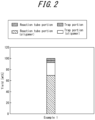
- the weight proportion of each product is illustrated in FIG. 2 .
- Examples 2 to 9 are presented in order to clarify conditions for obtaining a larger amount of isoprene and limonene.
- the amount of polymer component remaining in the solid content is determined as the weight loss at from 300°C to 650°C upon heating from 50°C to 700°C in nitrogen by TGA.
- the polymer component decomposition yield was determined by subtracting the amount of polymer component remaining in the solid content from the weight of polymer component contained in the rubber.
- the supernatant was measured by 1 H-NMR, the isoprene skeleton component yield in the decomposed polymer component was determined from the amount of hydrogen at an ⁇ -position in an isoprene structure relative to the amount of hydrogen of hexamethylene disilazane, and this yield is shown in Table 1.
- Example 2 Example 3
- Example 4 Example 5
- Example 6 Example 7
- Example 9 First decomposition step Electric furnace heating temperature (°C) 300 300 270 330 200 200 250 150 Electric furnace heating time (hr) 1 3 1 1 1 3 1 3
- Solvent decomposition step Decomposition yield of polymer component (mass%) 59 61 33 52 15 16 32 3 Isoprene skeleton component yield in polymer component (%) 58 44 83 35 76 80 81 33
- Second decomposition step Isoprene + limonene yield (mass%) 16 11 25 7 22 23 24 7
Landscapes
- Chemical & Material Sciences (AREA)
- Oil, Petroleum & Natural Gas (AREA)
- Engineering & Computer Science (AREA)
- Organic Chemistry (AREA)
- Chemical Kinetics & Catalysis (AREA)
- Life Sciences & Earth Sciences (AREA)
- Polymers & Plastics (AREA)
- Medicinal Chemistry (AREA)
- Physics & Mathematics (AREA)
- Health & Medical Sciences (AREA)
- Sustainable Development (AREA)
- Thermal Sciences (AREA)
- Materials Engineering (AREA)
- Wood Science & Technology (AREA)
- General Chemical & Material Sciences (AREA)
- Separation, Recovery Or Treatment Of Waste Materials Containing Plastics (AREA)
Abstract
Description
- The present disclosure relates to a method of decomposing a crosslinked rubber.
- Rubber products having rubber that has been crosslinked, such as vulcanized rubber, as a main material are difficult to reuse and are often reused as fuels, particularly in cement plants, once the product life thereof has passed. However, in accompaniment to increasing environmental issues in recent times, there has been demand for the development of methods of reusing materials obtained through decomposition of rubber products instead of burning rubber products as fuels.
- There are various methods by which crosslinked rubbers can be decomposed. For example, the pyrolysis of a crosslinked rubber at high temperature is a known technique. As another example, Patent Literature (PTL) 1, shown below, discloses a method of decomposing a polyisoprene-based rubber through microorganisms.
- PTL 1:
JP 2009-247241 A - Although there are various methods of decomposing crosslinked rubbers as mentioned above, it is important to raise the monomer yield obtained through decomposition from a viewpoint of further increasing recyclability of a crosslinked rubber.
- However, when a crosslinked rubber is pyrolyzed at high temperature as described above, gasification and aromatization of the decomposition product tend to arise, and the monomer yield cannot be sufficiently increased. Moreover, progression of a carbonization reaction results in the formation of a carbonized layer as char at the surface of carbon black, thereby reducing reinforcing capability of the carbon black when the carbon black is recycled. Moreover, the decomposition of a crosslinked rubber using microorganisms as in the technique disclosed in
PTL 1 requires a long time for decomposition and also has a problem of low monomer yield. - Accordingly, the present disclosure is directed at solving the problems of the conventional techniques described above and providing a method of decomposing a crosslinked rubber that can improve monomer yield.
- Primary features of a method of decomposing a crosslinked rubber according to the present disclosure for solving the problems set forth above are as follows.
- [1] A method of decomposing a crosslinked rubber, the method comprising:
- a first decomposition step of pyrolyzing a crosslinked rubber containing a rubber component that includes a diene-based rubber at not lower than 150°C and not higher than 400°C; and
- a second decomposition step of further pyrolyzing a decomposition product obtained through the first decomposition step at not lower than 300°C and not higher than 450°C in an inert gas atmosphere and in the absence of a catalyst.
- [2] The method of decomposing a crosslinked rubber according to the foregoing [1], wherein the first decomposition step is performed in an inert gas atmosphere.
- [3] The method of decomposing a crosslinked rubber according to the foregoing [1] or [2], wherein
- the rubber component of the crosslinked rubber includes either or both of isoprene units and butadiene units,
- a total proportion constituted by the isoprene units and the butadiene units in the rubber component is 40 mass% or more, and
- total mass (A) of the isoprene units and the butadiene units in the rubber component and mass (B) of an aromatic compound that is derived from either or both of the isoprene units and the butadiene units in the rubber component and that is present in the decomposition product obtained through the first decomposition step satisfy a relationship in formula (1), shown below:

- given that in formula (1), A is the total mass of the isoprene units and the butadiene units in the rubber component of the crosslinked rubber and B is the mass of the aromatic compound that is derived from either or both of the isoprene units and the butadiene units in the rubber component of the crosslinked rubber and that is present in the decomposition product obtained through the first decomposition step.
- [4] The method of decomposing a crosslinked rubber according to any one of the foregoing [1] to [3], wherein a liquid component of the decomposition product obtained through the first decomposition step is an oligomer having a weight-average molecular weight of 100 to 50,000, preferably 400 to 12,000, more preferably 400 to 5,000, and even more preferably 400 to 1,500.
- [5] The method of decomposing a crosslinked rubber according to any one of the foregoing [1] to [4], wherein a decomposition product obtained through the second decomposition step contains 15 mass% or more, preferably 20 mass% or more, and more preferably 25 mass% or more of a hydrocarbon compound having a carbon number of 5 or less and limonene.
- [6] The method of decomposing a crosslinked rubber according to any one of the foregoing [1] to [5], wherein the rubber component includes one or more selected from the group consisting of isoprene skeleton rubber, styrene-butadiene rubber, and butadiene rubber.
- [7] The method of decomposing a crosslinked rubber according to any one of the foregoing [1] to [6], wherein
- the crosslinked rubber further contains carbon black, and
- a content ratio of the carbon black in the crosslinked rubber is 20 mass% or more.
- According to the present disclosure, it is possible to provide a method of decomposing a crosslinked rubber that can improve monomer yield.
- In the accompanying drawings:
-
FIG. 1 is a GPC chart of an oligomer collected in a first decomposition step of Example 1; and -
FIG. 2 is a graph illustrating weight proportions of a pyrolysis product obtained through a second decomposition step of Example 1. - The following provides a detailed and illustrative description of the method of decomposing a crosslinked rubber according to the present disclosure based on embodiments thereof.
- The method of decomposing a crosslinked rubber according to the present disclosure includes:
- a first decomposition step of pyrolyzing a crosslinked rubber containing a rubber component that includes a diene-based rubber at not lower than 150°C and not higher than 400°C; and
- a second decomposition step of further pyrolyzing a decomposition product obtained through the first decomposition step at not lower than 300°C and not higher than 450°C in an inert gas atmosphere and in the absence of a catalyst.
- In the method of decomposing a crosslinked rubber according to the present disclosure, by performing pyrolysis at a comparatively low temperature of not lower than 150°C and not higher than 400°C in the first decomposition step, it is possible to inhibit gasification and aromatization of a decomposition product, and it is also possible to improve the retention rate of a monomer skeleton (isoprene skeleton, butadiene skeleton, etc.) in the diene-based rubber as compared to normal high-temperature pyrolysis.
- Moreover, in the method of decomposing a crosslinked rubber according to the present disclosure, by pyrolyzing a decomposition product obtained through the first decomposition step at not lower than 300°C and not higher than 450°C in an inert gas atmosphere and in the absence of a catalyst in the second decomposition step, it is possible to inhibit hydrogenation of double bonds in the monomer skeleton and oxidation of the decomposition product while also decomposing the decomposition product (intermediate decomposition product) to yield monomer (particularly diene-based monomer).
- Consequently, the method of decomposing a crosslinked rubber according to the present disclosure makes it possible to improve the yield of monomer that is ultimately obtained from the crosslinked rubber.
- A method of decomposing a crosslinked rubber of a present embodiment includes a first decomposition step of pyrolyzing a crosslinked rubber containing a rubber component that includes a diene-based rubber at not lower than 150°C and not higher than 400°C.
- The crosslinked rubber that is the subject of decomposition in the decomposition method of the present embodiment contains a rubber component that includes a diene-based rubber and may further contain carbon black, etc.
- Note that no specific limitations are placed on the form of the crosslinked rubber, and the crosslinked rubber may be in the form of a powdered rubber, for example. The powdered rubber can be obtained through cutting and pulverization of a used rubber product such as a scrap tire. The pulverization step may include a plurality of steps such as a preliminary pulverization step and a fine pulverization step. Moreover, the particle size of the powdered rubber that is used may be adjusted through a classification step that is performed after the pulverization step.
- The rubber component of the crosslinked rubber includes a diene-based rubber. The diene-based rubber is a rubber that includes units derived from a diene-based monomer (i.e., diene-based units) and that may further include units derived from a copolymerizable comonomer.
- The units derived from a diene-based monomer enable crosslinking (vulcanization) of the diene-based rubber and also enable the expression of rubber-like stretching and strength. It should be noted that although the diene-based rubber is normally present in a crosslinked state in the crosslinked rubber, some of the diene-based rubber may be in a non-crosslinked state. Specific examples of the diene-based monomer (diene-based compound) include 1,3-butadiene, isoprene, 1,3-pentadiene, and 2,3-dimethyl-1,3-butadiene, of which, 1,3-butadiene and isoprene are preferable.
- On the other hand, the copolymerizable comonomer may be an aromatic vinyl compound, for example. Specifically, the aromatic vinyl compound may be styrene, o-methylstyrene, m-methylstyrene, p-methylstyrene, o,p-dimethylstyrene, o-ethylstyrene, m-ethylstyrene, p-ethylstyrene, or the like.
- Moreover, the diene-based rubber may, more specifically, be isoprene skeleton rubber, styrene-butadiene rubber (SBR), butadiene rubber (BR), chloroprene rubber (CR), or the like. The isoprene skeleton rubber is rubber having isoprene units as a main skeleton and may, more specifically, be natural rubber (NR), synthetic isoprene rubber (IR), or the like.
- The rubber component preferably includes one or more selected from the group consisting of isoprene skeleton rubber, styrene-butadiene rubber, and butadiene rubber. In a case in which the rubber component includes one or more selected from the group consisting of isoprene skeleton rubber, styrene-butadiene rubber, and butadiene rubber, diene-based monomer that is easy to reuse, such as isoprene or butadiene, is obtained when adopting the decomposition method of the present embodiment.
- The content ratio of the rubber component in the crosslinked rubber is not specifically limited and may be within a range of 10 mass% to 90 mass%, for example, and preferably within a range of 20 mass% to 80 mass%.
- Moreover, the content ratio of the diene-based rubber in the rubber component is not specifically limited and may be within a range of 50 mass% to 100 mass%, for example, and preferably within a range of 80 mass% to 100 mass%.
- It is preferable that the rubber component of the crosslinked rubber includes either or both of isoprene units and butadiene units. Moreover, the total proportion constituted by isoprene units and butadiene units in the rubber component is preferably 40 mass% or more, more preferably 60 mass% or more, and may be 100 mass% (i.e., the rubber component may be composed of only isoprene units and/or butadiene units). When the total proportion constituted by isoprene units and butadiene units in the rubber component is 40 mass% or more, this improves the yield of diene-based monomer that is easy to reuse, such as isoprene or butadiene.
- As used here, the term "isoprene unit" refers to a unit that is derived from isoprene and the term "butadiene unit" refers to a unit that is derived from butadiene. Moreover, when the rubber component of the crosslinked rubber is said to include either or both of isoprene units and butadiene units, this means that the rubber component of the crosslinked rubber includes one or more of a diene-based rubber that includes units derived from isoprene (isoprene units), a diene-based rubber that includes units derived from butadiene (butadiene units), and a diene-based rubber that includes units derived from isoprene (isoprene units) and units derived from butadiene (butadiene units). The diene-based rubber that includes units derived from isoprene (isoprene units) may be the isoprene skeleton rubber mentioned above, for example, and the diene-based rubber that includes units derived from butadiene (butadiene units) may be styrene-butadiene rubber (SBR), butadiene rubber (BR), or the like.
- The crosslinked rubber may further contain carbon black. In the first decomposition step of the method of decomposing a crosslinked rubber according to the present disclosure, the rubber component in the crosslinked rubber can decompose and undergo reduction of molecular weight up until the form of a liquid polymer or liquid oligomer, for example. Therefore, even in a case in which the crosslinked rubber contains carbon black, the carbon black can easily be separated and collected after the first decomposition step through solid-liquid separation, for example. By collecting the carbon black before pyrolysis of the second decomposition step, degradation of the carbon black can be inhibited, and the collected carbon black can be reused as high-quality carbon black.
- The content ratio of the carbon black in the crosslinked rubber is preferably 20 mass% or more, and more preferably 30 mass% or more, and is preferably 40 mass% or less, and more preferably 35 mass% or less. A crosslinked rubber having a carbon black content ratio of 20 mass% or more has excellent reinforcement and enables the collection of a large amount of carbon black when the decomposition method of the present embodiment is adopted with respect to this crosslinked rubber.
- Besides the rubber component and carbon black described above, the crosslinked rubber may contain various components that are typically used in the rubber industry such as fillers other than carbon black (silica, calcium carbonate, etc.), silane coupling agents, antioxidants, softeners, processing aids, resins, surfactants, organic acids (stearic acid, etc.), zinc oxide (zinc flower), vulcanization accelerators, and crosslinking agents (sulfur, peroxides, etc.), for example.
- The first decomposition step is performed at not lower than 150°C and not higher than 400°C. Performing the first decomposition step at 150°C or higher improves the rate of a decomposition reaction of the diene-based rubber in the rubber component of the crosslinked rubber, whereas performing the first decomposition step at 400°C or lower can inhibit gasification and aromatization of the decomposition product, improves the retention rate (selectivity) of a monomer skeleton of the diene-based rubber in the rubber component of the crosslinked rubber after decomposition, and, in a case in which the crosslinked rubber contains carbon black, for example, makes it possible to collect and reuse this carbon black as high-quality carbon black. From a viewpoint of improving the rate of the decomposition reaction of the rubber component, the first decomposition step is preferably performed at 175°C or higher, and more preferably at 190°C or higher. Moreover, from a viewpoint of improving selectivity of product retaining the monomer skeleton, the first decomposition step is preferably performed at 350°C or lower, and more preferably at 300°C or lower.
- The first decomposition step is preferably performed in an inert gas atmosphere. By performing the first decomposition step in an inert gas atmosphere, it is possible to inhibit oxidation or reduction of the decomposition product and, in particular, to inhibit hydrogenation of double bonds of oligomer or monomer in the decomposition product. This also makes it possible to inhibit oxidation of carbon black in a case in which the crosslinked rubber contains carbon black. The inert gas may be nitrogen, carbon dioxide, argon, helium, or the like, for example.
- In order to perform the first decomposition step in an inert gas atmosphere, an atmosphere with which a reactor is charged may be set as an inert gas in a situation in which a batch-type reactor is used, or an atmosphere that is caused to flow in a reactor may be set as an inert gas in a situation in which a flow-type reactor is used, for example. Note that hydrogen may be produced during the first decomposition step, but this produced hydrogen is not taken into account in the atmosphere of the first decomposition step.
- Although the first decomposition step can be implemented at any pressure and can be implemented under reduced pressure, normal pressure, or raised pressure, it is preferable that the first decomposition step is performed under reduced pressure or normal pressure. As one example, the reaction pressure in the first decomposition step is preferably 1,000 kPa to 65 kPa. By performing the first decomposition step under reduced pressure or normal pressure, it is possible to inhibit polymerization (repolymerization) of oligomer or monomer in the decomposition product.
- No specific limitations are placed on the reaction time of the first decomposition step. As one example, the reaction time of the first decomposition step is preferably 1 minute to 180 minutes, more preferably 3 minutes to 60 minutes, and even more preferably 5 minutes to 30 minutes.
- Although a catalyst may or may not be used in the first decomposition step, it is preferable that a catalyst is not used. The omission of a catalyst in the first decomposition step enables cost reduction. In a case in which a catalyst is used, any catalyst having an effect of accelerating a decomposition reaction of the crosslinked rubber can be used.
- In the method of decomposing a crosslinked rubber of the present embodiment, the first decomposition step yields a liquid oligomer, a liquid polymer, or the like as a decomposition product.
- In the method of decomposing a crosslinked rubber of the present embodiment, it is preferable that the rubber component of the crosslinked rubber includes either or both of isoprene units and butadiene units, that the total proportion constituted by the isoprene units and the butadiene units in the rubber component is 40 mass% or more, and that the total mass (A) of the isoprene units and the butadiene units in the rubber component and the mass (B) of an aromatic compound that is derived from either or both of the isoprene units and the butadiene units in the rubber component and that is present in the decomposition product obtained through the first decomposition step satisfy a relationship in formula (1), shown below.

- In the method of decomposing a crosslinked rubber of the present embodiment, aromatization of the decomposition product can be inhibited as a result of the first decomposition step being performed at not lower than 150°C and not higher than 400°C. Moreover, when the mass (B) of an aromatic compound that is derived from either or both of isoprene units and butadiene units in the rubber component of the crosslinked rubber and that is present in the decomposition product obtained through the first decomposition step as a proportion (B/A × 100) relative to the total mass (A) of isoprene units and butadiene units in the rubber component of the crosslinked rubber is 50 mass% or less, this means that aromatization of the decomposition product is inhibited. In this case, the yield of diene-based monomer that is easy to reuse, such as isoprene or butadiene, improves. From a viewpoint of inhibiting aromatization of the decomposition product, the proportion (B/A × 100) is more preferably 40 mass% or less.
- In a case in which the rubber component of the crosslinked rubber includes aromatic compound units (styrene units, etc.), the mass of an aromatic compound that is derived from aromatic compound units in the rubber component of the crosslinked rubber is subtracted from the mass of the aromatic compound that is present in the decomposition product obtained through the first decomposition step in calculation of the left side in formula (1). The proportion (B/A × 100) can be controlled through reaction conditions such as the reaction temperature and the reaction time of the first decomposition step, for example.
- In the method of decomposing a crosslinked rubber of the present embodiment, a liquid component of the decomposition product obtained through the first decomposition step is an oligomer having a weight-average molecular weight of preferably 100 to 50,000, more preferably 400 to 12,000, even more preferably 400 to 5,000, and further preferably 400 to 1,500. By decomposing the crosslinked rubber (rubber component in the crosslinked rubber) to yield an oligomer having a weight-average molecular weight of preferably 100 to 50,000, more preferably 400 to 12,000, even more preferably 400 to 5,000, and further preferably 400 to 1,500 in the first decomposition step, it is possible to further improve the monomer yield through the subsequently described second decomposition step.
- Note that the term "liquid component of the decomposition product" as used in the present specification refers to a component that has a liquid form at normal temperature (23°C) and the term "oligomer" as used in the present specification refers to a component that has a weight-average molecular weight of 50,000 or less and that includes two or more monomer units. The weight-average molecular weight of the oligomer that is a liquid component of the decomposition product can be controlled through reaction conditions such as the reaction temperature and the reaction time of the first decomposition step, for example. Moreover, the weight-average molecular weight (Mw) can be measured by gel permeation chromatography (GPC).
- The method of decomposing a crosslinked rubber of the present embodiment includes a second decomposition step of further pyrolyzing the decomposition product obtained through the first decomposition step at not lower than 300°C and not higher than 450°C in an inert gas atmosphere and in the absence of a catalyst.
- Performing the second decomposition step at 300°C or higher improves the rate of a decomposition reaction of the decomposition product obtained through the first decomposition step and improves the monomer yield, whereas performing the second decomposition step at 450°C or lower can noticeably inhibit gasification and aromatization of the decomposition product and noticeably improves selectivity of product retaining the monomer skeleton. The second decomposition step is preferably performed at 320°C or higher from a viewpoint of improving the rate of the decomposition reaction and improving the monomer yield, and is preferably performed at 380°C or lower from a viewpoint of inhibiting gasification and aromatization of the decomposition product.
- The second decomposition step is performed in an inert gas atmosphere. By performing the second decomposition step in an inert gas atmosphere, it is possible to inhibit oxidation or reduction of the decomposition product and, in particular, to inhibit hydrogenation of double bonds of monomer in the decomposition product. The inert gas may be nitrogen, carbon dioxide, argon, helium, or the like, for example.
- In order to perform the second decomposition step in an inert gas atmosphere, an atmosphere with which a reactor is charged may be set as an inert gas in a situation in which a batch-type reactor is used, or an atmosphere that is caused to flow in a reactor may be set as an inert gas in a situation in which a flow-type reactor is used, for example. Note that hydrogen may be produced during the second decomposition step, but this produced hydrogen is not taken into account in the atmosphere of the second decomposition step.
- Although the second decomposition step can be implemented at any pressure and can be implemented under reduced pressure, normal pressure, or raised pressure, it is preferable that the second decomposition step is performed under reduced pressure or normal pressure. As one example, the reaction pressure of the second decomposition step is preferably 1,000 kPa to 67 kPa. By performing the second decomposition step under reduced pressure or normal pressure, it is possible to inhibit polymerization (repolymerization) of monomer in the decomposition product.
- No specific limitations are placed on the reaction time of the second decomposition step. As one example, the reaction time of the second decomposition step is preferably 3 minutes to 60 minutes, and more preferably 5 minutes to 30 minutes.
- The second decomposition step is performed in the absence of a catalyst (i.e., without using a catalyst). The omission of a catalyst in the second decomposition step enables cost reduction. The phrase "in the absence of a catalyst" as used here means that a catalyst having an effect of accelerating the decomposition reaction is not present in the reaction system in the second decomposition step.
- In the method of decomposing a crosslinked rubber of the present embodiment, the second decomposition step yields monomer (particularly diene-based monomer), etc. as a decomposition product.
- The decomposition product that is obtained through the second decomposition step of the method of decomposing a crosslinked rubber of the present embodiment preferably contains 15 mass% or more, more preferably 20 mass% or more, and even more preferably 25 mass% or more of a hydrocarbon compound having a carbon number of 5 or less and limonene (particularly a hydrocarbon compound having a carbon number of 2 to 4, isoprene, and limonene). Improvement of the yield of a hydrocarbon compound having a carbon number of 5 or less and limonene (particularly a hydrocarbon compound having a carbon number of 2 to 4, isoprene, and limonene) results in improvement of the yield of reuseable monomer and further improvement of the value of the decomposition method from an economical perspective and an environmental perspective. Note that from a viewpoint of yield of reuseable monomer, it is even more preferable that the decomposition product obtained through the second decomposition step contains 40 mass% or more of a hydrocarbon compound having a carbon number of 5 or less.
- The total amount of a hydrocarbon compound having a carbon number of 5 or less and limonene (particularly a hydrocarbon compound having a carbon number of 2 to 4, isoprene, and limonene) in the decomposition product obtained through the second decomposition step can be dependent on the previously described reaction conditions and also on the reaction apparatus that is used. The preferred range for the total amount of a hydrocarbon compound having a carbon number of 5 or less and limonene in the present embodiment is the preferred range for a case in which the reaction apparatus described in the subsequent Examples is used, and the total amount of a hydrocarbon compound having a carbon number of 5 or less and limonene can be further increased in a case in which a more preferable reaction apparatus is used in the method according to the present disclosure.
- The hydrocarbon compound having a carbon number of 5 or less that is a decomposition product differs depending on the type of rubber component in the crosslinked rubber that serves as a decomposition subject. For example, the hydrocarbon compound having a carbon number of 5 or less may be 1,3-butadiene, isoprene, 1,3-pentadiene, 2,3-dimethyl-1,3-butadiene, or the like, with 1,3-butadiene and isoprene being preferable. The proportion constituted by the hydrocarbon compound having a carbon number of 5 or less in the decomposition product can be controlled through reaction conditions such as the reaction temperature and the reaction time of the second decomposition step, for example.
- The method of decomposing a crosslinked rubber of the present embodiment may further include other steps besides the first decomposition step and the second decomposition step described above. Examples of such steps include a step of pre-processing the crosslinked rubber (for example, a cutting step or a pulverization step).
- Moreover, in a case in which the crosslinked rubber contains carbon black, it is preferable that a step of collecting the carbon black from the decomposition product (intermediate decomposition product) is included between the first decomposition step and the second decomposition step.
- The method of decomposing a crosslinked rubber of the present embodiment can be implemented in a batch-type reactor or in a flow-type reactor. Note that since the method of decomposing a crosslinked rubber of the present embodiment is performed under comparatively mild conditions of not lower than 150°C and not higher than 400°C in the first decomposition step and not lower than 300°C and not higher than 450°C in the second decomposition step, the method of decomposing a crosslinked rubber of the present embodiment is also advantageous in terms of durability of a used reactor.
- Moreover, the decomposition product present after the decomposition reaction may be separated and collected through filtration, distillation, or the like, or may be collected through sedimentation using a poor solvent, for example, and can then be reused. Furthermore, monomer (particularly diene-based monomer) that is ultimately obtained from the crosslinked rubber can be reused as a raw material of a diene-based rubber (polymer).
- The following describes the present disclosure in more detail through Examples. However, the present disclosure is not in any way limited by the following Examples.
- The polystyrene-equivalent weight-average molecular weight (Mw) of a decomposition product (intermediate decomposition product) was determined by gel permeation chromatography (GPC; HLC-8321GPC/HT produced by Tosoh Corporation; column: HT-806M × 2 columns (produced by Showa Denko K.K.); detector: differential refractometer (RI)) with monodisperse polystyrene as a reference. The measurement temperature is 40°C.
- A rubber composition was prepared through compounding of 50.0 parts by mass of carbon black, 1.0 parts by mass of antioxidant 6PPD (N-phenyl-N'-(1,3-dimethylbutyl)-p-phenylenediamine), 2.0 parts by mass of stearic acid, 2.5 parts by mass of zinc oxide, 1.5 parts by mass of a vulcanization accelerator (N-cyclohexyl-2-benzothiazolylsulfenamide), and 4.5 parts by mass of sulfur with 100.1 parts by mass of natural rubber, and this rubber composition was thermally crosslinked to prepare a crosslinked rubber. The obtained crosslinked rubber was cut up such that one side was approximately 2 mm to 6 mm to prepare a crosslinked rubber sample.
- Quartz wool was loaded at a lower section of a reaction site in a reaction tube that was provided with a sample loading inlet and a nitrogen feeding line at an upstream side. Note that an ice-cooling trap, a first liquid nitrogen trap, and a second liquid nitrogen trap are provided at a downstream side of the reaction tube. Gas that had passed through the second liquid nitrogen trap was collected in a gas bag.
- The reaction tube was supplied with 10 g of the crosslinked rubber sample obtained as described above at a supply rate of 1 g/10 min, and a pyrolysis reaction (first decomposition step) was performed at 330°C under a condition of a nitrogen flow rate of 600 mL/min. Note that the supplied sample becomes disposed at an upper section of the quartz wool and is subjected to a pyrolysis reaction.
- At 10 minutes after completion of sample supply, the reaction tube was cooled, and highly viscous material (oligomer) that had been deposited in the reaction tube and traps was directly collected. The collected oligomer had a dark brown color and was highly viscous. The yield of the oligomer was 2.4 g. The molecular weight of the collected oligomer was measured by GPC analysis. Results for oligomer deposited in the reaction tube and oligomer deposited in the traps are illustrated in
FIG. 1 . Note that according to measurement by liquid chromatography in accordance with test standard IP 391, the mass of an aromatic compound that is derived from natural rubber and that is present in the decomposition product as a proportion relative to the mass of the natural rubber in the crosslinked rubber sample is 25 mass%. - Moreover, carbon black originating from the crosslinked rubber sample was collected at the same time. The yield of carbon black was 6.1 g.
- The oligomer obtained in the first decomposition step, in an amount of 0.1 g, was loaded at a reaction site in a reaction tube, and then quartz wool was loaded at both an upstream side and a downstream side thereof. A helium feeding line is provided at an upstream side of the reaction tube, a cooling trap (cooling at -20°C with 60% ethylene glycol aqueous solution) loaded with chloroform is provided at a downstream side, and gas that has passed through the trap is collected in a gas bag.
- The reaction site of the reaction tube is heated at 400°C for 30 minutes under a condition of a helium flow rate of 50 mL/min to perform a second decomposition step.
- After completion of the reaction, the reaction tube is cooled, product that has been deposited in the reaction tube and the trap is collected, and gaseous product is collected in the gas bag. The weight proportion of each product is illustrated in
FIG. 2 . - When the yield of an aromatic component and an aliphatic component in the products and the yield of a hydrocarbon compound having a carbon number of 2 to 4, isoprene, and limonene in the products are measured by gas chromatography (GC), the total amount is 22 mass%.
- Next, Examples 2 to 9 are presented in order to clarify conditions for obtaining a larger amount of isoprene and limonene.
- A vulcanized rubber sample that had been cut to 2 mm-square, in an amount of 1.5 g, was loaded into an alumina boat and was set inside of a chamber of an electric furnace (ROP-001PG). Thereafter, 5 L/min of nitrogen gas was caused to flow inside of the electric furnace chamber so as to perform purging to obtain a nitrogen atmosphere. While causing nitrogen gas to flow at the same flow rate, the electric furnace was heated to a temperature indicated in Table 1 and was held thereat for a time indicated in Table 1 to perform a pyrolysis reaction (first decomposition step).
- After adding 2 g of deuterated chloroform as a solvent and 0.10 g of purified hexamethylene disilazane to 20 mg of the heat-treated rubber obtained as described above and causing dispersion by ultrasonication, solid-liquid separation was performed using a centrifuge so as to separate supernatant and solid content.
- The amount of polymer component remaining in the solid content is determined as the weight loss at from 300°C to 650°C upon heating from 50°C to 700°C in nitrogen by TGA. The polymer component decomposition yield was determined by subtracting the amount of polymer component remaining in the solid content from the weight of polymer component contained in the rubber.
- The supernatant was measured by 1H-NMR, the isoprene skeleton component yield in the decomposed polymer component was determined from the amount of hydrogen at an α-position in an isoprene structure relative to the amount of hydrogen of hexamethylene disilazane, and this yield is shown in Table 1.
- Under the assumption of implementation in the same manner as in Example 1, the yield of isoprene and limonene was projected from the isoprene skeleton component yield determined in each of Examples 2 to 9 based on the yield of isoprene and limonene in Example 1.
- The results are summarized in Table 1.
[Table 1] Example 2 Example 3 Example 4 Example 5 Example 6 Example 7 Example 8 Example 9 First decomposition step Electric furnace heating temperature (°C) 300 300 270 330 200 200 250 150 Electric furnace heating time (hr) 1 3 1 1 1 3 1 3 Solvent decomposition step Decomposition yield of polymer component (mass%) 59 61 33 52 15 16 32 3 Isoprene skeleton component yield in polymer component (%) 58 44 83 35 76 80 81 33 Second decomposition step Isoprene + limonene yield (mass%) 16 11 25 7 22 23 24 7
Claims (7)
- A method of decomposing a crosslinked rubber, the method comprising:a first decomposition step of pyrolyzing a crosslinked rubber containing a rubber component that includes a diene-based rubber at not lower than 150°C and not higher than 400°C; anda second decomposition step of further pyrolyzing a decomposition product obtained through the first decomposition step at not lower than 300°C and not higher than 450°C in an inert gas atmosphere and in the absence of a catalyst.
- The method of decomposing a crosslinked rubber according to claim 1, wherein the first decomposition step is performed in an inert gas atmosphere.
- The method of decomposing a crosslinked rubber according to claim 1 or 2, whereinthe rubber component of the crosslinked rubber includes either or both of isoprene units and butadiene units,a total proportion constituted by the isoprene units and the butadiene units in the rubber component is 40 mass% or more, andtotal mass (A) of the isoprene units and the butadiene units in the rubber component and mass (B) of an aromatic compound that is derived from either or both of the isoprene units and the butadiene units in the rubber component and that is present in the decomposition product obtained through the first decomposition step satisfy a relationship in formula (1), shown below:
 given that in formula (1), A is the total mass of the isoprene units and the butadiene units in the rubber component of the crosslinked rubber and B is the mass of the aromatic compound that is derived from either or both of the isoprene units and the butadiene units in the rubber component of the crosslinked rubber and that is present in the decomposition product obtained through the first decomposition step.
- The method of decomposing a crosslinked rubber according to any one of claims 1 to 3, wherein a liquid component of the decomposition product obtained through the first decomposition step is an oligomer having a weight-average molecular weight of 100 to 50,000.
- The method of decomposing a crosslinked rubber according to any one of claims 1 to 4, wherein a decomposition product obtained through the second decomposition step contains 15 mass% or more of a hydrocarbon compound having a carbon number of 5 or less and limonene.
- The method of decomposing a crosslinked rubber according to any one of claims 1 to 5, wherein the rubber component includes one or more selected from the group consisting of isoprene skeleton rubber, styrene-butadiene rubber, and butadiene rubber.
- The method of decomposing a crosslinked rubber according to any one of claims 1 to 6, whereinthe crosslinked rubber further contains carbon black, anda content ratio of the carbon black in the crosslinked rubber is 20 mass% or more.
Applications Claiming Priority (2)
| Application Number | Priority Date | Filing Date | Title |
|---|---|---|---|
| JP2022018303 | 2022-02-08 | ||
| PCT/JP2023/003872 WO2023153378A1 (en) | 2022-02-08 | 2023-02-06 | Method for decomposing crosslinked rubber |
Publications (2)
| Publication Number | Publication Date |
|---|---|
| EP4477696A1 true EP4477696A1 (en) | 2024-12-18 |
| EP4477696A4 EP4477696A4 (en) | 2025-09-24 |
Family
ID=87564339
Family Applications (1)
| Application Number | Title | Priority Date | Filing Date |
|---|---|---|---|
| EP23752842.7A Withdrawn EP4477696A4 (en) | 2022-02-08 | 2023-02-06 | METHOD FOR DECOMPOSITION OF CROSS-LINKED RUBBER |
Country Status (5)
| Country | Link |
|---|---|
| US (1) | US20250129291A1 (en) |
| EP (1) | EP4477696A4 (en) |
| JP (1) | JPWO2023153378A1 (en) |
| CN (1) | CN118647659A (en) |
| WO (1) | WO2023153378A1 (en) |
Families Citing this family (4)
| Publication number | Priority date | Publication date | Assignee | Title |
|---|---|---|---|---|
| WO2025033297A1 (en) * | 2023-08-04 | 2025-02-13 | 株式会社ブリヂストン | Method for decomposing crosslinked rubber |
| WO2025033362A1 (en) * | 2023-08-04 | 2025-02-13 | 株式会社ブリヂストン | Method for decomposing crosslinked rubber |
| JPWO2025033361A1 (en) * | 2023-08-04 | 2025-02-13 | ||
| JPWO2025033264A1 (en) * | 2023-08-04 | 2025-02-13 |
Family Cites Families (13)
| Publication number | Priority date | Publication date | Assignee | Title |
|---|---|---|---|---|
| JPS5140882B2 (en) * | 1973-01-05 | 1976-11-06 | ||
| JPS51100103A (en) * | 1975-02-28 | 1976-09-03 | Takasago Perfumery Co Ltd | Tankasuisonoseizoho oyobi sonoseizosochi |
| JPS59203683A (en) * | 1983-05-02 | 1984-11-17 | Ryozo Hotta | Dry distillation plant for waste tire and dry distillation method |
| JP2510067B2 (en) * | 1993-03-12 | 1996-06-26 | 黄 傳 陳 | Disassembly method of waste rubber tires |
| DE4311034A1 (en) * | 1993-04-03 | 1994-10-06 | Veba Oel Ag | Process for the extraction of chemical raw materials and fuel components from old or waste plastic |
| BRPI0613063A2 (en) * | 2005-07-11 | 2012-10-09 | Hasenkrug Werner | process for the preparation of hydrocarbon-containing products, and apparatus for carrying out the process |
| WO2011035812A1 (en) * | 2009-09-25 | 2011-03-31 | Scutum Capital Ag | Process and apparatus for multistage thermal treatment of rubber waste, in particular scrap tires |
| JP2012162672A (en) * | 2011-02-08 | 2012-08-30 | Bridgestone Corp | Thermal decomposition method and thermal decomposition apparatus for polymer waste |
| JP5739593B2 (en) * | 2013-01-23 | 2015-06-24 | 積水化学工業株式会社 | Tire manufacturing method |
| JP2015151412A (en) * | 2014-02-10 | 2015-08-24 | 遠藤 康之 | Dry distillation treatment method of organic material containing synthetic rubber and dry distillation treatment apparatus |
| CN104031672A (en) * | 2014-05-12 | 2014-09-10 | 中机国宏(北京)高分子裂解技术研究院 | Continuous thermal-cracking method and apparatus for waste and old tires |
| KR101744558B1 (en) * | 2015-10-06 | 2017-06-20 | 서울시립대학교 산학협력단 | Pyrorlysis apparatus for disposal of scrap tire and disposal method and system of scrap tire using the same |
| CN105694942A (en) * | 2016-04-21 | 2016-06-22 | 陕西延长石油(集团)有限责任公司 | Method for preparing high aromatic liquefied oil by two-step catalytic pyrolysis of waste rubber |
-
2023
- 2023-02-06 EP EP23752842.7A patent/EP4477696A4/en not_active Withdrawn
- 2023-02-06 JP JP2023580249A patent/JPWO2023153378A1/ja active Pending
- 2023-02-06 WO PCT/JP2023/003872 patent/WO2023153378A1/en not_active Ceased
- 2023-02-06 CN CN202380019823.6A patent/CN118647659A/en active Pending
- 2023-02-06 US US18/835,662 patent/US20250129291A1/en active Pending
Also Published As
| Publication number | Publication date |
|---|---|
| US20250129291A1 (en) | 2025-04-24 |
| JPWO2023153378A1 (en) | 2023-08-17 |
| CN118647659A (en) | 2024-09-13 |
| EP4477696A4 (en) | 2025-09-24 |
| WO2023153378A1 (en) | 2023-08-17 |
Similar Documents
| Publication | Publication Date | Title |
|---|---|---|
| EP4477695A1 (en) | Method for decomposing crosslinked rubber | |
| US20250129291A1 (en) | Method of decomposing crosslinked rubber | |
| EP4477697A1 (en) | Method for decomposing crosslinked rubber | |
| EP3228657B1 (en) | Pneumatic tire | |
| CN113150578B (en) | Novel modified pyrolysis carbon black and preparation method thereof | |
| EP3763518A1 (en) | Method for producing a tire | |
| WO2000069953A1 (en) | Methods of separating vulcanized or unvulcanized rubber and separating rubber composite, rubber composition containing recovered rubber or recovered carbon black, and process for producing carbon black | |
| EP3753977B1 (en) | Rubber composition production method | |
| EP1612241B1 (en) | Rubber composition and tire using the same | |
| JP2002265664A (en) | Material recovery method and material recovery from rubber molded products | |
| EP4477699A1 (en) | Method for decomposing crosslinked rubber | |
| WO2025247050A1 (en) | Vulcanization aid and preparation method therefor, rubber composition, rubber product and tire | |
| JP2002097386A (en) | Method of recovering high quality carbon black from vulcanized rubber, and rubber composition using the same carbonblack | |
| WO2025033362A1 (en) | Method for decomposing crosslinked rubber | |
| WO2025033361A1 (en) | Method for decomposing crosslinked rubber | |
| US20090000720A1 (en) | Rubber Composition for Sidewall | |
| WO2025033264A1 (en) | Method for decomposing crosslinked rubber | |
| WO2025033297A1 (en) | Method for decomposing crosslinked rubber | |
| WO2025225543A1 (en) | Pyrolysis oil, elastomer, rubber product, and resin product | |
| WO2025225541A1 (en) | Pyrolysis oil, elastomer, rubber product, and resin product | |
| JP2005041902A (en) | Method for increasing the molecular weight of recovered rubber, high molecular weight rubber and rubber composition containing the same | |
| JP2003082163A (en) | Recovered rubber and rubber composition using the same | |
| JP2001226520A (en) | Rubber composition using recovered carbon black | |
| WO2025225542A1 (en) | Pyrolysis oil, elastomer, rubber product, and resin product | |
| JP2025165769A (en) | Pyrolysis oil, elastomers, rubber products, and resin products |
Legal Events
| Date | Code | Title | Description |
|---|---|---|---|
| STAA | Information on the status of an ep patent application or granted ep patent |
Free format text: STATUS: THE INTERNATIONAL PUBLICATION HAS BEEN MADE |
|
| PUAI | Public reference made under article 153(3) epc to a published international application that has entered the european phase |
Free format text: ORIGINAL CODE: 0009012 |
|
| STAA | Information on the status of an ep patent application or granted ep patent |
Free format text: STATUS: REQUEST FOR EXAMINATION WAS MADE |
|
| 17P | Request for examination filed |
Effective date: 20240725 |
|
| AK | Designated contracting states |
Kind code of ref document: A1 Designated state(s): AL AT BE BG CH CY CZ DE DK EE ES FI FR GB GR HR HU IE IS IT LI LT LU LV MC ME MK MT NL NO PL PT RO RS SE SI SK SM TR |
|
| DAV | Request for validation of the european patent (deleted) | ||
| DAX | Request for extension of the european patent (deleted) | ||
| A4 | Supplementary search report drawn up and despatched |
Effective date: 20250825 |
|
| RIC1 | Information provided on ipc code assigned before grant |
Ipc: C08J 11/12 20060101AFI20250819BHEP Ipc: C10G 1/10 20060101ALI20250819BHEP |
|
| STAA | Information on the status of an ep patent application or granted ep patent |
Free format text: STATUS: THE APPLICATION HAS BEEN WITHDRAWN |
|
| 18W | Application withdrawn |
Effective date: 20251126 |