EP4477633A1 - Silicon nitride powder and method for producing same, and silicon nitride sintered body and method for producing same - Google Patents
Silicon nitride powder and method for producing same, and silicon nitride sintered body and method for producing same Download PDFInfo
- Publication number
- EP4477633A1 EP4477633A1 EP23779558.8A EP23779558A EP4477633A1 EP 4477633 A1 EP4477633 A1 EP 4477633A1 EP 23779558 A EP23779558 A EP 23779558A EP 4477633 A1 EP4477633 A1 EP 4477633A1
- Authority
- EP
- European Patent Office
- Prior art keywords
- silicon nitride
- powder
- mass proportion
- nitride powder
- carbon
- Prior art date
- Legal status (The legal status is an assumption and is not a legal conclusion. Google has not performed a legal analysis and makes no representation as to the accuracy of the status listed.)
- Pending
Links
Images
Classifications
-
- C—CHEMISTRY; METALLURGY
- C04—CEMENTS; CONCRETE; ARTIFICIAL STONE; CERAMICS; REFRACTORIES
- C04B—LIME, MAGNESIA; SLAG; CEMENTS; COMPOSITIONS THEREOF, e.g. MORTARS, CONCRETE OR LIKE BUILDING MATERIALS; ARTIFICIAL STONE; CERAMICS; REFRACTORIES; TREATMENT OF NATURAL STONE
- C04B35/00—Shaped ceramic products characterised by their composition; Ceramics compositions; Processing powders of inorganic compounds preparatory to the manufacturing of ceramic products
- C04B35/515—Shaped ceramic products characterised by their composition; Ceramics compositions; Processing powders of inorganic compounds preparatory to the manufacturing of ceramic products based on non-oxide ceramics
- C04B35/58—Shaped ceramic products characterised by their composition; Ceramics compositions; Processing powders of inorganic compounds preparatory to the manufacturing of ceramic products based on non-oxide ceramics based on borides, nitrides, i.e. nitrides, oxynitrides, carbonitrides or oxycarbonitrides or silicides
- C04B35/584—Shaped ceramic products characterised by their composition; Ceramics compositions; Processing powders of inorganic compounds preparatory to the manufacturing of ceramic products based on non-oxide ceramics based on borides, nitrides, i.e. nitrides, oxynitrides, carbonitrides or oxycarbonitrides or silicides based on silicon nitride
- C04B35/587—Fine ceramics
-
- C—CHEMISTRY; METALLURGY
- C01—INORGANIC CHEMISTRY
- C01B—NON-METALLIC ELEMENTS; COMPOUNDS THEREOF; METALLOIDS OR COMPOUNDS THEREOF NOT COVERED BY SUBCLASS C01C
- C01B21/00—Nitrogen; Compounds thereof
- C01B21/06—Binary compounds of nitrogen with metals, with silicon, or with boron, or with carbon, i.e. nitrides; Compounds of nitrogen with more than one metal, silicon or boron
- C01B21/068—Binary compounds of nitrogen with metals, with silicon, or with boron, or with carbon, i.e. nitrides; Compounds of nitrogen with more than one metal, silicon or boron with silicon
- C01B21/0682—Preparation by direct nitridation of silicon
-
- C—CHEMISTRY; METALLURGY
- C01—INORGANIC CHEMISTRY
- C01B—NON-METALLIC ELEMENTS; COMPOUNDS THEREOF; METALLOIDS OR COMPOUNDS THEREOF NOT COVERED BY SUBCLASS C01C
- C01B21/00—Nitrogen; Compounds thereof
- C01B21/06—Binary compounds of nitrogen with metals, with silicon, or with boron, or with carbon, i.e. nitrides; Compounds of nitrogen with more than one metal, silicon or boron
- C01B21/068—Binary compounds of nitrogen with metals, with silicon, or with boron, or with carbon, i.e. nitrides; Compounds of nitrogen with more than one metal, silicon or boron with silicon
- C01B21/0687—After-treatment, e.g. grinding, purification
-
- C—CHEMISTRY; METALLURGY
- C04—CEMENTS; CONCRETE; ARTIFICIAL STONE; CERAMICS; REFRACTORIES
- C04B—LIME, MAGNESIA; SLAG; CEMENTS; COMPOSITIONS THEREOF, e.g. MORTARS, CONCRETE OR LIKE BUILDING MATERIALS; ARTIFICIAL STONE; CERAMICS; REFRACTORIES; TREATMENT OF NATURAL STONE
- C04B35/00—Shaped ceramic products characterised by their composition; Ceramics compositions; Processing powders of inorganic compounds preparatory to the manufacturing of ceramic products
- C04B35/515—Shaped ceramic products characterised by their composition; Ceramics compositions; Processing powders of inorganic compounds preparatory to the manufacturing of ceramic products based on non-oxide ceramics
- C04B35/58—Shaped ceramic products characterised by their composition; Ceramics compositions; Processing powders of inorganic compounds preparatory to the manufacturing of ceramic products based on non-oxide ceramics based on borides, nitrides, i.e. nitrides, oxynitrides, carbonitrides or oxycarbonitrides or silicides
- C04B35/584—Shaped ceramic products characterised by their composition; Ceramics compositions; Processing powders of inorganic compounds preparatory to the manufacturing of ceramic products based on non-oxide ceramics based on borides, nitrides, i.e. nitrides, oxynitrides, carbonitrides or oxycarbonitrides or silicides based on silicon nitride
- C04B35/593—Shaped ceramic products characterised by their composition; Ceramics compositions; Processing powders of inorganic compounds preparatory to the manufacturing of ceramic products based on non-oxide ceramics based on borides, nitrides, i.e. nitrides, oxynitrides, carbonitrides or oxycarbonitrides or silicides based on silicon nitride obtained by pressure sintering
- C04B35/5935—Shaped ceramic products characterised by their composition; Ceramics compositions; Processing powders of inorganic compounds preparatory to the manufacturing of ceramic products based on non-oxide ceramics based on borides, nitrides, i.e. nitrides, oxynitrides, carbonitrides or oxycarbonitrides or silicides based on silicon nitride obtained by pressure sintering obtained by gas pressure sintering
-
- C—CHEMISTRY; METALLURGY
- C04—CEMENTS; CONCRETE; ARTIFICIAL STONE; CERAMICS; REFRACTORIES
- C04B—LIME, MAGNESIA; SLAG; CEMENTS; COMPOSITIONS THEREOF, e.g. MORTARS, CONCRETE OR LIKE BUILDING MATERIALS; ARTIFICIAL STONE; CERAMICS; REFRACTORIES; TREATMENT OF NATURAL STONE
- C04B35/00—Shaped ceramic products characterised by their composition; Ceramics compositions; Processing powders of inorganic compounds preparatory to the manufacturing of ceramic products
- C04B35/622—Forming processes; Processing powders of inorganic compounds preparatory to the manufacturing of ceramic products
- C04B35/64—Burning or sintering processes
-
- C—CHEMISTRY; METALLURGY
- C01—INORGANIC CHEMISTRY
- C01P—INDEXING SCHEME RELATING TO STRUCTURAL AND PHYSICAL ASPECTS OF SOLID INORGANIC COMPOUNDS
- C01P2006/00—Physical properties of inorganic compounds
- C01P2006/11—Powder tap density
-
- C—CHEMISTRY; METALLURGY
- C01—INORGANIC CHEMISTRY
- C01P—INDEXING SCHEME RELATING TO STRUCTURAL AND PHYSICAL ASPECTS OF SOLID INORGANIC COMPOUNDS
- C01P2006/00—Physical properties of inorganic compounds
- C01P2006/12—Surface area
-
- C—CHEMISTRY; METALLURGY
- C01—INORGANIC CHEMISTRY
- C01P—INDEXING SCHEME RELATING TO STRUCTURAL AND PHYSICAL ASPECTS OF SOLID INORGANIC COMPOUNDS
- C01P2006/00—Physical properties of inorganic compounds
- C01P2006/80—Compositional purity
-
- C—CHEMISTRY; METALLURGY
- C01—INORGANIC CHEMISTRY
- C01P—INDEXING SCHEME RELATING TO STRUCTURAL AND PHYSICAL ASPECTS OF SOLID INORGANIC COMPOUNDS
- C01P2006/00—Physical properties of inorganic compounds
- C01P2006/90—Other properties not specified above
-
- C—CHEMISTRY; METALLURGY
- C04—CEMENTS; CONCRETE; ARTIFICIAL STONE; CERAMICS; REFRACTORIES
- C04B—LIME, MAGNESIA; SLAG; CEMENTS; COMPOSITIONS THEREOF, e.g. MORTARS, CONCRETE OR LIKE BUILDING MATERIALS; ARTIFICIAL STONE; CERAMICS; REFRACTORIES; TREATMENT OF NATURAL STONE
- C04B2235/00—Aspects relating to ceramic starting mixtures or sintered ceramic products
- C04B2235/02—Composition of constituents of the starting material or of secondary phases of the final product
- C04B2235/30—Constituents and secondary phases not being of a fibrous nature
- C04B2235/32—Metal oxides, mixed metal oxides, or oxide-forming salts thereof, e.g. carbonates, nitrates, (oxy)hydroxides, chlorides
- C04B2235/3224—Rare earth oxide or oxide forming salts thereof, e.g. scandium oxide
-
- C—CHEMISTRY; METALLURGY
- C04—CEMENTS; CONCRETE; ARTIFICIAL STONE; CERAMICS; REFRACTORIES
- C04B—LIME, MAGNESIA; SLAG; CEMENTS; COMPOSITIONS THEREOF, e.g. MORTARS, CONCRETE OR LIKE BUILDING MATERIALS; ARTIFICIAL STONE; CERAMICS; REFRACTORIES; TREATMENT OF NATURAL STONE
- C04B2235/00—Aspects relating to ceramic starting mixtures or sintered ceramic products
- C04B2235/02—Composition of constituents of the starting material or of secondary phases of the final product
- C04B2235/30—Constituents and secondary phases not being of a fibrous nature
- C04B2235/32—Metal oxides, mixed metal oxides, or oxide-forming salts thereof, e.g. carbonates, nitrates, (oxy)hydroxides, chlorides
- C04B2235/3224—Rare earth oxide or oxide forming salts thereof, e.g. scandium oxide
- C04B2235/3225—Yttrium oxide or oxide-forming salts thereof
-
- C—CHEMISTRY; METALLURGY
- C04—CEMENTS; CONCRETE; ARTIFICIAL STONE; CERAMICS; REFRACTORIES
- C04B—LIME, MAGNESIA; SLAG; CEMENTS; COMPOSITIONS THEREOF, e.g. MORTARS, CONCRETE OR LIKE BUILDING MATERIALS; ARTIFICIAL STONE; CERAMICS; REFRACTORIES; TREATMENT OF NATURAL STONE
- C04B2235/00—Aspects relating to ceramic starting mixtures or sintered ceramic products
- C04B2235/02—Composition of constituents of the starting material or of secondary phases of the final product
- C04B2235/30—Constituents and secondary phases not being of a fibrous nature
- C04B2235/38—Non-oxide ceramic constituents or additives
- C04B2235/3852—Nitrides, e.g. oxynitrides, carbonitrides, oxycarbonitrides, lithium nitride, magnesium nitride
- C04B2235/3873—Silicon nitrides, e.g. silicon carbonitride, silicon oxynitride
- C04B2235/3878—Alpha silicon nitrides
-
- C—CHEMISTRY; METALLURGY
- C04—CEMENTS; CONCRETE; ARTIFICIAL STONE; CERAMICS; REFRACTORIES
- C04B—LIME, MAGNESIA; SLAG; CEMENTS; COMPOSITIONS THEREOF, e.g. MORTARS, CONCRETE OR LIKE BUILDING MATERIALS; ARTIFICIAL STONE; CERAMICS; REFRACTORIES; TREATMENT OF NATURAL STONE
- C04B2235/00—Aspects relating to ceramic starting mixtures or sintered ceramic products
- C04B2235/02—Composition of constituents of the starting material or of secondary phases of the final product
- C04B2235/30—Constituents and secondary phases not being of a fibrous nature
- C04B2235/42—Non metallic elements added as constituents or additives, e.g. sulfur, phosphor, selenium or tellurium
- C04B2235/422—Carbon
-
- C—CHEMISTRY; METALLURGY
- C04—CEMENTS; CONCRETE; ARTIFICIAL STONE; CERAMICS; REFRACTORIES
- C04B—LIME, MAGNESIA; SLAG; CEMENTS; COMPOSITIONS THEREOF, e.g. MORTARS, CONCRETE OR LIKE BUILDING MATERIALS; ARTIFICIAL STONE; CERAMICS; REFRACTORIES; TREATMENT OF NATURAL STONE
- C04B2235/00—Aspects relating to ceramic starting mixtures or sintered ceramic products
- C04B2235/02—Composition of constituents of the starting material or of secondary phases of the final product
- C04B2235/50—Constituents or additives of the starting mixture chosen for their shape or used because of their shape or their physical appearance
- C04B2235/54—Particle size related information
- C04B2235/5409—Particle size related information expressed by specific surface values
-
- C—CHEMISTRY; METALLURGY
- C04—CEMENTS; CONCRETE; ARTIFICIAL STONE; CERAMICS; REFRACTORIES
- C04B—LIME, MAGNESIA; SLAG; CEMENTS; COMPOSITIONS THEREOF, e.g. MORTARS, CONCRETE OR LIKE BUILDING MATERIALS; ARTIFICIAL STONE; CERAMICS; REFRACTORIES; TREATMENT OF NATURAL STONE
- C04B2235/00—Aspects relating to ceramic starting mixtures or sintered ceramic products
- C04B2235/02—Composition of constituents of the starting material or of secondary phases of the final product
- C04B2235/50—Constituents or additives of the starting mixture chosen for their shape or used because of their shape or their physical appearance
- C04B2235/54—Particle size related information
- C04B2235/5418—Particle size related information expressed by the size of the particles or aggregates thereof
- C04B2235/5436—Particle size related information expressed by the size of the particles or aggregates thereof micrometer sized, i.e. from 1 to 100 micron
-
- C—CHEMISTRY; METALLURGY
- C04—CEMENTS; CONCRETE; ARTIFICIAL STONE; CERAMICS; REFRACTORIES
- C04B—LIME, MAGNESIA; SLAG; CEMENTS; COMPOSITIONS THEREOF, e.g. MORTARS, CONCRETE OR LIKE BUILDING MATERIALS; ARTIFICIAL STONE; CERAMICS; REFRACTORIES; TREATMENT OF NATURAL STONE
- C04B2235/00—Aspects relating to ceramic starting mixtures or sintered ceramic products
- C04B2235/02—Composition of constituents of the starting material or of secondary phases of the final product
- C04B2235/50—Constituents or additives of the starting mixture chosen for their shape or used because of their shape or their physical appearance
- C04B2235/54—Particle size related information
- C04B2235/5418—Particle size related information expressed by the size of the particles or aggregates thereof
- C04B2235/5445—Particle size related information expressed by the size of the particles or aggregates thereof submicron sized, i.e. from 0,1 to 1 micron
-
- C—CHEMISTRY; METALLURGY
- C04—CEMENTS; CONCRETE; ARTIFICIAL STONE; CERAMICS; REFRACTORIES
- C04B—LIME, MAGNESIA; SLAG; CEMENTS; COMPOSITIONS THEREOF, e.g. MORTARS, CONCRETE OR LIKE BUILDING MATERIALS; ARTIFICIAL STONE; CERAMICS; REFRACTORIES; TREATMENT OF NATURAL STONE
- C04B2235/00—Aspects relating to ceramic starting mixtures or sintered ceramic products
- C04B2235/02—Composition of constituents of the starting material or of secondary phases of the final product
- C04B2235/50—Constituents or additives of the starting mixture chosen for their shape or used because of their shape or their physical appearance
- C04B2235/54—Particle size related information
- C04B2235/5463—Particle size distributions
-
- C—CHEMISTRY; METALLURGY
- C04—CEMENTS; CONCRETE; ARTIFICIAL STONE; CERAMICS; REFRACTORIES
- C04B—LIME, MAGNESIA; SLAG; CEMENTS; COMPOSITIONS THEREOF, e.g. MORTARS, CONCRETE OR LIKE BUILDING MATERIALS; ARTIFICIAL STONE; CERAMICS; REFRACTORIES; TREATMENT OF NATURAL STONE
- C04B2235/00—Aspects relating to ceramic starting mixtures or sintered ceramic products
- C04B2235/60—Aspects relating to the preparation, properties or mechanical treatment of green bodies or pre-forms
- C04B2235/604—Pressing at temperatures other than sintering temperatures
-
- C—CHEMISTRY; METALLURGY
- C04—CEMENTS; CONCRETE; ARTIFICIAL STONE; CERAMICS; REFRACTORIES
- C04B—LIME, MAGNESIA; SLAG; CEMENTS; COMPOSITIONS THEREOF, e.g. MORTARS, CONCRETE OR LIKE BUILDING MATERIALS; ARTIFICIAL STONE; CERAMICS; REFRACTORIES; TREATMENT OF NATURAL STONE
- C04B2235/00—Aspects relating to ceramic starting mixtures or sintered ceramic products
- C04B2235/65—Aspects relating to heat treatments of ceramic bodies such as green ceramics or pre-sintered ceramics, e.g. burning, sintering or melting processes
- C04B2235/658—Atmosphere during thermal treatment
-
- C—CHEMISTRY; METALLURGY
- C04—CEMENTS; CONCRETE; ARTIFICIAL STONE; CERAMICS; REFRACTORIES
- C04B—LIME, MAGNESIA; SLAG; CEMENTS; COMPOSITIONS THEREOF, e.g. MORTARS, CONCRETE OR LIKE BUILDING MATERIALS; ARTIFICIAL STONE; CERAMICS; REFRACTORIES; TREATMENT OF NATURAL STONE
- C04B2235/00—Aspects relating to ceramic starting mixtures or sintered ceramic products
- C04B2235/70—Aspects relating to sintered or melt-casted ceramic products
- C04B2235/74—Physical characteristics
- C04B2235/77—Density
-
- C—CHEMISTRY; METALLURGY
- C04—CEMENTS; CONCRETE; ARTIFICIAL STONE; CERAMICS; REFRACTORIES
- C04B—LIME, MAGNESIA; SLAG; CEMENTS; COMPOSITIONS THEREOF, e.g. MORTARS, CONCRETE OR LIKE BUILDING MATERIALS; ARTIFICIAL STONE; CERAMICS; REFRACTORIES; TREATMENT OF NATURAL STONE
- C04B2235/00—Aspects relating to ceramic starting mixtures or sintered ceramic products
- C04B2235/70—Aspects relating to sintered or melt-casted ceramic products
- C04B2235/96—Properties of ceramic products, e.g. mechanical properties such as strength, toughness, wear resistance
Definitions
- the present disclosure relates to a silicon nitride powder and a method for manufacturing the same, and a silicon nitride sintered body and a method for manufacturing the same.
- Silicon nitride is a material excellent in strength, hardness, toughness, heat resistance, corrosion resistance, thermal shock resistance, and the like. Therefore, the silicon nitride sintered body is used for various industrial parts such as die casting machines and melting furnaces, automobile parts, and the like. In addition, since the silicon nitride sintered body is also excellent in mechanical properties at high temperatures, it has been studied to use the silicon nitride sintered body for gas turbine parts required to have high-temperature strength and high-temperature creep properties.
- Patent Document 1 proposes to reduce the amounts of oxygen and carbon by using a silicon nitride powder obtained by an imide decomposition method.
- Patent Document 2 proposes a technique for obtaining a silicon nitride-based sintered body having high bending strength by using a silicon nitride-based powder having a ⁇ fraction of 30 to 100% and an oxygen content of less than 0.5% by weight.
- the silicon nitride sintered body is used for various applications because of its excellent strength. If it is lightweight, it can contribute to improvement in energy efficiency of a vehicle or the like, for example. In addition, the lighter the structural material is, the more easily it can be installed, and the more the durability of the structure itself is improved. Accordingly, the present disclosure provides a silicon nitride sintered body having low manufacturing cost, low density, and high strength, and a method for manufacturing the same. Further, the present disclosure provides a silicon nitride powder that enables manufacturing a silicon nitride sintered body having low density and high strength at a low manufacturing cost, and a method for manufacturing the same.
- a silicon nitride powder containing silicon nitride and carbon, wherein a mass proportion Cp of the carbon with respect to the entire powder is 0.05% or more, and a mass proportion Cs of carbon contained in a surface portion of the powder with respect to the entire powder is 0.05% or less.
- the silicon nitride powder can be manufactured by a low-cost manufacturing method because the mass proportion Cp of carbon with respect to the entire powder is a predetermined value or more.
- the mass proportion Cs of carbon contained in the surface portion of the powder is equal to or less than the predetermined value, ⁇ -phase of silicon nitride is likely to be generated when the powder is used as a sintering material.
- the ⁇ -phase that is a columnar crystal tends to be more difficult to density than ⁇ -phase, but has a higher strength than the ⁇ -phase. Therefore, a silicon nitride sintered body having low density (for example, relative density: 95% or less) and high strength may be manufactured at a low manufacturing cost.
- a ratio of the mass proportion Cs to a mass proportion Ci of carbon contained in an interior portion of the powder with respect to the entire powder may be 0.6 or less.
- the amount of carbon contained in the surface portion of the powder is small, when the silicon nitride powder is used as a sintering material, the ⁇ -phase is more likely to be generated during liquid phase sintering.
- carbon in the interior portion of the powder forms silicon carbide and is combined with silicon nitride. Due to these factors, a silicon nitride sintered body having a lower density and a higher strength can be obtained.
- a mass proportion Os of oxygen contained in the surface portion of the powder with respect to the entire powder and the mass proportion Cs of the carbon may satisfy the following expression (I).
- Such a silicon nitride powder has a sufficiently large ratio of oxygen to carbon in the surface portion, and thus can promote liquid phase sintering when used as a sintering material. Therefore, the grain boundary strength is improved, and a silicon nitride sintered body having sufficiently high strength can be obtained.
- the mass proportion Os of oxygen contained in the surface portion of the powder with respect to the entire powder may be 0.9% or less.
- a BET specific surface area of the silicon nitride powder may be 10 to 14 m 2 /g.
- a silicon nitride powder is used as a sintering material, sintering proceeds smoothly.
- the uniformity of the microstructure of the silicon nitride sintered body can be improved. Therefore, it is possible to reduce variations in characteristics such as the strength of the silicon nitride sintered body.
- An ⁇ -phase content (a proportion of the ⁇ -phase) of the silicon nitride powder may be 94% or more.
- Such a silicon nitride powder is easily sintered, and the strength is easily improved by the generation of the ⁇ -phase. Therefore, it is possible to sufficiently increase the strength of the silicon nitride sintered body while maintaining the density of the silicon nitride sintered body at a sufficiently low level.
- a method for manufacturing silicon nitride powder including: molding a kneaded material containing a silicon powder and an organic binder to obtain a molded body; degreasing the molded body by heating at 900°C or more and less than 1100°C for 1 hour or more; firing the molded body under a mixed atmosphere containing nitrogen and at least one selected from the group consisting of hydrogen and ammonia to obtain a fired product containing silicon nitride and carbon; and pulverizing the fired product.
- the silicon nitride powder is manufactured using the kneaded material containing the silicon powder and the organic binder. Therefore, carbon derived from the organic binder remains in the silicon nitride powder.
- the molded body of the kneaded material is heated at 900°C or more and less than 1100°C for 1 hour or more for degreasing. Therefore, most of the organic binder is scattered, and the amount of carbon in the surface portion of the silicon particles can be reduced.
- the silicon particles may contain some impurities, the silicon nitride powder can be manufactured at a low manufacturing cost.
- a silicon nitride powder when such a silicon nitride powder is used as a sintering material, since carbon contained in a surface portion of the powder is sufficiently reduced, ⁇ -phase of silicon nitride is likely to be generated during sintering.
- the ⁇ -phase that is a columnar crystal tends to be more difficult to density than the ⁇ -phase, but has a higher strength than the ⁇ -phase. Therefore, a silicon nitride sintered body having low density (for example, relative density: 95% or less) and high strength can be obtained at low manufacturing cost.
- a mass proportion Cp of carbon with respect to the entire powder may be 0.05% or more, and a mass proportion Cs of carbon contained in a surface portion of the powder with respect to the entire powder may be 0.05% or less.
- a silicon nitride sintered body having a bending strength of 700 MPa or more, wherein a ratio of the bending strength to a bulk density is 240 MPa ⁇ cm 3 /g or more.
- Such a silicon nitride sintered body has low density and high strength. Therefore, it can be suitably used as, for example, a member of a vehicle or a structure.
- a method for manufacturing a silicon nitride sintered body including: obtaining a silicon nitride sintered body by using a sintering material containing any one of the above-described silicon nitride powders.
- a silicon nitride sintered body having a low density and a high strength can be obtained.
- silicon nitride sintered body having low manufacturing cost, low density, and high strength, and a method for manufacturing the same. It is possible to provide silicon nitride powder capable of manufacturing a silicon nitride sintered body having low density and high strength at a low manufacturing cost, and a method for manufacturing the silicon nitride powder.
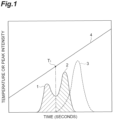
- FIG. 1 is a diagram illustrating an example of an oxygen/nitrogen analysis chart.
- the numerical range indicated by the symbol "-" includes a lower limit value and an upper limit value. That is, the numerical range indicated by "x-y” means x or more and y or less.
- a numerical range obtained by replacing the upper limit or the lower limit of each numerical range in each embodiment with a numerical value of any one of the examples is also included in the present disclosure. Both a case where one of the plurality of materials exemplified in parallel in each embodiment is contained alone and a case where two or more of the plurality of materials are contained in combination are included in the present disclosure.
- a silicon nitride powder (Si 3 N 4 powder) is a silicon nitride powder containing silicon nitride and carbon, in which a mass proportion Cp of carbon (total amount of carbon) with respect to the entire powder is 0.05% or more, and a mass proportion Cs of carbon contained in a surface portion of the powder with respect to the entire powder is 0.05% or less.
- Carbon contained in the silicon nitride powder may be contained as elemental carbon, or may be contained as an organic compound contained in an organic binder, for example. When the carbon is contained as a compound such as an organic compound, the mass proportion of carbon is obtained by converting the compound into carbon.
- the silicon nitride powder has the mass proportion Cp of carbon (total carbon) of 0.05% or more, the silicon nitride powder can be manufactured without using an imide decomposition method requiring a high manufacturing cost. In addition, the tolerance level of impurities contained in the raw material is high. Therefore, it can be manufactured at a low manufacturing cost.
- the mass proportion Cp of carbon contained in the silicon nitride powder with respect to the entire silicon nitride powder may exceed 0.05%, may be 0.07% or more, or may be 0.09% or more. Accordingly, the manufacturing cost can be further reduced.
- silicon carbide SiC
- SiC silicon carbide
- the mass proportion Cp of carbon contained in the silicon nitride powder with respect to the entire silicon nitride powder may be 0.16% or less, or may be 0.13% or less. Accordingly, when the silicon nitride powder is used as a sintering material, the ⁇ -phase is more easily generated, and the strength can be further improved while the density of the silicon nitride sintered body is maintained low.
- An example of the range of the mass proportion Cp of carbon with respect to the entire powder is 0.05%-0.16%.
- the mass proportion Cs of carbon contained in the surface portion of the silicon nitride powder with respect to the entire silicon nitride powder is obtained by dividing the weight of carbon contained in the surface portion of the silicon nitride powder by the weight of the entire silicon nitride powder.
- a mass proportion Ci of carbon contained in the interior portion of the silicon nitride powder with respect to the entire silicon nitride powder is obtained by dividing the weight of carbon contained in the interior portion of the silicon nitride powder by the weight of the entire silicon nitride powder. Therefore, the following expression (II) holds for the mass proportion Cp, Cs, and Ci.
- Cp % Cs % + Ci %
- the mass proportion Cs of carbon contained in the surface portion of the powder with respect to the entire powder may be less than 0.05%, may be 0.04% or less, or may be 0.03% or less.
- the mass proportion Ci of carbon contained in the interior portion of the powder with respect to the entire powder may be 0.05%-0.15%, or may be 0.08%-0.12%. With such a mass proportion Ci, the balance between the mass proportion Cp and the mass proportion Cs can be sufficiently improved.
- the ratio (Cs/Ci) of the mass proportion Cs to the mass proportion Ci may be 0.6 or less, 0.5 or less, or 0.3 or less.
- the ⁇ -phase is more likely to be generated during liquid phase sintering.
- carbon in the interior portion of the powder forms silicon carbide, which then combines with silicon nitride to form a composite. Due to these factors, a silicon nitride sintered body having a lower density and a higher strength can be obtained.
- the ratio (Cs/Ci) may be 0.05 or more.
- An example of the numerical range of the ratio (Cs/Ci) is 0.05-0.6.
- the mass proportion Cp, Cs, and Ci in the present specification are obtained by the following procedure.
- the amount of carbon in the silicon nitride powder can be analyzed using a carbon/sulfur analyzer.
- a powder sample for measurement is heated from 20°C to 2000°C at a temperature rise rate of 10°C/sec in an oxygen atmosphere. As the temperature rises, the desorbed carbon combines with oxygen to form carbon monoxide or carbon dioxide. Since silicon nitride is decomposed at a temperature higher than 1400°C, all carbon on the surface and in the interior portion of the powder becomes carbon monoxide or carbon dioxide.
- the mass proportion Cp of carbon contained in the entire silicon nitride powder can be determined by detecting, with an infrared detector, the carbon monoxide and carbon dioxide thus produced.
- the mass proportion Cs of carbon contained in the surface portion of the powder with respect to the entire powder is measured by heating the powder in an air atmosphere to a temperature at which silicon nitride is not decomposed. Specifically, the temperature is increased from 20°C to 1000°C at a temperature rise rate of 10°C/sec, and the temperature is held at 1000°C for 15 minutes. In this case, only carbon contained in the surface portion of the silicon nitride powder is combined with oxygen to form carbon monoxide or carbon dioxide.
- the mass proportion Cs of carbon contained in the surface portion of the silicon nitride powder can be determined by detecting, with an infrared detector, the carbon monoxide and carbon dioxide thus produced.
- the mass proportion Ci of carbon contained in the interior portion of the powder with respect to the entire powder can be calculated from the above expression (II) using the mass proportion Cp and Cs obtained by the above procedure.
- the carbon contained in the silicon nitride powder may be derived from the silicon powder used as a raw material, or may be derived from the organic binder used in the process of the direct nitriding method.
- the mass proportion Cs of carbon contained in the surface portion can be reduced by increasing the heating temperature or the heating time during the degreasing. Accordingly, the mass proportion Cp of carbon in the entire powder can also be reduced.
- the mass proportion Ci of carbon contained in the interior portion of the powder can be reduced. Accordingly, the mass proportion Cp of carbon in the entire powder can also be reduced.
- a mass proportion Os of the oxygen contained in the surface portion of the powder with respect to the entire silicon nitride powder may be 0.9% or less, 0.7% or less, or 0.5% or less.
- the mass proportion Os of the oxygen contained in the surface portion of the powder with respect to the entire silicon nitride powder may be 0.1% or more, may be 0.2% or more, or may be 0.3% or more.
- Such a silicon nitride powder is sufficiently densified by liquid phase sintering when it is used as a sintering material.
- An example of the range of the mass proportion Os of the oxygen contained in the surface portion of the powder is 0.1%-0.9%.
- a mass proportion Oi of the oxygen contained in the interior portion of the powder with respect to the entire silicon nitride powder may be 0.7% or less, 0.6% or less, or 0.5% or less.
- a silicon nitride powder is used as a sintering material, a silicon nitride sintered body having sufficiently high thermal conductivity can be obtained.
- the mass proportion Oi of the oxygen contained in the interior portion of the powder with respect to the entire silicon nitride powder may be 0.1% or more, may be 0.2% or more, or may be 0.3% or more.
- Such a silicon nitride powder can be manufactured relatively easily.
- An example of the range of the mass proportion Oi of the oxygen contained in the interior portion of the powder is 0.1%-0.7%.
- a mass proportion Op of oxygen with respect to the entire silicon nitride powder may be 0.3%-1.6%, 0.5%-1.3%, or 0.6%-1.1%.
- Such a silicon nitride powder has advantages in that it is relatively easy to manufacture the silicon nitride powder by a direct nitriding method, and it is easy to adjust the mass proportion Oi and the mass proportion Os of oxygen contained in the interior portion and the surface portion of the silicon nitride powder to the above-described ranges.
- the oxygen in the silicon nitride powder may be contained as silicon-dioxide (SiO 2 ). Each content of oxygen is obtained by converting such an oxide into oxygen.
- the mass proportion Os of the oxygen contained in the surface portion of the silicon nitride powder can be adjusted by changing the conditions and time of the surface treatment using hydrogen fluoride. For example, when the time of the surface treatment is increased, the mass proportion Os can be reduced. Accordingly, the mass proportion Op of oxygen in the entire silicon nitride powder can be reduced.
- the mass proportion Oi of oxygen contained in the interior portion of the silicon nitride powder can be adjusted by, for example, the oxygen content of the silicon powder used as a material for the direct nitriding method. For example, when a silicon powder having a low oxygen content is used, the mass proportion Oi of oxygen contained in the interior portion of the silicon nitride powder can be reduced. Accordingly, the mass proportion Op of oxygen in the entire silicon nitride powder can be reduced.
- the mass proportion Op of oxygen (total amount of oxygen) is obtained by dividing the weight of oxygen contained in the entire silicon nitride powder by the weight of the silicon nitride powder.
- the mass proportion Os of the oxygen is obtained by dividing the weight of the oxygen contained in the surface portion of the silicon nitride powder by the weight of the entire silicon nitride powder.
- the mass proportion Oi of oxygen is obtained by dividing the weight of oxygen contained in the interior portion of the silicon nitride powder by the weight of the entire silicon nitride powder. Therefore, the following expression (III) holds for the mass proportion Op, Os, and Oi.
- Op % Os % + Oi %
- the mass proportion Op, Os and Oi of oxygen in the silicon nitride powder in the present specification are determined by the following procedure using an oxygen/nitrogen analyzer.
- a sample for measurement is heated from 20°C to 2000°C at a temperature rise rate of 8°C/sec in a helium gas atmosphere.
- Oxygen desorbed with the temperature rise is detected.
- oxygen bonded to the surface of the silicon nitride powder is desorbed.
- the mass proportion Os of oxygen contained in the surface portion can be obtained by determining the amount of oxygen desorbed.
- the silicon nitride begins to decompose.
- the start of decomposition of silicon nitride can be recognized by the start of detection of nitrogen.
- oxygen in the interior portion of the silicon nitride powder is desorbed.
- the amount of oxygen desorbed at this stage is determined, whereby the mass proportion Oi of oxygen contained in the interior portion can be obtained.
- the mass proportion Op of oxygen can be calculated from the above expression (III) and the mass proportion Os of oxygen, Oi, obtained by the above procedure.
- FIG. 1 is an example of a chart obtained by oxygen-nitrogen analysis of silicon nitride.
- a peak 1 is a peak of oxygen contained in the surface portion of the silicon nitride powder
- a peak 2 is a peak of oxygen contained in the interior portion of the silicon nitride powder.
- a peak 3 is a peak of nitrogen.
- a straight line 4 indicates a temperature rise line.
- the peak 1 and the peak 2 are partitioned with a temperature T 1 where nitrogen gas begins to be generated.
- the temperature T 1 is a temperature at which the detection of the peak 3 is started, and is usually between 1350-1500°C.
- the temperature at which the detection of the peak 1 is started (the temperature at the left end of the peak 1) is, for example, 600-1000°C.
- the temperature at which the detection of the peak 2 ends (the temperature at the right end of the peak 2) is, for example, 1600-1800°C. From the integrated values (areas) of the peaks 1 and 2, the mass proportion Oi of oxygen contained in the interior portion and the mass proportion Os of oxygen contained in the surface portion are obtained based on the calibration curve. The total of the mass proportion Oi of oxygen and the mass proportion Os of oxygen is the mass proportion Op of oxygen contained in the entire silicon nitride powder.
- the ratio (Os/Cs) of the mass proportion Os of oxygen to the mass proportion Cs of carbon may satisfy the following expression (I). Accordingly, since the silicon nitride powder has a sufficiently high ratio of oxygen to carbon in the surface portion, liquid phase sintering may be promoted when the silicon nitride powder is used as a sintering material. Therefore, the grain boundary strength of the silicon nitride sintered body is improved. Os/Cs ⁇ 1 0
- the ratio (Os/Cs) may be 15 or more, or may be 20 or more.
- the ratio (Os/Cs) may be 70 or less, or may be 50 or less.
- An example of the range of the ratio (Os/Cs) is 10-70, or 15-70.
- a BET specific surface area of the silicon nitride powder may be 10-14 m 2 /g.
- a silicon nitride powder is used as a sintering material, sintering proceeds smoothly.
- the uniformity of the microstructure of the silicon nitride sintered body can be improved. Therefore, it is possible to reduce variations in characteristics such as the strength of the silicon nitride sintered body.
- the BET specific surface area of the silicon nitride powder may be 11-13 m 2 /g.
- the BET specific surface area in the present specification is a value measured by a BET one-point method using nitrogen gas in accordance with the method described in JIS Z 8830:2013 "Determination of the specific surface area of powders (solids) by gas adsorption-BET method".
- the BET specific surface area can be adjusted by changing the pulverization conditions when the fired product after nitriding is pulverized.
- the silicon nitride powder may have an ⁇ -phase content of 94% or more.
- the ⁇ -phase is more likely to be generated. Therefore, it is possible to sufficiently increase the strength of the silicon nitride sintered body while maintaining the density of the silicon nitride sintered body at a sufficiently low level.
- the ⁇ -phase content of the silicon nitride powder may be 97% or less, or 96% or less.
- the ⁇ -phase content of the silicon nitride powder can be determined based on the diffraction line intensity of X-ray diffraction.
- the ⁇ -phase content of the silicon nitride powder can be adjusted by changing the heating conditions at the time of nitriding. For example, when the heating temperature is increased, the ⁇ -phase tends to be generated and the ⁇ -phase content tends to be decreased.
- the average particle size (D50, median diameter) of the silicon nitride powder may be 0.5-1.2 ⁇ m, or may be 0.6-0.9 ⁇ m.
- the particle size distribution in the present specification is measured in accordance with the method described in JIS Z 8825:2013 "Particle size analysis-Laser diffraction methods".
- the horizontal axis represents a particle size [ ⁇ m] on a logarithmic scale and the vertical axis represents a frequency [% by volume]
- the particle size when the integrated value from the smallest particle size reaches 50% of the whole is the average particle size (D50).
- the particle size (D10) when the integrated value from the smallest particle size reaches 10% of the whole may be 0.1-0.45 ⁇ m.
- the particle size (D90) when the integrated value from the smallest particle size reaches 90% of the whole may be 1.3-2.5 ⁇ m, or may be 1.5-2.0 ⁇ m.
- the particle size (D100) when the integrated value from the smallest particle size reaches 100% of the whole may be 2.8-5.0 ⁇ m, or may be 3.2-4.5 ⁇ m.
- the silicon nitride powder described above can be suitably used as a sintering material.
- the silicon nitride powder may be used for a silicon nitride sintered body, but is not limited thereto.
- the content of silicon nitride in the silicon nitride powder may be 95% by mass or more, 98% by mass or more, or 99% by mass or more.
- the content of silicon nitride in the silicon nitride powder can be measured by, for example, X-ray diffraction.
- the silicon nitride sintered body according to an embodiment may have a bending strength of 700 MPa or more, and a ratio of the bending strength to bulk density of 240 MPa ⁇ cm 3 /g or more.
- the bending strength of the silicon nitride sintered body may be, for example, 700-900 MPa.
- the bending strength in the present specification is a three-point bending strength at room temperature measured in accordance with JIS R1601:2008.
- the bulk density of the silicon nitride sintered body may be 3.1 g/cm 3 or less, or may be 3.0 g/cm 3 or less, from the viewpoint of weight reduction. From the same viewpoint, the relative density of the silicon nitride sintered body may be 97% or less, or may be 95% or less. In addition, the bulk density of the silicon nitride sintered body may be 2.8 g/cm 3 or more, or may be 2.9 g/cm 3 or more, from the viewpoint of improving strength. From the same viewpoint, the relative density of the silicon nitride sintered body may be 88% or more, or may be 91% or more. An example of the range of the bulk density of the silicon nitride sintered body is 2.8-3.1 g/cm 3 . An example of the range of the relative density of the silicon nitride sintered body is 88-97%.
- the bulk density of the silicon nitride sintered body in the present specification is measured by the Archimedes method.
- the relative density of the silicon nitride sintered body in the present specification is a relative value of the bulk density with respect to the theoretical density of silicon nitride 3.17 g/cm 3 .
- the silicon nitride sintered body of the present embodiment may contain components other than silicon nitride and carbon. Carbon may be contained, for example, as silicon carbide.
- the silicon nitride sintered body of the present embodiment has a low density, a light weight, and a high strength. Therefore, it can be suitably used as, for example, a structural body and a member of a vehicle.
- a method for manufacturing silicon nitride powder includes: a molding step of molding a kneaded material containing a silicon powder and an organic binder to obtain a molded body; a degreasing step of degreasing the molded body by heating the molded body at 900°C or more and less than 1100°C for 1 hour or more; a firing step of firing the molded body under a mixed atmosphere containing nitrogen and at least one selected from a group consisting of hydrogen and ammonia to obtain a fired product containing silicon nitride and carbon; and a pulverization step of pulverizing the fired product.
- the oxygen content of the silicon powder used in the molding step may be, for example, 0.2-0.4% by mass.
- the carbon content of the silicon powder may be 0.05-0.15% by mass.
- the oxygen content and the carbon content of the silicon powder can be measured by an infrared absorption method.
- a pretreatment liquid containing hydrofluoric acid may be used to reduce the oxygen bound to the silicon powder.
- the pretreatment liquid may contain hydrofluoric acid, and may be a mixed acid with an acid such as hydrochloric acid.
- the organic binder examples include a urethane resin, a vinyl butyral resin, a vinyl alcohol resin, a vinyl acetal resin, a vinyl formal resin, a polyimide resin, a phenol resin, a melamine resin, an epoxy resin, a coumarone-indene resin, an acrylic resin, an aromatic vinyl resin, cellulose and cellulose derivatives, wax, and starch.
- the blending amount of the organic binder may be, for example, 3-30 parts by mass, or may be 5-20 parts by mass with respect to 100 parts by mass of the silicon powder.
- the kneaded material may contain a solvent.
- the solvent include water, alcohols, ketones, esters, ethers, aromatic hydrocarbons, and polybasic acids.
- Such a kneaded material is molded by a conventional molding method to produce a molded body. Examples of the molding method include extrusion and uniaxial pressing.
- the bulk density of the molded body after drying may be 0.5-1.5 g/cm 3 , or may be 0.8-1.2 g/cm 3 .
- the molded body is heated in a heating furnace to decompose and/or volatilize and remove at least a part of the organic binder contained in the molded body.
- a drying step of heating to a temperature equal to or higher than the boiling point of the solvent may be performed prior to the degreasing step.
- the molded body is heated at 900°C or more and less than 1100°C for 1 hour or more in an atmosphere containing, for example, hydrogen gas.
- the heating temperature in the degreasing step may be 950-1050°C.
- the heating time in the degreasing step may be 2 hours or more, or may be 3 hours or more, from the viewpoint of sufficiently reducing the organic binder in the molded body.
- the heating time in the degreasing step may be 20 hours or less, or may be 10 hours or less, from the viewpoint of improving the efficiency of the manufacturing process.
- An example of the range of the heating time in the degreasing step is 1-20 hours.
- the atmosphere may be hydrogen gas or a mixed gas having a hydrogen gas concentration of 1.0-10.0% by volume.
- the volume ratio is a value in a standard state (temperature: 0°C, pressure: 1 atm).
- the degreased molded body is fired under a mixed atmosphere containing nitrogen and at least one selected from the group consisting of hydrogen and ammonia to obtain a fired product containing silicon nitride and carbon.
- the carbon may be contained in the interior portion of the silicon nitride particles or may be attached or bonded as particles to the surface of the silicon nitride particles.
- the total content of hydrogen and ammonia in the mixed atmosphere may be, for example, 10-40% by volume with respect to the entire mixed atmosphere.
- the firing temperature may be, for example, 1100-1450°C, or may be 1200-1400°C.
- the firing time may be, for example, 30-100 hours.
- the fired product obtained in the firing step is dry-pulverized to obtain a pulverized product.
- the pulverization step may be performed in a plurality of stages including coarse pulverization and fine pulverization to adjust the particle size distribution of the silicon nitride powder.
- the pulverization step may include two steps of a ball mill pulverization step and a vibration mill pulverization step.
- a classification step may be performed to adjust the particle size.
- the pulverization step or classification step may be followed by a post-treatment step to adjust the oxygen concentration.
- the post-treatment step for example, the pulverized fired product may be dispersed in hydrofluoric acid. Thereafter, filtration and drying may be performed to obtain a silicon nitride powder.
- the silicon nitride powder can be manufactured by such a method.
- This method for manufacturing enables manufacturing silicon nitride powder at a lower manufacturing cost than the imide decomposition method.
- the shape, composition, and properties of the silicon nitride powder obtained by this method for manufacturing are as described in the embodiment of the silicon nitride powder. Therefore, the contents described in the embodiment of the silicon nitride powder are also applied to the method for manufacturing of the present embodiment.
- the mass proportion Cp of carbon in the entire powder of the silicon nitride powder obtained by this method for manufacturing may be 0.05% or more.
- the mass proportion Cs of carbon contained in a surface portion of the silicon nitride powder with respect to the entire silicon nitride powder may be 0.05% or less.
- the above-described method for manufacturing is an example, and the method for manufacturing the silicon nitride powder is not limited to the above-described method for manufacturing.
- a method for manufacturing a silicon nitride sintered body includes a sintering step of molding and firing a sintering material containing the silicon nitride powder.
- the sintering material may contain an oxide-based sintering aid in addition to the silicon nitride powder.
- oxide-based sintering aid examples include Y 2 O 3 , MgO, and Al 2 O 3 .
- the content of the oxide-based sintering aid in the sintering material may be, for example, 3-10% by mass.
- the sintering material is pressed at a forming pressure of, for example, 3.0-30 MPa to obtain a molded body.
- the molded body may be manufactured by uniaxial pressing or may be manufactured by CIP.
- firing may be performed while molding by hot pressing.
- the firing of the molded body may be performed in an inert gas atmosphere such as nitrogen gas or argon gas.
- the firing pressure may be 0.7-1.5 MPa.
- the firing temperature may be 1860-2100°C, or may be 1880-2000°C.
- the firing time at the firing temperature may be 6-20 hours, or may be 8-16 hours.
- the temperature rise rate up to the firing temperature may be, for example, 1.0-10.0°C/hour.
- the silicon nitride sintered body thus obtained has a high strength while having a low density because excessive densification is prevented and the ⁇ -phase is easily generated.
- the composition and properties of the silicon nitride sintered body obtained by this method for manufacturing are as described in the embodiment of the silicon nitride sintered body. Therefore, the contents described in the embodiment of the silicon nitride sintered body are also applied to the method for manufacturing of the present embodiment.
- the above-described method for manufacturing is an example, and the method for manufacturing the silicon nitride sintered body is not limited to the above-described method for manufacturing.
- a silicon powder (oxygen content: 0.3% by mass, carbon content: 0.10% by mass), an organic binder (vinyl alcohol resin), and a solvent (water) were kneaded to obtain a kneaded material.
- the blending amount of the organic binder was 10 parts by mass with respect to 100 parts by mass of the silicon powder.
- a molded body (bulk density: 1.0 g/cm 3 ) was manufactured by uniaxial pressure forming (forming pressure: 8 MPa).
- the obtained molded body was dried in a thermostatic bath at 150°C for 3 hours (drying step). After drying, the molded body was placed in an electric furnace and held in a hydrogen gas atmosphere at a temperature of 1000°C for 2 hours (degreasing step).
- the degreased molded body was placed in another electric furnace and fired at 1400°C for 60 hours to obtain a fired product containing silicon nitride.
- a gaseous mixture of nitrogen and hydrogen gas (a gaseous mixture of N 2 and H 2 mixed at a volumetric ratio of 80%:20% in a standard state) was supplied as an atmosphere during firing.
- the obtained fired product was coarsely pulverized, and then dry-pulverized with a ball mill.
- the silicon nitride powder obtained by the dry pulverization was classified using a classifier.
- Coarse particles were removed from the silicon nitride powder by classification.
- the mass proportion of the silicon nitride powder after the classification was 80% based on the total mass of the silicon nitride powder before the classification.
- the silicon nitride powder after the classification means a silicon nitride powder obtained by removing coarse particles.
- the silicon nitride powder thus obtained was evaluated as follows.
- the mass proportion Cp of carbon in the silicon nitride powder was examined using a commercially available carbon/sulfur analyzer (manufactured by LECO Corporation, device name: IR412). As a measurement procedure, a sample was heated from 20°C to 2000°C at a temperature rise rate of 10°C/sec in an oxygen atmosphere. The mass proportion Cp of carbon contained in the entire silicon nitride powder was determined by detecting carbon monoxide and carbon dioxide produced with the temperature rise with an infrared detector.
- the mass proportion Cs of carbon contained in the surface portion of the silicon nitride powder was examined. As the measurement procedure, the sample was heated from 20°C to 1000°C at a temperature rise rate of 10°C/sec, and held at 1000°C for 15 minutes.
- the mass proportion Cs of carbon contained in the surface portion of the silicon nitride powder was determined by detecting carbon monoxide and carbon dioxide produced during the above process with an infrared detector.
- the mass proportion Ci of carbon contained in the interior portion of the silicon nitride powder was determined by the above expression (II).
- the mass proportion Cp, Cs and Ci of carbon were as shown in Table 1.
- the ratio of the mass proportion Cs to the mass proportion Ci is also shown in Table 1.
- the mass proportion Os of oxygen contained in the surface portion of the silicon nitride powder and the mass proportion Oi of oxygen contained in the interior portion of the silicon nitride powder were measured using an oxygen/nitrogen analyzer (manufactured by HORIBA, Ltd., device name: EMGA-920).
- the silicon nitride powder was heated from 20°C to 2000°C at a temperature rise rate of 8°C/sec in a helium atmosphere, and the amount of oxygen before nitrogen gas was detected was quantified to determine the mass proportion Os of oxygen gas.
- the amount of oxygen after nitrogen gas started to be detected was quantified to determine the mass proportion Oi of oxygen gas.
- the mass proportion Os of the oxygen and the mass proportion Oi of the oxygen were totaled to obtain the mass proportion Op of the oxygen in the entire silicon nitride powder.
- the mass proportion Op, Os, and Oi of the oxygen were as shown in Table 1.
- the ratio of the mass proportion Os to the mass proportion Cs is also shown in Table 1.
- the ⁇ -phase content of the silicon nitride powder was measured by the following procedure. Using an X-ray diffraction apparatus (manufactured by Rigaku Corporation, device name: Ultima IV), the silicon nitride powder was subjected to X-ray diffraction with CuK ⁇ rays.
- the ⁇ -phase was represented by a diffraction line intensity I a102 of the (102) plane and a diffraction line intensity I a210 of the (210) plane
- the ⁇ -phase was represented by a diffraction line intensity I b101 of the (101) plane and a diffraction line intensity I b210 of the (210) plane.
- ⁇ -phase content (%) (I a102 + I a210 ) / (I a102 + I a210 + I b101 + I b210 ) ⁇ 100
- the BET specific surface area of the silicon nitride powder was measured by the BET one-point method using nitrogen gas in accordance with JIS Z 8830:2013. The results were as shown in Table 2.
- the particle size distribution of the silicon nitride powder was measured by a laser diffraction/scattering method. The measurement was performed in accordance with the method described in JIS Z 8825:2013 "Particle size analysis-Laser diffraction methods".
- a particle size distribution (cumulative distribution) in which the horizontal axis represents a particle size [ ⁇ m] on a logarithmic scale and the vertical axis represents frequency [% by volume]
- the particle sizes when the integrated value from the smallest particle size reached 10%, 50%, 90%, and 100% of the whole were obtained as D10, D50, D90, and D100, respectively.
- the results were as shown in Table 2.
- the prepared silicon nitride powder, a Y 2 O 3 powder having a mean particle size of 1.5 ⁇ m, and a Yb 2 O 3 powder having a mean particle size of 1.2 ⁇ m were blended in a weight ratio of 90:5:5. Methanol was added to the blended powder sample, followed by wet mixing for 4 hours.
- the mixed powder (sintering material) obtained by drying was subjected to uniaxial pressing at 10 MPa, and further subjected to cold isostatic pressing (CIP) at 25 MPa.
- the obtained molded body was set in a carbon crucible together with a packing powder composed of a mixed powder of a silicon nitride powder and a BN powder, and fired at a temperature of 1900°C for 10 hours under a nitrogen-pressurized atmosphere of 1 MPa to produce a silicon nitride sintered body.
- the three-point bending strength of the silicon nitride sintered body at room temperature was measured in accordance with JIS R1601:2008.
- the bulk density of the silicon nitride sintered body was measured by the Archimedes method. The results were as shown in Table 3.
- the ratio of bending strength to bulk density is also shown in Table 3.
- a silicon nitride powder and a silicon nitride sintered body were prepared under the same conditions as in Example 1 except that the holding time in the degreasing step was changed to 4 hours when the silicon nitride powder was prepared. Then, the silicon nitride powder and the silicon nitride sintered body were measured in the same manner as in Example 1. The results were as shown in Tables 1, 2, and 3.
- a silicon nitride powder and a silicon nitride sintered body were prepared under the same conditions as in Example 1, except that the holding time in the degreasing step was changed to 6 hours when the silicon nitride powder was prepared. Then, the silicon nitride powder and the silicon nitride sintered body were measured in the same manner as in Example 1. The results were as shown in Tables 1, 2, and 3.
- a silicon nitride powder and a silicon nitride sintered body were prepared under the same conditions as in Example 1, except that the holding time in the degreasing step was changed to 0.5 hours when the silicon nitride powder was prepared. Then, the silicon nitride powder and the silicon nitride sintered body were measured in the same manner as in Example 1. The results were as shown in Tables 1, 2, and 3.
- the silicon nitride sintered bodies of Examples 1 to 3 had a lower density and a higher strength than those of Comparative Example 1, and the ratio of the bending strength to the bulk density was higher.
- a silicon nitride sintered body having low manufacturing cost, low density, and high strength, and a method for manufacturing the same can be provided.
- Silicon nitride powder that enables manufacturing a silicon nitride sintered body having low density and high strength at a low manufacturing cost, and a method for manufacturing the silicon nitride powder can be provided.
Landscapes
- Chemical & Material Sciences (AREA)
- Engineering & Computer Science (AREA)
- Organic Chemistry (AREA)
- Ceramic Engineering (AREA)
- Inorganic Chemistry (AREA)
- Manufacturing & Machinery (AREA)
- Materials Engineering (AREA)
- Structural Engineering (AREA)
- Ceramic Products (AREA)
Abstract
Description
- The present disclosure relates to a silicon nitride powder and a method for manufacturing the same, and a silicon nitride sintered body and a method for manufacturing the same.
- Silicon nitride is a material excellent in strength, hardness, toughness, heat resistance, corrosion resistance, thermal shock resistance, and the like. Therefore, the silicon nitride sintered body is used for various industrial parts such as die casting machines and melting furnaces, automobile parts, and the like. In addition, since the silicon nitride sintered body is also excellent in mechanical properties at high temperatures, it has been studied to use the silicon nitride sintered body for gas turbine parts required to have high-temperature strength and high-temperature creep properties.
- It is known that carbon and oxygen contained in a silicon nitride powder as a sintering material affect the strength of a silicon nitride sintered body. In order to obtain a silicon nitride sintered body having high strength, Patent Document 1 proposes to reduce the amounts of oxygen and carbon by using a silicon nitride powder obtained by an imide decomposition method. Further, Patent Document 2 proposes a technique for obtaining a silicon nitride-based sintered body having high bending strength by using a silicon nitride-based powder having a β fraction of 30 to 100% and an oxygen content of less than 0.5% by weight.
-
- [Patent Document 1]
Japanese Unexamined Patent Publication No. H5-193914 - [Patent Document 2]
Japanese Unexamined Patent Publication No. 2004-262756 - The silicon nitride sintered body is used for various applications because of its excellent strength. If it is lightweight, it can contribute to improvement in energy efficiency of a vehicle or the like, for example. In addition, the lighter the structural material is, the more easily it can be installed, and the more the durability of the structure itself is improved. Accordingly, the present disclosure provides a silicon nitride sintered body having low manufacturing cost, low density, and high strength, and a method for manufacturing the same. Further, the present disclosure provides a silicon nitride powder that enables manufacturing a silicon nitride sintered body having low density and high strength at a low manufacturing cost, and a method for manufacturing the same.
- In an aspect of the present disclosure, there is provided a silicon nitride powder containing silicon nitride and carbon, wherein a mass proportion Cp of the carbon with respect to the entire powder is 0.05% or more, and a mass proportion Cs of carbon contained in a surface portion of the powder with respect to the entire powder is 0.05% or less.
- The silicon nitride powder can be manufactured by a low-cost manufacturing method because the mass proportion Cp of carbon with respect to the entire powder is a predetermined value or more. In addition, since the mass proportion Cs of carbon contained in the surface portion of the powder is equal to or less than the predetermined value, β-phase of silicon nitride is likely to be generated when the powder is used as a sintering material. The β-phase that is a columnar crystal tends to be more difficult to density than α-phase, but has a higher strength than the α-phase. Therefore, a silicon nitride sintered body having low density (for example, relative density: 95% or less) and high strength may be manufactured at a low manufacturing cost.
- In the silicon nitride powder, a ratio of the mass proportion Cs to a mass proportion Ci of carbon contained in an interior portion of the powder with respect to the entire powder may be 0.6 or less. In such a silicon nitride powder, since the amount of carbon contained in the surface portion of the powder is small, when the silicon nitride powder is used as a sintering material, the β-phase is more likely to be generated during liquid phase sintering. In addition, carbon in the interior portion of the powder forms silicon carbide and is combined with silicon nitride. Due to these factors, a silicon nitride sintered body having a lower density and a higher strength can be obtained.
- In the silicon nitride powder, a mass proportion Os of oxygen contained in the surface portion of the powder with respect to the entire powder and the mass proportion Cs of the carbon may satisfy the following expression (I). Such a silicon nitride powder has a sufficiently large ratio of oxygen to carbon in the surface portion, and thus can promote liquid phase sintering when used as a sintering material. Therefore, the grain boundary strength is improved, and a silicon nitride sintered body having sufficiently high strength can be obtained.

- In the silicon nitride powder, the mass proportion Os of oxygen contained in the surface portion of the powder with respect to the entire powder may be 0.9% or less. When such a silicon nitride powder is used as a sintering material, excessive densification can be prevented, and an excessive increase in the density of the silicon nitride sintered body can be prevented.
- A BET specific surface area of the silicon nitride powder may be 10 to 14 m2/g. When such a silicon nitride powder is used as a sintering material, sintering proceeds smoothly. In addition, the uniformity of the microstructure of the silicon nitride sintered body can be improved. Therefore, it is possible to reduce variations in characteristics such as the strength of the silicon nitride sintered body.
- An α-phase content (a proportion of the α-phase) of the silicon nitride powder may be 94% or more. Such a silicon nitride powder is easily sintered, and the strength is easily improved by the generation of the β-phase. Therefore, it is possible to sufficiently increase the strength of the silicon nitride sintered body while maintaining the density of the silicon nitride sintered body at a sufficiently low level.
- In an aspect of the present disclosure, there is provided a method for manufacturing silicon nitride powder, the method including: molding a kneaded material containing a silicon powder and an organic binder to obtain a molded body; degreasing the molded body by heating at 900°C or more and less than 1100°C for 1 hour or more; firing the molded body under a mixed atmosphere containing nitrogen and at least one selected from the group consisting of hydrogen and ammonia to obtain a fired product containing silicon nitride and carbon; and pulverizing the fired product.
- In the above-described manufacturing method, the silicon nitride powder is manufactured using the kneaded material containing the silicon powder and the organic binder. Therefore, carbon derived from the organic binder remains in the silicon nitride powder. However, the molded body of the kneaded material is heated at 900°C or more and less than 1100°C for 1 hour or more for degreasing. Therefore, most of the organic binder is scattered, and the amount of carbon in the surface portion of the silicon particles can be reduced. On the other hand, it is considered that carbon originally contained in the interior portion of the silicon particles and carbon diffused into the interior portion of the silicon particles by heating remain in the silicon nitride particles. In such a manufacturing method, since the silicon particles may contain some impurities, the silicon nitride powder can be manufactured at a low manufacturing cost. In addition, when such a silicon nitride powder is used as a sintering material, since carbon contained in a surface portion of the powder is sufficiently reduced, β-phase of silicon nitride is likely to be generated during sintering. The β-phase that is a columnar crystal tends to be more difficult to density than the α-phase, but has a higher strength than the α-phase. Therefore, a silicon nitride sintered body having low density (for example, relative density: 95% or less) and high strength can be obtained at low manufacturing cost.
- In the above-described manufacturing method, in the silicon nitride powder, a mass proportion Cp of carbon with respect to the entire powder may be 0.05% or more, and a mass proportion Cs of carbon contained in a surface portion of the powder with respect to the entire powder may be 0.05% or less.
- In an aspect of the present disclosure, there is provided a silicon nitride sintered body having a bending strength of 700 MPa or more, wherein a ratio of the bending strength to a bulk density is 240 MPa·cm3/g or more. Such a silicon nitride sintered body has low density and high strength. Therefore, it can be suitably used as, for example, a member of a vehicle or a structure.
- In an aspect of the present disclosure, there is provided a method for manufacturing a silicon nitride sintered body, the method including: obtaining a silicon nitride sintered body by using a sintering material containing any one of the above-described silicon nitride powders. In this manufacturing method, since the sintering material containing any one of the above-described silicon nitride powders is used, a silicon nitride sintered body having a low density and a high strength can be obtained.
- It is possible to provide a silicon nitride sintered body having low manufacturing cost, low density, and high strength, and a method for manufacturing the same. It is possible to provide silicon nitride powder capable of manufacturing a silicon nitride sintered body having low density and high strength at a low manufacturing cost, and a method for manufacturing the silicon nitride powder.
-
FIG. 1 is a diagram illustrating an example of an oxygen/nitrogen analysis chart. - Hereinafter, embodiments of the present disclosure will be described. Note that the following embodiments are examples for describing the present disclosure, and are not intended to limit the present disclosure to the following contents. The numerical range indicated by the symbol "-" includes a lower limit value and an upper limit value. That is, the numerical range indicated by "x-y" means x or more and y or less. A numerical range obtained by replacing the upper limit or the lower limit of each numerical range in each embodiment with a numerical value of any one of the examples is also included in the present disclosure. Both a case where one of the plurality of materials exemplified in parallel in each embodiment is contained alone and a case where two or more of the plurality of materials are contained in combination are included in the present disclosure.
- A silicon nitride powder (Si3N4 powder) according to an embodiment is a silicon nitride powder containing silicon nitride and carbon, in which a mass proportion Cp of carbon (total amount of carbon) with respect to the entire powder is 0.05% or more, and a mass proportion Cs of carbon contained in a surface portion of the powder with respect to the entire powder is 0.05% or less. Carbon contained in the silicon nitride powder may be contained as elemental carbon, or may be contained as an organic compound contained in an organic binder, for example. When the carbon is contained as a compound such as an organic compound, the mass proportion of carbon is obtained by converting the compound into carbon.
- Since the silicon nitride powder has the mass proportion Cp of carbon (total carbon) of 0.05% or more, the silicon nitride powder can be manufactured without using an imide decomposition method requiring a high manufacturing cost. In addition, the tolerance level of impurities contained in the raw material is high. Therefore, it can be manufactured at a low manufacturing cost.
- The mass proportion Cp of carbon contained in the silicon nitride powder with respect to the entire silicon nitride powder may exceed 0.05%, may be 0.07% or more, or may be 0.09% or more. Accordingly, the manufacturing cost can be further reduced. In addition, when the silicon nitride powder is used as a sintering material, silicon carbide (SiC) is generated, and a composite of silicon nitride and silicon carbide is formed, so that high strength of the silicon nitride sintered body can be maintained.
- The mass proportion Cp of carbon contained in the silicon nitride powder with respect to the entire silicon nitride powder may be 0.16% or less, or may be 0.13% or less. Accordingly, when the silicon nitride powder is used as a sintering material, the β-phase is more easily generated, and the strength can be further improved while the density of the silicon nitride sintered body is maintained low. An example of the range of the mass proportion Cp of carbon with respect to the entire powder is 0.05%-0.16%.
- The mass proportion Cs of carbon contained in the surface portion of the silicon nitride powder with respect to the entire silicon nitride powder is obtained by dividing the weight of carbon contained in the surface portion of the silicon nitride powder by the weight of the entire silicon nitride powder. A mass proportion Ci of carbon contained in the interior portion of the silicon nitride powder with respect to the entire silicon nitride powder is obtained by dividing the weight of carbon contained in the interior portion of the silicon nitride powder by the weight of the entire silicon nitride powder. Therefore, the following expression (II) holds for the mass proportion Cp, Cs, and Ci.

- The mass proportion Cs of carbon contained in the surface portion of the powder with respect to the entire powder may be less than 0.05%, may be 0.04% or less, or may be 0.03% or less. By sufficiently reducing the amount of carbon contained in the surface portion in this way, the reaction with oxygen contained in the surface portion of the powder is prevented, and liquid phase sintering proceeds smoothly. In addition, the β-phase is easily generated during sintering, and excessive densification is prevented, so that a silicon nitride sintered body having a low density and a higher strength can be obtained. The lower limit of the mass proportion Cs of carbon contained in the surface portion of the powder with respect to the entire powder may be 0.005% from the viewpoint of sufficiently reducing the manufacturing cost.
- The mass proportion Ci of carbon contained in the interior portion of the powder with respect to the entire powder may be 0.05%-0.15%, or may be 0.08%-0.12%. With such a mass proportion Ci, the balance between the mass proportion Cp and the mass proportion Cs can be sufficiently improved.
- The ratio (Cs/Ci) of the mass proportion Cs to the mass proportion Ci may be 0.6 or less, 0.5 or less, or 0.3 or less. In such a silicon nitride powder, since the amount of carbon contained in the surface portion of the powder is small, when the silicon nitride powder is used as a sintering material, the β-phase is more likely to be generated during liquid phase sintering. In addition, carbon in the interior portion of the powder forms silicon carbide, which then combines with silicon nitride to form a composite. Due to these factors, a silicon nitride sintered body having a lower density and a higher strength can be obtained. From the viewpoint of further reducing the manufacturing cost, the ratio (Cs/Ci) may be 0.05 or more. An example of the numerical range of the ratio (Cs/Ci) is 0.05-0.6.
- The mass proportion Cp, Cs, and Ci in the present specification are obtained by the following procedure. The amount of carbon in the silicon nitride powder can be analyzed using a carbon/sulfur analyzer. A powder sample for measurement is heated from 20°C to 2000°C at a temperature rise rate of 10°C/sec in an oxygen atmosphere. As the temperature rises, the desorbed carbon combines with oxygen to form carbon monoxide or carbon dioxide. Since silicon nitride is decomposed at a temperature higher than 1400°C, all carbon on the surface and in the interior portion of the powder becomes carbon monoxide or carbon dioxide. The mass proportion Cp of carbon contained in the entire silicon nitride powder can be determined by detecting, with an infrared detector, the carbon monoxide and carbon dioxide thus produced.
- The mass proportion Cs of carbon contained in the surface portion of the powder with respect to the entire powder is measured by heating the powder in an air atmosphere to a temperature at which silicon nitride is not decomposed. Specifically, the temperature is increased from 20°C to 1000°C at a temperature rise rate of 10°C/sec, and the temperature is held at 1000°C for 15 minutes. In this case, only carbon contained in the surface portion of the silicon nitride powder is combined with oxygen to form carbon monoxide or carbon dioxide. The mass proportion Cs of carbon contained in the surface portion of the silicon nitride powder can be determined by detecting, with an infrared detector, the carbon monoxide and carbon dioxide thus produced.
- The mass proportion Ci of carbon contained in the interior portion of the powder with respect to the entire powder can be calculated from the above expression (II) using the mass proportion Cp and Cs obtained by the above procedure. The carbon contained in the silicon nitride powder may be derived from the silicon powder used as a raw material, or may be derived from the organic binder used in the process of the direct nitriding method. The mass proportion Cs of carbon contained in the surface portion can be reduced by increasing the heating temperature or the heating time during the degreasing. Accordingly, the mass proportion Cp of carbon in the entire powder can also be reduced. On the other hand, when a silicon powder having a low carbon content is used, the mass proportion Ci of carbon contained in the interior portion of the powder can be reduced. Accordingly, the mass proportion Cp of carbon in the entire powder can also be reduced.
- A mass proportion Os of the oxygen contained in the surface portion of the powder with respect to the entire silicon nitride powder may be 0.9% or less, 0.7% or less, or 0.5% or less. When such a silicon nitride powder is used as a sintering material, excessive densification can be prevented, and an excessive increase in the density of the silicon nitride sintered body can be prevented. The mass proportion Os of the oxygen contained in the surface portion of the powder with respect to the entire silicon nitride powder may be 0.1% or more, may be 0.2% or more, or may be 0.3% or more. Such a silicon nitride powder is sufficiently densified by liquid phase sintering when it is used as a sintering material. An example of the range of the mass proportion Os of the oxygen contained in the surface portion of the powder is 0.1%-0.9%.
- A mass proportion Oi of the oxygen contained in the interior portion of the powder with respect to the entire silicon nitride powder may be 0.7% or less, 0.6% or less, or 0.5% or less. When such a silicon nitride powder is used as a sintering material, a silicon nitride sintered body having sufficiently high thermal conductivity can be obtained. The mass proportion Oi of the oxygen contained in the interior portion of the powder with respect to the entire silicon nitride powder may be 0.1% or more, may be 0.2% or more, or may be 0.3% or more. Such a silicon nitride powder can be manufactured relatively easily. An example of the range of the mass proportion Oi of the oxygen contained in the interior portion of the powder is 0.1%-0.7%.
- A mass proportion Op of oxygen with respect to the entire silicon nitride powder (total amount of oxygen) may be 0.3%-1.6%, 0.5%-1.3%, or 0.6%-1.1%. Such a silicon nitride powder has advantages in that it is relatively easy to manufacture the silicon nitride powder by a direct nitriding method, and it is easy to adjust the mass proportion Oi and the mass proportion Os of oxygen contained in the interior portion and the surface portion of the silicon nitride powder to the above-described ranges.
- The oxygen in the silicon nitride powder may be contained as silicon-dioxide (SiO2). Each content of oxygen is obtained by converting such an oxide into oxygen. The mass proportion Os of the oxygen contained in the surface portion of the silicon nitride powder can be adjusted by changing the conditions and time of the surface treatment using hydrogen fluoride. For example, when the time of the surface treatment is increased, the mass proportion Os can be reduced. Accordingly, the mass proportion Op of oxygen in the entire silicon nitride powder can be reduced.
- The mass proportion Oi of oxygen contained in the interior portion of the silicon nitride powder can be adjusted by, for example, the oxygen content of the silicon powder used as a material for the direct nitriding method. For example, when a silicon powder having a low oxygen content is used, the mass proportion Oi of oxygen contained in the interior portion of the silicon nitride powder can be reduced. Accordingly, the mass proportion Op of oxygen in the entire silicon nitride powder can be reduced.
- The mass proportion Op of oxygen (total amount of oxygen) is obtained by dividing the weight of oxygen contained in the entire silicon nitride powder by the weight of the silicon nitride powder. The mass proportion Os of the oxygen is obtained by dividing the weight of the oxygen contained in the surface portion of the silicon nitride powder by the weight of the entire silicon nitride powder. The mass proportion Oi of oxygen is obtained by dividing the weight of oxygen contained in the interior portion of the silicon nitride powder by the weight of the entire silicon nitride powder. Therefore, the following expression (III) holds for the mass proportion Op, Os, and Oi.

- The mass proportion Op, Os and Oi of oxygen in the silicon nitride powder in the present specification are determined by the following procedure using an oxygen/nitrogen analyzer. A sample for measurement is heated from 20°C to 2000°C at a temperature rise rate of 8°C/sec in a helium gas atmosphere. Oxygen desorbed with the temperature rise is detected. At the beginning of the temperature rise, oxygen bonded to the surface of the silicon nitride powder is desorbed. The mass proportion Os of oxygen contained in the surface portion can be obtained by determining the amount of oxygen desorbed.
- Thereafter, when the temperature reaches around 1400°C, the silicon nitride begins to decompose. The start of decomposition of silicon nitride can be recognized by the start of detection of nitrogen. When the silicon nitride begins to decompose, oxygen in the interior portion of the silicon nitride powder is desorbed. The amount of oxygen desorbed at this stage is determined, whereby the mass proportion Oi of oxygen contained in the interior portion can be obtained. The mass proportion Op of oxygen can be calculated from the above expression (III) and the mass proportion Os of oxygen, Oi, obtained by the above procedure.
-
FIG. 1 is an example of a chart obtained by oxygen-nitrogen analysis of silicon nitride. A peak 1 is a peak of oxygen contained in the surface portion of the silicon nitride powder, and a peak 2 is a peak of oxygen contained in the interior portion of the silicon nitride powder. A peak 3 is a peak of nitrogen. Astraight line 4 indicates a temperature rise line. The peak 1 and the peak 2 are partitioned with a temperature T1 where nitrogen gas begins to be generated. The temperature T1 is a temperature at which the detection of the peak 3 is started, and is usually between 1350-1500°C. The temperature at which the detection of the peak 1 is started (the temperature at the left end of the peak 1) is, for example, 600-1000°C. The temperature at which the detection of the peak 2 ends (the temperature at the right end of the peak 2) is, for example, 1600-1800°C. From the integrated values (areas) of the peaks 1 and 2, the mass proportion Oi of oxygen contained in the interior portion and the mass proportion Os of oxygen contained in the surface portion are obtained based on the calibration curve. The total of the mass proportion Oi of oxygen and the mass proportion Os of oxygen is the mass proportion Op of oxygen contained in the entire silicon nitride powder. - The ratio (Os/Cs) of the mass proportion Os of oxygen to the mass proportion Cs of carbon may satisfy the following expression (I). Accordingly, since the silicon nitride powder has a sufficiently high ratio of oxygen to carbon in the surface portion, liquid phase sintering may be promoted when the silicon nitride powder is used as a sintering material. Therefore, the grain boundary strength of the silicon nitride sintered body is improved.

- From the viewpoint of improving the grain boundary strength of the silicon nitride sintered body, the ratio (Os/Cs) may be 15 or more, or may be 20 or more. On the other hand, from the viewpoint of preventing excessive densification, the ratio (Os/Cs) may be 70 or less, or may be 50 or less. An example of the range of the ratio (Os/Cs) is 10-70, or 15-70.
- A BET specific surface area of the silicon nitride powder may be 10-14 m2/g. When such a silicon nitride powder is used as a sintering material, sintering proceeds smoothly. In addition, the uniformity of the microstructure of the silicon nitride sintered body can be improved. Therefore, it is possible to reduce variations in characteristics such as the strength of the silicon nitride sintered body. From the same viewpoint, the BET specific surface area of the silicon nitride powder may be 11-13 m2/g.
- The BET specific surface area in the present specification is a value measured by a BET one-point method using nitrogen gas in accordance with the method described in JIS Z 8830:2013 "Determination of the specific surface area of powders (solids) by gas adsorption-BET method". In the process of the direct nitriding method, the BET specific surface area can be adjusted by changing the pulverization conditions when the fired product after nitriding is pulverized.
- The silicon nitride powder may have an α-phase content of 94% or more. When such a silicon nitride powder is used as a sintering material, the β-phase is more likely to be generated. Therefore, it is possible to sufficiently increase the strength of the silicon nitride sintered body while maintaining the density of the silicon nitride sintered body at a sufficiently low level. From the viewpoint of further reducing the manufacturing cost, the α-phase content of the silicon nitride powder may be 97% or less, or 96% or less. The α-phase content of the silicon nitride powder can be determined based on the diffraction line intensity of X-ray diffraction. In the process of the direct nitriding method, the α-phase content of the silicon nitride powder can be adjusted by changing the heating conditions at the time of nitriding. For example, when the heating temperature is increased, the β-phase tends to be generated and the α-phase content tends to be decreased.
- The average particle size (D50, median diameter) of the silicon nitride powder may be 0.5-1.2 µm, or may be 0.6-0.9 µm. The particle size distribution in the present specification is measured in accordance with the method described in JIS Z 8825:2013 "Particle size analysis-Laser diffraction methods". In a particle size distribution (cumulative distribution) in which the horizontal axis represents a particle size [µm] on a logarithmic scale and the vertical axis represents a frequency [% by volume], the particle size when the integrated value from the smallest particle size reaches 50% of the whole is the average particle size (D50).
- In the particle size distribution, the particle size (D10) when the integrated value from the smallest particle size reaches 10% of the whole may be 0.1-0.45 µm. In the particle size distribution, the particle size (D90) when the integrated value from the smallest particle size reaches 90% of the whole may be 1.3-2.5 µm, or may be 1.5-2.0 µm. In the particle size distribution, the particle size (D100) when the integrated value from the smallest particle size reaches 100% of the whole may be 2.8-5.0 µm, or may be 3.2-4.5 µm.
- The silicon nitride powder described above can be suitably used as a sintering material. The silicon nitride powder may be used for a silicon nitride sintered body, but is not limited thereto. The content of silicon nitride in the silicon nitride powder may be 95% by mass or more, 98% by mass or more, or 99% by mass or more. The content of silicon nitride in the silicon nitride powder can be measured by, for example, X-ray diffraction.
- The silicon nitride sintered body according to an embodiment may have a bending strength of 700 MPa or more, and a ratio of the bending strength to bulk density of 240 MPa·cm3/g or more. The bending strength of the silicon nitride sintered body may be, for example, 700-900 MPa. The bending strength in the present specification is a three-point bending strength at room temperature measured in accordance with JIS R1601:2008.
- The bulk density of the silicon nitride sintered body may be 3.1 g/cm3 or less, or may be 3.0 g/cm3 or less, from the viewpoint of weight reduction. From the same viewpoint, the relative density of the silicon nitride sintered body may be 97% or less, or may be 95% or less. In addition, the bulk density of the silicon nitride sintered body may be 2.8 g/cm3 or more, or may be 2.9 g/cm3 or more, from the viewpoint of improving strength. From the same viewpoint, the relative density of the silicon nitride sintered body may be 88% or more, or may be 91% or more. An example of the range of the bulk density of the silicon nitride sintered body is 2.8-3.1 g/cm3. An example of the range of the relative density of the silicon nitride sintered body is 88-97%.
- The bulk density of the silicon nitride sintered body in the present specification is measured by the Archimedes method. The relative density of the silicon nitride sintered body in the present specification is a relative value of the bulk density with respect to the theoretical density of silicon nitride 3.17 g/cm3.
- The silicon nitride sintered body of the present embodiment may contain components other than silicon nitride and carbon. Carbon may be contained, for example, as silicon carbide. The silicon nitride sintered body of the present embodiment has a low density, a light weight, and a high strength. Therefore, it can be suitably used as, for example, a structural body and a member of a vehicle.
- A method for manufacturing silicon nitride powder according to one embodiment includes: a molding step of molding a kneaded material containing a silicon powder and an organic binder to obtain a molded body; a degreasing step of degreasing the molded body by heating the molded body at 900°C or more and less than 1100°C for 1 hour or more; a firing step of firing the molded body under a mixed atmosphere containing nitrogen and at least one selected from a group consisting of hydrogen and ammonia to obtain a fired product containing silicon nitride and carbon; and a pulverization step of pulverizing the fired product.
- The oxygen content of the silicon powder used in the molding step may be, for example, 0.2-0.4% by mass. The carbon content of the silicon powder may be 0.05-0.15% by mass. The oxygen content and the carbon content of the silicon powder can be measured by an infrared absorption method. In order to adjust the oxygen concentration before the molding step, a pretreatment liquid containing hydrofluoric acid may be used to reduce the oxygen bound to the silicon powder. The pretreatment liquid may contain hydrofluoric acid, and may be a mixed acid with an acid such as hydrochloric acid.
- Examples of the organic binder include a urethane resin, a vinyl butyral resin, a vinyl alcohol resin, a vinyl acetal resin, a vinyl formal resin, a polyimide resin, a phenol resin, a melamine resin, an epoxy resin, a coumarone-indene resin, an acrylic resin, an aromatic vinyl resin, cellulose and cellulose derivatives, wax, and starch. The blending amount of the organic binder may be, for example, 3-30 parts by mass, or may be 5-20 parts by mass with respect to 100 parts by mass of the silicon powder.
- The kneaded material may contain a solvent. Examples of the solvent include water, alcohols, ketones, esters, ethers, aromatic hydrocarbons, and polybasic acids. Such a kneaded material is molded by a conventional molding method to produce a molded body. Examples of the molding method include extrusion and uniaxial pressing. The bulk density of the molded body after drying may be 0.5-1.5 g/cm3, or may be 0.8-1.2 g/cm3.
- In the degreasing step, the molded body is heated in a heating furnace to decompose and/or volatilize and remove at least a part of the organic binder contained in the molded body. When a solvent is used, a drying step of heating to a temperature equal to or higher than the boiling point of the solvent may be performed prior to the degreasing step.
- In the degreasing step, the molded body is heated at 900°C or more and less than 1100°C for 1 hour or more in an atmosphere containing, for example, hydrogen gas. Thus, the organic binder contained in the molded body can be efficiently reduced. The heating temperature in the degreasing step may be 950-1050°C. The heating time in the degreasing step may be 2 hours or more, or may be 3 hours or more, from the viewpoint of sufficiently reducing the organic binder in the molded body. The heating time in the degreasing step may be 20 hours or less, or may be 10 hours or less, from the viewpoint of improving the efficiency of the manufacturing process. An example of the range of the heating time in the degreasing step is 1-20 hours. The atmosphere may be hydrogen gas or a mixed gas having a hydrogen gas concentration of 1.0-10.0% by volume. The volume ratio is a value in a standard state (temperature: 0°C, pressure: 1 atm).
- In the firing step, the degreased molded body is fired under a mixed atmosphere containing nitrogen and at least one selected from the group consisting of hydrogen and ammonia to obtain a fired product containing silicon nitride and carbon. The carbon may be contained in the interior portion of the silicon nitride particles or may be attached or bonded as particles to the surface of the silicon nitride particles. The total content of hydrogen and ammonia in the mixed atmosphere may be, for example, 10-40% by volume with respect to the entire mixed atmosphere. The firing temperature may be, for example, 1100-1450°C, or may be 1200-1400°C. The firing time may be, for example, 30-100 hours.
- In the pulverization step, the fired product obtained in the firing step is dry-pulverized to obtain a pulverized product. The pulverization step may be performed in a plurality of stages including coarse pulverization and fine pulverization to adjust the particle size distribution of the silicon nitride powder. For example, the pulverization step may include two steps of a ball mill pulverization step and a vibration mill pulverization step. After the fired product is pulverized, a classification step may be performed to adjust the particle size.
- The pulverization step or classification step may be followed by a post-treatment step to adjust the oxygen concentration. In the post-treatment step, for example, the pulverized fired product may be dispersed in hydrofluoric acid. Thereafter, filtration and drying may be performed to obtain a silicon nitride powder.
- The silicon nitride powder can be manufactured by such a method. This method for manufacturing enables manufacturing silicon nitride powder at a lower manufacturing cost than the imide decomposition method. The shape, composition, and properties of the silicon nitride powder obtained by this method for manufacturing are as described in the embodiment of the silicon nitride powder. Therefore, the contents described in the embodiment of the silicon nitride powder are also applied to the method for manufacturing of the present embodiment. For example, the mass proportion Cp of carbon in the entire powder of the silicon nitride powder obtained by this method for manufacturing may be 0.05% or more. The mass proportion Cs of carbon contained in a surface portion of the silicon nitride powder with respect to the entire silicon nitride powder may be 0.05% or less. However, the above-described method for manufacturing is an example, and the method for manufacturing the silicon nitride powder is not limited to the above-described method for manufacturing.
- A method for manufacturing a silicon nitride sintered body according to an exemplary embodiment includes a sintering step of molding and firing a sintering material containing the silicon nitride powder.
- The sintering material may contain an oxide-based sintering aid in addition to the silicon nitride powder. Examples of the oxide-based sintering aid include Y2O3, MgO, and Al2O3. The content of the oxide-based sintering aid in the sintering material may be, for example, 3-10% by mass.
- In the sintering step, the sintering material is pressed at a forming pressure of, for example, 3.0-30 MPa to obtain a molded body. The molded body may be manufactured by uniaxial pressing or may be manufactured by CIP. In addition, firing may be performed while molding by hot pressing. The firing of the molded body may be performed in an inert gas atmosphere such as nitrogen gas or argon gas. The firing pressure may be 0.7-1.5 MPa. The firing temperature may be 1860-2100°C, or may be 1880-2000°C. The firing time at the firing temperature may be 6-20 hours, or may be 8-16 hours. The temperature rise rate up to the firing temperature may be, for example, 1.0-10.0°C/hour.
- The silicon nitride sintered body thus obtained has a high strength while having a low density because excessive densification is prevented and the β-phase is easily generated. The composition and properties of the silicon nitride sintered body obtained by this method for manufacturing are as described in the embodiment of the silicon nitride sintered body. Therefore, the contents described in the embodiment of the silicon nitride sintered body are also applied to the method for manufacturing of the present embodiment. However, the above-described method for manufacturing is an example, and the method for manufacturing the silicon nitride sintered body is not limited to the above-described method for manufacturing.
- Although some embodiments have been described above, the present disclosure is not limited to the above-described embodiments. The present disclosure includes the following several embodiments.
- [1] A silicon nitride powder containing silicon nitride and carbon,
- wherein a mass proportion Cp of the carbon with respect to an entire powder is 0.05% or more, and
- wherein a mass proportion Cs of carbon contained in a surface portion of the powder with respect to the entire powder is 0.05% or less.
- [2] The silicon nitride powder according to [1], wherein a ratio of the mass proportion Cs to a mass proportion Ci of carbon contained in an interior portion of the powder with respect to the entire powder is 0.6 or less.
- [3] The silicon nitride powder according to [1] or [2], wherein a mass proportion Os of oxygen contained in the surface portion of the powder with respect to the entire powder and the mass proportion Cs satisfy the following expression (I)

- [4] The silicon nitride powder according to any one of [1] to [3], wherein a mass proportion Os of oxygen contained in the surface portion of the powder with respect to the entire powder is 0.9% or less.
- [5] The silicon nitride powder according to any one of [1] to [4], wherein a BET specific surface area is 10-14m2/g.
- [6] The silicon nitride powder according to any one of [1] to [5], wherein an α-phase content is 94% or more.
- [7] A method for manufacturing a silicon nitride powder, comprising:
- molding a kneaded material containing silicon powder and an organic binder to obtain a molded body;
- degreasing the molded body by heating the molded body at 900°C or more and less than 1100°C for 1 hour or more;
- firing the molded body under a mixed atmosphere containing nitrogen and at least one selected from a group consisting of hydrogen and ammonia to obtain a fired product containing silicon nitride and carbon; and
- pulverizing the fired product.
- [8] The method for manufacturing a silicon nitride powder according to [7], wherein in the silicon nitride powder, a mass proportion Cp of carbon with respect to an entire powder is 0.05% or more, and a mass proportion Cs of carbon contained in a surface portion of the powder with respect to the entire powder is 0.05% or less.
- [9] The method for manufacturing a silicon nitride powder according to [7] or [8], wherein a ratio of the mass proportion Cs to a mass proportion Ci of carbon contained in the interior portion of the powder to an entirety of the silicon nitride powder is 0.6 or less.
- [10] The method for manufacturing a silicon nitride powder according to any one of [7] to [9], wherein the mass proportion Os of oxygen contained in the surface portion of the silicon nitride powder with respect to an entire silicon nitride powder and the mass proportion Cs satisfy the following expression (I).

- [11] The method for manufacturing a silicon nitride powder according to any one of [7] to [10], wherein a mass proportion Os of oxygen contained in the surface portion of the silicon nitride powder with respect to an entire silicon nitride powder is 0.9% or less.
- [12] The method for manufacturing a silicon nitride powder according to any one of [7] to [11], wherein a BET specific surface area of the silicon nitride powder is 10-14m2/g.
- [13] The method for manufacturing a silicon nitride powder according to any one of [7] to [12], wherein an α-phase content of the silicon nitride powder is 94% or more.
- [14] A silicon nitride sintered body having a bending strength of 700 MPa or more,
wherein a ratio of the bending strength to a bulk density is 240 MPa·cm3/g or more. - [15] A method for manufacturing a silicon nitride sintered body, the method comprising:
obtaining a silicon nitride sintered body by using a sintering material containing the silicon nitride powder according to any one of [1] to [6] or the silicon nitride powder obtained by the method for manufacturing according to any one of [8] to [13]. - Hereinafter, the present disclosure will be described in more detail with reference to Examples and Comparative Examples. However, the present disclosure is not limited to the following examples.
- A silicon powder (oxygen content: 0.3% by mass, carbon content: 0.10% by mass), an organic binder (vinyl alcohol resin), and a solvent (water) were kneaded to obtain a kneaded material. The blending amount of the organic binder was 10 parts by mass with respect to 100 parts by mass of the silicon powder. Using this kneaded material, a molded body (bulk density: 1.0 g/cm3) was manufactured by uniaxial pressure forming (forming pressure: 8 MPa). The obtained molded body was dried in a thermostatic bath at 150°C for 3 hours (drying step). After drying, the molded body was placed in an electric furnace and held in a hydrogen gas atmosphere at a temperature of 1000°C for 2 hours (degreasing step).
- The degreased molded body was placed in another electric furnace and fired at 1400°C for 60 hours to obtain a fired product containing silicon nitride. A gaseous mixture of nitrogen and hydrogen gas (a gaseous mixture of N2 and H2 mixed at a volumetric ratio of 80%:20% in a standard state) was supplied as an atmosphere during firing. The obtained fired product was coarsely pulverized, and then dry-pulverized with a ball mill. The silicon nitride powder obtained by the dry pulverization was classified using a classifier.
- Coarse particles (aggregated particles) were removed from the silicon nitride powder by classification. The mass proportion of the silicon nitride powder after the classification was 80% based on the total mass of the silicon nitride powder before the classification. The silicon nitride powder after the classification means a silicon nitride powder obtained by removing coarse particles. The silicon nitride powder thus obtained was evaluated as follows.
- The mass proportion Cp of carbon in the silicon nitride powder was examined using a commercially available carbon/sulfur analyzer (manufactured by LECO Corporation, device name: IR412). As a measurement procedure, a sample was heated from 20°C to 2000°C at a temperature rise rate of 10°C/sec in an oxygen atmosphere. The mass proportion Cp of carbon contained in the entire silicon nitride powder was determined by detecting carbon monoxide and carbon dioxide produced with the temperature rise with an infrared detector.
- Using the same measuring apparatus, the mass proportion Cs of carbon contained in the surface portion of the silicon nitride powder was examined. As the measurement procedure, the sample was heated from 20°C to 1000°C at a temperature rise rate of 10°C/sec, and held at 1000°C for 15 minutes. The mass proportion Cs of carbon contained in the surface portion of the silicon nitride powder was determined by detecting carbon monoxide and carbon dioxide produced during the above process with an infrared detector. The mass proportion Ci of carbon contained in the interior portion of the silicon nitride powder was determined by the above expression (II). The mass proportion Cp, Cs and Ci of carbon were as shown in Table 1. The ratio of the mass proportion Cs to the mass proportion Ci is also shown in Table 1.
- The mass proportion Os of oxygen contained in the surface portion of the silicon nitride powder and the mass proportion Oi of oxygen contained in the interior portion of the silicon nitride powder were measured using an oxygen/nitrogen analyzer (manufactured by HORIBA, Ltd., device name: EMGA-920). To be specific, the silicon nitride powder was heated from 20°C to 2000°C at a temperature rise rate of 8°C/sec in a helium atmosphere, and the amount of oxygen before nitrogen gas was detected was quantified to determine the mass proportion Os of oxygen gas. In addition, the amount of oxygen after nitrogen gas started to be detected was quantified to determine the mass proportion Oi of oxygen gas. Further, the mass proportion Os of the oxygen and the mass proportion Oi of the oxygen were totaled to obtain the mass proportion Op of the oxygen in the entire silicon nitride powder. The mass proportion Op, Os, and Oi of the oxygen were as shown in Table 1. The ratio of the mass proportion Os to the mass proportion Cs is also shown in Table 1.
- The α-phase content of the silicon nitride powder was measured by the following procedure. Using an X-ray diffraction apparatus (manufactured by Rigaku Corporation, device name: Ultima IV), the silicon nitride powder was subjected to X-ray diffraction with CuK α rays. The α-phase was represented by a diffraction line intensity Ia102 of the (102) plane and a diffraction line intensity Ia210 of the (210) plane, and the β-phase was represented by a diffraction line intensity Ib101 of the (101) plane and a diffraction line intensity Ib210 of the (210) plane. Using these diffraction line intensities, the α-phase content was calculated by the following expression. The results were as shown in Table 2.
α-phase content (%) = (Ia102 + Ia210) / (Ia102 + Ia210 + Ib101 + Ib210) × 100 - The BET specific surface area of the silicon nitride powder was measured by the BET one-point method using nitrogen gas in accordance with JIS Z 8830:2013. The results were as shown in Table 2.
- The particle size distribution of the silicon nitride powder was measured by a laser diffraction/scattering method. The measurement was performed in accordance with the method described in JIS Z 8825:2013 "Particle size analysis-Laser diffraction methods". In a particle size distribution (cumulative distribution) in which the horizontal axis represents a particle size [µm] on a logarithmic scale and the vertical axis represents frequency [% by volume], the particle sizes when the integrated value from the smallest particle size reached 10%, 50%, 90%, and 100% of the whole were obtained as D10, D50, D90, and D100, respectively. The results were as shown in Table 2.
- The prepared silicon nitride powder, a Y2O3 powder having a mean particle size of 1.5 µm, and a Yb2O3 powder having a mean particle size of 1.2 µm were blended in a weight ratio of 90:5:5. Methanol was added to the blended powder sample, followed by wet mixing for 4 hours. The mixed powder (sintering material) obtained by drying was subjected to uniaxial pressing at 10 MPa, and further subjected to cold isostatic pressing (CIP) at 25 MPa. The obtained molded body was set in a carbon crucible together with a packing powder composed of a mixed powder of a silicon nitride powder and a BN powder, and fired at a temperature of 1900°C for 10 hours under a nitrogen-pressurized atmosphere of 1 MPa to produce a silicon nitride sintered body.
- The three-point bending strength of the silicon nitride sintered body at room temperature was measured in accordance with JIS R1601:2008. The bulk density of the silicon nitride sintered body was measured by the Archimedes method. The results were as shown in Table 3. The ratio of bending strength to bulk density is also shown in Table 3.
- A silicon nitride powder and a silicon nitride sintered body were prepared under the same conditions as in Example 1 except that the holding time in the degreasing step was changed to 4 hours when the silicon nitride powder was prepared. Then, the silicon nitride powder and the silicon nitride sintered body were measured in the same manner as in Example 1. The results were as shown in Tables 1, 2, and 3.
- A silicon nitride powder and a silicon nitride sintered body were prepared under the same conditions as in Example 1, except that the holding time in the degreasing step was changed to 6 hours when the silicon nitride powder was prepared. Then, the silicon nitride powder and the silicon nitride sintered body were measured in the same manner as in Example 1. The results were as shown in Tables 1, 2, and 3.
- A silicon nitride powder and a silicon nitride sintered body were prepared under the same conditions as in Example 1, except that the holding time in the degreasing step was changed to 0.5 hours when the silicon nitride powder was prepared. Then, the silicon nitride powder and the silicon nitride sintered body were measured in the same manner as in Example 1. The results were as shown in Tables 1, 2, and 3.
[Table 1] Mass Proportion of Carbon [%] Mass Proportion of Oxygen [%] Cs/Ci Os/Cs Surface portion Interior portion Total Surface portion Interior portion Total Cs Ci Cp Os Oi Op Example 1 0.05 0.10 0.15 0.40 0.44 0.84 0.54 7.3 Example 2 0.02 0.10 0.12 0.44 0.40 0.84 0.20 22.0 Example 3 0.01 0.10 0.11 0.42 0.40 0.82 0.10 42.0 Comparative Example 1 0.07 0.10 0.17 0.44 0.37 0.81 0.69 6.3 [Table 2] α-phase content BET Specific Surface Area Particle Size Distribution D10 D50 D90 D100 [%] [m2/g] [µm] [µm] [µm] [µm] Example 1 93.8 11.5 0.34 0.72 1.86 3.73 Example 2 94.2 12.0 0.34 0.73 1.85 3.73 Example 3 94.1 11.8 0.34 0.72 1.86 3.73 Comparative Example 1 93.4 11.5 0.34 0.73 1.87 3.73 [Table 3] Bulk Density Bending Strength Bending Strength / Bulk Density [g/cm3] [MPa] [MPa/(g/cm3)] Example 1 3.02 730 242 Example 2 2.91 720 248 Example 3 2.92 730 250 Comparative Example 1 3.03 710 234 - As shown in Table 3, the silicon nitride sintered bodies of Examples 1 to 3 had a lower density and a higher strength than those of Comparative Example 1, and the ratio of the bending strength to the bulk density was higher.
- A silicon nitride sintered body having low manufacturing cost, low density, and high strength, and a method for manufacturing the same can be provided. Silicon nitride powder that enables manufacturing a silicon nitride sintered body having low density and high strength at a low manufacturing cost, and a method for manufacturing the silicon nitride powder can be provided.
- 1, 2, 3: peak.
Claims (10)
- A silicon nitride powder containing silicon nitride and carbon,wherein a mass proportion Cp of the carbon with respect to an entire powder is 0.05% or more, andwherein a mass proportion Cs of carbon contained in a surface portion of the powder with respect to the entire powder is 0.05% or less.
- The silicon nitride powder according to claim 1, wherein a ratio of the mass proportion Cs to a mass proportion Ci of carbon contained in an interior portion of the powder with respect to the entire powder is 0.6 or less.
- The silicon nitride powder according to claim 1, wherein a mass proportion Os of oxygen contained in the surface portion of the powder with respect to the entire powder and the mass proportion Cs satisfy a following expression (I):

- The silicon nitride powder according to claim 1, wherein a mass proportion Os of oxygen contained in the surface portion of the powder with respect to the entire powder is 0.9% or less.
- The silicon nitride powder according to claim 1, wherein a BET specific surface area is 10 to 14 m2/g.
- The silicon nitride powder according to claim 1, wherein an α-phase content is 94% or more.
- A method for manufacturing a silicon nitride powder, the method comprising:molding a kneaded material containing a silicon powder and an organic binder to obtain a molded body;degreasing the molded body by heating the molded body at 900°C or more and less than 1100°C for 1 hour or more;firing the molded body under a mixed atmosphere containing nitrogen and at least one selected from a group consisting of hydrogen and ammonia to obtain a fired product containing silicon nitride and carbon; andpulverizing the fired product.
- The method for manufacturing a silicon nitride powder according to claim 7, wherein in the silicon nitride powder, a mass proportion Cp of carbon with respect to an entire powder is 0.05% or more, and a mass proportion Cs of carbon contained in a surface portion of the powder with respect to the entire powder is 0.05% or less.
- A silicon nitride sintered body having a bending strength of 700 MPa or more,
wherein a ratio of the bending strength to a bulk density is 240 MPa·cm3/g or more. - A method for manufacturing a silicon nitride sintered body, the method comprising:
obtaining a silicon nitride sintered body by using a sintering material containing the silicon nitride powder according to any one of claims 1 to 6 or the silicon nitride powder obtained by the method for manufacturing according to claim 7 or 8.
Applications Claiming Priority (2)
| Application Number | Priority Date | Filing Date | Title |
|---|---|---|---|
| JP2022060115 | 2022-03-31 | ||
| PCT/JP2023/009857 WO2023189539A1 (en) | 2022-03-31 | 2023-03-14 | Silicon nitride powder and method for producing same, and silicon nitride sintered body and method for producing same |
Publications (2)
| Publication Number | Publication Date |
|---|---|
| EP4477633A1 true EP4477633A1 (en) | 2024-12-18 |
| EP4477633A4 EP4477633A4 (en) | 2025-10-01 |
Family
ID=88201607
Family Applications (1)
| Application Number | Title | Priority Date | Filing Date |
|---|---|---|---|
| EP23779558.8A Pending EP4477633A4 (en) | 2022-03-31 | 2023-03-14 | Silicon nitride powder and method for producing the same, and silicon nitride sintered bodies and method for producing the same |
Country Status (6)
| Country | Link |
|---|---|
| US (1) | US20250282688A1 (en) |
| EP (1) | EP4477633A4 (en) |
| JP (1) | JP7437570B1 (en) |
| CN (1) | CN118922396A (en) |
| TW (1) | TW202346204A (en) |
| WO (1) | WO2023189539A1 (en) |
Cited By (2)
| Publication number | Priority date | Publication date | Assignee | Title |
|---|---|---|---|---|
| EP4628448A1 (en) * | 2024-04-02 | 2025-10-08 | Denka Company Limited | Silicon nitride powder |
| EP4631911A1 (en) * | 2024-04-02 | 2025-10-15 | Denka Company Limited | Silicon nitride powder |
Families Citing this family (3)
| Publication number | Priority date | Publication date | Assignee | Title |
|---|---|---|---|---|
| WO2025206127A1 (en) * | 2024-03-28 | 2025-10-02 | Ube株式会社 | Crystalline silicon nitride powder, silicon nitride-based sintered body, and method for producing silicon nitride-based sintered body |
| JP2025154728A (en) * | 2024-03-29 | 2025-10-10 | デンカ株式会社 | Silicon nitride powder and its manufacturing method |
| WO2025258653A1 (en) * | 2024-06-13 | 2025-12-18 | Ube株式会社 | Crystalline silicon nitride powder, silicon nitride sintered body containing said powder, method for producing silicon nitride sintered body, article containing said sintered body, and vehicle |
Family Cites Families (6)
| Publication number | Priority date | Publication date | Assignee | Title |
|---|---|---|---|---|
| JPS63162511A (en) * | 1986-12-26 | 1988-07-06 | Toshiba Ceramics Co Ltd | Production of silicon nitride |
| JPS63319264A (en) * | 1987-06-23 | 1988-12-27 | Toshiba Corp | Silicon nitride sintered body having high strength and low specific gravity |
| JP2946916B2 (en) | 1992-01-24 | 1999-09-13 | 住友電気工業株式会社 | Silicon nitride powder and method for producing the same |
| JP4089974B2 (en) | 2004-04-27 | 2008-05-28 | 日立金属株式会社 | Silicon nitride powder, silicon nitride sintered body, and circuit board for electronic components using the same |
| WO2007018050A1 (en) * | 2005-08-11 | 2007-02-15 | Denki Kagaku Kogyo Kabushiki Kaisha | Silicon nitride substrate, silicon nitride circuit substrate using the same, and its use |
| JP2007189112A (en) * | 2006-01-16 | 2007-07-26 | Denki Kagaku Kogyo Kk | Silicon nitride substrate and circuit board and module using the same. |
-
2023
- 2023-03-14 CN CN202380029652.5A patent/CN118922396A/en active Pending
- 2023-03-14 EP EP23779558.8A patent/EP4477633A4/en active Pending
- 2023-03-14 WO PCT/JP2023/009857 patent/WO2023189539A1/en not_active Ceased
- 2023-03-14 US US18/851,069 patent/US20250282688A1/en active Pending
- 2023-03-14 JP JP2023550660A patent/JP7437570B1/en active Active
- 2023-03-23 TW TW112110817A patent/TW202346204A/en unknown
Cited By (2)
| Publication number | Priority date | Publication date | Assignee | Title |
|---|---|---|---|---|
| EP4628448A1 (en) * | 2024-04-02 | 2025-10-08 | Denka Company Limited | Silicon nitride powder |
| EP4631911A1 (en) * | 2024-04-02 | 2025-10-15 | Denka Company Limited | Silicon nitride powder |
Also Published As
| Publication number | Publication date |
|---|---|
| TW202346204A (en) | 2023-12-01 |
| EP4477633A4 (en) | 2025-10-01 |
| US20250282688A1 (en) | 2025-09-11 |
| JP7437570B1 (en) | 2024-02-22 |
| WO2023189539A1 (en) | 2023-10-05 |
| JPWO2023189539A1 (en) | 2023-10-05 |
| CN118922396A (en) | 2024-11-08 |
Similar Documents
| Publication | Publication Date | Title |
|---|---|---|
| US20250282688A1 (en) | Silicon nitride powder and method for producing same, and silicon nitride sintered body and method for producing same | |
| JP7645813B2 (en) | Method for producing sintered silicon nitride | |
| JP5487099B2 (en) | Wear-resistant member, wear-resistant device, and method for manufacturing wear-resistant member | |
| WO1995017356A1 (en) | Low temperature, pressureless sintering of silicon nitride | |
| JP2025143538A (en) | Method for producing silicon nitride powder and silicon nitride sintered body | |
| JP4995920B2 (en) | Method for producing transparent polycrystalline aluminum oxynitride | |
| US4326039A (en) | Dense shaped articles of polycrystalline β-silicon carbide and process for the manufacture thereof by hot-pressing | |
| Jou et al. | High temperature creep of SiC densified using a transient liquid phase | |
| JP4325824B2 (en) | Method for producing high thermal conductivity silicon nitride sintered body | |
| EP4317057A1 (en) | Method for producing silicon nitride sinterned body | |
| CN113614035A (en) | Silicon nitride powder, method for producing same, and method for producing silicon nitride sintered body | |
| US5272121A (en) | SiC sintered body | |
| KR101972350B1 (en) | A ZrC Composites and A Manufacturing method of the same | |
| JP5161060B2 (en) | Heat resistant black member and method for producing the same | |
| JP3669406B2 (en) | Silicon nitride powder | |
| Yu et al. | Relationship between Microstructure and Mechanical Performance of a 70% Silicon Nitride–30% Barium Aluminum Silicate Self‐Reinforced Ceramic Composite | |
| EP4628448A1 (en) | Silicon nitride powder | |
| EP4631911A1 (en) | Silicon nitride powder | |
| JP2528300B2 (en) | Aluminum nitride sintered body | |
| JP7640530B2 (en) | Method for producing silicon nitride powder and silicon nitride sintered body | |
| JP2004091243A (en) | Method for producing silicon nitride based sintered body and silicon nitride based sintered body | |
| EP3659991A1 (en) | Aluminum nitride sintered compact and method for producing same | |
| JP3981510B2 (en) | Method for producing silicon nitride sintered body | |
| WO2025258653A1 (en) | Crystalline silicon nitride powder, silicon nitride sintered body containing said powder, method for producing silicon nitride sintered body, article containing said sintered body, and vehicle | |
| Kaga et al. | Effect of the amount of excess oxides on the densification of α-SiAlON fabricated via a reaction-bonding process |
Legal Events
| Date | Code | Title | Description |
|---|---|---|---|
| STAA | Information on the status of an ep patent application or granted ep patent |
Free format text: STATUS: THE INTERNATIONAL PUBLICATION HAS BEEN MADE |
|
| PUAI | Public reference made under article 153(3) epc to a published international application that has entered the european phase |
Free format text: ORIGINAL CODE: 0009012 |
|
| STAA | Information on the status of an ep patent application or granted ep patent |
Free format text: STATUS: REQUEST FOR EXAMINATION WAS MADE |
|
| 17P | Request for examination filed |
Effective date: 20240912 |
|
| AK | Designated contracting states |
Kind code of ref document: A1 Designated state(s): AL AT BE BG CH CY CZ DE DK EE ES FI FR GB GR HR HU IE IS IT LI LT LU LV MC ME MK MT NL NO PL PT RO RS SE SI SK SM TR |
|
| DAV | Request for validation of the european patent (deleted) | ||
| DAX | Request for extension of the european patent (deleted) | ||
| A4 | Supplementary search report drawn up and despatched |
Effective date: 20250902 |
|
| RIC1 | Information provided on ipc code assigned before grant |
Ipc: C04B 35/587 20060101AFI20250828BHEP Ipc: C01B 21/068 20060101ALI20250828BHEP |
|
| STAA | Information on the status of an ep patent application or granted ep patent |
Free format text: STATUS: EXAMINATION IS IN PROGRESS |
|
| 17Q | First examination report despatched |
Effective date: 20260330 |