EP4477410A1 - Steel sheet and method for manufacturing same - Google Patents
Steel sheet and method for manufacturing same Download PDFInfo
- Publication number
- EP4477410A1 EP4477410A1 EP23778783.3A EP23778783A EP4477410A1 EP 4477410 A1 EP4477410 A1 EP 4477410A1 EP 23778783 A EP23778783 A EP 23778783A EP 4477410 A1 EP4477410 A1 EP 4477410A1
- Authority
- EP
- European Patent Office
- Prior art keywords
- steel sheet
- gpa
- wax
- coating film
- organic resin
- Prior art date
- Legal status (The legal status is an assumption and is not a legal conclusion. Google has not performed a legal analysis and makes no representation as to the accuracy of the status listed.)
- Pending
Links
Images
Classifications
-
- C—CHEMISTRY; METALLURGY
- C09—DYES; PAINTS; POLISHES; NATURAL RESINS; ADHESIVES; COMPOSITIONS NOT OTHERWISE PROVIDED FOR; APPLICATIONS OF MATERIALS NOT OTHERWISE PROVIDED FOR
- C09D—COATING COMPOSITIONS, e.g. PAINTS, VARNISHES OR LACQUERS; FILLING PASTES; CHEMICAL PAINT OR INK REMOVERS; INKS; CORRECTING FLUIDS; WOODSTAINS; PASTES OR SOLIDS FOR COLOURING OR PRINTING; USE OF MATERIALS THEREFOR
- C09D133/00—Coating compositions based on homopolymers or copolymers of compounds having one or more unsaturated aliphatic radicals, each having only one carbon-to-carbon double bond, and at least one being terminated by only one carboxyl radical, or of salts, anhydrides, esters, amides, imides, or nitriles thereof; Coating compositions based on derivatives of such polymers
- C09D133/04—Homopolymers or copolymers of esters
- C09D133/06—Homopolymers or copolymers of esters of esters containing only carbon, hydrogen and oxygen, the oxygen atom being present only as part of the carboxyl radical
- C09D133/08—Homopolymers or copolymers of acrylic acid esters
-
- C—CHEMISTRY; METALLURGY
- C09—DYES; PAINTS; POLISHES; NATURAL RESINS; ADHESIVES; COMPOSITIONS NOT OTHERWISE PROVIDED FOR; APPLICATIONS OF MATERIALS NOT OTHERWISE PROVIDED FOR
- C09D—COATING COMPOSITIONS, e.g. PAINTS, VARNISHES OR LACQUERS; FILLING PASTES; CHEMICAL PAINT OR INK REMOVERS; INKS; CORRECTING FLUIDS; WOODSTAINS; PASTES OR SOLIDS FOR COLOURING OR PRINTING; USE OF MATERIALS THEREFOR
- C09D7/00—Features of coating compositions, not provided for in group C09D5/00; Processes for incorporating ingredients in coating compositions
- C09D7/40—Additives
- C09D7/65—Additives macromolecular
-
- B—PERFORMING OPERATIONS; TRANSPORTING
- B05—SPRAYING OR ATOMISING IN GENERAL; APPLYING FLUENT MATERIALS TO SURFACES, IN GENERAL
- B05D—PROCESSES FOR APPLYING FLUENT MATERIALS TO SURFACES, IN GENERAL
- B05D3/00—Pretreatment of surfaces to which liquids or other fluent materials are to be applied; After-treatment of applied coatings, e.g. intermediate treating of an applied coating preparatory to subsequent applications of liquids or other fluent materials
- B05D3/02—Pretreatment of surfaces to which liquids or other fluent materials are to be applied; After-treatment of applied coatings, e.g. intermediate treating of an applied coating preparatory to subsequent applications of liquids or other fluent materials by baking
- B05D3/0254—After-treatment
-
- B—PERFORMING OPERATIONS; TRANSPORTING
- B05—SPRAYING OR ATOMISING IN GENERAL; APPLYING FLUENT MATERIALS TO SURFACES, IN GENERAL
- B05D—PROCESSES FOR APPLYING FLUENT MATERIALS TO SURFACES, IN GENERAL
- B05D7/00—Processes, other than flocking, specially adapted for applying liquids or other fluent materials to particular surfaces or for applying particular liquids or other fluent materials
- B05D7/14—Processes, other than flocking, specially adapted for applying liquids or other fluent materials to particular surfaces or for applying particular liquids or other fluent materials to metal, e.g. car bodies
-
- B—PERFORMING OPERATIONS; TRANSPORTING
- B05—SPRAYING OR ATOMISING IN GENERAL; APPLYING FLUENT MATERIALS TO SURFACES, IN GENERAL
- B05D—PROCESSES FOR APPLYING FLUENT MATERIALS TO SURFACES, IN GENERAL
- B05D7/00—Processes, other than flocking, specially adapted for applying liquids or other fluent materials to particular surfaces or for applying particular liquids or other fluent materials
- B05D7/24—Processes, other than flocking, specially adapted for applying liquids or other fluent materials to particular surfaces or for applying particular liquids or other fluent materials for applying particular liquids or other fluent materials
-
- C—CHEMISTRY; METALLURGY
- C09—DYES; PAINTS; POLISHES; NATURAL RESINS; ADHESIVES; COMPOSITIONS NOT OTHERWISE PROVIDED FOR; APPLICATIONS OF MATERIALS NOT OTHERWISE PROVIDED FOR
- C09D—COATING COMPOSITIONS, e.g. PAINTS, VARNISHES OR LACQUERS; FILLING PASTES; CHEMICAL PAINT OR INK REMOVERS; INKS; CORRECTING FLUIDS; WOODSTAINS; PASTES OR SOLIDS FOR COLOURING OR PRINTING; USE OF MATERIALS THEREFOR
- C09D133/00—Coating compositions based on homopolymers or copolymers of compounds having one or more unsaturated aliphatic radicals, each having only one carbon-to-carbon double bond, and at least one being terminated by only one carboxyl radical, or of salts, anhydrides, esters, amides, imides, or nitriles thereof; Coating compositions based on derivatives of such polymers
-
- C—CHEMISTRY; METALLURGY
- C09—DYES; PAINTS; POLISHES; NATURAL RESINS; ADHESIVES; COMPOSITIONS NOT OTHERWISE PROVIDED FOR; APPLICATIONS OF MATERIALS NOT OTHERWISE PROVIDED FOR
- C09D—COATING COMPOSITIONS, e.g. PAINTS, VARNISHES OR LACQUERS; FILLING PASTES; CHEMICAL PAINT OR INK REMOVERS; INKS; CORRECTING FLUIDS; WOODSTAINS; PASTES OR SOLIDS FOR COLOURING OR PRINTING; USE OF MATERIALS THEREFOR
- C09D163/00—Coating compositions based on epoxy resins; Coating compositions based on derivatives of epoxy resins
-
- C—CHEMISTRY; METALLURGY
- C09—DYES; PAINTS; POLISHES; NATURAL RESINS; ADHESIVES; COMPOSITIONS NOT OTHERWISE PROVIDED FOR; APPLICATIONS OF MATERIALS NOT OTHERWISE PROVIDED FOR
- C09D—COATING COMPOSITIONS, e.g. PAINTS, VARNISHES OR LACQUERS; FILLING PASTES; CHEMICAL PAINT OR INK REMOVERS; INKS; CORRECTING FLUIDS; WOODSTAINS; PASTES OR SOLIDS FOR COLOURING OR PRINTING; USE OF MATERIALS THEREFOR
- C09D175/00—Coating compositions based on polyureas or polyurethanes; Coating compositions based on derivatives of such polymers
- C09D175/04—Polyurethanes
-
- C—CHEMISTRY; METALLURGY
- C09—DYES; PAINTS; POLISHES; NATURAL RESINS; ADHESIVES; COMPOSITIONS NOT OTHERWISE PROVIDED FOR; APPLICATIONS OF MATERIALS NOT OTHERWISE PROVIDED FOR
- C09D—COATING COMPOSITIONS, e.g. PAINTS, VARNISHES OR LACQUERS; FILLING PASTES; CHEMICAL PAINT OR INK REMOVERS; INKS; CORRECTING FLUIDS; WOODSTAINS; PASTES OR SOLIDS FOR COLOURING OR PRINTING; USE OF MATERIALS THEREFOR
- C09D187/00—Coating compositions based on unspecified macromolecular compounds, obtained otherwise than by polymerisation reactions only involving unsaturated carbon-to-carbon bonds
-
- C—CHEMISTRY; METALLURGY
- C09—DYES; PAINTS; POLISHES; NATURAL RESINS; ADHESIVES; COMPOSITIONS NOT OTHERWISE PROVIDED FOR; APPLICATIONS OF MATERIALS NOT OTHERWISE PROVIDED FOR
- C09D—COATING COMPOSITIONS, e.g. PAINTS, VARNISHES OR LACQUERS; FILLING PASTES; CHEMICAL PAINT OR INK REMOVERS; INKS; CORRECTING FLUIDS; WOODSTAINS; PASTES OR SOLIDS FOR COLOURING OR PRINTING; USE OF MATERIALS THEREFOR
- C09D5/00—Coating compositions, e.g. paints, varnishes or lacquers, characterised by their physical nature or the effects produced; Filling pastes
- C09D5/08—Anti-corrosive paints
-
- C—CHEMISTRY; METALLURGY
- C09—DYES; PAINTS; POLISHES; NATURAL RESINS; ADHESIVES; COMPOSITIONS NOT OTHERWISE PROVIDED FOR; APPLICATIONS OF MATERIALS NOT OTHERWISE PROVIDED FOR
- C09D—COATING COMPOSITIONS, e.g. PAINTS, VARNISHES OR LACQUERS; FILLING PASTES; CHEMICAL PAINT OR INK REMOVERS; INKS; CORRECTING FLUIDS; WOODSTAINS; PASTES OR SOLIDS FOR COLOURING OR PRINTING; USE OF MATERIALS THEREFOR
- C09D7/00—Features of coating compositions, not provided for in group C09D5/00; Processes for incorporating ingredients in coating compositions
- C09D7/40—Additives
- C09D7/60—Additives non-macromolecular
- C09D7/63—Additives non-macromolecular organic
-
- C—CHEMISTRY; METALLURGY
- C09—DYES; PAINTS; POLISHES; NATURAL RESINS; ADHESIVES; COMPOSITIONS NOT OTHERWISE PROVIDED FOR; APPLICATIONS OF MATERIALS NOT OTHERWISE PROVIDED FOR
- C09D—COATING COMPOSITIONS, e.g. PAINTS, VARNISHES OR LACQUERS; FILLING PASTES; CHEMICAL PAINT OR INK REMOVERS; INKS; CORRECTING FLUIDS; WOODSTAINS; PASTES OR SOLIDS FOR COLOURING OR PRINTING; USE OF MATERIALS THEREFOR
- C09D7/00—Features of coating compositions, not provided for in group C09D5/00; Processes for incorporating ingredients in coating compositions
- C09D7/40—Additives
- C09D7/66—Additives characterised by particle size
- C09D7/68—Particle size between 100-1000 nm
-
- C—CHEMISTRY; METALLURGY
- C09—DYES; PAINTS; POLISHES; NATURAL RESINS; ADHESIVES; COMPOSITIONS NOT OTHERWISE PROVIDED FOR; APPLICATIONS OF MATERIALS NOT OTHERWISE PROVIDED FOR
- C09D—COATING COMPOSITIONS, e.g. PAINTS, VARNISHES OR LACQUERS; FILLING PASTES; CHEMICAL PAINT OR INK REMOVERS; INKS; CORRECTING FLUIDS; WOODSTAINS; PASTES OR SOLIDS FOR COLOURING OR PRINTING; USE OF MATERIALS THEREFOR
- C09D7/00—Features of coating compositions, not provided for in group C09D5/00; Processes for incorporating ingredients in coating compositions
- C09D7/40—Additives
- C09D7/66—Additives characterised by particle size
- C09D7/69—Particle size larger than 1000 nm
-
- C—CHEMISTRY; METALLURGY
- C10—PETROLEUM, GAS OR COKE INDUSTRIES; TECHNICAL GASES CONTAINING CARBON MONOXIDE; FUELS; LUBRICANTS; PEAT
- C10M—LUBRICATING COMPOSITIONS; USE OF CHEMICAL SUBSTANCES EITHER ALONE OR AS LUBRICATING INGREDIENTS IN A LUBRICATING COMPOSITION
- C10M169/00—Lubricating compositions characterised by containing as components a mixture of at least two types of ingredient selected from base-materials, thickeners or additives, covered by the preceding groups, each of these compounds being essential
- C10M169/04—Mixtures of base-materials and additives
-
- B—PERFORMING OPERATIONS; TRANSPORTING
- B05—SPRAYING OR ATOMISING IN GENERAL; APPLYING FLUENT MATERIALS TO SURFACES, IN GENERAL
- B05D—PROCESSES FOR APPLYING FLUENT MATERIALS TO SURFACES, IN GENERAL
- B05D2202/00—Metallic substrate
- B05D2202/10—Metallic substrate based on Fe
-
- B—PERFORMING OPERATIONS; TRANSPORTING
- B21—MECHANICAL METAL-WORKING WITHOUT ESSENTIALLY REMOVING MATERIAL; PUNCHING METAL
- B21D—WORKING OR PROCESSING OF SHEET METAL OR METAL TUBES, RODS OR PROFILES WITHOUT ESSENTIALLY REMOVING MATERIAL; PUNCHING METAL
- B21D22/00—Shaping without cutting, by stamping, spinning, or deep-drawing
- B21D22/20—Deep-drawing
- B21D22/201—Work-pieces; preparation of the work-pieces, e.g. lubricating, coating
-
- C—CHEMISTRY; METALLURGY
- C08—ORGANIC MACROMOLECULAR COMPOUNDS; THEIR PREPARATION OR CHEMICAL WORKING-UP; COMPOSITIONS BASED THEREON
- C08L—COMPOSITIONS OF MACROMOLECULAR COMPOUNDS
- C08L91/00—Compositions of oils, fats or waxes; Compositions of derivatives thereof
- C08L91/06—Waxes
-
- C—CHEMISTRY; METALLURGY
- C10—PETROLEUM, GAS OR COKE INDUSTRIES; TECHNICAL GASES CONTAINING CARBON MONOXIDE; FUELS; LUBRICANTS; PEAT
- C10M—LUBRICATING COMPOSITIONS; USE OF CHEMICAL SUBSTANCES EITHER ALONE OR AS LUBRICATING INGREDIENTS IN A LUBRICATING COMPOSITION
- C10M2205/00—Organic macromolecular hydrocarbon compounds or fractions, whether or not modified by oxidation as ingredients in lubricant compositions
- C10M2205/16—Paraffin waxes; Petrolatum, e.g. slack wax
-
- C—CHEMISTRY; METALLURGY
- C10—PETROLEUM, GAS OR COKE INDUSTRIES; TECHNICAL GASES CONTAINING CARBON MONOXIDE; FUELS; LUBRICANTS; PEAT
- C10M—LUBRICATING COMPOSITIONS; USE OF CHEMICAL SUBSTANCES EITHER ALONE OR AS LUBRICATING INGREDIENTS IN A LUBRICATING COMPOSITION
- C10M2209/00—Organic macromolecular compounds containing oxygen as ingredients in lubricant compositions
- C10M2209/02—Macromolecular compounds obtained by reactions only involving carbon-to-carbon unsaturated bonds
- C10M2209/08—Macromolecular compounds obtained by reactions only involving carbon-to-carbon unsaturated bonds containing monomers having an unsaturated radical bound to a carboxyl radical, e.g. acrylate type
- C10M2209/084—Acrylate; Methacrylate
- C10M2209/0845—Acrylate; Methacrylate used as base material
-
- C—CHEMISTRY; METALLURGY
- C10—PETROLEUM, GAS OR COKE INDUSTRIES; TECHNICAL GASES CONTAINING CARBON MONOXIDE; FUELS; LUBRICANTS; PEAT
- C10M—LUBRICATING COMPOSITIONS; USE OF CHEMICAL SUBSTANCES EITHER ALONE OR AS LUBRICATING INGREDIENTS IN A LUBRICATING COMPOSITION
- C10M2209/00—Organic macromolecular compounds containing oxygen as ingredients in lubricant compositions
- C10M2209/10—Macromolecular compoundss obtained otherwise than by reactions only involving carbon-to-carbon unsaturated bonds
- C10M2209/101—Condensation polymers of aldehydes or ketones and phenols, e.g. Also polyoxyalkylene ether derivatives thereof
- C10M2209/1013—Condensation polymers of aldehydes or ketones and phenols, e.g. Also polyoxyalkylene ether derivatives thereof used as base material
-
- C—CHEMISTRY; METALLURGY
- C10—PETROLEUM, GAS OR COKE INDUSTRIES; TECHNICAL GASES CONTAINING CARBON MONOXIDE; FUELS; LUBRICANTS; PEAT
- C10M—LUBRICATING COMPOSITIONS; USE OF CHEMICAL SUBSTANCES EITHER ALONE OR AS LUBRICATING INGREDIENTS IN A LUBRICATING COMPOSITION
- C10M2217/00—Organic macromolecular compounds containing nitrogen as ingredients in lubricant compositions
- C10M2217/04—Macromolecular compounds from nitrogen-containing monomers obtained otherwise than by reactions only involving carbon-to-carbon unsaturated bonds
- C10M2217/045—Polyureas; Polyurethanes
- C10M2217/0453—Polyureas; Polyurethanes used as base material
-
- C—CHEMISTRY; METALLURGY
- C10—PETROLEUM, GAS OR COKE INDUSTRIES; TECHNICAL GASES CONTAINING CARBON MONOXIDE; FUELS; LUBRICANTS; PEAT
- C10N—INDEXING SCHEME ASSOCIATED WITH SUBCLASS C10M RELATING TO LUBRICATING COMPOSITIONS
- C10N2030/00—Specified physical or chemical properties which is improved by the additive characterising the lubricating composition, e.g. multifunctional additives
- C10N2030/06—Oiliness; Film-strength; Anti-wear; Resistance to extreme pressure
-
- C—CHEMISTRY; METALLURGY
- C10—PETROLEUM, GAS OR COKE INDUSTRIES; TECHNICAL GASES CONTAINING CARBON MONOXIDE; FUELS; LUBRICANTS; PEAT
- C10N—INDEXING SCHEME ASSOCIATED WITH SUBCLASS C10M RELATING TO LUBRICATING COMPOSITIONS
- C10N2040/00—Specified use or application for which the lubricating composition is intended
- C10N2040/20—Metal working
- C10N2040/24—Metal working without essential removal of material, e.g. forming, gorging, drawing, pressing, stamping, rolling or extruding; Punching metal
-
- C—CHEMISTRY; METALLURGY
- C10—PETROLEUM, GAS OR COKE INDUSTRIES; TECHNICAL GASES CONTAINING CARBON MONOXIDE; FUELS; LUBRICANTS; PEAT
- C10N—INDEXING SCHEME ASSOCIATED WITH SUBCLASS C10M RELATING TO LUBRICATING COMPOSITIONS
- C10N2050/00—Form in which the lubricant is applied to the material being lubricated
- C10N2050/015—Dispersions of solid lubricants
- C10N2050/02—Dispersions of solid lubricants dissolved or suspended in a carrier which subsequently evaporates to leave a lubricant coating
-
- C—CHEMISTRY; METALLURGY
- C10—PETROLEUM, GAS OR COKE INDUSTRIES; TECHNICAL GASES CONTAINING CARBON MONOXIDE; FUELS; LUBRICANTS; PEAT
- C10N—INDEXING SCHEME ASSOCIATED WITH SUBCLASS C10M RELATING TO LUBRICATING COMPOSITIONS
- C10N2050/00—Form in which the lubricant is applied to the material being lubricated
- C10N2050/023—Multi-layer lubricant coatings
- C10N2050/025—Multi-layer lubricant coatings in the form of films or sheets
Definitions
- the present invention relates to a steel sheet excellent in terms of slidability when press forming is performed and a method for manufacturing the steel sheet.
- the present invention relates to a steel sheet which has a lubrication film that is excellent in terms of formability even when intense drawing is performed and a method for manufacturing the steel sheet.
- Examples of a method for improving the press formability of cold rolled steel sheets and hot rolled steel sheets include a method involving surface treatment of a die. Although this method is widely used, in the case of this method, it is not possible to adjust the die after surface treatment has been performed. In addition, there is also a problem of high cost. Therefore, there is a strong demand for improving the press formability of a steel sheet itself.
- Examples of a method for improving press formability without performing surface treatment on a die include a method utilizing high-viscosity lubricant.
- a method for improving press formability without performing surface treatment on a die include a method utilizing high-viscosity lubricant.
- this method there may be a case of poor degreasing after press forming, and there is a risk of a deterioration in paintability.
- Patent Literature 1 describes a technique in which a lubrication film obtained by adding synthesized resin powder to an acrylic resin coating film is formed on the surface of a galvanized steel sheet.
- Patent Literature 2 describes a technique in which a lubrication film having lithium silicate as the constituent of a coating film and a wax and a metallic soap added as lubricants to the coating film is formed on the surface of a steel sheet.
- Patent Literature 3 describes a metal product having a lubrication-treated surface coated with a film which is formed by adding a lubricant to a polyurethane resin and which has a thickness of 0.5 um to 5 um and having excellent press formability.
- Patent Literature 4 describes a technique in which an alkali-soluble organic coating film obtained by adding a lubricant to an epoxy resin is formed on the surface of a steel sheet.
- Patent Literature 1 to Patent Literature 4 Although lubrication performance was achieved due to the lubrication effect of the added lubricants or the like, press formability was not always sufficient when complex forming was performed.
- the present invention has been completed in view of the situation described above, and an object of the present invention is to provide a steel sheet that is to be subjected to complex forming in which press forming is difficult, the steel sheet having low sliding resistance in a portion at risk of cracking when press forming is performed and excellent press formability in a portion in which die galling is considered to occur due to high contact pressure, and to provide a method for manufacturing the steel sheet.
- the steel sheet is also required to have sufficient film removability in an alkaline degreasing process in a painting process and to further have excellent weldability.
- the steel sheet desirably the steel sheet further has good film removability and weldability.
- the organic coating film has an indentation hardness of 0.5 GPa or higher and 1.5 GPa or lower in the case where the coating film has an indentation reduced Young's modulus of 20 GPa or higher and 50 GPa or lower or the coating film has an indentation hardness of 0.2 GPa or higher and 0.5 GPa or lower in the case where the coating film has an indentation reduced Young's modulus of 10 GPa or higher and lower than 20 GPa.
- steel sheet includes a cold rolled steel sheet and a hot rolled steel sheet.
- the present invention it is possible to obtain a steel sheet excellent in terms of press formability. Since there is a marked decrease in the friction coefficient between the steel sheet and a die or the like, it is possible to provide excellent press formability stably to a steel sheet having comparatively low strength, which is subjected to complex forming. In addition, in the case of a high strength steel sheet where there is an increase in the contact pressure when press forming is performed, it is possible to obtain a steel sheet having low sliding resistance in a portion at risk of cracking when press forming is performed and excellent press formability in a portion in which die galling is considered to occur due to high contact pressure. Moreover, it is possible to achieve a condition in which there is no impediment to subsequent processes such as a welding process, a degreasing process, a chemical conversion process, a painting process, and the like.
- the expression “high strength” denotes the assumption that tensile strength (TS) is 440 MPa or higher
- the expression “comparatively low strength” denotes the assumption that TS is lower than 440 MPa.
- indentation reduced Young's modulus of a coating film denotes a physical property value which is determined, when a coating film sample is indented by an indenter and then unloaded, from the line tangent to a load-displacement curve at the maximum load point and the projected contact area of the indenter. It indicates a level of force with which the coating film pushes back when a displacement is applied to the coating film.
- the indentation reduced Young's modulus of an organic resin coating film varies in accordance with the constituents, thickness, condensation degree, and the like of the coating film, the indentation reduced Young's modulus is 8 GPa to 40 GPa in general cases.
- the steel sheet has low sliding resistance in a portion at risk of cracking when press forming is performed and has excellent press formability in a portion in which die galling is considered to occur due to high contact pressure.
- the steel sheet has low sliding resistance in a portion at risk of cracking when press forming is performed and has excellent press formability in a portion in which die galling is considered to occur due to high contact pressure.
- indentation hardness of a coating film denotes hardness which is determined, when a coating film sample is indented by an indenter and then unloaded, by dividing the maximum load point by the projected contact area of the indenter, and it is possible to determine such indentation hardness by using, for example, a nanoindenter or the like.
- the coating weight after drying of the organic resin coating film is set to be 0.2 g/m 2 or more and 2.0 g/m 2 or less. It is not possible to achieve sufficient press formability in the case where the coating weight after drying of the organic resin coating film is less than 0.2 g/m 2 , and there may be a deterioration in weldability and film removability in the case where such a coating weight is more than 2.0 g/m 2 .
- the organic resin coating film contain one, two, or more selected from an acrylic resin, a urethane resin, a phenol resin, an epoxy resin, and a mixture thereof.
- an acrylic resin a urethane resin
- a phenol resin a phenol resin
- an epoxy resin a mixture thereof.
- the die and the steel sheet are inhibited from coming into direct contact with each other when press forming is performed and lubrication performance is achieved.
- there is high affinity between the organic resin and a wax when a hydrocarbon-based wax is added to the organic resin coating film, further improved lubrication performance is achieved due to a uniform mixture of the organic resin and the wax being formed when sliding occurs.
- the organic resin coating film contains the wax in an amount of 50 mass% or less with respect to 100 mass% of resin constituents, because this results in further improved lubrication performance.
- the wax content is 50 mass% or more with respect to 100 mass% of resin constituents, since there is a decrease in the indentation reduced Young's modulus and indentation hardness, there may be a case where it is not possible to achieve sufficient press formability.
- the steel sheet is used as an automobile steel sheet
- portion of a wax in an organic resin coating film denotes the ratio of the mass of the solid wax in the organic resin coating film with respect to the sum of the mass of the solid organic resin in the organic resin coating film and the mass of the solid wax in the organic resin coating film.
- a test specimen of a steel sheet for which the coating weight of each of the organic resin and the wax is known is prepared, the infrared absorption spectrum of the test specimen is measured by using a FT-IR measuring apparatus, and the calibration curve for the coating weight of each of the organic resin and the wax is produced from the relevant peak intensity. Subsequently, the infrared absorption spectrum of a target steel sheet having an organic resin coating film is measured, and the coating weight of each of the organic resin and the wax is determined on the basis of the relevant calibration curve, which makes it possible to determine the mass fraction of the wax in the organic resin coating film.
- the wax be a hydrocarbon-based wax.
- a hydrocarbon-based wax has a comparatively high melting temperature, low viscosity, and high hardness, which makes it possible to achieve good lubrication performance.
- the hydrocarbon-based wax in the case of a polyolefin wax, it is possible to control the melting temperature to be 120°C or higher and 140°C or lower comparatively easily by controlling its density and molecular weight.
- the melting temperature of the wax is 120°C or higher and 140°C or lower, it is possible to achieve an excellent lubrication effect, because it is possible for the wax to deliver self-lubrication performance, and because it is possible for the constituents of the lubrication film, formed of a mixture of the organic resin and the wax which is in a semi-molten state due to sliding when press forming is performed, to cover the surface of the die and it is thus possible to inhibit the die and the steel sheet from coming into direct contact with each other.
- the melting temperature of the wax is 120°C or higher and 140°C or lower, since the wax in the organic resin coating film efficiently adheres to the die in a sliding state when press forming is performed, the wax is less likely to be detached, which results in a high lubrication effect.
- a melting temperature is lower than 120°C, even in the case where the organic resin coating film adheres to the die, since there is a weak adhesion force, the coating film is more likely to be detached when sliding is performed.
- the organic resin coating film is less likely to adhere to the die.
- melting temperature with respect to the wax denotes the melting temperature measured in accordance with JIS K 7121:1987 “Testing Methods for Transition Temperatures of Plastics”.
- polyethylene wax it is preferable that a polyethylene wax be used, because this makes it possible to realize the highest lubrication effect.
- the average particle diameter of the wax be 4 um or less. In the case where the average particle diameter of the wax is more than 4 um, since the wax is less likely to be mixed with the organic resin when sliding is performed, it is not possible to realize the above-described effect of covering the die, which results in sufficient lubrication performance not being achieved. It is more preferable that the average particle diameter of the wax be 1.5 um or less, even more preferably 0.5 um or less, or even much more preferably 0.3 um or less.
- the average particle diameter of the wax be 0.01 um or more.
- the average particle diameter of the wax is less than 0.01 um, since the wax is more likely to be dissolved in a lubricant when sliding is performed, there may be a case where it is not possible to realize a sufficient effect of improving lubrication performance.
- the average particle diameter of the wax is less than 0.01 um, since the wax is more likely to be aggregated in a paint for forming the organic resin coating film, there is low paint stability. It is more preferable that such an average diameter be 0.03 um or more.
- average particle diameter of the wax denotes the median diameter of a volume average particle diameter, which is determined by using a laser diffraction/scattering method. It is possible to obtain the average particle diameter of the wax by observing a sample which is diluted with pure water by using, for example, a laser diffraction/scattering-type particle size distribution measuring device, that is, a Partica (registered trademark) LA-960V2 (produced by HORIBA, Ltd.).
- the method for manufacturing a steel sheet according to the present invention is a method for manufacturing a steel sheet having an organic resin coating film formed of an organic resin or an organic resin containing a wax on the surface thereof. After having applied a solution, which is prepared by dissolving or dispersing an organic resin in an aqueous solvent, or a solution, which is prepared by adding a wax to the solution of the organic resin, to the surface of a steel sheet, the solution is dried. With this method, a lubrication film having a coating weight per side after drying of 0.2 g/m 2 or more and 2.0 g/m 2 or less is formed on the steel sheet.
- examples of the coating method include a method utilizing a roll coater or a bar coater and a method involving spraying, dipping, or brushing.
- the coated steel sheet may be dried by using a common method.
- Examples of the drying method include a method utilizing hot air, an induction heater, or an infrared heater.
- candidate organic resin coating films are manufactured under assumed manufacturing conditions (film coating weight, drying conditions, and the like), and the indentation reduced Young's modulus and the indentation hardness are determined for selection.
- candidate organic resin coating films are manufactured under assumed manufacturing conditions (film coating weight, drying conditions, and the like), and the indentation reduced Young's modulus and the indentation hardness are determined for selection.
- the maximum end-point temperature of the steel sheet when drying is performed be 60°C or higher and 150°C or lower.
- the maximum end-point temperature of the steel sheet when drying is performed is lower than 60°C, it takes a long time to dry the steel sheet, and there may be a deterioration in antirust capability.
- the reduced Young's modulus becomes less than 10 GPa, which results in sufficient lubrication performance not being achieved.
- the maximum end-point temperature of the steel sheet when drying is performed is 150°C or higher, since the polymerization and dehydration of the organic resin progress, it is possible to achieve sufficient lubrication performance due to an increase in the reduced Young's modulus.
- the present invention includes, but is not limited to, the descriptions and figures of the present embodiments, which form a part of the disclosure of the present invention. That is, other embodiments, working examples, operational techniques, and the like, which are performed on the basis of the present embodiments by, for example, those ordinarily skilled in the art are all within the scope of the present invention.
- the present invention will be described in accordance with examples.
- the present invention is not limited to the examples below.
- the organic resin coating film may also be simply referred to as "coating film”.
- a steel sheet having a size of 350 mm ⁇ 230 mm which was taken from a cold rolled steel sheet (TS: 270 MPa) having a thickness of 0.8 mm was used as a base material for an organic resin coating film.
- the taken steel sheet had been subjected to an ultrasonic cleaning process of being immersed in a 50 vol% toluene-50 vol% ethanol solvent for 5 minutes, the cleaned steel sheet was dried by using a blower, and the dried steel sheet was subjected to a degreasing treatment utilizing an alkaline degreasing agent, that is, FINE CLEANER (registered trademark) E6403 (produced by Nihon Parkerizing Co., Ltd.).
- FINE CLEANER registered trademark
- E6403 produced by Nihon Parkerizing Co., Ltd.
- the indentation reduced Young's modulus and indentation hardness of the coating film were determined by using the following method.
- a piece having a size of 10 mm square which was taken from each of the lubrication organic resin-coated steel sheets was used as a sample material.
- a nanoindenter produced by HYSITRON Inc. that is, a TI Premier Multi Scale
- a cube corner-type indenter made of diamond was used. In the measurement, the indenter was impressed for 5 seconds, held thereafter at the maximum load (30 ⁇ N to 150 ⁇ N) for 10 seconds, and then unloaded in 5 seconds.
- A denotes the projected contact area of the residual indentation
- dP/dh denotes the line tangent to the unloading curve at the maximum load point
- P max denotes the maximum load
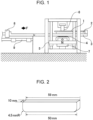
- Fig. 1 is a schematic front view illustrating a friction coefficient measurement apparatus. As illustrated in Fig. 1 , a sample 1 for measuring the friction coefficient taken from the sample material is fixed on a sample stage 2, and the sample stage 2 is fixed on the upper surface of a slide table 3, which is horizontally movable.
- a slide table supporting base 5 which has rollers 4 in contact with the lower surface of the slide table 3 and which is vertically movable is placed below the lower surface of the slide table 3, and a first load cell 7 for measuring a pressing load N, which is applied to the sample 1 for measuring the friction coefficient by using a bead 6 as a result of the slide table supporting base 5 being pushed up, is fixed on the slide table supporting base 5.
- a second load cell 8 for measuring sliding resistance F which is necessary to move the slide table 3 horizontally while the pressing load N described above is applied, is fixed on one end of the slide table 3.
- a wash oil for press forming that is, PRETON (registered trademark) R352L produced by Sugimura Chemical Industrial Co., Ltd., was applied to the surface of the sample 1 when the test was performed.
- Fig. 2 is a schematic perspective view illustrating the shape and dimensions of the bead used. Sliding is performed while the lower surface of the bead 6 is pressed onto the surface of the sample 1.
- the bead 6 in Fig. 2 has a width of 10 mm, a length in the sliding direction of the sample of 59 mm, and a curvature radius R of 4.5 mm at the bottom of each of the edges in the sliding direction, and the lower surface of the bead, onto which the sample is pressed, is a flat surface having a width of 10 mm and a length in the sliding direction of 50 mm.
- the test for measuring the friction coefficient was performed by using the bead illustrated in Fig. 2 under the conditions of a pressing load N of 400 kgf and a drawing speed of the sample (the horizontal movement speed of the slide table 3) of 20 cm/min.
- a case where the friction coefficient was 0.130 or less was judged as a case of good slidability and denoted by o, and a case where the friction coefficient was 0.130 or more was judged as unsatisfactory and denoted by ⁇ .
- test specimens were first subjected to a degreasing treatment by using an alkaline degreasing agent FINE CLEANER (registered trademark) E6403 (produced by Nihon Parkerizing Co., Ltd.).
- FINE CLEANER registered trademark
- E6403 produced by Nihon Parkerizing Co., Ltd.
- the test specimen was immersed for a predetermined time in a degreasing solution having a degreasing agent concentration of 20 g/L and a temperature of 40°C, washed with tap water, and then dried by using a blower.
- the surface carbon intensity of the test specimen which had been subjected to such a treatment was measured by using an X-ray fluorescence spectrometer, and a film removal ratio was calculated by using the following equation from the measured value of such a surface carbon intensity, a surface carbon intensity which had been measured in advance before degreasing was performed, and the surface carbon intensity of the steel sheet before the lubrication treatment was performed.
- the film removability of the organic resin-coated steel sheet was evaluated in accordance with the evaluation criteria below on the basis of an immersion time for which the sample had been immersed in the alkaline degreasing solution until the film removal ratio defined as above reached 98% or higher.
- film removal ratio (%) [(carbon intensity before degreasing - carbon intensity after degreasing)/(carbon intensity before degreasing - carbon intensity before lubrication treatment)] ⁇ 100
- Each of the test specimens was subjected to a welding test for investigating consecutive spot weldability by using a DR-type Cr-Cu electrode under the conditions of a welding force of 150 kgf, an energizing time of 10 cycles/60 Hz, and a welding current of 7.5 kA, and the weldability was evaluated on the basis of the consecutive spot number.
- the evaluation criteria are as follows.
- the steel sheet according to the present invention has excellent press formability, it is possible to use the steel sheet in a wide range of fields of industrial applications including applications in which particularly intense drawing is performed. In addition, since it is possible to optionally manufacture a steel sheet having excellent film removability and weldability, it is also possible to use such a steel sheet for automotive body applications.
Landscapes
- Chemical & Material Sciences (AREA)
- Engineering & Computer Science (AREA)
- Life Sciences & Earth Sciences (AREA)
- Wood Science & Technology (AREA)
- Organic Chemistry (AREA)
- Materials Engineering (AREA)
- Nanotechnology (AREA)
- Chemical Kinetics & Catalysis (AREA)
- Oil, Petroleum & Natural Gas (AREA)
- Health & Medical Sciences (AREA)
- Medicinal Chemistry (AREA)
- Polymers & Plastics (AREA)
- General Chemical & Material Sciences (AREA)
- Laminated Bodies (AREA)
- Other Surface Treatments For Metallic Materials (AREA)
- Application Of Or Painting With Fluid Materials (AREA)
- Paints Or Removers (AREA)
- Shaping Metal By Deep-Drawing, Or The Like (AREA)
Abstract
Description
- The present invention relates to a steel sheet excellent in terms of slidability when press forming is performed and a method for manufacturing the steel sheet. In particular, the present invention relates to a steel sheet which has a lubrication film that is excellent in terms of formability even when intense drawing is performed and a method for manufacturing the steel sheet.
- Cold rolled steel sheets and hot rolled steel sheets, which have a wide range of industrial applications in fields including automotive body applications, are generally subjected to press forming when used in such applications. Nowadays, since there are demands for integrated parts, which are intended to reduce the number of processes, and improvement in design effect, it is necessary to realize complex forming at a higher level. In the case where an attempt is made to realize complex press forming at a higher level, there is a risk of significant negative effects on the productivity of automobiles, such as steel sheet fracture caused by the degree of forming which exceeds the capacity of the steel sheet, die galling occurring when continuous press forming is performed, or the like. Therefore, it is necessary to improve the press formability of the steel sheets.
- Examples of a method for improving the press formability of cold rolled steel sheets and hot rolled steel sheets include a method involving surface treatment of a die. Although this method is widely used, in the case of this method, it is not possible to adjust the die after surface treatment has been performed. In addition, there is also a problem of high cost. Therefore, there is a strong demand for improving the press formability of a steel sheet itself.
- Examples of a method for improving press formability without performing surface treatment on a die include a method utilizing high-viscosity lubricant. However, in the case of this method, there may be a case of poor degreasing after press forming, and there is a risk of a deterioration in paintability.
- Therefore, as a technique for realizing press forming without utilizing the surface treatment of a die or high-viscosity lubricant, investigations are being conducted regarding various kinds of steel sheets having a lubrication-treated surface.
- Patent Literature 1 describes a technique in which a lubrication film obtained by adding synthesized resin powder to an acrylic resin coating film is formed on the surface of a galvanized steel sheet.
-
Patent Literature 2 describes a technique in which a lubrication film having lithium silicate as the constituent of a coating film and a wax and a metallic soap added as lubricants to the coating film is formed on the surface of a steel sheet. -
Patent Literature 3 describes a metal product having a lubrication-treated surface coated with a film which is formed by adding a lubricant to a polyurethane resin and which has a thickness of 0.5 um to 5 um and having excellent press formability. -
Patent Literature 4 describes a technique in which an alkali-soluble organic coating film obtained by adding a lubricant to an epoxy resin is formed on the surface of a steel sheet. -
- PTL 1:
Japanese Unexamined Patent Application Publication No. 9-170059 - PTL 2:
Japanese Unexamined Patent Application Publication No. 2002-307613 - PTL 3:
Japanese Unexamined Patent Application Publication No. 2000-309747 - PTL 4:
Japanese Unexamined Patent Application Publication No. 2000-167981 - However, in the case of Patent Literature 1 to
Patent Literature 4, although lubrication performance was achieved due to the lubrication effect of the added lubricants or the like, press formability was not always sufficient when complex forming was performed. - The present invention has been completed in view of the situation described above, and an object of the present invention is to provide a steel sheet that is to be subjected to complex forming in which press forming is difficult, the steel sheet having low sliding resistance in a portion at risk of cracking when press forming is performed and excellent press formability in a portion in which die galling is considered to occur due to high contact pressure, and to provide a method for manufacturing the steel sheet.
- In addition, in the case where the steel sheet is used as an automobile steel sheet, the steel sheet is also required to have sufficient film removability in an alkaline degreasing process in a painting process and to further have excellent weldability. In the case of such an application, desirably the steel sheet further has good film removability and weldability.
- To solve the problems described above, the present inventors diligently conducted investigations. As a result, the inventors found that it is possible to solve the problems described above by forming an organic coating film on the surface of a steel sheet to improve press formability. The organic coating film has an indentation hardness of 0.5 GPa or higher and 1.5 GPa or lower in the case where the coating film has an indentation reduced Young's modulus of 20 GPa or higher and 50 GPa or lower or the coating film has an indentation hardness of 0.2 GPa or higher and 0.5 GPa or lower in the case where the coating film has an indentation reduced Young's modulus of 10 GPa or higher and lower than 20 GPa.
- Moreover, it was also found that there is a significant improvement in lubrication performance in the case where a combination of a specified organic coating film and a specified wax is selected.
- The present invention has been completed on the basis of the knowledge described above, and the subject matter of the present invention is as follows.
- [1] A steel sheet having an organic resin coating film which has an indentation reduced Young's modulus of 20 GPa or higher and 50 GPa or lower and an indentation hardness of 0.5 GPa or higher and 1.5 GPa or lower and which has a coating weight per side after drying of 0.2 g/m2 or more and 2.0 g/m2 or less on at least one surface thereof.
- [2] A steel sheet having an organic resin coating film which has an indentation reduced Young's modulus of 10 GPa or higher and less than 20 GPa and an indentation hardness of 0.2 GPa or higher and 0.5 GPa or lower and which has a coating weight per side after drying of 0.2 g/m2 or more and 2.0 g/m2 or less on at least one surface thereof.
- [3] The steel sheet according to item [1] or [2], in which the organic resin coating film contains one, two, or more selected from an acrylic resin, a urethane resin, a phenol resin, an epoxy resin, and a mixture thereof.
- [4] The steel sheet according to any one of items [1] to [3], in which the organic resin coating film contains a wax in an amount of 50 mass% or less with respect to 100 mass% of resin constituents.
- [5] The steel sheet according to item [4], in which the wax is a hydrocarbon-based wax.
- [6] The steel sheet according to item [4] or [5], in which an average particle diameter of the wax is 0.01 um or more and 4 um or less.
- [7] A method for manufacturing the steel sheet according to any one of items [1] to [6], the method including: applying, to the steel sheet, a solution which is prepared by dissolving or dispersing an organic resin in an aqueous solvent or a solution which is prepared by adding a wax to the organic resin, and drying the applied solution by heating to form a lubrication film having a coating weight per side after drying of 0.2 g/m2 or more and 2.0 g/m2 or less on the steel sheet.
- In the present invention, the meaning of the term "steel sheet" includes a cold rolled steel sheet and a hot rolled steel sheet.
- According to the present invention, it is possible to obtain a steel sheet excellent in terms of press formability. Since there is a marked decrease in the friction coefficient between the steel sheet and a die or the like, it is possible to provide excellent press formability stably to a steel sheet having comparatively low strength, which is subjected to complex forming. In addition, in the case of a high strength steel sheet where there is an increase in the contact pressure when press forming is performed, it is possible to obtain a steel sheet having low sliding resistance in a portion at risk of cracking when press forming is performed and excellent press formability in a portion in which die galling is considered to occur due to high contact pressure. Moreover, it is possible to achieve a condition in which there is no impediment to subsequent processes such as a welding process, a degreasing process, a chemical conversion process, a painting process, and the like.
- In the description above, the expression "high strength" denotes the assumption that tensile strength (TS) is 440 MPa or higher, and the expression "comparatively low strength" denotes the assumption that TS is lower than 440 MPa.
-
- [
Fig. 1] Fig. 1 is a schematic front view illustrating a friction coefficient measurement apparatus. - [
Fig. 2] Fig. 2 is a schematic perspective view illustrating the shape and dimensions of the bead inFig. 1 . Description of Embodiments - Hereafter, embodiments of the present invention will be described.
- First, the indentation reduced Young's modulus and indentation hardness of the coating film after drying will be described.
- The term "indentation reduced Young's modulus of a coating film" denotes a physical property value which is determined, when a coating film sample is indented by an indenter and then unloaded, from the line tangent to a load-displacement curve at the maximum load point and the projected contact area of the indenter. It indicates a level of force with which the coating film pushes back when a displacement is applied to the coating film. Although the indentation reduced Young's modulus of an organic resin coating film varies in accordance with the constituents, thickness, condensation degree, and the like of the coating film, the indentation reduced Young's modulus is 8 GPa to 40 GPa in general cases.
- It is possible to determine the indentation reduced Young's modulus of a coating film by using, for example, a nanoindenter or the like.
- In the case of an organic resin coating film after drying having an indentation reduced Young's modulus of 20 GPa or higher and 50 GPa or lower and an indentation hardness of 0.5 GPa or higher and 1.5 GPa or lower, since the deformation amount of the constituents of the organic resin coating film which enters the interface between the steel sheet and the die is small, the steel sheet has low sliding resistance in a portion at risk of cracking when press forming is performed and has excellent press formability in a portion in which die galling is considered to occur due to high contact pressure.
- In addition, also in the case of an organic resin coating film after drying having an indentation reduced Young's modulus of 10 GPa or higher and less than 20 GPa, when the indentation hardness is 0.2 GPa or higher and 0.5 GPa or lower, since shear deformation tends to occur in the constituents of the organic resin coating film which enters the interface between the steel sheet and the die, the steel sheet has low sliding resistance in a portion at risk of cracking when press forming is performed and has excellent press formability in a portion in which die galling is considered to occur due to high contact pressure.
- The term "indentation hardness of a coating film" denotes hardness which is determined, when a coating film sample is indented by an indenter and then unloaded, by dividing the maximum load point by the projected contact area of the indenter, and it is possible to determine such indentation hardness by using, for example, a nanoindenter or the like.
- The coating weight after drying of the organic resin coating film is set to be 0.2 g/m2 or more and 2.0 g/m2 or less. It is not possible to achieve sufficient press formability in the case where the coating weight after drying of the organic resin coating film is less than 0.2 g/m2, and there may be a deterioration in weldability and film removability in the case where such a coating weight is more than 2.0 g/m2.
- It is preferable that the organic resin coating film contain one, two, or more selected from an acrylic resin, a urethane resin, a phenol resin, an epoxy resin, and a mixture thereof. With this, the die and the steel sheet are inhibited from coming into direct contact with each other when press forming is performed and lubrication performance is achieved. In addition, since there is high affinity between the organic resin and a wax, when a hydrocarbon-based wax is added to the organic resin coating film, further improved lubrication performance is achieved due to a uniform mixture of the organic resin and the wax being formed when sliding occurs.
- It is preferable that the organic resin coating film contains the wax in an amount of 50 mass% or less with respect to 100 mass% of resin constituents, because this results in further improved lubrication performance. In the case where the wax content is 50 mass% or more with respect to 100 mass% of resin constituents, since there is a decrease in the indentation reduced Young's modulus and indentation hardness, there may be a case where it is not possible to achieve sufficient press formability. In addition, in the case where the steel sheet is used as an automobile steel sheet, there may be a case where it is not possible to achieve sufficient degreasing capability in an alkaline degreasing process in a painting process, and, even in the case where an alkali-soluble organic resin is used, there may be a deterioration in paintability due to a residual coating film because the coating film is not sufficiently removed in the alkaline degreasing process.
- The term "proportion of a wax in an organic resin coating film" denotes the ratio of the mass of the solid wax in the organic resin coating film with respect to the sum of the mass of the solid organic resin in the organic resin coating film and the mass of the solid wax in the organic resin coating film.
- Regarding a specific method for determining the mass fraction of the wax, a test specimen of a steel sheet for which the coating weight of each of the organic resin and the wax is known is prepared, the infrared absorption spectrum of the test specimen is measured by using a FT-IR measuring apparatus, and the calibration curve for the coating weight of each of the organic resin and the wax is produced from the relevant peak intensity. Subsequently, the infrared absorption spectrum of a target steel sheet having an organic resin coating film is measured, and the coating weight of each of the organic resin and the wax is determined on the basis of the relevant calibration curve, which makes it possible to determine the mass fraction of the wax in the organic resin coating film.
- It is preferable that the wax be a hydrocarbon-based wax. This is because a hydrocarbon-based wax has a comparatively high melting temperature, low viscosity, and high hardness, which makes it possible to achieve good lubrication performance. In addition, regarding the hydrocarbon-based wax, in the case of a polyolefin wax, it is possible to control the melting temperature to be 120°C or higher and 140°C or lower comparatively easily by controlling its density and molecular weight.
- In the case where the melting temperature of the wax is 120°C or higher and 140°C or lower, it is possible to achieve an excellent lubrication effect, because it is possible for the wax to deliver self-lubrication performance, and because it is possible for the constituents of the lubrication film, formed of a mixture of the organic resin and the wax which is in a semi-molten state due to sliding when press forming is performed, to cover the surface of the die and it is thus possible to inhibit the die and the steel sheet from coming into direct contact with each other. In the case where such a melting temperature is lower than 120°C, since the wax is completely melted due to frictional heat generated by sliding when press forming is performed, it is not possible for the wax to realize a sufficient lubrication effect, and it is not possible for the constituents of the lubrication film to realize the effect of covering the die described above either. In addition, in the case where such a melting temperature is higher than 140°C, since the wax is not melted when sliding is performed, it is not possible to realize a sufficient lubrication effect, and it is not possible to realize the effect of covering the die described above either.
- It is considered that, in the case where the melting temperature of the wax is 120°C or higher and 140°C or lower, since the wax in the organic resin coating film efficiently adheres to the die in a sliding state when press forming is performed, the wax is less likely to be detached, which results in a high lubrication effect. In the case where such a melting temperature is lower than 120°C, even in the case where the organic resin coating film adheres to the die, since there is a weak adhesion force, the coating film is more likely to be detached when sliding is performed. In the case where such a melting temperature is higher than 140°C, the organic resin coating film is less likely to adhere to the die. Moreover, it is preferable that such a melting temperature be 125°C or higher and 135°C or lower.
- Here, the term "melting temperature" with respect to the wax denotes the melting temperature measured in accordance with JIS K 7121:1987 "Testing Methods for Transition Temperatures of Plastics".
- Regarding the polyolefin wax, it is preferable that a polyethylene wax be used, because this makes it possible to realize the highest lubrication effect.
- It is preferable that the average particle diameter of the wax be 4 um or less. In the case where the average particle diameter of the wax is more than 4 um, since the wax is less likely to be mixed with the organic resin when sliding is performed, it is not possible to realize the above-described effect of covering the die, which results in sufficient lubrication performance not being achieved. It is more preferable that the average particle diameter of the wax be 1.5 um or less, even more preferably 0.5 um or less, or even much more preferably 0.3 um or less.
- It is preferable that the average particle diameter of the wax be 0.01 um or more. In the case where the average particle diameter of the wax is less than 0.01 um, since the wax is more likely to be dissolved in a lubricant when sliding is performed, there may be a case where it is not possible to realize a sufficient effect of improving lubrication performance. In addition, in the case where the average particle diameter of the wax is less than 0.01 um, since the wax is more likely to be aggregated in a paint for forming the organic resin coating film, there is low paint stability. It is more preferable that such an average diameter be 0.03 um or more.
- The term "average particle diameter of the wax" denotes the median diameter of a volume average particle diameter, which is determined by using a laser diffraction/scattering method. It is possible to obtain the average particle diameter of the wax by observing a sample which is diluted with pure water by using, for example, a laser diffraction/scattering-type particle size distribution measuring device, that is, a Partica (registered trademark) LA-960V2 (produced by HORIBA, Ltd.).
- The method for manufacturing a steel sheet according to the present invention is a method for manufacturing a steel sheet having an organic resin coating film formed of an organic resin or an organic resin containing a wax on the surface thereof. After having applied a solution, which is prepared by dissolving or dispersing an organic resin in an aqueous solvent, or a solution, which is prepared by adding a wax to the solution of the organic resin, to the surface of a steel sheet, the solution is dried. With this method, a lubrication film having a coating weight per side after drying of 0.2 g/m2 or more and 2.0 g/m2 or less is formed on the steel sheet. Although there is no particular limitation on the coating method, examples of the coating method include a method utilizing a roll coater or a bar coater and a method involving spraying, dipping, or brushing. The coated steel sheet may be dried by using a common method. Examples of the drying method include a method utilizing hot air, an induction heater, or an infrared heater.
- To realize such a condition in which the organic resin coating film after drying has an indentation reduced Young's modulus of 20 GPa or higher and 50 GPa or lower and an indentation hardness of 0.5 GPa or higher and 1.5 GPa or lower, candidate organic resin coating films are manufactured under assumed manufacturing conditions (film coating weight, drying conditions, and the like), and the indentation reduced Young's modulus and the indentation hardness are determined for selection.
- To realize such a condition in which the organic resin coating film after drying has an indentation reduced Young's modulus of 10 GPa or higher and less than 20 GPa and an indentation hardness of 0.2 GPa or higher and 0.5 GPa or lower, candidate organic resin coating films are manufactured under assumed manufacturing conditions (film coating weight, drying conditions, and the like), and the indentation reduced Young's modulus and the indentation hardness are determined for selection.
- It is preferable that the maximum end-point temperature of the steel sheet when drying is performed be 60°C or higher and 150°C or lower. In the case where the maximum end-point temperature of the steel sheet when drying is performed is lower than 60°C, it takes a long time to dry the steel sheet, and there may be a deterioration in antirust capability. Moreover, since there is insufficient polymerization of the organic resin, the reduced Young's modulus becomes less than 10 GPa, which results in sufficient lubrication performance not being achieved. In the case where the maximum end-point temperature of the steel sheet when drying is performed is 150°C or higher, since the polymerization and dehydration of the organic resin progress, it is possible to achieve sufficient lubrication performance due to an increase in the reduced Young's modulus. However, there may be a deterioration in film removability. In addition, in the case where a wax having a melting temperature of 150°C or lower is contained in the organic resin coating film, since the wax is melted to be mixed with the resin, there is a decrease in the indentation reduced Young's modulus and the indentation hardness, which may result in a deterioration in press formability.
- Although the present invention has been described above in accordance with the embodiments of the present invention, the present invention includes, but is not limited to, the descriptions and figures of the present embodiments, which form a part of the disclosure of the present invention. That is, other embodiments, working examples, operational techniques, and the like, which are performed on the basis of the present embodiments by, for example, those ordinarily skilled in the art are all within the scope of the present invention.
- Hereafter, the present invention will be described in accordance with examples. Here, the present invention is not limited to the examples below. In addition, the organic resin coating film may also be simply referred to as "coating film".
- A steel sheet having a size of 350 mm × 230 mm which was taken from a cold rolled steel sheet (TS: 270 MPa) having a thickness of 0.8 mm was used as a base material for an organic resin coating film. After the taken steel sheet had been subjected to an ultrasonic cleaning process of being immersed in a 50 vol% toluene-50 vol% ethanol solvent for 5 minutes, the cleaned steel sheet was dried by using a blower, and the dried steel sheet was subjected to a degreasing treatment utilizing an alkaline degreasing agent, that is, FINE CLEANER (registered trademark) E6403 (produced by Nihon Parkerizing Co., Ltd.). In such a treatment, after the test specimen had been immersed in a degreasing solution containing the degreasing agent having a degreasing agent concentration of 20 g/L at a temperature of 40°C for 2 minutes, the immersed test specimen was rinsed in tap water, and then dried by using a blower. After each of the paints given in Table 1 had been applied to the surface of the steel sheet prepared as described above by using a bar coater, the painted steel sheet was baked and dried by using an induction heater (IH) to manufacture a steel sheet having a lubrication organic coating film given in Table 2. Here, the temperature at which each of the samples was baked to form the coating film is given in Table 2. These samples were evaluated by using the methods described below, and the results are given in Table 2.
[Table 1] Paint No. Base Resin Wax Type Type Mass% with respect to 100 mass% of Resin Melting Temperature (°C) Particle Diameter (µm) 1 Phenol None 0 - - 2 Phenol Polyethylene 10 110 0.6 3 Phenol Polyethylene 20 110 0.6 4 Phenol Polyethylene 50 110 0.6 5 Phenol Polyethylene 60 110 0.6 6 Phenol Polyethylene 20 132 0.6 7 Phenol Polyethylene 20 110 0.2 8 Phenol Polyethylene 20 110 1.0 9 Phenol Polyethylene 20 110 4.0 10 Phenol Polyethylene 20 110 10.0 11 Phenol Polyethylene 20 135 0.05 12 Phenol Paraffin 20 70 1.0 13 Phenol Fischer-Tropsch 20 113 1.0 14 Acrylic None 0 - - 15 Acrylic Polyethylene 20 110 0.6 16 Urethane None 0 - - 17 Urethane Polyethylene 20 110 0.6 18 Epoxy None 0 - - 19 Epoxy Polyethylene 20 110 0.6 [Table 2] Steel Sheet No. Paint No. Coating Weight (g/m2) Coating Film Baking Temperature (°C) Evaluation Item Note Mechanical Property of Coating Film Slidability Film Removability Weldability Indentation Reduced Young's Modulus (GPa) Indentation Hardness (GPa) Evaluation Frictional Coefficient Evaluation 1 1 0.8 80 27.8 0.9 ○ 0.110 ○ ○ ○ Example 2 1 0.8 90 28.9 0.9 ○ 0.102 ○ ○ ○ Example 3 1 0.8 120 32.1 1.1 ○ 0.100 ○ Δ ○ Example 4 1 0.8 155 48.1 1.2 ○ 0.098 ○ × ○ Example 5 1 0.8 55 9.8 0.3 × 0.173 × ○ ○ Comparative Example 6 2 0.8 80 27.4 0.9 ○ 0.101 ○ ○ ○ Example 7 3 0.8 80 27.1 0.9 ○ 0.083 ○ ○ ○ Example 8 3 0.1 80 51.3 1.2 × 0.173 × ○ ○ Comparative Example 9 3 0.2 80 42.1 1.0 ○ 0.129 ○ ○ ○ Example 10 3 2.0 80 21.2 0.8 ○ 0.074 ○ ○ ○ Example 11 3 3.0 80 20.9 0.8 ○ 0.060 ○ Δ × Example 12 4 0.8 80 24.1 0.7 ○ 0.100 ○ ○ ○ Example 13 5 0.8 80 19.3 0.6 × 0.136 × Δ ○ Comparative Example 14 6 0.8 80 27.2 0.9 ○ 0.075 ○ ○ ○ Example 15 7 0.8 80 27.5 0.9 ○ 0.081 ○ ○ ○ Example 16 8 0.8 80 26.8 0.8 ○ 0.096 ○ ○ ○ Example 17 9 0.8 80 21.1 0.7 ○ 0.128 ○ ○ ○ Example 18 10 0.8 80 18.6 0.6 × 0.146 × ○ ○ Comparative Example 19 11 0.8 80 27.8 0.9 ○ 0.068 ○ ○ ○ Example 20 12 0.8 80 19.4 0.6 × 0.190 × ○ ○ Comparative Example 21 13 0.8 80 26.9 0.8 ○ 0.112 ○ ○ ○ Example 22 14 0.8 80 14.7 0.5 ○ 0.105 ○ ○ ○ Example 23 14 0.8 90 15.2 0.6 × 0.135 × ○ ○ Comparative Example 24 14 0.8 155 17.3 0.8 × 0.137 × × ○ Comparative Example 25 14 0.8 55 8.7 0.2 × 0.138 × ○ ○ Comparative Example 26 15 0.8 80 14.3 0.4 ○ 0.101 ○ ○ ○ Example 27 15 0.8 90 14.7 0.5 ○ 0.110 ○ ○ ○ Example 28 16 0.8 80 11.6 0.3 ○ 0.128 ○ Δ ○ Example 29 16 0.8 90 12.3 0.3 ○ 0.124 ○ Δ ○ Example 30 16 0.8 155 14.2 0.6 × 0.142 × × ○ Comparative Example 31 16 0.8 55 8.3 0.1 × 0.182 × Δ ○ Comparative Example 32 17 0.8 80 10.8 0.3 ○ 0.119 ○ Δ ○ Example 33 17 0.8 90 11.0 0.4 ○ 0.117 ○ Δ ○ Example 34 18 0.8 80 14.4 0.6 × 0.159 × × ○ Comparative Example 35 18 0.8 90 15.0 0.6 × 0.148 × × ○ Comparative Example 36 18 0.8 155 18.3 0.8 × 0.138 × × ○ Comparative Example 37 18 0.8 55 8.5 0.2 × 0.161 × × ○ Comparative Example 38 19 0.8 80 13.8 0.5 ○ 0.130 ○ × ○ Example 39 19 0.8 90 14.2 0.5 ○ 0.129 ○ × ○ Example 40 - None 80 - - - 0.175 × - ○ Comparative Example - The indentation reduced Young's modulus and indentation hardness of the coating film were determined by using the following method.
- A piece having a size of 10 mm square which was taken from each of the lubrication organic resin-coated steel sheets was used as a sample material. For measurement, a nanoindenter produced by HYSITRON Inc., that is, a TI Premier Multi Scale, was used. Regarding the indenter, a cube corner-type indenter made of diamond was used. In the measurement, the indenter was impressed for 5 seconds, held thereafter at the maximum load (30 µN to 150 µN) for 10 seconds, and then unloaded in 5 seconds. At each of five randomly selected positions in the vicinity of the central position of each of the sample materials, an indentation depth-load curve was taken under such measurement conditions, and the indentation reduced Young's modulus Er and the indentation hardness H were calculated by using the equations below. The average values of the indentation reduced Young's modulus and the indentation hardness of the five points were defined as the average values of the indentation reduced Young's modulus and the indentation hardness, respectively, of each of the sample materials.


- Here, A denotes the projected contact area of the residual indentation, dP/dh denotes the line tangent to the unloading curve at the maximum load point, and Pmax denotes the maximum load.
- On the basis of the average values of the indentation reduced Young's modulus and the indentation hardness of each of the samples, a case of an organic resin coating film after drying having an indentation reduced Young's modulus of 20 GPa or higher and 50 GPa or lower and an indentation hardness of 0.5 GPa or higher and 1.5 GPa or lower or a case of an organic resin coating film after drying having an indentation reduced Young's modulus of 10 GPa or higher and less than 20 GPa and an indentation hardness of 0.2 GPa or higher and 0.5 GPa or lower was judged as a case of an organic resin coating film having the mechanical properties according to the present invention and denoted by o, and other cases were judged as unsatisfactory and denoted by x.
- To evaluate the press formability, the friction coefficient of each of the sample materials was measured by using the method described below.
Fig. 1 is a schematic front view illustrating a friction coefficient measurement apparatus. As illustrated inFig. 1 , a sample 1 for measuring the friction coefficient taken from the sample material is fixed on asample stage 2, and thesample stage 2 is fixed on the upper surface of a slide table 3, which is horizontally movable. A slidetable supporting base 5 which hasrollers 4 in contact with the lower surface of the slide table 3 and which is vertically movable is placed below the lower surface of the slide table 3, and afirst load cell 7 for measuring a pressing load N, which is applied to the sample 1 for measuring the friction coefficient by using abead 6 as a result of the slidetable supporting base 5 being pushed up, is fixed on the slidetable supporting base 5. Asecond load cell 8 for measuring sliding resistance F, which is necessary to move the slide table 3 horizontally while the pressing load N described above is applied, is fixed on one end of the slide table 3. Here, as a lubricant, a wash oil for press forming, that is, PRETON (registered trademark) R352L produced by Sugimura Chemical Industrial Co., Ltd., was applied to the surface of the sample 1 when the test was performed. -
Fig. 2 is a schematic perspective view illustrating the shape and dimensions of the bead used. Sliding is performed while the lower surface of thebead 6 is pressed onto the surface of the sample 1. Thebead 6 inFig. 2 has a width of 10 mm, a length in the sliding direction of the sample of 59 mm, and a curvature radius R of 4.5 mm at the bottom of each of the edges in the sliding direction, and the lower surface of the bead, onto which the sample is pressed, is a flat surface having a width of 10 mm and a length in the sliding direction of 50 mm. - The test for measuring the friction coefficient was performed by using the bead illustrated in
Fig. 2 under the conditions of a pressing load N of 400 kgf and a drawing speed of the sample (the horizontal movement speed of the slide table 3) of 20 cm/min. The friction coefficient µ between the sample material and the bead was calculated by using the equation µ = F/N. A case where the friction coefficient was 0.130 or less was judged as a case of good slidability and denoted by o, and a case where the friction coefficient was 0.130 or more was judged as unsatisfactory and denoted by ×. - To determine the film removability of the organic resin-coated steel sheet, the test specimens were first subjected to a degreasing treatment by using an alkaline degreasing agent FINE CLEANER (registered trademark) E6403 (produced by Nihon Parkerizing Co., Ltd.). In such a treatment, the test specimen was immersed for a predetermined time in a degreasing solution having a degreasing agent concentration of 20 g/L and a temperature of 40°C, washed with tap water, and then dried by using a blower. The surface carbon intensity of the test specimen which had been subjected to such a treatment was measured by using an X-ray fluorescence spectrometer, and a film removal ratio was calculated by using the following equation from the measured value of such a surface carbon intensity, a surface carbon intensity which had been measured in advance before degreasing was performed, and the surface carbon intensity of the steel sheet before the lubrication treatment was performed.
- The film removability of the organic resin-coated steel sheet was evaluated in accordance with the evaluation criteria below on the basis of an immersion time for which the sample had been immersed in the alkaline degreasing solution until the film removal ratio defined as above reached 98% or higher.
-
film removal ratio (%) = [(carbon intensity before degreasing - carbon intensity after degreasing)/(carbon intensity before degreasing - carbon intensity before lubrication treatment)] × 100 -
- o (excellent): 60 seconds or less
- △ (practicable): more than 60 seconds and 120 seconds or less
- × (poor): more than 120 seconds
- Each of the test specimens was subjected to a welding test for investigating consecutive spot weldability by using a DR-type Cr-Cu electrode under the conditions of a welding force of 150 kgf, an energizing time of 10 cycles/60 Hz, and a welding current of 7.5 kA, and the weldability was evaluated on the basis of the consecutive spot number. The evaluation criteria are as follows.
-
- o (practicable): 5000 spots or more
- × (poor): less than 5000 spots
- The results obtained by using the methods described above are given in Table 2.
- From the results given in Table 2, it was clarified that, according to the present invention, it is possible to obtain a steel sheet having excellent press formability. In addition, it is also possible to optionally obtain a steel sheet further having film removability and weldability which are at a practicable level.
- Since the steel sheet according to the present invention has excellent press formability, it is possible to use the steel sheet in a wide range of fields of industrial applications including applications in which particularly intense drawing is performed. In addition, since it is possible to optionally manufacture a steel sheet having excellent film removability and weldability, it is also possible to use such a steel sheet for automotive body applications.
-
- 1.
- sample for measuring friction coefficient
- 2.
- sample stage
- 3.
- slide table
- 4.
- roller
- 5.
- slide table supporting base
- 6.
- bead
- 7.
- first load cell
- 8.
- second load cell
- 9.
- rail
Claims (7)
- A steel sheet having an organic resin coating film which has an indentation reduced Young's modulus of 20 GPa or higher and 50 GPa or lower and an indentation hardness of 0.5 GPa or higher and 1.5 GPa or lower and which has a coating weight per side after drying of 0.2 g/m2 or more and 2.0 g/m2 or less on at least one surface thereof.
- A steel sheet having an organic resin coating film which has an indentation reduced Young's modulus of 10 GPa or higher and less than 20 GPa and an indentation hardness of 0.2 GPa or higher and 0.5 GPa or lower and which has a coating weight per side after drying of 0.2 g/m2 or more and 2.0 g/m2 or less on at least one surface thereof.
- The steel sheet according to Claim 1 or 2, wherein the organic resin coating film contains one, two, or more selected from an acrylic resin, a urethane resin, a phenol resin, an epoxy resin, and a mixture thereof.
- The steel sheet according to any one of Claims 1 to 3, wherein the organic resin coating film contains a wax in an amount of 50 mass% or less with respect to 100 mass% of resin constituents.
- The steel sheet according to Claim 4, wherein the wax is a hydrocarbon-based wax.
- The steel sheet according to Claim 4 or 5, wherein an average particle diameter of the wax is 0.01 um or more and 4 um or less.
- A method for manufacturing the steel sheet according to any one of Claims 1 to 6, the method comprising: applying, to the steel sheet, a solution which is prepared by dissolving or dispersing an organic resin in an aqueous solvent or a solution which is prepared by adding a wax to the organic resin, and drying the applied solution by heating to form a lubrication film having a coating weight per side after drying of 0.2 g/m2 or more and 2.0 g/m2 or less on the steel sheet.
Applications Claiming Priority (2)
| Application Number | Priority Date | Filing Date | Title |
|---|---|---|---|
| JP2022054830 | 2022-03-30 | ||
| PCT/JP2023/002151 WO2023188745A1 (en) | 2022-03-30 | 2023-01-24 | Steel sheet and method for manufacturing same |
Publications (2)
| Publication Number | Publication Date |
|---|---|
| EP4477410A1 true EP4477410A1 (en) | 2024-12-18 |
| EP4477410A4 EP4477410A4 (en) | 2025-05-28 |
Family
ID=88200756
Family Applications (1)
| Application Number | Title | Priority Date | Filing Date |
|---|---|---|---|
| EP23778783.3A Pending EP4477410A4 (en) | 2022-03-30 | 2023-01-24 | STEEL SHEET AND ITS MANUFACTURING PROCESS |
Country Status (7)
| Country | Link |
|---|---|
| US (1) | US20250066625A1 (en) |
| EP (1) | EP4477410A4 (en) |
| JP (1) | JP7416336B1 (en) |
| KR (1) | KR20240154039A (en) |
| CN (1) | CN118871290A (en) |
| MX (1) | MX2024011801A (en) |
| WO (1) | WO2023188745A1 (en) |
Family Cites Families (13)
| Publication number | Priority date | Publication date | Assignee | Title |
|---|---|---|---|---|
| JP2617838B2 (en) * | 1991-09-09 | 1997-06-04 | 新日本製鐵株式会社 | Manufacturing method of high performance lubricated steel sheet |
| JPH0890710A (en) * | 1994-09-21 | 1996-04-09 | Kobe Steel Ltd | Resin coated composite damping material excellent in press moldability and weldability |
| JP3088948B2 (en) | 1995-12-18 | 2000-09-18 | 日新製鋼株式会社 | Alkali-soluble resin film-coated zinc-based plated steel sheet with excellent adhesion by adhesive |
| JP3400366B2 (en) | 1998-12-04 | 2003-04-28 | 日本鋼管株式会社 | Alkali-soluble organic coating coated steel sheet with excellent adhesion and anti-galling properties |
| JP4324296B2 (en) | 1999-02-26 | 2009-09-02 | 新日本製鐵株式会社 | Coating composition capable of forming an alkali-soluble lubricating film excellent in press formability and galling resistance, and lubricated surface-treated metal product using this composition |
| JP3932823B2 (en) | 2001-04-10 | 2007-06-20 | 住友金属工業株式会社 | Lubricated steel sheet with excellent chemical conversion and adhesion |
| JP2004098316A (en) * | 2002-09-05 | 2004-04-02 | Nippon Steel Corp | Exhaust stainless steel lubricated steel plate |
| JP4551838B2 (en) * | 2005-08-09 | 2010-09-29 | 株式会社神戸製鋼所 | Resin coated metal plate |
| JP2013221177A (en) * | 2012-04-17 | 2013-10-28 | Nippon Steel & Sumitomo Metal Corp | Method for producing surface treated steel sheet |
| JP6049478B2 (en) * | 2013-01-30 | 2016-12-21 | 日新製鋼株式会社 | Painted metal plate |
| EP3385344B1 (en) * | 2015-12-04 | 2022-06-29 | JFE Steel Corporation | Lubricant coating for stainless steel plates, and lubricated stainless steel plates |
| JP6512204B2 (en) * | 2015-12-04 | 2019-05-15 | Jfeスチール株式会社 | Lubricating paint for stainless steel plates and lubricated stainless steel plates |
| JP7056683B2 (en) * | 2020-03-18 | 2022-04-19 | Jfeスチール株式会社 | cold-rolled steel plate |
-
2023
- 2023-01-24 US US18/848,572 patent/US20250066625A1/en active Pending
- 2023-01-24 KR KR1020247031558A patent/KR20240154039A/en active Pending
- 2023-01-24 JP JP2023528939A patent/JP7416336B1/en active Active
- 2023-01-24 WO PCT/JP2023/002151 patent/WO2023188745A1/en not_active Ceased
- 2023-01-24 CN CN202380028868.XA patent/CN118871290A/en active Pending
- 2023-01-24 EP EP23778783.3A patent/EP4477410A4/en active Pending
-
2024
- 2024-09-25 MX MX2024011801A patent/MX2024011801A/en unknown
Also Published As
| Publication number | Publication date |
|---|---|
| EP4477410A4 (en) | 2025-05-28 |
| KR20240154039A (en) | 2024-10-24 |
| MX2024011801A (en) | 2024-11-08 |
| US20250066625A1 (en) | 2025-02-27 |
| JPWO2023188745A1 (en) | 2023-10-05 |
| CN118871290A (en) | 2024-10-29 |
| WO2023188745A1 (en) | 2023-10-05 |
| JP7416336B1 (en) | 2024-01-17 |
Similar Documents
| Publication | Publication Date | Title |
|---|---|---|
| EP4431635B1 (en) | Lubricant-coated galvanized steel sheet and method for producing the same | |
| KR102798874B1 (en) | Cold rolled steel sheet | |
| JP7380964B1 (en) | Coated steel plate and its manufacturing method | |
| US20250066625A1 (en) | Steel sheet and method for manufacturing the same | |
| EP4238764B1 (en) | Steel sheet and method for manufacturing the same | |
| JP6933294B2 (en) | Steel sheet with lubricating film and its manufacturing method | |
| EP4538421A1 (en) | Galvanized steel sheet and manufacturing method therefor | |
| EP4474143A1 (en) | Steel sheet and method for manufacturing same | |
| JP7567841B2 (en) | Metal plate coating paint | |
| EP4450276A1 (en) | Organic resin-coated steel sheet | |
| JP7552576B2 (en) | Steel plate and its manufacturing method | |
| JP7838724B1 (en) | Zinc-plated steel sheet with coating and method for manufacturing the same | |
| EP4382589A1 (en) | Coating material for coating metal plate | |
| JP7533427B2 (en) | cold-rolled steel plate | |
| EP4509309A1 (en) | Coated steel sheet and method for manufacturing same | |
| JP2020023731A (en) | Steel plate having lubrication coating and manufacturing method of the same | |
| JP2016104895A (en) | Manufacturing method of galvanized steel plate | |
| Nanayakkara et al. | Interaction between the coating characteristics of galvanneal steel and forming parameters during flat die drawing |
Legal Events
| Date | Code | Title | Description |
|---|---|---|---|
| STAA | Information on the status of an ep patent application or granted ep patent |
Free format text: STATUS: THE INTERNATIONAL PUBLICATION HAS BEEN MADE |
|
| PUAI | Public reference made under article 153(3) epc to a published international application that has entered the european phase |
Free format text: ORIGINAL CODE: 0009012 |
|
| STAA | Information on the status of an ep patent application or granted ep patent |
Free format text: STATUS: REQUEST FOR EXAMINATION WAS MADE |
|
| 17P | Request for examination filed |
Effective date: 20240911 |
|
| AK | Designated contracting states |
Kind code of ref document: A1 Designated state(s): AL AT BE BG CH CY CZ DE DK EE ES FI FR GB GR HR HU IE IS IT LI LT LU LV MC ME MK MT NL NO PL PT RO RS SE SI SK SM TR |
|
| A4 | Supplementary search report drawn up and despatched |
Effective date: 20250430 |
|
| RIC1 | Information provided on ipc code assigned before grant |
Ipc: C10N 30/06 20060101ALI20250424BHEP Ipc: C10N 50/00 20060101ALI20250424BHEP Ipc: C10N 50/02 20060101ALI20250424BHEP Ipc: C10N 40/24 20060101ALI20250424BHEP Ipc: C10M 169/04 20060101ALI20250424BHEP Ipc: C09D 133/08 20060101ALI20250424BHEP Ipc: C09D 7/40 20180101ALI20250424BHEP Ipc: C09D 7/65 20180101ALI20250424BHEP Ipc: C09D 5/08 20060101ALI20250424BHEP Ipc: C08L 91/06 20060101ALI20250424BHEP Ipc: B21D 22/20 20060101ALI20250424BHEP Ipc: C23C 26/00 20060101ALI20250424BHEP Ipc: C09D 201/00 20060101ALI20250424BHEP Ipc: C09D 7/63 20180101ALI20250424BHEP Ipc: B05D 7/24 20060101ALI20250424BHEP Ipc: B05D 7/14 20060101ALI20250424BHEP Ipc: B05D 5/00 20060101ALI20250424BHEP Ipc: B32B 15/08 20060101AFI20250424BHEP |
|
| DAV | Request for validation of the european patent (deleted) | ||
| DAX | Request for extension of the european patent (deleted) |