EP4477389A1 - Folding device and folding method for pouch-type secondary battery sealing portion - Google Patents
Folding device and folding method for pouch-type secondary battery sealing portion Download PDFInfo
- Publication number
- EP4477389A1 EP4477389A1 EP23749962.9A EP23749962A EP4477389A1 EP 4477389 A1 EP4477389 A1 EP 4477389A1 EP 23749962 A EP23749962 A EP 23749962A EP 4477389 A1 EP4477389 A1 EP 4477389A1
- Authority
- EP
- European Patent Office
- Prior art keywords
- sealing part
- folding
- heating
- heating process
- contact
- Prior art date
- Legal status (The legal status is an assumption and is not a legal conclusion. Google has not performed a legal analysis and makes no representation as to the accuracy of the status listed.)
- Pending
Links
Images


Classifications
-
- H—ELECTRICITY
- H01—ELECTRIC ELEMENTS
- H01M—PROCESSES OR MEANS, e.g. BATTERIES, FOR THE DIRECT CONVERSION OF CHEMICAL ENERGY INTO ELECTRICAL ENERGY
- H01M10/00—Secondary cells; Manufacture thereof
- H01M10/04—Construction or manufacture in general
- H01M10/0404—Machines for assembling batteries
-
- B—PERFORMING OPERATIONS; TRANSPORTING
- B29—WORKING OF PLASTICS; WORKING OF SUBSTANCES IN A PLASTIC STATE IN GENERAL
- B29C—SHAPING OR JOINING OF PLASTICS; SHAPING OF MATERIAL IN A PLASTIC STATE, NOT OTHERWISE PROVIDED FOR; AFTER-TREATMENT OF THE SHAPED PRODUCTS, e.g. REPAIRING
- B29C53/00—Shaping by bending, folding, twisting, straightening or flattening; Apparatus therefor
- B29C53/02—Bending or folding
- B29C53/04—Bending or folding of plates or sheets
-
- B—PERFORMING OPERATIONS; TRANSPORTING
- B29—WORKING OF PLASTICS; WORKING OF SUBSTANCES IN A PLASTIC STATE IN GENERAL
- B29C—SHAPING OR JOINING OF PLASTICS; SHAPING OF MATERIAL IN A PLASTIC STATE, NOT OTHERWISE PROVIDED FOR; AFTER-TREATMENT OF THE SHAPED PRODUCTS, e.g. REPAIRING
- B29C53/00—Shaping by bending, folding, twisting, straightening or flattening; Apparatus therefor
- B29C53/80—Component parts, details or accessories; Auxiliary operations
- B29C53/84—Heating or cooling
-
- B—PERFORMING OPERATIONS; TRANSPORTING
- B29—WORKING OF PLASTICS; WORKING OF SUBSTANCES IN A PLASTIC STATE IN GENERAL
- B29C—SHAPING OR JOINING OF PLASTICS; SHAPING OF MATERIAL IN A PLASTIC STATE, NOT OTHERWISE PROVIDED FOR; AFTER-TREATMENT OF THE SHAPED PRODUCTS, e.g. REPAIRING
- B29C65/00—Joining or sealing of preformed parts, e.g. welding of plastics materials; Apparatus therefor
- B29C65/02—Joining or sealing of preformed parts, e.g. welding of plastics materials; Apparatus therefor by heating, with or without pressure
- B29C65/14—Joining or sealing of preformed parts, e.g. welding of plastics materials; Apparatus therefor by heating, with or without pressure using wave energy, i.e. electromagnetic radiation, or particle radiation
- B29C65/1403—Joining or sealing of preformed parts, e.g. welding of plastics materials; Apparatus therefor by heating, with or without pressure using wave energy, i.e. electromagnetic radiation, or particle radiation characterised by the type of electromagnetic or particle radiation
- B29C65/1406—Ultraviolet [UV] radiation
-
- B—PERFORMING OPERATIONS; TRANSPORTING
- B29—WORKING OF PLASTICS; WORKING OF SUBSTANCES IN A PLASTIC STATE IN GENERAL
- B29C—SHAPING OR JOINING OF PLASTICS; SHAPING OF MATERIAL IN A PLASTIC STATE, NOT OTHERWISE PROVIDED FOR; AFTER-TREATMENT OF THE SHAPED PRODUCTS, e.g. REPAIRING
- B29C65/00—Joining or sealing of preformed parts, e.g. welding of plastics materials; Apparatus therefor
- B29C65/02—Joining or sealing of preformed parts, e.g. welding of plastics materials; Apparatus therefor by heating, with or without pressure
- B29C65/14—Joining or sealing of preformed parts, e.g. welding of plastics materials; Apparatus therefor by heating, with or without pressure using wave energy, i.e. electromagnetic radiation, or particle radiation
- B29C65/1403—Joining or sealing of preformed parts, e.g. welding of plastics materials; Apparatus therefor by heating, with or without pressure using wave energy, i.e. electromagnetic radiation, or particle radiation characterised by the type of electromagnetic or particle radiation
- B29C65/1412—Infrared [IR] radiation
- B29C65/1416—Near-infrared radiation [NIR]
-
- B—PERFORMING OPERATIONS; TRANSPORTING
- B29—WORKING OF PLASTICS; WORKING OF SUBSTANCES IN A PLASTIC STATE IN GENERAL
- B29C—SHAPING OR JOINING OF PLASTICS; SHAPING OF MATERIAL IN A PLASTIC STATE, NOT OTHERWISE PROVIDED FOR; AFTER-TREATMENT OF THE SHAPED PRODUCTS, e.g. REPAIRING
- B29C65/00—Joining or sealing of preformed parts, e.g. welding of plastics materials; Apparatus therefor
- B29C65/02—Joining or sealing of preformed parts, e.g. welding of plastics materials; Apparatus therefor by heating, with or without pressure
- B29C65/14—Joining or sealing of preformed parts, e.g. welding of plastics materials; Apparatus therefor by heating, with or without pressure using wave energy, i.e. electromagnetic radiation, or particle radiation
- B29C65/1429—Joining or sealing of preformed parts, e.g. welding of plastics materials; Apparatus therefor by heating, with or without pressure using wave energy, i.e. electromagnetic radiation, or particle radiation characterised by the way of heating the interface
- B29C65/1445—Joining or sealing of preformed parts, e.g. welding of plastics materials; Apparatus therefor by heating, with or without pressure using wave energy, i.e. electromagnetic radiation, or particle radiation characterised by the way of heating the interface heating both sides of the joint
-
- B—PERFORMING OPERATIONS; TRANSPORTING
- B29—WORKING OF PLASTICS; WORKING OF SUBSTANCES IN A PLASTIC STATE IN GENERAL
- B29C—SHAPING OR JOINING OF PLASTICS; SHAPING OF MATERIAL IN A PLASTIC STATE, NOT OTHERWISE PROVIDED FOR; AFTER-TREATMENT OF THE SHAPED PRODUCTS, e.g. REPAIRING
- B29C65/00—Joining or sealing of preformed parts, e.g. welding of plastics materials; Apparatus therefor
- B29C65/48—Joining or sealing of preformed parts, e.g. welding of plastics materials; Apparatus therefor using adhesives, i.e. using supplementary joining material; solvent bonding
-
- B—PERFORMING OPERATIONS; TRANSPORTING
- B29—WORKING OF PLASTICS; WORKING OF SUBSTANCES IN A PLASTIC STATE IN GENERAL
- B29C—SHAPING OR JOINING OF PLASTICS; SHAPING OF MATERIAL IN A PLASTIC STATE, NOT OTHERWISE PROVIDED FOR; AFTER-TREATMENT OF THE SHAPED PRODUCTS, e.g. REPAIRING
- B29C66/00—General aspects of processes or apparatus for joining preformed parts
- B29C66/01—General aspects dealing with the joint area or with the area to be joined
- B29C66/03—After-treatments in the joint area
- B29C66/032—Mechanical after-treatments
- B29C66/0324—Reforming or reshaping the joint, e.g. folding over
-
- B—PERFORMING OPERATIONS; TRANSPORTING
- B29—WORKING OF PLASTICS; WORKING OF SUBSTANCES IN A PLASTIC STATE IN GENERAL
- B29C—SHAPING OR JOINING OF PLASTICS; SHAPING OF MATERIAL IN A PLASTIC STATE, NOT OTHERWISE PROVIDED FOR; AFTER-TREATMENT OF THE SHAPED PRODUCTS, e.g. REPAIRING
- B29C66/00—General aspects of processes or apparatus for joining preformed parts
- B29C66/01—General aspects dealing with the joint area or with the area to be joined
- B29C66/03—After-treatments in the joint area
- B29C66/032—Mechanical after-treatments
- B29C66/0324—Reforming or reshaping the joint, e.g. folding over
- B29C66/03241—Flattening
-
- B—PERFORMING OPERATIONS; TRANSPORTING
- B29—WORKING OF PLASTICS; WORKING OF SUBSTANCES IN A PLASTIC STATE IN GENERAL
- B29C—SHAPING OR JOINING OF PLASTICS; SHAPING OF MATERIAL IN A PLASTIC STATE, NOT OTHERWISE PROVIDED FOR; AFTER-TREATMENT OF THE SHAPED PRODUCTS, e.g. REPAIRING
- B29C66/00—General aspects of processes or apparatus for joining preformed parts
- B29C66/40—General aspects of joining substantially flat articles, e.g. plates, sheets or web-like materials; Making flat seams in tubular or hollow articles; Joining single elements to substantially flat surfaces
- B29C66/41—Joining substantially flat articles ; Making flat seams in tubular or hollow articles
- B29C66/43—Joining a relatively small portion of the surface of said articles
- B29C66/432—Joining a relatively small portion of the surface of said articles for making tubular articles or closed loops, e.g. by joining several sheets ; for making hollow articles or hollow preforms
- B29C66/4326—Joining a relatively small portion of the surface of said articles for making tubular articles or closed loops, e.g. by joining several sheets ; for making hollow articles or hollow preforms for making hollow articles or hollow-preforms, e.g. half-shells
-
- B—PERFORMING OPERATIONS; TRANSPORTING
- B29—WORKING OF PLASTICS; WORKING OF SUBSTANCES IN A PLASTIC STATE IN GENERAL
- B29C—SHAPING OR JOINING OF PLASTICS; SHAPING OF MATERIAL IN A PLASTIC STATE, NOT OTHERWISE PROVIDED FOR; AFTER-TREATMENT OF THE SHAPED PRODUCTS, e.g. REPAIRING
- B29C66/00—General aspects of processes or apparatus for joining preformed parts
- B29C66/40—General aspects of joining substantially flat articles, e.g. plates, sheets or web-like materials; Making flat seams in tubular or hollow articles; Joining single elements to substantially flat surfaces
- B29C66/41—Joining substantially flat articles ; Making flat seams in tubular or hollow articles
- B29C66/43—Joining a relatively small portion of the surface of said articles
- B29C66/433—Casing-in, i.e. enclosing an element between two sheets by an outlined seam
-
- B—PERFORMING OPERATIONS; TRANSPORTING
- B29—WORKING OF PLASTICS; WORKING OF SUBSTANCES IN A PLASTIC STATE IN GENERAL
- B29C—SHAPING OR JOINING OF PLASTICS; SHAPING OF MATERIAL IN A PLASTIC STATE, NOT OTHERWISE PROVIDED FOR; AFTER-TREATMENT OF THE SHAPED PRODUCTS, e.g. REPAIRING
- B29C66/00—General aspects of processes or apparatus for joining preformed parts
- B29C66/50—General aspects of joining tubular articles; General aspects of joining long products, i.e. bars or profiled elements; General aspects of joining single elements to tubular articles, hollow articles or bars; General aspects of joining several hollow-preforms to form hollow or tubular articles
- B29C66/51—Joining tubular articles, profiled elements or bars; Joining single elements to tubular articles, hollow articles or bars; Joining several hollow-preforms to form hollow or tubular articles
- B29C66/54—Joining several hollow-preforms, e.g. half-shells, to form hollow articles, e.g. for making balls, containers; Joining several hollow-preforms, e.g. half-cylinders, to form tubular articles
- B29C66/547—Joining several hollow-preforms, e.g. half-cylinders, to form tubular articles, e.g. endless tubes
-
- H—ELECTRICITY
- H01—ELECTRIC ELEMENTS
- H01M—PROCESSES OR MEANS, e.g. BATTERIES, FOR THE DIRECT CONVERSION OF CHEMICAL ENERGY INTO ELECTRICAL ENERGY
- H01M10/00—Secondary cells; Manufacture thereof
- H01M10/04—Construction or manufacture in general
-
- H—ELECTRICITY
- H01—ELECTRIC ELEMENTS
- H01M—PROCESSES OR MEANS, e.g. BATTERIES, FOR THE DIRECT CONVERSION OF CHEMICAL ENERGY INTO ELECTRICAL ENERGY
- H01M10/00—Secondary cells; Manufacture thereof
- H01M10/04—Construction or manufacture in general
- H01M10/0481—Compression means other than compression means for stacks of electrodes and separators
-
- H—ELECTRICITY
- H01—ELECTRIC ELEMENTS
- H01M—PROCESSES OR MEANS, e.g. BATTERIES, FOR THE DIRECT CONVERSION OF CHEMICAL ENERGY INTO ELECTRICAL ENERGY
- H01M10/00—Secondary cells; Manufacture thereof
- H01M10/60—Heating or cooling; Temperature control
- H01M10/61—Types of temperature control
- H01M10/615—Heating or keeping warm
-
- H—ELECTRICITY
- H01—ELECTRIC ELEMENTS
- H01M—PROCESSES OR MEANS, e.g. BATTERIES, FOR THE DIRECT CONVERSION OF CHEMICAL ENERGY INTO ELECTRICAL ENERGY
- H01M50/00—Constructional details or processes of manufacture of the non-active parts of electrochemical cells other than fuel cells, e.g. hybrid cells
- H01M50/10—Primary casings; Jackets or wrappings
- H01M50/102—Primary casings; Jackets or wrappings characterised by their shape or physical structure
- H01M50/105—Pouches or flexible bags
-
- H—ELECTRICITY
- H01—ELECTRIC ELEMENTS
- H01M—PROCESSES OR MEANS, e.g. BATTERIES, FOR THE DIRECT CONVERSION OF CHEMICAL ENERGY INTO ELECTRICAL ENERGY
- H01M50/00—Constructional details or processes of manufacture of the non-active parts of electrochemical cells other than fuel cells, e.g. hybrid cells
- H01M50/10—Primary casings; Jackets or wrappings
- H01M50/183—Sealing members
- H01M50/19—Sealing members characterised by the material
- H01M50/193—Organic material
-
- H—ELECTRICITY
- H01—ELECTRIC ELEMENTS
- H01M—PROCESSES OR MEANS, e.g. BATTERIES, FOR THE DIRECT CONVERSION OF CHEMICAL ENERGY INTO ELECTRICAL ENERGY
- H01M50/00—Constructional details or processes of manufacture of the non-active parts of electrochemical cells other than fuel cells, e.g. hybrid cells
- H01M50/10—Primary casings; Jackets or wrappings
- H01M50/183—Sealing members
- H01M50/19—Sealing members characterised by the material
- H01M50/197—Sealing members characterised by the material having a layered structure
-
- B—PERFORMING OPERATIONS; TRANSPORTING
- B29—WORKING OF PLASTICS; WORKING OF SUBSTANCES IN A PLASTIC STATE IN GENERAL
- B29C—SHAPING OR JOINING OF PLASTICS; SHAPING OF MATERIAL IN A PLASTIC STATE, NOT OTHERWISE PROVIDED FOR; AFTER-TREATMENT OF THE SHAPED PRODUCTS, e.g. REPAIRING
- B29C53/00—Shaping by bending, folding, twisting, straightening or flattening; Apparatus therefor
- B29C53/36—Bending and joining, e.g. for making hollow articles
- B29C53/38—Bending and joining, e.g. for making hollow articles by bending sheets or strips at right angles to the longitudinal axis of the article being formed and joining the edges
- B29C53/382—Bending and joining, e.g. for making hollow articles by bending sheets or strips at right angles to the longitudinal axis of the article being formed and joining the edges using laminated sheets
-
- B—PERFORMING OPERATIONS; TRANSPORTING
- B29—WORKING OF PLASTICS; WORKING OF SUBSTANCES IN A PLASTIC STATE IN GENERAL
- B29C—SHAPING OR JOINING OF PLASTICS; SHAPING OF MATERIAL IN A PLASTIC STATE, NOT OTHERWISE PROVIDED FOR; AFTER-TREATMENT OF THE SHAPED PRODUCTS, e.g. REPAIRING
- B29C65/00—Joining or sealing of preformed parts, e.g. welding of plastics materials; Apparatus therefor
- B29C65/02—Joining or sealing of preformed parts, e.g. welding of plastics materials; Apparatus therefor by heating, with or without pressure
- B29C65/14—Joining or sealing of preformed parts, e.g. welding of plastics materials; Apparatus therefor by heating, with or without pressure using wave energy, i.e. electromagnetic radiation, or particle radiation
- B29C65/1403—Joining or sealing of preformed parts, e.g. welding of plastics materials; Apparatus therefor by heating, with or without pressure using wave energy, i.e. electromagnetic radiation, or particle radiation characterised by the type of electromagnetic or particle radiation
- B29C65/1412—Infrared [IR] radiation
-
- B—PERFORMING OPERATIONS; TRANSPORTING
- B29—WORKING OF PLASTICS; WORKING OF SUBSTANCES IN A PLASTIC STATE IN GENERAL
- B29C—SHAPING OR JOINING OF PLASTICS; SHAPING OF MATERIAL IN A PLASTIC STATE, NOT OTHERWISE PROVIDED FOR; AFTER-TREATMENT OF THE SHAPED PRODUCTS, e.g. REPAIRING
- B29C66/00—General aspects of processes or apparatus for joining preformed parts
- B29C66/40—General aspects of joining substantially flat articles, e.g. plates, sheets or web-like materials; Making flat seams in tubular or hollow articles; Joining single elements to substantially flat surfaces
- B29C66/41—Joining substantially flat articles ; Making flat seams in tubular or hollow articles
- B29C66/43—Joining a relatively small portion of the surface of said articles
- B29C66/433—Casing-in, i.e. enclosing an element between two sheets by an outlined seam
- B29C66/4332—Casing-in, i.e. enclosing an element between two sheets by an outlined seam by folding a sheet over
-
- B—PERFORMING OPERATIONS; TRANSPORTING
- B29—WORKING OF PLASTICS; WORKING OF SUBSTANCES IN A PLASTIC STATE IN GENERAL
- B29C—SHAPING OR JOINING OF PLASTICS; SHAPING OF MATERIAL IN A PLASTIC STATE, NOT OTHERWISE PROVIDED FOR; AFTER-TREATMENT OF THE SHAPED PRODUCTS, e.g. REPAIRING
- B29C66/00—General aspects of processes or apparatus for joining preformed parts
- B29C66/80—General aspects of machine operations or constructions and parts thereof
- B29C66/83—General aspects of machine operations or constructions and parts thereof characterised by the movement of the joining or pressing tools
- B29C66/832—Reciprocating joining or pressing tools
- B29C66/8322—Joining or pressing tools reciprocating along one axis
- B29C66/83221—Joining or pressing tools reciprocating along one axis cooperating reciprocating tools, each tool reciprocating along one axis
-
- B—PERFORMING OPERATIONS; TRANSPORTING
- B29—WORKING OF PLASTICS; WORKING OF SUBSTANCES IN A PLASTIC STATE IN GENERAL
- B29K—INDEXING SCHEME ASSOCIATED WITH SUBCLASSES B29B, B29C OR B29D, RELATING TO MOULDING MATERIALS OR TO MATERIALS FOR MOULDS, REINFORCEMENTS, FILLERS OR PREFORMED PARTS, e.g. INSERTS
- B29K2023/00—Use of polyalkenes or derivatives thereof as moulding material
- B29K2023/10—Polymers of propylene
- B29K2023/12—PP, i.e. polypropylene
-
- B—PERFORMING OPERATIONS; TRANSPORTING
- B29—WORKING OF PLASTICS; WORKING OF SUBSTANCES IN A PLASTIC STATE IN GENERAL
- B29L—INDEXING SCHEME ASSOCIATED WITH SUBCLASS B29C, RELATING TO PARTICULAR ARTICLES
- B29L2031/00—Other particular articles
- B29L2031/34—Electrical apparatus, e.g. sparking plugs or parts thereof
- B29L2031/3468—Batteries, accumulators or fuel cells
-
- B—PERFORMING OPERATIONS; TRANSPORTING
- B29—WORKING OF PLASTICS; WORKING OF SUBSTANCES IN A PLASTIC STATE IN GENERAL
- B29L—INDEXING SCHEME ASSOCIATED WITH SUBCLASS B29C, RELATING TO PARTICULAR ARTICLES
- B29L2031/00—Other particular articles
- B29L2031/712—Containers; Packaging elements or accessories, Packages
- B29L2031/7146—Battery-cases
-
- Y—GENERAL TAGGING OF NEW TECHNOLOGICAL DEVELOPMENTS; GENERAL TAGGING OF CROSS-SECTIONAL TECHNOLOGIES SPANNING OVER SEVERAL SECTIONS OF THE IPC; TECHNICAL SUBJECTS COVERED BY FORMER USPC CROSS-REFERENCE ART COLLECTIONS [XRACs] AND DIGESTS
- Y02—TECHNOLOGIES OR APPLICATIONS FOR MITIGATION OR ADAPTATION AGAINST CLIMATE CHANGE
- Y02E—REDUCTION OF GREENHOUSE GAS [GHG] EMISSIONS, RELATED TO ENERGY GENERATION, TRANSMISSION OR DISTRIBUTION
- Y02E60/00—Enabling technologies; Technologies with a potential or indirect contribution to GHG emissions mitigation
- Y02E60/10—Energy storage using batteries
-
- Y—GENERAL TAGGING OF NEW TECHNOLOGICAL DEVELOPMENTS; GENERAL TAGGING OF CROSS-SECTIONAL TECHNOLOGIES SPANNING OVER SEVERAL SECTIONS OF THE IPC; TECHNICAL SUBJECTS COVERED BY FORMER USPC CROSS-REFERENCE ART COLLECTIONS [XRACs] AND DIGESTS
- Y02—TECHNOLOGIES OR APPLICATIONS FOR MITIGATION OR ADAPTATION AGAINST CLIMATE CHANGE
- Y02P—CLIMATE CHANGE MITIGATION TECHNOLOGIES IN THE PRODUCTION OR PROCESSING OF GOODS
- Y02P70/00—Climate change mitigation technologies in the production process for final industrial or consumer products
- Y02P70/50—Manufacturing or production processes characterised by the final manufactured product
Definitions
- the present invention relates to an apparatus and method for folding a sealing part provided along an edge of a pouch type secondary battery, and more particularly, to an apparatus and method for folding a sealing part of a pouch type secondary battery, which is capable of solving a problem of a structure according to the related art, in which excessive pressure is applied to the sealing part to cause damage to the sealing part.
- the secondary batteries that are chargeable and dischargeable unlike primary batteries are developed not only for use in digital devices but also for use in transport means such as electric vehicles.
- the secondary batteries may be variously classified according to materials of a positive electrode and a negative electrode and outer shapes.
- lithium secondary batteries using lithium compounds are widely used in place of typical nickel-cadmium secondary batteries, etc., because of their large capacity and low self-discharge rate.
- the lithium secondary batteries may be manufacture in various forms, and it is common to be representatively manufactured in a cylinder type, a prismatic type, and a pouch type.
- a pouch type secondary battery includes a pouch, and an electrode assembly that is embedded in the pouch to charge and discharge electric energy.
- the electrode assembly is configured so that a negative electrode and a positive electrode are alternately stacked together with a separator, and is manufactured so that an electrode tab, which is constituted by a negative electrode tab protruding from the negative electrode and a positive electrode tab protruding from the positive electrode, is bonded to an electrode lead and an end at one side of the electrode lead protrudes to the outside of the pouch.
- the positive electrode tab and the negative electrode tab may be disposed at opposite sides to each other or may be disposed to be spaced apart from each other at the same side.
- the pouch is manufactured to have a structure that is divisible into two portions so as to cover one side surface and the other side surface of the electrode assembly and accommodate the electrode assembly (e.g., a structure that is divisible into an upper portion and a lower portion) .
- the two portions divided are bonded to each other to form a sealing part 1.
- the pouch 2 may be manufactured so that a groove having a shape recessed with a predetermined size is defined in each of the upper portion and the lower portion thereof to accommodate the electrode assembly, and an edge of the groove is provided to be flat along a circumference.
- FIG. 1 which illustrates a process of folding a sealing part of a pouch type secondary battery according to the related art, performed
- the sealing part 1 of the pouch 2 is heated through heating blocks 3a and 3b.
- the heating blocks 3a and 3b are constituted by an upper mold 3a and a lower mold 3b so as to be away from or close to each other, and the upper mold 3a and the lower mold 3b are provided in a state of being heated to a predetermined temperature.
- the upper mold 3a and the lower mold 3b press and heat the sealing part 1 up and down so as to thermally fuse the sealing part 1.
- the upper mold 3a is configured to be slid laterally (a left and right direction in FIG. 1 ) to fold the sealing part 1 in a state in which the lower mold 3b supports the sealing part 1 from below the sealing part 1.
- the sealing part 1 may be separated from the heating blocks and then folded through a separate folding device (not shown).
- a main object of the present invention is to provide an apparatus and method for folding a sealing part of a pouch type secondary battery, which is capable of solving a problem that a synthetic resin layer is damaged by pressure occurring by direct contact when heating the sealing part, and heating the sealing part while maintaining a uniform temperature.
- the present invention for achieving the object as described above is to provide an apparatus and method for folding a sealing part of a pouch type secondary battery in which the sealing part protrudes laterally (a left and right direction in the drawings) along an edge of a pouch having an electrode assembly embedded therein.
- a folding method is a method for folding a sealing part of a pouch type secondary battery.
- the method includes: a sealing part heating process of heating the sealing part; and a folding process of pressing and folding the heated sealing part, wherein the heating process includes a non-contact heating process of emitting light onto the sealing part through a heating lamp to heat the sealing part.
- the sealing part includes a layer made of a thermoplastic resin, and the thermoplastic resin is polypropylene.
- the light emitted from the heating lamp is infrared light.
- the heating process includes a contact heating process of allowing heated heating blocks to be in contact with and to heat the sealing part.
- the non-contact heating process is performed and then, the contact heating process is performed, or the contact heating process is performed and then, the non-contact heating process is performed.
- one of the contact heating process and the non-contact heating process is first performed and then, some of the folding process are performed, and the other of the contact heating process and the non-contact heating process is performed and then, the rest of the folding process are performed.
- the non-contact heating process of emitting the light onto the sealing part through the heating lamp to heat the sealing part is performed multiple times, wherein the non-contact heating process is first performed and then, some of the folding process are performed, and the non-contact heating process is performed again in such a state and then, the rest of the folding process are performed.
- the method includes, after the folding process is completed, a taping process of attaching a fixing tape so that the folded sealing part is fixed.
- a folding apparatus is an apparatus for folding a sealing part of a pouch type secondary battery in which the sealing part protrudes in a lateral direction of a pouch having an electrode assembly embedded therein.
- the apparatus includes: a heating part that heats the sealing part; and a folding part that presses and folds the heated sealing part, wherein the heating part includes a heating lamp that emits light onto the sealing part to heat the sealing part.
- the heating lamp is disposed at each of an upper side and a lower side of the sealing part so as to heat a top surface and a bottom surface of the sealing part at the same time.
- the heating part includes a heating block including an upper mold and a lower mold, which are slidable to be away from or close to each other, wherein at least one of the upper mold or the lower mold is heated to a predetermined temperature to be in contact with and heat the sealing part when the sealing part enters between the upper mold and the lower mold.
- the heating lamp and the heating block are configured to be slidable to be exchanged with each other.
- the folding part includes: a fixing part that fixes a point at which the sealing part is bent when the folding is performed; and a pressing part that presses the sealing part in a direction in which the folding is performed.
- the present invention having the technical features as above may resolve the problems of the related art that the pressure is applied to the sealing part (by the direct contact of the heating block) to cause the damage because the heating lamp emits the infrared light onto the sealing part to perform the heating.
- the heating temperature may be uniformly maintained and thus, the sealing quality of the sealing part may be maintained to be consistent.
- the contact heating of allowing the heated heating blocks to be in contact with and heat the sealing part may be performed and thus, the heating may be performed while applying the appropriate pressure to the sealing part.
- the contact heating is additionally performed before and after the non-contact heating is performed, the pressure applied to the sealing part may be reduced compared to the method according to the related art. Thus, the damage to the sealing part may be prevented.
- the present invention relates to a method and apparatus for folding a sealing part of a pouch type secondary battery in which a sealing part 1 protrudes laterally (in a left and right direction in FIG. 2 ) along a circumference of a pouch 2 having an electrode assembly embedded therein.
- the present invention provides a method for folding a sealing part 1 of a pouch type secondary battery as a first embodiment.
- the folding method according to the present invention includes a heating process and a folding process, and the heating process includes a non-contact heating process in which the sealing part 1 is not in direct contact with a heat source.
- the heating process is a process of heating the sealing part 1 to a predetermined temperature, and is performed at least two times while the folding method provided in this embodiment is performed.
- at least one heating process is performed as the non-contact heating process of emitting light onto the sealing part 1 through a heating lamp 11 to heat the sealing part 1.
- the heating lamp 11 described herein is regarded as a heating lamp capable of providing an output to heat the sealing part 1 to a predetermined temperature and uniformly emitting light onto the entirety of the sealing part 1, so as to heat the sealing part 1 through radiant heat.
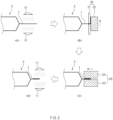
- FIG. 2 is a view illustrating a process of folding a sealing part of a pouch type secondary battery in a state in which non-contact heating is performed in a heating process according to the present invention. That is, FIG. 2 is a view illustrating operations in which a first heating process ⁇ A>, a first folding process ⁇ B>, a second folding process ⁇ C>, and a second heating process ⁇ D> are performed.
- FIG. 3 is a view illustrating operations in which subsequent processes (a third folding process ⁇ E>, a fourth folding process ⁇ F>, and a taping process ⁇ G>) are performed after the processes illustrated in FIG. 2 are performed.
- the folding method according to the present invention is performed by repeating each of the heating process and the folding process multiple times.
- the first heating process ⁇ A> is performed in a state in which the sealing part 1 is spread to be flat.
- the heating lamp 11 In a state in which the heating lamp 11 is disposed at each of an upper side and a lower side of the sealing part 1, the heating lamp 11 emits infrared light onto a surface at each of the upper side and the lower side of the sealing part 1 so as to heat the sealing part 1 to a predetermined temperature.
- the infrared light emitted in this embodiment may be near-infrared light that belongs to the shortest wavelength range.
- the near-infrared light is infrared light having a wavelength range of 750 nm to 4 um, and has advantages that the heating may be performed for a relatively short time and worker's safety may be secured even during prolonged exposure, when compared to mid-infrared light or far-infrared light.
- the heating may be performed by emitting ultraviolet light having a shorter wavelength in place of the infrared light, but the worker's safety may not be secured when the ultraviolet light is used.
- the present application provides, as a heat source, the near-infrared light having high heating efficiency and capable of securing the safety.
- a halogen lamp, an LED lamp, a diode lamp, or the like, which is capable of emitting the near-infrared light may be used as the heating lamp.
- the sealing part 1 includes a layer made of a thermoplastic resin, and the thermoplastic resin is polypropylene. Thus, when the heat is applied, the sealing part 1 increases in flexibility (becomes more flexible).
- the folding process is performed.
- the folding process may be performed by a folding part 20 included in a folding apparatus to be described later.
- the folding part 20 includes fixing parts 21 and 23, each of which fixes a point at which the sealing part 1 is bent when the folding is performed, and pressing parts 22 and 24, each of which presses the sealing part 1 in a direction in which the folding is performed.
- the folding process of the sealing part 1 is performed so that each of the pressing parts 22 and 24 is slid so that a predetermined point of the sealing part 1 is bent in a state in which each of the fixing parts 21 and 23 supports the sealing part to fix the sealing part.
- the folding process may be performed by being divided into multiple times, the first folding process ⁇ B> and the second folding process ⁇ C>, illustrated in FIG. 2 , and the third folding process ⁇ E> and the fourth folding process ⁇ F>, illustrated in FIG. 3 . That is, the folding processes may be selectively canceled, repeated, or added according to the length and the thickness of the sealing part 1.
- each of the fixing parts 21 and 23 and the pressing parts 22 and 24 may be provided as a different type of device according to each of the folding processes.
- the fixing part 21 in the folding process ⁇ B>, in order to bend the sealing part 1 at a right angle, the fixing part 21 may be provided in the form of a plate having a slit or hole recessed therein and, when the sealing part enters the slit or hole, the pressing part 22 may be slid vertically to fold the sealing part at an angle of 90°.
- the fixing part 23 may be provided to support a bottom surface of the sealing part 1 (in the form of a plate or a block), and the pressing part 24 may be slid on the fixing part 23 horizontally (in the left and right direction in FIG. 2 ) to fold the sealing part at an angle of 180°.
- the sealing part 1 is cooled to a predetermined temperature or lower while the folding process is performed, the second heating process ⁇ D> is performed.
- the third folding process ⁇ E> is performed in a manner similar to that of the first folding process ⁇ B> and then, the fourth folding process ⁇ F> is selectively performed in order to maintain a shape of the folded portion or to adjust the folding angle.
- a taping process of attaching a fixing tape 30 is performed so that the sealing part folded is fixed, after the folding process is completed.
- the heating process is performed twice while the folding process is performed, the heating process may be added or performed only once as necessary while the folding process is performed.
- At least one of the multiple heating processes is performed as a non-contact heating process of emitting light onto the sealing part 1 through the heating lamp 11 to heat the sealing part 1 (here, when the heating process is performed once, the non-contact heating process is performed).
- the heating process may further include a contact heating process of allowing the heating blocks 12a and 12b heated to be in contact with and heat the sealing part 1, so that appropriate pressure is applied during the heating of the sealing part 1.
- contact heating process is performed and then, the non-contact heating process is performed, or the non-contact heating process is performed and then, the contact heating process is performed.
- one of the contact heating process and the non-contact heating process is performed and then, some of the folding process are performed, and the other of the contact heating process and the non-contact heating process is performed and then, the rest of the folding process are performed.
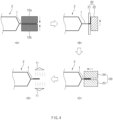
- FIG. 4 is a view illustrating a process of folding the sealing part through the same process as that in FIG. 2 , wherein contact heating is performed in a first heating process, and non-contact heating is performed in a second heating process.
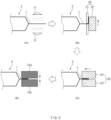
- FIG. 5 is a view illustrating a process of folding the sealing part through the same process as that in FIG. 2 , wherein the non-contact heating is performed in a first heating process, and the contact heating is performed in a second heating process.
- the heating process is performed multiple times, and, as illustrated in FIG. 4 , the contact heating process through the heating blocks 12a and 12b may be first performed and then, some of the folding process may be performed, and the non-contact heating process of emitting light onto the sealing part 1 through the heating lamp 11 to heat the sealing part 1 may be performed in this state and then, the rest of the folding process may be sequentially performed.
- the non-contact heating process may be first performed and then, some of the folding process may be performed, and the contact heating process may be performed in such a state and then, the rest of the folding process may be performed.
- the folding method provided in the first embodiment may be performed as the non-contact heating process at least once while the multiple heating processes are performed, and the contact heating process may be selectively included.
- the present invention provides an apparatus for folding a sealing part 1 of a pouch type secondary battery as a second embodiment.
- the folding apparatus according to the present invention is an apparatus for folding a sealing part of a pouch type secondary battery in which the sealing part protrudes in a lateral direction of a pouch an electrode assembly embedded therein.
- the apparatus is configured by including a heating part and a folding part 20.
- the heating part is configured to heat the sealing part 1 to a predetermined temperature, and includes a heating lamp 11 that emits light onto the sealing part 1 to heat the sealing part 1.
- the heating lamp 11 is disposed at each of an upper side and a lower side of the sealing part 1 so as to heat a top surface and a bottom surface of the sealing part 1 at the same time.
- the heating part provided in this embodiment may further include heating blocks 12a and 12b in addition to the heating lamp 11 that emits light onto the sealing part to heat the sealing part.
- the heating blocks 12a and 12b include an upper mold 12a and a lower mold 12b that are slidable to be away from or close to each other. At least one of the upper mold 12a or the lower mold 12b is heated to a predetermined temperature to be in contact with and heat the sealing part 1 when the sealing part 1 enters between the upper mold 12a and the lower mold 12b.
- the upper mold 12a and the lower mold 12b may apply appropriate pressure to the sealing part 1.
- heating lamp 11 and each of the heating blocks 12a and 12b are configured to be slidable to be exchanged with each other.
- the folding part 20 is configured to press and fold the heated sealing part 1.
- the folding part includes fixing parts 21 and 23, each of which fixes a point at which the sealing part is bent when the folding is performed, and pressing parts 22 and 24, each of which presses the sealing part 1 in a direction in which the folding is performed.
- each of the fixing parts 21 and 23 may be provided in the form of a plate having a slit or hole recessed therein so that the sealing part enters to efficiently fix the sealing part (as described above).
- the fixing part may be provided in the form of a plate or a block so as to support the bottom surface of the sealing part while the sealing part is folded at an angle of 180°.
- the pressing parts 22 and 24 may be configured to be slidable to apply appropriate pressure in various directions so that the folding is performed according to a rotation position of the sealing part 1.
- the present invention having the technical features as above may resolve the problems of the related art that the pressure is applied to the sealing part 1 to cause the damage because the heating lamp 11 emits the infrared light onto the sealing part 1 to perform the heating.
- the heating temperature may be uniformly maintained and thus, the sealing quality of the sealing part 1 may be maintained to be consistent.
- the contact heating of allowing the heated heating blocks 12a and 12b to be in contact with and heat the sealing part 1 may be performed and thus, the heating may be performed while applying the appropriate pressure to the sealing part 1.
- the contact heating is additionally performed before and after the non-contact heating is performed, the pressure applied to the sealing part 1 may be reduced compared to the method according to the related art. Thus, the damage to the sealing part 1 may be prevented.
Landscapes
- Engineering & Computer Science (AREA)
- Mechanical Engineering (AREA)
- Chemical Kinetics & Catalysis (AREA)
- Chemical & Material Sciences (AREA)
- Electrochemistry (AREA)
- General Chemical & Material Sciences (AREA)
- Physics & Mathematics (AREA)
- Electromagnetism (AREA)
- Manufacturing & Machinery (AREA)
- Health & Medical Sciences (AREA)
- Toxicology (AREA)
- Package Closures (AREA)
- Lining Or Joining Of Plastics Or The Like (AREA)
- Sealing Battery Cases Or Jackets (AREA)
Abstract
Description
- The present application claims the benefit of the priority of
Korean Patent Application No. 10-2022-0015836, filed on February 07, 2022 - The present invention relates to an apparatus and method for folding a sealing part provided along an edge of a pouch type secondary battery, and more particularly, to an apparatus and method for folding a sealing part of a pouch type secondary battery, which is capable of solving a problem of a structure according to the related art, in which excessive pressure is applied to the sealing part to cause damage to the sealing part.
- A demand for secondary batteries as energy sources rapidly increases in several fields including personal digital assistants and electric vehicles.
- The secondary batteries that are chargeable and dischargeable unlike primary batteries are developed not only for use in digital devices but also for use in transport means such as electric vehicles.
- The secondary batteries may be variously classified according to materials of a positive electrode and a negative electrode and outer shapes. Among the secondary batteries, lithium secondary batteries using lithium compounds are widely used in place of typical nickel-cadmium secondary batteries, etc., because of their large capacity and low self-discharge rate.
- In addition, the lithium secondary batteries may be manufacture in various forms, and it is common to be representatively manufactured in a cylinder type, a prismatic type, and a pouch type.
- Among the types, a pouch type secondary battery includes a pouch, and an electrode assembly that is embedded in the pouch to charge and discharge electric energy.
- The electrode assembly is configured so that a negative electrode and a positive electrode are alternately stacked together with a separator, and is manufactured so that an electrode tab, which is constituted by a negative electrode tab protruding from the negative electrode and a positive electrode tab protruding from the positive electrode, is bonded to an electrode lead and an end at one side of the electrode lead protrudes to the outside of the pouch. Here, according to a method for manufacturing the positive electrode and the negative electrode, the positive electrode tab and the negative electrode tab may be disposed at opposite sides to each other or may be disposed to be spaced apart from each other at the same side.
- The pouch is manufactured to have a structure that is divisible into two portions so as to cover one side surface and the other side surface of the electrode assembly and accommodate the electrode assembly (e.g., a structure that is divisible into an upper portion and a lower portion) . When the electrode assembly and an electrolyte are mounted in the pouch, the two portions divided are bonded to each other to form a
sealing part 1. - For example, the
pouch 2 may be manufactured so that a groove having a shape recessed with a predetermined size is defined in each of the upper portion and the lower portion thereof to accommodate the electrode assembly, and an edge of the groove is provided to be flat along a circumference. - Thus, when the electrode assembly is mounted and then the upper portion and the lower portion of the
pouch 2 are closed, the respective edges of the upper and lower portions are in contact with each other, and the sealingpart 1, at which the edges are thermally fused and sealed to each other in this state, is provided along an edge of thepouch 2. - Referring to
FIG. 1 , which illustrates a process of folding a sealing part of a pouch type secondary battery according to the related art, performed, the sealingpart 1 of thepouch 2 is heated throughheating blocks heating blocks upper mold 3a and alower mold 3b so as to be away from or close to each other, and theupper mold 3a and thelower mold 3b are provided in a state of being heated to a predetermined temperature. - When the sealing
part 1 enters between theupper mold 3a and thelower mold 3b, theupper mold 3a and thelower mold 3b press and heat the sealingpart 1 up and down so as to thermally fuse thesealing part 1. Theupper mold 3a is configured to be slid laterally (a left and right direction inFIG. 1 ) to fold the sealingpart 1 in a state in which thelower mold 3b supports thesealing part 1 from below thesealing part 1. Alternatively, the sealingpart 1 may be separated from the heating blocks and then folded through a separate folding device (not shown). - However, there is a likelihood that such a heating method through the pressing by the
upper mold 3a and thelower mold 3b causes damage such as dielectric breakdown, to a synthetic resin layer made of a thermoplastic resin, which is included in thepouch 1. Moreover, there is a problem that as theheating blocks - Thus, a main object of the present invention is to provide an apparatus and method for folding a sealing part of a pouch type secondary battery, which is capable of solving a problem that a synthetic resin layer is damaged by pressure occurring by direct contact when heating the sealing part, and heating the sealing part while maintaining a uniform temperature.
- The present invention for achieving the object as described above is to provide an apparatus and method for folding a sealing part of a pouch type secondary battery in which the sealing part protrudes laterally (a left and right direction in the drawings) along an edge of a pouch having an electrode assembly embedded therein.
- A folding method according to the present invention is a method for folding a sealing part of a pouch type secondary battery. The method includes: a sealing part heating process of heating the sealing part; and a folding process of pressing and folding the heated sealing part, wherein the heating process includes a non-contact heating process of emitting light onto the sealing part through a heating lamp to heat the sealing part.
- The sealing part includes a layer made of a thermoplastic resin, and the thermoplastic resin is polypropylene.
- The light emitted from the heating lamp is infrared light.
- The heating process includes a contact heating process of allowing heated heating blocks to be in contact with and to heat the sealing part.
- In the heating process, the non-contact heating process is performed and then, the contact heating process is performed, or the contact heating process is performed and then, the non-contact heating process is performed.
- Here, one of the contact heating process and the non-contact heating process is first performed and then, some of the folding process are performed, and the other of the contact heating process and the non-contact heating process is performed and then, the rest of the folding process are performed.
- In the heating process, the non-contact heating process of emitting the light onto the sealing part through the heating lamp to heat the sealing part is performed multiple times, wherein the non-contact heating process is first performed and then, some of the folding process are performed, and the non-contact heating process is performed again in such a state and then, the rest of the folding process are performed.
- The method includes, after the folding process is completed, a taping process of attaching a fixing tape so that the folded sealing part is fixed.
- A folding apparatus according to the present invention is an apparatus for folding a sealing part of a pouch type secondary battery in which the sealing part protrudes in a lateral direction of a pouch having an electrode assembly embedded therein. The apparatus includes: a heating part that heats the sealing part; and a folding part that presses and folds the heated sealing part, wherein the heating part includes a heating lamp that emits light onto the sealing part to heat the sealing part. Here, the heating lamp is disposed at each of an upper side and a lower side of the sealing part so as to heat a top surface and a bottom surface of the sealing part at the same time.
- The heating part includes a heating block including an upper mold and a lower mold, which are slidable to be away from or close to each other, wherein at least one of the upper mold or the lower mold is heated to a predetermined temperature to be in contact with and heat the sealing part when the sealing part enters between the upper mold and the lower mold. Here, the heating lamp and the heating block are configured to be slidable to be exchanged with each other.
- The folding part includes: a fixing part that fixes a point at which the sealing part is bent when the folding is performed; and a pressing part that presses the sealing part in a direction in which the folding is performed.
- The present invention having the technical features as above may resolve the problems of the related art that the pressure is applied to the sealing part (by the direct contact of the heating block) to cause the damage because the heating lamp emits the infrared light onto the sealing part to perform the heating.
- In addition, when compared to the contact heating method according to the related art, the heating temperature may be uniformly maintained and thus, the sealing quality of the sealing part may be maintained to be consistent.
- Moreover, in the present invention, the contact heating of allowing the heated heating blocks to be in contact with and heat the sealing part may be performed and thus, the heating may be performed while applying the appropriate pressure to the sealing part. Here, as the contact heating is additionally performed before and after the non-contact heating is performed, the pressure applied to the sealing part may be reduced compared to the method according to the related art. Thus, the damage to the sealing part may be prevented.
-
-
FIG. 1 is a view illustrating a process of folding a sealing part of a pouch type secondary battery according to the related art. -
FIG. 2 is a view illustrating a process of folding a sealing part of a pouch type secondary battery in a state in which non-contact heating is performed in a heating process according to the present invention. -
FIG. 3 is a view illustrating a process in which subsequent processes are performed after the processes illustrated inFIG. 2 are performed. -
FIG. 4 is a view illustrating a process of folding the sealing part through the same process as that inFIG. 2 , wherein contact heating is performed in a first heating process, and non-contact heating is performed in a second heating process. -
FIG. 5 is a view illustrating a process of folding the sealing part through the same process as that inFIG. 2 , wherein the non-contact heating is performed in a first heating process, and the contact heating is performed in a second heating process. - Hereinafter, the present invention will be described in detail with reference to the accompanying drawings to enable those skilled in the art to which the present invention pertains to easily carry out the present invention. The present invention may, however, be embodied in different forms and should not be construed as limited to the embodiments set forth herein.
- The parts unrelated to the description will be ruled out in order to clearly describe the present invention. Like reference numerals refer to like elements throughout the whole specification.
- Moreover, terms or words used in this specification and claims should not be restrictively interpreted as ordinary meanings or dictionary-based meanings, but should be interpreted as meanings and concepts conforming to the scope of the present invention on the basis of the principle that an inventor can properly define the concept of a term to describe and explain his or her invention in the best ways.
- The present invention relates to a method and apparatus for folding a sealing part of a pouch type secondary battery in which a sealing
part 1 protrudes laterally (in a left and right direction inFIG. 2 ) along a circumference of apouch 2 having an electrode assembly embedded therein. Hereinafter, embodiments according to the present invention will be described in more detail with reference to the accompanying drawings. - The present invention provides a method for folding a sealing
part 1 of a pouch type secondary battery as a first embodiment. - The folding method according to the present invention includes a heating process and a folding process, and the heating process includes a non-contact heating process in which the sealing
part 1 is not in direct contact with a heat source. - The heating process is a process of heating the
sealing part 1 to a predetermined temperature, and is performed at least two times while the folding method provided in this embodiment is performed. Here, at least one heating process is performed as the non-contact heating process of emitting light onto the sealingpart 1 through aheating lamp 11 to heat the sealingpart 1. Theheating lamp 11 described herein is regarded as a heating lamp capable of providing an output to heat the sealingpart 1 to a predetermined temperature and uniformly emitting light onto the entirety of the sealingpart 1, so as to heat the sealingpart 1 through radiant heat. -
FIG. 2 is a view illustrating a process of folding a sealing part of a pouch type secondary battery in a state in which non-contact heating is performed in a heating process according to the present invention. That is,FIG. 2 is a view illustrating operations in which a first heating process <A>, a first folding process <B>, a second folding process <C>, and a second heating process <D> are performed.FIG. 3 is a view illustrating operations in which subsequent processes (a third folding process <E>, a fourth folding process <F>, and a taping process <G>) are performed after the processes illustrated inFIG. 2 are performed. - As illustrated in the drawings, the folding method according to the present invention is performed by repeating each of the heating process and the folding process multiple times.
- The first heating process <A> is performed in a state in which the sealing
part 1 is spread to be flat. In a state in which theheating lamp 11 is disposed at each of an upper side and a lower side of the sealingpart 1, theheating lamp 11 emits infrared light onto a surface at each of the upper side and the lower side of the sealingpart 1 so as to heat the sealingpart 1 to a predetermined temperature. - Preferably, the infrared light emitted in this embodiment may be near-infrared light that belongs to the shortest wavelength range. The near-infrared light is infrared light having a wavelength range of 750 nm to 4 um, and has advantages that the heating may be performed for a relatively short time and worker's safety may be secured even during prolonged exposure, when compared to mid-infrared light or far-infrared light. The heating may be performed by emitting ultraviolet light having a shorter wavelength in place of the infrared light, but the worker's safety may not be secured when the ultraviolet light is used. Thus, the present application provides, as a heat source, the near-infrared light having high heating efficiency and capable of securing the safety. Thus, a halogen lamp, an LED lamp, a diode lamp, or the like, which is capable of emitting the near-infrared light, may be used as the heating lamp.
- Here, the sealing
part 1 includes a layer made of a thermoplastic resin, and the thermoplastic resin is polypropylene. Thus, when the heat is applied, the sealingpart 1 increases in flexibility (becomes more flexible). - In addition, when the sealing
part 1 is heated to a predetermined temperature, the folding process is performed. The folding process may be performed by afolding part 20 included in a folding apparatus to be described later. - The
folding part 20 includes fixingparts part 1 is bent when the folding is performed, andpressing parts part 1 in a direction in which the folding is performed. Thus, the folding process of the sealingpart 1 is performed so that each of thepressing parts part 1 is bent in a state in which each of the fixingparts - Here, according to the length and the thickness of the sealing
part 1 and according to the number of times of the folding, the folding process may be performed by being divided into multiple times, the first folding process <B> and the second folding process <C>, illustrated inFIG. 2 , and the third folding process <E> and the fourth folding process <F>, illustrated inFIG. 3 . That is, the folding processes may be selectively canceled, repeated, or added according to the length and the thickness of the sealingpart 1. - Each of the fixing
parts pressing parts part 1 at a right angle, the fixingpart 21 may be provided in the form of a plate having a slit or hole recessed therein and, when the sealing part enters the slit or hole, thepressing part 22 may be slid vertically to fold the sealing part at an angle of 90°. - In addition, in the second folding process, for the sealing
part 1 to be folded at an angle of 180°, the fixingpart 23 may be provided to support a bottom surface of the sealing part 1 (in the form of a plate or a block), and thepressing part 24 may be slid on the fixingpart 23 horizontally (in the left and right direction inFIG. 2 ) to fold the sealing part at an angle of 180°. - When the sealing
part 1 is cooled to a predetermined temperature or lower while the folding process is performed, the second heating process <D> is performed. - Thereafter, the third folding process <E> is performed in a manner similar to that of the first folding process <B> and then, the fourth folding process <F> is selectively performed in order to maintain a shape of the folded portion or to adjust the folding angle.
- Lastly, a taping process of attaching a fixing
tape 30 is performed so that the sealing part folded is fixed, after the folding process is completed. - Although it is described in this embodiment that the heating process is performed twice while the folding process is performed, the heating process may be added or performed only once as necessary while the folding process is performed.
- However, at least one of the multiple heating processes is performed as a non-contact heating process of emitting light onto the sealing
part 1 through theheating lamp 11 to heat the sealing part 1 (here, when the heating process is performed once, the non-contact heating process is performed). - However, the heating process may further include a contact heating process of allowing the heating blocks 12a and 12b heated to be in contact with and heat the sealing
part 1, so that appropriate pressure is applied during the heating of the sealingpart 1. - That is, in the heating process provided in this embodiment, contact heating process is performed and then, the non-contact heating process is performed, or the non-contact heating process is performed and then, the contact heating process is performed.
- Here, one of the contact heating process and the non-contact heating process is performed and then, some of the folding process are performed, and the other of the contact heating process and the non-contact heating process is performed and then, the rest of the folding process are performed.
-
FIG. 4 is a view illustrating a process of folding the sealing part through the same process as that inFIG. 2 , wherein contact heating is performed in a first heating process, and non-contact heating is performed in a second heating process.FIG. 5 is a view illustrating a process of folding the sealing part through the same process as that inFIG. 2 , wherein the non-contact heating is performed in a first heating process, and the contact heating is performed in a second heating process. - That is, the heating process is performed multiple times, and, as illustrated in
FIG. 4 , the contact heating process through the heating blocks 12a and 12b may be first performed and then, some of the folding process may be performed, and the non-contact heating process of emitting light onto the sealingpart 1 through theheating lamp 11 to heat the sealingpart 1 may be performed in this state and then, the rest of the folding process may be sequentially performed. - Alternatively, as illustrated in
FIG. 5 , the non-contact heating process may be first performed and then, some of the folding process may be performed, and the contact heating process may be performed in such a state and then, the rest of the folding process may be performed. - That is, the folding method provided in the first embodiment may be performed as the non-contact heating process at least once while the multiple heating processes are performed, and the contact heating process may be selectively included.
- The present invention provides an apparatus for folding a sealing
part 1 of a pouch type secondary battery as a second embodiment. The folding apparatus according to the present invention is an apparatus for folding a sealing part of a pouch type secondary battery in which the sealing part protrudes in a lateral direction of a pouch an electrode assembly embedded therein. The apparatus is configured by including a heating part and afolding part 20. - The heating part is configured to heat the sealing
part 1 to a predetermined temperature, and includes aheating lamp 11 that emits light onto the sealingpart 1 to heat the sealingpart 1. Theheating lamp 11 is disposed at each of an upper side and a lower side of the sealingpart 1 so as to heat a top surface and a bottom surface of the sealingpart 1 at the same time. - In more detail, the heating part provided in this embodiment may further include
heating blocks heating lamp 11 that emits light onto the sealing part to heat the sealing part. - The heating blocks 12a and 12b include an
upper mold 12a and alower mold 12b that are slidable to be away from or close to each other. At least one of theupper mold 12a or thelower mold 12b is heated to a predetermined temperature to be in contact with and heat the sealingpart 1 when the sealingpart 1 enters between theupper mold 12a and thelower mold 12b. Here, theupper mold 12a and thelower mold 12b may apply appropriate pressure to the sealingpart 1. - In addition, the
heating lamp 11 and each of the heating blocks 12a and 12b are configured to be slidable to be exchanged with each other. - In addition, the
folding part 20 is configured to press and fold theheated sealing part 1. As described above, the folding part includes fixingparts pressing parts part 1 in a direction in which the folding is performed. - According to the length and the thickness of the sealing
part 1 and according to the number of times of folding, each of the fixingparts - The
pressing parts part 1. - The present invention having the technical features as above may resolve the problems of the related art that the pressure is applied to the sealing
part 1 to cause the damage because theheating lamp 11 emits the infrared light onto the sealingpart 1 to perform the heating. - In addition, when compared to the contact heating method according to the related art, the heating temperature may be uniformly maintained and thus, the sealing quality of the sealing
part 1 may be maintained to be consistent. - Moreover, in the present invention, the contact heating of allowing the
heated heating blocks part 1 may be performed and thus, the heating may be performed while applying the appropriate pressure to the sealingpart 1. Here, as the contact heating is additionally performed before and after the non-contact heating is performed, the pressure applied to the sealingpart 1 may be reduced compared to the method according to the related art. Thus, the damage to the sealingpart 1 may be prevented. - Although the present invention has been described with reference to the limited embodiments and drawings, the present invention is not limited thereto and may be variously implemented by those of ordinary skill in the art to which the present invention pertains, within the technical idea of the present invention and an equivalent of the appended claims.
-
- 1: Sealing part
- 11: Heating lamp
- 12a: Upper mold
- 12b: Lower mold
- 20: Folding part
- 21, 23: Fixing part
- 22, 24: Pressing part
Claims (13)
- A method for folding a sealing part of a pouch type secondary battery in which the sealing part protrudes in a lateral direction of a pouch having an electrode assembly embedded therein, the method comprising:a sealing part heating process of heating the sealing part; anda folding process of pressing and folding the heated sealing part,wherein the heating process comprises a non-contact heating process of emitting light onto the sealing part through a heating lamp to heat the sealing part.
- The method of claim 1, wherein the sealing part comprises a layer made of a thermoplastic resin.
- The method of claim 2, wherein the thermoplastic resin is polypropylene.
- The method of claim 1, wherein the light emitted from the heating lamp is infrared light.
- The method of claim 1, wherein the heating process comprises a contact heating process of allowing heated heating blocks to be in contact with and to heat the sealing part.
- The method of claim 5, wherein, in the heating process, the contact heating process is performed and then, the non-contact heating process is performed.
- The method of claim 5, wherein, in the heating process, the non-contact heating process is performed and then, the contact heating process is performed.
- The method of claim 6 or 7, wherein one of the contact heating process and the non-contact heating process is performed and then, some of the folding process are performed, and
the other of the contact heating process and the non-contact heating process is performed and then, the rest of the folding process are performed. - The method of claim 1, wherein, in the heating process, the non-contact heating process of emitting the light onto the sealing part through the heating lamp to heat the sealing part is performed multiple times,
wherein the non-contact heating process is performed and then, some of the folding process are performed, and the non-contact heating process is performed again in this state and then, the rest of the folding process are performed. - The method of any one of claims 1 to 7 and 9, further comprising, after the folding process is completed, a taping process of attaching a fixing tape so that the folded sealing part is fixed.
- An apparatus for folding a sealing part of a pouch type secondary battery in which the sealing part protrudes in a lateral direction of a pouch having an electrode assembly embedded therein, the apparatus comprising:a heating part configured to heat the sealing part; anda folding part configured to press and fold the heated sealing part,wherein the heating part comprises a heating lamp configured to emit light onto and heat the sealing part.
- The apparatus of claim 11, wherein the heating part comprises a heating block comprising an upper mold and a lower mold, which are slidable to be away from or close to each other, wherein at least one of the upper mold or the lower mold is heated to a predetermined temperature so as to be in contact with and heat the sealing part when the sealing part enters between the upper mold and the lower mold,
wherein the heating lamp and the heating block are slidable to be exchanged with each other. - The apparatus of claim 11, wherein the folding part comprises:a fixing part configured to fix a point at which the sealing part is bent when the folding is performed; anda pressing part configured to press the sealing part in a direction in which the folding is performed.
Applications Claiming Priority (2)
| Application Number | Priority Date | Filing Date | Title |
|---|---|---|---|
| KR1020220015836A KR20230119552A (en) | 2022-02-07 | 2022-02-07 | Apparatus and method for folding sealing part of a pouch-type secondary battery |
| PCT/KR2023/001539 WO2023149729A1 (en) | 2022-02-07 | 2023-02-02 | Folding device and folding method for pouch-type secondary battery sealing portion |
Publications (2)
| Publication Number | Publication Date |
|---|---|
| EP4477389A1 true EP4477389A1 (en) | 2024-12-18 |
| EP4477389A4 EP4477389A4 (en) | 2025-05-14 |
Family
ID=87552650
Family Applications (1)
| Application Number | Title | Priority Date | Filing Date |
|---|---|---|---|
| EP23749962.9A Pending EP4477389A4 (en) | 2022-02-07 | 2023-02-02 | FOLDING DEVICE AND FOLDING METHOD FOR SEALING PART OF POCKET-TYPE SECONDARY BATTERY |
Country Status (6)
| Country | Link |
|---|---|
| US (1) | US20250201894A1 (en) |
| EP (1) | EP4477389A4 (en) |
| JP (1) | JP7797767B2 (en) |
| KR (1) | KR20230119552A (en) |
| CN (1) | CN118574721A (en) |
| WO (1) | WO2023149729A1 (en) |
Families Citing this family (3)
| Publication number | Priority date | Publication date | Assignee | Title |
|---|---|---|---|---|
| EP4446095B1 (en) * | 2022-09-22 | 2025-12-31 | LG Energy Solution, Ltd. | DEVICE AND METHOD FOR FOLDING THE SEALING SECTION OF A POUCH-STYLE BATTERY CELL |
| KR102720081B1 (en) | 2024-01-29 | 2024-10-22 | 이재완 | Standing pouch packaging apparatus |
| KR102694838B1 (en) | 2024-01-29 | 2024-08-14 | 이재완 | Pouch sealing device and standing pouch packaging apparatus having the same |
Family Cites Families (11)
| Publication number | Priority date | Publication date | Assignee | Title |
|---|---|---|---|---|
| JPS5876214A (en) * | 1981-11-02 | 1983-05-09 | Yoshino Kogyosho Co Ltd | Sealing process for synthetic resin tube container |
| JP3412057B2 (en) * | 1994-04-11 | 2003-06-03 | 株式会社吉野工業所 | Method and apparatus for molding seal portion of synthetic resin tube |
| JP2000223083A (en) * | 1999-01-27 | 2000-08-11 | Toshiba Battery Co Ltd | Exterior molding method and exterior molding apparatus for polymer battery |
| JP2005018990A (en) * | 2003-06-23 | 2005-01-20 | Ngk Spark Plug Co Ltd | Stacked lithium-ion secondary battery |
| KR102695825B1 (en) * | 2018-11-21 | 2024-08-19 | 주식회사 엘지에너지솔루션 | Pouch side processing apparatus and method of pouch type battery cell |
| KR102403858B1 (en) * | 2019-09-30 | 2022-06-02 | 에스케이온 주식회사 | Folding apparatus and method for pouch case of battery cell |
| US11695177B2 (en) * | 2019-09-30 | 2023-07-04 | Sk On Co., Ltd. | Apparatus and method of folding pouch case of battery cell |
| KR102851596B1 (en) * | 2019-10-22 | 2025-08-28 | 주식회사 엘지에너지솔루션 | Forming apparatus and method for pouch film for secondary battery |
| KR102132593B1 (en) * | 2020-01-23 | 2020-07-10 | 주식회사 와이에이치티 | Cell alignment device included in belt conveyor apparatus of folding system for processing terrace of secondary battery cell |
| KR102879175B1 (en) * | 2020-02-28 | 2025-11-03 | 에스케이온 주식회사 | Pouch type secondary battery sealing system and sealing method teherof |
| KR102292557B1 (en) * | 2021-04-01 | 2021-08-24 | 주식회사 에스에이치엘 | Double side folding apparatus for terrace of secondary battery and method thereof |
-
2022
- 2022-02-07 KR KR1020220015836A patent/KR20230119552A/en active Pending
-
2023
- 2023-02-02 JP JP2024546503A patent/JP7797767B2/en active Active
- 2023-02-02 WO PCT/KR2023/001539 patent/WO2023149729A1/en not_active Ceased
- 2023-02-02 EP EP23749962.9A patent/EP4477389A4/en active Pending
- 2023-02-02 CN CN202380020017.0A patent/CN118574721A/en active Pending
- 2023-02-02 US US18/836,297 patent/US20250201894A1/en active Pending
Also Published As
| Publication number | Publication date |
|---|---|
| JP2025505021A (en) | 2025-02-19 |
| US20250201894A1 (en) | 2025-06-19 |
| CN118574721A (en) | 2024-08-30 |
| JP7797767B2 (en) | 2026-01-14 |
| WO2023149729A1 (en) | 2023-08-10 |
| KR20230119552A (en) | 2023-08-16 |
| EP4477389A4 (en) | 2025-05-14 |
Similar Documents
| Publication | Publication Date | Title |
|---|---|---|
| US20250201894A1 (en) | Apparatus and method for folding sealing part of pouch type secondary battery | |
| US10892448B2 (en) | Pouch exterior for secondary battery, pouch-type secondary battery using the pouch exterior, and method of manufacturing the pouch-type secondary battery | |
| KR102347901B1 (en) | Pouch-Type Battery Case Having Structure to Prevent Crack and Method for Preparing the Same | |
| US10439258B2 (en) | Energy storage unit having a plurality of galvanic cells, battery cell for an energy storage unit of this kind, and method for producing the battery cell | |
| US12420489B2 (en) | Sealing apparatus for secondary battery | |
| KR20190010434A (en) | Pouch case for secondary battery, pouch type secondary battery and manufacturing method thereof using the same | |
| KR102248598B1 (en) | Curved secondary battery and manufacturing method thereof | |
| KR102191499B1 (en) | Sealing apparatus of pouch type secondary battery | |
| US20160380302A1 (en) | Curved secondary battery and manufacturing method thereof | |
| EP4434730A1 (en) | Battery case sealing device and battery case sealing method using same | |
| KR102455141B1 (en) | Electrode Assembly Manufacturing Method for Battery Cell of Secondary Battery | |
| CN114430866B (en) | Electrode assembly and method for manufacturing electrode assembly | |
| US20240322278A1 (en) | Secondary battery including pouch with gas adsorbent interposed therein and method for manufacturing same | |
| JP2024514898A (en) | Electrode assembly and battery cell including the same | |
| KR102464006B1 (en) | Cylindrical Secondary Battery Comprising More Than Two Jelly-Roll Type Electrode Assembly and Manufacturing Method Thereof | |
| US10818892B2 (en) | Secondary battery and method for manufacturing the same | |
| CN108496270B (en) | Secondary battery | |
| US20240258554A1 (en) | Electrode Assembly, Secondary Battery Including The Same, Method For Manufacturing The Secondary Battery, and Apparatus For Manufacturing The Secondary Battery | |
| KR102357772B1 (en) | Rechargeable battery | |
| EP4403336B1 (en) | Device and method for manufacturing secondary battery | |
| CN116964834A (en) | Methods used to form soft packs | |
| EP4024546A1 (en) | Electrode assembly and method for manufacturing same | |
| US20230369690A1 (en) | Secondary Battery And Method For Manufacturing The Same | |
| EP4160810A1 (en) | Method for manufacturing secondary battery, coupling clip for manufacturing secondary battery, and secondary battery | |
| US20250357586A1 (en) | Battery Case Sealing Device and Battery Case Sealing Method Using the Same |
Legal Events
| Date | Code | Title | Description |
|---|---|---|---|
| STAA | Information on the status of an ep patent application or granted ep patent |
Free format text: STATUS: THE INTERNATIONAL PUBLICATION HAS BEEN MADE |
|
| PUAI | Public reference made under article 153(3) epc to a published international application that has entered the european phase |
Free format text: ORIGINAL CODE: 0009012 |
|
| STAA | Information on the status of an ep patent application or granted ep patent |
Free format text: STATUS: REQUEST FOR EXAMINATION WAS MADE |
|
| 17P | Request for examination filed |
Effective date: 20240801 |
|
| AK | Designated contracting states |
Kind code of ref document: A1 Designated state(s): AL AT BE BG CH CY CZ DE DK EE ES FI FR GB GR HR HU IE IS IT LI LT LU LV MC ME MK MT NL NO PL PT RO RS SE SI SK SM TR |
|
| A4 | Supplementary search report drawn up and despatched |
Effective date: 20250411 |
|
| DAV | Request for validation of the european patent (deleted) | ||
| DAX | Request for extension of the european patent (deleted) | ||
| RIC1 | Information provided on ipc code assigned before grant |
Ipc: B29C 53/38 20060101ALN20250407BHEP Ipc: B29L 31/34 20060101ALN20250407BHEP Ipc: B29C 53/84 20060101ALI20250407BHEP Ipc: B29C 53/04 20060101ALI20250407BHEP Ipc: H01M 10/04 20060101ALI20250407BHEP Ipc: B29K 23/00 20060101ALI20250407BHEP Ipc: B29L 31/00 20060101ALI20250407BHEP Ipc: B29C 65/48 20060101ALI20250407BHEP Ipc: B29C 65/14 20060101ALI20250407BHEP Ipc: H01M 50/105 20210101ALI20250407BHEP Ipc: B29C 65/00 20060101AFI20250407BHEP |
|
| STAA | Information on the status of an ep patent application or granted ep patent |
Free format text: STATUS: EXAMINATION IS IN PROGRESS |
|
| RIC1 | Information provided on ipc code assigned before grant |
Ipc: B29C 65/00 20060101AFI20251222BHEP Ipc: H01M 50/105 20210101ALI20251222BHEP Ipc: B29C 65/14 20060101ALI20251222BHEP Ipc: B29C 65/48 20060101ALI20251222BHEP Ipc: B29L 31/00 20060101ALI20251222BHEP Ipc: B29K 23/00 20060101ALI20251222BHEP Ipc: H01M 10/04 20060101ALI20251222BHEP Ipc: B29C 53/04 20060101ALI20251222BHEP Ipc: B29C 53/84 20060101ALI20251222BHEP Ipc: B29L 31/34 20060101ALN20251222BHEP Ipc: B29C 53/38 20060101ALN20251222BHEP |
|
| RIC1 | Information provided on ipc code assigned before grant |
Ipc: B29C 65/00 20060101AFI20260113BHEP Ipc: H01M 50/105 20210101ALI20260113BHEP Ipc: B29C 65/14 20060101ALI20260113BHEP Ipc: B29C 65/48 20060101ALI20260113BHEP Ipc: B29L 31/00 20060101ALI20260113BHEP Ipc: B29K 23/00 20060101ALI20260113BHEP Ipc: H01M 10/04 20060101ALI20260113BHEP Ipc: B29C 53/04 20060101ALI20260113BHEP Ipc: B29C 53/84 20060101ALI20260113BHEP Ipc: B29L 31/34 20060101ALN20260113BHEP Ipc: B29C 53/38 20060101ALN20260113BHEP |
|
| 17Q | First examination report despatched |
Effective date: 20260121 |