EP4477271A2 - Compounds for inhibiting tnik and medical uses thereof - Google Patents
Compounds for inhibiting tnik and medical uses thereof Download PDFInfo
- Publication number
- EP4477271A2 EP4477271A2 EP24201292.0A EP24201292A EP4477271A2 EP 4477271 A2 EP4477271 A2 EP 4477271A2 EP 24201292 A EP24201292 A EP 24201292A EP 4477271 A2 EP4477271 A2 EP 4477271A2
- Authority
- EP
- European Patent Office
- Prior art keywords
- pyrazol
- amino
- alkyl
- phenyl
- methylphenyl
- Prior art date
- Legal status (The legal status is an assumption and is not a legal conclusion. Google has not performed a legal analysis and makes no representation as to the accuracy of the status listed.)
- Granted
Links
Images


Classifications
-
- A—HUMAN NECESSITIES
- A61—MEDICAL OR VETERINARY SCIENCE; HYGIENE
- A61P—SPECIFIC THERAPEUTIC ACTIVITY OF CHEMICAL COMPOUNDS OR MEDICINAL PREPARATIONS
- A61P35/00—Antineoplastic agents
- A61P35/02—Antineoplastic agents specific for leukemia
-
- A—HUMAN NECESSITIES
- A61—MEDICAL OR VETERINARY SCIENCE; HYGIENE
- A61K—PREPARATIONS FOR MEDICAL, DENTAL OR TOILETRY PURPOSES
- A61K31/00—Medicinal preparations containing organic active ingredients
- A61K31/33—Heterocyclic compounds
- A61K31/395—Heterocyclic compounds having nitrogen as a ring hetero atom, e.g. guanethidine or rifamycins
- A61K31/41—Heterocyclic compounds having nitrogen as a ring hetero atom, e.g. guanethidine or rifamycins having five-membered rings with two or more ring hetero atoms, at least one of which being nitrogen, e.g. tetrazole
- A61K31/415—1,2-Diazoles
-
- A—HUMAN NECESSITIES
- A61—MEDICAL OR VETERINARY SCIENCE; HYGIENE
- A61K—PREPARATIONS FOR MEDICAL, DENTAL OR TOILETRY PURPOSES
- A61K31/00—Medicinal preparations containing organic active ingredients
- A61K31/33—Heterocyclic compounds
- A61K31/395—Heterocyclic compounds having nitrogen as a ring hetero atom, e.g. guanethidine or rifamycins
- A61K31/41—Heterocyclic compounds having nitrogen as a ring hetero atom, e.g. guanethidine or rifamycins having five-membered rings with two or more ring hetero atoms, at least one of which being nitrogen, e.g. tetrazole
- A61K31/415—1,2-Diazoles
- A61K31/4155—1,2-Diazoles non condensed and containing further heterocyclic rings
-
- A—HUMAN NECESSITIES
- A61—MEDICAL OR VETERINARY SCIENCE; HYGIENE
- A61K—PREPARATIONS FOR MEDICAL, DENTAL OR TOILETRY PURPOSES
- A61K31/00—Medicinal preparations containing organic active ingredients
- A61K31/33—Heterocyclic compounds
- A61K31/395—Heterocyclic compounds having nitrogen as a ring hetero atom, e.g. guanethidine or rifamycins
- A61K31/41—Heterocyclic compounds having nitrogen as a ring hetero atom, e.g. guanethidine or rifamycins having five-membered rings with two or more ring hetero atoms, at least one of which being nitrogen, e.g. tetrazole
- A61K31/425—Thiazoles
- A61K31/427—Thiazoles not condensed and containing further heterocyclic rings
-
- A—HUMAN NECESSITIES
- A61—MEDICAL OR VETERINARY SCIENCE; HYGIENE
- A61K—PREPARATIONS FOR MEDICAL, DENTAL OR TOILETRY PURPOSES
- A61K31/00—Medicinal preparations containing organic active ingredients
- A61K31/33—Heterocyclic compounds
- A61K31/395—Heterocyclic compounds having nitrogen as a ring hetero atom, e.g. guanethidine or rifamycins
- A61K31/435—Heterocyclic compounds having nitrogen as a ring hetero atom, e.g. guanethidine or rifamycins having six-membered rings with one nitrogen as the only ring hetero atom
- A61K31/44—Non condensed pyridines; Hydrogenated derivatives thereof
- A61K31/4427—Non condensed pyridines; Hydrogenated derivatives thereof containing further heterocyclic ring systems
- A61K31/4439—Non condensed pyridines; Hydrogenated derivatives thereof containing further heterocyclic ring systems containing a five-membered ring with nitrogen as a ring hetero atom, e.g. omeprazole
-
- A—HUMAN NECESSITIES
- A61—MEDICAL OR VETERINARY SCIENCE; HYGIENE
- A61K—PREPARATIONS FOR MEDICAL, DENTAL OR TOILETRY PURPOSES
- A61K31/00—Medicinal preparations containing organic active ingredients
- A61K31/33—Heterocyclic compounds
- A61K31/395—Heterocyclic compounds having nitrogen as a ring hetero atom, e.g. guanethidine or rifamycins
- A61K31/435—Heterocyclic compounds having nitrogen as a ring hetero atom, e.g. guanethidine or rifamycins having six-membered rings with one nitrogen as the only ring hetero atom
- A61K31/44—Non condensed pyridines; Hydrogenated derivatives thereof
- A61K31/445—Non condensed piperidines, e.g. piperocaine
- A61K31/4523—Non condensed piperidines, e.g. piperocaine containing further heterocyclic ring systems
- A61K31/454—Non condensed piperidines, e.g. piperocaine containing further heterocyclic ring systems containing a five-membered ring with nitrogen as a ring hetero atom, e.g. pimozide, domperidone
-
- A—HUMAN NECESSITIES
- A61—MEDICAL OR VETERINARY SCIENCE; HYGIENE
- A61K—PREPARATIONS FOR MEDICAL, DENTAL OR TOILETRY PURPOSES
- A61K31/00—Medicinal preparations containing organic active ingredients
- A61K31/33—Heterocyclic compounds
- A61K31/395—Heterocyclic compounds having nitrogen as a ring hetero atom, e.g. guanethidine or rifamycins
- A61K31/495—Heterocyclic compounds having nitrogen as a ring hetero atom, e.g. guanethidine or rifamycins having six-membered rings with two or more nitrogen atoms as the only ring heteroatoms, e.g. piperazine or tetrazines
- A61K31/496—Non-condensed piperazines containing further heterocyclic rings, e.g. rifampin, thiothixene or sparfloxacin
-
- A—HUMAN NECESSITIES
- A61—MEDICAL OR VETERINARY SCIENCE; HYGIENE
- A61K—PREPARATIONS FOR MEDICAL, DENTAL OR TOILETRY PURPOSES
- A61K31/00—Medicinal preparations containing organic active ingredients
- A61K31/33—Heterocyclic compounds
- A61K31/395—Heterocyclic compounds having nitrogen as a ring hetero atom, e.g. guanethidine or rifamycins
- A61K31/535—Heterocyclic compounds having nitrogen as a ring hetero atom, e.g. guanethidine or rifamycins having six-membered rings with at least one nitrogen and one oxygen as the ring hetero atoms, e.g. 1,2-oxazines
- A61K31/5375—1,4-Oxazines, e.g. morpholine
- A61K31/5377—1,4-Oxazines, e.g. morpholine not condensed and containing further heterocyclic rings, e.g. timolol
-
- A—HUMAN NECESSITIES
- A61—MEDICAL OR VETERINARY SCIENCE; HYGIENE
- A61P—SPECIFIC THERAPEUTIC ACTIVITY OF CHEMICAL COMPOUNDS OR MEDICINAL PREPARATIONS
- A61P35/00—Antineoplastic agents
-
- A—HUMAN NECESSITIES
- A61—MEDICAL OR VETERINARY SCIENCE; HYGIENE
- A61P—SPECIFIC THERAPEUTIC ACTIVITY OF CHEMICAL COMPOUNDS OR MEDICINAL PREPARATIONS
- A61P35/00—Antineoplastic agents
- A61P35/04—Antineoplastic agents specific for metastasis
-
- C—CHEMISTRY; METALLURGY
- C07—ORGANIC CHEMISTRY
- C07D—HETEROCYCLIC COMPOUNDS
- C07D231/00—Heterocyclic compounds containing 1,2-diazole or hydrogenated 1,2-diazole rings
- C07D231/02—Heterocyclic compounds containing 1,2-diazole or hydrogenated 1,2-diazole rings not condensed with other rings
- C07D231/10—Heterocyclic compounds containing 1,2-diazole or hydrogenated 1,2-diazole rings not condensed with other rings having two or three double bonds between ring members or between ring members and non-ring members
- C07D231/14—Heterocyclic compounds containing 1,2-diazole or hydrogenated 1,2-diazole rings not condensed with other rings having two or three double bonds between ring members or between ring members and non-ring members with hetero atoms or with carbon atoms having three bonds to hetero atoms with at the most one bond to halogen, e.g. ester or nitrile radicals, directly attached to ring carbon atoms
- C07D231/38—Nitrogen atoms
-
- C—CHEMISTRY; METALLURGY
- C07—ORGANIC CHEMISTRY
- C07D—HETEROCYCLIC COMPOUNDS
- C07D401/00—Heterocyclic compounds containing two or more hetero rings, having nitrogen atoms as the only ring hetero atoms, at least one ring being a six-membered ring with only one nitrogen atom
- C07D401/02—Heterocyclic compounds containing two or more hetero rings, having nitrogen atoms as the only ring hetero atoms, at least one ring being a six-membered ring with only one nitrogen atom containing two hetero rings
- C07D401/04—Heterocyclic compounds containing two or more hetero rings, having nitrogen atoms as the only ring hetero atoms, at least one ring being a six-membered ring with only one nitrogen atom containing two hetero rings directly linked by a ring-member-to-ring-member bond
-
- C—CHEMISTRY; METALLURGY
- C07—ORGANIC CHEMISTRY
- C07D—HETEROCYCLIC COMPOUNDS
- C07D401/00—Heterocyclic compounds containing two or more hetero rings, having nitrogen atoms as the only ring hetero atoms, at least one ring being a six-membered ring with only one nitrogen atom
- C07D401/02—Heterocyclic compounds containing two or more hetero rings, having nitrogen atoms as the only ring hetero atoms, at least one ring being a six-membered ring with only one nitrogen atom containing two hetero rings
- C07D401/10—Heterocyclic compounds containing two or more hetero rings, having nitrogen atoms as the only ring hetero atoms, at least one ring being a six-membered ring with only one nitrogen atom containing two hetero rings linked by a carbon chain containing aromatic rings
-
- C—CHEMISTRY; METALLURGY
- C07—ORGANIC CHEMISTRY
- C07D—HETEROCYCLIC COMPOUNDS
- C07D401/00—Heterocyclic compounds containing two or more hetero rings, having nitrogen atoms as the only ring hetero atoms, at least one ring being a six-membered ring with only one nitrogen atom
- C07D401/14—Heterocyclic compounds containing two or more hetero rings, having nitrogen atoms as the only ring hetero atoms, at least one ring being a six-membered ring with only one nitrogen atom containing three or more hetero rings
-
- C—CHEMISTRY; METALLURGY
- C07—ORGANIC CHEMISTRY
- C07D—HETEROCYCLIC COMPOUNDS
- C07D403/00—Heterocyclic compounds containing two or more hetero rings, having nitrogen atoms as the only ring hetero atoms, not provided for by group C07D401/00
- C07D403/02—Heterocyclic compounds containing two or more hetero rings, having nitrogen atoms as the only ring hetero atoms, not provided for by group C07D401/00 containing two hetero rings
- C07D403/04—Heterocyclic compounds containing two or more hetero rings, having nitrogen atoms as the only ring hetero atoms, not provided for by group C07D401/00 containing two hetero rings directly linked by a ring-member-to-ring-member bond
-
- C—CHEMISTRY; METALLURGY
- C07—ORGANIC CHEMISTRY
- C07D—HETEROCYCLIC COMPOUNDS
- C07D403/00—Heterocyclic compounds containing two or more hetero rings, having nitrogen atoms as the only ring hetero atoms, not provided for by group C07D401/00
- C07D403/02—Heterocyclic compounds containing two or more hetero rings, having nitrogen atoms as the only ring hetero atoms, not provided for by group C07D401/00 containing two hetero rings
- C07D403/10—Heterocyclic compounds containing two or more hetero rings, having nitrogen atoms as the only ring hetero atoms, not provided for by group C07D401/00 containing two hetero rings linked by a carbon chain containing aromatic rings
-
- C—CHEMISTRY; METALLURGY
- C07—ORGANIC CHEMISTRY
- C07D—HETEROCYCLIC COMPOUNDS
- C07D403/00—Heterocyclic compounds containing two or more hetero rings, having nitrogen atoms as the only ring hetero atoms, not provided for by group C07D401/00
- C07D403/02—Heterocyclic compounds containing two or more hetero rings, having nitrogen atoms as the only ring hetero atoms, not provided for by group C07D401/00 containing two hetero rings
- C07D403/12—Heterocyclic compounds containing two or more hetero rings, having nitrogen atoms as the only ring hetero atoms, not provided for by group C07D401/00 containing two hetero rings linked by a chain containing hetero atoms as chain links
-
- C—CHEMISTRY; METALLURGY
- C07—ORGANIC CHEMISTRY
- C07D—HETEROCYCLIC COMPOUNDS
- C07D403/00—Heterocyclic compounds containing two or more hetero rings, having nitrogen atoms as the only ring hetero atoms, not provided for by group C07D401/00
- C07D403/14—Heterocyclic compounds containing two or more hetero rings, having nitrogen atoms as the only ring hetero atoms, not provided for by group C07D401/00 containing three or more hetero rings
-
- C—CHEMISTRY; METALLURGY
- C07—ORGANIC CHEMISTRY
- C07D—HETEROCYCLIC COMPOUNDS
- C07D409/00—Heterocyclic compounds containing two or more hetero rings, at least one ring having sulfur atoms as the only ring hetero atoms
- C07D409/02—Heterocyclic compounds containing two or more hetero rings, at least one ring having sulfur atoms as the only ring hetero atoms containing two hetero rings
- C07D409/04—Heterocyclic compounds containing two or more hetero rings, at least one ring having sulfur atoms as the only ring hetero atoms containing two hetero rings directly linked by a ring-member-to-ring-member bond
-
- C—CHEMISTRY; METALLURGY
- C07—ORGANIC CHEMISTRY
- C07D—HETEROCYCLIC COMPOUNDS
- C07D417/00—Heterocyclic compounds containing two or more hetero rings, at least one ring having nitrogen and sulfur atoms as the only ring hetero atoms, not provided for by group C07D415/00
- C07D417/02—Heterocyclic compounds containing two or more hetero rings, at least one ring having nitrogen and sulfur atoms as the only ring hetero atoms, not provided for by group C07D415/00 containing two hetero rings
- C07D417/04—Heterocyclic compounds containing two or more hetero rings, at least one ring having nitrogen and sulfur atoms as the only ring hetero atoms, not provided for by group C07D415/00 containing two hetero rings directly linked by a ring-member-to-ring-member bond
-
- A—HUMAN NECESSITIES
- A61—MEDICAL OR VETERINARY SCIENCE; HYGIENE
- A61K—PREPARATIONS FOR MEDICAL, DENTAL OR TOILETRY PURPOSES
- A61K31/00—Medicinal preparations containing organic active ingredients
- A61K31/33—Heterocyclic compounds
- A61K31/395—Heterocyclic compounds having nitrogen as a ring hetero atom, e.g. guanethidine or rifamycins
- A61K31/435—Heterocyclic compounds having nitrogen as a ring hetero atom, e.g. guanethidine or rifamycins having six-membered rings with one nitrogen as the only ring hetero atom
- A61K31/47—Quinolines; Isoquinolines
- A61K31/4738—Quinolines; Isoquinolines ortho- or peri-condensed with heterocyclic ring systems
- A61K31/4745—Quinolines; Isoquinolines ortho- or peri-condensed with heterocyclic ring systems condensed with ring systems having nitrogen as a ring hetero atom, e.g. phenantrolines
Definitions
- the present disclosure relates to a group of compounds having an activity inhibiting Traf2- and Nck-interacting kinase (TNIK).
- the present disclosure also relates to pharmaceutical compositions comprising the compound.
- the present disclosure relates to methods useful for treating specific diseases, including cancer or tumor, using the compound. That is, the present disclosure relates to medical-uses of those compounds according to the present disclosure for treating or preventing cancer or tumor.
- TNIK Traf2- and Nck-interacting kinase
- TNIK plays an important role in the growth of colorectal cancer, and TNIK was reported to be a target that is able to control aberrant Wnt signaling in colorectal cancer ( Cancer Res 2010;70:5024-5033 ). TNIK gene was over-expressed in 7% of gastric cancer patients' tissue samples, and TNIK was reported to be a new target for treating gastric cancer ( Oncogenesis 2014, 3, e89 ). In addition, TNIK was reported to be associated with proliferation and differentiation of leukemia stem cells in chronic myelogenous leukemia (The journal of clinical investigation 2012 122 624).
- hepatocellular carcinoma, desmoid tumor, medulloblastoma (pediatric brain tumor), Wilms tumor (pediatric kidney cancer), thyroid tumor and so no is related to aberrant Wnt signaling, and thus medicine for these diseases can be developed based on TNIK inhibition.proliferation and differentiation of leukemia stem cells in chronic myelogenous leukemia ( The journal of clinical investigation 2012 122 624 ).
- hepatocellular carcinoma, desmoid tumor, medulloblastoma (pediatric brain tumor), Wilms tumor (pediatric kidney cancer), thyroid tumor and so no is related to aberrant Wnt signaling, and thus medicine for these diseases can be developed based on TNIK inhibition.
- drugs inhibiting TNIK block the pathway of TNIK signaling, thereby inhibiting proliferation, survival, and angiogenesis of cancers. Drugs inhibiting TNIK thus are expected to be useful as medicine for treating cancer (See WO2010-100431 and WO2009-030890 ).
- TNIK inhibition was reported to be useful in treating chronic obstructive pulmonary disease (COPD), lupus nephritis, diabetic nephropathy, focal segmental glomerulosclerosis, renal fibrosis, Pulmonary fibrosis, scleroderma and so on.
- COPD chronic obstructive pulmonary disease
- lupus nephritis diabetic nephropathy
- focal segmental glomerulosclerosis renal fibrosis
- Pulmonary fibrosis Pulmonary fibrosis
- scleroderma so on.
- TNIK inhibitors are expected to be useful in treating or preventing various diseases including inflammatory diseases as well as cancers.
- one object of the present disclosure is to provide a compound having activity inhibiting TNIK (Traf2- and Nck-interacting kinase), pharmaceutical compositions comprising the compound as an effective agent, and medical-uses thereof for treating or preventing cancers.
- TNIK Traf2- and Nck-interacting kinase
- Another object of the present disclosure is to provide a method for treating or ameliorating cancer comprising administering to a subject in need of treatment, amelioration or prevention of cancer a compound inhibiting TNIK activity according to the present disclosure.
- Yet another object of the present disclosure is to provide a compound exhibiting synergic effect with other anticancer drugs by co-administration, pharmaceutical compositions comprising the compound as an effective agent, and medical uses thereof for treating or preventing cancer.
- Yet another object of the present disclosure is to provide a method for treating or ameliorating cancer comprising administering to a subject in need of treatment, amelioration or prevention of cancer a compound inhibiting TNIK activity and anti-cancer drug having other mechanism simultaneously or sequentially.
- a pharmaceutical composition comprising a compound of Chemical Formula 1 or a pharmaceutically acceptable salt thereof, and a pharmaceutically-acceptable carrier or additive.
- the pharmaceutical composition further comprises one or more additional pharmaceutically active agents, preferably, irinotecan or pharmaceutically acceptable salt thereof.
- a method for treating a condition comprising administering to a subject a therapeutically effective amount of a compound of Chemical Formula 1 or a pharmaceutically acceptable salt thereof, wherein the condition to be treated includes, but is not limited to, cancer such as colorectal cancer, breast cancer, brain tumor, gastric cancer, liver cancer, ovarian cancer, lung cancer, gastrointestinal cancer, leukemia, and melanoma, neoplasia, or tumor.
- the compound of Chemical Formula 1 or a pharmaceutically acceptable salt thereof according to the present disclosure is also useful in preventing metastasis and recurrence of tumor by targeting cancer stem cells. That is, there is provided medical-uses of the compound of Chemical Formula 1 or a pharmaceutically acceptable salt thereof for treating or preventing the diseases mentioned above.
- the method comprises administering combination agents of the compound of the present disclosure or its salt and other pharmaceutically active compounds (preferably, irinotecan or pharmaceutically acceptable salt thereof). That is, there is provided a medical-use of combination medicine comprising the compound of the present disclosure or its pharmaceutically acceptable salt and other active agent (preferably, irinotecan or pharmaceutically acceptable salt thereof) for treating or preventing the diseases above.
- combination agents of the compound of the present disclosure or its salt and other pharmaceutically active compounds preferably, irinotecan or pharmaceutically acceptable salt thereof.
- the term "patient” means an animal, preferably a mammal such as a non-primate (e.g., cow, horse, sheep, pig, chicken, turkey, quail, cat, dog, mouse, rat, rabbit or guinea pig) or a primate (e.g. , monkey and human), most preferably a human.
- a non-primate e.g., cow, horse, sheep, pig, chicken, turkey, quail, cat, dog, mouse, rat, rabbit or guinea pig
- a primate e.g. , monkey and human
- alkyl means a saturated straight chain or branched non-cyclic hydrocarbon, unless the context clearly dictates otherwise, having from 1 to 10 carbon atoms. "lower alkyl” means alkyl having from 1 to 4 carbon atoms.
- saturated straight chain alkyls include -methyl, -ethyl, -n-propyl, -n-butyl, -n-pentyl, -n-hexyl, -n-heptyl, -n-octyl, -n-nonyl and -n-decyl; while saturated branched alkyls include -isopropyl, - sec-butyl, -isobutyl, -tert-butyl, -isopentyl, 2-methylbutyl, 3-methylbutyl, 2-methylpentyl, .
- C 1-6 means the number of carbon atoms is from 1 to 6.
- C 1-6 alkyl means an alkyl which carbon number is any integer of from 1 to 6.
- haloalkyl means an alkyl, alkoxy, alkenyl or alkynyl group, respectively, wherein one or more hydrogen atoms are substituted with halogen atoms.
- the haloalkyl includes -CF 3 , -CHF 2 , -CH 2 F, -CBr 3 , -CHBr 2 , -CH 2 Br, -CC1 3 , -CHC1 2 , -CH 2 CI, -CI 3 , -CHI 2 , -CH 2 I, -CH 2 -CF 3 , -CH 2 -CHF 2 , -CH 2 -CH 2 F, -CH 2 -CBr 3 , -CH 2 -CHBr 2 , -CH 2 -CH 2 Br, -CH 2 -CC1 3 , -CH 2 -CHC1 2 , -CH 2 -CH 2 CI, -CH2-CI 3 , -CH 2 -CHI 2 , -CH 2 -CH 2 I, and the like, wherein alkyl and halogen are as described above.
- alkanoyl or "acyl” means an -C(O)alkyl group, wherein alkyl is defined above, including -C(O)CH 3 , -C(O)CH 2 CH 3 , -C(O)(CH 2 ) 2 CH 3 , -C(O)(CH 2 ) 3 CH 3 , -C(O)(CH 2 ) 4 CH 3 , - C(O)(CH 2 ) 5 CH 3 , and the like.
- alkanoyloxy or "acyloxy” means an -OC(O)alkyl group, wherein alkyl is defined above, including -OC(O)CH 3 , -OC(O)CH 2 CH 3 , -OC(O)(CH 2 ) 2 CH 3 , -OC(O)(CH 2 ) 3 CH 3 , - OC(O)(CH 2 ) 4 CH 3 , -OC(O)(CH 2 ) 5 CH 3 , and the like.
- alkoxy means an -O-(alkyl) group, wherein alkyl is defined above, including -OCH 3 , -OCH 2 CH 3 , -O(CH 2 ) 2 CH 3 , -O(CH 2 ) 3 CH 3 , -O(CH 2 ) 4 CH 3 , -O(CH 2 ) 5 CH 3 , and the like.
- lower alkoxy means -O-(lower alkyl), wherein lower alkyl is as described above.
- aryl means a carbocyclic aromatic group containing from 5 to 10 ring atoms. Representative examples include, but are not limited to, phenyl, tolyl, xylyl, naphthyl, tetrahydronaphthyl, anthracenyl, fluorenyl, indenyl, and azulenyl.
- a carbocyclic aromatic group can be unsubstituted or optionally substituted.
- aryloxy is RO-, where R is aryl as defined above
- arylthio is RS-, where R is aryl as defined above.
- cycloalkyl means a monocyclic or polycyclic saturated ring having carbon and hydrogen atoms and having no carbon-carbon multiple bonds.
- cycloalkyl groups include, but are not limited to, (C 3 -C 7 )cycloalkyl groups, including cyclopropyl, cyclobutyl, cyclopentyl, cyclohexyl, and cycloheptyl.
- a cycloalkyl group can be unsubstituted or optinally substituted.
- the cycloalkyl group is a monocyclic ring or bicyclic ring.
- mono-alkylamino means -NH(alkyl), wherein alkyl is defined above, such as -NHCH 3 , -NHCH 2 CH 3 , -NH(CH 2 ) 2 CH 3 , -NH(CH 2 ) 3 CH 3 , -NH(CH 2 ) 4 CH 3 , -NH(CH 2 ) 5 CH 3 , and the like.
- di-alkylamino means -N(alkyl)(alkyl), wherein each alkyl is independently an alkyl group as defined above, including -N(CH 3 ) 2 , -N(CH 2 CH 3 ) 2 , -N((CH 2 ) 2 CH 3 ) 2 , - N(CH 3 )(CH 2 CH 3 ), and the like.
- alkylamino means mono-alkylamino or di-alkylamino as defined above.
- aminoalkyl means -(alkyl)-NH 2 , wherein alkyl is defined above, including - CH 2 - NH 2 , -(CH 2 ) 2 -NH 2 , -(CH 2 ) 3 -NH 2 , -(CH 2 ) -NH 2 , -(CH 2 ) 5 -NH 2 and the like.
- mono-alkylaminoalkyl means -(alkyl)-NH(alkyl),wherein each alkyl is independently an alkyl group defined above, including -CH 2 -NH-CH 3 , -CH 2 -NHCH 2 CH 3 , - CH 2 -NH(CH 2 ) 2 CH 3 , -CH 2 -NH(CH 2 ) 3 CH 3 , -CH 2 -NH(CH 2 ) 4 CH 3 , -CH 2 -NH(CH 2 ) 5 CH 3 , -(CH 2 ) 2 -NH-CH 3 , and the like.
- heteroaryl means an aromatic heterocycle ring of 5- to 10 members and having at least one heteroatom selected from nitrogen, oxygen and sulfur, and containing at least 1 carbon atom, including both mono- and bicyclic ring systems.
- Representative heteroaryls are triazolyl, tetrazolyl, oxadiazolyl, pyridyl, furyl, benzofuranyl, thiophenyl, benzothiophenyl, quinolinyl, pyrrolyl, indolyl, oxazolyl, benzoxazolyl, imidazolyl, benzimidazolyl, thiazolyl, benzothiazolyl, isoxazolyl, pyrazolyl, isothiazolyl, pyridazinyl, pyrimidinyl, pyrazinyl, triazinyl, cinnolinyl, phthalazinyl, quinazolinyl, pyrimidyl,
- heterocycle means a 5- to 7-membered monocyclic, or 7- to 10-membered bicyclic, heterocyclic ring which is either saturated, unsaturated, and which contains from 1 to 4 heteroatoms independently selected from nitrogen, oxygen and sulfur, and wherein the nitrogen and sulfur heteroatoms can be optionally oxidized, and the nitrogen heteroatom can be optionally quatemized, including bicyclic rings in which any of the above heterocycles are fused to a benzene ring.
- the heterocycle can be attached via any heteroatom or carbon atom.
- Heterocycles include heteroaryls as defined above.
- heterocycles include morpholinyl, pyrrolidinonyl, pyrrolidinyl, piperidinyl, hydantoinyl, valerolactamyl, oxiranyl, oxetanyl, tetrahydrofuranyl, tetrahydropyranyl, tetrahydropyridinyl, tetrahydroprimidinyl, tetrahydrothiophenyl, tetrahydrothiopyranyl, tetrahydropyrimidinyl, tetrahydrothiophenyl, and tetrahydrothiopyranyl.
- heterocycle fused to phenyl means a heterocycle, wherein heterocycle is defined as above, that is attached to a phenyl ring at two adjacent carbon atoms of the phenyl ring.
- hydroxyalkyl means alkyl, wherein alkyl is as defined above, having one or more hydrogen atoms replaced with hydroxy, including -CH 2 OH, -CH 2 CH OH, -(CH ) CH OH, - (CH 2 ) 3 CH 2 OH, -(CH 2 ) 4 CH 2 OH, -(CH 2 ) 5 CH 2 OH, -CH(OH)-CH 3 , -CH 2 CH(OH)CH 3 , and the like.
- sulfonyl means -SO 3 H.
- sulfonylalkyl means -SO 2 -(alkyl), wherein alkyl is defined above, including - SO 2 -CH 3 , -SO 2 -CH 2 CH 3 , -SO 2 -(CH 2 ) 2 CH 3 , -SO 2 -(CH 2 ) 3 CH 3 ,-SO 2 -(CH 2 ) 4 CH 3 , -SO 2 -(CH 2 ) 5 CH 3 , and the like.
- sulfinylalkyl means -SO-(alkyl), wherein alkyl is defined above, including - SO-CH 3 , -SO-CH 2 CH 3 , -SO-(CH 2 ) 2 CH 3 , -SO-(CH 2 ) 3 CH 3 , -SO-(CH 2 ) 4 CH 3 , -SO-(CH 2 ) 5 CH 3 , and the like.
- thioalkyl means -S-(alkyl), wherein alkyl is defined above, including -S-CH 3 , -S-CH 2 CH 3 , -S-(CH 2 ) 2 CH 3 , -S-(CH 2 ) 3 CH 3 , -S-(CH 2 ) 4 CH 3 , -S-(CH 2 ) 5 CH 3 , and the like.
- substituted means any of the above groups (i.e., alkyl, aryl, heteroaryl, heterocycle or cycloalkyl) wherein at least one hydrogen atom of the moiety being substituted is replaced with a substituent.
- each carbon atom of the group being substituted is substituted with no more than two substituents.
- each carbon atom of the group being substituted is substituted with no more than one substituent.
- two hydrogen atoms are replaced with an oxygen which is attached to the carbon via a double bond.
- the term "pharmaceutically acceptable salt(s)” refers to a salt prepared from active compounds according to the present disclosure with relatively non-toxic acids or bases with active compounds, depending on the particular substituents of those compounds.
- base-added salts can be obtained by contacting the neutral compounds with a sufficient amount of the desired base and a pure or inert solvent.
- Suitable pharmaceutically acceptable base addition salts include, but are not limited to sodium, potassium, calcium, aluminum, organic amino, magnesium salts and the like.
- acid-added salts can be obtained by contacting the neutral compounds with a sufficient amount of the desired acid and pure or inert solvent.
- Suitable pharmaceutically acceptable acid addition salts include salts derived from non-toxic organic acids including, but are not limited to, acetic acid, propionic acid, isobutyl acid, oxalic acid, maleic acid, malonic acid, benzoic acid, succinic acid, suberic acid, fumaric acid, mandelic acid, phthalic acid, benzenesulfonic acid, p-tolylsulfonic acid, citric acid, tartaric acid, methanesulfonic acid, and the like, and non-toxic inorganic acids including, but are not limited to, hydrochloric acid, hydrobromic acid, nitric acid, carbonic acid, monohydrogencarbonic acid, phosphoric acid, monohydrogenphosphric acid, dihydrogenphosphoric acid, sulfuric acid, monohydrogensulfuric acid, hydrogen iodide, phosphorous acid and the like.
- non-toxic organic acids including, but are not limited to, acetic acid, propionic acid, is
- salts of amino acid such as arginate or its analogues
- organic acid such as glucuronic or galacturonic acid.
- salts of amino acid such as arginate or its analogues
- organic acid such as glucuronic or galacturonic acid.
- Some specific compounds of this disclosure have both basic and acidic functionality for the conversion of compounds with a basic or acidic portion (addition) salts.
- Other examples of salts are disclosed in well-known literature on the art, for example, Remington's Pharmaceutical Sciences, 18th eds., Mack Publishing, Easton PA (1990 ) or Remington :. The Science and Practice of Pharmacy, 19th eds, are disclosed in Mack Publishing, Easton PA (1995 ).
- the term "effective amount” includes that amount of a compound of this disclosure sufficient to destroy, modify, control or remove a primary, regional or metastatic cancer cell or tissue; delay or minimize the spread of cancer; or provide a therapeutic benefit in the treatment or management of cancer, a neoplastic disorder, or tumor.
- An “effective amount” also includes the amount of a compound of this disclosure sufficient to result in cancer or neoplastic cell death.
- An “effective amount” also includes the amount of a compound of this disclosure sufficient to inhibit or decrease TNIK activity either in vitro or in vivo.
- prophylactically effective amount refers to the amount of a compound sufficient to prevent the recurrence or spread of cancer or the occurrence of cancer in a patient, including but not limited to those predisposed to cancer or previously exposed to a carcinogen.
- neoplastic means an abnormal growth of a cell or tissue (e.g., a tumor) which may be benign or cancerous.
- prevention includes the prevention of the recurrence, spread or onset of cancer in a patient.
- treatment includes the eradication, removal, modification, or control of primary, regional, or metastatic cancer tissue; and the minimizing or delay of the spread of cancer.
- the phrase "Compound(s) of this/the Disclosure” includes any compound(s) of Chemical Formula 1, as well as clathrates, hydrates, solvates, or polymorphs thereof. And, even if the term “Compound(s) of the Disclosure” does not mention its pharmaceutically acceptable sat, the term includes salts thereof.
- the compounds of this disclosure include stereo-chemically pure compounds, e.g., those substantially free (e.g., greater than 85% ee, greater than 90% ee, greater than 95% ee, greater than 97% ee, or greater than 99% ee) of other stereoisomers.
- the compounds of Chemical Formula 1 according to the present disclosure or salts thereof are tautomeric isomers and/or stereoisomers (e.g., geometrical isomers and conformational isomers), such isolated isomers and their mixtures also are included in the scope of this disclosure. If the compounds of the present disclosure or salts thereof have an asymmetric carbon in their structures, their active optical isomers and their racemic mixtures also are included in the scope of this disclosure.
- polymorph refers to solid crystalline forms of a compound of this disclosure or complex thereof. Different polymorphs of the same compound can exhibit different physical, chemical and/or spectroscopic properties. Different physical properties include, but are not limited to stability (e.g., to heat or light), compressibility and density (important in formulation and product manufacturing), and dissolution rates (which can affect bioavailability).
- Differences in stability can result from changes in chemical reactivity (e.g., differential oxidation, such that a dosage form discolors more rapidly when comprised of one polymorph than when comprised of another polymorph) or mechanical characteristics (e.g., tablets crumble on storage as a kinetically favored polymorph converts to thermodynamically more stable polymorph) or both (e.g., tablets of one polymorph are more susceptible to breakdown at high humidity).
- chemical reactivity e.g., differential oxidation, such that a dosage form discolors more rapidly when comprised of one polymorph than when comprised of another polymorph
- mechanical characteristics e.g., tablets crumble on storage as a kinetically favored polymorph converts to thermodynamically more stable polymorph
- both e.g., tablets of one polymorph are more susceptible to breakdown at high humidity.
- Different physical properties of polymorphs can affect their processing. For example, one polymorph might be more likely to form solvates or might be more difficult to filter or wash free of impurities than another
- solvate means a compound or its salt according to this disclosure that further includes a stoichiometric or non-stoichiometric amount of a solvent bound by non-covalent intermolecular forces.
- Preferred solvents are volatile, non-toxic, and/or acceptable for administration to humans in trace amounts.
- hydrate means a compound or its salt according to this disclosure that further includes a stoichiometric or non-stoichiometric amount of water bound by non-covalent intermolecular forces.
- clathrate means a compound or its salt in the form of a crystal lattice that contains spaces (e.g., channels) that have a guest molecule (e.g., a solvent or water) trapped within.
- prodrug means a compound that can hydrolyze, oxidize, or otherwise react under biological conditions ( in vitro or in vivo ) to provide an active compound, particularly a compound of this disclosure.
- prodrugs include, but are not limited to, metabolites of a compound that include biohydrolyzable moieties such as biohydrolyzable amides, biohydrolyzable esters, biohydrolyzable carbamates, biohydrolyzable carbonates, biohydrolyzable ureides, and biohydrolyzable phosphate analogues.
- prodrugs of compounds with carboxyl functional groups are the lower alkyl esters of the carboxylic acid.
- the carboxylate esters are conveniently formed by esterifying any of the carboxylic acid moieties present on the molecule.
- Prodrugs can typically be prepared using well- known methods, such as those described by Burger's Medicinal Chemistry and Drug Discovery 6th ed. (Donald J. Abraham ed., 2001, Wiley ) and Design and Application of Prodrugs (H. Bundgaard ed., 1985, Harwood Academic Publishers Gmfh ).
- the term "purified" means that when isolated, the isolate is greater than 90% pure, in one embodiment greater than 95% pure, in another embodiment greater than 99% pure and in another embodiment greater than 99.9% pure.
- hydro means a single -H atom (H) and may be used interchangeably with the symbol “H” or the term “hydrogen”.
- substituent may be either (1) not substituted or (2) substituted. If a substitutable position is not substituted, the default substituent is a hydrido radical.
- pharmaceutically-acceptable means suitable for use in pharmaceutical preparations, generally considered as safe for such use, officially approved by a regulatory agency of a national or state government for such use, or being listed in South Korea or the U. S. Pharmacopoeia or other generally recognized pharmacopoeia for use in animals, and more particularly in humans.
- the inventors had synthesized and evaluated lots of compounds to find out compounds having good TNIK inhibition activity and high selectivity against TNIK, thereby having good inhibition effect against cancer cells and low side effects about normal cells. Finally, the compounds of the present disclosure are identified to be suitable for the object of the present disclosure.
- Non-limiting examples of the compounds of the present disclosure include the compounds of Table 1 below and pharmaceutically acceptable salts thereof.
- Table 1 Compound No. Structure Name 1 N-(4-(benzyloxy)phenyl)-5-(4-methoxyphenyl)-1H-pyrazol-3-amine 2 4-((5-(4-chlorophenyl)-1H-pyrazol-3-yl)amino)phenol 3 4-((5-(4-methoxyphenyl)-1H-pyrazol-3-yl)amino)phenol 4 4-((5-(o-tolyl)-1H-pyrazol-3-yl)amino)phenol 5 4-((5-(2,4-dimethylphenyl)-1H-pyrazol-3-yl)amino)phenol 6 N-(4-chloro-2-methylphenyl)-5-(4-methoxyphenyl)-1H-pyrazol-3-amine 7 N-(4-chloro-2-methylphenyl)-5-
- the compound of the present disclosure is chosen in Table 2 below [Table 2]
- Compound No. Name 12 4-((5-(4-methoxyphenyl)-1H-pyrazol-3-yl)amino)-3-methylphenol 24 4-((5-(4-aminophenyl)-1H-pyrazol-3-yl)amino)-3-methylphenol 29 N1-(5-(4-chlorophenyl)-1H-pyrazol-3-yl)-N4-propylbenzene-1,4-diamine 33 4-(3-((4-hydroxy-2-methylphenyl)amino)-1H-pyrazol-5-yl)benzonitrile 34 4-((5-(4-aminophenyl)-1H-pyrazol-3-yl)amino)-3-methoxyphenol 39 4-((5-(4-hydroxyphenyl)-1H-pyrazol-3-yl)amino)-3-methylphenol 40 4-((5-(4-me
- a pharmaceutical composition comprising a therapeutically effective amount of a compound of Chemical Formula 1 or a pharmaceutically acceptable salt thereof, and a pharmaceutically acceptable carrier.
- a pharmaceutical composition comprising a therapeutically effective amount of a compound of Chemical Formula 1 or a pharmaceutically acceptable salt thereof, a pharmaceutically acceptable carrier, and a therapeutically effective amount of an active pharmaceutical ingredient, which is not the compound of the present disclosure, selected from the group consisting of cytostatic drugs, angiogenesis inhibitors, kinase inhibitors, cytokine blockers and inhibitors of cell adhesion molecule inhibitors.
- a method for treating a disease or condition comprising administering to a subject in need thereof a therapeutically effective amount of a compound of Chemical Formula 1 or pharmaceutically acceptable salt thereof, wherein the disease or condition is selected from the group consisting of cancers, neoplasia, or tumors including colorectal cancer, breast cancer, brain tumor, gastric cancer, liver cancer, ovarian cancer, lung cancer, gastrointestinal cancer, leukemia, or melanoma.
- the subject is a human.
- the disease or condition is colorectal cancer.
- Chemical Formula 1 or pharmaceutically acceptable salt thereof wherein Chemical Formula 1 or pharmaceutically acceptable salt thereof is used as an effective agent.
- the medical-use is for treatment or prevention of the disease or condition descried above.
- the present disclosure further provides methods for treating a disease or condition in a subject having or susceptible to having such a disease or condition, by administering to the subject a therapeutically-effective amount of one or more compounds as described above.
- the treatment is preventative treatment.
- the treatment is palliative treatment.
- the treatment is restorative treatment.
- the compound of the present disclosure for inhibiting TNIK activity is useful for treatment or prevention of various conditions (for example, anti-tumor).
- the compound can be used for inhibiting or hindering TNIK activity, and for treating a tumor or cancer, or for preventing aggravation of such disease.
- the present disclosure provides a method for inhibiting or hindering TNIK activity in a cell, wherein the cell is contacted with an effective amount of a compound of the present disclosure.
- such cell is present in a subject (for example, cancer patients).
- a medical use for treating cancer or preventing proliferation of tumor in a subject using the compound according to the present disclosure.
- the method of the present disclosure comprises administering to a subject in need of treatment or prevention a pharmaceutical composition containing a therapeutically or prophylactically effective amount of TNIK inhibitor.
- a method for inhibiting or blocking TNIK activity in a tumor or cancer cell is used for inhibiting TNIK activity in a cell such as colorectal cancer cell, breast cancer cell, brain tumor cell, gastric cancer cell, liver cancer cell, ovarian cancer cell, lung cancer cell, gastrointestinal cancer cell, leukemia cell, or melanoma cell.
- the present disclosure provides a method for inhibiting the growth or proliferation of cells, particularly tumor or cancer cells, in a subject.
- tumor cells are present in vivo.
- the compound of the present disclosure can be administered to the subject as a form of the pharmaceutical composition described herein.
- a method for treating or preventing a cancer or tumor in a subject includes, but is not limited to, colorectal cancer, breast cancer, brain tumor, gastric cancer, liver cancer, ovarian cancer, lung cancer, gastrointestinal cancer, leukemia, or melanoma.
- the method comprises administering to a subject in need of treatment an enough amount of the compound, that is, a therapeutically amount of the compound of the present disclosure.
- Suitable subjects to be treated according to the present disclosure include mammalian subjects.
- Mammals according to the present disclosure include, but are not limited to, human, canine, feline, bovine, caprine, equine, ovine, porcine, rodents, lagomorphs, primates, and the like, and encompass mammals in utero. Subjects may be of either gender and at any stage of development.
- the suitable subject to be treated according to the present disclosure is human.
- the compounds of the present disclosure are generally administered in a therapeutically effective amount.
- the compounds of the present disclosure can be administered by any suitable route in the form of a pharmaceutical composition adapted to such a route, and in a dose effective for the treatment intended.
- An effective dosage is typically in the range of about 0.001 to about 100 mg per kg body weight per day, preferably about 0.01 to about 50 mg/kg/day, in single or divided doses. Depending on age, species and disease or condition being treated, dosage levels below the lower limit of this range may be suitable. In other cases, still larger doses may be used without harmful side effects. Larger doses may also be divided into several smaller doses, for administration throughout the day. Methods for determining suitable doses are well known in the art to which the present disclosure pertains. For example, Remington: The Science and Practice of Pharmacy, Mack Publishing Co., 20th ed., 2000 can be used.
- the compounds described herein or pharmaceutically acceptable salts thereof can be administered as follows:
- the compounds of the present disclosure may be administered orally, including by swallowing, so that the compound enters the gastrointestinal tract, or absorbed into the blood stream directly from the mouth (e.g., buccal or sublingual administration).
- compositions for oral administration include solid, liquid, gel or powder formulations, and have a dosage form such as tablet, lozenge, capsule, granule or powder.
- compositions for oral administration may be formulated as immediate or modified release, including delayed or sustained release, optionally with enteric coating.
- Liquid formulations can include solutions, syrups and suspensions, which can be used in soft or hard capsules.
- Such formulations may include a pharmaceutically acceptable carrier, for example, water, ethanol, polyethylene glycol, cellulose, or an oil.
- the formulation may also include one or more emulsifying agents and/or suspending agents.
- the amount of drug present may be from about 0.05% to about 95% by weight, more typically from about 2% to about 50% by weight of the dosage form.
- tablets may contain a disintegrant, comprising from about 0.5% to about 35% by weight, more typically from about 2% to about 25% of the dosage form.
- disintegrants include, but are not limited to, lactose, starch, sodium starch glycolate, crospovidone, croscarmellose sodium, maltodextrin, or mixtures thereof.
- Suitable lubricants for use in a tablet, may be present in amounts from about 0.1% to about 5% by weight, and include, but are not limited to, talc, silicon dioxide, stearic acid, calcium, zinc or magnesium stearate, sodium stearyl fumarate and the like.
- Suitable binders for use in a tablet, include, but are not limited to, gelatin, polyethylene glycol, sugars, gums, starch, polyvinyl pyrrolidone, hydroxypropyl cellulose, hydroxypropylmethyl cellulose and the like.
- Suitable diluents, for use in a tablet include, but are not limited to, mannitol, xylitol, lactose, dextrose, sucrose, sorbitol, microcrystalline cellulose and starch.
- Suitable solubilizers for use in a tablet, may be present in amounts from about 0.1% to about 3% by weight, and include, but are not limited to, polysorbates, sodium lauryl sulfate, sodium dodecyl sulfate, propylene carbonate, diethyleneglycol monoethyl ether, dimethyl isosorbide, polyethylene glycol (natural or hydrogenated) castor oil, HCOR TM (Nikkol), oleyl ester, Gelucire TM , caprylic/caprylic acid mono/diglyceride, sorbitan fatty acid esters, and Solutol HS TM .
- polysorbates sodium lauryl sulfate, sodium dodecyl sulfate, propylene carbonate, diethyleneglycol monoethyl ether, dimethyl isosorbide, polyethylene glycol (natural or hydrogenated) castor oil, HCOR TM (Nikkol), oleyl ester, Gelucire
- Compounds of the present disclosure may be administered directly into the blood stream, muscle, or internal organs.
- Suitable means for parenteral administration include intravenous, intramuscular, subcutaneous intraarterial, intraperitoneal, intrathecal, intracranial, and the like.
- Suitable devices for parenteral administration include injectors (including needle and needle-free injectors) and infusion methods.
- compositions for parenteral administration may be formulated as immediate or modified release, including delayed or sustained release.
- parenteral formulations are aqueous solutions containing excipients, including salts, buffering agents and isotonic agents.
- Parenteral formulations may also be prepared in a dehydrated form (e.g., by lyophilization) or as sterile non-aqueous solutions. These formulations can be used with a suitable vehicle, such as sterile water. Solubility-enhancing agents may also be used in preparation of parenteral solutions.
- Topical administration can include lotions, solutions, creams, gels, hydrogels, ointments, foams, implants, patches and the like.
- Pharmaceutically acceptable carriers for topical administration formulations can include water, alcohol, mineral oil, glycerin, polyethylene glycol and the like. Topical administration can also be performed by electroporation, iontophoresis, phonophoresis and the like.
- compositions for topical administration may be formulated as immediate or modified release, including delayed or sustained release.
- compositions for treating or preventing a disease or condition are well known in the art to which the present disclosure pertains. For example, based on Handbook of Pharmaceutical Excipients (7th ed .), Remington: The Science and Practice of Pharmacy (20th ed .), Encyclopedia of Pharmaceutical Technology (3rd ed .), or Sustained and Controlled Release Drug Delivery Systems (1978 ), pharmaceutically acceptable excipients, carriers, additives and so on can be selected and then mixed with the compounds of the present disclosure for making the pharmaceutical compositions.
- the compounds of the present disclosure can be used, alone or in combination with other pharmaceutically active compounds, to treat conditions such as those previously described above.
- the compound(s) of the present invention and other pharmaceutically active compound(s) can be administered simultaneously (either in the same dosage form or in separate dosage forms) or sequentially.
- the present disclosure comprises methods for treating a condition by administering to the subject a therapeutically-effective amount of one or more compounds of the present disclosure and one or more additional pharmaceutically active compounds.
- composition comprising one or more compounds of the present disclosure, one or more additional pharmaceutically active compounds, and a pharmaceutically acceptable carrier
- the one or more additional pharmaceutically active compounds is an anti-cancer drug.
- the anti-cancer drug is EGFR kinase inhibitors, MEK inhibitors, VEGFR inhibitors, anti-VEGFR2 antibodies, KDR antibodies, AKT inhibitors, PDK-1 inhibitors, PI3K inhibitors, c-kit/Kdr tyrosine kinase inhibitors, Bcr-Abl tyrosine kinase inhibitors, VEGFR2 inhibitors, PDGFR-beta inhibitors, KIT inhibitors, Flt3 tyrosine kinase inhibitors, PDGF receptor family inhibitors, Flt3 tyrosine kinase inhibitors, RET tyrosine kinase receptor family inhibitor, VEGF-3 receptor antagonists, Raf protein kinase family inhibitor, angiogenesis inhibitors, Erb2 inhibitors, mTOR inhibitors, IGF-1R antibodies, NFkB inhibitors, proteasome
- an active agent used in the combination medicine and/or combination therapy with the compound(s) of the present disclosure is an anti-cancer drug. That is, the compound(s) of the present invention may be administered concurrently or sequentially to a subject who is taking one or more anti-cancer drug.
- Such anti-cancer drug includes, but is not limited to, alkylating agents such as nitrogen mustard, chlorambucil, cytoxan, ifosfamide, melphalan, thiptepa and busulfan; antimetabolites such as methotrexate, 5-fluorouracil, cytoxine arabinoside (ara-C), 5-azacitidine, 6-mercaptopurine, 6-thioguanine, and fludarabine phosphat; antitumor antibiotics such as doxorubicin, adriamycin, daunorubicin, dactinomycin, bleomycin, mitomycin C, plicamycin, idarubicin, and mitoxantrone; vinca alkaloids and epipodophyllotoxins such as vincristine, vinblastine, vindesine, etoposide, and teniposide; nitrosoureas such as carmustine, lomustine, semustine and streptozotocin;
- an active agent used in the combination medicine and/or combination therapy with the compound(s) of the present disclosure is a drug for colorectal cancer.
- the drug for colorectal cancer is based on regimens FOLFOX or FOLFIRI including 5-FU, leucovorin, oxaliplatin, irinotecan or their combinations.
- the combination therapy is used together with cetuximab and/or bevacizumab.
- the compound of the present disclosure may be locally administered by injection to treat non-invasive colon cancer.
- Therapeutically effective dosages vary when the drugs are used in treatment combinations. Combination treatment further includes periodic treatments that start and stop at various times to assist with the clinical management of the patient.
- the multiple therapeutic agents one of which is a TNIK inhibitor as described herein
- the multiple therapeutic agents are administered in any order, or even simultaneously. If simultaneously, the multiple therapeutic agents are optionally provided in a single, unified form, or in multiple forms (by way of example only, either as a single pill or as two separate pills).
- one of the therapeutic agents is given in multiple doses, or both are given as multiple doses. If not simultaneous, the timing between the multiple doses optionally varies from more than zero weeks to less than twelve weeks.
- the combination methods, compositions and formulations are not to be limited to the use of only two agents, the use of multiple therapeutic combinations are also envisioned. It is understood that the dosage regimen to treat, prevent, or ameliorate the condition(s) for which relief is sought, is optionally modified in accordance with a variety of factors. These factors include the disorder from which the subject suffers, as well as the age, weight, sex, diet, and medical condition of the subject. Thus, the dosage regimen actually employed varies widely, in some embodiments, and therefore deviates from the dosage regimens set forth herein.
- the pharmaceutical agents which make up the combination therapy disclosed herein are optionally a combined dosage form or in separate dosage forms intended for substantially simultaneous administration.
- the pharmaceutical agents that make up the combination therapy are optionally also administered sequentially, with either agent being administered by a regimen calling for two-step administration.
- the two-step administration regimen optionally calls for sequential administration of the active agents or spaced-apart administration of the separate active agents.
- the time period between the multiple administration steps ranges from, a few minutes to several hours, depending upon the properties of each pharmaceutical agent, such as potency, solubility, bioavailability, plasma half-life and kinetic profile of the pharmaceutical agent. Circadian variation of the target molecule concentration is optionally used to determine the optimal dose interval.
- the present disclosure provides a compound having various pharmacological effects by inhibiting TNIK activity, a pharmaceutical composition having the compound as an effective agent, a medical use, particularly for treating cancers, of the compound, and a method of treatment or prevention comprising administering the compound to a subject in need of such treatment or prevention.
- the compounds of the present disclosure and pharmaceutically acceptable salts thereof have good safety and high selectivity for TNIK, and thus exhibit superior property as a drug.
- Figures 1 , 2 and 3 are graphes showing the results of the mouse xenograft test performed with the compounds according to some examples of the present disclosure.
- N,N -dimethylacetamide 13 mL, 139.9 mmol, 2.1 eq.
- H 2 O was added for quenching, and the reactant was extracted with EtOAc.
- the organic solvent layer wad dried over MgSO 4 and concentrated in vacuo. After that, it was filtered with Et 2 O to provide the compound as a yellow solid (8.1 g) (yield: 47%).
- N-(4-(benzyloxy)phenyl)-5-(4-chlorophenyl)-1H-pyrazol-3-amine (94 mg, 0.25 mmol) prepared in Step 3 and dichloromethane (10 mL) were stirred at -78 °C for 15 minutes in a 50 mL round flask.
- BBr 3 IM in DCM
- MeOH MeOH
- N-(4-((5-(4-(benzyloxy)phenyl)-1H-pyrazol-3-yl)amino)phenyl)-4-fluorobenzenesulfonamide (257 mg, 0.5 mmol) prepared in Step 3 and EtOAc/MeOH (8/8 mL) were stirred at ambient temperature in a round flask. Pd/C (51 mg, 20 wt%) was added and stirred at ambient temperature for 24 hours. After the reaction ended, Pd/C was removed with a celite filter and the solvent was removed with a rotavapor. After that, silica gel column chromatography (EtOAc : Hex) was performed to provide the compound (168 mg) (yield: 79%).
- N-(4-((5-(4-(benzyloxy)phenyl)-1H-pyrazol-3-yl)amino)-3-methylphenyl)methanesulfonamide (224 mg, 1.0 mmol) prepared in Step 3 and EtOAc/MeOH/THF (10/10/10 mL) were stirred at ambient temperature in a round flask. Pd/C (90 mg, 20 wt%) was added and stirred at ambient temperature for 48 hours. After the reaction ended, Pd/C was removed with a celite filter and the solvent was removed with a rotavapor. After that, silica gel column chromatography (EtOAc : Hex) was performed to provide the compound (24 mg) (yield: 13%).
- N-(3-methyl-4-nitrophenyl)acetamide (4.78 g, 24.6 mmol) and EtOAc/MeOH (100/100 mL) were stirred at ambient temperature in a round flask.
- Pd/C (1.9 g, 40 wt%) was added and stirred at ambient temperature for 24 hours. After the reaction ended, Pd/C was removed with a celite filter and the solvent was removed with a rotavapor. After that, silica gel column chromatography (EtOAc : Hex) was performed to provide the compound (2 steps, 1.85 g) (yield: 56%).
- N-(4-((5-(4-(benzyloxy)phenyl)-1H-pyrazol-3-yl)amino)-3-methylphenyl)acetamide (610 mg, 1.48 mmol) prepared in Step 3 and EtOAc/MeOH (10/10 mL) were stirred at ambient temperature in a round flask. Pd/C (120 mg, 20 wt%) was added and stirred at ambient temperature for 48 hours. After the reaction ended, Pd/C was removed with a celite filter and the solvent was removed with a rotavapor. After that, silica gel column chromatography (EtOAc : Hex) was performed to provide the compound (3 steps, 24 mg) (yield: 34%).
- EtOAc/MeOH/THF 50/50/50 mL
- Pd/C 600 mg, 20 wt% was added and stirred at ambient temperature for 48 hours.
- Pd/C was removed with a celite filter and the solvent was removed with a rotavapor.
- silica gel column chromatography (EtOAc : Hex) was performed to provide the compound (1.99 g) (yield: 85%).
- N,N- dimethylacetamide (2.8 mL, 30.5 mmol, 2.1 eq.) was added slowly and stirred at ambient temperature for 3 hours. After the reaction ended, H 2 O was added for quenching, and the reactant was extracted with EtOAc and then the organic solvent layer was dried over MgSO 4 and concentrated in vacuo. Then the reactant was filtered with Et 2 O to provide the compound (2.2 g) (yield: 56%).
- N1-(5-(4-nitrophenyl)-1H-pyrazol-3-yl)benzene-1,4-diamine (207 mg, 0.7 mmol) and THF/MeOH (5/5 mL) were stirred at ambient temperature in a 50 mL round flask.
- Pd/C (20 mg, 10 wt%) was added and stirred at ambient temperature for 24 hours.
- Pd/C was removed with a celite pad and the solvent was removed with a rotavapor.
- silica gel column chromatography (DCM : MeOH) was performed to provide the compound (120 mg) (yield: 65%).
- N-(3-acetylphenyl)acetamide (10 mmol, 1.77 g), (Boc) 2 O (1.5 eq, 3.2 g) and ACN (35 mL) were added in a 100 ml Round-bottom flask.
- Triethyl amine (2.0 eq, 2.8 mL) and DMAP (0.2 eq, 24 mg) were added to the mixture and stirred at 78 °C for 3 days. After the reaction ended, the solvent was removed under reduced pressure. The reactant was then extracted with H 2 O/EA three times, and the organic solvent layer was dried over MgSO 4 and concentrated in vacuo. After that, silica gel column chromatography was performed to provide the compound, tert-butyl acetyl(3-acetylphenyl)carbamate (1.63 g) (yield: 59%).
- N,N-dimethylacetamide (2.2 mL, 23.6 mmol, 2.1 eq.) was added slowly to the reactant and stirred at ambient temperature for 3 hours. After the reaction ended, H 2 O was added for quenching. The reactant was extracted with EtOAc and the organic solvent layer was dried over MgSO 4 and concentrated in vacuo. After that, the reactant was filtered with Et 2 O to provide the compound (yield: 72%).
- Methyl 4-(3,3-bis(methylthio)acryloyl)benzoate (1.7 g, 6.0 mmol) prepared in Step 1 and toluene (20 mL) were stirred at ambient temperature in a 250 mL round flask.
- Boron trifluoride (170 mg, 1.2 mmol, 0.2 eq) and 4-amino-3-methylphenol (1.1 g, 9.0 mmol, 1.5 eq) were added and stirred at 120 °C for 24 hours.
- toluene was removed with a rotavapor, and the reactant was extracted with sat. NaHCO 3 (30ml) and ethyl acetate (30 mL x 2).
- Step 7 tert-butyl 5-(4-(1H-pyrazol-1-yl)phenyl)-3-((tert-butoxycarbonyl)(4-(3-chloropropanamido)-2-methylphenyl)amino)- 1H-pyrazole-1-carboxylate
- XPhos Pd G1 (5 mol%, 0.0113 mmol, 5.4 mg), XPhos (7 mol%, 0.0158 mmol, 11.6 mg), NaO-tBu (2.1 eq, 0.475 mmol, 45 mg), pyrazole amine (1.0 eq, 0.226 mol, 40 mg), N-(4-bromo-3-methylphenyl)methanesulfonamide (1.2 eq, 0.271 mmol, 71 mg), and degassed t-BuOH (4 mL) were added in a microwave vial. The vial was irradiated at 150 °C for 4 hours by microwave. The vial was cooled to room temperature and the solvent was removed under reduced pressure.
- the reactant was diluted with EA, and extracted with distilled water and NH 4 Cl solution. The organic solvent layer was dried over Na 2 SO 4 and filtered. The reactant was concentrated in vacuo, and separated by column chromatography to provide the compound as a brown liquid (11 mg) (yield: 13%).
- Step 1 1-(2'-fluoro-5'-methoxy-[1,1'-biphenyl]-3-yl)-3,3-bis(methylthio)prop-2-en-1-one
- Binding reactions were assembled by combining kinases, liganded affinity beads, and test compounds in 1x binding buffer (20 % SeaBlock, 0.17x PBS, 0.05 % Tween 20, 6 mM DTT). Test compounds were prepared as 40x stocks in 100% DMSO and directly diluted into the assay. All reactions were performed in polypropylene 384-well plates in a final volume of 0.04 ml.
- the assay plates were incubated at room temperature with shaking for 1 hour and the affinity beads were washed with wash buffer (1x PBS, 0.05 % Tween 20). The beads were then re-suspended in elution buffer (1x PBS, 0.05 % Tween 20, 0.5 ⁇ M non-biotinylated affinity ligand) and incubated at room temperature with shaking for 30 minutes. The kinase concentration in the eluates was measured by qPCR.
- the compounds of the present disclosure were very effective in inhibiting TNIK activity.
- the inhibitory properties of compounds were evaluated with TNIK kinase enzyme system and luminescent ADP-Glo TM Kinase Assay from Promega Corporation according to the manufacturer's protocol.
- the tested compounds were incubated with TNIK kinases. Reactions were performed in 10 ⁇ l kinase buffer supplemented with reaction mixture containing 2 ⁇ l ATP, 2 ⁇ l MBP protein and 2 ⁇ l TNIK at 37°C for 30 min. The exact reactions' conditions are provided in Table 5. After kinase reaction, 5 ⁇ l reaction mixtures were transferred to 384 well assay plate (Greiner, solid white low-binding plates).
- the IC 50 of the compounds against TNIK kinase values were calculated a log-concentration-response curve fitted with a four-parameter logistic equation and expressed dose-response curve for % of inhibitory activity versus log of the compound concentration.
- TNIK kinase inhibitory assay The reactions' conditions to be used in vitro TNIK kinase inhibitory assay are shown in Table 6. [Table 6] TNIK kinase (ng/reaction) MBP substrate ( ⁇ g/reaction) ATP ( ⁇ M) Other reagents 13 1 100 Kinase buffer (40mM Tris (pH7.5), 20mM MgC12, 0. 1 mg/ml BSA)
- IC 50 (nM) Compound No. IC 50 (nM) 33 68 201 89 58 3 202 83 74 97 203 71 77 94 204 432 80 95 205 6 81 12 206 39 85 23 207 8 86 12 208 7 109 1 209 9 110 8 210 252 114 72 212 471 115 107 213 645 117 10 214 646 119 1 215 24 126 17 216 41 133 43 217 113 138 23 218 127 139 22 219 789 140 6 220 534 141 148 221 341 142 77 222 749 144 103 223 431 146 1 224 703 147 47 226 250 151 45 227 431 152 115 228 397 154 493 229 179 155 73 231 578 156 80 234 431 157 116 237 389 158 23 240 443 160 26 241 684 161 182 242 230 162 40 243 103
- the human colon cancer cell line SW480 (Catalog No. CCL-228) and SW620 (Catalog No. CCL-227) were obtained from the American Type Culture Collection (ATCC), and maintained in DMEM (Thermo Fisher Scientific Inc., Waltham, MA, USA) supplemented with 10% fetal bovine serum (FBS) (Thermo Fisher Scientific Inc., Waltham, MA), 100 U/ml penicillin, and 100 ⁇ g/ml streptomycin (Gibco, Gaithersburg, MD). Cells were grown at 37 °C in 5% CO 2 for confluence.
- Cell viability was measured using the Cell Counting Kit-8 (Dojindo Molecular Technologies).
- SW480 and SW620 cells (2.5 ⁇ 10 4 cells/well) were seeded in 96-well plates and incubated for 24 h. After incubation, the cells were exposed to serially diluted compounds (0.1, 0.3, 1, 3, 10 and 30 ⁇ M) in 100 ⁇ l phenol free DMEM medium containing 0.1% FBS. After 48 h, CCK-8 reagent was added at 10 ⁇ l per well and incubated for 1 h at 37 °C. Optical density was measured at 450 nm using a microplate reader (Bio-Rad Laboratories, Hercules, CA). The IC 50 values were calculated using GraphPad Prism software (GraphPad Software Inc., La Jolla, CA, USA) to determine kit performance. Experiments were performed in triplicate.
- CHO-K1 (KCLB no. 10061) cells were cultured (37 °C, 5% CO 2 ) in RPMI medium (Gibco) containing 10% FBS (Gibco) and 1% penicillin/streptomycin (Gibco) of a T75 flask.
- the culture was washed with DPBS (Dulbecco's Phosphate-Beffered Saline, Gibco) and 2 ml of 0.05% trypsin-EDTA (trypsin-EDTA, Gibco) wad added and cultured for one minute.
- DPBS Dulbecco's Phosphate-Beffered Saline, Gibco
- trypsin-EDTA trypsin-EDTA, Gibco
- CHO-K1 cells were diluted with the cell culture medium to become 4 ⁇ 10 4 cells/cm 2 and then seeded into a culture plate. The plate was cultured overnight at 37 in a 5% CO 2 condition. Next day, the transfection of reporter gene was performed as follows: 1.35 ⁇ g of reporter DNA (M50 Super 8 ⁇ TOPFlash, no. 12456, Addgene) and lipofectamine 2000 (Lipofectamine 2000 Reagent, no. 11668, Invitrogen) were diluted in an Opti-MEM medium (Gibco) to make a solution for transfection according to the protocol of those reagents.
- Opti-MEM medium Gabco
- the cell medium of the CHO-K1 cells attached by overnight culture was replaced with RPMI medium not containing FBS and penicillin/streptomycin. Then the cells were transfected with the solution and cultured (37 °C, 5% CO 2 ) for 5 hours. After that, the transfected cells were cultured overnight in RPMI medium containing 1% FBS and 1% penicillin/streptomycin to stabilize the transfected cells.
- the stabilized CHO-K1 cells were diluted with RPMI medium containing 1% FBS and seeded to be 2.5 ⁇ 10 4 cells in a 96 well plate. The plate was cultured overnight to attach cells. The attached cells were used for evaluating reporter activity and cell toxicity next day.
- DMSO solutions of test compounds were diluted with the culture medium containing 1% FBS to make the solutions having 10 times concentration of the tested concentration. 0.1 volumes of those solutions were added to the transfected CHO-K1 cells, and cultured overnight at 37°C, 5% CO 2 . Next day, 40 ⁇ g/ml of recombinant Wnt3a protein (Mouse Recombinant Wnt3a, no. 1324-WN, R&D systems) was diluted to 200 ng/ml with RPMI medium containing 1% FBS. 0.1 volumes of the diluted Wnt3a protein solution were added to CHO-K1 cells containing test compounds. Next, the CHO-K1 cells were further cultivated (37°C, 5% CO 2 ) for 7 hours.
- Luciferase assay system (no. E1960, Promega) was used. The activity of luciferase in the cells was determined by the microplate reader (SpectraMax M5e Multi-Mod Microplate Reader, Molecular Devices). The luminescence values were normalized with respect to cell viability, and IC 50 values of test compounds were calculated based on both the luminescence intensity of cells stimulated by Wnt3a without test compounds (100%) and the luminescence intensity of cells without test compounds and Wnt3a stimulus (0%).
- DMSO solutions of test compounds were diluted with the culture medium containing 1% FBS to make the solutions having 10 times concentration of the tested concentration. 0.1 volumes of those solutions were added to the transfected CHO-K1 cells, and cultured overnight at 37°C, 5% CO 2 . Next day, 40 ⁇ g/ml of recombinant Wnt3a protein (Mouse Recombinant Wnt3a, no. 1324-WN, R&D systems) was diluted to 200 ng/ml with RPMI medium containing 1% FBS. 0.1 volumes of the diluted Wnt3a protein solution were added to CHO-K1 cells containing test compounds.
- Test compounds were administered several times and inhibitory effect of tumor by test compounds was evaluated.
- the following groups were set up: 0 mg/kg dose of negative control group, 50 mg/kg dose of Compound 81 group, 75 mg/kg dose of Compound 58 group, 50 mg/kg dose of Compound 80 group, 75 mg/kg dose of Compound 110 group, 40 mg/kg dose of irinotecan group (positive control).
- the number of each group was six.
- Compound 81 was administered two times a day for 28 days, and other compounds were administered once a day for 28 days. The results are shown in Figure 1 .
- the average tumor volume of 50 mg/kg dose of Compound 81 group showed significant difference in comparison to negative control at day 15, 18, 22, 25 and 29 after administration.
- the inhibitory rate of tumor growth was 72.3 %, which means that the compound has a determinate effect of inhibiting tumor growth.
- the average tumor volume of 75 mg/kg dose of Compound 58 group showed significant difference in comparison to negative control at day 15, 18, 22 and 25 after administration.
- the inhibitory rate of tumor growth was 58.5 %, which means that the compound has a determinate effect of inhibiting tumor growth.
- the average tumor volume of 50 mg/kg dose of Compound 80 group showed significant difference in comparison to negative control at day 15, 18, and 25 after administration.
- the inhibitory rate of tumor growth was 48.8 %, which means that the compound has an effect of inhibiting tumor growth.
- the average tumor volume of 75 mg/kg dose of Compound 110 group showed significant difference in comparison to negative control at day 15, 18, 22, 25 and 29 after administration.
- the inhibitory rate of tumor growth was 58.0 %, which means that the compound has a determinate effect of inhibiting tumor growth.
- the average tumor volume of 40 mg/kg dose of positive control (Irinotecan) group showed significant difference in comparison to negative control at day 15, 18, 22, 25 and 29 after administration.
- the inhibitory rate of tumor growth was 81.8 %, which means that the compound has a determinate effect of inhibiting tumor growth.
- Test compounds were repeated administered to male nude mice grafted with colorectal carcinoma cell, SW620, derived from human.
- the following groups were set up: 0 mg/kg dose of negative control group, 100 mg/kg dose of Compound 81 group (oral administration), 100 mg/kg dose of Compound 81 group (intraperitoneal injection), 50, 100 and 160 mg/kg dose of Compound 138 group, 40 mg/kg dose of irinotecan group (positive control), a combined administration group of 100 mg/kg dose of Compound 81 and 40 mg/kg dose of irinotecan, and a combined administration group of 100 mg/kg dose of Compound 138 and 40 mg/kg dose of Irinotecan.
- the number of each group was six.
- Compounds 81 and 138 were administered two times a day for 15 days, and irinotecan was administered once a week for 15 days. The results are shown in Figures 2 and 3 .
- the average tumor volume of 100 mg/kg of oral administration of Compound 81 group showed significant difference in comparison to negative control.
- the inhibitory rate of tumor growth was 49.3 %.
- the average tumor volume of 100 mg/kg of intraperitoneal injection of Compound 81 group showed significant difference in comparison to negative control.
- the inhibitory rate of tumor growth was 53.2 %.
- the average tumor volumes of 50, 100 and 160 mg/kg dose of Compound 138 group showed significant difference in comparison to negative control.
- the inhibitory rates of tumor growth were 54.5, 64.7 and 57.8%.
- the average tumor volume of 40 mg/kg of irinotecan group showed significant difference in comparison to negative control.
- the inhibitory rate of tumor growth was 69.0%.
- the average tumor volume of the combined administration group of 100 mg/kg dose of Compound 81 and 40 mg/kg dose of irinotecan showed significant difference in comparison to negative control.
- the inhibitory rate of tumor growth was 78.8%.
- the average tumor volume of the combined administration group of 100 mg/kg dose of Compound 138 and 40 mg/kg dose of irinotecan showed significant difference in comparison to negative control.
- the inhibitory rate of tumor growth was 78.0%.
- the invention also provides:
Landscapes
- Chemical & Material Sciences (AREA)
- Organic Chemistry (AREA)
- Health & Medical Sciences (AREA)
- General Health & Medical Sciences (AREA)
- Veterinary Medicine (AREA)
- Public Health (AREA)
- Life Sciences & Earth Sciences (AREA)
- Animal Behavior & Ethology (AREA)
- Pharmacology & Pharmacy (AREA)
- Medicinal Chemistry (AREA)
- Epidemiology (AREA)
- Chemical Kinetics & Catalysis (AREA)
- General Chemical & Material Sciences (AREA)
- Nuclear Medicine, Radiotherapy & Molecular Imaging (AREA)
- Oncology (AREA)
- Hematology (AREA)
- Pharmaceuticals Containing Other Organic And Inorganic Compounds (AREA)
- Plural Heterocyclic Compounds (AREA)
Abstract
Description
- This application claims priority to Patent Application No.
10-2018-0015170 in the Republic of Korea on February 7, 2018 - The present disclosure relates to a group of compounds having an activity inhibiting Traf2- and Nck-interacting kinase (TNIK). The present disclosure also relates to pharmaceutical compositions comprising the compound. The present disclosure relates to methods useful for treating specific diseases, including cancer or tumor, using the compound. That is, the present disclosure relates to medical-uses of those compounds according to the present disclosure for treating or preventing cancer or tumor.
- It is well known that inhibitors of Traf2- and Nck-interacting kinase (TNIK) are useful for treating cancer (e.g.,
U.S. Patent Application Publication no. 2010/0216795 ). More concretely, it is known that TNIK is It is well known that inhibitors of Traf2- and Nck-interacting kinase (TNIK) are useful for treating cancer (e.g.,U.S. Patent Application Publication no. 2010/0216795 ). More concretely, it is known that TNIK is hyperactive in colorectal cancer, breast cancer, brain tumor, gastric cancer, liver cancer, ovarian cancer and so on (J.S. Boehm et al., Cell 129, 1065-1079, 2007). Specifically, TNIK plays an important role in the growth of colorectal cancer, and TNIK was reported to be a target that is able to control aberrant Wnt signaling in colorectal cancer (Cancer Res 2010;70:5024-5033). TNIK gene was over-expressed in 7% of gastric cancer patients' tissue samples, and TNIK was reported to be a new target for treating gastric cancer (Oncogenesis 2014, 3, e89). In addition, TNIK was reported to be associated with proliferation and differentiation of leukemia stem cells in chronic myelogenous leukemia (The journal of clinical investigation 2012 122 624). In addition to these cancers or tumors, hepatocellular carcinoma, desmoid tumor, medulloblastoma (pediatric brain tumor), Wilms tumor (pediatric kidney cancer), thyroid tumor and so no is related to aberrant Wnt signaling, and thus medicine for these diseases can be developed based on TNIK inhibition.proliferation and differentiation of leukemia stem cells in chronic myelogenous leukemia (The journal of clinical investigation 2012 122 624). In addition to these cancers or tumors, hepatocellular carcinoma, desmoid tumor, medulloblastoma (pediatric brain tumor), Wilms tumor (pediatric kidney cancer), thyroid tumor and so no is related to aberrant Wnt signaling, and thus medicine for these diseases can be developed based on TNIK inhibition. - Therefore, drugs inhibiting TNIK block the pathway of TNIK signaling, thereby inhibiting proliferation, survival, and angiogenesis of cancers. Drugs inhibiting TNIK thus are expected to be useful as medicine for treating cancer (See
WO2010-100431 andWO2009-030890 ). - Meanwhile, TNIK inhibition was reported to be useful in treating chronic obstructive pulmonary disease (COPD), lupus nephritis, diabetic nephropathy, focal segmental glomerulosclerosis, renal fibrosis, Pulmonary fibrosis, scleroderma and so on.
- Thus, TNIK inhibitors are expected to be useful in treating or preventing various diseases including inflammatory diseases as well as cancers.
- Thus one object of the present disclosure is to provide a compound having activity inhibiting TNIK (Traf2- and Nck-interacting kinase), pharmaceutical compositions comprising the compound as an effective agent, and medical-uses thereof for treating or preventing cancers.
- Another object of the present disclosure is to provide a method for treating or ameliorating cancer comprising administering to a subject in need of treatment, amelioration or prevention of cancer a compound inhibiting TNIK activity according to the present disclosure.
- Yet another object of the present disclosure is to provide a compound exhibiting synergic effect with other anticancer drugs by co-administration, pharmaceutical compositions comprising the compound as an effective agent, and medical uses thereof for treating or preventing cancer.
- Yet another object of the present disclosure is to provide a method for treating or ameliorating cancer comprising administering to a subject in need of treatment, amelioration or prevention of cancer a compound inhibiting TNIK activity and anti-cancer drug having other mechanism simultaneously or sequentially.
- To achieve the object, in one embodiment, there is provided a compound of Chemical Formula 1:

- in the Chemical Formula 1
- Y is N or CH,
- Z is N or C-V,
- A is H, halogen, -OH, -CO2-C1-6 alkyl, -CO2H, -CN, -C1-6 alkyl, -C1-6 haloalkyl, -OR1, - NH2, -NHR2, -substituted or unsubstituted piperazine, -NHSO2R3, -NHCO2-C1-6 alkyl, -NHCON-C1-6 alkyl, or -NHCOR4,
- B is H, -C1-6 haloalkyl, C1-6 alkyl, halogen, or C1-6 alkoxy,
- V is H, -CH2OH, halogen, -CO2H, -CO2-C1-6 alkyl, -OH, -NH2, phenoxy, or -NHCO-C1-6 alkyl,
- XisHorF,
- W is substituted or unsubstituted, aromatic ring, heteroaryl, or fused heteroaryl, wherein,
- R1 is C1-6 alkyl, benzyl, C1-6 haloalkyl, or phenyl,
- R2 is C1-6 alkyl, C1-6 haloalkyl, -CH2CH2-morpholin, or phenyl,
- R3 is C1-6 alkyl, C1-6 haloalkyl, or substituted or unsubstituted phenyl,
- R4 is C1-6 alkyl, C1-6 haloalkyl, -CH2CH2Cl, -CH2CH2NMe2, -CH2NMe2, or -CH2CH2-morpholin.
- In another embodiment, there is provided a pharmaceutical composition comprising a compound of Chemical Formula 1 or a pharmaceutically acceptable salt thereof, and a pharmaceutically-acceptable carrier or additive.
- In various embodiments, the pharmaceutical composition further comprises one or more additional pharmaceutically active agents, preferably, irinotecan or pharmaceutically acceptable salt thereof.
- In yet another embodiment, there is provided a method for treating a condition comprising administering to a subject a therapeutically effective amount of a compound of Chemical Formula 1 or a pharmaceutically acceptable salt thereof, wherein the condition to be treated includes, but is not limited to, cancer such as colorectal cancer, breast cancer, brain tumor, gastric cancer, liver cancer, ovarian cancer, lung cancer, gastrointestinal cancer, leukemia, and melanoma, neoplasia, or tumor. The compound of Chemical Formula 1 or a pharmaceutically acceptable salt thereof according to the present disclosure is also useful in preventing metastasis and recurrence of tumor by targeting cancer stem cells. That is, there is provided medical-uses of the compound of Chemical Formula 1 or a pharmaceutically acceptable salt thereof for treating or preventing the diseases mentioned above.
- In various embodiments, the method comprises administering combination agents of the compound of the present disclosure or its salt and other pharmaceutically active compounds (preferably, irinotecan or pharmaceutically acceptable salt thereof). That is, there is provided a medical-use of combination medicine comprising the compound of the present disclosure or its pharmaceutically acceptable salt and other active agent (preferably, irinotecan or pharmaceutically acceptable salt thereof) for treating or preventing the diseases above.
- The compounds, the pharmaceutical composition, and their medical use above are more fully described in the detailed description that follows.
- The following description is merely exemplary in nature and is not intended to limit the present disclosure, application, or uses.
- The generic terms used in the present disclosure are herein defined for clarity.
- This specification uses the terms "substituent", "radical", "group", "moiety", and "fragment" interchangeably.
- As used herein, the term "patient" means an animal, preferably a mammal such as a non-primate (e.g., cow, horse, sheep, pig, chicken, turkey, quail, cat, dog, mouse, rat, rabbit or guinea pig) or a primate (e.g. , monkey and human), most preferably a human.
- As used herein, the term "alkyl" means a saturated straight chain or branched non-cyclic hydrocarbon, unless the context clearly dictates otherwise, having from 1 to 10 carbon atoms. "lower alkyl" means alkyl having from 1 to 4 carbon atoms. Representative saturated straight chain alkyls include -methyl, -ethyl, -n-propyl, -n-butyl, -n-pentyl, -n-hexyl, -n-heptyl, -n-octyl, -n-nonyl and -n-decyl; while saturated branched alkyls include -isopropyl, - sec-butyl, -isobutyl, -tert-butyl, -isopentyl, 2-methylbutyl, 3-methylbutyl, 2-methylpentyl, . 3-methylpentyl, 4-methylpentyl, 2-methylhexyl, 3-methylhexyl, 4-methylhexyl, 5-methylhexyl, 2,3-dimethylbutyl, 2,3-dimethylpentyl, 2,4-dimethylpentyl, 2,3-dimethylhexyl, 2,4-dimethylhexyl, 2,5-dimethylhexyl, 2,2-dimethylpentyl, 2,2-dimethylhexyl, 3,3-dimtheylpentyl, 3,3-dimethylhexyl, 4,4-dimethylhexyl, 2-ethylpentyl, 3-ethylpentyl, 2-ethylhexyl, 3-ethylhexyl, 4-ethylhexyl, 2-methyl-2-ethylpentyl, 2-methyl-3-ethylpentyl, 2-methyl-4-ethylpentyl, 2-methyl-2-ethylhexyl, 2-methyl-3-ethylhexyl, 2-methyl-4-ethylhexyl, 2,2-diethylpentyl, 3,3-diethylhexyl, 2,2-diethylhexyl, 3,3-diethylhexyl and the like.
- As used herein, if the term "C1-6" is used, it means the number of carbon atoms is from 1 to 6. For example, C1-6 alkyl means an alkyl which carbon number is any integer of from 1 to 6.
- The terms "halogen" and "halo" mean fluorine, chlorine, bromine or iodine.
- As used herein, the term "haloalkyl", "haloalkoxy", "haloalkenyl" or "haloalkynyl" means an alkyl, alkoxy, alkenyl or alkynyl group, respectively, wherein one or more hydrogen atoms are substituted with halogen atoms. For example, the haloalkyl includes -CF3, -CHF2, -CH2F, -CBr3, -CHBr2, -CH2Br, -CC13, -CHC12, -CH2CI, -CI3, -CHI2, -CH2I, -CH2-CF3, -CH2-CHF2, -CH2-CH2F, -CH2-CBr3, -CH2-CHBr2, -CH2-CH2Br, -CH2-CC13, -CH2-CHC12, -CH2-CH2CI, -CH2-CI3, -CH2-CHI2, -CH2-CH2I, and the like, wherein alkyl and halogen are as described above.
- The term "alkanoyl" or "acyl" means an -C(O)alkyl group, wherein alkyl is defined above, including -C(O)CH3, -C(O)CH2CH3, -C(O)(CH2)2CH3, -C(O)(CH2)3CH3, -C(O)(CH2)4CH3, - C(O)(CH2)5CH3, and the like.
- The term "alkanoyloxy" or "acyloxy" means an -OC(O)alkyl group, wherein alkyl is defined above, including -OC(O)CH3, -OC(O)CH2CH3, -OC(O)(CH2)2CH3, -OC(O)(CH2)3CH3, - OC(O)(CH2)4CH3, -OC(O)(CH2)5CH3, and the like.
- The term "alkoxy" means an -O-(alkyl) group, wherein alkyl is defined above, including -OCH3, -OCH2CH3, -O(CH2)2CH3, -O(CH2)3CH3, -O(CH2)4CH3, -O(CH2)5CH3, and the like.
- The term "lower alkoxy" means -O-(lower alkyl), wherein lower alkyl is as described above.
- The term "aryl" means a carbocyclic aromatic group containing from 5 to 10 ring atoms. Representative examples include, but are not limited to, phenyl, tolyl, xylyl, naphthyl, tetrahydronaphthyl, anthracenyl, fluorenyl, indenyl, and azulenyl. A carbocyclic aromatic group can be unsubstituted or optionally substituted.
- The term "aryloxy" is RO-, where R is aryl as defined above, "arylthio" is RS-, where R is aryl as defined above.
- The term "cycloalkyl" means a monocyclic or polycyclic saturated ring having carbon and hydrogen atoms and having no carbon-carbon multiple bonds. Examples of cycloalkyl groups include, but are not limited to, (C3-C7)cycloalkyl groups, including cyclopropyl, cyclobutyl, cyclopentyl, cyclohexyl, and cycloheptyl. A cycloalkyl group can be unsubstituted or optinally substituted. In one embodiment, the cycloalkyl group is a monocyclic ring or bicyclic ring.
- The term "mono-alkylamino" means -NH(alkyl), wherein alkyl is defined above, such as -NHCH3, -NHCH2CH3, -NH(CH2)2CH3, -NH(CH2)3CH3, -NH(CH2)4CH3, -NH(CH2)5CH3, and the like.
- The term "di-alkylamino" means -N(alkyl)(alkyl), wherein each alkyl is independently an alkyl group as defined above, including -N(CH3)2, -N(CH2CH3)2, -N((CH2)2CH3)2, - N(CH3)(CH2CH3), and the like.
- The term "alkylamino" means mono-alkylamino or di-alkylamino as defined above.
- The term "carboxyl" and "carboxy" mean -COOH.
- The term "aminoalkyl" means -(alkyl)-NH2, wherein alkyl is defined above, including - CH2- NH2, -(CH2)2-NH2, -(CH2)3-NH2, -(CH2) -NH2, -(CH2)5-NH2 and the like.
- The term "mono-alkylaminoalkyl" means -(alkyl)-NH(alkyl),wherein each alkyl is independently an alkyl group defined above, including -CH2-NH-CH3, -CH2-NHCH2CH3, - CH2-NH(CH2)2CH3, -CH2-NH(CH2)3CH3, -CH2-NH(CH2)4CH3, -CH2-NH(CH2)5CH3, -(CH2)2-NH-CH3, and the like.
- The term "heteroaryl" means an aromatic heterocycle ring of 5- to 10 members and having at least one heteroatom selected from nitrogen, oxygen and sulfur, and containing at least 1 carbon atom, including both mono- and bicyclic ring systems. Representative heteroaryls are triazolyl, tetrazolyl, oxadiazolyl, pyridyl, furyl, benzofuranyl, thiophenyl, benzothiophenyl, quinolinyl, pyrrolyl, indolyl, oxazolyl, benzoxazolyl, imidazolyl, benzimidazolyl, thiazolyl, benzothiazolyl, isoxazolyl, pyrazolyl, isothiazolyl, pyridazinyl, pyrimidinyl, pyrazinyl, triazinyl, cinnolinyl, phthalazinyl, quinazolinyl, pyrimidyl, oxetanyl, azepinyl, piperazinyl, morpholinyl, dioxanyl, thietanyl and oxazolyl.
- The term "heterocycle" means a 5- to 7-membered monocyclic, or 7- to 10-membered bicyclic, heterocyclic ring which is either saturated, unsaturated, and which contains from 1 to 4 heteroatoms independently selected from nitrogen, oxygen and sulfur, and wherein the nitrogen and sulfur heteroatoms can be optionally oxidized, and the nitrogen heteroatom can be optionally quatemized, including bicyclic rings in which any of the above heterocycles are fused to a benzene ring. The heterocycle can be attached via any heteroatom or carbon atom. Heterocycles include heteroaryls as defined above. Representative heterocycles include morpholinyl, pyrrolidinonyl, pyrrolidinyl, piperidinyl, hydantoinyl, valerolactamyl, oxiranyl, oxetanyl, tetrahydrofuranyl, tetrahydropyranyl, tetrahydropyridinyl, tetrahydroprimidinyl, tetrahydrothiophenyl, tetrahydrothiopyranyl, tetrahydropyrimidinyl, tetrahydrothiophenyl, and tetrahydrothiopyranyl.
- The term "heterocycle fused to phenyl" means a heterocycle, wherein heterocycle is defined as above, that is attached to a phenyl ring at two adjacent carbon atoms of the phenyl ring.
- The term "hydroxyalkyl" means alkyl, wherein alkyl is as defined above, having one or more hydrogen atoms replaced with hydroxy, including -CH2OH, -CH2CH OH, -(CH ) CH OH, - (CH2)3CH2OH, -(CH2)4CH2OH, -(CH2)5CH2OH, -CH(OH)-CH3, -CH2CH(OH)CH3, and the like.
- The term "sulfonyl" means -SO3H.
- The term "sulfonylalkyl" means -SO2-(alkyl), wherein alkyl is defined above, including - SO2-CH3, -SO2-CH2CH3, -SO2-(CH2)2CH3, -SO2-(CH2)3CH3,-SO2-(CH2)4CH3, -SO2-(CH2)5CH3, and the like.
- The term "sulfinylalkyl" means -SO-(alkyl), wherein alkyl is defined above, including - SO-CH3, -SO-CH2CH3, -SO-(CH2)2CH3, -SO-(CH2)3CH3, -SO-(CH2)4CH3, -SO-(CH2)5CH3, and the like.
- The term "thioalkyl" means -S-(alkyl), wherein alkyl is defined above, including -S-CH3, -S-CH2CH3, -S-(CH2)2CH3, -S-(CH2)3CH3, -S-(CH2)4CH3, -S-(CH2)5CH3, and the like.
- As used herein, the term "substituted" means any of the above groups (i.e., alkyl, aryl, heteroaryl, heterocycle or cycloalkyl) wherein at least one hydrogen atom of the moiety being substituted is replaced with a substituent. In one embodiment, each carbon atom of the group being substituted is substituted with no more than two substituents. In another embodiment, each carbon atom of the group being substituted is substituted with no more than one substituent. In the case of a keto substituent, two hydrogen atoms are replaced with an oxygen which is attached to the carbon via a double bond. Unless specifically defined, substituents include halogen, hydroxyl, (lower) alkyl, haloalkyl, mono- or di-alkylamino, aryl, heterocycle, -NO2, -NRaRb, -NRaC(=O)Rb, -NRaC(=O)NRaRb, -NRaC(=O)ORb, -NRaSO2Rb, -ORa, -CN, -C(=O)Ra, -C(=O)ORa, - C(=O)NRaRb, -OC(=O)Ra, -OC(=O)ORa, -OC(=O)NRaRb, -NRaSO2Rb, -PO3Ra, -PO(ORa)(ORb), -SO2Ra, -S(O)Ra, -SO(N)Ra (e.g., sulfoximine), -(Ra)S=NRb (e.g., sulfilimine) and -SRa, wherein Ra and Rb are the same or different and independently hydrogen, halogen, amino, alkyl, haloalkyl, aryl or heterocycle, or wherein Ra and Rb taken together with the nitrogen atom to which they are attached form a heterocycle. Ra and Rb may be in the plural based on atoms which those are attached to.
- As used herein, the term "pharmaceutically acceptable salt(s)" refers to a salt prepared from active compounds according to the present disclosure with relatively non-toxic acids or bases with active compounds, depending on the particular substituents of those compounds. When the compounds have a relatively acidic group, base-added salts can be obtained by contacting the neutral compounds with a sufficient amount of the desired base and a pure or inert solvent. Suitable pharmaceutically acceptable base addition salts include, but are not limited to sodium, potassium, calcium, aluminum, organic amino, magnesium salts and the like. When the compounds have a relatively basic group, acid-added salts can be obtained by contacting the neutral compounds with a sufficient amount of the desired acid and pure or inert solvent. Suitable pharmaceutically acceptable acid addition salts include salts derived from non-toxic organic acids including, but are not limited to, acetic acid, propionic acid, isobutyl acid, oxalic acid, maleic acid, malonic acid, benzoic acid, succinic acid, suberic acid, fumaric acid, mandelic acid, phthalic acid, benzenesulfonic acid, p-tolylsulfonic acid, citric acid, tartaric acid, methanesulfonic acid, and the like, and non-toxic inorganic acids including, but are not limited to, hydrochloric acid, hydrobromic acid, nitric acid, carbonic acid, monohydrogencarbonic acid, phosphoric acid, monohydrogenphosphric acid, dihydrogenphosphoric acid, sulfuric acid, monohydrogensulfuric acid, hydrogen iodide, phosphorous acid and the like. Also it includes a salt of amino acid such as arginate or its analogues, and it also includes analogues of organic acid such as glucuronic or galacturonic acid. Some specific compounds of this disclosure have both basic and acidic functionality for the conversion of compounds with a basic or acidic portion (addition) salts. Other examples of salts are disclosed in well-known literature on the art, for example, Remington's Pharmaceutical Sciences, 18th eds., Mack Publishing, Easton PA (1990) or Remington :. The Science and Practice of Pharmacy, 19th eds, are disclosed in Mack Publishing, Easton PA (1995).
- As used herein, the term "effective amount" includes that amount of a compound of this disclosure sufficient to destroy, modify, control or remove a primary, regional or metastatic cancer cell or tissue; delay or minimize the spread of cancer; or provide a therapeutic benefit in the treatment or management of cancer, a neoplastic disorder, or tumor. An "effective amount" also includes the amount of a compound of this disclosure sufficient to result in cancer or neoplastic cell death. An "effective amount" also includes the amount of a compound of this disclosure sufficient to inhibit or decrease TNIK activity either in vitro or in vivo.
- As used herein, the term "prophylactically effective amount" refers to the amount of a compound sufficient to prevent the recurrence or spread of cancer or the occurrence of cancer in a patient, including but not limited to those predisposed to cancer or previously exposed to a carcinogen.
- As used herein, the term "neoplastic" means an abnormal growth of a cell or tissue (e.g., a tumor) which may be benign or cancerous.
- As used herein, the term "prevention" includes the prevention of the recurrence, spread or onset of cancer in a patient.
- As used herein, the term "treatment" includes the eradication, removal, modification, or control of primary, regional, or metastatic cancer tissue; and the minimizing or delay of the spread of cancer.
- As used herein, the phrase "Compound(s) of this/the Disclosure" includes any compound(s) of
Chemical Formula 1, as well as clathrates, hydrates, solvates, or polymorphs thereof. And, even if the term "Compound(s) of the Disclosure" does not mention its pharmaceutically acceptable sat, the term includes salts thereof. In one embodiment, the compounds of this disclosure include stereo-chemically pure compounds, e.g., those substantially free (e.g., greater than 85% ee, greater than 90% ee, greater than 95% ee, greater than 97% ee, or greater than 99% ee) of other stereoisomers. That is, if the compounds ofChemical Formula 1 according to the present disclosure or salts thereof are tautomeric isomers and/or stereoisomers (e.g., geometrical isomers and conformational isomers), such isolated isomers and their mixtures also are included in the scope of this disclosure. If the compounds of the present disclosure or salts thereof have an asymmetric carbon in their structures, their active optical isomers and their racemic mixtures also are included in the scope of this disclosure. - As used herein, the term "polymorph" refers to solid crystalline forms of a compound of this disclosure or complex thereof. Different polymorphs of the same compound can exhibit different physical, chemical and/or spectroscopic properties. Different physical properties include, but are not limited to stability (e.g., to heat or light), compressibility and density (important in formulation and product manufacturing), and dissolution rates (which can affect bioavailability). Differences in stability can result from changes in chemical reactivity (e.g., differential oxidation, such that a dosage form discolors more rapidly when comprised of one polymorph than when comprised of another polymorph) or mechanical characteristics (e.g., tablets crumble on storage as a kinetically favored polymorph converts to thermodynamically more stable polymorph) or both (e.g., tablets of one polymorph are more susceptible to breakdown at high humidity). Different physical properties of polymorphs can affect their processing. For example, one polymorph might be more likely to form solvates or might be more difficult to filter or wash free of impurities than another due to, for example, the shape or size distribution of particles of it.
- As used herein, the term "solvate" means a compound or its salt according to this disclosure that further includes a stoichiometric or non-stoichiometric amount of a solvent bound by non-covalent intermolecular forces. Preferred solvents are volatile, non-toxic, and/or acceptable for administration to humans in trace amounts.
- As used herein, the term "hydrate" means a compound or its salt according to this disclosure that further includes a stoichiometric or non-stoichiometric amount of water bound by non-covalent intermolecular forces.
- As used herein, the term "clathrate" means a compound or its salt in the form of a crystal lattice that contains spaces (e.g., channels) that have a guest molecule (e.g., a solvent or water) trapped within.
- If any compound (prodrug) produces the compound or its salt of this disclosure after degrading in vivo, such compound is included in this disclosure. As used herein and unless otherwise indicated, the term "prodrug" means a compound that can hydrolyze, oxidize, or otherwise react under biological conditions (in vitro or in vivo) to provide an active compound, particularly a compound of this disclosure. Examples of prodrugs include, but are not limited to, metabolites of a compound that include biohydrolyzable moieties such as biohydrolyzable amides, biohydrolyzable esters, biohydrolyzable carbamates, biohydrolyzable carbonates, biohydrolyzable ureides, and biohydrolyzable phosphate analogues. Preferably, prodrugs of compounds with carboxyl functional groups are the lower alkyl esters of the carboxylic acid. The carboxylate esters are conveniently formed by esterifying any of the carboxylic acid moieties present on the molecule. Prodrugs can typically be prepared using well- known methods, such as those described by Burger's Medicinal Chemistry and Drug Discovery 6th ed. (Donald J. Abraham ed., 2001, Wiley) and Design and Application of Prodrugs (H. Bundgaard ed., 1985, Harwood Academic Publishers Gmfh).
- As used herein, the term "purified" means that when isolated, the isolate is greater than 90% pure, in one embodiment greater than 95% pure, in another embodiment greater than 99% pure and in another embodiment greater than 99.9% pure.
- The term "hydrido" means a single -H atom (H) and may be used interchangeably with the symbol "H" or the term "hydrogen".
- If a substituent is described as being "optionally substituted," the substituent may be either (1) not substituted or (2) substituted. If a substitutable position is not substituted, the default substituent is a hydrido radical.
- As used herein, the singular forms "a" and "an" may include plural reference unless the context clearly dictates otherwise.
- The term "pharmaceutically-acceptable" means suitable for use in pharmaceutical preparations, generally considered as safe for such use, officially approved by a regulatory agency of a national or state government for such use, or being listed in South Korea or the U. S. Pharmacopoeia or other generally recognized pharmacopoeia for use in animals, and more particularly in humans.
- There is provided a compound of Chemical Formula 1:
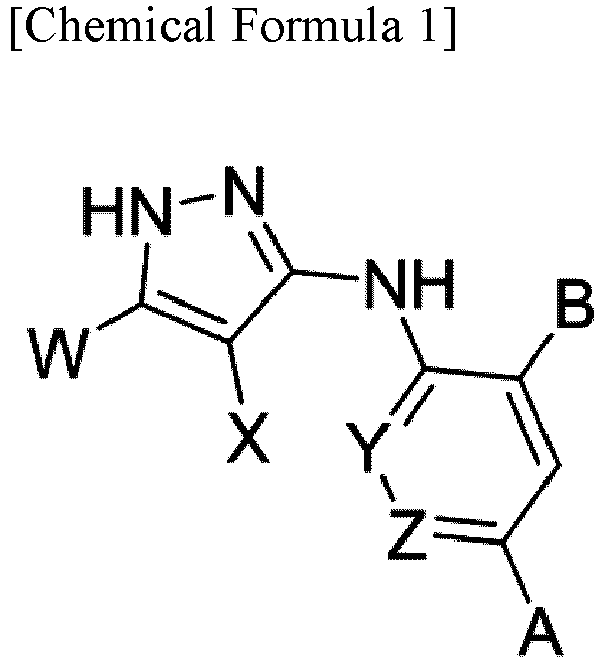
- in the
Chemical Formula 1 - Y is N or CH,
- Z is N or C-V,
- A is H, halogen, -OH, -CO2-C1-6 alkyl, -CO2H, -CN, -C1-6 alkyl, -C1-6 haloalkyl, -OR1, - NH2, -NHR2, -substituted or unsubstituted piperazine, -NHSO2R3, -NHCO2-C1-6 alkyl, -NHCON-C1-6 alkyl, or -NHCOR4,
- B is H, -C1-6 haloalkyl, C1-6 alkyl, halogen, or C1-6 alkoxy,
- V is H, -CH2OH, halogen, -CO2H, -CO2-C1-6 alkyl, -OH, -NH2, phenoxy, or -NHCO-C1-6 alkyl,
- XisHorF,
- W is substituted or unsubstituted, aromatic ring, heteroaryl, or fused heteroaryl,
- wherein,
- R1 is C1-6 alkyl, benzyl, C1-6 haloalkyl, or phenyl,
- R2 is C1-6 alkyl, C1-6 haloalkyl, -CH2CH2-morpholin, or phenyl,
- R3 is C1-6 alkyl, C1-6 haloalkyl, or substituted or unsubstituted phenyl,
- R4 is C1-6 alkyl, C1-6 haloalkyl, -CH2CH2Cl, -CH2CH2NMe2, -CH2NMe2, or -CH2CH2-morpholin.
- In another embodiment, in the
Chemical Formula 1, - Y is N or CH,
- Z is N or C-V,
- A is H, halogen, -OH, -CO2-C1-3 alkyl, -CO2H, -CN, -C1-3 alkyl, -OR1, -NH2, -NHR2, - substituted or unsubstituted piperazine, -NHSO2R3, -NHCO2-C1-6 alkyl, -NHCON-C1-6 alkyl, or - NHCOR4,
- B is H, -C1-3 haloalkyl, C1-3 alkyl, halogen, or C1-3 alkoxy,
- V is H, -CH2OH, halogen, -CO2H, -CO2-C1-3 alkyl, -OH, -NH2, phenoxy, or -NHCO-C1-3 alkyl,
- XisHorF,
- W is substituted or unsubstituted, phenyl, pyridyl, thiophene, thiazole, pyrrole, benzothiophene, indole, oxazole, pyrazole, imidazole, pyrimidine, benzopyrazole, benzothiazole, benzoxazole, benzoimidazole, or benzothiophene,
- wherein,
- R1 is benzyl, C1-3 haloalkyl, or phenyl,
- R2 is CF3, C1-3 alkyl, -CH2CH2-morpholin, or phenyl,
- R3 is C1-3 alkyl, or substituted or unsubstituted phenyl,
- R4 is C1-3 alkyl, CF3, -CH2CH2Cl, -CH2CH2NMe2, -CH2NMe2, or -CH2CH2-morpholin.
- Preferably, in yet another embodiment, in the
Chemical Formula 1, - Y is N or CH,
- Z is C-V,
- A is -OH, -CO2-C1-2 alkyl, -methyl, -OR1, -NH2, -NHR2, -substituted or unsubstituted piperazine, -NHSO2R3, -NHCO2-C1-6 alkyl, -NHCON-C1-6 alkyl, or -NHCOR4,
- B is H, -C1-3 haloalkyl, C1-3 alkyl, halogen, or C1-3 alkoxy,
- V is H, -CH2OH, F, -CO2H, -CO2-C1-2 alkyl, -OH, -NH2, phenoxy, or -NHCOCH3,
- X is H or F,
- W is substituted or unsubstituted, phenyl, pyridyl, thiophene, thiazole, pyrrole, benzothiophene, or indole,
- wherein,
- R1 is benzyl, CF3, or phenyl,
- R2 is CF3, C1-3 alkyl, -CH2CH2-morpholin, or phenyl,
- R3 is C1-3 alkyl, or substituted or unsubstituted phenyl,
- R4 is C1-3 alkyl, CF3, -CH2CH2Cl, -CH2CH2NMe2, -CH2NMe2, or -CH2CH2-morpholin.
- More preferably, in yet another embodiment, in the
Chemical Formula 1, - Y is CH,
- Z is C-V,
- A is -OH, -NHR2, -NHSO2R3, -NHCO2-C1-6 alkyl, -NHCON-C1-6 alkyl, or -NHCOR4,
- B is H, -C1-3 haloalkyl, C1-3 alkyl, halogen, or C1-3 alkoxy,
- V is H, -CH2OH, F, -OH, or -NHCOCH3,
- XisHorF,
- Wis





- R2 is CF3, C1-3 alkyl, -CH2CH2-morpholin, or phenyl,
- R3 is C1-3 alkyl, or substituted or unsubstituted phenyl,
- R4 is C1-3 alkyl, CF3, -CH2CH2Cl, -CH2CH2NMe2, -CH2NMe2, or -CH2CH2-morpholin.
- Much more preferably, in yet another embodiment, in the
Chemical Formula 1, - Y is CH,
- Z is C-V,
- A is -OH, -NHR2, -NHSO2R3, -NHCO2-C1-6 alkyl, -NHCON-C1-6 alkyl, or -NHCOR4,
- B is H, -C1-3 haloalkyl, C1-3 alkyl, halogen, or C1-3 alkoxy,
- V is H, F, -OH, or -NHCOCH3,
- X is H or F,
- Wis


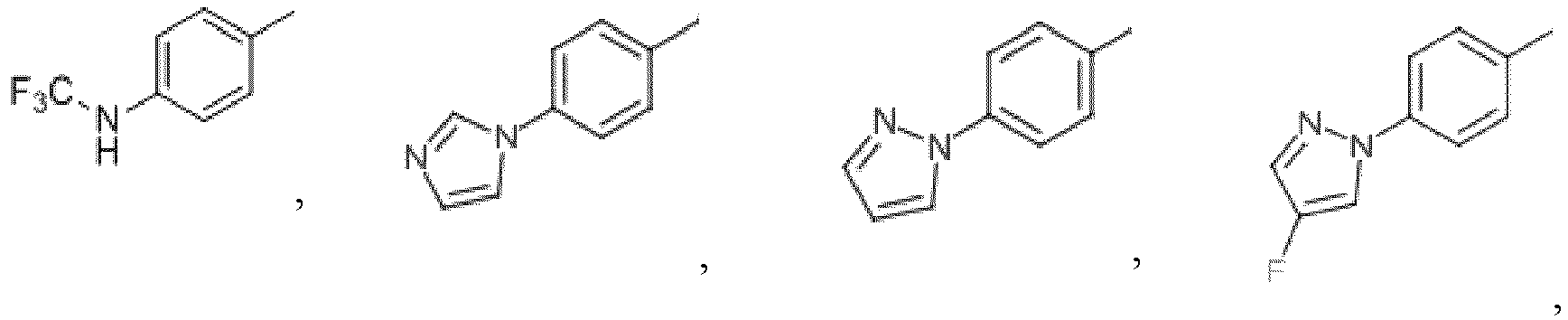


- R2 is CF3, or C1-3 alkyl,
- R3 is C1-3 alkyl,
- R4 is C1-3 alkyl, CF3, -CH2CH2Cl, -CH2CH2NMe2, -CH2NMe2, or -CH2CH2-morpholin.
- Much more preferably, in yet another embodiment, in the
Chemical Formula 1, - Y is CH,
- Z is C-V,
- A is -OH, -NHCF3, -NHSO2R3, -NHCO2-C1-6 alkyl, -NHCON-C1-6 alkyl, or -NHCOR4,
- B is C1-3 alkyl, or halogen,
- V is H, or F,
- X is H or F,
- Wis


- wherein,
- R3 is C1-3 alkyl,
- R4 is C1-3 alkyl, CF3, -CH2CH2Cl, -CH2CH2NMe2, -CH2NMe2, or -CH2CH2-morpholin.
- The inventors had synthesized and evaluated lots of compounds to find out compounds having good TNIK inhibition activity and high selectivity against TNIK, thereby having good inhibition effect against cancer cells and low side effects about normal cells. Finally, the compounds of the present disclosure are identified to be suitable for the object of the present disclosure.
- Non-limiting examples of the compounds of the present disclosure include the compounds of Table 1 below and pharmaceutically acceptable salts thereof.
[Table 1] Compound No. Structure Name 1 
N-(4-(benzyloxy)phenyl)-5-(4-methoxyphenyl)-1H-pyrazol-3-amine 2 
4-((5-(4-chlorophenyl)-1H-pyrazol-3-yl)amino)phenol 3 
4-((5-(4-methoxyphenyl)-1H-pyrazol-3-yl)amino)phenol 4 
4-((5-(o-tolyl)-1H-pyrazol-3-yl)amino)phenol 5 
4-((5-(2,4-dimethylphenyl)-1H-pyrazol-3-yl)amino)phenol 6 
N-(4-chloro-2-methylphenyl)-5-(4-methoxyphenyl)-1H-pyrazol-3-amine 7 
N-(4-chloro-2-methylphenyl)-5-(2,4-dimethylphenyl)-1H-pyrazol-3-amine 8 
5-(4-chlorophenyl)-N-(4-fluoro-2-methylphenyl)-1H-pyrazol-3-amine 9 
N-(4-fluoro-2-methylphenyl)-5-(4-methoxyphenyl)-1H-pyrazol-3-amine 10 
N-(4-fluoro-2-methylpheny1)-5-(o-tolyl)-1H-pyrazol-3-amine 11 
ethyl 4-((5-(4-methoxyphenyl)-1H-pyrazol-3-yl)amino)benzoate 12 
4-((5-(4-methoxyphenyl)-1H-pyrazol-3-yl)amino)-3-methylphenol 13 
N1-(5-(4-methoxyphenyl)-1H-pyrazol-3-yl)benzene-1,4-diamine 14 
N-(4-((5-(4-methoxyphenyl)-1H-pyrazol-3-yl)amino)phenyl)acetamide 15 
4-((5-(4-methoxyphenyl)-1H-pyrazol-3-yl)amino)benzoic acid 16 
N1-(5-(4-methoxyphenyl)-1H-pyrazol-3-yl)benzene-1,3-diamine 17 
ethyl 3-((5-(4-methoxyphenyl)-1H-pyrazol-3-yl)amino)benzoate 18 
N-(3-((5-(4-methoxyphenyl)-1H-pyrazol-3-yl)amino)phenyl)acetamide 19 
3-((5-(4-methoxyphenyl)-1H-pyrazol-3-yl)amino)phenol 20 
3-((5-(4-methoxyphenyl)-1H-pyrazol-3-yl)amino)benzoic acid 21 
N1-(5-(4-nitrophenyl)-1H-pyrazol-3-yl)benzene-1,4-diamine 22 
N1-(5-(4-aminophenyl)-1H-pyrazol-3-yl)benzene-1,4-diamine 23 
3-methyl-4-((5-(4-nitrophenyl)-1H-pyrazol-3-yl)amino)phenol 24 
4-((5-(4-aminophenyl)-1H-pyrazol-3-yl)amino)-3-methylphenol 25 
4-((5-(4-nitrophenyl)-1H-pyrazol-3-yl)amino)phenol 26 
5-(4-methoxyphenyl)-N-(3-phenoxyphenyl)-1H-pyrazol-3-amine 27 
4-((5-(4-chlorophenyl)-1H-pyrazol-3-yl)amino)-3-methoxyphenol 28 
4-((5-(4-chlorophenyl)-1H-pyrazol-3-yl)amino)-3-isopropoxyphenol 29 
N1-(5-(4-chlorophenyl)-1H-pyrazol-3-yl)-N4-propylbenzene-1,4-diamine 30 
N1-(5-(4-chlorophenyl)-1H-pyrazol-3-yl)-N4-phenylbenzene-1,4-diamine 31 
3-methyl-4-((5-(4-phenoxyphenyl)-1H-pyrazol-3-yl)amino)phenol 32 
4-((5-(4-bromophenyl)-1H-pyrazol-3-yl)amino)-3-methylphenol 33 
4-(3-((4-hydroxy-2-methylphenyl)amino)-1H-pyrazol-5-yl)benzonitrile 34 
4-((5-(4-aminophenyl)-1H-pyrazol-3-yl)amino)-3-methoxyphenol 35 
4-((5-(4-aminophenyl)-1H-pyrazol-3-yl)amino)-3-isopropoxyphenol 36 
N1-(5-(4-aminophenyl)-1H-pyrazol-3-yl)-N4-propylbenzene-1,4-diamine 37 
N1-(5-(4-aminophenyl)-1H-pyrazol-3-yl)-N4-phenylbenzene-1,4-diamine 38 
4-((5-(4-aminophenyl)-1H-pyrazol-3-yl)amino)phenol 39 
4-((5-(4-hydroxyphenyl)-1H-pyrazol-3-yl)amino)-3-methylphenol 40 
4-((5-(4-hydroxyphenyl)-1H-pyrazol-3-yl)amino)phenol 41 
4-((5-(3-aminophenyl)-1H-pyrazol-3-yl)amino)-3-methylphenol 42 
4-((5-(4-fluorophenyl)-1H-pyrazol-3-yl)amino)-3-methylphenol 43 
4-((5-(4-aminophenyl)-1H-pyrazol-3-yl)amino)-3-fluorophenol 44 
4-((5-(4-aminophenyl)-1H-pyrazol-3-yl)amino)-2-fluorophenol 45 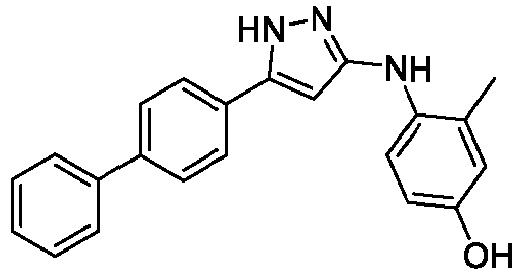
4-((5-([1,1'-biphenyl]-4-yl)-1H-pyrazol-3-yl)amino)-3-methylphenol 46 
4-((5-(4'-bromo-[1,1'-biphenyl]-4-yl)-1H-pyrazol-3-yl)amino)-3-methylphenol 47 
3-methyl-4-((5-(pyridin-3-yl)-1H-pyrazol-3-yl)amino)phenol 48 
N-(4-((5-(4-aminophenyl)-1H-pyrazol-3-yl)amino)phenyl)-4-fluorobenzenesulfonamide 49 
3-fluoro-4-((5-(4-hydroxyphenyl)-1H-pyrazol-3-yl)amino)phenol 50 
N-(4-((5-(4-aminophenyl)-1H-pyrazol-3-yl)amino)phenyl)methanesulfonami de 51 
N-(4-((5-(4-hydroxyphenyl)-1H-pyrazol-3-yl)amino)phenyl)methanesulfonami de 52 
4-fluoro-N-(4-((5-(4-hydroxyphenyl)-1H-pyrazol-3-yl)amino)phenyl)benzenesulfonami de 53 
N-(4-((5-(4-hydroxyphenyl)-1H-pyrazol-3-yl)amino)phenyl)acetamide 54 
N-(4-((5-(4-aminophenyl)-1H-pyrazol-3-yl)amino)phenyl)acetamide 55 
N-(4-((5-(4-aminophenyl)-1H-pyrazol-3-yl)amino)-3-methylphenyl)methanesulfonamide 56 
4-((5-(4-aminophenyl)-4-fluoro-1H-pyrazol-3-yl)amino)-3-methylphenol 57 
N-(4-((5-(4-aminophenyl)-1H-pyrazol-3-yl)amino)-3-methylphenyl)-4-fluorobenzenesulfonamide 58 
N-(4-((5-(4-hydroxyphenyl)-1H-pyrazol-3-yl)amino)-3-methylphenyl)methanesulfonamide 59 
N-(4-((5-(4-hydroxyphenyl)-1H-pyrazol-3-yl)amino)-3-methylphenyl)acetamide 60 
4-((5-(4-chlorophenyl)-4-fluoro-1H-pyrazol-3-yl)amino)phenol 61 
4-(4-fluoro-3-((4-hydroxyphenyl)amino)-1H-pyrazol-5-yl)phenol 62 
4-((4-fluoro-5-(4-hydroxyphenyl)-1H-pyrazol-3-yl)amino)-3-methylphenol 63 
4-(3-((4-bromo-2-methylphenyl)amino)-4-fluoro-1H-pyrazol-5-yl)phenol 64 
4-(3-((4-bromo-2-(trifluoromethyl)phenyl)amino)-4-fluoro-1H-pyrazol-5-yl)phenol 65 
4-(4-fluoro-3-((3-fluoro-4-methylphenyl)amino)-1H-pyrazol-5-yl)phenol 66 
4-((5-(6-chloropyridin-3-yl)-1H-pyrazol-3-yl)amino)-3-methylphenol 67 
3-fluoro-4-((5-(4-nitrophenyl)-1H-pyrazol-3-yl)amino)phenol 68 
2-fluoro-4-((5-(4-nitrophenyl)-1H-pyrazol-3-yl)amino)phenol 69 
4-fluoro-N-(4-((5-(4-nitrophenyl)-1H-pyrazol-3-yl)amino)phenyl)benzenesulfonami de 70 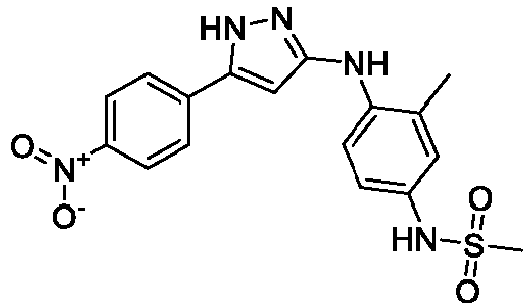
N-(3-methyl-4-((5-(4-nitrophenyl)-1H-pyrazol-3-yl)amino)phenyl)methanesulfonami de 71 
4-((4-fluoro-5-(4-nitrophenyl)-1H-pyrazol-3-yl)amino)-3-methylphenol 72 
4-fluoro-N-(3-methyl-4-((5-(4-nitrophenyl)-1H-pyrazol-3-yl)amino)phenyl)benzenesulfonami de 73 
4-((5-(4-(1H-imidazol-1-yl)phenyl)-1H-pyrazol-3-yl)amino)-3-methylphenol 74 
4-((5-(4-(1H-imidazol-1-yl)phenyl)-1H-pyrazol-3-yl)amino)phenol 75 
4-((5-([1,1'-biphenyl]-4-yl)-1H-pyrazol-3-yl)amino)phenol 76 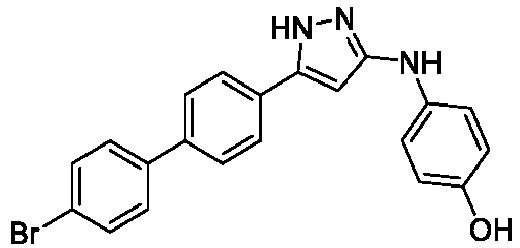
4-((5-(4'-bromo-[1,1'-biphenyl]-4-yl)-1H-pyrazol-3-yl)amino)phenol 77 
N-(4-((5-(4-(dimethylamino)phenyl)-1H-pyrazol-3-yl)amino)phenyl)acetamide 78 
N-(4-((5-(4-(dimethylamino)phenyl)-1H-pyrazol-3-yl)amino)-3-methylphenyl)acetamide 79 
4-((5-(4-(dimethylamino)phenyl)-1H-pyrazol-3-yl)amino)phenol 80 
4-((5-(4-(dimethylamino)phenyl)-1H-pyrazol-3-yl)amino)-3-methylphenol 81 
3-ethyl-4-((5-(4-hydroxyphenyl)-1H-pyrazol-3-yl)amino)phenol 82 
4-(3-((4-hydroxyphenyl)amino)-1H-pyrazol-5-yl)-2-methylphenol 83 
N-(4-((5-(4-hydroxy-3-methylphenyl)-1H-pyrazol-3-yl)amino)phenyl)acetamide 84 
N-(3-(3-((4-hydroxy-2-methylphenyl)amino)-1H-pyrazol-5-yl)phenyl)acetamide 85 
4-(3-((4-hydroxy-2-methylphenyl)amino)-1H-pyrazol-5-yl)-2-methylphenol 86 
N-(4-((5-(4-hydroxy-3-methylphenyl)-1H-pyrazol-3-yl)amino)-3-methylphenyl)acetamide 87 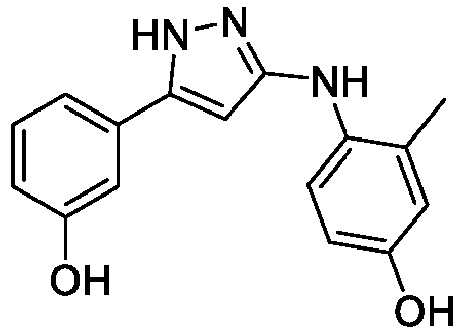
4-((5-(3-hydroxyphenyl)-1H-pyrazol-3-yl)amino)-3-methylphenol 88 
2-fluoro-4-(3 -((4-hydroxy-2-methylphenyl)amino)-1H-pyrazol-5-yl)phenol 89 
4-((5-(4-hydroxyphenyl)-1H-pyrazol-3-yl)amino)-3-(trifluoromethyl)phenol 90 
methyl 4-(3-((4-hydroxy-2-methylphenyl)amino)-1H-pyrazol-5-yl)benzoate 91 
4-(3-((4-hydroxy-2-methylphenyl)amino)-1H-pyrazol-5-yl)benzoic acid 92 
2-fluoro-4-(3-((4-hydroxyphenyl)amino)-1H-pyrazol-5-yl)phenol 93 
4-((5-(6-chloropyridin-3-yl)-1H-pyrazol-3-yl)amino)phenol 94 
2-fluoro-4-((5-(4-hydroxyphenyl)-1H-pyrazol-3-yl)amino)phenol 95 
4-((5-(6-(benzyloxy)pyridin-3-yl)-1H-pyrazol-3-yl)amino)-3-methylphenol 96 
(3-((5-(4-aminophenyl)-1H-pyrazol-3-yl)amino)-4-methylphenyl)methanol 97 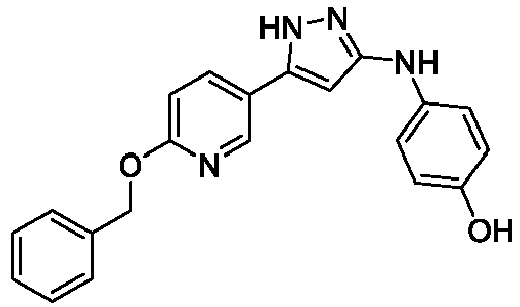
4-((5-(6-(benzyloxy)pyridin-3-yl)-1H-pyrazol-3-yl)amino)phenol 98 
4-((5-(5-methylthiophen-2-yl)-1H-pyrazol-3-yl)amino)phenol 99 
4-((5-(thiophen-2-yl)-1H-pyrazol-3-yl)amino)phenol 100 
3-methyl-4-((5-(5-methylthiophen-2-yl)-1H-pyrazol-3-yl)amino)phenol 101 
3-methyl-4-((5-(thiophen-2-yl)-1H-pyrazol-3-yl)amino)phenol 102 
N-(3-methyl-4-((5-(5-methylthiophen-2-yl)-1H-pyrazol-3-yl)amino)phenyl)acetamide 103 
4-((5-(5-chlorothiophen-2-yl)-1H-pyrazol-3-yl)amino)-3-methylphenol 104 
4-((5-(thiazol-2-yl)-1H-pyrazol-3-yl)amino)phenol Molecular Weight: 258.299 105 
3-methyl-4-((5-(thiazol-2-yl)-1H-pyrazol-3-yl)amino)phenol 106 
N-(4-((5-(5-chlorothiophen-2-yl)-1H-pyrazol-3-yl)amino)phenyl)acetamide 107 
N-(4-((5-(5-chlorothiophen-2-yl)-1H-pyrazol-3-yl)amino)-3-methylphenyl)acetamide 108 
4-(3-((5-(hydroxymethyl)-2-methylphenyl)amino)-1H-pyrazol-5-yl)phenol 109 
N-(4-((5-(4-(1H-imidazol-1-yl)phenyl)-1H-pyrazol-3-yl)amino)-3-methylphenyl)methanesulfonamide 110 
N-(4-((5-(4-(1H-imidazol-1-yl)phenyl)-4-fluoro-1H-pyrazol-3-yl)amino)-3-methylphenyl)methanesulfonamide 111 
4-((5-(4-(1H-imidazol-1-yl)phenyl)-1H-pyrazol-3-yl)amino)-3-ethylphenol 112 
4-((5-(1-methyl-1H-pyrrol-3-yl)-1H-pyrazol-3-yl)amino)phenol 113 
3-methyl-4-((5-(1-methyl-1H-pyrrol-3-yl)-1H-pyrazol-3-yl)amino)phenol 114 
4-((5-(benzo[b]thiophen-2-yl)-1H-pyrazol-3-yl)amino)-3-methylphenol 115 
4-((5-(benzo[b]thiophen-2-yl)-1H-pyrazol-3-yl)amino)-3-ethylphenol 116 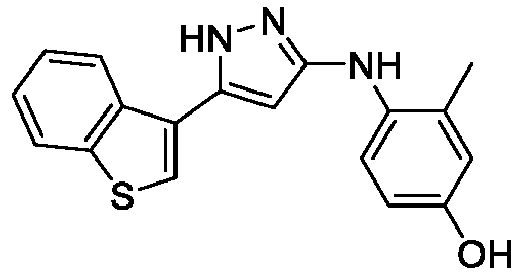
4-((5-(benzo[b]thiophen-3-yl)-1H-pyrazol-3-yl)amino)-3-methylphenol 117 
4-((5-(benzo[b]thiophen-3-yl)-1H-pyrazol-3-yl)amino)-3-ethylphenol 118 
4-((5-(5-chlorothiophen-2-yl)-1H-pyrazol-3-yl)amino)-3-methylphenol 119 
4-((5-(5-chlorothiophen-2-yl)-1H-pyrazol-3-yl)amino)-3-ethylphenol 120 
3-methyl-4-((5-(thiazol-2-yl)-1H-pyrazol-3-yl)amino)phenol 121 
3-ethyl-4-((5-(thiazol-2-yl)-1H-pyrazol-3-yl)amino)phenol 122 
tert-butyl 3-(3-((4-hydroxy-2-methylphenyl)amino)-1H-pyrazol-5-yl)-1H-indole-1-carboxylate 123 
tert-butyl 3-(3-((2-ethyl-4-hydroxyphenyl)amino)-1H-pyrazol-5-yl)-1H-indole-1-carboxylate 124 
4-(3-((3-hydroxycyclohexyl)amino)-1H-pyrazol-5-yl)phenol 125 
N-(5-((5-(4-(1H-imidazol-1-yl)phenyl)-1H-pyrazol-3-yl)amino)-4-methylpyridin-2-yl)acetamide 126 
3-chloro-4-((5-(4-hydroxyphenyl)-1H-pyrazol-3-yl)amino)phenol 127 
N-(4-((5-(benzo[b]thiophen-2-yl)-1H-pyrazol-3-yl)amino)-3-methylphenyl)acetamide 128 
N-(4-((5-(benzo [b]thiophen-3-yl)-1H-pyrazol-3-yl)amino)-3-methylphenyl)acetamide 129 
4-((5-(6-bromopyridin-2-yl)-1H-pyrazol-3-yl)amino)-3-methylphenol 130 
4-((5-(6-bromopyridin-2-yl)-1H-pyrazol-3-yl)amino)-3-ethylphenol 131 
3-methyl-4-((5-(pyridin-2-yl)-1H-pyrazol-3-yl)amino)phenol 132 
3-ethyl-4-((5-(pyridin-2-yl)-1H-pyrazol-3-yl)amino)phenol 133 
4-((5-(5-bromopyridin-3-yl)-1H-pyrazol-3-yl)amino)-3-methylphenol 134 
4-((5-(4-bromopyridin-2-yl)-1H-pyrazol-3-yl)amino)-3-ethylphenol 135 
N-(3-methyl-4-((5-(thiazol-2-yl)-1H-pyrazol-3-yl)amino)phenyl)methanesulfonami de 136 
N-(4-((5-(6-bromopyridin-2-yl)-1H-pyrazol-3-yl)amino)-3-methylphenyl)methanesulfonamide 137 
1-(4-(4-(3-((2-ethyl-4-hydroxyphenyl)amino)-1H-pyrazol-5-yl)phenyl)piperazin-1-yl)ethan-1-one 138 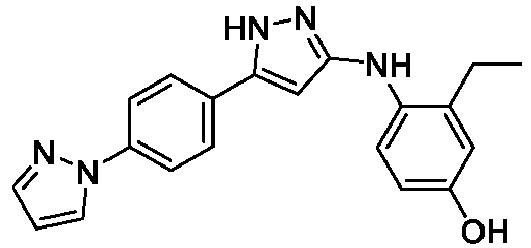
4-((5-(4-(1H-pyrazol-1-yl)phenyl)-1H-pyrazol-3-yl)amino)-3-ethylphenol 139 
N-(4-((5-(4-(1H-pyrazol-1-yl)phenyl)-1H-pyrazol-3-yl)amino)-3-methylphenyl)acetamide 140 
4-((5-(1H-indol-3-yl)-1H-pyrazol-3 -yl)amino)-3-methylphenol 141 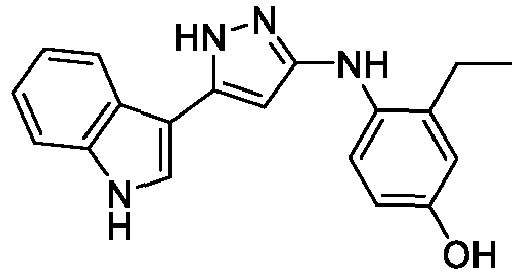
4-((5-(1H-indol-3-yl)-1H-pyrazol-3-yl)amino)-3-ethylphenol 142 
N-(3-chloro-4-((5-(4-hydroxyphenyl)-1H-pyrazol-3-yl)amino)phenyl)acetamide 143 
N-(5-((5-(4-hydroxyphenyl)-1H-pyrazol-3-yl)amino)-4-methylpyridin-2-yl)acetamide 144 
N-(3-chloro-4-((5-(4-hydroxyphenyl)-1H-pyrazol-3-yl)amino)phenyl)methanesulfonami de 145 
N-(2-fluoro-4-((5-(4-hydroxyphenyl)-1H-pyrazol-3-yl)amino)-5-methylphenyl)acetamide 146 
3-ethyl-4-((5-(4-iodophenyl)-1H-pyrazol-3-yl)amino)phenol 147 
N-(4-((5-(4-hydroxyphenyl)-1H-pyrazol-3-yl)amino)-3-methylphenyl)butyramide 148 
N-(4-((5-(4-(1H-imidazol-1-yl)phenyl)-1H-pyrazol-3-yl)amino)-3-methylphenyl)acetamide 149 
N-(4-((5-(4-hydroxy-3,5-dimethylphenyl)-1H-pyrazol-3-yl)amino)-3-methylphenyl)acetamide 150 
4-(3-((4-hydroxy-2-methylphenyl)amino)-1H-pyrazol-5-yl)-2,6-dimethylphenol 151 
2,2,2-trifluoro-N-(4-((5-(4-hydroxyphenyl)-1H-pyrazol-3-yl)amino)-3-methylphenyl)acetamide 152 
4-(3-((4-amino-2-methylphenyl)amino)-1H-pyrazol-5-yl)phenol 153 
N-(4-((5-(4-((tert-butyldimethylsilyl)oxy)-3,5-dimethylphenyl)-1H-pyrazol-3-yl)amino)-3-methylphenyl)acetamide 154 
N-(3-ethyl-4-((5-(4-hydroxyphenyl)-1H-pyrazol-3-yl)amino)phenyl)acetamide 155 
N-(2-fluoro-4-((5-(4-hydroxyphenyl)-1H-pyrazol-3-yl)amino)-5-methylphenyl)methanesulfonamide 156 
4-((5-(6-chloropyridin-3-yl)-1H-pyrazol-3-yl)amino)-3-methylphenol 157 
ethyl (4-((5-(4-hydroxyphenyl)-1H-pyrazol-3-yl)amino)-3-methylphenyl)carbamate 158 
N-(4-((5-(3-fluoro-4-hydroxyphenyl)-1H-pyrazol-3-yl)amino)-3-methylphenyl)methanesulfonamide 159 
1-(4-((5-(4-hydroxyphenyl)-1H-pyrazol-3-yl)amino)-3-methylphenyl)-3-methylurea 160 
4-(3-((2-ethyl-4-hydroxyphenyl)amino)-1H-pyrazol-5-yl)-2-fluorophenol 161 
1-(4-((5-(3-fluoro-4-hydroxyphenyl)-1H-pyrazol-3-yl)amino)-3-methylphenyl)-3-methylurea 162 
2-fluoro-4-(3 -((2-fluoro-4-hydroxyphenyl)amino)-1H-pyrazol-5-yl)phenol 163 
4-(3-((6-fluoropyridin-3-yl)amino)-1H-pyrazol-5-yl)phenol 164 
4-(3-((2-methyl-4-((2-morpholinoethyl)amino)phenyl)ami no)-1H-pyrazol-5-yl)phenol 165 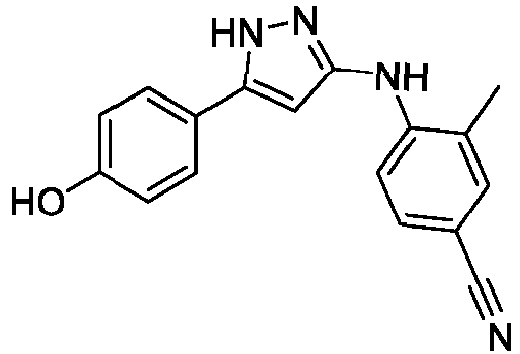
4-((5-(4-hydroxyphenyl)-1H-pyrazol-3-yl)amino)-3-methylbenzonitrile 166 
1-(4-(4-((5-(4-hydroxyphenyl)-1H-pyrazol-3-yl)amino)-3-methylphenyl)piperazin-1-yl)ethan-1-one 167 
5-(4-(benzyloxy)phenyl)-N-(2-methyl-4-(piperazin-1-yl)phenyl)-1H-pyrazol-3-amine 168 
4-((5-(4-hydroxyphenyl)-1H-pyrazol-3-yl)amino)-3,5-dimethylphenol 169 
4-(3-((2-methyl-4-(piperazin-1-yl)phenyl)amino)-1H-pyrazol-5-yl)phenol 170 
N-(4-((5-(4-(1H-imidazol-1-yl)phenyl)-1H-pyrazol-3-yl)amino)phenyl)acetamide 171 
N-(4-((5-(4-(1H-imidazol-1-yl)phenyl)-1H-pyrazol-3-yl)amino)phenyl)methanesulfonami de 172 
4-((5-(4-(1H-imidazol-1-yl)phenyl)-1H-pyrazol-3-yl)amino)-3-fluorophenol 173 
4-((5-(4-(1H-imidazol-1-yl)phenyl)-1H-pyrazol-3-yl)amino)-3-(trifluoromethyl)phenol 174 
N-(4-((5-(4-(1H-imidazol-1-yl)phenyl)-1H-pyrazol-3-yl)amino)-3-chlorophenyl)acetamide 175 
4-((5-(4-(1H-imidazol-1-yl)phenyl)-1H-pyrazol-3-yl)amino)-2-fluorophenol 176 
4-((5-(4-(1H-imidazol-1-yl)phenyl)-1H-pyrazol-3-yl)amino)-3 -chlorophenol 177 
N-(4-((5-(4-(1H-imidazol-1-yl)phenyl)-1H-pyrazol-3-yl)amino)-3-ethylphenyl)acetamide 178 
N-(4-((5-(4-(1H-imidazol-1-yl)phenyl)-1H-pyrazol-3-yl)amino)-2-fluoro-5-methylphenyl)acetamide 179 
N-(2-fluoro-4-((5-(3-fluoro-4-hydroxyphenyl)-1H-pyrazol-3-yl)amino)-5-methylphenyl)acetamide 180 
N-(4-((5-(4-(1H-pyrazol-1-yl)phenyl)-1H-pyrazol-3-yl)amino)-3-methylphenyl)-3-chloropropanamide 181 
N-(4-((5-(4-(1H-pyrazol-1-yl)phenyl)-1H-pyrazol-3-yl)amino)-3-methylphenyl)-3-morpholinopropanamide 182 
2-(dimethylamino)-N-(4-((5-(3-fluoro-4-hydroxyphenyl)-1H-pyrazol-3-yl)amino)-3-methylphenyl)acetamide 183 
N-(4-((5-(3-fluoro-4-hydroxyphenyl)-1H-pyrazol-3-yl)amino)-3-methylphenyl)-3-morpholinopropanamide 184 
3-chloro-N-(5-(4-fluorophenyl)-1H-pyrazol-3-yl)pyridin-2-amine 185 
3-(dimethylamino)-N-(4-((5-(3-fluoro-4-hydroxyphenyl)-1H-pyrazol-3-yl)amino)-3-methylphenyl)propanamide 186 
4-(3-((3-chloropyridin-2-yl)amino)-1H-pyrazol-5-yl)-2-fluorophenol 187 
N-(4-((5-(4-(1H-pyrazol-1-yl)phenyl)-1H-pyrazol-3-yl)amino)-3-methylphenyl)methanesulfonamide 188 
4-((5-(4-(1H-pyrazol-1-yl)phenyl)-1H-pyrazol-3-yl)amino)-3-(trifluoromethyl)phenol 189 
4-((5-(4-(1H-pyrazol-1-yl)phenyl)-1H-pyrazol-3-yl)amino)-3-fluorophenol 190 
N-(4-((5-(4-iodophenyl)-1H-pyrazol-3-yl)amino)-3-methylphenyl)methanesulfonamide 191 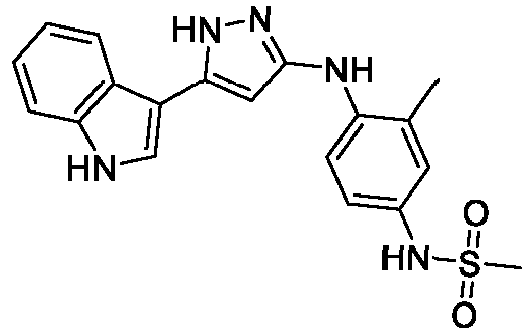
N-(4-((5-(1H-indol-3-yl)-1H-pyrazol-3-yl)amino)-3-methylphenyl)methanesulfonamide 192 
4-((5-(4-(1H-pyrazol-1-yl)phenyl)-1H-pyrazol-3-yl)amino)-2-fluorophenol 193 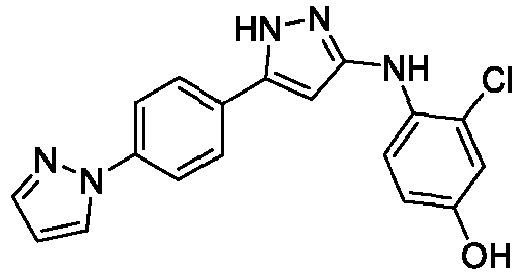
4-((5-(4-(1H-pyrazol-1-yl)phenyl)-1H-pyrazol-3-yl)amino)-3-chlorophenol 194 
3-methyl-4-((5-phenyl-1H-pyrazol-3-yl)amino)phenol 195 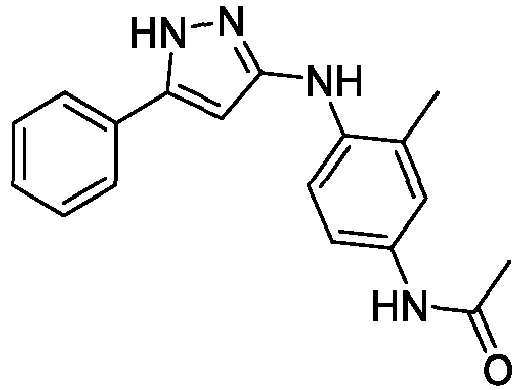
N-(3-methyl-4-((5-phenyl-1H-pyrazol-3-yl)amino)phenyl)acetamide 196 
N-(3-methyl-4-((5-phenyl-1H-pyrazol-3-yl)amino)phenyl)methanesulfonami de 197 
N-(4-((5-(4-methoxyphenyl)-1H-pyrazol-3-yl)amino)-3-methylphenyl)methanesulfonamide 198 
N-(4-((5-(4-cyanophenyl)-1H-pyrazol-3-yl)amino)-3-methylphenyl)methanesulfonamide 199 
N-(4-((5-(4-bromophenyl)-1H-pyrazol-3-yl)amino)-3-methylphenyl)methanesulfonamide 200 
N-(4-((5-(3-fluoro-4-hydroxyphenyl)-1H-pyrazol-3-yl)amino)-3-methylphenyl)methanesulfonamide 201 
N-(3-methyl-4-((5-(4-morpholinophenyl)-1H-pyrazol-3-yl)amino)phenyl)acetamide 202 
3-methyl-4-((5-(4-morpholinophenyl)-1H-pyrazol-3-yl)amino)phenol 203 
N-(3-methyl-4-((5-(4-morpholinophenyl)-1H-pyrazol-3-yl)amino)phenyl)methanesulfonami de 204 
N-(4-((5-(4-fluorophenyl)-1H-pyrazol-3-yl)amino)-3-methylphenyl)methanesulfonamide 205 
1-(4-(3-((4-hydroxy-2-methylphenyl)amino)-1H-pyrazol-5-yl)phenyl)pyrrolidin-2-one 206 
1-(4-(3-((4-hydroxy-2-methylphenyl)amino)-1H-pyrazol-5-yl)phenyl)piperidin-2-one 207 
1-(4-((5-(4-(1H-pyrazol-1-yl)phenyl)-1H-pyrazol-3-yl)amino)-3-methylphenyl)-3-methylurea 208 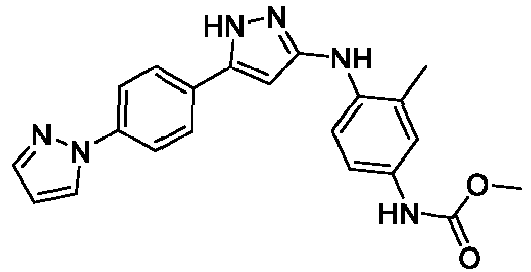
methyl (4-((5-(4-(1H-pyrazol-1-yl)phenyl)-1H-pyrazol-3-yl)amino)-3-methylphenyl)carbamate 209 
ethyl (4-((5-(4-(1H-pyrazol-1-yl)phenyl)-1H-pyrazol-3-yl)amino)-3-methylphenyl)carbamate 210 
N-(3-methyl-4-((5-(4-(2-oxopyrrolidin-1-yl)phenyl)-1H-pyrazol-3-yl)amino)phenyl)acetamide 211 
N-(3-methyl-4-((5-(4-(2-oxopiperidin-1-yl)phenyl)-1H-pyrazol-3-yl)amino)phenyl)acetamide 212 
4-((5-(6-methoxypyridin-3-yl)-1H-pyrazol-3-yl)amino)-3-methylphenol 213 
N-(4-((5-(6-methoxypyridin-3-yl)-1H-pyrazol-3-yl)amino)-3-methylphenyl)methanesulfonamide 214 
N-(4-((5-(6-methoxypyridin-3-yl)-1H-pyrazol-3-yl)amino)-3-methylphenyl)acetamide 215 
1-(4-(3-((4-hydroxy-2-methylphenyl)amino)-1H-pyrazol-5 -yl)phenyl)azetidin-2-one 216 
4-((5-(6-(1H-pyrazol-1-yl)pyridin-3-yl)-1H-pyrazol-3-yl)amino)-3-methylphenol 217 
N-(4-((5-(6-(1H-pyrazol-1-yl)pyridin-3-yl)-1H-pyrazol-3-yl)amino)-3-methylphenyl)acetamide 218 
N-(4-((5-(6-(1H-pyrazol-1-yl)pyridin-3-yl)-1H-pyrazol-3-yl)amino)-3-methylphenyl)methanesulfonamide 219 
N-(3-chloro-4-((5-(4-(2-oxopyrrolidin-1-yl)phenyl)-1H-pyrazol-3-yl)amino)phenyl)acetamide 220 
4-((5-(4-(dimethylamino)phenyl)-4-fluoro-1H-pyrazol-3-yl)amino)-3-methylphenol 221 
N-(4-((5-(benzo[b]thiophen-2-yl)-1H-pyrazol-3-yl)amino)-3-methylphenyl)methanesulfonamide 222 
1-(4-((5-(benzo[b]thiophen-2-yl)-1H-pyrazol-3-yl)amino)-3-methylphenyl)-3-methylurea 223 
ethyl (4-((5-(benzo[b]thiophen-2-yl)-1H-pyrazol-3-yl)amino)-3-methylphenyl)carbamate 224 
methyl (4-((5-(benzo[b]thiophen-2-yl)-1H-pyrazol-3-yl)amino)-3-methylphenyl)carbamate 225 
N-(4-((5-(4-(1H-pyrazol-1-yl)phenyl)-4-fluoro-1H-pyrazol-3-yl)amino)-3-methylphenyl)methanesulfonamide 226 
N-(3-chloro-4-((5-(4-methoxyphenyl)-1H-pyrazol-3-yl)amino)phenyl)acetamide 227 
4-((5-(3-(1H-pyrazol-1-yl)phenyl)-1H-pyrazol-3-yl)amino)-3-methylphenol 228 
N-(4-((5-(3-(1H-pyrazol-1-yl)phenyl)-1H-pyrazol-3-yl)amino)-3-methylphenyl)methanesulfonamide 229 
N-(4-((5-(4-(1H-pyrazol-1-yl)phenyl)-1H-pyrazol-3-yl)amino)-3 -methylphenyl)isobutyramide 230 
1-(4-(4-fluoro-3-((4-hydroxy-2-methylphenyl)amino)-1H-pyrazol-5-yl)phenyl)pyrrolidin-2-one 231 
N-(4-((5-(4-(1H-pyrazol-1-yl)phenyl)-4-fluoro-1H-pyrazol-3-yl)amino)-3-methylphenyl)acetamide 232 
methyl (4-((5-(4-(1H-pyrazol-1-yl)phenyl)-4-fluoro-1H-pyrazol-3-yl)amino)-3-methylphenyl)carbamate 233 
ethyl (4-((5-(4-(1H-pyrazol-1-yl)phenyl)-4-fluoro-1H-pyrazol-3-yl)amino)-3-methylphenyl)carbamate 234 
4-((4-fluoro-5-(4-methoxyphenyl)-1H-pyrazol-3-yl)amino)-3-methylphenol 235 
N-(4-((5-(1H-pyrazol-1-yl)phenyl)-4-fluoro-1H-pyrazol-3-yl)amino)-3-methylphenyl)methanesulfonamide 236 
1-(4-((5-(4-(1H-pyrazol-1-yl)phenyl)-4-fluoro-1H-pyrazol-3-yl)amino)-3-methylphenyl)-3-methylurea 237 
3-ethyl-4-((4-fluoro-5-(4-iodophenyl)-1H-pyrazol-3-yl)amino)phenol 238 
3-methyl-4-((5-(4-(4-methyl-1H-pyrazol-1-yl)phenyl)-1H-pyrazol-3-yl)amino)phenol 239 
N-(3-methyl-4-((5-(4-(4-methyl-1H-pyrazol-1-yl)phenyl)-1H-pyrazol-3-yl)amino)phenyl)acetamide 240 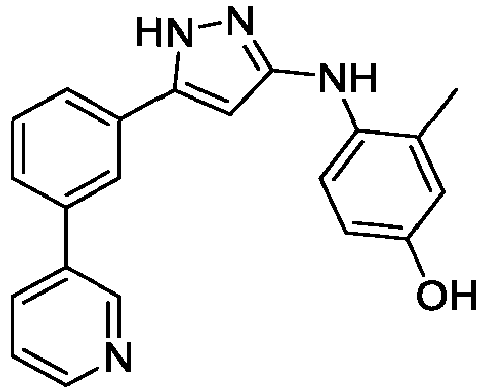
3-methyl-4-((5-(3-(pyridin-3-yl)phenyl)-1H-pyrazol-3-yl)amino)phenol 241 
3-methyl-4-((5-(4-(pyridin-3-yl)phenyl)-1H-pyrazol-3-yl)amino)phenol 242 
4-((5-(4-(4-fluoro-1H-pyrazol-1-yl)phenyl)-1H-pyrazol-3-yl)amino)-3-methylphenol 243 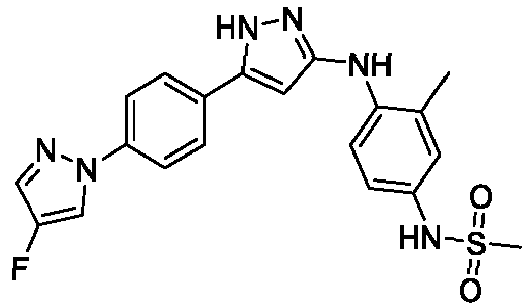
N-(4-((5-(4-(4-fluoro-1H-pyrazol-1-yl)phenyl)-1H-pyrazol-3-yl)amino)-3-methylphenyl)methanesulfonamide 244 
4-((4-fluoro-5-(1H-indol-3-yl)-1H-pyrazol-3-yl)amino)-3-methylphenol 245 
3-ethyl-4-((5-(3-iodophenyl)-1H-pyrazol-3-yl)amino)phenol 246 
4-((5-(2'-fluoro-5'-methoxy-[1,1'-biphenyl]-3-yl)-1H-pyrazol-3-yl)amino)-3-methylphenol 247 
N-(4-(benzyloxy)phenyl)-5-(4-chlorophenyl)-1H-pyrazol-3-amine 248 
N-(4-(benzyloxy)phenyl)-5-(o-tolyl)-1H-pyrazol-3-amine 249 
N-(4-(benzyloxy)phenyl)-5-(2,4-dimethylphenyl)-1H-pyrazol-3-amine 250 
N-(4-chloro-2-methylphenyl)-5-(4-chlorophenyl)-1H-pyrazol-3-amine 251 
N-(4-chloro-2-methylphenyl)-5-(o-tolyl)-1H-pyrazol-3-amine 252 
5-(2,4-dimethylphenyl)-N-(4-fluorophenyl)-1H-pyrazol-3-amine 253 
N-(4-fluorophenyl)-5-(o-tolyl)-1H-pyrazol-3-amine 254 
5-(4-methoxyphenyl)-N-(4-phenoxyphenyl)-1H-pyrazol-3-amine 255 
4-(4-fluoro-5-((4-(trifluoromethoxy)phenyl)amino)-1H-pyrazol-3-yl)phenol 256 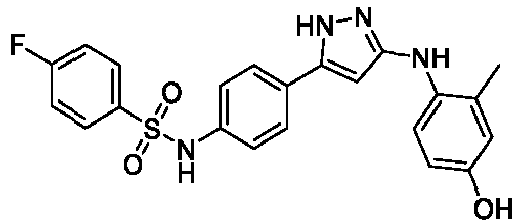
4-fluoro-N-(4-(3-((4-hydroxy-2-methylphenyl)amino)-1H-pyrazol-5-yl)phenyl)benzenesulfonamide 257 
4-(5-((4-bromophenyl)amino)-4-fluoro-1H-pyrazol-3-yl)phenol 258 
N-(4-((5-(4-(1H-pyrazol-1-yl)phenyl)-1H-pyrazol-3-yl)amino)-3-methylphenyl)-2-hydroxy acetamide 259 
2-((4-((5-(4-(1H-pyrazol-1-yl)phenyl)-1H-pyrazol-3 -yl)amino)-3-methylphenyl)amino)propane-1,3-diol 260 
3-((4-((5-(4-(1H-pyrazol-1-yl)phenyl)-1H-pyrazol-3-yl)amino)-3-methylphenyl)amino)propan-1-ol 261 
N-(4-((5-(4-(1H-pyrazol-1-yl)phenyl)-1H-pyrazol-3-yl)amino)-3-methylphenyl)-2-(4-methylpiperazin-1-yl)acetamide 262 
N-(4-((5-(4-(1H-pyrazol-1-yl)phenyl)-1H-pyrazol-3-yl)amino)-3-methylphenyl)-2-(4-acetylpiperazin-1-yl)acetamide 263 
N-(4-((5-(4-(1H-pyrazol-1-yl)phenyl)-1H-pyrazol-3 -yl)amino)-3-methylphenyl)isobutyramide 264 
N1-(5-(4-(1H-pyrazol-1-yl)phenyl)-1H-pyrazol-3-yl)-2-methyl-N4-(trifluoromethyl)benzene-1,4-diamine 265 
4-((5-(4-(1H-pyrazol-4-yl)phenyl)-1H-pyrazol-3-yl)amino)-3-methylphenol 266 
4-(3-((2-methyl-4-((trifluoromethyl)amino)phenyl)ami no)-1H-pyrazol-5-yl)phenol 267 
4-((5-(4-((trifluoromethyl)amino)phenyl)-1H-pyrazol-3-yl)amino)phenol 268 
2-methyl-N4-(trifluoromethyl)-N 1-(5-(4-((trifluoromethyl)amino)phenyl)-1H-pyrazol-3-yl)benzene-1,4-diamine 269 
3-ethyl-4-((5-(4-((trifluoromethyl)amino)phenyl)-1H-pyrazol-3-yl)amino)phenol 270 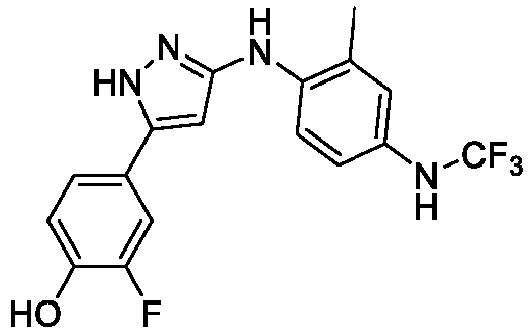
2-fluoro-4-(3-((2-methyl-4-((trifluoromethyl)amino)phenyl)ami no)-1H-pyrazol-5 -yl)phenol 271 
N1-(5-(4-(1H-imidazol-1-yl)phenyl)-1H-pyrazol-3-yl)-2-methyl-N4-(trifluoromethyl)benzene- 1,4-diamine 272 
3-methyl-4-((5-(3-(1-methyl-1H-pyrazol-4-yl)phenyl)-1H-pyrazol-3-yl)amino)phenol 273 
4-((5-(2'-fluoro-5'-methoxy-[1,1'-biphenyl]-4-yl)-1H-pyrazol-3-yl)amino)-3 -methylphenol 274 
4-((5-(4-(1H-pyrazol-1-yl)phenyl)-lH-pyrazol-3-yl)amino)-2-fluoro-5-methylphenol 275 
2-fluoro-4-((5-(4-hydroxyphenyl)-1H-pyrazol-3-yl)amino)-5-methylphenol 276 
3-methyl-4-((5-(4-(1-methyl-1H-pyrazol-4-yl)phenyl)-1H-pyrazol-3-yl)amino)phenol 277 
4-((5-(4-(3,5-dimethyl-1H-pyrazol-4-yl)phenyl)-1H-pyrazol-3-yl)amino)-3 -methylphenol 278 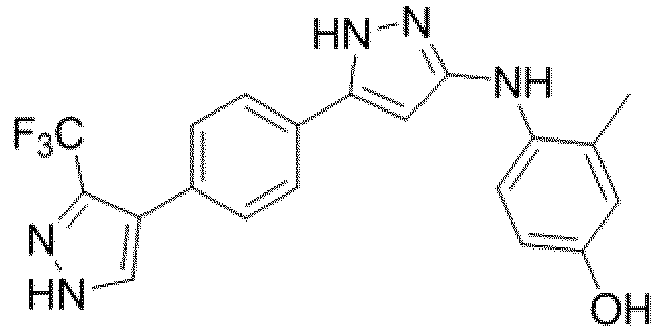
3-methyl-4-((5-(4-(3-(trifluoromethyl)-1H-pyrazol-4-yl)phenyl)-1H-pyrazol-3-yl)amino)phenol 279 
4-((5-(4-(1H-pyrazol-4-yl)phenyl)-1H-pyrazol-3-yl)amino)-3-ethylphenol 280 
1-(4-((5-(4-(1H-pyrazol-4-yl)phenyl)-1H-pyrazol-3 -yl)amino)-3 -methylphenyl)-3 -methylurea 281 
methyl (4-((5-(4-(1H-pyrazol-4-yl)phenyl)-1H-pyrazol-3-yl)amino)-3-methylphenyl)carbamate 282 
4-((5-(4-(1H-pyrazol-4-yl)phenyl)-1H-pyrazol-3-yl)amino)-2-fluoro-5-methylphenol 283 
1-(4-((5-(2'-fluoro-5'-methoxy-[1,1'-biphenyl]-4-yl)-1H-pyrazol-3-yl)amino)-3-methylphenyl)-3-methylurea 284 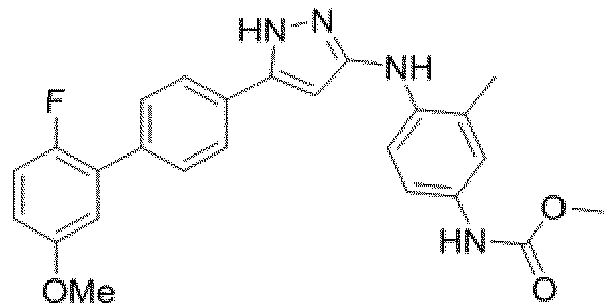
methyl (4-((5-(2'-fluoro-5'-methoxy-[1,1'-biphenyl]-4-yl)-1H-pyrazol-3-yl)amino)-3-methylphenyl)carbamate 285 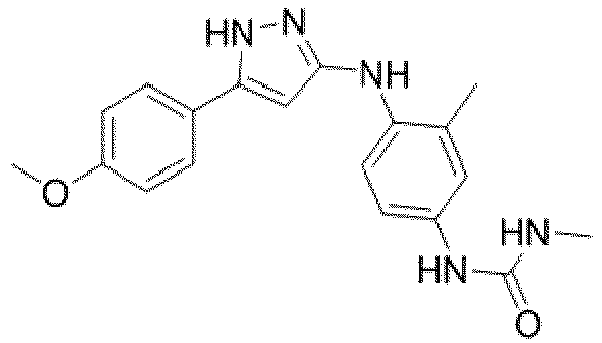
1-(4-((5-(4-methoxyphenyl)-1H-pyrazol-3-yl)amino)-3-methylphenyl)-3-methylurea 286 
(4-((5-(4-methoxyphenyl)-1H-pyrazol-3-yl)amino)-3-methylphenyl)carbamate 287 
4-((5-(4-(1H-pyrazol-1-yl)phenyl)-1H-pyrazol-3-yl)amino)-2,5-difluorophenol 288 
1-methyl-3-(3-methyl-4-((5-(4-(methylsulfonyl)phenyl)-1H-pyrazol-3-yl)amino)phenyl)urea 289 
methyl (3-methyl-4-((5-(4-(methylsulfonyl)phenyl)-1H-pyrazol-3-yl)amino)phenyl)carbamate 290 
1-methyl-3-(3-methyl-4-((5-(4-(3-(trifluoromethyl)-1H-pyrazol-4-yl)phenyl)-1H-pyrazol-3-yl)amino)phenyl)urea 291 
methyl (3-methyl-4-((5-(4-(3-(trifluoromethyl)-1H-pyrazol-4-yl)phenyl)-1H-pyrazol-3-yl)amino)phenyl)carbamate 292 
1-(4-((5-(4-bromophenyl)-1H-pyrazol-3-yl)amino)-3-methylphenyl)-3-methylurea 293 
methyl (4-((5-(4-bromophenyl)-1H-pyrazol-3-yl)amino)-3-methylphenyl)carbamate 294 
methyl (3-methyl-4-((5-(4-(1-methyl-1H-pyrazol-4-yl)phenyl)-1H-pyrazol-3-yl)amino)phenyl)carbamate 295 
3-methyl-4-((5-(4-(trifluoromethyl)phenyl)-1H-pyrazol-3-yl)amino)phenol 296 
methyl (3-methyl-4-((5-(4-(trifluoromethyl)phenyl)-1H-pyrazol-3-yl)amino)phenyl)carbamate 297 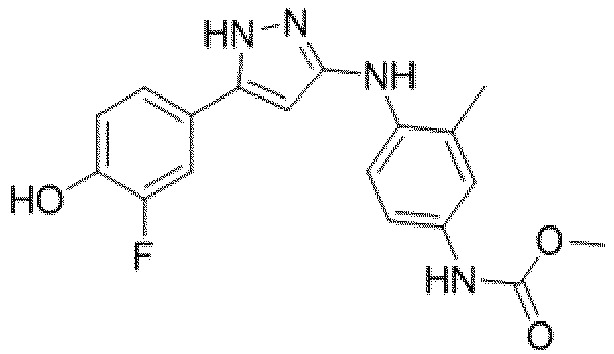
methyl (4-((5-(3-fluoro-4-hydroxyphenyl)-1H-pyrazol-3-yl)amino)-3-methylphenyl)carbamate 298 
methyl (4-((5-(4-chlorophenyl)-1H-pyrazol-3-yl)amino)-3-methylphenyl)carbamate 299 
methyl (4-((5-(4-aminophenyl)-1H-pyrazol-3-yl)amino)-3-methylphenyl)carbamate - Preferably, the compound of the present disclosure is chosen in Table 2 below
[Table 2] Compound No. Name 12 4-((5-(4-methoxyphenyl)-1H-pyrazol-3-yl)amino)-3-methylphenol 24 4-((5-(4-aminophenyl)-1H-pyrazol-3-yl)amino)-3-methylphenol 29 N1-(5-(4-chlorophenyl)-1H-pyrazol-3-yl)-N4-propylbenzene-1,4-diamine 33 4-(3-((4-hydroxy-2-methylphenyl)amino)-1H-pyrazol-5-yl)benzonitrile 34 4-((5-(4-aminophenyl)-1H-pyrazol-3-yl)amino)-3-methoxyphenol 39 4-((5-(4-hydroxyphenyl)-1H-pyrazol-3-yl)amino)-3-methylphenol 40 4-((5-(4-hydroxyphenyl)-1H-pyrazol-3-yl)amino)phenol 49 3-fluoro-4-((5-(4-hydroxyphenyl)-1H-pyrazol-3-yl)amino)phenol 58 N-(4-((5-(4-hydroxyphenyl)-1H-pyrazol-3-yl)amino)-3-methylphenyl)methanesulfonamide 59 N-(4-((5-(4-hydroxyphenyl)-1H-pyrazol-3-yl)amino)-3-methylphenyl)acetamide 62 4-((4-fluoro-5-(4-hydroxyphenyl)-1H-pyrazol-3-yl)amino)-3-methylphenol 73 4-((5-(4-(1H-imidazol-1-yl)phenyl)-1H-pyrazol-3-yl)amino)-3-methylphenol 74 4-((5-(4-(1H-imidazol-1-yl)phenyl)-1H-pyrazol-3-yl)amino)phenol 77 N-(4-((5-(4-(dimethylamino)phenyl)-1H-pyrazol-3-yl)amino)phenyl)acetamide 80 4-((5-(4-(dimethylamino)phenyl)-1H-pyrazol-3-yl)amino)-3-methylphenol 81 3-ethyl-4-((5-(4-hydroayphenyl)-1H-pyrazol-3-yl)amino)phenol 85 4-(3-((4-hydroxy-2-methylphenyl)amino)-1H-pyrazol-5-yl)-2-methylphenol 86 N-(4-((5-(4-hydroxy-3-methylphenyl)-1H-pyrazol-3-yl)amino)-3-methylphenyl)acetamide 88 2-fluoro-4-(3-((4-hydroxy-2-methylphenyl)amino)-1H-pyrazol-5-yl)phenol 89 4-((5-(4-hydroxyphenyl)-1H-pyrazol-3-yl)amino)-3-(trifluoromethyl)phenol 94 2-fluoro-4-((5-(4-hydroxyphenyl)-1H-pyrazol-3-yl)amino)phenol 109 N-(4-((5-(4-(1H-imidazol-1-yl)phenyl)-1H-pyrazol-3-yl)amino)-3-methylphenyl)methanesulfonamide 110 N-(4-((5-(4-(1H-imidazol-1-yl)phenyl)-4-fluoro-1H-pyrazol-3-yl)amino)-3-methylphenyl)methanesulfonamide 111 4-((5-(4-(1H-imidazol-1-yl)phenyl)-1H-pyrazol-3-yl)amino)-3-ethylphenol 114 4-((5-(benzo[b]thiophen-2-yl)-1H-pyrazol-3-yl)amino)-3-methylphenol 115 4-((5-(benzo[b]thiophen-2-yl)-1H-pyrazol-3-yl)amino)-3-ethylphenol 117 4-((5-(benzo[b]thiophen-3-yl)-1H-pyrazol-3-yl)amino)-3-ethylphenol 119 4-((5-(5-chlorothiophen-2-yl)-1H-pyrazol-3-yl)amino)-3-ethylphenol 126 3-chloro-4-((5-(4-hydroxyphenyl)-1H-pyrazol-3-yl)amino)phenol 133 4-((5-(5-bromopyridin-3-yl)-1H-pyrazol-3-yl)amino)-3-methylphenol 138 4-((5-(4-(1H-pyrazol-1-yl)phenyl)-1H-pyrazol-3-yl)amino)-3-ethylphenol 139 N-(4-((5-(4-(1H-pyrazol-1-yl)phenyl)-1H-pyrazol-3-yl)amino)-3-methylphenyl)acetamide 140 4-((5-(1H-indol-3-yl)-1H-pyrazol-3-yl)amino)-3-methylphenol 141 4-((5-(1H-indol-3-yl)-1H-pyrazol-3-yl)amino)-3-ethylphenol 142 N-(3-chloro-4-((5-(4-hydroxyphenyl)-1H-pyrazol-3-yl)amino)phenyl)acetamide 144 N-(3-chloro-4-((5-(4-hydroxyphenyl)-1H-pyrazol-3-yl)amino)phenyl)methanesulfonamide 146 3-ethyl-4-((5-(4-iodophenyl)-1H-pyrazol-3-yl)amino)phenol 147 N-(4-((5-(4-hydroxyphenyl)-1H-pyrazol-3-yl)amino)-3-methylphenyl)butyramide 151 2,2,2-trifluoro-N-(4-((5-(4-hydroxyphenyl)-1H-pyrazol-3-yl)amino)-3-methylphenyl)acetamide 152 4-(3-((4-amino-2-methylphenyl)amino)-1H-pyrazol-5-yl)phenol 154 N-(3-ethyl-4-((5-(4-hydroxyphenyl)-1H-pyrazol-3-yl)amino)phenyl)acetamide 155 N-(2-fluoro-4-((5-(4-hydroxyphenyl)-1H-pyrazol-3-yl)amino)-5-methylphenyl)methanesulfonamide 156 4-((5-(6-chloropyridin-3-yl)-1H-pyrazol-3-yl)amino)-3-methylphenol 157 ethyl (4-((5-(4-hydroxyphenyl)-1H-pyrazol-3-yl)amino)-3-methylphenyl)carbamate 158 N-(4-((5-(3-fluoro-4-hydroxyphenyl)-1H-pyrazol-3-yl)amino)-3-methylphenyl)methanesulfonamide 160 4-(3-((2-ethyl-4-hydroxyphenyl)amino)-1H-pyrazol-5-yl)-2-fluorophenol 161 1-(4-((5-(3-fluoro-4-hydroxyphenyl)-1H-pyrazol-3-yl)amino)-3-methylphenyl)-3-methylurea 162 2-fluoro-4-(3-((2-fluoro-4-hydroxyphenyl)amino)-1H-pyrazol-5-yl)phenol 170 N-(4-((5-(4-(1H-imidazol-1-yl)phenyl)-1H-pyrazol-3-yl)amino)phenyl)acetamide 171 N-(4-((5-(4-(1H-imidazol-1-yl)phenyl)-1H-pyrazol-3-yl)amino)phenyl)methanesulfonamide 172 4-((5-(4-(1H-imidazol-1-yl)phenyl)-1H-pyrazol-3-yl)amino)-3-fluorophenol 173 4-((5-(4-(1H-imidazol-1-yl)phenyl)-1H-pyrazol-3-yl)amino)-3-(trifluoromethyl)phenol 174 N-(4-((5-(4-(1H-imidazol-1-yl)phenyl)-1H-pyrazol-3-yl)amino)-3-chlorophenyl)acetamide 175 4-((5-(4-(1H-imidazol-1-yl)phenyl)-1H-pyrazol-3-yl)amino)-2-fluorophenol 176 4-((5-(4-(1H-imidazol-1-yl)phenyl)-1H-pyrazol-3-yl)amino)-3-chlorophenol 178 N-(4-((5-(4-(1H-imidazol-1-yl)phenyl)-1H-pyrazol-3-yl)amino)-2-fluoro-5-methylphenyl)acetamide 180 N-(4-((5-(4-(1H-pyrazol-1-yl)phenyl)-1H-pyrazol-3-yl)amino)-3-methylphenyl)-3-chloropropanamide 181 N-(4-((5-(4-(1H-pyrazol-1-yl)phenyl)-1H-pyrazol-3-yl)amino)-3-methylphenyl)-3-morpholinopropanamide 182 2-(dimethylamino)-N-(4-((5-(3-fluoro-4-hydroxyphenyl)-1H-pyrazol-3-yl)amino)-3-methylphenyl)acetamide 183 N-(4-((5-(3-fluoro-4-hydroxyphenyl)-1H-pyrazol-3-yl)amino)-3-methylphenyl)-3-morpholinopropanamide 185 3-(dimethylamino)-N-(4-((5-(3-fluoro-4-hydroxyphenyl)-1H-pyrazol-3-yl)amino)-3-methylphenyl)propanamide 187 N-(4-((5-(4-(1H-pyrazol-1-yl)phenyl)-1H-pyrazol-3-yl)amino)-3-methylphenyl)methanesulfonamide 188 4-((5-(4-(1H-pyrazol-1-yl)phenyl)-1H-pyrazol-3-yl)amino)-3-(trifluoromethyl)phenol 189 4-((5-(4-(1H-pyrazol-1-yl)phenyl)-1H-pyrazol-3-yl)amino)-3-fluorophenol 190 N-(4-((5-(4-iodophenyl)-1H-pyrazol-3-yl)amino)-3-methylphenyl)methanesulfonamide 191 N-(4-((5-(1H-indol-3-yl)-1H-pyrazol-3-yl)amino)-3-methylphenyl)methanesulfonamide 192 4-((5-(4-(1H-pyrazol-1-yl)phenyl)-1H-pyrazol-3-yl)amino)-2-fluorophenol 193 4-((5-(4-(1H-pyrazol-1-yl)phenyl)-1H-pyrazol-3-yl)amino)-3-chlorophenol 194 3-methyl-4-((5-phenyl-1H-pyrazol-3-yl)amino)phenol 195 N-(3-methyl-4-((5-phenyl-1H-pyrazol-3-yl)amino)phenyl)acetamide 196 N-(3-methyl-4-((5-phenyl-1H-pyrazol-3-yl)amino)phenyl)methanesulfonamide 197 N-(4-((5-(4-methoxyphenyl)-1H-pyrazol-3-yl)amino)-3-methylphenyl)methanesulfonamide 198 N-(4-((5-(4-cyanophenyl)-1H-pyrazol-3-yl)amino)-3-methylphenyl)methanesulfonamide 199 N-(4-((5-(4-bromophenyl)-1H-pyrazol-3-yl)amino)-3-methylphenyl)methanesulfonamide 200 N-(4-((5-(3-fluoro-4-hydroxyphenyl)-1H-pyrazol-3-yl)amino)-3-methylphenyl)methanesulfonamide 201 N-(3-methyl-4-((5-(4-morpholinophenyl)-1H-pyrazol-3-yl)amino)phenyl)acetamide 202 3-methyl-4-((5-(4-morpholinophenyl)-1H-pyrazol-3-yl)amino)phenol 203 N-(3-methyl-4-((5-(4-morpholinophenyl)-1H-pyrazol-3-yl)amino)phenyl)methanesulfonamide 204 N-(4-((5-(4-fluorophenyl)-1H-pyrazol-3-yl)amino)-3-methylphenyl)methanesulfonamide 205 1-(4-(3-((4-hydroxy-2-methylphenyl)amino)-1H-pyrazol-5-yl)phenyl)pyrrolidin-2-one 206 1-(4-(3-((4-hydroxy-2-methylphenyl)amino)-1H-pyrazol-5-yl)phenyl)piperidin-2-one 207 1-(4-((5-(4-(1H-pyrazol-1-yl)phenyl)-1H-pyrazol-3-yl)amino)-3-methylphenyl)-3-methylurea 208 methyl (4-((5-(4-(1H-pyrazol-1-yl)phenyl)-1H-pyrazol-3-yl)amino)-3-methylphenyl)carbamate 209 ethyl (4-((5-(4-(1H-pyrazol-1-yl)phenyl)-1H-pyrazol-3-yl)amino)-3-methylphenyl)carbamate 210 N-(3-methyl-4-((5-(4-(2-oxopyrrolidin-1-yl)phenyl)-1H-pyrazol-3-yl)amino)phenyl)acetamide 211 N-(3-methyl-4-((5-(4-(2-oxopiperidin-1-yl)phenyl)-1H-pyrazol-3-yl)amino)phenyl)acetamide 212 4-((5-(6-methoxypyridin-3-yl)-1H-pyrazol-3-yl)amino)-3-methylphenol 213 N-(4-((5-(6-methoxypyridin-3 -yl)-1H-pyrazol-3 -yl)amino)-3-methylphenyl)methanesulfonamide 214 N-(4-((5-(6-methoxypyridin-3-yl)-1H-pyrazol-3-yl)amino)-3-methylphenyl)acetamide 215 1-(4-(3-((4-hydroxy-2-methylphenyl)amino)-1H-pyrazol-5-yl)phenyl)azetidin-2-one 216 4-((5-(6-(1H[-pyrazol-1-yl)pyridin-3-yl)-1H-pyrazol-3-yl)amino)-3-methylphenol 217 N-(4-((5-(6-(1H-pyrazol-1-yl)pyridin-3-yl)-1H-pyrazol-3-yl)amino)-3-methylphenyl)acetamide 218 N-(4-((5-(6-(1H-pyrazol-1-yl)pyridin-3-yl)-1H-pyrazol-3-yl)amino)-3-methylphenyl)methanesulfonamide 219 N-(3-chloro-4-((5-(4-(2-oxopyrrolidin-1-yl)phenyl)-1H-pyrazol-3-yl)amino)phenyl)acetamide 220 4-((5-(4-(dimethylamino)phenyl)-4-fluoro-1H-pyrazol-3-yl)amino)-3-methylphenol 221 N-(4-((5-(benzo[b]thiophen-2-yl)-1H-pyrazol-3-yl)amino)-3-methylphenyl)methanesulfonamide 222 1-(4-((5-(benzo[b]thiophen-2-yl)-1H-pyrazol-3-yl)amino)-3-methylphenyl)-3-methylurea 223 ethyl (4-((5-(benzo[b]thiophen-2-yl)-1H-pyrazol-3-yl)amino)-3-methylphenyl)carbamate 224 methyl (4-((5-(benzo[b]thiophen-2-yl)-1H-pyrazol-3-yl)amino)-3-methylphenyl)carbamate 225 N-(4-((5-(4-(1H-pyrazol-1-yl)phenyl)-4-fluoro-1H-pyrazol-3-yl)amino)-3-methylphenyl)methanesulfonamide 226 N-(3-chloro-4-((5-(4-methoxyphenyl)-1H-pyrazol-3-yl)amino)phenyl)acetamide 227 4-((5-(3-(1H-pyrazol-1-yl)phenyl)-1H-pyrazol-3-yl)amino)-3-methylphenol 228 N-(4-((5-(3-(1H-pyrazol-1-yl)phenyl)-1H-pyrazol-3-yl)amino)-3-methylphenyl)methanesulfonamide 229 N-(4-((5-(4-(1H-pyrazol-1-yl)phenyl)-1H-pyrazol-3-yl)amino)-3-methylphenyl)isobutyramide 230 1-(4-(4-fluoro-3-((4-hydroxy-2-methylphenyl)amino)-1H-pyrazol-5-yl)phenyl)pyrrolidin-2-one 231 N-(4-((5-(4-(1H-pyrazol-1-yl)phenyl)-4-fluoro-1H-pyrazol-3-yl)amino)-3-methylphenyl)acetamide 232 methyl (4-((5-(4-(1H-pyrazol-1-yl)phenyl)-4-fluoro-1H-pyrazol-3-yl)amino)-3-methylphenyl)carbamate 233 ethyl (4-((5-(4-(1H-pyrazol-1-yl)phenyl)-4-fluoro-1H-pyrazol-3-yl)amino)-3-methylphenyl)carbamate 234 4-((4-fluoro-5-(4-methoxyphenyl)-1H-pyrazol-3-yl)amino)-3-methylphenol 236 1-(4-((5-(4-(1H-pyrazol-1-yl)phenyl)-4-fluoro-1H-pyrazol-3-yl)amino)-3-methylphenyl)-3-methylurea 237 3-ethyl-4-((4-fluoro-5-(4-iodophenyl)-1H-pyrazol-3-yl)amino)phenol 240 3-methyl-4-((5-(3-(pyridin-3-yl)phenyl)-1H-pyrazol-3-yl)amino)phenol 241 3-methyl-4-((5-(4-(pyridin-3-yl)phenyl)-1H-pyrazol-3-yl)amino)phenol 242 4-((5-(4-(4-fluoro-1H-pyrazol-1-yl)phenyl)-1H-pyrazol-3-yl)amino)-3-methylphenol 243 N-(4-((5-(4-(4-fluoro-1H-pyrazol-1-yl)phenyl)-1H-pyrazol-3-yl)amino)-3-methylphenyl)methanesulfonamide 244 4-((4-fluoro-5-(1H-indol-3-yl)-1H-pyrazol-3-yl)amino)-3-methylphenol 245 3-ethyl-4-((5-(3-iodophenyl)-lH-pyrazol-3-yl)amino)phenol 246 4-((5-(2'-fluoro-5'-methoxy-[1,1'-biphenyl]-3-yl)-1H-pyrazol-3-yl)amino)-3-methylphenol 265 4-((5-(4-(1H-pyrazol-4-yl)phenyl)-1H-pyrazol-3-yl)amino)-3-methylphenol 272 3-methyl-4-((5-(3-(1-methyl-1H-pyrazol-4-yl)phenyl)-1H-pyrazol-3-yl)amino)phenol 273 4-((5-(2'-fluoro-5'-methoxy-[1,1'-biphenyl]-4-yl)-1H-pyrazol-3-yl)amino)-3-methylphenol 274 4-((5-(4-(1H-pyrazol-1-yl)phenyl)-1H-pyrazol-3-yl)amino)-2-fluoro-5-methylphenol 275 2-fluoro-4-((5-(4-hydroxyphenyl)-1H-pyrazol-3-yl)amino)-5-methylphenol 276 3-methyl-4-((5-(4-(1-methyl-1H-pyrazol-4-yl)phenyl)-1H-pyrazol-3-yl)amino)phenol 277 4-((5-(4-(3,5-dimethyl-1H-pyrazol-4-yl)phenyl)-1H-pyrazol-3-yl)amino)-3-methylphenol 278 3-methyl-4-((5-(4-(3-(trifluoromethyl)-1H-pyrazol-4-yl)phenyl)-1H-pyrazol-3-yl)amino)phenol 279 4-((5-(4-(1H-pyrazol-4-yl)phenyl)-1H-pyrazol-3-yl)amino)-3-ethylphenol 280 1-(4-((5-(4-(1H-pyrazol-4-yl)phenyl)-1H-pyrazol-3-yl)amino)-3-methylphenyl)-3-methylurea 281 methyl (4-((5-(4-(1H-pyrazol-4-yl)phenyl)-1H-pyrazol-3-yl)amino)-3-methylphenyl)carbamate 282 4-((5-(4-(1H-pyrazol-4-yl)phenyl)-1H-pyrazol-3-yl)amino)-2-fluoro-5-methylphenol 283 1-(4-((5-(2'-fluoro-5'-methoxy-[1,1'-biphenyl]-4-yl)-1H-pyrazol-3-yl)amino)-3-methylphenyl)-3-methylurea 284 methyl (4-((5-(2'-fluoro-5'-methoxy-[1,1'-biphenyl]-4-yl)-1H-pyrazol-3-yl)amino)-3-methylphenyl)carbamate 285 1-(4-((5-(4-methoxyphenyl)-1H-pyrazol-3-yl)amino)-3-methylphenyl)-3-methylurea 286 (4-((5-(4-methoxyphenyl)-1H-pyrazol-3-yl)amino)-3-methylphenyl)carbamate 287 4-((5-(4-(1H-pyrazol-1-yl)phenyl)-1H-pyrazol-3-yl)amino)-2,5-difluorophenol 288 1-methyl-3-(3-methyl-4-((5-(4-(methylsulfonyl)phenyl)-1H-pyrazol-3-yl)amino)phenyl)urea 289 methyl (3-methyl-4-((5-(4-(methylsulfonyl)phenyl)-1H-pyrazol-3-yl)amino)phenyl)carbamate 290 1-methyl-3-(3-methyl-4-((5-(4-(3-(trifluoromethyl)-1H-pyrazol-4-yl)phenyl)-1H-pyrazol-3 -yl)amino)phenyl)urea 291 methyl (3-methyl-4-((5-(4-(3-(trifluoromethyl)-1H-pyrazol-4-yl)phenyl)-1H-pyrazol-3-yl)amino)phenyl)carbamate 292 1-(4-((5-(4-bromophenyl)-1H-pyrazol-3-yl)amino)-3-methylphenyl)-3-methylurea 293 methyl (4-((5-(4-bromophenyl)-1H-pyrazol-3-yl)amino)-3-methylphenyl)carbamate 294 methyl (3-methyl-4-((5-(4-(1-methyl-1H-pyrazol-4-yl)phenyl)-1H-pyrazol-3-yl)amino)phenyl)carbamate 295 3-methyl-4-((5-(4-(trifluoromethyl)phenyl)-1H-pyrazol-3-yl)amino)phenol 296 methyl (3-methyl-4-((5-(4-(trifluoromethyl)phenyl)-1H-pyrazol-3-yl)amino)phenyl)carbamate 297 methyl (4-((5-(3-fluoro-4-hydroxyphenyl)-1H-pyrazol-3-yl)amino)-3-methylphenyl)carbamate 298 methyl (4-((5-(4-chlorophenyl)-1H-pyrazol-3-yl)amino)-3-methylphenyl)carbamate 299 methyl (4-((5-(4-aminophenyl)-1H-pyrazol-3-yl)amino)-3-methylphenyl)carbamate - In yet another embodiment, there is provided a pharmaceutical composition comprising a therapeutically effective amount of a compound of
Chemical Formula 1 or a pharmaceutically acceptable salt thereof, and a pharmaceutically acceptable carrier. - In yet another embodiment, there is provided a pharmaceutical composition comprising a therapeutically effective amount of a compound of
Chemical Formula 1 or a pharmaceutically acceptable salt thereof, a pharmaceutically acceptable carrier, and a therapeutically effective amount of an active pharmaceutical ingredient, which is not the compound of the present disclosure, selected from the group consisting of cytostatic drugs, angiogenesis inhibitors, kinase inhibitors, cytokine blockers and inhibitors of cell adhesion molecule inhibitors. - In another embodiment, there is provided a method for treating a disease or condition comprising administering to a subject in need thereof a therapeutically effective amount of a compound of
Chemical Formula 1 or pharmaceutically acceptable salt thereof, wherein the disease or condition is selected from the group consisting of cancers, neoplasia, or tumors including colorectal cancer, breast cancer, brain tumor, gastric cancer, liver cancer, ovarian cancer, lung cancer, gastrointestinal cancer, leukemia, or melanoma. In another embodiment, the subject is a human. In another embodiment, the disease or condition is colorectal cancer. - That is, there is provided a medical use of
Chemical Formula 1 or pharmaceutically acceptable salt thereof, whereinChemical Formula 1 or pharmaceutically acceptable salt thereof is used as an effective agent. In one embodiment, the medical-use is for treatment or prevention of the disease or condition descried above. - The present disclosure further provides methods for treating a disease or condition in a subject having or susceptible to having such a disease or condition, by administering to the subject a therapeutically-effective amount of one or more compounds as described above. In one embodiment, the treatment is preventative treatment. In another embodiment, the treatment is palliative treatment. In another embodiment, the treatment is restorative treatment.
- The compound of the present disclosure for inhibiting TNIK activity is useful for treatment or prevention of various conditions (for example, anti-tumor). The compound can be used for inhibiting or hindering TNIK activity, and for treating a tumor or cancer, or for preventing aggravation of such disease. Thus, the present disclosure provides a method for inhibiting or hindering TNIK activity in a cell, wherein the cell is contacted with an effective amount of a compound of the present disclosure. In one embodiment, such cell is present in a subject (for example, cancer patients). In another embodiment, there is provided a medical use for treating cancer or preventing proliferation of tumor in a subject, using the compound according to the present disclosure. The method of the present disclosure comprises administering to a subject in need of treatment or prevention a pharmaceutical composition containing a therapeutically or prophylactically effective amount of TNIK inhibitor.
- In one embodiment, there is provided a method for inhibiting or blocking TNIK activity in a tumor or cancer cell. For example, the present disclosure is used for inhibiting TNIK activity in a cell such as colorectal cancer cell, breast cancer cell, brain tumor cell, gastric cancer cell, liver cancer cell, ovarian cancer cell, lung cancer cell, gastrointestinal cancer cell, leukemia cell, or melanoma cell. In this method, the present disclosure provides a method for inhibiting the growth or proliferation of cells, particularly tumor or cancer cells, in a subject. In this method, tumor cells are present in vivo. The compound of the present disclosure can be administered to the subject as a form of the pharmaceutical composition described herein.
- In another embodiment, there is provided a method for treating or preventing a cancer or tumor in a subject. The cancer includes, but is not limited to, colorectal cancer, breast cancer, brain tumor, gastric cancer, liver cancer, ovarian cancer, lung cancer, gastrointestinal cancer, leukemia, or melanoma. The method comprises administering to a subject in need of treatment an enough amount of the compound, that is, a therapeutically amount of the compound of the present disclosure.
- Suitable subjects to be treated according to the present disclosure include mammalian subjects. Mammals according to the present disclosure include, but are not limited to, human, canine, feline, bovine, caprine, equine, ovine, porcine, rodents, lagomorphs, primates, and the like, and encompass mammals in utero. Subjects may be of either gender and at any stage of development.
- In one embodiment, the suitable subject to be treated according to the present disclosure is human.
- The compounds of the present disclosure are generally administered in a therapeutically effective amount.
- The compounds of the present disclosure can be administered by any suitable route in the form of a pharmaceutical composition adapted to such a route, and in a dose effective for the treatment intended. An effective dosage is typically in the range of about 0.001 to about 100 mg per kg body weight per day, preferably about 0.01 to about 50 mg/kg/day, in single or divided doses. Depending on age, species and disease or condition being treated, dosage levels below the lower limit of this range may be suitable. In other cases, still larger doses may be used without harmful side effects. Larger doses may also be divided into several smaller doses, for administration throughout the day. Methods for determining suitable doses are well known in the art to which the present disclosure pertains. For example, Remington: The Science and Practice of Pharmacy, Mack Publishing Co., 20th ed., 2000 can be used.
- For the treatment of the diseases or conditions referred to above, the compounds described herein or pharmaceutically acceptable salts thereof can be administered as follows:
- The compounds of the present disclosure may be administered orally, including by swallowing, so that the compound enters the gastrointestinal tract, or absorbed into the blood stream directly from the mouth (e.g., buccal or sublingual administration).
- Suitable compositions for oral administration include solid, liquid, gel or powder formulations, and have a dosage form such as tablet, lozenge, capsule, granule or powder.
- Compositions for oral administration may be formulated as immediate or modified release, including delayed or sustained release, optionally with enteric coating.
- Liquid formulations can include solutions, syrups and suspensions, which can be used in soft or hard capsules. Such formulations may include a pharmaceutically acceptable carrier, for example, water, ethanol, polyethylene glycol, cellulose, or an oil. The formulation may also include one or more emulsifying agents and/or suspending agents.
- In a tablet dosage form the amount of drug present may be from about 0.05% to about 95% by weight, more typically from about 2% to about 50% by weight of the dosage form. In addition, tablets may contain a disintegrant, comprising from about 0.5% to about 35% by weight, more typically from about 2% to about 25% of the dosage form. Examples of disintegrants include, but are not limited to, lactose, starch, sodium starch glycolate, crospovidone, croscarmellose sodium, maltodextrin, or mixtures thereof.
- Suitable lubricants, for use in a tablet, may be present in amounts from about 0.1% to about 5% by weight, and include, but are not limited to, talc, silicon dioxide, stearic acid, calcium, zinc or magnesium stearate, sodium stearyl fumarate and the like.
- Suitable binders, for use in a tablet, include, but are not limited to, gelatin, polyethylene glycol, sugars, gums, starch, polyvinyl pyrrolidone, hydroxypropyl cellulose, hydroxypropylmethyl cellulose and the like. Suitable diluents, for use in a tablet, include, but are not limited to, mannitol, xylitol, lactose, dextrose, sucrose, sorbitol, microcrystalline cellulose and starch.
- Suitable solubilizers, for use in a tablet, may be present in amounts from about 0.1% to about 3% by weight, and include, but are not limited to, polysorbates, sodium lauryl sulfate, sodium dodecyl sulfate, propylene carbonate, diethyleneglycol monoethyl ether, dimethyl isosorbide, polyethylene glycol (natural or hydrogenated) castor oil, HCOR™ (Nikkol), oleyl ester, Gelucire™, caprylic/caprylic acid mono/diglyceride, sorbitan fatty acid esters, and Solutol HS™.
- Compounds of the present disclosure may be administered directly into the blood stream, muscle, or internal organs. Suitable means for parenteral administration include intravenous, intramuscular, subcutaneous intraarterial, intraperitoneal, intrathecal, intracranial, and the like. Suitable devices for parenteral administration include injectors (including needle and needle-free injectors) and infusion methods.
- Compositions for parenteral administration may be formulated as immediate or modified release, including delayed or sustained release.
- Most parenteral formulations are aqueous solutions containing excipients, including salts, buffering agents and isotonic agents.
- Parenteral formulations may also be prepared in a dehydrated form (e.g., by lyophilization) or as sterile non-aqueous solutions. These formulations can be used with a suitable vehicle, such as sterile water. Solubility-enhancing agents may also be used in preparation of parenteral solutions.
- Compounds of the present disclosure may be administered topically to the skin or transdermally. Formulations for this topical administration can include lotions, solutions, creams, gels, hydrogels, ointments, foams, implants, patches and the like. Pharmaceutically acceptable carriers for topical administration formulations can include water, alcohol, mineral oil, glycerin, polyethylene glycol and the like. Topical administration can also be performed by electroporation, iontophoresis, phonophoresis and the like.
- Compositions for topical administration may be formulated as immediate or modified release, including delayed or sustained release.
- Methods for preparing pharmaceutical compositions for treating or preventing a disease or condition are well known in the art to which the present disclosure pertains. For example, based on Handbook of Pharmaceutical Excipients (7th ed.), Remington: The Science and Practice of Pharmacy (20th ed.), Encyclopedia of Pharmaceutical Technology (3rd ed.), or Sustained and Controlled Release Drug Delivery Systems (1978), pharmaceutically acceptable excipients, carriers, additives and so on can be selected and then mixed with the compounds of the present disclosure for making the pharmaceutical compositions.
- The compounds of the present disclosure can be used, alone or in combination with other pharmaceutically active compounds, to treat conditions such as those previously described above. The compound(s) of the present invention and other pharmaceutically active compound(s) can be administered simultaneously (either in the same dosage form or in separate dosage forms) or sequentially. Accordingly, in one embodiment, the present disclosure comprises methods for treating a condition by administering to the subject a therapeutically-effective amount of one or more compounds of the present disclosure and one or more additional pharmaceutically active compounds.
- In another embodiment, there is provided a pharmaceutical composition comprising one or more compounds of the present disclosure, one or more additional pharmaceutically active compounds, and a pharmaceutically acceptable carrier
- In another embodiment, the one or more additional pharmaceutically active compounds is an anti-cancer drug. For example, the anti-cancer drug is EGFR kinase inhibitors, MEK inhibitors, VEGFR inhibitors, anti-VEGFR2 antibodies, KDR antibodies, AKT inhibitors, PDK-1 inhibitors, PI3K inhibitors, c-kit/Kdr tyrosine kinase inhibitors, Bcr-Abl tyrosine kinase inhibitors, VEGFR2 inhibitors, PDGFR-beta inhibitors, KIT inhibitors, Flt3 tyrosine kinase inhibitors, PDGF receptor family inhibitors, Flt3 tyrosine kinase inhibitors, RET tyrosine kinase receptor family inhibitor, VEGF-3 receptor antagonists, Raf protein kinase family inhibitor, angiogenesis inhibitors, Erb2 inhibitors, mTOR inhibitors, IGF-1R antibodies, NFkB inhibitors, proteasome inhibitors, chemotherapy agents, or glucose reduction agents.
- In one embodiment, an active agent used in the combination medicine and/or combination therapy with the compound(s) of the present disclosure is an anti-cancer drug. That is, the compound(s) of the present invention may be administered concurrently or sequentially to a subject who is taking one or more anti-cancer drug. Such anti-cancer drug includes, but is not limited to, alkylating agents such as nitrogen mustard, chlorambucil, cytoxan, ifosfamide, melphalan, thiptepa and busulfan; antimetabolites such as methotrexate, 5-fluorouracil, cytoxine arabinoside (ara-C), 5-azacitidine, 6-mercaptopurine, 6-thioguanine, and fludarabine phosphat; antitumor antibiotics such as doxorubicin, adriamycin, daunorubicin, dactinomycin, bleomycin, mitomycin C, plicamycin, idarubicin, and mitoxantrone; vinca alkaloids and epipodophyllotoxins such as vincristine, vinblastine, vindesine, etoposide, and teniposide; nitrosoureas such as carmustine, lomustine, semustine and streptozotocin; synthetic agents such as dacrabazine, hexamethyl melamine, hydroxyurea, mitotane procabazine, cisplatin, cisplatinum and carboplatin; corticosteroids (cortisone acetate, hydrocortisone, prednisone, prednisolone, methyl prednisolone and dexamethasone), estrogens (diethylstilbestrol, estradiol, esterified estrogens, conjugated estrogens, chlorotrianisene), progesterones (medroxyprogesterone acetate, hydroxy progesterone caproate, megestrol acetate), anti-estrogens (tamoxifen), aromastase inhibitors (aminoglutethimide), androgens (testosterone propionate), methyl testosterone, fluoxymesterone, testolactone), anti-androgens (flutamide), LHRH analogues (leuprolide acetate), and endocrines for prostate cancer (ketoconazole).
- In one embodiment, an active agent used in the combination medicine and/or combination therapy with the compound(s) of the present disclosure is a drug for colorectal cancer. In another embodiment, the drug for colorectal cancer is based on regimens FOLFOX or FOLFIRI including 5-FU, leucovorin, oxaliplatin, irinotecan or their combinations. In a conventional standard method of treatment, the combination therapy is used together with cetuximab and/or bevacizumab. When the compound of the present disclosure is used with other anti-colon drugs, the compound of the present disclosure may be locally administered by injection to treat non-invasive colon cancer.
- Therapeutically effective dosages vary when the drugs are used in treatment combinations. Combination treatment further includes periodic treatments that start and stop at various times to assist with the clinical management of the patient. In any case, the multiple therapeutic agents (one of which is a TNIK inhibitor as described herein) are administered in any order, or even simultaneously. If simultaneously, the multiple therapeutic agents are optionally provided in a single, unified form, or in multiple forms (by way of example only, either as a single pill or as two separate pills).
- In some embodiments, one of the therapeutic agents is given in multiple doses, or both are given as multiple doses. If not simultaneous, the timing between the multiple doses optionally varies from more than zero weeks to less than twelve weeks.
- In addition, the combination methods, compositions and formulations are not to be limited to the use of only two agents, the use of multiple therapeutic combinations are also envisioned. It is understood that the dosage regimen to treat, prevent, or ameliorate the condition(s) for which relief is sought, is optionally modified in accordance with a variety of factors. These factors include the disorder from which the subject suffers, as well as the age, weight, sex, diet, and medical condition of the subject. Thus, the dosage regimen actually employed varies widely, in some embodiments, and therefore deviates from the dosage regimens set forth herein.
- The pharmaceutical agents which make up the combination therapy disclosed herein are optionally a combined dosage form or in separate dosage forms intended for substantially simultaneous administration. The pharmaceutical agents that make up the combination therapy are optionally also administered sequentially, with either agent being administered by a regimen calling for two-step administration. The two-step administration regimen optionally calls for sequential administration of the active agents or spaced-apart administration of the separate active agents. The time period between the multiple administration steps ranges from, a few minutes to several hours, depending upon the properties of each pharmaceutical agent, such as potency, solubility, bioavailability, plasma half-life and kinetic profile of the pharmaceutical agent. Circadian variation of the target molecule concentration is optionally used to determine the optimal dose interval.
- The present disclosure provides a compound having various pharmacological effects by inhibiting TNIK activity, a pharmaceutical composition having the compound as an effective agent, a medical use, particularly for treating cancers, of the compound, and a method of treatment or prevention comprising administering the compound to a subject in need of such treatment or prevention. The compounds of the present disclosure and pharmaceutically acceptable salts thereof have good safety and high selectivity for TNIK, and thus exhibit superior property as a drug.
-
Figures 1 ,2 and3 are graphes showing the results of the mouse xenograft test performed with the compounds according to some examples of the present disclosure. - Hereinafter, the present disclosure is described in considerable detail with examples to help those skilled in the art understand the present disclosure. However, the following examples are offered by way of illustration and are not intended to limit the scope of the invention. It is apparent that various changes may be made without departing from the spirit and scope of the invention or sacrificing all of its material advantages.
- Reagents and solvents used below were purchased from Aldrich Chemical Co. (Milwaukee, Wisconsin, USA). 1H-NMR spectra were evaluated with Bruker Avance 300MHz, Bruker Avance III HD 300MHz, Bruker Avance 500MHz NMR spectrometer and so on.
- Below, the illustrating synthetic examples of some compounds of the present disclosure are described, and other compounds can be prepared by the similar method to one described below with different starting or reacting materials.
-

- 4-chloroacetophenone (5.4 mL, 66.6 mmol) and benzene (220 mL) were mixed at ambient temperature in a 500 mL round flask. After cooled using an ice bath, NaH (5.32 g, 133.0 mmol, 2.0 eq.) was added slowly and stirred for 5 minutes. Carbon disulfide (6.0 mL, 99.9 mmol, 1.5 eq.) was added slowly and stirred at ambient temperature for 5 minutes, and then iodomethane (12.4 mL, 199.8 mmol, 3.0 eq.) was added slowly and stirred at ambient temperature for 5 minutes. After that, N,N-dimethylacetamide (13 mL, 139.9 mmol, 2.1 eq.) was added slowly and stirred at ambient temperature for 3 hours. After the reaction ended, H2O was added for quenching, and the reactant was extracted with EtOAc. The organic solvent layer wad dried over MgSO4 and concentrated in vacuo. After that, it was filtered with Et2O to provide the compound as a yellow solid (8.1 g) (yield: 47%).
-

- 1-(4-chlorophenyl)-3,3-bis(methylthio)prop-2-en-1-one (1.94 g, 7.5 mmol) prepared in
Step 1 and toluene (40 mL) were stirred in a 100 mL round flask. Then BF3.OEt2 (200 µL, 1.5 mmol, 0.2 eq.) was added, and 4-benzyloxyaniline (2.65 g, 11.25 mmol, 1.5 eq.) was added. After that, the reaction mixture was reacted under reflux for 24 hours. After the reaction ended, the solvent was removed with a rotavapor and the remaining reactant was filtered with MeOH to provide the compound as a yellow solid (1.83 g) (yield: 60%). -

- (Z)-3-((4-(benzyloxy)phenyl)amino)-1-(4-chlorophenyl)-3-(methylthio)prop-2-en-1-one (410 mg, 1.0 mmol) prepared in Step 2, t-BuOH (7 mL) and AcOH (75 µL) were mixted in a 50 mL round flask. Then Hydrazine hydrate (75 µL, 1.5 mmol, 1.5 eq.) was added and reacted under reflux for 3 hours. After the reaction ended, the solvent was removed with a rotavapor and the reaction was filtered with MeOH to provide the compound as a yellow solid (336 mg) (yield: 89%).
-

- N-(4-(benzyloxy)phenyl)-5-(4-chlorophenyl)-1H-pyrazol-3-amine (94 mg, 0.25 mmol) prepared in Step 3 and dichloromethane (10 mL) were stirred at -78 °C for 15 minutes in a 50 mL round flask. BBr3 (IM in DCM) (1.2 mL) was added slowly and stirred at ambient temperature for 30 minutes. After the reaction ended, it was cooled using an ice bath and MeOH was added for quenching. The solvent was removed with a rotavapor. The reactant was extracted with H2O (50ml) and EtOAc (50 mL x 3), and the organic solvent layer was dried over MgSO4 and concentrated in vacuo. After that, silica gel column chromatography (EtOAc : Hex) was performed to provide the compound as a white solid (50 mg) (yield: 70%).
- 1H-NMR (300 MHz, DMSO-d6) δ 12.31 (s, 1H), 8.67 (s, 1H), 7.97 (s, 1H), 7.73 (d, 2H, J=9.0 Hz), 7.47 (d, 2H, J=6.0 Hz), 7.12 (s, 1H), 6.62 (d, 2H, J=6.0 Hz), 6.17 (s, 1H).
-
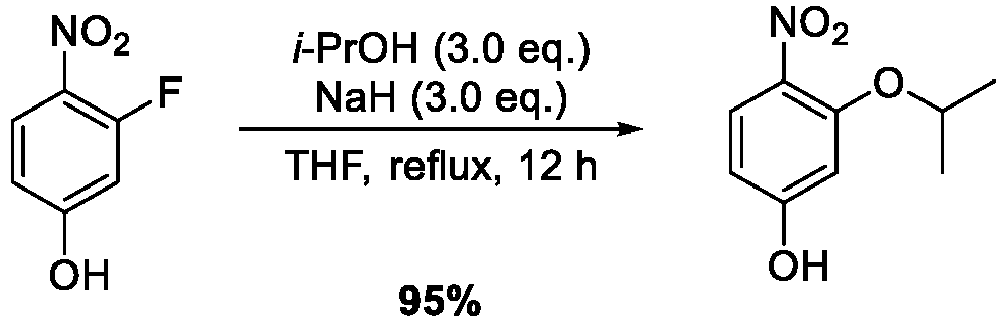
- THF (30 mL) and NaH (1.2 g, 30.0 mmol, 3.0 eq.) were stirred in a 100 mL round flask. i-PrOH (2.3 mL, 30.0 mmol, 3.0 eq.) was added and then stirred at ambient temperature for 10 minutes. After that, 3-fluoro-4-nitrophenol (1.57 g, 10.0 mmol) was added and reacted under reflux for 12 hours. After the reaction ended, it was cooed at ambient temperature and H2O was added for quenching. The reactant was extracted with IN HCl (50ml) and EtOAc (50 mL x 3), and the organic solvent layer was dried MgSO4 and concentrated in vacuo. After that, silica gel column chromatography (EtOAc : Hex) was performed to provide the compound as a dark brown solid (1.87 g) (yield: 95%).
-

- 3-isopropoxy-4-nitrophenol (1.87 g, 9.48 mmol) prepared in
Step 1 and EtOAc/THF (10/10 mL) were stirred at ambient temperature in a 100 mL round flask. Pd/C (370 mg, 20 wt%) was added and stirred at ambient temperature for 24 hours. After the reaction ended, the solvent was removed with a celite filter, and silica gel column chromatography (EtOAc : Hex) was performed to provide the compound (836 mg) (yield: 53%). -

- 1-(4-chlorophenyl)-3,3-bis(methylthio)prop-2-en-1-one (259 mg, 1.0 mmol) prepared in
Step 1 for preparation of Compound 2 and Toluene (10 mL) were stirred in a vial for microwave reaction. BF3.OEt2 (25 µL, 0.2 mmol, 0.2 eq.) and 4-amino-3-isopropoxyphenol (251 mg, 1.5 mmol, 1.5 eq.) prepared in Step 2 were added and reacted at 120 °C for 24 hours. After the reaction ended, the solvent was removed with a rotavapor, and extracted with H2O (50ml) and EtOAc (50 mL x 3). And, the organic solvent layer was dried over MgSO4 and concentrated in vacuo. t-BuOH(10 mL), AcOH (75 µL) and Hydrazine hydrate (75 µL, 1.5 mmol, 1.5 eq.) were added and reacted under reflux for 24 hours. After the reaction ended, the solvent was removed with a rotavapor, and extracted with H2O (50ml) and EtOAc (50 mL x 3). Then, the organic solvent layer was dried over MgSO4 and concentrated in vacuo. After that, silica gel column chromatography (EtOAc : Hex) was performed to provide the compound as a dark brown solid (2 steps, 96 mg) (yield: 28%). - 1H NMR (300 MHz, DMSO-d 6) δ 12.37 (s, 1H), 8.80 (s, 1H), 7.73 (d, J = 8.1 Hz, 2H), 7.47 (d, J = 8.0 Hz, 2H), 6.77 (s, 1H), 6.43 (d, J = 2.7 Hz, 1H), 6.35 - 6.23 (m, 2H), 4.51 (p, J = 6.0 Hz, 1H), 1.30 (d, J = 6.0 Hz, 6H).
-

- EtOH/conc.HCl (45 mL/45 mL) and 3-ethylphenol (74 mmol, 11 mL) were added in a 250 mL RBF. The mixture was stirred in an ice bath for 30 minutes. NaNO2 (1.5 eq, 7.8 g) then was added slowly and stirred to provide a solid. The reactant was stirred for 30 minutes and then water (100 mL) was added to end the reaction. The produced solid was filtered to provide 3-ethyl-4-nitrophenol (10.38g) as a brown solid (yield: 84%).
-

- 3-ethyl-4-nitrophenol (62 mmol, 10.4 g) was dissolved in EA/MeOH (90/10 mL) and Pd/C (1.0 g) was added. The mixture was reacted with a hedrogenator for 4 hours. After the reaction ended, Pd/C was removed using a cellite filter and the solvent was removed under reduced pressure. The solid was filtered with EA to provide 4-amino-3-ethylphenol (7.99 g) (yield: 94%).
-

- 1-(4-(benzyloxy)phenyl)-3,3-bis(methylthio)prop-2-en-1-one (496 mg, 1.5 mmol) and toluene (15 mL) were stirred in a 100 mL round flask. BF3.OEt2 (37 µL, 0.3 mmol, 0.2 eq.) was added and then 4-amino-3-ethylphenol 3-aminophenol (308 mg, 2.25 mmol, 1.5 eq.) preparedin in Step 2 was added. The mixture was reacted under reflux for 24 hours. After the reaction ended, the solvent was removed with a rotavapor, and the reactant was extracted with H2O (50ml) and EtOAc (50 mL x 3). The organic solvent layer was dried over MgSO4 and concentrated in vacuo. After that, silica gel column chromatography (EtOAc : Hex) was performed to provide the compound (298 mg) (yield: 47%).
-

- (Z)-1-(4-(benzyloxy)phenyl)-3-((2-ethyl-4-hydroxyphenyl)amino)-3-(methylthio)prop-2-en-1-one (250 mg, 0.6 mmol), t-BuOH (8 mL), and AcOH (46 µL) were stirred in a 50 ml round flask. Hydrazine hydrate (46 µL, 0.75 mmol, 1.5 eq.) was added and reacted under reflux for 24 hours. After the reaction ended, the solvent was removed with a rotavapor and the reactant was filtered with MeOH to provide the compound (227 mg) (yield: 99%).
-

- 4-((5-(4-(benzyloxy)phenyl)-1H-pyrazol-3-yl)amino)-3-ethylphenol (300 mg, 0.78 mmol) prepared in
Step 4 and DCM (8 mL) were stirred at -78 °C for 15 minutes in a 50 mL round flask. BBr3 (IM in DCM) (3.9 mL) was added slowly and the mixture was stirred at ambient temperature for 3 hours. After the reaction ended, the reactant was cooled using an ice bath and MeOH was used for quenching, and the solvent was removed with a rotavapor. The reactant was extracted with H2O (50ml) and EtOAc (50 mL x 3), and the organic solvent layer was dried over MgSO4 and concentrated in vacuo. After that, silica gel column chromatography (EtOAc : Hex) was performed to provide the compound (44 mg) (yield: 20%). - 1H NMR (500 MHz, DMSO) δ 12.01 - 11.82 (m, 1H), 9.57 (s, 1H), 8.78 (s, 1H), 7.48 (d, J = 8.6 Hz, 2H), 7.25 (s, 1H), 6.89 (s, 1H), 6.78 (d, J = 8.6 Hz, 2H), 6.58 (d, J = 2.7 Hz, 1H), 6.51 (dd, J = 8.6, 2.8 Hz, 1H), 5.87 (s, 1H), 2.56 (q, J = 7.5 Hz, 2H), 1.13 (t, J = 7.5 Hz, 3H).
-

- 4-nitrodiphenylamine (1.07 g, 5.0 mmol) and DCM (30 mL) were stirred in a 100 mL round flask. Et3N (1.4 mL, 10.0 mmol, 2.0 eq.) and (Boc)2O (1.64 g, 7.5 mmol, 1.5 eq.) were added and the mixture was reacted under reflux for 24 hours. After the reaction ended, the solvent was removed with a rotavapor, and extracted with H2O (50ml) and DCM (50 mL x 3). The organic solvent layer was dried over MgSO4 and concentrated in vacuo. Next step was performed without purification.
-

- Tert-butyl (4-nitrophenyl)(phenyl)carbamate of tert-butyl (4-nitrophenyl)(phenyl)carbamate (2.53 g, 8.0 mmol) prepared in
Step 1 and THF(60 mL) were stirred in a 500 mL round flask. MeOH (6 mL) and H2O (90 mL) were added, and then NaS2O4 (12.54 g, 72.0 mmol, 9.0 eq.) and NaHCO3 (6.05 g, 72.0 mmol, 9.0 eq.) were added slowly, and the mixture was stirred for 5 minutes. After the reaction ended, the reactant was extracted several times with EtOAc and the organic solvent layer was dried over MgSO4 and concentrated in vacuo. After that, silica gel column chromatography (EtOAc : Hex) was performed to provide the compound (2 steps, 597 mg) (yield: 42%). -

- 1H NMR (300 MHz, DMSO-d 6) δ 12.43 (s, 1H), 8.28 (s, 1H), 7.80 - 7.67 (m, 3H), 7.51 (s, 2H), 7.29 (s, 1H), 7.13 (t, J = 7.6 Hz, 2H), 6.99 (d, J = 8.2 Hz, 2H), 6.88 (d, J = 8.0 Hz, 2H), 6.66 (t, J = 7.3 Hz, 1H), 6.26 (s, 1H).
-

- 4-nitroaniline (1.41 g, 10.0 mmol) and DCM (30 mL) were stirred in a 100 mL round flask. Pyridine (2.4.mL, 30.0 mmol, 3.0 eq.) was added and cooled with an ice bath. 4-fluorobenzenesulfonyl chloride (1.98 g, 10.0 mmol, 1.0 eq.) was added slowly and the mixture was stirred at ambient temperature for 24 hours. After the reaction ended, the solvent was removed with a rotavapor. The reactant was extracted with H2O (50ml) and EtOAc (50 mL x 3), and the organic solvent layer was dried over MgSO4 and concentrated in vacuo. The produced solid was filtered with Ether to provide the compound (2.9 g) (yield: 98%).
-

- 4-fluoro-N-(4-nitrophenyl)benzenesulfonamide (2.9 g, 9.8 mmol) prepared in
Step 1 and EtOAc/MeOH (30/30 mL) were stirred at ambient temperature in a 250 mL round flask. Pd/C (580 mg, 20 wt%) was added and stirred at ambient temperature for 24 hours. After the reaction ended, Pd/C was removed with a celite filter and the solvent was removed with a rotavapor. After that, silica gel column chromatography (EtOAc : Hex) was performed to provide the compound (2.09 g) (yield: 80%). -

- 1-(4-(benzyloxy)phenyl)-3,3-bis(methylthio)prop-2-en-1-one (496 mg, 1.5 mmol) and Toluene (15 mL) were stirred in a vial for microwave reaction. BF3.OEt2 (37 µL, 0.3 mmol, 0.2 eq.) and N-(4-aminophenyl)-4-fluorobenzenesulfonamide (599 mg, 2.25 mmol, 1.5 eq.) prepared in Step 2 were added and reacted at 120 °C for 24 hours. After the reaction ended, the solvent was removed with a rotavapor H2O (50ml) and the reactant was extracted with EtOAc (50 mL x 3). Then the organic solvent layer was dried over MgSO4 and concentrated in vacuo. t-BuOH(30 mL), AcOH (113 µL) and Hydrazine hydrate(113 µL, 2.25 mmol, 1.5 eq.) were added and reacted under reflux for 24 hours. After the reaction ended, the solvent was removed with a rotavapor, and the reactant was extracted with H2O (50ml) and EtOAc (50 mL x 3). Then the organic solvent layer was dried over MgSO4 and concentrated in vacuo. After that, silica gel column chromatography (EtOAc : Hex) was performed to provide the compound (2 steps, 476mg) (yield: 62%).
-

- N-(4-((5-(4-(benzyloxy)phenyl)-1H-pyrazol-3-yl)amino)phenyl)-4-fluorobenzenesulfonamide (257 mg, 0.5 mmol) prepared in Step 3 and EtOAc/MeOH (8/8 mL) were stirred at ambient temperature in a round flask. Pd/C (51 mg, 20 wt%) was added and stirred at ambient temperature for 24 hours. After the reaction ended, Pd/C was removed with a celite filter and the solvent was removed with a rotavapor. After that, silica gel column chromatography (EtOAc : Hex) was performed to provide the compound (168 mg) (yield: 79%).
- 1HNMR (300 MHz, DMSO-d 6) δ 12.17 (s, 1H), 9.66 (s, 2H), 8.37 (s, 1H), 7.76 - 7.65 (m, 2H), 7.51 (d, J = 8.3 Hz, 2H), 7.37 (t, J = 8.7 Hz, 2H), 7.19 (d, J = 8.4 Hz, 2H), 6.89 - 6.75 (m, 4H), 6.02 (s, 1H).
-

- 3-methyl-4-nitroaniline (1.57 g, 10.0 mmol) and DCM (30 mL) were stirred in a 100 mL round flask. Pyridine (2.4.mL, 30.0 mmol, 3.0 eq.) was added and the mixture was cooled using an ice bath. Then methanesulfonyl chloride (774 µL, 10.0 mmol, 1.0 eq.) was added slowly and stirred at ambient temperature for 24 hours. After the reaction ended, the solvent was removed with a rotavapor and the reactant was extracted with H2O (50ml) and EtOAc (50 mL x 3). Then the organic solvent layer was dried over MgSO4 and concentrated in vacuo. The produced solid was filtered with ether to provide the compound (1.98 g) (yield: 86%).
-

- N-(3-methyl-4-nitrophenyl)methanesulfonamide (1.98 g, 8.6 mmol) prepared in
Step 1 and EtOAc/MeOH (40/40 mL) were stirred at ambient temperature in a 250 mL round flask. Pd/C (400 mg, 20 wt%) was added and stirred at ambient temperature for 24 hours. After the reaction ended, Pd/C was removed with a celite filter, and the solvent was removed with a rotavapor. After that, silica gel column chromatography (EtOAc : Hex) was performed to provide the compound (1.36 g) (yield: 79%). -

- 1-(4-(benzyloxy)phenyl)-3,3-bis(methylthio)prop-2-en-1-one (496 mg, 1.5 mmol) and Toluene (15 mL) were stirred in a MV vial. BF3.OEt2 (37 µL, 0.3 mmol, 0.2 eq.) and N-(4-amino-3-methylphenyl)methanesulfonamide (451 mg, 2.25 mmol, 1.5 eq.) prepared in Step 2 were added and reacted at 120 °C for 24 hours. After the reaction ended, the solvent was removed with a rotavapor and the reactant was extracted with H2O (50ml) and EtOAc (50 mL x 3). Then the organic solvent layer was dried over MgSO4 and concentrated in vacuo. t-BuOH (30 mL), AcOH (113 µL) and Hydrazine hydrate (113 µL, 2.25 mmol, 1.5 eq.) were added and reacted under reflux for 24 hours. After the reaction ended, the solvent was removed with a rotavapor. The reactant was extracted with H2O (50ml) and EtOAc (50 mL x 3), and then the organic solvent layer was dried over MgSO4 and concentrated in vacuo. After that, silica gel column chromatography (EtOAc : Hex) was performed to provide the compound (2 steps, 543 mg) (yield: 81%).
-

- N-(4-((5-(4-(benzyloxy)phenyl)-1H-pyrazol-3-yl)amino)-3-methylphenyl)methanesulfonamide (224 mg, 1.0 mmol) prepared in Step 3 and EtOAc/MeOH/THF (10/10/10 mL) were stirred at ambient temperature in a round flask. Pd/C (90 mg, 20 wt%) was added and stirred at ambient temperature for 48 hours. After the reaction ended, Pd/C was removed with a celite filter and the solvent was removed with a rotavapor. After that, silica gel column chromatography (EtOAc : Hex) was performed to provide the compound (24 mg) (yield: 13%).
- 1H NMR (300 MHz, DMSO-d 6) δ 12.21 (s, 1H), 9.63 (s, 1H), 9.17 (s, 1H), 7.68 (s, 1H), 7.51 (d, J = 8.5 Hz, 2H), 7.29 (s, 1H), 6.94 (d, J = 8.9 Hz, 2H), 6.81 (d, J = 8.5 Hz, 2H), 6.15 (s, 1H), 2.86 (s, 3H), 2.22 (s, 3H).
-

- 3-methyl-4-nitroaniline (3.14 g, 20.0 mmol) and pyridine (20 mL) were stirred in a 100 mL round flask. The mixture was cooled in an ice bath, and acetic anhydride (1.9 mL, 20.0 mmol, 2.0 eq.) was added slowly and stirred at ambient temperature for 24 hours. After the reaction ended, the reactant was extracted with H2O (50ml) and EtOAc (50 mL x 3), and then the organic solvent layer was dried over MgSO4 and concentrated in vacuo. Next step was performed without purification.
-

- N-(3-methyl-4-nitrophenyl)acetamide (4.78 g, 24.6 mmol) and EtOAc/MeOH (100/100 mL) were stirred at ambient temperature in a round flask. Pd/C (1.9 g, 40 wt%) was added and stirred at ambient temperature for 24 hours. After the reaction ended, Pd/C was removed with a celite filter and the solvent was removed with a rotavapor. After that, silica gel column chromatography (EtOAc : Hex) was performed to provide the compound (2 steps, 1.85 g) (yield: 56%).
-

- 1-(4-(benzyloxy)phenyl)-3,3-bis(methylthio)prop-2-en-1-one (496 mg, 1.5 mmol) and toluene (15 mL) were stirred in a MW vial. BF3.OEt2 (37 µL, 0.3 mmol, 0.2 eq.) and N-(4-amino-3-methylphenyl)acetamide (451 mg, 2.25 mmol, 1.5 eq.) were added and reacted at 120 °C for 24 hours. After the reaction ended, the solvent was removed with a rotavapor. Then the reactant was extracted with H2O (50ml) and EtOAc (50 mL x 3), and the organic solvent layer was dried over MgSO4 and concentrated in vacuo. t-BuOH (30 mL), AcOH (113 µL) and Hydrazine hydrate (113 µL, 2.25 mmol, 1.5 eq.) were added and reacted under reflux for 24 hours. After the reaction ended, the solvent was removed with a rotavapor. The reactant was extracted with H2O (50ml) and EtOAc (50 mL x 3), and the organic solvent layer was dried over MgSO4 and concentrated in vacuo. Next step was performed without purification.
-

- N-(4-((5-(4-(benzyloxy)phenyl)-1H-pyrazol-3-yl)amino)-3-methylphenyl)acetamide (610 mg, 1.48 mmol) prepared in Step 3 and EtOAc/MeOH (10/10 mL) were stirred at ambient temperature in a round flask. Pd/C (120 mg, 20 wt%) was added and stirred at ambient temperature for 48 hours. After the reaction ended, Pd/C was removed with a celite filter and the solvent was removed with a rotavapor. After that, silica gel column chromatography (EtOAc : Hex) was performed to provide the compound (3 steps, 24 mg) (yield: 34%).
- 1H NMR (300 MHz, DMSO-d 6) δ 12.14 (s, 1H), 9.62 (s, 1H), 7.51 (d, J = 8.2 Hz, 2H), 7.30 (s, 1H), 7.27 - 7.15 (m, 2H), 6.80 (d, J = 8.2 Hz, 2H), 6.10 (s, 1H), 2.20 (s, 3H), 1.98 (s, 3H).
-

- 3-methyl-4-nitroaniline (1.0 g, 6.6 mmol) and DCM (55 mL) were stirred at -78 °C in a 100 mL round flask. Tridluoroacetic anhydride (1.4 mL, 9.9 mmol, 1.5 eq.) was added slowly and then trimethylamine (3.4 mL, 18.48 mmol, 2.8 eq.) was added and stirred for 3 hours. After the reaction ended, the reactant was cooled in an ice bath, and IN HCl was added and extracted with DCM several times. Then the organic solvent layer was dried over MgSO4 and concentrated in vacuo. After that, silica gel column chromatography (EtOAc : Hex) was performed to provide the compound (1.5 g) (yield: 92%).
-

- 2,2,2-trifluoro-N-(3-methyl-4-nitrophenyl)acetamide (1.5 g, 6.0 mmol) prepared in
Step 1 and EtOAc/MeOH (20/15 mL) were stirred at ambient temperature in a round flask. Pd/C (300 mg, 20 wt%) was added and stirred at ambient temperature for 24 hours. After the reaction ended, Pd/C was removed with a celite filter and the solvent was removed with a rotavapor. After that, silica gel column chromatography (EtOAc : Hex) was performed to provide the compound (1. 19 g) (yield: 91%). -

- 1-(4-(benzyloxy)phenyl)-3,3-bis(methylthio)prop-2-en-1-one (350 mg, 1.06 mmol) and THF (4 mL) were stirred in a round flask. BF3.OEt2 (26 µL, 0.22 mmol, 0.2 eq.) was added and ino-3-methylphenyl)-2,2,2-trifluoroacetamide (347 mg, 1.59 mmol, 1.5 eq.) prepared in Step 2 was added and reacted under reflux for 24 hours. After the reaction ended, the solvent was removed with a rotavapor. The reactant was extracted with H2O (50ml) and EtOAc (50 mL x 3), and then the organic solvent layer was dried over MgSO4 and concentrated in vacuo. After that, silica gel column chromatography (EtOAc : Hex) was performed to provide the compound (228 mg) (yield: 43%).
-

- (Z)-N-(4-((3-(4-(benzyloxy)phenyl)-1-(methylthio)-3-oxoprop-1-en-1-yl)amino)-3-methylphenyl)-2,2,2-trifluoroacetamide (220 mg, 0.45 mmol) prepared in Step 3, t-BuOH (2 mL) and AcOH (33 µL) were stirred in a round flask. Hydrazine hydrate (33 µL, 0.68 mmol, 1.5 eq.) was added and reacted under reflux for 20 hours. After the reaction ended, the solvent was removed with a rotavapor. The reactant was filtered with MeOH to provide the compound (152 mg) (yield: 73%).
-

- N-(4-((5-(4-(benzyloxy)phenyl)-1H-pyrazol-3-yl)amino)-3-methylphenyl)-2,2,2-trifluoroacetamide (150 mg, 0.32 mmol) prepared in
Step 4 and EtOAc/MeOH (3/3 mL) were stirred at ambient temperature in a round flask. Pd/C (30 mg, 20 wt%) was added and stirred at ambient temperature for 24 hours. After the reaction ended, the solvent was removed with a celite filter. After that, silica gel column chromatography (EtOAc : Hex) was performed to provide the compound (yield: 49%). - 1H NMR (300 MHz, DMSO) δ 12.24 (s, 1H), 10.94 (s, 1H), 9.63 (s, 1H), 7.71 (s, 1H), 7.52 (d, J = 8.2 Hz, 2H), 7.37-7.31 (m, 3H), 6.81 (d, J = 8.1 Hz, 2H), 6.18 (s, 1H), 2.24 (s, 3H).
-

- Triphosgene (5.94 g, 20.0 mmol, 1.0 eq.) and THF were stirred at 0 °C in a 250 mL round flask. 3-methyl-4-nitroaniline (3.14 g, 20.0 mmol) in THF was added slowly and stirred at ambient temperature for 1 hour. The reactant was cooled in an ice bath, and methylamine (40% in MeOH, 1.5 mL, 1.0 eq.) was added slowly and stirred at ambient temperature for 24 hours. After the reaction ended, the reactant was extracted with H2O (50ml) and EtOAc (50 mL x 3), and the organic solvent layer was dried over MgSO4 and concentrated in vacuo. EtOAc/MeOH (100/100 mL) was added and then Pd/C (1.7 g, 20 wt%) was added, and the mixture was stirred at ambient temperature for 24 hours. After the reaction ended, Pd/C was removed with a celite filter and the solvent was removed with a rotavapor. After that, silica gel column chromatography (EtOAc : Hex) was performed to provide the compound (2.11 g) (yield: 59%).
-

-

- The Compound (774 mg, 1.71 mmol, 1.0 eq.) of Step 2 and THF were stirred at 0 °C in a 50 mL round flask. TBAF (2.24 g, 8.55 mmol) was added slowly and stirred at ambient temperature for 5 minutes. After the reaction ended, the reactant was extracted with H2O (50ml) and EtOAc (50 mL x 3), and then the organic solvent layer was dried over MgSO4 and concentrated in vacuo. After that, silica gel column chromatography (EtOAc : Hex) was performed to provide the compound (69 mg) (yield: 10%).
- 1H NMR (300 MHz, Chloroform-d) δ 7.85 (d, J = 7.9 Hz, 2H), 7.35 (s, 1H), 7.23 (s, 1H), 7.12 (d, J = 8.4 Hz, 1H), 6.88 (d, J = 7.9 Hz, 2H), 6.76 (s, 1H), 6.13 (s, 1H), 3.78 (s, 3H), 2.21 (s, 3H).
-

- 5-fluoro-2-nitrotoluene (1.2 mL, 10.0 mmol) and THF were stirred in a 100 mL round flask. Trimethylamine (2.8 mL, 20.0 mmol, 2.0 eq.) and 4-(2-aminoethyl)morpholine (3.9 mL, 30.0 mmol, 3.0 eq.) were added and reacted under reflux for 48 hours. After the reaction ended, the solvent was removed with a rotavapor. The reactant was extracted with H2O (50ml) and DCM (50 mL x 3), and then the organic solvent layer was dried over MgSO4 and concentrated in vacuo. The produced compound (3.9 g) and EtOAc/MeOH/THF (50/70/70 mL) were added in a 250 mL round flask and then Pd/C (800 mg, 20 wt%) was added and stirred at ambient temperature for 24 hours. After the reaction ended, Pd/C was removed with a celite filter and the solvent was removed with a rotavapor. After that, silica gel column chromatography (EtOAc : Hex) was performed to provide the compound (2.14 g) (yield: 91%).
-
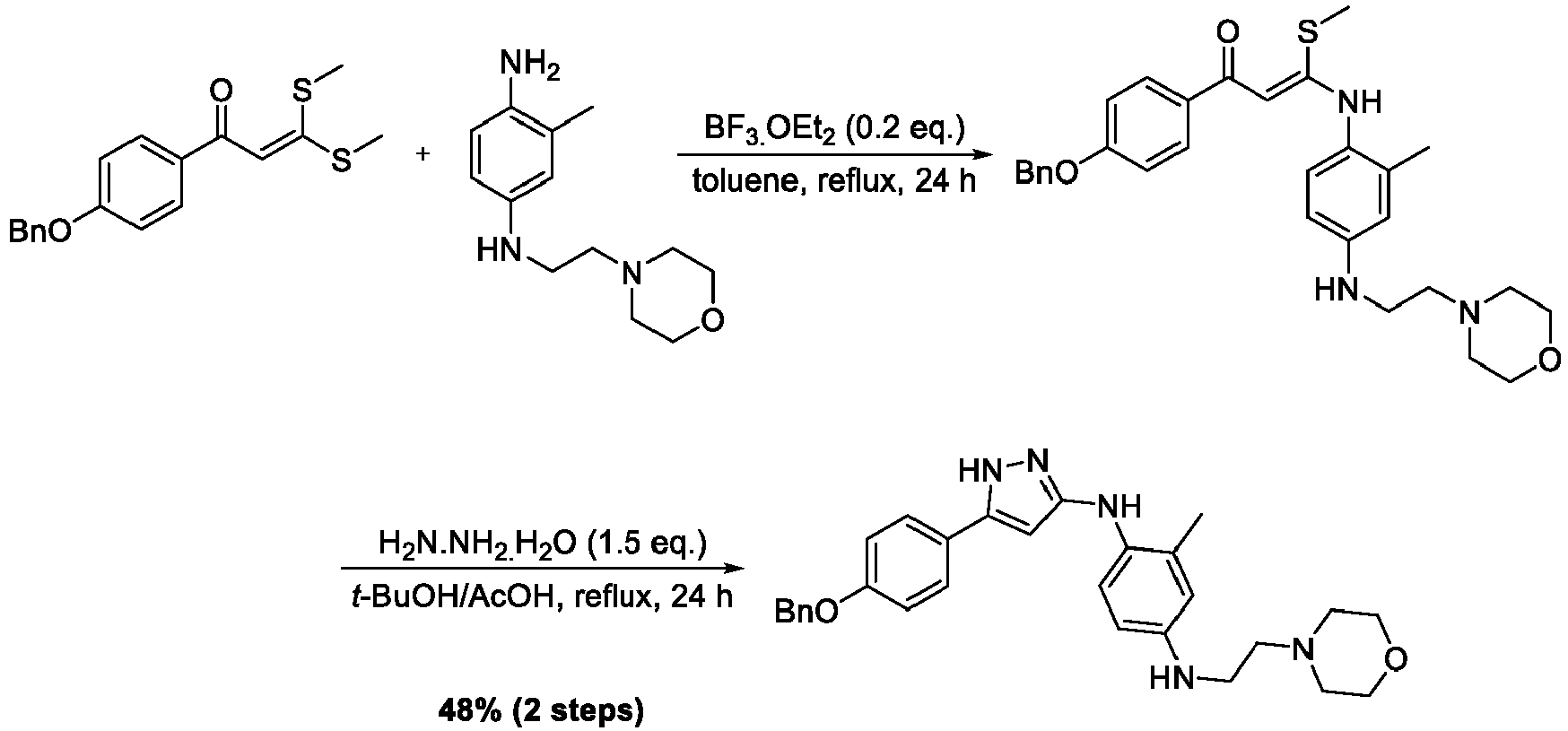
- 1-(4-(benzyloxy)phenyl)-3,3-bis(methylthio)prop-2-en-1-one (660 mg, 2.0 mmol) and Toluene (10 mL) were stirred in a MW vial. BF3.OEt2 (49 µL, 0.3 mmol, 0.2 eq.) and the aniline (706 mg, 3.0 mmol, 1.5 eq.) prepared in
Step 1 were added and reacted at 120 °C for 24 hours. After the reaction ended, the solvent was removed with a rotavapor. The reactant was extracted with H2O (50ml) and EtOAc (50 mL x 3), and then the organic solvent layer was dried over MgSO4 and concentrated in vacuo. t-BuOH (10 mL), AcOH (150 µL) and Hydrazine hydrate (150 µL, 3.0 mmol, 1.5 eq.) were added and reacted under reflux for 24 hours. After the reaction ended, the solvent was removed with a rotavapor. The reactant was extracted with H2O (50ml) and EtOAc (50 mL x 3), and then the organic solvent layer was dried over MgSO4 and concentrated in vacuo. After that, silica gel column chromatography (EtOAc : Hex) was performed to provide the compound (2 steps, 460 mg) (yield: 48%). -

- N1-(5-(4-(benzyloxy)phenyl)-1H-pyrazol-3-yl)-2-methyl-N4-(2-morpholinoethyl)benzene-1,4-diamine (450 mg, 0.93 mmol) prepared in Step 2 and EtOAc/MeOH/THF (5/10/10 mL) were stirred at ambient temperature in a round flask. Pd/C (90 mg, 20 wt%) was added and stirred at ambient temperature for 24 hours. After the reaction ended, Pd/C was removed with a celite filter and the solvent was removed with a rotavapor. After that, silica gel column chromatography (EtOAc : Hex) was performed to provide the compound (140 mg) (yield: 68%).
- 1H NMR (300 MHz, DMSO-d 6) δ 11.87 (s, 1H), 9.57 (s, 1H), 7.47 (d, J = 8.6 Hz, 2H), 7.19 (d, J = 8.5 Hz, 1H), 6.80 (d, J = 3.1 Hz, 2H), 6.76 (s, 1H), 6.44 (d, J = 2.4 Hz, 1H), 6.38 (dd, J = 8.6, 2.6 Hz, 1H), 5.82 (s, 1H), 4.85 (s, 1H), 3.67 - 3.52 (m, 4H), 3.08 (t, J = 6.8 Hz, 2H), 2.47 (s, 2H), 2.45 - 2.36 (m, 4H), 2.14 (s, 3H).
-

- 5-fluoro-2-nitrotoluene (1.2 mL, 10.0 mmol) and THF (20 mL) were stirred in a 100 mL round flask. Et3N (2.8 mL, 20.0 mmol, 2.0 eq.) and 1-acetylpiperazine (3.7 mL, 30.0 mmol, 3.0 eq.) were added and reacted under reflux for 48 hours. After the reaction ended, the reactant was cooled at ambient temperature, and then the solvent was removed with a rotavapor. The reactant was extracted with H2O (50ml) and EtOAc (50 mL x 3), and then the organic solvent layer was dried over MgSO4 and concentrated in vacuo. EtOAc/MeOH/THF (50/50/50 mL) was added to the produced compound and the mixture was stirred at ambient temperature. Pd/C (600 mg, 20 wt%) was added and stirred at ambient temperature for 48 hours. After the reaction ended, Pd/C was removed with a celite filter and the solvent was removed with a rotavapor. After that, silica gel column chromatography (EtOAc : Hex) was performed to provide the compound (1.99 g) (yield: 85%).
-

- 1-(4-(benzyloxy)phenyl)-3,3-bis(methylthio)prop-2-en-1-one (660 mg, 2.0 mmol) and Toluene (10 mL) were stirred in a MW vial. BF3.OEt2 (49 µL, 0.3 mmol, 0.2 eq.) and 1-(4-(4-amino-3-methylphenyl)piperazin-1-yl)ethan-1-one (700 mg, 3.0 mmol, 1.5 eq.) prepared in
Step 1 were added and reacted at 120 °C for 24 hours. After the reaction ended, the solvent was removed with a rotavapor. The reactant was extracted with H2O (50ml) and EtOAc (50 mL x 3), and then the organic solvent layer was dried over MgSO4 and concentrated in vacuo. EtOH (10 mL) and Hydrazine hydrate (150 µL, 3.0 mmol, 1.5 eq.) were added and reacted under reflux for 24 hours. After the reaction ended, the solvent was removed with a rotavapor. The reactant was extracted with H2O (50ml) and EtOAc (50 mL x 3), and then the organic solvent layer was dried over MgSO4 and concentrated in vacuo. After that, silica gel column chromatography (EtOAc : Hex) was performed to provide the compound (2 steps, 277 mg) (yield: 29%). -

- 1-(4-(4-((5-(4-(benzyloxy)phenyl)-1H-pyrazol-3-yl)amino)-3-methylphenyl)piperazin-1-yl)ethan-1-one(270 mg, 0.56 mmol) prepared in Step 2 and EtOAc/MeOH/THF (5/10/10 mL) were stirred at ambient temperature in a round flask. Pd/C (60 mg, 20 wt%) was added and stirred at ambient temperature for 24 hours. After the reaction ended, Pd/C was removed with a celite filter and the solvent was removed with a rotavapor. After that, silica gel column chromatography (EtOAc : Hex) was performed to provide the compound (153 mg) (yield: 70%).
- 1H NMR (300 MHz, DMSO-d 6) δ 12.06 (s, 1H), 9.65 (s, 1H), 7.49 (d, J = 8.7 Hz, 2H), 7.04 (s, 1H), 6.79 (d, J = 8.9 Hz, 3H), 6.70 (dd, J = 8.7, 2.8 Hz, 1H), 6.01 (s, 1H), 3.56 (q, J = 4.3 Hz, 4H), 2.97 (dt, J = 19.4, 5.1 Hz, 4H), 2.20 (s, 3H), 2.03 (s, 3H).
-

- 1-(4-(benzyloxy)phenyl)-3,3-bis(methylthio)prop-2-en-1-one (660 mg, 2.0 mmol) and Toluene (10 mL) were stirred in a MW vial. BF3.OEt2 (49 µL, 0.3 mmol, 0.2 eq.) and 1-(4-(4-amino-3-methylphenyl)piperazin-1-yl)ethan-1-one (700 mg, 3.0 mmol, 1.5 eq.) prepared in
Step 1 of Compound 166 synthesis were added and reacted at 120 °C for 24 hours. After the reaction ended, the solvent was removed with a rotavapor. The reactant was extracted with H2O (50ml) and EtOAc (50 mL x 3), and then the organic solvent layer was dried over MgSO4 and concentrated in vacuo. t-BuOH (10 mL), AcOH (150 µL) and Hydrazine hydrate (150 µL, 3.0 mmol, 1.5 eq.) were added and reacted under reflux for 24 hours. After the reaction ended, the solvent was removed with a rotavapor. The reactant was extracted with H2O (50ml) and EtOAc (50 mL x 3), and then the organic solvent layer was dried over MgSO4 and concentrated in vacuo. After that, silica gel column chromatography (EtOAc : Hex) was performed to provide the compound (2 steps, 377 mg) (yield: 43%). -

- 5-(4-(benzyloxy)phenyl)-N-(2-methyl-4-(piperazin-1-yl)phenyl)-1H-pyrazol-3-amine (241 mg, 0.55 mmol) prepared in
Step 1 and EtOAc/MeOH/THF (10/10/10 mL) were stirred at ambient temperature in a round flask. Pd/C (50 mg, 20 wt%) was added and stirred at ambient temperature for 24 hours. After the reaction ended, Pd/C was removed with a celite filter and the solvent was removed with a rotavapor. After that, silica gel column chromatography (EtOAc : Hex) was performed to provide the compound (92 mg) (yield: 48%). - 1H NMR (300 MHz, DMSO-d 6) δ 12.08 (s, 1H), 9.63 (s, 1H), 8.82 (s, 2H), 7.49 (d, J = 8.6 Hz, 2H), 7.09 (s, 1H), 6.80 (d, J = 8.6 Hz, 3H), 6.73 (dd, J = 8.8, 2.9 Hz, 1H), 6.03 (s, 1H), 3.33 (s, 4H), 3.17 (d, J = 4.2 Hz, 4H), 2.21 (s, 3H).
-

- 4-nitroacetophenone (2.4 g, 14.5 mmol) and benzene (73 mL) were stirred at ambient temperature in a round flask. The mixture was cooled in an ice bath, and then NaH (1.16 g, 29.0 mmol, 2.0 eq.) was added slowly and stirred at ambient temperature for 5 minutes. Carbon disulfide (1.3 mL, 21.8 mmol, 1.5 eq.) was added slowly and stirred at ambient temperature for 5 minutes. Iodomethane (2.7 mL, 43.5 mmol, 3.0 eq.) was then added slowly and stirred at ambient temperature for 5 minutes. N,N-dimethylacetamide (2.8 mL, 30.5 mmol, 2.1 eq.) was added slowly and stirred at ambient temperature for 3 hours. After the reaction ended, H2O was added for quenching, and the reactant was extracted with EtOAc and then the organic solvent layer was dried over MgSO4 and concentrated in vacuo. Then the reactant was filtered with Et2O to provide the compound (2.2 g) (yield: 56%).
-

- 3,3-bis(methylthio)-1-(4-nitrophenyl)prop-2-en-1-one(269 mg, 1.0 mmol) prepared in
Step 1 and toluene (4 mL) were stirred in a round flask. BF3.OEt2 (25 µL, 0.2 mmol, 0.2 eq.) was added and 1.4-phenylenediamine (162 mg, 1.5 mmol, 1.5 eq.) was added, and then reacted under reflux for 24 hours. After the reaction ended, the solvent was removed with a rotavapor. The reactant was extracted with MeOH to provide the compound (290 mg) (yield: 88%). -

- (Z)-3-((4-aminophenyl)amino)-3-(methylthio)-1-(4-nitrophenyl)prop-2-en-1-one(290 mg, 0.88 mmol) prepared in Step 2, t-BuOH (10 mL) and AcOH (45 µL) were stirred in a round flask. Hydrazine hydrate (45 µL, 1.3 mmol, 1.5 eq.) was added and reacted under reflux for 20 hours. After the reaction ended, the solvent was removed with a rotavapor. The reactant was extracted with MeOH to provide the compound (250 mg) (yield: 85%).
- 1H-NMR (300 MHz, DMSO-d6) δ 12.58 (s, 1H), 8.23-8.21 (m, 2H), 7.97-7.64 (m, 2H) 7.83 (s, 1H), 7.02 (s, 1H), 6.50-6.47 (m, 2H), 6.27 (s, 1H)
-

- N1-(5-(4-nitrophenyl)-1H-pyrazol-3-yl)benzene-1,4-diamine (207 mg, 0.7 mmol) and THF/MeOH (5/5 mL) were stirred at ambient temperature in a 50 mL round flask. Pd/C (20 mg, 10 wt%) was added and stirred at ambient temperature for 24 hours. After the reaction ended, Pd/C was removed with a celite pad and the solvent was removed with a rotavapor. After that, silica gel column chromatography (DCM : MeOH) was performed to provide the compound (120 mg) (yield: 65%).
- 1H-NMR (300 MHz, CDCl3) δ 7.33 (d, 2H, J=8.3 Hz), 7.03 (d, 2H, J=8.2 Hz), 6.72-6.65 (m, 4H), 6.02 (s, 1H).
-

- MeOH (10 mL) and Na (368 mg, 2.0 eq.) were stirred in a 100 mL round flask. 3-fluoro-4-nitrophenol (1.26 g, 8.0 mmol) was added and reacted under reflux for 12 hours. After the reaction ended, the reactant was cooled at ambient temperature, and then the solvent was removed with a rotavapor. The reactant was extracted with IN HCl (50ml) and DCM (50 mL x 3), and then the organic solvent layer was dried over MgSO4 and concentrated in vacuo to provide the compound (1.23 g) (yield: 91%).
-

- 3-methoxy-4-nitrophenol (1.23 g, 7.2 mmol) prepared in
Step 1 and EtOAc/THF (10/10 mL) were stirred at ambient temperature in a 100 mL round flask. Pd/C (240 mg, 20 wt%) was added and stirred at ambient temperature for 24 hours. After the reaction ended, the solvent was removed with a celite filter. After that, silica gel column chromatography (EtOAc : Hex) was performed to provide the compound (410 mg) (yield: 41%). -

- 3,3-bis(methylthio)-1-(4-nitrophenyl)prop-2-en-1-one (404 mg, 1.5 mmol) and Toluene (15 mL) were stirred in a MW vial. BF3.OEt2 (38 µL, 0.3 mmol, 0.2 eq.) and 4-amino-3-methoxyphenol (313 mg, 2.25 mmol, 1.5 eq.) prepared in Step 2 were added and reacted at 120 °C for 24 hours. After the reaction ended, the solvent was removed with a rotavapor. The reactant was extracted with H2O (50ml) and EtOAc (50 mL x 3), and then the organic solvent layer was dried over MgSO4 and concentrated in vacuo. t-BuOH (10 mL), AcOH (113 µL) and Hydrazine hydrate (113 µL, 2.25 mmol, 1.5 eq.) were added and reacted under reflux for 24 hours. After the reaction ended, the solvent was removed with a rotavapor. The reactant was extracted with H2O (50ml) and EtOAc (50 mL x 3), and then the organic solvent layer was dried over MgSO4 and concentrated in vacuo. After that, silica gel column chromatography (EtOAc : Hex) was performed to provide the compound (2 steps, 51 mg) (yield: 10%).
-

- 3-methoxy-4-((5-(4-nitrophenyl)-1H-pyrazol-3-yl)amino)phenol (50 mg, 0.15 mmol) prepared in Step 3 and MeOH/EtOAc (3/3 mL) were stirred at ambient temperature in a round flask. Pd/C (10 mg, 20 wt%) was added and stirred at ambient temperature for 24 hours. After the reaction ended, the solvent was removed with a celite filter. After that, silica gel column chromatography (EtOAc : Hex) was performed to provide the compound (13 mg) (yield: 30%).
- 1H NMR (300 MHz, Methanol-d 4) δ 7.40 (d, J = 8.2 Hz, 2H), 7.26 (d, J = 8.5 Hz, 1H), 6.73 (d, J= 8.2 Hz, 2H), 6.47 (d, J= 2.6 Hz, 1H), 6.35 (dd, J= 8.5, 2.6 Hz, 1H), 6.05 (s, 1H), 3.84 (s, 3H).
-

- 3-methyl-4-((5-(4-nitrophenyl)-1H-pyrazol-3-yl)amino)phenol (88 mg, 0.28 mmol) and MeOH/THF/EtOAc (2/2/2 mL) were stirred at ambient temperature in a round flask. Pd/C (9 mg, 10 wt%) was added and stirred at ambient temperature for 24 hours. After the reaction ended, the solvent was removed with a celite filter. After that, silica gel column chromatography (EtOAc : Hex) was performed to provide the compound as a brown solid (15 mg) (yield: 20%).
- 1H-NMR (300 MHz, CD3OD) δ 7.37 (d, 2H, J=8.5 Hz), 7.10 (d, 1H, J=8.5 Hz), 6.71 (d, 2H, J=8.5 Hz), 6.64-6.63 (m, 1H), 6.57 (dd, 1H, J=8.6, 2.8 Hz), 5.81 (s, 1H), 2.20 (s, 3H).
-

- Compound 24 (112 mg, 0.4 mmol) and DCM (3 mL) were stirred in a 100 mL round flask. Pyridine (97 µL, 1.2 mmol, 3.0 eq.) was added and the mixture was cooled in an ice bath. After that, 4-fluorobenzenesulfonyl chloride (79 mg, 0.4 mmol, 1.0 eq.) was added slowly and stirred at ambient temperature for 24 hours. After the reaction ended, the solvent was removed with a rotavapor. The reactant was extracted with H2O (50ml) and DCM (50 mL x 3), and then the organic solvent layer was dried over MgSO4 and concentrated in vacuo. After that, silica gel column chromatography (EtOAc : Hex) was performed to provide the compound as a brown solid (80 mg) (yield: 46%).
- 1H NMR (300 MHz, Chloroform-d) δ 8.08 (dd, J= 8.6, 5.0 Hz, 2H), 7.75 (dd, J= 8.7, 5.1 Hz, 2H), 7.59 (d, J= 8.4 Hz, 2H), 7.21 (t, J= 8.5 Hz, 2H), 7.12 - 7.00 (m, 4H), 6.75 (s, 1H), 6.72 - 6.62 (m, 2H), 5.48 (s, 1H), 4.98 (s, 1H), 2.21 (s, 3H).
-

- (Z)-3-((4-hydroxy-2-methylphenyl)amino)-3-(methylthio)-1-(4-nitrophenyl)prop-2-en-1-one (344 mg, 1.0 mmol) and CH3CN (7 mL) were stirred in a 25 mL round flask. The mixture was cooled in an ice bath, and Selectfluor (373 mg, 1.0 mmol, 1.0 eq.) was slowly added and stirred for 30 minutes at 0 °C. After the reaction ended, H2O (50ml) was added and extracted with DCM (50 mL x 3). After that, the organic solvent layer was dried over MgSO4 and concentrated in vacuo. i-PrOH (5 mL) and Hydrazine hydrate (50 µL, 1.0 mmol, 1.0 eq.) were added and stirred at 80 °C for 2 hours. After the reaction ended, the reactant was cooled at ambient temperature and the solvent was removed with a rotavapor. After that, the reactant was filtered with MeOH to provide the compound (2 steps, 158 mg) (yield: 48%).
- 1H NMR (300 MHz, DMSO-d 6) δ 8.81 (s, 1H), 8.35 (d, J= 8.5 Hz, 2H), 7.97 (d, J= 8.5 Hz, 2H), 7.04 (s, 1H), 6.73 (s, 1H), 6.56 (s, 1H), 6.47 (d, J= 8.6 Hz, 1H), 2.16 (s, 3H).
-

- Compound 71 (150 mg, 0.46 mmol) and EtOAc/MeOH/THF (5/5/5 mL) were stirred at ambient temperature in a round flask. Pd/C (30 mg, 20 wt%) was added and stirred at ambient temperature for 24 hours. After the reaction ended, the solvent was removed with a celite filter. After that, silica gel column chromatography (EtOAc : Hex) was performed to provide the compound (58 mg) (yield: 42%).
- 1H NMR (300 MHz, DMSO-d 6) δ 12.01 (s, 1H), 8.69 (s, 1H), 7.35 (d, J= 9.1 Hz, 2H), 6.86 (s, 1H), 6.68 (s, 1H), 6.63 (d, J= 8.2 Hz, 2H), 6.53 (s, 1H), 6.44 (d, J= 8.2 Hz, 1H), 5.36 (s, 2H), 2.16 (s, 3H).
-
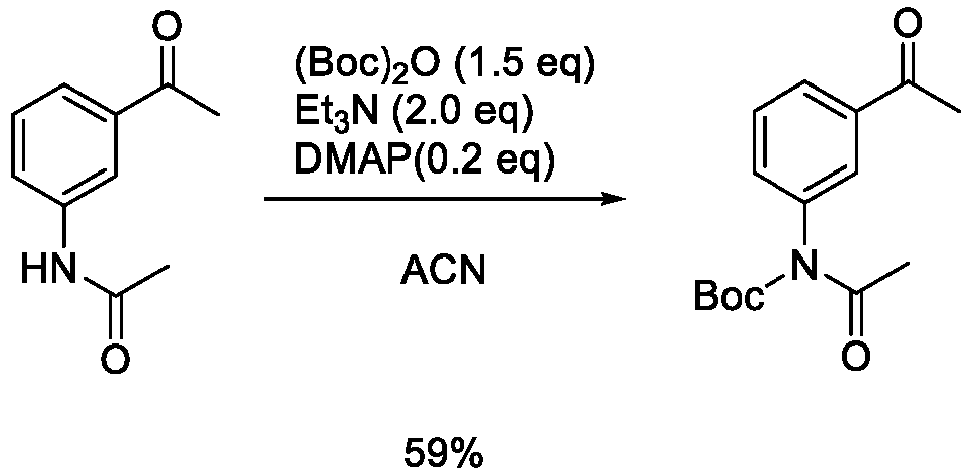
- N-(3-acetylphenyl)acetamide (10 mmol, 1.77 g), (Boc)2O (1.5 eq, 3.2 g) and ACN (35 mL) were added in a 100 ml Round-bottom flask. Triethyl amine (2.0 eq, 2.8 mL) and DMAP (0.2 eq, 24 mg) were added to the mixture and stirred at 78 °C for 3 days. After the reaction ended, the solvent was removed under reduced pressure. The reactant was then extracted with H2O/EA three times, and the organic solvent layer was dried over MgSO4 and concentrated in vacuo. After that, silica gel column chromatography was performed to provide the compound, tert-butyl acetyl(3-acetylphenyl)carbamate (1.63 g) (yield: 59%).
-

- Tert-butyl acetyl(3-acetylphenyl)carbamate (1.5g, 5.4 mmol), benzene (18 mL), and NaH (432 mg, 2.0 eq) were added in a 100 mL RBF at 0 °C and stirred at ambient temperature. After 5 minutes, carbon disulfide (0.67 mL, 1.5 eq) was added and stirred at ambient temperature. After 5 minutes, iodomethane (1.03 mL, 3.0 eq) was added and stirred at ambient temperature. After 5 minutes, N,N-dimethylacetamide (1.05 mL, 2.1 eq) was added and stirred at ambient temperature for 3 hours. After the reaction ended, H2O (60 mL) was added for quenching, and the reactant was extracted with EtOAc (100 mL x 3) and dried over MgSO4 and concentrated in vacuo. The solvent was removed and silica gel column chromatography was performed to provide tert-butyl acetyl(3-(3,3-bis(methylthio)acryloyl)phenyl)carbamate (255 mg) (yield: 12%).
-

- S.M. (0.65 mmol) and aniline derivative (1.5 eq) were dissolved in toluene (7 mL) in a 20 mL vial. Boron trifluoride diethyl etherate (0.2 eq) was added to the solution. The sealed vial was stirred at 120 °C for 6 hours. After the reaction ended, the solvent was removed under reduced pressure and the reactant was extracted with H2O/EA three times. The organic solvent layer was dried over MgSO4. The solvent was concentrated in vacuo. t-BuOH (5 mL) was added to the obtained intermediate, and hydrazine (1.5 eq) and acetic acid (1.5 eq) was added and stirred at 95 °C for 16 hours. After the reaction ended, the solvent was removed under reduced pressure and the reactant was extracted with H2O/EA three times. The organic solvent layer was dried over MgSO4 and concentrated in vacuo. Then silica gel column chromatography was performed to provide N-(3-(3-((4-hydroxy-2-methylphenyl)amino)-1H-pyrazol-5-yl)phenyl)acetamide (11 mg) (yield: 5%).
- 1H NMR (300 MHz, CDCl3) δ 7.70 (s, 1H), 7.54 (dd, J = 5.5, 3.2 Hz, 1H), 7.14 (d, J = 8.6 Hz, 2H), 6.74 - 6.61 (m, 3H), 5.99 (s, 1H), 2.23 (s, 3H), 2.17 (s, 3H).
-

- 4-methylesterlacetophenone (2.0 g, 11.2 mmol) and benzene (37 mL) were stirred at ambient temperature in a round flask. The mixture was cooled in an ice bath, and NaH (538 mg, 22.4 mmol, 2.0 eq.) was added slowly and stirred at ambient temperature for 5 minutes. Carbon disulfide (1.0 mL, 16.8 mmol, 1.5 eq.) was added slowly to the reactant and stirred at ambient temperature for 5 minutes. After that, iodomethane (2.1 mL, 33.7 mmol, 3.0 eq.) was added slowly to the reactant and stirred at ambient temperature for 5 minutes. N,N-dimethylacetamide (2.2 mL, 23.6 mmol, 2.1 eq.) was added slowly to the reactant and stirred at ambient temperature for 3 hours. After the reaction ended, H2O was added for quenching. The reactant was extracted with EtOAc and the organic solvent layer was dried over MgSO4 and concentrated in vacuo. After that, the reactant was filtered with Et2O to provide the compound (yield: 72%).
-

- Methyl 4-(3,3-bis(methylthio)acryloyl)benzoate (1.7 g, 6.0 mmol) prepared in
Step 1 and toluene (20 mL) were stirred at ambient temperature in a 250 mL round flask. Boron trifluoride (170 mg, 1.2 mmol, 0.2 eq) and 4-amino-3-methylphenol (1.1 g, 9.0 mmol, 1.5 eq) were added and stirred at 120 °C for 24 hours. After the reaction ended, toluene was removed with a rotavapor, and the reactant was extracted with sat. NaHCO3 (30ml) and ethyl acetate (30 mL x 2). The organic solvent layer was dried over MgSO4 and concentrated in vacuo. Silica gel column chromatography (EtOAc : Hex = 1 : 9) was performed to provide the reactant. The reactant was sonicated in DCM and filtered to the compound (yield: 79 %). -

- Methyl (Z)-4-(3-((4-hydroxy-2-methylphenyl)amino)-3-(methylthio)acryloyl)benzoate (1.5 g, 4.3 mmol) prepared in Step 2, t-BuOH (13 mL), acetic acid (1.0 mL), and hydrazine hydrate (206 mg, 6.44 mmol, 1.5 eq.) were stirred at 95 °C for 18 hours in a 250 mL round flask. After the reaction ended, the solvent was removed with a rotavapor. The reactant was extracted with H2O (30 mL) and DCM (30 mL x 3), and was dried over MgSO4 and concentrated in vacuo. Silica gel column chromatography (EtOAc : Hex = 1 : 4) was performed to provide the reactant. The reactant was sonicated in DCM and filtered to the compound (yield: 49 %).
- 1H NMR (300 MHz, CDCl3) δ 8.11 (s, 1H), 8.06 (d, J= 8.2 Hz, 2H), 7.98 (d, J= 8.2 Hz, 1H), 7.68 - 7.60 (m, 2H), 7.19 (d, J= 8.5 Hz, 1H), 6.71 (d, J = 2.9 Hz, 1H), 6.66 (dd, J= 8.5, 2.8 Hz, 1H), 6.13 (s, 1H), 5.53 (s, 1H), 3.93 (s, 3H), 2.23 (s, 3H)
-

- Compound 90 (1.95 mmol, 630 mg) was stirred and dissolved in the solvent (H2O:THF:EtOH = 2.0:1.0:2.0) in a 50 ml round bottom flask. Lithium hydroxide (9.74 mmol, 5.0 eq, 408.8 mg) was added and stirred at room temperature for 4 hours. After the reaction ended, solvent was removed for concentration. 30 ml of H2O was added to the reactant, and 6 N HCl was added dropwise to adjust the pH to 1.0. The reactant was extracted with ethyl acetate (30ml x 3). The organic solvent layer was dried over MgSO4 and concentrated in vacuo to provide the compound as a white solid (yield: 13 %).
- 1H NMR (300 MHz, DMSO) δ 12.67 (s, 1H), 8.81 (s, 1H), 8.01 (d, J= 12.4 Hz, 1H), 7.95 (d, J = 7.9 Hz, 2H), 7.81 (d, J = 8.6 Hz, 2H), 7.17 (d, J = 8.3 Hz, 1H), 7.10 (s, 1H), 6.58 (s, 1H), 6.52 (d, J = 8.1 Hz, 1H), 6.12 (s, 1H), 2.16 (s, 3H)
-
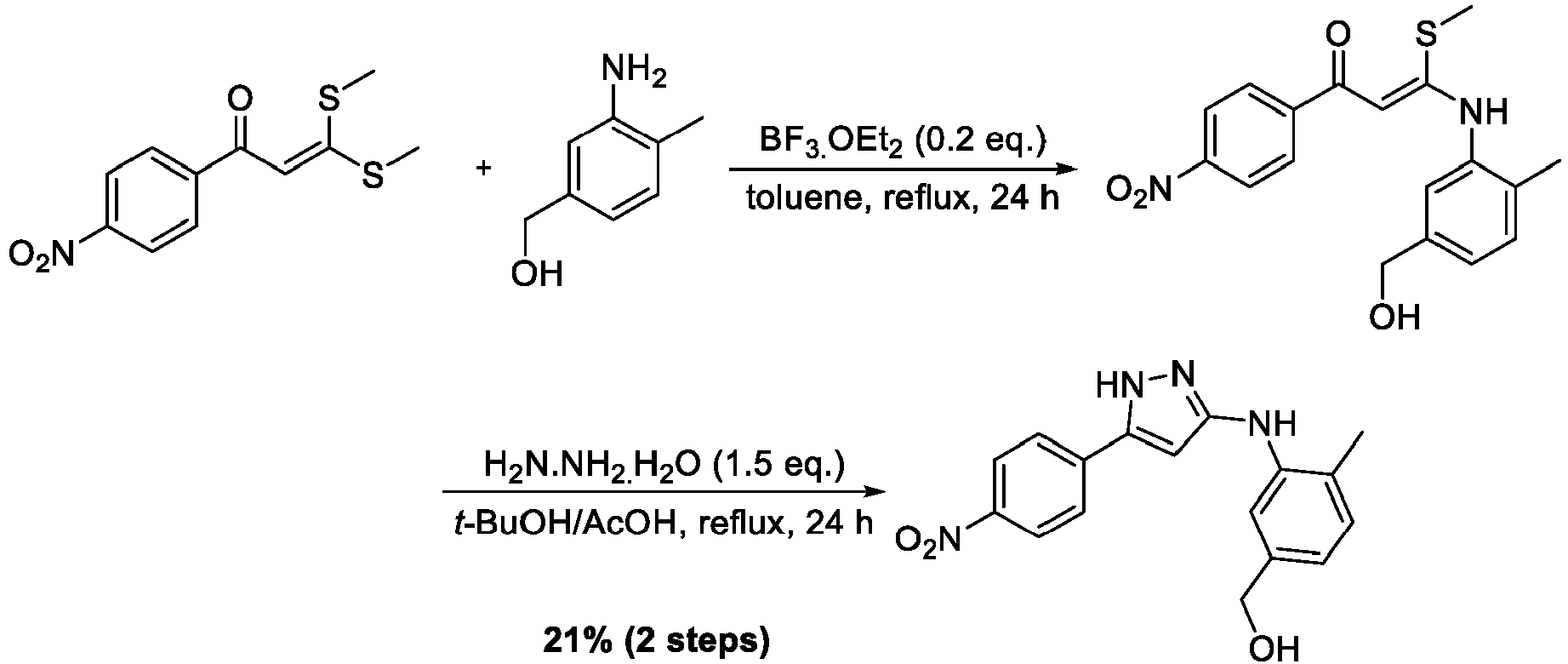
- 3,3-bis(methylthio)-1-(4-nitrophenyl)prop-2-en-1-one (808 mg, 3.0 mmol) and Toluene (20 mL) were added in a MW vial. BF3.OEt2 (74 µL, 0.6 mmol, 0.2 eq.) and 3-amino-4-methylbenzylalcohol (636 mg, 4.5 mmol, 1.5 eq.) were added and reacted at 120 °C for 24 hours. After the reaction ended, the solvent was removed with a rotavapor. The reactant was extracted with H2O (50ml) and EtOAc (50 mL x 3), and then the organic solvent layer was dried over MgSO4 and concentrated in vacuo. t-BuOH (25 mL), AcOH (150 µL) and Hydrazine hydrate (150 µL, 4.5 mmol, 1.5 eq.) were added and reacted under reflux for 24 hours. After the reaction ended, the solvent was removed with a rotavapor. The reactant was extracted with H2O (50ml) and EtOAc (50 mL x 3), and then the organic solvent layer was dried over MgSO4 and concentrated in vacuo. Silica gel column chromatography (EtOAc : Hex) was performed to provide the compound (2 steps, 200 mg) (yield: 21%).
-

- Compound 96 (200 mg, 0.68 mmol) and EtOAc/MeOH/THF (5/5/5 mL) were stirred at ambient temperature in a round flask. Pd/C(40 mg, 20 wt%) was added and stirred at ambient temperature for 24 hours. After the reaction ended, the solvent was removed with a celite filter. Silica gel column chromatography (EtOAc : Hex) was performed to provide the compound (63 mg) (yield: 31%).
- 1H NMR (300 MHz, DMSO-d 6) δ 7.60 (s, 1H), 7.35 (d, J= 8.1 Hz, 2H), 7.16 (s, 1H), 6.99 (d, J= 7.3 Hz, 1H), 6.61 (t, J= 9.6 Hz, 3H), 6.08 (s, 1H), 5.28 (s, 2H), 4.98 (s, 1H), 4.37 (s, 2H), 2.20 (s, 3H).
-

- 4'-iodoacetophenone (1.23 g, 5.0 mmol), pyrazole (0.68 g, 10.0 mmol, 2.0 eq), Cu(OAc)2 (91 mg, 0.5 mmol, 0.1 eq.), Cs2CO3 (3.3 mg, 10.0 mmol, 2.0 eq.) and DMF (5 mL) were stirred at 110 °C in the sealed vial. The same reaction was repeated four times. After the reaction ended, all the reactant was combined and filtered with a celite pad. The filtrate was concentrated with a rotavapor and extracted with H2O (50ml) and EtOAc (50 mL x 3). The organic solvent layer was dried over MgSO4 and concentrated in vacuo. After that, silica gel column chromatography (EtOAc : Hex) was performed and filtered with Et2O and Hex to provide the compound (2.91 g) (yield: 78%).
-

- 1-(4-(1H-pyrazol-1-yl)phenyl)ethan-1-one (1.26 g, 6.8 mmol) and THF (25 mL) were stirred at ambient temperature in a 100 mL round flask. The mixture was cooled in an ice bath, and NaH (544 mg, 13.6 mmol, 2.0 eq.) was added slowly and stirred at ambient temperature for 5 minutes. CS2 (620 µL, 10.2 mmol, 1.5 eq.) was added slowly and stirred at ambient temperature for 5 minutes. MeI (1.3 mL, 20.4 mmol, 3.0 eq.) was added slowly and stirred at 50 °C for 12 hours. After the reaction ended, H2O was added for quenching, and the reactant was extracted with EtOAc. The organic solvent layer was dried over MgSO4 and concentrated in vacuo. After that, Et2O was added to the reactant and sonicated and filtered to provide the compound (1.3 g) (yield: 66%).
-
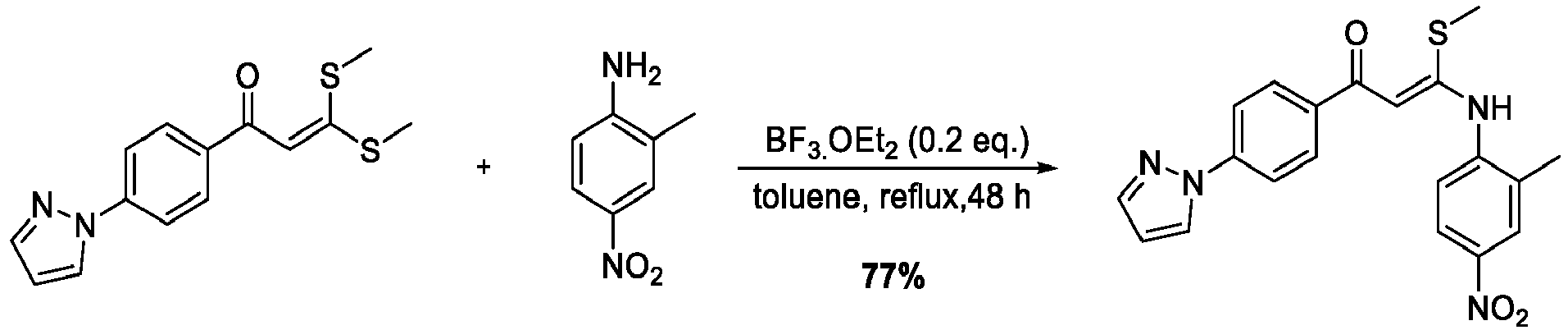
- 1-(4-(1H-pyrazol-1-yl)phenyl)-3,3-bis(methylthio)prop-2-en-1-one(871 mg, 3.0 mmol) prepared in Step 2 and toluene (15 mL) were stirred in a round flask. BF3.OEt2 (74 µL, 0.6 mmol, 0.2 eq.) was added and then 2-methyl-4-nitroaniline (685 mg, 4.5 mmol, 1.5 eq.) was added to the mixture. The mixture was stirred and reacted under reflux for 48 hours. After the reaction ended, the solvent was removed with a rotavapor and the reactant was filtered with MeOH to provide the compound (1.22 g) (yield: 77%).
-

- (Z)-1-(4-(1H-pyrazol-1-yl)phenyl)-3-((2-methyl-4-nitrophenyl)amino)-3-(methylthio)prop-2-en-1-one (1.22 g, 3.1 mmol) prepared in Step 3, t-BuOH (30 mL) and AcOH (233 µL) were stirred in a round flask. Hydrazine hydrate (233 µL, 4.65 mmol, 1.5 eq.) was added and reacted under reflux for 24 hours. After the reaction ended, the solvent was removed with a rotavapor and the reactant was filtered with MeOH to provide the compound (1.02 g) (yield: 91%).
-

- 5-(4-(1H-pyrazol-1-yl)phenyl)-N-(2-methyl-4-nitrophenyl)-1H-pyrazol-3-amine (1.51 g, 4.2 mmol) prepared in
Step 4 and THF were stirred in a 250 mL round flask. DMAP (103 mg, 0.84 mmol, 0.2 eq.), Et3N (1.8 mL, 12.6 mmol, 3.0 eq.), and (Boc)2O (2.75 g, 12.6 mmol, 3.0 eq.) were added and stirred for 24 hours. After the reaction ended, the solvent was removed with a rotavapor. The reactant was extracted with H2O (50ml) and EtOAc (50 mL x 3), and the organic solvent layer was dried over MgSO4 and concentrated in vacuo. After that, silica gel column chromatography (EtOAc : Hex) was performed to provide the compound (1.54 g) (yield: 99%). -

- tert-butyl 5-(4-(1H-pyrazol-1-yl)phenyl)-3-((tert-butoxycarbonyl)(2-methyl-4-nitrophenyl)amino)-1H-pyrazole-1-carboxylate (1.54 g, 2.75 mmol) prepared in
Step 5 and MeOH/THF (10/10 mL) were stirred at ambient temperature in a round flask. Pd/C(300 mg, 20 wt%) was added and stirred at ambient temperature for 48 hours. After the reaction ended, the solvent was removed with a celite filter. After that, silica gel column chromatography (EtOAc : Hex) was performed to provide the compound (1.16 g) (yield: 79%). -

- tert-butyl 5 -(4-(1H-pyrazol-1-yl)phenyl)-3 -((4-amino-2-methylphenyl)(tert-butoxycarbonyl)amino)-1H-pyrazole-1-carboxylate prepared in Step 6 and THF(15 mL) were stirred in a 100 mL round flask. 3-chloropropionyl chloride (600 µL, 6.21 mmol, 3.0 eq.) was added and reacted at 50 °C for 24 hours. After the reaction ended, the solvent was removed with a rotavapor. The reactant was extracted with H2O (50ml) and EtOAc (50 mL x 3), and the organic solvent layer was dried over MgSO4 and concentrated in vacuo. Next step was performed without purification.
-

- tert-butyl 5-(4-(1H-pyrazol-1-yl)phenyl)-3-((tert-butoxycarbonyl)(4-(3-chloropropanamido)-2-methylphenyl)amino)-1H-pyrazole-1-carboxylate prepared in Step 7 and THF(10 mL) were stirred in a 100 mL round flask. Morpholine (450 µL, 5.1 mmol, 3.0 eq.) was added and reacted at 50 °C for 24 hours. After the reaction ended, the solvent was removed with a rotavapor. The reactant was extracted with H2O (50ml) and EtOAc (50 mL x 3), and the organic solvent layer was dried over MgSO4 and concentrated in vacuo. After that, silica gel column chromatography (EtOAc : Hex) was performed to provide both tert-butyl (5-(4-(1H-pyrazol-1-yl)phenyl)-1H-pyrazol-3-yl)(4-(3-chloropropanamido)-2-methylphenyl)carbamate (360 mg) (yield: 41%) and N-(4-((5-(4-(1H-pyrazol-1-yl)phenyl)-1H-pyrazol-3-yl)amino)-3-methylphenyl)-3-chloropropanamide (16 mg) (yield: 2%).
- 1H NMR (300 MHz, DMSO-d 6) δ 12.47 (s, 1H), 9.79 (s, 1H), 8.55 (d, J= 2.5 Hz, 1H), 7.96 - 7.74 (m, 5H), 7.60 (s, 1H), 7.39 - 7.24 (m, 3H), 6.57 (t, J= 2.1 Hz, 1H), 6.31 (s, 1H), 3.87 (t, J= 6.3 Hz, 2H), 2.77 (t, J= 6.3 Hz, 2H), 2.23 (s, 3H).
-

- tert-butyl (5-(4-(1H-pyrazol-1-yl)phenyl)-1H-pyrazol-3-yl)(4-(3-chloropropanamido)-2-methylphenyl)carbamate (360 mg, 0.69 mmol) obtained as a by-product in
Step 8 of the preparation of Compound 180 and THF(10 mL) were stirred in a 100 mL round flask. Morpholine (180 µL, 2.07 mmol, 3.0 eq.) was added and reacted under reflux for 24 hours. After the reaction ended, the solvent was removed with a rotavapor. The reactant was extracted with H2O (50ml) and EtOAc (50 mL x 3), and the organic solvent layer was dried over MgSO4 and concentrated in vacuo. After that, silica gel column chromatography (DCM : MeOH) was performed to provide the compound (310 mg) (yield: 79%). -

- tert-butyl (5-(4-(1H-pyrazol-1-yl)phenyl)-1H-pyrazol-3-yl)(2-methyl-4-(3-morpholinopropanamido)phenyl)carbamate (300 mg, 0.52 mmol) prepared in
Step 1 and DCM (5 mL) were stirred in a 100 mL round flask. The mixture was cooled in an ice bath, and TFA (1.2 mL, 15.6 mmol, 30.0 eq.) was added and stirred at room temperature for 30 hours. After the reaction ended, the reactant was extracted with H2O (50ml) and EtOAc (50 mL x 3), and the organic solvent layer was washed with sat. NaHCO3. The reactant was dried over MgSO4 and concentrated in vacuo. After that, the reactant was filtered with DCM to provide the compound (81 mg) (yield: 33%). - 1H NMR (300 MHz, DMSO-d 6) δ 9.92 (s, 1H), 9.62 (s, 1H), 8.55 (d, J = 2.5 Hz, 1H), 7.91 (d, J = 8.8 Hz, 2H), 7.84 (d, J = 8.9 Hz, 2H), 7.77 (d, J = 1.7 Hz, 1H), 7.50 (d, J = 8.7 Hz, 1H), 7.35 (d, J= 2.4 Hz, 2H), 7.29 (dd, J = 8.6, 2.5 Hz, 1H), 6.60 - 6.54 (m, 1H), 6.32 (s, 1H), 4.00 (d, J= 12.8 Hz, 12H), 2.23 (s, 3H).
-

- XPhos Pd G1 (5 mol%, 0.0113 mmol, 5.4 mg), XPhos (7 mol%, 0.0158 mmol, 11.6 mg), NaO-tBu (2.1 eq, 0.475 mmol, 45 mg), pyrazole amine (1.0 eq, 0.226 mol, 40 mg), N-(4-bromo-3-methylphenyl)methanesulfonamide (1.2 eq, 0.271 mmol, 71 mg), and degassed t-BuOH (4 mL) were added in a microwave vial. The vial was irradiated at 150 °C for 4 hours by microwave. The vial was cooled to room temperature and the solvent was removed under reduced pressure. The reactant was diluted with EA, and extracted with distilled water and NH4Cl solution. The organic solvent layer was dried over Na2SO4 and filtered. The reactant was concentrated in vacuo, and separated by column chromatography to provide the compound as a brown liquid (11 mg) (yield: 13%).
-

- 1-(3-iodophenyl)-3,3-bis(methylthio)prop-2-en-1-one (700 mg, 2.0 mmol), 2-fluoro-5-methoxyphenylboronic acid (340 mg, 2.0 mmol, 1.0 eq.), Pd(PPh3)2Cl2 (264 mg, 0.6 mmol, 30 mol%), and K2CO3 (553 mg, 4.0 mmol, 2.0 eq.) were added to a mixture of H2O (2 mL) and 1,4-dioxane (4 mL) in a round flask and stirred at 90 °C for 24 hours. After the reaction ended, the solvent was removed with a celite filter. The reactant was extracted with H2O (30 mL) and ethyl acetate (30 mL x 3), and then dried over MgSO4 and concentrated in vacuo. Then, silica gel column chromatography (EtOAc : Hex) was performed to provide the compound (297 mg) (yield: 43%).
-

- 1-(2'-fluoro-5'-methoxy-[1,1'-biphenyl]-3-yl)-3,3-bis(methylthio)prop-2-en-1-one (297 mg, 0.88 mmol) prepared in
Step 1 and toluene (9 mL) were stirred in a round flask. BF3.OEt2 (21 µL, 0.17 mmol, 0.2 eq.) was added, and then 4-amino-3-methylphenol (157 mg, 1.28 mmol, 1.5 eq.) was added to the mixture. The mixture was reacted under reflux for 24 hours. After the reaction ended, the reactant was extracted with H2O (30 mL) and ethyl acetate (30 mL x 3), and dried over MgSO4 and concentrated in vacuo. Then, silica gel column chromatography (EtOAc : Hex) was performed to provide the compound (133 mg) (yield: 37%). -

- (Z)-1-(2'-fluoro-5'-methoxy-[1,1'-biphenyl]-3-yl)-3-((4-hydroxy-2-methylphenyl)amino)-3-(methylthio)prop-2-en-1-one (133 mg, 0.31 mmol) prepared in Step 2, t-BuOH (3 mL) and AcOH (23 µL) were stirred in a round flask. Hydrazine hydrate (23 µL, 0.46 mmol, 1.5 eq.) was added and the mixture was reacted under reflux for 24 hours. After the reaction ended, the reactant was extracted with H2O (30 mL) and ethyl acetate (30 mL x 3), and dried over MgSO4 and concentrated in vacuo. Then, silica gel column chromatography (EtOAc : Hex) was performed to provide the compound (96 mg) (yield: 79%).
- 1H NMR (300 MHz, Chloroform-d) δ 7.74 (q, J= 1.7 Hz, 1H), 7.58 (dt, J = 7.6, 1.5 Hz, 1H), 7.54 - 7.47 (m, 1H), 7.42 (t, J = 7.6 Hz, 1H), 7.13 (d, J = 8.4 Hz, 1H), 7.06 (dd, J= 9.9, 8.9 Hz, 1H), 6.94 (dd, J = 6.3, 3.1 Hz, 1H), 6.83 (dt, J = 8.9, 3.5 Hz, 1H), 6.67 - 6.58 (m, 2H), 6.07 (s, 1H), 3.80 (s, 3H), 2.13 (s, 3H).
-

- 2-fluoro-5-methylphenol (4.3 mL, 39.0 mmol), AcOH (12 mL), and H2SO4 (1.7 mL) were stirred in a 25 mL round flask. The mixture was cooled in an ice bath. NaNO2 (2.7 g, 39.0 mmol, 1.0 eq.) in H2O (7.0 mL) was added slowly to the reactant and then stirred at room temperature for 1 hour. The prepared orange solid was filtered and put in a 25 mL round flask to which H2O (19.0 mL) and HNO3 (4.0 mL) were added. The mixture was stirred at 40 °C for 2 hours (until the solid became pale yellow). After the reaction ended, the prepared solid was filtered with H2O to provide a beige solid (3.13 g) (yield: 47%).
-

- 2-fluoro-5-methyl-4-nitrophenol (3.13 g) prepared in
Step 1, THF/H2O (30/30 mL), Fe (4.09 g, 73.2 mmol, 4.0 eq.), and NH4Cl (3.92g, 73.2 mol, 4.0 eq.) were added in a 250 mL round flask and reacted under reflux for 4 hours. After the reaction ended, a celite filtration was performed and the reactant was extracted with H2O and EtOAc. The organic solvent layer was dried over MgSO4 and concentrated in vacuo. After that, silica gel column chromatography (EtOAc : Hex) was performed. The reactant was sonicated in Et2O and filtered to provide a beige solid (984 mg) (yield: 38%). -

- 1-(4-(1H-pyrazol-1-yl)phenyl)-3,3-bis(methylthio)prop-2-en-1-one (436 mg, 1.5 mmol) and Toluene (15 mL) were stirred in a MW vial. BF3.OEt2 (37 µL, 0.3 mmol, 0.2 eq.) and 4-amino-2-fluoro-5-methylphenol (254 mg, 1.8 mmol, 1.2 eq.) prepared in Step 2 were added hereto and reacted under reflux for 24 hours. After the reaction ended, the solvent was removed wth a rotavapor, and the reactant was extracted with H2O (50ml) and EtOAc (50 mL x 3). The organic layer was dried over MgSO4 and concentrated in vacuo. EtOH(15 mL) and Hydrazine hydrate (112 µL, 2.25 mmol, 1.5 eq.) were added hereto and the mixture was reacted under reflux. After the reaction ended, the solvent was removed with a rotavapor, and the reactant was extracted with H2O (50ml) and EtOAc (50 mL x 3). The organic layer was dried over MgSO4 and and concentrated in vacuo. After that, silica gel column chromatography (EtOAc : Hex) was performed to provide a white solid (2 steps, 65 mg) (yield: 12%).
- 1H NMR (300 MHz, DMSO-d6) δ 12.47 (s, 1H), 10.43 (s, 1H), 8.56 (d, J= 2.5 Hz, 1H), 8.42 (s, 1H), 7.92 (d, J = 8.5 Hz, 2H), 7.84 (d, J = 8.5 Hz, 2H), 7.77 (d, J = 1.7 Hz, 1H), 7.14 (s, 1H), 6.90 (d, J= 6.9 Hz, 1H), 6.74 (d, J= 8.4 Hz, 1H), 6.57 (t, J= 2.1 Hz, 1H), 6.24 (s, 1H), 4.49 (s, 2H).
-

- tert-butyl 5-(4-bromophenyl)-3-((tert-butoxycarbonyl)(4-hydroxy-2-methylphenyl)amino)-1H-pyrazole-1-carboxylate (100 mg, 0.18 mmol), 3,5-dimethyl-4-(4,4,5,5-tetramethyl-1,3,2-dioxaborolan-2-yl)-1H-pyrazole (61 mg, 0.27 mmol, 1.5 eq.), Pd(PPh3)2Cl2 (16 mg, 0.036 mmol, 20 mol%), and Na2CO3 (38 mg, 0.36 mmol, 2.0 eq.) were added to a mixture of EtOH (1 mL), H2O (1 mL) and DMF (2 mL) in a round flask, and then stirred at 80 °C for 19 hours. After the reaction ended, the solvent was removed with a celite filter. The reactant was extracted with H2O (30 mL) and ethyl acetate (30 mL x 3), and dried over MgSO4 and concentrated in vacuo. Then, silica gel column chromatography (EtOAc : Hex) was performed to provide the compound (46 mg) (yield: 50%).
-

- tert-butyl 3-((tert-butoxycarbonyl)(4-hydroxy-2-methylphenyl)amino)-5-(4-(3,5-dimethyl-1H-pyrazol-4-yl)phenyl)-1H-pyrazole-1-carboxylate (46 mg, 0.08 mmol) prepared in
Step 1 and DCM (1 mL) were stirred at room temperature in a round flask. The mixture was cooled in an ice bath. TFA (61 µ L, 0.8 mmol, 10.0 eq.) was added to the mixture and stirred at room temperature for 5 hours. After the reaction ended, the reactant was extracted with H2O (30 mL) and ethyl acetate (30 mL x 3). The organic layer was washed with sat. NaHCO3 and then dried over MgSO4 and concentrated in vacuo. Then, silica gel column chromatography (EtOAc : Hex) was performed to provide the compound (17 mg) (yield: 59%). - 1H NMR (500 MHz, DMSO-d 6) δ 8.85 (s, 1H), 7.70 - 7.54 (m, 4H), 7.05 (s, 1H), 6.58 (s, 1H), 6.52 (d, J= 8.6 Hz, 1H), 6.07 (s, 1H), 2.15 (s, 3H), 1.24 (s, 1H), 1.07 (s, 1H).
-

- 3-methyl-4-nitroaniline (15.2 g, 100.0 mmol) and DCM (500 mL) were stirred in a 1000 mL round flask. Pyridine (24.0 mL, 300.0 mmol, 3.0 eq.) was added to the mixture in an ice bath, and methyl chloroformate (9.3 mL, 120.0 mmol, 1.2 eq.) was added slowly and stirred at room temperature for 5 hours. After the reaction ended, H2O was added and the reactant was extracted with EtOAc. The organic layer was dried over MgSO4 and concentrated in vacuo. Then, the reactant was sonicated in Et2O to provide the compound (20.0 g) (yield: 95%).
-

-

- 1-(4-methoxyphenyl)-3,3-bis(methylthio)prop-2-en-1-one (509 mg, 2.0 mmol) and Toluene (15 mL) were stirred in a MW vial. BF3.OEt2 (49 µL, 0.4 mmol, 0.2 eq.) and methyl (4-amino-3-methylphenyl)carbamate (433 mg, 2.4 mmol, 1.2 eq.) prepared in Step 2 were added and reacted under reflux for 24 hours. After the reaction ended, the solvent was removed with a rotavapor. The reactant was extracted with H2O (50ml) and EtOAc (50 mL x 3). The organic layer was dried over MgSO4 and concentrated in vacuo. EtOH(15 mL) and Hydrazine hydrate (150 µL, 3.0 mmol, 1.5 eq.) were added to the reactant and reacted under reflux for 24 hours. After the reaction ended, the solvent was removed with a rotavapor. The reactant was extracted with H2O (50ml) and EtOAc (50 mL x 3), and the organic layer was dried over MgSO4 and concentrated in vacuo. Silica gel column chromatography (EtOAc : Hex) was performed to provide the compound (2 steps, 258 mg) (yield: 37%).
- 1H NMR (300 MHz, DMSO-d6) δ 12.22 (s, 1H), 8.92 (s, 1H), 7.62 (d, J = 8.6 Hz, 3H), 7.51 - 7.32 (m, 5H), 7.19 (s, 1H), 7.07 (d, J= 8.4 Hz, 2H), 6.69 (d, J= 9.9 Hz, 1H), 6.12 (s, 1H), 5.15 (s, 2H), 2.14 (s, 3H).
- The compounds of the present disclosure were synthesized using the method described above by adjusting starting materials and/or intermediates. Results of 1H NMR tests are written in Table 3 below.
[Table 3] Compound No. 1H NMR 1 1H-NMR (300 MHz, DMSO-d6) δ 7.48 (d, 2H, J=8.3 Hz), 7.33-7.30 (m, 2H), 7.19 (d, 2H, J=8.4 Hz), 7.07-6.86 (m, 6H), 6.68 (d, 2H, J=8.3 Hz), 6.17 (s, 1H), 5.98 (s, NH), 3.85 (s, 3H). 2 1H-NMR (300 MHz, DMSO-d6) δ 12.31 (s, 1H), 8.67 (s, 1H), 7.97 (s, 1H), 7.73 (d, 2H, J=9.0 Hz), 7.47 (d, 2H, J=6.0 Hz), 7.12 (s, 1H), 6.62 (d, 2H, J=6.0 Hz), 6.17 (s, 1H). 3 1H-NMR (300 MHz, DMSO-d6) δ 7.69 (d, 2H, J=9.0 Hz), 7.11 (d, 2H, J=9.0 Hz), 7.02 (d, 2H, J=9.0 Hz), 6.68 (d, 2H, J=9.0 Hz), 6.15 (s, 1H), 3.79 (s, 3H). 4 1H-NMR (300 MHz, CDCl3) δ 7.41-6.84 (m, 4H), 7.11 (d, 2H, J=8.9 Hz), 6.85 (d, 2H, J=8.7 Hz), 5.95 (s, 1H), 2.41 (s, 3H). 5 1H-NMR (300 MHz, CDCl3) δ 7.50 (d, 2H, J=8.2 Hz), 7.41 (d, 2H, J=8.5 Hz), 7.35 (d, 1H, J=8.5 Hz), 7.16-7.05 (m, 2H), 6.24 (s, 1H), 5.74 (s, NH), 2.26 (s, 3H). 6 1H-NMR (300 MHz, CDCl3) δ 7.49-7.47 (m, 2H), 7.40 (d, 1H, J=8.4 Hz), 7.13-7.09 (m, 2H), 6.96 (d, 2H, 8.6 Hz), 6.18 (s, 1H), 5.76 (s, NH), 3.85 (s, 3H), 2.25 (s, 3H). 7 1H-NMR (300 MHz, CDCl3) δ 7.42 (d, 1H, 8.5 Hz), 7.29 (s, 1H), 7.13-7.06 (m, 4H), 6.10 (s, 1H), 5.83 (s, NH), 2.40 (s, 3H), 2.36 (s, 3H), 2.26 (s, 3H). 8 1H-NMR (300 MHz, CDCl3) δ 7.51-7.48 (m, 2H), 7.41-7.26 (m, 3H), 6.93-6.84 (m, 2H), 6.15 (s, 1H), 5.30 (s, 1H), 2.27 (s, 3H). 9 1H-NMR (300 MHz, CDCl3) δ 7.50-7.46 (m, 2H), 7.38-7.27 (m, 1H), 6.94-6.85 (m, 4H), 6.11 (s, 1H), 5.64 (s, 1H), 3.84 (s, 3H), 2.25 (s, 3H). 10 1H-NMR (300 MHz, CDCl3) δ 7.40-7.35 (m, 2H), 7.32-7.21 (m, 3H), 6.91-9.80 (m, 2H), 6.05 (s, 1H), 5.73(s, NH), 2.42 (s, 3H), 2.26 (s, 3H). 11 1H-NMR (300 MHz, DMSO-d6) δ 9.11 (s, 1H), 7.79 (d, 2H J=8.9 Hz), 7.66 (d, 2H, J=8.7 Hz), 7.38 (d, 2H, J=8.5 Hz), 7.00 (d, 2H, J=8.8 Hz), 6.23 (s, 1H), 4.23 (q, 2H, J=7.0 Hz), 3.78 (s, 3H), 1.28 (t, J=7.1 Hz). 12 1H-NMR (300 MHz, CDCl3) δ 7.48 (d, 2H, J=8.7 Hz), 7.21 (d, 1H, J=8.5 Hz), 6.92 (d, 2H, J=8.9 Hz), 6.69-6.61 (m, 1H), 6.00 (s, 1H), 3.83 (s, 3H), 2.21 (s, 3H). 13 1H-NMR (300 MHz, CDCl3) δ 6.77 (d, 2H, J=8.9 Hz), 6.20 (d, 2H, J=8.2 Hz), 6.15 (d, 2H, J=8.9 Hz), 5.90(d, 2H, J=8.3 Hz), 5.24 (s, 1H), 3.00 (s, 3H). 14 1H-NMR (300 MHz, DMSO-d6) δ 9.63 (s, 1H), 8.27 (s, 1H), 7.64 (d, 2H, J=8.3 Hz), 7.37 (d, 2H, 8.5 Hz), 7.28-7.25 (m, 2H), 6.99 (d, 2H, J=8.4 Hz), 6.11 (s, 1H), 3.79 (s, 3), 1.99 (s, 3H). 15 1H-NMR (300 MHz, DMSO-d6) δ 12.50 (s, 1H), 9.08 (s, 1H), 7.78 (d, 2H J=8.8 Hz), 7.65 (d, 2H, J=8.2 Hz), 7.39 (d, 2H, J=8.5 Hz), 6.99 (d, 2H, J=8.3 Hz), 6.21 (s, 1H), 3.75 (s, 3H). 16 1H-NMR (300 MHz, CDCl3) δ 7.51-7.48 (m, 2H), 7.08-7.02 (m, 1H), 6.97-6.94 (m, 2H), 6.57-6.56 (m, 1H), 6.53-6.50 (m, 1H), 6.26-6.22 (2H), 3.85 (s, 3H). 17 1H-NMR (300 MHz, CDCl3) δ 7.81 (s, 1H), 7.57-7.54 (m, 1H), 7.49 (d, 2H, J= 8.7 Hz), 7.44-7.42 (m, 1H), 7.35-7.30 (m, 1H),), 6.96 (d, 2H, J= 8.7 Hz), 6.21 (s, 1H), 6.14 (s, 1H), 4.37 (q, 2H, J=7.1 Hz), 3.85 (s, 3H), 1.39 (t, 3H, J=7.1Hz) 18 1H-NMR (300 MHz, CDCl3) δ 12.14 (s, NH), 9.75 (s, 1H), 8.38 (s, 1H), 7.63 (d, 1H, J=8.4 Hz), 7.50 (s, 1H), 7.08-6.91 (m, 4H), 6.15 (s, 1H), 3.78 (s, 3H), 2.00 (s, 3H). 19 1H-NMR (300 MHz, CDCl3) δ 7.46 (d, J=8.5 Hz), 7.12 (t, 1H, J=7.5 Hz), 6.95 (d, 2H, J=8.6 Hz), 6.84-6.83 (m, 1H), 6.65-6.62 (m, 1H), 6.39-6.36 (m, 2H), 6.20 (s, 1H), 6.03-6.02 (m, 1H) 4.12 (q, 2H, J=7.2 Hz), 3.85 (s, 3H), 1.26 (t, 3H, J=7.1Hz) 20 1H-NMR (300 MHz, DMSO-d6) δ 8.68 (s, 1H), 8.06 (s, 1H), 7.65 (d, 2H, J=8.4 Hz), 7.53-7.50 (m, 1H), 7.31-7.27 (m, 2H), 7.00 (d, 2H, J=8.4 H), 6.14 (s, 1H), 3.78 (s, 3H). 21 1H-NMR (300 MHz, DMSO-d6) δ ) 12.58 (s, 1H), 8.23-8.21 (m, 2H), 7.97-7.64 (m, 2H) 7.83 (s, 1H), 7.02 (s, 1H), 6.50-6.47 (m, 2H), 6.27 (s, 1H) 22 1H-NMR (300 MHz, CDCl3) δ 7.33 (d, 2H, J=8.3 Hz), 7.03 (d, 2H, J=8.2 Hz), 6.72-6.65 (m, 4H), 6.02 (s, 1H). 23 1H-NMR (300 MHz, CD3OD) δ 8.21 (d, 2H, J=8.9 Hz), 7.86 (d, 2H, J=8.9 Hz), 7.07 (d, 2H, J=8.5 Hz), 6.66 (s, 1H), 6.60 (dd, 1H, 8.6, 2.8 Hz), 6.04 (s, 1H), 2.20 (s, 3H). 24 1H-NMR (300 MHz, CD3OD) δ 7.37 (d, 2H, J=8.5 Hz), 7.10 (d, 1H, J=8.5 Hz), 6.71 (d, 2H, J=8.5 Hz), 6.64-6.63 (m, 1H), 6.57 (dd, 1H, J=8.6, 2.8 Hz), 5.81 (s, 1H), 2.20 (s, 3H). 25 1H-NMR (300 MHz, CDCl3) δ 8.27 (d, 2H, J=8.6 Hz), 7.77 (d, 2H, J=8.6 Hz), 7.04 (d, 2H, J=8.5 Hz), 6.81 (d, 2H, J=8.5 Hz). 26 1H-NMR (300 MHz, DMSO-d6) δ 12.32 (s, NH), 8.60 (s, 1H), 7.62 (d, 2H, J=8.7 Hz), 7.40-7.33 (m, 3H), 7.20-6.95 (m, 9H), 6.36-6.29 (m, 2H), 6.17-6.09 (m, 2H), 5.21 (s, NH), 3.78 (s, 3H). 27 1H NMR (300 MHz, DMSO-d 6) δ 12.27 (s, 1H), 8.87 (s, 1H), 7.71 (d, J = 8.3 Hz, 2H), 7.48 (d, J = 8.2 Hz, 2H), 7.04 (s, 1H), 6.43 (s, 1H), 6.29 (d, J= 8.4 Hz, 2H), 3.79 (s, 3H). 28 1H NMR (300 MHz, DMSO-d 6) δ 12.37 (s, 1H), 8.80 (s, 1H), 7.73 (d, J = 8.1 Hz, 2H), 7.47 (d, J = 8.0 Hz, 2H), 6.77 (s, 1H), 6.43 (d, J = 2.7 Hz, 1H), 6.35 - 6.23 (m, 2H), 4.51 (p, J = 6.0 Hz, 1H), 1.30 (d, J= 6.0 Hz, 6H). 29 1H NMR (300 MHz, Methanol-d 4) δ 7.65 (d, J = 8.1 Hz, 2H), 7.40 (d, J = 8.3 Hz, 2H), 7.02 (s, 2H), 6.67 (d, J = 8.2 Hz, 2H), 6.12 (s, 1H), 3.01 (t, J = 7.5 Hz, 2H), 1.62 (q, J = 7.2 Hz, 2H), 0.99 (t, J = 7.4 Hz, 3H). 30 1H NMR (300 MHz, DMSO-d 6) δ 12.43 (s, 1H), 8.28 (s, 1H), 7.80 - 7.67 (m, 3H), 7.51 (s, 2H), 7.29 (s, 1H), 7.13 (t, J = 7.6 Hz, 2H), 6.99 (d, J = 8.2 Hz, 2H), 6.88 (d, J = 8.0 Hz, 2H), 6.66 (t, J = 7.3 Hz, 1H), 6.26 (s, 1H). 31 1H NMR (300 MHz, Chloroform-d) δ 7.50 (d, J = 8.7 Hz, 2H), 7.34 (t, J = 7.9 Hz, 2H), 7.12 (dt, J = 7.4, 3.1 Hz, 2H), 6.99 (dd, J = 13.0, 8.2 Hz, 4H), 6.64 - 6.52 (m, 3H), 5.98 (s, 1H), 2.13 (s, 3H). 32 1H NMR (300 MHz, DMSO-d 6) δ 12.23 (s, 1H), 8.81 (s, 1H), 7.65 (d, J= 8.4 Hz, 2H), 7.58 (d, J = 8.3 Hz, 2H), 7.08 (s, 1H), 6.57 (d, J = 2.9 Hz, 1H), 6.51 (dd, J = 8.6, 2.7 Hz, 1H), 6.05 (s, 1H), 2.14 (s, 3H). 33 1H NMR (300 MHz, DMSO-d 6) δ 12.52 (s, 1H), 12.18 (s, 1H), 8.84 (s, 1H), 7.87 (d, J = 7.3 Hz, 4H), 7.17 (s, 1H), 6.61 - 6.47 (m, 2H), 6.17 (s, 1H), 2.15 (s, 3H). 34 1H NMR (300 MHz, Methanol-d 4) δ 7.40 (d, J= 8.2 Hz, 2H), 7.26 (d, J = 8.5 Hz, 1H), 6.73 (d, J = 8.2 Hz, 2H), 6.47 (d, J = 2.6 Hz, 1H), 6.35 (dd, J = 8.5, 2.6 Hz, 1H), 6.05 (s, 1H), 3.84 (s, 3H). 35 1H NMR (300 MHz, Methanol-d 4) δ 7.41 (d, J = 8.6 Hz, 2H), 7.24 (d, J = 8.6 Hz, 1H), 6.74 (d, J = 8.6 Hz, 2H), 6.48 (d, J= 2.6 Hz, 1H), 6.36 (dd, J= 8.5, 2.6 Hz, 1H), 6.09 (s, 1H), 4.55 (p, J = 6.1 Hz, 1H), 1.36 (d, J = 6.0 Hz, 6H). 36 1H NMR (300 MHz, DMSO-d 6) δ 11.79 (s, 1H), 7.67 (s, 1H), 7.33 (d, J = 8.2 Hz, 2H), 7.09 (d, J = 8.4 Hz, 2H), 6.57 (d, J = 8.3 Hz, 2H), 6.47 (d, J = 8.4 Hz, 2H), 5.85 (s, 1H), 5.26 (s, 2H), 4.88 (s, 1H), 2.90 (t, J = 7.0 Hz, 2H), 1.54 (q, J = 7.2 Hz, 2H), 0.93 (t, J = 7.4 Hz, 3H). 37 1H NMR (300 MHz, Methanol-d 4) δ 7.42 (d, J = 8.6 Hz, 2H), 7.21 - 7.07 (m, 5H), 7.02 (d, J = 8.8 Hz, 2H), 6.92 (d, J = 7.8 Hz, 2H), 6.77 - 6.71 (m, 2H), 6.06 (s, 1H). 38 1H NMR (300 MHz, DMSO-d 6) δ 11.85 (s, 1H), 8.63 (s, 1H), 7.86 (s, 1H), 7.34 (d, J = 8.4 Hz, 2H), 7.14 (d, J= 8.3 Hz, 2H), 6.59 (t, J= 8.9 Hz, 4H), 5.88 (s, 1H), 5.27 (s, 2H). 39 1H NMR (500 MHz, DMSO-d 6) δ 11.98 (s, 1H), 9.58 (s, 1H), 7.49 (d, J = 8.5 Hz, 2H), 6.90 (s, 1H), 6.79 (d, J = 8.5 Hz, 2H), 6.56 (d, J = 2.8 Hz, 1H), 6.50 (dd, J = 8.5, 2.9 Hz, 1H), 5.91 (s, 1H), 2.15 (s, 3H). 40 1H NMR (500 MHz, DMSO-d 6) δ 12.02 (s, 1H), 9.62 (s, 1H), 8.63 (s, 1H), 7.90 (s, 1H), 7.51 (d, J = 8.3 Hz, 2H), 7.17 (s, 1H), 6.81 (d, J = 8.3 Hz, 2H), 6.65 - 6.59 (m, 2H), 5.98 (s, 1H). 41 1H NMR (300 MHz, DMSO-d 6) δ 12.05 (s, 1H), 8.75 (s, 1H), 7.31 (s, 1H), 7.01 (dd, J = 17.9, 10.2 Hz, 2H), 6.86 - 6.77 (m, 2H), 6.55 (s, 1H), 6.53 - 6.46 (m, 2H), 5.87 (s, 1H), 5.11 (s, 2H), 2.14 (s, 3H). 42 1H NMR (300 MHz, DMSO-d 6) δ 12.14 (s, 1H), 8.79 (s, 1H), 7.78 - 7.67 (m, 2H), 7.24 (t, J = 8.7 Hz, 3H), 7.03 (s, 1H), 6.57 (d, J = 2.8 Hz, 1H), 6.51 (dd, J = 8.6, 2.7 Hz, 1H), 6.03 (s, 1H), 2.15 (s, 3H). 43 1H NMR (300 MHz, DMSO-d 6) δ 11.89 (s, 1H), 9.14 (s, 1H), 7.74 (s, 1H), 7.52 (s, 1H), 7.32 (d, J = 8.4 Hz, 2H), 6.62 - 6.52 (m, 3H), 6.49 (dd, J = 8.9, 2.7 Hz, 1H), 5.92 (s, 1H), 5.28 (s, 2H). 44 1H NMR (300 MHz, DMSO-d 6) δ 11.96 (s, 1H), 8.90 (s, 1H), 8.18 (s, 1H), 7.35 (d, J = 8.2 Hz, 3H), 6.85 (d, J = 9.3 Hz, 1H), 6.77 (t, J = 9.2 Hz, 1H), 6.58 (d, J = 8.3 Hz, 2H), 5.89 (s, 1H), 5.30 (s, 2H), 3.35 (s, 3H), 2.08 (s, 3H). 45 1H NMR (300 MHz, DMSO-d 6) δ 12.29 (s, 1H), 8.78 (s, 1H), 7.78 (d, J = 7.9 Hz, 2H), 7.71 (d, J = 8.1 Hz, 4H), 7.47 (t, J = 7.5 Hz, 2H), 7.38 (d, J = 7.1 Hz, 1H), 7.05 (s, 1H), 6.57 (s, 1H), 6.52 (d, J = 7.3 Hz, 1H), 6.11 (s, 1H), 2.17 (s, 3H). 46 1 NMR (300 MHz, DMSO-d 6) δ 12.31 (s, 1H), 8.79 (s, 1H), 7.79 (d, J = 8.2 Hz, 2H), 7.73 (s, 2H), 7.67 (t, J = 10.0 Hz, 5H), 7.29 (s, 1H), 7.05 (s, 1H), 6.57 (s, 1H), 6.52 (dd, J = 8.8, 2.4 Hz, 1H), 6.11 (s, 1H), 2.16 (s, 3H). 47 1H NMR (300 MHz, DMSO-d 6) δ 12.27 (s, 1H), 8.92 (s, 1H), 8.82 (s, 1H), 8.48 (d, J = 3.7 Hz, 1H), 8.06 (d, J = 8.1 Hz, 1H), 7.42 (t, J = 6.5 Hz, 1H), 7.13 (s, 1H), 6.57 (s, 1H), 6.52 (d, J = 8.8 Hz, 1H), 6.13 (s, 1H), 2.15 (s, 3H). 48 1H NMR (300 MHz, DMSO-d 6) δ 12.01 (s, 1H), 9.69 (s, 1H), 8.33 (s, 1H), 7.76 - 7.65 (m, 2H), 7.37 (t, J = 9.2 Hz, 4H), 7.19 (d, J = 8.4 Hz, 2H), 6.83 (d, J = 8.4 Hz, 2H), 6.58 (d, J = 8.2 Hz, 2H), 5.93 (s, 1H), 5.29 (s, 2H). 49 1H NMR (300 MHz, DMSO-d 6) δ 12.04 (s, 1H), 9.62 (s, 1H), 9.17 (s, 1H), 7.71 (s, 1H), 7.58 (s, 1H), 7.48 (d, J = 8.2 Hz, 2H), 6.80 (d, J = 8.3 Hz, 2H), 6.57 (d, J = 13.1 Hz, 1H), 6.50 (dd, J = 9.1, 2.0 Hz, 1H), 6.00 (s, 1H). 50 1H NMR (300 MHz, DMSO-d 6) δ 12.03 (s, 1H), 9.12 (s, 1H), 8.37 (s, 1H), 7.36 (d, J = 8.0 Hz, 2H), 7.31 (d, J = 7.8 Hz, 2H), 7.04 (d, J = 8.9 Hz, 2H), 6.58 (d, J = 8.9 Hz, 2H), 5.97 (s, 1H), 5.30 (s, 2H), 2.86 (s, 3H). 51 1H NMR (300 MHz, DMSO-d 6) δ 12.19 (s, 1H), 9.64 (s, 1H), 9.13 (s, 1H), 8.42 (s, 1H), 7.52 (d, J = 8.3 Hz, 2H), 7.30 (d, J = 8.4 Hz, 2H), 7.05 (d, J = 8.5 Hz, 2H), 6.81 (d, J = 8.3 Hz, 2H), 6.06 (s, 1H), 2.86 (s, 3H). 52 1H NMR (300 MHz, DMSO-d 6) δ 12.17 (s, 1H), 9.66 (s, 2H), 8.37 (s, 1H), 7.76 - 7.65 (m, 2H), 7.51 (d, J = 8.3 Hz, 2H), 7.37 (t, J = 8.7 Hz, 2H), 7.19 (d, J = 8.4 Hz, 2H), 6.89 - 6.75 (m, 4H), 6.02 (s, 1H). 53 1H NMR (300 MHz, DMSO-d 6) δ 12.14 (s, 1H), 9.64 (s, 2H), 8.27 (s, 1H), 7.52 (d, J = 8.3 Hz, 2H), 7.35 (s, 2H), 7.26 (s, 2H), 6.81 (d, J = 7.4 Hz, 2H), 6.04 (s, 1H), 2.09 (s, 3H). 54 1H NMR (300 MHz, DMSO-d 6) δ 11.98 (s, 1H), 9.63 (s, 1H), 8.23 (s, 1H), 7.36 (d, J = 8.4 Hz, 4H), 7.25 (d, J= 8.3 Hz, 2H), 6.58 (d, J = 8.2 Hz, 2H), 5.95 (s, 1H), 5.29 (s, 2H), 1.98 (s, 3H). 55 1H NMR (300 MHz, DMSO-d 6) δ 12.05 (s, 1H), 9.13 (s, 1H), 7.62 (s, 1H), 7.35 (d, J = 8.3 Hz, 2H), 7.23 (s, 1H), 6.93 (d, J = 8.8 Hz, 2H), 6.58 (d, J = 8.4 Hz, 2H), 6.06 (s, 1H), 5.29 (s, 2H), 2.86 (s, 3H), 2.21 (s, 3H). 56 1H NMR (300 MHz, DMSO-d 6) δ 12.01 (s, 1H), 8.69 (s, 1H), 7.35 (d, J = 9.1 Hz, 2H), 6.86 (s, 1H), 6.68 (s, 1H), 6.63 (d, J = 8.2 Hz, 2H), 6.53 (s, 1H), 6.44 (d, J = 8.2 Hz, 1H), 5.36 (s, 2H), 2.16 (s, 3H). 57 1H NMR (300 MHz, DMSO-d 6) δ 12.03 (s, 1H), 9.71 (s, 1H), 7.73 (dd, J = 8.6, 5.1 Hz, 2H), 7.50 (s, 1H), 7.43 - 7.29 (m, 4H), 7.17 (s, 1H), 6.76 (s, 1H), 6.74 - 6.68 (m, 1H), 6.58 (d, J = 8.2 Hz, 2H), 6.02 (s, 1H), 5.28 (s, 2H), 2.12 (s, 3H). 58 1H NMR (300 MHz, DMSO-d 6) δ 12.21 (s, 1H), 9.63 (s, 1H), 9.17 (s, 1H), 7.68 (s, 1H), 7.51 (d, J = 8.5 Hz, 2H), 7.29 (s, 1H), 6.94 (d, J = 8.9 Hz, 2H), 6.81 (d, J = 8.5 Hz, 2H), 6.15 (s, 1H), 2.86 (s, 3H), 2.22 (s, 3H). 59 1H NMR (300 MHz, DMSO-d 6) δ 12.14 (s, 1H), 9.62 (s, 1H), 7.51 (d, J = 8.2 Hz, 2H), 7.30 (s, 1H), 7.27 - 7.15 (m, 2H), 6.80 (d, J = 8.2 Hz, 2H), 6.10 (s, 1H), 2.20 (s, 3H), 1.98 (s, 3H). 66 1H NMR (300 MHz, DMSO-d 6) δ 12.13 (s, 1H), 8.85 (s, 1H), 8.74 (d, J = 2.5 Hz, 1H), 8.13 (dd, J = 8.3, 2.5 Hz, 1H), 7.53 (s, 1H), 7.18 (s, 1H), 6.57 (s, 1H), 6.52 (d, J = 9.0 Hz, 1H), 6.11 (s, 1H), 2.14 (s, 3H). 67 1H NMR (300 MHz, Acetone-d 6) δ 8.24 (d, J = 8.7 Hz, 2H), 7.99 (d, J = 8.7 Hz, 2H), 7.61 (t, J = 9.6 Hz, 1H), 7.19 (s, 1H), 6.68 - 6.54 (m, 2H), 6.42 (s, 1H). 68 1H NMR (300 MHz, Methanol-d 4) δ 8.22 (d, J = 8.9 Hz, 2H), 7.86 (d, J = 9.0 Hz, 2H), 7.03 (d, J = 12.2 Hz, 1H), 6.85 - 6.75 (m, 2H), 6.31 (s, 1H). 69 1H NMR (300 MHz, DMSO-d 6) δ 12.79 (s, 1H), 9.66 (s, 1H), 8.54 (s, 1H), 8.28 (d, J = 8.5 Hz, 2H), 8.01 (d, J = 8.5 Hz, 2H), 7.72 (dd, J = 8.6, 5.2 Hz, 2H), 7.38 (t, J = 8.7 Hz, 2H), 7.14 (s, 2H), 6.88 (d, J = 8.4 Hz, 2H), 6.47 (s, 1H). 70 1H NMR (300 MHz, DMSO-d 6) δ 12.74 (s, 1H), 9.22 (s, 1H), 8.28 (d, J = 8.5 Hz, 2H), 8.01 (d, J = 8.5 Hz, 2H), 7.53 (s, 1H), 6.97 (d, J = 11.9 Hz, 2H), 6.50 (s, 1H), 2.88 (s, 3H), 2.23 (s, 3H). 71 1H NMR (300 MHz, DMSO-d 6) δ 8.81 (s, 1H), 8.35 (d, J = 8.5 Hz, 2H), 7.97 (d, J = 8.5 Hz, 2H), 7.04 (s, 1H), 6.73 (s, 1H), 6.56 (s, 1H), 6.47 (d, J = 8.6 Hz, 1H), 2.16 (s, 3H). 72 1H NMR (300 MHz, DMSO-d 6) δ 12.74 (s, 1H), 9.84 (s, 1H), 8.27 (d, J = 8.5 Hz, 2H), 7.99 (d, J = 8.4 Hz, 2H), 7.81 - 7.69 (m, 2H), 7.46 (s, 1H), 7.38 (t, J = 8.8 Hz, 2H), 6.82 (s, 1H), 6.76 (d, J = 8.1 Hz, 1H), 6.48 (s, 1H), 2.14 (s, 3H). 73 1H NMR (500 MHz, DMSO-d 6) δ 12.34 (s, 1H), 8.76 (s, 1H), 8.32 (s, 1H), 7.82 (d, J = 11.3 Hz, 4H), 7.72 (s, 2H), 7.13 (s, 2H), 6.58 (s, 2H), 6.53 (s, 1H), 6.15 (s, 1H), 2.17 (d, J = 2.9 Hz, 4H). 74 1H NMR (500 MHz, DMSO-d 6) δ 12.38 (s, 1H), 8.70 (s, 1H), 8.33 (d, J = 1.2 Hz, 1H), 8.00 (s, 1H), 7.86 (d, J = 8.5 Hz, 2H), 7.81 (t, J = 1.3 Hz, 1H), 7.73 (d, J = 8.3 Hz, 2H), 7.13 (t, J = 1.2 Hz, 1H), 6.68 - 6.62 (m, 2H), 6.24 (s, 1H). 75 1H NMR (500 MHz, DMSO-d 6) δ 12.36 (s, 1H), 8.66 (s, 1H), 8.01 (s, 1H), 7.81 (d, J = 8.0 Hz, 2H), 7.79 - 7.71 (m, 4H), 7.49 (t, J = 7.7 Hz, 2H), 7.39 (t, J = 7.3 Hz, 1H), 7.20 (d, J = 8.1 Hz, 2H), 6.65 (d, J = 8.4 Hz, 2H), 6.21 (s, 1H). 76 1H NMR (500 MHz, DMSO-d 6) δ 12.37 (s, 1H), 8.67 (s, 1H), 8.01 (s, 1H), 7.82 (d, J = 8.0 Hz, 2H), 7.76 (d, J = 8.3 Hz, 2H), 7.72 - 7.65 (m, 4H), 7.20 (s, 1H), 6.65 (d, J = 8.4 Hz, 2H), 6.22 (s, 1H). 80 1H NMR (500 MHz, DMSO-d 6) δ 11.93 (s, 1H), 8.71 (s, 1H), 7.54 - 7.46 (m, 2H), 7.33 (s, 1H), 6.87 (s, 1H), 6.77 - 6.71 (m, 2H), 6.56 (d, J = 2.9 Hz, 1H), 6.50 (dd, J = 8.5, 2.9 Hz, 1H), 5.90 (s, 1H), 2.93 (s, 6H). 81 1H NMR (500 MHz, DMSO) δ 12.01 - 11.82 (m, 1H), 9.57 (s, 1H), 8.78 (s, 1H), 7.48 (d, J = 8.6 Hz, 2H), 7.25 (s, 1H), 6.89 (s, 1H), 6.78 (d, J = 8.6 Hz, 2H), 6.58 (d, J = 2.7 Hz, 1H), 6.51 (dd, J = 8.6, 2.8 Hz, 1H), 5.87 (s, 1H), 2.56 (q, J = 7.5 Hz, 2H), 1.13 (t, J = 7.5 Hz, 3H). 82 1H NMR (300 MHz, DMSO) δ 12.06 - 11.76 (m, 1H), 9.46 (s, 1H), 8.62 (s, 1H), 7.86 (s, 1H), 7.38 (s, 1H), 7.30 (dd, J = 8.3, 2.4 Hz, 1H), 7.11 (d, J = 8.6 Hz, 2H), 6.77 (d, J = 8.4 Hz, 1H), 6.59 (d,J = 8.6 Hz, 2H), 5.93 (s, 1H), 2.13 (s, 3H). 83 1H NMR (300 MHz, CD3OD) δ 7.44 - 7.26 (m, 4H), 7.14 (d, J = 8.5 Hz, 2H), 6.77 (d, J = 8.4 Hz, 1H), 6.10 (s, 1H), 2.22 (s, 3H), 2.08 (s, 3H). 84 1H NMR (300 MHz, CDC13) δ 7.70 (s, 1H), 7.54 (dd, J = 5.5, 3.2 Hz, 1H), 7.14 (d, J = 8.6 Hz, 2H), 6.74 - 6.61 (m, 3H), 5.99 (s, 1H), 2.23 (s, 3H), 2.17 (s, 3H). 85 1H NMR (300 MHz, DMSO) δ 11.87 (s, 1H), 9.41 (s, 1H), 8.67 (s, 1H), 7.33 (s, 1H), 7.32 (t, J = 9.2 Hz, 2H), 6.83 (s, 1H), 6.73 (d, J = 8.3 Hz, 1H), 6.54-6.39 (m, 1H), 5.83 (s, 1H), 2.09 (s, 6H). 86 1H NMR (500 MHz, DMSO) δ 12.13 - 12.04 (m, 1H), 9.63 (s, 1H), 9.50 (s, 1H), 7.51 (s, 1H), 7.43 (d, J = 2.2 Hz, 1H), 7.34 (dd, J = 8.3, 2.3 Hz, 1H), 7.31 (d, J = 2.4 Hz, 1H), 7.24 (dd, J = 8.7, 2.4 Hz, 1H), 7.17 (s, 1H), 6.81 (d, J = 8.3 Hz, 1H), 6.09 (s, 1H), 2.21 87(s, 3H), 2.16 (s, 3H), 1.99 (s, 3H). 87 1H NMR (300 MHz, CD3OD) δ 7.20 (t, J = 7.8 Hz, 1H), 7.11 (d, J = 7.9 Hz, 2H), 7.07 (s, 1H), 6.75 (d, J = 8.5 Hz, 1H), 6.66 (s, 1H), 6.60 (dd, J = 8.5, 2.7 Hz, 1H), 5.92 (s, 3H), 2.21 (s, 3H) 88 1H NMR (300 MHz, CD3OD) δ 7.35 (d, J = 12.3 Hz, 1H), 7.26 (d, J = 8.4 Hz, 1H), 7.09 (d, J = 8.4 Hz, 1H), 6.91 (t, J = 8.7 Hz, 1H), 6.64 (s, 1H), 6.58 (dd, J = 8.4, 2.8 Hz, 1H), 5.85 (d, J = 1.4 Hz, 1H), 2.19 (s, 3H) 89 1H NMR (300 MHz, CD3OD) δ 7.49 (d, J = 8.4 Hz, 1H), 7.37 (d, J = 8.8 Hz, 1H), 6.99 (s, 1H), 6.94 (d, J = 8.9 Hz, 1H), 6.82 (d, J = 8.4 Hz, 2H), 6.07 (s, 1H) 90 1H NMR (300 MHz, CDC13) δ 8.11 (s, 1H), 8.06 (d, J = 8.2 Hz, 2H), 7.98 (d, J = 8.2 Hz, 1H), 7.68 - 7.60 (m, 2H), 7.19 (d, J = 8.5 Hz, 1H), 6.71 (d, J = 2.9 Hz, 1H), 6.66 (dd, J = 8.5, 2.8 Hz, 1H), 6.13 (s, 1H), 5.53 (s, 1H), 3.93 (s, 3H), 2.23 (s, 3H) 91 1H NMR (300 MHz, DMSO) δ 12.67 (s, 1H), 8.81 (s, 1H), 8.01 (d, J = 12.4 Hz, 1H), 7.95 (d, J = 7.9 Hz, 2H), 7.81 (d, J = 8.6 Hz, 2H), 7.17 (d, J = 8.3 Hz, 1H), 7.10 (s, 1H), 6.58 (s, 1H), 6.52 (d, J = 8.1 Hz, 1H), 6.12 (s, 1H), 2.16 (s, 3H) 92 1H NMR (300 MHz, CD3OD) δ 7.38 (dd, J = 12.2, 2.1 Hz, 1H), 7.29 (d, J = 8.2 Hz, 1H), 7.03 (d, J = 8.8 Hz, 2H), 6.94 (t, J = 8.7 Hz, 1H), 6.70 (d, J = 8.8 Hz, 2H), 6.05 (s, 3H) 93 1H NMR (300 MHz, DMSO-d 6) δ 12.49 (s, 1H), 8.79 (d, J = 2.5 Hz, 1H), 8.70 (s, 1H), 8.22 - 8.11 (m, 1H), 8.06 (s, 1H), 7.58 (s, 1H), 7.15 (s, 1H), 6.91 (s, 1H), 6.64 (d, J = 8.4 Hz, 2H), 6.31 (s, 1H). 94 1H NMR (300 MHz, DMSO-d 6) δ 12.11 (s, 1H), 9.63 (s, 1H), 8.91 (s, 1H), 8.21 (s, 1H), 7.51 (d, J = 8.7 Hz, 2H), 6.87 - 6.74 (m, 4H), 5.98 (s, 1H). 95 1H NMR (300 MHz, DMSO-d 6) δ 11.91 (s, 1H), 8.83 (s, 1H), 8.19 (s, 1H), 7.81 (d, J = 9.5 Hz, 1H), 7.31 (dt, J = 8.6, 5.6 Hz, 5H), 7.05 (s, 1H), 6.57 (d, J = 2.8 Hz, 1H), 6.50 (td, J = 6.9, 6.4, 3.4 Hz, 2H), 5.85 (s, 1H), 5.13 (s, 2H), 2.13 (s, 3H). 96 1H NMR (300 MHz, DMSO-d 6) δ 7.60 (s, 1H), 7.35 (d, J = 8.1 Hz, 2H), 7.16 (s, 1H), 6.99 (d, J = 7.3 Hz, 1H), 6.61 (t, J = 9.6 Hz, 3H), 6.08 (s, 1H), 5.28 (s, 2H), 4.98 (s, 1H), 4.37 (s, 2H), 2.20 (s, 3H). 97 1H NMR (300 MHz, DMSO-d 6) δ 12.06 (s, 1H), 8.72 (s, 1H), 8.24 (s, 1H), 7.95 (s, 1H), 7.82 (d, J = 9.5 Hz, 1H), 7.41 -7.23 (m, 5H), 7.05 (s, 1H), 6.62 (d, J = 8.3 Hz, 2H), 6.51 (d, J = 9.6 Hz, 1H), 6.02 (s, 1H), 5.14 (s, 2H). 98 1H NMR (300 MHz, DMSO) δ 12.11 (s, 1H), 8.72 (s, 1H), 7.94 (s, 1H), 7.15 (d, J = 3.6 Hz, 1H), 7.04 (q, J = 9.1, 8.6 Hz, 2H), 6.77 (s, 1H), 6.63 (d, J= 8.7 Hz, 2H), 5.89 (s, 1H), 2.44 (s, 3H) 99 1H NMR (300 MHz, DMSO) δ 9.92 (s, 1H), 8.74 (s, 1H), 7.96 (s, 1H), 7.47 (s, 1H), 7.36 (s, 1H), 7.08 (d, J= 5.3 Hz, 2H), 6.63 (d, J= 8.6 Hz, 2H), 6.43 (q, J= 8.5 Hz, 1H), 5.97 (s, 1H) 100 1H NMR (300 MHz, DMSO) δ 8.81 (s, 1H), 7.14 (d, J= 8.5 Hz, 1H), 7.11-7.02 (m, 2H), 6.73 (s, 1H), 6.56 (s, 1H), 6.51 (dd, J = 8.5, 2.8 Hz, 1H), 6.43-6.37 (m, 1H), 5.77 (s, 1H), 2.43 (s, 3H), 2.13 (s, 3H) 101 1H NMR (300 MHz, DMSO) δ 12.04 (s, 1H), 8.84 (s, 1H), 7.44 (d, J= 4.8 Hz, 1H), 7.32 (d, J = 3.6 Hz, 1H), 7.16-7.01 (m, 3H), 6.57 (s, 1H), 6.51 (d, J = 8.4 Hz, 1H), 5.83 (s, 1H), 2.14 (s, 3H) 102 1H NMR (300 MHz, DMSO) δ 9.65 (s, 1H), 7.37-7.20 (m, 3H), 7.15 (s, 1H), 6.77 (s, 2H), 6.42 (s, 1H), 6.00 (d, J= 2.5 Hz, 1H), 2.44 (s, 2H), 2.19 (s, 2H), 1.99 (s, 3H) 103 1H NMR (300 MHz, DMSO) δ 11.85 (s, 1H), 8.91 (s, 1H), 7.15 (s, 2H), 7.05 (s, 1H), 6.93 (s, 1H), 6.58 (s, 1H), 6.52 (dd, J= 9.0, 2.5 Hz, 1H), 5.81 (s, 1H), 2.13 (s, 3H) 104 1H NMR (300 MHz, DMSO) δ 12.42 (s, 1H), 8.84 (s, 1H), 8.06 (s, 1H), 7.83 (s, 1H), 7.67 (s, 1H), 7.11 (d, J = 8.0 Hz, 1H), 6.86-6.76 (m, 1H), 6.66 (d, J = 8.2 Hz, 2H), 6.16 (s, 1H) 105 1H NMR (300 MHz, DMSO) δ 12.18 (s, 1H), 8.94 (s, 1H), 7.80 (s, 1H), 7.63 (s, 1H), 7.29 (s, 1H), 6.97 (s, 1H), 6.60 (s, 1H), 6.54 (d, J = 8.7 Hz, 1H), 5.93 (s, 1H), 2.14 (s, 3H) 109 1H NMR (300 MHz, DMSO-d 6) δ 12.53 (s, 1H), 8.32 (s, 1H), 7.86 (d, J = 8.4 Hz, 2H), 7.80 (s, 1H), 7.73 (d, J= 8.3 Hz, 2H), 7.38 (s, 1H), 7.12 (s, 1H), 6.97 (d, J= 8.7 Hz, 2H), 6.38 (s, 1H), 2.88 (s, 3H), 2.24 (s, 3H). 110 1H NMR (300 MHz, DMSO-d 6) δ 8.34 (s, 1H), 7.90 - 7.76 (m, 5H), 7.23 (s, 1H), 7.14 (s, 1H), 6.98 (d, J = 2.1 Hz, 1H), 6.92 (dd, J = 8.3, 2.5 Hz, 1H), 2.87 (s, 3H), 2.24 (s, 3H). 111 1H NMR (300 MHz, DMSO-d 6) δ 8.84 (s, 1H), 8.30 (s, 1H), 7.81 (d, J = 8.6 Hz, 2H), 7.79 (s, 1H), 7.68 (d, J = 8.5 Hz, 2H), 7.18 (d, J= 8.4 Hz, 1H), 7.11 (s, 1H), 7.03 (s, 1H), 6.59 (d, J = 2.8 Hz, 1H), 6.53 (dd, J = 8.5, 2.9 Hz, 1H), 6.06 (s, 1H), 2.62 - 2.53 (m, 2H), 1.13 (t, J = 7.5 Hz, 3H). 112 1H NMR (300 MHz, DMSO) δ 11.7 (s, 1H), 8.61 (s, 1H), 7.80 (s, 1H), 7.13 (s, 2H), 7.04 (s, 1H), 6.71 (s, 1H), 6.60 (s, 1H), 6.29 (s, 1H), 5.73 (s, 1H), 3.62 (s, 3H) 115 1H NMR (500 MHz, DMSO-d 6) δ 11.91 (s, 1H), 9.01 (s, 1H), 7.92 (s, 1H), 7.77 (s, 1H), 7.62 (s, 1H), 7.34 (s, 3H), 6.97 (s, 1H), 6.63 (s, 1H), 6.57 (d, J = 8.5 Hz, 1H), 5.94 (s, 1H), 2.59 - 2.53 (m, 2H), 1.14 (t, J = 7.5 Hz, 3H). 117 1H NMR (500 MHz, DMSO-d 6) δ 8.87 (s, 1H), 8.04 (d, J = 7.9 Hz, 1H), 7.94 (s, 1H), 7.45 (dt, J = 22.4, 7.3 Hz, 2H), 7.11 (s, 1H), 6.61 (d, J = 2.8 Hz, 1H), 6.55 (dd, J = 8.5, 2.9 Hz, 1H), 6.03 (s, 1H), 2.58 (q, J = 7.4 Hz, 2H), 1.15 (t, J = 7.5 Hz, 3H). 119 1H NMR (500 MHz, DMSO-d 6) δ 11.92 (s, 1H), 8.96 (s, 1H), 7.17 (t, J = 3.7 Hz, 1H), 7.06 (d, J = 3.9 Hz, 1H), 7.04 - 6.98 (m, 1H), 6.61 (d, J = 2.9 Hz, 1H), 6.55 (dd, J = 8.5, 2.8 Hz, 1H), 5.78 (s, 1H), 2.56 - 2.51 (m, 2H), 1.14 - 1.08 (m, 3H). 121 1H NMR (500 MHz, DMSO-d 6) δ 12.10 (s, 1H), 9.04 (s, 1H), 7.78 (d, J = 3.2 Hz, 1H), 7.60 (d, J = 3.3 Hz, 1H), 7.32 (s, 1H), 6.93 (d, J = 8.5 Hz, 1H), 6.64 (s, 1H), 6.58 (d, J = 8.4 Hz, 1H), 5.83 (s, 1H), 2.55 (d, J = 7.1 Hz, 2H), 1.12 (t, J = 7.5 Hz, 3H). 123 1H NMR (500 MHz, DMSO-d 6) δ 12.18 (s, 1H), 8.81 (s, 1H), 8.13 (s, 2H), 7.37 (d, J = 32.0 Hz, 3H), 7.20 - 6.92 (m, 2H), 6.57 (d, J = 29.6 Hz, 3H), 2.62 - 2.54 (m, 2H), 1.66 (s, H), 1.15 (t, J = 7.5 Hz, 3H). 125 1H NMR (300 MHz, DMSO-d 6) δ 12.98 (s, 1H), 10.56 (s, 1H), 8.81 (s, 1H), 8.16 (d, J = 10.8 Hz, 3H), 8.04 (d, J = 10.5 Hz, 2H), 7.82 (d, J = 8.7 Hz, 2H), 7.39 (s, 1H), 6.08 (s, 1H), 2.26 (s, 3H), 2.10 (s, 3H). 126 1H NMR (500 MHz, DMSO-d 6) δ 12.17 (s, 1H), 9.63 (s, 1H), 9.20 (s, 1H), 7.70 (s, 1H), 7.51 (d, J = 8.6 Hz, 2H), 7.19 (s, 1H), 6.87 - 6.76 (m, 3H), 6.68 (dd, J = 8.9, 2.8 Hz, 1H), 6.14 (s, 1H). 127 1H NMR (300 MHz, CDC13) δ 7.84 - 7.74 (m, 2H), 7.60 (s, 1H), 7.38 - 7.28 (m, 3H), 7.18 - 7.14 (m, 2H), 6.23 (s, 1H), 5.80 (s, 1H), 2.20 (s, 3H), 2.17 (s, 3H). 128 1H NMR (300 MHz, CDC13) δ 8.07 (dd, J = 9.0, 2.2 Hz, 1H), 7.91 (dd, J = 6.2, 2.2 Hz, 1H), 7.58 (s, 1H), 7.44 - 7.38 (m, 3H), 7.34 (d, J = 2.1 Hz, 1H), 7.20 - 7.13 (m, 2H), 6.29 (s, 1H), 5.85 (s, 1H), 2.26 (s, 3H), 2.16 (s, 3H). 132 1H NMR (300 MHz, DMSO) δ 8.91 (d, J = 1.7 Hz, 2H), 8.48 (d, J = 3.8 Hz, 1H), 8.05 (d, J = 8.2 Hz, 1H), 7.41 (s, 1H), 7.12 (s, 2H), 6.59 (d, J = 2.5 Hz, 1H), 6.53 (d, J = 8.6 Hz, 1H), 6.09 (s, 1H), 2.55 (q, J = 7.5 Hz, 2H), 1.12 (t, J = 7.5 Hz, 3H). 133 1H NMR (300 MHz, DMSO) δ 8.93 (s, 1H), 8.87 (s, 1H), 8.60 (s, 1H), 8.35 (s, 1H), 7.18 (s, 1H), 6.59 (d, J = 2.2 Hz, 1H), 6.53 (dd, J = 8.7, 2.5 Hz, 1H), 6.21 (s, 1H), 2.15 (s, 3H). 135 1H NMR (300 MHz, DMSO) δ 12.54 (s, 1H), 9.26 (s, 1H), 7.85 - 7.60 (m, 3H), 7.01 - 6.97 (m, 2H), 6.27 (s, 1H), 2.90 (s, 3H), 2.23 (s, 3H). 137 1H NMR (300 MHz, DMSO) δ 9.60 (s, 1H), 7.95 (d, J = 5.4 Hz, 2H), 7.04 (d, J = 5.4 Hz, 2H), 6.85 (d, J = 5.0 Hz, 1H), 6.73 (d, J = 1.4 Hz, 1H), 6.66 (dd, J = 5.0, 1.4 Hz, 1H), 6.39 (s, 1H), 3.59 (t, J = 2.9 Hz, 4H), 3.45 (d, J = 2.9 Hz, 2H), 3.38 (d, J = 3.0 Hz, 2H), 2.41 - 2.35 (m, 2H), 2.05(s, 3H), 1.12 (t, J = 4.5 Hz, 3H). 138 1H NMR (300 MHz, DMSO) δ 12.15 (s, 1H), 8.84 (s, 1H), 8.54 (d, J = 2.5 Hz, 1H), 7.89 - 7.75 (m, 5H), 7.19 (s, 1H), 7.02 (s, 1H), 6.59 - 6.52 (m, 3H), 6.04 (s, 1H), 2.56 (q, J = 7.4 Hz, 2H), 1.12 (t, J = 7.4 Hz, 3H). 140 1H NMR (300 MHz, MeOD) δ 7.80 (d, J = 7.8 Hz, 1H), 7.59 (s, 1H), 7.43 (d, J = 7.6 Hz, 1H), 7.23 -7.08 (m, 3H), 6.68 (d, J = 2.7 Hz, 1H), 6.62 (dd, J = 8.5, 2.7 Hz, 1H), 5.99 (s, 1H), 2.27 (s, 3H). 141 1H NMR (300 MHz, DMSO) δ 7.77 (d, J = 7.3 Hz, 1H), 7.57 (s, 1H), 7.41 (d, J = 7.7 Hz, 1H), 7.20 -7.10 (m, 3H), 6.69 (d, J = 2.7 Hz, 1H), 6.61 (dd, J = 8.5, 2.9 Hz, 1H), 5.94 (s, 1H), 2.65 (q, J = 7.5 Hz, 2H), 1.23 (t, J = 7.5 Hz, 3H). 142 1H NMR (300 MHz, DMSO) δ 12.31 (s, 1H), 9.83 (s, 1H), 9.66 (s, 1H), 7.89 (d, J = 7.5 Hz, 1H), 7.76 (s, 1H), 7.52-7.48 (m, 3H), 7.28-7.25 (m, 1H), 6.82 (d, J = 8.3 Hz, 2H), 6.25 (s, 1H), 2.00 (s, 3H). 143 1H NMR (300 MHz, DMSO-d 6) δ 12.24 (s, 1H), 10.18 (s, 1H), 9.69 (s, 1H), 8.70 (s, 1H), 7.84 (s, 1H), 7.52 (s, 1H), 7.48 (d, J = 3.9 Hz, 2H), 6.81 (d, J = 8.3 Hz, 2H), 6.11 (s, 1H), 2.25 (s, 3H), 2.03 (s, 3H). 146 1H NMR (300 MHz, MeOD) δ 7.75 (d, J = 8.4 Hz, 2H), 7.45 (d, J = 8.4 Hz, 2H), 7.11 (d, J = 8.5 Hz, 1H), 6.70 (d, J = 2.7 Hz, 1H), 6.62 (dd, J = 8.5, 2.8 Hz, 1H), 5.93 (s, 1H), 2.63 (q, J = 7.5 Hz, 2H), 1.21 (t, J = 7.5 Hz, 3H). 147 1H NMR (500 MHz, DMSO-d 6) δ 12.12 (s, 1H), 9.61 (s, 1H), 9.56 (s, 1H), 7.55 - 7.48 (m, 2H), 7.34 (d, J = 2.4 Hz, 1H), 7.26 (dd, J = 8.7, 2.5 Hz, 1H), 7.19 (s, 1H), 6.82 - 6.78 (m, 2H), 6.10 (s, 1H), 2.24 (d, J = 7.2 Hz, 2H), 2.21 (d, J = 1.9 Hz, 3H), 1.60 (h, J = 7.4 Hz, 2H), 0.91 (t, J = 7.4 Hz, 3H). 148 1H NMR (300 MHz, DMSO) δ 9.99 (s, 1H), 8.40 (s, 1H), 8.22 (s, 1H), 7.99 (d, J = 8.5 Hz, 2H), 7.88 (s, 1H), 7.83 (d, J = 8.0 Hz, 2H), 7.55 (s, 1H), 7.46 (s, 1H), 7.15 (s, 1H), 7.00 (s, 1H), 6.74 (s,1H), 2.09 (s, 3H), 2.06 (s, 3H). 149 1H NMR (300 MHz, DMSO) δ 12.21 (s, 1H), 9.61 (s, 1H), 7.30 (s, 1H), 7.26-7.22 (m, 5H), 7.13 (s, 1H), 6.07 (s, 1H), 2.16 (s, 6H), 1.98 (s, 3H). 150 1H NMR (300 MHz, DMSO) δ 11.91 (s, 1H), 8.71 (s, 1H), 8.41 (s, 1H), 7.28-7.23 (m, 2H), 6.85 (s, 1H), 6.55-6.48 (m, 2H), 5.87 (s, 1H), 2.18 (s, 6H), 2.14 (s, 3H). 151 1H NMR (300 MHz, DMSO) δ 12.24 (s, 1H), 10.94 (s, 1H), 9.63 (s, 1H), 7.71 (s, 1H), 7.52 (d, J = 8.2 Hz, 2H), 7.37-7.31 (m, 3H), 6.81 (d, J = 8.1 Hz, 2H), 6.18 (s, 1H), 2.24 (s, 3H). 152 1H NMR (300 MHz, DMSO) δ 11.84 (s, 1H), 9.54 (s, 1H), 7.46 (d, J = 8.7 Hz, 2H), 7.09 (s, 1H), 6.76 (d, J = 8.3 Hz, 2H), 6.40 (s, 1H), 6.35-6.32 (m, 1H), 5.78 (s, 1H), 4.55 (s, 2H), 2.09 (s, 3H). 153 1H NMR (300 MHz, DMSO-d 6) δ 12.12 (s, 1H), 9.63 (s, 1H), 7.45 (s, 1H), 7.34-7.30 (m, 3 H), 7.25-7.19 (m, 2H), 6.13 (s, 1H), 2.20 (s, 9H), 1.98 (s, 3H), 1.00 (s, 9H), 0.20 (s, 6H). 156 1H NMR (300 MHz, DMSO) δ 12.25 (s, 1H), 8.85 (s, 1H), 8.75 (d, J = 2.4 Hz, 1H), 8.14 (dd, J = 8.4, 2.4 Hz, 1H), 7.54 (d, J = 8.2 Hz, 1H), 7.17 (s, 1H), 7.10 (s, 1H), 6.58 (d, J = 2.5 Hz, 1H), 6.52 (dd, J = 8.5, 2.7 Hz, 1H), 6.12 (s, 1H), 2.14 (s, 3H). 157 1H NMR (300 MHz, DMSO-d 6) δ 12.11 (s, 1H), 9.62 (s, 1H), 9.21 (s, 1H), 7.50 (d, J = 8.1 Hz, 2H), 7.15 (d, J = 7.9 Hz, 3H), 6.80 (d, J = 8.0 Hz, 2H), 6.07 (s, 1H), 4.08 (q, J = 6.6 Hz, 2H), 2.19 (s, 3H), 1.23 (t, J = 6.5 Hz, 3H). 158 1H NMR (300 MHz, MeOD) δ 7.39 (dd, J = 12.3, 1.9 Hz, 1H), 7.31 (d, J = 8.5 Hz, 2H), 7.04 (s, 1H), 7.00 (dd, J = 8.5, 2.4 Hz, 1H), 6.94 (t, J = 8.7 Hz, 1H), 6.14 (s, 1H), 2.87 (s, 3H), 2.26 (s, 3H). 159 1H NMR (300 MHz, Chloroform-d) δ 7.85 (d, J = 7.9 Hz, 2H), 7.35 (s, 1H), 7.23 (s, 1H), 7.12 (d, J = 8.4 Hz, 1H), 6.88 (d, J = 7.9 Hz, 2H), 6.76 (s, 1H), 6.13 (s, 1H), 3.78 (s, 3H), 2.21 (s, 3H). 160 1H NMR (300 MHz, MeOD) δ 7.38 (dd, J = 12.3, 2.1 Hz, 1H), 7.29 (d, J = 8.3 Hz, 1H), 7.12 (d, J = 8.5 Hz, 1H), 6.94 (t, J = 8.7 Hz, 1H), 6.70 (d, J = 2.8 Hz, 1H), 6.62 (dd, J = 8.5, 2.9 Hz, 1H), 5.85 (s, 1H), 2.63 (q, J = 7.5 Hz, 2H), 1.21 (t, J = 7.5 Hz, 3H). 161 1H NMR (300 MHz, DMSO-d 6) δ 12.18 (s, 1H), 10.04 (s, 1H), 9.26 (s, 1H), 7.49 (d, J = 12.5 Hz, 1H), 7.34 (d, J = 8.2 Hz, 1H), 7.22 - 7.09 (m, 3H), 6.97 (t, J = 8.7 Hz, 1H), 6.14 (s, 1H), 3.62 (s, 3H), 2.19 (s, 3H). 162 1H NMR (300 MHz, DMSO) δ 9.18 (s, 1H), 7.71 (s, 1H), 7.58 (s, 1H), 7.49-7.44 (m, 1H), 7.30 (d, J = 8.6 Hz, 1H), 6.97 (t, J = 8.7 Hz, 1H), 6.59-6.51 (m, 2H), 6.06 (s, 1H). 163 1H NMR (300 MHz, DMSO-d 6) δ 12.28 (s, 1H), 9.69 (s, 1H), 8.70 (s, 1H), 8.26 (s, 1H), 7.96 (t, J = 8.3 Hz, 1H), 7.53 (d, J = 8.6 Hz, 2H), 7.01 (dd, J = 8.8, 3.3 Hz, 1H), 6.82 (d, J = 8.5 Hz, 2H), 6.06 (s, 1H). 164 1H NMR (300 MHz, DMSO-d 6) δ 11.87 (s, 1H), 9.57 (s, 1H), 7.47 (d, J = 8.6 Hz, 2H), 7.19 (d, J = 8.5 Hz, 1H), 6.80 (d, J = 3.1 Hz, 2H), 6.76 (s, 1H), 6.44 (d, J = 2.4 Hz, 1H), 6.38 (dd, J = 8.6, 2.6 Hz, 1H), 5.82 (s, 1H), 4.85 (s, 1H), 3.67 - 3.52 (m, 4H), 3.08 (t, J = 6.8 Hz, 2H), 2.47 (s, 2H), 2.45 - 2.36 (m, 4H), 2.14 (s, 3H). 165 1H NMR (300 MHz, DMSO-d 6) δ 12.53 (s, 1H), 9.73 (s, 1H), 7.99 (s, 1H), 7.83 (s, 1H), 7.53 (d, J = 8.6 Hz, 2H), 7.46 (d, J = 6.8 Hz, 2H), 6.82 (d, J = 8.6 Hz, 2H), 6.31 (s, 1H), 2.26 (s, 3H). 166 1H NMR (300 MHz, DMSO-d 6) δ 12.06 (s, 1H), 9.65 (s, 1H), 7.49 (d, J = 8.7 Hz, 2H), 7.04 (s, 1H), 6.79 (d, J = 8.9 Hz, 3H), 6.70 (dd, J = 8.7, 2.8 Hz, 1H), 6.01 (s, 1H), 3.56 (q, J = 4.3 Hz, 4H), 2.97 (dt, J= 19.4, 5.1 Hz, 4H), 2.20 (s, 3H), 2.03 (s, 3H). 167 1H NMR (300 MHz, DMSO-d 6) δ 7.61 (d, J = 8.7 Hz, 2H), 7.48 - 7.33 (m, 6H), 7.05 (d, J = 9.0 Hz, 3H), 6.73 (d, J = 2.6 Hz, 1H), 6.66 (dd, J = 8.7, 2.8 Hz, 1H), 6.04 (s, 1H), 5.14 (s, 2H), 2.97 - 2.87 (m, 4H), 2.87 - 2.78 (m, 4H), 2.20 (s, 3H). 168 1H NMR (300 MHz, DMSO-d 6) δ 11.64 (s, 1H), 9.50 (s, 1H), 8.96 (s, 1H), 7.41 (d, J = 8.6 Hz, 2H), 6.77 - 6.69 (m, 2H), 6.67 - 6.57 (m, 1H), 6.45 (s, 2H), 5.33 (s, 1H), 2.10 (s, 6H). 169 1H NMR (300 MHz, DMSO-d 6) δ 12.08 (s, 1H), 9.63 (s, 1H), 8.82 (s, 2H), 7.49 (d, J = 8.6 Hz, 2H), 7.09 (s, 1H), 6.80 (d, J = 8.6 Hz, 3H), 6.73 (dd, J = 8.8, 2.9 Hz, 1H), 6.03 (s, 1H), 3.33 (s, 4H), 3.17 (d, J = 4.2 Hz, 4H), 2.21 (s, 3H). 170 1H NMR (300 MHz, DMSO) δ 12.48 (s, 1H), 9.66 (s, 1H), 8.33 (d, 2H), 7.87 (d, J = 8.6 Hz, 2H), 7.81 (s, 1H), 7.74 (d, J = 7.7 Hz, 2H), 7.39 (d, J = 8.8 Hz, 1H), 7.28 (s, 1H), 7.13 (s, 1H), 6.31 (s, 1H), 1.99 (s, 3H). 171 1H NMR (300 MHz, DMSO) δ 8.51 (s, 1H), 8.33 (s, 1H), 7.87 (d, J = 8.7 Hz, 2H), 7.81 (s, 1H), 7.74 (d, J = 8.7 Hz, 2H), 7.30 (d, J = 7.7 Hz, 1H), 7.13 (s, 1H), 7.08 (d, J= 8.8 Hz, 2H), 6.33 (s, 1H), 2.87 (s, 3H). 172 1H NMR (300 MHz, DMSO) δ 12.48 (s, 1H), 9.20 (s, 1H), 8.32 (s, 1H), 7.81 -7.68 (m, 7H), 7.13 (s, 1H), 6.62 - 6.51 (m, 2H), 6.23 (s, 1H). 173 1H NMR (300 MHz, DMSO) δ 8.92 (s, 1H), 8.32 (s, 1H), 7.84 (d, J = 8.7 Hz, 2H), 7.80 (s, 1H), 7.72 (d, J = 8.6 Hz, 2H), 7.48 (s, 1H), 7.12 (s, 1H), 6.98 - 6.96 (m, 2H), 6.30 (s, 1H). 174 1H NMR (300 MHz, DMSO) δ 12.66 (s, 1H), 9.87 (s, 1H), 8.93 (s, 1H), 8.33 (s, 1H), 7.82 - 7.76 (m, 6H), 7.61 (s, 1H), 7.30 (d, J = 9.0 Hz, 1H), 7.13 (s, 1H), 6.49 (s, 1H), 2.01 (s, 3H). 175 1H NMR (300 MHz, DMSO) δ 8.40 (s, 1H), 7.98 (d, J = 8.6 Hz, 2H), 7.87 (s, 1H), 7.82 (d, J = 8.6 Hz, 2H), 7.15 (s, 1H), 7.01 (t, J = 9.2 Hz, 1H), 6.92 (d, J = 14 Hz, 1H), 6.81 (d, J = 9.4 Hz, 1H), 6.73 (s, 1H). 176 1H NMR (300 MHz, DMSO) δ 12.50 (s, 1H), 9.21 (s, 1H), 8.32 (s, 1H), 7.81 - 7.75 (m, 5H), 7.25 (s, 1H), 7.13 (s, 1H), 6.81 (s, 1H), 6.69 (d, J = 8.8 Hz, 1H), 6.35 (s, 1H). 177 1H NMR (300 MHz, DMSO) δ 12.61 (s, 1H), 9.70 (s, 1H), 8.33 (s, 1H), 7.84 - 7.76 (m, 5H), 7.31 (s, 1H), 7.13 (s, 1H), 7.06 (s, 1H), 6.98 (d, J = 8.3 Hz, 1H), 6.42 (s, 1H), 2.59 (q, J =7.4 Hz, 2H), 1.97 (s, 3H), 1.15 (t, J = 7.4 Hz, 3H). 178 1H NMR (300 MHz, DMSO) δ 9.78 (s, 1H), 8.41 (s, 1H), 8.00 (d, J = 8.5 Hz, 2H), 7.88 - 7.81 (m, 4H), 7.15 (s, 1H), 6.90 (d, J = 11.5 Hz, 1H), 6.75 (s, 1H), 2.11 (s, 3H), 2.07 (s, 3H). 180 1H NMR (300 MHz, DMSO-d 6) δ 12.47 (s, 1H), 9.79 (s, 1H), 8.55 (d, J = 2.5 Hz, 1H), 7.96 - 7.74 (m, 5H), 7.60 (s, 1H), 7.39 - 7.24 (m, 3H), 6.57 (t, J = 2.1 Hz, 1H), 6.31 (s, 1H), 3.87 (t, J = 6.3 Hz, 2H), 2.77 (t, J = 6.3 Hz, 2H), 2.23 (s, 3H). 181 1H NMR (300 MHz, DMSO-d 6) δ 9.92 (s, 1H), 9.62 (s, 1H), 8.55 (d, J = 2.5 Hz, 1H), 7.91 (d, J = 8.8 Hz, 2H), 7.84 (d, J = 8.9 Hz, 2H), 7.77 (d, J = 1.7 Hz, 1H), 7.50 (d, J = 8.7 Hz, 1H), 7.35 (d, J = 2.4 Hz, 2H), 7.29 (dd, J = 8.6, 2.5 Hz, 1H), 6.60 - 6.54 (m, 1H), 6.32 (s, 1H), 4.00 (d, J = 12.8 Hz, 12H), 2.23 (s, 3H). 182 1H NMR (300 MHz, Methanol-d 4) δ 7.40 (dd, J = 12.4, 1.7 Hz, 1H), 7.37-7.18 (m, 4H), 6.95 (t, J = 8.7 Hz, 1H), 6.13 (s, 1H), 3.12 (s, 2H), 2.38 (s, 6H), 2.28 (s, 3H). 183 1H NMR (300 MHz, Methanol-d 4) δ 7.40 (dd, J = 12.2, 2.0 Hz, 1H), 7.36-7.22 (m, 4H), 6.95 (t, J = 8.7 Hz, 1H), 6.12 (s, 1H), 3.73 (t, J = 4.7 Hz, 4H), 2.78 (t, J = 7.0 Hz, 2H), 2.64-2.50 (m, 6H), 2.27 (s, 3H). 184 1H NMR (300 MHz, DMSO-d 6) δ 12.54 (s, 1H), 9.25 (s, 1H), 8.24-8.04 (m, 1H), 7.79 (dd, J = 8.6, 5.4 Hz, 3H), 7.38-7.13 (m, 2H), 7.03-6.45 (m, 2H). 185 1H NMR (300 MHz, Methanol-d 4) δ 7.40 (dd, J = 12.3, 2.1 Hz, 1H), 7.36-7.24 (m, 4H), 6.96 (t, J = 8.7 Hz, 1H), 6.13 (s, 1H), 3.20 (t, J = 6.5 Hz, 2H), 2.76 (t, J = 6.7 Hz, 2H), 2.71 (s, 6H), 2.27 (s, 3H). 187 1H NMR (300 MHz, DMSO-d6) δ 12.51 (s, 1H), 9.18 (s, 1H), 8.56 (d, J = 2.3 Hz, 1H), 7.91 (d, J = 8.7 Hz, 2H), 7.84 (d, J = 8.4 Hz, 2H), 7.77 (s, 1H), 7.40 (s, 1H), 6.98-6.94 (m, 2H), 6.61 - 6.53 (m, 1H), 6.36 (s, 1H), 2.88 (s, 3H), 2.23 (s, 3H). 188 1H NMR (300 MHz, DMSO-d6) δ 12.47 (s, 1H), 9.53 (s, 1H), 8.54 (d, J = 2.5 Hz, 1H), 7.90 (d, J = 8.6 Hz, 2H), 7.82 (d, J = 8.6 Hz, 2H), 7.76 (d, J = 1.7 Hz, 1H), 7.53 (s, 1H), 6.97 (d, J = 6.3 Hz, 3H), 6.56 (t, J= 2.2 Hz, 1H), 6.27 (s, 1H), 5.75 (s, 1H). 189 1H NMR (300 MHz, DMSO-d6) δ 12.33 (s, 1H), 9.20 (s, 1H), 8.54 (d, J = 2.5 Hz, 1H), 7.90 (d, J = 8.5 Hz, 2H), 7.80 (d, J = 8.6 Hz, 2H), 7.76 (d, J = 1.7 Hz, 1H), 7.65 (s, 1H), 6.63 - 6.55 (m, 2H), 6.52 (dd, J = 8.8, 2.8 Hz, 1H), 6.20 (s, 1H). 190 1H NMR (300 MHz, DMSO) δ 12.52 (s, 1H), 9.17 (s, 1H), 7.79 (d, J = 7.6 Hz, 2H), 7.62 (s, 1H), 7.53 (d, J = 7.3 Hz, 2H), 7.37 (s, 1H), 6.97 - 6.94 (m, 2H), 6.32 (s, 1H), 2.88 (s, 3H), 2.22 (s, 3H). 191 1H NMR (300 MHz, DMSO) δ 11.38 (s, 1H), 7.83 (d, J= 8.0 Hz, 1H), 7.73 (d, J = 2.5 Hz, 1H), 7.45 (d, J = 7.9 Hz, 1H), 7.29 (s, 1H), 7.21 - 7.08 (m, 2H), 6.96 - 6.94 (m, 2H), 6.25 (s, 1H), 5.71 (s, 1H), 2.87 (s, 3H), 2.24 (s, 3H). 192 1H NMR (300 MHz, DMSO-d6) δ 12.33 (s, 1H), 9.20 (s, 1H), 8.54 (d, J = 2.5 Hz, 1H), 7.90 (d, J = 8.5 Hz, 2H), 7.80 (d, J = 8.6 Hz, 2H), 7.76 (d, J = 1.7 Hz, 1H), 7.65 (s, 1H), 6.63 - 6.55 (m, 2H), 6.52 (dd, J = 8.8, 2.8 Hz, 1H), 6.20 (s, 1H). 193 1H NMR (300 MHz, DMSO-d6) δ 12.38 (s, 1H), 9.26 (s, 1H), 8.55 (d, J = 2.5 Hz, 1H), 7.91 (d, J = 8.6 Hz, 2H), 7.82 (d, J = 8.6 Hz, 2H), 7.77 (d, J = 1.6 Hz, 1H), 7.62 (d, J = 8.9 Hz, 1H), 7.32 (s, 1H), 6.82 (d, J = 2.7 Hz, 1H), 6.69 (dd, J = 8.9, 2.8 Hz, 1H), 6.56 (t, J = 2.1 Hz, 1H), 6.33 (s, 1H). 194 1H NMR (300 MHz, DMSO-d6) δ 12.15 (s, 1H), 8.74 (s, 1H), 7.68 (d, J = 7.0 Hz, 2H), 7.40 (t, J = 7.4 Hz, 2H), 7.29 (t, J = 7.3 Hz, 1H), 6.98 (s, 1H), 6.57 (d, J = 2.8 Hz, 1H), 6.51 (dd, J = 8.5, 2.9 Hz, 1H), 6.05 (s, 1H), 2.16 (s, 3H). 195 1H NMR (300 MHz, DMSO-d6) δ 12.41 (s, 1H), 9.63 (s, 1H), 7.70 (d, J = 7.5 Hz, 2H), 7.58 (s, 1H), 7.43 (t, J = 7.2 Hz, 2H), 7.33 (d, J = 7.5 Hz, 2H), 7.25 (d, J = 8.0 Hz, 2H), 6.26 (s, 1H), 2.21 (s, 3H), 1.99 (s, 3H). 196 1H NMR (300 MHz, DMSO-d6) δ 12.48 (s, 1H), 9.17 (s, 1H), 7.71 (d, J = 7.6 Hz, 2H), 7.49 - 7.29 (m, 4H), 6.95 (d, J = 9.7 Hz, 2H), 6.31 (s, 1H), 2.87 (s, 3H), 2.23 (s, 3H). 197 1H NMR (300 MHz, DMSO-d6) δ 12.31 (s, 1H), 9.15 (s, 1H), 7.64 (d, J = 8.4 Hz, 3H), 7.30 (s, 1H), 7.00 (d, J = 8.5 Hz, 2H), 6.95 (d, J = 8.8 Hz, 2H), 6.21 (s, 1H), 3.79 (s, 3H), 2.87 (s, 3H), 2.22 (s, 3H). 198 1H NMR (300 MHz, DMSO) δ 12.76 (s, 1H), 9.19 (s, 1H), 7.91 (s, 4H), 7.54 (m, 2H), 6.98 - 6.95 (m, 2H), 6.47 (s, 1H), 2.88 (s, 3H), 2.23 (s, 3H). 199 1H NMR (300 MHz, DMSO) δ 12.55 (s, 1H), 9.19 (s, 1H), 7.75 - 7.62 (m, 5H), 7.40 (s, 1H), 6.98 - 6.95 (m, 2H), 6.34 (s, 1H), 2.88 (s, 3H), 2.23 (s, 3H). 200 1H NMR (300 MHz, DMSO-d 6) δ 12.29 (s, 1H), 10.03 (s, 1H), 9.16 (s, 1H), 7.61 (s, 1H), 7.51 (dd, J = 12.5, 2.1 Hz, 1H), 7.40 - 7.27 (m, 2H), 7.05 - 6.89 (m, 3H), 6.22 (s, 1H), 2.87 (s, 3H), 2.22 (s, 3H). 201 1H NMR (300 MHz, DMSO-d6) δ 12.19 (s, 1H), 9.62 (s, 1H), 7.56 (d, J = 8.4 Hz, 3H), 7.30 (s, 1H), 7.24 (d, J = 8.9 Hz, 1H), 7.18 (s, 1H), 6.99 (d, J = 8.5 Hz, 2H), 6.13 (s, 1H), 4.10 (q, J = 5.3 Hz, 4H), 3.74 (t, J = 4.8 Hz, 4H), 2.20 (s, 3H), 1.98 (s, 3H). 202 1H NMR (300 MHz, DMSO-d 6) δ 12.02 (s, 1H), 8.70 (s, 1H), 7.53 (d, J = 8.3 Hz, 2H), 7.34 (s, 1H), 6.97 (d, J = 8.5 Hz, 2H), 6.89 (s, 1H), 6.55 (d, J = 2.9 Hz, 1H), 6.50 (d, J = 8.6 Hz, 1H), 5.94 (s, 1H), 3.74 (dd, J = 5.9, 3.6 Hz, 4H), 3.14 (t, J = 4.9 Hz, 4H), 2.15 (s, 3H). 203 1H NMR (300 MHz, DMSO-d 6) δ 12.25 (s, 1H), 7.65 (s, 1H), 7.57 (d, J = 8.2 Hz, 2H), 7.28 (s, 1H), 7.04 - 6.89 (m, 4H), 6.18 (s, 1H), 3.74 (t, J = 4.2 Hz, 4H), 3.23 - 3.10 (m, 4H), 2.87 (s, 3H), 2.22 (s, 3H). 204 1H NMR (300 MHz, DMSO-d 6) δ 12.46 (s, 1H), 9.16 (s, 1H), 7.85-7.70 (m, 2H), 7.65 (s, 1H), 7.36 (s. 1H), 7.34-7.18 (m, 2H), 7.01-6.90 (m, 2H), 6.30 (s, 1H), 2.87 (s, 3H), 2.23 (s, 3H). 205 (300 MHz, DMSO-d 6) δ 12.19 (s, 1H), 8.76 (s, 1H), 7.69 (s, 4H), 7.30 (s, 1H), 6.99 (s, 1H), 6.57 (s, 1H), 6.52 (d, J = 8.8 Hz, 1H), 6.03 (s, 1H), 3.86 (t, J = 7.0 Hz, 2H), 2.16 (s, 3H), 2.08 (p, J = 7.6 Hz, 3H) 206 (300 MHz, DMSO-d 6)δ 12.22 (s, 1H) 8.94 (s, 2H), 8.78 (s, 1H), 7.67 (d, J = 8.3 Hz, 2H), 7.31 (d, J = 8.2 Hz, 3H), 7.02 (s, 1H), 6.72 - 6.62 (m, 1H), 6.57 (d, J = 2.8 Hz, 1H), 6.52 (dd, J = 8.4, 2.8 Hz, 1H), 6.05 (s, 1H), 4.14 (s, 4H), 3.62 (t, J = 5.6 Hz, 2H), 2.40 (t, J = 6.2 Hz, 2H), 2.16 (s, 3H), 2.12 - 2.04 (m, 1H), 1.91 - 1.79 (m, 5H), 1.75 (s, 6H), 1.56 (d, J = 14.3 Hz, 1H), 1.24 (s, 1H), 0.97 - 0.72 (m, 1H). 207 (300 MHz, DMSO-d6) δ 12.45 (s, 1H), 9.28 (s, 1H), 8.55 (s, 1H), 7.91 (d, J = 7.4 Hz, 2H), 7.83 (d, J = 8.6 Hz, 2H), 7.77 (d, J = 1.3 Hz, 1H), 7.57 (s, 1H), 7.24 (s, 1H), 7.16 (d, J = 7.8 Hz, 2H), 6.57 (t, J = 2.0 Hz, 1H), 6.29 (s, 1H), 3.63 (s, 3H), 2.21 (s, 3H). 208 (300 MHz, DMSO-d6) δ 12.46 (s, 1H), 9.29 (s, 1H), 8.56 (s, 1H), 7.92 (d, J = 7.9 Hz, 2H), 7.84 (d, J = 8.5 Hz, 2H), 7.78 (d, J = 1.7 Hz, 1H), 7.57 (s, 1H), 7.26 (s, 1H), 7.17 (d, J = 9.8 Hz, 2H), 6.58 (t, J = 2.1 Hz, 1H), 6.30 (s, 1H), 3.64 (s, 3H), 2.22 (s, 3H). 209 (300 MHz, DMSO-d6) δ 12.44 (s, 1H), 9.26 (s, 1H), 8.55 (d, J = 2.5 Hz, 1H), 7.90 (d, J = 8.6 Hz, 2H), 7.83 (d, J = 8.5 Hz, 2H), 7.77 (d, J = 1.7 Hz, 1H), 7.56 (s, 1H), 7.25 (s, 1H), 7.17 (d, J = 12.5 Hz, 2H), 6.57 (t, J = 2.1 Hz, 1H), 6.28 (s, 1H), 4.09 (q, J = 7.1 Hz, 2H), 2.21 (s, 3H), 1.23 (t, J = 7.1 Hz, 3H). 210 (300 MHz, DMSO-d 6) δ 12.37 (s, 1H), 9.72 - 9.56 (m, 1H), 7.72 (s, 4H), 7.58 (s, 1H), 7.32 (s, 1H), 7.29 - 7.20 (m, 2H), 6.24 (s, 1H), 3.90 - 3.82 (m, 2H), 2.22 (s, 3H), 2.13 - 2.04 (m, 9H), 1.99 (d, J = 2.0 Hz, 3H). 211 (300 MHz, DMSO-d 6) δ 12.40 (s, 1H), 9.64 (s, 1H), 7.70 (d, J = 7.9 Hz, 2H), 7.59 (s, 1H), 7.39 - 7.21 (m, 5H), 6.25 (s, 1H), 4.11 (q, J = 5.2 Hz, 2H), 3.63 (d, J = 6.1 Hz, 2H), 3.18 (d, J = 5.2 Hz, 4H), 2.41 (t, J = 6.1 Hz, 3H), 2.22 (s, 3H), 200 (s, 3H), 1.87 (d, J = 5.4 Hz, 4H). 212 (500 MHz, Methanol-d 4) δ 8.37 (d, J = 2.3 Hz, 1H), 7.86 (dd, J = 8.7, 2.5 Hz, 1H), 7.05 (d, J = 8.5 Hz, 1H), 6.75 (d, J = 8.6 Hz, 1H), 6.62 (d, J = 2.8 Hz, 1H), 6.56 (dd, J = 8.5, 2.9 Hz, 1H), 5.85 (s, 1H), 3.86 (s, 3H). 213 (300 MHz, DMSO-d6) δ 12.45 (s, 1H), 9.17 (s, 1H), 8.54 (d, J = 2.4 Hz, 1H), 8.02 (d, J = 8.6 Hz, 1H), 7.64 (s, 1H), 7.38 (s, 1H), 7.00 - 6.86 (m, 3H), 6.30 (s, 1H), 3.88 (s, 3H), 2.87 (s, 3H), 2.22 (s, 3H). 214 (300 MHz, DMSO-d6) δ 12.39 (s, 1H), 9.64 (s, 1H), 8.53 (d, J = 2.4 Hz, 1H), 8.02 (d, J = 8.7 Hz, 1H), 7.57 (s, 1H), 7.38 - 7.21 (m, 3H), 6.90 (d, J = 7.6 Hz, 1H), 6.24 (s, 1H), 3.88 (s, 3H), 2.21 (s, 3H), 1.99 (s, 3H). 215 (300 MHz, DMSO-d 6) δ 12.08 (s, 1H), 9.19 (s, 1H), 9.07 (s, 1H), 8.77 (s, 1H), 7.72 - 7.65 (m, 2H), 7.37 (d, J = 8.6 Hz, 2H), 7.22 (s, 1H), 7.05 - 6.97 (m, 2H), 6.58 (dd, J = 5.8, 2.8 Hz, 2H), 6.52 (dt, J = 8.0, 3.7 Hz, 2H), 6.00 (s, 1H), 4.10 (d, J = 5.4 Hz, 1H), 3.66 (t, J = 4.5 Hz, 2H), 3.18 (d, J = 4.4 Hz, 3H), 3.09 (t, J= 4.5 Hz, 2H), 2.16 (s, 3H), 2.08 (s, 2H), 1.99 (s, 2H). 216 (300 MHz, DMSO-d6) δ 12.26 (s, 1H), 8.85 (s, 1H), 8.81 (d, J = 1.7 Hz, 1H), 8.64 (d, J = 2.2 Hz, 1H), 8.28 (dd, J = 8.6, 2.2 Hz, 1H), 7.95 (d, J = 8.6 Hz, 1H), 7.85 (s, 1H), 7.16 (s, 2H), 6.60 (d, J = 2.1 Hz, 2H), 6.54 (dd, J = 8.6, 2.5 Hz, 1H), 6.15 (s, 1H), 2.17 (s, 3H). 217 (300 MHz, DMSO-d6) δ 12.60 (s, 1H), 9.66 (s, 1H), 8.84 (s, 1H), 8.64 (d, J = 2.6 Hz, 1H), 8.30 (d, J = 9.8 Hz, 1H), 7.97 (d, J = 8.4 Hz, 1H), 7.85 (s, 1H), 7.39 (s, 1H), 7.34 (s, 1H), 7.27 (d, J = 8.2 Hz, 1H), 6.64 - 6.56 (m, 1H), 6.38 (s, 1H), 2.22 (s, 3H), 1.99 (s, 3H). 218 (300 MHz, DMSO-d6) δ 12.60 (s, 1H), 9.20 (s, 1H), 8.85 (s, 1H), 8.64 (d, J = 2.6 Hz, 1H), 8.31 (d, J = 8.5 Hz, 1H), 7.98 (d, J = 8.5 Hz, 1H), 7.85 (s, 1H), 7.47 (s, 1H), 6.98-6.95 (m, 2H), 6.64 - 6.56 (m, 1H), 6.44 (s, 1H), 2.88 (s, 3H), 2.23 (s, 3H). 219 (500 MHz, DMSO-d 6) δ 9.97 (s, 3H), 7.74 (d, J = 8.4 Hz, 4H), 7.63 (s, 4H), 7.29 (d, J = 8.6 Hz, 4H), 6.41 (s, 3H), 5.70 (s, 3H), 2.10 (s, 3H), 2.04 (s, 1H). 220 (500 MHz, DMSO-d6) δ 12.10 (s, 1H), 8.69 (s, 1H), 7.51 (d, J = 8.3 Hz, 2H), 6.89 (s, 1H), 6.80 (d, J = 8.5 Hz, 2H), 6.69 (s, 1H), 6.54 (d, J = 2.7 Hz, 1H), 6.45 (dd, J = 8.5, 2.8 Hz, 1H), 2.94 (s, 6H), 2.16 (s, 3H). 221 (300 MHz, DMSO-d6) δ 12.50 (s, 1H), 9.23 (s, 1H), 7.95 (d, J = 7.6 Hz, 1H), 7.81 (d, J = 6.9 Hz, 1H), 7.70 (s, 1H), 7.50 (s, 1H), 7.41 -7.29 (m, 2H), 6.98 (d, J = 9.2 Hz, 2H), 6.29 (s, 1H), 2.88 (s, 3H), 2.22 (s, 3H). 222 (300 MHz, DMSO-d6) δ 12.17 (s, 1H), 9.35 (s, 1H), 8.03 - 7.64 (m, 3H), 7.56 - 6.90 (m, 6H), 6.21 (s, 1H), 3.64 (s, 3H), 2.21 (s, 3H). 223 (300 MHz, DMSO-d6) δ 12.63 (d, J = 7.0 Hz, 1H), 12.21 (s, 1H), 9.32 (s, 1H), 7.95 (s, 1H), 7.80 (s, 1H), 7.69 (s, 1H), 7.43 (d, J = 42.1 Hz, 3H), 7.28 -7.14 (m, 2H), 7.00 (s, 1H), 6.21 (s, 1H), 4.15 - 4.07 (m, 2H), 2.21 (s, 3H), 1.24 (t, J = 7.1 Hz, 3H). 224 (300 MHz, DMSO-d6) δ 12.63 (s, 1H), 12.18 (s, 1H), 9.34 (s, 1H), 7.94 (d, J = 7.4 Hz, 1H), 7.80 (d, J = 7.2 Hz, 1H), 7.69 (s, 1H), 7.34 (h, J = 6.7, 6.2 Hz, 3H), 7.24 - 7.17 (m, 2H), 6.22 (s, 1H), 3.34 (s, 3H), 2.21 (s, 3H). 225 (300 MHz, DMSO-d6) δ 9.94 (s, 1H), 8.70 (d, J = 2.1 Hz, 1H), 8.24 (d, J = 8.7 Hz, 2H), 8.06 (d, J = 8.8 Hz, 2H), 7.85 (s, 1H), 7.15 (d, J = 6.6 Hz, 2H), 7.07 (d, J = 8.8 Hz, 1H), 6.67 (s, 1H), 6.63 (s, 1H), 3.07 (s, 3H), 2.71 (s, 3H), 2.15 (s, 3H). 226 (300 MHz, DMSO-d 6) δ 12.42 (s, 1H), 9.86 (s, 1H), 7.90 (s, 1H), 7.77 (d, J = 2.4 Hz, 1H), 7.65 (d, J = 8.4 Hz, 2H), 7.54 (s, 1H), 7.28 (dd, J= 8.9, 2.5 Hz, 1H), 7.02 (d, J = 8.6 Hz, 2H), 6.33 (s, 1H), 3.80 (s, 3H), 2.01 (s, 3H). 227 (300 MHz, DMSO-d6) δ 12.32 (s, 1H), 8.80 (s, 1H), 8.56 (d, J = 2.5 Hz, 1H), 8.13 (s, 1H), 7.77 (q, J = 3.5 Hz, 2H), 7.63 (d, J = 7.7 Hz, 1H), 7.51 (t, J = 7.9 Hz, 1H), 7.22 (s, 1H), 7.05 (s, 1H), 6.61 - 6.56 (m, 2H), 6.53 (dd, J = 8.5, 2.8 Hz, 1H), 6.16 (s, 1H), 2.16 (s, 3H). 228 1H NMR (300 MHz, DMSO-d6) δ 12.58 (s, 1H), 9.20 (s, 1H), 8.57 (d, J = 2.5 Hz, 1H), 8.18 (s, 1H), 7.78 (d, J = 1.5 Hz, 2H), 7.66 (d, J = 7.3 Hz, 1H), 7.55 (t, J = 7.9 Hz, 1H), 7.41 (s, 1H), 6.98 (d, J = 9.0 Hz, 2H), 6.62 - 6.54 (m, 1H), 6.45 (s, 1H), 2.88 (s, 3H), 2.24 (s, 3H). 229 (300 MHz, DMSO-d 6) δ 9.55 (s, 1H), 8.56 (d, J = 2.6 Hz, 1H), 7.91 (d, J = 8.7 Hz, 1H), 7.84 (d, J = 8.6 Hz, 2H), 7.77 (s, 1H), 7.40 - 7.26 (m, 4H), 6.58 (t, J = 2.2 Hz, 1H), 6.30 (s, 1H), 2.22 (s, 3H), 1.09 (d, J = 6.8 Hz, 6H). 230 (500 MHz, DMSO-d 6) δ 11.54 (s, 1H), 9.29 (s, 1H), 7.89 - 7.76 (m, 4H), 6.85 (d, J = 8.5 Hz, 1H), 6.68 (d, J = 2.7 Hz, 1H), 6.62 (dd, J = 8.4, 2.8 Hz, 1H), 4.11 (q, J = 5.3 Hz, 1H), 3.89 (t, J = 7.1 Hz, 2H), 3.18 (d, J = 5.2 Hz, 2H), 2.56 (d, J = 8.0 Hz, 3H), 2.14 (s, 3H), 2.09 (q, J = 7.6 Hz, 2H), 1.24 (s, 1H). 231 (300 MHz, DMSO-d 6) δ 8.56 (d, J = 2.5 Hz, 1H), 7.99 (d, J = 8.5 Hz, 2H), 7.92 - 7.75 (m, 3H), 7.34 (s, 1H), 7.20 (qd, J = 13.8, 12.6, 7.3 Hz, 2H), 6.89 (s, 1H), 6.63 - 6.55 (m, 1H), 3.34 (d, J = 7.0 Hz, 1H), 2.31 (s, 1H), 2.24 (s, 3H), 1.99 (d, J = 1.1 Hz, 4H), 1.18 (t, J = 7.1 Hz, 1H). 232 (300 MHz, DMSO-d 6) δ 12.71 (s, 1H), 9.28 (s, 1H), 8.57 (d, J = 2.5 Hz, 1H), 7.99 (d, J = 8.4 Hz, 2H), 7.84 (d, J = 8.3 Hz, 2H), 7.79 (d, J = 1.7 Hz, 1H), 7.18 (s, 1H), 7.11 (d, J = 6.6 Hz, 2H), 6.59 (t, J = 2.1 Hz, 1H), 3.63 (s, 3H), 2.23 (s, 3H). 233 (300 MHz, DMSO-d 6) δ 12.70 (s, 1H), 9.24 (s, 1H), 8.57 (d, J = 2.5 Hz, 1H), 7.99 (d, J = 8.4 Hz, 2H), 7.84 (d, J = 8.4 Hz, 2H), 7.79 (d, J = 1.7 Hz, 1H), 7.19 (s, 1H), 7.11 (d, J = 7.9 Hz, 2H), 6.59 (t, J = 2.1 Hz, 1H), 4.09 (q, J = 7.1 Hz, 2H), 2.22 (s, 3H), 1.23 (t, J = 7.1 Hz, 3H). 234 (300 MHz, Methanol-d 4) δ 7.70 - 7.60 (m, 2H), 7.05 - 6.98 (m, 2H), 6.94 (d, J = 8.5 Hz, 1H), 6.65 (d, J = 2.8 Hz, 1H), 6.56 (dd, J = 8.6, 2.9 Hz, 1H), 3.84 (s, 3H), 2.25 (s, 3H). 235 (300 MHz, DMSO-d 6) δ 12.82 (s, 1H), 9.18 (s, 1H), 8.57 (d, J = 2.6 Hz, 1H), 7.99 (d, J = 8.5 Hz, 2H), 7.84 (d, J = 8.5 Hz, 2H), 7.78 (d, J = 1.7 Hz, 1H), 7.24 (s, 1H), 6.98 (s, 1H), 6.92 (d, J = 7.4 Hz, 1H), 6.62 - 6.54 (m, 1H), 2.87 (s, 3H), 2.24 (s, 3H). 236 (300 MHz, DMSO-d 6) δ 12.75 (s, 1H), 9.29 (s, 1H), 8.58 (s, 1H), 7.99 (d, J = 8.4 Hz, 2H), 7.90 - 7.75 (m, 3H), 7.16 (d, J = 11.0 Hz, 3H), 6.84 (s, 1H), 6.64 - 6.53 (m, 1H), 3.63 (s, 3H), 2.23 (s, 3H). 237 1H NMR (300 MHz, DMSO-d 6) δ 12.44 (s, 1H), 8.80 (s, 1H), 7.86 (d, J = 8.0 Hz, 2H), 7.51 (s, 2H), 6.86 (s, 1H), 6.57 (d, J = 2.6 Hz, 1H), 6.47 (dd, J = 8.5, 2.8 Hz, 1H), 2.66 - 2.54 (m, 2H), 1.17 - 1.09 (m, 3H). 238 (300 MHz, DMSO-d 6) δ 13.01 (s, 1H), 9.58 (s, 1H), 8.39 (s, 1H), 8.07 (d, J = 8.7 Hz, 2H), 7.87 (d, J = 8.7 Hz, 2H), 7.63 (s, 1H), 7.07 (d, J = 8.5 Hz, 1H), 6.72 (d, J = 2.7 Hz, 1H), 6.64 (dd, J = 8.5, 2.7 Hz, 1H), 5.99 (s, 1H), 2.14 (d, J = 9.1 Hz, 5H). 239 1H NMR (500 MHz, DMSO-d 6) δ 10.07 (s, 1H), 8.48 (s, 1H), 8.22 (d, J = 8.9 Hz, 2H), 7.99 (d, J = 8.7 Hz, 2H), 7.68 (s, 1H), 7.58 (s, 1H), 7.51 (d, J = 8.6 Hz, 1H), 7.06 - 7.00 (m, 1H), 6.65 (s, 1H), 2.70 (s, 3H), 2.14 (s, 5H), 2.07 (s, 3H). 240 1H NMR (300 MHz, DMSO-d 6) δ 8.83 (s, 1H), 7.92 (t, J = 1.8 Hz, 1H), 7.70 (d, J = 7.7 Hz, 1H), 7.48 (d, J = 8.2 Hz, 1H), 7.36 (t, J = 7.8 Hz, 1H), 7.10 (s, 2H), 6.58 (d, J = 2.8 Hz, 1H), 6.52 (dd, J = 8.5, 2.9 Hz, 1H), 6.11 (s, 1H), 2.15 (s, 3H). 241 (300 MHz, DMSO-d 6) δ 11.16 (s, 1H), 9.33 (s, 1H), 8.97 (d, J = 2.4 Hz, 1H), 8.58 (dd, J = 4.7, 1.6 Hz, 1H), 8.16 (s, 1H), 8.06 (d, J = 8.3 Hz, 2H), 7.80 (d, J = 8.2 Hz, 2H), 7.55 -7.49 (m, 1H), 6.97 (d, J = 2.2 Hz, 1H), 6.58 (d, J = 2.2 Hz, 1H), 6.35 (s, 1H), 2.40 (s, 3H). 242 1H NMR (500 MHz, Acetone-d 6) δ 8.45 (d, J = 4.6 Hz, 1H), 7.86 (q, J = 8.9 Hz, 4H), 7.70 (d, J = 4.4 Hz, 1H), 7.34 (s, 1H), 6.69 (d, J = 2.9 Hz, 1H), 6.63 (dd, J = 8.6, 3.0 Hz, 1H), 6.54 (s, 1H), 6.14 (s, 1H), 2.24 (s, 3H). 243 1H NMR (300 MHz, Acetone-d 6) δ 11.76 (s, 1H), 8.46 (d, J = 4.6 Hz, 1H), 8.12 (s, 1H), 7.89 (s, 4H), 7.72 (d, J = 4.3 Hz, 1H), 7.13 (dd, J = 11.9, 3.3 Hz, 2H), 6.89 (s, 1H), 6.41 (s, 1H), 2.32 (s, 3H). 244 1H NMR (300 MHz, DMSO-d 6) δ 11.53 (s, 1H), 8.73 (s, 1H), 7.65 (s, 1H), 7.46 (d, J = 8.2 Hz, 1H), 7.14 (dt, J = 23.9, 7.2 Hz, 2H), 6.77 (s, 1H), 6.55 (s, 1H), 6.47 (d, J = 9.1 Hz, 1H), 2.19 (s, 2H). 245 1H NMR (500 MHz, DMSO-d 6) δ 8.07 (s, 1H), 7.77 - 7.59 (m, 2H), 7.20 (s, 2H), 7.02 (s, 1H), 6.59 (s, 1H), 6.53 (d, J = 8.7 Hz, 1H), 6.05 (s, 1H), 1.99 (s, 2H), 1.12 (t, J= 7.5 Hz, 3H). 246 1H NMR (300 MHz, Chloroform-d) δ 7.74 (q, J = 1.7 Hz, 1H), 7.58 (dt, J = 7.6, 1.5 Hz, 1H), 7.54 - 7.47 (m, 1H), 7.42 (t, J = 7.6 Hz, 1H), 7.13 (d, J = 8.4 Hz, 1H), 7.06 (dd, J = 9.9, 8.9 Hz, 1H), 6.94 (dd, J = 6.3, 3.1 Hz, 1H), 6.83 (dt, J = 8.9, 3.5 Hz, 1H), 6.67 - 6.58 (m, 2H), 6.07 (s, 1H), 3.80 (s, 3H), 2.13 (s, 3H). 256 1H NMR (300 MHz, Chloroform-d) δ 8.08 (dd, J = 8.6, 5.0 Hz, 2H), 7.75 (dd, J = 8.7, 5.1 Hz, 2H), 7.59 (d, J = 8.4 Hz, 2H), 7.21 (t, J = 8.5 Hz, 2H), 7.12 - 7.00 (m, 4H), 6.75 (s, 1H), 6.72 - 6.62 (m, 2H), 5.48 (s, 1H), 4.98 (s, 1H), 2.21 (s, 3H). 265 1H NMR (300 MHz, Methanol-d 4) δ 8.01 (s, 2H), 7.66 (d, J = 3.1 Hz, 4H), 7.15 (d, J = 8.5 Hz, 1H), 6.67 (s, 1H), 6.62 (dd, J = 8.6, 2.8 Hz, 1H), 5.99 (s, 1H), 2.25 (s, 3H). 272 1H NMR (300 MHz, DMSO-d 6) δ 8.78 (s, 1H), 8.19 (s, 1H), 7.92 (s, 1H), 7.89 (s, 1H), 7.49 (d, J = 6.7 Hz, 2H), 7.39 (d, J = 7.7 Hz, 1H), 7.01 (s, 1H), 6.57 (s, 1H), 6.53 (d, J = 8.5 Hz, 1H), 6.14 (s, 1H), 3.88 (s, 3H), 2.17 (s, 3H). 273 1H NMR (500 MHz, Acetone-d 6) δ 7.85 (d, J = 8.4 Hz, 2H), 7.63 (dd, J = 8.3, 1.8 Hz, 2H), 7.38 (d, J = 8.5 Hz, 1H), 7.16 (dd, J = 10.4, 8.9 Hz, 1H), 7.06 (dd, J = 6.4, 3.2 Hz, 1H), 6.93 (dt, J = 8.9, 3.5 Hz, 1H), 6.70 (d, J = 2.7 Hz, 1H), 6.64 (dd, J = 8.6, 2.8 Hz, 1H), 6.19 (s, 1H), 3.84 (s, 3H), 2.25 (s, 3H). 274 1H NMR (300 MHz, DMSO-d6) δ 12.47 (s, 1H), 10.43 (s, 1H), 8.56 (d, J = 2.5 Hz, 1H), 8.42 (s, 1H), 7.92 (d, J = 8.5 Hz, 2H), 7.84 (d, J = 8.5 Hz, 2H), 7.77 (d, J = 1.7 Hz, 1H), 7.14 (s, 1H), 6.90 (d, J = 6.9 Hz, 1H), 6.74 (d, J = 8.4 Hz, 1H), 6.57 (t, J = 2.1 Hz, 1H), 6.24 (s, 1H), 4.49 (s, 2H). 275 1H NMR (300 MHz, DMSO-d 6) δ 12.17 (s, 1H), 10.41 (s, 1H), 9.66 (s, 1H), 8.33 (s, 1H), 7.52 (d, J = 8.4 Hz, 2H), 7.14 (s, 1H), 6.88 (d, J = 8.7 Hz, 1H), 6.81 (d, J = 8.5 Hz, 2H), 6.72 (d, J = 8.5 Hz, 1H), 6.01 (s, 1H), 4.49 (s, 2H). 276 1H NMR (500 MHz, DMSO-d 6) δ 12.21 (s, 1H), 8.79 (s, 1H), 8.17 (s, 1H), 7.90 (s, 1H), 7.67 (d, J = 8.1 Hz, 2H), 7.60 (d, J = 8.1 Hz, 2H), 7.29 (s, 1H), 7.00 (s, 1H), 6.57 (d, J = 2.8 Hz, 1H), 6.52 (dd, J = 8.6, 2.9 Hz, 1H), 6.06 (s, 1H), 3.87 (s, 3H), 2.16 (s, 3H). 277 1H NMR (500 MHz, DMSO-d 6) δ 8.85 (s, 1H), 7.70 - 7.54 (m, 4H), 7.05 (s, 1H), 6.58 (s, 1H), 6.52 (d, J = 8.6 Hz, 1H), 6.07 (s, 1H), 2.15 (s, 3H), 1.24 (s, 1H), 1.07 (s, 1H). 278 1H NMR (300 MHz, Acetone-d 6) δ 7.75 - 7.68 (m, 2H), 7.61 - 7.54 (m, 2H), 7.30 (d, J = 8.5 Hz, 1H), 6.71 (d, J = 2.8 Hz, 1H), 6.68 - 6.58 (m, 2H), 6.12 (s, 1H), 2.24 (s, 3H). 279 1H NMR (300 MHz, Acetone-d 6) δ 7.72 (d, J = 8.4 Hz, 2H), 7.57 (d, J = 8.4 Hz, 2H), 7.28 (d, J = 8.5 Hz, 1H), 6.74 (d, J = 2.8 Hz, 1H), 6.66 (dd, J = 8.5, 2.9 Hz, 1H), 6.59 (s, 1H), 6.08 (s, 1H), 2.65 (q, J = 7.5 Hz, 2H), 1.19 (t, J = 7.5 Hz, 3H). 280 1H NMR (300 MHz, Acetone-d 6) δ 11.67 (s, 1H), 8.37 (s, 1H), 7.77 - 7.71 (m, 2H), 7.64 - 7.57 (m, 2H), 7.53 (d, J = 8.6 Hz, 1H), 7.38 - 7.34 (m, 1H), 7.33 - 7.27 (m, 1H), 6.78 (s, 1H), 6.31 (s, 1H), 3.69 (s, 3H), 2.29 (s, 3H) 281 1H NMR (300 MHz, Acetone-d 6) δ 8.39 (s, 1H), 7.79 - 7.70 (m, 2H), 7.65 - 7.58 (m, 2H), 7.53 (d, J = 8.6 Hz, 1H), 7.36 (d, J = 2.5 Hz, 1H), 7.30 (dd, J = 8.8, 2.6 Hz, 1H), 6.80 (s, 1H), 6.31 (s, 1H), 3.69 (s, 3H), 2.29 (s, 3H). 282 1H NMR (300 MHz, DMSO-d 6) δ 12.45 (s, 1H), 9.01 (s, 1H), 7.65 (d, J = 5.3 Hz, 5H), 7.29 (s, 1H), 6.71 (d, J = 9.9 Hz, 1H), 6.24 (s, 1H), 2.14 (s, 3H). 283 1H NMR (300 MHz, Chloroform-d) δ 7.73 - 7.64 (m, 2H), 7.62 - 7.53 (m, 2H), 7.52 - 7.43 (m, 1H), 7.35 (d, J = 8.6 Hz, 1H), 7.20 (s, 1H), 7.10 (t, J = 9.3 Hz, 2H), 6.94 (dd, J = 6.4, 3.2 Hz, 1H), 6.86 (dt, J = 8.8, 3.5 Hz, 1H), 6.65 (s, 1H), 6.28 (s, 1H), 5.80 (s, 1H), 3.85 (s, 3H), 3.79 (s, 3H), 2.20 (d, J = 5.8 Hz, 3H). 284 1H NMR (300 MHz, Chloroform-d) δ 7.66 (d, J = 8.2 Hz, 2H), 7.51 (dd, J = 8.4, 1.6 Hz, 2H), 7.32 (d, J = 8.6 Hz, 1H), 7.15 (s, 1H), 7.13 - 7.04 (m, 2H), 6.91 (dd, J = 6.3, 3.1 Hz, 1H), 6.85 (dt, J = 8.9, 3.5 Hz, 1H), 6.75 (s, 1H), 6.26 (s, 1H), 5.83 (s, 1H), 3.83 (s, 3H), 3.78 (s, 3H), 2.14 (s, 3H). 285 1H NMR (300 MHz, DMSO-d6)δ 12.24 (s, 1H), 9.26 (s, 1H), 7.63 (d, J = 8.4 Hz, 2H), 7.56 (s, 1H), 7.15 (t, J = 9.2 Hz, 3H), 6.99 (d, J = 8.4 Hz, 2H), 6.14 (s, 1H), 3.78 (s, 3H), 3.62 (s, 3H), 2.20 (s, 3H). 286 1H NMR (300 MHz, DMSO-d6) δ 12.22 (s, 1H), 8.92 (s, 1H), 7.62 (d, J = 8.6 Hz, 3H), 7.51 - 7.32 (m, 5H), 7.19 (s, 1H), 7.07 (d, J = 8.4 Hz, 2H), 6.69 (d, J = 9.9 Hz, 1H), 6.12 (s, 1H), 5.15 (s, 2H), 2.14 (s, 3H). 287 1H NMR (300 MHz, DMSO-d6)δ 12.24 (s, 1H), 9.26 (s, 1H), 7.63 (d, J = 8.4 Hz, 2H), 7.56 (s, 1H), 7.15 (t, J = 9.2 Hz, 3H), 6.99 (d, J = 8.4 Hz, 2H), 6.14 (s, 1H), 3.78 (s, 3H), 3.62 (s, 3H), 2.20 (s, 3H). 288 1H NMR (300 MHz, DMSO-d6)δ 12.32 (s, 1H), 9.31 (s, 1H), 7.63 (d, J = 8.4 Hz, 2H), 7.56 (s, 1H), 7.15 (t, J = 9.2 Hz, 3H), 6.99 (d, J = 8.4 Hz, 2H), 6.40 (s, 1H), 3.63 (s, 3H), 3.24 (s, 3H), 2.20 (s, 3H). 289 1H NMR (300 MHz, DMSO-d6)δ 12.33 (s, 1H), 9.32 (s, 1H), 7.63 (d, J = 8.4 Hz, 2H), 7.56 (s, 1H), 7.15 (t, J = 9.2 Hz, 3H), 6.99 (d, J = 8.4 Hz, 2H), 6.40 (s, 1H), 3.64 (s, 3H), 3.24 (s, 3H), 2.21 (s, 3H). 290 1H NMR (500 MHz, Acetone-d 6) δ 8.41 (s, 1H), 7.73 (dd, J = 8.6, 2.0 Hz, 2H), 7.59 (dt, J = 8.6, 2.0 Hz, 2H), 7.52 (d, J = 8.6 Hz, 1H), 7.36 (s, 1H), 7.31 (d, J = 8.7 Hz, 1H), 6.81 (d, J = 5.3 Hz, 1H), 6.31 (d, J = 1.1 Hz, 1H), 3.69 (d, J = 1.1 Hz, 3H), 2.29 (s, 3H). 291 1H NMR (500 MHz, Acetone-d 6) δ 8.43 (s, 1H), 7.75 - 7.70 (m, 2H), 7.58 (ddd, J = 8.4, 3.8, 2.2 Hz, 2H), 7.52 (d, J = 8.6 Hz, 1H), 7.36 (s, 1H), 7.32 (d, J = 8.7 Hz, 1H), 6.84 (s, 1H), 6.32 (s, 1H), 3.70 (d, J = 1.1 Hz, 3H), 2.28 (s, 3H). 292 1H NMR (300 MHz, Acetone-d 6) δ 8.38 (s, 1H), 7.80 - 7.69 (m, 2H), 7.59 (d, J = 8.5 Hz, 2H), 7.51 (d, J = 8.6 Hz, 1H), 7.40 - 7.27 (m, 2H), 6.31 (s, 1H), 3.69 (s, 3H), 2.29 (s, 3H). 293 1H NMR (300 MHz, Acetone-d 6) δ 8.39 (s, 1H), 7.78 - 7.69 (m, 2H), 7.63 - 7.55 (m, 2H), 7.50 (d, J = 8.6 Hz, 1H), 7.41 - 7.27 (m, 2H), 6.31 (s, 1H), 3.69 (s, 3H), 2.28 (s, 3H). 294 1H NMR (500 MHz, DMSO-d 6) δ 12.38 (s, 1H), 9.28 (s, 1H), 8.18 (s, 1H), 7.91 (s, 1H), 7.65 (d, J = 29.7 Hz, 5H), 7.20 (d, J = 27.7 Hz, 3H), 6.25 (s, 1H), 3.88 (s, 3H), 3.64 (s, 3H), 2.21 (s, 3H). 295 1H NMR (500 MHz, Chloroform-d) δ 7.73 (d, J = 8.0 Hz, 2H), 7.63 (d, J = 8.2 Hz, 2H), 7.15 (d, J = 8.5 Hz, 1H), 6.71 (s, 1H), 6.67 (d, J = 9.3 Hz, 1H), 6.07 (s, 1H), 2.21 (s, 4H). 296 1H NMR (500 MHz, Chloroform-d) δ 7.66 (d, J = 8.0 Hz, 2H), 7.51 (d, J = 8.0 Hz, 2H), 7.19 (d, J = 8.5 Hz, 1H), 7.06 (t, J = 32.9 Hz, 3H), 6.18 (s, 1H), 3.76 (s, 3H), 2.06 (d, J = 1.6 Hz, 5H). 297 1H NMR (300 MHz, DMSO-d 6) δ 12.22 (s, 1H), 10.05 (s, 1H), 9.26 (s, 1H), 7.50 (dd, J = 12.6, 2.1 Hz, 2H), 7.34 (d, J = 8.3 Hz, 1H), 7.15 (t, J = 10.6 Hz, 3H), 6.97 (t, J = 8.8 Hz, 1H), 6.14 (s, 1H), 3.62 (s, 3H), 2.49 (s, 8H), 2.19 (s, 3H). 298 1H NMR (300 MHz, DMSO-d6) δ 12.45 (s, 1H), 9.28 (s, 1H), 7.74 (d, J = 8.2 Hz, 2H), 7.48 (d, J = 8.2 Hz, 3H), 7.28 (s, 1H), 7.15 (d, J = 11.2 Hz, 2H), 6.26 (s, 1H), 3.63 (s, 3H), 2.20 (s, 3H). 299 1H NMR (300 MHz, DMSO-d 6) δ 12.45 (s, 1H), 9.28 (s, 1H), 7.74 (d, J = 8.2 Hz, 2H), 7.48 (d, J = 8.2 Hz, 3H), 7.28 (s, 1H), 7.15 (d, J = 11.2 Hz, 2H), 6.26 (s, 1H), 3.63 (s, 3H), 2.20 (s, 3H). - Kinase-tagged T7 phage strains were grown in parallel in an E. coli host derived from the BL21 strain. E. coli were grown to log-phase and infected with T7 phage from a frozen stock (multiplicity of infection = 0.4) and incubated with shaking at 32°C until lysis (90-150minutes). The lysates were centrifuged (6,000 × g) and filtered (0.2µm) to remove cell debris. The remaining kinases were produced in HEK-293 cells and subsequently tagged with DNA for qPCR detection. Streptavidin-coated magnetic beads were treated with biotinylated small molecule ligands for 30 minutes at room temperature to generate affinity resins for kinase assays. The liganded beads were blocked with excess biotin and washed with blocking buffer (SeaBlock (Pierce), 1 % BSA, 0.05
% Tween 20, 1 mM DTT) to remove unbound ligand and to reduce non-specific phage binding. Binding reactions were assembled by combining kinases, liganded affinity beads, and test compounds in 1x binding buffer (20 % SeaBlock, 0.17x PBS, 0.05 % Tween 20, 6 mM DTT). Test compounds were prepared as 40x stocks in 100% DMSO and directly diluted into the assay. All reactions were performed in polypropylene 384-well plates in a final volume of 0.04 ml. - The assay plates were incubated at room temperature with shaking for 1 hour and the affinity beads were washed with wash buffer (1x PBS, 0.05 % Tween 20). The beads were then re-suspended in elution buffer (1x PBS, 0.05 % Tween 20, 0.5 µM non-biotinylated affinity ligand) and incubated at room temperature with shaking for 30 minutes. The kinase concentration in the eluates was measured by qPCR.
- Results are shown in Tables 4 and 5 below.
[Table 4] Compound No. TNIK activity at 1 µM (%) Compound No. TNIK activity at 1 µM (%) 2 2 61 5 3 2 62 1 5 47 67 21 6 36 68 36 9 47 70 14 12 1 71 34 13 15 73 0 14 1 74 1 15 36 75 4 16 8 76 3 17 34 77 3 18 19 79 4 19 9 80 1 20 36 81 0 21 22 82 2 22 2 83 3 23 5 85 0 24 0 86 1 25 5 87 4 27 8 88 0 30 33 89 0 31 6 90 7 32 1 91 20 33 0 92 0 34 1 93 37 35 14 94 1 36 6 96 16 37 5 98 4 38 1 99 12 39 0 100 8 40 0 101 3 41 13 102 2 42 8 103 5 43 1 108 5 44 5 109 0 45 4 110 7 46 2 111 0 47 44 112 20 48 28 113 6 49 0 114 4 50 2 115 4 51 1 116 7 52 7 117 3 53 0 118 2 54 1 119 2 55 1 121 36 56 2 122 9 57 17 123 34 58 0 59 0 60 17 [Table 5] Compound No. Kd (nM) 12 29 24 14 29 25 34 95 39 6 40 9 49 19 58 11 59 16 62 8 73 14 81 3 88 16 89 21 94 12 111 20 - As shown in Tables 4 and 5 above, the compounds of the present disclosure were very effective in inhibiting TNIK activity.
- The inhibitory properties of compounds were evaluated with TNIK kinase enzyme system and luminescent ADP-Glo™ Kinase Assay from Promega Corporation according to the manufacturer's protocol. The tested compounds were incubated with TNIK kinases. Reactions were performed in 10 µl kinase buffer supplemented with reaction mixture containing 2 µl ATP, 2 µl MBP protein and 2 µl TNIK at 37°C for 30 min. The exact reactions' conditions are provided in Table 5. After kinase reaction, 5 µl reaction mixtures were transferred to 384 well assay plate (Greiner, solid white low-binding plates). Next, 5 µl of ADP-Glo Reagent was added to each well and incubated at 37°C for 30min. After 45 min, 10 µl Kinase Detection Reagent was added to each well and luminescence signal was detected with the SpectraMax M5e Microplate Reader (Molecular Devices, Menlo Park, CA) after 30 min at 37°C incubation. The IC50 values were calculated using GraphPad Prism software (GraphPad Software Inc., La Jolla, CA, USA) to determine kit performance. To the cut-off assay, the inhibitory activity of the compounds against TNIK kinase was expressed as the percentage of the kinase inhibitory activity for an indicated concentration of inhibitor. The IC50 of the compounds against TNIK kinase values were calculated a log-concentration-response curve fitted with a four-parameter logistic equation and expressed dose-response curve for % of inhibitory activity versus log of the compound concentration.
- The reactions' conditions to be used in vitro TNIK kinase inhibitory assay are shown in Table 6.
[Table 6] TNIK kinase (ng/reaction) MBP substrate (µg/reaction) ATP (µM) Other reagents 13 1 100 Kinase buffer (40mM Tris (pH7.5), 20mM MgC12, 0. 1 mg/ml BSA) - Results of in vitro TNIK kinase assay (HTRF) are shown in Tables 7 and 8 below.
[Table 7] Compound No. Inhibition at 1 µM(%) Compound No. Inhibition at 1 µM(%) 33 97 201 88 36 85 202 90 58 98 203 87 74 88 204 76 77 87 205 98 80 89 206 95 81 100 207 100 85 92 208 100 86 93 209 99 96 69 210 90 97 66 212 76 109 97 213 74 110 95 214 66 114 100 215 97 115 98 216 100 116 96 217 98 117 94 218 97 119 100 219 56 126 94 220 78 127 100 221 91 129 61 222 60 132 64 223 88 133 63 224 64 135 72 226 97 136 79 227 91 138 100 228 90 139 89 229 97 140 94 231 74 141 92 234 71 142 98 237 99 143 73 240 96 144 89 241 78 146 100 242 97 147 89 243 96 148 61 244 92 149 59 245 90 150 87 246 80 151 92 265 93 152 94 272 84 153 50 273 92 154 85 274 87 155 100 275 93 156 72 276 99 157 98 277 99 158 99 278 99 160 99 279 99 161 95 280 96 164 50 281 98 165 63 282 99 169 82 283 91 170 78 284 86 171 81 285 88 172 83 286 91 173 83 287 54 174 89 288 73 175 91 289 72 176 92 290 91 177 80 291 93 178 97 292 90 180 99 293 88 181 96 294 92 182 98 295 88 183 93 296 53 185 73 297 91 188 89 298 88 189 89 299 95 190 100 191 82 192 90 193 100 194 94 195 88 196 78 197 96 198 96 199 99 200 89 [Table 8] Compound No. IC50 (nM) Compound No. IC50 (nM) 33 68 201 89 58 3 202 83 74 97 203 71 77 94 204 432 80 95 205 6 81 12 206 39 85 23 207 8 86 12 208 7 109 1 209 9 110 8 210 252 114 72 212 471 115 107 213 645 117 10 214 646 119 1 215 24 126 17 216 41 133 43 217 113 138 23 218 127 139 22 219 789 140 6 220 534 141 148 221 341 142 77 222 749 144 103 223 431 146 1 224 703 147 47 226 250 151 45 227 431 152 115 228 397 154 493 229 179 155 73 231 578 156 80 234 431 157 116 237 389 158 23 240 443 160 26 241 684 161 182 242 230 162 40 243 103 170 15 244 106 171 16 245 82 172 33 246 236 173 32 265 4 174 46 272 117 175 15 273 34 176 8 274 20 178 89 275 19 180 1 276 8 181 2 277 11 182 7 278 9 183 10 279 37 185 408 280 66 187 3 281 25 188 177 282 41 189 125 283 48 190 38 284 113 191 314 285 161 192 271 286 97 193 140 287 919 194 195 288 506 195 236 289 623 196 516 290 64 197 105 291 41 198 125 292 108 199 112 293 157 200 91 294 143 295 264 296 745 297 243 298 128 299 54 - The human colon cancer cell line SW480 (Catalog No. CCL-228) and SW620 (Catalog No. CCL-227) were obtained from the American Type Culture Collection (ATCC), and maintained in DMEM (Thermo Fisher Scientific Inc., Waltham, MA, USA) supplemented with 10% fetal bovine serum (FBS) (Thermo Fisher Scientific Inc., Waltham, MA), 100 U/ml penicillin, and 100 µg/ml streptomycin (Gibco, Gaithersburg, MD). Cells were grown at 37 °C in 5% CO2 for confluence.
- Cell viability was measured using the Cell Counting Kit-8 (Dojindo Molecular Technologies). SW480 and SW620 cells (2.5×10⁴ cells/well) were seeded in 96-well plates and incubated for 24 h. After incubation, the cells were exposed to serially diluted compounds (0.1, 0.3, 1, 3, 10 and 30 µM) in 100 µl phenol free DMEM medium containing 0.1% FBS. After 48 h, CCK-8 reagent was added at 10 µl per well and incubated for 1 h at 37 °C. Optical density was measured at 450 nm using a microplate reader (Bio-Rad Laboratories, Hercules, CA). The IC50 values were calculated using GraphPad Prism software (GraphPad Software Inc., La Jolla, CA, USA) to determine kit performance. Experiments were performed in triplicate.
- Results of cell viability assay using SW620 cell are shown in Table 9 below.
[Table 9] Compound No SW620, IC50 (µM) Compound No SW620, IC50 (µM) 2 9.1 202 3.0 6 1.8 205 11.5 19 1.0 207 22.1 24 11.4 208 16.8 32 1.2 212 18.0 40 12.5 215 12.6 45 0.4 216 8.2 46 0.2 226 19.9 56 0.4 229 28.0 58 47.5 244 11.2 80 0.5 245 11.7 81 1.7 246 11.0 85 1.0 265 6.7 94 0.8 272 17.9 110 15.9 273 1.8 114 0.1 275 16.9 115 0.2 276 8.6 116 0.3 277 3.1 117 0.4 278 9.0 119 1.0 279 12.5 138 0.7 280 19.6 140 0.9 282 27.1 146 0.4 285 8.1 154 25.5 286 7.2 160 1.0 288 15.3 190 11.2 290 9.4 193 1.8 291 10.7 194 1.0 292 4.0 199 14.9 293 7.8 200 14.9 294 18.9 295 10.1 296 14.0 297 12.1 298 22.5 299 6.3 - Results of cell viability assay using SW480 cell are shown in Table 10 below.
[Table 10] Compound No. SW480, IC50 (µM) Compound No. SW480, IC50 (µM) 2 2.6 202 5.4 6 2.9 205 13.4 18 18.7 206 13.4 19 1.0 207 11.3 24 8.2 208 11.0 32 5.4 212 8.9 40 16.6 215 4.0 45 0.9 216 10.9 46 0.6 229 19.6 56 18.9 244 5.9 80 1.5 245 11.4 81 5.7 246 9.5 85 8.2 265 37.3 94 13.5 272 18.6 110 1.5 273 6.8 114 1.3 276 10.1 115 0.7 277 6.4 116 9.1 278 7.4 117 8.2 279 19.9 119 4.4 280 21.9 127 3.1 282 11.5 138 2.8 283 28.1 140 5.5 285 13.1 146 1.3 286 6.4 160 10.0 290 8.3 190 8.1 291 9.1 193 11.5 292 2.3 194 10.6 293 4.6 199 12.9 294 4.2 295 5.2 296 8.7 297 7.6 298 7.7 299 3.0 - CHO-K1 (KCLB no. 10061) cells were cultured (37 °C, 5% CO2) in RPMI medium (Gibco) containing 10% FBS (Gibco) and 1% penicillin/streptomycin (Gibco) of a T75 flask. The culture was washed with DPBS (Dulbecco's Phosphate-Beffered Saline, Gibco) and 2 ml of 0.05% trypsin-EDTA (trypsin-EDTA, Gibco) wad added and cultured for one minute. Next, cell suspension was centrifuged at 1,500 rpm for 2 minutes, and cell pellets was obtained for next steps.
- Cultured CHO-K1 cells were diluted with the cell culture medium to become 4 × 10⁴ cells/cm2 and then seeded into a culture plate. The plate was cultured overnight at 37 in a 5% CO2 condition. Next day, the transfection of reporter gene was performed as follows: 1.35 µg of reporter DNA (
M50 Super 8×TOPFlash, no. 12456, Addgene) and lipofectamine 2000 (Lipofectamine 2000 Reagent, no. 11668, Invitrogen) were diluted in an Opti-MEM medium (Gibco) to make a solution for transfection according to the protocol of those reagents. The cell medium of the CHO-K1 cells attached by overnight culture was replaced with RPMI medium not containing FBS and penicillin/streptomycin. Then the cells were transfected with the solution and cultured (37 °C, 5% CO2) for 5 hours. After that, the transfected cells were cultured overnight in RPMI medium containing 1% FBS and 1% penicillin/streptomycin to stabilize the transfected cells. The stabilized CHO-K1 cells were diluted with RPMI medium containing 1% FBS and seeded to be 2.5×10⁴ cells in a 96 well plate. The plate was cultured overnight to attach cells. The attached cells were used for evaluating reporter activity and cell toxicity next day. - DMSO solutions of test compounds were diluted with the culture medium containing 1% FBS to make the solutions having 10 times concentration of the tested concentration. 0.1 volumes of those solutions were added to the transfected CHO-K1 cells, and cultured overnight at 37°C, 5% CO2. Next day, 40 µg/ml of recombinant Wnt3a protein (Mouse Recombinant Wnt3a, no. 1324-WN, R&D systems) was diluted to 200 ng/ml with RPMI medium containing 1% FBS. 0.1 volumes of the diluted Wnt3a protein solution were added to CHO-K1 cells containing test compounds. Next, the CHO-K1 cells were further cultivated (37°C, 5% CO2) for 7 hours.
- Luciferase assay system (no. E1960, Promega) was used. The activity of luciferase in the cells was determined by the microplate reader (SpectraMax M5e Multi-Mod Microplate Reader, Molecular Devices). The luminescence values were normalized with respect to cell viability, and IC50 values of test compounds were calculated based on both the luminescence intensity of cells stimulated by Wnt3a without test compounds (100%) and the luminescence intensity of cells without test compounds and Wnt3a stimulus (0%).
- DMSO solutions of test compounds were diluted with the culture medium containing 1% FBS to make the solutions having 10 times concentration of the tested concentration. 0.1 volumes of those solutions were added to the transfected CHO-K1 cells, and cultured overnight at 37°C, 5% CO2. Next day, 40 µg/ml of recombinant Wnt3a protein (Mouse Recombinant Wnt3a, no. 1324-WN, R&D systems) was diluted to 200 ng/ml with RPMI medium containing 1% FBS. 0.1 volumes of the diluted Wnt3a protein solution were added to CHO-K1 cells containing test compounds. Next, the CHO-K1 cells were further cultivated (37°C, 5% CO2) for 7 hours. After that, 10 µℓ of CCK-8 solution (Cell Counting Kit-8, Dojindo Molecular Technologies) was added and cultured (37°C, 5% CO2) for 1 hour. Cell viability in wells then was determined at 450 nm by the microplate reader (SpectraMax M5e Multi-Mod Microplate Reader, Molecular Devices). The determined cell viability was used for normalization of luciferase activity.
- Results are shown in Tables 11 and 12 below.
[Table 11] Compound No. Inhibition at 10 µM (%) 114 92 115 92 119 82 138 83 140 68 146 89 193 30 194 21 216 82 222 33 [Table 12] Compound No. IC50 (µM) 81 3.1 114 1.5 115 1.9 119 2.8 138 2.1 140 7.0 146 1.0 216 6.1 - Male nude mice grafted with SW620 cell which is colorectal carcinoma cell derived from human were used. Test compounds were administered several times and inhibitory effect of tumor by test compounds was evaluated.
- The following groups were set up: 0 mg/kg dose of negative control group, 50 mg/kg dose of
Compound 81 group, 75 mg/kg dose ofCompound 58 group, 50 mg/kg dose ofCompound 80 group, 75 mg/kg dose ofCompound 110 group, 40 mg/kg dose of irinotecan group (positive control). The number of each group was six.Compound 81 was administered two times a day for 28 days, and other compounds were administered once a day for 28 days. The results are shown inFigure 1 . - The average tumor volume of 50 mg/kg dose of
Compound 81 group showed significant difference in comparison to negative control atday - The average tumor volume of 75 mg/kg dose of
Compound 58 group showed significant difference in comparison to negative control atday - The average tumor volume of 50 mg/kg dose of
Compound 80 group showed significant difference in comparison to negative control atday - The average tumor volume of 75 mg/kg dose of
Compound 110 group showed significant difference in comparison to negative control atday - The average tumor volume of 40 mg/kg dose of positive control (Irinotecan) group showed significant difference in comparison to negative control at
day - In anti-cancer effect tests against colorectal carcinoma cell derived from human, SW620, 50 mg/kg dose of
Compound Compound 58 andCompound 110 showed an effect of inhibiting growth of the tumor. - The effect of inhibiting the growth of tumor after administering the compounds of the present invention was evaluated. Test compounds were repeated administered to male nude mice grafted with colorectal carcinoma cell, SW620, derived from human.
- The following groups were set up: 0 mg/kg dose of negative control group, 100 mg/kg dose of
Compound 81 group (oral administration), 100 mg/kg dose ofCompound 81 group (intraperitoneal injection), 50, 100 and 160 mg/kg dose of Compound 138 group, 40 mg/kg dose of irinotecan group (positive control), a combined administration group of 100 mg/kg dose ofCompound Compound 138 and 40 mg/kg dose of Irinotecan. The number of each group was six.Compounds 81 and 138 were administered two times a day for 15 days, and irinotecan was administered once a week for 15 days. The results are shown inFigures 2 and3 . - The average tumor volume of 100 mg/kg of oral administration of
Compound 81 group showed significant difference in comparison to negative control. The inhibitory rate of tumor growth was 49.3 %. - The average tumor volume of 100 mg/kg of intraperitoneal injection of
Compound 81 group showed significant difference in comparison to negative control. The inhibitory rate of tumor growth was 53.2 %. - The average tumor volumes of 50, 100 and 160 mg/kg dose of Compound 138 group showed significant difference in comparison to negative control. The inhibitory rates of tumor growth were 54.5, 64.7 and 57.8%.
- The average tumor volume of 40 mg/kg of irinotecan group showed significant difference in comparison to negative control. The inhibitory rate of tumor growth was 69.0%.
- The average tumor volume of the combined administration group of 100 mg/kg dose of
Compound - The average tumor volume of the combined administration group of 100 mg/kg dose of
Compound 138 and 40 mg/kg dose of irinotecan showed significant difference in comparison to negative control. The inhibitory rate of tumor growth was 78.0%. - In conclusion, in anti-cancer effect tests against colorectal carcinoma cell derived from human, SW620,
Compound 81, Compound 138 and irinotecan clearly showed an effect of inhibiting growth of the tumor. And, the combined administration of irinotecan andCompound 81 or 138 showed a synergic inhibitory effect. - All mentioned documents are incorporated by reference as if herein written. When introducing elements of the present invention or the exemplary embodiment(s) thereof, the articles "a," "an," "the" and "said" are intended to mean that there are one or more of the elements. The terms "comprising," "including" and "having" are intended to be inclusive and mean that there may be additional elements other than the listed elements. Although this invention has been described with respect to specific embodiments, the details of these embodiments are not to be construed as limitations.
- The invention also provides:
- Clause 1 A compound of Chemical Formula 1:


- in the
Chemical Formula 1 - Y is N or CH,
- Z is N or C-V,
- A is H, halogen, -OH, -CO2-C1-6 alkyl, -CO2H, -CN, -C1-6 alkyl, -C1-6 haloalkyl, -OR1, - NH2, -NHR2, -substituted or unsubstituted piperazine, -NHSO2R3, -NHCO2-C1-6 alkyl, -NHCON-C1-6 alkyl, or -NHCOR4,
- B is H, -C1-6 haloalkyl, C1-6 alkyl, halogen, or C1-6 alkoxy,
- V is H, -CH2OH, halogen, -CO2H, -CO2-C1-6 alkyl, -OH, -NH2, phenoxy, or -NHCO-C1-6 alkyl,
- XisHorF,
- W is substituted or unsubstituted, aromatic ring, heteroaryl, or fused heteroaryl,
- wherein,
- R1 is C1-6 alkyl, benzyl, C1-6 haloalkyl, or phenyl,
- R2 is C1-6 alkyl, C1-6 haloalkyl, -CH2CH2-morpholin, or phenyl,
- R3 is C1-6 alkyl, C1-6 haloalkyl, or substituted or unsubstituted phenyl,
- R4 is C1-6 alkyl, C1-6 haloalkyl, -CH2CH2Cl, -CH2CH2NMe2, -CH2NMe2, or -CH2CH2-morpholin.
- in the
- Clause 2 The compound of
Clause 1, in theChemical Formula 1,- Y is N or CH,
- Z is N or C-V,
- A is H, halogen, -OH, -CO2-C1-3 alkyl, -CO2H, -CN, -C1-3 alkyl, -OR1, -NH2, -NHR2, - substituted or unsubstituted piperazine, -NHSO2R3, -NHCO2-C1-6 alkyl, -NHCON-C1-6 alkyl, or - NHCOR4,
- B is H, -C1-3 haloalkyl, C1-3 alkyl, halogen, or C1-3 alkoxy,
- V is H, -CH2OH, halogen, -CO2H, -CO2-C1-3 alkyl, -OH, -NH2, phenoxy, or -NHCO-C1-3 alkyl,
- XisHorF,
- W is substituted or unsubstituted, phenyl, pyridyl, thiophene, thiazole, pyrrole, benzothiophene, indole, oxazole, pyrazole, imidazole, pyrimidine, benzopyrazole, benzothiazole, benzoxazole, benzoimidazole, or benzothiophene,
- wherein,
- R1 is benzyl, C1-3 haloalkyl, or phenyl,
- R2 is CF3, C1-3 alkyl, -CH2CH2-morpholin, or phenyl,
- R3 is C1-3 alkyl, or substituted or unsubstituted phenyl,
- R4 is C1-3 alkyl, CF3, -CH2CH2Cl, -CH2CH2NMe2, -CH2NMe2, or -CH2CH2-morpholin.
- Clause 3 The compound of
Clause 1, in theChemical Formula 1,- Y is N or CH,
- Z is C-V,
- A is -OH, -CO2-C1-2 alkyl, -methyl, -OR1, -NH2, -NHR2, -substituted or unsubstituted piperazine, -NHSO2R3, -NHCO2-C1-6 alkyl, -NHCON-C1-6 alkyl, or -NHCOR4,
- B is H, -C1-3 haloalkyl, C1-3 alkyl, halogen, or C1-3 alkoxy,
- V is H, -CH2OH, F, -CO2H, -CO2-C1-2 alkyl, -OH, -NH2, phenoxy, or -NHCOCH3,
- XisHorF,
- W is substituted or unsubstituted, phenyl, pyridyl, thiophene, thiazole, pyrrole, benzothiophene, or indole,
- wherein,
- R1 is benzyl, CF3, or phenyl,
- R2 is CF3, C1-3 alkyl, -CH2CH2-morpholin, or phenyl,
- R3 is C1-3 alkyl, or substituted or unsubstituted phenyl,
- R4 is C1-3 alkyl, CF3, -CH2CH2Cl, -CH2CH2NMe2, -CH2NMe2, or -CH2CH2-morpholin.
-
Clause 4 The compound of Clause 3, in theChemical Formula 1,- Y is CH,
- Z is C-V,
- A is -OH, -NHR2, -NHSO2R3, -NHCO2-C1-6 alkyl, -NHCON-C1-6 alkyl, or -NHCOR4,
- B is H, -C1-3 haloalkyl, C1-3 alkyl, halogen, or C1-3 alkoxy,
- V is H, -CH2OH, F, -OH, or -NHCOCH3,
- XisHorF,
- Wis






- wherein,
- R2 is CF3, C1-3 alkyl, -CH2CH2-morpholin, or phenyl,
- R3 is C1-3 alkyl, or substituted or unsubstituted phenyl,
- R4 is C1-3 alkyl, CF3, -CH2CH2Cl, -CH2CH2NMe2, -CH2NMe2, or -CH2CH2-morpholin.
-
Clause 5 The compound ofClause 4, in theChemical Formula 1,- Y is CH,
- Z is C-V,
- A is -OH, -NHR2, -NHSO2R3, -NHCO2-C1-6 alkyl, -NHCON-C1-6 alkyl, or -NHCOR4,
- B is H, -C1-3 haloalkyl, C1-3 alkyl, halogen, or C1-3 alkoxy,
- V is H, F, -OH, or -NHCOCH3,
- X is H or F,
- Wis


- wherein,
- R2 is CF3, or C1-3 alkyl,
- R3 is C1-3 alkyl,
- R4 is C1-3 alkyl, CF3, -CH2CH2Cl, -CH2CH2NMe2, -CH2NMe2, or -CH2CH2-morpholin.
- Clause 6 The compound of
Clause 5, in theChemical Formula 1,- Y is CH,
- Z is C-V,
- A is -OH, -NHCF3, -NHSO2R3, -NHCO2-C1-6 alkyl, -NHCON-C1-6 alkyl, or -NHCOR4,
- B is C1-3 alkyl, or halogen,
- V is H, or F,
- X is H or F,
- Wis

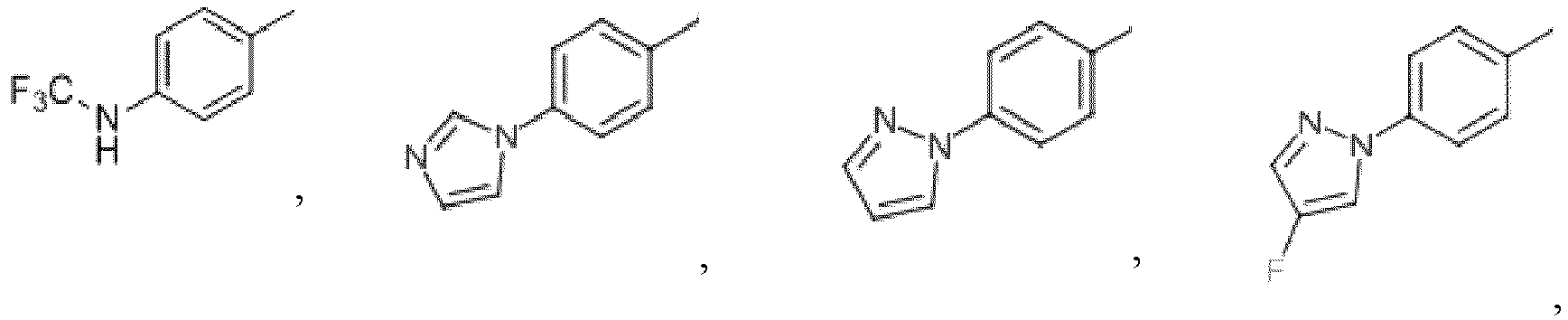


- wherein,
- R3 is C1-3 alkyl,
- R4 is C1-3 alkyl, CF3, -CH2CH2Cl, -CH2CH2NMe2, -CH2NMe2, or -CH2CH2-morpholin.
- Clause 7 The compound of
Clause 1, wherein the compound is- 4-((5-(4-methoxyphenyl)-1H-pyrazol-3-yl)amino)-3-methylphenol,
- 4-((5-(4-aminophenyl)-1H-pyrazol-3-yl)amino)-3-methylphenol,
- N1-(5-(4-chlorophenyl)-1H-pyrazol-3-yl)-N4-propylbenzene-1,4-diamine,
- 4-(3-((4-hydroxy-2-methylphenyl)amino)-1H-pyrazol-5-yl)benzonitrile,
- 4-((5-(4-aminophenyl)-1H-pyrazol-3-yl)amino)-3-methoxyphenol,
- 4-((5-(4-hydroxyphenyl)-1H-pyrazol-3-yl)amino)-3-methylphenol,
- 4-((5-(4-hydroxyphenyl)-1H-pyrazol-3-yl)amino)phenol,
- 3-fluoro-4-((5-(4-hydroxyphenyl)-1H-pyrazol-3-yl)amino)phenol,
- N-(4-((5-(4-hydroxyphenyl)-1H-pyrazol-3-yl)amino)-3-methylphenyl)methanesulfonamide,
- N-(4-((5-(4-hydroxyphenyl)-1H-pyrazol-3-yl)amino)-3-methylphenyl)acetamide,
- 4-((4-fluoro-5-(4-hydroxyphenyl)-1H-pyrazol-3-yl)amino)-3-methylphenol,
- 4-((5-(4-(1H-imidazol-1-yl)phenyl)-1H-pyrazol-3-yl)amino)-3-methylphenol,
- 4-((5-(4-(1H-imidazol-1-yl)phenyl)-1H-pyrazol-3-yl)amino)phenol,
- N-(4-((5-(4-(dimethylamino)phenyl)-1H-pyrazol-3-yl)amino)phenyl)acetamide,
- 4-((5-(4-(dimethylamino)phenyl)-1H-pyrazol-3-yl)amino)-3-methylphenol,
- 3-ethyl-4-((5-(4-hydroxyphenyl)-1H-pyrazol-3-yl)amino)phenol,
- 4-(3-((4-hydroxy-2-methylphenyl)amino)-1H-pyrazol-5-yl)-2-methylphenol,
- N-(4-((5-(4-hydroxy-3-methylphenyl)-1H-pyrazol-3-yl)amino)-3-methylphenyl)acetamide,
- 2-fluoro-4-(3-((4-hydroxy-2-methylphenyl)amino)-1H-pyrazol-5-yl)phenol,
- 4-((5-(4-hydroxyphenyl)-1H-pyrazol-3-yl)amino)-3-(trifluoromethyl)phenol,
- 2-fluoro-4-((5-(4-hydroxyphenyl)-1H-pyrazol-3-yl)amino)phenol,
- N-(4-((5-(4-(1H-imidazol-1-yl)phenyl)-1H-pyrazol-3-yl)amino)-3-methylphenyl)methanesulfonamide,
- N-(4-((5-(4-(1H-imidazol-1-yl)phenyl)-4-fluoro-1H-pyrazol-3-yl)amino)-3-methylphenyl)methanesulfonamide,
- 4-((5-(4-(1H-imidazol-1-yl)phenyl)-1H-pyrazol-3 -yl)amino)-3 -ethylphenol,
- 4-((5-(benzo[b]thiophen-2-yl)-1H-pyrazol-3-yl)amino)-3-methylphenol,
- 4-((5-(benzo[b]thiophen-2-yl)-1H-pyrazol-3-yl)amino)-3-ethylphenol,
- 4-((5-(benzo[b]thiophen-3-yl)-1H-pyrazol-3-yl)amino)-3-ethylphenol,
- 4-((5-(5-chlorothiophen-2-yl)-1H-pyrazol-3-yl)amino)-3-ethylphenol,
- 3-chloro-4-((5-(4-hydroxyphenyl)-1H-pyrazol-3-yl)amino)phenol,
- 4-((5-(5-bromopyridin-3-yl)-1H-pyrazol-3-yl)amino)-3-methylphenol,
- 4-((5-(4-(1H-pyrazol-1-yl)phenyl)-1H-pyrazol-3-yl)amino)-3-ethylphenol,
- N-(4-((5-(4-(1H-pyrazol-1-yl)phenyl)-1H-pyrazol-3-yl)amino)-3-methylphenyl)acetamide,
- 4-((5-(1H-indol-3-yl)-1H-pyrazol-3 -yl)amino)-3 -methylphenol,
- 4-((5-(1H-indol-3-yl)-1H-pyrazol-3-yl)amino)-3-ethylphenol,
- N-(3-chloro-4-((5-(4-hydroxyphenyl)-1H-pyrazol-3-yl)amino)phenyl)acetamide,
- N-(3-chloro-4-((5-(4-hydroxyphenyl)-1H-pyrazol-3-yl)amino)phenyl)methanesulfonamide,
- 3-ethyl-4-((5-(4-iodophenyl)-1H-pyrazol-3-yl)amino)phenol,
- N-(4-((5-(4-hydroxyphenyl)-1H-pyrazol-3-yl)amino)-3-methylphenyl)butyramide,
- 2,2,2-trifluoro-N-(4-((5-(4-hydroxyphenyl)-1H-pyrazol-3-yl)amino)-3-methylphenyl)acetamide,
- 4-(3-((4-amino-2-methylphenyl)amino)-1H-pyrazol-5-yl)phenol,
- N-(3-ethyl-4-((5-(4-hydroxyphenyl)-1H-pyrazol-3-yl)amino)phenyl)acetamide,
- N-(2-fluoro-4-((5-(4-hydroxyphenyl)-1H-pyrazol-3-yl)amino)-5-methylphenyl)methanesulfonamide,
- 4-((5-(6-chloropyridin-3-yl)-1H-pyrazol-3-yl)amino)-3-methylphenol,
- ethyl (4-((5-(4-hydroxyphenyl)-1H-pyrazol-3-yl)amino)-3-methylphenyl)carbamate,
- N-(4-((5-(3-fluoro-4-hydroxyphenyl)-1H-pyrazol-3-yl)amino)-3-methylphenyl)methanesulfonamide,
- 4-(3-((2-ethyl-4-hydroxyphenyl)amino)-1H-pyrazol-5-yl)-2-fluorophenol,
- 1-(4-((5-(3-fluoro-4-hydroxyphenyl)-1H-pyrazol-3-yl)amino)-3-methylphenyl)-3-methylurea,
- 2-fluoro-4-(3-((2-fluoro-4-hydroxyphenyl)amino)-1H-pyrazol-5-yl)phenol,
- N-(4-((5-(4-(1H-imidazol-1-yl)phenyl)-1H-pyrazol-3-yl)amino)phenyl)acetamide,
- N-(4-((5-(4-(1H-imidazol-1-yl)phenyl)-1H-pyrazol-3-yl)amino)phenyl)methanesulfonamide,
- 4-((5-(4-(1H-imidazol-1-yl)phenyl)-1H-pyrazol-3-yl)amino)-3-fluorophenol,
- 4-((5-(4-(1H-imidazol-1-yl)phenyl)-1H-pyrazol-3-yl)amino)-3-(trifluoromethyl)phenol,
- N-(4-((5-(4-(1H-imidazol-1-yl)phenyl)-1H-pyrazol-3-yl)amino)-3-chlorophenyl)acetamide,
- 4-((5-(4-(1H-imidazol-1-yl)phenyl)-1H-pyrazol-3-yl)amino)-2-fluorophenol,
- 4-((5-(4-(1H-imidazol-1-yl)phenyl)-1H-pyrazol-3-yl)amino)-3-chlorophenol,
- N-(4-((5-(4-(1H-imidazol-1-yl)phenyl)-1H-pyrazol-3-yl)amino)-2-fluoro-5-methylphenyl)acetamide,
- N-(4-((5-(4-(1H-pyrazol-1-yl)phenyl)-1H-pyrazol-3-yl)amino)-3-methylphenyl)-3-chloropropanamide,
- N-(4-((5-(4-(1H-pyrazol-1-yl)phenyl)-1H-pyrazol-3-yl)amino)-3-methylphenyl)-3-morpholinopropanamide,
- 2-(dimethylamino)-N-(4-((5-(3-fluoro-4-hydroxyphenyl)-1H-pyrazol-3-yl)amino)-3-methylphenyl)acetamide,
- N-(4-((5-(3-fluoro-4-hydroxyphenyl)-1H-pyrazol-3-yl)amino)-3-methylphenyl)-3-morpholinopropanamide,
- 3-(dimethylamino)-N-(4-((5-(3-fluoro-4-hydroxyphenyl)-1H-pyrazol-3-yl)amino)-3-methylphenyl)propanamide,
- N-(4-((5-(4-(1H-pyrazol-1-yl)phenyl)-1H-pyrazol-3-yl)amino)-3-methylphenyl)methanesulfonamide,
- 4-((5-(4-(1H-pyrazol-1-yl)phenyl)-1H-pyrazol-3-yl)amino)-3-(trifluoromethyl)phenol,
- 4-((5-(4-(1H-pyrazol-1-yl)phenyl)-1H-pyrazol-3-yl)amino)-3-fluorophenol,
- N-(4-((5-(4-iodophenyl)-1H-pyrazol-3-yl)amino)-3-methylphenyl)methanesulfonamide,
- N-(4-((5-(1H-indol-3-yl)-1H-pyrazol-3-yl)amino)-3-methylphenyl)methanesulfonamide,
- 4-((5-(4-(1H-pyrazol-1-yl)phenyl)-1H-pyrazol-3-yl)amino)-2-fluorophenol,
- 4-((5-(4-(1H-pyrazol-1-yl)phenyl)-1H-pyrazol-3-yl)amino)-3-chlorophenol,
- 3-methyl-4-((5-phenyl-1H-pyrazol-3-yl)amino)phenol,
- N-(3-methyl-4-((5-phenyl-1H-pyrazol-3-yl)amino)phenyl)acetamide,
- N-(3-methyl-4-((5-phenyl-1H-pyrazol-3-yl)amino)phenyl)methanesulfonamide,
- N-(4-((5-(4-methoxyphenyl)-1H-pyrazol-3-yl)amino)-3-methylphenyl)methanesulfonamide,
- N-(4-((5-(4-cyanophenyl)-1H-pyrazol-3-yl)amino)-3-methylphenyl)methanesulfonamide,
- N-(4-((5-(4-bromophenyl)-1H-pyrazol-3-yl)amino)-3-methylphenyl)methanesulfonamide,
- N-(4-((5-(3-fluoro-4-hydroxyphenyl)-1H-pyrazol-3-yl)amino)-3-methylphenyl)methanesulfonamide,
- N-(3-methyl-4-((5-(4-morpholinophenyl)-1H-pyrazol-3-yl)amino)phenyl)acetamide,
- 3-methyl-4-((5-(4-morpholinophenyl)-1H-pyrazol-3-yl)amino)phenol,
- N-(3-methyl-4-((5-(4-morpholinophenyl)-1H-pyrazol-3-yl)amino)phenyl)methanesulfonamide,
- N-(4-((5-(4-fluorophenyl)-1H-pyrazol-3-yl)amino)-3-methylphenyl)methanesulfonamide,
- 1-(4-(3-((4-hydroxy-2-methylphenyl)amino)-1H-pyrazol-5-yl)phenyl)pyrrolidin-2-one,
- 1-(4-(3-((4-hydroxy-2-methylphenyl)amino)-1H-pyrazol-5-yl)phenyl)piperidin-2-one,
- 1-(4-((5-(4-(1H-pyrazol-1-yl)phenyl)-1H-pyrazol-3 -yl)amino)-3 -methylphenyl)-3 - methylurea,
- methyl (4-((5-(4-(1H-pyrazol-1-yl)phenyl)-1H-pyrazol-3-yl)amino)-3-methylphenyl)carbamate,
- ethyl (4-((5-(4-(1H-pyrazol-1-yl)phenyl)-1H-pyrazol-3-yl)amino)-3-methylphenyl)carbamate,
- N-(3-methyl-4-((5-(4-(2-oxopyrrolidin-1-yl)phenyl)-1H-pyrazol-3-yl)amino)phenyl)acetamide,
- N-(3-methyl-4-((5-(4-(2-oxopiperidin-1-yl)phenyl)-1H-pyrazol-3-yl)amino)phenyl)acetamide,
- 4-((5-(6-methoxypyridin-3-yl)-1H-pyrazol-3-yl)amino)-3-methylphenol,
- N-(4-((5-(6-methoxypyridin-3-yl)-1H-pyrazol-3-yl)amino)-3-methylphenyl)methanesulfonamide,
- N-(4-((5-(6-methoxypyridin-3-yl)-1H-pyrazol-3-yl)amino)-3-methylphenyl)acetamide,
- 1-(4-(3-((4-hydroxy-2-methylphenyl)amino)-1H-pyrazol-5-yl)phenyl)azetidin-2-one,
- 4-((5-(6-(1H-pyrazol-1-yl)pyridin-3-yl)-1H-pyrazol-3-yl)amino)-3-methylphenol,
- N-(4-((5-(6-(1H-pyrazol-1-yl)pyridin-3-yl)-1H-pyrazol-3-yl)amino)-3-methylphenyl)acetamide,
- N-(4-((5-(6-(1H-pyrazol-1-yl)pyridin-3-yl)-1H-pyrazol-3-yl)amino)-3-methylphenyl)methanesulfonamide,
- N-(3-chloro-4-((5-(4-(2-oxopyrrolidin-1-yl)phenyl)-1H-pyrazol-3-yl)amino)phenyl)acetamide,
- 4-((5-(4-(dimethylamino)phenyl)-4-fluoro-1H-pyrazol-3-yl)amino)-3-methylphenol,
- N-(4-((5-(benzo[b]thiophen-2-yl)-1H-pyrazol-3-yl)amino)-3-methylphenyl)methanesulfonamide,
- 1-(4-((5-(benzo[b]thiophen-2-yl)-1H-pyrazol-3-yl)amino)-3-methylphenyl)-3-methylurea,
- ethyl (4-((5-(benzo[b]thiophen-2-yl)-1H-pyrazol-3-yl)amino)-3-methylphenyl)carbamate,
- methyl (4-((5-(benzo[b]thiophen-2-yl)-1H-pyrazol-3-yl)amino)-3-methylphenyl)carbamate,
- N-(4-((5-(4-(1H-pyrazol-1-yl)phenyl)-4-fluoro-1H-pyrazol-3-yl)amino)-3-methylphenyl)methanesulfonamide,
- N-(3-chloro-4-((5-(4-methoxyphenyl)-1H-pyrazol-3-yl)amino)phenyl)acetamide,
- 4-((5-(3-(1H-pyrazol-1-yl)phenyl)-1H-pyrazol-3-yl)amino)-3-methylphenol,
- N-(4-((5-(3-(1H-pyrazol-1-yl)phenyl)-1H-pyrazol-3-yl)amino)-3-methylphenyl)methanesulfonamide,
- N-(4-((5-(4-(1H-pyrazol-1-yl)phenyl)-1H-pyrazol-3-yl)amino)-3-methylphenyl)isobutyramide,
- 1-(4-(4-fluoro-3-((4-hydroxy-2-methylphenyl)amino)-1H-pyrazol-5-yl)phenyl)pyrrolidin-2-one,
- N-(4-((5-(4-(1H-pyrazol-1-yl)phenyl)-4-fluoro-1H-pyrazol-3-yl)amino)-3-methylphenyl)acetamide,
- methyl (4-((5-(4-(1H-pyrazol-1-yl)phenyl)-4-fluoro-1H-pyrazol-3-yl)amino)-3-methylphenyl)carbamate,
- ethyl (4-((5-(4-(1H-pyrazol-1-yl)phenyl)-4-fluoro-1H-pyrazol-3-yl)amino)-3-methylphenyl)carbamate,
- 4-((4-fluoro-5-(4-methoxyphenyl)-1H-pyrazol-3 -yl)amino)-3 -methylphenol,
- 1-(4-((5-(4-(1H-pyrazol-1-yl)phenyl)-4-fluoro-1H-pyrazol-3-yl)amino)-3-methylphenyl)-3 -methylurea,
- 3-ethyl-4-((4-fluoro-5-(4-iodophenyl)-1H-pyrazol-3-yl)amino)phenol,
- 3-methyl-4-((5-(3-(pyridin-3-yl)phenyl)-1H-pyrazol-3-yl)amino)phenol,
- 3-methyl-4-((5-(4-(pyridin-3-yl)phenyl)-1H-pyrazol-3-yl)amino)phenol,
- 4-((5-(4-(4-fluoro-1H-pyrazol-1-yl)phenyl)-1H-pyrazol-3-yl)amino)-3-methylphenol,
- N-(4-((5-(4-(4-fluoro-1H-pyrazol-1-yl)phenyl)-1H-pyrazol-3-yl)amino)-3-methylphenyl)methanesulfonamide,
- 4-((4-fluoro-5-(1H-indol-3-yl)-1H-pyrazol-3-yl)amino)-3-methylphenol,
- 3-ethyl-4-((5-(3-iodophenyl)-1H-pyrazol-3-yl)amino)phenol,
- 4-((5-(2'-fluoro-5'-methoxy-[1,1'-biphenyl]-3-yl)-1H-pyrazol-3-yl)amino)-3-methylphenol,
- 4-((5-(4-(1H-pyrazol-4-yl)phenyl)-1H-pyrazol-3-yl)amino)-3-methylphenol,
- 3-methyl-4-((5-(3-(1-methyl-1H-pyrazol-4-yl)phenyl)-1H-pyrazol-3-yl)amino)phenol,
- 4-((5-(2'-fluoro-5'-methoxy-[1,1'-biphenyl]-4-yl)-1H-pyrazol-3-yl)amino)-3-methylphenol,
- 4-((5-(4-(1H-pyrazol-1-yl)phenyl)-1H-pyrazol-3-yl)amino)-2-fluoro-5-methylphenol,
- 2-fluoro-4-((5-(4-hydroxyphenyl)-1H-pyrazol-3-yl)amino)-5-methylphenol,
- 3-methyl-4-((5-(4-(1-methyl-1H-pyrazol-4-yl)phenyl)-1H-pyrazol-3-yl)amino)phenol,
- 4-((5-(4-(3, 5-dimethyl-1H-pyrazol-4-yl)phenyl)-1H-pyrazol-3-yl)amino)-3-methylphenol,
- 3-methyl-4-((5-(4-(3-(trifluoromethyl)-1H-pyrazol-4-yl)phenyl)-1H-pyrazol-3-yl)amino)phenol,
- 4-((5-(4-(1H-pyrazol-4-yl)phenyl)-1H-pyrazol-3-yl)amino)-3-ethylphenol,
- 1-(4-((5-(4-(1H-pyrazol-4-yl)phenyl)-1H-pyrazol-3-yl)amino)-3-methylphenyl)-3-methylurea,
- methyl (4-((5-(4-(1H-pyrazol-4-yl)phenyl)-1H-pyrazol-3-yl)amino)-3-methylphenyl)carbamate,
- 4-((5-(4-(1H-pyrazol-4-yl)phenyl)-1H-pyrazol-3-yl)amino)-2-fluoro-5-methylphenol,
- 1-(4-((5-(2'-fluoro-5'-methoxy-[1,1'-biphenyl]-4-yl)-1H-pyrazol-3-yl)amino)-3-methylphenyl)-3 -methylurea,
- methyl (4-((5-(2'-fluoro-5'-methoxy-[1,1'-biphenyl]-4-yl)-1H-pyrazol-3-yl)amino)-3-methylphenyl)carbamate,
- 1-(4-((5-(4-methoxyphenyl)-1H-pyrazol-3-yl)amino)-3-methylphenyl)-3-methylurea,
- (4-((5-(4-methoxyphenyl)-1H-pyrazol-3-yl)amino)-3-methylphenyl)carbamate,
- 4-((5-(4-(1H-pyrazol-1-yl)phenyl)-1H-pyrazol-3-yl)amino)-2,5-difluorophenol,
- 1-methyl-3-(3-methyl-4-((5-(4-(methylsulfonyl)phenyl)-1H-pyrazol-3-yl)amino)phenyl)urea,
- methyl (3-methyl-4-((5-(4-(methylsulfonyl)phenyl)-1H-pyrazol-3-yl)amino)phenyl)carbamate,
- 1-methyl-3-(3-methyl-4-((5-(4-(3-(trifluoromethyl)-1H-pyrazol-4-yl)phenyl)-1H-pyrazol -3 -yl)amino)phenyl)urea,
- methyl (3-methyl-4-((5-(4-(3-(trifluoromethyl)-1H-pyrazol-4-yl)phenyl)-1H-pyrazol-3-yl)amino)phenyl)carbamate,
- 1-(4-((5-(4-bromophenyl)-1H-pyrazol-3-yl)amino)-3-methylphenyl)-3-methylurea,
- methyl (4-((5-(4-bromophenyl)-1H-pyrazol-3-yl)amino)-3-methylphenyl)carbamate,
- methyl (3 -methyl-4-((5-(4-(1-methyl-1H-pyrazol-4-yl)phenyl)-1H-pyrazol-3 - yl)amino)phenyl)carbamate,
- 3-methyl-4-((5-(4-(trifluoromethyl)phenyl)-1H-pyrazol-3-yl)amino)phenol,
- methyl (3 -methyl-4-((5 -(4-(trifluoromethyl)phenyl)-1H-pyrazol-3 - yl)amino)phenyl)carbamate,
- methyl (4-((5 -(3-fluoro-4-hydroxyphenyl)-1H-pyrazol-3 -yl)amino)-3 - methylphenyl)carbamate,
- methyl (4-((5-(4-chlorophenyl)-1H-pyrazol-3-yl)amino)-3-methylphenyl)carbamate, or
- methyl (4-((5-(4-aminophenyl)-1H-pyrazol-3-yl)amino)-3-methylphenyl)carbamate.
-
Clause 8 The compound ofClause 1, wherein the compound is- 3 -ethyl -4-((5-(4-hydroxyphenyl)-1H-pyrazol-3-yl)amino)phenol
- 4-((5-(4-(dimethylamino)phenyl)-1H-pyrazol-3-yl)amino)-3-methylphenol
- N-(4-((5-(4-hydroxyphenyl)-1H-pyrazol-3-yl)amino)-3-methylphenyl)methanesulfonamide
- N-(4-((5-(4-(1H-imidazol-1-yl)phenyl)-4-fluoro-1H-pyrazol-3-yl)amino)-3-methylphenyl)methanesulfonamide
- 4-((5-(4-(1H-pyrazol-1-yl)phenyl)-1H-pyrazol-3-yl)amino)-3-ethylphenol,
- N-(3-ethyl-4-((5-(4-hydroxyphenyl)-1H-pyrazol-3-yl)amino)phenyl)acetamide,
- 2-fluoro-4-((5-(4-hydroxyphenyl)-1H-pyrazol-3-yl)amino)-5-methylphenol,
- 1-(4-((5-(4-methoxyphenyl)-1H-pyrazol-3-yl)amino)-3-methylphenyl)-3-methylurea,
- (4-((5-(4-methoxyphenyl)-1H-pyrazol-3-yl)amino)-3-methylphenyl)carbamate,
- 1-(4-((5-(4-bromophenyl)-1H-pyrazol-3-yl)amino)-3-methylphenyl)-3-methylurea, or
- methyl (4-((5-(4-aminophenyl)-1H-pyrazol-3-yl)amino)-3-methylphenyl)carbamate.
- Clause 9 A composition comprising a compound of any one of
Clause 1 to 8 or a pharmaceutically acceptable salt thereof, and a pharmaceutically acceptable carrier. - Clause 10 A composition for treating or preventing cancer, comprising as an effective agent a compound of any one of
Clauses 1 to 8 or a pharmaceutically acceptable salt thereof. -
Clause 11 The composition of Clause 10, wherein the composition further comprises irinotecan or pharmaceutically acceptable salt thereof as other pharmaceutically active compound. -
Clause 12 The composition ofClause 10 or 11, wherein the cancer is colorectal cancer, breast cancer, brain tumor, gastric cancer, liver cancer, ovarian cancer, lung cancer, gastrointestinal cancer, leukemia, or melanoma. - Clause 13 The composition of
Clause 12, wherein the cancer is colorectal cancer. - Clause 14 A method for treating or preventing cancer comprising administering to a subject in need thereof a therapeutically effective amount of a compound of any one of
Clauses 1 to 8 or pharmaceutically acceptable salt thereof. -
Clause 15 The method of Clause 14, wherein the method further comprises administering to a subject in need thereof a therapeutically effective amount of irinotecan or pharmaceutically acceptable salt thereof. - Clause 16 The method of
Clause 14 or 15, wherein the cancer is colorectal cancer, breast cancer, brain tumor, gastric cancer, liver cancer, ovarian cancer, lung cancer, gastrointestinal cancer, leukemia, or melanoma. - Clause 17 The method of Clause 16, wherein the cancer is colorectal cancer.
Claims (12)
- A compound of Chemical Formula 1:
 or a pharmaceutically acceptable salt thereof,in the Chemical Formula 1W is a substituted or unsubstituted phenyl, heteroaryl, or fused heteroaryl,when W is a heteroaryl or fused heteroaryl,A is H, halogen, -OH, -CO2-C1-6 alkyl, -CO2H, -CN, -C1-6 alkyl, -C1-6 haloalkyl, - OR1, NH2, -NHR2, -substituted or unsubstituted piperazine, -NHSO2R3, -NHCO2-C1-6 alkyl, - NHCON-C1-6 alkyl, or -NHCOR4,B is H, -C1-6 haloalkyl, C1-6 alkyl, halogen, or C1-6 alkoxy,V is H, -CH2OH, halogen, -CO2H, -CO2-C1-6 alkyl, -OH, -NH2, phenoxy, or - NHCO-C1-6 alkyl,X is H or F,when W is a substituted or unsubstituted phenyl,A is H, halogen, -OH, -CO2-C1-6 alkyl, -CO2H, -CN, -C1-6 alkyl, -C1-6 haloalkyl, - OR1, NH2, -NHR2, -substituted or unsubstituted piperazine, -NHSO2R3, -NHCO2-C1-6 alkyl, - NHCON-C1-6 alkyl, or -NHCOR4,B is H or methyl,V is H, -CH2OH, halogen, -CO2H, -CO2-C1-6 alkyl, -OH, -NH2, phenoxy, or - NHCO-C1-6 alkyl,X is H or F,wherein,R1 is C1-6 alkyl, benzyl, C1-6 haloalkyl, or phenyl,R2 is C1-6 alkyl, C1-6 haloalkyl, -CH2CH2-morpholin, or phenyl,R3 is C1-6 alkyl, C1-6 haloalkyl, or substituted or unsubstituted phenyl,R4 is C1-6 alkyl, C1-6 haloalkyl, -CH2CH2Cl, -CH2CH2NMe2, -CH2NMe2, or -CH2CH2-morpholin.
 - The compound of Claim 1, in the Chemical Formula 1,when W is a heteroaryl or fused heteroaryl,W is substituted or unsubstituted pyridyl, thiophene, thiazole, pyrrole, benzothiophene, indole, oxazole, pyrazole, imidazole, pyrimidine, benzopyrazole, benzothiazole, benzoxazole, benzoimidazole, or benzothiophene,A is H, halogen, -OH, -CO2-C1-6 alkyl, -CO2H, -CN, -C1-6 alkyl, -C1-6 haloalkyl, - OR1, -NH2, -NHR2, -NHSO2R3, -NHCO2-C1-6 alkyl, -NHCON-C1-6 alkyl, or -NHCOR4,B is H, -C1-6 haloalkyl, C1-6 alkyl, halogen, or C1-6 alkoxy,V is H, -CH2OH, halogen, -CO2H, -CO2-C1-6 alkyl, -OH, -NH2, phenoxy, or - NHCO-C1-6 alkyl,X is H or F,when W is a substituted or unsubstituted phenyl,A is H, halogen, -OH, -CO2-C1-6 alkyl, -CO2H, -CN, -C1-6 alkyl, -C1-6 haloalkyl, - OR1, -NH2, -NHR2, -NHSO2R3, -NHCO2-C1-6 alkyl, -NHCON-C1-6 alkyl, or -NHCOR4,B is H or methyl,V is H, -CH2OH, halogen, -CO2H, -CO2-C1-6 alkyl, -OH, -NH2, phenoxy, or - NHCO-C1-6 alkyl,X is H or F,wherein,R1 is benzyl, C1-3 haloalkyl, or phenyl,R2 is CF3, C1-3 alkyl, -CH2CH2-morpholin, or phenyl,R3 is C1-3 alkyl, or substituted or unsubstituted phenyl,R4 is C1-3 alkyl, CF3, -CH2CH2Cl, -CH2CH2NMe2, -CH2NMe2, or -CH2CH2-morpholin.
- The compound of Claim 1, in the Chemical Formula 2,when W is a heteroaryl or fused heteroaryl,W is substituted or unsubstituted pyridyl, thiophene, thiazole, pyrrole, benzothiophene, or indole,A is -OH, -CO2-C1-6 alkyl, -C1-3 alkyl, -OR1, NH2, -NHR2, -NHSO2R3, -NHCO2-C1-6 alkyl, -NHCON-C1-3 alkyl, or -NHCOR4,B is H, -C1-3 haloalkyl, C1-3 alkyl, halogen, or C1-3 alkoxy,V is H, -CH2OH, halogen, -CO2H, -CO2-C1-2 alkyl, -OH, -NH2, phenoxy, or - NHCOCH3,X is H or F,when W is a substituted or unsubstituted phenyl,A is H, halogen, -OH, -CO2-C1-6 alkyl, -C1-3 alkyl, -OR1, -NH2, -NHR2, -NHSO2R3, -NHCO2-C1-6 alkyl, -NHCON-C1-6 alkyl, or -NHCOR4,B is H or methyl,V is H, -CH2OH, halogen, -CO2H, -CO2-C1-6 alkyl, -OH, -NH2, phenoxy, or - NHCOCH3,X is H or F,wherein,R1 is benzyl, CF3, or phenyl,R2 is CF3, C1-3 alkyl, -CH2CH2-morpholin, or phenyl,R3 is C1-3 alkyl, or substituted or unsubstituted phenyl,R4 is C1-3 alkyl, CF3, -CH2CH2Cl, -CH2CH2NMe2, -CH2NMe2, or -CH2CH2-morpholin.
- The compound of Claim 3, in the Chemical Formula 1,when W is a heteroaryl or fused heteroaryl,W is substituted or unsubstituted pyridyl, thiophene, thiazole, pyrrole, benzothiophene, or indole,A is -OH, -NHR2, -NHSO2R3, -NHCO2-C1-6 alkyl, -NHCON-C1-3 alkyl, or - NHCOR4,B is H, -C1-3 haloalkyl, C1-3 alkyl, halogen, or C1-3 alkoxy,V is H, -CH2OH, F, -OH, or -NHCOCH3,X is H or F,when W is a substituted or unsubstituted phenyl,A is H, halogen, -OH, -C1-3 alkyl, -NHR2, -NHSO2R3, -NHCO2-C1-6 alkyl, - NHCON-C1-3 alkyl, or -NHCOR4,B is H or methyl,V is H, -CH2OH, F, -CO2H, -OH, -NH2, or -NHCOCH3,X is H or F,wherein,R2 is CF3, C1-3 alkyl, -CH2CH2-morpholin, or phenyl,R3 is C1-3 alkyl, or substituted or unsubstituted phenyl,R4 is C1-3 alkyl, CF3, -CH2CH2Cl, -CH2CH2NMe2, -CH2NMe2, or -CH2CH2-morpholin.
- The compound of Claim 4, in the Chemical Formula 1,when W is a heteroaryl or fused heteroaryl,W is substituted or unsubstituted pyridyl, thiophene, thiazole, pyrrole, benzothiophene, or indole,A is -OH, -NHR2, -NHSO2R3, -NHCO2-C1-6 alkyl, -NHCON-C1-3 alkyl, or - NHCOR4,B is H, -C1-3 haloalkyl, C1-3 alkyl, halogen, or C1-3 alkoxy,V is H, -CH2OH, F, -OH, or -NHCOCH3,X is H or F,when W is a substituted or unsubstituted phenyl,A is H, halogen, -OH, -C1-3 alkyl, -NHR2, -NHSO2R3, -NHCO2-C1-6 alkyl, - NHCON-C1-3 alkyl, or -NHCOR4,B is H or methyl,V is H, -CH2OH, F, -CO2H, -OH, -NH2, or -NHCOCH3,wherein,R2 is CF3, or C1-3 alkyl,R3 is C1-3 alkyl,R4 is C1-3 alkyl, CF3, -CH2CH2Cl, -CH2CH2NMe2, -CH2NMe2, or -CH2CH2-morpholin.
- The compound of Claim 5, in the Chemical Formula 1,when W is a heteroaryl or fused heteroaryl,W is substituted or unsubstituted benzothiophene or indole,A is -OH, -NHCF3, -NHSO2R3, -NHCO2-C1-6 alkyl, -NHCON-C1-3 alkyl, or - NHCOR4,B is H, C1-3 alkyl, or halogen,V is H or F,X is H or F,when W is a substituted or unsubstituted phenyl,A is H, halogen, -OH, -C1-3 alkyl, -NHCF3, -NHSO2R3, -NHCO2-C1-6 alkyl, - NHCON-C1-3 alkyl, or -NHCOR4,B is H or methyl,V is H, -CH2OH, F, -CO2H, -OH, -NH2, or -NHCOCH3,X is H or F,wherein,R3 is C1-3 alkyl,R4 is C1-3 alkyl, CF3, -CH2CH2Cl, -CH2CH2NMe2, -CH2NMe2, or -CH2CH2-morpholin.
- The compound of Claim 1, wherein the compound is3-methyl-4-((5-(pyridin-3-yl)-1H-pyrazol-3-yl)amino)phenol,4-((5-(6-chloropyridin-3-yl)-1H-pyrazol-3-yl)amino)-3-methylphenol,4-((5-(6-chloropyridin-3-yl)-1H-pyrazol-3-yl)amino)phenol,4-((5-(6-(benzyloxy)pyridin-3-yl)-1H-pyrazol-3-yl)amino)-3-methylphenol,4-((5-(6-(benzyloxy)pyridin-3-yl)-1H-pyrazol-3-yl)amino)phenol,4-((5-(5-methylthiophen-2-yl)-1H-pyrazol-3-yl)amino)phenol,4-((5-(thiophen-2-yl)-1H-pyrazol-3-yl)amino)phenol,3-methyl-4-((5-(5-methylthiophen-2-yl)-1H-pyrazol-3-yl)amino)phenol,3-methyl-4-((5-(thiophen-2-yl)-1H-pyrazol-3-yl)amino)phenol,N-(3-methyl-4-((5-(5-methylthiophen-2-yl)-1H-pyrazol-3-yl)amino)phenyl)acetamide,4-((5-(5-chlorothiophen-2-yl)-1H-pyrazol-3-yl)amino)-3-methylphenol,4-((5-(thiazol-2-yl)-1H-pyrazol-3-yl)amino)phenol,3-methyl-4-((5-(thiazol-2-yl)-1H-pyrazol-3-yl)amino)phenol,N-(4-((5-(5-chlorothiophen-2-yl)-1H-pyrazol-3-yl)amino)phenyl)acetamide,N-(4-((5-(5-chlorothiophen-2-yl)-1H-pyrazol-3-yl)amino)-3-methylphenyl)acetamide,4-((5-(1-methyl-1H-pyrrol-3-yl)-1H-pyrazol-3-yl)amino)phenol,3 -methyl-4-((5-(1-methyl-1H-pyrrol-3-yl)-1H-pyrazol-3-yl)amino)phenol,4-((5-(benzo[b]thiophen-2-yl)-1H-pyrazol-3-yl)amino)-3-methylphenol,4-((5-(benzo[b]thiophen-2-yl)-1H-pyrazol-3 -yl)amino)-3-ethylphenol,4-((5-(benzo[b]thiophen-3-yl)-1H-pyrazol-3-yl)amino)-3-methylphenol,4-((5-(benzo[b]thiophen-3-yl)-1H-pyrazol-3-yl)amino)-3-ethylphenol,4-((5-(5-chlorothiophen-2-yl)-1H-pyrazol-3-yl)amino)-3-methylphenol,4-((5-(5-chlorothiophen-2-yl)-1H-pyrazol-3-yl)amino)-3-ethylphenol,3-methyl-4-((5-(thiazol-2-yl)-1H-pyrazol-3-yl)amino)phenol,3-ethyl-4-((5-(thiazol-2-yl)-1H-pyrazol-3-yl)amino)phenol,tert-butyl 3 -(3 -((4-hydroxy-2-methylphenyl)amino)-1H-pyrazol-5-yl)-1H-indole-1 - carboxylate,tert-butyl 3-(3-((2-ethyl-4-hydroxyphenyl)amino)-1H-pyrazol-5-yl)-1H-indole-1-carboxylate,N-(4-((5-(benzo[b]thiophen-2-yl)-1H-pyrazol-3-yl)amino)-3-methylphenyl)acetamide,N-(4-((5-(benzo[b]thiophen-3-yl)-1H-pyrazol-3-yl)amino)-3-methylphenyl)acetamide,4-((5-(6-bromopyridin-2-yl)-1H-pyrazol-3-yl)amino)-3-methylphenol,4-((5-(6-bromopyridin-2-yl)-1H-pyrazol-3-yl)amino)-3-ethylphenol,3-methyl-4-((5-(pyridin-2-yl)-1H-pyrazol-3-yl)amino)phenol,3-ethyl-4-((5-(pyridin-2-yl)-1H-pyrazol-3-yl)amino)phenol,4-((5-(5-bromopyridin-3-yl)-1H-pyrazol-3-yl)amino)-3-methylphenol,4-((5-(4-bromopyridin-2-yl)-1H-pyrazol-3-yl)amino)-3-ethylphenol,N-(3-methyl-4-((5-(thiazol-2-yl)-1H-pyrazol-3-yl)amino)phenyl)methanesulfonamide,N-(4-((5-(6-bromopyridin-2-yl)-1H-pyrazol-3-yl)amino)-3-methylphenyl)methanesulfonamide,4-((5-(1H-indol-3-yl)-1H-pyrazol-3-yl)amino)-3-methylphenol,4-((5-(1H-indol-3-yl)-1H-pyrazol-3-yl)amino)-3-ethylphenol,4-((5-(6-chloropyridin-3-yl)-1H-pyrazol-3-yl)amino)-3-methylphenol,N-(4-((5-(1H-indol-3-yl)-1H-pyrazol-3-yl)amino)-3-methylphenyl)methanesulfonamide,4-((5-(6-methoxypyridin-3-yl)-1H-pyrazol-3-yl)amino)-3-methylphenol,N-(4-((5-(6-methoxypyridin-3-yl)-1H-pyrazol-3-yl)amino)-3-methylphenyl)methanesulfonamide,N-(4-((5-(6-methoxypyridin-3-yl)-1H-pyrazol-3-yl)amino)-3-methylphenyl)acetamide,4-((5-(6-(1H-pyrazol-1-yl)pyridin-3-yl)-1H-pyrazol-3-yl)amino)-3-methylphenol,N-(4-((5-(6-(1H-pyrazol-1-yl)pyridin-3-yl)-1H-pyrazol-3 -yl)amino)-3 - methylphenyl)acetamide,N-(4-((5-(6-(1H-pyrazol-1-yl)pyridin-3-yl)-1H-pyrazol-3 -yl)amino)-3 - methylphenyl)methanesulfonamide,N-(4-((5-(benzo[b]thiophen-2-yl)-1H-pyrazol-3-yl)amino)-3-methylphenyl)methanesulfonamide,1-(4-((5-(benzo[b]thiophen-2-yl)-1H-pyrazol-3-yl)amino)-3-methylphenyl)-3-methylurea,ethyl (4-((5-(benzo[b]thiophen-2-yl)-1H-pyrazol-3-yl)amino)-3-methylphenyl)carbamate,methyl (4-((5-(benzo[b]thiophen-2-yl)-1H-pyrazol-3-yl)amino)-3-methylphenyl)carbamate,4-((4-fluoro-5-(1H-indol-3-yl)-1H-pyrazol-3-yl)amino)-3-methylphenol,N1-(5-(4-methoxyphenyl)-1H-pyrazol-3-yl)benzene-1,3-diamine,N-(3-((5-(4-methoxyphenyl)-1H-pyrazol-3-yl)amino)phenyl)acetamide,3-((5-(4-methoxyphenyl)-1H-pyrazol-3-yl)amino)phenol,4-((5-(4-aminophenyl)-1H-pyrazol-3-yl)amino)-2-fluorophenol,2-fluoro-4-((5-(4-nitrophenyl)-1H-pyrazol-3-yl)amino)phenol,2-fluoro-4-((5-(4-hydroxyphenyl)-1H-pyrazol-3-yl)amino)phenol,(3-((5-(4-aminophenyl)-1H-pyrazol-3-yl)amino)-4-methylphenyl)methanol,4-(3-((5-(hydroxymethyl)-2-methylphenyl)amino)-1H-pyrazol-5-yl)phenol,4-((5-(4-(1H-imidazol-1-yl)phenyl)-1H-pyrazol-3-yl)amino)-2-fluorophenol, or4-((5-(4-(1H-pyrazol-1-yl)phenyl)-1H-pyrazol-3-yl)amino)-2-fluorophenol.
- A composition comprising a compound of any one of claims 1 to 7 or a pharmaceutically acceptable salt thereof, and a pharmaceutically acceptable carrier.
- A compound of any one of claims 1 to 7 or a pharmaceutically acceptable salt thereof for use in treatment or prevention of cancer.
- The compound of any one of claims 1 to 7 or a pharmaceutically acceptable salt thereof for use according to claim 9, wherein the compound is administered with irinotecan or pharmaceutically acceptable salt thereof.
- The compound of any one of claims 1 to 7 or a pharmaceutically acceptable salt thereof for use according to claim 9 or 10, wherein the cancer is colorectal cancer, breast cancer, brain tumor, gastric cancer, liver cancer, ovarian cancer, lung cancer, gastrointestinal cancer, leukemia, or melanoma.
- The compound of any one of claims 1 to 7 or a pharmaceutically acceptable salt thereof for use according to claim 11, wherein the cancer is colorectal cancer.
Applications Claiming Priority (3)
| Application Number | Priority Date | Filing Date | Title |
|---|---|---|---|
| KR20180015170 | 2018-02-07 | ||
| PCT/KR2019/001404 WO2019156439A1 (en) | 2018-02-07 | 2019-01-31 | Compounds for inhibiting tnik and medical uses thereof |
| EP19751775.8A EP3749648B1 (en) | 2018-02-07 | 2019-01-31 | N-(phenyl)-5-(phenyl)-1h-pyrazol-3-amine derivatives as tnik inhibitors for use in the treatment of cancer |
Related Parent Applications (2)
| Application Number | Title | Priority Date | Filing Date |
|---|---|---|---|
| EP19751775.8A Division EP3749648B1 (en) | 2018-02-07 | 2019-01-31 | N-(phenyl)-5-(phenyl)-1h-pyrazol-3-amine derivatives as tnik inhibitors for use in the treatment of cancer |
| EP19751775.8A Division-Into EP3749648B1 (en) | 2018-02-07 | 2019-01-31 | N-(phenyl)-5-(phenyl)-1h-pyrazol-3-amine derivatives as tnik inhibitors for use in the treatment of cancer |
Publications (3)
| Publication Number | Publication Date |
|---|---|
| EP4477271A2 true EP4477271A2 (en) | 2024-12-18 |
| EP4477271A3 EP4477271A3 (en) | 2025-04-30 |
| EP4477271B1 EP4477271B1 (en) | 2026-05-13 |
Family
ID=67548327
Family Applications (2)
| Application Number | Title | Priority Date | Filing Date |
|---|---|---|---|
| EP24201292.0A Active EP4477271B1 (en) | 2018-02-07 | 2019-01-31 | N-(phenyl)-5-(heteroaryl)-1h-pyrazol-3-amine derivatives as tnik inhibitors for use in the treatment of cancer |
| EP19751775.8A Active EP3749648B1 (en) | 2018-02-07 | 2019-01-31 | N-(phenyl)-5-(phenyl)-1h-pyrazol-3-amine derivatives as tnik inhibitors for use in the treatment of cancer |
Family Applications After (1)
| Application Number | Title | Priority Date | Filing Date |
|---|---|---|---|
| EP19751775.8A Active EP3749648B1 (en) | 2018-02-07 | 2019-01-31 | N-(phenyl)-5-(phenyl)-1h-pyrazol-3-amine derivatives as tnik inhibitors for use in the treatment of cancer |
Country Status (8)
| Country | Link |
|---|---|
| US (2) | US11485711B2 (en) |
| EP (2) | EP4477271B1 (en) |
| JP (1) | JP7302794B2 (en) |
| KR (1) | KR102725207B1 (en) |
| CN (1) | CN111836801B (en) |
| AU (1) | AU2019217094B2 (en) |
| CA (1) | CA3090233A1 (en) |
| WO (1) | WO2019156439A1 (en) |
Families Citing this family (5)
| Publication number | Priority date | Publication date | Assignee | Title |
|---|---|---|---|---|
| JP7302794B2 (en) | 2018-02-07 | 2023-07-04 | コリア リサーチ インスティチュート オブ ケミカル テクノロジー | Compounds for inhibiting TNIK and their medical uses |
| CN111788183B (en) * | 2018-02-07 | 2024-02-23 | 韩国化学硏究院 | Heterocyclic fused phenyl compounds for inhibiting TNIK and their medical uses |
| CN111718310B (en) * | 2019-08-19 | 2021-06-11 | 中国药科大学 | Phenyl-substituted five-membered heterocyclic compound, and preparation method, application and pharmaceutical composition thereof |
| WO2022034587A1 (en) * | 2020-08-10 | 2022-02-17 | Tnik Therapeutics Ltd | Traf2- AND Nck-INTERACTING KINASE (TNIK) INHIBITORS AND USES THEREOF |
| JP7843071B2 (en) * | 2021-11-12 | 2026-04-09 | バイオポーラー ヨータン(グァンドン) ファーマシューティカル カンパニー,リミテッド | Drak2 inhibitors, methods for producing the same, and their use |
Citations (4)
| Publication number | Priority date | Publication date | Assignee | Title |
|---|---|---|---|---|
| WO2009030890A1 (en) | 2007-09-03 | 2009-03-12 | University Court Of The University Of Dundee | Pyrimidine compounds for the treatment of cancer, septic shock and/or primary open angle glaucoma |
| US20100216795A1 (en) | 2008-12-01 | 2010-08-26 | Tesshi Yamada | Tnik inhibitor and the use |
| WO2010100431A1 (en) | 2009-03-04 | 2010-09-10 | Medical Research Council Technology | Pyrrolopyrimidines used as kinase inhibitors |
| KR20180015170A (en) | 2015-05-29 | 2018-02-12 | 나이키 이노베이트 씨.브이. | A footwear article comprising a power type tensioning device having a split spool system |
Family Cites Families (7)
| Publication number | Priority date | Publication date | Assignee | Title |
|---|---|---|---|---|
| GB8611102D0 (en) * | 1986-05-07 | 1986-06-11 | Fisons Plc | Heterocyclic compounds |
| DE3773746D1 (en) | 1986-05-07 | 1991-11-21 | Fisons Plc | Pyrazole. |
| BR0110302A (en) | 2000-04-18 | 2003-01-14 | Agouron Pharma | Pyrazole compounds for protein kinase inhibition, pharmaceutically acceptable salt and prodrug, pharmaceutically active metabolite or pharmaceutically acceptable salt of metabolite, pharmaceutical composition, method of treating disease in mammals mediated by protein kinase activity, modulation or inhibition method of the activity of a protein kinase receptor |
| JP2006528661A (en) | 2003-07-25 | 2006-12-21 | ファイザー・インク | Aminopyrazole compounds and use as CHK1 inhibitors |
| GB201402277D0 (en) | 2014-02-10 | 2014-03-26 | Sentinel Oncology Ltd | Pharmaceutical compounds |
| KR101663277B1 (en) * | 2015-03-30 | 2016-10-06 | 주식회사 녹십자 | Pyrazole derivatives as TNIK, IKKε and TBK1 inhibitors and pharmaceutical compositions containing them |
| JP7302794B2 (en) | 2018-02-07 | 2023-07-04 | コリア リサーチ インスティチュート オブ ケミカル テクノロジー | Compounds for inhibiting TNIK and their medical uses |
-
2019
- 2019-01-31 JP JP2020542093A patent/JP7302794B2/en active Active
- 2019-01-31 CN CN201980016887.4A patent/CN111836801B/en active Active
- 2019-01-31 EP EP24201292.0A patent/EP4477271B1/en active Active
- 2019-01-31 EP EP19751775.8A patent/EP3749648B1/en active Active
- 2019-01-31 KR KR1020207024628A patent/KR102725207B1/en active Active
- 2019-01-31 WO PCT/KR2019/001404 patent/WO2019156439A1/en not_active Ceased
- 2019-01-31 US US16/967,844 patent/US11485711B2/en active Active
- 2019-01-31 CA CA3090233A patent/CA3090233A1/en active Pending
- 2019-01-31 AU AU2019217094A patent/AU2019217094B2/en active Active
-
2022
- 2022-09-07 US US17/939,147 patent/US11767297B2/en active Active
Patent Citations (4)
| Publication number | Priority date | Publication date | Assignee | Title |
|---|---|---|---|---|
| WO2009030890A1 (en) | 2007-09-03 | 2009-03-12 | University Court Of The University Of Dundee | Pyrimidine compounds for the treatment of cancer, septic shock and/or primary open angle glaucoma |
| US20100216795A1 (en) | 2008-12-01 | 2010-08-26 | Tesshi Yamada | Tnik inhibitor and the use |
| WO2010100431A1 (en) | 2009-03-04 | 2010-09-10 | Medical Research Council Technology | Pyrrolopyrimidines used as kinase inhibitors |
| KR20180015170A (en) | 2015-05-29 | 2018-02-12 | 나이키 이노베이트 씨.브이. | A footwear article comprising a power type tensioning device having a split spool system |
Non-Patent Citations (10)
| Title |
|---|
| "Burger's Medicinal Chemistry and Drug Discovery", 2001, WILEY |
| "Design and Application of Prodrugs", 1985, HARWOOD ACADEMIC PUBLISHERS GMFH |
| "Remington :. The Science and Practice of Pharmacy", 1995, MACK PUBLISHING |
| "Remington: The Science and Practice of Pharmacy", 2000, MACK PUBLISHING CO. |
| "Remington's Pharmaceutical Sciences", 1990, MACK PUBLISHING |
| CANCER RES, vol. 70, 2010, pages 5024 - 5033 |
| J.S. BOEHM ET AL., CELL, vol. 129, 2007, pages 1065 - 1079 |
| ONCOGENESIS, vol. 3, 2014, pages e89 |
| SUSTAINED AND CONTROLLED RELEASE DRUG DELIVERY SYSTEMS, 1978 |
| THE JOURNAL OF CLINICAL INVESTIGATION, vol. 122, 2012, pages 624 |
Also Published As
| Publication number | Publication date |
|---|---|
| EP3749648A1 (en) | 2020-12-16 |
| CN111836801A (en) | 2020-10-27 |
| US20230039679A1 (en) | 2023-02-09 |
| JP7302794B2 (en) | 2023-07-04 |
| AU2019217094A1 (en) | 2020-09-17 |
| EP4477271B1 (en) | 2026-05-13 |
| US11767297B2 (en) | 2023-09-26 |
| EP3749648C0 (en) | 2024-10-30 |
| US20210047277A1 (en) | 2021-02-18 |
| WO2019156439A1 (en) | 2019-08-15 |
| KR20200108078A (en) | 2020-09-16 |
| KR102725207B1 (en) | 2024-11-01 |
| EP4477271A3 (en) | 2025-04-30 |
| EP3749648B1 (en) | 2024-10-30 |
| CA3090233A1 (en) | 2019-08-15 |
| EP3749648A4 (en) | 2021-11-24 |
| JP2021512873A (en) | 2021-05-20 |
| AU2019217094B2 (en) | 2023-04-06 |
| CN111836801B (en) | 2024-02-02 |
| US11485711B2 (en) | 2022-11-01 |
Similar Documents
| Publication | Publication Date | Title |
|---|---|---|
| EP4477271B1 (en) | N-(phenyl)-5-(heteroaryl)-1h-pyrazol-3-amine derivatives as tnik inhibitors for use in the treatment of cancer | |
| TWI837169B (en) | Thyroid hormone receptor beta agonist compounds | |
| TWI473792B (en) | New quinoline compounds and their use | |
| TWI280127B (en) | Remedies for neurodegenerative diseases | |
| CN101835752A (en) | Heterocyclic amides useful for the treatment of cancer and psoriasis | |
| CZ20021746A3 (en) | Novel compounds | |
| JP7330546B2 (en) | Pyrimidine derivative that inhibits growth of cancer cells and its medical use | |
| KR102735378B1 (en) | Novel piperidine-2,6-dione derivatives and use thereof | |
| TW202003472A (en) | Calpain modulators and therapeutic uses thereof | |
| SG11202110545TA (en) | Inhibitors of notch signalling pathway and use thereof in treatment of cancers | |
| CN101289444B (en) | Pyrimidine derivate and medicinal use thereof | |
| EA037264B1 (en) | Heterocyclic sulfonamide derivative and medicament containing same | |
| EP3749647B1 (en) | N-(5-(phenyl)-1h-pyrazol-3-yl)-1h-indol-5-amine derivatives as tnik inhibitors for the treatment of cancer | |
| KR20210032093A (en) | Pyrimidine derivatives showing growth inhibition of EGFR mutation kinase and medical use thereof | |
| HK40039190B (en) | N-(phenyl)-5-(phenyl)-1h-pyrazol-3-amine derivatives as tnik inhibitors for use in the treatment of cancer | |
| HK40039190A (en) | N-(phenyl)-5-(phenyl)-1h-pyrazol-3-amine derivatives as tnik inhibitors for use in the treatment of cancer | |
| CN105017056A (en) | Phenyl acrylketone derivative and preparation method, drug composition and application thereof | |
| HK40039216A (en) | N-(5-(phenyl)-1h-pyrazol-3-yl)-1h-indol-5-amine derivatives as tnik inhibitors for the treatment of cancer | |
| HK40039216B (en) | N-(5-(phenyl)-1h-pyrazol-3-yl)-1h-indol-5-amine derivatives as tnik inhibitors for the treatment of cancer | |
| WO2014190872A1 (en) | Selenium-containing compounds and pharmaceutical use thereof | |
| KR20250038193A (en) | Prodrug of Norepinephrine Reuptake Inhibitor and Method for Preparing the Same | |
| CN121378170A (en) | Benzothiazole derivatives used to inhibit BCR-ABL1 activity | |
| TW202304882A (en) | Heterocyclic derivatives, pharmaceutical compositions and their use in the treatment or amelioration of cancer | |
| BR122025013774A2 (en) | NOTCH SIGNALING PATHWAY INHIBITOR COMPOUNDS, PHARMACEUTICAL COMPOSITION COMPRISING THE SAME AND USE OF SAID COMPOUNDS |
Legal Events
| Date | Code | Title | Description |
|---|---|---|---|
| PUAI | Public reference made under article 153(3) epc to a published international application that has entered the european phase |
Free format text: ORIGINAL CODE: 0009012 |
|
| STAA | Information on the status of an ep patent application or granted ep patent |
Free format text: STATUS: THE APPLICATION HAS BEEN PUBLISHED |
|
| AC | Divisional application: reference to earlier application |
Ref document number: 3749648 Country of ref document: EP Kind code of ref document: P |
|
| AK | Designated contracting states |
Kind code of ref document: A2 Designated state(s): AL AT BE BG CH CY CZ DE DK EE ES FI FR GB GR HR HU IE IS IT LI LT LU LV MC MK MT NL NO PL PT RO RS SE SI SK SM TR |
|
| REG | Reference to a national code |
Ref country code: DE Ipc: C07D0231380000 Ref legal event code: R079 Ref document number: 602019084942 Country of ref document: DE Free format text: PREVIOUS MAIN CLASS: A61P0035040000 |
|
| PUAL | Search report despatched |
Free format text: ORIGINAL CODE: 0009013 |
|
| AK | Designated contracting states |
Kind code of ref document: A3 Designated state(s): AL AT BE BG CH CY CZ DE DK EE ES FI FR GB GR HR HU IE IS IT LI LT LU LV MC MK MT NL NO PL PT RO RS SE SI SK SM TR |
|
| RIC1 | Information provided on ipc code assigned before grant |
Ipc: A61K 31/5377 20060101ALN20250325BHEP Ipc: A61K 31/496 20060101ALN20250325BHEP Ipc: A61K 31/4745 20060101ALN20250325BHEP Ipc: A61K 31/454 20060101ALN20250325BHEP Ipc: A61K 31/427 20060101ALN20250325BHEP Ipc: C07D 401/10 20060101ALN20250325BHEP Ipc: A61P 35/04 20060101ALI20250325BHEP Ipc: A61P 35/02 20060101ALI20250325BHEP Ipc: A61P 35/00 20060101ALI20250325BHEP Ipc: A61K 31/4439 20060101ALI20250325BHEP Ipc: A61K 31/4178 20060101ALI20250325BHEP Ipc: A61K 31/4155 20060101ALI20250325BHEP Ipc: A61K 31/415 20060101ALI20250325BHEP Ipc: C07D 417/04 20060101ALI20250325BHEP Ipc: C07D 413/12 20060101ALI20250325BHEP Ipc: C07D 413/10 20060101ALI20250325BHEP Ipc: C07D 409/04 20060101ALI20250325BHEP Ipc: C07D 403/14 20060101ALI20250325BHEP Ipc: C07D 403/12 20060101ALI20250325BHEP Ipc: C07D 403/10 20060101ALI20250325BHEP Ipc: C07D 403/04 20060101ALI20250325BHEP Ipc: C07D 401/14 20060101ALI20250325BHEP Ipc: C07D 401/04 20060101ALI20250325BHEP Ipc: C07D 231/38 20060101AFI20250325BHEP |
|
| STAA | Information on the status of an ep patent application or granted ep patent |
Free format text: STATUS: REQUEST FOR EXAMINATION WAS MADE |
|
| 17P | Request for examination filed |
Effective date: 20251030 |
|
| GRAP | Despatch of communication of intention to grant a patent |
Free format text: ORIGINAL CODE: EPIDOSNIGR1 |
|
| STAA | Information on the status of an ep patent application or granted ep patent |
Free format text: STATUS: GRANT OF PATENT IS INTENDED |
|
| RIC1 | Information provided on ipc code assigned before grant |
Ipc: C07D 231/38 20060101AFI20251209BHEP Ipc: C07D 401/04 20060101ALI20251209BHEP Ipc: C07D 401/14 20060101ALI20251209BHEP Ipc: C07D 403/04 20060101ALI20251209BHEP Ipc: C07D 403/10 20060101ALI20251209BHEP Ipc: C07D 403/12 20060101ALI20251209BHEP Ipc: C07D 403/14 20060101ALI20251209BHEP Ipc: C07D 409/04 20060101ALI20251209BHEP Ipc: C07D 413/10 20060101ALI20251209BHEP Ipc: C07D 413/12 20060101ALI20251209BHEP Ipc: C07D 417/04 20060101ALI20251209BHEP Ipc: A61K 31/415 20060101ALI20251209BHEP Ipc: A61K 31/4155 20060101ALI20251209BHEP Ipc: A61K 31/4178 20060101ALI20251209BHEP Ipc: A61K 31/4439 20060101ALI20251209BHEP Ipc: A61P 35/00 20060101ALI20251209BHEP Ipc: A61P 35/02 20060101ALI20251209BHEP Ipc: A61P 35/04 20060101ALI20251209BHEP Ipc: C07D 401/10 20060101ALN20251209BHEP Ipc: A61K 31/427 20060101ALN20251209BHEP Ipc: A61K 31/454 20060101ALN20251209BHEP Ipc: A61K 31/4745 20060101ALN20251209BHEP Ipc: A61K 31/496 20060101ALN20251209BHEP Ipc: A61K 31/5377 20060101ALN20251209BHEP |
|
| INTG | Intention to grant announced |
Effective date: 20251217 |
|
| GRAS | Grant fee paid |
Free format text: ORIGINAL CODE: EPIDOSNIGR3 |
|
| GRAA | (expected) grant |
Free format text: ORIGINAL CODE: 0009210 |
|
| STAA | Information on the status of an ep patent application or granted ep patent |
Free format text: STATUS: THE PATENT HAS BEEN GRANTED |
|
| AC | Divisional application: reference to earlier application |
Ref document number: 3749648 Country of ref document: EP Kind code of ref document: P |
|
| AK | Designated contracting states |
Kind code of ref document: B1 Designated state(s): AL AT BE BG CH CY CZ DE DK EE ES FI FR GB GR HR HU IE IS IT LI LT LU LV MC MK MT NL NO PL PT RO RS SE SI SK SM TR |
|
| REG | Reference to a national code |
Ref country code: CH Ref legal event code: F10 Free format text: ST27 STATUS EVENT CODE: U-0-0-F10-F00 (AS PROVIDED BY THE NATIONAL OFFICE) Effective date: 20260513 Ref country code: GB Ref legal event code: FG4D |
|
| REG | Reference to a national code |
Ref country code: DE Ref legal event code: R096 Ref document number: 602019084942 Country of ref document: DE Ref country code: IE Ref legal event code: FG4D |