EP4475599A2 - Verfahren zum verbinden eines benutzerendgeräts mit einem netzwerk-slice - Google Patents
Verfahren zum verbinden eines benutzerendgeräts mit einem netzwerk-slice Download PDFInfo
- Publication number
- EP4475599A2 EP4475599A2 EP24208269.1A EP24208269A EP4475599A2 EP 4475599 A2 EP4475599 A2 EP 4475599A2 EP 24208269 A EP24208269 A EP 24208269A EP 4475599 A2 EP4475599 A2 EP 4475599A2
- Authority
- EP
- European Patent Office
- Prior art keywords
- network
- slice
- identifier
- terminal
- operator
- Prior art date
- Legal status (The legal status is an assumption and is not a legal conclusion. Google has not performed a legal analysis and makes no representation as to the accuracy of the status listed.)
- Granted
Links
Images
Classifications
-
- H—ELECTRICITY
- H04—ELECTRIC COMMUNICATION TECHNIQUE
- H04W—WIRELESS COMMUNICATION NETWORKS
- H04W48/00—Access restriction; Network selection; Access point selection
- H04W48/18—Selecting a network or a communication service
-
- H—ELECTRICITY
- H04—ELECTRIC COMMUNICATION TECHNIQUE
- H04W—WIRELESS COMMUNICATION NETWORKS
- H04W48/00—Access restriction; Network selection; Access point selection
- H04W48/20—Selecting an access point
-
- H—ELECTRICITY
- H04—ELECTRIC COMMUNICATION TECHNIQUE
- H04W—WIRELESS COMMUNICATION NETWORKS
- H04W76/00—Connection management
- H04W76/10—Connection setup
-
- H—ELECTRICITY
- H04—ELECTRIC COMMUNICATION TECHNIQUE
- H04W—WIRELESS COMMUNICATION NETWORKS
- H04W84/00—Network topologies
- H04W84/02—Hierarchically pre-organised networks, e.g. paging networks, cellular networks, WLAN [Wireless Local Area Network] or WLL [Wireless Local Loop]
- H04W84/04—Large scale networks; Deep hierarchical networks
- H04W84/042—Public Land Mobile systems, e.g. cellular systems
Definitions
- the invention is in the field of telecommunications networks.
- the architecture of mobile telecommunications networks has so far been standardized through a standardization group known as 3GPP. This is particularly the case for the so-called “2G”, “3G” and “4G” mobile networks, whose different architectures are defined in technical specifications established by such a body.
- the various network architectures are based on very specific equipment dedicated to certain precise functionalities, whether at the access network or core network level, particularly with regard to the transmission of packets from or to a mobile terminal.
- 5G next generation of mobile networks
- 5G networks are intended to concern both mobile and fixed networks. Consequently, the techniques inherent in the development of 5G networks concern both fixed and mobile infrastructures.
- a network slice is intended to support communications services for specific services, specific clients or terminals specific by applying appropriate traffic management means for these specific needs.
- a network slice is composed of network functions and configurations to meet the requirements related to the services to be met via this network slice.
- the network slices deployed by an operator are not all composed of the same network functions, knowing that the idea is to adapt the architecture and the network slices to the needs of the use case related to this network slice.
- a network slice implemented for services related to loT (Internet of Things) services may require managing a large number of terminals but a rather low throughput associated with each terminal if, for example, it involves meter readings.
- a service offered to a professional clientele will require advanced security and availability functions.
- the objective is to activate for a given network slice only the functions that are essential for the use case corresponding to the network slice and not to implement superfluous functions.
- This network slice architecture aims to provide more flexibility to the operator and to offer customers services corresponding to their needs by activating only the necessary functions.
- network slice is very often associated with virtualization techniques.
- the operator can advantageously use virtualized functions to implement a network slice, thus making it possible to deploy a single physical infrastructure and activate several network slices on this physical infrastructure.
- the operator will also be able to deploy physical equipment for certain functions and a virtualized architecture for other functions.
- Certain functions, for example scheduling in access networks, can be shared between the different network slices while some, for example DPI (Deep Packet Inspection) will be used for a limited number of network slices.
- DPI Deep Packet Inspection
- Such a network slicing technique thus allows the operator of a telecommunications network to create "custom" networks, able to provide optimized solutions for a wide variety of scenarios with very diverse constraints in terms of functionality and performance.
- network slices mainly concern network cores, including in particular the MME (Mobility Management Entity), the SGW (Serving Gateway) and the PGW (PDN Gateway).
- MME Mobility Management Entity
- SGW Serving Gateway
- PGW Packet Data Network Gateway
- an operator has the possibility of dedicating network cores, for example for a virtual operator, for a specific category of customers or for a specific service.
- the separation of resources is however not only valid for network cores and it may be envisaged to also dedicate access resources, for example eNodeBs, NodeBs, RNCs (Radio Network Controllers) as well as future access nodes of next generation networks (5G).
- the frequencies of radio access networks can themselves be dedicated.
- a network slice comprising access and core network resources, for example to ensure that the processing of flows associated with the use case supported by the network slice makes it possible to satisfy the requirements of the use case in question.
- the selection of a network slice by the terminal is carried out by a core network device or by an access network device in cooperation with a core network device. Whatever the technique used, this selection requires that the terminal first connects to the access network or even to the core network to be assigned a network slice, even if no network slice is assigned to it, thus using access and core network resources inappropriately.
- the present invention aims to remedy these drawbacks.
- the development of architectures based on network slices requires the terminal to select a network slice from among the available network slices.
- the network slices correspond to services in the broad sense. Indeed, the network slice can offer an M2M (Machine to Machine) type service, a high-speed data access service or be an infrastructure dedicated to the traffic of a professional clientele, or even to the traffic of a virtual mobile operator for example.
- M2M Machine to Machine
- the operator deploying an architecture structured in network slices can offer its services by associating a given traffic with a network slice.
- the method according to the invention advantageously makes it possible to inform the user terminal of the different accessible slices and to select the network slice prior to its effective attachment to an access device, thus making it possible not to use resources of the access network which would subsequently prove to be non-optimal.
- the terminal must connect to the network before being informed of the available network slices and then selecting one.
- the terminal must therefore attach itself to an access device or even to a core network device that is not necessarily the one that will allow it to connect to the most suitable network slice.
- the terminal is informed of the network slices, for example by messages broadcast at the radio level if it is a mobile attachment network or on the wired link (optical, copper, etc.) if the terminal is connected to a wired network.
- the user terminal selects the network slice according to an algorithm specific to it, on the basis of the information and other determined parameters, such as for example slice identifiers which can be classified by order of priority.
- a terminal can for example receive several network slice identifiers, and must therefore select one before attaching to an access device of this slice.
- the terminal can select the network slice whose identifier corresponds to the M2M services of an attachment network of the "lambda" operator on which the flows of the M2M sessions can be conveyed.
- it is a smartphone that has subscribed to professional services, for example in the case where the terminal is part of a fleet of terminals of a company, it selects the network slice dedicated to professional services. If it is a personal phone, it selects the consumer network slice.
- a priority order of connection to the network slices can be defined in the selection algorithm so that the terminal selects the "professional” network slice as a priority if it receives, for example, identifiers relating to consumer and professional network slices. Once the network slice is selected, the terminal is able to attach itself to an access device of this slice.
- connection method further comprises a step of reception by the user terminal of at least one operator network identifier.
- the terminal may receive operator network identifiers that may be used by the terminal to select an operator network in addition to the network slice dedicated to a service.
- Receiving an operator identifier in addition to a slice identifier makes it possible to implement an enhanced connection method based on the operator identifier and the slice identifier.
- the selection algorithm may first select the operator and then the network slice or the slice identifier and then the operator in the case where the service linked to the network slice is offered by various operators. This second option requires that the slice identifier be identified and recognized by the various operators implementing a network slice corresponding to this identifier. It may be appropriate for the slice identifier, in particular in this case, to be a standardized identifier.
- a mobile terminal is informed of the attachment networks to which it can connect by identifiers of the PLMN-id (Public Land Mobile Network Identifier) type broadcast by the mobile access networks.
- PLMN-id Public Land Mobile Network Identifier
- This identifier which allows a mobile terminal to know the operator mobile networks accessible from the location where it is located, can be advantageously used in this invention as a parameter for selecting the mobile operator network completing the network slice selection method.
- the network slice identifier is not specific to an operator, it may be standardized, in accordance with what is defined for the PLMN-Id, so as to facilitate the selection and determination process at the terminal level in particular.
- the at least one slice identifier is associated with the operator network identifier.
- the slice identifier is transmitted in the same message as the operator network identifier.
- the operator network identifier and the network slice identifier may advantageously be transmitted in the same message so that the terminal has both identifiers at the same time to select the attachment network of an operator and the network slice.
- the equipment responsible for transmitting the PLMN-Id may insert the accessible network slice identifier in the message intended to inform the terminal about the available PLMN-Id. It should be noted that the equipment may send several slice identifiers in certain cases.
- the specification of the access equipment may advantageously integrate the transmission capacity of the two pieces of information, namely the operator network identifier and the slice identifier.
- Sending both identifiers simultaneously also allows for a more flexible selection process, such as selecting an operator network first and then a network slice, or vice versa, thereby allowing for more open selection options.
- the option of sending both identifiers in the same message saves resources, which can be important in particular in situations where the access networks are mobile networks.
- the messages used to transmit identifiers relating to operator networks and network slices can be sent using a unicast, multicast or broadcast transmission mode.
- the slice identifier is transmitted in a message separate from the message comprising the operator network identifier.
- the two identifiers relating respectively to the operator network and to the network slice can advantageously be transmitted in two different messages.
- the terminal can receive for example the operator network identifier and select the network by comparing it with the identifiers stored on the terminal and then receive the network slice identifier making it possible to select the network slice by comparing it with the stored network slice identifiers. on the terminal.
- This option allows on the one hand to be able to use different message formats and on the other hand to consider that the two messages can be transmitted by different entities.
- this option of sending the two identifiers in two different messages is relevant, since it does not require updating an existing message format, nor coupling two processes for sending identifiers to the terminals.
- connection method further comprises a step of selecting a network operator based on the at least one operator network identifier received.
- the network identifiers received by the terminal can be used by the terminal to select an operator network in addition to the network slice.
- the reception of the two identifiers by the terminal can enrich the selection process and authorize the selection of an operator network then a network slice or a network slice then an operator network according to the terminal's selection algorithm.
- a service linked to a given network slice it may be interesting, for example to guarantee that a service is accessible regardless of the operator, to select the network slice then the operator network.
- the network slice takes precedence over the choice of operator implementing an architecture dedicated to this slice.
- the choice of the operator network is likely to be favored in particular because the billing of the services linked to the network slice can be specific to a given operator.
- the operator network comprising an access network and a core network
- the slice identifier received by the terminal identifies entities of the core network
- a shared access network in other words not structured into slices, which is used by the different terminals to transmit and receive data.
- core network entities such as S-GW (Serving Gateway), PDN-GW (Packet Data Network Gateway), PCRF (Policy and Charging Rules Function), HSS (Home Subscriber Server)...if it is a mobile network, make up a network slice.
- Each slice is associated with a specific type of traffic, a specific clientele or specific services depending on the strategy of the core network operator.
- the selection of network slice only occurs for core network functions and does not apply to the access network which is shared and on which the different user flows associated with the different core network slices will be carried.
- the network slice identifiers and network slice identifiers stored by the terminal in this case concern entities of the core network.
- the operator network comprises an access network and a core network
- the slice identifier received by the terminal identifies entities of the access network and entities of the core network
- Another option is to compose network slices from both core network entities and access network entities such as NodeB, eNodeB radio transmitters if it is a mobile network and in particular DSLAM, BRAS or BNG if it is a fixed network.
- This option makes it possible to specialize an end-to-end architecture for a specific clientele or service and thus guarantee a certain watertightness with other services or clienteles depending on the case.
- This type of architecture is particularly interesting in the case where traffic requires adapted processing across the operator's entire communication chain.
- the identifiers implemented in this type of architecture identify network slices comprising core network entities and access entities.
- the network slice is dedicated to the segment of customer or service, in accordance with the operator's policy of definition and structuring in tranches.
- the access infrastructure organized in tranches may also include radio frequencies, in which case the entire network architecture is organized in network tranches dedicated to a specific service or clientele. This scenario could be relevant in the case where an operator implements a specific network tranche for emergency or security services, on which no other type of traffic can be carried. The operator thus guarantees that a dedicated end-to-end network is implemented for the service or customer in question.
- the step of selecting the network slice of the connection method comprises a step of comparing the at least one slice identifier received with at least one network slice identifier stored in the terminal.
- the selection of the network slice by the terminal may advantageously be carried out from a comparison between the slice identifiers received and network slice identifiers stored in the terminal.
- the network slice identifiers may for example be stored in an internal memory of the terminal. This option is of interest when, for example, the provision of a terminal is included in a commercial offer of access to the network of an operator and the latter has the possibility of configuring the terminal or of recording data in the terminal, for example with a list of network slices to be selected according to an order of priority.
- the network slice identifiers may thus be classified according to a priority order, thus making it possible to select the first in the list from among the service identifiers received.
- the at least one network slice identifier of the terminal is stored in the SIM card of the terminal.
- Slice identifiers can be conveniently stored in the card SIM (Subscriber Identify Module) of the terminal.
- SIM Subscriber Identify Module
- the terminal receives the identifiers of accessible network slices, it compares them with the identifiers stored in the SIM card, and following for example a prioritization of the identifiers according to the network slice to be favored, it selects the network slice.
- the identifiers can be saved on an eSIM card. This option is particularly interesting in the case where the terminal selects an operator network and a network slice because the operator network selection algorithm is based on identifiers stored in the terminal's SIM card.
- a default network slice is selected if no slice identifier received by the terminal matches a network slice identifier stored in the terminal.
- the terminal can receive attachment network slice identifiers that do not correspond to any stored identifier. In this case, it is not possible to select a network slice by analyzing the network slice identifiers stored in the terminal, in an internal memory or on a SIM card. In order to be able to access a minimum set of services, the terminal can select in this case a default attachment network, for example according to a specific algorithm, allowing it to be able to communicate at a minimum.
- This particular embodiment allows in particular a terminal to be able to contact emergency services or to be able to access services when it is in a roaming situation for example and none of the attachment network slices from which it receives identifiers are present in the selection algorithm.
- connection method just described can be implemented independently of each other or in combination with each other.
- the invention also relates to a computer program comprising instructions for implementing the steps of the connection method which has just been described, when this program is executed by the processor of a user terminal.
- This program may use any programming language, and may be in the form of source code, object code, or code intermediate between source code and object code, such as in a partially compiled form, or in any other desirable form.
- the invention also relates to an information medium readable by a computer, and comprising instructions of a computer program as mentioned above.
- the information carrier may be any entity or device capable of storing the program.
- the carrier may include a storage medium, such as a ROM, for example a CD ROM or a microelectronic circuit ROM, or another magnetic recording medium, for example a floppy disk or a hard disk.
- the information carrier may be a transmissible carrier such as an electrical or optical signal, which may be conveyed via an electrical or optical cable, by radio or by other means.
- the program according to the invention may in particular be downloaded from a network such as the Internet.
- the information carrier may be an integrated circuit in which the program is incorporated, the circuit being adapted to execute or to be used in the execution of the methods in question.
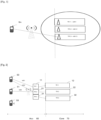
- FIG. 1 schematically illustrates a network slice connection system involving a user terminal connecting to a slice of a network.
- An operator network is composed of 3 network slices TR1, TR2, TR3, these slices being able for example to be associated with distinct services.
- the network slice TR1 is implemented to convey the flows specific to M2M (Machine to Machine) services.
- the network slice TR2 is implemented to carry the traffic linked to the broadband services of a professional clientele while the network slice TR3 is implemented to convey the flows of a residential clientele.
- the operator can, depending on its strategy, deploy as many network slices as necessary and assign these network slices to specific traffic, to specific clienteles or to specific market segments.
- Each network slice respectively identified TR1, TR2, TR3 are likely to emit slice identifiers ldS1, IdS2, IdS3 to the terminals.
- These slice identifiers may in particular be emitted on radio frequencies if they are mobile networks or on the wired access link, for example the optical network or the copper network, if they are wired networks.
- the transmission of the slice identifiers and the reception of these by the terminals do not require the terminals to be connected to the attachment network; in particular it is not necessary for the terminals to have an IP address.
- the terminals are on a wired network, they are physically connected to the network but it is not necessary for them to have network connectivity in addition to receive the slice identifiers.
- the terminals are also informed about the accessible network slices.
- Terminal 5n attaches to network slice TR3 because the slice identifier IdS3 transmitted by an access device of this slice and received by the terminal has been selected by the latter.
- the terminal 5n is a smartphone for residential use attached to the network slice intended to carry the flows of a residential clientele.
- the network slice is implemented by dedicating entities (for example in a framework of virtualization of network equipment), equipment or functions (naming, addressing, etc.) to a specific clientele or service.
- the network slice TR3 can be composed of dedicated access devices, specific user management entities and dedicated routing functions. Knowing that it is a question of dedicating entities to different services, the operator can advantageously rely on virtualization techniques to deploy architectures organized in network slices but this is not a necessity. Physical equipment is in this case deployed to be specifically assigned to the implementation of network slices.
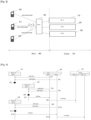
- FIG 2 illustrates a system where multiple terminals have connected to network slices comprising both access network entities 60 and core network entities 70.
- three terminals 50, 51, 53 are capable of attaching to network slices TR1, TR2, TR3.
- the network slices in this embodiment comprise access network entities and core network entities.
- the network slice TR1 comprises access network entities 11 and core network entities 12
- the network slice TR2 comprises access entities 21 and core entities 22
- the network slice TR3 comprises access entities 31 and core entities 32.
- the access network entities are, for example, the eNodeB, Node B, RNC (Radio Network Controller), while the core network entities are in particular the MME (Mobility Management Entity), the S-GW (Serving Gateway), the PDN-GW (Packet Data Network Gateway).
- the network slice can also integrate, for example, radio frequencies.
- the terminal 50 is in this embodiment, once the method of the invention has been implemented, simultaneously connected to two separate slices TR1 and TR2.
- the terminal 50 is for example equipped with the capacity to route M2M type flows, carried on the network slice TR1, and professional data flows, transiting on the network slice TR2.
- the terminal 50 receiving slice identifiers IdS1 and IdS2 from the respective access network entities 11 and 21, and having the capacity to transmit and receive flows associated with these network slices, connects to these two network slices. It is obvious that the terminal 50 must have the capacity to route the respective flows associated with these network slices. It can also decide to connect to a single network slice although supporting the capacity to connect to both slices, in particular depending on its configuration.
- the terminal 50 depending on the embodiment, can connect simultaneously to the two slices from which it receives the service identifiers or be configured to attach to a single slice, then attach to the other slice later if necessary.
- the terminal 51 is connected, once the connection method has been carried out, to a single network slice, in this case the network slice TR2, either because it is configured to connect to a single network slice or because it has not received any other network slice identifiers to which it would have been able to connect.
- the terminal 53 is not connected to any network slice, either because it is configured to connect to no network slice corresponding to the slice identifiers that it has received, or because it is not within range of an access network transmitting a slice identifier.
- FIG 3 illustrates a system where multiple terminals connect to network slices comprising only core network entities.
- the difference with the figure 2 previously described lies in the fact that the network slices implemented by the operator only comprise core network entities 70.
- the network slices TR4, TR5 and TR6 respectively comprise core network entities 15, 25 and 35.
- the entities 40 of the access network 60 are not differentiated by network slice and are therefore common in the sense that no entity of the access network is associated with a particular network slice.
- This embodiment does not mean that entities of the access network are not duplicated, in particular to ensure availability of the services, but these entities, even when replicated, are not dedicated to network slices specific to carrying specific data flows.
- the access network 60 is therefore not structured into network slices and represents a common access infrastructure for conveying the various flows exchanged between the terminals and the network slices implemented in the core network 70. Knowing that the network slices are not implemented in the access network, the sending of the slice identifiers to the terminals is not specific to a network slice and it is necessary for an equipment of the access network to send in an undifferentiated manner the identifiers of network slices of the core network for which it provides access.
- the terminals 50, 51 and 53 therefore receive in an undifferentiated manner the identifiers of network slices TR4, TR5 and TR6. Depending on the algorithm for selecting the terminals receiving these slice identifiers, these terminals will select the network slice(s) from among those corresponding to the slice identifiers received.
- the entities 40 of the access network 60 must therefore transmit the network slice identifiers of the core network to all terminals unless a specific policy has been configured, for example to send one or more specific network slice identifiers.
- the terminals are already informed in the mobile architectures of the operator networks to which they can connect.
- the corresponding PLMN-Id information is transmitted by RRC (Radio Resource Control) messages from the eNodeBs of the LTE (Long Term Evolution) network to the terminal.
- RRC Radio Resource Control
- the identifiers of accessible network slices, to be transmitted to the terminals can advantageously also be transmitted in the RRC messages when it comes to mobile networks.
- the terminal's network slice selection algorithm can be enhanced by combining the received slice identifier in addition to the operator network identifier, for example based on the received PLMN-Id.
- it can be envisaged to force the selection of a network slice of a particular operator or a particular service, or even any network slice of an operator.
- Such an algorithm could for example be structured as follows:
- This algorithm means that for B2B (Business-to-Business) services, the B2B network slice of the Orange network must be selected. If a terminal receives a PLMN Id equal to Orange and a slice identifier equal to B2B, it will then select Orange.B2B. For residential services, the "residential" network slice of the Orange operator must be selected. Finally, for M2M services, a network slice supporting M2M services offered by any operator can be selected. If we add the information Orange.*, this could consist in authorizing the selection of any network slice supported by the Orange operator for example in case of need for access for emergency services.
- the terminal 54 is configured with a slice identifier equal to 3, meaning that this terminal 54 can only connect to a network slice corresponding to the slice identifier Idt3.
- This slice identifier can be configured directly in the terminal, for example in a configuration file pre-installed by the operator with whom the user has subscribed to a service or on a SIM card installed in the terminal.
- the terminal 54 is within range of a mobile access network if it is a mobile network or is connected via xDSL or optical access, for example if it is a wired access network.
- the messages indicating the accessibility of the network slices can be transmitted using unicast type messages, intended only for one terminal, or broadcast or multicast type messages such that a single message is transmitted for a set of terminals. It is more likely that these messages are multicast or broadcast type messages because the terminal cannot be directly reached by the network. It is not connected and therefore does not have an IP address allocated by the network. However, it is possible to envisage, for example, that the terminal, provided with an IPv6 link-local type address, can be reached directly by a device in the network while the terminal has not been allocated a global IPv6 network prefix by the access network.
- the terminal 54 upon receiving the messages sent during steps E1 and E2, compares the received slice identifier numbers with the configured slice identifier number and selects during a step E3, if possible, one or more network slices in order to attach to them.
- the slice identifier configured on the terminal is IdT3 while it receives slice identifiers IdS1 and IdS2.
- the algorithm of the terminal 54 in this embodiment, being to select the network slice(s) whose slice identifier number stored on the terminal is (are) equal to the slice identifier number(s) received, it does not select any network slice and does not connect to any network slice.
- the terminal 54 selects a network slice by default, for example the one having the smallest slice identifier number, so as to be able to access certain services despite everything, for example security services.
- the behavior of the terminal depends on the algorithm implemented.
- the terminal 54 in this embodiment, does not connect to any slice because it has not received any message comprising the slice identifier IdS3.
- the information allowing the terminal to attach to the selected network slice can advantageously be sent in the message comprising the network slice identifier, or be configured in the equipment for example by associating the configured slice identifier with the information necessary for the attachment procedure. Knowing that the attachment requires a request for resources from the core network, the attachment request made during step E7 is followed by a connection request during step E8 transmitted by an access device of the slice to a core device of the selected slice.
- the attachment request made during step E7 is followed by a connection request during step E8 transmitted by an access device of the slice to a core device of the selected slice.
- this step E8 may consist of a request for PDP context (in English Packet Data Protocol) or EPS bearer (in English Evolved Packet System) instantiated during steps E7 and E8 and making it possible to establish the connection between the terminal and the PDN-GW of the ldS1 network slice.
- PDP context in English Packet Data Protocol
- EPS bearer in English Evolved Packet System
- these steps E7 and E8 correspond to the connection between the terminal and the DSLAM (in English Digital Subscriber Line Access Multiplexer) then the BAS (in English Broadband Access Server) or the BNG (Broadband Network Gateway) via the PPP protocol (in English Point to Point Protocol) or DHCP (in English Dynamic Host Configuration Protocol).
- the terminal 56 receives slice identifiers IdS1 and IdS2 during the respective steps E9 and E10.
- the terminal 56 having a stored slice identifier IdT2 selects the network slice whose parameter is ldS2 during the step E11 and attaches itself to the access entities of the network slice corresponding to the slice identifier ldS2 during the step E12 then to the core entities of this same network slice during the step E13 via the connection request transmitted from an access device to a network core device of the slice considered.
- FIG 5 illustrates the different steps of the connection method according to another embodiment of the invention where a network slice comprises only core network entities.
- the architecture presented in the figure 5 differs from the architecture of the figure 4 by the fact that the network slices implemented by the operator only include core network entities while the access network is not organized into network slices.
- the access network entities are therefore common to the different terminals and services. Since the access network is not structured into network slices, the slice identifiers are sent by a common access network device. This common access network equipment transmits to the terminals all the identifiers of network slices to which the terminals are likely to connect.
- the core network 70 being structured into two network slices whose slice identifiers are IdS1 and IdS2, the entity of the access network must send to the terminals all of the slice identifiers corresponding to the slices deployed in the core network.
- an equipment of the access network 60 transmits to the terminal 54 a message comprising the slice identifiers IdS1 and IdS2, the message being able to be transmitted in a unicast, multicast or broadcast mode.
- Step E'3 is in all respects comparable to step E3 of the figure 4 , the purpose for the terminal 54 being to compare the received slice identifiers with the slice identifiers configured on the terminal and to select one or more of them.
- the terminal 54 having a slice identifier number that does not correspond to any slice identifier number received during step E'1, the terminal 54 does not select any network slice and therefore does not make any attachment request.
- the following steps are in all respects equivalent to the steps described in the figure 4 , the only differences corresponding to the slice identifiers sent in the messages of steps E'4 and E'9, in a manner comparable to what was described for step E'1.
- the access network since the access network is not structured into network slices, the access network must have a means of transmitting the connection requests of steps E'8 and E'13 to the network slices selected by the terminals 55 and 56.
- the access network may rely on a slice identifier included in the attachment requests sent during the respective steps E'7 and E'12 to send the connection requests to the network slices selected by the respective terminals.
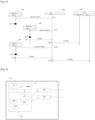
- FIG. 6 illustrates the functions of a user terminal arranged to accomplish the different steps of the connection method according to a particular embodiment.
- the terminal 100 comprises a processing unit 106, equipped for example with a microprocessor ⁇ P, and controlled by a computer program 105, stored in a memory 107 and implementing the connection method according to the invention.
- a computer program 105 stored in a memory 107 and implementing the connection method according to the invention.
- the code instructions of the computer program 105 are for example loaded into a RAM memory, before being executed by the processor of the processing unit 106.
- the terminal comprises an interface 110 for sending messages and an interface 120 for receiving messages.
- the modules described in relation to the figure 6 can be hardware or software.
- connection method according to the invention proves to be particularly useful in a multi-operator context where the terminal can be informed of network slices associated with services even before connecting to one of the operator networks. Indeed, it is generally necessary to connect to an operator network to subscribe to one or more services offered by this operator and it is not optimal to receive the slice identifiers once connected to the network.
- the invention makes it possible to send these identifiers even before the terminal is connected to one of the operator networks broadcasting these slice identifiers. This allows a terminal to be able, if necessary, subscribe to a service associated with a network slice offered by the operator, once the slice identifier has been received.
Landscapes
- Engineering & Computer Science (AREA)
- Computer Networks & Wireless Communication (AREA)
- Signal Processing (AREA)
- Computer Security & Cryptography (AREA)
- Mobile Radio Communication Systems (AREA)
- Data Exchanges In Wide-Area Networks (AREA)
- Small-Scale Networks (AREA)
Applications Claiming Priority (3)
| Application Number | Priority Date | Filing Date | Title |
|---|---|---|---|
| FR1655213A FR3052324A1 (fr) | 2016-06-07 | 2016-06-07 | Procede de connexion d'un terminal a une tranche de reseau |
| PCT/FR2017/051420 WO2017212162A1 (fr) | 2016-06-07 | 2017-06-06 | Procédé de connexion d'un terminal utilisateur à une tranche de réseau |
| EP17742792.9A EP3479644B1 (de) | 2016-06-07 | 2017-06-06 | Verfahren zur verbindung eines benutzerendgeräts mit einem netzwerk-slice |
Related Parent Applications (1)
| Application Number | Title | Priority Date | Filing Date |
|---|---|---|---|
| EP17742792.9A Division EP3479644B1 (de) | 2016-06-07 | 2017-06-06 | Verfahren zur verbindung eines benutzerendgeräts mit einem netzwerk-slice |
Publications (3)
| Publication Number | Publication Date |
|---|---|
| EP4475599A2 true EP4475599A2 (de) | 2024-12-11 |
| EP4475599A3 EP4475599A3 (de) | 2025-03-26 |
| EP4475599B1 EP4475599B1 (de) | 2026-01-21 |
Family
ID=57233544
Family Applications (2)
| Application Number | Title | Priority Date | Filing Date |
|---|---|---|---|
| EP24208269.1A Active EP4475599B1 (de) | 2016-06-07 | 2017-06-06 | Verfahren zum verbinden eines benutzerendgeräts mit einem netzwerk-slice |
| EP17742792.9A Active EP3479644B1 (de) | 2016-06-07 | 2017-06-06 | Verfahren zur verbindung eines benutzerendgeräts mit einem netzwerk-slice |
Family Applications After (1)
| Application Number | Title | Priority Date | Filing Date |
|---|---|---|---|
| EP17742792.9A Active EP3479644B1 (de) | 2016-06-07 | 2017-06-06 | Verfahren zur verbindung eines benutzerendgeräts mit einem netzwerk-slice |
Country Status (6)
| Country | Link |
|---|---|
| US (3) | US11457404B2 (de) |
| EP (2) | EP4475599B1 (de) |
| CN (4) | CN114205892B (de) |
| ES (1) | ES3008757T3 (de) |
| FR (1) | FR3052324A1 (de) |
| WO (1) | WO2017212162A1 (de) |
Families Citing this family (24)
| Publication number | Priority date | Publication date | Assignee | Title |
|---|---|---|---|---|
| US10855645B2 (en) | 2015-01-09 | 2020-12-01 | Microsoft Technology Licensing, Llc | EPC node selection using custom service types |
| EP3277008A1 (de) * | 2016-07-29 | 2018-01-31 | Deutsche Telekom AG | Teilnehmeridentitätselement zum authentifizieren eines kommunikationsgerätes gegenüber einem kommunikationsnetzwerk |
| US11038841B2 (en) | 2017-05-05 | 2021-06-15 | Microsoft Technology Licensing, Llc | Methods of and systems of service capabilities exposure function (SCEF) based internet-of-things (IOT) communications |
| CA3092370A1 (en) * | 2018-03-20 | 2019-09-26 | Affirmed Networks, Inc. | Systems and methods for network slicing |
| FR3085510A1 (fr) * | 2018-08-31 | 2020-03-06 | Orange | Procede de reglage de parametres d'un sous-ensemble virtuel d'un reseau dedie a un service |
| EP3884707B1 (de) | 2018-11-19 | 2024-01-10 | Telefonaktiebolaget LM Ericsson (publ) | Auswahl eines netzwerk-slice-identifikators |
| FR3089376A1 (fr) * | 2018-11-29 | 2020-06-05 | Orange | Activation ou désactivation d’un sous-ensemble virtuel d’un réseau dédié à un service pour un terminal |
| US10944647B2 (en) | 2019-01-24 | 2021-03-09 | Vmware, Inc. | Dynamic inter-cloud placement of virtual network functions for a slice |
| US10979314B2 (en) | 2019-01-24 | 2021-04-13 | Vmware, Inc. | Dynamic inter-cloud placement of virtual network functions for a slice |
| CN111757468B (zh) * | 2019-03-26 | 2025-06-10 | 中兴通讯股份有限公司 | 一种资源分配的方法、装置及存储介质、电子装置 |
| WO2020204585A1 (en) * | 2019-04-05 | 2020-10-08 | Samsung Electronics Co., Ltd. | Method and apparatus for providing network connectivity in a wireless communication system |
| US10892994B2 (en) * | 2019-05-14 | 2021-01-12 | Vmware, Inc. | Quality of service in virtual service networks |
| US11588733B2 (en) | 2019-05-14 | 2023-02-21 | Vmware, Inc. | Slice-based routing |
| US11012288B2 (en) | 2019-05-14 | 2021-05-18 | Vmware, Inc. | Congestion avoidance in a slice-based network |
| US10958579B2 (en) | 2019-05-14 | 2021-03-23 | Vmware, Inc. | Congestion avoidance in a slice-based network |
| US10897423B2 (en) | 2019-05-14 | 2021-01-19 | Vmware, Inc. | Congestion avoidance in a slice-based network |
| CN110710237B (zh) * | 2019-09-05 | 2022-08-19 | 北京小米移动软件有限公司 | 支持信息确定方法和装置 |
| CN114667766B (zh) * | 2019-09-30 | 2023-09-19 | 上海诺基亚贝尔股份有限公司 | 无线电接入网中的网络切片 |
| CN114125856B (zh) | 2020-08-27 | 2025-07-15 | 中兴通讯股份有限公司 | 网络切片连接方法、终端及计算机可读存储介质 |
| CN114205877A (zh) * | 2020-09-02 | 2022-03-18 | 中兴通讯股份有限公司 | 一种网络切片确定方法、通信设备、系统及存储介质 |
| US20220303884A1 (en) * | 2020-10-22 | 2022-09-22 | Apple Inc. | Radio Access Network Connectivity Enhancements for Network Slicing |
| CN114521004A (zh) * | 2020-11-19 | 2022-05-20 | 中国移动通信集团有限公司 | 数据发送方法、装置、设备及存储介质 |
| US12231920B2 (en) * | 2022-03-25 | 2025-02-18 | Juniper Networks, Inc. | Network slices for time sensitive networking |
| CN114727366B (zh) * | 2022-05-10 | 2024-09-13 | 中国电信股份有限公司 | 一种网络切片接入方法、系统、网络侧、终端及存储介质 |
Family Cites Families (15)
| Publication number | Priority date | Publication date | Assignee | Title |
|---|---|---|---|---|
| US7305251B2 (en) * | 2003-10-07 | 2007-12-04 | Motorola Inc. | Method for selecting a core network |
| US20110149968A1 (en) * | 2009-12-21 | 2011-06-23 | Electronics And Telecommunications Research Institute | Method for controlling internet network |
| US9131330B2 (en) * | 2011-07-15 | 2015-09-08 | Telefonaktiebolaget L M Ericsson (Publ) | M2M services enablement architecture for cellular access networks |
| KR101268440B1 (ko) * | 2011-10-31 | 2013-06-04 | 한국과학기술정보연구원 | 글로벌 네트워크 슬라이스 관리 시스템 및 그 방법 |
| US8870661B2 (en) * | 2012-12-21 | 2014-10-28 | Sony Computer Entertainment America Llc | Cloud-based game slice generation and frictionless social sharing with instant play |
| FR3004037A1 (fr) * | 2013-04-02 | 2014-10-03 | France Telecom | Procede de transport d'information de localisation au travers d'une authentification |
| US20160249353A1 (en) * | 2013-10-18 | 2016-08-25 | Nec Corporation | System and method for network control |
| US20170142010A1 (en) * | 2014-03-20 | 2017-05-18 | Hewlett Packard Enterprise Development Lp | Network operation rule |
| US9756361B2 (en) * | 2014-07-25 | 2017-09-05 | Verizon Patent And Licensing Inc. | On-demand load balancer and virtual live slicer server farm for program ingest |
| GB2542573B (en) * | 2015-09-22 | 2018-08-15 | Vodafone Ip Licensing Ltd | Network roaming |
| JP2018533885A (ja) * | 2015-11-10 | 2018-11-15 | 華為技術有限公司Huawei Technologies Co.,Ltd. | サービスネットワークを選択するための方法およびネットワークデバイスならびに管理デバイス |
| CN105516312B (zh) * | 2015-12-09 | 2019-02-22 | 重庆邮电大学 | 一种软件定义网络负载均衡装置与方法 |
| EP3417648B1 (de) * | 2016-02-15 | 2019-11-27 | Telefonaktiebolaget LM Ericsson (publ) | Netzwerkknoten und darin ausgeführte verfahren zur ermöglichung der kommunikation in einem kommunikationsnetzwerk |
| US10820241B2 (en) * | 2016-02-15 | 2020-10-27 | Telefonaktiebolaget Lm Ericsson (Publ) | Network nodes and methods performed therein for enabling communication in a communication network |
| WO2017143047A1 (en) * | 2016-02-16 | 2017-08-24 | Idac Holdings, Inc. | Network slicing operation |
-
2016
- 2016-06-07 FR FR1655213A patent/FR3052324A1/fr active Pending
-
2017
- 2017-06-06 US US16/307,753 patent/US11457404B2/en active Active
- 2017-06-06 ES ES17742792T patent/ES3008757T3/es active Active
- 2017-06-06 CN CN202111615017.4A patent/CN114205892B/zh active Active
- 2017-06-06 EP EP24208269.1A patent/EP4475599B1/de active Active
- 2017-06-06 CN CN201780047182.XA patent/CN109565747B/zh active Active
- 2017-06-06 EP EP17742792.9A patent/EP3479644B1/de active Active
- 2017-06-06 CN CN202111615019.3A patent/CN114205893B/zh active Active
- 2017-06-06 WO PCT/FR2017/051420 patent/WO2017212162A1/fr not_active Ceased
- 2017-06-06 CN CN202111613745.1A patent/CN114205891B/zh active Active
-
2022
- 2022-08-10 US US17/885,008 patent/US12200621B2/en active Active
-
2024
- 2024-12-05 US US18/969,845 patent/US20250106755A1/en active Pending
Also Published As
| Publication number | Publication date |
|---|---|
| EP4475599B1 (de) | 2026-01-21 |
| EP4475599A3 (de) | 2025-03-26 |
| CN114205892B (zh) | 2024-02-06 |
| CN114205892A (zh) | 2022-03-18 |
| CN114205893A (zh) | 2022-03-18 |
| US11457404B2 (en) | 2022-09-27 |
| US20220386232A1 (en) | 2022-12-01 |
| EP3479644B1 (de) | 2024-11-13 |
| WO2017212162A1 (fr) | 2017-12-14 |
| US20250106755A1 (en) | 2025-03-27 |
| CN109565747A (zh) | 2019-04-02 |
| EP3479644A1 (de) | 2019-05-08 |
| US12200621B2 (en) | 2025-01-14 |
| ES3008757T3 (en) | 2025-03-25 |
| US20190253962A1 (en) | 2019-08-15 |
| CN109565747B (zh) | 2022-01-14 |
| CN114205891B (zh) | 2024-02-06 |
| CN114205891A (zh) | 2022-03-18 |
| CN114205893B (zh) | 2024-02-06 |
| FR3052324A1 (fr) | 2017-12-08 |
Similar Documents
| Publication | Publication Date | Title |
|---|---|---|
| EP3479644B1 (de) | Verfahren zur verbindung eines benutzerendgeräts mit einem netzwerk-slice | |
| EP3476096A1 (de) | Verfahren für mehrweg-udp-kommunikationsverfahren zwischen zwei endgeräten | |
| FR3044855A1 (fr) | Dispositif et procede de communication sans-fil dans un reseau ip | |
| EP3682601B1 (de) | Datenumlenkung in einer anlage auf einem kundengelände unter verwendung von verbindungsaggregation | |
| CA3131239A1 (fr) | Procede de basculement d'une station mobile entre deux points d'acces sans fil d'un reseau de communication et dispositif gestionnaire de connexions associe | |
| EP3682600B1 (de) | Verwaltung der verbindung mit anderen residential gateways eines residential gateways mit verbindungsaggregation | |
| FR2970829A1 (fr) | Procede d'attachement d'un terminal utilisateur a un reseau de paquets | |
| FR3005546A1 (fr) | Procede et dispositif de selection d'interface de communication | |
| EP4082232A1 (de) | Verfahren zur konfiguration einer benutzervorrichtung, benutzergerät und regelverwaltungsentität | |
| EP3366069B1 (de) | Hybrider residential gateway | |
| EP2206384B1 (de) | Zugangsknoten-umschaltverfahren | |
| WO2020120850A1 (fr) | Terminal pouvant être connecté simultanément à plusieurs réseaux d'accès, procédé de différentiation de trafic émis par le terminal, dispositif et procédé de gestion du trafic | |
| EP3692741A1 (de) | Verfahren zur übertragung eines mobilen endgeräts zwischen zugangstationen in einem mehrbetreiberkontext | |
| WO2025133034A1 (fr) | Procédés de configuration et de communication, entité d'un réseau de télécommunications et équipement utilisateur | |
| FR3154893A1 (fr) | Procédés et dispositifs pour la configuration et l’utilisation d’un réseau supportant des tranches réseau | |
| WO2025078594A1 (fr) | Procédés de sélection de tranches réseau adaptées à un service, de gestion d'au moins une tranche réseau et de communication, et entités configurées pour mettre en œuvre ces procédés | |
| FR3153206A1 (fr) | Procédés, dispositifs et système de contrôle d’une communication dans un réseau |
Legal Events
| Date | Code | Title | Description |
|---|---|---|---|
| PUAI | Public reference made under article 153(3) epc to a published international application that has entered the european phase |
Free format text: ORIGINAL CODE: 0009012 |
|
| STAA | Information on the status of an ep patent application or granted ep patent |
Free format text: STATUS: THE APPLICATION HAS BEEN PUBLISHED |
|
| AC | Divisional application: reference to earlier application |
Ref document number: 3479644 Country of ref document: EP Kind code of ref document: P |
|
| AK | Designated contracting states |
Kind code of ref document: A2 Designated state(s): AL AT BE BG CH CY CZ DE DK EE ES FI FR GB GR HR HU IE IS IT LI LT LU LV MC MK MT NL NO PL PT RO RS SE SI SK SM TR |
|
| PUAL | Search report despatched |
Free format text: ORIGINAL CODE: 0009013 |
|
| AK | Designated contracting states |
Kind code of ref document: A3 Designated state(s): AL AT BE BG CH CY CZ DE DK EE ES FI FR GB GR HR HU IE IS IT LI LT LU LV MC MK MT NL NO PL PT RO RS SE SI SK SM TR |
|
| RIC1 | Information provided on ipc code assigned before grant |
Ipc: H04W 48/18 20090101AFI20250219BHEP |
|
| STAA | Information on the status of an ep patent application or granted ep patent |
Free format text: STATUS: REQUEST FOR EXAMINATION WAS MADE |
|
| 17P | Request for examination filed |
Effective date: 20250403 |
|
| GRAP | Despatch of communication of intention to grant a patent |
Free format text: ORIGINAL CODE: EPIDOSNIGR1 |
|
| STAA | Information on the status of an ep patent application or granted ep patent |
Free format text: STATUS: GRANT OF PATENT IS INTENDED |
|
| INTG | Intention to grant announced |
Effective date: 20250903 |
|
| GRAS | Grant fee paid |
Free format text: ORIGINAL CODE: EPIDOSNIGR3 |
|
| GRAA | (expected) grant |
Free format text: ORIGINAL CODE: 0009210 |
|
| STAA | Information on the status of an ep patent application or granted ep patent |
Free format text: STATUS: THE PATENT HAS BEEN GRANTED |
|
| AC | Divisional application: reference to earlier application |
Ref document number: 3479644 Country of ref document: EP Kind code of ref document: P |
|
| AK | Designated contracting states |
Kind code of ref document: B1 Designated state(s): AL AT BE BG CH CY CZ DE DK EE ES FI FR GB GR HR HU IE IS IT LI LT LU LV MC MK MT NL NO PL PT RO RS SE SI SK SM TR |
|
| REG | Reference to a national code |
Ref country code: CH Ref legal event code: F10 Free format text: ST27 STATUS EVENT CODE: U-0-0-F10-F00 (AS PROVIDED BY THE NATIONAL OFFICE) Effective date: 20260121 |