EP4475591A1 - Informationsübertragungsverfahren sowie elektronische vorrichtung und speichermedium - Google Patents
Informationsübertragungsverfahren sowie elektronische vorrichtung und speichermedium Download PDFInfo
- Publication number
- EP4475591A1 EP4475591A1 EP23830275.6A EP23830275A EP4475591A1 EP 4475591 A1 EP4475591 A1 EP 4475591A1 EP 23830275 A EP23830275 A EP 23830275A EP 4475591 A1 EP4475591 A1 EP 4475591A1
- Authority
- EP
- European Patent Office
- Prior art keywords
- resource
- node
- control information
- sidelink control
- conflict
- Prior art date
- Legal status (The legal status is an assumption and is not a legal conclusion. Google has not performed a legal analysis and makes no representation as to the accuracy of the status listed.)
- Pending
Links
Images

Classifications
-
- H—ELECTRICITY
- H04—ELECTRIC COMMUNICATION TECHNIQUE
- H04W—WIRELESS COMMUNICATION NETWORKS
- H04W72/00—Local resource management
- H04W72/20—Control channels or signalling for resource management
- H04W72/25—Control channels or signalling for resource management between terminals via a wireless link, e.g. sidelink
-
- H—ELECTRICITY
- H04—ELECTRIC COMMUNICATION TECHNIQUE
- H04L—TRANSMISSION OF DIGITAL INFORMATION, e.g. TELEGRAPHIC COMMUNICATION
- H04L5/00—Arrangements affording multiple use of the transmission path
- H04L5/14—Two-way operation using the same type of signal, i.e. duplex
- H04L5/16—Half-duplex systems; Simplex/duplex switching; Transmission of break signals non-automatically inverting the direction of transmission
-
- H—ELECTRICITY
- H04—ELECTRIC COMMUNICATION TECHNIQUE
- H04W—WIRELESS COMMUNICATION NETWORKS
- H04W28/00—Network traffic management; Network resource management
- H04W28/16—Central resource management; Negotiation of resources or communication parameters, e.g. negotiating bandwidth or QoS [Quality of Service]
- H04W28/26—Resource reservation
-
- H—ELECTRICITY
- H04—ELECTRIC COMMUNICATION TECHNIQUE
- H04W—WIRELESS COMMUNICATION NETWORKS
- H04W72/00—Local resource management
- H04W72/12—Wireless traffic scheduling
- H04W72/1263—Mapping of traffic onto schedule, e.g. scheduled allocation or multiplexing of flows
-
- H—ELECTRICITY
- H04—ELECTRIC COMMUNICATION TECHNIQUE
- H04W—WIRELESS COMMUNICATION NETWORKS
- H04W72/00—Local resource management
- H04W72/50—Allocation or scheduling criteria for wireless resources
- H04W72/56—Allocation or scheduling criteria for wireless resources based on priority criteria
-
- H—ELECTRICITY
- H04—ELECTRIC COMMUNICATION TECHNIQUE
- H04W—WIRELESS COMMUNICATION NETWORKS
- H04W72/00—Local resource management
- H04W72/50—Allocation or scheduling criteria for wireless resources
- H04W72/56—Allocation or scheduling criteria for wireless resources based on priority criteria
- H04W72/566—Allocation or scheduling criteria for wireless resources based on priority criteria of the information or information source or recipient
-
- H—ELECTRICITY
- H04—ELECTRIC COMMUNICATION TECHNIQUE
- H04W—WIRELESS COMMUNICATION NETWORKS
- H04W92/00—Interfaces specially adapted for wireless communication networks
- H04W92/16—Interfaces between hierarchically similar devices
- H04W92/18—Interfaces between hierarchically similar devices between terminal devices
-
- H—ELECTRICITY
- H04—ELECTRIC COMMUNICATION TECHNIQUE
- H04W—WIRELESS COMMUNICATION NETWORKS
- H04W72/00—Local resource management
- H04W72/02—Selection of wireless resources by user or terminal
Definitions
- the present application relates to the field of wireless communications, particularly an information transmission method, an electronic device, and a storage medium.
- SL communication can be divided into two communication modes. In a first mode, a resource for a user equipment (UE) to send sidelink signals are scheduled by a base station. In a second mode, a UE autonomously selects a resource from a network-configured or preconfigured resource pool according to a resource selection policy. Common resource selection policies include a sensing mechanism, a partial sensing mechanism, and a random selection mechanism.
- a first terminal may send the following two types of coordination information: coordination information 1: a set of resources that the UE-B is expected to use for transmission or a set of resources that the UE-B is not expected to use for transmission; and coordination information 2: an indication from the UE-B that the resource to be used in the future will encounter a resource conflict, referred to as a resource conflict indication.
- coordination information 1 a set of resources that the UE-B is expected to use for transmission or a set of resources that the UE-B is not expected to use for transmission
- coordination information 2 an indication from the UE-B that the resource to be used in the future will encounter a resource conflict, referred to as a resource conflict indication.
- the coordination information 2 or the resource conflict indication is carried in a physical sidelink feedback channel (PSFCH) when transmitted.
- PSFCH physical sidelink feedback channel
- Embodiments of the present application provide an information transmission method, an electronic device, and a storage medium to take into full consideration the information coordination capability between nodes, thereby reducing communication resource conflicts and improving the resource utilization rate.
- An embodiment of the present application provides an information transmission method.
- the method includes determining, according to received sidelink control information, that a resource conflict includes at least one of the following: a half-duplex resource conflict existing for a reserved resource of a second node or a resource reservation conflict existing between a reserved resource of a second node and a reserved resource of a third node; and determining, according to a specified condition, the second node for transmitting a resource conflict indication to.
- An embodiment of the present application provides an electronic device.
- the electronic device includes one or more processors and a memory configured to store one or more programs.
- the one or more programs When executed by the one or more processors, the one or more programs cause the one or more processors to perform the information transmission method of any embodiment of the present application.
- An embodiment of the present application provides a computer-readable storage medium.
- the computer-readable storage medium stores one or more programs which, when executed by one or more processors, cause the one or more processors to perform the information transmission method of any embodiment of the present application.
- module In the subsequent description, words for representing elements, such as “module”, “component” and “unit” are merely used for facilitating the description of the present application and have no particular meanings in themselves. Therefore, “module”, “component” and “unit” may be used in a mixed manner.
- UE-A In the case where the first terminal (UE-A) as the receiver cannot receive from UE-B, UE-A sends coordination information without considering whether UE-B can receive the coordination information or whether there is a valid resource on which the coordination information can be sent.
- UE-A When UE-A discovers a resource conflict between the reserved resource of UE-B and the reserved resource of another UE (the third terminal), it is currently not considered whether UE-A sends coordination information to UE-B.
- the current approach only considers situations where the second UE can receive a resource conflict indication and the third UE cannot. It does not consider whether UE-B can autonomously detect and handle resource conflicts. For example, UE-B may use the pre-emption technology to identify and avoid conflicts with other UEs. In cases where UE-B cannot detect or handle resource conflicts, UE-A is required to send coordination information. Otherwise, UE-A may send no coordination information.
- FIG. 1 is a flowchart of an information transmission method according to an embodiment of the present application.
- This embodiment of the present application can be applied to sidelink wireless communications.
- the method can be executed by the information transmission apparatus of the embodiment of the present application.
- the apparatus may be implemented by software and/or hardware.
- the apparatus is generally integrated in a terminal. See FIG. 1 .
- the method of this embodiment of the present application includes the following steps:
- a resource conflict includes at least one of the following: a half-duplex resource conflict existing for a reserved resource of a second node or a resource reservation conflict existing between a reserved resource of a second node and a reserved resource of a third node.
- the terminal when as a first node for sidelink communications, the terminal may determine the resource conflict according to the received sidelink control information.
- the resource conflict includes the following two types.
- the terminal is a half-duplex device that can either receive or send at a certain time.
- the terminal detects the sidelink control information (SCI) of the second node.
- SCI includes information about a reserved resource.
- the terminal is the receiver of the resource.
- the terminal finds it cannot receive data on this resource. That is, the terminal can send data but cannot receive data during the time period of the reserved resource, resulting in a resource conflict.
- This resource conflict can be identified as a half-duplex resource conflict of the reserved resource of the second node.
- the SCI can also refer to first-type SCI carried in a physical sidelink control channel (PSCCH), namely SCI format 1-A.
- PSCCH physical sidelink control channel
- the terminal receives SCI from the second node and SCI from the third node.
- the terminal detects from the SCI that the reserved resource of the second node overlap the reserved resource of the third node. In such case of resource overlap, it is required that the terminal be the receiver of the SCI reserved resource of the second node and the receiver of the SCI reserved resource of the third node. Alternatively, it is required that the terminal be the target receiver of the SCI reserved resource of the second node or the target receiver of the SCI reserved resource of the third node. Which is required may be configured by the protocol parameter typeAUEScheme2.
- this parameter When this parameter is enabled, it is required that the terminal be one of the target receiver of the SCI reserved resource of the second node or the target receiver of the SCI reserved resource of the third node.
- this parameter When this parameter is disabled, it is required that the terminal be the target receiver of the SCI reserved resource of the second node and the target receiver of the SCI reserved resource of the third node.
- step 120 the second node for transmitting a resource conflict indication to is determined according to a specified condition.
- the terminal can determine whether the node satisfies the specified condition. When the node satisfies the specified condition, the terminal determines that this node is a second node that requires the transmission of the resource conflict indication and transmits the resource conflict indication to this node.
- the resource conflict is the half-duplex resource conflict
- the terminal is the target receiver of the transmission on the reserved resource of the second node, but since limited by the half-duplex mode, the terminal is unable or unwilling to receive data on the reserved resource.
- the specified condition includes at least one of the following: The receiving capability indication for the resource conflict indication of the second node in the sidelink control information is enabled; the transmission occasion of the resource conflict indication is valid; or the receiving time of the sidelink control information is at least a first minimum interval threshold earlier than the transmission occasion of the resource conflict indication.
- the specified condition used by the terminal to determine the second node may include the following:
- the sidelink control information transmitted by the node to the terminal includes information indicating that the node has the capability to receive the resource conflict indication, for example, the field indicationUEB flag in the SCI sent by the node is set to 1.
- the transmission occasion of the resource conflict indication is valid.
- the transmission occasion may be determined by the transmission time of the sidelink control information or by the time of the reserved resource.
- the transmission occasion of the resource conflict indication corresponding to the node and determined by the transmission time of the sidelink control information satisfies that the transmission occasion of the resource conflict indication is located in the first slot containing a PSFCH resource in the resource pool that is at least a first minimum interval threshold later than the transmission time of the sidelink control information, and there is at least a second minimum interval threshold between the time of the reserved resource and the transmission occasion of the resource conflict indication.
- the transmission occasion of the resource conflict indication corresponding to the node and determined by the time of the reserved resource satisfies that the transmission occasion of the resource conflict indication is located in the first slot containing a PSFCH resource in the resource pool that is at least a first minimum interval threshold earlier than the time of the reserved resource, and there is at least a first minimum interval threshold between the transmission time of the sidelink control information and the transmission occasion of the resource conflict indication. That the transmission occasion of the resource conflict indication corresponding to the node is valid means that the transmission occasion determined by the transmission time of the sidelink control information or by the time of the reserved resource has not yet passed.
- the receiving time of the sidelink control information is at least a first minimum interval threshold earlier than the transmission occasion of the resource conflict indication.
- the first minimum interval threshold may be configured or preconfigured by a network or defined by a protocol.
- the higher-layer parameter sl-MinTimeGapPSFCH provides the value of the first minimum interval threshold.
- the time interval between the receiving time of the sidelink control information of the node and the transmission occasion is greater than or equal to the first minimum interval threshold.
- the node when the node satisfies one or more of the preceding specified conditions, the node can be determined as a second node that can receive the resource conflict indication, and the terminal can transmit the resource conflict indication to the second node.
- the specified condition includes the following: The transmission occasion of the resource conflict indication is at least a second minimum interval threshold earlier than reserved resource of the half-duplex resource conflict.
- the specified condition used by the terminal to determine the second node may also include the following:
- the transmission occasion of the resource conflict indication of the node is earlier than the time corresponding to the reserved resource where the half-duplex resource conflict occurs, and the time length between the transmission occasion and the time corresponding to the reserved resource is greater than the second minimum interval threshold.
- the second minimum interval threshold may be configured or preconfigured by a network or defined by a protocol. For example, the value of T3 defined by the protocol provides the value of the second minimum interval threshold.
- FIG. 2 is a flowchart of an information transmission method according to an embodiment of the present application. This embodiment of the present application is based on the previous embodiment. Referring to FIG. 2 , the method of this embodiment of the present application includes the following steps:
- step 210 it is determined, according to received sidelink control information, that a resource conflict is a resource reservation conflict between the reserved resource of a second node and the reserved resource of a third node.
- a terminal determines that a resource conflict is present between the reserved resource of the second node and the reserved resource of the third node, that is, an overlap is present between the reserved resource of the second node and the reserved resource of the third node.
- step 220 the second node for transmitting a resource conflict indication to is determined according to a specified condition.
- the second node satisfies the specified condition.
- the second node when the resource conflict occurs, the second node is detected to satisfy the specified condition, and the terminal may use this second node as a second node involved in transmission of the resource conflict indication.
- the specified condition satisfied by the second node includes at least one of the following: The transmission occasion of the resource conflict indication is valid; the receiving time of the sidelink control information of the second node is at least a third minimum interval earlier than the transmission occasion of the resource conflict indication; the receiving capability indication for the resource conflict indication of the second node is enabled through the sidelink control information; or the third node does not satisfy a second specified condition.
- the second node can be determined as a second node involved in transmission of the resource conflict indication when the second node satisfies at least one of the following: The transmission occasion of the resource conflict indication is valid; the receiving time of the sidelink control information of the second node is earlier than the transmission occasion of the resource conflict indication, and the time interval between the receiving time and the transmission occasion is greater than a third minimum interval; the receiving capability indication for the resource conflict indication of the second node in the sidelink control information is enabled; or the third node does not satisfy a second specified condition.
- the second specified condition includes at least one of the following: The transmission occasion of the resource conflict indication of the reserved resource of the third node is valid; the receiving time of the sidelink control information of the third node is at least a fourth minimum interval earlier than the transmission occasion of the resource conflict indication; or the receiving capability indication for the resource conflict indication is enabled through the sidelink control information of the third node.
- the third node when it is determined that the second node is a second node involved in transmission of the resource conflict indication, the third node does not satisfy the second specified condition.
- the second specified condition includes at least one of the following: The transmission occasion of the resource conflict indication of the reserved resource of the third node is valid; the receiving time of the sidelink control information of the third node is earlier than the transmission occasion of the resource conflict indication, and the time interval between the receiving time and the transmission occasion is greater than a fourth minimum interval; or the receiving capability indication for the resource conflict indication in the sidelink control information of the third node is enabled.
- the specified condition satisfied by the second node includes at least one of the following:
- the priority value included in the sidelink control information of the second node is greater than or equal to the priority value included in the sidelink control information of the third node; the priority value included in the sidelink control information of the second node is less than the priority value included in the sidelink control information of the third node, and a preemption mode is not configured for a resource pool of a reserved resource, or no preemption mode parameter is provided, for example, the higher-layer parameter sl-PreemptionEnable is not provided; or the priority value included in the sidelink control information of the second node is less than the priority value included in the sidelink control information of the third node, and the priority value included in the sidelink control information of the second node is less than a priority threshold corresponding to the preemption mode configured for the resource pool of the reserved resource, for example, the higher-layer parameter sl-PreemptionEnable is provided, and the value of this parameter is not equal to "enabled”.
- the reserved resource of the second node overlap the reserved resource of the third node
- the specified condition used by the terminal to determine the second node involved in transmission of the resource conflict indication may include the following: 1.
- the priority value in the sidelink control information of the second node is greater than or equal to the priority value in the sidelink control information of the third node.
- the priority value in the sidelink control information of the second node is less than the priority value in the sidelink control information of the third node, and the resource pool containing the overlapping reserved resource is not in the preemption mode. Whether this resource pool is in the preemption mode may be determined by whether the preemption mode of the resource pool is configured or whether the preemption mode parameter is provided. 3.
- the priority value in the sidelink control information of the second node is less than the priority value in the sidelink control information of the third node, and the resource pool containing the conflicting reserved resource is configured to be in the preemption mode.
- a priority threshold is set among the configuration parameters of the preemption mode. The priority value of the second node is less than this priority threshold.
- the specified condition satisfied by the second node also includes the following: The priority value included in the sidelink control information of the second node is less than the priority value included in the sidelink control information of the third node; and the priority value included in the sidelink control information of the third node is less than a priority threshold corresponding to the preemption mode configured for the resource pool of the reserved resource.
- the second node when the second node is determined as a second node involved in transmission of the resource conflict indication, it may be determined that the priority value included in the sidelink control information of the second node is less than the priority value included in the sidelink control information of the third node and that a preemption mode is configured for a resource pool of the reserved resource of the resource conflict, configuration parameters corresponding to the preemption mode include a priority threshold, and the priority value of the second node is less than the priority threshold.
- the larger the priority value the lower the priority level.
- FIG. 3 is a flowchart of an information transmission method according to an embodiment of the present application. This embodiment of the present application is based on the previous embodiments. Referring to FIG. 3 , the method of this embodiment of the present application includes the following steps:
- step 310 it is determined, according to received sidelink control information, that a resource conflict is a resource reservation conflict between the reserved resource of a second node and the reserved resource of a third node.
- step 320 in response to satisfying the specified condition, transmission of the resource conflict indication is abandoned.
- a terminal may detect whether a node satisfies the specified condition for abandoning transmitting the resource conflict indication. When the node satisfies the specified condition, the terminal does not transmit the resource conflict indication to the node.
- the specified condition includes at least one of the following: The priority value included in the sidelink control information of the second node is less than the priority value included in the sidelink control information of the third node, and a preemption mode is configured for a resource pool of the reserved resource of the resource conflict; or the priority value included in the sidelink control information of the second node is less than the priority value included in the sidelink control information of the third node, and the priority value included in the sidelink control information of the second node is less than a priority threshold corresponding to the preemption mode configured for the resource pool of the reserved resource of the resource conflict.
- the specified condition may include the following: 1. In the case where there is a resource conflict between the reserved resource of the second node and the reserved resource of the third node, and the resource pool containing the reserved resource is configured to be in the preemption mode, or the preemptive parameter of the resource pool is provided and set to "enabled", the priority value in the sidelink control information of the second node is less than the priority value in the sidelink control information of the third node. 2.
- the priority value of the second node is less than the priority threshold of the preemption mode of the resource pool, or the priority value of the second node is less than the priority threshold of the preemption mode of the resource pool.
- the specified condition includes at least one of the following:
- the priority value included in the sidelink control information of the second node is greater than the priority value included in the sidelink control information of the third node, and a preemption mode is configured for a resource pool of a reserved resource; or the priority value included in the sidelink control information of the second node is greater than the priority value included in the sidelink control information of the third node, and the priority value included in the sidelink control information of the third node is less than a priority threshold corresponding to the preemption mode configured for the resource pool of the reserved resource of the resource conflict.
- the specified condition may include the following: 1. In the case where there is a resource conflict between the reserved resource of the second node and the reserved resource of the third node, and the resource pool containing the reserved resource is configured to be in the preemption mode, or the preemptive parameter of the resource pool is provided and set to "enabled", the priority value in the sidelink control information of the second node is greater than the priority value in the sidelink control information of the third node. 2.
- the priority value of the second node is greater than the priority threshold of the preemption mode of the resource pool, or the priority value of the second node is greater than the priority threshold of the preemption mode of the resource pool.
- the condition under which the first UE determines the second UE and sends a PSFCH to the second UE to provide the resource conflict indication includes the following:
- the condition under which the first UE determines the second UE and sends a PSFCH to the second UE to provide the resource conflict indication includes the following.
- both the second UE and the third UE satisfy all conditions for receiving the resource conflict indication. These conditions may include the following.
- the first UE determines the second UE as a node involved in transmission of the resource conflict indication and sends a PSFCH to the second UE to provide the resource conflict indication.
- the first UE can determine the second UE and send a PSFCH to the second UE to provide the resource conflict indication when the second UE satisfies the following condition: 4.
- the transmission occasion of the resource conflict indication is at least a second minimum interval earlier than the time of the resource conflict.
- the conditions under which the first UE sends a PSFCH to the second UE to provide the resource conflict indication include at least one of the following.
- the conditions under which the first UE sends a PSFCH to the second UE to provide the resource conflict indication include the following:
- the transmission occasion of the resource conflict indication corresponding to the second UE is earlier than the time of the reserved resource in the resource conflict.
- the conditions under which the first UE sends a PSFCH to the second UE to provide the resource conflict indication include at least one of the following:
- the first UE may abandon sending a PSFCH to the second UE to provide the resource conflict indication, or the first UE may decide whether to send a PSFCH to the second UE to provide the resource conflict indication.
- These cases may include at least one of the following
- the conditions under which the first UE determines one UE or two UEs and sends a PSFCH to the second UE to provide the resource conflict indication include the following:
- the non-target receiver gives a feedback that the conflict indication is configured to be disabled, the first UE is the target receiver of the first reserved resource of the second UE and the target receiver of the second reserved resource of the third UE; or if, for a resource pool, the non-target receiver gives a feedback that the conflict indication is configured to be enabled, the first UE is at least the target receiver of the first reserved resource of the second UE or the target receiver of the second reserved resource of the third UE.
- the SCI of the second UE is detected.
- the SCI includes the priority value P1 and a reserved first resource for transmission.
- the SCI of the third UE is detected.
- the SCI includes the priority value P2 and a reserved second resource for transmission.
- the PSFCH transmission occasion of the resource conflict indication corresponding to the second UE is valid, that is, has not passed.
- the capability to indicate the resource conflict indication in the SCI is enabled, and the SCI of the second UE indicates that the second UE can serve as UE-B to receive the resource conflict indication.
- the indication value is 1.
- the receiving time of the SCI of the second UE is not later than the configured minimum time interval before the PSFCH occasion of the resource conflict indication.
- the first UE determines the second UE and sends a PSFCH to provide the resource conflict indication when at least one of the following conditions are satisfied:
- the PSFCH occasion of the resource conflict indication corresponding to the third UE is invalid, that is, has passed.
- the capability to indicate the resource conflict indication in the SCI is enabled, and the SCI of the third UE does not indicate that the third UE can serve as UE-B to receive the resource conflict indication.
- the indication value is 0.
- the receiving time of the SCI of the third UE is later than the configured minimum time interval before the PSFCH transmission occasion of the resource conflict indication.
- the first UE determines to send a PSFCH to the second UE to provide the resource conflict indication, and the second UE satisfies at least one of the following conditions.
- the priority value P1 contained in the SCI of the second UE is greater than or equal to the priority value P2 contained in the SCI of the third UE.
- the priority value P2 contained in the SCI of the third UE is greater than or equal to the priority value P1 contained in the SCI of the second UE, and the second UE satisfies at least one of the following.
- a preemption mode is not enabled for a resource pool of a reserved resource of the resource reservation conflict corresponding to the second UE, or no preemption enable parameter is provided.
- a preemption enable parameter is provided for a resource pool of a reserved resource of the resource reservation conflict corresponding to the second UE, and the priority value P1 contained in the SCI of the second UE is greater than or equal to the priority threshold Ppre configured for preemption in the resource pool.
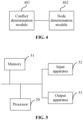
- FIG. 4 is a diagram illustrating the structure of an information transmission apparatus according to an embodiment of the present application.
- the information transmission apparatus can perform the information transmission method of any embodiment of the present application and has the corresponding function modules and effects of the performed method.
- the apparatus can be implemented by software and/or hardware.
- the apparatus is integrated in a terminal.
- the apparatus includes a conflict determination module 401 and a node determination module 402.
- the conflict determination module 401 is configured to determine, according to received sidelink control information, that a resource conflict includes at least one of the following: a half-duplex resource conflict existing for a reserved resource of a second node or a resource reservation conflict existing between a reserved resource of a second node and a reserved resource of a third node.
- the node determination module 402 is configured to determine, according to a specified condition, the second node for transmitting a resource conflict indication to.
- the specified condition includes at least one of the following: The receiving capability indication for the resource conflict indication of the second node in the sidelink control information is enabled; the transmission occasion of the resource conflict indication is valid; or the receiving time of the sidelink control information is at least a first minimum interval threshold earlier than the transmission occasion of the resource conflict indication.
- the specified condition in response to the resource conflict being the half-duplex resource conflict, includes the following:
- the transmission occasion of the resource conflict indication is at least a second minimum interval threshold earlier than the reserved resource of the half-duplex resource conflict.
- the second node in response to the resource conflict being the resource reservation conflict, the second node satisfies the specified condition.
- the specified condition satisfied by the second node includes at least one of the following: The transmission occasion of the resource conflict indication is valid; the receiving time of the sidelink control information of the second node is at least a third minimum interval earlier than the transmission occasion of the resource conflict indication; the receiving capability indication for the resource conflict indication of the second node in the sidelink control information is enabled; or the third node does not satisfy a second specified condition.
- the second specified condition includes at least one of the following: The transmission occasion of the resource conflict indication of the reserved resource of the third node is valid; the receiving time of the sidelink control information of the third node is at least a fourth minimum interval earlier than the transmission occasion of the resource conflict indication; or the receiving capability indication for the resource conflict indication in the sidelink control information of the third node is enabled.
- the specified condition satisfied by the second node includes at least one of the following:
- the priority value included in the sidelink control information of the second node is greater than or equal to the priority value included in the sidelink control information of the third node; the priority value included in the sidelink control information of the second node is less than the priority value included in the sidelink control information of the third node, and a preemption mode is not configured for a resource pool of a reserved resource, or no preemption mode parameter is provided; or the priority value included in the sidelink control information of the second node is less than the priority value included in the sidelink control information of the third node, and the priority value included in the sidelink control information of the second node is less than a priority threshold corresponding to the preemption mode configured for the resource pool of the reserved resource.
- the specified condition satisfied by the second node also includes the priority value included in the sidelink control information of the second node is less than the priority value included in the sidelink control information of the third node, and the priority value included in the sidelink control information of the third node is less than a priority threshold corresponding to the preemption mode configured for the resource pool of the reserved resource.
- the node determination module 402 includes an indication abandoning unit.
- the indication abandoning unit is configured to abandon transmitting the resource conflict indication.
- the specified condition includes at least one of the following: The priority value included in the sidelink control information of the second node is less than the priority value included in the sidelink control information of the third node; and a preemption mode is configured for a resource pool of a reserved resource of the resource conflict; or the priority value included in the sidelink control information of the second node is less than the priority value included in the sidelink control information of the third node, and the priority value included in the sidelink control information of the second node is less than a priority threshold corresponding to the preemption mode configured for the resource pool of the reserved resource of the resource conflict.
- the specified condition includes at least one of the following: The priority value included in the sidelink control information of the second node is greater than the priority value included in the sidelink control information of the third node, and a preemption mode is configured for a resource pool of a reserved resource; or the priority value included in the sidelink control information of the second node is greater than the priority value included in the sidelink control information of the third node, and the priority value included in the sidelink control information of the third node is less than a priority threshold corresponding to the preemption mode configured for the resource pool of the reserved resource of the resource conflict.
- FIG. 5 is a diagram illustrating the structure of an electronic device according to an embodiment of the present application.
- the device electronic includes a processor 50, a memory 51, an input apparatus 52, and an output apparatus 53.
- One or more processors 50 may be included in the electronic device.
- One processor 50 is shown as an example in FIG. 5 .
- the processor 50, the memory 51, the input apparatus 52, and the output apparatus 53 in the electronic device may be connected via a bus or in other manners. The connection via a bus is shown as an example in FIG. 5 .
- the memory 51 may be configured to store software programs, computer-executable programs, and modules, for example, modules (the conflict determination module 401 and the node determination module 402) corresponding to the data transmission apparatus in embodiments of the present application.
- the processor 50 runs the software programs, instructions, and modules stored in the memory 51 to perform function applications and data processing of the electronic device, that is, the preceding information transmission method is implemented.
- the memory 51 may mainly include a program storage region and a data storage region, where the program storage region may store an operating system and an application program required by at least one function, and the data storage region may store data created according to use of the electronic device. Additionally, the memory 51 may include a high-speed random-access memory or a nonvolatile memory such as at least one disk memory, a flash memory, or another nonvolatile solid-state memory. In some examples, the memory 71 may further include a memory remotely disposed with respect to the processor 50. These remote memories may be connected to the electronic device via a network. Examples of the preceding network include, but are not limited to, the Internet, an intranet, a local area network, a mobile communication network and a combination thereof.
- the input apparatus 52 may be configured to receive inputted digital or character information and generate key signal input related to user settings and function control of the electronic device.
- the output apparatus 73 may include a display device such as a display screen.
- An embodiment of the present application provides a storage medium including computer-executable instructions.
- the computer-executable instructions When executed by a computer processor, the computer-executable instructions cause the computer processor to perform an information transmission method.
- the method includes determining, according to received sidelink control information, that a resource conflict includes at least one of the following: a half-duplex resource conflict existing for a reserved resource of a second node or a resource reservation conflict existing between a reserved resource of a second node and a reserved resource of a third node; and determining, according to a specified condition, the second node for transmitting a resource conflict indication to.
- the present application may be implemented by use of software and necessary general-purpose hardware or may be implemented by hardware. Based on this understanding, the technical solutions of the present application substantially, or the part contributing to the related art, may be embodied in the form of a software product.
- the computer software product may be stored in a computer-readable storage medium such as a floppy disk, a read-only memory (ROM), a random-access memory (RAM), a flash memory, a hard disk, or an optical disk of a computer and includes several instructions for causing a computer device (which may be a personal computer, a server, or a network device) to perform the method in the embodiments of the present application.
- the division of the preceding function modules/units may not correspond to the division of physical components.
- one physical component may have multiple functions, or one function or step may be performed jointly by several physical components.
- Some or all physical components may be implemented as software executed by a processor such as a central processing unit, a digital signal processor or a microprocessor, may be implemented as hardware, or may be implemented as integrated circuits such as application-specific integrated circuits.
- Such software may be distributed on computer-readable media.
- the computer-readable media may include computer storage media (or non-transitory media) and communication media (or transitory media).
- the term computer storage media include volatile and nonvolatile media as well as removable and non-removable media implemented in any method or technology for storing information (such as computer-readable instructions, data structures, program modules or other data).
- the computer storage media include, but are not limited to, a RAM, a ROM, an EEPROM, a flash memory or other memory technologies, a CD-ROM, a digital video disc (DVD) or other optical storages, a magnetic cassette, a magnetic tape, a magnetic disk or other magnetic storage devices, or any other medium that can be used for storing desired information and that can be accessed by a computer.
- the communication media generally include computer-readable instructions, data structures, program modules or other data in carriers or in modulated data signals transported in other transport mechanisms and may include any information delivery medium.
Landscapes
- Engineering & Computer Science (AREA)
- Signal Processing (AREA)
- Computer Networks & Wireless Communication (AREA)
- Quality & Reliability (AREA)
- Mobile Radio Communication Systems (AREA)
- Data Exchanges In Wide-Area Networks (AREA)
Applications Claiming Priority (2)
| Application Number | Priority Date | Filing Date | Title |
|---|---|---|---|
| CN202210771068.4A CN115866674A (zh) | 2022-06-30 | 2022-06-30 | 一种信息传输方法、电子设备和存储介质 |
| PCT/CN2023/102884 WO2024002098A1 (zh) | 2022-06-30 | 2023-06-27 | 一种信息传输方法、电子设备和存储介质 |
Publications (2)
| Publication Number | Publication Date |
|---|---|
| EP4475591A1 true EP4475591A1 (de) | 2024-12-11 |
| EP4475591A4 EP4475591A4 (de) | 2025-11-26 |
Family
ID=85660244
Family Applications (1)
| Application Number | Title | Priority Date | Filing Date |
|---|---|---|---|
| EP23830275.6A Pending EP4475591A4 (de) | 2022-06-30 | 2023-06-27 | Informationsübertragungsverfahren sowie elektronische vorrichtung und speichermedium |
Country Status (6)
| Country | Link |
|---|---|
| US (1) | US20250240797A1 (de) |
| EP (1) | EP4475591A4 (de) |
| JP (1) | JP7812934B2 (de) |
| KR (1) | KR20240161186A (de) |
| CN (1) | CN115866674A (de) |
| WO (1) | WO2024002098A1 (de) |
Families Citing this family (1)
| Publication number | Priority date | Publication date | Assignee | Title |
|---|---|---|---|---|
| CN115866674A (zh) * | 2022-06-30 | 2023-03-28 | 中兴通讯股份有限公司 | 一种信息传输方法、电子设备和存储介质 |
Family Cites Families (3)
| Publication number | Priority date | Publication date | Assignee | Title |
|---|---|---|---|---|
| WO2022077519A1 (zh) * | 2020-10-16 | 2022-04-21 | 华为技术有限公司 | 一种信息传输方法及装置 |
| US12477568B2 (en) * | 2021-09-29 | 2025-11-18 | Samsung Electronics Co., Ltd. | Method and apparatus for inter-UE coordination signaling |
| CN115866674A (zh) * | 2022-06-30 | 2023-03-28 | 中兴通讯股份有限公司 | 一种信息传输方法、电子设备和存储介质 |
-
2022
- 2022-06-30 CN CN202210771068.4A patent/CN115866674A/zh active Pending
-
2023
- 2023-06-27 EP EP23830275.6A patent/EP4475591A4/de active Pending
- 2023-06-27 WO PCT/CN2023/102884 patent/WO2024002098A1/zh not_active Ceased
- 2023-06-27 US US18/844,768 patent/US20250240797A1/en active Pending
- 2023-06-27 JP JP2024552739A patent/JP7812934B2/ja active Active
- 2023-06-27 KR KR1020247034861A patent/KR20240161186A/ko active Pending
Also Published As
| Publication number | Publication date |
|---|---|
| JP7812934B2 (ja) | 2026-02-10 |
| US20250240797A1 (en) | 2025-07-24 |
| KR20240161186A (ko) | 2024-11-12 |
| CN115866674A (zh) | 2023-03-28 |
| JP2025507050A (ja) | 2025-03-13 |
| WO2024002098A1 (zh) | 2024-01-04 |
| EP4475591A4 (de) | 2025-11-26 |
Similar Documents
| Publication | Publication Date | Title |
|---|---|---|
| US12342358B2 (en) | Resource selection method and apparatus, resource indication method and apparatus, and terminal and storage medium | |
| US12063667B2 (en) | Method and apparatus for transmission processing, and computer-readable storage medium | |
| AU2017405380B2 (en) | Control signalling transmission method, base station and terminal | |
| WO2020063742A1 (zh) | 终端直通通信的资源分配方法和装置 | |
| CN111756487B (zh) | 资源重选方法、节点设备及资源重选装置 | |
| WO2022193274A1 (en) | Methods and apparatuses for a resource conflict indicator transmission | |
| US12581537B2 (en) | Channel occupancy time determination method, first communication node and storage medium | |
| US20230209508A1 (en) | Information transmission method, resource selection method, apparatus, and electronic device | |
| US20220007397A1 (en) | Information sending method and apparatus, information receiving method and apparatus, base station, terminal, and communication system | |
| US20250247863A1 (en) | Communication methods and device, and storage medium | |
| EP4475591A1 (de) | Informationsübertragungsverfahren sowie elektronische vorrichtung und speichermedium | |
| CN115843123A (zh) | 一种参数调整方法、电子设备和存储介质 | |
| US20240114554A1 (en) | Method and Device for Determining Resource in Shared Band | |
| US10827390B2 (en) | Method and device for resource reservation | |
| WO2019154330A1 (zh) | 一种反馈方法、系统、电子设备和计算机可读存储介质 | |
| EP4444024A1 (de) | Verfahren und vorrichtung zur kommunikation über sidelinks | |
| WO2025055415A1 (zh) | 一种载波聚合方法、系统、电子设备和存储介质 | |
| WO2024234992A1 (zh) | 边链路信息传输方法、冲突指示方法、通信节点及存储介质 | |
| US11832090B2 (en) | Data transmission method, device, and storage medium | |
| CN112752348A (zh) | 一种pdcch调度方法、基站及存储介质 | |
| US20240172187A1 (en) | Managing resource conflict in direct transmissions between user equipment | |
| CN116470996B (zh) | 组播通信的harq反馈方法、装置及用户设备 | |
| WO2024125518A1 (zh) | 一种侧行链路资源的预约方法及通信系统 | |
| CN115347989B (zh) | 资源确定方法、装置及通信设备 | |
| WO2022222815A1 (zh) | 资源确定方法、装置及通信设备 |
Legal Events
| Date | Code | Title | Description |
|---|---|---|---|
| STAA | Information on the status of an ep patent application or granted ep patent |
Free format text: STATUS: THE INTERNATIONAL PUBLICATION HAS BEEN MADE |
|
| PUAI | Public reference made under article 153(3) epc to a published international application that has entered the european phase |
Free format text: ORIGINAL CODE: 0009012 |
|
| STAA | Information on the status of an ep patent application or granted ep patent |
Free format text: STATUS: REQUEST FOR EXAMINATION WAS MADE |
|
| 17P | Request for examination filed |
Effective date: 20240906 |
|
| AK | Designated contracting states |
Kind code of ref document: A1 Designated state(s): AL AT BE BG CH CY CZ DE DK EE ES FI FR GB GR HR HU IE IS IT LI LT LU LV MC ME MK MT NL NO PL PT RO RS SE SI SK SM TR |
|
| DAV | Request for validation of the european patent (deleted) | ||
| DAX | Request for extension of the european patent (deleted) | ||
| REG | Reference to a national code |
Ref country code: DE Ref legal event code: R079 Free format text: PREVIOUS MAIN CLASS: H04W0028020000 Ipc: H04W0072250000 |
|
| A4 | Supplementary search report drawn up and despatched |
Effective date: 20251023 |
|
| RIC1 | Information provided on ipc code assigned before grant |
Ipc: H04W 72/25 20230101AFI20251017BHEP Ipc: H04W 72/02 20090101ALN20251017BHEP Ipc: H04W 92/18 20090101ALN20251017BHEP |