EP4475488A1 - Communication device and communication control method - Google Patents
Communication device and communication control method Download PDFInfo
- Publication number
- EP4475488A1 EP4475488A1 EP24153391.8A EP24153391A EP4475488A1 EP 4475488 A1 EP4475488 A1 EP 4475488A1 EP 24153391 A EP24153391 A EP 24153391A EP 4475488 A1 EP4475488 A1 EP 4475488A1
- Authority
- EP
- European Patent Office
- Prior art keywords
- communication
- communication device
- network
- dcm
- authentication
- Prior art date
- Legal status (The legal status is an assumption and is not a legal conclusion. Google has not performed a legal analysis and makes no representation as to the accuracy of the status listed.)
- Granted
Links
Images


Classifications
-
- H—ELECTRICITY
- H04—ELECTRIC COMMUNICATION TECHNIQUE
- H04W—WIRELESS COMMUNICATION NETWORKS
- H04W12/00—Security arrangements; Authentication; Protecting privacy or anonymity
- H04W12/06—Authentication
-
- H—ELECTRICITY
- H04—ELECTRIC COMMUNICATION TECHNIQUE
- H04L—TRANSMISSION OF DIGITAL INFORMATION, e.g. TELEGRAPHIC COMMUNICATION
- H04L63/00—Network architectures or network communication protocols for network security
- H04L63/02—Network architectures or network communication protocols for network security for separating internal from external traffic, e.g. firewalls
- H04L63/029—Firewall traversal, e.g. tunnelling or, creating pinholes
-
- H—ELECTRICITY
- H04—ELECTRIC COMMUNICATION TECHNIQUE
- H04W—WIRELESS COMMUNICATION NETWORKS
- H04W48/00—Access restriction; Network selection; Access point selection
- H04W48/18—Selecting a network or a communication service
-
- H—ELECTRICITY
- H04—ELECTRIC COMMUNICATION TECHNIQUE
- H04L—TRANSMISSION OF DIGITAL INFORMATION, e.g. TELEGRAPHIC COMMUNICATION
- H04L63/00—Network architectures or network communication protocols for network security
- H04L63/08—Network architectures or network communication protocols for network security for authentication of entities
-
- H—ELECTRICITY
- H04—ELECTRIC COMMUNICATION TECHNIQUE
- H04L—TRANSMISSION OF DIGITAL INFORMATION, e.g. TELEGRAPHIC COMMUNICATION
- H04L63/00—Network architectures or network communication protocols for network security
- H04L63/18—Network architectures or network communication protocols for network security using different networks or channels, e.g. using out of band channels
-
- H—ELECTRICITY
- H04—ELECTRIC COMMUNICATION TECHNIQUE
- H04L—TRANSMISSION OF DIGITAL INFORMATION, e.g. TELEGRAPHIC COMMUNICATION
- H04L63/00—Network architectures or network communication protocols for network security
- H04L63/20—Network architectures or network communication protocols for network security for managing network security; network security policies in general
- H04L63/205—Network architectures or network communication protocols for network security for managing network security; network security policies in general involving negotiation or determination of the one or more network security mechanisms to be used, e.g. by negotiation between the client and the server or between peers or by selection according to the capabilities of the entities involved
-
- H—ELECTRICITY
- H04—ELECTRIC COMMUNICATION TECHNIQUE
- H04W—WIRELESS COMMUNICATION NETWORKS
- H04W12/00—Security arrangements; Authentication; Protecting privacy or anonymity
- H04W12/08—Access security
-
- H—ELECTRICITY
- H04—ELECTRIC COMMUNICATION TECHNIQUE
- H04W—WIRELESS COMMUNICATION NETWORKS
- H04W4/00—Services specially adapted for wireless communication networks; Facilities therefor
- H04W4/30—Services specially adapted for particular environments, situations or purposes
- H04W4/40—Services specially adapted for particular environments, situations or purposes for vehicles, e.g. vehicle-to-pedestrians [V2P]
- H04W4/44—Services specially adapted for particular environments, situations or purposes for vehicles, e.g. vehicle-to-pedestrians [V2P] for communication between vehicles and infrastructures, e.g. vehicle-to-cloud [V2C] or vehicle-to-home [V2H]
-
- H—ELECTRICITY
- H04—ELECTRIC COMMUNICATION TECHNIQUE
- H04W—WIRELESS COMMUNICATION NETWORKS
- H04W4/00—Services specially adapted for wireless communication networks; Facilities therefor
- H04W4/30—Services specially adapted for particular environments, situations or purposes
- H04W4/40—Services specially adapted for particular environments, situations or purposes for vehicles, e.g. vehicle-to-pedestrians [V2P]
- H04W4/48—Services specially adapted for particular environments, situations or purposes for vehicles, e.g. vehicle-to-pedestrians [V2P] for in-vehicle communication
Definitions
- the present disclosure relates to a communication device and a communication control method.
- an in-vehicle terminal transmits request data including data on a current position of the in-vehicle terminal to a data center via the Internet, and the data center, after user authentication, extracts only information, of the latest information, that matches the current position of the user and provides the extracted information to the in-vehicle terminal (for example, Japanese Unexamined Patent Application Publication No. 2003-216637 ).
- An object of the present disclosure is to provide a communication device and a communication control method that make it possible to ensure reliability of communication between an in-vehicle terminal and a communication device.
- An aspect of the present disclosure is a communication device communicating with an in-vehicle terminal, the communication device including a control unit that performs: authentication based on authentication information that the communication device receives from the in-vehicle terminal by using a tunnel established on an access network selected from among a plurality of access networks available for communication between the in-vehicle terminal and the communication device; and, when the authentication succeeds, routing of data received from the in-vehicle terminal.
- aspects of the present disclosure include a communication control method executed by the communication device, a program causing a computer to operate as the communication device, a recording medium storing the program, and the like.
- the telecommunications carrier network a network (referred to as the telecommunications carrier network) of a mobile network operator (MNO: also referred to as a telecommunications carrier) with which a user of a vehicle has signed a contract.
- MNO mobile network operator
- telecommunications carrier network such as via a telecommunications carrier network of another telecommunications carrier and the Internet, or via a wireless LAN and the Internet by using tethering.
- a communication system that can solve the problems described above.
- a communication system is described that can ensure reliability of communication (secure communication) even if a method of access to the communication device is left to the discretion of a user and, at the same time, can restrain the configuration of an in-vehicle terminal from being complicated as a result of making it possible to select an access method.
- FIG. 1 shows an example of a communication system according to the embodiment.
- the communication system includes a data communication module (DCM) 10, which is an example of an in-vehicle terminal mounted in a vehicle, and a communication device 20.
- the in-vehicle terminal may be an information processing device other than the DCM.
- the in-vehicle terminal may be of a stationary type, or may have portability.
- the DCM 10 can collect information related to the vehicle (data related to driving of the vehicle, such as a position or a vehicle speed) from in-vehicle devices (for example, a car navigation device, a dashcam, an electronic control unit (ECU), and the like).
- the DCM 10 can also collect data related to communication by the vehicle (in-vehicle terminal).
- Data (user data) transmitted from the DCM 10 is transmitted to a predetermined communication partner (for example, a server 51 or a server 52) via the communication device 20.
- a predetermined communication partner for example, a server 51 or a server 52
- the destination of the user data may be the communication device 20.
- a telecommunications carrier network 2 for use of which the user of the vehicle has signed a contract is used.
- the telecommunications carrier network may be a mobile network operator (MNO) network, or may be a mobile virtual network operator (MVNO) network.
- the telecommunications carrier network 2 includes a wireless access network (base station) and a core network.
- base station base station
- the communication device 20 serves as part of the core network of the telecommunications carrier network 2.
- SIM subscriber identity module
- an MNO or MVNO network (an MVNO network 3 is illustrated in FIG. 1 ) other than the MNO network or the MVNO network that is the telecommunications carrier network 2.
- an MNO network 3 is illustrated in FIG. 1
- authentication information stored in a second SIM 106 is used.
- Each of the telecommunications carrier network 2 and the MVNO network 3 may be a 4G (LTE) network, a 5G network, or a 6G network.
- the user can also use a wireless LAN (Wi-Fi) 4 for an access network, through tethering using a tethering device 13.
- the tethering may be Wi-Fi tethering, Bluetooth(R) tethering, or universal serial bus (USB) tethering.
- a path from the DCM 10 up to the communication device 20 goes via the Internet 1.
- the user can select an access network that the user desires to use, from among a plurality of access networks such as the MVNO network 3 and the wireless LAN 4, apart from the telecommunications carrier network 2.
- the DCM 10 can access the communication device 20 by using an access method selected by the user from among a plurality of access methods.
- the telecommunications carrier network is an example of a cellular network (first cellular network).
- the MVNO network 3 is an example of a second cellular network, and of a first access network via the second cellular network.
- the wireless LAN 4 is an example of a network used through tethering other than the first cellular network, and of a second access network via the network.
- the communication device 20 can be configured by using a single computer or a set (cloud) of two or more computers.
- the communication device 20 includes a gateway (GW) 21 connected to the Internet 1.
- the GW 21 is a gateway accommodating non-3GPP(R) wireless accesses (untrusted non-3GPP(R) IP accesses) such as the Internet.
- the GW 21 is an evolved packet data gateway (ePDG) when the communication device conforms with 4G, is a non-3GPP(R) interworking function (N3IWF) when the communication device conforms with 5G, and is a PDG when the communication device conforms with 3G.
- ePDG evolved packet data gateway
- N3IWF non-3GPP(R) interworking function
- the GW 21 can convert a format of a signal received from the Internet 1 into a format that is suitable for the core network of the telecommunications carrier network 2 and is used in the communication device 20.
- reliability (security) of communications is poor, compared to in the telecommunications carrier network 2 (3GPP(R) wireless access).
- a logical tunnel is established between the DCM 10 and the GW 21.
- the tunnel is, for example, an IPsec tunnel established in an IPsec tunnel mode.
- the tunnel may be a tunnel other than the IPsec tunnel.
- the communication device 20 includes an authentication unit 22 and a routing unit 23.
- the authentication unit 22 receives, via the GW 21, authentication information transmitted from the DCM 10 through the tunnel and performs authentication of the DCM 10 (user).
- authentication information for authentication information, authentication information for authentication in the telecommunications carrier network 2, which is stored in the first SIM 105, is used.
- the authentication information may be authentication information stored in a secure storage area of the DCM 10, other than the first SIM 105.
- the authentication unit 22 operates as a home subscriber server (HSS) that performs authentication processing.
- the authentication unit 22 may operate as a combination of an HSS and authentication authorization accounting (AAA).
- the authentication unit 22 When the communication device 20 operates as part of a 5G core network, the authentication unit 22 operates as an authentication server function (AUSF), that is, a network function that authenticates a subscriber/UE (DCM 10) based on subscriber information stored in a unified data management (UDM).
- AUSF authentication server function
- DCM 10 subscriber/UE
- UDM unified data management
- EPA-AKA authentication scheme
- EPA-AKA an authentication scheme other than EPA-AKA may be applied.
- the authentication information used when the DCM 10 accesses the communication device 20 by using an access network (access line) other than the telecommunications carrier network 2 common authentication information is used in either case of using the MVNO network 3 and tethering.
- the authentication information (authentication information for the telecommunications carrier network 2) stored in the first SIM 105 is used.
- the routing unit 23 performs configuration and determination of a path from the DCM 10 up to a destination of user data (communication partner: for example, the server 51 or the server 52).
- a communication path (session) is established between the routing unit 23 and the DCM 10.
- the routing unit 23 operates as a packet data network gateway (PGW).
- PGW packet data network gateway
- the routing unit 23 operates as a user plane function (UPF).
- data addressed to the server 51 or the server 52 When the DCM 10 communicates with the server 51 or the server 52, data addressed to the server 51 or the server 52 always goes through the tunnel and arrives at the communication device 20 thanks to the routing unit 23, and is transmitted to the server 51 or the server 52 via the routing unit 23. Data addressed to the DCM 10 transmitted from the server 51 or the server 52 always passes through the communication device 20 and is transferred through the tunnel.
- a communication path (referred to as the first route) between the DCM 10 and the communication device 20 via the telecommunications carrier network 2 may be established.
- the first route and the second route may be used in parallel.
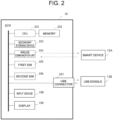
- FIG. 2 shows an example of a configuration of the DCM 10.
- the DCM 10 includes a CPU 101, a memory 102, a secondary storage device 103, a wireless communication unit 104, the first SIM 105, and the second SIM 106.
- the secondary storage device 103 include a hard disk drive (HDD), a solid state drive (SSD), an EEPROM, and the like.
- the secondary storage device 103 stores, for example, an operation system (OS) and a plurality of types of application programs (apps).
- the apps include programs for implementing various functions, such as a communication control program.
- Examples of the memory 102 include semiconductor memories, such as a read only memory (ROM) and a random access memory (RAM).
- Each of the memory 102 and the secondary storage device 103 (which are also collectively referred to as the storage device) is an example of a computer-readable recording medium.
- the first SIM 105 and the second SIM 106 is an eUICC.
- the first SIM 105 is a SIM for the telecommunications carrier network 2
- the second SIM 106 is a SIM for the MVNO network 3.
- the first SIM 105 and the second SIM 106 may be of a chip type or of a card type.
- the DCM 10 includes a SIM slot, a SIM card reader, and the like.
- the DCM 10 includes a USB connector 107, an input device 108, and a display 109.
- a USB dongle 13B can be connected to the USB connector 107.
- a smart device 13A can also be connected to the USB connector 107 via a USB cable.
- the USB dongle 13B and the smart device 13A are examples of the tethering device 13.
- the smart device 13A is a smartphone, a tablet terminal, or the like.
- the input device 108 is a button, a key, a touch panel, or the like and is used to input information, make settings, and the like.
- the display 109 is used to display information.
- the input device 108 may be a user interface displayed on the display 109.
- the CPU 101 executes various processes related to operation of the DCM 10 (collection of data, reception of collected data, transmission and reception of data, and the like), by executing various programs stored in the storage device.
- the CPU 101 is an example of a control unit, a controller, or a processor.
- FIG. 3A shows an example of a configuration of the communication device 20, and FIG. 3B shows an example of a configuration of the smart device 13A.
- the communication device 20 includes, as an example, a processor 31, a storage device 32, a communication interface (communication IF) 33, an input device 34, and a display 35.
- a processor 31 a processor 31, a storage device 32, a communication interface (communication IF) 33, an input device 34, and a display 35.
- communication IF communication interface
- the storage device 32 stores various programs and data.
- the processor 31 is an example of a control unit, and is a CPU, a DSP, a GPU a combination of any thereof, or the like.
- the processor 31 executes various processes, such as calculation or manipulation using the data stored in the storage device 32 and the like, by executing the programs stored in the storage device 32.
- the communication device 20 operates as a device including the GW 21, the authentication unit 22, and the routing unit 23.
- the processor 31 corresponds to a control unit that performs operation as the GW 21, the authentication unit 22, and the routing unit 23.
- the communication IF 33 includes a communication interface circuit for the telecommunications carrier network 2 and a communication interface circuit for the Internet 1, and performs transmission and reception of communication-related signals, format (protocol) conversion, and the like.
- the input device 34 is a button, a key, a touch panel, or the like used to input information, make settings, and the like.
- the display 35 is used to display information.
- the smart device 13A includes, as an example, a processor 131, a storage device 132, an input device 134, and a display 135. Such components have similar functions to the processor 31, the storage device 32, the input device 34, and the display 35, although there are differences in performance and type.
- a wireless communication interface (wireless communication IF) 133 includes a communication interface circuit that enables wireless access to each of telecommunications carrier network, Bluetooth(R), and wireless LAN (Wi-Fi).
- the processor 131 can execute various processes by executing programs stored in the storage device 132.
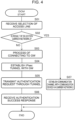
- FIG. 4 is a flowchart showing an example of processing by the DCM 10.
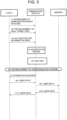
- FIG. 5 is a sequence chart showing an example of operation in the communication system. The processing according to the flowchart shown in FIG. 4 is started, for example, when the user of the vehicle operates the DCM 10 and calls up, on the display 109, a screen for selecting an access line (method of access) to the communication device 20.
- step S01 the CPU 101 of the DCM 10 receives an input that fixes a result of selection of an access line, which is input by the user using the input device 108.
- step S02 the CPU 101 determines whether or not the result of selection is the telecommunications carrier network 2. When it is determined that the telecommunications carrier network 2 is selected, the processing moves to step S07, and otherwise the processing moves to step S03.
- the CPU 101 performs a process of establishing a communication channel with the communication device 20 via the telecommunications carrier network 2.
- the DCM 10 transmits a connection request including information on a communication partner to the telecommunications carrier network 2.
- Registration of a position, authentication, and the like of the DCM 10 in the telecommunications carrier network 2 are performed by using information (subscriber information, authentication information, and the like) stored in the first SIM 105.
- the CPU 101 performs a process of reading the authentication information stored in the first SIM 105 and transmitting the authentication information to the telecommunications carrier network 2.
- the telecommunications carrier network 2 includes an authentication unit that is different from the authentication unit 22, and authentication using the authentication information is performed by the authentication unit.
- the authentication unit 22 is used to perform authentication when an access line other than the telecommunications carrier network 2 is used.
- the telecommunications carrier network 2 performs control for establishing a communication channel that connects the routing unit 23 of the communication device 20 and the DCM 10.
- the routing unit 23 performs routing to the communication partner (for example, the server 51 or 52) of the DCM 10. Through the routing, a state is brought about in which communication (transmission and reception of data) via the communication device 20 (routing unit 23) is enabled between the DCM 10 and the communication partner.
- the CPU 101 performs a process of connecting to the GW 21.
- the MVNO network 3 is selected as the result of selection of an access line, registration of a position, authentication, and the like of the DCM 10 in the MVNO network 3 are performed by using information (subscriber information, authentication information, and the like) stored in the second SIM 106.
- the CPU 101 performs a process of reading the authentication information stored in the second SIM 106 and transmitting the authentication information to the telecommunications carrier network 2.
- the MVNO network 3 performs routing to the GW 21, which is a communication partner of the DCM 10, and thus establishes a communication channel between the DCM 10 and the GW 21 ( FIG. 5 , ⁇ 1>).
- the user When tethering using the tethering device 13 (smart device 13A or USB dongle 13B) is selected as the result of selection of an access line, the user performs a process of connecting the DCM 10 and the tethering device 13 by using the USB connector 107.
- a setting is made for pairing the DCM 10 and the smart device 13A through wireless communication (Bluetooth(R) or Wi-Fi).
- the DCM 10 transmits data destined for the GW 21 to the tethering device 13.
- the tethering device 13 accesses an access point of a predetermined wireless LAN by operating like a mobile router, and transmits the data to the GW 21 via the wireless LAN 4 and the Internet.
- communication is enabled between the DCM 10 and the GW 21 via the wireless LAN 4 and the Internet 1 ( FIG. 5 , ⁇ 1>).
- step S04 the CPU 101 performs a process of establishing a tunnel (IPsec tunnel) in the IPsec tunnel mode between the DCM 10 and the GW 21.
- IPsec tunnel a tunnel
- a remote access VPN is built in which the DCM 10 corresponds to a terminal and the GW 21 corresponds to VPN equipment ( FIG. 5 , ⁇ 2>).
- SSL/TLS SSL/TLS
- the CPU 101 When the tunnel is established, the CPU 101 performs a process of reading the authentication information from the first SIM 105 and transmitting the authentication information to the GW 21 ( FIG. 5 , ⁇ 3>). The authentication information is transferred to the GW 21 through the tunnel. The GW 21 forwards the authentication information to the authentication unit 22. The authentication unit 22 performs an authentication process by using the authentication information ( FIG. 5 , ⁇ 4>).
- the routing unit 23 performs routing of data transmitted and received between the DCM 10 and the communication partner (server 51 or 52) by using information on the communication partner, which is transmitted together with the authentication information (or may be transmitted at another timing) from the DCM 10 ( FIG. 5 , ⁇ 5>).
- the routing unit 23 transmits data from the DCM 10 toward the communication partner and transmits data from the communication partner toward the DCM 10.
- the DCM 10 falls in a state of being able to communicate with the communication partner ( FIG. 5 , ⁇ 6>).
- information notifying authentication success (that communication is enabled) is transmitted from the communication device 20 to the DCM 10 ( FIG. 5 , ⁇ 7>), and is received by the DCM 10 (step S06).
- user data such as vehicle-related data transmitted from the DCM 10 arrives at the communication device 20 through the tunnel, and is received by the communication partner via the routing unit 23 of the communication device 20 ( FIG. 5 , ⁇ 8> and ⁇ 9>).
- Data addressed to the DCM 10 from the communication partner passes through the routing unit 23, and is received by the DCM 10 through the tunnel ( FIG. 5 , ⁇ 10> and ⁇ 11>).
- authentication information is handed over from the DCM 10 to the communication device 20 by using the tunnel established between the DCM 10 (in-vehicle terminal) and the communication device 20. Accordingly, the problem concerning reliability of an access network existing between the DCM 10 and the communication device 20 can be disregarded. In other words, communication between the DCM 10 and the communication device 20 is performed in an encrypted state due to the tunnel (VPN connection). Thus, even in a route via the Internet 1, reliability of a communication is ensured. Accordingly, the user can flexibly select an access line.
- the common authentication information among access lines (access networks) is the authentication information used when the telecommunications carrier network 2 is used. Accordingly, since the DCM 10 (user (subscriber)) can be authenticated by using a similar scheme to the scheme used when the telecommunications carrier network 2 is used, it is possible to restrain the configuration of the DCM 10 (in-vehicle terminal) from being complicated.
- the DCM 10 can be configured to, or can be changed to a setting to, receive only data coming from the communication device 20 and reject data coming from others than the communication device 20. With the configuration thus made, since the DCM 10 does not need to determine whether or not a communication partner is a reliable one, the configuration of the DCM 10 can be simplified. Since the DCM 10 can be dedicated to communication with the communication device 20, all functions including routing can be deployed on the communication device 20 side, with future provision of an advanced application in mind.
- a communication fee is charged via a charging mechanism 40 ( FIG. 1 ) on a network.
- the communication fee in such a case can be charged to the user.
- the user signs a contract to pay a flat rate for up to a certain communication amount with regard to a fee for communication by the smartphone
- communication through tethering as described above can be performed within the rest of the communication amount covered by the flat rate.
- the business operator side does not need to bear tetheringrelated communication costs.
- the user also has a benefit of practically not needing to incur a communication cost because communication is performed within the coverage of the flat rate.
- an application program used by the DCM 10 can be changed to one that, though using a more communication amount, is more convenient.
- an application program that performs processing as follows may be installed in the smart device 13A.
- any of the processes and the means described in the present disclosure can be freely combined and implemented to an extent that no technical inconsistency occurs.
- a process described as being executed by a single device may be executed by a plurality of devices in a divided manner.
- a process described as being executed by different devices may be executed by a single device. It can be flexibly changed what hardware configuration (server configuration) is used to implement individual functions in a computer system.
- the present disclosure can also be implemented by providing a computer with a computer program in which the functions described in the embodiment are packaged, and by one or more processors included in the computer reading and executing the program.
- Such a computer program may be provided to the computer by using a non-transitory computer-readable recording medium that is capable of connecting to a system bus of the computer, or may be provided to the computer via a network.
- the non-transitory computer-readable recording medium include any types of disks, such as magnetic disks (floppy(R) disk, hard disk drive (HDD), and the like) and optical disks (CD-ROM, DVD disk, Blu-ray Disc, and the like), a read only memory (ROM), a random access memory (RAM), an EPROM, an EEPROM, a magnetic card, a flash memory, an optical card, and any types of media suitable to store electronic instructions.
- a communication device communicating with an in-vehicle terminal includes a control unit that performs: authentication based on authentication information that the communication device receives from the in-vehicle terminal by using a tunnel established on an access network selected from among a plurality of access networks available for communication between the in-vehicle terminal and the communication device; and, when the authentication succeeds, routing of data received from the in-vehicle terminal.
Landscapes
- Engineering & Computer Science (AREA)
- Computer Networks & Wireless Communication (AREA)
- Signal Processing (AREA)
- Computer Security & Cryptography (AREA)
- Computer Hardware Design (AREA)
- Computing Systems (AREA)
- General Engineering & Computer Science (AREA)
- Mobile Radio Communication Systems (AREA)
Abstract
Description
- The present disclosure relates to a communication device and a communication control method.
- Conventionally, there has been a system in which an in-vehicle terminal transmits request data including data on a current position of the in-vehicle terminal to a data center via the Internet, and the data center, after user authentication, extracts only information, of the latest information, that matches the current position of the user and provides the extracted information to the in-vehicle terminal (for example,
Japanese Unexamined Patent Application Publication No. 2003-216637 - An object of the present disclosure is to provide a communication device and a communication control method that make it possible to ensure reliability of communication between an in-vehicle terminal and a communication device.
- An aspect of the present disclosure is a communication device communicating with an in-vehicle terminal, the communication device including a control unit that performs: authentication based on authentication information that the communication device receives from the in-vehicle terminal by using a tunnel established on an access network selected from among a plurality of access networks available for communication between the in-vehicle terminal and the communication device; and, when the authentication succeeds, routing of data received from the in-vehicle terminal.
- Other aspects of the present disclosure include a communication control method executed by the communication device, a program causing a computer to operate as the communication device, a recording medium storing the program, and the like.
- According to any one of the aspects of the present disclosure, it is possible to ensure reliability of communication between an in-vehicle terminal and the communication device.
- Features, advantages, and technical and industrial significance of exemplary embodiments of the invention will be described below with reference to the accompanying drawings, in which like signs denote like elements, and wherein:
-
FIG. 1 shows an example of a communication system according to an embodiment; -
FIG. 2 shows an example of a configuration of a DCM; -
FIG. 3A shows an example of a configuration of a communication device; -
FIG. 3B shows an example of a configuration of a smart device; -
FIG. 4 is a flowchart showing an example of processing by the DCM; and -
FIG. 5 is a sequence chart showing an example of operation in the communication system. - Business operators involved with vehicles (for example, manufacturers, dealers, rental companies, and the like of vehicles) having communication functionality, such as connected cars and self-driving vehicles, desire to collect vehicle-related data (for example, data related to driving of vehicles, data related to communication by vehicles, and the like), in some cases. Accordingly, it is considered to configure a communication device (communication facility) of a business operator to receive, via a network, predetermined data (IoT data) transmitted from an in-vehicle terminal mounted in each vehicle.
- For the network connecting the in-vehicle terminal and the communication device, it is conceivable to use a network (referred to as the telecommunications carrier network) of a mobile network operator (MNO: also referred to as a telecommunications carrier) with which a user of a vehicle has signed a contract. However, to access the communication device, there is another conceivable case apart from via the telecommunications carrier network, such as via a telecommunications carrier network of another telecommunications carrier and the Internet, or via a wireless LAN and the Internet by using tethering. If users are allowed to select an access network to use to access the communication device from among a plurality of access networks, it becomes possible to transmit vehicle-related data to the communication device on conditions advantageous to users, and it therefore becomes easier to obtain cooperations from users in collecting vehicle-related data. On the other hand, it becomes possible for business operators to collect more data.
- However, in cases where the Internet is included in a path over networks from an in-vehicle terminal up to the communication device, there has been a problem that reliability of communication lowers, compared to cases where only the telecommunications carrier network is used for a path. Moreover, there also has been a problem that a configuration and information to be included on an in-vehicle terminal side become complicated if information exchanged between an in-vehicle terminal and the communication device, particularly information related to authentication of the in-vehicle terminal, varies with differences in method of access from the in-vehicle terminal to the communication device.
- In an embodiment described below, a communication system is described that can solve the problems described above. In other words, a communication system is described that can ensure reliability of communication (secure communication) even if a method of access to the communication device is left to the discretion of a user and, at the same time, can restrain the configuration of an in-vehicle terminal from being complicated as a result of making it possible to select an access method.
- Hereinafter, an embodiment of the present disclosure is described with reference to the drawings. Configurations according to the embodiment are presented for an illustrative purpose, and the present disclosure is not limited to such configurations in the embodiment.
FIG. 1 shows an example of a communication system according to the embodiment. The communication system includes a data communication module (DCM) 10, which is an example of an in-vehicle terminal mounted in a vehicle, and acommunication device 20. The in-vehicle terminal may be an information processing device other than the DCM. The in-vehicle terminal may be of a stationary type, or may have portability. - The DCM 10 can collect information related to the vehicle (data related to driving of the vehicle, such as a position or a vehicle speed) from in-vehicle devices (for example, a car navigation device, a dashcam, an electronic control unit (ECU), and the like). The DCM 10 can also collect data related to communication by the vehicle (in-vehicle terminal). Data (user data) transmitted from the
DCM 10 is transmitted to a predetermined communication partner (for example, aserver 51 or a server 52) via thecommunication device 20. However, the destination of the user data may be thecommunication device 20. - For a default network to be used for the
DCM 10 to communicate with thecommunication device 20, atelecommunications carrier network 2 for use of which the user of the vehicle has signed a contract is used. The telecommunications carrier network may be a mobile network operator (MNO) network, or may be a mobile virtual network operator (MVNO) network. Thetelecommunications carrier network 2 includes a wireless access network (base station) and a core network. When thetelecommunications carrier network 2 is used, thecommunication device 20 serves as part of the core network of thetelecommunications carrier network 2. For authentication of theDCM 10 in thetelecommunications carrier network 2, authentication information stored in a first subscriber identity module (SIM) 105 included in theDCM 10 is used. - In the present embodiment, for an access network other than the
telecommunications carrier network 2, the user can use an MNO or MVNO network (anMVNO network 3 is illustrated inFIG. 1 ) other than the MNO network or the MVNO network that is thetelecommunications carrier network 2. In such a case, for authentication of theDCM 10 in theMVNO network 3, authentication information stored in asecond SIM 106 is used. Each of thetelecommunications carrier network 2 and theMVNO network 3 may be a 4G (LTE) network, a 5G network, or a 6G network. - The user can also use a wireless LAN (Wi-Fi) 4 for an access network, through tethering using a
tethering device 13. The tethering may be Wi-Fi tethering, Bluetooth(R) tethering, or universal serial bus (USB) tethering. When theMVNO network 3 or thewireless LAN 4 is used for an access network, a path from theDCM 10 up to thecommunication device 20 goes via the Internet 1. As described above, with regard to access to thecommunication device 20, the user can select an access network that the user desires to use, from among a plurality of access networks such as theMVNO network 3 and thewireless LAN 4, apart from thetelecommunications carrier network 2. In other words, theDCM 10 can access thecommunication device 20 by using an access method selected by the user from among a plurality of access methods. The telecommunications carrier network is an example of a cellular network (first cellular network). The MVNOnetwork 3 is an example of a second cellular network, and of a first access network via the second cellular network. Thewireless LAN 4 is an example of a network used through tethering other than the first cellular network, and of a second access network via the network. - The
communication device 20 can be configured by using a single computer or a set (cloud) of two or more computers. Thecommunication device 20 includes a gateway (GW) 21 connected to the Internet 1. The GW 21 is a gateway accommodating non-3GPP(R) wireless accesses (untrusted non-3GPP(R) IP accesses) such as the Internet. For example, the GW 21 is an evolved packet data gateway (ePDG) when the communication device conforms with 4G, is a non-3GPP(R) interworking function (N3IWF) when the communication device conforms with 5G, and is a PDG when the communication device conforms with 3G. The GW 21 can convert a format of a signal received from the Internet 1 into a format that is suitable for the core network of thetelecommunications carrier network 2 and is used in thecommunication device 20. In the Internet 1, reliability (security) of communications is poor, compared to in the telecommunications carrier network 2 (3GPP(R) wireless access). Accordingly, when theDCM 10 communicates with thecommunication device 20 by using an access network other than thetelecommunications carrier network 2, a logical tunnel is established between theDCM 10 and theGW 21. The tunnel is, for example, an IPsec tunnel established in an IPsec tunnel mode. However, the tunnel may be a tunnel other than the IPsec tunnel. - The
communication device 20 includes anauthentication unit 22 and arouting unit 23. After the tunnel is established, theauthentication unit 22 receives, via theGW 21, authentication information transmitted from theDCM 10 through the tunnel and performs authentication of the DCM 10 (user). In the present embodiment, for the authentication information, authentication information for authentication in thetelecommunications carrier network 2, which is stored in thefirst SIM 105, is used. However, the authentication information may be authentication information stored in a secure storage area of theDCM 10, other than thefirst SIM 105. When thecommunication device 20 operates as part of an LTE (4G) core network, theauthentication unit 22 operates as a home subscriber server (HSS) that performs authentication processing. However, theauthentication unit 22 may operate as a combination of an HSS and authentication authorization accounting (AAA). When thecommunication device 20 operates as part of a 5G core network, theauthentication unit 22 operates as an authentication server function (AUSF), that is, a network function that authenticates a subscriber/UE (DCM 10) based on subscriber information stored in a unified data management (UDM). For an authentication scheme, for example, EPA-AKA is applied. However, an authentication scheme other than EPA-AKA may be applied. - For the authentication information used when the
DCM 10 accesses thecommunication device 20 by using an access network (access line) other than thetelecommunications carrier network 2, common authentication information is used in either case of using theMVNO network 3 and tethering. In the present embodiment, for the common authentication information among a plurality of access networks, the authentication information (authentication information for the telecommunications carrier network 2) stored in thefirst SIM 105 is used. - The
routing unit 23 performs configuration and determination of a path from theDCM 10 up to a destination of user data (communication partner: for example, theserver 51 or the server 52). A communication path (session) is established between the routingunit 23 and theDCM 10. When thecommunication device 20 operates as part of the LTE (4G) core network, therouting unit 23 operates as a packet data network gateway (PGW). When thecommunication device 20 operates as part of the 5G core network, therouting unit 23 operates as a user plane function (UPF). - When the
DCM 10 communicates with theserver 51 or theserver 52, data addressed to theserver 51 or theserver 52 always goes through the tunnel and arrives at thecommunication device 20 thanks to therouting unit 23, and is transmitted to theserver 51 or theserver 52 via therouting unit 23. Data addressed to theDCM 10 transmitted from theserver 51 or theserver 52 always passes through thecommunication device 20 and is transferred through the tunnel. - In a state where communication is being performed by using a path (referred to as the first route) between the
DCM 10 and thecommunication device 20 via thetelecommunications carrier network 2, a communication path (referred to as the second route) between theDCM 10 and theGW 21 may be established. In other words, the first route and the second route may be used in parallel. -
FIG. 2 shows an example of a configuration of theDCM 10. TheDCM 10 includes aCPU 101, amemory 102, asecondary storage device 103, awireless communication unit 104, thefirst SIM 105, and thesecond SIM 106. Examples of thesecondary storage device 103 include a hard disk drive (HDD), a solid state drive (SSD), an EEPROM, and the like. Thesecondary storage device 103 stores, for example, an operation system (OS) and a plurality of types of application programs (apps). The apps include programs for implementing various functions, such as a communication control program. Examples of thememory 102 include semiconductor memories, such as a read only memory (ROM) and a random access memory (RAM). Each of thememory 102 and the secondary storage device 103 (which are also collectively referred to as the storage device) is an example of a computer-readable recording medium. - The
wireless communication unit 104 includes a data circuit-terminating equipment (DCE) and performs communication with an external device in accordance with a wireless communication scheme, such as cellular network (LTE, 4G, 5G, 6G, or the like), Bluetooth(R), or wireless LAN (including IEEE 802.11 series, Wi-Fi, and the like). The external device is a base station in the case of telecommunications carrier network, is an access point in the case of wireless LAN (Wi-Fi), and is Bluetooth(R)-compatible communication equipment in the case of Bluetooth(R). - Each of the
first SIM 105 and thesecond SIM 106 is an eUICC. Thefirst SIM 105 is a SIM for thetelecommunications carrier network 2, and thesecond SIM 106 is a SIM for theMVNO network 3. Thefirst SIM 105 and thesecond SIM 106 may be of a chip type or of a card type. When the SIM is of a card type, theDCM 10 includes a SIM slot, a SIM card reader, and the like. - Further, the
DCM 10 includes aUSB connector 107, aninput device 108, and adisplay 109. AUSB dongle 13B can be connected to theUSB connector 107. Asmart device 13A can also be connected to theUSB connector 107 via a USB cable. TheUSB dongle 13B and thesmart device 13A are examples of thetethering device 13. Thesmart device 13A is a smartphone, a tablet terminal, or the like. - The
input device 108 is a button, a key, a touch panel, or the like and is used to input information, make settings, and the like. Thedisplay 109 is used to display information. Theinput device 108 may be a user interface displayed on thedisplay 109. - The
CPU 101 executes various processes related to operation of the DCM 10 (collection of data, reception of collected data, transmission and reception of data, and the like), by executing various programs stored in the storage device. TheCPU 101 is an example of a control unit, a controller, or a processor. -
FIG. 3A shows an example of a configuration of thecommunication device 20, andFIG. 3B shows an example of a configuration of thesmart device 13A. InFIG. 3A , thecommunication device 20 includes, as an example, aprocessor 31, astorage device 32, a communication interface (communication IF) 33, aninput device 34, and adisplay 35. - The
storage device 32 stores various programs and data. Theprocessor 31 is an example of a control unit, and is a CPU, a DSP, a GPU a combination of any thereof, or the like. Theprocessor 31 executes various processes, such as calculation or manipulation using the data stored in thestorage device 32 and the like, by executing the programs stored in thestorage device 32. By executing the programs, thecommunication device 20 operates as a device including theGW 21, theauthentication unit 22, and therouting unit 23. Theprocessor 31 corresponds to a control unit that performs operation as theGW 21, theauthentication unit 22, and therouting unit 23. The communication IF 33 includes a communication interface circuit for thetelecommunications carrier network 2 and a communication interface circuit for theInternet 1, and performs transmission and reception of communication-related signals, format (protocol) conversion, and the like. Theinput device 34 is a button, a key, a touch panel, or the like used to input information, make settings, and the like. Thedisplay 35 is used to display information. - In
FIG. 3B , thesmart device 13A includes, as an example, aprocessor 131, astorage device 132, aninput device 134, and adisplay 135. Such components have similar functions to theprocessor 31, thestorage device 32, theinput device 34, and thedisplay 35, although there are differences in performance and type. A wireless communication interface (wireless communication IF) 133 includes a communication interface circuit that enables wireless access to each of telecommunications carrier network, Bluetooth(R), and wireless LAN (Wi-Fi). Theprocessor 131 can execute various processes by executing programs stored in thestorage device 132. -
FIG. 4 is a flowchart showing an example of processing by theDCM 10.FIG. 5 is a sequence chart showing an example of operation in the communication system. The processing according to the flowchart shown inFIG. 4 is started, for example, when the user of the vehicle operates theDCM 10 and calls up, on thedisplay 109, a screen for selecting an access line (method of access) to thecommunication device 20. - In step S01, the
CPU 101 of theDCM 10 receives an input that fixes a result of selection of an access line, which is input by the user using theinput device 108. In step S02, theCPU 101 determines whether or not the result of selection is thetelecommunications carrier network 2. When it is determined that thetelecommunications carrier network 2 is selected, the processing moves to step S07, and otherwise the processing moves to step S03. - When the processing moves to step S07, the
CPU 101 performs a process of establishing a communication channel with thecommunication device 20 via thetelecommunications carrier network 2. In establishing the communication channel, theDCM 10 transmits a connection request including information on a communication partner to thetelecommunications carrier network 2. - Registration of a position, authentication, and the like of the
DCM 10 in thetelecommunications carrier network 2 are performed by using information (subscriber information, authentication information, and the like) stored in thefirst SIM 105. For authentication, theCPU 101 performs a process of reading the authentication information stored in thefirst SIM 105 and transmitting the authentication information to thetelecommunications carrier network 2. Thetelecommunications carrier network 2 includes an authentication unit that is different from theauthentication unit 22, and authentication using the authentication information is performed by the authentication unit. Theauthentication unit 22 is used to perform authentication when an access line other than thetelecommunications carrier network 2 is used. - In establishing the communication channel between the
DCM 10 and thecommunication device 20, when the authentication in thetelecommunications carrier network 2 succeeds, thetelecommunications carrier network 2 performs control for establishing a communication channel that connects therouting unit 23 of thecommunication device 20 and theDCM 10. In establishing such a communication channel, therouting unit 23 performs routing to the communication partner (for example, theserver 51 or 52) of theDCM 10. Through the routing, a state is brought about in which communication (transmission and reception of data) via the communication device 20 (routing unit 23) is enabled between theDCM 10 and the communication partner. - When the processing moves to step S03, the
CPU 101 performs a process of connecting to theGW 21. For example, when theMVNO network 3 is selected as the result of selection of an access line, registration of a position, authentication, and the like of theDCM 10 in theMVNO network 3 are performed by using information (subscriber information, authentication information, and the like) stored in thesecond SIM 106. For authentication, theCPU 101 performs a process of reading the authentication information stored in thesecond SIM 106 and transmitting the authentication information to thetelecommunications carrier network 2. When the authentication succeeds, theMVNO network 3 performs routing to theGW 21, which is a communication partner of theDCM 10, and thus establishes a communication channel between theDCM 10 and the GW 21 (FIG. 5 , <1>). - When tethering using the tethering device 13 (
smart device 13A orUSB dongle 13B) is selected as the result of selection of an access line, the user performs a process of connecting theDCM 10 and thetethering device 13 by using theUSB connector 107. Alternatively, a setting is made for pairing theDCM 10 and thesmart device 13A through wireless communication (Bluetooth(R) or Wi-Fi). TheDCM 10 transmits data destined for theGW 21 to thetethering device 13. Thetethering device 13 accesses an access point of a predetermined wireless LAN by operating like a mobile router, and transmits the data to theGW 21 via thewireless LAN 4 and the Internet. Thus, communication is enabled between theDCM 10 and theGW 21 via thewireless LAN 4 and the Internet 1 (FIG. 5 , <1>). - In step S04, the
CPU 101 performs a process of establishing a tunnel (IPsec tunnel) in the IPsec tunnel mode between theDCM 10 and theGW 21. For example, a remote access VPN is built in which theDCM 10 corresponds to a terminal and theGW 21 corresponds to VPN equipment (FIG. 5 , <2>). Note that for the tunnel, it is conceivable to use SSL/TLS, instead of IPsec. - When the tunnel is established, the
CPU 101 performs a process of reading the authentication information from thefirst SIM 105 and transmitting the authentication information to the GW 21 (FIG. 5 , <3>). The authentication information is transferred to theGW 21 through the tunnel. TheGW 21 forwards the authentication information to theauthentication unit 22. Theauthentication unit 22 performs an authentication process by using the authentication information (FIG. 5 , <4>). - When the authentication is succeeds, the
routing unit 23 performs routing of data transmitted and received between theDCM 10 and the communication partner (server 51 or 52) by using information on the communication partner, which is transmitted together with the authentication information (or may be transmitted at another timing) from the DCM 10 (FIG. 5 , <5>). As a result of the routing, a state is brought about in which therouting unit 23 transmits data from theDCM 10 toward the communication partner and transmits data from the communication partner toward theDCM 10. In other words, theDCM 10 falls in a state of being able to communicate with the communication partner (FIG. 5 , <6>). - Thereafter, information notifying authentication success (that communication is enabled) is transmitted from the
communication device 20 to the DCM 10 (FIG. 5 , <7>), and is received by the DCM 10 (step S06). Thereafter, user data such as vehicle-related data transmitted from theDCM 10 arrives at thecommunication device 20 through the tunnel, and is received by the communication partner via therouting unit 23 of the communication device 20 (FIG. 5 , <8> and <9>). Data addressed to theDCM 10 from the communication partner passes through therouting unit 23, and is received by theDCM 10 through the tunnel (FIG. 5 , <10> and <11>). - According to the communication system in the embodiment, authentication information is handed over from the
DCM 10 to thecommunication device 20 by using the tunnel established between the DCM 10 (in-vehicle terminal) and thecommunication device 20. Accordingly, the problem concerning reliability of an access network existing between theDCM 10 and thecommunication device 20 can be disregarded. In other words, communication between theDCM 10 and thecommunication device 20 is performed in an encrypted state due to the tunnel (VPN connection). Thus, even in a route via theInternet 1, reliability of a communication is ensured. Accordingly, the user can flexibly select an access line. - When an access line other than the
telecommunications carrier network 2 is used, authentication using the common authentication information is performed by theauthentication unit 22 of thecommunication device 20, regardless of a result of selection of an access line. The common authentication information among access lines (access networks) is the authentication information used when thetelecommunications carrier network 2 is used. Accordingly, since the DCM 10 (user (subscriber)) can be authenticated by using a similar scheme to the scheme used when thetelecommunications carrier network 2 is used, it is possible to restrain the configuration of the DCM 10 (in-vehicle terminal) from being complicated. - The
DCM 10 can be configured to, or can be changed to a setting to, receive only data coming from thecommunication device 20 and reject data coming from others than thecommunication device 20. With the configuration thus made, since theDCM 10 does not need to determine whether or not a communication partner is a reliable one, the configuration of theDCM 10 can be simplified. Since theDCM 10 can be dedicated to communication with thecommunication device 20, all functions including routing can be deployed on thecommunication device 20 side, with future provision of an advanced application in mind. - When communication is performed between the
DCM 10 and thecommunication device 20 through tethering using thesmart device 13A (for example, a smartphone of the user), a communication fee is charged via a charging mechanism 40 (FIG. 1 ) on a network. The communication fee in such a case can be charged to the user. For example, when the user signs a contract to pay a flat rate for up to a certain communication amount with regard to a fee for communication by the smartphone, communication through tethering as described above can be performed within the rest of the communication amount covered by the flat rate. Thus, the business operator side does not need to bear tetheringrelated communication costs. The user also has a benefit of practically not needing to incur a communication cost because communication is performed within the coverage of the flat rate. Moreover, when the communication amount that can be used for a certain price under flat-rate pricing increases in the future, an application program used by theDCM 10 can be changed to one that, though using a more communication amount, is more convenient. - In operation related to such a communication fee for tethering, an application program (app) that performs processing as follows may be installed in the
smart device 13A. - · When tethering is performed, it is notified that the user is charged a communication fee. The notification is performed by, for example, displaying such a notification on the display 125.
- · When tethering is performed, a communication amount that has been already used, of a communication amount that can be used within the flat rate, is notified, or the rest of the communication amount that can be used within the flat rate is notified.
- · When the communication amount that has been already used, of the communication amount that can be used within the flat rate, is a threshold value or more (or the rest of the communication amount that can be used within the flat rate is less than a threshold value), a notice related to use of tethering is issued (for example, is displayed on the display 125). Alternatively, use of tethering is inhibited (a state is brought about in which connection or pairing between the
DCM 10 and thesmart device 13A is disabled). - Configurations as follows may also be adopted.
- · The communication amount of the
DCM 10 is controlled, depending on an increase or a decrease in communication amount that can be allowed by the user. The amount of communication performed by theDCM 10 toward thecommunication device 20 may be increased or decreased in some cases, and the amount of communication from thecommunication device 20 toward theDCM 10 may be increased or decreased in some cases. - · In response to a request from the
DCM 10 to install an application for communication, thecommunication device 20 permits the application to be installed according to a communication amount allowed by the user. In other words, a type of application that can be installed in theDCM 10 is controlled, according to a communication amount that can be used by the user within the flat rate. - Any of the processes and the means described in the present disclosure can be freely combined and implemented to an extent that no technical inconsistency occurs. Moreover, a process described as being executed by a single device may be executed by a plurality of devices in a divided manner. Alternatively, a process described as being executed by different devices may be executed by a single device. It can be flexibly changed what hardware configuration (server configuration) is used to implement individual functions in a computer system. The present disclosure can also be implemented by providing a computer with a computer program in which the functions described in the embodiment are packaged, and by one or more processors included in the computer reading and executing the program. Such a computer program may be provided to the computer by using a non-transitory computer-readable recording medium that is capable of connecting to a system bus of the computer, or may be provided to the computer via a network. Examples of the non-transitory computer-readable recording medium include any types of disks, such as magnetic disks (floppy(R) disk, hard disk drive (HDD), and the like) and optical disks (CD-ROM, DVD disk, Blu-ray Disc, and the like), a read only memory (ROM), a random access memory (RAM), an EPROM, an EEPROM, a magnetic card, a flash memory, an optical card, and any types of media suitable to store electronic instructions.
- A communication device communicating with an in-vehicle terminal includes a control unit that performs: authentication based on authentication information that the communication device receives from the in-vehicle terminal by using a tunnel established on an access network selected from among a plurality of access networks available for communication between the in-vehicle terminal and the communication device; and, when the authentication succeeds, routing of data received from the in-vehicle terminal. Selected drawing:
FIG. 1
Claims (5)
- A communication device communicating with an in-vehicle terminal, the communication device comprising a control unit that performs: authentication based on authentication information that the communication device receives from the in-vehicle terminal by using a tunnel established on an access network selected from among a plurality of access networks available for communication between the in-vehicle terminal and the communication device; and, when the authentication succeeds, routing of data received from the in-vehicle terminal.
- The communication device according to claim 1, wherein the authentication based on the authentication information is a procedure that is common to the plurality of access networks.
- The communication device according to claim 1, wherein the authentication information is authentication information used when the in-vehicle terminal accesses the communication device via a cellular network that is different from the plurality of access networks and the communication device operates as part of a core network of the cellular network.
- The communication device according to claim 3, wherein the communication device receives the authentication information by using an access network selected from among the plurality of access networks including a first access network and a second access network, the first access network being via a second cellular network that is different from a first cellular network that is the cellular network, the second access network being used through tethering via a network other than the first cellular network.
- A communication control method, comprising:by a communication device communicating with an in-vehicle terminal,performing authentication based on authentication information that the communication device receives from the in-vehicle terminal by using a tunnel established on an access network selected from among a plurality of access networks available for communication between the in-vehicle terminal and the communication device; andwhen the authentication succeeds, performing routing of data received from the in-vehicle terminal.
Applications Claiming Priority (1)
| Application Number | Priority Date | Filing Date | Title |
|---|---|---|---|
| JP2023094159A JP7852577B2 (en) | 2023-06-07 | 2023-06-07 | Communication device and communication control method |
Publications (2)
| Publication Number | Publication Date |
|---|---|
| EP4475488A1 true EP4475488A1 (en) | 2024-12-11 |
| EP4475488B1 EP4475488B1 (en) | 2026-04-29 |
Family
ID=89707885
Family Applications (1)
| Application Number | Title | Priority Date | Filing Date |
|---|---|---|---|
| EP24153391.8A Active EP4475488B1 (en) | 2023-06-07 | 2024-01-23 | Communication device and communication control method |
Country Status (4)
| Country | Link |
|---|---|
| US (1) | US20240414134A1 (en) |
| EP (1) | EP4475488B1 (en) |
| JP (1) | JP7852577B2 (en) |
| CN (1) | CN119110375A (en) |
Citations (9)
| Publication number | Priority date | Publication date | Assignee | Title |
|---|---|---|---|---|
| JP2003216637A (en) | 2002-01-28 | 2003-07-31 | Toyota Motor Corp | Information providing system and on-vehicle device |
| US20150004940A1 (en) * | 2011-09-13 | 2015-01-01 | Aicent, Inc. | Method of and system for data access over dual data channels with dynamic sim credential |
| US20160226861A1 (en) * | 2013-11-11 | 2016-08-04 | Sony Corporation | Terminal device and information processing device |
| US20160255574A1 (en) * | 2013-11-06 | 2016-09-01 | Sony Corporation | Terminal device, information processing device, and information providing device |
| US20170134946A1 (en) * | 2015-11-10 | 2017-05-11 | Samsung Electronics Co., Ltd. | Method for establishing communication connection between electronic devices and electronic device therefor |
| US9955515B2 (en) * | 2014-05-01 | 2018-04-24 | Sony Corporation | Wireless communication apparatus |
| KR20210025421A (en) * | 2019-08-27 | 2021-03-09 | 주식회사 케이티 | Method for supporting intranet access and network system implementing the same method |
| US20220141130A1 (en) * | 2020-11-02 | 2022-05-05 | Google Llc | Virtual Carrier Network |
| US20230044647A1 (en) * | 2020-01-29 | 2023-02-09 | Volvo Truck Corporation | Wireless network access for user terminal device and gateway device in vehicle |
Family Cites Families (4)
| Publication number | Priority date | Publication date | Assignee | Title |
|---|---|---|---|---|
| JP2016111660A (en) | 2014-11-27 | 2016-06-20 | パナソニックIpマネジメント株式会社 | Authentication server, terminal and authentication method |
| ES2828575T3 (en) | 2016-10-14 | 2021-05-26 | Telefonica Digital Espana Slu | Access through a second mobile telecommunications network to the services offered by a first mobile telecommunications network |
| CN110636506A (en) | 2018-06-22 | 2019-12-31 | 维沃移动通信有限公司 | Network access method, terminal and network-side network element |
| US11832326B2 (en) * | 2020-10-02 | 2023-11-28 | Cable Television Laboratories, Inc. | Systems and methods to converge a mobile network operator (MNO) with a multiple-system operator (MSO) |
-
2023
- 2023-06-07 JP JP2023094159A patent/JP7852577B2/en active Active
-
2024
- 2024-01-23 EP EP24153391.8A patent/EP4475488B1/en active Active
- 2024-02-29 US US18/591,246 patent/US20240414134A1/en active Pending
- 2024-04-15 CN CN202410448210.0A patent/CN119110375A/en active Pending
Patent Citations (9)
| Publication number | Priority date | Publication date | Assignee | Title |
|---|---|---|---|---|
| JP2003216637A (en) | 2002-01-28 | 2003-07-31 | Toyota Motor Corp | Information providing system and on-vehicle device |
| US20150004940A1 (en) * | 2011-09-13 | 2015-01-01 | Aicent, Inc. | Method of and system for data access over dual data channels with dynamic sim credential |
| US20160255574A1 (en) * | 2013-11-06 | 2016-09-01 | Sony Corporation | Terminal device, information processing device, and information providing device |
| US20160226861A1 (en) * | 2013-11-11 | 2016-08-04 | Sony Corporation | Terminal device and information processing device |
| US9955515B2 (en) * | 2014-05-01 | 2018-04-24 | Sony Corporation | Wireless communication apparatus |
| US20170134946A1 (en) * | 2015-11-10 | 2017-05-11 | Samsung Electronics Co., Ltd. | Method for establishing communication connection between electronic devices and electronic device therefor |
| KR20210025421A (en) * | 2019-08-27 | 2021-03-09 | 주식회사 케이티 | Method for supporting intranet access and network system implementing the same method |
| US20230044647A1 (en) * | 2020-01-29 | 2023-02-09 | Volvo Truck Corporation | Wireless network access for user terminal device and gateway device in vehicle |
| US20220141130A1 (en) * | 2020-11-02 | 2022-05-05 | Google Llc | Virtual Carrier Network |
Also Published As
| Publication number | Publication date |
|---|---|
| JP7852577B2 (en) | 2026-04-28 |
| US20240414134A1 (en) | 2024-12-12 |
| CN119110375A (en) | 2024-12-10 |
| EP4475488B1 (en) | 2026-04-29 |
| JP2024175995A (en) | 2024-12-19 |
Similar Documents
| Publication | Publication Date | Title |
|---|---|---|
| US20160080351A1 (en) | Single-ssid and dual-ssid enhancements | |
| EP3763164B1 (en) | Electronic device supporting multiple wireless communication protocols and method therefor | |
| CN102917438A (en) | Access point device and communication configuration providing method | |
| US10143030B2 (en) | Methods and apparatus to improve a network connection via a connected vehicle | |
| KR20220159455A (en) | Method and communication device for protecting terminal parameter update | |
| JP4876017B2 (en) | Mobile terminal, wireless LAN device, and wireless LAN connection setting method | |
| JP6241312B2 (en) | Wireless connection apparatus, wireless connection apparatus control method, and network system including wireless connection apparatus and mobile communication terminal | |
| US11218462B2 (en) | Access network authentication token broker (ANATB) gateway | |
| EP4475488B1 (en) | Communication device and communication control method | |
| EP3606264B1 (en) | Method for random access and terminal | |
| EP4510773A1 (en) | Relay transmission method, switching method, apparatus, and user equipment | |
| US20240414535A1 (en) | Communication system, authentication method, and storing medium | |
| CN111770094B (en) | Wireless network access control method and related device | |
| JP2024176015A (en) | Vehicle-mounted terminal and information processing method | |
| CN115426139B (en) | Access control method and communication device based on SIM card information | |
| CN110312636B (en) | Charging device for charging an electrically driven motor vehicle and method for operating a charging device | |
| CN113114798B (en) | A method and electronic device for obtaining an Internet Protocol IP address | |
| CN113196831B (en) | Communication device, communication control method, and non-transitory computer-readable medium | |
| EP4475580A1 (en) | Communication system and authentication method | |
| KR101803972B1 (en) | Apparatus having Universal Integrated Circuit card and File registration Method and Peer-to-Peer Transmission Method using the same | |
| EP4633089A1 (en) | Information processing apparatus, communication method, and storage medium | |
| US20250220436A1 (en) | Information processing apparatus and communication system | |
| CN115734395A (en) | Data transmission method, terminal, system and storage medium in multi-link system | |
| US20250392487A1 (en) | Communication device | |
| KR101184722B1 (en) | Terminal Connected to Access Point FMC Service is available |
Legal Events
| Date | Code | Title | Description |
|---|---|---|---|
| PUAI | Public reference made under article 153(3) epc to a published international application that has entered the european phase |
Free format text: ORIGINAL CODE: 0009012 |
|
| STAA | Information on the status of an ep patent application or granted ep patent |
Free format text: STATUS: REQUEST FOR EXAMINATION WAS MADE |
|
| 17P | Request for examination filed |
Effective date: 20240123 |
|
| AK | Designated contracting states |
Kind code of ref document: A1 Designated state(s): AL AT BE BG CH CY CZ DE DK EE ES FI FR GB GR HR HU IE IS IT LI LT LU LV MC ME MK MT NL NO PL PT RO RS SE SI SK SM TR |
|
| GRAP | Despatch of communication of intention to grant a patent |
Free format text: ORIGINAL CODE: EPIDOSNIGR1 |
|
| STAA | Information on the status of an ep patent application or granted ep patent |
Free format text: STATUS: GRANT OF PATENT IS INTENDED |
|
| INTG | Intention to grant announced |
Effective date: 20251223 |
|
| GRAS | Grant fee paid |
Free format text: ORIGINAL CODE: EPIDOSNIGR3 |
|
| GRAA | (expected) grant |
Free format text: ORIGINAL CODE: 0009210 |
|
| STAA | Information on the status of an ep patent application or granted ep patent |
Free format text: STATUS: THE PATENT HAS BEEN GRANTED |
|
| AK | Designated contracting states |
Kind code of ref document: B1 Designated state(s): AL AT BE BG CH CY CZ DE DK EE ES FI FR GB GR HR HU IE IS IT LI LT LU LV MC ME MK MT NL NO PL PT RO RS SE SI SK SM TR |
|
| REG | Reference to a national code |
Ref country code: CH Ref legal event code: F10 Free format text: ST27 STATUS EVENT CODE: U-0-0-F10-F00 (AS PROVIDED BY THE NATIONAL OFFICE) Effective date: 20260429 |