EP4475306A1 - Batteriebehälter und energiespeichersystem damit - Google Patents
Batteriebehälter und energiespeichersystem damit Download PDFInfo
- Publication number
- EP4475306A1 EP4475306A1 EP23799728.3A EP23799728A EP4475306A1 EP 4475306 A1 EP4475306 A1 EP 4475306A1 EP 23799728 A EP23799728 A EP 23799728A EP 4475306 A1 EP4475306 A1 EP 4475306A1
- Authority
- EP
- European Patent Office
- Prior art keywords
- container body
- bracket
- container
- support
- coupling
- Prior art date
- Legal status (The legal status is an assumption and is not a legal conclusion. Google has not performed a legal analysis and makes no representation as to the accuracy of the status listed.)
- Pending
Links
Images








Classifications
-
- H—ELECTRICITY
- H01—ELECTRIC ELEMENTS
- H01M—PROCESSES OR MEANS, e.g. BATTERIES, FOR THE DIRECT CONVERSION OF CHEMICAL ENERGY INTO ELECTRICAL ENERGY
- H01M50/00—Constructional details or processes of manufacture of the non-active parts of electrochemical cells other than fuel cells, e.g. hybrid cells
- H01M50/20—Mountings; Secondary casings or frames; Racks, modules or packs; Suspension devices; Shock absorbers; Transport or carrying devices; Holders
- H01M50/204—Racks, modules or packs for multiple batteries or multiple cells
- H01M50/207—Racks, modules or packs for multiple batteries or multiple cells characterised by their shape
- H01M50/209—Racks, modules or packs for multiple batteries or multiple cells characterised by their shape adapted for prismatic or rectangular cells
-
- H—ELECTRICITY
- H01—ELECTRIC ELEMENTS
- H01M—PROCESSES OR MEANS, e.g. BATTERIES, FOR THE DIRECT CONVERSION OF CHEMICAL ENERGY INTO ELECTRICAL ENERGY
- H01M50/00—Constructional details or processes of manufacture of the non-active parts of electrochemical cells other than fuel cells, e.g. hybrid cells
- H01M50/20—Mountings; Secondary casings or frames; Racks, modules or packs; Suspension devices; Shock absorbers; Transport or carrying devices; Holders
- H01M50/233—Mountings; Secondary casings or frames; Racks, modules or packs; Suspension devices; Shock absorbers; Transport or carrying devices; Holders characterised by physical properties of casings or racks, e.g. dimensions
-
- H—ELECTRICITY
- H01—ELECTRIC ELEMENTS
- H01M—PROCESSES OR MEANS, e.g. BATTERIES, FOR THE DIRECT CONVERSION OF CHEMICAL ENERGY INTO ELECTRICAL ENERGY
- H01M50/00—Constructional details or processes of manufacture of the non-active parts of electrochemical cells other than fuel cells, e.g. hybrid cells
- H01M50/20—Mountings; Secondary casings or frames; Racks, modules or packs; Suspension devices; Shock absorbers; Transport or carrying devices; Holders
- H01M50/251—Mountings; Secondary casings or frames; Racks, modules or packs; Suspension devices; Shock absorbers; Transport or carrying devices; Holders specially adapted for stationary devices, e.g. power plant buffering or backup power supplies
-
- H—ELECTRICITY
- H01—ELECTRIC ELEMENTS
- H01M—PROCESSES OR MEANS, e.g. BATTERIES, FOR THE DIRECT CONVERSION OF CHEMICAL ENERGY INTO ELECTRICAL ENERGY
- H01M50/00—Constructional details or processes of manufacture of the non-active parts of electrochemical cells other than fuel cells, e.g. hybrid cells
- H01M50/20—Mountings; Secondary casings or frames; Racks, modules or packs; Suspension devices; Shock absorbers; Transport or carrying devices; Holders
- H01M50/258—Modular batteries; Casings provided with means for assembling
-
- H—ELECTRICITY
- H01—ELECTRIC ELEMENTS
- H01M—PROCESSES OR MEANS, e.g. BATTERIES, FOR THE DIRECT CONVERSION OF CHEMICAL ENERGY INTO ELECTRICAL ENERGY
- H01M50/00—Constructional details or processes of manufacture of the non-active parts of electrochemical cells other than fuel cells, e.g. hybrid cells
- H01M50/20—Mountings; Secondary casings or frames; Racks, modules or packs; Suspension devices; Shock absorbers; Transport or carrying devices; Holders
- H01M50/262—Mountings; Secondary casings or frames; Racks, modules or packs; Suspension devices; Shock absorbers; Transport or carrying devices; Holders with fastening means, e.g. locks
-
- H—ELECTRICITY
- H01—ELECTRIC ELEMENTS
- H01M—PROCESSES OR MEANS, e.g. BATTERIES, FOR THE DIRECT CONVERSION OF CHEMICAL ENERGY INTO ELECTRICAL ENERGY
- H01M2220/00—Batteries for particular applications
- H01M2220/10—Batteries in stationary systems, e.g. emergency power source in plant
-
- Y—GENERAL TAGGING OF NEW TECHNOLOGICAL DEVELOPMENTS; GENERAL TAGGING OF CROSS-SECTIONAL TECHNOLOGIES SPANNING OVER SEVERAL SECTIONS OF THE IPC; TECHNICAL SUBJECTS COVERED BY FORMER USPC CROSS-REFERENCE ART COLLECTIONS [XRACs] AND DIGESTS
- Y02—TECHNOLOGIES OR APPLICATIONS FOR MITIGATION OR ADAPTATION AGAINST CLIMATE CHANGE
- Y02E—REDUCTION OF GREENHOUSE GAS [GHG] EMISSIONS, RELATED TO ENERGY GENERATION, TRANSMISSION OR DISTRIBUTION
- Y02E60/00—Enabling technologies; Technologies with a potential or indirect contribution to GHG emissions mitigation
- Y02E60/10—Energy storage using batteries
Definitions
- the present disclosure relates to a battery container and an energy storage system including the same, and more specifically, to a battery container with improved energy density and an energy storage system including the same.
- the present application claims priority to Korean Patent Application No. 10-2022-0055923 filed on May 6, 2022 in the Republic of Korea, the disclosures of which are incorporated herein by reference.
- lithium secondary batteries are in the spotlight since they can be freely charged and discharged due to little memory effect compared to nickel-based secondary batteries and have very low discharge rate and high energy density.
- the lithium secondary battery mainly uses lithium-based oxide and carbon material as a positive electrode active material and a negative electrode active material, respectively.
- the lithium secondary battery includes an electrode assembly in which a positive electrode plate and a negative electrode plate coated with a positive electrode active material and a negative electrode active material are disposed with a separator interposed therebetween, and an exterior, namely a battery case, that seals and accommodates the electrode assembly along with an electrolyte solution.
- lithium secondary batteries may be classified into can-type secondary batteries in which the electrode assembly is included in a metal can and pouch-type secondary batteries in which the electrode assembly is included in a pouch of an aluminum laminate sheet, depending on the shape of the exterior.
- the secondary battery may be used alone, but in many cases, the secondary battery is generally configured to include a plurality of secondary batteries electrically connected to each other in series and/or parallel.
- a plurality of secondary batteries may be electrically connected to each other and accommodated inside one module case to form one battery module.
- the battery module may be used alone, or two or more battery modules may be electrically connected to each other in series and/or parallel to form a higher-level device such as a battery rack or a battery pack.
- an energy storage system for storing generated power is receiving more attention.
- the smart grid system is being proposed as one of ways to control power supply and demand.
- the amount of electricity used by consumers is not always constant and may fluctuate from time to time.
- a representative example is that the amount of power usage increases rapidly during the summer afternoon due to the use of air conditioning devices, and then rapidly decreases at night.
- the power consumption is not constant and may fluctuate frequently, but in view of power suppliers, even if the power generation is controlled to some extent, it is realistically difficult to match such power consumption.
- the smart grid system may flexibly store and control power to solve such problems.
- the smart grid system may be regarded as a concept that stores power at time points or areas in which surplus power is generated and supplies the stored power at time points or areas in which power shortage occurs.
- One of key components to construct such a smart grid system may be an energy storage system for storing power.
- power storage devices may be utilized in facilities for charging electric vehicles, such as charging stations.
- the energy storage system may be typically configured to include a large number of battery containers to secure a huge charging and discharging capacity.
- each battery container may include a plurality of battery racks, and each battery rack may include a plurality of battery modules.
- the battery container may require a variety of performances.
- ESS energy storage system
- a plurality of battery containers may be installed to be connected to each other.
- there is no connection and load support structure for stacking a plurality of battery containers so it is difficult to configure more battery containers when the ground for placing battery containers is limited.
- the present disclosure is designed to solve the problems of the related art, and therefore the present disclosure is directed to providing a battery container with improved energy density for a limited ground, and an energy storage system including the same.
- a battery container comprising: a container body; a coupling unit configured to couple different container bodies; and a load support unit configured to support a vertical load of the container body.
- the coupling unit may be provided to at least one of a top end and a bottom end of the container body and provided at a corner of the container body.
- the coupling unit may be formed to extend further in a vertical direction than the top end or the bottom end of the container body.
- the load support unit may include a first support bracket provided at the bottom end of the container body; and a second support bracket provided at the top end of the container body and configured to be coupled with the first support bracket in a vertical direction.
- the first support bracket may include a first side bracket coupled to a side surface of the bottom end of the container body; a first coupling bracket coupled to a lower portion of the first side bracket and configured to be coupled with the second support bracket in the vertical direction; and a first base bracket connected to the first coupling bracket and configured to support a lower surface of the container body.
- the second support bracket may include a second side bracket coupled to a side surface of the top end of the container body; a second coupling bracket coupled to an upper portion of the second side bracket and configured to be coupled with the first coupling bracket in the vertical direction; and a second base bracket connected to the second coupling bracket and configured to support an upper surface of the container body.
- the load support unit may be located between two different coupling units on at least one of an upper surface and a lower surface of the container body.
- the load support unit may be formed in plurality between the two different coupling units.
- the load support unit may be located between the two different coupling units at an edge of the container body.
- the load support unit may be located symmetrically at both sides of an edge of the container body based on a center line of the edge of the container body.
- the load support unit may be configured to support the container body disposed on the ground.
- the battery container may further comprise a support plate configured to support the container body disposed on the ground.
- the battery container may further comprise a fixing member configured to connect the support plate and the coupling unit, and the fixing member may be configured to fix the container body to the ground.
- the coupling unit may further include a side hole in a side surface of the coupling unit formed along the vertical direction
- the battery container may further comprise a reinforcing member configured to connect the side holes of the two different coupling units in the vertical direction.
- an energy storage system comprising at least one battery container as described above.
- the vertical load of the container body may be stably supported.
- container bodies may be stably stacked on the same ground, the energy density of the battery containers may be improved for a limited ground.
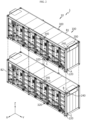
- FIG. 1 is a diagram showing an energy storage system 1 according to an embodiment of the present disclosure
- FIG. 2 is a perspective view showing the overall shape of a battery container 10 provided in the energy storage system 1 of FIG. 1
- FIG. 3 is a front view showing the battery container 10 of FIG. 2
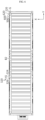
- FIG. 4 is a side view showing the battery container 10 of FIG. 2
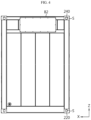
- FIG. 5 is a top view showing the battery container 10 of FIG. 2
- FIG. 6 is a bottom view showing the battery container 10 of FIG. 2 .
- FIGS. 3 to 6 exemplarily show only a second battery container B2, explained later.
- X-axis direction shown in the drawing may refer to a width direction
- Y-axis direction may refer to a length direction perpendicular to the X-axis direction on the horizontal plane (X-Y plane)
- Z-axis direction may refer to a vertical direction perpendicular to both the X-axis direction and the Y-axis direction.
- the energy storage system 1 includes a battery container 10.
- the energy storage system 1 may form a link group by combining a certain number of battery containers 10 and a control container (E-Link, EL). This will be explained in detail below.
- the battery container 10 described above may include a container body 100, a coupling unit 200, and a load support unit 300.
- the container body 100 may include a plurality of battery racks therein. To this end, the container body 100 may have an accommodation space to accommodate the battery racks described above. As an example, the container body 100 may be made of a metal material such as steel.
- the battery rack may be configured to include a plurality of battery modules stacked.
- each battery module may be configured to include a plurality of battery cells (secondary batteries) accommodated in a module case.
- the battery modules may be accommodated in a rack case and stacked in at least one direction.
- the battery modules may be configured to be stacked vertically through the rack case.
- the container body 100 may accommodate a plurality of battery modules therein by constructing a separate structure therein for fixing the plurality of battery modules, without including the battery rack described above.
- the coupling unit 200 may be configured to couple different container bodies 100.
- different container bodies 100 may be arranged to be stacked in a vertical direction. At least two container bodies 100 may be arranged to be stacked in a vertical direction. At this time, the container bodies 100 may be stacked in the vertical direction on the same ground.
- the container body 100 may, by way of example, include a first container body B1 and a second container body B2. At this time, the second container body B2 may be located lower than the first container body B 1. In particular, the second container body B2 may be located on the ground.
- the load support unit 300 may be configured to support the vertical load of the container body 100.
- the load support unit 300 may be provided in the form of a bracket, but is not limited thereto.
- the load support unit 300 may be integrally provided with the container body 100 or may be configured as a separate member.
- the load support unit 300 may be provided in a portion of the container body 100 that is different from the portion where the coupling unit 200 for coupling different container bodies 100 is located. Accordingly, the structural rigidity of the remaining portion of the container body 100, excluding the portion where the coupling unit 200 is located, may be reinforced.
- the vertical load of the container body 100 may be stably supported.
- the container bodies 100 may be stably stacked on the same ground, the energy density of the battery containers 10 may be improved in a limited ground.
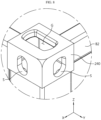
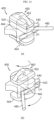
- FIG. 7 is an enlarged view showing the portion A of FIG. 2
- FIG. 8 is an enlarged view showing the portion B of FIG. 2
- FIG. 7 is a diagram showing a first coupling unit 220 provided at the bottom end of the first container body B1 in detail
- FIG. 8 is a diagram showing a second coupling unit 240 provided at the top end of the second container body B2 in detail.
- the coupling unit 200 may be provided to at least one of a top end and a bottom end of the container body 100.
- the coupling unit 200 may be provided only at one of the top end and the bottom end of the container body 100.
- the coupling unit 200 may be provided only at the bottom end of the first container body B1, and may be provided only at the top end of the second container body B2.
- the coupling unit 200 may be provided at both the top end and the bottom end of the container body 100.
- the coupling unit 200 may be provided at both the top end and the bottom end of the first container body B1, and may be provided at both the top end and the bottom end of the second container body B2.
- the coupling unit 200 provided at the bottom end of the second container body B2 may be located on the ground.
- the coupling unit 200 may include a first coupling unit 220 provided at the bottom end of the container body 100 and a second coupling unit 240 provided at the top end of the container body 100.
- the first coupling unit 220 and the second coupling unit 240 may be provided to both the first container body B1 and the second container body B2 described above.
- the first coupling unit 220 described above may also be provided at the bottom end of the second container body B2 located on the ground.
- the coupling unit 200 may be provided at a corner of the container body 100. More specifically, the first coupling unit 220 may be provided at the corner of the bottom end of the first container body B1 described above, and the second coupling unit 240 may be provided at the corner of the top end of the second container body B2 described above. At this time, the first coupling unit 220 and the second coupling unit 240 may be coupled to each other in the vertical direction.
- the coupling unit 200 may be provided at the corner of the container body 100, which is the part where stress is most concentrated, to stably couple different container bodies 100.
- the coupling unit 200 may be formed to extend further in the vertical direction than the top end or the bottom end of the container body 100. More specifically, the first coupling unit 220 may be formed to extend further downward than the bottom end of the first container body B1 described above, and the second coupling unit 240 may be formed to extend further upward than the top end of the second container body B2 described above.
- the coupling unit 200 is formed to extend further in the vertical direction than the top end or the bottom end of the container body 100, when different container bodies 100 are coupled, it is possible to prevent regions of different container bodies 100, except for the corners of the container bodies 100, from directly touching each other. Accordingly, it is possible to minimize the direct transfer of load to the battery modules arranged in the accommodation space of the container body 100.
- the load support unit 300 may be provided to at least one of the top end and the bottom end of the container body 100.
- the load support unit 300 may be provided only to one of the top end and the bottom end of the container body 100. As an example, the load support unit 300 may be provided only at the bottom end of the first container body B 1 described above, and may be provided only at the top end of the second container body B2 described above.
- the load support unit 300 may be provided at both the top end and the bottom end of the container body 100.
- the load support unit 300 may be provided at both the top end and the bottom end of the first container body B1, and may be provided at both the top end and the bottom end of the second container body B2.
- the load support unit 300 coupled to the bottom end of the second container body B2 may be located on the ground.
- the load support unit 300 may be configured to support the vertical load of two different container bodies 100.
- the load support unit 300 may additionally support the vertical load of the first container body B 1 and the second container body B2.
- the vertical load of the container bodies 100 may be stably supported.
- the load support unit 300 may be located between two different coupling units 200 on at least one of the upper surface and the lower surface of the container body 100.
- the load support unit 300 may be located between two different first coupling units 220 on the lower surface of the container body 100. At this time, the load support unit 300 may be located between two different first coupling units 220 in the length direction of the container body 100. In addition, although not shown, the load support unit 300 may be located between two different first coupling units 220 in the width direction of the container body 100, and may be located between two different first coupling units 220 located in the diagonal direction.
- the load support unit 300 may be located between two different second coupling units 240 on the upper surface of the container body 100. At this time, the load support unit 300 may be located between two different second coupling units 240 in the length direction of the container body 100. In addition, although not shown, the load support unit 300 may be located between two different second coupling units 240 in the width direction of the container body 100, and may be located between two different second coupling units 240 located in the diagonal direction.
- the load support unit 300 since the length in the length direction of the container body 100 is formed to be longer than the length in the width direction, if the load support unit 300 is located between two different coupling units 200 in the length direction of the container body 100, a higher load support effect may be achieved. In addition, since the load support unit 300 is located between two different coupling units 200 in all of the length direction, the width direction, and the diagonal direction of the container body 100, the vertical load of the container bodies 100 may be supported more stably.
- the load support unit 300 is located between the coupling units 200 that couple different container bodies 100 on at least one of the upper surface and the lower surface of the container body 100, the vertical load of the container bodies 100 may be supported more stably.
- the load support unit 300 may be formed in plurality between two different coupling units 200.
- a plurality of load support units 300 may be formed between two different coupling units 200 in the length direction of the container body 100.
- a plurality of load support units 300 may be formed between two different coupling units 200 in the width direction of the container body 100, and a plurality of load support units 300 may be formed between two different coupling units 200 located in the diagonal direction.
- the length in the length direction of the container body 100 is formed to be longer than the length in the width direction, if the plurality of load support units 300 are located between two different coupling units 200 in the length direction of the container body 100, a higher load support effect may be achieved.
- the plurality of load support units 300 are located between two different coupling units 200 in all of the length direction, the width direction, and the diagonal direction of the container body 100, the vertical load of the container body 100 may be supported more stably.
- the vertical load of the container bodies 100 may be distributed to the plurality of load support units 300. Accordingly, the vertical load of the container bodies 100 may be supported more stably.
- the load support unit 300 may be located between two different coupling units 200 at the edge of the container body 100.
- the load support unit 300 may be located between two different coupling units 200 at the edge in the length direction of the container body 100.
- the load support unit 300 may be located between two different coupling units 200 at the edge in the width direction of the container body 100.
- the load support unit 300 is located between two different coupling units 200 at the edge of the container body 100, which is vulnerable to the vertical load, the vertical load of the container body 100 may be supported more stably.
- the load support unit 300 may be located symmetrically at both sides of the edge of the container body 100 based on a center line of the edge of the container body 100.
- the load support unit 300 may be positioned symmetrically at both sides in the length direction based on the center line in the width direction at the edge of the container body 100 in the length direction.
- the load support unit 300 may be positioned symmetrically at both sides in the width direction based on the center line in the length direction, at the edge of the container body 100 in the width direction.
- the vertical load of the container body 100 may be uniformly distributed to the load support unit 300. Accordingly, the vertical load of the container body 100 may be supported more stably.
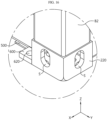
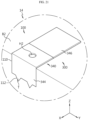
- FIG. 9 is an enlarged view showing the portion C of FIG. 2
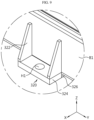
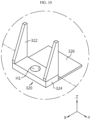
- FIG. 10 is a diagram showing a first support bracket 320 in FIG. 9 in detail
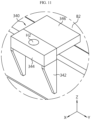
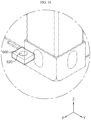
- FIG. 11 is an enlarged view showing the portion D of FIG. 2
- FIG. 12 is a diagram showing a second support bracket 340 in FIG. 11 in detail.
- the load support unit 300 may include a first support bracket 320 and a second support bracket 340.
- the first support bracket 320 may be provided at the bottom end of the container body 100. As an example, the first support bracket 320 may be provided at the bottom end of the first container body B1.
- the second support bracket 340 may be provided at the top end of the container body 100.
- the second support bracket 340 may be provided at the top end of the second container body B2.
- the second support bracket 340 may be configured to be coupled with the first support bracket 320 in the vertical direction.
- the first support bracket 320 and the second support bracket 340 may be configured to support the vertical load of the first container body B1 and the second container body B2.
- first support bracket 320 and the second support bracket 340 may be provided to both the first container body B 1 and the second container body B2 described above. Meanwhile, the first support bracket 320 described above may be provided at the bottom end of the second container body B2 located on the ground.
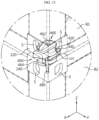
- FIG. 13 is an enlarged view showing the portion L of FIG. 1
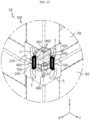
- FIG. 14 is a diagram showing a connection member 400 in FIG. 13 in detail
- FIG. 15 is a diagram for illustrating a state in which a load support unit 300 supports the load of two different container bodies 100.
- the battery container 10 may further include a connection member 400 configured to connect two different coupling units 200 in the vertical direction.
- the connection member 400 is a type of twist lock and may be made of a high-strength metal material.
- connection member 400 may include a connection body 420 and a side portion 440.
- connection body 420 may be disposed vertically inside two different coupling units 200. That is, the connection body 420 may be disposed vertically inside the first coupling unit 220 provided to the first container body B1 and the second coupling unit 240 provided to the second container body B2.
- the side portion 440 may be formed at both sides of the connection body 420 and disposed between the two different coupling units 200 in the vertical direction. That is, the side portion 440 may be disposed between the first coupling unit 220 and the second coupling unit 240 in the vertical direction.
- connection member 400 A more detailed configuration of the connection member 400 described above will be described later in more detail.
- connection member 400 may prevent the two different coupling units 200 coupled to the corner of the container body 100, which is the part where stress is most concentrated in the container body 100, from directly touching each other. Accordingly, different container bodies 100 may be connected stably.
- first support bracket 320 and the second support bracket 340 of the present disclosure may be coupled to each other in the vertical direction and configured to support the vertical load of the first container body B1 and the second container body B2.
- the first support bracket 320 may include a first side bracket 322, a first coupling bracket 324, and a first base bracket 326.
- the first side bracket 322 may be coupled to a side surface of the bottom end of the container body 100. In this way, the first support bracket 320 may be more stably coupled to the container body 100 by providing the first side bracket 322 that is coupled to the side surface of the container body 100. Accordingly, the first support bracket 320 may support the vertical load of the container body 100 more stably.
- the first coupling bracket 324 may be coupled to the lower portion of the first side bracket 322 and configured to be coupled with the second support bracket 340 in the vertical direction. In this way, the first support bracket 320 may be more stably coupled to the second support bracket 340 in the vertical direction by providing the first coupling bracket 324 coupled to the lower portion of the first side bracket 322.
- the first base bracket 326 may be connected to the first coupling bracket 324 and configured to support the lower surface of the container body 100. In this way, the first support bracket 320 may support the vertical load of the container body 100 more stably by providing the first base bracket 326 configured to support the lower surface of the container body 100.
- the second support bracket 340 may include a second side bracket 342, a second coupling bracket 344, and a second base bracket 346.
- the second side bracket 342 may be coupled to a side surface of the top end of the container body 100.
- the second support bracket 340 may be more stably coupled to the container body 100 by providing the second side bracket 342 configured to be coupled to the side surface of the container body 100. Accordingly, the second support bracket 340 may support the vertical load of the container body 100 more stably.
- the second coupling bracket 344 may be coupled to the upper portion of the second side bracket 342 and configured to be coupled with the first coupling bracket 324 in the vertical direction.
- the first coupling bracket 324 and the second coupling bracket 344 may be coupled as a separate coupling member (not shown) couples a first hole H1 formed in the first coupling bracket 324 and a second hole H2 formed in the second coupling bracket 344 with each other.
- the second support bracket 340 may be more stably coupled to the first support bracket 320 in the vertical direction by providing the second coupling bracket 344 coupled to the upper portion of the second side bracket 342.
- the first support bracket 320 and the second support bracket 340 have the first coupling bracket 324 and the second coupling bracket 344 configured to be easily coupled to each other in the vertical direction, different container bodies 100 may be easily coupled.
- the second base bracket 346 may be connected to the second coupling bracket 344 and configured to support the upper surface of the container body 100. In this way, the second support bracket 340 may support the vertical load of the container body 100 more stably by providing the second base bracket 346 configured to support the upper surface of the container body 100.
- the gap between the bottom end of the first container body B 1 and the top end of the second container body B2 may be equal to the sum of the heights of the first base bracket 326 and the second base bracket 346. Accordingly, the deformation of the container body 100 may be minimized, and the vertical load of the container body 100 may be stably supported.
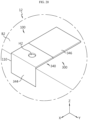
- FIG. 16 is an enlarged view of part E of FIG. 2
- FIG. 17 is a diagram showing a support plate 500 of FIG. 16 in detail
- FIG. 18 is a diagram showing a fixing member 600 of FIG. 16 in detail
- FIG. 19 is a diagram for illustrating the relationship between the support plate 500 and the load support unit 30 of FIG. 16 .
- the load support unit 300 may be configured to support the container body 100 disposed on the ground.
- the second container body B2 described above may be located on the ground.
- the first coupling unit 220 may be provided at the bottom end of the second container body B2 located on the ground.
- the first support bracket 320 of the load support unit 300 may be provided at the bottom end of the second container body B2 located on the ground.
- the bottom end of the first coupling bracket 324 and the first base bracket 326 of the first support bracket 320 may be located on the same horizontal plane as the bottom end of the first coupling unit 220.
- the first support bracket 320 may be fixed to the ground by inserting a separate coupling member (not shown) into the ground through the first hole H1 of the first coupling bracket 324. Accordingly, the second container body B2 located on the ground may be fixed to the ground.
- the load support unit 300 may stably support the container body 100 disposed on the ground, thereby enabling stable stacking of the container bodies 100.
- the battery container 10 may further include a support plate 500.
- the support plate 500 may be configured to support the container body 100 disposed on the ground.
- the support plate 500 may support the bottom end of the container body 100 disposed on the ground. More specifically, the support plate 500 may support the bottom end of the second container body B2 located on the ground.
- the support plate 500 may be directly connected to the first coupling unit 220 or may be disposed adjacent to the first coupling unit 220. By this configuration of the support plate 500, it is possible to additionally secure the support force in the vertical direction near the corner of the container body 100.
- the bottom end of the support plate 500 may be located on the same horizontal plane as the bottom end of the first coupling unit 220, and may be located on the same horizontal plane as the bottom end of the first coupling bracket 324 and the first base bracket 326 of the first support bracket 320.
- the battery container 10 may further include a fixing member 600.
- the fixing member 600 may be configured to connect the support plate 500 and the coupling unit 200. Since the support plate 500 and the coupling unit 200 are connected to each other by the fixing member 600 in this way, the support force in the vertical direction near the corner of the container body 100 may be more stably achieved.
- the fixing member 600 may be configured to fix the container body 100 to the ground. More specifically, the fixing member 600 may fix the second container body B2 located on the ground to the ground. As an example, a separate coupling member (not shown) may be inserted into the ground through a fixing hole 620 formed in the fixing member 600. Accordingly, the fixing member 600 may fix the second container body B2 located on the ground to the ground.
- the bottom end of the fixing member 600 may be located on the same horizontal plane as the bottom end of the first coupling unit 220, and may be located on the same horizontal plane as the bottom end of the support plate 500.
- the bottom end of the fixing member 600 may be located on the same horizontal plane as the bottom end of the first coupling bracket 324 and the first base bracket 326 of the first support bracket 320.
- the fixing member 600 by using the fixing member 600, not only more stable stacking of the container bodies 100 may be guided, but also an additional force for fixing the container bodies 100 to the ground may be secured.
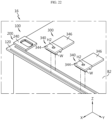
- FIGS. 20 to 23 are diagrams showing a battery container according to another embodiment of the present disclosure. Hereinafter, FIGS. 20 to 23 will show only some components of the battery container described above.
- the battery container 12 according to the second embodiment of the present disclosure is shown. Since the battery container 12 according to this embodiment is similar to the battery container 10 of the former embodiment, features substantially identical or similar to those of the former embodiment will not be described in detail, and features different from those of the former embodiment will be described in detail.
- the battery container 12 may include a container body 100 and a load support unit 300.
- At least one seating groove 110 may be formed at the top end of the second container body B2 described above along the length direction of the second container body B2.
- the seating groove 110 may be formed to be indented inward in the width direction of the second container body B2.
- the second coupling bracket 344 of the second support bracket 340 may be disposed in the seating groove 110.
- the second base bracket 346 of the second support bracket 340 may be connected to the second coupling bracket 344 and configured to support the upper surface of the second container body B2.
- the container body 100 may not include a second side bracket 342, unlike the former embodiment.
- the load support unit 300 may be configured more simply, and the load support unit 300 may support the vertical load of the container body 100 more stably.
- the battery container 14 according to the third embodiment of the present disclosure is shown. Since the battery container 14 according to this embodiment is similar to the battery container 10 of the former embodiment, features substantially identical or similar to those of the former embodiment will not be described in detail, and features different from those of the former embodiment will be described in detail.
- the battery container 14 may include a container body 100 and a load support unit 300.
- the second coupling bracket 344 of the second support bracket 340 may be disposed in the seating groove 110.
- a protrusion T having a shape corresponding to the guide groove 112 may be formed at one side of the second coupling bracket 344. The protrusion T may be inserted into the guide groove 112.
- the load support unit 300 may be positioned more stably in the seating groove 110, the load support unit 300 may support the vertical load of the container body 100 more stably.
- the battery container 16 according to the fourth embodiment of the present disclosure is shown. Since the battery container 16 according to this embodiment is similar to the battery container 10 of the former embodiment, features substantially identical or similar to those of the former embodiment will not be described in detail, and features different from those of the former embodiment will be described in detail.
- the battery container 16 may include a container body 100 and a load support unit 300.
- the container body 100 may further include a slide guide 120, unlike the former embodiment.
- the slide guide 120 may be formed on at least one of the top end and the bottom end of the container body 100.
- the slide guide 120 may be formed in the form of a guide rail.
- a plurality of load support units 300 may be arranged on the slide guide 120 and configured to move on the container body 100, and each load support unit 300 may be fixed at a specific position of the slide guide 120 by a separate stopper (not shown).
- the slide guide 120 may be formed at the top end of the second container body B2 described above along the length direction of the second container body B2.
- the second coupling bracket 344 may be configured to move on the second container body B2 along the slide guide 120, and each second coupling bracket 344 may be fixed at a specific position of the slide guide 120 by the stopper.
- the container body 100 may not include the second side bracket 342.
- the load support unit 300 may freely move on the container body 100 through the slide guide 120, the plurality of load support units 300 may be disposed at any positions of the container body 100. Accordingly, the vertical load of the container body 100 may be supported more stably.
- the battery container 18 according to the fifth embodiment of the present disclosure is shown. Since the battery container 18 according to this embodiment is similar to the battery container 10 of the former embodiment, features substantially identical or similar to those of the former embodiment will not be described in detail, and features different from those of the former embodiment will be described in detail.
- the battery container 18 may include a container body 100 and a coupling unit 200.
- the coupling unit 200 may further have a side hole S.
- the side hole S may be formed in the side surface of the coupling unit 200 along the vertical direction.
- the battery container 18 according to this embodiment may further include a reinforcing member 700, unlike the former embodiment.
- the reinforcing member 700 may connect the side holes S of two different coupling units 200 in the vertical direction.
- the reinforcing member 700 may connect the side hole S formed in the side surface of the first coupling unit 220 coupled to the first container body B1 and the side hole S formed in the side surface of the second coupling unit 240 coupled to the second container body B2 in the vertical direction.
- the reinforcing member 700 may be made of an elastic material and may be formed in a clip shape to facilitate attachment and detachment to/from the side hole S.
- the support force in the vertical direction may be additionally secured at the corner of the container body 100, and also more stable stacking of the container bodies 100 may be guided.
- the vertical load of the container bodies 100 may be stably supported.
- connection member 400 may further include a locking unit 460 and a handle portion 480.
- the locking unit 460 may be configured to fix the connection body 420 of the connection member 400 to the interior of the coupling units 200.
- the handle portion 480 may be connected to the locking unit 460 and may have a long bar shape.
- the handle portion 480 may be configured to rotate the locking unit 460 with respect to the connection body 420 according to movement on a horizontal plane within an elongated hole LH formed at one side of the connection body 420.
- the handle portion 480 may act to fix the connection body 420 to the interior of the coupling units 200 through the locking unit 460 by rotating the locking unit 460 with respect to the connection body 420.
- the locking unit 460 may include a first locking member 462, a second locking member 464, and a rotary shaft 466.
- the first locking member 462 may be disposed at the upper portion of the connection body 420.
- the second locking member 464 may be disposed at the lower portion of the connection body 420.
- the rotary shaft 466 may be formed inside the connection body 420 and connect the first locking member 462 and the second locking member 464.
- the coupling unit 200 described above may further include a perforated hole G.
- the perforated hole G is formed at one side of the coupling unit 200 in the vertical direction, and the first locking member 462 or the second locking member 464 may pass through the perforated hole G.
- the first locking member 462 and the second locking member 464 may be converted from the state of FIG. 14(a) to FIG. 14(b) , so as to be arranged in a direction perpendicular to the perforated hole G inside the coupling units 200. In this state, the first locking member 462 and the second locking member 464 may be prevented from passing through the perforated hole G. Accordingly, the connection body 420 may be fixed inside the coupling units 200.
- At least one battery containers 10, 12, 14, 16, 18 described above may be provided to form an energy storage system 1.
- the energy storage system 1 may form a link group by combining a certain number of battery containers 10 and a control container EL.
- two container bodies 100 and one control container EL are provided.
- two container bodies 100 and one control container EL may constitute one link group.
- the present disclosure is not limited thereto, and when three or more container bodies 100 are stacked, it is also possible that three or more container bodies 100 and one control container EL form one link group.
- each link group the container body 100 located on the ground may be connected to one control container EL.
- the control container EL may perform overall control or diagnosis for the container bodies 100 that are stacked.
- control container EL may include a DC part, an AC part, and a BSC part to control the battery container. Meanwhile, each control container EL may be connected to the PCS.
Landscapes
- Chemical & Material Sciences (AREA)
- Chemical Kinetics & Catalysis (AREA)
- Electrochemistry (AREA)
- General Chemical & Material Sciences (AREA)
- Battery Mounting, Suspending (AREA)
Applications Claiming Priority (2)
| Application Number | Priority Date | Filing Date | Title |
|---|---|---|---|
| KR1020220055923A KR102732024B1 (ko) | 2022-05-06 | 2022-05-06 | 배터리 컨테이너 및 이를 포함하는 에너지 저장 시스템 |
| PCT/KR2023/006168 WO2023214847A1 (ko) | 2022-05-06 | 2023-05-04 | 배터리 컨테이너 및 이를 포함하는 에너지 저장 시스템 |
Publications (2)
| Publication Number | Publication Date |
|---|---|
| EP4475306A1 true EP4475306A1 (de) | 2024-12-11 |
| EP4475306A4 EP4475306A4 (de) | 2025-05-21 |
Family
ID=88646740
Family Applications (1)
| Application Number | Title | Priority Date | Filing Date |
|---|---|---|---|
| EP23799728.3A Pending EP4475306A4 (de) | 2022-05-06 | 2023-05-04 | Batteriebehälter und energiespeichersystem damit |
Country Status (7)
| Country | Link |
|---|---|
| US (1) | US20250062474A1 (de) |
| EP (1) | EP4475306A4 (de) |
| JP (1) | JP2025511528A (de) |
| KR (1) | KR102732024B1 (de) |
| CN (1) | CN118872134A (de) |
| AU (1) | AU2023263905A1 (de) |
| WO (1) | WO2023214847A1 (de) |
Families Citing this family (2)
| Publication number | Priority date | Publication date | Assignee | Title |
|---|---|---|---|---|
| WO2025116372A1 (ko) * | 2023-12-01 | 2025-06-05 | 주식회사 엘지에너지솔루션 | 배터리 외함 및 이를 포함하는 에너지 저장 시스템 |
| USD1118488S1 (en) * | 2024-08-02 | 2026-03-17 | Microvast Power Systems Co., Ltd. | Energy storage system |
Family Cites Families (11)
| Publication number | Priority date | Publication date | Assignee | Title |
|---|---|---|---|---|
| US6364584B1 (en) * | 2000-09-01 | 2002-04-02 | Patrick Asher Taylor | Access bar for a shipping container |
| US9083029B2 (en) * | 2009-12-23 | 2015-07-14 | Samsung Sdi Co., Ltd. | Battery pack |
| KR101278979B1 (ko) * | 2011-04-25 | 2013-07-02 | 주식회사 엘지화학 | 배터리 수납장치와 이에 사용되는 서브 수납장치 및 이를 이용한 배터리 팩 |
| KR20150145564A (ko) * | 2014-06-20 | 2015-12-30 | 김진우 | 컨테이너 결합시 층간 또는 측벽간 소음 및 진동방지장치 |
| JP6058746B1 (ja) * | 2015-06-17 | 2017-01-11 | 株式会社東芝 | 水素システム用コンテナ組合体 |
| KR102159975B1 (ko) * | 2016-01-07 | 2020-09-28 | 주식회사 엘지화학 | 컨테이너 |
| SE540489C2 (en) * | 2016-10-27 | 2018-09-25 | Lox Container Tech Ab | A container corner lock for locking a shipping container into position |
| KR102380443B1 (ko) * | 2019-01-04 | 2022-03-29 | 주식회사 엘지에너지솔루션 | 인접 배터리 모듈들로 열을 분산할 수 있는 구조를 갖는 에너지 저장 시스템 |
| KR102771052B1 (ko) * | 2019-10-30 | 2025-02-19 | 주식회사 엘지에너지솔루션 | 배터리 모듈, 이러한 배터리 모듈을 포함하는 배터리 랙 및 전력 저장 장치 |
| AU2021346597A1 (en) * | 2020-09-28 | 2022-12-22 | Lg Energy Solution, Ltd. | Battery rack, energy storage system, and power generation system |
| KR20220055923A (ko) | 2020-10-27 | 2022-05-04 | 주식회사 케이티 | 지도 학습 및 비지도 학습이 결합된 하이브리드 학습을 통해 디도스 공격을 탐지하는 방법 |
-
2022
- 2022-05-06 KR KR1020220055923A patent/KR102732024B1/ko active Active
-
2023
- 2023-05-04 CN CN202380030572.1A patent/CN118872134A/zh active Pending
- 2023-05-04 AU AU2023263905A patent/AU2023263905A1/en active Pending
- 2023-05-04 JP JP2024554698A patent/JP2025511528A/ja active Pending
- 2023-05-04 WO PCT/KR2023/006168 patent/WO2023214847A1/ko not_active Ceased
- 2023-05-04 EP EP23799728.3A patent/EP4475306A4/de active Pending
-
2024
- 2024-11-04 US US18/936,353 patent/US20250062474A1/en active Pending
Also Published As
| Publication number | Publication date |
|---|---|
| US20250062474A1 (en) | 2025-02-20 |
| WO2023214847A1 (ko) | 2023-11-09 |
| KR20230156488A (ko) | 2023-11-14 |
| EP4475306A4 (de) | 2025-05-21 |
| KR102732024B1 (ko) | 2024-11-18 |
| CN118872134A (zh) | 2024-10-29 |
| JP2025511528A (ja) | 2025-04-16 |
| AU2023263905A1 (en) | 2024-12-05 |
Similar Documents
| Publication | Publication Date | Title |
|---|---|---|
| US20250062474A1 (en) | Battery container and energy storage system including the same | |
| US11342623B2 (en) | Battery pack and vehicle including same | |
| CN103493241B (zh) | 电池容器、用在电池容器中的子电池容器及使用它们的电池组 | |
| EP4142030B1 (de) | Batteriegestell, energiespeichersystem und stromerzeugungssystem | |
| EP4145601B1 (de) | Batteriegestell, energiespeichervorrichtung und stromerzeugungssystem | |
| US12609397B2 (en) | Battery rack, power storage device, and container | |
| CN222801947U (zh) | 电池架以及包括该电池架的电池容器和能量存储系统 | |
| KR20230149600A (ko) | 배터리 팩 및 이를 포함하는 자동차 | |
| KR20240030840A (ko) | 배터리 랙, 배터리 컨테이너 및 이를 포함하는 전력 저장 시스템 | |
| EP4571977A1 (de) | Energiespeichersystem | |
| CN223443504U (zh) | 换电站 | |
| EP4712229A1 (de) | Batteriepack | |
| KR102959031B1 (ko) | 에너지 저장 시스템 | |
| CN218514107U (zh) | 一种储能电源 | |
| CN223598873U (zh) | 电池装置及用电装置 | |
| EP4654354A1 (de) | Batteriepack | |
| EP4546510A1 (de) | Batterieanordnung | |
| KR20250036642A (ko) | 컨테이너 모듈 | |
| KR20250036653A (ko) | 컨테이너 모듈 | |
| KR20250098976A (ko) | 컨테이너 모듈 | |
| KR20250040390A (ko) | 배터리 팩 및 이를 포함하는 자동차 | |
| CN109149019A (zh) | 复合式电池组 | |
| CN120937186A (zh) | 电池组件 |
Legal Events
| Date | Code | Title | Description |
|---|---|---|---|
| STAA | Information on the status of an ep patent application or granted ep patent |
Free format text: STATUS: THE INTERNATIONAL PUBLICATION HAS BEEN MADE |
|
| PUAI | Public reference made under article 153(3) epc to a published international application that has entered the european phase |
Free format text: ORIGINAL CODE: 0009012 |
|
| STAA | Information on the status of an ep patent application or granted ep patent |
Free format text: STATUS: REQUEST FOR EXAMINATION WAS MADE |
|
| 17P | Request for examination filed |
Effective date: 20240902 |
|
| AK | Designated contracting states |
Kind code of ref document: A1 Designated state(s): AL AT BE BG CH CY CZ DE DK EE ES FI FR GB GR HR HU IE IS IT LI LT LU LV MC ME MK MT NL NO PL PT RO RS SE SI SK SM TR |
|
| A4 | Supplementary search report drawn up and despatched |
Effective date: 20250425 |
|
| RIC1 | Information provided on ipc code assigned before grant |
Ipc: H01M 50/258 20210101ALI20250417BHEP Ipc: H01M 50/209 20210101ALI20250417BHEP Ipc: H01M 50/262 20210101ALI20250417BHEP Ipc: H01M 50/251 20210101AFI20250417BHEP |
|
| DAV | Request for validation of the european patent (deleted) | ||
| DAX | Request for extension of the european patent (deleted) | ||
| GRAP | Despatch of communication of intention to grant a patent |
Free format text: ORIGINAL CODE: EPIDOSNIGR1 |
|
| STAA | Information on the status of an ep patent application or granted ep patent |
Free format text: STATUS: GRANT OF PATENT IS INTENDED |
|
| INTG | Intention to grant announced |
Effective date: 20260226 |
|
| P01 | Opt-out of the competence of the unified patent court (upc) registered |
Free format text: CASE NUMBER: UPC_APP_0009410_4475306/2026 Effective date: 20260311 |