EP4474030A1 - Darstellungsverfahren und elektronische vorrichtung - Google Patents
Darstellungsverfahren und elektronische vorrichtung Download PDFInfo
- Publication number
- EP4474030A1 EP4474030A1 EP23765812.5A EP23765812A EP4474030A1 EP 4474030 A1 EP4474030 A1 EP 4474030A1 EP 23765812 A EP23765812 A EP 23765812A EP 4474030 A1 EP4474030 A1 EP 4474030A1
- Authority
- EP
- European Patent Office
- Prior art keywords
- preset
- complexity
- rendering
- feedback information
- channel feedback
- Prior art date
- Legal status (The legal status is an assumption and is not a legal conclusion. Google has not performed a legal analysis and makes no representation as to the accuracy of the status listed.)
- Pending
Links
Images




Classifications
-
- G—PHYSICS
- G06—COMPUTING OR CALCULATING; COUNTING
- G06T—IMAGE DATA PROCESSING OR GENERATION, IN GENERAL
- G06T17/00—Three-dimensional [3D] modelling for computer graphics
-
- G—PHYSICS
- G06—COMPUTING OR CALCULATING; COUNTING
- G06T—IMAGE DATA PROCESSING OR GENERATION, IN GENERAL
- G06T15/00—Three-dimensional [3D] image rendering
- G06T15/005—General purpose rendering architectures
-
- A—HUMAN NECESSITIES
- A63—SPORTS; GAMES; AMUSEMENTS
- A63F—CARD, BOARD, OR ROULETTE GAMES; INDOOR GAMES USING SMALL MOVING PLAYING BODIES; VIDEO GAMES; GAMES NOT OTHERWISE PROVIDED FOR
- A63F13/00—Video games, i.e. games using an electronically generated display having two or more dimensions
- A63F13/30—Interconnection arrangements between game servers and game devices; Interconnection arrangements between game devices; Interconnection arrangements between game servers
- A63F13/33—Interconnection arrangements between game servers and game devices; Interconnection arrangements between game devices; Interconnection arrangements between game servers using wide area network [WAN] connections
-
- A—HUMAN NECESSITIES
- A63—SPORTS; GAMES; AMUSEMENTS
- A63F—CARD, BOARD, OR ROULETTE GAMES; INDOOR GAMES USING SMALL MOVING PLAYING BODIES; VIDEO GAMES; GAMES NOT OTHERWISE PROVIDED FOR
- A63F13/00—Video games, i.e. games using an electronically generated display having two or more dimensions
- A63F13/30—Interconnection arrangements between game servers and game devices; Interconnection arrangements between game devices; Interconnection arrangements between game servers
- A63F13/35—Details of game servers
- A63F13/355—Performing operations on behalf of clients with restricted processing capabilities, e.g. servers transform changing game scene into an encoded video stream for transmitting to a mobile phone or a thin client
-
- A—HUMAN NECESSITIES
- A63—SPORTS; GAMES; AMUSEMENTS
- A63F—CARD, BOARD, OR ROULETTE GAMES; INDOOR GAMES USING SMALL MOVING PLAYING BODIES; VIDEO GAMES; GAMES NOT OTHERWISE PROVIDED FOR
- A63F13/00—Video games, i.e. games using an electronically generated display having two or more dimensions
- A63F13/30—Interconnection arrangements between game servers and game devices; Interconnection arrangements between game devices; Interconnection arrangements between game servers
- A63F13/35—Details of game servers
- A63F13/358—Adapting the game course according to the network or server load, e.g. for reducing latency due to different connection speeds between clients
-
- A—HUMAN NECESSITIES
- A63—SPORTS; GAMES; AMUSEMENTS
- A63F—CARD, BOARD, OR ROULETTE GAMES; INDOOR GAMES USING SMALL MOVING PLAYING BODIES; VIDEO GAMES; GAMES NOT OTHERWISE PROVIDED FOR
- A63F13/00—Video games, i.e. games using an electronically generated display having two or more dimensions
- A63F13/50—Controlling the output signals based on the game progress
- A63F13/52—Controlling the output signals based on the game progress involving aspects of the displayed game scene
-
- G—PHYSICS
- G06—COMPUTING OR CALCULATING; COUNTING
- G06T—IMAGE DATA PROCESSING OR GENERATION, IN GENERAL
- G06T15/00—Three-dimensional [3D] image rendering
-
- G—PHYSICS
- G06—COMPUTING OR CALCULATING; COUNTING
- G06T—IMAGE DATA PROCESSING OR GENERATION, IN GENERAL
- G06T15/00—Three-dimensional [3D] image rendering
- G06T15/04—Texture mapping
-
- H—ELECTRICITY
- H04—ELECTRIC COMMUNICATION TECHNIQUE
- H04N—PICTORIAL COMMUNICATION, e.g. TELEVISION
- H04N19/00—Methods or arrangements for coding, decoding, compressing or decompressing digital video signals
- H04N19/10—Methods or arrangements for coding, decoding, compressing or decompressing digital video signals using adaptive coding
- H04N19/134—Methods or arrangements for coding, decoding, compressing or decompressing digital video signals using adaptive coding characterised by the element, parameter or criterion affecting or controlling the adaptive coding
- H04N19/164—Feedback from the receiver or from the transmission channel
-
- H—ELECTRICITY
- H04—ELECTRIC COMMUNICATION TECHNIQUE
- H04N—PICTORIAL COMMUNICATION, e.g. TELEVISION
- H04N19/00—Methods or arrangements for coding, decoding, compressing or decompressing digital video signals
- H04N19/50—Methods or arrangements for coding, decoding, compressing or decompressing digital video signals using predictive coding
- H04N19/503—Methods or arrangements for coding, decoding, compressing or decompressing digital video signals using predictive coding involving temporal prediction
-
- H—ELECTRICITY
- H04—ELECTRIC COMMUNICATION TECHNIQUE
- H04N—PICTORIAL COMMUNICATION, e.g. TELEVISION
- H04N19/00—Methods or arrangements for coding, decoding, compressing or decompressing digital video signals
- H04N19/50—Methods or arrangements for coding, decoding, compressing or decompressing digital video signals using predictive coding
- H04N19/597—Methods or arrangements for coding, decoding, compressing or decompressing digital video signals using predictive coding specially adapted for multi-view video sequence encoding
-
- H—ELECTRICITY
- H04—ELECTRIC COMMUNICATION TECHNIQUE
- H04N—PICTORIAL COMMUNICATION, e.g. TELEVISION
- H04N21/00—Selective content distribution, e.g. interactive television or video on demand [VOD]
- H04N21/80—Generation or processing of content or additional data by content creator independently of the distribution process; Content per se
- H04N21/81—Monomedia components thereof
- H04N21/816—Monomedia components thereof involving special video data, e.g 3D video
-
- A—HUMAN NECESSITIES
- A63—SPORTS; GAMES; AMUSEMENTS
- A63F—CARD, BOARD, OR ROULETTE GAMES; INDOOR GAMES USING SMALL MOVING PLAYING BODIES; VIDEO GAMES; GAMES NOT OTHERWISE PROVIDED FOR
- A63F2300/00—Features of games using an electronically generated display having two or more dimensions, e.g. on a television screen, showing representations related to the game
- A63F2300/50—Features of games using an electronically generated display having two or more dimensions, e.g. on a television screen, showing representations related to the game characterized by details of game servers
- A63F2300/53—Features of games using an electronically generated display having two or more dimensions, e.g. on a television screen, showing representations related to the game characterized by details of game servers details of basic data processing
- A63F2300/538—Features of games using an electronically generated display having two or more dimensions, e.g. on a television screen, showing representations related to the game characterized by details of game servers details of basic data processing for performing operations on behalf of the game client, e.g. rendering
-
- A—HUMAN NECESSITIES
- A63—SPORTS; GAMES; AMUSEMENTS
- A63F—CARD, BOARD, OR ROULETTE GAMES; INDOOR GAMES USING SMALL MOVING PLAYING BODIES; VIDEO GAMES; GAMES NOT OTHERWISE PROVIDED FOR
- A63F2300/00—Features of games using an electronically generated display having two or more dimensions, e.g. on a television screen, showing representations related to the game
- A63F2300/60—Methods for processing data by generating or executing the game program
- A63F2300/66—Methods for processing data by generating or executing the game program for rendering three dimensional images
-
- A—HUMAN NECESSITIES
- A63—SPORTS; GAMES; AMUSEMENTS
- A63F—CARD, BOARD, OR ROULETTE GAMES; INDOOR GAMES USING SMALL MOVING PLAYING BODIES; VIDEO GAMES; GAMES NOT OTHERWISE PROVIDED FOR
- A63F2300/00—Features of games using an electronically generated display having two or more dimensions, e.g. on a television screen, showing representations related to the game
- A63F2300/60—Methods for processing data by generating or executing the game program
- A63F2300/66—Methods for processing data by generating or executing the game program for rendering three dimensional images
- A63F2300/6638—Methods for processing data by generating or executing the game program for rendering three dimensional images for simulating particle systems, e.g. explosion, fireworks
-
- G—PHYSICS
- G06—COMPUTING OR CALCULATING; COUNTING
- G06T—IMAGE DATA PROCESSING OR GENERATION, IN GENERAL
- G06T2200/00—Indexing scheme for image data processing or generation, in general
- G06T2200/04—Indexing scheme for image data processing or generation, in general involving 3D image data
-
- G—PHYSICS
- G06—COMPUTING OR CALCULATING; COUNTING
- G06T—IMAGE DATA PROCESSING OR GENERATION, IN GENERAL
- G06T2210/00—Indexing scheme for image generation or computer graphics
- G06T2210/08—Bandwidth reduction
-
- G—PHYSICS
- G06—COMPUTING OR CALCULATING; COUNTING
- G06T—IMAGE DATA PROCESSING OR GENERATION, IN GENERAL
- G06T2210/00—Indexing scheme for image generation or computer graphics
- G06T2210/36—Level of detail
-
- G—PHYSICS
- G06—COMPUTING OR CALCULATING; COUNTING
- G06T—IMAGE DATA PROCESSING OR GENERATION, IN GENERAL
- G06T2210/00—Indexing scheme for image generation or computer graphics
- G06T2210/56—Particle system, point based geometry or rendering
Definitions
- Embodiments of this application relate to the field of graphics processing, and in particular, to a rendering method and an electronic device.
- this application provides a rendering method and an electronic device.
- the method can ensure video image quality while ensuring video smoothness.
- an embodiment of this application provides a rendering method.
- the method includes: first, obtaining channel feedback information of an encoded transmission channel, where the encoded transmission channel is used to transmit an encoded bitstream corresponding to a rendered image; subsequently, determining, from a plurality of groups of preset rendering input information, rendering input information corresponding to the channel feedback information, where complexity of the plurality of groups of preset rendering input information is different; then, performing rendering based on the rendering input information corresponding to the channel feedback information, to obtain the rendered image.
- Content complexity of the obtained rendered image is associated with complexity of the rendering input information corresponding to the channel feedback information. To be specific, higher complexity of the rendering input information corresponding to the channel feedback information indicates higher content complexity of the obtained rendered image.
- Lower complexity of the rendering input information corresponding to the channel feedback information indicates lower content complexity of the obtained rendered image.
- higher content complexity of the image indicates a larger corresponding encoded bitstream
- lower content complexity of the image indicates a smaller corresponding encoded bitstream.
- the content complexity of the image is reduced by reducing the complexity of the rendering input information, so that bandwidth required for the encoded bitstream for transmitting the rendered image can be reduced.
- subjective quality of an original image and video smoothness can be maintained (or maintained as much as possible). In this way, a video image watched by a user does not suddenly become blurry or freeze. This improves user experience.
- the channel quality is enhanced, larger bandwidth may be provided to transmit a bitstream, and further, content complexity of an image may be restored or partially restored (or enhanced) by restoring or partially restoring (or enhancing) the complexity of the rendering input information.
- the rendered image may be encoded to obtain the encoded bitstream corresponding to the rendered image.
- the encoded bitstream may be transmitted through the encoded transmission channel, to transmit the encoded bitstream to a receive end.
- the receive end decodes the encoded bitstream to obtain and display a corresponding decoded image. In this way, when a channel status changes, a video image displayed at the receive end does not suddenly become blurry or freeze.
- each group of preset rendering input information may include at least one of the following: a preset three-dimensional object model, a preset motion model, a preset particle model, or a preset texture. It should be understood that the preset rendering input information may further include other input information that affects the content complexity of the image. This is not limited in this application.
- the preset rendering input information has a plurality of corresponding parameters.
- a parameter corresponding to the preset three-dimensional object model may include a quantity of vertices/faces.
- a parameter corresponding to the preset motion model may include a physical simulation unit granularity.
- rendering input information corresponding to the preset particle model may include various particle behavior parameters. In this case, complexity of the preset rendering input information may be determined based on the parameter corresponding to the preset rendering input information. When the preset rendering input information is an image, the complexity of the preset rendering input information may be determined based on image texture complexity.
- the content complexity of the image may be a comprehensive representation of factors such as fineness of object details in the image, complexity of object surface texture in the image, motion complexity of an object in the image, and particle motion complexity in the image (this factor exists when the image includes particle special effect).
- the motion complexity of the object in the image may be determined based on motion fineness of the object. Higher motion fineness of the object in the image indicates higher complexity of the object in the corresponding image. On the contrary, lower motion fineness of the object in the image indicates lower complexity of the object in the corresponding image.
- the motion fineness may refer to a size or a quantity of pixels of a region in which a similar motion or same motion is performed in a local region of an image.
- the particle motion complexity may be determined based on a particle behavior parameter.
- the particle behavior parameter may include but is not limited to: a particle generation speed (used to determine a quantity of particles generated per unit time), a particle initial speed vector (used to describe a motion direction of a particle at each moment), a particle life (that is, a life cycle of particle annihilation), a particle color, a particle size, particle transparency, a change of a particle in a life cycle, and another parameter.
- the rendering input information corresponding to the channel feedback information includes at least one of the following: a three-dimensional object model, a motion model, a particle model, or a texture.
- the determining, from a plurality of groups of preset rendering input information, rendering input information corresponding to the channel feedback information includes: determining, from a plurality of preset three-dimensional object models, a three-dimensional object model corresponding to the channel feedback information.
- the plurality of preset three-dimensional object models correspond to a same object, and complexity of the plurality of preset three-dimensional object models is different.
- the performing rendering based on the rendering input information corresponding to the channel feedback information, to obtain the rendered image includes: performing rendering based on the three-dimensional object model corresponding to the channel feedback information, to obtain the rendered image.
- the content complexity of the rendered image is associated with complexity of the three-dimensional object model corresponding to the channel feedback information.
- higher complexity of the three-dimensional object model corresponding to the channel feedback information indicates higher fineness of object details in the rendered image and higher content complexity of the rendered image.
- Lower complexity of the three-dimensional object model corresponding to the channel feedback information indicates lower fineness of object details in the rendered image and lower content complexity of the rendered image.
- rendering is performed based on the three-dimensional object model whose complexity corresponds to a channel status, so that the fineness of the object details in the rendered image adapts to the channel status, and a size of the encoded bitstream corresponding to the rendered image adapts to the channel status.
- This ensures subjective image quality and video smoothness of a video, and improves user experience.
- the preset three-dimensional object model is a face model, and complexity of the preset three-dimensional object model is determined based on a quantity of faces of the preset three-dimensional object model.
- the preset three-dimensional object model is a point cloud model, and complexity of the preset three-dimensional object model is determined based on a quantity of vertices of the preset three-dimensional object model.
- the complexity of the preset three-dimensional object model may be determined based on the quantity of vertices of the preset three-dimensional object model.
- the quantity of vertices of the preset three-dimensional object model represents the complexity of the preset three-dimensional object model.
- a complexity level is determined based on the quantity of vertices of the preset three-dimensional object model, and the complexity level represents the complexity of the preset three-dimensional object model. This is not limited in this application.
- a larger quantity of vertices of the preset three-dimensional object model indicates higher complexity of the preset three-dimensional object model and finer preset three-dimensional object model.
- a smaller quantity of vertices of the preset three-dimensional object model indicates lower complexity of the preset three-dimensional object model and coarser preset three-dimensional object model.
- the complexity of the preset three-dimensional object model may be determined based on the quantity of faces.
- the quantity of faces of the preset three-dimensional object model represents the complexity of the preset three-dimensional object model.
- a complexity level is determined based on the quantity of faces of the preset three-dimensional object model, and the complexity level represents the complexity of the preset three-dimensional object model. This is not limited in this application. A larger quantity of faces of the preset three-dimensional object model indicates higher complexity of the preset three-dimensional object model and finer preset three-dimensional object model. On the contrary, a smaller quantity of faces of the preset three-dimensional object model indicates lower complexity of the preset three-dimensional object model and coarser preset three-dimensional object model.
- the determining, from a plurality of groups of preset rendering input information, rendering input information corresponding to the channel feedback information includes: determining, from a plurality of preset motion models, a motion model corresponding to the channel feedback information.
- the plurality of preset motion models correspond to a same motion process, and complexity of the plurality of preset motion models is different.
- the performing rendering based on the rendering input information corresponding to the channel feedback information, to obtain the rendered image includes: performing rendering based on the motion model corresponding to the channel feedback information, to obtain the rendered image.
- the content complexity of the rendered image is associated with complexity of the motion model corresponding to the channel feedback information.
- higher complexity of the motion model corresponding to the channel feedback information indicates higher motion complexity of an object in the rendered image and higher content complexity of the rendered image.
- Lower complexity of the motion model corresponding to the channel feedback information indicates lower motion complexity of the object in the rendered image and lower content complexity of the rendered image.
- rendering is performed based on the motion model whose complexity corresponds to a channel status, so that motion complexity of an object in a rendered video sequence adapts to the channel status.
- motion complexity of an object in an image is lower, inter time domain correlation is higher, inter prediction is easier in an encoding process, compression is easier, and a bit rate of an encoded bitstream is lower. Therefore, a size of an encoded bitstream corresponding to the rendered image adapts to the channel status. This ensures subjective image quality and video smoothness of the video, and improves user experience.
- the complexity of the motion model corresponding to the channel feedback information when the complexity of the motion model corresponding to the channel feedback information is lower, a quantity of physical simulation units that require physical simulation is smaller, rendering complexity is lower, and a rendering speed is higher.
- the complexity of the motion model corresponding to the channel feedback information is higher, the motion complexity of the object in the rendered image is higher, and a motion process of the object displayed in a corresponding video sequence is more realistic. This improves user experience.
- complexity of the preset motion model is determined based on a physical simulation unit granularity of the preset motion model, and the physical simulation unit granularity is a granularity at which a three-dimensional object model is divided into units used for physical simulation.
- the preset motion model defines the physical simulation unit granularity.
- the physical simulation unit granularity is a granularity at which the three-dimensional object model is divided into units used for physical simulation, and a minimum value of the physical simulation unit granularity may be a face or a vertex.
- the complexity of the preset motion model may be determined based on the physical simulation unit granularity.
- the complexity of the preset motion model is represented by using the physical simulation unit granularity of the preset motion model.
- the complexity level is determined based on the physical simulation unit granularity of the preset motion model, and the complexity level represents the complexity of the preset motion model. This is not limited in this application.
- a larger physical simulation unit granularity of the preset motion model indicates lower complexity of the preset motion model.
- a smaller physical simulation unit granularity of the preset motion model indicates higher complexity of the preset motion model.
- a larger quantity of faces/vertices included in the physical simulation unit granularity indicates a larger physical simulation unit.
- a larger physical simulation unit granularity indicates lower motion fineness of the object in the image.
- a smaller physical simulation unit granularity indicates higher motion fineness of the object in the image.
- the determining, from a plurality of groups of preset rendering input information, rendering input information corresponding to the channel feedback information includes: determining, from a plurality of preset particle models, a particle model corresponding to the channel feedback information.
- the plurality of preset particle models correspond to same particle special effect, and complexity of the plurality of preset particle models is different.
- the performing rendering based on the rendering input information corresponding to the channel feedback information, to obtain the rendered image includes: performing particle rendering based on the particle model corresponding to the channel feedback information, to obtain the rendered image.
- the content complexity of the rendered image is associated with complexity of the particle model corresponding to the channel feedback information. To be specific, higher complexity of the particle model corresponding to the channel feedback information indicates higher content complexity of the rendered image. Lower complexity of the particle model corresponding to the channel feedback information indicates lower content complexity of the rendered image.
- particle rendering is performed based on a particle model whose complexity adapts to a channel status, so that particle motion complexity in the rendered image adapts to the channel status, and a size of an encoded bitstream corresponding to the rendered image adapts to the channel status. This ensures subjective image quality and video smoothness of a video, and improves user experience.
- model complexity of the particle model corresponding to the channel feedback information when model complexity of the particle model corresponding to the channel feedback information is lower, rendering complexity is lower, and a rendering speed is higher.
- the model complexity of the particle model corresponding to the channel feedback information is higher, the particle motion complexity in the rendered image is higher, and a particle motion process displayed in a corresponding video sequence is more realistic, so that particle special effect is more realistic. This improves user experience.
- complexity of the preset particle model is determined based on a particle behavior parameter of the preset particle model.
- the determining, from a plurality of groups of preset rendering input information, rendering input information corresponding to the channel feedback information includes: determining, from a plurality of preset textures, a texture corresponding to the channel feedback information.
- the plurality of preset textures correspond to a same object, and texture complexity of the plurality of preset textures is different.
- the performing rendering based on the rendering input information corresponding to the channel feedback information, to obtain the rendered image includes: performing rendering based on the texture corresponding to the channel feedback information, to obtain the rendered image.
- the content complexity of the rendered image is associated with texture complexity of the texture corresponding to the channel feedback information.
- higher complexity of the texture corresponding to the channel feedback information indicates higher texture complexity of an object surface in the rendered image and higher content complexity of the rendered image.
- Lower complexity of the texture corresponding to the channel feedback information indicates lower texture complexity of the object surface in the rendered image and lower content complexity of the rendered image.
- rendering is performed based on the texture whose complexity adapts to a channel status, so that the texture complexity of the object surface in the rendered image adapts to the channel status, and a size of an encoded bitstream corresponding to the rendered image adapts to the channel status.
- texture complexity of the texture corresponding to the channel feedback information when the texture complexity of the texture corresponding to the channel feedback information is lower, rendering complexity is lower, and a rendering speed is higher.
- texture complexity of the texture corresponding to the channel feedback information is higher, complexity of a surface texture of the object in the rendered image is higher. Further, details of a texture of the object in the image can be increased, so that the object in the image is more realistic. This improves user experience.
- complexity of the preset texture may be texture complexity.
- texture complexity of a preset texture may be determined in a plurality of manners. For example, a variance corresponding to an intensity histogram of the preset texture is calculated, and the variance is used to determine the texture complexity of the preset texture (for example, the variance of the preset texture represents the complexity of the preset texture; for another example, a complexity level is determined based on the variance of the preset texture, and the complexity level represents the complexity of the preset texture, and this is not limited in this application).
- a gradient of the preset texture is calculated, and the calculated gradient is used to determine the texture complexity of the preset texture (for example, the gradient of the preset texture represents the complexity of the preset texture; for another example, a complexity level is determined based on the gradient of the preset texture, and the complexity level represents the complexity of the preset texture, and this is not limited in this application).
- the texture complexity of the preset texture may alternatively be determined in another manner. This is not limited in this application.
- the method further includes: determining a channel status change degree based on the channel feedback information; and when the channel status change degree is greater than a preset change threshold, performing the step of determining, from a plurality of groups of preset rendering input information, rendering input information corresponding to the channel feedback information. In this way, a switching frequency of the rendering input information can be reduced, and a quantity of preset rendering input information can be reduced.
- the channel feedback information includes at least one of the following: network transmission bandwidth; a network transmission delay; a network jitter value; and a network packet loss rate.
- an embodiment of this application provides a rendering apparatus.
- the apparatus includes: a channel information obtaining module, configured to obtain channel feedback information of an encoded transmission channel, where the encoded transmission channel is used to transmit an encoded bitstream corresponding to a rendered image;
- the rendering input information includes at least one of the following: a three-dimensional object model, a motion model, a particle model, or a texture.
- the input information determining module is specifically configured to: when each group of preset rendering input information includes a preset three-dimensional object model, determine, from a plurality of preset three-dimensional object models, a three-dimensional object model corresponding to the channel feedback information.
- the plurality of preset three-dimensional object models correspond to a same object, and complexity of the plurality of preset three-dimensional object models is different.
- the rendering module is specifically configured to perform rendering based on the three-dimensional object model corresponding to the channel feedback information, to obtain the rendered image.
- the content complexity of the rendered image is associated with complexity of the three-dimensional object model corresponding to the channel feedback information.
- the preset three-dimensional object model is a face model, and complexity of the preset three-dimensional object model is determined based on a quantity of faces of the preset three-dimensional object model.
- the preset three-dimensional object model is a point cloud model, and complexity of the preset three-dimensional object model is determined based on a quantity of vertices of the preset three-dimensional object model.
- the input information determining module is specifically configured to: when each group of preset rendering input information includes a preset motion model, determine, from a plurality of preset motion models, a motion model corresponding to the channel feedback information.
- the plurality of preset motion models correspond to a same motion process, and complexity of the plurality of preset motion models is different.
- the rendering module is specifically configured to perform rendering based on the motion model corresponding to the channel feedback information, to obtain the rendered image.
- the content complexity of the rendered image is associated with complexity of the motion model corresponding to the channel feedback information.
- complexity of the preset motion model is determined based on a physical simulation unit granularity of the preset motion model, and the physical simulation unit granularity is a granularity at which a three-dimensional object model is divided into units used for physical simulation.
- the input information determining module is specifically configured to: when each group of preset rendering input information includes a preset particle model, determine, from a plurality of preset particle models, a particle model corresponding to the channel feedback information.
- the plurality of preset particle models correspond to same particle special effect, and complexity of the plurality of preset particle models is different.
- the rendering module is specifically configured to perform particle rendering based on the particle model corresponding to the channel feedback information, to obtain the rendered image.
- the content complexity of the rendered image is associated with complexity of the particle model corresponding to the channel feedback information.
- complexity of the preset particle model is determined based on a particle behavior parameter of the preset particle model.
- the input information determining module is specifically configured to: when each group of preset rendering input information includes a preset texture, determine, from a plurality of preset textures, a texture corresponding to the channel feedback information.
- the plurality of preset textures correspond to a same object, and texture complexity of the plurality of preset textures is different.
- the rendering module is specifically configured to perform rendering based on the texture corresponding to the channel feedback information, to obtain the rendered image.
- the content complexity of the rendered image is associated with texture complexity of the texture corresponding to the channel feedback information.
- the apparatus further includes a change degree determining module, configured to determine a channel status change degree based on the channel feedback information.
- the input information determining module is specifically configured to: when the channel status change degree is greater than a preset change threshold, determine, from the plurality of groups of preset rendering input information, the rendering input information corresponding to the channel feedback information.
- the channel feedback information includes at least one of the following: network transmission bandwidth; a network transmission delay; a network jitter value; or a network packet loss rate.
- the second aspect and any implementation of the second aspect respectively correspond to the first aspect and any implementation of the first aspect.
- an embodiment of this application provides an electronic device, including a memory and a processor.
- the memory is coupled to the processor.
- the memory stores program instructions.
- the electronic device is enabled to perform the rendering method according to the first aspect or any possible implementation of the first aspect.
- the third aspect and any implementation of the third aspect respectively correspond to the first aspect and any implementation of the first aspect.
- an embodiment of this application provides a chip, including one or more interface circuits and one or more processors.
- the interface circuit is configured to receive a signal from a memory of an electronic device, and send the signal to the processor.
- the signal includes computer instructions stored in the memory.
- the processor executes the computer instructions, the electronic device is enabled to perform the rendering method according to the first aspect or any possible implementation of the first aspect.
- the fourth aspect and any implementation of the fourth aspect respectively correspond to the first aspect and any implementation of the first aspect.
- an embodiment of this application provides a computer-readable storage medium.
- the computer-readable storage medium stores a computer program.
- the computer program is run on a computer or a processor, the computer or the processor is enabled to perform the rendering method according to the first aspect or any possible implementation of the first aspect.
- the fifth aspect and any implementation of the fifth aspect respectively correspond to the first aspect and any implementation of the first aspect.
- an embodiment of this application provides a computer program product.
- the computer program product includes a software program.
- the software program is executed by a computer or a processor, the computer or the processor is enabled to perform the rendering method according to the first aspect or any possible implementation of the first aspect.
- the sixth aspect and any implementation of the sixth aspect respectively correspond to the first aspect and any implementation of the first aspect.
- a and/or B may represent the following three cases: Only A exists, both A and B exist, and only B exists.
- the word “example” or “for example” is used to represent giving an example, an illustration, or a description. Any embodiment or design scheme described as an “example” or “for example” in embodiments of this application should not be explained as being more preferred or having more advantages than another embodiment or design scheme. Exactly, use of the word “example”, “for example”, or the like is intended to present a related concept in a specific manner.
- a plurality of means two or more than two.
- a plurality of processing units mean two or more processing units
- a plurality of systems mean two or more systems.
- Embodiments of this application may be applied to a scenario in which cloud rendering needs to be performed, for example, an AR (Augmented Reality, augmented reality) scenario, a VR (Virtual Reality, virtual reality) scenario, an XR scenario, a cloud exhibition scenario, a cloud classroom scenario, a cloud Karaoke scenario, a cloud concert scenario, a cloud game scenario, or a content production scenario (including film special effect production, television special effect production, and the like).
- an AR Augmented Reality, augmented reality
- VR Virtual Reality, virtual reality
- XR scenario Virtual Reality, virtual reality
- cloud exhibition scenario a cloud classroom scenario
- a cloud Karaoke scenario a cloud concert scenario
- a cloud game scenario or a content production scenario (including film special effect production, television special effect production, and the like).
- the cloud game scenario is used as an example for description.
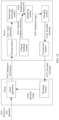
- the cloud game scenario in FIG. 1a includes a client and a server.
- a parsing module For example, a parsing module, a game logic processing module, a rendering module, an encoding module, and a transmission module are deployed on the server.
- the server may be an independent server, or may be a server cluster. This is not limited in this application.
- the parsing module may be configured to parse indication information.
- the game logic processing module may be configured to determine whether rendering is required.
- the rendering module may be configured to perform a rendering operation.
- the encoding module may be configured to encode data (for example, an image or a video), and may be an encoder (for example, a video encoder).
- the transmission module may be configured to transmit an encoded bitstream.
- the parsing module, the game logic processing module, the encoding module, and the transmission module may be deployed in a CPU (Central Processing Unit, central processing unit).
- the rendering module may be a graphics processing unit, or may be deployed in a graphics processing unit.
- the graphics processing unit is a microprocessor that performs image and graphics-related operations on a personal computer, a workstation, a game console, and some mobile devices (such as a tablet and a smartphone).
- the graphics processing unit may include a GPU (Graphics Processing Unit, graphics processing unit).
- the parsing module, the game logic processing module, and the transmission module may be deployed in the CPU, and the rendering module and the encoding module may be deployed in the GPU.
- a rendering process of a cloud game may be as follows:
- S101 The game application receives a user operation.
- the user may start the game application in the client as required, and perform various operations in the game application to play a game. Further, the game application may receive the user operation.
- the game application may generate, in response to the user operation, the indication information based on information related to the user operation, and send the indication information to the parsing module in the server.
- the parsing module sends a game instruction to the game logic processing module.
- the parsing module may parse the indication information to obtain the game instruction. Then, the parsing module sends the game instruction to the game logic processing module.
- the game logic processing module sends a rendering instruction to the rendering module.
- the game logic processing module may determine, according to the game instruction, whether rendering is required. If it is determined that rendering is required, the rendering instruction may be generated and sent to the rendering module.
- the rendering module sends a rendered image to the encoding module.
- the rendering module may perform a rendering operation in response to the rendering instruction, to obtain the rendered image. Then, the rendering module may send the rendered image to the encoding module.
- the encoding module sends an encoded bitstream to the transmission module.
- the encoding module may encode the rendered image to obtain the encoded bitstream corresponding to the rendered image; and then send the encoded bitstream to the transmission module.
- the encoding module may first divide the rendered image into a plurality of macroblocks, then divide each macroblock into a plurality of coding blocks, and then perform encoding on a basis of a coding block.
- an encoding process of the encoding module is as follows: For each coding block, a pixel value of a pixel in the current coding block may be predicted (that is, intra prediction) by using a pixel value of a pixel in a reconstructed region in a current frame.
- a matched reference coding block is found for the current coding block in a current frame, and a pixel value of a pixel in the reference coding block is used as prediction information of a pixel value of a pixel in the current coding block (this process may be referred to as motion estimation (Motion estimation, ME)); and a motion vector (Motion Vector, MV) pointing to the reference coding block, and indication information of an image frame in which the reference coding block is located are determined (that is, inter prediction).
- residual information may be obtained by subtracting the corresponding prediction information from the pixel value of the pixel in the current coding block.
- DCT discrete Cosine Transform
- the transmission module sends the encoded bitstream to the decoding module.
- the transmission module performs streaming (streaming) processing on the encoded bitstream, and sends and transmits streamed data.
- the transmission module may obtain the indication information from the parsing module, and parse the indication information to obtain a source address of the client.
- the transmission module may alternatively directly obtain the source address of the client from the parsing module.
- the transmission module may send the encoded bitstream to the client according to the source address.
- the decoding module sends a decoded image to the game application.
- the decoding module may decode the encoded bitstream to obtain the decoded image, and then return the decoded image to the game application.
- the encoding module encodes (in other words, compresses) the rendered image, image quality deteriorates. Therefore, the decoded image sent by the decoding module to the game application is different from the rendered image sent by the rendering module to the encoding module.
- a decoding process of the decoding module may be as follows: The decoding module first obtains residual information by performing operations such as entropy decoding, dequantization, and inverse transformation, and then determines whether intra predictive encoding or inter predictive encoding is used for a current coding block. If intra predictive encoding is used, prediction information is constructed by using a pixel value of a pixel in a surrounding reconstructed region and according to an intra prediction method used by the encoding module.
- motion information MV needs to be obtained through parsing
- a reference coding block is determined in a reconstructed image by using the motion information MV obtained through parsing, and a pixel value of a pixel in the block is used as prediction information (this process is referred to as motion compensation (Motion compensation, MC)).
- Reconstructed information can be obtained by combining the prediction information and the residual information and performing a filtering operation.
- the game application may display the decoded image, to display a game scene (an image or a video) corresponding to the user operation.
- a channel feedback module may be deployed on the server.
- the channel feedback module may be configured to perform S109, that is, send channel feedback information to the rendering module.
- S 109 may be performed simultaneously with any one of S101 to S108, or may be performed before or after any one of S101 to S108. This is not limited in this application.
- the channel feedback module may send the channel feedback information to the rendering module based on a preset feedback period.
- the preset feedback period may be set based on a requirement. This is not limited in this application.
- the rendering module may perform rendering based on rendering input information that is selected from a plurality of groups of preset rendering input information and that corresponds to the channel feedback information. Complexity of different groups of preset rendering input information is different, complexity of the preset rendering input information affects content complexity of an image obtained through rendering based on the preset rendering input information, and the content complexity of the image affects a size of an encoded bitstream (that is, higher content complexity of the image indicates a larger corresponding encoded bitstream, and lower content complexity of the image indicates a smaller corresponding encoded bitstream).
- the content complexity of the image is reduced by reducing the complexity of the rendering input information, so that bandwidth required for the encoded bitstream for transmitting the rendered image can be reduced. Further, subjective quality of an original image and video smoothness can be maintained (or maintained as much as possible). In this way, a video image watched by a user does not suddenly become blurry or freeze. This improves user experience.
- the channel quality is enhanced, larger bandwidth may be provided to transmit a bitstream, and further, content complexity of an image may be restored or partially restored (or enhanced) by restoring or partially restoring (or enhancing) the complexity of the rendering input information.
- each group of preset rendering input information may include at least one of the following: a preset three-dimensional object model, a preset motion model, a preset particle model, or a preset texture. It should be understood that the preset rendering input information may further include other input information that affects the content complexity of the image. This is not limited in this application.
- the preset rendering input information has a plurality of corresponding parameters.
- a parameter corresponding to the preset three-dimensional object model may include a quantity of vertices/faces.
- a parameter corresponding to the preset motion model may include a physical simulation unit granularity.
- rendering input information corresponding to the preset particle model may include various particle behavior parameters. In this case, complexity of the preset rendering input information may be determined based on the parameter corresponding to the preset rendering input information. When the preset rendering input information is an image, the complexity of the preset rendering input information may be determined based on image texture complexity.
- the content complexity of the image may be a comprehensive representation of factors such as fineness of object details in the image, complexity of object surface texture in the image, motion complexity of an object in the image, and particle motion complexity in the image (this factor exists when the image includes particle special effect).
- the motion complexity of the object in the image may be determined based on motion fineness of the object. Higher motion fineness of the object in the image indicates higher complexity of the object in the corresponding image. On the contrary, lower motion fineness of the object in the image indicates lower complexity of the object in the corresponding image.
- the motion fineness may refer to a size or a quantity of pixels of a region in which a similar motion or same motion is performed in a local region of an image.
- the particle motion complexity may be determined based on a particle behavior parameter, and the particle behavior parameter is described subsequently.
- FIG. 1a and FIG. 1b are merely examples of this application, and the client in this application has more modules or programs than those shown in FIG. 1a and FIG. 1b . This is not limited in this embodiment of this application.
- the server has more modules than those shown in FIG. 1a and FIG. 1b . This is not limited in this embodiment of this application.
- the parsing module, the game logic processing module, the encoding module, and the transmission module that are deployed in the CPU in FIG. 1a and FIG. 1b may be a whole, or may be mutually independent modules.
- the rendering module and the encoding module that are deployed in the GPU in FIG. 1a and FIG. 1b may be a whole, or may be mutually independent modules.
- the channel feedback module in FIG. 1b may be integrated into any one of the parsing module, the game logic processing module, the encoding module, the rendering module, and the transmission module, or may be independent of these modules.
- the CPU and the GPU in the server may not be divided into modules, but the CPU, the GPU, and the like of the server jointly complete the foregoing steps. This is not limited in this application.
- FIG. 2 is a diagram of an example of a rendering process.
- the encoded transmission channel may be a channel used to transmit an encoded bitstream corresponding to a rendered image.
- the encoded transmission channel may be a channel used to transmit the encoded bitstream in S106 and S 107 in FIG. 1a / FIG. 1b .
- the channel feedback information includes at least one of the following: network transmission bandwidth, a network transmission delay, a network jitter value, or a network packet loss rate. It should be understood that the channel feedback information may further include other information that affects transmission of the encoded bitstream, for example, an amount of blocked data. This is not limited in this application.
- the network transmission bandwidth represents a transmission capability of actually sending data on a channel.
- the network transmission delay refers to duration from a time when a bitstream corresponding to a frame starts to be sent to a time when the bitstream is acknowledged to be received or discarded.
- the network jitter value refers to a time difference between a maximum network transmission delay and a minimum network transmission delay.
- the network packet loss rate refers to a ratio of a quantity of lost data packets to a total quantity of transmitted data packets.
- the amount of blocked data is an amount of to-be-sent data or a quantity of frames currently stored in a buffer of a sending device (for example, a server).
- S202 Determine, from a plurality of groups of preset rendering input information, rendering input information corresponding to the channel feedback information.
- the plurality of groups of preset rendering input information may be prestored, complexity of different groups of preset rendering input information is different, and complexity of the preset rendering input information affects content complexity of an image obtained through rendering based on the preset rendering input information.
- one group of rendering input information corresponding to the channel feedback information may be searched for from the plurality of groups of preset rendering input information.
- a better channel status indicates higher complexity of the determined rendering input information.
- a worse channel status indicates lower complexity of the determined rendering input information.
- S203 Perform rendering based on the rendering input information corresponding to the channel feedback information, to obtain a rendered image.
- the rendering input information corresponding to the channel feedback information may be loaded into a three-dimensional scene, and then rendering is performed, to obtain the rendered image.
- content complexity of the rendered image is associated with complexity of the rendering input information corresponding to the channel feedback information.
- higher complexity of the rendering input information corresponding to the channel feedback information indicates higher content complexity of the rendered image.
- Lower complexity of the rendering input information corresponding to the channel feedback information indicates lower content complexity of the rendered image.
- rendering is performed based on the rendering input information whose complexity corresponds to a channel status, so that the content complexity of the rendered image adapts to the channel status, and a size of the encoded bitstream corresponding to the rendered image is adjusted based on a channel status of the encoded bitstream used to transmit the rendered image.
- the size of the encoded bitstream corresponding to the rendered image adapts to the channel status. This ensures subjective image quality and video smoothness of a video, and improves user experience.
- FIG. 3 is a diagram of an example of a rendering procedure.
- FIG. 3 is a graphics rendering pipeline for implementing rendering. It should be understood that FIG. 3 is merely an example of a graphics rendering pipeline.
- the graphics rendering pipeline used to implement rendering in this application may include more or fewer phases than those shown in FIG. 3 or include another phase, or rendering is implemented in another graphics rendering pipeline. This is not limited in this application.
- the rendering process may include the following plurality of phases: a vertex data input phase, a vertex shader phase, a tessellation phase, a geometry shader phase, a primitive assembly phase, a rasterization phase, a fragment shader phase, and a blending test phase.
- the tessellation phase and the geometry shader phase may be optional phases.
- an operation performed in the vertex data input phase is inputting vertex data.
- the vertex data may include attribute information of a vertex of a three-dimensional object model (which may also be referred to as a 3D (3-dimensional, three-dimensional) object model), for example, may include: vertex coordinates, texture coordinates, a vertex normal, a vertex color, and a connection relationship between vertices.
- a 3D scene may be created first, including setting an origin, a light source, a camera location, an observation parameter (for example, a location of a near plane, a location of a far plane, an aspect ratio, and a field of view) of the 3D scene, and the like. Then, the vertex data can be loaded into the created 3D scene.
- the 3D scene is created in world space.
- an operation performed in the vertex shader phase is performing coordinate transformation on the vertex coordinates.
- the 3D object model is created in model space, and the 3D scene is created in the world space. Therefore, after the 3D model is loaded into the 3D scene, coordinates of each vertex of the 3D object model may be separately changed from the model space to the world space.
- a camera is used as a viewpoint to observe an object in the 3D scene. Therefore, to ensure that all objects in the 3D scene are in a field of view, the vertex coordinates may be changed from the world space to observation space. For example, because only an object located between the near plane and the far plane can be observed, the vertex coordinates may be changed from the observation space to clip space, to clip a viewing frustum formed between the near plane and the far plane by using the camera as a viewpoint.
- an operation performed in the tessellation phase is subdividing a triangular face to increase a quantity of triangular faces on a surface of the object.
- an operation performed in the geometry shader phase is adjusting a quantity of primitives.
- a point or a line may be extended to a polygon, or an extension point or a line.
- the primitive may include a point, a line, a line strip, and a triangular face.
- an operation performed in the primitive assembly phase is assembling input vertices into a specified primitive.
- optimization related to clipping and back-face culling is performed to reduce a quantity of primitives in the rasterization phase and accelerate the rendering process.
- a screen mapping phase is further entered.
- Operations performed in the screen mapping phase are perspective division and viewport transform.
- the vertex coordinates are changed to screen space.
- an operation performed in the rasterization phase is converting continuous 3D objects into discrete screen pixels.
- an operation performed in the fragment shader phase is determining a final color of a pixel on a screen.
- illumination calculation, shadow processing, and textureping are performed.
- the test blending phase includes a test phase and a blending phase.
- the test phase includes a clipping test, an Alpha test ( ⁇ test), a template test, a depth test, and the like.
- the blending phase is used to determine, for each pixel, the final color of the pixel based on a result of the clipping test, a result of the Alpha test, a result of the template test, and a result of the depth test.
- physical simulation may be performed based on a motion model corresponding to the object, and then rendering is performed based on a physical simulation result, to obtain a video sequence including a plurality of frames of images, that is, a video sequence corresponding to the motion process of the object.
- Physical simulation may refer to parameterizing some attributes of an object in the real world, and modeling a feature like a motion of the object in reality with reference to an obtained parameter, to perform various virtual analysis and prediction on the obj ect.
- modeling is performed on the water flow, force of each part of the water flow is analyzed, physical simulation is performed with reference to a feature (like viscosity) of water, and then rendering is performed, to simulate dynamic effect close to reality.
- rendering may be performed based on a three-dimensional object model corresponding to each moment.
- particle rendering is a type of rendering, and is usually used to render various pieces of particle special effect such as smoke, fog, cloud, water, and fire.
- one video sequence may be obtained through rendering.
- a process of rendering one frame of image in the video sequence may be as follows:
- each group of preset rendering input information includes at least one of the following: a preset three-dimensional object model, a preset motion model, a preset particle model, or a preset texture. It should be understood that the preset rendering input information may further include other input information that affects content complexity of a rendered image. This is not limited in this application.
- FIG. 4a is a diagram of an example of a rendering process.
- a process of determining, when each group of preset rendering input information includes a preset three-dimensional object model, a three-dimensional object model corresponding to channel feedback information is described.
- W' i is network transmission bandwidth at an i th moment
- N1 is a quantity of moments included in the preset feedback period
- N1 is a positive integer
- A1 is the network transmission bandwidth in the preset feedback period.
- a network transmission delay in the channel feedback information may be an average value of network transmission delays at a plurality of moments in a preset feedback period.
- E1 is the network transmission delay in the preset feedback period
- N1 is a quantity of moments included in the preset feedback period
- N1 is a positive integer
- Y i is a network transmission delay at an i th moment.
- a network jitter value may be a difference between a maximum value of the network transmission delay and a minimum value of the network transmission delay in the preset feedback period.
- a network packet loss rate may refer to a ratio of an amount of data received by a client to a total amount of data sent by a server in the preset feedback period.
- S402 Determine, from a plurality of preset three-dimensional object models, a three-dimensional object model corresponding to the channel feedback information.
- the plurality of preset three-dimensional object models correspond to a same object, and complexity of the plurality of preset three-dimensional object models is different.
- the server stores preset three-dimensional object models corresponding to a plurality of objects (such as flowers, grasses, trees, buildings, tables, chairs, and mountains). For each object, a plurality of preset three-dimensional object models corresponding to the object are stored.
- objects such as flowers, grasses, trees, buildings, tables, chairs, and mountains.
- the preset three-dimensional object models correspond to different complexity.
- complexity of the preset three-dimensional object model may be determined based on a quantity of vertices of the preset three-dimensional object model.
- the quantity of vertices of the preset three-dimensional object model represents the complexity of the preset three-dimensional object model.
- a complexity level is determined based on the quantity of vertices of the preset three-dimensional object model, and the complexity level represents the complexity of the preset three-dimensional object model. This is not limited in this application.
- a larger quantity of vertices of the preset three-dimensional object model indicates higher complexity of the preset three-dimensional object model and finer preset three-dimensional object model.
- a smaller quantity of vertices of the preset three-dimensional object model indicates lower complexity of the preset three-dimensional object model and coarser preset three-dimensional object model.
- the complexity of the preset three-dimensional object model may be determined based on a quantity of faces.
- the quantity of faces of the preset three-dimensional object model represents the complexity of the preset three-dimensional object model.
- a complexity level is determined based on the quantity of faces of the preset three-dimensional object model, and the complexity level represents the complexity of the preset three-dimensional object model. This is not limited in this application.
- a larger quantity of faces of the preset three-dimensional object model indicates higher complexity of the preset three-dimensional object model and finer preset three-dimensional object model.
- a smaller quantity of faces of the preset three-dimensional object model indicates lower complexity of the preset three-dimensional object model and coarser preset three-dimensional object model.
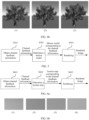
- FIG. 4b is a diagram of examples of preset three-dimensional object models.
- (1) in FIG. 4b, (2) in FIG. 4b, and ( 3 ) in FIG. 4b show three preset three-dimensional object models corresponding to a same tree, and all the three preset three-dimensional object models are face models.
- a quantity of faces of the preset three-dimensional object model in (1) in FIG. 4b is 30,000
- a quantity of faces of the preset three-dimensional object model in (2) in FIG. 4b is 70,000
- a quantity of faces of the preset three-dimensional object model in (3) in FIG. 4b is 150,000. It can be learned by comparing (1) in FIG. 4b, (2) in FIG. 4b , and ( 3 ) in FIG.
- a corresponding preset parameter range may be set based on complexity of the preset three-dimensional object model, and then an association between the preset three-dimensional object model and the corresponding preset parameter range is established.
- the preset parameter range may include at least one of the following: a network transmission bandwidth range, a network transmission delay range, a network jitter range, or a network packet loss rate range.
- Higher complexity of the preset three-dimensional obj ect model indicates a larger boundary value of the network transmission bandwidth range, a smaller boundary value of the network transmission delay range, a smaller boundary value of the network jitter range, and a smaller boundary value of the network packet loss rate range in the corresponding preset parameter range.
- lower complexity of the preset three-dimensional object model indicates a smaller boundary value of the network transmission bandwidth range, a larger boundary value of the network transmission delay range, a larger boundary value of the network jitter range, and a larger boundary value of the network packet loss rate range in the corresponding preset parameter range.
- the channel feedback information may be compared with preset parameter ranges respectively associated with the preset three-dimensional object models, to select, from the plurality of preset three-dimensional object models, the three-dimensional object model corresponding to the channel feedback information.
- the network transmission bandwidth included in the channel feedback information may be compared with a network transmission bandwidth range associated with the preset three-dimensional object model
- the network transmission delay included in the channel feedback information may be compared with a network transmission delay range associated with the preset three-dimensional object model
- the network jitter value in the channel feedback information may be compared with a network jitter range associated with the preset three-dimensional object model
- the network packet loss rate included in the channel feedback information may be compared with a network packet loss rate range associated with the preset three-dimensional object model.
- the preset three-dimensional object model may be determined as the three-dimensional object model corresponding to the channel feedback information.
- the preset parameter range may be a channel status range, and a channel status may be represented by channel status indication information determined based on information included in the channel feedback information (for example, represented by using a weighted value of the network transmission bandwidth, the network transmission delay, the network jitter value, and the network packet loss rate, weights of all the information included in the channel feedback information may be set as required, and this is not limited in this application).
- a channel status indication information determined based on information included in the channel feedback information (for example, represented by using a weighted value of the network transmission bandwidth, the network transmission delay, the network jitter value, and the network packet loss rate, weights of all the information included in the channel feedback information may be set as required, and this is not limited in this application).
- Higher complexity of the preset three-dimensional object model indicates a larger boundary value of the corresponding channel status range.
- lower complexity of the preset three-dimensional object model indicates a smaller boundary value of the corresponding channel status range.
- a weighted value of all information included in the channel feedback information may be calculated, and then the weighted value is compared with channel status ranges respectively associated with the preset three-dimensional object models.
- a preset three-dimensional object model associated with the channel status range may be determined as the three-dimensional object model corresponding to the channel feedback information.
- a complexity level corresponding to the preset three-dimensional object model is identified based on complexity of the preset three-dimensional object model. For example, higher complexity of the preset three-dimensional object model corresponds to a higher complexity level. Then, a complexity level fluctuation value set is determined based on a difference between any two complexity levels of all the complexity levels.
- FIG. 4b includes the three preset three-dimensional object models, a complexity level corresponding to (1) in FIG. 4b is L1, a complexity level corresponding to (2) in FIG. 4b is L2, and a complexity level corresponding to (3) in FIG. 4b is L3.
- a channel status change range corresponding to a complexity level fluctuation value +1 is [ ⁇ , 2 ⁇ )
- a channel status change range corresponding to a complexity level fluctuation value +2 is [2 ⁇ , 3 ⁇ )
- a channel status change range corresponding to a complexity level fluctuation value -1 is [-2 ⁇ , - ⁇ )
- a channel status change range corresponding to a complexity level fluctuation value -2 is [-3 ⁇ , -2 ⁇ ), where ⁇ is a positive number, and may be set based on a requirement. This is not limited in this application.
- a larger complexity level fluctuation value indicates a larger boundary value of the corresponding channel status change range.
- a channel status change degree may be determined based on channel feedback information obtained this time and channel feedback information obtained last time; and then a target channel status change range within which the channel status change degree falls may be determined. Then, the three-dimensional object model corresponding to the channel feedback information may be determined based on the complexity level fluctuation value associated with the target channel status change degree and the complexity level determined last time. For example, a target complexity level may be determined by a sum of the complexity level fluctuation value associated with the target channel status change degree and the complexity level determined last time; and then a preset three-dimensional object model corresponding to the target complexity level is determined as the three-dimensional object model corresponding to the channel feedback information.
- the complexity level fluctuation value is +1. If a complexity level corresponding to a three-dimensional object model used in previous rendering is L1, a preset three-dimensional object model whose complexity level is L2 may be used as a three-dimensional object model required in current rendering, that is, the three-dimensional object model corresponding to the channel feedback information.
- current channel status indicator information may be calculated based on the current channel feedback information, and previous channel status indicator information may be calculated based on the channel feedback information obtained last time. Then, a difference obtained by subtracting the previous channel status indicator information from the current channel status indicator information is determined as the channel status change degree.
- a difference obtained by subtracting the type of information obtained last time from the type of information obtained this time is calculated is a change value of the type of information. Then, the channel status change degree is determined based on change values of all information included in the channel feedback information.
- the three-dimensional object model corresponding to the channel feedback information may be determined from a plurality of preset three-dimensional object models corresponding to the object with reference to the foregoing description.
- S403 Perform rendering based on the three-dimensional object model corresponding to the channel feedback information, to obtain a rendered image.
- a rendering module may first load, in a three-dimensional scene, the three-dimensional object model corresponding to the channel feedback information, and then perform rendering. Further, if the channel feedback information is obtained and the three-dimensional object model corresponding to the channel feedback information is determined in a process of rendering a current frame, when a next frame is rendered, the three-dimensional object model corresponding to the channel feedback information is loaded and then rendered, to obtain a next frame of rendered image. In this way, content complexity of the obtained rendered image is associated with complexity of the three-dimensional object model.
- the three-dimensional object model may be generated in the 3D scene at a phase of an image rendering pipeline, and then rendering is performed (in this case, a model parameter of a three-dimensional object model that needs to be generated is input at a vertex data input phase). Further, if the channel feedback information is received and the three-dimensional object model corresponding to the channel feedback information is determined before the three-dimensional object model is generated in the image rendering pipeline, in a process of rendering the current frame in the image rendering pipeline, the three-dimensional object model corresponding to the channel feedback information may be generated, and then rendering is performed, to obtain a current frame of rendered image.
- the content complexity of the rendered image is associated with the complexity of the three-dimensional object model corresponding to the channel feedback information.
- higher complexity of the three-dimensional object model corresponding to the channel feedback information indicates higher fineness of object details in the rendered image and higher content complexity of the rendered image.
- Lower complexity of the three-dimensional object model corresponding to the channel feedback information indicates lower fineness of object details in the rendered image and lower content complexity of the rendered image.
- rendering is performed based on a three-dimensional object model whose complexity corresponds to a channel status, so that fineness of the object details in the rendered image adapts to the channel status, and a size of an encoded bitstream corresponding to the rendered image adapts to the channel status. This ensures subjective image quality and video smoothness of a video.
- the complexity of the three-dimensional object model corresponding to the channel feedback information is lower, a quantity of faces/vertices that need to be rendered is smaller, and further, complexity is lower, and a rendering speed is higher.
- the complexity of the three-dimensional object model corresponding to the channel feedback information is higher, the object details in the rendered image are finer, so that object details in the image can be increased. This improves user experience.
- FIG. 5 is a diagram of an example of a rendering process.
- a process of determining, when each group of preset rendering input information includes a preset motion model, a motion model corresponding to channel feedback information is described.
- S502 Determine, from a plurality of preset motion models, the motion model corresponding to the channel feedback information.
- the plurality of preset motion models correspond to a same motion process, and complexity of the plurality of preset motion models is different.
- a server stores preset motion models corresponding to a plurality of motion processes (such as a process in which a tree is blown by wind, a process in which water flows, a process in which snow melts, and a process in which a building shakes). For each motion process, a plurality of preset motion models corresponding to the motion process are stored. In this application, an example in which a plurality of preset motion models correspond to one motion process is used for description.
- the preset motion models correspond to different complexity.
- the preset motion model defines a physical simulation unit granularity.
- the physical simulation unit granularity is a granularity at which a three-dimensional object model is divided into units used for physical simulation, and a minimum value of the physical simulation unit granularity may be a face or a vertex.
- the complexity of the preset motion model may be determined based on the physical simulation unit granularity.
- the complexity of the preset motion model is represented by using the physical simulation unit granularity of the preset motion model.
- a complexity level is determined based on the physical simulation unit granularity of the preset motion model, and the complexity level represents the complexity of the preset motion model. This is not limited in this application.
- a larger physical simulation unit granularity of the preset motion model indicates lower complexity of the preset motion model.
- a smaller physical simulation unit granularity of the preset motion model indicates higher complexity of the preset motion model.
- a larger quantity of faces/vertices included in the physical simulation unit granularity indicates a larger physical simulation unit.
- an association between each preset motion model and a corresponding preset parameter range is established, or a complexity level corresponding to each motion model is determined, and an association between a complexity level fluctuation value and a channel status change range is established.
- the motion model corresponding to the channel feedback information is determined, based on the established associations, from the plurality of preset motion models.
- higher complexity of the preset motion model indicates a larger boundary value of a network transmission bandwidth range, a smaller boundary value of a network transmission delay range, a smaller boundary value of a network jitter range, and a smaller boundary value of a network packet loss rate range in the corresponding preset parameter range.
- lower complexity of the preset motion model indicates a smaller boundary value of the network transmission bandwidth range, a larger boundary value of the network transmission delay range, a larger boundary value of the network jitter range, and a larger boundary value of the network packet loss rate range in the corresponding preset parameter range.
- higher complexity of the preset motion model indicates a larger boundary value of a corresponding channel status range.
- lower complexity of the preset motion model indicates a smaller boundary value of the corresponding channel status range.
- higher complexity of the preset motion model corresponds to a higher complexity level.
- the motion model corresponding to the channel feedback information may be determined from a plurality of preset motion models corresponding to the motion process with reference to the foregoing description.
- a process of rendering each frame of the video sequence may be as follows: perform physical simulation on a corresponding three-dimensional object model based on the motion model corresponding to the channel feedback information, to obtain a physical simulation result; and perform rendering based on the physical simulation result, to obtain a frame of image.
- rendering may be performed based on a result of comparing the motion model corresponding to the channel feedback information determined for the current frame with the motion model corresponding to the channel feedback information determined for the previous frame, a frame interval between the current frame and the previous frame, and the motion model corresponding to the channel feedback information determined for the current frame, to obtain the current frame.
- rendering is performed by using the motion model corresponding to the channel feedback information in a process of rendering the next frame, to obtain a next frame of rendered image.
- content complexity of the rendered image is associated with complexity of the motion model corresponding to the channel feedback information.
- higher complexity of the motion model corresponding to the channel feedback information indicates higher motion complexity of an object in the rendered image and higher content complexity of the rendered image.
- Lower complexity of the motion model corresponding to the channel feedback information indicates lower motion complexity of the object in the rendered image and lower content complexity of the rendered image.
- rendering is performed based on the motion model whose complexity corresponds to a channel status, so that motion complexity of an object in a rendered video sequence adapts to the channel status.
- the motion complexity of the object in the image is lower, inter time domain correlation is higher, inter prediction is easier in an encoding process, compression is easier, and a bit rate of an encoded bitstream is lower. Therefore, a size of an encoded bitstream corresponding to the rendered image adapts to the channel status. This ensures subjective image quality and video smoothness of the video, and improves user experience.
- the complexity of the motion model corresponding to the channel feedback information when the complexity of the motion model corresponding to the channel feedback information is lower, a quantity of physical simulation units that require physical simulation is smaller, rendering complexity is lower, and a rendering speed is higher.
- the complexity of the motion model corresponding to the channel feedback information when the complexity of the motion model corresponding to the channel feedback information is higher, the motion complexity of the object in the rendered image is higher, and a motion process of the object displayed in a corresponding video sequence is more realistic. This improves user experience.
- FIG. 6a is a diagram of an example of a rendering process.
- a process of determining, when each group of preset rendering input information includes a preset texture, a texture corresponding to channel feedback information is described.
- S602 Determine, from a plurality of preset textures, a texture corresponding to the channel feedback information.
- the plurality of preset textures correspond to a same object, and texture complexity of the plurality of preset textures is different.
- a server stores preset textures corresponding to a plurality of objects (such as flowers, grass, trees, buildings, tables, chairs, mountains, and carpets). For each object, a plurality of preset textures corresponding to the object are stored. In this application, an example in which a plurality of preset textures correspond to one object is used for description.
- objects such as flowers, grass, trees, buildings, tables, chairs, mountains, and carpets.
- different preset textures correspond to different texture complexity.
- texture complexity of a preset texture may be determined in a plurality of manners. For example, a variance corresponding to an intensity histogram of the preset texture is calculated, and the variance is used to determine the texture complexity of the preset texture (for example, the variance of the preset texture represents the complexity of the preset texture; for another example, a complexity level is determined based on the variance of the preset texture, and the complexity level represents the complexity of the preset texture, and this is not limited in this application).
- a gradient of the preset texture is calculated, and the calculated gradient is used to determine the texture complexity of the preset texture (for example, the gradient of the preset texture represents the complexity of the preset texture; for another example, a complexity level is determined based on the gradient of the preset texture, and the complexity level represents the complexity of the preset texture, and this is not limited in this application).
- the texture complexity of the preset texture may alternatively be determined in another manner. This is not limited in this application.
- FIG. 6b is a diagram of examples of preset textures.
- FIG. 6b shows four preset textures with different texture complexity corresponding to a same carpet.
- texture complexity of the preset texture in (4) in FIG. 6b is greater than texture complexity of the preset texture in (3) in FIG. 6b
- texture complexity of the preset texture in (3) in FIG. 6b is greater than texture complexity of the preset texture in (2) in FIG. 6b
- texture complexity of the preset texture in (2) in FIG. 6b is greater than texture complexity of the preset texture in (1) in FIG. 6b .
- an association between each preset texture and a corresponding preset parameter range is established, or complexity levels corresponding to various textures are determined, and an association between a complexity level fluctuation value and a channel status change range is established. Then, the texture corresponding to the channel feedback information is determined, based on the established associations, from the plurality of preset textures.
- an association between each preset texture and a corresponding preset parameter range is established, or complexity levels corresponding to various textures are determined, and an association between a complexity level fluctuation value and a channel status change range is established.
- the texture corresponding to the channel feedback information is determined, based on the established associations, from the plurality of preset textures.
- higher complexity of the preset texture indicates a larger boundary value of a network transmission bandwidth range, a smaller boundary value of a network transmission delay range, a smaller boundary value of a network jitter range, and a smaller boundary value of a network packet loss rate range in the corresponding preset parameter range.
- lower complexity of the preset texture indicates a smaller boundary value of the network transmission bandwidth range, a larger boundary value of the network transmission delay range, a larger boundary value of the network jitter range, and a larger boundary value of the network packet loss rate range in the corresponding preset parameter range.
- higher complexity of the preset texture indicates a larger boundary value of a corresponding channel status range.
- lower complexity of the preset texture indicates a smaller boundary value of the corresponding channel status range.
- higher complexity of the preset texture corresponds to a higher complexity level.
- the texture corresponding to the channel feedback information may be determined from the plurality of preset textures corresponding to the object with reference to the foregoing description.
- S603 Perform rendering based on the texture corresponding to the channel feedback information, to obtain a rendered image.
- a process of mapping the three-dimensional object model in a segment shader phase may be as follows:
- the texture corresponding to the channel feedback information is stored in a memory, and a texture (the texture corresponds to the channel feedback information) of each three-dimensional object model may be read from the memory.
- a texture the texture corresponds to the channel feedback information
- a pixel that is corresponding to each vertex in the three-dimensional object model and that is on the texture corresponding to the channel feedback information may be determined based on texture coordinates corresponding to each vertex in the three-dimensional object model.
- each vertex in the three-dimensional object model is colored based on a color of the pixel that is corresponding to each vertex in the three-dimensional object model and that is on the texture corresponding to the channel feedback information.
- the texture corresponding to the channel feedback information is used to map the three-dimensional object model of the current frame.
- a current frame of rendered image may be obtained.
- the three-dimensional object model of a next frame is mapped by using the texture corresponding to the channel feedback information.
- content complexity of the rendered image is associated with complexity of the texture corresponding to the channel feedback information.
- higher complexity of the texture corresponding to the channel feedback information indicates higher texture complexity of an object surface in the rendered image and higher content complexity of the rendered image.
- Lower complexity of the texture corresponding to the channel feedback information indicates lower texture complexity of the object surface in the rendered image and lower content complexity of the rendered image.
- rendering is performed based on the texture whose complexity adapts to a channel status, so that the texture complexity of the object surface in the rendered image adapts to the channel status, and a size of an encoded bitstream corresponding to the rendered image adapts to the channel status.
- texture complexity of the texture corresponding to the channel feedback information when the texture complexity of the texture corresponding to the channel feedback information is lower, rendering complexity is lower, and a rendering speed is higher.
- texture complexity of the texture corresponding to the channel feedback information is higher, complexity of a surface texture of the object in the rendered image is higher. Further, details of a texture of the object in the image can be increased, so that the object in the image is more realistic. This improves user experience.
- FIG. 7a is a diagram of an example of a rendering process.
- a process of determining, when each group of preset rendering input information includes a preset particle model, a particle model corresponding to channel feedback information is described.
- S702 Determine, from a plurality of preset particle models, a particle model corresponding to the channel feedback information.
- the plurality of preset particle models correspond to same particle special effect, and complexity of the plurality of preset particle models is different.
- a server stores preset particle models corresponding to a plurality of pieces of particle special effect (such as fireworks, fog, flame, and explosion). For each particle special effect, a plurality of preset particle models corresponding to the particle special effect are stored. In this application, an example in which a plurality of preset particle models correspond to one piece of particle special effect is used for description.
- a plurality of preset particle models correspond to one piece of particle special effect is used for description.
- different preset particle models correspond to different model complexity.
- the preset particle model defines a particle behavior parameter.
- complexity of the particle model may be determined based on the particle behavior parameter.
- a quantity of particles in the preset particle model represents complexity of the preset particle model.
- a complexity level is determined based on the quantity of particles in the preset particle model, and the complexity level indicates the complexity of the preset particle model.
- the quantity of particles may be a quantity of particles in space at a moment, and is equal to a maximum quantity of particles that can be displayed in an image.
- a larger quantity of particles in the preset particle model indicates higher complexity of the preset particle model.
- a smaller quantity of particles in the preset particle model indicates lower complexity of the preset particle model.
- FIG. 7b is a diagram of examples of preset particle models.
- FIG. 7b shows three preset particle models with different complexity corresponding to same particle special effect.
- a quantity of particles in the preset particle model in (1) in FIG. 7b is 300
- a quantity of particles in the preset particle model in (2) in FIG. 7b is 500
- a quantity of particles in the preset particle model in (3) in FIG. 7b is 700. It can be learned by comparing (1) in FIG. 7b, (2) in FIG. 7b and ( 3 ) in FIG. 7b that complexity of the preset particle model in (2) in FIG. 7b is greater than complexity of the preset particle model in (1) in FIG. 7b
- complexity of the preset particle model in (3) in FIG. 7b is greater than the complexity of the preset particle model in (2) in FIG. 7b
- an association between each preset particle model and a corresponding preset parameter range is established, or complexity levels corresponding to various particle models are determined, and an association between a complexity level fluctuation value and a channel status change range is established. Then, the particle model corresponding to the channel feedback information is determined, based on the established associations, from the plurality of preset particle models. For details, refer to the description in the embodiment in FIG. 4a . Details are not described herein again.
- higher complexity of the preset particle model indicates a larger boundary value of a network transmission bandwidth range, a smaller boundary value of a network transmission delay range, a smaller boundary value of a network jitter range, and a smaller boundary value of a network packet loss rate range in the corresponding preset parameter range.
- lower complexity of the preset particle model indicates a smaller boundary value of the network transmission bandwidth range, a larger boundary value of the network transmission delay range, a larger boundary value of the network jitter range, and a larger boundary value of the network packet loss rate range in the corresponding preset parameter range.
- higher complexity of the preset particle model indicates a larger boundary value of a corresponding channel status range.
- lower complexity of the preset particle model indicates a smaller boundary value of the corresponding channel status range.
- higher complexity of the preset particle model corresponds to a higher complexity level.
- the particle model corresponding to the channel feedback information may be determined from the plurality of preset particle models corresponding to the particle special effect with reference to the foregoing description.
- S703 Perform particle rendering based on the particle model corresponding to the channel feedback information, to obtain the rendered image.
- particle rendering is performed based on the particle model corresponding to the channel feedback information in a process of rendering a next frame, to obtain a next frame of rendered image.
- a quantity of particles newly generated in the current frame, a particle attribute, and a particle needs to be eliminated are determined based on a result of comparing the particle model corresponding to the channel feedback information determined in the current frame with the particle model corresponding to the channel feedback information determined in the previous frame, a frame interval between the current frame and a next frame, and the particle model corresponding to the channel feedback information determined in the current frame. Then, a surviving particle is rendered into the current frame.
- content complexity of the rendered image is associated with complexity of the particle model corresponding to the channel feedback information.
- higher complexity of the particle model corresponding to the channel feedback information indicates higher particle complexity of the rendered image and higher content complexity of the rendered image.
- Lower complexity of the particle model corresponding to the channel feedback information indicates lower particle complexity of the rendered image and lower content complexity of the rendered image.
- particle rendering is performed based on the particle model whose complexity adapts to a channel status, so that particle motion complexity in the rendered image adapts to the channel status, and a size of an encoded bitstream corresponding to the rendered image adapts to the channel status. This ensures subjective image quality and video smoothness of a video, and improves user experience.
- model complexity of the particle model corresponding to the channel feedback information when model complexity of the particle model corresponding to the channel feedback information is lower, rendering complexity is lower, and a rendering speed is higher.
- the model complexity of the particle model corresponding to the channel feedback information is higher, the particle motion complexity in the rendered image is higher, and a particle motion process displayed in a corresponding video sequence is more realistic, so that particle special effect is more realistic. This improves user experience.
- each group of preset rendering input information includes any two or more of a preset three-dimensional object model, a preset motion model, a preset texture, and a preset particle model
- the foregoing corresponding embodiments may be combined to determine the rendering input information corresponding to the channel feedback information. Then, rendering is performed based on the determined rendering input information to obtain the rendered image. Details are not described herein again.
- the corresponding rendering input information may be determined based on the channel feedback information.
- current rendering input information is determined based on complexity of rendering input information determined last time. In this way, a switching frequency of the rendering input information can be reduced, and a quantity of preset rendering input information can be reduced.
- FIG. 8 is a diagram of an example of a rendering process.
- S802 Determine a channel status change degree based on the channel feedback information.
- the channel status change degree may be determined based on the description of S402. Details are not described herein again.
- S803 Determine whether the channel status change degree is greater than a preset change threshold.
- the channel status change degree may be compared with the preset change threshold, to determine whether to determine corresponding rendering input information based on the channel feedback information.
- the preset change threshold may be set based on a requirement. This is not limited in this application. For a process of determining the channel status change degree, refer to the foregoing description. Details are not described herein again.
- the corresponding rendering input information may be determined based on the channel feedback information, in other words, the rendering input information corresponding to the channel feedback information is determined from the plurality of groups of preset rendering input information.
- S804 refer to the descriptions of S402, S502, S602, and S702. Details are not described herein again.
- the corresponding rendering input information may be determined from the plurality of groups of preset rendering input information based on the complexity of the rendering input information determined last time.
- the preset rendering input information is a preset three-dimensional object model.
- a preset parameter range associated with a preset three-dimensional object model determined last time may be first determined, and the preset parameter range is used as a reference parameter range. Then, after a target object required for current rendering is determined, for the target object, a preset three-dimensional object model whose associated preset parameter range is the same as the reference parameter range may be searched for from a plurality of preset three-dimensional object models corresponding to the target object. The preset three-dimensional object model is determined as a three-dimensional object model required for the current rendering.
- a complexity level associated with a preset three-dimensional object model determined last time may be first determined, and the complexity level is used as a reference level. Then, after a target object required for current rendering is determined, for the target object, a preset three-dimensional object model whose complexity level is the same as the reference level may be searched for from a plurality of preset three-dimensional object models corresponding to the target object. The preset three-dimensional object model is determined as a three-dimensional object model required for the current rendering.
- S806 Perform rendering based on the rendering input information, to obtain a rendered image.
- FIG. 9 is a diagram of an example of a rendering apparatus, and the rendering apparatus may be configured to perform the method in the foregoing embodiment. Therefore, for beneficial effect that can be achieved by the rendering apparatus, refer to beneficial effect in the corresponding method provided above. Details are not described herein again.
- the rendering apparatus may include:
- the channel information obtaining module 901 obtains the channel feedback information of the encoded transmission channel from the channel feedback information module in FIG. 1b .
- the rendering input information corresponding to the channel feedback information includes at least one of the following: a three-dimensional object model, a motion model, a particle model, and a texture.
- the input information determining module 902 is specifically configured to: when each group of preset rendering input information includes a preset three-dimensional object model, determine, from a plurality of preset three-dimensional object models, a three-dimensional object model corresponding to the channel feedback information.
- the plurality of preset three-dimensional object models correspond to a same object, and complexity of the plurality of preset three-dimensional object models is different.
- the rendering module 903 is specifically configured to perform rendering based on the three-dimensional object model corresponding to the channel feedback information, to obtain the rendered image.
- the content complexity of the rendered image is associated with complexity of the three-dimensional object model corresponding to the channel feedback information.
- the preset three-dimensional object model is a face model, and complexity of the preset three-dimensional object model is determined based on a quantity of faces of the preset three-dimensional object model.
- the preset three-dimensional object model is a point cloud model, and complexity of the preset three-dimensional object model is determined based on a quantity of vertices of the preset three-dimensional object model.
- the input information determining module 902 is specifically configured to: when each group of preset rendering input information includes a preset motion model, determine, from a plurality of preset motion models, a motion model corresponding to the channel feedback information.
- the plurality of preset motion models correspond to a same motion process, and complexity of the plurality of preset motion models is different.
- the rendering module 903 is specifically configured to perform rendering based on the motion model corresponding to the channel feedback information, to obtain the rendered image.
- the content complexity of the rendered image is associated with complexity of the motion model corresponding to the channel feedback information.
- complexity of the preset motion model is determined based on a physical simulation unit granularity of the preset motion model, and the physical simulation unit granularity is a granularity at which a three-dimensional object model is divided into units used for physical simulation.
- the input information determining module 902 is specifically configured to: when each group of preset rendering input information includes a preset particle model, determine, from a plurality of preset particle models, a particle model corresponding to the channel feedback information.
- the plurality of preset particle models correspond to same particle special effect, and complexity of the plurality of preset particle models is different.
- the rendering module 903 is specifically configured to perform particle rendering based on the particle model corresponding to the channel feedback information, to obtain the rendered image.
- the content complexity of the rendered image is associated with complexity of the particle model corresponding to the channel feedback information.
- complexity of the preset particle model is determined based on a particle behavior parameter of the preset particle model.
- the input information determining module 902 is specifically configured to: when each group of preset rendering input information includes a preset texture, determine, from a plurality of preset textures, a texture corresponding to the channel feedback information.
- the plurality of preset textures correspond to a same object, and texture complexity of the plurality of preset textures is different.
- the rendering module 903 is specifically configured to perform rendering based on the texture corresponding to the channel feedback information, to obtain the rendered image.
- the content complexity of the rendered image is associated with texture complexity of the texture corresponding to the channel feedback information.
- the rendering apparatus further includes a change degree determining module, configured to determine a channel status change degree based on the channel feedback information.
- the input information determining module 902 is specifically configured to: when the channel status change degree is greater than a preset change threshold, determine, from the plurality of groups of preset rendering input information, the rendering input information corresponding to the channel feedback information. It should be noted that the change degree determining module may belong to the rendering module in FIG. 1 .
- the channel feedback information includes at least one of the following: network transmission bandwidth, a network transmission delay, a network jitter value, or a network packet loss rate.
- FIG. 10 is a block diagram of an apparatus 1000 according to an embodiment of this application.
- the apparatus 1000 may include a processor 1001 and a transceiver/transceiver pin 1002, and optionally, further includes a memory 1003.
- the bus 1004 further includes a power bus, a control bus, and a status signal bus.
- various buses are referred to as the bus 1004 in the figure.
- the memory 1003 may be configured to store instructions in the foregoing method embodiments.
- the processor 1001 may be configured to: execute instructions in the memory 1003, control a receive pin to receive a signal, and control a transmit pin to send a signal.
- the apparatus 1000 may be the electronic device or a chip of the electronic device in the foregoing method embodiments.
- This embodiment further provides a computer-readable storage medium.
- the computer-readable storage medium stores computer instructions.
- the computer instructions When the computer instructions are run on an electronic device, the electronic device is enabled to perform the foregoing related method steps to implement the rendering method in the foregoing embodiments.
- This embodiment further provides a computer program product.
- the computer program product When the computer program product is run on a computer, the computer is enabled to perform the foregoing related steps, to implement the rendering method in the foregoing embodiments.
- an embodiment of this application further provides an apparatus.
- the apparatus may be specifically a chip, a component, or a module.
- the apparatus may include a processor and a memory that are connected.
- the memory is configured to store computer-executable instructions.
- the processor may execute the computer-executable instructions stored in the memory, to enable the chip to perform the rendering method in the foregoing method embodiments.
- the electronic device, the computer-readable storage medium, the computer program product, or the chip provided in embodiments is configured to perform the corresponding method provided above. Therefore, for beneficial effect that can be achieved, refer to the beneficial effect in the corresponding method provided above. Details are not described herein.
- the disclosed apparatus and method may be implemented in other manners.
- the described apparatus embodiment is merely an example.
- division into the modules or the units is merely logical function division and there may be another division manner in actual implementation.
- a plurality of units or components may be combined or integrated into another system, or some features may be ignored or not performed.
- the displayed or discussed mutual couplings or direct couplings or communication connections may be implemented through some interfaces.
- the indirect couplings or communication connections between the apparatuses or units may be implemented in electronic, mechanical, or another form.
- the units described as separate parts may or may not be physically separate, and parts displayed as units may be one or more physical units, may be located in one place, or may be distributed on different places. Some or all of the units may be selected based on actual requirements to achieve objectives of solutions of embodiments.
- functional units in embodiments of this application may be integrated into one processing unit, each of the units may exist alone physically, or two or more units are integrated into one unit.
- the integrated unit may be implemented in a form of hardware, or may be implemented in a form of a software functional unit.
- the integrated unit When the integrated unit is implemented in the form of a software functional unit and sold or used as an independent product, the integrated unit may be stored in a readable storage medium. Based on such an understanding, the technical solutions of embodiments of this application essentially, or the part contributing to the conventional technology, or all or some of the technical solutions may be implemented in a form of a software product.
- the software product is stored in a storage medium and includes several instructions for instructing a device (which may be a single-chip microcomputer, a chip, or the like) or a processor (processor) to perform all or some of the steps of the methods described in embodiments of this application.
- the foregoing storage medium includes any medium that can store program code, for example, a USB flash drive, a removable hard disk, a read-only memory (read-only memory, ROM), a random access memory (random access memory, RAM), a magnetic disk, or an optical disc.
- a USB flash drive for example, a USB flash drive, a removable hard disk, a read-only memory (read-only memory, ROM), a random access memory (random access memory, RAM), a magnetic disk, or an optical disc.
- the software instruction may include a corresponding software module.
- the software module may be stored in a random access memory (Random Access Memory, RAM), a flash memory, a read only memory (Read Only Memory, ROM), an erasable programmable read only memory (Erasable Programmable ROM, EPROM), an electrically erasable programmable read only memory (Electrically EPROM, EEPROM), a register, a hard disk, a removable hard disk, a compact disc read-only memory (CD-ROM), or any other form of storage medium well-known in the art.
- a storage medium is coupled to a processor, so that the processor can read information from the storage medium and write information into the storage medium.
- the storage medium may be a component of the processor.
- the processor and the storage medium may be disposed in an ASIC.
- the computer-readable medium includes a computer-readable storage medium and a communication medium.
- the communication medium includes any medium that enables a computer program to be transmitted from one place to another.
- the storage medium may be any available medium accessible to a general-purpose or a special-purpose computer.
Landscapes
- Engineering & Computer Science (AREA)
- Multimedia (AREA)
- Physics & Mathematics (AREA)
- Computer Graphics (AREA)
- General Physics & Mathematics (AREA)
- Theoretical Computer Science (AREA)
- Signal Processing (AREA)
- Geometry (AREA)
- Software Systems (AREA)
- Image Generation (AREA)
Applications Claiming Priority (2)
| Application Number | Priority Date | Filing Date | Title |
|---|---|---|---|
| CN202210222772.4A CN116764188A (zh) | 2022-03-07 | 2022-03-07 | 渲染方法及电子设备 |
| PCT/CN2023/078241 WO2023169234A1 (zh) | 2022-03-07 | 2023-02-24 | 渲染方法及电子设备 |
Publications (2)
| Publication Number | Publication Date |
|---|---|
| EP4474030A1 true EP4474030A1 (de) | 2024-12-11 |
| EP4474030A4 EP4474030A4 (de) | 2025-05-07 |
Family
ID=87937175
Family Applications (1)
| Application Number | Title | Priority Date | Filing Date |
|---|---|---|---|
| EP23765812.5A Pending EP4474030A4 (de) | 2022-03-07 | 2023-02-24 | Darstellungsverfahren und elektronische vorrichtung |
Country Status (4)
| Country | Link |
|---|---|
| US (1) | US20250005857A1 (de) |
| EP (1) | EP4474030A4 (de) |
| CN (1) | CN116764188A (de) |
| WO (1) | WO2023169234A1 (de) |
Families Citing this family (1)
| Publication number | Priority date | Publication date | Assignee | Title |
|---|---|---|---|---|
| CN121681007B (zh) * | 2026-02-11 | 2026-05-08 | 宁波市海曙雪利曼电子仪表有限公司 | 一种基于异构多核架构的模拟器高性能渲染方法及系统 |
Family Cites Families (12)
| Publication number | Priority date | Publication date | Assignee | Title |
|---|---|---|---|---|
| US8264493B2 (en) * | 2008-05-12 | 2012-09-11 | Playcast Media Systems, Ltd. | Method and system for optimized streaming game server |
| WO2012078640A2 (en) * | 2010-12-06 | 2012-06-14 | The Regents Of The University Of California | Rendering and encoding adaptation to address computation and network bandwidth constraints |
| US9412332B2 (en) * | 2013-12-20 | 2016-08-09 | Blackberry Limited | Method for wirelessly transmitting content from a source device to a sink device |
| US9704270B1 (en) * | 2015-07-30 | 2017-07-11 | Teradici Corporation | Method and apparatus for rasterizing and encoding vector graphics |
| US11297346B2 (en) * | 2016-05-28 | 2022-04-05 | Microsoft Technology Licensing, Llc | Motion-compensated compression of dynamic voxelized point clouds |
| US10339692B2 (en) * | 2017-06-09 | 2019-07-02 | Sony Interactive Entertainment Inc. | Foveal adaptation of particles and simulation models in a foveated rendering system |
| US10916053B1 (en) * | 2019-11-26 | 2021-02-09 | Sdc U.S. Smilepay Spv | Systems and methods for constructing a three-dimensional model from two-dimensional images |
| US11830225B2 (en) * | 2018-05-30 | 2023-11-28 | Ati Technologies Ulc | Graphics rendering with encoder feedback |
| US11348283B2 (en) * | 2018-07-10 | 2022-05-31 | Samsung Electronics Co., Ltd. | Point cloud compression via color smoothing of point cloud prior to texture video generation |
| CN109600617B (zh) * | 2018-12-19 | 2020-07-21 | 北京东土科技股份有限公司 | 视频数据的编码、转发方法、装置、设备及存储介质 |
| US11665372B2 (en) * | 2019-01-07 | 2023-05-30 | Samsung Electronics Co., Ltd. | Fast projection method in video-based point cloud compression codecs |
| US11593967B2 (en) * | 2020-01-08 | 2023-02-28 | Samsung Electronics Co., Ltd. | Attribute transfer in V-PCC |
-
2022
- 2022-03-07 CN CN202210222772.4A patent/CN116764188A/zh active Pending
-
2023
- 2023-02-24 EP EP23765812.5A patent/EP4474030A4/de active Pending
- 2023-02-24 WO PCT/CN2023/078241 patent/WO2023169234A1/zh not_active Ceased
-
2024
- 2024-09-06 US US18/827,338 patent/US20250005857A1/en active Pending
Also Published As
| Publication number | Publication date |
|---|---|
| WO2023169234A1 (zh) | 2023-09-14 |
| EP4474030A4 (de) | 2025-05-07 |
| CN116764188A (zh) | 2023-09-19 |
| US20250005857A1 (en) | 2025-01-02 |
Similar Documents
| Publication | Publication Date | Title |
|---|---|---|
| US10636201B2 (en) | Real-time rendering with compressed animated light fields | |
| US9491433B2 (en) | Moving image distribution server, moving image playback apparatus, control method, and recording medium | |
| KR101536501B1 (ko) | 동화상 배포 서버, 동화상 재생 장치, 제어 방법, 기록 매체, 및 동화상 배포 시스템 | |
| US10504280B2 (en) | Accelerated occlusion computation | |
| CN102870412A (zh) | 在网络环境中提供编码视频应用 | |
| KR101491941B1 (ko) | 서버로부터 클라이언트로 3d 비디오 정보를 전송하기 위한 디바이스 및 방법 | |
| US11924442B2 (en) | Generating and displaying a video stream by omitting or replacing an occluded part | |
| US12626409B2 (en) | Encoding and decoding views on volumetric image data | |
| US20250324091A1 (en) | Device-cloud collaboration system, encoding and decoding method, and electronic device | |
| Tredinnick et al. | Progressive feedback point cloud rendering for virtual reality display | |
| US20250005857A1 (en) | Rendering method and electronic device | |
| US20250329056A1 (en) | Device-cloud collaboration system, encoding and decoding method, and electronic device | |
| US20170221174A1 (en) | Gpu data sniffing and 3d streaming system and method | |
| JP2022521701A (ja) | 画像信号を生成する装置および方法 | |
| CN121753060A (zh) | 用于运动估计和立体深度的网格拼接 | |
| RU2817803C2 (ru) | Сигнал изображения, представляющий сцену | |
| Balcisoy et al. | Hybrid participant embodiments in networked collaborative virtual environments | |
| TW201503048A (zh) | 動畫配送伺服器、動畫再生裝置、控制方法、程式、及記錄媒體 |
Legal Events
| Date | Code | Title | Description |
|---|---|---|---|
| STAA | Information on the status of an ep patent application or granted ep patent |
Free format text: STATUS: THE INTERNATIONAL PUBLICATION HAS BEEN MADE |
|
| PUAI | Public reference made under article 153(3) epc to a published international application that has entered the european phase |
Free format text: ORIGINAL CODE: 0009012 |
|
| STAA | Information on the status of an ep patent application or granted ep patent |
Free format text: STATUS: REQUEST FOR EXAMINATION WAS MADE |
|
| 17P | Request for examination filed |
Effective date: 20240902 |
|
| AK | Designated contracting states |
Kind code of ref document: A1 Designated state(s): AL AT BE BG CH CY CZ DE DK EE ES FI FR GB GR HR HU IE IS IT LI LT LU LV MC ME MK MT NL NO PL PT RO RS SE SI SK SM TR |
|
| A4 | Supplementary search report drawn up and despatched |
Effective date: 20250408 |
|
| RIC1 | Information provided on ipc code assigned before grant |
Ipc: A63F 13/52 20140101ALI20250402BHEP Ipc: H04N 21/81 20110101ALI20250402BHEP Ipc: H04N 19/166 20140101ALI20250402BHEP Ipc: A63F 13/358 20140101ALI20250402BHEP Ipc: A63F 13/355 20140101ALI20250402BHEP Ipc: A63F 13/33 20140101AFI20250402BHEP |
|
| DAV | Request for validation of the european patent (deleted) | ||
| DAX | Request for extension of the european patent (deleted) |