EP4474022A1 - Handrehabilitationsvorrichtung - Google Patents
Handrehabilitationsvorrichtung Download PDFInfo
- Publication number
- EP4474022A1 EP4474022A1 EP23177924.0A EP23177924A EP4474022A1 EP 4474022 A1 EP4474022 A1 EP 4474022A1 EP 23177924 A EP23177924 A EP 23177924A EP 4474022 A1 EP4474022 A1 EP 4474022A1
- Authority
- EP
- European Patent Office
- Prior art keywords
- finger
- wearer
- hand
- wrist
- sleeve
- Prior art date
- Legal status (The legal status is an assumption and is not a legal conclusion. Google has not performed a legal analysis and makes no representation as to the accuracy of the status listed.)
- Withdrawn
Links
Images


Classifications
-
- A—HUMAN NECESSITIES
- A63—SPORTS; GAMES; AMUSEMENTS
- A63B—APPARATUS FOR PHYSICAL TRAINING, GYMNASTICS, SWIMMING, CLIMBING, OR FENCING; BALL GAMES; TRAINING EQUIPMENT
- A63B23/00—Exercising apparatus specially adapted for particular parts of the body
- A63B23/035—Exercising apparatus specially adapted for particular parts of the body for limbs, i.e. upper or lower limbs, e.g. simultaneously
- A63B23/12—Exercising apparatus specially adapted for particular parts of the body for limbs, i.e. upper or lower limbs, e.g. simultaneously for upper limbs or related muscles, e.g. chest, upper back or shoulder muscles
- A63B23/16—Exercising apparatus specially adapted for particular parts of the body for limbs, i.e. upper or lower limbs, e.g. simultaneously for upper limbs or related muscles, e.g. chest, upper back or shoulder muscles for hands or fingers
-
- A—HUMAN NECESSITIES
- A63—SPORTS; GAMES; AMUSEMENTS
- A63B—APPARATUS FOR PHYSICAL TRAINING, GYMNASTICS, SWIMMING, CLIMBING, OR FENCING; BALL GAMES; TRAINING EQUIPMENT
- A63B21/00—Exercising apparatus for developing or strengthening the muscles or joints of the body by working against a counterforce, with or without measuring devices
- A63B21/02—Exercising apparatus for developing or strengthening the muscles or joints of the body by working against a counterforce, with or without measuring devices using resilient force-resisters
- A63B21/026—Bars; Tubes; Leaf springs
-
- A—HUMAN NECESSITIES
- A63—SPORTS; GAMES; AMUSEMENTS
- A63B—APPARATUS FOR PHYSICAL TRAINING, GYMNASTICS, SWIMMING, CLIMBING, OR FENCING; BALL GAMES; TRAINING EQUIPMENT
- A63B21/00—Exercising apparatus for developing or strengthening the muscles or joints of the body by working against a counterforce, with or without measuring devices
- A63B21/40—Interfaces with the user related to strength training; Details thereof
- A63B21/4001—Arrangements for attaching the exercising apparatus to the user's body, e.g. belts, shoes or gloves specially adapted therefor
- A63B21/4017—Arrangements for attaching the exercising apparatus to the user's body, e.g. belts, shoes or gloves specially adapted therefor to the upper limbs
- A63B21/4019—Arrangements for attaching the exercising apparatus to the user's body, e.g. belts, shoes or gloves specially adapted therefor to the upper limbs to the hand
-
- A—HUMAN NECESSITIES
- A63—SPORTS; GAMES; AMUSEMENTS
- A63B—APPARATUS FOR PHYSICAL TRAINING, GYMNASTICS, SWIMMING, CLIMBING, OR FENCING; BALL GAMES; TRAINING EQUIPMENT
- A63B21/00—Exercising apparatus for developing or strengthening the muscles or joints of the body by working against a counterforce, with or without measuring devices
- A63B21/40—Interfaces with the user related to strength training; Details thereof
- A63B21/4023—Interfaces with the user related to strength training; Details thereof the user operating the resistance directly, without additional interface
- A63B21/4025—Resistance devices worn on the user's body
-
- A—HUMAN NECESSITIES
- A63—SPORTS; GAMES; AMUSEMENTS
- A63B—APPARATUS FOR PHYSICAL TRAINING, GYMNASTICS, SWIMMING, CLIMBING, OR FENCING; BALL GAMES; TRAINING EQUIPMENT
- A63B23/00—Exercising apparatus specially adapted for particular parts of the body
- A63B23/035—Exercising apparatus specially adapted for particular parts of the body for limbs, i.e. upper or lower limbs, e.g. simultaneously
- A63B23/03508—For a single arm or leg
Definitions
- the present disclosure relates to hand rehabilitation training, in particular a hand rehabilitation device for being worn on a wearer's hand, for stretching the wearer's fingers by dorsal tension.
- Spasticity is a problem that occurs as a result of many neurological disorders (cerebral palsy, multiple sclerosis, stroke, traumatic brain injury, etc.).
- Cerebral palsy multiple sclerosis, stroke, traumatic brain injury, etc.
- both the fingers and the wrist can be in a constant involuntarily contracted state.
- the information traveling through the motor neurons to the muscles urges contraction, and prevents voluntary extension. Beyond a lack of motor control, the sensory information being sent back to the central nervous system is also frequently disrupted.
- a variable tension rehabilitation glove including a glove body configured to receive a hand of a user, a wrist band surround the wrist portion, and a plurality of tension bands connecting distal portions of finger portions to a movable tension device for varying the tension of the tension bands.
- US 5,538,488 A discloses a glove for exercising digits of a human hand.
- the device includes an inner glove for receiving a human hand therewithin. Digit cups are secured to the inner glove for receiving the outermost portion of each digit.
- a plurality of spring-loaded tension cables extend along a posterior of the glove and operate to resist motion of the glove during closing of the hand.
- An adjustment assembly effects tensioning of the cables to a desired resistance.
- the tension may generally be in proximal direction.
- the tension is along one or more tendons associated with extension of the respective finger and/or an anatomic direction of such tendon(s).
- the tension may help and/or correct (a direction of) extension of the finger.
- the flexible members may be fixed to the finger components.
- the hand sleeve may comprise plural finger openings to expose the fingers individually, e.g. protruding from the sleeve opening, preferably the sleeve comprises a single finger opening for accommodating and exposing all fingers and possibly part of the hand's palm, e.g. protruding from the sleeve opening.
- the sleeve comprises a separate thumb portion possibly for fully enclosing the thumb but preferably comprising a thumb opening for exposing the wearer's thumb, e.g. protruding from the thumb opening.
- Exposing the wearer's fingers may facilitate putting the finger components onto the fingers without a glove layer in between. Also or alternatively, tactile contact may be facilitated. Also or alternatively, putting on the hand sleeve, and therewith the device as a whole, is facilitated since the hand sleeve and the finger components may be put on separately from each other. The number of finger components (to be) connected may be selected as desired.
- the hand sleeve and finger components may be sized individually.
- the hand sleeve may be used as a hand and/or wrist brace without the finger components.
- a single bridge may suffice for the four fingers of a hand.
- the thumb may be considered separately.
- the device allows closing by a distal to proximal movement, e.g. pulling a zipper slider or another closure element, in a direction from the finger tips of the hand wearing the hand sleeve toward the body of the wearer, in correspondence with a natural movement for putting on the device and, facilitating that the wearer puts on at least the sleeve of the device without assistance.
- a distal to proximal movement e.g. pulling a zipper slider or another closure element
- the hand sleeve may have a reversibly closable or an unopenable portion for encircling the hand, e.g. one or more finger openings having a closed circumference and/or a thumb opening having a closed circumference, which circumference(s) may be permanently closed.
- the hand sleeve may comprise a blind end to the reversible closure, preferably a blind distal end, e.g. the zipper having an end that is closeable or even being permanently closed.
- a combination of a closed portion for encircling the hand and an openable portion for closing about the wrist and possibly about the thumb is found to facilitate significantly putting on the device by a wearer without assistance.
- a closure having a blind end may provide a staring for the closure and/or help that the closure requires relatively little force for drawing together sides of the opening and holding and/or attaching them together compared to two loose ends that have to be pulled together for the closing.
- a hand rehabilitation training device comprising a wrist component and one or more finger components removably connectable with the wrist component, the wrist component comprising a hand sleeve and one or more dorsal bridges movably connected to the hand sleeve via an adjustment mechanism for reversibly adjusting and securing a proximal-distal position of the bridge relative to the hand sleeve, wherein the hand sleeve accommodates the hand and wrist of a wearer, exposing the wearer's fingers, and the device comprises one or more flexible members removably connecting each finger component to one or more of the dorsal bridges to tension the flexible member(s) to one or more connected finger components, the device in particular being a hand rehabilitation training device according to any embodiment of a device as disclosed herein, wherein the hand sleeve accommodates the hand and wrist of a wearer, exposing the wearer's fingers, and wherein each of
- each of the one or more finger components comprises a comparably rigid backbone connected to the finger tip portion and finger base portion and configured for placement dorsally over and along the middle phalanx of a wearer's finger.
- the finger tip portion and finger base portion may be integrated, e.g be formed at least in part of a single piece of fabric.
- the comparably soft and pliable, and possibly comparably elastic portions may, e.g., be generally of a textile fabric such as an at least partly knitted and/or crocheted fabric, although wovens and/or non-wovens may be used as well, including leather.
- the finger component may comprise different portions of (predominantly) different materials such as different fabrics. Elastic sheets may be used also or alternatively.
- the material may be at least in part "breathable" and/or water transmissive, and may preferably be skin-contact compliant over prolonged periods.
- the finger component may comprise padding in one or more portions.
- the comparably soft and pliable, and possibly elastic, portion(s) of the finger component may allow freedom of movement of the hand and/or wrist, preferably substantially without hindrance, e.g. much like supple garments, knit gloves.
- the comparably rigid backbone may serve for one or more of attachment of the flexible element associated with the finger portion, directing the flexible element over the finger and/or palm of the hand, spreading tension and/or pressure over the finger and/or the finger component, assist securing position of the finger component on the finger.
- the backbone may be generally bending resistant or allow some bending, a flexibility possibly being selected dependent on a length of the backbone relative to the medial phalanx.
- a backbone may be formed of any suitable material, e.g. plastic, metal, leather, rubber, etc.
- a backbone preferably comprises a thermoplastic material for when heated above ambient temperatures deforming the backbone to conform to a wearer's anatomy and when cooled to ambient temperatures retaining the deformed shape, facilitating forming at least part of the backbone to a wearer's anatomy, and/or determining a particular range of motion of the finger.
- the flexible member may be attached, e.g. removably attached, to the backbone, preferably at a position corresponding to a middle of the middle phalanx of the wearer's finger, or a proximal end of the backbone.
- the backbone may assist directing a direction of the tension. This may one or more of facilitate connection and/or position and/or direction of the flexible member and the finger component, improve wearer comfort.
- the backbone may comprise one or more openings for accommodating one or more interphalangeal joints.
- the backbone comprises a distal opening and a proximal opening, associated with the distal and proximal interphalangeal joints, respectively. This may facilitate bending the finger, one or more of facilitate positioning and/or direction of the backbone and therewith any attached portion (e.g. a flexible member, a soft and pliable portions) and the finger component as a whole, improve wearer comfort.
- a hand rehabilitation training device comprising a wrist component and one or more finger components removably connectable with the wrist component, the wrist component comprising a hand sleeve and one or more dorsal bridges movably connected to the hand sleeve via an adjustment mechanism for reversibly adjusting and securing a proximal-distal position of the bridge relative to the hand sleeve, wherein the hand sleeve accommodates the hand and wrist of a wearer, exposing the wearer's fingers, and the device comprises flexible members removably connecting each finger component to the one or more dorsal bridges to tension the flexible member(s) to one or more connected finger components, the device in particular being a hand rehabilitation training device according to any embodiment of a device as disclosed herein, wherein the hand sleeve accommodates the hand and wrist of a wearer, exposing the wearer's fingers, and wherein the one or more finger components
- At least part of the hand sleeve may be comparably soft and pliable, and possibly being comparably elastic, e.g. being generally of a textile fabric such as an at least partly knitted and/or crocheted fabric, although wovens and/or non-wovens may be used as well, including leather.
- the hand sleeve may comprise different portions of (predominantly) different materials such as different fabrics. Elastic sheets may be used also or alternatively.
- the material may be at least in part "breathable" and/or water transmissive, and may preferably be skin-contact compliant over prolonged periods.
- the hand sleeve may comprise padding in one or more portions.
- the comparably soft and pliable, and possibly elastic, portion(s) of the hand sleeve may allow freedom of movement of the hand and/or wrist, preferably substantially without hindrance, e.g. much like garments.
- the same materials and associated considerations may equally apply to one or more of the finger components, see also below.
- the hand sleeve may comprise a comparably rigid brace.
- the brace is configured to generally resist or even prevent movement of the wrist and/or hand.
- the brace may comprise a palmar brace leg and/or a dorsal brace leg, for spanning in proximal-distal direction over the wrist, e.g. spanning over the carpus, such as spanning from overlapping part of the arm bones (radius, ulna) to overlapping part (preferably: most if not all of the metacarpus (palm of the hand).
- a position and/or range of motion of the wearer's hand may be supported and/or secured, and/or a base for the tension onto the fingers may be provided.
- the hand sleeve and brace may be integrated, possibly irremovably integrated but preferably the brace is removably secured to the hand sleeve, e.g. the hand sleeve may comprise a pocket for accommodating at least part of the brace.
- the brace may comprise both a palmar and a dorsal brace leg, connected by a back, which may stabilize the palmar and dorsal brace legs.
- the brace preferably is devoid of another back portion, which may facilitate sizing the hand sleeve and/or brace and/or which may facilitate putting the brace and/or the hand sleeve on.
- the back may be an ulnar back, passing over the ulnar hand back, then in particular and preferably being devoid of a radial connection between the palmar and a dorsal brace leg. This may facilitate freedom of movement of the thumb and/or prevent bulk and/or pressure on the hand between thumb and index finger.
- the back may comprise a distal recess associated with lateral abduction of the wearer's finger adjacent the back, e.g. ulnar abduction of the little finger in case of an ulnar back allowing spreading the fingers wide.
- the brace may be M-shaped, at least in a folded-out configuration, facilitating the lateral abduction while retaining robustness of the brace, e.g. providing a constant size (e.g. width and thickness) along (the shape of) the brace.
- the brace may be formed to conform to the wearer's anatomy, e.g. based on a print, a cast, and/or a (3D-)scan of the wearer's hand. At least part of the brace may be made by additive manufacturing. At least part of the bread may be made of metal and/or a plastic material.
- the device may be provided adjustable to adjust the brace to a wearer's anatomy, e.g. for optimizing operation and/or wearer comfort which may assist one or more of use, therapy, acceptance.
- the brace may comprise a thermoplastic material for when heated above ambient temperatures deforming the brace to conform to a wearer's anatomy and when cooled to ambient temperatures retaining the deformed shape, facilitating forming to a wearer's anatomy and/or determining a predetermined range of motion of the hand and/or wrist.
- the device may further comprise a releasable and/or openable wrist band for reversibly tightening and loosening a loop around the wearer's wrist and/or forearm, and/or for, e.g. from an open configuration, reversibly wrapping and closing a loop around the wearer's wrist and/or forearm and, respectively, from a closed configuration, opening the loop and unwrapping it from the wearer's wrist and/or forearm.
- the wrist band may assist keeping the wrist sleeve, and/or a brace if provided, in a desired position relative to one or more of the wearer's wrist, forearm, and hand.
- a position and/or range of motion and/or a base for the tension onto the fingers may be provided.
- the wrist band may secure the reversible closure, which it may cross and/or overlap.
- the adjustment mechanism of at least one of the dorsal bridges may comprise a rotary adjustment handle, e.g. a rotary button.
- the rotation may allow (continuous or stepwise) adjustment and/or locking of the rotary button to define continuous and/or stepwise position adjustment of the bridge.
- the rotary button may have a tightening mechanism by the rotation e.g. for reeling in a flexible adjustment member such as a string or band with which the bridge may be connected to the adjustment handle.
- the adjustment mechanism may have a release mechanism.
- the release mechanism may preferably be operable by another movement than the rotation, such as by moving at least part of the handle (e.g.
- buttons in axial direction (pushing or pulling) relative to an axis of rotation of the rotary adjustment handle, which may facilitate operation and/or construction of the adjustment mechanism and/or may prevent accidental operation of the adjustment mechanism.
- rotary adjustment mechanisms and buttons are commonly known and widely commercially available and therefore not further elucidated here.
- Rotation may facilitate operation by one hand, and/or may facilitate reeling in a flexible adjustment member and/or may facilitate substantially retaining a size associated with the adjustment mechanism and/or facilitate providing relatively large travel of the bridge without detachment of it.
- a convenient and predictable size may be provided.
- the flexible members may be elastic and/or be reversibly length adjustable between the finger components and the bridge, preferably in at least a distal position of the bridge. This may facilitate adjusting tension between the bridge and the finger component connected by the flexible member.
- the device may comprise a thumb section removably connected to the hand sleeve.
- the thumb section and hand sleeve may be configured for reversibly adjusting and securing a proximal-distal position of the thumb portion relative to the hand sleeve to tension to provide adjustable tension on the thumb section, e.g. to pull on the thumb section.
- the thumb section preferably may be provided with a flexible member just like the fingers / finger components.
- the tension may be arranged along one or more tendons associated with extension of the thumb and/or an anatomic direction of such tendon(s). Thus, the tension may help and/or correct (a direction of) extension of the thumb.
- the thumb may also be pulled, possibly without connection to the bridge, and/or by providing a separate bridge and/or a separate adjustment means.
- a tension direction on the thumb may differ from a general tension direction on the fingers; the flexible members of the fingers may be arranged dorsal over at least part of the respective fingers and the hand palm generally parallel to the respective fingers, whereas for the thumb it may be preferred that the tension direction be rather radial than substantially dorsal.
- the one or more finger components may comprise a loop portion for accommodating, e.g. encircling, a wearer's finger, the loop being openable for reversibly wrapping and closing the loop around the wearer's finger and, respectively, opening the loop and unwrapping it from the wearer's finger.
- the one or more finger components may comprise a finger tip portion comprising sleeve and/or a loop portion for accommodating, e.g. encircling, the finger tip of a wearer's finger, and/or a finger base portion comprising a loop portion for encircling the finger base segment (proximal phalanx) of a wearer's finger.
- One or each of the respective loops may be openable for, reversibly wrapping and closing the loop around the wearer's finger and, respectively, opening the loop and unwrapping it from the wearer's finger.
- Opening and closing the loops may obviate having to fit a finger in a finger component which may be painful of substantially impossible for a cramped finger.
- At least part of a finger component may be formed with touch screen sensitive material, in particular a finger tip portion.
- touch screen sensitive material in particular a finger tip portion.
- a wearer can operate touch screens while wearing (a finger component of) the device.
- an exposed finger portion may also allow or assist operation of a touch screen.
- the presently provided hand rehabilitation training device may serve as both a dynamic splint and as a compressive wrist sleeve.
- the former may be responsible for counteracting the contraction in the wrist and fingers, while still allowing some movement.
- the latter along with the open design may be responsible for encouraging blood flow and thus, sensory feedback.
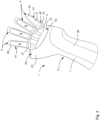
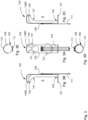
- Figs. 1-2 show embodiments of (parts of) a hand rehabilitation training device 1, comprising a wrist component 3 and one or more finger components 5 removably connectable with the wrist component 3.
- the wrist component 3 comprises a hand sleeve 7 and a dorsal bridge 9.
- the device 1 further comprises flexible members 11 each removably connecting a finger component 5 to the dorsal bridge 9 via hooks 10 or other connectors.
- one or more bridges could be provided and/or one or more bridges could be formed differently, e.g. being formed as a.
- the flexible members 11 associated with all four finger components 5 / all four fingers are attached to the same bridge 9, however, one or more finger components 5 could be omitted.
- the dorsal bridge 9 is movably connected to the hand sleeve 7 via an adjustment mechanism 13 comprising one or more flexible adjustment members 15, e.g. one or more pieces of strap or string, and an adjustment handle 17, here in the form of a rotary button
- the adjustment mechanism 13 is configured for reversibly adjusting and securing a proximal-distal position of the bridge 9 relative to the hand sleeve 7, by winding up / reeling in a portion of the flexible adjustment members 15.
- a reversible tightening mechanism is provided to tension, when the device 1 is worn on the hand and arm of a wearer (not shown), the flexible member(s) 11 to one or more connected finger components 5 worn on a wearer's finger (not shown).
- the adjustment members 15 may be retained by optional loops 19 or other structures to prevent snagging behind objects.
- a bridge could be attached with a single adjustment member 17 to one adjustment handle 17, or with plural adjustment mechanism 13 to plural adjustment handles 17.
- the hand sleeve 7 accommodates the hand and wrist of a wearer (not shown), exposing the wearer's fingers (not shown).
- a distal end 7D of the hand sleeve 7 comprises an unopenable sleeve portion providing an opening 21 for encircling the hand. In another embodiment, the distal end 7D may be reversibly openable (not shown).
- the hand sleeve 7 also comprises an optional thumb sleeve 23 and a thumb component 25 (only shown in Fig. 1 ) removably connected to the hand sleeve 7, here via a flexible members 27 connected with a hook 29 to loops 31 provided on the hand sleeve 7.
- the (distal end of the) thumb sleeve 23 comprises an unopenable portion providing an opening 33 for encircling the thumb.
- the hand sleeve 7 comprises a zipper 35 in proximal-distal direction of the hand sleeve 7 providing a reversibly openable portion for opening and closing a proximal end 7P of the hand sleeve 7 about the wearer's wrist.
- the zipper 35 has a blind end, being closed at a distal end 33D.
- At least part of the hand sleeve 7 is comparably soft and pliable and possibly being comparably elastic, e.g. being generally of one or more textile fabrics with or without padding, and the hand sleeve 7 comprises a comparably rigid brace 36 discussed further below.
- the hand sleeve 7 may be configured to closely fit about the hand, wrist and (distal portion of the) lower arm of the wearer (not shown); the hand sleeve 7 may be generally elastic so as to engage the wearer's anatomy along and substantially throughout the sleeve 7 as much as possible at a substantially constant local pressure so as to prevent local stress and/or cutting off blood flow.
- the device 1 further comprises one or more optional openable wrist bands 37 for reversibly wrapping and closing a loop around the wearer's wrist and/or forearm, and, respectively, opening the loop and unwrapping it from the wearer's wrist and/or forearm.
- the wrist band 37 is preferably arranged at a proximal end of the wrist component, configured to be attached under the wearer's wrist bone for facilitating maximum support.
- the wrist band 37 is preferably fixed to the wrist sleeve (not shown) and comprises an optional eye of ring 39 through which a leading free end of the wrist band 37 is fed and doubled back onto a trailing end of the wrist band 37. This may facilitate tightening the band 37.
- the band 37 may be provided with a releasable closure such as a buckle and/or a hook-and-loop-fabric type fastening system such as Velcro which may be preferred.
- the wrist band 37 may be tightened under the adjustment members 15 to prevent interference with (tenson control of) the adjustment members 15.
- the wrist band 37 also preferably is arranged to be separated from the adjustment handle 17.
- Each shown finger component 5 comprises a comparably soft and pliable portion 41, possibly being comparably elastic, e.g. being generally of one or more textile fabrics with or without padding, for attachment about a wearer's finger (not shown).
- the soft finger component portion 41 comprises a finger tip portion 43 for attachment about the finger tip of a wearer's finger (not shown) comprising a sleeve, and a finger base portion 45 for attachment about the base segment of the wearer's finger.
- the finger base portion 45 comprises a strap 47 for reversibly wrapping and forming a closed loop around the base (proximal) segment of the wearer's finger and, respectively, opening the loop and unwrapping it from the wearer's finger.
- Each shown finger component 5 comprises a comparably rigid backbone 49 attached to a dorsal side of the soft finger component portion 41.
- the backbones 49 are configured for placement dorsally over and along the middle phalanx of the respective wearer's finger (not shown).
- the backbones 49 comprise openings 51 for accommodating (flexion of) respective interphalangeal joints, which openings 51 may be formed into and/or through (as shown) the rigid material of the backbone 49.
- One or more of the openings 51 may expose the soft finger component portion 41 underneath the backbone 49, or may be open and expose the finger.
- the backbones 49 may be formed of any suitable material, e.g. plastic, metal, rubber, hard leather, etc. In another embodiment, not shown, one or more of the backbones 49 may be one or more of covered by, integrated with, and at least partly accommodated in, the soft finger component portion 41.
- the finger tip portion 43 and the finger base portion 45 (47) are separate and spaced from each other on a palmar side of the device, leaving a space S for exposing at least part of the middle phalanx of the wearer's finger.
- Figs. 2 , 4-5 indicate embodiments of the brace 36, 236.
- Fig. 5 shows the brace 36 of Fig. 2 in an unfolded state, wherein the brace has a general M-shape. In an unfolded state, the brace may be flat, e.g. the brace may be cut from a metal or a thermoplastic sheet. Other manufacturing methods may also be provided.
- Figs. 2 , 4-5 indicate embodiments of the brace 36, 236.
- Fig. 5 shows the brace 36 of Fig. 2 in an unfolded state, wherein the brace has a general M-shape. In an unfolded state, the brace may be flat, e.g. the brace may be cut from a metal or a thermoplastic sheet. Other manufacturing methods may also be provided.
- brace 36, 236 in use, formed to operably fit about the wearer's hand such that the brace comprises a palmar brace leg 53, 253 and a dorsal brace leg 55, 255 connected by an ulnar back 57, 257 to fit around the ulnar side of a wearer's hand (not shown).
- the back 57 in Figs. 2 and 5 is generally V-shaped and provides a distal recess 59 for lateral abduction of a wearer's finger adjacent the back, here the little finger (pinky).
- the back 57 in Figs. 2 and 5 is generally V-shaped and provides a distal recess 59 for lateral abduction of a wearer's finger adjacent the back, here the little finger (pinky).
- the back 57 in Figs. 2 and 5 is generally V-shaped and provides a distal recess 59 for lateral abduction of a wearer's finger adjacent the back, here the little finger (pinky).
- the distal portions of the dorsal side DD and the distal portion of the palmar side DP may be the same or differ for accommodating movement, as shown; the shown brace may be deformed by bending, starting from te folded-out geometry shown in Fig. 5 the legs 53, 55 "towards the viewer" as it were.
- the brace 236 of Fig. 4 may be, in an unfolded configuration generally U-shaped (not shown), so that in a configuration formed to operably fit about the wearer's hand the ulnar back may flare laterally outward as indicated.
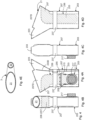
- Figs. 3 are schematic views in different directions of a finger component 105 of a hand rehabilitation training device as described herein.
- the backbone 149 is provided with a distal extension 49D providing a cap 43 over soft the finger tip portion 141.
- a flexible member 111 is attached in a medial portion of the backbone 149.
- finger components 5, 105 and/or others could be used with one wrist component, e.g. the wrist component of Figs. 1-2 , e.g. associated with different (degrees of) afflictions of different fingers.
- a property of preferred embodiments of the provided device is a combination of soft and hard materials in both the finger components and wrist component.
- the finger components can be individually clipped/slipped on, allowing independent use.
- the finger components have (elastic) tensioners, e.g. at the proximal side thereof and can be position-adjusted to a large extent via a continuous tensioner.
- the wrist component contains a hard brace and it can be slipped on.
- the present device is easily customizable by the tensioners, wrist sleeve and number of fingers.
- the device may be lightweight, not bulky and may allow for independent use in a domestic environment.
- the provided device comprises several separate components, which work together to open the wrist and fingers of a wearer into a functional position.
- the wrist brace may be made of thermoplastic which can be formed, e.g. molded to a wearer's anatomy. Further, the thickness of this component can be selected based on the required strength e.g. associated with a severity of the wearer's spasticity. This brace may be configured to maintain the wrist in a neutral position, thereby helping to alleviate spasticity and involuntary movements.
- An optional adjustable wrist strap goes around the forearm to stabilize the wrist component.
- the strap may be closable with any suitable closing means; a hook-and-loop-fabric type fastening system such as Velcro may be preferred as indicated; it is preferred that for closing, a leading end of the strap is fed through an eye and looped back, e.g. for closing onto a trailing end of the strap, for pulling on the eye reducing required force for closing and/or providing an anchoring point for the closing.
- the device also comprises one or more separate finger components. These are preferably made of semi rigid plastic, on the back of the digit and are attached to stretchy material.
- the finger components may all be individual, so as to alleviate struggling for a person who puts them on the fingers of the wearer, possibly the wearer personally putting one or more finger components on without assistance.
- the amount of fingers affected by spasticity can vary, and hence the number of finger components used, thus this acts as another level of customization.
- the finger components help stretch the fingers but also still allow movement that makes grabbing, grasping, daily activities and other finger movements possible. This may be facilitated by the pliable material of the finger components and the hard material conforming to a phalanx of the finger.
- the finger and wrist components are preferably attached via two adjustable mechanisms connected, e.g. hooked, together.
- the mechanisms may be continuous adjustable mechanisms.
- the first adjustable mechanism is attached to the finger components, e.g. the proximal end thereof and/or the hard part (also dubbed "backbone") thereof, and is made of a flexible material, possibly elastic, with an adjustment component.
- the adjustment member may comprise a slider which may allow continuous sliding and/or may be configured for adjustment to discrete positions. At an end of the member, there may be a connector, preferably a hook, which is, in use, attached to a bridge.
- the second adjustment mechanism may be continuous as well or adjustable to discrete increments, and/or the mechanism may comprise a rotary button or "wheel” attached to the wrist component, in particular the brace.
- This wheel is also attached to the bridge, preferably via flexible adjustment elements such as strings which more preferably have significantly lower elasticity than the flexible elements straps, e.g. having little to substantially no elasticity.
- the wheel can easily be adjusted with one hand and may be responsible for larger tensioning steps than the flexible straps. Note that more or fewer mechanism may be provided.
- the device may also provide compressive sensory feedback.
- the compression provided by the wrist component in particular the wrist sleeve, possibly assisted by the optional brace, may stabilize the hand, reducing tremors and involuntary movements.
- the wrist component could be applied for people with Parkinson's disease or arthritis as well.
- the wrist component could be provided individually, instead of being part of the device and then optionally the wrist component could also be devoid of the dorsal bridge and adjustment mechanism.
- the soft wrist sleeve covers part of the palm and back of the hand, the wrist and part of the forearm, e.g. going down about half of the forearm, and also comprises an optional sleeve for the thumb.
- the soft compressive wrist sleeve can be closed, e.g. zipped shut with one hand; the hand and thumb sleeve may anchor the sleeve against pulling force on the zipper and may facilitate closing the sleeve.
- the preferred finger components are also made of soft compressive material to which a semi rigid plastic backbone is attached.
- the finger components may contain a small finger-tip component into which one can place the finger.
- the tip component may be made of touch screen sensitive material.
- At the proximal end of the finger component e.g. at the proximal segment of the finger there is a strap which can be adjusted to the finger size and make putting the finger components on easily and independently.
- Most of the bottom of the finger, excluding the tip and bottom, is preferably open to allow for maximal sensory feedback. Exposure of parts of the palm and finger and optional textured surface of the wrist component enhance grip strength and dexterity, making it easier to hold objects and perform fine motor tasks.
- the hand sleeve of the wrist component applies gentle pressure to the affected hand, encouraging muscle relaxation and reducing spasticity.
- the device promotes a more comfortable hand and wrist position, thereby improving functional ability, encouraging independence and enhancing the quality-of-life for individuals with neurological conditions.
- the wrist component may be made of plastics and textiles, along with an adjustment wheel, a bridge and a zipper.
- the hand sleeve of soft material may include one hole for all fingers to go through together and a thumb sleeve.
- the bridge can be attached to the back of the glove, possibly removably attachable in discrete positions and an adjustment handle can be left out.
- a rotary adjustment handle may allow for very precise adjustments (which adjustment may be associated with controlled opening of the fingers).
- the adjustment mechanism may provide a quick release mechanism releasing tension in, and/or freeing of, the adjustment members 15.
Landscapes
- Health & Medical Sciences (AREA)
- Orthopedic Medicine & Surgery (AREA)
- General Health & Medical Sciences (AREA)
- Physical Education & Sports Medicine (AREA)
- Life Sciences & Earth Sciences (AREA)
- Biophysics (AREA)
- Orthopedics, Nursing, And Contraception (AREA)
Priority Applications (4)
| Application Number | Priority Date | Filing Date | Title |
|---|---|---|---|
| EP23177924.0A EP4474022A1 (de) | 2023-06-07 | 2023-06-07 | Handrehabilitationsvorrichtung |
| EP24730395.1A EP4724154A1 (de) | 2023-06-07 | 2024-06-07 | Handrehabilitationsvorrichtung |
| PCT/EP2024/065808 WO2024251989A1 (en) | 2023-06-07 | 2024-06-07 | Hand rehabilitation device |
| CN202480051346.6A CN121693371A (zh) | 2023-06-07 | 2024-06-07 | 手部康复设备 |
Applications Claiming Priority (1)
| Application Number | Priority Date | Filing Date | Title |
|---|---|---|---|
| EP23177924.0A EP4474022A1 (de) | 2023-06-07 | 2023-06-07 | Handrehabilitationsvorrichtung |
Publications (1)
| Publication Number | Publication Date |
|---|---|
| EP4474022A1 true EP4474022A1 (de) | 2024-12-11 |
Family
ID=86731975
Family Applications (2)
| Application Number | Title | Priority Date | Filing Date |
|---|---|---|---|
| EP23177924.0A Withdrawn EP4474022A1 (de) | 2023-06-07 | 2023-06-07 | Handrehabilitationsvorrichtung |
| EP24730395.1A Pending EP4724154A1 (de) | 2023-06-07 | 2024-06-07 | Handrehabilitationsvorrichtung |
Family Applications After (1)
| Application Number | Title | Priority Date | Filing Date |
|---|---|---|---|
| EP24730395.1A Pending EP4724154A1 (de) | 2023-06-07 | 2024-06-07 | Handrehabilitationsvorrichtung |
Country Status (3)
| Country | Link |
|---|---|
| EP (2) | EP4474022A1 (de) |
| CN (1) | CN121693371A (de) |
| WO (1) | WO2024251989A1 (de) |
Families Citing this family (1)
| Publication number | Priority date | Publication date | Assignee | Title |
|---|---|---|---|---|
| CN119925059A (zh) * | 2024-12-20 | 2025-05-06 | 北京力达康科技有限公司 | 一种特殊晶格结构的腕部3d打印康复支具及其制备方法 |
Citations (22)
| Publication number | Priority date | Publication date | Assignee | Title |
|---|---|---|---|---|
| US5373585A (en) | 1993-01-11 | 1994-12-20 | John Wiggins | Therapeutic glove |
| US5538488A (en) | 1995-06-08 | 1996-07-23 | Villepigue; James C. | Exercising glove |
| US5697103A (en) | 1993-01-11 | 1997-12-16 | Personal Expression I, Inc. | Therapeutic glove |
| US20030195093A1 (en) | 2002-04-11 | 2003-10-16 | White Daryl C. | Variable tension exercising glove |
| US20040049141A1 (en) | 2002-09-11 | 2004-03-11 | Slautterback E. Gerald | Universal wrist splint with removable dorsal stay |
| US7001352B2 (en) | 2002-02-25 | 2006-02-21 | Saebo, Inc. | Dynamic resting hand splint |
| US7601130B2 (en) | 2002-02-25 | 2009-10-13 | Saebo, Inc. | Dynamic hand splint |
| US20100234182A1 (en) * | 2009-01-15 | 2010-09-16 | Saebo, Inc. | Neurological device |
| US8328744B2 (en) | 2004-12-10 | 2012-12-11 | Saebo, Inc. | Dynamic hand splints |
| US8677514B1 (en) | 2013-01-25 | 2014-03-25 | Ronald E. Jones | Finger splaying glove |
| US9387110B2 (en) | 2013-03-05 | 2016-07-12 | The Kelly Clientele Group, Llc | Variable tension glove |
| WO2016117758A1 (ko) * | 2015-01-23 | 2016-07-28 | 주식회사 네오펙트 | 손 재활 운동 시스템 및 방법 |
| US9764190B2 (en) | 2012-06-13 | 2017-09-19 | Saebo, Inc. | Dynamic hand splints |
| CN110433462A (zh) | 2019-07-31 | 2019-11-12 | 山东大学 | 一种脑卒中手部康复训练音乐手套 |
| CN210872803U (zh) | 2019-06-28 | 2020-06-30 | 上海市嘉定区中心医院 | 手部康复训练装置 |
| CN211095754U (zh) | 2019-06-18 | 2020-07-28 | 襄阳市中心医院 | 一种便携式手偏瘫康复锻炼辅助装置 |
| CN211794500U (zh) | 2020-02-14 | 2020-10-30 | 南京林业大学 | 一种中风患者手指康复锻炼手套 |
| CN213965028U (zh) | 2021-01-06 | 2021-08-17 | 甘肃中医药大学附属医院 | 一种卒中后手部康复训练和保持良肢位的装置 |
| CN214388673U (zh) | 2021-03-08 | 2021-10-15 | 武汉市武昌医院 | 一种心内科康复用恢复锻炼装置 |
| CN113975747A (zh) | 2021-10-30 | 2022-01-28 | 买莹 | 一种手部烧伤用拉力锻炼用康复装置 |
| WO2022094736A1 (es) | 2020-11-04 | 2022-05-12 | Gogo Labs Spa | Dispositivo accesorio de mano y muñeca facilitador de movimientos de extension para personas |
| US20220218507A1 (en) | 2019-10-07 | 2022-07-14 | Neofect Co., Ltd. | Rehabilitation glove |
-
2023
- 2023-06-07 EP EP23177924.0A patent/EP4474022A1/de not_active Withdrawn
-
2024
- 2024-06-07 EP EP24730395.1A patent/EP4724154A1/de active Pending
- 2024-06-07 CN CN202480051346.6A patent/CN121693371A/zh active Pending
- 2024-06-07 WO PCT/EP2024/065808 patent/WO2024251989A1/en not_active Ceased
Patent Citations (22)
| Publication number | Priority date | Publication date | Assignee | Title |
|---|---|---|---|---|
| US5697103A (en) | 1993-01-11 | 1997-12-16 | Personal Expression I, Inc. | Therapeutic glove |
| US5373585A (en) | 1993-01-11 | 1994-12-20 | John Wiggins | Therapeutic glove |
| US5538488A (en) | 1995-06-08 | 1996-07-23 | Villepigue; James C. | Exercising glove |
| US7001352B2 (en) | 2002-02-25 | 2006-02-21 | Saebo, Inc. | Dynamic resting hand splint |
| US7601130B2 (en) | 2002-02-25 | 2009-10-13 | Saebo, Inc. | Dynamic hand splint |
| US20030195093A1 (en) | 2002-04-11 | 2003-10-16 | White Daryl C. | Variable tension exercising glove |
| US20040049141A1 (en) | 2002-09-11 | 2004-03-11 | Slautterback E. Gerald | Universal wrist splint with removable dorsal stay |
| US8328744B2 (en) | 2004-12-10 | 2012-12-11 | Saebo, Inc. | Dynamic hand splints |
| US20100234182A1 (en) * | 2009-01-15 | 2010-09-16 | Saebo, Inc. | Neurological device |
| US9764190B2 (en) | 2012-06-13 | 2017-09-19 | Saebo, Inc. | Dynamic hand splints |
| US8677514B1 (en) | 2013-01-25 | 2014-03-25 | Ronald E. Jones | Finger splaying glove |
| US9387110B2 (en) | 2013-03-05 | 2016-07-12 | The Kelly Clientele Group, Llc | Variable tension glove |
| WO2016117758A1 (ko) * | 2015-01-23 | 2016-07-28 | 주식회사 네오펙트 | 손 재활 운동 시스템 및 방법 |
| CN211095754U (zh) | 2019-06-18 | 2020-07-28 | 襄阳市中心医院 | 一种便携式手偏瘫康复锻炼辅助装置 |
| CN210872803U (zh) | 2019-06-28 | 2020-06-30 | 上海市嘉定区中心医院 | 手部康复训练装置 |
| CN110433462A (zh) | 2019-07-31 | 2019-11-12 | 山东大学 | 一种脑卒中手部康复训练音乐手套 |
| US20220218507A1 (en) | 2019-10-07 | 2022-07-14 | Neofect Co., Ltd. | Rehabilitation glove |
| CN211794500U (zh) | 2020-02-14 | 2020-10-30 | 南京林业大学 | 一种中风患者手指康复锻炼手套 |
| WO2022094736A1 (es) | 2020-11-04 | 2022-05-12 | Gogo Labs Spa | Dispositivo accesorio de mano y muñeca facilitador de movimientos de extension para personas |
| CN213965028U (zh) | 2021-01-06 | 2021-08-17 | 甘肃中医药大学附属医院 | 一种卒中后手部康复训练和保持良肢位的装置 |
| CN214388673U (zh) | 2021-03-08 | 2021-10-15 | 武汉市武昌医院 | 一种心内科康复用恢复锻炼装置 |
| CN113975747A (zh) | 2021-10-30 | 2022-01-28 | 买莹 | 一种手部烧伤用拉力锻炼用康复装置 |
Also Published As
| Publication number | Publication date |
|---|---|
| EP4724154A1 (de) | 2026-04-15 |
| WO2024251989A1 (en) | 2024-12-12 |
| CN121693371A (zh) | 2026-03-17 |
Similar Documents
| Publication | Publication Date | Title |
|---|---|---|
| US7537577B2 (en) | Low-profile, radial nerve splint with interchangeable resilient digit extensor elements and supination adjustment means | |
| US5787896A (en) | Method and apparatus for an ulnar collateral ligament thumb support | |
| US8328744B2 (en) | Dynamic hand splints | |
| US20190343670A1 (en) | Wearable Mobility Assisting Apparatus | |
| US5476439A (en) | Remedial hand wear article | |
| RU2423954C2 (ru) | Ременное устройство для растягивания пениса | |
| US20060149180A1 (en) | Low-profile, radial nerve splint with interchangeable resilient digit extensor elements | |
| US8235928B2 (en) | Functional low-profile dynamic extension splint and methods for its use and manufacture | |
| AU4941890A (en) | Exercice apparatus | |
| US20110005525A1 (en) | Method and apparatus for therapeutically supporting the arm of a patient | |
| US20130338556A1 (en) | Dynamic hand splints | |
| CN110062612A (zh) | 用于肌肉力量支持的装置和方法 | |
| CN102811690A (zh) | 手部康复装置 | |
| GB2552358A (en) | Rehabilitation device | |
| JP2008526321A (ja) | 動的副子アセンブリ | |
| WO2008036355A2 (en) | Druj brace with ulnar styloid accommodation | |
| US8366647B2 (en) | Apparatus and method for treating ulnar neuropathy | |
| TWM516411U (zh) | 手部動態矯型器 | |
| EP4474022A1 (de) | Handrehabilitationsvorrichtung | |
| CN110226998B (zh) | 矫形肩部支撑体 | |
| US6526591B2 (en) | Rehabilitation and exercise system | |
| US6662374B2 (en) | Rehabilitation & exercise system | |
| US20100217168A1 (en) | Orthosis | |
| EP3806965B1 (de) | Sportbekleidungsstück mit durchblutungsbeschränkung | |
| KR20040039241A (ko) | 악력장갑 |
Legal Events
| Date | Code | Title | Description |
|---|---|---|---|
| PUAI | Public reference made under article 153(3) epc to a published international application that has entered the european phase |
Free format text: ORIGINAL CODE: 0009012 |
|
| STAA | Information on the status of an ep patent application or granted ep patent |
Free format text: STATUS: THE APPLICATION HAS BEEN PUBLISHED |
|
| AK | Designated contracting states |
Kind code of ref document: A1 Designated state(s): AL AT BE BG CH CY CZ DE DK EE ES FI FR GB GR HR HU IE IS IT LI LT LU LV MC ME MK MT NL NO PL PT RO RS SE SI SK SM TR |
|
| STAA | Information on the status of an ep patent application or granted ep patent |
Free format text: STATUS: THE APPLICATION IS DEEMED TO BE WITHDRAWN |
|
| 18D | Application deemed to be withdrawn |
Effective date: 20250612 |