EP4472243A1 - System und/oder verfahren zur automatischen lautsprecherkalibrierung und lautsprecherkonfigurationslayoutschätzung - Google Patents
System und/oder verfahren zur automatischen lautsprecherkalibrierung und lautsprecherkonfigurationslayoutschätzung Download PDFInfo
- Publication number
- EP4472243A1 EP4472243A1 EP24175728.5A EP24175728A EP4472243A1 EP 4472243 A1 EP4472243 A1 EP 4472243A1 EP 24175728 A EP24175728 A EP 24175728A EP 4472243 A1 EP4472243 A1 EP 4472243A1
- Authority
- EP
- European Patent Office
- Prior art keywords
- loudspeaker
- loudspeakers
- mobile device
- signal
- audio
- Prior art date
- Legal status (The legal status is an assumption and is not a legal conclusion. Google has not performed a legal analysis and makes no representation as to the accuracy of the status listed.)
- Pending
Links
Images






Classifications
-
- H—ELECTRICITY
- H04—ELECTRIC COMMUNICATION TECHNIQUE
- H04S—STEREOPHONIC SYSTEMS
- H04S7/00—Indicating arrangements; Control arrangements, e.g. balance control
- H04S7/30—Control circuits for electronic adaptation of the sound field
- H04S7/301—Automatic calibration of stereophonic sound system, e.g. with test microphone
-
- H—ELECTRICITY
- H04—ELECTRIC COMMUNICATION TECHNIQUE
- H04R—LOUDSPEAKERS, MICROPHONES, GRAMOPHONE PICK-UPS OR LIKE ACOUSTIC ELECTROMECHANICAL TRANSDUCERS; DEAF-AID SETS; PUBLIC ADDRESS SYSTEMS
- H04R9/00—Transducers of moving-coil, moving-strip, or moving-wire type
- H04R9/06—Loudspeakers
-
- H—ELECTRICITY
- H04—ELECTRIC COMMUNICATION TECHNIQUE
- H04R—LOUDSPEAKERS, MICROPHONES, GRAMOPHONE PICK-UPS OR LIKE ACOUSTIC ELECTROMECHANICAL TRANSDUCERS; DEAF-AID SETS; PUBLIC ADDRESS SYSTEMS
- H04R5/00—Stereophonic arrangements
- H04R5/02—Spatial or constructional arrangements of loudspeakers
-
- H—ELECTRICITY
- H04—ELECTRIC COMMUNICATION TECHNIQUE
- H04R—LOUDSPEAKERS, MICROPHONES, GRAMOPHONE PICK-UPS OR LIKE ACOUSTIC ELECTROMECHANICAL TRANSDUCERS; DEAF-AID SETS; PUBLIC ADDRESS SYSTEMS
- H04R5/00—Stereophonic arrangements
- H04R5/027—Spatial or constructional arrangements of microphones, e.g. in dummy heads
-
- H—ELECTRICITY
- H04—ELECTRIC COMMUNICATION TECHNIQUE
- H04R—LOUDSPEAKERS, MICROPHONES, GRAMOPHONE PICK-UPS OR LIKE ACOUSTIC ELECTROMECHANICAL TRANSDUCERS; DEAF-AID SETS; PUBLIC ADDRESS SYSTEMS
- H04R5/00—Stereophonic arrangements
- H04R5/04—Circuit arrangements, e.g. for selective connection of amplifier inputs/outputs to loudspeakers, for loudspeaker detection, or for adaptation of settings to personal preferences or hearing impairments
-
- H—ELECTRICITY
- H04—ELECTRIC COMMUNICATION TECHNIQUE
- H04R—LOUDSPEAKERS, MICROPHONES, GRAMOPHONE PICK-UPS OR LIKE ACOUSTIC ELECTROMECHANICAL TRANSDUCERS; DEAF-AID SETS; PUBLIC ADDRESS SYSTEMS
- H04R9/00—Transducers of moving-coil, moving-strip, or moving-wire type
- H04R9/02—Details
-
- H—ELECTRICITY
- H04—ELECTRIC COMMUNICATION TECHNIQUE
- H04R—LOUDSPEAKERS, MICROPHONES, GRAMOPHONE PICK-UPS OR LIKE ACOUSTIC ELECTROMECHANICAL TRANSDUCERS; DEAF-AID SETS; PUBLIC ADDRESS SYSTEMS
- H04R2205/00—Details of stereophonic arrangements covered by H04R5/00 but not provided for in any of its subgroups
- H04R2205/024—Positioning of loudspeaker enclosures for spatial sound reproduction
-
- H—ELECTRICITY
- H04—ELECTRIC COMMUNICATION TECHNIQUE
- H04R—LOUDSPEAKERS, MICROPHONES, GRAMOPHONE PICK-UPS OR LIKE ACOUSTIC ELECTROMECHANICAL TRANSDUCERS; DEAF-AID SETS; PUBLIC ADDRESS SYSTEMS
- H04R2400/00—Loudspeakers
- H04R2400/11—Aspects regarding the frame of loudspeaker transducers
-
- H—ELECTRICITY
- H04—ELECTRIC COMMUNICATION TECHNIQUE
- H04S—STEREOPHONIC SYSTEMS
- H04S2400/00—Details of stereophonic systems covered by H04S but not provided for in its groups
- H04S2400/15—Aspects of sound capture and related signal processing for recording or reproduction
Definitions
- This application generally relates to the Attorney Docket No. P220104US (HARM0867PUS), U.S. application Serial No. 18/204,159, filed May 31, 2023 , entitled "APPARATUS, SYSTEM AND/OR METHOD FOR NOISE TIME-FREQUENCY MASKING BASED DIRECTION OF ARRIVAL ESTIMATION FOR LOUDSPEAKER AUDIO CALIBRATION" the disclosure of which is hereby incorporated in its entirety by reference herein.
- aspects disclosed herein generally relate to an apparatus, system, and/or method for noise - robust time-frequency masking-based direction of arrival estimation for loudspeaker audio calibration. These aspects and others will be discussed in more detail herein.
- loudspeaker manufacturers or providers may bring together various loudspeaker categories to form one ecosystem.
- various loudspeakers communicate or work with one another and/or with a mobile device. Therefore, such loudspeakers can achieve higher audio quality using immersive sound.
- Information related to the locations of the loudspeakers may be needed for immersive sound generation. Hence, auto-calibration may be needed before the loudspeakers can generate immersive sound.
- an audio system in at least one embodiment, includes a plurality of loudspeakers and a mobile device.
- the plurality of loudspeakers is capable of being positioned in a listening environment and being arranged to transmit an audio signal in the listening environment.
- Each loudspeaker is programmed to determine angle information of the audio signal as received at the loudspeaker relative to other loudspeakers of the plurality of loudspeakers and to transmit a first signal indicative of the angle information.
- the mobile device is programmed to receive the first signal from each of the loudspeakers and to determine a location for each loudspeaker in the listening environment based at least on the angle information.
- a method in at least another embodiment, includes transmitting, via a plurality of loudspeakers capable of being positioned in a listening environment, an audio signal in the listening environment and determining, by each loudspeaker, angle information of the audio signal as received at each loudspeaker relative to other loudspeakers of the plurality of loudspeakers and transmitting a first signal indicative of the angle information.
- the method further includes receiving, at a mobile device, the first signal from each of the loudspeakers and to determine a location for each loudspeaker in the listening environment based at least on the angle information.
- an audio system including a plurality of loudspeakers and a primary loudspeaker.
- the plurality of loudspeakers is capable of being positioned in a listening environment and being arranged to transmit an audio signal in the listening environment.
- Each is loudspeaker programmed to determine angle information of the audio signal as received at the loudspeaker relative to other loudspeakers of the plurality of loudspeakers and to transmit a first signal indicative of the angle information.
- the primary loudspeaker is programmed to receive the first signal from each of the loudspeakers and to determine a location for each loudspeaker in the listening environment based at least on the angle information.
- Loudspeakers are used to generate immersive sound effects.
- One aspect for immersive sound the need for auto-calibration to be performed to localize a position for the loudspeakers.
- One method for performing loudspeaker localization includes estimating an azimuth of the loudspeakers, which is also known as the direction of arrival estimation (DOA).
- DOA direction of arrival estimation
- the performance of DOA methods may be problematic for a low signal to noise ratio (SNR), i.e. , below 0 dB, since noise is a dominating signal for low SNR conditions.
- SNR signal to noise ratio
- noise may not be avoided for auto-calibration stage in realistic scenarios. Therefore, the noise-robust DOA estimation method is needed for the auto-calibration stage.
- the disclosed system and/or method utilize time-frequency (TF) masking, which may be used for source separation, as a preprocessing step for the DOA estimation method to achieve high performance under low SNR.
- TF masking may extract a desired signal from a noisy signal that is captured by microphones.
- Aspects provided herein also provide a signature signal which maximizes performance under low SNR conditions.
- the embodiment disclosed herein provides a TF masking-based DOA estimation using at least two microphones and a signature signal design that may be played back by the loudspeaker.
- noise-robust auto calibration is desirable for immersive sound generation using multiple loudspeakers.
- the disclosed embodiments provide noise-robust auto calibration to provide immersive sound generation.
- the disclosed system generally provides an accurate DOA estimation under low signal to noise ratio and reverberation for loudspeaker auto calibration. These aspects enable immersive sound generation and microphone array calibration.
- the disclosed system may accurately estimate the DOA for corner cases such as two loudspeakers are on, for example, a same line but not aiming at one another.
- TDOA time difference of arrival
- MUSIC multiple signal classification
- SRP steered response power
- the disclosed system provides a signature tone in the form of an inverse exponential sine sweep (ESS) signal which has been discovered to, among other things, provide an indication to a controller to in initiate loudspeaker autocalibration in noisy environments such as -10dB.
- ESS inverse exponential sine sweep
- FIGURE 1 depicts a system 100 for performing noise-robust time-frequency masking-based direction and loudspeaker auto calibration and loudspeaker configuration layout estimation in accordance with one embodiment.
- the system 100 includes a loudspeaker 102 having a plurality of microphones 106a - 106b (or "106"), a time frequency (TF) masking block 108, a signature frame detection block 110, a generalized cross-correlation (GCC) phase transform (PHAT) block 112, at least one controller 122 (“the controller 122"), and memory 130.
- the system 100 also includes a mobile device 150 having a matrix array 114, a microphone orientation estimation (MOE) block 116, an outlier detection block 118, an optimization block 120, and at least one controller 123 (hereafter "the controller 123"). It is recognized that the controller 123 may execute any instructions any of the functionality performed by the mobile device 150 as set forth herein. While FIGURE 1 illustrates a single loudspeaker 102, it is recognized that the system 100 includes any number of loudspeakers 102 positioned therein.
- MOE microphone orientation estimation
- At least one of the loudspeakers 102 transmits an audio signal including a signature tone 104 into a listening environment 151 to the other loudspeakers 102 in the system 100.
- the loudspeaker 102 generally includes at least two of the microphones 106a - 106b.
- the loudspeaker 102 may transmit an audio signal including the signature tone 104 into the listening environment 151.
- the microphones 106a - 106b positioned on a different loudspeaker 102 captures the audio signal including the signature tone 104.
- Each loudspeaker 102a and 102b includes memory 130.
- the memory 130 of the loudspeaker 102b stores the audio signal and the corresponding signature tone (or signature frame) 104 for processing.
- the TF masking block 108, the signature frame detection 110, the GCC PHAT block 112, and the controller 122 are implemented in all of the loudspeakers 102 that are present in the system 100.
- a first loudspeaker 102 receives the audio signal and corresponding signature tone 104 from the other loudspeakers 102.
- each loudspeaker 102 estimates the direction of arrival (DOA) of the audio signals received from the three other loudspeakers 102.
- the mobile device 150 includes one or more transceivers 155 to wirelessly receive the DOA estimations from each of the loudspeakers 102 in the system 100. It is also recognized that each of the loudspeakers 102 in the system 100 may also include one or more transceivers 152 to wirelessly transmit the estimated DOA information to the mobile device 150.
- the TF masking block 108 in the loudspeaker 102 reduces a noise effect associated with the captured audio signal as received from the other loudspeakers 102 in the system 100.
- the controller 122 applies the TF masking block 108 to each microphone input to reduce the noise effect.
- the signature frame detection block 110 estimates the signature tone 104 after the TF masking block 108 reduces the noise effect.
- the length of the signature tone 104 may be 200 msec.
- the loudspeaker 102 records the received audio, for example, for more than 200 msec since the loudspeaker 102 does not have knowledge of when the signature tone 104 is being played by the other loudspeaker 102.
- the loudspeaker 102 may be in a recording mode while the other loudspeaker 102 transmits the signature tone 104. It is generally desirable to detect the signature tone 104 for a long enough duration to correctly estimate the DOA. Receipt of the signature tone 104 on the audio signal may be indicative to the receiving loudspeaker 102 that the system 100 may be in autocalibration mode. In the autocalibration mode, the loudspeakers 102 may transmit information corresponding to the location of these loudspeakers 102 relative to the mobile device 150 (or other audio source).
- the controller 122 applies cross-correlation between signature tone 104, which is played by the transmitting loudspeaker 102 and the acquired audio.
- the cross-correlation, performed by the GCC PHAT block 112 provides the location of the signature tone 104 in a long recording. In this regard, the controller 122 utilizes this location to extract the signature tone 104. At this point, the extracted signature tone 104 is provided to the GCC-PHAT block 112.
- the controller 122 may then utilize the estimated DOA to perform auto-calibration of the loudspeaker 102b. These aspects will be discussed in more detail below.
- the controller 122 applies the TF masking operation as a pre-processing step for the DOA estimation.
- the TF masking block 108 may eliminate the most noise-dominated T-F bins in the audio signal to minimize the effects of noises and reverberations.
- a noisy input audio signal including the signature tone 104 is generally shown at 200 in connection with the FIGURE 2 .
- the noisy input audio signal including the signature tone 104 as shown in FIGURE 2 includes a noise sweep sine of between 6-7 kHz.
- the controller 122 in response to the TF masking block 108 performing the TF masking operation, extracts the signature tone 104 or signal from the noise mixture of the input audio signal.
- the TF masking block 108 employs techniques for source separation and speech enhancement.
- the TF masking block 108 receives the signature tone 104 to generate an enhanced signal.
- the controller 122 utilizes the signature tone 104 via the enhanced signal to generate a sample delay ⁇ .
- the controller 122 utilizes the sample delay ⁇ to determine the DOA of the received audio signal at the receiving loudspeaker 102.
- the TF masking-based techniques as noted above may include ideal binary mask (IBM), ideal ratio mask (IRM), a complex ideal ratio mask (cIRM), an optimal ratio mask (ORM), etc.
- IBM ideal binary mask
- IRM ideal ratio mask
- cIRM complex ideal ratio mask
- ORM optimal ratio mask
- Equation 1 may be found, for example, in " The Optimal Ratio Time-Frequency Mask for Speech Separation in Terms of Signal-to-Noise Ratio", The Journal of the Acoustical Society of America 134, no. 5 (2013): EL452 - EL458 .
- S ( t , f ) is the frequency response of the signature signal (or the signature tone 104)
- N ( t , f ) represents a noise spectrum
- ⁇ is the smoothing factor. Since the overall knowledge of the signature tone 104, S ( t , f ) can be calculated.
- the denominator in equation (1) may be the captured signal at the microphones 106a - 106b.
- the controller 122 calculates the mask
- the enhanced signal can be calculated using the multiplication of the captured signal with the mask as in equation (2).
- E t f IRM t f ⁇ Y t f
- E ( t , f) represents the enhanced signal which is a two-channel signal given that the two microphones 106a and 106b of the receiving loudspeaker 102 each receive the incoming audio signal including the signature tone 104.
- Y ( t , f ) corresponds to the captured signal at the microphones 106a - 106b.
- the enhanced signal may correspond to the signal as generally shown at 202 in FIGURE 2 where the noise is removed from the captured audio signal.
- FIGURE 3 depicts an example of a recorded signal 300 provided by the TF masking block 108 of the loudspeaker 102 in accordance with one embodiment.
- the recorded signal 300 corresponds to an output that is provided by the TF masking block 108 after the TF masking block 108 performs the masking operation.
- the recorded signal 300 provided by the TF masking block 108 may comprise a long string of audio data 302 that includes silence/noise and the signature tone 104.
- the signature tone 104 is generally bounded by a frame 304.
- the two audio signals as shown in FIGURE 3 correspond to one audio signal received at the microphone 106a and another audio signal received at the microphone 106b which are then processed by the TF masking block 108.
- the controller 122 utilizes cross-correlation between the audio data 302 and the signature tone 104 to detect the frame 304.
- the controller 122 detects an enhanced version of the frame 304 (e.g., the signature tone 104 and acquired audio signal (e.g., which corresponds to the recorded signal 300, the audio data 302, and the frame 304)) to detect a start time of the frame 304.
- the GCC PHAT block 112 then receives as an input the frame 304.
- the GCC PHAT block 112 processes the output of the signature frame detection block 110 to provide the estimated DOA for the captured audio signals transmitted by at least the loudspeaker 102.
- One example of the GCC PHAT operation is set forth in " The Generalized Correlation Method for Estimation of Time Delay", IEEE transactions on acoustics, speech, and signal processing 24, No. 4 (1976): 320 - 327 which is incorporated herein by reference in its entirety.
- the loudspeakers 102 in the system 100 may provide (or wirelessly transmit) the estimated DOA reading to the mobile device 150 (see FIGURE 1 ).
- the mobile device 150 may be a cell phone, laptop, desktop, etc.
- the loudspeaker 102 in the system 100 may include one or more transceivers 152 to wirelessly transmit and receive information (including estimate DOA readings) to one another and/or to the mobile device 150
- the GCC PHAT block 112 may utilize a single-path wave propagation of sound waves from a single sound source signal s(n) that is provided by a sound source (or any one of the loudspeakers 102).
- the microphones 106a and 106b receive the signal s(n) as received signals x 1 ( n ) and x 2 ( n ) that are delayed and attenuated versions of the original sound signal s ( n ).
- the controller 122 may determine a time delay between the received signals x 1 ( n ) and x 2 ( n ) by finding a max of cross correlation of x 1 ( n ) and x 2 ( n )
- R x 1 x 2 ⁇ X 1 ⁇ X 2 ⁇ ⁇
- Equation 3 represents the cross-correlation between x 1 ( n ) and x 2 ( n ).
- Equation 4 is the cross-power density, which is obtained by taking the product of frequency response of x 1 ( n ) and x 2 ( n ).
- Equation 5 illustrates the PHAT processor (of the GCC PHAT block 112). The inverse Fourier transform is applied to obtain the cross-correlation between x 1 ( n ) and x 2 ( n ) as shown in equation 6.
- the sample delay ⁇ is calculated by finding a max of cross correlation of x 1 ( n ) and x 2 ( n ) in equation 7.
- the GCC Phat block 112 estimates a phase difference between the audio captured between the microphones 106a and 106b.
- the phase difference generally corresponds to ⁇ (or angle information) as set forth in equation 8.
- the controller 122 utilizes, among other things, an inverse cosine to convert the phase difference to an enable as set forth in equation 8.
- the manner in which the controller 122 determines the sample delay ⁇ is shown in FIGURE 4 .
- FIGURE 5 depicts various signature tone signals 500, 502 in accordance with one embodiment.
- the signature tone 500 includes energy that sits under 4 kHz.
- the signature tone 500 may be generated based on an exponential sine sweep (ESS). In this case, it may be more desirable to provide a signature signal that includes more energy at high frequencies for higher noise-based environments to perform the estimated DOA.
- the signature tone signal 502 is generated based on an inverse ESS.
- Figure 5 illustrates that both of the signature tone signals 500, 502 are in the frequency domain.
- the signature tone signal 502 has a higher amplitude after 1 kHz, which prevents the signature tone signal 502 from being distorted by background noise.
- the signature tone 104 as generated by the first or the second loudspeakers 102a, 102b may be based on the inverse ESS from a predetermined frequency range that may be 700 Hz to 10 kHz and having a predetermined length of, for example, 150 ms at a predetermined frequency of, for example, 48 kHz.
- the disclosed system 100 generally provides an accurate DOA estimation under low signal to noise ratio and reverberation for loudspeaker auto calibration. These aspects enable immersive sound generation and microphone array calibration.
- the disclosed system may accurately estimate the DOA for corner cases such as two loudspeakers are on, for example, a same line but not aiming at one another.
- the signature tone signal 500, 502 (e.g., the inverse EES signal) has been discovered withstand high noise environments of at least -10 dB level.
- the inverse ESS signal has been found to be uninfluenced in high noise environments of at least - 10 dB which serves to provide an adequate signal to trigger autocalibration and determination of the DOA for the various loudspeakers 102 in the system 100.
- the loudspeakers 102 in the system 100 are configured to communicate with one another.
- Each of the first and the second loudspeakers 102a, 102b may provide high audio quality while utilizing immersive sound.
- the immerse sound technology depends on the locations of the first and the second loudspeakers 102a, 102b.
- the immersive sound technology requires an auto loudspeaker calibration process.
- One way to perform auto-calibration entails providing an estimate of an azimuth of the loudspeaker, also known as the DOAs.
- the DOA for an audio signal transmitted from each loudspeaker can be detected by playing the signature tone from one speaker at a time.
- the angles (or DOAs) from the different speakers are then used to create the speaker configuration in the room.
- obtaining the estimate of the azimuth may be erroneous due to environmental conditions and locations of the loudspeakers. Such errors may occur primarily when the loudspeakers are not aimed at one another (e.g., due to loudspeaker directivity), and the background noise has more energy than the signature tone.
- the system 100 as disclosed herein provides multiple DOA estimations for optimization loudspeaker location and estimating the loudspeaker layout configuration for two or more loudspeakers.
- the system 100 also provides an accurate representation of the loudspeaker configuration which is required for true immersive experience.
- the disclosed embodiments may increase robustness and overcome the above noted environmental conditions.
- the disclosed embodiments may provide (i) an accurate loudspeaker configuration estimation, (ii) loudspeaker orientation estimation, (iii) detection of DOA estimation outliers while taking into account background noise, reverberation, and obstruction, and (iv) optimizing the loudspeaker configuration estimation based on previous DOA estimations and outlier detection.
- the system 100 further includes a matrix block 114, a microphone orientation estimation block 116, and outlier detection block 118, and an optimization block 120.
- the matrix block 114 stores DOA estimates for each of the first and the second loudspeakers 102a, 102b.
- the microphone orientation estimation block 116 estimates an orientation for each of the microphones 106a and 106b as positioned on the loudspeakers 102.
- the outlier detection block 118 detects outliers that may be present in the matrix formed by the matrix block 114.
- the optimization block 120 performs reference microphone selection, an initial layout estimation, candidate coordinate estimations, and best coordinates selection. These aspects will be discussed in more detail below.
- FIGURE 6 depicts a method 600 for performing an optimized loudspeaker auto calibration and a loudspeaker configuration estimation in accordance with one embodiment.
- the microphone orientation estimation block 116 estimates an orientation for the microphones 106a and 106b. This operation will be discussed in more detail in connection with FIGUREs 8 and 9 .
- the outlier detection block 118 detects outliers that may be present in the matrix formed by the matrix block 114 with respect to the DOAs. This operation will be discussed in more detail in connection with FIGUREs 10 - 11 .
- the optimization block 120 performs a reference microphone selection. This operation will be discussed in more detail in connection with FIGURE 12 .
- the optimization block 120 performs an initial layout estimation using DOA estimations. This operation will be discussed in more detail in connection with FIGURE 13 .
- the optimization block 120 calculates candidate coordinate estimations. This operation will be discussed in more detail in connection with FIGUREs 14 - 16 .
- the optimization block 120 selects best coordinates. This operation This operation will be discussed in more detail connection with FIGUREs 17 - 18 .
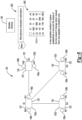
- FIGURE 7 depicts an example of the loudspeaker and microphone configuration 700 in the system 100 in accordance with one embodiment.
- the configuration 700 includes the loudspeakers 102 of FIGURE 1 .
- the loudspeakers 102 of FIGURE 1 are generally shown as a first loudspeaker 102a, a second loudspeaker 102b, a third loudspeaker 102c, and a fourth loudspeaker 102d with reference to FIGURE 7 and hereafter.
- any number of loudspeakers may be provided.
- Each of the first, second, third, and fourth loudspeakers 102a, 102b, 102c, and 102d include the first and the second microphones 106a and 106b.
- each of the first, second, third, and fourth loudspeakers 102a, 102b, 102c, and 102d include the controller 122, the memory 130, and the transceiver 152.
- each of the first, second, third, and fourth loudspeakers 102a, 102b, 102c, and 120d include the TF masking block 108, the signature frame detection block 110, and the GCC PHAT block 112.
- the mobile device 150 includes the matrix block 114, the microphone orientation estimation block 116, the outlier detection block 118, and the optimization block 120. It is also recognized that in another embodiment, the system 100 may include a primary loudspeaker 103.
- the primary loudspeaker 103 may correspond any of the loudspeakers 102a - 102d and may simply designated as the primary loudspeaker to perform similar task as the mobile device 150.
- the primary loudspeaker 103 may be arranged to provide the layout of the loudspeakers 102 including the layout for the primary loudspeaker 103 based on the principles disclosed herein. In this sense, the primary loudspeaker 103 provides a similar level of functionality as that as provided in connection with the mobile device 150 in the event it may be preferred for the primary loudspeaker 103 to provide the location of the various loudspeakers 102 and 103 within the listening environment 151 for the purpose of establishing channel assignment for the loudspeakers 102 and 103.
- the primary loudspeaker 103 may include the matrix block 114, the microphone orientation estimation block 116, the outlier detection block 118, and the optimization block 120. While the primary loudspeaker 103 may provide the location of the loudspeakers 102, 103 in the listening environment 151 in a similar manner to that explained with the mobile device 150, the primary loudspeaker 103 may not provide any visual indicators or prompts to the user with respect to the location of the loudspeaker 102, 103.
- the first, second, third, and fourth loudspeakers 102a, 102b, 102c, and 102d wirelessly communicate with one another via the transceivers 152 and/or with the mobile device 150 to provide the loudspeaker layout in a listening environment 151.
- the mobile device 150 may provide a layout of the various loudspeakers 102a, 102b, 102c, and 102d as arranged in the listening environment 151.
- the particular layout of the loudspeaker 102a - 102d may not be known relative to one another and aspects set forth herein may determine the particular layout of the loudspeakers 102a - 102d in the listening environment 151.
- the mobile device 150 may assign channels to the loudspeakers 102a - 102d in a deterministic way based on the prestored or predetermined system configurations.
- the mobile device 150 may display the layout of the first, second, third, and fourth loudspeakers 102a, 102b, 102c, and 102d based on information received from such devices.
- the first, second, third, and fourth loudspeakers 102a, 102b, 102c, and 102d may wirelessly transmit DOA estimations, microphone orientation estimation information, outlier information, reference loudspeaker selection information, initial loudspeaker layout estimation, candidate coordinate estimation information, and best coordinate selection information as set forth in the method 600 to one another via the transceivers 152 and/or with the mobile device 150.
- a legend 702 is provided that illustrates various angles of positions of the microphones 106a - 106b on one loudspeaker 102 relative to microphones 106a - 106b on other the loudspeakers 102a, 102b, 102c, and 102d. Reference will be made to the legend 702 in describing the various operations of the method 600 below.
- the first, third, and fourth loudspeakers 102a, 102c, and 102d illustrate that their respective microphones 106a - 106b are arranged horizontally on such loudspeakers 102a, 102c, and 102d.
- the second loudspeaker 102b illustrates that the microphones 106a - 106b are arranged vertically on the second loudspeaker 102b.
- the arrangement of the microphones 106a -106b is not known and that the arrangement of the microphones 106a - 106b may be arranged in any number of configurations on the loudspeakers 102a - 102d in the listening environment 151.
- the disclosed system 100 and method 600 are configured to determine the loudspeaker configuration layout while taking into account the different configurations of microphones 106a - 106b.
- the first loudspeaker 102a is capturing audio (or detecting audio) from the second loudspeaker 102b at 0 degrees.
- the first loudspeaker 102a is capturing audio (or detecting audio) from the third loudspeaker 102c at 45 degrees.
- the first loudspeaker 102a is capturing audio from the fourth loudspeaker 102d at an angle 90 degrees.
- the angle (or angle information) at which the remaining loudspeakers 102b - 102d are receiving audio relative to the other loudspeakers 102a - 102d are illustrated in FIGURE 7 . Any reference to the term “angle” may also correspond to "angle information" or vice versa.
- each of the loudspeakers 102a - 102d transmit information related to the angle information at which they receive the audio from one another to the mobile device 150 or other suitable computing device.
- the mobile device 150 stores the angles in memory thereof.
- the DOA information as reported out by the loudspeakers 102a - 102d are reported out as the angles as referenced above.
- FIGUREs 8 - 9 depict an example of the microphone orientation and operation 604 of the method 600 of FIGURE 6 being performed on the configuration of FIGURE 7 in accordance with one embodiment.
- At least one embodiment provides a two-speaker location in space that establishes a line and the slope of the line doesn't change when viewed from one loudspeaker or another loudspeaker.
- the system 100 and/or method 600 recognizes that a two-loudspeaker location in space establishes a line and a slope of the line doesn't change from one loudspeaker to another loudspeaker.
- First matrix 800 is illustrated that depicts the relative angles of audio that is received relative to the various loudspeaker 102a - 102d (or S1 - S4, respectively).
- any angle reading of -360 represents a null value.
- the first matrix 800 illustrates that S1 in both the column and row of the matrix is -360 since the first loudspeaker 102a (or S1) cannot receive audio from itself). This is further illustrated for any values that illustrate an angle of 360 for the second loudspeaker 102b (or S2), the third loudspeaker 102c (or S3), and the fourth loudspeaker 102d (or S4).
- the mobile device 150 generally stores information corresponding to the angle information depicted in the first matrix 800.
- the first column as shown by the dashed box as illustrated in the first matrix 800 corresponds to the particular loudspeaker that is receiving audio from the loudspeakers S1 - S4 as illustrated in columns 2-5, respectively.
- the second loudspeaker (e.g., or S2) 102b receives audio from the first loudspeaker (e.g., or S1) 102a (as shown in the second column) at an angle of 90 degrees, the second loudspeaker 102b receives audio from the third loudspeaker 102c at an angle of 0 degrees, the second loudspeaker 102b receives audio from the fourth loudspeaker 102d (or S4) at an angle of 45 degrees.
- the first loudspeaker e.g., or S1
- the second loudspeaker 102b receives audio from the third loudspeaker 102c at an angle of 0 degrees
- the second loudspeaker 102b receives audio from the fourth loudspeaker 102d (or S4) at an angle of 45 degrees.
- the third loudspeaker 102c receives audio from the first loudspeaker 102a (e.g., or S1) at an angle of 45 degrees
- the third loudspeaker 102c receives audio from the fourth loudspeaker 102d (e.g., or S4) at an angle of 0 degrees.
- the fourth loudspeaker 102d receives audio from the first loudspeaker 102a (or S1) at an angle of 90 degrees, the fourth loudspeaker 102d receives audio from the second loudspeaker 102b (or S2) at an angle of 135 degrees, and the fourth loudspeaker 102d receives audio from the third loudspeaker 102c (or S3) at an angle of 180 degrees.
- the mobile device 150 receives the information corresponding to the various angles from the transceivers 152 of the first, second, third, and fourth loudspeakers 102a, 102b, 102c, and 102d, respectively. As noted above, the mobile device 150 assembles the first matrix 800 based on the information received from the first, second, third, and fourth loudspeakers 102a, 102b, 102c, and 102d, respectively. The mobile device 150 may determine the orientation of the microphones 106a - 106b for the first, second, third, and fourth loudspeakers 102a, 102b, 102c, and 102d relative to one another.
- the mobile device 150 may determine whether the orientation of the microphones 106a - 106b for the various first, second, third, and fourth loudspeakers 102a, 102b, 102c, and 102d are different from one another based on the angles that are stored in the first matrix 800.
- the embodiments disclosed herein generally illustrate that the slope may not change but the angle depends on the orientation of the microphones 106a - 106b which can be from the first for and the first column as shown generally shown at 900.
- the mobile device 150 may determine whether the difference in angles between the first, second, third, and fourth loudspeaker 102a, 102b, 102c, and 102d as illustrated in the first matrix 800 correspond to one or more predetermined values (e.g., 0 or 180). In the event the difference between the angles for the first, second, third, and fourth loudspeakers 102a, 102b, 102c, and 102d correspond to the one or more predetermined values, then the mobile device 150 may determine that the microphones 106a - 106b for the two or more loudspeakers 102a, 102b, 102c, 102d are in the same orientation.
- one or more predetermined values e.g., 0 or 180
- the mobile device 150 may determine that the microphones 106a - 106b are not in the same orientation for the two or more loudspeakers 102a, 102b, 102c, 102d.
- the mobile device 150 determines that the second loudspeaker 102b has a difference of 90 degrees with respect to the first, third, and fourth loudspeakers 102a, 102c, and 102d. Thus, in this regard, the mobile device 150 determines that the orientation of the microphones 106a - 106b for the second loudspeaker 102b is different than that of the orientation of the microphones 106a - 106b for the first, third, and fourth loudspeakers 102a, 102c, and 102d. This is shown in FIGURE 9 .
- the mobile device 150 subtracts the angle from the first column from the first row to perform the microphone orientation estimation. Then the subtraction operation is performed, the result is [0, 90, 0, 0] for the first loudspeaker 102a (or S1), the second loudspeaker 102b (or S2), the third loudspeaker 102c (or S3), and the fourth loudspeaker 102d (or S4). Therefore, the microphone estimation for the third loudspeaker 102c (S3) and the fourth loudspeaker 102d (S4) is 0, which is the same orientation as the first loudspeaker 102.
- the mobile device 150 may also perform the microphone orientation with a modulo operation after the subtraction operation is performed since the angle range should be [0, 180] as identified in the legend 702 of FIGURE 7 .
- the slope between the loudspeakers 102a - 102d may not change, however the angle may depend on the orientation of the microphones 106a - 106b.
- the mobile device 150 generates a microphone orientation array 900 that includes the difference in angle that does not correspond to 0 or 180 degrees (or the predetermined values).
- the embodiments disclosed herein generally illustrate that the slope may not change but the angle depends on the orientation of the microphones 106a - 106b which may be found from the first row and the first column of the microphone orientation array.
- FIGUREs 10 - 12 depict an example of the outlier detection operation 604 of the method 600 of FIGURE 6 being performed on the configuration of FIGURE 7 in accordance with one embodiment.
- the mobile device 150 After performing the microphone orientation estimation of operation 602, the mobile device 150 performs the outlier detection operation 604 to determine whether any of the loudspeakers 102a - 102d are an outlier with respect to the layout. If any of the loudspeakers 102a - 102d are determined to be an outlier, the mobile device 150 determines that the location of the loudspeaker 102 is incorrect or cannot be ascertained relative to the locations of the other loudspeakers 102a - 102d.
- the mobile device 150 subtracts the microphone orientation array 900 from the first matrix 800 to provide a calibrated angle matrix 902 as part of operation 604.
- the mobile device 150 takes into account the loudspeaker(s) that have a microphone orientation that is not aligned with the remaining microphones of the loudspeakers.
- the calibrated angle matrix 902 as shown in FIGURE 10 , it is shown that the angle of 90 degrees from the microphone orientation array 900 is subtracted from the angles (except for -360 since this is a null value) in the second row (S2) to provide the following in the calibrated angle matrix 902 [0, -360, 90, 135].
- the mobile device 150 may compare the angles as shown in row 2 of the calibrated angle matrix 902 to predetermined threshold values as part of operation 604 in accordance with one example. If the any one or more of the angles in row 2 of the calibrated angle matrix 902 is higher than the predetermined threshold values, then the mobile device 150 detects an outlier for the one or more loudspeakers 102a - 102d that have a higher angle than that of the predetermined threshold values. The mobile device 150 generates a blocked matrix 1100 as generally shown in FIGURE 11 .
- the mobile device 150 checks the difference between each pair of estimations (e.g., the angle estimation of the second loudspeaker 102b at the first loudspeaker 102a and the angle estimation of the first loudspeaker 102a at the second loudspeaker 102b).
- the mobile device 150 may apply, for example, a modulo 180 to ensure that the difference is in the range of [0, 180] degrees. If the difference is higher than the predetermined threshold value, the mobile device 150 may determine that an outlier exists for the pair of loudspeakers.
- the blocked matrix 1100 does not indicate an error for any of the loudspeakers 102a -102d.
- the angles in row 2 of the calibrated angle matrix 902 is less than the predetermined threshold values.
- the outlier generally represents various erroneous estimations in DOA matrix.
- the detected outliers may not be used in optimization (e.g., operations 606, 608, and 610).
- the mobile device 150 may compare the angles as shown in row 2 of the calibrated angle matrix 902 to predetermined threshold values as part of operation 604 in accordance with another example.
- row 2 of the calibrated angle matrix 902 differs from the matrix 902 as illustrated in FIGURE 11 and corresponds to [0, -360, 25, 135].
- the mobile devices 150 when the mobile device 150 compares the angles as shown in row 2 of the calibrated angle matrix 902 to the predetermined threshold values, the mobile devices 150 generates a value "1" as shown in row 3, col. 2 and in row 2, col. 3 in the blocked matrix 1100.
- FIGURE 13 depicts an example of the reference speaker selection operation 606 of the method 600 of FIGURE 6 being performed on the configuration of FIGURE 7 in accordance with one embodiment.
- the mobile device 150 may then check the blocked matrix 1100 for any rows/columns that are populated with "1". As noted above, these values are generally indicative of the loudspeaker being an outlier.
- the blocked matrix 1100 as illustrated in connection with FIGURE 13 is similar to the blocked matrix 1100 as illustrated in connection with FIGURE 11 and does not indicate the presence of any outliers. In the event the mobile device 150 does not detect an outlier in the blocked matrix 1100, the mobile device 150 generates an error and repeats the method 600 again.
- FIGUREs 14 and 15 depict an example of the microphone orientation and loudspeaker layout estimation operation 608 of the method 600 of FIGURE 6 being performed on the configuration of FIGURE 7 in accordance with one embodiment.
- the configuration of the first, second, third, and fourth loudspeakers 102a - 102d as illustrated is now reflected to include distance coordinates in the x & y axis.
- the first loudspeaker 102a is selected as a reference loudspeaker.
- the second loudspeaker 102b has coordinates (100, 0) relative to the first loudspeaker 102a
- the third loudspeaker 102c has coordinates (70.71, - 70.71) relative to the first loudspeaker 102a
- the fourth loudspeaker 102d has coordinates (0, - 100) relative to the first loudspeaker 102a.
- the mobile device 150 does not have knowledge of the exact layout of the loudspeakers 102a - 102d in the listening environment 151.
- the mobile device 150 establishes a reference matrix 1400 that has reference coordinates (or distances or values): 0, 100, 100, 100 for the first, second, third, and fourth loudspeakers 102a, 102b, 102c, and 102d, respectively.
- the mobile device 150 selects the coordinates (e.g., 0, 100, 100, 100) randomly.
- the mobile device 150 assumes that the second loudspeaker 102b, the third loudspeaker 102c, and the fourth loudspeaker 102d are equally positioned away from the first loudspeaker 102a.
- the mobile device 150 has information corresponding to angles with respect to the audio that is received by the first, second, third, and fourth loudspeaker 102a, 102b, 102c, and 102d. However, the actual distance of such loudspeakers 102a - 102d are not known.
- the mobile device 150 calculates the distance (or x, y coordinates) for the second loudspeaker 102b, the third loudspeaker 102c, and the fourth loudspeaker 102d relative to the first loudspeaker 102a may be determined based on equation 9 below: x y ( x s 1 + distance s 1 sj ⁇ cos DOA s 1 sj , y s1 ⁇ distance s 1 sj ⁇ sin DOA s 1 sj
- Equation 10 corresponds to the distance coordinates of the second loudspeaker 102b relative to the first loudspeaker 102a, where the angle of 0 is inserted into equation 5 and taken from the first row (i.e., S1) and second column (i.e., S2) from the first matrix 800.
- Equation 11 corresponds to the distance coordinates of the third loudspeaker 102c relative to the first loudspeaker 102a, where the angle of 45 is inserted into equation 8 and taken from the first row (i.e., S1) and second column (i.e., S3) from the first matrix 800.
- Equation 11 corresponds to the distance coordinates of the third loudspeaker 102c relative to the first loudspeaker 102a, where the angle of 90 is inserted into equation 12 and taken from the first row (i.e., S1) and third column (i.e., S3) from the first matrix 800.
- FIGUREs 16 - 20 depict various aspects of the candidate coordinate estimation operation 610 of the method 600 of FIGURE 6 being performed on the configuration of FIGURE 7 in accordance with one embodiment.
- FIGURE 16 generally illustrates that an estimation of the layout of the third loudspeaker 102c is positioned relative to the first loudspeaker 102a at coordinates (70.71, -70.71) based on the execution of operation 608.
- the actual layout indicates that the third loudspeaker 102c is positioned at coordinates (70.71, - 70.71) relative to the first loudspeaker 102a, the third loudspeaker 102c is positioned at coordinates (100, -100) relative to the second loudspeaker 102b and that the third loudspeaker 102b is positioned at coordinates (-100, -100) relative to the fourth loudspeaker 102d.
- These aspects are generally shown as candidate coordinate estimates 1600.
- FIGURE 17 illustrates the manner in which the various coordinates are determined for the third loudspeaker 102c relative to the first, the second, and the fourth loudspeakers 102a - 102d based on equations 10, 11, and 12 as discussed in connection with FIGURE 15 .
- the mobile device 150 does not have knowledge of whether the coordinates of the third loudspeaker 102c is correct. In this case, the mobile device 150 estimates possible candidate points. In operation 612, the mobile device 150 calculates the error for each candidate point. The candidate that exhibits the lowest error is selected as the best coordinate. It is recognized that all DOA estimations from all of the loudspeakers 102 are transferred to the mobile device 150 utilizing any number of wireless communication protocols such as, but not limited to, Bluetooth, WiFi, etc.
- the mobile device 150 utilizes the angles from the calibrated angle matrix 902 in connection with determining the coordinates of the third loudspeaker 102c relative to the first, second and fourth loudspeakers 102a, 102b, and 102d.
- the mobile device 150 extends the candidate coordinate estimates 1600 by combining x and y points.
- the candidate coordinate estimates 1600 are provided in addition to extended candidate coordinate estimates 1802.
- the candidate coordinate estimates reflect the x and y coordinates in the following manner: ( x a , y a ), ( x b , y b ), and ( x c , y c ) for the first, second, and fourth loudspeakers 102a, 102b, 102d, respectively.
- the extended candidate coordinate estimates 1802 reflect the x and y coordinates in the following manner: ( x a , y b ), ( x c , y z ) for the first and the second loudspeakers 102a, 102b and the fourth and the first loudspeakers 102d, 102a, respectively.
- the extended candidate coordinate estimates 1802 are extended in the manner illustrated at 1800 since some degree estimates provides information for, for example, one dimension (e.g., x, y coordinates).
- the mobile device 150 combines the coordinates to obtain the information in a two-dimensional format (e.g., x and y coordinates).
- the mobile device 150 generally assembles the candidate coordinate estimates 1600, the extended candidate coordinate estimates 1802 in addition to an extended angle as shown as 1804.
- the extended angle 1804 is generally estimated using the angle of the first loudspeaker 102a and the second loudspeaker 102b (e.g., S2 and S1) which corresponds to (100, -100).
- the first loudspeaker 102a and the third loudspeaker 102c from a line and coordinates (100, -100) is calculated using the intersection of these two lines.
- the angle information is used to form the lines.
- the mobile device 150 extends the candidates coordinate estimates to locate an intersection between the third loudspeaker 102c, to both the second loudspeaker 102b and the fourth loudspeaker 102d.
- the mobile device 150 does not take into account the third loudspeaker 102c for the candidate coordinate estimates 1600, the extended candidate coordinate estimates 1802, and the extended angle 1804 since the location of the third loudspeaker 102c is not correct. In general, it is not necessary for the mobile device 150 to ascertain if any location is correct or not.
- FIGURE 18 discloses the operations for the third loudspeaker 102c as an example. In the overall method, these operations are applied for each loudspeaker 102 in the system 100.
- the mobile device 150 continues to extend the candidate coordinate estimates 1600.
- the example illustrated in connection for FIGURE 19 is provided to simply illustrate another example of the extended candidate coordinate and the example illustrated in connection to FIGURE 19 may not be related to the example shown above.
- FIGURE 20 depicts another example of the candidate coordinates estimations operation 610 being expected by the mobile device 150.
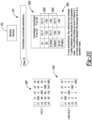
- FIGURE 20 illustrates another example of a modified first matrix 800' and a modified blocked matrix 1100'.
- the modified first matrix 800' illustrates that there is an obstruction between the fourth loudspeaker 102d and the third loudspeaker 102c as exhibited by the angle of "145" in the third column (e.g., S3) and the fourth row (e.g., S4).
- the method 600 may only tolerate a single outlier between any two loudspeakers for a four-loudspeaker layout configuration.
- the mobile device 150 determines that two or more outliers (e.g., the third loudspeaker 102c and the fourth loudspeaker 102d).
- the mobile device 150 determines that the third loudspeaker 102c is an outlier as discussed above in connection with operation 604.
- the mobile device 150 also determines that the fourth loudspeaker 102d is an outlier also based on the description provided above in connection with operation 604.
- the mobile device 150 includes a user interface and commands the user to move any obstructions that are present with respect to the third loudspeaker 102c and the fourth loudspeaker 102d.
- the mobile device 150 does not take into account the estimations from the third loudspeaker 102c and the fourth loudspeaker 102d for the candidate coordinate estimates 1600 (and vice versa), the extended candidate coordinate estimates 1802, and the extended angle 1804 since there is an outlier between the locations of the third loudspeaker 102c and the fourth loudspeaker 102d and such estimations are considered not correct.
- the mobile device 150 updates the modified block matrix 1100' which illustrates that the third and the fourth loudspeakers 102c and 102d are blocked for consideration in the layout.
- FIGUREs 21 and 22 depict an example of the best coordinate selection operation 612 of the method of FIGURE 6 being performed on the configuration of FIGURE 7 in accordance with one embodiment.
- the mobile device 150 performs the best coordinate selection operation 612.
- the mobile device 150 selects candidate points that minimize an error.
- the calibrated DOA matrix 800 is set forth above is used as DOA ij in the above equation.
- Figure 22 illustrates the manner in which equation 10 can be used for first two rows in the table in Figure 22 for third speaker location estimation.
- ⁇ 3C comes from the second term in equation 5.
- ⁇ 3C as shown in the table of FIGURE 22 represents the angle between the speakers 102 and candidate points.
- FIGURE 23 depicts one example of the microphone orientation and loudspeaker estimation method 600 in accordance with one embodiment.
- FIGURE 23 the locations of the loudspeakers 102a - 102d in the listening room 151 (or listening environment).
- the mobile device 150 may display the location of the loudspeaker 102a - 102d (e.g., front, left, right, and rear) as arranged within the listening room.
- the system 100 and/or method 600 determines the locations of the first, second, third, and fourth loudspeakers 102a - 102d in the listening environment 151 based on the methods at least shown in connection with FIGUREs 6 - 22 .
- the system 100 and/or method 600 utilize the location information to provide channel assignment for immersive sound generation with respect to the loudspeakers 102a - 102d.
- the mobile device 150 utilizes the final DOAs to assign the loudspeakers 102a - 102d as front, left, right, and rear loudspeaker locations.
- the first, second, third and fourth loudspeakers 102a - 102d generally from a series of products all of which are equipped with microphones 106a - 106b mounted thereon.
- the microphones 106a - 106b for each loudspeaker 102 provide an ability to detect the location of an audio source (e.g., the mobile device 150) with respect to any nearby wall.
- the microphones 106a - 106b may be in a linear arrangement when packaged on a corresponding loudspeaker 102, the microphones 106a - 106b may lack the ability to discriminate the audio source that is in a front or rear of the loudspeaker based on using a line between the microphones 106a - 106b as the line of symmetry. Detecting a wall or barrier in one of the directions may eliminate the symmetry limitation.
- the disclosed system may detect if a loudspeaker is placed too close to the wall and to automatically correct for the loudspeaker being positioned to close to the wall to ensure the desired sound field is transmitted in the room (or the listening environment 151).
- loudspeaker close to the wall can have effects of +/- 3 dB at low frequencies.
- the disclosed system and method may be used for an improved audio upmix. Aspects disclosed herein may provide, for example, a circular microphone array having six microphones capable of detecting all surrounding walls using the disclosed method.
- the disclosed method may determine whether a left or right wall is the surrounding wall to the microphone by comparing the proximity to the walls to each microphone. At that point, the system may perform channel assignment that may be used for upmixing that can be performed automatically. In addition, the disclosed system and method may obtain the room characteristics and estimate the distance to the wall or a reflector.
- Room impulse response generally provides an audio fingerprint of a location in an acoustic environment.
- RIR Room impulse response
- the measurement of RIR includes exciting the room (or listening environment) may be performed by, but not limited to, clapping hands.
- the measurement of RIR may also include deconvolving an audio signal to obtain room characteristics.
- RIR may involves the reflections after exciting the room.
- Reverberation may refer to the audio reflections that reflect back to the audio source. The reverberations are generally not direct sound, so the reverberations arrive later to the microphone. The reverberation amplitude and the time to come back depending on the material of the surfaces and the number of the reflected area. The sound continues to reflect until the sound loses its energy due to absorption.
- FIGURE 24 depicts a system 2400 for performing a boundary estimation in accordance with one embodiment.
- the system 2400 generally includes the first loudspeaker 102a and the second loudspeaker 102b.
- Each of the loudspeakers 102a, 102b generally include and an audio source 2402. While only the first and second loudspeakers 102a - 102b are shown, it is recognized that any number of loudspeakers may be positioned in the listening environment.
- the audio source 2402 may be integrated within any one of the loudspeakers 102a, 102b to directly transmit audio from the particular loudspeaker 102 into the listening environment 151.
- the first loudspeaker 102a and the second loudspeaker 102b are located a distance away from a wall 2404. In general, it is desirable to understand the distance of the first and/or the second loudspeakers 102a - 102b from the wall 2404 in the listening environment 151. If one or more of the first and the second loudspeakers 102a - 102b are placed too close to the wall 2404, such a condition may be difficult for the audio source 2402 to automatically correct for the location of the wall 204 relative to the loudspeakers 102a - 102b to ensure the desired sound field is transmitted into the room (or the listening environment 151).
- the first and/or the second loudspeaker 102a may cause effects of +/- 3 dB at low frequencies.
- the audio source 2402 i.e., within the loudspeaker 102a and/or the loudspeaker 102b
- the system 2400 may improve channel assignment using more than two microphones 106a by employing the corrective mechanism to account for the close proximity of the loudspeakers 102a - 102b to the wall 2404.
- the ability to perform channel assignment e.g., which loudspeaker is front left! front right/rear, etc.
- the audio source 2402 may include any number of controllers 2410 (hereafter "the controller 2410") to perform the operations noted herein.
- the audio source 2402 may determine the distance of the first and/or the second loudspeakers 102a - 102b relative to the wall 2404, it is recognized the any one or more of the first loudspeaker 102a or the second loudspeaker 102b may also include at least one controller 2412 to determine the distance of the loudspeakers 102a, 102b relative to the wall 2404.
- the controller 2410 may employ, for example, a predetermined measurement scheme such as RIR to provide and transmit an audio fingerprint in the listening environment 151.
- the controller 2410 may include a driver (not shown) to transmit the audio fingerprint into the listening environment 151.
- the controller 2410 may also include memory to store the audio fingerprint.
- the system 2400 may employ a variety of applications of RIR, such as wall boundary estimation, digitally reconstructing the acoustic environment for pro-audio applications, room correction, and frequency response correction for the playback system.
- the audio source 2402 may excite the room (or the listening environment 151) by transmitting an audio signal and perform and the measurement of RIR may also include deconvolving an audio signal to obtain room characteristics.
- RIR may involve performing measurements of a captured audio fingerprint (i.e., reflections) after exciting the listening room 151 has been excited.
- Reverberation may refer to the audio reflections that reflect back to the audio source 2402.
- the audio source 2402 maybe coupled to the microphone 106a and 106b to receive the captured reflections (or reverberations) from the listening environment 151.
- the reverberations as received back by the audio source 2402 are generally not direct sound, so the reverberations arrive at a time later to the microphone 106.
- the amplitude of the reverberation and the time for the reverberation to arrive at audio source 2402 depends on the material of the surfaces within the listening environment 151 and the number of the reflected area. The sound continues to reflect until the sound loses its energy due to absorption within the listening environment 151.
- the audio source 2204 may excite the listening environment 151 by transmitting an audio signal that includes an exponential sine sweep (ESS) (or ESS signal).
- ESS exponential sine sweep
- the ESS signal may be more advantageous over an impulse response measurement method since (i) the ESS signal has better noise rejection than a maximum length sequence (MI,S) method for a signal that is transmitting at a same length as that of the MLS, and (ii) the ESS signal may be more robust than non-linear effects given that the driver directly transmits the ESS signal
- K ⁇ 1 T ln ⁇ 1 ⁇ 2
- L T ln ⁇ 1 ⁇ 2
- T denotes a time duration of the sweep.
- FIGURE 25 generally illustrates a frequency response for an ESS signal 2500.
- the ESS signal 2500 includes a peak 2502 thereof as the signal 2500 is transmitted from the audio source 2402 to one or more of the first and the second loudspeakers 102a, 102b.
- f ( t ) can be created using post-modulation, which is applying amplitude modulation envelope of +6 dB/octave to the spectrum of the time reversed signal.
- A denotes the constant for the modulation function.
- FIGURE 26 illustrates an amplitude spectrum for the inverse filter.
- the measured RIR is obtained by the audio source 2402 by utilizing equation 13.
- the aspects related to equation 13 correspond to a convolution of the ESS signal and the inverse filter.
- the audio source 2402 may utilize the measured RIR to estimate the distance of the first and/or second loudspeakers 102a, 102b to the wall 2404. It is recognized that the audio source 2402 for a given loudspeaker 102a and 102b determines the distance for each loudspeaker 102a and 102b that the audio source 2402 is positioned in.
- the wall proximity estimation as utilized by the audio source 2402 may be sophisticated.
- FIGURE 27 generally illustrates on example of a plot 2700 corresponding to an RIR measurement as performed by the audio source 2402.
- the RIR measurement 2700 includes a plurality of peaks 2702.
- the peaks 2702 may correspond to reflections or reverberations of the ESS signal from various objects in the listening environment 151.
- a reverberation number of 1850 is generally shown at 2704.
- the reverberation number of 1850 generally corresponds to a strong candidate for the reverberation of the ESS signal from the wall 2404. This condition may be verified since an amplitude of the peak is highest after a gap 2710 is shown between a highest peak 2712 and the reverberation number of 1850 as shown at 2704.
- the highest peak 2172 generally represents the direct path of the ESS signal from the loudspeaker 102 to the microphone 2420. In addition, this condition may also be verified since peak amplitude associated with 2704 may correspond to a material of the wall 2404. In general, the peak from the wall 2404 may not be obvious as illustrated in FIGURE 27 . In addition, the nonlinearity attributed to the peaks 2702 may be caused by due to the driver (or amplifier) in the audio source 2402. For example, the amplifier generally causes spurious peaks in the RIR measurement performed by the audio source 2402. Thus, the audio source 2402 may need to take these conditions into account when performing the RIR measurement.
- the audio source 2402 may overcome the noted issues above to perform wall distance estimation by (i) sampling or extracting peaks in the RIR measurement to avoid spurious peaks (or ringing) which are strong and close to the peaks to be detected around the peaks 2702 which may cause erroneous estimations, and/or (ii) score each peak to determine a correct peak from the wall 2404. It is recognized that there are undesired peaks around the peaks 2702 due to nonlinearity and it is desirable to avoid such peaks in the RIR measurement.
- the peaks 2702 in the RIR measurement may correspond to a direct path from the audio source 2402 to the microphone 2420 and from the reflector to the microphone 2420 on the audio source 2402).
- the audio source 2402 may extract peaks to detect impulse events. Thus, in this regard the audio source 2402 may utilize a sliding window to extract the peak in each window. The audio source 2402 may find each peak in the window after the max peak in the RIR measurement is obtained and ignores the other peaks in the RIR measurement.
- FIGURE 28 generally illustrates the RIR measurement 2800 having detected peaks 2802 by the audio source 2402 in accordance with one embodiment.
- FIGURE 28 also illustrates that the ringing as noted above in connection with FIGURE 27 is more pronounced or obvious.
- the audio source 2402 obtains the RIR measurement 2800 when the distance the first loudspeaker 102a and/or the second loudspeaker 102b to the wall to is 137cm for a 32 kHz sampling rate.
- the "index of estimated peak” as set forth above in equation 17 generally corresponds to the estimate peak in the RIR measurement 2800.
- the detected peak 2802a as shown in FIGURE 28 corresponds to sample 251 which may be defined as the index of estimated peak.
- the "index of max peak” may generally correspond to 0.
- FIGURE 28 generally depicts a trimmed version of the RIR measurement that is shown in FIGURE 27 .
- the highest peak 2712 as shown in FIGURE 27 generally corresponds to the highest peak 2802 as shown at 0 on the x-axis of the plot of FIGURE 28 .
- constant value of "2" as set forth in equation 17 generally corresponds from the round-trip time.
- the audio source 2402 determines that the distance is between the wall 2404 and the first loudspeaker 102a or the second loudspeaker 102b is, for example, 137 cm for a 32 kHz sampling rate utilizing equation 17 from above if the audio source 2402 correctly estimates the peak at sample 251.
- the audio source 2402 tracks an overall trend in the peaks 2802 of the RIR measurement 2800 to estimate the peaks of the reverberation of the RIR measurement 2800. For example, if the ESS signal as transmitted by the audio source 2402 does not encounter the wall 2404 or an object in the listening environment 151, then the anticipated trend of the peaks 2802 of the RIR measurement would illustrate or corresponding to an overall decrease in peaks (i.e., a decreasing trend). If the ESS signal as transmitted by the audio source 2402 does encounter the wall 2404 or an object in the listening environment 151, then the anticipated trend of the peaks 2802 of the RIR measurement would illustrate a decreasing trend of peaks 2802 followed by an increased trend in peaks which are then followed by a decreasing trend in peaks 2802.
- the audio source 2402 stores information corresponding to the peaks 2802 as received for the RIR measurement to determine if there is only a decreasing trend of peaks 2802 that continually decrease over time or if there is a decreasing trend of peaks 2802 followed by an increasing peak 2802a.
- the audio source 2402 may then establish a confidence score that is calculated by using, for example, a percentage increase that is multiplied by, for example, a value of 1.01 to the number of negative peaks 2802.
- the audio source 2402 may then select a predetermined number of peaks that have the highest confidence score (i.e., maximum score) or level (e.g., 20) and then locates a maximum peak among the selected peaks 2802.
- Such a maximum peak may correspond to the peak that exhibits the largest amplitude on the RIR measurement and may be positive after a long series of decreasing peaks.
- the maximum peak may be selected as the sample number (e.g., 251) which is then utilized by the audio source 2402 for insertion into equation 17 as provided above to find the distance of the loudspeaker 102a or 102b from the wall 2404.
- FIGURE 29 depicts a method 2900 for performing a boundary estimation involving a plurality of loudspeakers 102 in accordance with one embodiment.
- the audio source 2402 transmits an audio signal in the form of an ESS signal into the listening environment 151. It is recognized that the audio source 2402 may transmit the ESS signal from each loudspeaker 102 positioned in the listening environment 151 one at a time and perform the operation of method 2900 for each loudspeaker 102 to determine the distance of the loudspeaker 102 relative to the wall 2404. Each audio source 2402 determines the distance for its corresponding loudspeaker 102a, 102b with respect to the wall 2404.
- each loudspeaker 102a, 102b may also transmit the distance information to the mobile device 150 or other device that may require such information so that the mobile device or other audio source may compensate the audio output to mitigate any one or more of the loudspeakers 102a, 102b from being too close to the wall 2404.
- the audio source 2402 receives reverberations from the listening environment 151 in response to transmitting the ESS signal. In this case, the audio source 2402 detects the peaks 2802 of the reverberations in the RIR measurement 2800 and stores information corresponding to the peaks 2802 in memory thereof. In operation 2906, the audio source 2402 performs trend tracking of the peaks 2802.
- the audio source 2402 assesses the stored peaks 2802 of the reverberations to determine if there is only a decreasing trend of peaks 2802 that continually decrease over time in the RIR measurement or if there is a decreasing trend of peaks 2802 followed by an increasing peak 2802a in the RIR measurement. If the audio source 2402 determines that the peaks 2802 do not increase over time, then the method 2900 moves to operation 2912 and determines that the wall distance of the first or the second loudspeaker 102a or 102b cannot be determined. In this case, the method 2900 may move back to operation 2902. If the audio source 2402 determines that there is an increasing peak 2802a in the RIR measurement, then the method 2900 moves to operation 2910.
- the audio source 2402 establishes a confidence score that is calculated by using, for example, a percentage increase that is multiplied by, for example, a value of 1.01 to the number of negative peaks 2802.
- the audio source 2402 may then select a predetermined number of peaks that have the highest confidence score or level (e.g., 20) and then locate a maximum peak among the selected peaks 2802.
- Such a maximum peak may correspond to the peak 2802a that exhibits the largest amplitude on the RIR measurement and may be positive after a long series of decreasing peaks 2802.
- the audio source 2402 applies the maximum peak to the distance equation (e.g., equation 17) and also applies the other variables as noted above in connection with equation 17 to determine the distance of the first loudspeaker 102a or the second loudspeaker 102b relative to the wall 2404.
- controllers as disclosed herein may include various microprocessors, integrated circuits, memory devices (e.g., FLASH, random access memory (RAM), read only memory (ROM), electrically programmable read only memory (EPROM), electrically erasable programmable read only memory (EEPROM), or other suitable variants thereof), and software which co-act with one another to perform operation(s) disclosed herein.
- controllers as disclosed utilizes one or more microprocessors to execute a computer-program that is embodied in a non-transitory computer readable medium that is programmed to perform any number of the functions as disclosed.
- controller(s) as provided herein includes a housing and the various number of microprocessors, integrated circuits, and memory devices ((e.g., FLASH, random access memory (RAM), read only memory (ROM), electrically programmable read only memory (EPROM), electrically erasable programmable read only memory (EEPROM)) positioned within the housing.
- the controller(s) as disclosed also include hardware-based inputs and outputs for receiving and transmitting data, respectively from and to other hardware-based devices as discussed herein.
Landscapes
- Physics & Mathematics (AREA)
- Engineering & Computer Science (AREA)
- Acoustics & Sound (AREA)
- Signal Processing (AREA)
- Circuit For Audible Band Transducer (AREA)
Applications Claiming Priority (1)
| Application Number | Priority Date | Filing Date | Title |
|---|---|---|---|
| US18/204,150 US12495264B2 (en) | 2023-05-31 | 2023-05-31 | System and/or method for loudspeaker auto calibration and loudspeaker configuration layout estimation |
Publications (1)
| Publication Number | Publication Date |
|---|---|
| EP4472243A1 true EP4472243A1 (de) | 2024-12-04 |
Family
ID=91081927
Family Applications (1)
| Application Number | Title | Priority Date | Filing Date |
|---|---|---|---|
| EP24175728.5A Pending EP4472243A1 (de) | 2023-05-31 | 2024-05-14 | System und/oder verfahren zur automatischen lautsprecherkalibrierung und lautsprecherkonfigurationslayoutschätzung |
Country Status (3)
| Country | Link |
|---|---|
| US (1) | US12495264B2 (de) |
| EP (1) | EP4472243A1 (de) |
| CN (1) | CN119071697A (de) |
Citations (3)
| Publication number | Priority date | Publication date | Assignee | Title |
|---|---|---|---|---|
| US20050254662A1 (en) * | 2004-05-14 | 2005-11-17 | Microsoft Corporation | System and method for calibration of an acoustic system |
| US20170094437A1 (en) * | 2015-09-30 | 2017-03-30 | Sonos, Inc. | Spatial Mapping of Audio Playback Devices in a Listening Environment |
| US20230040846A1 (en) * | 2019-12-18 | 2023-02-09 | Dolby Laboratories Licensing Corporation | Audio device auto-location |
Family Cites Families (16)
| Publication number | Priority date | Publication date | Assignee | Title |
|---|---|---|---|---|
| AT510359B1 (de) | 2010-09-08 | 2015-05-15 | Akg Acoustics Gmbh | Verfahren zur akustischen signalverfolgung |
| US9270807B2 (en) | 2011-02-23 | 2016-02-23 | Digimarc Corporation | Audio localization using audio signal encoding and recognition |
| US9408011B2 (en) * | 2011-12-19 | 2016-08-02 | Qualcomm Incorporated | Automated user/sensor location recognition to customize audio performance in a distributed multi-sensor environment |
| US9360546B2 (en) | 2012-04-13 | 2016-06-07 | Qualcomm Incorporated | Systems, methods, and apparatus for indicating direction of arrival |
| US12352882B2 (en) | 2015-07-17 | 2025-07-08 | Origin Research Wireless, Inc. | Method, apparatus, and system for speech enhancement and separation based on audio and radio signals |
| US9794720B1 (en) | 2016-09-22 | 2017-10-17 | Sonos, Inc. | Acoustic position measurement |
| CN109791193B (zh) | 2016-09-29 | 2023-11-10 | 杜比实验室特许公司 | 环绕声系统中扬声器位置的自动发现和定位 |
| US10299060B2 (en) | 2016-12-30 | 2019-05-21 | Caavo Inc | Determining distances and angles between speakers and other home theater components |
| CN110226101B (zh) | 2017-04-25 | 2021-09-14 | 华为技术有限公司 | 用于估计到达方向的设备和方法 |
| US10598543B1 (en) | 2017-12-04 | 2020-03-24 | Amazon Technologies, Inc. | Multi microphone wall detection and location estimation |
| KR102088222B1 (ko) | 2018-01-25 | 2020-03-16 | 서강대학교 산학협력단 | 분산도 마스크를 이용한 음원 국지화 방법 및 음원 국지화 장치 |
| EP3809726B1 (de) | 2019-10-17 | 2025-12-31 | Bang & Olufsen A/S | Echobasierte raumschätzung |
| WO2022118072A1 (en) | 2020-12-03 | 2022-06-09 | Dolby International Ab | Pervasive acoustic mapping |
| US11545172B1 (en) | 2021-03-09 | 2023-01-03 | Amazon Technologies, Inc. | Sound source localization using reflection classification |
| US12081949B2 (en) | 2021-10-21 | 2024-09-03 | Syng, Inc. | Systems and methods for loudspeaker layout mapping |
| US20230162750A1 (en) | 2021-11-19 | 2023-05-25 | Apple Inc. | Near-field audio source detection for electronic devices |
-
2023
- 2023-05-31 US US18/204,150 patent/US12495264B2/en active Active
-
2024
- 2024-05-14 EP EP24175728.5A patent/EP4472243A1/de active Pending
- 2024-05-23 CN CN202410642933.4A patent/CN119071697A/zh active Pending
Patent Citations (3)
| Publication number | Priority date | Publication date | Assignee | Title |
|---|---|---|---|---|
| US20050254662A1 (en) * | 2004-05-14 | 2005-11-17 | Microsoft Corporation | System and method for calibration of an acoustic system |
| US20170094437A1 (en) * | 2015-09-30 | 2017-03-30 | Sonos, Inc. | Spatial Mapping of Audio Playback Devices in a Listening Environment |
| US20230040846A1 (en) * | 2019-12-18 | 2023-02-09 | Dolby Laboratories Licensing Corporation | Audio device auto-location |
Non-Patent Citations (2)
| Title |
|---|
| "The Generalized Correlation Method for Estimation of Time Delay", IEEE TRANSACTIONS ON ACOUSTICS, SPEECH, AND SIGNAL PROCESSING, vol. 24, no. 4, 1976, pages 320 - 327 |
| "The Optimal Ratio Time-Frequency Mask for Speech Separation in Terms of Signal-to-Noise Ratio", THE JOURNAL OF THE ACOUSTICAL SOCIETY OF AMERICA, vol. 134, no. 5, 2013, pages EL452 - EL458 |
Also Published As
| Publication number | Publication date |
|---|---|
| US20240406655A1 (en) | 2024-12-05 |
| US12495264B2 (en) | 2025-12-09 |
| CN119071697A (zh) | 2024-12-03 |
Similar Documents
| Publication | Publication Date | Title |
|---|---|---|
| EP2786593B1 (de) | Vorrichtung und verfahren zur mikrofonpositionierung basierend auf räumlicher leistungsdichte | |
| US10334357B2 (en) | Machine learning based sound field analysis | |
| US9633651B2 (en) | Apparatus and method for providing an informed multichannel speech presence probability estimation | |
| EP2633697B1 (de) | Dreidimensionale tonaufnahme und wiedergabe mit multimikrofonen | |
| CN103180900B (zh) | 用于话音活动检测的系统、方法和设备 | |
| US9947338B1 (en) | Echo latency estimation | |
| US9799322B2 (en) | Reverberation estimator | |
| EP4472244A1 (de) | Grenzdistanzsystem und -verfahren | |
| JP4812302B2 (ja) | 音源方向推定システム、音源方向推定方法及び音源方向推定プログラム | |
| EP4472243A1 (de) | System und/oder verfahren zur automatischen lautsprecherkalibrierung und lautsprecherkonfigurationslayoutschätzung | |
| EP4472235A1 (de) | Rauschzeitfrequenzmaskierungsbasierten schätzung der einfallsrichtung zur lautsprecheraudiokalibrierung | |
| EP3182734B1 (de) | Verfahren zur verwendung einer mobilen vorrichtung mit mindestens zwei mikrofonen zur bestimmung der richtung von lautsprechern bei der einrichtung eines raumklangsystems | |
| Flores et al. | Cepstral distance based channel selection for distant speech recognition | |
| EP4657897A1 (de) | Vorrichtung, system und/oder verfahren zur vorrichtungslokalisierung und -optimierung unter verwendung eines vorbestimmten hörbaren signals | |
| KR20180130367A (ko) | 음성전처리장치 및 그 동작방법 | |
| de Groot et al. | Loudspeaker Beamforming to Enhance Speech Recognition Performance of Voice Driven Applications | |
| CN121176039A (zh) | 使用悦耳音频进行多声道空间位置校准的用户友好型方法 | |
| HK1202746B (en) | Apparatus and method for microphone positioning based on a spatial power density |
Legal Events
| Date | Code | Title | Description |
|---|---|---|---|
| PUAI | Public reference made under article 153(3) epc to a published international application that has entered the european phase |
Free format text: ORIGINAL CODE: 0009012 |
|
| STAA | Information on the status of an ep patent application or granted ep patent |
Free format text: STATUS: THE APPLICATION HAS BEEN PUBLISHED |
|
| AK | Designated contracting states |
Kind code of ref document: A1 Designated state(s): AL AT BE BG CH CY CZ DE DK EE ES FI FR GB GR HR HU IE IS IT LI LT LU LV MC ME MK MT NL NO PL PT RO RS SE SI SK SM TR |
|
| STAA | Information on the status of an ep patent application or granted ep patent |
Free format text: STATUS: REQUEST FOR EXAMINATION WAS MADE |
|
| 17P | Request for examination filed |
Effective date: 20250604 |