EP4472201A1 - Codierungs- und decodierungsverfahren und -vorrichtung, codierungsvorrichtung, decodierungsvorrichtung und speichermedium - Google Patents
Codierungs- und decodierungsverfahren und -vorrichtung, codierungsvorrichtung, decodierungsvorrichtung und speichermedium Download PDFInfo
- Publication number
- EP4472201A1 EP4472201A1 EP22922632.9A EP22922632A EP4472201A1 EP 4472201 A1 EP4472201 A1 EP 4472201A1 EP 22922632 A EP22922632 A EP 22922632A EP 4472201 A1 EP4472201 A1 EP 4472201A1
- Authority
- EP
- European Patent Office
- Prior art keywords
- colour
- value
- component
- sample
- current block
- Prior art date
- Legal status (The legal status is an assumption and is not a legal conclusion. Google has not performed a legal analysis and makes no representation as to the accuracy of the status listed.)
- Pending
Links
Images







Classifications
-
- H—ELECTRICITY
- H04—ELECTRIC COMMUNICATION TECHNIQUE
- H04N—PICTORIAL COMMUNICATION, e.g. TELEVISION
- H04N19/00—Methods or arrangements for coding, decoding, compressing or decompressing digital video signals
- H04N19/10—Methods or arrangements for coding, decoding, compressing or decompressing digital video signals using adaptive coding
- H04N19/169—Methods or arrangements for coding, decoding, compressing or decompressing digital video signals using adaptive coding characterised by the coding unit, i.e. the structural portion or semantic portion of the video signal being the object or the subject of the adaptive coding
- H04N19/186—Methods or arrangements for coding, decoding, compressing or decompressing digital video signals using adaptive coding characterised by the coding unit, i.e. the structural portion or semantic portion of the video signal being the object or the subject of the adaptive coding the unit being a colour or a chrominance component
-
- H—ELECTRICITY
- H04—ELECTRIC COMMUNICATION TECHNIQUE
- H04N—PICTORIAL COMMUNICATION, e.g. TELEVISION
- H04N19/00—Methods or arrangements for coding, decoding, compressing or decompressing digital video signals
- H04N19/10—Methods or arrangements for coding, decoding, compressing or decompressing digital video signals using adaptive coding
- H04N19/102—Methods or arrangements for coding, decoding, compressing or decompressing digital video signals using adaptive coding characterised by the element, parameter or selection affected or controlled by the adaptive coding
- H04N19/103—Selection of coding mode or of prediction mode
- H04N19/105—Selection of the reference unit for prediction within a chosen coding or prediction mode, e.g. adaptive choice of position and number of pixels used for prediction
-
- H—ELECTRICITY
- H04—ELECTRIC COMMUNICATION TECHNIQUE
- H04N—PICTORIAL COMMUNICATION, e.g. TELEVISION
- H04N19/00—Methods or arrangements for coding, decoding, compressing or decompressing digital video signals
- H04N19/10—Methods or arrangements for coding, decoding, compressing or decompressing digital video signals using adaptive coding
- H04N19/102—Methods or arrangements for coding, decoding, compressing or decompressing digital video signals using adaptive coding characterised by the element, parameter or selection affected or controlled by the adaptive coding
- H04N19/119—Adaptive subdivision aspects, e.g. subdivision of a picture into rectangular or non-rectangular coding blocks
-
- H—ELECTRICITY
- H04—ELECTRIC COMMUNICATION TECHNIQUE
- H04N—PICTORIAL COMMUNICATION, e.g. TELEVISION
- H04N19/00—Methods or arrangements for coding, decoding, compressing or decompressing digital video signals
- H04N19/10—Methods or arrangements for coding, decoding, compressing or decompressing digital video signals using adaptive coding
- H04N19/169—Methods or arrangements for coding, decoding, compressing or decompressing digital video signals using adaptive coding characterised by the coding unit, i.e. the structural portion or semantic portion of the video signal being the object or the subject of the adaptive coding
- H04N19/17—Methods or arrangements for coding, decoding, compressing or decompressing digital video signals using adaptive coding characterised by the coding unit, i.e. the structural portion or semantic portion of the video signal being the object or the subject of the adaptive coding the unit being an image region, e.g. an object
- H04N19/176—Methods or arrangements for coding, decoding, compressing or decompressing digital video signals using adaptive coding characterised by the coding unit, i.e. the structural portion or semantic portion of the video signal being the object or the subject of the adaptive coding the unit being an image region, e.g. an object the region being a block, e.g. a macroblock
-
- H—ELECTRICITY
- H04—ELECTRIC COMMUNICATION TECHNIQUE
- H04N—PICTORIAL COMMUNICATION, e.g. TELEVISION
- H04N19/00—Methods or arrangements for coding, decoding, compressing or decompressing digital video signals
- H04N19/50—Methods or arrangements for coding, decoding, compressing or decompressing digital video signals using predictive coding
-
- H—ELECTRICITY
- H04—ELECTRIC COMMUNICATION TECHNIQUE
- H04N—PICTORIAL COMMUNICATION, e.g. TELEVISION
- H04N19/00—Methods or arrangements for coding, decoding, compressing or decompressing digital video signals
- H04N19/50—Methods or arrangements for coding, decoding, compressing or decompressing digital video signals using predictive coding
- H04N19/593—Methods or arrangements for coding, decoding, compressing or decompressing digital video signals using predictive coding involving spatial prediction techniques
-
- H—ELECTRICITY
- H04—ELECTRIC COMMUNICATION TECHNIQUE
- H04N—PICTORIAL COMMUNICATION, e.g. TELEVISION
- H04N19/00—Methods or arrangements for coding, decoding, compressing or decompressing digital video signals
- H04N19/80—Details of filtering operations specially adapted for video compression, e.g. for pixel interpolation
- H04N19/82—Details of filtering operations specially adapted for video compression, e.g. for pixel interpolation involving filtering within a prediction loop
Definitions
- Embodiments of the disclosure relate to the field of video coding technology, and more particularly, to a coding method and apparatus, an encoding device, a decoding device, and a storage medium.
- JVET Joint video exploration team proposes a next-generation video coding standard, namely H.266/versatile video coding (WC), with a corresponding test model of WC test model (VTM).
- CCLM cross-component linear model
- Embodiments of the disclosure provide a coding method and apparatus, an encoding device, a decoding device, and a storage medium, which can improve accuracy of chroma prediction, save bit rate, and improve coding performance.
- a decoding method in embodiments of the disclosure. The method includes the following.
- a reference sample for a current block is determined.
- a weighting factor is determined according to the reference sample.
- a prediction value of a first colour component of a sample to-be-predicted in the current block is determined by weighting a first colour component value of the reference sample according to the weighting factor.
- an encoding method in embodiments of the disclosure. The method includes the following.
- a reference sample for a current block is determined.
- a weighting factor is determined according to the reference sample.
- a prediction value of a first colour component of a sample to-be-predicted in the current block is determined by weighting a first colour component value of the reference sample according to the weighting factor.
- an encoding apparatus in embodiments of the disclosure.
- the encoding apparatus includes a first determining unit, a first calculating unit and a first predicting unit.
- the first determining unit is configured to determine a reference sample for a current block.
- the first calculating unit is configured to determine a prediction value of a first colour component of a sample to-be-predicted in the current block by weighting a first colour component value of the reference sample according to the weighting factor.
- an encoding device in embodiments of the disclosure.
- the encoding device includes a first memory and a first processor.
- the first memory is configured to store computer programs executable by the first processor.
- the first processor is configured to execute the computer programs to perform the method described in the second aspect.
- a decoding apparatus in embodiments of the disclosure.
- the decoding apparatus includes a second determining unit, a second calculating unit, and a second predicting unit.
- the second determining unit is configured to determine a reference sample for a current block.
- the second calculating unit is configured to determine a weighting factor according to the reference sample.
- the second predicting unit is configured to determine a prediction value of a first colour component of a sample to-be-predicted in the current block by weighting a first colour component value of the reference sample according to the weighting factor.
- a decoding device in embodiments of the disclosure.
- the decoding device includes a second memory and a second processor.
- the second memory is configured to store computer programs executable by the second processor.
- the second processor is configured to execute the computer programs to perform the method described in the first aspect.
- a computer-readable storage medium is provided in embodiments of the disclosure.
- the computer-readable storage medium is configured to store computer programs which, when executed, are operable to perform the method described in the first aspect or perform the method described in the second aspect.
- Embodiments of the disclosure provide a coding method and apparatus, an encoding device, a decoding device, and a storage medium.
- the reference sample for the current block is determined
- the weighting factor is determined according to the reference sample
- the prediction value of the first colour component of the sample to-be-predicted in the current block is determined by weightingthe first colour component value of the reference sample according to the weighting factor.
- different samples to-be-predicted may correspond to different weighting factors.
- the weighting factor for chroma prediction of the sample to-be-predicted in the current block it is possible to improve accuracy of chroma prediction, save bit rate, and improve coding performance.
- a first colour component, a second colour component, and a third colour component are usually used to represent a coding block (CB).
- the three colour components are a luma component, a blue chroma component, and a red chroma component respectively.
- the luma component is usually represented by a symbol Y
- the blue chroma component is usually represented by a symbol Cb or U
- the red chroma component is usually represented by a symbol Cr or V.
- the video picture can be expressed in the format of YCbCr or YUV.
- a cross-component prediction technology mainly includes a cross-component linear model (CCLM) prediction mode and a multi-directional linear model (MDLM) prediction mode.
- CCLM cross-component linear model
- MDLM multi-directional linear model
- the prediction model corresponding thereto can be used to implement cross-colour-component prediction, for example, from the first colour component to the second colour component, from the second colour component to the first colour component, from the first colour component to the third colour component, from the third colour component to the first colour component, from the second colour component to the third colour component, or from the third colour component to the second colour component, etc.
- i, j represents a location coordinate of a sample to-be-predicted in a coding block, where i represents a horizontal direction, and j represents a vertical direction.
- Pred C ( i,j ) represents a chroma prediction value corresponding to the sample to-be-predicted at the location coordinate ( i,j ) in the coding block
- Rec L ( i,j ) represents a reconstructed luma (after downsampling) value corresponding to the sample to-be-predicted at the location coordinate ( i, j ) in the same coding block.
- ⁇ and ⁇ represent model parameters, and the model parameters can be derived according to a reference sample.
- a neighbouring area of the coding block may include five parts: a left neighbouring area, a top neighbouring area, a bottom-left neighbouring area, a top-left neighbouring area, and a top-right neighbouring area.
- CCLM prediction modes i. e. a neighbouring left and top intra-CCLM prediction mode (which can be represented by INTRA_LT_CCLM), a neighbouring left and bottom-left intra-CCLM prediction mode (which can be represented by INTRA_L_CCLM), and a neighbouring top and top-right intra-CCLM prediction mode (which can be represented by INTRA_T_CCLM).
- a preset number for example, four
- the major difference between the three prediction modes lies in that selection areas corresponding to the reference sample for derivation of the model parameters ⁇ and ⁇ are different.
- FIG. 1 is a schematic diagram illustrating distribution of valid neighbouring areas.
- the left neighbouring area, the bottom-left neighbouring area, the top neighbouring area, and the top-right neighbouring area are all valid.
- the gray-filled block represents the sample to-be-predicted whose location coordinate is ( i,j ) in the coding block.
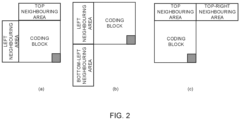
- FIG. 2 illustrates the selection area for the INTRA LT_CCLM mode, which includes the left neighbouring area and the top neighbouring area; (b) illustrates the selection area for the INTRA_L_CCLM mode, which includes the left neighbouring area and the bottom-left neighbouring area; (c) illustrates the selection area for the INTRA T_CCLM mode, which includes the top neighbouring area and the top-right neighbouring area.
- a sample for model parameter derivation can be selected from the selection areas.
- the sample thus selected can be referred to as a reference sample, and the number of reference samples is usually four.
- the location of the reference sample thereof is usually fixed.
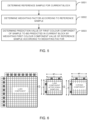
- chroma prediction is performed according to a schematic flowchart of a model parameter derivation scheme illustrated in FIG. 3 . Assuming that the preset number is four, then according to the flows illustrated in FIG. 3 , the process may include the following.
- reference samples are determined from a selection area.
- model parameter ⁇ is set to 0 and model parameter ⁇ is set to a default value.
- a chroma prediction value is set to the default value.
- chroma prediction is performed by using a prediction model constructed with ⁇ and ⁇ .
- the prediction model is constructed based on the principle of "two points determines one straight line", where the two points can be referred to as fitting points.
- two reference samples with greater luma component values and two reference samples with smaller luma component values are determined through four comparisons.
- a mean point (which can be represented by mean max ) is calculated according to the two reference samples with greater values
- another mean point (which can be represented by mean min ) is calculated according to the two reference samples with smaller values, so as to obtain the two mean points mean max and mean min .
- mean max and mean min are taken as two fitting points, so as to derive the model parameters (represented by ⁇ and ⁇ ).
- the prediction model is constructed according to ⁇ and ⁇ , and a chroma component is predicted with the prediction model.
- a simple linear model is used for luma-to-chroma mapping so as to implement chroma prediction, but for some coding blocks, a luma-to-chroma mapping function cannot be fitted accurately with the simple linear model, and as a result, prediction effect for some coding blocks is not accurate enough.
- a reference sample for a current block is determined, a weighting factor is determined according to the reference sample, and a prediction value of a first colour component of a sample to-be-predicted in the current block is determined by weighting a first colour component value of the reference sample according to the weighting factor.
- the weighting factor corresponding to the sample to-be-predicted in the current block can be calculated.
- different samples to-be-predicted may correspond to different weighting factors.
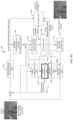
- FIG. 4A is a schematic block diagram of an encoder provided in embodiments of the disclosure.
- the encoder (which is specifically a "video encoder") 100 may include a transform and quantization unit 101, an intra estimation unit 102, an intra prediction unit 103, a motion compensation unit 104, a motion estimation unit 105, an inverse transform and inverse quantization unit 106, a filter control analysis unit 107, a filtering unit 108, a coding unit 109, a decoded picture buffer unit 110, and the like.
- the filtering unit 108 can implement deblocking filtering and sample adaptive offset (SAO) filtering.
- SAO sample adaptive offset
- the coding unit 109 can implement header information encoding and context-based adaptive binary arithmetic coding (CABAC).
- CABAC header information encoding and context-based adaptive binary arithmetic coding
- one video coding block can be obtained through partitioning of a coding tree unit (CTU).
- CTU coding tree unit
- the video coding block is transformed by the transform and quantization unit 101, including transforming the residual information from the sample domain to the transform domain, and the obtained transform coefficients are quantized, so as to further reduce bit rate.
- the intra estimation unit 102 and the intra prediction unit 103 are used to perform intra prediction on the coding block. Specifically, the intra estimation unit 102 and the intra prediction unit 103 are used to determine an intra prediction mode to-be-used to encode the coding block.
- the motion compensation unit 104 and the motion estimation unit 105 are used to perform inter prediction encoding on the received coding block relative to one or more blocks in one or more reference pictures, to provide temporal prediction information.
- the motion estimation performed by the motion estimation unit 105 is a process of generating a motion vector, where the motion vector can be used to estimate motion of the coding block.
- the motion compensation unit 104 is used to perform motion compensation based on the motion vector determined by the motion estimation unit 105.
- the intra prediction unit 103 is used to provide the selected intra prediction data to the coding unit 109, and the motion estimation unit 105 is used to send the calculated motion vector data to the coding unit 109.
- the inverse transform and inverse quantization unit 106 is used for reconstruction of the coding block.
- a residual block is reconstructed in the sample domain, and blockiness artifacts of the reconstructed residual block are removed by the filter control analysis unit 107 and the filtering unit 108, and then the reconstructed residual block is added to a prediction block of a picture in the decoded picture buffer unit 110, to generate a reconstructed coding block.
- the coding unit 109 is used to encode various coding parameters and quantized transform coefficients. In the CABAC-based encoding algorithm, the context can be based on neighbouring coding blocks, and the coding unit 109 can be used to encode information indicating the determined intra prediction mode and output a bitstream of the video signal.
- the decoded picture buffer unit 110 is used to store reconstructed coding blocks in order for prediction reference. As the picture encoding progresses, reconstructed coding blocks will be continuously generated, and these reconstructed coding blocks will be stored into the decoded picture buffer unit 110.
- FIG. 4B is a schematic block diagram a decoder provided in embodiments of the disclosure.
- the decoder (which is specifically a "video decoder") 200 includes a decoding unit 201, an inverse transform and inverse quantization unit 202, an intra prediction unit 203, a motion compensation unit 204, a filtering unit 205, a decoded picture buffer unit 206, and the like.
- the decoding unit 201 can implement header information decoding and CABAC.
- the filtering unit 205 can implement deblocking filtering and SAO filtering. After the input video signal is encoded (as illustrated in FIG. 4A ), the bitstream of the video signal is output.
- the bitstream is input into the decoder 200.
- decoded transform coefficients are obtained by the decoding unit 201.
- the decoded transform coefficients are processed by the inverse transform and inverse quantization unit 202, so as to generate a residual block in the sample domain.
- the intra prediction unit 203 can be used to generate prediction data of the current video coding block based on the determined intra prediction mode and data from the previous decoded block of the current frame or picture.
- the motion compensation unit 204 is used to determine prediction information for the coding block by analyzing motion vectors and other associated syntax elements, and use the prediction information to generate a prediction block of the video coding block that is being decoded.
- the decoded video block is formed by summing the residual block from the inverse transform and inverse quantization unit 202 and the corresponding prediction block generated by the intra prediction unit 203 or the motion compensation unit 204.
- the blockiness artifacts of the decoded video signal are removed by the filtering unit 205, which can improve quality of the video.
- the decoded video block is then stored into the decoded picture buffer unit 206.
- the decoded picture buffer unit 206 is used to store reference pictures used for subsequent intra prediction or motion compensation, and is also used to output the video signal, that is, the restored original video signal is obtained.
- embodiments of the disclosure is mainly applied to the intra prediction unit 103 illustrated in FIG. 4A and the intra prediction unit 203 illustrated in FIG. 4B . That is, embodiments of the disclosure can be applied to an encoder, a decoder, or even both an encoder and a decoder, but embodiments of the disclosure are not limited in this regard.
- the "current block” specifically refers to a coding block on which intra prediction is currently to be performed.
- the "current block” specifically refers to a coding block on which intra prediction is currently to be performed.
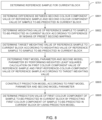
- FIG. 5 illustrates schematic flowchart I of a decoding method provided in embodiments of the disclosure. As illustrated in FIG. 5 , the method may include the following.
- a reference sample(s) for a current block is determined.
- the decoding method in the embodiment of the disclosure is applied to a decoder.
- the decoding method may specifically refer to an intra prediction method, and more specifically, refers to a colour component prediction method.
- a video picture can be partitioned into a multiple coding blocks, and each coding block may include a first colour component, a second colour component, and a third colour component.
- the current block in the embodiment of the disclosure refers to a coding block on which intra prediction is currently to be performed in the video picture.
- a component to-be-predicted is the first colour component.
- the component to-be-predicted is the second colour component.
- the component to-be-predicted is the third colour component.
- the current block can also be called a luma block.
- the current block can also be called a chroma block.
- the reference sample for the current block may refer to a reference sample neighbouring the current block.
- neighborhbouring can be spatially neighbouring, but is not limited thereto.
- neighborhbouring can also be temporally neighbouring or spatially and temporally neighbouring.
- the reference sample for the current block can also be a reference sample obtained through some processing on a spatially neighbouring reference sample, a temporally neighbouring reference sample, or a spatially and temporally neighbouring reference sample, etc., and embodiments of the disclosure are not limited in this regard.
- the reference sample for the current block can be determined as follows.
- the reference sample is determined from samples in a neighbouring area of the current block, where the neighbouring area includes at least one of: a top neighbouring area, a top-right neighbouring area, a left neighbouring area, or a bottom-left neighbouring area.
- the reference sample can be determined from the samples in the neighbouring area of the current block as follows.
- a first reference sample set is determined from the samples in the neighbouring area of the current block.
- the reference sample is determined from the first reference sample set.
- the first reference sample set may consist of samples in the left neighbouring area and the top neighbouring area of the current block, as illustrated in (a) of FIG.
- the first reference sample set may consist of samples in the left neighbouring area and the bottom-left neighbouring area of the current block, as illustrated in (b) of FIG. 2 ; for an INTRA T_CCLM mode, the first reference sample set may consist of samples in the top neighbouring area and the top-right neighbouring area of the current block, as illustrated in (c) of FIG. 2 .
- the neighbouring area of the current block can be multiple rows or multiple columns.
- the left neighbouring area or the bottom-left neighbouring area may include one or more columns
- the top neighbouring area or the top-right neighbouring area may include one or more rows.
- samples in some neighbouring areas rather than all neighbouring areas can be used for colour component prediction of the current block, which can be, for example, only the top neighbouring area; or only the left neighbouring area; or only the top neighbouring area and the top-right neighbouring area; or only the left neighbouring area and the bottom-left neighbouring area; or only the top neighbouring area and the left neighbouring area, or only the top neighbouring area, the top-right neighbouring area, and the left neighbouring area; or only the left neighbouring area, the bottom-left neighbouring area, and the top neighbouring area, or the like.
- reference samples in the four neighbouring areas i. e. left, bottom-left, top, and top-right, can be obtained for colour component prediction of the current block.
- the manner for selecting the neighbouring area can also be determined according to a prediction mode for the current block.
- the prediction mode for the current block is a horizontal mode
- the reference sample is determined from samples in the top neighbouring area and/or the top-right neighbouring area
- the prediction mode for the current block is a vertical mode
- the reference sample is determined from samples in the left neighbouring area and/or the bottom-left neighbouring area.
- a luma prediction mode for the current block is the horizontal mode
- the neighbouring area for chroma component prediction can be only the top neighbouring area and/or the top-right neighbouring area.
- the luma prediction mode for the current block is a vertical mode
- the neighbouring area for chroma component prediction can be only the left neighbouring area and/or the bottom-left neighbouring area.
- the method may further include the following.
- the reference sample is determined by selecting from the samples in the neighbouring area.
- the first reference sample set is formed from the samples in the neighbouring area of the current block.
- the reference sample can be determined by selecting from the first reference sample set.
- the number of reference samples can be N , where N is an integer and N>0.
- N reference samples can be selected from the samples in the neighbouring area.
- the value of N can be four, but is not limited thereto.
- the reference sample can be determined by selecting from the samples in the neighbouring area as follows. A sample location(s) to-be-selected is determined according to a location and/or a colour component intensity of the sample in the neighbouring area. The reference sample is determined from the samples in the neighbouring area according to the sample location to-be-selected.
- the colour component intensity can be represented by a colour component value, such as a luma component value and a chroma component value.
- a greater colour component value represents a higher colour component intensity.
- two samples can be selected from the top selection area W', and locations corresponding thereto are S[W'/4,-1] and S[3W'/4,-1] respectively; two samples can be chosen from the left selection area H' , and locations corresponding thereto are S[-1,H'/4] and S[-1, 3H'/4] respectively; and the four samples are determined to be the reference samples for the current block, as illustrated in FIG. 6 .
- the left neighbouring area and the top neighbouring area of the current block are both valid.
- a weighting factor is determined according to the reference sample.
- the weighting factor can be determined according to a location of the sample to-be-predicted in the current block and the reference sample.
- the weighting factor can be determined according to the reference sample as follows.
- a first-reference-colour-component parameter that is, parameter of a first reference colour component
- the weighting factor is determined according to the first reference colour component parameter by using a preset first mapping.
- the first-reference-colour-component parameter can be determined directly according to a difference between a first-reference-colour-component value of the reference sample and a first-reference-colour-component value of the sample to-be-predicted. Therefore, in some embodiments, the first-reference-colour-component parameter can be determined according to the first-reference-colour-component relationship between the sample to-be-predicted in the current block and the reference sample as follows. The difference between the first-reference-colour-component value of the reference sample and the first-reference-colour-component value of the sample to-be-predicted is determined. The first-reference-colour-component parameter is determined according to the difference.
- the first-reference-colour-component parameter can be determined according to the difference as follows.
- the first-reference-colour-component parameter is set to be equal to an absolute value of the difference.
- the first-reference-colour-component parameter can be determined according to the difference as follows.
- the first-reference-colour-component parameter is set to be equal to a product of an absolute value of the difference and a preset multiplier.
- the first reference colour component can be a first colour component.
- the first reference colour component can be a second colour component, where the second colour component is different from the first colour component.
- the first colour component is the component to-be-predicted in the embodiment of the disclosure. That is, if the first colour component is a chroma component and the second colour component is a luma component, the first-reference-colour-component parameter can be chroma component information or luma component information.
- the embodiment of the disclosure mainly aims at predicting a chroma component of the sample to-be-predicted in the current block.
- a sample to-be-predicted with significant colour difference in the current block is selected, and a chroma difference (represented by
- the chroma difference represents the degree of similarity between chrominance.
- indicates higher similarity between chroma values, and the corresponding weighting factor (represented by w k ) can be given a greater value; on the contrary, a greater
- , as illustrated below: w k f ⁇ C k
- the weighting factor can be determined according to the first-reference-colour-component parameter by using the preset first mapping as follows. A value corresponding to the first-reference-colour-component parameter in a preset function relationship of the first mapping is determined. The weighting factor is set to be equal to the value.
- represents the first-reference-colour-component parameter
- ) represents the value corresponding to the first-reference-colour-component parameter in the preset function relationship of the first mapping
- w k represents the weighting factor, that is, w k is set to be equal to f (
- the number of weighting factors is N accordingly, where the sum of the N weighting factors is equal to 1 and each of the weighting factors is a value greater than or equal to 0 and less than or equal to 1, i. e. 0 ⁇ w k ⁇ 1.
- the sum of the N weighting factors is equal to 1
- the absolute value of the weighting factor can be greater than 1.
- Softmax function a normalized exponential function, or referred to as a Softmax function, is a generalization of a logic function. It can "convert" an N-dimensional vector z of arbitrary real numbers into another N -dimensional vector ⁇ (z) such that the range of each element is within (0, 1), and the sum of all the elements is 1.
- the Softmax function is often used as a non-linear activation function for a multi-class classification neural network.
- the Softmax function can satisfy conditional constraints of w k , its function value increases as the value of the vector element increases, which does not comply with the approximately inverse proportion between w k and
- . Therefore, in order to adapt to the design of w k and meet requirements for nonlinearity of w k , the f function of formula (1) can be implemented by a Softmax function with parameter ⁇ , as illustrated in detail below: f x i e ⁇ x i ⁇ j e ⁇ x j
- ⁇ can be defined as a negative number. That is, if the first-reference-colour-component parameter is
- the value corresponding to the first-reference-colour-component parameter in the preset function relationship of the first mapping can be determined as follows. A first factor is determined. A first product value is determined according to the first factor and the first-reference-colour-component parameter. A value corresponding to the first product value in the preset function relationship of the first mapping is determined.
- the first factor is a constant value less than zero.
- ⁇ represents the first factor
- represents the first-reference-colour-component parameter
- represents the first product value
- the first factor can be determined as follows.
- the first factor is a preset constant value.
- a distribution of weighting factors for neighbouring chromimance can be adjusted according to relatively flat characteristics of chromimance, so as to determine a distribution of weighting factors that is suitable for chroma prediction of a natural picture.
- ⁇ can be -2 ⁇ , where ⁇ ⁇ 1, 0, - 1, - 2, - 3 ⁇ . It is found from experiments that in this set of ⁇ , the optimal value of ⁇ is - 0.25. Therefore, in an embodiment, ⁇ can be set to -0.25, but the embodiment of the disclosure is not limited thereto.
- the first factor can be determined as follows. A value of the first factor is determined according to a size parameter of the current block.
- the method may further include the following.
- the value of the first factor is determined according to a preset mapping look-up table between the size parameter of the current block and the value of the first factor.
- the size parameter of the current block may include at least one of: a width of the current block or a height of the current block.
- the value of the first factor can be set by means of classification. For example, the size parameter of the current block is classified into three categories, and the value of the first factor corresponding to each category is determined.
- the preset mapping look-up table between the size parameter of the current block and the value of the first factor can also be pre-stored, and then the value of the first factor can be determined according to the look-up table.
- Table 1 shows a correspondence between the first factor and the size parameter of the current block provided in the embodiment of the disclosure. It should be noted that, Table 1 is merely an exemplary look-up table, and is not intended for limitation.
- the first factor can be determined as follows. A value of the first factor is determined according to the number of reference samples for the current block.
- the method may further include the following.
- the value of the first factor is determined according to a preset mapping look-up table between the number of reference samples for the current block and the value of the first factor.
- the number of reference samples can be classified into three categories, and the value of the first factor can also be set by means of classification.
- the number of reference samples for the current block is classified into three categories, and the value of the first factor corresponding to each category is determined.
- the mapping look-up table between the number of reference samples for the current block and the value of the first factor can also be pre-stored, and then the value of the first factor can be determined according to the look-up table.
- the first product value can be determined according to the first factor and the first-reference-colour-component parameter as follows.
- the first product value is set to be equal to a product of the first factor and the first-reference-colour-component parameter.
- the first product value can be determined according to the first factor and the first-reference-colour-component parameter as follows.
- the first product value is set to be equal to a numerical value obtained by right-shifting the first-reference-colour-component parameter, where the number of bits right shifted is equal to the first factor.
- the first product value can be determined according to the first factor and the first-reference-colour-component parameter as follows.
- the first product value is determined by performing addition and bit shift on the first-reference-colour-component parameter according to the first factor.
- the first product value can be equal to the product of the first factor and the first-reference-colour-component parameter, or can be equal to the value obtained by right-shifting the first-reference-colour-component parameter, or can be obtained by performing addition and bit shift on the first-reference-colour-component parameter according to the first factor.
- the first factor is equal to 0.25 and the first-reference-colour-component parameter is represented by S
- the first product value is equal to 0.25 ⁇ S
- 0.25 ⁇ S can also be represented by S /4, that is, S»2.
- a floating-point number can be converted into addition and shift operations. That is, there is no limitation on the manner for calculation of the first product value.
- the first product value is determined according to the first factor and the first-reference-colour-component parameter as follows.
- a second factor is determined according to the first colour component value of the reference sample and the first-reference-colour-component value of the reference sample.
- the first product value is set to a product of the first factor, the first-reference-colour-component parameter, and the second factor.
- the first reference colour component is the component to-be-predicted (namely, chroma component)
- a chroma component value of the sample to-be-predicted cannot be directly determined
- between the reference sample and the sample to-be-predicted cannot be directly obtained.
- can be derived according to an absolute luma difference
- the first-reference-colour-component parameter can be
- the first-reference-colour-component parameter can be
- the first-reference-colour-component parameter can be
- the preset multiplier is the second factor described in the embodiment of the disclosure.
- the second factor can be determined according to the first colour component value of the reference sample and the first-reference-colour-component value of the reference sample as follows.
- the second factor is determined by performing least squares calculation on the first colour component value of the reference sample and the first-reference-colour-component value of the reference sample.
- L k represents a luma component value of a k th reference sample.
- C k represents a chroma component value of the k th reference sample.
- N represents the number of reference samples.
- ⁇ represents the second factor, which can be calculated by means of least squares regression.
- the first-reference-colour-component parameter can also be determined with a neural network. Therefore, in some embodiments, the first-reference-colour-component parameter can be determined according to the first-reference-colour-component relationship between the sample to-be-predicted in the current block and the reference sample as follows. The first-reference-colour-component parameter is determined by using a first neural network model.
- the method may include the following.
- An input of the first neural network model includes the first-reference-colour-component value of the reference sample and the first-reference-colour-component value of the sample to-be-predicted.
- An output of the first neural network model includes the first-reference-colour-component parameter.
- a preset neural network model can be a convolutional neural network, a deep learning neural network, or the like.
- the first-reference-colour-component value of the reference sample and the first-reference-colour-component value of the sample to-be-predicted can be the input of the preset neural network model, and accordingly, the output of the preset neural network model is the first-reference-colour-component parameter.
- the method may further include the following.
- the number of first colour component values is determined according to the number of reference samples for the current block.
- An initial value of the second factor is determined according to the number of first colour component values.
- the second factor is determined according to the initial value of the second factor.
- the second factor can be determined according to the initial value of the second factor as follows.
- the initial value of the second factor is taken directly as the second factor, or the initial value of the second factor is adjusted to obtain the second factor.
- the initial value of the second factor can be determined according to the number of first colour component values as follows. If the number of the first colour component values is greater than zero and less than 16, the initial value of the second factor is determined to be 0.445. If the number of the first colour component values is greater than or equal to 16 and less than 32, the initial value of the second factor is determined to be 0.3091. If the number of the first colour component values is greater than or equal to 32, the initial value of the second factor is determined to be 0.2026.
- ⁇ can be obtained by performing linear least squares regression calculation on the reference sample(s) in the neighbouring area.
- ⁇ there is a deviation between ⁇ and the theoretically optimal value; on the other hand, if ⁇ is estimated by means of linear least squares regression, additional calculation is needed at both an encoding end and a decoding end. Therefore, in order to further reduce complexity of calculation of the weighting factor, ⁇ can be classified according to size characteristics of the current block, and the value of ⁇ can be set accordingly, so as to eliminate linear least squares regression calculation.
- VVC a flexible block partitioning technology is used, which supports binary tree partitioning, ternary tree partitioning, and quadtree partitioning.
- the minimum block size of a chroma coding unit only needs to satisfy that the total number of samples is greater than or equal to 16. Therefore, there are square blocks and rectangular blocks of various sizes in chroma coding units in the same video picture, and the number of reference samples involved in estimation varies with the block size.
- the number of reference samples is classified into three categories, and each category corresponds to a fixed ⁇ value.
- An average ⁇ (namely, the initial value of the second factor described herein) corresponding to each of the three categories of the number of reference samples is calculated according to a block subject to WC encoding, then fine adjustment is conducted based on the average ⁇ as the center, and finally, three categories of ⁇ after fine adjustment that can lead to better coding performance can be used as the final ⁇ .
- the weighting factor can be determined according to the first-reference-colour-component parameter by using the preset first mapping.
- the first mapping can be a mapping look-up table between the first-reference-colour-component parameter and a value of the weighting factor. That is, the decoder may pre-store the mapping look-up table between the first-reference-colour-component parameter and the value of the weighting factor, and in this way, after the first-reference-colour-component parameter is obtained, the weighting factor can be determined directly according to the look-up table.
- a value corresponding to the first-reference-colour-component parameter in the preset function relationship of the first mapping is determined, and then the weighting factor is set to be equal to the value.
- the preset function relationship of the first mapping can be a Softmax function.
- the Softmax function is a normalized exponential function.
- normalization may not be needed, and the value thereof is not limited to the range of [0, 1].
- the value of scale is equal to 8. If the minimum value between the length and the height is greater than 4 and less than or equal to 16, the value of scale is equal to 12. If the minimum value between the length and the height is greater than 16, the value of scale is equal to 16.
- the preset function relationship of the first mapping can be a weighting function that is inverse proportion with the first-reference-colour-component parameter.
- the preset function relationship of the first mapping can be as illustrated in formula (10), or can be as illustrated in formula (11), or can be as illustrated in formula (12), or can even be another function model of the weighting factor that is constructed by fitting the tendency that higher similarity between luma information of reference sample x and luma information of the sample to-be-predicted in the current block leads to higher importance of the chrominance of the reference sample to the sample to-be-predicted in the current block.
- the embodiment of the disclosure is not limited in this regard.
- the weighting factor can be determined according to the location of the sample to-be-predicted in the current block and the reference sample.
- the weighting factor may specifically include N weighting factors w 1 , w 2 , ..., w N , where N represents the number of reference samples. Theoretically, the sum of the N weighting factors is equal to 1, and each of the weighting factors is a value greater than or equal to 0 and less than or equal to 1.
- a prediction value of a first colour component of the sample to-be-predicted in the current block is determined by weighting the first colour component value of the reference sample according to the weighting factor.
- the first colour component value of the reference sample can be weighted according to the weighting factor, so as to obtain the prediction value of the first colour component of the sample to-be-predicted in the current block.
- the prediction value of the first colour component of the sample to-be-predicted in the current block can be determined by weighting the first colour component value of the reference sample according to the weighting factor as follows. A weighted value of the first colour component value of the reference sample multiplied by the corresponding weighting factor is determined. The prediction value of the first colour component of the sample to-be-predicted in the current block is set to be equal to the sum of N weighted values, where N represents the number of the reference samples, and N is a positive integer.
- a weighted value (namely, w k C k ) of a first colour component value of each reference sample multiplied by a corresponding weighting factor is determined, and then the sum of the N weighted values is taken as the prediction value of the first colour component of the sample to-be-predicted in the current block.
- the first reference colour component is a luma component
- an absolute luma difference is calculated according to a luma component at location (i, j) in the current block and a luma component of the reference sample, and then the weighting factor is calculated according to the Softmax function, so as to obtain the prediction value of a chroma component at location (i, j) in the current block according to formula (13).
- the weighting factor is calculated according to the Softmax function, so as to obtain the prediction value of a chroma component at location (i, j) in the current block according to formula (13).
- the method may further include the following. Downsampling is performed on a first reference colour component of the reference sample and a first reference colour component of the sample to-be-predicted in the current block, so that the first reference colour component has the same resolution as the component to-be-predicted.
- downsampling can be performed on the luma component to make the resolution of the luma component be consistent with the resolution of the chroma component.
- the method for downsampling can be a traditional filter coefficient or a neural network, which is not specifically limited in embodiments of the disclosure.
- embodiments of the disclosure provide a new chroma prediction technology, which can improve accuracy of chroma prediction.
- the weighting factor is calculated according to the luma information of the reference sample in the neighbouring area and the luma information of the sample to-be-predicted in the current block, and the weighting factor is used for chroma prediction of the sample to-be-predicted in the current block.
- the luminance of the current block can also be obtained besides the luminance/chrominance of the neighbouring area.
- the correlation between the current block and the neighbouring area in terms of luma information is fully utilized for chroma prediction of the current block, thereby improving accuracy of chroma prediction.
- BD-rate Bj ⁇ ntegaard-Delta rate
- PSNR peak signal to noise ratio
- Embodiments of the disclosure provide a decoding method.
- the reference sample for the current block is determined.
- the weighting factor is determined according to the reference sample.
- the prediction value of the first colour component of the sample to-be-predicted in the current block is determined by weighting the first colour component value of the reference sample according to the weighting factor.
- the weighting factor corresponding to the sample to-be-predicted in the current block can be calculated.
- different samples to-be-predicted may correspond to different weighting factors.
- FIG. 7 is schematic flowchart II of a decoding method provided in embodiments of the disclosure. As illustrated in FIG. 7 , the method may include the following.
- a reference sample(s) for a current block is determined.
- the reference sample may refer to a reference sample neighbouring the current block.
- the reference sample can be determined from samples in a left neighbouring area, a bottom-left neighbouring area, a top neighbouring area, and a top-right neighbouring area that are available for the current block, and then colour component prediction of the current block is performed according to the reference sample.
- the neighbouring area can be multiple rows/multiple columns.
- a reference sample(s) in some of the neighbouring areas can be used for chroma component prediction of the current block, for example, only the top neighbouring area, or only the left neighbouring area, or only the top neighbouring area + the top-right neighbouring area, or only the left neighbouring area + the bottom-left neighbouring area, or only the top neighbouring area + the left neighbouring area, or only the top neighbouring area + the top-right neighbouring area + the left neighbouring area, or only the left neighbouring area + the bottom-left neighbouring area + the top neighbouring area, etc.
- the manner for selecting the neighbouring area can also be determined based on a luma prediction mode for the current block. For example, if the luma prediction mode for the current block is a horizontal mode, the neighbouring area for chroma prediction may only include the top neighbouring area or the top-right neighbouring area; if the luma prediction mode for the current block is a vertical mode, the neighbouring area for chroma prediction may include only the left neighbouring area or the bottom-left neighbouring area.
- embodiments of the disclosure are not limited in this regard.
- a second colour component parameter is determined according to a second colour component relationship between a sample to-be-predicted in the current block and the reference sample.
- the second colour component parameter can be determined according to the second colour component relationship between the sample to-be-predicted in the current block and the reference sample as follows. A difference between a second colour component value of the reference sample and a second colour component value of the sample to-be-predicted is determined. The second colour component parameter is set to be equal to an absolute value of the difference.
- the second colour component parameter can also be referred to as luma information.
- an absolute value of a difference between a luma component of the reference sample and a luma component of a sample (i, j) to-be-predicted in the current block is taken as the second colour component parameter (namely, an absolute luma difference
- the second colour component parameter can be determined according to the second colour component relationship between the sample to-be-predicted in the current block and the reference sample as follows.
- the second colour component value of the reference sample and the second colour component value of the sample to-be-predicted are input into a preset neural network, and the second colour component parameter is output at the preset neural network.
- the second colour component parameter can be determined according to the second colour component relationship between the sample to-be-predicted in the current block and the reference sample as follows. Similarity between the second colour component value of the reference sample and the second colour component value of the sample to-be-predicted is determined, and the second colour component parameter is determined according to a comparison result.
- downsampling can be performed on the Y component to make the resolution of the Y component be consistent with the resolution of the U or V component.
- the method for downsampling herein can be a traditional filter coefficient or a neural network.
- the luma component value of the reference sample and the luma component value of the sample to-be-predicted in the current block can also be taken as an input of the preset neural network, and an output of the preset neural network is taken as the luma information obtained.
- similarity between a luma component value of a k th reference sample and the luma component value of the sample to-be-predicted in the current block can be determined, that is, whether the k th reference sample is the most similar reference sample to the sample to-be-predicted in the current block in terms of luma component value is determined and the determination result is taken as the luma information obtained. For example, if the k th reference sample is the most similar, the luma information of the k th reference sample is set to 1; otherwise, the luma information of the k th reference sample is set to 0.
- scale adjustment can be performed.
- is taken as an example of the luma information, and then scale adjustment can be performed on N pieces of
- scale adjustment can be performed based on different third factors.
- the method may further include the following.
- the size parameter of the current block is determined.
- the third factor is determined according to the size parameter of the current block, where the size parameter of the current block includes at least one of: a width of the current block or a height of the current block.
- the third factor can be determined according to the size parameter of the current block as follows. If the minimum value between the height and the width of the current block is less than or equal to 4, the third factor is determined to be 8. If the minimum value between the height and width of the current block is greater than 4 and less than or equal to 16, the third factor is determined to be 12. If the minimum value between the height and the width of the current block is greater than 16, the third factor is determined to be 16.
- a value of the third factor can be set by means of classification.
- the height of the current block is represented by H
- the width of the current block is represented by W .
- Table 4 shows a correspondence between the third factor ⁇ and the size parameter of the current block provided in embodiments of the disclosure.
- fine adjustment can be performed on the foregoing correspondence between the third factor ⁇ and the size parameter of the current block.
- Table 5 shows another correspondence between the third factor ⁇ and the size parameter of the current block provided in embodiments of the disclosure.
- fine adjustment can also be performed on the value of the third factor ⁇ .
- the third factor can be determined according to the size parameter of the current block as follows. If the minimum value between the height and the width of the current block is less than or equal to 4, the third factor is determined to be 7. If the minimum value between the height and the width of the current block is greater than 4 and less than or equal to 16, the third factor is determined to be 11. If the minimum value between the height and the width of the current block is greater than 16, the third factor is determined to be 15.
- Table 6 shows another correspondence between the third factor ⁇ and the size parameter of the current block provided in embodiments of the disclosure after fine adjustment of the value of the third factor ⁇ .
- the third factor can also be classified according to the number of reference samples for the current block.
- N represents the number of reference samples, and in some embodiments, the method may further include the following. If the value of N is less than 16, the third factor is determined to be 8. If the value of N is greater than or equal to 16 and less than 32, the third factor is determined to be 12. If the value of N is greater than or equal to 32, the third factor is determined to be 16.
- the third factor can also be calculated in another manner.
- the method may further include the following.
- a first model parameter for the current block is determined.
- Scaling is performed on the first model parameter to obtain a scaled first model parameter.
- a reciprocal of the scaled first model parameter is calculated to obtain the third factor.
- a prediction model is constructed according to the luminance and the chrominance of the reference sample for the current block (the prediction model can be constructed by using a CCLM linear model construction scheme in the related art, or can be constructed by means of a least squares method or a weighted least squares method), so as to calculate the first model parameter (namely, a slope parameter, which is represented by ⁇ ) for the prediction model.
- the parameter ⁇ is scaled and then a reciprocal of the scaled parameter ⁇ is taken as the third factor ⁇ for the current block. For example, ⁇ /4 is scaled and then a reciprocal thereof is taken as the value of the third factor ⁇ .
- the number of categories of the third factor ⁇ can be adjusted according to performance requirements. For example, classification of ⁇ can be finer to increase the number of categories of ⁇ , so as to improve prediction accuracy. Alternatively, the number of categories of ⁇ can be decreased; or even the same ⁇ can be used for any current block or ⁇ can be an average value of the foregoing multiple categories of ⁇ and no classification is needed. As such, operations can be simplified, but prediction accuracy is degraded.
- a weighting factor is determined according to the adjusted second colour component parameter by using a preset second mapping.
- the weighting factor can be calculated according to the preset second mapping, where the preset second mapping is a non-linear mapping. Assuming that the number of reference samples for the current block is N , then N second colour component parameters can be obtained; and after scale adjustment, N adjusted second colour component parameters can be obtained; in this way, the number of weighting factors calculated through non-linear mapping is N accordingly.
- a function model (namely, the preset second mapping, represented by f ) for weighting factor calculation can be constructed according to the tendency that higher similarity between the luma information of the reference sample and the luma information of the sample (i, j ) to-be-predicted in the current block leads to higher importance of the chrominance of the reference sample to the sample (i, j) to-be-predicted.
- the Softmax function is used as the f model, and after scale adjustment is performed on the absolute luma difference, the absolute luma difference subject to scale adjustment is mapped to a weighting factor for the chrominance through the Softmax function.
- scale adjustment is performed on the N absolute luma differences
- the function model can be constructed by fitting the tendency that higher similarity between the luma information of reference sample and the luma information of the sample to-be-predicted in the current block leads to higher importance of the chrominance of the reference sample to the sample to-be-predicted in the current block.
- the preset second mapping can be as illustrated in formula (15), or can be as illustrated in formula (16), or can be as illustrated in formula (17), or can even be another function model for weighting factor calculation that can be constructed by fitting the foregoing tendency, which is not specifically limited in embodiments of the disclosure.
- an array element value can be determined according to a preset mapping look-up table between a first-reference-colour-component parameter, a first factor, and an array element; a value corresponding to the array element value in a preset function relationship of the first mapping can be determined; and then the weighting factor can be set to be equal to the value.
- an array element value can be determined according to a preset mapping look-up table between the second colour component parameter, the third factor, and an array element; a value corresponding to the array element value in a preset function relationship of the second mapping can be determined; and then the weighting factor can be set to be equal to the value.
- the f model for weighting factor calculation can be implemented through simplified operations, for example, by means of a look-up table.
- a numerator in the f model can be stored by taking the independent variable
- Subsequent operations that are the same as calculation of the numerator in the f model are implemented by means of the look-up table, so as to eliminate calculations on the numerator and a denominator.
- the storage can be full storage or partial storage.
- the full storage means storing all numerators corresponding to the range of
- the size of the array that needs to be stored is the size of the range of
- is integers within 0-1023, the number of categories of ⁇ is 3, and the numerators are fully stored by taking
- a corresponding array offset can also be set according to the categories of ⁇ , and then the numerators are fully stored by taking
- partial storage refers to storing part of numerator values for weighting factor calculation.
- and/or part of the categories of ⁇ can be stored, the value of the f model which is not chosen for storage can be 0 by default, and the size of the array that needs to be stored is the size of the selected range of
- Table 10 Index 1 (
- the storage range of partial storage can be determined according to actual needs, and is not limited to integers within 100 for
- a corresponding offset can also be set for the selected categories of ⁇ , so as to open up a one-dimensional storage space for storage, and embodiments of the disclosure are not limited in this regard.
- a prediction value of the first colour component of the sample to-be-predicted in the current block is determined by weighting a first colour component value of the reference sample according to the weighting factor.
- the chroma prediction value of the sample to-be-predicted can be calculated.
- chroma component values C k of N reference samples can be weighted according to the weighting factors obtained in the foregoing steps, so as to obtain a chroma prediction value C ij pred of the sample (i, j) to-be-predicted in the current block, which is specifically as follows:
- a weight can be allocated to the sample in the neighbouring area according to luma information of the sample in the neighbouring area and luma information of the current block, and CCLM prediction can be performed based on a first model parameter and a second model parameter derived by performing weighted least mean square (LMS) on the reference sample(s) having weight characteristics, thereby improving accuracy of chroma prediction.
- LMS weighted least mean square
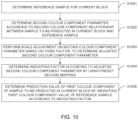
- FIG. 8 is schematic flowchart III of a decoding method provided in embodiments of the disclosure.
- the first reference colour component is exemplarily the second colour component, and after S701, the method may further include the following.
- a weighting value(s) of the reference sample(s) to the sample to-be-predicted in the current block is determined according to the difference by means of a preset second mapping.
- a target weighting value of the reference sample to the current block is determined according to the weighting value of the reference sample to the sample to-be-predicted in the current block.
- a first model parameter and a second model parameter are determined by performing weighted least squares calculation on the first colour component value of the reference sample and the first-reference-colour-component value of the reference sample according to the target weighting value.
- a prediction model is constructed according to the first model parameter and the second model parameter.
- the prediction value of the first colour component of the sample to-be-predicted in the current block is determined by predicting the first colour component of the sample to-be-predicted in the current block by using the prediction model.
- the first model parameter is represented by ⁇
- the second model parameter is represented by ⁇ .
- the first colour component is a chroma component
- the second colour component is a luma component, that is, the chroma component of the current block is to be predicted.
- L r and C r are luma component values and chroma component values of the N reference samples obtained in the CCLM technology.
- CCLM prediction is performed based on ⁇ and ⁇ derived by performing weighted LMS on the reference sample having weight characteristics.
- a CCLM prediction method is used in WC, that is, a chroma prediction value is constructed based on a reconstructed luma value of the same current block, as illustrated below:
- Pred C i j ⁇ ⁇ Rec L i j + ⁇
- Pred C (i, j) represents a chroma prediction value of the current block
- Rec L (i, j) represents a reconstructed luma (after downsampling) value of the same current block.
- ⁇ and ⁇ are model parameters, and can be derived from the reference sample in the neighbouring area by means of the foregoing weight allocation scheme and weighted LMS.
- the foregoing function model f for calculating w rij can also be another function capable of fitting the tendency that higher similarity between the luma information of the reference sample and the luma information of the sample to-be-predicted in the current block leads to higher importance of the chrominance of the reference sample to the sample to-be-predicted.
- the target weighting value of the reference sample to the current block can be determined according to the weighting value of the reference sample to the sample to-be-predicted in the current block as follows.
- the target weighting value of the reference sample to the current block is determined by performing averaging calculation on the weighting value of the reference sample to the sample to-be-predicted in the current block.
- the target weighting value of the reference sample to the current block is determined by performing summing calculation on the weighting value of the reference sample to the sample to-be-predicted in the current block.
- the method may further include the following.
- the number of minimum values among absolute values of the differences is determined based on the difference between the first-reference-colour-component value of the reference sample and the first-reference-colour-component value of the sample to-be-predicted in the current block. The number of minimum values is taken as the target weighting value of the reference sample to the current block.
- the method may further include the following. Second colour component values of the N reference samples are compared. According to a comparison result, a first reference sample sub-set with greater second colour component values and a second reference sample sub-set with smaller second colour component values are determined. A first fitting sample is obtained by performing averaging calculation on the first reference sample sub-set, and a second fitting sample is obtained by performing averaging calculation on the second reference sample sub-set. The first model parameter and the second model parameter are obtained by performing model parameter calculation according to the first fitting sample and the second fitting sample.
- two reference sample sub-sets i. e. a reference sample sub-set with greater luma component values and a reference sample sub-set with smaller luma component values
- two average reference samples namely, two fitting samples
- the model parameters ⁇ and ⁇ can also be derived according to the two fitting samples.
- model parameters can be obtained according to the two fitting samples by means of calculation based on "two points determines one straight line".
- the first model parameter and the second model parameter can be obtained by performing model parameter calculation according to the first fitting sample and the second fitting sample as follows. After the target weighting value of each of N reference samples to the current block is determined, a target weighting value set corresponding to the first reference sample sub-set and a target weighting value set corresponding to the second reference sample sub-set are determined. A first weighting average value is obtained by performing normalization on the target weighting value set corresponding to the first reference sample sub-set, and a second weighting average value is obtained by performing normalization on the target weighting value set corresponding to the second reference sample sub-set. The first model parameter and the second model parameter are obtained by performing weighted least squares calculation on the first fitting sample and the second fitting sample according to the first weighting average value and the second weighting average value.
- the importance weight w r of each reference sample to the current block is calculated according to the foregoing steps, and the importance weights of the reference samples are also classified into two importance weight sub-sets by means of the classification scheme in the current CCLM technology.
- Weights corresponding to reference samples in each reference sample sub-set are obtained by performing normalization on weights in each importance weight sub-set.
- two weighted average reference samples are obtained by performing weighted average calculation on each of the two reference sample sub-sets according to normalized weights in the corresponding importance weight sub-set.
- ⁇ and ⁇ are derived from the two weighted average reference samples.
- the CCLM technology has experienced many times of evolution, from deriving ⁇ and ⁇ by means of LMS according to luminance and chrominance of the reference sample in the neighbouring area, such as top, top-right, left, and bottom-left at an early stage, to selecting only reference samples at four locations in the neighbouring area to obtain ⁇ and ⁇ by means of the maximum-minimum method at present.
- the weight calculation method described in the foregoing embodiments can be applied to derivation of the model parameters ⁇ and ⁇ in any version of CCLM technology.
- the method may further include the following.
- a bitstream is parsed to determine the first model parameter and the second model parameter.
- the encoder can determine the model parameters ⁇ and ⁇ according to the foregoing scheme, and signal the model parameters ⁇ and ⁇ into the bitstream. In this way, for the decoder, the model parameters ⁇ and ⁇ can be obtained directly by decoding without performing model parameter calculation.
- the method may further include the following.
- the bitstream is parsed to determine a residual value of the first colour component of the sample to-be-predicted in the current block.
- a reconstructed value of the first colour component of the sample to-be-predicted in the current block is determined according to the residual value of the first colour component and the prediction value of the first colour component.
- the residual value of the first colour component of the sample to-be-predicted in the current block can be obtained by parsing the bitstream.
- the reconstructed value of the first colour component of the sample to-be-predicted in the current block can be determined according to the residual value of the first colour component and the prediction value of the first colour component, specifically, by performing addition calculation on the residual value of the first colour component and the prediction value of the first colour component.
- embodiments of the disclosure provide a chroma prediction technology, which is specifically a chroma intra prediction technology.
- the principle is to calculate the weighting factor according to the luma information of the reference sample and the luma information of the current block that are known, and to perform chroma prediction of the current block by using the weighting factor.
- a chroma component value of the reference sample is weighted for prediction to obtain a prediction value of a chroma component of the sample to-be-predicted in the current block, where a weighting factor corresponding to the chroma component value of the reference sample can be obtained by performing scale adjustment and non-linear mapping on the luma information of the sample to-be-predicted in the current block and the luma information of the reference sample.
- the weighting factor corresponding to the chroma component value of the reference sample can be calculated according to the luma information of the reference sample and the luma information of the current block; on the other hand, considering difference in luma information and chroma information of different sizes of blocks, scale adjustment is performed on the luma information according to the size parameter of the current block, which is more conducive to validity of the weighting factor; in addition, considering the tendency that higher similarity between the luma information of the reference sample and the luma information of the sample to-be-predicted in the current block leads to higher importance of the chrominance of the reference sample to the sample to-be-predicted, a valid and accurate mapping model f is constructed, and as such, different weighting factors corresponding to chrominance of the reference sample can be designed for different samples to-be-predicted, thereby improving accuracy of chroma prediction.
- the embodiment provides the decoding method.
- the weighting factor corresponding to the sample to-be-predicted can be calculated according to colour component information of the reference sample and colour component information of the sample to-be-predicted.
- different samples to-be-predicted may correspond to different weighting factors.
- FIG. 9 is schematic flowchart I of an encoding method provided in embodiments of the disclosure. As illustrated in FIG. 9 , the method may include the following.
- a reference sample(s) for a current block is determined.
- the encoding method in the embodiment of the disclosure is applied to an encoder.
- the encoding method may specifically refer to an intra prediction method, and more specifically, refers to a colour component prediction method.
- a video picture can be partitioned into a multiple coding blocks, and each coding block may include a first colour component, a second colour component, and a third colour component.
- the current block in the embodiment of the disclosure refers to a coding block on which intra prediction is currently to be performed in the video picture.
- a component to-be-predicted is the first colour component.
- the component to-be-predicted is the second colour component.
- the component to-be-predicted is the third colour component.
- the current block can also be called a luma block.
- the current block can also be called a chroma block.
- the reference sample for the current block may refer to a reference sample neighbouring the current block.
- neighborhbouring can be spatially neighbouring, but is not limited thereto.
- neighborhbouring can also be temporally neighbouring or spatially and temporally neighbouring.
- the reference sample for the current block can also be a reference sample obtained through some processing on a spatially neighbouring reference sample, a temporally neighbouring reference sample, or a spatially and temporally neighbouring reference sample, etc., and embodiments of the disclosure are not limited in this regard.
- the reference sample for the current block can be determined as follows.
- the reference sample is determined from samples in a neighbouring area of the current block, where the neighbouring area includes at least one of: a top neighbouring area, a top-right neighbouring area, a left neighbouring area, or a bottom-left neighbouring area.
- the reference sample can be determined from the samples in the neighbouring area of the current block as follows.
- a first reference sample set is determined from the samples in the neighbouring area of the current block.
- the reference sample is determined from the first reference sample set.
- the first reference sample set may consist of samples in the left neighbouring area and the top neighbouring area of the current block, as illustrated in (a) of FIG.
- the first reference sample set may consist of samples in the left neighbouring area and the bottom-left neighbouring area of the current block, as illustrated in (b) of FIG. 2 ; for an INTRA T_CCLM mode, the first reference sample set may consist of samples in the top neighbouring area and the top-right neighbouring area of the current block, as illustrated in (c) of FIG. 2 .
- the neighbouring area of the current block can be multiple rows or multiple columns.
- the left neighbouring area or the bottom-left neighbouring area may include one or more columns
- the top neighbouring area or the top-right neighbouring area may include one or more rows.
- samples in some neighbouring areas rather than all neighbouring areas can be used for colour component prediction of the current block, which can be, for example, only the top neighbouring area; or only the left neighbouring area; or only the top neighbouring area and the top-right neighbouring area; or only the left neighbouring area and the bottom-left neighbouring area; or only the top neighbouring area and the left neighbouring area, or only the top neighbouring area, the top-right neighbouring area, and the left neighbouring area; or only the left neighbouring area, the bottom-left neighbouring area, and the top neighbouring area, or the like.
- reference samples in the four neighbouring areas i. e. left, bottom-left, top, and top-right, can be obtained for colour component prediction of the current block.
- the manner for selecting the neighbouring area can also be determined according to a prediction mode for the current block.
- the prediction mode for the current block is a horizontal mode
- the reference sample is determined from samples in the top neighbouring area and/or the top-right neighbouring area
- the prediction mode for the current block is a vertical mode
- the reference sample is determined from samples in the left neighbouring area and/or the bottom-left neighbouring area.
- a luma prediction mode for the current block is the horizontal mode
- the neighbouring area for chroma component prediction can be only the top neighbouring area and/or the top-right neighbouring area.
- the luma prediction mode for the current block is a vertical mode
- the neighbouring area for chroma component prediction can be only the left neighbouring area and/or the bottom-left neighbouring area.
- the method may further include the following.
- the reference sample is determined by selecting from the samples in the neighbouring area.
- the first reference sample set is determined from the samples in the neighbouring area of the current block.
- the reference sample can be determined by selecting from the first reference sample set.
- the number of reference samples can be N , where N is an integer and N>0.
- N reference samples can be selected from the samples in the neighbouring area.
- the value of N can be four, but is not limited thereto.
- the reference sample can be determined by selecting from the samples in the neighbouring area as follows.
- a sample location(s) to-be-selected is determined according to a location and/or a colour component intensity of the sample in the neighbouring area.
- the reference sample is determined from the samples in the neighbouring area according to the sample location to-be-selected.
- the colour component intensity can be represented by a colour component value, such as a luma component value and a chroma component value.
- a greater colour component value represents a higher colour component intensity.
- selection can be performed from the samples in the neighbouring area according to the location of the sample, or can be performed according to the colour component intensity, and embodiments of the disclosure are not limited in this regard.
- the reference sample for the current block can be determined according to the sample chosen.
- a weighting factor is determined according to the reference sample.
- the weighting factor can be determined according to a location of the sample to-be-predicted in the current block and the reference sample.
- the weighting factor can be determined according to the reference sample as follows.
- a first-reference-colour-component parameter is determined according to a first-reference-colour-component relationship between the sample to-be-predicted in the current block and the reference sample.
- the weighting factor is determined according to the first-reference-colour-component parameter by using a preset first mapping.
- the first-reference-colour-component parameter can be determined directly according to a difference between a first-reference-colour-component value of the reference sample and a first-reference-colour-component value of the sample to-be-predicted. Therefore, in some embodiments, the first-reference-colour-component parameter can be determined according to the first-reference-colour-component relationship between the sample to-be-predicted in the current block and the reference sample as follows. The difference between the first-reference-colour-component value of the reference sample and the first-reference-colour-component value of the sample to-be-predicted is determined. The first-reference-colour-component parameter is determined according to the difference.
- the first-reference-colour-component parameter can be determined according to the difference as follows.
- the first-reference-colour-component parameter is set to be equal to an absolute value of the difference.
- the first-reference-colour-component parameter can be determined according to the difference as follows.
- the first-reference-colour-component parameter is set to be equal to a product of an absolute value of the difference and a preset multiplier.
- the first reference colour component can be a first colour component.
- the first reference colour component can be a second colour component, where the second colour component is different from the first colour component.
- the first colour component is the component to-be-predicted in the embodiment of the disclosure. That is, if the first colour component is a chroma component and the second colour component is a luma component, the first-reference-colour-component parameter can be chroma component information or luma component information.
- the embodiment of the disclosure mainly aims at predicting a chroma component of the sample to-be-predicted in the current block.
- a sample to-be-predicted with significant colour difference in the current block is selected, and a chroma difference (represented by
- the chroma difference represents the degree of similarity between chrominance.
- indicates higher similarity between chroma values, and the corresponding weighting factor (represented by w k ) can be given a greater value; on the contrary, a greater
- the weighting factor can be determined according to the first-reference-colour-component parameter by using the preset first mapping as follows. A value corresponding to the first-reference-colour-component parameter in a preset function relationship of the first mapping is determined. The weighting factor is set to be equal to the value.
- the number of weighting factors is N accordingly, where the sum of the N weighting factors is equal to 1 and each of the weighting factors is a value greater than or equal to 0 and less than or equal to 1, i. e. 0 ⁇ w k ⁇ 1.
- the sum of the N weighting factors is equal to 1
- the absolute value of the weighting factor can be greater than 1.
- a normalized exponential function or referred to as a Softmax function
- a Softmax function is a generalization of a logic function. It can "convert" an N-dimensional vector z of arbitrary real numbers into another N-dimensional vector ⁇ (z) such that the range of each element is within (0, 1), and the sum of all the elements is 1.
- the Softmax function is often used as a non-linear activation function for a multi-class classification neural network.
- the Softmax function is illustrated in the foregoing formula (2).
- the softmax function can satisfy conditional constraints of w k , its function value increases as the value of the vector element increases, which does not comply with the approximately inverse proportion between w k and
- ⁇ can be defined as a negative number. That is, if the first-reference-colour-component parameter is
- the first factor is a constant value less than zero.
- ⁇ represents the first factor
- represents the first-reference-colour-component parameter
- represents the first product value
- the first factor can be determined as follows.
- the first factor is a preset constant value.
- a distribution of weighting factors for neighbouring chromimance can be adjusted according to relatively flat characteristics of chromimance, so as to determine a distribution of weighting factors that is suitable for chroma prediction of a natural picture.
- ⁇ can be -2 ⁇ , where ⁇ ⁇ 1, 0, - 1, - 2, - 3 ⁇ . It is found from experiments that in this set of ⁇ , the optimal value of ⁇ is - 0.25. Therefore, in an embodiment, ⁇ can be set to - 0.25, but the embodiment of the disclosure is not limited thereto.
- the first factor can be determined as follows. A value of the first factor is determined according to a size parameter of the current block.
- the method may further include the following.
- the value of the first factor is determined according to a preset mapping look-up table between the size parameter of the current block and the value of the first factor.
- the size parameter of the current block may include at least one of: a width of the current block or a height of the current block.
- the value of the first factor can be set by means of classification. For example, the size parameter of the current block is classified into three categories, and the value of the first factor corresponding to each category is determined.
- the preset mapping look-up table between the size parameter of the current block and the value of the first factor can also be pre-stored, and then the value of the first factor can be determined according to the look-up table.
- Table 1 is a schematic table illustrating a correspondence between the first factor and the size parameter of the current block provided in the embodiment of the disclosure.
- the first factor can be determined as follows. A value of the first factor is determined according to the number of reference samples for the current block.
- the method may further include the following.
- the value of the first factor is determined according to a preset mapping look-up table between the number of reference samples for the current block and the value of the first factor.
- the number of reference samples can be classified into three categories, and the value of the first factor can also be set by means of classification.
- the number of reference samples for the current block is classified into three categories, and the value of the first factor corresponding to each category is determined.
- the mapping look-up table between the number of reference samples for the current block and the value of the first factor can also be pre-stored, and then the value of the first factor can be determined according to the look-up table.
- Table 2 is a schematic table illustrating a correspondence between the first factor and the number of reference samples for the current block provided in the embodiment of the disclosure.
- the first product value can be determined according to the first factor and the first-reference-colour-component parameter as follows.
- the first product value is set to be equal to a product of the first factor and the first-reference-colour-component parameter.
- the first product value can be determined according to the first factor and the first-reference-colour-component parameter as follows.
- the first product value is set to be equal to a numerical value obtained by right-shifting the first-reference-colour-component parameter, where the number of bits right shifted is equal to the first factor.
- the first product value can be determined according to the first factor and the first-reference-colour-component parameter as follows.
- the first product value is determined by performing addition and bit shift on the first-reference-colour-component parameter according to the first factor.
- the first product value can be equal to the product of the first factor and the first-reference-colour-component parameter, or can be equal to the value obtained by right-shifting the first-reference-colour-component parameter, or can be obtained by performing addition and bit shift on the first-reference-colour-component parameter according to the first factor.
- the first factor is equal to 0.25 and the first-reference-colour-component parameter is represented by S
- the first product value is equal to 0.25 ⁇ S
- 0.25 ⁇ S can also be represented by S/4, that is, S»2.
- a floating-point number can be converted into addition and shift operations. That is, there is no limitation on the manner for calculation of the first product value.
- the first product value is determined according to the first factor and the first-reference-colour-component parameter as follows.
- a second factor is determined according to the first colour component value of the reference sample and the first-reference-colour-component value of the reference sample.
- the first product value is set to a product of the first factor, the first-reference-colour-component parameter, and the second factor.
- the first reference colour component is the component to-be-predicted (namely, chroma component)
- a chroma component value of the sample to-be-predicted cannot be directly determined
- between the reference sample and the sample to-be-predicted cannot be directly obtained.
- can be derived according to an absolute luma difference
- the chroma component value C ij of the current sample to-be-predicted (i, j) can be estimated according to a reconstructed luma value Y ij of the current sample to-be-predicted, as illustrated in the foregoing formula (5).
- neighbouring chrominance C k can also be estimated according to a reconstructed luma value Y k corresponding thereto, as illustrated in the foregoing formula (6).
- can be obtained through subtraction between formula (5) and formula (6), as illustrated in the foregoing formula (7).
- the first-reference-colour-component parameter can be
- the first-reference-colour-component parameter can be
- the first-reference-colour-component parameter can be
- the preset multiplier is the second factor described in the embodiment of the disclosure.
- the second factor can be determined according to the first colour component value of the reference sample and the first-reference-colour-component value of the reference sample as follows.
- the second factor is determined by performing least squares calculation on the first colour component value of the reference sample and the first-reference-colour-component value of the reference sample.
- the least squares calculation can be performed on chroma component values and luma component values of the N reference samples, so as to obtain the second factor.
- the least squares regression calculation is illustrated in formula (8) above.
- the first-reference-colour-component parameter can also be determined with a neural network. Therefore, in some embodiments, the first-reference-colour-component parameter can be determined according to the first-reference-colour-component relationship between the sample to-be-predicted in the current block and the reference sample as follows. The first-reference-colour-component parameter is determined by using a first neural network model.
- the method may include the following.
- An input of the first neural network model includes the first-reference-colour-component value of the reference sample and the first-reference-colour-component value of the sample to-be-predicted.
- An output of the first neural network model includes the first-reference-colour-component parameter.
- a preset neural network model can be a convolutional neural network, a deep learning neural network, or the like.
- the first-reference-colour-component value of the reference sample and the first-reference-colour-component value of the sample to-be-predicted can be the input of the preset neural network model, and accordingly, the output of the preset neural network model is the first-reference-colour-component parameter.
- the method may further include the following.
- the number of first colour component values is determined according to the number of reference samples for the current block.
- An initial value of the second factor is determined according to the number of first colour component values.
- the second factor is determined according to the initial value of the second factor.
- the second factor can be determined according to the initial value of the second factor as follows.
- the initial value of the second factor is taken directly as the second factor, or the initial value of the second factor is adjusted to obtain the second factor.
- the initial value of the second factor can be determined according to the number of first colour component values as follows. If the number of the first colour component values is greater than zero and less than 16, the initial value of the second factor is determined to be 0.445. If the number of the first colour component values is greater than or equal to 16 and less than 32, the initial value of the second factor is determined to be 0.3091. If the number of the first colour component values is greater than or equal to 32, the initial value of the second factor is determined to be 0.2026.
- ⁇ can be obtained by performing linear least squares regression calculation on the reference sample(s) in the neighbouring area.
- ⁇ there is a deviation between ⁇ and the theoretically optimal value; on the other hand, if ⁇ is estimated by means of linear least squares regression, additional calculation is needed at both an encoding end and a decoding end. Therefore, in order to further reduce complexity of calculation of the weighting factor, ⁇ can be classified according to size characteristics of the current block, and the value of ⁇ can be set accordingly, so as to be eliminate linear least squares regression calculation.
- VVC a flexible block partitioning technology is used, which supports binary tree partitioning, ternary tree partitioning, and quadtree partitioning.
- the minimum block size of a chroma coding unit only needs to satisfy that the total number of samples is greater than or equal to 16. Therefore, there are square blocks and rectangular blocks of various sizes in chroma coding units in the same video picture, and the number of reference samples involved in estimation varies with the block size.
- the number of reference samples is classified into three categories, and each category corresponds to a fixed ⁇ value.
- An average ⁇ (namely, the initial value of the second factor described herein) corresponding to each of the three categories of the number of reference samples is calculated according to a block subject to WC encoding, then fine adjustment is performed based on the average ⁇ as the center, and finally, the three categories of ⁇ after fine adjustment that can lead to better coding performance can be used as the final ⁇ .
- Table 3 is a schematic table illustrating a correspondence between the number R of chrominance corresponding to the reference samples and the average ⁇ .
- the weighting factor can be determined according to the first-reference-colour-component parameter by using the preset first mapping.
- the first mapping can be a mapping look-up table between the first-reference-colour-component parameter and a value of the weighting factor. That is, the decoder may pre-store the mapping look-up table between the first-reference-colour-component parameter and the value of the weighting factor, and in this way, after the first-reference-colour-component parameter is obtained, the weighting factor can be determined directly according to the look-up table.
- a value corresponding to the first-reference-colour-component parameter in the preset function relationship of the first mapping is determined, and then the weighting factor is set to be equal to the value.
- the preset function relationship of the first mapping can be a Softmax function.
- the Softmax function is a normalized exponential function.
- normalization may not be needed, and the value thereof is not limited to the range of [0, 1].
- the weighting factor w k corresponding to the kth reference sample can be calculated according to the following formula, as illustrated in the foregoing formula (9) or formula (10).
- the preset function relationship of the first mapping can be a weighting function that is inverse proportion with the first-reference-colour-component parameter.
- the preset function relationship of the first mapping in addition to replacing the Softmax function of formula (10) with formula (11) or formula (12) described above, the preset function relationship of the first mapping can even be another function model of the weighting factor that is constructed by fitting the tendency that higher similarity between luma information of reference sample x and luma information of the sample to-be-predicted in the current block leads to higher importance of the chrominance of the reference sample to the sample to-be-predicted in the current block.
- the embodiment of the disclosure is not limited in this regard.
- the weighting factor can be determined according to the location of the sample to-be-predicted in the current block and the reference sample.
- the weighting factor may specifically include N weighting factors w 1 , w 2 , ..., w N , where N represents the number of reference samples. Theoretically, the sum of the N weighting factors is equal to 1, and each of the weighting factors is a value greater than or equal to 0 and less than or equal to 1.
- a prediction value of a first colour component of the sample to-be-predicted in the current block is determined by weighting the first colour component value of the reference sample according to the weighting factor.
- the first colour component value of the reference sample can be weighted according to the weighting factor, so as to obtain the prediction value of the first colour component of the sample to-be-predicted in the current block.
- the prediction value of the first colour component of the sample to-be-predicted in the current block can be determined by weighting the first colour component value of the reference sample according to the weighting factor as follows. A weighted value of the first colour component value multiplied by the reference sample with the corresponding weighting factor is determined. The prediction value of the first colour component of the sample to-be-predicted in the current block is set to be equal to the sum of N weighted values, where N represents the number of the reference samples, and N is a positive integer.
- a weighted value (namely, w k C k ) of a first colour component value of each reference sample multiplied by a corresponding weighting factor is determined, and then the sum of the N weighted values is taken as the prediction value of the first colour component of the sample to-be-predicted in the current block.
- the formula for calculation is that illustrated in the foregoing formula (13). It should be noted that, as such, it is conducive to parallel processing and higher calculation speed.
- the method may further include the following. Downsampling is performed on a first reference colour component of the reference sample and a first reference colour component of the sample to-be-predicted in the current block, so that the first reference colour component has the same resolution as the component to-be-predicted.
- downsampling can be performed on the luma component to make the resolution of the luma component be consistent with the resolution of the chroma component.
- the method for downsampling can be a traditional filter coefficient or a neural network, which is not specifically limited in embodiments of the disclosure.
- FIG. 10 is schematic flowchart II of an encoding method provided in embodiments of the disclosure. As illustrated in FIG. 10 , the method may include the following.
- a reference sample(s) for a current block is determined.
- the reference sample may refer to a reference sample neighbouring the current block.
- the reference sample can be determined from samples in a left neighbouring area, a bottom-left neighbouring area, a top neighbouring area, and a top-right neighbouring area that are available for the current block, and then colour component prediction of the current block is performed according to the reference sample.
- a second colour component parameter is determined according to a second colour component relationship between a sample to-be-predicted in the current block and the reference sample.
- the second colour component parameter can be determined according to the second colour component relationship between the sample to-be-predicted in the current block and the reference sample as follows. A difference between a second colour component value of the reference sample and a second colour component value of the sample to-be-predicted is determined. The second colour component parameter is set to be equal to an absolute value of the difference.
- the second colour component parameter can also be referred to as luma information.
- an absolute value of a difference between a luma component of the reference sample and a luma component of a sample (i, j) to-be-predicted in the current block is taken as the second colour component parameter (namely, an absolute luma difference
- the second colour component parameter can be determined according to the second colour component relationship between the sample to-be-predicted in the current block and the reference sample as follows.
- the second colour component value of the reference sample and the second colour component value of the sample to-be-predicted are input into a preset neural network, and the second colour component parameter is output at the preset neural network.
- the second colour component parameter can be determined according to the second colour component relationship between the sample to-be-predicted in the current block and the reference sample as follows. Similarity between the second colour component value of the reference sample and the second colour component value of the sample to-be-predicted is determined, and the second colour component parameter is determined according to a comparison result.
- downsampling can be performed on the Y component to make the resolution of the Y component be consistent with the resolution of the U or V component.
- the method for downsampling herein can be a traditional filter coefficient or a neural network.
- the luma component value of the reference sample and the luma component value of the sample to-be-predicted in the current block can also be taken as an input of the preset neural network, and an output of the preset neural network is taken as the luma information obtained.
- similarity between a luma component value of a k th reference sample and the luma component value of the sample to-be-predicted in the current block can be determined, that is, whether the k th reference sample is the most similar reference sample to the sample to-be-predicted in the current block in terms of luma component value is determined and the determination result is taken as the luma information obtained. For example, if the k th reference sample is the most similar, the luma information of the k th reference sample is set to 1; otherwise, the luma information of the k th reference sample is set to 0.
- scale adjustment can be performed.
- is taken as an example of the luma information, and then scale adjustment can be performed on N pieces of
- scale adjustment can be performed based on different third factors.
- the method may further include the following.
- the size parameter of the current block is determined.
- the third factor is determined according to the size parameter of the current block, where the size parameter of the current block includes at least one of: a width of the current block or a height of the current block.
- the third factor can be determined according to the size parameter of the current block as follows. If the minimum value between the height and the width of the current block is less than or equal to 4, the third factor is determined to be 8. If the minimum value between the height and width of the current block is greater than 4 and less than or equal to 16, the third factor is determined to be 12. If the minimum value between the height and the width of the current block is greater than 16, the third factor is determined to be 16.
- a value of the third factor (represented by ⁇ ) can be set by means of classification.
- the height of the current block is represented by H
- the width of the current block is represented by W.
- fine adjustment can be performed on the foregoing correspondence between the third factor ⁇ and the size parameter of the current block.
- the correspondence between the third factor ⁇ and the size parameter of the current block after fine adjustment reference can be made to Table 5.
- fine adjustment can also be performed on the value of the third factor ⁇ .
- the third factor can be determined according to the size parameter of the current block as follows. If the minimum value between the height and the width of the current block is less than or equal to 4, the third factor is determined to be 7. If the minimum value between the height and the width of the current block is greater than 4 and less than or equal to 16, the third factor is determined to be 11. If the minimum value between the height and the width of the current block is greater than 16, the third factor is determined to be 15.
- the third factor can also be classified according to the number of reference samples for the current block.
- N represents the number of reference samples, and in some embodiments, the method may further include the following. If the value of N is less than 16, the third factor is determined to be 8. If the value of N is greater than or equal to 16 and less than 32, the third factor is determined to be 12. If the value of N is greater than or equal to 32, the third factor is determined to be 16.
- classification is performed according to the number of reference samples of the current block.
- a correspondence between the third factor ⁇ and the number of neighbouring reference samples is that illustrated in Table 7.
- the third factor can also be calculated in another manner.
- the method may further include the following.
- a first model parameter for the current block is determined.
- Scaling is performed on the first model parameter to obtain a scaled first model parameter.
- a reciprocal of the scaled first model parameter is calculated to obtain the third factor.
- a prediction model is constructed according to the luminance and the chrominance of the reference sample for the current block (the prediction model can be constructed by using a CCLM linear model construction scheme in the related art, or can be constructed by means of a least squares method or a weighted least squares method), so as to calculate the first model parameter (namely, a slope parameter, which is represented by ⁇ ) for the prediction model.
- the parameter ⁇ is scaled and then a reciprocal of the scaled parameter ⁇ is taken as the third factor ⁇ for the current block. For example, ⁇ /4 is scaled and then a reciprocal thereof is taken as the value of the third factor ⁇ .
- the number of categories of the third factor ⁇ can be adjusted according to performance requirements. For example, classification of ⁇ can be finer to increase the number of categories of ⁇ , so as to improve prediction accuracy. Alternatively, the number of categories of ⁇ can be decreased; or even the same ⁇ can be used for any current block or ⁇ can be an average value of the foregoing multiple categories of ⁇ and no classification is needed. As such, operations can be simplified, but prediction accuracy is degraded.
- a weighting factor is determined according to the adjusted second colour component parameter by using a preset second mapping.
- the weighting factor can be calculated according to in the preset second mapping, where the preset second mapping is a non-linear mapping. Assuming that the number of reference samples for the current block is N , then N second colour component parameters can be obtained; and after scale adjustment, N adjusted second colour component parameters can be obtained; in this way, the number of weighting factors calculated through non-linear mapping is N accordingly.
- a function model (namely, the preset second mapping, represented by f ) for weighting factor calculation can be constructed according to the tendency that higher similarity between the luma information of the reference sample and the luma information of the sample (i,j) to-be-predicted in the current block leads to higher importance of the chrominance of the reference sample to the sample (i,j) to-be-predicted.
- the Softmax function is used as the f model, and after scale adjustment is performed on the absolute luma difference, the absolute luma difference subject to scale adjustment is mapped to a weighting factor for the chrominance through the Softmax function.
- scale adjustment is performed on the N absolute luma differences
- subject to scale adjustment are mapped to weighting factors w kij corresponding to the N reference samples respectively through the Softmax function, and details of the calculation are illustrated in the foregoing formula (15).
- the function model can be constructed by fitting the tendency that higher similarity between the luma information of reference sample and the luma information of the sample to-be-predicted in the current block leads to higher importance of the chrominance of the reference sample to the sample to-be-predicted in the current block.
- formula (15) can be used, or the Softmax function of formula (15) can be replaced with formula (16) or formula (17), which is not limited herein.
- a preset first mapping or the preset second mapping operations can be simplified, for example, it is possible to eliminate some calculation operations by means of an array element look-up table.
- an array element value can be determined according to a preset mapping look-up table between a first-reference-colour-component parameter, a first factor, and an array element; a value corresponding to the array element value in a preset function relationship of the first mapping can be determined; and then the weighting factor can be set to be equal to the value.
- an array element value can be determined according to a preset mapping look-up table between the second colour component parameter, the third factor, and an array element; a value corresponding to the array element value in a preset function relationship of the second mapping can be determined; and then the weighting factor can be set to be equal to the value.
- the f model for weighting factor calculation can be implemented through simplified operations, for example, by means of a look-up table.
- a numerator in the f model can be stored by taking the independent variable
- Subsequent operations that are the same as calculation of the numerator in the f model are implemented by means of the look-up table, so as to eliminate calculation operations on the numerator and a denominator.
- the storage can be full storage or partial storage.
- the full storage means storing all numerators corresponding to the range of
- the size of the array that needs to be stored is the size of the range of
- a corresponding array offset can also be set according to the categories of ⁇ , and then the numerators are fully stored by taking
- elements in the one-dimensional array ostorMole ostorMole[index] are those illustrated in Table 9.
- partial storage refers to storing part of numerator values for weighting factor calculation.
- and/or part of the categories of ⁇ can be stored, the value of the f model which is not chosen for storage can be 0 by default, and the size of the array that needs to be stored is the size of the selected range of
- the storage range of partial storage can be determined according to actual needs, and is not limited to integers within 100 for
- a corresponding offset can also be set for the selected categories of ⁇ , so as to open up a one-dimensional storage space for storage, and embodiments of the disclosure are not limited in this regard.
- a prediction value of the first colour component of the sample to-be-predicted in the current block is determined by weighting a first colour component value of the reference sample according to the weighting factor.
- the chroma prediction value of the sample to-be-predicted can be calculated. Specifically, chroma component values C k of N reference samples can be weighted according to the weighting factors obtained in the foregoing steps, so as to obtain a chroma prediction value C ij pred of the sample (i,j) to-be-predicted in the current block. Details thereof are illustrated the foregoing formula (24).
- a weight can be allocated to the sample in the neighbouring area according to luma information of the sample in the neighbouring area and luma information of the current block, and CCLM prediction can be performed based on a first model parameter and a second model parameter derived by performing weighted LMS on the reference sample(s) having weight characteristics, thereby improving accuracy of chroma prediction. Therefore, in some embodiments, the method may further include the following. A difference between the second colour component value of the reference sample and the second colour component value of the sample to-be-predicted in the current block is determined.
- a weighting value(s) of the reference sample(s) to the sample to-be-predicted in the current block is determined according to the difference by using the preset second mapping.
- a target weighting value of the reference sample to the current block is determined according to the weighting value of the reference sample to the sample to-be-predicted in the current block.
- a first model parameter and a second model parameter are determined by performing weighted least squares calculation on the first colour component value of the reference sample and the first-reference-colour-component value of the reference sample according to the target weighting value.
- a prediction model is constructed according to the first model parameter and the second model parameter. The prediction value of the first colour component of the sample to-be-predicted in the current block is determined by predicting the first colour component of the sample to-be-predicted in the current block with the prediction model.
- the target weighting value of the reference sample to the current block can be determined according to the weighting value of the reference sample to the sample to-be-predicted in the current block as follows.
- the target weighting value of the reference sample to the current block is determined by performing averaging calculation on the weighting value of the reference sample to the sample to-be-predicted in the current block.
- the target weighting value of the reference sample to the current block is determined by performing summing calculation on the weighting value of the reference sample to the sample to-be-predicted in the current block.
- the method may further include the following.
- the number of minimum values among absolute values of the differences is determined based on the difference between the first-reference-colour-component value of the reference sample and the first-reference-colour-component value of the sample to-be-predicted in the current block. The number of minimum values is taken as the target weighting value of the reference sample to the current block.
- the importance weight w r for the current block can also be a sum obtained through summing calculation, such as formula (32) mentioned above.
- the importance weight w r of each reference sample to the current block the number of minimum differences between the luma component value of each reference sample for the current block and the luma component value of the sample to-be-predicted can be calculated and taken as the importance weight w r for the current block, such as the foregoing formula (33) and formula (34), which is not limited in embodiments of the disclosure.
- the first model parameter is represented by ⁇
- the second model parameter is represented by ⁇
- the method may further include the following. Second colour component values of the N reference samples are compared. According to a comparison result, a first reference sample sub-set with greater second colour component values and a second reference sample sub-set with smaller second colour component values are determined. A first fitting sample is obtained by performing averaging calculation on the first reference sample sub-set, and a second fitting sample is obtained by performing averaging calculation on the second reference sample sub-set. The first model parameter and the second model parameter are obtained by performing model parameter calculation according to the first fitting sample and the second fitting sample.
- two reference sample sub-sets i. e. a reference sample sub-set with greater luma component values and a reference sample sub-set with smaller luma component values
- two average reference samples namely, two fitting samples
- the model parameters ⁇ and ⁇ can also be derived according to the two fitting samples.
- the first model parameter and the second model parameter can be obtained by performing model parameter calculation according to the first fitting sample and the second fitting sample as follows. After the target weighting value of each of N reference samples to the current block is determined, a target weighting value set corresponding to the first reference sample sub-set and a target weighting value set corresponding to the second reference sample sub-set are determined. A first weighting average value is obtained by performing normalization on the target weighting value set corresponding to the first reference sample sub-set, and a second weighting average value is obtained by performing normalization on the target weighting value set corresponding to the second reference sample sub-set. The first model parameter and the second model parameter are obtained by performing weighted least squares calculation on the first fitting sample and the second fitting sample according to the first weighting average value and the second weighting average value.
- the importance weight w r of each reference sample to the current block is calculated according to the foregoing steps, and the importance weights of the reference samples are also classified into two importance weight sub-sets by means of the classification scheme in the current CCLM technology.
- Weights corresponding to reference samples in each reference sample sub-set are obtained by performing normalization on weights in each importance weight sub-set.
- two weighted average reference samples are obtained by performing weighted average calculation on each of the two reference sample sub-sets according to normalized weights in the corresponding importance weight sub-set.
- ⁇ and ⁇ are derived from the two weighted average reference samples.
- the CCLM technology has experienced many times of evolution, from deriving ⁇ and ⁇ by means of LMS according to luminance and chrominance of the reference sample in the neighbouring area, such as top, top-right, left, and bottom-left at an early stage, to selecting only reference samples at four locations in the neighbouring area to obtain ⁇ and ⁇ by means of the maximum-minimum method at present.
- the weight calculation method described in the foregoing embodiments can be applied to derivation of the model parameters ⁇ and ⁇ in any version of CCLM technology.
- the method may further include the following.
- the first model parameter and the second model parameter are encoded, and encoded bits obtained are signalled into a bitstream.
- an encoder may determine the model parameters ⁇ and ⁇ according to the foregoing scheme, and signal the model parameters ⁇ and ⁇ into the bitstream. In this way, for the decoder, the model parameters ⁇ and ⁇ can be obtained directly by decoding without performing model parameter calculation.
- the method further include the following.
- An original value of the first colour component of the sample to-be-predicted in the current block is determined.
- a residual value of the first colour component of the sample to-be-predicted in the current block is determined according to the original value of the first colour component and the prediction value of the first colour component.
- the residual value of the first colour component of the sample to-be-predicted in the current block is encoded, and encoded bits obtained are signalled into the bitstream.
- the residual value of the first colour component of the sample to-be-predicted in the current block can be determined according to the original value of the first colour component and the prediction value of the first colour component. Specifically, the residual value of the first colour component of the sample to-be-predicted in the current block can be determibed by performing subtraction calculation on the original value of the first colour component and the prediction value of the first colour component.
- the residual value of the first colour component can be obtained by decoding, so as to restore a reconstructed value of the first colour component of the sample to-be-predicted in the current block.
- embodiments of the disclosure provide a chroma prediction technology, which is specifically a chroma intra prediction technology.
- the principle is to calculate the weighting factor according to the luma information of the reference sample and the luma information of the current block that are known, and to perform chroma prediction of the current block by using the weighting factor.
- a chroma component value of the reference sample is weighted for prediction to obtain a prediction value of a chroma component of the sample to-be-predicted in the current block, where a weighting factor corresponding to the chroma component value of the reference sample can be obtained by performing scale adjustment and non-linear mapping on the luma information of the sample to-be-predicted in the current block and the luma information of the reference sample.
- the weighting factor corresponding to the chroma component value of the reference sample can be calculated according to the luma information of the reference sample and the luma information of the current block; on the other hand, considering difference in luma information and chroma information of different sizes of blocks, scale adjustment is performed on the luma information according to the size parameter of the current block, which is more conducive to validity of the weighting factor; in addition, considering the tendency that higher similarity between the luma information of the reference sample and the luma information of the sample to-be-predicted in the current block leads to higher importance of the chrominance of the reference sample to the sample to-be-predicted, a valid and accurate mapping model f is constructed, and as such, different weighting factors corresponding to chrominance of the reference sample can be designed for different samples to-be-predicted, thereby improving accuracy of chroma prediction.
- the embodiment provides an encoding method.
- the reference sample for the current block is determined.
- the weighting factor is determined according to the reference sample.
- the prediction value of the first colour component of the sample to-be-predicted in the current block is determined by weighting the first colour component value of the reference sample according to the weighting factor.
- the weighting factor corresponding to the sample to-be-predicted in the current block can be calculated.
- different samples to-be-predicted may correspond to different weighting factors, and the weighting factor is used for chroma prediction of the sample to-be-predicted in the current block.
- the correlation between the current block and the neighbouring area in terms of luma information is fully utilized for chroma prediction of the current block. As such, it is possible to improve accuracy of chroma prediction, save bit rate, and improve coding performance.
- the embodiment of the disclosure further provides a bitstream.
- the bitstream is generated by performing bit encoding according to information to-be-encoded.
- the information to-be-encoded at least includes a residual value of a first colour component of a sample to-be-predicted in a current block.
- the decoder after the residual value of the first colour component of the sample to-be-predicted in the current block is transmitted to a decoder by an encoder, the decoder obtains the residual value of the first colour component by decoding, and then can restore a reconstructed value of the first colour component of the sample to-be-predicted in the current block according to a prediction value of the first colour component of the sample to-be-predicted in the current block.
- a weighting factor corresponding to the sample to-be-predicted can be calculated, which can improve accuracy of chroma prediction, save bit rate, and improve coding performance.
- FIG. 11 is a schematic structural diagram of an encoding apparatus provided in embodiments of the disclosure.
- the encoding apparatus 110 may include a first determining unit 1101, a first calculating unit 1102, and a first predicting unit 1103.
- the first determining unit 1101 is configured to determine a reference sample for a current block.
- the first calculating unit 1102 is configured to determine a weighting factor according to the reference sample.
- the first predicting unit 1103 is configured to determine a prediction value of a first colour component of a sample to-be-predicted in the current block by weighting a first colour component value of the reference sample according to the weighting factor.
- the first determining unit 1101 is further configured to determine a weighted value of the first colour component value of the reference sample multiplied by the corresponding weighting factor.
- the first predicting unit 1103 is further configured to set the prediction value of the first colour component of the sample to-be-predicted in the current block to be equal to a sum of N weighted values, where N represents the number of the reference samples, and N is a positive integer.
- the first determining unit 1101 is further configured to determine the reference sample from samples in a neighbouring area of the current block, where the neighbouring area includes at least one of: a top neighbouring area, a top-right neighbouring area, a left neighbouring area, or a bottom-left neighbouring area.
- the first determining unit 1101 is further configured to determine the reference sample by selecting from the samples in the neighbouring area.
- the first determining unit 1101 is further configured to determine a sample location to-be-selected according to a location and/or a colour component intensity of the sample in the neighbouring area; and determine the reference sample from the samples in the neighbouring area according to the sample location to-be-selected.
- the first determining unit 1101 is further configured to determine a first-reference-colour-component parameter according to a first-reference-colour-component relationship between the sample to-be-predicted in the current block and the reference sample.
- the first calculating unit 1102 is further configured to determine the weighting factor according to the first-reference-colour-component parameter by using a preset first mapping.
- the first mapping is a mapping look-up table between the first-reference-colour-component parameter and a value of the weighting factor.
- the first determining unit 1101 is further configured to determine a value corresponding to the first-reference-colour-component parameter in a preset function relationship of the first mapping; and set the weighting factor to be equal to the value.
- the first determining unit 1101 is further configured to determine a first factor.
- the first calculating unit 1102 is further configured to determine a first product value according to the first factor and the first-reference-colour-component parameter; and determine a value corresponding to the first product value in the preset function relationship of the first mapping.
- the first determining unit 1101 is further configured to determine an array element value according to a preset mapping look-up table between the first-reference-colour-component parameter, the first factor, and an array element; and determine a value corresponding to the array element value in the preset function relationship of the first mapping.
- the first factor is a preset constant value.
- the first determining unit 1101 is further configured to determine a value of the first factor according to a size parameter of the current block, where the size parameter of the current block includes at least one of: a width of the current block or a height of the current block.
- the first determining unit 1101 is further configured to determine the value of the first factor according to a preset mapping look-up table between the size parameter of the current block and the value of the first factor.
- the first determining unit 1101 is further configured to determine a value of the first factor according to the number of reference samples for the current block.
- the first determining unit 1101 is further configured to determine the value of the first factor according to a preset mapping look-up table between the number of reference samples for the current block and the value of the first factor.
- the first calculating unit 1102 is further configured to set the first product value to be equal to a product of the first factor and the first-reference-colour-component parameter.
- the first calculating unit 1102 is further configured to set the first product value to be equal to a numerical value obtained by right-shifting the first-reference-colour-component parameter, where the number of bits right shifted is equal to the first factor.
- the first calculating unit 1102 is further configured to determine the first product value by performing addition and bit shift on the first-reference-colour-component parameter according to the first factor.
- the first determining unit 1101 is further configured to determine a second factor according to the first colour component value of the reference sample and a first-reference-colour-component value of the reference sample.
- the first calculating unit 1102 is further configured to set the first product value to a product of the first factor, the first-reference-colour-component parameter, and the second factor.
- the first determining unit 1101 is further configured to determine the second factor by performing least squares calculation on the first colour component value of the reference sample and the first-reference-colour-component value of the reference sample.
- the preset function relationship of the first mapping is a Softmax function.
- the preset function relationship of the first mapping is a weighting function that is in inverse proportion with the first-reference-colour-component parameter.
- the first reference colour component is the first colour component.
- the first reference colour component is a second colour component, where the second colour component is different from the first colour component.
- the first determining unit 1101 is further configured to determine a difference between a first-reference-colour-component value of the reference sample and a first-reference-colour-component value of the sample to-be-predicted; and determine the first-reference-colour-component parameter according to the difference.
- the first determining unit 1101 is further configured to set the first-reference-colour-component parameter to be equal to an absolute value of the difference.
- the first determining unit 1101 is further configured to determine the first-reference-colour-component parameter by using a first neural network model.
- the first determining unit 1101 is further configured to operate as follows.
- An input of the first neural network model includes a first-reference-colour-component value of the reference sample and a first-reference-colour-component value of the sample to-be-predicted; and an output of the first neural network model includes the first-reference-colour-component parameter.
- the encoding apparatus 110 may further include a first constructing unit 1104.
- the first determining unit 1101 is further configured to determine a difference between a first-reference-colour-component value of the reference sample and a first-reference-colour-component value of the sample to-be-predicted in the current block; determine a weighting value of the reference sample to the sample to-be-predicted in the current block according to the difference by using a preset second mapping; and determine a target weighting value of the reference sample to the current block according to the weighting value of the reference sample to the sample to-be-predicted in the current block.
- the first calculating unit 1102 is further configured to determine a first model parameter and a second model parameter by performing weighted least squares calculation on the first colour component value of the reference sample and the first-reference-colour-component value of the reference sample according to the target weighting value.
- the first constructing unit 1104 is configured to construct a prediction model according to the first model parameter and the second model parameter.
- the first predicting unit 1103 is further configured to determine the prediction value of the first colour component of the sample to-be-predicted in the current block by predicting the first colour component of the sample to-be-predicted in the current block with the prediction model.
- the first calculating unit 1102 is further configured to determine the target weighting value of the reference sample to the current block by performing averaging calculation on the weighting value of the reference sample to the sample to-be-predicted in the current block; or determine the target weighting value of the reference sample to the current block by performing summing calculation on the weighting value of the reference sample to the sample to-be-predicted in the current block.
- the first determining unit 1101 is further configured to determine the number of minimum values among absolute values of the differences, based on the difference between the first-reference-colour-component value of the reference sample and the first-reference-colour-component value of the sample to-be-predicted in the current block; and take the number of minimum values as the target weighting value of the reference sample to the current block.
- the encoding apparatus 110 may further include an encoding unit 1105.
- the first determining unit 1101 is further configured to determine an original value of the first colour component of the sample to-be-predicted in a current block; and determine a residual value of the first colour component of the sample to-be-predicted in the current block according to the original value of the first colour component and the prediction value of the first colour component.
- the encoding unit 1105 is configured to encode the residual value of the first colour component of the sample to-be-predicted in the current block, and signal encoded bits obtained into a bitstream.
- the "unit" can be part of a circuit, part of a processor, part of a program or software, etc., or can be a module, or can be non-modular.
- various components in the embodiment can be integrated into one processing unit or can be present as a number of physically separated units, and two or more units can be integrated into one.
- the integrated unit can be implemented in a form of hardware, or can be implemented in a form of software functional module.
- the integrated units are implemented as software functional modules and sold or used as standalone products, they can be stored in a computer-readable storage medium.
- the computer software products can be stored in a storage medium and may include multiple instructions that, when executed, can cause a computer device, e.g., a personal computer, a server, a network device, etc., or a processor to execute some or all operations of the methods described in various embodiments of the disclosure.
- the above storage medium may include various kinds of media that can store program codes, such as a universal serial bus (USB) flash disk, a mobile hard drive, a read-only memory (ROM), a random access memory (RAM), a magnetic disk, or an optical disk.
- USB universal serial bus
- ROM read-only memory
- RAM random access memory
- inventions of the disclosure provide a computer-readable storage medium.
- the computer-readable storage medium stores computer programs which, when executed by a first processor, are operable with the first processor to implement the method according to any one of the foregoing embodiments of the disclosure.
- FIG. 12 is a schematic structural diagram illustrating hardware of an encoding device provided in embodiments of the disclosure.
- the encoding device 120 may include a first communication interface 1201, a first memory 1202, and a first processor 1203. These components are coupled together via a first bus system 1204. It is understandable that, the first bus system 1204 is configured for connection and communication between these components.
- the first bus system 1204 further includes a power bus, a control bus, and a status signal bus. However, for the sake of illustration, various buses are marked as the first bus system 1204 in FIG. 12 .
- the first communication interface 1201 is configured for signal reception and transmission during information reception and transmission with other external network elements.
- the first memory 1202 is configured to store computer programs executable by the first processor 1203.
- the first processor 1203 is configured to execute the computer programs to implement the following steps: determining a reference sample for a current block; determining a weighting factor according to the reference sample; and determining a prediction value of a first colour component of a sample to-be-predicted in the current block by weighting a first colour component value of the reference sample according to the weighting factor.
- the first memory 1202 in the embodiment of the disclosure can be a volatile memory or a non-volatile memory, or may include both the volatile memory and the non-volatile memory.
- the non-volatile memory can be a ROM, a programmable ROM (PROM), an erasable PROM (EPROM), an electrically EPROM (EEPROM), or flash memory.
- the volatile memory can be a RAM that acts as an external cache.
- RAM random access memory
- SRAM static RAM
- DRAM dynamic RAM
- SDRAM synchronous DRAM
- DDR SDRAM double data rate SDRAM
- ESDRAM enhanced SDRAM
- SLDRAM synchlink DRAM
- DR RAM direct rambus RAM
- the first processor 1203 can be an integrated circuit chip with signal processing capabilities. During implementation, each step of the foregoing method can be completed by an integrated logic circuit in hardware in the first processor 1203 or an instruction in the form of software.
- the first processor 1203 can be a general-purpose processor, a digital signal processor (DSP), an application specific integrated circuit (ASIC), a field programmable gate array (FPGA), or other programmable logic devices, discrete gates or transistor logic devices, discrete hardware components.
- DSP digital signal processor
- ASIC application specific integrated circuit
- FPGA field programmable gate array
- the methods, steps, and logic blocks disclosed in embodiments of the disclosure can be implemented or executed.
- the general-purpose processor can be a microprocessor, or the processor can be any conventional processor or the like.
- the steps of the method disclosed in embodiments of the disclosure can be directly implemented by a hardware decoding processor, or can be performed by hardware and software modules in the decoding processor.
- the software module can be located in a storage medium such as a RAM, a flash memory, a ROM, a PROM, or an electrically erasable programmable memory, registers, and the like.
- the storage medium is located in the first memory 1202, and the first processor 1203 reads information in the first memory 1202 and completes the steps of the foregoing with the hardware thereof.
- the embodiments described herein can be implemented in hardware, software, firmware, middleware, microcode, or a combination thereof.
- the processing unit can be implemented in one or more application ASICs, DSPs, DSP devices (DSPDs), programmable logic devices (PLDs), FPGAs, general-purpose processors, controllers, micro-controllers, microprocessors, other electronic units for performing the functionality in the disclosure, or a combination thereof.
- the techniques described in the disclosure can be implemented by modules (e. g., procedures, functions, etc.) for performing the functionality in the disclosure.
- the software codes can be stored in the memory and executed by the processor.
- the memory can be implemented inside or external to the processor.
- the first processor 1203 is further configured to execute the computer programs to implement the method described in any of the foregoing embodiments.
- the embodiment provides the encoding apparatus.
- the encoding apparatus may includes the first determining unit, the first calculating unit, and the first predicting unit.
- the weighting factor corresponding to the sample to-be-predicted can be calculated.
- different samples to-be-predicted may correspond to different weighting factors.
- FIG. 13 is a schematic structural diagram of a decoding apparatus provided in embodiments of the disclosure.
- the decoding apparatus 130 may include a second determining unit 1301, a second calculating unit 1302, and a second predicting unit 1303.
- the second determining unit 1301 is configured to determine a reference sample for a current block.
- the second calculating unit 1302 is configured to determine a weighting factor according to the reference sample.
- the second predicting unit 1303 is configured to determine a prediction value of a first colour component of a sample to-be-predicted in the current block by weighting a first colour component value of the reference sample according to the weighting factor.
- the second determining unit 1301 is further configured to determine a weighted value of the first colour component value of the reference sample multiplied by the corresponding weighting factor; and set the prediction value of the first colour component of the sample to-be-predicted in the current block to be equal to a sum of N weighted values, wherein N represents the number of the reference samples, and N is a positive integer.
- the second determining unit 1301 is further configured to determine the reference sample from samples in a neighbouring area of the current block, where the neighbouring area includes at least one of: a top neighbouring area, a top-right neighbouring area, a left neighbouring area, or a bottom-left neighbouring area.
- the second determining unit 1301 is further configured to determine the reference sample by selecting from the samples in the neighbouring area.
- the second determining unit 1301 is further configured to determine a sample location to-be-selected according to a location and/or a colour component intensity of the sample in the neighbouring area; and determine the reference sample from the samples in the neighbouring area according to the sample location to-be-selected.
- the second determining unit 1301 is further configured to determine a first-reference-colour-component parameter according to a first-reference-colour-component relationship between the sample to-be-predicted in the current block and the reference sample.
- the second calculating unit 1302 is further configured to determine the weighting factor according to the first-reference-colour-component parameter by using a preset first mapping.
- the first mapping is a mapping look-up table between the first-reference-colour-component parameter and a value of the weighting factor.
- the second determining unit 1301 is further configured to determine a value corresponding to the first-reference-colour-component parameter in a preset function relationship of the first mapping; and set the weighting factor to be equal to the value.
- the second determining unit 1301 is further configured to determine a first factor.
- the second calculating unit 1302 is further configured to determine a first product value according to the first factor and the first-reference-colour-component parameter; and determine a value corresponding to the first product value in the preset function relationship of the first mapping.
- the second determining unit 1301 is further configured to determine an array element value according to a preset mapping look-up table between the first-reference-colour-component parameter, the first factor, and an array element; and determine a value corresponding to the array element value in the preset function relationship of the first mapping.
- the first factor is a preset constant value.
- the second determining unit 1301 is further configured to determine a value of the first factor according to a size parameter of the current block, where the size parameter of the current block includes at least one of: a width of the current block or a height of the current block.
- the second determining unit 1301 is further configured to determine the value of the first factor according to a preset mapping look-up table between the size parameter of the current block and the value of the first factor.
- the second determining unit 1301 is further configured to determine a value of the first factor according to the number of reference samples for the current block.
- the second determining unit 1301 is further configured to determine the value of the first factor according to a preset mapping look-up table between the number of reference samples for the current block and the value of the first factor.
- the second calculating unit 1302 is further configured to set the first product value to be equal to a product of the first factor and the first-reference-colour-component parameter.
- the second calculating unit 1302 is further configured to set the first product value to be equal to a numerical value obtained by right-shifting the first-reference-colour-component parameter, wherein the number of bits right shifted is equal to the first factor.
- the second calculating unit 1302 is further configured to determine the first product value by performing addition and bit shift on the first-reference-colour-component parameter according to the first factor.
- the second determining unit 1301 is further configured to determine a second factor according to the first colour component value of the reference sample and a first-reference-colour-component value of the reference sample.
- the second calculating unit 1302 is further configured to set the first product value to a product of the first factor, the first-reference-colour-component parameter, and the second factor.
- the second determining unit 1301 is further configured to determine the second factor by performing least squares calculation on the first colour component value of the reference sample and the first-reference-colour-component value of the reference sample.
- the preset function relationship of the first mapping is a Softmax function.
- the preset function relationship of the first mapping is a weighting function that is in inverse proportion with the first-reference-colour-component parameter.
- the first reference colour component is the first colour component.
- the first reference colour component is a second colour component, where the second colour component is different from the first colour component.
- the second determining unit 1301 is further configured to determine a difference between a first-reference-colour-component value of the reference sample and a first-reference-colour-component value of the sample to-be-predicted; and determine the first-reference-colour-component parameter according to the difference.
- the second determining unit 1301 is further configured to set the first-reference-colour-component parameter to be equal to an absolute value of the difference.
- the second determining unit 1301 is further configured to determine the first-reference-colour-component parameter by using a first neural network model.
- the second determining unit 1301 is further configured to operate as follows.
- An input of the first neural network model input includes a first-reference-colour-component value of the reference sample and a first-reference-colour-component value of the sample to-be-predicted.
- An output of the first neural network model includes first-reference-colour-component parameter.
- the decoding apparatus 130 may further include a second constructing unit 1304.
- the second determining unit 1301 is further configured to determine a difference between a first-reference-colour-component value of the reference sample and a first-reference-colour-component value of the sample to-be-predicted in the current block; determine a weighting value of the reference sample to the sample to-be-predicted in the current block according to the difference by using a preset second mapping; and determine a target weighting value of the reference sample to the current block according to the weighting value of the reference sample to the sample to-be-predicted in the current block.
- the second calculating unit 1302 is further configured to determine a first model parameter and a second model parameter by performing weighted least squares calculation on the first colour component value of the reference sample and the first-reference-colour-component value of the reference sample according to the target weighting value.
- the second constructing unit 1304 is configured to construct a prediction model according to the first model parameter and the second model parameter.
- the second predicting unit 1303 is further configured to determine the prediction value of the first colour component of the sample to-be-predicted in the current block by predicting the first colour component of the sample to-be-predicted in the current block with the prediction model.
- the second calculating unit 1302 is further configured to determine the target weighting value of the reference sample to the current block by performing averaging calculation on the weighting value of the reference sample to the sample to-be-predicted in the current block; or determine the target weighting value of the reference sample to the current block by performing summing calculation on the weighting value of the reference sample to the sample to-be-predicted in the current block.
- the second determining unit 1301 is further configured to determine the number of minimum values among absolute values of the differences, based on the difference between the first-reference-colour-component value of the reference sample and the first-reference-colour-component value of the sample to-be-predicted in the current block; and take the number of minimum values as the target weighting value of the reference sample to the current block.
- the decoding apparatus 130 may further include a decoding unit 1305.
- the decoding unit 1305 is configured to parse a bitstream to determine a residual value of the first colour component of the sample to-be-predicted in the current block.
- the second determining unit 1301 is further configured to determine a reconstructed value of the first colour component of the sample to-be-predicted in the current block according to the residual value of the first colour component and the prediction value of the first colour component.
- the "unit" can be part of a circuit, part of a processor, part of a program or software, etc., or can be a module, or can be non-modular.
- various components in the embodiment can be integrated into one processing unit or can be present as a number of physically separated units, and two or more units can be integrated into one.
- the integrated unit can be implemented in a form of hardware, or can be implemented in a form of software functional module.
- the integrated units are implemented as software functional modules and sold or used as standalone products, they can be stored in a computer-readable storage medium. Based on such an understanding, embodiments provide a computer-readable storage medium.
- the computer-readable storage medium stores computer programs which, when executed by a second processor, are operable with the second processor to implement the method according to any one of the foregoing embodiments.
- FIG. 14 is a schematic structural diagram illustrating hardware of a decoding device provided in embodiments of the disclosure.
- the decoding device 140 may include a second communication interface 1401, a second memory 1402, and a second processor 1403. These components are coupled together via a second bus system 1404.
- the second bus system 1404 is configured for connection and communication between these components.
- the second bus system 1404 further includes a power bus, a control bus, and a status signal bus.
- various buses are marked as the second bus system 1404 in FIG. 14 .
- the second communication interface 1401 is configured for signal reception and transmission during information reception and transmission with other external network elements.
- the second memory 1402 is configured to store computer programs executable by the second processor 1403.
- the second processor 1403 is configured to execute the computer programs to implement the following steps: determining a reference sample for a current block; determining a weighting factor according to the reference sample; and determining a prediction value of a first colour component of a sample to-be-predicted in the current block by weighting a first colour component value of the reference sample according to the weighting factor.
- the second processor 1403 is further configured to execute the computer programs to implement the method described in any of the foregoing embodiments.
- the second memory 1402 has a hardware function similar to that of the first memory 1202, and the second processor 1403 has a hardware function similar to that of the first processor 1203, which are not described again herein.
- the embodiment provides the decoding apparatus.
- the decoding apparatus may include a second determining unit, a second calculating unit and a second predicting unit.
- the weighting factor corresponding to the sample to-be-predicted can be calculated.
- different samples to-be-predicted may correspond to different weighting factors.
- FIG. 15 is a schematic structural diagram of a coding system provided in embodiments of the disclosure.
- the coding system 150 may include an encoder 1501 and a decoder 1502.
- the encoder 1501 can be a device integrating the encoding apparatus 110 in the foregoing embodiment, or can be the encoding device 120 in the foregoing embodiment.
- the decoder 1502 can be a device integrating the decoding apparatus 130 described in the foregoing embodiment, or can be the decoding device 140 described in the foregoing embodiment.
- the weighting factor corresponding to the sample to-be-predicted can be calculated according to colour component information of the neighbouring reference sample and colour component information of the sample to-be-predicted in the current block.
- different samples to-be-predicted may correspond to different weighting factors.
- a reference sample for a current block is determined at an encoding end or at a decoding end.
- a weighting factor is determined according to the reference sample.
- a prediction value of a first colour component of a sample to-be-predicted in the current block is determined by weighting a first colour component value of the reference sample according to the weighting factor.
- the weighting factor corresponding to the sample to-be-predicted in the current block can be calculated.
- different samples to-be-predicted may correspond to different weighting factors.
Landscapes
- Engineering & Computer Science (AREA)
- Multimedia (AREA)
- Signal Processing (AREA)
- Compression Or Coding Systems Of Tv Signals (AREA)
Applications Claiming Priority (1)
| Application Number | Priority Date | Filing Date | Title |
|---|---|---|---|
| PCT/CN2022/073876 WO2023141781A1 (zh) | 2022-01-25 | 2022-01-25 | 编解码方法、装置、编码设备、解码设备以及存储介质 |
Publications (2)
| Publication Number | Publication Date |
|---|---|
| EP4472201A1 true EP4472201A1 (de) | 2024-12-04 |
| EP4472201A4 EP4472201A4 (de) | 2025-11-12 |
Family
ID=87470028
Family Applications (1)
| Application Number | Title | Priority Date | Filing Date |
|---|---|---|---|
| EP22922632.9A Pending EP4472201A4 (de) | 2022-01-25 | 2022-01-25 | Codierungs- und decodierungsverfahren und -vorrichtung, codierungsvorrichtung, decodierungsvorrichtung und speichermedium |
Country Status (4)
| Country | Link |
|---|---|
| US (1) | US20240422330A1 (de) |
| EP (1) | EP4472201A4 (de) |
| CN (1) | CN118614063A (de) |
| WO (1) | WO2023141781A1 (de) |
Cited By (3)
| Publication number | Priority date | Publication date | Assignee | Title |
|---|---|---|---|---|
| US20260012573A1 (en) * | 2022-06-21 | 2026-01-08 | Interdigital Ce Patent Holdings, Sas | Methods and apparatuses for encoding and decoding an image or a video |
| EP4510577A4 (de) * | 2022-04-12 | 2026-02-11 | Guangdong Oppo Mobile Telecommunications Corp Ltd | Codierungsverfahren und -vorrichtung, decodierungsverfahren und -vorrichtung, codierungsvorrichtung, decodierungsvorrichtung und speichermedium |
| EP4510575A4 (de) * | 2022-04-12 | 2026-02-11 | Guangdong Oppo Mobile Telecommunications Corp Ltd | Codierungsverfahren und -vorrichtung, decodierungsverfahren und -vorrichtung, codierungsvorrichtung, decodierungsvorrichtung und speichermedium |
Families Citing this family (4)
| Publication number | Priority date | Publication date | Assignee | Title |
|---|---|---|---|---|
| WO2025065572A1 (zh) * | 2023-09-28 | 2025-04-03 | 深圳传音控股股份有限公司 | 图像处理方法、智能终端及存储介质 |
| WO2025241193A1 (zh) * | 2024-05-24 | 2025-11-27 | 深圳传音控股股份有限公司 | 处理方法、处理设备及存储介质 |
| WO2026007137A1 (en) * | 2024-07-05 | 2026-01-08 | Shenzhen Tcl New Technology Co., Ltd. | Encoding and decoding method |
| CN121281812A (zh) * | 2025-12-09 | 2026-01-06 | 自贡市第一人民医院 | 一种儿童肺功能检查数据辅助解读系统 |
Family Cites Families (9)
| Publication number | Priority date | Publication date | Assignee | Title |
|---|---|---|---|---|
| US10419757B2 (en) * | 2016-08-31 | 2019-09-17 | Qualcomm Incorporated | Cross-component filter |
| GB2567249A (en) * | 2017-10-09 | 2019-04-10 | Canon Kk | New sample sets and new down-sampling schemes for linear component sample prediction |
| GB2571313B (en) * | 2018-02-23 | 2022-09-21 | Canon Kk | New sample sets and new down-sampling schemes for linear component sample prediction |
| AU2018435559A1 (en) * | 2018-08-09 | 2021-03-11 | Guangdong Oppo Mobile Telecommunications Corp., Ltd. | Video image component prediction method and device, and computer storage medium |
| BR112021002310A2 (pt) * | 2018-08-09 | 2021-05-04 | Guangdong Oppo Mobile Telecommunications Corp., Ltd. | método para prever um componente de coloração de vídeo, aparelho de previsão, e mídia de armazenamento legível por computador |
| MY207520A (en) * | 2018-11-05 | 2025-03-01 | Beijing Bytedance Network Tech Co Ltd | Interpolation for inter prediction with refinement |
| WO2020236039A1 (en) * | 2019-05-21 | 2020-11-26 | Huawei Technologies Co., Ltd. | Method and apparatus of local illumination compensation for inter prediction |
| WO2021027925A1 (en) * | 2019-08-14 | 2021-02-18 | Beijing Bytedance Network Technology Co., Ltd. | Position-dependent intra prediction sample filtering |
| US20230262223A1 (en) * | 2020-06-03 | 2023-08-17 | Nokia Technologies Oy | A Method, An Apparatus and a Computer Program Product for Video Encoding and Video Decoding |
-
2022
- 2022-01-25 WO PCT/CN2022/073876 patent/WO2023141781A1/zh not_active Ceased
- 2022-01-25 CN CN202280089392.6A patent/CN118614063A/zh active Pending
- 2022-01-25 EP EP22922632.9A patent/EP4472201A4/de active Pending
-
2024
- 2024-07-24 US US18/782,956 patent/US20240422330A1/en active Pending
Cited By (3)
| Publication number | Priority date | Publication date | Assignee | Title |
|---|---|---|---|---|
| EP4510577A4 (de) * | 2022-04-12 | 2026-02-11 | Guangdong Oppo Mobile Telecommunications Corp Ltd | Codierungsverfahren und -vorrichtung, decodierungsverfahren und -vorrichtung, codierungsvorrichtung, decodierungsvorrichtung und speichermedium |
| EP4510575A4 (de) * | 2022-04-12 | 2026-02-11 | Guangdong Oppo Mobile Telecommunications Corp Ltd | Codierungsverfahren und -vorrichtung, decodierungsverfahren und -vorrichtung, codierungsvorrichtung, decodierungsvorrichtung und speichermedium |
| US20260012573A1 (en) * | 2022-06-21 | 2026-01-08 | Interdigital Ce Patent Holdings, Sas | Methods and apparatuses for encoding and decoding an image or a video |
Also Published As
| Publication number | Publication date |
|---|---|
| WO2023141781A1 (zh) | 2023-08-03 |
| US20240422330A1 (en) | 2024-12-19 |
| CN118614063A (zh) | 2024-09-06 |
| EP4472201A4 (de) | 2025-11-12 |
Similar Documents
| Publication | Publication Date | Title |
|---|---|---|
| EP4472201A1 (de) | Codierungs- und decodierungsverfahren und -vorrichtung, codierungsvorrichtung, decodierungsvorrichtung und speichermedium | |
| CN119788855B (zh) | 变换方法、编码器、解码器以及存储介质 | |
| EP3607746A1 (de) | Verfahren und vorrichtung zur prädiktiven bildcodierung und -decodierung | |
| US10419758B2 (en) | Non-local adaptive loop filter processing | |
| US10091514B1 (en) | Apparatus and method for inter and intra mode selection and block partitioning | |
| EP3910951A1 (de) | Bildkomponentenvorhersageverfahren, kodierer, dekodierer und speichermedium | |
| EP3843399B1 (de) | Videobildkomponentenvorhersageverfahren und -apparat, und computerspeichermedium | |
| US9756340B2 (en) | Video encoding device and video encoding method | |
| EP3944621A1 (de) | Bildvorhersageverfahren, kodierer, dekodierer, und speichermedium | |
| WO2022021422A1 (zh) | 视频编码方法、编码器、系统以及计算机存储介质 | |
| US11849141B2 (en) | Prediction image correcting device, image encoding device, image decoding device, and program | |
| EP4554223A1 (de) | Codierungsverfahren, vorrichtung und einrichtung, decodierungsverfahren, einrichtung und einrichtung und speichermedium | |
| US20160277767A1 (en) | Methods, systems and apparatus for determining prediction adjustment factors | |
| US20250047834A1 (en) | Encoding device, decoding device, and storage medium | |
| EP3955571B1 (de) | Bildvorhersageverfahren, kodierer, dekodierer und speichermedium | |
| US20250039358A1 (en) | Encoding device, decoding device, and storage medium | |
| EP4637154A1 (de) | Präzisionsbestimmung und schnelle kandidatenauswahl für zusammenführungsmodus mit bewegungsvektorunterschied in der videocodierung | |
| US20250039413A1 (en) | Encoding method, decoding method, and decoding device | |
| WO2024056219A1 (en) | A method, an apparatus and a computer program product for video encoding and video decoding | |
| EP4648418A1 (de) | Decodierungsverfahren, codierungsverfahren, decodierer und codierer | |
| CN120476592A (zh) | 编解码方法、码流、编码器、解码器以及存储介质 | |
| WO2023197189A1 (zh) | 编解码方法、装置、编码设备、解码设备以及存储介质 | |
| US20250254304A1 (en) | Hardware friendly block partition combination decision in video encoding | |
| WO2026007137A1 (en) | Encoding and decoding method | |
| US20250254310A1 (en) | Quantization using distortion-aware rounding offsets |
Legal Events
| Date | Code | Title | Description |
|---|---|---|---|
| STAA | Information on the status of an ep patent application or granted ep patent |
Free format text: STATUS: THE INTERNATIONAL PUBLICATION HAS BEEN MADE |
|
| PUAI | Public reference made under article 153(3) epc to a published international application that has entered the european phase |
Free format text: ORIGINAL CODE: 0009012 |
|
| STAA | Information on the status of an ep patent application or granted ep patent |
Free format text: STATUS: REQUEST FOR EXAMINATION WAS MADE |
|
| 17P | Request for examination filed |
Effective date: 20240821 |
|
| AK | Designated contracting states |
Kind code of ref document: A1 Designated state(s): AL AT BE BG CH CY CZ DE DK EE ES FI FR GB GR HR HU IE IS IT LI LT LU LV MC MK MT NL NO PL PT RO RS SE SI SK SM TR |
|
| DAV | Request for validation of the european patent (deleted) | ||
| DAX | Request for extension of the european patent (deleted) | ||
| A4 | Supplementary search report drawn up and despatched |
Effective date: 20251013 |
|
| RIC1 | Information provided on ipc code assigned before grant |
Ipc: H04N 19/186 20140101AFI20251007BHEP Ipc: H04N 19/50 20140101ALI20251007BHEP Ipc: H04N 19/159 20140101ALI20251007BHEP |