EP4471011A1 - Process for the selective cleavage of c-scf3 bonds and analogues - Google Patents
Process for the selective cleavage of c-scf3 bonds and analogues Download PDFInfo
- Publication number
- EP4471011A1 EP4471011A1 EP23305863.5A EP23305863A EP4471011A1 EP 4471011 A1 EP4471011 A1 EP 4471011A1 EP 23305863 A EP23305863 A EP 23305863A EP 4471011 A1 EP4471011 A1 EP 4471011A1
- Authority
- EP
- European Patent Office
- Prior art keywords
- alkyl
- group
- sih
- compound
- formula
- Prior art date
- Legal status (The legal status is an assumption and is not a legal conclusion. Google has not performed a legal analysis and makes no representation as to the accuracy of the status listed.)
- Granted
Links
Classifications
-
- C—CHEMISTRY; METALLURGY
- C07—ORGANIC CHEMISTRY
- C07D—HETEROCYCLIC COMPOUNDS
- C07D277/00—Heterocyclic compounds containing 1,3-thiazole or hydrogenated 1,3-thiazole rings
- C07D277/60—Heterocyclic compounds containing 1,3-thiazole or hydrogenated 1,3-thiazole rings condensed with carbocyclic rings or ring systems
- C07D277/62—Benzothiazoles
- C07D277/64—Benzothiazoles with only hydrocarbon or substituted hydrocarbon radicals attached in position 2
-
- C—CHEMISTRY; METALLURGY
- C07—ORGANIC CHEMISTRY
- C07B—GENERAL METHODS OF ORGANIC CHEMISTRY; APPARATUS THEREFOR
- C07B31/00—Reduction in general
-
- C—CHEMISTRY; METALLURGY
- C07—ORGANIC CHEMISTRY
- C07C—ACYCLIC OR CARBOCYCLIC COMPOUNDS
- C07C1/00—Preparation of hydrocarbons from one or more compounds, none of them being a hydrocarbon
- C07C1/32—Preparation of hydrocarbons from one or more compounds, none of them being a hydrocarbon starting from compounds containing hetero-atoms other than or in addition to oxygen or halogen
- C07C1/321—Preparation of hydrocarbons from one or more compounds, none of them being a hydrocarbon starting from compounds containing hetero-atoms other than or in addition to oxygen or halogen the hetero-atom being a non-metal atom
- C07C1/322—Preparation of hydrocarbons from one or more compounds, none of them being a hydrocarbon starting from compounds containing hetero-atoms other than or in addition to oxygen or halogen the hetero-atom being a non-metal atom the hetero-atom being a sulfur atom
-
- C—CHEMISTRY; METALLURGY
- C07—ORGANIC CHEMISTRY
- C07C—ACYCLIC OR CARBOCYCLIC COMPOUNDS
- C07C17/00—Preparation of halogenated hydrocarbons
- C07C17/361—Preparation of halogenated hydrocarbons by reactions involving a decrease in the number of carbon atoms
-
- C—CHEMISTRY; METALLURGY
- C07—ORGANIC CHEMISTRY
- C07C—ACYCLIC OR CARBOCYCLIC COMPOUNDS
- C07C41/00—Preparation of ethers; Preparation of compounds having groups, groups or groups
- C07C41/01—Preparation of ethers
- C07C41/18—Preparation of ethers by reactions not forming ether-oxygen bonds
-
- C—CHEMISTRY; METALLURGY
- C07—ORGANIC CHEMISTRY
- C07C—ACYCLIC OR CARBOCYCLIC COMPOUNDS
- C07C67/00—Preparation of carboxylic acid esters
- C07C67/30—Preparation of carboxylic acid esters by modifying the acid moiety of the ester, such modification not being an introduction of an ester group
- C07C67/317—Preparation of carboxylic acid esters by modifying the acid moiety of the ester, such modification not being an introduction of an ester group by splitting-off hydrogen or functional groups; by hydrogenolysis of functional groups
-
- C—CHEMISTRY; METALLURGY
- C07—ORGANIC CHEMISTRY
- C07D—HETEROCYCLIC COMPOUNDS
- C07D207/00—Heterocyclic compounds containing five-membered rings not condensed with other rings, with one nitrogen atom as the only ring hetero atom
- C07D207/02—Heterocyclic compounds containing five-membered rings not condensed with other rings, with one nitrogen atom as the only ring hetero atom with only hydrogen or carbon atoms directly attached to the ring nitrogen atom
- C07D207/30—Heterocyclic compounds containing five-membered rings not condensed with other rings, with one nitrogen atom as the only ring hetero atom with only hydrogen or carbon atoms directly attached to the ring nitrogen atom having two double bonds between ring members or between ring members and non-ring members
- C07D207/32—Heterocyclic compounds containing five-membered rings not condensed with other rings, with one nitrogen atom as the only ring hetero atom with only hydrogen or carbon atoms directly attached to the ring nitrogen atom having two double bonds between ring members or between ring members and non-ring members with only hydrogen atoms, hydrocarbon or substituted hydrocarbon radicals, directly attached to ring carbon atoms
- C07D207/323—Heterocyclic compounds containing five-membered rings not condensed with other rings, with one nitrogen atom as the only ring hetero atom with only hydrogen or carbon atoms directly attached to the ring nitrogen atom having two double bonds between ring members or between ring members and non-ring members with only hydrogen atoms, hydrocarbon or substituted hydrocarbon radicals, directly attached to ring carbon atoms with only hydrogen atoms or radicals containing only hydrogen and carbon atoms directly attached to the ring nitrogen atoms
-
- C—CHEMISTRY; METALLURGY
- C07—ORGANIC CHEMISTRY
- C07D—HETEROCYCLIC COMPOUNDS
- C07D209/00—Heterocyclic compounds containing five-membered rings, condensed with other rings, with one nitrogen atom as the only ring hetero atom
- C07D209/02—Heterocyclic compounds containing five-membered rings, condensed with other rings, with one nitrogen atom as the only ring hetero atom condensed with one carbocyclic ring
- C07D209/04—Indoles; Hydrogenated indoles
- C07D209/08—Indoles; Hydrogenated indoles with only hydrogen atoms or radicals containing only hydrogen and carbon atoms, directly attached to carbon atoms of the hetero ring
-
- C—CHEMISTRY; METALLURGY
- C07—ORGANIC CHEMISTRY
- C07D—HETEROCYCLIC COMPOUNDS
- C07D307/00—Heterocyclic compounds containing five-membered rings having one oxygen atom as the only ring hetero atom
- C07D307/77—Heterocyclic compounds containing five-membered rings having one oxygen atom as the only ring hetero atom ortho- or peri-condensed with carbocyclic rings or ring systems
- C07D307/78—Benzo [b] furans; Hydrogenated benzo [b] furans
- C07D307/79—Benzo [b] furans; Hydrogenated benzo [b] furans with only hydrogen atoms, hydrocarbon or substituted hydrocarbon radicals, directly attached to carbon atoms of the hetero ring
-
- C—CHEMISTRY; METALLURGY
- C07—ORGANIC CHEMISTRY
- C07D—HETEROCYCLIC COMPOUNDS
- C07D333/00—Heterocyclic compounds containing five-membered rings having one sulfur atom as the only ring hetero atom
- C07D333/50—Heterocyclic compounds containing five-membered rings having one sulfur atom as the only ring hetero atom condensed with carbocyclic rings or ring systems
- C07D333/52—Benzo[b]thiophenes; Hydrogenated benzo[b]thiophenes
- C07D333/54—Benzo[b]thiophenes; Hydrogenated benzo[b]thiophenes with only hydrogen atoms, hydrocarbon or substituted hydrocarbon radicals, directly attached to carbon atoms of the hetero ring
-
- C—CHEMISTRY; METALLURGY
- C07—ORGANIC CHEMISTRY
- C07C—ACYCLIC OR CARBOCYCLIC COMPOUNDS
- C07C2602/00—Systems containing two condensed rings
- C07C2602/02—Systems containing two condensed rings the rings having only two atoms in common
- C07C2602/04—One of the condensed rings being a six-membered aromatic ring
- C07C2602/08—One of the condensed rings being a six-membered aromatic ring the other ring being five-membered, e.g. indane
Definitions
- the present invention concerns a process for the selective cleavage of C-SCF 3 bonds and analogues of such bonds.
- CFCs chlorofluorocarbons
- HFCs hydrofluorocarbons
- PFAs per- and poly-fluoroalkyl substances
- One aim of the present invention is thus to provide a tool for the de-fluorination of fluorinated compounds.
- One aim of the present invention is to provide a process for the de-fluorination of fluorinated compounds, for example through the cleavage of C-SCF 3 bonds, or analogues of such bonds.
- the present invention relates to a process for the preparation of a compound having the formula (I): A-H
- A is selected from the group consisting of:
- X is selected from the group consisting of: SCF 3 , SOCF 3 , SO 2 CF 3 , SCF 2 SO 2 Ph, SOCF 2 SO 2 Ph, SO 2 CF 2 SO 2 Ph, S(O) n CF 2 COOR, S(O) n CF 2 CONR 2 , S(O) n CF 2 CH 2 OH, S(O) n CN, S(O) n CHF 2 , S(O) n CF 2 H, S(O) n CF 2 C n F 2n+1 , S(O) n CF 2 COR, and all analogues of this list in the selenium series, R and n being as defined above.
- X is selected from the group consisting of: SCF 3 , SOCF 3 , SO 2 CF 3 , SCF 2 SO 2 Ph, SOCF 2 SO 2 Ph, SO 2 CF 2 SO 2 Ph, S(O) n CF 2 COOR, S(O) n CF 2 CONR 2 , S(O) n CF 2 CH 2 OH, S(O) n CN, S(O) n CHF 2 , S(O) n CF 2 H, S(O) n CF 2 C n F 2n+1 , S(O) n CF 2 COR, and SeCF 3 .
- X is selected from the group consisting of: SCF 3 , SOCF 3 , SO 2 CF 3 , SCF 2 SO 2 Ph, SO 2 CF 2 SO 2 Ph, and SeCF 3 .
- C t -C z means a carbon-based chain which can have from t to z carbon atoms, for example C 1 -C 3 means a carbon-based chain which can have from 1 to 3 carbon atoms.
- alkyl group means: a linear or branched, saturated, hydrocarbonbased aliphatic group comprising, unless otherwise mentioned, from 1 to 12 carbon atoms.
- alkyl group means: a linear or branched, saturated, hydrocarbonbased aliphatic group comprising, unless otherwise mentioned, from 1 to 12 carbon atoms.
- aryl group means: a cyclic aromatic group comprising between 6 and 10 carbon atoms.
- aryl groups mention may be made of phenyl or naphthyl groups.
- heteroaryl group means: a 5- to 10-membered aromatic monocyclic or bicyclic group containing from 1 to 4 heteroatoms selected from O, S or N.
- heteroatoms selected from O, S or N.
- heteroaryl comprising 5 to 6 atoms, including 1 to 4 nitrogen atoms
- arylalkyl When an alkyl group is substituted with an aryl group, the term “arylalkyl” or “aralkyl” group is used.
- the "arylalkyl” or “aralkyl” groups are aryl-alkyl- groups, the aryl and alkyl groups being as defined above.
- arylalkyl groups mention may in particular be made of the benzyl or phenethyl groups.
- halogen means: a fluorine, a chlorine, a bromine or an iodine.
- alkoxy group means: an -O-alkyl group where the alkyl group is as previously defined.
- alkyl group is as previously defined.
- -O-(C 1 -C 4 )alkyl groups and in particular the -O-methyl group, the -O-ethyl group, as -O-Csalkyl group, the -O-propyl group, the -O-isopropyl group, and as -O-C 4 alkyl group, the -O-butyl, - O-isobutyl or -O-tert-butyl group.
- alkynyl as employed herein includes unsaturated, nonaromatic, hydrocarbon groups having 2 to 6 carbons, and comprising at least one triple bond.
- the alkynyl group is linear.
- the alkynyl group is a -(CH 2 ) m -C ⁇ CH group, m being an integer comprised from 1 to 4.
- alkenyl as employed herein includes unsaturated, nonaromatic, hydrocarbon groups having 2 to 6 carbons, and comprising at least one double bond.
- the alkenyl group is linear.
- alkyl can be substituted with one or more substituents.
- substituents mention may be made of the following groups: amino, hydroxyl, thiol, oxo, halogen, alkyl, alkoxy, alkylthio, alkylamino, aryloxy, arylalkoxy, cyano, trifluoromethyl, carboxy or carboxyalkyl.
- alkylthio means: an -S-alkyl group, the alkyl group being as defined above.
- alkylamino means: an -NH-alkyl group, the alkyl group being as defined above.
- aryloxy means: an -O-aryl group, the aryl group being as defined above.
- arylalkoxy means: an aryl-alkoxy- group, the aryl and alkoxy groups being as defined above.
- carboxyalkyl means: an HOOC-alkyl- group, the alkyl group being as defined above.
- carboxyalkyl groups mention may in particular be made of carboxymethyl or carboxyethyl.
- haloalkyl group means: an alkyl group as defined above, in which one or more of the hydrogen atoms is(are) replaced with a halogen atom.
- fluoroalkyls in particular CF 3 or CHF 2 .
- carboxyl means: a COOH group.
- the hydride is selected from the group consisting of: EtMe 2 SiH, Me(OMe) 2 SiH, Me(OEt) 2 SiH, (OEt) 3 SiH, Et 3 SiH, tBuMe 2 SiH, Me 2 PhSiH, Me 2 BnSiH, MePh 2 SiH, Ph 3 SiH, Me 2 ( p- CF 3 (C 6 H 4 ))SiH, and Me 2 ( p -tBu(C 6 H 4 ))SiH.
- the hydride is Me 2 ( p -CF 3 (C 6 H 4 ))SiH or Me 2 BnSiH.
- the ligand is selected from the group consisting of: 1,5-cyclooctadiene (COD), 1,2-Bis(dicyclohexylphosphino)ethane (dcype), 1,1'-Bis(diphenylphosphino)ferrocene (dppf), 1,1'-Bis(di- tert -butylphosphino)ferrocene (DTBPF), 4,5-Bis(diphenyl-phosphino)-9,9-dimethylxanthene (XantPhos), and triphenylarsine (AsPh 3 ).
- COD 1,5-cyclooctadiene
- dcype 1,2-Bis(dicyclohexylphosphino)ethane
- dppf 1,1'-Bis(diphenylphosphino)ferrocene
- DTBPF 1,1'-Bis(di- tert -butylphosphino)
- the metallic complex is a Ni(0) complex such as bis(1,5-cyclooctadiene)nickel.
- the solvent used in the process according to the invention is selected from the usual solvents used in the field.
- the solvent for the process according to the invention is toluene.
- the reaction is carried out a temperature from 90°C to 140°C.
- the reaction may be carried out at 90°C, 120°C, and 140°C.
- the present invention also relates to a process as defined above, for the preparation of a compound having the formula (I-2): from a compound having the formula (II-2):
- X 1 being selected from the group consisting of: SCF 3 , SOCF 3 , SO 2 CF 3 , SCF 2 SO 2 Ph, SOCF 2 SO 2 Ph, SO 2 CF 2 SO 2 Ph, and SeCF 3 .
- the reaction is carried out in the presence of toluene with bis(1,5-cyclooctadiene)nickel and Me 2 ( p -CF 3 (C 6 H 4 ))SiH.
- the present invention also relates to a process as defined above, for the preparation of a compound having the formula (I-3): from a compound having the formula (II-3):
- the reaction is carried out in the presence of toluene, a base and molecular sieve with bis(1,5-cyclooctadiene)nickel and BnMe 2 SiH.
- the base is K 2 HPO 4 .
Landscapes
- Chemical & Material Sciences (AREA)
- Organic Chemistry (AREA)
- Chemical Kinetics & Catalysis (AREA)
- Low-Molecular Organic Synthesis Reactions Using Catalysts (AREA)
- Catalysts (AREA)
- Organic Low-Molecular-Weight Compounds And Preparation Thereof (AREA)
Abstract
A being selected from the group consisting of: (C6-C10)aryl groups, heteroaryl groups, and a vinyl compound, and
X being selected from the group consisting of: YCF3, Y(O)nCF3, YCF2SO2Ph, Y(O)nCF2SO2Ph, Y(O)nCF2COOR, Y(O)nCF2CONR2, Y(O)nCF2CH2OH, Y(O)nCN, Y(O)nCHF2, Y(O)nCF2H, Y(O)nCF2CnF2n+1, Y(O)nCF2COR, Y being S or Se, n being 1 or 2, and R being (C1-C6)alkyl.
Description
- The present invention concerns a process for the selective cleavage of C-SCF3 bonds and analogues of such bonds.
- In a society concerned about the environment, earth and aquatic systems pollution and circular economy, development of new technologies to meet such objectives is nowadays a real challenge and a hot topic across the whole chemical industry.
- The field of organofluorine chemistry is unavoidable and fluorinated compounds are highly represented in many fields such as materials science, the pharmaceutical and agrochemical industries. Indeed, the incorporation of a fluorine atom or a fluorinated unit can modify the physico-chemical properties of organic molecules in a significant way explaining the interest of the scientific community regarding this research area. However, the prevalence of these compounds raises the question of their fate and degradation. Recently, there has been a strong awareness from the scientific community and society regarding chlorofluorocarbons (CFCs), hydrofluorocarbons (HFCs) and per- and poly-fluoroalkyl substances (PFAs). It is now important to go even further and to look at the fate of emerging fluorinated groups that have become essential, such as derivatives containing a SCF3 unit (eg. Toltrazuril and Fipronil).
- In this context, the development of tools allowing to valorize these fluorinated derivatives, which, once used, are then considered as waste by converting them into compounds with high added value would have an undeniable ecological impact and allow for cost reduction. It is therefore essential to develop innovative tools to meet this challenge and to remove this synthetic lock.
- There is currently no technology allowing to selectively cleave C(sp2)-SRf bonds on (hetero)aromatic derivatives or vinyl positions or C(sp3)-SRf bonds and any progress would have a major impact from a scientific and environmental point of view.
- One aim of the present invention is thus to provide a tool for the de-fluorination of fluorinated compounds.
- One aim of the present invention is to provide a process for the de-fluorination of fluorinated compounds, for example through the cleavage of C-SCF3 bonds, or analogues of such bonds.
- Thus, the present invention relates to a process for the preparation of a compound having the formula (I):
A-H
- by reacting a compound having the formula (II):
A-X
- in the presence of a metallic complex comprising nickel, a ligand, a hydride, and a solvent,
- wherein:
- A is selected from the group consisting of:
- . (C6-C10)aryl groups,
- said aryl groups being optionally substituted with at least one substituent preferably selected from the group consisting of: halogen, (C1-C6)alkyl, (C1-C6)alkoxy, -CN, -CF3, -OCF3, -NRaRb, -SiRaRbRc, -BRaRb, (C2-C6)alkenyl, (C2-C6)alkynyl, -C(=O)-NRaRb, and -C(=O)-O(C1-C6)alkyl;
- Ra and Rb being independently from each other H or a (C1-C6)alkyl group; Rc being a (C1-C6)alkyl group;
- . heteroaryl groups comprising from 5 to 10 atoms and including at least one heteroatom selected from O, N, and S,
said heteroaryl groups being optionally substituted with at least one substituent preferably selected from: halogen, (C1-C6)alkyl, (C1-C6)alkoxy, -CN, -CF3, -OCF3, -NRaRb, -Si(Rc)3, -BRaRb, (C2-C6)alkenyl, (C2-C6)alkynyl, -C(=O)-NRaRb, and -C(=O)-O(C1-C6)alkyl, Ra, Rb and Rc being as defined above; and - . a vinyl compound having the following formula (III):

- . (C6-C10)aryl groups,
- X is selected from the group consisting of: YCF3, YOCF3, YO2CF3, YCF2SO2Ph, YOCF2SO2Ph, YO2CF2SO2Ph, Y(O)nCF2COOR, Y(O)nCF2CONR2, Y(O)nCF2CH2OH, Y(O)nCN, Y(O)nCHF2, Y(O)nCF2H, Y(O)nCF2CnF2n+1, Y(O)nCF2COR, Y being S or Se, Y being preferably S, n being 1 or 2, and R being (C1-C6)alkyl.
- A is selected from the group consisting of:
- According to an embodiment, in formula (I) or (II) above, A is selected from the group consisting of:
- . (C6-C10)aryl groups,
said aryl groups being optionally substituted with at least one substituent selected from the group consisting of: (C1-C6)alkyl, (C1-C6)alkoxy, and -C(=O)-O(C1-C6)alkyl; - . heteroaryl groups comprising from 5 to 10 atoms and including at least one heteroatom selected from O, N, and S,
said heteroaryl groups being optionally substituted with at least one substituent selected from: (C1-C6)alkyl, (C1-C6)alkoxy, and -C(=O)-O(C1-C6)alkyl; and - . a vinyl compound having the following formula (III):

- According to an embodiment, in formula (II) above, X is selected from the group consisting of: SCF3, SOCF3, SO2CF3, SCF2SO2Ph, SOCF2SO2Ph, SO2CF2SO2Ph, S(O)nCF2COOR, S(O)nCF2CONR2, S(O)nCF2CH2OH, S(O)nCN, S(O)nCHF2, S(O)nCF2H, S(O)nCF2CnF2n+1, S(O)nCF2COR, and all analogues of this list in the selenium series, R and n being as defined above.
- According to an embodiment, in formula (II) above, X is selected from the group consisting of: SCF3, SOCF3, SO2CF3, SCF2SO2Ph, SOCF2SO2Ph, SO2CF2SO2Ph, S(O)nCF2COOR, S(O)nCF2CONR2, S(O)nCF2CH2OH, S(O)nCN, S(O)nCHF2, S(O)nCF2H, S(O)nCF2CnF2n+1, S(O)nCF2COR, and SeCF3.
- According to an embodiment, in formula (II) above, X is selected from the group consisting of: SCF3, SOCF3, SO2CF3, SCF2SO2Ph, SO2CF2SO2Ph, and SeCF3.
- The following definitions are set forth to illustrate and define the meaning and scope of the various terms used to describe the invention herein.
- The expression "Ct-Cz" means a carbon-based chain which can have from t to z carbon atoms, for example C1-C3 means a carbon-based chain which can have from 1 to 3 carbon atoms.
- The term "alkyl group" means: a linear or branched, saturated, hydrocarbonbased aliphatic group comprising, unless otherwise mentioned, from 1 to 12 carbon atoms. By way of examples, mention may be made of methyl, ethyl, n-propyl, isopropyl, butyl, isobutyl, tert-butyl or pentyl groups.
- The term "aryl group" means: a cyclic aromatic group comprising between 6 and 10 carbon atoms. By way of examples of aryl groups, mention may be made of phenyl or naphthyl groups.
- The term "heteroaryl group" means: a 5- to 10-membered aromatic monocyclic or bicyclic group containing from 1 to 4 heteroatoms selected from O, S or N. By way of examples, mention may be made of imidazolyl, thiazolyl, oxazolyl, furanyl, thiophenyl, pyrazolyl, oxadiazolyl, tetrazolyl, pyridinyl, pyrazinyl, pyrimidinyl, pyridazinyl, indolyl, benzofuranyl, benzothiophenyl, benzoxazolyl, benzimidazolyl, indazolyl, benzothiazolyl, isobenzothiazolyl, benzotriazolyl, quinolinyl and isoquinolinyl groups.
- By way of a heteroaryl comprising 5 to 6 atoms, including 1 to 4 nitrogen atoms, mention may in particular be made of the following representative groups: pyrrolyl, pyrazolyl, 1,2,3-triazolyl, 1,2,4-triazolyl, tetrazolyl and 1,2,3-triazinyl.
- Mention may also be made, by way of heteroaryl, of thiophenyl, oxazolyl, furazanyl, 1,2,4-thiadiazolyl, naphthyridinyl, quinoxalinyl, phthalazinyl, imidazo[1,2-a]pyridine, imidazo[2,1-b]thiazolyl, cinnolinyl, benzofurazanyl, azaindolyl, benzimidazolyl, benzothiophenyl, thienopyridyl, thienopyrimidinyl, pyrrolopyridyl, imidazopyridyl, benzoazaindole, 1,2,4-triazinyl, indolizinyl, isoxazolyl, isoquinolinyl, isothiazolyl, purinyl, quinazolinyl, quinolinyl, isoquinolyl, 1,3,4-thiadiazolyl, thiazolyl, isothiazolyl, carbazolyl, and also the corresponding groups resulting from their fusion or from fusion with the phenyl nucleus.
- When an alkyl group is substituted with an aryl group, the term "arylalkyl" or "aralkyl" group is used. The "arylalkyl" or "aralkyl" groups are aryl-alkyl- groups, the aryl and alkyl groups being as defined above. Among the arylalkyl groups, mention may in particular be made of the benzyl or phenethyl groups.
- The term "halogen" means: a fluorine, a chlorine, a bromine or an iodine.
- The term "alkoxy group" means: an -O-alkyl group where the alkyl group is as previously defined. By way of examples, mention may be made of -O-(C1-C4)alkyl groups, and in particular the -O-methyl group, the -O-ethyl group, as -O-Csalkyl group, the -O-propyl group, the -O-isopropyl group, and as -O-C4alkyl group, the -O-butyl, - O-isobutyl or -O-tert-butyl group.
- The term "alkynyl" as employed herein includes unsaturated, nonaromatic, hydrocarbon groups having 2 to 6 carbons, and comprising at least one triple bond. Preferably, the alkynyl group is linear. Preferably, the alkynyl group is a -(CH2)m-C≡CH group, m being an integer comprised from 1 to 4.
- The term "alkenyl" as employed herein includes unsaturated, nonaromatic, hydrocarbon groups having 2 to 6 carbons, and comprising at least one double bond. Preferably, the alkenyl group is linear. Preferably, the alkenyl group is a -(CH2)m-CH=CH2 group, m being an integer comprised from 1 to 4.
- The abovementioned "alkyl", "aryl", and "heteroaryl" groups can be substituted with one or more substituents. Among these substituents, mention may be made of the following groups: amino, hydroxyl, thiol, oxo, halogen, alkyl, alkoxy, alkylthio, alkylamino, aryloxy, arylalkoxy, cyano, trifluoromethyl, carboxy or carboxyalkyl.
- The term "alkylthio" means: an -S-alkyl group, the alkyl group being as defined above.
- The term "alkylamino" means: an -NH-alkyl group, the alkyl group being as defined above.
- The term "aryloxy" means: an -O-aryl group, the aryl group being as defined above.
- The term "arylalkoxy" means: an aryl-alkoxy- group, the aryl and alkoxy groups being as defined above.
- The term "carboxyalkyl" means: an HOOC-alkyl- group, the alkyl group being as defined above. As examples of carboxyalkyl groups, mention may in particular be made of carboxymethyl or carboxyethyl.
- The term "haloalkyl group" means: an alkyl group as defined above, in which one or more of the hydrogen atoms is(are) replaced with a halogen atom. By way of example, mention may be made of fluoroalkyls, in particular CF3 or CHF2.
- The term "carboxyl" means: a COOH group.
- The term "oxo" means: "=O".
- In one embodiment of the process according to the invention, the hydride is a silane compound of formula R2(R3)2SiH, R2 and R3 being independently from each other selected from (C1-C6)alkyl, (C1-C6)alkoxy, and (C6-C10)aryl groups, said aryl groups being optionally substituted with at least one substituent selected from: (C1-C6)alkyl, (C1-C6)alkoxy, -CN, -OCF3, -NRaRb, -Si(Rc)3, -BRaRb, (C2-C6)alkenyl, (C2-C6)alkynyl, -C(=O)-NRaRb, -C(=O)-O(C1-C6)alkyl, and CF3, Ra, Rb and Rc being as defined above.
- In one embodiment of the process according to the invention, the hydride is a silane compound of formula R2(R3)2SiH, R2 and R3 being independently from each other selected from (C1-C6)alkyl, (C1-C6)alkoxy, and (C6-C10)aryl groups, said aryl groups being optionally substituted with at least one substituent selected from: (C1-C6)alkyl, (C1-C6)alkoxy, and -C(=O)-O(C1-C6)alkyl, and CF3.
- In one embodiment of the process according to the invention, the hydride is selected from the group consisting of: EtMe2SiH, Me(OMe)2SiH, Me(OEt)2SiH, (OEt)3SiH, Et3SiH, tBuMe2SiH, Me2PhSiH, Me2BnSiH, MePh2SiH, Ph3SiH, Me2(p-CF3(C6H4))SiH, and Me2(p-tBu(C6H4))SiH.
- In one embodiment, the hydride is Me2(p-CF3(C6H4))SiH or Me2BnSiH.
- According to one embodiment, in the process according to the invention, the ligand is selected from the group consisting of: 1,5-cyclooctadiene (COD), 1,2-Bis(dicyclohexylphosphino)ethane (dcype), 1,1'-Bis(diphenylphosphino)ferrocene (dppf), 1,1'-Bis(di-tert-butylphosphino)ferrocene (DTBPF), 4,5-Bis(diphenyl-phosphino)-9,9-dimethylxanthene (XantPhos), and triphenylarsine (AsPh3).
- Preferably, the metallic complex is a Ni(0) complex such as bis(1,5-cyclooctadiene)nickel.
- According to one embodiment, the solvent used in the process according to the invention is selected from the usual solvents used in the field. Preferably, the solvent for the process according to the invention is toluene.
- According to one embodiment of the process according to the invention, the reaction is carried out a temperature from 90°C to 140°C. Preferably, the reaction may be carried out at 90°C, 120°C, and 140°C.
- The present invention also relates to a process as defined above, for the preparation of a compound having the formula (I), from a compound having the formula A-SCF3 (II-1),
wherein A is a heteroaryl group comprising from 5 to 10 atoms and including at least one heteroatom selected from O, N, and S, said heteroaryl group being optionally substituted with at least one substituent selected from: halogen, (C1-C6)alkyl, (C1-C6)alkoxy, and -C(=O)-O(C1-C6)alkyl. - The present invention also relates to a process as defined above, for the preparation of a compound having the formula (I-2):


- X1 being selected from the group consisting of: SCF3, SOCF3, SO2CF3, SCF2SO2Ph, SOCF2SO2Ph, SO2CF2SO2Ph, and SeCF3.
- According to one embodiment of the processes as mentioned above, the reaction is carried out in the presence of toluene with bis(1,5-cyclooctadiene)nickel and Me2(p-CF3(C6H4))SiH.
- The present invention also relates to a process as defined above, for the preparation of a compound having the formula (I-3):


- p being 0, 1, 2, or 3; and
- R4, identical or different, being selected from the group consisting of: (C1-C6)alkyl, (C1-C6)alkoxy, and -C(=O)-O(C1-C6)alkyl.
- The present invention also relates to a process as defined above, for the preparation of a compound having the formula (I-4):


- According to one embodiment of the above processes, the reaction is carried out in the presence of toluene, a base and molecular sieve with bis(1,5-cyclooctadiene)nickel and BnMe2SiH.
- Preferably, the base is K2HPO4.
- General procedure A: an oven-dried 10 mL tube equipped with a stirring bar was charged with Ni(cod)2 (14 mg, 0.05 mmol, 10 mol%), (hetero)aryl-SCF3 derivative 1a-k or 3-7 (0.5 mmol, 1 equiv.), Me2(p-CF3(C6H4))SiH (408 mg, 2 mmol, 4 equiv.) and toluene (2 mL) under argon. The resulting solution was stirred at 140 °C for 48 h. The mixture was allowed to cooled down to 21 °C. The solution was filtered on CHROMAFIL® Xtra PTFE-45/25 and the solvent was evaporated under reduced pressure. The residue was purified by silica gel flash column chromatography by dry loading the samples and eluting with a solvent system as noted below to afford the desired products 2a-k.
- The steps, the reactants, the structures of the compounds, and the corresponding yields are shown in Scheme 1 hereafter.

- General procedure B: an oven-dried 10 mL tube equipped with a stirring bar was charged with Ni(cod)2 (14 mg, 0.05 mmol, 10 mol%), aryl-SCF3 8 or vinyl-SCF3 10 derivatives (0.5 mmol, 1 equiv.), K2HPO4 (174 mg, 1 mmol, 2 equiv.), Me2BnSiH (301 mg, 2 mmol, 4 equiv.), toluene (2 mL) and 4Å MS (62 mg) under argon. The resulting solution was stirred at 140°C for 48 h. The mixture was allowed to cooled down to 21°C. The solution was filtered on CHROMAFIL® Xtra PTFE-45/25 and the solvent was evaporated under reduced pressure. The residue was purified by silica gel flash column chromatography by dry loading the samples and eluting with a solvent system as noted below to afford the desired products 9 or 11.


Claims (15)
- A process for the preparation of a compound having the formula (I):
A-H
by reacting a compound having the formula (II):
A-X
in the presence of a metallic complex comprising nickel, a ligand, a hydride, anda solvent,wherein:- A is selected from the group consisting of:. (C6-C10)aryl groups,said aryl groups being optionally substituted with at least one substituent preferably selected from the group consisting of: halogen, (C1-C6)alkyl, (C1-C6)alkoxy, -CN, -CF3, -OCF3, -NRaRb, -SiRaRbRc, -BRaRb, (C2-C6)alkenyl, (C2-C6)alkynyl, -C(=O)-NRaRb, and -C(=O)-O(C1-C6)alkyl;Ra and Rb being independently from each other H or a (C1-C6)alkyl group;Rc being a (C1-C6)alkyl group;. heteroaryl groups comprising from 5 to 10 atoms and including at least one heteroatom selected from O, N, and S,
said heteroaryl groups being optionally substituted with at least one substituent preferably selected from: halogen, (C1-C6)alkyl, (C1-C6)alkoxy, -CN, -CF3, -OCF3, -NRaRb, -Si(Rc)3, -BRaRb, (C2-C6)alkenyl, (C2-C6)alkynyl, -C(=O)-NRaRb, and -C(=O)-O(C1-C6)alkyl, Ra, Rb and Rc being as defined above; and. a vinyl compound having the following formula (III): - X is selected from the group consisting of: YCF3, YOCF3, YO2CF3, YCF2SO2Ph, YOCF2SO2Ph, YO2CF2SO2Ph, Y(O)nCF2COOR, Y(O)nCF2CONR2, Y(O)nCF2CH2OH, Y(O)nCN, Y(O)nCHF2, Y(O)nCF2H, Y(O)nCF2CnF2n+1, Y(O)nCF2COR, Y being S or Se,
n being 1 or 2, and R being (C1-C6)alkyl. - The process of claim 1, wherein the hydride is a silane compound of formula R2(R3)2SiH, R2 and R3 being independently from each other selected from (C1-C6)alkyl, (C1-C6)alkoxy, and (C6-C10)aryl groups, said aryl groups being optionally substituted with at least one substituent selected from: (C1-C6)alkyl, (C1-C6)alkoxy, -CN, -OCF3, -NRaRb, -Si(Rc)3, -BRaRb, (C2-C6)alkenyl, (C2-C6)alkynyl, -C(=O)-NRaRb, and -C(=O)-O(C1-C6)alkyl, and CF3, Ra, Rb and Rc being as defined in claim 1.
- The process of claim 1 or 2, wherein the hydride is selected from the group consisting of: EtMe2SiH, Me(OMe)2SiH, Me(OEt)2SiH, (OEt)3SiH, Et3SiH, tBuMe2SiH, Me2PhSiH, Me2BnSiH, MePh2SiH, Ph3SiH, Me2(p-CF3(C6H4))SiH, and Me2(p-tBu(C6H4))SiH.
- The process of any one of claims 1 to 3, wherein the hydride is Me2(p-CF3(C6H4))SiH or Me2BnSiH.
- The process of any one of claims 1 to 4, wherein the ligand is selected from the group consisting of: 1,5-cyclooctadiene (COD), 1,2-Bis(dicyclohexylphosphino)ethane (dcype), 1,1'-Bis(diphenylphosphino)ferrocene (dppf), 1,1'-Bis(di-tert-butylphosphino)ferrocene (DTBPF), 4,5-Bis(diphenylphosphino)-9,9-dimethylxanthene (XantPhos), and triphenylarsine (AsPh3).
- The process of any one of claims 1 to 5, wherein the solvent is toluene.
- The process of any one of claims 1 to 6, wherein the reaction is carried out at a temperature from 90°C to 140°C.
- The process of any one of claims 1 to 7, wherein the metallic complex is a Ni(0) complex such as bis(1,5-cyclooctadiene)nickel.
- The process of any one of claims 1 to 8, for the preparation of a compound having the formula (I), from a compound having the formula A-SCF3 (II-1),
wherein A is a heteroaryl group comprising from 5 to 10 atoms and including at least one heteroatom selected from O, N, and S, said heteroaryl group being optionally substituted with at least one substituent selected from: halogen, (C1-C6)alkyl, (C1-C6)alkoxy, and -C(=O)-O(C1-C6)alkyl. - The process of any one of claims 1 to 8, for the preparation of a compound having the formula (I-2):


- The process of claim 9 or 10, wherein the reaction is carried out in the presence of toluene with bis(1,5-cyclooctadiene)nickel and Me2(p-CF3(C6H4))SiH.
- The process of any one of claims 1 to 8, for the preparation of a compound having the formula (I-3):
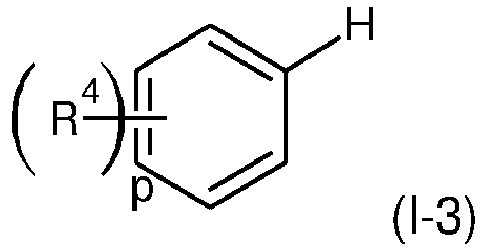
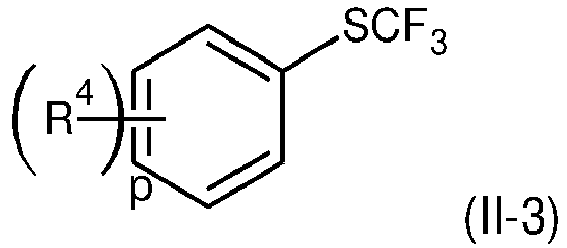 p being 0, 1, 2, or 3; andR4, identical or different, being selected from the group consisting of: (C1-C6)alkyl, (C1-C6)alkoxy, and -C(=O)-O(C1-C6)alkyl.
 - The process of any one of claims 1 to 8, for the preparation of a compound having the formula (I-4):


- The process of claim 12 or 13, wherein the reaction is carried out in the presence of toluene, a base, and also molecular sieve, with bis(1,5-cyclooctadiene)nickel and BnMe2SiH.
- The process of claim 14, wherein the base is K2HPO4.
Priority Applications (3)
| Application Number | Priority Date | Filing Date | Title |
|---|---|---|---|
| EP23305863.5A EP4471011B1 (en) | 2023-06-01 | 2023-06-01 | Process for the selective cleavage of c-scf3 bonds and analogues |
| JP2025569911A JP2026519109A (en) | 2023-06-01 | 2024-05-30 | Method for selective cleavage of C-SCF3 bonds and analogs |
| PCT/EP2024/064943 WO2024246226A1 (en) | 2023-06-01 | 2024-05-30 | Process for the selective cleavage of c-scf3 bonds and analogues |
Applications Claiming Priority (1)
| Application Number | Priority Date | Filing Date | Title |
|---|---|---|---|
| EP23305863.5A EP4471011B1 (en) | 2023-06-01 | 2023-06-01 | Process for the selective cleavage of c-scf3 bonds and analogues |
Publications (3)
| Publication Number | Publication Date |
|---|---|
| EP4471011A1 true EP4471011A1 (en) | 2024-12-04 |
| EP4471011C0 EP4471011C0 (en) | 2026-01-14 |
| EP4471011B1 EP4471011B1 (en) | 2026-01-14 |
Family
ID=87047668
Family Applications (1)
| Application Number | Title | Priority Date | Filing Date |
|---|---|---|---|
| EP23305863.5A Active EP4471011B1 (en) | 2023-06-01 | 2023-06-01 | Process for the selective cleavage of c-scf3 bonds and analogues |
Country Status (3)
| Country | Link |
|---|---|
| EP (1) | EP4471011B1 (en) |
| JP (1) | JP2026519109A (en) |
| WO (1) | WO2024246226A1 (en) |
Citations (2)
| Publication number | Priority date | Publication date | Assignee | Title |
|---|---|---|---|---|
| WO2008040057A1 (en) * | 2006-10-04 | 2008-04-10 | Bionomics Limited | Novel benzofuran potassium channel blockers and uses thereof |
| WO2021018572A1 (en) * | 2019-07-30 | 2021-02-04 | Studiengesellschaft Kohle Mbh | Air-stable ni(0)-olefin complexes and their use as catalysts or precatalysts |
Family Cites Families (1)
| Publication number | Priority date | Publication date | Assignee | Title |
|---|---|---|---|---|
| GB0602951D0 (en) * | 2006-02-14 | 2006-03-29 | Novartis Ag | Organic Compounds |
-
2023
- 2023-06-01 EP EP23305863.5A patent/EP4471011B1/en active Active
-
2024
- 2024-05-30 WO PCT/EP2024/064943 patent/WO2024246226A1/en not_active Ceased
- 2024-05-30 JP JP2025569911A patent/JP2026519109A/en active Pending
Patent Citations (2)
| Publication number | Priority date | Publication date | Assignee | Title |
|---|---|---|---|---|
| WO2008040057A1 (en) * | 2006-10-04 | 2008-04-10 | Bionomics Limited | Novel benzofuran potassium channel blockers and uses thereof |
| WO2021018572A1 (en) * | 2019-07-30 | 2021-02-04 | Studiengesellschaft Kohle Mbh | Air-stable ni(0)-olefin complexes and their use as catalysts or precatalysts |
Non-Patent Citations (4)
| Title |
|---|
| BARBERO NEKANE ET AL: "Ligand-Free Ni-Catalyzed Reductive Cleavage of Inert Carbon-Sulfur Bonds", vol. 14, no. 3, 18 January 2012 (2012-01-18), US, pages 796 - 799, XP093101949, ISSN: 1523-7060, Retrieved from the Internet <URL:https://pubs.acs.org/doi/epdf/10.1021/ol2033306> DOI: 10.1021/ol2033306 * |
| MARTIN R BRYCE ET AL: "Formation and rearrangement of adducts from benzyne and substituted 2,1,3-benzoselenadiazoles", JOURNAL OF THE CHEMICAL SOCIETY, PERKIN TRANSACTIONS 1, ROYAL SOCIETY OF CHEMISTRY, CAMBRIDGE, UK, 1 January 1981 (1981-01-01), pages 607 - 613, XP008152039, ISSN: 0300-922X, DOI: 10.1039/P19810000607 * |
| SASAKI HIROTAKA ET AL: "Nucleophilic addition reactions of benzoxanthone derivatives with collapse of aromaticity", TETRAHEDRON, vol. 76, no. 39, 1 September 2020 (2020-09-01), AMSTERDAM, NL, pages 131472, XP093101582, ISSN: 0040-4020, DOI: 10.1016/j.tet.2020.131472 * |
| ZHENGKUN Y ET AL: "Mild and Efficient Desulfurization of Alkyl Sulfides with Sodium", TETRAHEDRON LETTERS, ELSEVIER, AMSTERDAM , NL, vol. 39, no. 18, 30 April 1998 (1998-04-30), pages 2671 - 2674, XP004113316, ISSN: 0040-4039, DOI: 10.1016/S0040-4039(98)00368-2 * |
Also Published As
| Publication number | Publication date |
|---|---|
| JP2026519109A (en) | 2026-06-11 |
| EP4471011C0 (en) | 2026-01-14 |
| WO2024246226A1 (en) | 2024-12-05 |
| EP4471011B1 (en) | 2026-01-14 |
Similar Documents
| Publication | Publication Date | Title |
|---|---|---|
| Wiehn et al. | Electrophilic trifluoromethylation of arenes and N-heteroarenes using hypervalent iodine reagents | |
| JP4653730B2 (en) | Method for producing dithioester | |
| Garza-Sanchez et al. | Visible light-mediated direct decarboxylative C–H functionalization of heteroarenes | |
| Yuan et al. | Catalytic enantioselective reductive arylation and alkenylation of sulfinylamines to access sulfinamides enabled by cobalt catalysis | |
| Prakash et al. | Difluoro (sulfinato) methylation of N-sulfinyl imines facilitated by 2-pyridyl sulfone: stereoselective synthesis of difluorinated β-amino sulfonic acids and peptidosulfonamides. | |
| Behbahani et al. | A new catalyst for the synthesis of 2-substituted perimidines catalysed by FePO4 | |
| Shimbo et al. | N-Alkenylation of hydroxamic acid derivatives with ethynyl benziodoxolone to synthesize cis-enamides through vinyl benziodoxolones | |
| CN107400073A (en) | A kind of 4 isothiocyanos 2(Trifluoromethyl)The synthetic method of benzonitrile | |
| EP4471011B1 (en) | Process for the selective cleavage of c-scf3 bonds and analogues | |
| Nguyen et al. | Sulfur–DMSO promoted oxidative coupling of active methylhetarenes with amines: access to amides | |
| Rahaman et al. | Multicomponent cross-dehydrogenative coupling of imidazo [1, 2-a] pyridine: Access to abnormal Mannich and Mannich-type reaction | |
| Gong et al. | Recent Applications of Triphenylmethyl (Trityl) Cations in Synthesis | |
| Wang et al. | Imidazobenzothiazine and primidobenzothiazine derivatives synthesis via an aliphatic SN2 substitution/Cu (I) catalyzed Ullmann coupling cascade process | |
| Sutherland et al. | Functionalization of aromatic and heterocyclic systems. Regioselective introduction of 2-oxoalkyl chain or cyano functions via organoiron complexes | |
| CN111718301B (en) | Synthetic method of quinazolinone derivative | |
| EP4471015A1 (en) | Process for the selective cleavage of c-scf3 bonds and analogues | |
| EP4471009A1 (en) | Process for trapping thiocarbonyl fluoride | |
| Li et al. | Highly Chemoselective Synthesis of 4‑Aminocinnolines via Electrophilic Activation Strategy | |
| Zhou | Microwave-Assisted, Metal-and Solvent-Free Synthesis of Diaryl Thioethers from Aryl Halides and Carbon Disulfide in the Presence of [DBUH]+[OAc]− | |
| CN117107367A (en) | Method for obtaining On-DNA aromatic compound through Suzuki coupling reaction and application thereof | |
| CN116589460A (en) | The preparation method of pyrido[1,2-b]indazole | |
| CN109232564B (en) | A molecular iodine-promoted one-pot method for the synthesis of 3-position thio-substituted imidazo[1,2-a]pyridine compounds | |
| Jiang et al. | Photocatalytic Diverse Synthesis of Transformable SF5-Scaffolds Utilizing SF6 | |
| JP3593523B2 (en) | New process for producing N, N-disubstituted amides | |
| CN111995543B (en) | Synthetic method of alpha-ketoamide compound |
Legal Events
| Date | Code | Title | Description |
|---|---|---|---|
| PUAI | Public reference made under article 153(3) epc to a published international application that has entered the european phase |
Free format text: ORIGINAL CODE: 0009012 |
|
| STAA | Information on the status of an ep patent application or granted ep patent |
Free format text: STATUS: THE APPLICATION HAS BEEN PUBLISHED |
|
| AK | Designated contracting states |
Kind code of ref document: A1 Designated state(s): AL AT BE BG CH CY CZ DE DK EE ES FI FR GB GR HR HU IE IS IT LI LT LU LV MC ME MK MT NL NO PL PT RO RS SE SI SK SM TR |
|
| STAA | Information on the status of an ep patent application or granted ep patent |
Free format text: STATUS: REQUEST FOR EXAMINATION WAS MADE |
|
| 17P | Request for examination filed |
Effective date: 20250430 |
|
| GRAP | Despatch of communication of intention to grant a patent |
Free format text: ORIGINAL CODE: EPIDOSNIGR1 |
|
| STAA | Information on the status of an ep patent application or granted ep patent |
Free format text: STATUS: GRANT OF PATENT IS INTENDED |
|
| RIC1 | Information provided on ipc code assigned before grant |
Ipc: C07D 207/323 20060101AFI20250901BHEP Ipc: C07C 15/00 20060101ALI20250901BHEP Ipc: C07C 17/00 20060101ALI20250901BHEP Ipc: C07C 41/18 20060101ALI20250901BHEP Ipc: C07C 67/28 20060101ALI20250901BHEP Ipc: C07C 67/30 20060101ALI20250901BHEP Ipc: C07D 209/08 20060101ALI20250901BHEP Ipc: C07D 277/64 20060101ALI20250901BHEP Ipc: C07D 307/79 20060101ALI20250901BHEP Ipc: C07D 333/54 20060101ALI20250901BHEP Ipc: C07B 31/00 20060101ALI20250901BHEP Ipc: C07C 1/32 20060101ALI20250901BHEP Ipc: C07C 67/317 20060101ALI20250901BHEP Ipc: C07C 17/361 20060101ALI20250901BHEP |
|
| INTG | Intention to grant announced |
Effective date: 20250918 |
|
| GRAS | Grant fee paid |
Free format text: ORIGINAL CODE: EPIDOSNIGR3 |
|
| GRAA | (expected) grant |
Free format text: ORIGINAL CODE: 0009210 |
|
| STAA | Information on the status of an ep patent application or granted ep patent |
Free format text: STATUS: THE PATENT HAS BEEN GRANTED |
|
| AK | Designated contracting states |
Kind code of ref document: B1 Designated state(s): AL AT BE BG CH CY CZ DE DK EE ES FI FR GB GR HR HU IE IS IT LI LT LU LV MC ME MK MT NL NO PL PT RO RS SE SI SK SM TR |
|
| REG | Reference to a national code |
Ref country code: CH Ref legal event code: F10 Free format text: ST27 STATUS EVENT CODE: U-0-0-F10-F00 (AS PROVIDED BY THE NATIONAL OFFICE) Effective date: 20260114 Ref country code: GB Ref legal event code: FG4D |
|
| REG | Reference to a national code |
Ref country code: DE Ref legal event code: R096 Ref document number: 602023010732 Country of ref document: DE |
|
| REG | Reference to a national code |
Ref country code: IE Ref legal event code: FG4D |
|
| U01 | Request for unitary effect filed |
Effective date: 20260119 |
|
| U07 | Unitary effect registered |
Designated state(s): AT BE BG DE DK EE FI FR IT LT LU LV MT NL PT RO SE SI Effective date: 20260126 |
|
| PG25 | Lapsed in a contracting state [announced via postgrant information from national office to epo] |
Ref country code: RS Free format text: LAPSE BECAUSE OF FAILURE TO SUBMIT A TRANSLATION OF THE DESCRIPTION OR TO PAY THE FEE WITHIN THE PRESCRIBED TIME-LIMIT Effective date: 20260414 |
|
| PG25 | Lapsed in a contracting state [announced via postgrant information from national office to epo] |
Ref country code: ES Free format text: LAPSE BECAUSE OF FAILURE TO SUBMIT A TRANSLATION OF THE DESCRIPTION OR TO PAY THE FEE WITHIN THE PRESCRIBED TIME-LIMIT Effective date: 20260114 |
|
| PG25 | Lapsed in a contracting state [announced via postgrant information from national office to epo] |
Ref country code: PL Free format text: LAPSE BECAUSE OF FAILURE TO SUBMIT A TRANSLATION OF THE DESCRIPTION OR TO PAY THE FEE WITHIN THE PRESCRIBED TIME-LIMIT Effective date: 20260114 |
|
| PG25 | Lapsed in a contracting state [announced via postgrant information from national office to epo] |
Ref country code: GR Free format text: LAPSE BECAUSE OF FAILURE TO SUBMIT A TRANSLATION OF THE DESCRIPTION OR TO PAY THE FEE WITHIN THE PRESCRIBED TIME-LIMIT Effective date: 20260415 |
|
| PG25 | Lapsed in a contracting state [announced via postgrant information from national office to epo] |
Ref country code: NO Free format text: LAPSE BECAUSE OF FAILURE TO SUBMIT A TRANSLATION OF THE DESCRIPTION OR TO PAY THE FEE WITHIN THE PRESCRIBED TIME-LIMIT Effective date: 20260414 |
|
| PG25 | Lapsed in a contracting state [announced via postgrant information from national office to epo] |
Ref country code: HR Free format text: LAPSE BECAUSE OF FAILURE TO SUBMIT A TRANSLATION OF THE DESCRIPTION OR TO PAY THE FEE WITHIN THE PRESCRIBED TIME-LIMIT Effective date: 20260114 |
|
| PG25 | Lapsed in a contracting state [announced via postgrant information from national office to epo] |
Ref country code: IS Free format text: LAPSE BECAUSE OF FAILURE TO SUBMIT A TRANSLATION OF THE DESCRIPTION OR TO PAY THE FEE WITHIN THE PRESCRIBED TIME-LIMIT Effective date: 20260514 |
|
| U20 | Renewal fee for the european patent with unitary effect paid |
Year of fee payment: 4 Effective date: 20260629 |