EP4470982A2 - Verfahren zur herstellung einer synthetischen karbonisierten mineralischen komponente in einer zementherstellungsanlage - Google Patents
Verfahren zur herstellung einer synthetischen karbonisierten mineralischen komponente in einer zementherstellungsanlage Download PDFInfo
- Publication number
- EP4470982A2 EP4470982A2 EP24205934.3A EP24205934A EP4470982A2 EP 4470982 A2 EP4470982 A2 EP 4470982A2 EP 24205934 A EP24205934 A EP 24205934A EP 4470982 A2 EP4470982 A2 EP 4470982A2
- Authority
- EP
- European Patent Office
- Prior art keywords
- exhaust gas
- carbonatable
- substance
- cement
- mineral component
- Prior art date
- Legal status (The legal status is an assumption and is not a legal conclusion. Google has not performed a legal analysis and makes no representation as to the accuracy of the status listed.)
- Pending
Links
Images
Classifications
-
- C—CHEMISTRY; METALLURGY
- C04—CEMENTS; CONCRETE; ARTIFICIAL STONE; CERAMICS; REFRACTORIES
- C04B—LIME, MAGNESIA; SLAG; CEMENTS; COMPOSITIONS THEREOF, e.g. MORTARS, CONCRETE OR LIKE BUILDING MATERIALS; ARTIFICIAL STONE; CERAMICS; REFRACTORIES; TREATMENT OF NATURAL STONE
- C04B7/00—Hydraulic cements
- C04B7/36—Manufacture of hydraulic cements in general
- C04B7/364—Avoiding environmental pollution during cement-manufacturing
- C04B7/367—Avoiding or minimising carbon dioxide emissions
-
- C—CHEMISTRY; METALLURGY
- C04—CEMENTS; CONCRETE; ARTIFICIAL STONE; CERAMICS; REFRACTORIES
- C04B—LIME, MAGNESIA; SLAG; CEMENTS; COMPOSITIONS THEREOF, e.g. MORTARS, CONCRETE OR LIKE BUILDING MATERIALS; ARTIFICIAL STONE; CERAMICS; REFRACTORIES; TREATMENT OF NATURAL STONE
- C04B7/00—Hydraulic cements
- C04B7/02—Portland cement
-
- C—CHEMISTRY; METALLURGY
- C04—CEMENTS; CONCRETE; ARTIFICIAL STONE; CERAMICS; REFRACTORIES
- C04B—LIME, MAGNESIA; SLAG; CEMENTS; COMPOSITIONS THEREOF, e.g. MORTARS, CONCRETE OR LIKE BUILDING MATERIALS; ARTIFICIAL STONE; CERAMICS; REFRACTORIES; TREATMENT OF NATURAL STONE
- C04B7/00—Hydraulic cements
- C04B7/24—Cements from oil shales, residues or waste other than slag
- C04B7/246—Cements from oil shales, residues or waste other than slag from waste building materials, e.g. waste asbestos-cement products, demolition waste
-
- C—CHEMISTRY; METALLURGY
- C04—CEMENTS; CONCRETE; ARTIFICIAL STONE; CERAMICS; REFRACTORIES
- C04B—LIME, MAGNESIA; SLAG; CEMENTS; COMPOSITIONS THEREOF, e.g. MORTARS, CONCRETE OR LIKE BUILDING MATERIALS; ARTIFICIAL STONE; CERAMICS; REFRACTORIES; TREATMENT OF NATURAL STONE
- C04B7/00—Hydraulic cements
- C04B7/36—Manufacture of hydraulic cements in general
- C04B7/43—Heat treatment, e.g. precalcining, burning, melting; Cooling
- C04B7/432—Preheating without addition of fuel
-
- C—CHEMISTRY; METALLURGY
- C04—CEMENTS; CONCRETE; ARTIFICIAL STONE; CERAMICS; REFRACTORIES
- C04B—LIME, MAGNESIA; SLAG; CEMENTS; COMPOSITIONS THEREOF, e.g. MORTARS, CONCRETE OR LIKE BUILDING MATERIALS; ARTIFICIAL STONE; CERAMICS; REFRACTORIES; TREATMENT OF NATURAL STONE
- C04B7/00—Hydraulic cements
- C04B7/36—Manufacture of hydraulic cements in general
- C04B7/48—Clinker treatment
- C04B7/52—Grinding ; After-treatment of ground cement
-
- Y—GENERAL TAGGING OF NEW TECHNOLOGICAL DEVELOPMENTS; GENERAL TAGGING OF CROSS-SECTIONAL TECHNOLOGIES SPANNING OVER SEVERAL SECTIONS OF THE IPC; TECHNICAL SUBJECTS COVERED BY FORMER USPC CROSS-REFERENCE ART COLLECTIONS [XRACs] AND DIGESTS
- Y02—TECHNOLOGIES OR APPLICATIONS FOR MITIGATION OR ADAPTATION AGAINST CLIMATE CHANGE
- Y02P—CLIMATE CHANGE MITIGATION TECHNOLOGIES IN THE PRODUCTION OR PROCESSING OF GOODS
- Y02P40/00—Technologies relating to the processing of minerals
- Y02P40/10—Production of cement, e.g. improving or optimising the production methods; Cement grinding
- Y02P40/18—Carbon capture and storage [CCS]
Definitions
- the invention relates to a method of producing a synthetic carbonated mineral component in a cement manufacturing plant, wherein the cement manufacturing plant comprises a calcination device for producing Portland clinker by decarbonating cement raw meal while releasing a CO 2 enriched exhaust gas and further comprising an exhaust gas installation for directing a flow of the CO 2 enriched exhaust gas from the calcination device to an exhaust stack of the cement manufacturing plant.
- raw meal is fed into a calcination device, in particular a rotary kiln, after it has been preheated and partially decarbonated in a multistage preheater system by using the heat of combustion gases exhausted from the rotary kiln.
- the preheated raw material is fed into the rotary kiln via the kiln inlet and travels to the kiln outlet while being calcined at temperatures of up to 1400°C.
- Carbon dioxide (CO 2 ) is the most significant long-lived greenhouse gas in the Earth's atmosphere.
- the use of fossil fuels and deforestation have rapidly increased its concentration in the atmosphere, leading to global warming.
- Carbon dioxide also causes ocean acidification, because it dissolves in water to form carbonic acid.
- the cement industry is an important emitter of CO 2 .
- significant amounts of CO 2 are generated during the decarbonation of raw meal (containing CaCO 3 ) to lime (CaO).
- CaO lime
- During the production of Portland cement clinker about 0,9 tons of CO 2 per ton of Portland cement clinker are emitted by the calcination of the raw materials and from the fuel combustion in the rotary kiln.
- EP 3656750 A2 discloses a method for using the CO 2 contained in an exhaust gas of a cement manufacturing plant for carbonating carbonatable waste material, such as concrete demolition waste, fly ash or slag, wherein the carbonated waste material can be used as a supplemental cementitious material in cement compositions.
- the carbonation is carried out in a wet scrubber, a semi-dry scrubber or a dry scrubber, so that a separate installation is needed for the carbonation process. Therefore, a disadvantage of the method is that it requires high capital expenditures.
- the instant invention aims at further reducing the CO 2 footprint of a cement plant without significantly increasing the capital and operating expenditures.
- the invention provides a method of producing a synthetic carbonated mineral component in a cement manufacturing plant, wherein the cement manufacturing plant comprises a calcination device for producing Portland clinker by decarbonating cement raw meal while releasing a CO 2 enriched exhaust gas and further comprising an exhaust gas installation for directing a flow of the CO 2 enriched exhaust gas from the calcination device to an exhaust stack of the cement manufacturing plant, wherein the method comprises the steps of:
- the invention is based on the idea to carbonate a carbonatable substance by injecting it directly into the gas streams of a Portland clinker manufacturing process that is enriched in carbon dioxide.
- the carbon dioxide generated within the clinker manufacturing process by the combustion of fuels and by the decarbonation of raw meal is directly used within the existing process and its content in the exhaust gas is thus reduced.
- an in-situ carbonation of carbonatable substances, such as waste materials is integrated into the clinker manufacturing process of a cement plant.
- the in-situ carbonation process does not require any separate installations and therefore minimizes the capital expenditures needed for the carbonation process.
- the existing exhaust gas installation is used for the carbonation process, i.e. the structural components of the cement plant that allow the CO 2 enriched exhaust gas to flow from the calcination device to an exhaust stack of the cement manufacturing plant.
- two main CO 2 enriched exhaust gas streams are existing.
- the first exhaust gas stream is coming from the preheater of the cement plant, in which cement raw meal is preheated in counter-current flow to exhaust gas coming from the calcination device, i.e. the rotary kiln.
- the preheater includes a Lepol heat exchanger, the preheating is done in a cross-current flow to the exhaust gas.
- This first stream is guided from the preheater exhaust gas outlet to an exhaust stack via a plurality of exhaust gas installation components, such as gas conditioning tower, raw meal mill, a filter unit and various ducts that interconnect said components.
- the second exhaust gas stream is coming from the kiln bypass that is used to extract kiln bypass dust from the calcination device, i.e. the rotary kiln.
- the second stream is guided from the kiln bypass to an exhaust stack via a plurality of exhaust gas installation components, such as a quenching chamber, a filter unit and various ducts that interconnect said components.
- the carbonatable material may generally be added to the first stream and/or the second stream at any suitable point thereof. However, it is preferably avoided to add the carbonatable substance at a point, where the carbonatable substance could be mixed with a non-hydraulic dust.
- the carbonation step may be carried out at various temperature ranges.
- the temperature of the CO 2 enriched exhaust gas decreases as it flows from the calcination device towards the exhaust stack. Therefore, the carbonation temperature depends on at which distance from the calcination device the carbonatable substance is introduced into the exhaust gas installation.
- the carbonation at the lower temperature range can be carried out in any point between the preheater gas outlet and the kiln production filter or before the chlorine bypass filter. In this atmosphere the content of carbon dioxide is around 5 to 20%, and that of water is between 2-15%. This environment enables the calcium silicate hydrates eventually contained in the carbonatable substance to recarbonate, providing calcium carbonates and fine silica.
- the carbonation at the higher temperature range can be achieved by injecting the carbonatable substance in the quenching air of a cement kiln bypass probe. This injection further contributes to the quenching and chlorine dust dilution, and reduces fresh air dilution, improving the carbon dioxide content of the exhaust gas and lowering the size of the bypass filter.
- the bypass can be adapted with a 2-stage cooling step to increase and ensure residence time at this temperature, and increase the carbonation rate of the carbonatable material.
- the exhaust gas installation comprises a cement kiln bypass installation for extracting kiln bypass dust and exhaust gas from the calcination device, and a bypass filter connected to an exhaust end of the kiln bypass installation
- the step of introducing the carbonatable substance into the exhaust gas installation comprises introducing the carbonatable substance into the kiln bypass installation upstream of the bypass filter
- the step of removing the synthetic carbonated mineral component from the exhaust gas installation comprises separating the synthetic material from the exhaust gas by means of said bypass filter and removing the synthetic material from the bypass filter.
- the kiln bypass installation comprises a quenching chamber for cooling the kiln bypass dust and the exhaust gas, and wherein the carbonatable substance is introduced into the quenching chamber.
- the carbonatable substance can be introduced into the quenching chamber together with the quenching air.
- a quenching air duct is connected to the quenching chamber for introducing quenching air into the quenching chamber, and wherein the carbonatable substance is introduced into the quenching chamber via the quenching air duct.
- the cement manufacturing plant comprises a preheater for preheating the cement raw meal in counter or cross current to the exhaust gas, and optionally an exhaust gas conditioning tower for conditioning the exhaust gas coming from the preheater, a raw meal mill to dry and grind raw material and wherein the exhaust gas installation comprises an exhaust gas duct arranged downstream of the preheater or the exhaust gas conditioning tower for directing the exhaust gas to a main filter, and wherein the step of introducing the carbonatable substance into the exhaust gas installation comprises introducing the carbonatable substance into the exhaust gas flow at a location between the preheater and the main filter, and wherein the step of removing the synthetic carbonated mineral component from the exhaust gas installation comprises separating the synthetic material from the exhaust gas by means of said main filter and removing the synthetic material from the main filter.
- the carbonatable substance may be introduced into the exhaust gas conditioning tower to avoid decantation or introduced into the exhaust gas duct upstream of the main filter.
- the carbonatable substance may be introduced into the inlet duct of the main filter.
- Another possible embodiment consists in injecting carbonatable material into the raw meal mill.
- the production capacity of the raw meal mills exceeds that of the kiln, which translates into downtime for the raw meal mills.
- raw meal mills can be operated in batches with only carbonatable materials.
- carbonatable materials are fed directly into the raw meal mill, where it is dried, ground and partly to totally carbonated.
- the residence time of the carbonatable material can be increased by creating a recirculation of the substance back to the introduction site, such as the main filter inlet duct or raw meal mill inlet.
- a preferred embodiment provides that the synthetic carbonated mineral component, after step d) is reintroduced into the exhaust gas installation (step b)) and steps c) and d) are repeated.
- the carbonation is conducted until the carbonatable substance has turned into a synthetic carbonated mineral component having pozzolanic properties.
- the carbonation is conducted until the CaCO 3 content of the carbonatable substance has increased by least 5 wt.-%, preferably by at least 10 wt.-%, that is the CaCO 3 content of the carbonatable substance has increased from x% to (x+5)%, preferably from x% to (x+10)%.
- the carbonated material Being a synthetic carbonated mineral component and due to its pozzolanic properties, the carbonated material can be used in cementitious compositions as a replacement material for Portland cement. In this way, the Portland clinker content and thus the CO 2 footprint of the composition may be reduced.
- the synthetic carbonated mineral component obtained from the process of the invention may be mixed with the Portland clinker coming from the calcination device of the same plant and optionally co-ground in a cement mill.
- the synthetic carbonated mineral component obtained from the process of the invention may be mixed with a Portland cement in a mixing process.
- the synthetic carbonated mineral component is preferentially separately ground beforehand to increase its fineness, and increase its pozzolanic activity.
- the clinker amount in the Portland cement can be adapted to produce the cement having the desired performance in terms of setting times and strength development.
- the synthetic carbonated mineral component can be used as is and blended in a CEM I, or optionally pre-ground prior to blending to reach a specific fineness, or co-ground with the other cement components.
- the carbonated material further contains chlorides and alkalis, which improve the reactivity of this material when used as a mineral component in cement compositions.
- the carbonatable substance may be any carbon dioxide reactive solid substance that can be carbonated when being contacted with the CO 2 enriched exhaust gas.
- the carbonatable substance is taken from an external source, which means that it is a material that is not inherent in a Portland clinker manufacturing process. Therefore, the carbonatable substance excludes any material flow usually occurring in a cement plant, such as raw meal, preheated raw meal, pre-calcined raw meal, Portland clinker and cement kiln dust.
- a waste material can be used as a source for the carbonatable material so that such waste material can be recycled.
- the carbonatable waste material can be selected from the fine fractions of recycled concrete, a concrete mud from a ready-mix plant, or any mineral component with a sufficient amount of metal oxide that is able to carbonate, or mixtures thereof.
- the metal oxide is calcium oxide, or magnesium oxide, or mixtures thereof.
- the carbonatable substance can be any material defined in the standard EN 197-1 published in April 2012, as long as the total metal oxide content, such as the CaO content, in the carbonatable substance is at least 10 wt.-%, preferably at least 30 wt.-%.
- Blast furnace slag or fly ash having a high calcium oxide content are for example suitable for being used as the carbonatable substance.
- the carbonatable substance may be a concrete mud that is obtained by recuperating mud from a decantation basin in a concrete ready-mix plant and reducing the water content of the mud.
- the excess water of the concrete mud may be removed by known processes such as a filter press, or by making use of a heated screw integrated in the cement process.
- the concrete mud can be pre-dried in order to reduce its free water content to 25 wt.-% or lower, preferably 20 wt.-% or lower. Free water is defined by water that is able to evaporate at temperatures below 105°C.
- the concrete mud can be further dried in the raw meal mill or in a dedicated mill fed by exhaust gas coming from the preheater.
- the carbonatable material is obtained from recycled concrete by crushing recycled concrete, separating a fine fraction of said crushed recycled concrete from a coarse fraction and using the fine fraction as said carbonatable material, wherein the fine fraction is preferably composed of particles having a particle size of 0-4mm, preferably 0-3mm, in particular 0-2mm.
- This fine fraction is composed of hardened cement paste, and fine quartz or limestone sand coming from the sand in the recycled concrete.
- the method of the present invention further contains an optional step of grinding and drying the carbonatable substance.
- the substance may be pre-ground in order to increase the specific surface area of the powder, and increase its potential to carbonate.
- This optional grinding step of the fine fraction can for example be carried out using a ball or a vertical mill, either fed by atmospheric gas for drying only, or by exhaust gas to also carbonate, like a raw meal mill.
- Cement paste would be deagglomerated from aggregates by attrition.
- the finer ground material may be separated by means of a dynamic or a static separator. The rejects of the separator may be removed from the system, and be for example reused as a silica additive in the cement plant for the production of clinker.
- the carbonatable substance When the carbonatable substance is construction demolition waste, it may further contain chlorine bypass dust that is produced at the cement plant.
- the carbonatable substance may contain chlorine bypass dust in an amount of between 0,1 and 60 wt.-%, preferably between 10 and 50 wt.-%, of the carbonatable substance.
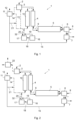
- Fig. 1 shows a first layout of a cement plant for carrying out the method of the invention
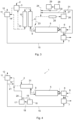
- Fig. 2 shows a second layout of a cement plant for carrying out the method of the invention
- Fig. 3 shows a third layout of a cement plant for carrying out the method of the invention
- Fig. 4 shows a fourth layout of a cement plant for carrying out the method of the invention.
- Fig. 1 schematically illustrates a cement plant for carrying out the method of the invention.
- raw meal 2 is ground in a raw meal mill 3 and the ground raw meal is charged into a preheater string 4, where it is preheated in counter-current to the hot exhaust gases 9 coming from a rotary clinker kiln 5.
- the preheater string 4 comprises a plurality of interconnected preheaters, such as cyclone suspension-type preheaters.
- the preheated and optionally pre-calcined raw meal is then introduced into the rotary kiln 5, where it is calcined to obtain cement clinker.
- the clinker leaves the rotary kiln 5 and is cooled in a clinker cooler 6.
- the cooled clinker is charged into a cement mill 7, where the clinker is ground to a desired fineness, optionally together with other components of the final product, such as supplementary cementitious substances and gypsum.
- Fig. 1 the flow of solid material is shown with solid lines, while the flow of gasses is shown with dotted lines.
- cooling air 8 is introduced into the clinker cooler 6, where the air is heated in heat exchange with the clinker.
- the heated air leaving the clinker cooler 6 is introduced into the rotary kiln 5, where the preheated raw meal is calcined, i.e. decarbonated, while releasing CO 2 .
- the CO 2 enriched exhaust gas 9 is introduced into the preheater string 4 in order to preheat the raw meal.
- the exhaust gas withdrawn from the preheater string 4 is introduced into a gas conditioning tower 10, where water may be injected in order to cool the exhaust gas.
- the cooled exhaust gas may be introduced into the raw meal mill 3 via the line 13 for preheating the raw meal and further cooling the exhaust gas.
- the exhaust gas leaving the raw meal mill is loaded with fine particles of raw meal and is introduced into the main filter 11 for separating said fine particles from the exhaust gas.
- the exhaust gas is withdrawn from the main filter 11 at 12 and directed to an exhaust stack (not shown).
- the cooled exhaust gas coming from the gas conditioning tower 10 is directly led to the main filter 11 via the line 14, where cement kiln dust entrained from rotary kiln 5 is separated from the exhaust gas.
- the separated particles collected in the main filter 11 may be introduced into the cement mill 7 via the line 15 to be co-ground with the clinker.
- the method of the invention provides for the introduction of carbonatable waste substances coming from an external source into the process.
- a storage container for the carbonatable substance is denoted by reference numeral 16.
- the storage container 16 may, e.g., contain a fine fraction obtained from crushed recycled concrete.
- the carbonatable material may optionally be introduced into a mill 17, such as a rotary mill via the line 18, in order to reduce the particle size of the carbonatable substance.
- the mill 17 may be fed by atmospheric gas or preferably by exhaust gas coming from the gas conditioning tower 10 via line 32, in order to perform carbonation within the mill 17.
- the ground carbonatable substance is introduced into the flow of CO 2 enriched exhaust gas via the line 20. More specifically, the ground carbonatable substance is introduced into the exhausts gas duct that connects the gas conditioning tower 10 with the main filter 11. Alternatively, the carbonatable substance is introduced into said duct directly via the line 19, i.e. without having been ground.
- the carbonatable substance is entrained by the exhaust gas and is transported through the line 14 to enter the main filter 11.
- the carbonatable substance gets carbonated by reacting with the CO 2 contained in the exhaust gas, thereby reducing the CO 2 content of the exhaust gas.
- a synthetic carbonated mineral component is obtained that is withdrawn from the main filter 11 together with the other fine particles that are retained by the filter.
- the synthetic material component may be introduced into the cement mill 7 together with the other fine particles that are retained by the filter 11.
- the material removed from the main filter 11 can be recirculated into the exhaust gas via the line 21.
- the carbonation process as described above is only carried out when the raw meal mill 3 is not in operation with cement raw meal.
- Introducing the carbonatable substance into the exhaust gas during mill shutdown enables to lower the exhaust gas temperature and reduce the water injection into the gas conditioning tower 10, and further enables the trapping of pollutants, typically mercury, sulfates, chlorides, or organic pollutants such as dioxins and furans, from the exhaust gas by absorbing the pollutants on the particles of the carbonatable substance.
- the raw meal mill 3 may be used to grind and carbonate the carbonatable substance.
- the carbonatable substance from container 16 is fed via line 20 into the exhausts gas duct that connects the gas conditioning tower 10 with the main filter 11 and is entrained via line 13 into the raw meal mill 3, in order to dry, grind and carbonate the carbonatable substance.
- One part of the carbonated material is collected in the finished product circuit of the raw meal mill 3 and another part of the carbonated material that is entrained by the exhaust gas to the main filter 11 is collected there.
- the collected carbonated material is either transported directly to cement mill 7 or recirculated via line 14 to the main filter 11 or recirculated into the raw meal mill 3 or recirculated into the mill 17, in order to pursue carbonation.
- the raw meal mill 3 has a separate filter 22, so that a simultaneous operation of a) the raw meal mill 3 for grinding cement raw meal and of b) the carbonation process by entraining the carbonatable substance originating from container 16 into the main filter 11 may be realized.
- Fig. 3 shows another embodiment, wherein the carbonatable substance is introduced into a kiln bypass duct.
- the carbonatable substance is introduced into the flow of exhaust gas in the kiln bypass duct 23, which is a duct for withdrawing a partial amount of the cement kiln dust loaded atmosphere at a location between the exhaust gas outlet of the rotary kiln 5 and the preheater string 4.
- the exhaust gas is cooled in a quenching chamber by injecting cooling air 24 into the kiln bypass duct 23. Further downstream, a second cooling installation 25 is optionally provided.
- the cooled mixture of cement kiln dust and exhaust gas is introduced into a bypass filter 26, where the cement kiln dust is separated from the exhaust gas 27.
- the exhaust gas is fed to an exhaust stack (not shown), while the cement kiln dust is conveyed to the cement mill 7 via the line 31.
- a storage container for the carbonatable substance is denoted by reference numeral 28.
- the storage container 28 may, e.g., contain a fine fraction obtained from crushed recycled concrete.
- the carbonatable material may optionally be introduced into a mill 29, such as a rotary mill, in order to reduce the particle size of the carbonatable substance.
- the carbonatable substance coming from the mill 29 is added to the flow of cooling air 24 and introduced into the kiln bypass duct 23.
- the carbonatable substance is directly fed from the storage container 28 into the flow of cooling air 24, bypassing the mill 29.
- the carbonatable substance is entrained by the exhaust gas and enters the bypass filter 26.
- the carbonatable substance gets carbonated by reacting with the CO 2 contained in the exhaust gas, thereby reducing the CO 2 content of the exhaust gas.
- a synthetic carbonated mineral component is obtained that is withdrawn from the bypass filter 26 together with the cement kiln dust that is retained by the filter.
- the synthetic material component may be introduced into the cement mill 7 together with the cement kiln dust that is retained by the filter 26.
- the material removed from the bypass filter 26 can be recirculated into the exhaust gas via the line 30.
- the method described with reference to Fig. 3 has the effect that the carbonatable substance is first carbonated at a high temperature of 500 to 600°C when being in the first cooling stage (cooling air 24) and is then carbonated at a low temperature of 100-300°C when travelling through the second cooling stage 25. Therefore, both temperature ranges that are optimal for the carbonation process can be used.
- Additional benefits of adding the carbonatable substance into the kiln bypass duct include: the reduction of cooling/quenching air due the cooling effect brought about by the introduction of the carbonatable substance, and the reduction of the alkali and chloride content by dilution.
- Fig. 4 shows a cement plant operating according to the semi-dry or semi-wet process, wherein the preheater is designed as a Lepol great preheater 31.
- the Lepol great preheater is designed to be fed with nodulised damp feed 2.
- the injection of the carbonatable substance can be done before the main filter 11, i.e. into the duct 14 that connects the exhaust gas outlet of the preheater 31 and the main filter 11.
- the synthetic carbonated mineral component is collected in the filter 11 together with cement kiln dust, which can be fed to the cement mill 7 via the line 15 and/or recirculated into the duct 14.
Landscapes
- Chemical & Material Sciences (AREA)
- Engineering & Computer Science (AREA)
- Ceramic Engineering (AREA)
- Materials Engineering (AREA)
- Structural Engineering (AREA)
- Organic Chemistry (AREA)
- Chemical Kinetics & Catalysis (AREA)
- Health & Medical Sciences (AREA)
- Life Sciences & Earth Sciences (AREA)
- Biodiversity & Conservation Biology (AREA)
- Ecology (AREA)
- Environmental & Geological Engineering (AREA)
- Environmental Sciences (AREA)
- Public Health (AREA)
- Thermal Sciences (AREA)
- Physics & Mathematics (AREA)
- Curing Cements, Concrete, And Artificial Stone (AREA)
- Treating Waste Gases (AREA)
- Cultivation Of Plants (AREA)
Applications Claiming Priority (3)
| Application Number | Priority Date | Filing Date | Title |
|---|---|---|---|
| EP20020604.3A EP4011849A1 (de) | 2020-12-10 | 2020-12-10 | Verfahren zur herstellung einer synthetischen karbonisierten mineralischen komponente in einer zementherstellungsanlage |
| EP21823378.1A EP4259590B1 (de) | 2020-12-10 | 2021-12-09 | Verfahren zur herstellung einer synthetischen karbonisierten mineralischen komponente in einer zementherstellungsanlage |
| PCT/IB2021/061483 WO2022123471A1 (en) | 2020-12-10 | 2021-12-09 | Method of producing a synthetic carbonated mineral component in a cement manufacturing plant |
Related Parent Applications (2)
| Application Number | Title | Priority Date | Filing Date |
|---|---|---|---|
| EP21823378.1A Division EP4259590B1 (de) | 2020-12-10 | 2021-12-09 | Verfahren zur herstellung einer synthetischen karbonisierten mineralischen komponente in einer zementherstellungsanlage |
| EP21823378.1A Division-Into EP4259590B1 (de) | 2020-12-10 | 2021-12-09 | Verfahren zur herstellung einer synthetischen karbonisierten mineralischen komponente in einer zementherstellungsanlage |
Publications (2)
| Publication Number | Publication Date |
|---|---|
| EP4470982A2 true EP4470982A2 (de) | 2024-12-04 |
| EP4470982A3 EP4470982A3 (de) | 2025-02-19 |
Family
ID=73792915
Family Applications (3)
| Application Number | Title | Priority Date | Filing Date |
|---|---|---|---|
| EP20020604.3A Withdrawn EP4011849A1 (de) | 2020-12-10 | 2020-12-10 | Verfahren zur herstellung einer synthetischen karbonisierten mineralischen komponente in einer zementherstellungsanlage |
| EP21823378.1A Active EP4259590B1 (de) | 2020-12-10 | 2021-12-09 | Verfahren zur herstellung einer synthetischen karbonisierten mineralischen komponente in einer zementherstellungsanlage |
| EP24205934.3A Pending EP4470982A3 (de) | 2020-12-10 | 2021-12-09 | Verfahren zur herstellung einer synthetischen karbonisierten mineralischen komponente in einer zementherstellungsanlage |
Family Applications Before (2)
| Application Number | Title | Priority Date | Filing Date |
|---|---|---|---|
| EP20020604.3A Withdrawn EP4011849A1 (de) | 2020-12-10 | 2020-12-10 | Verfahren zur herstellung einer synthetischen karbonisierten mineralischen komponente in einer zementherstellungsanlage |
| EP21823378.1A Active EP4259590B1 (de) | 2020-12-10 | 2021-12-09 | Verfahren zur herstellung einer synthetischen karbonisierten mineralischen komponente in einer zementherstellungsanlage |
Country Status (5)
| Country | Link |
|---|---|
| US (1) | US20240092691A1 (de) |
| EP (3) | EP4011849A1 (de) |
| CA (1) | CA3201581A1 (de) |
| PL (1) | PL4259590T3 (de) |
| WO (1) | WO2022123471A1 (de) |
Families Citing this family (3)
| Publication number | Priority date | Publication date | Assignee | Title |
|---|---|---|---|---|
| CN115228278B (zh) * | 2022-07-19 | 2024-04-30 | 天津中材工程研究中心有限公司 | pH值调控碳酸钙加速矿化吸收烟气中CO2的系统和方法 |
| CN116854383B (zh) * | 2023-06-29 | 2024-04-19 | 唐滨江 | 一种新型低能耗生产轻烧MgO粉的工艺系统 |
| BE1032939B1 (de) * | 2024-09-03 | 2026-04-20 | thyssenkrupp Polysius GmbH | Anreicherung von Altzementstein aus Altbeton |
Citations (1)
| Publication number | Priority date | Publication date | Assignee | Title |
|---|---|---|---|---|
| EP3656750A2 (de) | 2020-03-24 | 2020-05-27 | HeidelbergCement AG | Verwendung von kohlendioxid aus und für zement |
Family Cites Families (1)
| Publication number | Priority date | Publication date | Assignee | Title |
|---|---|---|---|---|
| EP3498681A1 (de) * | 2017-12-13 | 2019-06-19 | HeidelbergCement AG | Verwendung von kohlensäurehaltigen recycelten wiederverwendeten betonteilchen als zusätzliches zementmaterial |
-
2020
- 2020-12-10 EP EP20020604.3A patent/EP4011849A1/de not_active Withdrawn
-
2021
- 2021-12-09 WO PCT/IB2021/061483 patent/WO2022123471A1/en not_active Ceased
- 2021-12-09 EP EP21823378.1A patent/EP4259590B1/de active Active
- 2021-12-09 EP EP24205934.3A patent/EP4470982A3/de active Pending
- 2021-12-09 US US18/256,829 patent/US20240092691A1/en active Pending
- 2021-12-09 PL PL21823378.1T patent/PL4259590T3/pl unknown
- 2021-12-09 CA CA3201581A patent/CA3201581A1/en active Pending
Patent Citations (1)
| Publication number | Priority date | Publication date | Assignee | Title |
|---|---|---|---|---|
| EP3656750A2 (de) | 2020-03-24 | 2020-05-27 | HeidelbergCement AG | Verwendung von kohlendioxid aus und für zement |
Also Published As
| Publication number | Publication date |
|---|---|
| EP4011849A1 (de) | 2022-06-15 |
| EP4470982A3 (de) | 2025-02-19 |
| US20240092691A1 (en) | 2024-03-21 |
| EP4259590A1 (de) | 2023-10-18 |
| CA3201581A1 (en) | 2022-06-16 |
| EP4259590B1 (de) | 2025-06-18 |
| PL4259590T3 (pl) | 2025-09-15 |
| WO2022123471A1 (en) | 2022-06-16 |
Similar Documents
| Publication | Publication Date | Title |
|---|---|---|
| EP3724147B1 (de) | Verfahren zur gleichzeitigen abgasreinigung und herstellung von klinkerersatzmaterial | |
| AU2020281669B2 (en) | Improved process and device for carbonating concrete waste and/or sequestering CO2 | |
| Habert | Assessing the environmental impact of conventional and ‘green’cement production | |
| EP4259590B1 (de) | Verfahren zur herstellung einer synthetischen karbonisierten mineralischen komponente in einer zementherstellungsanlage | |
| EP3581257A1 (de) | Verfahren zur entfernung von co2/so2 aus abgase durch verwendung von recycelten betonteilchen. | |
| EP3498681A1 (de) | Verwendung von kohlensäurehaltigen recycelten wiederverwendeten betonteilchen als zusätzliches zementmaterial | |
| CN113950365B (zh) | 将废气涤除CO2和/或SOx的方法 | |
| CZ303436B6 (cs) | Zpusob snížení emise SOx v zarízení pro výrobu cementového slínku a výrobní zarízení k provádení tohoto zpusobu | |
| EP1200176B1 (de) | Verfahren und vorrichtung zur entschwefelung von abgasen | |
| US20250084000A1 (en) | Device and method for manufacturing cement clinker and calcined clay | |
| EP4180404A1 (de) | Verfahren zur herstellung einer synthetischen karbonisierten mineralischen komponente in einer zementherstellungsanlage | |
| CN117185692A (zh) | 基于水洗砂污泥的混凝土掺合料及其制备方法 | |
| JP5303716B2 (ja) | 改質灰、改質灰の製造方法及びセメント組成物 | |
| CA3085504C (en) | Method for simultaneous exhaust gas cleaning and manufacturing of supplementary cementitious material | |
| CA3139016C (en) | Improved process and device for carbonating concrete waste and/or sequestering co2 | |
| EA045091B1 (ru) | Способ производства дополнительного вяжущего материала секвестрации co2, устройство для секвестрации со2 и карбонизации мелких частиц бетона, и применение карбонизированных мелких частиц бетона | |
| EA041254B1 (ru) | Способ одновременной очистки отходящего газа и производства дополнительного минерального вяжущего материала |
Legal Events
| Date | Code | Title | Description |
|---|---|---|---|
| PUAI | Public reference made under article 153(3) epc to a published international application that has entered the european phase |
Free format text: ORIGINAL CODE: 0009012 |
|
| STAA | Information on the status of an ep patent application or granted ep patent |
Free format text: STATUS: THE APPLICATION HAS BEEN PUBLISHED |
|
| AC | Divisional application: reference to earlier application |
Ref document number: 4259590 Country of ref document: EP Kind code of ref document: P |
|
| AK | Designated contracting states |
Kind code of ref document: A2 Designated state(s): AL AT BE BG CH CY CZ DE DK EE ES FI FR GB GR HR HU IE IS IT LI LT LU LV MC MK MT NL NO PL PT RO RS SE SI SK SM TR |
|
| PUAL | Search report despatched |
Free format text: ORIGINAL CODE: 0009013 |
|
| AK | Designated contracting states |
Kind code of ref document: A3 Designated state(s): AL AT BE BG CH CY CZ DE DK EE ES FI FR GB GR HR HU IE IS IT LI LT LU LV MC MK MT NL NO PL PT RO RS SE SI SK SM TR |
|
| RIC1 | Information provided on ipc code assigned before grant |
Ipc: C04B 7/36 20060101AFI20250116BHEP |
|
| STAA | Information on the status of an ep patent application or granted ep patent |
Free format text: STATUS: REQUEST FOR EXAMINATION WAS MADE |
|
| 17P | Request for examination filed |
Effective date: 20250819 |
|
| RAV | Requested validation state of the european patent: fee paid |
Extension state: MA Effective date: 20250819 |
|
| P01 | Opt-out of the competence of the unified patent court (upc) registered |
Free format text: CASE NUMBER: UPC_APP_5971_4470982/2025 Effective date: 20250904 |