EP4470636A1 - Golf ball - Google Patents
Golf ball Download PDFInfo
- Publication number
- EP4470636A1 EP4470636A1 EP24177667.3A EP24177667A EP4470636A1 EP 4470636 A1 EP4470636 A1 EP 4470636A1 EP 24177667 A EP24177667 A EP 24177667A EP 4470636 A1 EP4470636 A1 EP 4470636A1
- Authority
- EP
- European Patent Office
- Prior art keywords
- hardness
- golf ball
- shore
- intermediate layer
- spherical core
- Prior art date
- Legal status (The legal status is an assumption and is not a legal conclusion. Google has not performed a legal analysis and makes no representation as to the accuracy of the status listed.)
- Granted
Links
Images


Classifications
-
- A—HUMAN NECESSITIES
- A63—SPORTS; GAMES; AMUSEMENTS
- A63B—APPARATUS FOR PHYSICAL TRAINING, GYMNASTICS, SWIMMING, CLIMBING, OR FENCING; BALL GAMES; TRAINING EQUIPMENT
- A63B37/00—Solid balls; Rigid hollow balls; Marbles
- A63B37/0003—Golf balls
- A63B37/007—Characteristics of the ball as a whole
- A63B37/0072—Characteristics of the ball as a whole with a specified number of layers
- A63B37/0075—Three piece balls, i.e. cover, intermediate layer and core
-
- A—HUMAN NECESSITIES
- A63—SPORTS; GAMES; AMUSEMENTS
- A63B—APPARATUS FOR PHYSICAL TRAINING, GYMNASTICS, SWIMMING, CLIMBING, OR FENCING; BALL GAMES; TRAINING EQUIPMENT
- A63B37/00—Solid balls; Rigid hollow balls; Marbles
- A63B37/0003—Golf balls
- A63B37/0004—Surface depressions or protrusions
- A63B37/0017—Specified total dimple volume
-
- A—HUMAN NECESSITIES
- A63—SPORTS; GAMES; AMUSEMENTS
- A63B—APPARATUS FOR PHYSICAL TRAINING, GYMNASTICS, SWIMMING, CLIMBING, OR FENCING; BALL GAMES; TRAINING EQUIPMENT
- A63B37/00—Solid balls; Rigid hollow balls; Marbles
- A63B37/0003—Golf balls
- A63B37/0023—Covers
- A63B37/0029—Physical properties
- A63B37/0031—Hardness
-
- A—HUMAN NECESSITIES
- A63—SPORTS; GAMES; AMUSEMENTS
- A63B—APPARATUS FOR PHYSICAL TRAINING, GYMNASTICS, SWIMMING, CLIMBING, OR FENCING; BALL GAMES; TRAINING EQUIPMENT
- A63B37/00—Solid balls; Rigid hollow balls; Marbles
- A63B37/0003—Golf balls
- A63B37/0023—Covers
- A63B37/0029—Physical properties
- A63B37/0033—Thickness
-
- A—HUMAN NECESSITIES
- A63—SPORTS; GAMES; AMUSEMENTS
- A63B—APPARATUS FOR PHYSICAL TRAINING, GYMNASTICS, SWIMMING, CLIMBING, OR FENCING; BALL GAMES; TRAINING EQUIPMENT
- A63B37/00—Solid balls; Rigid hollow balls; Marbles
- A63B37/0003—Golf balls
- A63B37/0038—Intermediate layers, e.g. inner cover, outer core, mantle
- A63B37/004—Physical properties
- A63B37/0043—Hardness
-
- A—HUMAN NECESSITIES
- A63—SPORTS; GAMES; AMUSEMENTS
- A63B—APPARATUS FOR PHYSICAL TRAINING, GYMNASTICS, SWIMMING, CLIMBING, OR FENCING; BALL GAMES; TRAINING EQUIPMENT
- A63B37/00—Solid balls; Rigid hollow balls; Marbles
- A63B37/0003—Golf balls
- A63B37/005—Cores
- A63B37/006—Physical properties
- A63B37/0062—Hardness
- A63B37/00621—Centre hardness
-
- A—HUMAN NECESSITIES
- A63—SPORTS; GAMES; AMUSEMENTS
- A63B—APPARATUS FOR PHYSICAL TRAINING, GYMNASTICS, SWIMMING, CLIMBING, OR FENCING; BALL GAMES; TRAINING EQUIPMENT
- A63B37/00—Solid balls; Rigid hollow balls; Marbles
- A63B37/0003—Golf balls
- A63B37/005—Cores
- A63B37/006—Physical properties
- A63B37/0062—Hardness
- A63B37/00622—Surface hardness
-
- A—HUMAN NECESSITIES
- A63—SPORTS; GAMES; AMUSEMENTS
- A63B—APPARATUS FOR PHYSICAL TRAINING, GYMNASTICS, SWIMMING, CLIMBING, OR FENCING; BALL GAMES; TRAINING EQUIPMENT
- A63B37/00—Solid balls; Rigid hollow balls; Marbles
- A63B37/0003—Golf balls
- A63B37/007—Characteristics of the ball as a whole
- A63B37/0077—Physical properties
- A63B37/0092—Hardness distribution amongst different ball layers
-
- A—HUMAN NECESSITIES
- A63—SPORTS; GAMES; AMUSEMENTS
- A63B—APPARATUS FOR PHYSICAL TRAINING, GYMNASTICS, SWIMMING, CLIMBING, OR FENCING; BALL GAMES; TRAINING EQUIPMENT
- A63B37/00—Solid balls; Rigid hollow balls; Marbles
- A63B37/0003—Golf balls
- A63B37/007—Characteristics of the ball as a whole
- A63B37/0077—Physical properties
- A63B37/0096—Spin rate
Definitions
- the present disclosure relates to a golf ball, and particularly relates to a golf ball comprising a spherical core, an intermediate layer, an outermost cover and dimples.
- the face of a golf club has a loft angle.
- the golf ball When a golf ball is hit with the golf club, the golf ball is launched at a launch angle corresponding to the loft angle. Furthermore, the loft angle imparts a back spin to the golf ball. The golf ball flies associated with the backspin.
- a golf player places importance on the spin performance of a golf ball.
- a backspin rate is high, the run is short.
- Use of a golf ball having a high backspin rate makes a golf player stop the golf ball at a target point.
- a golf ball having excellent spin performance has excellent controllability.
- A a compression (Atti) of the golf ball
- B a hardness difference (Shore C) between a surface and
- An iron shot is a shot for carrying a golf ball to the green or a target place, and the importance is not a flight distance itself but the performance that the golf ball travels a distance as intended. Thus, it is preferable that the difference in a flight distance between respective irons is small.
- a golf ball having enhanced spin performance is excellent in controllability since the rolling thereof on the green can be suppressed.
- enhanced spin performance creates an excess lift on the golf ball on iron shots and tends to lower a flight distance performance.
- the spin rate is higher, lowering in the flight distance due to the excess lift is greater. In other words, the degree of lowering the flight distance is greater for shorter irons.
- an object of the present disclosure is to provide a golf ball having a reduced difference in a flight distance between respective iron shots.
- an object of the present disclosure is to provide a golf ball having a reduced difference in a flight distance between respective short iron shots depending upon the head speed of the golf player.
- an object of the present disclosure is to provide a golf ball having a small difference in a flight distance between a long iron shot and a middle iron shot for a high head-speed golfer.
- the high head speed is, for example, at least 40 m/s for a 5-iron, and at least 38 m/s for a 7-iron.
- the present disclosure provides a golf ball comprising a spherical core, an intermediate layer covering the spherical core, and an outermost cover positioned outside the intermediate layer and having a plurality of dimples formed thereon, wherein the plurality of dimples have a total lower volume Vi of more than 365 mm 3 , and a slab hardness Hc (Shore D) of a cover composition constituting the outermost cover, a thickness Tc (mm) of the outermost cover and the total lower volume Vi (mm 3 ) of the plurality of dimples satisfy a relationship of 8.5 ⁇ Tc/Hc ⁇ Vi.
- the dimples formed on the outermost cover disturb the air flow around the golf ball during flight to cause separation of air flow. This phenomenon is referred to as "turbulence". Particularly, if the total lower volume Vi of the dimples is more than 365 mm 3 , the lift force that acts upon the golf ball is suppressed due to the backspin, and the excess lift on short iron shots is suppressed.
- the head speed on a short iron shot is low and the golf ball has a small deformation amount when being hit, therefore, the properties of the outermost cover have greatest influence on the spin performance.
- the slab hardness Hc (Shore D) the thickness Tc (mm) of the outermost cover and the total lower volume Vi (mm 3 ) of the dimples satisfy the relationship of 8.5 ⁇ Tc/Hc ⁇ Vi, the excess lift on a short iron shot is suppressed, and the run on a middle or long iron shot can be suppressed.
- a difference in a flight distance between respective short iron shots by an average golfer can be made small.
- the head speed by the average golfer is, for example, 28m/s or more and 38 m/s or less for a 7-iron, and 27m/s or more and 37m/s or less for a 9-iron.
- the present disclosure provides a golf ball comprising a spherical core, an intermediate layer covering the spherical core, and an outermost cover positioned outside the intermediate layer and having a plurality of dimples formed thereon, wherein the plurality of dimples have a total lower volume Vi of more than 365 mm 3 , and a center hardness Ho (Shore C) of the spherical core, a surface hardness Hs (Shore C) of the spherical core, a slab hardness Hc (Shore D) of a cover composition constituting the outermost cover, a thickness Tc (mm) of the outermost cover and the total lower volume Vi (mm 3 ) of the plurality of dimples satisfy a relationship of ⁇ (Hs-Ho)/(Vi ⁇ Tc/Hc) ⁇ 2.1.
- the dimples formed on the outermost cover disturb the air flow around the golf ball during flight to cause separation of air flow. This phenomenon is referred to as "turbulence". Particularly, if the total lower volume Vi of the dimples is more than 365mm 3 , the lift force that acts upon the golf ball is suppressed due to the backspin, and the excess lift on a short iron shot is suppressed.
- the hardness difference between the center hardness Ho of the spherical core and the surface hardness Hs of the spherical core is smaller, the spin rate is higher. Further, the head speed on a short iron shot is low and the golf ball has a small deformation amount when being hit, therefore the spin performance can be enhanced by controlling the properties of the outermost cover. Based on these facts, if the relationship of ⁇ (Hs-Ho)/(Vi ⁇ Tc/Hc) ⁇ 2.1 is satisfied, the excess lift on a short iron shot is suppressed, and the run on a middle or long iron shot can be suppressed. Thus, a difference in a flight distance between respective short iron shots by a golfer with a high head speed can be made small.
- the lift force caused by the spin is suppressed when a golf ball having high spin performance is hit with a middle iron.
- the excess lift on the middle iron shot is suppressed, and the decrease in the flight distance is suppressed. This effect that the lift force is suppressed is greater when the speed of hitting the golf ball is higher.
- a trajectory of a golf ball hit with a long iron is lower than that of a golf ball hit with a middle iron and thus, the golf ball hit with a long iron tends to have a longer run.
- the golf ball according to the present disclosure has high spin performance, and the run thereof is suppressed by the spin. The effect that the run is suppressed by the spin is greater when the trajectory of the golf ball is lower when hit with a longer iron.
- a golf ball having a small difference in a flight distance between respective short iron shots for a golfer with a high head speed and an average golfer is obtained.
- a golf ball having a small difference in a flight distance between a long iron shot and a middle iron shot for a golfer with a high head speed is obtained.
- the present disclosure provides a golf ball comprising a spherical core, an intermediate layer covering the spherical core, and an outermost cover positioned outside the intermediate layer and having a plurality of dimples formed thereon, wherein the plurality of dimples have a total lower volume Vi of more than 365 mm 3 , and a slab hardness Hc (Shore D) of a cover composition constituting the outermost cover, a thickness Tc (mm) of the outermost cover and the total lower volume Vi (mm 3 ) of the plurality of dimples satisfy a relationship of 8.5 ⁇ Tc/Hc ⁇ Vi.
- the ratio (Tc/Hc) of the thickness Tc of the outermost cover to the slab hardness Hc is an index of the spin rate-increasing effect by the outermost cover.
- the total lower volume Vi is an index of the excess lift-suppressing effect by the dimples. If the slab hardness Hc (Shore D), the thickness Tc (mm) of the outermost cover and the total lower volume Vi (mm 3 ) of the dimples satisfy the relationship of 8.5 ⁇ Tc/Hc ⁇ Vi, the excess lift on a short iron shot is suppressed, and the run on a middle or long iron shot can be suppressed. Thus, a difference in a flight distance between respective short iron shots by an average golfer can be made small.
- the value (Tc/Hc ⁇ Vi) is preferably 9.0 or more, more preferably 10.0 or more.
- the upper limit of the value (Tc/Hc ⁇ Vi) is not particularly limited, but the value (Tc/Hc ⁇ Vi) is preferably 18 or less, more preferably 16 or less, and even more preferably 15 or less, from the viewpoint of the flight distance performance on a driver shot.
- the present disclosure provides a golf ball comprising a spherical core, an intermediate layer covering the spherical core, and an outermost cover positioned outside the intermediate layer and having a plurality of dimples formed thereon, wherein the plurality of dimples have a total lower volume Vi of more than 365 mm 3 , and a center hardness Ho (Shore C) of the spherical core, a surface hardness Hs (Shore C) of the spherical core, a slab hardness Hc (Shore D) of a cover composition constituting the outermost cover, a thickness Tc (mm) of the outermost cover and the total lower volume Vi (mm 3 ) of the plurality of dimples satisfy a relationship of ⁇ (Hs-Ho)/(Vi ⁇ Tc/Hc) ⁇ 2.1.
- the relationship is satisfied, the excess lift on a short iron shot is suppressed, and the run on a middle or long iron shot can be suppressed. Thus, a difference in flight distance between respective short iron shots by a golfer with a high head speed can be made small.
- the value ⁇ (Hs-Ho)/(Vi ⁇ Tc/Hc) ⁇ is preferably less than 2.1, more preferably 2.0 or less, and even more preferably 1.9 or less.
- the lower limit of the value ⁇ (Hs-Ho)/(Vi ⁇ Tc/Hc) ⁇ is not particularly limited, but the value ⁇ (Hs-Ho)/(Vi ⁇ Tc/Hc) ⁇ is preferably 0.8 or more, more preferably 0.9 or more, and even more preferably 1.0 or more, from the viewpoint of the flight distance performance on a driver shot.
- the golf ball according to the present disclosure satisfies S ⁇ Hm/Vi ⁇ 2.4.
- S is the hardness difference between the surface hardness Hs and the center hardness Ho of the spherical core
- Hm is the material hardness of the intermediate layer
- Vi is the total lower volume of the dimples.
- the value S ⁇ Hm/Vi is preferably 1.0 or more, more preferably 1.1 or more, and even more preferably 1.2 or more, and is preferably 2.0 or less, more preferably 1.8 or less. If the value S ⁇ Hm/Vi falls within the above range, the difference in a flight distance between respective iron shots is small, and thus control of the flight distance is better.
- the value (Hm/Vi) is preferably 0.08 or more, more preferably 0.09 or more, and even more preferably 0.10 or more, and is preferably 0.22 or less, more preferably 0.20 or less, and even more preferably 0.18 or less. If the value (Hm/Vi) falls within the above range, lowering the spin rate on a driver shot and turbulence by the dimples fully occur, and thus the flight distance performance is better.
- the golf ball according to the present disclosure comprises an outermost cover having a plurality of dimples formed thereon.
- the dimples are concaves formed on the outermost cover.
- a golf ball 2 shown in Fig. 1 comprises a spherical core 4, an intermediate layer 6 covering the core 4, and an outermost cover 8 positioned outside the intermediate layer 6.
- the golf ball 2 has a plurality of dimples 10 on the surface. Other portions than the dimples 10 on the surface of the golf ball 2 are lands 12.
- the golf ball 2 is provided with a paint layer and a mark layer on an outer side of the outermost cover 8, but these layers are not depicted.
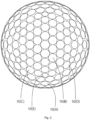
- the outermost cover of the golf ball 2 has a plurality of dimples 10 formed on the surface.
- Each of the dimples 10 has a circle contour.
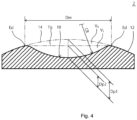
- Fig. 4 shows a cross section of the golf ball 2 along a plane passing through the central point of the dimple 10 and the central point of the golf ball 2.
- the top-to-bottom direction in Fig. 4 is the depth direction of the dimple 10.
- a chain double-dashed line 14 indicates a virtual sphere.
- the surface of the virtual sphere 14 is the surface of the golf ball 2 when it is virtualized that no dimple 10 exists.
- the diameter of the virtual sphere 14 is equal to the diameter of the golf ball 2.
- the dimple 10 is recessed from the surface of the virtual sphere 14.
- the land 12 coincides with the surface of the virtual sphere 14.
- the cross-sectional shape of the dimple 10 is substantially a circular arc.
- the curvature radius of this circular arc is shown by a reference sign CR in Fig. 4 .
- an arrow Dm indicates the diameter of the dimple 10.
- the diameter Dm is a distance between one tangent point Ed and another tangent point Ed when a tangent line Tg traversing two sides of the dimple 10 is drawn.
- the tangent point Ed is also the edge of the dimple 10.
- the edge Ed defines the contour of the dimple 10.
- the "volume of the dimple” means the volume of the portion surrounded by the surface of the dimple 10 and the surface of the virtual sphere including the contour of the dimple 10.
- the “volume of the dimple” is divided by a plane connecting intersection points Ed-Ed of the surface of the virtual sphere 14 with the surface of the dimple.
- the "upper volume of the dimple” is the volume of the dimple upper part surrounded by the surface of the virtual sphere 14 and the plane connecting the intersection points Ed-Ed of the surface of the dimple.
- the “lower volume of the dimple” is the volume of the dimple lower part surrounded by the plane connecting the intersection points Ed-Ed of the surface of the dimple and the surface of the dimple 10.
- the volume of the dimple is the sum of the upper volume and the lower volume.
- the “total volume V of the dimples” in the present disclosure is the sum of the volume of all the dimples.
- the “total upper volume Vo of the dimples” is the sum of the upper volume of all the dimples.
- the “total lower volume Vi of the dimples” is the sum of the lower volume of all the dimples.
- the total lower volume Vi of the plurality of dimples of the golf ball is more than 365 mm 3 , preferably 380 mm 3 or more, more preferably 400 mm 3 or more. If the total lower volume Vi is more than 365 mm 3 , the lift force that acts upon the golf ball is suppressed due to the backspin, and the excess lift on a short iron shot is suppressed.
- the total lower volume Vi is preferably 500 mm 3 or less, more preferably 495 mm 3 or less, and even more preferably 490 mm 3 or less. If the total lower volume Vi is 500 mm 3 or less, the lift force that acts upon the golf ball on a driver shot is fully obtained, and the flight distance performance is better.
- the diameter Dm of the dimple 10 is preferably 2.0 mm or more, more preferably 2.5 mm or more, and even more preferably 2.8 mm or more, and is preferably 6.0 mm or less, more preferably 5.5 mm or less, and even more preferably 5.0 mm or less. If the diameter Dm is 2.0 mm or more, the dimples easily contribute to the turbulence, and if the diameter Dm is 6.0 mm or less, the nature of the golf ball that is substantially a spherical body can be kept.
- the plurality of dimples may be a plurality of dimples with a single diameter, or a combination of dimples with various types of diameters.
- the golf ball 2 shown in Fig. 2 and Fig. 3 has five types of dimples, i.e. a dimple A with a diameter of 4.400 mm, a dimple B with a diameter of 4.285 mm, a dimple C with a diameter of 4.150 mm, a dimple D with a diameter of 3.875 mm, and a dimple E with a diameter of 3.000 mm.
- a double ended arrow Dp1 indicates a first depth of the dimple 10.
- the first depth Dp1 is the distance between the deepest part of the dimple 10 and the surface of the virtual sphere 14.
- the first depth Dp1 is preferably 0.15 mm or more, more preferably 0.17 mm or more, and even more preferably 0.20 mm or more, and is preferably 0.45 mm or less, more preferably 0.43 mm or less, and even more preferably 0.40 mm or less. If the first depth Dp1 is 0.15 mm or more, the lift force obtained by the dimples fully occurs, and if the first depth Dp1 is 0.45 mm or less, the nature of the golf ball that is substantially a spherical body can be kept.
- a double ended arrow Dp2 indicates a second depth of the dimple 10.
- the second depth Dp2 is the distance between the deepest part of the dimple 10 and the tangent line Tg.
- the second depth Dp2 is preferably 0.08 mm or more, more preferably 0.10 mm or more, and even more preferably 0.12 mm or more, and is preferably 0.30 mm or less, more preferably 0.28 mm or less, and even more preferably 0.26 mm or less. If the second depth Dp2 is 0.08 mm or more, the dimples easily contribute to the turbulence, and if the second depth Dp2 is 0.30 mm or less, the lift force obtained by the dimples is not excessively great, and the flight distance performance on a driver shot is better.
- the area of the dimple A is 15.21 mm 2
- the area of the dimple B is 14.42 mm 2
- the area of the dimple C is 13.53 mm 2
- the area of the dimple D is 11.79 mm 2
- the area of the dimple E is 7.07 mm 2 .
- the ratio (total areas of dimples/surface area of virtual sphere) of the sum of the areas A of all the dimples 10 to the surface area of the virtual sphere 14 is referred to as an occupation ratio So.
- the occupation ratio So is preferably 70% or more, more preferably 75% or more, and even more preferably 80% or more, and is preferably 95% or less, more preferably 92% or less, and even more preferably 90% or less. If the occupation ratio So falls within the above range, the effect of the turbulence by the dimples is greater.
- the number of the dimples can be appropriately adjusted depending on the diameter or occupation ratio of the dimples. It is noted that from the viewpoint of the occupation ratio or the function of the respective dimple, the total number of the dimples 10 is preferably 250 or more, more preferably 280 or more, and even more preferably 300 or more, and is preferably 450 or less, more preferably 410 or less, and even more preferably 390 or less.
- the spherical core is not particularly limited, as long as the spherical core can be used as a core of the golf ball.
- the effect of improving spin performance by the outermost cover and the effect of suppressing the excess lift by the dimples formed on the outermost cover are obtained regardless of the type of the spherical core.
- the construction of the spherical core may be a single-layered construction or a multi-layered construction, and is preferably the single-layered construction.
- the diameter of the spherical core is preferably 34.8 mm or more, more preferably 36.8 mm or more, and even more preferably 38.8 mm or more, and is preferably 42.2 mm or less, more preferably 41.8 mm or less, even more preferably 41.2 mm or less, and most preferably 40.8 mm or less. If the diameter of the spherical core falls within the above range, the golf ball has better flight distance performance or shot feeling.
- the compression deformation amount of the spherical core (shrinking amount of the spherical core along the compression direction) when applying a load from an initial load of 98 N to a final load of 1275 N to the spherical core is preferably 2.0 mm or more, more preferably 2.5 mm or more, and even more preferably 3.0 mm or more, and is preferably 5.0 mm or less, more preferably 4.5 mm or less, and even more preferably 4.0 mm or less. If the compression deformation amount falls within the above range, the shot feeling is better.
- the surface hardness (Hs) of the spherical core is not particularly limited, but the surface hardness (Hs) is preferably 60 or more, more preferably 65 or more, and even more preferably 70 or more, and is preferably 95 or less, more preferably 90 or less, and even more preferably 85 or less in Shore C hardness. If the surface hardness (Hs) falls within the above range, better shot feeling is obtained.
- the center hardness (Ho) of the spherical core is not particularly limited, but the center hardness (Ho) is preferably 45 or more, more preferably 47 or more, and even more preferably 49 or more, and is preferably 74 or less, more preferably 72 or less, and even more preferably 70 or less in Shore C hardness. If the center hardness (Ho) falls within the above range, better shot feeling is obtained.
- the hardness (H10) at the radial distance of 10 mm from the center of the spherical core is not particularly limited, but the hardness (H10) is preferably 60 or more, more preferably 62 or more, and even more preferably 64 or more, and is preferably 84 or less, more preferably 82 or less, and even more preferably 80 or less in Shore C hardness. If the hardness (H10) falls within the above range, better shot feeling is obtained.
- the spherical core is preferably formed from a rubber composition (hereinafter sometimes referred to as "core rubber composition") containing (a) a base rubber, (b) an ⁇ , ⁇ -unsaturated carboxylic acid having 3 to 8 carbon atoms and/or a metal salt thereof as a co-crosslinking agent, and (c) a crosslinking initiator.
- core rubber composition a rubber composition containing (a) a base rubber, (b) an ⁇ , ⁇ -unsaturated carboxylic acid having 3 to 8 carbon atoms and/or a metal salt thereof as a co-crosslinking agent, and (c) a crosslinking initiator.
- a natural rubber and/or a synthetic rubber can be used as (a) the base rubber.
- a polybutadiene rubber, a natural rubber, a polyisoprene rubber, a styrene polybutadiene rubber, or an ethylene-propylene-diene rubber (EPDM) can be used as (a) the base rubber.
- EPDM ethylene-propylene-diene rubber
- These rubbers may be used solely, or at least two of these rubbers may be used in combination.
- the ⁇ , ⁇ -unsaturated carboxylic acid having 3 to 8 carbon atoms and/or the metal salt thereof is blended as a co-crosslinking agent in the rubber composition, and has an action of crosslinking a rubber molecule by graft polymerization to a base rubber molecular chain.
- Examples of the ⁇ , ⁇ -unsaturated carboxylic acid having 3 to 8 carbon atoms include acrylic acid, methacrylic acid, fumaric acid, maleic acid and crotonic acid.
- Examples of the metal ion constituting the metal salt of the ⁇ , ⁇ -unsaturated carboxylic acid having 3 to 8 carbon atoms include a monovalent metal ion such as sodium, potassium and lithium; a divalent metal ion such as magnesium, calcium, zinc, barium and cadmium; a trivalent metal ion such as aluminum; and other metal ions such as tin and zirconium.
- the above metal component may be used solely or as a mixture of at least two of them.
- the divalent metal ion such as magnesium, calcium, zinc, barium and cadmium is preferably used as the metal component.
- the divalent metal salt of the ⁇ , ⁇ -unsaturated carboxylic acid having 3 to 8 carbon atoms is used, a metal crosslinking easily generates between the rubber molecules.
- zinc acrylate is preferable, because zinc acrylate enhances the resilience of the obtained golf ball.
- the ⁇ , ⁇ -unsaturated carboxylic acid having 3 to 8 carbon atoms and/or the metal salt thereof may be used solely or as a mixture of at least two of them.
- the amount of (b) the ⁇ , ⁇ -unsaturated carboxylic acid having 3 to 8 carbon atoms and/or the metal salt thereof may be appropriately adjusted depending on the desired hardness of the spherical core.
- the amount of the component (b) is preferably 15 parts by mass or more, more preferably 20 parts by mass or more, and is preferably 50 parts by mass or less, more preferably 40 parts by mass or less, with respect to 100 parts by mass of (a) the base rubber.
- the crosslinking initiator is blended to crosslink (a) the base rubber component.
- an organic peroxide is suitable.
- the organic peroxide include dicumyl peroxide, 1,1-bis(t-butylperoxy)-3,3,5-trimethylcyclohexane, 2,5-dimethyl-2,5-di(t-butylperoxy) hexane and di-t-butyl peroxide. These organic peroxides may be used solely or as a mixture of at least two of them. Among them, dicumyl peroxide is preferably used.
- the amount of (c) the crosslinking initiator may be appropriately adjusted depending on the desired hardness of the spherical core.
- the amount of (c) the crosslinking initiator is preferably 0.2 part by mass or more, more preferably 0.4 part by mass or more, and is preferably 5.0 parts by mass or less, more preferably 2.5 parts by mass or less, and even more preferably 1.0 part by mass or less, with respect to 100 parts by mass of (a) the base rubber.
- the rubber composition preferably further contains (d) a metal compound.
- a metal compound may be used in the case that the co-crosslinking agent of the rubber composition consists of the ⁇ , ⁇ -unsaturated carboxylic acid having 3 to 8 carbon atoms.
- the metal compound is not particularly limited, as long as it can neutralize (b) the ⁇ , ⁇ -unsaturated carboxylic acid having 3 to 8 carbon atoms in the rubber composition.
- the metal compound include a metal hydroxide such as magnesium hydroxide, zinc hydroxide, calcium hydroxide, sodium hydroxide, lithium hydroxide, potassium hydroxide, and copper hydroxide; a metal oxide such as magnesium oxide, calcium oxide, zinc oxide, and copper oxide; and a metal carbonate such as magnesium carbonate, zinc carbonate, calcium carbonate, sodium carbonate, lithium carbonate, and potassium carbonate.
- the metal compound the divalent metal compound is preferable, the zinc compound is more preferable.
- the metal compound reacts with the ⁇ , ⁇ -unsaturated carboxylic acid having 3 to 8 carbon atoms to form a metal crosslinking.
- the metal compound may be used solely, or at least two of them may be used in combination.
- the rubber composition may further contain (e) an organic sulfur compound.
- the organic sulfur compound enhances the resilience of the spherical core.
- the organic sulfur compound is not particularly limited, as long as it is an organic compound having a sulfur atom in the molecule thereof. Examples of (e) the organic sulfur compound include an organic compound having a thiol group (-SH) or a polysulfide bond having 2 to 4 sulfur atoms (-S-S-, -S-S-S-, or -S-S-S-S-), and a metal salt thereof (-SM, -S-M-S- or the like; M is a metal atom).
- the organic sulfur compound may be used solely or as a mixture of at least two of them.
- Examples of (e) the organic sulfur compound include thiophenols, thionaphthols, polysulfides, thiurams, thiocarboxylic acids, dithiocarboxylic acids, sulfenamides, dithiocarbamates, and thiazoles.
- diphenyl disulfides e.g. diphenyl disulfide, bis(pentabromophenyl) disulfide
- thiophenols e.g. 2-thionaphthol
- 2-thionaphthols e.g. 2-thionaphthol
- the amount of (e) the organic sulfur compound may be appropriately adjusted depending on the desired resilience performance of the spherical core.
- the amount of (e) the organic sulfur compound is preferably 0.05 part by mass or more, more preferably 0.1 part by mass or more, and is preferably 5.0 parts by mass or less, more preferably 3.0 parts by mass or less, with respect to 100 parts by mass of (a) the base rubber.
- the rubber composition may further contain (f) a carboxylic acid and/or a metal salt thereof.
- a carboxylic acid and/or the metal salt thereof a carboxylic acid having 1 to 30 carbon atoms and/or a metal salt thereof is preferable.
- the carboxylic acid an aliphatic carboxylic acid (a saturated fatty acid or an unsaturated fatty acid), or an aromatic carboxylic acid (benzoic acid) can be used.
- the amount of (f) the carboxylic acid and/or the metal salt thereof is preferably 1 part by mass or more and 40 parts by mass or less with respect to 100 parts by mass of the base rubber.
- the rubber composition may further contain an additive such as a filler for adjusting weight or the like, an antioxidant, a peptizing agent, and a softener, where necessary.
- an additive such as a filler for adjusting weight or the like, an antioxidant, a peptizing agent, and a softener, where necessary.
- the filler blended in the rubber composition is mainly used as a weight adjusting agent for adjusting the weight of the golf ball obtained as a final product, and may be blended where necessary.
- the filler include an inorganic filler such as barium sulfate, calcium carbonate, magnesium oxide, tungsten powder, and molybdenum powder.
- the rubber composition can be obtained by kneading (a) the base rubber, (b) the ⁇ , ⁇ -unsaturated carboxylic acid having 3 to 8 carbon atoms and/or the metal salt thereof, (c) the crosslinking initiator, and the other optional components.
- the kneading method is not particularly limited.
- the kneading can be conducted with a conventional kneading machine such as a kneading roll, a banbury mixer and a kneader.
- the spherical core can be molded, for example, by heat pressing the core rubber composition.
- the molding conditions for heat pressing the core rubber composition may be determined appropriately depending on the rubber composition.
- the heat pressing is preferably carried out at a temperature of 130 °C to 200 °C for 10 to 60 minutes, or carried out in a two-step heating of heating at a temperature of 130 °C to 150 °C for 20 to 40 minutes followed by heating at a temperature of 160 °C to 180 °C for 5 to 15 minutes.
- the golf ball according to the present disclosure has an intermediate layer covering the spherical core. It is noted that in the present disclosure, the effect of improving spin performance by the outermost cover and the effect of suppressing the excess lift by the dimples formed on the outermost cover are obtained regardless of the type of the intermediate layer.
- the slab hardness Hm of the intermediate layer composition constituting the intermediate layer is preferably 50 or more, more preferably 52 or more, and even more preferably 54 or more, and is preferably 73 or less, more preferably 72 or less, and even more preferably 70 or less in Shore D hardness. If the slab hardness Hm is 50 or more, the flight distance is better due to the low spin rate on a driver shot, and if the slab hardness Hm is 73 or less, better shot feeling is obtained when the golf ball is hit.
- the thickness Tm of the intermediate layer is preferably 0.8 mm or more, more preferably 0.9 mm or more, and even more preferably 1.0 mm or more, and is preferably 3.0 mm or less, more preferably 2.7 mm or less, and even more preferably 2.5 mm or less. If the thickness Tm is 0.8 mm or more, the durability is better, and if the thickness Tm is 3.0 mm or less, better shot feeling is obtained. It is noted that in the case of comprising a plurality of intermediate layers, the total thickness of all the intermediate layers is adopted as the thickness Tm of the intermediate layer.
- the golf ball according to the present disclosure has an outermost cover positioned outside of the intermediate layer.
- the slab hardness Hc of the cover composition constituting the outermost cover is preferably 20 or more, more preferably 22 or more, and even more preferably 24 or more, and is preferably 40 or less, more preferably 39 or less, and even more preferably 38 or less in Shore D hardness. If the slab hardness Hc is 20 or more, the spin rate on a driver shot is not excessively high and thus the flight distance performance is better, and if the slab hardness Hc is 40 or less, the spin performance on an approach shot is better.
- the thickness Tc of the outermost cover is preferably 0.4 mm or more, more preferably 0.5 mm or more, and even more preferably 0.6 mm or more, and is preferably 1.0 mm or less, more preferably 0.9 mm or less, and even more preferably 0.8 mm or less. If the thickness Tc is 0.4 mm or more, the spin performance on an approach shot is better, and if the thickness Tc is 1.0 mm or less, the spin rate on a driver shot is not excessively high and thus the flight distance performance is better.
- the ratio (Tc/Hc) of the thickness Tc (mm) to the slab hardness Hc (Shore D) is preferably 0.012 or more, more preferably 0.014 or more, and even more preferably 0.016 or more. If the ratio (Tc/Hc) is 0.012 or more, better shot feeling is obtained. It is noted that the upper limit of the ratio (Tc/Hc) is not particularly limited, but the ratio (Tc/Hc) is preferably 0.033 or less, more preferably 0.031 or less, and even more preferably 0.030 or less, from the viewpoint of the resilience performance.
- the ratio (Tc/Hc) is an index of the effect of increasing the spin rate by the outermost cover, and a greater value thereof means a greater effect of increasing the spin rate.
- the outermost cover is preferably formed from a cover composition containing a base resin
- the intermediate layer is preferably formed from an intermediate layer composition containing a base resin.
- Examples of the base resin used in the resin composition forming the outermost cover and the intermediate layer include an ionomer resin, a polyurethane (a thermoplastic polyurethane elastomer or a thermosetting polyurethane elastomer), a thermoplastic styrene elastomer, a thermoplastic polyamide elastomer, and a thermoplastic polyester elastomer.
- the ionomer resin examples include a binary ionomer resin prepared by neutralizing at least a part of carboxyl groups in a binary copolymer composed of an olefin and an ⁇ , ⁇ -unsaturated carboxylic acid having 3 to 8 carbon atoms with a metal ion, a ternary ionomer resin prepared by neutralizing at least a part of carboxyl groups in a ternary copolymer composed of an olefin, an ⁇ , ⁇ -unsaturated carboxylic acid having 3 to 8 carbon atoms and an ⁇ , ⁇ -unsaturated carboxylic acid ester with a metal ion, and a mixture of those.
- Examples of the binary ionomer resin include Himilan (registered trademark) 1555 (Na), 1557 (Zn), 1605 (Na), 1706 (Zn), 1707 (Na), AM7311 (Mg), AM7329 (Zn), AM7337 (available from Dow-Mitsui Polychemicals Co., Ltd.); Surlyn (registered trademark) 8945 (Na), 9945 (Zn), 8140 (Na), 8150 (Na), 9120 (Zn), 9150 (Zn), 6910 (Mg), 6120 (Mg), 7930 (Li), 7940 (Li), AD8546 (Li) (available from E.I. du Pont de Nemours and Company); and lotek (registered trademark) 8000 (Na), 8030 (Na), 7010 (Zn), 7030 (Zn) (available from ExxonMobil Chemical Corporation).
- Examples of the ternary ionomer resin include Himilan AM7327 (Zn), 1855 (Zn), 1856 (Na), AM7331 (Na) (available from Dow-Mitsui Polychemicals Co., Ltd.); Surlyn 6320 (Mg), 8120 (Na), 8320 (Na), 9320 (Zn), 9320W (Zn), HPF1000 (Mg), HPF2000 (Mg) (available from E.I. du Pont de Nemours and Company); and Iotek7510 (Zn), 7520 (Zn) (available from ExxonMobil Chemical Corporation). It is noted that Na, Zn, Li, Mg or the like described in the parentheses after the trade names of the ionomer resin indicate metal ion type for neutralizing the ionomer resin.
- the thermoplastic polyurethane elastomer has a urethane bond in the molecule.
- the urethane bond may be formed by a reaction between a polyol and a polyisocyanate.
- the polyol which is the raw material for the urethane bond has a plurality of hydroxy groups, and a low molecular weight polyol or a high molecular weight polyol may be used.
- thermoplastic polyurethane elastomer examples include Elastollan (registered trademark) NY80A, NY84A, NY88A, NY95A, ET885, ET890 (available from BASF Japan Ltd.).
- thermoplastic styrene based elastomer a styrene block-containing thermoplastic elastomer can be suitably used.
- the styrene block-containing thermoplastic elastomer has a polystyrene block as a hard segment, and a soft segment.
- the styrene block-containing thermoplastic elastomer includes a styrenebutadiene-styrene block copolymer (SBS), a styrene-isoprene-styrene block copolymer (SIS), a styrene-isoprene-butadiene-styrene block copolymer (SIBS), a hydrogenated product of SBS, a hydrogenated product of SIS, and a hydrogenated product of SIBS.
- SBS styrene-ethylene-butylene-styrene block copolymer
- SEBS styrene-ethylene-butylene-styrene block copolymer
- Examples of the hydrogenated product of SIS include a styrene-ethylene-propylene-styrene block copolymer (SEPS).
- Examples of the hydrogenated product of SIBS include a styrene-ethylene-ethylene-propylene-styrene block copolymer (SEEPS).
- thermoplastic styrene based elastomer examples include TEFABLOC T3221C, T3339C, SJ4400N, SJ5400N, SJ6400N, SJ7400N, SJ8400N, SJ9400N, SR04 (available from Mitsubishi Chemical Corporation).
- the cover composition constituting the outermost cover preferably contains the polyurethane and/or the ionomer resin as the base resin, and particularly preferably contains the polyurethane as the base resin. If the outermost cover contains the polyurethane as the base resin, the bite of the outermost cover into the iron face on an iron shot is greater, and thus the spin rate is further increased.
- the amount of the polyurethane in the base resin is preferably 50 mass % or more, more preferably 60 mass % or more, and even more preferably 70 mass % or more.
- the base resin of the cover composition may consist of the polyurethane (preferably the thermoplastic polyurethane elastomer).
- the cover composition contains the ionomer resin as the base resin
- the amount of the ionomer resin in the base resin is preferably 50 mass % or more, more preferably 60 mass % or more, and even more preferably 70 mass % or more.
- the thermoplastic styrene elastomer is used in combination.
- the intermediate layer composition preferably contains the ionomer resin as the base resin.
- the ionomer resin is contained, it is also preferable that the thermoplastic styrene elastomer is used in combination.
- the amount of the ionomer resin in the base resin of the intermediate layer composition is preferably 50 mass % or more, more preferably 60 mass % or more, and even more preferably 70 mass % or more.
- the outermost cover composition and the intermediate layer composition may contain a pigment component such as a white pigment (e.g. titanium oxide), a blue pigment and a red pigment, a weight adjusting agent such as zinc oxide, calcium carbonate and barium sulfate, a dispersant, an antioxidant, an ultraviolet absorber, a light stabilizer, a fluorescent material or fluorescent brightener, or the like, in addition to the above base resin.
- a pigment component such as a white pigment (e.g. titanium oxide), a blue pigment and a red pigment
- a weight adjusting agent such as zinc oxide, calcium carbonate and barium sulfate
- a dispersant such as an antioxidant, an ultraviolet absorber, a light stabilizer, a fluorescent material or fluorescent brightener, or the like, in addition to the above base resin.
- the amount of the white pigment (e.g. titanium oxide) is preferably 0.5 part by mass or more, more preferably 1 part by mass or more, and is preferably 10 parts by mass or less, more preferably 8 parts by mass or less, with respect to 100 parts by mass of the base resin constituting the outermost cover. If the amount of the white pigment is 0.5 part by mass or more, it is possible to impart the opacity to the cover. In addition, if the amount of the white pigment is 10 parts by mass or less, the obtained cover has better durability.
- the white pigment e.g. titanium oxide
- the method for forming the intermediate layer is not particularly limited, and examples thereof include a method which comprises molding the intermediate layer composition into a hemispherical half-shell in advance, covering the spherical core with two of the half-shells, and performing compression molding; and a method which comprises injection molding the intermediate layer composition directly onto the spherical core to cover the spherical core.
- Examples of the method for molding the cover include a method which comprises molding the cover composition into a hollow shell, covering the spherical body (the spherical body having the spherical core and the intermediate layer) with a plurality of the hollow shells, and performing compression molding (preferably a method which comprises molding the cover composition into a hollow half-shell, covering the spherical body with two of the half-shells, and performing compression molding); and a method which comprises injection molding the cover composition directly onto the spherical body.
- the golf ball body having the cover formed thereon is ejected from the mold, and is preferably subjected to surface treatments such as deburring, cleaning and sandblast where necessary.
- a paint film or a mark may be formed.
- the thickness of the paint film is not particularly limited, and is preferably 5 ⁇ m or more, more preferably 6 ⁇ m or more, and even more preferably 7 ⁇ m or more, and is preferably 50 ⁇ m or less, more preferably 40 ⁇ m or less, and even more preferably 30 ⁇ m or less. If the thickness of the paint film is 5 ⁇ m or more, the paint film is hard to wear off even if the golf ball is used continuously, and if the thickness of the paint film is 50 ⁇ m or less, the dimple effect is fully obtained. It is noted that the effect of the present disclosure is not impaired since the paint film is very thin.
- the golf ball according to the present disclosure comprises a spherical core, an intermediate layer covering the spherical core, and an outermost cover positioned outside of the intermediate layer and having a plurality of dimples formed thereon.
- Examples of the construction of the golf ball include a three-piece golf ball composed of a single-layered spherical core, an intermediate layer covering the spherical core, and an outermost cover covering the intermediate layer; and a multi-piece golf ball (a four-piece golf ball, a five-piece golf ball, or the like) composed of a single layered spherical core, two or more intermediate layers covering the spherical core, and an outermost cover covering the intermediate layers.
- the golf ball according to the present disclosure preferably has a diameter ranging from 40 mm to 45 mm.
- the diameter is particularly preferably 42.67 mm or more.
- the diameter is more preferably 44 mm or less, and particularly preferably 42.80 mm or less.
- the golf ball according to the present disclosure preferably has a mass of 40 g or more and 50 g or less. In light of obtaining greater inertia, the mass is more preferably 44 g or more, and particularly preferably 45.00 g or more. In light of satisfying the regulation of USGA, the mass is particularly preferably 45.93 g or less.
- the compression deformation amount (shrinking amount along the compression direction) of the golf ball when applying a load from an initial load of 98 N to a final load of 1275 N to the golf ball is preferably 2.0 mm or more, more preferably 2.1 mm or more, and even more preferably 2.2 mm or more, and is preferably 3.0 mm or less, more preferably 2.9 mm or less, and even more preferably 2.8 mm or less. If the compression deformation amount falls within the above range, the golf ball has better shot feeling.
- the difference (Hms-Hcs) between the surface hardness Hms of the intermediate layer and the surface hardness Hcs of the golf ball is preferably more than 0, more preferably 2 or more, and even more preferably 4 or more in Shore C hardness. If the difference (Hms-Hcs) is more than 0, the spin performance on an approach shot is better since the deformation of the cover when the golf ball is hit is greater.
- the upper limit of the difference (Hms-Hcs) is not particularly limited, but it is about 20 in Shore C hardness. It is noted that in the case that two or more intermediate layers are comprised, the hardness measured on the surface of the intermediate layer on the outermost side is taken as the surface hardness Hms of the intermediate layer.
- the difference (Hms-Hs) between the surface hardness Hms of the intermediate layer and the surface hardness Hs of the spherical core is preferably more than 0, more preferably 2 or more, and even more preferably 4 or more in Shore C hardness. If the difference (Hms-Hs) is more than 0, the whole intermediate layer-covering spherical body having the intermediate layer formed on the surface of the spherical core has a greater outer-hard and inner-soft degree, and the spin rate on a driver shot can be suppressed.
- Sheets with a thickness of about 2 mm were produced by injection molding the intermediate layer composition or the cover composition.
- the sheets were stored at a temperature of 23 °C for two weeks. At least three of these sheets were stacked on one another so as not to be affected by the measuring substrate on which the sheets were placed, and the hardness of the stack was measured with an automatic hardness tester (Digitest II, available from Bareiss company) using a testing device of "Shore D".
- Digitest II available from Bareiss company
- the compression deformation amount was measured with a YAMADA type compression tester "SCH".
- the golf ball or spherical core was placed on a metal rigid plate of the tester.
- a metal cylinder slowly fell toward the golf ball or spherical core.
- the golf ball or spherical core sandwiched between the bottom of the cylinder and the rigid plate deformed.
- the travelling distance of the cylinder when applying a load from an initial load of 98 N to a final load of 1275 N to the golf ball or spherical core was measured.
- the compression deformation amount (mm) is the travelling distance.
- the travelling speed of the cylinder before applying the initial load was 0.83 mm/s.
- the travelling speed of the cylinder when applying the load from the initial load to the final load was 1.67 mm/s.
- the hardness measured at the surface portion of the core was adopted as the surface hardness of the core.
- the core was cut into two hemispheres to obtain a cut plane, and the hardness at the central point of the cut plane and the hardness at the predetermined distance from the central point in the radius direction were measured. It is noted that the core hardness was measured at four points at the predetermined distance from the central point of the core cut plane, and the average value thereof was calculated.
- the hardness was measured with an automatic hardness tester (Digitest II, available from Bareiss company) using a testing device of "Shore C".
- the hardness measured at the land on the surface portion of the golf ball was adopted as the surface hardness of the golf ball.
- the hardness measured at the surface portion of the intermediate layer-covering spherical body having the intermediate layer formed on the surface of the spherical core was adopted as the surface hardness of the intermediate layer.
- Each hardness was measured at four points and the average value thereof was calculated.
- the hardness was measured with an automatic hardness tester (Digitest II, available from Bareiss company) using a testing device of "Shore C".
- a 7-iron (“XXIO (registered trademark) 12", Shaft hardness: S, Loft angle: 28°, available from Sumitomo Rubber Industries, Ltd.) was installed on a swing machine available from Golf Laboratories, Inc.
- the hitting point was set at the face center.
- the golf ball was hit under a condition of a head speed of 33 m/sec, and the spin rate right after hitting the golf ball and the flight distance (the distance from the launch point to the stop point) were measured.
- the measurement was conducted twelve times for each golf ball, and the average value thereof was adopted as the measurement value for that golf ball.
- a 9-iron (“XXIO (registered trademark) 12", Shaft hardness: S, Loft angle: 37°, available from Sumitomo Rubber Industries, Ltd.) was installed on a swing machine available from Golf Laboratories, Inc.
- the hitting point was set at the face center.
- the golf ball was hit under a condition of a head speed of 31 m/sec, and the spin rate right after hitting the golf ball and the flight distance (the distance from the launch point to the stop point) were measured.
- the measurement was conducted twelve times for each golf ball, and the average value thereof was adopted as the measurement value for that golf ball.
- An 8-iron (“SRIXON (registered trademark) ZX7", Shaft hardness: X, Loft angle: 36°, available from Sumitomo Rubber Industries, Ltd.) was installed on a swing machine available from Golf Laboratories, Inc.
- the hitting point was set at the face center.
- the golf ball was hit under a condition of a head speed of 39 m/sec, and the spin rate right after hitting the golf ball and the flight distance (the distance from the launch point to the stop point) were measured.
- the measurement was conducted twelve times for each golf ball, and the average value thereof was adopted as the measurement value for that golf ball.
- a pitching wedge (“SRIXON (registered trademark) ZX7", Shaft hardness: X, Loft angle: 46°, available from Sumitomo Rubber Industries, Ltd.) was installed on a swing machine available from Golf Laboratories, Inc. The hitting point was set at the face center. The golf ball was hit under a condition of a head speed of 38 m/sec, and the spin rate right after hitting the golf ball and the flight distance (the distance from the launch point to the stop point) were measured. The measurement was conducted twelve times for each golf ball, and the average value thereof was adopted as the measurement value for that golf ball.
- a 5-iron (I#5) ("SRIXON ZX7", Shaft hardness: X, Loft angle: 25°, available from Sumitomo Rubber Industries, Ltd.) was installed on a swing machine available from Golf Laboratories, Inc.
- the hitting point was set at the face center.
- the golf ball was hit under a condition of a head speed of 41 m/sec, and the spin rate right after hitting the golf ball and the flight distance (the distance from the launch point to the stop point) were measured.
- the measurement was conducted twelve times for each golf ball, and the average value thereof was adopted as the measurement value for that golf ball.
- a 7-iron (I#7) ("SRIXON ZX7", Shaft hardness: X, Loft angle: 32°, available from Sumitomo Rubber Industries, Ltd.) was installed on a swing machine available from Golf Laboratories, Inc.
- the hitting point was set at the face center.
- the golf ball was hit under a condition of a head speed of 39 m/sec, and the spin rate right after hitting the golf ball and the flight distance (the distance from the launch point to the stop point) were measured.
- the measurement was conducted twelve times for each golf ball, and the average value thereof was adopted as the measurement value for that golf ball.
- the materials were kneaded with a kneading roll to obtain the core compositions.
- the materials were extruded with a twin-screw kneading type extruder to prepare the intermediate layer compositions in a pellet form.
- Himilan (registered trademark) 1605 sodium ion neutralized ethylene-methacrylic acid copolymer ionomer resin available from Dow-Mitsui Polychemicals Co., Ltd.
- Himilan (registered trademark) AM7329 sodium ion neutralized ethylene-methacrylic acid copolymer ionomer resin available from Dow-Mitsui Polychemicals Co., Ltd.
- Himilan (registered trademark) 1555 sodium ion neutralized ethylene-methacrylic acid copolymer ionomer resin available from Dow-Mitsui Polychemicals Co., Ltd.
- Himilan (registered trademark) 1557 zinc ion neutralized ethylene-methacrylic acid copolymer ionomer resin available from Dow-Mitsui Polychemicals Co., Ltd.
- TEFABLOC T3221C thermoplastic styrene based elastomer available from Mitsubishi Chemical Corporation Titanium dioxide: A-220 available from Ishihara Sangyo Kaisha, Ltd.
- the materials were extruded with a twin-screw kneading type extruder to prepare the cover compositions in a pellet form.
- Elastollan (registered trademark) NY80A thermoplastic polyurethane elastomer available from BASF Japan Ltd.
- Elastollan (registered trademark) NY84A thermoplastic polyurethane elastomer available from BASF Japan Ltd.
- Elastollan (registered trademark) NY88A thermoplastic polyurethane elastomer available from BASF Japan Ltd.
- Elastollan (registered trademark) NY95A thermoplastic polyurethane elastomer available from BASF Japan Ltd.
- TINUVIN (registered trademark) 770 hindered amine based light stabilizer available from BASF Japan Ltd.
- Himilan (registered trademark) 1555 sodium ion neutralized ethylene-methacrylic acid copolymer ionomer resin available from Dow-Mitsui Polychemicals Co., Ltd.
- Himilan (registered trademark) 1557 zinc ion neutralized ethylene-methacrylic acid copolymer ionomer resin available from Dow-Mitsui Polychemicals Co., Ltd.
- TEFABLOC T3221C thermoplastic styrene based elastomer available from Mitsubishi Chemical Corporation Titanium dioxide: A-220 available from Ishihara Sangyo Kaisha, Ltd.
- the core compositions shown in Table 1 were heat-pressed in upper and lower molds, each having a hemispherical cavity, at a temperature of 150 °C to 170 °C for 15 minutes to 20 minutes to produce the spherical cores. It is noted that barium sulfate was added in an appropriate amount such that the obtained golf balls had a mass of 45.3 g.
- the core rubber composition No. F described in Table 1 was used to produce the spherical cores.
- the core rubber compositions No. A to No. E described in Table 1 were used to produce the spherical cores described in Table 4.
- the intermediate layer composition was injection molded on the spherical core to obtain the intermediate layer-covering spherical body.
- the obtained intermediate layer-covering spherical body was charged into a final mold provided with a plurality of pimples on the cavity surface.
- Half shells were obtained from the cover composition by a compression molding method.
- the intermediate layer-covering spherical body charged into the final mold was covered with two of the half shells to obtain the golf balls having an outermost cover on which a plurality of dimples with an inverted shape of the pimple shape on the cavity surface were formed.
- the specifications of the dimples formed on the outermost cover are shown in Tables 5 and 6.
- the evaluation results regarding the obtained golf balls are shown in Tables 7 to 11.
- the golf balls No. 1 to 8 are the cases that the total lower volume Vi of the dimples is more than 365 mm 3 , and the slab hardness He (Shore D), the thickness Tc (mm) of the outermost cover and the total lower volume Vi (mm 3 ) of the dimples satisfy the relationship of 8.5 ⁇ Tc/Hc ⁇ V.
- These golf balls No. 1 to 8 have a high spin rate on the 7-iron and 9-iron shots, and a small difference in a flight distance between the 7-iron shot and the 9-iron shot.
- the golf balls No. 9 to 15 are the cases that the slab hardness He (Shore D), the thickness Tc (mm) of the outermost cover and the total lower volume Vi (mm 3 ) of the dimples don't satisfy the relationship of 8.5 ⁇ Tc/Hc ⁇ V. These golf balls No. 9 to 15 have a large difference in flight distance between the 7-iron shot and the 9-iron shot.
- the golf balls No. 16 to 22 are the cases that the total lower volume Vi of the plurality of dimples is more than 365 mm 3 , and the center hardness Ho (Shore C) of the spherical core, the surface hardness Hs (Shore C) of the spherical core, the slab hardness He (Shore D) of the cover composition, the thickness Tc (mm) of the outermost cover and the total lower volume Vi (mm 3 ) of the plurality of dimples satisfy the relationship of ⁇ (Hs-Ho)/(Vi ⁇ Tc/Hc) ⁇ 2.1.
- These golf balls No. 16 to 22 have a small difference in a flight distance between the 8-iron shot and the pitching wedge shot.
- the golf balls No. 23 to 32 are the cases that the center hardness Ho (Shore C) of the spherical core, the surface hardness Hs (Shore C) of the spherical core, the slab hardness He (Shore D) of the cover composition, the thickness Tc (mm) of the outermost cover and the total lower volume Vi (mm 3 ) of the plurality of dimples don't satisfy the relationship of ⁇ (Hs-Ho)/(Vi ⁇ Tc/Hc) ⁇ 2.1.
- These golf balls No. 23 to 32 have a large difference in a flight distance between the 8-iron shot and the pitching wedge shot.
Landscapes
- Health & Medical Sciences (AREA)
- General Health & Medical Sciences (AREA)
- Physical Education & Sports Medicine (AREA)
- Compositions Of Macromolecular Compounds (AREA)
Abstract
Description
- The present disclosure relates to a golf ball, and particularly relates to a golf ball comprising a spherical core, an intermediate layer, an outermost cover and dimples.
- The face of a golf club has a loft angle. When a golf ball is hit with the golf club, the golf ball is launched at a launch angle corresponding to the loft angle. Furthermore, the loft angle imparts a back spin to the golf ball. The golf ball flies associated with the backspin.
- Further, a golf player places importance on the spin performance of a golf ball. When a backspin rate is high, the run is short. Use of a golf ball having a high backspin rate makes a golf player stop the golf ball at a target point. Thus, a golf ball having excellent spin performance has excellent controllability.
- Conventionally, a golf ball having increased controllability has been proposed. For example,
JP 2021-74198 A
(Hi×Ti+2Ho×To)/(Ti+2To), D: a dimple total volume (mm3), Hi: a hardness (Shore D) of the inner cover, Ho: a hardness (Shore D) of the outer cover, Ti: a thickness (mm) of the inner cover, To: a thickness (mm) of the outer cover]. - An iron shot is a shot for carrying a golf ball to the green or a target place, and the importance is not a flight distance itself but the performance that the golf ball travels a distance as intended. Thus, it is preferable that the difference in a flight distance between respective irons is small.
- Here, a golf ball having enhanced spin performance is excellent in controllability since the rolling thereof on the green can be suppressed. However, enhanced spin performance creates an excess lift on the golf ball on iron shots and tends to lower a flight distance performance. The spin rate is higher, lowering in the flight distance due to the excess lift is greater. In other words, the degree of lowering the flight distance is greater for shorter irons.
- The present disclosure has been made in view of the above circumstances, and an object of the present disclosure is to provide a golf ball having a reduced difference in a flight distance between respective iron shots. Particularly, an object of the present disclosure is to provide a golf ball having a reduced difference in a flight distance between respective short iron shots depending upon the head speed of the golf player. Further, an object of the present disclosure is to provide a golf ball having a small difference in a flight distance between a long iron shot and a middle iron shot for a high head-speed golfer. It is noted that the high head speed is, for example, at least 40 m/s for a 5-iron, and at least 38 m/s for a 7-iron.
- The present disclosure provides a golf ball comprising a spherical core, an intermediate layer covering the spherical core, and an outermost cover positioned outside the intermediate layer and having a plurality of dimples formed thereon, wherein the plurality of dimples have a total lower volume Vi of more than 365 mm3, and a slab hardness Hc (Shore D) of a cover composition constituting the outermost cover, a thickness Tc (mm) of the outermost cover and the total lower volume Vi (mm3) of the plurality of dimples satisfy a relationship of 8.5≤Tc/Hc×Vi.
- The dimples formed on the outermost cover disturb the air flow around the golf ball during flight to cause separation of air flow. This phenomenon is referred to as "turbulence". Particularly, if the total lower volume Vi of the dimples is more than 365 mm3, the lift force that acts upon the golf ball is suppressed due to the backspin, and the excess lift on short iron shots is suppressed.
- In addition, the head speed on a short iron shot is low and the golf ball has a small deformation amount when being hit, therefore, the properties of the outermost cover have greatest influence on the spin performance. Thus, if the slab hardness Hc (Shore D), the thickness Tc (mm) of the outermost cover and the total lower volume Vi (mm3) of the dimples satisfy the relationship of 8.5≤Tc/Hc×Vi, the excess lift on a short iron shot is suppressed, and the run on a middle or long iron shot can be suppressed. Thus, a difference in a flight distance between respective short iron shots by an average golfer can be made small. It is noted that the head speed by the average golfer is, for example, 28m/s or more and 38 m/s or less for a 7-iron, and 27m/s or more and 37m/s or less for a 9-iron.
- The present disclosure provides a golf ball comprising a spherical core, an intermediate layer covering the spherical core, and an outermost cover positioned outside the intermediate layer and having a plurality of dimples formed thereon, wherein the plurality of dimples have a total lower volume Vi of more than 365 mm3, and a center hardness Ho (Shore C) of the spherical core, a surface hardness Hs (Shore C) of the spherical core, a slab hardness Hc (Shore D) of a cover composition constituting the outermost cover, a thickness Tc (mm) of the outermost cover and the total lower volume Vi (mm3) of the plurality of dimples satisfy a relationship of {(Hs-Ho)/(Vi×Tc/Hc)}<2.1.
- The dimples formed on the outermost cover disturb the air flow around the golf ball during flight to cause separation of air flow. This phenomenon is referred to as "turbulence". Particularly, if the total lower volume Vi of the dimples is more than 365mm3, the lift force that acts upon the golf ball is suppressed due to the backspin, and the excess lift on a short iron shot is suppressed.
- In addition, the hardness difference between the center hardness Ho of the spherical core and the surface hardness Hs of the spherical core is smaller, the spin rate is higher. Further, the head speed on a short iron shot is low and the golf ball has a small deformation amount when being hit, therefore the spin performance can be enhanced by controlling the properties of the outermost cover.
Based on these facts, if the relationship of {(Hs-Ho)/(Vi×Tc/Hc)}<2.1 is satisfied, the excess lift on a short iron shot is suppressed, and the run on a middle or long iron shot can be suppressed. Thus, a difference in a flight distance between respective short iron shots by a golfer with a high head speed can be made small. - The present disclosure provides a golf ball comprising a spherical core, an intermediate layer covering the spherical core, and an outermost cover positioned outside the intermediate layer and having a plurality of dimples formed thereon, wherein a center hardness Ho (Shore C hardness) of the spherical core, a surface hardness Hs (Shore C hardness) of the spherical core, a hardness difference S=Hs-Ho, a material hardness Hm (Shore D hardness) of the intermediate layer, and a total lower volume Vi (mm3) of the plurality of dimples satisfy S×Hm/Vi<2.4.
- If the present disclosure is constituted as above, the lift force caused by the spin is suppressed when a golf ball having high spin performance is hit with a middle iron. As a result, the excess lift on the middle iron shot is suppressed, and the decrease in the flight distance is suppressed. This effect that the lift force is suppressed is greater when the speed of hitting the golf ball is higher.
- On the other hand, a trajectory of a golf ball hit with a long iron is lower than that of a golf ball hit with a middle iron and thus, the golf ball hit with a long iron tends to have a longer run. The golf ball according to the present disclosure has high spin performance, and the run thereof is suppressed by the spin. The effect that the run is suppressed by the spin is greater when the trajectory of the golf ball is lower when hit with a longer iron.
- According to the present disclosure, a golf ball having a small difference in a flight distance between respective short iron shots for a golfer with a high head speed and an average golfer is obtained. In addition, a golf ball having a small difference in a flight distance between a long iron shot and a middle iron shot for a golfer with a high head speed is obtained.
-
-
Fig. 1 is a partially cutaway cross-sectional view showing a golf ball according to one embodiment of the present disclosure; -
Fig. 2 is a front view of a dimple pattern formed on an outermost cover; -
Fig. 3 is a plane view of a dimple pattern formed on an outermost cover; and -
Fig. 4 is an enlarged sectional view of dimples formed on an outermost cover. - The present disclosure provides a golf ball comprising a spherical core, an intermediate layer covering the spherical core, and an outermost cover positioned outside the intermediate layer and having a plurality of dimples formed thereon, wherein the plurality of dimples have a total lower volume Vi of more than 365 mm3, and a slab hardness Hc (Shore D) of a cover composition constituting the outermost cover, a thickness Tc (mm) of the outermost cover and the total lower volume Vi (mm3) of the plurality of dimples satisfy a relationship of 8.5≤Tc/Hc×Vi.
- The ratio (Tc/Hc) of the thickness Tc of the outermost cover to the slab hardness Hc is an index of the spin rate-increasing effect by the outermost cover. The total lower volume Vi is an index of the excess lift-suppressing effect by the dimples. If the slab hardness Hc (Shore D), the thickness Tc (mm) of the outermost cover and the total lower volume Vi (mm3) of the dimples satisfy the relationship of 8.5≤Tc/Hc×Vi, the excess lift on a short iron shot is suppressed, and the run on a middle or long iron shot can be suppressed. Thus, a difference in a flight distance between respective short iron shots by an average golfer can be made small.
- The value (Tc/Hc×Vi) is preferably 9.0 or more, more preferably 10.0 or more. In addition, the upper limit of the value (Tc/Hc×Vi) is not particularly limited, but the value (Tc/Hc×Vi) is preferably 18 or less, more preferably 16 or less, and even more preferably 15 or less, from the viewpoint of the flight distance performance on a driver shot.
- The present disclosure provides a golf ball comprising a spherical core, an intermediate layer covering the spherical core, and an outermost cover positioned outside the intermediate layer and having a plurality of dimples formed thereon, wherein the plurality of dimples have a total lower volume Vi of more than 365 mm3, and a center hardness Ho (Shore C) of the spherical core, a surface hardness Hs (Shore C) of the spherical core, a slab hardness Hc (Shore D) of a cover composition constituting the outermost cover, a thickness Tc (mm) of the outermost cover and the total lower volume Vi (mm3) of the plurality of dimples satisfy a relationship of {(Hs-Ho)/(Vi×Tc/Hc)}<2.1. If the relationship is satisfied, the excess lift on a short iron shot is suppressed, and the run on a middle or long iron shot can be suppressed. Thus, a difference in flight distance between respective short iron shots by a golfer with a high head speed can be made small.
- The value {(Hs-Ho)/(Vi×Tc/Hc)} is preferably less than 2.1, more preferably 2.0 or less, and even more preferably 1.9 or less. The lower limit of the value {(Hs-Ho)/(Vi×Tc/Hc)} is not particularly limited, but the value {(Hs-Ho)/(Vi×Tc/Hc)} is preferably 0.8 or more, more preferably 0.9 or more, and even more preferably 1.0 or more, from the viewpoint of the flight distance performance on a driver shot.
- The present disclosure provides a golf ball comprising a spherical core, an intermediate layer covering the spherical core, and an outermost cover positioned outside the intermediate layer and having a plurality of dimples formed thereon, wherein a center hardness Ho (Shore C hardness) of the spherical core, a surface hardness Hs (Shore C hardness) of the spherical core, a hardness difference S=Hs-Ho, a material hardness Hm (Shore D hardness) of the intermediate layer, and a total lower volume Vi (mm3) of the plurality of dimples satisfy a relationship of S×Hm/Vi<2.4.
- The golf ball according to the present disclosure satisfies S×Hm/Vi<2.4. Here, S is the hardness difference between the surface hardness Hs and the center hardness Ho of the spherical core, Hm is the material hardness of the intermediate layer, and Vi is the total lower volume of the dimples. The value S×Hm/Vi is preferably 1.0 or more, more preferably 1.1 or more, and even more preferably 1.2 or more, and is preferably 2.0 or less, more preferably 1.8 or less. If the value S×Hm/Vi falls within the above range, the difference in a flight distance between respective iron shots is small, and thus control of the flight distance is better.
- The value (Hm/Vi) is preferably 0.08 or more, more preferably 0.09 or more, and even more preferably 0.10 or more, and is preferably 0.22 or less, more preferably 0.20 or less, and even more preferably 0.18 or less. If the value (Hm/Vi) falls within the above range, lowering the spin rate on a driver shot and turbulence by the dimples fully occur, and thus the flight distance performance is better.
- The golf ball according to the present disclosure comprises an outermost cover having a plurality of dimples formed thereon. The dimples are concaves formed on the outermost cover. Next, the dimples formed on the outermost cover of the golf ball according to the present disclosure will be described with reference to the figures.
- A
golf ball 2 shown inFig. 1 comprises aspherical core 4, anintermediate layer 6 covering thecore 4, and anoutermost cover 8 positioned outside theintermediate layer 6. Thegolf ball 2 has a plurality ofdimples 10 on the surface. Other portions than thedimples 10 on the surface of thegolf ball 2 are lands 12. Thegolf ball 2 is provided with a paint layer and a mark layer on an outer side of theoutermost cover 8, but these layers are not depicted. - As shown in
Fig. 2 andFig. 3 , the outermost cover of thegolf ball 2 has a plurality ofdimples 10 formed on the surface. Each of thedimples 10 has a circle contour. -
Fig. 4 shows a cross section of thegolf ball 2 along a plane passing through the central point of thedimple 10 and the central point of thegolf ball 2. The top-to-bottom direction inFig. 4 is the depth direction of thedimple 10. InFig. 4 , a chain double-dashedline 14 indicates a virtual sphere. The surface of thevirtual sphere 14 is the surface of thegolf ball 2 when it is virtualized that nodimple 10 exists. The diameter of thevirtual sphere 14 is equal to the diameter of thegolf ball 2. Thedimple 10 is recessed from the surface of thevirtual sphere 14. Theland 12 coincides with the surface of thevirtual sphere 14. In the present embodiment, the cross-sectional shape of thedimple 10 is substantially a circular arc. The curvature radius of this circular arc is shown by a reference sign CR inFig. 4 . - In
Fig. 4 , an arrow Dm indicates the diameter of thedimple 10. The diameter Dm is a distance between one tangent point Ed and another tangent point Ed when a tangent line Tg traversing two sides of thedimple 10 is drawn. The tangent point Ed is also the edge of thedimple 10. The edge Ed defines the contour of thedimple 10. - In the present disclosure, the "volume of the dimple" means the volume of the portion surrounded by the surface of the
dimple 10 and the surface of the virtual sphere including the contour of thedimple 10. The "volume of the dimple" is divided by a plane connecting intersection points Ed-Ed of the surface of thevirtual sphere 14 with the surface of the dimple. The "upper volume of the dimple" is the volume of the dimple upper part surrounded by the surface of thevirtual sphere 14 and the plane connecting the intersection points Ed-Ed of the surface of the dimple. The "lower volume of the dimple" is the volume of the dimple lower part surrounded by the plane connecting the intersection points Ed-Ed of the surface of the dimple and the surface of thedimple 10. The volume of the dimple is the sum of the upper volume and the lower volume. The "total volume V of the dimples" in the present disclosure is the sum of the volume of all the dimples. The "total upper volume Vo of the dimples" is the sum of the upper volume of all the dimples. The "total lower volume Vi of the dimples" is the sum of the lower volume of all the dimples. When the total upper volume of the dimples is Vo, and the total lower volume of the dimples is Vi, so V=Vo+Vi. - The total lower volume Vi of the plurality of dimples of the golf ball is more than 365 mm3, preferably 380 mm3 or more, more preferably 400 mm3 or more. If the total lower volume Vi is more than 365 mm3, the lift force that acts upon the golf ball is suppressed due to the backspin, and the excess lift on a short iron shot is suppressed. The total lower volume Vi is preferably 500 mm3 or less, more preferably 495 mm3 or less, and even more preferably 490 mm3 or less. If the total lower volume Vi is 500 mm3 or less, the lift force that acts upon the golf ball on a driver shot is fully obtained, and the flight distance performance is better.
- The diameter Dm of the
dimple 10 is preferably 2.0 mm or more, more preferably 2.5 mm or more, and even more preferably 2.8 mm or more, and is preferably 6.0 mm or less, more preferably 5.5 mm or less, and even more preferably 5.0 mm or less. If the diameter Dm is 2.0 mm or more, the dimples easily contribute to the turbulence, and if the diameter Dm is 6.0 mm or less, the nature of the golf ball that is substantially a spherical body can be kept. - The plurality of dimples may be a plurality of dimples with a single diameter, or a combination of dimples with various types of diameters. The
golf ball 2 shown inFig. 2 andFig. 3 has five types of dimples, i.e. a dimple A with a diameter of 4.400 mm, a dimple B with a diameter of 4.285 mm, a dimple C with a diameter of 4.150 mm, a dimple D with a diameter of 3.875 mm, and a dimple E with a diameter of 3.000 mm. - In
Fig. 4 , a double ended arrow Dp1 indicates a first depth of thedimple 10. The first depth Dp1 is the distance between the deepest part of thedimple 10 and the surface of thevirtual sphere 14. - The first depth Dp1 is preferably 0.15 mm or more, more preferably 0.17 mm or more, and even more preferably 0.20 mm or more, and is preferably 0.45 mm or less, more preferably 0.43 mm or less, and even more preferably 0.40 mm or less. If the first depth Dp1 is 0.15 mm or more, the lift force obtained by the dimples fully occurs, and if the first depth Dp1 is 0.45 mm or less, the nature of the golf ball that is substantially a spherical body can be kept.
- In
Fig. 4 , a double ended arrow Dp2 indicates a second depth of thedimple 10. The second depth Dp2 is the distance between the deepest part of thedimple 10 and the tangent line Tg. - The second depth Dp2 is preferably 0.08 mm or more, more preferably 0.10 mm or more, and even more preferably 0.12 mm or more, and is preferably 0.30 mm or less, more preferably 0.28 mm or less, and even more preferably 0.26 mm or less. If the second depth Dp2 is 0.08 mm or more, the dimples easily contribute to the turbulence, and if the second depth Dp2 is 0.30 mm or less, the lift force obtained by the dimples is not excessively great, and the flight distance performance on a driver shot is better.
- The area A of the
dimple 10 is the area of a region surrounded by the contour of thedimple 10 when the central point of thegolf ball 2 is viewed at infinity. In the case that thedimple 10 has a circular shape, the area A is calculated by the following mathematical formula.
- In the
golf ball 2 shown inFig. 2 andFig. 3 , the area of the dimple A is 15.21 mm2, the area of the dimple B is 14.42 mm2, the area of the dimple C is 13.53 mm2, the area of the dimple D is 11.79 mm2, and the area of the dimple E is 7.07 mm2. - The ratio (total areas of dimples/surface area of virtual sphere) of the sum of the areas A of all the
dimples 10 to the surface area of thevirtual sphere 14 is referred to as an occupation ratio So. The occupation ratio So is preferably 70% or more, more preferably 75% or more, and even more preferably 80% or more, and is preferably 95% or less, more preferably 92% or less, and even more preferably 90% or less. If the occupation ratio So falls within the above range, the effect of the turbulence by the dimples is greater. - The number of the dimples can be appropriately adjusted depending on the diameter or occupation ratio of the dimples. It is noted that from the viewpoint of the occupation ratio or the function of the respective dimple, the total number of the
dimples 10 is preferably 250 or more, more preferably 280 or more, and even more preferably 300 or more, and is preferably 450 or less, more preferably 410 or less, and even more preferably 390 or less. - The spherical core is not particularly limited, as long as the spherical core can be used as a core of the golf ball. In the present disclosure, the effect of improving spin performance by the outermost cover and the effect of suppressing the excess lift by the dimples formed on the outermost cover are obtained regardless of the type of the spherical core.
- The construction of the spherical core may be a single-layered construction or a multi-layered construction, and is preferably the single-layered construction.
- The diameter of the spherical core is preferably 34.8 mm or more, more preferably 36.8 mm or more, and even more preferably 38.8 mm or more, and is preferably 42.2 mm or less, more preferably 41.8 mm or less, even more preferably 41.2 mm or less, and most preferably 40.8 mm or less. If the diameter of the spherical core falls within the above range, the golf ball has better flight distance performance or shot feeling.
- When the spherical core has a diameter in the range from 34.8 mm to 42.2 mm, the compression deformation amount of the spherical core (shrinking amount of the spherical core along the compression direction) when applying a load from an initial load of 98 N to a final load of 1275 N to the spherical core is preferably 2.0 mm or more, more preferably 2.5 mm or more, and even more preferably 3.0 mm or more, and is preferably 5.0 mm or less, more preferably 4.5 mm or less, and even more preferably 4.0 mm or less. If the compression deformation amount falls within the above range, the shot feeling is better.
- The surface hardness (Hs) of the spherical core is not particularly limited, but the surface hardness (Hs) is preferably 60 or more, more preferably 65 or more, and even more preferably 70 or more, and is preferably 95 or less, more preferably 90 or less, and even more preferably 85 or less in Shore C hardness. If the surface hardness (Hs) falls within the above range, better shot feeling is obtained.
- The center hardness (Ho) of the spherical core is not particularly limited, but the center hardness (Ho) is preferably 45 or more, more preferably 47 or more, and even more preferably 49 or more, and is preferably 74 or less, more preferably 72 or less, and even more preferably 70 or less in Shore C hardness. If the center hardness (Ho) falls within the above range, better shot feeling is obtained.
- The hardness difference S (=Hs-Ho) between the surface hardness (Hs) of the spherical core and the center hardness (Ho) of the spherical core is preferably 3 or more, more preferably 5 or more, and even more preferably 7 or more, and is preferably less than 20, more preferably 18 or less, and even more preferably 16 or less in Shore C hardness. If the hardness difference is less than 20, the spin rate increases and thus the controllability on the iron shots is better. If the hardness difference is 3 or more, the flight distance on the driver shot becomes great.
- The hardness (H10) at the radial distance of 10 mm from the center of the spherical core is not particularly limited, but the hardness (H10) is preferably 60 or more, more preferably 62 or more, and even more preferably 64 or more, and is preferably 84 or less, more preferably 82 or less, and even more preferably 80 or less in Shore C hardness. If the hardness (H10) falls within the above range, better shot feeling is obtained.
- The value of [(H10-Ho) / S (=Hs-Ho)] is preferably more than 0.35, more preferably 0.38 or more, and even more preferably 0.40 or more, and is less than 0.6, more preferably 0.58 or less, and even more preferably 0.56 or less. If the value of [(H10-Ho) / S (=Hs-Ho)] falls within the above range, the hardness of the spherical core linearly changes. If the hardness of the spherical core linearly increases, the core deforms smoothly at hitting, the shot feeling on the driver shot becomes better.
- The spherical core is preferably formed from a rubber composition (hereinafter sometimes referred to as "core rubber composition") containing (a) a base rubber, (b) an α,β-unsaturated carboxylic acid having 3 to 8 carbon atoms and/or a metal salt thereof as a co-crosslinking agent, and (c) a crosslinking initiator.
- As (a) the base rubber, a natural rubber and/or a synthetic rubber can be used. For example, a polybutadiene rubber, a natural rubber, a polyisoprene rubber, a styrene polybutadiene rubber, or an ethylene-propylene-diene rubber (EPDM) can be used. These rubbers may be used solely, or at least two of these rubbers may be used in combination.
- (b) The α,β-unsaturated carboxylic acid having 3 to 8 carbon atoms and/or the metal salt thereof is blended as a co-crosslinking agent in the rubber composition, and has an action of crosslinking a rubber molecule by graft polymerization to a base rubber molecular chain.
- Examples of the α,β-unsaturated carboxylic acid having 3 to 8 carbon atoms include acrylic acid, methacrylic acid, fumaric acid, maleic acid and crotonic acid.
- Examples of the metal ion constituting the metal salt of the α,β-unsaturated carboxylic acid having 3 to 8 carbon atoms include a monovalent metal ion such as sodium, potassium and lithium; a divalent metal ion such as magnesium, calcium, zinc, barium and cadmium; a trivalent metal ion such as aluminum; and other metal ions such as tin and zirconium. The above metal component may be used solely or as a mixture of at least two of them. Among them, the divalent metal ion such as magnesium, calcium, zinc, barium and cadmium is preferably used as the metal component. This is because if the divalent metal salt of the α,β-unsaturated carboxylic acid having 3 to 8 carbon atoms is used, a metal crosslinking easily generates between the rubber molecules. Especially, as the divalent metal salt, zinc acrylate is preferable, because zinc acrylate enhances the resilience of the obtained golf ball. It is noted that the α,β-unsaturated carboxylic acid having 3 to 8 carbon atoms and/or the metal salt thereof may be used solely or as a mixture of at least two of them.
- The amount of (b) the α,β-unsaturated carboxylic acid having 3 to 8 carbon atoms and/or the metal salt thereof may be appropriately adjusted depending on the desired hardness of the spherical core. For example, the amount of the component (b) is preferably 15 parts by mass or more, more preferably 20 parts by mass or more, and is preferably 50 parts by mass or less, more preferably 40 parts by mass or less, with respect to 100 parts by mass of (a) the base rubber.
- (c) The crosslinking initiator is blended to crosslink (a) the base rubber component. As (c) the crosslinking initiator, an organic peroxide is suitable. Specific examples of the organic peroxide include dicumyl peroxide, 1,1-bis(t-butylperoxy)-3,3,5-trimethylcyclohexane, 2,5-dimethyl-2,5-di(t-butylperoxy) hexane and di-t-butyl peroxide. These organic peroxides may be used solely or as a mixture of at least two of them. Among them, dicumyl peroxide is preferably used.
- The amount of (c) the crosslinking initiator may be appropriately adjusted depending on the desired hardness of the spherical core. For example, the amount of (c) the crosslinking initiator is preferably 0.2 part by mass or more, more preferably 0.4 part by mass or more, and is preferably 5.0 parts by mass or less, more preferably 2.5 parts by mass or less, and even more preferably 1.0 part by mass or less, with respect to 100 parts by mass of (a) the base rubber.
- In the case that the co-crosslinking agent of the rubber composition consists of the α,β-unsaturated carboxylic acid having 3 to 8 carbon atoms, the rubber composition preferably further contains (d) a metal compound. This is because if the α,β-unsaturated carboxylic acid having 3 to 8 carbon atoms is neutralized with the metal compound in the rubber composition, substantially the same effect as using the metal salt of the α,β-unsaturated carboxylic acid having 3 to 8 carbon atoms as the co-crosslinking agent is provided. In addition, in the case that the α,β-unsaturated carboxylic acid having 3 to 8 carbon atoms and the metal salt thereof are used in combination as the co-crosslinking agent, (d) the metal compound may be used.
- (d) The metal compound is not particularly limited, as long as it can neutralize (b) the α,β-unsaturated carboxylic acid having 3 to 8 carbon atoms in the rubber composition. Examples of (d) the metal compound include a metal hydroxide such as magnesium hydroxide, zinc hydroxide, calcium hydroxide, sodium hydroxide, lithium hydroxide, potassium hydroxide, and copper hydroxide; a metal oxide such as magnesium oxide, calcium oxide, zinc oxide, and copper oxide; and a metal carbonate such as magnesium carbonate, zinc carbonate, calcium carbonate, sodium carbonate, lithium carbonate, and potassium carbonate. As (d) the metal compound, the divalent metal compound is preferable, the zinc compound is more preferable. This is because the divalent metal compound reacts with the α,β-unsaturated carboxylic acid having 3 to 8 carbon atoms to form a metal crosslinking. (d) The metal compound may be used solely, or at least two of them may be used in combination.
- The rubber composition may further contain (e) an organic sulfur compound. (e) The organic sulfur compound enhances the resilience of the spherical core. (e) The organic sulfur compound is not particularly limited, as long as it is an organic compound having a sulfur atom in the molecule thereof. Examples of (e) the organic sulfur compound include an organic compound having a thiol group (-SH) or a polysulfide bond having 2 to 4 sulfur atoms (-S-S-, -S-S-S-, or -S-S-S-S-), and a metal salt thereof (-SM, -S-M-S- or the like; M is a metal atom). (e) The organic sulfur compound may be used solely or as a mixture of at least two of them.
- Examples of (e) the organic sulfur compound include thiophenols, thionaphthols, polysulfides, thiurams, thiocarboxylic acids, dithiocarboxylic acids, sulfenamides, dithiocarbamates, and thiazoles. As the organic sulfur compound, diphenyl disulfides (e.g. diphenyl disulfide, bis(pentabromophenyl) disulfide), thiophenols, and thionaphthols (e.g. 2-thionaphthol) can be suitably used.
- The amount of (e) the organic sulfur compound may be appropriately adjusted depending on the desired resilience performance of the spherical core. For example, the amount of (e) the organic sulfur compound is preferably 0.05 part by mass or more, more preferably 0.1 part by mass or more, and is preferably 5.0 parts by mass or less, more preferably 3.0 parts by mass or less, with respect to 100 parts by mass of (a) the base rubber.
- The rubber composition may further contain (f) a carboxylic acid and/or a metal salt thereof. As (f) the carboxylic acid and/or the metal salt thereof, a carboxylic acid having 1 to 30 carbon atoms and/or a metal salt thereof is preferable. As the carboxylic acid, an aliphatic carboxylic acid (a saturated fatty acid or an unsaturated fatty acid), or an aromatic carboxylic acid (benzoic acid) can be used. The amount of (f) the carboxylic acid and/or the metal salt thereof is preferably 1 part by mass or more and 40 parts by mass or less with respect to 100 parts by mass of the base rubber.
- The rubber composition may further contain an additive such as a filler for adjusting weight or the like, an antioxidant, a peptizing agent, and a softener, where necessary.
- The filler blended in the rubber composition is mainly used as a weight adjusting agent for adjusting the weight of the golf ball obtained as a final product, and may be blended where necessary. Examples of the filler include an inorganic filler such as barium sulfate, calcium carbonate, magnesium oxide, tungsten powder, and molybdenum powder.
- The rubber composition can be obtained by kneading (a) the base rubber, (b) the α,β-unsaturated carboxylic acid having 3 to 8 carbon atoms and/or the metal salt thereof, (c) the crosslinking initiator, and the other optional components. The kneading method is not particularly limited. For example, the kneading can be conducted with a conventional kneading machine such as a kneading roll, a banbury mixer and a kneader.
- The spherical core can be molded, for example, by heat pressing the core rubber composition. The molding conditions for heat pressing the core rubber composition may be determined appropriately depending on the rubber composition. Generally, the heat pressing is preferably carried out at a temperature of 130 °C to 200 °C for 10 to 60 minutes, or carried out in a two-step heating of heating at a temperature of 130 °C to 150 °C for 20 to 40 minutes followed by heating at a temperature of 160 °C to 180 °C for 5 to 15 minutes.
- The golf ball according to the present disclosure has an intermediate layer covering the spherical core. It is noted that in the present disclosure, the effect of improving spin performance by the outermost cover and the effect of suppressing the excess lift by the dimples formed on the outermost cover are obtained regardless of the type of the intermediate layer.
- The slab hardness Hm of the intermediate layer composition constituting the intermediate layer is preferably 50 or more, more preferably 52 or more, and even more preferably 54 or more, and is preferably 73 or less, more preferably 72 or less, and even more preferably 70 or less in Shore D hardness. If the slab hardness Hm is 50 or more, the flight distance is better due to the low spin rate on a driver shot, and if the slab hardness Hm is 73 or less, better shot feeling is obtained when the golf ball is hit.
- The thickness Tm of the intermediate layer is preferably 0.8 mm or more, more preferably 0.9 mm or more, and even more preferably 1.0 mm or more, and is preferably 3.0 mm or less, more preferably 2.7 mm or less, and even more preferably 2.5 mm or less. If the thickness Tm is 0.8 mm or more, the durability is better, and if the thickness Tm is 3.0 mm or less, better shot feeling is obtained. It is noted that in the case of comprising a plurality of intermediate layers, the total thickness of all the intermediate layers is adopted as the thickness Tm of the intermediate layer.
- The golf ball according to the present disclosure has an outermost cover positioned outside of the intermediate layer.
- The slab hardness Hc of the cover composition constituting the outermost cover is preferably 20 or more, more preferably 22 or more, and even more preferably 24 or more, and is preferably 40 or less, more preferably 39 or less, and even more preferably 38 or less in Shore D hardness. If the slab hardness Hc is 20 or more, the spin rate on a driver shot is not excessively high and thus the flight distance performance is better, and if the slab hardness Hc is 40 or less, the spin performance on an approach shot is better.
- The thickness Tc of the outermost cover is preferably 0.4 mm or more, more preferably 0.5 mm or more, and even more preferably 0.6 mm or more, and is preferably 1.0 mm or less, more preferably 0.9 mm or less, and even more preferably 0.8 mm or less. If the thickness Tc is 0.4 mm or more, the spin performance on an approach shot is better, and if the thickness Tc is 1.0 mm or less, the spin rate on a driver shot is not excessively high and thus the flight distance performance is better.
- The ratio (Tc/Hc) of the thickness Tc (mm) to the slab hardness Hc (Shore D) is preferably 0.012 or more, more preferably 0.014 or more, and even more preferably 0.016 or more. If the ratio (Tc/Hc) is 0.012 or more, better shot feeling is obtained. It is noted that the upper limit of the ratio (Tc/Hc) is not particularly limited, but the ratio (Tc/Hc) is preferably 0.033 or less, more preferably 0.031 or less, and even more preferably 0.030 or less, from the viewpoint of the resilience performance. The ratio (Tc/Hc) is an index of the effect of increasing the spin rate by the outermost cover, and a greater value thereof means a greater effect of increasing the spin rate.
- The outermost cover is preferably formed from a cover composition containing a base resin, and the intermediate layer is preferably formed from an intermediate layer composition containing a base resin.
- Examples of the base resin used in the resin composition forming the outermost cover and the intermediate layer include an ionomer resin, a polyurethane (a thermoplastic polyurethane elastomer or a thermosetting polyurethane elastomer), a thermoplastic styrene elastomer, a thermoplastic polyamide elastomer, and a thermoplastic polyester elastomer.
- Examples of the ionomer resin include a binary ionomer resin prepared by neutralizing at least a part of carboxyl groups in a binary copolymer composed of an olefin and an α, β-unsaturated carboxylic acid having 3 to 8 carbon atoms with a metal ion, a ternary ionomer resin prepared by neutralizing at least a part of carboxyl groups in a ternary copolymer composed of an olefin, an α, β-unsaturated carboxylic acid having 3 to 8 carbon atoms and an α, β-unsaturated carboxylic acid ester with a metal ion, and a mixture of those.
- Examples of the binary ionomer resin include Himilan (registered trademark) 1555 (Na), 1557 (Zn), 1605 (Na), 1706 (Zn), 1707 (Na), AM7311 (Mg), AM7329 (Zn), AM7337 (available from Dow-Mitsui Polychemicals Co., Ltd.); Surlyn (registered trademark) 8945 (Na), 9945 (Zn), 8140 (Na), 8150 (Na), 9120 (Zn), 9150 (Zn), 6910 (Mg), 6120 (Mg), 7930 (Li), 7940 (Li), AD8546 (Li) (available from E.I. du Pont de Nemours and Company); and lotek (registered trademark) 8000 (Na), 8030 (Na), 7010 (Zn), 7030 (Zn) (available from ExxonMobil Chemical Corporation).
- Examples of the ternary ionomer resin include Himilan AM7327 (Zn), 1855 (Zn), 1856 (Na), AM7331 (Na) (available from Dow-Mitsui Polychemicals Co., Ltd.); Surlyn 6320 (Mg), 8120 (Na), 8320 (Na), 9320 (Zn), 9320W (Zn), HPF1000 (Mg), HPF2000 (Mg) (available from E.I. du Pont de Nemours and Company); and Iotek7510 (Zn), 7520 (Zn) (available from ExxonMobil Chemical Corporation). It is noted that Na, Zn, Li, Mg or the like described in the parentheses after the trade names of the ionomer resin indicate metal ion type for neutralizing the ionomer resin.
- The thermoplastic polyurethane elastomer has a urethane bond in the molecule. The urethane bond may be formed by a reaction between a polyol and a polyisocyanate. The polyol which is the raw material for the urethane bond has a plurality of hydroxy groups, and a low molecular weight polyol or a high molecular weight polyol may be used.
- Specific examples of the thermoplastic polyurethane elastomer include Elastollan (registered trademark) NY80A, NY84A, NY88A, NY95A, ET885, ET890 (available from BASF Japan Ltd.).
- As the thermoplastic styrene based elastomer, a styrene block-containing thermoplastic elastomer can be suitably used. The styrene block-containing thermoplastic elastomer has a polystyrene block as a hard segment, and a soft segment.
- The styrene block-containing thermoplastic elastomer includes a styrenebutadiene-styrene block copolymer (SBS), a styrene-isoprene-styrene block copolymer (SIS), a styrene-isoprene-butadiene-styrene block copolymer (SIBS), a hydrogenated product of SBS, a hydrogenated product of SIS, and a hydrogenated product of SIBS. Examples of the hydrogenated product of SBS include a styrene-ethylene-butylene-styrene block copolymer (SEBS). Examples of the hydrogenated product of SIS include a styrene-ethylene-propylene-styrene block copolymer (SEPS). Examples of the hydrogenated product of SIBS include a styrene-ethylene-ethylene-propylene-styrene block copolymer (SEEPS).
- Examples of the thermoplastic styrene based elastomer include TEFABLOC T3221C, T3339C, SJ4400N, SJ5400N, SJ6400N, SJ7400N, SJ8400N, SJ9400N, SR04 (available from Mitsubishi Chemical Corporation).
- The cover composition constituting the outermost cover preferably contains the polyurethane and/or the ionomer resin as the base resin, and particularly preferably contains the polyurethane as the base resin. If the outermost cover contains the polyurethane as the base resin, the bite of the outermost cover into the iron face on an iron shot is greater, and thus the spin rate is further increased.
- In the case that the cover composition contains the polyurethane as the base resin, the amount of the polyurethane in the base resin is preferably 50 mass % or more, more preferably 60 mass % or more, and even more preferably 70 mass % or more. The base resin of the cover composition may consist of the polyurethane (preferably the thermoplastic polyurethane elastomer).
- In the case that the cover composition contains the ionomer resin as the base resin, the amount of the ionomer resin in the base resin is preferably 50 mass % or more, more preferably 60 mass % or more, and even more preferably 70 mass % or more. When the ionomer resin is contained, it is also preferable that the thermoplastic styrene elastomer is used in combination.
- The intermediate layer composition preferably contains the ionomer resin as the base resin. When the ionomer resin is contained, it is also preferable that the thermoplastic styrene elastomer is used in combination. The amount of the ionomer resin in the base resin of the intermediate layer composition is preferably 50 mass % or more, more preferably 60 mass % or more, and even more preferably 70 mass % or more.
- The outermost cover composition and the intermediate layer composition may contain a pigment component such as a white pigment (e.g. titanium oxide), a blue pigment and a red pigment, a weight adjusting agent such as zinc oxide, calcium carbonate and barium sulfate, a dispersant, an antioxidant, an ultraviolet absorber, a light stabilizer, a fluorescent material or fluorescent brightener, or the like, in addition to the above base resin.
- The amount of the white pigment (e.g. titanium oxide) is preferably 0.5 part by mass or more, more preferably 1 part by mass or more, and is preferably 10 parts by mass or less, more preferably 8 parts by mass or less, with respect to 100 parts by mass of the base resin constituting the outermost cover. If the amount of the white pigment is 0.5 part by mass or more, it is possible to impart the opacity to the cover. In addition, if the amount of the white pigment is 10 parts by mass or less, the obtained cover has better durability.
- The method for forming the intermediate layer is not particularly limited, and examples thereof include a method which comprises molding the intermediate layer composition into a hemispherical half-shell in advance, covering the spherical core with two of the half-shells, and performing compression molding; and a method which comprises injection molding the intermediate layer composition directly onto the spherical core to cover the spherical core.
- Examples of the method for molding the cover include a method which comprises molding the cover composition into a hollow shell, covering the spherical body (the spherical body having the spherical core and the intermediate layer) with a plurality of the hollow shells, and performing compression molding (preferably a method which comprises molding the cover composition into a hollow half-shell, covering the spherical body with two of the half-shells, and performing compression molding); and a method which comprises injection molding the cover composition directly onto the spherical body.
- The golf ball body having the cover formed thereon is ejected from the mold, and is preferably subjected to surface treatments such as deburring, cleaning and sandblast where necessary.
- In addition, if desired, a paint film or a mark may be formed. The thickness of the paint film is not particularly limited, and is preferably 5 µm or more, more preferably 6 µm or more, and even more preferably 7 µm or more, and is preferably 50 µm or less, more preferably 40 µm or less, and even more preferably 30 µm or less. If the thickness of the paint film is 5 µm or more, the paint film is hard to wear off even if the golf ball is used continuously, and if the thickness of the paint film is 50 µm or less, the dimple effect is fully obtained. It is noted that the effect of the present disclosure is not impaired since the paint film is very thin.
- The golf ball according to the present disclosure comprises a spherical core, an intermediate layer covering the spherical core, and an outermost cover positioned outside of the intermediate layer and having a plurality of dimples formed thereon. Examples of the construction of the golf ball include a three-piece golf ball composed of a single-layered spherical core, an intermediate layer covering the spherical core, and an outermost cover covering the intermediate layer; and a multi-piece golf ball (a four-piece golf ball, a five-piece golf ball, or the like) composed of a single layered spherical core, two or more intermediate layers covering the spherical core, and an outermost cover covering the intermediate layers.
- The golf ball according to the present disclosure preferably has a diameter ranging from 40 mm to 45 mm. In light of satisfying the regulation of US Golf Association (USGA), the diameter is particularly preferably 42.67 mm or more. In light of prevention of air resistance, the diameter is more preferably 44 mm or less, and particularly preferably 42.80 mm or less. In addition, the golf ball according to the present disclosure preferably has a mass of 40 g or more and 50 g or less. In light of obtaining greater inertia, the mass is more preferably 44 g or more, and particularly preferably 45.00 g or more. In light of satisfying the regulation of USGA, the mass is particularly preferably 45.93 g or less.
- When the golf ball has a diameter in the range of from 40 mm to 45 mm, the compression deformation amount (shrinking amount along the compression direction) of the golf ball when applying a load from an initial load of 98 N to a final load of 1275 N to the golf ball is preferably 2.0 mm or more, more preferably 2.1 mm or more, and even more preferably 2.2 mm or more, and is preferably 3.0 mm or less, more preferably 2.9 mm or less, and even more preferably 2.8 mm or less. If the compression deformation amount falls within the above range, the golf ball has better shot feeling.
- The difference (Hms-Hcs) between the surface hardness Hms of the intermediate layer and the surface hardness Hcs of the golf ball is preferably more than 0, more preferably 2 or more, and even more preferably 4 or more in Shore C hardness. If the difference (Hms-Hcs) is more than 0, the spin performance on an approach shot is better since the deformation of the cover when the golf ball is hit is greater. The upper limit of the difference (Hms-Hcs) is not particularly limited, but it is about 20 in Shore C hardness. It is noted that in the case that two or more intermediate layers are comprised, the hardness measured on the surface of the intermediate layer on the outermost side is taken as the surface hardness Hms of the intermediate layer.
- The difference (Hms-Hs) between the surface hardness Hms of the intermediate layer and the surface hardness Hs of the spherical core is preferably more than 0, more preferably 2 or more, and even more preferably 4 or more in Shore C hardness. If the difference (Hms-Hs) is more than 0, the whole intermediate layer-covering spherical body having the intermediate layer formed on the surface of the spherical core has a greater outer-hard and inner-soft degree, and the spin rate on a driver shot can be suppressed.
- Next, the present disclosure will be described in detail by way of examples. However, the present disclosure is not limited to the examples described below. Various changes and modifications without departing from the spirit of the present disclosure are included in the scope of the present disclosure.
- Sheets with a thickness of about 2 mm were produced by injection molding the intermediate layer composition or the cover composition. The sheets were stored at a temperature of 23 °C for two weeks. At least three of these sheets were stacked on one another so as not to be affected by the measuring substrate on which the sheets were placed, and the hardness of the stack was measured with an automatic hardness tester (Digitest II, available from Bareiss company) using a testing device of "Shore D".
- The compression deformation amount was measured with a YAMADA type compression tester "SCH". The golf ball or spherical core was placed on a metal rigid plate of the tester. A metal cylinder slowly fell toward the golf ball or spherical core. The golf ball or spherical core sandwiched between the bottom of the cylinder and the rigid plate deformed. The travelling distance of the cylinder when applying a load from an initial load of 98 N to a final load of 1275 N to the golf ball or spherical core was measured. The compression deformation amount (mm) is the travelling distance. The travelling speed of the cylinder before applying the initial load was 0.83 mm/s. The travelling speed of the cylinder when applying the load from the initial load to the final load was 1.67 mm/s.
- The hardness measured at the surface portion of the core was adopted as the surface hardness of the core. In addition, the core was cut into two hemispheres to obtain a cut plane, and the hardness at the central point of the cut plane and the hardness at the predetermined distance from the central point in the radius direction were measured. It is noted that the core hardness was measured at four points at the predetermined distance from the central point of the core cut plane, and the average value thereof was calculated. The hardness was measured with an automatic hardness tester (Digitest II, available from Bareiss company) using a testing device of "Shore C".
- The hardness measured at the land on the surface portion of the golf ball was adopted as the surface hardness of the golf ball. In addition, the hardness measured at the surface portion of the intermediate layer-covering spherical body having the intermediate layer formed on the surface of the spherical core was adopted as the surface hardness of the intermediate layer. Each hardness was measured at four points and the average value thereof was calculated. The hardness was measured with an automatic hardness tester (Digitest II, available from Bareiss company) using a testing device of "Shore C".
- A 7-iron ("XXIO (registered trademark) 12", Shaft hardness: S, Loft angle: 28°, available from Sumitomo Rubber Industries, Ltd.) was installed on a swing machine available from Golf Laboratories, Inc. The hitting point was set at the face center. The golf ball was hit under a condition of a head speed of 33 m/sec, and the spin rate right after hitting the golf ball and the flight distance (the distance from the launch point to the stop point) were measured. The measurement was conducted twelve times for each golf ball, and the average value thereof was adopted as the measurement value for that golf ball.
- A 9-iron ("XXIO (registered trademark) 12", Shaft hardness: S, Loft angle: 37°, available from Sumitomo Rubber Industries, Ltd.) was installed on a swing machine available from Golf Laboratories, Inc. The hitting point was set at the face center. The golf ball was hit under a condition of a head speed of 31 m/sec, and the spin rate right after hitting the golf ball and the flight distance (the distance from the launch point to the stop point) were measured. The measurement was conducted twelve times for each golf ball, and the average value thereof was adopted as the measurement value for that golf ball.
- An 8-iron ("SRIXON (registered trademark) ZX7", Shaft hardness: X, Loft angle: 36°, available from Sumitomo Rubber Industries, Ltd.) was installed on a swing machine available from Golf Laboratories, Inc. The hitting point was set at the face center. The golf ball was hit under a condition of a head speed of 39 m/sec, and the spin rate right after hitting the golf ball and the flight distance (the distance from the launch point to the stop point) were measured. The measurement was conducted twelve times for each golf ball, and the average value thereof was adopted as the measurement value for that golf ball.
- A pitching wedge ("SRIXON (registered trademark) ZX7", Shaft hardness: X, Loft angle: 46°, available from Sumitomo Rubber Industries, Ltd.) was installed on a swing machine available from Golf Laboratories, Inc. The hitting point was set at the face center. The golf ball was hit under a condition of a head speed of 38 m/sec, and the spin rate right after hitting the golf ball and the flight distance (the distance from the launch point to the stop point) were measured. The measurement was conducted twelve times for each golf ball, and the average value thereof was adopted as the measurement value for that golf ball.
- A 5-iron (I#5) ("SRIXON ZX7", Shaft hardness: X, Loft angle: 25°, available from Sumitomo Rubber Industries, Ltd.) was installed on a swing machine available from Golf Laboratories, Inc. The hitting point was set at the face center. The golf ball was hit under a condition of a head speed of 41 m/sec, and the spin rate right after hitting the golf ball and the flight distance (the distance from the launch point to the stop point) were measured. The measurement was conducted twelve times for each golf ball, and the average value thereof was adopted as the measurement value for that golf ball.
- A 7-iron (I#7) ("SRIXON ZX7", Shaft hardness: X, Loft angle: 32°, available from Sumitomo Rubber Industries, Ltd.) was installed on a swing machine available from Golf Laboratories, Inc. The hitting point was set at the face center. The golf ball was hit under a condition of a head speed of 39 m/sec, and the spin rate right after hitting the golf ball and the flight distance (the distance from the launch point to the stop point) were measured. The measurement was conducted twelve times for each golf ball, and the average value thereof was adopted as the measurement value for that golf ball.
- According to the formulations shown in Table 1, the materials were kneaded with a kneading roll to obtain the core compositions.

- The materials used in Table 1 are shown as follows.
- Polybutadiene: "BR-730" available from JSR Corporation
- Zinc acrylate: "ZN-DA90S" available from Nisshoku Techno Fine Chemical Co., Ltd.
- Zinc oxide: "Ginrei R" available from Toho Zinc Co., Ltd.
- Barium sulfate: "Barium sulfate BD" available from Sakai Chemical Industry Co., Ltd.
- Bis(pentabromophenyl) disulfide: available from Kawaguchi Chemical Industry Co., Ltd.
- Dicumyl peroxide: "Percumyl (registered trademark) D" available from NOF Corporation
- According to the formulations shown in Table 2, the materials were extruded with a twin-screw kneading type extruder to prepare the intermediate layer compositions in a pellet form.

- Himilan (registered trademark) 1605: sodium ion neutralized ethylene-methacrylic acid copolymer ionomer resin available from Dow-Mitsui Polychemicals Co., Ltd.
- Himilan (registered trademark) AM7329: sodium ion neutralized ethylene-methacrylic acid copolymer ionomer resin available from Dow-Mitsui Polychemicals Co., Ltd.
- Himilan (registered trademark) 1555: sodium ion neutralized ethylene-methacrylic acid copolymer ionomer resin available from Dow-Mitsui Polychemicals Co., Ltd.
- Himilan (registered trademark) 1557: zinc ion neutralized ethylene-methacrylic acid copolymer ionomer resin available from Dow-Mitsui Polychemicals Co., Ltd.
- TEFABLOC T3221C: thermoplastic styrene based elastomer available from Mitsubishi Chemical Corporation
Titanium dioxide: A-220 available from Ishihara Sangyo Kaisha, Ltd. - According to the formulations shown in Table 3, the materials were extruded with a twin-screw kneading type extruder to prepare the cover compositions in a pellet form.

- Elastollan (registered trademark) NY80A: thermoplastic polyurethane elastomer available from BASF Japan Ltd.
- Elastollan (registered trademark) NY84A: thermoplastic polyurethane elastomer available from BASF Japan Ltd.
- Elastollan (registered trademark) NY88A: thermoplastic polyurethane elastomer available from BASF Japan Ltd.
- Elastollan (registered trademark) NY95A: thermoplastic polyurethane elastomer available from BASF Japan Ltd.
- TINUVIN (registered trademark) 770: hindered amine based light stabilizer available from BASF Japan Ltd.
- Himilan (registered trademark) 1555: sodium ion neutralized ethylene-methacrylic acid copolymer ionomer resin available from Dow-Mitsui Polychemicals Co., Ltd.
- Himilan (registered trademark) 1557: zinc ion neutralized ethylene-methacrylic acid copolymer ionomer resin available from Dow-Mitsui Polychemicals Co., Ltd.
- TEFABLOC T3221C: thermoplastic styrene based elastomer available from Mitsubishi Chemical Corporation
Titanium dioxide: A-220 available from Ishihara Sangyo Kaisha, Ltd. - The core compositions shown in Table 1 were heat-pressed in upper and lower molds, each having a hemispherical cavity, at a temperature of 150 °C to 170 °C for 15 minutes to 20 minutes to produce the spherical cores. It is noted that barium sulfate was added in an appropriate amount such that the obtained golf balls had a mass of 45.3 g.
- Regarding the golf balls No. 1 to No. 15, the core rubber composition No. F described in Table 1 was used to produce the spherical cores. Regarding the golf balls No. 16 to No. 48, the core rubber compositions No. A to No. E described in Table 1 were used to produce the spherical cores described in Table 4.


- The intermediate layer composition was injection molded on the spherical core to obtain the intermediate layer-covering spherical body. The obtained intermediate layer-covering spherical body was charged into a final mold provided with a plurality of pimples on the cavity surface. Half shells were obtained from the cover composition by a compression molding method. The intermediate layer-covering spherical body charged into the final mold was covered with two of the half shells to obtain the golf balls having an outermost cover on which a plurality of dimples with an inverted shape of the pimple shape on the cavity surface were formed. The specifications of the dimples formed on the outermost cover are shown in Tables 5 and 6. The evaluation results regarding the obtained golf balls are shown in Tables 7 to 11.
Table 5 Type Number Diameter Dm (mm) Depth Dp1 (mm) Lower depth Dp2 (mm) Curvature radius CR (mm) Lower volume (mm3) I A 60 4.400 0.2356 0.1219 19.9 0.93 B 158 4.285 0.2297 0.1219 18.9 0.88 C 72 4.150 0.2230 0.1219 17.7 0.83 D 36 3.875 0.2100 0.1219 15.5 0.72 E 12 3.000 0.1747 0.1219 9.3 0.43 II A 60 4.400 0.2526 0.1389 17.5 1.06 B 158 4.285 0.2467 0.1389 16.6 1.00 C 72 4.150 0.2400 0.1389 15.6 0.94 D 36 3.875 0.2270 0.1389 13.6 0.82 E 12 3.000 0.1917 0.1389 8.2 0.49 III A 60 4.400 0.2696 0.1559 15.6 1.19 B 158 4.285 0.2637 0.1559 14.8 1.13 C 72 4.150 0.2570 0.1559 13.9 1.06 D 36 3.875 0.2440 0.1559 12.1 0.92 E 12 3.000 0.2087 0.1559 7.3 0.55 IV A 60 4.400 0.2866 0.1729 14.1 1.32 B 158 4.285 0.2807 0.1729 13.4 1.25 C 72 4.150 0.2740 0.1729 12.5 1.17 D 36 3.875 0.2610 0.1729 10.9 1.02 E 12 3.000 0.2257 0.1729 6.6 0.61 V A 60 4.400 0.3036 0.1899 12.8 1.45 B 158 4.285 0.2977 0.1899 12.2 1.37 C 72 4.150 0.2910 0.1899 11.4 1.29 D 36 3.875 0.2780 0.1899 10.0 1.12 E 12 3.000 0.2427 0.1899 6.0 0.67 VI A 60 4.400 0.3206 0.2069 11.8 1.58 B 158 4.285 0.3147 0.2069 11.2 1.50 C 72 4.150 0.3080 0.2069 10.5 1.40 D 36 3.875 0.2950 0.2069 9.2 1.22 E 12 3.000 0.2597 0.2069 5.5 0.74 Table 6 Dimple pattern No. I II III IV V VI Front view Fig. 2 Fig. 2 Fig. 2 Fig. 2 Fig. 2 Fig. 2 Plane view Fig. 3 Fig. 3 Fig. 3 Fig. 3 Fig. 3 Fig. 3 Total number 338 338 338 338 338 338 Total lower volume Vi (mm3) 285 325 365 405 445 485 Occupation ratio (%) 81.6 81.6 81.6 81.6 81.6 81.6 Table 7 Golf ball No. 1 2 3 4 Core Core composition No. F F F F Diameter (mm) 39.1 39.5 39.5 39.5 Surface hardness Hs (Shore C) 81 81.3 81.3 81.3 Compression deformation amount (mm) 3.23 3.18 3.18 3.18 Intermediate layer Intermediate layer composition No. b b b b Slab hardness Hm (Shore D) 68 68 68 68 Thickness (mm) 1.0 1.0 1.0 1.0 Surface hardness Hms (Shore C) 97 97 97 97 Cover Cover composition No. c b b a Slab hardness Hc (Shore D) 36 31 31 27 Thickness Tc (mm) 0.8 0.6 0.6 0.6 Ratio (Tc/Hc) 0.022 0.019 0.019 0.022 Dimple Pattern No. IV V VI V Total lower volume Vi (mm3) 405 445 485 445 Golf ball Surface hardness Hcs (Shore C) 87 88 88 86 Compression deformation amount (mm) 2.70 2.68 2.68 2.70 Value (Tc/Hc×Vi) 9.0 8.6 9.4 9.9 I#7 shot Spin rate (rpm) 4790 4730 4730 5040 Flight distance (m) 125.9 126.4 126.8 124.6 I#9 shot Spin rate (rpm) 6450 6360 6360 6700 Flight distance (m) 109.7 110.1 110.9 108.8 Flight distance difference (I#7-I#9) 16.2 16.3 15.9 15.8 Table 7-continued Golf ball No. 5 6 7 8 Core Core composition No. F F F F Diameter (mm) 39.1 39.1 39.1 39.1 Surface hardness Hs (Shore C) 81 81 81 81 Compression deformation amount (mm) 3.23 3.23 3.23 3.23 Intermediate layer Intermediate layer composition No. b b b b Slab hardness Hm (Shore D) 68 68 68 68 Thickness (mm) 1.0 1.0 1.0 1.0 Surface hardness Hms (Shore C) 97 97 97 97 Cover Cover composition No. b c d a Slab hardness Hc (Shore D) 31 36 40 27 Thickness Tc (mm) 0.8 0.8 0.8 0.8 Ratio (Tc/Hc) 0.026 0.022 0.020 0.030 Dimple Pattern No. V V V V Total lower volume Vi (mm3) 445 445 445 445 Golf ball Surface hardness Hcs (Shore C) 83 87 88 80 Compression deformation amount (mm) 2.73 2.71 2.67 2.75 Value (Tc/Hc×Vi) 11.5 9.9 8.9 13.2 I#7 shot Spin rate (rpm) 5120 4790 4510 5390 Flight distance (m) 124.2 126.1 127.6 122.9 I#9 shot Spin rate (rpm) 6800 6440 6110 7070 Flight distance (m) 108.8 110.0 111.1 107.7 Flight distance difference (I#7-I#9) 15.4 16.1 16.5 15.2 Table 7-continued Golf ball No. 9 10 11 12 Core Core composition No. F F F F Diameter (mm) 39.5 39.5 39.5 39.7 Surface hardness Hs (Shore C) 81.3 81.3 81.3 81.5 Compression deformation amount (mm) 3.18 3.18 3.18 3.14 Intermediate layer Intermediate layer composition No. b b b b Slab hardness Hm (Shore D) 68 68 68 68 Thickness (mm) 1.0 1.0 1.0 1.0 Surface hardness Hms (Shore C) 97 97 97 97 Cover Cover composition No. b b b b Slab hardness Hc (Shore D) 31 31 31 31 Thickness Tc (mm) 0.6 0.6 0.6 0.5 Ratio (Tc/Hc) 0.019 0.019 0.019 0.016 Dimple Pattern No. III II IV V Total lower volume Vi (mm3) 365 325 405 445 Golf ball Surface hardness Hcs (Shore C) 88 88 88 91 Compression deformation amount (mm) 2.68 2.68 2.68 2.64 Value (Tc/Hc×Vi) 7.1 6.3 7.8 7.2 I#7 shot Spin rate (rpm) 4730 4730 4730 4520 Flight distance (m) 125.4 125.1 125.7 127.6 I#9 shot Spin rate (rpm) 6360 6360 6360 6160 Flight distance (m) 108.3 107.7 108.8 110.4 Flight distance difference (I#7-I#9) 17.1 17.4 16.9 17.2 Table 7-continued Golf ball No. 13 14 15 Core Core composition No. F F F Diameter (mm) 39.5 39.1 39.1 Surface hardness Hs (Shore C) 81.3 81 81 Compression deformation amount (mm) 3.18 3.23 3.23 Intermediate layer Intermediate layer composition No. b b b Slab hardness Hm (Shore D) 68 68 68 Thickness (mm) 1.0 1.0 1.0 Surface hardness Hms (Shore C) 97 97 97 Cover Cover composition No. d e a Slab hardness Hc (Shore D) 40 50 27 Thickness Tc (mm) 0.6 0.8 0.8 Ratio (Tc/Hc) 0.015 0.016 0.030 Dimple Pattern No. V VI I Total lower volume Vi (mm3) 445 485 285 Golf ball Surface hardness Hcs (Shore C) 92 91 80 Compression deformation amount (mm) 2.65 2.59 2.75 Value (Tc/Hc×Vi) 6.7 7.8 8.4 I#7 shot Spin rate (rpm) 4150 4100 5390 Flight distance (m) 129.2 129.6 121.7 I#9 shot Spin rate (rpm) 5760 5680 7070 Flight distance (m) 112.1 112.5 105 Flight distance difference (I#7-I#9) 17.1 17.1 16.7 - The golf balls No. 1 to 8 are the cases that the total lower volume Vi of the dimples is more than 365 mm3, and the slab hardness He (Shore D), the thickness Tc (mm) of the outermost cover and the total lower volume Vi (mm3) of the dimples satisfy the relationship of 8.5≤Tc/Hc×V. These golf balls No. 1 to 8 have a high spin rate on the 7-iron and 9-iron shots, and a small difference in a flight distance between the 7-iron shot and the 9-iron shot.
- The golf balls No. 9 to 15 are the cases that the slab hardness He (Shore D), the thickness Tc (mm) of the outermost cover and the total lower volume Vi (mm3) of the dimples don't satisfy the relationship of 8.5≤Tc/Hc×V. These golf balls No. 9 to 15 have a large difference in flight distance between the 7-iron shot and the 9-iron shot.
Table 8 Golf ball No. 16 17 18 19 Core Spherical core No. B2 C2 D2 C1 Diameter (mm) 39.5 39.5 39.5 39.1 Compression deformation amount (mm) 3.20 3.18 3.16 3.22 Hardness distribution (Shore C) Center hardness Ho 68.3 70.7 64.8 64.2 H10 at 10 mm point 74.8 75.5 72.6 72.3 Surface hardness Hs 82.3 79.3 82.2 81.7 (H10-Ho)/(Hs-Ho) 0.46 0.56 0.45 0.46 Hardness difference (Hs-Ho) 14.0 8.6 17.4 17.5 Intermediate layer Intermediate layer composition No. a a a a Slab hardness Hm (Shore D) 66 66 66 66 Thickness (mm) 1.0 1.0 1.0 1.0 Surface hardness Hms (Shore C) 95 95 95 95 Cover Cover composition No. b b b a Slab hardness He (Shore D) 31 31 31 27 Thickness Tc (mm) 0.6 0.6 0.6 0.8 Ratio (Tc/Hc) 0.019 0.019 0.019 0.030 Dimple Pattern No. V V V VI Total lower volume Vi (mm3) 445 445 445 485 Golf ball Surface hardness Hcs (Shore C) 86 86 86 78 Compression deformation amount (mm) 2.74 2.72 2.70 2.77 Value {(Hs-Ho)/(Vi×Tc/Hc)} 1.6 1.0 2.0 1.2 I# 8 shotSpin rate (rpm) 7150 7330 7040 7750 Flight distance (m) 142.7 141.5 142.9 140.6 PW shot Spin rate (rpm) 9500 9760 9460 9020 Flight distance (m) 120.1 119.8 120.3 118.4 Flight distance difference (I#8-PW) 22.6 21.7 22.6 22.2 Table 8-continued Golf ball No. 20 21 22 Core Spherical core No. B2 B2 B1 Diameter (mm) 39.5 39.5 39.1 Compression deformation amount (mm) 3.20 3.20 3.24 Hardness distribution (Shore C) Center hardness Ho 68.3 68.3 67.9 H10 at 10 mm point 74.8 74.8 74.6 Surface hardness Hs 82.3 82.3 81.9 (H10-Ho)/(Hs-Ho) 0.46 0.46 0.48 Hardness difference (Hs-Ho) 14.0 14.0 14.0 Intermediate layer Intermediate layer composition No. a a a Slab hardness Hm (Shore D) 66 66 66 Thickness (mm) 1.0 1.0 1.0 Surface hardness Hms (Shore C) 95 95 95 Cover Cover composition No. b b b Slab hardness He (Shore D) 31 31 31 Thickness Tc (mm) 0.6 0.6 0.8 Ratio (Tc/Hc) 0.019 0.019 0.026 Dimple Pattern No. VI IV V Total lower volume Vi (mm3) 485 405 445 Golf ball Surface hardness Hcs (Shore C) 86 86 80 Compression deformation amount (mm) 2.74 2.74 2.78 Value {(Hs-Ho)/(Vi×Tc/Hc)} 1.5 1.8 1.2 I# 8 shotSpin rate (rpm) 7150 7150 7560 Flight distance (m) 143.4 142.3 140.8 PW shot Spin rate (rpm) 8320 8320 8800 Flight distance (m) 121.1 119.8 118.7 Flight distance difference (I#8-PW) 22.3 22.5 22.1 Table 9 Golf ball No. 23 24 25 26 Core Spherical core No. A E A D2 Diameter (mm) 39.5 39.5 39.5 39.5 Compression deformation amount (mm) 3.21 3.20 3.21 3.16 Hardness distribution (Shore C) Center hardness Ho 56.1 55.4 56.1 64.8 H10 at 10 mm point 67.3 70.6 67.3 72.6 Surface hardness Hs 81.8 86.2 81.8 82.2 (H10-Ho)/(Hs-Ho) 0.44 0.49 0.44 0.45 Hardness difference (Hs-Ho) 25.7 30.8 25.7 17.4 Intermediate layer Intermediate layer composition No. a a a a Slab hardness Hm (Shore D) 66 66 66 66 Thickness (mm) 1.0 1.0 1.0 1.0 Surface hardness Hms (Shore C) 95 95 95 95 Cover Cover composition No. b b e c Slab hardness He (Shore D) 31 31 50 36 Thickness Tc (mm) 0.6 0.6 0.6 0.6 Ratio (Tc/Hc) 0.019 0.019 0.012 0.017 Dimple Pattern No. V V V V Total lower volume Vi (mm3) 445 445 445 445 Golf ball Surface hardness Hcs (Shore C) 86 86 89 88 Compression deformation amount (mm) 2.75 2.74 2.75 2.68 Value {(Hs-Ho)/(Vi×Tc/Hc)} 3.0 3.6 4.8 2.3 I# 8 shotSpin rate (rpm) 6820 6680 6090 6870 Flight distance (m) 143.8 144.4 146.6 143.7 PW shot Spin rate (rpm) 8000 7860 7200 8080 Flight distance (m) 121 121.2 122.6 120.6 Flight distance difference (I#8-PW) 22.8 23.2 24 23.1 Table 9-continued Golf ball No. 27 28 29 Core Spherical core No. D2 D3 B2 Diameter (mm) 39.5 39.7 39.5 Compression deformation amount (mm) 3.16 3.11 3.20 Hardness distribution (Shore C) Center hardness Ho 64.8 64.6 68.3 H10 at 10 mm point 72.6 72.1 74.8 Surface hardness Hs 82.2 81.8 82.3 (H10-Ho)/(Hs-Ho) 0.45 0.44 0.46 Hardness difference (Hs-Ho) 17.4 17.2 14.0 Intermediate layer Intermediate layer composition No. a a a Slab hardness Hm (Shore D) 66 66 66 Thickness (mm) 1.0 1.0 1.0 Surface hardness Hms (Shore C) 95 95 95 Cover Cover composition No. b b d Slab hardness He (Shore D) 31 31 40 Thickness Tc (mm) 0.6 0.5 0.6 Ratio (Tc/Hc) 0.019 0.016 0.015 Dimple Pattern No. IV V IV Total lower volume Vi (mm3) 405 445 405 Golf ball Surface hardness Hcs (Shore C) 86 87 89 Compression deformation amount (mm) 2.74 2.65 2.72 Value {(Hs-Ho)/(Vi×Tc/Hc)} 2.2 2.4 2.3 I# 8 shotSpin rate (rpm) 7040 6930 6750 Flight distance (m) 142.3 143.4 143.5 PW shot Spin rate (rpm) 8250 8150 7940 Flight distance (m) 119.2 120.2 120.4 Flight distance difference (I#8-PW) 23.1 23.2 23.1 Table 9-continued Golf ball No. 30 31 32 Core Spherical core No. D1 D2 D2 Diameter (mm) 39.1 39.5 39.5 Compression deformation amount (mm) 3.22 3.16 3.16 Hardness distribution (Shore C) Center hardness Ho 64.2 64.8 64.8 H10 at 10 mm point 72.3 72.6 72.6 Surface hardness Hs 81.7 82.2 82.2 (H10-Ho)/(Hs-Ho) 0.46 0.45 0.45 Hardness difference (Hs-Ho) 17.5 17.4 17.4 Intermediate layer Intermediate layer composition No. a a a Slab hardness Hm (Shore D) 66 66 66 Thickness (mm) 1.0 1.0 1.0 Surface hardness Hms (Shore C) 95 95 95 Cover Cover composition No. b b b Slab hardness He (Shore D) 31 31 31 Thickness Tc (mm) 0.8 0.6 0.6 Ratio (Tc/Hc) 0.026 0.019 0.019 Dimple Pattern No. I II III Total lower volume Vi (mm3) 285 325 365 Golf ball Surface hardness Hcs (Shore C) 80 86 86 Compression deformation amount (mm) 2.78 2.74 2.74 Value {(Hs-Ho)/(Vi×Tc/Hc)} 2.4 2.8 2.5 I# 8 shotSpin rate (rpm) 7460 7040 7040 Flight distance (m) 138.4 141.2 141.7 PW shot Spin rate (rpm) 8690 8250 8250 Flight distance (m) 115.1 117.5 118.5 Flight distance difference (I#8-PW) 23.3 23.7 23.2 - The golf balls No. 16 to 22 are the cases that the total lower volume Vi of the plurality of dimples is more than 365 mm3, and the center hardness Ho (Shore C) of the spherical core, the surface hardness Hs (Shore C) of the spherical core, the slab hardness He (Shore D) of the cover composition, the thickness Tc (mm) of the outermost cover and the total lower volume Vi (mm3) of the plurality of dimples satisfy the relationship of {(Hs-Ho)/(Vi×Tc/Hc)}<2.1. These golf balls No. 16 to 22 have a small difference in a flight distance between the 8-iron shot and the pitching wedge shot.
- The golf balls No. 23 to 32 are the cases that the center hardness Ho (Shore C) of the spherical core, the surface hardness Hs (Shore C) of the spherical core, the slab hardness He (Shore D) of the cover composition, the thickness Tc (mm) of the outermost cover and the total lower volume Vi (mm3) of the plurality of dimples don't satisfy the relationship of {(Hs-Ho)/(Vi×Tc/Hc)}<2.1. These golf balls No. 23 to 32 have a large difference in a flight distance between the 8-iron shot and the pitching wedge shot.
Table 10 Golf ball No. 33 34 35 36 Core Spherical core No. B2 C2 D2 B2 Diameter (mm) 39.5 39.5 39.5 39.5 Compression deformation amount (mm) 3.2 3.18 3.16 3.2 Core center hardness Ho (Shore C) 68.3 70.7 64.8 68.3 Hardness H10 at 10 mm point (Shore C) 74.8 75.5 72.6 74.8 Core surface hardness Hs (Shore C) 82.3 79.3 82.2 82.3 (H10-Ho)/S 0.46 0.56 0.45 0.46 Hardness difference S (Shore C) 14.0 8.6 17.4 14.0 Intermediate layer Intermediate layer composition No. c c c d Thickness (mm) 1 1 1 1 Surface hardness Hms (Shore C) 92 92 92 83 Material hardness Hm (Shore D) 63 63 63 55 Cover Cover composition No. a a a a Thickness Tc (mm) 0.6 0.6 0.6 0.6 Material hardness He (Shore D) 27 27 27 27 Dimple Type (pattern) V V VI V Lower volume Vi (mm3) 445 445 485 445 Golf ball Surface hardness Hcs (Shore C) 82 82 82 75 Compression deformation amount (mm) 2.79 2.79 2.79 2.85 S×Hm/Vi 2.0 1.2 2.3 1.7 I#5 shot Spin rate (rpm) 5190 5350 5140 5280 Flight distance (m) 171.4 170.3 171.9 170.8 I#7 shot Spin rate (rpm) 6200 6370 6140 6300 Flight distance (m) 150.9 150.4 151.3 150.6 Flight distance difference (I#5-I#7) 20.5 19.9 20.6 20.2 Table 10-continued Golf ball No. 37 38 39 Core Spherical core No. B2 B2 C2 Diameter (mm) 39.5 39.5 39.5 Compression deformation amount (mm) 3.2 3.2 3.18 Core center hardness Ho (Shore C) 68.3 68.3 70.7 Hardness H10 at 10 mm point (Shore C) 74.8 74.8 75.5 Core surface hardness Hs (Shore C) 82.3 82.3 79.3 (H10-Ho)/S 0.46 0.46 0.56 Hardness difference S (Shore C) 14.0 14.0 8.6 Intermediate layer Intermediate layer composition No. e d b Thickness (mm) 1 1 1 Surface hardness Hms (Shore C) 76 83 97 Material hardness Hm (Shore D) 50 55 68 Cover Cover composition No. a a a Thickness Tc (mm) 0.6 0.6 0.6 Material hardness He (Shore D) 27 27 27 Dimple Type (pattern) V IV V Lower volume Vi (mm3) 445 405 445 Golf ball Surface hardness Hcs (Shore C) 68 75 87 Compression deformation amount (mm) 2.9 2.85 2.75 S×Hm/Vi 1.6 1.9 1.3 I#5 shot Spin rate (rpm) 5350 5280 5270 Flight distance (m) 170.3 170.4 170.8 I#7 shot Spin rate (rpm) 6420 6300 6280 Flight distance (m) 150.2 149.8 150.6 Flight distance difference (I#5-I#7) 20.1 20.6 20.2 Table 11 Golf ball No. 40 41 42 43 Core Spherical core No. D2 D2 A E Diameter (mm) 39.5 39.5 39.5 39.5 Compression deformation amount (mm) 3.16 3.16 3.21 3.2 Core center hardness Ho (Shore C) 64.8 64.8 56.1 55.4 Hardness H10 at 10 mm point (Shore C) 72.6 72.6 67.3 70.6 Core surface hardness Hs (Shore C) 82.2 82.2 81.8 86.2 (H10-Ho)/S 0.45 0.45 0.44 0.49 Hardness difference S (Shore C) 17.4 17.4 25.7 30.8 Intermediate layer Intermediate layer composition No. c a a a Thickness (mm) 1 1 1 1 Surface hardness Hms (Shore C) 92 95 95 95 Material hardness Hm (Shore D) 63 66 66 66 Cover Cover composition No. a a a a Thickness Tc (mm) 0.6 0.6 0.6 0.6 Material hardness He (Shore D) 27 27 27 27 Dimple Type (pattern) V V V V Lower volume Vi (mm3) 445 445 445 445 Golf ball Surface hardness Hcs (Shore C) 82 84 84 84 Compression deformation amount (mm) 2.79 2.77 2.77 2.77 S×Hm/Vi 2.5 2.6 3.8 4.6 I#5 shot Spin rate (rpm) 5140 5080 4770 4640 Flight distance (m) 171.6 172.2 175.3 176.2 I#7 shot Spin rate (rpm) 6140 6060 5680 5540 Flight distance (m) 150.7 151.1 153.5 154.3 Flight distance difference (I#5-I#7) 20.9 21.1 21.8 21.9 Table 11-continued Golf ball No. 44 45 46 47 48 Core Spherical core No. D2 B2 D2 D2 D2 Diameter (mm) 39.5 39.5 39.5 39.5 39.5 Compression deformation amount (mm) 3.16 3.2 3.16 3.16 3.16 Core center hardness Ho (Shore C) 64.8 68.3 64.8 64.8 64.8 Hardness H10 at 10 mm point (Shore C) 72.6 74.8 72.6 72.6 72.6 Core surface hardness Hs (Shore C) 82.2 82.3 82.2 82.2 82.2 (H10-Ho)/S 0.45 0.46 0.45 0.45 0.45 Hardness difference S (Shore C) 17.4 14.0 17.4 17.4 17.4 Intermediate layer Intermediate layer composition No. a a c c c Thickness (mm) 1 1 1 1 1 Surface hardness Hms (Shore C) 95 95 92 92 92 Material hardness Hm (Shore D) 66 66 63 63 63 Cover Cover composition No. a a a a a Thickness Tc (mm) 0.6 0.6 0.6 0.6 0.6 Material hardness He (Shore D) 27 27 27 27 27 Dimple Type (pattern) IV III I II III Lower volume Vi (mm3) 405 365 285 325 365 Golf ball Surface hardness Hcs (Shore C) 84 84 82 82 82 Compression deformation amount (mm) 2.77 2.77 2.79 2.79 2.79 S×Hm/Vi 2.8 2.5 3.8 3.4 3.0 I#5 shot Spin rate (rpm) 5080 5130 5140 5140 5140 Flight distance (m) 171.9 170.9 169.9 170.4 170.8 I#7 shot Spin rate (rpm) 6060 6130 6140 6140 6140 Flight distance (m) 150.5 149.9 148.7 149.4 150 Flight distance difference (I#5-I#7) 21.4 21 21.2 21 20.8 - The golf balls No. 33 to No. 39 are the cases that the golf ball comprises a spherical core, an intermediate layer covering the spherical core, and an outermost cover positioned outside the intermediate layer and having a plurality of dimples formed thereon, wherein the center hardness Ho (Shore C hardness) of the spherical core, the surface hardness Hs (Shore C hardness) of the spherical core, the hardness difference S=Hs-Ho, the material hardness Hm (Shore D hardness) of the intermediate layer, and the total lower volume Vi (mm3) of the plurality of dimples satisfy S×Hm/Vi<2.4. It can be seen that these golf balls No. 33 to No. 39 have a small difference in a flight distance between the long iron shot and the middle iron shot.
- The golf balls No. 40 to No. 48 are the cases that the center hardness Ho (Shore C hardness) of the spherical core, the surface hardness Hs (Shore C hardness) of the spherical core, the hardness difference S=Hs-Ho, the material hardness Hm (Shore D hardness) of the intermediate layer, and the total lower volume Vi (mm3) of the plurality of dimples do not satisfy S×Hm/Vi<2.4. It can be seen that these golf balls No. 40 to No. 48 have a large difference in a flight distance between the long iron shot and the middle iron shot.
- This application is based on
Japanese Utility applications No. 2023-001870 No. 2023-001872 No. 2023-001873 filed on May 31, 2023
Claims (20)
- A golf ball comprising a spherical core, an intermediate layer covering the spherical core, and an outermost cover positioned outside the intermediate layer and having a plurality of dimples formed thereon, whereinthe plurality of dimples have a total lower volume Vi of more than 365 mm3, anda slab hardness Hc (Shore D) of a cover composition constituting the outermost cover, a thickness Tc (mm) of the outermost cover and the total lower volume Vi (mm3) of the plurality of dimples satisfy a relationship of 8.5≤Tc/Hc×Vi.
- The golf ball according to claim 1, wherein the slab hardness Hc of the cover composition constituting the outermost cover ranges from 20 to 40 in Shore D hardness, and the thickness Tc of the outermost cover ranges from 0.4 mm to 1.0 mm.
- The golf ball according to claim 1, wherein the total lower volume Vi of the plurality of dimples is 380 mm3 or more.
- The golf ball according to claim 1, wherein a hardness difference (Hms-Hcs) between a surface hardness Hms of the intermediate layer and a surface hardness Hcs of the golf ball is more than 0 in Shore C hardness.
- The golf ball according to claim 1, wherein a hardness difference (Hms-Hs) between a surface hardness Hms of the intermediate layer and a surface hardness Hs of the spherical core is more than 0 in Shore C hardness.
- The golf ball according to claim 1, wherein the cover composition constituting the outermost cover is a resin composition containing a polyurethane as a base resin.
- A golf ball comprising a spherical core, an intermediate layer covering the spherical core, and an outermost cover positioned outside the intermediate layer and having a plurality of dimples formed thereon, whereinthe plurality of dimples have a total lower volume Vi of more than 365 mm3, anda center hardness Ho (Shore C) of the spherical core, a surface hardness Hs (Shore C) of the spherical core, a slab hardness Hc (Shore D) of a cover composition constituting the outermost cover, a thickness Tc (mm) of the outermost cover and the total lower volume Vi (mm3) of the plurality of dimples satisfy a relationship of {(Hs-Ho)/(Vi×Tc/Hc)}<2.1.
- The golf ball according to claim 7, wherein a hardness difference (Hs-Ho) between the surface hardness Hs of the spherical core and the center hardness Ho of the spherical core is less than 20 in Shore C hardness.
- The golf ball according to claim 7, wherein the total lower volume Vi of the plurality of dimples is 380 mm3 or more.
- The golf ball according to claim 7, wherein the slab hardness Hc of the cover composition constituting the outermost cover ranges from 20 to 40 in Shore D hardness, and the thickness Tc of the outermost cover ranges from 0.4 mm to 1.0 mm.
- The golf ball according to claim 7, wherein a hardness difference (Hms-Hcs) between a surface hardness Hms of the intermediate layer and a surface hardness Hcs of the golf ball is more than 0 in Shore C hardness.
- The golf ball according to claim 7, wherein a hardness difference (Hms-Hs) between a surface hardness Hms of the intermediate layer and the surface hardness Hs of the spherical core is more than 0 in Shore C hardness.
- The golf ball according to claim 7, wherein the cover composition constituting the outermost cover is a resin composition containing a polyurethane as a base resin.
- A golf ball comprising a spherical core, an intermediate layer covering the spherical core, and an outermost cover positioned outside the intermediate layer and having a plurality of dimples formed thereon, whereina center hardness Ho (Shore C hardness) of the spherical core,a surface hardness Hs (Shore C hardness) of the spherical core,a hardness difference S=Hs-Ho,a material hardness Hm (Shore D hardness) of the intermediate layer, anda total lower volume Vi (mm3) of the plurality of dimples satisfya relationship of S×Hm/Vi<2.4.
- The golf ball according to claim 14, wherein 0.35<(H10-Ho)/S<0.6 is satisfied where H10 is a hardness at a 10 mm point from a center of the spherical core.
- The golf ball according to claim 14, wherein the hardness difference S<20.
- The golf ball according to claim 14, wherein Vi>365.
- The golf ball according to claim 14, wherein Vi≥380.
- The golf ball according to claim 14, wherein the surface hardness (Shore C hardness) of the spherical core < a surface hardness (Shore C hardness) of the intermediate layer > a surface hardness (Shore C hardness) of the golf ball is satisfied.
- The golf ball according to claim 14, wherein the outermost cover contains a polyurethane as a resin component.
Applications Claiming Priority (3)
| Application Number | Priority Date | Filing Date | Title |
|---|---|---|---|
| JP2023001872U JP3243007U (en) | 2023-05-31 | 2023-05-31 | Golf ball |
| JP2023001870U JP3243005U (en) | 2023-05-31 | 2023-05-31 | Golf ball |
| JP2023001873U JP3243008U (en) | 2023-05-31 | 2023-05-31 | Golf ball |
Publications (2)
| Publication Number | Publication Date |
|---|---|
| EP4470636A1 true EP4470636A1 (en) | 2024-12-04 |
| EP4470636B1 EP4470636B1 (en) | 2026-04-29 |
Family
ID=93654386
Family Applications (1)
| Application Number | Title | Priority Date | Filing Date |
|---|---|---|---|
| EP24177667.3A Active EP4470636B1 (en) | 2023-05-31 | 2024-05-23 | Golf ball |
Country Status (3)
| Country | Link |
|---|---|
| US (1) | US20240399215A1 (en) |
| EP (1) | EP4470636B1 (en) |
| KR (1) | KR20240172040A (en) |
Citations (8)
| Publication number | Priority date | Publication date | Assignee | Title |
|---|---|---|---|---|
| US5800287A (en) * | 1995-09-14 | 1998-09-01 | Sumitomo Rubber Industries, Ltd. | Solid golf ball |
| US20030036445A1 (en) * | 2001-06-22 | 2003-02-20 | Bridgestone Sports Co., Ltd. | Golf ball |
| US20170165528A1 (en) * | 2015-12-14 | 2017-06-15 | Dunlop Sports Co. Ltd. | Golf ball |
| US20170182371A1 (en) * | 2015-12-24 | 2017-06-29 | Dunlop Sports Co. Ltd. | Golf ball |
| JP2021074198A (en) | 2019-11-07 | 2021-05-20 | 住友ゴム工業株式会社 | Golf ball |
| JP2023001873A (en) | 2021-06-21 | 2023-01-06 | 株式会社日本触媒 | Ink for inkjet printing, method for producing printed matter using the ink, and image adhered article |
| JP2023001872A (en) | 2021-06-21 | 2023-01-06 | キヤノン株式会社 | toner |
| JP2023001870A (en) | 2021-06-21 | 2023-01-06 | 吉林大学 | AUTOMOTIVE BRAKE CONTROL SYSTEM AND CONTROL METHOD |
-
2024
- 2024-04-30 KR KR1020240057835A patent/KR20240172040A/en active Pending
- 2024-05-23 EP EP24177667.3A patent/EP4470636B1/en active Active
- 2024-05-30 US US18/679,218 patent/US20240399215A1/en active Pending
Patent Citations (8)
| Publication number | Priority date | Publication date | Assignee | Title |
|---|---|---|---|---|
| US5800287A (en) * | 1995-09-14 | 1998-09-01 | Sumitomo Rubber Industries, Ltd. | Solid golf ball |
| US20030036445A1 (en) * | 2001-06-22 | 2003-02-20 | Bridgestone Sports Co., Ltd. | Golf ball |
| US20170165528A1 (en) * | 2015-12-14 | 2017-06-15 | Dunlop Sports Co. Ltd. | Golf ball |
| US20170182371A1 (en) * | 2015-12-24 | 2017-06-29 | Dunlop Sports Co. Ltd. | Golf ball |
| JP2021074198A (en) | 2019-11-07 | 2021-05-20 | 住友ゴム工業株式会社 | Golf ball |
| JP2023001873A (en) | 2021-06-21 | 2023-01-06 | 株式会社日本触媒 | Ink for inkjet printing, method for producing printed matter using the ink, and image adhered article |
| JP2023001872A (en) | 2021-06-21 | 2023-01-06 | キヤノン株式会社 | toner |
| JP2023001870A (en) | 2021-06-21 | 2023-01-06 | 吉林大学 | AUTOMOTIVE BRAKE CONTROL SYSTEM AND CONTROL METHOD |
Also Published As
| Publication number | Publication date |
|---|---|
| EP4470636B1 (en) | 2026-04-29 |
| US20240399215A1 (en) | 2024-12-05 |
| KR20240172040A (en) | 2024-12-09 |
Similar Documents
| Publication | Publication Date | Title |
|---|---|---|
| EP3037137B1 (en) | Golf ball | |
| EP3088051B1 (en) | Golf ball | |
| US9884226B2 (en) | Golf ball | |
| EP4470636B1 (en) | Golf ball | |
| EP3088052B1 (en) | Golf ball | |
| EP4470634B1 (en) | Golf ball | |
| EP3088060B1 (en) | Golf ball | |
| EP4470635B1 (en) | Golf ball | |
| US20240424352A1 (en) | Golf ball | |
| JP3243007U (en) | Golf ball | |
| US20250041672A1 (en) | Golf ball | |
| JP3243331U (en) | Golf ball | |
| JP3243005U (en) | Golf ball | |
| JP3243008U (en) | Golf ball | |
| JP2019097667A (en) | Golf ball | |
| US20250041670A1 (en) | Golf ball | |
| EP4548983A1 (en) | Golf ball | |
| US20250135294A1 (en) | Golf ball | |
| US20250041671A1 (en) | Golf ball | |
| US20250269240A1 (en) | Golf ball | |
| US20250170458A1 (en) | Golf ball | |
| US20250114665A1 (en) | Golf ball | |
| US20250041669A1 (en) | Golf ball | |
| US20250001263A1 (en) | Golf ball | |
| US20240424353A1 (en) | Golf ball |
Legal Events
| Date | Code | Title | Description |
|---|---|---|---|
| PUAI | Public reference made under article 153(3) epc to a published international application that has entered the european phase |
Free format text: ORIGINAL CODE: 0009012 |
|
| STAA | Information on the status of an ep patent application or granted ep patent |
Free format text: STATUS: THE APPLICATION HAS BEEN PUBLISHED |
|
| AK | Designated contracting states |
Kind code of ref document: A1 Designated state(s): AL AT BE BG CH CY CZ DE DK EE ES FI FR GB GR HR HU IE IS IT LI LT LU LV MC ME MK MT NL NO PL PT RO RS SE SI SK SM TR |
|
| P01 | Opt-out of the competence of the unified patent court (upc) registered |
Free format text: CASE NUMBER: APP_12436/2025 Effective date: 20250313 |
|
| STAA | Information on the status of an ep patent application or granted ep patent |
Free format text: STATUS: REQUEST FOR EXAMINATION WAS MADE |
|
| 17P | Request for examination filed |
Effective date: 20250521 |
|
| GRAP | Despatch of communication of intention to grant a patent |
Free format text: ORIGINAL CODE: EPIDOSNIGR1 |
|
| STAA | Information on the status of an ep patent application or granted ep patent |
Free format text: STATUS: GRANT OF PATENT IS INTENDED |
|
| INTG | Intention to grant announced |
Effective date: 20251210 |
|
| GRAS | Grant fee paid |
Free format text: ORIGINAL CODE: EPIDOSNIGR3 |
|
| GRAA | (expected) grant |
Free format text: ORIGINAL CODE: 0009210 |
|
| STAA | Information on the status of an ep patent application or granted ep patent |
Free format text: STATUS: THE PATENT HAS BEEN GRANTED |
|
| AK | Designated contracting states |
Kind code of ref document: B1 Designated state(s): AL AT BE BG CH CY CZ DE DK EE ES FI FR GB GR HR HU IE IS IT LI LT LU LV MC ME MK MT NL NO PL PT RO RS SE SI SK SM TR |
|
| REG | Reference to a national code |
Ref country code: CH Ref legal event code: F10 Free format text: ST27 STATUS EVENT CODE: U-0-0-F10-F00 (AS PROVIDED BY THE NATIONAL OFFICE) Effective date: 20260429 Ref country code: GB Ref legal event code: FG4D |