EP4468440A1 - Non-aqueous electrolyte solution and secondary battery - Google Patents
Non-aqueous electrolyte solution and secondary battery Download PDFInfo
- Publication number
- EP4468440A1 EP4468440A1 EP22921668.4A EP22921668A EP4468440A1 EP 4468440 A1 EP4468440 A1 EP 4468440A1 EP 22921668 A EP22921668 A EP 22921668A EP 4468440 A1 EP4468440 A1 EP 4468440A1
- Authority
- EP
- European Patent Office
- Prior art keywords
- aqueous electrolyte
- compound
- electrolyte
- formula
- carbonate
- Prior art date
- Legal status (The legal status is an assumption and is not a legal conclusion. Google has not performed a legal analysis and makes no representation as to the accuracy of the status listed.)
- Granted
Links
Classifications
-
- H—ELECTRICITY
- H01—ELECTRIC ELEMENTS
- H01M—PROCESSES OR MEANS, e.g. BATTERIES, FOR THE DIRECT CONVERSION OF CHEMICAL ENERGY INTO ELECTRICAL ENERGY
- H01M10/00—Secondary cells; Manufacture thereof
- H01M10/05—Accumulators with non-aqueous electrolyte
- H01M10/056—Accumulators with non-aqueous electrolyte characterised by the materials used as electrolytes, e.g. mixed inorganic/organic electrolytes
- H01M10/0564—Accumulators with non-aqueous electrolyte characterised by the materials used as electrolytes, e.g. mixed inorganic/organic electrolytes the electrolyte being constituted of organic materials only
- H01M10/0566—Liquid materials
- H01M10/0567—Liquid materials characterised by the additives
-
- C—CHEMISTRY; METALLURGY
- C07—ORGANIC CHEMISTRY
- C07D—HETEROCYCLIC COMPOUNDS
- C07D327/00—Heterocyclic compounds containing rings having oxygen and sulfur atoms as the only ring hetero atoms
- C07D327/10—Heterocyclic compounds containing rings having oxygen and sulfur atoms as the only ring hetero atoms two oxygen atoms and one sulfur atom, e.g. cyclic sulfates
-
- C—CHEMISTRY; METALLURGY
- C07—ORGANIC CHEMISTRY
- C07D—HETEROCYCLIC COMPOUNDS
- C07D411/00—Heterocyclic compounds containing two or more hetero rings, at least one ring having oxygen and sulfur atoms as the only ring hetero atoms
- C07D411/02—Heterocyclic compounds containing two or more hetero rings, at least one ring having oxygen and sulfur atoms as the only ring hetero atoms containing two hetero rings
- C07D411/04—Heterocyclic compounds containing two or more hetero rings, at least one ring having oxygen and sulfur atoms as the only ring hetero atoms containing two hetero rings directly linked by a ring-member-to-ring-member bond
-
- C—CHEMISTRY; METALLURGY
- C07—ORGANIC CHEMISTRY
- C07D—HETEROCYCLIC COMPOUNDS
- C07D411/00—Heterocyclic compounds containing two or more hetero rings, at least one ring having oxygen and sulfur atoms as the only ring hetero atoms
- C07D411/14—Heterocyclic compounds containing two or more hetero rings, at least one ring having oxygen and sulfur atoms as the only ring hetero atoms containing three or more hetero rings
-
- H—ELECTRICITY
- H01—ELECTRIC ELEMENTS
- H01M—PROCESSES OR MEANS, e.g. BATTERIES, FOR THE DIRECT CONVERSION OF CHEMICAL ENERGY INTO ELECTRICAL ENERGY
- H01M10/00—Secondary cells; Manufacture thereof
- H01M10/05—Accumulators with non-aqueous electrolyte
- H01M10/052—Li-accumulators
-
- H—ELECTRICITY
- H01—ELECTRIC ELEMENTS
- H01M—PROCESSES OR MEANS, e.g. BATTERIES, FOR THE DIRECT CONVERSION OF CHEMICAL ENERGY INTO ELECTRICAL ENERGY
- H01M10/00—Secondary cells; Manufacture thereof
- H01M10/05—Accumulators with non-aqueous electrolyte
- H01M10/052—Li-accumulators
- H01M10/0525—Rocking-chair batteries, i.e. batteries with lithium insertion or intercalation in both electrodes; Lithium-ion batteries
-
- H—ELECTRICITY
- H01—ELECTRIC ELEMENTS
- H01M—PROCESSES OR MEANS, e.g. BATTERIES, FOR THE DIRECT CONVERSION OF CHEMICAL ENERGY INTO ELECTRICAL ENERGY
- H01M10/00—Secondary cells; Manufacture thereof
- H01M10/05—Accumulators with non-aqueous electrolyte
- H01M10/056—Accumulators with non-aqueous electrolyte characterised by the materials used as electrolytes, e.g. mixed inorganic/organic electrolytes
- H01M10/0564—Accumulators with non-aqueous electrolyte characterised by the materials used as electrolytes, e.g. mixed inorganic/organic electrolytes the electrolyte being constituted of organic materials only
- H01M10/0566—Liquid materials
- H01M10/0568—Liquid materials characterised by the solutes
-
- H—ELECTRICITY
- H01—ELECTRIC ELEMENTS
- H01M—PROCESSES OR MEANS, e.g. BATTERIES, FOR THE DIRECT CONVERSION OF CHEMICAL ENERGY INTO ELECTRICAL ENERGY
- H01M10/00—Secondary cells; Manufacture thereof
- H01M10/05—Accumulators with non-aqueous electrolyte
- H01M10/056—Accumulators with non-aqueous electrolyte characterised by the materials used as electrolytes, e.g. mixed inorganic/organic electrolytes
- H01M10/0564—Accumulators with non-aqueous electrolyte characterised by the materials used as electrolytes, e.g. mixed inorganic/organic electrolytes the electrolyte being constituted of organic materials only
- H01M10/0566—Liquid materials
- H01M10/0569—Liquid materials characterised by the solvents
-
- H—ELECTRICITY
- H01—ELECTRIC ELEMENTS
- H01M—PROCESSES OR MEANS, e.g. BATTERIES, FOR THE DIRECT CONVERSION OF CHEMICAL ENERGY INTO ELECTRICAL ENERGY
- H01M10/00—Secondary cells; Manufacture thereof
- H01M10/42—Methods or arrangements for servicing or maintenance of secondary cells or secondary half-cells
- H01M10/4235—Safety or regulating additives or arrangements in electrodes, separators or electrolyte
-
- H—ELECTRICITY
- H01—ELECTRIC ELEMENTS
- H01M—PROCESSES OR MEANS, e.g. BATTERIES, FOR THE DIRECT CONVERSION OF CHEMICAL ENERGY INTO ELECTRICAL ENERGY
- H01M4/00—Electrodes
- H01M4/02—Electrodes composed of, or comprising, active material
- H01M4/36—Selection of substances as active materials, active masses, active liquids
- H01M4/48—Selection of substances as active materials, active masses, active liquids of inorganic oxides or hydroxides
- H01M4/52—Selection of substances as active materials, active masses, active liquids of inorganic oxides or hydroxides of nickel, cobalt or iron
- H01M4/525—Selection of substances as active materials, active masses, active liquids of inorganic oxides or hydroxides of nickel, cobalt or iron of mixed oxides or hydroxides containing iron, cobalt or nickel for inserting or intercalating light metals, e.g. LiNiO2, LiCoO2 or LiCoOxFy
-
- H—ELECTRICITY
- H01—ELECTRIC ELEMENTS
- H01M—PROCESSES OR MEANS, e.g. BATTERIES, FOR THE DIRECT CONVERSION OF CHEMICAL ENERGY INTO ELECTRICAL ENERGY
- H01M4/00—Electrodes
- H01M4/02—Electrodes composed of, or comprising, active material
- H01M4/36—Selection of substances as active materials, active masses, active liquids
- H01M4/58—Selection of substances as active materials, active masses, active liquids of inorganic compounds other than oxides or hydroxides, e.g. sulfides, selenides, tellurides, halogenides or LiCoFy; of polyanionic structures, e.g. phosphates, silicates or borates
- H01M4/583—Carbonaceous material, e.g. graphite-intercalation compounds or CFx
-
- H—ELECTRICITY
- H01—ELECTRIC ELEMENTS
- H01M—PROCESSES OR MEANS, e.g. BATTERIES, FOR THE DIRECT CONVERSION OF CHEMICAL ENERGY INTO ELECTRICAL ENERGY
- H01M4/00—Electrodes
- H01M4/02—Electrodes composed of, or comprising, active material
- H01M2004/021—Physical characteristics, e.g. porosity, surface area
-
- H—ELECTRICITY
- H01—ELECTRIC ELEMENTS
- H01M—PROCESSES OR MEANS, e.g. BATTERIES, FOR THE DIRECT CONVERSION OF CHEMICAL ENERGY INTO ELECTRICAL ENERGY
- H01M4/00—Electrodes
- H01M4/02—Electrodes composed of, or comprising, active material
- H01M2004/026—Electrodes composed of, or comprising, active material characterised by the polarity
- H01M2004/027—Negative electrodes
-
- H—ELECTRICITY
- H01—ELECTRIC ELEMENTS
- H01M—PROCESSES OR MEANS, e.g. BATTERIES, FOR THE DIRECT CONVERSION OF CHEMICAL ENERGY INTO ELECTRICAL ENERGY
- H01M4/00—Electrodes
- H01M4/02—Electrodes composed of, or comprising, active material
- H01M2004/026—Electrodes composed of, or comprising, active material characterised by the polarity
- H01M2004/028—Positive electrodes
-
- H—ELECTRICITY
- H01—ELECTRIC ELEMENTS
- H01M—PROCESSES OR MEANS, e.g. BATTERIES, FOR THE DIRECT CONVERSION OF CHEMICAL ENERGY INTO ELECTRICAL ENERGY
- H01M2300/00—Electrolytes
- H01M2300/0017—Non-aqueous electrolytes
- H01M2300/0025—Organic electrolyte
-
- H—ELECTRICITY
- H01—ELECTRIC ELEMENTS
- H01M—PROCESSES OR MEANS, e.g. BATTERIES, FOR THE DIRECT CONVERSION OF CHEMICAL ENERGY INTO ELECTRICAL ENERGY
- H01M2300/00—Electrolytes
- H01M2300/0017—Non-aqueous electrolytes
- H01M2300/0025—Organic electrolyte
- H01M2300/0028—Organic electrolyte characterised by the solvent
-
- Y—GENERAL TAGGING OF NEW TECHNOLOGICAL DEVELOPMENTS; GENERAL TAGGING OF CROSS-SECTIONAL TECHNOLOGIES SPANNING OVER SEVERAL SECTIONS OF THE IPC; TECHNICAL SUBJECTS COVERED BY FORMER USPC CROSS-REFERENCE ART COLLECTIONS [XRACs] AND DIGESTS
- Y02—TECHNOLOGIES OR APPLICATIONS FOR MITIGATION OR ADAPTATION AGAINST CLIMATE CHANGE
- Y02E—REDUCTION OF GREENHOUSE GAS [GHG] EMISSIONS, RELATED TO ENERGY GENERATION, TRANSMISSION OR DISTRIBUTION
- Y02E60/00—Enabling technologies; Technologies with a potential or indirect contribution to GHG emissions mitigation
- Y02E60/10—Energy storage using batteries
Definitions
- the present invention relates to the technical field of energy storage battery devices, and more particularly to a non-aqueous electrolyte and a secondary battery.
- a lithium-ion battery has been widely used in the field of 3C digital products such as mobile phones and notebook computers, as well as in the field of new energy vehicles due to its advantages of high operating voltage, wide operating temperature range, high energy density and power density, no memory effect and long cycle life.
- 3C digital products such as mobile phones and notebook computers
- new energy vehicles due to its advantages of high operating voltage, wide operating temperature range, high energy density and power density, no memory effect and long cycle life.
- a demand for a high energy density of the lithium-ion battery in a battery industry is higher and higher.
- fast charging has become a basic requirement of a battery. Therefore, there is an urgent need to increase an energy density of lithium-ion battery and improve a fast charging performance.
- One way is to increase a cutoff charge voltage of a positive electrode, and the other way is to pressurize an electrode active material layer to achieve a high density.
- the activity of the positive electrode is further improved.
- a side reaction between the positive electrode and an electrolyte is also exacerbated, resulting in the dissolution of transition metal ions at the positive electrode, thus resulting in the deterioration of a cycle performance of the battery.
- a load of an electrode sheet may be improved, thus improving an overall energy density of the battery.
- a carboxylate system with a high dielectric constant and a small viscosity is often selected as a solvent to improve the fast charging performance of the battery.
- the carboxylate is unstable under a high voltage and tends to generate decomposition products at a positive electrode side.
- the decomposition products migrate to a negative electrode to be reduced, and accumulate on a surface of the negative electrode, resulting in the increase of an impedance of the battery and rapid deterioration in later stages of the cycle. Therefore, it is urgent to improve the fast charging performance of the battery from the perspective of electrolyte.
- the present invention provides a non-aqueous electrolyte and a secondary battery.
- the present invention provides a non-aqueous electrolyte.
- the non-aqueous electrolyte includes an electrolyte salt, a non-aqueous organic solvent, and an additive.
- the non-aqueous organic solvent includes a carboxylate
- the additive includes a compound represented by formula 1: where n is 0 or 1, A is selected from C or O, X is selected from or R 1 and R 2 are each independently selected from H, R 1 and R 2 are not selected from H simultaneously, and X, R 1 and R 2 at least contain one sulfur atom.
- the non-aqueous electrolyte satisfies following conditions: 0.02 ⁇ an/m ⁇ 9, 0.01% ⁇ a ⁇ 5%, 5% ⁇ m ⁇ 70%, and 8% ⁇ n ⁇ 25%;
- a conductivity of the non-aqueous electrolyte at 25°C is greater than or equal to 5mS/cm.
- the non-aqueous electrolyte satisfies a following condition: 0.2 ⁇ an/m ⁇ 4.
- the mass percentage content a of the compound represented by the formula 1 in the non-aqueous electrolyte is 0.05% to 3%.
- the mass percentage content m of the carboxylate in the non-aqueous electrolyte is 10% to 60%.
- the mass percentage content n of the electrolyte salt in the non-aqueous electrolyte is 10% to 20%.
- the electrolyte salt is selected from one or more of: LiPF 6 , LiPO 2 F 2 , LiBF 4 , LiClO 4 , LiCF 3 SO 3 , LiN(SO 2 CF 3 ) 2 and LiN(SO 2 F) 2 .
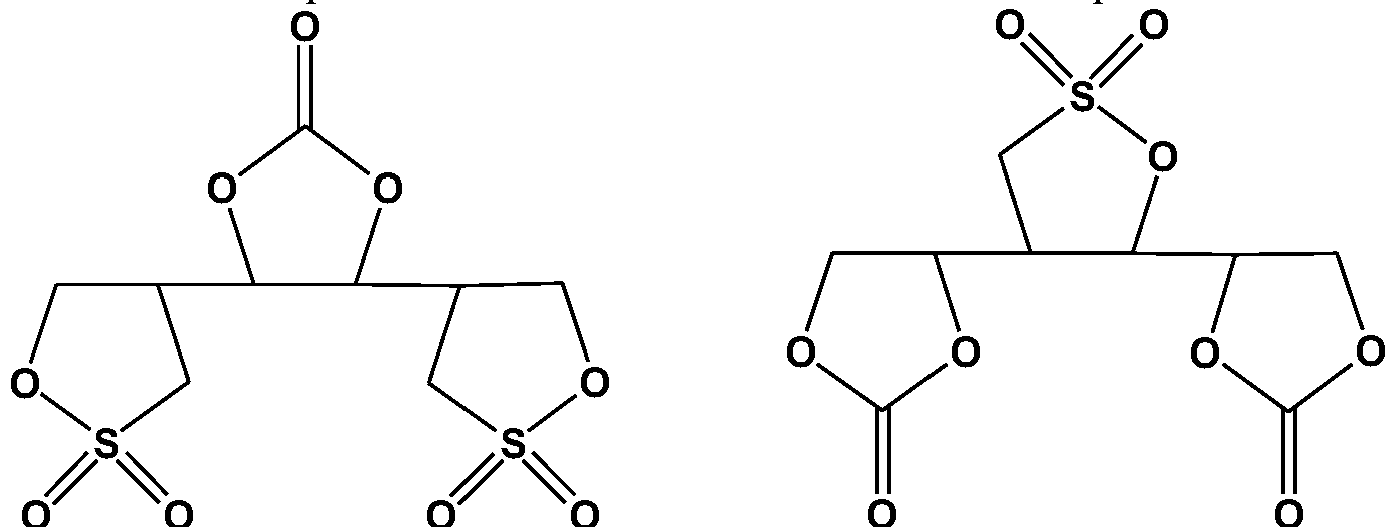
- the compound represented by the formula 1 is selected from one or more of following compounds 1-22:
- the carboxylate includes one or more of: methyl acetate, ethyl acetate, propyl acetate, methyl propionate, ethyl propionate, propyl propionate, 2,2-difluoroethyl acetate, methyl butyrate, methyl isobutyrate, methyl trimethylacetate and ethyl trimethylacetate.
- the non-aqueous electrolyte further includes an auxiliary additive.
- the auxiliary additive includes at least one of: a cyclic sulfate compound, a sultone compound, a cyclic carbonate compound, an unsaturated phosphate compound, a nitrile compound and a lithium oxalate borate.
- the auxiliary additive is added in an amount of 0.01% to 30% based on a total mass of the non-aqueous electrolyte as 100%.
- the cyclic sulfate compound is selected from at least one of: ethylene sulfate, propene sulfate or methyl ethylene sulfate.
- the sultone compound is selected from at least one of: 1,3-propane sultone, 1,4-butane sultone or 1,3-propene sultone.
- the cyclic carbonate compound is selected from at least one of: vinylene carbonate, vinyl ethylene carbonate, fluoroethylene carbonate or a compound represented by formula 2 in the formula 2,
- R 21 , R 22 , R 23 , R 24 , R 25 and R 26 are each independently selected from one of: a hydrogen atom, a halogen atom or a C1-C5 group.
- the unsaturated phosphate compound is selected from at least one of compounds represented by formula 3: in the formula 3, R 31 , R 32 and R 33 are each independently selected from a C1-C5 saturated hydrocarbon group, an unsaturated hydrocarbon group, a halogenated hydrocarbon group and -Si(C m H 2m+1 ) 3 , where m is a natural number of 1 to 3, and at least one of R 31 , R 32 and R 33 is an unsaturated hydrocarbon group.
- the nitrile compound is selected from one or more of: succinonitrile, glutaronitrile, ethylene glycol bis(propionitrile)ether, hexane trinitrile, adiponitrile, pimelonitrile, suberonitrile, azelanitrile and sebaconitrile.
- the lithium oxalate borate is selected from one or more of: Li[B(C 2 O 4 ) 2 ] and Li[B(C 2 O 4 )F 2 ].
- the non-aqueous organic solvent further includes one or more of: cyclic carbonates, linear carbonates and ethers.
- the cyclic carbonates include one or more of: vinylene carbonate, propene carbonate and ethylene carbonate.
- the linear carbonates include one or more of: dimethyl carbonate, diethyl carbonate and ethyl methyl carbonate.
- the ethers include one or more of: glycol dimethyl ether, 1,3-dioxolane and 1,1,2,2-tetrafluoroethyl-2,2,3,3-tetrafluoropropylether.
- the present invention provides a secondary battery.
- the secondary battery includes a positive electrode, a negative electrode, and a non-aqueous electrolyte as described above.
- the positive electrode includes a positive electrode material layer, and a compaction density of the positive electrode material layer is 3.5g/cm 3 or more.
- the negative electrode includes a negative electrode material layer, and a compaction density of the negative electrode material layer is 1.5g/cm 3 or more. Therefore, a battery with a high energy density may be obtained.
- the carboxylate with a high dielectric constant and a small viscosity is selected as the solvent of the non-aqueous electrolyte, so as to improve infiltration and ion conductivity of the non-aqueous electrolyte to the positive and negative electrodes, and improve the fast charging ability of the battery.
- the inventors have found through a large number of researches that a side reaction of the carboxylate in the battery may be effectively inhibited by adding the compound represented by the formula 1 as the additive into the non-aqueous electrolyte.
- the content of electrolyte salt and the content of carboxylate jointly affect the ion conductivity of the non-aqueous electrolyte.
- the mass percentage content a of the compound represented by the formula 1 in the non-aqueous electrolyte By controlling parameter ranges of the mass percentage content a of the compound represented by the formula 1 in the non-aqueous electrolyte, the mass percentage content m of the carboxylate in the non-aqueous electrolyte and the mass percentage content n of the electrolyte salt in the non-aqueous electrolyte, and allowing them to satisfy a relational expression of 0.02 ⁇ an/m ⁇ 9, a stable and dense passivation film may be formed on the positive and negative electrodes, and the oxidation of the carboxylate is effectively prevented.
- an internal resistance of the battery is effectively reduced and the fast charging performance and the cycle performance of the battery are improved by limiting a content relation of the compound as represented by formula 1, the carboxylate and the electrolyte salt.
- An embodiment of the present invention provides a non-aqueous electrolyte.
- the non-aqueous electrolyte includes an electrolyte salt, a non-aqueous organic solvent, and an additive.
- the non-aqueous organic solvent includes a carboxylate
- the additive includes a compound represented by formula 1: where n is 0 or 1, A is selected from C or O, X is selected from or R 1 and R 2 are each independently selected from H, R 1 and R 2 are not selected from H simultaneously, and X, R 1 and R 2 at least contain one sulfur atom.
- the non-aqueous electrolyte satisfies following conditions: 0.02 ⁇ an/m ⁇ 9, 0.01% ⁇ a ⁇ 5%, 5% ⁇ m ⁇ 70%, and 8% ⁇ n ⁇ 25%;
- a conductivity of the non-aqueous electrolyte at 25°C is greater than or equal to 5mS/cm.
- the carboxylate is unstable under a high voltage and tends to produce decomposition products at a positive electrode side. Some of the decomposition products migrate to the negative electrode to be reduced, and accumulate on a surface of the negative electrode, resulting in a continuous increase in an impedance of the battery, which is not conducive to the improvement of a cycle performance of the battery.
- the inventors have found that a side reaction of the carboxylate in the battery may be effectively inhibited by adding the compound represented by the formula 1 as the additive into the non-aqueous electrolyte.
- a formed passivation film may effectively inhibit a decomposition reaction of the carboxylate on a surface of the positive electrode, reduce the formation of oxidation by-products, and inhibit the reduction and accumulation of the oxidation by-products on a surface of the negative electrode simultaneously. Therefore, the continuous increase of an impedance of the passivation film on the surfaces of the positive and negative electrodes may be avoided during cycling, and at the same time, the improvement effect of the carboxylate on a fast charging performance of the battery is ensured.
- the content of electrolyte salt and the content of carboxylate jointly affect viscosity and ion conductivity of the non-aqueous electrolyte.
- the mass percentage content m of the carboxylate in the non-aqueous electrolyte and the mass percentage content n of the electrolyte salt in the non-aqueous electrolyte and allowing them to satisfy a relational expression of 0.02 ⁇ an/m ⁇ 9, a stable and dense passivation film may be formed on the positive and negative electrodes, and the oxidation of the carboxylate is effectively prevented.
- an internal resistance of the battery is effectively reduced and a fast charging performance and the cycle performance of the battery are improved by limiting a content relation of the compound as represented by formula 1, the carboxylate and the electrolyte salt.
- the conductivity of the non-aqueous electrolyte at 25°C is greater than or equal to 5mS/cm, so that a film-forming effect of the compound represented by the formula 1 is better, and it is ensured that the electrolyte has a better high-temperature performance.
- the conductivity of the non-aqueous electrolyte at 25°C is 6.0mS/cm to 9.0mS/cm, which may further ensure that the negative electrode does not precipitate lithium, thus improving a high-temperature cycle performance of the battery.
- the higher the conductivity of the electrolyte at room temperature of 25°C the better the performance of the battery.
- a side reaction may be increased due to an excessive addition ratio of the certain type of organic solvent, and on the contrary, the performance such as a cycle life of the battery is affected to a certain extent.
- the compound represented by the formula 1 is: where Ais selected from C or O, X is selected from R 1 and R 2 are each independently selected from H, R 1 and R 2 are not selected from H simultaneously, and X, R 1 and R 2 at least contain one sulfur atom.
- the compound represented by the formula 1 is: where Ais selected from C or O, X is selected from R 1 and R 2 are each independently selected from H, R 1 and R 2 are not selected from H simultaneously, and X, R 1 and R 2 at least contain one sulfur atom.
- the non-aqueous electrolyte satisfies a following condition: 0.2 ⁇ an/m ⁇ 4.
- the mass percentage content a of the compound represented by the formula 1 in the non-aqueous electrolyte, the mass percentage content m of the carboxylate in the non-aqueous electrolyte and the mass percentage content n of the electrolyte salt in the non-aqueous electrolyte are associated, so that comprehensive effects of the compound represented by the formula 1, the carboxylate and the electrolyte salt on the fast charging performance of the battery may be integrated, the non-aqueous electrolyte suitable for a high compaction battery may be obtained, and the cycle performance of the battery under high-rate charge and discharge conditions may be improved.
- the mass percentage content a of the compound represented by the formula 1 in the non-aqueous electrolyte may be 0.01%, 0.05%, 0.1%, 0.12%, 0.15%, 0.3%, 0.5%, 0.8%, 0.9%, 1.0%, 1.2%, 1.4%, 1.7%, 1.9%, 2.1%, 2.2%, 2.4%, 2.7%, 2.9%, 3.1%, 3.3%, 3.5%, 3.7%, 4.2%, 4.4%, 4.7%, 4.9%, or 5.0%.
- the mass percentage content a of the compound represented by the formula 1 in the non-aqueous electrolyte is 0.05% to 3%.
- the mass percentage content m of the carboxylate in the non-aqueous electrolyte may be 5%, 8%, 10%, 13%, 16%, 17%, 19%, 21%, 22%, 24%, 27%, 29%, 31%, 33%, 35%, 37%, 42%, 44%, 47%, 49%, 50%, 53%, 55%, 58%, 60%, 61%, 63%, 65%, 68%, or 70%.
- the mass percentage content m of the carboxylate in the non-aqueous electrolyte is 10% to 60%.
- the fast charging performance of the battery may be improved.
- the carboxylate is added in a small amount, the conductivity of the non-aqueous electrolyte is low, which affects the cycle performance of the battery.
- the carboxylate is added in an excessive amount, the stability of the non-aqueous electrolyte may be reduced, which is also not conducive to the improvement of the cycle performance of the battery.
- the mass percentage content n of the electrolyte salt in the non-aqueous electrolyte may be 8%, 9%, 10%, 11%, 12%, 13%, 14%, 15%, 16%, 17%, 18%, 19%, 20%, 21%, 22%, 23%, 24%, or 25%.
- the mass percentage content n of the electrolyte salt in the non-aqueous electrolyte is 10% to 20%.
- Alkali metal ions formed by the dissociation of the electrolyte salt in the non-aqueous electrolyte are deintercalated and intercalated between the positive electrode and the negative electrode to complete a cycle of charge and discharge.
- a concentration of the electrolyte salt directly affects a transmission speed of the alkali metal ions, and the transmission speed of the alkali metal ions affects a potential change of the negative electrode.
- the electrolyte salt includes one or more of: a lithium salt, a sodium salt, a potassium salt, a magnesium salt, a zinc salt and an aluminum salt. In preferred embodiments, the electrolyte salt is selected from the lithium salt or the sodium salt.
- the electrolyte salt is selected from at least one of: LiPF 6 , LiPO 2 F 2 , LiBF 4 , LiSbF 6 , LiAsF 6 , LiCF 3 SO 3 , LiN(SO 2 CF 3 ) 2 , LiC(SO 2 CF 3 ) 3 , LiN(SO 2 C 2 F 5 ) 2 , LiN(SO 2 F) 2 , LiCl, LiBr, LiI, LiClO 4 , LiBF 4 , LiB 10 Cl 10 , LiAlCl 4 , a lithium chloroborane, a lower aliphatic lithium carboxylate having 4 or less carbon atoms, a lithium tetraphenylborate or a lithium imino group.
- the electrolyte salt may be inorganic electrolyte salts such as LiBF 4 , LiClO 4 , LiAlF 4 , LiSbF 6 , LiTaF 6 , LiWF 7 ; fluorophosphate electrolyte salts such as LiPF 6 ; tungstate electrolyte salts such as LiWOF 5 ; carboxylic acid electrolyte salts such as HCO 2 Li, CH 3 CO 2 Li, CH 2 FCO 2 Li, CHF 2 CO 2 Li, CF 3 CO 2 Li, CF 3 CH 2 CO 2 Li, CF 3 CF 2 CO 2 Li, CF 3 CF 2 CO 2 Li, CF 3 CF 2 CF 2 CO 2 Li, and CF 3 CF 2 CF 2 CO 2 Li; sulfonic acid electrolyte salts such as CH 3 SO 3 Li; imide electrolyte salts such as LiN(FCO 2 ) 2 , LiN(FCO)(FSO 2 ), LiN(FSO 2 )
- the electrolyte salt is selected from one or more of: LiPF 6 , LiPO 2 F 2 , LiBF 4 , LiClO 4 , LiCF 3 SO 3 , LiN(SO 2 CF 3 ) 2 , and LiN(SO 2 F) 2 .
- the electrolyte salt is selected from other salts such as a sodium salt, a potassium salt, a magnesium salt, a zinc salt or an aluminum salt
- lithium in the lithium salt may be correspondingly replaced with sodium, potassium, magnesium, zinc, or aluminum, etc.
- the sodium salt is selected from at least one of: sodium perchlorate (NaClO 4 ), sodium hexafluorophosphate (NaPF 6 ), sodium tetrafluoroborate (NaBF 4 ), sodium trifluoromethanesulfonate (NaFSI) or sodium bis-trifluoromethanesulfonate (NaTFSI).
- NaClO 4 sodium perchlorate
- NaPF 6 sodium hexafluorophosphate
- NaBF 4 sodium tetrafluoroborate
- NaFSI sodium trifluoromethanesulfonate
- NaTFSI sodium bis-trifluoromethanesulfonate
- the compound represented by the formula 1 is selected from one or more of following compounds 1-22:
- compound 7 may be prepared by a method as follows:
- Organic solvents such as sorbitol, dimethyl carbonate, methanol alkaline substance catalyst potassium hydroxide, DMF, and the like are placed in a reaction vessel. After reaction for several hours under heating conditions, a certain amount of oxalic acid is added to adjust the pH to be neutral. Filtration and recrystallization are performed to obtain an intermediate product 1.
- the intermediate product 1, carbonate, thionyl chloride, and the like are subjected to an esterification reaction at high temperature to obtain an intermediate product 2.
- An oxidizing agent such as sodium periodate is used to oxidize the intermediate product 2 to obtain the compound 7.
- the carboxylate includes one or more of: methyl acetate, ethyl acetate, propyl acetate, methyl propionate, ethyl propionate, propyl propionate, 2,2-difluoroethyl acetate, methyl butyrate, methyl isobutyrate, methyl trimethylacetate and ethyl trimethylacetate.
- the non-aqueous organic solvent further includes one or more of: ether solvents, nitrile solvents and carbonate solvents.
- the ether solvents include cyclic ethers or linear ethers, preferably linear ethers having 3 to 10 carbon atoms and cyclic ethers having 3 to 6 carbon atoms.
- the cyclic ethers may specifically be, but are not limited to one or more of: 1,3-dioxolane (DOL), 1,4-dioxane (DX), crown ethers, tetrahydrofuran (THF), 2-methyltetrahydrofuran (2-CH 3 -THF), and 2-trifluoromethyltetrahydrofuran (2-CF 3 -THF).
- the linear ethers may specifically be, but are not limited to dimethoxymethane, diethoxymethane, ethoxymethoxymethane, ethylene glycol di-n-propyl ether, ethylene glycol di-n-butyl ether and diethyleneglycoldimethylether. Since solvability of the linear ethers and lithium ions is high and ion dissociation may be improved, dimethoxymethane, diethoxymethane and ethoxymethoxymethane with a small viscosity and a high ionic conductivity are particularly preferred. Ether compounds may be used alone, or in combination of two or more in any combination and ratio.
- An addition amount of the ether compounds is not particularly limited, and it is arbitrary within a range that does not significantly destroy the effect of the high compaction lithium-ion battery of the present invention.
- a volume ratio of the non-aqueous organic solvent is 100%
- a volume ratio of the ether compounds is usually 1% or more, preferably 2% or more, more preferably 3% or more
- the volume ratio of the ether compounds is generally 30% or less, preferably 25% or less, and more preferably 20% or less.
- a total amount of the ether compounds is within the above-mentioned range.
- an addition amount of the ether compounds is within the above-mentioned preferred range, it is easy to ensure an effect of improving the ionic conductivity by increasing a lithium ion dissociation degree and reducing the viscosity of the linear ethers.
- a negative electrode active material is a carbon material, a phenomenon of co-intercalating of the linear ethers and the lithium ions may be inhibited, so that input and output characteristics and charge and discharge rate characteristics may reach appropriate ranges.
- the nitrile solvents may specifically be, but are not limited to one or more of: acetonitrile, glutaronitrile, and malononitrile.
- the carbonate solvents include cyclic carbonates or linear carbonates.
- the cyclic carbonates may specifically be, but are not limited to one or more of: ethylene carbonate (EC), propylene carbonate (PC), ⁇ -butyrolactone (GBL), and butylene carbonate (BC).
- the linear carbonates may specifically be, but are not limited to one or more of: dimethyl carbonate (DMC), ethyl methyl carbonate (EMC), diethyl carbonate (DEC), and dipropyl carbonate (DPC).
- DMC dimethyl carbonate
- EMC ethyl methyl carbonate
- DEC diethyl carbonate
- DPC dipropyl carbonate
- a content of the cyclic carbonates is not particularly limited, and it is arbitrary within a range that does not significantly destroy the effect of the secondary battery of the present invention.
- a volume ratio of a lower limit of a content of the cyclic carbonate is usually 3% or more, preferably 5% or more, relative to a total amount of the non-aqueous organic solvent in the non-aqueous electrolyte.
- a volume ratio of an upper limit of a content of the cyclic carbonate is usually 90% or less, preferably 85% or less, and more preferably 80% or less.
- a content of the linear carbonates is not particularly limited, and a volume ratio of the linear carbonates is usually 15% or more, preferably 20% or more, and more preferably 25% or more, relative to a total amount of the non-aqueous organic solvent in the non-aqueous electrolyte.
- a volume ratio of the linear carbonates is usually 90% or less, preferably 85% or less, and more preferably 80% or less.
- fluorinated linear carbonates having fluorine atom(s)
- the number of the fluorine atoms in the fluorinated linear carbonate is not particularly limited as long as it is 1 or more, but it is usually 6 or less, preferably 4 or less.
- these fluorine atoms may be bonded to a same carbon, or may be bonded to different carbons.
- the fluorinated linear carbonates include fluorinated dimethyl carbonate derivatives, fluorinated methyl ethyl carbonate derivatives, and fluorinated diethyl carbonate derivatives.
- sulfone solvents include cyclic sulfones and linear sulfones.
- the sulfone solvents is the cyclic sulfones
- the cyclic sulfones is usually a compound having 3 to 6 carbon atoms, preferably 3 to 5 carbon atoms.
- the linear sulfones is usually a compound having 2 to 6 carbon atoms, preferably 2 to 5 carbon atoms.
- An addition amount of the sulfone solvents is not particularly limited, and it is arbitrary within a range that does not significantly destroy the effect of the secondary battery of the present invention.
- a volume ratio of the sulfone solvents is usually 0.3% or more, preferably 0.5% or more, more preferably 1% or more, and in addition, the volume ratio of the sulfone solvents is generally 40% or less, preferably 35% or less, and more preferably 30% or less, relative to a total amount of non-aqueous organic solvent in non-aqueous electrolyte.
- a total amount of the sulfone solvents is within the above-mentioned range.
- the addition amount of the sulfone solvents is within the above-mentioned range, it tends to obtain an electrolyte with excellent high temperature storage stability.
- the non-aqueous electrolyte further includes an auxiliary additive.
- the auxiliary additive includes at least one of: a cyclic sulfate compound, a sultone compound, a cyclic carbonate compound, an unsaturated phosphate compound, a nitrile compound and a lithium oxalate borate.
- the cyclic sulfate compound is selected from at least one of: ethylene sulfate, propene sulfate or methyl ethylene sulfate.
- the sultone compound is selected from at least one of: 1,3-propane sultone, 1,4-butane sultone or 1,3-propene sultone.
- the cyclic carbonate compound is selected from at least one of: vinylene carbonate, vinyl ethylene carbonate, fluoroethylene carbonate or a compound represented by formula 2, in the formula 2, R 21 , R 22 , R 23 , R 24 , R 25 and R 26 are each independently selected from one of: a hydrogen atom, a halogen atom or a C1-C5 group.
- the unsaturated phosphate compound is selected from at least one of compounds represented by formula 3: in the formula 3, R 31 , R 32 and R 33 are each independently selected from a C1-C5 saturated hydrocarbon group, an unsaturated hydrocarbon group, a halogenated hydrocarbon group and -Si(C m H 2m+1 ) 3 , where m is a natural number of 1 to 3, and at least one of R 31 , R 32 and R 33 is an unsaturated hydrocarbon group.
- the unsaturated phosphate compound may be at least one of: tripropargyl phosphate, dipropargyl methyl phosphate, dipropargyl ethyl phosphate, dipropargyl propyl phosphate, dipropargyl trifluoromethyl phosphate, dipropargyl-2,2,2-trifluoroethyl phosphate, dipropargyl-3,3,3-trifluoropropyl phosphate, dipropargyl hexafluoroisopropyl phosphate, triallyl phosphate, diallyl methyl phosphate, diallyl ethyl phosphate, diallyl propyl phosphate, diallyl trifluoromethyl phosphate, diallyl-2,2,2-trifluoroethyl phosphate, diallyl-3,3,3-trifluoropropyl phosphate, diallyl hexafluoroisopropyl phosphate.
- the nitrile compound is selected from one or more of: succinonitrile, glutaronitrile, ethylene glycol bis(propionitrile) ether, hexanitrile, adiponitrile, pimelonitrile, suberonitrile, azelanitrile and sebaconitrile.
- the lithium oxalate borate is selected from one or more of: Li[B(C 2 O 4 ) 2 ] and Li[B(C 2 O 4 )F 2 ].
- the auxiliary additive may further include other additives that may improve a performance of the battery, for example, additives that may improve a safety performance of the battery, specifically for example, flame retardant additives such as fluorophosphate and cyclophosphazene, or anti-overcharge additives such as tert-amylbenzene and tert-butylbenzene.
- additives that may improve a safety performance of the battery specifically for example, flame retardant additives such as fluorophosphate and cyclophosphazene, or anti-overcharge additives such as tert-amylbenzene and tert-butylbenzene.
- the auxiliary additive is added in an amount of 0.01% to 30% based on a total mass of the non-aqueous electrolyte as 100%.
- any optional substance in the auxiliary additive in the non-aqueous electrolyte is added in an amount of 10% or less, preferably 0.1 to 5%, and more preferably 0.1% to 2%.
- any optional substance in the auxiliary additive may be added in an amount of 0.05%, 0.08%, 0.1%, 0.5%, 0.8%, 1%, 1.2%, 1.5%, 1.8%, 2%, 2.2%, 2.5%, 2.8%, 3%, 3.2%, 3.5%, 3.8%, 4%, 4.5%, 5%, 5.5%, 6%, 6.5%, 7%, 7.5%, 7.8%, 8%, 8.5%, 9%, 9.5%, and 10%.
- the fluoroethylene carbonate is added in an amount of 0.05% to 30% based on a total mass of the non-aqueous electrolyte as 100%.
- the secondary battery includes a positive electrode, a negative electrode, and a non-aqueous electrolyte as described above.
- the positive electrode includes a positive electrode material layer, and a compaction density of the positive electrode material layer is 3.5g/cm 3 or more.
- the negative electrode includes a negative electrode material layer, and a compaction density of the negative electrode material layer is 1.5g/cm 3 or more.
- the compaction density of the positive electrode material layer is 3.8 to 4.15g/cm 3 .
- the compaction density of the negative electrode material layer is 1.65 to 1.85g/cm 3 .
- a porosity of the positive electrode material and the negative electrode material is 50% or less.
- a porosity of the positive electrode material and the negative electrode material is 10% to 35%.
- a highest cutoff charge voltage of the secondary battery is ⁇ 4.4V
- the positive electrode material layer includes a positive electrode active material.
- a type and a content of the positive electrode active material are not particularly limited, and may be selected according to actual needs, as long as it is a positive electrode active material or a conversion positive electrode material capable of reversibly intercalating/deintercalating metal ions, such as lithium ion, sodium ion, potassium ion, magnesium ion, zinc ion, aluminum ion, etc..
- the battery is a lithium-ion battery.
- a positive electrode active material of the lithium-ion battery may be selected from one or more of: LiFe 1-x' M' x' PO 4 , LiMn 2-y' M y' O 4 and LiNi x Co y Mn z M 1-x-y-z O 2 , where 0 ⁇ x' ⁇ 1, 0 ⁇ y' ⁇ 1, 0 ⁇ y ⁇ 1, 0 ⁇ x ⁇ 1, 0 ⁇ z ⁇ 1, x+y+z ⁇ 1.
- M' is selected from one or more of: Mn, Mg, Co, Ni, Cu, Zn, Al, Sn, B, Ga, Cr, Sr, V or Ti.
- M is selected from one or more of: Fe, Co, Ni, Mn, Mg, Cu, Zn, Al, Sn, B, Ga, Cr, Sr, V or Ti.
- the positive electrode active material may also be selected from one or more of: sulfide, selenide and halide.
- the positive electrode active material may be selected from one or more of: LiCoO 2 , LiFePO 4 , LiFe 0.8 Mn 0.2 PO 4 , LiMn 2 O 4 , LiNi 0.5 Co 0.2 Mn 0.3 O 2 , LiNi 0.6 Co 0.2 Mn 0.2 O 2 , LiNi 0.8 Co 0.1 Mn 0.1 O 2 , LiNi 0.5 Co 0.2 Mn 0.2 Al 0.1 O 2 and LiNi 0.5 Co 0.2 Al 0.3 O 2 .
- the secondary battery is a sodium ion battery.
- a positive electrode active material of the sodium ion battery may be selected from one or more of: a metal sodium, a carbon material, an alloy material, a transition metal oxide, a transition metal sulfide, a phosphorus-based material, a titanate material and a Prussian blue material.
- the carbon material may be selected from one or more of: graphite, soft carbon and hard carbon.
- the alloy material may be selected from alloy materials composed of at least two of Si, Ge, Sn, Pb and Sb. The alloy material may also be selected from alloy materials composed of at least one of: Si, Ge, Sn, Pb and Sb, and C.
- a chemical formula of the transition metal oxide and the transition metal sulfide is M1 x N y .
- M1 may be selected from one or more of: Fe, Co, Ni, Cu, Mn, Sn, Mo, Sb and V N may be selected from O or S.
- the phosphorus-based material may be selected from one or more of: red phosphorus, white phosphorus and black phosphorus.
- the titanate material may be selected from one or more of: Na 2 Ti 3 O 7 , Na 2 Ti 6 O 13 , Na 4 Ti 5 O 12 , Li 4 Ti 5 O 12 and NaTi 2 (PO 4 ) 3 .
- a molecular formula of the Prussian blue material is Na x M[M'(CN) 6 ] y ⁇ zH 2 O, where M is a transition metal, and M' is a transition metal, 0 ⁇ x ⁇ 2, 0.8 ⁇ y ⁇ 1, 0 ⁇ z ⁇ 20.
- the positive electrode further includes a positive electrode current collector.
- the positive electrode material layer covers a surface of the positive electrode current collector.
- the positive electrode current collector is selected from metal materials that may conduct electrons.
- the positive electrode current collector includes one or more of: Al, Ni, tin, copper and stainless steel.
- the positive electrode current collector is selected from aluminum foil.
- the positive electrode active material layer further includes a positive electrode binder and a positive electrode conductive agent.
- the positive electrode active material, the positive electrode binder and the positive electrode conductive agent are blended to obtain the positive electrode material layer.
- the positive electrode binder includes one or more of: thermoplastic resins such as polyvinylidene fluoride, vinylidene fluoride copolymers, polytetrafluoroethylene, vinylidene fluoride-hexafluoropropylene copolymers, tetrafluoroethylene-hexafluoropropylene copolymers, tetrafluoroethylene-perfluoroalkyl vinyl ether copolymers, ethylene-tetrafluoroethylene copolymers, vinylidene fluoride-tetrafluoroethylene copolymers, vinylidene fluoride-trifluoroethylene copolymers, vinylidene fluoride-trichloroethylene copolymers, vinylidene fluoride-fluoroethylene copolymers, vinylidene fluoride-hexafluoropropylene-tetrafluoroethylene copolymers, thermoplastic polyimides, polyethylene, polypropylene and so on; acrylic resin
- the positive electrode conductive agent includes one or more of: conductive carbon black, conductive carbon spheres, conductive graphite, conductive carbon fibers, carbon nanotubes, graphene or reduced graphene oxide.
- the negative electrode includes the negative electrode material layer.
- the negative electrode material layer includes a negative electrode active material.
- the negative electrode active material includes one or more of: a carbon-based negative electrode, a tin-based negative electrode, a silicon-based negative electrode, a lithium negative electrode, a sodium negative electrode, a potassium negative electrode, a magnesium negative electrode, a zinc negative electrode and an aluminum negative electrode.
- the carbon-based negative electrode may include graphite, hard carbon, soft carbon, graphene, mesophase carbon microspheres, etc.
- the silicon-based negative electrode may include one or more of: a silicon material, a silicon oxide, a silicon-carbon composite material and a silicon alloy material.
- the tin-based negative electrode may include tin, tin carbon, tin oxide and tin metal compounds.
- the lithium negative electrode may include metallic lithium or lithium alloy.
- the lithium alloy may be at least one of: lithium silicon alloy, lithium sodium alloy, lithium potassium alloy, lithium aluminum alloy, lithium tin alloy and lithium indium alloy.
- the negative electrode further includes a negative electrode current collector.
- the negative electrode material layer covers a surface of the negative electrode current collector.
- a material of the negative electrode current collector may be the same as that of the positive electrode current collector, which will not be elaborated herein.
- the negative electrode material layer further includes a negative electrode binder and a negative electrode conductive agent.
- the negative electrode active material, the negative electrode binder and the negative electrode conductive agent are blended to obtain the negative electrode material layer.
- the negative electrode binder and the negative electrode conductive agent may be the same as the positive electrode binder and the positive electrode conductive agent, respectively, which will not be elaborated herein.
- the battery further includes a separator, and the separator is located between the positive electrode and the negative electrode.
- the separator may be an existing conventional separator, and may be a ceramic separator, a polymer separator, a nonwoven fabric, an inorganic-organic composite separator, etc., including but not limited to separators, such as single-layer polypropylene (PP), single-layer polyethylene (PE), double-layer PP/PE, double-layer PP/PP, triple-layer PP/PE/PP, and the like.
- separators such as single-layer polypropylene (PP), single-layer polyethylene (PE), double-layer PP/PE, double-layer PP/PP, triple-layer PP/PE/PP, and the like.
- Example 1 is used to illustrate a battery and a preparation method thereof disclosed in the present invention, including steps as follows:
- an electrolyte as prepared above was injected into the battery cell via a liquid injection hole, and an amount of the electrolyte was ensured to fill a gap in the battery cell. Then, formation was performed according to the following steps: charging at a constant current of 0.05C for 180min, charging at a constant current of 0.1C for 180min, shaping and sealing after standing for 24h, then further charging at a constant current of 0.2C to a cutoff voltage of 4.50V, standing at room temperature for 24h, and discharging at a constant current of 0.2C to 3.0V.
- Examples 2 to 43 are used to illustrate a battery and a preparation method thereof disclosed in the present invention, including most of the steps in Example 1, excepting that an electrolyte is prepared by adding components shown in Table 1.
- Comparative Examples 1 to 13 are used to compare and illustrate a battery and a preparation method thereof disclosed in the present invention, including most of the steps in Example 1, excepting that an electrolyte is prepared by adding components shown in Table 1.
- the lithium-ion batteries prepared above were subjected to the following performance tests.
- the lithium-ion battery was charged at a constant current of 3C to 4.50V, charged at a constant voltage of 4.50V until the current drops to 0.05C, and then discharged at a constant current of 3C to 3.0V. This was cycled for 400 cycles.
- a discharge capacity, discharge DCIR, of a first cycle and a discharge capacity, discharge DCIR, of a 400 th cycle were recorded.
- a capacity retention rate and a DCIR growth rate were calculated according to the following formula:
- Capacity retention rate (%) (the discharge capacity of the 400 th cycle ⁇ the discharge capacity of the first cycle) ⁇ 100%;
- DCIR growth rate (%) (the discharge DCIR of the 400 th cycle - the discharge DCIR of the first cycle) / the discharge DCIR of the first cycle.
- Table 2 Group Capacity retention rate of 400 cycles at 45°C at 3C/3C (%) Internal resistance growth rate of 400 cycles at 45°C at 3C/3C (%)
- Example 1 75.3 72.9
- Example 2 75.7 70.1
- Example 3 76.0 72.8
- Example 4 82.2 55.2
- Example 6 85.3 50.1
- Example 8 86.2 45.3
- Example 10 89.1 40.1
- Example 12 87.6 46.5
- Example 13 88.3 43.0
- Example 14 86.2 45.6
- Example 15 86.7 45.1
- Example 16 77.6 49.9
- Example 17 80.7 53.1
- Example 18 85.3 49.8
- Example 19 76.3 70.9
- Example 20 76.9 69.8
- Example 21
- the mass percentage content a of the compound represented by the formula 1 in the non-aqueous electrolyte the mass percentage content m of the carboxylate in the non-aqueous electrolyte and the mass percentage content n of the electrolyte salt in the non-aqueous electrolyte satisfy relational expressions 0.02 ⁇ an/m ⁇ 9, 0.01% ⁇ a ⁇ 5%, 5% ⁇ m ⁇ 70%, and 8% ⁇ n ⁇ 25%, an obtained lithium-ion battery has a higher cycle capacity retention rate and a lower impedance growth rate under a condition of large current fast charging.
- a formed passivation film may effectively inhibit a decomposition reaction of the carboxylate on a surface of the positive electrode, reduce the formation of oxidation by-products, and inhibit the reduction and accumulation of the oxidation by-products on a surface of the negative electrode simultaneously. Therefore, the continuous increase of an impedance of the passivation film on the surfaces of the positive and negative electrodes may be avoided during cycling, and at the same time, the improvement effect of the carboxylate on a fast charging performance of the battery is ensured, thus inhibiting the capacity attenuation.
- the content of electrolyte salt and the content of carboxylate jointly affect viscosity and ion conductivity of the non-aqueous electrolyte. Under the control of comprehensive conditions, it is beneficial to form a dense passivation film on the surfaces of the positive and negative electrodes, and thus an internal resistance of the battery is effectively reduced and the fast charging performance and the cycle performance of the battery are improved.
- lithium-ion batteries have a best comprehensive performance of the battery when the relational expression is 0.2 ⁇ an/m ⁇ 4.
- the carboxylate When the content of the carboxylate is too high or the compound represented by the formula 1 is not enough to inhibit the decomposition of the carboxylate, the carboxylate is prone to side reactions, which decomposes to increase a thickness of the passivation film on the surfaces of the positive and the negative electrodes, and reduce the conductivity of the non-aqueous electrolyte, thus affecting the capacity development and increasing the impedance of the lithium-ion battery.
- Example 10 The test results obtained in Example 10 and Examples 31 to 35 are shown in Table 3.
- Table 3 Group Capacity retention rate of 400 cycles at 45°C at 3C/3C (%) Internal resistance growth rate of 400 cycles at 45°C at 3C/3C (%)
- Example 10 89.1 40.1
- Example 31 88.5 40.5
- Example 32 88.3 41.0
- Example 33 88.6 40.1
- Example 34 88.2 41.2
- Example 35 88.1 41.3
- Example 10 and Examples 31-35 From the test results of Example 10 and Examples 31-35, it may be seen that when compounds represented by different formulas 1 are used as the additives of the non-aqueous electrolyte, they also satisfy the limitation of the relational expression 0.02 ⁇ an/m ⁇ 9, indicating that cyclic sulfur-containing groups commonly contained in the compounds represented by the different formulas 1 play a decisive role in the formation of passivation films on the surfaces of the positive and the negative electrodes.
- a passivation film rich in S element generated by decomposition has a good isolation effect on the carboxylate, thus avoiding the continuous decomposition of the carboxylate on the surfaces of positive and negative electrode materials.
- the relational expression defined in the present invention is universal for the compounds represented by the different formula 1, and has an improvement effect on the fast charging and cycle performance of lithium-ion battery.
- Example 10 (3) Test results obtained in Example 10 and Examples 36 to 38 are shown in Table 4.
- Table 4 Group Capacity retention rate of 400 cycles at 45°C at 3C/3C (%) Internal resistance growth rate of 400 cycles at 45°C at 3C/3C (%)
- Example 10 89.1 40.1
- Example 36 88.9 42.1
- Example 37 88.4 44.1
- Example 38 88.7 42.5
- Example 10 From the test results of Example 10 and Examples 36 to 38, it may be seen that, when different carboxylates are used as the non-aqueous organic solvents, they also satisfy the limitation of the relational expression 0.02 ⁇ an/m ⁇ 9, indicating that different carboxylates have the functions of reducing the viscosity of the non-aqueous electrolyte and improving the conductivity, and also have a good synergistic effect with the compound represented by the formula 1, and may synergistically improve the capacity retention rate and reduce the impedance growth rate of the battery under the condition of fast charging.
- Example 10 (4) Test results obtained in Example 10 and Examples 39 to 43 are shown in Table 5.
- Table 5 Group Capacity retention rate of 400 cycles at 45°C at 3C/3C (%) Internal resistance growth rate of 400 cycles at 45°C at 3C/3C (%)
- Example 10 89.1 40.1
- Example 39 88.7 37.1
- Example 40 90.0 37.4
- Example 41 89.0 37.4
- Example 42 88.4 38.4
- Example 43 91.2 39.5
Landscapes
- Chemical & Material Sciences (AREA)
- General Chemical & Material Sciences (AREA)
- Chemical Kinetics & Catalysis (AREA)
- Electrochemistry (AREA)
- Engineering & Computer Science (AREA)
- Manufacturing & Machinery (AREA)
- Inorganic Chemistry (AREA)
- Organic Chemistry (AREA)
- General Physics & Mathematics (AREA)
- Condensed Matter Physics & Semiconductors (AREA)
- Physics & Mathematics (AREA)
- Materials Engineering (AREA)
- Secondary Cells (AREA)
Abstract
Description
- The present invention relates to the technical field of energy storage battery devices, and more particularly to a non-aqueous electrolyte and a secondary battery.
- A lithium-ion battery has been widely used in the field of 3C digital products such as mobile phones and notebook computers, as well as in the field of new energy vehicles due to its advantages of high operating voltage, wide operating temperature range, high energy density and power density, no memory effect and long cycle life. In recent years, with a continuous development of light and thin 3C digital products, a demand for a high energy density of the lithium-ion battery in a battery industry is higher and higher. At the same time, for a user side, fast charging has become a basic requirement of a battery. Therefore, there is an urgent need to increase an energy density of lithium-ion battery and improve a fast charging performance.
- At present, there are mainly two ways to increase an energy density of a battery. One way is to increase a cutoff charge voltage of a positive electrode, and the other way is to pressurize an electrode active material layer to achieve a high density. However, after the cutoff charge voltage of the positive electrode is increased, the activity of the positive electrode is further improved. A side reaction between the positive electrode and an electrolyte is also exacerbated, resulting in the dissolution of transition metal ions at the positive electrode, thus resulting in the deterioration of a cycle performance of the battery. In addition, by using a high compaction electrode, a load of an electrode sheet may be improved, thus improving an overall energy density of the battery. However, due to a low porosity of the high compaction electrode, a liquid retention capacity of the battery is also reduced, so that the electrolyte is difficult to penetrate at an interface of the electrode sheet with a low porosity, thus increasing a contact internal resistance between the electrolyte and the electrode. The polarization of charge and discharge becomes larger during long term cycling, resulting in a sudden dive due to lithium precipitation. A lithium ion conduction channel of a high compaction electrode sheet is tortuous, resulting in difficulty in lithium ion transmission, so that a fast charging performance of the battery is very poor. To sum up, the way of increasing the energy density in the existing technology leads to the deterioration of the cycle performance and fast charging performance of the battery. Therefore, how to enable a high-voltage and high compaction lithium-ion battery to have good fast charging performance is an industry problem, which needs to be improved from various aspects such as an electrode material and an electrolyte.
- From the perspective of electrolyte, in the prior art, a carboxylate system with a high dielectric constant and a small viscosity is often selected as a solvent to improve the fast charging performance of the battery. However, the carboxylate is unstable under a high voltage and tends to generate decomposition products at a positive electrode side. The decomposition products migrate to a negative electrode to be reduced, and accumulate on a surface of the negative electrode, resulting in the increase of an impedance of the battery and rapid deterioration in later stages of the cycle. Therefore, it is urgent to improve the fast charging performance of the battery from the perspective of electrolyte.
- In view of a problem that it is difficult to combine an energy density, a cycle performance and a fast charging performance of an existing secondary battery, the present invention provides a non-aqueous electrolyte and a secondary battery.
- The technical solution used in the present invention to solve the above-mentioned technical problem is as follows.
- On the one hand, the present invention provides a non-aqueous electrolyte. The non-aqueous electrolyte includes an electrolyte salt, a non-aqueous organic solvent, and an additive. The non-aqueous organic solvent includes a carboxylate, and the additive includes a compound represented by formula 1:


- The non-aqueous electrolyte satisfies following conditions: 0.02 ≤ an/m ≤ 9, 0.01% ≤ a ≤ 5%, 5% ≤ m ≤ 70%, and 8% ≤ n ≤ 25%;
- where a is a mass percentage content of the compound represented by the formula 1 in the non-aqueous electrolyte, in %;
- m is a mass percentage content of the carboxylate in the non-aqueous electrolyte, in %; and
- n is a mass percentage content of the electrolyte salt in the non-aqueous electrolyte, in %.
- A conductivity of the non-aqueous electrolyte at 25°C is greater than or equal to 5mS/cm.
- Optionally, the non-aqueous electrolyte satisfies a following condition: 0.2<an/m<4.
- Optionally, the mass percentage content a of the compound represented by the formula 1 in the non-aqueous electrolyte is 0.05% to 3%.
- Optionally, the mass percentage content m of the carboxylate in the non-aqueous electrolyte is 10% to 60%.
- Optionally, the mass percentage content n of the electrolyte salt in the non-aqueous electrolyte is 10% to 20%.
- Preferably, the electrolyte salt is selected from one or more of: LiPF6, LiPO2F2, LiBF4, LiClO4, LiCF3SO3, LiN(SO2CF3)2 and LiN(SO2F)2.
- Optionally, the compound represented by the formula 1 is selected from one or more of following compounds 1-22:




- Optionally, the carboxylate includes one or more of: methyl acetate, ethyl acetate, propyl acetate, methyl propionate, ethyl propionate, propyl propionate, 2,2-difluoroethyl acetate, methyl butyrate, methyl isobutyrate, methyl trimethylacetate and ethyl trimethylacetate.
- Optionally, the non-aqueous electrolyte further includes an auxiliary additive. The auxiliary additive includes at least one of: a cyclic sulfate compound, a sultone compound, a cyclic carbonate compound, an unsaturated phosphate compound, a nitrile compound and a lithium oxalate borate.
- Preferably, the auxiliary additive is added in an amount of 0.01% to 30% based on a total mass of the non-aqueous electrolyte as 100%.
- Preferably, the cyclic sulfate compound is selected from at least one of: ethylene sulfate, propene sulfate or methyl ethylene sulfate. The sultone compound is selected from at least one of: 1,3-propane sultone, 1,4-butane sultone or 1,3-propene sultone. The cyclic carbonate compound is selected from at least one of: vinylene carbonate, vinyl ethylene carbonate, fluoroethylene carbonate or a compound represented by formula 2

- The unsaturated phosphate compound is selected from at least one of compounds represented by formula 3:

- The nitrile compound is selected from one or more of: succinonitrile, glutaronitrile, ethylene glycol bis(propionitrile)ether, hexane trinitrile, adiponitrile, pimelonitrile, suberonitrile, azelanitrile and sebaconitrile.
- The lithium oxalate borate is selected from one or more of: Li[B(C2O4)2] and Li[B(C2O4)F2].
- Preferably, the non-aqueous organic solvent further includes one or more of: cyclic carbonates, linear carbonates and ethers.
- Preferably, the cyclic carbonates include one or more of: vinylene carbonate, propene carbonate and ethylene carbonate. The linear carbonates include one or more of: dimethyl carbonate, diethyl carbonate and ethyl methyl carbonate. The ethers include one or more of: glycol dimethyl ether, 1,3-dioxolane and 1,1,2,2-tetrafluoroethyl-2,2,3,3-tetrafluoropropylether.
- On the other hand, the present invention provides a secondary battery. The secondary battery includes a positive electrode, a negative electrode, and a non-aqueous electrolyte as described above. The positive electrode includes a positive electrode material layer, and a compaction density of the positive electrode material layer is 3.5g/cm3 or more. The negative electrode includes a negative electrode material layer, and a compaction density of the negative electrode material layer is 1.5g/cm3 or more. Therefore, a battery with a high energy density may be obtained.
- According to the non-aqueous electrolyte provided in the present invention, aiming at characteristics of a high compaction density and a high voltage in a high energy density battery system, the carboxylate with a high dielectric constant and a small viscosity is selected as the solvent of the non-aqueous electrolyte, so as to improve infiltration and ion conductivity of the non-aqueous electrolyte to the positive and negative electrodes, and improve the fast charging ability of the battery. Aiming at a problem that the carboxylate is unstable and tends to decompose under a high voltage, the inventors have found through a large number of researches that a side reaction of the carboxylate in the battery may be effectively inhibited by adding the compound represented by the formula 1 as the additive into the non-aqueous electrolyte. The content of electrolyte salt and the content of carboxylate jointly affect the ion conductivity of the non-aqueous electrolyte. By controlling parameter ranges of the mass percentage content a of the compound represented by the formula 1 in the non-aqueous electrolyte, the mass percentage content m of the carboxylate in the non-aqueous electrolyte and the mass percentage content n of the electrolyte salt in the non-aqueous electrolyte, and allowing them to satisfy a relational expression of 0.02≤an/m≤9, a stable and dense passivation film may be formed on the positive and negative electrodes, and the oxidation of the carboxylate is effectively prevented. At the same time, an internal resistance of the battery is effectively reduced and the fast charging performance and the cycle performance of the battery are improved by limiting a content relation of the compound as represented by formula 1, the carboxylate and the electrolyte salt.
- In order that the technical problems, technical solutions and advantageous effects to be solved by the present invention may be more clearly understood, the present invention will be described in further detail with reference to embodiments. It is to be understood that particular embodiments described herein are only used to explain the present invention, and are not intended to limit the present invention.
- An embodiment of the present invention provides a non-aqueous electrolyte. The non-aqueous electrolyte includes an electrolyte salt, a non-aqueous organic solvent, and an additive. The non-aqueous organic solvent includes a carboxylate, and the additive includes a compound represented by formula 1:


- The non-aqueous electrolyte satisfies following conditions: 0.02 ≤ an/m ≤ 9, 0.01% ≤ a ≤ 5%, 5% ≤ m ≤ 70%, and 8% ≤ n ≤ 25%;
- where a is a mass percentage content of the compound represented by the formula 1 in the non-aqueous electrolyte, in %;
- m is a mass percentage content of the carboxylate in the non-aqueous electrolyte, in %; and
- n is a mass percentage content of the electrolyte salt in the non-aqueous electrolyte, in %.
- A conductivity of the non-aqueous electrolyte at 25°C is greater than or equal to 5mS/cm.
- The carboxylate is unstable under a high voltage and tends to produce decomposition products at a positive electrode side. Some of the decomposition products migrate to the negative electrode to be reduced, and accumulate on a surface of the negative electrode, resulting in a continuous increase in an impedance of the battery, which is not conducive to the improvement of a cycle performance of the battery. Through a large number of researches, the inventors have found that a side reaction of the carboxylate in the battery may be effectively inhibited by adding the compound represented by the formula 1 as the additive into the non-aqueous electrolyte. It is speculated that due to the fact that the compound represented by the formula 1 participates in film formation on the positive and the negative electrodes simultaneously, a formed passivation film may effectively inhibit a decomposition reaction of the carboxylate on a surface of the positive electrode, reduce the formation of oxidation by-products, and inhibit the reduction and accumulation of the oxidation by-products on a surface of the negative electrode simultaneously. Therefore, the continuous increase of an impedance of the passivation film on the surfaces of the positive and negative electrodes may be avoided during cycling, and at the same time, the improvement effect of the carboxylate on a fast charging performance of the battery is ensured. The content of electrolyte salt and the content of carboxylate jointly affect viscosity and ion conductivity of the non-aqueous electrolyte. By controlling parameter ranges of the mass percentage content a of the compound represented by the formula 1 in the non-aqueous electrolyte, the mass percentage content m of the carboxylate in the non-aqueous electrolyte and the mass percentage content n of the electrolyte salt in the non-aqueous electrolyte, and allowing them to satisfy a relational expression of 0.02 ≤ an/m ≤ 9, a stable and dense passivation film may be formed on the positive and negative electrodes, and the oxidation of the carboxylate is effectively prevented. At the same time, an internal resistance of the battery is effectively reduced and a fast charging performance and the cycle performance of the battery are improved by limiting a content relation of the compound as represented by formula 1, the carboxylate and the electrolyte salt.
- The conductivity of the non-aqueous electrolyte at 25°C is greater than or equal to 5mS/cm, so that a film-forming effect of the compound represented by the formula 1 is better, and it is ensured that the electrolyte has a better high-temperature performance.
- In some preferred embodiments, the conductivity of the non-aqueous electrolyte at 25°C is 6.0mS/cm to 9.0mS/cm, which may further ensure that the negative electrode does not precipitate lithium, thus improving a high-temperature cycle performance of the battery. The higher the conductivity of the electrolyte at room temperature of 25°C, the better the performance of the battery. However, in case that a content of a certain type of organic solvent is increased simply to improve the conductivity of the electrolyte at room temperature, a side reaction may be increased due to an excessive addition ratio of the certain type of organic solvent, and on the contrary, the performance such as a cycle life of the battery is affected to a certain extent.
- In some embodiments, when n is 0, the compound represented by the formula 1 is:


- In some embodiments, when n is 1, the compound represented by the formula 1 is:


- In preferred embodiments, the non-aqueous electrolyte satisfies a following condition: 0.2≤an/m≤4.
- The mass percentage content a of the compound represented by the formula 1 in the non-aqueous electrolyte, the mass percentage content m of the carboxylate in the non-aqueous electrolyte and the mass percentage content n of the electrolyte salt in the non-aqueous electrolyte are associated, so that comprehensive effects of the compound represented by the formula 1, the carboxylate and the electrolyte salt on the fast charging performance of the battery may be integrated, the non-aqueous electrolyte suitable for a high compaction battery may be obtained, and the cycle performance of the battery under high-rate charge and discharge conditions may be improved.
- In a specific embodiment, the mass percentage content a of the compound represented by the formula 1 in the non-aqueous electrolyte may be 0.01%, 0.05%, 0.1%, 0.12%, 0.15%, 0.3%, 0.5%, 0.8%, 0.9%, 1.0%, 1.2%, 1.4%, 1.7%, 1.9%, 2.1%, 2.2%, 2.4%, 2.7%, 2.9%, 3.1%, 3.3%, 3.5%, 3.7%, 4.2%, 4.4%, 4.7%, 4.9%, or 5.0%.
- In preferred embodiments, the mass percentage content a of the compound represented by the formula 1 in the non-aqueous electrolyte is 0.05% to 3%.
- In case that the content of the compound represented by the formula 1 in the non-aqueous electrolyte is too low, a formation quality of the passivation film on the surfaces of the positive and negative electrodes is affected, and it is difficult to effectively inhibit the side reaction of the carboxylate. In case that the content of the compound represented by the formula 1 in the non-aqueous electrolyte is too high, the viscosity of the non-aqueous electrolyte is increased, which affects the infiltration of the non-aqueous electrolyte to positive and negative electrode materials, resulting in an increase in an impedance and affecting the performance of the battery.
- In specific embodiments, the mass percentage content m of the carboxylate in the non-aqueous electrolyte may be 5%, 8%, 10%, 13%, 16%, 17%, 19%, 21%, 22%, 24%, 27%, 29%, 31%, 33%, 35%, 37%, 42%, 44%, 47%, 49%, 50%, 53%, 55%, 58%, 60%, 61%, 63%, 65%, 68%, or 70%.
- In preferred embodiments, the mass percentage content m of the carboxylate in the non-aqueous electrolyte is 10% to 60%.
- By adding the carboxylate as the non-aqueous organic solvent into the non-aqueous electrolyte, the fast charging performance of the battery may be improved. However, in case that the carboxylate is added in a small amount, the conductivity of the non-aqueous electrolyte is low, which affects the cycle performance of the battery. In case that the carboxylate is added in an excessive amount, the stability of the non-aqueous electrolyte may be reduced, which is also not conducive to the improvement of the cycle performance of the battery.
- In specific embodiments, the mass percentage content n of the electrolyte salt in the non-aqueous electrolyte may be 8%, 9%, 10%, 11%, 12%, 13%, 14%, 15%, 16%, 17%, 18%, 19%, 20%, 21%, 22%, 23%, 24%, or 25%.
- In preferred embodiments, the mass percentage content n of the electrolyte salt in the non-aqueous electrolyte is 10% to 20%.
- Alkali metal ions formed by the dissociation of the electrolyte salt in the non-aqueous electrolyte are deintercalated and intercalated between the positive electrode and the negative electrode to complete a cycle of charge and discharge. A concentration of the electrolyte salt directly affects a transmission speed of the alkali metal ions, and the transmission speed of the alkali metal ions affects a potential change of the negative electrode. In a fast charging process of the battery, it is necessary to increase a moving speed of the alkali metal ions as much as possible to prevent the formation of lithium dendrites caused by the rapid decrease in a potential of the negative electrode, bringing safety hazards to the battery, and prevent a cycle capacity of the battery from decaying too fast at the same time. When the content of the electrolyte salt is too low, an intercalation and deintercalation efficiency of the alkali metal ions between the positive electrode and the negative electrode may be reduced, and a demand of fast charging of the battery cannot be met. When the content of the electrolyte salt is too high, the viscosity of the non-aqueous electrolyte is increased, so that the improvement of the intercalation and deintercalation efficiency of the alkali metal ions between the positive electrode and the negative electrode is also not facilitated, and the internal resistance of the battery is increased.
- In some embodiments, the electrolyte salt includes one or more of: a lithium salt, a sodium salt, a potassium salt, a magnesium salt, a zinc salt and an aluminum salt. In preferred embodiments, the electrolyte salt is selected from the lithium salt or the sodium salt.
- In preferred embodiments, the electrolyte salt is selected from at least one of: LiPF6, LiPO2F2, LiBF4, LiSbF6, LiAsF6, LiCF3SO3, LiN(SO2CF3)2, LiC(SO2CF3)3, LiN(SO2C2F5)2, LiN(SO2F)2, LiCl, LiBr, LiI, LiClO4, LiBF4, LiB10Cl10, LiAlCl4, a lithium chloroborane, a lower aliphatic lithium carboxylate having 4 or less carbon atoms, a lithium tetraphenylborate or a lithium imino group. Specifically, the electrolyte salt may be inorganic electrolyte salts such as LiBF4, LiClO4, LiAlF4, LiSbF6, LiTaF6, LiWF7; fluorophosphate electrolyte salts such as LiPF6; tungstate electrolyte salts such as LiWOF5; carboxylic acid electrolyte salts such as HCO2Li, CH3CO2Li, CH2FCO2Li, CHF2CO2Li, CF3CO2Li, CF3CH2CO2Li, CF3CF2CO2Li, CF3CF2CF2CO2Li, and CF3CF2CF2CF2CO2Li; sulfonic acid electrolyte salts such as CH3SO3Li; imide electrolyte salts such as LiN(FCO2)2, LiN(FCO)(FSO2), LiN(FSO2)2, LiN(FSO2)(CF3SO2), LiN(CF3SO2)2, LiN(C2F5SO2)2, cyclic lithium 1,2-perfluoroethanedisulfonylimide, cyclic lithium 1,3-perfluoropropanedisulfonylimide, LiN(CF3SO2)(C4F9SO2); methyl electrolyte salts such as LiC(FSO2)3, LiC(CF3SO2)3, LiC(C2F5SO2)3; and fluorine-containing organic electrolyte salts such as LiPF4(CF3)2, LiPF4(C2F5)2, LiPF4(CF3SO2)2, LiPF4(C2F5SO2)2, LiBF3CF3, LiBF3C2F5, LiBF3C3F7, LiBF2(CF3)2, LiBF2(C2F5)2, LiBF2(CF3SO2)2, LiBF2(C2F5SO2)2, etc.
- In preferred embodiments, the electrolyte salt is selected from one or more of: LiPF6, LiPO2F2, LiBF4, LiClO4, LiCF3SO3, LiN(SO2CF3)2, and LiN(SO2F)2.
- In case that the electrolyte salt is selected from other salts such as a sodium salt, a potassium salt, a magnesium salt, a zinc salt or an aluminum salt, lithium in the lithium salt may be correspondingly replaced with sodium, potassium, magnesium, zinc, or aluminum, etc.
- In preferred embodiments, the sodium salt is selected from at least one of: sodium perchlorate (NaClO4), sodium hexafluorophosphate (NaPF6), sodium tetrafluoroborate (NaBF4), sodium trifluoromethanesulfonate (NaFSI) or sodium bis-trifluoromethanesulfonate (NaTFSI).
- The above-mentioned analysis is only based on the impact of each parameter or multiple parameters present individually on the battery. However, in an actual battery application process, parameters such as the mass percentage content a of the compound represented by the formula 1 in the non-aqueous electrolyte, the mass percentage content m of the carboxylate in the non-aqueous electrolyte and the mass percentage content n of the electrolyte salt in the non-aqueous electrolyte are associated within a certain extent. Through a large number of tests, the inventor summarizes that a relational expression of 0.02≤an/m≤9, which may be effectively serve as a basis for screening a secondary battery with a high energy density, a fast charge performance and an excellent cycle performance.
- In some embodiments, the compound represented by the formula 1 is selected from one or more of following compounds 1-22:


- It is to be noted that the above-mentioned compounds are only preferred compounds of the present invention, and do not represent limitations on the present invention.
- Those skilled in the art may know the preparation method of the above-mentioned compounds according to the general knowledge in the field of chemical synthesis when they know a structural formula of the compound represented by the formula 1. For example, compound 7 may be prepared by a method as follows:
- Organic solvents such as sorbitol, dimethyl carbonate, methanol alkaline substance catalyst potassium hydroxide, DMF, and the like are placed in a reaction vessel. After reaction for several hours under heating conditions, a certain amount of oxalic acid is added to adjust the pH to be neutral. Filtration and recrystallization are performed to obtain an intermediate product 1. The intermediate product 1, carbonate, thionyl chloride, and the like are subjected to an esterification reaction at high temperature to obtain an intermediate product 2. An oxidizing agent such as sodium periodate is used to oxidize the intermediate product 2 to obtain the compound 7.
- In some embodiments, the carboxylate includes one or more of: methyl acetate, ethyl acetate, propyl acetate, methyl propionate, ethyl propionate, propyl propionate, 2,2-difluoroethyl acetate, methyl butyrate, methyl isobutyrate, methyl trimethylacetate and ethyl trimethylacetate.
- In some embodiments, the non-aqueous organic solvent further includes one or more of: ether solvents, nitrile solvents and carbonate solvents.
- In some embodiments, the ether solvents include cyclic ethers or linear ethers, preferably linear ethers having 3 to 10 carbon atoms and cyclic ethers having 3 to 6 carbon atoms. The cyclic ethers may specifically be, but are not limited to one or more of: 1,3-dioxolane (DOL), 1,4-dioxane (DX), crown ethers, tetrahydrofuran (THF), 2-methyltetrahydrofuran (2-CH3-THF), and 2-trifluoromethyltetrahydrofuran (2-CF3-THF). The linear ethers may specifically be, but are not limited to dimethoxymethane, diethoxymethane, ethoxymethoxymethane, ethylene glycol di-n-propyl ether, ethylene glycol di-n-butyl ether and diethyleneglycoldimethylether. Since solvability of the linear ethers and lithium ions is high and ion dissociation may be improved, dimethoxymethane, diethoxymethane and ethoxymethoxymethane with a small viscosity and a high ionic conductivity are particularly preferred. Ether compounds may be used alone, or in combination of two or more in any combination and ratio. An addition amount of the ether compounds is not particularly limited, and it is arbitrary within a range that does not significantly destroy the effect of the high compaction lithium-ion battery of the present invention. When a volume ratio of the non-aqueous organic solvent is 100%, a volume ratio of the ether compounds is usually 1% or more, preferably 2% or more, more preferably 3% or more, and in addition, the volume ratio of the ether compounds is generally 30% or less, preferably 25% or less, and more preferably 20% or less. When two or more ether compounds are used in combination, a total amount of the ether compounds is within the above-mentioned range. When an addition amount of the ether compounds is within the above-mentioned preferred range, it is easy to ensure an effect of improving the ionic conductivity by increasing a lithium ion dissociation degree and reducing the viscosity of the linear ethers. In addition, when a negative electrode active material is a carbon material, a phenomenon of co-intercalating of the linear ethers and the lithium ions may be inhibited, so that input and output characteristics and charge and discharge rate characteristics may reach appropriate ranges.
- In some embodiments, the nitrile solvents may specifically be, but are not limited to one or more of: acetonitrile, glutaronitrile, and malononitrile.
- In some embodiments, the carbonate solvents include cyclic carbonates or linear carbonates. The cyclic carbonates may specifically be, but are not limited to one or more of: ethylene carbonate (EC), propylene carbonate (PC), γ-butyrolactone (GBL), and butylene carbonate (BC). The linear carbonates may specifically be, but are not limited to one or more of: dimethyl carbonate (DMC), ethyl methyl carbonate (EMC), diethyl carbonate (DEC), and dipropyl carbonate (DPC). A content of the cyclic carbonates is not particularly limited, and it is arbitrary within a range that does not significantly destroy the effect of the secondary battery of the present invention. However, when the cyclic carbonate is used alone, a volume ratio of a lower limit of a content of the cyclic carbonate is usually 3% or more, preferably 5% or more, relative to a total amount of the non-aqueous organic solvent in the non-aqueous electrolyte. By setting this range, it is possible to avoid a decrease in conductivity due to a decrease in the dielectric constant of the non-aqueous electrolyte, and it is easy to make high current discharge characteristics, stability relative to the negative electrode and cycle characteristics of a non-aqueous electrolyte battery reach a good range. A volume ratio of an upper limit of a content of the cyclic carbonate is usually 90% or less, preferably 85% or less, and more preferably 80% or less. By setting this range, oxidation/reduction resistance of the non-aqueous electrolyte may be improved, thus contributing to improve the stability during high temperature storage. A content of the linear carbonates is not particularly limited, and a volume ratio of the linear carbonates is usually 15% or more, preferably 20% or more, and more preferably 25% or more, relative to a total amount of the non-aqueous organic solvent in the non-aqueous electrolyte. In addition, a volume ratio of the linear carbonates is usually 90% or less, preferably 85% or less, and more preferably 80% or less. By making the content of the linear carbonates in the above-mentioned range, it is easy to make the viscosity of the non-aqueous electrolyte reach an appropriate range and inhibit the decrease of the ionic conductivity, thus contributing to make output characteristics of the non-aqueous electrolyte battery reach a good range. When two or more linear carbonates are used in combination, a total amount of the linear carbonates is within the above-mentioned range.
- In some embodiments, it is also preferable to use linear carbonates having fluorine atom(s) (hereinafter referred to as "fluorinated linear carbonates"). The number of the fluorine atoms in the fluorinated linear carbonate is not particularly limited as long as it is 1 or more, but it is usually 6 or less, preferably 4 or less. When the fluorinated linear carbonate has a plurality of fluorine atoms, these fluorine atoms may be bonded to a same carbon, or may be bonded to different carbons. Examples of the fluorinated linear carbonates include fluorinated dimethyl carbonate derivatives, fluorinated methyl ethyl carbonate derivatives, and fluorinated diethyl carbonate derivatives.
- In some embodiments, sulfone solvents include cyclic sulfones and linear sulfones. Preferably, when the sulfone solvents is the cyclic sulfones, the cyclic sulfones is usually a compound having 3 to 6 carbon atoms, preferably 3 to 5 carbon atoms. When the sulfone solvents is the linear sulfones, the linear sulfones is usually a compound having 2 to 6 carbon atoms, preferably 2 to 5 carbon atoms. An addition amount of the sulfone solvents is not particularly limited, and it is arbitrary within a range that does not significantly destroy the effect of the secondary battery of the present invention. A volume ratio of the sulfone solvents is usually 0.3% or more, preferably 0.5% or more, more preferably 1% or more, and in addition, the volume ratio of the sulfone solvents is generally 40% or less, preferably 35% or less, and more preferably 30% or less, relative to a total amount of non-aqueous organic solvent in non-aqueous electrolyte. When two or more sulfone solvents are used in combination, a total amount of the sulfone solvents is within the above-mentioned range. When the addition amount of the sulfone solvents is within the above-mentioned range, it tends to obtain an electrolyte with excellent high temperature storage stability.
- In some embodiments, the non-aqueous electrolyte further includes an auxiliary additive. The auxiliary additive includes at least one of: a cyclic sulfate compound, a sultone compound, a cyclic carbonate compound, an unsaturated phosphate compound, a nitrile compound and a lithium oxalate borate.
- In preferred embodiments, the cyclic sulfate compound is selected from at least one of: ethylene sulfate, propene sulfate or methyl ethylene sulfate.
- The sultone compound is selected from at least one of: 1,3-propane sultone, 1,4-butane sultone or 1,3-propene sultone.
- The cyclic carbonate compound is selected from at least one of: vinylene carbonate, vinyl ethylene carbonate, fluoroethylene carbonate or a compound represented by formula 2,

- The unsaturated phosphate compound is selected from at least one of compounds represented by formula 3:

- In preferred embodiments, the unsaturated phosphate compound may be at least one of: tripropargyl phosphate, dipropargyl methyl phosphate, dipropargyl ethyl phosphate, dipropargyl propyl phosphate, dipropargyl trifluoromethyl phosphate, dipropargyl-2,2,2-trifluoroethyl phosphate, dipropargyl-3,3,3-trifluoropropyl phosphate, dipropargyl hexafluoroisopropyl phosphate, triallyl phosphate, diallyl methyl phosphate, diallyl ethyl phosphate, diallyl propyl phosphate, diallyl trifluoromethyl phosphate, diallyl-2,2,2-trifluoroethyl phosphate, diallyl-3,3,3-trifluoropropyl phosphate, diallyl hexafluoroisopropyl phosphate.
- The nitrile compound is selected from one or more of: succinonitrile, glutaronitrile, ethylene glycol bis(propionitrile) ether, hexanitrile, adiponitrile, pimelonitrile, suberonitrile, azelanitrile and sebaconitrile.
- The lithium oxalate borate is selected from one or more of: Li[B(C2O4)2] and Li[B(C2O4)F2].
- In other embodiments, the auxiliary additive may further include other additives that may improve a performance of the battery, for example, additives that may improve a safety performance of the battery, specifically for example, flame retardant additives such as fluorophosphate and cyclophosphazene, or anti-overcharge additives such as tert-amylbenzene and tert-butylbenzene.
- In some embodiments, the auxiliary additive is added in an amount of 0.01% to 30% based on a total mass of the non-aqueous electrolyte as 100%.
- It is to be noted that, unless otherwise specified, in general, any optional substance in the auxiliary additive in the non-aqueous electrolyte is added in an amount of 10% or less, preferably 0.1 to 5%, and more preferably 0.1% to 2%. Specifically, any optional substance in the auxiliary additive may be added in an amount of 0.05%, 0.08%, 0.1%, 0.5%, 0.8%, 1%, 1.2%, 1.5%, 1.8%, 2%, 2.2%, 2.5%, 2.8%, 3%, 3.2%, 3.5%, 3.8%, 4%, 4.5%, 5%, 5.5%, 6%, 6.5%, 7%, 7.5%, 7.8%, 8%, 8.5%, 9%, 9.5%, and 10%.
- In some embodiments, when the auxiliary additive is selected from fluoroethylene carbonate, the fluoroethylene carbonate is added in an amount of 0.05% to 30% based on a total mass of the non-aqueous electrolyte as 100%.
- Another embodiment of the present invention provides a secondary battery. The secondary battery includes a positive electrode, a negative electrode, and a non-aqueous electrolyte as described above. The positive electrode includes a positive electrode material layer, and a compaction density of the positive electrode material layer is 3.5g/cm3 or more. The negative electrode includes a negative electrode material layer, and a compaction density of the negative electrode material layer is 1.5g/cm3 or more.
- In preferred embodiments, the compaction density of the positive electrode material layer is 3.8 to 4.15g/cm3.
- In preferred embodiments, the compaction density of the negative electrode material layer is 1.65 to 1.85g/cm3.
- In some embodiments, a porosity of the positive electrode material and the negative electrode material is 50% or less.
- In preferred embodiments, a porosity of the positive electrode material and the negative electrode material is 10% to 35%.
- In some embodiments, a highest cutoff charge voltage of the secondary battery is ≥ 4.4V
- In some embodiments, the positive electrode material layer includes a positive electrode active material. A type and a content of the positive electrode active material are not particularly limited, and may be selected according to actual needs, as long as it is a positive electrode active material or a conversion positive electrode material capable of reversibly intercalating/deintercalating metal ions, such as lithium ion, sodium ion, potassium ion, magnesium ion, zinc ion, aluminum ion, etc..
- In preferred embodiments, the battery is a lithium-ion battery. A positive electrode active material of the lithium-ion battery may be selected from one or more of: LiFe1-x'M'x'PO4, LiMn2-y'My'O4 and LiNixCoyMnzM1-x-y-zO2, where 0≤x' < 1, 0≤y'≤1, 0≤y≤1, 0≤x≤1, 0≤z≤1, x+y+z≤1. M' is selected from one or more of: Mn, Mg, Co, Ni, Cu, Zn, Al, Sn, B, Ga, Cr, Sr, V or Ti. M is selected from one or more of: Fe, Co, Ni, Mn, Mg, Cu, Zn, Al, Sn, B, Ga, Cr, Sr, V or Ti. The positive electrode active material may also be selected from one or more of: sulfide, selenide and halide. More preferably, the positive electrode active material may be selected from one or more of: LiCoO2, LiFePO4, LiFe0.8Mn0.2PO4, LiMn2O4, LiNi0.5Co0.2Mn0.3O2, LiNi0.6Co0.2Mn0.2O2, LiNi0.8Co0.1Mn0.1O2, LiNi0.5Co0.2Mn0.2Al0.1O2 and LiNi0.5Co0.2Al0.3O2.
- In preferred embodiments, the secondary battery is a sodium ion battery. A positive electrode active material of the sodium ion battery may be selected from one or more of: a metal sodium, a carbon material, an alloy material, a transition metal oxide, a transition metal sulfide, a phosphorus-based material, a titanate material and a Prussian blue material. The carbon material may be selected from one or more of: graphite, soft carbon and hard carbon. The alloy material may be selected from alloy materials composed of at least two of Si, Ge, Sn, Pb and Sb. The alloy material may also be selected from alloy materials composed of at least one of: Si, Ge, Sn, Pb and Sb, and C. A chemical formula of the transition metal oxide and the transition metal sulfide is M1xNy. M1 may be selected from one or more of: Fe, Co, Ni, Cu, Mn, Sn, Mo, Sb and V N may be selected from O or S. The phosphorus-based material may be selected from one or more of: red phosphorus, white phosphorus and black phosphorus. The titanate material may be selected from one or more of: Na2Ti3O7, Na2Ti6O13, Na4Ti5O12, Li4Ti5O12 and NaTi2(PO4)3. A molecular formula of the Prussian blue material is NaxM[M'(CN)6]y·zH2O, where M is a transition metal, and M' is a transition metal, 0<x≤2, 0.8≤y<1, 0<z≤20.
- In some embodiments, the positive electrode further includes a positive electrode current collector. The positive electrode material layer covers a surface of the positive electrode current collector.
- The positive electrode current collector is selected from metal materials that may conduct electrons. Preferably, the positive electrode current collector includes one or more of: Al, Ni, tin, copper and stainless steel. In a more preferred embodiment, the positive electrode current collector is selected from aluminum foil.
- In some embodiments, the positive electrode active material layer further includes a positive electrode binder and a positive electrode conductive agent. The positive electrode active material, the positive electrode binder and the positive electrode conductive agent are blended to obtain the positive electrode material layer.
- The positive electrode binder includes one or more of: thermoplastic resins such as polyvinylidene fluoride, vinylidene fluoride copolymers, polytetrafluoroethylene, vinylidene fluoride-hexafluoropropylene copolymers, tetrafluoroethylene-hexafluoropropylene copolymers, tetrafluoroethylene-perfluoroalkyl vinyl ether copolymers, ethylene-tetrafluoroethylene copolymers, vinylidene fluoride-tetrafluoroethylene copolymers, vinylidene fluoride-trifluoroethylene copolymers, vinylidene fluoride-trichloroethylene copolymers, vinylidene fluoride-fluoroethylene copolymers, vinylidene fluoride-hexafluoropropylene-tetrafluoroethylene copolymers, thermoplastic polyimides, polyethylene, polypropylene and so on; acrylic resins; and styrene butadiene rubbers.
- The positive electrode conductive agent includes one or more of: conductive carbon black, conductive carbon spheres, conductive graphite, conductive carbon fibers, carbon nanotubes, graphene or reduced graphene oxide.
- In some embodiments, the negative electrode includes the negative electrode material layer. The negative electrode material layer includes a negative electrode active material. The negative electrode active material includes one or more of: a carbon-based negative electrode, a tin-based negative electrode, a silicon-based negative electrode, a lithium negative electrode, a sodium negative electrode, a potassium negative electrode, a magnesium negative electrode, a zinc negative electrode and an aluminum negative electrode. The carbon-based negative electrode may include graphite, hard carbon, soft carbon, graphene, mesophase carbon microspheres, etc. The silicon-based negative electrode may include one or more of: a silicon material, a silicon oxide, a silicon-carbon composite material and a silicon alloy material. The tin-based negative electrode may include tin, tin carbon, tin oxide and tin metal compounds. The lithium negative electrode may include metallic lithium or lithium alloy. The lithium alloy may be at least one of: lithium silicon alloy, lithium sodium alloy, lithium potassium alloy, lithium aluminum alloy, lithium tin alloy and lithium indium alloy.
- In some embodiments, the negative electrode further includes a negative electrode current collector. The negative electrode material layer covers a surface of the negative electrode current collector. A material of the negative electrode current collector may be the same as that of the positive electrode current collector, which will not be elaborated herein.
- In some embodiments, the negative electrode material layer further includes a negative electrode binder and a negative electrode conductive agent. The negative electrode active material, the negative electrode binder and the negative electrode conductive agent are blended to obtain the negative electrode material layer. The negative electrode binder and the negative electrode conductive agent may be the same as the positive electrode binder and the positive electrode conductive agent, respectively, which will not be elaborated herein.
- In some embodiments, the battery further includes a separator, and the separator is located between the positive electrode and the negative electrode.
- The separator may be an existing conventional separator, and may be a ceramic separator, a polymer separator, a nonwoven fabric, an inorganic-organic composite separator, etc., including but not limited to separators, such as single-layer polypropylene (PP), single-layer polyethylene (PE), double-layer PP/PE, double-layer PP/PP, triple-layer PP/PE/PP, and the like.
- The present invention is further illustrated by way of examples below.
- The compounds involved in the following examples and comparative examples are shown in the table below:
Table 1. Design of Parameters of Examples and Comparative Examples Compound 1 
Compound 3 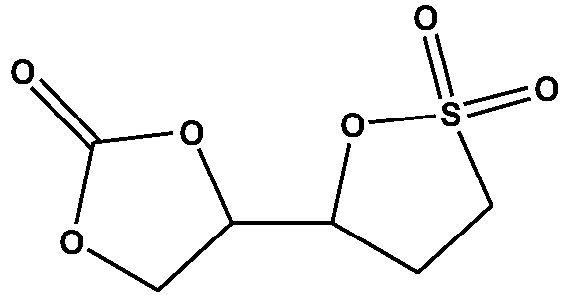
Compound 4 
Compound 7 
Compound 8 
Compound 20 
Type of compound represented by formula 1 Content a of compound represented by formula 1/% Other additives and their contents Type of carboxylate content m of carboxylat e /% content n of lithium salt/% an/m Example 1 Compound 1 0.01 - propyl propionate 5.0 10.0 0.02 Example 2 Compound 1 0.05 - propyl propionate 8.0 12.0 0.08 Example 3 Compound 1 0.1 - propyl propionate 20.0 8.0 0.04 Example 4 Compound 1 0.2 propyl propionate 25.0 12.5 0.10 Example 5 Compound 1 0.5 - propyl propionate 20.0 12.0 0.30 Example 6 Compound 1 0.5 - propyl propionate 50.0 12.0 0.12 Example 7 Compound 1 0.8 - propyl propionate 40.0 13.5 0.27 Example 8 Compound 1 1.0 - propyl propionate 10.0 25.0 2.50 Example 9 Compound 2 1.0 propyl propionate 20.0 15.0 0.75 Example 10 Compound 1 1.0 - propyl propionate 30.0 15.0 0.50 Example 11 Compound 1 1.0 - propyl propionate 35.0 25.0 0.71 Example 12 Compound 1 1.0 - propyl propionate 50.0 20.0 0.40 Example 13 Compound 1 1.2 - propyl propionate 24.0 12.0 0.60 Example 14 Compound 1 1.5 - propyl propionate 30.0 10.0 0.50 Example 15 Compound 1 1.8 - propyl propionate 30.0 20.0 1.20 Example 16 Compound 1 2.0 - propyl propionate 10.0 20.0 4.00 Example 17 Compound 1 2.5 - propyl propionate 15.0 20.0 3.33 Example 18 Compound 1 2.5 - propyl propionate 50.0 25.0 1.25 Example 19 Compound 1 2.5 - propyl propionate 5.0 15.0 7.50 Example 20 Compound 1 2.5 - propyl propionate 10.0 20.0 5.00 Example 21 Compound 1 3.0 - propyl propionate 25.0 18.0 2.160 Example 22 Compound 1 3.0 - propyl propionate 20.0 20.0 3.00 Example 23 Compound 1 4.0 - propyl propionate 30.0 15.0 2.00 Example 24 Compound 1 4.5 - propyl propionate 70.0 20.0 1.29 Example 25 Compound 1 5.0 - propyl propionate 15.0 20.0 6.67 Example 26 Compound 1 5.0 - propyl propionate 50.0 25.0 2.50 Example 27 Compound 1 3.0 - propyl propionate 5.0 15.0 9.00 Example 28 Compound 1 1.5 - propyl propionate 5.0 15.0 4.50 Example 29 Compound 1 1.5 - propyl propionate 10.0 25.0 3.75 Example 30 Compound 1 5.0 - propyl propionate 60.0 25.0 2.08 Example 31 Compound 3 1.0 - propyl propionate 30 15 0.50 Example 32 Compound 4 1.0 - propyl propionate 30 15 0.50 Example 33 Compound 7 1.0 - propyl propionate 30 15 0.50 Example 34 Compound 8 1.0 - propyl propionate 30 15 0.50 Example 35 Compound 20 1.0 - propyl propionate 30 15 0.50 Example 36 Compound 1 1.0 - ethyl propionate 30 15 0.50 Example 37 Compound 1 1.0 - ethyl acetate 30 15 0.50 Example 38 Compound 1 1.0 - 2,2-difluoroethyl acetate 30 15 0.50 Example 39 Compound 1 1.0 PS 0.5% propyl propionate 30 15 0.50 Example 40 Compound 1 1.0 DTD 1% propyl propionate 30 15 0.50 Example 41 Compound 1 1.0 triproparg yl phosphate 0.5% propyl propionate 30 15 0.50 Example 42 Compound 1 1.0 succinonit rile 1% propyl propionate 30 15 0.50 Example 43 Compound 1 1.0 0.5% LiODFB propyl propionate 30 15 0.50 Comparative Example 1 Compound 1 0.1 - propyl propionate 60 10 0.02 Comparative Example 2 Compound 1 0.05 - propyl propionate 60 15 0.01 Comparative Example 3 Compound 1 5.0 - propyl propionate 10 20 10.00 Comparative Example 4 Compound 1 2.0 - propyl propionate 5 25 10.00 Comparative Example 5 Compound 1 3.0 - propyl propionate 5 20 12.00 Comparative Example 6 Compound 1 1.5 - propyl propionate 10 5 0.75 Comparative Example 7 - - - propyl propionate 30 15 - Comparative Example 8 Compound 1 3.0 - propyl propionate 3 15 15.00 Comparative Example 9 Compound 1 3.0 - propyl propionate 80 15 0.56 Comparative Example 10 Compound 1 0.009 - propyl propionate 8 20 0.02 Comparative Example 11 Compound 1 6.0 - propyl propionate 30 15 3.00 Comparative Example 12 Compound 1 5.0 - propyl propionate 10 5 2.50 Comparative Example 13 Compound 1 1.0 - propyl propionate 30 28 0.93 - Example 1 is used to illustrate a battery and a preparation method thereof disclosed in the present invention, including steps as follows:
- 1) Preparation of electrolyte: solvent ethylene carbonate (EC), diethyl carbonate (DEC) and carboxylate were mixed, and then lithium hexafluorophosphate (LiPF6) and an additive were added. Contents of the carboxylate, the lithium hexafluorophosphate and the additive in the electrolyte are shown in Table 1, and the contents are calculated as a percentage of the total mass of the electrolyte.
- 2) Preparation of positive electrode sheet
A positive electrode active material LiCoO2, conductive carbon black Super-P and binder polyvinylidene fluoride (PVDF) were mixed in a mass ratio of 93:4:3, and then dispersed in N-methyl-2-pyrrolidone (NMP) to obtain a positive electrode slurry. The slurry was evenly coated on both sides of aluminum foil, dried, calendered and vacuum dried, and an aluminum lead-out wire was welded with an ultrasonic welder to obtain a positive electrode sheet. A thickness of the positive electrode sheet is 80 to 150µm, and a compaction density of the positive electrode sheet is 4.13g/cm3. - 3) Preparation of negative electrode sheet
A negative electrode active material artificial graphite, conductive carbon black Super-P, binder styrene-butadiene rubber (SBR) and carboxymethyl cellulose (CMC) were mixed in a mass ratio of 94:1 :2.5:2.5, and then dispersed in deionized water to obtain a negative electrode slurry. The slurry was coated on both sides of copper foil, dried, and rolled, and a nickel lead-out wire was welded with an ultrasonic welder to obtain a negative electrode sheet with a compaction density of 1.81g/cm3. - 4) Preparation of battery cell
A polyethylene microporous membrane with a thickness of 20µm was placed between the positive electrode sheet and the negative electrode sheet as a separator, and then a sandwich structure composed of the positive electrode sheet, the negative electrode sheet and the separator was wound. Then, a wound body was flattened and placed in an aluminum-plastic film. After lead-out wires of the positive and negative electrodes were led out, respectively, the aluminum-plastic film was hot-pressed and sealed to obtain the battery cell to be injected with liquid. - 5) Liquid injection and formation of battery cell
- In a glove box with a dew point controlled below -40°C, an electrolyte as prepared above was injected into the battery cell via a liquid injection hole, and an amount of the electrolyte was ensured to fill a gap in the battery cell. Then, formation was performed according to the following steps: charging at a constant current of 0.05C for 180min, charging at a constant current of 0.1C for 180min, shaping and sealing after standing for 24h, then further charging at a constant current of 0.2C to a cutoff voltage of 4.50V, standing at room temperature for 24h, and discharging at a constant current of 0.2C to 3.0V.
- Examples 2 to 43 are used to illustrate a battery and a preparation method thereof disclosed in the present invention, including most of the steps in Example 1, excepting that an electrolyte is prepared by adding components shown in Table 1.
- Comparative Examples 1 to 13 are used to compare and illustrate a battery and a preparation method thereof disclosed in the present invention, including most of the steps in Example 1, excepting that an electrolyte is prepared by adding components shown in Table 1.
- The lithium-ion batteries prepared above were subjected to the following performance tests.
- Under a condition of 25°C, a conductivity of the non-aqueous electrolyte was tested. It was found that conductivities of Examples 1 to 43, Comparative Examples 1 to 5, Comparative Examples 7 to 11 and Comparative Example 13 were all 5mS/cm or more, and those of Comparative Examples 6 and 12 were 5mS/cm or less.
- Under a condition of 45°C, the lithium-ion battery was charged at a constant current of 3C to 4.50V, charged at a constant voltage of 4.50V until the current drops to 0.05C, and then discharged at a constant current of 3C to 3.0V. This was cycled for 400 cycles. A discharge capacity, discharge DCIR, of a first cycle and a discharge capacity, discharge DCIR, of a 400th cycle were recorded. A capacity retention rate and a DCIR growth rate were calculated according to the following formula:
- Capacity retention rate (%) = (the discharge capacity of the 400th cycle ÷ the discharge capacity of the first cycle) × 100%;
- DCIR growth rate (%) = (the discharge DCIR of the 400th cycle - the discharge DCIR of the first cycle) / the discharge DCIR of the first cycle.
(1) Test results obtained in Examples 1 to 30 and Comparative Examples 1 to 13 are shown in Table 2.Table 2 Group Capacity retention rate of 400 cycles at 45°C at 3C/3C (%) Internal resistance growth rate of 400 cycles at 45°C at 3C/3C (%) Example 1 75.3 72.9 Example 2 75.7 70.1 Example 3 76.0 72.8 Example 4 82.2 55.2 Example 5 83.2 52.1 Example 6 85.3 50.1 Example 7 86.1 46.8 Example 8 86.2 45.3 Example 9 88.9 41.2 Example 10 89.1 40.1 Example 11 88.4 42.9 Example 12 87.6 46.5 Example 13 88.3 43.0 Example 14 86.2 45.6 Example 15 86.7 45.1 Example 16 77.6 49.9 Example 17 80.7 53.1 Example 18 85.3 49.8 Example 19 76.3 70.9 Example 20 76.9 69.8 Example 21 83.6 81.6 Example 22 83.2 52.3 Example 23 85.1 58.2 Example 24 82.6 57.5 Example 25 74.9 75.2 Example 26 83.4 53.6 Example 27 75.4 73.8 Example 28 76.2 71.4 Example 29 78.2 51.0 Example 30 83.2 52.6 Comparative Example 1 60.1 120.5 Comparative Example 2 60.3 130.2 Comparative Example 3 63.2 110.2 Comparative Example 4 64.3 108.9 Comparative Example 5 65.2 103.5 Comparative Example 6 44.2 204.5 Comparative Example 7 56.2 150.3 Comparative Example 8 68.9 89.4 Comparative Example 9 64.9 99.7 Comparative Example 10 63.5 105.2 Comparative Example 11 60.1 120.6 Comparative Example 12 45.2 190.8 Comparative Example 13 43.6 200.9 - From the test results of Examples 1 to 30 and Comparative Examples 1 to 13, it may be seen that the mass percentage content a of the compound represented by formula 1 in the non-aqueous electrolyte, the mass percentage content m of the carboxylate in the non-aqueous electrolyte and the mass percentage content n of the electrolyte salt in the non-aqueous electrolyte has an obvious association. When the mass percentage content a of the compound represented by the formula 1 in the non-aqueous electrolyte, the mass percentage content m of the carboxylate in the non-aqueous electrolyte and the mass percentage content n of the electrolyte salt in the non-aqueous electrolyte satisfy relational expressions 0.02≤an/m≤9, 0.01%≤a≤5%, 5%≤m≤70%, and 8%≤n≤25%, an obtained lithium-ion battery has a higher cycle capacity retention rate and a lower impedance growth rate under a condition of large current fast charging. It is speculated that due to the fact that the compound represented by the formula 1 participates in film formation on the positive and the negative electrodes simultaneously, a formed passivation film may effectively inhibit a decomposition reaction of the carboxylate on a surface of the positive electrode, reduce the formation of oxidation by-products, and inhibit the reduction and accumulation of the oxidation by-products on a surface of the negative electrode simultaneously. Therefore, the continuous increase of an impedance of the passivation film on the surfaces of the positive and negative electrodes may be avoided during cycling, and at the same time, the improvement effect of the carboxylate on a fast charging performance of the battery is ensured, thus inhibiting the capacity attenuation. The content of electrolyte salt and the content of carboxylate jointly affect viscosity and ion conductivity of the non-aqueous electrolyte. Under the control of comprehensive conditions, it is beneficial to form a dense passivation film on the surfaces of the positive and negative electrodes, and thus an internal resistance of the battery is effectively reduced and the fast charging performance and the cycle performance of the battery are improved.
- From the test results of Comparative Examples 1 to 5, it may be seen that even if a value of a, a value of n and a value of m all meet parameter range limitation thereof. However, when a value of an/m is too large or too small, it results in the deterioration of the fast charging performance of the battery, indicating that there is an interaction among the mass percentage content a of the compound represented by the formula 1 in the non-aqueous electrolyte, the mass percentage content m of the carboxylate in the non-aqueous electrolyte and the mass percentage content n of the electrolyte salt in the non-aqueous electrolyte. The fast charging performance of the battery may be significantly improved only when the three are in a good balance state. At the same time, from the test results of Comparative Examples 6 to 13, it may be seen that when one of the value of a, the value of n and the value of m exceeds a defined range, even if the value of a, the value of n and the value of m satisfy the relational expression of 0.02≤an/m≤9, the capacity retention rate and impedance growth rate of the battery under the condition of large current fast charging are poor, indicating that when the mass percentage content a of the compound represented by the formula 1 in the non-aqueous electrolyte, the mass percentage content m of the carboxylate in the non-aqueous electrolyte, and the mass percentage content n of the electrolyte salt in the non-aqueous electrolyte are too high or too low, the formation of the passivation film on the surfaces of the positive and the negative electrodes and the stability of the non-aqueous electrolyte under the condition of fast charging will be affected.
- From the test results of Examples 1 to 30, it may be seen that lithium-ion batteries have a best comprehensive performance of the battery when the relational expression is 0.2≤an/m≤4.
- From the test results of Examples 8 to 12, it may be seen that in the lithium-ion battery provided in the present invention, with the increase of the content of the carboxylate in the solvent, the capacity retention rate and the impedance growth rate of the battery under the condition of fast charging increase first and then decrease, indicating that adding the carboxylate in an appropriate amount is beneficial to improve the conductivity of the non-aqueous electrolyte and is a prerequisite for improving the fast charging performance of the lithium-ion battery. However, the carboxylate is unstable. When the content of the carboxylate is too high or the compound represented by the formula 1 is not enough to inhibit the decomposition of the carboxylate, the carboxylate is prone to side reactions, which decomposes to increase a thickness of the passivation film on the surfaces of the positive and the negative electrodes, and reduce the conductivity of the non-aqueous electrolyte, thus affecting the capacity development and increasing the impedance of the lithium-ion battery.
- From the test results of Examples 19 to 26, it may be seen that, with the increase of the content of the compound represented by the formula 1, the fast charging and cycle performance of the battery may be effectively improved only when the content of the carboxylate in the solvent is increased at the same time. When the content of the compound represented by the formula 1 is high and the content of the carboxylate is insufficient, as shown in Example 25, the capacity retention rate and the impedance growth rate of the lithium-ion battery are slightly worse than those of Example 26, indicating that the passivation film formed by the compound represented by the formula 1 is relatively dense, and adequate carboxylate is needed to reduce the viscosity of the non-aqueous electrolyte, thus ensuring the infiltration of the non-aqueous electrolyte to the electrode material and improving the ionic conductivity.
- (2) The test results obtained in Example 10 and Examples 31 to 35 are shown in Table 3.
Table 3 Group Capacity retention rate of 400 cycles at 45°C at 3C/3C (%) Internal resistance growth rate of 400 cycles at 45°C at 3C/3C (%) Example 10 89.1 40.1 Example 31 88.5 40.5 Example 32 88.3 41.0 Example 33 88.6 40.1 Example 34 88.2 41.2 Example 35 88.1 41.3 - From the test results of Example 10 and Examples 31-35, it may be seen that when compounds represented by different formulas 1 are used as the additives of the non-aqueous electrolyte, they also satisfy the limitation of the relational expression 0.02≤ an/m ≤ 9, indicating that cyclic sulfur-containing groups commonly contained in the compounds represented by the different formulas 1 play a decisive role in the formation of passivation films on the surfaces of the positive and the negative electrodes. A passivation film rich in S element generated by decomposition has a good isolation effect on the carboxylate, thus avoiding the continuous decomposition of the carboxylate on the surfaces of positive and negative electrode materials. The relational expression defined in the present invention is universal for the compounds represented by the different formula 1, and has an improvement effect on the fast charging and cycle performance of lithium-ion battery.
- (3) Test results obtained in Example 10 and Examples 36 to 38 are shown in Table 4.
Table 4 Group Capacity retention rate of 400 cycles at 45°C at 3C/3C (%) Internal resistance growth rate of 400 cycles at 45°C at 3C/3C (%) Example 10 89.1 40.1 Example 36 88.9 42.1 Example 37 88.4 44.1 Example 38 88.7 42.5 - From the test results of Example 10 and Examples 36 to 38, it may be seen that, when different carboxylates are used as the non-aqueous organic solvents, they also satisfy the limitation of the relational expression 0.02≤an/m≤9, indicating that different carboxylates have the functions of reducing the viscosity of the non-aqueous electrolyte and improving the conductivity, and also have a good synergistic effect with the compound represented by the formula 1, and may synergistically improve the capacity retention rate and reduce the impedance growth rate of the battery under the condition of fast charging.
- (4) Test results obtained in Example 10 and Examples 39 to 43 are shown in Table 5.
Table 5 Group Capacity retention rate of 400 cycles at 45°C at 3C/3C (%) Internal resistance growth rate of 400 cycles at 45°C at 3C/3C (%) Example 10 89.1 40.1 Example 39 88.7 37.1 Example 40 90.0 37.4 Example 41 89.0 37.4 Example 42 88.4 38.4 Example 43 91.2 39.5 - From the test results of Example 10 and Examples 39 to 43, it may be seen that on the basis of the battery provided in the present invention, 1,3-propane sultone (PS), ethylene sulfate (DTD), tripropargyl phosphate, succinonitrile or LiODFB are added as the auxiliary additive, so that the capacity retention performance of the battery may be further improved, and the impedance growth rate of the battery may be reduced. It is speculated that due to the fact that a certain common decomposition reaction exists between the compound represented by the formula 1 and added 1,3-propane sultone (PS), ethylene sulfate (DTD), tripropargyl phosphate, succinonitrile or LiODFB, which may jointly participate in the formation of passivation film on an electrode surface. An obtained passivation film may improve the stability of the non-aqueous electrolyte and maintain the stability of the cycle of the battery and high current resistance.
- The above descriptions are only preferred embodiments of the present invention, and are not intended to limit the present invention. Any modifications, equivalent replacements and improvements made within the range of spirit and principles of the present invention should be included in the protection scope of the present invention.
Claims (19)
- A non-aqueous electrolyte, comprising an electrolyte salt, a non-aqueous organic solvent, and an additive, wherein the non-aqueous organic solvent comprises a carboxylate, and the additive comprises a compound represented by formula 1:
 where n is 0 or 1, A is selected from C or O, X is selected from


 wherein the non-aqueous electrolyte satisfies following conditions:0.02 ≤ an/m ≤ 9, 0.01% ≤ a ≤ 5%, 5% ≤ m ≤ 70%, and 8% ≤ n ≤ 25%;where a is a mass percentage content of the compound represented by the formula 1 in the non-aqueous electrolyte, in %;m is a mass percentage content of the carboxylate in the non-aqueous electrolyte, in %; andn is a mass percentage content of the electrolyte salt in the non-aqueous electrolyte, in %;wherein a conductivity of the non-aqueous electrolyte at 25°C is greater than or equal to 5mS/cm.
 - The non-aqueous electrolyte of claim 1, wherein the non-aqueous electrolyte satisfies a following condition:
0.2<an/m<4. - The non-aqueous electrolyte of claim 1, wherein the mass percentage content a of the compound represented by the formula 1 in the non-aqueous electrolyte is 0.05% to 3%.
- The non-aqueous electrolyte of claim 1, wherein the mass percentage content m of the carboxylate in the non-aqueous electrolyte is 10% to 60%.
- The non-aqueous electrolyte of claim 1, wherein the mass percentage content n of the electrolyte salt in the non-aqueous electrolyte is 10% to 20%.
- The non-aqueous electrolyte of claim 5, wherein the electrolyte salt is selected from one or more of: LiPF6, LiPO2F2, LiBF4, LiClO4, LiCF3SO3, LiN(SO2CF3)2 and LiN(SO2F)2.
- The non-aqueous electrolyte of claim 1, wherein the compound represented by the formula 1 is selected from one or more of following compounds 1-22:


- The non-aqueous electrolyte of claim 1, wherein the carboxylate comprises one or more of: methyl acetate, ethyl acetate, propyl acetate, methyl propionate, ethyl propionate, propyl propionate, 2,2-difluoroethyl acetate, methyl butyrate, methyl isobutyrate, methyl trimethylacetate and ethyl trimethylacetate.
- The non-aqueous electrolyte of claim 1, further comprising an auxiliary additive, wherein the auxiliary additive comprises at least one of: a cyclic sulfate compound, a sultone compound, a cyclic carbonate compound, an unsaturated phosphate compound, a nitrile compound and a lithium oxalate borate.
- The non-aqueous electrolyte of claim 9, wherein the auxiliary additive is added in an amount of 0.01% to 30% based on a total mass of the non-aqueous electrolyte as 100%.
- The non-aqueous electrolyte of claim 9, wherein the cyclic sulfate compound is selected from at least one of: ethylene sulfate, propene sulfate or methyl ethylene sulfate.
- The non-aqueous electrolyte of claim 9, wherein the sultone compound is selected from at least one of: 1,3-propane sultone, 1,4-butane sultone or 1,3-propene sultone.
- The non-aqueous electrolyte of claim 9, wherein the cyclic carbonate compound is selected from at least one of: vinylene carbonate, vinyl ethylene carbonate, fluoroethylene carbonate or a compound represented by formula 2,

- The non-aqueous electrolyte of claim 9, wherein the unsaturated phosphate compound is selected from at least one of compounds represented by formula 3:

- The non-aqueous electrolyte of claim 9, wherein the nitrile compound is selected from one or more of: succinonitrile, glutaronitrile, ethylene glycol bis(propionitrile)ether, hexane trinitrile, adiponitrile, pimelonitrile, suberonitrile, azelanitrile and sebaconitrile.
- The non-aqueous electrolyte of claim 9, wherein the lithium oxalate borate is selected from one or more of: Li[B(C2O4)2] and Li[B(C2O4)F2].
- The non-aqueous electrolyte of claim 1, wherein the non-aqueous organic solvent further comprises one or more of: cyclic carbonates, linear carbonates and ethers.
- The non-aqueous electrolyte of claim 17, whereinthe cyclic carbonates comprise one or more of: vinylene carbonate, propene carbonate and ethylene carbonate;the linear carbonates comprise one or more of: dimethyl carbonate, diethyl carbonate and ethyl methyl carbonate; orthe ethers comprise one or more of: glycol dimethyl ether, 1,3-dioxolane and 1,1,2,2-tetrafluoroethyl-2,2,3,3-tetrafluoropropylether.
- A secondary battery, comprising a positive electrode, a negative electrode, and a non-aqueous electrolyte according to any one of claims 1 to 18, wherein the positive electrode comprises a positive electrode material layer, and a compaction density of the positive electrode material layer is 3.5g/cm3 or more, and the negative electrode comprises a negative electrode material layer, and a compaction density of the negative electrode material layer is 1.5g/cm3 or more.
Applications Claiming Priority (2)
| Application Number | Priority Date | Filing Date | Title |
|---|---|---|---|
| CN202210073247.0A CN114552004B (en) | 2022-01-21 | 2022-01-21 | Non-aqueous electrolyte and secondary battery |
| PCT/CN2022/137107 WO2023138244A1 (en) | 2022-01-21 | 2022-12-07 | Non-aqueous electrolyte solution and secondary battery |
Publications (3)
| Publication Number | Publication Date |
|---|---|
| EP4468440A1 true EP4468440A1 (en) | 2024-11-27 |
| EP4468440A4 EP4468440A4 (en) | 2025-10-22 |
| EP4468440B1 EP4468440B1 (en) | 2026-05-06 |
Family
ID=81672554
Family Applications (1)
| Application Number | Title | Priority Date | Filing Date |
|---|---|---|---|
| EP22921668.4A Active EP4468440B1 (en) | 2022-01-21 | 2022-12-07 | Non-aqueous electrolyte solution and secondary battery |
Country Status (4)
| Country | Link |
|---|---|
| US (1) | US20250062412A1 (en) |
| EP (1) | EP4468440B1 (en) |
| CN (2) | CN118610582A (en) |
| WO (1) | WO2023138244A1 (en) |
Families Citing this family (18)
| Publication number | Priority date | Publication date | Assignee | Title |
|---|---|---|---|---|
| CN118610582A (en) * | 2022-01-21 | 2024-09-06 | 深圳新宙邦科技股份有限公司 | A non-aqueous electrolyte and secondary battery |
| CN115036572A (en) * | 2022-06-21 | 2022-09-09 | 深圳新宙邦科技股份有限公司 | Lithium secondary battery |
| CN115020815B (en) * | 2022-08-09 | 2022-12-06 | 深圳新宙邦科技股份有限公司 | Lithium ion battery |
| WO2024082110A1 (en) * | 2022-10-17 | 2024-04-25 | 宁德时代新能源科技股份有限公司 | Secondary battery and electric device comprising same |
| CN116072964B (en) * | 2022-12-27 | 2026-04-17 | 深圳新宙邦科技股份有限公司 | A lithium-ion battery |
| CN118299505A (en) * | 2023-01-05 | 2024-07-05 | 宁德时代新能源科技股份有限公司 | Battery cells, batteries and electrical equipment |
| CN117096436B (en) * | 2023-01-17 | 2024-02-13 | 北京中科海钠科技有限责任公司 | Nonaqueous electrolyte and sodium ion battery |
| EP4668402A1 (en) * | 2023-02-13 | 2025-12-24 | Zhuhai CosMX Battery Co., Ltd. | Electrolyte and battery |
| WO2024183051A1 (en) * | 2023-03-09 | 2024-09-12 | 宁德时代新能源科技股份有限公司 | Non-aqueous electrolyte, secondary battery, and electrical apparatus |
| CN116454381A (en) * | 2023-04-12 | 2023-07-18 | 深圳新宙邦科技股份有限公司 | High-voltage lithium ion battery |
| CN119895617A (en) * | 2023-04-18 | 2025-04-25 | 宁德时代新能源科技股份有限公司 | Electrolyte, secondary battery, and electricity-using device |
| CN120226184A (en) * | 2023-05-31 | 2025-06-27 | 宁德时代新能源科技股份有限公司 | Nonaqueous electrolyte, secondary battery, and electricity-using device |
| CN116895839B (en) * | 2023-08-29 | 2024-04-05 | 合肥市赛纬电子材料有限公司 | Non-aqueous electrolyte and sodium ion battery containing the same |
| WO2025086283A1 (en) * | 2023-10-27 | 2025-05-01 | 宁德新能源科技有限公司 | Secondary battery and electronic device |
| CN117219868B (en) * | 2023-11-09 | 2024-04-09 | 宁德时代新能源科技股份有限公司 | Electrolyte, sodium secondary battery and electricity utilization device |
| CN118867399A (en) * | 2024-06-26 | 2024-10-29 | 宁德新能源科技有限公司 | Electrolyte for secondary battery, secondary battery and electronic device |
| CN118712499B (en) * | 2024-08-20 | 2026-04-17 | 广州天赐高新材料股份有限公司 | Battery cell |
| CN119920988B (en) * | 2025-04-02 | 2025-06-17 | 江苏华盛锂电材料股份有限公司 | Non-aqueous electrolyte and secondary battery |
Family Cites Families (19)
| Publication number | Priority date | Publication date | Assignee | Title |
|---|---|---|---|---|
| JP6487147B2 (en) * | 2014-02-07 | 2019-03-20 | 三井化学株式会社 | Nonaqueous electrolyte for battery and lithium secondary battery |
| JP6368501B2 (en) * | 2014-02-26 | 2018-08-01 | 三井化学株式会社 | Nonaqueous electrolyte for battery and lithium secondary battery |
| JP2015187926A (en) * | 2014-03-26 | 2015-10-29 | 三井化学株式会社 | lithium secondary battery |
| CN108242568A (en) * | 2016-12-26 | 2018-07-03 | 宁德时代新能源科技股份有限公司 | Electrolyte solution and secondary battery |
| CN108808066B (en) * | 2017-04-28 | 2020-04-21 | 深圳新宙邦科技股份有限公司 | Lithium-ion battery non-aqueous electrolyte and lithium-ion battery |
| KR102492766B1 (en) * | 2017-06-15 | 2023-01-26 | 선천 캡쳄 테크놀로지 컴퍼니 리미티드 | Electrolyte for secondary battery and secondary battery comprising same |
| CN109950620B (en) * | 2017-12-20 | 2021-05-14 | 深圳新宙邦科技股份有限公司 | Non-aqueous electrolyte for lithium ion battery and lithium ion battery |
| CN109994776B (en) * | 2017-12-29 | 2022-05-03 | 深圳新宙邦科技股份有限公司 | A lithium ion battery non-aqueous electrolyte and lithium ion battery |
| JP7034292B2 (en) * | 2018-07-26 | 2022-03-11 | 三井化学株式会社 | Non-aqueous electrolyte for batteries and lithium secondary batteries |
| CN111403807B (en) * | 2019-01-02 | 2022-12-06 | 深圳新宙邦科技股份有限公司 | A kind of lithium-ion battery non-aqueous electrolyte and lithium-ion battery |
| CN112290091B (en) * | 2019-07-25 | 2022-03-15 | 杉杉新材料(衢州)有限公司 | Lithium ion battery electrolyte with high and low temperature performance and lithium ion battery |
| CN110931863B (en) * | 2019-11-12 | 2022-03-29 | 深圳市比克动力电池有限公司 | Additive for battery electrolyte, lithium ion battery electrolyte and lithium ion battery |
| CN113130983B (en) * | 2019-12-30 | 2022-12-06 | 深圳新宙邦科技股份有限公司 | Solid electrolyte and solid lithium ion battery |
| CN111755753B (en) * | 2020-07-09 | 2021-09-28 | 香河昆仑化学制品有限公司 | Cyclic carbonic acid vinyl sulfate ester as lithium ion battery electrolyte additive and preparation method thereof |
| CN112349961B (en) * | 2020-11-12 | 2021-09-24 | 宁德新能源科技有限公司 | Electrolyte solution, electrochemical device and electronic apparatus including the same |
| CN112271337A (en) * | 2020-11-25 | 2021-01-26 | 深圳新宙邦科技股份有限公司 | Non-aqueous electrolyte and lithium ion battery |
| CN115117446A (en) * | 2021-03-19 | 2022-09-27 | 三井化学株式会社 | Nonaqueous electrolyte for battery, lithium secondary battery precursor, lithium secondary battery, and method for producing lithium secondary battery |
| CN113659206B (en) * | 2021-08-13 | 2023-05-09 | 深圳新宙邦科技股份有限公司 | A high-compression lithium-ion battery |
| CN118610582A (en) * | 2022-01-21 | 2024-09-06 | 深圳新宙邦科技股份有限公司 | A non-aqueous electrolyte and secondary battery |
-
2022
- 2022-01-21 CN CN202410817907.0A patent/CN118610582A/en active Pending
- 2022-01-21 CN CN202210073247.0A patent/CN114552004B/en active Active
- 2022-12-07 US US18/721,453 patent/US20250062412A1/en active Pending
- 2022-12-07 EP EP22921668.4A patent/EP4468440B1/en active Active
- 2022-12-07 WO PCT/CN2022/137107 patent/WO2023138244A1/en not_active Ceased
Also Published As
| Publication number | Publication date |
|---|---|
| CN114552004B (en) | 2024-12-13 |
| EP4468440B1 (en) | 2026-05-06 |
| CN114552004A (en) | 2022-05-27 |
| EP4468440A4 (en) | 2025-10-22 |
| US20250062412A1 (en) | 2025-02-20 |
| WO2023138244A1 (en) | 2023-07-27 |
| CN118610582A (en) | 2024-09-06 |
Similar Documents
| Publication | Publication Date | Title |
|---|---|---|
| EP4468440B1 (en) | Non-aqueous electrolyte solution and secondary battery | |
| CN114497692B (en) | secondary battery | |
| CN114464887B (en) | Secondary battery | |
| WO2024174712A1 (en) | Lithium ion battery | |
| EP4571917A1 (en) | Lithium-ion battery | |
| CN114725512A (en) | Non-aqueous electrolyte and secondary battery | |
| CN116072964B (en) | A lithium-ion battery | |
| CN115706255B (en) | Nonaqueous electrolyte and battery | |
| CN115911515B (en) | Non-aqueous electrolyte and battery | |
| CN115663286B (en) | A lithium ion battery | |
| WO2024016897A1 (en) | Non-aqueous electrolyte solution and secondary battery | |
| EP4443588A1 (en) | Lithium-ion battery | |
| EP4369455A1 (en) | Non-aqueous electrolyte and battery | |
| WO2023020323A1 (en) | Non-aqueous electrolyte and battery | |
| CN117186113B (en) | Non-aqueous electrolyte additive and application thereof | |
| CN116190788A (en) | A kind of non-aqueous electrolyte and lithium ion battery | |
| CN117335016A (en) | High-voltage lithium ion battery | |
| CN120033329A (en) | A semi-solid-state battery | |
| CN117525583A (en) | A lithium-ion battery | |
| EP4239745A1 (en) | Lithium ion battery | |
| KR102680034B1 (en) | Nonaqueous electrolyte for lithium secondary battery and lithium secondary battery comprising the same | |
| CN116315033A (en) | Secondary battery | |
| CN115939511B (en) | A non-aqueous electrolyte and battery | |
| CN120565806A (en) | Non-aqueous electrolyte and lithium-ion battery | |
| CN119823168A (en) | Compound and application thereof, nonaqueous electrolyte and battery |
Legal Events
| Date | Code | Title | Description |
|---|---|---|---|
| STAA | Information on the status of an ep patent application or granted ep patent |
Free format text: STATUS: THE INTERNATIONAL PUBLICATION HAS BEEN MADE |
|
| PUAI | Public reference made under article 153(3) epc to a published international application that has entered the european phase |
Free format text: ORIGINAL CODE: 0009012 |
|
| STAA | Information on the status of an ep patent application or granted ep patent |
Free format text: STATUS: REQUEST FOR EXAMINATION WAS MADE |
|
| 17P | Request for examination filed |
Effective date: 20240619 |
|
| AK | Designated contracting states |
Kind code of ref document: A1 Designated state(s): AL AT BE BG CH CY CZ DE DK EE ES FI FR GB GR HR HU IE IS IT LI LT LU LV MC ME MK MT NL NO PL PT RO RS SE SI SK SM TR |
|
| DAV | Request for validation of the european patent (deleted) | ||
| DAX | Request for extension of the european patent (deleted) | ||
| A4 | Supplementary search report drawn up and despatched |
Effective date: 20250919 |
|
| RIC1 | Information provided on ipc code assigned before grant |
Ipc: H01M 10/0567 20100101AFI20250915BHEP Ipc: H01M 10/0569 20100101ALI20250915BHEP Ipc: H01M 10/0525 20100101ALI20250915BHEP Ipc: H01M 10/052 20100101ALI20250915BHEP Ipc: H01M 10/0568 20100101ALI20250915BHEP Ipc: H01M 10/42 20060101ALI20250915BHEP |
|
| GRAP | Despatch of communication of intention to grant a patent |
Free format text: ORIGINAL CODE: EPIDOSNIGR1 |
|
| STAA | Information on the status of an ep patent application or granted ep patent |
Free format text: STATUS: GRANT OF PATENT IS INTENDED |
|
| RIC1 | Information provided on ipc code assigned before grant |
Ipc: H01M 10/0567 20100101AFI20260107BHEP Ipc: H01M 10/0569 20100101ALI20260107BHEP Ipc: H01M 10/0525 20100101ALI20260107BHEP Ipc: H01M 10/052 20100101ALI20260107BHEP Ipc: H01M 10/0568 20100101ALI20260107BHEP Ipc: H01M 10/42 20060101ALI20260107BHEP |
|
| INTG | Intention to grant announced |
Effective date: 20260206 |
|
| GRAS | Grant fee paid |
Free format text: ORIGINAL CODE: EPIDOSNIGR3 |
|
| GRAA | (expected) grant |
Free format text: ORIGINAL CODE: 0009210 |
|
| STAA | Information on the status of an ep patent application or granted ep patent |
Free format text: STATUS: THE PATENT HAS BEEN GRANTED |
|
| P01 | Opt-out of the competence of the unified patent court (upc) registered |
Free format text: CASE NUMBER: UPC_APP_0009928_4468440/2026 Effective date: 20260313 |