EP4468418A1 - Polyimide binder precursor composition, and power storage device using same - Google Patents
Polyimide binder precursor composition, and power storage device using same Download PDFInfo
- Publication number
- EP4468418A1 EP4468418A1 EP23743270.3A EP23743270A EP4468418A1 EP 4468418 A1 EP4468418 A1 EP 4468418A1 EP 23743270 A EP23743270 A EP 23743270A EP 4468418 A1 EP4468418 A1 EP 4468418A1
- Authority
- EP
- European Patent Office
- Prior art keywords
- negative electrode
- polyimide binder
- polyimide
- precursor composition
- active material
- Prior art date
- Legal status (The legal status is an assumption and is not a legal conclusion. Google has not performed a legal analysis and makes no representation as to the accuracy of the status listed.)
- Pending
Links
Images

Classifications
-
- H—ELECTRICITY
- H01—ELECTRIC ELEMENTS
- H01M—PROCESSES OR MEANS, e.g. BATTERIES, FOR THE DIRECT CONVERSION OF CHEMICAL ENERGY INTO ELECTRICAL ENERGY
- H01M4/00—Electrodes
- H01M4/02—Electrodes composed of, or comprising, active material
- H01M4/62—Selection of inactive substances as ingredients for active masses, e.g. binders, fillers
- H01M4/621—Binders
- H01M4/622—Binders being polymers
-
- C—CHEMISTRY; METALLURGY
- C08—ORGANIC MACROMOLECULAR COMPOUNDS; THEIR PREPARATION OR CHEMICAL WORKING-UP; COMPOSITIONS BASED THEREON
- C08G—MACROMOLECULAR COMPOUNDS OBTAINED OTHERWISE THAN BY REACTIONS ONLY INVOLVING UNSATURATED CARBON-TO-CARBON BONDS
- C08G73/00—Macromolecular compounds obtained by reactions forming a linkage containing nitrogen with or without oxygen or carbon in the main chain of the macromolecule, not provided for in groups C08G12/00 - C08G71/00
- C08G73/06—Polycondensates having nitrogen-containing heterocyclic rings in the main chain of the macromolecule
- C08G73/10—Polyimides; Polyester-imides; Polyamide-imides; Polyamide acids or similar polyimide precursors
-
- C—CHEMISTRY; METALLURGY
- C08—ORGANIC MACROMOLECULAR COMPOUNDS; THEIR PREPARATION OR CHEMICAL WORKING-UP; COMPOSITIONS BASED THEREON
- C08G—MACROMOLECULAR COMPOUNDS OBTAINED OTHERWISE THAN BY REACTIONS ONLY INVOLVING UNSATURATED CARBON-TO-CARBON BONDS
- C08G73/00—Macromolecular compounds obtained by reactions forming a linkage containing nitrogen with or without oxygen or carbon in the main chain of the macromolecule, not provided for in groups C08G12/00 - C08G71/00
- C08G73/06—Polycondensates having nitrogen-containing heterocyclic rings in the main chain of the macromolecule
- C08G73/10—Polyimides; Polyester-imides; Polyamide-imides; Polyamide acids or similar polyimide precursors
- C08G73/1003—Preparatory processes
- C08G73/1007—Preparatory processes from tetracarboxylic acids or derivatives and diamines
- C08G73/1028—Preparatory processes from tetracarboxylic acids or derivatives and diamines characterised by the process itself, e.g. steps, continuous
- C08G73/1032—Preparatory processes from tetracarboxylic acids or derivatives and diamines characterised by the process itself, e.g. steps, continuous characterised by the solvent(s) used
-
- C—CHEMISTRY; METALLURGY
- C08—ORGANIC MACROMOLECULAR COMPOUNDS; THEIR PREPARATION OR CHEMICAL WORKING-UP; COMPOSITIONS BASED THEREON
- C08G—MACROMOLECULAR COMPOUNDS OBTAINED OTHERWISE THAN BY REACTIONS ONLY INVOLVING UNSATURATED CARBON-TO-CARBON BONDS
- C08G73/00—Macromolecular compounds obtained by reactions forming a linkage containing nitrogen with or without oxygen or carbon in the main chain of the macromolecule, not provided for in groups C08G12/00 - C08G71/00
- C08G73/06—Polycondensates having nitrogen-containing heterocyclic rings in the main chain of the macromolecule
- C08G73/10—Polyimides; Polyester-imides; Polyamide-imides; Polyamide acids or similar polyimide precursors
- C08G73/1042—Copolyimides derived from at least two different tetracarboxylic compounds or two different diamino compounds
-
- C—CHEMISTRY; METALLURGY
- C08—ORGANIC MACROMOLECULAR COMPOUNDS; THEIR PREPARATION OR CHEMICAL WORKING-UP; COMPOSITIONS BASED THEREON
- C08G—MACROMOLECULAR COMPOUNDS OBTAINED OTHERWISE THAN BY REACTIONS ONLY INVOLVING UNSATURATED CARBON-TO-CARBON BONDS
- C08G73/00—Macromolecular compounds obtained by reactions forming a linkage containing nitrogen with or without oxygen or carbon in the main chain of the macromolecule, not provided for in groups C08G12/00 - C08G71/00
- C08G73/06—Polycondensates having nitrogen-containing heterocyclic rings in the main chain of the macromolecule
- C08G73/10—Polyimides; Polyester-imides; Polyamide-imides; Polyamide acids or similar polyimide precursors
- C08G73/1046—Polyimides containing oxygen in the form of ether bonds in the main chain
- C08G73/105—Polyimides containing oxygen in the form of ether bonds in the main chain with oxygen only in the diamino moiety
-
- C—CHEMISTRY; METALLURGY
- C08—ORGANIC MACROMOLECULAR COMPOUNDS; THEIR PREPARATION OR CHEMICAL WORKING-UP; COMPOSITIONS BASED THEREON
- C08G—MACROMOLECULAR COMPOUNDS OBTAINED OTHERWISE THAN BY REACTIONS ONLY INVOLVING UNSATURATED CARBON-TO-CARBON BONDS
- C08G73/00—Macromolecular compounds obtained by reactions forming a linkage containing nitrogen with or without oxygen or carbon in the main chain of the macromolecule, not provided for in groups C08G12/00 - C08G71/00
- C08G73/06—Polycondensates having nitrogen-containing heterocyclic rings in the main chain of the macromolecule
- C08G73/10—Polyimides; Polyester-imides; Polyamide-imides; Polyamide acids or similar polyimide precursors
- C08G73/1046—Polyimides containing oxygen in the form of ether bonds in the main chain
- C08G73/1053—Polyimides containing oxygen in the form of ether bonds in the main chain with oxygen only in the tetracarboxylic moiety
-
- C—CHEMISTRY; METALLURGY
- C08—ORGANIC MACROMOLECULAR COMPOUNDS; THEIR PREPARATION OR CHEMICAL WORKING-UP; COMPOSITIONS BASED THEREON
- C08G—MACROMOLECULAR COMPOUNDS OBTAINED OTHERWISE THAN BY REACTIONS ONLY INVOLVING UNSATURATED CARBON-TO-CARBON BONDS
- C08G73/00—Macromolecular compounds obtained by reactions forming a linkage containing nitrogen with or without oxygen or carbon in the main chain of the macromolecule, not provided for in groups C08G12/00 - C08G71/00
- C08G73/06—Polycondensates having nitrogen-containing heterocyclic rings in the main chain of the macromolecule
- C08G73/10—Polyimides; Polyester-imides; Polyamide-imides; Polyamide acids or similar polyimide precursors
- C08G73/1067—Wholly aromatic polyimides, i.e. having both tetracarboxylic and diamino moieties aromatically bound
-
- C—CHEMISTRY; METALLURGY
- C08—ORGANIC MACROMOLECULAR COMPOUNDS; THEIR PREPARATION OR CHEMICAL WORKING-UP; COMPOSITIONS BASED THEREON
- C08G—MACROMOLECULAR COMPOUNDS OBTAINED OTHERWISE THAN BY REACTIONS ONLY INVOLVING UNSATURATED CARBON-TO-CARBON BONDS
- C08G73/00—Macromolecular compounds obtained by reactions forming a linkage containing nitrogen with or without oxygen or carbon in the main chain of the macromolecule, not provided for in groups C08G12/00 - C08G71/00
- C08G73/06—Polycondensates having nitrogen-containing heterocyclic rings in the main chain of the macromolecule
- C08G73/10—Polyimides; Polyester-imides; Polyamide-imides; Polyamide acids or similar polyimide precursors
- C08G73/1067—Wholly aromatic polyimides, i.e. having both tetracarboxylic and diamino moieties aromatically bound
- C08G73/1071—Wholly aromatic polyimides containing oxygen in the form of ether bonds in the main chain
-
- C—CHEMISTRY; METALLURGY
- C08—ORGANIC MACROMOLECULAR COMPOUNDS; THEIR PREPARATION OR CHEMICAL WORKING-UP; COMPOSITIONS BASED THEREON
- C08G—MACROMOLECULAR COMPOUNDS OBTAINED OTHERWISE THAN BY REACTIONS ONLY INVOLVING UNSATURATED CARBON-TO-CARBON BONDS
- C08G73/00—Macromolecular compounds obtained by reactions forming a linkage containing nitrogen with or without oxygen or carbon in the main chain of the macromolecule, not provided for in groups C08G12/00 - C08G71/00
- C08G73/06—Polycondensates having nitrogen-containing heterocyclic rings in the main chain of the macromolecule
- C08G73/10—Polyimides; Polyester-imides; Polyamide-imides; Polyamide acids or similar polyimide precursors
- C08G73/1075—Partially aromatic polyimides
-
- C—CHEMISTRY; METALLURGY
- C08—ORGANIC MACROMOLECULAR COMPOUNDS; THEIR PREPARATION OR CHEMICAL WORKING-UP; COMPOSITIONS BASED THEREON
- C08G—MACROMOLECULAR COMPOUNDS OBTAINED OTHERWISE THAN BY REACTIONS ONLY INVOLVING UNSATURATED CARBON-TO-CARBON BONDS
- C08G73/00—Macromolecular compounds obtained by reactions forming a linkage containing nitrogen with or without oxygen or carbon in the main chain of the macromolecule, not provided for in groups C08G12/00 - C08G71/00
- C08G73/06—Polycondensates having nitrogen-containing heterocyclic rings in the main chain of the macromolecule
- C08G73/10—Polyimides; Polyester-imides; Polyamide-imides; Polyamide acids or similar polyimide precursors
- C08G73/1075—Partially aromatic polyimides
- C08G73/1078—Partially aromatic polyimides wholly aromatic in the diamino moiety
-
- C—CHEMISTRY; METALLURGY
- C08—ORGANIC MACROMOLECULAR COMPOUNDS; THEIR PREPARATION OR CHEMICAL WORKING-UP; COMPOSITIONS BASED THEREON
- C08G—MACROMOLECULAR COMPOUNDS OBTAINED OTHERWISE THAN BY REACTIONS ONLY INVOLVING UNSATURATED CARBON-TO-CARBON BONDS
- C08G73/00—Macromolecular compounds obtained by reactions forming a linkage containing nitrogen with or without oxygen or carbon in the main chain of the macromolecule, not provided for in groups C08G12/00 - C08G71/00
- C08G73/06—Polycondensates having nitrogen-containing heterocyclic rings in the main chain of the macromolecule
- C08G73/10—Polyimides; Polyester-imides; Polyamide-imides; Polyamide acids or similar polyimide precursors
- C08G73/1085—Polyimides with diamino moieties or tetracarboxylic segments containing heterocyclic moieties
-
- C—CHEMISTRY; METALLURGY
- C08—ORGANIC MACROMOLECULAR COMPOUNDS; THEIR PREPARATION OR CHEMICAL WORKING-UP; COMPOSITIONS BASED THEREON
- C08G—MACROMOLECULAR COMPOUNDS OBTAINED OTHERWISE THAN BY REACTIONS ONLY INVOLVING UNSATURATED CARBON-TO-CARBON BONDS
- C08G73/00—Macromolecular compounds obtained by reactions forming a linkage containing nitrogen with or without oxygen or carbon in the main chain of the macromolecule, not provided for in groups C08G12/00 - C08G71/00
- C08G73/06—Polycondensates having nitrogen-containing heterocyclic rings in the main chain of the macromolecule
- C08G73/10—Polyimides; Polyester-imides; Polyamide-imides; Polyamide acids or similar polyimide precursors
- C08G73/12—Unsaturated polyimide precursors
-
- C—CHEMISTRY; METALLURGY
- C08—ORGANIC MACROMOLECULAR COMPOUNDS; THEIR PREPARATION OR CHEMICAL WORKING-UP; COMPOSITIONS BASED THEREON
- C08G—MACROMOLECULAR COMPOUNDS OBTAINED OTHERWISE THAN BY REACTIONS ONLY INVOLVING UNSATURATED CARBON-TO-CARBON BONDS
- C08G73/00—Macromolecular compounds obtained by reactions forming a linkage containing nitrogen with or without oxygen or carbon in the main chain of the macromolecule, not provided for in groups C08G12/00 - C08G71/00
- C08G73/06—Polycondensates having nitrogen-containing heterocyclic rings in the main chain of the macromolecule
- C08G73/10—Polyimides; Polyester-imides; Polyamide-imides; Polyamide acids or similar polyimide precursors
- C08G73/14—Polyamide-imides
-
- C—CHEMISTRY; METALLURGY
- C08—ORGANIC MACROMOLECULAR COMPOUNDS; THEIR PREPARATION OR CHEMICAL WORKING-UP; COMPOSITIONS BASED THEREON
- C08L—COMPOSITIONS OF MACROMOLECULAR COMPOUNDS
- C08L79/00—Compositions of macromolecular compounds obtained by reactions forming in the main chain of the macromolecule a linkage containing nitrogen with or without oxygen or carbon only, not provided for in groups C08L61/00 - C08L77/00
- C08L79/04—Polycondensates having nitrogen-containing heterocyclic rings in the main chain; Polyhydrazides; Polyamide acids or similar polyimide precursors
- C08L79/08—Polyimides; Polyester-imides; Polyamide-imides; Polyamide acids or similar polyimide precursors
-
- H—ELECTRICITY
- H01—ELECTRIC ELEMENTS
- H01G—CAPACITORS; CAPACITORS, RECTIFIERS, DETECTORS, SWITCHING DEVICES, LIGHT-SENSITIVE OR TEMPERATURE-SENSITIVE DEVICES OF THE ELECTROLYTIC TYPE
- H01G11/00—Hybrid capacitors, i.e. capacitors having different positive and negative electrodes; Electric double-layer [EDL] capacitors; Processes for the manufacture thereof or of parts thereof
- H01G11/22—Electrodes
- H01G11/26—Electrodes characterised by their structure, e.g. multi-layered, porosity or surface features
- H01G11/28—Electrodes characterised by their structure, e.g. multi-layered, porosity or surface features arranged or disposed on a current collector; Layers or phases between electrodes and current collectors, e.g. adhesives
-
- H—ELECTRICITY
- H01—ELECTRIC ELEMENTS
- H01G—CAPACITORS; CAPACITORS, RECTIFIERS, DETECTORS, SWITCHING DEVICES, LIGHT-SENSITIVE OR TEMPERATURE-SENSITIVE DEVICES OF THE ELECTROLYTIC TYPE
- H01G11/00—Hybrid capacitors, i.e. capacitors having different positive and negative electrodes; Electric double-layer [EDL] capacitors; Processes for the manufacture thereof or of parts thereof
- H01G11/22—Electrodes
- H01G11/30—Electrodes characterised by their material
-
- H—ELECTRICITY
- H01—ELECTRIC ELEMENTS
- H01G—CAPACITORS; CAPACITORS, RECTIFIERS, DETECTORS, SWITCHING DEVICES, LIGHT-SENSITIVE OR TEMPERATURE-SENSITIVE DEVICES OF THE ELECTROLYTIC TYPE
- H01G11/00—Hybrid capacitors, i.e. capacitors having different positive and negative electrodes; Electric double-layer [EDL] capacitors; Processes for the manufacture thereof or of parts thereof
- H01G11/22—Electrodes
- H01G11/30—Electrodes characterised by their material
- H01G11/32—Carbon-based
- H01G11/38—Carbon pastes or blends; Binders or additives therein
-
- H—ELECTRICITY
- H01—ELECTRIC ELEMENTS
- H01G—CAPACITORS; CAPACITORS, RECTIFIERS, DETECTORS, SWITCHING DEVICES, LIGHT-SENSITIVE OR TEMPERATURE-SENSITIVE DEVICES OF THE ELECTROLYTIC TYPE
- H01G11/00—Hybrid capacitors, i.e. capacitors having different positive and negative electrodes; Electric double-layer [EDL] capacitors; Processes for the manufacture thereof or of parts thereof
- H01G11/22—Electrodes
- H01G11/30—Electrodes characterised by their material
- H01G11/50—Electrodes characterised by their material specially adapted for lithium-ion capacitors, e.g. for lithium-doping or for intercalation
-
- H—ELECTRICITY
- H01—ELECTRIC ELEMENTS
- H01G—CAPACITORS; CAPACITORS, RECTIFIERS, DETECTORS, SWITCHING DEVICES, LIGHT-SENSITIVE OR TEMPERATURE-SENSITIVE DEVICES OF THE ELECTROLYTIC TYPE
- H01G11/00—Hybrid capacitors, i.e. capacitors having different positive and negative electrodes; Electric double-layer [EDL] capacitors; Processes for the manufacture thereof or of parts thereof
- H01G11/84—Processes for the manufacture of hybrid or EDL capacitors, or components thereof
- H01G11/86—Processes for the manufacture of hybrid or EDL capacitors, or components thereof specially adapted for electrodes
-
- H—ELECTRICITY
- H01—ELECTRIC ELEMENTS
- H01M—PROCESSES OR MEANS, e.g. BATTERIES, FOR THE DIRECT CONVERSION OF CHEMICAL ENERGY INTO ELECTRICAL ENERGY
- H01M10/00—Secondary cells; Manufacture thereof
- H01M10/05—Accumulators with non-aqueous electrolyte
- H01M10/052—Li-accumulators
- H01M10/0525—Rocking-chair batteries, i.e. batteries with lithium insertion or intercalation in both electrodes; Lithium-ion batteries
-
- H—ELECTRICITY
- H01—ELECTRIC ELEMENTS
- H01M—PROCESSES OR MEANS, e.g. BATTERIES, FOR THE DIRECT CONVERSION OF CHEMICAL ENERGY INTO ELECTRICAL ENERGY
- H01M4/00—Electrodes
- H01M4/02—Electrodes composed of, or comprising, active material
- H01M4/04—Processes of manufacture in general
- H01M4/0402—Methods of deposition of the material
- H01M4/0404—Methods of deposition of the material by coating on electrode collectors
-
- H—ELECTRICITY
- H01—ELECTRIC ELEMENTS
- H01M—PROCESSES OR MEANS, e.g. BATTERIES, FOR THE DIRECT CONVERSION OF CHEMICAL ENERGY INTO ELECTRICAL ENERGY
- H01M4/00—Electrodes
- H01M4/02—Electrodes composed of, or comprising, active material
- H01M4/13—Electrodes for accumulators with non-aqueous electrolyte, e.g. for lithium-accumulators; Processes of manufacture thereof
-
- H—ELECTRICITY
- H01—ELECTRIC ELEMENTS
- H01M—PROCESSES OR MEANS, e.g. BATTERIES, FOR THE DIRECT CONVERSION OF CHEMICAL ENERGY INTO ELECTRICAL ENERGY
- H01M4/00—Electrodes
- H01M4/02—Electrodes composed of, or comprising, active material
- H01M4/13—Electrodes for accumulators with non-aqueous electrolyte, e.g. for lithium-accumulators; Processes of manufacture thereof
- H01M4/133—Electrodes based on carbonaceous material, e.g. graphite-intercalation compounds or CFx
-
- H—ELECTRICITY
- H01—ELECTRIC ELEMENTS
- H01M—PROCESSES OR MEANS, e.g. BATTERIES, FOR THE DIRECT CONVERSION OF CHEMICAL ENERGY INTO ELECTRICAL ENERGY
- H01M4/00—Electrodes
- H01M4/02—Electrodes composed of, or comprising, active material
- H01M4/13—Electrodes for accumulators with non-aqueous electrolyte, e.g. for lithium-accumulators; Processes of manufacture thereof
- H01M4/134—Electrodes based on metals, Si or alloys
-
- H—ELECTRICITY
- H01—ELECTRIC ELEMENTS
- H01M—PROCESSES OR MEANS, e.g. BATTERIES, FOR THE DIRECT CONVERSION OF CHEMICAL ENERGY INTO ELECTRICAL ENERGY
- H01M4/00—Electrodes
- H01M4/02—Electrodes composed of, or comprising, active material
- H01M4/13—Electrodes for accumulators with non-aqueous electrolyte, e.g. for lithium-accumulators; Processes of manufacture thereof
- H01M4/139—Processes of manufacture
-
- H—ELECTRICITY
- H01—ELECTRIC ELEMENTS
- H01M—PROCESSES OR MEANS, e.g. BATTERIES, FOR THE DIRECT CONVERSION OF CHEMICAL ENERGY INTO ELECTRICAL ENERGY
- H01M4/00—Electrodes
- H01M4/02—Electrodes composed of, or comprising, active material
- H01M4/13—Electrodes for accumulators with non-aqueous electrolyte, e.g. for lithium-accumulators; Processes of manufacture thereof
- H01M4/139—Processes of manufacture
- H01M4/1393—Processes of manufacture of electrodes based on carbonaceous material, e.g. graphite-intercalation compounds or CFx
-
- H—ELECTRICITY
- H01—ELECTRIC ELEMENTS
- H01M—PROCESSES OR MEANS, e.g. BATTERIES, FOR THE DIRECT CONVERSION OF CHEMICAL ENERGY INTO ELECTRICAL ENERGY
- H01M4/00—Electrodes
- H01M4/02—Electrodes composed of, or comprising, active material
- H01M4/13—Electrodes for accumulators with non-aqueous electrolyte, e.g. for lithium-accumulators; Processes of manufacture thereof
- H01M4/139—Processes of manufacture
- H01M4/1395—Processes of manufacture of electrodes based on metals, Si or alloys
-
- H—ELECTRICITY
- H01—ELECTRIC ELEMENTS
- H01M—PROCESSES OR MEANS, e.g. BATTERIES, FOR THE DIRECT CONVERSION OF CHEMICAL ENERGY INTO ELECTRICAL ENERGY
- H01M4/00—Electrodes
- H01M4/02—Electrodes composed of, or comprising, active material
- H01M4/36—Selection of substances as active materials, active masses, active liquids
-
- H—ELECTRICITY
- H01—ELECTRIC ELEMENTS
- H01M—PROCESSES OR MEANS, e.g. BATTERIES, FOR THE DIRECT CONVERSION OF CHEMICAL ENERGY INTO ELECTRICAL ENERGY
- H01M4/00—Electrodes
- H01M4/02—Electrodes composed of, or comprising, active material
- H01M4/36—Selection of substances as active materials, active masses, active liquids
- H01M4/38—Selection of substances as active materials, active masses, active liquids of elements or alloys
-
- H—ELECTRICITY
- H01—ELECTRIC ELEMENTS
- H01M—PROCESSES OR MEANS, e.g. BATTERIES, FOR THE DIRECT CONVERSION OF CHEMICAL ENERGY INTO ELECTRICAL ENERGY
- H01M4/00—Electrodes
- H01M4/02—Electrodes composed of, or comprising, active material
- H01M4/36—Selection of substances as active materials, active masses, active liquids
- H01M4/38—Selection of substances as active materials, active masses, active liquids of elements or alloys
- H01M4/386—Silicon or alloys based on silicon
-
- H—ELECTRICITY
- H01—ELECTRIC ELEMENTS
- H01M—PROCESSES OR MEANS, e.g. BATTERIES, FOR THE DIRECT CONVERSION OF CHEMICAL ENERGY INTO ELECTRICAL ENERGY
- H01M4/00—Electrodes
- H01M4/02—Electrodes composed of, or comprising, active material
- H01M4/36—Selection of substances as active materials, active masses, active liquids
- H01M4/58—Selection of substances as active materials, active masses, active liquids of inorganic compounds other than oxides or hydroxides, e.g. sulfides, selenides, tellurides, halogenides or LiCoFy; of polyanionic structures, e.g. phosphates, silicates or borates
- H01M4/583—Carbonaceous material, e.g. graphite-intercalation compounds or CFx
- H01M4/587—Carbonaceous material, e.g. graphite-intercalation compounds or CFx for inserting or intercalating light metals
-
- H—ELECTRICITY
- H01—ELECTRIC ELEMENTS
- H01M—PROCESSES OR MEANS, e.g. BATTERIES, FOR THE DIRECT CONVERSION OF CHEMICAL ENERGY INTO ELECTRICAL ENERGY
- H01M4/00—Electrodes
- H01M4/02—Electrodes composed of, or comprising, active material
- H01M4/62—Selection of inactive substances as ingredients for active masses, e.g. binders, fillers
-
- H—ELECTRICITY
- H01—ELECTRIC ELEMENTS
- H01M—PROCESSES OR MEANS, e.g. BATTERIES, FOR THE DIRECT CONVERSION OF CHEMICAL ENERGY INTO ELECTRICAL ENERGY
- H01M4/00—Electrodes
- H01M4/02—Electrodes composed of, or comprising, active material
- H01M4/62—Selection of inactive substances as ingredients for active masses, e.g. binders, fillers
- H01M4/621—Binders
-
- H—ELECTRICITY
- H01—ELECTRIC ELEMENTS
- H01M—PROCESSES OR MEANS, e.g. BATTERIES, FOR THE DIRECT CONVERSION OF CHEMICAL ENERGY INTO ELECTRICAL ENERGY
- H01M4/00—Electrodes
- H01M4/02—Electrodes composed of, or comprising, active material
- H01M2004/026—Electrodes composed of, or comprising, active material characterised by the polarity
- H01M2004/027—Negative electrodes
-
- Y—GENERAL TAGGING OF NEW TECHNOLOGICAL DEVELOPMENTS; GENERAL TAGGING OF CROSS-SECTIONAL TECHNOLOGIES SPANNING OVER SEVERAL SECTIONS OF THE IPC; TECHNICAL SUBJECTS COVERED BY FORMER USPC CROSS-REFERENCE ART COLLECTIONS [XRACs] AND DIGESTS
- Y02—TECHNOLOGIES OR APPLICATIONS FOR MITIGATION OR ADAPTATION AGAINST CLIMATE CHANGE
- Y02E—REDUCTION OF GREENHOUSE GAS [GHG] EMISSIONS, RELATED TO ENERGY GENERATION, TRANSMISSION OR DISTRIBUTION
- Y02E60/00—Enabling technologies; Technologies with a potential or indirect contribution to GHG emissions mitigation
- Y02E60/10—Energy storage using batteries
Definitions
- the present invention relates to a polyimide-based binder for power storage devices such as lithium ion secondary batteries, and more particularly to a polyimide binder precursor composition, an electrode mixture paste, a negative electrode active material layer, a negative electrode sheet, and a power storage device.
- a power storage device such as a lithium secondary battery has a high energy density and a high capacity, and is therefore widely used as a drive power source for mobile information terminals.
- application to industrial applications such as mounting on electric/hybrid automobiles, unmanned aerial vehicles, and the like, has been investigated, and further increase in capacity of a power storage device is being promoted.
- As an example of increasing a capacity regarding a negative electrode constituting a power storage device, studies to increase the charge/discharge capacity have been conducted by employing silicon or tin or an alloy containing these having a large storing amount per unit volume.
- an electrode active material having a large charge/discharge capacity such as silicon, tin, or an alloy containing these causes a very large volume change associated with charge/discharge. Therefore, when these electrode active materials are used to form a negative electrode active material layer using a general-purpose binder such as polyvinylidene fluoride or a rubber-based resin, problems such as disintegration of the negative electrode active material layer or interfacial peeling between a current collector and a negative electrode active material layer occur due to the volume change of the electrode active material, leading to the deterioration of the cycle characteristics of the power storage device.
- a general-purpose binder such as polyvinylidene fluoride or a rubber-based resin
- Patent Document 4 ( US 2006/0099506 ) points out that a large irreversible capacity is observed when a polyimide-based binder is used. Specifically, Patent Document 4 proposes a solution for reducing the irreversible capacity in a polyimide-based binder obtained from 3,3'4,4'-benzophenonetetracarboxylic dianhydride and 4,4'-oxydianiline by replacing a part or all of the tetracarboxylic acid dianhydride thereof with 1,2,3,4-butanetetracarboxylic dianhydride, which is an open-chain aliphatic tetracarboxylic acid dianhydride.
- Patent Document 5 JP 2019-3873 A ) describes the use of a binder containing an imide group-containing polymer compound having a tensile modulus of elasticity of 3.0 GPa or more and a reactivity to lithium ions of 1200 mAh/g or less in a negative electrode active material layer containing a silicon-based negative electrode active material.
- Patent Document 4 aims to reduce irreversible capacity, but the degree of reduction is insufficient and compositional considerations are not made.
- Patent Document 5 suggests that reactivity to lithium ions is related to cycle characteristics, but does not measure initial irreversible capacity. In order to correctly evaluate the influence on the initial efficiency, it is necessary to evaluate the charge/discharge capacity of the binder itself and estimate the irreversible capacity that is the difference between them. There is also almost no mention of the structure of polyimide, and thus it is impossible to understand the details.
- the present invention has been made to solve the above problems, and an object thereof is to provide a polyimide binder having a small irreversible capacity and a precursor composition thereof.
- a power storage device such as a lithium ion secondary battery having a high initial charge/discharge efficiency can be provided.
- the present invention relates to the following items.
- a polyimide binder having a small irreversible capacity and a precursor composition thereof is provided.
- a power storage device such as a lithium ion secondary battery having a high initial charge/discharge efficiency can be provided.
- this polyimide binder for example, as a negative electrode binder, the amount of active material on the positive electrode side that compensates for irreversible capacity can be reduced, and as a result, a power storage device having lightweight and high-capacity can be obtained.
- FIG. 1 is a diagram showing one embodiment of a method for calculating the irreversible capacity of a polyimide binder itself in the present invention.
- the polyimide binder precursor composition of the present invention comprises a reaction product of a tetracarboxylic acid component and a diamine component, and a solvent.
- the reaction product of the tetracarboxylic acid component and the diamine component in the polyimide binder precursor composition is a polyimide precursor as described below.
- the polyimide binder precursor composition of the present invention can be converted into a polyimide binder that binds particles of an active material, for example, by heating the polyimide binder precursor composition of the present invention together with, for example, particles of an active material to remove the solvent, and then subjecting the polyimide binder precursor composition to an imidization reaction as necessary.
- the "polyimide binder (of the present invention)" is a binder obtained from the polyimide binder precursor composition of the present invention, and is a substance that binds particles of an active material, for example, in an electrode.
- the polyimide binder obtained from the polyimide binder precursor composition of the present invention has an irreversible capacity of 1200 mAh/g or less.
- the irreversible capacity is preferably 1100 mAh/g or less, more preferably 1000 mAh/g or less, even more preferably 900 mAh/g or less, and even more preferably 800 mAh/g or less.
- the irreversible capacity of the polyimide binder can be determined as follows.
- the negative electrode active material for producing the evaluation negative electrode does not need to be a silicon-based material, and it is preferable to use graphite, which has a smaller capacity than silicon-based materials.
- the counter electrode is preferably made of metallic lithium in order to eliminate the influence of the irreversible capacity of the counter electrode.
- the polyimide binder has excellent mechanical properties.
- a binder with excellent mechanical properties can withstand expansion and contraction during charging and discharging even when a material that undergoes a large volume change, such as a silicon-based material, is used as the electrode active material, and is therefore known to prevent the active material from falling off, leading to excellent cycle characteristics.
- the mechanical properties of the polyimide binder can be measured using a polyimide film formed from the polyimide binder precursor composition.
- a representative mechanical property is the elastic modulus, and is preferably 1.0 GPa or more, more preferably 2.0 GPa or more, and even more preferably 2.5 GPa or more. It is also preferable that the elongation ratio (elongation at break) is large, and specifically, it is preferably 30% or more, more preferably 40% or more, even more preferably 50% or more, even more preferably 60% or more, and even more preferably 70% or more.
- the break energy is preferably 40 MJ/m 3 or more, more preferably 50 MJ/m 3 or more, and even more preferably 60 MJ/m 3 or more.
- the elastic modulus, elongation ratio (elongation at break), and energy at break all simultaneously satisfy the "preferred" ranges.
- the tetracarboxylic acid component includes tetracarboxylic acid, tetracarboxylic acid dianhydride, and other tetracarboxylic acid derivatives such as tetracarboxylic acid silyl ester, tetracarboxylic acid ester and tetracarboxylic acid chloride, each of which is used as a raw material for producing a polyimide.
- tetracarboxylic acid dianhydride it is convenient to use tetracarboxylic acid dianhydride from the view point of production, and the following description will be generally made to examples using tetracarboxylic acid dianhydride as a tetracarboxylic acid component.
- the diamine component is a diamine compound having two amino groups (-NH 2 ), which is used as a starting material for producing a polyimide.
- the reaction product of the tetracarboxylic acid component and the diamine component is usually called a polyimide precursor, and typically includes a polyamic acid (or a derivative thereof) whose repeating unit is represented by the following general formula (I), but may have a structure in which imidization has proceeded further.
- X 1 is derived from the tetracarboxylic acid component
- Y 1 is derived from the diamine component.
- X 1 is a tetravalent aliphatic group or aromatic group
- Y 1 is a divalent aliphatic group or aromatic group
- R 1 and R 2 are each independently a hydrogen atom, an alkyl group having 1 to 6 carbon atoms or an alkylsilyl group having 3 to 9 carbon atoms.
- a repeating unit in which general formula (I) is further imidized is a structure in which one or two of the two amide bonds present in general formula (I) are converted to imide bonds, and are specifically represented by the following general formulas (Ib), (Ic) and (II):
- the imidization ratio is 0%, and if every repeating unit has general formula (Ib) and/or (Ic), the imidization ratio is 50%, and if every repeating unit has general formula (II), the imidization ratio is 100% (that is, polyimide).
- the imidization ratio of the polyimide precursor may be in any range from 0 to 100%. In this application, even if the imidization ratio is 100%, those present in the polyimide binder precursor composition is referred to as a polyimide precursor.
- the polyimide precursor comprises the repeating unit of formula (I), and for example, it may comprise repeating units selected from formulas (I), (Ib) and/or (Ic), and formula (II) so that the imidization ratio is 0 to 50%, for example 0 to 30%, or furthermore 0 to 20%.
- the polyimide precursor comprises the repeating unit of formula (II), and for example, it may comprise repeating units selected from the above formulas so that the imidization ratio is more than 50% to 100%.
- aliphatic tetracarboxylic dianhydrides or aromatic tetracarboxylic dianhydrides may be used.
- an aliphatic tetracarboxylic dianhydride an alicyclic tetracarboxylic dianhydride is preferable, and for example, a dianhydride of a tetracarboxylic acid in which four carboxyl groups are directly bonded to X 1 that is an alicyclic group is preferable.
- the use of an alicyclic tetracarboxylic dianhydride can achieve both high capacity of the power storage device by reducing the irreversible capacity of the polyimide binder and mechanical strength.
- the proportion of alicyclic tetracarboxylic dianhydrides in the total tetracarboxylic acid components is 50 mol % or more, more preferably 60 mol % or more, even more preferably 70 mol % or more, and even more preferably 80 mol % or more (including 100 mol %).
- the remaining tetracarboxylic acid components are preferably aromatic tetracarboxylic dianhydrides.
- the form thereof is not limited, and may be a copolymer, a block (co)polymer, a blend of homopolymers, or a blend of a copolymer and a homopolymer.
- a copolymer has, in one molecule, X 1 which is an alicyclic group and X 1 which is an aromatic group.
- a block (co)polymer is formed by reacting a block of repeating units having X 1 which is an alicyclic group and a block of repeating units having X 1 which is an aromatic group, forming one molecule.
- a homopolymer blend is a blend of a polymer having only X 1 which is an alicyclic group and a polymer having only X 1 which is an aromatic group.
- the alicyclic group X 1 is preferably a tetravalent group having an alicyclic structure having 4 to 40 carbon atoms, more preferably having at least one aliphatic 4- to 12-membered ring, more preferably an aliphatic 4-membered ring or an aliphatic 6-membered ring.
- Preferred examples of the tetravalent group having an aliphatic 4-membered ring or an aliphatic 6-membered ring include the following groups.
- R 48 is an organic group having an aromatic ring or an alicyclic structure.
- R 31 , R 32 , R 33 , R 34 , R 35 , R 36 , R 37 and R 38 include a direct bond, an organic group having an aromatic ring or an alicyclic structure, an aliphatic hydrocarbon group having 1 to 6 carbon atoms, or an oxygen atom (-O-), a sulfur atom (-S-), a carbonyl bond, an ester bond, and an amide bond.
- Examples of the organic group having an aromatic ring as R 31 to R 38 or R 48 include the following groups. (wherein W 1 is a direct bond, or a divalent organic group; n11 to n13 each independently represent an integer of 0 to 4; and R 51 , R 52 and R 53 are each independently an alkyl group having 1 to 6 carbon atoms, a halogen group, a hydroxyl group, a carboxyl group, or a trifluoromethyl group.)
- W 1 include divalent groups represented by the formula (5) as described below, and divalent groups represented by the formula (6) as described below. (wherein R 61 to R 68 in the formula (6) each independently represent any one of the divalent groups represented by the formula (5).)
- the following group is particularly preferred as the tetravalent group having an alicyclic structure.
- tetracarboxylic acid dianhydride examples include monocyclic alicyclic tetracarboxylic dianhydrides such as 1,2,3,4-cyclobutane tetracarboxylic dianhydride and cyclohexane-1,2,4,5-tetracarboxylic dianhydride; and alicyclic tetracarboxylic dianhydrides having two or more rings such as [1,1'-bi(cyclohexane)]-3,3',4,4'-tetracarboxylic dianhydride, [1,1'-bi(cyclohexane)]-2,3,3',4'-tetracarboxylic dianhydride, [1,1'-bi(cyclohexane)]-2,2',3,3'-tetracarboxylic dianhydride, 4,4'-methylenebis(cyclohexane-1,2-dicarboxylic anhydride), 4,4'-(propane-2
- the aromatic tetracarboxylic dianhydride preferably has 2 to 3 aromatic rings.
- Examples of the aromatic group X 1 include compounds having the following structure. (wherein Z 1 is a direct bond, or any one of the following divalent groups: wherein Z 2 in the formula is a divalent organic group, Z 3 and Z 4 are each independently an amide bond, an ester bond and a carbonyl bond, and Z 5 is an organic group containing an aromatic ring.)
- Z 2 include an aliphatic hydrocarbon group having 2 to 24 carbon atoms, and an aromatic hydrocarbon group having 6 to 24 carbon atoms.
- Z 5 includes an aromatic hydrocarbon group having 6 to 24 carbon atoms.
- aromatic tetracarboxylic dianhydride examples include, but not limited to, halogen-unsubstituted aromatic tetracarboxylic dianhydrides such as 3,3',4,4'-biphenyltetracarboxylic dianhydride, 2,3,3',4'-biphenyltetracarboxylic dianhydride, 2,2',3,3'-biphenyltetracarboxylic dianhydride, pyromellitic dianhydride, benzophenonetetracarboxylic dianhydride, 4,4'-oxydiphthalic dianhydride, diphenylsulfonetetracarboxylic dianhydride, p-terphenyltetracarboxylic dianhydride, m-terphenyltetracarboxylic dianhydride; and halogen-substituted tetracarboxylic dianhydrides such as 4,4'-(hexa
- the diamine component an aromatic diamine compound or an aliphatic diamine compound is used.
- the proportion of the aromatic diamine compound in the total diamine components is 50 mol% or more, more preferably 60 mol% or more, even more preferably 70 mol% or more, and even more preferably 80 mol% or more (including 100 mol%).
- the remaining diamine components are aliphatic diamine compounds, preferably diamine compounds having an alicyclic structure.
- the diamine component may comprise an aliphatic diamine compound, preferably an alicyclic diamine compound in a proportion of 50 mol% or more, more preferably 60 mol% or more, even more preferably 70 mol% or more, and even more preferably 80 mol% or more (including 100 mol%), based on the total diamine components.
- examples of the aromatic group Y 1 include the following ones. (wherein W 1 is a direct bond, or a divalent organic group; n11 to n13 each independently represent an integer of 0 to 4; and R 51 , R 52 and R 53 are each independently an alkyl group having 1 to 6 carbon atoms, a halogen group, a hydroxyl group, a carboxyl group, or a trifluoromethyl group.)
- W 1 include divalent groups represented by the formula (5) as described below, and divalent groups represented by the formula (6) as described below. (wherein R 61 to R 68 in the formula (6) each independently represent any one of the divalent groups represented by the formula (5).)
- Examples of the diamine component to provide a repeating unit of the general formula (I) in which Y 1 is a divalent group having an aromatic ring include p-phenylenediamine, m-phenylenediamine, 2,4-toluenediamine, 3,3'-dihydroxy-4,4'-diaminobiphenyl, bis(4-amino-3-carboxyphenyl)methane, benzidine, 3,3'-diamino-biphenyl, 2,2'-bis(trifluoromethyl)benzidine, 3,3'-bis(trifluoromethyl) benzidine, m-tolidine, 4,4'-diaminobenzanilide, 3,4'-diaminobenzanilide, N,N'-bis(4-aminophenyl)terephthalamide, N,N'-p-phenylenebis(p-amino benzamide), 4-aminophenoxy-4-diaminobenzoate, bis
- Examples of the diamine component to provide a repeating unit of the general formula (I) in which Y 1 is a divalent group having a fluorine atom-containing aromatic ring include 2,2'-bis (trifluoromethyl)benzidine, 3,3'-bis(trifluoromethyl)benzidine, 2,2-bis[4-(4-aminophenoxy)phenyl]hexafluoropropane, 2,2-bis(4-aminophenyl) hexafluoropropane, and 2,2'-bis(3-amino-4-hydroxyphenyl)hexafluoropropane.
- preferred diamine compounds include 9,9-bis(4-aminophenyl)fluorene, 4,4'-(((9H-fluorene-9,9-diyl)bis([1,1'-biphenyl]-5,2-diyl))bis(oxy))diamine, [1,1':4',1"-terphenyl]-4,4"-diamine, 4,4'-([1,1'-binaphthalene]-2,2'-diylbis(oxy))diamine.
- the diamine component may be used alone or in combination of a plurality of types.
- examples of the Y 1 which is a group having an alicyclic structure include the following ones.
- V 1 and V 2 are each independently a direct bond, or a divalent organic group
- n 21 to n 26 each independently represent an integer of 0 to 4
- R 81 to R 86 are each independently an alkyl group having 1 to 6 carbon atoms, a halogen group, a hydroxyl group, a carboxyl group, or a trifluoromethyl group
- V 1 and V 2 include a direct bond and divalent groups represented by the formula (5) as described above.
- Examples of the diamine component to provide a repeating unit of the general formula (I) in which Y 1 is a divalent group having an alicyclic structure include 1,4-diaminocyclohexane, 1,4-diamino-2-methylcyclohexane, 1,4-diamino-2-ethylcyclohexane, 1,4-diamino-2-n-propylcyclohexane, 1,4-diamino-2-isopropylcyclohexane, 1,4-diamino-2-n-butylcyclohexane, 1,4-diamino-2-isobutylcyclohexane, 1,4-diamino-2-sec-butylcyclohexane, 1,4-diamino-2-tert-butylcyclohexane, 1,2-diaminocyclohexane, 1,3-diamino cyclobutane
- solvents include nonpolar solvents (solvent with dielectric constant of 6 or less) including aromatic hydrocarbons such as xylene, toluene, and ethylbenzene, aliphatic hydrocarbons such as pentane, hexane, and heptane, and benzoic acid esters such as methyl benzoate, ethyl benzoate, and propyl benzoate; polar solvents (solvents with a dielectric constant of more than 6) including water, methanol, ethanol, acetone, N,N-dimethylformamide, dimethylamide, N,N-dimethylacetamide, N,N-diethylformamide, N-methyl-2-pyrrolidone, N-ethyl-2-pyrrolidone, 1,3-dimethyl-2-imidazolidinone, N-methylcaprolactam, hexamethylphosphorotriamide, 1,2-dimethoxymethane, bis(2-methoxye), bis(
- the polyimide binder precursor composition of the present invention is obtained by reacting a tetracarboxylic acid component and a diamine component in a reaction solvent.
- This reaction solvent may be any of the above-mentioned solvents, and preferably the reaction solvent is contained as it is in the polyimide binder precursor composition.
- this reaction is carried out at a relatively low temperature, for example, 25°C or higher and 100°C or lower, preferably 80°C or lower.
- the reaction temperature is usually 25°C to 100°C, preferably 25°C to 80°C, and more preferably 30°C to 80°C
- the reaction time is, for example, about 0.1 to 72 hours, and preferably about 2 to 60 hours.
- the reaction can be carried out in an air atmosphere, but is usually suitably carried out in an inert gas atmosphere, preferably a nitrogen gas atmosphere.
- the approximately equimolar amount of the tetracarboxylic acid component (tetracarboxylic dianhydride) and the diamine component specifically means a molar ratio [tetracarboxylic acid component/diamine component] of about 0.90 to 1.10, preferably about 0.95 to 1.05.
- the solid content concentration of the polyimide binder precursor composition is preferably more than 5% by mass to 45% by mass, more preferably more than 10% by mass to 40% by mass, and even more preferably 10% by mass to 30% by mass.
- the reaction solution of the tetracarboxylic acid component and the diamine component may be used as it is as a polyimide binder precursor composition, or the concentration may be adjusted by concentrating or diluting it as necessary.
- the solution viscosity at 30°C is preferably 1000 Pa sec or less, more preferably 500 Pa sec or less, further preferably 300 Pa sec or less, and particularly preferably 200 Pa ⁇ sec or less.
- a solution viscosity of 1000 Pa ⁇ sec or less is preferable because if so, it facilitates mixing of the electrode active material powder and uniform application onto the current collector.
- the polyimide binder precursor composition may contain additives other than the electrode active material, which will be described in the next section "Electrode mixture paste". Details will be described below using a lithium ion secondary battery as an example.
- the electrode mixture paste which is one of the embodiments of the present invention, is a composition comprising a polyimide binder precursor composition, an electrode active material, and an optionally added solvent.
- the polyimide binder precursor composition of the present invention can be used in either a negative electrode or a positive electrode. Therefore, the electrode active material may be either a negative electrode active material or a positive electrode active material. Generally, the negative electrode is more effective in using the polyimide binder precursor composition of the present invention.
- the electrode active material includes a negative electrode active material.
- a lithium-containing metal composite oxide, a carbon powder, a silicon powder, a tin powder, or an alloy powder containing silicon or tin is preferable.
- the amount of the electrode active material in the electrode mixture paste is not particularly limited, and may be appropriately determined depending on the desired capacity.
- the amount of the electrode active material is preferably 0.1 times or more, more preferably 1 time or more, and even more preferably 5 times or more, and even more preferably 10 times or more, based on mass-basis amount of the solid content (polyimide converted mass) in the polyimide binder precursor composition.
- the negative electrode active material layer contains more active portions therein, which enables it to function satisfactorily as an electrode.
- the amount of the electrode active material is preferably usually 1000 times or less relative to the solid content in the polyimide binder precursor composition.
- a negative electrode active material for a lithium secondary battery a lithium metal, a lithium alloy, and a carbon material capable of absorbing and releasing lithium [easily graphitizable carbon, hardly graphitizable carbon having
- the negative electrode active material comprises at least tin (elemental substance), tin compound, a silicon-containing material (in the following description, referred to as silicon-containing negative electrode active material or silicon-containing active material) such as silicon (elemental substance) or silicon compound.
- the silicon-containing material such as silicon (elemental substance) or a silicon compound has an extremely large theoretical capacity as compared with graphite, while the volume expansion ratio of the electrode active material itself during charging is also extremely large.
- the lithium ion secondary battery using the polyimide binder precursor composition of the present invention suppresses deterioration of the electrode active material due to volume expansion, and is excellent in not only characteristics during use such as cycle characteristics but also characteristics over a wide temperature range such as low-temperature characteristics or gas generation after high-temperature storage.
- the type of the silicon-containing active material is not particularly limited, and examples thereof include silicon (elemental substance), a silicon compound, a partial substitution product of silicon, a partial substitution product of a silicon compound, and a solid solution of a silicon compound.
- Specific suitable examples of the silicon compound include silicon oxides represented by formula: SiOx (0.05 ⁇ x ⁇ 1.95), silicon carbides represented by formula: SiCy (0 ⁇ y ⁇ 1), silicon nitrides represented by formula: SiNz (0 ⁇ z ⁇ 4/3), silicon alloys which are alloys of silicon and other different element(s) M, and the like.
- silicon alloys preferred examples of other different element M1 include at least one element selected from the group consisting of Fe, Co, Sb, Bi, Pb, Ni, Cu, Zn, Ge, In, Sn and Ti.
- the partial substitution product of silicon is a compound in which a part of silicon contained in silicon (elemental substance) and a silicon compound is replaced with other different element M2.
- the other different element M2 include B, Mg, Ni, Ti, Mo, Co, Ca, Cr, Cu, Fe, Mn, Nb, Ta, V, W, Zn, C, N and Sn.
- silicon-containing active materials more preferred are silicon (elemental substance), silicon oxide, and silicon alloy, and further more preferred are silicon (elemental substance) and silicon oxide.
- the amount of the silicon-containing active material is, as a mass of the net silicon in the negative electrode mixture, preferably 1% by mass or more, more preferably 5% by mass or more, still more preferably 10% by mass or more to obtain higher capacity, and preferably 95% by mass or less, more preferably 65% by mass or less, and further more preferably 45% by mass or less from the viewpoint of improving cycle characteristics.
- Preferred solvents that can be used in the electrode mixture paste include nonpolar solvents, for example, aromatic hydrocarbons such as xylene, toluene and ethylbenzene, aliphatic hydrocarbons such as pentane, hexane and heptane, and benzoic acid esters such as methyl benzoate, ethyl benzoate and propyl benzoate; and water, methanol, ethanol, acetone, N, N-dimethylformamide, dimethylamide, N, N-dimethylacetamide, N, N-diethylformamide, N-methyl-2-pyrrolidone, N-ethyl-2-pyrrolidone, 1,3-dimethyl-2-imidazolidinone, N-methylcaprolactam, hexamethylphosphortriamide, 1,2-dimethoxymethane, bis(2-methoxyethyl) ether, 1,2-bis (2-methoxyethoxy)ethane,
- the solvent in the polyimide binder precursor composition may be used as it is, or if necessary, it may be concentrated or an additional solvent may be added to provide an appropriate concentration for coating.
- the electrode mixture paste of the present invention when it is an aqueous solvent system, it is preferable to contain a pyridine compound or an imidazole compound.
- a pyridine compound or an imidazole compound As a result, the degree of swelling of the obtained polyimide with respect to the electrolytic solution can be made smaller, and the elongation ratio (elongation at break) and break energy can be made larger.
- the heat treatment temperature for obtaining the negative electrode active material layer can be lowered.
- Pyridine compounds are compounds having a pyridine moiety in their chemical structure, and preferred examples thereof include pyridine, 3-pyridinol, quinoline, isoquinoline, quinoxaline, 6-tert-butylquinoline, acridine, 6-quinoline carboxylic acid, 3, 4-lutidine, pyridazine, and the like. These pyridine compounds may be used alone or in combination of two or more.
- Examples of the imidazole compound include 1,2-dimethylimidazole, 2-ethyl-4-methylimidazole, 4-ethyl-2-methylimidazole, 1-methyl-4-ethylimidazole and the like.
- the imidazoles may be used alone of or in a mixture of plural kinds.
- the amount of the pyridine compound to be added is not limited, but it is preferably 0.05 to 2.0 molar equivalents, more preferably 0.1 to 1.0 molar equivalent, with respect to 1 mol of repeating unit of the polyimide precursor (particularly polyamic acid). If the added amount is outside of this range, it may be difficult to use an aqueous solvent system.
- the amount of the imidazole compound to be added is not limited, but it is 1.6 molar equivalents or more, more preferably 2.0 molar equivalents or more, still more preferably 2.4 molar equivalents or more, with respect to 1 mol of amic acid repeating unit of the polyamic acid.
- Electrode mixture paste of the present invention known additives may be added if necessary.
- negative electrode conductive agent, base, surfactant, viscosity modifier, conductive assisting agent, silane coupling agent, binder other than a polyimide-based binder, and the like may be used as long as the effects of the present invention are not impaired.
- the negative electrode conductive agent is not particularly limited as long as it is an electron conductive material that does not cause a chemical change, but it is preferable to use metal powders such as copper, nickel, titanium, or aluminum, carbon materials, or the like.
- Carbon materials used as conductive agents and negative electrode active materials preferably include graphites such as natural graphite (scaly graphite and the like), artificial graphite and other graphite; one or more of carbon blacks selected from acetylene black, ketjen black, channel black, furnace black, lamp black, and thermal black; and fibrous carbon powders such as carbon nanotubes and carbon fibers
- the negative electrode conductive agents may be appropriately mixed and used in such a mixture as graphite and carbon black, graphite and fibrous carbon powder, or carbon black and fibrous carbon powder.
- the use of fibrous carbon powder is preferable because it has an effect of reducing the use of a conductive agent having a large specific surface area in order to ensure conductivity.
- the carbon material is used as a conductive agent or a negative electrode active material, and the amount of the carbon material added to the negative electrode mixture is preferably 1 to 90% by mass, more preferably 10 to 70% by mass.
- the ratio of the silicon-containing negative electrode active material and the carbon material is such that the carbon material is preferably 10% by mass or more, more preferably 20% by mass or more, based on the total net mass of silicon in the silicon-containing negative electrode active material in the negative electrode mixture, from the viewpoint of improving a cycle characteristic due to the effect of enhancing electron conductivity by mixing with the carbon material. Further, if the ratio of the carbon material mixed with the silicon-containing negative electrode active material is too large, the amount of the silicon-containing negative electrode active material in the negative electrode mixture layer may decrease, and the effect of increasing the capacity may be reduced.
- the net mass of silicon in the silicon-containing negative electrode active material is preferably 1% by mass or more, more preferably 2% by mass or more, and further more preferably 5% by mass or more, based on the total mass of the carbon material. Further, it is more preferable that the conductive agent is composited by mixing it with a silicon-containing active material in advance and appropriately heat-treated if needed.
- graphite when graphite is used, more preferably used is a carbon material having a graphite-type crystal structure in which the plane spacing (d002) of the graphite lattice planes (002) is 0.340 nm (nanometers) or less, particularly 0.335 to 0.337 nm.
- preferred one is an artificial graphite particles having a massive structure in which a plurality of flat graphite fine particles are assembled or bonded in a non-parallel manner to each other, or spheroidized particles of scaly natural graphite obtained by applying repeatedly mechanical actions such as compressive force, frictional force, and shearing force.
- the ratio I (110)/I (004) is preferably 0.01 or more because the electrochemical characteristics in a wider temperature range are improved, and is more preferably 0.05 or more, and further more preferably 0.1 or more, wherein I (110)/I (004) is a ratio of peak intensity I (110) of (110) plane and peak intensity I (004) of (004) plane of the graphite crystal determined from X-ray diffraction measurement measured for the negative electrode sheet obtained by press-forming the negative electrode into a density of 1.5 g/cm3 or more excluding the current collector.
- the upper limit of the peak intensity ratio I (110)/I (004) is preferably 0.5 or less and more preferably 0.3 or less, because excessive treatment may reduce the crystallinity and the discharge capacity of the battery.
- the highly crystalline carbon material (core material) is coated with a carbon material having a lower crystallinity than the core material because the electrochemical characteristics in a wide temperature range are further improved.
- the crystallinity of the coated carbon material can be confirmed by TEM.
- a highly crystalline carbon material it reacts with a nonaqueous electrolyte solution during charging and tends to deteriorate the characteristics of the lithium-ion secondary batteries in a wide temperature range such as low temperature characteristics after high temperature storage and gas generation due to the increase in interfacial resistance.
- the polyimide binder precursor composition according to the present invention is used, the characteristics of these lithium-ion secondary batteries are improved.
- the polyimide binder precursor composition of the present invention is used as the negative electrode mixture paste.
- Other binders may be used together in an amount of 95% by mass or less, more preferably 45% by mass or less.
- binders other than the polyimide binder precursor composition of the present invention include polyvinylidene fluoride, polytetrafluoroethylene, styrene butadiene rubber, butadiene rubber, nitrile rubber, polyacrylonitrile, ethylene vinyl alcohol copolymer resin, ethylene propylene diene rubber, polyurethane, polyacrylic acid, polyamide, polyacrylate, polyvinyl ether, fluororubber, carboxymethyl cellulose, and sodium carboxymethyl cellulose.
- the electrode mixture paste of the present invention may further contain a solid electrolyte.
- the solid electrolyte include oxide-based solid electrolytes such as La 0.51 Li 0.34 TiO 2.94 having perovskite type crystal, Li 7 La 3 Zr 2 O 12 having garnet type crystal, Li 1.3 Al 0.3 Ti 1.7 (PO 4 ) 3 having NASICON type crystal, and amorphous LIPON (Li 2.9 PO 3.3 N 0.46 ); and sulfide-based solid electrolytes such as Li 2 S-SiS 2 based materials and Li 2 S-P 2 S 5 based materials.
- the electrode mixture paste of the present invention can be produced as a uniform composition by applying the above-mentioned components to a known production method and by adding, stirring, mixing and the like.
- an electrode mixture paste may be produced by producing a solution or dispersion in which a polyimide-based binder and a solvent are mixed, and then adding and mixing various additives.
- the negative electrode mixture paste of the present invention is cast or applied on a conductive current collector, and then heated to remove the solvent, and optionally subjected to an imidization reaction, to form a negative electrode (negative electrode sheet) having a negative electrode active material layer on the current collector.
- a negative electrode sheet having a negative electrode active material layer on the current collector.
- the polyimide precursor present in the polyimide binder precursor composition is converted to a polyimide binder by the heat treatment, and the particles of the active material and the conductive agent are bound to each other and to the current collector at the same time.
- the heat treatment removes the solvent, and allows the imidization of the polyimide precursor to proceed, which decreases the solubility in solvents such as the electrolyte solution and improves the solvent resistance.
- the heat treatment can be carried out at, for example, 80°C to 450°C.
- To advance the imidization it is preferable to perform heating so that the maximum temperature is preferably 180°C to 450°C, more preferably 200°C to 450°C, for example 250°C to 380°C or higher.
- the removal of the solvent mainly proceeds. Therefore, the heat treatment may be divided into a step of mainly removing the solvent and a step of mainly advancing the imidization, namely may be carried out stepwise or continuously by dividing step 1 of heating at 80°C to 200°C (or 180°C), and step 2 of heating at a temperature of 200°C or higher (or 180°C or higher).
- step 1 of heating at 80°C to 200°C (or 180°C) and step 2 of heating at a temperature of 200°C or higher (or 180°C or higher.
- imidization may proceed at high temperature range in step 1, and solvent removal may also occur in step 2 depending on the extent of solvent removal in step 1.
- the times of steps 1 and 2 can be appropriately determined in consideration of the simplicity of the process, the desired imidization ratio, and the like.
- the time of step 1 may be 0 seconds (when step 1 is not performed), but is preferably 1 minute or more, more preferably 10 minutes or more, and preferably 5 hours or less, more preferably 2 hours or less, while the time of step 2 is preferably 10 minutes or more, more preferably 30 minutes or more, and preferably 24 hours or less, more preferably 12 hours or less.
- the imidization ratio of the polyimide precursor present in the polyimide binder precursor composition is high, for example, the imidization ratio is 70% or more, preferably 80% or more (it may be 90% or more or 100%), only the above-mentioned step 1, in which the solvent is mainly removed, may be sufficient as the heat treatment in some cases. However, in order to ensure solvent removal and/or increase the imidization ratio, the above step 2 may also be performed.
- the thickness of the negative electrode active material layer of the present invention may be appropriately determined depending on the application and the desired capacity. Although not limited, it is preferably to be used in the range of 0.1 ⁇ m to 500 ⁇ m, for example. More preferably, it is 1 ⁇ m or more, even more preferably 10 ⁇ m or more, even more preferably 20 ⁇ m or more, and more preferably 300 ⁇ m or less, even more preferably 100 ⁇ m or less, and even more preferably 50 ⁇ m or less.
- a positive electrode active material for lithium secondary batteries a composite metal oxide with lithium containing at least one selected from cobalt, manganese and nickel is used. These positive electrode active materials can be used alone or in combination of two or more.
- lithium composite metal oxides include one or more selected from LiCoO 2 , LiMn 2 O 4 , LiNiO 2 , LiCo 1-x Ni x O 2 (0.01 ⁇ x ⁇ 1), LiCo 1/3 Ni 1/3 Mn 1/3 O 2 , LiNi 1/2 Mn 3/2 O 4 , and LiCo 0.98 Mg 0.02 O 2 . Further, these may be used in combination, for example, LiCoO 2 and LiMn 2 O 4 , LiCoO 2 and LiNiO 2 , and LiMn 2 O 4 and LiNiO 2 .
- a part of the lithium composite metal oxide may be replaced with another element in order to improve safety and cycle characteristics during overcharging or to enable the use at a charging potential of 4.3 V or higher.
- a part of cobalt, manganese, and nickel may be replaced with at least one or more elements such as Sn, Mg, Fe, Ti, Al, Zr, Cr, V, Ga, Zn, Cu, Bi, Mo, and La.
- a part of O can be replaced with S or F, or a coating may be formed by a compound containing these other elements.
- lithium composite metal oxides that are operable at a charging potential of the positive electrode of 4.3 V versus Li or higher in a fully charged state, such as LiCoO 2 , LiMn 2 O 4 , and LiNiO 2 .
- lithium composite metal oxides that are operable at 4.4 V or higher, for example, different-element-substituted lithium cobalt oxides such as LiCo 1-x M x O 2 (wherein, M is one or more elements selected from Sn, Mg, Fe, Ti, Al, Zr, Cr, V, Ga, Zn, and Cu, 0.001 ⁇ x ⁇ 0.05), and lithium composite metal oxides in which the ratio of nickel atoms and manganese atoms to all metal elements other than lithium atoms is 50 atomic% or more and 100 atomic% or less such as LiNi 1/3 Mn 1/3 Co 1/3 O 2 , LiNi 0.5 Mn 0.3 Co 0.2 O 2 , LiNi 1/2 Mn 3/2 O 4 , and a solid solution of Li 2 MnO 3 and LiMO 2 (wherein, M is a transition metal such as Co, Ni, Mn, Fe and the like).
- M is one or more elements selected from Sn, Mg, Fe, Ti, Al, Zr, Cr, V, Ga,
- the characteristics of the lithium ion secondary battery tend to deteriorate when used in a wide temperature range due to the reaction with the electrolytic solution during charging.
- the polyimide binder precursor composition according to the present invention is used, deterioration of the characteristics of these lithium ion secondary battery can be suppressed.
- lithium-containing olivine-type phosphate salts can also be used.
- a lithium-containing olivine-type phosphate containing at least one selected from iron, cobalt, nickel and manganese is preferable. Specific preferred examples thereof include one or more selected from LiFePO 4 , LiCoPO 4 , LiNiPO 4 , and LiMnPO 4 .
- lithium-containing olivine phosphates may be replaced with other elements, and a part of iron, cobalt, nickel and manganese may be replaced with one or more elements selected from Co, Mn, Ni, Mg, Al, B, Ti, V, Nb, Cu, Zn, Mo, Ca, Sr, W, Zr and the like, or a coating may be formed by a compound containing these other elements or carbon material.
- LiFePO 4 or LiMnPO 4 is preferred.
- lithium-containing olivine-type phosphate can be used in a mixture with, for example, the above-mentioned positive electrode active material(s).
- the positive electrode conductive agent is not particularly limited as long as it is an electronic conductive material that does not cause a chemical change.
- Preferred examples thereof include graphites such as natural graphite (scaly graphite and the like), artificial graphite and other graphite; one or more of carbon blacks selected from acetylene black, ketjen black, channel black, furnace black, lamp black, and thermal black; and fibrous carbon powders such as carbon nanotubes and carbon fibers.
- the positive electrode conductive agents may be appropriately mixed and used in such a mixture as graphite and carbon black, graphite and fibrous carbon powder, or carbon black and fibrous carbon powder.
- the amount of the carbon material added to the positive electrode mixture is preferably 1 to 10% by mass, more preferably 2 to 5% by mass
- the polyimide binder precursor composition of the present invention can be used, but other binders may be also used, and the examples thereof include polytetrafluoroethylene (PTFE), polyvinylidene fluoride (PVDF), copolymer of styrene and butadiene (SBR), copolymers of acrylonitrile and butadiene (NBR), carboxymethyl cellulose (CMC), or ethylene propylene dien terpolymer.
- PTFE polytetrafluoroethylene
- PVDF polyvinylidene fluoride
- SBR copolymer of styrene and butadiene
- NBR copolymers of acrylonitrile and butadiene
- CMC carboxymethyl cellulose
- ethylene propylene dien terpolymer ethylene propylene dien terpolymer
- polyimide binder precursor composition of the present invention and other binders can be used in combination, but the preferred embodiment thereof is the same as that described in the section of [Negative electrode binder].
- the positive electrode sheet is a sheet formed by casting or applying the electrode mixture paste, which is a mixture of a positive electrode binder, a positive electrode active material, and an optional component such as a conductive agent, on a current collector to form an active material layer.
- the electrode mixture paste which is a mixture of a positive electrode binder, a positive electrode active material, and an optional component such as a conductive agent, on a current collector to form an active material layer.
- the lithium ion secondary battery according to one embodiment of the present invention includes the above-mentioned negative electrode (negative electrode sheet), and known configurations may be employed for those required for lithium ion secondary batteries, such as a positive electrode (positive electrode sheet), an electrolytic solution, and other components as required, for example, a separator.
- the lithium ion secondary battery may be a lithium polymer battery using a gel electrolyte as the electrolyte, or an all-solid-state battery using an inorganic solid electrolyte such as an oxide or sulfide electrolyte.
- the polyimide binder of the present invention can be used not only for lithium ion secondary batteries but also for other power storage devices having a mechanism similar to lithium ion secondary batteries, such as lithium ion capacitors.
- a graphite (MAG-D; massive artificial graphite, manufactured by Show a Denko Materials Co., Ltd., average particle size 20 ⁇ m) as a negative electrode active material and a polyimide binder precursor composition (Examples and Comparative Examples) were blended so as to have a solid content ratios of 92:8, 95:5, and 97:3 (mass %), and then NMP was added and mixed so that a slurry concentration becomes about 50 mass %, whereby negative electrode mixture pastes were prepared.
- the negative electrode mixture paste was applied onto a nickel-plated steel foil (thickness 10 ⁇ m) as a current collector and pre-dried for 3 minutes on a hot plate at 110°C. Then, it was roll-pressed and placed in an electric furnace and heat-treated at 360°C for 1.5 hours under argon flow to prepare a negative electrode for evaluation (2 mAh/cm 2 ).
- a battery for evaluation was fabricated in the following configuration.
- the charge capacity and discharge capacity are calculated based on the weight of the entire active material layer (the sum of the weight of the active material and the weight of the binder).
- the difference between the first charge capacity and the first discharge capacity up to 1 V was calculated as the irreversible capacity.
- the absorption of Li in the "evaluation negative electrode” is referred to as “charging”
- the release of Li from the “evaluation negative electrode” is referred to as discharge.
- the irreversible capacity of the battery calculated in (A3) above was plotted against the amount of polyimide binder added (mass%) to create a calibration curve.
- the irreversible capacity at a binder addition amount of 100% is defined as the irreversible capacity of the polyimide itself.
- a negative electrode active material silicon (manufactured by Elkem, average particle diameter 3 ⁇ m), polyimide binder precursor composition (examples and comparative examples), and conductive assisting agent (acetylene black, manufactured by DENKA) were mixed in a solid content ratio of 60:30:10 (% by mass) to prepare a negative electrode mixture paste.
- the negative electrode mixture paste was applied onto a nickel-plated steel foil (thickness: 10 ⁇ m) serving as a current collector, and pre-dried at 110°C for 3 minutes. Thereafter, it was roll pressed, placed in an electric furnace, and heat treated at 360°C for 1.5 hours under an argon flow, whereby a negative electrode (3 mAh/cm 2 ) was prepared.
- a battery was prepared in the same manner as in (A2) above, and charge and discharge were carried out under the following conditions.
- Initial charge/discharge efficiency (first discharge capacity up to 1 V) / (first charge capacity) x 100%
- the polyimide binder precursor composition (Examples and Comparative Examples) was applied onto a glass substrate using a spin coater, dried at 80°C for 10 minutes, and then heat-treated in a nitrogen atmosphere at 120°C for 30 minutes, at 150°C for 10 minutes, at 200°C for 10 minutes, at 250°C for 10 minutes, and at 350°C for 10 minutes (heating rate: 5°C/min) to obtain a film having a thickness of 10 ⁇ m.
- the obtained film was cut into a strip having a width of 10 mm and a length of 200 mm to prepare a test sample.
- the test sample was set in a tensile tester with a chuck distance set to 100 mm, and the sample was pulled at a speed of 50 mm/min.
- the elastic modulus, elongation ratio (elongation at break), and break energy were calculated from the obtained stress-strain curve.
- the measurement environment was room temperature in the atmosphere.
- compositions PI-2 to PI-12 [Compositions PI-2 to PI-12]
- compositions PI-2 to PI-12 were obtained by reacting them in the same manner as composition PI-1.
- the viscosity and concentration are shown in Table 2.
- composition PI-10' Polyimide solution type composition
- a polyimide solution-type polyimide binder precursor composition was produced from the same monomer composition as composition PI-10 by advancing imidization.
- 160 g of NMP was added into a reaction vessel, and the inside of the vessel was purged with nitrogen and kept at 50°C. 32.3399 g of BAPP was supplied thereto and dissolved, and then temperature of the reaction bath was raised to 70 °C.
- a total of 17.6601 g of H"-PMDA (molar ratio to diamine is 1) was added stepwise together with 40 g of NMP. After stirring at 70°C for 30 minutes, the mixture was stirred at 170°C for 3 hours for imidization to obtain a polyimide binder precursor composition PI-10'.
- the viscosity and concentration are shown in Table 2.
- compositions PI-13 to PI-14 (copolymerized polyimide precursors)
- polyimide binder precursor compositions PI-13 and PI-14 were obtained by reacting them in the same manner as in composition PI-1.
- the viscosities and concentrations are shown in Table 2.
- the molar ratios are shown in parentheses after the monomers.
- compositions PI-15 to PI-18 [Compositions PI-15 to PI-18]
- polyimide binder precursor compositions PI-15 to PI-18 were obtained by reacting them in the same manner as composition PI-1.
- compositions PI-MIX (Blend of polyimide precursors)
- polyimide binder precursor composition PI-MIX As shown in Table 2, two types of polyimide binder precursor compositions were blended to obtain a polyimide binder precursor composition PI-MIX.
- the viscosity and concentration are shown in Table 2.
- the mixing ratio is shown in parentheses as a molar ratio (ratio of the total number of monomer units).
- compositions PI-19 to PI-23 [Compositions PI-19 to PI-23]
- polyimide binder precursor compositions PI-19 to PI-23 were obtained by reacting them in the same manner as composition PI-1.
- the viscosity and concentration are shown in Table 2.
- a negative electrode using silicon as the negative electrode active material was prepared according to ⁇ Evaluation of elemental silicon negative electrode using polyimide binder>. Then a battery was prepared, and the initial charge/discharge efficiency was evaluated. The results are shown in Table 3.
- Example 1 PI-1 H"-PMDA//ODA 405 86.5
- Example 2 PI-2 H'-PMDA//ODA 188 -
- Example 3 PI-3 CBDA//ODA 509 85.5
- Example 4 PI-4 CpODA//ODA 44 -
- Example 5 PI-5 DNDAxx//ODA 108 -
- Example 6 PI-6 BTA//ODA 110 -
- Example 8 PI-8 PPHT//ODA 211 80.7
- Example 9 PI-9 H"-PMDA//TPE-R 667 81.5
- Example 10 PI-10 H"-PMDA//BAPP 31 -
- Example 11 PI-10' H"-PMDA//BAPP (PI solution) 8 -
- Example 12 PI-11 H"
- the mechanical properties (elastic modulus, elongation ratio (elongation at break), and break energy) of the binder were measured according to ⁇ Evaluation of Mechanical Properties of Polyimide Binder>.
- the results are shown in Table 4. The results show that the polyimide binder obtained from the polyimide binder precursor composition of the present invention has excellent mechanical properties and can fully function as a binder.
- Example 1 PI-1 H"-PMDA//ODA 3 119 134
- Example 3 PI-3 CBDA//ODA 3.4 50 65
- Example 8 PI-8 PPHT//ODA 1.3 100 76
- Example 9 PI-9 H"-PMDA//TPE-R 2.5 167 162
- Example 10 PI-10 H"-PMDA//BAPP 2.2 155 163
- Example 11 PI-10' H"-PMDA//BAPP (PI solution) 2.2 155 163
- Example 13 PI-12 H"-PMDA//DABAN 4.4
- Example 14 PI-13 H"-PMDA(8)/s-BPDA(2)//ODA 2.4 107 124
- Example 16 PI-19 H"-PMDA//ODA(2)/DABAN(8) 3.8 49 68
- Example 17 PI-20 H"-PMDA//ODA(8)/
- the present invention can be suitably utilized as an electrode binder of electrical storage devices, such as a lithium ion secondary battery.
Landscapes
- Chemical & Material Sciences (AREA)
- Engineering & Computer Science (AREA)
- Chemical Kinetics & Catalysis (AREA)
- Electrochemistry (AREA)
- General Chemical & Material Sciences (AREA)
- Materials Engineering (AREA)
- Polymers & Plastics (AREA)
- Health & Medical Sciences (AREA)
- Medicinal Chemistry (AREA)
- Organic Chemistry (AREA)
- Power Engineering (AREA)
- Manufacturing & Machinery (AREA)
- Microelectronics & Electronic Packaging (AREA)
- Inorganic Chemistry (AREA)
- Macromolecular Compounds Obtained By Forming Nitrogen-Containing Linkages In General (AREA)
- Adhesives Or Adhesive Processes (AREA)
- Battery Electrode And Active Subsutance (AREA)
Abstract
Description
- The present invention relates to a polyimide-based binder for power storage devices such as lithium ion secondary batteries, and more particularly to a polyimide binder precursor composition, an electrode mixture paste, a negative electrode active material layer, a negative electrode sheet, and a power storage device.
- A power storage device such as a lithium secondary battery has a high energy density and a high capacity, and is therefore widely used as a drive power source for mobile information terminals. In recent years, application to industrial applications such as mounting on electric/hybrid automobiles, unmanned aerial vehicles, and the like, has been investigated, and further increase in capacity of a power storage device is being promoted. As an example of increasing a capacity, regarding a negative electrode constituting a power storage device, studies to increase the charge/discharge capacity have been conducted by employing silicon or tin or an alloy containing these having a large storing amount per unit volume.
- However, it is known that an electrode active material having a large charge/discharge capacity such as silicon, tin, or an alloy containing these causes a very large volume change associated with charge/discharge. Therefore, when these electrode active materials are used to form a negative electrode active material layer using a general-purpose binder such as polyvinylidene fluoride or a rubber-based resin, problems such as disintegration of the negative electrode active material layer or interfacial peeling between a current collector and a negative electrode active material layer occur due to the volume change of the electrode active material, leading to the deterioration of the cycle characteristics of the power storage device.
- To address these problems, the use of polyimide-based binders has been proposed as a method for improving the deterioration of cycle characteristics caused by volume changes during repeated charging and discharging (see, for example, Patent Documents 1 to 3).
- On the other hand, Patent Document 4 (
US 2006/0099506 ) points out that a large irreversible capacity is observed when a polyimide-based binder is used. Specifically, Patent Document 4 proposes a solution for reducing the irreversible capacity in a polyimide-based binder obtained from 3,3'4,4'-benzophenonetetracarboxylic dianhydride and 4,4'-oxydianiline by replacing a part or all of the tetracarboxylic acid dianhydride thereof with 1,2,3,4-butanetetracarboxylic dianhydride, which is an open-chain aliphatic tetracarboxylic acid dianhydride. - In addition, Patent Document 5 (
JP 2019-3873 A -
- Patent Document 1:
WO 2013/035806 - Patent Document 2:
WO 2017/022796 - Patent Document 3:
WO 2018/174299 - Patent Document 4:
US2006/0099506 - Patent Document 5:
Japanese Patent Laid-Open No. 2019-3873 - The inventors investigated and found that if the binder itself has an irreversible capacity, Li is taken also into the binder during the first charge, and Li still remains in the binder without released during discharge, and thus, Li is required more than the amount of the theoretical capacity of the negative electrode active material.
- Therefore, the larger the irreversible capacity of the binder itself, the more Li must be loaded on the positive electrode, which may increase the weight of the entire battery. In order to eliminate these concerns, there is a need to develop a polyimide binder with a smaller irreversible capacity. As described above, Patent Document 4 aims to reduce irreversible capacity, but the degree of reduction is insufficient and compositional considerations are not made. Further,
Patent Document 5 suggests that reactivity to lithium ions is related to cycle characteristics, but does not measure initial irreversible capacity. In order to correctly evaluate the influence on the initial efficiency, it is necessary to evaluate the charge/discharge capacity of the binder itself and estimate the irreversible capacity that is the difference between them. There is also almost no mention of the structure of polyimide, and thus it is impossible to understand the details. - In addition, in the case of a lithium ion capacitor, if the irreversible capacity of the binder is large, a large amount of lithium ions will be required for pre-doping, and it is assumed that the pre-doping processing time and the like will change significantly.
- The present invention has been made to solve the above problems, and an object thereof is to provide a polyimide binder having a small irreversible capacity and a precursor composition thereof. In addition, by using the polyimide binder of the present invention, a power storage device such as a lithium ion secondary battery having a high initial charge/discharge efficiency can be provided.
- The present invention relates to the following items.
- 1. A polyimide binder precursor composition for a power storage device electrode, comprising a reaction product of a tetracarboxylic acid component and a diamine component, and a solvent,
wherein a polyimide binder obtained from the polyimide binder precursor composition has an irreversible capacity of 1200 mAh/g or less. - 2. The polyimide binder precursor composition according to the above item 1, wherein the polyimide binder precursor composition comprises a reaction product of a tetracarboxylic acid component comprising 50 mol % or more of an alicyclic tetracarboxylic dianhydride and a diamine component, and a solvent.
- 3. The polyimide binder precursor composition according to the above item 1 or 2, wherein the diamine component comprises 50 mol % or more of an aromatic diamine compound.
- 4. A negative electrode mixture paste for an electrical storage device, comprising the polyimide binder precursor composition according to any one of the above items 1 to 3 and an active material comprising a silicon-containing material and/or a graphite.
- 5. A negative electrode for a power storage device comprising:
- (a) an electrode active material layer comprising an active material comprising a silicon-containing material and/or a graphite, and a polyimide binder that is a heated product of a polyimide precursor in the polyimide binder precursor composition according to any one of the above items 1 to 3; the polyimide binder binding the active material; and
- (b) a current collector
- 6. A power storage device comprising the negative electrode for a power storage device according to the
above item 5. - 7. A method for producing a negative electrode for a power storage device comprising the steps of:
- casting or applying the negative electrode mixture paste according to the above item 4 onto a current collector; and
- heating the applied layer of the negative electrode mixture paste to form a negative electrode active material layer.
- 8. A method for producing a power storage device, comprising the method for producing a negative electrode according to the above item 7 as one step.
- According to the present invention, provided is a polyimide binder having a small irreversible capacity and a precursor composition thereof. In addition, by using the polyimide binder of the present invention, a power storage device such as a lithium ion secondary battery having a high initial charge/discharge efficiency can be provided. When this polyimide binder is used, for example, as a negative electrode binder, the amount of active material on the positive electrode side that compensates for irreversible capacity can be reduced, and as a result, a power storage device having lightweight and high-capacity can be obtained.
-
FIG. 1 is a diagram showing one embodiment of a method for calculating the irreversible capacity of a polyimide binder itself in the present invention. - The polyimide binder precursor composition of the present invention comprises a reaction product of a tetracarboxylic acid component and a diamine component, and a solvent. The reaction product of the tetracarboxylic acid component and the diamine component in the polyimide binder precursor composition is a polyimide precursor as described below. The polyimide binder precursor composition of the present invention can be converted into a polyimide binder that binds particles of an active material, for example, by heating the polyimide binder precursor composition of the present invention together with, for example, particles of an active material to remove the solvent, and then subjecting the polyimide binder precursor composition to an imidization reaction as necessary. Therefore, in the present invention, the "polyimide binder (of the present invention)" is a binder obtained from the polyimide binder precursor composition of the present invention, and is a substance that binds particles of an active material, for example, in an electrode.
- The polyimide binder obtained from the polyimide binder precursor composition of the present invention has an irreversible capacity of 1200 mAh/g or less. The irreversible capacity is preferably 1100 mAh/g or less, more preferably 1000 mAh/g or less, even more preferably 900 mAh/g or less, and even more preferably 800 mAh/g or less.
- The irreversible capacity of the polyimide binder can be determined as follows.
- (1) A polyimide binder precursor composition and a negative electrode active material are mixed at different ratios to produce a plurality of evaluation mixture pastes. Using the evaluation mixture pastes, a plurality of evaluation negative electrodes having different polyimide binder content ratios are manufactured.
- (2) Using, for example, a metallic lithium as a counter electrode, the initial charge capacity and initial discharge capacity of the evaluation negative electrode are measured, and the difference between the charge capacity (mAh/g) and discharge capacity (mAh/g) of the active material layer is defined as the irreversible capacity (mAh/g) of the evaluation negative electrode. Herein, the charge capacity and discharge capacity per unit mass are calculated based on the total mass of the active material and the binder.
- (3) The irreversible capacity (mAh/g) of the evaluation negative electrode is plotted against the content (mass%) of the polyimide binder to prepare a calibration curve. The irreversible capacity of the evaluation negative electrode having a polyimide binder content of 100% is defined as the "irreversible capacity of the polyimide binder."
- The negative electrode active material for producing the evaluation negative electrode does not need to be a silicon-based material, and it is preferable to use graphite, which has a smaller capacity than silicon-based materials. In addition, the counter electrode is preferably made of metallic lithium in order to eliminate the influence of the irreversible capacity of the counter electrode.
- It is also preferable that the polyimide binder has excellent mechanical properties. A binder with excellent mechanical properties can withstand expansion and contraction during charging and discharging even when a material that undergoes a large volume change, such as a silicon-based material, is used as the electrode active material, and is therefore known to prevent the active material from falling off, leading to excellent cycle characteristics.
- The mechanical properties of the polyimide binder can be measured using a polyimide film formed from the polyimide binder precursor composition.
- A representative mechanical property is the elastic modulus, and is preferably 1.0 GPa or more, more preferably 2.0 GPa or more, and even more preferably 2.5 GPa or more. It is also preferable that the elongation ratio (elongation at break) is large, and specifically, it is preferably 30% or more, more preferably 40% or more, even more preferably 50% or more, even more preferably 60% or more, and even more preferably 70% or more. The break energy is preferably 40 MJ/m3 or more, more preferably 50 MJ/m3 or more, and even more preferably 60 MJ/m3 or more.
- In particular, it is preferred that the elastic modulus, elongation ratio (elongation at break), and energy at break all simultaneously satisfy the "preferred" ranges.
- Next, the components and manufacturing method of the polyimide binder precursor composition will be explained.
- In the present specification, the tetracarboxylic acid component includes tetracarboxylic acid, tetracarboxylic acid dianhydride, and other tetracarboxylic acid derivatives such as tetracarboxylic acid silyl ester, tetracarboxylic acid ester and tetracarboxylic acid chloride, each of which is used as a raw material for producing a polyimide. Although not particularly limited, it is convenient to use tetracarboxylic acid dianhydride from the view point of production, and the following description will be generally made to examples using tetracarboxylic acid dianhydride as a tetracarboxylic acid component. Further, the diamine component is a diamine compound having two amino groups (-NH2), which is used as a starting material for producing a polyimide.
- Here, the reaction product of the tetracarboxylic acid component and the diamine component is usually called a polyimide precursor, and typically includes a polyamic acid (or a derivative thereof) whose repeating unit is represented by the following general formula (I), but may have a structure in which imidization has proceeded further. In the formula, X1 is derived from the tetracarboxylic acid component, and Y1 is derived from the diamine component.

- A repeating unit in which general formula (I) is further imidized is a structure in which one or two of the two amide bonds present in general formula (I) are converted to imide bonds, and are specifically represented by the following general formulas (Ib), (Ic) and (II):
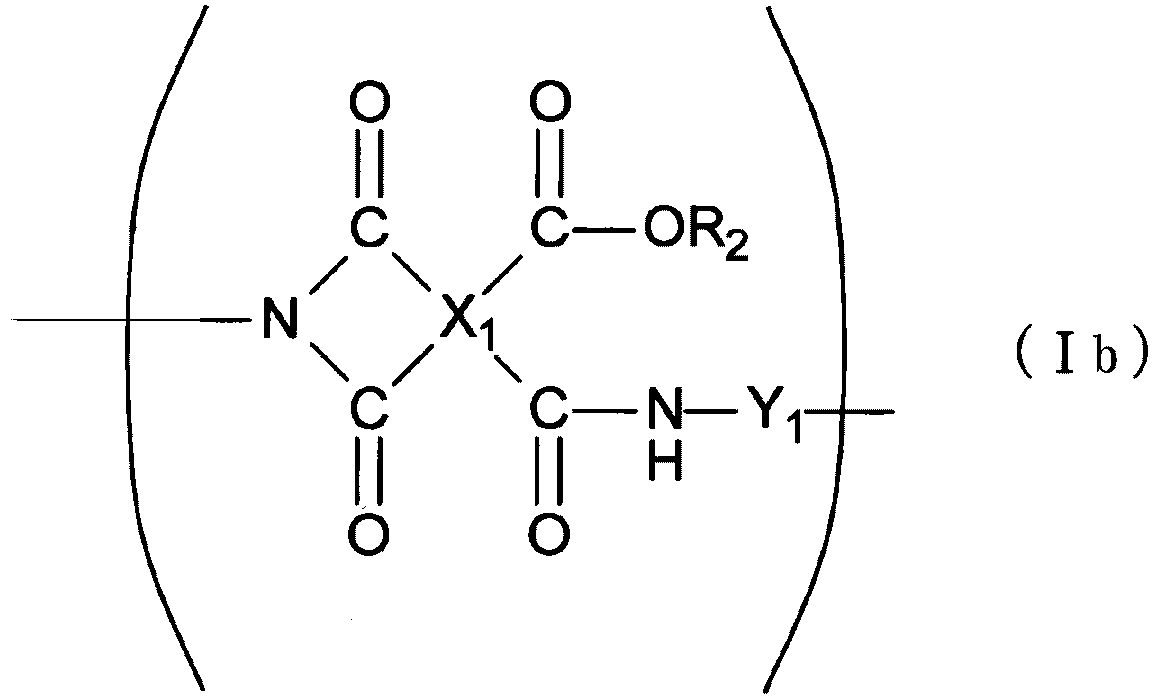


- If every repeating unit in the polyimide precursor has general formula (I), the imidization ratio is 0%, and if every repeating unit has general formula (Ib) and/or (Ic), the imidization ratio is 50%, and if every repeating unit has general formula (II), the imidization ratio is 100% (that is, polyimide). The imidization ratio of the polyimide precursor may be in any range from 0 to 100%. In this application, even if the imidization ratio is 100%, those present in the polyimide binder precursor composition is referred to as a polyimide precursor.
- In one preferred embodiment, the polyimide precursor comprises the repeating unit of formula (I), and for example, it may comprise repeating units selected from formulas (I), (Ib) and/or (Ic), and formula (II) so that the imidization ratio is 0 to 50%, for example 0 to 30%, or furthermore 0 to 20%. In another embodiment, the polyimide precursor comprises the repeating unit of formula (II), and for example, it may comprise repeating units selected from the above formulas so that the imidization ratio is more than 50% to 100%.
- As the tetracarboxylic acid component, aliphatic tetracarboxylic dianhydrides or aromatic tetracarboxylic dianhydrides may be used. As the aliphatic tetracarboxylic dianhydride, an alicyclic tetracarboxylic dianhydride is preferable, and for example, a dianhydride of a tetracarboxylic acid in which four carboxyl groups are directly bonded to X1 that is an alicyclic group is preferable. The use of an alicyclic tetracarboxylic dianhydride can achieve both high capacity of the power storage device by reducing the irreversible capacity of the polyimide binder and mechanical strength.
- In a preferred embodiment of the present invention, the proportion of alicyclic tetracarboxylic dianhydrides in the total tetracarboxylic acid components is 50 mol % or more, more preferably 60 mol % or more, even more preferably 70 mol % or more, and even more preferably 80 mol % or more (including 100 mol %). The remaining tetracarboxylic acid components are preferably aromatic tetracarboxylic dianhydrides.
- When the polyimide precursor is obtained using a tetracarboxylic acid component containing an alicyclic tetracarboxylic dianhydride and another tetracarboxylic dianhydride (preferably an aromatic tetracarboxylic dianhydride), the form thereof is not limited, and may be a copolymer, a block (co)polymer, a blend of homopolymers, or a blend of a copolymer and a homopolymer. A copolymer has, in one molecule, X1 which is an alicyclic group and X1 which is an aromatic group. A block (co)polymer is formed by reacting a block of repeating units having X1 which is an alicyclic group and a block of repeating units having X1 which is an aromatic group, forming one molecule. A homopolymer blend is a blend of a polymer having only X1 which is an alicyclic group and a polymer having only X1 which is an aromatic group.
- To explain the alicyclic tetracarboxylic dianhydride, the alicyclic group X1 is preferably a tetravalent group having an alicyclic structure having 4 to 40 carbon atoms, more preferably having at least one aliphatic 4- to 12-membered ring, more preferably an aliphatic 4-membered ring or an aliphatic 6-membered ring. Preferred examples of the tetravalent group having an aliphatic 4-membered ring or an aliphatic 6-membered ring include the following groups.

- Specific examples of R31, R32, R33, R34, R35, R36, R37 and R38 include a direct bond, an organic group having an aromatic ring or an alicyclic structure, an aliphatic hydrocarbon group having 1 to 6 carbon atoms, or an oxygen atom (-O-), a sulfur atom (-S-), a carbonyl bond, an ester bond, and an amide bond.
- Examples of the organic group having an aromatic ring as R31 to R38 or R48 include the following groups.

- Specific examples of W1 include divalent groups represented by the formula (5) as described below, and divalent groups represented by the formula (6) as described below.


- Among them, the following group is particularly preferred as the tetravalent group having an alicyclic structure.

- Examples of the tetracarboxylic acid dianhydride include monocyclic alicyclic tetracarboxylic dianhydrides such as 1,2,3,4-cyclobutane tetracarboxylic dianhydride and cyclohexane-1,2,4,5-tetracarboxylic dianhydride; and alicyclic tetracarboxylic dianhydrides having two or more rings such as [1,1'-bi(cyclohexane)]-3,3',4,4'-tetracarboxylic dianhydride, [1,1'-bi(cyclohexane)]-2,3,3',4'-tetracarboxylic dianhydride, [1,1'-bi(cyclohexane)]-2,2',3,3'-tetracarboxylic dianhydride, 4,4'-methylenebis(cyclohexane-1,2-dicarboxylic anhydride), 4,4'-(propane-2,2-diyl)bis(cyclohexane-1,2-dicarboxylic anhydride), 4,4'-oxybis(cyclohexane-1,2-dicarboxylic anhydride), 4,4'-thiobis(cyclohexane-1,2-dicarboxylic anhydride), 4,4'-sulfonylbis(cyclohexane-1,2-dicarboxylic anhydride), 4,4'-(dimethylsilanediyl)bis(cyclohexane-1,2-dicarboxylic anhydride), 4,4'-(tetrafluoropropane-2,2-diyl)bis(cyclohexane-1,2-dicarboxylic anhydride), octahydropentalene-1,3,4,6-tetracarboxylic dianhydride, bicyclo[2.2.1]heptane-2,3,5,6-tetracarboxylic dianhydride, 6-( carboxymethyl)bicyclo[2.2.1]heptane-2,3,5-tricarboxylic dianhydride, bicyclo[2.2.2]octane-2,3,5,6-tetracarboxylic dianhydride, bicyclo[2.2.2]oct-5-ene-2,3,7,8-tetracarboxylic dianhydride, tricyclo[4.2.2.02,5]decane-3,4,7,8-tetracarboxylic dianhydride, tricyclo[4.2.2.02,5]dec-7-ene-3,4,9,10-tetracarboxylic dianhydride, 9-oxatricyclo[4.2.1.02,5]nonane-3,4,7,8-tetracarboxylic dianhydride, norbornane-2-spiro-α-cyclopentanone-α'-spiro-2''-norbornane-5,5'',6,6''-tetracarboxylic dianhydride, (4arH,8acH)-decahydro-1t,4t:5c,8c-dimethanonaphthalene-2c,3c,6c,7c-tetracarboxylic dianhydride, (4arH,8acH)-decahydro-1t,4t:5c,8c-dimethanonaphthalene-2t,3t,6c,7c-tetracarboxylic dianhydride, decahydro-1,4-ethano-5,8-methanonaphthalene-2,3,6,7-tetracarboxylic dianhydride, tetradecahydro-1,4:5,8:9,10-trimethanoanthracene-2,3,6,7-tetracarboxylic dianhydride; and the like. These may be used alone or in combination of a plurality of types.
- The aromatic tetracarboxylic dianhydride preferably has 2 to 3 aromatic rings. Examples of the aromatic group X1 include compounds having the following structure.


- Specific examples of Z2 include an aliphatic hydrocarbon group having 2 to 24 carbon atoms, and an aromatic hydrocarbon group having 6 to 24 carbon atoms.
- Specific examples of Z5 includes an aromatic hydrocarbon group having 6 to 24 carbon atoms.
- Examples of the preferred aromatic tetracarboxylic dianhydride include, but not limited to, halogen-unsubstituted aromatic tetracarboxylic dianhydrides such as 3,3',4,4'-biphenyltetracarboxylic dianhydride, 2,3,3',4'-biphenyltetracarboxylic dianhydride, 2,2',3,3'-biphenyltetracarboxylic dianhydride, pyromellitic dianhydride, benzophenonetetracarboxylic dianhydride, 4,4'-oxydiphthalic dianhydride, diphenylsulfonetetracarboxylic dianhydride, p-terphenyltetracarboxylic dianhydride, m-terphenyltetracarboxylic dianhydride; and halogen-substituted tetracarboxylic dianhydrides such as 4,4'-(hexafluoroisopropylidene)diphthalic anhydride, 3,3'-(hexafluoroisopropylidene)diphthalic anhydride, 5,5'-[2,2,2-trifluoro-1-[3-(trifluoromethyl)phenyl]ethylidene]diphthalic anhydride, 5,5'-[2,2,3,3,3-pentafluoro-1-(trifluoromethyl)pyropyridene]diphthalic anhydride, 1H-difuro[3,4-b:3',4'-i]xanthene-1,3,7,9(11H)-tetrone, 5,5'-oxybis[4,6,7-trifluoro-pyromellitic anhydride], 3,6-bis(trifluoromethyl)pyromellitic dianhydride, 4-(trifluoromethyl)pyromellitic dianhydride, 1,4-difluoropyromellitic dianhydride, 1,4-bis(3,4-dicarboxytrifluorophenoxy)tetrafluorobenzene dianhydride; and the like. These may be used alone or in combination of a plurality of types.
- As the diamine component, an aromatic diamine compound or an aliphatic diamine compound is used. In a preferred embodiment of the present invention, the proportion of the aromatic diamine compound in the total diamine components is 50 mol% or more, more preferably 60 mol% or more, even more preferably 70 mol% or more, and even more preferably 80 mol% or more (including 100 mol%). The remaining diamine components are aliphatic diamine compounds, preferably diamine compounds having an alicyclic structure. In a different embodiment, the diamine component may comprise an aliphatic diamine compound, preferably an alicyclic diamine compound in a proportion of 50 mol% or more, more preferably 60 mol% or more, even more preferably 70 mol% or more, and even more preferably 80 mol% or more (including 100 mol%), based on the total diamine components.
- To explain the aromatic diamine compound, examples of the aromatic group Y1 include the following ones.

- Specific examples of W1 include divalent groups represented by the formula (5) as described below, and divalent groups represented by the formula (6) as described below.


- Examples of the diamine component to provide a repeating unit of the general formula (I) in which Y1 is a divalent group having an aromatic ring include p-phenylenediamine, m-phenylenediamine, 2,4-toluenediamine, 3,3'-dihydroxy-4,4'-diaminobiphenyl, bis(4-amino-3-carboxyphenyl)methane, benzidine, 3,3'-diamino-biphenyl, 2,2'-bis(trifluoromethyl)benzidine, 3,3'-bis(trifluoromethyl) benzidine, m-tolidine, 4,4'-diaminobenzanilide, 3,4'-diaminobenzanilide, N,N'-bis(4-aminophenyl)terephthalamide, N,N'-p-phenylenebis(p-amino benzamide), 4-aminophenoxy-4-diaminobenzoate, bis(4-aminophenyl) terephthalate, biphenyl-4,4'-dicarboxylic acid bis(4-aminophenyl)ester, p-phenylenebis(p-aminobenzoate), bis(4-aminophenyl)-[1,1'-biphenyl]-4,4'-dicarboxylate, [1,1'-biphenyl]-4,4'-diyl bis(4-aminobenzoate), 4,4'-oxydianiline (also known as 4,4'-diaminodiphenyl ether), 3,4'-oxydianiline, 3,3'-oxydianiline, p-methylenebis(phenylenediamine), 1,3-bis(4-aminophenoxy)benzene, 1,3-bis(3-aminophenoxy)benzene, 1,4-bis(4-aminophenoxy)benzene, 4,4'-bis(4-aminophenoxy)biphenyl, 4,4'-bis(3-amino phenoxy)biphenyl, 2,2-bis(4-(4-aminophenoxy)phenyl)hexafluoropropane, 2,2-bis(4-aminophenyl)propane, bis(4-aminophenyl)sulfone, 2,2-bis(4-aminophenyl)hexafluoropropane, bis(4-aminophenyl)sulfone, 3,3'-bis(trifluoromethyl)benzidine, 3,3'-bis((aminophenoxy)phenyl)propane, 2,2'-bis(3-amino-4-hydroxyphenyl)hexafluoropropane, bis(4-(4-aminophenoxy) diphenyl)sulfone, bis(4-(3-aminophenoxy)diphenyl)sulfone, octafluorobenzidine, 3,3'-dimethoxy-4,4'-diaminobiphenyl, 3,3'-dichloro-4,4'-diaminobiphenyl, 3,3'-difluoro-4,4'-diaminobiphenyl, 2,4-bis(4-aminoanilino)-6-amino-1,3,5-triazine, 2,4-bis(4-aminoanilino)-6-methylamino-1,3,5-triazine, 2,4-bis(4-aminoanilino)-6-ethylamino-1,3,5-triazine, and 2,4-bis(4-amino anilino)-6-anilino-1,3,5-triazine. Examples of the diamine component to provide a repeating unit of the general formula (I) in which Y1 is a divalent group having a fluorine atom-containing aromatic ring include 2,2'-bis (trifluoromethyl)benzidine, 3,3'-bis(trifluoromethyl)benzidine, 2,2-bis[4-(4-aminophenoxy)phenyl]hexafluoropropane, 2,2-bis(4-aminophenyl) hexafluoropropane, and 2,2'-bis(3-amino-4-hydroxyphenyl)hexafluoropropane. In addition, preferred diamine compounds include 9,9-bis(4-aminophenyl)fluorene, 4,4'-(((9H-fluorene-9,9-diyl)bis([1,1'-biphenyl]-5,2-diyl))bis(oxy))diamine, [1,1':4',1"-terphenyl]-4,4"-diamine, 4,4'-([1,1'-binaphthalene]-2,2'-diylbis(oxy))diamine. The diamine component may be used alone or in combination of a plurality of types.
- To explain the diamine compound having an alicyclic structure, examples of the Y1 which is a group having an alicyclic structure include the following ones.

- Specific examples of V1 and V2 include a direct bond and divalent groups represented by the formula (5) as described above.
- Examples of the diamine component to provide a repeating unit of the general formula (I) in which Y1 is a divalent group having an alicyclic structure include 1,4-diaminocyclohexane, 1,4-diamino-2-methylcyclohexane, 1,4-diamino-2-ethylcyclohexane, 1,4-diamino-2-n-propylcyclohexane, 1,4-diamino-2-isopropylcyclohexane, 1,4-diamino-2-n-butylcyclohexane, 1,4-diamino-2-isobutylcyclohexane, 1,4-diamino-2-sec-butylcyclohexane, 1,4-diamino-2-tert-butylcyclohexane, 1,2-diaminocyclohexane, 1,3-diamino cyclobutane, 1,4-bis(aminomethyl)cyclohexane, 1,3-bis(aminomethyl) cyclohexane, diaminobicycloheptane, diaminomethylbicycloheptane, diaminooxybicycloheptane, diaminomethyloxybicycloheptane, isophoronediamine, diaminotricyclodecane, diaminomethyltricyclodecane, bis(aminocyclohexyl)methane, bis(aminocyclohexyl)isopropylidene, 6,6'-bis(3-aminophenoxy)-3,3,3',3'-tetramethyl-1,1'-spirobiindane, and 6,6'-bis(4-aminophenoxy)-3,3,3',3'-tetramethyl-1,1'-spirobiindane. The diamine component may be used alone or in combination of a plurality of types.
- Preferred examples of solvents include nonpolar solvents (solvent with dielectric constant of 6 or less) including aromatic hydrocarbons such as xylene, toluene, and ethylbenzene, aliphatic hydrocarbons such as pentane, hexane, and heptane, and benzoic acid esters such as methyl benzoate, ethyl benzoate, and propyl benzoate; polar solvents (solvents with a dielectric constant of more than 6) including water, methanol, ethanol, acetone, N,N-dimethylformamide, dimethylamide, N,N-dimethylacetamide, N,N-diethylformamide, N-methyl-2-pyrrolidone, N-ethyl-2-pyrrolidone, 1,3-dimethyl-2-imidazolidinone, N-methylcaprolactam, hexamethylphosphorotriamide, 1,2-dimethoxymethane, bis(2-methoxyethyl)ether, 1,2-bis(2-methoxyethoxy)ethane, tetrahydrofuran, bis[2-(2-methoxyethoxy)ethyl]ether, 1,4-dioxane, dimethylsulfoxide, dimethylsulfone, diphenyl ether, sulfolane, diphenylsulfone, tetramethylurea, anisole, m-cresol, phenol, γ-butyrolactone and the like; and mixtures of these solvents and the like. In particular, water, N-methyl-2-pyrrolidone, N-ethyl-2 -pyrrolidone and γ-butyrolactone are preferred.
- The polyimide binder precursor composition of the present invention is obtained by reacting a tetracarboxylic acid component and a diamine component in a reaction solvent. This reaction solvent may be any of the above-mentioned solvents, and preferably the reaction solvent is contained as it is in the polyimide binder precursor composition.
- Using approximately equimolar amounts of a tetracarboxylic acid component (tetracarboxylic dianhydride) and a diamine component, this reaction is carried out at a relatively low temperature, for example, 25°C or higher and 100°C or lower, preferably 80°C or lower. Although not limited thereto, the reaction temperature is usually 25°C to 100°C, preferably 25°C to 80°C, and more preferably 30°C to 80°C, and the reaction time is, for example, about 0.1 to 72 hours, and preferably about 2 to 60 hours. The reaction can be carried out in an air atmosphere, but is usually suitably carried out in an inert gas atmosphere, preferably a nitrogen gas atmosphere.
- Here, the approximately equimolar amount of the tetracarboxylic acid component (tetracarboxylic dianhydride) and the diamine component specifically means a molar ratio [tetracarboxylic acid component/diamine component] of about 0.90 to 1.10, preferably about 0.95 to 1.05.
- The solid content concentration of the polyimide binder precursor composition (polyimide converted concentration of polyimide precursor) is preferably more than 5% by mass to 45% by mass, more preferably more than 10% by mass to 40% by mass, and even more preferably 10% by mass to 30% by mass. When the solid content concentration is lower than 5% by mass, the viscosity of the composition becomes too low, and when it is higher than 45% by mass, the fluidity of the composition may be lost. The reaction solution of the tetracarboxylic acid component and the diamine component may be used as it is as a polyimide binder precursor composition, or the concentration may be adjusted by concentrating or diluting it as necessary.
- As to the solution viscosity (the viscosity of the polyimide binder precursor composition), the solution viscosity at 30°C is preferably 1000 Pa sec or less, more preferably 500 Pa sec or less, further preferably 300 Pa sec or less, and particularly preferably 200 Pa·sec or less. A solution viscosity of 1000 Pa·sec or less is preferable because if so, it facilitates mixing of the electrode active material powder and uniform application onto the current collector.
- The polyimide binder precursor composition may contain additives other than the electrode active material, which will be described in the next section "Electrode mixture paste". Details will be described below using a lithium ion secondary battery as an example.
- The electrode mixture paste, which is one of the embodiments of the present invention, is a composition comprising a polyimide binder precursor composition, an electrode active material, and an optionally added solvent.
- As the electrode active material that can be used in the electrode mixture paste of the present invention, known materials can be preferably used. The polyimide binder precursor composition of the present invention can be used in either a negative electrode or a positive electrode. Therefore, the electrode active material may be either a negative electrode active material or a positive electrode active material. Generally, the negative electrode is more effective in using the polyimide binder precursor composition of the present invention. In this case, the electrode active material includes a negative electrode active material. As the electrode active material, for example, a lithium-containing metal composite oxide, a carbon powder, a silicon powder, a tin powder, or an alloy powder containing silicon or tin is preferable. The amount of the electrode active material in the electrode mixture paste is not particularly limited, and may be appropriately determined depending on the desired capacity. Usually, the amount of the electrode active material is preferably 0.1 times or more, more preferably 1 time or more, and even more preferably 5 times or more, and even more preferably 10 times or more, based on mass-basis amount of the solid content (polyimide converted mass) in the polyimide binder precursor composition. Within these ranges, the negative electrode active material layer contains more active portions therein, which enables it to function satisfactorily as an electrode. On the other hand, in order to sufficiently bind the electrode active material to the current collector and effectively prevent it from falling off, the amount of the electrode active material is preferably usually 1000 times or less relative to the solid content in the polyimide binder precursor composition.
- As a negative electrode active material for a lithium secondary battery, a lithium metal, a lithium alloy, and a carbon material capable of absorbing and releasing lithium [easily graphitizable carbon, hardly graphitizable carbon having
- (002) plane spacing of 0.37 nm or more, graphite having (002) surface spacing of 0.34 nm or less, or the like], tin (elemental substance), tin compound, silicon (elemental substance), silicon compound, or lithium titanate compounds such as Li4Ti5O12 or the like can be used alone or in combination of two or more types. In the present invention, it is preferable that the negative electrode active material comprises at least tin (elemental substance), tin compound, a silicon-containing material (in the following description, referred to as silicon-containing negative electrode active material or silicon-containing active material) such as silicon (elemental substance) or silicon compound. In particular, the silicon-containing material such as silicon (elemental substance) or a silicon compound has an extremely large theoretical capacity as compared with graphite, while the volume expansion ratio of the electrode active material itself during charging is also extremely large.
- The lithium ion secondary battery using the polyimide binder precursor composition of the present invention suppresses deterioration of the electrode active material due to volume expansion, and is excellent in not only characteristics during use such as cycle characteristics but also characteristics over a wide temperature range such as low-temperature characteristics or gas generation after high-temperature storage.
- The type of the silicon-containing active material is not particularly limited, and examples thereof include silicon (elemental substance), a silicon compound, a partial substitution product of silicon, a partial substitution product of a silicon compound, and a solid solution of a silicon compound. Specific suitable examples of the silicon compound include silicon oxides represented by formula: SiOx (0.05 <x <1.95), silicon carbides represented by formula: SiCy (0 <y <1), silicon nitrides represented by formula: SiNz (0<z <4/3), silicon alloys which are alloys of silicon and other different element(s) M, and the like. In the case of silicon alloys, preferred examples of other different element M1 include at least one element selected from the group consisting of Fe, Co, Sb, Bi, Pb, Ni, Cu, Zn, Ge, In, Sn and Ti.
- The partial substitution product of silicon is a compound in which a part of silicon contained in silicon (elemental substance) and a silicon compound is replaced with other different element M2. Specific preferred examples of the other different element M2 include B, Mg, Ni, Ti, Mo, Co, Ca, Cr, Cu, Fe, Mn, Nb, Ta, V, W, Zn, C, N and Sn. Among these silicon-containing active materials, more preferred are silicon (elemental substance), silicon oxide, and silicon alloy, and further more preferred are silicon (elemental substance) and silicon oxide.
- The amount of the silicon-containing active material is, as a mass of the net silicon in the negative electrode mixture, preferably 1% by mass or more, more preferably 5% by mass or more, still more preferably 10% by mass or more to obtain higher capacity, and preferably 95% by mass or less, more preferably 65% by mass or less, and further more preferably 45% by mass or less from the viewpoint of improving cycle characteristics.
- Preferred solvents that can be used in the electrode mixture paste include nonpolar solvents, for example, aromatic hydrocarbons such as xylene, toluene and ethylbenzene, aliphatic hydrocarbons such as pentane, hexane and heptane, and benzoic acid esters such as methyl benzoate, ethyl benzoate and propyl benzoate; and water, methanol, ethanol, acetone, N, N-dimethylformamide, dimethylamide, N, N-dimethylacetamide, N, N-diethylformamide, N-methyl-2-pyrrolidone, N-ethyl-2-pyrrolidone, 1,3-dimethyl-2-imidazolidinone, N-methylcaprolactam, hexamethylphosphortriamide, 1,2-dimethoxymethane, bis(2-methoxyethyl) ether, 1,2-bis (2-methoxyethoxy)ethane, tetrahydrofuran, bis[2-(2-methoxyethoxy)ethyl] ether, 1,4-dioxane, dimethylsulfoxide, dimethylsulfone, diphenyl ether, sulfolane, diphenylsulfone, tetramethylurea, anisole, m-cresol, phenol, γ -butyrolactone; and in particular, water, N-methyl-2-pyrrolidone, N-ethyl-2-pyrrolidone, and γ-butyrolactone are preferable.
- As the solvent, the solvent in the polyimide binder precursor composition may be used as it is, or if necessary, it may be concentrated or an additional solvent may be added to provide an appropriate concentration for coating.
- In the electrode mixture paste of the present invention, when it is an aqueous solvent system, it is preferable to contain a pyridine compound or an imidazole compound. As a result, the degree of swelling of the obtained polyimide with respect to the electrolytic solution can be made smaller, and the elongation ratio (elongation at break) and break energy can be made larger. In addition, the heat treatment temperature for obtaining the negative electrode active material layer can be lowered. Pyridine compounds are compounds having a pyridine moiety in their chemical structure, and preferred examples thereof include pyridine, 3-pyridinol, quinoline, isoquinoline, quinoxaline, 6-tert-butylquinoline, acridine, 6-quinoline carboxylic acid, 3, 4-lutidine, pyridazine, and the like. These pyridine compounds may be used alone or in combination of two or more. Examples of the imidazole compound include 1,2-dimethylimidazole, 2-ethyl-4-methylimidazole, 4-ethyl-2-methylimidazole, 1-methyl-4-ethylimidazole and the like. The imidazoles may be used alone of or in a mixture of plural kinds.
- The amount of the pyridine compound to be added is not limited, but it is preferably 0.05 to 2.0 molar equivalents, more preferably 0.1 to 1.0 molar equivalent, with respect to 1 mol of repeating unit of the polyimide precursor (particularly polyamic acid). If the added amount is outside of this range, it may be difficult to use an aqueous solvent system. The amount of the imidazole compound to be added is not limited, but it is 1.6 molar equivalents or more, more preferably 2.0 molar equivalents or more, still more preferably 2.4 molar equivalents or more, with respect to 1 mol of amic acid repeating unit of the polyamic acid.
- To the electrode mixture paste of the present invention, known additives may be added if necessary. For example, negative electrode conductive agent, base, surfactant, viscosity modifier, conductive assisting agent, silane coupling agent, binder other than a polyimide-based binder, and the like may be used as long as the effects of the present invention are not impaired.
- The negative electrode conductive agent is not particularly limited as long as it is an electron conductive material that does not cause a chemical change, but it is preferable to use metal powders such as copper, nickel, titanium, or aluminum, carbon materials, or the like. Carbon materials used as conductive agents and negative electrode active materials preferably include graphites such as natural graphite (scaly graphite and the like), artificial graphite and other graphite; one or more of carbon blacks selected from acetylene black, ketjen black, channel black, furnace black, lamp black, and thermal black; and fibrous carbon powders such as carbon nanotubes and carbon fibers
- Further, it is more preferable that the negative electrode conductive agents may be appropriately mixed and used in such a mixture as graphite and carbon black, graphite and fibrous carbon powder, or carbon black and fibrous carbon powder. In particular, the use of fibrous carbon powder is preferable because it has an effect of reducing the use of a conductive agent having a large specific surface area in order to ensure conductivity. The carbon material is used as a conductive agent or a negative electrode active material, and the amount of the carbon material added to the negative electrode mixture is preferably 1 to 90% by mass, more preferably 10 to 70% by mass.
- When a carbon material is used as a negative electrode conductive agent by mixing it with a silicon-containing negative electrode active material, the ratio of the silicon-containing negative electrode active material and the carbon material is such that the carbon material is preferably 10% by mass or more, more preferably 20% by mass or more, based on the total net mass of silicon in the silicon-containing negative electrode active material in the negative electrode mixture, from the viewpoint of improving a cycle characteristic due to the effect of enhancing electron conductivity by mixing with the carbon material. Further, if the ratio of the carbon material mixed with the silicon-containing negative electrode active material is too large, the amount of the silicon-containing negative electrode active material in the negative electrode mixture layer may decrease, and the effect of increasing the capacity may be reduced. The net mass of silicon in the silicon-containing negative electrode active material is preferably 1% by mass or more, more preferably 2% by mass or more, and further more preferably 5% by mass or more, based on the total mass of the carbon material. Further, it is more preferable that the conductive agent is composited by mixing it with a silicon-containing active material in advance and appropriately heat-treated if needed.
- When graphite is used, more preferably used is a carbon material having a graphite-type crystal structure in which the plane spacing (d002) of the graphite lattice planes (002) is 0.340 nm (nanometers) or less, particularly 0.335 to 0.337 nm. In particular, preferred one is an artificial graphite particles having a massive structure in which a plurality of flat graphite fine particles are assembled or bonded in a non-parallel manner to each other, or spheroidized particles of scaly natural graphite obtained by applying repeatedly mechanical actions such as compressive force, frictional force, and shearing force.
- The ratio I (110)/I (004) is preferably 0.01 or more because the electrochemical characteristics in a wider temperature range are improved, and is more preferably 0.05 or more, and further more preferably 0.1 or more, wherein I (110)/I (004) is a ratio of peak intensity I (110) of (110) plane and peak intensity I (004) of (004) plane of the graphite crystal determined from X-ray diffraction measurement measured for the negative electrode sheet obtained by press-forming the negative electrode into a density of 1.5 g/cm3 or more excluding the current collector. In addition, the upper limit of the peak intensity ratio I (110)/I (004) is preferably 0.5 or less and more preferably 0.3 or less, because excessive treatment may reduce the crystallinity and the discharge capacity of the battery.
- Further, it is preferable that the highly crystalline carbon material (core material) is coated with a carbon material having a lower crystallinity than the core material because the electrochemical characteristics in a wide temperature range are further improved. The crystallinity of the coated carbon material can be confirmed by TEM. When a highly crystalline carbon material is used, it reacts with a nonaqueous electrolyte solution during charging and tends to deteriorate the characteristics of the lithium-ion secondary batteries in a wide temperature range such as low temperature characteristics after high temperature storage and gas generation due to the increase in interfacial resistance. However, if the polyimide binder precursor composition according to the present invention is used, the characteristics of these lithium-ion secondary batteries are improved.
- As the negative electrode mixture paste, the polyimide binder precursor composition of the present invention is used. Other binders may be used together in an amount of 95% by mass or less, more preferably 45% by mass or less.
- Examples of binders other than the polyimide binder precursor composition of the present invention include polyvinylidene fluoride, polytetrafluoroethylene, styrene butadiene rubber, butadiene rubber, nitrile rubber, polyacrylonitrile, ethylene vinyl alcohol copolymer resin, ethylene propylene diene rubber, polyurethane, polyacrylic acid, polyamide, polyacrylate, polyvinyl ether, fluororubber, carboxymethyl cellulose, and sodium carboxymethyl cellulose.
- In addition, the electrode mixture paste of the present invention may further contain a solid electrolyte. Examples of the solid electrolyte include oxide-based solid electrolytes such as La0.51Li0.34TiO2.94 having perovskite type crystal, Li7La3Zr2O12 having garnet type crystal, Li1.3Al0.3Ti1.7(PO4)3 having NASICON type crystal, and amorphous LIPON (Li2.9PO3.3N0.46); and sulfide-based solid electrolytes such as Li2S-SiS2 based materials and Li2S-P2S5 based materials.
- The electrode mixture paste of the present invention can be produced as a uniform composition by applying the above-mentioned components to a known production method and by adding, stirring, mixing and the like. For example, an electrode mixture paste may be produced by producing a solution or dispersion in which a polyimide-based binder and a solvent are mixed, and then adding and mixing various additives.
- The negative electrode mixture paste of the present invention is cast or applied on a conductive current collector, and then heated to remove the solvent, and optionally subjected to an imidization reaction, to form a negative electrode (negative electrode sheet) having a negative electrode active material layer on the current collector. During the process of forming the negative electrode sheet, it is also preferable to press the negative electrode sheet using a roll press until the desired electrode density is achieved. Any known current collector can be used.
- The polyimide precursor present in the polyimide binder precursor composition is converted to a polyimide binder by the heat treatment, and the particles of the active material and the conductive agent are bound to each other and to the current collector at the same time. The heat treatment removes the solvent, and allows the imidization of the polyimide precursor to proceed, which decreases the solubility in solvents such as the electrolyte solution and improves the solvent resistance. The heat treatment can be carried out at, for example, 80°C to 450°C. To advance the imidization, it is preferable to perform heating so that the maximum temperature is preferably 180°C to 450°C, more preferably 200°C to 450°C, for example 250°C to 380°C or higher. In the temperature range of 200°C or lower (or lower than 200°C), particularly 180°C or lower (or lower than 180°C), the removal of the solvent mainly proceeds. Therefore, the heat treatment may be divided into a step of mainly removing the solvent and a step of mainly advancing the imidization, namely may be carried out stepwise or continuously by dividing step 1 of heating at 80°C to 200°C (or 180°C), and step 2 of heating at a temperature of 200°C or higher (or 180°C or higher). In practice, imidization may proceed at high temperature range in step 1, and solvent removal may also occur in step 2 depending on the extent of solvent removal in step 1.
- The times of steps 1 and 2 can be appropriately determined in consideration of the simplicity of the process, the desired imidization ratio, and the like. The time of step 1 may be 0 seconds (when step 1 is not performed), but is preferably 1 minute or more, more preferably 10 minutes or more, and preferably 5 hours or less, more preferably 2 hours or less, while the time of step 2 is preferably 10 minutes or more, more preferably 30 minutes or more, and preferably 24 hours or less, more preferably 12 hours or less.
- When the imidization ratio of the polyimide precursor present in the polyimide binder precursor composition is high, for example, the imidization ratio is 70% or more, preferably 80% or more (it may be 90% or more or 100%), only the above-mentioned step 1, in which the solvent is mainly removed, may be sufficient as the heat treatment in some cases. However, in order to ensure solvent removal and/or increase the imidization ratio, the above step 2 may also be performed.
- The thickness of the negative electrode active material layer of the present invention may be appropriately determined depending on the application and the desired capacity. Although not limited, it is preferably to be used in the range of 0.1 µm to 500 µm, for example. More preferably, it is 1 µm or more, even more preferably 10 µm or more, even more preferably 20 µm or more, and more preferably 300 µm or less, even more preferably 100 µm or less, and even more preferably 50 µm or less.
- As a positive electrode active material for lithium secondary batteries, a composite metal oxide with lithium containing at least one selected from cobalt, manganese and nickel is used. These positive electrode active materials can be used alone or in combination of two or more.
- Examples of such lithium composite metal oxides include one or more selected from LiCoO2, LiMn2O4, LiNiO2, LiCo1-xNixO2(0.01 <x <1), LiCo1/3Ni1/3Mn1/3O2, LiNi1/2Mn3/2O4, and LiCo0.98Mg0.02O2. Further, these may be used in combination, for example, LiCoO2 and LiMn2O4, LiCoO2 and LiNiO2, and LiMn2O4 and LiNiO2.
- In addition, a part of the lithium composite metal oxide may be replaced with another element in order to improve safety and cycle characteristics during overcharging or to enable the use at a charging potential of 4.3 V or higher. For example, a part of cobalt, manganese, and nickel may be replaced with at least one or more elements such as Sn, Mg, Fe, Ti, Al, Zr, Cr, V, Ga, Zn, Cu, Bi, Mo, and La. Or a part of O can be replaced with S or F, or a coating may be formed by a compound containing these other elements.
- Among these, preferred are lithium composite metal oxides that are operable at a charging potential of the positive electrode of 4.3 V versus Li or higher in a fully charged state, such as LiCoO2, LiMn2O4, and LiNiO2. More preferred are lithium composite metal oxides that are operable at 4.4 V or higher, for example, different-element-substituted lithium cobalt oxides such as LiCo1-xMxO2 (wherein, M is one or more elements selected from Sn, Mg, Fe, Ti, Al, Zr, Cr, V, Ga, Zn, and Cu, 0.001 ≦x≦0.05), and lithium composite metal oxides in which the ratio of nickel atoms and manganese atoms to all metal elements other than lithium atoms is 50 atomic% or more and 100 atomic% or less such as LiNi1/3Mn1/3Co1/3O2, LiNi0.5Mn0.3Co0.2O2, LiNi1/2Mn3/2O4, and a solid solution of Li2MnO3 and LiMO2 (wherein, M is a transition metal such as Co, Ni, Mn, Fe and the like). When a lithium composite metal oxide that operates at a high charging voltage is used, the characteristics of the lithium ion secondary battery tend to deteriorate when used in a wide temperature range due to the reaction with the electrolytic solution during charging. However, if the polyimide binder precursor composition according to the present invention is used, deterioration of the characteristics of these lithium ion secondary battery can be suppressed.
- Further, as the positive electrode active material, lithium-containing olivine-type phosphate salts can also be used. In particular, a lithium-containing olivine-type phosphate containing at least one selected from iron, cobalt, nickel and manganese is preferable. Specific preferred examples thereof include one or more selected from LiFePO4, LiCoPO4, LiNiPO4, and LiMnPO4.
- Some of these lithium-containing olivine phosphates may be replaced with other elements, and a part of iron, cobalt, nickel and manganese may be replaced with one or more elements selected from Co, Mn, Ni, Mg, Al, B, Ti, V, Nb, Cu, Zn, Mo, Ca, Sr, W, Zr and the like, or a coating may be formed by a compound containing these other elements or carbon material. Among these, LiFePO4 or LiMnPO4is preferred.
- Further, the lithium-containing olivine-type phosphate can be used in a mixture with, for example, the above-mentioned positive electrode active material(s).
- The positive electrode conductive agent is not particularly limited as long as it is an electronic conductive material that does not cause a chemical change. Preferred examples thereof include graphites such as natural graphite (scaly graphite and the like), artificial graphite and other graphite; one or more of carbon blacks selected from acetylene black, ketjen black, channel black, furnace black, lamp black, and thermal black; and fibrous carbon powders such as carbon nanotubes and carbon fibers. Further, it is more preferable that the positive electrode conductive agents may be appropriately mixed and used in such a mixture as graphite and carbon black, graphite and fibrous carbon powder, or carbon black and fibrous carbon powder. The amount of the carbon material added to the positive electrode mixture is preferably 1 to 10% by mass, more preferably 2 to 5% by mass
- As the positive electrode mixture paste, the polyimide binder precursor composition of the present invention can be used, but other binders may be also used, and the examples thereof include polytetrafluoroethylene (PTFE), polyvinylidene fluoride (PVDF), copolymer of styrene and butadiene (SBR), copolymers of acrylonitrile and butadiene (NBR), carboxymethyl cellulose (CMC), or ethylene propylene dien terpolymer.
- Further, the polyimide binder precursor composition of the present invention and other binders can be used in combination, but the preferred embodiment thereof is the same as that described in the section of [Negative electrode binder].
- The positive electrode sheet is a sheet formed by casting or applying the electrode mixture paste, which is a mixture of a positive electrode binder, a positive electrode active material, and an optional component such as a conductive agent, on a current collector to form an active material layer.
- The lithium ion secondary battery according to one embodiment of the present invention includes the above-mentioned negative electrode (negative electrode sheet), and known configurations may be employed for those required for lithium ion secondary batteries, such as a positive electrode (positive electrode sheet), an electrolytic solution, and other components as required, for example, a separator. The lithium ion secondary battery may be a lithium polymer battery using a gel electrolyte as the electrolyte, or an all-solid-state battery using an inorganic solid electrolyte such as an oxide or sulfide electrolyte.
- The polyimide binder of the present invention can be used not only for lithium ion secondary batteries but also for other power storage devices having a mechanism similar to lithium ion secondary batteries, such as lithium ion capacitors.
- Hereinafter, the present invention will be explained in more detail with reference to Examples and Comparative Examples, but the present invention is not limited to these Examples.
- The abbreviations of compounds used in the following examples will be explained.
-
- H"-PMDA: cyclohexane-1,2,4,5-tetracarboxylic dianhydride (chair isomer)
- H'-PMDA: cyclohexane-1,2,4,5-tetracarboxylic dianhydride (boat isomer)
- CBDA: 1,2,3,4-cyclobutanetetracarboxylic dianhydride
- CpODA: norbornane-2-spiro-α-cyclopentanone-α'-spiro-2"-
norbornane - DNDAxx: (4arH,8acH)-decahydro-1t,4t:5c,8c-dimethanonaphthalene-2t,3t,6c,7c-tetracarboxylic dianhydride
- BTA: Bicyclo[2.2.2]oct-7-ene-2,3,5,6-tetracarboxylic dianhydride
- H-sBPDA: [1,1'-bi(cyclohexane)]-3,3',4,4'-tetracarboxylic dianhydride
- PPHT: (Octahydro-1,3-dioxo-5-isobenzofurancarboxylic acid) 1,4-phenylenediamide
- PMDA: Pyromellitic dianhydride
- s-BPDA: 3,3',4,4'-biphenyltetracarboxylic dianhydride
-
- ODA: 4,4'-diaminodiphenyl ether
- PPD: p-phenylenediamine
- TPE-R: 1,3-bis(4-aminophenoxy)benzene
- BAPP: 2,2-bis[4-(4-aminophenoxy)phenyl]propane
- MBAA: bis(4-amino-3-carboxyphenyl)methane
- DABAN: 4,4'-diaminobenzanilide
- DATP: 4,4"-diamino-p-terphenyl
-
- EC: ethylene carbonate
- DEC: diethyl carbonate
- VC: vinylene carbonate
- NMP: N-methyl-2-pyrrolidone
- A graphite (MAG-D; massive artificial graphite, manufactured by Show a Denko Materials Co., Ltd.,
average particle size 20 µm) as a negative electrode active material and a polyimide binder precursor composition (Examples and Comparative Examples) were blended so as to have a solid content ratios of 92:8, 95:5, and 97:3 (mass %), and then NMP was added and mixed so that a slurry concentration becomes about 50 mass %, whereby negative electrode mixture pastes were prepared. - The negative electrode mixture paste was applied onto a nickel-plated steel foil (
thickness 10 µm) as a current collector and pre-dried for 3 minutes on a hot plate at 110°C. Then, it was roll-pressed and placed in an electric furnace and heat-treated at 360°C for 1.5 hours under argon flow to prepare a negative electrode for evaluation (2 mAh/cm2). - Using the negative electrode for evaluation obtained in (1) above, a battery for evaluation was fabricated in the following configuration.
- Cell shape: 2032 type coin cell
- Counter electrode: Lithium foil (metallic lithium)
- Electrolyte: 1M LiPF6/ EC:DEC=1:1 (volume %) VC 1% by mass was added
- Separator
- Charging and discharging were carried out under the following conditions.
- Measurement temperature: 30°C
- Charge/discharge range: 0.001 to 2.0 V
- (However, the initial charging should be performed from the natural potential (approximately 3V) to 0.001V.)
- Charge/discharge current value: 0.02C
- The charge capacity and discharge capacity (mAh/g) are calculated based on the weight of the entire active material layer (the sum of the weight of the active material and the weight of the binder). The difference between the first charge capacity and the first discharge capacity up to 1 V was calculated as the irreversible capacity. Herein, the absorption of Li in the "evaluation negative electrode" is referred to as "charging", and the release of Li from the "evaluation negative electrode" is referred to as discharge.
- As shown in
FIG. 1 , the irreversible capacity of the battery calculated in (A3) above was plotted against the amount of polyimide binder added (mass%) to create a calibration curve. In the obtained calibration curve, the irreversible capacity at a binder addition amount of 100% is defined as the irreversible capacity of the polyimide itself. - As a negative electrode active material, silicon (manufactured by Elkem, average particle diameter 3 µm), polyimide binder precursor composition (examples and comparative examples), and conductive assisting agent (acetylene black, manufactured by DENKA) were mixed in a solid content ratio of 60:30:10 (% by mass) to prepare a negative electrode mixture paste. The negative electrode mixture paste was applied onto a nickel-plated steel foil (thickness: 10 µm) serving as a current collector, and pre-dried at 110°C for 3 minutes. Thereafter, it was roll pressed, placed in an electric furnace, and heat treated at 360°C for 1.5 hours under an argon flow, whereby a negative electrode (3 mAh/cm2) was prepared.
- A battery was prepared in the same manner as in (A2) above, and charge and discharge were carried out under the following conditions.
- Measurement temperature: 30°C
- Charge/discharge range: 0.001 to 1.0 V
- (However, the initial charging should be done from the natural potential (approximately 3V) to 0.001V.)
- Charge/discharge current value: 0.1 C
- The initial charge/discharge efficiency was calculated by the following formula.
Initial charge/discharge efficiency = (first discharge capacity up to 1 V) / (first charge capacity) x 100% - The polyimide binder precursor composition (Examples and Comparative Examples) was applied onto a glass substrate using a spin coater, dried at 80°C for 10 minutes, and then heat-treated in a nitrogen atmosphere at 120°C for 30 minutes, at 150°C for 10 minutes, at 200°C for 10 minutes, at 250°C for 10 minutes, and at 350°C for 10 minutes (heating rate: 5°C/min) to obtain a film having a thickness of 10 µm. The obtained film was cut into a strip having a width of 10 mm and a length of 200 mm to prepare a test sample.
- The test sample was set in a tensile tester with a chuck distance set to 100 mm, and the sample was pulled at a speed of 50 mm/min. The elastic modulus, elongation ratio (elongation at break), and break energy were calculated from the obtained stress-strain curve. The measurement environment was room temperature in the atmosphere.
- 160 g of NMP was added to a reaction vessel, and the inside of the vessel was replaced with nitrogen and kept at 50°C. Into the vessel, 23.5916 g of ODA was added and dissolved, and then a total of 26.3424 g of H"-PMDA (molar ratio to diamine is 1) was added stepwise together with 40 g of NMP, and the mixture was stirred overnight at 50°C to obtain a polyimide binder precursor composition PI-1.
Viscosity 49P - Using the tetracarboxylic dianhydride and diamine shown in Table 2, polyimide binder precursor compositions PI-2 to PI-12 were obtained by reacting them in the same manner as composition PI-1. The viscosity and concentration are shown in Table 2.
- A polyimide solution-type polyimide binder precursor composition was produced from the same monomer composition as composition PI-10 by advancing imidization. First, 160 g of NMP was added into a reaction vessel, and the inside of the vessel was purged with nitrogen and kept at 50°C. 32.3399 g of BAPP was supplied thereto and dissolved, and then temperature of the reaction bath was raised to 70 °C. Into the vessel, a total of 17.6601 g of H"-PMDA (molar ratio to diamine is 1) was added stepwise together with 40 g of NMP. After stirring at 70°C for 30 minutes, the mixture was stirred at 170°C for 3 hours for imidization to obtain a polyimide binder precursor composition PI-10'. The viscosity and concentration are shown in Table 2.
- Using the two types of tetracarboxylic dianhydrides shown in Table 2 as the tetracarboxylic acid components and the diamines shown in Table 2, polyimide binder precursor compositions PI-13 and PI-14 were obtained by reacting them in the same manner as in composition PI-1. The viscosities and concentrations are shown in Table 2. For compositions using two or more compounds as the tetracarboxylic acid components and diamine components, the molar ratios are shown in parentheses after the monomers.
- Using the tetracarboxylic dianhydride and diamine shown in Table 2, polyimide binder precursor compositions PI-15 to PI-18 were obtained by reacting them in the same manner as composition PI-1.
- As shown in Table 2, two types of polyimide binder precursor compositions were blended to obtain a polyimide binder precursor composition PI-MIX. The viscosity and concentration are shown in Table 2. In Table 2, the mixing ratio is shown in parentheses as a molar ratio (ratio of the total number of monomer units).
- Using the tetracarboxylic dianhydride and diamine shown in Table 2, polyimide binder precursor compositions PI-19 to PI-23 were obtained by reacting them in the same manner as composition PI-1. The viscosity and concentration are shown in Table 2.
Table 2 tetracarboxylic dianhydride/diamine tetracarboxylic acid component/ diamine ratio viscosity concentration at polymerization wt% PI-1 H"-PMDA/ODA 1 49 P 20 PI-2 H'-PMDA/ODA 1 2 P 20 PI-3 CBDA/ODA 1 6 P 20 PI-4 CpODA/ODA 0.99 75 P 20 PI-5 DNDAxx/ODA 0.99 80 P 20 PI-6 BTA/ODA 1 0.1 P 10 PI-7 H-sBPDA/ODA 1 52 P 12 PI-8 PPHT/ODA 1 6 P 20 PI-9 H"-PMDA/TPE-R 1 66 P 20 PI-10 H"-PMDA/BAPP 1 62 P 20 PI-10' H"-PMDA/BAPP (PI solution) 1 2 P 20 PI-11 H"-PMDA/MBAA 1 1 P 20 PI-12 H"-PMDA/DABAN 0.99 69 P 20 PI-13 H"-PMDA(8)/s-BPDA(2)//ODA 1 75 P 20 PI-14 H"-PMDA(2)/s-BPDA(8)//ODA 1 110 P 20 PI-19 H"-PMDA//ODA(2)/DABAN(8) 1 18 P 18 PI-20 H"-PMDA//ODA(8)/DABAN(2) 0.99 7 P 18 PI-21 CBDA//TPE-R(3)/ODA(7) 0.99 26 P 14 PI-22 CBDA//TPE-R(5)/PPD(5) 0.99 43 P 14 PI-23 CBDA//BAPP 1 50 P 17 PI-15 s-BPDA/ODA 1 51 P 20 PI-16 s-BPDA(5)/ODPA(5)//ODA(7)/PPD(3) 1 55 P 33 PI-17 PMDA/ODA 0.99 48 P 14 PI-18 s-BPDA/DATP 0.98 20 P 14 PI-MIX PI-1(7)+ PI-15 (3) blend 1 50 P 20 - Using the produced polyimide binder precursor composition, a battery for evaluation was fabricated according to <Calculation of irreversible capacity of polyimide binder>, and the battery was evaluated to prepare a calibration curve and calculate the irreversible capacity of the polyimide binder. The results are shown in Table 3.
- Using the produced polyimide binder precursor composition, a negative electrode using silicon as the negative electrode active material was prepared according to <Evaluation of elemental silicon negative electrode using polyimide binder>. Then a battery was prepared, and the initial charge/discharge efficiency was evaluated. The results are shown in Table 3.
Table 3 Example binder precursor composition monomer composition irreversible capacity of binder mAh/g evaluation of Si negative electrode cell initial charge/discharge efficiency % Example 1 PI-1 H"-PMDA//ODA 405 86.5 Example 2 PI-2 H'-PMDA//ODA 188 - Example 3 PI-3 CBDA//ODA 509 85.5 Example 4 PI-4 CpODA//ODA 44 - Example 5 PI-5 DNDAxx//ODA 108 - Example 6 PI-6 BTA//ODA 110 - Example 7 PI-7 H-sBPDA//ODA 97 - Example 8 PI-8 PPHT//ODA 211 80.7 Example 9 PI-9 H"-PMDA//TPE-R 667 81.5 Example 10 PI-10 H"-PMDA//BAPP 31 - Example 11 PI-10' H"-PMDA//BAPP (PI solution) 8 - Example 12 PI-11 H"-PMDA//MBAA 1063 - Example 13 PI-12 H"-PMDA//DABAN 756 84.1 Example 14 PI-13 H"-PMDA(8)/s-BPDA(2)//ODA 1108 82.1 Example 15 PI-MIX PI-1(7)+PI-15(3) blend 1090 81.6 Example 16 PI-19 H"-PMDA//ODA(2)/DABAN(8) 828 84.1 Example 17 PI-20 H"-PMDA//ODA(8)/DABAN(2) 911 87.0 Example 18 PI-21 CBDA//TPE-R(3)/ODA(7) 557 - Example 19 PI-22 CBDA//TPE-R(5)/PPD(5) 581 85.1 Example 20 PI-23 CBDA//BAPP 105 - Comp-Ex. 1 PI-14 H"-PMDA(2)/s-BPDA(8)//ODA 1373 77.4 Comp-Ex. 2 PI-15 s-BPDA//ODA 1482 78.2 Comp-Ex. 3 PI-16 s-BPDA(5)/ODPA(5)//ODA(7)/PPD(3) 1488 78.2 Comp-Ex. 4 PI-17 PMDA/ODA 1483 - Comp-Ex. 5 PI-18 s-BPDA/DATP 1431 - - From Table 3, it was found that when the irreversible capacity of the polyimide binder was 1200 mAh/g or less, the initial charge/discharge efficiency of the battery using elemental silicon as the negative electrode active material was 80% or more. Therefore, the use of the polyimide binder precursor composition of the present invention enables to increase the capacity of a lithium ion secondary battery.
- Using the produced polyimide binder precursor composition, the mechanical properties (elastic modulus, elongation ratio (elongation at break), and break energy) of the binder were measured according to <Evaluation of Mechanical Properties of Polyimide Binder>. The results are shown in Table 4. The results show that the polyimide binder obtained from the polyimide binder precursor composition of the present invention has excellent mechanical properties and can fully function as a binder.
Table 4 Example binder precursor composition monomer composition elastic modulus Gpa elongation ratio (elongation at break) % break energy MJ/m3 Example 1 PI-1 H"-PMDA//ODA 3 119 134 Example 3 PI-3 CBDA//ODA 3.4 50 65 Example 8 PI-8 PPHT//ODA 1.3 100 76 Example 9 PI-9 H"-PMDA//TPE-R 2.5 167 162 Example 10 PI-10 H"-PMDA//BAPP 2.2 155 163 Example 11 PI-10' H"-PMDA//BAPP (PI solution) 2.2 155 163 Example 13 PI-12 H"-PMDA//DABAN 4.4 38 56 Example 14 PI-13 H"-PMDA(8)/s-BPDA(2)//ODA 2.4 107 124 Example 16 PI-19 H"-PMDA//ODA(2)/DABAN(8) 3.8 49 68 Example 17 PI-20 H"-PMDA//ODA(8)/DABAN(2) 2.9 87 112 Example 18 PI-21 CBDA//TPE-R(3)/ODA(7) 3.8 65 93 Example 19 PI-22 CBDA//TPE-R(5)/PPD(5) 4.6 95 136 Example 20 PI-23 CBDA//BAPP 2.5 131 129 - The present invention can be suitably utilized as an electrode binder of electrical storage devices, such as a lithium ion secondary battery.

Claims (8)
- A polyimide binder precursor composition for a power storage device electrode, comprising a reaction product of a tetracarboxylic acid component and a diamine component, and a solvent,
wherein a polyimide binder obtained from the polyimide binder precursor composition has an irreversible capacity of 1200 mAh/g or less. - The polyimide binder precursor composition according to claim 1, wherein the polyimide binder precursor composition comprises a reaction product of a tetracarboxylic acid component comprising 50 mol % or more of an alicyclic tetracarboxylic dianhydride and a diamine component, and a solvent.
- The polyimide binder precursor composition according to claim 1, wherein the diamine component comprises 50 mol % or more of an aromatic diamine compound.
- A negative electrode mixture paste for an electrical storage device, comprising the polyimide binder precursor composition according to claim 1 and an active material comprising a silicon-containing material and/or a graphite.
- A negative electrode for a power storage device comprising:(a) an electrode active material layer comprising an active material comprising a silicon-containing material and/or a graphite, and a polyimide binder that is a heated product of a polyimide precursor in the polyimide binder precursor composition according to any one of claims 1 to 3; the polyimide binder binding the active material; and(b) a current collector
- A power storage device comprising the negative electrode for a power storage device according to claim 5.
- A method for producing a negative electrode for a power storage device comprising the steps of:casting or applying the negative electrode mixture paste according to claim 4 onto a current collector; andheating the applied layer of the negative electrode mixture paste to form a negative electrode active material layer.
- A method for producing a power storage device, comprising the method for producing a negative electrode according to claim 7 as one step.
Applications Claiming Priority (3)
| Application Number | Priority Date | Filing Date | Title |
|---|---|---|---|
| JP2022007980 | 2022-01-21 | ||
| JP2022105139 | 2022-06-29 | ||
| PCT/JP2023/001286 WO2023140276A1 (en) | 2022-01-21 | 2023-01-18 | Polyimide binder precursor composition, and power storage device using same |
Publications (2)
| Publication Number | Publication Date |
|---|---|
| EP4468418A1 true EP4468418A1 (en) | 2024-11-27 |
| EP4468418A4 EP4468418A4 (en) | 2025-04-23 |
Family
ID=87348314
Family Applications (1)
| Application Number | Title | Priority Date | Filing Date |
|---|---|---|---|
| EP23743270.3A Pending EP4468418A4 (en) | 2022-01-21 | 2023-01-18 | POLYIMIDE BINDER PRECURSOR COMPOSITION AND ENERGY STORAGE DEVICE THEREOF |
Country Status (7)
| Country | Link |
|---|---|
| US (1) | US20250112240A1 (en) |
| EP (1) | EP4468418A4 (en) |
| JP (1) | JP7639950B2 (en) |
| KR (1) | KR102930019B1 (en) |
| CN (1) | CN118872096B (en) |
| TW (1) | TWI859710B (en) |
| WO (1) | WO2023140276A1 (en) |
Family Cites Families (18)
| Publication number | Priority date | Publication date | Assignee | Title |
|---|---|---|---|---|
| US7972725B2 (en) | 2004-11-08 | 2011-07-05 | 3M Innovative Properties Company | Polyimide electrode binders |
| JP5207282B2 (en) * | 2008-01-21 | 2013-06-12 | Necエナジーデバイス株式会社 | Lithium secondary battery |
| KR101385546B1 (en) * | 2010-11-30 | 2014-04-15 | 도레이 카부시키가이샤 | Binder for electrodes of lithium ion batteries, paste for negative electrodes of lithium ion batteries, and method for producing negative electrode of lithium ion battery |
| JP5834930B2 (en) * | 2011-09-09 | 2015-12-24 | 宇部興産株式会社 | Polyimide precursor aqueous solution composition and method for producing polyimide precursor aqueous solution composition |
| WO2014080853A1 (en) * | 2012-11-22 | 2014-05-30 | 株式会社カネカ | Collector for bipolar lithium ion secondary batteries, and bipolar lithium ion secondary battery |
| WO2014208704A1 (en) * | 2013-06-27 | 2014-12-31 | 宇部興産株式会社 | Polyimide precursor and polyimide |
| CN105580173B (en) * | 2013-09-26 | 2018-06-19 | 宇部兴产株式会社 | Electric energy storage device polyimide adhesive, the electrode sheet and electric energy storage device for having used the adhesive |
| JP6572551B2 (en) * | 2014-02-19 | 2019-09-11 | 東ソー株式会社 | Negative electrode active material for lithium ion secondary battery and method for producing the same |
| JP6760287B2 (en) * | 2015-07-16 | 2020-09-23 | 宇部興産株式会社 | Polyamic acid solution composition and polyimide film |
| EP3333943A4 (en) * | 2015-08-04 | 2019-01-02 | Mitsui Chemicals, Inc. | Mixture paste for negative electrode of lithium ion secondary battery, negative electrode for lithium ion secondary battery, method for producing negative electrode for lithium ion secondary battery, and lithium ion secondary battery |
| CN108701831B (en) * | 2016-02-10 | 2021-06-04 | 日本电气株式会社 | Adhesives for Secondary Batteries |
| JP7047835B2 (en) * | 2017-03-15 | 2022-04-05 | 日本電気株式会社 | Binder composition for secondary batteries |
| CN110476280A (en) | 2017-03-24 | 2019-11-19 | 日产自动车株式会社 | Negative electrode for non-aqueous electrolyte secondary battery and non-aqueous electrolyte secondary battery using the same |
| JP7035344B2 (en) | 2017-06-16 | 2022-03-15 | 日産自動車株式会社 | Negative electrode for lithium ion secondary battery and lithium ion secondary battery using this |
| KR102511725B1 (en) * | 2017-07-07 | 2023-03-21 | 도레이 카부시키가이샤 | Resin composition, laminate and manufacturing method thereof, electrode, secondary battery and electric double layer capacitor |
| US12269949B2 (en) * | 2019-02-01 | 2025-04-08 | Wingo Technology Co., Ltd. | Polyimide compound and molded article comprising the polyimide compound |
| WO2021053800A1 (en) * | 2019-09-19 | 2021-03-25 | ウィンゴーテクノロジー株式会社 | Solvent-soluble polyimide compound, lithium-ion secondary battery negative electrode producing resin composition including said solvent-soluble polyimide compound, lithium-ion secondary battery negative electrode configured using said lithium-ion secondary battery negative electrode producing resin composition, and lithium-ion secondary battery provided with said lithium-ion secondary battery negative electrode |
| WO2021153147A1 (en) * | 2020-01-30 | 2021-08-05 | 東レ株式会社 | Resin composition, laminate and method for producing same, electrode, secondary battery, and electric double-layer capacitor |
-
2023
- 2023-01-18 CN CN202380026935.4A patent/CN118872096B/en active Active
- 2023-01-18 US US18/729,291 patent/US20250112240A1/en active Pending
- 2023-01-18 JP JP2023575268A patent/JP7639950B2/en active Active
- 2023-01-18 WO PCT/JP2023/001286 patent/WO2023140276A1/en not_active Ceased
- 2023-01-18 KR KR1020247027481A patent/KR102930019B1/en active Active
- 2023-01-18 EP EP23743270.3A patent/EP4468418A4/en active Pending
- 2023-01-19 TW TW112102567A patent/TWI859710B/en active
Also Published As
| Publication number | Publication date |
|---|---|
| WO2023140276A1 (en) | 2023-07-27 |
| TWI859710B (en) | 2024-10-21 |
| CN118872096B (en) | 2026-04-24 |
| KR20240129090A (en) | 2024-08-27 |
| CN118872096A (en) | 2024-10-29 |
| US20250112240A1 (en) | 2025-04-03 |
| KR102930019B1 (en) | 2026-02-24 |
| EP4468418A4 (en) | 2025-04-23 |
| JP7639950B2 (en) | 2025-03-05 |
| JPWO2023140276A1 (en) | 2023-07-27 |
| TW202338055A (en) | 2023-10-01 |
Similar Documents
| Publication | Publication Date | Title |
|---|---|---|
| EP3051613B1 (en) | Polyimide binder for power storage device, electrode sheet using same, and power storage device | |
| JP5130273B2 (en) | Non-aqueous secondary battery negative electrode and method for producing the same | |
| US11569508B2 (en) | Binder resin for lithium secondary battery electrode, electrode for lithium secondary battery, and lithium secondary battery | |
| JP6891818B2 (en) | Binder for secondary battery | |
| JP7047835B2 (en) | Binder composition for secondary batteries | |
| CN113555535A (en) | Silicon-carbon cathode for lithium ion battery and lithium ion battery | |
| JP2023155344A (en) | Polyimide binder for power storage device, electrode mixture paste, negative electrode active material layer, negative electrode sheet for power storage device, and power storage device | |
| EP4468418A1 (en) | Polyimide binder precursor composition, and power storage device using same | |
| KR101711437B1 (en) | Binder for negative-electrode material for secondary battery | |
| JP2019096401A (en) | Binder for lithium ion secondary battery production, and lithium ion secondary battery using the same | |
| JP7648013B2 (en) | Binder for electric storage device, electrode for electric storage device, electric storage device, polymer composite, and method for manufacturing binder for electric storage device |
Legal Events
| Date | Code | Title | Description |
|---|---|---|---|
| STAA | Information on the status of an ep patent application or granted ep patent |
Free format text: STATUS: THE INTERNATIONAL PUBLICATION HAS BEEN MADE |
|
| PUAI | Public reference made under article 153(3) epc to a published international application that has entered the european phase |
Free format text: ORIGINAL CODE: 0009012 |
|
| STAA | Information on the status of an ep patent application or granted ep patent |
Free format text: STATUS: REQUEST FOR EXAMINATION WAS MADE |
|
| 17P | Request for examination filed |
Effective date: 20240808 |
|
| AK | Designated contracting states |
Kind code of ref document: A1 Designated state(s): AL AT BE BG CH CY CZ DE DK EE ES FI FR GB GR HR HU IE IS IT LI LT LU LV MC ME MK MT NL NO PL PT RO RS SE SI SK SM TR |
|
| A4 | Supplementary search report drawn up and despatched |
Effective date: 20250326 |
|
| RIC1 | Information provided on ipc code assigned before grant |
Ipc: H01M 10/0525 20100101ALI20250320BHEP Ipc: H01G 11/38 20130101ALI20250320BHEP Ipc: H01M 4/04 20060101ALI20250320BHEP Ipc: C08L 79/08 20060101ALI20250320BHEP Ipc: C08G 73/14 20060101ALI20250320BHEP Ipc: C08G 73/12 20060101ALI20250320BHEP Ipc: H01M 4/587 20100101ALI20250320BHEP Ipc: H01M 4/38 20060101ALI20250320BHEP Ipc: H01M 4/36 20060101ALI20250320BHEP Ipc: H01M 4/1395 20100101ALI20250320BHEP Ipc: H01M 4/1393 20100101ALI20250320BHEP Ipc: H01M 4/139 20100101ALI20250320BHEP Ipc: H01M 4/134 20100101ALI20250320BHEP Ipc: H01M 4/133 20100101ALI20250320BHEP Ipc: H01M 4/13 20100101ALI20250320BHEP Ipc: H01G 11/86 20130101ALI20250320BHEP Ipc: H01G 11/30 20130101ALI20250320BHEP Ipc: C08G 73/10 20060101ALI20250320BHEP Ipc: H01M 4/62 20060101AFI20250320BHEP |
|
| DAV | Request for validation of the european patent (deleted) | ||
| DAX | Request for extension of the european patent (deleted) | ||
| STAA | Information on the status of an ep patent application or granted ep patent |
Free format text: STATUS: EXAMINATION IS IN PROGRESS |
|
| 17Q | First examination report despatched |
Effective date: 20260116 |