EP4468392A2 - Negative electrode plate, electrochemical apparatus, and electronic apparatus - Google Patents
Negative electrode plate, electrochemical apparatus, and electronic apparatus Download PDFInfo
- Publication number
- EP4468392A2 EP4468392A2 EP24178057.6A EP24178057A EP4468392A2 EP 4468392 A2 EP4468392 A2 EP 4468392A2 EP 24178057 A EP24178057 A EP 24178057A EP 4468392 A2 EP4468392 A2 EP 4468392A2
- Authority
- EP
- European Patent Office
- Prior art keywords
- negative electrode
- metal oxide
- composite metal
- niobium composite
- electrode plate
- Prior art date
- Legal status (The legal status is an assumption and is not a legal conclusion. Google has not performed a legal analysis and makes no representation as to the accuracy of the status listed.)
- Pending
Links
- 239000010955 niobium Substances 0.000 claims abstract description 203
- 229910052758 niobium Inorganic materials 0.000 claims abstract description 148
- 150000004706 metal oxides Chemical class 0.000 claims abstract description 147
- 229910044991 metal oxide Inorganic materials 0.000 claims abstract description 146
- 239000002131 composite material Substances 0.000 claims abstract description 145
- GUCVJGMIXFAOAE-UHFFFAOYSA-N niobium atom Chemical compound [Nb] GUCVJGMIXFAOAE-UHFFFAOYSA-N 0.000 claims abstract description 144
- OKTJSMMVPCPJKN-UHFFFAOYSA-N Carbon Chemical compound [C] OKTJSMMVPCPJKN-UHFFFAOYSA-N 0.000 claims abstract description 84
- 229910002804 graphite Inorganic materials 0.000 claims abstract description 82
- 239000010439 graphite Substances 0.000 claims abstract description 82
- 239000007773 negative electrode material Substances 0.000 claims abstract description 69
- 150000001875 compounds Chemical class 0.000 claims abstract description 6
- 239000002245 particle Substances 0.000 claims description 61
- 229910052782 aluminium Inorganic materials 0.000 claims description 11
- 229910052744 lithium Inorganic materials 0.000 claims description 11
- 239000010936 titanium Substances 0.000 claims description 11
- 229910052721 tungsten Inorganic materials 0.000 claims description 11
- 229910052748 manganese Inorganic materials 0.000 claims description 9
- 229910052759 nickel Inorganic materials 0.000 claims description 9
- 229910052710 silicon Inorganic materials 0.000 claims description 9
- 229910052738 indium Inorganic materials 0.000 claims description 8
- 229910052750 molybdenum Inorganic materials 0.000 claims description 8
- 229910052712 strontium Inorganic materials 0.000 claims description 8
- 229910052713 technetium Inorganic materials 0.000 claims description 8
- 229910052718 tin Inorganic materials 0.000 claims description 8
- 229910052720 vanadium Inorganic materials 0.000 claims description 8
- 229910052727 yttrium Inorganic materials 0.000 claims description 8
- 229910052726 zirconium Inorganic materials 0.000 claims description 8
- 239000010949 copper Substances 0.000 claims description 7
- 229910052802 copper Inorganic materials 0.000 claims description 5
- 229910052698 phosphorus Inorganic materials 0.000 claims description 5
- 229910052804 chromium Inorganic materials 0.000 claims description 4
- 229910052733 gallium Inorganic materials 0.000 claims description 4
- 229910052732 germanium Inorganic materials 0.000 claims description 4
- 229910052742 iron Inorganic materials 0.000 claims description 4
- 229910052749 magnesium Inorganic materials 0.000 claims description 4
- 229910052700 potassium Inorganic materials 0.000 claims description 4
- 229910052719 titanium Inorganic materials 0.000 claims description 4
- 229910052725 zinc Inorganic materials 0.000 claims description 4
- 239000010937 tungsten Substances 0.000 claims description 3
- 229910052735 hafnium Inorganic materials 0.000 claims description 2
- 229910001416 lithium ion Inorganic materials 0.000 description 67
- HBBGRARXTFLTSG-UHFFFAOYSA-N Lithium ion Chemical compound [Li+] HBBGRARXTFLTSG-UHFFFAOYSA-N 0.000 description 55
- 238000003860 storage Methods 0.000 description 39
- 230000000052 comparative effect Effects 0.000 description 32
- 229910021383 artificial graphite Inorganic materials 0.000 description 27
- 238000000034 method Methods 0.000 description 20
- 238000002360 preparation method Methods 0.000 description 19
- 239000007774 positive electrode material Substances 0.000 description 18
- 239000003792 electrolyte Substances 0.000 description 15
- 230000008961 swelling Effects 0.000 description 14
- 238000004806 packaging method and process Methods 0.000 description 13
- 230000014759 maintenance of location Effects 0.000 description 12
- 239000011572 manganese Substances 0.000 description 11
- PXHVJJICTQNCMI-UHFFFAOYSA-N nickel Substances [Ni] PXHVJJICTQNCMI-UHFFFAOYSA-N 0.000 description 11
- 230000008569 process Effects 0.000 description 11
- 238000012360 testing method Methods 0.000 description 11
- 239000006258 conductive agent Substances 0.000 description 10
- 239000011883 electrode binding agent Substances 0.000 description 10
- XEEYBQQBJWHFJM-UHFFFAOYSA-N iron Substances [Fe] XEEYBQQBJWHFJM-UHFFFAOYSA-N 0.000 description 9
- 238000009792 diffusion process Methods 0.000 description 7
- WHXSMMKQMYFTQS-UHFFFAOYSA-N Lithium Chemical compound [Li] WHXSMMKQMYFTQS-UHFFFAOYSA-N 0.000 description 6
- 238000007600 charging Methods 0.000 description 6
- 239000011888 foil Substances 0.000 description 6
- -1 polyethylene Polymers 0.000 description 6
- 239000002994 raw material Substances 0.000 description 6
- 230000001276 controlling effect Effects 0.000 description 5
- 239000007789 gas Substances 0.000 description 5
- 238000009830 intercalation Methods 0.000 description 5
- 230000002687 intercalation Effects 0.000 description 5
- 238000007086 side reaction Methods 0.000 description 5
- 239000007787 solid Substances 0.000 description 5
- 239000002562 thickening agent Substances 0.000 description 5
- RYGMFSIKBFXOCR-UHFFFAOYSA-N Copper Chemical compound [Cu] RYGMFSIKBFXOCR-UHFFFAOYSA-N 0.000 description 4
- 239000004698 Polyethylene Substances 0.000 description 4
- 239000004743 Polypropylene Substances 0.000 description 4
- 229910010379 TiNb2O7 Inorganic materials 0.000 description 4
- 230000007423 decrease Effects 0.000 description 4
- 238000009831 deintercalation Methods 0.000 description 4
- 238000007599 discharging Methods 0.000 description 4
- 239000011267 electrode slurry Substances 0.000 description 4
- 238000002156 mixing Methods 0.000 description 4
- HFLAMWCKUFHSAZ-UHFFFAOYSA-N niobium dioxide Inorganic materials O=[Nb]=O HFLAMWCKUFHSAZ-UHFFFAOYSA-N 0.000 description 4
- 229920000573 polyethylene Polymers 0.000 description 4
- 229920001155 polypropylene Polymers 0.000 description 4
- 238000007873 sieving Methods 0.000 description 4
- 238000003836 solid-state method Methods 0.000 description 4
- RTAQQCXQSZGOHL-UHFFFAOYSA-N Titanium Chemical compound [Ti] RTAQQCXQSZGOHL-UHFFFAOYSA-N 0.000 description 3
- XAGFODPZIPBFFR-UHFFFAOYSA-N aluminium Chemical compound [Al] XAGFODPZIPBFFR-UHFFFAOYSA-N 0.000 description 3
- 230000009286 beneficial effect Effects 0.000 description 3
- 239000011889 copper foil Substances 0.000 description 3
- 230000002596 correlated effect Effects 0.000 description 3
- 230000001351 cycling effect Effects 0.000 description 3
- 230000000694 effects Effects 0.000 description 3
- 229920000642 polymer Polymers 0.000 description 3
- 238000005245 sintering Methods 0.000 description 3
- IJGRMHOSHXDMSA-UHFFFAOYSA-N Atomic nitrogen Chemical compound N#N IJGRMHOSHXDMSA-UHFFFAOYSA-N 0.000 description 2
- OIFBSDVPJOWBCH-UHFFFAOYSA-N Diethyl carbonate Chemical compound CCOC(=O)OCC OIFBSDVPJOWBCH-UHFFFAOYSA-N 0.000 description 2
- KMTRUDSVKNLOMY-UHFFFAOYSA-N Ethylene carbonate Chemical compound O=C1OCCO1 KMTRUDSVKNLOMY-UHFFFAOYSA-N 0.000 description 2
- SECXISVLQFMRJM-UHFFFAOYSA-N N-Methylpyrrolidone Chemical compound CN1CCCC1=O SECXISVLQFMRJM-UHFFFAOYSA-N 0.000 description 2
- 239000002033 PVDF binder Substances 0.000 description 2
- 239000004952 Polyamide Substances 0.000 description 2
- 239000004642 Polyimide Substances 0.000 description 2
- FKNQFGJONOIPTF-UHFFFAOYSA-N Sodium cation Chemical compound [Na+] FKNQFGJONOIPTF-UHFFFAOYSA-N 0.000 description 2
- GWEVSGVZZGPLCZ-UHFFFAOYSA-N Titan oxide Chemical compound O=[Ti]=O GWEVSGVZZGPLCZ-UHFFFAOYSA-N 0.000 description 2
- HFCVPDYCRZVZDF-UHFFFAOYSA-N [Li+].[Co+2].[Ni+2].[O-][Mn]([O-])(=O)=O Chemical compound [Li+].[Co+2].[Ni+2].[O-][Mn]([O-])(=O)=O HFCVPDYCRZVZDF-UHFFFAOYSA-N 0.000 description 2
- 239000006230 acetylene black Substances 0.000 description 2
- 238000006243 chemical reaction Methods 0.000 description 2
- 230000008021 deposition Effects 0.000 description 2
- 238000010586 diagram Methods 0.000 description 2
- 238000001035 drying Methods 0.000 description 2
- 239000006260 foam Substances 0.000 description 2
- 229910000625 lithium cobalt oxide Inorganic materials 0.000 description 2
- BFZPBUKRYWOWDV-UHFFFAOYSA-N lithium;oxido(oxo)cobalt Chemical compound [Li+].[O-][Co]=O BFZPBUKRYWOWDV-UHFFFAOYSA-N 0.000 description 2
- 239000000463 material Substances 0.000 description 2
- 239000000203 mixture Substances 0.000 description 2
- ZKATWMILCYLAPD-UHFFFAOYSA-N niobium pentoxide Chemical compound O=[Nb](=O)O[Nb](=O)=O ZKATWMILCYLAPD-UHFFFAOYSA-N 0.000 description 2
- 229910052755 nonmetal Inorganic materials 0.000 description 2
- 229920002647 polyamide Polymers 0.000 description 2
- 229920000139 polyethylene terephthalate Polymers 0.000 description 2
- 239000005020 polyethylene terephthalate Substances 0.000 description 2
- 229920001721 polyimide Polymers 0.000 description 2
- 229920000098 polyolefin Polymers 0.000 description 2
- 229920002981 polyvinylidene fluoride Polymers 0.000 description 2
- RUOJZAUFBMNUDX-UHFFFAOYSA-N propylene carbonate Chemical compound CC1COC(=O)O1 RUOJZAUFBMNUDX-UHFFFAOYSA-N 0.000 description 2
- 238000001878 scanning electron micrograph Methods 0.000 description 2
- 238000012216 screening Methods 0.000 description 2
- 238000007789 sealing Methods 0.000 description 2
- 229910001415 sodium ion Inorganic materials 0.000 description 2
- 239000002904 solvent Substances 0.000 description 2
- 238000001179 sorption measurement Methods 0.000 description 2
- 229920003048 styrene butadiene rubber Polymers 0.000 description 2
- XLYOFNOQVPJJNP-UHFFFAOYSA-N water Chemical compound O XLYOFNOQVPJJNP-UHFFFAOYSA-N 0.000 description 2
- 238000004804 winding Methods 0.000 description 2
- 229910000838 Al alloy Inorganic materials 0.000 description 1
- 238000004438 BET method Methods 0.000 description 1
- ZOXJGFHDIHLPTG-UHFFFAOYSA-N Boron Chemical compound [B] ZOXJGFHDIHLPTG-UHFFFAOYSA-N 0.000 description 1
- ZAMOUSCENKQFHK-UHFFFAOYSA-N Chlorine atom Chemical compound [Cl] ZAMOUSCENKQFHK-UHFFFAOYSA-N 0.000 description 1
- 229910000881 Cu alloy Inorganic materials 0.000 description 1
- PXGOKWXKJXAPGV-UHFFFAOYSA-N Fluorine Chemical compound FF PXGOKWXKJXAPGV-UHFFFAOYSA-N 0.000 description 1
- 229910012599 Li3NbO4 Inorganic materials 0.000 description 1
- 229910003327 LiNbO3 Inorganic materials 0.000 description 1
- 229910002991 LiNi0.5Co0.2Mn0.3O2 Inorganic materials 0.000 description 1
- 229910015872 LiNi0.8Co0.1Mn0.1O2 Inorganic materials 0.000 description 1
- PWHULOQIROXLJO-UHFFFAOYSA-N Manganese Chemical compound [Mn] PWHULOQIROXLJO-UHFFFAOYSA-N 0.000 description 1
- OAICVXFJPJFONN-UHFFFAOYSA-N Phosphorus Chemical compound [P] OAICVXFJPJFONN-UHFFFAOYSA-N 0.000 description 1
- XUIMIQQOPSSXEZ-UHFFFAOYSA-N Silicon Chemical compound [Si] XUIMIQQOPSSXEZ-UHFFFAOYSA-N 0.000 description 1
- 229920002334 Spandex Polymers 0.000 description 1
- 239000002174 Styrene-butadiene Substances 0.000 description 1
- NINIDFKCEFEMDL-UHFFFAOYSA-N Sulfur Chemical compound [S] NINIDFKCEFEMDL-UHFFFAOYSA-N 0.000 description 1
- PFYQFCKUASLJLL-UHFFFAOYSA-N [Co].[Ni].[Li] Chemical compound [Co].[Ni].[Li] PFYQFCKUASLJLL-UHFFFAOYSA-N 0.000 description 1
- DPXJVFZANSGRMM-UHFFFAOYSA-N acetic acid;2,3,4,5,6-pentahydroxyhexanal;sodium Chemical compound [Na].CC(O)=O.OCC(O)C(O)C(O)C(O)C=O DPXJVFZANSGRMM-UHFFFAOYSA-N 0.000 description 1
- 239000004760 aramid Substances 0.000 description 1
- 229920003235 aromatic polyamide Polymers 0.000 description 1
- 230000015572 biosynthetic process Effects 0.000 description 1
- 230000000903 blocking effect Effects 0.000 description 1
- 229910052796 boron Inorganic materials 0.000 description 1
- 239000003990 capacitor Substances 0.000 description 1
- 239000001768 carboxy methyl cellulose Substances 0.000 description 1
- 239000001913 cellulose Substances 0.000 description 1
- 229920002678 cellulose Polymers 0.000 description 1
- 230000008859 change Effects 0.000 description 1
- 229910052801 chlorine Inorganic materials 0.000 description 1
- 239000000460 chlorine Substances 0.000 description 1
- 230000000875 corresponding effect Effects 0.000 description 1
- 230000003247 decreasing effect Effects 0.000 description 1
- 238000007872 degassing Methods 0.000 description 1
- 239000008367 deionised water Substances 0.000 description 1
- 229910021641 deionized water Inorganic materials 0.000 description 1
- 230000006866 deterioration Effects 0.000 description 1
- 230000001627 detrimental effect Effects 0.000 description 1
- QHGJSLXSVXVKHZ-UHFFFAOYSA-N dilithium;dioxido(dioxo)manganese Chemical compound [Li+].[Li+].[O-][Mn]([O-])(=O)=O QHGJSLXSVXVKHZ-UHFFFAOYSA-N 0.000 description 1
- 238000009826 distribution Methods 0.000 description 1
- 238000010325 electrochemical charging Methods 0.000 description 1
- 238000010326 electrochemical discharging Methods 0.000 description 1
- 238000003487 electrochemical reaction Methods 0.000 description 1
- 238000004146 energy storage Methods 0.000 description 1
- 238000005516 engineering process Methods 0.000 description 1
- 230000007613 environmental effect Effects 0.000 description 1
- 238000011156 evaluation Methods 0.000 description 1
- 238000011049 filling Methods 0.000 description 1
- 229910052731 fluorine Inorganic materials 0.000 description 1
- 239000011737 fluorine Substances 0.000 description 1
- 238000005755 formation reaction Methods 0.000 description 1
- 230000006872 improvement Effects 0.000 description 1
- 230000016507 interphase Effects 0.000 description 1
- 150000002500 ions Chemical class 0.000 description 1
- JEIPFZHSYJVQDO-UHFFFAOYSA-N iron(III) oxide Inorganic materials O=[Fe]O[Fe]=O JEIPFZHSYJVQDO-UHFFFAOYSA-N 0.000 description 1
- 238000007561 laser diffraction method Methods 0.000 description 1
- 239000004973 liquid crystal related substance Substances 0.000 description 1
- GELKBWJHTRAYNV-UHFFFAOYSA-K lithium iron phosphate Chemical compound [Li+].[Fe+2].[O-]P([O-])([O-])=O GELKBWJHTRAYNV-UHFFFAOYSA-K 0.000 description 1
- 229910003002 lithium salt Inorganic materials 0.000 description 1
- 159000000002 lithium salts Chemical class 0.000 description 1
- DVATZODUVBMYHN-UHFFFAOYSA-K lithium;iron(2+);manganese(2+);phosphate Chemical compound [Li+].[Mn+2].[Fe+2].[O-]P([O-])([O-])=O DVATZODUVBMYHN-UHFFFAOYSA-K 0.000 description 1
- GEYXPJBPASPPLI-UHFFFAOYSA-N manganese(III) oxide Inorganic materials O=[Mn]O[Mn]=O GEYXPJBPASPPLI-UHFFFAOYSA-N 0.000 description 1
- 238000004519 manufacturing process Methods 0.000 description 1
- 229910052751 metal Inorganic materials 0.000 description 1
- 239000002184 metal Substances 0.000 description 1
- 230000005012 migration Effects 0.000 description 1
- 238000013508 migration Methods 0.000 description 1
- 230000004048 modification Effects 0.000 description 1
- 238000012986 modification Methods 0.000 description 1
- 229910021382 natural graphite Inorganic materials 0.000 description 1
- 229910000484 niobium oxide Inorganic materials 0.000 description 1
- URLJKFSTXLNXLG-UHFFFAOYSA-N niobium(5+);oxygen(2-) Chemical compound [O-2].[O-2].[O-2].[O-2].[O-2].[Nb+5].[Nb+5] URLJKFSTXLNXLG-UHFFFAOYSA-N 0.000 description 1
- 229910052757 nitrogen Inorganic materials 0.000 description 1
- 239000011356 non-aqueous organic solvent Substances 0.000 description 1
- 238000003921 particle size analysis Methods 0.000 description 1
- 239000011574 phosphorus Substances 0.000 description 1
- 239000002985 plastic film Substances 0.000 description 1
- 229920006255 plastic film Polymers 0.000 description 1
- 230000010287 polarization Effects 0.000 description 1
- 229920000728 polyester Polymers 0.000 description 1
- 239000011148 porous material Substances 0.000 description 1
- 238000003825 pressing Methods 0.000 description 1
- 230000002265 prevention Effects 0.000 description 1
- 238000005096 rolling process Methods 0.000 description 1
- 238000000926 separation method Methods 0.000 description 1
- 238000007493 shaping process Methods 0.000 description 1
- 239000010703 silicon Substances 0.000 description 1
- 235000019812 sodium carboxymethyl cellulose Nutrition 0.000 description 1
- 229920001027 sodium carboxymethylcellulose Polymers 0.000 description 1
- 239000007784 solid electrolyte Substances 0.000 description 1
- 239000004759 spandex Substances 0.000 description 1
- 238000009987 spinning Methods 0.000 description 1
- 239000010935 stainless steel Substances 0.000 description 1
- 229910001220 stainless steel Inorganic materials 0.000 description 1
- 229910052717 sulfur Inorganic materials 0.000 description 1
- 239000011593 sulfur Substances 0.000 description 1
- 238000010998 test method Methods 0.000 description 1
- 229910052723 transition metal Inorganic materials 0.000 description 1
- ZSDSQXJSNMTJDA-UHFFFAOYSA-N trifluralin Chemical compound CCCN(CCC)C1=C([N+]([O-])=O)C=C(C(F)(F)F)C=C1[N+]([O-])=O ZSDSQXJSNMTJDA-UHFFFAOYSA-N 0.000 description 1
Images
Classifications
-
- H—ELECTRICITY
- H01—ELECTRIC ELEMENTS
- H01M—PROCESSES OR MEANS, e.g. BATTERIES, FOR THE DIRECT CONVERSION OF CHEMICAL ENERGY INTO ELECTRICAL ENERGY
- H01M4/00—Electrodes
- H01M4/02—Electrodes composed of, or comprising, active material
- H01M4/13—Electrodes for accumulators with non-aqueous electrolyte, e.g. for lithium-accumulators; Processes of manufacture thereof
- H01M4/131—Electrodes based on mixed oxides or hydroxides, or on mixtures of oxides or hydroxides, e.g. LiCoOx
-
- H—ELECTRICITY
- H01—ELECTRIC ELEMENTS
- H01M—PROCESSES OR MEANS, e.g. BATTERIES, FOR THE DIRECT CONVERSION OF CHEMICAL ENERGY INTO ELECTRICAL ENERGY
- H01M10/00—Secondary cells; Manufacture thereof
- H01M10/05—Accumulators with non-aqueous electrolyte
- H01M10/052—Li-accumulators
- H01M10/0525—Rocking-chair batteries, i.e. batteries with lithium insertion or intercalation in both electrodes; Lithium-ion batteries
-
- H—ELECTRICITY
- H01—ELECTRIC ELEMENTS
- H01M—PROCESSES OR MEANS, e.g. BATTERIES, FOR THE DIRECT CONVERSION OF CHEMICAL ENERGY INTO ELECTRICAL ENERGY
- H01M4/00—Electrodes
- H01M4/02—Electrodes composed of, or comprising, active material
- H01M4/13—Electrodes for accumulators with non-aqueous electrolyte, e.g. for lithium-accumulators; Processes of manufacture thereof
- H01M4/133—Electrodes based on carbonaceous material, e.g. graphite-intercalation compounds or CFx
-
- H—ELECTRICITY
- H01—ELECTRIC ELEMENTS
- H01M—PROCESSES OR MEANS, e.g. BATTERIES, FOR THE DIRECT CONVERSION OF CHEMICAL ENERGY INTO ELECTRICAL ENERGY
- H01M4/00—Electrodes
- H01M4/02—Electrodes composed of, or comprising, active material
- H01M4/36—Selection of substances as active materials, active masses, active liquids
- H01M4/362—Composites
- H01M4/364—Composites as mixtures
-
- H—ELECTRICITY
- H01—ELECTRIC ELEMENTS
- H01M—PROCESSES OR MEANS, e.g. BATTERIES, FOR THE DIRECT CONVERSION OF CHEMICAL ENERGY INTO ELECTRICAL ENERGY
- H01M4/00—Electrodes
- H01M4/02—Electrodes composed of, or comprising, active material
- H01M4/36—Selection of substances as active materials, active masses, active liquids
- H01M4/362—Composites
- H01M4/366—Composites as layered products
-
- H—ELECTRICITY
- H01—ELECTRIC ELEMENTS
- H01M—PROCESSES OR MEANS, e.g. BATTERIES, FOR THE DIRECT CONVERSION OF CHEMICAL ENERGY INTO ELECTRICAL ENERGY
- H01M4/00—Electrodes
- H01M4/02—Electrodes composed of, or comprising, active material
- H01M4/36—Selection of substances as active materials, active masses, active liquids
- H01M4/48—Selection of substances as active materials, active masses, active liquids of inorganic oxides or hydroxides
- H01M4/485—Selection of substances as active materials, active masses, active liquids of inorganic oxides or hydroxides of mixed oxides or hydroxides for inserting or intercalating light metals, e.g. LiTi2O4 or LiTi2OxFy
-
- H—ELECTRICITY
- H01—ELECTRIC ELEMENTS
- H01M—PROCESSES OR MEANS, e.g. BATTERIES, FOR THE DIRECT CONVERSION OF CHEMICAL ENERGY INTO ELECTRICAL ENERGY
- H01M4/00—Electrodes
- H01M4/02—Electrodes composed of, or comprising, active material
- H01M4/36—Selection of substances as active materials, active masses, active liquids
- H01M4/48—Selection of substances as active materials, active masses, active liquids of inorganic oxides or hydroxides
- H01M4/52—Selection of substances as active materials, active masses, active liquids of inorganic oxides or hydroxides of nickel, cobalt or iron
- H01M4/525—Selection of substances as active materials, active masses, active liquids of inorganic oxides or hydroxides of nickel, cobalt or iron of mixed oxides or hydroxides containing iron, cobalt or nickel for inserting or intercalating light metals, e.g. LiNiO2, LiCoO2 or LiCoOxFy
-
- H—ELECTRICITY
- H01—ELECTRIC ELEMENTS
- H01M—PROCESSES OR MEANS, e.g. BATTERIES, FOR THE DIRECT CONVERSION OF CHEMICAL ENERGY INTO ELECTRICAL ENERGY
- H01M4/00—Electrodes
- H01M4/02—Electrodes composed of, or comprising, active material
- H01M4/36—Selection of substances as active materials, active masses, active liquids
- H01M4/58—Selection of substances as active materials, active masses, active liquids of inorganic compounds other than oxides or hydroxides, e.g. sulfides, selenides, tellurides, halogenides or LiCoFy; of polyanionic structures, e.g. phosphates, silicates or borates
- H01M4/583—Carbonaceous material, e.g. graphite-intercalation compounds or CFx
-
- H—ELECTRICITY
- H01—ELECTRIC ELEMENTS
- H01M—PROCESSES OR MEANS, e.g. BATTERIES, FOR THE DIRECT CONVERSION OF CHEMICAL ENERGY INTO ELECTRICAL ENERGY
- H01M4/00—Electrodes
- H01M4/02—Electrodes composed of, or comprising, active material
- H01M4/36—Selection of substances as active materials, active masses, active liquids
- H01M4/58—Selection of substances as active materials, active masses, active liquids of inorganic compounds other than oxides or hydroxides, e.g. sulfides, selenides, tellurides, halogenides or LiCoFy; of polyanionic structures, e.g. phosphates, silicates or borates
- H01M4/583—Carbonaceous material, e.g. graphite-intercalation compounds or CFx
- H01M4/587—Carbonaceous material, e.g. graphite-intercalation compounds or CFx for inserting or intercalating light metals
-
- H—ELECTRICITY
- H01—ELECTRIC ELEMENTS
- H01M—PROCESSES OR MEANS, e.g. BATTERIES, FOR THE DIRECT CONVERSION OF CHEMICAL ENERGY INTO ELECTRICAL ENERGY
- H01M4/00—Electrodes
- H01M4/02—Electrodes composed of, or comprising, active material
- H01M2004/021—Physical characteristics, e.g. porosity, surface area
-
- H—ELECTRICITY
- H01—ELECTRIC ELEMENTS
- H01M—PROCESSES OR MEANS, e.g. BATTERIES, FOR THE DIRECT CONVERSION OF CHEMICAL ENERGY INTO ELECTRICAL ENERGY
- H01M4/00—Electrodes
- H01M4/02—Electrodes composed of, or comprising, active material
- H01M2004/026—Electrodes composed of, or comprising, active material characterised by the polarity
- H01M2004/027—Negative electrodes
-
- Y—GENERAL TAGGING OF NEW TECHNOLOGICAL DEVELOPMENTS; GENERAL TAGGING OF CROSS-SECTIONAL TECHNOLOGIES SPANNING OVER SEVERAL SECTIONS OF THE IPC; TECHNICAL SUBJECTS COVERED BY FORMER USPC CROSS-REFERENCE ART COLLECTIONS [XRACs] AND DIGESTS
- Y02—TECHNOLOGIES OR APPLICATIONS FOR MITIGATION OR ADAPTATION AGAINST CLIMATE CHANGE
- Y02E—REDUCTION OF GREENHOUSE GAS [GHG] EMISSIONS, RELATED TO ENERGY GENERATION, TRANSMISSION OR DISTRIBUTION
- Y02E60/00—Enabling technologies; Technologies with a potential or indirect contribution to GHG emissions mitigation
- Y02E60/10—Energy storage using batteries
Definitions
- This application relates to the field of electrochemical technologies, and in particular, to a negative electrode plate, an electrochemical apparatus, and an electronic apparatus.
- Lithium-ion batteries have been widely used in fields such as consumer electronics, electric vehicles, and energy storage due to their characteristics such as high specific energy and power density, long cycle life, and environmental friendliness.
- lithium-ion batteries still have many problems in practical applications. For example, the energy density is significantly reduced at low temperature, which in turn affects the cycle life; and the storage performance is poor at high temperature. These seriously limit the large-scale use of lithium-ion batteries. Therefore, how the comprehensive performance of lithium-ion batteries is improved has become an urgent technical problem to be solved by those skilled in the art.
- An objective of some embodiments of this application is to provide a negative electrode plate, an electrochemical apparatus, and an electronic apparatus, so as to improve the comprehensive performance of the electrochemical apparatus.
- a first aspect of this application provides a negative electrode plate including a negative electrode current collector and a negative electrode active material layer arranged on at least one surface of the negative electrode current collector, where the negative electrode active material layer includes a negative electrode active material, the negative electrode active material includes graphite and niobium composite metal oxide, and the niobium composite metal oxide includes at least one of compounds with a molecular formula of T x Nb y M z O a , where T includes at least one of K, Li, Fe, V, W, Cr, Zr, Al, Mg, Zn, Cu, Mo, Na, Ga, P, Tc, Si, Ge, Sn, Ni, Co, Mn, Sr, Y, In, or Ti, M includes at least one of Al, Ti, W
- the niobium composite metal oxide and the graphite are mixed, and the mass ratio of the niobium composite metal oxide to the graphite is controlled within the range of this application, which can solve the problem of poor electronic conductivity of the niobium composite metal oxide, and can ensure normal Li + deintercalation and intercalation of the niobium composite metal oxide at low temperature, that is, can ensure normal charge and discharge.
- the whole electrochemical apparatus system In the process of charging and discharging the electrochemical apparatus, the whole electrochemical apparatus system generates heat, and the generated heat raises the temperature inside the whole electrochemical apparatus, such that the kinetics of the graphite increases with the increase of temperature, thereby improving the low-temperature performance of the graphite.
- the negative electrode plate including the negative electrode active material of this application is applicable to an electrochemical apparatus, and the electrochemical apparatus has good low-temperature performance, high energy density, and good storage performance. Therefore, the electrochemical apparatus has good comprehensive performance.
- the niobium composite metal oxide has a structure of at least one of a Wadsley-Roth cross-section structure or a tungsten bronze structure.
- the niobium composite metal oxide having the preceding structure is conducive to the diffusion of Li + , and the niobium composite metal oxide has good structural stability, good cycling performance, and good storage performance. This is beneficial to improving the comprehensive performance of the electrochemical apparatus.
- a median particle size by volume D V 50 -1 of the niobium composite metal oxide is 2 ⁇ m to 10 ⁇ m
- a median particle size by volume D V 50 -2 of the graphite is 10 ⁇ m to 23 ⁇ m.
- the median particle size by volume D V 50 -1 of the niobium composite metal oxide and a particle size by number D N 10 of the niobium composite metal oxide satisfy 3 ⁇ D V 50 -1 D N 10 ⁇ 26.
- D V 50 -1 /D N 10 controlled within the foregoing range, the small particles can be reduced, and a specific surface area of the niobium composite metal oxide can be decreased, so as to achieve the purpose of reducing gas generated during high-temperature storage and caused by side reactions.
- the median particle size by volume D V 50 -1 of the niobium composite metal oxide and the median particle size by volume D V 50 -2 of the graphite satisfy D V 50 -2 /D V 50 -1 ⁇ 2.
- D V 50 -2 /D V 50 -1 controlled within the foregoing range, the purpose of filling the niobium composite metal oxide particles into the graphite gaps can be achieved, so as to increase the compacted density of the negative electrode plate and the energy density of the electrochemical apparatus.
- a specific surface area BET 1 of the niobium composite metal oxide is 0.1 m 2 /g to 2.0 m 2 /g, and a specific surface area BET 2 of the graphite is 0.5 m 2 /g to 10 m 2 /g.
- a compacted density of the negative electrode plate is 1.6 g/cm 3 to 3.6 g/cm 3 . Controlling the compacted density of the niobium composite metal oxide and the compacted density of the graphite within the foregoing ranges is conducive to improving the comprehensive performance of electrochemical apparatus.
- a second aspect of this application provides an electrochemical apparatus including the negative electrode plate according to the first aspect of this application. Therefore, the electrochemical apparatus has good comprehensive performance.
- a third aspect of this application provides an electronic apparatus including the electrochemical apparatus according to the second aspect of this application.
- Beneficial effects of some embodiments of this application are as follows: Embodiments of this application provide a negative electrode plate, an electrochemical apparatus, and an electronic apparatus.
- the negative electrode plate includes a negative electrode current collector and a negative electrode active material layer arranged on at least one surface of the negative electrode current collector, where the negative electrode active material layer includes a negative electrode active material, the negative electrode active material includes graphite and niobium composite metal oxide, and the niobium composite metal oxide includes at least one of compounds with a molecular formula of T x Nb y M z O a , where T includes at least one of K, Li, Fe, V, W, Cr, Zr, Al, Mg, Zn, Cu, Mo, Na, Ga, P, Tc, Si, Ge, Sn, Ni, Co, Mn, Sr, Y, In, or Ti, M includes at least one of Al, Ti, W, Zr
- the niobium composite metal oxide and the graphite are mixed, and the mass ratio of the niobium composite metal oxide to the graphite is controlled within the range of this application, which can solve the problem of poor electronic conductivity of the niobium composite metal oxide, and can ensure normal Li + deintercalation and intercalation of the niobium composite metal oxide at low temperature, that is, can ensure normal charge and discharge.
- the whole electrochemical apparatus system In the process of charging and discharging the electrochemical apparatus, the whole electrochemical apparatus system generates heat, and the generated heat raises the temperature inside the whole electrochemical apparatus, such that the kinetics of the graphite increases with the increase of temperature, thereby improving the low-temperature performance of the graphite.
- the negative electrode plate including the negative electrode active material of this application is applicable to an electrochemical apparatus, and the electrochemical apparatus has good low-temperature performance, high energy density, and good storage performance. Therefore, the electrochemical apparatus has good comprehensive performance. Certainly, when any product or method of this application is implemented, all advantages described above are not necessarily demonstrated simultaneously.
- a first aspect of this application provides a negative electrode plate including a negative electrode current collector and a negative electrode active material layer arranged on at least one surface of the negative electrode current collector, where the negative electrode active material layer includes a negative electrode active material, the negative electrode active material includes graphite and niobium composite metal oxide, and the niobium composite metal oxide includes at least one of compounds with a molecular formula of T x Nb y M z O a .
- T includes at least one of K, Li, Fe, V, W, Cr, Zr, Al, Mg, Zn, Cu, Mo, Na, Ga, P, Tc, Si, Ge, Sn, Ni, Co, Mn, Sr, Y, In, Hf, or Ti
- M includes at least one of Al, Ti, W, Zr, Nb, In, Ru, Sb, Sr, Y, Ni, Co, Mn, Fe, Gr, Mo, Tc, Sn, Ga, Si, V, or Mg, T and M are different, 0 ⁇ x/(x+y+z) ⁇ 0.6, 1 ⁇ a/(x+y+z) ⁇ 5, and 0 ⁇ z/(x+y+z) ⁇ 0.5.
- a mass ratio of the niobium composite metal oxide to the graphite is (5-50):(50-95).
- the mass ratio of the niobium composite metal oxide to the graphite is 5:95, 10:90, 15:85, 20:80, 25:75, 30:70, 35:65, 40:60, 45:55, 50:50, or any one in a range defined by any two of these ratios.
- the niobium composite metal oxide is based on niobium oxide, which co-dissolves with other metal oxides to form a pure-phase M-Nb-O compound with a high theoretical capacity (340 mAh/g to 416 mAh/g). Moreover, the niobium composite metal oxide is contribute to the diffusion of lithium ions (Li + ), and the diffusion coefficient of Li + is two to three orders of magnitude higher than that of lithium titanate (LTO), which is a common negative electrode active material, so the niobium composite metal oxide has good rate performance.
- the niobium composite metal oxide works at a temperature of -40°C to 60°C.
- the temperature has little effect on the kinetics of the niobium composite metal oxide, so the niobium composite metal oxide can be charged and discharged normally even at low temperature.
- the volume change of the niobium composite metal oxide unit cell is lower than or equal to 10%, so the niobium composite metal oxide has good structural stability, good cycling performance, and good storage performance.
- the niobium composite metal oxides generally have the problem of poor electronic conductivity.
- the negative electrode active material graphite has good electronic conductivity, but its kinetics is greatly influenced by temperature.
- the reaction activity decreases and the polarization is serious, which leads to a large amount of metal lithium deposition on the surface of the negative electrode plate, thereby seriously affecting the low-temperature performance of the electrochemical apparatus.
- the decrease of solid diffusion coefficient of Li + in the graphite at low temperature is the main rate-controlling step that leads to the deterioration of capacity characteristics of the electrochemical apparatus.
- a smaller diffusion coefficient hinders the diffusion process of Li + in the graphite, which easily leads to "lithium deposition" on the surface of the graphite particles and causes permanent damage to the electrochemical apparatus.
- the energy density of the electrochemical apparatus is positively correlated with the gram capacity of the negative electrode active material, and a higher gram capacity presents a higher energy density.
- the energy density of the electrochemical apparatus is negatively correlated with the voltage plateau of the negative electrode active material.
- a higher voltage plateau presents a lower energy density of the electrochemical apparatus. Because the lithium-intercalated voltage plateau of the niobium composite metal oxide is higher than that of the graphite, it is necessary to control the ratio of the niobium composite metal oxide to the graphite from the perspective of energy density.
- the mass ratio of the niobium composite metal oxide to the graphite is less than 5:95, the content of the niobium composite metal oxide contained in the negative electrode active material is too small, which does not significantly improve the low-temperature performance of the electrochemical apparatus.
- the mass ratio of the niobium composite metal oxide to the graphite is greater than 50:50, the content of the niobium composite metal oxide contained in the negative electrode active material is too large, which affects the energy density of the electrochemical apparatus.
- the gram capacity of the niobium composite metal oxide may be lower than that of the graphite.
- the energy density of the electrochemical apparatus is affected because the lithium-intercalated voltage plateau of the niobium composite metal oxide is higher than that of the graphite. Therefore, it is necessary to consider an appropriate ratio of the niobium composite metal oxide to the graphite.
- the niobium composite metal oxide and the graphite are mixed, and the mass ratio of the niobium composite metal oxide to the graphite is controlled within the range of this application, which can solve the problem of poor electronic conductivity of the niobium composite metal oxide, and can ensure normal Li + deintercalation and intercalation of the niobium composite metal oxide at low temperature, that is, can ensure normal charge and discharge.
- the whole electrochemical apparatus system In the process of charging and discharging the electrochemical apparatus, the whole electrochemical apparatus system generates heat, and the generated heat raises the temperature inside the whole electrochemical apparatus, such that the kinetics of the graphite increases with the increase of temperature, thereby improving the low-temperature performance of the graphite.
- the negative electrode plate including the negative electrode active material of this application is applicable to an electrochemical apparatus, and the electrochemical apparatus has good low-temperature performance, high energy density, and good storage performance. Therefore, the electrochemical apparatus has good comprehensive performance.
- low temperature means that the temperature is lower than or equal to -10°C.
- negative electrode active material layer arranged on at least one surface of the negative electrode current collector means that the negative electrode active material layer is arranged on one surface of the negative electrode current collector or the negative electrode active material layer is arranged on two surfaces of the negative electrode current collector.
- the "surface” may be part or all of the surface of the negative electrode current collector.
- the niobium composite metal oxide T x Nb y M z O a includes at least one of Nb 16 W 5 O 55 , Nb 18 W 16 O 93 , TiNb 2 O 7 , Nb 16 W 5 O 93 , Cr 0.5 Nb 24.5 O 62 , Ti 2 Nb 14 O 39 , TiNb 24 O 62 , TiNb 6 O 17 , Ni 2 Nb 34 O 87 , Cu 2 Nb 34 O 87 , Cr 0.5 Nb 24.5 O 62 , V 3 Nb 17 O 5O , Zn 2 Nb 34 O 87 , Al 0.5 Nb 24.5 O 62 , MoNb 12 O 33 , ZrNb 24 O 62 , AlNb 11 O 29 , Mg 2 Nb 34 O 87 , GaNb 11 O 29 , Mo 3 Nb 14 O 44 , CrNb 11 O 29 , HfNb 24 O 62 , FeNb 11 O 28 , GaNb 49 O
- the niobium composite metal oxide has a structure of at least one of a Wadsley-Roth (Wadsley-Roth) cross-section structure or a tungsten bronze structure.
- the niobium composite metal oxide having the preceding structure is conducive to the diffusion of Li + , and the niobium composite metal oxide has good structural stability, good cycling performance, and good storage performance. This is beneficial to improving the comprehensive performance of the electrochemical apparatus.
- This application has no particular limitation on the control method of the structure of the niobium composite metal oxide, provided that the objective of this application can be achieved. For example, it can be achieved by controlling the sintering temperature, sintering time, types of raw materials, and ratio of different raw materials in the preparation process of the niobium composite metal oxide.
- a median particle size by volume D V 50 -1 of the niobium composite metal oxide is 2 ⁇ m to 10 ⁇ m
- a median particle size by volume D V 50 -2 of the graphite is 10 ⁇ m to 23 ⁇ m.
- D V 50 -1 is 2 ⁇ m, 3 ⁇ m, 4 ⁇ m, 5 ⁇ m, 6 ⁇ m, 7 ⁇ m, 8 ⁇ m, 9 ⁇ m, 10 ⁇ m, or any one in a range defined by any two of these values.
- D V 50 -2 is 10 ⁇ m, 11 ⁇ m, 12 ⁇ m, 13 ⁇ m, 14 ⁇ m, 15 ⁇ m, 16 ⁇ m, 17 ⁇ m, 18 ⁇ m, 19 ⁇ m, 20 ⁇ m, 21 ⁇ m, 22 ⁇ m, 23 ⁇ m, or any one in a range defined by any two of these values.
- the median particle size by volume D V 50 -1 of the niobium composite metal oxide and the median particle size by volume D V 50 -2 of the graphite are controlled within the foregoing ranges, and the niobium composite metal oxide and the graphite have a suitable contact area, which is conducive to implementing good electronic conductivity of the niobium composite metal oxide. It can also achieve the purpose of increasing the compacted density by mixing large and small particles, which is conducive to increasing the energy density of the electrochemical apparatus under the condition of good low-temperature performance and storage performance. Therefore, the electrochemical apparatus has good comprehensive performance.
- the median particle size by volume D V 50 -1 of the niobium composite metal oxide and a particle size by number D N 10 of the niobium composite metal oxide satisfy 3 ⁇ D V 50 -1 /D N 10 ⁇ 26.
- the value of D V 50 -1 /D N 10 is 3, 5, 8, 11, 14, 17, 20, 23, 26, or any one in a range defined by any two of these values.
- a smaller particle size of the niobium composite metal oxide particles presents a larger specific surface area and indicates more side reactions with the electrolyte.
- a better uniformity of particle size of the niobium composite metal oxide presents less number of small particles filled between large particles, which is not conducive to increasing the compacted density of the niobium composite metal oxide.
- the number of particles with smaller particle size in the niobium composite metal oxide and the uniformity of particle size of the niobium composite metal oxide each are within a suitable range, which is conducive to reducing the reactions between the niobium composite metal oxide and the electrolyte and increasing the compacted density of the niobium composite metal oxide. This is conducive to improving the low-temperature performance, energy density, and storage performance of the electrochemical apparatus. Therefore, the electrochemical apparatus has good comprehensive performance.
- This application has no particular limitation on the particle size by number D N 10 of the niobium composite metal oxide, provided that the objective of this application can be achieved.
- the particle size by number D N 10 of the niobium composite metal oxide is 0.1 ⁇ m to 2 ⁇ m.
- the median particle size by volume D V 50 -1 of the niobium composite metal oxide and the median particle size by volume D V 50 -2 of the graphite satisfy D V 50 -2 /D V 50 -1 ⁇ 2.
- the value of D V 50 -2 /D V 50 -1 is 2, 4, 5, 6, 7, 8, 9, 10, 11, 11.5, or any one in a range defined by any two of these values.
- D V 50 -2 /D V 50 -1 controlled within the foregoing range the niobium composite metal oxide and the graphite can be more densely packed, which is conducive to increasing the compacted density of the negative electrode plate. In this way, the low-temperature performance, energy density, and storage performance of the electrochemical apparatus are improved. Therefore, the electrochemical apparatus has good comprehensive performance.
- D V 50 -1 means that the diameter of niobium composite metal oxide particles accounting for 50% of the total volume is larger than this value, and the diameter of niobium composite metal oxide particles accounting for 50% of the total volume is smaller than this value, indicating the median particle size of the two parts.
- D V 50 -2 means that the diameter of graphite particles accounting for 50% of the total volume is larger than this value, and the diameter of graphite particles accounting for 50% of the total volume is smaller than this value, indicating the median particle size of the two parts.
- D N 10 means that the diameter of niobium composite metal oxide particles accounting for 10% of the total number is smaller than this value.
- a specific surface area BET 1 of the niobium composite metal oxide is 0.1 m 2 /g to 2.0 m 2 /g
- a specific surface area BET 2 of the graphite is 0.5 m 2 /g to 10 m 2 /g.
- the specific surface area BET 1 of the niobium composite metal oxide is 0.1 m 2 /g, 0.2 m 2 /g, 0.4 m 2 /g, 0.6 m 2 /g, 0.8 m 2 /g, 1.0 m 2 /g, 1.2 m 2 /g, 1.4 m 2 /g, 1.6 m 2 /g, 1.8 m 2 /g, 2.0 m 2 /g, or any one in a rang defined by any two of these values.
- the specific surface area BET 2 of the graphite is 0.5 m 2 /g, 1 m 2 /g, 2 m 2 /g, 3 m 2 /g, 4 m 2 /g, 5 m 2 /g, 6 m 2 /g, 7 m 2 /g, 8 m 2 /g, 9 m 2 /g, 10 m 2 /g, or any one in a rang defined by any two of these values.
- Controlling the specific surface area BET 1 of the niobium composite metal oxide and the specific surface area BET 2 of the graphite within the foregoing ranges is contribute to reducing the side reactions between the negative electrode active material and the electrolyte, reducing the amount of solid electrolyte interphase (SEI) film generated, thereby reducing the blocking effect of SEI film on Li + intercalation, also reducing gas generated during high-temperature storage of the electrochemical apparatus, reducing the thickness swelling rate of the electrochemical apparatus, and improving the storage performance of the electrochemical apparatus. Therefore, the electrochemical apparatus has good comprehensive performance.
- SEI solid electrolyte interphase
- Smaller particles of the negative electrode active material present a larger corresponding specific surface area and a shorter migration path of Li + , which is conducive to the deintercalation and intercalation of Li + and the exertion of gram capacity, but affects the gas generated during high-temperature storage. This is because a larger specific surface area of the negative electrode active material presents more side reactions between the negative electrode active material and the electrolyte, which leads to gassing and swelling in the electrochemical apparatus and is detrimental to its safety and reliability.
- This application has no particular limitation on the control method of the median particle size by volume D V 50 -1 , particle size by number D N 10, and specific surface area BET 1 of the niobium composite metal oxide, provided that the objective of this application can be achieved.
- it can be achieved by adjusting the process parameters in the preparation process of the niobium composite metal oxide, for example, crushing and screening.
- it can be achieved by purchasing from the manufacturer.
- This application has no particular limitation on the control method of the median particle size by volume D V 50 -2 and specific surface area BET 2 of the graphite, provided that the objective of this application can be achieved. For example, it can be achieved by purchasing from the manufacturer.
- the compacted density of the negative electrode plate is positively correlated with the true density of the negative electrode active material, which has a decisive influence on the compacted density of the negative electrode active material, and the mixing of large and small particles also affects the compacted density of the negative electrode plate, but its influence on the compacted density of the negative electrode plate is smaller than that of the true density.
- the true density of the graphite is lower than that of the niobium composite metal oxide.
- the true density TD 1 of the niobium composite metal oxide is 4.2 g/cm 3 to 5.5 g/cm 3
- the true density TD 2 of the graphite is 2.20 g/cm 3 to 2.26 g/cm 3 .
- the true density TD 1 of the niobium composite metal oxide is 4.2 g/cm 3 , 4.4 g/cm 3 , 4.6 g/cm 3 , 4.8 g/cm 3 , 5.0 g/cm 3 , 5.2 g/cm 3 , 5.4 g/cm 3 , 5.5 g/cm 3 , or any one in a range defined by any two of these values.
- the true density TD 2 of the graphite is 2.20 g/cm 3 , 2.21 g/cm 3 , 2.22 g/cm 3 , 2.23 g/cm 3 , 2.24 g/cm 3 , 2.25 g/cm 3 , 2.26 g/cm 3 , or any one in a range defined by any two of these values. Controlling the true density TD 1 of the niobium composite metal oxide and the true density TD 2 of the graphite within the foregoing ranges is contribute to increasing the compacted density of the negative electrode plate, thereby increasing the energy density of the electrochemical apparatus.
- the true density refers to an actual volume of solid matter in the volume of the graphite or niobium composite metal oxide in an absolutely dense state, excluding internal pores or gaps between particles.
- a compacted density of the negative electrode plate is 1.6 g/cm 3 to 3.6 g/cm 3 .
- the compacted density of the negative electrode plate is 1.6 g/cm 3 , 1.8 g/cm 3 , 2.0 g/cm 3 , 2.2 g/cm 3 , 2.4 g/cm 3 , 2.6 g/cm 3 , 2.8 g/cm 3 , 3.0 g/cm 3 , 3.2 g/cm 3 , 3.4 g/cm 3 , 3.6 g/cm 3 , or any one in a range defined by any two of these values.
- the compacted density of the negative electrode plate is controlled within the foregoing range, such that the negative electrode plate has a higher compacted density, thereby having a higher energy density.
- the electrochemical apparatus has high energy density on the basis of good low-temperature performance and storage performance. Therefore, the electrochemical apparatus has good comprehensive performance.
- This application has no particular limitation on the control method of the compacted density of the negative electrode plate, provided that the objective of this application can be achieved.
- it can be achieved by controlling the pressure of the negative electrode plate during cold pressing, adjusting the type or average particle size of the negative electrode active material, or the like.
- This application has no particular limitation on the magnitude of the pressure mentioned above, provided that the objective of this application can be achieved.
- the pressure is 40t to 80t.
- This application has no particular limitation on the type of the graphite, provided that the objective of this application can be achieved.
- the graphite includes but is not limited to artificial graphite and natural graphite.
- the preparation method of the niobium composite metal oxide includes but is not limited to the following steps: selecting NbO 2 and other metal oxides to mix based on a molar ratio of the molecular formula of the niobium composite metal oxide, sintering at 700°C to 1500°C for 2h to 24h after mixing, and crushing and screening to obtain the required niobium composite metal oxide.
- This application has no particular limitation on the types of "other metal oxides" mentioned above, and those skilled in the art can choose according to their needs, provided that the niobium composite metal oxide within the ranges of this application can be prepared and the objective of this application can be achieved.
- the negative electrode current collector is not particularly limited in this application, provided that the objective of this application can be achieved.
- the negative electrode current collector may include copper foil, copper alloy foil, nickel foil, stainless steel foil, titanium foil, nickel foam, copper foam, or the like.
- This application has no particular limitation on thicknesses of the negative electrode current collector and the negative electrode active material layer, provided that the objective of this application can be achieved.
- the thickness of the negative electrode current collector is 6 ⁇ m to 10 ⁇ m, and the thickness of the negative electrode active material layer is 30 ⁇ m to 130 ⁇ m.
- the negative electrode active material layer of this application further includes at least one of a negative electrode conductive agent, a thickener, or a negative electrode binder.
- a negative electrode conductive agent for example, the mass ratio of the negative electrode active material, negative electrode conductive agent, negative electrode binder, and thickener in the negative electrode active material layer is (90-98):(0.5-3):(1-4):(0.5-3).
- a second aspect of this application provides an electrochemical apparatus including the negative electrode plate according to the first aspect of this application. Therefore, the electrochemical apparatus has good comprehensive performance, such as good low-temperature performance and storage performance and high energy density.
- the electrochemical apparatus further includes a positive electrode plate.
- the positive electrode plate includes a positive electrode current collector and a positive electrode active material layer arranged on at least one surface of the positive electrode current collector.
- the positive electrode current collector may include aluminum foil, aluminum alloy foil, and the like.
- the positive electrode active material layer in this application includes a positive electrode active material. This application has no particular limitation on the type of the positive electrode active material, provided that the transition metal elements in this application are included and the objective of this application can be achieved.
- the positive electrode active material may include at least one of lithium nickel cobalt manganate (LiNi 0.8 Co 0.1 Mn 0.1 O 2 ), lithium nickel cobalt aluminate, lithium iron phosphate, lithium-rich manganese-based materials, lithium cobalt oxide (LiCoO 2 ), lithium manganate, lithium iron manganese phosphate, or lithium titanate.
- the positive electrode active material may further include a non-metal element, for example, the non-metal element includes at least one of fluorine, phosphorus, boron, chlorine, silicon, or sulfur. These elements can further improve stability of the positive electrode active material.
- thicknesses of the positive electrode current collector and the positive electrode active material layer are not particularly limited, provided that the objective of this application can be achieved.
- the thickness of the positive electrode current collector is 5 ⁇ m to 20 ⁇ m, and preferably 6 ⁇ m to 18 ⁇ m.
- the thickness of the positive electrode active material layer is 30 ⁇ m to 120 ⁇ m.
- the positive electrode active material layer may further include a positive electrode conductive agent and a positive electrode binder. This application has no particular limitation on the types of the positive electrode conductive agent and positive electrode binder in the positive electrode active material layer, provided that the objective of this application can be achieved.
- the mass ratio of the positive electrode active material, positive electrode conductive agent, and positive electrode binder in the positive electrode active material layer is (90-98):(0.5-5):(1.5-5).
- the electrochemical apparatus further includes a separator, where the separator is arranged between the positive electrode plate and the negative electrode plate, so as to separate the positive electrode plate from the negative electrode plate, prevent internal short circuit of the electrochemical apparatus, allow ions in the electrolyte to migrate freely, and have no effect on the electrochemical charging and discharging process.
- a separator is arranged between the positive electrode plate and the negative electrode plate, so as to separate the positive electrode plate from the negative electrode plate, prevent internal short circuit of the electrochemical apparatus, allow ions in the electrolyte to migrate freely, and have no effect on the electrochemical charging and discharging process.
- the material of the separator may include but is not limited to at least one of polyethylene (PE) and polypropylene (PP)-based polyolefin (PO), polyester (for example, a polyethylene terephthalate (PET) film), cellulose, polyimide (PI), polyamide (PA), spandex, or aramid.
- the type of the separator may include at least one of a woven film, a nonwoven film, a microporous film, a composite film, a rolling film, or a spinning film.
- the electrochemical apparatus further includes a packaging bag and an electrolyte, where the electrolyte and an electrode assembly are contained in the packaging bag, and the electrode assembly includes the positive electrode plate, the separator, and the negative electrode plate.
- a packaging bag and an electrolyte which may be well-known packaging bags and electrolytes in the field, provided that the objective of this application can be achieved.
- the electrochemical apparatus may include any apparatus in which electrochemical reactions occur.
- the electrochemical apparatus may include but is not limited to a lithium metal secondary battery, a lithium-ion secondary battery (a lithium-ion battery), a sodium-ion secondary battery (a sodium-ion battery), a lithium polymer secondary battery, and a lithium-ion polymer secondary battery (a lithium-ion polymer battery).
- a process for preparing the electrochemical apparatus of this application is well known to persons skilled in the art, and is not particularly limited in this application.
- the process may include but is not limited to the following steps: stacking the positive electrode plate, the separator, and the negative electrode plate in sequence, performing operations such as winding and folding on the stack as required to obtain an electrode assembly having a winding structure, placing the electrode assembly into a packaging bag, injecting an electrolyte into the packaging bag, and sealing the packaging bag to obtain the electrochemical apparatus; or stacking the positive electrode plate, the separator, and the negative electrode plate in sequence, fixing four corners of the overall laminated structure with a tape to obtain an electrode assembly having a laminated structure, placing the electrode assembly into a packaging bag, injecting an electrolyte into the packaging bag, and sealing the packaging bag to obtain the electrochemical apparatus.
- an overcurrent prevention element, a guide plate, and the like may be placed in the packaging bag to prevent pressure increase, overcharge, and overdischarge in the electrochemical apparatus.
- a third aspect of this application provides an electronic apparatus including the electrochemical apparatus according to the second aspect of this application. Therefore, the electronic apparatus has good use performance.
- the electronic apparatus of this application is not particularly limited, and the electronic apparatus may be any known electronic apparatus used in the prior art.
- the electronic apparatus may include but is not limited to a notebook computer, a pen-input computer, a mobile computer, an electronic book player, a portable telephone, a portable fax machine, a portable copier, a portable printer, a stereo headset, a video recorder, a liquid crystal television, a portable cleaner, a portable CD player, a mini-disc, a transceiver, an electronic notepad, a calculator, a storage card, a portable recorder, a radio, a standby power source, a motor, an automobile, a motorcycle, a power-assisted bicycle, a bicycle, a lighting appliance, a toy, a game console, a clock, an electric tool, a flash lamp, a camera, a large household battery, and a lithium-ion capacitor.
- the particle size distributions of the graphite and niobium composite metal oxide in the negative electrode active material were tested using Malvern particle size tester, and D V 50 -1 and D N 10 of the niobium composite metal oxide and D V 50 -2 of the graphite were obtained. The specific tests were carried out in accordance with the national standard GB/T 19077-2016 "Particle Size Analysis - Laser Diffraction Methods".
- Compacted density mass of negative electrode active material layer per unit area (g/cm 2 )/thickness of negative electrode active material layer (cm).
- the negative electrode plates of all examples and comparative examples were assembled with Li sheets to form coin cells (coin cell), and the coin cells were discharged to a gram capacity of 5.0 mV.
- the specific discharge process was as follows: The coin cells were discharged at 0.05C to 5.0 mV and charged at 0.1C to 3.0 V, and the capacities of the coin cells were recorded as gram capacities at this point.
- 0.05C is a current value under 0.05 times the designed gram capacity
- 0.1C is a current value under 0.1 times the designed gram capacity.
- the lithium-ion batteries in all examples and comparative examples were charged to 4.3 V at 25°C at a rate of 0.2C, and the charging capacities at this point were denoted as C 1 ; the lithium-ion batteries were charged to 4.3 V at -20°C at 1C, and the charging capacities at this point were denoted as C 2 ; and the capacity retention rate R was equal to C 2 /C 1 ⁇ 100%.
- R indicates the low-temperature performance, and a higher value R indicates better low-temperature performance.
- the lithium-ion batteries of all examples and comparative examples were stored at 85°C for 12h, and the thickness changes of the lithium-ion batteries before and after storage were recorded.
- the thickness swelling rate T (thickness after storage-thickness before storage)/thickness before storage ⁇ 100%. T is used to represent the storage performance, and a smaller T value indicates better storage performance.
- Nb 16 W 5 O 55 was synthesized using solid-state method.
- the raw materials were NbO 2 and WO 2 , which were well mixed at a molar ratio of 16:5 and then sintered at 1150°C for 10h. Then crushing and sieving were carried out on the resulting product to obtain Nb 16 W 5 O 55 with D V 50 -1 of 3.8 ⁇ m, D N 10 of 0.35 ⁇ m, and BET 1 of 1.5 m 2 /g.
- the niobium composite metal oxide Nb 16 W 5 O 55 prepared above and artificial graphite were mixed at a mass ratio of 5:95 to obtain the negative electrode active material.
- the specific surface area BET 2 of the artificial graphite was 0.65 m 2 /g, and the median particle size by volume D V 50 -2 of the artificial graphite was 15.9 ⁇ m.
- the structure of the niobium composite metal oxide was Wadsley-Roth cross-section structure.
- the negative electrode active material prepared above, negative electrode conductive agent acetylene black, negative electrode binder styrene-butadiene rubber (SBR, with a weight-average molecular weight of 1 ⁇ 10 5 to 1.1 ⁇ 10 5 ), and thickener sodium carboxymethyl cellulose (CMCNa) were mixed at a mass ratio of 95:2:2:1, a resulting solution was added with deionized water as a solvent, and a resulting product was stirred with a stirrer until a negative electrode slurry with a solid content of 70wt% and a uniform system was prepared.
- the negative electrode slurry was uniformly applied onto a surface of a negative electrode current collector copper foil with a thickness of 6 ⁇ m, followed by drying at 90°C to obtain a negative electrode plate having a negative electrode active material layer coated on one surface (with a thickness of 130 ⁇ m). The foregoing steps were repeated on the other surface of the copper foil to obtain the negative electrode plate coated with the negative electrode active material layer on two surfaces.
- the negative electrode plate was cold pressed, cut, and welded with tabs, to obtain the negative electrode plate with a size of 76 mm ⁇ 867 mm for use.
- Positive electrode active material lithium nickel cobalt manganate (molecular formula LiNi 0.5 Co 0.2 Mn 0.3 O 2 , NCM523 for short), positive electrode conductive agent acetylene black, and positive electrode binder polyvinylidene fluoride (PVDF, weight-average molecular weight of 2 ⁇ 10 5 to 10 ⁇ 10 5 ) were mixed at a mass ratio 94:3:3, a resulting solution was added with N-methylpyrrolidone (NMP) as a solvent, and a resulting product was stirred with a vacuum mixer until a positive electrode slurry with a solid content of 75wt% and a uniform system was prepared.
- PVDF positive electrode binder polyvinylidene fluoride
- the positive electrode slurry was uniformly applied onto a positive electrode current collector aluminum foil with a thickness of 6 ⁇ m, followed by drying at 90°C to obtain a positive electrode plate having a positive electrode active material layer coated on one surface. The foregoing steps were repeated on the other surface of the aluminum foil to obtain the positive electrode plate coated with the positive electrode active material layer on two surfaces.
- the positive electrode plate was cold pressed, cut, and welded with tabs, to obtain the positive electrode plate with a size of 74 mm ⁇ 851 mm for use.
- a porous polyethylene (PE) film with a thickness of 8 ⁇ m was used as the separator.
- a lithium salt lithium hexafluorophosphate and a non-aqueous organic solvent (a mass ratio of ethylene carbonate (EC), propylene carbonate (PC), polypropylene (PP), and diethyl carbonate (DEC) was 1:1:1:1) were prepared into an electrolyte with a lithium salt concentration of 1.0 mol/L.
- the positive electrode plate, the separator, and the negative electrode plate were stacked in sequence, such that the separator was sandwiched between the positive electrode plate and the negative electrode plate for separation, and the stacked product was wound to obtain an electrode assembly.
- the electrode assembly was arranged in a packaging bag aluminum-plastic film, and was dehydrated at 80°C. Then the above-mentioned electrolyte was injected and packaging was carried out, followed by processes such as formation, degassing, and shaping to obtain the lithium-ion battery.
- Example 2 to Example 4 were the same as Example 1 except that related preparation parameters were adjusted according to Table 1.
- Nb 16 W 5 O 93 was synthesized using solid-state method.
- the raw materials were NbO 2 and WO 2 , which were well mixed at a molar ratio of 16:5 and then sintered at 1200°C for 10h. Then crushing and sieving were carried out on the resulting product to obtain Nb 16 W 5 O 93 with D V 50 -1 of 6.2 ⁇ m, D N 10 of 0.5 ⁇ m, and BET 1 of 1.2 m 2 /g.
- TiNb 2 O 7 was synthesized using solid-state method.
- the raw materials were NbO 2 and TiO 2 , which were well mixed at a molar ratio of 2:1 and then sintered at 1150°C for 10h. Then crushing and sieving were carried out on the resulting product to obtain TiNb 2 O 7 with D V 50 -1 of 5.8 ⁇ m, D N 10 of 0.26 ⁇ m, and BET 1 of 1.3 m 2 /g.
- Fe 0.8 Nb 11 Mn 0.2 O 29 was synthesized using solid-state method.
- the raw materials were Fe 2 O 3 , Nb 2 O 5 , and Mn 2 O 3 , which were well mixed at a molar ratio of 0.8:11:0.2 and then sintered at 130°C for 4h. Then crushing and sieving were carried out on the resulting product to obtain Fe 0.8 Nb 11 Mn 0.2 O 29 with D V 50 -1 of 3.4 ⁇ m, D N 10 of 0.3 ⁇ m, and BET 1 of 1.6 m 2 /g.
- Example 8 to Example 16 were the same as Example 3 except that related preparation parameters were adjusted according to Table 1.
- Comparative Example 1 to Comparative Example 4 were the same as Example 1 except that related preparation parameters were adjusted according to Table 1.
- the negative electrode active material includes graphite and niobium composite metal oxide T x Nb y M z O a and the mass ratio of niobium composite metal oxide to graphite falls within the range of this application, such that the lithium-ion battery of some examples of this application has higher gram capacity and capacity retention rate R and lower thickness swelling rate T, which indicates that the lithium-ion battery of this application has higher energy density and good low-temperature performance and high-temperature storage performance. Therefore, the lithium-ion battery has good comprehensive performance.
- one of the graphite and the niobium composite metal oxide T x Nb y M z O a is selected as the negative electrode active material, or the mass ratio of the niobium composite metal oxide to the graphite does not fall within the range of this application, such that at least one of the gram capacity, capacity retention rate R, or thickness swelling rate T of the lithium-ion battery in the comparative examples is poorer, indicating that at least one of the energy density, low-temperature performance, or high-temperature storage performance of the lithium-ion battery in the comparative examples is poorer. Therefore, the lithium-ion battery has poorer comprehensive performance.
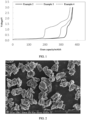
- FIG. 1 is a gram capacity-voltage test diagram of Examples 2, 3, and 4.
- the use amount of the niobium composite metal oxide shows an increasing trend.
- the lithium-ion battery in which the use amount of the niobium composite metal oxide is within the range of this application has a higher gram capacity, which indicates that the negative electrode active material with the mass ratio of the niobium composite metal oxide to the graphite controlled within the range of this application can be used in the lithium-ion battery, and the lithium-ion battery can have a higher energy density.
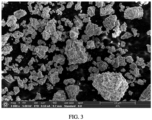
- FIG. 2 shows a scanning electron microscope (SEM) image of artificial graphite in Comparative Example 1 of this application
- FIG. 3 shows a SEM image of niobium composite metal oxide in Comparative Example 2 of this application. It can be seen from the comparison between FIG. 2 and FIG. 3 that the particle size of the artificial graphite in FIG. 2 is larger than that of the niobium composite metal oxide in FIG. 3 .
- the mass ratio of the niobium composite metal oxide to the graphite usually affects the energy density, low-temperature performance, and high-temperature storage performance of the lithium-ion battery.
- the lithium-ion battery with the mass ratio of the niobium composite metal oxide to the graphite within the range of this application has higher gram capacity and capacity retention rate R and lower thickness swelling rate T, indicating that the lithium-ion battery has higher energy density and good low-temperature performance and high-temperature storage performance, and has good comprehensive performance.
- the artificial graphite and the mixture of niobium composite metal oxide and graphite at the mass ratio of 2:98 are selected as the negative electrode active materials respectively.
- Such negative electrode active material has higher gram capacity, but lower capacity retention rate R and higher thickness swelling rate T.
- the niobium composite metal oxide and the mixture of niobium composite metal oxide and graphite at the mass ratio of 98:2 are selected as the negative electrode active materials respectively.
- Such negative electrode active material has higher capacity retention rate R and lower thickness swelling rate T, but lower gram capacity. It is well known to those skilled in the art that it is difficult to increase the gram capacity. Therefore, the lithium-ion batteries of Comparative Examples 1 to 4 have poor comprehensive performance.
- the types of the niobium composite metal oxides usually affect the energy density, low-temperature performance, and high-temperature storage performance of the lithium-ion battery. As can be seen from Example 3 and Examples 5 to 7, the lithium-ion battery with the types of the niobium composite metal oxides within the range of this application has higher gram capacity and capacity retention rate R and lower thickness swelling rate T, indicating that the lithium-ion battery has higher energy density and good low-temperature performance and high-temperature storage performance, and has good comprehensive performance.
- the median particle size by volume D V 50 -1 of the niobium composite metal oxide, the median particle size by volume D V 50 -2 of the graphite, the specific surface area BET 1 of the niobium composite metal oxide, and the specific surface area BET 2 of the graphite usually affect the energy density, low-temperature performance, and high-temperature storage performance of the lithium-ion battery.
- the lithium-ion battery with the median particle size by volume D V 50 -1 of the niobium composite metal oxide, the median particle size by volume D V 50 -2 of the graphite, the specific surface area BET 1 of the niobium composite metal oxide, and the specific surface area BET 2 of the graphite within the ranges of this application has higher gram capacity and capacity retention rate R, and lower thickness swelling rate T, indicating that lithium-ion battery has higher energy density and good low-temperature performance and high-temperature storage performance, and has good comprehensive performance.
- the ratio D V 50 -1 /D N 10 of the median particle size by volume D V 50 -1 of the niobium composite metal oxide to the particle size by number D N 10 of the niobium composite metal oxide usually affects the energy density, low-temperature performance, and high-temperature storage performance of the lithium-ion battery.
- the lithium-ion battery with the value of D V 50 -1 /D N 10 within the range of this application has higher gram capacity and capacity retention rate R and lower thickness swelling rate T, indicating that the lithium-ion battery has higher energy density and good low-temperature performance and high-temperature storage performance.
- the compacted density of the negative electrode plate usually affects the gram capacity, low-temperature performance, and high-temperature storage performance of the lithium-ion battery.
- the lithium-ion battery with the compacted density of the negative electrode plate within the range of this application has higher gram capacity and capacity retention rate R and lower thickness swelling rate T, indicating that the lithium-ion battery has higher energy density and good low-temperature performance and high-temperature storage performance, and has good comprehensive performance.
- the ratio D V 50 -2 /D V 50 -1 of the median particle size by volume D V 50 -2 of the graphite to the median particle size by volume D V 50 -1 of the niobium composite metal oxide usually affects the gram capacity, low-temperature performance, and high-temperature storage performance of the lithium-ion battery.
- the lithium-ion battery with the value of D V 50 -2 /D V 50 -1 within the range of this application has higher gram capacity and capacity retention rate R and lower thickness swelling rate T, indicating that the lithium-ion battery has higher energy density and good low-temperature performance and high-temperature storage performance, and has good comprehensive performance.
Landscapes
- Chemical & Material Sciences (AREA)
- Chemical Kinetics & Catalysis (AREA)
- Electrochemistry (AREA)
- General Chemical & Material Sciences (AREA)
- Engineering & Computer Science (AREA)
- Inorganic Chemistry (AREA)
- Materials Engineering (AREA)
- Composite Materials (AREA)
- Manufacturing & Machinery (AREA)
- Battery Electrode And Active Subsutance (AREA)
- Electric Double-Layer Capacitors Or The Like (AREA)
Abstract
Description
- This application relates to the field of electrochemical technologies, and in particular, to a negative electrode plate, an electrochemical apparatus, and an electronic apparatus.
- Lithium-ion batteries have been widely used in fields such as consumer electronics, electric vehicles, and energy storage due to their characteristics such as high specific energy and power density, long cycle life, and environmental friendliness. As the power source of new energy vehicles, lithium-ion batteries still have many problems in practical applications. For example, the energy density is significantly reduced at low temperature, which in turn affects the cycle life; and the storage performance is poor at high temperature. These seriously limit the large-scale use of lithium-ion batteries. Therefore, how the comprehensive performance of lithium-ion batteries is improved has become an urgent technical problem to be solved by those skilled in the art.
- An objective of some embodiments of this application is to provide a negative electrode plate, an electrochemical apparatus, and an electronic apparatus, so as to improve the comprehensive performance of the electrochemical apparatus.
- It should be noted that in the invention content of this application, a lithium-ion battery is used as an example of an electrochemical apparatus to explain this application. However, the electrochemical apparatus of this application is not limited to the lithium-ion battery. Specific technical solutions are as follows:
A first aspect of this application provides a negative electrode plate including a negative electrode current collector and a negative electrode active material layer arranged on at least one surface of the negative electrode current collector, where the negative electrode active material layer includes a negative electrode active material, the negative electrode active material includes graphite and niobium composite metal oxide, and the niobium composite metal oxide includes at least one of compounds with a molecular formula of TxNbyMzOa, where T includes at least one of K, Li, Fe, V, W, Cr, Zr, Al, Mg, Zn, Cu, Mo, Na, Ga, P, Tc, Si, Ge, Sn, Ni, Co, Mn, Sr, Y, In, or Ti, M includes at least one of Al, Ti, W, Zr, Nb, In, Ru, Sb, Sr, Y, Ni, Co, Mn, Fe, Gr, Mo, Tc, Sn, Ga, Si, V, or Mg, T and M are different, 0≤x/(x+y+z)≤0.6, 1<a/(x+y+z)<5, and 0≤z/(x+y+z)≤0.5; and a mass ratio of the niobium composite metal oxide to the graphite is (5-50):(50-95). In the negative electrode active material of this application, the niobium composite metal oxide and the graphite are mixed, and the mass ratio of the niobium composite metal oxide to the graphite is controlled within the range of this application, which can solve the problem of poor electronic conductivity of the niobium composite metal oxide, and can ensure normal Li+ deintercalation and intercalation of the niobium composite metal oxide at low temperature, that is, can ensure normal charge and discharge. In the process of charging and discharging the electrochemical apparatus, the whole electrochemical apparatus system generates heat, and the generated heat raises the temperature inside the whole electrochemical apparatus, such that the kinetics of the graphite increases with the increase of temperature, thereby improving the low-temperature performance of the graphite. The negative electrode plate including the negative electrode active material of this application is applicable to an electrochemical apparatus, and the electrochemical apparatus has good low-temperature performance, high energy density, and good storage performance. Therefore, the electrochemical apparatus has good comprehensive performance. - In some embodiments of this application, the niobium composite metal oxide has a structure of at least one of a Wadsley-Roth cross-section structure or a tungsten bronze structure. The niobium composite metal oxide having the preceding structure is conducive to the diffusion of Li+, and the niobium composite metal oxide has good structural stability, good cycling performance, and good storage performance. This is beneficial to improving the comprehensive performance of the electrochemical apparatus.
- In some embodiments of this application, a median particle size by
volume D V50-1 of the niobium composite metal oxide is 2 µm to 10 µm, and a median particle size byvolume D V50-2 of the graphite is 10 µm to 23 µm. With the median particle size byvolume D V50-1 of the niobium composite metal oxide and the median particle size byvolume D V50-2 of the graphite controlled within the foregoing ranges, the purpose of increasing the compacted density by mixing large and small particles can be achieved, which is conducive to increasing the energy density of the electrochemical apparatus under the condition of good low-temperature performance and storage performance. In some embodiments of this application, the median particle size byvolume D V50-1 of the niobium composite metal oxide and a particle size bynumber D N10 of the niobium composite metal oxide satisfy 3≤DV50-1D N10≤26. WithD V50-1/D N10 controlled within the foregoing range, the small particles can be reduced, and a specific surface area of the niobium composite metal oxide can be decreased, so as to achieve the purpose of reducing gas generated during high-temperature storage and caused by side reactions. In some embodiments of this application, the median particle size byvolume D V50-1 of the niobium composite metal oxide and the median particle size byvolume D V50-2 of the graphite satisfyD V50-2/D V50-1≥2. WithD V50-2/D V50-1 controlled within the foregoing range, the purpose of filling the niobium composite metal oxide particles into the graphite gaps can be achieved, so as to increase the compacted density of the negative electrode plate and the energy density of the electrochemical apparatus. - In some embodiments of this application, a specific surface area BET1 of the niobium composite metal oxide is 0.1 m2/g to 2.0 m2/g, and a specific surface area BET2 of the graphite is 0.5 m2/g to 10 m2/g. With the specific surface area BET1 of the niobium composite metal oxide and the specific surface area BET2 of the graphite controlled within the foregoing ranges, the side reactions between the negative electrode active material and the electrolyte can be reduced, which is conducive to reducing gas generated during high-temperature storage.
- In some embodiments of this application, a compacted density of the negative electrode plate is 1.6 g/cm3 to 3.6 g/cm3. Controlling the compacted density of the niobium composite metal oxide and the compacted density of the graphite within the foregoing ranges is conducive to improving the comprehensive performance of electrochemical apparatus.
- A second aspect of this application provides an electrochemical apparatus including the negative electrode plate according to the first aspect of this application. Therefore, the electrochemical apparatus has good comprehensive performance.
- A third aspect of this application provides an electronic apparatus including the electrochemical apparatus according to the second aspect of this application. Beneficial effects of some embodiments of this application are as follows:
Embodiments of this application provide a negative electrode plate, an electrochemical apparatus, and an electronic apparatus. The negative electrode plate includes a negative electrode current collector and a negative electrode active material layer arranged on at least one surface of the negative electrode current collector, where the negative electrode active material layer includes a negative electrode active material, the negative electrode active material includes graphite and niobium composite metal oxide, and the niobium composite metal oxide includes at least one of compounds with a molecular formula of TxNbyMzOa, where T includes at least one of K, Li, Fe, V, W, Cr, Zr, Al, Mg, Zn, Cu, Mo, Na, Ga, P, Tc, Si, Ge, Sn, Ni, Co, Mn, Sr, Y, In, or Ti, M includes at least one of Al, Ti, W, Zr, Nb, In, Ru, Sb, Sr, Y, Ni, Co, Mn, Fe, Gr, Mo, Tc, Sn, Ga, Si, V, or Mg, T and M are different, 0≤x/(x+y+z)≤0.6, 1<a/(x+y+z)<5, and 0≤z/(x+y+z)≤0.5; and a mass ratio of the niobium composite metal oxide to the graphite is (5-50):(50-95). In the negative electrode active material of this application, the niobium composite metal oxide and the graphite are mixed, and the mass ratio of the niobium composite metal oxide to the graphite is controlled within the range of this application, which can solve the problem of poor electronic conductivity of the niobium composite metal oxide, and can ensure normal Li+ deintercalation and intercalation of the niobium composite metal oxide at low temperature, that is, can ensure normal charge and discharge. In the process of charging and discharging the electrochemical apparatus, the whole electrochemical apparatus system generates heat, and the generated heat raises the temperature inside the whole electrochemical apparatus, such that the kinetics of the graphite increases with the increase of temperature, thereby improving the low-temperature performance of the graphite. The negative electrode plate including the negative electrode active material of this application is applicable to an electrochemical apparatus, and the electrochemical apparatus has good low-temperature performance, high energy density, and good storage performance. Therefore, the electrochemical apparatus has good comprehensive performance. Certainly, when any product or method of this application is implemented, all advantages described above are not necessarily demonstrated simultaneously. - To describe technical solutions in some embodiments of this application or in the prior art more clearly, the following briefly describes the accompanying drawings required for describing some embodiments or the prior art. Apparently, the accompanying drawings in the following descriptions show some embodiments of this application, and persons of ordinary skill in the art may still derive others drawings from these accompanying drawings.
-
FIG. 1 is a gram capacity-voltage test diagram of Example 2, Example 3, and Example 4 of this application; -
FIG. 2 shows a scanning electron microscope (SEM) image of artificial graphite in Comparative Example 1 of this application; and -
FIG. 3 shows a SEM image of niobium composite metal oxide in Comparative Example 2 of this application. - The following clearly and completely describes the technical solutions in some embodiments of this application with reference to the accompanying drawings in some embodiments of this application. Apparently, the described embodiments are only some rather than all of these embodiments of this application. Based on some embodiments of this application, all other embodiments obtained by persons of ordinary skill in the art based on this application shall fall within the protection scope of this application.
- It should be noted that, in the specific embodiments of this application, an example in which a lithium-ion battery is used as an electrochemical apparatus is used to illustrate this application. However, the electrochemical apparatus of this application is not limited to the lithium-ion battery. Specific technical solutions are as follows:
A first aspect of this application provides a negative electrode plate including a negative electrode current collector and a negative electrode active material layer arranged on at least one surface of the negative electrode current collector, where the negative electrode active material layer includes a negative electrode active material, the negative electrode active material includes graphite and niobium composite metal oxide, and the niobium composite metal oxide includes at least one of compounds with a molecular formula of TxNbyMzOa. T includes at least one of K, Li, Fe, V, W, Cr, Zr, Al, Mg, Zn, Cu, Mo, Na, Ga, P, Tc, Si, Ge, Sn, Ni, Co, Mn, Sr, Y, In, Hf, or Ti, M includes at least one of Al, Ti, W, Zr, Nb, In, Ru, Sb, Sr, Y, Ni, Co, Mn, Fe, Gr, Mo, Tc, Sn, Ga, Si, V, or Mg, T and M are different, 0≤x/(x+y+z)≤0.6, 1≤a/(x+y+z)<5, and 0≤z/(x+y+z)≤0.5. A mass ratio of the niobium composite metal oxide to the graphite is (5-50):(50-95). For example, the mass ratio of the niobium composite metal oxide to the graphite is 5:95, 10:90, 15:85, 20:80, 25:75, 30:70, 35:65, 40:60, 45:55, 50:50, or any one in a range defined by any two of these ratios. - The niobium composite metal oxide is based on niobium oxide, which co-dissolves with other metal oxides to form a pure-phase M-Nb-O compound with a high theoretical capacity (340 mAh/g to 416 mAh/g). Moreover, the niobium composite metal oxide is contribute to the diffusion of lithium ions (Li+), and the diffusion coefficient of Li+ is two to three orders of magnitude higher than that of lithium titanate (LTO), which is a common negative electrode active material, so the niobium composite metal oxide has good rate performance. The niobium composite metal oxide works at a temperature of -40°C to 60°C. The temperature has little effect on the kinetics of the niobium composite metal oxide, so the niobium composite metal oxide can be charged and discharged normally even at low temperature. During the charging and discharging process of the electrochemical apparatus, the volume change of the niobium composite metal oxide unit cell is lower than or equal to 10%, so the niobium composite metal oxide has good structural stability, good cycling performance, and good storage performance. However, the niobium composite metal oxides generally have the problem of poor electronic conductivity. In contrast, the negative electrode active material graphite has good electronic conductivity, but its kinetics is greatly influenced by temperature. At low temperature, the reaction activity decreases and the polarization is serious, which leads to a large amount of metal lithium deposition on the surface of the negative electrode plate, thereby seriously affecting the low-temperature performance of the electrochemical apparatus. The decrease of solid diffusion coefficient of Li+ in the graphite at low temperature is the main rate-controlling step that leads to the deterioration of capacity characteristics of the electrochemical apparatus. When the electrochemical apparatus is charged at low temperature, a smaller diffusion coefficient hinders the diffusion process of Li+ in the graphite, which easily leads to "lithium deposition" on the surface of the graphite particles and causes permanent damage to the electrochemical apparatus.
- The energy density of the electrochemical apparatus is positively correlated with the gram capacity of the negative electrode active material, and a higher gram capacity presents a higher energy density. However, the energy density of the electrochemical apparatus is negatively correlated with the voltage plateau of the negative electrode active material. A higher voltage plateau presents a lower energy density of the electrochemical apparatus. Because the lithium-intercalated voltage plateau of the niobium composite metal oxide is higher than that of the graphite, it is necessary to control the ratio of the niobium composite metal oxide to the graphite from the perspective of energy density. When the mass ratio of the niobium composite metal oxide to the graphite is less than 5:95, the content of the niobium composite metal oxide contained in the negative electrode active material is too small, which does not significantly improve the low-temperature performance of the electrochemical apparatus. When the mass ratio of the niobium composite metal oxide to the graphite is greater than 50:50, the content of the niobium composite metal oxide contained in the negative electrode active material is too large, which affects the energy density of the electrochemical apparatus. Firstly, the gram capacity of the niobium composite metal oxide may be lower than that of the graphite. Secondly, the energy density of the electrochemical apparatus is affected because the lithium-intercalated voltage plateau of the niobium composite metal oxide is higher than that of the graphite. Therefore, it is necessary to consider an appropriate ratio of the niobium composite metal oxide to the graphite. In the negative electrode active material of this application, the niobium composite metal oxide and the graphite are mixed, and the mass ratio of the niobium composite metal oxide to the graphite is controlled within the range of this application, which can solve the problem of poor electronic conductivity of the niobium composite metal oxide, and can ensure normal Li+ deintercalation and intercalation of the niobium composite metal oxide at low temperature, that is, can ensure normal charge and discharge. In the process of charging and discharging the electrochemical apparatus, the whole electrochemical apparatus system generates heat, and the generated heat raises the temperature inside the whole electrochemical apparatus, such that the kinetics of the graphite increases with the increase of temperature, thereby improving the low-temperature performance of the graphite. The negative electrode plate including the negative electrode active material of this application is applicable to an electrochemical apparatus, and the electrochemical apparatus has good low-temperature performance, high energy density, and good storage performance. Therefore, the electrochemical apparatus has good comprehensive performance.
- In this application, low temperature means that the temperature is lower than or equal to -10°C.
- The foregoing "negative electrode active material layer arranged on at least one surface of the negative electrode current collector" means that the negative electrode active material layer is arranged on one surface of the negative electrode current collector or the negative electrode active material layer is arranged on two surfaces of the negative electrode current collector. The "surface" may be part or all of the surface of the negative electrode current collector.
- Further, the niobium composite metal oxide TxNbyMzOa includes at least one of Nb16W5O55, Nb18W16O93, TiNb2O7, Nb16W5O93, Cr0.5Nb24.5O62, Ti2Nb14O39, TiNb24O62, TiNb6O17, Ni2Nb34O87, Cu2Nb34O87, Cr0.5Nb24.5O62, V3Nb17O5O, Zn2Nb34O87, Al0.5Nb24.5O62, MoNb12O33, ZrNb24O62, AlNb11O29, Mg2Nb34O87, GaNb11O29, Mo3Nb14O44, CrNb11O29, HfNb24O62, FeNb11O28, GaNb49O124, NaNb13O33, Ni2Nb34O87, TiNb6O17, WNb12O33, LiNbO3, Li3NbO4, TiCr0.5Nb10.5O2, VNb9O25, KNb5O13, K6Nb10.8O30, PNb9O25, Nb18W8O69, Ti2Nb10O29, Cr0.2Fe0.8Nb11O29, Fe0.8Mn0.2Nb11O29, Fe0.8V0.2Nb11O29, or Cu0.02Ti0.94Nb2.04O7.
- In some embodiments of this application, the niobium composite metal oxide has a structure of at least one of a Wadsley-Roth (Wadsley-Roth) cross-section structure or a tungsten bronze structure. The niobium composite metal oxide having the preceding structure is conducive to the diffusion of Li+, and the niobium composite metal oxide has good structural stability, good cycling performance, and good storage performance. This is beneficial to improving the comprehensive performance of the electrochemical apparatus.
- This application has no particular limitation on the control method of the structure of the niobium composite metal oxide, provided that the objective of this application can be achieved. For example, it can be achieved by controlling the sintering temperature, sintering time, types of raw materials, and ratio of different raw materials in the preparation process of the niobium composite metal oxide.
- In some embodiments of this application, a median particle size by
volume D V50-1 of the niobium composite metal oxide is 2 µm to 10 µm, and a median particle size byvolume D V50-2 of the graphite is 10 µm to 23 µm. For example,D V50-1 is 2 µm, 3 µm, 4 µm, 5 µm, 6 µm, 7 µm, 8 µm, 9 µm, 10 µm, or any one in a range defined by any two of these values.D V50-2 is 10 µm, 11 µm, 12 µm, 13 µm, 14 µm, 15 µm, 16 µm, 17 µm, 18 µm, 19 µm, 20 µm, 21 µm, 22 µm, 23 µm, or any one in a range defined by any two of these values. To improve the electronic conductivity of the niobium composite metal oxide by the graphite, the median particle size byvolume D V50-1 of the niobium composite metal oxide and the median particle size byvolume D V50-2 of the graphite are controlled within the foregoing ranges, and the niobium composite metal oxide and the graphite have a suitable contact area, which is conducive to implementing good electronic conductivity of the niobium composite metal oxide. It can also achieve the purpose of increasing the compacted density by mixing large and small particles, which is conducive to increasing the energy density of the electrochemical apparatus under the condition of good low-temperature performance and storage performance. Therefore, the electrochemical apparatus has good comprehensive performance. - In some embodiments of this application, the median particle size by
volume D V50-1 of the niobium composite metal oxide and a particle size bynumber D N10 of the niobium composite metal oxide satisfy 3≤D V50-1/D N10≤26. For example, the value ofD V50-1/D N10 is 3, 5, 8, 11, 14, 17, 20, 23, 26, or any one in a range defined by any two of these values. A smaller particle size of the niobium composite metal oxide particles presents a larger specific surface area and indicates more side reactions with the electrolyte. A better uniformity of particle size of the niobium composite metal oxide presents less number of small particles filled between large particles, which is not conducive to increasing the compacted density of the niobium composite metal oxide. WithD V50-1/D N10 controlled within the foregoing range, the number of particles with smaller particle size in the niobium composite metal oxide and the uniformity of particle size of the niobium composite metal oxide each are within a suitable range, which is conducive to reducing the reactions between the niobium composite metal oxide and the electrolyte and increasing the compacted density of the niobium composite metal oxide. This is conducive to improving the low-temperature performance, energy density, and storage performance of the electrochemical apparatus. Therefore, the electrochemical apparatus has good comprehensive performance. - This application has no particular limitation on the particle size by
number D N10 of the niobium composite metal oxide, provided that the objective of this application can be achieved. For example, the particle size bynumber D N10 of the niobium composite metal oxide is 0.1 µm to 2 µm. - In some embodiments of this application, the median particle size by
volume D V50-1 of the niobium composite metal oxide and the median particle size byvolume D V50-2 of the graphite satisfyD V50-2/D V50-1≥2. In some embodiments, 2≤D V50-2/D V50-1≤7. For example, the value ofD V50-2/D V50-1 is 2, 4, 5, 6, 7, 8, 9, 10, 11, 11.5, or any one in a range defined by any two of these values. WithD V50-2/D V50-1 controlled within the foregoing range, the niobium composite metal oxide and the graphite can be more densely packed, which is conducive to increasing the compacted density of the negative electrode plate. In this way, the low-temperature performance, energy density, and storage performance of the electrochemical apparatus are improved. Therefore, the electrochemical apparatus has good comprehensive performance. - In this application,
D V50-1 means that the diameter of niobium composite metal oxide particles accounting for 50% of the total volume is larger than this value, and the diameter of niobium composite metal oxide particles accounting for 50% of the total volume is smaller than this value, indicating the median particle size of the two parts.D V50-2 means that the diameter of graphite particles accounting for 50% of the total volume is larger than this value, and the diameter of graphite particles accounting for 50% of the total volume is smaller than this value, indicating the median particle size of the two parts.D N10 means that the diameter of niobium composite metal oxide particles accounting for 10% of the total number is smaller than this value. - In some embodiments of this application, a specific surface area BET1 of the niobium composite metal oxide is 0.1 m2/g to 2.0 m2/g, and a specific surface area BET2 of the graphite is 0.5 m2/g to 10 m2/g. For example, the specific surface area BET1 of the niobium composite metal oxide is 0.1 m2/g, 0.2 m2/g, 0.4 m2/g, 0.6 m2/g, 0.8 m2/g, 1.0 m2/g, 1.2 m2/g, 1.4 m2/g, 1.6 m2/g, 1.8 m2/g, 2.0 m2/g, or any one in a rang defined by any two of these values. The specific surface area BET2 of the graphite is 0.5 m2/g, 1 m2/g, 2 m2/g, 3 m2/g, 4 m2/g, 5 m2/g, 6 m2/g, 7 m2/g, 8 m2/g, 9 m2/g, 10 m2/g, or any one in a rang defined by any two of these values. Controlling the specific surface area BET1 of the niobium composite metal oxide and the specific surface area BET2 of the graphite within the foregoing ranges is contribute to reducing the side reactions between the negative electrode active material and the electrolyte, reducing the amount of solid electrolyte interphase (SEI) film generated, thereby reducing the blocking effect of SEI film on Li+ intercalation, also reducing gas generated during high-temperature storage of the electrochemical apparatus, reducing the thickness swelling rate of the electrochemical apparatus, and improving the storage performance of the electrochemical apparatus. Therefore, the electrochemical apparatus has good comprehensive performance.
- Smaller particles of the negative electrode active material present a larger corresponding specific surface area and a shorter migration path of Li+, which is conducive to the deintercalation and intercalation of Li+ and the exertion of gram capacity, but affects the gas generated during high-temperature storage. This is because a larger specific surface area of the negative electrode active material presents more side reactions between the negative electrode active material and the electrolyte, which leads to gassing and swelling in the electrochemical apparatus and is detrimental to its safety and reliability.
- This application has no particular limitation on the control method of the median particle size by
volume D V50-1, particle size bynumber D N10, and specific surface area BET1 of the niobium composite metal oxide, provided that the objective of this application can be achieved. For example, it can be achieved by adjusting the process parameters in the preparation process of the niobium composite metal oxide, for example, crushing and screening. Alternatively, it can be achieved by purchasing from the manufacturer. - This application has no particular limitation on the control method of the median particle size by
volume D V50-2 and specific surface area BET2 of the graphite, provided that the objective of this application can be achieved. For example, it can be achieved by purchasing from the manufacturer. - The compacted density of the negative electrode plate is positively correlated with the true density of the negative electrode active material, which has a decisive influence on the compacted density of the negative electrode active material, and the mixing of large and small particles also affects the compacted density of the negative electrode plate, but its influence on the compacted density of the negative electrode plate is smaller than that of the true density.
- In some embodiments of this application, the true density of the graphite is lower than that of the niobium composite metal oxide. The true density TD1 of the niobium composite metal oxide is 4.2 g/cm3 to 5.5 g/cm3, and the true density TD2 of the graphite is 2.20 g/cm3 to 2.26 g/cm3. For example, the true density TD1 of the niobium composite metal oxide is 4.2 g/cm3, 4.4 g/cm3, 4.6 g/cm3, 4.8 g/cm3, 5.0 g/cm3, 5.2 g/cm3, 5.4 g/cm3, 5.5 g/cm3, or any one in a range defined by any two of these values. The true density TD2 of the graphite is 2.20 g/cm3, 2.21 g/cm3, 2.22 g/cm3, 2.23 g/cm3, 2.24 g/cm3, 2.25 g/cm3, 2.26 g/cm3, or any one in a range defined by any two of these values. Controlling the true density TD1 of the niobium composite metal oxide and the true density TD2 of the graphite within the foregoing ranges is contribute to increasing the compacted density of the negative electrode plate, thereby increasing the energy density of the electrochemical apparatus.
- In this application, the true density refers to an actual volume of solid matter in the volume of the graphite or niobium composite metal oxide in an absolutely dense state, excluding internal pores or gaps between particles.
- In some embodiments of this application, a compacted density of the negative electrode plate is 1.6 g/cm3 to 3.6 g/cm3. For example, the compacted density of the negative electrode plate is 1.6 g/cm3, 1.8 g/cm3, 2.0 g/cm3, 2.2 g/cm3, 2.4 g/cm3, 2.6 g/cm3, 2.8 g/cm3, 3.0 g/cm3, 3.2 g/cm3, 3.4 g/cm3, 3.6 g/cm3, or any one in a range defined by any two of these values. The compacted density of the negative electrode plate is controlled within the foregoing range, such that the negative electrode plate has a higher compacted density, thereby having a higher energy density. In this way, the electrochemical apparatus has high energy density on the basis of good low-temperature performance and storage performance. Therefore, the electrochemical apparatus has good comprehensive performance.
- This application has no particular limitation on the control method of the compacted density of the negative electrode plate, provided that the objective of this application can be achieved. For example, it can be achieved by controlling the pressure of the negative electrode plate during cold pressing, adjusting the type or average particle size of the negative electrode active material, or the like. This application has no particular limitation on the magnitude of the pressure mentioned above, provided that the objective of this application can be achieved. For example, the pressure is 40t to 80t. This application has no particular limitation on the type of the graphite, provided that the objective of this application can be achieved. For example, the graphite includes but is not limited to artificial graphite and natural graphite.
- This application has no particular limitation on the preparation method of the niobium composite metal oxide, provided that the objective of this application can be achieved. For example, the preparation method of the niobium composite metal oxide includes but is not limited to the following steps: selecting NbO2 and other metal oxides to mix based on a molar ratio of the molecular formula of the niobium composite metal oxide, sintering at 700°C to 1500°C for 2h to 24h after mixing, and crushing and screening to obtain the required niobium composite metal oxide. This application has no particular limitation on the types of "other metal oxides" mentioned above, and those skilled in the art can choose according to their needs, provided that the niobium composite metal oxide within the ranges of this application can be prepared and the objective of this application can be achieved.
- The negative electrode current collector is not particularly limited in this application, provided that the objective of this application can be achieved. For example, the negative electrode current collector may include copper foil, copper alloy foil, nickel foil, stainless steel foil, titanium foil, nickel foam, copper foam, or the like. This application has no particular limitation on thicknesses of the negative electrode current collector and the negative electrode active material layer, provided that the objective of this application can be achieved. For example, the thickness of the negative electrode current collector is 6 µm to 10 µm, and the thickness of the negative electrode active material layer is 30 µm to 130 µm.
- In some embodiments of this application, the negative electrode active material layer of this application further includes at least one of a negative electrode conductive agent, a thickener, or a negative electrode binder. This application has no particular limitation on the types of the negative electrode conductive agent, the thickener, and the negative electrode binder, provided that the objective of this application can be achieved. This application has no particular limitation on the mass ratio of the negative electrode active material, negative electrode conductive agent, thickener, and negative electrode binder in the negative electrode active material layer, provided that the objective of this application can be achieved. For example, the mass ratio of the negative electrode active material, negative electrode conductive agent, negative electrode binder, and thickener in the negative electrode active material layer is (90-98):(0.5-3):(1-4):(0.5-3).
- A second aspect of this application provides an electrochemical apparatus including the negative electrode plate according to the first aspect of this application. Therefore, the electrochemical apparatus has good comprehensive performance, such as good low-temperature performance and storage performance and high energy density.
- In some embodiments of this application, the electrochemical apparatus further includes a positive electrode plate. This application has no particular limitation on the positive electrode plate, provided that the objective of this application can be achieved. For example, the positive electrode plate includes a positive electrode current collector and a positive electrode active material layer arranged on at least one surface of the positive electrode current collector. This application has no particular limitation on the type of the positive electrode current collector, provided that the objective of this application can be achieved. For example, the positive electrode current collector may include aluminum foil, aluminum alloy foil, and the like. The positive electrode active material layer in this application includes a positive electrode active material. This application has no particular limitation on the type of the positive electrode active material, provided that the transition metal elements in this application are included and the objective of this application can be achieved. For example, the positive electrode active material may include at least one of lithium nickel cobalt manganate (LiNi0.8Co0.1Mn0.1O2), lithium nickel cobalt aluminate, lithium iron phosphate, lithium-rich manganese-based materials, lithium cobalt oxide (LiCoO2), lithium manganate, lithium iron manganese phosphate, or lithium titanate. In this application, the positive electrode active material may further include a non-metal element, for example, the non-metal element includes at least one of fluorine, phosphorus, boron, chlorine, silicon, or sulfur. These elements can further improve stability of the positive electrode active material. In this application, thicknesses of the positive electrode current collector and the positive electrode active material layer are not particularly limited, provided that the objective of this application can be achieved. For example, the thickness of the positive electrode current collector is 5 µm to 20 µm, and preferably 6 µm to 18 µm. The thickness of the positive electrode active material layer is 30 µm to 120 µm. Optionally, the positive electrode active material layer may further include a positive electrode conductive agent and a positive electrode binder. This application has no particular limitation on the types of the positive electrode conductive agent and positive electrode binder in the positive electrode active material layer, provided that the objective of this application can be achieved. This application has no particular limitation on the mass ratio of the positive electrode active material, positive electrode conductive agent, and positive electrode binder in the positive electrode active material layer, and those skilled in the art can choose according to actual needs, provided that the objective of this application can be achieved. For example, the mass ratio of the positive electrode active material, positive electrode conductive agent, and positive electrode binder in the positive electrode active material layer is (90-98):(0.5-5):(1.5-5).
- In some embodiments of this application, the electrochemical apparatus further includes a separator, where the separator is arranged between the positive electrode plate and the negative electrode plate, so as to separate the positive electrode plate from the negative electrode plate, prevent internal short circuit of the electrochemical apparatus, allow ions in the electrolyte to migrate freely, and have no effect on the electrochemical charging and discharging process. This application has no particular limitation on the separator, provided that the objective of this application can be achieved. For example, the material of the separator may include but is not limited to at least one of polyethylene (PE) and polypropylene (PP)-based polyolefin (PO), polyester (for example, a polyethylene terephthalate (PET) film), cellulose, polyimide (PI), polyamide (PA), spandex, or aramid. The type of the separator may include at least one of a woven film, a nonwoven film, a microporous film, a composite film, a rolling film, or a spinning film.
- In some embodiments of this application, the electrochemical apparatus further includes a packaging bag and an electrolyte, where the electrolyte and an electrode assembly are contained in the packaging bag, and the electrode assembly includes the positive electrode plate, the separator, and the negative electrode plate. This application has no particular limitation on the packaging bag and electrolyte, which may be well-known packaging bags and electrolytes in the field, provided that the objective of this application can be achieved.
- This application has no particular limitation on the type of the electrochemical apparatus, which may include any apparatus in which electrochemical reactions occur. In some embodiments, the electrochemical apparatus may include but is not limited to a lithium metal secondary battery, a lithium-ion secondary battery (a lithium-ion battery), a sodium-ion secondary battery (a sodium-ion battery), a lithium polymer secondary battery, and a lithium-ion polymer secondary battery (a lithium-ion polymer battery).
- A process for preparing the electrochemical apparatus of this application is well known to persons skilled in the art, and is not particularly limited in this application. For example, the process may include but is not limited to the following steps: stacking the positive electrode plate, the separator, and the negative electrode plate in sequence, performing operations such as winding and folding on the stack as required to obtain an electrode assembly having a winding structure, placing the electrode assembly into a packaging bag, injecting an electrolyte into the packaging bag, and sealing the packaging bag to obtain the electrochemical apparatus; or stacking the positive electrode plate, the separator, and the negative electrode plate in sequence, fixing four corners of the overall laminated structure with a tape to obtain an electrode assembly having a laminated structure, placing the electrode assembly into a packaging bag, injecting an electrolyte into the packaging bag, and sealing the packaging bag to obtain the electrochemical apparatus. In addition, if necessary, an overcurrent prevention element, a guide plate, and the like may be placed in the packaging bag to prevent pressure increase, overcharge, and overdischarge in the electrochemical apparatus.
- A third aspect of this application provides an electronic apparatus including the electrochemical apparatus according to the second aspect of this application. Therefore, the electronic apparatus has good use performance.
- The electronic apparatus of this application is not particularly limited, and the electronic apparatus may be any known electronic apparatus used in the prior art. For example, the electronic apparatus may include but is not limited to a notebook computer, a pen-input computer, a mobile computer, an electronic book player, a portable telephone, a portable fax machine, a portable copier, a portable printer, a stereo headset, a video recorder, a liquid crystal television, a portable cleaner, a portable CD player, a mini-disc, a transceiver, an electronic notepad, a calculator, a storage card, a portable recorder, a radio, a standby power source, a motor, an automobile, a motorcycle, a power-assisted bicycle, a bicycle, a lighting appliance, a toy, a game console, a clock, an electric tool, a flash lamp, a camera, a large household battery, and a lithium-ion capacitor.
- The following describes some embodiments of this application more specifically by using examples and comparative examples. Various tests and evaluations are performed in the following methods.
- Test method and device
- The particle size distributions of the graphite and niobium composite metal oxide in the negative electrode active material were tested using Malvern particle size tester, and
D V50-1 andD N10 of the niobium composite metal oxide andD V50-2 of the graphite were obtained. The specific tests were carried out in accordance with the national standardGB/T 19077-2016 - With a specific surface area analyzer (Tristar II 3020M), the specific surface areas of the graphite and niobium composite metal oxides in the negative electrode active materials of all examples and comparative examples were measured using the nitrogen adsorption method. The specific test was carried out in accordance with the national standard
GB/T 19587-2017 - Compacted density = mass of negative electrode active material layer per unit area (g/cm2)/thickness of negative electrode active material layer (cm).
- The negative electrode plates of all examples and comparative examples were assembled with Li sheets to form coin cells (coin cell), and the coin cells were discharged to a gram capacity of 5.0 mV. The specific discharge process was as follows: The coin cells were discharged at 0.05C to 5.0 mV and charged at 0.1C to 3.0 V, and the capacities of the coin cells were recorded as gram capacities at this point. 0.05C is a current value under 0.05 times the designed gram capacity, and 0.1C is a current value under 0.1 times the designed gram capacity.
- The lithium-ion batteries in all examples and comparative examples were charged to 4.3 V at 25°C at a rate of 0.2C, and the charging capacities at this point were denoted as C1; the lithium-ion batteries were charged to 4.3 V at -20°C at 1C, and the charging capacities at this point were denoted as C2; and the capacity retention rate R was equal to C2/C1×100%. R indicates the low-temperature performance, and a higher value R indicates better low-temperature performance.
- The lithium-ion batteries of all examples and comparative examples were stored at 85°C for 12h, and the thickness changes of the lithium-ion batteries before and after storage were recorded. The thickness swelling rate T=(thickness after storage-thickness before storage)/thickness before storage×100%. T is used to represent the storage performance, and a smaller T value indicates better storage performance.
- Preparation of niobium composite metal oxide: Nb16W5O55 was synthesized using solid-state method. The raw materials were NbO2 and WO2, which were well mixed at a molar ratio of 16:5 and then sintered at 1150°C for 10h. Then crushing and sieving were carried out on the resulting product to obtain Nb16W5O55 with
D V50-1 of 3.8 µm,D N10 of 0.35 µm, and BET1 of 1.5 m2/g. - The niobium composite metal oxide Nb16W5O55 prepared above and artificial graphite were mixed at a mass ratio of 5:95 to obtain the negative electrode active material. The specific surface area BET2 of the artificial graphite was 0.65 m2/g, and the median particle size by
volume D V50-2 of the artificial graphite was 15.9 µm. The structure of the niobium composite metal oxide was Wadsley-Roth cross-section structure. - The negative electrode active material prepared above, negative electrode conductive agent acetylene black, negative electrode binder styrene-butadiene rubber (SBR, with a weight-average molecular weight of 1×10⁵ to 1.1×10⁵), and thickener sodium carboxymethyl cellulose (CMCNa) were mixed at a mass ratio of 95:2:2:1, a resulting solution was added with deionized water as a solvent, and a resulting product was stirred with a stirrer until a negative electrode slurry with a solid content of 70wt% and a uniform system was prepared. The negative electrode slurry was uniformly applied onto a surface of a negative electrode current collector copper foil with a thickness of 6 µm, followed by drying at 90°C to obtain a negative electrode plate having a negative electrode active material layer coated on one surface (with a thickness of 130 µm). The foregoing steps were repeated on the other surface of the copper foil to obtain the negative electrode plate coated with the negative electrode active material layer on two surfaces. The negative electrode plate was cold pressed, cut, and welded with tabs, to obtain the negative electrode plate with a size of 76 mm×867 mm for use.
- Positive electrode active material lithium nickel cobalt manganate (molecular formula LiNi0.5Co0.2Mn0.3O2, NCM523 for short), positive electrode conductive agent acetylene black, and positive electrode binder polyvinylidene fluoride (PVDF, weight-average molecular weight of 2×10⁵ to 10×105) were mixed at a mass ratio 94:3:3, a resulting solution was added with N-methylpyrrolidone (NMP) as a solvent, and a resulting product was stirred with a vacuum mixer until a positive electrode slurry with a solid content of 75wt% and a uniform system was prepared. The positive electrode slurry was uniformly applied onto a positive electrode current collector aluminum foil with a thickness of 6 µm, followed by drying at 90°C to obtain a positive electrode plate having a positive electrode active material layer coated on one surface. The foregoing steps were repeated on the other surface of the aluminum foil to obtain the positive electrode plate coated with the positive electrode active material layer on two surfaces. The positive electrode plate was cold pressed, cut, and welded with tabs, to obtain the positive electrode plate with a size of 74 mm×851 mm for use.
- A porous polyethylene (PE) film with a thickness of 8 µm was used as the separator.
- Under an environment with a water content lower than 10 ppm, a lithium salt lithium hexafluorophosphate and a non-aqueous organic solvent (a mass ratio of ethylene carbonate (EC), propylene carbonate (PC), polypropylene (PP), and diethyl carbonate (DEC) was 1:1:1:1) were prepared into an electrolyte with a lithium salt concentration of 1.0 mol/L.
- The positive electrode plate, the separator, and the negative electrode plate were stacked in sequence, such that the separator was sandwiched between the positive electrode plate and the negative electrode plate for separation, and the stacked product was wound to obtain an electrode assembly. The electrode assembly was arranged in a packaging bag aluminum-plastic film, and was dehydrated at 80°C. Then the above-mentioned electrolyte was injected and packaging was carried out, followed by processes such as formation, degassing, and shaping to obtain the lithium-ion battery.
- Example 2 to Example 4 were the same as Example 1 except that related preparation parameters were adjusted according to Table 1.
- Preparation of niobium composite metal oxide: Nb16W5O93 was synthesized using solid-state method. The raw materials were NbO2 and WO2, which were well mixed at a molar ratio of 16:5 and then sintered at 1200°C for 10h. Then crushing and sieving were carried out on the resulting product to obtain Nb16W5O93 with
D V50-1 of 6.2 µm,D N10 of 0.5 µm, and BET1 of 1.2 m2/g. - The rest was the same as that in Example 3.
- Preparation of niobium composite metal oxide: TiNb2O7 was synthesized using solid-state method. The raw materials were NbO2 and TiO2, which were well mixed at a molar ratio of 2:1 and then sintered at 1150°C for 10h. Then crushing and sieving were carried out on the resulting product to obtain TiNb2O7 with
D V50-1 of 5.8 µm,D N10 of 0.26 µm, and BET1 of 1.3 m2/g. - The rest was the same as that in Example 3.
- Preparation of niobium composite metal oxide: Fe0.8Nb11Mn0.2O29 was synthesized using solid-state method. The raw materials were Fe2O3, Nb2O5, and Mn2O3, which were well mixed at a molar ratio of 0.8:11:0.2 and then sintered at 130°C for 4h. Then crushing and sieving were carried out on the resulting product to obtain Fe0.8Nb11Mn0.2O29 with
D V50-1 of 3.4 µm,D N10 of 0.3 µm, and BET1 of 1.6 m2/g. - The rest was the same as that in Example 3.
- Example 8 to Example 16 were the same as Example 3 except that related preparation parameters were adjusted according to Table 1.
- Comparative Example 1 to Comparative Example 4 were the same as Example 1 except that related preparation parameters were adjusted according to Table 1.
- Preparation parameters and performance parameters of examples and comparative examples are shown in Table 1 and Table 2.
Table 1 Negative electrode active material a/(x+y+z) z/(x+y+z) x/(x+y+z) Mass ratio of niobium composite metal oxide to graphite DV50-1 (µm) DN10 (µm) DV50-2 (µm) DV50-1/DN10 DV50-2/DV50-1 BET1 (m2/g) BET2 (m2/g) Example 1 Nb16W5O55, artificial graphite 2.6 0.24 0 5:95 3.8 0.35 15.9 10.9 4.2 1.5 0.65 Example 2 Nb16W5O55, artificial graphite 2.6 0.24 0 10:90 3.8 0.35 15.9 10.9 4.2 1.5 0.65 Example 3 Nb16W5O55, artificial graphite 2.6 0.24 0 30:70 3.8 0.35 15.9 10.9 4.2 1.5 0.65 Example 4 Nb16W5O55, artificial graphite 2.6 0.24 0 50:50 3.8 0.35 15.9 10.9 4.2 1.5 0.65 Example 5 Nb16W5O93, artificial graphite 4.4 0.24 0 30:70 6.2 0.5 15.9 12.4 2.6 1.2 0.65 Example 6 TiNb2O7, artificial graphite 2.3 0.33 0 30:70 5.8 0.26 15.9 22.3 2.7 1.3 0.65 Example 7 Fe0.8Nb11Mn0.2O29, artificial graphite 2.5 0.02 0.07 30:70 3.4 0.3 15.9 11.3 4.7 1.6 0.65 Example 8 Nb16W5O55, artificial graphite 2.6 0.24 0 30:70 5.1 0.35 20.4 14.6 4.0 1.35 0.6 Example 9 Nb16W5O55, artificial graphite 2.6 0.24 0 30:70 10 0.85 23 11.8 2.3 0.48 0.45 Example 10 Nb16W5O55, artificial graphite 2.6 0.24 0 30:70 3 0.6 15.9 5 5.3 1.47 0.65 Example 11 Nb16W5O55, artificial graphite 2.6 0.24 0 30:70 4.8 0.24 15.9 20 3.3 1.53 0.65 Example 12 Nb16W5o55, artificial graphite 2.6 0.24 0 30:70 3.8 1.2 15.9 3.2 4.2 0.1 0.65 Example 13 Nb16W5O55, artificial graphite 2.6 0.24 0 30:70 3.8 0.15 15.9 25.3 4.2 1.91 0.65 Example 14 Nb16W5O55, artificial graphite 2.6 0.24 0 30:70 3.8 0.35 23 10.9 6.1 1.5 0.45 Example 15 Nb16W5O55, artificial graphite 2.6 0.24 0 30:70 3.8 0.35 16 10.9 4.2 1.5 10 Example 16 Nb16W5O55, artificial graphite 2.6 0.24 0 30:70 5.5 1 23 5.5 4.2 0.2 0.45 Comparative Example 1 Artificial graphite \ \ \ 0:100 \ \ 15.9 \ \ \ 0.65 Comparative Example 2 Nb16W5O55 2.6 0.24 0 100:0 3.8 0.15 \ 25.3 \ 1.91 \ Comparative Example 3 Nb16W5O55, artificial graphite 2.6 0.24 0 2:98 3.8 0.15 15.9 25.3 4.2 1.91 0.65 Comparative Example 4 Nb16W5O55, artificial graphite 2.6 0.24 0 98:2 3.8 0.15 15.9 25.3 4.2 1.91 0.65 Note: "\" in Table 1 means that there is no related preparation parameter. Table 2 Compacted density of negative electrode plate (g/cm3) Gram capacity (mAh/g) Capacity retention rate R (%) Thickness swelling rate T (%) Example 1 1.83 368 43 9.1 Example 2 1.9 367 56 8.3 Example 3 2.19 361 80 8.6 Example 4 2.48 355 83 8.7 Example 5 2.16 353 73 9.2 Example 6 2.11 354 71 8.9 Example 7 2.17 345 74 8.1 Example 8 2.13 352 81 8.1 Example 9 2.11 343 77 6.1 Example 10 2.2 356 84 8.4 Example 11 2.11 353 82 8.8 Example 12 2.19 350 80 5.2 Example 13 2.19 351 81 11 Example 14 2.2 344 77 7.1 Example 15 2.18 357 85 10.2 Example 16 2.16 352 82 8.4 Comparative Example 1 1.71 370 31 12.4 Comparative Example 2 3 340 87 8.7 Comparative Example 3 1.73 369 34 11.6 Comparative Example 4 2.95 341 85 10.3 - As can be seen from Examples 1 to 16 and Comparative Examples 1 to 4, in the lithium-ion battery of some examples of this application, the negative electrode active material includes graphite and niobium composite metal oxide TxNbyMzOa and the mass ratio of niobium composite metal oxide to graphite falls within the range of this application, such that the lithium-ion battery of some examples of this application has higher gram capacity and capacity retention rate R and lower thickness swelling rate T, which indicates that the lithium-ion battery of this application has higher energy density and good low-temperature performance and high-temperature storage performance. Therefore, the lithium-ion battery has good comprehensive performance. In the lithium-ion battery of the comparative examples, one of the graphite and the niobium composite metal oxide TxNbyMzOa is selected as the negative electrode active material, or the mass ratio of the niobium composite metal oxide to the graphite does not fall within the range of this application, such that at least one of the gram capacity, capacity retention rate R, or thickness swelling rate T of the lithium-ion battery in the comparative examples is poorer, indicating that at least one of the energy density, low-temperature performance, or high-temperature storage performance of the lithium-ion battery in the comparative examples is poorer. Therefore, the lithium-ion battery has poorer comprehensive performance.
FIG. 1 is a gram capacity-voltage test diagram of Examples 2, 3, and 4. In the negative electrode active materials of Examples 2, 3, and 4, the use amount of the niobium composite metal oxide shows an increasing trend. As can be seen fromFIG. 1 , with the increase of the use amount of the niobium composite metal oxide, the voltage plateau of the negative electrode active material increases, which means that the voltage plateau of the lithium-ion battery decreases (because the voltage plateau of lithium-ion battery = positive potential-negative potential), and the energy density of the lithium-ion battery decreases. However, as can be seen from the table, the lithium-ion battery in which the use amount of the niobium composite metal oxide is within the range of this application has a higher gram capacity, which indicates that the negative electrode active material with the mass ratio of the niobium composite metal oxide to the graphite controlled within the range of this application can be used in the lithium-ion battery, and the lithium-ion battery can have a higher energy density.FIG. 2 shows a scanning electron microscope (SEM) image of artificial graphite in Comparative Example 1 of this application; andFIG. 3 shows a SEM image of niobium composite metal oxide in Comparative Example 2 of this application. It can be seen from the comparison betweenFIG. 2 andFIG. 3 that the particle size of the artificial graphite inFIG. 2 is larger than that of the niobium composite metal oxide inFIG. 3 . - The mass ratio of the niobium composite metal oxide to the graphite usually affects the energy density, low-temperature performance, and high-temperature storage performance of the lithium-ion battery. As can be seen from Examples 1 to 4 and Comparative Examples 1 to 4, the lithium-ion battery with the mass ratio of the niobium composite metal oxide to the graphite within the range of this application has higher gram capacity and capacity retention rate R and lower thickness swelling rate T, indicating that the lithium-ion battery has higher energy density and good low-temperature performance and high-temperature storage performance, and has good comprehensive performance. In the lithium-ion batteries of Comparative Example 1 and Comparative Example 3, the artificial graphite and the mixture of niobium composite metal oxide and graphite at the mass ratio of 2:98 are selected as the negative electrode active materials respectively. Such negative electrode active material has higher gram capacity, but lower capacity retention rate R and higher thickness swelling rate T. In the lithium-ion batteries of Comparative Example 2 and Comparative Example 4, the niobium composite metal oxide and the mixture of niobium composite metal oxide and graphite at the mass ratio of 98:2 are selected as the negative electrode active materials respectively. Such negative electrode active material has higher capacity retention rate R and lower thickness swelling rate T, but lower gram capacity. It is well known to those skilled in the art that it is difficult to increase the gram capacity. Therefore, the lithium-ion batteries of Comparative Examples 1 to 4 have poor comprehensive performance.
- The types of the niobium composite metal oxides usually affect the energy density, low-temperature performance, and high-temperature storage performance of the lithium-ion battery. As can be seen from Example 3 and Examples 5 to 7, the lithium-ion battery with the types of the niobium composite metal oxides within the range of this application has higher gram capacity and capacity retention rate R and lower thickness swelling rate T, indicating that the lithium-ion battery has higher energy density and good low-temperature performance and high-temperature storage performance, and has good comprehensive performance.
- The median particle size by
volume D V50-1 of the niobium composite metal oxide, the median particle size byvolume D V50-2 of the graphite, the specific surface area BET1 of the niobium composite metal oxide, and the specific surface area BET2 of the graphite usually affect the energy density, low-temperature performance, and high-temperature storage performance of the lithium-ion battery. As can be seen from Example 3 and Examples 5 to 16, the lithium-ion battery with the median particle size byvolume D V50-1 of the niobium composite metal oxide, the median particle size byvolume D V50-2 of the graphite, the specific surface area BET1 of the niobium composite metal oxide, and the specific surface area BET2 of the graphite within the ranges of this application has higher gram capacity and capacity retention rate R, and lower thickness swelling rate T, indicating that lithium-ion battery has higher energy density and good low-temperature performance and high-temperature storage performance, and has good comprehensive performance. - The
ratio D V50-1/D N10 of the median particle size byvolume D V50-1 of the niobium composite metal oxide to the particle size bynumber D N10 of the niobium composite metal oxide usually affects the energy density, low-temperature performance, and high-temperature storage performance of the lithium-ion battery. As can be seen from Example 3 and Examples 5 to 16, the lithium-ion battery with the value ofD V50-1/D N10 within the range of this application has higher gram capacity and capacity retention rate R and lower thickness swelling rate T, indicating that the lithium-ion battery has higher energy density and good low-temperature performance and high-temperature storage performance. - The compacted density of the negative electrode plate usually affects the gram capacity, low-temperature performance, and high-temperature storage performance of the lithium-ion battery. As can be seen from Examples 1 to 16, the lithium-ion battery with the compacted density of the negative electrode plate within the range of this application has higher gram capacity and capacity retention rate R and lower thickness swelling rate T, indicating that the lithium-ion battery has higher energy density and good low-temperature performance and high-temperature storage performance, and has good comprehensive performance.
- The
ratio D V50-2/D V50-1 of the median particle size byvolume D V50-2 of the graphite to the median particle size byvolume D V50-1 of the niobium composite metal oxide usually affects the gram capacity, low-temperature performance, and high-temperature storage performance of the lithium-ion battery. As can be seen from Example 3, Examples 5 to 11, and Example 14, the lithium-ion battery with the value ofD V50-2/D V50-1 within the range of this application has higher gram capacity and capacity retention rate R and lower thickness swelling rate T, indicating that the lithium-ion battery has higher energy density and good low-temperature performance and high-temperature storage performance, and has good comprehensive performance. - It should be noted the term "include", "comprise", or any of their variants are intended to cover a non-exclusive inclusion, so that a process, a method, an article, or a device that includes a list of elements not only includes those elements but also includes other elements that are not expressly listed, or further includes elements inherent to such process, method, article, or device.
- Some embodiments in this specification are described in a related manner. For a part that is the same or similar between these embodiments, reference may be made between these embodiments. Each embodiment focuses on differences from other embodiments. The foregoing descriptions are merely preferred examples of this application, and are not intended to limit the protection scope of this application. Any modification, equivalent replacement, improvement, or the like made without departing from the spirit and principle of this application shall fall within the protection scope of this application.
Claims (15)
- A negative electrode plate, comprising a negative electrode current collector and a negative electrode active material layer disposed on at least one surface of the negative electrode current collector; the negative electrode active material layer comprises a negative electrode active material, characterized in that, the negative electrode active material comprises graphite and niobium composite metal oxide, and the niobium composite metal oxide comprises at least one of compounds with a molecular formula of TxNbyMzOa, wherein T comprises at least one of K, Li, Fe, V, W, Cr, Zr, Al, Mg, Zn, Cu, Mo, Na, Ga, P, Tc, Si, Ge, Sn, Ni, Co, Mn, Sr, Y, In, Hf, or Ti, M comprises at least one of Al, Ti, W, Zr, Nb, In, Ru, Sb, Sr, Y, Ni, Co, Mn, Fe, Gr, Mo, Tc, Sn, Ga, Si, V, or Mg, T and M are different, 0≤x/(x+y+z)≤0.6, 1<a/(x+y+z)<$, and 0≤z/(x+y+z)≤0.5; and
a mass ratio of the niobium composite metal oxide to the graphite is (5-50):(50-95). - The negative electrode plate according to claim 1, characterized in that, the niobium composite metal oxide has a structure of at least one of a Wadsley-Roth cross-section structure or a tungsten bronze structure.
- The negative electrode plate according to claim 1 or 2, characterized in that, a median particle size by volume DV50-1 of the niobium composite metal oxide is 2 µm to 10 µm, and a median particle size by volume DV50-2 of the graphite is 10 µm to 23 µm.
- The negative electrode plate according to claim 3, characterized in that, the median particle size by volume DV50-1 of the niobium composite metal oxide and a particle size by number DN10 of the niobium composite metal oxide satisfy 3 ≤ DV50-1/DN10 ≤ 26.
- The negative electrode plate according to claim 3 or 4, characterized in that, DV50-2/DV50-1 ≥ 2.
- The negative electrode plate according to any one of claims 1 to 5, characterized in that, a specific surface area BET1 of the niobium composite metal oxide is 0.1 m2/g to 2.0 m2/g, and a specific surface area BET2 of the graphite is 0.5 m2/g to 10 m2/g.
- The negative electrode plate according to any one of claims 1 to 6, characterized in that, a compacted density of the negative electrode plate is 1.6 g/cm3 to 3.6 g/cm3.
- The negative electrode plate according to any one of claims 1 to 7, characterized in that, a compacted density of the negative electrode plate is 1.7 g/cm3 to 2.0 g/cm3.
- The negative electrode plate according to any one of claims 6 to 8, characterized in that, the specific surface area BET1 of the niobium composite metal oxide is 0.2 m2/g to1.8 m2/g.
- The negative electrode plate according to any one of claims 6 to 9, characterized in that, the specific surface area BET1 of the niobium composite metal oxide is 0.4 m2/g to1.6 m2/g.
- The negative electrode plate according to any one of claims 6 to 10, characterized in that, the specific surface area BET1 of the niobium composite metal oxide is 1.2 m2/g to1.6 m2/g.
- The negative electrode plate according to any one of claims 1 to 11, characterized in that, a specific surface area BET2 of the graphite is 0.6 m2/g to 8 m2/g.
- The negative electrode plate according to any one of claims 1 to 12, characterized in that, a specific surface area BET2 of the graphite is 0.6 m2/g to 4 m2/g.
- An electrochemical apparatus, comprising the negative electrode plate according to any one of claims 1 to 13.
- An electronic apparatus, comprising the electrochemical apparatus according to claim 14.
Applications Claiming Priority (1)
| Application Number | Priority Date | Filing Date | Title |
|---|---|---|---|
| CN202310597048.4A CN116314603B (en) | 2023-05-25 | 2023-05-25 | Negative electrode plate, electrochemical device and electronic device |
Publications (2)
| Publication Number | Publication Date |
|---|---|
| EP4468392A2 true EP4468392A2 (en) | 2024-11-27 |
| EP4468392A3 EP4468392A3 (en) | 2025-04-09 |
Family
ID=86785502
Family Applications (1)
| Application Number | Title | Priority Date | Filing Date |
|---|---|---|---|
| EP24178057.6A Pending EP4468392A3 (en) | 2023-05-25 | 2024-05-24 | Negative electrode plate, electrochemical apparatus, and electronic apparatus |
Country Status (4)
| Country | Link |
|---|---|
| US (1) | US20240396008A1 (en) |
| EP (1) | EP4468392A3 (en) |
| JP (1) | JP2024105506A (en) |
| CN (1) | CN116314603B (en) |
Families Citing this family (1)
| Publication number | Priority date | Publication date | Assignee | Title |
|---|---|---|---|---|
| CN118099401B (en) * | 2024-04-25 | 2024-08-27 | 西安金沙江电池有限公司 | A modified matrix composite material and its preparation method and application |
Family Cites Families (17)
| Publication number | Priority date | Publication date | Assignee | Title |
|---|---|---|---|---|
| JPH11329429A (en) * | 1998-05-15 | 1999-11-30 | Fuji Elelctrochem Co Ltd | Non-aqueous electrolyte secondary battery and method of manufacturing the same |
| JP2000021392A (en) * | 1998-07-06 | 2000-01-21 | Fuji Photo Film Co Ltd | Nonaqueous secondary battery |
| CN1601786A (en) * | 2003-09-26 | 2005-03-30 | 中国科学院物理研究所 | Oxygen-containing composite carbon material for secondary lithium battery and its preparation method and use |
| JP2009295290A (en) * | 2008-06-02 | 2009-12-17 | Panasonic Corp | Negative electrode for nonaqueous electrolyte secondary battery and nonaqueous electrolyte secondary battery including the same |
| JP6138218B2 (en) * | 2015-11-25 | 2017-05-31 | 太平洋セメント株式会社 | Oxide-based negative electrode active material for secondary battery and method for producing the same |
| JP6848807B2 (en) * | 2017-10-18 | 2021-03-24 | トヨタ自動車株式会社 | Negative electrode material, lithium ion secondary battery, and method for manufacturing negative electrode material |
| CN108365167A (en) * | 2017-12-19 | 2018-08-03 | 成都亦道科技合伙企业(有限合伙) | A kind of graphite cathode structure combination and preparation method thereof, lithium battery electric core |
| JP6845176B2 (en) * | 2018-03-26 | 2021-03-17 | 株式会社東芝 | Electrodes, rechargeable batteries, battery packs and vehicles |
| CN108565443A (en) * | 2018-05-30 | 2018-09-21 | 武汉艾特米克超能新材料科技有限公司 | A kind of graphite cathode material and preparation method thereof, cathode pole piece and lithium ion battery |
| CN109167049A (en) * | 2018-09-27 | 2019-01-08 | 天津普兰能源科技有限公司 | A kind of graphene coated titanium niobium oxide combination electrode material, lithium primary battery and preparation method |
| CN110380048A (en) * | 2019-07-05 | 2019-10-25 | 南京理工大学 | Nanostructure LiNbO3/ Graphene electrodes material and preparation method thereof |
| CN110400923B (en) * | 2019-07-29 | 2021-03-12 | 珠海格力电器股份有限公司 | Battery negative electrode material, negative electrode material slurry, negative electrode plate and electrochemical cell |
| CN113161532B (en) * | 2021-03-31 | 2022-09-23 | 宁德新能源科技有限公司 | Negative electrode active material, and negative electrode, secondary battery, and electronic device including same |
| CN114300671B (en) * | 2021-12-28 | 2024-04-12 | 蜂巢能源科技股份有限公司 | Graphite composite negative electrode material and preparation method and application thereof |
| CN115064658B (en) * | 2022-06-29 | 2024-06-18 | 珠海冠宇电池股份有限公司 | A negative electrode sheet capable of rapid lithium insertion and a battery comprising the negative electrode sheet |
| CN114864916A (en) * | 2022-06-30 | 2022-08-05 | 武汉理工大学三亚科教创新园 | Niobium pentoxide coated graphite composite negative electrode material and preparation method thereof |
| CN115020682B (en) * | 2022-07-25 | 2023-02-03 | 晖阳(贵州)新能源材料有限公司 | Preparation method of high-energy-density quick-charging graphite cathode material |
-
2023
- 2023-05-25 CN CN202310597048.4A patent/CN116314603B/en active Active
-
2024
- 2024-05-13 JP JP2024077678A patent/JP2024105506A/en active Pending
- 2024-05-24 US US18/673,721 patent/US20240396008A1/en active Pending
- 2024-05-24 EP EP24178057.6A patent/EP4468392A3/en active Pending
Also Published As
| Publication number | Publication date |
|---|---|
| US20240396008A1 (en) | 2024-11-28 |
| EP4468392A3 (en) | 2025-04-09 |
| JP2024105506A (en) | 2024-08-06 |
| CN116314603B (en) | 2023-09-01 |
| CN116314603A (en) | 2023-06-23 |
Similar Documents
| Publication | Publication Date | Title |
|---|---|---|
| EP3783709B1 (en) | Negative electrode piece, secondary battery, battery module, battery pack and device | |
| EP4220759A1 (en) | Lithium metal negative electrode plate, electrochemical apparatus, and electronic device | |
| EP4693499A1 (en) | Negative electrode active material and preparation method therefor, and secondary battery and electronic device | |
| US7976984B2 (en) | Powdered graphite and nonaqueous electrolyte secondary battery | |
| EP4507024A1 (en) | Composite electrode and preparation method therefor, battery and electric device | |
| EP2549577B1 (en) | Lithium secondary battery using ionic liquid | |
| US10411250B2 (en) | Nonaqueous electrolyte battery, battery pack, and vehicle | |
| US9172083B2 (en) | Lithium ion secondary battery | |
| EP3955349A1 (en) | Negative electrode active material, manufacturing method therefor, secondary battery, and device comprising secondary battery | |
| EP4270548A1 (en) | Electrode, nonaqueous electrolyte battery, and battery pack | |
| US20240243284A1 (en) | Electrochemical apparatus and electronic apparatus | |
| CN113161532B (en) | Negative electrode active material, and negative electrode, secondary battery, and electronic device including same | |
| US20230352661A1 (en) | Electrochemical apparatus and electronic apparatus | |
| EP3863082A1 (en) | Method for manufacturing negative electrode active material for secondary battery, negative electrode for secondary battery, and lithium secondary battery comprising same | |
| CN115986053A (en) | Negative electrode sheet, secondary battery, and power consumption device | |
| EP4254556A1 (en) | Positive electrode material, electrochemical device, and electronic device | |
| US6846593B2 (en) | Negative electrode for non-aqueous electrolyte secondary battery and battery employing the same | |
| EP4468392A2 (en) | Negative electrode plate, electrochemical apparatus, and electronic apparatus | |
| EP3859855A1 (en) | Secondary battery | |
| WO2023026482A1 (en) | Electrode, battery, and battery pack | |
| US20240079635A1 (en) | Electrochemical Apparatus and Electronic Apparatus Containing Same | |
| JPH09213305A (en) | Non-aqueous electrolyte secondary battery | |
| EP4471904A1 (en) | Secondary battery and electronic apparatus | |
| CN118198488A (en) | Secondary battery and electrochemical device | |
| CN115552661A (en) | Lithium-ion battery and method for manufacturing such lithium-ion battery |
Legal Events
| Date | Code | Title | Description |
|---|---|---|---|
| PUAI | Public reference made under article 153(3) epc to a published international application that has entered the european phase |
Free format text: ORIGINAL CODE: 0009012 |
|
| STAA | Information on the status of an ep patent application or granted ep patent |
Free format text: STATUS: REQUEST FOR EXAMINATION WAS MADE |
|
| 17P | Request for examination filed |
Effective date: 20240524 |
|
| AK | Designated contracting states |
Kind code of ref document: A2 Designated state(s): AL AT BE BG CH CY CZ DE DK EE ES FI FR GB GR HR HU IE IS IT LI LT LU LV MC ME MK MT NL NO PL PT RO RS SE SI SK SM TR |
|
| PUAL | Search report despatched |
Free format text: ORIGINAL CODE: 0009013 |
|
| AK | Designated contracting states |
Kind code of ref document: A3 Designated state(s): AL AT BE BG CH CY CZ DE DK EE ES FI FR GB GR HR HU IE IS IT LI LT LU LV MC ME MK MT NL NO PL PT RO RS SE SI SK SM TR |
|
| RIC1 | Information provided on ipc code assigned before grant |
Ipc: H01M 10/0525 20100101ALI20250304BHEP Ipc: H01M 4/02 20060101ALI20250304BHEP Ipc: H01M 4/587 20100101ALI20250304BHEP Ipc: H01M 4/583 20100101ALI20250304BHEP Ipc: H01M 4/525 20100101ALI20250304BHEP Ipc: H01M 4/485 20100101ALI20250304BHEP Ipc: H01M 4/36 20060101ALI20250304BHEP Ipc: H01M 4/133 20100101ALI20250304BHEP Ipc: H01M 4/131 20100101AFI20250304BHEP |