EP4465747A1 - Verfahren zur prach-gelegenheitsindexierung und ro-gruppenbestimmung - Google Patents
Verfahren zur prach-gelegenheitsindexierung und ro-gruppenbestimmung Download PDFInfo
- Publication number
- EP4465747A1 EP4465747A1 EP24172436.8A EP24172436A EP4465747A1 EP 4465747 A1 EP4465747 A1 EP 4465747A1 EP 24172436 A EP24172436 A EP 24172436A EP 4465747 A1 EP4465747 A1 EP 4465747A1
- Authority
- EP
- European Patent Office
- Prior art keywords
- random access
- access channel
- indexing
- occasions
- synchronization signal
- Prior art date
- Legal status (The legal status is an assumption and is not a legal conclusion. Google has not performed a legal analysis and makes no representation as to the accuracy of the status listed.)
- Pending
Links
Images




Classifications
-
- H—ELECTRICITY
- H04—ELECTRIC COMMUNICATION TECHNIQUE
- H04W—WIRELESS COMMUNICATION NETWORKS
- H04W74/00—Wireless channel access
- H04W74/08—Non-scheduled access, e.g. ALOHA
- H04W74/0833—Random access procedures, e.g. with 4-step access
-
- H—ELECTRICITY
- H04—ELECTRIC COMMUNICATION TECHNIQUE
- H04L—TRANSMISSION OF DIGITAL INFORMATION, e.g. TELEGRAPHIC COMMUNICATION
- H04L5/00—Arrangements affording multiple use of the transmission path
- H04L5/003—Arrangements for allocating sub-channels of the transmission path
- H04L5/0053—Allocation of signalling, i.e. of overhead other than pilot signals
Definitions
- the example and non-limiting embodiments relate generally to multiple random access channel transmissions and, more particularly, to random access channel occasions.
- PRACH Physical random access channel
- an example method comprising: receiving, from a network device, configuration information for random access, wherein the configuration information comprises parameters for determining a plurality of random access channel occasions and for mapping the plurality of random access channel occasions with one or more of a plurality of synchronization signal block indices; indexing the plurality of random access channel occasions; grouping the plurality of random access channel occasions into one or more random access channel occasion groups based on the indexing; and transmitting, to the network device, a plurality of physical random access channel transmissions using at least one of the one or more random access channel occasion groups.
- the method can further comprise determining corresponding time and frequency positions of the plurality of random access channel occasions based on the configuration information.
- the random access channel occasions can be at a same frequency position.
- the random access channel occasions can be at different frequency positions.
- the method can further comprise sequentially indexing, within an association period, random access channel occasions mapped to a same synchronization signal block index of the plurality of synchronization signal block indices, starting from a first random access channel occasion mapped to the same synchronization signal block index in the association period, wherein the first random access channel occasion is the earliest random access channel occasion in the association period at the lowest frequency position among the plurality of random access channel occasions.
- the sequentially indexing can be done first in frequency and then in time.
- the sequentially indexing can be done first in time and then in frequency.
- the sequentially indexing can be done only in time for each frequency position of the random access channel occasions.
- the method can further comprise indexing, across more than one association period, random access channel occasions mapped to a same synchronization signal block index of the plurality of synchronization signal block indices.
- the random access channel occasions can be at a same frequency position.
- the random access channel occasions can be at different frequency positions.
- the method can further comprise determining a time span of the more than one association period based on the configuration information.
- the association periods can constitute a reference time period, and the association periods can be enumerated from 0 to K-1, wherein 0 is the first association period within the reference time period and K-1 is the last association period within the reference time period, K is a positive integer.
- Random access channel occasions in one random access channel occasion group can be associated with a same synchronization signal block index. Random access channel occasions associated with a same synchronization signal block index, in a same time instance, can share a same random access channel occasion index, and the indexing can be done in time domain.
- a random access channel occasion group can be determined as a sequence of random access channel occasions with consecutive indexes at a same frequency position.
- a random access channel occasion group can be determined as a sequence of random access channel occasions with consecutive indexes at different frequency positions.
- a random access channel occasion group can be determined as a sequence of random access channel occasions with non-consecutive indexes.
- a random access channel occasion group can be determined as a sequence of random access channel occasions with a same index.
- a random access channel occasion group can be determined as a sequence of random access channel occasions in a sequence of association periods with consecutive indexes.
- an example method comprising: indexing physical random access channel resources; determining grouping of the physical random access channel resources based, at least partially, upon the indexing; and transmitting a physical random access channel transmission using the determined grouping.
- the method can further comprise determining the physical random access channel resources, where the random access channel resources comprise physical random access channel occasions.
- the transmitting of the physical random access channel transmission can comprise a physical random access channel repetition.
- the transmitting of the physical random access channel transmission can comprise transmitting the physical random access channel transmission multiple times at occasions determined using the determined grouping.
- the indexing of the physical random access channel resources can comprise indexing relative to at least one association period.
- the indexing of the physical random access channel resources can comprise indexing relative to occasions mapped to a same synchronization signal block index.
- the indexing of the physical random access channel resources can comprise starting with an earliest physical random access channel resource in an association period at a lowest frequency position.
- the indexing of the physical random access channel resources relative to one another can be sequentially accomplished first in relation to frequency of the physical random access channel resource and then in relation to time of the physical random access channel resource.
- the indexing of the physical random access channel resources relative to one another can be sequentially accomplished first in relation to time of the physical random access channel resource and then in relation to frequency of the physical random access channel resource.
- the indexing of the physical random access channel resources relative to one another can be sequentially accomplished first in relation to time of the physical random access channel resource and not in relation to frequency of the physical random access channel resource.
- the indexing of the physical random access channel resources can comprise a multi-step process comprising partially indexing with regard to a first association period and partially indexing with regard to multiple association periods.
- the indexing of the physical random access channel resources can comprise indexing relative to a sole association period.
- the indexing of the physical random access channel resources can comprise indexing relative to a random access frequency index.
- the indexing of the physical random access channel resources can comprise a modulo operation using a size of the group seeking to be created.
- the determining of the grouping can comprise the group being determined as a sequence of physical random access channel resources with consecutive indexes at a same random access frequency index value.
- the determining of the grouping can comprise the group being determined as a sequence of physical random access channel resources with consecutive indexes at different random access frequency index values.
- the determining of the grouping can comprise the group being determined as a sequence of physical random access channel resources with non-consecutive indexes.
- the determining of the grouping can comprise the group being determined as a sequence of physical random access channel resources with same indexes.
- the determining of the grouping can comprise the group being determined as a sequence of ROs in a sequence of association periods with consecutive
- an example apparatus comprising: at least one processor; and at least one non-transitory memory storing instructions that, when executed with the at least one processor, cause the apparatus to perform: receiving, from a network device, configuration information for random access, wherein the configuration information comprises parameters for determining a plurality of random access channel occasions and for mapping the plurality of random access channel occasions with one or more of a plurality of synchronization signal block indices; indexing the plurality of random access channel occasions; grouping the plurality of random access channel occasions into one or more random access channel occasion groups based on the indexing; and transmitting, to the network device, a plurality of physical random access channel transmissions using at least one of the one or more random access channel occasion groups.
- the instructions when executed with the at least one processor, can cause the apparatus to perform determining corresponding time and frequency positions of the plurality of random access channel occasions based on the configuration information.
- the random access channel occasions can be at a same frequency position.
- the random access channel occasions can be at different frequency positions.
- the instructions when executed with the at least one processor, can cause the apparatus to perform sequentially indexing, within an association period, random access channel occasions mapped to a same synchronization signal block index of the plurality of synchronization signal block indices, starting from a first random access channel occasion mapped to the same synchronization signal block index in the association period, wherein the first random access channel occasion can be the earliest random access channel occasion in the association period at the lowest frequency position among the plurality of random access channel occasions.
- the sequentially indexing can be done first in frequency and then in time.
- the sequentially indexing can be done first in time and then in frequency.
- the sequentially indexing can be done only in time for each frequency position of the random access channel occasions.
- the instructions when executed with the at least one processor, can cause the apparatus to perform indexing, across more than one association period, random access channel occasions mapped to a same synchronization signal block index of the plurality of synchronization signal block indices.
- the random access channel occasions can be at a same frequency position.
- the random access channel occasions can be at different frequency positions.
- the instructions, when executed with the at least one processor can cause the apparatus to perform determining a time span of the more than one association period based on the configuration information.
- the association periods can constitute a reference time period, and the association periods can be enumerated from 0 to K-1, wherein 0 is the first association period within the reference time period and K-1 is the last association period within the reference time period, K is a positive integer.
- Random access channel occasions in one random access channel occasion group can be associated with a same synchronization signal block index. Random access channel occasions associated with a same synchronization signal block index, in a same time instance, can share a same random access channel occasion index, and the indexing can be done in time domain.
- a random access channel occasion group can be determined as a sequence of random access channel occasions with consecutive indexes at a same frequency position.
- a random access channel occasion group can be determined as a sequence of random access channel occasions with consecutive indexes at different frequency positions.
- a random access channel occasion group can be determined as a sequence of random access channel occasions with non-consecutive indexes.
- a random access channel occasion group can be as a sequence of random access channel occasions with a same index.
- a random access channel occasion group can be determined as a sequence of random access channel occasions in a sequence of association periods with consecutive indexes.
- an example apparatus comprising: means for receiving, from a network device, configuration information for random access, wherein the configuration information comprises parameters for determining a plurality of random access channel occasions and for mapping the plurality of random access channel occasions with one or more of a plurality of synchronization signal block indices; means for indexing the plurality of random access channel occasions; means for grouping the plurality of random access channel occasions into one or more random access channel occasion groups based on the indexing; and means for transmitting, to the network device, a plurality of physical random access channel transmissions using at least one of the one or more random access channel occasion groups.
- an example non-transitory program storage device readable by an apparatus, tangibly embodying a program of instructions executable with the apparatus for performing operations, the operations comprising: receiving, from a network device, configuration information for random access, wherein the configuration information comprises parameters for determining a plurality of random access channel occasions and for mapping the plurality of random access channel occasions with one or more of a plurality of synchronization signal block indices; indexing the plurality of random access channel occasions; grouping the plurality of random access channel occasions into one or more random access channel occasion groups based on the indexing; and transmitting, to the network device, a plurality of physical random access channel transmissions using at least one of the one or more random access channel occasion groups.
- an example apparatus comprising: at least one processor; and at least one non-transitory memory storing instructions that, when executed with the at least one processor, cause the apparatus to perform: indexing physical random access channel resources; determining grouping of the physical random access channel resources based, at least partially, upon the indexing; and transmitting a physical random access channel transmission using the determined grouping.
- an example apparatus comprising: means for indexing physical random access channel resources; means for determining grouping of the physical random access channel resources based, at least partially, upon the indexing; and means for transmitting a physical random access channel transmission using the determined grouping.
- an example non-transitory program storage device readable by an apparatus, tangibly embodying a program of instructions executable with the apparatus for performing operations, the operations comprising: indexing physical random access channel resources; determining grouping of the physical random access channel resources based, at least partially, upon the indexing; and transmitting a physical random access channel transmission using the determined grouping.
- FIG. 1 this figure shows a block diagram of one possible and non-limiting example in which the examples may be practiced.
- a user equipment (UE) 110 radio access network (RAN) node 170, and network element(s) 190 are illustrated.
- Examples of network equipment, network device, or a network entity might be understood to include, at least part of, a transmission reception point or a cell or a gNB or node for example.
- the user equipment (UE) 110 is in wireless communication with a wireless network 100.
- a UE is a wireless device that can access the wireless network 100.
- the UE 110 includes one or more processors 120, one or more memories 125, and one or more transceivers 130 interconnected through one or more buses 127.
- Each of the one or more transceivers 130 includes a receiver, Rx, 132 and a transmitter, Tx, 133.
- the one or more buses 127 may be address, data, or control buses, and may include any interconnection mechanism, such as a series of lines on a motherboard or integrated circuit, fiber optics or other optical communication equipment, and the like.
- the one or more transceivers 130 are connected to one or more antennas 128.
- the one or more memories 125 include computer program code 123.
- the UE 110 includes a module 140, comprising one of or both parts 140-1 and/or 140-2, which may be implemented in a number of ways.
- the module 140 may be implemented in hardware as module 140-1, such as being implemented as part of the one or more processors 120.
- the module 140-1 may be implemented also as an integrated circuit or through other hardware such as a programmable gate array.
- the module 140 may be implemented as module 140-2, which is implemented as computer program code 123 and is executed by the one or more processors 120.
- the one or more memories 125 and the computer program code 123 may be configured to, with the one or more processors 120, cause the user equipment 110 to perform one or more of the operations as described herein.
- the UE 110 communicates with RAN node 170 via a wireless link 111.
- the RAN node 170 in this example is a base station that provides access by wireless devices such as the UE 110 to the wireless network 100.
- the RAN node 170 may be, for example, a base station for 5G, also called New Radio (NR).
- the RAN node 170 may be a NG-RAN node, which is defined as either a gNB or a ng-eNB.
- a gNB is a node providing NR user plane and control plane protocol terminations towards the UE, and connected via the NG interface to a 5GC (such as, for example, the network element(s) 190).
- the ng-eNB is a node providing E-UTRA user plane and control plane protocol terminations towards the UE, and connected via the NG interface to the 5GC.
- the NG-RAN node may include multiple gNBs, which may also include a central unit (CU) (gNB-CU) 196 and distributed unit(s) (DUs) (gNB-DUs), of which DU 195 is shown.
- the DU may include or be coupled to and control a radio unit (RU).
- the gNB-CU is a logical node hosting RRC, SDAP and PDCP protocols of the gNB or RRC and PDCP protocols of the en-gNB that controls the operation of one or more gNB-DUs.
- the gNB-CU terminates the F1 interface connected with the gNB-DU.
- the F1 interface is illustrated as reference 198, although reference 198 also illustrates a link between remote elements of the RAN node 170 and centralized elements of the RAN node 170, such as between the gNB-CU 196 and the gNB-DU 195.
- the gNB-DU is a logical node hosting RLC, MAC and PHY layers of the gNB or en-gNB, and its operation is partly controlled by gNB-CU.
- One gNB-CU supports one or multiple cells.
- One cell is supported by only one gNB-DU.
- the gNB-DU terminates the F1 interface 198 connected with the gNB-CU.
- the DU 195 is considered to include the transceiver 160, e.g., as part of a RU, but some examples of this may have the transceiver 160 as part of a separate RU, e.g., under control of and connected to the DU 195.
- the RAN node 170 may also be an eNB (evolved NodeB) base station, for LTE (long term evolution), or any other suitable base station or node.
- eNB evolved NodeB
- the RAN node 170 includes one or more processors 152, one or more memories 155, one or more network interfaces (N/W I/F(s)) 161, and one or more transceivers 160 interconnected through one or more buses 157.
- Each of the one or more transceivers 160 includes a receiver, Rx, 162 and a transmitter, Tx, 163.
- the one or more transceivers 160 are connected to one or more antennas 158.
- the one or more memories 155 include computer program code 153.
- the CU 196 may include the processor(s) 152, memories 155, and network interfaces 161. Note that the DU 195 may also contain its own memory/memories and processor(s), and/or other hardware, but these are not shown.
- the RAN node 170 includes a module 150, comprising one of or both parts 150-1 and/or 150-2, which may be implemented in a number of ways.
- the module 150 may be implemented in hardware as module 150-1, such as being implemented as part of the one or more processors 152.
- the module 150-1 may be implemented also as an integrated circuit or through other hardware such as a programmable gate array.
- the module 150 may be implemented as module 150-2, which is implemented as computer program code 153 and is executed by the one or more processors 152.
- the one or more memories 155 and the computer program code 153 are configured to, with the one or more processors 152, cause the RAN node 170 to perform one or more of the operations as described herein.
- the functionality of the module 150 may be distributed, such as being distributed between the DU 195 and the CU 196, or be implemented solely in the DU 195.
- the one or more network interfaces 161 communicate over a network such as via the links 176 and 131.
- Two or more gNBs 170 may communicate using, e.g., link 176.
- the link 176 may be wired or wireless or both and may implement, for example, an Xn interface for 5G, an X2 interface for LTE, or other suitable interface for other standards.
- the one or more buses 157 may be address, data, or control buses, and may include any interconnection mechanism, such as a series of lines on a motherboard or integrated circuit, fiber optics or other optical communication equipment, wireless channels, and the like.
- the one or more transceivers 160 may be implemented as a remote radio head (RRH) 195 for LTE or a distributed unit (DU) 195 for gNB implementation for 5G, with the other elements of the RAN node 170 possibly being physically in a different location from the RRH/DU, and the one or more buses 157 could be implemented in part as, for example, fiber optic cable or other suitable network connection to connect the other elements (e.g., a central unit (CU), gNB-CU) of the RAN node 170 to the RRH/DU 195.
- Reference 198 also indicates those suitable network link(s).
- the cell makes up part of a base station. That is, there can be multiple cells per base station. For example, there could be three cells for a single carrier frequency and associated bandwidth, each cell covering one-third of a 360 degree area so that the single base station's coverage area covers an approximate oval or circle. Furthermore, each cell can correspond to a single carrier and a base station may use multiple carriers. So if there are three 120 degree cells per carrier and two carriers, then the base station has a total of 6 cells.
- the wireless network 100 may include a network element or elements 190 that may include core network functionality, and which provides connectivity via a link or links 181 with a further network, such as a telephone network and/or a data communications network (e.g., the Internet).
- a further network such as a telephone network and/or a data communications network (e.g., the Internet).
- core network functionality for 5G may include access and mobility management function(s) (AMF(S)) and/or user plane functions (UPF(s)) and/or session management function(s) (SMF(s)).
- AMF(S) access and mobility management function(s)
- UPF(s) user plane functions
- SMF(s) session management function
- Such core network functionality for LTE may include MME (Mobility Management Entity)/SGW (Serving Gateway) functionality. These are merely exemplary functions that may be supported by the network element(s) 190, and note that both 5G and LTE functions might be supported.
- the RAN node 170 is coupled via a link 131 to a network element 190.
- the link 131 may be implemented as, e.g., an NG interface for 5G, or an S1 interface for LTE, or other suitable interface for other standards.
- the network element 190 includes one or more processors 175, one or more memories 171, and one or more network interfaces (N/W I/F(s)) 180, interconnected through one or more buses 185.
- the one or more memories 171 include computer program code 173.
- the one or more memories 171 and the computer program code 173 are configured to, with the one or more processors 175, cause the network element 190 to perform one or more operations.
- the wireless network 100 may implement network virtualization, which is the process of combining hardware and software network resources and network functionality into a single, software-based administrative entity, a virtual network.
- Network virtualization involves platform virtualization, often combined with resource virtualization.
- Network virtualization is categorized as either external, combining many networks, or parts of networks, into a virtual unit, or internal, providing network-like functionality to software containers on a single system. Note that the virtualized entities that result from the network virtualization are still implemented, at some level, using hardware such as processors 152 or 175 and memories 155 and 171, and also such virtualized entities create technical effects.
- the computer readable memories 125, 155, and 171 may be of any type suitable to the local technical environment and may be implemented using any suitable data storage technology, such as semiconductor based memory devices, flash memory, magnetic memory devices and systems, optical memory devices and systems, fixed memory and removable memory.
- the computer readable memories 125, 155, and 171 may be means for performing storage functions.
- the processors 120, 152, and 175 may be of any type suitable to the local technical environment, and may include one or more of general purpose computers, special purpose computers, microprocessors, digital signal processors (DSPs) and processors based on a multi-core processor architecture, as non-limiting examples.
- the processors 120, 152, and 175 may be means for performing functions, such as controlling the UE 110, RAN node 170, and other functions as described herein.
- the various embodiments of the user equipment 110 can include, but are not limited to, cellular telephones such as smart phones, tablets, personal digital assistants (PDAs) having wireless communication capabilities, portable computers having wireless communication capabilities, image capture devices such as digital cameras having wireless communication capabilities, gaming devices having wireless communication capabilities, music storage and playback appliances having wireless communication capabilities, Internet appliances permitting wireless Internet access and browsing, tablets with wireless communication capabilities, as well as portable units or terminals that incorporate combinations of such functions.
- cellular telephones such as smart phones, tablets, personal digital assistants (PDAs) having wireless communication capabilities, portable computers having wireless communication capabilities, image capture devices such as digital cameras having wireless communication capabilities, gaming devices having wireless communication capabilities, music storage and playback appliances having wireless communication capabilities, Internet appliances permitting wireless Internet access and browsing, tablets with wireless communication capabilities, as well as portable units or terminals that incorporate combinations of such functions.
- PDAs personal digital assistants
- portable computers having wireless communication capabilities
- image capture devices such as digital cameras having wireless communication capabilities
- gaming devices having wireless communication capabilities
- music storage and playback appliances having wireless communication capabilities
- a UE may autonomously determine the index of ROs within certain associations period, and use such information for determination of the RO groups for the multiple PRACH transmissions. For example, this may be used to unambiguously find on which ROs to perform PRACH repetitions. In other words, a network configuration from the network is not required.
- the UE may transmit PRACH repetitions on one of the determined RO groups.
- FIG. 2 an example of a 4-step RACH procedure is shown.
- CBRA contention based random access
- FIG. 2 An example of a 4-step RACH procedure is shown.
- two contention based random access (CBRA) procedures are supported, namely 4-step RACH (Rel-15) and 2-step RACH (Rel-16).
- CBRA contention based random access
- FIG. 2 is merely for illustration purposes and simplicity.
- Features as described herein are equally applicable to the 2-step RACH procedure.
- the 4-step RACH procedure can be summarized as follows:
- the UE Upon reception of Msg4, the UE sends an ACK on a PUCCH if its contention-resolution ID is carried by Msg4. This completes the 4-step RACH. It is worth noting that prior to Msg1, there is also a preliminary step of sending and receiving the synchronization signal block (SSB), i.e., DL beam sweeping, which is not formally part of the RACH procedure. As a result of this preliminary step, the UE selects the index of the preferred SSB beam and decodes the associated PBCH for MIB, SIB and so on. This index is also used by UE to identify a suitable RO for the preamble transmission (Msg1), according to the SSB-to-RO mapping implicitly conveyed by SIB1.
- SSB synchronization signal block
- 2-step RACH is similar to 4-step RACH noted above, but Msg1 and Msg3 are combined in a MsgA and sent out without waiting for feedback from the UE in between (traditionally Msg2).
- the gNB combines Msg2 and Msg4 into MsgB. It is straightforward to apply features described herein for Msg1, to the preamble/Msg1 part of MsgA.
- the time-domain resource for RACH occasions is RRC configured by prach-ConfigurationIndex (in rach-ConfigGeneric), which acts as an indicator to a row of a table specified in TS 38.211 (clause 6.3.3.2).
- prach-ConfigurationIndex in rach-ConfigGeneric
- the UE determines the preamble format for PRACH and applies the procedure specified in TS 38.211 (clause 5.3.2) to find the ROs in time-domain.
- FIG. 3 illustrates an example of time-domain resource determination for RACH occasions, wherein the prach-ConfigurationIndex is 251. With this index indicated, the UE determines the following:
- the parameters msg1-FrequencyStart and msg1-FDM configured in RACH-ConfigGeneric indicate the offset of the lowest RO in frequency domain from the start of the UE uplink bandwidth part and the number of ROs multiplexed in frequency domain for each time instance, respectively.
- n RA is the name of the index of the frequencies allocated to RACH occasions for random access usage.
- n RA is a form of a random access frequency index.
- the number of occupied resource blocks per RO is specified in Section 6.3.3.2 of TS 38.211, depending on the configured preamble length and sub-carrier spacings for PRACH and PUSCH.
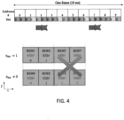
- the mapping of SSB indexes to the determined ROs is fundamental for a UE to understand which ROs are associated to the SSB index selected during the preliminary step before the start of the RACH procedure.
- the different SSB indexes are beamformed in different directions in the cell. Hence, selection of a wrong SSB index may entail failure of the RACH procedure.
- one fundamental parameter ssb-perRACH-OccasionAndCB-PreamblesPerSSB is configured in RACH-ConfigCommon and indicates two information: (i) the number of SSB indexes per RO and (ii) the number of contention-based preambles per SSB index.
- the UE maps the SSB indexes to the time-frequency grid of ROs (determined as described above) in increasing order of frequency resource indices, time resource indices of the ROs within a PRACH slots, and the PRACH slots, sequentially.
- FIG. 4 illustrates an example of SSB to RO mapping with prach-ConfigurationIndex 251 and UL/DL configuration DDDSU.
- Msg1-FDM two
- TS 38.213 defines an association period, starting from frame 0, for mapping SSB indexes to PRACH occasions (i.e. ROs) as the smallest value in the set determined by the PRACH configuration period according to Table 8.1-1 (shown below) such that all of the SSB indexes are mapped at least once to the PRACH occasions within the association period.
- the PRACH configuration period referred to here is determined at the UE based on the configured PRACH configuration index.
- an association period is a period of time wherein all SSB indexes are mapped to at least one RO.
- Table 8.1-1 Mapping between PRACH configuration period and SS/PBCH block to PRACH occasion association period PRACH configuration period (msec) Association period (number of PRACH configuration periods) 10 ⁇ 1, 2, 4, 8, 16 ⁇ 20 ⁇ 1, 2, 4, 8 ⁇ 40 ⁇ 1, 2, 4 ⁇ 80 ⁇ 1.2 ⁇ 160 ⁇ 1 ⁇
- PRACH repetitions will be specified for 5G NR in Rel-18.
- the concept of RO groups was introduced, wherein with RO group it is intended a group of ROs where a UE transmits multiple PRACH transmissions (or also referred to as PRACH repetitions). Details of RO groups, however, are still being discussed in 3GPP. Features as described herein may be used to provide methods for determination of RO indexing at the UE for generation of the RO groups.
- RO groups are being defined in 3GPP RAN1 to allow a gNB to know with certainty on which ROs a UE is transmitting multiple PRACH transmissions and blindly combine the multiple PRACH transmissions. For that reason, as disclosed herein, the RO counting method for RO group generation for multi-PRACH transmission should be common among UEs in a cell. If the RO counting method is different among UEs in a cell, the first PRACH and the last PRACH transmission can be different among UEs, which makes impossible to have a combined detection over the multi-PRACH transmission at gNB. However, the RO group generation may become cumbersome when restricting the ROs of an RO group to be in different time instances and when considering the possibility of enabling frequency hopping in one RO group. For this reason, features are described herein for the determination of RO indexing at the UE targeting a simplification of the generation of the RO groups.
- Example methods are described herein for RO indexing and for RO groups determination at the UE in the case of multiple PRACH transmissions, based on the RO indexing.
- an example method is described for a UE to autonomously determine the index of ROs within certain association periods, and use such information for determination of the RO groups for the multiple PRACH transmissions, i.e. to unambiguously find on which ROs to perform PRACH repetitions.
- the PRACH resources are PRACH occasions (i.e. ROs), wherein the time and frequency location of the ROs are determined by the UE based on network configuration, and the numbering of the ROs refers to the determination of indexes of the ROs.
- ROs PRACH occasions
- the determination of the indexes is limited to an association period and for ROs mapped to a same SSB index, for ROs with same or different n RA
- the determination of the indexes is limited to an association period and for ROs mapped to a same SSB index, for ROs with same n RA
- the determination of the indexes spans multiple association periods for ROs mapped to a same SSB index and with same or different n RA
- the determination of the indexes spans multiple association periods for ROs mapped to a same SSB index and with same n RA
- the PRACH resources are association periods (APs), wherein the time span of the AP is determined by the UE based on network configuration and the specifications, and the numbering of the APs refers to the determination of indexes of the APs.
- APs association periods
- a set of K APs constitute a reference time period, and the APs are enumerated from 0 to K-1, wherein 0 is the first AP within the reference time period and K-1 is the last AP within the reference time period.
- the PRACH resources are RO groups, wherein the time span of the RO groups is determined by the UE based on network configuration and the specifications, and the numbering of the RO groups refers to the determination of indexes of the RO groups.
- the time span of a set of R RO groups constitutes a reference time period, and the RO groups are enumerated from 0 to R-1, wherein 0 is the first RO group within the reference time period and R-1 is the last RO group within the reference time period.
- an APP is defined as a period that includes one or more APs and is determined so that a pattern between PRACH occasions and SS/PBCH block indexes repeats at most every 160 msec.
- the time span of an APP is a time duration during which a same pattern between ROs and SSB indexes can be found.
- the numbering of the APPs refers to the determination of indexes of the APPs.
- a set of P APPs constitute a reference time period, and the association pattern periods are enumerated from 0 to P-1, wherein 0 is the first APP within the reference time period and P-1 is the last APP within the reference time period.
- all ROs associated with a same SSB index in a same time instance share a same RO index and the numbering is done in time domain.
- the UE determines RO numbering/indexing (such as with the example methods described above and further described with the examples below), the UE then groups the ROs into an RO group, and then the UE provides transmission of the multiple PRACH transmissions in the determined ROs of the determined RO group.
- the UE may be configured to use one group or multiple groups. For the time-frequency grid provided in the examples below, the UE may determine all the RO groups within the grid. Then the UE may choose the group to be used to send its PRACH repetitions. So, in the example where there is more than one group, the UE may only transmit in regard to one selected group at a time even though multiple grouping may be available for use. Although the UE may be able to report details of a RO group or grouping selection to the gNB, the UE does not need to communicate any details to gNB. This is because the gNB may be able to derive a RO group itself. The way for a gNB to derive a RO groups itself may, for example, be described in a specification for the UE and/or a specification for the gNB.
- the UE may be configured to only use one method.
- the UE may be configured to select one of the methods from a group of methods.
- the selection process may be in a predetermined way, i.e., according to some rules. As one example, if RO indexing is done in a certain way, then the UE may select a predetermined certain RO grouping method; otherwise, the UE may select another predetermined grouping method.
- Step 1 the UE is configured based upon a configuration from a gNB of the PRACH parameters and time and frequency location of the ROs.
- Step 2 the UE determines the numbering of PRACH resources, i.e., it determines the RO indexes of valid ROs with same SSB index.
- Step 3 the UE determines the ROs belonging to RO groups based on the RO numbering derived in Step 2 (these may be the RO indexes where the UE may perform its PRACH repetitions).
- the numbering of PRACH resources may refer to association period, e.g. within a certain association period.
- the UE may, thus, determine the ROs belonging to RO groups based on the RO numbering, for performing PRACH repetitions.
- An example method for determination of RO indexing at the UE for generation of the RO groups may be provided with numbering of PRACH resources, with reference to association period, and determining ROs belonging to RO groups based on the numbering.
- Features may be used regarding how to determine RO indexing at the UE in order to simplify generation of the RO groups.
- a UE may autonomously determine the index of ROs within certain associations period, and use such information for determination of the RO groups for the multiple PRACH transmissions, i.e. to unambiguously find on which ROs to perform PRACH repetitions. Because the UE may operate autonomously, network configuration is not required. Once the RO numbering/indexing and RO groups are determined, the UE may transmit the PRACH repetitions on one of the determined RO groups.
- numerology may be used for RO groups which may have direct standardization impact if agreed within RAN 1.
- Features may be integrated into standards such as, for example, TS 38.213 and TS 38.331.
- an example method comprising: receiving, from a network device, configuration information for random access, wherein the configuration information comprises parameters for determining a plurality of random access channel occasions and for mapping the plurality of random access channel occasions with one or more of a plurality of synchronization signal block indices as indicated with block 802; indexing the plurality of random access channel occasions as indicated with block 804; grouping the plurality of random access channel occasions into one or more random access channel occasion groups based on the indexing as indicated with block 806; and transmitting, to the network device, a plurality of physical random access channel transmissions using at least one of the one or more random access channel occasion groups as indicated with block 808.
- the method may further comprise determining corresponding time and frequency positions of the plurality of random access channel occasions based on the configuration information.
- the random access channel occasions may be at a same frequency position.
- the random access channel occasions may be at different frequency positions.
- the method may further comprise: sequentially indexing, within an association period, random access channel occasions mapped to a same synchronization signal block index of the plurality of synchronization signal block indices, starting from a first random access channel occasion mapped to the same synchronization signal block index in the association period, wherein the first random access channel occasion is the earliest random access channel occasion in the association period at the lowest frequency position among the plurality of random access channel occasions.
- the sequentially indexing may be done first in frequency and then in time.
- the sequentially indexing may be done first in time and then in frequency.
- the sequentially indexing may be done only in time for each frequency position of the random access channel occasions.
- the method may further comprise indexing, across more than one association period, random access channel occasions mapped to a same synchronization signal block index of the plurality of synchronization signal block indices.
- the random access channel occasions may be at a same frequency position.
- the random access channel occasions may be at different frequency positions.
- the method may further comprise determining a time span of the more than one association period based on the configuration information.
- the association periods may constitute a reference time period; and the association periods are enumerated from 0 to K-1, wherein 0 is the first association period within the reference time period and K-1 is the last association period within the reference time period, K is a positive integer.
- the random access channel occasions in one random access channel occasion group may be associated with a same synchronization signal block index.
- the random access channel occasions associated with a same synchronization signal block index, in a same time instance, may share a same random access channel occasion index, and the indexing may be done in time domain.
- a random access channel occasion group may be determined as a sequence of random access channel occasions with consecutive indexes at a same frequency position.
- a random access channel occasion group may be determined as a sequence of random access channel occasions with consecutive indexes at different frequency positions.
- a random access channel occasion group may be determined as a sequence of random access channel occasions with non-consecutive indexes.
- a random access channel occasion group may be determined as a sequence of random access channel occasions with a same index.
- a random access channel occasion group may be determined as a sequence of random access channel occasions in a sequence of association periods with consecutive indexes.
- An example method comprising: indexing physical random access channel resources; determining grouping of the physical random access channel resources based, at least partially, upon the indexing; and transmitting a physical random access channel transmission using the determined grouping.
- the method may further comprise determining the physical random access channel resources, where the random access channel resources comprise physical random access channel occasions.
- the transmitting of the physical random access channel transmission may comprise a physical random access channel repetition.
- the transmitting of the physical random access channel transmission may comprise transmitting the physical random access channel transmission multiple times at occasions determined using the determined grouping.
- the indexing of the physical random access channel resources may comprise indexing relative to at least one association period.
- the indexing of the physical random access channel resources may comprise indexing relative to occasions mapped to a same synchronization signal block index.
- the indexing of the physical random access channel resources may comprise starting with an earliest physical random access channel resource in an association period at a lowest frequency position.
- the indexing of the physical random access channel resources relative to one another may be sequentially accomplished first in relation to frequency of the physical random access channel resource and then in relation to time of the physical random access channel resource.
- the indexing of the physical random access channel resources relative to one another may be sequentially accomplished first in relation to time of the physical random access channel resource and then in relation to frequency of the physical random access channel resource.
- the indexing of the physical random access channel resources relative to one another may be sequentially accomplished first in relation to time of the physical random access channel resource and not in relation to frequency of the physical random access channel resource.
- the indexing of the physical random access channel resources may comprise a multi-step process comprising partially indexing with regard to a first association period and partially indexing with regard to multiple association periods.
- the indexing of the physical random access channel resources may comprise indexing relative to a sole association period.
- the indexing of the physical random access channel resources may comprise indexing relative to a random access frequency index.
- the indexing of the physical random access channel resources may comprise a modulo operation using a size of the group seeking to be created.
- the determining of the grouping may comprise the group being determined as a sequence of physical random access channel resources with consecutive indexes at a same random access frequency index value.
- the determining of the grouping may comprise the group being determined as a sequence of physical random access channel resources with consecutive indexes at different random access frequency index values.
- the determining of the grouping may comprise the group being determined as a sequence of physical random access channel resources with non-consecutive indexes.
- the determining of the grouping may comprise the group being determined as a sequence of physical random access channel resources with same indexes.
- the determining of the grouping may comprise the group being determined as a sequence of ROs in a sequence of association periods with consecutive
- An example embodiment may be provided with an apparatus comprising: at least one processor; and at least one non-transitory memory storing instructions that, when executed with the at least one processor, cause the apparatus to perform: receiving, from a network device, configuration information for random access, wherein the configuration information comprises parameters for determining a plurality of random access channel occasions and for mapping the plurality of random access channel occasions with one or more of a plurality of synchronization signal block indices; indexing the plurality of random access channel occasions; grouping the plurality of random access channel occasions into one or more random access channel occasion groups based on the indexing; and transmitting, to the network device, a plurality of physical random access channel transmissions using at least one of the one or more random access channel occasion groups.
- the instructions when executed with the at least one processor, may cause the apparatus to perform: determining corresponding time and frequency positions of the plurality of random access channel occasions based on the configuration information.
- the random access channel occasions may be at a same frequency position.
- the random access channel occasions may be at different frequency positions.
- the instructions, when executed with the at least one processor, may cause the apparatus to perform: sequentially indexing, within an association period, random access channel occasions mapped to a same synchronization signal block index of the plurality of synchronization signal block indices, starting from a first random access channel occasion mapped to the same synchronization signal block index in the association period, wherein the first random access channel occasion is the earliest random access channel occasion in the association period at the lowest frequency position among the plurality of random access channel occasions.
- the sequentially indexing may be done first in frequency and then in time.
- the sequentially indexing may be done first in time and then in frequency.
- the sequentially indexing may be done only in time for each frequency position of the random access channel occasions.
- the instructions, when executed with the at least one processor, may cause the apparatus to perform: indexing, across more than one association period, random access channel occasions mapped to a same synchronization signal block index of the plurality of synchronization signal block indices.
- the random access channel occasions may be at a same frequency position.
- the random access channel occasions may be at different frequency positions.
- the instructions, when executed with the at least one processor may cause the apparatus to perform: determining a time span of the more than one association period based on the configuration information.
- the association periods may constitute a reference time period; and the association periods may be enumerated from 0 to K-1, wherein 0 is the first association period within the reference time period and K-1 is the last association period within the reference time period, K is a positive integer.
- Random access channel occasions in one random access channel occasion group may be associated with a same synchronization signal block index. Random access channel occasions associated with a same synchronization signal block index, in a same time instance, may share a same random access channel occasion index, and the indexing may be done in time domain.
- a random access channel occasion group may be determined as a sequence of random access channel occasions with consecutive indexes at a same frequency position.
- a random access channel occasion group may be determined as a sequence of random access channel occasions with consecutive indexes at different frequency positions.
- a random access channel occasion group may be determined as a sequence of random access channel occasions with non-consecutive indexes.
- a random access channel occasion group may be determined as a sequence of random access channel occasions with a same index.
- a random access channel occasion group may be determined as a sequence of random access channel occasions in a sequence of association periods with consecutive indexes.
- An example embodiment may be provided with an apparatus comprising: means for receiving, from a network device, configuration information for random access, wherein the configuration information comprises parameters for determining a plurality of random access channel occasions and for mapping the plurality of random access channel occasions with one or more of a plurality of synchronization signal block indices; means for indexing the plurality of random access channel occasions; means for grouping the plurality of random access channel occasions into one or more random access channel occasion groups based on the indexing; and means for transmitting, to the network device, a plurality of physical random access channel transmissions using at least one of the one or more random access channel occasion groups.
- An example embodiment may be provided with a non-transitory program storage device readable by an apparatus, tangibly embodying a program of instructions executable with the apparatus for performing operations, the operations comprising: receiving, from a network device, configuration information for random access, wherein the configuration information comprises parameters for determining a plurality of random access channel occasions and for mapping the plurality of random access channel occasions with one or more of a plurality of synchronization signal block indices; indexing the plurality of random access channel occasions; grouping the plurality of random access channel occasions into one or more random access channel occasion groups based on the indexing; and transmitting, to the network device, a plurality of physical random access channel transmissions using at least one of the one or more random access channel occasion groups.
- An example embodiment may be provided with an apparatus comprising: at least one processor; and at least one non-transitory memory storing instructions that, when executed with the at least one processor, cause the apparatus to perform: indexing physical random access channel resources; determining grouping of the physical random access channel resources based, at least partially, upon the indexing; and transmitting a physical random access channel transmission using the determined grouping.
- An example embodiment may be provided with an apparatus comprising: means for indexing physical random access channel resources; means for determining grouping of the physical random access channel resources based, at least partially, upon the indexing; and means for transmitting a physical random access channel transmission using the determined grouping.
- An example embodiment may be provided with a non-transitory program storage device readable by an apparatus, tangibly embodying a program of instructions executable with the apparatus for performing operations, the operations comprising: indexing physical random access channel resources; determining grouping of the physical random access channel resources based, at least partially, upon the indexing; and transmitting a physical random access channel transmission using the determined grouping.
- An example may be provided with a method comprising: receiving, from a network device, configuration information for random access, wherein the configuration information comprises a plurality of synchronization signal block indices and a plurality of random access channel occasions each associated with one or more of the plurality of synchronization signal block indices within corresponding one or more association periods; indexing the plurality of random access channel occasions based on the corresponding association periods; grouping the plurality of random access channel occasions into one or more random access channel occasion groups based on the indexing; and transmitting, to the network device, a plurality of physical random access channel transmissions using at least one of the one or more random access channel occasion groups.
- SSB indices may be referred to as configuration information.
- SSB is transmitted to a UE carrying synchronization signal and PBCH, and the UE detects its index.
- non-transitory is a limitation of the medium itself (i.e., tangible, not a signal) as opposed to a limitation on data storage persistency (e.g., RAM vs. ROM).
- circuitry may refer to one or more or all of the following:
- circuitry also covers an implementation of merely a hardware circuit or processor (or multiple processors) or portion of a hardware circuit or processor and its (or their) accompanying software and/or firmware.
- circuitry also covers, for example and if applicable to the particular claim element, a baseband integrated circuit or processor integrated circuit for a mobile device or a similar integrated circuit in server, a cellular network device, or other computing or network device.
Landscapes
- Engineering & Computer Science (AREA)
- Computer Networks & Wireless Communication (AREA)
- Signal Processing (AREA)
- Mobile Radio Communication Systems (AREA)
Applications Claiming Priority (1)
| Application Number | Priority Date | Filing Date | Title |
|---|---|---|---|
| US202363466505P | 2023-05-15 | 2023-05-15 |
Publications (1)
| Publication Number | Publication Date |
|---|---|
| EP4465747A1 true EP4465747A1 (de) | 2024-11-20 |
Family
ID=90904612
Family Applications (1)
| Application Number | Title | Priority Date | Filing Date |
|---|---|---|---|
| EP24172436.8A Pending EP4465747A1 (de) | 2023-05-15 | 2024-04-25 | Verfahren zur prach-gelegenheitsindexierung und ro-gruppenbestimmung |
Country Status (2)
| Country | Link |
|---|---|
| US (1) | US20240389155A1 (de) |
| EP (1) | EP4465747A1 (de) |
Family Cites Families (4)
| Publication number | Priority date | Publication date | Assignee | Title |
|---|---|---|---|---|
| US9119064B2 (en) * | 2013-11-20 | 2015-08-25 | At&T Intellectual Property I, L.P. | Method and apparatus for providing broadcast channel encryption to enhance cellular network security |
| US10405354B2 (en) * | 2016-12-09 | 2019-09-03 | Samsung Electronics Co., Ltd. | Method and apparatus for RACH procedure in wireless systems |
| CN111278156B (zh) * | 2019-03-29 | 2022-02-15 | 维沃移动通信有限公司 | 随机接入过程的信息传输方法及终端 |
| US20260067782A1 (en) * | 2022-09-06 | 2026-03-05 | Interdigital Patent Holdings, Inc. | Methods, apparatus, and systems for proactive non-radio measurements based conditional pscell change |
-
2024
- 2024-04-25 EP EP24172436.8A patent/EP4465747A1/de active Pending
- 2024-05-15 US US18/664,424 patent/US20240389155A1/en active Pending
Non-Patent Citations (2)
| Title |
|---|
| CHINA TELECOM: "Discussion on PRACH coverage enhancement", vol. 3GPP RAN 1, no. e-Meeting; 20230417 - 20230426, 7 April 2023 (2023-04-07), XP052352501, Retrieved from the Internet <URL:https://ftp.3gpp.org/tsg_ran/WG1_RL1/TSGR1_112b-e/Docs/R1-2303034.zip R1-2303034.docx> [retrieved on 20230407] * |
| MARCO MASO ET AL: "PRACH coverage enhancements", vol. 3GPP RAN 1, no. Online; 20230417 - 20230426, 7 April 2023 (2023-04-07), XP052293455, Retrieved from the Internet <URL:https://www.3gpp.org/ftp/TSG_RAN/WG1_RL1/TSGR1_112b-e/Docs/R1-2302880.zip R1-2302880 PRACH coverage enhancements.docx> [retrieved on 20230407] * |
Also Published As
| Publication number | Publication date |
|---|---|
| US20240389155A1 (en) | 2024-11-21 |
Similar Documents
| Publication | Publication Date | Title |
|---|---|---|
| US11979916B2 (en) | Method and apparatus for determining RA-RNTI | |
| EP3994945B1 (de) | Verfahren und vorrichtung zur breitband-prach-konfiguration für nr unlicensed | |
| RU2739330C1 (ru) | Произвольный доступ с переключением частей ширины полосы частот | |
| US9807656B2 (en) | Method and UE for performing random access to base station, and method and base station for establishing connection with UE | |
| US20250038900A1 (en) | Initial access method and communication apparatus | |
| US12232179B2 (en) | 2-step RACH radio network temporary identifier (RNTI) | |
| US20200245365A1 (en) | NPRACH Formats for NB-IoT Transmission in TDD Mode | |
| EP4611471A1 (de) | Kommunikationsverfahren und -vorrichtung | |
| US12389446B2 (en) | Information indication method and apparatus, device, and storage medium | |
| CN111726825B (zh) | 通信方法及装置 | |
| US20210410195A1 (en) | Method for two-step random access, terminal device and network device | |
| WO2023198059A1 (zh) | 一种通信方法、装置、系统及存储介质 | |
| EP4694439A1 (de) | Kommunikationsverfahren und -vorrichtung | |
| CN117652115A (zh) | 半双工频分双工冲突处理 | |
| US20260075656A1 (en) | Starting random access channel occasion determination for multiple prach transmissions for wireless networks | |
| US20240389155A1 (en) | Methods for prach occasion indexing and ro groups determination | |
| EP4666454A1 (de) | Verfahren und vorrichtung für den ausgangsleistungszustand eines benutzergeräts zur auswahl der anzahl von prach-wiederholungen | |
| CN113647133B (zh) | 发送、接收反馈信息的方法和设备 | |
| CN118574242A (zh) | Ro确定方法及相关装置 | |
| US20260075655A1 (en) | Communication method and related apparatus | |
| WO2026088009A1 (en) | Facilitating mu-mimo transmission for pdcch and pdsch carrying random access response | |
| GB2628971A (en) | Methods for frequency hopping in PRACH repetitions | |
| KR20260070463A (ko) | 무선 통신 시스템에서 cfra에 대하여 prach 반복 전송을 수행하기 위한 장치 및 방법 | |
| CN119631554A (zh) | 用于分割prach格式传输的方法 | |
| WO2021160069A1 (en) | Method and apparatus for random access |
Legal Events
| Date | Code | Title | Description |
|---|---|---|---|
| PUAI | Public reference made under article 153(3) epc to a published international application that has entered the european phase |
Free format text: ORIGINAL CODE: 0009012 |
|
| STAA | Information on the status of an ep patent application or granted ep patent |
Free format text: STATUS: THE APPLICATION HAS BEEN PUBLISHED |
|
| AK | Designated contracting states |
Kind code of ref document: A1 Designated state(s): AL AT BE BG CH CY CZ DE DK EE ES FI FR GB GR HR HU IE IS IT LI LT LU LV MC ME MK MT NL NO PL PT RO RS SE SI SK SM TR |
|
| STAA | Information on the status of an ep patent application or granted ep patent |
Free format text: STATUS: REQUEST FOR EXAMINATION WAS MADE |
|
| 17P | Request for examination filed |
Effective date: 20250520 |