EP4465368A1 - Thixotropic silicone gel composition for spot potting, cured product thereof, and photocoupler - Google Patents
Thixotropic silicone gel composition for spot potting, cured product thereof, and photocoupler Download PDFInfo
- Publication number
- EP4465368A1 EP4465368A1 EP23740198.9A EP23740198A EP4465368A1 EP 4465368 A1 EP4465368 A1 EP 4465368A1 EP 23740198 A EP23740198 A EP 23740198A EP 4465368 A1 EP4465368 A1 EP 4465368A1
- Authority
- EP
- European Patent Office
- Prior art keywords
- silicone gel
- cured product
- gel composition
- composition
- component
- Prior art date
- Legal status (The legal status is an assumption and is not a legal conclusion. Google has not performed a legal analysis and makes no representation as to the accuracy of the status listed.)
- Pending
Links
Classifications
-
- C—CHEMISTRY; METALLURGY
- C09—DYES; PAINTS; POLISHES; NATURAL RESINS; ADHESIVES; COMPOSITIONS NOT OTHERWISE PROVIDED FOR; APPLICATIONS OF MATERIALS NOT OTHERWISE PROVIDED FOR
- C09D—COATING COMPOSITIONS, e.g. PAINTS, VARNISHES OR LACQUERS; FILLING PASTES; CHEMICAL PAINT OR INK REMOVERS; INKS; CORRECTING FLUIDS; WOODSTAINS; PASTES OR SOLIDS FOR COLOURING OR PRINTING; USE OF MATERIALS THEREFOR
- C09D183/00—Coating compositions based on macromolecular compounds obtained by reactions forming in the main chain of the macromolecule a linkage containing silicon, with or without sulfur, nitrogen, oxygen, or carbon only; Coating compositions based on derivatives of such polymers
- C09D183/04—Polysiloxanes
-
- C—CHEMISTRY; METALLURGY
- C09—DYES; PAINTS; POLISHES; NATURAL RESINS; ADHESIVES; COMPOSITIONS NOT OTHERWISE PROVIDED FOR; APPLICATIONS OF MATERIALS NOT OTHERWISE PROVIDED FOR
- C09D—COATING COMPOSITIONS, e.g. PAINTS, VARNISHES OR LACQUERS; FILLING PASTES; CHEMICAL PAINT OR INK REMOVERS; INKS; CORRECTING FLUIDS; WOODSTAINS; PASTES OR SOLIDS FOR COLOURING OR PRINTING; USE OF MATERIALS THEREFOR
- C09D183/00—Coating compositions based on macromolecular compounds obtained by reactions forming in the main chain of the macromolecule a linkage containing silicon, with or without sulfur, nitrogen, oxygen, or carbon only; Coating compositions based on derivatives of such polymers
- C09D183/04—Polysiloxanes
- C09D183/06—Polysiloxanes containing silicon bound to oxygen-containing groups
-
- C—CHEMISTRY; METALLURGY
- C08—ORGANIC MACROMOLECULAR COMPOUNDS; THEIR PREPARATION OR CHEMICAL WORKING-UP; COMPOSITIONS BASED THEREON
- C08G—MACROMOLECULAR COMPOUNDS OBTAINED OTHERWISE THAN BY REACTIONS ONLY INVOLVING UNSATURATED CARBON-TO-CARBON BONDS
- C08G77/00—Macromolecular compounds obtained by reactions forming a linkage containing silicon with or without sulfur, nitrogen, oxygen or carbon in the main chain of the macromolecule
- C08G77/04—Polysiloxanes
- C08G77/06—Preparatory processes
- C08G77/08—Preparatory processes characterised by the catalysts used
-
- C—CHEMISTRY; METALLURGY
- C08—ORGANIC MACROMOLECULAR COMPOUNDS; THEIR PREPARATION OR CHEMICAL WORKING-UP; COMPOSITIONS BASED THEREON
- C08G—MACROMOLECULAR COMPOUNDS OBTAINED OTHERWISE THAN BY REACTIONS ONLY INVOLVING UNSATURATED CARBON-TO-CARBON BONDS
- C08G77/00—Macromolecular compounds obtained by reactions forming a linkage containing silicon with or without sulfur, nitrogen, oxygen or carbon in the main chain of the macromolecule
- C08G77/04—Polysiloxanes
- C08G77/12—Polysiloxanes containing silicon bound to hydrogen
-
- C—CHEMISTRY; METALLURGY
- C08—ORGANIC MACROMOLECULAR COMPOUNDS; THEIR PREPARATION OR CHEMICAL WORKING-UP; COMPOSITIONS BASED THEREON
- C08G—MACROMOLECULAR COMPOUNDS OBTAINED OTHERWISE THAN BY REACTIONS ONLY INVOLVING UNSATURATED CARBON-TO-CARBON BONDS
- C08G77/00—Macromolecular compounds obtained by reactions forming a linkage containing silicon with or without sulfur, nitrogen, oxygen or carbon in the main chain of the macromolecule
- C08G77/04—Polysiloxanes
- C08G77/20—Polysiloxanes containing silicon bound to unsaturated aliphatic groups
-
- C—CHEMISTRY; METALLURGY
- C08—ORGANIC MACROMOLECULAR COMPOUNDS; THEIR PREPARATION OR CHEMICAL WORKING-UP; COMPOSITIONS BASED THEREON
- C08K—Use of inorganic or non-macromolecular organic substances as compounding ingredients
- C08K3/00—Use of inorganic substances as compounding ingredients
- C08K3/34—Silicon-containing compounds
- C08K3/36—Silica
-
- C—CHEMISTRY; METALLURGY
- C08—ORGANIC MACROMOLECULAR COMPOUNDS; THEIR PREPARATION OR CHEMICAL WORKING-UP; COMPOSITIONS BASED THEREON
- C08K—Use of inorganic or non-macromolecular organic substances as compounding ingredients
- C08K5/00—Use of organic ingredients
- C08K5/54—Silicon-containing compounds
- C08K5/544—Silicon-containing compounds containing nitrogen
- C08K5/5477—Silicon-containing compounds containing nitrogen containing nitrogen in a heterocyclic ring
-
- C—CHEMISTRY; METALLURGY
- C08—ORGANIC MACROMOLECULAR COMPOUNDS; THEIR PREPARATION OR CHEMICAL WORKING-UP; COMPOSITIONS BASED THEREON
- C08K—Use of inorganic or non-macromolecular organic substances as compounding ingredients
- C08K9/00—Use of pretreated ingredients
- C08K9/04—Ingredients treated with organic substances
- C08K9/06—Ingredients treated with organic substances with silicon-containing compounds
-
- C—CHEMISTRY; METALLURGY
- C09—DYES; PAINTS; POLISHES; NATURAL RESINS; ADHESIVES; COMPOSITIONS NOT OTHERWISE PROVIDED FOR; APPLICATIONS OF MATERIALS NOT OTHERWISE PROVIDED FOR
- C09D—COATING COMPOSITIONS, e.g. PAINTS, VARNISHES OR LACQUERS; FILLING PASTES; CHEMICAL PAINT OR INK REMOVERS; INKS; CORRECTING FLUIDS; WOODSTAINS; PASTES OR SOLIDS FOR COLOURING OR PRINTING; USE OF MATERIALS THEREFOR
- C09D7/00—Features of coating compositions, not provided for in group C09D5/00; Processes for incorporating ingredients in coating compositions
- C09D7/40—Additives
- C09D7/60—Additives non-macromolecular
- C09D7/61—Additives non-macromolecular inorganic
- C09D7/62—Additives non-macromolecular inorganic modified by treatment with other compounds
-
- C—CHEMISTRY; METALLURGY
- C09—DYES; PAINTS; POLISHES; NATURAL RESINS; ADHESIVES; COMPOSITIONS NOT OTHERWISE PROVIDED FOR; APPLICATIONS OF MATERIALS NOT OTHERWISE PROVIDED FOR
- C09D—COATING COMPOSITIONS, e.g. PAINTS, VARNISHES OR LACQUERS; FILLING PASTES; CHEMICAL PAINT OR INK REMOVERS; INKS; CORRECTING FLUIDS; WOODSTAINS; PASTES OR SOLIDS FOR COLOURING OR PRINTING; USE OF MATERIALS THEREFOR
- C09D7/00—Features of coating compositions, not provided for in group C09D5/00; Processes for incorporating ingredients in coating compositions
- C09D7/40—Additives
- C09D7/60—Additives non-macromolecular
- C09D7/63—Additives non-macromolecular organic
-
- C—CHEMISTRY; METALLURGY
- C08—ORGANIC MACROMOLECULAR COMPOUNDS; THEIR PREPARATION OR CHEMICAL WORKING-UP; COMPOSITIONS BASED THEREON
- C08K—Use of inorganic or non-macromolecular organic substances as compounding ingredients
- C08K2201/00—Specific properties of additives
- C08K2201/002—Physical properties
- C08K2201/006—Additives being defined by their surface area
Definitions
- This invention relates to a thixotropic silicone gel composition for spot potting, especially for spot potting for use in the sealing of photocouplers, which shows narrow spreading upon coating onto a substrate and little changes of shape before and after heat cure and little changes of penetration of a cured product under high-temperature conditions, a cured product (silicone gel) thereof, and a photocoupler sealed with the cured product.
- silicone gel Since silicone gel has excellent properties including electric insulation, stable electric properties and flexibility, it is used for potting and sealing of electric/electronic parts as a coating material to coat control circuit devices such as ICs and capacitors therewith to protect them from thermal and mechanical damages.
- silicone gel compositions used for such purposes are highly flowable because they are intended for use by casting or potting into casings. They are unsuitable in spot potting for coating only a specified semiconductor device rested on a control circuit substrate.
- Patent Document 1 JP 3073888 discloses an addition curing silicone gel composition comprising an organopolysiloxane having a 3,3,3-trifluoropropyl group on molecular side chain and hydrophobized silica.
- Patent Document 2 JP-A H09-132718 discloses a two-pack curable silicone composition comprising an organopolysiloxane having an alkenyl group and an inorganic filler having a specific surface area of 50 to 500 m 2 /g.
- Patent Document 3 JP 3746394 proposes an addition curing silicone gel composition comprising a branched organopolysiloxane having an alkenyl group, silica powder, and an epoxy compound and/or polyhydric alcohol.
- a low-viscosity silicone gel composition having a viscosity of 10 Pa s or lower is disclosed. It shows insufficient shape retention in the heat curing step.
- the polyhydric alcohol is used, there is a risk of property changes with the lapse of time (or under-cure).
- An object of the invention which has been made under the above-mentioned circumstances, is to provide a thixotropic silicone gel composition for spot potting which shows narrow spreading upon coating onto a substrate such as control circuit substrate, little changes of shape before and after heat curing and little changes of penetration of a cured product under high-temperature conditions, and is suited for the sealing of a specific semiconductor device resting on a control circuit substrate such as photocoupler, a cured product thereof, and a photocoupler sealed with the cured product.
- a silicone gel composition comprising a silicon-bonded alkenyl-containing linear or branched organopolysiloxane containing a specific amount of diphenylsiloxane units ((C 6 H 5 ) 2 SiO 2/2 ) in the molecule as a base polymer, a crosslinker having a specific molecular structure, a platinum base curing catalyst, hydrophobically treated fine-powder silica, and an isocyanuric acid derivative of specific molecular structure containing at least 2 trialkoxysilyl-substitued alkyl groups in the molecule, the composition curing into a silicone gel cured product having a penetration of 10 to 100 as measured by JIS K6249.
- the invention is predicated on this finding.
- the invention provides a thixotropic silicone gel composition for spot potting, a cured product (silicone gel) thereof, and a photocoupler, as defined below.
- the thixotropic silicone gel composition for spot potting shows narrow spreading upon coating onto substrates including various electronic substrates such as control circuit substrates, little changes of shape before and after heat curing, and little changes of penetration of a cured product under high-temperature conditions (little changes of flexibility or little changes of stress relaxation), is suited for the sealing of a specific semiconductor device resting on a control circuit substrate such as photocoupler by potting (so-called spot potting), and can be used to seal the device in the desired shape. It is thus useful for the sealing of photocouplers and the like.
- silicone gel cured product means a cured product composed mainly of organopolysiloxane, having a low crosslinking density, and having a penetration (or cone penetration) of 10 to 100 as measured according to JIS K6249 using the penetration test method (1/4 cone) of JIS K2220.
- the silicone gel cured product is distinguished from so-called silicone rubber cured product (rubbery elastomer).
- Component (A) is an organopolysiloxane which is a main component or base polymer of the thixotropic silicone gel composition for spot potting. It is a linear or branched organopolysiloxane containing 0.1 to 10 mol% of (C 6 H 5 ) 2 SiO 2/2 units as difunctional diorganosiloxane units (D units of the formula: R 2 SiO 2/2 wherein R is an unsubstituted or substituted monovalent hydrocarbon group) of which the backbone is composed, based on the overall diorganosiloxane units in the backbone, and containing an alkenyl group bonded to a silicon atom (also referred to as "silicon-bonded alkenyl group”) per molecule, that is, a linear or branched alkenyl-containing organopolysiloxane essentially comprising a specific amount of diphenylsiloxane units in the molecule.
- the "branched" organopolysiloxane is an organopolysiloxane containing a small number, for example, 1 to 5, preferably 1 to 3 trifunctional organosilsesquioxane units (T units of the formula: RSiO 3/2 wherein R is an unsubstituted or substituted monovalent hydrocarbon group) as a branching site(s) in the repeating structure of difunctional diorganosiloxane units of which the backbone is composed.
- linear organopolysiloxane refers to an organopolysiloxane consisting of difunctional diorganosiloxane units (D units) of which the backbone is composed and monofunctional triorganosiloxy units (M units of the formula: R 3 SiO 1/2 wherein R is an unsubstituted or substituted monovalent hydrocarbon group) of which the molecular chain end is composed.
- the branched organopolysiloxane refers to an organopolysiloxane which is composed of trifunctional organosilsesquioxane units (T units) as a branching site, difunctional diorganosiloxane units (D units) of which the backbone is composed, and monofunctional triorganosiloxy units (M units) of which the molecular chain end is composed and has branches in the molecule, and which may contain a cyclic structure in the molecule.
- T units trifunctional organosilsesquioxane units
- D units difunctional diorganosiloxane units
- M units monofunctional triorganosiloxy units
- R is phenyl groups, alkenyl groups to be described later, and "silicon-bonded organic groups" to be described later.
- the alkenyl groups are preferably of 2 to 10 carbon atoms, and examples thereof include vinyl, allyl, propenyl, isopropenyl, butenyl, isobutenyl, pentenyl, hexenyl, cyclohexenyl and heptenyl, with vinyl being preferred.
- the position of an organopolysiloxane molecule at which the silicon-bonded alkenyl group is bonded may be a molecular chain end or a molecular chain non-end (i.e., molecular chain side chain) or both.
- the content of silicon-bonded alkenyl group is preferably 0.001 to 10 mol/100 g, more preferably 0.002 to 1 mol/100 g, even more preferably 0.003 to 0.1 mol/100 g, most preferably 0.004 to 0.05 mol/100 g.
- the organic group bonded to a silicon atom (referred to as "silicon-bonded organic group", hereinafter) other than the silicon-bonded alkenyl group and the phenyl groups of which diphenylsiloxane unit is composed is not particularly limited as long as it is free of aliphatic unsaturation.
- silicon-bonded organic group referred to as "silicon-bonded organic group”, hereinafter
- examples thereof include unsubstituted or substituted monovalent hydrocarbon groups of typically 1 to 12 carbon atoms, preferably 1 to 10 carbon atoms, free of aliphatic unsaturation.
- Examples of the unsubstituted or substituted monovalent hydrocarbon groups include alkyl groups such as methyl, ethyl, propyl, butyl, pentyl, hexyl and heptyl; cycloalkyl groups such as cyclohexyl; aryl groups such as tolyl, xylyl and naphthyl (exclusive of phenyl); aralkyl groups such as benzyl and phenethyl; and substituted forms of the foregoing in which some or all of the hydrogen atoms are substituted by halogen atoms such as chlorine, fluorine, and bromine, e.g., halogenated alkyl groups such as chloromethyl, 3-chloropropyl and 3,3,3-trifluoropropyl.
- alkyl, aryl and halogenated alkyl groups are preferred.
- methyl and trifluoropropyl are more preferred, with methyl being most preferred
- the organopolysiloxane as component (A) contains typically 0.1 to 10 mol%, preferably 0.5 to 8 mol%, more preferably 1 to 6 mol% of (C 6 H 5 ) 2 SiO 2/2 units, based on the overall diorganopolysiloxane units consisting of repeating difunctional diorganosiloxane units of which the molecular chain backbone is composed. If the content of (C 6 H 5 ) 2 SiO 2/2 units exceeds the upper limit of the range, the resulting composition has a very high viscosity which detracts from the efficiency of coating work.
- Component (A) has a viscosity at 25°C of preferably 100 to 100,000 mPa s, more preferably 300 to 10,000 mPa ⁇ s, because the workability of the composition and the dynamic properties of a cured product (silicone gel cured product) become better.
- the viscosity may be measured by a rotational viscometer, for example, BL, BH, BS or cone plate type viscometer or rheometer (the same holds true, hereinafter).
- the number of silicon atoms (or degree of polymerization) in component (A) is typically about 30 to about 1,200, preferably about 50 to about 1,000, more preferably about 80 to about 800.
- the degree of polymerization is determined as a number average degree of polymerization (or number average molecular weight) as analyzed by gel permeation chromatography (GPC) versus polystyrene standards using toluene as a developing solvent (the same holds true, hereinafter).
- component (A) examples include diorganopolysiloxanes capped with triorganosiloxy groups at both ends of the molecular chain such as both end dimethylvinylsiloxy-capped dimethylsiloxane/diphenylsiloxane copolymers, both end dimethylvinylsiloxy-capped dimethylsiloxane/methylvinylsiloxane/diphenylsiloxane copolymers, both end trimethylsiloxy-capped dimethylsiloxane/vinylmethylsiloxane/diphenylsiloxane copolymers, one end trimethylsiloxy- and one end dimethylvinylsiloxy-capped dimethylsiloxane/diphenylsiloxane copolymers, one end trimethylsiloxy- and one end dimethylvinylsiloxy-capped dimethylsiloxane/diphenylsiloxane copolymers, one end trimethylsiloxy- and one end di
- the organopolysiloxane as component (A) may be used alone or in admixture of two or more as long as the condition that component (A) contains on the average at least 0.5 silicon-bonded alkenyl group per molecule in entirety is met.
- Component (B) used herein is an organohydrogenpolysiloxane which acts as a crosslinker or curing agent in hydrosilation curing reaction with component (A). It is a linear organohydrogenpolysiloxane, represented by the average compositional formula (1), containing at least 3, preferably 4 to 300, more preferably 5 to 100 hydrogen atoms each bonded to a silicon atom (referred to as "silicon-bonded hydrogen atoms" or SiH groups, hereinafter) per molecule, more specifically an organohydrogensiloxane/diorganosiloxane copolymer capped with triorganosiloxy groups at both ends of the molecular chain or organohydrogensiloxane/diorganosiloxane copolymer capped with diorganohydrogensiloxy groups at both ends of the molecular chain, which essentially contains a hydrogen atom bonded to a silicon atom (SiH group) at a non-end position (or intermediate position
- R 1 which may be identical or different, is a C 1 -C 10 monovalent hydrocarbon group free of aliphatic unsaturation, "a” is 0 or 1, "b” is a positive number of 0.002 to 0.3, “c” is a positive number of 0.1 to 0.6.
- R 1 which may be identical or different, is a monovalent hydrocarbon group free of aliphatic unsaturation, preferably an unsubstituted or substituted, aliphatic unsaturation-free monovalent hydrocarbon group of typically 1 to 10 carbon atoms, preferably 1 to 6 carbon atoms.
- alkyl groups such as methyl, ethyl, propyl, butyl, pentyl, hexyl and heptyl; cycloalkyl groups such as cyclohexyl; aryl groups such as phenyl, tolyl, xylyl and naphthyl; aralkyl groups such as benzyl and phenethyl; and substituted forms of the foregoing in which some or all of the hydrogen atoms are substituted by halogen atoms such as chlorine, fluorine, and bromine, e.g., halogenated alkyl groups such as chloromethyl, 3-chloropropyl and 3,3,3-trifluoropropyl. Of these, alkyl and aryl groups are preferred, with methyl and phenyl being more preferred.
- a is 0 or 1;
- b is a positive number of 0.002 to 0.3, preferably 0.006 to 0.2, more preferably 0.013 to 0.1;
- c is a positive number of 0.1 to 0.6, preferably 0.1 to 0.4. If b is less than 0.002, a silicone gel cured product having the desired penetration is not obtained. If b exceeds 0.3, it is not only difficult to obtain a silicone gel cured product having a low elasticity and low stress, but the cured product also has a varying density on its surface and hence, loses displacement durability.
- the average compositional formula (1) indicates that the molecular structure of component (B) is an organohydrogensiloxane/diorganosiloxane copolymer capped with triorganosiloxy groups at both ends of the molecular chain or organohydrogensiloxane/diorganosiloxane copolymer capped with diorganohydrogensiloxy groups at both ends of the molecular chain, and represented by the average molecular formula (1'): wherein R 1 and "a" are as defined in average compositional formula (1), c' is an integer of 1 to 300, preferably 2 to 50, more preferably 3 to 30, d' is an integer of 4 to 700, preferably 6 to 280, more preferably 15 to 120, c'+d' is an integer of 5 to 998, preferably 8 to 328, more preferably 18 to 148, with the proviso that at least 3 SiH groups are contained per molecule.
- Component (B) may be synthesized by any prior art well-known methods.
- the organohydrogenpolysiloxane as component (B) has a viscosity at 25°C of preferably 0.1 to 5,000 mPa s, more preferably 0.5 to 1,000 mPa s, even more preferably 2 to 500 mPa ⁇ s, that is, in the range corresponding to liquid at room temperature (25°C), because the composition becomes readily workable and the cured product has better optical or dynamic properties.
- the number of silicon atoms per molecule (or degree of polymerization) of the organohydrogenpolysiloxane is typically about 7 to 1,000, preferably about 10 to 330, more preferably about 20 to 150.
- the content of silicon-bonded hydrogen atom (or SiH group) is preferably 0.0005 to 0.008 mol/g, more preferably 0.001 to 0.006 mol/g.
- Examples of the linear organohydrogenpolysiloxane as component (B) include those having the following average compositional formulae.
- Me stands for methyl
- b and c are as defined above.
- At least 3 SiH groups are contained in the molecule.
- examples of the linear organohydrogenpolysiloxane as component (B) include those having the following average compositional formulae.
- Me stands for methyl
- c' and d' are as defined above
- c" is an integer of 3 to 300, preferably 3 to 50, more preferably 3 to 30
- c"+d' is an integer of 7 to 998, preferably 9 to 328, more preferably 18 to 148.
- the organohydrogenpolysiloxane as component (B) may be used alone or in admixture.
- the amount of component (B) added is to provide 0.01 to 3 moles, preferably 0.05 to 2 moles, more preferably 0.1 to 1.8 moles, even more preferably 0.2 to 1.5 moles, most preferably 0.3 to 1.2 moles of silicon-bonded hydrogen atom (or SiH group) in component (B) per mole of silicon-bonded alkenyl group in component (A). If the amount of silicon-bonded hydrogen in component (B) is less than 0.01 mole per mole of silicon-bonded alkenyl group in component (A), a silicone gel cured product having the desired penetration is not obtained. If the amount exceeds 3 moles, the cured product may depart from gel or lose heat resistance.
- Component (C) used herein serves as a catalyst for promoting hydrosilation addition reaction of silicon-bonded alkenyl group in component (A) with silicon-bonded hydrogen (or SiH group) in component (B). It is a platinum base curing catalyst (platinum or platinum-base compound). Any well-known catalysts may be used. Examples include platinum group metal catalysts such as platinum black, chloroplatinic acid, alcohol-modified products of chloroplatinic acid, and complexes of chloroplatinic acid with olefins, aldehydes, vinylsiloxanes or acetylene alcohols.
- platinum group metal catalysts such as platinum black, chloroplatinic acid, alcohol-modified products of chloroplatinic acid, and complexes of chloroplatinic acid with olefins, aldehydes, vinylsiloxanes or acetylene alcohols.
- the amount of component (C) blended is a catalytic amount and may be suitably varied depending on the desired curing rate. Often, the amount is in a range to provide 0.1 to 1,000 ppm, preferably 1 to 300 ppm of platinum group metal based on the total weight of components (A) and (B). If the amount is too much, the resulting cured product may lose heat resistance. If the amount is too small, hydrosilation addition reaction may not fully take place under the predetermined curing conditions or a gel-like cured product may not be obtained.
- Component (D) used herein is finely divided silica which is hydrophobic as a result of surface treatment with an organosilazane, organochlorosilane, organoalkoxysilane or organopolysiloxane containing only methyl as a silicon-bonded monovalent hydrocarbon group, the surface-treated silica having a specific surface area of 50 to 500 m 2 /g as measured by the BET adsorption method.
- component (D) acts to impart thixotropy to the uncured composition to reduce the spreading thereof upon coating.
- the finely divided silica defined herein acts to allow the inventive composition to exert thixotropy through interaction with component (E).
- the silica should have a specific surface area of 50 to 500 m 2 /g, preferably 50 to 400 m 2 /g as measured by the BET adsorption method and be hydrophobically treated on its surface with an organosilazane, organochlorosilane, organoalkoxysilane or organopolysiloxane containing only methyl as a silicon-bonded organic substituent group (or monovalent hydrocarbon group).
- Examples of the surface treating agent include hexamethyldisilazane; trimethylchlorosilane, dimethyldichlorosilane, methyltrichlorosilane; trimethylalkoxysilanes, dimethyldialkoxysilanes, methyltrialkoxysilanes (wherein exemplary alkoxy groups include methoxy, ethoxy, propoxy and butoxy); cyclic or linear polydimethylsiloxanes, which may be used alone or in admixture.
- the dimethylpolysiloxanes may be either cyclic or linear.
- finely divided silica examples include fumed silica (dry silica), ground silica, fused silica, crystalline silica (finely divided quartz), precipitated silica (wet silica), and colloidal silica.
- fumed silica is preferred in view of the desired specific surface area (or average particle size).
- the finely divided silica which is hydrophobic as a result of surface treatment should have a specific surface area of 50 to 500 m 2 /g, preferably 50 to 400 m 2 /g as measured by the BET adsorption method. With a specific surface area of less than 50 m 2 /g, it is difficult to impart satisfactory thixotropy to the composition. With a specific surface area in excess of 500 m 2 /g, the composition has too high a viscosity and substantially loses coating work efficiency.
- hydrophobically surface-treated, finely divided silica is commercially available, for example, under the tradename of DM-30S (Tokuyama Corp.), NSX-200 (Nippon Aerosil Co., Ltd.), and CAB-O-SIL TS-610 (Cabot Corp.).
- the amount of component (D) blended is 2 to 30 parts by weight, preferably 3 to 20 parts by weight, more preferably 5 to 15 parts by weight per 100 parts by weight of component (A). If the amount is too small, component (D) fails to impart satisfactory thixotropy to the composition and to control the spreading upon coating. If the amount is too large, the composition has a significantly increased viscosity and loses coating work efficiency.
- Component (E) used herein is an isocyanuric acid derivative of specific molecular structure containing at least two trialkoxysilyl-substituted alkyl groups in the molecule, which is selected from an isocyanuric acid derivative whose isocyanuric acid skeleton is composed of three nitrogen atoms, containing a trialkoxysilyl-substituted alkyl group on each of two nitrogen atoms (total two alkyl groups per molecule) and an alkenyl group or an alkyl group substituted with a silyl or siloxanyl group containing silicon-bonded hydrogen (or SiH moiety) on the remaining one nitrogen atom, and an isocyanuric acid derivative whose isocyanuric acid skeleton is composed of three nitrogen atoms, containing a trialkoxysilyl-substituted alkyl group on each of three nitrogen atoms (total three alkyl groups per molecule). It corporates with component (D) to impart thixotropy
- component (E) More illustrative examples of component (E) include
- alkyl moiety in the trialkoxysilyl-substituted alkyl group and the alkyl group substituted with a silyl or siloxanyl group containing silicon-bonded hydrogen or SiH moiety examples include those of 2 to 10 carbon atoms such as ethyl, propyl, isopropyl, butyl, isobutyl, tert-butyl, pentyl, neopentyl, hexyl and octyl. Inter alia, propyl is preferred.
- alkoxy moiety in the trialkoxysilyl-substituted alkyl group examples include those of 1 to 10 carbon atoms such as methoxy, ethoxy, propoxy, and butoxy. Inter alia, methoxy and ethoxy are preferred.
- isocyanuric acid derivatives having the formulae (2) to (7) are preferred as component (E).
- the isocyanuric acid derivatives may be used alone or in admixture as component (E).
- Me is methyl and Et is ethyl.
- the amount of component (E) blended is 0.01 to 3 parts by weight, preferably 0.05 to 1 part by weight per 100 parts by weight of component (A). Less than 0.01 part of component (E) fails to impart sufficient thixotropy to the composition whereas more than 3 parts of component (E) leads to a high viscosity and a substantial drop of coating efficiency.
- the thixotropic silicone gel composition for spot potting may contain optional components as long as the object of the invention is not impaired.
- optional components include, for example, reaction inhibitors, inorganic fillers other than component (D), non-functional organopolysiloxanes free of silicon-bonded hydrogen (or SiH group) and silicon-bonded alkenyl participating in hydrosilation addition reaction (so-called non-functional silicone oils such as dimethylpolysiloxane and dimethylsiloxane-diphenylsiloxane copolymers), adhesion promotors contributing to an improvement in adhesion or pressure-sensitive adhesion (e.g., alkoxyorganosilanes), heat resistant additives, flame retardants, pigments, and dyes.
- reaction inhibitors for example, reaction inhibitors, inorganic fillers other than component (D), non-functional organopolysiloxanes free of silicon-bonded hydrogen (or SiH group) and silicon-bonded alkenyl participating in hydrosilation addition reaction (s
- the reaction inhibitor is a component for restraining the composition from reaction.
- exemplary reaction inhibitors include acetylene, amine, carboxylate, and phosphite compounds.
- the inorganic filler examples include inorganic fillers, for instance, finely divided silica other than component (D) such as crystalline silica and precipitated silica, inorganic hollow fillers (e.g., silica hollow fillers, titanium oxide hollow fillers), silsesquioxane, fumed titanium dioxide, magnesium oxide, zinc oxide, iron oxide, aluminum hydroxide, magnesium carbonate, calcium carbonate, zinc carbonate, laminar mica, diatomaceous earth, and glass fibers; as well as the foregoing inorganic fillers which are hydrophobically surface-treated with organosilicon compounds such as organoalkoxysilane compounds, organochlorosilane compounds, organosilazane compounds, and low-molecular-weight siloxane compounds.
- silicone rubber powders and silicone resin powders may be blended.
- the thixotropic silicone gel composition for spot potting may be obtained by mixing predetermined amounts of the foregoing components (A) to (E) and optional components until uniform.
- the components may be divided into two or more parts before they are mixed. For example, they are divided into one part consisting of part of component (A) and components (C), (D) and (E) and the other part consisting of the remainder of component (A) and component (B) before they are mixed.
- Exemplary mixing means used herein include homo-mixers, puddle mixers, homo-dispersers, colloid mills, vacuum mixing agitation mixers, and planetary mixers.
- the mixing means is not particularly limited as long as components (A) to (E) can be uniformly mixed.
- the method of computing the SVI value which is an apparent viscosity ratio is described below.
- the viscosity of a thixotropic silicone gel composition is measured according to JIS K7117, specifically a thixotropic silicone gel composition is measured for apparent viscosity by a rheometer (ARES G2 by TA Instruments) at 25°C and rotational speeds of 1 s -1 and 10 s -1 .
- the value of SVI is computed according to the following equation.
- SVI (apparent viscosity at rotational speed of 1 s -1 )/(apparent viscosity at rotational speed of 10 s -1 )
- the above-specified range of the SVI value (apparent viscosity ratio) of a thixotropic silicone gel composition for spot potting can be achieved by suitably adjusting the amounts of finely divided silica as component (D) and the isocyanuric acid derivative as component (E).
- the thixotropic silicone gel composition for spot potting may be cured under conditions: 23 to 150°C, especially 50 to 130°C for 10 minutes to 8 hours, especially 30 minutes to 5 hours.
- the droplet of the composition has a diameter of d mm
- the value of D-d is preferably up to 3 mm, more preferably up to 2 mm.
- the diameter is an average of diameters in two perpendicular directions or longitudinal and lateral directions. If D-d exceeds 3 mm, potting to only the desired site may become impossible.
- the value of D-d to 3 mm or less in conjunction with the thixotropic silicone gel composition for spot potting is achievable by suitably adjusting the blending amount of finely divided silica (D) and/or isocyanuric acid derivative (E).
- the silicone gel cured product obtained by curing the thixotropic silicone gel composition for spot potting should have a cone penetration of 10 to 100, preferably 20 to 70 as prescribed in JIS K6249. If the penetration is less than 10, the adhesion of the cured product to the substrate sealed therewith may be poor. If the penetration exceeds 100, the sealing gel itself has a low strength and may crack when heated.
- the range can be achieved by suitably adjusting the blending ratio of components (A) and (B), that is, the molar ratio of silicon-bonded hydrogen (SiH group) in component (B) to silicon-bonded alkenyl group in component (A).
- a silicone gel cured product obtained by curing the thixotropic silicone gel composition for spot potting has an initial penetration immediately after curing, and the silicone gel cured product has a heat-aged penetration after it is allowed to stand in a 200°C atmosphere for 72 hours, a percent reduction of the heat-aged penetration from the initial penetration is up to 20%, preferably up to 15%. If the percent reduction exceeds 20%, the cured product will crack or the adhesion to the substrate may be considerably reduced.
- the range can be achieved by suitably adjusting the blending ratio of components (A) and (B), that is, the molar ratio of silicon-bonded hydrogen (SiH group) in component (B) to silicon-bonded alkenyl group in component (A) and/or blending the heat resistance improver.
- the thixotropic silicone gel composition for spot potting experiences least spreading when applied to substrates of various electronic boards such as control circuit substrates, little changes of shape before and after heat curing, and little changes of penetration of a cured product under high-temperature conditions (little changes of flexibility or little changes of stress relaxation), only particular semiconductor devices (typically photocouplers) mounted on control circuit substrates can be sealed with the composition by potting, specifically by spot potting. That is, only target devices can be sealed with the composition in desired shape.
- the composition can seal only the target device to be sealed and is useful as a sealant for electric/electronic parts requiring spot potting, especially photocouplers.
- a further embodiment of the invention is a photocoupler which is sealed with the silicone gel cured product obtained by curing the thixotropic silicone gel composition for spot potting. Since the composition can be potted just as designed, it is useful in restraining the generation of failure products.
- Examples and Comparative Examples are shown below for further illustrating the invention although the invention is not limited thereto. In Examples, all parts are by weight.
- the viscosity of each of the exemplified components is measured at 25°C by a rotational viscometer. Me stands for methyl.
- the degree of polymerization is a number average degree of polymerization measured by gel permeation chromatography (GPC) versus polystyrene standards using toluene as a developing solvent.
- GPC gel permeation chromatography
- the SVI value and spreading of a silicone gel composition and the heat resistance of a silicone gel cured product are evaluated as follows.
- a 5-ml micro-syringe was charged with about 5 g of a silicone gel composition.
- a 1-g portion of the composition was slowly dispensed at the center of a glass plate of 50 mm by 50 mm.
- the composition was allowed to stand in an atmosphere at 25°C for 30 minutes, during which the composition radially spread to a circular shape.
- the diameter of the circular spreading silicone gel composition was measured in two perpendicular directions (or longitudinal and lateral directions), from which an average value was computed. This value is an index of spreading prior to curing.
- the silicone gel composition was cured by heating the glass plate having the silicone gel composition coated thereon in an oven at 130°C for 30 minutes.
- the diameter of the silicone gel cured product was measured in two perpendicular directions (or longitudinal and lateral directions), from which an average value was computed. This value is an index of spreading after curing. A difference between spreading after curing and spreading prior to curing was determined.
- the silicone gel composition was heated at 130°C for 30 minutes, obtaining a cylindrical silicone gel cured product having a diameter of ⁇ 40 mm and a thickness of ⁇ 20 mm.
- the cone penetration of the cured product was measured. This penetration is an initial cured value.
- the penetration was measured by the penetration test method (1/4 cone) of JIS K2220, as prescribed in JIS K6249.
- the silicone gel cured product was exposed to an atmosphere at 200°C for 72 hours, after which its penetration was measured. This is the penetration after 200°C heating.
- the linear polysiloxane capped with dimethylvinylsiloxy and trimethylsiloxy groups at ends of the molecular chain represented by average molecular formula (9) is a uniform mixture of a linear polysiloxane [9a] capped with dimethylvinylsiloxy at one end and trimethylsiloxy group at the other end of the molecular chain, represented by average molecular formula (9a) and a linear polysiloxane [9b] capped with trimethylsiloxy group at both ends of the molecular chain, represented by average molecular formula (9b) in a molar ratio [9a]:[9b] of 6:4 (molar ratio being approximately equal to weight ratio).
- (A-3) branched polysiloxane capped with dimethylvinylsiloxy and trimethylsiloxy groups at ends of the molecular chain represented by the following average molecular formula (10), having a viscosity at 25°C of ⁇ 0.8 Pa ⁇ s (containing 0 mol% of (C 6 H 5 ) 2 SiO 2/2 units based on overall diorganopolysiloxane units and having an alkenyl content of 0.012 mol/100 g)
- the branched polysiloxane capped with dimethylvinylsiloxy and trimethylsiloxy groups at ends of the molecular chain represented by average molecular formula (10) is a uniform mixture of a branched polysiloxane [10a] capped with dimethylvinylsiloxy at two ends of the molecular chain, represented by average molecular formula (10a) and a branched polysiloxane [10b] capped with trimethylsiloxy group at two ends of the molecular chain, represented by average molecular formula (10b) in a molar ratio [10a]:[10b] of 4:6 (molar ratio being approximately equal to weight ratio).
- the linear polysiloxane capped with dimethylvinylsiloxy and trimethylsiloxy groups at ends of the molecular chain represented by average molecular formula (12) is a uniform mixture of a linear polysiloxane [12a] capped with dimethylvinylsiloxy at one end and trimethylsiloxy at the other end of the molecular chain, represented by average molecular formula (12a) and a linear polysiloxane [12b] capped with trimethylsiloxy at both ends of the molecular chain, represented by average molecular formula (12b) in a molar ratio [12a]:[12b] of 6:4 (molar ratio being approximately equal to weight ratio).
- the linear polysiloxane capped with dimethylvinylsiloxy and trimethylsiloxy groups at ends of the molecular chain represented by average molecular formula (13) is a uniform mixture of a linear polysiloxane [13a] capped with dimethylvinylsiloxy at one end and trimethylsiloxy at the other end of the molecular chain, represented by average molecular formula (13a) and a linear polysiloxane [13b] capped with trimethylsiloxy at both ends of the molecular chain, represented by average molecular formula (13b) in a molar ratio [13a]:[13b] of 6:4 (molar ratio being approximately equal to weight ratio).
- (B-1) methylhydrogenpolysiloxane represented by the following average molecular formula (14), having a viscosity at 25°C of 30 mPa ⁇ s and a SiH content of 0.004 mol/g
- (B-2) methylhydrogenpolysiloxane represented by the following average molecular formula (15), having a viscosity at 25°C of 110 mPa ⁇ s and a SiH content of 0.006 mol/g
- Silicone gel compositions S 1 to S 1 1 were prepared by combining and mixing components (A) to (E) in accordance with Tables 1 and 2. These silicone gel compositions were measured for viscosity by a rheometer, from which a SVI value was computed. These silicone gel compositions were also observed for a change of spreading before and after curing by the above-defined method. Further, the cured products of these silicone gel compositions were evaluated for heat resistance by the above-mentioned method. The results are shown in Tables 1 and 2.
- the silicone gel compositions of Examples 1 to 4 falling within the scope of the invention are thixotropic silicone gel compositions, show little spreading upon heat curing, and are thus useful for spot potting on devices to be sealed. These compositions experience only a little change of penetration in the 200°C atmosphere, indicating satisfactory heat resistance. This is effective for preventing the silicone gel cured product from cracking even during high-temperature operation and leads to the advantage that the load applied to the sealed device is quite small.
- Example 1 Example 2
- Example 3 Example 4 Comparative Example 1 Comparative Example 2 Silicone gel composition S1 S2 S3 S4 S5 S6 Blending amount (pbw) (A-1) 100 100 100 - 100 100 (A-2) - - - 100 - - (A-3) - - - - - - (A-4) - - - - - - (A-5) - - - - - - (A-6) - - - - - - - (B-1) 0.94 0.94 1.0 - 0.94 0.94 (B-2) - - - 1.0 - - (B-3) - - - - - - - (C-1) 0.08 0.08 0.08 0.08 0.08 0.08 (D-1) 7.1 7.1 - - 7.1 7.1 (D-2) - - 12.5 8.0 - - (E-1) 0.08 - 0.08 0.08 - - (E-2) -
Landscapes
- Chemical & Material Sciences (AREA)
- Organic Chemistry (AREA)
- Chemical Kinetics & Catalysis (AREA)
- Health & Medical Sciences (AREA)
- Medicinal Chemistry (AREA)
- Polymers & Plastics (AREA)
- Life Sciences & Earth Sciences (AREA)
- Engineering & Computer Science (AREA)
- Materials Engineering (AREA)
- Wood Science & Technology (AREA)
- Inorganic Chemistry (AREA)
- Compositions Of Macromolecular Compounds (AREA)
Abstract
Description
- This invention relates to a thixotropic silicone gel composition for spot potting, especially for spot potting for use in the sealing of photocouplers, which shows narrow spreading upon coating onto a substrate and little changes of shape before and after heat cure and little changes of penetration of a cured product under high-temperature conditions, a cured product (silicone gel) thereof, and a photocoupler sealed with the cured product.
- Since silicone gel has excellent properties including electric insulation, stable electric properties and flexibility, it is used for potting and sealing of electric/electronic parts as a coating material to coat control circuit devices such as ICs and capacitors therewith to protect them from thermal and mechanical damages.
- Most silicone gel compositions used for such purposes are highly flowable because they are intended for use by casting or potting into casings. They are unsuitable in spot potting for coating only a specified semiconductor device rested on a control circuit substrate.
- On the other hand, a study is made on silicone gel compositions which are thixotropic and amenable to spot potting. Patent Document 1 (
JP 3073888 JP-A H09-132718 - These silicone compositions having thixotropy retain their shape immediately after coating, but gradually spread in the heat curing step. As a result, portions outside the intended sealing site on a control circuit substrate (in the proximity of a specific semiconductor device) are undesirably coated with the cured product.
- Patent Document 3 (
JP 3746394 -
- Patent Document 1:
JP 3073888 - Patent Document 2:
JP-A H09-132718 - Patent Document 3:
JP 3746394 - An object of the invention, which has been made under the above-mentioned circumstances, is to provide a thixotropic silicone gel composition for spot potting which shows narrow spreading upon coating onto a substrate such as control circuit substrate, little changes of shape before and after heat curing and little changes of penetration of a cured product under high-temperature conditions, and is suited for the sealing of a specific semiconductor device resting on a control circuit substrate such as photocoupler, a cured product thereof, and a photocoupler sealed with the cured product.
- Making extensive investigations to attain the above object, the inventor has found that the outstanding problems are solved by a silicone gel composition comprising a silicon-bonded alkenyl-containing linear or branched organopolysiloxane containing a specific amount of diphenylsiloxane units ((C6H5)2SiO2/2) in the molecule as a base polymer, a crosslinker having a specific molecular structure, a platinum base curing catalyst, hydrophobically treated fine-powder silica, and an isocyanuric acid derivative of specific molecular structure containing at least 2 trialkoxysilyl-substitued alkyl groups in the molecule, the composition curing into a silicone gel cured product having a penetration of 10 to 100 as measured by JIS K6249. The invention is predicated on this finding.
- The invention provides a thixotropic silicone gel composition for spot potting, a cured product (silicone gel) thereof, and a photocoupler, as defined below.
- [1] A thixotropic silicone gel composition for spot potting comprising
- (A) 100 parts by weight of a linear or branched organopolysiloxane containing 0.1 to 10 mol% of (C6H5)2SiO2/2 units as diorganosiloxane units in the backbone, based on the overall diorganosiloxane units in the backbone, and containing 0.001 to 10 mol/100 g of silicon-bonded alkenyl groups,
- (B) an organohydrogenpolysiloxane containing at least 3 silicon-bonded hydrogen atoms per molecule, represented by the average compositional formula (1):

- (C) a catalytic amount of a platinum base curing catalyst,
- (D) 2 to 30 parts by weight of finely divided silica which is hydrophobic as a result of surface treatment with an organosilazane, organochlorosilane, organoalkoxysilane or organopolysiloxane containing only methyl as a silicon-bonded monovalent hydrocarbon group, the surface-treated silica having a specific surface area of 50 to 500 m2/g as measured by the BET adsorption method, and
- (E) 0.01 to 3 parts by weight of an isocyanuric acid derivative whose isocyanuric acid skeleton is composed of three nitrogen atoms, containing a trialkoxysilyl-substituted alkyl group on each of two nitrogen atoms (total two alkyl groups per molecule) and an alkenyl group or an alkyl group substituted with a silyl or siloxanyl group containing silicon-bonded hydrogen (or SiH moiety) on the remaining one nitrogen atom, and/or an isocyanuric acid derivative whose isocyanuric acid skeleton is composed of three nitrogen atoms, containing a trialkoxysilyl-substituted alkyl group on each of three nitrogen atoms (total three alkyl groups per molecule),
- [2] The thixotropic silicone gel composition of [1] wherein component (E) is at least one derivative selected from isocyanuric acid derivatives having the formulae (2) to (7):


- [3] The thixotropic silicone gel composition of [1] or [2] wherein when an apparent viscosity at 25°C is measured by the method according to JIS K7117 at low and high rotational speeds set in a ratio of 1:10, the value of SVI which is given by the equation: SVI = (apparent viscosity at low rotational speed)/(apparent viscosity at high rotational speed) is from 3.0 to 10.0.
- [4] The thixotropic silicone gel composition of any one of [1] to [3] wherein provided that after 1 g of an uncured composition is dropped onto a glass plate and allowed to stand in a 25°C atmosphere for 30 minutes, the droplet of the composition has a diameter of d mm, and after 1 g of an uncured composition resting on a glass plate is further allowed to stand in a 130°C atmosphere for 30 minutes, the cured product of the composition on the glass plate has a diameter of D mm, the value of D-d is up to 3 mm.
- [5] The thixotropic silicone gel composition of any one of [1] to [4] wherein a percent reduction from the penetration of a silicone gel cured product (obtained by curing an uncured composition) immediately as cured, of the penetration of the silicone gel cured product which is further allowed to stand in a 200°C atmosphere for 72 hours is up to 20%.
- [6] A silicone gel cured product obtained by curing the thixotropic silicone gel composition of any one of [1] to [5].
- [7] A photocoupler which is sealed with the silicone gel cured product of [6].
- The thixotropic silicone gel composition for spot potting shows narrow spreading upon coating onto substrates including various electronic substrates such as control circuit substrates, little changes of shape before and after heat curing, and little changes of penetration of a cured product under high-temperature conditions (little changes of flexibility or little changes of stress relaxation), is suited for the sealing of a specific semiconductor device resting on a control circuit substrate such as photocoupler by potting (so-called spot potting), and can be used to seal the device in the desired shape. It is thus useful for the sealing of photocouplers and the like.
- One embodiment of the invention is a thixotropic silicone gel composition for spot potting comprising the following components (A) to (E) as essential components. As used herein, the silicone gel cured product (also simply referred to as "silicone gel") means a cured product composed mainly of organopolysiloxane, having a low crosslinking density, and having a penetration (or cone penetration) of 10 to 100 as measured according to JIS K6249 using the penetration test method (1/4 cone) of JIS K2220. This corresponds to a material exhibiting a rubber hardness value of 0 as measured by the rubber hardness measuring method according to JIS K6301 and having as low a hardness as not to exhibit an effective rubber hardness value (that is, soft) and a low elasticity. In this regard, the silicone gel cured product is distinguished from so-called silicone rubber cured product (rubbery elastomer).
- Now the invention is described in detail.
- Component (A) is an organopolysiloxane which is a main component or base polymer of the thixotropic silicone gel composition for spot potting. It is a linear or branched organopolysiloxane containing 0.1 to 10 mol% of (C6H5)2SiO2/2 units as difunctional diorganosiloxane units (D units of the formula: R2SiO2/2 wherein R is an unsubstituted or substituted monovalent hydrocarbon group) of which the backbone is composed, based on the overall diorganosiloxane units in the backbone, and containing an alkenyl group bonded to a silicon atom (also referred to as "silicon-bonded alkenyl group") per molecule, that is, a linear or branched alkenyl-containing organopolysiloxane essentially comprising a specific amount of diphenylsiloxane units in the molecule. It is noted that the "branched" organopolysiloxane is an organopolysiloxane containing a small number, for example, 1 to 5, preferably 1 to 3 trifunctional organosilsesquioxane units (T units of the formula: RSiO3/2 wherein R is an unsubstituted or substituted monovalent hydrocarbon group) as a branching site(s) in the repeating structure of difunctional diorganosiloxane units of which the backbone is composed.
- It is noted that the linear organopolysiloxane refers to an organopolysiloxane consisting of difunctional diorganosiloxane units (D units) of which the backbone is composed and monofunctional triorganosiloxy units (M units of the formula: R3SiO1/2 wherein R is an unsubstituted or substituted monovalent hydrocarbon group) of which the molecular chain end is composed. The branched organopolysiloxane refers to an organopolysiloxane which is composed of trifunctional organosilsesquioxane units (T units) as a branching site, difunctional diorganosiloxane units (D units) of which the backbone is composed, and monofunctional triorganosiloxy units (M units) of which the molecular chain end is composed and has branches in the molecule, and which may contain a cyclic structure in the molecule.
- Exemplary of R are phenyl groups, alkenyl groups to be described later, and "silicon-bonded organic groups" to be described later.
- The alkenyl groups are preferably of 2 to 10 carbon atoms, and examples thereof include vinyl, allyl, propenyl, isopropenyl, butenyl, isobutenyl, pentenyl, hexenyl, cyclohexenyl and heptenyl, with vinyl being preferred. The position of an organopolysiloxane molecule at which the silicon-bonded alkenyl group is bonded may be a molecular chain end or a molecular chain non-end (i.e., molecular chain side chain) or both.
- In component (A), the content of silicon-bonded alkenyl group is preferably 0.001 to 10 mol/100 g, more preferably 0.002 to 1 mol/100 g, even more preferably 0.003 to 0.1 mol/100 g, most preferably 0.004 to 0.05 mol/100 g.
- In the organopolysiloxane as component (A), the organic group bonded to a silicon atom (referred to as "silicon-bonded organic group", hereinafter) other than the silicon-bonded alkenyl group and the phenyl groups of which diphenylsiloxane unit is composed is not particularly limited as long as it is free of aliphatic unsaturation. Examples thereof include unsubstituted or substituted monovalent hydrocarbon groups of typically 1 to 12 carbon atoms, preferably 1 to 10 carbon atoms, free of aliphatic unsaturation. Examples of the unsubstituted or substituted monovalent hydrocarbon groups include alkyl groups such as methyl, ethyl, propyl, butyl, pentyl, hexyl and heptyl; cycloalkyl groups such as cyclohexyl; aryl groups such as tolyl, xylyl and naphthyl (exclusive of phenyl); aralkyl groups such as benzyl and phenethyl; and substituted forms of the foregoing in which some or all of the hydrogen atoms are substituted by halogen atoms such as chlorine, fluorine, and bromine, e.g., halogenated alkyl groups such as chloromethyl, 3-chloropropyl and 3,3,3-trifluoropropyl. For ease of synthesis, alkyl, aryl and halogenated alkyl groups are preferred. Inter alia, methyl and trifluoropropyl are more preferred, with methyl being most preferred.
- The organopolysiloxane as component (A) contains typically 0.1 to 10 mol%, preferably 0.5 to 8 mol%, more preferably 1 to 6 mol% of (C6H5)2SiO2/2 units, based on the overall diorganopolysiloxane units consisting of repeating difunctional diorganosiloxane units of which the molecular chain backbone is composed. If the content of (C6H5)2SiO2/2 units exceeds the upper limit of the range, the resulting composition has a very high viscosity which detracts from the efficiency of coating work.
- Component (A) has a viscosity at 25°C of preferably 100 to 100,000 mPa s, more preferably 300 to 10,000 mPa·s, because the workability of the composition and the dynamic properties of a cured product (silicone gel cured product) become better. As used herein, the viscosity may be measured by a rotational viscometer, for example, BL, BH, BS or cone plate type viscometer or rheometer (the same holds true, hereinafter). For the same reason, the number of silicon atoms (or degree of polymerization) in component (A) is typically about 30 to about 1,200, preferably about 50 to about 1,000, more preferably about 80 to about 800. As used herein, the degree of polymerization (or molecular weight) is determined as a number average degree of polymerization (or number average molecular weight) as analyzed by gel permeation chromatography (GPC) versus polystyrene standards using toluene as a developing solvent (the same holds true, hereinafter).
- Examples of component (A) are shown below. Included are diorganopolysiloxanes capped with triorganosiloxy groups at both ends of the molecular chain such as both end dimethylvinylsiloxy-capped dimethylsiloxane/diphenylsiloxane copolymers, both end dimethylvinylsiloxy-capped dimethylsiloxane/methylvinylsiloxane/diphenylsiloxane copolymers, both end trimethylsiloxy-capped dimethylsiloxane/vinylmethylsiloxane/diphenylsiloxane copolymers, one end trimethylsiloxy- and one end dimethylvinylsiloxy-capped dimethylsiloxane/diphenylsiloxane copolymers, one end trimethylsiloxy- and one end dimethylvinylsiloxy-capped dimethylsiloxane/diphenylsiloxane/methylvinylsiloxane copolymers, both end methyldivinylsiloxy-capped dimethylsiloxane/diphenylsiloxane copolymers, both end methyldivinylsiloxy-capped dimethylsiloxane/methylvinylsiloxane/diphenylsiloxane copolymers, both end trivinylsiloxy-capped dimethylsiloxane/diphenylsiloxane copolymers, both end trivinylsiloxy-capped dimethylsiloxane/methylvinylsiloxane/diphenylsiloxane copolymers; and branched forms of the foregoing linear diorganopolysiloxanes (i.e., partially branched linear organopolysiloxanes) in which 1 to 5, preferably 1 to 3, more preferably 1 or 2 of difunctional diorganosiloxane units of which their backbone is composed are replaced by branched structures (trifunctional organosilsesquioxane units).
- The organopolysiloxane as component (A) may be used alone or in admixture of two or more as long as the condition that component (A) contains on the average at least 0.5 silicon-bonded alkenyl group per molecule in entirety is met.
- Component (B) used herein is an organohydrogenpolysiloxane which acts as a crosslinker or curing agent in hydrosilation curing reaction with component (A). It is a linear organohydrogenpolysiloxane, represented by the average compositional formula (1), containing at least 3, preferably 4 to 300, more preferably 5 to 100 hydrogen atoms each bonded to a silicon atom (referred to as "silicon-bonded hydrogen atoms" or SiH groups, hereinafter) per molecule, more specifically an organohydrogensiloxane/diorganosiloxane copolymer capped with triorganosiloxy groups at both ends of the molecular chain or organohydrogensiloxane/diorganosiloxane copolymer capped with diorganohydrogensiloxy groups at both ends of the molecular chain, which essentially contains a hydrogen atom bonded to a silicon atom (SiH group) at a non-end position (or intermediate position) of the molecular chain in the molecule, and may further contain a hydrogen atom bonded to a silicon atom (SiH group) at the end of the molecular chain.

- In average compositional formula (1), R1, which may be identical or different, is a monovalent hydrocarbon group free of aliphatic unsaturation, preferably an unsubstituted or substituted, aliphatic unsaturation-free monovalent hydrocarbon group of typically 1 to 10 carbon atoms, preferably 1 to 6 carbon atoms. Examples thereof include alkyl groups such as methyl, ethyl, propyl, butyl, pentyl, hexyl and heptyl; cycloalkyl groups such as cyclohexyl; aryl groups such as phenyl, tolyl, xylyl and naphthyl; aralkyl groups such as benzyl and phenethyl; and substituted forms of the foregoing in which some or all of the hydrogen atoms are substituted by halogen atoms such as chlorine, fluorine, and bromine, e.g., halogenated alkyl groups such as chloromethyl, 3-chloropropyl and 3,3,3-trifluoropropyl. Of these, alkyl and aryl groups are preferred, with methyl and phenyl being more preferred.
- In formula (1), "a" is 0 or 1; "b" is a positive number of 0.002 to 0.3, preferably 0.006 to 0.2, more preferably 0.013 to 0.1; "c" is a positive number of 0.1 to 0.6, preferably 0.1 to 0.4. If b is less than 0.002, a silicone gel cured product having the desired penetration is not obtained. If b exceeds 0.3, it is not only difficult to obtain a silicone gel cured product having a low elasticity and low stress, but the cured product also has a varying density on its surface and hence, loses displacement durability.
- The average compositional formula (1) indicates that the molecular structure of component (B) is an organohydrogensiloxane/diorganosiloxane copolymer capped with triorganosiloxy groups at both ends of the molecular chain or organohydrogensiloxane/diorganosiloxane copolymer capped with diorganohydrogensiloxy groups at both ends of the molecular chain, and represented by the average molecular formula (1'):

- Component (B) may be synthesized by any prior art well-known methods.
- The organohydrogenpolysiloxane as component (B) has a viscosity at 25°C of preferably 0.1 to 5,000 mPa s, more preferably 0.5 to 1,000 mPa s, even more preferably 2 to 500 mPa·s, that is, in the range corresponding to liquid at room temperature (25°C), because the composition becomes readily workable and the cured product has better optical or dynamic properties. When the viscosity falls in the range, the number of silicon atoms per molecule (or degree of polymerization) of the organohydrogenpolysiloxane is typically about 7 to 1,000, preferably about 10 to 330, more preferably about 20 to 150.
- In component (B), the content of silicon-bonded hydrogen atom (or SiH group) is preferably 0.0005 to 0.008 mol/g, more preferably 0.001 to 0.006 mol/g.
- Examples of the linear organohydrogenpolysiloxane as component (B) include those having the following average compositional formulae.


- Also, examples of the linear organohydrogenpolysiloxane as component (B) include those having the following average compositional formulae.

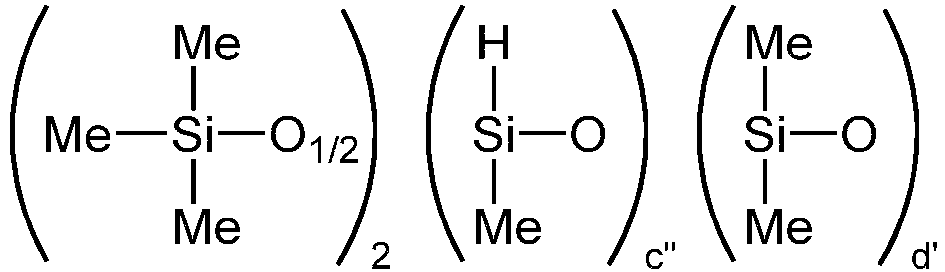
- The organohydrogenpolysiloxane as component (B) may be used alone or in admixture.
- The amount of component (B) added is to provide 0.01 to 3 moles, preferably 0.05 to 2 moles, more preferably 0.1 to 1.8 moles, even more preferably 0.2 to 1.5 moles, most preferably 0.3 to 1.2 moles of silicon-bonded hydrogen atom (or SiH group) in component (B) per mole of silicon-bonded alkenyl group in component (A). If the amount of silicon-bonded hydrogen in component (B) is less than 0.01 mole per mole of silicon-bonded alkenyl group in component (A), a silicone gel cured product having the desired penetration is not obtained. If the amount exceeds 3 moles, the cured product may depart from gel or lose heat resistance.
- Component (C) used herein serves as a catalyst for promoting hydrosilation addition reaction of silicon-bonded alkenyl group in component (A) with silicon-bonded hydrogen (or SiH group) in component (B). It is a platinum base curing catalyst (platinum or platinum-base compound). Any well-known catalysts may be used. Examples include platinum group metal catalysts such as platinum black, chloroplatinic acid, alcohol-modified products of chloroplatinic acid, and complexes of chloroplatinic acid with olefins, aldehydes, vinylsiloxanes or acetylene alcohols.
- The amount of component (C) blended is a catalytic amount and may be suitably varied depending on the desired curing rate. Often, the amount is in a range to provide 0.1 to 1,000 ppm, preferably 1 to 300 ppm of platinum group metal based on the total weight of components (A) and (B). If the amount is too much, the resulting cured product may lose heat resistance. If the amount is too small, hydrosilation addition reaction may not fully take place under the predetermined curing conditions or a gel-like cured product may not be obtained.
- Component (D) used herein is finely divided silica which is hydrophobic as a result of surface treatment with an organosilazane, organochlorosilane, organoalkoxysilane or organopolysiloxane containing only methyl as a silicon-bonded monovalent hydrocarbon group, the surface-treated silica having a specific surface area of 50 to 500 m2/g as measured by the BET adsorption method. When combined with component (E) to be described later, component (D) acts to impart thixotropy to the uncured composition to reduce the spreading thereof upon coating. The finely divided silica defined herein acts to allow the inventive composition to exert thixotropy through interaction with component (E). To this end, the silica should have a specific surface area of 50 to 500 m2/g, preferably 50 to 400 m2/g as measured by the BET adsorption method and be hydrophobically treated on its surface with an organosilazane, organochlorosilane, organoalkoxysilane or organopolysiloxane containing only methyl as a silicon-bonded organic substituent group (or monovalent hydrocarbon group).
- Examples of the surface treating agent include hexamethyldisilazane; trimethylchlorosilane, dimethyldichlorosilane, methyltrichlorosilane; trimethylalkoxysilanes, dimethyldialkoxysilanes, methyltrialkoxysilanes (wherein exemplary alkoxy groups include methoxy, ethoxy, propoxy and butoxy); cyclic or linear polydimethylsiloxanes, which may be used alone or in admixture. The dimethylpolysiloxanes may be either cyclic or linear.
- Examples of the finely divided silica include fumed silica (dry silica), ground silica, fused silica, crystalline silica (finely divided quartz), precipitated silica (wet silica), and colloidal silica. Inter alia, fumed silica is preferred in view of the desired specific surface area (or average particle size).
- The finely divided silica which is hydrophobic as a result of surface treatment should have a specific surface area of 50 to 500 m2/g, preferably 50 to 400 m2/g as measured by the BET adsorption method. With a specific surface area of less than 50 m2/g, it is difficult to impart satisfactory thixotropy to the composition. With a specific surface area in excess of 500 m2/g, the composition has too high a viscosity and substantially loses coating work efficiency.
- The hydrophobically surface-treated, finely divided silica is commercially available, for example, under the tradename of DM-30S (Tokuyama Corp.), NSX-200 (Nippon Aerosil Co., Ltd.), and CAB-O-SIL TS-610 (Cabot Corp.).
- The amount of component (D) blended is 2 to 30 parts by weight, preferably 3 to 20 parts by weight, more preferably 5 to 15 parts by weight per 100 parts by weight of component (A). If the amount is too small, component (D) fails to impart satisfactory thixotropy to the composition and to control the spreading upon coating. If the amount is too large, the composition has a significantly increased viscosity and loses coating work efficiency.
- Component (E) used herein is an isocyanuric acid derivative of specific molecular structure containing at least two trialkoxysilyl-substituted alkyl groups in the molecule, which is selected from an isocyanuric acid derivative whose isocyanuric acid skeleton is composed of three nitrogen atoms, containing a trialkoxysilyl-substituted alkyl group on each of two nitrogen atoms (total two alkyl groups per molecule) and an alkenyl group or an alkyl group substituted with a silyl or siloxanyl group containing silicon-bonded hydrogen (or SiH moiety) on the remaining one nitrogen atom, and an isocyanuric acid derivative whose isocyanuric acid skeleton is composed of three nitrogen atoms, containing a trialkoxysilyl-substituted alkyl group on each of three nitrogen atoms (total three alkyl groups per molecule). It corporates with component (D) to impart thixotropy to the composition and reduce the spreading upon coating without detracting from the fluidity of the composition.
- More illustrative examples of component (E) include
- (i) an isocyanuric acid derivative whose isocyanuric acid skeleton is composed of three nitrogen atoms, containing a trialkoxysilyl-substituted alkyl group (e.g., trimethoxysilylpropyl or triethoxysilylpropyl) on each of three nitrogen atoms (total three alkyl groups per molecule), as represented by the following formulae (2) and (5);
- (ii) an isocyanuric acid derivative whose isocyanuric acid skeleton is composed of three nitrogen atoms, containing a trialkoxysilyl-substituted alkyl group (e.g., trimethoxysilylpropyl or triethoxysilylpropyl) on each of two nitrogen atoms (total two alkyl groups per molecule) and an alkenyl group (e.g., allyl) on the remaining one nitrogen atom, as represented by the following formulae (3) and (6);
- (iii) an isocyanuric acid derivative whose isocyanuric acid skeleton is composed of three nitrogen atoms, containing a trialkoxysilyl-substituted alkyl group (e.g., trimethoxysilylpropyl or triethoxysilylpropyl) on each of two nitrogen atoms (total two alkyl groups per molecule) and an alkyl group substituted with a silyl or siloxanyl group containing silicon-bonded hydrogen or SiH moiety (e.g., [dimethyl(hydrogen)siloxy]dimethylsilylpropyl) on the remaining one nitrogen atom, as represented by the following formulae (4) and (7).
- Examples of the alkyl moiety in the trialkoxysilyl-substituted alkyl group and the alkyl group substituted with a silyl or siloxanyl group containing silicon-bonded hydrogen or SiH moiety include those of 2 to 10 carbon atoms such as ethyl, propyl, isopropyl, butyl, isobutyl, tert-butyl, pentyl, neopentyl, hexyl and octyl. Inter alia, propyl is preferred.
- Examples of the alkoxy moiety in the trialkoxysilyl-substituted alkyl group include those of 1 to 10 carbon atoms such as methoxy, ethoxy, propoxy, and butoxy. Inter alia, methoxy and ethoxy are preferred.
- Inter alia, isocyanuric acid derivatives having the formulae (2) to (7) are preferred as component (E). The isocyanuric acid derivatives may be used alone or in admixture as component (E).


- Herein, Me is methyl and Et is ethyl.
- The amount of component (E) blended is 0.01 to 3 parts by weight, preferably 0.05 to 1 part by weight per 100 parts by weight of component (A). Less than 0.01 part of component (E) fails to impart sufficient thixotropy to the composition whereas more than 3 parts of component (E) leads to a high viscosity and a substantial drop of coating efficiency.
- In addition to the foregoing components (A) to (E), the thixotropic silicone gel composition for spot potting may contain optional components as long as the object of the invention is not impaired. Such optional components include, for example, reaction inhibitors, inorganic fillers other than component (D), non-functional organopolysiloxanes free of silicon-bonded hydrogen (or SiH group) and silicon-bonded alkenyl participating in hydrosilation addition reaction (so-called non-functional silicone oils such as dimethylpolysiloxane and dimethylsiloxane-diphenylsiloxane copolymers), adhesion promotors contributing to an improvement in adhesion or pressure-sensitive adhesion (e.g., alkoxyorganosilanes), heat resistant additives, flame retardants, pigments, and dyes.
- The reaction inhibitor is a component for restraining the composition from reaction. Exemplary reaction inhibitors include acetylene, amine, carboxylate, and phosphite compounds.
- Examples of the inorganic filler include inorganic fillers, for instance, finely divided silica other than component (D) such as crystalline silica and precipitated silica, inorganic hollow fillers (e.g., silica hollow fillers, titanium oxide hollow fillers), silsesquioxane, fumed titanium dioxide, magnesium oxide, zinc oxide, iron oxide, aluminum hydroxide, magnesium carbonate, calcium carbonate, zinc carbonate, laminar mica, diatomaceous earth, and glass fibers; as well as the foregoing inorganic fillers which are hydrophobically surface-treated with organosilicon compounds such as organoalkoxysilane compounds, organochlorosilane compounds, organosilazane compounds, and low-molecular-weight siloxane compounds. Also, silicone rubber powders and silicone resin powders may be blended.
- The thixotropic silicone gel composition for spot potting may be obtained by mixing predetermined amounts of the foregoing components (A) to (E) and optional components until uniform. In the mixing step, the components may be divided into two or more parts before they are mixed. For example, they are divided into one part consisting of part of component (A) and components (C), (D) and (E) and the other part consisting of the remainder of component (A) and component (B) before they are mixed. Exemplary mixing means used herein include homo-mixers, puddle mixers, homo-dispersers, colloid mills, vacuum mixing agitation mixers, and planetary mixers. The mixing means is not particularly limited as long as components (A) to (E) can be uniformly mixed.
- In a preferred embodiment of the thixotropic silicone gel composition for spot potting, when an apparent viscosity at 25°C is measured by the method according to JIS K7117 at low and high rotational speeds set in a ratio of 1:10, the value of SVI which is given by the following equation is in the range of 3.0 to 10.0, more preferably 4.0 to 8.0. If the apparent viscosity ratio (SVI value) is less than 3.0, the composition may experience too much spreading upon coating due to the lack of sufficient thixotropy. If the SVI value exceeds 10.0, sometimes the composition cannot be coated to the desired shape.
SVI = (apparent viscosity at low rotational speed)/(apparent viscosity at high rotational speed) - The method of computing the SVI value which is an apparent viscosity ratio is described below. The viscosity of a thixotropic silicone gel composition is measured according to JIS K7117, specifically a thixotropic silicone gel composition is measured for apparent viscosity by a rheometer (ARES G2 by TA Instruments) at 25°C and rotational speeds of 1 s-1 and 10 s-1. Using these apparent viscosities, the value of SVI is computed according to the following equation.
SVI = (apparent viscosity at rotational speed of 1 s-1)/(apparent viscosity at rotational speed of 10 s-1) - It is noted that the above-specified range of the SVI value (apparent viscosity ratio) of a thixotropic silicone gel composition for spot potting can be achieved by suitably adjusting the amounts of finely divided silica as component (D) and the isocyanuric acid derivative as component (E).
- The thixotropic silicone gel composition for spot potting may be cured under conditions: 23 to 150°C, especially 50 to 130°C for 10 minutes to 8 hours, especially 30 minutes to 5 hours.
- Provided that after 1 g of an uncured composition is dropped onto a glass plate and allowed to stand in a 25°C atmosphere for 30 minutes, the droplet of the composition has a diameter of d mm, and after 1 g of an uncured composition resting on a glass plate is allowed to stand in a 130°C atmosphere for 30 minutes, the cured product of the composition on the glass plate has a diameter of D mm, the value of D-d is preferably up to 3 mm, more preferably up to 2 mm. Preferably, the diameter is an average of diameters in two perpendicular directions or longitudinal and lateral directions. If D-d exceeds 3 mm, potting to only the desired site may become impossible.
- As to the means for adjusting the value of D-d to 3 mm or less in conjunction with the thixotropic silicone gel composition for spot potting, the value is achievable by suitably adjusting the blending amount of finely divided silica (D) and/or isocyanuric acid derivative (E).
- The silicone gel cured product obtained by curing the thixotropic silicone gel composition for spot potting should have a cone penetration of 10 to 100, preferably 20 to 70 as prescribed in JIS K6249. If the penetration is less than 10, the adhesion of the cured product to the substrate sealed therewith may be poor. If the penetration exceeds 100, the sealing gel itself has a low strength and may crack when heated.
- As to the means for adjusting the penetration of the silicone gel cured product to fall in the specific range, the range can be achieved by suitably adjusting the blending ratio of components (A) and (B), that is, the molar ratio of silicon-bonded hydrogen (SiH group) in component (B) to silicon-bonded alkenyl group in component (A).
- Provided that a silicone gel cured product obtained by curing the thixotropic silicone gel composition for spot potting has an initial penetration immediately after curing, and the silicone gel cured product has a heat-aged penetration after it is allowed to stand in a 200°C atmosphere for 72 hours, a percent reduction of the heat-aged penetration from the initial penetration is up to 20%, preferably up to 15%. If the percent reduction exceeds 20%, the cured product will crack or the adhesion to the substrate may be considerably reduced.
- As to the means for adjusting the percent reduction to 20% or less, the range can be achieved by suitably adjusting the blending ratio of components (A) and (B), that is, the molar ratio of silicon-bonded hydrogen (SiH group) in component (B) to silicon-bonded alkenyl group in component (A) and/or blending the heat resistance improver.
- Since the thixotropic silicone gel composition for spot potting experiences least spreading when applied to substrates of various electronic boards such as control circuit substrates, little changes of shape before and after heat curing, and little changes of penetration of a cured product under high-temperature conditions (little changes of flexibility or little changes of stress relaxation), only particular semiconductor devices (typically photocouplers) mounted on control circuit substrates can be sealed with the composition by potting, specifically by spot potting. That is, only target devices can be sealed with the composition in desired shape. The composition can seal only the target device to be sealed and is useful as a sealant for electric/electronic parts requiring spot potting, especially photocouplers.
- A further embodiment of the invention is a photocoupler which is sealed with the silicone gel cured product obtained by curing the thixotropic silicone gel composition for spot potting. Since the composition can be potted just as designed, it is useful in restraining the generation of failure products.
- Examples and Comparative Examples are shown below for further illustrating the invention although the invention is not limited thereto. In Examples, all parts are by weight. The viscosity of each of the exemplified components is measured at 25°C by a rotational viscometer. Me stands for methyl. The degree of polymerization is a number average degree of polymerization measured by gel permeation chromatography (GPC) versus polystyrene standards using toluene as a developing solvent. The SVI value and spreading of a silicone gel composition and the heat resistance of a silicone gel cured product are evaluated as follows.
- The viscosity of a silicone gel composition was measured according to JIS K7117. Specifically, a silicone gel composition was measured for apparent viscosity by a rheometer (ARES G2 by TA Instruments) at 25°C and rotational speeds of 1 s-1 and 10 s-1 to give a rotational speed ratio of 1:10. Using these apparent viscosities, the value of SVI is computed according to the following equation.
SVI = (apparent viscosity at rotational speed 1 s-1)/(apparent viscosity at rotational speed 10 s-1) - A 5-ml micro-syringe was charged with about 5 g of a silicone gel composition. A 1-g portion of the composition was slowly dispensed at the center of a glass plate of 50 mm by 50 mm. The composition was allowed to stand in an atmosphere at 25°C for 30 minutes, during which the composition radially spread to a circular shape. The diameter of the circular spreading silicone gel composition was measured in two perpendicular directions (or longitudinal and lateral directions), from which an average value was computed. This value is an index of spreading prior to curing.
- The silicone gel composition was cured by heating the glass plate having the silicone gel composition coated thereon in an oven at 130°C for 30 minutes. The diameter of the silicone gel cured product was measured in two perpendicular directions (or longitudinal and lateral directions), from which an average value was computed. This value is an index of spreading after curing. A difference between spreading after curing and spreading prior to curing was determined.
- The silicone gel composition was heated at 130°C for 30 minutes, obtaining a cylindrical silicone gel cured product having a diameter of ~40 mm and a thickness of ~20 mm. The cone penetration of the cured product was measured. This penetration is an initial cured value. The penetration was measured by the penetration test method (1/4 cone) of JIS K2220, as prescribed in JIS K6249. The silicone gel cured product was exposed to an atmosphere at 200°C for 72 hours, after which its penetration was measured. This is the penetration after 200°C heating.
- (A-1) branched polysiloxane capped with dimethylvinylsiloxy and trimethylsiloxy groups at ends of the molecular chain, represented by the following average molecular formula (8), having a viscosity at 25°C of ~1 Pa·s (containing 2 mol% of (C6H5)2SiO2/2 units based on overall diorganopolysiloxane units and having an alkenyl content of 0.011 mol/100 g)

- (A-2) linear polysiloxane capped with dimethylvinylsiloxy and trimethylsiloxy groups at ends of the molecular chain, represented by the following average molecular formula (9), having a viscosity at 25°C of ~0.7 Pa s (containing 5 mol% of (C6H5)2SiO2/2 units based on overall diorganopolysiloxane units and having an alkenyl content of 0.005 mol/100 g)

- The linear polysiloxane capped with dimethylvinylsiloxy and trimethylsiloxy groups at ends of the molecular chain, represented by average molecular formula (9) is a uniform mixture of a linear polysiloxane [9a] capped with dimethylvinylsiloxy at one end and trimethylsiloxy group at the other end of the molecular chain, represented by average molecular formula (9a) and a linear polysiloxane [9b] capped with trimethylsiloxy group at both ends of the molecular chain, represented by average molecular formula (9b) in a molar ratio [9a]:[9b] of 6:4 (molar ratio being approximately equal to weight ratio).


- (A-3) branched polysiloxane capped with dimethylvinylsiloxy and trimethylsiloxy groups at ends of the molecular chain, represented by the following average molecular formula (10), having a viscosity at 25°C of ~0.8 Pa·s (containing 0 mol% of (C6H5)2SiO2/2 units based on overall diorganopolysiloxane units and having an alkenyl content of 0.012 mol/100 g)

- The branched polysiloxane capped with dimethylvinylsiloxy and trimethylsiloxy groups at ends of the molecular chain, represented by average molecular formula (10) is a uniform mixture of a branched polysiloxane [10a] capped with dimethylvinylsiloxy at two ends of the molecular chain, represented by average molecular formula (10a) and a branched polysiloxane [10b] capped with trimethylsiloxy group at two ends of the molecular chain, represented by average molecular formula (10b) in a molar ratio [10a]:[10b] of 4:6 (molar ratio being approximately equal to weight ratio).


- (A-4) branched polysiloxane capped with dimethylvinylsiloxy and trimethylsiloxy groups at ends of the molecular chain, represented by the following average molecular formula (11), having a viscosity at 25°C of ~1 Pa s (containing 0 mol% of (C6H5)2SiO2/2 units based on overall diorganopolysiloxane units and having an alkenyl content of 0.011 mol/100 g)

- (A-5) linear polysiloxane capped with dimethylvinylsiloxy and trimethylsiloxy groups at ends of the molecular chain, represented by the following average molecular formula (12), having a viscosity at 25°C of ~0.8 Pa·s (containing 0 mol% of (C6H5)2SiO2/2 units based on overall diorganopolysiloxane units and having an alkenyl content of 0.004 mol/100 g)

- The linear polysiloxane capped with dimethylvinylsiloxy and trimethylsiloxy groups at ends of the molecular chain, represented by average molecular formula (12) is a uniform mixture of a linear polysiloxane [12a] capped with dimethylvinylsiloxy at one end and trimethylsiloxy at the other end of the molecular chain, represented by average molecular formula (12a) and a linear polysiloxane [12b] capped with trimethylsiloxy at both ends of the molecular chain, represented by average molecular formula (12b) in a molar ratio [12a]:[12b] of 6:4 (molar ratio being approximately equal to weight ratio).


- (A-6) linear polysiloxane capped with dimethylvinylsiloxy and trimethylsiloxy groups at ends of the molecular chain, represented by the following average molecular formula (13), having a viscosity at 25°C of ~0.8 Pa·s (containing 0 mol% of (C6H5)2SiO2/2 units based on overall diorganopolysiloxane units and having an alkenyl content of 0.005 mol/100 g)

- The linear polysiloxane capped with dimethylvinylsiloxy and trimethylsiloxy groups at ends of the molecular chain, represented by average molecular formula (13) is a uniform mixture of a linear polysiloxane [13a] capped with dimethylvinylsiloxy at one end and trimethylsiloxy at the other end of the molecular chain, represented by average molecular formula (13a) and a linear polysiloxane [13b] capped with trimethylsiloxy at both ends of the molecular chain, represented by average molecular formula (13b) in a molar ratio [13a]:[13b] of 6:4 (molar ratio being approximately equal to weight ratio).


- (B-1) methylhydrogenpolysiloxane, represented by the following average molecular formula (14), having a viscosity at 25°C of 30 mPa·s and a SiH content of 0.004 mol/g

- (B-2) methylhydrogenpolysiloxane, represented by the following average molecular formula (15), having a viscosity at 25°C of 110 mPa·s and a SiH content of 0.006 mol/g

- (B-3) methylhydrogenpolysiloxane, represented by the following average molecular formula (16), having a viscosity at 25°C of 20 mPa·s and a SiH content of 0.001 mol/g

- (C-1) solution of chloroplatinic acid-vinylsiloxane complex in a dimethylpolysiloxane capped with vinyldimethylsiloxy at both ends of the molecular chain, represented by the following formula (17), as a solvent (platinum content 1 wt%)

-
- (D-1) fumed silica surface-treated with dimethyldichlorosilane, having a BET specific surface area of 300 m2/g (tradename DM-30S by Tokuyama Corp.)
- (D-2) fumed silica surface-treated with trimethylchlorosilane, having a BET specific surface area of 140 m2/g (tradename NSX-200 by Nippon Aerosil Co., Ltd.)
- (E-1) isocyanuric acid derivative having the following formula (18)

- (E-2) isocyanuric acid derivative having the following formula (19)

-
- (E-3) 3-glycidoxypropyltrimethoxysilane (tradename KBM-403 by Shin-Etsu Chemical Co., Ltd.)
- (E-4) 8-glycidyloxyoctyltrimethoxysilane (tradename KBM-4803 by Shin-Etsu Chemical Co., Ltd.)
- (E-5) methoxy-containing siloxane oligomer having a methoxy content of 28% by weight and a viscosity at 25°C of 25 mPa s (tradename KR-500 by Shin-Etsu Chemical Co., Ltd.)
- Silicone gel compositions S 1 to S 1 1 were prepared by combining and mixing components (A) to (E) in accordance with Tables 1 and 2. These silicone gel compositions were measured for viscosity by a rheometer, from which a SVI value was computed. These silicone gel compositions were also observed for a change of spreading before and after curing by the above-defined method. Further, the cured products of these silicone gel compositions were evaluated for heat resistance by the above-mentioned method. The results are shown in Tables 1 and 2.
- As shown in Tables 1 and 2, the silicone gel compositions of Examples 1 to 4 falling within the scope of the invention are thixotropic silicone gel compositions, show little spreading upon heat curing, and are thus useful for spot potting on devices to be sealed. These compositions experience only a little change of penetration in the 200°C atmosphere, indicating satisfactory heat resistance. This is effective for preventing the silicone gel cured product from cracking even during high-temperature operation and leads to the advantage that the load applied to the sealed device is quite small.
[Table 1] Example 1 Example 2 Example 3 Example 4 Comparative Example 1 Comparative Example 2 Silicone gel composition S1 S2 S3 S4 S5 S6 Blending amount (pbw) (A-1) 100 100 100 - 100 100 (A-2) - - - 100 - - (A-3) - - - - - - (A-4) - - - - - - (A-5) - - - - - - (A-6) - - - - - - (B-1) 0.94 0.94 1.0 - 0.94 0.94 (B-2) - - - 1.0 - - (B-3) - - - - - - (C-1) 0.08 0.08 0.08 0.08 0.08 0.08 (D-1) 7.1 7.1 - - 7.1 7.1 (D-2) - - 12.5 8.0 - - (E-1) 0.08 - 0.08 0.08 - - (E-2) - 0.08 - - - - (E-3) - - - - 0.30 - (E-4) - - - - - 0.25 (E-5) - - - - - - SiH/SiVi* 0.34 0.34 0.36 1.20 0.34 0.34 Viscosity (Pa·s) 1 s-1 116 112 215 52.2 175 69.5 10 s-1 23.0 21.9 35.2 8.8 33.7 15.2 SVI 5.1 5.1 6.1 5.9 5.2 4.6 Spreading (mm) Before curing 17 17 15 18 16 17 After curing 19 19 16 20 22 23 Difference 2 2 1 2 6 6 Penetration at initial cure 36 41 37 43 37 38 Penetration after 200°C heating 32 35 32 40 29 30 * moles of silicon-bonded hydrogen (SiH group) in component (B) per mole of silicon-bonded alkenyl group in component (A) [Table 2] Comparative Example 3 Comparative Example 4 Comparative Example 5 Comparative Example 6 Comparative Example 7 Silicone composition S7 S8 S9 S10 S11 Blending amount (pbw) (A-1) 100 - - - - (A-2) - - - - - (A-3) - 100 - - - (A-4) - - 100 - - (A-5) - - - 100 - (A-6) - - - - 100 (B-1) 0.94 - 0.9 - - (B-2) - - - 0.7 1.0 (B-3) - 10 - - - (C-1) 0.08 0.08 0.08 0.08 0.08 (D-1) 7.1 7.1 7.1 7.1 7.1 (D-2) - - - - - (E-1) - 0.08 0.08 0.08 0.08 (E-2) - - - - - (E-3) - - - - - (E-4) - - - - - (E-5) 0.10 - - - - SiH/SiVi* 0.34 0.83 0.33 1.05 1.20 Viscosity (Pa·s) 1 s-1 43.2 51.6 230 18.2 32.5 10 s-1 16.3 15.1 41.8 5.1 7.1 SVI 2.7 3.4 5.5 3.6 4.6 Spreading (mm) Before curing 17 17 16 19 17 After curing 28 20 17 21 20 Difference 11 3 1 2 3 Penetration at initial cure 38 41 38 46 46 Penetration after 200°C heating 28 9 11 9 13 * moles of silicon-bonded hydrogen (SiH group) in component (B) per mole of silicon-bonded alkenyl group in component (A)
Claims (7)
- A thixotropic silicone gel composition for spot potting comprising(A) 100 parts by weight of a linear or branched organopolysiloxane containing 0.1 to 10 mol% of (C6H5)2SiO2/2 units as diorganosiloxane units in the backbone, based on the overall diorganosiloxane units in the backbone, and containing 0.001 to 10 mol/100 g of silicon-bonded alkenyl groups,(B) an organohydrogenpolysiloxane containing at least 3 silicon-bonded hydrogen atoms per molecule, represented by the average compositional formula (1):
 (C) a catalytic amount of a platinum base curing catalyst,(D) 2 to 30 parts by weight of finely divided silica which is hydrophobic as a result of surface treatment with an organosilazane, organochlorosilane, organoalkoxysilane or organopolysiloxane containing only methyl as a silicon-bonded monovalent hydrocarbon group, the surface-treated silica having a specific surface area of 50 to 500 m2/g as measured by the BET adsorption method, and(E) 0.01 to 3 parts by weight of an isocyanuric acid derivative whose isocyanuric acid skeleton is composed of three nitrogen atoms, containing a trialkoxysilyl-substituted alkyl group on each of two nitrogen atoms (total two alkyl groups per molecule) and an alkenyl group or an alkyl group substituted with a silyl or siloxanyl group containing silicon-bonded hydrogen (or SiH moiety) on the remaining one nitrogen atom, and/or an isocyanuric acid derivative whose isocyanuric acid skeleton is composed of three nitrogen atoms, containing a trialkoxysilyl-substituted alkyl group on each of three nitrogen atoms (total three alkyl groups per molecule),the silicone gel composition curing into a silicone gel cured product having a penetration of 10 to 100 as prescribed in JIS K6249.
 - The thixotropic silicone gel composition of claim 1 wherein component (E) is at least one derivative selected from isocyanuric acid derivatives having the formulae (2) to (7):


- The thixotropic silicone gel composition of claim 1 or 2 wherein when an apparent viscosity at 25°C is measured by the method according to JIS K7117 at low and high rotational speeds set in a ratio of 1:10, the value of SVI which is given by the equation: SVI = (apparent viscosity at low rotational speed)/(apparent viscosity at high rotational speed) is from 3.0 to 10.0.
- The thixotropic silicone gel composition of any one of claims 1 to 3 wherein provided that after 1 g of an uncured composition is dropped onto a glass plate and allowed to stand in a 25°C atmosphere for 30 minutes, the droplet of the composition has a diameter of d mm, and after 1 g of an uncured composition resting on a glass plate is further allowed to stand in a 130°C atmosphere for 30 minutes, the cured product of the composition on the glass plate has a diameter of D mm, the value of D-d is up to 3 mm.
- The thixotropic silicone gel composition of any one of claims 1 to 4 wherein a percent reduction from the penetration of a silicone gel cured product (obtained by curing an uncured composition) immediately as cured, of the penetration of the silicone gel cured product which is further allowed to stand in a 200°C atmosphere for 72 hours is up to 20%.
- A silicone gel cured product obtained by curing the thixotropic silicone gel composition of any one of claims 1 to 5.
- A photocoupler which is sealed with the silicone gel cured product of claim 6.
Applications Claiming Priority (2)
| Application Number | Priority Date | Filing Date | Title |
|---|---|---|---|
| JP2022003099 | 2022-01-12 | ||
| PCT/JP2023/000036 WO2023136188A1 (en) | 2022-01-12 | 2023-01-05 | Thixotropic silicone gel composition for spot potting, cured product thereof, and photocoupler |
Publications (2)
| Publication Number | Publication Date |
|---|---|
| EP4465368A1 true EP4465368A1 (en) | 2024-11-20 |
| EP4465368A4 EP4465368A4 (en) | 2026-01-21 |
Family
ID=87279025
Family Applications (1)
| Application Number | Title | Priority Date | Filing Date |
|---|---|---|---|
| EP23740198.9A Pending EP4465368A4 (en) | 2022-01-12 | 2023-01-05 | THIXOTROPE SILICONE GEL COMPOSITION FOR POINT WELDING, CURED PRODUCT MADE FROM IT AND PHOTOCOPPERS |
Country Status (4)
| Country | Link |
|---|---|
| US (1) | US20250092283A1 (en) |
| EP (1) | EP4465368A4 (en) |
| JP (1) | JP7743879B2 (en) |
| WO (1) | WO2023136188A1 (en) |
Family Cites Families (12)
| Publication number | Priority date | Publication date | Assignee | Title |
|---|---|---|---|---|
| JP3073888B2 (en) | 1993-06-17 | 2000-08-07 | 信越化学工業株式会社 | Thixotropic fluorosilicone gel composition |
| JPH09132718A (en) | 1995-11-08 | 1997-05-20 | Toray Dow Corning Silicone Co Ltd | Two-component curable liquid silicone composition |
| JP3765444B2 (en) * | 1997-07-10 | 2006-04-12 | 東レ・ダウコーニング株式会社 | Silicone gel composition and silicone gel for sealing and filling electric and electronic parts |
| JP3746394B2 (en) * | 1999-04-14 | 2006-02-15 | 東レ・ダウコーニング株式会社 | Silicone gel composition |
| JP5594232B2 (en) * | 2010-06-11 | 2014-09-24 | 信越化学工業株式会社 | Curable silicone gel composition |
| JP5522116B2 (en) * | 2011-04-28 | 2014-06-18 | 信越化学工業株式会社 | Addition-curing silicone composition and optical semiconductor device using the same |
| CN103013433B (en) * | 2012-12-27 | 2014-04-09 | 广州天赐有机硅科技有限公司 | High-transparency, highly-refractive and self-bonding organic silicon material and preparation method thereof |
| CN105814142A (en) * | 2013-12-16 | 2016-07-27 | 迈图高新材料日本合同公司 | Addition-curable silicone composition |
| JP6409704B2 (en) * | 2015-07-24 | 2018-10-24 | 信越化学工業株式会社 | Silicone gel composition and cured silicone gel |
| JP6480360B2 (en) * | 2016-02-18 | 2019-03-06 | 信越化学工業株式会社 | Semiconductor device |
| JP6658428B2 (en) * | 2016-09-27 | 2020-03-04 | 信越化学工業株式会社 | Silicone gel composition, cured product thereof, and power module |
| JP7151770B2 (en) * | 2018-08-03 | 2022-10-12 | 信越化学工業株式会社 | SILICONE GEL COMPOSITION AND ITS CURED PRODUCT AND POWER MODULE |
-
2023
- 2023-01-05 JP JP2023574001A patent/JP7743879B2/en active Active
- 2023-01-05 EP EP23740198.9A patent/EP4465368A4/en active Pending
- 2023-01-05 US US18/728,385 patent/US20250092283A1/en active Pending
- 2023-01-05 WO PCT/JP2023/000036 patent/WO2023136188A1/en not_active Ceased
Also Published As
| Publication number | Publication date |
|---|---|
| EP4465368A4 (en) | 2026-01-21 |
| JPWO2023136188A1 (en) | 2023-07-20 |
| US20250092283A1 (en) | 2025-03-20 |
| WO2023136188A1 (en) | 2023-07-20 |
| JP7743879B2 (en) | 2025-09-25 |
Similar Documents
| Publication | Publication Date | Title |
|---|---|---|
| JP3638746B2 (en) | Silicone gel composition and silicone gel for sealing and filling electric and electronic parts | |
| US6124407A (en) | Silicone composition, method for the preparation thereof, and silicone elastomer | |
| US6433057B1 (en) | Silicone composition and electrically conductive silicone adhesive formed therefrom | |
| JP3765444B2 (en) | Silicone gel composition and silicone gel for sealing and filling electric and electronic parts | |
| JP6658428B2 (en) | Silicone gel composition, cured product thereof, and power module | |
| KR20150003815A (en) | Thermally-curable heat-conductive silicone grease composition | |
| JP2001002922A (en) | Addition-curable silicone composition for encapsulating semiconductor device and semiconductor device | |
| KR20130040142A (en) | Conductive silicone composition and method for producing the same | |
| EP2395053A1 (en) | Curable silicone gel composition | |
| JP6958031B2 (en) | Silicone gel composition and its cured product and power module | |
| EP1852468B1 (en) | Method of forming a flux resistant silicone gel | |
| JP3985133B2 (en) | Thixo fluorine-containing curable composition and encapsulated material using the same | |
| JPH086039B2 (en) | Organopolysiloxane composition and gel cured product thereof | |
| JP6409704B2 (en) | Silicone gel composition and cured silicone gel | |
| JP2019001885A (en) | Self-adhesive silicone gel composition and cured product thereof | |
| WO2020252773A1 (en) | Thermal conductive silicone composition | |
| JP2004331738A (en) | Curable composition | |
| JP7147966B2 (en) | Self-adhesive silicone gel composition and silicone gel comprising cured product thereof | |
| JP4703374B2 (en) | Silicone gel composition | |
| US20250092283A1 (en) | Thixotropic silicone gel composition for spot potting, cured product thereof, and photocoupler | |
| EP1256601B1 (en) | Silicone composition and electrically conductive silicone adhesive formed therefrom | |
| JP6520851B2 (en) | Silicone gel composition | |
| CN113493677B (en) | Organic silicon composition for die bonding, cured product thereof, and optical semiconductor device | |
| EP4488335A1 (en) | Thermally conductive silicone composition | |
| CN111918928B (en) | Silicone gel composition, cured product thereof, and power module |
Legal Events
| Date | Code | Title | Description |
|---|---|---|---|
| STAA | Information on the status of an ep patent application or granted ep patent |
Free format text: STATUS: THE INTERNATIONAL PUBLICATION HAS BEEN MADE |
|
| PUAI | Public reference made under article 153(3) epc to a published international application that has entered the european phase |
Free format text: ORIGINAL CODE: 0009012 |
|
| STAA | Information on the status of an ep patent application or granted ep patent |
Free format text: STATUS: REQUEST FOR EXAMINATION WAS MADE |
|
| 17P | Request for examination filed |
Effective date: 20240801 |
|
| AK | Designated contracting states |
Kind code of ref document: A1 Designated state(s): AL AT BE BG CH CY CZ DE DK EE ES FI FR GB GR HR HU IE IS IT LI LT LU LV MC ME MK MT NL NO PL PT RO RS SE SI SK SM TR |
|
| DAV | Request for validation of the european patent (deleted) | ||
| DAX | Request for extension of the european patent (deleted) | ||
| REG | Reference to a national code |
Ref country code: DE Ref legal event code: R079 Free format text: PREVIOUS MAIN CLASS: H01L0031120000 Ipc: C08K0005544000 |
|
| A4 | Supplementary search report drawn up and despatched |
Effective date: 20251218 |
|
| RIC1 | Information provided on ipc code assigned before grant |
Ipc: C08K 5/544 20060101AFI20251212BHEP Ipc: C08K 9/06 20060101ALI20251212BHEP Ipc: C08L 83/05 20060101ALI20251212BHEP Ipc: C08L 83/07 20060101ALI20251212BHEP Ipc: H01L 23/29 20060101ALI20251212BHEP Ipc: C08K 5/3492 20060101ALI20251212BHEP |