EP4465248B1 - Verfahren, system und nichttransitorische computerlesbare medien zur priorisierung von objekten zur merkmalsextraktion - Google Patents
Verfahren, system und nichttransitorische computerlesbare medien zur priorisierung von objekten zur merkmalsextraktion Download PDFInfo
- Publication number
- EP4465248B1 EP4465248B1 EP23173346.0A EP23173346A EP4465248B1 EP 4465248 B1 EP4465248 B1 EP 4465248B1 EP 23173346 A EP23173346 A EP 23173346A EP 4465248 B1 EP4465248 B1 EP 4465248B1
- Authority
- EP
- European Patent Office
- Prior art keywords
- objects
- feature extraction
- roi
- motion
- image frame
- Prior art date
- Legal status (The legal status is an assumption and is not a legal conclusion. Google has not performed a legal analysis and makes no representation as to the accuracy of the status listed.)
- Active
Links
Images



Classifications
-
- G—PHYSICS
- G06—COMPUTING OR CALCULATING; COUNTING
- G06T—IMAGE DATA PROCESSING OR GENERATION, IN GENERAL
- G06T7/00—Image analysis
- G06T7/20—Analysis of motion
- G06T7/215—Motion-based segmentation
-
- G—PHYSICS
- G06—COMPUTING OR CALCULATING; COUNTING
- G06V—IMAGE OR VIDEO RECOGNITION OR UNDERSTANDING
- G06V20/00—Scenes; Scene-specific elements
- G06V20/50—Context or environment of the image
- G06V20/52—Surveillance or monitoring of activities, e.g. for recognising suspicious objects
-
- G—PHYSICS
- G06—COMPUTING OR CALCULATING; COUNTING
- G06V—IMAGE OR VIDEO RECOGNITION OR UNDERSTANDING
- G06V10/00—Arrangements for image or video recognition or understanding
- G06V10/40—Extraction of image or video features
- G06V10/46—Descriptors for shape, contour or point-related descriptors, e.g. scale invariant feature transform [SIFT] or bags of words [BoW]; Salient regional features
- G06V10/469—Contour-based spatial representations, e.g. vector-coding
-
- G—PHYSICS
- G06—COMPUTING OR CALCULATING; COUNTING
- G06T—IMAGE DATA PROCESSING OR GENERATION, IN GENERAL
- G06T7/00—Image analysis
- G06T7/20—Analysis of motion
-
- G—PHYSICS
- G06—COMPUTING OR CALCULATING; COUNTING
- G06T—IMAGE DATA PROCESSING OR GENERATION, IN GENERAL
- G06T7/00—Image analysis
- G06T7/20—Analysis of motion
- G06T7/246—Analysis of motion using feature-based methods, e.g. the tracking of corners or segments
-
- G—PHYSICS
- G06—COMPUTING OR CALCULATING; COUNTING
- G06V—IMAGE OR VIDEO RECOGNITION OR UNDERSTANDING
- G06V10/00—Arrangements for image or video recognition or understanding
- G06V10/20—Image preprocessing
- G06V10/25—Determination of region of interest [ROI] or a volume of interest [VOI]
-
- G—PHYSICS
- G06—COMPUTING OR CALCULATING; COUNTING
- G06V—IMAGE OR VIDEO RECOGNITION OR UNDERSTANDING
- G06V10/00—Arrangements for image or video recognition or understanding
- G06V10/20—Image preprocessing
- G06V10/26—Segmentation of patterns in the image field; Cutting or merging of image elements to establish the pattern region, e.g. clustering-based techniques; Detection of occlusion
-
- G—PHYSICS
- G06—COMPUTING OR CALCULATING; COUNTING
- G06V—IMAGE OR VIDEO RECOGNITION OR UNDERSTANDING
- G06V10/00—Arrangements for image or video recognition or understanding
- G06V10/20—Image preprocessing
- G06V10/36—Applying a local operator, i.e. means to operate on image points situated in the vicinity of a given point; Non-linear local filtering operations, e.g. median filtering
-
- G—PHYSICS
- G06—COMPUTING OR CALCULATING; COUNTING
- G06V—IMAGE OR VIDEO RECOGNITION OR UNDERSTANDING
- G06V10/00—Arrangements for image or video recognition or understanding
- G06V10/40—Extraction of image or video features
-
- G—PHYSICS
- G06—COMPUTING OR CALCULATING; COUNTING
- G06V—IMAGE OR VIDEO RECOGNITION OR UNDERSTANDING
- G06V10/00—Arrangements for image or video recognition or understanding
- G06V10/40—Extraction of image or video features
- G06V10/46—Descriptors for shape, contour or point-related descriptors, e.g. scale invariant feature transform [SIFT] or bags of words [BoW]; Salient regional features
-
- G—PHYSICS
- G06—COMPUTING OR CALCULATING; COUNTING
- G06V—IMAGE OR VIDEO RECOGNITION OR UNDERSTANDING
- G06V10/00—Arrangements for image or video recognition or understanding
- G06V10/40—Extraction of image or video features
- G06V10/62—Extraction of image or video features relating to a temporal dimension, e.g. time-based feature extraction; Pattern tracking
-
- G—PHYSICS
- G06—COMPUTING OR CALCULATING; COUNTING
- G06V—IMAGE OR VIDEO RECOGNITION OR UNDERSTANDING
- G06V20/00—Scenes; Scene-specific elements
- G06V20/40—Scenes; Scene-specific elements in video content
- G06V20/41—Higher-level, semantic clustering, classification or understanding of video scenes, e.g. detection, labelling or Markovian modelling of sport events or news items
-
- G—PHYSICS
- G06—COMPUTING OR CALCULATING; COUNTING
- G06V—IMAGE OR VIDEO RECOGNITION OR UNDERSTANDING
- G06V40/00—Recognition of biometric, human-related or animal-related patterns in image or video data
- G06V40/10—Human or animal bodies, e.g. vehicle occupants or pedestrians; Body parts, e.g. hands
Definitions
- the present invention relates to the technical field of object re-identification and in particular to a method, system and non-transitory computer-readable media for prioritizing objects for feature extraction for the purpose of object re-identification in an object tracking application.
- re-identification refers to the process of identifying an object in a video sequence as the same object that was previously detected in a previous frame or frames of the video sequence or in a frame of another video sequence. This is an important task in object tracking, as it allows the system to maintain a consistent track of the object's movement across the image frames of the video sequence.
- the process of object re-identification can be challenging, as objects in a video sequence can undergo a variety of transformations over time, such as changes in appearance, orientation, scale, and occlusion. These changes can make it difficult to track an object continuously from one image frame to the next.
- object tracking systems typically use a combination of object detection, feature extraction, and matching techniques to identify and track objects in a video sequence.
- Feature extraction involves extracting a set of descriptive features (a feature vector) from the objects detected in each frame. These features may include colour, texture, shape, or other characteristics that can be used to differentiate one object from another. Feature extraction may be sensitive to object occlusion. For example, if two objects partially overlap, the feature extraction process may extract a feature vector that represent a combination of the two objects, rather than two feature vectors that are specific to each object individually. This may lead to confusion during the matching process, as the extracted features may not match well with the corresponding features in the previous frame.
- the method further comprises the steps of determining a list of prioritized candidate objects for feature extraction by, for each ROI for object feature extraction associated with two or more objects: for each object of the two or more objects, upon determining that the object is not overlapping with any of the other objects of the plurality of objects with more than a threshold amount, adding the object to the list of prioritized candidate objects for feature extraction.
- the present method may provide a low complexity and efficient selection criteria for which objects that may be analysed to determine feature vectors for object re-identification.
- the method does not rely on future object movement predictions to identify object tracks that may be at risk of loss or erroneous association.
- motion data indicating one or more motion areas in the (currently analysed) image frame is used.
- the motion data may be obtained by motion detection techniques such as frame differencing, which do not require prediction.
- the present method reduces the risk of erroneous object track associations with objects detected.
- the method of the present invention does not rely on the existing object tracks or their associated objects, thus increasing the flexibility of the method.
- the selection of objects for feature vector determination is decoupled from the existing object tracks and their associations, which may provide more freedom to choose the most suitable objects for feature vector determination.
- the present method may reduce the risk of feature vector leakage between objects, resulting in a decreased likelihood of erroneous object track associations with objects detected in the image frame.
- the present method enhances the accuracy of object tracking and reduces the incidence of false associations between object tracks and objects in the image frame.
- objects that are likely to either be obscured or cause occlusion in subsequent image frames can be prioritized for feature extraction. This approach prioritizes objects that the object tracker might lose track of in subsequent image frames.
- the motion data further comprises, for each motion area in the image frame, an indication of a velocity of the detected motion in the corresponding area of the scene, wherein the step of determining a ROI for object feature extraction comprises extending the motion area based on the velocity. Consequently, the ROI for object feature extraction is determined by incorporating the motion area along with an additional margin around it, which is based on the characteristics of the detected motion.
- This approach may enable a flexible and precise analysis of the scene motion to identify the appropriate objects for feature vector determination and subsequent object re-identification.
- the present embodiment may achieve a targeted and adaptable means of selecting ROIs for feature extraction, leading to improved object tracking and re-identification performance.
- a shape of the ROI for object feature extraction is one of: a pixel mask, a circle, an ellipse, and a rectangle.
- a flexible approach of determining the ROI for object feature extraction may be achieved.
- a pixel mask shaped ROI may be determined using the motion area, possibly subjected to a morphological operation (e.g., dilatation) to extend it.
- a circular shaped ROI may be obtained by determining the minimal circle that encloses the motion area, optionally augmented with an additional radius.
- An ellipse may be determined similarly to the circle, optionally extended according to the direction of the velocity. The same strategy may be utilized when determining a rectangle shaped ROI.
- the threshold amount is a predetermined percentage of the spatial extent of one of the overlapping objects. For instance, suppose that a first object with size X in the image frame is overlapping a second object that is 100 times larger (size 100X) in the image frame. The second object is only overlapped by 1% of the first object while the first object is overlapped by 100% of the second object. In case the threshold amount is 1% (inclusive), the second object will be added to the list of prioritized candidate objects for feature extraction while the first object will not. Consequently, object size is considered, which may influence the impact of feature vector leakage between objects.
- a maximum of N objects among the list of prioritized candidate objects is selected, wherein N is a predetermined number.
- N may be selected in view of the computational resources available for object re-identification.
- the method further comprises the step of for each selected object, associating the determined feature vector with a time stamp indicating a capturing time of the image frame.
- the time stamp can be utilized to assess the suitability of a feature vector for a particular object track during the object re-identification process. For instance, the maximum permissible distance between the position of a selected object and a track may be adjusted based on the time difference between the most recent object instance in the track and the time stamp of the selected object. This approach may enable more accurate and relevant object re-identification, taking into account the time-related dynamics of the tracked objects.
- a system for prioritizing feature extraction for object re-identification in an object tracking application comprising: one or more processors; and one or more non-transitory computer-readable media storing computer executable instructions that, when executed by the one or more processors, cause the system to perform actions comprising: receiving an image frame depicting a scene comprising a plurality of objects; receiving object detection data comprising, for each object of the plurality of objects, localization data indicating location and spatial extent of the object in the image frame; receiving motion data indicating one or more motion areas in the image frame, each motion area corresponding to an area in the scene where motion has been detected, wherein the motion data further comprises, for each motion area in the image frame, an indication of a velocity of the detected motion in the corresponding area of the scene; for each motion area, determining a region of interest, ROI, for object feature extraction in the image frame, the ROI for object feature extraction overlapping with the motion area, and extending the motion area based on the velocity
- the above object is achieved by one or more non-transitory computer-readable media storing instructions executable by one or more processors, wherein the instructions, when executed, cause the one or more processors to perform operations comprising: receiving an image frame depicting a scene comprising a plurality of objects; receiving object detection data comprising, for each object of the plurality of objects, localization data indicating location and spatial extent of the object in the image frame; receiving motion data indicating one or more motion areas in the image frame, each motion area corresponding to an area in the scene where motion has been detected, wherein the motion data further comprises, for each motion area in the image frame, an indication of a velocity of the detected motion in the corresponding area of the scene; for each motion area, determining a region of interest, ROI, for object feature extraction in the image frame, the ROI for object feature extraction overlapping with the motion area, and extending the motion area based on the velocity; for each ROI for object feature extraction, determining a list of objects at least partly overlapping with the ROI for object
- the second and third aspects may generally have the same features and advantages as the first aspect. It is further noted that the disclosure relates to all possible combinations of features unless explicitly stated otherwise.
- the pixel data relating to a first person i.e., pixel data from the bounding box of the first person
- the pixel data relating to a first person may affect or contaminate the feature vector calculation for the second person. This scenario can complicate the process of accurately distinguishing and recognizing each individual.
- Figure 1 shows a scene captured by five image frames 100a-e.
- three objects 102, 104, 112 appears.
- the objects are all persons, but it should be noted that the techniques described herein may be applied on any suitable object type, such as cars, bicycles, animals, etc.
- the scene may be any type of scene, such as an indoor scene (room, corridor, library, a convenience store, a shopping mall, entrance of a building etc.,) or an outdoor scene (a road, a park, a suburban neighbourhood, a beach, etc.,).
- the techniques discussed here may offer greater advantages in scenarios with a higher number of objects.
- figure 1 demonstrates a case with only three objects 102, 104, 112.
- the locations and spatial extents of the objects 102, 104, 112 are shown as dashed (longer dashes) rectangles 106, 108 and 114.
- the locations and spatial extents are thus in this example shown as bounding boxes.
- the form for the locations and spatial extents of the detected objects 102, 104, 112 may differ, and may include segmentation masks, bounding polygons, etc.
- region of interest, ROI, 110, 116 for object feature extraction in the image frame are shown as dashed (shorter dashes) rectangles.
- Each ROI 110, 116 is determined based on a motion area (area in the scene where motion has been detected) as will be further discussed in conjunction with figures 2-4 below. It is important to note that the ROIs 110 and 116 depicted in figure 1 are included for illustrative purposes and may not accurately represent the ROIs as they would be identified in a real-life scenario.
- first image frame 100a two persons 102, 104 are shown.
- the first person 102 stands still while the second person 104 moves.
- the two persons are not close enough such that feature extractions for re-identification purposes as described herein comes into play.
- feature extraction may be performed also for the two persons 102 and 104 even if they are not determined to be prioritized objects for feature extraction as described herein.
- a third moving person 112 enters the scene.
- the first person 102 and second person 104 are closer to each other. More specifically, both persons 102, 104 at least partly overlap with the ROI 110 (i.e., the bounding boxes 106, 108 of the persons 102, 104 at least partly overlaps with the ROI 110). Consequently, re-identification may be needed in the future to maintain continuous tracking of the persons 102, 104.
- overlap between the persons 102, 104 are checked.
- the persons do not overlap, i.e., the bounding boxes 106, 108 of the persons 102, 104 do not overlap. Consequently, the risk of "leakage" is determined to be low, and the persons 102, 104 are thus determined to be prioritized candidate objects for feature extraction (shown by the bolded rectangles 108, 106 in figure 1 ).
- the third person 112 is determined to not be a prioritized candidate object for feature extraction, since it is sufficiently far away from any of the other objects 102, 104, as discussed herein.
- both the first person 102 and the second person 104 still at least partly overlaps with the ROI 110.
- the persons 102, 104 now overlap with each other (i.e., the bounding boxes 106, 108 of the persons 102, 104 overlap).
- the objects are not considered to be prioritized candidate objects for feature extraction since the risk of leakage of visual appearance of the overlapping objects when determining feature vectors for the overlapping objects is considered to be too high.
- the first 102 and the second 104 person are considered to overlap with a too high extent, and thus, the persons 102, 104 are not determined to be prioritized candidate objects for feature extraction.
- the third person 112 is determined to not be a prioritized candidate object for feature extraction, since the third person 112 is sufficiently far away from any of the other objects 102, 104, as discussed herein.
- both the first ROI 110 and a second ROI 116 are associated with two objects in the scene, meaning that two objects at least partly overlap each of the ROIs 110, 116. Both the first person 102 and the second person 104 still at least partly overlaps with the first ROI 110. Moreover, both the first person 102 and the third person 112 at least partly overlaps with the second ROI 116. For the first ROI 110, it is determined that associated objects 102, 104 do not overlap with each other (or with object 112), and both are thus added to the list of prioritized candidate objects. For the second ROI 116, it is determined that the associated objects 102, 112 do not overlap with each other (or with object 104), and both are thus added to the list of prioritized candidate objects.
- any duplicates are removed when at least one object among the list of prioritized candidate objects are selected for determining a feature vector as further described below.
- all objects are sufficiently far away such that no prioritized candidate objects for feature extraction are determined.
- none of the ROIs 110, 116 is associated with at least two objects as described herein.
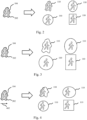
- Figures 2-4 shows by way of example how ROIs 110 may be determined based on a motion area 202 in an image frame.
- a cropped portion of an image frame is shown.
- the cropped portion includes an object 104, accompanied by a motion area 202 from the image frame.
- the motion area 202 is in the examples of figures 2-4 shown as a pixel mask 202.
- other ways of representing a motion area in an image frame may be used, such as a polygon, a rectangle etc.
- the motion areas 202 may be determined by identifying changes (e.g., using frame differencing, background subtraction, temporal filters, etc.) in the scene over time, typically by comparing consecutive or nearby frames.
- FIG 2 four examples of how to determine a ROI 110 based on a motion area 202 are shown.
- the top-left example represents the case where the ROI 110 has the shape of a pixel mask 110.
- the ROI 110 has the same form and extent as the motion area 202.
- the bottom-left example in figure 2 represents the case where the ROI 110 has the form of a circle, fully overlapping the motion area 202.
- the top-right example in figure 2 represents the case where the ROI 110 has the form of an ellipse, fully overlapping the motion area 202.
- the bottom-right example in figure 2 represents the case where the ROI 110 has the form of a rectangle, fully overlapping the motion area 202.
- Figure 3 shows four other examples of how to determine a ROI 110 based on a motion area 202.
- determining a ROI for object feature extraction comprises extending the motion area by a predetermined extent in each direction.
- the motion area 202 has been extended uniformly in each direction.
- the motion area 202 may be extended using other strategies, for example to a larger extent in a horizontal direction compared to the vertical direction.
- motion in the scene has a larger velocity in a horizontal direction compared to a velocity in a vertical direction, which may be advantageously captured by such an embodiment.
- each of the four examples correspond to the examples of figure 2 , however, the ROIs 110 in figure 3 have all been extended uniformly in each direction compared to the ROIs 110 in figure 2 .
- each of the four examples correspond to the examples of figure 3 , however, the ROIs 110 in figure 4 have all been extended according to the velocity compared to the ROIs 110 in figure 3 that have been extended uniformly in each direction.
- the size of the ROI extension may thus be a function of the velocity of the object, i.e., how far the object is expected to move in a certain time frame.
- the analysis speed of the system may be taken into account, i.e., how quickly the system can perform the necessary analyses.
- a margin may be added to the size of the ROI extension. This margin allows the system more time to perform the necessary analyses before the object is lost or occluded.
- Figure 5 shows by way of example three overlapping objects, schematically represented by bounding boxes 106, 108, 114.
- visual appearance leakage can occur when overlapping objects are not properly separated during the feature extraction process. For example, if one object partially covers another, the feature extraction process might inadvertently include information from both objects in the overlapping region. As a result, the feature vector of the partially occluded object may contain visual appearance characteristics of the occluding object. In some cases, an overlap below a certain threshold may still yield a sufficiently accurate feature vector. This is because a majority of the image data used for determining the feature vector for an object may still be derived from the correct object, despite the overlap.
- a bounding box 106 of a first object is overlapped to a certain extent 506 by a bounding box 108 of a second object, which means that an area 504 is not overlapped by any other object.
- the bounding box 108 of the second object is overlapped by bounding boxes 106, 114 of two objects and the extent of the overlap is represented by areas 506 and 510 in figure 5 , which means that an area 502 is not overlapped by any other object.
- the bounding box 114 of the third object is thus overlapped to a certain extent 510 by the bounding box 108 of the second object, which means an area 508 is not overlapped by any other object.
- an object may be considered as a prioritized candidate object for feature extraction upon determining that the object is not overlapping with any of the other objects with more than a threshold amount.
- the threshold amount is 0.
- the threshold amount (i.e., allowed extent of the overlap) is a predetermined percentage of the spatial extent of one of the overlapping objects. Examples of the predetermined percentage may be 1%, 5%, 7%, 10%, 25%, etc.
- the extent of the overlap 506 may be considered too high compared to the total area of the bounding box 106 of the first object, which means that the first object is not included among the prioritized candidate objects as described herein.
- the extent of the overlap 510 may be considered to be not exceeding the threshold (i.e., the overlap area 510 compared to the total area of the bounding box 114 of the third object), which means that the third object is included among the prioritized candidate objects as described herein.
- the total area (506 + 510) of the overlap is compared to the full area of the bounding box 108, to determine if the second object should be included among the prioritized candidate objects.
- the second object is not included among the prioritized candidate objects.
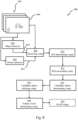
- FIG 6 shows by way of example a flow chart of a method 600 for prioritizing feature extraction for object re-identification in an object tracking application.
- the method 600 will now be described in conjunction with figure 8 showing by way of example a system 800 implementing the method 600.
- the method 600 comprises the step of receiving S602, by a receiving component 808, an image frame (100a) depicting a scene comprising a plurality of objects.
- the image frame may for example be a frame from a video sequence 802 depicting a scene as captured by a camera.
- the method 600 further comprises the step receiving S604, by the receiving component 808, object detection data 805 comprising, for each object of the plurality of objects, localization data indicating location and spatial extent of the object in the image frame.
- the object detection data may be received from an object detection component 804.
- the object detector component may implement any suitable conventional algorithm for object detection, such as a Haar cascade classifier, Histogram of Oriented Gradients (HOG), Region-based Convolutional Neural Networks (R-CNN), etc.
- the object detector component may comprise an artificial intelligence (AI) or machine learning (ML) algorithm trained to detect objects of interests in an image.
- AI artificial intelligence
- ML machine learning
- AI/ML is a suitable technology for detecting objects in an image and may relatively easily be trained with a large labelled/annotated dataset of images that contain the object type(s) of interest. It should be noted that there are several object detection algorithms that do not rely on neural networks. These methods may be based on classical computer vision such as Scale-Invariant Feature Transform (SIFT), Template matching, etc.
- SIFT Scale-Invariant Feature Transform
- Template matching etc.
- the method 600 further comprises receiving S606, by the receiving component 808, motion data 807 indicating one or more motion areas in the image frame, each motion area corresponding to an area in the scene where motion has been detected.
- the motion data further comprises, for each motion area in the image frame, an indication of a velocity of the detected motion in the corresponding area of the scene.
- the motion data 807 may be received from a motion detection component 806.
- the motion detector may implement any suitable algorithm (as described herein) for detecting motion in a scene (captured by a video sequence), typically by comparing consecutive or nearby frames.
- the method 600 further comprises, for each motion area, determining S608, by a region of interest, ROI, determining component 810, a ROI for object feature extraction in the image frame, the ROI for object feature extraction overlapping with the motion area.
- the ROI may further be extended S610 (as further described above in conjunction with figures 2-4 ) by the ROI determining component 810, e.g., by extending ROI derived from the motion area.
- the method 600 further comprises, for each ROI for object feature extraction, determining a list of objects at least partly overlapping with the ROI for object feature extraction using the object detection data, and associating S612, by a ROI associating component 812, the ROI for object feature extraction with the list of objects.
- the method 600 further comprises determining S614, by a candidate object determining component 814, a list of prioritized candidate objects for feature extraction as will be further described below in conjunction with figure 7 .
- the method further comprises selecting S616, by a candidate object selecting component 816, at least one object among the list of prioritized candidate objects.
- the selection S616 may comprise removing duplicates from the list of prioritized candidate objects.
- the selection may limit the number of objects used to determine feature vectors to a certain number (N). Such limitation may further comprise comparing each prioritized candidate object to one or more selection criteria and selecting (at most) the N objects meeting at least one of the one or more selection criteria.
- the selection criteria may be configurable based on the application or requirements of the application. For example, the selection criteria may comprise selecting objects of a certain object type, and/or of a certain size, and/or associated with a speed of motion, etc.
- An object may in embodiments be associated with a speed of motion in case it overlaps to a high extent (fully, 95%, etc.) with a motion area associated with the speed of motion.
- such limitation may comprise ranking each prioritized candidate object according to one or more ranking criteria and selecting the N highest ranked objects.
- the ranking criteria may for example comprise ranking based on object size, based on confidence score from the object detector, speed of the object, etc.
- the method 600 further comprises, for each selected object, determining S618, by a feature vector determining component 818, a feature vector for the selected object based on image data of the image frame according to the localization data of the object.
- determining S618, by a feature vector determining component 818 a feature vector for the selected object based on image data of the image frame according to the localization data of the object.
- Any suitable algorithm for determining a feature vector from image data may be used.
- Example algorithms include:
- the feature vector may subsequently be used by a re-identification component 820, e.g., to identify the selected object in the image frame as the same object that was previously detected in a previous frame or frames of the same video sequence 802, or detected in another video sequence.
- the feature vector may be transmitted to a tracker that can use it to create more robust tracks or recreate tracks that have been lost due to occlusion.
- a tracker that can use it to create more robust tracks or recreate tracks that have been lost due to occlusion.
- a determined feature vector may be associated with at least parts of the localisation data of the corresponding selected object. For example, a position of the selected object may be associated with the feature vector.
- Such information may be used by the re-identification component 820 to determine relevance of the feature vector for a track which have been lost in the video sequence. For example, some object movements may be considered unreasonable. Very large movements, such as across the image in just one frame, are probably instead two different objects that look alike.
- a tracker including a re-identification component 820 usually has a limited area based on the latest detection of an object that it expects the object to reappear in, based on the object's speed and some margin of error. If the object is lost, the radius is usually increased to enable re-association, for example when a person walks behind a bush. Association with the given track from detections outside that radius is usually "expensive" (requires very secure matching) or prohibited.
- a determined feature vector may be associated with a time stamp indicating a capturing time of the image frame. Such information may be used by the re-identification component 820 to determine relevance of the feature vector for a track which have been lost in the video sequence. For example, the time stamp may be used to determine an acceptable distance between a location of the selected object and a last instance of a lost track. Moreover, the time stamp may be used to determine relevance of the feature vector when performing long-term tracking.
- each object of the two or more objects associated with the ROI is analysed S708 to determine if the objects should be added S710 to the list of prioritized candidate objects.
- the method thus comprises an analysing step S708 of checking whether the object is overlapping with any of the other objects of the plurality of objects with more than a threshold amount. In case none of the other objects among the plurality of objects detected in the image frame (i.e., as identified in the object detection data received in step S604 of figure 6 ) overlap with the currently analysed object with more than the threshold amount, the currently analysed object is added S710 to the list of prioritized candidate objects.
- the analysing step S708 (and the adding step S710 if applicable) is performed until all objects have been analysed (as determined in step S706). When its determined S706 that all objects associated with a ROI has been analysed, the next ROI is checked and so on.
- the methods shown in figures 6-7 may be stored on a non-transitory computer-readable storage medium as instructions, such that the methods are implemented when the instructions are executed on a device or system having processing capabilities.
- a device or system e.g., as shown in figure 8
- Such device or system may comprise one or more processors.
- the system 800 may in examples be implemented in a single device such as a camera.
- some or all of different components (modules, units, etc.,) 804-820 may be implemented in a server or in the cloud.
- a camera implements all components of figure 8 except the re-identification component 820 which may be implemented by e.g., a server.
- a camera implements all components of figure 8 except the feature vector determining component 818 and the re-identification component 820 which may be implemented by e.g., a server.
- a subset of the components of figure 8 is implemented on a camera, such as image capture (capturing the video sequence 802) and motion detection 804, while the other components are implemented in a server.
- the device (camera, server, etc.,) or devices implementing the components 804-820 may each comprise circuitry which is configured to implement the components 804-820 and, more specifically, their functionality.
- a programmable system may include at least one programmable processor coupled to receive data and instructions from, and to transmit data and instructions to, a data storage system, at least one input device such as a camera for capturing the image frames/video sequence, and at least one output device such as a display used to display the images, potentially in an object tracking application including tracked objects as described herein.
- Suitable processors for the execution of a program of instructions include, by way of example, both general and special purpose microprocessors, and the sole processor or one of multiple processors or cores, of any kind of computer.
- the processors can be supplemented by, or incorporated in, ASICs (application-specific integrated circuits).
- the motion data may be received from the object tracker component and based on the movement of the objects it tracks between image frames. It is to be understood that any feature described in relation to any one embodiment may be used alone, or in combination with other features described, and may also be used in combination with one or more features of any other of the embodiments, or any combination of any other of the embodiments.
Landscapes
- Engineering & Computer Science (AREA)
- Physics & Mathematics (AREA)
- General Physics & Mathematics (AREA)
- Multimedia (AREA)
- Theoretical Computer Science (AREA)
- Computer Vision & Pattern Recognition (AREA)
- Human Computer Interaction (AREA)
- Nonlinear Science (AREA)
- Computational Linguistics (AREA)
- Software Systems (AREA)
- Image Analysis (AREA)
Claims (13)
- Computerimplementiertes Verfahren (600) zum Priorisieren von Objekten zur Merkmalextraktion zum Zweck der Objektreidentifizierung in einer Objektverfolgungsanwendung, welches die folgenden Schritte umfasst:Empfangen (S602) eines Bild-Frames (100a-e), der eine Szene darstellt, die mehrere Objekte umfasst;Empfangen (S604) von Objektdetektionsdaten, die für jedes Objekt der mehreren Objekte (102, 104, 112) Lokalisierungsdaten umfassen, die einen Ort und eine räumliche Ausdehnung (106, 108, 114) des Objekts in dem Bild-Frame angeben;Empfangen (S606) von Bewegungsdaten, die einen oder mehrere Bewegungsbereiche (202) in dem Bild-Frame angeben, wobei jeder Bewegungsbereich einem Bereich in der Szene entspricht, wo eine Bewegung detektiert wurde, wobei die Bewegungsdaten ferner für jeden Bewegungsbereich in dem Bild-Frame eine Indikation einer Geschwindigkeit der detektierten Bewegung in dem entsprechenden Bereich der Szene umfassen;für jeden Bewegungsbereich, Bestimmen (S608) eines Gebiets von Interesse, ROI, zur Objektmerkmalextraktion (110, 116) in dem Bild-Frame, wobei das ROI zur Objektmerkmalextraktion mit dem Bewegungsbereich überlappt, und Erweitern (S610) des ROI basierend auf der Geschwindigkeit;für jedes ROI zur Objektmerkmalextraktion, Bestimmen einer Liste von Objekten, die wenigstens teilweise mit dem ROI zur Objektmerkmalextraktion überlappen, unter Verwendung der Objektdetektionsdaten, und Assoziieren (S612) des ROI zur Objektmerkmalextraktion mit der Liste von Objekten;Bestimmen (S614) einer Liste priorisierter Kandidatenobjekte zur Merkmalextraktion durch Folgendes für jedes ROI zur Objektmerkmalextraktion, das mit zwei oder mehr Objekten assoziiert ist (S704):für jedes Objekt der zwei oder mehr Objekte, beim Bestimmen (S708) davon, dass das Objekt mit keinem der anderen Objekte der mehreren Objekte mit mehr als einer Schwellenmenge überlappt, Hinzufügen (S710) des Objekts zu der Liste priorisierter Kandidatenobjekte zur Merkmalextraktion;Auswählen (S616) wenigstens eines Objekts aus der Liste priorisierter Kandidatenobjekte und, für jedes ausgewählte Objekt, Bestimmen (S618) eines Merkmalvektors für das ausgewählte Objekt basierend auf Bilddaten des Bild-Frames gemäß den Lokalisationsdaten des Objekts.
- Verfahren nach Anspruch 1, wobei der Schritt des Bestimmens eines ROI zur Objektmerkmalextraktion Erweitern (S610) des Bewegungsbereichs um ein vorbestimmtes Ausmaß in jeder Richtung umfasst.
- Verfahren nach Anspruch 1 oder 2, wobei das ROI zur Objektmerkmalextraktion durch Erweitern des Bewegungsbereichs um ein größeres Ausmaß in einer Richtung, die der Richtung der Geschwindigkeit entspricht, im Vergleich zu einer Richtung, die nicht der Richtung der Geschwindigkeit entspricht, bestimmt wird.
- Verfahren nach einem der Ansprüche 1-3, wobei eine Form des ROI zur Objektmerkmalextraktion eines von Folgendem ist: eine Pixelmaske, ein Kreis, eine Ellipse und ein Rechteck.
- Verfahren nach einem der Ansprüche 1-4, wobei die Schwellenmenge 0 ist.
- Verfahren nach einem der Ansprüche 1-4, wobei die Schwellenmenge ein vorbestimmter Prozentsatz der räumlichen Ausdehnung eines der überlappenden Objekte ist.
- Verfahren nach einem der Ansprüche 1-6, wobei ein Maximum von N Objekten aus der Liste priorisierter Kandidatenobjekte ausgewählt wird, wobei N eine vorbestimmte Zahl ist.
- Verfahren nach Anspruch 7, wobei, wenn die Liste priorisierter Kandidatenobjekte aus mehr als N Objekten besteht, der Schritt des Auswählens Vergleichen jedes priorisierten Kandidatenobjekts mit einem oder mehreren Auswahlkriterien und Auswählen der N Objekte, die wenigstens eines des einen oder der mehreren Auswahlkriterien erfüllen, umfasst.
- Verfahren nach Anspruch 7, wobei, wenn die Liste priorisierter Kandidatenobjekte aus mehr als N Objekten besteht, der Schritt des Auswählens Einstufen jedes priorisierten Kandidatenobjekts gemäß einem oder mehreren Einstufungskriterien und Auswählen der N am höchsten eingestuften Objekte umfasst.
- Verfahren nach einem der Ansprüche 1-9, das ferner die folgenden Schritte umfasst:
für jedes ausgewählte Objekt, Assoziieren des bestimmten Merkmalvektors mit wenigstens Teilen der Lokalisierungsdaten des ausgewählten Objekts. - Verfahren nach einem der Ansprüche 1-10, das ferner die folgenden Schritte umfasst:
für jede ausgewählte Objekt, Assoziieren des bestimmten Merkmalvektors mit einem Zeitstempel, der eine Erfassungszeit des Bild-Frames angibt. - System zum Priorisieren einer Merkmalextraktion zur Objektreidentifizierung in einer Objektverfolgungsanwendung, welches Folgendes umfasst:einen oder mehrere Prozessoren; undein oder mehrere nichtflüchtige computerlesbares Medien, die computerausführbare Anweisungen speichern, die bei Ausführung durch den einen oder die mehreren Prozessoren das System zum Durchführen von Handlungen veranlassen, die Folgendes umfassen:Empfangen eines Bild-Frames, der eine Szene darstellt, die mehrere Objekte umfasst;Empfangen von Objektsdetektionsdaten, die für jedes Objekt der mehreren Objekte Lokalisationsdaten umfassen, die einen Ort und eine räumliche Ausdehnung des Objekts in dem Bild-Frame angeben;Empfangen von Bewegungsdaten, die einen oder mehrere Bewegungsbereiche in dem Bild-Frame angeben, wobei jeder Bewegungsbereich einem Bereich in der Szene entspricht, wo eine Bewegung detektiert wurde, wobei die Bewegungsdaten ferner für jeden Bewegungsbereich in dem Bild-Frame eine Indikation einer Geschwindigkeit der detektierten Bewegung in dem entsprechenden Bereich der Szene umfassen;für jeden Bewegungsbereich, Bestimmen eines Gebiets von Interesse, ROI, zur Objektmerkmalextraktion in dem Bild-Frame, wobei das ROI zur Objektmerkmalextraktion mit dem Bewegungsbereich überlappt, und Erweitern des ROI basierend auf der Geschwindigkeit;für jedes ROI zur Objektmerkmalextraktion, Bestimmen einer Liste von Objekten, die wenigstens teilweise mit dem ROI zur Objektmerkmalextraktion überlappen, unter Verwendung der Objektdetektionsdaten, und Assoziieren des ROI zur Objektmerkmalextraktion mit der Liste von Objekten;Bestimmen einer Liste priorisierter Kandidatenobjekte zur Merkmalextraktion durch Folgendes für jedes ROI zur Objektmerkmalextraktion, das mit zwei oder mehr Objekten assoziiert ist:für jedes Objekt der zwei oder mehr Objekte, beim Bestimmen davon, dass das Objekt mit keinem der anderen Objekte der mehreren Objekte mit mehr als einer Schwellenmenge überlappt, Hinzufügen des Objekts zu der Liste priorisierter Kandidatenobjekte zur Merkmalextraktion;Auswählen wenigstens eines Objekts aus der Liste priorisierter Kandidatenobjekte und, für jedes ausgewählte Objekt, Bestimmen eines Merkmalvektors für das ausgewählte Objekt basierend auf Bilddaten des Bild-Frames gemäß den Lokalisationsdaten des Objekts.
- Nichtflüchtiges computerlesbares Medium oder nichtflüchtige computerlesbare Medien, die durch einen oder mehrere Prozessoren ausführbare Anweisungen speichern, wobei die Anweisungen bei Ausführung den einen oder die mehreren Prozessoren zum Durchführen von Operationen veranlassen, die Folgendes umfassen:Empfangen eines Bild-Frames, der eine Szene darstellt, die mehrere Objekte umfasst;Empfangen von Objektsdetektionsdaten, die für jedes Objekt der mehreren Objekte Lokalisationsdaten umfassen, die einen Ort und eine räumliche Ausdehnung des Objekts in dem Bild-Frame angeben;Empfangen von Bewegungsdaten, die einen oder mehrere Bewegungsbereiche in dem Bild-Frame angeben, wobei jeder Bewegungsbereich einem Bereich in der Szene entspricht, wo eine Bewegung detektiert wurde, wobei die Bewegungsdaten ferner für jeden Bewegungsbereich in dem Bild-Frame eine Indikation einer Geschwindigkeit der detektierten Bewegung in dem entsprechenden Bereich der Szene umfassen;für jeden Bewegungsbereich, Bestimmen eines Gebiets von Interesse, ROI, zur Objektmerkmalextraktion in dem Bild-Frame, wobei das ROI zur Objektmerkmalextraktion mit dem Bewegungsbereich überlappt, und Erweitern des ROI basierend auf der Geschwindigkeit;für jedes ROI zur Objektmerkmalextraktion, Bestimmen einer Liste von Objekten, die wenigstens teilweise mit dem ROI zur Objektmerkmalextraktion überlappen, unter Verwendung der Objektdetektionsdaten, und Assoziieren des ROI zur Objektmerkmalextraktion mit der Liste von Objekten;Bestimmen einer Liste priorisierter Kandidatenobjekte zur Merkmalextraktion durch Folgendes für jedes ROI zur Objektmerkmalextraktion, das mit zwei oder mehr Objekten assoziiert ist:für jedes Objekt der zwei oder mehr Objekte, beim Bestimmen davon, dass das Objekt mit keinem der anderen Objekte der mehreren Objekte mit mehr als einer Schwellenmenge überlappt, Hinzufügen des Objekts zu der Liste priorisierter Kandidatenobjekte zur Merkmalextraktion;Auswählen wenigstens eines Objekts aus der Liste priorisierter Kandidatenobjekte und, für jedes ausgewählte Objekt, Bestimmen eines Merkmalvektors für das ausgewählte Objekt basierend auf Bilddaten des Bild-Frames gemäß den Lokalisationsdaten des Objekts.
Priority Applications (4)
| Application Number | Priority Date | Filing Date | Title |
|---|---|---|---|
| EP23173346.0A EP4465248B1 (de) | 2023-05-15 | 2023-05-15 | Verfahren, system und nichttransitorische computerlesbare medien zur priorisierung von objekten zur merkmalsextraktion |
| KR1020240039761A KR102882837B1 (ko) | 2023-05-15 | 2024-03-22 | 특징 추출을 위한 객체의 우선순위를 정하기 위한 방법, 시스템 및 비일시성의 컴퓨터 판독 가능 매체 |
| US18/616,830 US12293529B2 (en) | 2023-05-15 | 2024-03-26 | Method, system and non-transitory computer-readable media for prioritizing objects for feature extraction |
| CN202410588504.3A CN118968009B (zh) | 2023-05-15 | 2024-05-13 | 对对象进行优先级排序的方法、系统和计算机可读介质 |
Applications Claiming Priority (1)
| Application Number | Priority Date | Filing Date | Title |
|---|---|---|---|
| EP23173346.0A EP4465248B1 (de) | 2023-05-15 | 2023-05-15 | Verfahren, system und nichttransitorische computerlesbare medien zur priorisierung von objekten zur merkmalsextraktion |
Publications (3)
| Publication Number | Publication Date |
|---|---|
| EP4465248A1 EP4465248A1 (de) | 2024-11-20 |
| EP4465248B1 true EP4465248B1 (de) | 2025-02-26 |
| EP4465248C0 EP4465248C0 (de) | 2025-02-26 |
Family
ID=86382994
Family Applications (1)
| Application Number | Title | Priority Date | Filing Date |
|---|---|---|---|
| EP23173346.0A Active EP4465248B1 (de) | 2023-05-15 | 2023-05-15 | Verfahren, system und nichttransitorische computerlesbare medien zur priorisierung von objekten zur merkmalsextraktion |
Country Status (4)
| Country | Link |
|---|---|
| US (1) | US12293529B2 (de) |
| EP (1) | EP4465248B1 (de) |
| KR (1) | KR102882837B1 (de) |
| CN (1) | CN118968009B (de) |
Families Citing this family (2)
| Publication number | Priority date | Publication date | Assignee | Title |
|---|---|---|---|---|
| US20240135561A1 (en) * | 2022-10-06 | 2024-04-25 | Adobe Inc. | Modifying digital images via depth-aware object move |
| US12505596B2 (en) | 2022-10-06 | 2025-12-23 | Adobe Inc. | Modifying digital images via perspective-aware object move |
Family Cites Families (10)
| Publication number | Priority date | Publication date | Assignee | Title |
|---|---|---|---|---|
| US8265349B2 (en) * | 2006-02-07 | 2012-09-11 | Qualcomm Incorporated | Intra-mode region-of-interest video object segmentation |
| US8948454B2 (en) * | 2013-01-02 | 2015-02-03 | International Business Machines Corporation | Boosting object detection performance in videos |
| US10643101B2 (en) | 2015-07-09 | 2020-05-05 | Texas Instruments Incorporated | Window grouping and tracking for fast object detection |
| US10395385B2 (en) | 2017-06-27 | 2019-08-27 | Qualcomm Incorporated | Using object re-identification in video surveillance |
| TWI701609B (zh) * | 2018-01-04 | 2020-08-11 | 緯創資通股份有限公司 | 影像物件追蹤方法及其系統與電腦可讀取儲存媒體 |
| CN110458861B (zh) * | 2018-05-04 | 2024-01-26 | 佳能株式会社 | 对象检测与跟踪方法和设备 |
| WO2020142892A1 (en) * | 2019-01-08 | 2020-07-16 | Hangzhou Taro Positioning Technology Co., Ltd. | Determining region-of-interest of object using image-based object tracking |
| CN111582032A (zh) | 2020-04-03 | 2020-08-25 | 普联技术有限公司 | 行人检测方法、装置、终端设备及存储介质 |
| EP4016377B1 (de) * | 2020-12-21 | 2024-10-09 | Axis AB | Vorrichtung und verfahren zur zuordnung von objektdetektionen zwischen rahmen mit einem neuronalen netzwerk |
| US12254709B2 (en) * | 2022-02-28 | 2025-03-18 | Zebra Technologies Corporation | Using image processing to identify produce |
-
2023
- 2023-05-15 EP EP23173346.0A patent/EP4465248B1/de active Active
-
2024
- 2024-03-22 KR KR1020240039761A patent/KR102882837B1/ko active Active
- 2024-03-26 US US18/616,830 patent/US12293529B2/en active Active
- 2024-05-13 CN CN202410588504.3A patent/CN118968009B/zh active Active
Non-Patent Citations (2)
| Title |
|---|
| CHU QI ET AL: "Online Multi-object Tracking Using CNN-Based Single Object Tracker with Spatial-Temporal Attention Mechanism", 2017 IEEE INTERNATIONAL CONFERENCE ON COMPUTER VISION (ICCV), IEEE, 22 October 2017 (2017-10-22), pages 4846 - 4855, XP033283361, DOI: 10.1109/ICCV.2017.518 * |
| NAUSHAD ALI M.M. ET AL: "Multiple object tracking with partial occlusion handling using salient feature points", INFORMATION SCIENCES, vol. 278, 1 September 2014 (2014-09-01), AMSTERDAM, NL, pages 448 - 465, XP093112693, ISSN: 0020-0255, DOI: 10.1016/j.ins.2014.03.064 * |
Also Published As
| Publication number | Publication date |
|---|---|
| CN118968009A (zh) | 2024-11-15 |
| US12293529B2 (en) | 2025-05-06 |
| KR20240165259A (ko) | 2024-11-22 |
| EP4465248A1 (de) | 2024-11-20 |
| US20240386579A1 (en) | 2024-11-21 |
| CN118968009B (zh) | 2025-07-11 |
| EP4465248C0 (de) | 2025-02-26 |
| KR102882837B1 (ko) | 2025-11-06 |
Similar Documents
| Publication | Publication Date | Title |
|---|---|---|
| Portmann et al. | People detection and tracking from aerial thermal views | |
| Bondi et al. | Real-time people counting from depth imagery of crowded environments | |
| Rauter | Reliable human detection and tracking in top-view depth images | |
| Tan et al. | Multi-camera vehicle tracking and re-identification based on visual and spatial-temporal features. | |
| Ren et al. | Tracking the soccer ball using multiple fixed cameras | |
| Lima et al. | Generalizable multi-camera 3d pedestrian detection | |
| Jiang et al. | Multiple pedestrian tracking from monocular videos in an interacting multiple model framework | |
| US12293529B2 (en) | Method, system and non-transitory computer-readable media for prioritizing objects for feature extraction | |
| Baykara et al. | Real-time detection, tracking and classification of multiple moving objects in UAV videos | |
| Fradi et al. | Spatial and temporal variations of feature tracks for crowd behavior analysis | |
| Isobe et al. | Occlusion handling for a target-tracking robot with a stereo camera | |
| US20250014190A1 (en) | Method and non-transitory computer-readable storage medium for detecting one or more occluded areas of a scene | |
| Cancela et al. | Multiple human tracking system for unpredictable trajectories | |
| Li et al. | Condensation-based multi-person detection and tracking with HOG and LBP | |
| Vu et al. | Real-time robust human tracking based on Lucas-Kanade optical flow and deep detection for embedded surveillance | |
| Zhang et al. | Moving pedestrian detection based on motion segmentation | |
| Eiselein et al. | Enhancing human detection using crowd density measures and an adaptive correction filter | |
| Saif et al. | Moving object segmentation using various features from aerial images: A review | |
| Pairo et al. | A delay-free and robust object tracking approach for robotics applications | |
| De Padua et al. | Particle filter-based predictive tracking of futsal players from a single stationary camera | |
| Setia et al. | Co-operative pedestrians group tracking in crowded scenes using an mst approach | |
| Wang et al. | Online adaptive multiple pedestrian tracking in monocular surveillance video | |
| Li et al. | Robust object tracking in crowd dynamic scenes using explicit stereo depth | |
| Xu et al. | Smart video surveillance system | |
| El-Alami et al. | An efficient hybrid approach for vehicle detection and tracking |
Legal Events
| Date | Code | Title | Description |
|---|---|---|---|
| STAA | Information on the status of an ep patent application or granted ep patent |
Free format text: STATUS: EXAMINATION IS IN PROGRESS |
|
| PUAI | Public reference made under article 153(3) epc to a published international application that has entered the european phase |
Free format text: ORIGINAL CODE: 0009012 |
|
| 17P | Request for examination filed |
Effective date: 20231017 |
|
| AK | Designated contracting states |
Kind code of ref document: A1 Designated state(s): AL AT BE BG CH CY CZ DE DK EE ES FI FR GB GR HR HU IE IS IT LI LT LU LV MC ME MK MT NL NO PL PT RO RS SE SI SK SM TR |
|
| GRAP | Despatch of communication of intention to grant a patent |
Free format text: ORIGINAL CODE: EPIDOSNIGR1 |
|
| STAA | Information on the status of an ep patent application or granted ep patent |
Free format text: STATUS: GRANT OF PATENT IS INTENDED |
|
| RIC1 | Information provided on ipc code assigned before grant |
Ipc: G06T 7/20 20170101ALI20241126BHEP Ipc: G06T 7/246 20170101ALI20241126BHEP Ipc: G06V 20/52 20220101ALI20241126BHEP Ipc: G06V 10/62 20220101ALI20241126BHEP Ipc: G06V 10/46 20220101ALI20241126BHEP Ipc: G06V 10/36 20220101ALI20241126BHEP Ipc: G06V 10/26 20220101ALI20241126BHEP Ipc: G06V 10/25 20220101AFI20241126BHEP |
|
| INTG | Intention to grant announced |
Effective date: 20241210 |
|
| GRAS | Grant fee paid |
Free format text: ORIGINAL CODE: EPIDOSNIGR3 |
|
| GRAA | (expected) grant |
Free format text: ORIGINAL CODE: 0009210 |
|
| STAA | Information on the status of an ep patent application or granted ep patent |
Free format text: STATUS: THE PATENT HAS BEEN GRANTED |
|
| AK | Designated contracting states |
Kind code of ref document: B1 Designated state(s): AL AT BE BG CH CY CZ DE DK EE ES FI FR GB GR HR HU IE IS IT LI LT LU LV MC ME MK MT NL NO PL PT RO RS SE SI SK SM TR |
|
| REG | Reference to a national code |
Ref country code: GB Ref legal event code: FG4D |
|
| REG | Reference to a national code |
Ref country code: CH Ref legal event code: EP |
|
| REG | Reference to a national code |
Ref country code: DE Ref legal event code: R096 Ref document number: 602023002163 Country of ref document: DE |
|
| REG | Reference to a national code |
Ref country code: IE Ref legal event code: FG4D |
|
| U01 | Request for unitary effect filed |
Effective date: 20250226 |
|
| U07 | Unitary effect registered |
Designated state(s): AT BE BG DE DK EE FI FR IT LT LU LV MT NL PT RO SE SI Effective date: 20250304 |
|
| U20 | Renewal fee for the european patent with unitary effect paid |
Year of fee payment: 3 Effective date: 20250423 |
|
| PG25 | Lapsed in a contracting state [announced via postgrant information from national office to epo] |
Ref country code: RS Free format text: LAPSE BECAUSE OF FAILURE TO SUBMIT A TRANSLATION OF THE DESCRIPTION OR TO PAY THE FEE WITHIN THE PRESCRIBED TIME-LIMIT Effective date: 20250526 |
|
| PG25 | Lapsed in a contracting state [announced via postgrant information from national office to epo] |
Ref country code: PL Free format text: LAPSE BECAUSE OF FAILURE TO SUBMIT A TRANSLATION OF THE DESCRIPTION OR TO PAY THE FEE WITHIN THE PRESCRIBED TIME-LIMIT Effective date: 20250226 |
|
| PG25 | Lapsed in a contracting state [announced via postgrant information from national office to epo] |
Ref country code: ES Free format text: LAPSE BECAUSE OF FAILURE TO SUBMIT A TRANSLATION OF THE DESCRIPTION OR TO PAY THE FEE WITHIN THE PRESCRIBED TIME-LIMIT Effective date: 20250226 |
|
| PG25 | Lapsed in a contracting state [announced via postgrant information from national office to epo] |
Ref country code: NO Free format text: LAPSE BECAUSE OF FAILURE TO SUBMIT A TRANSLATION OF THE DESCRIPTION OR TO PAY THE FEE WITHIN THE PRESCRIBED TIME-LIMIT Effective date: 20250526 Ref country code: IS Free format text: LAPSE BECAUSE OF FAILURE TO SUBMIT A TRANSLATION OF THE DESCRIPTION OR TO PAY THE FEE WITHIN THE PRESCRIBED TIME-LIMIT Effective date: 20250626 |
|
| PG25 | Lapsed in a contracting state [announced via postgrant information from national office to epo] |
Ref country code: HR Free format text: LAPSE BECAUSE OF FAILURE TO SUBMIT A TRANSLATION OF THE DESCRIPTION OR TO PAY THE FEE WITHIN THE PRESCRIBED TIME-LIMIT Effective date: 20250226 |
|
| PG25 | Lapsed in a contracting state [announced via postgrant information from national office to epo] |
Ref country code: GR Free format text: LAPSE BECAUSE OF FAILURE TO SUBMIT A TRANSLATION OF THE DESCRIPTION OR TO PAY THE FEE WITHIN THE PRESCRIBED TIME-LIMIT Effective date: 20250527 |
|
| PG25 | Lapsed in a contracting state [announced via postgrant information from national office to epo] |
Ref country code: SM Free format text: LAPSE BECAUSE OF FAILURE TO SUBMIT A TRANSLATION OF THE DESCRIPTION OR TO PAY THE FEE WITHIN THE PRESCRIBED TIME-LIMIT Effective date: 20250226 |
|
| PG25 | Lapsed in a contracting state [announced via postgrant information from national office to epo] |
Ref country code: CZ Free format text: LAPSE BECAUSE OF FAILURE TO SUBMIT A TRANSLATION OF THE DESCRIPTION OR TO PAY THE FEE WITHIN THE PRESCRIBED TIME-LIMIT Effective date: 20250226 |
|
| PG25 | Lapsed in a contracting state [announced via postgrant information from national office to epo] |
Ref country code: SK Free format text: LAPSE BECAUSE OF FAILURE TO SUBMIT A TRANSLATION OF THE DESCRIPTION OR TO PAY THE FEE WITHIN THE PRESCRIBED TIME-LIMIT Effective date: 20250226 |
|
| PLBE | No opposition filed within time limit |
Free format text: ORIGINAL CODE: 0009261 |
|
| STAA | Information on the status of an ep patent application or granted ep patent |
Free format text: STATUS: NO OPPOSITION FILED WITHIN TIME LIMIT |
|
| PG25 | Lapsed in a contracting state [announced via postgrant information from national office to epo] |
Ref country code: MC Free format text: LAPSE BECAUSE OF FAILURE TO SUBMIT A TRANSLATION OF THE DESCRIPTION OR TO PAY THE FEE WITHIN THE PRESCRIBED TIME-LIMIT Effective date: 20250226 |
|
| 26N | No opposition filed |
Effective date: 20251127 |