EP4464690A1 - High-selectivity kcnq4 potassium channel agonist, preparation method therefor and use thereof - Google Patents
High-selectivity kcnq4 potassium channel agonist, preparation method therefor and use thereof Download PDFInfo
- Publication number
- EP4464690A1 EP4464690A1 EP23740015.5A EP23740015A EP4464690A1 EP 4464690 A1 EP4464690 A1 EP 4464690A1 EP 23740015 A EP23740015 A EP 23740015A EP 4464690 A1 EP4464690 A1 EP 4464690A1
- Authority
- EP
- European Patent Office
- Prior art keywords
- compound
- tert
- formula
- pharmaceutically acceptable
- kcnq4
- Prior art date
- Legal status (The legal status is an assumption and is not a legal conclusion. Google has not performed a legal analysis and makes no representation as to the accuracy of the status listed.)
- Pending
Links
- 238000002360 preparation method Methods 0.000 title claims abstract description 19
- 229940122117 Potassium channel agonist Drugs 0.000 title claims abstract description 12
- 150000001875 compounds Chemical class 0.000 claims abstract description 87
- 101000994648 Homo sapiens Potassium voltage-gated channel subfamily KQT member 4 Proteins 0.000 claims abstract description 49
- 102100034363 Potassium voltage-gated channel subfamily KQT member 4 Human genes 0.000 claims abstract description 37
- -1 C4-C14 tert-alkoxy Chemical group 0.000 claims description 19
- 239000003814 drug Substances 0.000 claims description 19
- 150000003839 salts Chemical class 0.000 claims description 19
- 210000002460 smooth muscle Anatomy 0.000 claims description 13
- 208000037265 diseases, disorders, signs and symptoms Diseases 0.000 claims description 11
- 201000010099 disease Diseases 0.000 claims description 10
- 125000004169 (C1-C6) alkyl group Chemical group 0.000 claims description 8
- 229910052736 halogen Inorganic materials 0.000 claims description 8
- 150000002367 halogens Chemical class 0.000 claims description 8
- 239000008194 pharmaceutical composition Substances 0.000 claims description 8
- 210000002027 skeletal muscle Anatomy 0.000 claims description 8
- 229910052739 hydrogen Inorganic materials 0.000 claims description 7
- 239000001257 hydrogen Substances 0.000 claims description 7
- 125000004191 (C1-C6) alkoxy group Chemical group 0.000 claims description 6
- 125000000051 benzyloxy group Chemical group [H]C1=C([H])C([H])=C(C([H])=C1[H])C([H])([H])O* 0.000 claims description 6
- 238000000034 method Methods 0.000 claims description 6
- 125000000999 tert-butyl group Chemical group [H]C([H])([H])C(*)(C([H])([H])[H])C([H])([H])[H] 0.000 claims description 6
- 208000009935 visceral pain Diseases 0.000 claims description 6
- 125000006274 (C1-C3)alkoxy group Chemical group 0.000 claims description 5
- 208000006545 Chronic Obstructive Pulmonary Disease Diseases 0.000 claims description 5
- 206010011878 Deafness Diseases 0.000 claims description 5
- 206010020772 Hypertension Diseases 0.000 claims description 5
- 206010020853 Hypertonic bladder Diseases 0.000 claims description 5
- 208000007914 Labor Pain Diseases 0.000 claims description 5
- 208000035945 Labour pain Diseases 0.000 claims description 5
- 208000009722 Overactive Urinary Bladder Diseases 0.000 claims description 5
- 208000003251 Pruritus Diseases 0.000 claims description 5
- 201000001880 Sexual dysfunction Diseases 0.000 claims description 5
- 208000006673 asthma Diseases 0.000 claims description 5
- 208000029078 coronary artery disease Diseases 0.000 claims description 5
- 231100000895 deafness Toxicity 0.000 claims description 5
- 201000006549 dyspepsia Diseases 0.000 claims description 5
- 208000016354 hearing loss disease Diseases 0.000 claims description 5
- 125000004435 hydrogen atom Chemical group [H]* 0.000 claims description 5
- 208000001286 intracranial vasospasm Diseases 0.000 claims description 5
- 208000002551 irritable bowel syndrome Diseases 0.000 claims description 5
- 208000020629 overactive bladder Diseases 0.000 claims description 5
- 208000002815 pulmonary hypertension Diseases 0.000 claims description 5
- 231100000872 sexual dysfunction Toxicity 0.000 claims description 5
- 208000011580 syndromic disease Diseases 0.000 claims description 5
- WIVYTYZCVWHWSH-UHFFFAOYSA-N tert-butyl n-(4-aminophenyl)carbamate Chemical compound CC(C)(C)OC(=O)NC1=CC=C(N)C=C1 WIVYTYZCVWHWSH-UHFFFAOYSA-N 0.000 claims description 5
- 125000004093 cyano group Chemical group *C#N 0.000 claims description 4
- 125000000449 nitro group Chemical group [O-][N+](*)=O 0.000 claims description 4
- 125000000951 phenoxy group Chemical group [H]C1=C([H])C([H])=C(O*)C([H])=C1[H] 0.000 claims description 4
- 238000006467 substitution reaction Methods 0.000 claims description 4
- DYHSDKLCOJIUFX-UHFFFAOYSA-N tert-butoxycarbonyl anhydride Chemical compound CC(C)(C)OC(=O)OC(=O)OC(C)(C)C DYHSDKLCOJIUFX-UHFFFAOYSA-N 0.000 claims description 4
- 125000006700 (C1-C6) alkylthio group Chemical group 0.000 claims description 3
- 239000000546 pharmaceutical excipient Substances 0.000 claims description 3
- 125000002023 trifluoromethyl group Chemical group FC(F)(F)* 0.000 claims description 3
- CBCKQZAAMUWICA-UHFFFAOYSA-N 1,4-phenylenediamine Chemical compound NC1=CC=C(N)C=C1 CBCKQZAAMUWICA-UHFFFAOYSA-N 0.000 claims description 2
- XXFUZSHTIOFGNV-UHFFFAOYSA-N 1-bromoprop-1-yne Chemical compound CC#CBr XXFUZSHTIOFGNV-UHFFFAOYSA-N 0.000 claims description 2
- LMBFAGIMSUYTBN-MPZNNTNKSA-N teixobactin Chemical compound C([C@H](C(=O)N[C@@H]([C@@H](C)CC)C(=O)N[C@@H](CO)C(=O)N[C@H](CCC(N)=O)C(=O)N[C@H]([C@@H](C)CC)C(=O)N[C@@H]([C@@H](C)CC)C(=O)N[C@@H](CO)C(=O)N[C@H]1C(N[C@@H](C)C(=O)N[C@@H](C[C@@H]2NC(=N)NC2)C(=O)N[C@H](C(=O)O[C@H]1C)[C@@H](C)CC)=O)NC)C1=CC=CC=C1 LMBFAGIMSUYTBN-MPZNNTNKSA-N 0.000 claims description 2
- 125000004213 tert-butoxy group Chemical group [H]C([H])([H])C(O*)(C([H])([H])[H])C([H])([H])[H] 0.000 claims description 2
- 150000002431 hydrogen Chemical class 0.000 claims 2
- 108010006746 KCNQ2 Potassium Channel Proteins 0.000 abstract description 23
- 239000000556 agonist Substances 0.000 abstract description 17
- 230000001270 agonistic effect Effects 0.000 abstract description 16
- 230000000694 effects Effects 0.000 abstract description 10
- 229940127343 Potassium Channel Agonists Drugs 0.000 abstract description 5
- 230000002829 reductive effect Effects 0.000 abstract description 3
- 231100000419 toxicity Toxicity 0.000 abstract description 3
- 230000001988 toxicity Effects 0.000 abstract description 3
- 238000011161 development Methods 0.000 abstract description 2
- 102100034354 Potassium voltage-gated channel subfamily KQT member 2 Human genes 0.000 abstract 2
- 230000007547 defect Effects 0.000 abstract 1
- 102000005453 KCNQ2 Potassium Channel Human genes 0.000 description 19
- IAZDPXIOMUYVGZ-UHFFFAOYSA-N Dimethylsulphoxide Chemical compound CS(C)=O IAZDPXIOMUYVGZ-UHFFFAOYSA-N 0.000 description 15
- 229940079593 drug Drugs 0.000 description 15
- XEKOWRVHYACXOJ-UHFFFAOYSA-N Ethyl acetate Chemical compound CCOC(C)=O XEKOWRVHYACXOJ-UHFFFAOYSA-N 0.000 description 12
- 210000004027 cell Anatomy 0.000 description 11
- PCOBBVZJEWWZFR-UHFFFAOYSA-N ezogabine Chemical group C1=C(N)C(NC(=O)OCC)=CC=C1NCC1=CC=C(F)C=C1 PCOBBVZJEWWZFR-UHFFFAOYSA-N 0.000 description 11
- 229960003312 retigabine Drugs 0.000 description 11
- 239000000243 solution Substances 0.000 description 11
- 108091006146 Channels Proteins 0.000 description 10
- 238000002474 experimental method Methods 0.000 description 9
- 125000001424 substituent group Chemical group 0.000 description 9
- 102000012359 KCNQ Potassium Channels Human genes 0.000 description 8
- 108010022282 KCNQ Potassium Channels Proteins 0.000 description 8
- 125000003277 amino group Chemical group 0.000 description 7
- 239000000203 mixture Substances 0.000 description 7
- HEDRZPFGACZZDS-MICDWDOJSA-N Trichloro(2H)methane Chemical compound [2H]C(Cl)(Cl)Cl HEDRZPFGACZZDS-MICDWDOJSA-N 0.000 description 6
- 125000000217 alkyl group Chemical group 0.000 description 6
- 210000003722 extracellular fluid Anatomy 0.000 description 6
- 125000001997 phenyl group Chemical group [H]C1=C([H])C([H])=C(*)C([H])=C1[H] 0.000 description 6
- 239000013612 plasmid Substances 0.000 description 6
- 101000994656 Homo sapiens Potassium voltage-gated channel subfamily KQT member 5 Proteins 0.000 description 5
- 108010011185 KCNQ1 Potassium Channel Proteins 0.000 description 5
- 238000001994 activation Methods 0.000 description 5
- 238000006243 chemical reaction Methods 0.000 description 5
- 238000012360 testing method Methods 0.000 description 5
- 238000001890 transfection Methods 0.000 description 5
- TWRXJAOTZQYOKJ-UHFFFAOYSA-L Magnesium chloride Chemical compound [Mg+2].[Cl-].[Cl-] TWRXJAOTZQYOKJ-UHFFFAOYSA-L 0.000 description 4
- JGFZNNIVVJXRND-UHFFFAOYSA-N N,N-Diisopropylethylamine (DIPEA) Chemical compound CCN(C(C)C)C(C)C JGFZNNIVVJXRND-UHFFFAOYSA-N 0.000 description 4
- 238000005481 NMR spectroscopy Methods 0.000 description 4
- 102100037444 Potassium voltage-gated channel subfamily KQT member 1 Human genes 0.000 description 4
- 239000002253 acid Substances 0.000 description 4
- 230000004913 activation Effects 0.000 description 4
- 239000003153 chemical reaction reagent Substances 0.000 description 4
- 239000012043 crude product Substances 0.000 description 4
- 229910052757 nitrogen Inorganic materials 0.000 description 4
- 210000001519 tissue Anatomy 0.000 description 4
- QTBSBXVTEAMEQO-UHFFFAOYSA-N Acetic acid Chemical compound CC(O)=O QTBSBXVTEAMEQO-UHFFFAOYSA-N 0.000 description 3
- IJGRMHOSHXDMSA-UHFFFAOYSA-N Atomic nitrogen Chemical compound N#N IJGRMHOSHXDMSA-UHFFFAOYSA-N 0.000 description 3
- MUBZPKHOEPUJKR-UHFFFAOYSA-N Oxalic acid Chemical compound OC(=O)C(O)=O MUBZPKHOEPUJKR-UHFFFAOYSA-N 0.000 description 3
- OFOBLEOULBTSOW-UHFFFAOYSA-N Propanedioic acid Natural products OC(=O)CC(O)=O OFOBLEOULBTSOW-UHFFFAOYSA-N 0.000 description 3
- VYPSYNLAJGMNEJ-UHFFFAOYSA-N Silicium dioxide Chemical compound O=[Si]=O VYPSYNLAJGMNEJ-UHFFFAOYSA-N 0.000 description 3
- HEMHJVSKTPXQMS-UHFFFAOYSA-M Sodium hydroxide Chemical compound [OH-].[Na+] HEMHJVSKTPXQMS-UHFFFAOYSA-M 0.000 description 3
- 230000015572 biosynthetic process Effects 0.000 description 3
- 125000004432 carbon atom Chemical group C* 0.000 description 3
- 210000003169 central nervous system Anatomy 0.000 description 3
- KRKNYBCHXYNGOX-UHFFFAOYSA-N citric acid Chemical compound OC(=O)CC(O)(C(O)=O)CC(O)=O KRKNYBCHXYNGOX-UHFFFAOYSA-N 0.000 description 3
- 238000009826 distribution Methods 0.000 description 3
- 125000002496 methyl group Chemical group [H]C([H])([H])* 0.000 description 3
- 230000010412 perfusion Effects 0.000 description 3
- 230000000704 physical effect Effects 0.000 description 3
- 239000000741 silica gel Substances 0.000 description 3
- 229910002027 silica gel Inorganic materials 0.000 description 3
- 239000011550 stock solution Substances 0.000 description 3
- 238000003786 synthesis reaction Methods 0.000 description 3
- 238000005160 1H NMR spectroscopy Methods 0.000 description 2
- HIXDQWDOVZUNNA-UHFFFAOYSA-N 2-(3,4-dimethoxyphenyl)-5-hydroxy-7-methoxychromen-4-one Chemical compound C=1C(OC)=CC(O)=C(C(C=2)=O)C=1OC=2C1=CC=C(OC)C(OC)=C1 HIXDQWDOVZUNNA-UHFFFAOYSA-N 0.000 description 2
- JKMHFZQWWAIEOD-UHFFFAOYSA-N 2-[4-(2-hydroxyethyl)piperazin-1-yl]ethanesulfonic acid Chemical compound OCC[NH+]1CCN(CCS([O-])(=O)=O)CC1 JKMHFZQWWAIEOD-UHFFFAOYSA-N 0.000 description 2
- 206010001497 Agitation Diseases 0.000 description 2
- 108091003079 Bovine Serum Albumin Proteins 0.000 description 2
- RGHNJXZEOKUKBD-SQOUGZDYSA-N D-gluconic acid Chemical compound OC[C@@H](O)[C@@H](O)[C@H](O)[C@@H](O)C(O)=O RGHNJXZEOKUKBD-SQOUGZDYSA-N 0.000 description 2
- OKKJLVBELUTLKV-MZCSYVLQSA-N Deuterated methanol Chemical compound [2H]OC([2H])([2H])[2H] OKKJLVBELUTLKV-MZCSYVLQSA-N 0.000 description 2
- IAZDPXIOMUYVGZ-WFGJKAKNSA-N Dimethyl sulfoxide Chemical compound [2H]C([2H])([2H])S(=O)C([2H])([2H])[2H] IAZDPXIOMUYVGZ-WFGJKAKNSA-N 0.000 description 2
- 241000588724 Escherichia coli Species 0.000 description 2
- VZCYOOQTPOCHFL-OWOJBTEDSA-N Fumaric acid Chemical compound OC(=O)\C=C\C(O)=O VZCYOOQTPOCHFL-OWOJBTEDSA-N 0.000 description 2
- 108010043121 Green Fluorescent Proteins Proteins 0.000 description 2
- 102000004144 Green Fluorescent Proteins Human genes 0.000 description 2
- 239000007995 HEPES buffer Substances 0.000 description 2
- VEXZGXHMUGYJMC-UHFFFAOYSA-N Hydrochloric acid Chemical compound Cl VEXZGXHMUGYJMC-UHFFFAOYSA-N 0.000 description 2
- 108010038888 KCNQ3 Potassium Channel Proteins 0.000 description 2
- AFVFQIVMOAPDHO-UHFFFAOYSA-N Methanesulfonic acid Chemical compound CS(O)(=O)=O AFVFQIVMOAPDHO-UHFFFAOYSA-N 0.000 description 2
- 241000699670 Mus sp. Species 0.000 description 2
- 208000002193 Pain Diseases 0.000 description 2
- NBIIXXVUZAFLBC-UHFFFAOYSA-N Phosphoric acid Chemical compound OP(O)(O)=O NBIIXXVUZAFLBC-UHFFFAOYSA-N 0.000 description 2
- PMZURENOXWZQFD-UHFFFAOYSA-L Sodium Sulfate Chemical compound [Na+].[Na+].[O-]S([O-])(=O)=O PMZURENOXWZQFD-UHFFFAOYSA-L 0.000 description 2
- FAPWRFPIFSIZLT-UHFFFAOYSA-M Sodium chloride Chemical compound [Na+].[Cl-] FAPWRFPIFSIZLT-UHFFFAOYSA-M 0.000 description 2
- 206010041349 Somnolence Diseases 0.000 description 2
- QAOWNCQODCNURD-UHFFFAOYSA-N Sulfuric acid Chemical compound OS(O)(=O)=O QAOWNCQODCNURD-UHFFFAOYSA-N 0.000 description 2
- DTQVDTLACAAQTR-UHFFFAOYSA-N Trifluoroacetic acid Chemical compound OC(=O)C(F)(F)F DTQVDTLACAAQTR-UHFFFAOYSA-N 0.000 description 2
- 125000003545 alkoxy group Chemical group 0.000 description 2
- WPYMKLBDIGXBTP-UHFFFAOYSA-N benzoic acid Chemical compound OC(=O)C1=CC=CC=C1 WPYMKLBDIGXBTP-UHFFFAOYSA-N 0.000 description 2
- 210000004978 chinese hamster ovary cell Anatomy 0.000 description 2
- 238000007405 data analysis Methods 0.000 description 2
- 230000006866 deterioration Effects 0.000 description 2
- XBDQKXXYIPTUBI-UHFFFAOYSA-N dimethylselenoniopropionate Natural products CCC(O)=O XBDQKXXYIPTUBI-UHFFFAOYSA-N 0.000 description 2
- 239000003480 eluent Substances 0.000 description 2
- 230000002708 enhancing effect Effects 0.000 description 2
- 206010015037 epilepsy Diseases 0.000 description 2
- RTZKZFJDLAIYFH-UHFFFAOYSA-N ether Substances CCOCC RTZKZFJDLAIYFH-UHFFFAOYSA-N 0.000 description 2
- 238000000605 extraction Methods 0.000 description 2
- NGOGFTYYXHNFQH-UHFFFAOYSA-N fasudil Chemical compound C=1C=CC2=CN=CC=C2C=1S(=O)(=O)N1CCCNCC1 NGOGFTYYXHNFQH-UHFFFAOYSA-N 0.000 description 2
- 229960002435 fasudil Drugs 0.000 description 2
- 239000012091 fetal bovine serum Substances 0.000 description 2
- 238000009472 formulation Methods 0.000 description 2
- LNTHITQWFMADLM-UHFFFAOYSA-N gallic acid Chemical compound OC(=O)C1=CC(O)=C(O)C(O)=C1 LNTHITQWFMADLM-UHFFFAOYSA-N 0.000 description 2
- 230000002068 genetic effect Effects 0.000 description 2
- 239000005090 green fluorescent protein Substances 0.000 description 2
- 230000002401 inhibitory effect Effects 0.000 description 2
- 210000002977 intracellular fluid Anatomy 0.000 description 2
- SUMDYPCJJOFFON-UHFFFAOYSA-N isethionic acid Chemical compound OCCS(O)(=O)=O SUMDYPCJJOFFON-UHFFFAOYSA-N 0.000 description 2
- JVTAAEKCZFNVCJ-UHFFFAOYSA-N lactic acid Chemical compound CC(O)C(O)=O JVTAAEKCZFNVCJ-UHFFFAOYSA-N 0.000 description 2
- 229910001629 magnesium chloride Inorganic materials 0.000 description 2
- 239000012528 membrane Substances 0.000 description 2
- BDAGIHXWWSANSR-UHFFFAOYSA-N methanoic acid Natural products OC=O BDAGIHXWWSANSR-UHFFFAOYSA-N 0.000 description 2
- TZIHFWKZFHZASV-UHFFFAOYSA-N methyl formate Chemical compound COC=O TZIHFWKZFHZASV-UHFFFAOYSA-N 0.000 description 2
- 230000002107 myocardial effect Effects 0.000 description 2
- XTEGVFVZDVNBPF-UHFFFAOYSA-N naphthalene-1,5-disulfonic acid Chemical compound C1=CC=C2C(S(=O)(=O)O)=CC=CC2=C1S(O)(=O)=O XTEGVFVZDVNBPF-UHFFFAOYSA-N 0.000 description 2
- 230000001537 neural effect Effects 0.000 description 2
- 125000004433 nitrogen atom Chemical group N* 0.000 description 2
- 239000012044 organic layer Substances 0.000 description 2
- 230000003647 oxidation Effects 0.000 description 2
- 238000007254 oxidation reaction Methods 0.000 description 2
- VLTRZXGMWDSKGL-UHFFFAOYSA-N perchloric acid Chemical compound OCl(=O)(=O)=O VLTRZXGMWDSKGL-UHFFFAOYSA-N 0.000 description 2
- 239000003208 petroleum Substances 0.000 description 2
- XNGIFLGASWRNHJ-UHFFFAOYSA-N phthalic acid Chemical compound OC(=O)C1=CC=CC=C1C(O)=O XNGIFLGASWRNHJ-UHFFFAOYSA-N 0.000 description 2
- 239000000047 product Substances 0.000 description 2
- 239000002994 raw material Substances 0.000 description 2
- 230000001105 regulatory effect Effects 0.000 description 2
- 238000012163 sequencing technique Methods 0.000 description 2
- 238000010898 silica gel chromatography Methods 0.000 description 2
- HPALAKNZSZLMCH-UHFFFAOYSA-M sodium;chloride;hydrate Chemical class O.[Na+].[Cl-] HPALAKNZSZLMCH-UHFFFAOYSA-M 0.000 description 2
- 239000007787 solid Substances 0.000 description 2
- XOAAWQZATWQOTB-UHFFFAOYSA-N taurine Chemical compound NCCS(O)(=O)=O XOAAWQZATWQOTB-UHFFFAOYSA-N 0.000 description 2
- RUPAXCPQAAOIPB-UHFFFAOYSA-N tert-butyl formate Chemical compound CC(C)(C)OC=O RUPAXCPQAAOIPB-UHFFFAOYSA-N 0.000 description 2
- 125000001973 tert-pentyl group Chemical group [H]C([H])([H])C([H])([H])C(*)(C([H])([H])[H])C([H])([H])[H] 0.000 description 2
- 238000004809 thin layer chromatography Methods 0.000 description 2
- VZCYOOQTPOCHFL-UHFFFAOYSA-N trans-butenedioic acid Natural products OC(=O)C=CC(O)=O VZCYOOQTPOCHFL-UHFFFAOYSA-N 0.000 description 2
- 229940124549 vasodilator Drugs 0.000 description 2
- 239000003071 vasodilator agent Substances 0.000 description 2
- 230000009278 visceral effect Effects 0.000 description 2
- XLYOFNOQVPJJNP-UHFFFAOYSA-N water Substances O XLYOFNOQVPJJNP-UHFFFAOYSA-N 0.000 description 2
- QBYIENPQHBMVBV-HFEGYEGKSA-N (2R)-2-hydroxy-2-phenylacetic acid Chemical compound O[C@@H](C(O)=O)c1ccccc1.O[C@@H](C(O)=O)c1ccccc1 QBYIENPQHBMVBV-HFEGYEGKSA-N 0.000 description 1
- MIOPJNTWMNEORI-GMSGAONNSA-N (S)-camphorsulfonic acid Chemical compound C1C[C@@]2(CS(O)(=O)=O)C(=O)C[C@@H]1C2(C)C MIOPJNTWMNEORI-GMSGAONNSA-N 0.000 description 1
- BJEPYKJPYRNKOW-REOHCLBHSA-N (S)-malic acid Chemical compound OC(=O)[C@@H](O)CC(O)=O BJEPYKJPYRNKOW-REOHCLBHSA-N 0.000 description 1
- WBYWAXJHAXSJNI-VOTSOKGWSA-M .beta-Phenylacrylic acid Natural products [O-]C(=O)\C=C\C1=CC=CC=C1 WBYWAXJHAXSJNI-VOTSOKGWSA-M 0.000 description 1
- NVNPLEPBDPJYRZ-UHFFFAOYSA-N 1-(bromomethyl)-4-fluorobenzene Chemical compound FC1=CC=C(CBr)C=C1 NVNPLEPBDPJYRZ-UHFFFAOYSA-N 0.000 description 1
- 125000006218 1-ethylbutyl group Chemical group [H]C([H])([H])C([H])([H])C([H])([H])C([H])(*)C([H])([H])C([H])([H])[H] 0.000 description 1
- LBLYYCQCTBFVLH-UHFFFAOYSA-N 2-Methylbenzenesulfonic acid Chemical compound CC1=CC=CC=C1S(O)(=O)=O LBLYYCQCTBFVLH-UHFFFAOYSA-N 0.000 description 1
- 125000006176 2-ethylbutyl group Chemical group [H]C([H])([H])C([H])([H])C([H])(C([H])([H])*)C([H])([H])C([H])([H])[H] 0.000 description 1
- 125000005916 2-methylpentyl group Chemical group 0.000 description 1
- 125000003903 2-propenyl group Chemical group [H]C([*])([H])C([H])=C([H])[H] 0.000 description 1
- 125000001494 2-propynyl group Chemical group [H]C#CC([H])([H])* 0.000 description 1
- SNKZJIOFVMKAOJ-UHFFFAOYSA-N 3-Aminopropanesulfonate Chemical compound NCCCS(O)(=O)=O SNKZJIOFVMKAOJ-UHFFFAOYSA-N 0.000 description 1
- BMYNFMYTOJXKLE-UHFFFAOYSA-N 3-azaniumyl-2-hydroxypropanoate Chemical compound NCC(O)C(O)=O BMYNFMYTOJXKLE-UHFFFAOYSA-N 0.000 description 1
- OSWFIVFLDKOXQC-UHFFFAOYSA-N 4-(3-methoxyphenyl)aniline Chemical compound COC1=CC=CC(C=2C=CC(N)=CC=2)=C1 OSWFIVFLDKOXQC-UHFFFAOYSA-N 0.000 description 1
- 125000004920 4-methyl-2-pentyl group Chemical group CC(CC(C)*)C 0.000 description 1
- BSYNRYMUTXBXSQ-FOQJRBATSA-N 59096-14-9 Chemical compound CC(=O)OC1=CC=CC=C1[14C](O)=O BSYNRYMUTXBXSQ-FOQJRBATSA-N 0.000 description 1
- ZCYVEMRRCGMTRW-UHFFFAOYSA-N 7553-56-2 Chemical compound [I] ZCYVEMRRCGMTRW-UHFFFAOYSA-N 0.000 description 1
- 241000502561 Acacia irrorata Species 0.000 description 1
- 206010067484 Adverse reaction Diseases 0.000 description 1
- 208000000044 Amnesia Diseases 0.000 description 1
- 206010003591 Ataxia Diseases 0.000 description 1
- 208000012639 Balance disease Diseases 0.000 description 1
- 239000005711 Benzoic acid Substances 0.000 description 1
- WKBOTKDWSSQWDR-UHFFFAOYSA-N Bromine atom Chemical compound [Br] WKBOTKDWSSQWDR-UHFFFAOYSA-N 0.000 description 1
- UXVMQQNJUSDDNG-UHFFFAOYSA-L Calcium chloride Chemical compound [Cl-].[Cl-].[Ca+2] UXVMQQNJUSDDNG-UHFFFAOYSA-L 0.000 description 1
- LSPHULWDVZXLIL-UHFFFAOYSA-N Camphoric acid Natural products CC1(C)C(C(O)=O)CCC1(C)C(O)=O LSPHULWDVZXLIL-UHFFFAOYSA-N 0.000 description 1
- 239000004215 Carbon black (E152) Substances 0.000 description 1
- ZAMOUSCENKQFHK-UHFFFAOYSA-N Chlorine atom Chemical compound [Cl] ZAMOUSCENKQFHK-UHFFFAOYSA-N 0.000 description 1
- 208000000094 Chronic Pain Diseases 0.000 description 1
- WBYWAXJHAXSJNI-SREVYHEPSA-N Cinnamic acid Chemical compound OC(=O)\C=C/C1=CC=CC=C1 WBYWAXJHAXSJNI-SREVYHEPSA-N 0.000 description 1
- RGHNJXZEOKUKBD-UHFFFAOYSA-N D-gluconic acid Natural products OCC(O)C(O)C(O)C(O)C(O)=O RGHNJXZEOKUKBD-UHFFFAOYSA-N 0.000 description 1
- 206010011882 Deafness congenital Diseases 0.000 description 1
- 208000019505 Deglutition disease Diseases 0.000 description 1
- FEWJPZIEWOKRBE-JCYAYHJZSA-N Dextrotartaric acid Chemical compound OC(=O)[C@H](O)[C@@H](O)C(O)=O FEWJPZIEWOKRBE-JCYAYHJZSA-N 0.000 description 1
- 208000003164 Diplopia Diseases 0.000 description 1
- 239000006144 Dulbecco’s modified Eagle's medium Substances 0.000 description 1
- 206010013952 Dysphonia Diseases 0.000 description 1
- 241000620209 Escherichia coli DH5[alpha] Species 0.000 description 1
- PXGOKWXKJXAPGV-UHFFFAOYSA-N Fluorine Chemical compound FF PXGOKWXKJXAPGV-UHFFFAOYSA-N 0.000 description 1
- 206010064571 Gene mutation Diseases 0.000 description 1
- WQZGKKKJIJFFOK-GASJEMHNSA-N Glucose Natural products OC[C@H]1OC(O)[C@H](O)[C@@H](O)[C@@H]1O WQZGKKKJIJFFOK-GASJEMHNSA-N 0.000 description 1
- WHUUTDBJXJRKMK-UHFFFAOYSA-N Glutamic acid Natural products OC(=O)C(N)CCC(O)=O WHUUTDBJXJRKMK-UHFFFAOYSA-N 0.000 description 1
- 208000004547 Hallucinations Diseases 0.000 description 1
- 101000994667 Homo sapiens Potassium voltage-gated channel subfamily KQT member 2 Proteins 0.000 description 1
- 208000006083 Hypokinesia Diseases 0.000 description 1
- 206010065390 Inflammatory pain Diseases 0.000 description 1
- 102000004310 Ion Channels Human genes 0.000 description 1
- 108090000862 Ion Channels Proteins 0.000 description 1
- CKLJMWTZIZZHCS-REOHCLBHSA-N L-aspartic acid Chemical compound OC(=O)[C@@H](N)CC(O)=O CKLJMWTZIZZHCS-REOHCLBHSA-N 0.000 description 1
- WHUUTDBJXJRKMK-VKHMYHEASA-N L-glutamic acid Chemical compound OC(=O)[C@@H](N)CCC(O)=O WHUUTDBJXJRKMK-VKHMYHEASA-N 0.000 description 1
- ZDXPYRJPNDTMRX-VKHMYHEASA-N L-glutamine Chemical compound OC(=O)[C@@H](N)CCC(N)=O ZDXPYRJPNDTMRX-VKHMYHEASA-N 0.000 description 1
- 229930182816 L-glutamine Natural products 0.000 description 1
- 208000026139 Memory disease Diseases 0.000 description 1
- 208000002033 Myoclonus Diseases 0.000 description 1
- JUUFBMODXQKSTD-UHFFFAOYSA-N N-[2-amino-6-[(4-fluorophenyl)methylamino]-3-pyridinyl]carbamic acid ethyl ester Chemical compound N1=C(N)C(NC(=O)OCC)=CC=C1NCC1=CC=C(F)C=C1 JUUFBMODXQKSTD-UHFFFAOYSA-N 0.000 description 1
- 208000012902 Nervous system disease Diseases 0.000 description 1
- 208000025966 Neurological disease Diseases 0.000 description 1
- GRYLNZFGIOXLOG-UHFFFAOYSA-N Nitric acid Chemical compound O[N+]([O-])=O GRYLNZFGIOXLOG-UHFFFAOYSA-N 0.000 description 1
- 208000001294 Nociceptive Pain Diseases 0.000 description 1
- 206010030124 Oedema peripheral Diseases 0.000 description 1
- 102100034360 Potassium voltage-gated channel subfamily KQT member 3 Human genes 0.000 description 1
- 102100034365 Potassium voltage-gated channel subfamily KQT member 5 Human genes 0.000 description 1
- IWYDHOAUDWTVEP-UHFFFAOYSA-N R-2-phenyl-2-hydroxyacetic acid Natural products OC(=O)C(O)C1=CC=CC=C1 IWYDHOAUDWTVEP-UHFFFAOYSA-N 0.000 description 1
- 241000283984 Rodentia Species 0.000 description 1
- 206010039897 Sedation Diseases 0.000 description 1
- KDYFGRWQOYBRFD-UHFFFAOYSA-N Succinic acid Natural products OC(=O)CCC(O)=O KDYFGRWQOYBRFD-UHFFFAOYSA-N 0.000 description 1
- FEWJPZIEWOKRBE-UHFFFAOYSA-N Tartaric acid Natural products [H+].[H+].[O-]C(=O)C(O)C(O)C([O-])=O FEWJPZIEWOKRBE-UHFFFAOYSA-N 0.000 description 1
- 206010044565 Tremor Diseases 0.000 description 1
- 102000004142 Trypsin Human genes 0.000 description 1
- 108090000631 Trypsin Proteins 0.000 description 1
- 206010046555 Urinary retention Diseases 0.000 description 1
- 206010047513 Vision blurred Diseases 0.000 description 1
- 102000003734 Voltage-Gated Potassium Channels Human genes 0.000 description 1
- 108090000013 Voltage-Gated Potassium Channels Proteins 0.000 description 1
- 230000002159 abnormal effect Effects 0.000 description 1
- 235000011054 acetic acid Nutrition 0.000 description 1
- 230000009471 action Effects 0.000 description 1
- 230000003213 activating effect Effects 0.000 description 1
- 239000004480 active ingredient Substances 0.000 description 1
- 230000001154 acute effect Effects 0.000 description 1
- 208000005298 acute pain Diseases 0.000 description 1
- 230000006838 adverse reaction Effects 0.000 description 1
- BJEPYKJPYRNKOW-UHFFFAOYSA-N alpha-hydroxysuccinic acid Natural products OC(=O)C(O)CC(O)=O BJEPYKJPYRNKOW-UHFFFAOYSA-N 0.000 description 1
- 229910000147 aluminium phosphate Inorganic materials 0.000 description 1
- 238000004458 analytical method Methods 0.000 description 1
- 230000003556 anti-epileptic effect Effects 0.000 description 1
- 239000001961 anticonvulsive agent Substances 0.000 description 1
- 229960003965 antiepileptics Drugs 0.000 description 1
- 201000007201 aphasia Diseases 0.000 description 1
- 206010003119 arrhythmia Diseases 0.000 description 1
- 235000003704 aspartic acid Nutrition 0.000 description 1
- 230000009286 beneficial effect Effects 0.000 description 1
- 150000001555 benzenes Chemical group 0.000 description 1
- SRSXLGNVWSONIS-UHFFFAOYSA-N benzenesulfonic acid Chemical compound OS(=O)(=O)C1=CC=CC=C1 SRSXLGNVWSONIS-UHFFFAOYSA-N 0.000 description 1
- 229940092714 benzenesulfonic acid Drugs 0.000 description 1
- 235000010233 benzoic acid Nutrition 0.000 description 1
- 125000001797 benzyl group Chemical group [H]C1=C([H])C([H])=C(C([H])=C1[H])C([H])([H])* 0.000 description 1
- OQFSQFPPLPISGP-UHFFFAOYSA-N beta-carboxyaspartic acid Natural products OC(=O)C(N)C(C(O)=O)C(O)=O OQFSQFPPLPISGP-UHFFFAOYSA-N 0.000 description 1
- 230000033228 biological regulation Effects 0.000 description 1
- 239000005388 borosilicate glass Substances 0.000 description 1
- 210000004556 brain Anatomy 0.000 description 1
- 210000005013 brain tissue Anatomy 0.000 description 1
- GDTBXPJZTBHREO-UHFFFAOYSA-N bromine Substances BrBr GDTBXPJZTBHREO-UHFFFAOYSA-N 0.000 description 1
- 229910052794 bromium Inorganic materials 0.000 description 1
- KDYFGRWQOYBRFD-NUQCWPJISA-N butanedioic acid Chemical compound O[14C](=O)CC[14C](O)=O KDYFGRWQOYBRFD-NUQCWPJISA-N 0.000 description 1
- 125000000484 butyl group Chemical group [H]C([*])([H])C([H])([H])C([H])([H])C([H])([H])[H] 0.000 description 1
- 239000001110 calcium chloride Substances 0.000 description 1
- 229910001628 calcium chloride Inorganic materials 0.000 description 1
- LSPHULWDVZXLIL-QUBYGPBYSA-N camphoric acid Chemical compound CC1(C)[C@H](C(O)=O)CC[C@]1(C)C(O)=O LSPHULWDVZXLIL-QUBYGPBYSA-N 0.000 description 1
- 210000004903 cardiac system Anatomy 0.000 description 1
- 238000004113 cell culture Methods 0.000 description 1
- 229910052801 chlorine Inorganic materials 0.000 description 1
- 239000000460 chlorine Substances 0.000 description 1
- 229930016911 cinnamic acid Natural products 0.000 description 1
- 235000013985 cinnamic acid Nutrition 0.000 description 1
- 235000015165 citric acid Nutrition 0.000 description 1
- 210000001072 colon Anatomy 0.000 description 1
- 238000004440 column chromatography Methods 0.000 description 1
- 239000002299 complementary DNA Substances 0.000 description 1
- 238000013480 data collection Methods 0.000 description 1
- 238000003113 dilution method Methods 0.000 description 1
- 208000035475 disorder Diseases 0.000 description 1
- 238000004090 dissolution Methods 0.000 description 1
- 208000002173 dizziness Diseases 0.000 description 1
- 238000012377 drug delivery Methods 0.000 description 1
- 238000007876 drug discovery Methods 0.000 description 1
- 206010013781 dry mouth Diseases 0.000 description 1
- 230000004064 dysfunction Effects 0.000 description 1
- BEFDCLMNVWHSGT-UHFFFAOYSA-N ethenylcyclopentane Chemical compound C=CC1CCCC1 BEFDCLMNVWHSGT-UHFFFAOYSA-N 0.000 description 1
- 125000001495 ethyl group Chemical group [H]C([H])([H])C([H])([H])* 0.000 description 1
- DEFVIWRASFVYLL-UHFFFAOYSA-N ethylene glycol bis(2-aminoethyl)tetraacetic acid Chemical compound OC(=O)CN(CC(O)=O)CCOCCOCCN(CC(O)=O)CC(O)=O DEFVIWRASFVYLL-UHFFFAOYSA-N 0.000 description 1
- 238000011156 evaluation Methods 0.000 description 1
- 206010016256 fatigue Diseases 0.000 description 1
- 229910052731 fluorine Inorganic materials 0.000 description 1
- 239000011737 fluorine Substances 0.000 description 1
- 229960003667 flupirtine Drugs 0.000 description 1
- 235000019253 formic acid Nutrition 0.000 description 1
- 239000001530 fumaric acid Substances 0.000 description 1
- 235000011087 fumaric acid Nutrition 0.000 description 1
- 229940074391 gallic acid Drugs 0.000 description 1
- 235000004515 gallic acid Nutrition 0.000 description 1
- 230000002496 gastric effect Effects 0.000 description 1
- 239000000174 gluconic acid Substances 0.000 description 1
- 235000012208 gluconic acid Nutrition 0.000 description 1
- 239000008103 glucose Substances 0.000 description 1
- 239000004220 glutamic acid Substances 0.000 description 1
- 235000013922 glutamic acid Nutrition 0.000 description 1
- 125000000623 heterocyclic group Chemical group 0.000 description 1
- 125000004051 hexyl group Chemical group [H]C([H])([H])C([H])([H])C([H])([H])C([H])([H])C([H])([H])C([H])([H])* 0.000 description 1
- 102000053004 human KCNQ2 Human genes 0.000 description 1
- 102000045563 human KCNQ4 Human genes 0.000 description 1
- 229930195733 hydrocarbon Natural products 0.000 description 1
- XMBWDFGMSWQBCA-UHFFFAOYSA-N hydrogen iodide Chemical compound I XMBWDFGMSWQBCA-UHFFFAOYSA-N 0.000 description 1
- 229940071870 hydroiodic acid Drugs 0.000 description 1
- 230000003483 hypokinetic effect Effects 0.000 description 1
- 238000000338 in vitro Methods 0.000 description 1
- 238000001727 in vivo Methods 0.000 description 1
- 206010021654 increased appetite Diseases 0.000 description 1
- 239000011630 iodine Substances 0.000 description 1
- 229910052740 iodine Inorganic materials 0.000 description 1
- 125000000959 isobutyl group Chemical group [H]C([H])([H])C([H])(C([H])([H])[H])C([H])([H])* 0.000 description 1
- 125000001972 isopentyl group Chemical group [H]C([H])([H])C([H])(C([H])([H])[H])C([H])([H])C([H])([H])* 0.000 description 1
- 125000001449 isopropyl group Chemical group [H]C([H])([H])C([H])(*)C([H])([H])[H] 0.000 description 1
- 210000001630 jejunum Anatomy 0.000 description 1
- 239000004310 lactic acid Substances 0.000 description 1
- 235000014655 lactic acid Nutrition 0.000 description 1
- 208000004731 long QT syndrome Diseases 0.000 description 1
- VZCYOOQTPOCHFL-UPHRSURJSA-N maleic acid Chemical compound OC(=O)\C=C/C(O)=O VZCYOOQTPOCHFL-UPHRSURJSA-N 0.000 description 1
- 239000011976 maleic acid Substances 0.000 description 1
- 239000001630 malic acid Substances 0.000 description 1
- 235000011090 malic acid Nutrition 0.000 description 1
- 229940099690 malic acid Drugs 0.000 description 1
- 229960002510 mandelic acid Drugs 0.000 description 1
- 238000004519 manufacturing process Methods 0.000 description 1
- 230000007246 mechanism Effects 0.000 description 1
- 230000001404 mediated effect Effects 0.000 description 1
- 239000002609 medium Substances 0.000 description 1
- 230000006984 memory degeneration Effects 0.000 description 1
- 208000023060 memory loss Diseases 0.000 description 1
- 229940098779 methanesulfonic acid Drugs 0.000 description 1
- WBYWAXJHAXSJNI-UHFFFAOYSA-N methyl p-hydroxycinnamate Natural products OC(=O)C=CC1=CC=CC=C1 WBYWAXJHAXSJNI-UHFFFAOYSA-N 0.000 description 1
- 230000027939 micturition Effects 0.000 description 1
- 238000012986 modification Methods 0.000 description 1
- 230000004048 modification Effects 0.000 description 1
- 230000004118 muscle contraction Effects 0.000 description 1
- 230000036640 muscle relaxation Effects 0.000 description 1
- 125000004108 n-butyl group Chemical group [H]C([H])([H])C([H])([H])C([H])([H])C([H])([H])* 0.000 description 1
- 125000001280 n-hexyl group Chemical group C(CCCCC)* 0.000 description 1
- 125000000740 n-pentyl group Chemical group [H]C([H])([H])C([H])([H])C([H])([H])C([H])([H])C([H])([H])* 0.000 description 1
- 125000004123 n-propyl group Chemical group [H]C([H])([H])C([H])([H])C([H])([H])* 0.000 description 1
- PSZYNBSKGUBXEH-UHFFFAOYSA-N naphthalene-1-sulfonic acid Chemical compound C1=CC=C2C(S(=O)(=O)O)=CC=CC2=C1 PSZYNBSKGUBXEH-UHFFFAOYSA-N 0.000 description 1
- 125000001971 neopentyl group Chemical group [H]C([*])([H])C(C([H])([H])[H])(C([H])([H])[H])C([H])([H])[H] 0.000 description 1
- 208000004296 neuralgia Diseases 0.000 description 1
- 208000021722 neuropathic pain Diseases 0.000 description 1
- 231100000189 neurotoxic Toxicity 0.000 description 1
- 230000002887 neurotoxic effect Effects 0.000 description 1
- 239000002547 new drug Substances 0.000 description 1
- 229910017604 nitric acid Inorganic materials 0.000 description 1
- QJGQUHMNIGDVPM-UHFFFAOYSA-N nitrogen group Chemical group [N] QJGQUHMNIGDVPM-UHFFFAOYSA-N 0.000 description 1
- 230000003287 optical effect Effects 0.000 description 1
- 235000006408 oxalic acid Nutrition 0.000 description 1
- 125000001147 pentyl group Chemical group C(CCCC)* 0.000 description 1
- 210000001428 peripheral nervous system Anatomy 0.000 description 1
- 230000000144 pharmacologic effect Effects 0.000 description 1
- 239000000049 pigment Substances 0.000 description 1
- 229920000729 poly(L-lysine) polymer Polymers 0.000 description 1
- 238000012545 processing Methods 0.000 description 1
- YORCIIVHUBAYBQ-UHFFFAOYSA-N propargyl bromide Chemical compound BrCC#C YORCIIVHUBAYBQ-UHFFFAOYSA-N 0.000 description 1
- 235000019260 propionic acid Nutrition 0.000 description 1
- 125000001436 propyl group Chemical group [H]C([*])([H])C([H])([H])C([H])([H])[H] 0.000 description 1
- 230000001681 protective effect Effects 0.000 description 1
- 210000004203 pyloric antrum Anatomy 0.000 description 1
- IUVKMZGDUIUOCP-BTNSXGMBSA-N quinbolone Chemical compound O([C@H]1CC[C@H]2[C@H]3[C@@H]([C@]4(C=CC(=O)C=C4CC3)C)CC[C@@]21C)C1=CCCC1 IUVKMZGDUIUOCP-BTNSXGMBSA-N 0.000 description 1
- 230000002336 repolarization Effects 0.000 description 1
- 238000011160 research Methods 0.000 description 1
- 230000000241 respiratory effect Effects 0.000 description 1
- 239000000790 retinal pigment Substances 0.000 description 1
- JZWFDVDETGFGFC-UHFFFAOYSA-N salacetamide Chemical group CC(=O)NC(=O)C1=CC=CC=C1O JZWFDVDETGFGFC-UHFFFAOYSA-N 0.000 description 1
- 238000005070 sampling Methods 0.000 description 1
- 229920006395 saturated elastomer Polymers 0.000 description 1
- 125000003548 sec-pentyl group Chemical group [H]C([H])([H])C([H])([H])C([H])([H])C([H])(*)C([H])([H])[H] 0.000 description 1
- 230000036280 sedation Effects 0.000 description 1
- 208000013363 skeletal muscle disease Diseases 0.000 description 1
- 239000011780 sodium chloride Substances 0.000 description 1
- 239000004334 sorbic acid Substances 0.000 description 1
- 235000010199 sorbic acid Nutrition 0.000 description 1
- 229940075582 sorbic acid Drugs 0.000 description 1
- 230000000638 stimulation Effects 0.000 description 1
- 238000003860 storage Methods 0.000 description 1
- 239000000126 substance Substances 0.000 description 1
- 230000008961 swelling Effects 0.000 description 1
- 230000008685 targeting Effects 0.000 description 1
- 239000011975 tartaric acid Substances 0.000 description 1
- 235000002906 tartaric acid Nutrition 0.000 description 1
- 229960003080 taurine Drugs 0.000 description 1
- 230000001225 therapeutic effect Effects 0.000 description 1
- 230000008719 thickening Effects 0.000 description 1
- 210000005090 tracheal smooth muscle Anatomy 0.000 description 1
- 230000009466 transformation Effects 0.000 description 1
- 239000012588 trypsin Substances 0.000 description 1
- 238000012762 unpaired Student’s t-test Methods 0.000 description 1
- 230000002792 vascular Effects 0.000 description 1
- 210000001835 viscera Anatomy 0.000 description 1
Classifications
-
- A—HUMAN NECESSITIES
- A61—MEDICAL OR VETERINARY SCIENCE; HYGIENE
- A61P—SPECIFIC THERAPEUTIC ACTIVITY OF CHEMICAL COMPOUNDS OR MEDICINAL PREPARATIONS
- A61P1/00—Drugs for disorders of the alimentary tract or the digestive system
-
- C—CHEMISTRY; METALLURGY
- C07—ORGANIC CHEMISTRY
- C07C—ACYCLIC OR CARBOCYCLIC COMPOUNDS
- C07C269/00—Preparation of derivatives of carbamic acid, i.e. compounds containing any of the groups, the nitrogen atom not being part of nitro or nitroso groups
- C07C269/04—Preparation of derivatives of carbamic acid, i.e. compounds containing any of the groups, the nitrogen atom not being part of nitro or nitroso groups from amines with formation of carbamate groups
-
- A—HUMAN NECESSITIES
- A61—MEDICAL OR VETERINARY SCIENCE; HYGIENE
- A61K—PREPARATIONS FOR MEDICAL, DENTAL OR TOILETRY PURPOSES
- A61K31/00—Medicinal preparations containing organic active ingredients
- A61K31/21—Esters, e.g. nitroglycerine, selenocyanates
- A61K31/27—Esters, e.g. nitroglycerine, selenocyanates of carbamic or thiocarbamic acids, meprobamate, carbachol, neostigmine
-
- A—HUMAN NECESSITIES
- A61—MEDICAL OR VETERINARY SCIENCE; HYGIENE
- A61P—SPECIFIC THERAPEUTIC ACTIVITY OF CHEMICAL COMPOUNDS OR MEDICINAL PREPARATIONS
- A61P1/00—Drugs for disorders of the alimentary tract or the digestive system
- A61P1/14—Prodigestives, e.g. acids, enzymes, appetite stimulants, antidyspeptics, tonics, antiflatulents
-
- A—HUMAN NECESSITIES
- A61—MEDICAL OR VETERINARY SCIENCE; HYGIENE
- A61P—SPECIFIC THERAPEUTIC ACTIVITY OF CHEMICAL COMPOUNDS OR MEDICINAL PREPARATIONS
- A61P11/00—Drugs for disorders of the respiratory system
-
- A—HUMAN NECESSITIES
- A61—MEDICAL OR VETERINARY SCIENCE; HYGIENE
- A61P—SPECIFIC THERAPEUTIC ACTIVITY OF CHEMICAL COMPOUNDS OR MEDICINAL PREPARATIONS
- A61P11/00—Drugs for disorders of the respiratory system
- A61P11/06—Antiasthmatics
-
- A—HUMAN NECESSITIES
- A61—MEDICAL OR VETERINARY SCIENCE; HYGIENE
- A61P—SPECIFIC THERAPEUTIC ACTIVITY OF CHEMICAL COMPOUNDS OR MEDICINAL PREPARATIONS
- A61P13/00—Drugs for disorders of the urinary system
- A61P13/10—Drugs for disorders of the urinary system of the bladder
-
- A—HUMAN NECESSITIES
- A61—MEDICAL OR VETERINARY SCIENCE; HYGIENE
- A61P—SPECIFIC THERAPEUTIC ACTIVITY OF CHEMICAL COMPOUNDS OR MEDICINAL PREPARATIONS
- A61P15/00—Drugs for genital or sexual disorders; Contraceptives
-
- A—HUMAN NECESSITIES
- A61—MEDICAL OR VETERINARY SCIENCE; HYGIENE
- A61P—SPECIFIC THERAPEUTIC ACTIVITY OF CHEMICAL COMPOUNDS OR MEDICINAL PREPARATIONS
- A61P17/00—Drugs for dermatological disorders
- A61P17/04—Antipruritics
-
- A—HUMAN NECESSITIES
- A61—MEDICAL OR VETERINARY SCIENCE; HYGIENE
- A61P—SPECIFIC THERAPEUTIC ACTIVITY OF CHEMICAL COMPOUNDS OR MEDICINAL PREPARATIONS
- A61P19/00—Drugs for skeletal disorders
-
- A—HUMAN NECESSITIES
- A61—MEDICAL OR VETERINARY SCIENCE; HYGIENE
- A61P—SPECIFIC THERAPEUTIC ACTIVITY OF CHEMICAL COMPOUNDS OR MEDICINAL PREPARATIONS
- A61P21/00—Drugs for disorders of the muscular or neuromuscular system
-
- A—HUMAN NECESSITIES
- A61—MEDICAL OR VETERINARY SCIENCE; HYGIENE
- A61P—SPECIFIC THERAPEUTIC ACTIVITY OF CHEMICAL COMPOUNDS OR MEDICINAL PREPARATIONS
- A61P25/00—Drugs for disorders of the nervous system
-
- A—HUMAN NECESSITIES
- A61—MEDICAL OR VETERINARY SCIENCE; HYGIENE
- A61P—SPECIFIC THERAPEUTIC ACTIVITY OF CHEMICAL COMPOUNDS OR MEDICINAL PREPARATIONS
- A61P27/00—Drugs for disorders of the senses
- A61P27/16—Otologicals
-
- A—HUMAN NECESSITIES
- A61—MEDICAL OR VETERINARY SCIENCE; HYGIENE
- A61P—SPECIFIC THERAPEUTIC ACTIVITY OF CHEMICAL COMPOUNDS OR MEDICINAL PREPARATIONS
- A61P9/00—Drugs for disorders of the cardiovascular system
- A61P9/12—Antihypertensives
-
- C—CHEMISTRY; METALLURGY
- C07—ORGANIC CHEMISTRY
- C07C—ACYCLIC OR CARBOCYCLIC COMPOUNDS
- C07C269/00—Preparation of derivatives of carbamic acid, i.e. compounds containing any of the groups, the nitrogen atom not being part of nitro or nitroso groups
- C07C269/06—Preparation of derivatives of carbamic acid, i.e. compounds containing any of the groups, the nitrogen atom not being part of nitro or nitroso groups by reactions not involving the formation of carbamate groups
-
- C—CHEMISTRY; METALLURGY
- C07—ORGANIC CHEMISTRY
- C07C—ACYCLIC OR CARBOCYCLIC COMPOUNDS
- C07C271/00—Derivatives of carbamic acids, i.e. compounds containing any of the groups, the nitrogen atom not being part of nitro or nitroso groups
- C07C271/06—Esters of carbamic acids
- C07C271/08—Esters of carbamic acids having oxygen atoms of carbamate groups bound to acyclic carbon atoms
- C07C271/26—Esters of carbamic acids having oxygen atoms of carbamate groups bound to acyclic carbon atoms with the nitrogen atom of at least one of the carbamate groups bound to a carbon atom of a six-membered aromatic ring
- C07C271/28—Esters of carbamic acids having oxygen atoms of carbamate groups bound to acyclic carbon atoms with the nitrogen atom of at least one of the carbamate groups bound to a carbon atom of a six-membered aromatic ring to a carbon atom of a non-condensed six-membered aromatic ring
-
- Y—GENERAL TAGGING OF NEW TECHNOLOGICAL DEVELOPMENTS; GENERAL TAGGING OF CROSS-SECTIONAL TECHNOLOGIES SPANNING OVER SEVERAL SECTIONS OF THE IPC; TECHNICAL SUBJECTS COVERED BY FORMER USPC CROSS-REFERENCE ART COLLECTIONS [XRACs] AND DIGESTS
- Y02—TECHNOLOGIES OR APPLICATIONS FOR MITIGATION OR ADAPTATION AGAINST CLIMATE CHANGE
- Y02P—CLIMATE CHANGE MITIGATION TECHNOLOGIES IN THE PRODUCTION OR PROCESSING OF GOODS
- Y02P20/00—Technologies relating to chemical industry
- Y02P20/50—Improvements relating to the production of bulk chemicals
- Y02P20/55—Design of synthesis routes, e.g. reducing the use of auxiliary or protecting groups
Definitions
- the present invention relates to the technical field of agonist synthesis, in particular to a new highly selective KCNQ4 potassium channel agonist, its preparation method therefor and a use thereof in preparation of a medicament for treating conditions associated with smooth muscle or skeletal muscle dysfunction such as visceral pain, indigestion, irritable bowel syndrome, overactive bladder syndrome, hypertension, pulmonary hypertension, coronary artery disease, cerebral vasospasm, asthma, chronic obstructive pulmonary disease, prenatal labor pains, pruritus, sexual dysfunction and deafness.
- smooth muscle or skeletal muscle dysfunction such as visceral pain, indigestion, irritable bowel syndrome, overactive bladder syndrome, hypertension, pulmonary hypertension, coronary artery disease, cerebral vasospasm, asthma, chronic obstructive pulmonary disease, prenatal labor pains, pruritus, sexual dysfunction and deafness.
- Kv channels Voltage-gated potassium channels
- KCNQ channels are currently the most discovered ion channel family, with a total of 12 members (Kv1.X-Kv12.X).
- KCNQ channels are the 7 th subfamily of Kv channels (Kv7), including five subtypes, namely, KCNQ1-KCNQ5.
- KCNQ1 is mainly distributed in the cardiac system, and together with the auxiliary subunit KCNQ1, it forms the I Ks current in the myocardial action potential and is responsible for the repolarization of myocardial action potential.
- KCNQ2-KCNQ5 are mainly distributed in the central and peripheral nervous systems, also known as neural KCNQ channels, regulating membrane potential levels and neural excitability ( Brown et al., Br J Pharmacol.
- KCNQ4 and KCNQ5 channels are also distributed in smooth and skeletal muscle, regulating muscle contraction and relaxation by affecting membrane potential levels ( Stott et al., Drug Discov Today. 2014, 19(4): 413-424 ).
- Human genetic studies have shown that KCNQ gene mutations can cause cardiac arrhythmias, epilepsy and congenital deafness ( Jentsch, Nat Rev Neurosci. 2000, 1(1): 21-30 ).
- the activation threshold of KCNQ channel current is low (it can be opened at a subthreshold potential of about -60 mV), the activation process thereof is slow, and it will not become inactivated after activation.
- KCNQ2-KCNQ5 channel agonists can be used as drugs for the treatment, relief or control of somatic pain, visceral pain, inflammatory pain, neuropathic pain and other diseases ( Du et al., Br J Pharmacol. 2018,175(12):2158-2172 ).
- the non-selective KCNQ channel agonist flupirtine has been approved in Europe since 1984 for the treatment of acute or chronic pain ( Szelenyi, Inflamm Res. 2013, 62(3): 251-258 ).
- KCNQ4 channels are specifically highly expressed in a variety of internal organs and tissues, and are basically not expressed in the central nervous system. This specific tissue distribution provides a structural basis for targeted regulation of KCNQ4 channels and further for the treatment of related diseases. Most of the visceral tissues that have been detected show a trend of high expression of KCNQ4 subtype. For example, the expression of KCNQ channels in various vascular arterial smooth muscles of mice was analyzed and it was found that the expression levels of the five subtypes are: KCNQ4>KCNQ5>>KCNQ1, and the expression levels of KCNQ2 and KCNQ3 were extremely low ( Yeung et al., Br J Pharmacol. 2007, 151(6):758-770 ).
- KCNQ4 The expression of KCNQ4 is the highest in different parts of the gastrointestinal smooth muscle, including the colon, jejunum, gastric antrum, fundus, etc. ( Ipavec et al., Pharmacol Res. 2011, 64(4):397-409 ). KCNQ4 channels are abundantly expressed in rodent respiratory tracheal smooth muscle and uterine smooth muscle ( Evseev et al., Front Physiol. 2013, 4:277 ). Meanwhile, the results of KCNQ distribution study in human visceral tissues also show high expression of KCNQ4 ( Ng et al., Br J Pharmacol. 2011, 162(1):42-53 ).
- KCNQ4 can avoid the side effects of activating other subtypes, for example, long QT syndrome may be caused by inhibiting KCNQ1 channels and KCNQ1-mediated I Ks currents ( Terrenoire et al., Circ Res. 2005, 96(5):e25-34 ), and can also effectively avoid side effects such as sedation and drowsiness caused by enhancing KCNQ2 and KCNQ3 channels in the central nervous system ( Orhan et al., Expert Opin Pharmacother. 2012, 13(12): 1807-16 ).
- Existing KCNQ agonists generally suffer from poor selectivity, especially for KCNQ2, KCNQ4 and KCNQ5 channels. All discovered KCNQ2 agonists affect KCNQ4 channels simultaneously.
- RL648_81 ethyl (2-amino-3-fluoro-4-((4-(trifluoromethyl)benzyl)amino)phenyl)amino formate
- RL648_81 ethyl (2-amino-3-fluoro-4-((4-(trifluoromethyl)benzyl)amino)phenyl)amino formate
- RL648_81 ethyl (2-amino-3-fluoro-4-((4-(trifluoromethyl)benzyl)amino)phenyl)amino formate
- KCNQ4 channel agonists can be used for, but are not limited to, the treatment of the following diseases, including visceral pain, indigestion, irritable bowel syndrome, overactive bladder syndrome, hypertension, pulmonary hypertension, coronary artery disease, cerebral vasospasm, asthma, chronic obstructive pulmonary disease, prenatal labor pain, pruritus, sexual dysfunction, deafness ( Haick et al., Pharmacol Ther. 2016, 165:14-25 ; Barrese et al., Annu Rev Pharmacol Toxicol. 2018, 58:625-648 ).
- diseases including visceral pain, indigestion, irritable bowel syndrome, overactive bladder syndrome, hypertension, pulmonary hypertension, coronary artery disease, cerebral vasospasm, asthma, chronic obstructive pulmonary disease, prenatal labor pain, pruritus, sexual dysfunction, deafness ( Haick et al., Pharmacol Ther. 2016, 165:14-25 ; Barrese e
- the reported KCNQ potassium channel agonists are mainly as follows:
- This compound is similar to that of the compound in patent WO2005/087754 , except that a fused benzene ring structural unit is introduced into the nitrogen heterocyclic hydrocarbon.
- RMG Retigabine
- Retigabine is the first KCNQ potassium channel agonist that has been systematically studied. It can activate KCNQ2-5 and is mainly used for the treatment of adult patients with partial-onset epilepsy.
- Retigabine contains an electron-rich benzene ring substituted by three amine groups in the structure, which makes it particularly susceptible to oxidation and deterioration during synthesis and storage. Meanwhile, retigabine results in many adverse reactions in clinical applications, including dizziness, drowsiness, fatigue, confusion, tremor, poor coordination, diplopia, blurred vision, attention disorder, memory loss, ataxia, aphasia, dysphonia, balance disorder, increased appetite, hallucinations, myoclonus, peripheral edema, hypokinesia, dry mouth, dysphagia, etc. Abnormal urination is also a common side effect of retigabine, including bladder swelling, bladder wall thickening, and urinary retention.
- a KCNQ potassium channel agonist with the following structure: wherein, when R 3 is allyl or propargyl, the compound not only maintains KCNQ potassium channel agonistic activity that is equivalent to or better than retigabine, but also has significant anti-epileptic effects in vivo, and the protective effect is equivalent to retigabine; the preliminary pharmacokinetic studies in mice have shown that this compound has superior brain exposure compared with retigabine.
- the compounds disclosed in WO2013060097 are highly neurotoxic.
- a KCNQ potassium channel agonist with the following structure is disclosed: wherein, when the introduced substituents R 4 and R 5 are alkyl groups in which methyl is a representative group (for example HN37), the resulting compound not only has stable physical properties and is well absorbed by brain tissue, but also has greatly improved KCNQ2 agonistic activity. However, as KCNQ2 agonistic activity increases, the corresponding KCNQ4 agonistic activity also increases accordingly.
- KCNQ4 agonists generally suffer from poor selectivity, especially for KCNQ2 and KCNQ4 channels. All discovered KCNQ2 agonists affect KCNQ4 channels simultaneously, and among them, only RL648_81 (ethyl (2-amino-3-fluoro-4-((4-(trifluoromethyl)benzyl)amino)phenyl)amino formate) just enhances the KCNQ2 channel without affecting the KCNQ4 channel ( Kumar et al., Mol Pharmacol. 2016;89(6):667-77 ). Currently, the selectivity of existing KCNQ4 agonists is not ideal.
- KCNQ potassium channel agonists which has better selectivity for KCNQ4 and is used for a new drug for visceral pain, indigestion, irritable bowel syndrome, overactive bladder syndrome, hypertension, pulmonary hypertension, coronary artery disease, cerebral vasospasm, asthma, chronic obstructive pulmonary disease, prenatal labor pain, pruritus, sexual dysfunction, deafness and other diseases.
- One of the objects of the present invention is to provide a new compound that can be used as a highly selective KCNQ4 potassium channel agonist.
- the second object of the present invention is to provide a preparation method of the above-mentioned compound.
- the third object of the present invention is to provide a pharmaceutical composition, which comprises the compound or the pharmaceutically acceptable salt thereof as an active ingredient and optionally, a pharmaceutically acceptable excipient.
- the fourth object of the present invention is to provide a use of the above-mentioned compound or the pharmaceutically acceptable salt thereof or the composition containing the same in preparation of a KCNQ4 potassium channel agonist.
- the fifth object of the present invention is to provide a use of the above-mentioned compound or the pharmaceutically acceptable salt thereof or the composition containing the same in preparation of a medicament for treating a disease associated with smooth muscle or skeletal muscle or the like.
- the invention provides a compound of formula I or a pharmaceutically acceptable salt thereof, wherein:
- the compound of Formula I is a compound of Formula II below: wherein the definitions of R 1 , R 2 , R 3 , R 4 and R 5 are the same as those mentioned above.
- the compound of Formula I is a compound of Formula III below:
- the compound of formula I is a compound of formula c below: wherein the definitions of R 1 and R 2 are the same as those mentioned above.
- the compound of formula I is selected from the following compounds: Compound Number Compound Structure K31 K32 K33 K34 K35 K36 K37 K38 K39 K40 K41 K42 K43
- halogen may be fluorine, chlorine, bromine or iodine.
- C 1 -C 6 alkyl refers to a chain alkyl with 1-6 carbon atoms; and specific examples thereof may include but are not limited to methyl, ethyl, propyl, n-propyl, isopropyl, butyl, n-butyl, isobutyl, tert-butyl, 1-methyl-butyl, 1-ethyl-butyl, pentyl, n-pentyl, isopentyl, neopentyl, tert-pentyl, hexyl, n-hexyl, 1-methylpentyl, 2-methylpentyl, 4-methyl-2-pentyl, 3,3-dimethylbutyl, 2-ethylbutyl, and the like.
- halogenated C 1 -C 6 alkyl refers to a C 1 -C 6 heterochain alkyl in which at least one hydrogen is substituted with halogen; and specific examples thereof include trifluoromethyl, and the like.
- C 4 -C 6 tert-alkyl refers to an alkyl with 4-6 carbon atoms and two branches; and specific examples thereof may include tert-butyl, tert-pentyl, etc.
- C 1 -C 3 alkoxy refers to the RO- group, where R is a C 1 -C 14 alkyl as described above; and specific examples of the alkoxy include methoxy, ethoxy, n-propoxy, isopropoxy, and the like.
- C 4 -C 6 tert-alkoxy refers to an alkoxy group with 4-6 carbon atoms and two branches; and specific examples thereof may include tert-butoxy, tert-pentyloxy, etc.
- the definition of C 4 -C 14 tert-alkoxy can be deduced by analogy.
- the pharmaceutically acceptable salt of the compound described in the present invention can be a salt formed by the above-mentioned compound and an acid, and the acid is selected from the group consisting of maleic acid, succinic acid, citric acid, tartaric acid, fumaric acid, formic acid, acetic acid, propionic acid, malonic acid, oxalic acid, benzoic acid, phthalic acid, methanesulfonic acid, benzenesulfonic acid, toluenesulfonic acid, naphthalenesulfonic acid, 1,5-naphthalenedisulfonic acid, camphoric acid, camphorsulfonic acid, salicyl acid, acetylsalicylic acid, aspartic acid, glutamic acid, lactic acid, gluconic acid, vscorbic acid, gallic acid, mandelic acid, malic acid, sorbic acid, trifluoroacetic acid, taurine, homotaurine, 2-hydroxyethanesulfonic
- the compound and the pharmaceutically acceptable salt thereof involved in this application may have an isomer or a racemate, such as an optical isomer (including a diastereomer and an enantiomer), an atropisomer, a geometric isomer (cis-trans isomers), a conformational isomer, a tautomer and mixtures thereof, etc., but are not limited to these.
- an optical isomer including a diastereomer and an enantiomer
- an atropisomer a geometric isomer (cis-trans isomers)
- cis-trans isomers cis-trans isomers
- conformational isomer a tautomer and mixtures thereof, etc.
- the inventors of the present invention found, when different substituents are introduced into the benzene ring connected to the amino group, especially when the introduced substituents are alkyl group represented by two methyl groups (such as HN37, CN105017085A ) the agonistic activity of KCNQ2 can be greatly enhanced.
- the inventors further studied and found that, the agonistic activity of KCNQ4 can be greatly enhanced when the substituent on the terminal nitrogen atom was replaced from methyl formate to tert-butyl formate on the basis of retaining the overall skeleton of HN37.
- the novel selective KCNQ4 agonist provided by the present invention overcomes the shortcomings of poor selectivity of existing potassium channel agonists, has improved activity and significantly reduced toxicity, and has a simpler structure. And the production cost thereof is lower, so it possesses better development prospects.
- the present invention provides a preparation method of the compound of formula c, which is accomplished through the following reaction route:
- R 1 and R 2 are the same as those mentioned above.
- the present invention provides a pharmaceutical composition
- a pharmaceutical composition comprising the compound or the pharmaceutically acceptable salt thereof according to the present invention and optionally, a pharmaceutically acceptable excipient.
- the present invention provides a use of the compound or the pharmaceutically acceptable salt thereof according to the present invention, or the pharmaceutical composition according to the present invention in preparation of a KCNQ4 potassium channel agonist.
- the present invention provides a use of the compound or the pharmaceutically acceptable salt thereof according to the present invention, or the pharmaceutical composition according to the present invention in preparation of a medicament for treating a disease associated with smooth muscle or skeletal muscle.
- the present invention provides a method for treating a neurological disease, wherein the compound or the pharmaceutically acceptable salt thereof according to the present invention or the pharmaceutical composition according to the present invention is administered to a subject suffering from a disease associated with smooth muscle or skeletal muscle or the like;
- the disease associated with smooth muscle or skeletal muscle diseases associated with smooth muscle or skeletal muscle such as visceral pain, indigestion, irritable bowel syndrome, overactive bladder syndrome, hypertension, pulmonary hypertension, coronary artery disease, cerebral vasospasm, asthma, chronic obstructive pulmonary disease, prenatal labor pain, pruritus, sexual dysfunction, deafness, and the like.
- the invention has the following beneficial effects: Compared with existing KCNQ agonists, the compound provided by the invention has greatly improved selectivity for KCNQ4 and KCNQ2. For example, in in vitro electrophysiological experiments, compounds K31-K43 all have good selectivity for KCNQ4 and KCNQ2. They only have KCNQ4 agonistic activity and have no effect on KCNQ2.
- the compound provided by the present invention has more stable physical properties and is less susceptible to oxidation and deterioration due to the absence of free amine groups in its structure. It can be shown that the solution of this kind of compound is not easily oxidized and discolored even when exposed to air.
- the compound provided by the present invention overcomes the shortcomings of poor selectivity of existing agonists. It not only has stable physical properties and high activity, but also has good selectivity and greatly reduced toxicity. Therefore, it has a larger therapeutic window and is more effective. It is shown that the compound has good application prospects.
- the raw materials, reagents, methods, etc. used in the examples are all conventional raw materials, reagents, and methods in this field.
- nuclear magnetic resonance was measured with a Bruker NMR Spectrometer 400M instrument produced by Bruker. NMR calibration: ⁇ H7.26 ppm (CDCl 3 ), 2.50 ppm (DMSO-d 6 ), 3.15 ppm (CD 3 OD);
- the organic layer was washed once with water (15 mL) and once with saturated brine (15 mL) respectively, dried over anhydrous sodium sulfate, and concentrated to obtain a crude product.
- the cell line used in the electrophysiological experiments was the Chinese hamster ovary cell line (CHO-K1); KCNQ cDNA was transformed into E. coli, expressed in E. coli, and then confirmed by plasmid extraction and sequencing.
- CHO-K1 Chinese hamster ovary cell line
- KCNQ cDNA was transformed into E. coli, expressed in E. coli, and then confirmed by plasmid extraction and sequencing.
- CHO-K1 cells Cell Bank of Chinese Academy of Sciences
- medium formula 50/50 DMEM/F-12 (Gibco)
- FBS fetal bovine serum
- Invitrogen 2mM L-glutamine
- Transfection and expression of KCNQ channels 24 hours before transfection, cells were digested with trypsin (Sigma, China) and spread in a 6-well plate.
- Lipofectamine2000TM reagent (Invitrogen) was used for transfection, and the experiment was carried out according to the procedures provided. Twenty-four hours after transfection, cells were digested and seeded onto poly-L-lysine (Sigma)-soaked slides.
- the transfected cells were determined under a fluorescence microscope (Olympus).
- the human KCNQ2 plasmid (NCBI: NM_172107.4) and human KCNQ4 plasmid (NCBI: NM_004700.4) used were synthesized by Beijing Genomics Institute and constructed in the pcDNA3.1(+) vector plasmid. KCNQ2 and KCNQ4 plasmids were confirmed by plasmid extraction and sequencing after transformation into E . coli DH5 ⁇ .
- the cells were clamped at a holding potential of -120 mV, and then depolarized to -10 mV for a duration of 1500 ms, and the stimulation frequency was 0.1 Hz.
- the current amplitudes at the -10 mV test pulse before ( I Control ) and after ( I Drug ) the perfusion of the compounds were collected to determine the activation efficacy ( I Drug / I Control ).
- the gradient dilution method was as follows: 5 ⁇ L DMSO stock solution was first pipetted and added to 10 mL of extracellular fluid, and was dissolved evenly to obtain a 10 ⁇ M compound solution; then 1 mL of 10 ⁇ M compound solution was pipetted and added to 9 mL of extracellular fluid, dissolved evenly to obtain a 1 ⁇ M compound solution; then 1 mL of 1 ⁇ M compound was pipetted and added to 9 mL of extracellular fluid, dissolved evenly to obtain a 100 nM compound solution.
- Activation efficacy I Drug / I Control ; wherein I Control is the steady-state maximum value of the current peak generated in cells stimulated at a test voltage of -10 mV after being given blank extracellular fluid and I Drug is the steady-state maximum value of the current peak generated in cells stimulated at a test voltage of -10 mV after perfusion with a compound.
- I Drug / I Control > 1 it indicates an enhancing effect
- I Drug / I Control ⁇ 1 it indicates an inhibitory effect
- I Drug / I Control 1, it indicates no effect.
- n is the number of cells detected.
Landscapes
- Health & Medical Sciences (AREA)
- Chemical & Material Sciences (AREA)
- Organic Chemistry (AREA)
- Veterinary Medicine (AREA)
- Medicinal Chemistry (AREA)
- Pharmacology & Pharmacy (AREA)
- Life Sciences & Earth Sciences (AREA)
- Animal Behavior & Ethology (AREA)
- General Health & Medical Sciences (AREA)
- Public Health (AREA)
- Chemical Kinetics & Catalysis (AREA)
- Bioinformatics & Cheminformatics (AREA)
- Engineering & Computer Science (AREA)
- General Chemical & Material Sciences (AREA)
- Nuclear Medicine, Radiotherapy & Molecular Imaging (AREA)
- Pulmonology (AREA)
- Neurology (AREA)
- Physical Education & Sports Medicine (AREA)
- Reproductive Health (AREA)
- Urology & Nephrology (AREA)
- Dermatology (AREA)
- Endocrinology (AREA)
- Epidemiology (AREA)
- Emergency Medicine (AREA)
- Orthopedic Medicine & Surgery (AREA)
- Nutrition Science (AREA)
- Cardiology (AREA)
- Heart & Thoracic Surgery (AREA)
- Biomedical Technology (AREA)
- Neurosurgery (AREA)
- Acyclic And Carbocyclic Compounds In Medicinal Compositions (AREA)
- Organic Low-Molecular-Weight Compounds And Preparation Thereof (AREA)
- Pharmaceuticals Containing Other Organic And Inorganic Compounds (AREA)
Abstract
Description
- The present invention relates to the technical field of agonist synthesis, in particular to a new highly selective KCNQ4 potassium channel agonist, its preparation method therefor and a use thereof in preparation of a medicament for treating conditions associated with smooth muscle or skeletal muscle dysfunction such as visceral pain, indigestion, irritable bowel syndrome, overactive bladder syndrome, hypertension, pulmonary hypertension, coronary artery disease, cerebral vasospasm, asthma, chronic obstructive pulmonary disease, prenatal labor pains, pruritus, sexual dysfunction and deafness.
- Voltage-gated potassium channels (Kv channels) are currently the most discovered ion channel family, with a total of 12 members (Kv1.X-Kv12.X). KCNQ channels are the 7th subfamily of Kv channels (Kv7), including five subtypes, namely, KCNQ1-KCNQ5. KCNQ1 is mainly distributed in the cardiac system, and together with the auxiliary subunit KCNQ1, it forms the IKs current in the myocardial action potential and is responsible for the repolarization of myocardial action potential. KCNQ2-KCNQ5 are mainly distributed in the central and peripheral nervous systems, also known as neural KCNQ channels, regulating membrane potential levels and neural excitability (Brown et al., Br J Pharmacol. 2009, 156(8): 1185-1195); KCNQ4 and KCNQ5 channels are also distributed in smooth and skeletal muscle, regulating muscle contraction and relaxation by affecting membrane potential levels (Stott et al., Drug Discov Today. 2014, 19(4): 413-424). Human genetic studies have shown that KCNQ gene mutations can cause cardiac arrhythmias, epilepsy and congenital deafness (Jentsch, Nat Rev Neurosci. 2000, 1(1): 21-30). The activation threshold of KCNQ channel current is low (it can be opened at a subthreshold potential of about -60 mV), the activation process thereof is slow, and it will not become inactivated after activation. Therefore, it plays a basic role in the electrical excitability of excitable cells. Expression distribution, genetic and pharmacological studies all support that enhanced non-selective KCNQ2-KCNQ5 channel agonists can be used as drugs for the treatment, relief or control of somatic pain, visceral pain, inflammatory pain, neuropathic pain and other diseases (Du et al., Br J Pharmacol. 2018,175(12):2158-2172). The non-selective KCNQ channel agonist flupirtine has been approved in Europe since 1984 for the treatment of acute or chronic pain (Szelenyi, Inflamm Res. 2013, 62(3): 251-258).
- KCNQ4 channels are specifically highly expressed in a variety of internal organs and tissues, and are basically not expressed in the central nervous system. This specific tissue distribution provides a structural basis for targeted regulation of KCNQ4 channels and further for the treatment of related diseases. Most of the visceral tissues that have been detected show a trend of high expression of KCNQ4 subtype. For example, the expression of KCNQ channels in various vascular arterial smooth muscles of mice was analyzed and it was found that the expression levels of the five subtypes are: KCNQ4>KCNQ5>>KCNQ1, and the expression levels of KCNQ2 and KCNQ3 were extremely low (Yeung et al., Br J Pharmacol. 2007, 151(6):758-770). The expression of KCNQ4 is the highest in different parts of the gastrointestinal smooth muscle, including the colon, jejunum, gastric antrum, fundus, etc. (Ipavec et al., Pharmacol Res. 2011, 64(4):397-409). KCNQ4 channels are abundantly expressed in rodent respiratory tracheal smooth muscle and uterine smooth muscle (Evseev et al., Front Physiol. 2013, 4:277). Meanwhile, the results of KCNQ distribution study in human visceral tissues also show high expression of KCNQ4 (Ng et al., Br J Pharmacol. 2011, 162(1):42-53). Specific targeting of KCNQ4 can avoid the side effects of activating other subtypes, for example, long QT syndrome may be caused by inhibiting KCNQ1 channels and KCNQ1-mediated IKs currents (Terrenoire et al., Circ Res. 2005, 96(5):e25-34), and can also effectively avoid side effects such as sedation and drowsiness caused by enhancing KCNQ2 and KCNQ3 channels in the central nervous system (Orhan et al., Expert Opin Pharmacother. 2012, 13(12): 1807-16). Existing KCNQ agonists generally suffer from poor selectivity, especially for KCNQ2, KCNQ4 and KCNQ5 channels. All discovered KCNQ2 agonists affect KCNQ4 channels simultaneously. Among them, only RL648_81 (ethyl (2-amino-3-fluoro-4-((4-(trifluoromethyl)benzyl)amino)phenyl)amino formate) just enhances the KCNQ2 channel without affecting the KCNQ4 channel (Kumar et al., Mol Pharmacol. 2016, 89(6):667-677). The selectivity of the existing KCNQ4 agonists is not ideal. Except for the vasodilator fasudil reported by Xuan Zhang et al. in November 2016, which has a relatively selective agonistic effect on the KCNQ4/KCNQ5 channels, there is no other KCNQ4 agonist displaying selectivity for KCNQ4 (Zhang et al., Br J Pharmacol. 2016,173(24):3480-3491).
- In view of the important role of KCNQ4 channel in nervous and smooth muscle systems, KCNQ4 channel agonists can be used for, but are not limited to, the treatment of the following diseases, including visceral pain, indigestion, irritable bowel syndrome, overactive bladder syndrome, hypertension, pulmonary hypertension, coronary artery disease, cerebral vasospasm, asthma, chronic obstructive pulmonary disease, prenatal labor pain, pruritus, sexual dysfunction, deafness (Haick et al., Pharmacol Ther. 2016, 165:14-25; Barrese et al., Annu Rev Pharmacol Toxicol. 2018, 58:625-648).
- The reported KCNQ potassium channel agonists are mainly as follows:
- 1) Some compounds with the following structure are disclosed in Patent No.
US5384330 :
- 2) a KCNQ potassium channel agonist with the following structure is described in Patent publication No.
WO2005/087754 :
- 3) A compound with the following structure is described in Patent publication No.
WO2008024398 :
- The structure of this compound is similar to that of the compound in patent
WO2005/087754 , except that a fused benzene ring structural unit is introduced into the nitrogen heterocyclic hydrocarbon. - The most representative KCNQ potassium channel agonist in clinical practice is Retigabine (RTG), an anti-epileptic drug developed by GSK and launched in 2011. Its structure is:

- Retigabine is the first KCNQ potassium channel agonist that has been systematically studied. It can activate KCNQ2-5 and is mainly used for the treatment of adult patients with partial-onset epilepsy.
- Retigabine contains an electron-rich benzene ring substituted by three amine groups in the structure, which makes it particularly susceptible to oxidation and deterioration during synthesis and storage. Meanwhile, retigabine results in many adverse reactions in clinical applications, including dizziness, drowsiness, fatigue, confusion, tremor, poor coordination, diplopia, blurred vision, attention disorder, memory loss, ataxia, aphasia, dysphonia, balance disorder, increased appetite, hallucinations, myoclonus, peripheral edema, hypokinesia, dry mouth, dysphagia, etc. Abnormal urination is also a common side effect of retigabine, including bladder swelling, bladder wall thickening, and urinary retention. On April 26, 2013, the FDA Drug Safety Committee disclosed that retigabine may also cause some pigment reactions during clinical application, including blue skin, retinal pigment changes, etc., but its specific mechanism of the action is not yet clear, and it is recommended that all patients taking this drug should undergo regular eye examinations (S. Jankovic et al., Expert Opinion on Drug Discovery, 2013, 8(11), 1-9; F. Rode et al., European Journal of Pharmacology, 2010, 638, 121-127) .
- In previous study (
WO2013060097 ) of the inventors, a KCNQ potassium channel agonist with the following structure is disclosed:
WO2013060097 are highly neurotoxic. - In the subsequent study (
CN105017085A ) of the inventors, a KCNQ potassium channel agonist with the following structure is disclosed:
- When reviewing the previously reported work, the inventors of the present invention found that existing KCNQ agonists generally suffer from poor selectivity, especially for KCNQ2 and KCNQ4 channels. All discovered KCNQ2 agonists affect KCNQ4 channels simultaneously, and among them, only RL648_81 (ethyl (2-amino-3-fluoro-4-((4-(trifluoromethyl)benzyl)amino)phenyl)amino formate) just enhances the KCNQ2 channel without affecting the KCNQ4 channel (Kumar et al., Mol Pharmacol. 2016;89(6):667-77). Currently, the selectivity of existing KCNQ4 agonists is not ideal. Except for the vasodilator fasudil reported by Xuan Zhang et al. in November 2016, which has a relatively selective agonistic effect on the KCNQ4/KCNQ5 channels, there is no other KCNQ4 agonist which was reported to have selectivity for KCNQ4 (Zhang et al., Br J Pharmacol. 2016,173(24):3480-3491). Considering the above-mentioned shortcomings of poor selectivity of existing KCNQ potassium channel agonists, it is necessary to develop new potassium channel agonists, which has better selectivity for KCNQ4 and is used for a new drug for visceral pain, indigestion, irritable bowel syndrome, overactive bladder syndrome, hypertension, pulmonary hypertension, coronary artery disease, cerebral vasospasm, asthma, chronic obstructive pulmonary disease, prenatal labor pain, pruritus, sexual dysfunction, deafness and other diseases.
- One of the objects of the present invention is to provide a new compound that can be used as a highly selective KCNQ4 potassium channel agonist.
- The second object of the present invention is to provide a preparation method of the above-mentioned compound.
- The third object of the present invention is to provide a pharmaceutical composition, which comprises the compound or the pharmaceutically acceptable salt thereof as an active ingredient and optionally, a pharmaceutically acceptable excipient.
- The fourth object of the present invention is to provide a use of the above-mentioned compound or the pharmaceutically acceptable salt thereof or the composition containing the same in preparation of a KCNQ4 potassium channel agonist.
- The fifth object of the present invention is to provide a use of the above-mentioned compound or the pharmaceutically acceptable salt thereof or the composition containing the same in preparation of a medicament for treating a disease associated with smooth muscle or skeletal muscle or the like. In one aspect, the invention provides a compound of formula I or a pharmaceutically acceptable salt thereof,

- R1 and R2 are each independently selected from the group consisting of hydrogen, halogen, C1-C6 alkoxy, halogenated C1-C6 alkoxy, C1-C6 alkylthio, C4-C6 tert-alkyl, halogenated C1-C6 alkyl, nitro and cyano; preferably, R1 and R2 are each independently selected from the group consisting of halogen, tert-butyl, nitro, cyano and trifluoromethyl;
- R3 and R4 are each independently selected from the group consisting of hydrogen, halogen, and C1-C6 alkyl; preferably, R3 and R4 are each independently hydrogen;
- R5 is selected from the group consisting of C1-C6 alkyl, C1-C3 alkoxy, C4-C14 tert-alkoxy, phenoxy, and benzyloxy; preferably, R5 is selected from the group consisting of C1-C3 alkoxy, C4-C6 tert-alkoxy, phenoxy, and benzyloxy; more preferably, R5 is selected from the group consisting of methoxy, ethoxy, isopropoxy, tert-butoxy, phenoxy, and benzyloxy; R5 is most preferably tert-butoxy.
- In some embodiments, the compound of Formula I is a compound of Formula II below:

- In some embodiments, the compound of Formula I is a compound of Formula III below:

- wherein the definitions of R1 and R2 are the same as those mentioned above;
- R6 is C4-C6 tert-alkyl; and R6 is preferably tert-butyl.
- In some embodiments, the compound of formula I is a compound of formula c below:

- In some preferable embodiments, the compound of formula I is selected from the following compounds:
Compound Number Compound Structure K31 
K32 
K33 
K34 
K35 
K36 
K37 
K38 
K39 
K40 
K41 
K42 
K43 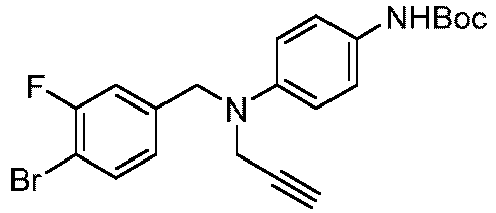
- The terms used in this invention are defined as follows:
The "halogen" may be fluorine, chlorine, bromine or iodine. - The "C1-C6 alkyl" refers to a chain alkyl with 1-6 carbon atoms; and specific examples thereof may include but are not limited to methyl, ethyl, propyl, n-propyl, isopropyl, butyl, n-butyl, isobutyl, tert-butyl, 1-methyl-butyl, 1-ethyl-butyl, pentyl, n-pentyl, isopentyl, neopentyl, tert-pentyl, hexyl, n-hexyl, 1-methylpentyl, 2-methylpentyl, 4-methyl-2-pentyl, 3,3-dimethylbutyl, 2-ethylbutyl, and the like.
- The "halogenated C1-C6 alkyl" refers to a C1-C6 heterochain alkyl in which at least one hydrogen is substituted with halogen; and specific examples thereof include trifluoromethyl, and the like.
- The "C4-C6 tert-alkyl" refers to an alkyl with 4-6 carbon atoms and two branches; and specific examples thereof may include tert-butyl, tert-pentyl, etc.
- The "C1-C3 alkoxy" refers to the RO- group, where R is a C1-C14 alkyl as described above; and specific examples of the alkoxy include methoxy, ethoxy, n-propoxy, isopropoxy, and the like.
- The "C4-C6 tert-alkoxy" refers to an alkoxy group with 4-6 carbon atoms and two branches; and specific examples thereof may include tert-butoxy, tert-pentyloxy, etc. The definition of C4-C14 tert-alkoxy can be deduced by analogy.
- The pharmaceutically acceptable salt of the compound described in the present invention can be a salt formed by the above-mentioned compound and an acid, and the acid is selected from the group consisting of maleic acid, succinic acid, citric acid, tartaric acid, fumaric acid, formic acid, acetic acid, propionic acid, malonic acid, oxalic acid, benzoic acid, phthalic acid, methanesulfonic acid, benzenesulfonic acid, toluenesulfonic acid, naphthalenesulfonic acid, 1,5-naphthalenedisulfonic acid, camphoric acid, camphorsulfonic acid, salicyl acid, acetylsalicylic acid, aspartic acid, glutamic acid, lactic acid, gluconic acid, vscorbic acid, gallic acid, mandelic acid, malic acid, sorbic acid, trifluoroacetic acid, taurine, homotaurine, 2-hydroxyethanesulfonic acid, cinnamic acid, hydrochloric acid, hydrobromic acid, hydroiodic acid, sulfuric acid, nitric acid, phosphoric acid and perchloric acid.
- The compound and the pharmaceutically acceptable salt thereof involved in this application may have an isomer or a racemate, such as an optical isomer (including a diastereomer and an enantiomer), an atropisomer, a geometric isomer (cis-trans isomers), a conformational isomer, a tautomer and mixtures thereof, etc., but are not limited to these. These isomers are also included in the scope defined by the claims of the present invention.
- In previous studies, the inventors of the present invention found, when different substituents are introduced into the benzene ring connected to the amino group, especially when the introduced substituents are alkyl group represented by two methyl groups (such as HN37,
CN105017085A ) the agonistic activity of KCNQ2 can be greatly enhanced. In the present invention, the inventors further studied and found that, the agonistic activity of KCNQ4 can be greatly enhanced when the substituent on the terminal nitrogen atom was replaced from methyl formate to tert-butyl formate on the basis of retaining the overall skeleton of HN37. Further research showed that, when the substituent on the terminal nitrogen atom was kept as tert-butyl formate and all the substituents on the benzene ring connected to the amino group were removed, the obtained compound K31 not only still had good KCNQ4 agonistic activity, but also lost KCNQ2 agonistic activity, that is to say, it has very good selectivity. On this basis, when different substituents are then introduced to the benzene ring of the benzyl group connected to the amino group, especially when the introduced substituent is an electron-rich substituent represented by tert-butyl group, it is found that not only was the KCNQ4 agonistic activity of the obtained compound further improved, the KCNQ2 agonistic activity was also still lost, and the obtained compound still had good KCNQ4/KCNQ2 selectivity. In summary, the novel selective KCNQ4 agonist provided by the present invention overcomes the shortcomings of poor selectivity of existing potassium channel agonists, has improved activity and significantly reduced toxicity, and has a simpler structure. And the production cost thereof is lower, so it possesses better development prospects. - In another aspect, the present invention provides a preparation method of the compound of formula c, which is accomplished through the following reaction route:
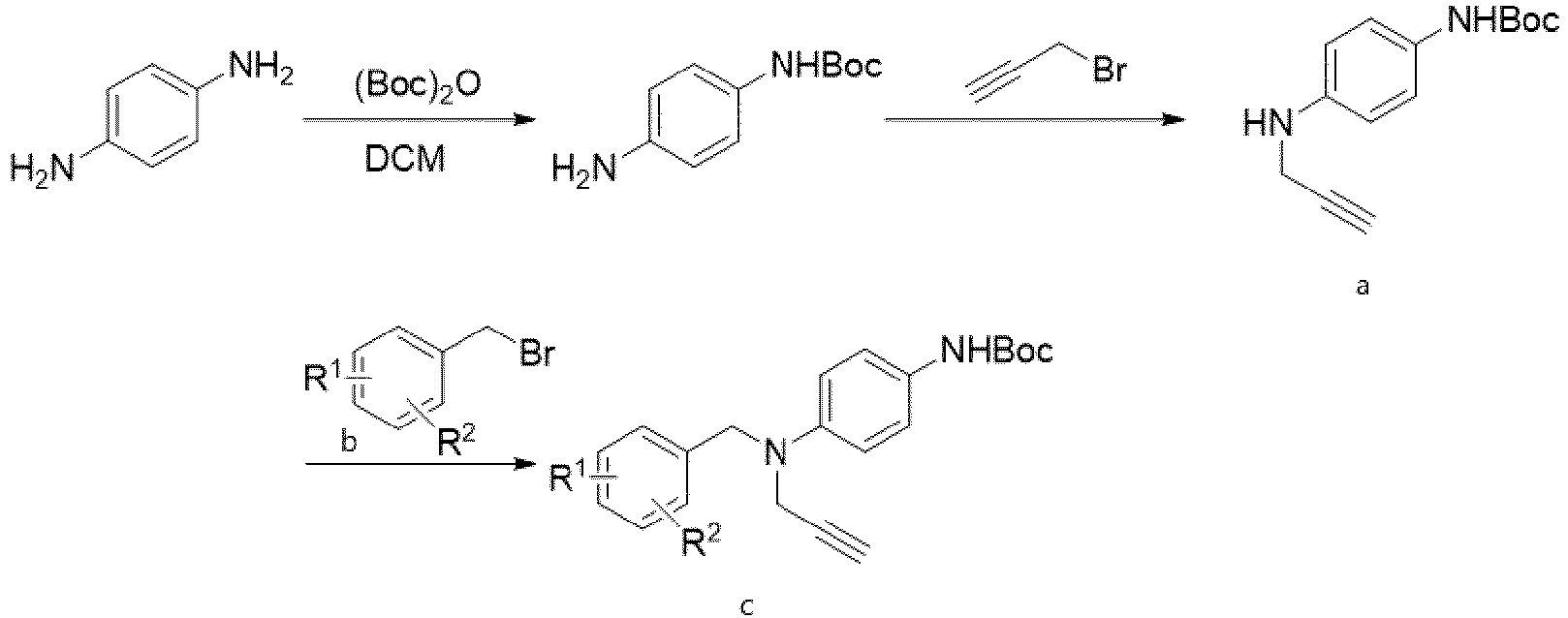
- In the preparation method of the present invention, the definitions of R1 and R2 are the same as those mentioned above.
reacting 1,4-phenylenediamine with di-tert-butyl dicarbonate to produce N-(tert-butoxycarbonyl)-1,4-phenylenediamine; subjecting N-(tert-butoxycarbonyl)-1,4-phenylenediamine and bromopropyne to a substitution reaction to obtain intermediate a; and reacting the intermediate a with compound b to produce compound c (the compound of formula c). - In still another aspect, the present invention provides a pharmaceutical composition comprising the compound or the pharmaceutically acceptable salt thereof according to the present invention and optionally, a pharmaceutically acceptable excipient.
- In further another aspect, the present invention provides a use of the compound or the pharmaceutically acceptable salt thereof according to the present invention, or the pharmaceutical composition according to the present invention in preparation of a KCNQ4 potassium channel agonist.
- In still another aspect, the present invention provides a use of the compound or the pharmaceutically acceptable salt thereof according to the present invention, or the pharmaceutical composition according to the present invention in preparation of a medicament for treating a disease associated with smooth muscle or skeletal muscle.
- In still another aspect, the present invention provides a method for treating a neurological disease, wherein the compound or the pharmaceutically acceptable salt thereof according to the present invention or the pharmaceutical composition according to the present invention is administered to a subject suffering from a disease associated with smooth muscle or skeletal muscle or the like;
- The disease associated with smooth muscle or skeletal muscle diseases associated with smooth muscle or skeletal muscle such as visceral pain, indigestion, irritable bowel syndrome, overactive bladder syndrome, hypertension, pulmonary hypertension, coronary artery disease, cerebral vasospasm, asthma, chronic obstructive pulmonary disease, prenatal labor pain, pruritus, sexual dysfunction, deafness, and the like.
- The invention has the following beneficial effects:
Compared with existing KCNQ agonists, the compound provided by the invention has greatly improved selectivity for KCNQ4 and KCNQ2. For example, in in vitro electrophysiological experiments, compounds K31-K43 all have good selectivity for KCNQ4 and KCNQ2. They only have KCNQ4 agonistic activity and have no effect on KCNQ2. - Compared with the existing drug retigabine, the compound provided by the present invention has more stable physical properties and is less susceptible to oxidation and deterioration due to the absence of free amine groups in its structure. It can be shown that the solution of this kind of compound is not easily oxidized and discolored even when exposed to air.
- In summary, the compound provided by the present invention overcomes the shortcomings of poor selectivity of existing agonists. It not only has stable physical properties and high activity, but also has good selectivity and greatly reduced toxicity. Therefore, it has a larger therapeutic window and is more effective. It is shown that the compound has good application prospects.
- The present invention has been described in detail above, but the above-mentioned embodiments are only illustrative in nature and are not intended to limit the present invention. Furthermore, there is no intention to be bound by any theory presented in the preceding prior art or summary of the invention or in the following examples.
- The present invention will be further described below with reference to the examples. It should be noted that the following examples are provided for illustrative purposes only and do not constitute a limitation on the scope of protection claimed by the present invention.
- Unless otherwise specified, the raw materials, reagents, methods, etc. used in the examples are all conventional raw materials, reagents, and methods in this field.
- In the following preparation examples, nuclear magnetic resonance (NMR) was measured with a Bruker NMR Spectrometer 400M instrument produced by Bruker. NMR calibration: δH7.26 ppm (CDCl3), 2.50 ppm (DMSO-d6), 3.15 ppm (CD3OD);
- Reagents are mainly provided by Shanghai Bide Pharmaceutical Technology Co., Ltd.;
- Thin layer chromatography (TLC) silica gel plate is produced by Shandong Yantai Huiyou Silica Gel Development Co., Ltd., model HSGF254;
- The compound was purified by normal phase column chromatography, in which silica gel used was produced by Qingdao Marine Chemical Plant Branch in Shandong Province, model zcx-11, 200-300 mesh.
-

- To a solution of compound N-(tert-butoxycarbonyl)-1,4-phenylenediamine K31-a (1.25 g, 6.0 mmol) in DMF (20 mL), diisopropylethylamine (1.16 g, 9.0 mmol) and propargyl bromide (0.71 g, 6.0 mmol) was added, and the resulting mixture was heated to 65°C for 12 hours. After the reaction was completed, the resultant was cooled to room temperature, and ethyl acetate (50 mL) was added. The organic layer was washed once with water (15 mL) and once with saturated brine (15 mL) respectively, dried over anhydrous sodium sulfate, and concentrated to obtain a crude product. The crude product was purified by a silica gel column chromatography (eluent: petroleum ether/ethyl acetate = 5:1) to obtain a product K31-b as a white solid (1.21 g, yield 82%), which was directly used in the next reaction.
- To a solution of compound K31-b (73.89 mg, 0.3 mmol) in DMF (3 mL), diisopropylethylamine (0.1 mL, 0.6 mmol) and p-fluorobenzyl bromide (68.05 mg, 0.36 mmol) was added. The resulting mixture was heated to 65°C for 12 hours. After the reaction was completed, the resultant was cooled to room temperature, and ethyl acetate (20 mL) was added. The organic layer was washed once with water (5 mL) and once with saturated brine (5 mL) respectively, dried over anhydrous sodium sulfate, and concentrated to obtain a crude product. The crude product was purified by a silica gel column chromatography (eluent: petroleum ether/ethyl acetate = 20:1) to obtain a product K31 as a white solid (0.95 g, yield 90%). 1H NMR (400 MHz ,CDCl3): δ 7.30-7.27 (m, 2H), 7.24-7.22 (d, J=8.0 Hz, 2H), 7.01 (t, J = 8.0 Hz, 2H), 6.86-6.84 (d, J = 8.0 Hz, 2H), 6.30 (dr, 1H), 4.43 (s, 2H), 3.93 (s, 2H), 2.22 (t, J = 4.0 Hz, 1H), 1.59 (s, 9H).
- The following compounds were prepared by using operations similar to Preparation Example 1:
Compound Structural Formula 1H NMR (400 MHz ,CDCl3) data, δ K32 
7.31 (td, J = 7.8, 1.8 Hz, 1H), 7.25-7.21 (m, 3H), 7.08-7.03 (m, 2H), 6.85 (d, J = 9.0 Hz, 2H), 6.28 (s, 1H), 4.54 (s, 2H), 4.00 (d, J = 2.4 Hz, 2H), 2.22 (t, J = 2.0 Hz, 1H), 1.50 (s, 9H). K33 
7.31-7.26 (m, 1H), 7.22 (d, J = 8.4 Hz, 2H), 7.10 (d, J = 7.6 Hz, 1H), 7.04 (d, J = 9.6 Hz, 1H), 6.94 (td, J = 8.4, 2.6 Hz, 1H), 6.84 (d, J = 9.0 Hz, 2H), 6.29 (s, 1H), 4.47 (s, 2H), 3.97 (d, J = 2.4 Hz, 2H), 2.22 (t, J = 2.4 Hz, 1H), 1.50 (s, 9H). K34 
7.35 (d, J = 8.4 Hz, 2H), 7.25-7.21 (m, 3H), 6.87 (d, J = 9.0 Hz, 2H), 6.28 (s, 1H), 4.45 (s, 2H), 3.95 (d, J = 2.4 Hz, 2H), 2.20 (t, J = 2.4 Hz, 1H), 1.50 (s, 9H), 1.31 (s, 9H). K35 
7.29 (d, J = 8.6 Hz, 2H), 7.26 - 7.20 (m, 3H), 6.84 (d, J = 9.0 Hz, 2H), 6.30 (s, 1H), 4.43 (s, 2H), 3.94 (d, J = 2.4 Hz, 2H), 2.21 (t, J = 2.4 Hz, 1H), 1.50 (s, 9H). K36 
7.44 (d, J = 8.4 Hz, 2H), 7.24-7.19 (m, 4H), 6.83 (d, J = 9.0 Hz, 2H), 6.29 (s, 1H), 4.42 (s, 2H), 3.94 (d, J = 2.4 Hz, 2H), 2.21 (t, J = 2.4 Hz, 1H), 1.50 (s, 9H). K37 
7.64 (d, J = 8.0 Hz, 2H), 7.22 (d, J = 8.4 Hz, 2H), 7.07 (d, J = 8.4 Hz, 2H), 6.82 (d, J = 9.2 Hz, 2H), 6.30 (s, 1H), 4.41 (s, 2H), 3.94 (d, J = 2.4 Hz, 2H), 2.21 (t, J = 2.4 Hz, 1H), 1.50 (s, 9H). K38 
8.18 (d, J = 8.4 Hz, 2H), 7.49 (d, J = 8.4 Hz, 2H), 7.24 (d, J = 8.4 Hz, 2H), 6.80 (d, J = 9.2 Hz, 2H), 6.37 (s, 1H), 4.57 (s, 2H), 4.00 (d, J = 2.4 Hz, 2H), 2.25 (t, J = 2.4 Hz, 1H), 1.50 (s, 9H). K39 
7.23 (d, J = 8.8 Hz, 2H), 7.18 - 7.00 (m, 3H), 6.83 (d, J = 8.8 Hz, 2H), 6.30 (s, 1H), 4.41 (s, 2H), 3.95 (d, J = 2.4 Hz, 2H), 2.23 (t, J = 2.4 Hz, 1H), 1.50 (s, 9H). K40 
7.61 - 7.52 (m, 2H), 7.27 - 7.21 (m, 2H), 7.17 (t, J = 8.4 Hz, 1H), 6.82 (d, J = 8.8 Hz, 2H), 6.36 (s, 1H), 4.45 (s, 2H), 3.95 (d, J = 2.4 Hz, 2H), 2.25 (t, J = 2.4 Hz, 1H), 1.50 (s, 9H). K41 
7.59 - 7.49 (m, 2H), 7.26-7.23 (m, 2H), 7.15 (t, J = 9.2 Hz, 1H), 6.84 (d, J =8.8 Hz, 2H), 6.31 (s, 1H), 4.46 (s, 2H), 3.95 (d, J = 2.4 Hz, 2H), 2.23 (t, J = 2.4 Hz, 1H), 1.50 (s, 9H). K42 
8.04 (dd, J = 6.8, 2.4 Hz, 1H), 7.62-7.58 (m, 1H), 7.30 - 7.24 (m, 2H), 6.83 (d, J = 8.8 Hz, 2H), 6.38 (s, 1H), 4.49 (s, 2H), 3.98 (d, J = 2.4 Hz, 2H), 2.26 (t, J = 2.4 Hz, 1H), 1.50 (s, 9H). K43 
7.48 (dd, J = 8.0, 6.8 Hz, 1H), 7.23 (d, J = 8.4 Hz, 2H), 7.11 (dd, J = 9.6, 2.0 Hz, 1H), 7.02 - 6.99 (m, 1H), 6.82 (d, J = 8.8 Hz, 2H), 6.30 (s, 1H), 4.42 (s, 2H), 3.96 (d, J = 2.4 Hz, 2H), 2.23 (t, J = 2.4 Hz, 1H), 1.50 (s, 9H). - The cell line used in the electrophysiological experiments was the Chinese hamster ovary cell line (CHO-K1); KCNQ cDNA was transformed into E. coli, expressed in E. coli, and then confirmed by plasmid extraction and sequencing.
- CHO-K1 cells (Cell Bank of Chinese Academy of Sciences), medium formula: 50/50 DMEM/F-12 (Gibco), supplemented with 10% fetal bovine serum (FBS) (Gibco, Australia) and 2mM L-glutamine (Invitrogen). Transfection and expression of KCNQ channels: 24 hours before transfection, cells were digested with trypsin (Sigma, China) and spread in a 6-well plate. Lipofectamine2000TM reagent (Invitrogen) was used for transfection, and the experiment was carried out according to the procedures provided. Twenty-four hours after transfection, cells were digested and seeded onto poly-L-lysine (Sigma)-soaked slides. After co-transfected with GFP (green fluorescent protein), the transfected cells were determined under a fluorescence microscope (Olympus). The human KCNQ2 plasmid (NCBI: NM_172107.4) and human KCNQ4 plasmid (NCBI: NM_004700.4) used were synthesized by Beijing Genomics Institute and constructed in the pcDNA3.1(+) vector plasmid. KCNQ2 and KCNQ4 plasmids were confirmed by plasmid extraction and sequencing after transformation into E. coli DH5α.
- Whole-cell voltage clamp experiments were carried out at room temperature (23~25°C), where Axopatch-700B amplifier (Molecular Devices, Sunnyvale, CA) and Digidata 1440A (Molecular Devices) as digital-to-analog converter were used, pClamp 10.0 software (Molecular Devices, Sunnyvale, CA) was used for signal acquisition, the signal was filtered at 2 kHz, the sampling frequency was 10 kHz. Series resistance compensation was used and set to 60%. Pipettes were pulled from Borosilicate glass capillaries (World Precision Instruments, Sarasota, FL), and the resistance of the pipettes filled with an intracellular fluid was 3-5 MΩ. The perfusion drug delivery system was BPS-8 (ALA Scientific Instruments, Westburg, NY) with a speed of approximately 1 mL/min.
- Intracellular fluid formulation for electrophysiological experiments: 145 mM KCl, 1 mM MgCl2, 5 mM EGTA, 10 mM HEPES, 5mM MgATP (adjusted to pH=7.3 with KOH).
- Extracellular fluid formulation for electrophysiological experiments: 140 mM NaCl, 5mM KCl, 2 mM CaCl2, 1.5 mM MgCl2, 10 mM HEPES, 10 mM glucose (adjusted to pH=7.4 with NaOH).
- To record the whole-cell currents of KCNQ2 and KCNQ4 channels, the cells were clamped at a holding potential of -120 mV, and then depolarized to -10 mV for a duration of 1500 ms, and the stimulation frequency was 0.1 Hz. The current amplitudes at the -10 mV test pulse before (I Control) and after (I Drug) the perfusion of the compounds were collected to determine the activation efficacy (I Drug / I Control).
- A certain mass of the compound was weighed and dissolved in DMSO to prepare a 20 mM DMSO stock solution which was frozen and stored at -20°C until use. On the day of the test, the 20 mM compound stock solution was diluted with extracellular fluid to the final concentration to be detected, ensuring that the DMSO content in the test drug solution did not exceed 0.5%. This kind of concentration of DMSO has no effect on the detected KCNQ channel current. For example, to prepare 100 nM and 1 µM compound solutions, the gradient dilution method was as follows: 5 µL DMSO stock solution was first pipetted and added to 10 mL of extracellular fluid, and was dissolved evenly to obtain a 10 µM compound solution; then 1 mL of 10 µM compound solution was pipetted and added to 9 mL of extracellular fluid, dissolved evenly to obtain a 1 µM compound solution; then 1 mL of 1 µM compound was pipetted and added to 9 mL of extracellular fluid, dissolved evenly to obtain a 100 nM compound solution.
- Data collection, analysis and processing were performed using pClamp10 (Molecular Devices, Sunnyvale, CA), GraphPad Prism 5 (GraphPad Software, San Diego, CA) and Excel (Microsoft Corporation) software. All data are expressed as mean ± standard error (Mean ± SEM), significance analysis was performed using unpaired student's t-test. When P < 0.05, the difference between the two groups was considered statistically significant. The effect of a compound on current flow is calculated using the following formula:

Compound KCNQ4 (I Drug / I Control 100 nM) n KCNQ2 ( I Drug / I Control 100 nM) n K31 3.06 ± 0.61 3 1.07 ± 0.04 3 K32 2.50 ± 0.28 3 1.05 ± 0.02 5 K33 3.00 ± 0.18 3 1.06 ± 0.03 3 K34 4.40 ± 0.62 3 1.07 ± 0.04 5 K35 3.30 ± 0.62 3 0.98 ± 0.03 4 K36 3.50 ± 0.28 3 1.05 ± 0.03 4 K37 3.28 ± 0.21 3 1.02 ± 0.04 3 K38 1.66 ± 0.19 4 0.96 ± 0.01 4 K39 1.46 ± 0.02 3 1.10 ± 0.02 5 K40 1.26 ± 0.16 3 0.97 ± 0.02 3 K41 1.69 ± 0.19 3 1.03 ± 0.02 3 K42 1.35 ± 0.08 3 1.02 ± 0.02 4 K43 2.72 ± 0.38 3 0.98 ± 0.00 3 - Results and discussion: It can be seen from the above electrophysiological experiment results that the compounds disclosed in the present invention maintain the agonistic activity of KCNQ4 potassium channel well, but all compounds are inactive towards KCNQ2, showing good selectivity.
- The above embodiments are only used to illustrate the technical solution of the present invention, but not to limit it. Although the present invention has been described in detail with reference to the foregoing embodiments, those of ordinary skilled in the art will understand that the technical solutions described in the foregoing embodiments can be modified, or equivalent substitutions can be made for some or all of the technical features, without departing from the spirit and essence of the invention as defined by the claims; and these modifications or substitutions are still within the scope of the claims of the present invention.
Claims (10)
- A compound represented by formula I or a pharmaceutically acceptable salt thereof,
 R1 and R2 are each independently selected from the group consisting of hydrogen, halogen, C1-C6 alkoxy, halogenated C1-C6 alkoxy, C1-C6 alkylthio, C4-C6 tert-alkyl, halogenated C1-C6 alkyl, nitro and cyano;R3 and R4 are each independently selected from the group consisting of hydrogen, halogen and C1-C6 alkyl;R5 is selected from the group consisting of C1-C6 alkyl, C1-C3 alkoxy, C4-C14 tert-alkoxy, phenoxy and benzyloxy; preferably, R5 is selected from the group consisting of C1-C3 alkoxy, C4-C6 tert-alkoxy, phenoxy and benzyloxy; more preferably, R5 is selected from the group consisting of methoxy, ethoxy, isopropoxy, tert-butoxy, phenoxy and benzyloxy; and R5 is most preferably tert-butoxy.
 - The compound or the pharmaceutically acceptable salt thereof according to claim 1, wherein R1 and R2 are each independently selected from the group consisting of halogen, C1-C6 alkoxy, halogenated C1-C6 alkoxy, C1- C6 alkylthio, tert-butyl, nitro, cyano and trifluoromethyl;
preferably, R3 and R4 are each independently hydrogen. - The compound or the pharmaceutically acceptable salt thereof according to claim 1, wherein the compound of formula I is a compound of formula II below:

- The compound or the pharmaceutically acceptable salt thereof according to claim 1, wherein the compound of formula I is a compound of formula III below:
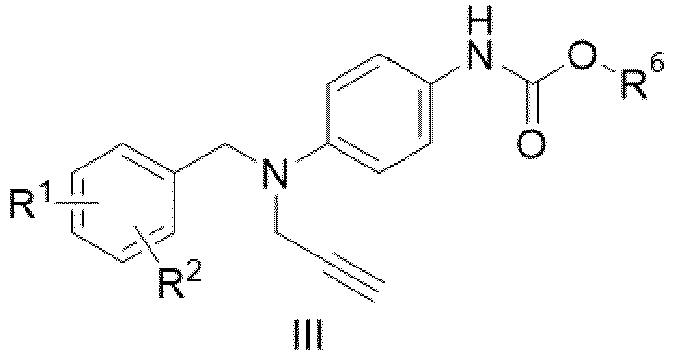 wherein the definitions of R1 and R2 are the same as those in the corresponding claim;R6 is C4-C6 tert-alkyl;preferably, the compound of formula I is a compound of formula c below:
 wherein the definitions of R1 and R2 are the same as those in the corresponding claim.
 - The compound or the pharmaceutically acceptable salt thereof according to claim 1, wherein the compound of formula I is selected from the following compounds:
Compound Number Compound Structure K31 
K32 
K33 
K34 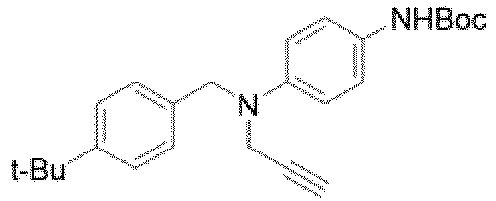
K35 
K36 
K37 
K38 
K39 
K40 
K41 
K42 
K43 
- A method for preparing the compound according to any one of claims 1 to 5, wherein the compound is a compound of formula c, and the method includes steps of:
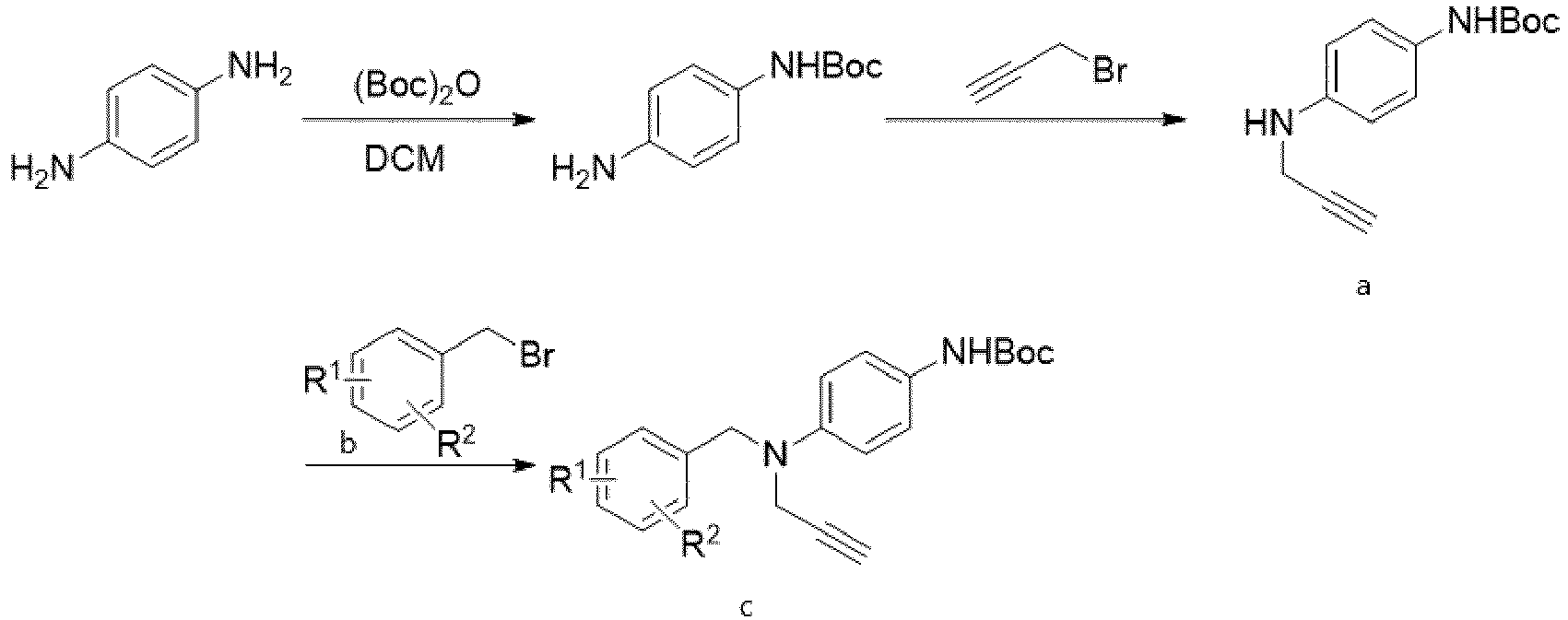 reacting 1,4-phenylenediamine with di-tert-butyl dicarbonate to produce N-(tert-butoxycarbonyl)-1,4-phenylenediamine;subjecting N-(tert-butoxycarbonyl)-1,4-phenylenediamine and bromopropyne to a substitution reaction to obtain intermediate a; andreacting the intermediate a with compound b to produce compound of formula c;wherein the definitions of R1 and R2 are the same as those in the corresponding claims respectively.
 - A pharmaceutical composition comprising the compound or the pharmaceutically acceptable salt thereof according to any one of claims 1 to 5 and optionally, a pharmaceutically acceptable excipient.
- Use of the compound or the pharmaceutically acceptable salt thereof according to any one of claims 1 to 5, or the pharmaceutical composition according to claim 7 in preparation of a KCNQ4 potassium channel agonist.
- Use of the compound or the pharmaceutically acceptable salt thereof according to any one of claims 1 to 5, or the pharmaceutical composition according to claim 7 in preparation of a medicament for treating a disease associated with smooth muscle or skeletal muscle.
- The use according to claim 9, wherein the disease associated with smooth muscle or skeletal muscle includes visceral pain, indigestion, irritable bowel syndrome, overactive bladder syndrome, hypertension, pulmonary hypertension, coronary artery disease, cerebral vasospasm, asthma, chronic obstructive pulmonary disease, prenatal labor pain, pruritus, sexual dysfunction and deafness.
Applications Claiming Priority (2)
| Application Number | Priority Date | Filing Date | Title |
|---|---|---|---|
| CN202210041774.3A CN116478068A (en) | 2022-01-14 | 2022-01-14 | A highly selective KCNQ4 potassium channel agonist, its preparation method and use |
| PCT/CN2023/071587 WO2023134673A1 (en) | 2022-01-14 | 2023-01-10 | High-selectivity kcnq4 potassium channel agonist, preparation method therefor and use thereof |
Publications (2)
| Publication Number | Publication Date |
|---|---|
| EP4464690A1 true EP4464690A1 (en) | 2024-11-20 |
| EP4464690A4 EP4464690A4 (en) | 2025-04-23 |
Family
ID=87216418
Family Applications (1)
| Application Number | Title | Priority Date | Filing Date |
|---|---|---|---|
| EP23740015.5A Pending EP4464690A4 (en) | 2022-01-14 | 2023-01-10 | High-selectivity kcnq4 potassium channel agonist, preparation method therefor and use thereof |
Country Status (5)
| Country | Link |
|---|---|
| US (1) | US20250122148A1 (en) |
| EP (1) | EP4464690A4 (en) |
| JP (1) | JP7818710B2 (en) |
| CN (1) | CN116478068A (en) |
| WO (1) | WO2023134673A1 (en) |
Family Cites Families (7)
| Publication number | Priority date | Publication date | Assignee | Title |
|---|---|---|---|---|
| DE4200259A1 (en) | 1992-01-08 | 1993-07-15 | Asta Medica Ag | NEW 1,2,4-TRIAMINOBENZOL DERIVATIVES AND METHOD FOR THE PRODUCTION THEREOF |
| TWI349666B (en) | 2004-03-12 | 2011-10-01 | Lundbeck & Co As H | Substituted morpholine and thiomorpholine derivatives |
| BRPI0716715B1 (en) | 2006-08-23 | 2021-07-06 | Xenon Pharmaceuticals, Inc | 4-(N-AZACICLOALKYL) DERIVATIVES AS POTASSIUM CHANNEL MODULATORS, THEIR USES, PRODUCT, COMPOSITION, TABLET AND CAPSULE |
| CN103073455B (en) * | 2011-10-25 | 2015-08-19 | 中国科学院上海药物研究所 | Kcnq potassium channel agonist, Preparation Method And The Use that one class is novel |
| CN105017085B (en) * | 2014-04-28 | 2018-06-29 | 中国科学院上海药物研究所 | A kind of kcnq potassium channel agonist, preparation method and use |
| CN105853405B (en) * | 2015-01-23 | 2019-03-08 | 中国科学院上海药物研究所 | Application of benzbromarone in the preparation of voltage-gated potassium channel KCNQ agonists |
| MX2018015251A (en) * | 2016-06-10 | 2019-04-25 | Scifluor Life Sciences Inc | Fluorinated 2-amino-4-(substituted amino)phenyl carbamate derivatives. |
-
2022
- 2022-01-14 CN CN202210041774.3A patent/CN116478068A/en active Pending
-
2023
- 2023-01-10 US US18/728,641 patent/US20250122148A1/en active Pending
- 2023-01-10 EP EP23740015.5A patent/EP4464690A4/en active Pending
- 2023-01-10 WO PCT/CN2023/071587 patent/WO2023134673A1/en not_active Ceased
- 2023-01-10 JP JP2024542083A patent/JP7818710B2/en active Active
Also Published As
| Publication number | Publication date |
|---|---|
| EP4464690A4 (en) | 2025-04-23 |
| WO2023134673A1 (en) | 2023-07-20 |
| CN116478068A (en) | 2023-07-25 |
| JP2025500696A (en) | 2025-01-09 |
| US20250122148A1 (en) | 2025-04-17 |
| JP7818710B2 (en) | 2026-02-20 |
Similar Documents
| Publication | Publication Date | Title |
|---|---|---|
| EP3983384B1 (en) | N-(phenyl)-indole-3-sulfonamide derivatives and related compounds as gpr17 modulators for treating cns disorders such as multiple sclerosis | |
| EP2300440B1 (en) | 3,4-dihydropyrimidine trpa1 antagonists | |
| KR101449348B1 (en) | Piperidinyl pyrimidine amides as kv7 potassium channel openers | |
| KR20120136422A (en) | Substituted morpholine and thiomorpholine derivatives | |
| TWI402261B (en) | Tricyclic compound and pharmaceutical use thereof | |
| JPWO2005087231A1 (en) | Solifenacin-containing composition | |
| JP6357248B2 (en) | New KCNQ potassium channel agonist, its production method and use | |
| KR101697834B1 (en) | Novel compound as kcnq potassium channel agonist, preparation method therefor and use thereof | |
| JP2002521430A (en) | Glucocorticoid-selective drugs | |
| EP3541784B1 (en) | Novel azetidine derivatives useful as modulators of cortical catecholaminergic neurotransmission | |
| EP1787983B1 (en) | Methods for producing isoindole derivatives | |
| US20250122148A1 (en) | High-selectivity kcnq4 potassium channel agonist, preparation method therefor and use thereof | |
| AU2009301797B2 (en) | Indazole derivative | |
| CN107646031B (en) | Azetidine derivatives as modulators of cortical catecholaminergic neurotransmission | |
| JP2025538201A (en) | Aryl group-containing amine compounds, their preparation and use | |
| CN119285489A (en) | A compound and its pharmaceutical composition and application | |
| EP3560927B1 (en) | Azepine derivatives acting as 5-ht7 receptor modulators | |
| HK40022836B (en) | Macrocyclic compound as a wee1 inhibitor and applications thereof | |
| CA3021624A1 (en) | Crystal polymorphism of kcnq2-5 channel activator | |
| JPWO2001083453A1 (en) | Novel tricyclic compounds having substituents |
Legal Events
| Date | Code | Title | Description |
|---|---|---|---|
| STAA | Information on the status of an ep patent application or granted ep patent |
Free format text: STATUS: THE INTERNATIONAL PUBLICATION HAS BEEN MADE |
|
| PUAI | Public reference made under article 153(3) epc to a published international application that has entered the european phase |
Free format text: ORIGINAL CODE: 0009012 |
|
| STAA | Information on the status of an ep patent application or granted ep patent |
Free format text: STATUS: REQUEST FOR EXAMINATION WAS MADE |
|
| 17P | Request for examination filed |
Effective date: 20240812 |
|
| AK | Designated contracting states |
Kind code of ref document: A1 Designated state(s): AL AT BE BG CH CY CZ DE DK EE ES FI FR GB GR HR HU IE IS IT LI LT LU LV MC ME MK MT NL NO PL PT RO RS SE SI SK SM TR |
|
| A4 | Supplementary search report drawn up and despatched |
Effective date: 20250325 |
|
| DAV | Request for validation of the european patent (deleted) | ||
| DAX | Request for extension of the european patent (deleted) | ||
| RIC1 | Information provided on ipc code assigned before grant |
Ipc: A61P 1/00 20060101ALI20250319BHEP Ipc: A61P 25/00 20060101ALI20250319BHEP Ipc: A61P 27/16 20060101ALI20250319BHEP Ipc: A61P 17/04 20060101ALI20250319BHEP Ipc: A61P 15/00 20060101ALI20250319BHEP Ipc: A61P 11/06 20060101ALI20250319BHEP Ipc: A61P 11/00 20060101ALI20250319BHEP Ipc: A61P 9/12 20060101ALI20250319BHEP Ipc: A61P 13/10 20060101ALI20250319BHEP Ipc: A61P 1/14 20060101ALI20250319BHEP Ipc: A61P 19/00 20060101ALI20250319BHEP Ipc: A61K 31/277 20060101ALI20250319BHEP Ipc: A61K 31/27 20060101ALI20250319BHEP Ipc: C07C 269/06 20060101ALI20250319BHEP Ipc: C07C 269/04 20060101ALI20250319BHEP Ipc: C07C 271/28 20060101AFI20250319BHEP |