WO2008024398A2 - Derivatives of 4-(n-azacycloalkyl) anilides as potassium channel modulators - Google Patents

Derivatives of 4-(n-azacycloalkyl) anilides as potassium channel modulators Download PDF

Info

Publication number
WO2008024398A2
WO2008024398A2 PCT/US2007/018571 US2007018571W WO2008024398A2 WO 2008024398 A2 WO2008024398 A2 WO 2008024398A2 US 2007018571 W US2007018571 W US 2007018571W WO 2008024398 A2 WO2008024398 A2 WO 2008024398A2
Authority
WO
WIPO (PCT)
Prior art keywords
alkyl
isoquinolin
dihydro
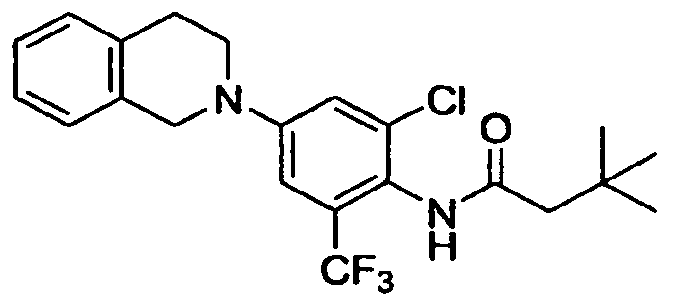
dimethylbutanamide
compound
Prior art date
Legal status (The legal status is an assumption and is not a legal conclusion. Google has not performed a legal analysis and makes no representation as to the accuracy of the status listed.)
Ceased
Application number
PCT/US2007/018571
Other languages
French (fr)
Other versions
WO2008024398B1 (en
WO2008024398A3 (en
Inventor
Jean-Michel Vernier
Martha Alicia De La Rosa
Huanming Chen
Jim Zhen Wu
Gary Lee Larson
Ian Wayne Cheney
Current Assignee (The listed assignees may be inaccurate. Google has not performed a legal analysis and makes no representation or warranty as to the accuracy of the list.)
Bausch Health Americas Inc
Original Assignee
Valeant Pharmaceuticals International Inc USA
Priority date (The priority date is an assumption and is not a legal conclusion. Google has not performed a legal analysis and makes no representation as to the accuracy of the date listed.)
Filing date
Publication date
Priority to AU2007288253A priority Critical patent/AU2007288253B2/en
Priority to NZ575652A priority patent/NZ575652A/en
Priority to PL07837199T priority patent/PL2061465T3/en
Priority to EP07837199.4A priority patent/EP2061465B1/en
Priority to CA2661462A priority patent/CA2661462C/en
Priority to ES07837199T priority patent/ES2420960T3/en
Priority to BRPI0716715-6A priority patent/BRPI0716715B1/en
Priority to MX2009002002A priority patent/MX2009002002A/en
Priority to DK07837199.4T priority patent/DK2061465T3/en
Application filed by Valeant Pharmaceuticals International Inc USA filed Critical Valeant Pharmaceuticals International Inc USA
Priority to JP2009525618A priority patent/JP5419691B2/en
Publication of WO2008024398A2 publication Critical patent/WO2008024398A2/en
Publication of WO2008024398A3 publication Critical patent/WO2008024398A3/en
Publication of WO2008024398B1 publication Critical patent/WO2008024398B1/en
Priority to IL197161A priority patent/IL197161A/en
Anticipated expiration legal-status Critical
Priority to ZA2009/01977A priority patent/ZA200901977B/en
Priority to NO20091183A priority patent/NO343575B1/en
Ceased legal-status Critical Current

Links

Classifications

    • CCHEMISTRY; METALLURGY
    • C07ORGANIC CHEMISTRY
    • C07DHETEROCYCLIC COMPOUNDS
    • C07D217/00Heterocyclic compounds containing isoquinoline or hydrogenated isoquinoline ring systems
    • C07D217/22Heterocyclic compounds containing isoquinoline or hydrogenated isoquinoline ring systems with hetero atoms or with carbon atoms having three bonds to hetero atoms with at the most one bond to halogen, e.g. ester or nitrile radicals, directly attached to carbon atoms of the nitrogen-containing ring
    • C07D217/24Oxygen atoms
    • CCHEMISTRY; METALLURGY
    • C07ORGANIC CHEMISTRY
    • C07DHETEROCYCLIC COMPOUNDS
    • C07D217/00Heterocyclic compounds containing isoquinoline or hydrogenated isoquinoline ring systems
    • C07D217/12Heterocyclic compounds containing isoquinoline or hydrogenated isoquinoline ring systems with radicals, substituted by hetero atoms, attached to carbon atoms of the nitrogen-containing ring
    • C07D217/14Heterocyclic compounds containing isoquinoline or hydrogenated isoquinoline ring systems with radicals, substituted by hetero atoms, attached to carbon atoms of the nitrogen-containing ring other than aralkyl radicals
    • CCHEMISTRY; METALLURGY
    • C07ORGANIC CHEMISTRY
    • C07DHETEROCYCLIC COMPOUNDS
    • C07D217/00Heterocyclic compounds containing isoquinoline or hydrogenated isoquinoline ring systems
    • C07D217/12Heterocyclic compounds containing isoquinoline or hydrogenated isoquinoline ring systems with radicals, substituted by hetero atoms, attached to carbon atoms of the nitrogen-containing ring
    • AHUMAN NECESSITIES
    • A61MEDICAL OR VETERINARY SCIENCE; HYGIENE
    • A61KPREPARATIONS FOR MEDICAL, DENTAL OR TOILETRY PURPOSES
    • A61K31/00Medicinal preparations containing organic active ingredients
    • A61K31/33Heterocyclic compounds
    • A61K31/395Heterocyclic compounds having nitrogen as a ring hetero atom, e.g. guanethidine or rifamycins
    • A61K31/435Heterocyclic compounds having nitrogen as a ring hetero atom, e.g. guanethidine or rifamycins having six-membered rings with one nitrogen as the only ring hetero atom
    • A61K31/47Quinolines; Isoquinolines
    • AHUMAN NECESSITIES
    • A61MEDICAL OR VETERINARY SCIENCE; HYGIENE
    • A61PSPECIFIC THERAPEUTIC ACTIVITY OF CHEMICAL COMPOUNDS OR MEDICINAL PREPARATIONS
    • A61P25/00Drugs for disorders of the nervous system
    • AHUMAN NECESSITIES
    • A61MEDICAL OR VETERINARY SCIENCE; HYGIENE
    • A61PSPECIFIC THERAPEUTIC ACTIVITY OF CHEMICAL COMPOUNDS OR MEDICINAL PREPARATIONS
    • A61P25/00Drugs for disorders of the nervous system
    • A61P25/08Antiepileptics; Anticonvulsants
    • AHUMAN NECESSITIES
    • A61MEDICAL OR VETERINARY SCIENCE; HYGIENE
    • A61PSPECIFIC THERAPEUTIC ACTIVITY OF CHEMICAL COMPOUNDS OR MEDICINAL PREPARATIONS
    • A61P43/00Drugs for specific purposes, not provided for in groups A61P1/00-A61P41/00
    • CCHEMISTRY; METALLURGY
    • C07ORGANIC CHEMISTRY
    • C07DHETEROCYCLIC COMPOUNDS
    • C07D217/00Heterocyclic compounds containing isoquinoline or hydrogenated isoquinoline ring systems
    • C07D217/12Heterocyclic compounds containing isoquinoline or hydrogenated isoquinoline ring systems with radicals, substituted by hetero atoms, attached to carbon atoms of the nitrogen-containing ring
    • C07D217/14Heterocyclic compounds containing isoquinoline or hydrogenated isoquinoline ring systems with radicals, substituted by hetero atoms, attached to carbon atoms of the nitrogen-containing ring other than aralkyl radicals
    • C07D217/16Heterocyclic compounds containing isoquinoline or hydrogenated isoquinoline ring systems with radicals, substituted by hetero atoms, attached to carbon atoms of the nitrogen-containing ring other than aralkyl radicals substituted by oxygen atoms
    • CCHEMISTRY; METALLURGY
    • C07ORGANIC CHEMISTRY
    • C07DHETEROCYCLIC COMPOUNDS
    • C07D217/00Heterocyclic compounds containing isoquinoline or hydrogenated isoquinoline ring systems
    • C07D217/12Heterocyclic compounds containing isoquinoline or hydrogenated isoquinoline ring systems with radicals, substituted by hetero atoms, attached to carbon atoms of the nitrogen-containing ring
    • C07D217/18Aralkyl radicals

Definitions

  • This invention concerns novel compounds that activate or otherwise modulate voltage-gated potassium channels.
  • the compounds are useful for the treatment and prevention of diseases and disorders which are affected by modulation of potassium ion channels.
  • One such condition is seizure disorders.
  • Epilepsy is a well-known neurological disease, found in about 3% of the population. Approximately 30% of patients with epilepsy do not respond to currently available therapies. Such unfortunate patients — who number hundreds of thousands of people world-wide — must contend with both uncontrolled seizures and the resulting narrowing of their options in such crucial areas of life as health insurance, employment, and driving.
  • Retigabine N-[2-amino-4-(4-fluorobenzylamino)phenyl]carbamic acid, ethyl ester
  • U.S. Patent No. 5,384,330 has been found to be an effective treatment of seizure disorders and has also been found useful in treating pain.
  • Retigabine has been found to be particularly potent in models for the drug-refractory types of epilepsy. Bialer, M. et al., Epilepsy Research 1999, 34, 1-41; Blackburn-Munro and Jensen, Eur. J. Pharmacol. 2003, 460, 109-116; Wickenden, A.D. et al., Expert Opin. Ther. Patents, 2004, 14(4).
  • Retigabine has been shown to increase the conductance of the channels at the resting membrane potential, with a possible mechanism involving binding of the activation gate of the KCNQ 2/3 channel. Wuttke, T. V., et al., MoI. Pharmacol. 2005. Additionally, retigabine has been shown to increase neuronal M currents and to increase the channel open probability of KCNQ 2/3 channels. Delmas, P. and Brown, D.A. Nat. Revs Neurosci., vol. 6, 2005, 850-62; Tatulian, L. and Brown, D.A., ./. Physiol, (2003) 549, 57-63.
  • the seizure type that has been most resistant to therapy is the so-called "complex partial seizure.”
  • Retigabine is active in several seizure models, including, as indicated above, models for drug-refractory epilepsy. Because of retigabine's broad spectrum of activity and its unusual molecular mechanism, there is hope that retigabine will be effective in management of several seizure types, including the complex partial seizure, which have been resistant to treatment.
  • Porter, R. J., Nohria, V., and Rundfeldt, C Neurotherapeutics, 2007, vol. 4, 149-154.
  • retigabine as a potassium channel opener has inspired a search among compounds with structural features in common with retigabine for other compounds which can affect the opening of, or otherwise modulate, potassium ion channels.
  • tetrahydroisoquinoline derivatives are, of course, benzyl amines which are restricted to particular conformations because the benzylic nitrogen is a member of a second ring fused to the phenyl ring.
  • the present inventors have further discovered that replacement of the primary amino group of retigabine with substituents like halogen, C 1 -C 3 alkyl, OC 1 -C 3 alkyl, and trifluoromethyl also confers surprising and desirable properties.
  • this invention provides or contemplates a compound of formula IA
  • this invention provides or contemplates a composition
  • a pharmaceutically acceptable carrier or diluent and at least one of the following: a pharmaceutically effective amount of a compound of formula IA, a pharmaceutically acceptable salt of a compound of formula IA, a pharmaceutically acceptable solvate of a compound of formula IA, and a pharmaceutically acceptable ester of a compound of formula IA.
  • this invention provides or contemplates a pediatric pharmaceutical composition
  • a pediatric pharmaceutical composition comprising a pharmaceutically acceptable carrier or diluent, a syrup for pediatric use, and at least one of the following: a pharmaceutically effective amount of a compound of formula IA, a pharmaceutically acceptable salt of a compound of formula IA, a pharmaceutically acceptable ester of a compound of formula IA, and a pharmaceutically acceptable solvate of a compound of formula IA.
  • this invention provides or contemplates a chewable tablet, suitable for pediatric pharmaceutical use, comprising a pharmaceutically acceptable carrier or diluent, and at least one of the following: a pharmaceutically effective amount of a compound of formula IA, a pharmaceutically acceptable salt of a compound of formula IA, a pharmaceutically acceptable solvate of a compound of formula IA, and a pharmaceutically acceptable ester of a compound of formula IA.
  • this invention provides or contemplates a method of preventing or treating a disease or disorder which is affected by activation voltage-gated potassium channels, comprising administering to a patient in need thereof a therapeutically effective amount of a compound of formula IA or a salt or ester or solvate thereof.
  • This invention includes all tautomers and salts of compounds of this invention. This invention also includes all compounds of this invention where one or more atoms are replaced by a radioactive isotope thereof.
  • this invention provides or contemplates a compound of formula IA, where q is zero and Rs is Ci-C ⁇ alkyl, or CCHR ⁇ VCj-C ⁇ cycloalkyl.
  • this invention provides or contemplates a compound of formula IA, where R' is H, methyl, ethyl, or halogen.
  • this invention provides or contemplates a compound of formula IA, where R' is phenyl. In another subgeneric embodiment, this invention provides or contemplates a compound of formula IA, where R 1 is OC 1 -C 3 alkyl.
  • this invention provides or contemplates a compound of formula IA, where R' is 2-dimethylaminoethyl.
  • this invention provides or contemplates a compound of formula IA, where R 1 is H.
  • this invention provides or contemplates a compound of formula IA, where R 1 halogen.
  • this invention provides or contemplates a compound of formula IA, where R 1 is methyl or ethyl.
  • Ri is located as shown below
  • Ri is located as shown below
  • Ri is located as shown below
  • Ri is located as shown below
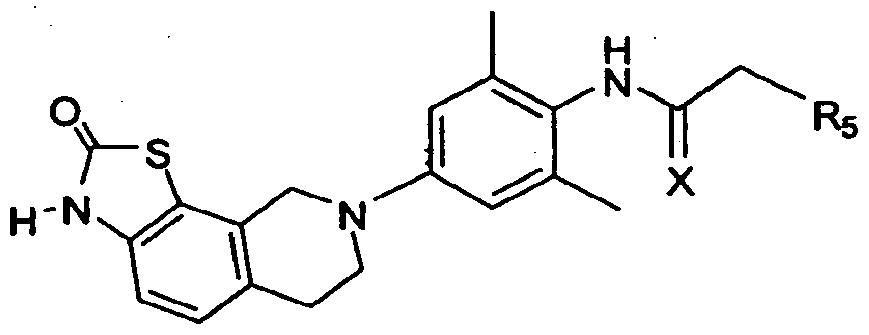
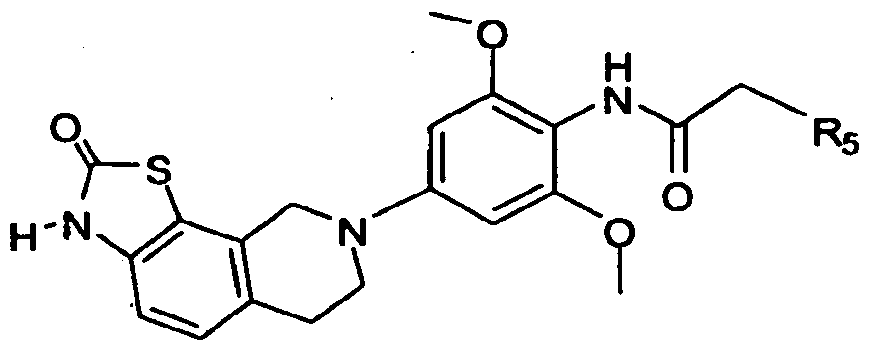
  • this invention provides or contemplates a compound of the structure shown below.
  • this invention provides or contemplates a compound of the structure shown below.
  • this invention provides or contemplates a compound of the structure shown below, where R 5 is Cs-Ce alkyl or (CH 2 )wC5-C 6 cycloalkyl.
  • this invention provides or contemplates a compound of the structure shown below, where R 5 is Cs-Ce alkyl or (CH 2 )wC 5 -C 6 cycloalkyl.
  • this invention provides or contemplates a compound of the structure shown below, where R 3 and R 4 are, independently, H, methyl, or methoxy.
  • this invention provides or contemplates a compound of the structure shown below, where R 3 and R 4 are, independently, H, methyl, or methoxy, and R 5 is C5-C6 alkyl or (CH 2 )WCs-Ce cycloalkyl.
  • this invention provides or contemplates a compound of the structure shown below, where R5 is Cs-Ce alkyl or (CH 2 )w C 5 -C 6 cycloalkyl.
  • this invention provides or contemplates a compound of the structure shown below, where R 3 and R 4 are, independently, H, methyl, or methoxy.
  • this invention provides or contemplates a compound of the structure shown below, where R 3 and R 4 are, independently, H, methyl, or methoxy.
  • this invention provides or contemplates a compound of the structure shown below, where Rs is C 5 -C 6 alkyl or (CH 2 ) * C 5 -C 6 cycloalkyl.
  • this invention provides or contemplates a compound of the structure shown below, where R 3 and R4 are, independently, H, methyl, Cl, CF 3 , OCF 3 , or methoxy.
  • this invention provides or contemplates a compound of the structure shown below, where R 5 is Cs-C 6 alkyl or (CH 2 )w C 5 -C 6 cycloalkyl.
  • this invention provides or contemplates a compound of the structure shown below, where R 3 and R 4 are, independently, H, methyl, Cl, CF3, OCF 3 , or methoxy.
  • this invention provides or contemplates a compound of the structure shown below, where R 5 is C 5 -C 6 alkyl or (CH 2 )w Cs-C 6 cycloalkyl.
  • this invention provides or contemplates a compound of the structure shown below, where Rs is Cs-C 6 alkyl or (CH 2 )w C 5 -C 6 cycloalkyl.
  • this invention provides or contemplates a compound of the structure shown below, where R 5 is'(CH 2 ) w Ar or C 3 -C 6 alkyl.
  • this invention provides or contemplates a compound of the structure shown below, where R 3 and R 4 are, independently, H, methyl, Cl, CF 3 , OCF 3 , or methoxy.
  • this invention provides or contemplates a compound of the structure shown below, where R 3 and R 4 are, independently, H, methyl, Cl, CF 3 , OCF 3 , or methoxy and R 5 is (CH 2 ) w Ar or C 3 -C 6 alkyl.
  • this invention provides or contemplates a compound of the structure shown below, where Rs is (CH 2 ) w Ar or C 3 -C 6 alkyl.
  • this invention provides or contemplates a compound of the structure shown below, where R 3 and R 4 are, independently, H, methyl, Cl, CF 3 , OCF 3 , or methoxy and where R 5 is (CH 2 ) w Ar or C 3 -Ce alkyl.
  • this invention provides or contemplates a compound of formula IA, where R 2 is H.
  • this invention provides or contemplates a compound of formula IA, where R 2 is halogen.
  • this invention provides or contemplates a compound of formula IA, where R 2 is Cl or F.
  • this invention provides or contemplates a compound of formula IA, where R 2 is trifluoromethyl.
  • this invention provides or contemplates a compound of formula IA, where R 3 and R 4 are, independently, H, Cl, methyl, ethyl, trifluoromethyl, or methoxy.
  • this invention provides or contemplates a compound of formula IA, where q is zero and R3 and R4 are Cl, ethyl, methoxy, or methyl.
  • this invention provides or contemplates a compound of formula IA, where q is zero and R 3 and R4 are both methyl.
  • this invention provides or contemplates a compound of formula IA, where R' is methyl, halogen, or H; and R 3 and R 4 are, independently, H, Cl, ethyl, methoxy, or methyl.
  • this invention provides or contemplates a compound of formula IA, where R' is methoxy; and R 3 and R4 are, independently, H, Cl, ethyl, methoxy, or methyl.
  • this invention provides or contemplates a compound of formula IA, where R' is H; and R 3 and R4 are, independently, H, Cl, ethyl, or methyl.
  • this invention provides or contemplates a compound of formula IA, where R 1 is H, q is zero, and R 5 is Ci-Ce alkyl, or (CHR 6 )WC 3 -C 6 cycloalkyl.
  • this invention provides or contemplates a compound of formula IA, where R 1 is H; q is 1 ; Y is O; and R 5 is Q-C 6 alkyl, or (CHR 6 )WC 3 -C 6 cycloalkyl.
  • this invention provides or contemplates a compound of formula IA, where R 1 is H; q is 1 ; Y is S; and R5 is Ci-C 6 alkyl, or (CHR 6 )WC 3 -C 6 cycloalkyl.
  • this invention provides or contemplates a compound of formula IA, where R' and R 2 are H and R 5 is Ci-C 6 alkyl, or (CHR 6 ) W C 3 -C 6 cycloalkyl.
  • this invention provides or contemplates a compound of formula IA, where R' and R 2 are H and R 5 is Ar, (CHR 6 )WAr, CH 2 (CHR 6 ) W Ar, or (CHR 6 ) W CH 2 Ar.
  • this invention provides or contemplates a compound of formula IA, where R 1 and R 2 are H and R 5 is (CHR 6 ) W Cs-C 6 cycloalkenyl, CH 2 (CHR 6 ) W C 5 -C 6 cycloalkenyl, C 2 -C 6 alkenyl, or C 2 -C 6 alkynyl.
  • this invention provides or contemplates a compound of formula IA, where R 1 is halogen; and R 3 and R 4 are H, Cl, ethyl, or methyl. In another more specific subgeneric embodiment, this invention provides or contemplates a compound of formula IA, where R 1 is Cl or F; and R 3 and R 4 are H, Cl, ethyl, or methyl.
  • this invention provides or contemplates a compound of formula IA, where R 1 is Cl or F; R 3 and R 4 are H, Cl, ethyl, or methyl; and R 5 is CpC 6 alkyl, or (CHR 6 )WC 3 -C 6 cycloalkyl.
  • this invention provides or contemplates a compound of formula IA, where R 1 is phenyl, optionally substituted.
  • this invention provides or contemplates a compound of formula IA, where R 1 is 1 -phenyl, optionally substituted. In another more specific subgeneric embodiment, this invention provides or contemplates a compound of formula IA, where R 1 is 4-phenyl, optionally substituted.
  • this invention provides or contemplates a compound of formula IA, where R 1 is phenyl, optionally substituted, and R 5 is Ci-Ce alkyl, or (CHR 6 )WC 3 -C 6 cycloalkyl.
  • this invention provides or contemplates a compound of formula IA, where Ri is NH-Ci-C 6 alkyl, N(Ci-C 6 alkyl )-Cr C 6 alkyl, C(O)NH-C, -C 6 alkyl, NH-C(O)C 1 -C 6 alkyl; 0-C 1 -C 6 alkyl, CeO)-C 1 -C 6 alkyl, C(O)-OCi-C 6 alkyl, or OC(O)Ci-C 6 alkyl; R 1 is phenyl, optionally substituted, and R 5 is C 1 -C 6 alkyl, or (CHR 6 ) W C 3 -C 6 cycloalkyl.
  • this invention provides or contemplates a compound of formula IA, where R' is H, methyl, or ethyl; and R 1 is NH-Ci-C 6 alkyl, N(Ci-C 6 alkyl )-C,-C 6 alkyl, C(O)NH-Ci -C 6 alkyl, or NH-C(O)C 1 -C 6 alkyl.
  • this invention provides or contemplates a compound of formula IA, where R 1 is H, methyl, or ethyl; and R 1 is C(O)OCi -C 6 alkyl, OC(O)C 1 -C 6 alkyl, or OC 1 -C 6 alkyl.
  • this invention provides or contemplates a compound of formula IA, where R 1 is H, methyl, methoxy, or halogen, and R' is methyl or ethyl.
  • this invention provides or contemplates a compound of formula IA, where R 1 is H, methyl, methoxy, or halogen, and R' is phenyl.
  • this invention provides or contemplates a compound of formula IA, where R 1 is H, methyl, methoxy, or halogen, and R 1 is F.
  • this invention provides or contemplates a compound of formula IA, where Ri is methoxy, methoxymethyl, ethoxymethyl, or methoxyethyl.
  • this invention provides or contemplates a compound of formula IA, where Ri is methoxy, methoxymethyl, ethoxymethyl, or methoxyethyl; R 2 is H, methyl, or halogen; and R 3 is methyl or Cl.
  • this invention provides or contemplates a compound of formula IA, where R' is 4-phenyl, optionally substituted, and R 2 is H, methyl, methoxy, or halogen.
  • this invention provides or contemplates a compound of formula IA, where R 1 is CF 3 or C 1 -C3 alkyl, and R2 is H, methyl, methoxy, or halogen.
  • this invention provides or contemplates a compound of formula IA, where R' is methoxy, and R2 is H, methyl, methoxy, or halogen.
  • this invention provides or contemplates a compound of formula IA, where R 1 is 2-dimethylamino ethyl, and R 2 is H, methyl, methoxy, or halogen.
  • this invention provides or contemplates a compound of formula IA, where q is zero, R 2 is H, methyl, methoxy, or halogen, R' is 1 -phenyl, optionally substituted; and R 3 and R4 are H, Cl, ethyl, or methyl.
  • this invention provides or contemplates a compound of formula IA, where q is zero, R 2 is H, methyl, methoxy, or halogen, R 1 is 4-phenyl, optionally substituted; and R 3 and R 4 are H, Cl, ethyl, or methyl.
  • this invention provides or contemplates a compound of formula IA, where q is zero, R2 is H, methyl, methoxy, or halogen; R' is CF 3 or C1-C3 alkyl; and R 3 and R4 are H, Cl, ethyl, or methyl.
  • this invention provides or contemplates a compound of formula IA, where q is zero, R 2 is H, methyl, methoxy, or halogen; R' is methoxy; and R 3 and R 4 are H, Cl, ethyl, or methyl.
  • this invention provides or contemplates a compound of formula IA, where q is zero; R' is (2-dimethylamino) ethyl; R 2 is H, methyl, methoxy, or halogen; and R 3 and R 4 are H, Cl, ethyl, or methyl.
  • the invention provides or contemplates a compound of formula IA-I below.
  • this invention provides or contemplates a compound of formula IA-2 below.
  • this invention provides or contemplates a compound of formula IA-3 below.
  • this invention provides or contemplates a compound of formula IA-4 below.
  • this invention provides or contemplates a compound of formula IA-5 below.
  • this invention provides or contemplates a compound of formula IA-I or formula IA-3, where R 2 is H, alkyl, or halogen; and R 5 is
  • this invention provides or contemplates a compound of formula IA-I or formula IA-3, where R
  • this invention provides or contemplates a compound of formula IA-I or formula IA-3, where Ri is methoxy, methoxymethyl, or methoxyethyl; R 2 is H, alkyl, or halogen; and R 5 is C]-C 6 alkyl,
  • this invention provides or contemplates a compound of formula IA-2, where R5 is Ci-C 6 alkyl, (CHR 6 )WC 3 -C 6 cycloalkyl, (CHR 6 )WCH 2 C 3 -C 6 cycloalkyl, or CH 2 (CHR 6 )WC 3 -C 6 cycloalkyl.
  • this invention provides or contemplates a compound of formula IA-2, where R 5 is Ar, (CHR 6 ) W Ar, CH 2 (CHR 6 ) w Ar, or (CHR 6 ) W CH 2 Ar.
  • this invention provides or contemplates a compound of formula IA-3, where R 2 and R 1 are H; R 3 is methyl; and R 5 is C 1 -C 6 alkyl, (CHR 6 )WC 3 -C 6 cycloalkyl, (CHR 6 )WCH 2 C 3 -C 6 cycloalkyl, or CH 2 (CHR 6 )WC 3 - Ce cycloalkyl.
  • this invention provides or contemplates a compound of formula IA-I, where Ri is H, F, Cl, Br, methoxy, methoxymethyl, ethoxymethyl, methoxyethyl, or trifluoromethyl; R 3 is methyl; and R 5 is C 4 -C 6 alkyl, (CHR 6 ) W CH 2 C 5 -C 6 cycloalkyl, or CH 2 (CHR 6 ) W C 5 -C 6 cycloalkyl.
  • this invention provides or contemplates a compound of formula IA-2, where R 5 is C 4 -C 6 alkyl, (CHR 6 )WCs-C 6 cycloalkyl, or CH 2 (CHR 6 )WC 5 -C 6 cycloalkyl; and Ri is H, F, Cl, Br, methoxy, methoxymethyl, ethoxymethyl, methoxyethyl, or trifluoromethyl.
  • this invention provides or contemplates a compound of formula IA-3, where Ri is H, F, Cl, Br, methoxy, methoxymethyl, ethoxymethyl, methoxyethyl, or trifluoromethyl; R 2 is H, methyl, or F; R 1 is H or methyl; R 3 is methyl; and R 5 is C 4 -C 6 alkyl, (CHR 6 ) W C 5 -C 6 cycloalkyl, or CH 2 (CHR 6 )WC 5 -C 6 cycloalkyl.
  • this invention provides or contemplates a compound of formula IA-I, where R 1 is (CH 2 ) m C 3 -C ⁇ cycloalkyl, C 3 -C 6 cycloalkenyl, or (CH 2 ) m C 3 -C 6 cycloalkenyl; R' is halogen; and R 3 is methyl or Cl.
  • this invention provides or contemplates a compound of formula IA-I, where Ri is (CH 2 ) m C 3 -C 6 cycloalkyl, C3-C6 cycloalkenyl, or (CH 2 ) m C 3 -C6 cycloalkenyl; and R 1 is F or Cl.
  • this invention provides or contemplates a compound of formula IA-I, where Ri is methoxy, methoxymethyl, ethoxymethyl; or methoxyethyl; R 2 is H or F; R 3 is methyl; R4 is methyl or Cl; and R5 is (CHR 6 )WC 5 -C 6 cycloalkenyl or (CHR 6 )WAr.
  • this invention provides or contemplates a compound of formula IA-I, where Rj is phenyl, optionally substituted. In another more specific subgeneric embodiment, this invention provides or contemplates a compound of formula IA-I, where Ri is methyl, halomethyl, ethyl, or haloethyl.
  • this invention provides or contemplates a compound of formula IA-I, where R 1 is 2-(dimethylamino) ethyl. In another subgeneric embodiment, this invention provides or contemplates a compound of formula IA-I, where R 1 is 1 -methyl or 1 -ethyl.
  • this invention provides or contemplates a compound of formula IA-I, where R 1 is 1-fluoro, R 5 is C 4 -C 6 alkyl, (CHR 6 )WCs-C 6 cycloalkyl, or CH 2 (CHR 6 )WC 5 -C 6 cycloalkyl; and R, is H, F, Cl, Br, methoxy, or trifluoromethyl.
  • this invention provides or contemplates a compound of formula IA-I, where R' is 4-fluoro, R 5 is (CHR 6 )WC 5 -C 6 cycloalkyl, or CH 2 (CHR 6 ) W C 5 -C 6 cycloalkyl; and Ri is H, F, Cl, Br, methoxy, or trifluoromethyl.
  • this invention provides or contemplates a compound of formula IA-I, where Ri is (CH 2 ) m ⁇ dazolyl, (CH 2 ) m pyrazyl, (CH 2 )m furyl, (CH 2 ) m thienyl, (CH 2 ) m oxazolyl, (CH 2 ) m isoxazolyl, (CH 2 ) m thiazolyl, (CH 2 ) m isothiazolyl, (CH 2 ) m phenyl, (CH 2 ) m ⁇ yrrolyl, (C ⁇ pyridyl, or (CH 2 ) m ⁇ yrimidyl; and R 2 and R' are H.
  • this invention provides or contemplates a compound of formula IA-I, where Ri is (CH 2 ) m imidazolyl, (CH 2 ) ⁇ ,pyrazyl, (CH 2 ) m furyl, (CH 2 ) m thienyl, (CH 2 ) m oxazolyl, (CH 2 ) m isoxazolyl, (CH 2 ) m thiazolyl, (CH 2 ) m isothiazolyl, (CH 2 ) m phenyl, (CH 2 ) m pyrrolyl, (CH 2 ) m pyridyl, or (CH 2 ) m pyrimidyl; and R' is 4-phenyl, optionally substituted.
  • this invention provides or contemplates a compound of formula IA-I, where R 1 is CF 3 or C 1 -C 3 alkyl; R 5 is G t -C 6 alkyl, (CHR 6 )WC 5 -C 6 cycloalkyl, or CH 2 (CHR 6 )WC 5 -C 6 cycloalkyl; and R t is H, F, Cl, Br, methoxy, or trifluoromethyl.
  • this invention provides or contemplates a compound of formula IA-I, where R' is 4-methyl or 4-ethyl; and R 5 is C 4 - C 6 alkyl, (CHR 6 ) W C 5 -C 6 cycloalkyl, or CH 2 (CHR 6 ) W C 5 -C 6 cycloalkyl; and Rj is H, F, Cl, Br, methoxy, or trifluoromethyl.
  • this invention provides or contemplates a compound of formula IA-I , where R' is methoxy or ethoxy; and R s is C 4 - C 6 alkyl, (CHR 6 )WC 5 -C 6 cycloalkyl, or CH 2 (CHR 6 ) W C 5 -C 6 cycloalkyl; and Ri is H, F, Cl, Br, methoxy, or trifluoromethyl.
  • this invention provides or contemplates a compound of formula IA-I, where R' is 1 -phenyl, optionally substituted; R 5 is C 4 -C 6 alkyl, (CHR 6 ) W C 5 -C 6 cycloalkyl, or CH 2 (CHR 6 ) W C 5 -C 6 cycloalkyl; and Ri is H, F, Cl, Br, methoxy, or trifluoromethyl.
  • this invention provides or contemplates a compound of formula IA-I, where R' is 4-phenyl, optionally substituted; R 5 is C 4 -C 6 alkyl, (CHR 6 )WC 5 -C 6 cycloalkyl, or CH 2 (CHR 6 ) W C 5 -C 6 cycloalkyl; and R 1 is H, F, Cl, Br, methoxy, or trifluoromethyl.
  • this invention provides or contemplates a compound of formula IA-I, where R' is CF 3 or C 1 -C 3 alkyl; R 5 is C 4 -C 6 alkyl, (CHR 6 ) ⁇ C 5 -C 6 cycloalkyl, or CH 2 (CHR ⁇ ;) W C 5 -C 6 cycloalkyl; and Ri is H, F, Cl, Br, methoxy, or trifluoromethyl.
  • this invention provides or contemplates a compound of formula IA-I, where R' is 4-methyl or 4-ethyl; R 5 is C4-C 6 alkyl, (CHR 6 )WC 5 -C 6 cycloalkyl, or CH 2 (CHR 6 )WC 5 -C 6 cydoalkyl; and Ri is H, F, Cl, Br, methoxy, or trifluoromethyl.
  • this invention provides or contemplates a compound of formula IA-I, where R' is methoxy or ethoxy, R 5 is C-J-C 6 alkyl, (CHR 6 )WC 5 -C 6 cycloalkyl, or CH 2 (CHR 6 )WC 5 -C 6 cycloalkyl; and Ri is H, F, Cl, Br, methoxy, or trifluoromethyl.
  • this invention provides or contemplates a compound of formula IA-4, where Ri is H, F, Cl, Br, methoxy, or trifluoromethyl; R 5 is C 4 -C 6 alkyl, (CHR 6 )WC 5 -C 6 cycloalkyl, or CH 2 (CHR 6 ) W C 5 -C 6 cycloalkyl; and Rj is H, F, Cl, Br, methoxy, or trifluoromethyl.
  • this invention provides or contemplates a compound of formula IA-4, where R 2 is H, F, or methyl; R 5 is C 4 -C 6 alkyl, (CHR 6 )WC 5 -C 6 cycloalkyl, or CH 2 (CHR 6 )WC 5 -C 6 cycloalkyl; and Ri is H, F, Cl, Br, methoxy, or trifluoromethyl.
  • this invention provides or contemplates a compound of formula IA-2, where R' is H.
  • this invention provides or contemplates a compound of formula IA-2, where R 1 is halogen.
  • this invention provides or contemplates a compound of formula IA-2, where R* is F.
  • this invention provides or contemplates a compound of formula IA-2, where R 1 is methyl or ethyl.
  • this invention provides or contemplates a compound of formula IA-2, where R 1 is methyl or ethyl; R 5 is C 4 -C 6 alkyl, (CHR 6 )WC 5 -C 6 cycloalkyl, or CH 2 (CHR 6 ) W C 5 -C 6 cycloalkyl; and R
  • this invention provides or contemplates a compound of formula IA-2, where R' is halogen; R 5 is C 4 -C 6 alkyl, (CHR 6 )WC 5 -C 6 cycloalkyl, or CH 2 (CHR6) W C 5 -C 6 cycloalkyl; and Ri is H, F, Cl, Br, methoxy, or trifluoromethyl.
  • this invention provides or contemplates a compound of formula IA-2, where R' is H; R 5 is C 4 -C 6 alkyl, (CHR 6 ) W C 5 - C 6 cycloalkyl, or CH 2 (CHR 6 ) W C 5 -C 6 cycloalkyl; and Ri is H, F, Cl, Br, methoxy, or trifluoromethyl.
  • this invention provides or contemplates a compound of formula IA-2, where R' is 1 -phenyl, optionally substituted.
  • this invention provides or contemplates a compound of formula IA-2, where R 1 is 4-phenyl, optionally substituted.
  • this invention provides or contemplates a compound of formula IA-2, where R' is CF 3 or Ci -Cj alkyl.
  • this invention provides or contemplates a compound of formula IA-3, where R 1 is H; R 5 is C 4 -QaIkVl, (CHR 6 ) W C 5 - C 6 cycloalkyl, or CH 2 (CHR 6 ) W C 5 -C 6 cycloalkyl; and Ri is H, F, Cl, Br, methoxy, or trifluoromethyl.
  • this invention provides or contemplates a compound of formula IA-3, where R' is F; R 5 is G t -C 6 alkyl, (CHR 6 ) W C 5 - C 6 cycloalkyl, or CH 2 (CHR 6 ) W C 5 -C 6 cycloalkyl; and Ri is H, F, Cl, Br, methoxy, or trifluoromethyl.
  • this invention provides or contemplates a compound of formula IA-3, where R' is 1 -phenyl, optionally substituted; R 5 is C 4 -C 6 alkyl, (CHR 6 )WC 5 -C 6 cycloalkyl, or CH 2 (CHR 6 )WC 5 -C 6 cycloalkyl; and Ri is H, F, Cl, Br, methoxy, or trifluoromethyl.
  • this invention provides or contemplates a compound of formula IA-3, where R' is 4-phenyl, optionally substituted; R 5 is C 4 -C 6 alkyl, (CHR 6 )WC 5 -C 6 cycloalkyl, or CH 2 (CHR 6 )WC 5 -C 6 cycloalkyl; and R t is H, F, Cl, Br, methoxy, or trifluoromethyl.
  • this invention provides or contemplates a compound of formula IA-3, where R' is CF 3 or C 1 -C 3 alkyl; R 5 is C 4 -C 6 alkyl, (CHR 6 )WC 5 -C 6 cycloalkyl, or CH 2 (CHR 6 )WC 5 -C 6 cycloalkyl; and Ri is H, F, Cl, Br, methoxy, or trifluoromethyl.
  • this invention provides or contemplates a compound of formula IA, where R 5 is Ar, (CHR 6 )WAr 5 CH 2 (CHR 6 ) W Ar, or In another subgeneric embodiment, this invention provides or contemplates a compound of formula IA-2, where R 5 is Ar, (CHR 6 ) W Ar, CH 2 (CHR 6 ) W Ar, or
  • this invention provides or contemplates a compound of formula IA-3, where R 5 is Ar, (CHR 6 ) W Ar, CH 2 (CHR 6 ) W Ar, or
  • this invention provides or contemplates compounds of formula IA-I, IA-2, IA-3, IA-4, or IA-5, where Ri and R 2 , are, independently, methyl, ethyl, F, Cl, CF 3 , methoxy or methoxymethyl, R 1 is methyl, and R 5 is C 4 -C 6 alkyl, (CHR 6 ) W C 5 -C 6 cycloalkyl, or CH 2 (CHR 6 ) W C 5 -C 6 cycloalkyl.
  • this invention provides or contemplates a compound of formula IA, where R 5 is haloalkyl. In another subgeneric embodiment, this invention provides or contemplates a compound of formula IA-I, where R 5 is haloalkyl.
  • this invention provides or contemplates a compound of formula IA-2, where R 5 is haloalkyl. In another subgeneric embodiment, this invention provides or contemplates a compound of formula IA-3, where R5 is haloalkyl.
  • this invention provides or contemplates a compound of formula IA, where Rs is methoxy alkyl.
  • this invention provides or contemplates a compound of formula IA, where R5 is cyano alkyl.
  • the invention provides or contemplates a compound of formula IA-4, where Rs is halo alkyl.
  • the invention provides or contemplates a compound of formula IA, where R 5 is CH 2 -cycloalkyl or CH 2 CH 2 - cycloalkyl.
  • the invention provides or contemplates a compound of formula IA-4, where R 5 is CH2-cycloalkyl or CH 2 CH 2 - cycloalkyl.
  • the invention provides or contemplates a compound of formula IA-5, where R 5 is CH 2 -cycloalkyl or CH 2 CH 2 - cycloalkyl.
  • this invention provides or contemplates a compound of formula IA-I , where R 3 and R 4 are chloro, methoxy, or methyl and R 5 is CH 2 -cycloalkyl .
  • this invention provides or contemplates a compound of formula IA-I, where R 3 and R4 are chloro, methoxy, or methyl and Rs is haloalkyl, hydroxyalkyl, or methoxyalkyl.
  • this invention provides or contemplates a compound of formula IA-I, where R 3 and R 4 are chloro, methoxy, or methyl and R 5 is methoxy alkyl.
  • this invention provides or contemplates a compound of formula IA-2, where R 3 and R 4 are chloro, methoxy, or methyl and R 5 is chloroalkyl.
  • this invention provides or contemplates a compound of formula IA-2, where R 3 and R4 are chloro, methoxy, or methyl and R 5 is methoxyalkyl.
  • this invention provides or contemplates a compound of formula IA-I, where R 3 and R4 are both methyl and R 5 is 2-(2-halo cyclopentyl) ethyl. In another subgeneric embodiment, this invention provides or contemplates a compound of formula IA-I, where R 3 and R4 are both methyl and R 5 is 2-(2-furyl) ethyl.
  • this invention provides or contemplates a compound of formula IA-I, where R 3 and R 4 are both methyl and R 5 is 2-(2- tetrahydrofuryl) ethyl. In another subgeneric embodiment, this invention provides or contemplates a compound of formula IA-I, where R 3 and R 4 are both methyl and R 5 is 2-phenyl ethyl.
  • this invention provides or contemplates a compound of formula IA-I, where R 3 and R4 are both methyl and R 5 is 3-phenyl propyl.
  • this invention provides or contemplates a compound of formula IA-I , where R 3 and R4 are both methyl and R 5 is 2-phenyl propyl.
  • this invention provides or contemplates a compound of formula IA-I, where R 5 is Ci-C 6 alkyl, (CHR 6 ) W C 3 -C 6 cycloalkyl, (CHR 6 )WCH 2 C 3 -C 6 cycloalkyl, or CH 2 (CHR 6 )WC 3 -C 6 cycloalkyl; R' is halogen or C1-C 3 alkyl; and Ri is halogen.
  • this invention provides or contemplates a compound of formula IA-I, where R5 is Ci-C 6 alkyl, (CHR6) W C 3 -C 6 cycloalkyl, (CHR 6 ) W CH 2 C 3 -C 6 cycloalkyl, or CH 2 (CHR 6 )WC 3 -C 6 cycloalkyl; R' is halogen or Ci-C 3 alkyl; R 2 is H or halogen; and Ri is halogen.
  • this invention provides or contemplates a compound of formula IA- 1 , where R 5 is Ci-C 6 alkyl, (CHR 6 ) W C 3 -C 6 cycloalkyl, (CHR 6 )WCH 2 C 3 -C 6 cycloalkyl, or CH 2 (CHR 6 )WC 3 -C 6 cycloalkyl; R 1 is phenyl, optionally substituted; R 2 is H or halogen; and Ri is halogen.
  • this invention provides or contemplates a compound of formula IA-I, where R 5 is C)-C 6 alkyl, (CHR 6 )WC 3 -C 6 cycloalkyl, (CHR 6 )WCH 2 C 3 -C 6 cycloalkyl, or CH 2 (CHR 6 )WC 3 -C 6 cycloalkyl; R 1 is halogen or Ci-C 3 alkyl; R 2 is H or halogen; and Ri is halogen.
  • this invention provides or contemplates a compound of formula IA-2, where R 5 is Ci-C 6 alkyl, (CHR 6 ) W C 3 -C 6 cycloalkyl, (CHR 6 ) W CH 2 C 3 -C 6 cycloalkyl, or CH 2 (CHR 6 ) W C 3 -C 6 cycloalkyl; R 1 is halogen or Cj-C 3 alkyl; and Ri is halogen.
  • this invention provides or contemplates a compound of formula IA-3, where R 5 is Ci-C 6 alkyl, (CHR 6 )WC 3 -C 6 cycloalkyl, (CHR 6 ) W CH 2 C 3 -C 6 cycloalkyl, or CH 2 (CHR 6 ) W C 3 -C 6 cycloalkyl; R 1 is halogen or Ci-C 3 alkyl; and Rj is halogen.
  • this invention provides or contemplates a compound of formula IA, where R 5 is Ar, (CHR 6 ) W Ar, CH 2 (CHR 6 ) W Ar, or (CHR 6 ) W CH 2 Ar 1 .
  • this invention provides or contemplates a compound of formula IA-3, where Ri is haloalkyl; R 2 is H or F; R 3 and R 4 are Cl, methoxy, or methyl; and R 5 is Cj-C 6 alkyl, (CHR 6 )WC 3 -C 6 cycloalkyl, (CHR 6 ) W CH 2 C 3 -C 6 cycloalkyl, or CH 2 (CHR 6 ) W C 3 -C 6 cycloalkyl.
  • this invention provides or contemplates a compound of formula IA-I, where Ri is Cj-C 3 alkyl, halogen, or haloalkyl; R 2 is H or F; R 3 and R 4 are H, methyl, or Cl; and R 5 is CH 2 CR 6 -C 3 -C 6 cycloalkyl, or C 2 -C 6 alkyl.
  • this invention provides or contemplates a compound of formula IA-3, where Ri is Ci-C 3 alkyl, halogen, or haloalkyl; R 2 is H or F; R 3 and R 4 are H, methyl, or Cl; and R 5 is CH 2 CR 6 -C 3 -C 6 cycloalkyl, (CHR 6 ) W C 5 -C 6 cycloalkenyl, CH 2 (CHR 6 ) W C 5 -C 6 cycloalkenyl, C 2 -C 6 alkenyl, or C 2 -C 6 alkynyl.
  • this invention provides or contemplates a compound of formula IA-3, where Ri is halogen or haloalkyl; R 2 is H or F; R 3 and R 4 are Cl, methoxy, or methyl; and R 5 is Ci-C 6 alkyl, (CHR 6 ) W C 3 -C 6 cycloalkyl, (CHR 6 )WCH 2 C 3 -C 6 cycloalkyl, or CH 2 (CHR 6 )WC 3 -C 6 cycloalkyl.
  • this invention provides or contemplates a compound of formula IA-3, where Ri is methyl, fluoro, or fluoroalkyl; R 2 is H or F; and R 5 is Ci-C 6 alkyl, (CHR 6 ) W C 3 -C 6 cycloalkyl, (CHR 6 ) W CH 2 C 3 -C 6 cycloalkyl, or CH 2 (CHR 6 ) W C 3 -C 6 cycloalkyl.
  • this invention provides or contemplates a compound of formula IA-3, where Ri is Cl, F, or CF 3 ; R 2 is H or F; R' is H or CH 3 ; and R 5 is Ar, (CHR 6 )WAr, CH 2 (CHR 6 )WAr, or (CHR 6 )WCH 2 Ar.
  • this invention provides or contemplates a compound of formula I A-4, where R 3 and R4 are H, methyl, or Cl; and R 5 is Ci-C 6 alkyl, (CHR 6 )WC 3 -C 6 cycloalkyl, (CHR 6 )WCH 2 C 3 -C 6 cycloalkyl, or CH 2 (CHR 6 ) W C 3 - C 6 cycloalkyl.
  • this invention provides or contemplates a compound of formula IA-I, where R 3 and R 4 are H, methyl, or Cl; and where Ri and R 2 , on adjacent carbons, form a six-membered ring.
  • this invention provides or contemplates a compound of formula IA- 1 , where R' is F, methyl, or H; R 3 and R 4 are H, methyl, or Cl; and R 5 is Ci-C 6 alkyl, (CHR 6 ) W C 3 -C 6 cycloalkyl, (CHR 6 ) W CH 2 C 3 -C 6 cycloalkyl, or CH 2 (CHR 6 ) W C 3 -C 6 cycloalkyl.
  • this invention provides or contemplates a compound of formula IA-I, where R 1 is halogen and R 5 is Ar, (CHR 6 ) W Ar, .
  • this invention provides or contemplates a compound of formula IA-I , where Ri and R 2 are on adjacent carbon atoms and are both other than H.
  • this invention provides or contemplates a compound of formula IA-I, where Ri and R 2 , on adjacent carbon atoms are, independently trifluoromethyl or halogen; and where Rs is Ci-Ce alkyl, (CHR 6 ) W C 3 -C 6 cycloalkyl, (CHR 6 )WCH 2 C 3 -C 6 cycloalkyi, or CH 2 (CHR 6 )WC 3 -C 6 cycloalkyl-
  • this invention provides or contemplates a compound of formula IA-I, where Rs is (CHR 6 )WCs-C 6 cycloalkenyl, CH 2 (CHR 6 )WCs-C 6 cycloalkenyl, C 2 -C 6 alkenyl, or C 2 -C 6 alkynyl.
  • this invention provides or contemplates a compound of fo ⁇ nula IA-I, where R 5 is Ar, (CHR ⁇ JwAr, CH 2 (CHR 6 ) W Ar, or
  • this invention provides or contemplates a compound of formula IA-I, where Ri is halogen or trifluoromethyl and R 2 is H, or Ri and R 2 , on adjacent carbon atoms are, independently trifluoromethyl or halogen; and where R 5 is Ar, (CHR 6 ) W Ar, CH 2 (CHR 6 ) W Ar, or (CHR 6 ) W CH 2 Ar.
  • this invention provides or contemplates a compound of formula IA -2 where R 5 is Ci-C 6 alkyl or (CHR 6 ) W Cs-C 6 cycloalkyl.
  • this invention provides or contemplates a compound of formula IA-3, where R 5 is C]-C 6 alkyl or (CHR 6 )WC 3 -C 6 cycloalkyl.
  • this invention provides or contemplates a compound of formula IA-2, where Ri is halogen or trifluoromethyl and R 2 is H or Ri and R 2 , on adjacent carbon atoms, are, independently, halogen or trifluoromethyl; and R 5 is Ci-C 6 alkyl or (CHR 6 ) W C 3 -C 6 cycloalkyl.
  • this invention provides or contemplates a compound of formula IA-3, where Ri is halogen or trifluoromethyl and R 2 is H or Ri and R2, on adjacent carbon atoms, are, independently, halogen or trifluoromethyl; and R 5 is Ci-C 6 alkyl or (CHR 6 ) W C 3 -C 6 cycloalkyl.
  • this invention provides or contemplates a compound of formula IA-2, where Ri and R 2 are, independently, methyl, methoxy, trifluoromethyl, F, Cl, or H; and R 5 is Ci-C 6 alkyl or (CHR 6 ) W C 3 -C 6 cycloalkyl.
  • this invention provides or contemplates a compound of formula IA-3, where Rj and R 2 are, independently, methyl, methoxy, trifluoromethyl, F, Cl, or H; R' is H; and R 5 is Q-C 6 alkyl or (CHR 6 )WC 3 -C 6 cycloalkyl.
  • this invention provides or contemplates a compound of formula IA-I or IA-2 or IA-3, where Rj is halogen, Ci-C 6 alkyl, mono-halo Ci-C 6 alkyl, CN, di-halo C r C 6 alkyl, CF 3 , CN, or O-Ci-C 6 alkyl; R' is methyl or ethyl; and R 5 is C 5 -C 6 alkyl or CH 2 -C 3 -C 6 cycloalkyl.
  • this invention provides or contemplates a compound of formula IA-I or IA-2 or IA-3, where R
  • this invention provides or contemplates a compound of formula IA, where Ri is F, Cl, or CF 3 ; R 2 is H; and R 1 is halogen, methyl, ethyl, or methoxy; R 3 and R 4 are H, methyl, or Cl; and R5 is C 5 -C6 alkyl or CH2-C 3 -C 6 cycloalkyl.
  • this invention provides or contemplates a compound of formula IA, where Ri is halogen or CF 3 ; R 2 is H, F, or methyl, R' is phenyl; R 3 and R 4 are H, methyl, or Cl; and R 5 is C 5 -C 6 alkyl or CH 2 -C 5 -C 6 cycloalkyl.
  • this invention provides or contemplates a compound of formula IA, where Ri is halogen or CF 3 ; R2 is H, F, or methyl, R' is halophenyl; R 3 and R4 are H, methyl, or Cl; and R 5 is C 5 -C 6 alkyl or CFb-C 5 -C 6 cycloalkyl.
  • this invention provides or contemplates a compound of formula IA where Rj is NH 2 , NH-Ci -C 6 alkyl; or N(CpC 6 alkyl)-Ci -C 6 alkyl; and R 2 is H or halogen.
  • this invention provides or contemplates a compound of formula IA-I where Ri is NHC(O)Ci -C 6 alkyl, C(O)N(CHj) 2 , C(O)N(Et) 2 , C(O)NH 2 , or C(O)NH-Ci-C 6 alkyl.
  • this invention provides or contemplates a compound of formula IA-I where Ri is SO 2 NH 2 or NHSO 2 -Ci-C 6 alkyl. In another more specific subgeneric embodiment, this invention provides or contemplates a compound of formula IA-2 where R 1 is SO 2 NH 2 or NHSO 2 -Ci-Ce alkyl.
  • this invention provides or contemplates a compound of formula IA, where R 1 is (CH 2 ) m C 3 -C 6 cycloalkenyl, C2-C 6 alkenyl, or C2-C6 alkynyl.
  • this invention provides or contemplates a compound of formula IA, where Ri is CH 2 OCH 3 , CH 2 OCH 2 CH 3 , OC 1 -C 6 alkyl, or SC r C 6 alkyl.
  • this invention provides or contemplates a compound of formula IA-I, where R 1 is CH 2 OCH 3 , CH 2 OCH 2 CH 3 , OCi-C 6 alkyl, or SC 1 - C 6 alkyl.
  • -C 6 alkyl, OCC O)C 1 - C 6 alkyl, OCi-C 6 alkyl, or SC 1 -C 6 alkyl; R 2 is H, F, or methyl, R' is halogen or methyl; and R 5 is C 5 -C 6 alkyl or CH 2 -C 5 -C 6 cycloalkyl.
  • this invention provides or contemplates a compound of formula IA-I, where Ri is NH 2 , NH-Ci-C 6 alkyl; or N(Ci-C 6 alkyl)-Ci -C 6 alkyl; R 2 is H, F, or methyl, R 1 is halogen or methyl; and R5 is Cs-C 6 alkyl or CH 2 -C 5 -C 6 cycloalkyl.
  • this invention provides or contemplates a compound of formula IA, where Ri is C 2 -Ce alkynyl, optionally substituted.
  • this invention provides or contemplates a compound of formula IA, where Rj and R 2 form a fused, nitrogen-containing ring. In another subgeneric embodiment, this invention provides or contemplates a compound of formula IA, where Ri and R 2 form a fused, oxygen-containing ring.
  • this invention provides or contemplates a compound of formula IA, where Ri and R 2 form a fused thiazolo or isothiazolo group.
  • this invention provides or contemplates a compound of formula IA, where Ri and R 2 form a fused cyclopentane, optionally substituted.
  • this invention provides or contemplates a compound of formula IA, where R] and R 2 form a fused cyclohexane, optionally substituted.
  • this invention provides or contemplates a compound of formula IA-I or IA-2, where Ri and R 2 form a fused, nitrogen-containing ring.
  • this invention provides or contemplates a compound of formula IA-I or IA-2, where Ri and R 2 form a fused, oxygen-containing ring.
  • this invention provides or contemplates a compound of formula IA-I or IA-2, where Ri and R 2 form a fused thiazolo or isothiazolo group.
  • this invention provides or contemplates a compound of formula IA-I or IA-2, where Ri and R 2 form a fused cyclopentane, optionally substituted.
  • this invention provides or contemplates a compound of formula IA-I or IA-2, where Ri and R 2 form a fused cyclohexane, optionally substituted.
  • this invention provides or contemplates a compound of formula IA-I or IA-2, where Ri and R 2 form a fused, nitrogen-containing ring; and R 5 is Cs-Ce alkyl or CH 2 -Cs-Ce cycloalkyl.
  • this invention provides or contemplates a compound of formula IA-I or IA-2, where Rj and R 2 form a fused, oxygen-containing ring; and R 5 is Cs-Q alkyl or CH2-C5-C6 cycloalkyl.
  • this invention provides or contemplates a compound of formula IA-I or IA-2, where Ri and R 2 form a fused thiazolo or isothiazolo group; and R 5 is C 5 -C 6 alkyl or CH 2 -C 5 -C 6 cycloalkyl.
  • this invention provides or contemplates a compound of formula IA-I or IA-2, where Ri and R 2 form a fused cyclopentane, optionally substituted; and R 5 is C 5 -C 6 alkyl or CH 2 -Cs-Ce cycloalkyl.
  • this invention provides or contemplates a compound of formula IA-I or IA-2, where Ri and R 2 form a fused cyclohexane, optionally substituted; and R 5 is C 5 -C 6 alkyl or CH 2 -Cs-C 6 cycloalkyl.
  • this invention provides or contemplates a compound of formula IA-I, where Ri is halogen; R 2 is H, F, or methyl, R' is halogen or methyl; and R 5 is C 5 -Ce alkyl or CH 2 -C 5 -C 6 cycloalkyl.
  • this invention provides or contemplates a compound of formula IA-I, where Ri is halogen; R 2 is H, F, or methyl, R 1 is 2-(dimethylamino) ethyl; and R 5 is C 5 -C 6 alkyl or CH 2 -C 5 -C 6 cycloalkyl.
  • this invention provides or contemplates a compound of formula IA-I, where Ri is halogen; R 2 is H, halogen, or methyl, R' is H; and R 5 is C 5 -C 6 alkyl or CH 2 -C 5 -C 6 cycloalkyl.
  • this invention provides or contemplates a compound of formula IA-2, where Ri is halogen; R 2 is H or methyl, R' is halogen or methyl; and R 5 is C 5 -C 6 alkyl or CH 2 -C 5 -C 6 cycloalkyl.
  • this invention provides or contemplates a compound of formula IA-I .
  • this invention provides or contemplates a compound of formula IA-I, where R 1 is trifluoromethyl; R2 is H or methyl, R' is halogen or methyl; and R 5 is C 5 -C 6 alkyl or CH 2 -C S -C O cycloalkyl.
  • this invention provides or contemplates a compound of formula IA-2, where Ri where Ri is trifluoromethyl; R 2 is H or methyl, R' is halogen or methyl; and R 5 is Cs-C ⁇ alkyl or CH2-C5-C6 cycloalkyl.
  • this invention provides or contemplates a compound of formula IA-3, where Ri where Ri is trifluoromethyl; R 2 is H or methyl, R' is halogen or methyl; and R 5 is Cs-C ⁇ alkyl or CH2-C5-C6 cycloalkyl.
  • this invention provides or contemplates a compound of formula IA-4 or IA-5, where Rj where Ri is trifluoromethyl; R 2 is H or methyl, R* is halogen or methyl; and R 5 is C 5 -C 6 alkyl or CH 2 -Cs-Cg cycloalkyl.
  • this invention provides or contemplates a compound of formula IA-2, where Ri is trifluoromethyl; R 2 is F; R 1 is halogen or methyl; and Rs is Cs-Q alkyl or CH 2 -C S -C O cycloalkyl.
  • this invention provides or contemplates a compound of formula IA, where Ri or R 5 is CH 2 Ar or CH 2 CH 2 -Ar, where Ar is phenyl, pyridyl, pyrrolyl, imidazolyl, oxazolyl, or thiazolyl.
  • this invention provides or contemplates a compound of formula IA, where Ri is F. In another subgeneric embodiment, this invention provides or contemplates a compound of formula IA, where Ri is Cl.
  • this invention provides or contemplates a compound of formula IA, where Ri is Br.
  • this invention provides or contemplates a compound of formula IA- 1 , where Ri is F.
  • this invention provides or contemplates a compound of formula IA-I, where Ri is Cl.
  • this invention provides or contemplates a compound of formula IA-I, where Ri is Br. In another subgeneric embodiment, this invention provides or contemplates a compound of formula IA-I, where Ri is F and R 2 is H, OCH 3 , or F.
  • this invention provides or contemplates a compound of formula IA-I, where Ri is F; R 3 and R 4 are both methyl; and R 1 is H. In another subgeneric embodiment, this invention provides or contemplates a compound of formula IA-I, where Ri is CF 3 ; R 3 and R 4 are both methyl; and R' is H.
  • this invention provides or contemplates a compound of formula IA, where Ri and R 2 are both F.
  • this invention provides or contemplates a compound of formula IA, where Ri is mono-, di-, or tri-halomethyl.
  • this invention provides or contemplates a compound of formula IA, where Ri is CH 2 F, CHF 2 , or CF 3 .
  • this invention provides or contemplates a compound of formula IA, where Ri is CH 2 CI. In another subgeneric embodiment, this invention provides or contemplates a compound of formula IA, where Ri is CH 2 Br.
  • this invention provides or contemplates a compound of formula IA-I, where Ri and R 2 are both F; R 3 and R4 are both methyl; and R 1 is H. In another subgeneric embodiment, this invention provides or contemplates a compound of formula IA-2, where Ri is F.
  • this invention provides or contemplates a compound of formula IA-2, where Ri and R 2 are both F.
  • this invention provides or contemplates a compound of formula IA-3, where Ri is F.
  • this invention provides or contemplates a compound of formula IA-3, where Ri and R 2 are both F.
  • this invention provides or contemplates a compound of formula IA, where Ri or R 5 is CH 2 Ar or CH 2 CH 2 -Ar, where Ar is isoxazolyl or isothiazolyl. In another subgeneric embodiment, this invention provides or contemplates a compound of formula IA, where R
  • this invention provides or contemplates a compound of formula IA, where Ri or Rs is CH 2 Ar or CH 2 CH 2 -Ar, where Ar is pyrimidyl or purinyl.
  • this invention provides or contemplates a compound of formula IA, where Ri or R5 is CH 2 Ar or CH 2 CH 2 -Ar, where Ar is indolyl, isoindolyl, or benzimidazolyl.
  • this invention provides or contemplates a compound of formula IA, where Ri or Rs is CH 2 Ar or CH 2 CH 2 -Ar, where Ar is halo phenyl.
  • this invention provides or contemplates a compound of formula IA, where Ri or R 5 is CH 2 Ar or CH 2 CH 2 -Ar, where Ar is dihalophenyl or dihalopyridyl.
  • invention provides or contemplates a compound of formula IA, where Ri or Rs is CH 2 Ar or CH 2 CH 2 -Ar, where Ar is mono- or di-halothienyl, mono- or di-halofiiryl, mono- or di-halobenzothienyl, or mono- or di- halobenzofuryl.
  • this invention provides or contemplates a compound of formula IA, where Ri or R 5 is CH 2 Ar or CH 2 CH 2 -Ar, where Ar is o-, m-, or p- xylyl or o-, m-, orp-anisyl.
  • this invention provides or contemplates a compound of formula IA, where Ri or Rs is CH 2 Ar or CH 2 CH 2 -Ar, where Ar is m- o ⁇ p- cyanophenyl or m- or p-cyanom ethyl phenyl.
  • this invention provides or contemplates a compound of formula IA, in which R 3 and R 4 are halogen, CF 3 , or C 1 -C 3 alkyl and R 5 is C 1 -C 6 alkyl, where the alkyl group is substituted with one or two groups selected, independently, from OH, OMe, OEt, F, CF 3 , Cl, or CN.
  • this invention provides or contemplates a compound of formula IA, in which R 3 and R 4 are halogen, CF 3 , OCF 3 , C 1 -C 3 alkyl, or OCi-C 3 alkyl, and R 5 is (CH2) W C 3 -C 6 cycloalkyl, where w is 1 or 2, where the cycloalkyl group is substituted with Me, OH, OMe, OEt, F, CF 3 , Cl, or CN.
  • this invention provides or contemplates a compound of formula IA-I, in which R3 and R4 are halogen, CF 3 , or Ci- C 3 alkyl, and R 5 is (CH 2 ) W -Cs-C 6 cycloalkyl, optionally substituted, or (CH 2 ) W -Cs-C 6 heterocycloalkyl, optionally substituted.
  • this invention provides or contemplates a compound of formula IA-I , where Ri is CH 2 phenyl or CH2CH2-phenyl.
  • this invention provides or contemplates a compound of formula IA-I, where Ri is Ar, CH 2 Ar or CH 2 CH 2 -Ar, where Ar is 3,5- dichlorophenyl or 3,5-difluorophenyl.
  • this invention provides or contemplates a compound of formula IA-I, where Rs is Ar, (CHRe) w Ar, CH 2 (CHR ⁇ j) w Ar, or (CHR 6 )WCH 2 Ar, where Ar is phenyl or pyridyl; R 3 and R4 are H or Ci-Ce alkyl, unsubstituted or substituted with one or two groups selected from OH, OMe; and Re is CN, CH 2 CN, or halogen.
  • this invention provides or contemplates a compound of formula IA-I , where R 5 is Ar, (CHR 6 ) w Ar, CH 2 (CHR 6 ) w Ar, or
  • this invention provides or contemplates a compound of formula IA-I, where R 5 is Ar, (CHR ⁇ ) w Ar, CH 2 (CHRe) W Ar, or (CHR 6 )WCH 2 Ar, where Ar is phenyl or pyridyl, and Ri is OCi-C 6 alkyl or C(O)Cj-C 6 alkyl.
  • this invention provides or contemplates a compound of formula IA-I, where R 5 is Ar, (CHR ⁇ ) w Ar, CH 2 (CHR 6 ) w Ar, or (CHR6) w CH 2 Ar, where Ar is phenyl or pyridyl, and Ri is C(O)OCi-C 6 alkyl or OC(O)Ci-C 6 alkyl.
  • this invention provides or contemplates a compound of formula IA-I, where R5 is Ar, (CHR6) w A ⁇ , CH 2 (CHR 6 )WAr, or (CHR 6 )WCH 2 Ar, where Ar is phenyl or pyridyl, Ri is C2-C6 alkenyl or C2-C6 alkynyl, q is 1, and X and Y are both O.
  • this invention provides or contemplates a compound of formula IA-I, where R5 is Ar, (CHR 6 )WAr, CH 2 (CHRe)WAr, or (CHRe) Vv CH 2 Ar, Ar is phenyl or pyridyl, and Ri is SCi-Ce alkyl.
  • this invention provides or contemplates a compound of formula IA-I, where R 5 is Ar, (CHR 6 )V 1 Ar, CH 2 (CHR 6 )WAr, or (CHR 6 ) W CH 2 Ar, where Ar is phenyl or pyridyl, R 3 and R 4 are H, Cl, methoxy, or C 1 -C 3 alkyl, and Ri is CpC 6 alkyl.
  • this invention provides or contemplates a compound of formula IA-2, where R 5 is Ar, (CHR 6 ) w Ar, CH 2 (CHR 6 ) W Ar, or (CHR 6 ) w CH 2 Ar, where Ar is phenyl or pyridyl; R3 and R 4 are H, Cl, methoxy, or Ci-C 2 alkyl, unsubstituted or substituted with one or two groups selected from OH, OMe; and Ri is CN, CH 2 CN, or halogen.
  • this invention provides or contemplates a compound of formula IA-2, where R5 is Ar, (CHR6) w Ar, CH 2 (CHR 6 )WAr, or (CHR 6 )WCH 2 Ar, where Ar is phenyl or pyridyl; and Ri is F, CH 2 F, CHF 2 , CF 3 , or CF 2 CF 3 .
  • this invention provides or contemplates a compound of formula IA-I, where R s is Ar, (CHR 6 )WAr, CH 2 (CHR 6 )WAr, or (CHR 6 )WCH 2 Ar, where Ar is phenyl or pyridyl, and Ri is OCi-C 6 alkyl or C(O)Ci-C 6 alkyl.
  • this invention provides or contemplates a compound of formula IA-2, where R 5 is Ar, (CHRe) w Ar, CH 2 (CHR 6 ) W Ar, or
  • this invention provides or contemplates a compound of formula IA-3, where R 5 is Ar, (CHR 6 )WAr, CH 2 (CHR 6 ) W Ar, or (CHR 6 ) w CH 2 Ar, where Ar is phenyl or pyridyl, and Ri is OC 1 -C 6 alkyl or C(K))Ci-C 6 alkyl.
  • this invention provides or contemplates a compound of formula IA-2, where R 5 is Ar, (CHR ⁇ Ar, CH 2 (CHR 6 ) w Ar, or (CHR 6 ) W CH 2 Ar, Ar is phenyl or pyridyl, and Rj is SCi -C 6 alkyl.
  • this invention provides or contemplates a compound of formula IA-2, where R 5 is Ar, (CHR 6 )WAr, CH 2 (CHR 6 ) W Ar, or (CHR 6 ) W CH 2 Ar, where Ar is phenyl or pyridyl, R 3 and R 4 are H or C 1 -C 3 alkyl, and Ri is Ci-C 6 alkyl.
  • this invention provides or contemplates a method of treating or preventing a disease, disorder, or condition that is affected by modulation of potassium ion channels in a patient comprising administration of a compound of formula LA in an amount of up to 2000 mg per day.
  • this invention provides or contemplates a method of treating or preventing a disease, disorder, or condition that is affected by modulation of potassium ion channels in a patient comprising administration of a compound of formula IA in an amount of from about 10 mg to about 2000 mg per day.
  • this invention provides or contemplates a method of treating or preventing a disease, disorder, or condition that is affected by modulation of potassium ion channels in a patient comprising administration of a compound of formula IA-I in an amount of up to about 2000 mg per day.
  • this invention provides or contemplates a method of treating or preventing a seizure disorder in a patient comprising administration of a compound of formula IA in an amount of up to about 2000 mg per day. In another embodiment, this invention provides or contemplates a method of treating or preventing a seizure disorder in a patient comprising administration of a compound of formula IA in an amount of from about 10 mg per day to about 2000 mg per day.
  • this invention provides or contemplates a method of treating or preventing a seizure disorder in a patient comprising administration of a compound of formula IA in an amount of from about 300 mg per day to about 2000 mg per day.
  • this invention provides or contemplates a method of treating or preventing a seizure disorder in a patient comprising administration of a compound of formula IA in an amount of from about 300 mg per day to about 1200 mg per day. In another more specific embodiment, this invention provides or contemplates a method of treating or preventing a seizure disorder in a patient comprising administration of a compound of formula IA-I in an amount of up to 2000 mg per day.
  • this invention provides or contemplates a method of treating or preventing a seizure disorder in a patient comprising administration of a compound of formula IA- 1 in an amount of from about 10 mg per day to about 2000 mg per day.
  • this invention provides or contemplates a method of treating or preventing a seizure disorder in a patient comprising administration of a compound of formula IA-I in an amount of from about 300 mg per day to about 2000 mg per day.
  • this invention provides or contemplates a method of treating or preventing a seizure disorder in a patient comprising administration of a compound of formula IA-I in an amount of from about 300 mg per day to about 1200 mg per day.
  • compounds of formula IA are designed for oral or intravenous dosing of up to 2000 mg per day. Yet the high activities of many of these compounds indicate that dosing of less than 1200 mg per day - the current anticipated dosing level of retigabine in adults — is possible.
  • this invention comprises tablets, capsules, solutions, and suspensions of compounds of formula IA which are formulated for oral administration.
  • solutions and suspensions suitable for oral pediatric administration comprising, in addition to compounds of formula IA, a syrup such as sorbitol or propylene glycol, among many other examples, are also contemplated.
  • solutions and suspensions comprising, in addition to compounds of formula IA, a syrup such as sorbitol or propylene glycol, along with colorants and flavorings suitable for oral pediatric administration, are also contemplated.
  • a syrup such as sorbitol or propylene glycol
  • colorants and flavorings suitable for oral pediatric administration are also contemplated.
  • both chewable and non- chewable tablets comprising compounds of formula IA, along with pharmaceutically acceptable tabletting agents and other pharmaceutically acceptable carriers and excipients, are also contemplated.
  • pharmaceutically acceptable carrier comprises such excipients, binders, lubricants, tabletting agents, disintegrants, preservatives, anti-oxidants, flavours and colourants as are typically used in the art of formulation of pharmaceuticals.
  • Such agents include — but are not limited to — starch, calcium carbonate, dibasic calcium phosphate, dicalcium phosphate, microcrystalline cellulose, hydroxypropylcellulose, hydroxypropylmethylcellulose lactose, polyethylene glycols, polysorbates, glycols, safflower oil, sesame oil, soybean oil, and Povidone. Additionally, disintegrants such as sodium starch glycolate; lubricants such as magnesium stearate, stearic acid, and SiO 2 ; and solubility enhancers such as cyclodextrins, among a great many other examples for each group, are contemplated. ' Such materials and the methods of using them are well known in the pharmaceutical art.
  • the term "pharmaceutically acceptable acid salts” refers to acid addition salts formed from acids which provide non-toxic anions.
  • the pharmaceutically acceptable anions include, but are not limited to, acetate, aspartate, benzoate, bicarbonate, carbonate, bisulfate, sulfate, chloride, bromide, benzene sulfonate, methyl sulfonate, phosphate, acid phosphate, lactate, maleate, malate, malonate, fumarate, lactate, tartrate, borate, camsylate, citrate, edisylate, esylate, formate, fumarate, gluceptate, glucuronate, gluconate oxalate, palmitate, pamoate, saccharate, stearate, succinate, tartrate, tosylate and trifluoroacetate salts, among a great
  • salts of compounds of formula I maybe prepared by reaction of a compound of formula I with the desired acid; by removal of a protecting group from a suitable precursor of the compound of formula I or by ring-opening a suitable cyclic precursor, for example, a lactone or lactam, using the desired acid or base; and by conversion of one salt of the compound of formula I to another by reaction with an appropriate acid or base or by passage through an appropriate ion-exchange column.
  • solvate refers to describe a molecular complex comprising the compound of the invention and a stoichiometric amount of one or more pharmaceutically acceptable solvent molecules, including but not limited to water and ethanol.
  • solvate includes a hydrate as one example and an ethanolate as another example.
  • modulation of ion channels refers to activating the ion channels, to affecting the kinetics of opening and closing of the ion channels, or to causing any change in the channel open probability of the ion channels.
  • Such substituted tetrahydroisoquinolines are either commercially available or are prepared from commercially available materials.
  • a great many substituted tetrahydroisoquinolines are known, including many fused isothiazole, piperidino and pyrrolidine derivatives.
  • compounds of formula IA where Ri is 5- fluoro- can be prepared starting with 5-fluoro-l,2,3,4-tetrahydroisoquinoline.
  • compounds of formula IA where Rj or R 2 is 6-methyl- can be prepared starting with 6-methyl-l ,2,3,4-tetrahydroisoquinoline.
  • compounds of formula IA where Ri and R 2 are 6- and 7- chloro, respectively can be prepared starting with 6-, 7- dichloro-1,2,3,4- tetrahydroisoquinoline; and compounds with a substituent in the 9-position can be prepared starting with the appropriate 9-substitued tetrahydroisoquinoline.
  • compounds with R' other than H can be prepared starting with the appropriate 1-, 3-, or 4- substituted tetrahydroisoquinolines.
  • R' is phenyl, methoxy, ethyl, methyl, F, or 2-(N-, N-dimethylamino)ethyl are accessible via the commercially available 1- and 4-substituted tetrahydroisoquinolines.
  • the aromatic amine I is brominated according to standard procedures, including but not limited to the reaction with such reagents as N- bromosuccinimide in an aprotic solvent such as acetonitrile.
  • the reaction mixture is typically heated under reflux for a period of from approximately 8 to approximately 48 hours.
  • the resulting bromo derivative II is purified by filtration of the crude reaction mixture through Celite. If desired, other standard purification techniques, including flash chromatography, can be used.
  • the reaction of a compound II with the appropriate acyl chloride III in an aprotic solvent such as acetonitrile produces the amide of general formula IV.
  • This reaction is typically conducted at room temperature for a period of from approximately 4 to approximately 48 hours.
  • the resulting amide of general formula IV can be purified by a standard chromatographic technique such as flash chromatography or thin layer chromatography.
  • the next step of the reaction sequence is to prepare the desired product of general Formula VI using the well-known palladium coupling reaction, employing a phosphine ligand such as the commercially available dicyclohexyl phosphino-2'-(7/, ⁇ ';- dimethylamino)biphenyl.
  • a phosphine ligand such as the commercially available dicyclohexyl phosphino-2'-(7/, ⁇ ';- dimethylamino)biphenyl.
  • the amine of general formula V can be coupled to the bromine derivative of general formula IV using a palladium derivative such as, for example, bis(dibenzylidineacetone)palladium, a base such as potassium t ⁇ r/-butoxide and the ligand dicyclohexyl phosphino-2'-(JV,A' r , -dimethyl amino)biphenyl in an aprotic solvent.
  • the reaction mixture is typically heated in an oil bath at 90 0 C for a period of from approximately 8 to approximately 48 hours, or it can be heated using a microwave 5 apparatus (Horizon unit, Biotage) at a temperature range of from approximately 90° to approximately 250 0 C.
  • the desired compound of general formula VI is purified by standard chromatographic techniques, such as flash chromatography or thin layer chromatography. It can also be recrystallized from toluene.
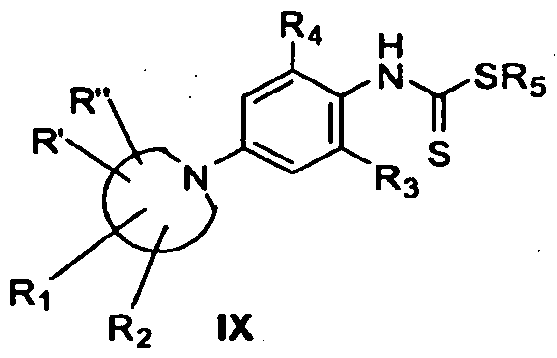
  • the compounds of general Formula IX are prepared in a way similar to that employed in section I.
  • the aniline derivative II (section I) is combined with the haloalkyl compound VII under standard conditions to produce the desired thioester of general formula VIII.
  • the reaction is typically conducted at a temperature of from approximately 20° to approximately 9O 0 C for a period of from
  • thioester can be purified by standard chromatographic techniques such as flash chromatography or thin layer chromatography.
  • a palladium coupling reaction to produce the compound of general Formula IX is identical to that described in the corresponding step in Section I.
  • the aniline is allowed to react with an anhydride derivative of general Formula X in the presence of a base such as triethylamine or diisopropyl ethylamine in an aprotic solvent such as methylene chloride.
  • a base such as triethylamine or diisopropyl ethylamine
  • an aprotic solvent such as methylene chloride.
  • the reaction is conducted at a temperature in the range of from approximately -20° to approximately 4O 0 C for a period of from approximately 30 min to approximately 48 hours, depending on the particular substrates.
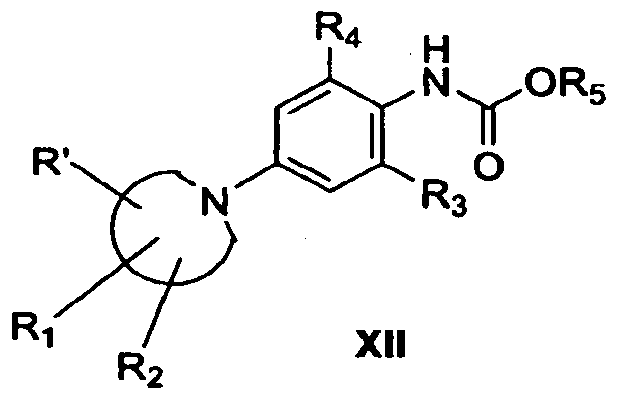
  • the resulting carbamate derivative of general Formula XI can be purified by the usual chromatographic techniques, such as flash chromatography or thin layer chromatography. As in sections I and II, the final step is a palladium coupling.
  • a compound of general Formula XII obtained as in section III, reacts with Lawesson's reagent in an aprotic solvent such as methylene chloride to produce the 5 thiocarbamate.
  • an aprotic solvent such as methylene chloride
  • the reaction is stirred at room temperature or is heated under reflux for a period of from approximately 2 to approximately 48 hours.
  • the resulting compound XIII can be purified by the usual chromatographic techniques, such as flash chromatography or thin layer chromatography.
  • the compound of general Formula XIV is obtained under the same conditions 15 described in section IV.
  • the reaction is typically heated under reflux or stirred at room temperature for a period of from approximately 2 to approximately 48 hours.
  • the resulting derivative of general Formula XIV can be purified by the usual chromatographic techniques, such as flash chromatography or thin layer chromatography.
  • bromodimethylaniline was obtained from either Alfa Aesar or Sigma Aldrich.
  • Step B N-(4-bromo-2-chloro-6-(trifluoromethyl)phenyl)-3.3- dimethylbutanamide:
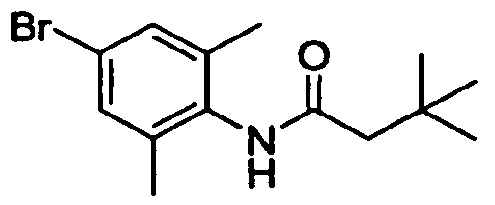
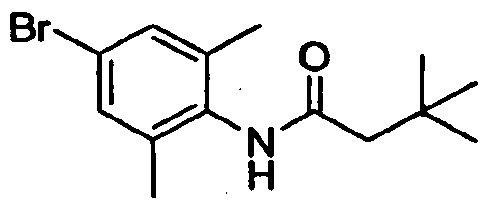
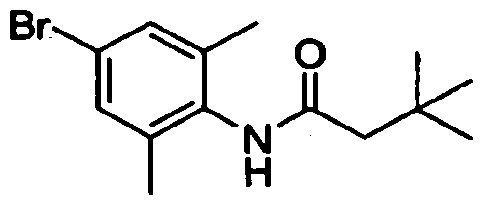
  • Step A N-(4-Bromo-2.6-dimethyl-phenyl ' )-3,3-dimethyl-butanamide:
  • Step A 4-bromo-2-chloro-6-(trifluoromethyl)aniline:
  • N-bromosuccinimide (910 mg, 5.1 mmol) was added to a solution of 2-chloro-6- (trifluoromethyl)aniline (1.0 g, 5.1 mmol) and acetic acid (3 mL) in acetonitrile (10 mL) at room temperature. The mixture was stirred at reflux for 18h. The reaction mixture was then filtered through Celite and concentrated to give the title compound, which was used in the next step without further purification.
  • Step B N-(4-Bromo-2-chloro-6-trifluoromethyl-phenv ⁇ -3-cvclopentyl- propionamide:
  • Step C N-(2-chloro-4-(3,4-dihydroisoquinolin-2(7HVyl)-6- (trifluoromethyl)phenyl)-3 -cvclopentyl propanamide:
  • Step B 6-fluoro-1.2.3.4-tetrahydroisoquinoline:
  • Step C N-(2-chloro-4-(6-fluoro-3,4-dihvdroisoquinolin-2(7i : /)-yl)-6- (trifluorornethyl)phenv1)-3,3-dirnethylbutanamide:
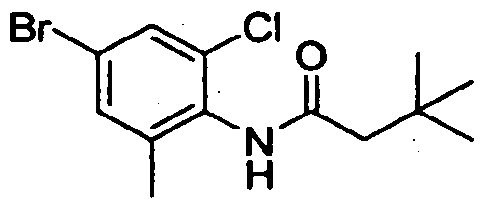
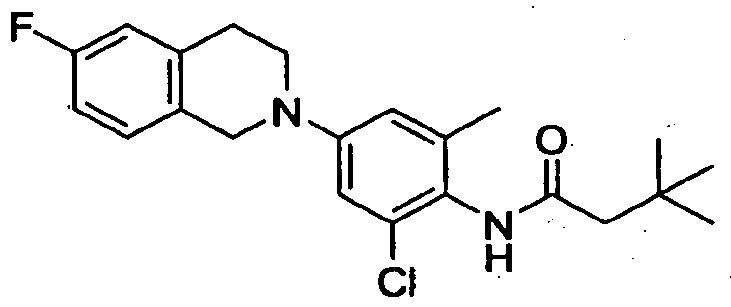
  • Step A N-(4-Bromo-2-chloro-6-methylphenyl)-3.3-dimethyl butanamide:
  • Step B N-[2-Chloro-4-(3.4-dihydro-7//-isoquinolin-2-yl)-6-methyl-phenyll-3.3- dimethyl-butanamide :
  • Step A 4-bromo-2-chloro-6-(trifluoromethyl ' )aniline:
  • N-bromosuccinimide (910 mg, 5.1 ⁇ unol) was added at room temperature to a solution of 2-chloro-6-(trifluoromethyl)aniline (1.0 g, 5.1 mmol) and acetic acid (3 mL) in acetonitrile ( 10 mL). The mixture was stirred at reflux to 18h. The reaction mixture was then filtered through celite and concentrated to give the title compound, which was used in the next step without further purification.
  • Step B N-(4-Bromo-2-chloro-6-trifluoromethyl-phenyl)-3-cvclopentyl propionamide:
  • Step C N-r2-Chloro-4-f6-fluoro-3.4-dihvdro-7.H-isoquinolin-2-vn-6- trifluoromethyl- ⁇ henyli-3-cvclopentyl propionamide:
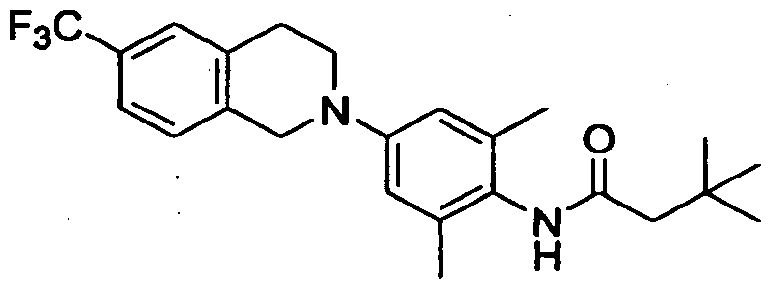
  • Step A N-f4-Bromo-2.6-dimethyl-phenvD-3.3-dimethyl-butanamide:
  • Step B N-r2.6-Dimethyl-4-(6-trifluoromethyl-3.4-dihydro-7H-isoquinolin-2-yl)- phenv ⁇ -3.3-dimethyl butanamide:
  • Step A 4-bromo-2-chloro-6-ftrifluoromethyl ' ) aniline:
  • Step B N-(4-bromo-2-chloro-6-(trifluoromethyl)phenyl)-3.3- dimethylbutanamide:
  • Step C N-[2-Chloro-6-trifluoromethyl-4-f6-trifluoromethyl-3.4-dihvdro-7.H- isoquinolin-2-yl)-phenyll-3.3-dimethyl butanamide:
  • Step A 4-bromo-2-chloro-6-(trifluoromethyl)aniline:
  • Step B N-(4-bromo-2-chloro-6-(trifluoromethv ⁇ phenvI)-3.3- dimethylbutanamide:
  • Step C N-[2-Chloro-4-(6-chloro-3,4-dihvdro-7H-isoquinolin-2-ylV6- trifluoromethyl- ⁇ henyll-3.3-dimethyl-butanamide:
  • Step A N-(4-Bromo-2.6-dimethyl-phenyl)-3.3-dimethyl-butanamide:
  • Step B N-r4-f6-Chloro-3.4-dihvdro-7//-isoquinolin-2-yl)-2.6-dimethyl-phenyll- 3.3 -dimethyl butanamide:
  • Step A N-(4-Bromo-2,6-dimethyl-phenyl)-3.3-dimethyl-butanamide:
  • Step B N-[4-(6-Fluoro-3.4-dmydro-7//-isoquinolin-2-ylV2.6-dimethylphenyl '
  • Step A 4-bromo-2-chloro-6-(trifluoromethyl)aniline:
  • N-bromosuccinimide (910 mg, 5.1 mmol) was added to a solution of 2-chloro-6- (trifluoromethyl)aniline (1.0 g, 5.1 mmol) in acetonitrile (10 mL) and acetic acid (3 mL) at room temperature. The mixture was stirred at reflux for 18h. The reaction mixture was then filtered through Celite and concentrated to give the title compound, which was used in the next step without further purification.
  • Step B N-(4-bromo-2-chloro-6-(trifluoromethyl)phenyl)-3,3- dimethylbutanamide:
  • Step C N-f2-Chloro-4-f7-fluoro-3.4-dihvdro-7//-isoquinolin-2-vn-6- trifluoromethyl-phenvn-3,3-dimethylbutanamide:
  • Step A N-(4-Bromo-2.6-dimethyl-phenv ⁇ -3.3-dimethyl-butanamide:
  • Step B N44-(7-Fluoro-3,4-dihvdro-7H-isoquinolin-2-yl)-2.6-dimethyl-phenyll- 3.3 -dimeth yl-butanamide:
  • Step A N-(4-Bromo-2-chloro-6-methyl-phenyl)-3.3-dimethyl-butanamide:
  • Step B N-r2-Chloro-4-f6-fluoro-3.4-dihvdro-7H-isoquinolin-2-ylV6- methylphenyl "
  • Step B N-[2-Chloro-4-(7-fluoro-3.4-dihvdro-7//-isoquinolin-2-yl)-6- methylphenyl1-3.3-dimethylbutanamide:
  • Step A N-(4-Bromo-2-chloro-6-methyl-phenyl)-3,3-dimethyl-butanamide:
  • Step B N-[2-Chloro-6-methyl-4-(6-trifluoromethyl-3.4-dihvdro-7H-isoquinolin- 2-ylVphenyll-3.3-dimethylbutanamide:
  • Step A N-(4-Bromo-2-chloro-6-methyl-phenyl)-3.3-dimethvIbutanamide:
  • Step A N-(4-Bromo-2-chloro-phenylV3.3-dimethyl-butanamide:
  • Step A N-(4-Bromo-2-methyl-phenyl)-3.3-dimethylbutanamide:
  • Step B N-r4-(6-Fluoro-3.4-dihvdro-7H-isoquinolin-2-yl)-2-methyl-phenyl]-3.3- dimethylbutanamide:
  • Step B N-.
  • Step A N-(4-Bromo-2-chloro-phenylV3.3-dimethylbutanamide:
  • Step B N-r2-Chloro-4-(6-trifluoromethyl-3.4-dihvdro-7//-isoquinolin-2-yl')- phenyl]-3,3-dimethylbutanamide:
  • Step A N-(4-Bromo-2-trifluoromethyl-phenyl)-3,3-dimethyl-butanamide:
  • Step B N-[4-(7-Fluoro-3.4-dihvdro-///-isoquinolin-2-ylV2-trifluoromethyl- phenyl] -3.3 -dimeth ylbutanamide:
  • Step A N-f4-Bromo-2-trifluoromemyl-phenvD-3.3-dimethylbutanamide:
  • Step A N-(4-Bromo-2.6-dimethyl-phenyl)-3.3-dimethyl-butanamide:
  • Step B N-[4-(6-Metho ⁇ y-3.4-dihvdro-/H-isoquinolin-2-yl)-2.6-dimethyl- phenyli-3 ,3-dimethylbutanamide:
  • Step A N-(4-Bromo-2.6-dimethyl-phenyl)-3,3-dimethylbutanamide:
  • Step B N-[2.6-Dimethyl-4-(7-trifluoromethyl-3.4-dihvdro-/H-isoquinolin-2-yl " )- phenyl1-33-dimethyl-butanamide:
  • Step A 4-bromo-2-methoxy-6-methyl-aniline:
  • Step B (4-Bromo-2-methoxy-6-methyl-phenylV3.3-dimethyl butanamide:
  • Step C N-[4-(3.4-Dihvdro-7H-isoquinolin-2-yl')-2-methoxy-6-methyl-phenyl]- 3.3 -dimethyl-butanamide:
  • reaction tube was sealed and reacted in microwave at 100 0 C for 2 hours.
  • the reaction mixture was purified by silica gel column (ISCO, hexane/EtOAc, 0- 40%, 40 min) to give pure compound as a white solid.
  • Step A N-(4-Bromo-2-chloro-6-trifluoromethoxy-phenyl)-3.3-dimethyl- butanamide:
  • Step B N-f2-Chloro-4-f3.4-dihvdro-7//-isoquinolin-2-yl)-6-trifluoromethoxy- phenvn-3.3-dimethylbutanamide:
  • Step B 5-Bromo-l .3-dimethoxy-2-amino-benzene:
  • Step D N-[4-(3.4-Dihvdro-/H-isoquinolin-2-yl)-2,6-dimethoxy-phenyl]-3.3- dimethyl-butanamide:
  • Step A N-(4-Bromo-2.6-dimethyl-phenv ⁇ -3.3-dimethyl-butyramide:
  • Step B N-r2.6-Dimethyl-4-(6-trifluoromethyl-3.4-dihvdro-lH-isoquinolin-2-yl)- phenyll-3.3-dimethyl-butanamide:
  • Step C N-[2,6-Dimethyl-4-(6-trifluoromethyl-3,4-dihydro-7//-isoquinolin-2-yl)- phenyl]-3.3-dimethyl-thiobutanamide:
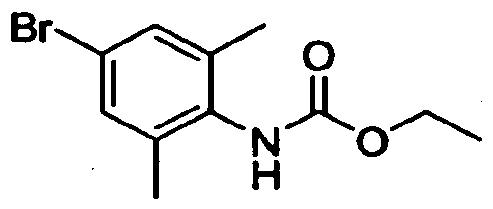
  • Step A (4-Bromo-2.6-dimethyl-phenyl)-carbamic acid ethyl ester:
  • Step B r2,6-Dimethyl-4-(6-trifluoroniethyl-3.4-dihydro-lH-isoquinoIin-2-v0- phenyli-carbamic acid ethyl ester:
  • PC-12 cells were grown at 37 0 C and 5 % CO 2 in DMEM/F12 Medium (Dulbecco's Modified Eagle Medium with Nutrient Mix F-12, available from Invitrogen of Carlsbad, CA), supplemented with 10 % horse serum, 5 % fetal bovine serum, 2 mM glutamine, 100 U/ml penicillin, and 100 U/ml streptomycin. They were plated in poly-D- lysine-coated 96-well cell culture microplates at a density of 40,000 cells/well and differentiated with 100 ng/ml NGF-7s for 2-5 days.
  • DMEM/F12 Medium Dulbecco's Modified Eagle Medium with Nutrient Mix F-12, available from Invitrogen of Carlsbad, CA
  • the medium was aspirated, and the cells were washed once with 0.2 ml in wash buffer (25 mM HEPES, pH 7.4, 150 mM NaCl, 1 mM MgCl 2 , 0.8 mM NaH 2 PO 4 , 2 mM CaCl 2 ).
  • the cells were then loaded with 0.2 ml Rb + loading buffer (wash buffer plus 5.4 mM RbCl 2 , 5 mM glucose) and incubated at 37 0 C for 2 h. Attached cells were quickly washed three times with buffer (same as Rb + loading buffer, but containing 5.4 mM KCl instead of RbCl) to remove extracellular Rb + .
  • Rb + Ly S were quantified using an ICR8000 flame atomic absorption spectrometer (Aurora Biomed Inc., Vancouver, B.C.) under conditions defined by the manufacturer. Samples 0.05 ml in volume were processed automatically from microtiter plates by dilution with an equal volume OfRb + sample analysis buffer and injection into an air- acetylene flame. The amount OfRb + in the sample was measured by absorption at 780 nm using a hollow cathode lamp as light source and a PMT detector. A calibration curve covering the range 0-5 mg/L Rb + in sample analysis buffer was generated with each set of plates. The percent Rb + efflux (F) was defined by
  • F [Rb + SUp / (Rb + SUp + Rb + Ly 5 )] X 100 %.
  • F c is the efflux in the presence of compound in depolarization buffer
  • F b is the efflux in basal buffer
  • F s is the efflux in depolarization buffer
  • F c is the efflux in the presence of compound in depolarization buffer.
  • the efflux (F) and compound concentration relationship was plotted to calculate an EC 50 value, a compound's concentration for 50% of maximal Rb + efflux. The results are shown below.
  • the MES testing protocol is based on procedures established at the National Institute of Neurological Disorders and Stroke in conjunction with the Anticonvulsant Screening Program (ASP) at the University of Utah (White, H.S., Woodhead, J.H., Wilcox, K.S., Stables, J.P., Kupferberg, HJ and Wolf, H.H. 2002. "General Principles: Discovery and Preclinical Development of Antiepileptic Drugs, " in Antiepileptic Drugs, 5 th Edition, R.H. Levy, ed.; R.H. Mattson, B.S. Meldrum, and E. Perucca. Philadelphia, Lippincott Williams & Wilkins.), The goal of the test rapid identification and characterization of the in vivo anticonvulsant activity of any compounds that have been shown active in PC- 12 cellular based Rb + efflux assay.
  • mice Adult male CF-I albino mice (18-25 g, Charles River Laboratories) are exclusively used for in-house MES screen of compounds. Male Sprague-Dawley albino rats (100-125g, Charles River Laboratories) are also used to test anticonvulsant compounds. Variability of test outcomes is reduced by using animals of the same sex, age, and weight. Animals are permitted to rest and recover from transit for at least 48 hr prior to experimentation. Animals are used for AED testing only once. In some instances, the animals may be anesthetized prior to blood collection and/or whole brain extraction for pharmacokinetic assay. All animals are maintained and handled as outlined in standard animal care guidelines.
  • testing compounds are prepared as suspensions in 0.5% methyl cellulose (Sigma, Cat # M0512, Viscosity 4000 cP at 20 0 C) in water, regardless of solubility. Dry powder compounds are initially ground with a glass rod in a test tube in several drops of methyl cellulose to create a paste and to break down any large chunks. After several minutes of grinding, the volume of the suspension is increased to the final concentration desired. The suspension is then sonicated using a Branson sonicator model 3510 in a water bath at room temperature for 15 minutes. Compound suspensions are further vortexed prior to animal dosing.
  • DMSO is used to initially solubilize compounds in small volumes and then this solution is added to the 0.5% methyl cellulose solution, in order to create more even and less aggregated compound suspensions.
  • the final concentration of DMSO is 3.75%, an amount with no apparent toxicity or neuroprotective effects in our usual rotarod and MES tests.
  • Methyl cellulose/DMSO compound suspensions are identically prepared for intraperitoneally (i.p.) to mice or orally (p.o.) to rat dosing. Initially the animals are weighed with an electronic scale and then marked. Data recording sheets are generated for each compound assessment. Mice or rats are dosed with the compound suspension at 0.01 mL/g of body weight.
  • mice The typical injection volume range is between 180-250 ⁇ l for mice.
  • Compounds are dosed by i.p. to mice using a 25 or 22 gauge needle, depending on the viscosity of the suspension. Rats are p.o. dosed using a flexible feeding tube, typically starting at a compound dose of 5 mg/kg.
  • a Rodent Electroconvulsive Stimulator (Model 200, Hamit-Darvin-Freesh, Snow Canyon Clinic, Ivins, UT) is used for MES testing.
  • a 60-Hz alternating current (50 mA for mice; 150 mA for rats) is delivered for 0.2 seconds through corneal electrodes to the mice.
  • a drop of 0.5% tetracaine (Sigma, Cat. # T-7508) solution is placed on the eye prior to current delivery.
  • the electrodes are subsequently placed gently onto the eyes of the animal and the electrical shock is initiated by triggering through a foot-pedal activator.
  • the animals are restrained by hand and gently released as the shock is delivered and the seizure commences. Animals are monitored for hind limb tonic extension as the end point for this test.
  • time-to-peak effect studies are initially performed using 0.5, 1, 2, 4, 8 and 24 hr time points, typically using a single 5 or 25 mg/kg dose.
  • the determined time-to-peak effect is used for further titration of a compound's potency (ED50, the dose of a drug that protects 50% of animals from electrical induced seizure) in both mouse and rat models.
  • ED50 the dose of a drug that protects 50% of animals from electrical induced seizure
  • 8 animals are used per concentration and dose (normal 5 concentrations) is varied until a full dose response curve can be obtained.
  • Probit analysis ASP method
  • non-linear regression analysis on Graph Pad is used to calculate an ED 50 value for the test compound.
  • rats are visually observed for acute toxicity signs for approximately one minute in the open field test.
  • rats are gently placed into a plexiglass enclosure and are monitored for behavior consistent with toxicity including ataxia, trembling, hypoactivity (including failure to seek the walls), hypersensitivity, lack of exploratory behavior and lack of avoidance of the open area.
  • toxicity including ataxia, trembling, hypoactivity (including failure to seek the walls), hypersensitivity, lack of exploratory behavior and lack of avoidance of the open area.
  • hypoactivity including failure to seek the walls
  • hypersensitivity including failure to seek the walls
  • lack of exploratory behavior and lack of avoidance of the open area.
  • the rats typically if the rats exhibits two or more of these abnormal behaviors they are scored as toxic.
  • A EC 50 ⁇ 1 nM
  • C 10 nM ⁇ EC 50 ⁇ 50 nM
  • D 50 nM ⁇ EC 50 ⁇ 500 nM ⁇ :0.12 ⁇ ED50 ⁇ 1.2 ⁇ : 1.2 ⁇ ED50 ⁇ 12 ⁇ :12 ⁇ ED50
  • Xenopus laevis extracted ovaries were purchased from eNASCO (LM00935MX, eNASCO Fort Atkinson, WI). Following manual dissection of the oocytes into smaller groups, the oocytes were defolliculated by enzymatic treatment with collagenase type 2 (LS004177, Worthington, Lakewood, NJ) for 1-1/2 hour in the presence of calcium-free Culture Bath solution (88 mM NaCl, 1 mM KCl, 0.82 mM MgSO 4 , 2.4 mM NaHCO 3 , and 5 mM HEPES, pH 7.5).
  • calcium-free Culture Bath solution 88 mM NaCl, 1 mM KCl, 0.82 mM MgSO 4 , 2.4 mM NaHCO 3 , and 5 mM HEPES, pH 7.5.
  • Oocytes were then kept in supplemented Culture Bath solution (88 mM NaCl, 1 mM KCl, 0.82 mM MgSO 4, 0.9 mM CaCl 2 , 2.4 mM NaHCO 3 , 1 mM sodium pyruvate, 0.05 mg/ml Geneticin, 100 U/ml penicillin, 0.1 mg/ml streptomycin and 5 mM HEPES, pH 7.5) at 19 0 C for 24 hours before injection of cRNA. Approximately 50 nl cRNA (about 50 ng) was injected for KCNQl , KCNQ4, and KCNQ5 using a Nanoject microinjector (Drummond, Broomall, PA, USA).
  • a Nanoject microinjector (Drummond, Broomall, PA, USA).
  • cRNA's were mixed in equal molar ratios before injection of approximately 50 nl.
  • the mixtures contained about 10 + 10 ng and 12.5 + 2.5 ng cRNA, respectively.
  • the smaller amounts are needed because larger currents arise when KCNQ2/KCNQ3 and KCNQ1/KCNE1 are co-expressed.
  • Oocytes were kept in Culture Barth solution at 19°C which was changed daily and currents were recorded after 3 to 5 days.
  • Electrophysiology KCNQ channel currents expressed in Xenopus laevis oocytes were recorded using a two-electrode voltage-clamp.
  • the recordings were made at room temperature in recording solution (96 mM NaCl, 2 mM KCl, 1 mM MgCl 2 , 1.8 mM CaCl 2 , and 5 mM HEPES, pH 7.5) using a two-electrode voltage-clamp amplifier (OC T 725C, Warner Instrument, Hamden, CT, USA).
  • the oocytes were placed in custom built perfusion chambers connected to a continuous flow system and impaled with a current electrode and a voltage-clamp electrode pulled from borosilicate glass on a Flaming/Brown Micropipette Puller (Sutter Instruments Co, Novato, CA, USA). Recording electrodes were filled with 3 M KCl and had a resistance of 0.5 to 2.5 M ⁇ .
  • C2 is the recorded steady current in the presence of follow-on compound at its EC 7s and Cl is the recorded steady current in the presence of Retigabine at its EC 75 .

Landscapes

  • Chemical & Material Sciences (AREA)
  • Organic Chemistry (AREA)
  • Health & Medical Sciences (AREA)
  • Life Sciences & Earth Sciences (AREA)
  • Veterinary Medicine (AREA)
  • Public Health (AREA)
  • General Health & Medical Sciences (AREA)
  • Medicinal Chemistry (AREA)
  • Animal Behavior & Ethology (AREA)
  • Pharmacology & Pharmacy (AREA)
  • General Chemical & Material Sciences (AREA)
  • Nuclear Medicine, Radiotherapy & Molecular Imaging (AREA)
  • Engineering & Computer Science (AREA)
  • Chemical Kinetics & Catalysis (AREA)
  • Bioinformatics & Cheminformatics (AREA)
  • Biomedical Technology (AREA)
  • Neurology (AREA)
  • Neurosurgery (AREA)
  • Pain & Pain Management (AREA)
  • Epidemiology (AREA)
  • Pharmaceuticals Containing Other Organic And Inorganic Compounds (AREA)
  • Other In-Based Heterocyclic Compounds (AREA)
  • Medicinal Preparation (AREA)

Abstract

This invention provides a compound of formula (IA) where X = O or S; Y is O or S; q = 1 or 0; and other substituents are defined herein. Such compounds can affect the opening of, or otherwise modulate, voltage-gated potassium channels. They are potentially useful for the treatment and prevention of diseases and disorders which are affected by activation or modulation of potassium ion channels. One such condition is seizure disorders.

Description
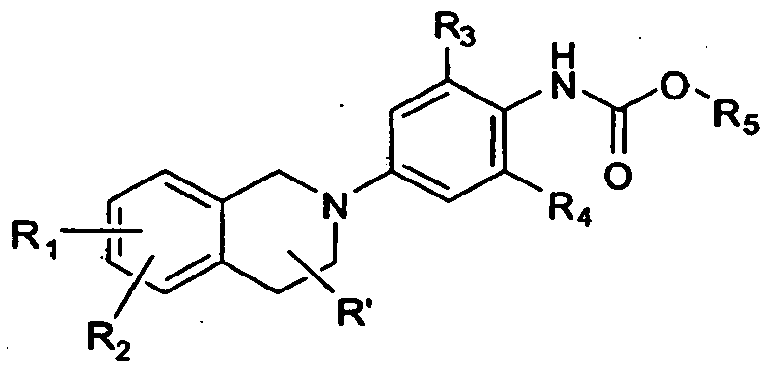
DERIVATIVES OF 4-(N-AZACYCLOALKYL) ANILIDES AS POTASSIUM CHANNEL MODULATORS
Field of the Invention
This invention concerns novel compounds that activate or otherwise modulate voltage-gated potassium channels. The compounds are useful for the treatment and prevention of diseases and disorders which are affected by modulation of potassium ion channels. One such condition is seizure disorders.
Background of the Invention
Epilepsy is a well-known neurological disease, found in about 3% of the population. Approximately 30% of patients with epilepsy do not respond to currently available therapies. Such unfortunate patients — who number hundreds of thousands of people world-wide — must contend with both uncontrolled seizures and the resulting narrowing of their options in such crucial areas of life as health insurance, employment, and driving.
Retigabine (N-[2-amino-4-(4-fluorobenzylamino)phenyl]carbamic acid, ethyl ester) (U.S. Patent No. 5,384,330) has been found to be an effective treatment of seizure disorders and has also been found useful in treating pain. Retigabine has been found to be particularly potent in models for the drug-refractory types of epilepsy. Bialer, M. et al., Epilepsy Research 1999, 34, 1-41; Blackburn-Munro and Jensen, Eur. J. Pharmacol. 2003, 460, 109-116; Wickenden, A.D. et al., Expert Opin. Ther. Patents, 2004, 14(4). "Benign familial neonatal convulsions," an inherited form of epilepsy, has been associated with mutations in the KCNQ2/3 channels. Biervert, C. et al., Science 1998, 27, 403-06; Singh, N.A., et al., Nat. Genet.1998, 18, 25-29; Charlier, C. et al., Nat. Genet. 1998, 18, 53-55; Rogawski, Trends in Neurosciences 2000, 23, 393-398. Subsequent investigations have established that one important site of action of retigabine is the KCNQ2/3 channel. Wickenden, A.D. et al., MoL Pharmacol. 2000, 58,591-600; Main, M.J. et al., MoI. Pharmcol. 2000, 58, 253-62. Retigabine has been shown to increase the conductance of the channels at the resting membrane potential, with a possible mechanism involving binding of the activation gate of the KCNQ 2/3 channel. Wuttke, T. V., et al., MoI. Pharmacol. 2005. Additionally, retigabine has been shown to increase neuronal M currents and to increase the channel open probability of KCNQ 2/3 channels. Delmas, P. and Brown, D.A. Nat. Revs Neurosci., vol. 6, 2005, 850-62; Tatulian, L. and Brown, D.A., ./. Physiol, (2003) 549, 57-63.
The seizure type that has been most resistant to therapy is the so-called "complex partial seizure." Retigabine is active in several seizure models, including, as indicated above, models for drug-refractory epilepsy. Because of retigabine's broad spectrum of activity and its unusual molecular mechanism, there is hope that retigabine will be effective in management of several seizure types, including the complex partial seizure, which have been resistant to treatment. Porter, R. J., Nohria, V., and Rundfeldt, C, Neurotherapeutics, 2007, vol. 4, 149-154.
The recognition of retigabine as a potassium channel opener has inspired a search among compounds with structural features in common with retigabine for other compounds which can affect the opening of, or otherwise modulate, potassium ion channels.
Brief Description of the Invention In their efforts to design a potassium channel modulating compound that is superior to retigabine, shown below, which is a benzyl amine derivative,
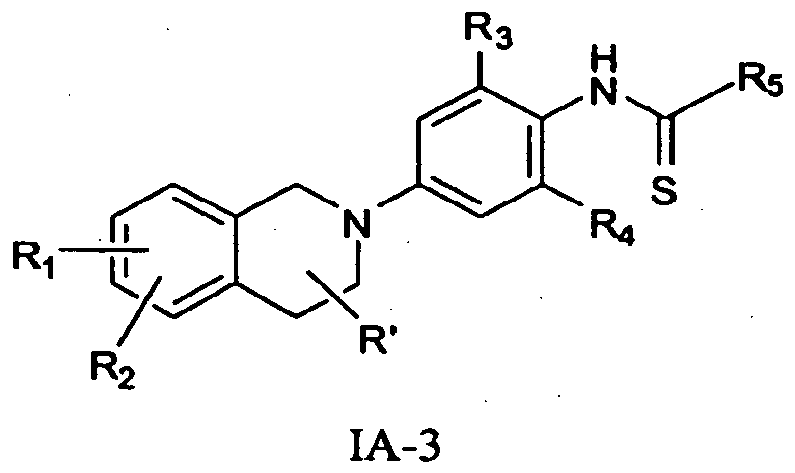
Figure imgf000003_0001
the present inventors have discovered surprising and exceptionally promising properties in a series of tetrahydroisoquinoline derivatives, specifically, para-Λ/-(l,2,3,4-tetrahydro) isoquinolyl anilides and carbamates, and their several sulfur analogues, of the structure of formula IA below
These tetrahydroisoquinoline derivatives are, of course, benzyl amines which are restricted to particular conformations because the benzylic nitrogen is a member of a second ring fused to the phenyl ring. Moreover, the present inventors have further discovered that replacement of the primary amino group of retigabine with substituents like halogen, C1-C3 alkyl, OC1-C3 alkyl, and trifluoromethyl also confers surprising and desirable properties.
Thus, in one embodiment, this invention provides or contemplates a compound of formula IA
Figure imgf000004_0001
IA where Ri and R2, are, independently, H, CN, halogen, CH2CN, OH, NO2, CH2F, CHF2, CF3, CF2CF3, C1-C6 alkyl, C(=O)C,-C6 alkyl; NH2, NH-C1-C6 alkyl; N(C1-C6 alkyl)-CrC6 alkyl, NHC(=O)C,-C6 alkyl, C(=O)N(CH3)2, CC=O)N(Et)2, C(=O)NH2, C(=O)NH-C,-C6 alkyl, SO2NH2, NHSO2-Ci-C6 alkyl; C(=O)OC,-C6 alkyl, OC(=O)C,-C6 alkyl, OCi-C6 alkyl, SCi-C6 alkyl, C3-C6 cycloalkyl, (CH2)mC3-C6 cycloalkyl, C3-C6 cycloalkenyl, (CH2)mC3-C6 cycloalkenyl, C2-C6 alkenyl, C2-C6 alkynyl, Ar, (CH2)mthienyl, (CH2)mfuryl, (CH2)mimidazolyl, (CH2)mpyrazyl, (CH2)moxazolyl, (CH2)misoxazolyl,
(CH2)mthiazolyl, (CH2)misothiazolyl, (CH2)mphenyl, (CH2)mpyrrolyl, (CH2)mpyridyl, or (CH2)mpyrimidyl, which cycloalkyl and said cycloalkenyl groups optionally contain one or two heteroatoms selected independently from O, N, and S, and which are optionally substituted as described below; where m is zero, 1, or 2, Ar is a 5- to 10- member mono- or bicyclic aromatic group, optionally containing 1 — 4 ring heteroatoms selected independently from N, O, and S; or Ri and R2, together with the ring carbon atoms to which they are attached, form a 5- or 6- member fused ring, which ring may be saturated, unsaturated, or aromatic, which optionally contains one or two heteroatoms selected independently from O, N, and S, and which is optionally substituted as described below; R' is H, halogen, phenyl, 2-(N,N-dimethylamino)ethyl, CF3, OCi-C3 alkyl or Ci-C3 alkyl; R3 and R4 are, independently, H, CN, halogen, CF3, OCF3, OCi-C3 alkyl, or Ci-C6 alkyl; X = O or S; Y is O or S; q = 1 or zero; R5 is Ci-C6 alkyl, (CHR6)WC3-C6 cycloalkyl, (CHR6)WCH2C3-C6 cycloalkyl, CH2(CHR6)WC3-C6 cycloalkyl, CR6=CH-C3-C6 cycloalkyl, CH=CR6-C3-C6 cycloalkyl, (CHR6)WC5-C6 cycloalkenyl, CH2(CHR6)WC5-C6 cycloalkenyl, C2-C6 alkenyl, C2-C6 alkynyl, Ar, (CHRή)wAr, CH2(CHR6)WAr, or (CHR6)WCH2Ar, where w = zero, 1, 2, or 3, Ar is a 5- to 10- member mono- or bicyclic aromatic group, optionally containing 1 - 4 ring heteroatoms selected independently from N, O, and S; R6 is H or Ci-C3 alkyl; where all cycloalkyl and cycloalkenyl groups optionally contain one or two ring heteroatoms selected independently from N, O, and S; where all alkyl, cycloalkyl, alkenyl, cycloalkenyl, heterocycloalkyl, heterocycloalkenyl, alkynyl, aryl, and heteroaryl groups in Rj, R2, R', R3, R4, R5, R6, and Ar are optionally substituted with one or two substituents selected independently from Ci-C3 alkyl, halogen, CN, OH, OMe, OEt, CN, CH2F, and trifluoromethyl; and where, additionally, all cycloalkyl and heterocycloalkyl groups are optionally substituted with a carbonyl group. Such compounds are potassium channel activators or modulators.
Essentially all combinations of the several variables in formula IA are contemplated by this invention.
In another embodiment, this invention provides or contemplates a composition comprising a pharmaceutically acceptable carrier or diluent and at least one of the following: a pharmaceutically effective amount of a compound of formula IA, a pharmaceutically acceptable salt of a compound of formula IA, a pharmaceutically acceptable solvate of a compound of formula IA, and a pharmaceutically acceptable ester of a compound of formula IA.
In yet another embodiment, this invention provides or contemplates a pediatric pharmaceutical composition comprising a pharmaceutically acceptable carrier or diluent, a syrup for pediatric use, and at least one of the following: a pharmaceutically effective amount of a compound of formula IA, a pharmaceutically acceptable salt of a compound of formula IA, a pharmaceutically acceptable ester of a compound of formula IA, and a pharmaceutically acceptable solvate of a compound of formula IA.
In yet another embodiment, this invention provides or contemplates a chewable tablet, suitable for pediatric pharmaceutical use, comprising a pharmaceutically acceptable carrier or diluent, and at least one of the following: a pharmaceutically effective amount of a compound of formula IA, a pharmaceutically acceptable salt of a compound of formula IA, a pharmaceutically acceptable solvate of a compound of formula IA, and a pharmaceutically acceptable ester of a compound of formula IA.
In yet another embodiment, this invention provides or contemplates a method of preventing or treating a disease or disorder which is affected by activation voltage-gated potassium channels, comprising administering to a patient in need thereof a therapeutically effective amount of a compound of formula IA or a salt or ester or solvate thereof.
This invention includes all tautomers and salts of compounds of this invention. This invention also includes all compounds of this invention where one or more atoms are replaced by a radioactive isotope thereof.
This invention provides or contemplates compounds of formula IA above where the group NH-C(=X)-(Y)q-R5 is each of the following: NHCC=O)R5, NHCC=O)OR5, NHCC=S)R5, NHC(=S)SR5, NHCC=S)OR5, and NHC(=O)SR5. Thus, in one embodiment, this invention provides or contemplates a compound of formula IA, where NH-C(=X)-CY)q-R5 is NHC(=O)R5.
In another embodiment, this invention provides or contemplates a compound of formula IA, where NH-CC=X)-COq-Rs is NHCC=S)R5.
In another embodiment, this invention provides or contemplates a compound of formula IA, where NH-CC=X)-CY)q-Rs is NHCC=S)SR5.
In another embodiment, this invention provides or contemplates a compound of formula IA, where NH-CC=X)-CY)q-Rs is each NHCC=O)OR5.
In another embodiment, this invention provides or contemplates a compound of formula IA, where NH-C(=X)-(Υ)q-R5 is NHCC=S)OR5. In another embodiment, this invention provides or contemplates a compound of formula IA, where NH-C(=X)-(Υ)q-R5 is NHCC=O)SR5.
In another generic embodiment, this invention provides or contemplates a compound of formula IA, where q is zero and Rs is Ci-Cβalkyl, or CCHRβVCj-Cβ cycloalkyl. In another subgeneric embodiment, this invention provides or contemplates a compound of formula IA, where R' is H, methyl, ethyl, or halogen.
In another subgeneric embodiment, this invention provides or contemplates a compound of formula IA, where R' is phenyl. In another subgeneric embodiment, this invention provides or contemplates a compound of formula IA, where R1 is OC1-C3 alkyl.
In another subgeneric embodiment, this invention provides or contemplates a compound of formula IA, where R' is 2-dimethylaminoethyl.
In another subgeneric embodiment, this invention provides or contemplates a compound of formula IA, where R1 is H.
In another subgeneric embodiment, this invention provides or contemplates a compound of formula IA, where R1 halogen.
In another subgeneric embodiment, this invention provides or contemplates a compound of formula IA, where R1 is methyl or ethyl. In another subgeneric embodiment, Ri is located as shown below
Figure imgf000007_0001
In another subgeneric embodiment, Ri is located as shown below
Figure imgf000007_0002
In another subgeneric embodiment, Ri is located as shown below
Figure imgf000008_0001
In another subgeneric embodiment, Ri is located as shown below
Figure imgf000008_0002
In another subgeneric embodiment, this invention provides or contemplates a compound of the structure shown below.
Figure imgf000008_0003
In another subgeneric embodiment, this invention provides or contemplates a compound of the structure shown below.
Figure imgf000008_0004
In a more specific subgeneric embodiment, this invention provides or contemplates a compound of the structure shown below, where R5 is Cs-Ce alkyl or (CH2)wC5-C6 cycloalkyl.
Figure imgf000009_0001
In another more specific subgeneric embodiment, this invention provides or contemplates a compound of the structure shown below, where R5 is Cs-Ce alkyl or (CH2)wC5-C6 cycloalkyl.
Figure imgf000009_0002
In another specific subgeneric embodiment, this invention provides or contemplates a compound of the structure shown below, where R3 and R4 are, independently, H, methyl, or methoxy.
Figure imgf000009_0003
In a more specific subgeneric embodiment, this invention provides or contemplates a compound of the structure shown below, where R3 and R4 are, independently, H, methyl, or methoxy, and R5 is C5-C6 alkyl or (CH2)WCs-Ce cycloalkyl.
Figure imgf000010_0001
In a still more specific subgeneric embodiment, this invention provides or contemplates a compound of the structure shown below, where R5 is Cs-Ce alkyl or (CH2)w C5-C6 cycloalkyl.
Figure imgf000010_0002
In another specific subgeneric embodiment, this invention provides or contemplates a compound of the structure shown below, where R3 and R4 are, independently, H, methyl, or methoxy.
Figure imgf000010_0003
In another specific subgeneric embodiment, this invention provides or contemplates a compound of the structure shown below, where R3 and R4 are, independently, H, methyl, or methoxy.
Figure imgf000010_0004
In a still more specific subgeneric embodiment, this invention provides or contemplates a compound of the structure shown below, where Rs is C5-C6 alkyl or (CH2)* C5-C6 cycloalkyl.
Figure imgf000011_0001
In another specific subgeneric embodiment, this invention provides or contemplates a compound of the structure shown below, where R3 and R4 are, independently, H, methyl, Cl, CF3, OCF3, or methoxy.
Figure imgf000011_0002
In a still more specific subgeneric embodiment, this invention provides or contemplates a compound of the structure shown below, where R5 is Cs-C6 alkyl or (CH2)w C5-C6 cycloalkyl.
Figure imgf000011_0003
In another specific subgeneric embodiment, this invention provides or contemplates a compound of the structure shown below, where R3 and R4 are, independently, H, methyl, Cl, CF3, OCF3, or methoxy.
Figure imgf000012_0001
In a more specific subgeneric embodiment, this invention provides or contemplates a compound of the structure shown below, where R5 is C5-C6 alkyl or (CH2)w Cs-C6 cycloalkyl.
Figure imgf000012_0002
In another more specific subgeneric embodiment, this invention provides or contemplates a compound of the structure shown below, where Rs is Cs-C6 alkyl or (CH2)w C5-C6 cycloalkyl.
Figure imgf000012_0003
In yet another more specific subgeneric embodiment, this invention provides or contemplates a compound of the structure shown below, where R5 is'(CH2)wAr or C3-C6 alkyl.
Figure imgf000012_0004
In another subgeneric embodiment, this invention provides or contemplates a compound of the structure shown below, where R3 and R4 are, independently, H, methyl, Cl, CF3, OCF3, or methoxy.
Figure imgf000013_0001
In a more specific subgeneric embodiment, this invention provides or contemplates a compound of the structure shown below, where R3 and R4 are, independently, H, methyl, Cl, CF3, OCF3, or methoxy and R5 is (CH2)wAr or C3-C6 alkyl.
Figure imgf000013_0002
In another subgeneric embodiment, this invention provides or contemplates a compound of the structure shown below, where Rs is (CH2)wAr or C3-C6 alkyl.
Figure imgf000013_0003
In yet another more specific subgeneric embodiment, this invention provides or contemplates a compound of the structure shown below, where R3 and R4 are, independently, H, methyl, Cl, CF3, OCF3, or methoxy and where R5 is (CH2)wAr or C3-Ce alkyl.
Figure imgf000014_0001
In another subgeneric embodiment, this invention provides or contemplates a compound of formula IA, where R2 is H.
In another subgeneric embodiment, this invention provides or contemplates a compound of formula IA, where R2 is halogen.
In another, more specific subgeneric embodiment, this invention provides or contemplates a compound of formula IA, where R2 is Cl or F.
In another subgeneric embodiment, this invention provides or contemplates a compound of formula IA, where R2 is trifluoromethyl. In another subgeneric embodiment, this invention provides or contemplates a compound of formula IA, where R3 and R4 are, independently, H, Cl, methyl, ethyl, trifluoromethyl, or methoxy.
In another, more specific subgeneric embodiment, this invention provides or contemplates a compound of formula IA, where q is zero and R3 and R4 are Cl, ethyl, methoxy, or methyl.
In another, more specific subgeneric embodiment, this invention provides or contemplates a compound of formula IA, where q is zero and R3 and R4 are both methyl.
In another subgeneric embodiment, this invention provides or contemplates a compound of formula IA, where R' is methyl, halogen, or H; and R3 and R4 are, independently, H, Cl, ethyl, methoxy, or methyl. hi another subgeneric embodiment, this invention provides or contemplates a compound of formula IA, where R' is methoxy; and R3 and R4 are, independently, H, Cl, ethyl, methoxy, or methyl.
In another more specific subgeneric embodiment, this invention provides or contemplates a compound of formula IA, where R' is H; and R3 and R4 are, independently, H, Cl, ethyl, or methyl. In another subgeneric embodiment, this invention provides or contemplates a compound of formula IA, where R1 is H, q is zero, and R5 is Ci-Ce alkyl, or (CHR6)WC3-C6 cycloalkyl.
In another subgeneric embodiment, this invention provides or contemplates a compound of formula IA, where R1 is H; q is 1 ; Y is O; and R5 is Q-C6 alkyl, or (CHR6)WC3-C6 cycloalkyl.
In another subgeneric embodiment, this invention provides or contemplates a compound of formula IA, where R1 is H; q is 1 ; Y is S; and R5 is Ci-C6 alkyl, or (CHR6)WC3-C6 cycloalkyl. In a more specific subgeneric embodiment, this invention provides or contemplates a compound of formula IA, where R' and R2 are H and R5 is Ci-C6 alkyl, or (CHR6)WC3-C6 cycloalkyl.
In a more specific subgeneric embodiment, this invention provides or contemplates a compound of formula IA, where R' and R2 are H and R5 is Ar, (CHR6)WAr, CH2(CHR6)WAr, or (CHR6)WCH2Ar.
In a more specific subgeneric embodiment, this invention provides or contemplates a compound of formula IA, where R1 and R2 are H and R5 is (CHR6)WCs-C6 cycloalkenyl, CH2(CHR6)WC5-C6 cycloalkenyl, C2-C6 alkenyl, or C2-C6 alkynyl. In a more specific subgeneric embodiment, this invention provides or contemplates a compound of formula IA, where R' and R2 are H and R5 is CR6=CH-C3-C6 cycloalkyl or CH=CR6-C3-C6 cycloalkyl.
In another more specific subgeneric embodiment, this invention provides or contemplates a compound of formula IA, where R1 is halogen; and R3 and R4 are H, Cl, ethyl, or methyl. In another more specific subgeneric embodiment, this invention provides or contemplates a compound of formula IA, where R1 is Cl or F; and R3 and R4 are H, Cl, ethyl, or methyl.
In another more specific subgeneric embodiment, this invention provides or contemplates a compound of formula IA, where R1 is Cl or F; R3 and R4 are H, Cl, ethyl, or methyl; and R5 is CpC6 alkyl, or (CHR6)WC3-C6 cycloalkyl. In another subgeneric embodiment, this invention provides or contemplates a compound of formula IA, where R1 is phenyl, optionally substituted.
In another more- specific subgeneric embodiment, this invention provides or contemplates a compound of formula IA, where R1 is 1 -phenyl, optionally substituted. In another more specific subgeneric embodiment, this invention provides or contemplates a compound of formula IA, where R1 is 4-phenyl, optionally substituted.
In another more specific subgeneric embodiment, this invention provides or contemplates a compound of formula IA, where R1 is phenyl, optionally substituted, and R5 is Ci-Ce alkyl, or (CHR6)WC3-C6 cycloalkyl. In another more specific subgeneric embodiment, this invention provides or contemplates a compound of formula IA, where Ri is NH-Ci-C6 alkyl, N(Ci-C6 alkyl )-Cr C6 alkyl, C(O)NH-C, -C6 alkyl, NH-C(O)C1 -C6 alkyl; 0-C1-C6 alkyl, CeO)-C1-C6 alkyl, C(O)-OCi-C6 alkyl, or OC(O)Ci-C6 alkyl; R1 is phenyl, optionally substituted, and R5 is C1-C6 alkyl, or (CHR6)WC3-C6 cycloalkyl. In another subgeneric embodiment, this invention provides or contemplates a compound of formula IA, where R' is H, methyl, or ethyl; and R1 is NH-Ci-C6 alkyl, N(Ci-C6 alkyl )-C,-C6 alkyl, C(O)NH-Ci -C6 alkyl, or NH-C(O)C1-C6 alkyl.
In yet another subgeneric embodiment, this invention provides or contemplates a compound of formula IA, where R1 is H, methyl, or ethyl; and R1 is C(O)OCi -C6 alkyl, OC(O)C1-C6 alkyl, or OC1-C6 alkyl.
In another specific subgeneric embodiment, this invention provides or contemplates a compound of formula IA, where R1 is H, methyl, methoxy, or halogen, and R' is methyl or ethyl.
In another more specific subgeneric embodiment, this invention provides or contemplates a compound of formula IA, where R1 is H, methyl, methoxy, or halogen, and R' is phenyl.
In another more specific subgeneric embodiment, this invention provides or contemplates a compound of formula IA, where R1 is H, methyl, methoxy, or halogen, and R1 is F. In another subgeneric embodiment, this invention provides or contemplates a compound of formula IA, where Ri is methoxy, methoxymethyl, ethoxymethyl, or methoxyethyl.
In a more specific subgeneric embodiment, this invention provides or contemplates a compound of formula IA, where Ri is methoxy, methoxymethyl, ethoxymethyl, or methoxyethyl; R2 is H, methyl, or halogen; and R3 is methyl or Cl.
In another more specific subgeneric embodiment, this invention provides or contemplates a compound of formula IA, where R' is 4-phenyl, optionally substituted, and R2 is H, methyl, methoxy, or halogen. In another more specific subgeneric embodiment, this invention provides or contemplates a compound of formula IA, where R1 is CF3 or C1-C3 alkyl, and R2 is H, methyl, methoxy, or halogen.
In another more specific subgeneric embodiment, this invention provides or contemplates a compound of formula IA, where R' is methoxy, and R2 is H, methyl, methoxy, or halogen.
In another more specific subgeneric embodiment, this invention provides or contemplates a compound of formula IA, where R1 is 2-dimethylamino ethyl, and R2 is H, methyl, methoxy, or halogen.
In another more specific subgeneric embodiment, this invention provides or contemplates a compound of formula IA, where q is zero, R2 is H, methyl, methoxy, or halogen, R' is 1 -phenyl, optionally substituted; and R3 and R4 are H, Cl, ethyl, or methyl.
In another more specific subgeneric embodiment, this invention provides or contemplates a compound of formula IA, where q is zero, R2 is H, methyl, methoxy, or halogen, R1 is 4-phenyl, optionally substituted; and R3 and R4 are H, Cl, ethyl, or methyl. In another more specific subgeneric embodiment, this invention provides or contemplates a compound of formula IA, where q is zero, R2 is H, methyl, methoxy, or halogen; R' is CF3 or C1-C3 alkyl; and R3 and R4 are H, Cl, ethyl, or methyl.
In another more specific subgeneric embodiment, this invention provides or contemplates a compound of formula IA, where q is zero, R2 is H, methyl, methoxy, or halogen; R' is methoxy; and R3 and R4 are H, Cl, ethyl, or methyl. In another subgeneric embodiment, this invention provides or contemplates a compound of formula IA, where q is zero; R' is (2-dimethylamino) ethyl; R2 is H, methyl, methoxy, or halogen; and R3 and R4 are H, Cl, ethyl, or methyl.
In a more specific sub-generic embodiment, the invention provides or contemplates a compound of formula IA-I below.
Figure imgf000018_0001
In another more specific embodiment, this invention provides or contemplates a compound of formula IA-2 below.
Figure imgf000018_0002
IA-2
In another more specific embodiment, this invention provides or contemplates a compound of formula IA-3 below.
Figure imgf000018_0003
In another more specific embodiment, this invention provides or contemplates a compound of formula IA-4 below.
Figure imgf000019_0001
IA-4
In another more specific embodiment, this invention provides or contemplates a compound of formula IA-5 below.
Figure imgf000019_0002
IA-5
In another subgeneric embodiment, this invention provides or contemplates a compound of formula IA-I or formula IA-3, where R2 is H, alkyl, or halogen; and R5 is
C1-C6 alkyl, (CHR6)WC3-C6 cycloalkyl, (CHR6)WCH2C3-C6 cycloalkyl, or CH2(CHR6)WC3-C6 cycloalkyl.
In another more specific subgeneric embodiment, this invention provides or contemplates a compound of formula IA-I or formula IA-3, where R| is (CH2)mC3-C6 cycloalkyl; R2 is H, alkyl, or halogen; and R5 is Ci-C6 alkyl, (CHR6)WC3-C6 cycloalkyl,
(CHR6)WCH2C3-C6 cycloalkyl, or CH2(CHR6)WC3-C6 cycloalkyl.
In another more specific subgeneric embodiment, this invention provides or contemplates a compound of formula IA-I or formula IA-3, where Ri is methoxy, methoxymethyl, or methoxyethyl; R2 is H, alkyl, or halogen; and R5 is C]-C6 alkyl,
(CHR6)WC3-C6 cycloalkyl, (CHR6)WCH2C3-C6 cycloalkyl, or CH2(CHR6)WC3-C6 cycloalkyl. In yet another more specific subgeneric embodiment, this invention provides or contemplates a compound of formula IA-2, where R5 is Ci-C6 alkyl, (CHR6)WC3-C6 cycloalkyl, (CHR6)WCH2C3-C6 cycloalkyl, or CH2(CHR6)WC3-C6 cycloalkyl.
In yet another more specific subgeneric embodiment, this invention provides or contemplates a compound of formula IA-2, where R5 is Ar, (CHR6)WAr, CH2(CHR6)wAr, or (CHR6)WCH2Ar.
In yet another more specific subgeneric embodiment, this invention provides or contemplates a compound of formula IA-2, where Rs is CR6=CH-C3-C6 cycloalkyl, CH=CR6-C3-C6 cycloalkyl, (CHR6)WC5-C6 cycloalkenyl, CH2(CHR6)WC5-C6 cycloalkenyl, C2-C6 alkenyl, or C2-C6 alkynyl.
In yet another more specific subgeneric embodiment, this invention provides or contemplates a compound of formula IA-3, where R2 and R1 are H; R3 is methyl; and R5 is C1-C6 alkyl, (CHR6)WC3-C6 cycloalkyl, (CHR6)WCH2C3-C6 cycloalkyl, or CH2(CHR6)WC3- Ce cycloalkyl. In a still more specific subgeneric embodiment, this invention provides or contemplates a compound of formula IA-I, where Ri is H, F, Cl, Br, methoxy, methoxymethyl, ethoxymethyl, methoxyethyl, or trifluoromethyl; R3 is methyl; and R5 is C4-C6 alkyl, (CHR6)WCH2C5-C6 cycloalkyl, or CH2(CHR6)WC5-C6 cycloalkyl.
In another still more specific subgeneric embodiment, this invention provides or contemplates a compound of formula IA-2, where R5 is C4-C6 alkyl, (CHR6)WCs-C6 cycloalkyl, or CH2(CHR6)WC5-C6 cycloalkyl; and Ri is H, F, Cl, Br, methoxy, methoxymethyl, ethoxymethyl, methoxyethyl, or trifluoromethyl.
In another still more specific subgeneric embodiment, this invention provides or contemplates a compound of formula IA-3, where Ri is H, F, Cl, Br, methoxy, methoxymethyl, ethoxymethyl, methoxyethyl, or trifluoromethyl; R2 is H, methyl, or F; R1 is H or methyl; R3 is methyl; and R5 is C4-C6 alkyl, (CHR6)WC5-C6 cycloalkyl, or CH2(CHR6)WC5-C6 cycloalkyl.
In another more generic embodiment, this invention provides or contemplates a compound of formula IA-I, where R1 is (CH2)mC3-Cβ cycloalkyl, C3-C6 cycloalkenyl, or (CH2)mC3-C6 cycloalkenyl; R' is halogen; and R3 is methyl or Cl. In another more specific subgeneric embodiment, this invention provides or contemplates a compound of formula IA-I, where Ri is (CH2)mC3-C6 cycloalkyl, C3-C6 cycloalkenyl, or (CH2)mC3-C6 cycloalkenyl; and R1 is F or Cl.
In another more specific subgeneric embodiment, this invention provides or contemplates a compound of formula IA-I, where Ri is methoxy, methoxymethyl, ethoxymethyl; or methoxyethyl; R2 is H or F; R3 is methyl; R4 is methyl or Cl; and R5 is (CHR6)WC5-C6 cycloalkenyl or (CHR6)WAr.
In another more specific subgeneric embodiment, this invention provides or contemplates a compound of formula IA-I, where Rj is phenyl, optionally substituted. In another more specific subgeneric embodiment, this invention provides or contemplates a compound of formula IA-I, where Ri is methyl, halomethyl, ethyl, or haloethyl.
In another subgeneric embodiment, this invention provides or contemplates a compound of formula IA-I, where R1 is 2-(dimethylamino) ethyl. In another subgeneric embodiment, this invention provides or contemplates a compound of formula IA-I, where R1 is 1 -methyl or 1 -ethyl.
In another more specific subgeneric embodiment, this invention provides or contemplates a compound of formula IA-I, where R1 is 1-fluoro, R5 is C4-C6alkyl, (CHR6)WCs-C6 cycloalkyl, or CH2(CHR6)WC5-C6 cycloalkyl; and R, is H, F, Cl, Br, methoxy, or trifluoromethyl.
In another more specific subgeneric embodiment, this invention provides or contemplates a compound of formula IA-I, where R' is 4-fluoro, R5 is
Figure imgf000021_0001
(CHR6)WC5-C6 cycloalkyl, or CH2(CHR6)WC5-C6 cycloalkyl; and Ri is H, F, Cl, Br, methoxy, or trifluoromethyl. In another more specific subgeneric embodiment, this invention provides or contemplates a compound of formula IA-I, where Ri is (CH2)mϋτύdazolyl, (CH2)mpyrazyl, (CH2)m furyl, (CH2)m thienyl, (CH2)moxazolyl, (CH2)misoxazolyl, (CH2)mthiazolyl, (CH2)misothiazolyl, (CH2)mphenyl, (CH2)mρyrrolyl, (C^^pyridyl, or (CH2)mρyrimidyl; and R2 and R' are H. In another more specific subgeneric embodiment, this invention provides or contemplates a compound of formula IA-I, where Ri is (CH2)mimidazolyl, (CH2)π,pyrazyl, (CH2)m furyl, (CH2)m thienyl, (CH2)moxazolyl, (CH2)misoxazolyl, (CH2)mthiazolyl, (CH2)misothiazolyl, (CH2)mphenyl, (CH2)mpyrrolyl, (CH2)mpyridyl, or (CH2)mpyrimidyl; and R' is 4-phenyl, optionally substituted.
In another more specific subgeneric embodiment, this invention provides or contemplates a compound of formula IA-I, where R1 is CF3 or C1-C3 alkyl; R5 is Gt-C6 alkyl, (CHR6)WC5-C6 cycloalkyl, or CH2(CHR6)WC5-C6 cycloalkyl; and Rt is H, F, Cl, Br, methoxy, or trifluoromethyl. In another more specific subgeneric embodiment, this invention provides or contemplates a compound of formula IA-I, where R' is 4-methyl or 4-ethyl; and R5 is C4- C6 alkyl, (CHR6)WC5-C6 cycloalkyl, or CH2(CHR6)WC5-C6 cycloalkyl; and Rj is H, F, Cl, Br, methoxy, or trifluoromethyl.
In another more specific subgeneric embodiment, this invention provides or contemplates a compound of formula IA-I , where R' is methoxy or ethoxy; and Rs is C4- C6 alkyl, (CHR6)WC5-C6 cycloalkyl, or CH2(CHR6)WC5-C6 cycloalkyl; and Ri is H, F, Cl, Br, methoxy, or trifluoromethyl.
In another more specific subgeneric embodiment, this invention provides or contemplates a compound of formula IA-I, where R' is 1 -phenyl, optionally substituted; R5 is C4-C6 alkyl, (CHR6)WC5-C6 cycloalkyl, or CH2(CHR6)WC5-C6 cycloalkyl; and Ri is H, F, Cl, Br, methoxy, or trifluoromethyl.
In another more specific subgeneric embodiment, this invention provides or contemplates a compound of formula IA-I, where R' is 4-phenyl, optionally substituted; R5 is C4-C6 alkyl, (CHR6)WC5-C6 cycloalkyl, or CH2(CHR6)WC5-C6 cycloalkyl; and R1 is H, F, Cl, Br, methoxy, or trifluoromethyl.
In another more specific subgeneric embodiment, this invention provides or contemplates a compound of formula IA-I, where R' is CF3 or C1-C3 alkyl; R5 is C4-C6 alkyl, (CHR6)^C5-C6 cycloalkyl, or CH2(CHR<;)WC5-C6 cycloalkyl; and Ri is H, F, Cl, Br, methoxy, or trifluoromethyl. In another more specific subgeneric embodiment, this invention provides or contemplates a compound of formula IA-I, where R' is 4-methyl or 4-ethyl; R5 is C4-C6 alkyl, (CHR6)WC5-C6 cycloalkyl, or CH2(CHR6)WC5-C6 cydoalkyl; and Ri is H, F, Cl, Br, methoxy, or trifluoromethyl. In another more specific subgeneric embodiment, this invention provides or contemplates a compound of formula IA-I, where R' is methoxy or ethoxy, R5 is C-J-C6 alkyl, (CHR6)WC5-C6 cycloalkyl, or CH2(CHR6)WC5-C6 cycloalkyl; and Ri is H, F, Cl, Br, methoxy, or trifluoromethyl.
In another more specific subgeneric embodiment, this invention provides or contemplates a compound of formula IA-4, where Ri is H, F, Cl, Br, methoxy, or trifluoromethyl; R5 is C4-C6 alkyl, (CHR6)WC5-C6 cycloalkyl, or CH2(CHR6)WC5-C6 cycloalkyl; and Rj is H, F, Cl, Br, methoxy, or trifluoromethyl.
In another more specific subgeneric embodiment, this invention provides or contemplates a compound of formula IA-4, where R2 is H, F, or methyl; R5 is C4-C6 alkyl, (CHR6)WC5-C6 cycloalkyl, or CH2(CHR6)WC5-C6 cycloalkyl; and Ri is H, F, Cl, Br, methoxy, or trifluoromethyl.
In another subgeneric embodiment, this invention provides or contemplates a compound of formula IA-2, where R' is H.
In another subgeneric embodiment, this invention provides or contemplates a compound of formula IA-2, where R1 is halogen.
In another more specific subgeneric embodiment, this invention provides or contemplates a compound of formula IA-2, where R* is F.
In another more specific subgeneric embodiment, this invention provides or contemplates a compound of formula IA-2, where R1 is methyl or ethyl. In another more specific subgeneric embodiment, this invention provides or contemplates a compound of formula IA-2, where R1 is methyl or ethyl; R5 is C4-C6 alkyl, (CHR6)WC5-C6 cycloalkyl, or CH2(CHR6)WC5-C6 cycloalkyl; and R| is H, F, Cl, Br, methoxy, or trifluoromethyl.
In another more specific subgeneric embodiment, this invention provides or contemplates a compound of formula IA-2, where R' is halogen; R5 is C4-C6 alkyl, (CHR6)WC5-C6 cycloalkyl, or CH2(CHR6)WC5-C6 cycloalkyl; and Ri is H, F, Cl, Br, methoxy, or trifluoromethyl.
In another more specific subgeneric embodiment, this invention provides or contemplates a compound of formula IA-2, where R' is H; R5 is C4-C6alkyl, (CHR6)WC5- C6 cycloalkyl, or CH2(CHR6)WC5-C6 cycloalkyl; and Ri is H, F, Cl, Br, methoxy, or trifluoromethyl.
In another more specific subgeneric embodiment, this invention provides or contemplates a compound of formula IA-2, where R' is 1 -phenyl, optionally substituted.
In another more specific subgeneric embodiment, this invention provides or contemplates a compound of formula IA-2, where R1 is 4-phenyl, optionally substituted.
In another more specific subgeneric embodiment, this invention provides or contemplates a compound of formula IA-2, where R' is CF3 or Ci -Cj alkyl.
In another more specific subgeneric embodiment, this invention provides or contemplates a compound of formula IA-3, where R1 is H; R5 is C4-QaIkVl, (CHR6)WC5- C6 cycloalkyl, or CH2(CHR6)WC5-C6 cycloalkyl; and Ri is H, F, Cl, Br, methoxy, or trifluoromethyl.
In another more specific subgeneric embodiment, this invention provides or contemplates a compound of formula IA-3, where R' is F; R5 is Gt-C6 alkyl, (CHR6)WC5- C6 cycloalkyl, or CH2(CHR6)WC5-C6 cycloalkyl; and Ri is H, F, Cl, Br, methoxy, or trifluoromethyl.
In another more specific subgeneric embodiment, this invention provides or contemplates a compound of formula IA-3, where R' is 1 -phenyl, optionally substituted; R5 is C4-C6 alkyl, (CHR6)WC5-C6 cycloalkyl, or CH2(CHR6)WC5-C6 cycloalkyl; and Ri is H, F, Cl, Br, methoxy, or trifluoromethyl. In another more specific subgeneric embodiment, this invention provides or contemplates a compound of formula IA-3, where R' is 4-phenyl, optionally substituted; R5 is C4-C6 alkyl, (CHR6)WC5-C6 cycloalkyl, or CH2(CHR6)WC5-C6 cycloalkyl; and Rt is H, F, Cl, Br, methoxy, or trifluoromethyl.
In another more specific subgeneric embodiment, this invention provides or contemplates a compound of formula IA-3, where R' is CF3 or C1-C3 alkyl; R5 is C4-C6 alkyl, (CHR6)WC5-C6 cycloalkyl, or CH2(CHR6)WC5-C6 cycloalkyl; and Ri is H, F, Cl, Br, methoxy, or trifluoromethyl.
In another subgeneric embodiment, this invention provides or contemplates a compound of formula IA-I, where Ri and R2, are, independently, H, CN, F, Cl, Br, CH2CN, OCH3, CH2OCH3, CH2 CH2OCH3, CH2OCH2CH3; CH2F, CHF2, CF3, CF2CF3, or Ci-C6 alkyl and R5 is Ci-C6 alkyl or CH2(CHR6)WC3-C6 cycloalkyl, where w = 0, 1, or 2.
In another still more specific subgeneric embodiment, this invention provides or contemplates a compound of formula IA-I, Ri is H, CN, F, Cl, Br, CH2CN, OCH3, CH2OCH3, CH2CH2OCH3, CH2OCH2CH3, CH2F, CHF2, CF3, CF2CF3, or CrC6 alkyl; R2 is H, F, Cl, or methyl; R3 is methyl or chloro; and R5 is Ci-C6 alkyJ or CH2(CHR6)WC3-C6 cycloalkyl, where R6 is H or methyl and w = 1 or 2.
In another more specific subgeneric embodiment, this invention provides or contemplates a compound of formula IA, where R5 is Ar, (CHR6)WAr5CH2(CHR6)WAr, or
Figure imgf000025_0001
In another subgeneric embodiment, this invention provides or contemplates a compound of formula IA-2, where R5 is Ar, (CHR6)WAr, CH2(CHR6)WAr, or
Figure imgf000025_0002
In another subgeneric embodiment, this invention provides or contemplates a compound of formula IA-3, where R5 is Ar, (CHR6)WAr, CH2(CHR6)WAr, or
Figure imgf000025_0003
In another more specific subgeneric embodiment, this invention provides or contemplates compounds of formula IA-I, IA-2, IA-3, IA-4, or IA-5, where Ri and R2, are, independently, methyl, ethyl, F, Cl, CF3, methoxy or methoxymethyl, R1 is methyl, and R5 is C4-C6 alkyl, (CHR6)WC5-C6 cycloalkyl, or CH2(CHR6)WC5-C6 cycloalkyl. In another more specific subgeneric embodiment, this invention provides or contemplates a compound of formula IA, where R5 is CR6=CH-C3-C6 cycloalkyl, CH=CR6-C3-C6 cycloalkyl, (CHR6)WC5-C6 cycloalkenyl, CH2(CHR6)WC5-C6 cycloalkenyl, C2-C6 alkenyl, or C2-C6 alkynyl.
In another subgeneric embodiment, this invention provides or contemplates a compound of formula IA, where R5 is haloalkyl. In another subgeneric embodiment, this invention provides or contemplates a compound of formula IA-I, where R5 is haloalkyl.
In another subgeneric embodiment, this invention provides or contemplates a compound of formula IA-2, where R5 is haloalkyl. In another subgeneric embodiment, this invention provides or contemplates a compound of formula IA-3, where R5 is haloalkyl.
In another subgeneric embodiment, this invention provides or contemplates a compound of formula IA, where Rs is methoxy alkyl.
In another subgeneric embodiment, this invention provides or contemplates a compound of formula IA, where R5 is cyano alkyl.
In a more specific subgeneric embodiment, the invention provides or contemplates a compound of formula IA-4, where Rs is halo alkyl.
In a more specific subgeneric embodiment, the invention provides or contemplates a compound of formula IA, where R5 is CH2-cycloalkyl or CH2CH2- cycloalkyl.
In a more specific subgeneric embodiment, the invention provides or contemplates a compound of formula IA-4, where R5 is CH2-cycloalkyl or CH2CH2- cycloalkyl.
In a more specific subgeneric embodiment, the invention provides or contemplates a compound of formula IA-5, where R5 is CH2-cycloalkyl or CH2CH2- cycloalkyl.
In another subgeneric embodiment, this invention provides or contemplates a compound of formula IA-I , where R3 and R4 are chloro, methoxy, or methyl and R5 is CH2-cycloalkyl . In another subgeneric embodiment, this invention provides or contemplates a compound of formula IA-I, where R3 and R4 are chloro, methoxy, or methyl and Rs is haloalkyl, hydroxyalkyl, or methoxyalkyl.
In a more specific subgeneric embodiment, this invention provides or contemplates a compound of formula IA-I, where R3 and R4 are chloro, methoxy, or methyl and R5 is methoxy alkyl. In another subgeneric embodiment, this invention provides or contemplates a compound of formula IA-2, where R3 and R4 are chloro, methoxy, or methyl and R5 is chloroalkyl.
In another subgeneric embodiment, this invention provides or contemplates a compound of formula IA-2, where R3 and R4 are chloro, methoxy, or methyl and R5 is methoxyalkyl.
In another subgeneric embodiment, this invention provides or contemplates a compound of formula IA-I, where R3 and R4 are both methyl and R5 is 2-(2-halo cyclopentyl) ethyl. In another subgeneric embodiment, this invention provides or contemplates a compound of formula IA-I, where R3 and R4 are both methyl and R5 is 2-(2-furyl) ethyl.
In another subgeneric embodiment, this invention provides or contemplates a compound of formula IA-I, where R3 and R4 are both methyl and R5 is 2-(2- tetrahydrofuryl) ethyl. In another subgeneric embodiment, this invention provides or contemplates a compound of formula IA-I, where R3 and R4 are both methyl and R5 is 2-phenyl ethyl.
In another subgeneric embodiment, this invention provides or contemplates a compound of formula IA-I, where R3 and R4 are both methyl and R5 is 3-phenyl propyl.
In another subgeneric embodiment, this invention provides or contemplates a compound of formula IA-I , where R3 and R4 are both methyl and R5 is 2-phenyl propyl.
In another more specific subgeneric embodiment, this invention provides or contemplates a compound of formula IA-I, where R5 is Ci-C6alkyl, (CHR6)WC3-C6 cycloalkyl, (CHR6)WCH2C3-C6 cycloalkyl, or CH2(CHR6)WC3-C6 cycloalkyl; R' is halogen or C1-C3 alkyl; and Ri is halogen. In another more specific subgeneric embodiment, this invention provides or contemplates a compound of formula IA-I, where R5 is Ci-C6 alkyl, (CHR6)WC3-C6 cycloalkyl, (CHR6)WCH2C3-C6 cycloalkyl, or CH2(CHR6)WC3-C6 cycloalkyl; R' is halogen or Ci-C3 alkyl; R2 is H or halogen; and Ri is halogen.
In another more specific subgeneric embodiment, this invention provides or contemplates a compound of formula IA- 1 , where R5 is Ci-C6 alkyl, (CHR6)WC3-C6 cycloalkyl, (CHR6)WCH2C3-C6 cycloalkyl, or CH2(CHR6)WC3-C6 cycloalkyl; R1 is phenyl, optionally substituted; R2 is H or halogen; and Ri is halogen.
In another more specific subgeneric embodiment, this invention provides or contemplates a compound of formula IA-I, where R5 is C)-C6 alkyl, (CHR6)WC3-C6 cycloalkyl, (CHR6)WCH2C3-C6 cycloalkyl, or CH2(CHR6)WC3-C6 cycloalkyl; R1 is halogen or Ci-C3 alkyl; R2 is H or halogen; and Ri is halogen.
In another more specific subgeneric embodiment, this invention provides or contemplates a compound of formula IA-2, where R5 is Ci-C6 alkyl, (CHR6)WC3-C6 cycloalkyl, (CHR6)WCH2C3-C6 cycloalkyl, or CH2(CHR6)WC3-C6 cycloalkyl; R1 is halogen or Cj-C3 alkyl; and Ri is halogen.
In another more specific subgeneric embodiment, this invention provides or contemplates a compound of formula IA-3, where R5 is Ci-C6 alkyl, (CHR6)WC3-C6 cycloalkyl, (CHR6)WCH2C3-C6 cycloalkyl, or CH2(CHR6)WC3-C6 cycloalkyl; R1 is halogen or Ci-C3 alkyl; and Rj is halogen. In another more specific subgeneric embodiment, this invention provides or contemplates a compound of formula IA, where R5 is CR6=CH-C3-C6 cycloalkyl, CH=CR6-C3-C6 cycloalkyl, (CHR6)WC5-C6 cycloalkenyl, CH2(CHR6)WC5-C6 cycloalkenyl, C2-C6 alkenyl, or C2-C6 alkynyl.
In another more specific subgeneric embodiment, this invention provides or contemplates a compound of formula IA, where R5 is Ar, (CHR6)WAr, CH2(CHR6)WAr, or (CHR6)WCH2Ar1.
In another more specific subgeneric embodiment, this invention provides or contemplates a compound of formula IA-3, where Ri is haloalkyl; R2 is H or F; R3 and R4 are Cl, methoxy, or methyl; and R5 is Cj-C6 alkyl, (CHR6)WC3-C6 cycloalkyl, (CHR6)WCH2C3-C6 cycloalkyl, or CH2(CHR6)WC3-C6 cycloalkyl.
In another more specific subgeneric embodiment, this invention provides or contemplates a compound of formula IA, where Ri is Ci-C3 alkyl, halogen, or haloalkyl; R2 is H or F; R3 and R4 are H, methyl, or Cl; and R5 is CH2CR6-C3-C6 cycloalkyl, CR6=CH-C3-C6 cycloalkyl, CH=CR6-C3-C6 cycloalkyl, (CHR6)WC5-C6 cycloalkenyl, CH2(CHR6)WC5-C6 cycloalkenyl, C4-C6 alkyl, C2-C6 alkenyl, or C2-C6 alkynyl. In .mother more specific subgeneric embodiment, this invention provides or contemplates a compound of formula IA-I, where Ri is C1-C3 alkyl, halogen, or haloalkyl; R2 is H or F; R3 and R4 are H, methyl, or Cl; and R5 is CH2CR6-C3-C6 cycloalkyl, CR6=CH-C3-C6 cycloalkyl, CH=CR6-C3-C6 cycloalkyl, (CHR6)WC5-C6 cycloalkenyl, CH2(CHR6)WC5-C6 cycloalkenyl, C4-C6 alkyl, C2-C6 alkenyl, or C2-C6 alkynyl.
In another more specific subgeneric embodiment, this invention provides or contemplates a compound of formula IA-3, where R] is Ci-C3 alkyl, halogen, or haloalkyl; R2 is H or F; R3 and R4 are H, methyl, or Cl; and R5 is CH2CR6-C3-C6 cycloalkyl, CR6=CH-C3-C6 cycloalkyl, CH=CR6-C3-C6 cycloalkyl, (CHR6)WC5-C6 cycloalkenyl, CH2(CHR6)WC5-C6 cycloalkenyl, C4-C6 alkyl, C2-C6 alkenyl, or C2-C6 alkynyl.
In another more specific subgeneric embodiment, this invention provides or contemplates a compound of formula IA-I, where Ri is Cj-C3 alkyl, halogen, or haloalkyl; R2 is H or F; R3 and R4 are H, methyl, or Cl; and R5 is CH2CR6-C3-C6 cycloalkyl, or C2-C6 alkyl. In another more specific subgeneric embodiment, this invention provides or contemplates a compound of formula IA-3, where Ri is Ci-C3 alkyl, halogen, or haloalkyl; R2 is H or F; R3 and R4 are H, methyl, or Cl; and R5 is CH2CR6-C3-C6 cycloalkyl, (CHR6)WC5-C6 cycloalkenyl, CH2(CHR6)WC5-C6 cycloalkenyl, C2-C6 alkenyl, or C2-C6 alkynyl. In another more specific subgeneric embodiment, this invention provides or contemplates a compound of formula IA-3, where Ri is halogen or haloalkyl; R2 is H or F; and R5 is CR6=CH-C3-C6 cycloalkyl, CH=CR6-C3-C6 cycloalkyl, (CHR6)WC5-C6 cycloalkenyl, CH2(CHR6)WC5-C6 cycloalkenyl, C2-C6 alkenyl, or C2-C6 alkynyl.
In another more specific subgeneric embodiment, this invention provides or contemplates a compound of formula IA-3, where Ri is halogen or haloalkyl; R2 is H or F; and R5 is CR6=CH-C3-C6 cycloalkyl, CH=CR6-C3-C6 cycloalkyl, (CHR6)WC5-C6 cycloalkenyl, CH2(CHR6)WC5-C6 cycloalkenyl, C2-C6 alkenyl, or C2-C6 alkynyl.
In another more specific subgeneric embodiment, this invention provides or contemplates a compound of formula IA-3, where Ri is halogen or haloalkyl; R2 is H or F; R3 and R4 are Cl, methoxy, or methyl; and R5 is Ci-C6 alkyl, (CHR6)WC3-C6 cycloalkyl, (CHR6)WCH2C3-C6 cycloalkyl, or CH2(CHR6)WC3-C6 cycloalkyl.
In another more specific subgeneric embodiment, this invention provides or contemplates a compound of formula IA-3, where Ri is halogen or haloalkyl; R2 is H or F; and R5 is CR6=CH-C3-C6 cycloalkyl, CH=CR6-C3-C6 cycloalkyl, (CHR6)WC5-C6 cycloalkenyl, CH2(CHR6)WC5-C6 cycloalkenyl, C2-C6 alkenyl, or C2-C6 alkynyl.
In another more specific subgeneric embodiment, this invention provides or contemplates a compound of formula IA-3, where Ri is methyl, fluoro, or fluoroalkyl; R2 is H or F; and R5 is Ci-C6 alkyl, (CHR6)WC3-C6 cycloalkyl, (CHR6)WCH2C3-C6 cycloalkyl, or CH2(CHR6)WC3-C6 cycloalkyl.
In another more specific subgeneric embodiment, this invention provides or contemplates a compound of formula IA-3, where Ri is Cl, F, or CF3; R2 is H or F; R1 is H or CH3; and R5 is CR6=CH-C3-C6 cycloalkyl, CH=CR6-C3-C6 cycloalkyl, (CHR6)WC5-C6 cycloalkenyl, CH2(CHR6)WC5-C6 cycloalkenyl, C2-C6 alkenyl, or C2-C6 alkynyl. In another more specific subgeneric embodiment, this invention provides or contemplates a compound of formula IA-3, where Ri is Cl, F, or CF3; R2 is H or F; R' is H or CH3; and R5 is Ar, (CHR6)WAr, CH2(CHR6)WAr, or (CHR6)WCH2Ar.
In another more specific subgeneric embodiment, this invention provides or contemplates a compound of formula I A-4, where R3 and R4 are H, methyl, or Cl; and R5 is Ci-C6 alkyl, (CHR6)WC3-C6 cycloalkyl, (CHR6)WCH2C3-C6 cycloalkyl, or CH2(CHR6)WC3- C6 cycloalkyl.
In another more specific subgeneric embodiment, this invention provides or contemplates a compound of formula IA-5, where R3 and R4 are H, methyl, or Cl; and R5 is CR6=CH-C3-C6 cycloalkyl, CH=CR6-C3-C6 cycloalkyl, (CHR6)WC5-C6 cycloalkenyl, CH2(CHR6)WC5-C6 cycloalkenyl, C2-C6 alkenyl, or C2-C6 alkynyl.
In another more specific subgeneric embodiment, this invention provides or contemplates a compound of formula IA-I, where R3 and R4 are H, methyl, or Cl; and where Ri and R2, on adjacent carbons, form a six-membered ring.
In another more specific subgeneric embodiment, this invention provides or contemplates a compound of formula IA-I, where R3 and R4 are H, methyl, or Cl; where R5 is C2-C6 alkyl, CH2-C5-C6 cycloalkyl, CH2CH2-C5-C6 cycloalkyl, CR6=CH-C3-C6 cycloalkyl, CH=CRe-C3-C6 cycloalkyl, or C2-C6 alkenyl; and where Ri and R2, are on adjacent carbons, and are both other than H.
In another more specific subgeneric embodiment, this invention provides or contemplates a compound of formula IA-I, where R3 and R4 are H, methyl, or Cl; where R5 is C2-C6 alkyl, CH2-C5-C6 cycloalkyl, CH2CH2-C5-C6 cycloalkyl, CR6=CH-C3-C6 cycloalkyl, CH=CR6-C3-C6 cycloalkyl, or C2-C6 alkenyl; and where Ri and R2, on adjacent carbons, are both halogen.
In another more specific subgeneric embodiment, this invention provides or contemplates a compound of formula IA-I, where R3 and R4 are H, methyl, or Cl; where R5 is C2-C6 alkyl, CH2-C5-C6 cycloalkyl, CH2CH2-C5-C6 cycloalkyl, CR6=CH-C3-C6 cycloalkyl, CH=CR6-C3-C6 cycloalkyl, or C2-C6 alkenyl; and where Ri and R2, on adjacent carbons, are both fluorine.
In a more specific subgeneric embodiment, this invention provides or contemplates a compound of formula IA- 1 , where R' is F, methyl, or H; R3 and R4 are H, methyl, or Cl; and R5 is Ci-C6 alkyl, (CHR6)WC3-C6 cycloalkyl, (CHR6)WCH2C3-C6 cycloalkyl, or CH2(CHR6)WC3-C6 cycloalkyl.
In another more specific subgeneric embodiment, this invention provides or contemplates a compound of formula IA-I, where R' is F, methyl, or H; R5 is CR6=CH- C3-C6 cycloalkyl, CH=CR6-C3-C6 cycloalkyl, (CHR6)WC5-C6 cycloalkenyl, CH2(CHR6)WC5- C6 cycloalkenyl, C2-C6 alkenyl, or C2-C6 alkynyl.
In another more specific subgeneric embodiment, this invention provides or contemplates a compound of formula IA-I, where R1 is halogen and R5 is Ar, (CHR6)WAr,
Figure imgf000031_0001
. In another subgeneric embodiment, this invention provides or contemplates a compound of formula IA-I , where Ri and R2 are on adjacent carbon atoms and are both other than H.
In a more specific subgeneric embodiment, this invention provides or contemplates a compound of formula IA-I, where Ri and R2, on adjacent carbon atoms are, independently trifluoromethyl or halogen; and where Rs is Ci-Ce alkyl, (CHR6)WC3-C6 cycloalkyl, (CHR6)WCH2C3-C6 cycloalkyi, or CH2(CHR6)WC3-C6 cycloalkyl-
In another subgeneric embodiment, this invention provides or contemplates a compound of formula IA-I, where Rs is (CHR6)WCs-C6 cycloalkenyl, CH2(CHR6)WCs-C6 cycloalkenyl, C2-C6 alkenyl, or C2-C6 alkynyl.
In another more specific subgeneric embodiment, this invention provides or contemplates a compound of formula IA-I, where R) is halogen and R2 is H, or Rj and R2, on adjacent carbon atoms are, independently trifluoromethyl or halogen; and where R5 is CR6=CH-C3-C6 cycloalkyl, CH=CR6-C3-C6 cycloalkyl, (CHR6)WC5-C6 cycloalkenyl, CH2(CHR6)WC5-C6 cycloalkenyl, C2-C6 alkenyl, or C2-C6 alkynyl.
In another subgeneric embodiment, this invention provides or contemplates a compound of foπnula IA-I, where R5 is Ar, (CHRδJwAr, CH2(CHR6)WAr, or
Figure imgf000032_0001
In another more specific subgeneric embodiment, this invention provides or contemplates a compound of formula IA-I, where Ri is halogen or trifluoromethyl and R2 is H, or Ri and R2, on adjacent carbon atoms are, independently trifluoromethyl or halogen; and where R5 is Ar, (CHR6)WAr, CH2(CHR6)WAr, or (CHR6)WCH2Ar.
In another more specific subgeneric embodiment, this invention provides or contemplates a compound of formula IA, where X is S, q =1, Y is O, and R5 is Ci-C6 alkyl, (CHR6)WC3-C6 cycloalkyl, (CHR6)WCH2C3-C6 cycloalkyl, or CH2(CHR6)WC3-C6 cycloalkyl.
In another more specific subgeneric embodiment, this invention provides or contemplates a compound of formula IA, where X is S, q =1 , Y is O, and R5 is CR6=CH- C3-C6 cycloalkyl, CH=CRo-C3-C6 cycloalkyl, (CHR6)WC5-C6 cycloalkenyl, CH2(CHR6)wC5-C6 cycloalkenyl, C2-C6 alkenyl, or C2-C6 alkynyl.
In another more specific subgeneric embodiment, this invention provides or contemplates a compound of formula IA, where X is S, q =1, Y is O, and R5 is Ar, (CHR6)wAr, CH2(CHR6)wAr, or (CHR6)wCH2Ar.
In another more specific subgeneric embodiment, this invention provides or contemplates a compound of formula IA, where X is S, q = zero, and R5 is Ci-C6 alkyl, (CHR6)WC3-C6 cycloalkyl, (CHRo^CH2C3-C6 cycloalkyl, or CH2(CHR6)WC3-C6 cycloalkyl.
In another more specific subgeneric embodiment, this invention provides or contemplates a compound of formula IA, where X is S, q = zero, and Rs is CR6=CH-C3- C6 cycloalkyl, CH=CR6-C3-C6 cycloalkyl, (CHR6)WC5-C6 cycloalkenyl, CH2(CHR6)WrC5-C6 cycloalkenyl, C2-C6 alkenyl, or C2-C6 alkynyl.
In another subgeneric embodiment, this invention provides or contemplates a compound of formula IA -2 where R5 is Ci-C6 alkyl or (CHR6)WCs-C6 cycloalkyl.
In another subgeneric embodiment, this invention provides or contemplates a compound of formula IA-3, where R5 is C]-C6 alkyl or (CHR6)WC3-C6 cycloalkyl.
In another subgeneric embodiment, this invention provides or contemplates a compound of formula IA-2, where Ri is halogen or trifluoromethyl and R2 is H or Ri and R2, on adjacent carbon atoms, are, independently, halogen or trifluoromethyl; and R5 is Ci-C6 alkyl or (CHR6)WC3-C6 cycloalkyl. In another subgeneric embodiment, this invention provides or contemplates a compound of formula IA-3, where Ri is halogen or trifluoromethyl and R2 is H or Ri and R2, on adjacent carbon atoms, are, independently, halogen or trifluoromethyl; and R5 is Ci-C6 alkyl or (CHR6)WC3-C6 cycloalkyl.
In another more specific subgeneric embodiment, this invention provides or contemplates a compound of formula IA-2, where Ri and R2 are, independently, methyl, methoxy, trifluoromethyl, F, Cl, or H; and R5 is Ci-C6 alkyl or (CHR6)WC3-C6 cycloalkyl.
In another more specific subgeneric embodiment, this invention provides or contemplates a compound of formula IA-3, where Rj and R2 are, independently, methyl, methoxy, trifluoromethyl, F, Cl, or H; R' is H; and R5 is Q-C6 alkyl or (CHR6)WC3-C6 cycloalkyl.
In another subgeneric embodiment, this invention provides or contemplates a compound of formula IA-I or IA-2 or IA-3, where Rj is halogen, Ci-C6 alkyl, mono-halo Ci-C6 alkyl, CN, di-halo CrC6 alkyl, CF3, CN, or O-Ci-C6 alkyl; R' is methyl or ethyl; and R5 is C5-C6 alkyl or CH2-C3-C6 cycloalkyl. In another more specific subgeneric embodiment, this invention provides or contemplates a compound of formula IA-I or IA-2 or IA-3, where R| is H, halogen, cyano, CF3, or methoxy, R2 is H, F, or methyl, R' is H, halogen, methyl, ethyl, or methoxy, and R5 is Cs-C* alkyl or CH2-C3-C6 cycloalkyl. In another subgeneric embodiment, this invention provides or contemplates a compound of formula IA, where Ri is F, Cl, or CF3; R2 is H; and R1 is halogen, methyl, ethyl, or methoxy; R3 and R4 are H, methyl, or Cl; and R5 is C5-C6 alkyl or CH2-C3-C6 cycloalkyl.
In another subgeneric embodiment, this invention provides or contemplates a compound of formula IA, where Ri is halogen or CF3; R2 is H, F, or methyl, R' is phenyl; R3 and R4 are H, methyl, or Cl; and R5 is C5-C6 alkyl or CH2-C5-C6 cycloalkyl.
In another subgeneric embodiment, this invention provides or contemplates a compound of formula IA, where Ri is halogen or CF3; R2 is H, F, or methyl, R' is halophenyl; R3 and R4 are H, methyl, or Cl; and R5 is C5-C6 alkyl or CFb-C5-C6 cycloalkyl. In another subgeneric embodiment, this invention provides or contemplates a compound of formula IA, where Ri is NH2, NH-Ci-C6 alkyl; N(C 1-QaIlCyI)-Ci-C6 alkyl, NHC(=O)Ci-C6 alkyl, C(=O)N(CH3)2, C(O)N(Et)2, C(=O)NH2, C(=O)NH-C, -C6 alkyl, SO2NH2, NHSO2-C1-C6 alkyl.
In a more specific subgeneric embodiment, this invention provides or contemplates a compound of formula IA where Rj is NH2, NH-Ci -C6 alkyl; or N(CpC6 alkyl)-Ci -C6 alkyl; and R2 is H or halogen.
In another more specific subgeneric embodiment, this invention provides or contemplates a compound of formula IA where Ri is NHC(O)Ci -C6 alkyl, C(=O)N(CH3)2, C(O)N(Et)2, C(O)NH2, or C(O)NH-C1-C6 alkyl. In another more specific subgeneric embodiment, this invention provides or contemplates a compound of formula IA-I where Ri is NHC(O)Ci -C6 alkyl, C(O)N(CHj)2, C(O)N(Et)2, C(O)NH2, or C(O)NH-Ci-C6 alkyl.
In another more specific subgeneric embodiment, this invention provides or contemplates a compound of formula IA-I where Ri is SO2NH2 or NHSO2-Ci-C6 alkyl. In another more specific subgeneric embodiment, this invention provides or contemplates a compound of formula IA-2 where R1 is SO2NH2 or NHSO2-Ci-Ce alkyl.
In another subgeneric embodiment, this invention provides or contemplates a compound of formula IA, where R1 is C(=O)OCrC6 alkyl, OCC=O)C1 -C6 alkyl, OC1-C6 alkyl, or SC1-C6 alkyl.
In another subgeneric embodiment, this invention provides or contemplates a compound of formula IA, where R1 is (CH2)mC3-C6 cycloalkenyl, C2-C6 alkenyl, or C2-C6 alkynyl.
In another subgeneric embodiment, this invention provides or contemplates a compound of formula IA, where Ri is CH2OCH3, CH2OCH2CH3, OC1-C6 alkyl, or SCr C6 alkyl.
In another more specific subgeneric embodiment, this invention provides or contemplates a compound of formula IA-I, where R1 is C(=O)OCi-C6 alkyl, OCC=O)C1- C6 alkyl, OCi-C6 alkyl, or SC1-C6 alkyl. In another subgeneric embodiment, this invention provides or contemplates a compound of formula IA-I, where R1 is CH2OCH3, CH2OCH2CH3, OCi-C6 alkyl, or SC1- C6 alkyl.
In another more specific subgeneric embodiment, this invention provides or contemplates a compound of formula IA-I, where R1 is C(=O)OC|-C6 alkyl, OCC=O)C1- C6 alkyl, OCi-C6 alkyl, or SC1-C6 alkyl; R2 is H, F, or methyl, R' is halogen or methyl; and R5 is C5-C6 alkyl or CH2-C5-C6 cycloalkyl.
In another more specific subgeneric embodiment, this invention provides or contemplates a compound of formula IA-I, where Ri is NH2, NH-Ci-C6 alkyl; or N(Ci-C6 alkyl)-Ci -C6 alkyl; R2 is H, F, or methyl, R1 is halogen or methyl; and R5 is Cs-C6 alkyl or CH2-C5-C6 cycloalkyl.
In another more specific subgeneric embodiment, this invention provides or contemplates a compound of formula IA-I, where Ri is NHC(=O)Ci-C6 alkyl, CC=O)N(CH-J)2, C(=O)N(Et)2, C(=O)NH2, Q=O)NH-C1 -C6 alkyl, SO2NH2, OrNHSO2-C1- C6 alkyl; R2 is H, F, or methyl, R' is halogen or methyl; and R5 is C5-C6 alkyl or CH2-C5- C6 cycloalkyl. In another subgeneric embodiment, this invention provides or contemplates a compound of formula IA, where Ri is C2-Ce alkynyl, optionally substituted.
In another subgeneric embodiment, this invention provides or contemplates a compound of formula IA, where Rj and R2 form a fused, nitrogen-containing ring. In another subgeneric embodiment, this invention provides or contemplates a compound of formula IA, where Ri and R2 form a fused, oxygen-containing ring.
In another subgeneric embodiment, this invention provides or contemplates a compound of formula IA, where Ri and R2 form a fused thiazolo or isothiazolo group.
In another subgeneric embodiment, this invention provides or contemplates a compound of formula IA, where Ri and R2 form a fused cyclopentane, optionally substituted.
In another subgeneric embodiment, this invention provides or contemplates a compound of formula IA, where R] and R2 form a fused cyclohexane, optionally substituted. In another subgeneric embodiment, this invention provides or contemplates a compound of formula IA-I or IA-2, where Ri and R2 form a fused, nitrogen-containing ring.
In another subgeneric embodiment, this invention provides or contemplates a compound of formula IA-I or IA-2, where Ri and R2 form a fused, oxygen-containing ring.
In another subgeneric embodiment, this invention provides or contemplates a compound of formula IA-I or IA-2, where Ri and R2 form a fused thiazolo or isothiazolo group.
In another subgeneric embodiment, this invention provides or contemplates a compound of formula IA-I or IA-2, where Ri and R2 form a fused cyclopentane, optionally substituted.
In another subgeneric embodiment, this invention provides or contemplates a compound of formula IA-I or IA-2, where Ri and R2 form a fused cyclohexane, optionally substituted. In another subgeneric embodiment, this invention provides or contemplates a compound of formula IA-I or IA-2, where Ri and R2 form a fused, nitrogen-containing ring; and R5 is Cs-Ce alkyl or CH2-Cs-Ce cycloalkyl.
In another subgeneric embodiment, this invention provides or contemplates a compound of formula IA-I or IA-2, where Rj and R2 form a fused, oxygen-containing ring; and R5 is Cs-Q alkyl or CH2-C5-C6 cycloalkyl.
In another subgeneric embodiment, this invention provides or contemplates a compound of formula IA-I or IA-2, where Ri and R2 form a fused thiazolo or isothiazolo group; and R5 is C5-C6 alkyl or CH2-C5-C6 cycloalkyl. In another subgeneric embodiment, this invention provides or contemplates a compound of formula IA-I or IA-2, where Ri and R2 form a fused cyclopentane, optionally substituted; and R5 is C5-C6 alkyl or CH2-Cs-Ce cycloalkyl.
In another subgeneric embodiment, this invention provides or contemplates a compound of formula IA-I or IA-2, where Ri and R2 form a fused cyclohexane, optionally substituted; and R5 is C5-C6 alkyl or CH2-Cs-C6 cycloalkyl.
In another more specific subgeneric embodiment, this invention provides or contemplates a compound of formula IA-I, where Ri is halogen; R2 is H, F, or methyl, R' is halogen or methyl; and R5 is C5-Ce alkyl or CH2-C5-C6 cycloalkyl.
In another more specific subgeneric embodiment, this invention provides or contemplates a compound of formula IA-I, where Ri is halogen; R2 is H, F, or methyl, R1 is 2-(dimethylamino) ethyl; and R5 is C5-C6 alkyl or CH2-C5-C6 cycloalkyl.
In another more specific subgeneric embodiment, this invention provides or contemplates a compound of formula IA-I, where Ri is halogen; R2 is H, halogen, or methyl, R' is H; and R5 is C5-C6 alkyl or CH2-C5-C6 cycloalkyl. In another more specific subgeneric embodiment, this invention provides or contemplates a compound of formula IA-2, where Ri is halogen; R2 is H or methyl, R' is halogen or methyl; and R5 is C5-C6 alkyl or CH2-C5-C6 cycloalkyl.
C(=O)OCi-C6 alkyl, OC(=O)Ci -C6 alkyl, OCi-C6 alkyl In another more specific subgeneric embodiment, this invention provides or contemplates a compound of formula IA-I , In another more specific subgeneric embodiment, this invention provides or contemplates a compound of formula IA-I, where R1 is trifluoromethyl; R2 is H or methyl, R' is halogen or methyl; and R5 is C5-C6 alkyl or CH2-CS-CO cycloalkyl.
In another more specific subgeneric embodiment, this invention provides or contemplates a compound of formula IA-2, where Ri where Ri is trifluoromethyl; R2 is H or methyl, R' is halogen or methyl; and R5 is Cs-Cβ alkyl or CH2-C5-C6 cycloalkyl.
In another more specific subgeneric embodiment, this invention provides or contemplates a compound of formula IA-3, where Ri where Ri is trifluoromethyl; R2 is H or methyl, R' is halogen or methyl; and R5 is Cs-Cβ alkyl or CH2-C5-C6 cycloalkyl.
In another more specific subgeneric embodiment, this invention provides or contemplates a compound of formula IA-4 or IA-5, where Rj where Ri is trifluoromethyl; R2 is H or methyl, R* is halogen or methyl; and R5 is C5-C6 alkyl or CH2-Cs-Cg cycloalkyl.
In another more specific subgeneric embodiment, this invention provides or contemplates a compound of formula IA-2, where Ri is trifluoromethyl; R2 is F; R1 is halogen or methyl; and Rs is Cs-Q alkyl or CH2-CS-CO cycloalkyl. In another subgeneric embodiment, this invention provides or contemplates a compound of formula IA, where Ri or R5 is CH2Ar or CH2CH2-Ar, where Ar is phenyl, pyridyl, pyrrolyl, imidazolyl, oxazolyl, or thiazolyl.
In another subgeneric embodiment, this invention provides or contemplates a compound of formula IA, where Ri is F. In another subgeneric embodiment, this invention provides or contemplates a compound of formula IA, where Ri is Cl.
In another subgeneric embodiment, this invention provides or contemplates a compound of formula IA, where Ri is Br.
In another subgeneric embodiment, this invention provides or contemplates a compound of formula IA- 1 , where Ri is F.
In another subgeneric embodiment, this invention provides or contemplates a compound of formula IA-I, where Ri is Cl.
In another subgeneric embodiment, this invention provides or contemplates a compound of formula IA-I, where Ri is Br. In another subgeneric embodiment, this invention provides or contemplates a compound of formula IA-I, where Ri is F and R2 is H, OCH3, or F.
In another subgeneric embodiment, this invention provides or contemplates a compound of formula IA-I, where Ri is F; R3 and R4 are both methyl; and R1 is H. In another subgeneric embodiment, this invention provides or contemplates a compound of formula IA-I, where Ri is CF3; R3 and R4 are both methyl; and R' is H.
In another subgeneric embodiment, this invention provides or contemplates a compound of formula IA, where Ri and R2 are both F.
In another subgeneric embodiment, this invention provides or contemplates a compound of formula IA, where Ri is mono-, di-, or tri-halomethyl.
In another subgeneric embodiment, this invention provides or contemplates a compound of formula IA, where Ri is CH2F, CHF2, or CF3.
In another subgeneric embodiment, this invention provides or contemplates a compound of formula IA, where Ri is CH2CI. In another subgeneric embodiment, this invention provides or contemplates a compound of formula IA, where Ri is CH2Br.
In another subgeneric embodiment, this invention provides or contemplates a compound of formula IA-I, where Ri and R2 are both F; R3 and R4 are both methyl; and R1 is H. In another subgeneric embodiment, this invention provides or contemplates a compound of formula IA-2, where Ri is F.
In another subgeneric embodiment, this invention provides or contemplates a compound of formula IA-2, where Ri and R2 are both F.
In another subgeneric embodiment, this invention provides or contemplates a compound of formula IA-3, where Ri is F.
In another subgeneric embodiment, this invention provides or contemplates a compound of formula IA-3, where Ri and R2 are both F.
In another subgeneric embodiment, this invention provides or contemplates a compound of formula IA, where Ri or R5 is CH2Ar or CH2CH2-Ar, where Ar is isoxazolyl or isothiazolyl. In another subgeneric embodiment, this invention provides or contemplates a compound of formula IA, where R| or R5 is CHaAr or CH2CH2-Ar, where Ar is quinolyl or isoquinolyl.
In another subgeneric embodiment, this invention provides or contemplates a compound of formula IA, where Ri or Rs is CH2Ar or CH2CH2-Ar, where Ar is pyrimidyl or purinyl.
In another subgeneric embodiment, this invention provides or contemplates a compound of formula IA, where Ri or R5 is CH2Ar or CH2CH2-Ar, where Ar is indolyl, isoindolyl, or benzimidazolyl. In a more specific embodiment, this invention provides or contemplates a compound of formula IA, where Ri or Rs is CH2Ar or CH2CH2-Ar, where Ar is halo phenyl.
In another more specific embodiment, this invention provides or contemplates a compound of formula IA, where Ri or R5 is CH2Ar or CH2CH2-Ar, where Ar is dihalophenyl or dihalopyridyl.
In another more specific embodiment, invention provides or contemplates a compound of formula IA, where Ri or Rs is CH2Ar or CH2CH2-Ar, where Ar is mono- or di-halothienyl, mono- or di-halofiiryl, mono- or di-halobenzothienyl, or mono- or di- halobenzofuryl. In another more specific embodiment, this invention provides or contemplates a compound of formula IA, where Ri or R5 is CH2Ar or CH2CH2-Ar, where Ar is o-, m-, or p- xylyl or o-, m-, orp-anisyl.
In another more specific embodiment, this invention provides or contemplates a compound of formula IA, where Ri or Rs is CH2Ar or CH2CH2-Ar, where Ar is m- oτp- cyanophenyl or m- or p-cyanom ethyl phenyl.
In another subgeneric embodiment, this invention provides or contemplates a compound of formula IA, in which R3 and R4 are halogen, CF3, or C1-C3 alkyl and R5 is C1-C6 alkyl, where the alkyl group is substituted with one or two groups selected, independently, from OH, OMe, OEt, F, CF3, Cl, or CN. In another subgeneric embodiment, this invention provides or contemplates a compound of formula IA, in which R3 and R4 are halogen, CF3, OCF3, C1-C3 alkyl, or OCi-C3 alkyl, and R5 is (CH2)WC3-C6 cycloalkyl, where w is 1 or 2, where the cycloalkyl group is substituted with Me, OH, OMe, OEt, F, CF3, Cl, or CN. In a more specific subgeneric embodiment, this invention provides or contemplates a compound of formula IA-I, in which R3 and R4 are halogen, CF3, or Ci- C3 alkyl, and R5 is (CH2)W-Cs-C6 cycloalkyl, optionally substituted, or (CH2)W-Cs-C6 heterocycloalkyl, optionally substituted.
In another more specific embodiment, this invention provides or contemplates a compound of formula IA-I , where Ri is CH2phenyl or CH2CH2-phenyl.
In another more specific embodiment, this invention provides or contemplates a compound of formula IA-I, where Ri is Ar, CH2Ar or CH2CH2-Ar, where Ar is 3,5- dichlorophenyl or 3,5-difluorophenyl. hi a more specific embodiment, this invention provides or contemplates a compound of formula IA-I, where Rs is Ar, (CHRe)wAr, CH2(CHR<j)wAr, or (CHR6)WCH2Ar, where Ar is phenyl or pyridyl; R3 and R4 are H or Ci-Ce alkyl, unsubstituted or substituted with one or two groups selected from OH, OMe; and Re is CN, CH2CN, or halogen.
In another subgeneric embodiment, this invention provides or contemplates a compound of formula IA-I , where R5 is Ar, (CHR6)wAr, CH2(CHR6)wAr, or
(CHR6)WCH2Ar, where Ar is phenyl or pyridyl; and Ri is F, CH2F, CHF2, CF3, or CF2CF3.
In a more specific embodiment, this invention provides or contemplates a compound of formula IA-I, where R5 is Ar, (CHRδ)wAr, CH2(CHRe)WAr, or (CHR6)WCH2Ar, where Ar is phenyl or pyridyl, and Ri is OCi-C6 alkyl or C(O)Cj-C6 alkyl.
In a more specific embodiment, this invention provides or contemplates a compound of formula IA-I, where R5 is Ar, (CHRβ)wAr, CH2(CHR6)wAr, or (CHR6)wCH2Ar, where Ar is phenyl or pyridyl, and Ri is C(O)OCi-C6 alkyl or OC(O)Ci-C6 alkyl. In a more specific embodiment, this invention provides or contemplates a compound of formula IA-I, where R5 is Ar, (CHR6)wAτ, CH2(CHR6)WAr, or (CHR6)WCH2Ar, where Ar is phenyl or pyridyl, Ri is C2-C6 alkenyl or C2-C6 alkynyl, q is 1, and X and Y are both O. In a more specific embodiment, this invention provides or contemplates a compound of formula IA-I, where R5 is Ar, (CHR6)WAr, CH2(CHRe)WAr, or (CHRe)VvCH2Ar, Ar is phenyl or pyridyl, and Ri is SCi-Ce alkyl.
In a more specific embodiment, this invention provides or contemplates a compound of formula IA-I, where R5 is Ar, (CHR6)V1Ar, CH2(CHR6)WAr, or (CHR6)WCH2Ar, where Ar is phenyl or pyridyl, R3 and R4 are H, Cl, methoxy, or C1-C3 alkyl, and Ri is CpC6 alkyl.
In a more specific embodiment, this invention provides or contemplates a compound of formula IA-2, where R5 is Ar, (CHR6)wAr, CH2(CHR6)WAr, or (CHR6)wCH2Ar, where Ar is phenyl or pyridyl; R3 and R4 are H, Cl, methoxy, or Ci-C2 alkyl, unsubstituted or substituted with one or two groups selected from OH, OMe; and Ri is CN, CH2CN, or halogen.
In another subgeneric embodiment, this invention provides or contemplates a compound of formula IA-2, where R5 is Ar, (CHR6)wAr, CH2(CHR6)WAr, or (CHR6)WCH2Ar, where Ar is phenyl or pyridyl; and Ri is F, CH2F, CHF2, CF3, or CF2CF3. In a more specific embodiment, this invention provides or contemplates a compound of formula IA-I, where Rs is Ar, (CHR6)WAr, CH2(CHR6)WAr, or (CHR6)WCH2Ar, where Ar is phenyl or pyridyl, and Ri is OCi-C6 alkyl or C(O)Ci-C6 alkyl.
In a more specific embodiment, this invention provides or contemplates a compound of formula IA-2, where R5 is Ar, (CHRe)wAr, CH2(CHR6)WAr, or
(CHR6)WCH2Ar, where Ar is phenyl or pyridyl, and Ri is OCi-C6 alkyl or C(=O)Ci-C6 alkyl.
In a more specific embodiment, this invention provides or contemplates a compound of formula IA-3, where R5 is Ar, (CHR6)WAr, CH2(CHR6)WAr, or (CHR6)wCH2Ar, where Ar is phenyl or pyridyl, and Ri is OC1 -C6 alkyl or C(K))Ci-C6 alkyl.
In a more specific embodiment, this invention provides or contemplates a compound of formula IA-3, where R1 is phenyl or methoxy, R2 is H, and R5 is Ar, (CHR6)WAr, CH2(CHR6)wAr, or (CHR6)WCH2 Ar, where Ar is phenyl or pyridyl, and Ri is C(O)OCi-C6 alkyl or OC(=O)C, -C6 alkyl.
In a more specific embodiment, this invention provides or contemplates a compound of formula IA-2, where R5 is Ar, (CHR^Ar, CH2(CHR6)wAr, or (CHR6)WCH2Ar, Ar is phenyl or pyridyl, and Rj is SCi -C6 alkyl. In a more specific embodiment, this invention provides or contemplates a compound of formula IA-2, where R5 is Ar, (CHR6)WAr, CH2(CHR6)WAr, or (CHR6)WCH2Ar, where Ar is phenyl or pyridyl, R3 and R4 are H or C1-C3 alkyl, and Ri is Ci-C6 alkyl.
In another embodiment, this invention provides or contemplates a method of treating or preventing a disease, disorder, or condition that is affected by modulation of potassium ion channels in a patient comprising administration of a compound of formula LA in an amount of up to 2000 mg per day.
In another embodiment, this invention provides or contemplates a method of treating or preventing a disease, disorder, or condition that is affected by modulation of potassium ion channels in a patient comprising administration of a compound of formula IA in an amount of from about 10 mg to about 2000 mg per day.
Ln a more specific embodiment, this invention provides or contemplates a method of treating or preventing a disease, disorder, or condition that is affected by modulation of potassium ion channels in a patient comprising administration of a compound of formula IA-I in an amount of up to about 2000 mg per day.
In a more specific embodiment, this invention provides or contemplates a method of treating or preventing a seizure disorder in a patient comprising administration of a compound of formula IA in an amount of up to about 2000 mg per day. In another embodiment, this invention provides or contemplates a method of treating or preventing a seizure disorder in a patient comprising administration of a compound of formula IA in an amount of from about 10 mg per day to about 2000 mg per day.
In another embodiment, this invention provides or contemplates a method of treating or preventing a seizure disorder in a patient comprising administration of a compound of formula IA in an amount of from about 300 mg per day to about 2000 mg per day.
In another embodiment, this invention provides or contemplates a method of treating or preventing a seizure disorder in a patient comprising administration of a compound of formula IA in an amount of from about 300 mg per day to about 1200 mg per day. In another more specific embodiment, this invention provides or contemplates a method of treating or preventing a seizure disorder in a patient comprising administration of a compound of formula IA-I in an amount of up to 2000 mg per day.
In another embodiment, this invention provides or contemplates a method of treating or preventing a seizure disorder in a patient comprising administration of a compound of formula IA- 1 in an amount of from about 10 mg per day to about 2000 mg per day.
In another embodiment, this invention provides or contemplates a method of treating or preventing a seizure disorder in a patient comprising administration of a compound of formula IA-I in an amount of from about 300 mg per day to about 2000 mg per day.
In another embodiment, this invention provides or contemplates a method of treating or preventing a seizure disorder in a patient comprising administration of a compound of formula IA-I in an amount of from about 300 mg per day to about 1200 mg per day.
Detailed Description of Invention
As contemplated by this invention, compounds of formula IA are designed for oral or intravenous dosing of up to 2000 mg per day. Yet the high activities of many of these compounds indicate that dosing of less than 1200 mg per day - the current anticipated dosing level of retigabine in adults — is possible. Thus, this invention comprises tablets, capsules, solutions, and suspensions of compounds of formula IA which are formulated for oral administration. Similarly, solutions and suspensions suitable for oral pediatric administration, comprising, in addition to compounds of formula IA, a syrup such as sorbitol or propylene glycol, among many other examples, are also contemplated. More specifically, solutions and suspensions comprising, in addition to compounds of formula IA, a syrup such as sorbitol or propylene glycol, along with colorants and flavorings suitable for oral pediatric administration, are also contemplated. Additionally, both chewable and non- chewable tablets comprising compounds of formula IA, along with pharmaceutically acceptable tabletting agents and other pharmaceutically acceptable carriers and excipients, are also contemplated. As used herein, the term pharmaceutically acceptable carrier comprises such excipients, binders, lubricants, tabletting agents, disintegrants, preservatives, anti-oxidants, flavours and colourants as are typically used in the art of formulation of pharmaceuticals. Examples of such agents include — but are not limited to — starch, calcium carbonate, dibasic calcium phosphate, dicalcium phosphate, microcrystalline cellulose, hydroxypropylcellulose, hydroxypropylmethylcellulose lactose, polyethylene glycols, polysorbates, glycols, safflower oil, sesame oil, soybean oil, and Povidone. Additionally, disintegrants such as sodium starch glycolate; lubricants such as magnesium stearate, stearic acid, and SiO2; and solubility enhancers such as cyclodextrins, among a great many other examples for each group, are contemplated. ' Such materials and the methods of using them are well known in the pharmaceutical art. Additional examples are provided in Kibbe, Handbook of Pharmaceutical Excipients, London, Pharmaceutical Press, 2000. As used herein, the term "pharmaceutically acceptable acid salts" refers to acid addition salts formed from acids which provide non-toxic anions. The pharmaceutically acceptable anions include, but are not limited to, acetate, aspartate, benzoate, bicarbonate, carbonate, bisulfate, sulfate, chloride, bromide, benzene sulfonate, methyl sulfonate, phosphate, acid phosphate, lactate, maleate, malate, malonate, fumarate, lactate, tartrate, borate, camsylate, citrate, edisylate, esylate, formate, fumarate, gluceptate, glucuronate, gluconate oxalate, palmitate, pamoate, saccharate, stearate, succinate, tartrate, tosylate and trifluoroacetate salts, among a great many other examples. Hemi-salts, including but not limited to hemi-sulfate salts, are likewise contemplated.
For a review on suitable salts, see "Handbook of Pharmaceutical Salts: Properties, Selection, and Use" by Stahl and Wermuth (Wiley- VCH, Weinheim, Germany, 2002). As is well known, pharmaceutically acceptable salts of compounds of formula I maybe prepared by reaction of a compound of formula I with the desired acid; by removal of a protecting group from a suitable precursor of the compound of formula I or by ring-opening a suitable cyclic precursor, for example, a lactone or lactam, using the desired acid or base; and by conversion of one salt of the compound of formula I to another by reaction with an appropriate acid or base or by passage through an appropriate ion-exchange column.
As used herein, the term "pharmaceutically acceptable solvate" refers to describe a molecular complex comprising the compound of the invention and a stoichiometric amount of one or more pharmaceutically acceptable solvent molecules, including but not limited to water and ethanol. Thus, the term solvate includes a hydrate as one example and an ethanolate as another example.
As used herein, modulation of ion channels refers to activating the ion channels, to affecting the kinetics of opening and closing of the ion channels, or to causing any change in the channel open probability of the ion channels.
Preparation of compounds General Strategy
Section I. The preparation of compounds of formula VI is outlined in Scheme 1, in which, for convenience, a substituted tetrahydroisoquinoline,
is symbolized by structure V.
Figure imgf000047_0001
y
Such substituted tetrahydroisoquinolines are either commercially available or are prepared from commercially available materials. A great many substituted tetrahydroisoquinolines are known, including many fused isothiazole, piperidino and pyrrolidine derivatives. Thus, for example, compounds of formula IA where Ri is 5- fluoro- can be prepared starting with 5-fluoro-l,2,3,4-tetrahydroisoquinoline. Similarly, as another among many examples, compounds of formula IA where Rj or R2 is 6-methyl- can be prepared starting with 6-methyl-l ,2,3,4-tetrahydroisoquinoline. and, again, in two more examples among many, compounds of formula IA where Ri and R2 are 6- and 7- chloro, respectively, can be prepared starting with 6-, 7- dichloro-1,2,3,4- tetrahydroisoquinoline; and compounds with a substituent in the 9-position can be prepared starting with the appropriate 9-substitued tetrahydroisoquinoline. Analogously, compounds with R' other than H can be prepared starting with the appropriate 1-, 3-, or 4- substituted tetrahydroisoquinolines. For examples, compounds in which, in the 1- and 4- positions, R' is phenyl, methoxy, ethyl, methyl, F, or 2-(N-, N-dimethylamino)ethyl are accessible via the commercially available 1- and 4-substituted tetrahydroisoquinolines.
Figure imgf000048_0001
IV
Figure imgf000048_0002
In this procedure the aromatic amine I is brominated according to standard procedures, including but not limited to the reaction with such reagents as N- bromosuccinimide in an aprotic solvent such as acetonitrile. The reaction mixture is typically heated under reflux for a period of from approximately 8 to approximately 48 hours.
In a typical procedure, the resulting bromo derivative II is purified by filtration of the crude reaction mixture through Celite. If desired, other standard purification techniques, including flash chromatography, can be used.
In the following step, the reaction of a compound II with the appropriate acyl chloride III in an aprotic solvent such as acetonitrile produces the amide of general formula IV. This reaction is typically conducted at room temperature for a period of from approximately 4 to approximately 48 hours. The resulting amide of general formula IV can be purified by a standard chromatographic technique such as flash chromatography or thin layer chromatography.
The next step of the reaction sequence is to prepare the desired product of general Formula VI using the well-known palladium coupling reaction, employing a phosphine ligand such as the commercially available dicyclohexyl phosphino-2'-(7/,Λ';- dimethylamino)biphenyl. Thus, the amine of general formula V can be coupled to the bromine derivative of general formula IV using a palladium derivative such as, for example, bis(dibenzylidineacetone)palladium, a base such as potassium tør/-butoxide and the ligand dicyclohexyl phosphino-2'-(JV,A'r, -dimethyl amino)biphenyl in an aprotic solvent. The reaction mixture is typically heated in an oil bath at 900C for a period of from approximately 8 to approximately 48 hours, or it can be heated using a microwave 5 apparatus (Horizon unit, Biotage) at a temperature range of from approximately 90° to approximately 2500C. The desired compound of general formula VI is purified by standard chromatographic techniques, such as flash chromatography or thin layer chromatography. It can also be recrystallized from toluene.
10 Section II. The preparation of compounds of formula IX is outlined in Scheme 2. Scheme 2:
Figure imgf000049_0001
VIII
Figure imgf000049_0002
15 In reactions in section II, the compounds of general Formula IX are prepared in a way similar to that employed in section I. The aniline derivative II (section I) is combined with the haloalkyl compound VII under standard conditions to produce the desired thioester of general formula VIII. The reaction is typically conducted at a temperature of from approximately 20° to approximately 9O0C for a period of from
20 approximately 8 to approximately 48 hours, or in a microwave apparatus (Horizon unit, Biotage) at a temperature range of from approximately 90° to approximately 2500C. As in the previous sequence, the thioester can be purified by standard chromatographic techniques such as flash chromatography or thin layer chromatography. The final step, a palladium coupling reaction to produce the compound of general Formula IX, is identical to that described in the corresponding step in Section I.
Section III. The preparation of compound of formula XII is outlined in Scheme 3.
Scheme 3:
Figure imgf000050_0001
In section III, the carbamate derivative of general Formula XI is obtained from the aniline derivative of general Formula II (see section I) using standard conditions.
Typically, the aniline is allowed to react with an anhydride derivative of general Formula X in the presence of a base such as triethylamine or diisopropyl ethylamine in an aprotic solvent such as methylene chloride. The reaction is conducted at a temperature in the range of from approximately -20° to approximately 4O0C for a period of from approximately 30 min to approximately 48 hours, depending on the particular substrates. The resulting carbamate derivative of general Formula XI can be purified by the usual chromatographic techniques, such as flash chromatography or thin layer chromatography. As in sections I and II, the final step is a palladium coupling.
Section IV. The preparation of compound of formula XIII is outlined in Scheme 4. Scheme 4: Lawesson's reagent
Figure imgf000051_0001
Figure imgf000051_0002
Here, a compound of general Formula XII, obtained as in section III, reacts with Lawesson's reagent in an aprotic solvent such as methylene chloride to produce the 5 thiocarbamate. Depending on the substrates involved, the reaction is stirred at room temperature or is heated under reflux for a period of from approximately 2 to approximately 48 hours. The resulting compound XIII can be purified by the usual chromatographic techniques, such as flash chromatography or thin layer chromatography.
10 Section V. The preparation of compound of formula XIV is outlined in Scheme 5. Scheme 5:
Lawesson's reagent
Figure imgf000051_0003
Figure imgf000051_0004
The compound of general Formula XIV is obtained under the same conditions 15 described in section IV. The reaction is typically heated under reflux or stirred at room temperature for a period of from approximately 2 to approximately 48 hours. The resulting derivative of general Formula XIV can be purified by the usual chromatographic techniques, such as flash chromatography or thin layer chromatography.
20 Exemplary Compounds
Starting materials: bromodimethylaniline was obtained from either Alfa Aesar or Sigma Aldrich.
Substituted tetrahydroisoquinolines commercially available; those used in exemplary reactions here were obtained from ASW MedChem Inc., of New Brunswick, NJ. Other substituted tetrahydroisoquinolines may be synthesized from commercially available starting materials via standard synthetic techniques.
Example 1 N-(2-chloro-4-(3,4-dihydroisoquinolin-2(l/0-yI)-6-(trifluoromethyl)phenyl)-3^- dimethylbutanamide
Step A: 4-bromo-2-chloro-6-ftrifluoromethyl)aniline
Figure imgf000052_0001
N-bromo succinimide (910 mg, 5.1 mmol) was added to a solution of 2-chloro-6-
(trifluoromethyl)aniline (1.0 g, 5.1 mmol) and acetic acid (3 mL) in acetonitrile (10 mL) at room temperature. The mixture was heated at reflux, with stirring, forlδh. The reaction mixture was then filtered through Celite and concentrated to give the title compound, which was used in the next step without further purification.
Step B: N-(4-bromo-2-chloro-6-(trifluoromethyl)phenyl)-3.3- dimethylbutanamide:
Figure imgf000052_0002
3,3-Dimethylbutanoyl chloride (1.08 g, 8.0 mmol) was added to a solution of 4- bromo-2-chloro-6-(trifluoromethyl)aniline (2.0 g, 7.3 mmol) in acetonitrile (10 mL). The reaction mixture was stirred at room temperature overnight. Water was added, and the mixture was then extracted with ethyl acetate. The organic layer was dried over sodium sulfate and concentrated. Purification by column chromatography in dichloromethane afforded the title compound as a powder (1.22 g, 65% over the two steps). Step C: N-f2-chloro-4-(3.4-dihvdroisoquinolin-2(iHVyl)-6-
(trifluoromethyl1phenyl)-3.3-dimethylbutanamide:
Figure imgf000053_0001
Bis(dibenzylidineacetone)palladium (2 mg, 0.0035mmol) and (2'-dicyclohexyl phosphanyl-biphenyl-2-yl)-dimethylamine (3.3 mg, 0.0084 mmol) were added to dry toluene (10 mL purged with argon), and the solution was stirred for 15 minutes under argon. Potassium ter/-butoxide (122 mg, 1.08 mmol), 1,2,3,4-tetrahydroisoquinoline (87 mg, 0.65 mmol), and N-(2-chloro-4-(3,4-dihydroisoquinolin-2(iH)-yl)-6- (trifluoromethyl)phenyl)-3,3-dimethylbutanamide (200 mg, 0.54 mmol) were then added, and the reaction mixture was stirred at 90 0C overnight. The reaction mixture was then cooled to room temperature, concentrated, and purified by thin layer chromatography (dichloromethane:methanol 5%) to afford the title compound as a solid. (106 mg, 47%). 1H NMR (DMS(W6, 300 MHz) δ 1.02 (s, 9H), 2.07 (s, 3H), 2.17 (s, 2H), 2.92 (t, J= 5.4 Hz, 2H), 3.62(t, J = 6 Hz, 2H), 4.48 (s, 2H), 7.33 (m, 6H), 9.30 (s, IH).
Example 2 N-(4-(3,4-dihydroisoquinolin-2(iH)-yl)-2,6-diinethylphenyl)-3,3-dimethyl butanamide
Step A: N-(4-Bromo-2.6-dimethyl-phenyl')-3,3-dimethyl-butanamide:
Figure imgf000053_0002
3,3-Dimethylbutanoyl chloride (3.37 g, 3.5 mL, 25 mmol) and triethylamine
(2.53g, 3.5 mL, 25 mmol) were added to a solution of 4-bromo-2,6-dimethyl- phenylamine (5;0 g, 25 mmol) in acetonitrile (30 mL). The reaction mixture was stirred at room temperature for 4 hours. Water was added to the mixture, and the precipitate which formed was collected to give the title compound as a powder (7.46 g, 100% yield). Step B: N-(4-f3.4-dihvdroisoquinolin-2(7/f)-vn-2.6-dimethylphenyl)-3>3- dimethylbutanamide:
Figure imgf000054_0001
Bis(dibenzylidineacetone)palladium (2 mg, 0.0035mmol) and (2'-dicyclohexyl phosphanyl-biphenyl-2-yl)-dimethylamine (3.3 mg, 0.0084 mmol) were added to dry toluene (10 mL purged with argon) and stirred for 15 minutes under argon. Potassium terf-butoxide (150 mg, 1.34 mmol), 1,2,3,4-tetrahydroisoquinoline (107 mg, 0.8 mmol) and N-(4-bromo-2,6-dimethyl-phenyl)-3,3-dimethyl-butanamide (200 mg, 0.67 mmol) were then added, and the reaction mixture was stirred at 900C overnight. The reaction mixture was then cooled to room temperature, concentrated, and purified by thin layer chromatography (dichloromethane:methanol 5%) to afford the title compound as a solid. (113.20 mg, 50%).
1H NMR (DMSO-^5, 300 MHz) δ 1.03 (s, 9H), 2.08 (s, 6H), 2.15 (s, 2H), 2.89 (t, J= 5.7 Hz, 2H), 3.49 (t, J= 5.7 Hz, 2H), 4.31 (s, 2H), 6.68 (s, 2H), 7.2 (m, 4H), 8.86 (s, IH).
Example 3
N-(2-chloro-4-(3,4-dihydroisoquuiolin-2(ii/)-yl)-6-(trifluoromethyl)phenyl)-3- cyclopenryl propanamide
Step A: 4-bromo-2-chloro-6-(trifluoromethyl)aniline:
Figure imgf000054_0002
N-bromosuccinimide (910 mg, 5.1 mmol) was added to a solution of 2-chloro-6- (trifluoromethyl)aniline (1.0 g, 5.1 mmol) and acetic acid (3 mL) in acetonitrile (10 mL) at room temperature. The mixture was stirred at reflux for 18h. The reaction mixture was then filtered through Celite and concentrated to give the title compound, which was used in the next step without further purification. Step B: N-(4-Bromo-2-chloro-6-trifluoromethyl-phenvπ-3-cvclopentyl- propionamide:
Figure imgf000055_0001
3-Cyclopentyl propionyl chloride (1.28 g, 8.0 mmol) was added to a solution of 4- bromo-2-chloro-6-(trifluoromethyl)aniline (2.0 g, 7.3 mmol) in acetonitrile (10 mL). The reaction mixture was stirred at room temperature overnight. Water was added, and the mixture was then extracted with ethyl acetate. The organic layer was dried over sodium sulfate and concentrated. Purification by column chromatography (100% DCM) afforded the title compound as a powder.
Step C: N-(2-chloro-4-(3,4-dihydroisoquinolin-2(7HVyl)-6- (trifluoromethyl)phenyl)-3 -cvclopentyl propanamide:
Figure imgf000055_0002
Bis(dibenzylidineacetone)palladium (2 mg, 0.0035mmol) and (2'-dicyclohexyl phosphanyl-biphenyl-2-yl)-dimethylamine (3.3 mg, 0.0084 mmol) were added to dry toluene (10 mL purged with argon) and stirred for 15 minutes under argon. Potassium terf-butoxide (150 mg, 1.34 mmol), 1,2,3,4-tetrahydroisoquinoline (107 mg, 0.8 mmol), and N-(4-bromo-2-chloro-6-trifluoromethyl phenyl )-3-cyclopentyl propionamide (200 mg, 0.5 mmol) were then added, and the reaction mixture was stirred at 900C overnight. The reaction mixture was then cooled to room temperature, concentrated, and purified by thin layer chromatography (dichloromethane: methanol 5%) to afford the title compound as a solid. Yield: 28%. 1H NMR (CDCl3, 300 MHz) δ 1.15 (m, 2H), 1.65 (m, 4H), 1.85 (m, 4H), 2.44 (t, J= 7.5 Hz, 2H), 3.01 (t, J= 5.7. Hz, 2H), 3.6 (t, J = 5.7. Hz, 2H), 4.43 (s, 2H),
6.72 (s, IH), 7.10 (m, 2H), 7.24 (m, 4H). Example 4
N-(2-chloro-4-(6-fluoro-3,4-dihydroisoquinolin-2(J^)-yl)-6-
(trifluoromethyl)phenyl)-3,3-dimethylbutanamide:
Step A: 6-fluoro-3.4-dihydroisoquinolin- 1 (2H)-one:
Figure imgf000056_0001
Sodium azide (0.870 g, 13.33 mmol) was added in portions to a stirred solution of 5-fluoro-l-indanone (1.0 g, 6.67 mmol) and methanesulfonic acid (4 mL) in dichloromethane (4 mL) at 00C. The reaction mixture was stirred at room temperature for 18 h. The mixture was then cooled to 00C and neutralized with 2N NaOH. The layers were separated, the aqueous layer extracted with dichloromethane, and the combined organic layers were dried over Na2SC^ and concentrated to give the title compound as a white powder. The crude product was used in the next step.
Step B: 6-fluoro-1.2.3.4-tetrahydroisoquinoline:
Figure imgf000056_0002
Diborane (IM, THF, 24 mL) was added at 0 0C to a solution of 6-fluoro-3,4- dihydro isoquinolin-l(2//)-one (1.14g, 6.9 mmol) in THF (8 mL). The mixture was stirred at reflux for 18 h. It was cooled to room temperature and water was added. The mixture was extracted with dichloromethane, and the organic layer was dried over sodium sulfate and concentrated. Purification by column chromatography (hexanes: ethyl acetate 1:1) afforded the title compound.
Step C: N-(2-chloro-4-(6-fluoro-3,4-dihvdroisoquinolin-2(7i:/)-yl)-6- (trifluorornethyl)phenv1)-3,3-dirnethylbutanamide:
Figure imgf000057_0001
Bis(dibenzylidineacetone)palladium (2 mg, 0.0035mmol) and (2'-dicyclohexyl phosphanyl biphenyl-2-yl) dimethylamine (3.3 mg, 0.0084 mmol) were added to dry toluene (10 mL purged with argon) and stirred for 15 minutes under argon. Potassium /erf-butoxide (122 mg, 1.08 mmol), 6-fluoro-l,2,3,4-tetrahydroisoquinoline (96 mg, 0.65 mmol), and N-(4-bromo-2-chloro-6-(trifluoromethyl)phenyl)-3,3-dimethylbutanamide (200 mg, 0.54 mmol) were then added, and the reaction mixture was stirred at 90 0C overnight. The reaction mixture was then cooled to room temperature, concentrated, and purified by thin layer chromatography (dichloromethane:methanol 5%) to afford the title compound as a solid, mlz = 441 [M-I ]".
Example 5
N-[2-Chloro-4-(3,4-dihydro-7H-isoquinolin-2-yl)-6-methyl-phenyl]-3,3-dimethyl- butanamide
Step A: N-(4-Bromo-2-chloro-6-methylphenyl)-3.3-dimethyl butanamide:
Figure imgf000057_0002
3,3-Dimethylbutanoyl chloride (3.37 g, 3.5 mL, 25 mmol) and triethylamine (2.53g, 3.5 mL, 25 mmol) were added to a solution of 4-bromo-2-chloro-6-methyl- phenylamine (5.0 g, 25 mmol) in acetonitrile (30 mL). The reaction mixture was stirred at room temperature for 4 hours. Water was added to the mixture, and the precipitate that formed was collected to give the title compound as a powder (7.46 g, 100% yield).
Step B: N-[2-Chloro-4-(3.4-dihydro-7//-isoquinolin-2-yl)-6-methyl-phenyll-3.3- dimethyl-butanamide :
The synthesis of this compound was performed as described in example 4, step C.
Figure imgf000058_0001
1H NMR (DMSO^, 300 MHz) δ 1.03 (s, 9H), 2.12 (s, 3H), 2.15 (s, 2H), 2.89 (t, J = 5.7 Hz, 2H), 3.53 (t, J = 5.7 Hz, 2H), 4.36 (s, 2H), 6.87 (d, J= 9.6, 2H), 7.2 (m, 4H), 9.08 (s, IH).
Example 6
N-[2-Chloro-4-(6-fluoro-3,4-dihydro-ljfiT-isoquinolin-2-yl)-6-trifluoromethyl- phenyl]-3-cyclopentyI-propionamide
Step A: 4-bromo-2-chloro-6-(trifluoromethyl')aniline:
Figure imgf000058_0002
N-bromosuccinimide (910 mg, 5.1 πunol) was added at room temperature to a solution of 2-chloro-6-(trifluoromethyl)aniline (1.0 g, 5.1 mmol) and acetic acid (3 mL) in acetonitrile ( 10 mL). The mixture was stirred at reflux to 18h. The reaction mixture was then filtered through celite and concentrated to give the title compound, which was used in the next step without further purification.
Step B: N-(4-Bromo-2-chloro-6-trifluoromethyl-phenyl)-3-cvclopentyl propionamide:
Figure imgf000058_0003
3-Cyclopentyl propionyl chloride (1.28 g, 8.0 mmol) was added to a solution of 4- bromo-2-chloro-6-(trifluoromethyl)aniline (2.0 g, 7.3 mmol) in acetonitrile (10 mL). The reaction mixture was stirred at room temperature overnight. Water was added to the mixture, which was then extracted with ethyl acetate. The organic layer was dried over sodium sulfate and concentrated. Purification by column chromatography (100% DCM) afforded the title compound as a powder.
Step C: N-r2-Chloro-4-f6-fluoro-3.4-dihvdro-7.H-isoquinolin-2-vn-6- trifluoromethyl-ρhenyli-3-cvclopentyl propionamide:
Figure imgf000059_0001
Bis(dibenzylidineacetone)palladium (2 mg, 0.0035mmol) and (2'-dicyclohexyl phosphanyl-biphenyl-2-yl)-dimethylamine (3.3 mg, 0.0084 mmol) were added to dry toluene (10 mL purged with argon) and stirred for 15 minutes under argon. Potassium tert-butoxidc (140 mg, 1.25 mmol), 6-fluoro-l,2,3,4-tetrahydroisoquinoline hydrochloride salt (150 mg, 0.8 mmol) and N-(4-Bromo-2-chloro-6-trifluoromethyl- phenyl)-3-cyclopentyl-propionamide (200 mg, 0.5 mmol) were then added and the reaction mixture was stirred at 90 0C overnight. The reaction mixture was then cooled to room temperature, concentrated, and purified by thin layer chromatography (dichloromethaneimethanol 5%) to afford the title compound as a solid. 1H NMR (DMSO-^J, 300 MHz) δ 1.07 (m, 2H), 1.57 (m, 6H), 1.75 (m, 3H), 2.31 (m, 2H), 2.93 (t, J= 5.1 Hz, 2H), 3.60 (t, J= 5.4 Hz, 2H), 4.45 (s, 2H), 7.06 (m, 2H), 7.15 (s, IH), 7.32 (m, 2H), 9.39 (s, IH).
Example 7
N-[2,6-Dimethyl-4-(6-trifluoromethyl-3,4-dihydro-/H-isoquinolin-2-yl)-phenyl]-3,3- dimethyl butanamide
Step A: N-f4-Bromo-2.6-dimethyl-phenvD-3.3-dimethyl-butanamide:
Figure imgf000060_0001
3,3-Dimethylbutanoyl chloride (3.37 g, 3.5 mL, 25 mmol) and triethylamine (2.53g, 3.5 mL, 25 mmol) were added to a solution of 4-Bromo-2,6-dimethyl- phenylamine (5.0 g, 25 mmol) in acetonitrile (30 mL). The reaction mixture was stirred at room temperature for 4 hours. Water was added to the mixture, and the precipitate which formed was collected to give the title compound as a powder (7.46 g, 100% yield).
Step B: N-r2.6-Dimethyl-4-(6-trifluoromethyl-3.4-dihydro-7H-isoquinolin-2-yl)- phenvπ-3.3-dimethyl butanamide:
Figure imgf000060_0002
Bis(dibenzylidineacetone)palladium (390 mg, 0.68 mmol) and (2'-dicyclohexyl phosphanyl-biphenyl-2-yl)-dimethylamine (800 mg, 2.0 mmol) were added to dry toluene (150 mL purged with argon) and stirred for 30 minutes under argon. Potassium tert- butoxide (4.75 mg, 42.3 mmol), 6-Trifluoromethyl-l,2,3,4-tetrahydro-isoquinoline hydrochloride salt (4.82 g, 20.3 mmol) and N-(4-bromo-2,6-dimethyl-phenyl)-3,3- dimethyl-butanamide (5 g, 16.8 mmol) were then added, and the reaction mixture was stirred at 800C overnight. The reaction mixture was then cooled to room temperature and recrystallized from toluene to afford the title compound as a solid. (5.55 g, 79%). 1H NMR (OMSO-d6, 500 MHz) δ 1.03 (s, 9H), 2.09 (s, 6H), 2.15 (s, 2H), 2.98 (t, J = 5.0 Hz, 2H), 3.52 (t, J= 6.0 Hz, 2H), 4.40 (s, 2H), 6.71 (s, 2H), 7.45 (d, J = 8.0, IH), 7.52 (m, 2H), 8.87 (s, IH).
Example 8
N-P-Chloro-ό-trifluoromethyW-Cθ-trifluoromethyl-S^-dihydro-iΛ-isoquinolin-I- yl)-pheiiyl]-3,3-dimethyl butanamide
Step A: 4-bromo-2-chloro-6-ftrifluoromethyl') aniline:
BrγγCI
CF3
N-bromosuccinimide (910 mg, 5.1 mmol) was added to a solution of 2-chloro-6-
(trifluoromethyl)aniline ( 1.0 g, 5.1 mmol) in acetonitrile (10 mL) and acetic acid (3 mL) at room temperature. The mixture was stirred at reflux to 18h. The reaction mixture was then filtered through celite and concentrated to give the title compound which was used in the next step without further purification.
Step B: N-(4-bromo-2-chloro-6-(trifluoromethyl)phenyl)-3.3- dimethylbutanamide:
Figure imgf000061_0001
3,3-dimethylbutanoyl chloride (1.08 g, 8.0 mmol) was added to a solution of 4- bromo-2-chloro-6-(trifluoromethyl)aniline (2.0 g, 7.3 mmol) in acetonitrile (10 mL). The reaction mixture was stirred at room temperature overnight. Water was added to the mixture and then extracted with ethyl acetate. The organic layer was dried over sodium sulfate and concentrated. Purification by column chromatography (100% DCM) afforded the title compound as a powder (1.22 g, 65%) over the two steps. Step C: N-[2-Chloro-6-trifluoromethyl-4-f6-trifluoromethyl-3.4-dihvdro-7.H- isoquinolin-2-yl)-phenyll-3.3-dimethyl butanamide:
Figure imgf000062_0001
Bis(dibenzylidineacetone)palladium (2 mg, 0.0035mmol) and (2'-dicyclohexyl phosphanyl-biphenyl-2-yl)-dimethylamine (3.3 mg, 0.0084 mmol) were added to dry toluene (10 mL purged with argon) and stirred for 15 minutes under argon. Potassium ter/-butoxide (197 mg, 1.75 mmol), 6-trifluoro-l,2,3,4-tetrahydroisoquinoline (154 mg, 0.65 mmol) and N-(4-bromo-2-chloro-6-(trifluoromethyl)phenyl)-3,3- dimethylbutanamide (200 mg, 0.54 mmol) were then added, and the reaction mixture was stirred at 900C overnight. The reaction mixture was then cooled to room temperature, concentrated, and purified by thin layer chromatography (dichloromethane:methanol 5%) to afford the title compound as a solid 1H NMR (OMSO-d6, 500 MHz) δ 1.03 (s, 9H), 2.17 (s, 2H), 3.02 (t, J = 5.35 Hz, 2H), 3.65
(t, J = 5.0 Hz, 2H), 4.61 (s, 2H), 7.19 (d, J= 2.0 Hz, IH), 7.38 (d, J= 1.9 Hz, IH), 7.49 (d, J= 8.0 Hz, IH), 7.56 (d, J= 8.1 Hz, IH), 7.59 (s, IH), 9.32 (s, IH).
Example 9 N-I2-Chloro-4-(6-chloro-3,4-dihydro-/flr-isoquinolin-2-yl)-6-trifluoromethyl- phenyl]-3,3-dimethyl butanamide
Step A: 4-bromo-2-chloro-6-(trifluoromethyl)aniline:
Figure imgf000062_0002
N-bromosuccinimide (910 mg, 5.1 mmol) was added to a solution of 2-chloro-6-
(trifluoromethyl)aniline (1.0 g, 5.1 mmol) in acetonitrile (10 mL) and acetic acid (3 mL) at room temperature. The mixture was stirred at reflux to 18h. The reaction mixture was then filtered through Celite and concentrated to give the title compound which was used in the next step without further purification.
Step B: N-(4-bromo-2-chloro-6-(trifluoromethvπphenvI)-3.3- dimethylbutanamide:
Figure imgf000063_0001
3,3-Dimethylbutanoyl chloride (1.08 g, 8.0 mmol) was added to a solution of 4- bromo-2-chloro-6-(trifluoromethyl)aniline (2.0 g, 7.3 mmol) in acetonitrile (10 mL). The reaction mixture was stirred at room temperature overnight. Water was added to the mixture and then extracted with ethyl acetate. The organic layer was dried over sodium sulfate and concentrated. Purification by column chromatography (100% DCM) afforded the title compound as a powder (1.22 g, 65%) over the two steps.
Step C: N-[2-Chloro-4-(6-chloro-3,4-dihvdro-7H-isoquinolin-2-ylV6- trifluoromethyl-ρhenyll-3.3-dimethyl-butanamide:
Figure imgf000063_0002
Bis(dibenzylidineacetone)palladium (2 mg, 0.0035mmol) and (2'-dicyclohexyl phosphanyl-biphenyl-2-yl)-dimethylamine (3.3 mg, 0.0084 mmol) were added to dry toluene (10 mL purged with argon) and stirred for 15 minutes under argon. Potassium terf-butoxide (151 mg, 1.35 mmol), 6-chloro-l,2,3,4-tetrahydroisoquinoline hydrochloride (133 mg, 0.65 mmol) and N-(4-bromo-2-chloro-6-
(trifluoromethyl)phenyl)-3,3-dimethylbutanamide (200 mg, 0.54 mmol) were then added and the reaction mixture was stirred at 90 0C overnight. The reaction mixture was then cooled to room temperature, concentrated and purified by thin layer chromatography (dichloromethane:methanol 5%) to afford the title compound as a solid
1H NMR (DMSO-4 500 MHz) δ 1.02 (s, 9H), 2.17 (s, 2H), 2.92 (t, J = 5.35 Hz, 2H),
3.61
(t, J= 5.6 Hz, 2H), 4.47 (s, 2H), 7.16 (s, IH), 7.29 (m, 3H), 7.34 (s, IH), 9.3 l(s, IH).
Example 10
N-[4-(6-Chloro-3,4-dihydro-/H-isoquinolin-2-yl)-2,6-dimethyl-phenyl]-3^3-dimethyl- butanamide
Step A: N-(4-Bromo-2.6-dimethyl-phenyl)-3.3-dimethyl-butanamide:
Figure imgf000064_0001
3,3-Dimethylbutanoyl chloride (3.37 g, 3.5 mL, 25 mmol) and triethylamine (2.53g, 3.5 mL, 25 mmol) were added to a solution of 4-bromo-2,6-dimethyl phenylamine (5.0 g, 25 mmol) in acetonitrile (30 mL). The reaction mixture was stirred at room temperature for 4 hours. Water was added to the mixture and the precipitate formed collected to give the title compound as a powder (7.46 g, 100% yield).
Step B: N-r4-f6-Chloro-3.4-dihvdro-7//-isoquinolin-2-yl)-2.6-dimethyl-phenyll- 3.3 -dimethyl butanamide:
Figure imgf000064_0002
Bis(dibenzylidineacetone)palladium (2 mg, 0.0035mmol) and (2'-dicyclohexyl phosphanyl-biphenyl-2-yl)-dimethylamine (3.3 mg, 0.0084 mmol) were added to dry toluene (5 mL purged with argon) and stirred for 15 minutes under argon. Potassium tert- butoxide (188 mg, 1.7 mmol), 6-chloro-l,2,3,4-tetrahydro isoquinoline hydrochloride salt (165 mg, 0.8 mmol), and N-(4-bromo-2,6-dimethylphenyl)-3,3-dimethylbutanamide (200 mg, 0.67 mmol) were then added, and the reaction mixture was stirred at 80 0C overnight. The reaction mixture was then cooled to room temperature and filtered through silica gel. Purification by preparative thin layer chromatography afforded the title compound as a solid. 1H NMR (DMSO-^5, 500 MHz) δ 1.03 (s, 9H), 2.08 (s, 6H), 2.15 (s, 2H), 2.89 (t, J= 5.25 Hz, 2H), 3.47 (t, J= 5.6 Hz, 2H), 4.30 (s, 2H), 6.68 (s, 2H), 7.25 (m, 3H), 8.85 (s, IH).
Example 11 N-[4-(6-fluoro-3,4-dihydro-/A-isoquinolin-2-yl)-2,6-dimethyl phenyl]-3,3-dimethyl bu tan amide
Step A: N-(4-Bromo-2,6-dimethyl-phenyl)-3.3-dimethyl-butanamide:
Figure imgf000065_0001
3,3-Dimethylbutanoyl chloride (3.37 g, 3.5 mL, 25 mmol) and triethylamine
(2.53g, 3.5 mL, 25 mmol) were added to a solution of 4-bromo-2,6-dimethyl- phenylamine (5.0 g, 25 mmol) in acetonitrile (30 mL). The reaction mixture was stirred at room temperature for 4 hours. Water was added to the mixture, and the precipitate which formed was collected to give the title compound as a powder (7.46 g, 100% yield).
Step B: N-[4-(6-Fluoro-3.4-dmydro-7//-isoquinolin-2-ylV2.6-dimethylphenyl'|- 3.3-dimethyl butanamide:
Figure imgf000066_0001
Bis(dibenzylidineacetone)palladium (390 mg, 0.68 mmol) and (2'-dicyclohexyl phosphanyl-biphenyl-2-yl)-dimethylamine (800 mg, 2.0 mmol) were added to dry toluene (150 mL purged with argon for 30 minutes) and stirred for 30 minutes under argon. Potassium terf-butoxide (4.75 mg, 42.3 mmol), 6-fluoro-l,2,3,4-tetrahydro-isoquinoline hydrochloride salt (3.2 g, 17.0 mmol), and N-(4-bromo-2,6-dimethyl-ρhenyl)-3,3- dimethyl-butanamide (5 g, 16.8 mmol) were then added, and the reaction mixture was stirred at 80 0C overnight. The reaction mixture was then cooled to room temperature and recrystallized from toluene to afford the title compound as a solid. (5.11 g, 83%). 1H NMR (OMSO-d6, 500 MHz) δ 1.03 (s, 9H), 2.08 (s, 6H), 2.15 (s, 2H), 2.89 (t, J= 5.25 Hz, 2H), 3.47 (t, J= 5.6 Hz, 2H), 4.30 (s, 2H), 6.68 (s, 2H), 6.99 (m, 2H), 7.25 (m, IH), 8.84 (s, IH).
Example 12 N-[2-Chloro-4-(7-fluoro-3,4-dihydro-7H-isoquinolin-2-yl)-6-trifluoromethyl- phenyl]-3,3-dimethylbutanamide
Step A: 4-bromo-2-chloro-6-(trifluoromethyl)aniline:
Figure imgf000066_0002
N-bromosuccinimide (910 mg, 5.1 mmol) was added to a solution of 2-chloro-6- (trifluoromethyl)aniline (1.0 g, 5.1 mmol) in acetonitrile (10 mL) and acetic acid (3 mL) at room temperature. The mixture was stirred at reflux for 18h. The reaction mixture was then filtered through Celite and concentrated to give the title compound, which was used in the next step without further purification. Step B: N-(4-bromo-2-chloro-6-(trifluoromethyl)phenyl)-3,3- dimethylbutanamide:
Figure imgf000067_0001
3,3-Dimethylbutanoyl chloride (1.08 g, 8.0 mmol) was added to a solution of 4- bromo-2-chloro-6-(trifluoromethyl)aniline (2.0 g, 7.3 mmol) in acetόnitrile (10 mL). The reaction mixture was stirred at room temperature overnight. Water was added to the mixture and then extracted with ethyl acetate. The organic layer was dried over sodium sulfate and concentrated. Purification by column chromatography (100% DCM) afforded the title compound as a powder (1.22 g, 65%) over the two steps.
Step C: N-f2-Chloro-4-f7-fluoro-3.4-dihvdro-7//-isoquinolin-2-vn-6- trifluoromethyl-phenvn-3,3-dimethylbutanamide:
Figure imgf000067_0002
Bis(dibenzylidineacetone)palladium (2 mg, 0.0035mmol) and (2'-dicyclohexyl phosphanyl-biphenyl-2-yl)-dimethylamine (3.3 mg, 0.0084 mmol) were added to dry toluene (10 mL purged with argon) and stirred for 15 minutes under argon. Potassium terf-butoxide (151 mg, 1.35 mmol), 7-fluoro-l,2,3,4-tetrahydroisoquinoline hydrochloride (122 mg, 0.65 mmol) and N-(4-bromo-2-chloro-6- (trifluoromethyl)phenyl)-3,3-dimethylbutanamide (200 mg, 0.54 mmol) were then added, and the reaction mixture was stirred at 90 0C overnight. The reaction mixture was then cooled to room temperature, concentrated, and purified by thin layer chromatography (dichloromethane:methanol 5%) to afford the title compound as a solid. 1H NMR (DMSO-£/(j, 500 MHz) δ 1.02 (s, 9H), 2.17 (s, 2H), 2.89 (t, J = 5.1 Hz, 2H), 3.61 (t, J= 5.7 Hz, 2H), 4.49 (s, 2H), 7.03 (dd, J= 8.6, 2,3 Hz, IH), 7.12 (m, 2H), 7.16 (d, J=
2.2 Hz, IH), 7.23 (m, IH), 7.33 (d, J = 2.6, IH), 9.30 (s, IH). Example 13
N-[4-(7-Fluoro-3,4-dihydro-iiϊ-isoquinolin-2-yl)-2,6-dimethyI-phenyI]-3^-dimethyl- butanamide
Step A: N-(4-Bromo-2.6-dimethyl-phenvπ-3.3-dimethyl-butanamide:
Figure imgf000068_0001
3,3-Dimethylbutanoyl chloride (3.37 g, 3.5 mL, 25 mmol) and triethylamine (2.53g, 3.5 mL, 25 mmol) were added to a solution of 4-Bromo-2,6-dimethyl- phenylamine (5.0 g, 25 mmol) in acetonitrile (30 mL). The reaction mixture was stirred at room temperature for 4 hours. Water was added to the mixture and the precipitate formed collected to give the title compound as a powder (7.46 g, 100% yield).
Step B: N44-(7-Fluoro-3,4-dihvdro-7H-isoquinolin-2-yl)-2.6-dimethyl-phenyll- 3.3 -dimeth yl-butanamide:
Figure imgf000068_0002
Bis(dibenzylidineacetone)palladium (156 mg, 0.28 mmol) and (2'-dicyclohexyl phosphanyl-biphenyl-2-yl)-dirnethylamine (320 mg, 0.8 mmol) were added to dry toluene (60 mL purged with argon) and stirred for 15 minutes under argon. Potassium tert- butoxide (1.9 g, 16.25 mmol), 7-fluoro-l,2,3,4-tetrahydro-isoquinoline hydrochloride salt (1.28 g, 6.8 mmol), and N-(4-bromo-2,6-dimethyl-phenyl)-3,3-dimethyl-butanamide (5 g, 6.8 mmol) were then added, and the reaction mixture was stirred at 80 0C overnight. The reaction mixture was then cooled to room temperature and recrystallized from toluene to afford the title compound as a solid. (1.9 g, 76%). 1H NMR (OMSO-d6, 400 MHz) δ 1.05 (s, 9H), 2.10 (s, 6H), 2.17 (s, 2H), 2.89 (t, J= 5.1 Hz, 2H), 3.49 (t, J= 5.7 Hz, 2H), 4.34 (s, 2H), 6.70 (s, 2H), 7.0 (m, IH), 7.1 (m, IH), 7.2 (m, IH), 8.9 (s, IH).
Example 14
N-(2-Chloro-4-(6-fluoro-3,4-dihydro-iH-isoquinolin-2-yl)-6-methylphenyl]-33- dimethylbutanamide
Step A: N-(4-Bromo-2-chloro-6-methyl-phenyl)-3.3-dimethyl-butanamide:
Figure imgf000069_0001
3,3-Dimethylbutanoyl chloride (3.37 g, 3.5 mL, 25 mmol) and triethylamine (2.53g, 3.5 mL, 25 mmol) were added to a solution of 4-Bromo-2-chloro-6-methyl- phenylamine (5.0 g, 25 mmol) in acetonitrile (30 mL). The reaction mixture was stirred at room temperature for 4 hours. Water was added to the mixture and the precipitate formed collected to give the title compound as a powder (7.46 g, 100% yield).
Step B: N-r2-Chloro-4-f6-fluoro-3.4-dihvdro-7H-isoquinolin-2-ylV6- methylphenyl"|-3.3-dimethylbutanamide:
Figure imgf000069_0002
Bis(dibenzylidineacetone)palladium (2 mg, 0.0035mmol) and (2'-dicyclohexyl phosphanyl-biphenyl-2-yl)-dimethylamine (3.3 mg, 0.0084 mmol) were added to dry toluene (10 mL purged with argon) and stirred for 15 minutes under argon. Potassium ferf-butoxide (197 mg, 1.75 mmol), 6-fluoro-l,2,3,4-tetτahydroisoquinoline hydrochloride salt (121 mg, 0.65 mmol) and N-(4-bromo-2-chloro-6-methyphenyl)-3,3- dimethylbutanamide (200 mg, 0.63 mmol) were then added and the reaction mixture was stirred at 900C overnight. The reaction mixture was then cooled to room temperature, concentrated and purified by thin layer chromatography (dichloromethane:methanol 5%) to afford the title compound as a solid.
1H NMR (DMSO-d6, 400 MHz) δ 1.05 (s, 9H), 2.14 (s, 3H), 2.17 (s, 2H), 2.91 (t, J = 5.25 Hz, 2H), 3.52 (t, J= 5.6 Hz, 2H), 4.37 (s, 2H), 6.85 (s, IH), 6.9 (s, IH), 7.0 (m, 2H), 7.3 (m, IH), 9.10 (s, IH).
Example 15
N-IZ-Chloro^-CT-fluoro-S.ΦKϋhydro-i^-isoquinoliii-l-y^-ό-methylplienyll-a^- dimethylbutanamide Step A: N-(4-Bromo-2-chloro-6-methyl-phenyl*)-3.3-dimethyl-butanamide:
Figure imgf000070_0001
3,3-Dimethylbutanoyl chloride (3.37 g, 3.5 mL, 25 mmol) and triethylamine (2.53g, 3.5 mL, 25 mmol) were added to a solution of 4-Bromo-2-chloro-6-methyl- phenylamine (5.0 g, 25 mmol) in acetonitrile (30 mL). The reaction mixture was stirred at room temperature for 4 hours. Water was added to the mixture and the precipitate formed collected to give the title compound as a powder (7.46 g, 100% yield).
Step B: N-[2-Chloro-4-(7-fluoro-3.4-dihvdro-7//-isoquinolin-2-yl)-6- methylphenyl1-3.3-dimethylbutanamide:
Figure imgf000070_0002
Bis(dibenzylidineacetone)palladium (2 mg, 0.0035mmol) and (2'-dicyclohexyl phosphanyl-biphenyl-2-yl)-dimethylamine (3.3 mg, 0.0084 mmol) were added to dry toluene (10 mL purged with argon) and stirred for 15 minutes under argon. Potassium ferf-butoxide (197 mg, 1.75 mmol), 7-fluoro-l,2,3,4-tetrahydroisoquinoline hydrochloride salt (121 mg, 0.65 mmol) and N-(4-bromo-2-chloro-6-methyphenyl)-3,3- dimethylbutanamide (200 mg, 0.63 mmol) were then added and the reaction mixture was stirred at 90 0C overnight. The reaction mixture was then cooled to room temperature, concentrated, and purified by thin layer chromatography (dichloromethane:methanol 5%) to afford the title compound as a solid. 1H NMR (OMSO-d6, 400 MHz) δ 1.04 (s, 9H), 2.14 (s, 3H), 2.18 (s, 2H), 2.88 (t, J= 5.25 Hz, 2H), 3.55 (t, J= 5.6 Hz, 2H), 4.4 (s, 2H), 6.88 (s, IH), 6.9 (s, IH), 7.0 (m, IH), 7.1 (m, IH), 7.2 (m, IH), 9.10 (s, IH). [
Example 16 N-[2-Chloro-6-methyl-4-(6-trifluoromethyl-3,4-dihydro-/JfiT-isoquinoliii-2-yl)- phenyl]-3,3-dimethylbutanamide
Step A: N-(4-Bromo-2-chloro-6-methyl-phenyl)-3,3-dimethyl-butanamide:
Figure imgf000071_0001
3,3-Dimethylbutanoyl chloride (3.37 g, 3.5 mL, 25 mmol) and triethylamine (2.53g, 3.5 mL, 25 mmol) were added to a solution of 4-Bromo-2-chloro-6-methyl- phenylamine (5.0 g, 25 mmol) in acetonitrile (30 mL). The reaction mixture was stirred at room temperature for 4 hours. Water was added to the mixture and the precipitate formed collected to give the title compound as a powder (7.46 g, 100% yield).
Step B: N-[2-Chloro-6-methyl-4-(6-trifluoromethyl-3.4-dihvdro-7H-isoquinolin- 2-ylVphenyll-3.3-dimethylbutanamide:
Figure imgf000071_0002
Bis(dibenzylidineacetone)palladium (2 mg, 0.0035mmol) and (2'-dicyclohexyl phosphanyl-biphenyl-2-yl)-dimethylamine (3.3 mg, 0.0084 mmol) were added to dry toluene (10 mL purged with argon) and stirred for 15 minutes under argon. Potassium /er/-butoxide (197 mg, 1.75 mmol), 6-trifluoromethyl-l,2,3,4-tetrahydroisoquinoline hydrochloride salt (154 mg, 0.65 mmol) and N-(4-bromo-2-chloro-6-methyphenyl)-3,3- dimethylbutanamide (200 mg, 0.63 mmol) were then added and the reaction mixture was stirred at 90 0C overnight. The reaction mixture was then cooled to room temperature, concentrated and purified by thin layer chromatography (dichloromethane:methanol 5%) to afford the title compound as a solid. 1H NMR (DMSO-d6, 400 MHz) δ 1.08 (s, 9H), 2.17(s, 3H), 2.21 (s, 2H), 3.0 (t, J = 5.25 Hz, 2H), 3.6 (t, J = 5.6 Hz, 2H), 4.5 (s, 2H), 6.9 (s, IH), 6.95 (s, IH), 7.3 (m, IH), 7.5 (m, 2H), 9.13 (s, IH).
Example 17 N-[2-Chloro-4-(6-chloro-3,4-dihydro-7/T-isoquinolin-2-yl)-6-methyl-phenyl]-3,3- dimethylbutanamide
Step A: N-(4-Bromo-2-chloro-6-methyl-phenyl)-3.3-dimethvIbutanamide:
Figure imgf000072_0001
3,3-dimethylbutanoyl chloride (3.37 g, 3.5 mL, 25 mmol) and triethylamine (2.53g, 3.5 mL, 25 mmol) were added to a solution of 4-Bromo-2-chloro-6-methyl- phenylamine (5.0 g, 25 mmol) in acetonitrile (30 mL). The reaction mixture was stirred at room temperature for 4 hours. Water was added to the mixture and the precipitate formed collected to give the title compound as a powder (7.46 g, 100% yield).
Step: N-[2-Chloro-4-(6-chloro-3.4-dihvdro-7i/-isoquinolin-2-vπ-6-methyl- phenvll-3.3-dimethvlbutanamide:
Figure imgf000073_0001
Bis(dibenzylidineacetone)palladium (2 mg, 0.0035mmol) and (2'-dicyclohexyl phosphanyl-biphenyl-2-yl)-dimethylamine (3.3 mg, 0.0084 mmol) were added to dry toluene (10 mL purged with argon) and stirred for 15 minutes under argon. Potassium fert-butoxide (197 mg, 1.75 mmol), 6-chloro-l,2,3,4-tetrahydroisoquinoline hydrochloride salt (133 mg, 0.65 mmol), and N-(4-bromo-2-chloro-6-methyphenyl)-3,3- dimethylbutanamide (200 mg, 0.63 mmol) were then added, and the reaction mixture was stirred at 900C overnight. The reaction mixture was then cooled to room temperature, concentrated, and purified by thin layer chromatography (dichloromethane:methanol 5%) to afford the title compound as a solid.
1H NMR (DMSO-^6, 400 MHz) δ 1.06 (s, 9H), 2.14 (s, 3H), 2.18 (s, 2H), 2.9 (t, J= 5.25 Hz, 2H), 3.5 (t, J= 5.6 Hz, 2H), 4.4 (s, 2H), 6.85 (s, IH), 6.9 (s, IH), 7.25 (m, 3H), 9.1 (s, IH).
Example 18
N-[2-Chloro-4-(6-fluoro-3,4-dihydro-ii/-isoquinolin-2-yl)-phenyl]-3r3- dimethylbu tan amide
Step A: N-(4-Bromo-2-chloro-phenylV3.3-dimethyl-butanamide:
Figure imgf000073_0002
3,3-Dimethylbutanoyl chloride (717 mg, 0.74 mL, 5.32 mmol) was added to a solution of 4-Bromo-2-chloro-phenylamine (1.0 g, 4.84 mmol) in acetonitrile (10 mL). The reaction mixture was stirred at room temperature overnight. Water was added to the mixture and the precipitate formed collected to give the title compound as a powder (1.04 g, 72% yield). Step B: N-r2-Chloro-4-(6-fluoro0.4-dihvdro-///-isoquinolin-2-ylVρhenyl1-3.3- dimethylbutanamide:
The synthesis of this compound was performed as described in example 4, step C.
Figure imgf000074_0001
1H NMR (DMSO-rfβ, 400 MHz) δ 1.04 (s, 9H), 2.19 (s, 2H), 2.93 (t, J= 8 Hz, 2H), 3.54
(t, J = 8 Hz, 2H), 4.37 (s, 2H), 6.96 (dd, J = 4, 12 Hz, IH), 7.04 (m, 3H), 7.27 (m, IH), 7.34 (d, J= 8 Hz, IH), 9.17 (s, IH).
Example 19
N-[4-(6-Fluoro-3,4-dihydro-iH-isoquinolin-2-yl)-2-methyl-phenyl]-3^- dimethylbutanamide
Step A: N-(4-Bromo-2-methyl-phenyl)-3.3-dimethylbutanamide:
Figure imgf000074_0002
3,3-Dimethylbutanoyl chloride (724 mg, 0.75 mL, 5.4 mmol) was added to a solution of 4-Bromo-2-methyl-phenylamine (1.0 g, 5.4 mmol) in acetonitrile (10 mL). The reaction mixture was stirred at room temperature overnight. Water was added to the mixture and the precipitate formed collected to give the title compound as a powder (830 mg, 56% yield).
Step B: N-r4-(6-Fluoro-3.4-dihvdro-7H-isoquinolin-2-yl)-2-methyl-phenyl]-3.3- dimethylbutanamide:
The synthesis of this compound was performed as described in example 4, step C.
Figure imgf000075_0001
1H NMR (DMSO-.4, 400 MHz) δ 1.04 (s, 9H), 2.14 (s, 3H), 2.16 (s, 2H), 2.91 (t, J = 8 Hz, 2H), 3.48 (t, J= 8 Hz, 2H), 4.31 (s, 2H), 6.8 (dd, J= 4, 12 Hz, IH), 6.85 (s, IH), 7.0 (m, 2H), 7.09 (d, J= 8 Hz, IH), 7.3 (m, IH), 8.98 (s, IH).
Example 20
N-l4-(6-Fluoro-3,4-dihydro-i<ff-isoquinolin-2-yl)-2-trifluoromethylphenyl]-3^- dimethylbutanamide
Step A; N-f4-Bromo-2-trifluoromethyl-phenyl')-3.3-dimethylbutanaπiide:
Figure imgf000075_0002
3,3-Dimethylbutanoyl chloride (617 mg, 0.64 mL, 4.6 mmol) was added to a solution of 4-Bromo-2-trifluoromethyl-phenylamine (1.0 g, 4.16 mmol) in acetonitrile (10 mL). The reaction mixture was stirred at room temperature overnight. Water was added to the mixture and the precipitate formed collected to give the title compound as a powder (1.1 g, 79% yield).
Step B: N-.|"4-(6-Fluoro-3.4-dihydro-7H-isoquinolin-2-yl)-2-trifluoromethyl- phenyl] -3.3 -dimeth ylbutanamide:
The synthesis of this compound was performed as described in example 4, step C.
Figure imgf000076_0001
1H NMR (DMSO-^s, 400 MHz) δ 1.02 (s, 9H), 2.18 (s, 2H), 2.94 (t, J = 8 Hz, 2H), 3.59 (t, J= 8 Hz, 2H), 4.43 (s, 2H), 7.0 (m, 2H), 7.17 (m, 3H), 7.3 (m, IH), 9.18 (s, IH).
Example 21
N-[2-Chloro-4-(6-trifluoromethyI-3,4-dihydro-7H-isoquinoIin-2-yl)-phenyll-3,3- dimethylbutanamide
Step A: N-(4-Bromo-2-chloro-phenylV3.3-dimethylbutanamide:
Figure imgf000076_0002
3,3-Dimethylbutanoyl chloride (717 mg, 0.74 mL, 5.32 mmol) was added to a solution of 4-Bromo-2-chloro-phenylamine (1.0 g, 4.84 mmol) in acetonitrile (10 mL). The reaction mixture was stirred at room temperature overnight. Water was added to the mixture and the precipitate formed collected to give the title compound as a powder (1.04 g, 72% yield).
Step B: N-r2-Chloro-4-(6-trifluoromethyl-3.4-dihvdro-7//-isoquinolin-2-yl')- phenyl]-3,3-dimethylbutanamide:
Figure imgf000076_0003
Bis(dibenzylidineacetone)palladium (2 mg, 0.0035mmol) and (2'-dicyclohexyl phosphanyl-biphenyl-2-yl)-dimethylamine (3.3 mg, 0.0084 mmol) were added to dry toluene (10 mL purged with argon) and stirred for 15 minutes under argon. Potassium ter/-butoxide (197 mg, 1.75 mmol), 6-trifluoromethyl-l,2,3,4-tetrahydroisoquinoline hydrochloride salt (154 mg, 0.65 mmol) and N-(4-bromo-2-chloro)-3,3- dimethylbutanamide (200 mg, 0.66 mmol) were then added and the reaction mixture was stirred at 900C overnight. The reaction mixture was then cooled to room temperature, concentrated, and purified by thin layer chromatography (dichloromethane:methanol 5%) to afford the title compound as a solid.
1H NMR (OMSO-d6, 400 MHz) δ 1.03 (s, 9H), 2.19 (s, 2H), 2.99 (t, J= 8 Hz, 2H), 3.58 (t, J= 8 Hz, 2H), 4.48 (s, 2H), 6.99 (dd, J= 4, 8 Hz, IH), 7.08 (d, J= 4 Hz, IH), 7.35 (dd, J = 4, 8 Hz, IH), 7.48 (dd, J= 4, 8 Hz, IH), 7.56 (m, 2H), 9.19 (s, IH).
Example 22
N-[4-(7-Fluoro-3,4-dihydro-2f-r-isoquinolin-2-yl)-2-trifluoromethyI-phenyl]-3,3- dimethylbutanamide
Step A: N-(4-Bromo-2-trifluoromethyl-phenyl)-3,3-dimethyl-butanamide:
Figure imgf000077_0001
3,3-Dimethylbutanoyl chloride (617 mg, 0.64 mL, 4.6 mmol) was added to a solution of 4-Bromo-2-trifluoromethyl-phenylamine (1.0 g, 4.16 mmol) in acetonitrile (10 mL). The reaction mixture was stirred at room temperature overnight. Water was added to the mixture and the precipitate formed collected to give the title compound as a powder (1.1 g, 79% yield).
Step B: N-[4-(7-Fluoro-3.4-dihvdro-///-isoquinolin-2-ylV2-trifluoromethyl- phenyl] -3.3 -dimeth ylbutanamide:
Figure imgf000078_0001
Bis(dibenzylidineacetone)palladium (2 rag, 0.0035mmol) and (2'-dicyclohexyl phosphanyl-biphenyl-2-yl)-dimethylamine (3.3 mg, 0.0084 mmol) were added to dry toluene (10 mL purged with argon) and stirred for 15 minutes under argon. Potassium terf-butoxide ( 197 mg, 1.75 mmol), 7-Fluoro- 1 ,2,3 ,4-tetrahydroisoquinoline hydrochloride salt (122 mg, 0.65 mmol) and N-(4-bromo-2-trifluoromethyl)-3,3- dimethylbutanamide (200 mg, 0.59 mmol) were then added and the reaction mixture was stirred at 90 0C overnight. The reaction mixture was then cooled to room temperature, concentrated and purified by thin layer chromatography (dichloromethane 100%) to afford the title compound as a solid.
1H NMR (OMSO-d6, 400 MHz) δ 1.02 (s, 9H), 2.18 (s, 2H), 2.90 (t, J= 8 Hz, 2H), 3.60 (t, J= 8 Hz, 2H), 4.46 (s, 2H), 7.0 (m, IH), 7.23 (m, 5H), 9.17(s, IH).
Example 23 3T3-Dimethyl-N-[2-trifluoromethyI-4-(7-trifluoromethyl-3,4-dihydro-i/f-isoquinoliii- 2-yl)-phenyl]-butanainide
Step A: N-f4-Bromo-2-trifluoromemyl-phenvD-3.3-dimethylbutanamide:
Figure imgf000078_0002
3,3-Dimethylbutanoyl chloride (617 mg, 0.64 mL, 4.6 mmol) was added to a solution of 4-Bromo-2-trifluoromethyl-phenylamine (1.0 g, 4.16 mmol) in acetonitrile (10 mL). The reaction mixture was stirred at room temperature overnight. Water was added to the mixture and the precipitate formed collected to give the title compound as a powder ( 1.1 g, 79% yield). Step B: 3.3-Dimethyl-N-r2-trifluoromethyl-4-('7-trifluoromethyl-3.4-dihvdro-/H- isoquinolin-2-yl)-phenyll-butanamide:
Figure imgf000079_0001
Bis(dibenzylidineacetone)palladium (2 mg, 0.0035mmol) and (2'-dicyclohexyl phosphanyl-biphenyl-2-yl)-dimethylamine (3.3 mg, 0.0084 mmol) were added to dry toluene (10 mL purged with argon) and stirred for 15 minutes under argon. Potassium terf-butoxide (197 mg, 1.75 mmol), 7-trifluoromethyl-l,2,3,4-tetrahydroisoquinoline hydrochloride salt (154 mg, 0.65 mmol) and N-(4-bromo-2-trifluoromethyl)-3,3- dimethylbutanamide (200 mg, 0.59 mmol) were then added and the reaction mixture was stirred at 900C overnight. The reaction mixture was then cooled to room temperature, concentrated and purified by thin layer chromatography (Dichloromethane 100%) to afford the title compound as a solid. 1H NMR (DMSO-ck, 400 MHz) δ 1.02 (s, 9H), 2.18 (s, 2H), 3.01 (t, J = 8 Hz, 2H), 3.62 (t, J= 8 Hz, 2H), 4.56 (s, 2H), 7.24 (m, 3H), 7.44 (d, J= 4 Hz, IH), 7.52 (d, J= 4 Hz, IH), 7.67 (s, IH), 9.18 (s, IH).
Example 24
N-[4-(6-Methoxy-3,4-dihydro-iΛ-isoquinolin-2-yl)-2,6-dimethyl-phenyl]-3,3- dimethyl butanamide
Step A: N-(4-Bromo-2.6-dimethyl-phenyl)-3.3-dimethyl-butanamide:
Figure imgf000079_0002
3,3-Dimethylbutanoyl chloride (3.37 g, 3.5 mL, 25 mmol) and triethylamine
(2.53g, 3.5 mL, 25 mmol) were added to a solution of 4-Bromo-2,6-dimethyl- phenylamine (5.0 g, 25 mmol) in acetonitrile (30 mL). The reaction mixture was stirred at room temperature for 4 hours. Water was added to the mixture and the precipitate formed collected to give the title compound as a powder (7.46 g, 100% yield).
Step B: N-[4-(6-Methoχy-3.4-dihvdro-/H-isoquinolin-2-yl)-2.6-dimethyl- phenyli-3 ,3-dimethylbutanamide:
Figure imgf000080_0001
Bis(dibenzylidineacetone)palladium (2 mg, 0.0035mmol) and (2'-dicyclohexyl phosphanyl-biphenyl-2-yl)-dimethylamine (3.3 mg, 0.0084 mmol) were added to dry toluene (10 mL purged with argon) and stirred for 15 minutes under argon. Potassium terf-butoxide (197 mg, 1.75 mmol), 6-methoxy-l,2,3,4-tetrahydroisoquinoline hydrochloride salt (134 mg, 0.67 mmol) and N-(4-bromo-2,6-dimethyphenyl)-3,3- dimethylbutanamide (200 mg, 0.67 mmol) were then added and the reaction mixture was stirred at 800C overnight. The reaction mixture was then cooled to room temperature, concentrated, filtered through a pad of silica gel, and recrystallized from toluene to afford the title compound as a solid.
1H NMR (OMSO-d6, 400 MHz) δ 1.05 (s, 9H), 2.10 (s, 6H), 2.14 (s, 2H), 2.87 (t, J= 8 Hz, 2H), 3.48 (t, J = 8 Hz, 2H), 3.72 (s, 3H), 4.26 (s, 2H), 6.68 (s, 2H), 6.79 (m, 2H), 7.14 (m, IH), 8.85 (s, IH).
Example 25
N-[2,6-Dimethyl-4-(7-trifluoromethyl-3,4-dihydro-7H-isoquinolin-2-yl)-phenyll-3,3- dimethyl butanamide
Step A: N-(4-Bromo-2.6-dimethyl-phenyl)-3,3-dimethylbutanamide:
Figure imgf000081_0001
3,3-Dimethylbutanoyl chloride (3.37 g, 3.5 mL, 25 mmol) and triethylamine (2.53 g, 3.5 mL, 25 mmol) were added to a solution of 4-bromo-2,6-dimethyl-phenylamine (5.0 g, 25 mmol) in acetonitrile (30 mL). The reaction mixture was stirred at room temperature for 4 hours. Water was added to the mixture, and the precipitate that formed was collected to give the title compound as a powder (7.46 g, 100% yield).
Step B: N-[2.6-Dimethyl-4-(7-trifluoromethyl-3.4-dihvdro-/H-isoquinolin-2-yl")- phenyl1-33-dimethyl-butanamide:
Figure imgf000081_0002
Bis(dibenzylidineacetone)palladium (390 mg, 0.68 mmol) and (2'-dicyclohexyl phosphanyl-biphenyl-2-yl)-dimethylamine (800 mg, 2.0 mmol) were added to dry toluene (150 mL purged with argon) and stirred for 15 minutes under argon. Potassium tert- butoxide (4.75 g, 42.3 mmol), 7-trifluoromethyl-l,2,3,4-tetrahydro-isoquinoline hydrochloride salt (4.82 g, 20.3 mmol) and N-(4-Bromo-2,6-dimethyl-phenyl)-3,3- dimethyl-butanamide (5 g, 16.8 mmol) were then added and the reaction mixture was stirred at 80 0C overnight. The reaction mixture was then cooled to room temperature, filtered through silica gel, and recrystallized from toluene to afford the title compound as a solid. (5.94 g, 85%).
1H NMR (DMSO-J6, 400 MHz) δ 1.06 (s, 9H), 2.11 (s, 6H), 2.18 (s, 2H), 2.89 (t, J = 4 Hz, 2H), 3.54 (t, J = 4 Hz, 2H), 4.44 (s, 2H), 6.73 (s, 2H), 7.40 (d, J= 8 Hz, IH), 7.51 (d, J= 8 Hz, IH), 7.62 (s, IH), 8.87 (s, IH). Example 26
N-[4-(3,4-Dihydro-iΛT-isoquinolin-2-yl)-2-methoxy-6-inethyl-phenyl]-3^-diinethyl- butanamide
Step A: 4-bromo-2-methoxy-6-methyl-aniline:
Figure imgf000082_0001
To an ice-water cooled solution of 2-methoxy-6-methylaniline (10 g, 72.9 mmol) in 30 mL of methanol and 10 mL of acetic acid was added dropwise bromine (3.75 mL, 72.9 mmol). The reaction mixture was allowed to stand for overnight. The solvent was removed under reduced pressure and the residue was suspended in 60 mL of IN NaOH and extracted with ethyl acetate and dried over sodium sulfate and evaporated to dryness to give reddish crude product, which was recrystallized from hexane to give pure product (14.3 g, 91%).
Step B: (4-Bromo-2-methoxy-6-methyl-phenylV3.3-dimethyl butanamide:
Figure imgf000082_0002
To a solution of 4-bromo-2-methoxy-6-methyl-aniline (2.2 g, lOmmol) and triethylamine (1.5 g, 15 mmol) in anhydrous dichloromethane (50 mL) was added dropwise /erf-butylacetyl chloride (1.6g, 12mmol) with stirring at room temperature. The reaction mixture was stirred for 3 hours at room temperature, than the reaction mixture was diluted with dichloromethane and washed with water and dried over anhydrous sodium sulfate and evaporated to dryness under reduced pressure. The residue was purified by silica gel column (ISCO, hexane/EtOAc, 0-40%, 40 min) to give a white solid (2.8 g, 89%). Step C; N-[4-(3.4-Dihvdro-7H-isoquinolin-2-yl')-2-methoxy-6-methyl-phenyl]- 3.3 -dimethyl-butanamide:
Figure imgf000083_0001
Toluene (6ml) was degassed with nitrogen for 15 min in a 10 mL of microwave tube, then (4-bromo-2-methoxy-6-methyl-phenyl)-3,3-dimethyl-butanamide (188mg, O.όmmol) and 1,2,3,4-tetrahydroisoquinoline (96 mg, 0.72 mmol) was added, followed by potassium tert-butoxide (lOlmg, 0.9mmol), bis(dibenzylidene acetone)palladium (17 mg, 0.03 mmol), and 2-dicyclohexyphosphino-2-(N,N-dimethylamiήo)biphenyl (24 mg, 0.06 mmol). The reaction tube was sealed and reacted in microwave at 1000C for 2 hours. The reaction mixture was purified by silica gel column (ISCO, hexane/EtOAc, 0- 40%, 40 min) to give pure compound as a white solid.
1H-NMR (OMSO-d6, 400MHz): δ 8.64 (brs, IH, exchangeable with D2O), 7.20 (m, 4H), 6.48 (s, IH), 6.43 (s, IH), 4.37 (s, 2H), 3.73 (s, 3H), 3.52 (t, J=6.0Hz, 2H), 2.92 (t, J=6.0Hz, 2H), 2.13 (s, 2H), 2.08 (S, 3H), 1.04 (s, 9H). MS: 367 (M+l).
Example 27
N-[2-Chloro-4-(3,4-dihydro-i-fi-r-isoquinolin-2-yl)-6-trifluoromethoxy-phenyl]-3^- dimethyl-butanamide
Step A: N-(4-Bromo-2-chloro-6-trifluoromethoxy-phenyl)-3.3-dimethyl- butanamide:
Figure imgf000083_0002
To a solution of 4-bromo-2-chloro-6-trifluoromethoxy-aniline (2.9 g, 10 mmol) and triethylamine (1.5 g, 15 mmol) in anhydrous dichloromethane (50 mL) was added dropwise ter/-butylacetyl chloride (1.6 g, 12 mmol) with stirring at room temperature. The reaction mixture was stirred for 3 hours at room temperature, than the reaction mixture was diluted with dichloromethane and washed with water and dried over anhydrous sodium sulfate and evaporated to dryness under reduced pressure. The residue was purified by silica gel column (ISCO, hexane/EtOAc, 0-40%, 40 min) to give a white solid (3.6 g, 93%).
Step B : N-f2-Chloro-4-f3.4-dihvdro-7//-isoquinolin-2-yl)-6-trifluoromethoxy- phenvn-3.3-dimethylbutanamide:
Figure imgf000084_0001
Synthesized according to example 26: 1H-NMR (OMSO-d6, 400MHz): δ 9.28 (brs, 1 H, exchangeable with D2O), 7.20 (m, 4H), 7.10 (s, 1 H), 6.89 (s, 1 H), 4.45 (s, 2H), 3.57 (t, J=6.0Hz, 2H), 2.92 (t, J=6.0Hz, 2H), 2.18 (s, 2H), 1.04 (s, 9H). MS: 441 (M+l).
Example 28
N-[4-(3,4-Dihydro-7H-isoquinolin-2-yl)-2,6-dimethoxy-phenyI]-3,3-dimethyl- butanamide
Step A: 5-Bromo- 1.3-dimethoxy-2-nitro-benzene:
Figure imgf000085_0001
l-Bromo-3,5-dimethoxybenzene (10.9 g, 50 mmol) was dissolved in 100 mL of acetic anhydride and cooled to 0 0C. A cooled solution of 70% HNO3 (6.4 mL, 100 mmol) in 20 mL of acetic anhydride was added dropwise and the resulting mixture was stirred for 1 hour at 00C and for 3 hours at room temperature. The reaction mixture was poured into ice-water with strong stirring and the yellow solid was filtered and washed with water. The solid as a mixture of two isomers was separated by silica gel column (ISCO, hexane/EtOAc, 0-30%, 40 min) to give 3.3 g (25%) of pure 5-bromo-l,3- dimethoxy-2-nitro-benzene as an yellow solid. 1H-NMR (DMSO-d6, 400MHz): δ 7.17 (s, 2H), 3.89 (s, 6H).
Step B: 5-Bromo-l .3-dimethoxy-2-amino-benzene:
Figure imgf000085_0002
5-Bromo-l, 3-dimethoxy-2-nitro-benzene (2.6 g, 10 mmol) was dissolved in 200 mL of methanol and 40 mL of water was added, followed by 2.5 g of Fe powder and 2.5 g of ammonium chloride. The mixture was heated to reflux at 800C for 2 hours and the cooled reaction mixture was filtered and washed with methanol. The filtrate was evaporated under reduce pressure to give the crude product, which was used for next step without further purification.
Step C; N-(4-Bromo-2,6-dimethoxy-phenyl)-3.3-dimethyl-butanamide:
Figure imgf000085_0003
To a solution of the crude 5-bromo-l,3-dimethoxy-2-arnino-benzene from above and triethylamine (1.5 g, 15 mmol) in anhydrous dichloromethane (50 mL) was added dropwise ter/-butyl acetyl chloride (1.6 g, 12 mmol) with stirring at room temperature. The reaction mixture was stirred for 3 hours at room temperature. Then the reaction mixture was diluted with dichloromethane, washed with water, dried over anhydrous sodium sulfate, and evaporated to dryness under reduced pressure. The residue was purified by silica gel column (ISCO, hexane/EtOAc, 0-40%, 40 min) to give a white solid (3.0 g, 91%). 1H-NMR (DMSO-^s, 400MHz): δ 8.69 (brs, IH, exchangeable with D2O), 6.87 (s, 2H), 3.73 (s, 6H), 2.11 (s, 2H), 1.02 (s, 9H).
Step D: N-[4-(3.4-Dihvdro-/H-isoquinolin-2-yl)-2,6-dimethoxy-phenyl]-3.3- dimethyl-butanamide:
Figure imgf000086_0001
Toluene (6 mL) was degassed with nitrogen for 15 min in a 10 mL of microwave tube, then N-(4-bromo-2,6-dimethoxy phenyl)-3, 3 -dimethyl butanamide (200 mg, 0.6 mmol) and 1,2,3,4-tetrahydroisoquinoline (96 mg, 0.72 mmol) was added, followed by potassium /ert-butoxide (101 mg, 0.9 mmol), bis(dibenzylidene acetone)palladium (17 mg, 0.03 mmol), and 2-dicyclohexyphosphino-2-(N,N-dimethylamino)biphenyl (24 mg, 0.06 mmol). The reaction tube was sealed and reacted in microwave at 100 "C for 2 hours. The reaction mixture was purified by silica gel column (ISCO, hexane/EtOAc, 0- 40%, 40 min) to give pure compound as a white solid. 1H-NMR (OMSO-d6, 400MHz): δ 8.36 (brs, IH, exchangeable with D2O), 7.20 (m, 4H), 6.25 (s, 2H), 4.41 (s, 2H), 3.72 (s, 6H), 3.55 (t, J=6.0Hz, 2H), 2.95 (t, J=6.0Hz, 2H), 2.07 (s, 2H), 1.03 (s, 9H). MS: 383 (M+l). Example 28
N-[2,6-DimethyI-4-(6-trifluoromethyl-3,4-dihydro-7/T-isoquinolin-2-yl)-phenyl]-3^- dimethyl-thiobutanamide
Step A: N-(4-Bromo-2.6-dimethyl-phenvπ-3.3-dimethyl-butyramide:
Figure imgf000087_0001
3,3-dimethylbutanoyl chloride (3.37 g, 3.5 mL, 25 mmol) and triethylamine (2.53g, 3.5 mL, 25 mmol) were added to a solution of 4-Bromo-2,6-dimethyl- phenylamine (5.0 g, 25 mmol) in acetonitrile (30 mL). The reaction mixture was stirred at room temperature for 4 hours. Water was added to the mixture and the precipitate formed collected to give the title compound as a powder (7.46 g, 100% yield).
Step B: N-r2.6-Dimethyl-4-(6-trifluoromethyl-3.4-dihvdro-lH-isoquinolin-2-yl)- phenyll-3.3-dimethyl-butanamide:
Figure imgf000087_0002
Bis(dibenzylidineacetone)palladium (390 mg, 0.68 mmol) and (2'- dicyclohexylphosphanyl-biphenyl-2-yl)-dimethylamine (800 mg, 2.0 mmol) were added to dry toluene (150 mL purged with argon) and stirred for 15 minutes under argon. Potassium ter/-butoxide (4.75 mg, 42.3 mmol), 6-Trifluoromethyl- 1,2,3 ,4-tetrahydro- isoquinoline hydrochloride salt (4.82 g, 20.3 mmol) and N-(4-Bromo-2,6-dimethyl- phenyl)-3,3-dimethyl-butyramide (5 g, 16.8 mmol) were then added and the reaction mixture was stirred at 80 0C over night. The reaction mixture was then cooled to room temperature and recrystallized from toluene to afford the title compound as a solid. (5.55 g, 79%). 1H NMR (ΩMSO-d6, 500 MHz) δ 1.03 (s, 9H), 2.09 (s, 6H), 2.15 (s, 2H), 2.98 (t, J = 5.0 Hz, 2H), 3.52 (t, J= 6.0 Hz, 2H), 4.40 (s, 2H), 6.71 (s, 2H), 7.45 (d, J= 8.0, IH), 7.52 (m, 2H), 8.87 (s, IH).
Step C: N-[2,6-Dimethyl-4-(6-trifluoromethyl-3,4-dihydro-7//-isoquinolin-2-yl)- phenyl]-3.3-dimethyl-thiobutanamide:
Figure imgf000088_0001
To a solution of N-[2,6-Dimethyl-4-(6-trifluoromethyl-3,4-dihydro-lH- isoquinolin-2-yl)-phenyl]-3,3-dimethyl-butyramide (200 mg, 0.48 mmol) in dichloroethane (10 mL) was added Lawesson's reagent (193 mg, 0.48 mmol) and the reaction mixture was stirred at reflux for 2h. The mixture was then cooled to room temperature and concentrate. Purification by preparative thin layer chromatography (dichloromethane 100%) afforded the desired compound as a solid. 1H NMR (DMSO--^, 400 MHz) δ 1.12 (s, 9H), 2.11 (s, 6H), 2.73 (s, 2H), 3.0 (t, J= 5.0 Hz, 2H), 3.57 (t, J= 4.0 Hz, 2H), 4.46 (s, 2H), 6.75 (s, 2H), 7.47 (d, J = 8.0, IH), 7.56 (m, 2H), 10.7 (s, IH).
Example 29
[2,6-Dimethyl-4-(6-trifluoromethyl-3,4-dihydro-7ZI-isoquinolin-2-yl)-phenyl]- carbamic acid ethyl ester:
Step A: (4-Bromo-2.6-dimethyl-phenyl)-carbamic acid ethyl ester:
Figure imgf000088_0002
Ethyl chloroformate (0.55g, 0.48 mL, 5 mmol) was added to a solution of 4- bromo-2,6-dimethyl-phenylamine (1.0 g, 5 mmol) in acetonitrile (20 mL). The reaction mixture was stirred at reflux for 16 hours. Water was added to the mixture and the precipitate formed collected to give the title compound as a powder (1.32 g, 97% yield).
Step B: r2,6-Dimethyl-4-(6-trifluoroniethyl-3.4-dihydro-lH-isoquinoIin-2-v0- phenyli-carbamic acid ethyl ester:
Figure imgf000089_0001
Bis(dibenzylidineacetone)palladium (17 mg, 0.03 mmol) and (2'- dicyclohexylphosphanyl-biphenyl-2-yl)-dimethylamine (35 mg, 0.09 mmol) were added to dry toluene (5 mL purged with argon) and stirred for 15 minutes under argon.
Potassium ferf-butoxide (166 mg, 1.48 mmol), 6-Trifluoromethyl-l,2,3,4-tetrahydro- isoquinoline hydrochloride salt (176 mg, 0.74 mmol) and (4-Bromo-2,6-dimethyl- phenyl)-carbamic acid ethyl ester (200 mg, 0.74 mmol) were then added and the reaction mixture was stirred at 80 0C overnight. The reaction mixture was then cooled to room temperature filtered through silica gel and purified by preparative thin layer chromatography (DCM 100%) to give the desired compound as a solid. 1H NMR (DMSO-dtf, 400 MHz) δ 1.23 (t, J = 7.2 Hz, 3H), 2.12 (s, 6H), 3.0 (t, J = 6.4 Hz, 2H), 3.52 (t, J= 6.3 Hz, 2H), 4.08 (q, J= 13.6, 8.3 Hz, 2H), 4.42 (s, 2H) 6.73 (s, 2H), 7.46 (d, J= 7.4, IH), 7.54 (m, 2H), 8.32 (s, IH).
Biological Results
Compounds of this invention formula were evaluated for activity toward potassium channels in a cell-based Rb+ efflux assay This cellular bioassay is believed to faithfully represent the M current channel activities identified with KCNQ2/3 heteromultimers. The most active compounds of this invention have ECsoS in the single- digit nM range, which represents a 40- to 400-fold improvement over retigabine. Additionally, antiseizure activity in vivo was evaluated in a mouse maximal electroshock seizure (MES) model, and neurotoxicities were determined from a rotorod neurocognitive motor impairment model.
Methods; Rubidium Efflux Test
PC-12 cells were grown at 37 0C and 5 % CO2 in DMEM/F12 Medium (Dulbecco's Modified Eagle Medium with Nutrient Mix F-12, available from Invitrogen of Carlsbad, CA), supplemented with 10 % horse serum, 5 % fetal bovine serum, 2 mM glutamine, 100 U/ml penicillin, and 100 U/ml streptomycin. They were plated in poly-D- lysine-coated 96-well cell culture microplates at a density of 40,000 cells/well and differentiated with 100 ng/ml NGF-7s for 2-5 days. For the assay, the medium was aspirated, and the cells were washed once with 0.2 ml in wash buffer (25 mM HEPES, pH 7.4, 150 mM NaCl, 1 mM MgCl2, 0.8 mM NaH2PO4, 2 mM CaCl2). The cells were then loaded with 0.2 ml Rb+ loading buffer (wash buffer plus 5.4 mM RbCl2, 5 mM glucose) and incubated at 37 0C for 2 h. Attached cells were quickly washed three times with buffer (same as Rb+ loading buffer, but containing 5.4 mM KCl instead of RbCl) to remove extracellular Rb+. Immediately following the wash, 0.2 ml of depolarization buffer (wash buffer plus 15 mM KCl) with or without compounds was added to the cells to activate efflux of potassium ion channels. After incubation for 10 min at room temperature, the supernatant was carefully removed and collected. Cells were lysed by the addition of 0.2 ml of lysis buffer (depolarization buffer plus 0.1 % Triton X-100) and the cell lysates were also collected. If collected samples were not immediately analyzed for Rb+ contents by atomic absorption spectroscopy (see below), they were stored at 4 0C without any negative effects on subsequent Rb+ analysis. The concentrations OfRb+ in the supernatants (Rb+sUp) and the cell lysates
(Rb+LyS) were quantified using an ICR8000 flame atomic absorption spectrometer (Aurora Biomed Inc., Vancouver, B.C.) under conditions defined by the manufacturer. Samples 0.05 ml in volume were processed automatically from microtiter plates by dilution with an equal volume OfRb+ sample analysis buffer and injection into an air- acetylene flame. The amount OfRb+ in the sample was measured by absorption at 780 nm using a hollow cathode lamp as light source and a PMT detector. A calibration curve covering the range 0-5 mg/L Rb+ in sample analysis buffer was generated with each set of plates. The percent Rb+ efflux (F) was defined by
F = [Rb+SUp / (Rb+SUp + Rb+Ly5)] X 100 %. where the Fc is the efflux in the presence of compound in depolarization buffer, Fb is the efflux in basal buffer, and Fs is the efflux in depolarization buffer, and Fc is the efflux in the presence of compound in depolarization buffer. The efflux (F) and compound concentration relationship was plotted to calculate an EC50 value, a compound's concentration for 50% of maximal Rb+ efflux. The results are shown below.
Maximal Electroshock Seizure (MES) and Acute Toxicity Tests MES Test
The MES testing protocol is based on procedures established at the National Institute of Neurological Disorders and Stroke in conjunction with the Anticonvulsant Screening Program (ASP) at the University of Utah (White, H.S., Woodhead, J.H., Wilcox, K.S., Stables, J.P., Kupferberg, HJ and Wolf, H.H. 2002. "General Principles: Discovery and Preclinical Development of Antiepileptic Drugs, " in Antiepileptic Drugs, 5th Edition, R.H. Levy, ed.; R.H. Mattson, B.S. Meldrum, and E. Perucca. Philadelphia, Lippincott Williams & Wilkins.), The goal of the test rapid identification and characterization of the in vivo anticonvulsant activity of any compounds that have been shown active in PC- 12 cellular based Rb+ efflux assay.
Adult male CF-I albino mice (18-25 g, Charles River Laboratories) are exclusively used for in-house MES screen of compounds. Male Sprague-Dawley albino rats (100-125g, Charles River Laboratories) are also used to test anticonvulsant compounds. Variability of test outcomes is reduced by using animals of the same sex, age, and weight. Animals are permitted to rest and recover from transit for at least 48 hr prior to experimentation. Animals are used for AED testing only once. In some instances, the animals may be anesthetized prior to blood collection and/or whole brain extraction for pharmacokinetic assay. All animals are maintained and handled as outlined in standard animal care guidelines. In the experiments, testing compounds are prepared as suspensions in 0.5% methyl cellulose (Sigma, Cat # M0512, Viscosity 4000 cP at 200C) in water, regardless of solubility. Dry powder compounds are initially ground with a glass rod in a test tube in several drops of methyl cellulose to create a paste and to break down any large chunks. After several minutes of grinding, the volume of the suspension is increased to the final concentration desired. The suspension is then sonicated using a Branson sonicator model 3510 in a water bath at room temperature for 15 minutes. Compound suspensions are further vortexed prior to animal dosing. In some of the cases, DMSO is used to initially solubilize compounds in small volumes and then this solution is added to the 0.5% methyl cellulose solution, in order to create more even and less aggregated compound suspensions. The final concentration of DMSO is 3.75%, an amount with no apparent toxicity or neuroprotective effects in our usual rotarod and MES tests. Methyl cellulose/DMSO compound suspensions are identically prepared for intraperitoneally (i.p.) to mice or orally (p.o.) to rat dosing. Initially the animals are weighed with an electronic scale and then marked. Data recording sheets are generated for each compound assessment. Mice or rats are dosed with the compound suspension at 0.01 mL/g of body weight. The typical injection volume range is between 180-250 μl for mice. Compounds are dosed by i.p. to mice using a 25 or 22 gauge needle, depending on the viscosity of the suspension. Rats are p.o. dosed using a flexible feeding tube, typically starting at a compound dose of 5 mg/kg.
A Rodent Electroconvulsive Stimulator (Model 200, Hamit-Darvin-Freesh, Snow Canyon Clinic, Ivins, UT) is used for MES testing. A 60-Hz alternating current (50 mA for mice; 150 mA for rats) is delivered for 0.2 seconds through corneal electrodes to the mice. A drop of 0.5% tetracaine (Sigma, Cat. # T-7508) solution is placed on the eye prior to current delivery. The electrodes are subsequently placed gently onto the eyes of the animal and the electrical shock is initiated by triggering through a foot-pedal activator. The animals are restrained by hand and gently released as the shock is delivered and the seizure commences. Animals are monitored for hind limb tonic extension as the end point for this test. Current delivery is recorded as a measure of overall seizure-induction potential. Electrical current delivery can vary from approximately 30-55 mA (mice) or 90-160 mA (rats) depending on impedance in the animal and quality of the current delivery (ie. correct placement of the electrodes on the cornea). Seizures will be successfully induced in control animals throughout this current range. Tonic extension is considered abolished if the hind limbs fail to become fully extended at 180° with the plane of the body. Lack of tonic extension suggests that the test compound has prevented the spread of seizure discharge through neural tissue. Although unnecessary in mice, the rats are pre-screened for seizure induction potential using the MES 24hr prior to compound dosing and the subsequent MES test. A success rate of 92-100% has been determined for the rat seizure induction potential. Rats that fail to develop tonic/clonic seizures during the pre-screening are not used for drug testing.
For a compound testing, time-to-peak effect studies are initially performed using 0.5, 1, 2, 4, 8 and 24 hr time points, typically using a single 5 or 25 mg/kg dose. The determined time-to-peak effect is used for further titration of a compound's potency (ED50, the dose of a drug that protects 50% of animals from electrical induced seizure) in both mouse and rat models. For titrations, 8 animals are used per concentration and dose (normal 5 concentrations) is varied until a full dose response curve can be obtained. Probit analysis (ASP method) or non-linear regression analysis on Graph Pad (constraining the lower dose/effect value) is used to calculate an ED50 value for the test compound.
Rotarod Test
Prior to MES testing, compound dosed mice are scrutinized for abnormal neurologic status as defined by motor impairment on a slowly turning (6 rpm) rotarod apparatus (Model 755, Series 8, IITC Life Sciences, Woodland Hills, CA). The inability of a mouse to maintain its balance on the rotarod over a period of one minute (three falls = failure) signifies motor impairment and hence acute toxicity. These measurements are done at the same time points as the MES assay. Untreated normal mice are able to maintain balance on the rotarod for at least one minute without falling. Median toxicity of a compound (TD50, the dose of a drug that results in motor impairment in 50% of animals) is determined. Open Field Test
Before MES test, compound treated rats are visually observed for acute toxicity signs for approximately one minute in the open field test. Here, rats are gently placed into a plexiglass enclosure and are monitored for behavior consistent with toxicity including ataxia, trembling, hypoactivity (including failure to seek the walls), hypersensitivity, lack of exploratory behavior and lack of avoidance of the open area. Typically if the rats exhibits two or more of these abnormal behaviors they are scored as toxic.
TABLEl ACTIVITIES OF EXEMPLARY COMPOUNDS
Legend: A: EC50 < 1 nM; B: = 1 nM < EC50 < 10 nM; C: 10 nM <EC50 < 50 nM; D: 50 nM <EC50 < 500 nM α:0.12<ED50<1.2 β: 1.2<ED50<12 γ:12<ED50
Figure imgf000095_0001
Figure imgf000096_0001
Figure imgf000097_0001
Figure imgf000098_0001
Figure imgf000099_0001
Studies of KCNQ2/3 opening activity and KCNQ subtype selectivity using electrophysiological patch clamp in Xenopus oocytes
Expression in Xenopus laevis oocytes
Female Xenopus laevis extracted ovaries were purchased from eNASCO (LM00935MX, eNASCO Fort Atkinson, WI). Following manual dissection of the oocytes into smaller groups, the oocytes were defolliculated by enzymatic treatment with collagenase type 2 (LS004177, Worthington, Lakewood, NJ) for 1-1/2 hour in the presence of calcium-free Culture Bath solution (88 mM NaCl, 1 mM KCl, 0.82 mM MgSO4, 2.4 mM NaHCO3, and 5 mM HEPES, pH 7.5). Oocytes were then kept in supplemented Culture Bath solution (88 mM NaCl, 1 mM KCl, 0.82 mM MgSO4, 0.9 mM CaCl2, 2.4 mM NaHCO3, 1 mM sodium pyruvate, 0.05 mg/ml Geneticin, 100 U/ml penicillin, 0.1 mg/ml streptomycin and 5 mM HEPES, pH 7.5) at 190C for 24 hours before injection of cRNA. Approximately 50 nl cRNA (about 50 ng) was injected for KCNQl , KCNQ4, and KCNQ5 using a Nanoject microinjector (Drummond, Broomall, PA, USA). For co-expression of KCNQ2 and KCNQ3 and of KCNQl and KCNEl, cRNA's were mixed in equal molar ratios before injection of approximately 50 nl. The mixtures contained about 10 + 10 ng and 12.5 + 2.5 ng cRNA, respectively. The smaller amounts are needed because larger currents arise when KCNQ2/KCNQ3 and KCNQ1/KCNE1 are co-expressed. Oocytes were kept in Culture Barth solution at 19°C which was changed daily and currents were recorded after 3 to 5 days.
Electrophysiology KCNQ channel currents expressed in Xenopus laevis oocytes were recorded using a two-electrode voltage-clamp. The recordings were made at room temperature in recording solution (96 mM NaCl, 2 mM KCl, 1 mM MgCl2, 1.8 mM CaCl2, and 5 mM HEPES, pH 7.5) using a two-electrode voltage-clamp amplifier (OCT725C, Warner Instrument, Hamden, CT, USA). The oocytes were placed in custom built perfusion chambers connected to a continuous flow system and impaled with a current electrode and a voltage-clamp electrode pulled from borosilicate glass on a Flaming/Brown Micropipette Puller (Sutter Instruments Co, Novato, CA, USA). Recording electrodes were filled with 3 M KCl and had a resistance of 0.5 to 2.5 MΩ.
Compounds
All compounds were dissolved in DMSO to obtain concentrated stock solutions. On the day of electrophysiological experiments the stock solutions were thawed and diluted in recording solution to their final concentrations. The final DMSO concentration never exceeded 0.1%. Compound delivery was performed using a custom built multi- barrel apparatus connected to the flow system. Calculations
Data were acquired by means of an Axograph X software (Axograph Scientific, Sydney, AU) and analyzed using Graph Pad Prism (GraphPad Software Inc., CA, USA). Concentration - response curves were constructed by plotting the increase in steady-state current expressed in percentages as a function of drug concentration. During the course of the experiment, while various concentrations of the drug were being dosed, the resting voltage was held at -90 mV and pulsed to -60 mV, -40 mV, and -50 mV for 5 s for KCNQ2/KCNQ3, KCNQ4 and KCNQ5 channels respectively. The plot was then fitted to a Hill function:
Response = R2 + (Rl-R2)/[l-KC/EC50)AnH] where Rl is the initial response, R2 is the maximum response, C is the drug concentration and nH is the slope (Hill coefficient) of the curve. The efficacy of compounds of this invention in comparison with Retigabine (as a positive control) was determined by recording the steady current using the above voltage protocol for the channels in the presence of the EC75 of the drugs. After steady channel current was recorded in the presence of Retigabine at its EC75, recorded oocyte was washed with the recording solution until its steady current returned to its normal level without the presence of any drugs. Then the channel steady current was recorded in the presence of the test compound at its EC 75. The percent efficacy was then expressed as:
% efficacy = (C2/C1) X 100 %
where C2 is the recorded steady current in the presence of follow-on compound at its EC 7s and Cl is the recorded steady current in the presence of Retigabine at its EC75.

Claims

What is claimed is:
1. A compound of formula IA
Figure imgf000102_0001
IA where R1 and R2, are, independently, H, CN, halogen, NH2, CH2CN, OH, NO2, CH2F, CHF2, CF3, CF2CF3, C1-C6 alkyl, C(=O)C,-C6 alkyl; NH-C1-C6 alkyl; N(Ci-C6OIlCyI)-C1-C6 alkyl,
Figure imgf000102_0002
C(=O)NH2, C(=O)NH-C,-C6 alkyl, SO2NH2, NHSO2-Ci-C6 alkyl; C(=O)OC,-C6 alkyl, OC(=O)C, -C6 alkyl, OC1-C6 alkyl, SCj-C6 alkyl, C3-C6 cycloalkyl, (CH2)mC3-C6 cycloalkyl, C3-C6 cycloalkenyl, (CH2)mC3-C6 cycloalkenyl, C2-C6 alkenyl, C2-C6 alkynyl, Ar, (CH2)mthienyl, (CH2)raimidazolyl, (CH2)mpyrazyl, (CH2)moxazolyl, (CH2)misoxazolyl, (CH2)mthiazolyl, (CH2)misothiazolyl, (CH2)mphenyl, (CH2)mpyrrolyl, (CH2)mpyridyl, or (CH2)mpyrimidyl, where m = zero, 1, or 2, Ar is a 5- to 10- member mono- or bicyclic aromatic group, optionally containing 1 — 4 ring heteroatoms selected independently from N, O, and S; or R1 and R2, together with the ring carbon atoms to which they are attached, form a 5- or 6- member fused ring, which ring may be saturated, unsaturated, or aromatic, which optionally contains one or two heteroatoms selected independently from O, N, and S; R1 is H, halogen, phenyl, 2-(N,N-dimethylamino)ethyl, CF3, OCi-C3 alkyl or Ci-C3 alkyl; R3 and R4 are, independently, H, CN, halogen, CF3, OCF3, OCj-C3 alkyl, or C1-C3 alkyl; X is O or S; Y is O or S; q = 1 or zero; R5 is Ci-C6 alkyl, (CHR6)WC3-C6 cycloalkyl, (CHR6)WCH2C3-C6 cycloalkyl, CH2(CHR6)WC3-C6 cycloalkyl, CR6=CH-C3-C6 cycloalkyl, CH=CR6-C3-C6 cycloalkyl, (CHR6)WC5-C6 cycloalkenyl, CH2(CHR6)WC5-C6 cycloalkenyl, C2-C6 alkenyl, C2-C6 alkynyl, Ar,. (CHR6)WAr, CH2(CHR6)WAr, or (CHR6)WCH2Ar, where w = zero, 1, 2, or 3, Ar is a 5- to 10- member mono- or bicyclic aromatic group, optionally containing 1 — 4 ring heteroatoms selected independently from N, O, and S; R6 is H or C1-C3 alkyl; where all cycloalkyl and cycloalkenyl groups optionally contain one or two ring heteroatoms selected independently from N, O, and S; where all alkyl, cycloalkyl, alkenyl, cycloalkenyl, heterocycloalkyl, heterocycloalkenyl, alkynyl, aryl, and heteroaryl groups in Ri, R2, R', R3, R4, R5, Re, and Ar are optionally substituted with one or two substituents selected independently from C1-C3 alkyl, halogen, OH, OEt, OMe, CN, CH2F, OCF3, and CF3; and where, additionally, all cycloalkyl and heterocycloalkyl groups are optionally substituted with a carbonyl group.
2. The compound of claim 1, where Ri and R2, are, independently, H, halogen, CF3, Ci-C6alkyl, C(=O)Q -C6 alkyl, CX=O)OC-C6 alkyl, OC(O)Ci -C6 alkyl, OC,-C6alkyl, SCH3, C3-C6 cycloalkyl, (CH2^C3-C6 cycloalkyl, phenyl, pyridyl, pyrrolyl, thienyl, (CH2)mphenyl, (CH2)mpyrrolyl, or (CH2)mpyridyl, said cycloalkyl groups optionally containing one or two heteroatoms selected independently from O, N, and S, and said alkyl, cycloalkyl, phenyl, pyrrolyl, and pyridyl groups optionally substituted with one or two groups selected, independently, from halogen, methyl, ethyl, or trifluoromethyl, where m is zero, 1 , or 2; R' is H, halogen, phenyl, 2-(N,N-dimethylamino)ethyl, CF3, OCi-C3 alkyl or Ci-C3 alkyl; where R3 and R4 are, independently, H, halogen, CF3, OCF3, OCi-C3 alkyl, or Ci-C3 alkyl; X = O or S; Y is O or S; q = 1 or O; R5 is Ci-C6 alkyl, (CHR6)WC3-C6 cycloalkyl, (CHR6)WCH2C3-C6 cycloalkyl, CH2(CHR6)WC3-C6 cycloalkyl, CR6=CH-C3-C6 cycloalkyl, CH=CR6-C3-C6 cycloalkyl, (CHR6)WC5-C6 cycloalkenyl, CH2(CHR6)WC5-C6 cycloalkenyl, C2-C6 alkenyl, C2-C6 alkynyl, Ar, (CHR^wAr, CH2(CHR6)WAr, or
(CHR7)wCH2Ar, where w = O — 3, Ar is phenyl, pyrimidyl, or pyridyl, or a 5- member heteroaromatic ring, containing 1 or 2 ring heteroatoms selected independently from N, O, and S; R6 is H or methyl; where all cycloalkyl and cycloalkenyl groups in R5 optionally contain one or two ring heteroatoms selected independently from N, O, and S; and where all alkyl, cycloalkyl, alkenyl, cycloalkenyl, heterocycloalkyl, heterocycloalkenyl, alkynyl, aryl, and heteroaryl groups in R|, R2, R3, R4, R5, R6, and Ar are optionally substituted with one or two substituents selected independently from Ci-C3 alkyl, halogen, OEt, OMe, and trifluoromethyl.
3. The compound of claim 1, where Ri and R2, are, independently, H, halogen, CF3, C1-C6 alkyl, Ct=O)C1-C6 alkyl, C(O)OC1-C6 alkyl, OQ=O)Q-C6 alkyl, OC1-C6 alkyl, SCH3, (CHz)n, cyclopropyl, (CH2)mcyclobutyl, (CH2),,, cyclopentyl, (CH2)m cyclohexyl, (CH2)moxazolyl, (CH2)misoxazolyl, (CH2)mthiazolyl, (CH2)misothiazolyl, (CH2)mphenyl, (CH2)mpyrrolyl, (CH2)mpyridyl, or (CH2)mpyrimidyl, said cyclopentyl and said cyclohexyl groups optionally containing one or two ring heteroatoms selected independently from O, N, and S, and said alkyl, cycloalkyl, phenyl, pyrrolyl, and pyridyl groups optionally substituted with one or two groups selected, independently, from halogen, CH3, ethyl, or CF3, where m is zero, 1, or 2; R1 is H, halogen, CF3, or C1-C3 alkyl; R3 and R4 are, independently, H, halogen, CF3, OCF3, OCj-C3 alkyl, or Ci-C3 alkyl; X = O or S; Y is O; q = 1 or O; R5 is C-C6 alkyl, (CHR^Q-Q cycloalkyl, (CHR6)WCH2C3-C6 cycloalkyl, CH2(CHR6^C3-C6 cycloalkyl, CR6=CH-C3-C6 cycloalkyl, CH=CR6-C3-C6 cycloalkyl, (CHR6)WC5-C6 cycloalkenyl, CH2(CHR6)WC5-C6 cycloalkenyl, C2-C6 alkenyl, C2-C6 alkynyl, Ar, (CHR6)WAr, CH2(CHR6)WAr, or (CHR6)WCH2Ar, where w = O - 3, Ar is phenyl, pyridyl, or a 5 -member heteroaromatic ring, containing 1 or 2 ring heteroatoms selected independently from N, O, and S; R6 is H or methyl; where all cycloalkyl and cycloalkenyl groups optionally contain one or two ring heteroatoms selected independently from N, O, and S; where all alkyl, cycloalkyl, alkenyl, cycloalkenyl, heterocycloalkyl, heterocycloalkenyl, alkynyl, aryl, and heteroaryl groups in Ri, R2, R3, R4, R5, R6, and Ar are optionally substituted with one or two substituents selected independently from Ci-C3 alkyl, halogen, OMe, OEt, and CF3.
4. The compound of claim 2, where Ri and R2, are, independently, H, halogen, CF3, OCi-C3 alkyl, C1-C6 alkyl, Q=O)OC1-C3 alkyl, OC(=O)Ci-C3 alkyl, or C(=O)Ci-C3 alkyl; R1 is H, F, CH3, or ethyl; R3 and R4 are, independently, H, F, Cl, CF3, OCF3, OC1-C3 alkyl, or CNC3 alkyl; and R5 is Ci-C6 alkyl, (CHR6)WC3-C6 cycloalkyl, (CHR6)WCH2C3-C6 cycloalkyl, CH2(CHR6)WC3-C6 cycloalkyl, or (CHR6)WAr, CH2(CHR6)WAr, or
Figure imgf000104_0001
5. The compound of claim 1 , where R2 is H or F; R' is H; R3 is H, CH3, OCH3, CF3, OCF3, or Cl; R4 is CH3, OCH3, CF3, OCF3, or Cl; and R5 is C3-C6 alkyl or (CH2)WC3-C6 cycloalkyl.
6. The compound of claim 1 or claim 2, where Ri is halogen or CF3; R2 is H or F; R' is H; R3 and R4 are, independently, H, CH3, OCH3, CF3, OCF3, or Cl; and R5 is Ci-C6 alkyl, (CHR6)WC3-C6 cycloalkyl, (CHR6)WCH2C3-C6 cycloalkyl, CH2(CHR6)WC3-C6 cycloalkyl, CR6=CH-C3-C6 cycloalkyl, CH=CR6-C3-C6 cycloalkyl, (CHR6)WC5-C6 cycloalkenyl, CH2(CHR6)WC5-C6 cycloalkenyl, C2-C6 alkenyl, C2-C6 alkynyl, Ar, (CHR6)WAr, CH2(CHR6)WAr, or (CHR6)WCH2Ar.
7. The compound of claim 1 which is a compound of formula IA-I
Figure imgf000105_0001
IA-I where Rj is H, halogen, CN, CH2CN, CF3, Cj-C6 alkyl, OCH3, (C=O)OCH3, 0(C=O)CH3, OCF3, (CH2)mC3-C6 cycloalkyl, phenyl, or pyridyl; R2 is H, F, OCH3, CH3, or CF3; R3 and R4 are, independently, H, F, Cl, CF3, OCF3, OCi-C3 alkyl, or Ci-C3; and R5 is Ci-C6 alkyl, (CHR6)WC3-C6 cycloalkyl, (CHR6)WCH2C3-C6 cycloalkyl, CH2(CHR6)WC3-C6 cycloalkyl, CR6=CH-C3-C6 cycloalkyl, CH=CR6-C3-C6 cycloalkyl, (CHR6)WC5-C6 cycloalkenyl, CH2(CHR6)WC5-C6 cycloalkenyl, C2-C6 alkenyl, C2-C6 alkynyl, Ar, (CHR6)WAr,
CH2(CHR6)WAr, or (CHR6)WCH2Ar, where w = O - 3, Ar is phenyl, furyl, pyrrolyl, oxazolyl, thiazolyl, thienyl, or pyridyl; and R6 is Ci-C3 alkyl; where all alkyl, cycloalkyl, aryl, and heteroaryl groups in R|, R2, R3, R4, R5, R6, and Ar are optionally substituted with one or two substituents selected independently from Ci-C3 alkyl, halogen, OCH3, OCH2CH3, CN, and CF3.
8. The compound of claim 7, where Ri is H, F, Cl, Br, CF3, Cj-C6 alkyl, OCH3, CH2OCH3, CH2CH2OCH3, CH2OCH2CH3, OCH2CH3, or CH2OCH3; R1 is H, CH3, CH2CH3, or halogen; R3 and R4 are, independently, H, F, Cl, CF3, OCF3, OCH3, or CH3; and R5 is C1-C6 alkyl, CH2C3-C6 cycloalkyl, CH2CH2C3-C6 cycloalkyl, CH=CH-C3-C6 cycloalkyl, CH=CH-C5-C6 cycloalkenyl, CH2C5-C6 cycloalkenyl, CH2CH2C5-C6 cycloalkenyl, C2-C6 alkenyl, or (CH2)wAr, where w = 1 or 2; Ar is phenyl, oxazolyl, thiazolyl, isoxazolyl, isothiazolyl, furyl, thienyl, pyrrolyl, or pyridyl; where all alkyl, cycloalkyl, aryl, and heteroaryl groups in Ri, R2, R3, R4, R5, R6, and Ar are optionally substituted with one or two substituents selected independently from CH3, halogen, OCH3, OCH2CH3, CN, and CF3.
9. The compound of claim 1 which is a compound of formula IA-2.
Figure imgf000106_0001
IA-2 where Rj and R2, are, independently, H, halogen, CH2CN, CF3, Ci-C6 alkyl, (CH2)mC3-C6 cycloalkyl, or phenyl, said alkyl and cycloalkyl groups optionally substituted with one or two groups selected, independently, from OH, halogen, CN, CH3, CH2CH3, or CF3, where m is zero, 1, or 2; R1 is H, F, Cl, or Ci-C3 alkyl; where R3 and R4 are, independently, H, F, Cl, CF3, OCF3, OCH3, or Ci-C3 alkyl, all said alkyl groups optionally substituted with one or two groups selected, independently, from OH, halogen, Ci-C3 alkyl, OCi-C3 alkyl, or CF3; R5 is Ci-C6 alkyl, (CHR6)WC3-C6 cycloalkyl, (CHR6)WCH2C3-C6 cycloalkyl, CH2(CHR6)WC3-C6 cycloalkyl, CR6=CH-C3-C6 cycloalkyl, CH=CR6-C3-C6 cycloalkyl, (CHR6)WC5-C6 cycloalkenyl, CH2(CHR6)WC5-C6 cycloalkenyl, C2-C6 alkenyl, C2-C6 alkynyl, Ar, (CHR6)WAr, CH2(CHR6)WAr, or (CHR6)WCH2Ar, where w = O - 3, Ar is phenyl, furyl, pyrrolyl, or pyridyl; R6 is Cj-C3 alkyl; where all alkyl, cycloalkyl, aryl, and heteroaryl groups in R4, R5, R6, and Ar are optionally substituted with one or two substituents selected independently from C1-C3 alkyl, halogen, OMe, OEt, CN, and CF3.
10. The compound of claim 8, where Rt is F, CF3, Cl, CH3, CH2CH3, SCH3, OCH3, CH2OCH3, CH2OCH2CH3, OCF3, phenyl, thienyl, or H; R2 is H, F, Cl, or OCH3; R' is H, F, CH2CH3, or CH3; R3 and R4 are, independently, H, Cl, CH3, CF3, OCH3, or OCF3; and R5 is C4-C6 alkyl, (CH2)wAr or (CH2)wC5-C6 cycloalkyl, where w is 1, 2, or 3.
11. The compound of claim 10, where Ri is F, CF3, Cl, CH3, OCH3, CH2OCH3, or H; R2 is H, F, CH3, or Cl; R1 is H; R3 is H, Cl, CH3, CF3, OCH3, or OCF3; R4 is Cl, OCH3, or
CH3; and R5 is C4-C6 alkyl or 2-cyclopentyl ethyl.
12. The compound of claim 11, where R3 and R4 are both CH3 or both OCH3; and R5 is C5-C6 alkyl.
13. The compound of claim 1 which is a compound of formula IA-3
Figure imgf000107_0001
IA-3 where R1 is F, CF3, Cl, CH3, CH2CH3, SCH3, OCH3, CH2OCH3, CH2OCH2CH3, OCF3, phenyl, thienyl, or H; R2 is H, F, Cl, or methyl; R' is H, F, ethyl, or methyl; R3 and R4 are, independently, H, Cl, CH3, CF3, OCH3, or OCF3; and R5 is C4-C6 alkyl, (CH2)wAr or (CH2)WC5-C6 cycloalkyl, where w is 1, 2, or 3.
14. The compound of claim 1 which is a compound of formula IA-4
Figure imgf000108_0001
IA-4 where R1 is F, CF3, Cl, CH3, CH2CH3, SCH3, OCH3, CH2OCH3, CH2OCH2CH3, OCF3, phenyl, thienyl, or H; R2 is H, F, Cl, or methyl; R' is H, F, ethyl, or methyl; R3 and R4 are, independently, H, Cl, CH3, CF3, OCH3, or OCF3; and R5 is C4-C6 alkyl, (CH2)wAr or (CH2)WC5-C6 cycloalkyl, where w is 1, 2, or 3.
15. The compound of claim 3, where R' and R2 are H; R3 and R4 are both methyl; and Rs is C5-C6 alkyl or (CH2)WC5-C6 cycloalkyl, where w is 1, 2, or 3.
16. A composition comprising a pharmaceutically acceptable carrier and one or more of the following: i. a compound of formula IA; ii. a pharmaceutically acceptable solvate of a compound of formula IA; iii. a pharmaceutically acceptable salt of a compound of formula IA; and iv. a pharmaceutically acceptable ester of a compound of formula IA.
17. The composition of claim 16, wherein the compound of formula IA is a compound of formula IA- 1.
18. The composition according to either of claims 16 or 17, where Ri is F, CF3, Cl, or H; R2 is H; R' is H; R3 and R4 are CH3 or OCH3; and R5 is C4-C6 alkyl or 2-cyclopentyl ethyl.
19. A compound which is one of the following:
N-(2-chloro-4-(3,4-dihydroisoquinolin-2(/H)-yl)-6-(trifluoromethyl)phenyl)-3,3- dimethylbutanamide N-(4-(3,4-dihydroisoquinolin-2(/H)-yl)-2,6-dimethylphenyl)-3,3- dimethylbutanamide
N-(2-chloro-4-(3,4-dihydroisoquinolin-2(iH)-yl)-6-(trifluoromethyl)phenyl)-3- cyclopentylpropanamide N-(2-cMoro-4-(6-fluoro-3,4-dihydroisoquinolin-2(7/f)-yl)-6-
(trifluoromethylphenyl)-3,3-dimethylbutanamide
N-[2-chloro-4-(3 ,4-dihydro-/H-isoquinolin-2-yl)-6-methyl phenyl]-3,3- dimethylbutanamide
N-[2-chloro-4-(6-fluoro-3,4-dihydro-iH-isoquinolin-2-yl)-6-trifluoromethyl phenylj-S-cyclopentylpropionamide
N-[2,6-dimethyl-4-(6-trifluoromethyl-3,4-dihydro-/H-isoquinolin-2-yl)-phenyl]- 3 ,3 -dimethylbutanamide
N-[2-chloro-6-trifluoromethyl-4-(6-trifluoromethyl-3,4-dihydro-7H-isoquinolin- 2-yl)-phenyl]-3,3-dimethylbutanamide N-[2-chloro-4-(6-chloro-3,4-dihydro-/i/-isoquinolin-2-yl)-6-trifluoromethyl phenyl] -3 ,3-dimethylbutanamide
N-[4-(6-chloro-3,4-dihydro-7H-isoquinolin-2-yl)-2,6-dimethyl-phenyl]-3,3- dimethylbutanamide
N-[4-(6-fluoro-3,4-dihydro-7H-isoquinolin-2-yl)-2,6-dimethyl phenyl]-3,3- dimethylbutanamide
N-[2-chloro-4-(7-fluoro-3,4-dihydro-7//-isoquinolin-2-yl)-6-trifluoromethyl- phenyl]-3,3-dimethylbutanamide
N-[4-(7-fluoro-3,4-dihydro-7H-isoquinolin-2-yl)-2,6-dimethyl-phenyl]-3,3- dimethylbutanamide N-[2-chloro-4-(6-fluoro-3,4-dihydro-77/-isoquinolin-2-yl)-6-methylphenyl]-3,3- dimethylbutanamide
N-[2-chloro-4-(7-fluoro-3,4-dihydro-7H-isoquinolin-2-yl)-6-methylphenyl]-3 ,3- dimethylbutanamide
N-[2-chloro-6-methyl-4-(6-trifluoromethyl-3,4-dihydro-7/7-isoquinolin-2-yl)- phenyl]-3,3-dimethylbutanamide N-[2-chloro-4-(6-chloro-3 ,4-dihydro-77/-isoquinolin-2-yl)-6-methyl-phenyl] -3,3 - dimethylbutanamide
N-[2-chloro-4-(6-fluoro-3 ,4-dihydro- 7//-isoquinolin-2-yl)-phenyl]-3 ,3 - dimethylbutanamide N-[4-(6-fluoro-3,4-dihydro-7//-isoquinolin-2-yl)-2-methyl-phenyl]-3,3- dimethylbutanamide
N-[4-(6-fluoro-3 ,4-dihydro- 7H-isoquinolin-2-yl)-2-trifluoromethylphenyl] -3,3- dimethylbutanamide
N-[2-chloro-4-(6-trifluoromethyl-3,4-dihydro-7/f-isoquinolin-2-yl)-phenyl]-3,3- dimethylbutanamide
N-[4-(7-fluoro-3,4-dihydro-7i/-isoquinolin-2-yl)-2-trifluoromethyl-phenyl]-3,3- dimethylbutanamide
3,3-dimethyl-N-[2-trifluoromethyl-4-(7-trifluoromethyl-3,4-dihydro-7/-f- isoquinolin-2-yl)-phenyl]butanamide N-[4-(6-methoxy-3,4-dihydro-7//-isoquinolin-2-yl)-2,6-dimethyl-phenyl]-3,3- dimethylbutanamide
N-[4-(3,4-dihydro-7H-isoquinolin-2-yl)-2-methoxy-6-methyl-phenyl]-3,3- dimethylbutanamide
N-[2-chloro-4-(3,4-dihydro-7H-isoquinoHn-2-yl)-6-trifluoromethoxy-phenyl]-3,3- dimethylbutanamide, and
N-[4-(3,4-dihydro-77/-isoquinolin-2-yl)-2,6-dimethoxy-phenyl]-3,3- dimethylbutanamide.
20. The composition of claim 16, where the compound of formula IA is chosen from the following:
N-(2-chloro-4-(3,4-dihydroisoquinolin-2(7H)-yl)-6-(trifluoromethyl)phenyl)-3,3- dimethyl butanamide
N-(4-(3,4-dihydroisoquinolin-2(77¥)-yl)-2,6-dimethylphenyl)-3,3- dimethylbutanamide N-(2-chloro-4-(3,4-dihydroisoquinolin-2(7//)-yl)-6-(trifluoromethyl)phenyl)-3- cyclopentylpropanamide
N-(2-chloro-4-(6-fluoro-3,4-dihydroisoquinolin-2(7H)-yl)-6-(trifluoromethyl phenyl)-3 ,3 -dimethylbutanamide N-[2-chloro-4-(3,4-dihydro-7//-isoquinolin-2-yl)-6-methyl phenyl]-3,3- dimethylbutanamide
N-[2-chloro-4-(6-fluoro-3,4-dihydro-7H-isoquinolin-2-yl)-6-trifluoromethyl phenylJ-S-cyclopentylpropionainide
N-[2,6-dimethyl-4-(6-trifluoromethyl-3,4-dihydro-7i/-isoquinolin-2-yl)-phenyl]- 3,3 -dimethylbutanamide
N-[2-chloro-6-trifluoromethyl-4-(6-trifluoromethyl-3,4-dihydro-7H-isoquinolin- 2-yl)-phenyl]-3,3-dimethylbutanamide
N-[2-chloro-4-(6-chloro-3,4-dihydro-7//-isoquinolin-2-yl)-6-trifluoromethyl phenyl]-3,3-diπiethylbutanamide N-[4-(6-chloro-3,4-dihydro-7H-isoquinolin-2-yl)-2,6-dimethyl-phenyl]-3,3- dimethylbutanamide
N-[4-(6-fluoro-3,4-dihydro-7H-isoquinolin-2-yl)-2,6-dimethyl phenyl]-3,3- dimethylbutanamide
N-[2-chloro-4-(7-fluoro-3,4-dihydro-7H-isoquinolin-2-yl)-6-trifluoromethyl- phenyl] -3, 3 -dimethylbutanamide
N-[4-(7-fluoro-3,4-dihydro-77/-isoquinolin-2-yl)-2,6-dimethylphenyl]-3,3- dimethylbutanamide
N-[2-chloro-4-(6-fluoro-3,4-dihydro-7H-isoquinolin-2-yl)-6-methylphenyl]-3,3- dimethylbutanamide N-[2-chloro-4-(7-fluoro-3,4-dihydro-7H-isoquinolin-2-yl)-6-methylphenyl]-3,3- dimethylbutanamide
N-[2-chloro-6-methyl-4-(6-trifluoromethyl-3,4-dihydro-7/-r-isoquinolin-2- yl)phenyl]-3,3-dimethylbutanamide
N-[2-chloro-4-(6-chloro-3,4-dihydro-7/-r-isoquinolin-2-yl)-6-methylphenyl]-3,3- dimethylbutanamide N-[2-chloro-4-(6-fluoro-3,4-dihydro-i//-isoquinolin-2-yl)phenyl]-3,3- dimethylbutanamide
N-[4-(6-fluoro-3,4-dihydro-/H-isoquinolin-2-yl)-2-methylphenyl]-3,3- dimethylbutanamide N-[4-(6-fluoro-3,4-dihydro-7//-isoquinolin-2-yl)-2-trifluoromethylphenyl]-3,3- dimethylbutanamide
N-[2-chloro-4-(6-trifluoromethyl-3,4-dihydro-///-isoquinolin-2-yl)phenyl]-3,3- dimethylbutanamide
N-[4-(7-fluoro-3,4-dihydro-7H-isoquinolin-2-yl)-2-trifluoromethylphenyl]-3,3- dimethylbutanamide
3,3-dimethyl-N-[2-trifluoromethyl-4-(7-trifluoromethyl-3,4-dihydro-7//- isoquinolin-2-yl)-phenyl]butanamide
N-[4-(6-methoxy-3,4-dihydro-i//-isoquinolin-2-yl)-2,6-dimethylphenyl]-3,3- dimethylbutanamide N-[4-(3,4-dihydro-i//-isoquinolin-2-yl)-2-methoxy-6-methylphenyl]-3,3- dimethyl-butanamide
N-[2-chloro-4-(3,4-dihydro-i//-isoquinolin-2-yl)-6-trifluoroinethoxyphenyl]-3,3- dimethyl-butanamide, and
N-[4-(3,4-dihydro-///-isoquinolin-2-yl)-2,6-dimethoxy-phenyl]-3,3- dimethylbutanatnide.
21. A method of preventing or treating a disease or disorder which is affected by modulation of potassium channels, comprising administering to a patient in need thereof a therapeutically effective amount of a compound of formula IA or a salt or solvate thereof.
22. The method of claim 20, where the compound of formula IA is a compound of formula IA-I .
23. The method of claim 20, where the compound of formula IA is chosen from the following: N-(2-chloro-4-(3,4-dihydroisoquinolin-2(7H)-yl)-6-(trifluoromethyl)phenyl)-3,3- dimethylbutanamide
N-(4-(3,4-dihydroisoquinolin-2(7H)-yl)-2,6-dimethylphenyl)-3,3- dimethylbutanamide N-(2-chloro-4-(3,4-dihydroisoquinolin-2(i//)-yl)-6-(trifluoromethyl)phenyl)-3- cyclopentylpropanamide
N-(2-cMoro-4-(6-fluoro-3,4-dihydroisoquinolin-2(/H>yl)-6- (trifluoromethylphenyl)-3,3-dimethylbutanamide
N-[2-chloro-:4-(3,4-dihydro-7H'-isoquinolin-2-y])-6-methylphenyl]-3,3-dimethyl- butanamide
N-[2-chloro-4-(6-fluoro-3,4-dihydro-7//-isoquinolin-2-yl)-6- trifluoromethylphenyl]-3-cyclopentylpropionamide
N-[2,6-dimethyl-4-(6-trifluoromethyl-3,4-dihydro-///-isoquinolin-2-yl)phenyl]- 3 , 3 -dimethylbutanamide N-[2-chloro-6-trifluoromethyl-4-(6-trifluoromethyl-3 ,4-dihydro-/H-isoquinolin-
2-yl)-phenyl]-3,3-dimethylbutanamide
N-[2-chloro-4-(6-chloro-3,4-dihydro-i//-isoquinolin-2-yl)-6- trifluoromethylphenyl]-3,3-dimethyl butanamide
N-[4-(6-chloro-3,4-dihydro-7H-isoquinolin-2-yl)-2,6-dimethylphenyl]-3,3- dimethylbutanamide
N- [4-(6-fluoro-3 ,4-dihydro- 7//-isoquinolin-2-yl)-2,6-dimethylphenyl]-3 ,3 - dimethylbutanamide
N-[2-chloro-4-(7-fluoro-3,4-dihydro-///-isoquinolin-2-yl)-6- trifluoromethylphenyl]-3,3-dimethylbutanamide N-[4-(7-fluoro-3,4-dihydro-/H-isoquinolin-2-yl)-2,6-dimethylphenyl]-3,3- dimethylbutanamide
N-[2-chloro-4-(6-fluoro-3,4-dihydro-/Η-isoquinolin-2-yl)-6-methylphenyl]-3,3- dimethylbutanamide
N-[2-chloro-4-(7-fluoro-3,4-dihydro-7H-isoquinolin-2-yl)-6-methylphenyl]-3,3- dimethylbutanamide N-[2-chloro-6-methyl-4-(6-trifluoromethyl-3,4-dihydro-7H-isoquinolin-2- yl)phenyl] -3,3 -dimethylbutanamide
N-[2-chloro-4-(6-chloro-3,4-dihydro-7//-isoquinolin-2-yl)-6-methylphenyl]-3,3- dimethylbutanamide N-[2-chloro-4-(6-fluoro-3,4-dihydro-7//-isoquinolin-2-yl)phenyl]-3,3- dimethylbutanamide
N-[4-(6-fluoro-3,4-dihydro-7H-isoquinolin-2-yl)-2-methylphenyl]-3,3- dimethylbutanamide
N-[4-(6-fluoro-3,4-dihydro-iH-isoquinolin-2-yl)-2-trifluoromethylphenyl]-3,3- dimethylbutanamide
N-[2-chloro-4-(6-trifluoromethyl-3,4-dihydro-7//-isoquinolin-2-yl)phenyl]-3,3- dimethylbutanamide
N-[4-(7-fluoro-3,4-dihydro-7H-isoquinolin-2-yl)-2-trifluoromethylphenyl]-3,3- dimethylbutanamide 3,3-dimethyl-N-[2-trifluoromethyl-4-(7-trifluoromethyl-3,4-dihydro-/H- isoquinolin-2-yl)-phenyl]butanamide
N-[4-(6-methoxy-3,4-dihydro-777-isoquinolin-2-yl)-2,6-dimethylphenyl]-3,3- dimethylbutanamide
N-[4-(3,4-dihydro-7H-isoquinolin-2-yl)-2-methoxy-6-methylphenyl]-3,3- dimethylbutanamide
N-[2-chloro-4-(3,4-dihydro-7H-isoquinolin-2-yl)-6-trifluoromethoxyphenyl]-3,3- dimethylbutanamide, and
N-[4-(3,4-dihydro-77/-isoquinolin-2-yl)-2,6-dimethoxyphenyl]-3,3- dimethylbutanamide.
24. A method of preventing or treating a disease or disorder which is affected by activation of voltage-gated potassium channels, comprising administering to a patient in need thereof a therapeutically effective amount of a compound of formula IA or a salt or ester or solvate thereof.
25. A method of preventing or treating a seizure or seizure disorder, comprising administering to a patient in need thereof a therapeutically effective amount of one of more of the following: a compound of formula IA a salt of a compound of formula IA or a solvate of a compound of formula IA.
26. A method of treating or preventing a disorder characterized by hyperexcitability of the nervous system comprising administering to a patient in need thereof an effective amount of a compound of formula IA or a salt or solvate thereof.
27. A method of increasing the channel open probability of KCNQ2/3 channels in a mammal comprising administering to said mammal to an effective amount of a compound of formula IA-I or a salt or solvate thereof.
28. A method of increasing neuronal M currents in a mammal comprising administering to said mammal an effective amount of a compound of formula IA-I or a salt, solvate, or ester thereof.
29. The method of any of claims 24, 25, and 26, where the compound of formula IA is a compound of formula IA-I.
30. The method of any of claims 24, 25, 26, 27, or 28 where the compound administered is a compound chosen from the following:
N-(2-chloro-4-(3,4-dihydroisoquinolin-2(7H)-yl)-6-(trifluoromethyl)phenyl)-3,3- dimethylbutanamide N-(4-(3,4-dihydroisoquinolin-2(7H)-yl)-2,6-dimethylphenyl)-3,3- dimethylbutanamide
N-(2-chloro-4-(3,4-dihydroisoquinolin-2(7H)-yl)-6-(trifluoromethyl)phenyl)-3- cyclopentylpropanamide
N-(2-chloro-4-(6-fluoro-3,4-dihydroisoquinolin-2(/H)-yl)-6- (trifluoromethylphenyl)-3 ,3 -dimethylbutanamide N-[2-chloro-4-(3,4-dihydro-7//-isoquinolin-2-yl)-6-methylphenyl]-3,3- dimethylbutanamide
N-[2-chloro-4-(6-fluoro-3,4-dihydro-///-isoquinolin-2-yl)-6- trifluoromethyIphenyl]-3-cyclopentylpropionamide N-[2,6-dimethyl-4-(6-trifluoromethyl-3,4-dihydro-7/-r-isoquinolin-2-yl)-phenyl]-
3,3-dimethylbutanamide
N-[2-chloro-6-trifluoromethyl-4-(6-trifluoromethyl-3,4-dihydro-/H-isoquinolin- 2-yl)-phenyl]-3,3-dimethylbutanamide
N-[2-chloro-4-(6-chloro-3,4-dihydro-7//-isoquinolin-2-yl)-6- trifluoromethylphenyl]-3,3-dimethylbutanamide
N-[4-(6-chloro-3,4-dihydro-7H-isoquinolin-2-yl)-2,6-dimethylphenyl]-3,3- dimethylbutanamide
N-[4-(6-fluoro-3,4-dihydro-7//-isoquinolin-2-yl)-2,6-dimethylphenyl]-3,3- dimethylbutanamide N-[2-chloro-4-(7-fluoro-3,4-dihydro-7//-isoquinolin-2-yl)-6- trifluoromethylphenyl]-3,3-dimethylbutanamide
N-[4-(7-£luoro-3,4-dihydro-7H-isoquinolin-2-yl)-2,6-dimethylphenyl]-3,3- dimethylbutanamide
N-[2-chloro-4-(6-fluoro-3,4-dihydro-77ϊ-isoquinolin-2-yl)-6-methylphenyl]-3,3- dimethylbutanamide
N-[2-chloro-4-(7-fluoro-3,4-dihydro-7/f-isoquinolin-2-yl)-6-methylphenyl]-3,3- dimethylbutanamide
N-[2-chloro-6-methyl-4-(6-trifluoromethyl-3,4-dihydro-77/-isoquinolin-2- yl)phenyl]-3 ,3 -dimethylbutanamide N-[2-chloro-4-(6-chloro-3,4-dihydro-7//-isoquinolin-2-yl)-6-methylphenyl]-3,3- dimethylbutanamide
N-[2-chloro-4-(6-fluoro-3,4-dihydro-7/-r-isoquinolin-2-yl)phenyl]-3,3- dimethylbutanamide
N-[4-(6-fluoro-3,4-dihydro-7//-isoquinolin-2-yl)-2-methylphenyl]-3,3- dimethylbutanamide N-[4-(6-fluoro-3,4-dihydro-7H-isoquinolm-2-yl)-2-trifluoromethylphenyl]-3,3- dimethylbutanamide
N-[2-chloro-4-(6-trifluoromethyl-3,4-dihydro-7//-isoquinolin-2-yl)phenyl]-3,3- dimethylbutanamide N-[4-(7-fluoro-3,4-dihydro-7H-isoquinolin-2-yl)-2-trifluoromethylphenyl]-3,3- dimethylbutanamide
3,3-dimethyl-N-[2-trifluorotnethyl-4-(7-trifluoromethyl-3,4-dihydro-7H- isoquinolin-2-yl)-phenyl]butanamide
N-[4-(6-methoxy-3,4-dihydro-77-/-isoquinolin-2-yl)-2,6-dimethylphenyl]-3,3- dimethylbutanamide
N-[4-(3,4-dihydro-7/¥-isoquinolin-2-yl)-2-methoxy-6-methylphenyl]-3,3- dimethylbutanamide
N-[2-chloro-4-(3,4-dihydro-7H-isoquinolin-2-yl)-6-trifluoromethoxyphenyl]-3,3- dimethyl-butanamide, and N-[4-(3,4-dihydro-7//-isoquinolin-2-yl)-2,6-dimethoxyphenyl]-3,3- dimethylbutanamide.
31. A method of preventing or treating a disease or disorder which is affected by modulation of potassium channels, comprising administering to a patient in need thereof a therapeutically effective amount of a compound of formula IA or a salt or solvate thereof.
32. The method of claim 31 , where the compound of formula IA is a compound of formula IA-I.
33. The method of claim 20, where the compound of formula IA is chosen from the following:
N-(2-chloro-4-(3,4-dihydroisoquinolin-2(77/)-yl)-6-(trifluoromethyl)phenyl)-3,3- dimethylbutanamide N-(4-(3,4-dihydroisoquinolin-2(7//)-yl)-2,6-dimethylphenylj-3,3- dimethylbutanamide
N-(2-chloro-4-(3,4-dihydroisoquinolin-2(7H)-yl)-6-(trifluoromethyl)phenyl)-3- cyclopentylpropanamide N-(2-chloro-4-(6-fluoro-3,4-dihydroisoquinolin-2(7H)-yl)-6-
(trifluoromethylphenyl)-3,3-<ii™ethylbutanamide
N-[2-chloro-4-(3,4-dihydro-/H-isoquinolin-2-yl)-6-methylphenyl]-3,3-dimethyl- butanamide
N-[2-chloro-4-(6-fluoro-3,4-dihydro-7/_f-isoquinolin-2-yl)-6- trifluoromethylphenyl]-3-cyclopentylpropionamide
N-[2,6-dimethyl-4-(6-trifluoromethyl-3 ,4-dihydro- 7/_r-isoquinolin-2-yl)phenyl] - 3 ,3 -dimethylbutanamide
N-[2-chloro-6-trifluoromethyl-4-(6-trifluoromethyl-3,4-dihydro-7//-isoquinolin- 2-yl)-phenyl] -3 ,3 -dimethylbutanamide N-[2-chloro-4-(6-chloro-3,4-dihydro-7H-isoquinolin-2-yl)-6- trifluoromethylphenyl]-3,3-dimethylbutanamide
N-[4-(6-chloro-3,4-dihydro-7H-isoquinolin-2-yl)-2,6-dimethylphenyl]-3,3- dimethylbutanamide
N-[4-(6-fluoro-3,4-dihydro-7//-isoquinolin-2-yl)-2,6-dimethylphenyl]-3,3- dimethylbutanamide
N-[2-chloro-4-(7-fluoro-3,4-dihydro-77/-isoquinolin-2-yl)-6- trifluoromethylphenyl]-3,3-dimethylbutanamide
N-[4-(7-fluoro-3,4-dihydro-77/-isoquinolin-2-yl)-2,6-dimethylphenyl]-3,3- dimethylbutanamide N-[2-chloro-4-(6-fluoro-3,4-dihydro-7/¥-isoquinolin-2-yl)-6-methylphenyl]-3,3- dimethylbutanamide
N-[2-chloro-4-(7-fluoro-3,4-dihydro-7//-isoquinolin-2-yl)-6-methylphenyl]-3,3- dimethylbutanamide
N-[2-chloro-6-methyl-4-(6-trifluoromethyl-3,4-dihydro-7H-isoquinolin-2- yl)phenyl]-3,3-dimethylbutanamide N-[2-chloro-4-(6-chloro-3,4-dihydro-/H-isoquinolin-2-yl)-6-methylphenyl]-3,3- dimethylbutanamide
N-[2-chloro-4-(6-fluoro-3,4-dihydro-///-isoquinolin-2-yl)phenyl]-3,3- dimethylbutanamide N-[4-(6-fluoro-3,4-dihydro-i//-isoquinolin-2-yl)-2-methylphenyl]-3,3- dimethylbutanainide
N-[4-(6-fluoro-3,4-dihydro-iH-isoquinolin-2-yl)-2-trifluoromethylphenyl]-3,3- dimethylbutanamide
N-[2-chloro-4-(6-trifluoromethyl-3,4-dihydro-iH-isoquinolin-2-yl)phenyl]-3,3- dimethylbutanamide
N-[4-(7-fluoro-3,4-dihydro-i//-isoquinolin-2-yl)-2-trifluoromethylphenyl]-3,3- dimethylbutanamide
3,3-dimethyl-N-[2-trifluoromethyl-4-(7-trifluoromethyl-3,4-dihydro-7H- isoquinolin-2-yl)-phenyl]butanamide N-[4-(6-methoxy-3,4-dihydro-///-isoquinolin-2-yl)-2,6-dimethylphenyl]-3,3- dimethylbutanamide
N-[4-(3,4-dihydro-7H-isoquinolin-2-yl)-2-methoxy-6-methy-phenyl]-3,3- dimethylbutanamide
N- [2-chloro-4-(3 ,4-dihydro-i//-isoquinolin-2-yl)-6-trifluoromethoxyphenyl] -3,3- dimethylbutanamide, and
N-[4-(3,4-dihydro-7H-isoquinolin-2-yl)-2,6-dimethoxyphenyl]-3,3- dimethylbutanamide.
34. The product resulting from the reaction of N-(4-bromo-2,6-dimethyl-phenyl)-3,3- dimethyl-butanamide with a tetrahydroisoquinoline derivative of formula Q below, in
Figure imgf000119_0001
Q where Ri and R2, are, independently, H, CN, halogen, CH2CN, OH, NO2, CH2F, CHF2,
CF3, CF2CF3, Ci-C6 alkyl, C(=O)CrC6alkyl; NH2, NH-Ci-C6 alkyl; N(C,-C6alkyl)-Ci-C6 alkyl, NHC(=O)C,-C6alkyl, C(=O)N(CH3)2, C(=O)N(Et)2, C(O)NH2, C(O)NH-C1-C6 alkyl, SO2NH2, NHSO2-Ci-C6 alkyl; C(O)OCi-C6 alkyl, OC(=O)Ci -C6 alkyl, OCi-C6 alkyl, SCi-C6 alkyl, C3-C6 cycloalkyl, (CH2)D1C3-C6 cycloalkyl, C3-C6 cycloalkenyl, (CH2)mC3-C6 cycloalkenyl, C2-C6 alkenyl, C2-C6 alkynyl, (CH2)mthienyl, (CH2)mfuryl, (CH2)mimidazolyl, (CH2)mpyrazyl, (CH2)moxazolyl, (CH2)misoxazolyl, (CH2)mthiazolyl, (CH2)misothiazolyl, (CH2)mphenyl, (CH2)mpyrrolyl, (CH2)mpyridyl, or
Figure imgf000120_0001
which cycloalkyl and said cycloalkenyl groups optionally contain one or two heteroatoms selected independently from O, N, and S; where m is zero, 1, or 2; or Ri and R2, together with the ring carbon atoms to which they are attached, form a 5- or 6- member fused ring, which ring may be saturated, unsaturated, or aromatic, which optionally contains one or two heteroatoms selected independently from O, N, and S; R1 is H, halogen, phenyl, 2- (N,N-dimethylamino)ethyl, CF3, OCi-C3 alkyl or Ci-C3 alkyl; where all alkyl, cycloalkyl, alkenyl, cycloalkenyl, heterocycloalkyl, heterocycloalkenyl, alkynyl, aryl, and heteroaryl groups in Ri, R2, and R' are optionally substituted with one or two substituents selected independently from Cj-C3 alkyl, halogen, CN, OH, OMe, OEt, CN, CH2F, and trifluoromethyl; and where, additionally, all cycloalkyl and heterocycloalkyl groups are optionally substituted with a carbonyl group; in the presence of bis(dibenzylidineacetone)palladium, (2'-dicyclohexyl phosphanyl-biphenyl-2-yl)- dimethylamine, and potassium t-butoxide in dry toluene.
35. The product of claim 31, where R' is H, halogen, CF3, OCi-C3 alkyl or Ci-C3 alkyl.
36. A composition comprising a pharmaceutically acceptable carrier or diluent, a syrup for pediatric use, and a pharmaceutically effective amount of at least one of the following: a compound of formula IA, a pharmaceutically acceptable salt of a compound of formula IA, and a pharmaceutically acceptable solvate of a compound of formula I.
37. A tablet comprising a pharmaceutically acceptable carrier or diluent, and a pharmaceutically effective amount of at least one of the following: a compound of formula IA-I, a pharmaceutically acceptable salt of a compound of formula IA-I, and a pharmaceutically acceptable solvate of a compound of formula IA-I .
38. The tablet of claim 32, where the tablet is chewable.
39. A capsule comprising a pharmaceutically acceptable carrier or diluent, and a pharmaceutically effective amount of at least one of the following: a compound of formula IA-I, a pharmaceutically acceptable salt of a compound of formula IA-I, and a pharmaceutically acceptable solvate of a compound of formula IA-I .
40. The compound of claim 1 which is a compound of formula LA-I, where Rt and R2 form a fused 5- or 6- member ring, optionally substituted with methyl or halogen, and where R3 and R4 are, independently, H, F, Cl, CF3, OCF3, OCi-C3 alkyl, or CNC3; and R5 is Ci-C6 alkyl, (CHR6VC3-C6 cycloalkyl, (CHR6)WCH2C3-C6 cycloalkyl, CH2(CHR6)WC3-C6 cycloalkyl, CR6=CH-C3-C6 cycloalkyl, CH=CR6-C3-C6 cycloalkyl, (CHR6)WCs-C6 cycloalkenyl, CH2(CHR6)WC5-C6 cycloalkenyl, C2-C6 alkenyl, C2-C6 alkynyl, Ar, (CHRtOwAr, CH2(CHR6)WAr, or (CHR6)WCH2Ar, where w = 0 - 3, Ar is phenyl, furyl, pyrrolyl, oxazolyl, thiazolyl, thienyl, or pyridyl; and R6 is Ci-C3 alkyl; where all alkyl, cycloalkyl, aryl, and heteroaryl groups in R3, R4, Rs, R6, and Ar are optionally substituted with one or two substituents selected independently from Ci-C3 alkyl, halogen, OCH3, OCH2CH3, CN, and CF3.
41. A method of treating or preventing a disease, disorder, or condition that is affected by modulation of potassium ion channels in a patient comprising administration of a compound of formula LA in an amount of from about 10 mg to about 2000 mg per day to a patient in need thereof.
PCT/US2007/018571 2006-08-23 2007-08-22 Derivatives of 4-(n-azacycloalkyl) anilides as potassium channel modulators Ceased WO2008024398A2 (en)

Priority Applications (13)

Application Number Priority Date Filing Date Title
DK07837199.4T DK2061465T3 (en) 2006-08-23 2007-08-22 Derivatives of 4- (N-azacycloalkyl) anilides as potassium channel modulators
PL07837199T PL2061465T3 (en) 2006-08-23 2007-08-22 Derivatives of 4-(n-azacycloalkyl) anilides as potassium channel modulators
JP2009525618A JP5419691B2 (en) 2006-08-23 2007-08-22 Derivatives of 4- (N-azacycloalkyl) anilide as potassium channel modulators
CA2661462A CA2661462C (en) 2006-08-23 2007-08-22 Derivatives of 4-(n-azacycloalkyl) anilides as potassium channel modulators
ES07837199T ES2420960T3 (en) 2006-08-23 2007-08-22 Derivatives of 4- (N-azacycloalkyl) anilides as modulators of potassium channels
BRPI0716715-6A BRPI0716715B1 (en) 2006-08-23 2007-08-22 4-(N-AZACICLOALKYL) DERIVATIVES AS POTASSIUM CHANNEL MODULATORS, THEIR USES, PRODUCT, COMPOSITION, TABLET AND CAPSULE
MX2009002002A MX2009002002A (en) 2006-08-23 2007-08-22 Derivatives of 4-(n-azacycloalkyl) anilides as potassium channel modulators.
AU2007288253A AU2007288253B2 (en) 2006-08-23 2007-08-22 Derivatives of 4-(N-azacycloalkyl) anilides as potassium channel modulators
EP07837199.4A EP2061465B1 (en) 2006-08-23 2007-08-22 Derivatives of 4-(n-azacycloalkyl) anilides as potassium channel modulators
NZ575652A NZ575652A (en) 2006-08-23 2007-08-22 Derivatives of 4-(n-azacycloalkyl) anilides as potassium channel modulators
IL197161A IL197161A (en) 2006-08-23 2009-02-22 Derivatives of 4-(n-azacycloalkyl)anilides, compositions containing the same and uses thereof
ZA2009/01977A ZA200901977B (en) 2006-08-23 2009-03-20 Derivatives of 4-(in-azacycloalkyl) anilides as potassium channel modulators
NO20091183A NO343575B1 (en) 2006-08-23 2009-03-20 Derivatives of 4- (N-azacycloalkyl) anilides, process for the preparation of such compounds, preparations comprising such compounds and the use of such compounds for the prevention or treatment of disease

Applications Claiming Priority (2)

Application Number Priority Date Filing Date Title
US83994106P 2006-08-23 2006-08-23
US60/839,941 2006-08-23

Publications (3)

Publication Number Publication Date
WO2008024398A2 true WO2008024398A2 (en) 2008-02-28
WO2008024398A3 WO2008024398A3 (en) 2008-06-26
WO2008024398B1 WO2008024398B1 (en) 2008-08-14

Family

ID=39107384

Family Applications (1)

Application Number Title Priority Date Filing Date
PCT/US2007/018571 Ceased WO2008024398A2 (en) 2006-08-23 2007-08-22 Derivatives of 4-(n-azacycloalkyl) anilides as potassium channel modulators

Country Status (23)

Country Link
US (1) US8293911B2 (en)
EP (1) EP2061465B1 (en)
JP (1) JP5419691B2 (en)
KR (1) KR20090079191A (en)
CN (1) CN101563085A (en)
AR (1) AR062508A1 (en)
AU (1) AU2007288253B2 (en)
BR (1) BRPI0716715B1 (en)
CA (1) CA2661462C (en)
CL (1) CL2007002455A1 (en)
DK (1) DK2061465T3 (en)
ES (1) ES2420960T3 (en)
IL (1) IL197161A (en)
MX (1) MX2009002002A (en)
NO (1) NO343575B1 (en)
NZ (1) NZ575652A (en)
PL (1) PL2061465T3 (en)
PT (1) PT2061465E (en)
RU (1) RU2009110172A (en)
SG (1) SG174095A1 (en)
TW (1) TW200827339A (en)
WO (1) WO2008024398A2 (en)
ZA (1) ZA200901977B (en)

Cited By (36)

* Cited by examiner, † Cited by third party
Publication number Priority date Publication date Assignee Title
WO2009018466A1 (en) * 2007-08-01 2009-02-05 Valeant Pharmaceuticals International, Inc. Naphthyridine derivatives as potassium channel modulators
WO2008157404A3 (en) * 2007-06-13 2009-02-19 Valeant Pharmaceuticals Int Derivatives of 4-(n-azacycloalkyl) anilides as potassium channel modulators
US7786146B2 (en) 2007-08-13 2010-08-31 Valeant Pharmaceuticals International Derivatives of 5-amino-4,6-disubstituted indole and 5-amino-4,6-disubstituted indoline as potassium channel modulators
US7799832B2 (en) 2003-10-23 2010-09-21 Valeant Pharmaceuticals North America Combinations of retigabine and sodium channel inhibitors or sodium channel-influencing active compounds for treating pains
US7960436B2 (en) 2006-06-05 2011-06-14 Valeant Pharmaceuticals International Substituted arylamino-1,2,3,4-tetrahydro naphthalenes and-2,3-dihydro-1H-indenes as potassium channel modulators
WO2010130260A3 (en) * 2009-05-11 2011-06-16 H. Lundbeck A/S Stable forms of n-(2,6-dimethyl-4-morpholin-4-yl-phenyl)-3,3-dimethyl-butyramide
WO2011094186A1 (en) * 2010-02-01 2011-08-04 Valeant Pharmaceuticals International Derivatives of 4-(n-azacycloalkyl) aniilides as potassium channel modulators
US8030518B2 (en) 2006-11-28 2011-10-04 Valeant Pharmaceuticals International 1,4 diamino bicyclic retigabine analogues as potassium channel modulators
WO2012004698A1 (en) * 2010-07-08 2012-01-12 Pfizer Inc. Piperidinyl pyrimidine amides as kv7 potassium channel openers
US8293911B2 (en) 2006-08-23 2012-10-23 Valeant Pharmaceuticals International Derivatives of 4-(n-azacycloalkyl) anilides as potassium channel modulators
WO2013056034A1 (en) 2011-10-14 2013-04-18 Bristol-Myers Squibb Company Substituted tetrahydroisoquinoline compounds as factor xia inhibitors
WO2013056060A1 (en) 2011-10-14 2013-04-18 Bristol-Myers Squibb Company Substituted tetrahydroisoquinoline compounds as factor xia inhibitors
WO2013055984A1 (en) 2011-10-14 2013-04-18 Bristol-Myers Squibb Company Substituted tetrahydroisoquinoline compounds as factor xia inhibitors
US8741901B2 (en) 2004-07-15 2014-06-03 Albany Molecular Research, Inc. Aryl- and heteroaryl-substituted tetrahydroisoquinolines and use thereof to block reuptake of norepinephrine, dopamine, and serotonin
US8802696B2 (en) 2009-05-12 2014-08-12 Albany Molecular Research, Inc. 7-([1,2,4]triazolo[1,5-a]pyridin-6-yl)-4-(3,4-dichlorophenyl)-1,2,3,4-tetrahydroisoqu inoli and use thereof
US8815894B2 (en) 2009-05-12 2014-08-26 Bristol-Myers Squibb Company Crystalline forms of (S)-7-([1,2,4]triazolo[1,5-a]pyridin-6-yl)-4-(3,4-dichlorophenyl)-1,2,3,4-tetrahydroisoquinoline and use thereof
WO2014160668A1 (en) 2013-03-25 2014-10-02 Bristol-Myers Squibb Company Tetrahydroisoquinolines containing substituted azoles as factor xia inhibitors
US9034899B2 (en) 2009-05-12 2015-05-19 Albany Molecular Research, Inc. Aryl, heteroaryl, and heterocycle substituted tetrahydroisoquinolines and use thereof
US9498476B2 (en) 2008-06-04 2016-11-22 Albany Molecular Research, Inc. Crystalline form of 6-[(4S)-2-methyl-4-(2-naphthyl)-1,2,3,4-tetrahydroisoquinolin-7-yl]pyridazin-3-amine
WO2019118657A1 (en) * 2017-12-13 2019-06-20 Scifluor Life Sciences, Inc. Fluorinated 4-(substituted amino)phenyl carbamate derivatives
WO2019217924A1 (en) * 2018-05-11 2019-11-14 Xenon Pharmaceuticals Inc. Methods for enhancing the bioavailability and exposure of a voltage-gated potassium channel opener
EP3468947A4 (en) * 2016-06-10 2020-01-08 SciFluor Life Sciences, Inc. FLUORINATED 2-AMINO-4- (SUBSTITUTED AMINO) PHENYLCARBAMATE DERIVATIVES
WO2020157126A1 (en) 2019-01-29 2020-08-06 Università degli Studi di Salerno Modulators of potassium ion channels and uses thereof
WO2021072307A1 (en) * 2019-10-10 2021-04-15 Xenon Pharmaceuticals Inc. Solid state crystalline forms of a selective potassium channel modulator
WO2021092439A1 (en) * 2019-11-08 2021-05-14 Xenon Pharmaceuticals Inc. Methods of treating depressive disorders
US11365181B2 (en) 2018-05-22 2022-06-21 Shanghai Zhimeng Biopharma Inc. P-phenylenediamine derivative as potassium channel regulator and preparation method and medical application thereof
WO2022174667A1 (en) 2021-10-27 2022-08-25 上海挚盟医药科技有限公司 Compound as potassium channel regulator, and preparation and use thereof
AU2021359042B1 (en) * 2021-10-27 2023-04-13 Shanghai Zhimeng Biopharma, Inc. Compound as potassium channel regulator and preparation and use thereof
RU2798327C1 (en) * 2021-10-27 2023-06-21 Шанхай Чжимэн Биофарма, Инк. Compound as a potassium channels regulator, its production and application
WO2023134673A1 (en) 2022-01-14 2023-07-20 中国科学院上海药物研究所 High-selectivity kcnq4 potassium channel agonist, preparation method therefor and use thereof
WO2023239729A1 (en) * 2022-06-08 2023-12-14 Xenon Pharmaceuticals Inc. Pyridinamine derivatives and their use as potassium channel modulators
US11957675B2 (en) 2021-02-09 2024-04-16 Xenon Pharmaceuticals Inc. Methods and uses for treating anhedonia
US11993586B2 (en) 2018-10-22 2024-05-28 Novartis Ag Crystalline forms of potassium channel modulators
WO2025038930A1 (en) 2023-08-17 2025-02-20 Xenon Pharmaceuticals, Inc. Azepane and pyrrolidine compounds and uses thereof
WO2025038917A1 (en) 2023-08-17 2025-02-20 Xenon Pharmaceuticals Inc. Heteroaryl amine compounds and uses thereof
WO2026006669A1 (en) * 2024-06-28 2026-01-02 Xenon Pharmaceuticals Inc. Prodrugs of n-[4-(6-fluoro-3,4-dihydro-2(1 h)-isoquinolinyl)-2,6-dimethylphe nyl]-3,3-dimethyl- butanamide

Families Citing this family (18)

* Cited by examiner, † Cited by third party
Publication number Priority date Publication date Assignee Title
US20080045534A1 (en) * 2006-08-18 2008-02-21 Valeant Pharmaceuticals North America Derivatives of 1,3-diamino benzene as potassium channel modulators
US8722929B2 (en) * 2006-10-10 2014-05-13 Valeant Pharmaceuticals International N-[2-amino-4-(phenylmethoxy)phenyl] amides and related compounds as potassium channel modulators
MX2010014461A (en) * 2008-06-24 2011-04-28 Valeant Pharmaceuticals Int Benzyloxy anilide derivatives useful as potassium channel modulators.
CN103073455B (en) 2011-10-25 2015-08-19 中国科学院上海药物研究所 Kcnq potassium channel agonist, Preparation Method And The Use that one class is novel
CN103694163A (en) * 2012-09-27 2014-04-02 上海先声药物研究有限公司 Compounds as Potassium Channel Modulators
US10329516B2 (en) * 2016-12-20 2019-06-25 International Flavors & Fragrances Inc. Organoleptic compounds
CN112262137A (en) 2018-01-10 2021-01-22 阿林齐生物制药公司 Tetrahydroisoquinoline compounds
CN114786658A (en) * 2019-12-06 2022-07-22 泽农医药公司 Use of KV7 potassium channel openers for the treatment of pain
CN114057641B (en) * 2020-08-07 2025-02-18 上海挚盟医药科技有限公司 Tetrahydroisoquinoline compounds as potassium channel regulators and their preparation and use
MA61730A1 (en) 2021-02-09 2024-01-31 Xenon Pharmaceuticals Inc CONJOINT THERAPY FOR THE TREATMENT OF EPILEPTIC SEIZURES
US20240317689A1 (en) * 2021-08-26 2024-09-26 Neushen Therapeutics (Shanghai) Co., Ltd Potassium channel modulator, composition and application
WO2023125935A1 (en) * 2021-12-31 2023-07-06 上海翰森生物医药科技有限公司 Benzopyridine derivative regulator, and preparation method therefor and use thereof
CN116535353A (en) * 2022-01-25 2023-08-04 上海挚盟医药科技有限公司 Amide compounds as potassium channel regulators and their preparation and application
WO2024050389A1 (en) * 2022-08-30 2024-03-07 Biohaven Therapeutics Ltd. Combination therapies including metal channel activators and nmda receptor antagonists
CN119948023A (en) * 2022-09-30 2025-05-06 上海翰森生物医药科技有限公司 Regulator containing piperidine polycyclic derivatives, preparation method and application thereof
WO2025064502A1 (en) * 2023-09-19 2025-03-27 Xenon Pharmaceuticals Inc. Deuterium and aryl amine compounds and uses thereof
TW202540067A (en) * 2024-02-08 2025-10-16 大陸商上海摯盟醫藥科技有限公司 Crystal form of tetrahydroisoquinoline compound and its application
WO2025179128A1 (en) 2024-02-22 2025-08-28 Xenon Pharmaceuticals Inc. Azetukalner for use in the treatment of depression, anhedonia or a seizure disorder such as epilepsy in pediatric subjects

Family Cites Families (83)

* Cited by examiner, † Cited by third party
Publication number Priority date Publication date Assignee Title
US4181803A (en) * 1973-12-14 1980-01-01 Eisai Co., Ltd. Propiophenone derivatives and preparation thereof
ATE25078T1 (en) * 1982-10-27 1987-02-15 Degussa 2-AMINO-3-ACYLAMINO-6-BENZYLAMINO-PYRIDINE DERIVATIVES WITH ANTI-EPILEPTIC ACTIVITY.
DE3337593A1 (en) 1982-10-27 1984-05-03 Degussa Ag, 6000 Frankfurt 2-Amino-3-acylamino-6-benzylaminopyridine derivatives having antiepileptic action
DE3665538D1 (en) 1985-01-23 1989-10-19 Asta Pharma Ag Synergistic combination of flupirtin and non-steroidal anti-phlogistics
DE3663775D1 (en) * 1985-02-23 1989-07-13 Asta Pharma Ag Combination of flupirtin with spasmolytics having an anticholinergic effect
DE3604575A1 (en) 1985-02-23 1986-08-28 Degussa Ag, 6000 Frankfurt Combination of flupirtine and spasmolytics with anticholinergic activity
JP2583067B2 (en) * 1987-08-04 1997-02-19 住友化学工業株式会社 Monoazo compound and method for dyeing or printing hydrophobic fiber material using the same
GB8800199D0 (en) * 1988-01-06 1988-02-10 Beecham Group Plc Pharmaceutical preparation
MC2029A1 (en) 1988-05-16 1990-04-25 Asta Pharma Ag (N-HETEROCYCLYL) -3 DIAMINO-2,6 SUBSTITUTED PYRIDINES AND THEIR N-OXIDES, PREPARATION OF THESE COMPOUNDS AND THEIR APPLICATION AS MEDICAMENTS
US5629307A (en) * 1989-10-20 1997-05-13 Olney; John W. Use of ibogaine in reducing excitotoxic brain damage
US6004945A (en) * 1990-05-10 1999-12-21 Fukunaga; Atsuo F. Use of adenosine compounds to relieve pain
IN172468B (en) * 1990-07-14 1993-08-14 Asta Medica Ag
US5643921A (en) * 1990-09-26 1997-07-01 E.R. Squibb & Sons, Inc. Cardiopulmonary bypass and organ transplant using a potassium channel activator
US5234947A (en) * 1991-11-07 1993-08-10 New York University Potassium channel activating compounds and methods of use thereof
DE4200259A1 (en) * 1992-01-08 1993-07-15 Asta Medica Ag NEW 1,2,4-TRIAMINOBENZOL DERIVATIVES AND METHOD FOR THE PRODUCTION THEREOF
US5262419A (en) * 1992-06-11 1993-11-16 E. R. Squibb & Sons, Inc. Method for the prophylaxis and/or treatment of ulcerative gastrointestinal conditions using a potassium channel activator
CA2115792C (en) * 1993-03-05 2005-11-01 David J. Mayer Method for the treatment of pain
US5428039A (en) * 1994-02-20 1995-06-27 The Center For Innovative Technology Method for electively achieving reversible hyperpolarized cardiac arrest
DE69434794T2 (en) * 1994-09-22 2007-07-12 Smith, Richard Alan, La Jolla COMBINATION OF DEXTROMETHORPHANE WITH QUINIDINE OR QUININE SULPHATE TO TREAT VARIOUS REFRACTORY INTERFERENCE
US5679706A (en) * 1994-09-30 1997-10-21 Bristol-Myers Squibb Company Combination of a potassium channel activator and an antiarrhythmic agent
EP2301562B1 (en) * 1994-12-12 2013-04-17 Omeros Corporation Irrigation solution and method for inhibition of pain, inflammation and spasm
DE19539861A1 (en) * 1995-10-26 1997-04-30 Asta Medica Ag Use of 4-amino-4- (4-fluorobenzylamino) -1-ethoxy-carbonylaminobenzen for the prophylaxis and treatment of the consequences of acute and chronic cerebral low blood circulation and neurodegenerative diseases
DE19701694A1 (en) * 1997-01-20 1998-07-23 Asta Medica Ag New modifications of the 2-amino-4- (4-fluorobenzylamino) -l-ethoxycarbonyl-aminobenzen and processes for their preparation
US5760007A (en) * 1997-07-16 1998-06-02 Ortho Pharmaceutical Corporation Anticonvulsant derivatives useful in treating neuropathic pain
US6218411B1 (en) * 1997-08-08 2001-04-17 Chugai Seiyaku Kabushiki Kaisha Therapeutics for diabetic complications
US6593335B1 (en) * 1997-12-18 2003-07-15 Abbott Laboratories Potassium channel openers
US6265417B1 (en) * 1997-12-18 2001-07-24 Abbott Laboratories Potassium channel openers
US6333337B1 (en) * 1998-01-27 2001-12-25 Icagen, Inc. Potassium channel inhibitors
US6211171B1 (en) * 1998-05-19 2001-04-03 Dalhousie University Use of antidepressants for local analgesia
JP3441970B2 (en) 1998-06-30 2003-09-02 株式会社サミー Method and apparatus for producing tofu
JP2000143510A (en) 1998-11-16 2000-05-23 Taisho Pharmaceut Co Ltd External composition
HUP0104676A3 (en) * 1998-12-14 2005-12-28 Cellegy Pharmaceuticals Inc So Compositions for the treatment of anorectal disorders and their use
US6281211B1 (en) * 1999-02-04 2001-08-28 Euro-Celtique S.A. Substituted semicarbazides and the use thereof
GB9903476D0 (en) * 1999-02-17 1999-04-07 Zeneca Ltd Therapeutic agents
BR0008847A (en) * 1999-03-10 2001-12-26 Warner Lambert Co Analgesic compositions comprising antiepileptic compounds, and methods of using them
AU766648B2 (en) * 1999-03-17 2003-10-23 Axys Pharmaceuticals, Inc. Compounds and methods for modulation of estrogen receptors
AT409083B (en) * 1999-04-01 2002-05-27 Sanochemia Pharmazeutika Ag PHARMACEUTICAL PREPARATION CONTAINING TOLPERISON FOR ORAL ADMINISTRATION
US6610324B2 (en) 1999-04-07 2003-08-26 The Mclean Hospital Corporation Flupirtine in the treatment of fibromyalgia and related conditions
GB9915414D0 (en) 1999-07-01 1999-09-01 Glaxo Group Ltd Medical use
EP1200073B1 (en) 1999-07-06 2007-01-10 Eli Lilly And Company SELECTIVE iGluR 5? RECEPTOR ANTAGONISTS FOR THE TREATMENT OF MIGRAINE
US6472165B1 (en) * 1999-08-03 2002-10-29 Arzneimittelwerk Dresden Gmbh Modulatory binding site in potassium channels for screening and finding new active ingredients
US6495550B2 (en) * 1999-08-04 2002-12-17 Icagen, Inc. Pyridine-substituted benzanilides as potassium ion channel openers
JP2003506387A (en) * 1999-08-04 2003-02-18 アイカゲン インコーポレイテッド Benzanilide as a potassium channel opener
WO2001010381A2 (en) * 1999-08-04 2001-02-15 Icagen, Inc. Methods for treating or preventing pain and anxiety
US6117900A (en) 1999-09-27 2000-09-12 Asta Medica Aktiengesellschaft Use of retigabine for the treatment of neuropathic pain
US6383511B1 (en) * 1999-10-25 2002-05-07 Epicept Corporation Local prevention or amelioration of pain from surgically closed wounds
US6538004B2 (en) * 2000-03-03 2003-03-25 Abbott Laboratories Tricyclic dihydropyrazolone and tricyclic dihydroisoxazolone potassium channel openers
US20020015730A1 (en) * 2000-03-09 2002-02-07 Torsten Hoffmann Pharmaceutical formulations and method for making
US6348486B1 (en) * 2000-10-17 2002-02-19 American Home Products Corporation Methods for modulating bladder function
US6589986B2 (en) * 2000-12-20 2003-07-08 Wyeth Methods of treating anxiety disorders
US6469042B1 (en) * 2001-02-20 2002-10-22 Bristol-Myers Squibb Company Fluoro oxindole derivatives as modulators if KCNQ potassium channels
AU2002338333A1 (en) * 2001-04-04 2002-10-21 Wyeth Methods for treating hyperactive gastric motility
US6831080B2 (en) * 2001-05-31 2004-12-14 Bristol-Myers Squibb Company Cinnamide derivatives as KCNQ potassium channel modulators
GB0121214D0 (en) * 2001-08-31 2001-10-24 Btg Int Ltd Synthetic method
WO2003068769A1 (en) 2002-02-12 2003-08-21 Pfizer Inc. Non-peptide compounds affecting the action of gonadotropin-releasing hormone (gnrh)
AUPS110302A0 (en) * 2002-03-14 2002-04-18 Biomolecular Research Institute Limited Novel chalcone derivatives and uses thereof
CA2486092A1 (en) 2002-05-17 2003-11-27 Janssen Pharmaceutica N.V. Aminotetralin-derived urea modulators of vanilloid vr1 receptor
WO2003106454A1 (en) * 2002-06-12 2003-12-24 Orchid Chemicals & Pharmaceuticals Ltd 1h-isoquinoline-oxazolidinone derivaties and their use as antibacterial agents
AUPS312602A0 (en) * 2002-06-21 2002-07-18 James Cook University Organ arrest, protection, preservation and recovery
US7419981B2 (en) * 2002-08-15 2008-09-02 Pfizer Inc. Synergistic combinations of an alpha-2-delta ligand and a cGMP phosphodieterse 5 inhibitor
WO2004047743A2 (en) * 2002-11-22 2004-06-10 Bristol-Myers Squibb Company 1-aryl-2-hydroxyethyl amides as potassium channel openers
EP1585522B1 (en) * 2002-12-23 2010-11-17 Icagen, Inc. Quinazolinones as potassium channel modulators
WO2004058739A1 (en) 2002-12-27 2004-07-15 H. Lundbeck A/S 1,2,4-triaminobenzene derivatives useful for treating disorders of the central nervous system
MXPA05009282A (en) 2003-03-14 2005-10-05 Lundbeck & Co As H Substituted aniline derivatives.
MXPA05010000A (en) 2003-03-21 2005-11-17 Lundbeck & Co As H Substituted p-diaminobenzene derivatives.
WO2004096767A1 (en) 2003-04-25 2004-11-11 H. Lundbeck A/S Sustituted indoline and indole derivatives
AU2004243444A1 (en) 2003-05-27 2004-12-09 Altana Pharma Ag Pharmaceutical combinations of a proton pump inhibitor and a compound which modifies gastrointestinal motility
US20050070570A1 (en) 2003-06-18 2005-03-31 4Sc Ag Novel potassium channels modulators
JP2007505142A (en) * 2003-09-10 2007-03-08 セダーズ−シナイ メディカル センター Potassium channel-mediated delivery of drugs across the blood brain barrier
AU2004289186B2 (en) * 2003-09-23 2010-12-16 Merck Sharp & Dohme Corp. Isoquinolinone potassium channel inhibitors
US7799832B2 (en) * 2003-10-23 2010-09-21 Valeant Pharmaceuticals North America Combinations of retigabine and sodium channel inhibitors or sodium channel-influencing active compounds for treating pains
DE10359335A1 (en) 2003-10-23 2005-05-25 Viatris Gmbh & Co. Kg Combinations of potassium channel openers and sodium channel inhibitors or sodium channel influencing agents for the treatment of pain
ES2235626B1 (en) 2003-11-10 2006-11-01 Almirall Prodesfarma, S.A. MASTICABLE ADMINISTRATION FORMS, NOT INDIVIDUALLY DOSED COMPRESSED.
TWI349666B (en) 2004-03-12 2011-10-01 Lundbeck & Co As H Substituted morpholine and thiomorpholine derivatives
JP2007532676A (en) 2004-04-13 2007-11-15 イカジェン インコーポレイテッド Polycyclic pyridines as potassium ion channel modulators
CA2565154A1 (en) * 2004-05-03 2005-11-24 Duke University Compositions for affecting weight loss
UA89503C2 (en) 2004-09-13 2010-02-10 Х. Луннбек А/С Substituted aniline derivatives
WO2006054513A1 (en) 2004-11-19 2006-05-26 Kissei Pharmaceutical Co., Ltd. Preventive or therapeutic agent for neuropathic pain
EP1688141A1 (en) * 2005-01-31 2006-08-09 elbion AG The use of flupirtine for the treatment of overactive bladder and associated diseases, and for the treatment of irritable bowel syndrome
AU2006220130B2 (en) 2005-03-03 2011-07-28 H. Lundbeck A/S Substituted pyridine derivatives
US7683058B2 (en) * 2005-09-09 2010-03-23 H. Lundbeck A/S Substituted pyrimidine derivatives
RU2009110172A (en) 2006-08-23 2010-09-27 Валеант Фармасьютикалс Интернэшнл (Us) 4- (N-AZACYCLOalkyl) ANILIDE DERIVATIVES AS POTASSIUM CHANNEL MODULATORS
KR20090083479A (en) 2006-11-28 2009-08-03 밸리언트 파마슈티컬즈 인터내셔널 1,4 diamino bicyclic retigabine analog as potassium channel modulator

Non-Patent Citations (2)

* Cited by examiner, † Cited by third party
Title
None
See also references of EP2061465A4

Cited By (77)

* Cited by examiner, † Cited by third party
Publication number Priority date Publication date Assignee Title
US7799832B2 (en) 2003-10-23 2010-09-21 Valeant Pharmaceuticals North America Combinations of retigabine and sodium channel inhibitors or sodium channel-influencing active compounds for treating pains
US9085531B2 (en) 2004-07-15 2015-07-21 Albany Molecular Research, Inc. Aryl- and heteroaryl-substituted tetrahydroisoquinolines and use thereof to block reuptake of norepinephrine, dopamine, and serotonin
US8741901B2 (en) 2004-07-15 2014-06-03 Albany Molecular Research, Inc. Aryl- and heteroaryl-substituted tetrahydroisoquinolines and use thereof to block reuptake of norepinephrine, dopamine, and serotonin
US9499531B2 (en) 2004-07-15 2016-11-22 Albany Molecular Research, Inc. Aryl- and heteroaryl-substituted tetrahydroisoquinolines and use thereof to block reuptake of norepinephrine, dopamine, and serotonin
US7960436B2 (en) 2006-06-05 2011-06-14 Valeant Pharmaceuticals International Substituted arylamino-1,2,3,4-tetrahydro naphthalenes and-2,3-dihydro-1H-indenes as potassium channel modulators
US8338487B2 (en) 2006-06-05 2012-12-25 Valeant Pharmaceuticals International, Inc. Substituted arylamino-1,2,3,4-tetrahydro naphthalenes and -2,3-dihydro-1H-indenes as potassium channel modulators
US8293911B2 (en) 2006-08-23 2012-10-23 Valeant Pharmaceuticals International Derivatives of 4-(n-azacycloalkyl) anilides as potassium channel modulators
US8993593B2 (en) 2006-08-23 2015-03-31 Valeant Pharmaceuticals International N-(4-(6-fluoro-3,4-dihydroisoquinolin-2(1H)-yl)-2,6-dimethylphenyl)-3,3-dimethylbutanamide as potassium channel modulators
US8030518B2 (en) 2006-11-28 2011-10-04 Valeant Pharmaceuticals International 1,4 diamino bicyclic retigabine analogues as potassium channel modulators
JP2010530002A (en) * 2007-06-13 2010-09-02 バレアント ファーマシューティカルズ インターナショナル Derivatives of 4- (N-azacycloalkyl) anilide as potassium channel modulators
US8367684B2 (en) 2007-06-13 2013-02-05 Valeant Pharmaceuticals International Derivatives of 4-(N-azacycloalkyl) anilides as potassium channel modulators
WO2008157404A3 (en) * 2007-06-13 2009-02-19 Valeant Pharmaceuticals Int Derivatives of 4-(n-azacycloalkyl) anilides as potassium channel modulators
WO2009018466A1 (en) * 2007-08-01 2009-02-05 Valeant Pharmaceuticals International, Inc. Naphthyridine derivatives as potassium channel modulators
EP2311836A1 (en) * 2007-08-01 2011-04-20 Valeant Pharmaceuticals International, Inc. Process for preparing naphthyridine derivatives.
US8211918B2 (en) 2007-08-13 2012-07-03 Valeant Pharmaceuticals International Derivatives of 5-amino-4,6-disubstituted indole and 5-amino-4,6-disubstituted indoline as potassium channel modulators
US7786146B2 (en) 2007-08-13 2010-08-31 Valeant Pharmaceuticals International Derivatives of 5-amino-4,6-disubstituted indole and 5-amino-4,6-disubstituted indoline as potassium channel modulators
US9498476B2 (en) 2008-06-04 2016-11-22 Albany Molecular Research, Inc. Crystalline form of 6-[(4S)-2-methyl-4-(2-naphthyl)-1,2,3,4-tetrahydroisoquinolin-7-yl]pyridazin-3-amine
WO2010130260A3 (en) * 2009-05-11 2011-06-16 H. Lundbeck A/S Stable forms of n-(2,6-dimethyl-4-morpholin-4-yl-phenyl)-3,3-dimethyl-butyramide
US8802696B2 (en) 2009-05-12 2014-08-12 Albany Molecular Research, Inc. 7-([1,2,4]triazolo[1,5-a]pyridin-6-yl)-4-(3,4-dichlorophenyl)-1,2,3,4-tetrahydroisoqu inoli and use thereof
US9173879B2 (en) 2009-05-12 2015-11-03 Bristol-Myers Squibb Company Crystalline forms of (S)-7-([1,2,4]triazolo[1,5-a ]pyridin-6-yl)-4-(3,4-dichlorophenyl)-1,2,3,4-tetrahydroisoquinoline and use thereof
US8815894B2 (en) 2009-05-12 2014-08-26 Bristol-Myers Squibb Company Crystalline forms of (S)-7-([1,2,4]triazolo[1,5-a]pyridin-6-yl)-4-(3,4-dichlorophenyl)-1,2,3,4-tetrahydroisoquinoline and use thereof
US9604960B2 (en) 2009-05-12 2017-03-28 Albany Molecular Research, Inc. Aryl, heteroaryl, and heterocycle substituted tetrahydroisoquinolines and use thereof
US9034899B2 (en) 2009-05-12 2015-05-19 Albany Molecular Research, Inc. Aryl, heteroaryl, and heterocycle substituted tetrahydroisoquinolines and use thereof
WO2011094186A1 (en) * 2010-02-01 2011-08-04 Valeant Pharmaceuticals International Derivatives of 4-(n-azacycloalkyl) aniilides as potassium channel modulators
KR101841989B1 (en) * 2010-02-01 2018-03-26 제논 파마슈티칼스 인크. Derivatives of 4-(N-Azacycloalkyl) Aniilides as Potassium Channel Modulators
US8883812B2 (en) 2010-07-08 2014-11-11 Pfizer Inc. Piperidinyl pyrimidine amides as Kv7 potassium channel openers
WO2012004698A1 (en) * 2010-07-08 2012-01-12 Pfizer Inc. Piperidinyl pyrimidine amides as kv7 potassium channel openers
AU2011275393B2 (en) * 2010-07-08 2014-04-10 Pfizer Inc. Piperidinyl pyrimidine amides as Kv7 potassium channel openers
WO2013056034A1 (en) 2011-10-14 2013-04-18 Bristol-Myers Squibb Company Substituted tetrahydroisoquinoline compounds as factor xia inhibitors
EP2899183A1 (en) 2011-10-14 2015-07-29 Bristol-Myers Squibb Company Substituted tetrahydroisoquinoline compounds as factor xia inhibitors
WO2013056060A1 (en) 2011-10-14 2013-04-18 Bristol-Myers Squibb Company Substituted tetrahydroisoquinoline compounds as factor xia inhibitors
WO2013055984A1 (en) 2011-10-14 2013-04-18 Bristol-Myers Squibb Company Substituted tetrahydroisoquinoline compounds as factor xia inhibitors
EP3309148A1 (en) 2011-10-14 2018-04-18 Bristol-Myers Squibb Company Substituted tetrahydroisoquinoline compounds as factor xia inhibitors
WO2014160668A1 (en) 2013-03-25 2014-10-02 Bristol-Myers Squibb Company Tetrahydroisoquinolines containing substituted azoles as factor xia inhibitors
EP3468947A4 (en) * 2016-06-10 2020-01-08 SciFluor Life Sciences, Inc. FLUORINATED 2-AMINO-4- (SUBSTITUTED AMINO) PHENYLCARBAMATE DERIVATIVES
US11858900B2 (en) 2016-06-10 2024-01-02 Ocuterra Therapeutics, Inc. Fluorinated 2-amino-4-(substituted amino)phenyl carbamate derivatives
AU2017278093B8 (en) * 2016-06-10 2021-12-23 Ocuterra Therapeutics, Inc. Fluorinated 2-amino-4-(substituted amino)phenyl carbamate derivatives
AU2017278093B2 (en) * 2016-06-10 2021-12-16 Ocuterra Therapeutics, Inc. Fluorinated 2-amino-4-(substituted amino)phenyl carbamate derivatives
WO2019118657A1 (en) * 2017-12-13 2019-06-20 Scifluor Life Sciences, Inc. Fluorinated 4-(substituted amino)phenyl carbamate derivatives
EP3724163A4 (en) * 2017-12-13 2021-07-28 SciFluor Life Sciences, Inc. FLUORINE DERIVATIVES 4- (AMINO SUBSTITUTE) PHENYL CARBAMATE
US10676437B2 (en) 2017-12-13 2020-06-09 Scifluor Life Sciences, Inc. Fluorinated 4-(substituted amino)phenyl carbamate derivatives
EP4279133A3 (en) * 2018-05-11 2024-02-21 Xenon Pharmaceuticals Inc. Methods for enhancing the bioavailability and exposure of a voltage-gated potassium channel opener
WO2019217924A1 (en) * 2018-05-11 2019-11-14 Xenon Pharmaceuticals Inc. Methods for enhancing the bioavailability and exposure of a voltage-gated potassium channel opener
US11135214B2 (en) 2018-05-11 2021-10-05 Xenon Pharmaceuticals Inc. Methods for enhancing the bio availability and exposure of a voltage-gated potassium channel opener
AU2019265002C1 (en) * 2018-05-11 2025-01-23 Xenon Pharmaceuticals Inc. Methods for enhancing the bioavailability and exposure of a voltage-gated potassium channel opener
IL278577B1 (en) * 2018-05-11 2025-03-01 Xenon Pharmaceuticals Inc Methods for enhancing the bioavailability and exposure of a voltage-gated potassium channel opener
IL278577B2 (en) * 2018-05-11 2025-07-01 Xenon Pharmaceuticals Inc Methods for improving bioavailability and exposure of voltage-gated potassium channel openers
EP3798220B1 (en) * 2018-05-22 2023-08-23 Shanghai Zhimeng Biopharma, Inc. P-phenylenediamine derivative as potassium channel regulator and preparation method and medical application thereof
US12157726B2 (en) 2018-05-22 2024-12-03 Shanghai Zhimeng Biopharma Inc. P-phenylenediamine derivative as potassium channel regulator and preparation method and medical application thereof
US11365181B2 (en) 2018-05-22 2022-06-21 Shanghai Zhimeng Biopharma Inc. P-phenylenediamine derivative as potassium channel regulator and preparation method and medical application thereof
US11993586B2 (en) 2018-10-22 2024-05-28 Novartis Ag Crystalline forms of potassium channel modulators
WO2020157126A1 (en) 2019-01-29 2020-08-06 Università degli Studi di Salerno Modulators of potassium ion channels and uses thereof
EP4523687A3 (en) * 2019-10-10 2025-05-21 Xenon Pharmaceuticals Inc. Solid state crystalline forms of a selective potassium channel modulator
WO2021072307A1 (en) * 2019-10-10 2021-04-15 Xenon Pharmaceuticals Inc. Solid state crystalline forms of a selective potassium channel modulator
IL292005B2 (en) * 2019-10-10 2025-05-01 Xenon Pharmaceuticals Inc Solid state crystalline form of n-[4-(6-fluoro-3,4-dihydro-1h-isoquinolin-2-yl)-2,6-dimethylphenyl]-3,3-dimethylbutanamide
US11091441B2 (en) 2019-10-10 2021-08-17 Xenon Pharmaceuticals Inc. Solid state crystalline forms of a selective potassium channel modulator
US12319657B1 (en) 2019-10-10 2025-06-03 Xenon Pharmaceuticals Inc. Solid state crystalline forms of a selective potassium channel modulator
IL292005B1 (en) * 2019-10-10 2025-01-01 Xenon Pharmaceuticals Inc Solid state crystalline form of n-[4-(6-fluoro-3,4-dihydro-1h-isoquinolin-2-yl)-2,6-dimethylphenyl]-3,3-dimethylbutanamide
TWI886158B (en) * 2019-10-10 2025-06-11 加拿大商再諾製藥公司 Solid state crystalline forms of a selective potassium channel modulator
WO2021092439A1 (en) * 2019-11-08 2021-05-14 Xenon Pharmaceuticals Inc. Methods of treating depressive disorders
US12178811B2 (en) 2019-11-08 2024-12-31 Xenon Pharmaceuticals Inc. Methods of treating depressive disorders
US11957675B2 (en) 2021-02-09 2024-04-16 Xenon Pharmaceuticals Inc. Methods and uses for treating anhedonia
US12171759B1 (en) 2021-02-09 2024-12-24 Xenon Pharmaceuticals Inc. Methods and uses for treating anhedonia
KR20230060487A (en) * 2021-10-27 2023-05-04 상하이 지멍 바이오파마 아이엔씨 Compounds used as potassium channel modulators and their preparation and application
JP2023516838A (en) * 2021-10-27 2023-04-21 シャンハイ ジムン バイオファーマ,インコーポレーテッド Compounds as potassium channel modulators and their preparation and application
WO2022174667A1 (en) 2021-10-27 2022-08-25 上海挚盟医药科技有限公司 Compound as potassium channel regulator, and preparation and use thereof
AU2021359042B1 (en) * 2021-10-27 2023-04-13 Shanghai Zhimeng Biopharma, Inc. Compound as potassium channel regulator and preparation and use thereof
KR102694996B1 (en) 2021-10-27 2024-08-13 상하이 지멍 바이오파마 아이엔씨 Compounds used as potassium channel modulators and their preparation and applications
US12319656B2 (en) 2021-10-27 2025-06-03 Shanghai Zhimeng Biopharma, Inc. Compound as potassium channel regulator and preparation and use thereof
JP7294734B2 (en) 2021-10-27 2023-06-20 シャンハイ ジムン バイオファーマ,インコーポレーテッド Compounds as potassium channel modulators and their preparation and application
RU2798327C1 (en) * 2021-10-27 2023-06-21 Шанхай Чжимэн Биофарма, Инк. Compound as a potassium channels regulator, its production and application
WO2023134673A1 (en) 2022-01-14 2023-07-20 中国科学院上海药物研究所 High-selectivity kcnq4 potassium channel agonist, preparation method therefor and use thereof
WO2023239729A1 (en) * 2022-06-08 2023-12-14 Xenon Pharmaceuticals Inc. Pyridinamine derivatives and their use as potassium channel modulators
WO2025038920A1 (en) 2023-08-17 2025-02-20 Xenon Pharmaceuticals, Inc. Heteroaryl amine compounds and uses thereof
WO2025038917A1 (en) 2023-08-17 2025-02-20 Xenon Pharmaceuticals Inc. Heteroaryl amine compounds and uses thereof
WO2025038930A1 (en) 2023-08-17 2025-02-20 Xenon Pharmaceuticals, Inc. Azepane and pyrrolidine compounds and uses thereof
WO2026006669A1 (en) * 2024-06-28 2026-01-02 Xenon Pharmaceuticals Inc. Prodrugs of n-[4-(6-fluoro-3,4-dihydro-2(1 h)-isoquinolinyl)-2,6-dimethylphe nyl]-3,3-dimethyl- butanamide

Also Published As

Publication number Publication date
PT2061465E (en) 2013-07-15
CA2661462C (en) 2015-09-29
MX2009002002A (en) 2009-07-22
KR20090079191A (en) 2009-07-21
WO2008024398B1 (en) 2008-08-14
EP2061465A2 (en) 2009-05-27
NO20091183L (en) 2009-05-08
JP5419691B2 (en) 2014-02-19
AU2007288253B2 (en) 2013-05-02
TW200827339A (en) 2008-07-01
ES2420960T3 (en) 2013-08-28
US8293911B2 (en) 2012-10-23
JP2010501568A (en) 2010-01-21
IL197161A0 (en) 2009-12-24
BRPI0716715A2 (en) 2013-09-03
AU2007288253A1 (en) 2008-02-28
US20080139610A1 (en) 2008-06-12
WO2008024398A3 (en) 2008-06-26
EP2061465B1 (en) 2013-04-10
RU2009110172A (en) 2010-09-27
CN101563085A (en) 2009-10-21
ZA200901977B (en) 2010-02-24
PL2061465T3 (en) 2014-03-31
CA2661462A1 (en) 2008-02-28
IL197161A (en) 2015-07-30
NO343575B1 (en) 2019-04-08
EP2061465A4 (en) 2011-03-16
BRPI0716715B1 (en) 2021-07-06
DK2061465T3 (en) 2013-07-08
AR062508A1 (en) 2008-11-12
SG174095A1 (en) 2011-09-29
NZ575652A (en) 2011-08-26
CL2007002455A1 (en) 2008-04-18

Similar Documents

Publication Publication Date Title
EP2061465B1 (en) Derivatives of 4-(n-azacycloalkyl) anilides as potassium channel modulators
CA2788712C (en) Derivatives of 4-(n-azacycloalkyl) anilides as potassium channel modulators
JP2010501568A5 (en)
EP2086925B1 (en) 1,4 diamino bicyclic retigabine analogues as potassium channel modulators
US8492588B2 (en) Benzyloxy anilide derivatives useful as potassium channel modulators
AU2013211531A1 (en) Derivatives of 4-(n-azacycloalkyl) anilides as potassium channel modulators

Legal Events

Date Code Title Description
WWE Wipo information: entry into national phase

Ref document number: 200780039265.0

Country of ref document: CN

121 Ep: the epo has been informed by wipo that ep was designated in this application

Ref document number: 07837199

Country of ref document: EP

Kind code of ref document: A2

WWE Wipo information: entry into national phase

Ref document number: 2661462

Country of ref document: CA

Ref document number: 2009525618

Country of ref document: JP

WWE Wipo information: entry into national phase

Ref document number: 197161

Country of ref document: IL

WWE Wipo information: entry into national phase

Ref document number: MX/A/2009/002002

Country of ref document: MX

Ref document number: 12009500357

Country of ref document: PH

NENP Non-entry into the national phase

Ref country code: DE

WWE Wipo information: entry into national phase

Ref document number: 2007288253

Country of ref document: AU

WWE Wipo information: entry into national phase

Ref document number: 575652

Country of ref document: NZ

WWE Wipo information: entry into national phase

Ref document number: 1085/KOLNP/2009

Country of ref document: IN

ENP Entry into the national phase

Ref document number: 2009110172

Country of ref document: RU

Kind code of ref document: A

WWE Wipo information: entry into national phase

Ref document number: A20090426

Country of ref document: BY

Ref document number: 2007837199

Country of ref document: EP

Ref document number: 1020097005943

Country of ref document: KR

ENP Entry into the national phase

Ref document number: 2007288253

Country of ref document: AU

Date of ref document: 20070822

Kind code of ref document: A

ENP Entry into the national phase

Ref document number: PI0716715

Country of ref document: BR

Kind code of ref document: A2

Effective date: 20090225