EP4462383A1 - Artificial intelligence-based method for detecting lane using spectrogram pattern, and apparatus for same - Google Patents
Artificial intelligence-based method for detecting lane using spectrogram pattern, and apparatus for same Download PDFInfo
- Publication number
- EP4462383A1 EP4462383A1 EP22918973.3A EP22918973A EP4462383A1 EP 4462383 A1 EP4462383 A1 EP 4462383A1 EP 22918973 A EP22918973 A EP 22918973A EP 4462383 A1 EP4462383 A1 EP 4462383A1
- Authority
- EP
- European Patent Office
- Prior art keywords
- lane
- pattern
- spectrogram
- magnetic
- model
- Prior art date
- Legal status (The legal status is an assumption and is not a legal conclusion. Google has not performed a legal analysis and makes no representation as to the accuracy of the status listed.)
- Pending
Links
Images


Classifications
-
- G—PHYSICS
- G06—COMPUTING OR CALCULATING; COUNTING
- G06F—ELECTRIC DIGITAL DATA PROCESSING
- G06F18/00—Pattern recognition
- G06F18/20—Analysing
- G06F18/21—Design or setup of recognition systems or techniques; Extraction of features in feature space; Blind source separation
- G06F18/214—Generating training patterns; Bootstrap methods, e.g. bagging or boosting
-
- G—PHYSICS
- G01—MEASURING; TESTING
- G01C—MEASURING DISTANCES, LEVELS OR BEARINGS; SURVEYING; NAVIGATION; GYROSCOPIC INSTRUMENTS; PHOTOGRAMMETRY OR VIDEOGRAMMETRY
- G01C21/00—Navigation; Navigational instruments not provided for in groups G01C1/00 - G01C19/00
- G01C21/26—Navigation; Navigational instruments not provided for in groups G01C1/00 - G01C19/00 specially adapted for navigation in a road network
-
- G—PHYSICS
- G06—COMPUTING OR CALCULATING; COUNTING
- G06F—ELECTRIC DIGITAL DATA PROCESSING
- G06F18/00—Pattern recognition
- G06F18/20—Analysing
- G06F18/24—Classification techniques
- G06F18/241—Classification techniques relating to the classification model, e.g. parametric or non-parametric approaches
- G06F18/2413—Classification techniques relating to the classification model, e.g. parametric or non-parametric approaches based on distances to training or reference patterns
-
- G—PHYSICS
- G06—COMPUTING OR CALCULATING; COUNTING
- G06N—COMPUTING ARRANGEMENTS BASED ON SPECIFIC COMPUTATIONAL MODELS
- G06N20/00—Machine learning
-
- G—PHYSICS
- G06—COMPUTING OR CALCULATING; COUNTING
- G06N—COMPUTING ARRANGEMENTS BASED ON SPECIFIC COMPUTATIONAL MODELS
- G06N20/00—Machine learning
- G06N20/10—Machine learning using kernel methods, e.g. support vector machines [SVM]
-
- G—PHYSICS
- G06—COMPUTING OR CALCULATING; COUNTING
- G06N—COMPUTING ARRANGEMENTS BASED ON SPECIFIC COMPUTATIONAL MODELS
- G06N3/00—Computing arrangements based on biological models
- G06N3/02—Neural networks
- G06N3/04—Architecture, e.g. interconnection topology
-
- G—PHYSICS
- G06—COMPUTING OR CALCULATING; COUNTING
- G06N—COMPUTING ARRANGEMENTS BASED ON SPECIFIC COMPUTATIONAL MODELS
- G06N3/00—Computing arrangements based on biological models
- G06N3/02—Neural networks
- G06N3/04—Architecture, e.g. interconnection topology
- G06N3/044—Recurrent networks, e.g. Hopfield networks
-
- G—PHYSICS
- G06—COMPUTING OR CALCULATING; COUNTING
- G06N—COMPUTING ARRANGEMENTS BASED ON SPECIFIC COMPUTATIONAL MODELS
- G06N3/00—Computing arrangements based on biological models
- G06N3/02—Neural networks
- G06N3/04—Architecture, e.g. interconnection topology
- G06N3/045—Combinations of networks
-
- G—PHYSICS
- G06—COMPUTING OR CALCULATING; COUNTING
- G06N—COMPUTING ARRANGEMENTS BASED ON SPECIFIC COMPUTATIONAL MODELS
- G06N3/00—Computing arrangements based on biological models
- G06N3/02—Neural networks
- G06N3/08—Learning methods
-
- G—PHYSICS
- G06—COMPUTING OR CALCULATING; COUNTING
- G06N—COMPUTING ARRANGEMENTS BASED ON SPECIFIC COMPUTATIONAL MODELS
- G06N3/00—Computing arrangements based on biological models
- G06N3/02—Neural networks
- G06N3/08—Learning methods
- G06N3/084—Backpropagation, e.g. using gradient descent
-
- G—PHYSICS
- G06—COMPUTING OR CALCULATING; COUNTING
- G06N—COMPUTING ARRANGEMENTS BASED ON SPECIFIC COMPUTATIONAL MODELS
- G06N3/00—Computing arrangements based on biological models
- G06N3/02—Neural networks
- G06N3/08—Learning methods
- G06N3/096—Transfer learning
-
- G—PHYSICS
- G06—COMPUTING OR CALCULATING; COUNTING
- G06V—IMAGE OR VIDEO RECOGNITION OR UNDERSTANDING
- G06V20/00—Scenes; Scene-specific elements
- G06V20/50—Context or environment of the image
- G06V20/56—Context or environment of the image exterior to a vehicle by using sensors mounted on the vehicle
- G06V20/588—Recognition of the road, e.g. of lane markings; Recognition of the vehicle driving pattern in relation to the road
-
- G—PHYSICS
- G08—SIGNALLING
- G08G—TRAFFIC CONTROL SYSTEMS
- G08G1/00—Traffic control systems for road vehicles
- G08G1/01—Detecting movement of traffic to be counted or controlled
- G08G1/042—Detecting movement of traffic to be counted or controlled using inductive or magnetic detectors
-
- G—PHYSICS
- G06—COMPUTING OR CALCULATING; COUNTING
- G06F—ELECTRIC DIGITAL DATA PROCESSING
- G06F2218/00—Aspects of pattern recognition specially adapted for signal processing
- G06F2218/12—Classification; Matching
-
- G—PHYSICS
- G06—COMPUTING OR CALCULATING; COUNTING
- G06V—IMAGE OR VIDEO RECOGNITION OR UNDERSTANDING
- G06V10/00—Arrangements for image or video recognition or understanding
- G06V10/70—Arrangements for image or video recognition or understanding using pattern recognition or machine learning
- G06V10/82—Arrangements for image or video recognition or understanding using pattern recognition or machine learning using neural networks
Definitions
- the present disclosure relates generally to an artificial intelligent (AI)-based method for detecting a lane using a spectrogram pattern, and an apparatus for the method, and more particularly to technology for using AI to accurately detect a signal generated from a lane having an alternating magnetic pattern.
- AI artificial intelligent
- a lane on which magnetic paint is applied and magnetic information detected from this lane may be used for traveling of an autonomous vehicle.
- magnetic paint including ferromagnetic particles is applied on the existing lane, an alternating magnetic field is applied to generate an alternating magnetic pattern in the lane, and then a magnetic sensor embedded in the autonomous vehicle is used to detect the alternating magnetic pattern, whereby information related to vehicle traveling, such as a vehicle speed or lane information, may be notified to a driver or a passenger of an autonomous vehicle.
- the information provided in relation to the vehicle traveling may be associated with a magnetic signal composed of a time or frequency of the alternating magnetic pattern corresponding to the magnetic signal, etc.
- the vibration of a vehicle generated during traveling, or outdoor power transmission lines or the like serves as noise for a signal detected through the magnetic sensor in the vehicle, and thus the vehicle may be hindered from detecting only the magnetic signal generated from the magnetic paint lane to which the alternating magnetic pattern is applied.
- An object of the present disclosure is to use a time-frequency based spectrogram pattern generated by performing short-time Fourier transform on a signal in which a lane signal of an alternating magnetic pattern is mixed with noise to train an artificial intelligence (AI) model, and input, to the trained AI model, the spectrogram pattern detected from the lane in real-time to accurately detect the lane signal.
- AI artificial intelligence
- Another object of the present disclosure is to clearly detect the magnetic signal, which is generated from the magnetic paint lane to which the alternating magnetic pattern is applied, to control the vehicle in safety.
- a further object of the present disclosure is to, in an autonomous vehicle system configured to use a magnetic signal generated from a magnetic paint lane to travel, remove noise generated due to reasons such as other vehicles, the power transmission lines, the vibration of a vehicle , or the like to make it possible to reduce a malfunction of the autonomous vehicle and operate the vehicle in safety
- a lane detection method including: generating a time-frequency spectrogram pattern based on a magnetic signal from a magnetic paint lane to which an alternating magnetic pattern is applied; inputting the spectrogram pattern of the magnetic signal detected from the magnetic paint lane in real time to an artificial intelligence (AI) model trained using training data corresponding to the spectrogram pattern; and detecting the magnetic paint lane based on an output value from the AI model.
- AI artificial intelligence
- the real-time magnetic signal may be detected for each preset interval, and a short-time Fourier transform may be used to generate the spectrogram pattern of the magnetic signal detected in real time.
- the preset interval may be set in consideration of a braking distance according to a vehicle speed.
- the spectrogram pattern may be generated using the magnetic signal filtered based on a high pass filter.
- the training data may be generated by labeling the spectrogram pattern for each average vehicle speed.
- the AI model may be trained based on a transfer learning algorithm using the training data.
- the AI model may correspond to an artificial neural network.
- a lane detection apparatus including a processor configured to generate a time-frequency spectrogram pattern based on a magnetic signal corresponding to an alternating magnetic pattern, input the spectrogram pattern detected from a magnetic paint lane in real time to an AI model trained using training data corresponding to the spectrogram pattern, and detect the magnetic paint lane based on an output value from the AI model; and memory configured to store the AI model.
- the real-time magnetic signal may be detected for each preset interval, and short-time Fourier transform may be used to generate the spectrogram pattern of the magnetic signal detected in real time.
- the preset interval may be set in consideration of a braking distance according to a vehicle speed.
- the spectrogram pattern may be generated using the magnetic signal filtered based on a high pass filter.
- the training data may be generated by labeling the spectrogram pattern for each average vehicle speed.
- the AI model may be trained based on a transfer learning algorithm using the training data.
- the AI model may correspond to an artificial neural network.
- the time-frequency based spectrogram pattern generated by performing the short-time Fourier transform on a signal in which the lane signal of an alternating magnetic pattern is mixed with noise may be used to train the artificial intelligence (AI) model, and the spectrogram pattern detected from the lane in real-time may be input to the trained AI model to accurately detect the lane signal.
- AI artificial intelligence
- the present disclosure may clearly detect the magnetic signal, which is generated from the magnetic paint lane to which the alternating magnetic pattern is applied, to control the vehicle safely.
- the present disclosure may remove noise generated due to reasons such as other vehicles, the power transmission lines, the vibration of the autonomous vehicle, or the like to make it possible to reduce a malfunction of the autonomous vehicle and operate the same in safety.
- An AI-based process for detecting a lane using a spectrogram pattern may be classified into a process for using a spectrogram pattern 101 for training to train an AI model 110 and a process for using an output value of a trained AI model 120 to detect a lane from a magnetic signal detected in real time.
- the AI model 110 used in the present disclosure corresponds to an artificial neural network, for example, a deep neural network (DNN) model or a convolutional neural network (CNN).
- DNN deep neural network
- CNN convolutional neural network
- the spectrogram pattern 101 for training may be provided as training data for training the AI model 110.
- the spectrogram pattern 101 for training may correspond to a spectrogram pattern generated in correspondence to a magnetic signal detected from a magnetic paint lane by a vehicle while the vehicle travels at various speeds. Therefore, the spectrogram pattern 101 for training may be collected at various vehicle speeds.
- the trained AI model 120 in this way may receive the spectrogram pattern 103 for the magnetic signal 102 detected in real time by the traveling vehicle to output a detected result value for the magnetic paint lane on which the vehicle travels.
- the trained AI model 120 may analyze the spectrogram pattern (103) to provide a predicted vehicle speed and lane information.
- the magnetic paint lane is detected through the spectrogram pattern and related information are provided, and thus the lane may be clearly detected even in a state where noise is included in a magnetic signal detected by the vehicle.
- FIG. 2 is an operational flowchart illustrating an AI-based method for detecting a lane using a spectrogram pattern according to an embodiment of the present disclosure.
- the AI-based method for detecting a lane using a spectrogram pattern involves generating a time-frequency spectrogram pattern based on the magnetic signal of the magnetic paint lane to which an alternating magnetic pattern is applied (step S210).
- the magnetic signal may be acquired through the magnetic sensor embedded in the vehicle.
- the magnetic paint lane may be generated by applying an alternating magnetic pattern so that the magnetic paint lane has a certain spatial interval.
- Such a spatial interval of the magnetic paint lane may affect the magnetic signal acquired while the autonomous vehicle travels.
- a travel distance S (units of cm) for one second according to the vehicle speed (v) is calculated, and the travel distance for one second is divided by the spatial interval (units of cm) of the magnetic paint lane, the number of times of magnetic alternating pattern for which the vehicle detects during traveling for one second may be counted.
- the counted number of times of the magnetic alternating pattern may correspond to the frequency (fv) that should be detected by the vehicle.
- a process for calculating the frequency (fv) may be expressed as Equation 1.
- the frequency that should be detected by the vehicle changes according to the spatial interval of the magnetic paint lane, which may significantly affect the control of the traveling vehicle.
- power noise 60 Hz in Korea
- noise generated from the vibration of the vehicle itself or generated from the vibration of the vehicle due to the roughness of a road surface may be considered.
- the vibration noise of the vehicle generated from the vehicle itself or the roughness of a road surface is measured at about 30 Hz or lower.
- the noise may be generated from nearby vehicles.
- the relative speed between vehicles is not over 50 Km/h.
- the power noise is detected at 60 Hz in Korea, and this value may be detected as constant regardless of the vehicle speed. Harmonics (frequencies of integer multiples of the fundamental wave) of such various types of noise may also act as noise, but the magnitude of the harmonics may not be greater than that of the fundamental frequency.
- the frequencies of the noise generated due to various sources do not significantly change even when the vehicle accelerates and decelerates, but the frequency, which should be detected in correspondence to the alternating magnetic pattern, changes in proportional to the vehicle speed.
- the actually detected noise changes only in the magnitude but the value of the frequency itself does not change significantly.
- a frequency band pass filter is typically used to remove a noise component.
- the present disclosure intends to propose a solution using a spectrogram pattern for detecting a lane signal more clearly even in a state where such noise is present.
- the spectrogram pattern may be generated using a magnetic signal filtered based on a high pass filter.
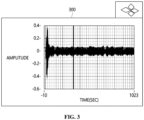
- FIGS. 3 to 5 are diagrams illustrating examples of a spectrogram analysis result and a power spectrum density based on a detected frequency component while a vehicle travels at 50 Km/h on a magnetic paint lane to which an alternating magnetic pattern is applied at a spatial interval of 10 cm.
- the graph illustrated in FIG. 3 illustrates a result 300 obtained by filtering a frequency component using a 80 Hz high frequency pass filter, when an alternating magnetic pattern is applied such that the magnetic paint lane has a spatial interval of 10 cm, and the vehicle detects the frequency component while traveling at 50 Km/h.
- the signal illustrated in the graph in FIG. 3 is a magnetic signal in time, which is obtained by removing 80 Hz high-pass filtered signal from an original signal detected from the magnetic paint lane.
- the magnetic signal illustrated in FIG. 3 is filtered again using a 132-153 Hz bandpass filter and then the result signal is analyzed by the power spectrum density. As a result, a frequency of about 140 Hz is detected as illustrated in FIG. 4 .
- spectrogram analysis as illustrated in FIG. 5 may be performed to intuitively show a frequency desired to detect.
- FIG. 5 is a diagram illustrating a spectrogram analysis result 500 for the magnetic signal illustrated in FIG. 3 .
- the spectrogram analysis result 500 illustrated in FIG. 5 may be a time-frequency spectrogram obtained by performing short-time Fourier transform on the magnetic signal and representing the short-time Fourier transformed result as the time-frequency spectrogram.
- the spectrogram illustrated in FIG. 5 may correspond to a result acquired by setting a frequency bin to 512 for every 50 ms and the size of a Hanning window to 64.
- the color of the spectrogram indicates the signal intensity in time and frequency, and it may be intuitively found that the closer to red the color is, the stronger the signal is.
- the spectrum analysis result 500 illustrated in FIG. 5 it may be found that a strong signal is generated at about 140 Hz every 50 ms, and the surrounding noise also appears. It may be found that such a result matches the power spectrum density analysis result illustrated in FIG. 4 .
- the AI-based method for detecting a lane using a spectrogram pattern involves inputting the spectrogram pattern of a magnetic signal detected from a magnetic paint lane in real time to a trained AI model using training data corresponding to the spectrogram pattern (step S220).
- the training data may be generated by labeling the spectrogram pattern for each average speed.
- the AI model may be trained based on a transfer learning algorithm using the training data.
- the AI model may correspond to an artificial neural network.
- the real-time magnetic signal is detected for each preset interval, and short-time Fourier transform is performed to generate the spectrogram pattern of a magnetic signal detected in real time.
- spectrogram patterns for using as the training data may be generated based on a series of magnetic signals acquired from the magnetic paint lane while the vehicle travels.
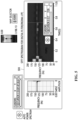
- FIG. 6 shows a JPG file transformed from the spectrogram pattern for each average vehicle speed. Comparing the spectrogram patterns 610 to 640 illustrated in FIG. 6 , it may be found that as the speed increases, by about 10 Km/h, from 22 Km/h, 32 Km/h, 43 Km/h, and to 54 Km/h, the magnitude of a frequency having a strong intensity also increases. Accordingly, it may be found that the shapes of the pattern are different for each average vehicle speed.
- the AI model may be trained in a form in which a portion of the transfer training algorithm is modified, and, to this end, the training may be performed with the plurality of spectrogram patterns 610 to 640 measured at different average speeds as in FIG. 6 .
- each of 60 spectrograms corresponding to 22 Km/h, 60 spectrograms corresponding to 32 Km/h, 60 spectrograms corresponding to 43 Km/h, and 60 spectrograms corresponding to 54 Km/h are input to the AI model to train the same.
- test spectrogram pattern is input to the AI model to examine a recognition rate of the same. For example, since frequencies acquired from the magnetic paint lane are related to the vehicle speed, an experiment may be performed in which test spectrogram patterns labeled for each speed may be input to the AI model to identify the vehicle speed.
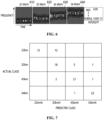
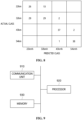
- FIGS. 7 and 8 are diagrams illustrating examples of results in which a supervised-learning performed deep convolutional neural network recognizes test patterns for each of the four speeds illustrated in FIG. 6 according to the present disclosure.
- FIG. 7 represents a recognized result obtained by inputting 25 test spectrogram patterns for each speed are input to a trained-deep convolutional neural network.
- a recognition accuracy of the AI model appears to be about 77.1%, and thus it may be found that as the speed becomes higher, the accuracy increases.
- the accuracy increases, and thus the accuracy may be significantly improved.
- the recognition accuracy of the AI model appears to be about 83.3%, and it may be also found as in FIG. 7 that as the speed becomes higher, the accuracy increases.
- the accuracy becomes higher and may be greatly improved to maximum 99%.
- the autonomous vehicle using information about the magnetic paint lane to which the alternating magnetic pattern is applied, it may be preferable to obtain information about the magnetic paint lane in a manner of changing the magnetic signal acquired from the magnetic paint lane to a pattern in the form of spectrogram and recognizing the pattern, than to detect the lane through a typical technology.
- the vehicle speed may be acquired based on information fed back from at least one of a speedometer and a GPS sensor embedded in the vehicle.
- the vehicle speed may be acquired in correspondence to a value output from the speedometer in the vehicle.
- the location of the vehicle acquired through the GPS sensor is used to calculate a traveling distance of the vehicle, and the vehicle speed may be computed based on the time and the traveling distance.
- the preset interval may be set in consideration of the braking distance according to the vehicle speed.
- the vehicle speed varies every hour, it may be preferable to perform the short-time Fourier transform in consideration of the vehicle speed and the traveling speed of the vehicle according to the braking distance.
- determining a time interval in which the short-time Fourier transform is performed may correspond to an important factor to prevent a vehicle accident so that the frequency analysis is performed within the traveling distance of the vehicle including the braking distance.
- the emergency braking distance (the distance that the vehicle travels after the wheels stop) of the vehicle may calculated as Equation 2.
- Emrgencey braking distance speed Km / h 10 ⁇ speed Km / h 10 ⁇ 1 2
- the vehicle travels at 30 Km/h, the vehicle travels 8 m for one second.
- the emergency braking distance is computed to be 4.5 m, but may be differed due to the road surface and the surrounding environment. Accordingly, for safe traveling, the frequency analysis for the short-time Fourier transform should be performed before the vehicle travels 3.5m for one second, and thus the time interval in which the short-time Fourier transform is performed may be set to 0.4 seconds or less.
- the time interval in which the short-time Fourier transform is performed may be set to 0.2 seconds or less to lower a risk that an accident occurs during the emergency braking of the vehicle.
- the frequency analysis for the short-time Fourier transform is performed every time the vehicle travels 0.4 m and thus the safety of the vehicle may be greatly improved.
- time interval in which the short-time Fourier transform is performed is set to several milliseconds (ms)
- data (bin) for the Fourier transform may not be sufficient to make it difficult to accurately perform frequency analysis and thus the time interval may be set in a range in which data for Fourier transform is acquired well.
- the AI-based method for detecting a lane using a spectrogram pattern involves, detecting the magnetic paint lane based on the output value of the AI model (step S230).
- the vehicle speed or lane information may be detected through the output value of the AI model.
- the AI-based method for detecting a lane using a spectrogram pattern may involve controlling the operation of the vehicle based on the detected lane.
- a time-frequency based spectrogram pattern generated by performing short-time Fourier transform on a signal in which a lane signal of an alternating magnetic pattern is mixed with noise may be used to train an AI model, and the spectrogram pattern detected from the lane in real-time may be input to the trained AI model to accurately detect the lane signal.
- the present disclosure may control the vehicle in safety by clearly detecting the magnetic signal generated from the magnetic paint lane to which the alternating magnetic pattern is applied.
- the present disclosure may remove noise generated due to sources such as other vehicles, the power transmission lines, the vibration of the vehicle, or the like to make it possible to reduce a malfunction of the autonomous vehicle and operate the vehicle in safety.
- FIG. 9 is a block diagram of an AI-based apparatus for detecting a lane using a spectrogram pattern according to an embodiment of the present disclosure.
- the lane detection apparatus based on AI using a spectrogram pattern may interact with a magnetic sensor embedded in a vehicle or operate with the magnetic sensor included therein.
- the AI-based apparatus for detecting a lane using a spectrogram pattern may include a communication unit 910, a processor 920, and a memory 930.
- the communication unit 910 may serve to transmit and receive information required for lane detection based on AI using a spectrogram pattern over a communication network such as a network.
- the network is to provide a pathway for transferring data between apparatuses, and is a concept covering networks that have been used and networks that may be developed in the future.
- the network may be an IP network for providing a transmission and reception service of mass data and a seamless data service through the Internet Protocol (IP), an all IP network that is an IP network structure in which different networks are integrated based on IP, or the like.
- IP Internet Protocol
- the network may be composed by combining one or more of a wired network, a Wireless Broadband (WiBro) network, a third-generation wireless network including WCDMA, a 3.5 generation wireless communication network including network High Speed Downlink Packet Access (HSDPA) network, a fourth generation wireless communication network including LTE network, a satellite communication network, and a Wi-Fi network.
- a network may be any one or a combination of two or more of a wired and wireless short-range communication network, a mobile communication network providing communication between mobile bodies and a mobile body and the outside of the mobile body, a satellite communication network providing communication between earth stations using a satellite, or a wired and wireless communication network.
- the standard transmission method of the network is not limited to the existing standard transmission method, but may include all standard transmission methods to be developed in the future.
- the processor 920 generates a time-frequency spectrogram pattern based on a magnetic signal from a magnetic paint lane to which an alternating magnetic pattern is applied.
- the spectrogram pattern may be generated using a magnetic signal filtered based on a high pass filter.
- the processor 920 inputs the spectrogram pattern of the magnetic signal detected from the magnetic paint lane in real time to an AI model trained using training data corresponding to the spectrogram pattern.
- the real-time magnetic signal is detected for each preset period, and short-time Fourier transform is performed to generate the spectrogram pattern of the magnetic signal detected in real time.
- the present period may be set in consideration of the braking distance according to the vehicle speed.
- the training data may be generated by labeling the spectrogram pattern for each average speed.
- the AI model may be trained based on a transfer learning algorithm using the training data.
- the AI model may correspond to an artificial neural network.
- the processor 920 detects the magnetic paint lane based on an output value of the AI model.
- the memory 930 stores various pieces of information generated from the AI-based apparatus for detecting a lane using a spectrogram pattern according to an embodiment of the present disclosure.
- the memory 930 may be configured regardless of the lane detection apparatus to support a function for lane detection.
- the memory 930 may operate as a separate large capacity storage, or include a control function for performing operations.
- the lane detection apparatus has the memory mounted thereon.
- the memory is a computer-readable medium.
- the memory may be a volatile memory unit, and for another embodiment, the memory may be a non-volatile memory unit.
- the memory may be a cloud storage apparatus connected through communication.
- the storage apparatus is a computer-readable medium.
- the storage apparatus may include, for example, a hard disk apparatus, an optical disc apparatus or any other mass storage apparatus.
- a time-frequency-based spectrogram pattern generated by performing short-time Fourier transform on a signal in which a lane signal of an alternating magnetic pattern is mixed with noise may be used to train an AI model, and the spectrogram pattern detected from the lane in real-time may be input to the trained AI model to accurately detect the lane signal.
- the present disclosure may control the vehicle in safety by clearly detecting the magnetic signal generated from the magnetic paint lane to which the alternating magnetic pattern is applied.
- the present disclosure may remove noise generated due to sources such as other vehicles, the power transmission lines, the vibration of the vehicle, or the like to make it possible to reduce a malfunction of the autonomous vehicle and operate the vehicle in safety.
- the configurations and schemes in the above-described embodiments are not limitedly applied, and some or all of the above embodiments can be selectively combined and configured so that various modifications are possible.
Landscapes
- Engineering & Computer Science (AREA)
- Theoretical Computer Science (AREA)
- Physics & Mathematics (AREA)
- General Physics & Mathematics (AREA)
- Data Mining & Analysis (AREA)
- Evolutionary Computation (AREA)
- Artificial Intelligence (AREA)
- Software Systems (AREA)
- General Engineering & Computer Science (AREA)
- Mathematical Physics (AREA)
- Computing Systems (AREA)
- Life Sciences & Earth Sciences (AREA)
- Health & Medical Sciences (AREA)
- General Health & Medical Sciences (AREA)
- Molecular Biology (AREA)
- Biomedical Technology (AREA)
- Biophysics (AREA)
- Computational Linguistics (AREA)
- Computer Vision & Pattern Recognition (AREA)
- Radar, Positioning & Navigation (AREA)
- Remote Sensing (AREA)
- Medical Informatics (AREA)
- Bioinformatics & Cheminformatics (AREA)
- Bioinformatics & Computational Biology (AREA)
- Evolutionary Biology (AREA)
- Multimedia (AREA)
- Automation & Control Theory (AREA)
- Traffic Control Systems (AREA)
- Transportation (AREA)
- Mechanical Engineering (AREA)
- Databases & Information Systems (AREA)
Abstract
Description
- The present disclosure relates generally to an artificial intelligent (AI)-based method for detecting a lane using a spectrogram pattern, and an apparatus for the method, and more particularly to technology for using AI to accurately detect a signal generated from a lane having an alternating magnetic pattern.
- This application claims the benefit of
Korean Patent Application No. 10-2022-0001000 filed January 4, 2022 - Unless otherwise indicated herein, what is described in this section is not prior art to the claims in this application and is not admitted to be prior art by inclusion in this section.
- A lane on which magnetic paint is applied and magnetic information detected from this lane may be used for traveling of an autonomous vehicle. For example, magnetic paint including ferromagnetic particles is applied on the existing lane, an alternating magnetic field is applied to generate an alternating magnetic pattern in the lane, and then a magnetic sensor embedded in the autonomous vehicle is used to detect the alternating magnetic pattern, whereby information related to vehicle traveling, such as a vehicle speed or lane information, may be notified to a driver or a passenger of an autonomous vehicle.
- Here, the information provided in relation to the vehicle traveling may be associated with a magnetic signal composed of a time or frequency of the alternating magnetic pattern corresponding to the magnetic signal, etc.
- However, the vibration of a vehicle generated during traveling, or outdoor power transmission lines or the like serves as noise for a signal detected through the magnetic sensor in the vehicle, and thus the vehicle may be hindered from detecting only the magnetic signal generated from the magnetic paint lane to which the alternating magnetic pattern is applied.
- An object of the present disclosure is to use a time-frequency based spectrogram pattern generated by performing short-time Fourier transform on a signal in which a lane signal of an alternating magnetic pattern is mixed with noise to train an artificial intelligence (AI) model, and input, to the trained AI model, the spectrogram pattern detected from the lane in real-time to accurately detect the lane signal.
- Another object of the present disclosure is to clearly detect the magnetic signal, which is generated from the magnetic paint lane to which the alternating magnetic pattern is applied, to control the vehicle in safety.
- A further object of the present disclosure is to, in an autonomous vehicle system configured to use a magnetic signal generated from a magnetic paint lane to travel, remove noise generated due to reasons such as other vehicles, the power transmission lines, the vibration of a vehicle , or the like to make it possible to reduce a malfunction of the autonomous vehicle and operate the vehicle in safety
- In addition, technical objects accomplished by the present disclosure are not limited to the above-described objects, and thus other objects should be clearly understood from the following descriptions.
- In accordance with an aspect of the present disclosure to accomplish the above objects, there is provided a lane detection method including: generating a time-frequency spectrogram pattern based on a magnetic signal from a magnetic paint lane to which an alternating magnetic pattern is applied; inputting the spectrogram pattern of the magnetic signal detected from the magnetic paint lane in real time to an artificial intelligence (AI) model trained using training data corresponding to the spectrogram pattern; and detecting the magnetic paint lane based on an output value from the AI model.
- Here, the real-time magnetic signal may be detected for each preset interval, and a short-time Fourier transform may be used to generate the spectrogram pattern of the magnetic signal detected in real time.
- Here, the preset interval may be set in consideration of a braking distance according to a vehicle speed.
- Here, the spectrogram pattern may be generated using the magnetic signal filtered based on a high pass filter.
- Here, the training data may be generated by labeling the spectrogram pattern for each average vehicle speed.
- Here, the AI model may be trained based on a transfer learning algorithm using the training data.
- Here, the AI model may correspond to an artificial neural network.
- In accordance with another aspect of the present disclosure to accomplish the above objects, there is provided a lane detection apparatus including a processor configured to generate a time-frequency spectrogram pattern based on a magnetic signal corresponding to an alternating magnetic pattern, input the spectrogram pattern detected from a magnetic paint lane in real time to an AI model trained using training data corresponding to the spectrogram pattern, and detect the magnetic paint lane based on an output value from the AI model; and memory configured to store the AI model.
- Here, the real-time magnetic signal may be detected for each preset interval, and short-time Fourier transform may be used to generate the spectrogram pattern of the magnetic signal detected in real time.
- Here, the preset interval may be set in consideration of a braking distance according to a vehicle speed.
- Here, the spectrogram pattern may be generated using the magnetic signal filtered based on a high pass filter.
- Here, the training data may be generated by labeling the spectrogram pattern for each average vehicle speed.
- Here, the AI model may be trained based on a transfer learning algorithm using the training data.
- Here, the AI model may correspond to an artificial neural network.
- In accordance with the present disclosure having the above configuration, the time-frequency based spectrogram pattern generated by performing the short-time Fourier transform on a signal in which the lane signal of an alternating magnetic pattern is mixed with noise may be used to train the artificial intelligence (AI) model, and the spectrogram pattern detected from the lane in real-time may be input to the trained AI model to accurately detect the lane signal.
- In addition, the present disclosure may clearly detect the magnetic signal, which is generated from the magnetic paint lane to which the alternating magnetic pattern is applied, to control the vehicle safely.
- Furthermore, in the autonomous vehicle system configured to use the magnetic signal generated from the magnetic paint lane to travel, the present disclosure may remove noise generated due to reasons such as other vehicles, the power transmission lines, the vibration of the autonomous vehicle, or the like to make it possible to reduce a malfunction of the autonomous vehicle and operate the same in safety.
- Effects of the present embodiments are not limited to those described above and other issues unmentioned above will be clearly understood by those skilled in the art from the description of the claims.
-
-
FIG. 1 is a conceptual diagram illustrating an artificial intelligent (AI)-based process for detecting a lane using a spectrogram pattern according to an embodiment of the present disclosure; -
FIG. 2 is an operational flowchart illustrating an AI-based method for detecting a lane using a spectrogram pattern according to an embodiment of the present disclosure; -
FIGS. 3 to 5 are diagrams illustrating examples of a spectrogram analysis result and a power spectrum density based on a detected frequency component while a vehicle travels at 50 Km/h on a magnetic paint lane to which an alternating magnetic pattern is applied at a spatial interval of 10 cm; -
FIG. 6 is a diagram illustrating a magnetic signal detected for each speed of a vehicle as a spectrogram pattern according to an embodiment of the present disclosure; -
FIGS. 7 and8 are diagrams illustrating examples of results in which a supervised-learning performed deep convolutional neural network recognizes a test pattern for each of four speeds illustrated inFIG. 6 according to the present disclosure; and -
FIG. 9 is a block diagram illustrating an AI-based apparatus for detecting a lane using a spectrogram pattern according to an embodiment of the present disclosure. - An AI-based process for detecting a lane using a spectrogram pattern according to an embodiment may be classified into a process for using a
spectrogram pattern 101 for training to train anAI model 110 and a process for using an output value of a trainedAI model 120 to detect a lane from a magnetic signal detected in real time. - First, the
AI model 110 used in the present disclosure corresponds to an artificial neural network, for example, a deep neural network (DNN) model or a convolutional neural network (CNN). - Here, the
spectrogram pattern 101 for training may be provided as training data for training theAI model 110. - For example, the
spectrogram pattern 101 for training may correspond to a spectrogram pattern generated in correspondence to a magnetic signal detected from a magnetic paint lane by a vehicle while the vehicle travels at various speeds. Therefore, thespectrogram pattern 101 for training may be collected at various vehicle speeds. - The trained
AI model 120 in this way may receive thespectrogram pattern 103 for themagnetic signal 102 detected in real time by the traveling vehicle to output a detected result value for the magnetic paint lane on which the vehicle travels. - In other words, when the
magnetic signal 102, detected while the vehicle travels, is short-time Fourier-transformed to generate thespectrogram pattern 103, and the spectrogram pattern is input to the trainedAI model 120, the trainedAI model 120 may analyze the spectrogram pattern (103) to provide a predicted vehicle speed and lane information. - In this way, the magnetic paint lane is detected through the spectrogram pattern and related information are provided, and thus the lane may be clearly detected even in a state where noise is included in a magnetic signal detected by the vehicle.
-
FIG. 2 is an operational flowchart illustrating an AI-based method for detecting a lane using a spectrogram pattern according to an embodiment of the present disclosure. - Referring to
FIG. 2 , the AI-based method for detecting a lane using a spectrogram pattern according to an embodiment of the present disclosure involves generating a time-frequency spectrogram pattern based on the magnetic signal of the magnetic paint lane to which an alternating magnetic pattern is applied (step S210). - Here, the magnetic signal may be acquired through the magnetic sensor embedded in the vehicle.
- Here, the magnetic paint lane may be generated by applying an alternating magnetic pattern so that the magnetic paint lane has a certain spatial interval. Such a spatial interval of the magnetic paint lane may affect the magnetic signal acquired while the autonomous vehicle travels.
- For example, when a travel distance S (units of cm) for one second according to the vehicle speed (v) is calculated, and the travel distance for one second is divided by the spatial interval (units of cm) of the magnetic paint lane, the number of times of magnetic alternating pattern for which the vehicle detects during traveling for one second may be counted. Here, the counted number of times of the magnetic alternating pattern may correspond to the frequency (fv) that should be detected by the vehicle. In this way, a process for calculating the frequency (fv) may be expressed as
Equation 1.
- In other words, the frequency that should be detected by the vehicle changes according to the spatial interval of the magnetic paint lane, which may significantly affect the control of the traveling vehicle.
- Here, power noise (60 Hz in Korea) generated due to nearby vehicles or power supply lines and noise generated from the vibration of the vehicle itself or generated from the vibration of the vehicle due to the roughness of a road surface may be considered.
- Typically the vibration noise of the vehicle generated from the vehicle itself or the roughness of a road surface is measured at about 30 Hz or lower. In addition, while the vehicle travels, the noise may be generated from nearby vehicles. However, considering the minimum speed limit and the maximum speed limit on the road, typically the relative speed between vehicles is not over 50 Km/h. Furthermore, the power noise is detected at 60 Hz in Korea, and this value may be detected as constant regardless of the vehicle speed. Harmonics (frequencies of integer multiples of the fundamental wave) of such various types of noise may also act as noise, but the magnitude of the harmonics may not be greater than that of the fundamental frequency.
- In this way, the frequencies of the noise generated due to various sources do not significantly change even when the vehicle accelerates and decelerates, but the frequency, which should be detected in correspondence to the alternating magnetic pattern, changes in proportional to the vehicle speed.
- For example, when comparing frequency components detected in a state of a vehicle parked with in a state of a vehicle traveling at 50 Km, the actually detected noise changes only in the magnitude but the value of the frequency itself does not change significantly.
- In consideration of such a feature, a frequency band pass filter is typically used to remove a noise component.
- However, a method for using the band pass filter to remove the noise component is highly likely to provide wrong information due to the harmonics caused by the power noise generated by the vibrations of the vehicle, nearby vehicles, or power supply lines, and noise due to frequencies generated by interference from them. Accordingly, the present disclosure intends to propose a solution using a spectrogram pattern for detecting a lane signal more clearly even in a state where such noise is present.
- Here, the spectrogram pattern may be generated using a magnetic signal filtered based on a high pass filter.
- For example,
FIGS. 3 to 5 are diagrams illustrating examples of a spectrogram analysis result and a power spectrum density based on a detected frequency component while a vehicle travels at 50 Km/h on a magnetic paint lane to which an alternating magnetic pattern is applied at a spatial interval of 10 cm. - First, the graph illustrated in
FIG. 3 illustrates aresult 300 obtained by filtering a frequency component using a 80 Hz high frequency pass filter, when an alternating magnetic pattern is applied such that the magnetic paint lane has a spatial interval of 10 cm, and the vehicle detects the frequency component while traveling at 50 Km/h. In other words, the signal illustrated in the graph inFIG. 3 is a magnetic signal in time, which is obtained by removing 80 Hz high-pass filtered signal from an original signal detected from the magnetic paint lane. - Here, the magnetic signal illustrated in
FIG. 3 is filtered again using a 132-153 Hz bandpass filter and then the result signal is analyzed by the power spectrum density. As a result, a frequency of about 140 Hz is detected as illustrated inFIG. 4 . - However, as described above, it is highly possible that such a frequency analysis method may provide wrong information due to the harmonics caused by the power noise generated by the vibration of the vehicle, the nearby vehicles, or the power supply lines, and noise due to frequencies generated by interference from them.
- Accordingly, in the present disclosure, spectrogram analysis as illustrated in
FIG. 5 may be performed to intuitively show a frequency desired to detect. -
FIG. 5 is a diagram illustrating aspectrogram analysis result 500 for the magnetic signal illustrated inFIG. 3 . - For example, the
spectrogram analysis result 500 illustrated inFIG. 5 may be a time-frequency spectrogram obtained by performing short-time Fourier transform on the magnetic signal and representing the short-time Fourier transformed result as the time-frequency spectrogram. - Here, the spectrogram illustrated in
FIG. 5 may correspond to a result acquired by setting a frequency bin to 512 for every 50 ms and the size of a Hanning window to 64. - Here, the color of the spectrogram indicates the signal intensity in time and frequency, and it may be intuitively found that the closer to red the color is, the stronger the signal is. In other words, referring to the
spectrum analysis result 500 illustrated inFIG. 5 , it may be found that a strong signal is generated at about 140 Hz every 50 ms, and the surrounding noise also appears. It may be found that such a result matches the power spectrum density analysis result illustrated inFIG. 4 . - However, even when comparing
FIGS. 4 and5 , it may be clearly found that the spectrogram analysis result inFIG. 5 more intuitively represents the frequency desired to detect in comparison to the power spectrum density analysis result inFIG. 5 . - In addition, the AI-based method for detecting a lane using a spectrogram pattern according to an embodiment of the present disclosure involves inputting the spectrogram pattern of a magnetic signal detected from a magnetic paint lane in real time to a trained AI model using training data corresponding to the spectrogram pattern (step S220).
- Here, the training data may be generated by labeling the spectrogram pattern for each average speed.
- Here, the AI model may be trained based on a transfer learning algorithm using the training data.
- Here, the AI model may correspond to an artificial neural network.
- Here, the real-time magnetic signal is detected for each preset interval, and short-time Fourier transform is performed to generate the spectrogram pattern of a magnetic signal detected in real time.
- For example, spectrogram patterns for using as the training data according to an embodiment of the present disclosure may be generated based on a series of magnetic signals acquired from the magnetic paint lane while the vehicle travels.
-
FIG. 6 shows a JPG file transformed from the spectrogram pattern for each average vehicle speed. Comparing thespectrogram patterns 610 to 640 illustrated inFIG. 6 , it may be found that as the speed increases, by about 10 Km/h, from 22 Km/h, 32 Km/h, 43 Km/h, and to 54 Km/h, the magnitude of a frequency having a strong intensity also increases. Accordingly, it may be found that the shapes of the pattern are different for each average vehicle speed. - Here, in the present disclosure, the AI model may be trained in a form in which a portion of the transfer training algorithm is modified, and, to this end, the training may be performed with the plurality of
spectrogram patterns 610 to 640 measured at different average speeds as inFIG. 6 . - For example, each of 60 spectrograms corresponding to 22 Km/h, 60 spectrograms corresponding to 32 Km/h, 60 spectrograms corresponding to 43 Km/h, and 60 spectrograms corresponding to 54 Km/h are input to the AI model to train the same.
- Then, a separate test spectrogram pattern is input to the AI model to examine a recognition rate of the same. For example, since frequencies acquired from the magnetic paint lane are related to the vehicle speed, an experiment may be performed in which test spectrogram patterns labeled for each speed may be input to the AI model to identify the vehicle speed.
- For example,
FIGS. 7 and8 are diagrams illustrating examples of results in which a supervised-learning performed deep convolutional neural network recognizes test patterns for each of the four speeds illustrated inFIG. 6 according to the present disclosure. - First,
FIG. 7 represents a recognized result obtained by inputting 25 test spectrogram patterns for each speed are input to a trained-deep convolutional neural network. - Referring to
FIG. 7 , a recognition accuracy of the AI model (deep convolutional neural network) appears to be about 77.1%, and thus it may be found that as the speed becomes higher, the accuracy increases. - Here, for the AI model, as the number of samples for training increases, the accuracy increases, and thus the accuracy may be significantly improved.
- To this end, it was examined how much the accuracy increases by preparing 30 more spectrogram patterns for each of the same speeds as illustrated in
FIG. 6 , further training the AI model, and inputting 40 test spectrogram patterns for each of the speeds to the further trained AI model. - Referring to
FIG. 8 , the recognition accuracy of the AI model (deep convolutional neural network) appears to be about 83.3%, and it may be also found as inFIG. 7 that as the speed becomes higher, the accuracy increases. - In this way, for the AI model, as the number of training samples, namely, the number of training spectrogram patterns increases, the accuracy becomes higher and may be greatly improved to maximum 99%.
- Accordingly, for the autonomous vehicle using information about the magnetic paint lane to which the alternating magnetic pattern is applied, it may be preferable to obtain information about the magnetic paint lane in a manner of changing the magnetic signal acquired from the magnetic paint lane to a pattern in the form of spectrogram and recognizing the pattern, than to detect the lane through a typical technology.
- Here, the vehicle speed may be acquired based on information fed back from at least one of a speedometer and a GPS sensor embedded in the vehicle.
- For example, the vehicle speed may be acquired in correspondence to a value output from the speedometer in the vehicle.
- For another example, the location of the vehicle acquired through the GPS sensor is used to calculate a traveling distance of the vehicle, and the vehicle speed may be computed based on the time and the traveling distance.
- Here, the preset interval may be set in consideration of the braking distance according to the vehicle speed.
- For example, since the vehicle speed varies every hour, it may be preferable to perform the short-time Fourier transform in consideration of the vehicle speed and the traveling speed of the vehicle according to the braking distance.
- Accordingly, determining a time interval in which the short-time Fourier transform is performed may correspond to an important factor to prevent a vehicle accident so that the frequency analysis is performed within the traveling distance of the vehicle including the braking distance.
- Here, the emergency braking distance (the distance that the vehicle travels after the wheels stop) of the vehicle may calculated as
Equation 2.
- For example, when the vehicle travels at 30 Km/h, the vehicle travels 8 m for one second. Here, according to [expression 2], the emergency braking distance is computed to be 4.5 m, but may be differed due to the road surface and the surrounding environment. Accordingly, for safe traveling, the frequency analysis for the short-time Fourier transform should be performed before the vehicle travels 3.5m for one second, and thus the time interval in which the short-time Fourier transform is performed may be set to 0.4 seconds or less.
- However, since an actual braking distance is known to be twice longer than the emergency braking distance, the time interval in which the short-time Fourier transform is performed may be set to 0.2 seconds or less to lower a risk that an accident occurs during the emergency braking of the vehicle.
- Actually, when the time interval in which the short-time Fourier transform is performed is set to 0.05 seconds, the frequency analysis for the short-time Fourier transform is performed every time the vehicle travels 0.4 m and thus the safety of the vehicle may be greatly improved.
- However, when the time interval in which the short-time Fourier transform is performed is set to several milliseconds (ms), data (bin) for the Fourier transform may not be sufficient to make it difficult to accurately perform frequency analysis and thus the time interval may be set in a range in which data for Fourier transform is acquired well.
- In addition, the AI-based method for detecting a lane using a spectrogram pattern according to an embodiment of the present disclosure involves, detecting the magnetic paint lane based on the output value of the AI model (step S230).
- Here, the vehicle speed or lane information may be detected through the output value of the AI model.
- Furthermore, although not illustrated in
FIG. 2 , the AI-based method for detecting a lane using a spectrogram pattern according to an embodiment of the present disclosure may involve controlling the operation of the vehicle based on the detected lane. - Through such an AI-based method for detecting a lane using a spectrogram pattern, a time-frequency based spectrogram pattern generated by performing short-time Fourier transform on a signal in which a lane signal of an alternating magnetic pattern is mixed with noise may be used to train an AI model, and the spectrogram pattern detected from the lane in real-time may be input to the trained AI model to accurately detect the lane signal.
- In addition, the present disclosure may control the vehicle in safety by clearly detecting the magnetic signal generated from the magnetic paint lane to which the alternating magnetic pattern is applied.
- Furthermore, in the autonomous vehicle system for using the magnetic signal generated from the magnetic paint lane to travel, the present disclosure may remove noise generated due to sources such as other vehicles, the power transmission lines, the vibration of the vehicle, or the like to make it possible to reduce a malfunction of the autonomous vehicle and operate the vehicle in safety.
-
FIG. 9 is a block diagram of an AI-based apparatus for detecting a lane using a spectrogram pattern according to an embodiment of the present disclosure. - Here, the lane detection apparatus based on AI using a spectrogram pattern may interact with a magnetic sensor embedded in a vehicle or operate with the magnetic sensor included therein.
- Referring to
FIG. 9 , the AI-based apparatus for detecting a lane using a spectrogram pattern may include acommunication unit 910, aprocessor 920, and amemory 930. - The
communication unit 910 may serve to transmit and receive information required for lane detection based on AI using a spectrogram pattern over a communication network such as a network. Here, the network is to provide a pathway for transferring data between apparatuses, and is a concept covering networks that have been used and networks that may be developed in the future. - For example, the network may be an IP network for providing a transmission and reception service of mass data and a seamless data service through the Internet Protocol (IP), an all IP network that is an IP network structure in which different networks are integrated based on IP, or the like. In addition, the network may be composed by combining one or more of a wired network, a Wireless Broadband (WiBro) network, a third-generation wireless network including WCDMA, a 3.5 generation wireless communication network including network High Speed Downlink Packet Access (HSDPA) network, a fourth generation wireless communication network including LTE network, a satellite communication network, and a Wi-Fi network.
- In addition, a network may be any one or a combination of two or more of a wired and wireless short-range communication network, a mobile communication network providing communication between mobile bodies and a mobile body and the outside of the mobile body, a satellite communication network providing communication between earth stations using a satellite, or a wired and wireless communication network. Meanwhile, the standard transmission method of the network is not limited to the existing standard transmission method, but may include all standard transmission methods to be developed in the future.
- The
processor 920 generates a time-frequency spectrogram pattern based on a magnetic signal from a magnetic paint lane to which an alternating magnetic pattern is applied. - Here, the spectrogram pattern may be generated using a magnetic signal filtered based on a high pass filter.
- In addition, the
processor 920 inputs the spectrogram pattern of the magnetic signal detected from the magnetic paint lane in real time to an AI model trained using training data corresponding to the spectrogram pattern. - Here, the real-time magnetic signal is detected for each preset period, and short-time Fourier transform is performed to generate the spectrogram pattern of the magnetic signal detected in real time.
- Here, the present period may be set in consideration of the braking distance according to the vehicle speed.
- Here, the training data may be generated by labeling the spectrogram pattern for each average speed.
- Here, the AI model may be trained based on a transfer learning algorithm using the training data.
- Here, the AI model may correspond to an artificial neural network.
- In addition, the
processor 920 detects the magnetic paint lane based on an output value of the AI model. - In addition, as described above, the
memory 930 stores various pieces of information generated from the AI-based apparatus for detecting a lane using a spectrogram pattern according to an embodiment of the present disclosure. - According to embodiments, the
memory 930 may be configured regardless of the lane detection apparatus to support a function for lane detection. Here, thememory 930 may operate as a separate large capacity storage, or include a control function for performing operations. - Meanwhile, the lane detection apparatus has the memory mounted thereon. For an implementation example, the memory is a computer-readable medium. For an implementation example, the memory may be a volatile memory unit, and for another embodiment, the memory may be a non-volatile memory unit. For another implementation example, the memory may be a cloud storage apparatus connected through communication. For an implementation example, the storage apparatus is a computer-readable medium. In various different implementation examples, the storage apparatus may include, for example, a hard disk apparatus, an optical disc apparatus or any other mass storage apparatus.
- Through such an AI-based method for detecting a lane using a spectrogram pattern, a time-frequency-based spectrogram pattern generated by performing short-time Fourier transform on a signal in which a lane signal of an alternating magnetic pattern is mixed with noise may be used to train an AI model, and the spectrogram pattern detected from the lane in real-time may be input to the trained AI model to accurately detect the lane signal.
- In addition, the present disclosure may control the vehicle in safety by clearly detecting the magnetic signal generated from the magnetic paint lane to which the alternating magnetic pattern is applied.
- Furthermore, in an autonomous vehicle system for using the magnetic signal generated from the magnetic paint lane to travel, the present disclosure may remove noise generated due to sources such as other vehicles, the power transmission lines, the vibration of the vehicle, or the like to make it possible to reduce a malfunction of the autonomous vehicle and operate the vehicle in safety.
- As described above, in the AI-based apparatus for detecting a lane using a spectrogram pattern and an apparatus using the method according to the present disclosure, the configurations and schemes in the above-described embodiments are not limitedly applied, and some or all of the above embodiments can be selectively combined and configured so that various modifications are possible.
Claims (14)
- A lane detection method comprising:generating a time-frequency spectrogram pattern based on a magnetic signal from a magnetic paint lane to which an alternating magnetic pattern is applied;inputting the spectrogram pattern of the magnetic signal detected from the magnetic paint lane in real time to an artificial intelligence (AI) model trained using training data corresponding to the spectrogram pattern; anddetecting the magnetic paint lane based on an output value from the AI model.
- The lane detection method of claim 1, wherein the real-time magnetic signal is detected for each preset interval, and a short-time Fourier transform is performed to generate the spectrogram pattern of the magnetic signal detected in real time.
- The lane detection method of claim 2, wherein the preset interval is set in consideration of a braking distance according to a vehicle speed.
- The lane detection method of claim 2, wherein the spectrogram pattern is generated using a magnetic signal filtered based on a high pass filter.
- The lane detection method of claim 1, wherein the training data is generated by labeling the spectrogram pattern for each average vehicle speed.
- The lane detection method of claim 5, wherein the AI model is trained based on a transfer learning algorithm using the training data.
- The lane detection method of claim 1, wherein the AI model corresponds to an artificial neural network.
- A detection apparatus, comprising:a processor configured to generate a time-frequency spectrogram pattern based on a magnetic signal corresponding to an alternating magnetic pattern, input the spectrogram pattern detected from a magnetic paint lane in real time to an AI model trained using training data corresponding to the spectrogram pattern, and detect the magnetic paint lane based on an output value from the AI model; anda memory configured to store the AI model.
- The lane detection apparatus of claim 8, wherein the real-time magnetic signal is detected for each preset interval, and a short-time Fourier transform is performed to generate the spectrogram pattern of the magnetic signal detected in real time.
- The lane detection apparatus of claim 9, wherein the preset interval is set in consideration of a braking distance according to a vehicle speed.
- The lane detection apparatus of claim 9, wherein the spectrogram pattern is generated using a magnetic signal filtered based on a high pass filter.
- The lane detection apparatus of claim 8, wherein the training data is generated by labeling the spectrogram pattern for each average vehicle speed.
- The lane detection apparatus of claim 12, wherein the AI model is trained based on a transfer learning algorithm using the training data.
- The lane detection apparatus of claim 8, wherein the AI model corresponds to an artificial neural network.
Applications Claiming Priority (2)
| Application Number | Priority Date | Filing Date | Title |
|---|---|---|---|
| KR1020220001000A KR102511280B1 (en) | 2022-01-04 | 2022-01-04 | Method for detecting lane based on ai using spectrogram pattern and apparatus using the same |
| PCT/KR2022/013987 WO2023132436A1 (en) | 2022-01-04 | 2022-09-19 | Artificial intelligence-based method for detecting lane using spectrogram pattern, and apparatus for same |
Publications (2)
| Publication Number | Publication Date |
|---|---|
| EP4462383A1 true EP4462383A1 (en) | 2024-11-13 |
| EP4462383A4 EP4462383A4 (en) | 2025-08-13 |
Family
ID=85796515
Family Applications (1)
| Application Number | Title | Priority Date | Filing Date |
|---|---|---|---|
| EP22918973.3A Pending EP4462383A4 (en) | 2022-01-04 | 2022-09-19 | ARTIFICIAL INTELLIGENCE-BASED METHOD FOR DETECTING A TRACK USING A SPECTROGRAM PATTERN AND DEVICE THEREFOR |
Country Status (6)
| Country | Link |
|---|---|
| US (1) | US20250085113A1 (en) |
| EP (1) | EP4462383A4 (en) |
| KR (1) | KR102511280B1 (en) |
| CN (1) | CN117413301A (en) |
| CA (1) | CA3220776A1 (en) |
| WO (1) | WO2023132436A1 (en) |
Families Citing this family (1)
| Publication number | Priority date | Publication date | Assignee | Title |
|---|---|---|---|---|
| CN119903374B (en) * | 2024-12-30 | 2025-11-11 | 广州市银科电子有限公司 | Method for training analysis and identification model of magnetic spectrogram ViT of paper money |
Family Cites Families (13)
| Publication number | Priority date | Publication date | Assignee | Title |
|---|---|---|---|---|
| CN101776747B (en) * | 2010-01-15 | 2012-07-18 | 山东大学 | Adaptive resampling-based radar signal compression method |
| KR20150125115A (en) | 2014-04-29 | 2015-11-09 | 한국철도기술연구원 | The generation method of lane for using magnetic powder, thereby detection device |
| US9892296B2 (en) * | 2014-11-12 | 2018-02-13 | Joseph E. Kovarik | Method and system for autonomous vehicles |
| JP6172237B2 (en) * | 2015-10-23 | 2017-08-02 | 愛知製鋼株式会社 | Magnetic marker detection method and magnetic marker detection apparatus |
| KR20180048407A (en) * | 2016-10-31 | 2018-05-10 | 삼성전자주식회사 | Apparatus and method for detecting a lane |
| KR102122747B1 (en) * | 2018-08-02 | 2020-06-16 | 주식회사 정석케미칼 | Method for generating magnetic field and method for detecting lane using magnetic field, vehcle using the same |
| KR102180800B1 (en) * | 2019-04-03 | 2020-11-19 | 경북대학교 산학협력단 | Apparatus and Method for determining traveling status of vehicle |
| DE102019215658B3 (en) * | 2019-10-11 | 2021-01-07 | Zf Friedrichshafen Ag | System and method for controlling automated driving functions for an automatically operated vehicle and an automatically operated vehicle |
| KR102272641B1 (en) * | 2019-11-29 | 2021-07-02 | 포항공과대학교 산학협력단 | Object identification apparatus and method, system comprising the same |
| CN111160167A (en) * | 2019-12-18 | 2020-05-15 | 北京信息科技大学 | Spindle fault classification and identification method based on S-transform deep convolutional neural network |
| KR102393836B1 (en) * | 2020-06-23 | 2022-05-04 | 주식회사 정석케미칼 | Method and apparatus of recognizing walking information by using multiple magnetic sensors |
| KR20220001000A (en) | 2020-06-28 | 2022-01-04 | 권용진 | Sieve cat toilet |
| KR102321567B1 (en) * | 2021-04-27 | 2021-11-05 | 주식회사 정석케미칼 | Method and apparatus of recognizing driving information by using multiple magnetic sensors |
-
2022
- 2022-01-04 KR KR1020220001000A patent/KR102511280B1/en active Active
- 2022-09-19 CN CN202280039792.6A patent/CN117413301A/en active Pending
- 2022-09-19 US US18/564,940 patent/US20250085113A1/en active Pending
- 2022-09-19 WO PCT/KR2022/013987 patent/WO2023132436A1/en not_active Ceased
- 2022-09-19 EP EP22918973.3A patent/EP4462383A4/en active Pending
- 2022-09-19 CA CA3220776A patent/CA3220776A1/en active Pending
Also Published As
| Publication number | Publication date |
|---|---|
| CA3220776A1 (en) | 2023-07-13 |
| EP4462383A4 (en) | 2025-08-13 |
| KR102511280B1 (en) | 2023-03-20 |
| US20250085113A1 (en) | 2025-03-13 |
| CN117413301A (en) | 2024-01-16 |
| WO2023132436A1 (en) | 2023-07-13 |
Similar Documents
| Publication | Publication Date | Title |
|---|---|---|
| Eren et al. | Estimating driving behavior by a smartphone | |
| KR101912109B1 (en) | Detection of short term irregularities in a road surface | |
| EP2537723B1 (en) | Method and apparatus for determining road surface condition | |
| US20150117652A1 (en) | Sound source detection device, noise model generation device, noise reduction device, sound source direction estimation device, approaching vehicle detection device and noise reduction method | |
| CN105092467A (en) | Rapid monitoring device and method for high-speed railway wheel tread abrasion | |
| CN101535769A (en) | Method and apparatus for monitoring sensor noise | |
| US11458784B2 (en) | Methods and apparatus to determine tire tread depth | |
| CN101923782A (en) | Acquisition method of traffic vehicle speed based on geomagnetic sensing technology | |
| EP4462383A1 (en) | Artificial intelligence-based method for detecting lane using spectrogram pattern, and apparatus for same | |
| CN113281414A (en) | Method and device for identifying short-wave disease types of steel rails and electronic equipment | |
| CN113343928A (en) | Method and device for detecting corrugation of high-speed railway steel rail on variable-speed road section and computer equipment | |
| JP2022532941A (en) | Devices and methods for processing vehicle signals to calculate behavioral risk measures | |
| CN108482385A (en) | A kind of mobile unit operational risk discrimination method considering traffic environment complexity | |
| US12094330B2 (en) | Traffic prediction apparatus, system, method, and non-transitory computer readable medium | |
| EP3832159A1 (en) | Method and apparatus for controlling anti-yaw damper | |
| Ambrosini et al. | Deep neural networks for road surface roughness classification from acoustic signals | |
| EP3020579A1 (en) | Tire pressure decrease detection apparatus, method, and program | |
| CN108973544A (en) | A kind of equipment using current detecting tire pressure | |
| CN117109953B (en) | Sound and vibration collaborative diagnosis method, system, device and medium for train | |
| JP2011237323A (en) | Noise measuring device | |
| CN111683348A (en) | Method, device and system for testing scale performance of V2X security application | |
| Shul et al. | Localization of rattle noise sources in the vehicle underbody using acceleration signals | |
| JP2017128979A (en) | Road surface state evaluation device, control method, program and storage medium | |
| EP3835090B1 (en) | Tire type distinguishing method and tire type distinguishing device | |
| EP3825703B1 (en) | Method and system for detecting and/or classifying a wanted signal |
Legal Events
| Date | Code | Title | Description |
|---|---|---|---|
| STAA | Information on the status of an ep patent application or granted ep patent |
Free format text: STATUS: THE INTERNATIONAL PUBLICATION HAS BEEN MADE |
|
| PUAI | Public reference made under article 153(3) epc to a published international application that has entered the european phase |
Free format text: ORIGINAL CODE: 0009012 |
|
| STAA | Information on the status of an ep patent application or granted ep patent |
Free format text: STATUS: REQUEST FOR EXAMINATION WAS MADE |
|
| 17P | Request for examination filed |
Effective date: 20231130 |
|
| AK | Designated contracting states |
Kind code of ref document: A1 Designated state(s): AL AT BE BG CH CY CZ DE DK EE ES FI FR GB GR HR HU IE IS IT LI LT LU LV MC MK MT NL NO PL PT RO RS SE SI SK SM TR |
|
| DAV | Request for validation of the european patent (deleted) | ||
| DAX | Request for extension of the european patent (deleted) | ||
| REG | Reference to a national code |
Ref country code: DE Ref legal event code: R079 Free format text: PREVIOUS MAIN CLASS: G06V0020560000 Ipc: G06F0018214000 |
|
| A4 | Supplementary search report drawn up and despatched |
Effective date: 20250715 |
|
| RIC1 | Information provided on ipc code assigned before grant |
Ipc: G06F 18/214 20230101AFI20250709BHEP Ipc: G06F 18/2413 20230101ALI20250709BHEP Ipc: G06N 3/045 20230101ALI20250709BHEP Ipc: G06N 3/08 20230101ALI20250709BHEP Ipc: G06N 3/096 20230101ALI20250709BHEP Ipc: G08G 1/042 20060101ALI20250709BHEP Ipc: G06N 3/04 20230101ALI20250709BHEP Ipc: G06N 3/044 20230101ALI20250709BHEP Ipc: G06N 3/084 20230101ALI20250709BHEP Ipc: G06N 20/00 20190101ALI20250709BHEP Ipc: G06N 20/10 20190101ALI20250709BHEP Ipc: G06V 20/56 20220101ALN20250709BHEP |
|
| REG | Reference to a national code |
Ref country code: DE Ref legal event code: R079 Free format text: PREVIOUS MAIN CLASS: G06F0018214000 Ipc: G06V0020560000 |
|
| GRAP | Despatch of communication of intention to grant a patent |
Free format text: ORIGINAL CODE: EPIDOSNIGR1 |
|
| STAA | Information on the status of an ep patent application or granted ep patent |
Free format text: STATUS: GRANT OF PATENT IS INTENDED |
|
| RIC1 | Information provided on ipc code assigned before grant |
Ipc: G06V 20/56 20220101AFI20260312BHEP Ipc: G06F 18/214 20230101ALI20260312BHEP Ipc: G06F 18/2413 20230101ALI20260312BHEP Ipc: G06N 3/045 20230101ALI20260312BHEP Ipc: G06N 3/08 20230101ALI20260312BHEP Ipc: G06N 3/096 20230101ALI20260312BHEP Ipc: G08G 1/042 20060101ALI20260312BHEP Ipc: G06N 3/04 20230101ALI20260312BHEP Ipc: G06N 3/044 20230101ALI20260312BHEP Ipc: G06N 3/084 20230101ALI20260312BHEP Ipc: G06N 20/00 20190101ALI20260312BHEP Ipc: G06N 20/10 20190101ALI20260312BHEP Ipc: G06V 10/82 20220101ALN20260312BHEP |
|
| INTG | Intention to grant announced |
Effective date: 20260325 |