EP4462306A2 - Erlernen von datenerweiterungsrichtlinien - Google Patents
Erlernen von datenerweiterungsrichtlinien Download PDFInfo
- Publication number
- EP4462306A2 EP4462306A2 EP24201809.1A EP24201809A EP4462306A2 EP 4462306 A2 EP4462306 A2 EP 4462306A2 EP 24201809 A EP24201809 A EP 24201809A EP 4462306 A2 EP4462306 A2 EP 4462306A2
- Authority
- EP
- European Patent Office
- Prior art keywords
- policy
- data augmentation
- machine learning
- training
- learning model
- Prior art date
- Legal status (The legal status is an assumption and is not a legal conclusion. Google has not performed a legal analysis and makes no representation as to the accuracy of the status listed.)
- Granted
Links
Images



Classifications
-
- G—PHYSICS
- G06—COMPUTING OR CALCULATING; COUNTING
- G06N—COMPUTING ARRANGEMENTS BASED ON SPECIFIC COMPUTATIONAL MODELS
- G06N20/00—Machine learning
-
- G—PHYSICS
- G06—COMPUTING OR CALCULATING; COUNTING
- G06F—ELECTRIC DIGITAL DATA PROCESSING
- G06F18/00—Pattern recognition
- G06F18/20—Analysing
- G06F18/21—Design or setup of recognition systems or techniques; Extraction of features in feature space; Blind source separation
- G06F18/217—Validation; Performance evaluation; Active pattern learning techniques
-
- G—PHYSICS
- G06—COMPUTING OR CALCULATING; COUNTING
- G06F—ELECTRIC DIGITAL DATA PROCESSING
- G06F18/00—Pattern recognition
- G06F18/20—Analysing
- G06F18/24—Classification techniques
-
- G—PHYSICS
- G06—COMPUTING OR CALCULATING; COUNTING
- G06N—COMPUTING ARRANGEMENTS BASED ON SPECIFIC COMPUTATIONAL MODELS
- G06N20/00—Machine learning
- G06N20/10—Machine learning using kernel methods, e.g. support vector machines [SVM]
-
- G—PHYSICS
- G06—COMPUTING OR CALCULATING; COUNTING
- G06N—COMPUTING ARRANGEMENTS BASED ON SPECIFIC COMPUTATIONAL MODELS
- G06N3/00—Computing arrangements based on biological models
- G06N3/004—Artificial life, i.e. computing arrangements simulating life
- G06N3/006—Artificial life, i.e. computing arrangements simulating life based on simulated virtual individual or collective life forms, e.g. social simulations or particle swarm optimisation [PSO]
-
- G—PHYSICS
- G06—COMPUTING OR CALCULATING; COUNTING
- G06N—COMPUTING ARRANGEMENTS BASED ON SPECIFIC COMPUTATIONAL MODELS
- G06N3/00—Computing arrangements based on biological models
- G06N3/02—Neural networks
- G06N3/04—Architecture, e.g. interconnection topology
- G06N3/044—Recurrent networks, e.g. Hopfield networks
-
- G—PHYSICS
- G06—COMPUTING OR CALCULATING; COUNTING
- G06N—COMPUTING ARRANGEMENTS BASED ON SPECIFIC COMPUTATIONAL MODELS
- G06N3/00—Computing arrangements based on biological models
- G06N3/02—Neural networks
- G06N3/04—Architecture, e.g. interconnection topology
- G06N3/044—Recurrent networks, e.g. Hopfield networks
- G06N3/0442—Recurrent networks, e.g. Hopfield networks characterised by memory or gating, e.g. long short-term memory [LSTM] or gated recurrent units [GRU]
-
- G—PHYSICS
- G06—COMPUTING OR CALCULATING; COUNTING
- G06N—COMPUTING ARRANGEMENTS BASED ON SPECIFIC COMPUTATIONAL MODELS
- G06N3/00—Computing arrangements based on biological models
- G06N3/02—Neural networks
- G06N3/04—Architecture, e.g. interconnection topology
- G06N3/045—Combinations of networks
-
- G—PHYSICS
- G06—COMPUTING OR CALCULATING; COUNTING
- G06N—COMPUTING ARRANGEMENTS BASED ON SPECIFIC COMPUTATIONAL MODELS
- G06N3/00—Computing arrangements based on biological models
- G06N3/02—Neural networks
- G06N3/04—Architecture, e.g. interconnection topology
- G06N3/0464—Convolutional networks [CNN, ConvNet]
-
- G—PHYSICS
- G06—COMPUTING OR CALCULATING; COUNTING
- G06N—COMPUTING ARRANGEMENTS BASED ON SPECIFIC COMPUTATIONAL MODELS
- G06N3/00—Computing arrangements based on biological models
- G06N3/02—Neural networks
- G06N3/08—Learning methods
- G06N3/084—Backpropagation, e.g. using gradient descent
-
- G—PHYSICS
- G06—COMPUTING OR CALCULATING; COUNTING
- G06N—COMPUTING ARRANGEMENTS BASED ON SPECIFIC COMPUTATIONAL MODELS
- G06N3/00—Computing arrangements based on biological models
- G06N3/02—Neural networks
- G06N3/08—Learning methods
- G06N3/09—Supervised learning
-
- G—PHYSICS
- G06—COMPUTING OR CALCULATING; COUNTING
- G06N—COMPUTING ARRANGEMENTS BASED ON SPECIFIC COMPUTATIONAL MODELS
- G06N3/00—Computing arrangements based on biological models
- G06N3/02—Neural networks
- G06N3/08—Learning methods
- G06N3/092—Reinforcement learning
-
- G—PHYSICS
- G06—COMPUTING OR CALCULATING; COUNTING
- G06N—COMPUTING ARRANGEMENTS BASED ON SPECIFIC COMPUTATIONAL MODELS
- G06N3/00—Computing arrangements based on biological models
- G06N3/02—Neural networks
- G06N3/08—Learning methods
- G06N3/0985—Hyperparameter optimisation; Meta-learning; Learning-to-learn
-
- G—PHYSICS
- G06—COMPUTING OR CALCULATING; COUNTING
- G06N—COMPUTING ARRANGEMENTS BASED ON SPECIFIC COMPUTATIONAL MODELS
- G06N3/00—Computing arrangements based on biological models
- G06N3/12—Computing arrangements based on biological models using genetic models
- G06N3/126—Evolutionary algorithms, e.g. genetic algorithms or genetic programming
-
- G—PHYSICS
- G06—COMPUTING OR CALCULATING; COUNTING
- G06N—COMPUTING ARRANGEMENTS BASED ON SPECIFIC COMPUTATIONAL MODELS
- G06N5/00—Computing arrangements using knowledge-based models
- G06N5/01—Dynamic search techniques; Heuristics; Dynamic trees; Branch-and-bound
-
- G—PHYSICS
- G06—COMPUTING OR CALCULATING; COUNTING
- G06T—IMAGE DATA PROCESSING OR GENERATION, IN GENERAL
- G06T11/00—Two-dimensional [2D] image generation
- G06T11/10—Texturing; Colouring; Generation of textures or colours
-
- G—PHYSICS
- G06—COMPUTING OR CALCULATING; COUNTING
- G06T—IMAGE DATA PROCESSING OR GENERATION, IN GENERAL
- G06T3/00—Geometric image transformations in the plane of the image
- G06T3/20—Linear translation of whole images or parts thereof, e.g. panning
-
- G—PHYSICS
- G06—COMPUTING OR CALCULATING; COUNTING
- G06T—IMAGE DATA PROCESSING OR GENERATION, IN GENERAL
- G06T3/00—Geometric image transformations in the plane of the image
- G06T3/60—Rotation of whole images or parts thereof
-
- G—PHYSICS
- G06—COMPUTING OR CALCULATING; COUNTING
- G06V—IMAGE OR VIDEO RECOGNITION OR UNDERSTANDING
- G06V10/00—Arrangements for image or video recognition or understanding
- G06V10/70—Arrangements for image or video recognition or understanding using pattern recognition or machine learning
- G06V10/77—Processing image or video features in feature spaces; using data integration or data reduction, e.g. principal component analysis [PCA] or independent component analysis [ICA] or self-organising maps [SOM]; Blind source separation
- G06V10/772—Determining representative reference patterns, e.g. averaging or distorting patterns; Generating dictionaries
-
- G—PHYSICS
- G06—COMPUTING OR CALCULATING; COUNTING
- G06N—COMPUTING ARRANGEMENTS BASED ON SPECIFIC COMPUTATIONAL MODELS
- G06N20/00—Machine learning
- G06N20/20—Ensemble learning
-
- G—PHYSICS
- G06—COMPUTING OR CALCULATING; COUNTING
- G06N—COMPUTING ARRANGEMENTS BASED ON SPECIFIC COMPUTATIONAL MODELS
- G06N3/00—Computing arrangements based on biological models
- G06N3/02—Neural networks
- G06N3/06—Physical realisation, i.e. hardware implementation of neural networks, neurons or parts of neurons
- G06N3/067—Physical realisation, i.e. hardware implementation of neural networks, neurons or parts of neurons using optical means
Definitions
- This specification relates to processing data using machine learning models.
- Machine learning models receive an input and generate an output, e.g., a predicted output, based on the received input.
- Some machine learning models are parametric models and generate the output based on the received input and on values of the parameters of the model.
- Some machine learning models are deep models that employ multiple layers of models to generate an output for a received input.
- a deep neural network is a deep machine learning model that includes an output layer and one or more hidden layers that each apply a nonlinear transformation to a received input to generate an output.
- This specification describes a training system implemented as computer programs on one or more computers in one or more locations.
- a method that includes receiving training data for training a machine learning model to perform a particular machine learning task.
- the training data includes multiple training inputs.
- Multiple data augmentation policies are determined, where each data augmentation policy has multiple data augmentation policy parameters that define a procedure for transforming training inputs before the training inputs are used to train a machine learning model.
- a current data augmentation policy is generated based on quality measures of data augmentation policies generated at previous time steps.
- a quality measure of a data augmentation policy represents a performance of a machine learning model on a particular machine learning task as a result of training the machine learning model using the data augmentation policy.
- a machine learning model is trained on the training data using the current data augmentation policy.
- Training a machine learning model using a data augmentation policy includes: selecting a batch of training data, determining an augmented batch of training data by transforming the training inputs in the batch of training data in accordance with the data augmentation policy, and adjusting current values of the machine learning model parameters based on the augmented batch of training data.
- a quality measure of the current data augmentation policy is determined using the machine learning model after it has been trained using the current data augmentation policy.
- a final data augmentation policy is selected based on the quality measures of the determined data augmentation policies.
- a final trained machine learning model is generated by training a final machine learning model using the final data augmentation policy.
- the particular machine learning task is an image processing task including classification or regression.
- each data augmentation policy includes one or more sub-policies.
- Each sub-policy includes a sequence of one or more transformation tuples, where for each transformation tuple, the data augmentation policy parameters define: (i) a transformation operation, and (ii) a magnitude of the transformation operation.
- Transforming the training inputs in the batch of training data in accordance with the data augmentation policy includes, for each training input: identifying a sub-policy included in the data augmentation policy; and transforming the training input in accordance with the identified sub-policy by sequentially applying each transformation tuple included in the identified sub-policy to the training input.
- identifying a sub-policy included in the data augmentation policy for the training input includes randomly sampling a sub-policy included in the data augmentation policy.
- applying a transformation tuple to the training input includes applying the transformation operation from the transformation tuple with the transformation operation magnitude from the transformation tuple to the training input.
- the data augmentation policy parameters further define a probability of applying the transformation operation; and applying a transformation tuple to the training input includes applying the transformation operation from the transformation tuple with the transformation operation magnitude from the transformation tuple to the training input with the transformation probability from the transformation tuple.
- the machine learning model is a neural network
- adjusting the current values of the machine learning model parameters based on the augmented batch of training data includes: determining a gradient of a loss function using the augmented batch of training data; and adjusting the current values of the machine learning model parameters using the gradient.
- generating the current data augmentation policy based on quality measures of data augmentation policies generated at previous time steps includes generating the current data augmentation policy using a policy neural network in accordance with current values of policy neural network parameters; and the policy neural network is trained by reinforcement learning techniques, and at each time step, the reinforcement learning reward signal is based on the quality measure of the current data augmentation policy at the time step.
- the policy network output defines a score distribution over possible values of the data augmentation policy parameter.
- determining the current data augmentation policy from the policy network output includes sampling a value for each data augmentation policy parameter using the score distribution for the data augmentation policy parameter.
- the policy neural network is a recurrent neural network.
- generating a current data augmentation policy based on quality measures of data augmentation policies generated at previous time steps includes generating the current data augmentation policy using a genetic programming procedure.
- determining the quality measure of the current data augmentation policy using the machine learning model after it has been trained using the current data augmentation policy includes: determining a performance measure of the machine learning model on a particular machine learning task using validation data comprising a plurality of training inputs; and determining the quality measure based on the performance measure.
- the training inputs included in the validation data are not included in the training data.
- selecting the final data augmentation policy based on the quality measures of the determined data augmentation policies includes selecting the determined data augmentation policy having the highest quality score.
- the training inputs are images.
- a system including one or more computers and one or more storage devices storing instructions that when executed by the one or more computers cause the one more computers to perform operations including the operations of the first aspect.
- one or more computer storage media storing instructions that when executed by one or more computers cause the one more computers to perform operations including the operations of the first aspect.
- the training system described in this specification can train a machine learning model using a "learned" data augmentation policy, rather than a manually designed data augmentation policy.
- the training system can learn the data augmentation policy by automatically searching a space of possible data augmentation policies to identify a particular data augmentation policy that enables a machine learning model trained using the particular data augmentation policy to effectively perform a machine learning task.
- Machine learning models trained using learned data augmentation policies may perform better (e.g., by achieving a higher prediction accuracy) than machine learning models trained using manually designed data augmentation policies.
- using a learned data augmentation policy may enable a machine learning model to be trained to achieve an acceptable performance level using less training data than would otherwise be required, thus enabling more efficient use of computational resources (e.g., memory).
- Data augmentation policies learned by the training system described in this specification are, in some cases, transferrable between training data sets. That is, a data augmentation policy learned with reference to a first training data set can be used to effectively train a machine learning model on a second training data set (i.e., even if the data augmentation policy was not learned with reference to the second training data set).
- the transferability of the data augmentation policies learned by the training system can reduce consumption of computational resources, e.g., by enabling learned data augmentation policies to be re-used on new training data sets, rather than learning new data augmentation policies for the new training data sets.
- This specification describes a training system implemented as computer programs on one or more computers in one or more locations that trains a machine learning model to perform a machine learning task using a data augmentation policy.
- a data augmentation policy can be used to increase the quantity and diversity of the training inputs used in training the machine learning model, thereby resulting in the trained machine learning model performing the machine learning task more effectively (e.g., with greater prediction accuracy).
- the training system automatically searches a space of possible data augmentation policies to identify a particular data augmentation policy, and then trains the machine learning model using the particular data augmentation policy.
- FIG. 1 shows an example training system 100.
- the training system 100 is an example of a system implemented as computer programs on one or more computers in one or more locations, in which the systems, components, and techniques described below can be implemented.
- the training system 100 is configured to generate a trained machine learning model 102 that is trained to perform a machine learning task by training a machine learning model 104 using: (i) a set of training data 106, and (ii) a "final" data augmentation policy 108. As will be described in more detail below, the training system 100 identifies the final data augmentation policy 108 by searching a space of possible data augmentation policies.
- the machine learning task may involve processing an image to generate a prediction based on the image. That is, the machine learning model 104 may be configured to process an input that includes an image to generate a corresponding output, e.g., a classification output, a regression output, or a combination thereof.
- a corresponding output e.g., a classification output, a regression output, or a combination thereof.
- the machine learning model is configured to process an image to generate a classification output that includes a respective score corresponding to each of multiple categories.
- the score for a category indicates a likelihood that the image belongs to the category.
- the categories may be classes of objects (e.g., dog, cat, person, and the like), and the image may belong to a category if it depicts an object included in the object class corresponding to the category.
- the categories may represent global image properties (e.g., whether the image depicts a scene in the day or at night, or whether the image depicts a scene in the summer or the winter), and the image may belong to the category if it has the global property corresponding to the category.
- the machine learning model is configured to process an image to generate a pixel-level classification output that includes, for each pixel, a respective score corresponding to each of multiple categories. For a given pixel, the score for a category indicates a likelihood that pixel belongs to the category.
- the categories may be classes of objects, and a pixel may belong to a category if it is part on an object included in the object class corresponding to the category. That is, the pixel-level classification output may be semantic segmentation output.
- the machine learning model is configured to process an image to generate a regression output that estimates one or more continuous variables (i.e., that can assume infinitely many possible numerical values) that characterize the image.
- the regression output may estimate the coordinates of bounding boxes that enclose respective objects depicted in the image.
- the coordinates of a bounding box may be defined by x-y coordinates of the vertices of the bounding box.
- this specification primarily describes the machine learning task as processing an image to generate a prediction based on the image. More generally, the machine learning task can be any task that involves processing an input to generate a prediction based on the input. A few additional examples of machine learning tasks are described next.
- the machine learning task may be a speech recognition task, where the machine learning model is configured to process a representation of an audio waveform to generate an output that characterizes a sequence of phonemes, characters, or words corresponding to the audio waveform.
- the machine learning task may be a video analysis task, where the machine learning model is configured to process a sequence of video frames to generate an output that characterizes the video frames, e.g., by characterizing whether the video frames depict a person performing a particular action.
- the machine learning task may be a natural language processing task, where the machine learning model is configured to process a portion of text to generate an output that characterizes the portion of text, e.g., by characterizing a translation of the portion of text into a different natural language.
- the training data 106 is composed of multiple training examples, where each training example specifies a training input and a corresponding target output.
- the training input includes an image.
- the target output represents the output that should be generated by the machine learning model by processing the training input.
- the target output may be a classification output that specifies a category (e.g., object class) corresponding to the input image, or a regression output that specifies one or more continuous variables corresponding to the input image (e.g., object bounding box coordinates).
- the machine learning model 104 can have any appropriate machine learning model architecture.
- the machine learning model may be a neural network model, a random forest model, a support vector machine (SVM) model, a linear model, or a combination thereof.
- SVM support vector machine
- the system 100 can receive the training data 106 and data defining the machine learning model 104 in any of a variety of ways.
- the system 100 can receive training data 106 and the data defining the machine learning model 104 as an upload from a remote user of the system 100 over a data communication network, e.g., using an application programming interface (API) made available by the system 100.
- API application programming interface
- a data augmentation policy is defined by a set of parameters (referred to in this document as "data augmentation policy parameters") that specify a procedure for transforming training inputs (i.e., included in training examples) before the training inputs are used to train the machine learning model.
- data augmentation policy parameters An example of a data augmentation policy and corresponding data augmentation policy parameters are described in more detail with reference to FIG. 3 .
- the procedure for transforming the training inputs generally includes applying one or more operations (referred to in this document as "transformation operations") to the images included in the training inputs.
- the operations may be any appropriate sort of image processing operations, for example, translation operations, rotation operations, shearing operations, color inversion operations, or a combination thereof.
- the data augmentation policy parameters may specify which transformation operations should be applied, with which magnitude, and with what probability. Examples of possible transformation operations are described in more detail with reference to FIG. 6 .
- the system 100 implements a search algorithm to identify data augmentation policies with high "quality measures" from a space of possible data augmentation policies.
- the quality measure of a data augmentation policy characterizes the performance (e.g., prediction accuracy) of a machine learning model trained using the data augmentation policy. For convenience, a higher quality measure will be understood in this document as implying a better performance (e.g., higher prediction accuracy).
- the system 100 may determine the quality measure of a data augmentation policy by evaluating the performance of a machine learning model trained using the data augmentation policy on a "validation set".
- the validation set is composed of one of more training examples that were not used in training the machine learning model.
- the system 100 can determine the quality measure 110 based on any appropriate performance measure of the trained machine learning model on the validation set, e.g., an F1 score or a Matthews correlation coefficient (in the case of a classification task), or a squared-error or absolute error (in the case of a regression task).
- the quality measure of the data augmentation policy may be inversely proportional to the performance measure (i.e., so higher quality measures still imply better performance).
- the system 100 can obtain the validation set, e.g., by randomly partitioning a larger set of training data to generate the training data 106 (i.e., used in training the machine learning model) and the validation set (i.e., used in evaluating the performance of the trained machine learning model).
- the space of possible data augmentation policies refers to the space parametrized by the possible values of the data augmentation policy parameters.
- the training system 100 includes a training engine 112 and a policy generation engine 114.
- the policy generation engine 114 At each of multiple iterations, referred to in this specification as "time steps", the policy generation engine 114 generates one or more "current" data augmentation policies 116. For each current data augmentation policy 116, the system 100 uses the training engine 112 to train a machine learning model 104 using the current data augmentation policy and thereafter determines a quality measure 110 of the current data augmentation policy. The policy generation engine 114 uses the quality measures 110 of the current data augmentation policies 116 to improve the expected quality measures of the data augmentation policies generated for the next time step.
- Training a machine learning model refers to determining trained values of the parameters of the machine learning model from initial values of the parameters of the machine learning model.
- the training engine 112 may train a machine learning model 104 starting from, e.g., randomly selected or default initial values of the machine learning model parameters.
- a machine learning model can be trained using a data augmentation policy by transforming the training inputs of existing training examples to generate "new" training examples, and using the new training examples (instead of or in addition to the existing training examples) to train the machine learning model.
- an image included in the training input of a training example can be transformed by applying one or more image processing operations specified by the data augmentation policy to the image.
- the training input of a training example can be transformed (e.g., in accordance with a data augmentation policy) while maintain the same corresponding target output.
- a data augmentation policy For example, for an image classification task where the target output specifies a type of object depicted in the training input, applying image processing operations (e.g., rotation, shearing, and the like) to the image included in the training input would not affect the type of object depicted in the image. Therefore, in this example, the transformed training input would correspond to the same target output as the original training input.
- transforming the training input of a training example may also require changing the target output of the training example.
- the target output corresponding to a training input may specify coordinates of a bounding box that encloses an obj ect depicted in the image of the training input.
- applying a translation operation to the image of the training input would require applying the same translation operation to the bounding box coordinates specified by the target output.
- the specific operations performed by the training engine 112 to train the machine learning model 104 using a data augmentation policy depend on the architecture of the machine learning model 104, e.g., whether the machine learning model 104 is a neural network model or a random forest model.
- An example of training a neural network model using a data augmentation policy is described in more detail with reference to FIG. 7 .
- the policy generation engine 114 can use any of a variety of techniques to search the space of possible data augmentation policies.
- the policy generation engine 114 generates the data augmentation policies using a neural network, referred to in this document as a "policy" network.
- the policy network can be trained using reinforcement learning techniques, where the rewards (i.e., that the policy network is trained to maximize) are provided by the quality measures corresponding to the data augmentation policies generated by the policy neural network.
- An example implementation of a policy generation engine 114 that uses a policy network trained using reinforcement learning techniques is described in more detail with reference to FIG. 2 .
- the policy generation engine 114 can any of a variety of other techniques to search the space of possible data augmentation policies.
- the policy generation engine 114 can use random search techniques, e.g., described with reference to: H. Mania, A. Guy, and B. Roth, "Simple random search provides a competitive approach to reinforcement learning", arXiv:1803.07055v1, 2018 .
- the policy generation engine 114 can use evolutionary search techniques (i.e., a "genetic programming procedure"), e.g., described with reference to: E. Real, A. Aggarwal, Y. Huang, and Q. V. Le: "Regularized evolution for image classifier architecture search", arXiv: 1802.01548, 2018 .
- the system 100 may continue generating data augmentation policies until a search termination criterion is satisfied. For example, the training system 100 may determine that a search termination criterion is satisfied if data augmentation policies have been generated for a predetermined number of time steps. As another example, the training system 100 may determine that a search termination criterion is satisfied if the quality measure of a generated data augmentation policy satisfies a predetermined threshold.
- the system 100 selects the final data augmentation policy based on the respective quality measures 110 of the generated data augmentation policies. For example, the system 100 may select the data augmentation policy generated by the training system 100 with the highest quality score as the final data augmentation policy. As another example, which will be described in more detail with reference to FIG. 3 , the system 100 may combine a predetermined number (e.g., 5) of data augmentation policies generated by the training system with the highest quality scores to generate the final data augmentation policy 108.
- a predetermined number e.g., 5
- the system 100 can generate the trained machine learning model 102 by training a machine learning model 104 on the training data 106 using the final data augmentation policy 108, and thereafter output data defining the trained machine learning model 102.
- the system 100 uses the trained machine learning model 102 to process requests received by users, e.g., through the API provided by the system 100. That is, the system 100 can receive inputs to be processed, use the trained machine learning model 102 to process the inputs, and provide the outputs generated by the trained machine learning model 102 or data derived from the generated outputs in response to the received inputs.
- the training system 100 determines the final data augmentation policy 108 with respect to a particular set of training data 106
- the final data augmentation policy 108 may (in some cases) be transferrable to other sets of training data. That is, the final data augmentation policy 108 determined with respect to the training data 106 may be used to effectively train other machine learning model on different sets of training data.
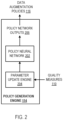
- FIG. 2 shows an example policy generation engine 114.
- the policy generation engine 114 includes a policy neural network 202 that is configured to generate policy network outputs in accordance with the parameters of the policy network 202, and a parameter update engine 204 that is configured to adjust the policy network parameter values.
- Each policy network output 206 generated by the policy network 202 defines a respective data augmentation policy 116.
- each policy network output 206 includes a respective output at each of multiple output positions and each output position corresponds to a different data augmentation policy parameter.
- each policy network output includes, at each output position, a respective value of the corresponding data augmentation policy parameter.
- the policy generation engine 114 uses the policy network 202 to generate one or more policy network outputs 206 in accordance with the current values of the policy network parameters, each of which define a respective data augmentation policy 116.
- the policy network 202 is a recurrent neural network that includes one or more recurrent neural network layers, e.g., long short-term memory (LSTM) layers or gated recurrent unit (GRU) layers.
- the policy network 202 generates a policy network output 206 by sequentially generating the respective data augmentation policy parameter corresponding to each output position in the sequence of output positions of the policy network output 206.
- the policy network 202 receives as input the value of the data augmentation policy parameter corresponding to the preceding output position in the policy network output 206 and processes the input to update a current hidden state of the policy network 202.
- the policy network 202 can process a pre-determined placeholder input.
- the policy network 202 also includes a respective output layer for each output position in the policy network output 206.
- the output layer corresponding to an output position processes the updated hidden state of the policy network 202 corresponding to the output position to generate an output that defines a score distribution over possible values of the data augmentation policy parameter corresponding to the output position.
- the output layer can first project the updated hidden state of the policy network 202 into the appropriate dimensionality for the number of possible values for the corresponding data augmentation policy parameter. Then, the output layer can apply a softmax to the projected hidden state to generate a respective score for each of multiple possible values for the corresponding data augmentation policy parameter.
- the policy network 202 For each output position, the policy network 202 generates the value for the corresponding data augmentation policy parameter by sampling from the score distribution over possible values of the data augmentation policy parameter (i.e., that is generated by the corresponding output layer).
- the possible values that a given data augmentation policy parameter can take are fixed prior to training and the number of possible values can be different for different data augmentation policy parameters.
- the values of the policy network parameters do not change within a time step. However, by sampling the values of the data augmentation policy parameters from score distributions over possible values, the policy network 202 can generate multiple distinct policy network outputs 206 (i.e., which each correspond to a different data augmentation policy 116) at each time step.
- the training system 100 trains a machine learning model using the data augmentation policy 116 and thereafter determines a respective quality measure 110 of the trained machine learning model (as described earlier).
- the parameter update engine 204 uses the quality measures 110 as a reward signal to update the current values of the policy network parameters using a reinforcement learning technique. That is, the parameter update engine 204 adjusts the current values of the policy network parameters by training the policy network to generate policy network outputs that result in increased quality measures of the corresponding data augmentation policies using a reinforcement learning technique. More specifically, the parameter update engine 204 trains the policy network to generate policy network outputs that maximize a received reward that is determined based on the quality measures of the corresponding data augmentation policies.
- the reward for a given policy network output is a function of the quality measure of the data augmentation policy defined by the given policy network output.
- the reward can be one of or directly proportional to one of: the quality measure, the square of the quality measure, the cube of the quality measure, the square root of the quality measure, and so on.
- the parameter update engine 204 trains the policy network 202 to maximize the expected reward using a policy gradient technique.
- the policy gradient technique can be a REINFORCE technique or a Proximal Policy Optimization (PPO) technique.
- the parameter update engine 204 can train the policy network 202 to generate policy network outputs defining data augmentation policies that result in trained machine learning models that have increased performance on the machine learning task. That is, updating the values of the policy network parameters in this manner can increase the expected accuracy on the validation set of machine learning models that are trained using the data augmentation policies proposed by the policy network.
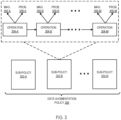
- FIG. 3 is an illustration of an example data augmentation policy 300.
- the data augmentation policy 300 is composed of one or more "sub-policies" 302-A - 302-N.
- Each sub-policy specifies a sequence of transformation operations (e.g., 304-A - 304-M), e.g., image processing operations, e.g., translation, rotation, or shearing operations.
- Each transformation operation has an associated magnitude (e.g., 306-A - 306-M) and an associated probability (e.g., 308-A - 308-M).
- the magnitude of a transformation operation is an ordered collection of one or more numerical values that specifies how the transformation operation should be applied to a training input.
- the magnitude of a translation operation may specify the number of pixels an image should be translated in the x- and y- directions.
- the magnitude of a rotation operation may specify the number of radians by which an image should be rotated.
- a sub-policy is selected from the set of sub-policies included in the data augmentation policy, e.g., by randomly sampling a sub-policy. Then, for each transformation operation in the sequence of transformation operations specified by the selected sub-policy, the transformation operation is applied to the training input with the probability associated with the transformation operation. If the transformation operation is applied to the training input, then it is applied with the magnitude associated with the transformation operation. The transformation operations that are applied to the training input are applied in accordance with the ordering of the transformation operations specified by the sub-policy. An illustration of the effects of applying different sub-policies to an image is shown in FIG. 4 .
- the parameters of the example data augmentation policy 300 include, for each transformation operation of each sub-policy: (i) the type of the transformation operation (e.g., translation, rotation, shearing, etc.), (ii) the magnitude of the transformation operation, and (ii) the probability of applying the transformation operation.
- Each data augmentation policy parameter may have a predetermined set of possible values.
- the type of a transformation operation may be selected from a predetermined set of possible transformation types.
- the magnitude of a transformation operation may have a predetermined number of possible values that are, e.g., uniformly spaced throughout a continuous range of allowable values.
- the continuous range of allowable values may be [0, 2 ⁇ ] radians, and the possible values of the magnitude of the rotation operation may be: 0 ⁇ 2 ⁇ 3 ⁇ 2 .
- the probability of applying a transformation operation may have a predetermined number of possible values that are, e.g., uniformly spaced throughout the range [0,1].
- the possible values of the probability of applying a transformation operation may be: ⁇ 0, 0.2, 0.4, 0.6, 0.8, 1 ⁇ .
- a data augmentation policy may have a predetermined number of sub-policies, and each sub-policy may specify a predetermined number of transformation operations. In some cases, the probability of applying a transformation operation may be 0, resulting in the transformation operation never being applied to training inputs. Designing the space of data augmentation policies in this way can increase the diversity of data augmentation policies that are found.
- a data augmentation policy may have 5 sub-policies, each of which specifies 2 transformation operations. Each transformation operation has respective scalar magnitude and probability values, and can be any of 16 different transformation types.
- the training system 100 may combine a predetermined number of data augmentation policies generated by the training system 100 with the highest quality scores to generate the final data augmentation policy.
- data augmentation policies having the form described with reference to FIG. 3
- multiple data augmentation policies can be combined by aggregating their respective sub-policies into a single, combined data augmentation policy.
- one of the sub-policies from the combined collection of sub-policies may be randomly selected, and the training input may be transformed in accordance with the sequence of transformation operations specified by the randomly selected sub-policy (as described earlier).
- FIG. 4 is an illustration of the effects of applying different sub-policies to an original image 400.
- "sub-policy 1" specifies a sequence of transformation operations including: (i) a equalize operation, with corresponding probability 0.4 and magnitude 4, and (ii) a rotate operation, with corresponding probability 0.8 and magnitude 8 degrees.
- the equalize operation and the rotate operation are described in more detail with reference to FIG. 6 .
- the effects of applying sub-policy 1 to the original image 400 three different times are illustrated by 402, 404, and 406.
- FIG. 4 also illustrates the effects of applying "sub-policy 2", “sub-policy 3", “sub-policy 4", and "sub-policy 5" to the original image 400.
- FIG. 5 shows an example of the performance gains that can be achieved by using the training system described in this specification.
- the error rate of a neural network model trained using a data augmentation policy selected by the training system 100 exceeds some of the best published results for the training data set.
- FIG. 6 describes different types of transformation operations that can be applied to images.
- the value of one of the parameters of any given augmentation policy can define which transformation types from the set of transformation types shown in FIG. 6 is included in the given augmentation policy.
- FIG. 7 is a flow diagram of an example process 700 for automatically selecting a data augmentation policy and using the data augmentation policy to train a machine learning model.
- the process 700 will be described as being performed by a system of one or more computers located in one or more locations.
- a training system e.g., the training system 100 of FIG. 1 , appropriately programmed in accordance with this specification, can perform the process 700.
- the system receives training data for training a machine learning model to perform a particular machine learning task (702).
- the system may receive the training data through an API made available by the system.
- the training data includes multiple training examples, each of which specifies a training input and a corresponding target output.
- the system performs the steps 704-708 of the process 700 at each of multiple time steps. For convenience, each of the steps 704-708 will be described as being performed at a "current" time step.
- the system generates one or more current data augmentation policies based on quality measures of data augmentation policies generated at previous time steps (704). If the current time step is the first time step, then the system may generate the data augmentation policies in any of a variety ways, e.g., by randomly selecting the parameter values defining each data augmentation policy. In one implementation, the system can generate the current data augmentation policies using a policy network that is trained using reinforcement learning techniques based on rewards defined by the quality measures of data augmentation policies generated at previous time steps (e.g., as described with reference to FIG. 2 ). In other implementations, the system can generate the current data augmentation policies using any of a variety of appropriate search techniques, e.g., random search techniques or evolutionary search techniques.
- search techniques e.g., random search techniques or evolutionary search techniques.
- the system trains a machine learning model on the training data using the current data augmentation policy (706).
- the machine learning model is a neural network model and the system trains the neural network model over multiple training iterations.
- the system selects a current "batch" (i.e., set) of one or more training examples, and then determines an "augmented" batch of training examples by transforming the training inputs in the current batch of training examples using the current data augmentation policy.
- the system may adjust the target outputs in the current batch of training examples to account for the transformations applied to the training inputs (as described earlier).
- the system processes the transformed training inputs in accordance with the current parameter values of the machine learning model to generate corresponding outputs.
- the system determines gradients of an objective function that measures a similarity between: (i) the outputs generated by the machine learning model, and (ii) the target outputs specified by the training examples, and uses the gradients to adjust the current values of the machine learning model parameters.
- the system may determine the gradients using, e.g., a backpropagation procedure, and the system may use the gradients to adjust the current values of the machine learning model parameters using any appropriate gradient descent optimization procedure, e.g., an RMSprop or Adam procedure.
- the system determines a quality measure of the current data augmentation policy using the machine learning model after it has been trained using the current data augmentation policy (708).
- the system can determine the quality measure to be a performance measure (e.g., F1 score or mean squared error) of the trained machine learning model on a set of validation data composed of multiple training examples that are not used to train the machine learning model.
- the system can repeatedly perform the steps 704-708 until a search termination criterion is satisfied (e.g., if the steps 704-708 have been performed a predetermined number of times).
- the system selects a final data augmentation policy based on the quality measures of the data augmentation policies generated during steps 704-708 (710). For example, the system may generate the final data augmentation policy by combining a predetermined number of data augmentation policies generated during steps 704-708 that have the highest quality scores.
- the system generates a final trained machine learning model by training a machine learning model on the training data using the final data augmentation policy (712).
- the system may provide the final trained machine learning model to a user of the system. Alternatively or in combination, the system may use the trained machine learning model to process requests received from users.
- the system may train the final machine learning model using the final data augmentation policy for a larger number of training iterations than when the system trains machine learning models using the "current" data augmentation policies generated at step 706. For example, the system may train the final machine learning model using the final data augmentation policy until a convergence criterion is satisfied, e.g., until the prediction accuracy of the final machine learning model evaluated on a validation set reaches a minimum. On the other hand, the system may train each of the current data augmentation policies generated at step 706, for a smaller (e.g., fixed) number of training iterations.
- Embodiments of the subject matter and the functional operations described in this specification can be implemented in digital electronic circuitry, in tangibly-embodied computer software or firmware, in computer hardware, including the structures disclosed in this specification and their structural equivalents, or in combinations of one or more of them.
- Embodiments of the subject matter described in this specification can be implemented as one or more computer programs, i.e., one or more modules of computer program instructions encoded on a tangible non-transitory storage medium for execution by, or to control the operation of, data processing apparatus.
- the computer storage medium can be a machine-readable storage device, a machine-readable storage substrate, a random or serial access memory device, or a combination of one or more of them.
- the program instructions can be encoded on an artificially-generated propagated signal, e.g., a machine-generated electrical, optical, or electromagnetic signal, that is generated to encode information for transmission to suitable receiver apparatus for execution by a data processing apparatus.
- data processing apparatus refers to data processing hardware and encompasses all kinds of apparatus, devices, and machines for processing data, including by way of example a programmable processor, a computer, or multiple processors or computers.
- the apparatus can also be, or further include, special purpose logic circuitry, e.g., an FPGA (field programmable gate array) or an ASIC (application-specific integrated circuit).
- the apparatus can optionally include, in addition to hardware, code that creates an execution environment for computer programs, e.g., code that constitutes processor firmware, a protocol stack, a database management system, an operating system, or a combination of one or more of them.
- a computer program which may also be referred to or described as a program, software, a software application, an app, a module, a software module, a script, or code, can be written in any form of programming language, including compiled or interpreted languages, or declarative or procedural languages; and it can be deployed in any form, including as a stand-alone program or as a module, component, subroutine, or other unit suitable for use in a computing environment.
- a program may, but need not, correspond to a file in a file system.
- a program can be stored in a portion of a file that holds other programs or data, e.g., one or more scripts stored in a markup language document, in a single file dedicated to the program in question, or in multiple coordinated files, e.g., files that store one or more modules, sub-programs, or portions of code.
- a computer program can be deployed to be executed on one computer or on multiple computers that are located at one site or distributed across multiple sites and interconnected by a data communication network.
- engine is used broadly to refer to a software-based system, subsystem, or process that is programmed to perform one or more specific functions.
- an engine will be implemented as one or more software modules or components, installed on one or more computers in one or more locations. In some cases, one or more computers will be dedicated to a particular engine; in other cases, multiple engines can be installed and running on the same computer or computers.
- the processes and logic flows described in this specification can be performed by one or more programmable computers executing one or more computer programs to perform functions by operating on input data and generating output.
- the processes and logic flows can also be performed by special purpose logic circuitry, e.g., an FPGA or an ASIC, or by a combination of special purpose logic circuitry and one or more programmed computers.
- Computers suitable for the execution of a computer program can be based on general or special purpose microprocessors or both, or any other kind of central processing unit.
- a central processing unit will receive instructions and data from a read-only memory or a random access memory or both.
- the essential elements of a computer are a central processing unit for performing or executing instructions and one or more memory devices for storing instructions and data.
- the central processing unit and the memory can be supplemented by, or incorporated in, special purpose logic circuitry.
- a computer will also include, or be operatively coupled to receive data from or transfer data to, or both, one or more mass storage devices for storing data, e.g., magnetic, magneto-optical disks, or optical disks.
- a computer need not have such devices.
- a computer can be embedded in another device, e.g., a mobile telephone, a personal digital assistant (PDA), a mobile audio or video player, a game console, a Global Positioning System (GPS) receiver, or a portable storage device, e.g., a universal serial bus (USB) flash drive, to name just a few.
- PDA personal digital assistant
- GPS Global Positioning System
- USB universal serial bus
- Computer-readable media suitable for storing computer program instructions and data include all forms of non-volatile memory, media and memory devices, including by way of example semiconductor memory devices, e.g., EPROM, EEPROM, and flash memory devices; magnetic disks, e.g., internal hard disks or removable disks; magneto-optical disks; and CD-ROM and DVD-ROM disks.
- semiconductor memory devices e.g., EPROM, EEPROM, and flash memory devices
- magnetic disks e.g., internal hard disks or removable disks
- magneto-optical disks e.g., CD-ROM and DVD-ROM disks.
- embodiments of the subject matter described in this specification can be implemented on a computer having a display device, e.g., a CRT (cathode ray tube) or LCD (liquid crystal display) monitor, for displaying information to the user and a keyboard and a pointing device, e.g., a mouse or a trackball, by which the user can provide input to the computer.
- a display device e.g., a CRT (cathode ray tube) or LCD (liquid crystal display) monitor
- keyboard and a pointing device e.g., a mouse or a trackball
- Other kinds of devices can be used to provide for interaction with a user as well; for example, feedback provided to the user can be any form of sensory feedback, e.g., visual feedback, auditory feedback, or tactile feedback; and input from the user can be received in any form, including acoustic, speech, or tactile input.
- a computer can interact with a user by sending documents to and receiving documents from a device that is used by the user; for example, by sending web pages to a web browser on a user's device in response to requests received from the web browser.
- a computer can interact with a user by sending text messages or other forms of message to a personal device, e.g., a smartphone that is running a messaging application, and receiving responsive messages from the user in return.
- Data processing apparatus for implementing machine learning models can also include, for example, special-purpose hardware accelerator units for processing common and compute-intensive parts of machine learning training or production, i.e., inference, workloads.
- Machine learning models can be implemented and deployed using a machine learning framework, e.g., a TensorFlow framework, a Microsoft Cognitive Toolkit framework, an Apache Singa framework, or an Apache MXNet framework.
- a machine learning framework e.g., a TensorFlow framework, a Microsoft Cognitive Toolkit framework, an Apache Singa framework, or an Apache MXNet framework.
- Embodiments of the subject matter described in this specification can be implemented in a computing system that includes a back-end component, e.g., as a data server, or that includes a middleware component, e.g., an application server, or that includes a front-end component, e.g., a client computer having a graphical user interface, a web browser, or an app through which a user can interact with an implementation of the subject matter described in this specification, or any combination of one or more such back-end, middleware, or front-end components.
- the components of the system can be interconnected by any form or medium of digital data communication, e.g., a communication network. Examples of communication networks include a local area network (LAN) and a wide area network (WAN), e.g., the Internet.
- LAN local area network
- WAN wide area network
- the computing system can include clients and servers.
- a client and server are generally remote from each other and typically interact through a communication network. The relationship of client and server arises by virtue of computer programs running on the respective computers and having a client-server relationship to each other.
- a server transmits data, e.g., an HTML page, to a user device, e.g., for purposes of displaying data to and receiving user input from a user interacting with the device, which acts as a client.
- Data generated at the user device e.g., a result of the user interaction, can be received at the server from the device.
Landscapes
- Engineering & Computer Science (AREA)
- Theoretical Computer Science (AREA)
- Physics & Mathematics (AREA)
- General Physics & Mathematics (AREA)
- Software Systems (AREA)
- Data Mining & Analysis (AREA)
- Artificial Intelligence (AREA)
- Evolutionary Computation (AREA)
- General Engineering & Computer Science (AREA)
- Computing Systems (AREA)
- Mathematical Physics (AREA)
- Life Sciences & Earth Sciences (AREA)
- Health & Medical Sciences (AREA)
- Biophysics (AREA)
- General Health & Medical Sciences (AREA)
- Computational Linguistics (AREA)
- Biomedical Technology (AREA)
- Molecular Biology (AREA)
- Computer Vision & Pattern Recognition (AREA)
- Medical Informatics (AREA)
- Evolutionary Biology (AREA)
- Bioinformatics & Computational Biology (AREA)
- Bioinformatics & Cheminformatics (AREA)
- Physiology (AREA)
- Genetics & Genomics (AREA)
- Multimedia (AREA)
- Databases & Information Systems (AREA)
- Image Analysis (AREA)
- Management, Administration, Business Operations System, And Electronic Commerce (AREA)
- Electrically Operated Instructional Devices (AREA)
Applications Claiming Priority (3)
| Application Number | Priority Date | Filing Date | Title |
|---|---|---|---|
| US201862673777P | 2018-05-18 | 2018-05-18 | |
| EP19728302.1A EP3732628B1 (de) | 2018-05-18 | 2019-05-20 | Erlernen von datenerweiterungsrichtlinien |
| PCT/US2019/033091 WO2019222734A1 (en) | 2018-05-18 | 2019-05-20 | Learning data augmentation policies |
Related Parent Applications (2)
| Application Number | Title | Priority Date | Filing Date |
|---|---|---|---|
| EP19728302.1A Division EP3732628B1 (de) | 2018-05-18 | 2019-05-20 | Erlernen von datenerweiterungsrichtlinien |
| EP19728302.1A Division-Into EP3732628B1 (de) | 2018-05-18 | 2019-05-20 | Erlernen von datenerweiterungsrichtlinien |
Publications (3)
| Publication Number | Publication Date |
|---|---|
| EP4462306A2 true EP4462306A2 (de) | 2024-11-13 |
| EP4462306A3 EP4462306A3 (de) | 2024-12-04 |
| EP4462306B1 EP4462306B1 (de) | 2025-07-02 |
Family
ID=66691084
Family Applications (2)
| Application Number | Title | Priority Date | Filing Date |
|---|---|---|---|
| EP24201809.1A Active EP4462306B1 (de) | 2018-05-18 | 2019-05-20 | Erlernen von datenerweiterungsrichtlinien |
| EP19728302.1A Active EP3732628B1 (de) | 2018-05-18 | 2019-05-20 | Erlernen von datenerweiterungsrichtlinien |
Family Applications After (1)
| Application Number | Title | Priority Date | Filing Date |
|---|---|---|---|
| EP19728302.1A Active EP3732628B1 (de) | 2018-05-18 | 2019-05-20 | Erlernen von datenerweiterungsrichtlinien |
Country Status (6)
| Country | Link |
|---|---|
| US (4) | US10817805B2 (de) |
| EP (2) | EP4462306B1 (de) |
| JP (1) | JP7017640B2 (de) |
| KR (1) | KR102422729B1 (de) |
| CN (2) | CN119647553A (de) |
| WO (1) | WO2019222734A1 (de) |
Families Citing this family (73)
| Publication number | Priority date | Publication date | Assignee | Title |
|---|---|---|---|---|
| US20190377984A1 (en) | 2018-06-06 | 2019-12-12 | DataRobot, Inc. | Detecting suitability of machine learning models for datasets |
| JP6929322B2 (ja) * | 2019-05-31 | 2021-09-01 | 楽天グループ株式会社 | データ拡張システム、データ拡張方法、及びプログラム |
| US11803765B2 (en) * | 2019-05-31 | 2023-10-31 | At&T Intellectual Property I, L.P. | Public policy rule enhancement of machine learning/artificial intelligence solutions |
| EP3789924A1 (de) * | 2019-09-09 | 2021-03-10 | Robert Bosch GmbH | Stochastische datenerweiterung für maschinenlernen |
| JP7353940B2 (ja) * | 2019-11-26 | 2023-10-02 | 株式会社日立製作所 | 転移可能性判定装置、転移可能性判定方法、及び転移可能性判定プログラム |
| CN114981820A (zh) * | 2019-12-20 | 2022-08-30 | 谷歌有限责任公司 | 用于在边缘设备上评估和选择性蒸馏机器学习模型的系统和方法 |
| CN111176564B (zh) * | 2019-12-25 | 2024-02-27 | 三星(中国)半导体有限公司 | 确定ssd内数据摆放策略的方法及装置 |
| CN111339866A (zh) * | 2020-02-18 | 2020-06-26 | 济南浪潮高新科技投资发展有限公司 | 一种基于DPN与Faster RCNN的火车票图像生成方法 |
| CN113379045B (zh) * | 2020-02-25 | 2022-08-09 | 华为技术有限公司 | 数据增强方法和装置 |
| US20210284184A1 (en) * | 2020-03-05 | 2021-09-16 | Waymo Llc | Learning point cloud augmentation policies |
| US11551088B2 (en) | 2020-03-13 | 2023-01-10 | International Business Machines Corporation | Determining optimal augmentations for a training data set |
| JP7484318B2 (ja) * | 2020-03-27 | 2024-05-16 | 富士フイルムビジネスイノベーション株式会社 | 学習装置及び学習プログラム |
| CN115087995A (zh) * | 2020-03-31 | 2022-09-20 | Abb瑞士股份有限公司 | 用于工业车间的特定生产过程的迁移学习方法 |
| CN111582371B (zh) * | 2020-05-07 | 2024-02-02 | 广州视源电子科技股份有限公司 | 一种图像分类网络的训练方法、装置、设备及存储介质 |
| CN111695624B (zh) * | 2020-06-09 | 2024-04-16 | 北京市商汤科技开发有限公司 | 数据增强策略的更新方法、装置、设备及存储介质 |
| US20210406682A1 (en) * | 2020-06-26 | 2021-12-30 | Advanced Micro Devices, Inc. | Quantization of neural network models using data augmentation |
| KR102496030B1 (ko) * | 2020-08-13 | 2023-02-07 | 주식회사 아이오코드 | 데이터 분류를 위한 강화 학습 장치 및 방법 |
| WO2022061277A1 (en) * | 2020-09-21 | 2022-03-24 | Nvidia Corporation | Measuring the effects of augmentation artifacts on a machine learning network |
| US20220101112A1 (en) * | 2020-09-25 | 2022-03-31 | Nvidia Corporation | Neural network training using robust temporal ensembling |
| DE102020212366A1 (de) * | 2020-09-30 | 2022-03-31 | Robert Bosch Gesellschaft mit beschränkter Haftung | Transformieren von Messdaten zwischen verschiedenen Konfigurationen von Messsystemen |
| KR20220049421A (ko) * | 2020-10-14 | 2022-04-21 | 삼성에스디에스 주식회사 | 데이터 증강 기법 스케줄링 장치 및 방법 |
| KR102617753B1 (ko) | 2020-10-26 | 2023-12-27 | 삼성에스디에스 주식회사 | 텍스트 데이터 증강 장치 및 방법 |
| JP7566589B2 (ja) | 2020-11-05 | 2024-10-15 | 株式会社東芝 | 情報処理装置、情報処理方法およびプログラム |
| CN114462628B (zh) * | 2020-11-09 | 2025-05-02 | 华为技术有限公司 | 数据增强方法、装置、计算设备以及计算机可读存储介质 |
| US20220155263A1 (en) * | 2020-11-19 | 2022-05-19 | International Business Machines Corporation | Sound anomaly detection using data augmentation |
| CN112506483B (zh) * | 2020-12-04 | 2024-04-05 | 北京五八信息技术有限公司 | 数据增广方法、装置、电子设备及存储介质 |
| DE102020216017A1 (de) * | 2020-12-16 | 2022-06-23 | Siemens Healthcare Gmbh | Bereitstellen von korrigierten medizinischen Bilddaten |
| CN112651892A (zh) * | 2020-12-22 | 2021-04-13 | 中国科学技术大学 | 一种基于图像样本的自动数据增强策略选择方法 |
| CN114282581B (zh) * | 2021-01-29 | 2023-10-13 | 北京有竹居网络技术有限公司 | 基于数据增强的训练样本获取方法、装置和电子设备 |
| US20220277195A1 (en) * | 2021-02-26 | 2022-09-01 | GE Precision Healthcare LLC | Automated data augmentation in deep learning |
| CN113010762B (zh) * | 2021-03-01 | 2024-05-31 | 北京嘀嘀无限科技发展有限公司 | 数据增强方法、装置、存储介质和电子设备 |
| US11410388B1 (en) * | 2021-03-16 | 2022-08-09 | Huawei Technologies Co., Ltd. | Devices, systems, methods, and media for adaptive augmentation for a point cloud dataset used for training |
| WO2022202456A1 (ja) * | 2021-03-22 | 2022-09-29 | 株式会社日立製作所 | 外観検査方法および外観検査システム |
| CN113139578B (zh) * | 2021-03-23 | 2022-12-06 | 广东省科学院智能制造研究所 | 一种基于最优训练集的深度学习图像分类方法及系统 |
| KR102712122B1 (ko) | 2021-03-24 | 2024-10-02 | 한국전자통신연구원 | 혼합 샘플링 기반 학습 데이터 유형 분류 성능 개선 방법 및 장치 |
| CN113221979B (zh) * | 2021-04-27 | 2023-05-23 | 北京市商汤科技开发有限公司 | 样本的生成方法、神经网络的训练方法以及装置 |
| US20220351071A1 (en) * | 2021-04-30 | 2022-11-03 | Recruit Co., Ltd., | Meta-learning data augmentation framework |
| DE102021204343A1 (de) | 2021-04-30 | 2022-11-03 | Albert-Ludwigs-Universität Freiburg, Körperschaft des öffentlichen Rechts | Steuergerät zum Erzeugen von Trainingsdaten zum Trainieren eines Algorithmus des maschinellen Lernens |
| DE202021102338U1 (de) | 2021-04-30 | 2021-05-14 | Robert Bosch Gesellschaft mit beschränkter Haftung | Steuergerät zum Erzeugen von Trainingsdaten zum Trainieren eines Algorithmus des maschinellen Lernens |
| CN112991346B (zh) * | 2021-05-13 | 2022-04-26 | 深圳科亚医疗科技有限公司 | 用于医学图像分析的学习网络的训练方法和训练系统 |
| EP4102405A1 (de) * | 2021-06-10 | 2022-12-14 | Naver Corporation | Demonstrationskonditioniertes verstärkungslernen für imitation mit wenigen aufnahmen |
| US20230032208A1 (en) * | 2021-07-30 | 2023-02-02 | Oracle International Corporation | Augmenting data sets for machine learning models |
| CN113657742B (zh) * | 2021-08-09 | 2024-04-19 | 武汉科技大学 | 车间调度方法、装置、电子设备及存储介质 |
| CN113642667B (zh) * | 2021-08-30 | 2024-02-02 | 重庆紫光华山智安科技有限公司 | 一种图片增强策略确定方法、装置、电子设备及存储介质 |
| JP7201270B1 (ja) * | 2021-10-28 | 2023-01-10 | 望 窪田 | 情報処理方法、プログラム及び情報処理装置 |
| CN113971644B (zh) * | 2021-10-29 | 2025-06-24 | 际络科技(上海)有限公司 | 基于数据增强策略选择的图像识别方法及装置 |
| DE102021212728A1 (de) | 2021-11-11 | 2023-05-11 | Robert Bosch Gesellschaft mit beschränkter Haftung | Verfahren zum Erzeugen von Trainingsdaten zum Trainieren eines Algorithmus des maschinellen Lernens |
| DE102021212727A1 (de) | 2021-11-11 | 2023-05-11 | Robert Bosch Gesellschaft mit beschränkter Haftung | Verfahren zum Erzeugen von Trainingsdaten zum Trainieren eines Algorithmus des maschinellen Lernens |
| KR102679943B1 (ko) * | 2021-12-06 | 2024-07-02 | 대한민국 | 돼지 임신 진단 장치, 이를 포함하는 돼지 임신 진단 시스템 및 돼지 임신 진단 방법 |
| CN116318481A (zh) * | 2021-12-20 | 2023-06-23 | 华为技术有限公司 | 一种通信方法及装置 |
| KR102879365B1 (ko) * | 2022-01-07 | 2025-11-03 | 기초과학연구원 | 우범 선별 장치 및 그 방법 |
| KR102456513B1 (ko) | 2022-03-04 | 2022-10-20 | 주식회사 테스트웍스 | 생성 모델을 이용한 데이터 증강 처리 시스템 및 그 방법 |
| WO2023193097A1 (en) * | 2022-04-05 | 2023-10-12 | Royal Bank Of Canada | System and method for multi-objective reinforcement learning |
| CN114723010B (zh) * | 2022-04-12 | 2023-05-26 | 重庆大学 | 一种异步事件数据的自动学习增强方法及系统 |
| CN114492215A (zh) * | 2022-04-18 | 2022-05-13 | 南湖实验室 | 利用策略模型辅助训练的gp世界模型及其训练方法 |
| CA3251061A1 (en) * | 2022-05-01 | 2023-11-09 | Zetane Systems Inc. | PRODUCTION OF AN AUGMENTED DATASET TO IMPROVE THE PERFORMANCE OF A MACHINE LEARNING MODEL |
| CN115031363B (zh) * | 2022-05-27 | 2023-11-28 | 约克广州空调冷冻设备有限公司 | 预测空调性能的方法和装置 |
| JP2025524033A (ja) * | 2022-09-16 | 2025-07-25 | ケルス インコーポレイテッド | 画像情報に基づいて感染状態情報を生成する装置及び方法 |
| CN115757273B (zh) * | 2022-10-24 | 2023-09-15 | 江苏中科西北星信息科技有限公司 | 基于云平台的养老政策资料管理方法及系统 |
| CN115601614A (zh) * | 2022-10-28 | 2023-01-13 | 中国农业银行股份有限公司(Cn) | 一种图像识别神经网络训练优化方法、装置和设备 |
| KR102722318B1 (ko) * | 2022-12-12 | 2024-10-25 | 대한민국 | 딥러닝 알고리즘을 이용한 돼지의 초음파 기반 임신 진단 장치 및 방법 |
| US12367587B2 (en) * | 2023-01-03 | 2025-07-22 | Fair Isaac Corporation | Segmentation using zero value features in machine learning |
| CN116310626A (zh) * | 2023-01-06 | 2023-06-23 | 北京百度网讯科技有限公司 | 模型训练及图像处理方法、装置、设备及存储介质 |
| CN118524400A (zh) * | 2023-02-17 | 2024-08-20 | 华为技术有限公司 | 一种通信方法及装置 |
| CN116452621B (zh) * | 2023-03-10 | 2023-12-15 | 广州市易鸿智能装备有限公司 | 一种基于强化学习的理想轮廓生成算法、装置及存储介质 |
| US20240378422A1 (en) * | 2023-05-12 | 2024-11-14 | Fair Isaac Corporation | Multi-variate counterfactual diffusion process |
| CN116957917B (zh) * | 2023-06-19 | 2024-03-15 | 广州极点三维信息科技有限公司 | 一种基于近端策略优化的图像美化方法及装置 |
| JP2025017111A (ja) * | 2023-07-24 | 2025-02-05 | 株式会社東芝 | 機械学習装置、方法及びプログラム |
| KR102647511B1 (ko) * | 2023-08-23 | 2024-03-14 | 주식회사 액션파워 | 대규모 언어 모델의 강화 학습 방법 |
| CN121942154A (zh) * | 2023-09-19 | 2026-04-28 | 华为技术有限公司 | 数据处理方法以及相关装置 |
| EP4575845A1 (de) * | 2023-12-19 | 2025-06-25 | Helsing GmbH | Datensatzergänzung |
| KR20250098328A (ko) | 2023-12-22 | 2025-07-01 | 고려대학교 산학협력단 | 토익 문제 풀이 모델 학습을 위한 유의어/반의어 기반 데이터 증강 장치 및 방법 |
| CN121217722A (zh) * | 2024-06-25 | 2025-12-26 | 华为技术有限公司 | 数据传输方法以及相关装置 |
Family Cites Families (12)
| Publication number | Priority date | Publication date | Assignee | Title |
|---|---|---|---|---|
| US4942516A (en) | 1970-12-28 | 1990-07-17 | Hyatt Gilbert P | Single chip integrated circuit computer architecture |
| US7697789B2 (en) * | 2006-04-28 | 2010-04-13 | Xerox Corporation | System and method for enhancing stored binary images |
| US8700577B2 (en) * | 2009-12-07 | 2014-04-15 | Accenture Global Services Limited GmbH | Method and system for accelerated data quality enhancement |
| US8903167B2 (en) * | 2011-05-12 | 2014-12-02 | Microsoft Corporation | Synthesizing training samples for object recognition |
| US9224058B2 (en) * | 2013-04-05 | 2015-12-29 | Xerox Corporation | Data augmentation method and system for improved automatic license plate recognition |
| CN103984959B (zh) * | 2014-05-26 | 2017-07-21 | 中国科学院自动化研究所 | 一种基于数据与任务驱动的图像分类方法 |
| US10289962B2 (en) * | 2014-06-06 | 2019-05-14 | Google Llc | Training distilled machine learning models |
| US9721559B2 (en) * | 2015-04-17 | 2017-08-01 | International Business Machines Corporation | Data augmentation method based on stochastic feature mapping for automatic speech recognition |
| US20170337486A1 (en) * | 2016-05-17 | 2017-11-23 | Futurewei Technologies, Inc. | Feature-set augmentation using knowledge engine |
| DE202016004627U1 (de) * | 2016-07-27 | 2016-09-23 | Google Inc. | Training eines neuronalen Wertnetzwerks |
| CN106529598B (zh) * | 2016-11-11 | 2020-05-08 | 北京工业大学 | 一种基于不均衡医疗图像数据集的分类方法与系统 |
| CN107368787B (zh) * | 2017-06-16 | 2020-11-10 | 长安大学 | 一种面向深度智驾应用的交通标志识别方法 |
-
2019
- 2019-05-20 KR KR1020207023904A patent/KR102422729B1/ko active Active
- 2019-05-20 EP EP24201809.1A patent/EP4462306B1/de active Active
- 2019-05-20 WO PCT/US2019/033091 patent/WO2019222734A1/en not_active Ceased
- 2019-05-20 CN CN202411540784.7A patent/CN119647553A/zh active Pending
- 2019-05-20 CN CN201980014733.1A patent/CN111758105B/zh active Active
- 2019-05-20 EP EP19728302.1A patent/EP3732628B1/de active Active
- 2019-05-20 JP JP2020544457A patent/JP7017640B2/ja active Active
- 2019-05-20 US US16/417,133 patent/US10817805B2/en active Active
-
2020
- 2020-10-01 US US17/061,103 patent/US12033038B2/en active Active
-
2024
- 2024-02-22 US US18/584,625 patent/US12293266B2/en active Active
-
2025
- 2025-08-06 US US19/292,426 patent/US20260030873A1/en active Pending
Also Published As
| Publication number | Publication date |
|---|---|
| CN119647553A (zh) | 2025-03-18 |
| CN111758105A (zh) | 2020-10-09 |
| US20210019658A1 (en) | 2021-01-21 |
| US20190354895A1 (en) | 2019-11-21 |
| JP7017640B2 (ja) | 2022-02-08 |
| US20240242125A1 (en) | 2024-07-18 |
| KR20200110400A (ko) | 2020-09-23 |
| WO2019222734A1 (en) | 2019-11-21 |
| US12293266B2 (en) | 2025-05-06 |
| EP4462306B1 (de) | 2025-07-02 |
| EP3732628B1 (de) | 2025-02-12 |
| US10817805B2 (en) | 2020-10-27 |
| EP3732628A1 (de) | 2020-11-04 |
| JP2021518939A (ja) | 2021-08-05 |
| US20260030873A1 (en) | 2026-01-29 |
| KR102422729B1 (ko) | 2022-07-19 |
| US12033038B2 (en) | 2024-07-09 |
| EP3732628C0 (de) | 2025-02-12 |
| EP4462306A3 (de) | 2024-12-04 |
| CN111758105B (zh) | 2024-11-12 |
Similar Documents
| Publication | Publication Date | Title |
|---|---|---|
| US12293266B2 (en) | Learning data augmentation policies | |
| US12361326B2 (en) | Training neural networks using data augmentation policies | |
| US12400121B2 (en) | Regularized neural network architecture search | |
| US11803731B2 (en) | Neural architecture search with weight sharing | |
| EP3574454B1 (de) | Lernen der struktur neuronaler netze | |
| US11951622B2 (en) | Domain adaptation using simulation to simulation transfer | |
| EP3782080B1 (de) | Neuronale netze für skalierbares kontinuierliches lernen in domänen mit sequentiell gelernten aufgaben | |
| US20240152809A1 (en) | Efficient machine learning model architecture selection | |
| US11514313B2 (en) | Sampling from a generator neural network using a discriminator neural network | |
| US11941867B2 (en) | Neural network training using the soft nearest neighbor loss | |
| US20260105299A1 (en) | Training neural network systems to perform multiple machine learning tasks | |
| US20250259073A1 (en) | Reinforcement learning through preference feedback |
Legal Events
| Date | Code | Title | Description |
|---|---|---|---|
| PUAI | Public reference made under article 153(3) epc to a published international application that has entered the european phase |
Free format text: ORIGINAL CODE: 0009012 |
|
| STAA | Information on the status of an ep patent application or granted ep patent |
Free format text: STATUS: REQUEST FOR EXAMINATION WAS MADE |
|
| REG | Reference to a national code |
Ref country code: DE Ref legal event code: R079 Free format text: PREVIOUS MAIN CLASS: G06N0003006000 Ipc: G06N0003044000 Ref document number: 602019072202 Country of ref document: DE |
|
| PUAL | Search report despatched |
Free format text: ORIGINAL CODE: 0009013 |
|
| 17P | Request for examination filed |
Effective date: 20240921 |
|
| AC | Divisional application: reference to earlier application |
Ref document number: 3732628 Country of ref document: EP Kind code of ref document: P |
|
| AK | Designated contracting states |
Kind code of ref document: A2 Designated state(s): AL AT BE BG CH CY CZ DE DK EE ES FI FR GB GR HR HU IE IS IT LI LT LU LV MC MK MT NL NO PL PT RO RS SE SI SK SM TR |
|
| AK | Designated contracting states |
Kind code of ref document: A3 Designated state(s): AL AT BE BG CH CY CZ DE DK EE ES FI FR GB GR HR HU IE IS IT LI LT LU LV MC MK MT NL NO PL PT RO RS SE SI SK SM TR |
|
| RIC1 | Information provided on ipc code assigned before grant |
Ipc: G06N 3/067 20060101ALN20241025BHEP Ipc: G06N 20/20 20190101ALN20241025BHEP Ipc: G06N 20/10 20190101ALN20241025BHEP Ipc: G06N 5/01 20230101ALN20241025BHEP Ipc: G06N 3/126 20230101ALN20241025BHEP Ipc: G06N 3/0985 20230101ALI20241025BHEP Ipc: G06N 3/092 20230101ALI20241025BHEP Ipc: G06N 3/045 20230101ALI20241025BHEP Ipc: G06N 3/006 20230101ALI20241025BHEP Ipc: G06N 3/084 20230101ALI20241025BHEP Ipc: G06N 3/044 20230101AFI20241025BHEP |
|
| GRAP | Despatch of communication of intention to grant a patent |
Free format text: ORIGINAL CODE: EPIDOSNIGR1 |
|
| STAA | Information on the status of an ep patent application or granted ep patent |
Free format text: STATUS: GRANT OF PATENT IS INTENDED |
|
| GRAS | Grant fee paid |
Free format text: ORIGINAL CODE: EPIDOSNIGR3 |
|
| RIC1 | Information provided on ipc code assigned before grant |
Ipc: G06N 3/067 20060101ALN20250305BHEP Ipc: G06N 20/20 20190101ALN20250305BHEP Ipc: G06N 20/10 20190101ALN20250305BHEP Ipc: G06N 5/01 20230101ALN20250305BHEP Ipc: G06N 3/126 20230101ALN20250305BHEP Ipc: G06N 3/0985 20230101ALI20250305BHEP Ipc: G06N 3/092 20230101ALI20250305BHEP Ipc: G06N 3/045 20230101ALI20250305BHEP Ipc: G06N 3/006 20230101ALI20250305BHEP Ipc: G06N 3/084 20230101ALI20250305BHEP Ipc: G06N 3/044 20230101AFI20250305BHEP |
|
| INTG | Intention to grant announced |
Effective date: 20250312 |
|
| GRAA | (expected) grant |
Free format text: ORIGINAL CODE: 0009210 |
|
| STAA | Information on the status of an ep patent application or granted ep patent |
Free format text: STATUS: THE PATENT HAS BEEN GRANTED |
|
| AC | Divisional application: reference to earlier application |
Ref document number: 3732628 Country of ref document: EP Kind code of ref document: P |
|
| AK | Designated contracting states |
Kind code of ref document: B1 Designated state(s): AL AT BE BG CH CY CZ DE DK EE ES FI FR GB GR HR HU IE IS IT LI LT LU LV MC MK MT NL NO PL PT RO RS SE SI SK SM TR |
|
| REG | Reference to a national code |
Ref country code: GB Ref legal event code: FG4D |
|
| REG | Reference to a national code |
Ref country code: CH Ref legal event code: EP |
|
| REG | Reference to a national code |
Ref country code: DE Ref legal event code: R096 Ref document number: 602019072202 Country of ref document: DE |
|
| P01 | Opt-out of the competence of the unified patent court (upc) registered |
Free format text: CASE NUMBER: APP_28685/2025 Effective date: 20250616 |
|
| REG | Reference to a national code |
Ref country code: IE Ref legal event code: FG4D |
|
| REG | Reference to a national code |
Ref country code: NL Ref legal event code: MP Effective date: 20250702 |
|
| PG25 | Lapsed in a contracting state [announced via postgrant information from national office to epo] |
Ref country code: PT Free format text: LAPSE BECAUSE OF FAILURE TO SUBMIT A TRANSLATION OF THE DESCRIPTION OR TO PAY THE FEE WITHIN THE PRESCRIBED TIME-LIMIT Effective date: 20251103 |
|
| PG25 | Lapsed in a contracting state [announced via postgrant information from national office to epo] |
Ref country code: NL Free format text: LAPSE BECAUSE OF FAILURE TO SUBMIT A TRANSLATION OF THE DESCRIPTION OR TO PAY THE FEE WITHIN THE PRESCRIBED TIME-LIMIT Effective date: 20250702 |
|
| REG | Reference to a national code |
Ref country code: AT Ref legal event code: MK05 Ref document number: 1810076 Country of ref document: AT Kind code of ref document: T Effective date: 20250702 |
|
| PG25 | Lapsed in a contracting state [announced via postgrant information from national office to epo] |
Ref country code: IS Free format text: LAPSE BECAUSE OF FAILURE TO SUBMIT A TRANSLATION OF THE DESCRIPTION OR TO PAY THE FEE WITHIN THE PRESCRIBED TIME-LIMIT Effective date: 20251102 |
|
| PG25 | Lapsed in a contracting state [announced via postgrant information from national office to epo] |
Ref country code: NO Free format text: LAPSE BECAUSE OF FAILURE TO SUBMIT A TRANSLATION OF THE DESCRIPTION OR TO PAY THE FEE WITHIN THE PRESCRIBED TIME-LIMIT Effective date: 20251002 |
|
| REG | Reference to a national code |
Ref country code: LT Ref legal event code: MG9D |
|
| PG25 | Lapsed in a contracting state [announced via postgrant information from national office to epo] |
Ref country code: AT Free format text: LAPSE BECAUSE OF FAILURE TO SUBMIT A TRANSLATION OF THE DESCRIPTION OR TO PAY THE FEE WITHIN THE PRESCRIBED TIME-LIMIT Effective date: 20250702 |
|
| PG25 | Lapsed in a contracting state [announced via postgrant information from national office to epo] |
Ref country code: FI Free format text: LAPSE BECAUSE OF FAILURE TO SUBMIT A TRANSLATION OF THE DESCRIPTION OR TO PAY THE FEE WITHIN THE PRESCRIBED TIME-LIMIT Effective date: 20250702 |
|
| PG25 | Lapsed in a contracting state [announced via postgrant information from national office to epo] |
Ref country code: HR Free format text: LAPSE BECAUSE OF FAILURE TO SUBMIT A TRANSLATION OF THE DESCRIPTION OR TO PAY THE FEE WITHIN THE PRESCRIBED TIME-LIMIT Effective date: 20250702 |
|
| PG25 | Lapsed in a contracting state [announced via postgrant information from national office to epo] |
Ref country code: GR Free format text: LAPSE BECAUSE OF FAILURE TO SUBMIT A TRANSLATION OF THE DESCRIPTION OR TO PAY THE FEE WITHIN THE PRESCRIBED TIME-LIMIT Effective date: 20251003 |
|
| PG25 | Lapsed in a contracting state [announced via postgrant information from national office to epo] |
Ref country code: CZ Free format text: LAPSE BECAUSE OF FAILURE TO SUBMIT A TRANSLATION OF THE DESCRIPTION OR TO PAY THE FEE WITHIN THE PRESCRIBED TIME-LIMIT Effective date: 20250702 Ref country code: SE Free format text: LAPSE BECAUSE OF FAILURE TO SUBMIT A TRANSLATION OF THE DESCRIPTION OR TO PAY THE FEE WITHIN THE PRESCRIBED TIME-LIMIT Effective date: 20250702 |
|
| PG25 | Lapsed in a contracting state [announced via postgrant information from national office to epo] |
Ref country code: LV Free format text: LAPSE BECAUSE OF FAILURE TO SUBMIT A TRANSLATION OF THE DESCRIPTION OR TO PAY THE FEE WITHIN THE PRESCRIBED TIME-LIMIT Effective date: 20250702 |
|
| PG25 | Lapsed in a contracting state [announced via postgrant information from national office to epo] |
Ref country code: BG Free format text: LAPSE BECAUSE OF FAILURE TO SUBMIT A TRANSLATION OF THE DESCRIPTION OR TO PAY THE FEE WITHIN THE PRESCRIBED TIME-LIMIT Effective date: 20250702 Ref country code: PL Free format text: LAPSE BECAUSE OF FAILURE TO SUBMIT A TRANSLATION OF THE DESCRIPTION OR TO PAY THE FEE WITHIN THE PRESCRIBED TIME-LIMIT Effective date: 20250702 |
|
| PG25 | Lapsed in a contracting state [announced via postgrant information from national office to epo] |
Ref country code: RS Free format text: LAPSE BECAUSE OF FAILURE TO SUBMIT A TRANSLATION OF THE DESCRIPTION OR TO PAY THE FEE WITHIN THE PRESCRIBED TIME-LIMIT Effective date: 20251002 |
|
| PG25 | Lapsed in a contracting state [announced via postgrant information from national office to epo] |
Ref country code: ES Free format text: LAPSE BECAUSE OF FAILURE TO SUBMIT A TRANSLATION OF THE DESCRIPTION OR TO PAY THE FEE WITHIN THE PRESCRIBED TIME-LIMIT Effective date: 20250702 |
|
| REG | Reference to a national code |
Ref country code: DE Ref legal event code: R026 Ref document number: 602019072202 Country of ref document: DE |
|
| PLBI | Opposition filed |
Free format text: ORIGINAL CODE: 0009260 |
|
| PG25 | Lapsed in a contracting state [announced via postgrant information from national office to epo] |
Ref country code: SM Free format text: LAPSE BECAUSE OF FAILURE TO SUBMIT A TRANSLATION OF THE DESCRIPTION OR TO PAY THE FEE WITHIN THE PRESCRIBED TIME-LIMIT Effective date: 20250702 |
|
| REG | Reference to a national code |
Ref country code: CH Ref legal event code: L10 Free format text: ST27 STATUS EVENT CODE: U-0-0-L10-L00 (AS PROVIDED BY THE NATIONAL OFFICE) Effective date: 20260409 |
|
| PG25 | Lapsed in a contracting state [announced via postgrant information from national office to epo] |
Ref country code: DK Free format text: LAPSE BECAUSE OF FAILURE TO SUBMIT A TRANSLATION OF THE DESCRIPTION OR TO PAY THE FEE WITHIN THE PRESCRIBED TIME-LIMIT Effective date: 20250702 |
|
| PG25 | Lapsed in a contracting state [announced via postgrant information from national office to epo] |
Ref country code: IT Free format text: LAPSE BECAUSE OF FAILURE TO SUBMIT A TRANSLATION OF THE DESCRIPTION OR TO PAY THE FEE WITHIN THE PRESCRIBED TIME-LIMIT Effective date: 20250702 |
|
| PLAX | Notice of opposition and request to file observation + time limit sent |
Free format text: ORIGINAL CODE: EPIDOSNOBS2 |
|
| PG25 | Lapsed in a contracting state [announced via postgrant information from national office to epo] |
Ref country code: SK Free format text: LAPSE BECAUSE OF FAILURE TO SUBMIT A TRANSLATION OF THE DESCRIPTION OR TO PAY THE FEE WITHIN THE PRESCRIBED TIME-LIMIT Effective date: 20250702 Ref country code: EE Free format text: LAPSE BECAUSE OF FAILURE TO SUBMIT A TRANSLATION OF THE DESCRIPTION OR TO PAY THE FEE WITHIN THE PRESCRIBED TIME-LIMIT Effective date: 20250702 |