EP4459743A1 - Batteriepack - Google Patents
Batteriepack Download PDFInfo
- Publication number
- EP4459743A1 EP4459743A1 EP24164582.9A EP24164582A EP4459743A1 EP 4459743 A1 EP4459743 A1 EP 4459743A1 EP 24164582 A EP24164582 A EP 24164582A EP 4459743 A1 EP4459743 A1 EP 4459743A1
- Authority
- EP
- European Patent Office
- Prior art keywords
- battery cells
- battery pack
- battery
- portions
- bus bar
- Prior art date
- Legal status (The legal status is an assumption and is not a legal conclusion. Google has not performed a legal analysis and makes no representation as to the accuracy of the status listed.)
- Pending
Links
Images







Classifications
-
- H—ELECTRICITY
- H01—ELECTRIC ELEMENTS
- H01M—PROCESSES OR MEANS, e.g. BATTERIES, FOR THE DIRECT CONVERSION OF CHEMICAL ENERGY INTO ELECTRICAL ENERGY
- H01M10/00—Secondary cells; Manufacture thereof
- H01M10/60—Heating or cooling; Temperature control
- H01M10/61—Types of temperature control
- H01M10/613—Cooling or keeping cold
-
- H—ELECTRICITY
- H01—ELECTRIC ELEMENTS
- H01M—PROCESSES OR MEANS, e.g. BATTERIES, FOR THE DIRECT CONVERSION OF CHEMICAL ENERGY INTO ELECTRICAL ENERGY
- H01M50/00—Constructional details or processes of manufacture of the non-active parts of electrochemical cells other than fuel cells, e.g. hybrid cells
- H01M50/20—Mountings; Secondary casings or frames; Racks, modules or packs; Suspension devices; Shock absorbers; Transport or carrying devices; Holders
-
- H—ELECTRICITY
- H01—ELECTRIC ELEMENTS
- H01M—PROCESSES OR MEANS, e.g. BATTERIES, FOR THE DIRECT CONVERSION OF CHEMICAL ENERGY INTO ELECTRICAL ENERGY
- H01M10/00—Secondary cells; Manufacture thereof
- H01M10/04—Construction or manufacture in general
- H01M10/0422—Cells or battery with cylindrical casing
-
- H—ELECTRICITY
- H01—ELECTRIC ELEMENTS
- H01M—PROCESSES OR MEANS, e.g. BATTERIES, FOR THE DIRECT CONVERSION OF CHEMICAL ENERGY INTO ELECTRICAL ENERGY
- H01M10/00—Secondary cells; Manufacture thereof
- H01M10/60—Heating or cooling; Temperature control
- H01M10/62—Heating or cooling; Temperature control specially adapted for specific applications
- H01M10/625—Vehicles
-
- H—ELECTRICITY
- H01—ELECTRIC ELEMENTS
- H01M—PROCESSES OR MEANS, e.g. BATTERIES, FOR THE DIRECT CONVERSION OF CHEMICAL ENERGY INTO ELECTRICAL ENERGY
- H01M10/00—Secondary cells; Manufacture thereof
- H01M10/60—Heating or cooling; Temperature control
- H01M10/64—Heating or cooling; Temperature control characterised by the shape of the cells
- H01M10/643—Cylindrical cells
-
- H—ELECTRICITY
- H01—ELECTRIC ELEMENTS
- H01M—PROCESSES OR MEANS, e.g. BATTERIES, FOR THE DIRECT CONVERSION OF CHEMICAL ENERGY INTO ELECTRICAL ENERGY
- H01M10/00—Secondary cells; Manufacture thereof
- H01M10/60—Heating or cooling; Temperature control
- H01M10/65—Means for temperature control structurally associated with the cells
- H01M10/653—Means for temperature control structurally associated with the cells characterised by electrically insulating or thermally conductive materials
-
- H—ELECTRICITY
- H01—ELECTRIC ELEMENTS
- H01M—PROCESSES OR MEANS, e.g. BATTERIES, FOR THE DIRECT CONVERSION OF CHEMICAL ENERGY INTO ELECTRICAL ENERGY
- H01M10/00—Secondary cells; Manufacture thereof
- H01M10/60—Heating or cooling; Temperature control
- H01M10/65—Means for temperature control structurally associated with the cells
- H01M10/655—Solid structures for heat exchange or heat conduction
- H01M10/6554—Rods or plates
- H01M10/6555—Rods or plates arranged between the cells
-
- H—ELECTRICITY
- H01—ELECTRIC ELEMENTS
- H01M—PROCESSES OR MEANS, e.g. BATTERIES, FOR THE DIRECT CONVERSION OF CHEMICAL ENERGY INTO ELECTRICAL ENERGY
- H01M10/00—Secondary cells; Manufacture thereof
- H01M10/60—Heating or cooling; Temperature control
- H01M10/65—Means for temperature control structurally associated with the cells
- H01M10/655—Solid structures for heat exchange or heat conduction
- H01M10/6556—Solid parts with flow channel passages or pipes for heat exchange
- H01M10/6557—Solid parts with flow channel passages or pipes for heat exchange arranged between the cells
-
- H—ELECTRICITY
- H01—ELECTRIC ELEMENTS
- H01M—PROCESSES OR MEANS, e.g. BATTERIES, FOR THE DIRECT CONVERSION OF CHEMICAL ENERGY INTO ELECTRICAL ENERGY
- H01M10/00—Secondary cells; Manufacture thereof
- H01M10/60—Heating or cooling; Temperature control
- H01M10/65—Means for temperature control structurally associated with the cells
- H01M10/656—Means for temperature control structurally associated with the cells characterised by the type of heat-exchange fluid
- H01M10/6567—Liquids
-
- H—ELECTRICITY
- H01—ELECTRIC ELEMENTS
- H01M—PROCESSES OR MEANS, e.g. BATTERIES, FOR THE DIRECT CONVERSION OF CHEMICAL ENERGY INTO ELECTRICAL ENERGY
- H01M50/00—Constructional details or processes of manufacture of the non-active parts of electrochemical cells other than fuel cells, e.g. hybrid cells
- H01M50/10—Primary casings; Jackets or wrappings
- H01M50/102—Primary casings; Jackets or wrappings characterised by their shape or physical structure
- H01M50/107—Primary casings; Jackets or wrappings characterised by their shape or physical structure having curved cross-section, e.g. round or elliptic
-
- H—ELECTRICITY
- H01—ELECTRIC ELEMENTS
- H01M—PROCESSES OR MEANS, e.g. BATTERIES, FOR THE DIRECT CONVERSION OF CHEMICAL ENERGY INTO ELECTRICAL ENERGY
- H01M50/00—Constructional details or processes of manufacture of the non-active parts of electrochemical cells other than fuel cells, e.g. hybrid cells
- H01M50/20—Mountings; Secondary casings or frames; Racks, modules or packs; Suspension devices; Shock absorbers; Transport or carrying devices; Holders
- H01M50/204—Racks, modules or packs for multiple batteries or multiple cells
- H01M50/207—Racks, modules or packs for multiple batteries or multiple cells characterised by their shape
- H01M50/213—Racks, modules or packs for multiple batteries or multiple cells characterised by their shape adapted for cells having curved cross-section, e.g. round or elliptic
-
- H—ELECTRICITY
- H01—ELECTRIC ELEMENTS
- H01M—PROCESSES OR MEANS, e.g. BATTERIES, FOR THE DIRECT CONVERSION OF CHEMICAL ENERGY INTO ELECTRICAL ENERGY
- H01M50/00—Constructional details or processes of manufacture of the non-active parts of electrochemical cells other than fuel cells, e.g. hybrid cells
- H01M50/20—Mountings; Secondary casings or frames; Racks, modules or packs; Suspension devices; Shock absorbers; Transport or carrying devices; Holders
- H01M50/244—Secondary casings; Racks; Suspension devices; Carrying devices; Holders characterised by their mounting method
-
- H—ELECTRICITY
- H01—ELECTRIC ELEMENTS
- H01M—PROCESSES OR MEANS, e.g. BATTERIES, FOR THE DIRECT CONVERSION OF CHEMICAL ENERGY INTO ELECTRICAL ENERGY
- H01M50/00—Constructional details or processes of manufacture of the non-active parts of electrochemical cells other than fuel cells, e.g. hybrid cells
- H01M50/20—Mountings; Secondary casings or frames; Racks, modules or packs; Suspension devices; Shock absorbers; Transport or carrying devices; Holders
- H01M50/249—Mountings; Secondary casings or frames; Racks, modules or packs; Suspension devices; Shock absorbers; Transport or carrying devices; Holders specially adapted for aircraft or vehicles, e.g. cars or trains
-
- H—ELECTRICITY
- H01—ELECTRIC ELEMENTS
- H01M—PROCESSES OR MEANS, e.g. BATTERIES, FOR THE DIRECT CONVERSION OF CHEMICAL ENERGY INTO ELECTRICAL ENERGY
- H01M50/00—Constructional details or processes of manufacture of the non-active parts of electrochemical cells other than fuel cells, e.g. hybrid cells
- H01M50/20—Mountings; Secondary casings or frames; Racks, modules or packs; Suspension devices; Shock absorbers; Transport or carrying devices; Holders
- H01M50/262—Mountings; Secondary casings or frames; Racks, modules or packs; Suspension devices; Shock absorbers; Transport or carrying devices; Holders with fastening means, e.g. locks
-
- H—ELECTRICITY
- H01—ELECTRIC ELEMENTS
- H01M—PROCESSES OR MEANS, e.g. BATTERIES, FOR THE DIRECT CONVERSION OF CHEMICAL ENERGY INTO ELECTRICAL ENERGY
- H01M50/00—Constructional details or processes of manufacture of the non-active parts of electrochemical cells other than fuel cells, e.g. hybrid cells
- H01M50/20—Mountings; Secondary casings or frames; Racks, modules or packs; Suspension devices; Shock absorbers; Transport or carrying devices; Holders
- H01M50/262—Mountings; Secondary casings or frames; Racks, modules or packs; Suspension devices; Shock absorbers; Transport or carrying devices; Holders with fastening means, e.g. locks
- H01M50/264—Mountings; Secondary casings or frames; Racks, modules or packs; Suspension devices; Shock absorbers; Transport or carrying devices; Holders with fastening means, e.g. locks for cells or batteries, e.g. straps, tie rods or peripheral frames
-
- H—ELECTRICITY
- H01—ELECTRIC ELEMENTS
- H01M—PROCESSES OR MEANS, e.g. BATTERIES, FOR THE DIRECT CONVERSION OF CHEMICAL ENERGY INTO ELECTRICAL ENERGY
- H01M50/00—Constructional details or processes of manufacture of the non-active parts of electrochemical cells other than fuel cells, e.g. hybrid cells
- H01M50/20—Mountings; Secondary casings or frames; Racks, modules or packs; Suspension devices; Shock absorbers; Transport or carrying devices; Holders
- H01M50/289—Mountings; Secondary casings or frames; Racks, modules or packs; Suspension devices; Shock absorbers; Transport or carrying devices; Holders characterised by spacing elements or positioning means within frames, racks or packs
-
- H—ELECTRICITY
- H01—ELECTRIC ELEMENTS
- H01M—PROCESSES OR MEANS, e.g. BATTERIES, FOR THE DIRECT CONVERSION OF CHEMICAL ENERGY INTO ELECTRICAL ENERGY
- H01M50/00—Constructional details or processes of manufacture of the non-active parts of electrochemical cells other than fuel cells, e.g. hybrid cells
- H01M50/20—Mountings; Secondary casings or frames; Racks, modules or packs; Suspension devices; Shock absorbers; Transport or carrying devices; Holders
- H01M50/289—Mountings; Secondary casings or frames; Racks, modules or packs; Suspension devices; Shock absorbers; Transport or carrying devices; Holders characterised by spacing elements or positioning means within frames, racks or packs
- H01M50/291—Mountings; Secondary casings or frames; Racks, modules or packs; Suspension devices; Shock absorbers; Transport or carrying devices; Holders characterised by spacing elements or positioning means within frames, racks or packs characterised by their shape
-
- H—ELECTRICITY
- H01—ELECTRIC ELEMENTS
- H01M—PROCESSES OR MEANS, e.g. BATTERIES, FOR THE DIRECT CONVERSION OF CHEMICAL ENERGY INTO ELECTRICAL ENERGY
- H01M50/00—Constructional details or processes of manufacture of the non-active parts of electrochemical cells other than fuel cells, e.g. hybrid cells
- H01M50/20—Mountings; Secondary casings or frames; Racks, modules or packs; Suspension devices; Shock absorbers; Transport or carrying devices; Holders
- H01M50/298—Mountings; Secondary casings or frames; Racks, modules or packs; Suspension devices; Shock absorbers; Transport or carrying devices; Holders characterised by the wiring of battery packs
-
- H—ELECTRICITY
- H01—ELECTRIC ELEMENTS
- H01M—PROCESSES OR MEANS, e.g. BATTERIES, FOR THE DIRECT CONVERSION OF CHEMICAL ENERGY INTO ELECTRICAL ENERGY
- H01M50/00—Constructional details or processes of manufacture of the non-active parts of electrochemical cells other than fuel cells, e.g. hybrid cells
- H01M50/30—Arrangements for facilitating escape of gases
-
- H—ELECTRICITY
- H01—ELECTRIC ELEMENTS
- H01M—PROCESSES OR MEANS, e.g. BATTERIES, FOR THE DIRECT CONVERSION OF CHEMICAL ENERGY INTO ELECTRICAL ENERGY
- H01M50/00—Constructional details or processes of manufacture of the non-active parts of electrochemical cells other than fuel cells, e.g. hybrid cells
- H01M50/30—Arrangements for facilitating escape of gases
- H01M50/35—Gas exhaust passages comprising elongated, tortuous or labyrinth-shaped exhaust passages
-
- H—ELECTRICITY
- H01—ELECTRIC ELEMENTS
- H01M—PROCESSES OR MEANS, e.g. BATTERIES, FOR THE DIRECT CONVERSION OF CHEMICAL ENERGY INTO ELECTRICAL ENERGY
- H01M50/00—Constructional details or processes of manufacture of the non-active parts of electrochemical cells other than fuel cells, e.g. hybrid cells
- H01M50/50—Current conducting connections for cells or batteries
- H01M50/502—Interconnectors for connecting terminals of adjacent batteries; Interconnectors for connecting cells outside a battery casing
-
- H—ELECTRICITY
- H01—ELECTRIC ELEMENTS
- H01M—PROCESSES OR MEANS, e.g. BATTERIES, FOR THE DIRECT CONVERSION OF CHEMICAL ENERGY INTO ELECTRICAL ENERGY
- H01M50/00—Constructional details or processes of manufacture of the non-active parts of electrochemical cells other than fuel cells, e.g. hybrid cells
- H01M50/50—Current conducting connections for cells or batteries
- H01M50/502—Interconnectors for connecting terminals of adjacent batteries; Interconnectors for connecting cells outside a battery casing
- H01M50/503—Interconnectors for connecting terminals of adjacent batteries; Interconnectors for connecting cells outside a battery casing characterised by the shape of the interconnectors
-
- H—ELECTRICITY
- H01—ELECTRIC ELEMENTS
- H01M—PROCESSES OR MEANS, e.g. BATTERIES, FOR THE DIRECT CONVERSION OF CHEMICAL ENERGY INTO ELECTRICAL ENERGY
- H01M50/00—Constructional details or processes of manufacture of the non-active parts of electrochemical cells other than fuel cells, e.g. hybrid cells
- H01M50/50—Current conducting connections for cells or batteries
- H01M50/502—Interconnectors for connecting terminals of adjacent batteries; Interconnectors for connecting cells outside a battery casing
- H01M50/505—Interconnectors for connecting terminals of adjacent batteries; Interconnectors for connecting cells outside a battery casing comprising a single busbar
-
- H—ELECTRICITY
- H01—ELECTRIC ELEMENTS
- H01M—PROCESSES OR MEANS, e.g. BATTERIES, FOR THE DIRECT CONVERSION OF CHEMICAL ENERGY INTO ELECTRICAL ENERGY
- H01M50/00—Constructional details or processes of manufacture of the non-active parts of electrochemical cells other than fuel cells, e.g. hybrid cells
- H01M50/50—Current conducting connections for cells or batteries
- H01M50/502—Interconnectors for connecting terminals of adjacent batteries; Interconnectors for connecting cells outside a battery casing
- H01M50/507—Interconnectors for connecting terminals of adjacent batteries; Interconnectors for connecting cells outside a battery casing comprising an arrangement of two or more busbars within a container structure, e.g. busbar modules
-
- H—ELECTRICITY
- H01—ELECTRIC ELEMENTS
- H01M—PROCESSES OR MEANS, e.g. BATTERIES, FOR THE DIRECT CONVERSION OF CHEMICAL ENERGY INTO ELECTRICAL ENERGY
- H01M50/00—Constructional details or processes of manufacture of the non-active parts of electrochemical cells other than fuel cells, e.g. hybrid cells
- H01M50/50—Current conducting connections for cells or batteries
- H01M50/502—Interconnectors for connecting terminals of adjacent batteries; Interconnectors for connecting cells outside a battery casing
- H01M50/509—Interconnectors for connecting terminals of adjacent batteries; Interconnectors for connecting cells outside a battery casing characterised by the type of connection, e.g. mixed connections
- H01M50/51—Connection only in series
-
- H—ELECTRICITY
- H01—ELECTRIC ELEMENTS
- H01M—PROCESSES OR MEANS, e.g. BATTERIES, FOR THE DIRECT CONVERSION OF CHEMICAL ENERGY INTO ELECTRICAL ENERGY
- H01M50/00—Constructional details or processes of manufacture of the non-active parts of electrochemical cells other than fuel cells, e.g. hybrid cells
- H01M50/50—Current conducting connections for cells or batteries
- H01M50/502—Interconnectors for connecting terminals of adjacent batteries; Interconnectors for connecting cells outside a battery casing
- H01M50/514—Methods for interconnecting adjacent batteries or cells
- H01M50/516—Methods for interconnecting adjacent batteries or cells by welding, soldering or brazing
-
- H—ELECTRICITY
- H01—ELECTRIC ELEMENTS
- H01M—PROCESSES OR MEANS, e.g. BATTERIES, FOR THE DIRECT CONVERSION OF CHEMICAL ENERGY INTO ELECTRICAL ENERGY
- H01M50/00—Constructional details or processes of manufacture of the non-active parts of electrochemical cells other than fuel cells, e.g. hybrid cells
- H01M50/50—Current conducting connections for cells or batteries
- H01M50/543—Terminals
- H01M50/547—Terminals characterised by the disposition of the terminals on the cells
- H01M50/55—Terminals characterised by the disposition of the terminals on the cells on the same side of the cell
-
- H—ELECTRICITY
- H01—ELECTRIC ELEMENTS
- H01M—PROCESSES OR MEANS, e.g. BATTERIES, FOR THE DIRECT CONVERSION OF CHEMICAL ENERGY INTO ELECTRICAL ENERGY
- H01M50/00—Constructional details or processes of manufacture of the non-active parts of electrochemical cells other than fuel cells, e.g. hybrid cells
- H01M50/50—Current conducting connections for cells or batteries
- H01M50/543—Terminals
- H01M50/552—Terminals characterised by their shape
- H01M50/559—Terminals adapted for cells having curved cross-section, e.g. round, elliptic or button cells
-
- H—ELECTRICITY
- H01—ELECTRIC ELEMENTS
- H01M—PROCESSES OR MEANS, e.g. BATTERIES, FOR THE DIRECT CONVERSION OF CHEMICAL ENERGY INTO ELECTRICAL ENERGY
- H01M2220/00—Batteries for particular applications
- H01M2220/20—Batteries in motive systems, e.g. vehicle, ship, plane
-
- Y—GENERAL TAGGING OF NEW TECHNOLOGICAL DEVELOPMENTS; GENERAL TAGGING OF CROSS-SECTIONAL TECHNOLOGIES SPANNING OVER SEVERAL SECTIONS OF THE IPC; TECHNICAL SUBJECTS COVERED BY FORMER USPC CROSS-REFERENCE ART COLLECTIONS [XRACs] AND DIGESTS
- Y02—TECHNOLOGIES OR APPLICATIONS FOR MITIGATION OR ADAPTATION AGAINST CLIMATE CHANGE
- Y02E—REDUCTION OF GREENHOUSE GAS [GHG] EMISSIONS, RELATED TO ENERGY GENERATION, TRANSMISSION OR DISTRIBUTION
- Y02E60/00—Enabling technologies; Technologies with a potential or indirect contribution to GHG emissions mitigation
- Y02E60/10—Energy storage using batteries
Definitions
- aspects of one or more embodiments of the present disclosure relate to a battery pack.
- secondary batteries can be charged and discharged, unlike primary batteries that cannot be charged.
- Secondary batteries are used as energy sources for mobile devices, electric vehicles, hybrid vehicles, electric bicycles, uninterruptible power supplies, and the like.
- the secondary batteries may be used in the form of a single battery, or in the form of a module in which a plurality of batteries are connected and bundled together into a unit.
- a small mobile device such as a mobile phone, may operate for a certain period of time with only the output and capacity of a single battery.
- the module kind including a plurality of batteries may be desired due to the higher output and capacity thereof.
- the output voltage or output current may be increased according to the number of batteries embedded therein.
- One or more embodiments of the present disclosure are directed to a battery pack that may prevent or substantially prevent leakage of a coolant while securing heat dissipation performance due to a structure in which a cooling piece containing an insulating fluid is located between battery cells.
- One or more embodiments of the present disclosure are directed to a battery pack that may be easily connected to a chiller, on which the battery pack is to be mounted, of a vehicle by including first and second heat conductive surfaces formed by bending ends (e.g., both ends or opposite ends) of a cooling piece.
- One or more embodiments of the present disclosure are directed to a battery pack that may minimize or reduce energy density loss by including a structure in which mounting portions and first and second terminals are arranged in spaces between battery cells.
- One or more embodiments of the present disclosure are directed to a battery pack that may increase the allowable current capacity and minimize or reduce loss due to a resistance.
- One or more embodiments of the present disclosure are directed to a battery pack that includes a bus bar having different thicknesses for different regions to improve the welding quality of the bus bar.
- One or more embodiments of the present disclosure are directed to a battery pack that may facilitate a gas discharge when an ignition event occurs by including a structure of a venting portion formed on the lower surface of the battery pack.
- a battery pack includes: a plurality of battery cells in a plurality of columns, the battery cells in each of the columns being located along a column direction, and the battery cells in the columns adjacent to each other being located along a zigzag pattern in a row direction while alternately shifted forward and rearward in the column direction; a plurality of cooling pieces, each of the cooling pieces being located between the battery cells in the columns adjacent to each other, and extending in a meander shape along an outer circumference of the battery cells in the columns adjacent to each other; and a bus bar on a terminal surface of the battery cells to electrically connect the battery cells to each other in rows adjacent to each other, the terminal surface being a surface on which different first and second electrodes are exposed.
- extra spaces may be located at a position behind the battery cells in a column shifted forward, and at a position in front of the battery cells in a column shifted rearward from among the battery cells in the columns adjacent to each other.
- the extra spaces may be located in at least one position from among mounting portions of first and second holders configured to accommodate the plurality of battery cells, or first and second terminals configured to draw electrical outputs of the plurality of battery cells.
- each of the cooling pieces may include first and second heat conductive surfaces at opposite ends, respectively, that may be bent in a direction crossing the column direction outside the plurality of battery cells.
- the bus bar may include: first portions connected to the first electrodes of the battery cells of a first group; second portions connected to the second electrodes of the battery cells of a second group adjacent to the first group in the row direction; and connection portions connecting the first and second portions to each other.
- the bus bar may include a plurality of bus bar units, and the plurality of bus bar units may be located in a zigzag pattern along the row direction.
- a thickness of at least one of the first portions, the second portions, or the connection portions may be different from thicknesses of the others.
- the thicknesses of the first and second portions may be less than the thickness of the connection portions.
- the first portions may be welded and coupled to the first electrodes of the battery cells of the first group, and the second portions may be welded and coupled to the second electrodes of the battery cells of the second group.
- the thicknesses of each of the first and second portions may be 0.5 mm or less, and the thickness of the connection portions may be 0.8 mm or more.
- the battery pack may further include a venting portion on a bottom surface of the battery pack, the venting portion having a pillar structure protruding in a vertical direction from a lower surface of the battery cells.
- the cooling pieces may be configured to accommodate an insulating fluid therein.
- the battery pack may further include first and second holders configured to accommodate the plurality of battery cells.
- the first and second holders may include a plurality of hooks on outer surfaces thereof.
- a specific process order may be different from the described order.
- two consecutively described processes may be performed at the same or substantially at the same time, or may be performed in an order opposite to the described order.
- the x-axis, the y-axis, and the z-axis are not limited to three axes of the rectangular coordinate system, and may be interpreted in a broader sense.
- the x-axis, the y-axis, and the z-axis may be perpendicular to or substantially perpendicular to one another, or may represent different directions from each other that are not perpendicular to one another.
- first,” “second,” “third,” etc. may be used herein to describe various elements, components, regions, layers and/or sections, these elements, components, regions, layers and/or sections should not be limited by these terms. These terms are used to distinguish one element, component, region, layer or section from another element, component, region, layer or section. Thus, a first element, component, region, layer or section described below could be termed a second element, component, region, layer or section, without departing from the scope of the present disclosure.
- the expression "A and/or B” denotes A, B, or A and B. Expressions such as “at least one of,” when preceding a list of elements, modify the entire list of elements and do not modify the individual elements of the list. For example, the expression “at least one of a, b, or c,” “at least one of a, b, and c,” and “at least one selected from the group consisting of a, b, and c" indicates only a, only b, only c, both a and b, both a and c, both b and c, all of a, b, and c, or variations thereof.
- the term “substantially,” “about,” and similar terms are used as terms of approximation and not as terms of degree, and are intended to account for the inherent variations in measured or calculated values that would be recognized by those of ordinary skill in the art. Further, the use of “may” when describing embodiments of the present disclosure refers to “one or more embodiments of the present disclosure.” As used herein, the terms “use,” “using,” and “used” may be considered synonymous with the terms “utilize,” “utilizing,” and “utilized,” respectively.
- a battery pack according to one or more embodiments of the present disclosure will first be described with reference to FIGS. 1 , 2 , and 8 .
- FIG. 1 is a perspective view showing a battery pack 1 according to one or more embodiments.
- FIG. 2 is an exploded perspective view of the battery pack 1 of FIG. 1 .
- FIG. 8 is a view showing first and second electrodes E1 and E2 of a battery cell according to one or more embodiments.
- the battery pack 1 may include a plurality of battery cells 10.
- Battery cells 10 are shown as being cylibdrical.
- the plurality of battery cells 10 may be arranged in a plurality of columns of the battery cells 10.
- the battery cells 10 in each of the columns are arranged along a column direction.
- the battery cells 10 in the columns adjacent to each other are arranged in a zigzag pattern along a row direction, while alternately shifting forward and rearward in the column direction.
- the axis of each battery extends in a direction perpendicular to the column and row directions.
- the battery pack 1 includes a plurality of cooling pieces 20, each of which is located between the battery cells in corresponding columns adjacent to each other, and extends in a meander shape along an outer circumference of the battery cells in the corresponding columns adjacent to each other.
- the meander shape may follow the contours of the battery cells in the column direction in view of the zigzag pattern in the row direction, and may be a substantially regular wave shape along at least a portion of the cooling piece. In other words the meander shape may be determined by the arrangement of the plurality of battery cells.
- a bus bar 50 is provided on a terminal surface of each of the battery cells 10, on which different first and second electrodes E1 and E2 are formed together, so that the battery cells 10 in rows adjacent to each other are electrically connected to each other.
- Each of the battery cells 10 may be a cylindrical battery cell including the first electrode E1 formed in the middle of an upper terminal and protruding upward, the second electrode E2 defining a circumferential surface surrounding (e.g., around a periphery of) the first electrode E1, and an outer circumferential surface 11 having a cylindrical shape.
- a height direction may refer to the length that represents the longest dimension of the battery cell 10.
- the height direction of the battery pack 1 may be the same as the height direction of the battery cell 10.
- a side at a high height may represent the upper side and a side at a low height may represent the lower side.
- the first and second electrodes E1 and E2 on the same side of the battery cell 10 in the height direction may include electrodes having different polarities from each other through which charging/discharging currents are input or output.
- the electrodes having different polarities from each other, through which the charging/discharging currents are input or output, are all formed at one end selected from among first and second ends of the battery cell 10 that are opposite to each other in the height direction.
- different portions on one end of the battery cell 10 may have the positive polarity and the negative polarity, respectively.
- the present disclosure is not limited thereto, and the battery cell 10 may have any suitable shape, such as a prismatic shape.
- the battery pack 1 according to one or more embodiments may be mounted on a means of transportation, such as a vehicle, to provide a movement power. Therefore, the battery pack 1 may include a battery cell 10 having a large capacity, or may include a plurality of battery cells 10 in order to provide the desired output performance.
- the bus bar 50 may include a plurality of bus bar units 50 that electrically connect the battery cells 10 in adjacent rows to each other.
- the bus bar 50 may include a first portion 50a1 connected to the first electrode E1 of each of the battery cells 10 in the adjacent rows, a second portion 50a2 connected to the second electrode E2 of each of the battery cells 10 in the adjacent rows, and a connection portion CP connecting the first and second portions 50a1 and 50a2 to each other.
- the bus bar 50 may electrically connect the battery cells 10 to each other in the rows adjacent to each other (e.g., the adjacent rows).
- the first portion 50a1 of the bus bar 50 may protrude toward the first electrode E1 of the battery cell 10, and the first portion 50a1 of the bus bar 50 may be welded and coupled to the first electrode E1 of the battery cell 10.
- the second portion 50a2 of the bus bar 50 may protrude toward the second electrode E2 of the battery cell 10 (e.g., the adjacent battery cell 10), and the second portion 50a2 of the bus bar 50 may be welded and coupled to the second electrode E2 of the battery cell 10 (e.g., the adjacent battery cell 10).
- first and second holders 30 and 40 may accommodate the plurality of battery cells 10.
- the first holder 30 may hold upper sides of the plurality of battery cells 10.
- the second holder 40 may hold lower sides of the plurality of battery cells 10.
- the first and second holders 30 and 40 may accommodate the plurality of battery cells 10 from above and below, respectively, and protect the battery cells 10 accommodated therein from the outside.
- the battery pack 1 may be mounted on a means of transportation, such as the vehicle, and thus, it may be desirable for the battery pack 1 to have an appropriate strength against a collision with the means of transportation (e.g., when the means of transportation is in an accident and the like).
- the first and second holders 30 and 40 may include a metal material having a suitable ductility and an appropriate strength, so as to not be broken or damaged by an external impact.
- a brittle material such as plastic or a synthetic resin, may be broken or damaged by an external impact, and thus, the first and second holders 30 and 40 according to one or more embodiments may include the metal material, for example, such as aluminum.
- first and second holders 30 and 40 may function as heat sinks for a cooling fluid that cools the battery cells 10, in addition to providing a space for accommodating the battery cells 10 therein, and thus, the first and second holders 30 and 40 may include a metal material having a suitable thermal conductivity (e.g., a high or excellent thermal conductivity), such as aluminum.
- a suitable thermal conductivity e.g., a high or excellent thermal conductivity
- the bus bar 50 may be disposed on the upper sides of the plurality of battery cells 10, and may be coupled to the first and second electrodes E1 and E2 arranged on the upper terminal surfaces of the plurality of battery cells 10.
- the bus bar 50 may be located between the plurality of battery cells 10 and a top cover 70.
- a sensing flexible printed circuit 60 may be located between the top cover 70 and the plurality of battery cells 10.
- FIG. 3A is a reversed perspective view of the battery pack of FIG. 1 .
- FIG. 3A is a view in which the battery pack 1 of FIG. 1 is viewed upside down.
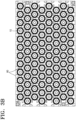
- FIG. 3B is a plan view of the battery pack 1 of FIG. 1 when viewed in the direction A.
- the battery pack 1 may include venting portions 80 formed on a bottom surface (e.g., the lower surface) of the battery pack 1.
- each of the venting portions 80 may have a pillar structure that protrudes in the vertical direction (e.g., the A direction) from the lower surface of the battery cell 10.
- a first venting portion 80a may be provided between three adjacent battery cells 10, and a second venting portion 80b may be provided between the second holder 40 and two adjacent battery cells 10 adjacent to the second holder 40.
- Both the first venting portion 80a and the second venting portion 80b may have a polygonal prism shape.
- the first venting portion 80a may have a hexagonal prism shape
- the second venting portion 80b may have an irregular hexagonal prism shape that includes a portion connected to the second holder 40.
- Each of the first and second venting portions 80a and 80b has a structure protruding in a pillar shape from the lower surface of the battery cell 10, and thus, spaces are formed between the lower surfaces of the battery cells 10 and the outermost surface of the battery pack 1.
- an event such as an ignition, an explosion, or a fire of the battery pack 1
- an event such as an ignition, an explosion, or a fire of the battery pack 1
- FIG. 4 is a view of the battery pack 1 of FIG. 1 when viewed in the direction B.
- FIG. 6A is a view showing an arrangement configuration of the plurality of battery cells 10 and the cooling pieces 20 according to one or more embodiments.
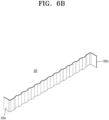
- FIG. 6B is a view showing a shape of each of the cooling pieces 20 according to one or more embodiments.
- the cooling pieces 20 may be located between the battery cells 10 in the columns adjacent to each other, and extends in a meander shape along the outer circumference of the battery cells 10 in the columns adjacent to each other.
- First and second heat conductive surfaces 20a and 20b may be formed at one end and another end (e.g., an opposite end) of the cooling piece 20, respectively.
- the first and second heat conductive surfaces 20a and 20b may be bent, in a direction crossing the column direction of the plurality of battery cells 10, on the outside of the plurality of battery cells 10, for example, in regions formed by the outer surfaces of the first and second holders 30 and 40.
- the first and second heat conductive surfaces 20a and 20b may be bent at 90 degrees, and thus, may be in contact with the outer surfaces of the first and second holders 30 and 40. Consequently, both ends (e.g., opposite ends) of the cooling piece 20 in contact with the plurality of battery cells 10 may be not located in the inner space formed by the first and second holders 30 and 40 that accommodate the plurality of battery cells 10, and may be located in the outer space of the first and second holders 30 and 40. Therefore, it may be possible to more easily connect the first and second heat conductive surfaces 20a and 20b to a chiller of a vehicle.
- the area of the first and second heat conductive surfaces 20a and 20b exposed to the outside may exceed half of the area of the outer surfaces of the first and second holders 30 and 40. Therefore, it may be possible to more easily connect the first and second heat conductive surfaces 20a and 20b to the chiller of the vehicle.
- an insulating fluid may be accommodated in the cooling pieces 20.
- the structure in which the insulating fluid is accommodated inside the cooling pieces 20 may increase the thermal conductivity of the cooling pieces 20, and thus, it may be possible to prevent or substantially prevent the cooling fluid from entering electric components of the battery pack 1 or leaking to the outside of the battery pack 1.
- a plurality of hooks h may be formed on the outside of the first and second holders 30 and 40.
- the plurality of hooks h may establish hook-coupling between the top cover 70 and the first holder 30, and may facilitate hook-coupling between the first holder 30 and the second holder 40.
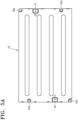
- FIG. 5A is a plan view of the battery pack 1 of FIG. 1 when viewed in the direction C.
- FIG. 5B is a plan view of the battery pack 1 shown in a state in which the top cover 70 and the bus bar 50 are removed from the view of FIG. 5A .
- extra spaces may be formed at a position (e.g., the rear position) behind the battery cells 10 in a column shifted forward, and at a position (e.g., the front position) in front of the battery cells 10 in a column shifted rearward from among the battery cells 10 in the columns adjacent to each other.
- the extra spaces may be provided at positions of mounting portions 53a, 53b, 53c, and 53d of the first and second holders 30 and 40 for accommodating the plurality of battery cells 10, and at first and second terminals 51 and 52 for drawing electrical outputs of the plurality of battery cells 10.
- the positions of the mounting portions 53a, 53b, 53c, and 53d and the first and second terminals 51 and 52 are at the extra spaces between the plurality of battery cells 10 that are cylindrical battery cells, the utilization of the space may be improved, and the energy density of the battery pack 1 may be increased.
- two mounting portions 53a and 53d and the first terminal 51 between the two mounting portions 53a and 53d may be arranged on one side of the first and second holders 30 and 40.
- two mounting portions 53b and 53c and the second terminal 52 between the two mounting portions 53b and 53c may be arranged on another side (e.g., an opposite side) of the first and second holders 30 and 40.
- FIG. 7A is a view showing a portion of a plurality of bus bar units 50, 50', and 50" according to one or more embodiments.
- FIG. 7B is a view in which the plurality of bus bar units 50, 50', and 50" of FIG. 7A are viewed from another angle.
- FIG. 8 is a view showing the first and second electrodes E1 and E2 of the battery cell 10 according to one or more embodiments.
- FIG. 9A is a view showing the shape of the bus bar 50 according to one or more embodiments.
- FIG. 9B is a cross-sectional view taken along the line A-A' of FIG. 9A , and shows a state in which the battery cells 10 are coupled to the bus bar 50.
- the bus bar 50 may include the plurality of bus bar units 500, 50', and 50".
- the longitudinal direction of the plurality of bus bar units 500, 50', and 50" is in the row direction, and the bus bar units 500, 50', and 50" may connect the first electrodes E1 of the battery cells 10 in a first group Ga, which are adjacent to each other in the row direction, to the second electrodes E2 of the battery cells 10 in a second group Gb adjacent to the first group Ga (e.g., in the column direction).
- the plurality of bus bar units 500, 50', and 50" may connect the plurality of battery cells 10 arranged along the column direction to each other.
- the plurality of bus bar units 500, 50', and 50" may be arranged in a zigzag pattern in the row direction.
- FIG. 7A illustrates only three bus bar units 500, 50', and 50", but the present disclosure is not limited thereto, and the number of bus bar units may vary as needed or desired.
- the bus bar unit 500 may include the first portion 50a1 coupled to the first electrode E1 of one battery cell 10 in one column of the battery cells 10, and the second portion 50a2 coupled to the second electrode E2 of a battery cell 10 adjacent to the one battery cell 10 in the same column.
- the bus bar unit 50' may include a first portion 50'a1 coupled to the first electrode E1 of one battery cell 10 in one column of the battery cells 10, and a second portion 50'a2 coupled to the second electrode E2 of a battery cell 10 adjacent to the one battery cell 10 in the same column.
- the second portion 50'a2 of the bus bar unit 50' may correspond to a first portion 50b1, of the bus bar unit 500 adjacent to the bus bar unit 50', which is coupled to the first electrode E1 of another battery cell 10 coupled to the second portion 50'a2.
- the first portion 50b1 has a circular shape corresponding to the shape of the first electrode E1
- the second portion 50'a2 has an arc shape corresponding to the shape of the second electrode E2.
- the first portion 50b1 and the second portion 50'a2 may be arranged such that the first portion 50b1 is inserted into a space in the arc shape of the second portion 50'a2.
- one battery cell 10 from among the battery cells 10 in one column and one battery cell 10 from among the battery cells 10 in another column adjacent to the one column can be connected to each other while being offset from each other.
- the bus bar 50 includes the plurality of bus bar units, and the plurality of first and second portions are arranged to be offset from each other in the bus bar.
- This configuration may represent the entire configuration, and thus, other bus bars and first and second portions of the bus bars in regions other than the above-described region are also arranged in the same structure and pattern.
- the bus bar 50 and the first and second portions 50a1 and 50a2 may be defined by the description of the above reference numerals.
- the thickness of at least one of the first portion 50a1, the second portion 50a2, or the connection portion CP of the bus bar 50 may be different from the thicknesses of the others.
- the thicknesses w 1 and w 2 of the first and second portions 50a1 and 50a2 may be less than the thickness w 3 of the connection portion CP.
- the first portion 50a1 may be welded and coupled to the first electrode E1 of the battery cell 10
- the second portion 50a2 may be welded and coupled to the second electrode E2 of the battery cell 10 (e.g., the adjacent battery cell).
- the bus bar 50 may have a suitable thickness (e.g., a certain thickness) in order to satisfy current capacity as a current collector. However, if the thickness of the bus bar 50 is too large, a welding quality between the bus bar 50 and the battery cells 10 may be deteriorated.
- a suitable thickness e.g., a certain thickness
- the thickness of the bus bar 50 in a region in which the bus bar 50 is welded to the electrodes of the battery cells 10 is less than the thickness of the bus bar 50 in a region that is not welded. Therefore, it may be possible to satisfy the current capacity of the bus bar 50 and minimize or reduce loss due to a resistance, and at the same time, to satisfy the welding quality at welding sites between the bus bar 50 and the first and second electrodes E1 and E2 of the battery cells 10.
- the thicknesses w 1 and w 2 of the first and second portions 50a1 and 50a2 may be 0.5 mm or less, and the thickness w 3 of the connection portion CP may be 0.8 mm or more.
- the thicknesses w 1 and w 2 of the first and second portions 50a1 and 50a2 are 0.5 mm or less, the welding quality may be secured during laser welding.
- the thicknesses w 1 and w 2 of the first and second portions 50a1 and 50a2 exceed 0.5 mm, it may be difficult to ensure the welding quality.
- the electrical connection between the battery cells 10 might not satisfy a reference value of the battery pack 1 due to insufficient current capacity.
- the battery pack according to one or more embodiments of the present disclosure may prevent or substantially prevent leakage of a coolant, and may secure heat dissipation performance by including the structure in which the cooling piece containing the insulating fluid is located between the battery cells.
- the battery pack according to one or more embodiments of the present disclosure may be easily connected to a chiller of a vehicle, on which the battery pack is to be mounted, by including the first and second heat conductive surfaces formed by bending both ends (e.g., opposite ends) of the cooling piece.
- the battery pack according to one or more embodiments of the present disclosure may minimize or reduce energy density loss by including the structure in which the mounting portions and the first and second terminals are arranged in spaces between the battery cells.
- the battery pack according to one or more embodiments of the present disclosure may increase the allowable current capacity and minimize or reduce loss due to a resistance by including the bus bar.
- the battery pack according to one or more embodiments of the present disclosure may improve the welding quality of the bus bar by having different thicknesses for different regions of the bus bar.
- the battery pack according to one or more embodiments of the present disclosure may facilitate a gas discharge, even if an ignition event occurs in the battery pack, by including the structure of the venting portion formed on the lower surface of the battery pack.
Landscapes
- Chemical & Material Sciences (AREA)
- Chemical Kinetics & Catalysis (AREA)
- Electrochemistry (AREA)
- General Chemical & Material Sciences (AREA)
- Engineering & Computer Science (AREA)
- Manufacturing & Machinery (AREA)
- Aviation & Aerospace Engineering (AREA)
- Connection Of Batteries Or Terminals (AREA)
- Battery Mounting, Suspending (AREA)
Applications Claiming Priority (1)
| Application Number | Priority Date | Filing Date | Title |
|---|---|---|---|
| KR1020230036724A KR20240142129A (ko) | 2023-03-21 | 2023-03-21 | 배터리 팩 |
Publications (1)
| Publication Number | Publication Date |
|---|---|
| EP4459743A1 true EP4459743A1 (de) | 2024-11-06 |
Family
ID=90368106
Family Applications (1)
| Application Number | Title | Priority Date | Filing Date |
|---|---|---|---|
| EP24164582.9A Pending EP4459743A1 (de) | 2023-03-21 | 2024-03-19 | Batteriepack |
Country Status (4)
| Country | Link |
|---|---|
| US (1) | US20240322292A1 (de) |
| EP (1) | EP4459743A1 (de) |
| KR (1) | KR20240142129A (de) |
| CN (1) | CN118693397A (de) |
Citations (4)
| Publication number | Priority date | Publication date | Assignee | Title |
|---|---|---|---|---|
| US20190148681A1 (en) * | 2017-11-13 | 2019-05-16 | Lg Chem, Ltd. | Battery module having heat pipe and battery pack including the same |
| WO2022149964A1 (ko) * | 2021-01-11 | 2022-07-14 | 주식회사 엘지에너지솔루션 | 배터리 팩 및 이를 포함하는 자동차 |
| CN217158421U (zh) * | 2022-01-29 | 2022-08-09 | 湖北亿纬动力有限公司 | 一种电芯模组及电池系统 |
| CN115020901A (zh) * | 2021-03-04 | 2022-09-06 | 株式会社Lg新能源 | 电池组以及包含该电池组的汽车 |
-
2023
- 2023-03-21 KR KR1020230036724A patent/KR20240142129A/ko active Pending
- 2023-10-10 US US18/484,226 patent/US20240322292A1/en active Pending
-
2024
- 2024-03-15 CN CN202410299502.2A patent/CN118693397A/zh active Pending
- 2024-03-19 EP EP24164582.9A patent/EP4459743A1/de active Pending
Patent Citations (7)
| Publication number | Priority date | Publication date | Assignee | Title |
|---|---|---|---|---|
| US20190148681A1 (en) * | 2017-11-13 | 2019-05-16 | Lg Chem, Ltd. | Battery module having heat pipe and battery pack including the same |
| WO2022149964A1 (ko) * | 2021-01-11 | 2022-07-14 | 주식회사 엘지에너지솔루션 | 배터리 팩 및 이를 포함하는 자동차 |
| EP4181276A1 (de) * | 2021-01-11 | 2023-05-17 | LG Energy Solution, Ltd. | Batteriepack und fahrzeug damit |
| CN115020901A (zh) * | 2021-03-04 | 2022-09-06 | 株式会社Lg新能源 | 电池组以及包含该电池组的汽车 |
| EP4184686A1 (de) * | 2021-03-04 | 2023-05-24 | LG Energy Solution, Ltd. | Batteriepack und fahrzeug damit |
| CN217158421U (zh) * | 2022-01-29 | 2022-08-09 | 湖北亿纬动力有限公司 | 一种电芯模组及电池系统 |
| EP4243173A1 (de) * | 2022-01-29 | 2023-09-13 | Eve Power Co., Ltd. | Batteriezellenmodul und batteriesystem |
Also Published As
| Publication number | Publication date |
|---|---|
| KR20240142129A (ko) | 2024-09-30 |
| US20240322292A1 (en) | 2024-09-26 |
| CN118693397A (zh) | 2024-09-24 |
Similar Documents
| Publication | Publication Date | Title |
|---|---|---|
| US11139529B2 (en) | Cylindrical battery cell assembly with improved space utilization and safety, and battery module comprising same | |
| US11594776B2 (en) | Battery module including heat shrinkable tube | |
| US12525682B2 (en) | Battery module including flame-retardant sheet, and battery rack and energy storage system including the same | |
| JP5259599B2 (ja) | バッテリーモジュールインタフェース | |
| EP3761396B1 (de) | Batteriemodul mit schutzabdeckung zur abdeckung einer flexiblen leiterplatte | |
| US11888181B2 (en) | Battery pack including insulating tube | |
| US9178206B2 (en) | Battery module | |
| US12183952B2 (en) | Battery pack with enhanced structure for preventing short circuit and shock | |
| US20240291051A1 (en) | Battery pack | |
| KR20200086957A (ko) | 내부 플레이트를 포함한 배터리 모듈 | |
| US8889279B2 (en) | Battery pack | |
| US20230095885A1 (en) | Battery module, battery pack comprising the same, and vehicle | |
| JP7045596B2 (ja) | 円筒型二次電池モジュール | |
| KR20200086959A (ko) | 모듈 케이스를 구비한 배터리 모듈 | |
| EP3367463B1 (de) | Batteriemodul sowie batteriepack und fahrzeug damit | |
| KR20190001424A (ko) | 이차 전지 | |
| US12494554B2 (en) | Battery module having flexible busbar | |
| EP4459743A1 (de) | Batteriepack | |
| KR20230097896A (ko) | 로지컬 셀, 이차전지 모듈 및 이를 포함하는 이차전지 팩 | |
| EP4439825A2 (de) | Batteriepack | |
| US20260121262A1 (en) | Battery module | |
| US20240322387A1 (en) | Battery pack | |
| KR102090310B1 (ko) | 파우치셀용 하우징 및 상기 하우징을 구비한 파우치셀 유니트 | |
| CN121601924A (zh) | 电池组和电动装置 | |
| CN121970203A (zh) | 电池组和包括该电池组的电气设备 |
Legal Events
| Date | Code | Title | Description |
|---|---|---|---|
| PUAI | Public reference made under article 153(3) epc to a published international application that has entered the european phase |
Free format text: ORIGINAL CODE: 0009012 |
|
| STAA | Information on the status of an ep patent application or granted ep patent |
Free format text: STATUS: REQUEST FOR EXAMINATION WAS MADE |
|
| 17P | Request for examination filed |
Effective date: 20240319 |
|
| AK | Designated contracting states |
Kind code of ref document: A1 Designated state(s): AL AT BE BG CH CY CZ DE DK EE ES FI FR GB GR HR HU IE IS IT LI LT LU LV MC ME MK MT NL NO PL PT RO RS SE SI SK SM TR |