EP4459646A1 - Umrichter und verfahren zum betrieb eines umrichters - Google Patents
Umrichter und verfahren zum betrieb eines umrichters Download PDFInfo
- Publication number
- EP4459646A1 EP4459646A1 EP23171597.0A EP23171597A EP4459646A1 EP 4459646 A1 EP4459646 A1 EP 4459646A1 EP 23171597 A EP23171597 A EP 23171597A EP 4459646 A1 EP4459646 A1 EP 4459646A1
- Authority
- EP
- European Patent Office
- Prior art keywords
- fluid
- converter
- container
- power
- medium
- Prior art date
- Legal status (The legal status is an assumption and is not a legal conclusion. Google has not performed a legal analysis and makes no representation as to the accuracy of the status listed.)
- Pending
Links
Images


Classifications
-
- H—ELECTRICITY
- H02—GENERATION; CONVERSION OR DISTRIBUTION OF ELECTRIC POWER
- H02M—APPARATUS FOR CONVERSION BETWEEN AC AND AC, BETWEEN AC AND DC, OR BETWEEN DC AND DC, AND FOR USE WITH MAINS OR SIMILAR POWER SUPPLY SYSTEMS; CONVERSION OF DC OR AC INPUT POWER INTO SURGE OUTPUT POWER; CONTROL OR REGULATION THEREOF
- H02M7/00—Conversion of AC power input into DC power output; Conversion of DC power input into AC power output
- H02M7/42—Conversion of DC power input into AC power output without possibility of reversal
- H02M7/44—Conversion of DC power input into AC power output without possibility of reversal by static converters
- H02M7/48—Conversion of DC power input into AC power output without possibility of reversal by static converters using discharge tubes with control electrode or semiconductor devices with control electrode
- H02M7/53—Conversion of DC power input into AC power output without possibility of reversal by static converters using discharge tubes with control electrode or semiconductor devices with control electrode using devices of a triode or transistor type requiring continuous application of a control signal
- H02M7/537—Conversion of DC power input into AC power output without possibility of reversal by static converters using discharge tubes with control electrode or semiconductor devices with control electrode using devices of a triode or transistor type requiring continuous application of a control signal using semiconductor devices only, e.g. single switched pulse inverters
-
- H—ELECTRICITY
- H01—ELECTRIC ELEMENTS
- H01F—MAGNETS; INDUCTANCES; TRANSFORMERS; SELECTION OF MATERIALS FOR THEIR MAGNETIC PROPERTIES
- H01F27/00—Details of transformers or inductances, in general
- H01F27/08—Cooling; Ventilating
- H01F27/10—Liquid cooling
- H01F27/12—Oil cooling
-
- H—ELECTRICITY
- H02—GENERATION; CONVERSION OR DISTRIBUTION OF ELECTRIC POWER
- H02M—APPARATUS FOR CONVERSION BETWEEN AC AND AC, BETWEEN AC AND DC, OR BETWEEN DC AND DC, AND FOR USE WITH MAINS OR SIMILAR POWER SUPPLY SYSTEMS; CONVERSION OF DC OR AC INPUT POWER INTO SURGE OUTPUT POWER; CONTROL OR REGULATION THEREOF
- H02M1/00—Details of apparatus for conversion
- H02M1/0067—Converter structures employing plural converter units, other than for parallel operation of the units on a single load
- H02M1/007—Plural converter units in cascade
-
- H—ELECTRICITY
- H02—GENERATION; CONVERSION OR DISTRIBUTION OF ELECTRIC POWER
- H02M—APPARATUS FOR CONVERSION BETWEEN AC AND AC, BETWEEN AC AND DC, OR BETWEEN DC AND DC, AND FOR USE WITH MAINS OR SIMILAR POWER SUPPLY SYSTEMS; CONVERSION OF DC OR AC INPUT POWER INTO SURGE OUTPUT POWER; CONTROL OR REGULATION THEREOF
- H02M1/00—Details of apparatus for conversion
- H02M1/0067—Converter structures employing plural converter units, other than for parallel operation of the units on a single load
- H02M1/0074—Plural converter units whose inputs are connected in series
-
- H—ELECTRICITY
- H02—GENERATION; CONVERSION OR DISTRIBUTION OF ELECTRIC POWER
- H02M—APPARATUS FOR CONVERSION BETWEEN AC AND AC, BETWEEN AC AND DC, OR BETWEEN DC AND DC, AND FOR USE WITH MAINS OR SIMILAR POWER SUPPLY SYSTEMS; CONVERSION OF DC OR AC INPUT POWER INTO SURGE OUTPUT POWER; CONTROL OR REGULATION THEREOF
- H02M1/00—Details of apparatus for conversion
- H02M1/0067—Converter structures employing plural converter units, other than for parallel operation of the units on a single load
- H02M1/008—Plural converter units for generating at two or more independent and non-parallel outputs, e.g. systems with plural point of load switching regulators
-
- H—ELECTRICITY
- H02—GENERATION; CONVERSION OR DISTRIBUTION OF ELECTRIC POWER
- H02M—APPARATUS FOR CONVERSION BETWEEN AC AND AC, BETWEEN AC AND DC, OR BETWEEN DC AND DC, AND FOR USE WITH MAINS OR SIMILAR POWER SUPPLY SYSTEMS; CONVERSION OF DC OR AC INPUT POWER INTO SURGE OUTPUT POWER; CONTROL OR REGULATION THEREOF
- H02M1/00—Details of apparatus for conversion
- H02M1/32—Means for protecting converters other than automatic disconnection
-
- H—ELECTRICITY
- H02—GENERATION; CONVERSION OR DISTRIBUTION OF ELECTRIC POWER
- H02M—APPARATUS FOR CONVERSION BETWEEN AC AND AC, BETWEEN AC AND DC, OR BETWEEN DC AND DC, AND FOR USE WITH MAINS OR SIMILAR POWER SUPPLY SYSTEMS; CONVERSION OF DC OR AC INPUT POWER INTO SURGE OUTPUT POWER; CONTROL OR REGULATION THEREOF
- H02M3/00—Conversion of DC power input into DC power output
- H02M3/003—Constructional details, e.g. physical layout, assembly, wiring or busbar connections
-
- H—ELECTRICITY
- H02—GENERATION; CONVERSION OR DISTRIBUTION OF ELECTRIC POWER
- H02M—APPARATUS FOR CONVERSION BETWEEN AC AND AC, BETWEEN AC AND DC, OR BETWEEN DC AND DC, AND FOR USE WITH MAINS OR SIMILAR POWER SUPPLY SYSTEMS; CONVERSION OF DC OR AC INPUT POWER INTO SURGE OUTPUT POWER; CONTROL OR REGULATION THEREOF
- H02M3/00—Conversion of DC power input into DC power output
- H02M3/22—Conversion of DC power input into DC power output with intermediate conversion into AC
- H02M3/24—Conversion of DC power input into DC power output with intermediate conversion into AC by static converters
- H02M3/28—Conversion of DC power input into DC power output with intermediate conversion into AC by static converters using discharge tubes with control electrode or semiconductor devices with control electrode to produce the intermediate AC
- H02M3/285—Single converters with a plurality of output stages connected in parallel
-
- H—ELECTRICITY
- H02—GENERATION; CONVERSION OR DISTRIBUTION OF ELECTRIC POWER
- H02M—APPARATUS FOR CONVERSION BETWEEN AC AND AC, BETWEEN AC AND DC, OR BETWEEN DC AND DC, AND FOR USE WITH MAINS OR SIMILAR POWER SUPPLY SYSTEMS; CONVERSION OF DC OR AC INPUT POWER INTO SURGE OUTPUT POWER; CONTROL OR REGULATION THEREOF
- H02M3/00—Conversion of DC power input into DC power output
- H02M3/22—Conversion of DC power input into DC power output with intermediate conversion into AC
- H02M3/24—Conversion of DC power input into DC power output with intermediate conversion into AC by static converters
- H02M3/28—Conversion of DC power input into DC power output with intermediate conversion into AC by static converters using discharge tubes with control electrode or semiconductor devices with control electrode to produce the intermediate AC
- H02M3/325—Conversion of DC power input into DC power output with intermediate conversion into AC by static converters using discharge tubes with control electrode or semiconductor devices with control electrode to produce the intermediate AC using devices of a triode or a transistor type requiring continuous application of a control signal
- H02M3/335—Conversion of DC power input into DC power output with intermediate conversion into AC by static converters using discharge tubes with control electrode or semiconductor devices with control electrode to produce the intermediate AC using devices of a triode or a transistor type requiring continuous application of a control signal using semiconductor devices only
- H02M3/3353—Conversion of DC power input into DC power output with intermediate conversion into AC by static converters using discharge tubes with control electrode or semiconductor devices with control electrode to produce the intermediate AC using devices of a triode or a transistor type requiring continuous application of a control signal using semiconductor devices only having at least two simultaneously operating switches on the input side, e.g. "double forward" or "double (switched) flyback" converter
-
- H—ELECTRICITY
- H02—GENERATION; CONVERSION OR DISTRIBUTION OF ELECTRIC POWER
- H02M—APPARATUS FOR CONVERSION BETWEEN AC AND AC, BETWEEN AC AND DC, OR BETWEEN DC AND DC, AND FOR USE WITH MAINS OR SIMILAR POWER SUPPLY SYSTEMS; CONVERSION OF DC OR AC INPUT POWER INTO SURGE OUTPUT POWER; CONTROL OR REGULATION THEREOF
- H02M3/00—Conversion of DC power input into DC power output
- H02M3/22—Conversion of DC power input into DC power output with intermediate conversion into AC
- H02M3/24—Conversion of DC power input into DC power output with intermediate conversion into AC by static converters
- H02M3/28—Conversion of DC power input into DC power output with intermediate conversion into AC by static converters using discharge tubes with control electrode or semiconductor devices with control electrode to produce the intermediate AC
- H02M3/325—Conversion of DC power input into DC power output with intermediate conversion into AC by static converters using discharge tubes with control electrode or semiconductor devices with control electrode to produce the intermediate AC using devices of a triode or a transistor type requiring continuous application of a control signal
- H02M3/335—Conversion of DC power input into DC power output with intermediate conversion into AC by static converters using discharge tubes with control electrode or semiconductor devices with control electrode to produce the intermediate AC using devices of a triode or a transistor type requiring continuous application of a control signal using semiconductor devices only
- H02M3/33569—Conversion of DC power input into DC power output with intermediate conversion into AC by static converters using discharge tubes with control electrode or semiconductor devices with control electrode to produce the intermediate AC using devices of a triode or a transistor type requiring continuous application of a control signal using semiconductor devices only having several active switching elements
- H02M3/33571—Half-bridge at primary side of an isolation transformer
-
- H—ELECTRICITY
- H02—GENERATION; CONVERSION OR DISTRIBUTION OF ELECTRIC POWER
- H02M—APPARATUS FOR CONVERSION BETWEEN AC AND AC, BETWEEN AC AND DC, OR BETWEEN DC AND DC, AND FOR USE WITH MAINS OR SIMILAR POWER SUPPLY SYSTEMS; CONVERSION OF DC OR AC INPUT POWER INTO SURGE OUTPUT POWER; CONTROL OR REGULATION THEREOF
- H02M3/00—Conversion of DC power input into DC power output
- H02M3/22—Conversion of DC power input into DC power output with intermediate conversion into AC
- H02M3/24—Conversion of DC power input into DC power output with intermediate conversion into AC by static converters
- H02M3/28—Conversion of DC power input into DC power output with intermediate conversion into AC by static converters using discharge tubes with control electrode or semiconductor devices with control electrode to produce the intermediate AC
- H02M3/325—Conversion of DC power input into DC power output with intermediate conversion into AC by static converters using discharge tubes with control electrode or semiconductor devices with control electrode to produce the intermediate AC using devices of a triode or a transistor type requiring continuous application of a control signal
- H02M3/335—Conversion of DC power input into DC power output with intermediate conversion into AC by static converters using discharge tubes with control electrode or semiconductor devices with control electrode to produce the intermediate AC using devices of a triode or a transistor type requiring continuous application of a control signal using semiconductor devices only
- H02M3/33569—Conversion of DC power input into DC power output with intermediate conversion into AC by static converters using discharge tubes with control electrode or semiconductor devices with control electrode to produce the intermediate AC using devices of a triode or a transistor type requiring continuous application of a control signal using semiconductor devices only having several active switching elements
- H02M3/33573—Full-bridge at primary side of an isolation transformer
-
- H—ELECTRICITY
- H02—GENERATION; CONVERSION OR DISTRIBUTION OF ELECTRIC POWER
- H02M—APPARATUS FOR CONVERSION BETWEEN AC AND AC, BETWEEN AC AND DC, OR BETWEEN DC AND DC, AND FOR USE WITH MAINS OR SIMILAR POWER SUPPLY SYSTEMS; CONVERSION OF DC OR AC INPUT POWER INTO SURGE OUTPUT POWER; CONTROL OR REGULATION THEREOF
- H02M7/00—Conversion of AC power input into DC power output; Conversion of DC power input into AC power output
- H02M7/003—Constructional details, e.g. physical layout, assembly, wiring or busbar connections
-
- H—ELECTRICITY
- H02—GENERATION; CONVERSION OR DISTRIBUTION OF ELECTRIC POWER
- H02M—APPARATUS FOR CONVERSION BETWEEN AC AND AC, BETWEEN AC AND DC, OR BETWEEN DC AND DC, AND FOR USE WITH MAINS OR SIMILAR POWER SUPPLY SYSTEMS; CONVERSION OF DC OR AC INPUT POWER INTO SURGE OUTPUT POWER; CONTROL OR REGULATION THEREOF
- H02M7/00—Conversion of AC power input into DC power output; Conversion of DC power input into AC power output
- H02M7/02—Conversion of AC power input into DC power output without possibility of reversal
- H02M7/04—Conversion of AC power input into DC power output without possibility of reversal by static converters
-
- H—ELECTRICITY
- H05—ELECTRIC TECHNIQUES NOT OTHERWISE PROVIDED FOR
- H05K—PRINTED CIRCUITS; CASINGS OR CONSTRUCTIONAL DETAILS OF ELECTRIC APPARATUS; MANUFACTURE OF ASSEMBLAGES OF ELECTRICAL COMPONENTS
- H05K7/00—Constructional details common to different types of electric apparatus
- H05K7/20—Modifications to facilitate cooling, ventilating, or heating
- H05K7/2089—Modifications to facilitate cooling, ventilating, or heating for power electronics, e.g. for inverters for controlling motor
- H05K7/20927—Liquid coolant without phase change
Definitions
- aspects of the invention relate to a converter, particularly a solid state transformer, including a medium frequency transformer.
- aspects of the invention particularly relate to the medium frequency transformer providing galvanic insulation from e.g. a medium voltage grid.
- aspects of the invention particularly relate to efficiently providing insulation of the medium voltage side of the converter from grounded components of the converter.
- aspects of the invention particularly relate to providing a space efficient converter.
- aspects of the invention particularly relate to providing efficient cooling of the medium frequency transformer.
- Converters and/or converter installations may be employed for several uses, such as converting a medium voltage AC power into a low voltage DC power, which may be utilized for electric vehicle charging, datacenter power supplies, marine, mining, solar and wind power generation, large scale battery storage and/or hydrogen production.
- a high power density of a converter beneficially provides lower material cost, lower cabinet cost and a smaller footprint. Accordingly, increasing the power density may be desirable in some products.
- Some converter systems may be air-insulated and include bushings for providing insulation between grounded and non-grounded components of the converter.
- such bushings must be able to withstand lightning impulse voltages of 75 kV and higher, and may be comparably large. The space occupied by the bushing may be detrimental to the power density of the converter.
- a converter includes at least one medium voltage stage including an inverter circuit, at least one medium frequency transformer, a first winding of the transformer being electrically connected to the medium voltage stage, at least one DC output stage, the DC output stage being electrically connected to a second winding of the medium frequency transformer, and a plurality of containers having a volume.
- Each container is configured for holding an insulating fluid inside the volume.
- Each container has provided within the container one of the at least one medium frequency transformer to be electrically insulated by the fluid.
- the container includes at least one connector for fluidly connecting the volume with a fluid circuit.
- a first container of the plurality of containers is fluidly connected to a second container of the plurality of containers via the connector, the at least one connector comprising a valve for opening and/or closing the connector, wherein the valve is configured for fluidly separating the first container from the second container when the connector is closed by the valve.
- a method of operating a converter includes, while the fluid circuit is unobstructed by a valve, converting a medium voltage AC power into a low voltage DC power while circulating the fluid in the fluid circuit to cool the medium frequency transformer.
- a method of operating a converter includes, while the converter is in an unpowered state, closing one or more valves to separate at least one of the plurality of containers from the fluid circuit.
- a low voltage may be a voltage above 200 Volt (V), such as a voltage between 200 V - 1 kV, or even 200 V - 1.5 kV.
- a medium voltage is described.
- a medium voltage may be voltage higher than the low voltage, such as a voltage of above 1 kV, or even of above 1.5 kV, such as a voltage between 1 kV - 52 kV or 1.5 kV - 52 kV, particularly between 1 kV - 30 kV or 1.5 kV - 30 kV.
- a medium voltage may be a voltage received, and optionally rectified, from a medium voltage grid, such as a 10 kV grid, a 15 kV grid, a 20 kV grid, a 25 kV grid, a 30 kV grid, or even a 50 kV grid.
- the medium voltage grid may be e.g. a 50 Hz grid or a 60 Hz grid.
- a converter is described.
- the converter may be configured for converting a medium voltage AC power into a low voltage DC power.
- the low voltage DC power may be particularly useful for low voltage DC applications, such as, but not limited to, powering devices, electric vehicle charging, electrolytic processes such as hydrogen generation, and/or any of the uses described in the background section of this disclosure.
- the converter may be configured for providing a low voltage DC power having at least 500 Kilowatt (kW), at least 1 MW, at least 2 MW, at least 3 MW, at least 5 MW, or even at least 10 MW.
- the converter includes a solid state transformer.
- the converter may be a solid state transformer.
- the converter may include a plurality of solid state transformers.
- the converter includes a medium voltage stage.
- the medium voltage stage includes an inverter circuit.
- the medium voltage stage may include a line transformer, reactor and/or autotransformer, such as a line interphase transformer.
- the medium voltage stage may include a rectifier.
- the line transformer and the rectifier may form an AC/DC (sub-)converter.
- the AC/DC (sub-)converter may be configured for converting a medium voltage AC power, such as a power received from a medium voltage grid, into a medium voltage DC power.
- the medium voltage stage includes an inverter circuit.
- the inverter circuit may include an inverter, such as an inverter configured for switching a medium voltage DC power to provide a medium frequency AC power to a medium frequency transformer.
- the inverter circuit may include a plurality of semiconductor components, such as a plurality of semiconductor switches.
- the converter may include a plurality of semiconductor devices.
- the semiconductor devices may be described as transistors and/or diodes, particularly semiconductor diodes such as silicon diodes.
- Different types of semiconductor devices, such as switchable semiconductor devices may be provided.
- the converter, and/or even the rectifier may include actively switchable semiconductor devices, such as transistors and/or thyristors, such as a metal-oxide-semiconductor field-effect transistor (MOSFET), an insulated-gate bipolar transistor (IGBT), high-electron-mobility transistor (HEMT), or an integrated gate-commutated thyristor (IGCT).
- MOSFET metal-oxide-semiconductor field-effect transistor
- IGBT insulated-gate bipolar transistor
- HEMT high-electron-mobility transistor
- IGCT integrated gate-commutated thyristor
- a medium frequency transformer may be a transformer configured for transforming a medium frequency AC power.
- the medium frequency AC power may have a medium frequency.
- a medium frequency may be understood as a frequency at or above 400 Hertz (Hz), at or above 600 Hz, at or above 800 Hz, at or above 1 kHz, at or above 2 kHz, at or above 5 kHz, at or above 10 kHz, at or above 20 kHz, at or above 50 kHz, or even at or above 100 kHz.
- the medium voltage stage is not galvanically insulated from the medium voltage AC power.
- a line transformer such as a line interphase transformer, may galvanically connect the medium voltage AC power to the medium voltage stage, particularly the rectifier.
- the converter may be devoid of a distribution transformer for providing galvanic insulation between the medium voltage AC power and the converter.
- galvanic insulation is provided by the MFT.
- a first winding of the MFT may be electrically connected to the medium voltage stage, such as the inverter circuit, and a second winding of the MFT may be galvanically insulated form the medium voltage stage.
- the second winding of the MFT may be electrically connected to a DC output stage.
- the second winding of the MFT may be electrically connected to a ground potential, and/or be connected to a circuit of the converter, such as the DC output stage, which is connected to the ground potential. Accordingly, the MFT may provide galvanic insulation between the medium voltage stage and the DC output stage. According to an aspect, the MFT may be configured to convert a medium frequency medium voltage AC power into a medium frequency low voltage AC power.
- the DC output stage may be configured for converting a medium frequency low voltage AC power into a low voltage DC power.
- the DC output stage may include a rectifier.
- the inverter circuit, the MFT and the DC output stage may be a DC/DC (sub-)converter configured for converting a medium voltage DC power into a low voltage DC power.
- the converter includes a plurality of (sub-)converters, such as a plurality of AC/DC converters and a plurality of DC/DC converters.
- the converter may include (sub-)converters arranged in a Single-Input-Single-Output (SISO), Single-Input-Multiple-Output (SIMO), Multiple-Input-Multiple-Output (MIMO) and/or Input-Series-Output-Parallel (ISOP) topology.
- a plurality of converters and/or converter modules may be provided in a SISO, SIMO, MIMO and/or ISOP topology, e.g. to provide a single low voltage DC power from multiple medium voltage AC powers, or to provide multiple low voltage DC powers from a single medium voltage AC power.
- the converter may include a plurality of MFTs.
- the converter described herein may have an improved power density, and may be based on modules which may be combined according to the desired properties of the converter.
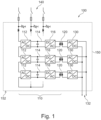
- a circuit diagram of a converter 100 is shown. It should be noted that the configuration and/or topology of the converter 100 is exemplary, and other and/or different configurations may be utilized.
- the converter 100 includes three converter modules, each module including an AC/DC converter 112, a DC link 114 including a DC link capacitor, an inverter circuit 116, a medium frequency transformer (MFT) 120, and a DC output stage 130. Accordingly, the converter 100 may be a modular converter.
- each module including an AC/DC converter 112, a DC link 114 including a DC link capacitor, an inverter circuit 116, a medium frequency transformer (MFT) 120, and a DC output stage 130.
- MFT medium frequency transformer
- the converter 100 includes a medium voltage stage 110, which may include the AC/DC converter 112, the DC link 114, and the inverter circuit 116.
- the MFT 120 provides an interface between the medium voltage stage 110 and the DC output stage. Accordingly, the medium voltage stage 110 may extend to a first winding of the MFT 120.
- three AC/DC converters 112 of three modules are connected in series between phases of a three-phase medium voltage grid 140. Additional modules may be provided, e.g. connected in the configuration shown in Fig. 1 to other phases of the medium voltage grid 140.
- the AC/DC converter 112 may be configured for converting a medium voltage AC power received from a grid 140 into a medium voltage DC power and/or a medium voltage DC link voltage.
- the medium voltage DC power may have a voltage corresponding to the voltage of the medium voltage AC power, e.g. after rectification.
- the AC/DC converter 112 may include a rectifier.
- the AC/DC converter 112 may include a line transformer, such as a line interphase transformer, e.g. for improving grid harmonics and/or providing a low-ripple medium voltage DC power to the DC link 114.
- the medium voltage stage 110 includes an AC/AC converter. Accordingly, the AC/DC converter and/or the DC link 114 may be optional.
- the medium voltage stage 110 includes an inverter circuit 116.
- the inverter circuit 116 may be configured for generating a medium-frequency medium voltage AC power form the medium voltage DC power.
- the inverter circuit 116 may be a known type of DC/AC converter, such as a half-bridge or full-bridge inverter.
- the converter includes a medium frequency transformer 120.
- the medium frequency transformer 120 may be a medium frequency transformer as described in document WO2021115966A1 , which is incorporated herein in its entirety, and/or particularly to the extent of the description of a medium frequency transformer in the document.
- the medium frequency transformer may be configured for transforming the medium-frequency medium voltage AC power into a medium-frequency low voltage AC power.
- the outputs of the three modules i.e. the outputs of the DC output stages 130, may be connected in parallel to provide a combined low voltage DC output 132.
- the converter 100 may be a converter having an ISOP topology.
- the converter 100 may be surrounded by a grounded component, such as an enclosure, such as a cabinet 150 being connected to the earthing system 152 for grounding.
- the cabinet 150 may be provided particularly for safety reasons, and be an integral component of the converter 100 e.g. due to safety codes and/or standards.
- Further components of the converter may be grounded, include a connection to ground and/or include grounded components. Being grounded may be understood as being connected to an earthing system and/or being connected to a ground potential.
- the earthing system may define the ground potential.
- a core of the medium frequency transformer 120 may be grounded.
- components and/or parts of the DC output stage 130 may be grounded.
- the medium voltage stage 110 may be insulated from ground.
- the MFT 120 may provide an interface between the grounded portion and the non-grounded portion of the converter 100.
- the converter 100 may include means for providing the insulation from ground, and particularly for providing the insulation of the MFT 120.
- the converter 200 has a single module which is shown schematically in a plan view, however, it should be noted that alternative configurations may be equally suitable, and the view may likewise be a side-view. Some features of the converter 200 have been omitted and/or generalized in the figure for clarity.
- the components of the medium voltage stage 110 are provided at a distance 222 from the cabinet 150.
- the distance 222 may be a minimum required distance, particularly a minimum required distance to provide suitable electrical insulation by air, such as a minimum required distance according to a standard such as IEC 61800-5-1.
- the components of the medium voltage stage 110 are provided in close proximity, or even adjacent one another. This may beneficially improve the power density of the converter.
- the converter 200 includes grounded components, particularly the cabinet 150. Furthermore, as indicated by the shaded portions in the figure, the DC output stage 130 may be, at least partially, connected to ground. Furthermore, portions of the MFT 120, such as a core of the MFT 120, may be connected to ground. Accordingly, the grounded portions must be insulated from the medium voltage stage.
- the insulation is provided by a bushing 210.
- the bushing 210 provides a minimum safe distance 220, such as a minimum required distance according to a standard such as IEC 61800-5-1, from the medium voltage stage, such as from the inverter circuit 116 and/or one or more conductors connecting the inverter circuit 116 to the MFT 120.
- the minimum safe distance 220 may be defined as the distance between a first end of the bushing 210 and the grounded core of the MFT 120.
- a disadvantage of the implementation shown in Fig. 2 is the required size of the bushing, which may generate a large space between the medium voltage stage 110 and the MFT 120.
- the converter 300 may be a module of a converter according to embodiments, i.e. several converters 300 may be provided as modules of a converter, for example according to the circuit diagram shown in Fig. 1 .
- the converter 300 includes a container 310.
- the container 310 has a volume, such as an inside volume defined by walls and/or surfaces of the container 310.
- the container 310 is configured for holding an insulating fluid inside the volume.
- the container 310 may be sealed and/or sealable.
- the container 310 may be a housing of the MFT 120.
- the container 310 may be provided in addition to a housing of the MFT 120.
- the insulating fluid may be an electrically insulating fluid.
- the insulating fluid may be an oil, such as a transformer oil.
- Suitable fluid types include, but are not limited to, mineral oils, synthetic oils, paraffinic oils, naphthenic oils, and/or pentaerythritol tetra fatty acid natural and synthetic esters.
- the container 310 has provided within the volume of the container an MFT 120.
- the MFT 120 may be immersed in the fluid.
- the fluid inside the volume electrically insulates the MFT 120.
- the fluid inside the volume provides better insulation compared to air. Accordingly, the minimum safe distance 220 decreases, and no bushing 210 as shown in Fig. 2 is required. Beneficially, this allows the medium voltage stage 110 to be provided closer to the MFT 120, which may beneficially increase the power density of the converter.
- the container 310 includes at least one connector 320 for fluidly connecting the volume with a fluid circuit.
- the container 310 includes two connectors 320, provided at different sides of the container 310, such as opposite side walls of the container 310.
- the connector 320 may be a means for providing a fluid connection, such as a pipe, a hose, a conduit, or the like.
- the connector 320 may be at least partially provided within a surface and/or wall of the container 310, e.g. as a fitting.
- a single connector 320 may be utilizable e.g. for filling and/or draining the volume of the container with the insulating fluid, and/or for maintaining a desired fluid level and/or fluid pressure.
- the container may include valves, e.g. for venting, deaeration, and/or pressure equalization with respect to the fluid circuit.
- the container may include a bleeding valve, e.g. provided at a top wall and/or lid of the container.
- the connectors 320 may enable the container 310 to be incorporated within the fluid circuit, such that the volume of the container 310 forms a portion of the fluid circuit.
- a fluid circulating within the fluid circuit may flow into the volume through a first one of the connectors 320, and flow out of the volume through a second one of the connectors 320. Accordingly, the fluid may flow through the volume of the container 310.
- the connector 320 includes a valve 322.
- the valve 322 is configured for opening and/or closing the connector. Closing the valve 322 may fluidly separate the container 310 and/or the volume of the container 310 from the fluid circuit.
- each connector 320 includes a valve 322. Accordingly, when both valves are closed, the container 310 is fully separated from the fluid circuit. Beneficially, this may allow the container 310 to be removed from the fluid circuit, particularly without otherwise preparing the fluid circuit for the removal, such as by e.g. draining the fluid circuit. Accordingly, a MFT 120 provided within the container may be easily accessed, e.g. for maintenance and/or replacement.
- the connectors 320 may be connected to a fluid circuit, such as the fluid circuit shown in Fig. 4 .
- the fluid circuit may be configured for circulating the fluid, e.g. by pumping the fluid.
- the fluid may act as a cooling fluid.
- the fluid may transfer heat generated during operation of the converter 300 to a heat exchanger and/or a cooling structure, such as a heat exchanger provided within the fluid circuit, or even heat exchangers such as cooling fins and/or radiators provided on the outside of the container 310.
- the fluid may act as a cooling fluid independently from being circulated, and transfer heat generated by the MFT 120 e.g.
- a heat exchanger such as a water cooled heatsink, may be provided within the container 310.
- the water cooled heatsink may be connected in a water-based fluid circuit, similar to the fluid circuit described with reference to Fig. 4 .
- the container 310 is formed of a non-conductive, electrically non-conductive and/or dielectric material.
- the container and/or the material may be heat-conductive.
- the container 310 may be formed of a polymer and/or a composite material.
- Non-conductive materials may include materials such as plastic, composite material, fiberglass, rubber, or any other material that is non-conductive and suitable for holding the fluid.
- a non-conductive material may be particularly suitable for a MFT 120 operating at a medium frequency, such as a frequency that is higher than the grid frequency.
- a heating of the container 310 due to induction and/or eddy currents may be mitigated by providing the non-conductive material.
- the container 310 includes one or more terminals for electrically connecting the medium voltage stage 110 and/or the DC output stage 130.
- the terminals such as a first terminal, may be configured for connecting the medium voltage stage 110 to the MFT 120.
- the terminals such as a second terminal, may be configured for connecting the MFT 120 to the DC output stage.
- the terminals may be openings within one or more walls of the container 310, the openings feeding one or more conductors through the container to provide an electrical connection from an outside of the container 310 to the volume of the container 310.
- the terminals may be considered bushings, however, the bushings may be different, especially smaller than the air-type bushing 210 shown in Fig. 2 .
- the terminals may be configured for attaching a cable shoe to the terminal.
- the terminals may include and/or provide a seal, such a seal suitable for sealing the volume, e.g. to prevent leakage of a fluid provided within the volume.
- the converter 400 may include converter modules, such as several converters 300 described with reference to Fig. 3 , e.g. several converters 300 may be provided, for example in a configuration according to the circuit diagram shown in Fig. 1 .
- three converters 300 are provided as modules, each module including a MFT 120 provided within a container 310, 312, 314.
- the containers 310, 312, 314 may be a container such as the container 310 described with reference to Fig. 3 .
- the modules may be stacked horizontally, vertically, or in a combination thereof.
- the containers 310, 312, 314 are fluidly connected to at least one other container of the containers 310, 312, 314 via connectors, such as the connectors 320 described with reference to Fig. 3 .
- Each connector includes a valve 322, which is configured for fluidly separating the containers from the fluid circuit, and/or from an adjacent container when the valve is closed.
- a connector of a first container 310, 312, 314 may be the connector of a second container 310, 312, 314.
- the connector provided between the container 310 and the container 312 may be a connector of both the container 310 and the container 312.
- one or more, or even all of the connectors may include more than one valve, such as two valves, provided in series. This may allow a container to be separated from the fluid circuit and/or adjacent, fluidly connected containers, without having to drain either of the container to be connected, the adjacent containers, and/or the fluid circuit.
- a disconnectable connection may be provided within the connector between two valves, and the disconnectable connection may be opened without efflux of the fluid after closing the two valves.
- the converter 400 includes a fluid circuit.
- the containers 310, 312, 314 are adjacently arranged and fluidly connected via the connectors.
- the containers 310, 312, 314 form a portion of the fluid circuit, e.g. a fluid may flow from an inlet of e.g. the container 310 to an outlet of the container 314 or vice versa.
- the containers 310, 312, 314 are connected in series in the fluid circuit.
- some of the containers of the converter 400 may be connected in parallel, and/or the converter 400 may include a plurality of series connected containers connected in parallel.
- the converter 400 may include nine converter modules in a 3x3 configuration, e.g.
- the converter 400 may include 2, 4, 5, 6, 7, 8, 9, or even 10 or more converters 300 connected in series and/or parallel in the fluid circuit.
- the fluid circuit further includes the conduits 412, connecting the outermost containers 310 and 314 to a pump 410.
- the pump 410 may be configured for circulating the fluid in the fluid circuit.
- the pump 410 may be provided inside the cabinet 150, or even outside the cabinet 150.
- multiple pumps 410 may be provided, e.g. to form separate fluid circuits within the converter 400.
- a separate pump and/or fluid circuit may be provided for each container 310, 312, 314.
- the fluid circuit may include additional components, such as tanks and/or reservoirs, such as equalizing tanks, and/or pressure regulators, filling and/or outlet ports, or the like.
- one or more heat exchangers for cooling the fluid may be provided at a location within the fluid circuit other than the container 310, 312, 314.
- the fluid circuit may include a fluid monitor, such as a fluid monitoring device.
- the fluid monitor may include one or more sensors for sensing one or more properties of the fluid.
- the fluid monitor may include a temperature sensor for sensing a temperature of the fluid.
- the fluid monitor may include a sensor for sensing a degradation of the fluid, such as an optical sensor, e.g. for sensing an absorbance and/or turbidity of the fluid.
- the fluid monitor may include sensors for detecting particles within the fluid.
- the fluid monitor may include a flow sensor.
- the fluid monitor may include a pressure sensor.
- the fluid monitor may be connected or connectable to an alarm system, the alarm module being configured for generating a warning signal, e.g. when one or more of the sensor signals sensed by the fluid monitor are determined to be outside a predefined threshold and/or range.
- the fluid monitor and/or the alarm system may further comprise a network interface for connecting the device to a data network, in particular a global data network.
- the data network may be a TCP/IP network such as Internet.
- the fluid monitor and/or the alarm system is operatively connected to the network interface for carrying out commands received from the data network.
- the commands may include a control command for controlling the fluid monitor and/or the alarm system to carry out a task such as monitoring the fluid, and/or measuring and/or transmitting parameters of the fluid.
- the fluid monitor and/or the alarm system is adapted for carrying out the task in response to the control command.
- the commands may include a status request.
- the fluid monitor and/or the alarm system may be adapted for sending a status information and/or an alarm to the network interface, and the network interface is then adapted for sending the status information and/or the alarm over the network.
- the commands may include an update command including update data.
- the fluid monitor and/or the alarm system is adapted for initiating an update in response to the update command and using the update data.
- the data network may be an Ethernet network using TCP/IP such as LAN, WAN or Internet.
- the data network may comprise distributed storage units such as Cloud.
- the Cloud can be in form of public, private, hybrid or community Cloud.
- a converter including containers 310 and/or the fluid circuit according to embodiments described herein may be particularly suitable for a converter including a plurality of modules, such as more than 3 modules, such as 6 or more modules, 9 or more modules, 12 or more modules, 15 or more modules, or even 20 or more modules, such as 21 modules.
- a converter based on a plurality of modules may be provided with a low footprint and/or high power density, since the unutilized space required for providing a plurality of air-type bushings is not present in the proposed solution.
- Each of the modules may be a converter and/or solid state transformer, e.g. as described with reference to Fig. 3 .
- the solutions proposed herein may beneficially provide improved scalability, in particular, a plurality of low-power converter modules may be provided and/or combined into a higher power converter.
- the low-power converter modules may employ low-cost power semiconductor switches in the low-voltage range, such as 1.2 kV IGBTs instead of 3.3 kV SiC MOSFETs.
- the insulating fluid does not affect the electronic components of the converter, such as the components of the inverter circuit.
- a method 500 of operating a converter according to embodiments described herein is described.
- Operation 510 the converter is operated, e.g. according to known methods to operate a converter and/or solid state transformer.
- Operation 510 includes circulating a fluid in the fluid circuit to cool the MFT 120.
- the operation 510 may include providing the valves 522 in an open state, to allow a circulation of the fluid, e.g. to allow the fluid to operate as a cooling fluid. Accordingly, the fluid may be unobstructed by a valve.
- Operation 510 may include converting and/or transforming a medium voltage AC power, such as a power received from a medium voltage grid 140, into a low voltage DC power, such as a low voltage DC power provided to the low voltage DC output 132.
- the method 500 may include monitoring 520 the fluid.
- Monitoring the fluid may include utilizing a fluid monitor, such as the fluid monitor described with reference to Fig. 4 .
- Monitoring 520 the fluid may include determining if a fault is present in the system.
- monitoring 520 may include determining if the converter is operating normally, e.g. by determining if the flow rate, pressure and/or temperature of the fluid is within predetermined limits.
- Monitoring the fluid may include determining a fluid degradation.
- a fluid degradation may indicate a degradation of the fluid, e.g. due to chemical processes and/or aging of the fluid.
- a fluid degradation may include the presence of chemical and/or physical components, such as particles, within the fluid, which may indicate the deterioration of components of the converter and/or the fluid circuit, such as the MFT 120, the pump 410, a heat exchanger, a valve, a conduit, a connector, or other components of the converter having contact with the fluid.
- Monitoring 520 the fluid may include determining if a fault is present in the converter, e.g. by determining if the parameters and/or values determined by the fluid monitor are within predefined ranges. Under the proviso that a fault is present, the method 500 may include operation 530.
- Operation 530 a fault was detected, and actions are performed in response to the fault.
- Operation 530 may include indicating the fault, e.g. by providing a warning signal, e.g. by an alarm module.
- Operation 530 may include deactivating, e.g. powering down, the converter, e.g. by disconnecting the converter from the grid 140, to put the converter in an unpowered state. In case the converter includes a plurality of fluid circuits, only the modules associated with the fluid circuit may be deactivated. Operation 530 may include performing maintenance on the converter.
- operation 530 may include closing one or more valves 322 to separate at least one of the plurality of containers, such as containers 310, 312, 314, from the fluid circuit.
- the container including the MFT, or even the whole converter module may be removed from the converter, e.g. for maintenance and/or replacement with a replacement converter module.
- the operation 530 may be performed independently of a fault being detected within the fluid circuit.
- a fault which does not affect the fluid circuit may be present in one of the modules, and the operation may be performed accordingly.
Landscapes
- Engineering & Computer Science (AREA)
- Power Engineering (AREA)
- Microelectronics & Electronic Packaging (AREA)
- Physics & Mathematics (AREA)
- Thermal Sciences (AREA)
- Dc-Dc Converters (AREA)
Priority Applications (3)
| Application Number | Priority Date | Filing Date | Title |
|---|---|---|---|
| EP23171597.0A EP4459646A1 (de) | 2023-05-04 | 2023-05-04 | Umrichter und verfahren zum betrieb eines umrichters |
| CN202410530969.3A CN118900050A (zh) | 2023-05-04 | 2024-04-29 | 转换器和操作转换器的方法 |
| US18/654,129 US20240373602A1 (en) | 2023-05-04 | 2024-05-03 | Converter and method of operating a converter |
Applications Claiming Priority (1)
| Application Number | Priority Date | Filing Date | Title |
|---|---|---|---|
| EP23171597.0A EP4459646A1 (de) | 2023-05-04 | 2023-05-04 | Umrichter und verfahren zum betrieb eines umrichters |
Publications (1)
| Publication Number | Publication Date |
|---|---|
| EP4459646A1 true EP4459646A1 (de) | 2024-11-06 |
Family
ID=86329773
Family Applications (1)
| Application Number | Title | Priority Date | Filing Date |
|---|---|---|---|
| EP23171597.0A Pending EP4459646A1 (de) | 2023-05-04 | 2023-05-04 | Umrichter und verfahren zum betrieb eines umrichters |
Country Status (3)
| Country | Link |
|---|---|
| US (1) | US20240373602A1 (de) |
| EP (1) | EP4459646A1 (de) |
| CN (1) | CN118900050A (de) |
Citations (4)
| Publication number | Priority date | Publication date | Assignee | Title |
|---|---|---|---|---|
| WO2012098107A2 (en) * | 2011-01-17 | 2012-07-26 | Abb Technology Ag | Converter circuit with a charging unit |
| US20170316864A1 (en) * | 2016-04-29 | 2017-11-02 | Siemens Aktiengesellschaft | Replacement Transformer With Modular Construction |
| WO2021115966A1 (en) | 2019-12-12 | 2021-06-17 | Abb Power Grids Switzerland Ag | Medium frequency transformer with parallel windings |
| EP4099347A1 (de) * | 2021-06-02 | 2022-12-07 | ABB E-mobility B.V. | Zwangskonvektionskühlung für mittelfrequenztransformatoren in mittelspannungswandlerschränken |
-
2023
- 2023-05-04 EP EP23171597.0A patent/EP4459646A1/de active Pending
-
2024
- 2024-04-29 CN CN202410530969.3A patent/CN118900050A/zh active Pending
- 2024-05-03 US US18/654,129 patent/US20240373602A1/en active Pending
Patent Citations (4)
| Publication number | Priority date | Publication date | Assignee | Title |
|---|---|---|---|---|
| WO2012098107A2 (en) * | 2011-01-17 | 2012-07-26 | Abb Technology Ag | Converter circuit with a charging unit |
| US20170316864A1 (en) * | 2016-04-29 | 2017-11-02 | Siemens Aktiengesellschaft | Replacement Transformer With Modular Construction |
| WO2021115966A1 (en) | 2019-12-12 | 2021-06-17 | Abb Power Grids Switzerland Ag | Medium frequency transformer with parallel windings |
| EP4099347A1 (de) * | 2021-06-02 | 2022-12-07 | ABB E-mobility B.V. | Zwangskonvektionskühlung für mittelfrequenztransformatoren in mittelspannungswandlerschränken |
Also Published As
| Publication number | Publication date |
|---|---|
| US20240373602A1 (en) | 2024-11-07 |
| CN118900050A (zh) | 2024-11-05 |
Similar Documents
| Publication | Publication Date | Title |
|---|---|---|
| US9496798B2 (en) | Variable speed drive for subsea applications | |
| US9153374B2 (en) | Cooling arrangements for drive systems | |
| US9260946B2 (en) | Power cell for deepwater application | |
| US9520801B1 (en) | Method and system for a gas tube switch-based voltage source high voltage direct current transmission system | |
| US11370314B1 (en) | Insulation system for reducing partial discharge in medium voltage power converter | |
| EP3132462B1 (de) | Unterseeschaltanlage | |
| CN102804294A (zh) | 通用配电变压器 | |
| AU2015281320B2 (en) | Subsea power distribution system and method | |
| RU2412523C2 (ru) | Система конструктивного оформления для модульных силовых ячеек | |
| CN212695909U (zh) | 转换器装置 | |
| Narayanaswamy | Review of challenges in reliable electric power delivery to remote deep water enhanced oil recovery systems | |
| EP2988579A1 (de) | Ölkühlungskonfiguration für ein elektronisches Unterwassersystem | |
| EP2606547A1 (de) | Unterwasser-gleichstromübertragungssystem | |
| EP2826565B1 (de) | Elektronische und/oder elektrische Modulanordnung für eine Unterwasserinstallation | |
| EP4459646A1 (de) | Umrichter und verfahren zum betrieb eines umrichters | |
| US20160352240A1 (en) | Modular subsea converter | |
| CN204271890U (zh) | 一种油浸自冷型原油脱水电源防爆油箱 | |
| WO2018046113A1 (en) | A cover for a distribution transformer filled with a dielectric liquid | |
| JP6244382B2 (ja) | 配電盤、パワーコンディショナ及び油入変圧器 | |
| NO343424B1 (en) | Combined Subsea Transformer and compensating HV Reactor | |
| RU168870U1 (ru) | Трансформатор преобразовательный трехфазный многообмоточный с жидкостной системой охлаждения | |
| CN115803831B (zh) | 静电感应装置 | |
| CN119893914A (zh) | 高压电能变换模块 | |
| KR20260053012A (ko) | 냉각 시스템을 갖는 노 전력 공급 장치 | |
| WO2025002887A1 (en) | Converter-hydrogen system |
Legal Events
| Date | Code | Title | Description |
|---|---|---|---|
| PUAI | Public reference made under article 153(3) epc to a published international application that has entered the european phase |
Free format text: ORIGINAL CODE: 0009012 |
|
| STAA | Information on the status of an ep patent application or granted ep patent |
Free format text: STATUS: THE APPLICATION HAS BEEN PUBLISHED |
|
| AK | Designated contracting states |
Kind code of ref document: A1 Designated state(s): AL AT BE BG CH CY CZ DE DK EE ES FI FR GB GR HR HU IE IS IT LI LT LU LV MC ME MK MT NL NO PL PT RO RS SE SI SK SM TR |
|
| STAA | Information on the status of an ep patent application or granted ep patent |
Free format text: STATUS: REQUEST FOR EXAMINATION WAS MADE |
|
| 17P | Request for examination filed |
Effective date: 20250505 |