EP4459408A1 - Effiziente trajektorienplanung für eine fahrzeugflotte - Google Patents
Effiziente trajektorienplanung für eine fahrzeugflotte Download PDFInfo
- Publication number
- EP4459408A1 EP4459408A1 EP23171302.5A EP23171302A EP4459408A1 EP 4459408 A1 EP4459408 A1 EP 4459408A1 EP 23171302 A EP23171302 A EP 23171302A EP 4459408 A1 EP4459408 A1 EP 4459408A1
- Authority
- EP
- European Patent Office
- Prior art keywords
- vehicles
- vehicle
- mutex
- zone
- zones
- Prior art date
- Legal status (The legal status is an assumption and is not a legal conclusion. Google has not performed a legal analysis and makes no representation as to the accuracy of the status listed.)
- Granted
Links
Images





Classifications
-
- G—PHYSICS
- G05—CONTROLLING; REGULATING
- G05D—SYSTEMS FOR CONTROLLING OR REGULATING NON-ELECTRIC VARIABLES
- G05D1/00—Control of position, course, altitude or attitude of land, water, air or space vehicles, e.g. using automatic pilots
- G05D1/60—Intended control result
- G05D1/69—Coordinated control of the position or course of two or more vehicles
- G05D1/693—Coordinated control of the position or course of two or more vehicles for avoiding collisions between vehicles
-
- G—PHYSICS
- G08—SIGNALLING
- G08G—TRAFFIC CONTROL SYSTEMS
- G08G1/00—Traffic control systems for road vehicles
- G08G1/09—Arrangements for giving variable traffic instructions
- G08G1/0962—Arrangements for giving variable traffic instructions having an indicator mounted inside the vehicle, e.g. giving voice messages
- G08G1/0967—Systems involving transmission of highway information, e.g. weather, speed limits
- G08G1/096766—Systems involving transmission of highway information, e.g. weather, speed limits where the system is characterised by the origin of the information transmission
-
- G—PHYSICS
- G05—CONTROLLING; REGULATING
- G05D—SYSTEMS FOR CONTROLLING OR REGULATING NON-ELECTRIC VARIABLES
- G05D1/00—Control of position, course, altitude or attitude of land, water, air or space vehicles, e.g. using automatic pilots
- G05D1/60—Intended control result
- G05D1/644—Optimisation of travel parameters, e.g. of energy consumption, journey time or distance
-
- G—PHYSICS
- G05—CONTROLLING; REGULATING
- G05D—SYSTEMS FOR CONTROLLING OR REGULATING NON-ELECTRIC VARIABLES
- G05D1/00—Control of position, course, altitude or attitude of land, water, air or space vehicles, e.g. using automatic pilots
- G05D1/60—Intended control result
- G05D1/69—Coordinated control of the position or course of two or more vehicles
- G05D1/698—Control allocation
- G05D1/6987—Control allocation by centralised control off-board any of the vehicles
-
- G—PHYSICS
- G05—CONTROLLING; REGULATING
- G05D—SYSTEMS FOR CONTROLLING OR REGULATING NON-ELECTRIC VARIABLES
- G05D2105/00—Specific applications of the controlled vehicles
- G05D2105/20—Specific applications of the controlled vehicles for transportation
-
- G—PHYSICS
- G05—CONTROLLING; REGULATING
- G05D—SYSTEMS FOR CONTROLLING OR REGULATING NON-ELECTRIC VARIABLES
- G05D2107/00—Specific environments of the controlled vehicles
- G05D2107/70—Industrial sites, e.g. warehouses or factories
-
- G—PHYSICS
- G05—CONTROLLING; REGULATING
- G05D—SYSTEMS FOR CONTROLLING OR REGULATING NON-ELECTRIC VARIABLES
- G05D2109/00—Types of controlled vehicles
- G05D2109/10—Land vehicles
Definitions
- the disclosure relates generally to the field of automatic vehicle control.
- the disclosure relates to techniques for coordinating the movement of multiple vehicles in an environment with mutually exclusive (MUTEX) zones.
- MUTEX mutually exclusive
- the disclosure can be applied to heavy-duty vehicles, such as trucks, buses, and construction equipment, among other vehicle types.
- trucks, buses, and construction equipment among other vehicle types.
- the disclosure may be described with respect to a particular vehicle, the disclosure is not restricted to any particular vehicle.
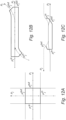
- FIG. 12A is a top view of an intersection-type MUTEX zone
- Figure 12B shows a merge-split MUTEX zone
- Figure 12C shows a MUTEX zone constituted by a narrow road section.
- MUTEX zones For public roads, the coordination of automated vehicles for intersection-type MUTEX zones has received substantial attention recently; see [2] for a comprehensive survey. In confined sites, a number of additional types of MUTEX zones are present, such as loading/unloading locations, charging/fueling stations, and narrow roads.
- One objective of the present disclosure is to make available vehicle fleet coordination techniques which are computationally more efficient than the currently available methods reviewed above and/or which lend themselves to convenient implementation.
- a further objective is to ensure scalability (with respect to the number of vehicles) of the described computation while safeguarding the provision of efficient and safe instructions for the vehicle fleet.
- a method of planning trajectories for a plurality of vehicles operating in a common environment wherein movements of each vehicle are controllable by a control signal.
- the method comprises: for each vehicle, obtaining a predefined vehicle path to be traversed; performing a first computation to obtain a vehicle crossing order at each mutually exclusive (MUTEX) zone between two vehicle paths, wherein the first computation is subject to safety constraints; and performing trajectory planning subject to the obtained vehicle crossing order at the MUTEX zones, to obtain a control signal for each of the vehicles.
- MUTEX mutually exclusive
- the method further comprises assigning a dependency metric to each pair of vehicles, and partitioning the vehicles into a number N SG of vehicle subsets (in particular, N SG disjoint vehicle subsets) such that the dependency metric exceeds a threshold ⁇ within each. Then, the trajectory planning is performed as multiple independent subproblems, each relating to one of the vehicle subsets.
- the method according to the first aspect may allow an original NLP to be decomposed into multiple smaller independent NLPs.
- the decomposition method may be based on a graph-view of the problem [8], [9], where each vehicle is a node and each mutex relation is an edge.
- a mutex relation is said to exist between two vehicles when both require utilization of the same MUTEX during some part of their transport mission. Even though a mutex relation exists, it is not necessarily the case that it influences the solution to the NLP.
- a simple example of this is when two vehicles need to cross an intersection, but where their crossings can be significantly separated in time.
- the subproblems are solved as optimal control problems (OCPs) for a predefined cost function.
- OCPs optimal control problems
- the first computation is an optimization problem and the dependency metric is derived from the solving of said optimization problem.
- the first computation may be a distance-based First Come First Served algorithm.
- the dependency metric for a pair of vehicle paths is related to one or more dual optimization variables ⁇ k associated with safety constraints for the MUTEX zones between these vehicle paths.
- the method further comprises: forming an adjacency matrix in which the elements correspond to pairs of the vehicles; reducing a nonzero element in the adjacency matrix if a safety constraint for a MUTEX zone between the paths of the corresponding vehicle has an associated dual optimization variable which is less than the threshold ⁇ ; and partitioning the vehicles into subsets in accordance with the adjacency matrix after the reductions.
- the dependency metric for a pair of vehicle paths is related to the number of MUTEX zones between these vehicle paths.
- the dependency metric is further related to a dependency importance weight.
- the dependency importance weight may represent (an inverse of) a time separation of consecutive vehicles at a MUTEX zone according to the crossing order.
- the partitioning of the vehicles includes: forming a weighted graph where nodes represent vehicles and where edges represent MUTEX zones; and performing a depth-first search to determine subgraphs.
- the method further comprises determining the threshold based on the assigned values of the dependency metric.
- each of the subproblems is independent of the safety constraints of the first computation.
- the first computation is an optimization problem which is solved as a mixed-integer quadratic program (MIQP).
- MIQP mixed-integer quadratic program
- the MUTEX zones include at least one of the following: an intersection zone, a merge-split zone, a dwelling zone, wherein the safety constraints for an intersection zone or a dwelling zone include a mutual exclusion requirement, and wherein the safety constraints for a merge-split zone include a minimum longitudinal spacing requirement.
- the common environment is a confined area with no other traffic participants than said vehicles.
- the movements of each vehicle are controllable independently of other vehicles. This is to say, although a vehicle may have to respect positions and movements of nearby vehicles to avoid collisions, the position of the vehicle is not locked (or constrained) to that of another vehicle like in platooning.
- the above method is embedded into a method of controlling a plurality of vehicles operating in a common environment which includes at least one MUTEX zone, wherein movements of each vehicle are controllable by a control signal.
- the method according to the second aspect comprises: sensing current positions of all vehicles; performing trajectory planning according to the above method, subject to the sensed vehicle positions, to obtain a control signal for each of the vehicles; and feeding the control signals to the vehicles for execution.
- execution of the obtained control signals is subject to a successful verification of the safety constraints of the first computation.
- the vehicles are partitioned into a number N SG ′ of new vehicle subsets, and the trajectory planning is performed as independent subproblems relating to the new vehicle subsets.
- the solving of the subproblems is delegated (D, E in Figure 15 ) to one or more distributed processing resources, such as processing resources carried by the vehicles.
- the execution of the method, including any delegation, may be coordinated by a central processing resource, which is either fixedly installed or carried by one of the vehicles
- a computer system comprising memory and processing circuitry configured to perform the method of the first or second aspect.
- a “data carrier” may be a transitory data carrier, such as modulated electromagnetic or optical waves, or a non-transitory data carrier.
- Non-transitory data carriers include volatile and non-volatile memories, such as permanent and non-permanent storage media of magnetic, optical or solid-state type. Still within the scope of "data carrier", such memories may be fixedly mounted or portable.
- This disclosure will propose a computational decomposition strategy for the central optimal coordination problem, enabling the computation of multiple NLPs in parallel.
- the proposed algorithm is based on a graph view of the problem and exploits the heuristic used to solve the coordination problem to refine the graph connections.
- a tunable metric is proposed to further decompose the graphs.
- the method in the present disclosure can thus be used to analyze the trade-off between optimality and computation which is linked to the degree of decomposition.
- the optimization-based method in [7] has been extended to handle recomputing the motion plan and the dynamic case when new vehicles are added to the optimization problem.
- the proposed computational decomposition method is integrated into this algorithm.
- Partitioning large graphs is an important subproblem for reducing complexity and enabling parallelization in various applications, such as social networks, power grids, road networks, and communication problems [10], [11], [12].
- One widely applicable technique is the hierarchical decomposition approach [13], which decomposes the original problem into multiple layers using slack variables (Lagrange multipliers). These approaches are particularly useful for network utility maximization.
- the authors propose an approach of finding sub-graphs when the weights of the graph's vertex connections dynamically change. This is an alternative way of interpreting the problem, however, the methods used for finding sub-graphs differ from the proposed approach in this disclosure.
- the method in [15] also relies on weighted graphs for how to partition airspace into smaller regions, where the weights are calculated based on summing the number of aircraft in each region.
- the benefits of the proposed computational decomposition approach are demonstrated through multiple simulation scenarios, particularly when computing the motion plan initially, recomputing the plan, and when a new vehicle is added to the optimization problem.
- the proposed approach is compared with the non-decomposed problem which was used in [7] and a simple decomposition based solely on current graph connections.
- a model used in the theoretical part of this disclosure considers N a fully automated vehicles operating in a confined area, meaning that non-controlled traffic participants such as pedestrians, manually operated vehicles, bicycles, etc., are absent or can be neglected without detriment. Furthermore, it is assumed that the paths of all vehicles, i.e., their routes through the road network, are known, that overtakes are prohibited, and that no vehicle reverses.
- the road network contains mutually exclusive (MUTEX) zones, such as intersections, merge-splits, narrow roads, etc., where simultaneous access must be restricted; see Figure 12 .
- a MUTEX zone may alternatively be referred to as a conflict zone.
- Figure 14 shows an environment 1400 in which a plurality of vehicles 1460 operate.
- the environment 1400 includes roads 1440 as well as multiple intersection MUTEX zones 1410, dwelling-type MUTEX zones (dwelling zones) 1420 and merge-split MUTEX zones 1430.
- the environment 1400 may be a confined area with no other traffic participants than the vehicles 1460.
- the vehicles 1460 may be conventional vehicles, partially autonomous vehicles or fully autonomous vehicles; they may be cars, trucks, buses, construction equipment; they may be single vehicles or multi-unit vehicle combinations.
- a computer system 1450 suitable for controlling said vehicles 1460.
- the computer system 1450 includes processing circuitry 1452 and is configured to communicate over a wireless interface 1451 with corresponding wireless interfaces 1461 on the vehicles 1460.
- the vehicles 1460 circulating in the environment 1400 may further include vehicle-carried processing circuitry 1462.
- J i ( x i , u i ) is a cost function (objective function), is the order in which the vehicles enter all MUTEX zones in the site.
- the cost function may be related to a dynamic vehicle model, and it may include cost terms representing the energy consumption, expected wear, expected service needs, etc. incurred by the vehicles' movements and positions.
- the safety constraints in this problem relate to the collision-free occupancy of the MUTEX zones.
- the constraints (1b)-(1e) apply for all vehicles, hence, for all values of the index i.
- a quadratic approximation of (2) can be provided in a similar fashion as QP sub-problems are formed in SQP methods.
- the constant term J ( W **) can be discarded.
- the solution guess W ** can be obtained, for example, by solving the optimization problem (1) without safety constraints (1e), or by a forward simulation of the vehicles with, for example, an LQR controller.
- Problem 1 can be stated as a Mixed Integer Nonlinear Program (MINLP), where the crossing order corresponds to the "integer part” and the state and control trajectories corresponds to the "NLP part".
- MINLP Mixed Integer Nonlinear Program
- NLP nonlinear program
- MIQP Mixed Integer Quadratic Problem
- the MIQP is formed as a quadratic approximation of (1), similarly to how QP sub-problems are formed in SQP methods [23].
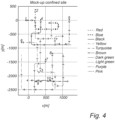
- Figure 2 depicts the control structure of the heuristic.
- the proposed MIQP has an exponential complexity in the decision variables (i.e., amount of MUTEX zones) and the NLP has a cubic complexity in the number of stages, i.e., the sum of N a vehicles and M stages per vehicle.
- the edge set can be defined such that every pair of vehicles that share one or more MUTEX zones have an edge, i.e. ⁇ V ⁇ V . This choice would result in undirected graphs.
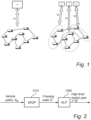
- Figure 3 shows an example of a scenario with three vehicles v1, v2, v3 that have multiple MUTEX zones e1, e2, e3, e4.
- FIG. 3 To the right in Figure 3 , there is a graph representation of the scenario modeled with the above-defined dependencies.
- a adj is the N a ⁇ N a matrix whose ij -th entry is the number of edges joining vertex i and vertex j.
- This section presents a procedure for identifying relevant edges (connections) and sub-graphs for the vehicle coordination problem. Furthermore, it will be described how this procedure can be integrated into the optimization-based heuristic.
- a relevant edge is a MUTEX zone for which the safety constraints will be violated if the vehicles do not modify their state and control trajectories.
- the inventors have realized a way to utilize the property of constrained optimization problems that a constraint is not active if the dual variable (or slack variable, or Lagrange multiplier) associated with that constraint is equal to zero. In other words, a non-active constraint does not influence the solution to the problem.
- the MUTEX constraints explicitly enter the optimization problem, and the optimization-based heuristic's MIQP is a direct approximation of the MINLP, it is possible to estimate the influence of the MUTEX constraints before solving the NLP.
- Remark 1 The MIQP remains an approximation, and there is a risk of erroneously omitting a necessary edge. Therefore, an implementer of the present teachings may choose to perform a safety check on the MUTEX constraints that have been excluded after solving the NLP.
- a dual variable may not be exactly equal to zero but is "fairly" close to zero.
- a relevant MUTEX zone may be located far away from the current vehicle positions. This implies that even though a collision would occur if no control action were taken, the constraint does not significantly influence the optimization problem's solution because the vehicles have substantial control flexibility to take actions that would avoid violating the constraint.
- a tunable margin ⁇ (or threshold) is defined, which allows further dropping edges that are just "weakly” relevant, e.g., if ⁇ k ⁇ ⁇ .
- the lower bound of ⁇ is zero and the upper bound is adjustable by the user. If a "weakly" relevant edge is excluded, constraints can be imposed on the vehicle's MUTEX entry and exit times to ensure the desired zone utilization. However, instead of coupling multiple vehicles, the constraints are defined at the local vehicle level.
- the algorithm is implemented by initializing a stack to store the vertices and an array to keep track of the visited vertices. The algorithm then iteratively visits each vertex in the stack, adding its adjacent vertices to the stack if they have not been visited before. The algorithm continues until all vertices have been visited. The output of the algorithm provides the total size of each sub-graph and the total number of sub-graphs ( N SG ) .
- the running time of the algorithm is linear in the number of vertices and edges, i.e., the asymptotic complexity is O(
- the high-level optimization-based approach is invoked at the beginning of the mission and when the plan needs to be recalculated due to changes in the environment, such as a new vehicle being introduced into the optimization, vehicles deviating from the plan, or a certain amount of time has elapsed.
- the MIQP problem is formed and solved as described in [7]. From the MIQP algorithm, a MUTEX zone occupancy order is obtained, as well as dual variables which are used to initiate Algorithm 1. After sub-graphs have been found, a number N SG of fixed-order NLPs are solved in parallel to obtain optimal state and control trajectories. Afterward, a safety check is performed on the dropped MUTEX zone constraints.
- the first step is to identify how the environment has changed since the last iteration of the high-level algorithm. This includes identifying which zones the vehicles have passed, checking if new vehicles have entered the optimization problem, and determining if there are new MUTEX zones. A new vehicle can enter the confined site optimization problem when more transportation resources are required to accomplish the productivity goal. If new MUTEX zones or a new vehicle are part of the optimization problem, new crossing orders are calculated and Algorithm 1 is repeated, followed by solving a new set of fixed-order NLPs (possibly with a different cardinality N SG ′ ) and a safety check.
- the adjacency matrix must first be updated based on the current conditions. Subsequently, the step of identifying sub-graphs and computing N SG NLPs must be repeated to obtain a motion plan from the current vehicle positions until their mission end. However, since the same order has been maintained, based on the current state of the vehicles, this solution could be suboptimal. To ensure that the new plan is not significantly worse than the previous one, the cost function of the "new" plan may be compared with the cost to go from the previous motion plan calculated from the current vehicle states until the end.
- the crossing order can be recomputed and Algorithm 1 repeated, after which the new set of NLPs is solved. This comparison reduces the need to always recompute the MIQP and is beneficial in the absence of major deviations in the tracking of the motion plan. Recomputing the crossing order has the potential to improve the cost of the new plan. However, there may be situations where the MIQP results in the same order and there is no improvement in the cost of the new plan compared to the cost to go from the previous plan.
- Remark 3 The cost metric for the new plan compared to the previous plan is tunable, and for the use cases considered herein, a metric of 15% or higher triggers a recomputation of the MIQP.
- the tunable metric (threshold) is denoted by ⁇ .
- the optimization problem cost function, constraints, and vehicle parameters are the same as the ones used in [7] and/or as discussed above.
- the dynamics can discretized using multiple shooting and an Explicit Runge-Kutta-4 (ERK4).
- the constraints are chosen as bounds on the speed and longitudinal acceleration ( v i ⁇ v i,k ⁇ v i , a i,k ⁇ a i,lon ) in order to obey speed limits and physical constraints.
- the vehicles are expected to manoeuvre on curved roads, thus, it is needed to consider the lateral forces they experience.
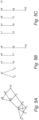
- FIG. 4 For the evaluation of the method, two instances of the vehicles in a confined site as shown in Figure 4 will be considered.
- the figure illustrates the positions of the vehicles at their initial position, and the positions of the vehicles when a recomputation of the motion plan is necessary.
- the vehicles have a nonzero start time to ensure that a collision occurs in multiple MUTEX zones if no coordinating action is taken.
- the respective initial times are summarized in Table 1.
- Table 1 Initial start times for vehicles (seconds) t 1,0 t 2 ,0 t 3,0 t 4,0 t 5,0 t 6,0 t 7,0 t 8,0 t 9,0 t 10,0 6.7 6.2 0 13 71 64 105.25 76 86.5 90.5
- the recomputation trigger is after 96.5 seconds. At this point, only Vehicle 7 is still at its initial position.
- the simulation scenario is implemented in MATLAB on a 2.10GHz 12 th -generation Intel i7 with 32 GB of RAM.
- the CasADi [27] toolkit and IPOPT [28] are utilized to formulate and solve the NLP, and Gurobi is used for the MIQP.
- Figures 5 and 6 show the graphs obtained when the vehicles are at their initial positions and when the motion plan needs to be recomputed.
- the graphs in Figures 5A and 6A are obtained by checking which vehicles share a MUTEX zone from their current position until their end destination.
- Vehicle 11 enters the plan, it shares a MUTEX zone with Vehicle 1 and Vehicle 4 and also with Vehicle 6, which results in coupling all the vehicles so that no sub-graphs can be found.
- the appearance of new MUTEX zones suggest that the MIQP should be recomputed.
- four sub-graphs are obtained, and it becomes clear that three of the vehicles have no coupling at all.
- Figure 9 presents a comparison of the computational effort required to solve the problem using different decomposition techniques in three scenarios: when the vehicles are at their initial positions (Scenario 1); when the plan needs to be recomputed (Scenario 2); and when a new vehicle enters the optimization problem, causing all vehicles to be connected again (Scenario 3).
- the first data bar correspond to the case where no decomposition is applied, i.e., only one NLP is solved involving all vehicles and MUTEX zones.
- the second bar correspond to the NLP solve times for the graphs depicted in Figures 5A , 6A and 8A.
- Scenario 1 and Scenario 3 all vehicles are connected through MUTEX zones, resulting in only one NLP that involves all vehicles.
- the vehicles have traveled some distance, and have passed some MUTEX zones, leading to three sub-graphs which means that three NLPs can be computed in parallel.
- the reported time for this case is the highest time of one of these NLPs.
- the performance loss of the fully decomposed case is more significant, resulting in a 19.3 percent increase in the cost function value.
- the fully decomposed case in this scenario would yield an infeasible result if the starting speed of the vehicles were higher, whereas this is not the case for the other methods.
- the inventors have presented a process for a computational decomposition of an optimization-based algorithm for the coordination of automated vehicles in confined sites.
- the method is based on a graph model where the vehicles are the graph's vertices and the MUTEX zones that the vehicles experience are the graph's edges.
- the information on the dual variables related to the MUTEX zone constraints can be used as a guidance to identify which edges can further be dropped from the graph.
- the next step of the algorithm looks at whether there are any sub-graphs, which is related to the question of how many parallel optimization problems can be solved.
- the method is included in the recomputation algorithm for the optimization-based heuristic. Because the method is amenable to parallel computing, a reduced overall computational time can be achieved, as has been demonstrated in the three simulation scenarios.
- Figure 13 is a flowchart of a method 1300 for controlling a plurality of vehicles 1460 (see Figure 14 ) operating in a common environment 1400 which includes at least one MUTEX zone, wherein movements of an i th vehicle are controllable by a control signal u i .
- the number N a of controlled vehicles 1460 may be at least 2, such as at least 5, such as at least 10, such as at least 20, such as at least 50, such as at least 100, such as at least 200. In some examples, the number N a of controlled vehicles 1460 does not exceed 50.
- the execution of the method 1300 may be coordinated by a central processing resource being either fixedly installed or vehicle-carried.
- a central processing resource being either fixedly installed or vehicle-carried.
- the execution of the method 1300 is coordinated by processing circuitry 1452 fixedly installed in a computer system 1450.
- the computer system 1450 can delegate the execution of some steps of the method 1300, or parts thereof, to vehicle-carried processing resources (e.g., processing circuitry 1462) by transmitting a corresponding delegation signal D to the vehicles 1460 over the wireless interface 1451 and receiving a processing result message E in return.
- a first step 1310 of the method 1300 current positions of all vehicles are sensed.
- the vehicle positions may be self-reported positions represented by a signal P (see Figure 15 ) transmitted from each vehicle 1460 to the computer system 1450.
- the transmission of the signal P may be event-triggered, periodic or triggered by a request (not shown) transmitted from the computer system 1450 to the vehicles 1460.
- a predefined vehicle path to be traversed is obtained for each vehicle.
- a path together with indications relating to the timing of the vehicle's movement along the path is referred to as a trajectory in the present disclosure.
- a first computation 1314 to obtain a vehicle crossing order at each MUTEX zone 1410, 1420, 1430 between two vehicle paths is performed, wherein the first computation is subject to safety constraints.
- the first computation 1314 is an optimization problem.
- the first computation 1314 may be an optimization problem which is solved as a mixed-integer quadratic program (MIQP).
- MIQP mixed-integer quadratic program
- the first computation 1314 can be carried out as a sorting algorithm, for example a distance-based First Come First Served algorithm.
- a dependency metric is assigned to each pair of vehicles that can be formed of the vehicles.
- the vehicles are partitioned into a number N SG of vehicle subsets such that the dependency metric exceeds a threshold ⁇ within each subset.
- the partition is such that the threshold ⁇ is exceeded by the dependency metric for each pair of vehicles that can be formed of the vehicles in the subset.
- the threshold can be determined 1316.1 based on the assigned values of the dependency metric, e.g., to obtain a number N SG of subsets that may suit the implementation well, notably a parallelization capability. This may be achieved by setting the threshold based on a suitable statistic of the assigned values of the dependency metric, such as one or more p -quantiles, a histogram, a cumulative distribution function or the like.
- a first substep 1318.1 of forming a weighted graph where nodes represent vehicles and where edges represent MUTEX zones may be executed and then followed by a second substep 1318.2 of performing a depth-first search (DFS; see above) to determine subgraphs.
- the determined subgraphs corresponds to the vehicle subsets.
- the execution of the method 1300 then proceeds to trajectory planning 1320.
- the trajectory planning 1320 is performed by having the processing circuitry 1452 (or another processor) execute an algorithm or heuristic which provides indications relating to the timing of the vehicle's movement along the vehicles path subject to the constraint that the vehicle crossing order at the MUTEX zones, which was obtained in step 1314, shall be respected.
- the algorithm may be configured (e.g., through a suitable choice of a cost function) to minimize standstill time, avoid congestion in areas of the environment 1400, avoid vehicle collisions, minimize energy consumption, execute a user-defined transport mission and/or pursue other desirable goals.
- the trajectory planning is performed as multiple independent subproblems 1320-1, 1320-2, ..., 1320- N SG , each relating to one of the vehicle subsets.
- the output of the trajectory planning 1320 includes a control signal u i for each of the vehicles.
- the subproblems 1320-1, 1320-2, ..., 1320 -N SG may be independent in the sense that no information exchange between the subproblems 1320-1, 1320-2, ..., 1320- N SG is necessary for successful execution. Additionally or alternatively, the subproblems 1320-1, 1320-2, ..., 1320 -N SG may be independent in the sense that they can be executed in any order and/or in a time-overlapping fashion, whereby efficient parallelization is possible.
- the subproblems 1320-1, 1320-2, ..., 1320 -N SG may be solved as optimal control problems (OCPs) for a predefined cost function.
- OCPs optimal control problems
- the cost function may be related to a dynamic vehicle model, and it may include costs such as energy consumption, wear, servicing needs, etc.
- control signals U ( u 1 , u 2 , ..., u Na ) are then fed to the vehicles 1460 for execution; see Figure 15 .
- step 1324 is conditional upon a positive outcome of a verification 1322 that the control signals obtained in step 1320 fulfil (Y branch) the safety constraints of the first computation 1314.
- This is particularly relevant in such example embodiments where the subproblems 1320-1, 1320-2, ..., 1320 -N SG are independent of said safety constraints.
- the execution flow of the method 1300 may loop back to the step 1318 of partitioning the vehicles into vehicle subsets, which may result in a different number N SG ′ ⁇ N SG of new subsets.
- the trajectory planning 1320 is then performed anew using the new subsets, after which the new control signals are verified 1322.
- a negative outcome of the verification 1322 may cause the processing circuitry 1452 to not forward the control signals U to the vehicles 1460.
- the negative outcome may cause the processing circuitry 1452 to forward the control signals U to the vehicles 1460 but without an accompanying approval signal which, according to an applicable communication protocol or foregoing agreement with the vehicles 1460, is a necessary prerequisite for the vehicles 1460 to execute the control signals U.
- the dependency metric can be derived in a number of different ways. According to one option, if the first computation 1314 is an optimization problem, the dependency metric is derived from the solving of said optimization problem.
- the dependency metric for a pair of vehicle paths may be related to one or more dual optimization variables ⁇ k associated with safety constraints for the MUTEX zones between these vehicle paths.
- the above-defined adjacency matrix A adj may be formed, in which the elements correspond to pairs of the vehicles. If a safety constraint for a MUTEX zone between the paths of the corresponding vehicle has an associated dual optimization variable which is less than the threshold, then a corresponding nonzero element in the adjacency matrix is reduced; see Algorithm 1.
- the coordination graph is defined with bidirectional edges, like in Figure 3 , the mirror-symmetric element of said corresponding nonzero element in the adjacency matrix is reduced as well.
- the adjacency matrix can then be used, after these reductions, for partitioning the vehicles into subsets (step 1318).
- the dependency metric for a pair of vehicle paths is related to the number of MUTEX zones between these vehicle paths, e.g., a linearly or nonlinearly scaled value of this number.
- This option is applicable without a restriction that the first computation 1314 must be an OCP with dual optimization variables as weights; rather, different weights can be used.
- the dependency metric can be further related to a dependency importance weight, which is applied as a scaling factor to the number of MUTEX zones.
- the dependency importance weight represents a time separation of consecutive crossing vehicles at a MUTEX zone according to the crossing order .
- the dependency importance weight represents an expected time separation of consecutive crossing vehicles according to some suitable heuristics.
- the computer system 1450 shown in Figure 14 is adapted to execute instructions from a computer-readable medium to perform these and/or any of the functions or processing described herein.
- the computer system 1450 may be connected (e.g., networked) to other machines in a LAN, an intranet, an extranet, or the Internet.
- the computer system 1450 may be connected to the processing circuitry 1462 of the vehicles 1460 over a vehicle-to-infrastructure (V2I), vehicle-to-vehicle (V2V) or vehicle-to-everything (V2X) connection.
- V2I vehicle-to-infrastructure
- V2V vehicle-to-vehicle
- V2X vehicle-to-everything
- control system may include a single control unit or a plurality of control units connected or otherwise communicatively coupled to each other, such that any performed function may be distributed between the control units as desired.
- control system may include a single control unit or a plurality of control units connected or otherwise communicatively coupled to each other, such that any performed function may be distributed between the control units as desired.
- such devices may communicate with each other or other devices by various system architectures, such as directly or via a Controller Area Network (CAN) bus, etc.
- CAN Controller Area Network
- the computer system 1450 may comprise at least one computing device or electronic device capable of including firmware, hardware, and/or executing software instructions to implement the functionality described herein.
- the computer system 1450 may include processing circuitry 1452 (e.g., processing circuitry including one or more processor devices or control units), a memory, and a system bus.
- the computer system 1450 may include at least one computing device having the processing circuitry 1452.
- the system bus provides an interface for system components including, but not limited to, the memory and the processing circuitry 1452.
- the processing circuitry 1452 may include any number of hardware components for conducting data or signal processing or for executing computer code stored in memory.
- the processing circuitry 1452 may, for example, include a general-purpose processor, an application specific processor, a Digital Signal Processor (DSP), an Application Specific Integrated Circuit (ASIC), a Field Programmable Gate Array (FPGA), a circuit containing processing components, a group of distributed processing components, a group of distributed computers configured for processing, or other programmable logic device, discrete gate or transistor logic, discrete hardware components, or any combination thereof designed to perform the functions described herein.
- the processing circuitry 1452 may further include computer executable code that controls operation of the programmable device.
- the system bus may be any of several types of bus structures that may further interconnect to a memory bus (with or without a memory controller), a peripheral bus, and/or a local bus using any of a variety of bus architectures.
- the memory may be one or more devices for storing data and/or computer code for completing or facilitating methods described herein.
- the memory may include database components, object code components, script components, or other types of information structure for supporting the various activities herein. Any distributed or local memory device may be utilized with the systems and methods of this description.
- the memory may be communicably connected to the processing circuitry 1452 (e.g., via a circuit or any other wired, wireless, or network connection) and may include computer code for executing one or more processes described herein.
- the memory may include non-volatile memory (e.g., read-only memory (ROM), erasable programmable read-only memory (EPROM), electrically erasable programmable read-only memory (EEPROM), etc.), and volatile memory (e.g., random-access memory (RAM)), or any other medium which can be used to carry or store desired program code in the form of machine-executable instructions or data structures and which can be accessed by a computer or other machine with processing circuitry 1452.
- a basic input/output system (BIOS) may be stored in the non-volatile memory and can include the basic routines that help to transfer information between elements within the computer system 1450.
- the computer system 1450 may further include or be coupled to a non-transitory computer-readable storage medium such as the storage device , which may comprise, for example, an internal or external hard disk drive (HDD) (e.g., enhanced integrated drive electronics (EIDE) or serial advanced technology attachment
- HDD hard disk drive
- EIDE enhanced integrated drive electronics
- SATA Serial Advanced Technology Attachment
- HDD e.g., EIDE or SATA
- flash memory flash memory
- the storage device and other drives associated with computer-readable media and computer-usable media may provide non-volatile storage of data, data structures, computer-executable instructions, and the like.
- Computer-code which is hard or soft coded may be provided in the form of one or more modules.
- the module(s) can be implemented as software and/or hard-coded in circuitry to implement the functionality described herein in whole or in part.
- the modules may be stored in the storage device and/or in the volatile memory, which may include an operating system and/or one or more program modules. All or a portion of the examples disclosed herein may be implemented as a computer program stored on a transitory or non-transitory computer-usable or computer-readable storage medium (e.g., single medium or multiple media), such as the storage device, which includes complex programming instructions (e.g., complex computer-readable program code) to cause the processing circuitry 1452 to carry out actions described herein.
- complex programming instructions e.g., complex computer-readable program code
- the computer-readable program code of the computer program can comprise software instructions for implementing the functionality of the examples described herein when executed by the processing circuitry 1452.
- the storage device may be a computer program product (e.g., readable storage medium) storing the computer program thereon, where at least a portion of a computer program may be loadable (e.g., into a processor) for implementing the functionality of the examples described herein when executed by the processing circuitry 1452.
- the processing circuitry 1452 may serve as a controller or control system for the computer system 1450 that is to implement the functionality described herein.
- the computer system 1450 may include an input device interface configured to receive input and selections to be communicated to the computer system 1450 when executing instructions, such as from a keyboard, mouse, touch-sensitive surface, etc. Such input devices may be connected to the processing circuitry 1452 through the input device interface coupled to the system bus but can be connected through other interfaces, such as a parallel port, an Institute of Electrical and Electronic Engineers (IEEE) 1394 serial port, a Universal Serial Bus (USB) port, an IR interface, and the like.
- the computer system 1450 may include an output device interface configured to forward output, such as to a display, a video display unit (e.g., a liquid crystal display (LCD) or a cathode ray tube (CRT)).
- the computer system 1450 may include a communications interface suitable for communicating with a network as appropriate or desired.
- Relative terms such as “below” or “above” or “upper” or “lower” or “horizontal” or “vertical” may be used herein to describe a relationship of one element to another element as illustrated in the Figures. It will be understood that these terms and those discussed above are intended to encompass different orientations of the device in addition to the orientation depicted in the Figures. It will be understood that when an element is referred to as being “connected” or “coupled” to another element, it can be directly connected or coupled to the other element, or intervening elements may be present. In contrast, when an element is referred to as being “directly connected” or “directly coupled” to another element, there are no intervening elements present.
Landscapes
- Engineering & Computer Science (AREA)
- Physics & Mathematics (AREA)
- General Physics & Mathematics (AREA)
- Aviation & Aerospace Engineering (AREA)
- Radar, Positioning & Navigation (AREA)
- Remote Sensing (AREA)
- Automation & Control Theory (AREA)
- Life Sciences & Earth Sciences (AREA)
- Atmospheric Sciences (AREA)
- Traffic Control Systems (AREA)
- Feedback Control In General (AREA)
Priority Applications (3)
| Application Number | Priority Date | Filing Date | Title |
|---|---|---|---|
| EP23171302.5A EP4459408B1 (de) | 2023-05-03 | 2023-05-03 | Effiziente trajektorienplanung für eine fahrzeugflotte |
| AU2024202470A AU2024202470A1 (en) | 2023-05-03 | 2024-04-16 | Efficient trajectory planning for a fleet of vehicles |
| US18/646,140 US12530966B2 (en) | 2023-05-03 | 2024-04-25 | Efficient trajectory planning for a fleet of vehicles |
Applications Claiming Priority (1)
| Application Number | Priority Date | Filing Date | Title |
|---|---|---|---|
| EP23171302.5A EP4459408B1 (de) | 2023-05-03 | 2023-05-03 | Effiziente trajektorienplanung für eine fahrzeugflotte |
Publications (2)
| Publication Number | Publication Date |
|---|---|
| EP4459408A1 true EP4459408A1 (de) | 2024-11-06 |
| EP4459408B1 EP4459408B1 (de) | 2025-09-10 |
Family
ID=86328984
Family Applications (1)
| Application Number | Title | Priority Date | Filing Date |
|---|---|---|---|
| EP23171302.5A Active EP4459408B1 (de) | 2023-05-03 | 2023-05-03 | Effiziente trajektorienplanung für eine fahrzeugflotte |
Country Status (3)
| Country | Link |
|---|---|
| US (1) | US12530966B2 (de) |
| EP (1) | EP4459408B1 (de) |
| AU (1) | AU2024202470A1 (de) |
Cited By (2)
| Publication number | Priority date | Publication date | Assignee | Title |
|---|---|---|---|---|
| CN120087725A (zh) * | 2025-05-06 | 2025-06-03 | 中科云谷科技有限公司 | 互斥节点对判断方法、处理器、存储介质及自动运输系统 |
| CN120730420A (zh) * | 2025-07-01 | 2025-09-30 | 东北大学 | 一种基于星鸦优化的无人机集群网络高效拓扑控制方法 |
Families Citing this family (1)
| Publication number | Priority date | Publication date | Assignee | Title |
|---|---|---|---|---|
| EP4459408B1 (de) * | 2023-05-03 | 2025-09-10 | Volvo Autonomous Solutions AB | Effiziente trajektorienplanung für eine fahrzeugflotte |
Citations (2)
| Publication number | Priority date | Publication date | Assignee | Title |
|---|---|---|---|---|
| US20190391580A1 (en) * | 2018-06-25 | 2019-12-26 | Mitsubishi Electric Research Laboratories, Inc. | Systems and Methods for Safe Decision Making of Autonomous Vehicles |
| US20210323573A1 (en) * | 2020-04-17 | 2021-10-21 | Zoox, Inc. | Teleoperations for collaborative vehicle guidance |
Family Cites Families (13)
| Publication number | Priority date | Publication date | Assignee | Title |
|---|---|---|---|---|
| US6904578B2 (en) * | 2002-11-13 | 2005-06-07 | Fujitsu Limited | System and method for verifying a plurality of states associated with a target circuit |
| US20090192981A1 (en) * | 2008-01-29 | 2009-07-30 | Olga Papaemmanouil | Query Deployment Plan For A Distributed Shared Stream Processing System |
| US20130219362A1 (en) * | 2010-08-30 | 2013-08-22 | Drexel University | Design rule hierarchy, task parallelism, and dependency analysis in logical decision models |
| US9940840B1 (en) | 2016-10-06 | 2018-04-10 | X Development Llc | Smart platooning of vehicles |
| US11416649B2 (en) * | 2019-09-05 | 2022-08-16 | Palo Alto Research Center Incorporated | Method and system for part design using heterogeneous constraints |
| CL2021002230A1 (es) | 2020-08-27 | 2022-04-18 | Tech Resources Pty Ltd | Método y aparatos para coordinar múltiples trayectorias cooperativas de vehículos en redes de carreteras compartidas |
| CN114872532A (zh) * | 2021-02-05 | 2022-08-09 | 乾碳国际公司 | 软件定义混联动力总成及车辆 |
| US12441363B2 (en) * | 2021-11-24 | 2025-10-14 | Motional Ad Llc | Encoding homotopy constraints in spatio-temporal grids |
| EP4473459A4 (de) * | 2022-02-04 | 2026-01-21 | C3 Ai Inc | Auf einem ressourcen-task-netzwerk (rtn) basierender rahmen für optimierte, template-produktionsplanung (pso) |
| CN114187781B (zh) | 2022-02-10 | 2022-05-17 | 北京理工大学 | 一种分布式多车协同行为决策方法和系统 |
| CN115578880B (zh) | 2022-09-21 | 2025-06-03 | 北京踏歌智行科技有限公司 | 一种面向露天矿区无人化系统的云端规划策略 |
| US12397431B2 (en) * | 2023-01-17 | 2025-08-26 | Tencent America LLC | Robot trajectory under collision constraints |
| EP4459408B1 (de) * | 2023-05-03 | 2025-09-10 | Volvo Autonomous Solutions AB | Effiziente trajektorienplanung für eine fahrzeugflotte |
-
2023
- 2023-05-03 EP EP23171302.5A patent/EP4459408B1/de active Active
-
2024
- 2024-04-16 AU AU2024202470A patent/AU2024202470A1/en active Pending
- 2024-04-25 US US18/646,140 patent/US12530966B2/en active Active
Patent Citations (2)
| Publication number | Priority date | Publication date | Assignee | Title |
|---|---|---|---|---|
| US20190391580A1 (en) * | 2018-06-25 | 2019-12-26 | Mitsubishi Electric Research Laboratories, Inc. | Systems and Methods for Safe Decision Making of Autonomous Vehicles |
| US20210323573A1 (en) * | 2020-04-17 | 2021-10-21 | Zoox, Inc. | Teleoperations for collaborative vehicle guidance |
Non-Patent Citations (27)
| Title |
|---|
| ANDERSSON, JOEL AEJORIS GILLISGREG HORNJAMES B. RAWLINGSMORITZ DIEHL: "CasADi: a software framework for nonlinear optimization and optimal control", MATHEMATICAL PROGRAMMING COMPUTATION, vol. 11, no. 1, 2019, pages 1 - 36, XP036728308, DOI: 10.1007/s12532-018-0139-4 |
| BAGLOEE, SAEED ASADIMADJID TAVANAMOHSEN ASADITRACEY OLIVER: "Autonomous vehicles: challenges, opportunities, and future implications for transportation policies", JOURNAL OF MODERN TRANSPORTATION, vol. 24, no. 4, 2016, pages 284 - 303 |
| BENFENATI, ALESSANDROEMILIE CHOUZENOUXLAURENT DUVALJEAN-CHRISTOPHE PESQUETAURELIE PIRAYRE: "Research Report, LIGM", 2018, LABORATOIRE D'INFORMATIQUE GASPARD-MONGE, article "A review on graph optimization and algorithmic frameworks" |
| BONDY, JOHN ADRIANUPPALURI SIVA RAMACHANDRA MURTY: "Graph theory with applications", vol. 290, 1976, MACMILLAN |
| BULUÇ, AYDMHENNING MEYERHENKEILYA SAFROPETER SANDERSCHRISTIAN SCHULZ: "Recent advances in graph partitioning", 2016, SPRINGER INTERNATIONAL PUBLISHING |
| CAO, YONGCANWENWU YUWEI RENGUANRONG CHEN: "An overview of recent progress in the study of distributed multi-agent coordination", IEEE TRANSACTIONS ON INDUSTRIAL INFORMATICS, vol. 9, no. 1, 2012, pages 427 - 438, XP011482911, DOI: 10.1109/TII.2012.2219061 |
| CHINO, NAOHITO: "An elementary theory of a dynamic weighted digraph (1", PROCEEDINGS OF THE 46TH ANNUAL MEETING OF THE BEHAVIORMETRIC SOCIETY OF JAPAN, 2018, pages 26 - 29 |
| COLOMBO, ALESSANDRODOMITILLA DEL VECCHIO: "Efficient algorithms for collision avoidance at intersections", PROCEEDINGS OF THE 15TH ACM INTERNATIONAL CONFERENCE ON HYBRID SYSTEMS: COMPUTATION AND CONTROL, 2012, pages 145 - 154 |
| CORMEN, THOMAS H.CHARLES E. LEISERSONRONALD L. RIVESTCLIFFORD STEIN: "Introduction to algorithms", 2022, MIT PRESS |
| HENDRICKSON, BRUCETAMARA G. KOLDA: "Graph partitioning models for parallel computing", PARALLEL COMPUTING, vol. 26, no. 12, 2000, pages 1519 - 1534, XP004217055, DOI: 10.1016/S0167-8191(00)00048-X |
| HULT, ROBERTMARIO ZANONSEBASTIEN GRASPAOLO FALCONE: "2018 IEEE Conference on Decision and Control (CDC)", 2018, IEEE, article "An miqp-based heuristic for optimal coordination of vehicles at intersections", pages: 2783 - 2790 |
| KARAKOQ, NURULLAHANNA SCAGLIONEANGELIA NEDICMARTIN REISSLEIN: "Multi-layer decomposition of network utility maximization problems", IEEE/ACM TRANSACTIONS ON NETWORKING, vol. 28, no. 5, 2020, pages 2077 - 2091, XP011814575, DOI: 10.1109/TNET.2020.3003925 |
| KATRINIOK, ALEXANDERPETER KLEIBAUMMARTINA JOŠEVSKI: "Distributed model predictive control for intersection automation using a parallelized optimization approach", IFAC-PAPERSONLINE, vol. 50, no. 1, 2017, pages 5940 - 5946 |
| KOJCHEV STEFAN ET AL: "Optimization based coordination of autonomous vehicles in confined areas", 2022 IEEE 25TH INTERNATIONAL CONFERENCE ON INTELLIGENT TRANSPORTATION SYSTEMS (ITSC), IEEE, 8 October 2022 (2022-10-08), pages 1957 - 1963, XP034216418, DOI: 10.1109/ITSC55140.2022.9922180 * |
| KOJCHEV STEFAN ET AL: "Quadratic approximation based heuristic for optimization-based coordination of automated vehicles in confined areas", 2022 IEEE 61ST CONFERENCE ON DECISION AND CONTROL (CDC), IEEE, 6 December 2022 (2022-12-06), pages 6156 - 6162, XP034271777, DOI: 10.1109/CDC51059.2022.9992529 * |
| MARTINEZ, STEPHANEGANO CHATTERJIDENGFENG SUNALEXANDRE BAYEN: "A weighted-graph approach for dynamic airspace configuration", AIAA GUIDANCE, NAVIGATION AND CONTROL CONFERENCE AND EXHIBIT, 2007, pages 6448 |
| MIRHELI, AMIRMEHRDAD TAJALLILEILA HAJIBABAIALI HAJBABAIE: "A consensus-based distributed trajectory control in a signal-free intersection", TRANSPORTATION RESEARCH PART C: EMERGING TECHNOLOGIES, vol. 100, 2019, pages 161 - 176 |
| PALLOTTINO, LUCIAVINCENZO GIOVANNI SCORDIOANTONIO BICCHI: "2004 43rd IEEE Conference on Decision and Control (CDC)(IEEE Cat. No. 04CH37601)", vol. 5, 2004, IEEE, article "Decentralized cooperative conflict resolution among multiple autonomous mobile agents", pages: 4758 - 4763 |
| RESTREPO, ESTEBANANTONIO LORIAIOANNIS SARRASJULIEN MARZAT: "2022 IEEE 61st Conference on Decision and Control (CDC)", 2022, IEEE, article "Consensus of Open Multi-agent Systems over Dynamic Undirected Graphs with Preserved Connectivity and Collision Avoidance", pages: 4609 - 4614 |
| RICHARDS, ARTHURJONATHAN HOW: "Proceedings of the 2005 American Control Conference", 2005, IEEE, article "Mixed-integer programming for control", pages: 2676 - 2683 |
| RIOS-TORRES, JACKELINEANDREAS A. MALIKOPOULOS: "A survey on the coordination of connected and automated vehicles at intersections and merging at highway on-ramps", IEEE TRANSACTIONS ON INTELLIGENT TRANSPORTATION SYSTEMS, vol. 18, no. 5, 2016, pages 1066 - 1077, XP011647991, DOI: 10.1109/TITS.2016.2600504 |
| SHI, PENGBING YAN: "A survey on intelligent control for multiagent systems", IEEE TRANSACTIONS ON SYSTEMS, MAN, AND CYBERNETICS: SYSTEMS, vol. 51, no. 1, 2020, pages 161 - 175, XP011830643, DOI: 10.1109/TSMC.2020.3042823 |
| TARJAN, ROBERT: "Depth-first search and linear graph algorithms", SIAM JOURNAL ON COMPUTING, vol. 1, no. 2, 1972, pages 146 - 160 |
| WACHTER, ANDREASLORENZ T. BIEGLER: "On the implementation of an interior-point filter line-search algorithm for large-scale nonlinear programming", MATHEMATICAL PROGRAMMING, vol. 106, no. 1, 2006, pages 25 - 57, XP019355841, DOI: 10.1007/s10107-004-0559-y |
| WEI RENR. W. BEARDE. M. ATKINS: "A survey of consensus problems in multi-agent coordination", PROCEEDINGS OF THE 2005 AMERICAN CONTROL CONFERENCE, 2005., PORTLAND, OR, USA, vol. 3, 2005, pages 1859 - 1864 |
| WILSON, ROBIN J.: "Introduction to graph theory", 1979, PEARSON EDUCATION INDIA |
| ZHANG, YUE J.ANDREAS A. MALIKOPOULOSCHRISTOS G. CASSANDRAS: "2016 American Control Conference (ACC)", 2016, IEEE, article "Optimal control and coordination of connected and automated vehicles at urban traffic intersections", pages: 6227 - 6232 |
Cited By (2)
| Publication number | Priority date | Publication date | Assignee | Title |
|---|---|---|---|---|
| CN120087725A (zh) * | 2025-05-06 | 2025-06-03 | 中科云谷科技有限公司 | 互斥节点对判断方法、处理器、存储介质及自动运输系统 |
| CN120730420A (zh) * | 2025-07-01 | 2025-09-30 | 东北大学 | 一种基于星鸦优化的无人机集群网络高效拓扑控制方法 |
Also Published As
| Publication number | Publication date |
|---|---|
| US20240371268A1 (en) | 2024-11-07 |
| US12530966B2 (en) | 2026-01-20 |
| EP4459408B1 (de) | 2025-09-10 |
| AU2024202470A1 (en) | 2024-11-21 |
Similar Documents
| Publication | Publication Date | Title |
|---|---|---|
| EP4459408B1 (de) | Effiziente trajektorienplanung für eine fahrzeugflotte | |
| Ma et al. | Signal timing at an isolated intersection under mixed traffic environment with self‐organizing connected and automated vehicles | |
| US12371061B2 (en) | Method and device for coordinating vehicle routes in confined areas | |
| Mersheeva et al. | Routing for Continuous Monitoring by Multiple Micro AVs in Disaster Scenarios. | |
| Guney et al. | Scheduling‐based optimization for motion coordination of autonomous vehicles at multilane intersections | |
| Deng et al. | A coevolutionary algorithm for cooperative platoon formation of connected and automated vehicles | |
| Suriyarachchi et al. | Gameopt: Optimal real-time multi-agent planning and control for dynamic intersections | |
| Zheng et al. | Lane-level heterogeneous traffic flow prediction: A spatiotemporal attention-based encoder–decoder model | |
| Trentin et al. | Interaction-aware intention estimation at roundabouts | |
| Luo et al. | A computationally efficient bi-level coordination framework for CAVs at unsignalized intersections | |
| Cecchi et al. | Priority-based distributed coordination for heterogeneous multi-robot systems with realistic assumptions | |
| Zaki et al. | Quality-aware task offloading for cooperative perception in vehicular edge computing | |
| Suriyarachchi et al. | Gameopt+: Improving fuel efficiency in unregulated heterogeneous traffic intersections via optimal multi-agent cooperative control | |
| Xu et al. | Graph-based multi agent reinforcement learning for on-ramp merging in mixed traffic: Dongwei Xu et al. | |
| Behbahani et al. | Proposing a kinematic wave‐based adaptive transit signal priority control using genetic algorithm | |
| Xie et al. | CoAlign: Uncertainty Calibration of LLM for Geospatial Repartition | |
| Li et al. | Distributed cooperative driving strategy for connected automated vehicles at unsignalized intersections based on Monte Carlo method | |
| Isele et al. | Delayed-decision motion planning in the presence of multiple predictions | |
| Zhang et al. | A collision-free coordination framework for mixed-vehicle intersections | |
| Zhao et al. | An optimisation method for a co-operative driving system at road junctions | |
| WO2023072418A1 (en) | Method and device for coordinating vehicle routes in confined areas | |
| Khosravi et al. | Maximum reward collection problem: a cooperative receding horizon approach for dynamic clustering | |
| Kojchev et al. | A Computation Decomposition Strategy for Optimization-Based Coordination of Automated Vehicles in Confined Sites | |
| Dai et al. | Artificial intelligence: need, evolution, and applications for transportation systems | |
| Yang et al. | A minimax framework for two-agent scheduling with inertial constraints |
Legal Events
| Date | Code | Title | Description |
|---|---|---|---|
| PUAI | Public reference made under article 153(3) epc to a published international application that has entered the european phase |
Free format text: ORIGINAL CODE: 0009012 |
|
| STAA | Information on the status of an ep patent application or granted ep patent |
Free format text: STATUS: REQUEST FOR EXAMINATION WAS MADE |
|
| 17P | Request for examination filed |
Effective date: 20240312 |
|
| AK | Designated contracting states |
Kind code of ref document: A1 Designated state(s): AL AT BE BG CH CY CZ DE DK EE ES FI FR GB GR HR HU IE IS IT LI LT LU LV MC ME MK MT NL NO PL PT RO RS SE SI SK SM TR |
|
| GRAP | Despatch of communication of intention to grant a patent |
Free format text: ORIGINAL CODE: EPIDOSNIGR1 |
|
| STAA | Information on the status of an ep patent application or granted ep patent |
Free format text: STATUS: GRANT OF PATENT IS INTENDED |
|
| GRAJ | Information related to disapproval of communication of intention to grant by the applicant or resumption of examination proceedings by the epo deleted |
Free format text: ORIGINAL CODE: EPIDOSDIGR1 |
|
| STAA | Information on the status of an ep patent application or granted ep patent |
Free format text: STATUS: REQUEST FOR EXAMINATION WAS MADE |
|
| GRAP | Despatch of communication of intention to grant a patent |
Free format text: ORIGINAL CODE: EPIDOSNIGR1 |
|
| STAA | Information on the status of an ep patent application or granted ep patent |
Free format text: STATUS: GRANT OF PATENT IS INTENDED |
|
| INTG | Intention to grant announced |
Effective date: 20250314 |
|
| INTC | Intention to grant announced (deleted) | ||
| INTG | Intention to grant announced |
Effective date: 20250410 |
|
| GRAS | Grant fee paid |
Free format text: ORIGINAL CODE: EPIDOSNIGR3 |
|
| GRAA | (expected) grant |
Free format text: ORIGINAL CODE: 0009210 |
|
| STAA | Information on the status of an ep patent application or granted ep patent |
Free format text: STATUS: THE PATENT HAS BEEN GRANTED |
|
| AK | Designated contracting states |
Kind code of ref document: B1 Designated state(s): AL AT BE BG CH CY CZ DE DK EE ES FI FR GB GR HR HU IE IS IT LI LT LU LV MC ME MK MT NL NO PL PT RO RS SE SI SK SM TR |
|
| REG | Reference to a national code |
Ref country code: GB Ref legal event code: FG4D |
|
| REG | Reference to a national code |
Ref country code: CH Ref legal event code: EP |
|
| REG | Reference to a national code |
Ref country code: DE Ref legal event code: R096 Ref document number: 602023006481 Country of ref document: DE |
|
| REG | Reference to a national code |
Ref country code: IE Ref legal event code: FG4D |
|
| REG | Reference to a national code |
Ref country code: SE Ref legal event code: TRGR |
|
| PG25 | Lapsed in a contracting state [announced via postgrant information from national office to epo] |
Ref country code: NO Free format text: LAPSE BECAUSE OF FAILURE TO SUBMIT A TRANSLATION OF THE DESCRIPTION OR TO PAY THE FEE WITHIN THE PRESCRIBED TIME-LIMIT Effective date: 20251210 |
|
| REG | Reference to a national code |
Ref country code: LT Ref legal event code: MG9D |
|
| PG25 | Lapsed in a contracting state [announced via postgrant information from national office to epo] |
Ref country code: FI Free format text: LAPSE BECAUSE OF FAILURE TO SUBMIT A TRANSLATION OF THE DESCRIPTION OR TO PAY THE FEE WITHIN THE PRESCRIBED TIME-LIMIT Effective date: 20250910 |
|
| REG | Reference to a national code |
Ref country code: NL Ref legal event code: MP Effective date: 20250910 |
|
| PG25 | Lapsed in a contracting state [announced via postgrant information from national office to epo] |
Ref country code: HR Free format text: LAPSE BECAUSE OF FAILURE TO SUBMIT A TRANSLATION OF THE DESCRIPTION OR TO PAY THE FEE WITHIN THE PRESCRIBED TIME-LIMIT Effective date: 20250910 |
|
| PG25 | Lapsed in a contracting state [announced via postgrant information from national office to epo] |
Ref country code: GR Free format text: LAPSE BECAUSE OF FAILURE TO SUBMIT A TRANSLATION OF THE DESCRIPTION OR TO PAY THE FEE WITHIN THE PRESCRIBED TIME-LIMIT Effective date: 20251211 |
|
| PG25 | Lapsed in a contracting state [announced via postgrant information from national office to epo] |
Ref country code: LV Free format text: LAPSE BECAUSE OF FAILURE TO SUBMIT A TRANSLATION OF THE DESCRIPTION OR TO PAY THE FEE WITHIN THE PRESCRIBED TIME-LIMIT Effective date: 20250910 |
|
| PG25 | Lapsed in a contracting state [announced via postgrant information from national office to epo] |
Ref country code: BG Free format text: LAPSE BECAUSE OF FAILURE TO SUBMIT A TRANSLATION OF THE DESCRIPTION OR TO PAY THE FEE WITHIN THE PRESCRIBED TIME-LIMIT Effective date: 20250910 Ref country code: PL Free format text: LAPSE BECAUSE OF FAILURE TO SUBMIT A TRANSLATION OF THE DESCRIPTION OR TO PAY THE FEE WITHIN THE PRESCRIBED TIME-LIMIT Effective date: 20250910 |
|
| PG25 | Lapsed in a contracting state [announced via postgrant information from national office to epo] |
Ref country code: RS Free format text: LAPSE BECAUSE OF FAILURE TO SUBMIT A TRANSLATION OF THE DESCRIPTION OR TO PAY THE FEE WITHIN THE PRESCRIBED TIME-LIMIT Effective date: 20251210 |
|
| PG25 | Lapsed in a contracting state [announced via postgrant information from national office to epo] |
Ref country code: ES Free format text: LAPSE BECAUSE OF FAILURE TO SUBMIT A TRANSLATION OF THE DESCRIPTION OR TO PAY THE FEE WITHIN THE PRESCRIBED TIME-LIMIT Effective date: 20250910 |