EP4459226A1 - Cumulative altitude calculation device, cumulative altitude calculation method, and program - Google Patents
Cumulative altitude calculation device, cumulative altitude calculation method, and program Download PDFInfo
- Publication number
- EP4459226A1 EP4459226A1 EP24161654.9A EP24161654A EP4459226A1 EP 4459226 A1 EP4459226 A1 EP 4459226A1 EP 24161654 A EP24161654 A EP 24161654A EP 4459226 A1 EP4459226 A1 EP 4459226A1
- Authority
- EP
- European Patent Office
- Prior art keywords
- altitude
- cumulative
- cumulative altitude
- ascend
- atmospheric pressure
- Prior art date
- Legal status (The legal status is an assumption and is not a legal conclusion. Google has not performed a legal analysis and makes no representation as to the accuracy of the status listed.)
- Pending
Links
Images





Classifications
-
- G—PHYSICS
- G01—MEASURING; TESTING
- G01C—MEASURING DISTANCES, LEVELS OR BEARINGS; SURVEYING; NAVIGATION; GYROSCOPIC INSTRUMENTS; PHOTOGRAMMETRY OR VIDEOGRAMMETRY
- G01C5/00—Measuring height; Measuring distances transverse to line of sight; Levelling between separated points; Surveyors' levels
- G01C5/06—Measuring height; Measuring distances transverse to line of sight; Levelling between separated points; Surveyors' levels by using barometric means
Definitions
- the present disclosure relates generally to a cumulative altitude calculation device, a cumulative altitude calculation method, and a program.
- a portable altimeter is known in the related art that acquires atmospheric pressure data from a pressure sensor that measures atmospheric pressure, and calculates the altitude of the current location by converting the atmospheric pressure to altitude.
- a method is known for estimating, as the altitude of the current location, a cumulative altitude obtained by sequentially adding, to the elevation at a reference location, slight altitude difference values obtained from atmospheric pressure data that changes from moment to moment.
- the portable altimeter disclosed in the publication described above is determined to be in a moving state when an amount of altitude change is great, and in a stationary state when the amount of altitude change is small and, when in the moving state, adds the altitude difference value and updates the cumulative altitude to estimate the altitude of the current location.
- a cumulative altitude calculation device of one aspect of the present disclosure includes an atmospheric pressure data acquirer that acquires atmospheric pressure data from an atmospheric pressure sensor; a first calculator that calculates a first cumulative altitude from the acquired atmospheric pressure data; a second calculator that calculates a second cumulative altitude from the acquired atmospheric pressure data; a state determiner that determines, from the acquired atmospheric pressure data, whether a current state is a first state or a second state; and an integrator that derives, in accordance with the determined current state and based on the first cumulative altitude and the second cumulative altitude, a cumulative altitude.
- a wristwatch 1 according to Embodiment 1 includes an atmospheric pressure sensor.
- the wristwatch 1 estimates an elevation of a current location from acquired atmospheric pressure data and provides the estimated elevation of the current location to a user by displaying the estimated elevation on a display.
- the wristwatch 1 includes a CPU 10, a RAM 20, a ROM 30, an atmospheric pressure sensor 40, an A/D conversion circuit 50, an oscillation circuit 60, a frequency dividing circuit 70, an input device 80, and a display device 90. These components are connected to each other via a non-illustrated bus. Additionally, the wristwatch 1 includes a non-illustrated wristband and the like.
- a cumulative altitude calculation device 100 is a device that is realized by the CPU 10 and the like of the wristwatch 1.
- the cumulative altitude calculation device 100 converts the acquired atmospheric pressure data to altitude data, and calculates the altitude of the current location.
- the CPU 10 is a central processing unit (CPU) that carries out the overall control of the wristwatch 1.
- the CPU 10 executes a program stored in the ROM 30 to realize the various functions of the cumulative altitude calculation device 100.
- the RAM 20 is random access memory (RAM) into which the program is loaded from the ROM 30, and is used as the working area of the CPU 10. Additionally, an altitude change table 21, in which the altitude data that is converted from the atmospheric pressure data is stored, is retained in the RAM 20.
- the ROM 30 is read-only memory (ROM) that stores programs required for the CPU 10 to operate, and various types of data to be used in processing.
- the atmospheric pressure sensor 40 is an atmospheric pressure sensor such as a piezoresistive barometer or the like, and measures an atmospheric pressure value in accordance with instructions from the CPU 10.
- the A/D conversion circuit 50 converts the atmospheric pressure value measured by the atmospheric pressure sensor 40 to digital data, and sends the converted digital data to the CPU 10.
- the oscillation circuit 60 and the frequency dividing circuit 70 are components for supplying a clock signal having a constant clock frequency to the CPU 10. This clock signal is used to measure the time by counting a number of rises of a clock pulse by software processing executed by the CPU 10.
- the input device 80 is a switch or the like that receives commands from the user.
- the display device 90 may be a liquid crystal display, an organic electro luminescence (EL) display, or the like, or a capacitive touch panel or the like in which a touch pad, namely the input device 80, is integrated.
- EL organic electro luminescence
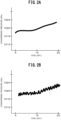
- the cumulative altitude calculation device 100 realized by the CPU 10 and the like of the wristwatch 1 acquires the atmospheric pressure value measured by the atmospheric pressure sensor 40, and smooths the acquired atmospheric pressure value with an intensity corresponding to an amount of noise included in the changes over time of the atmospheric pressure value. For example, as illustrated in FIG. 2A , in a case in which atmospheric pressure data that changes gradually is obtained, the cumulative altitude calculation device 100 smooths the atmospheric pressure data with a small intensity, Conversely, as illustrated in FIG. 2B , in a case in which atmospheric pressure data with a large amount of noise is obtained, the cumulative altitude calculation device 100 smooths the atmospheric pressure data with a large intensity. Then, the cumulative altitude calculation device 100 estimates the altitude of the current location on the basis of the smoothed atmospheric pressure data.
- the phrase “the intensity of the smoothing is small” means that the cutoff frequency in the low-pass filter is high, and the phrase “the intensity of the smoothing is large” means that the cutoff frequency is low.
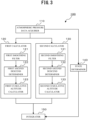
- the cumulative altitude calculation device 100 includes an atmospheric pressure data acquirer 110 that acquires the atmospheric pressure data from the atmospheric pressure sensor 40, a first calculator 120 that calculates a cumulative altitude from the atmospheric pressure data smoothed with the small intensity, a second calculator 130 that calculates the cumulative altitude from the atmospheric pressure data smoothed with the large intensity, a state determiner 140 that determines a current noise state, and an integrator 150 that uses the cumulative altitude corresponding to the noise state.
- the atmospheric pressure data acquirer 110 includes the CPU 10, the A/D conversion circuit 50, and the like, and acquires the atmospheric pressure data from the atmospheric pressure sensor 40.
- the first calculator 120 calculates a first cumulative altitude from the atmospheric pressure data acquired from the atmospheric pressure sensor 40.
- the term "cumulative altitude” refers to an altitude obtained by sequentially adding, to an elevation of a reference location, an altitude difference value calculated every predetermined period.
- the first calculator 120 includes a first smoothing filter 121 that smooths the atmospheric pressure data with a first intensity, a first ascend/descend determiner 122 that determines an ascend/descend direction in a first period every predetermined cycle, and a first cumulative altitude calculator 123 that calculates an ascend/descend difference value in the predetermined cycle and calculates the first cumulative altitude on the basis of the ascend/descend direction and the ascend/descend difference value.
- the first smoothing filter 121 is a desired low-pass filter or the like.
- the first period is a period for calculating the ascend/descend direction every predetermined cycle, such as one clock, in order for the first calculator 120 to calculate the first cumulative altitude from the atmospheric pressure data.
- the second calculator 130 calculates a second cumulative altitude from the atmospheric pressure data acquired from the atmospheric pressure sensor 40.
- the second calculator 130 includes a second smoothing filter 131 that smooths the atmospheric pressure data with a second intensity, a second ascend/descend determiner 132 that determines the ascend/descend direction in a second period every predetermined cycle, and a second cumulative altitude calculator 133 that calculates the ascend/descend difference value in the predetermined cycle and calculates the second cumulative altitude on the basis of the ascend/descend direction and the ascend/descend difference value.
- the second smoothing filter 131 is a desired low-pass filter or the like.
- the second period is a period for calculating the ascend/descend direction every predetermined cycle in order for the second calculator 130 to calculate the second cumulative altitude from the atmospheric pressure data.
- the second intensity is greater than the first intensity
- the second period is greater than the first period.
- the state determiner 140 determines, from the atmospheric pressure data acquired from the atmospheric pressure sensor 40, whether the current state is a first state or a second state.
- the first state is a state in which the amount of noise included in the changes over time of the atmospheric pressure value is small
- the second state is a state in which the amount of noise is great.
- the state determiner 140 determines that the current state is the first state
- the state determiner 140 determines that the current state is the second state.
- the integrator 150 derives the cumulative altitude in accordance with the state determined by the state determiner 140, on the basis of the first cumulative altitude and the second cumulative altitude.
- FIG. 4 is a flowchart for explaining cumulative altitude calculation processing executed by the cumulative altitude calculation device 100.
- the cumulative altitude calculation processing is processing for estimating the altitude of the current location by calculating, from the atmospheric pressure data acquired from the atmospheric pressure sensor 40, the cumulative altitude up to the current location.
- the cumulative altitude calculation processing starts when the user operates the input device 80 of the wristwatch 1 to input the elevation of the current location (or the ascend/descend altitude up to that location) H 0 .
- first calculation processing (step S100), second calculation processing (step S200), state determination processing (step S300), and integration processing (step S400) are each started. These processings end when, for example, the user operates the input device 80 and enters a command into the cumulative altitude calculation device 100 for stopping the cumulative altitude calculation processing.
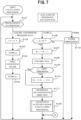
- FIG. 7 is a flowchart for explaining the first calculation processing that starts when the cumulative altitude calculation processing illustrated in FIG. 4 starts.
- the first calculation processing is processing that is executed by the first calculator 120, and in which the first cumulative altitude is calculated from the atmospheric pressure data.
- the atmospheric pressure data is acquired from the atmospheric pressure sensor 40 every clock cycle of the clock signal supplied from the oscillation circuit 60 and the frequency dividing circuit 70. Additionally, the first calculator 120 calculates the first cumulative altitude in the first period every predetermined cycle, such as the clock cycle or the like.
- the first period is a cycle that is an integer multiple of the clock cycle and, here, the clock cycle is 1 second (1 Hz), and the first period is 10 seconds.
- the first calculation processing assumes a stand-by state until one of the conditions described later is satisfied (step S101).
- the first calculator 120 acquires the atmospheric pressure data from the atmospheric pressure data acquirer 110, the clock cycle number i is incremented (step S102). Then, the first calculator 120 stores the atmospheric pressure value pi that is the i th atmospheric pressure data in the first altitude change table 21j (step S103).
- the first calculator 120 smooths the acquired atmospheric pressure data with the first smoothing filter 121 (step S104). Thereafter, the first calculator 120 stores the smoothed atmospheric pressure data p 1,i in the first altitude change table 21j retained in the RAM 20 (step S105). Then, the processing of step S101 is executed.
- the first calculator 120 determines whether the clock cycle number i of the filtered atmospheric pressure data p 1,i is greater than or equal to 10 (sec), which is the first period (step S106).
- the first cumulative altitude calculator 123 calculates an atmospheric pressure difference p 1,i - p 1,i-1 , which is a difference value between the i th filtered atmospheric pressure value p 1,i and the (i-1) th filtered atmospheric pressure value p 1,i-1 (step S107). Meanwhile, when the first calculator 120 determines that i is less than 10 (step S106; No), the processing of step S101 is executed.
- the first cumulative altitude calculator 123 converts, by a known function, the atmospheric pressures p 1,i and p 1,i-1 to altitudes respectively corresponding thereto and, then, calculates, as the difference value between the altitudes, an ascend/descend difference value h 1,i (step S108).
- the first cumulative altitude calculator 123 determines whether the absolute value of the i th ascend/descend difference value h 1,i is greater than a first threshold (step S109).
- step S109 when the first cumulative altitude calculator 123 determines that the absolute value of the i th ascend/descend difference value h 1,i is less than the first threshold (step S109; No), step S110 is skipped and the ascend/descend difference value h 1,i is not added.
- the first ascend/descend determiner 122 determines the i th ascend/descend direction (step 5111).
- the first ascend/descend determiner 122 determines that the ascend/descend direction is a flat ground direction when the value of the ascend/descend difference value h 1,i is 0, an ascend direction when the value of the ascend/descend difference value h 1,i is positive, and a descend direction when the value of the ascend/descend difference value h 1,i is negative.
- the first calculator 120 executes continuous altitude change calculation processing (step S130).
- the first cumulative altitude calculator 123 adds together the ascend/descend difference value h 1,i of the intervals in which the ascend/descend direction is determined to continuously be the ascend direction or the descend direction, and retains the result as the continuous altitude change.
- the first cumulative altitude calculator 123 resets the continuous altitude change.
- the integrator 150 uses the first cumulative altitude H 1,i when the continuous altitude change exceeds a predetermined threshold.
- the first cumulative altitude calculator 123 resets the continuous altitude change.
- FIG. 8 is a flowchart for explaining the continuous altitude change calculation processing executed when, in the first calculation processing, the first calculator 120 calculates the first cumulative altitude H 1,i .
- the first ascend/descend determiner 122 determines whether there is an ascend/descend direction change in the i th clock cycle (step S 131).
- the first ascend/descend determiner 122 determines that, for example, the ascend/descend direction in the (i-1) th clock cycle is the flat ground direction ( ⁇ ), but the ascend/descend direction in the i th clock cycle is the ascend direction ( ⁇ ) or the descend direction ( ⁇ )
- the first cumulative altitude calculator 123 resets the continuous altitude change in order to start the counting of the continuous altitude change (step S132).
- the ascend/descend difference value h 1,i is set as an initial value in the continuous altitude change.
- the first cumulative altitude calculator 123 updates the continuous altitude change by adding the ascend/descend difference value h 1,i (step S133).
- the first cumulative altitude calculator 123 resets the continuous altitude change (step S134).
- the first ascend/descend determiner 122 determines that, for example, the ascend/descend direction in the (i-1) th clock cycle is the flat ground direction ( ⁇ ), and the ascend/descend direction in the i th clock cycle is the flat ground direction ( ⁇ ), or the ascend/descend direction in the (i-1) th clock cycle is the ascend direction ( ⁇ ), but the ascend/descend direction in the i th clock cycle is the flat ground direction ( ⁇ ), or the ascend/descend direction in the (i-1) th clock cycle is the descend direction ( ⁇ ), but the ascend/descend direction in the i th clock cycle is the flat ground direction ( ⁇ ), the first ascend/descend determiner 122 determines whether a period T f in which the ascend/descend direction is the flat ground direction is greater than or equal to a predetermined period ⁇ (step S135).
- the first cumulative altitude calculator 123 resets the continuous altitude change (step S136). Meanwhile, when the first ascend/descend determiner 122 determines that the period Tf in which the ascend/descend direction is the flat ground direction is not greater than or equal to the predetermined period ⁇ (step S135; No), the first cumulative altitude calculator 123 maintains the continuous altitude change (step S137).
- step S101 illustrated in FIG. 7 is executed. Note that, the set, updated, or maintained continuous altitude change is retained in the RAM 20.
- step S101 when the first calculator 120 determines that another condition is satisfied, the first calculator 120 executes other processing corresponding to that condition (step S112). Thereafter, the processing of step S101 is executed.
- FIG. 9 is a flowchart for explaining the second calculation processing that starts when the cumulative altitude calculation processing illustrated in FIG. 4 starts.
- the second calculation processing is processing that is executed by the second calculator 130, and in which the second cumulative altitude is calculated from the atmospheric pressure data.
- the second calculator 130 calculates the second cumulative altitude in the second period every predetermined cycle such as the clock cycle or the like.
- the second period is a period that is an integer multiple of the clock cycle, and is greater than the first period.
- the clock cycle is 1 second (1 Hz)
- the second period is 50 seconds.
- the second calculation processing assumes a stand-by state until one of the conditions described later is satisfied (step S201).
- the second calculator 130 acquires the atmospheric pressure data from the atmospheric pressure data acquirer 110, the clock cycle number i is incremented (step S202). Then, the second calculator 130 stores, in the second altitude change table 21k, the atmospheric pressure value pi that is the i th atmospheric pressure data (step S203).
- the second calculator 130 smooths the acquired atmospheric pressure data with the second smoothing filter 131 (step S204). Thereafter, the second calculator 130 stores the smoothed atmospheric pressure data p 2,i in the second altitude change table 21k retained in the RAM 20 (step S205).
- the second calculator 130 determines whether the clock cycle number i of the filtered atmospheric pressure data p 2,i is greater than or equal to 50 (sec), which is the second period (step S206).
- the second cumulative altitude calculator 133 calculates an atmospheric pressure difference p 2,i - p 2,i-1 , which is a difference value between the i th filtered atmospheric pressure value p 2,i and the (i-1) th filtered atmospheric pressure value p 2,i-1 (step S207). Meanwhile, when the second calculator 130 determines that i is less than 50 (step S206; No), the processing of step S201 is executed.
- the second cumulative altitude calculator 133 converts, by a known function, the atmospheric pressures p 2,i and p 2,i-1 to an ascend/descend difference value h 2,i (step S208).
- the second cumulative altitude calculator 133 determines whether the absolute value of the i th ascend/descend difference value h 2,i is greater than a second threshold (step S209).
- step S210 is skipped and the ascend/descend difference value h 2,i is not added.
- step S211 the second ascend/descend determiner 132 determines the i th ascend/descend direction.
- the method for determining the ascend/descend direction is the same as that used by the first ascend/descend determiner 122. Thereafter, the processing of step S201 is executed.
- step S201 when the second calculator 130 determines that another condition is satisfied, the second calculator 130 executes other processing corresponding to that condition (step S215). Thereafter, the processing of step S201 is executed.
- FIG. 10 is a flowchart for explaining the state determination processing that starts when the cumulative altitude calculation processing illustrated in FIG. 4 starts.
- the state determination processing is processing that is executed by the state determiner 140.
- the state determiner 140 determines, from the atmospheric pressure data, if the current state is the first state or the second state.
- the state determiner 140 determines the current state every 1 second, which is the clock cycle.
- the state determiner 140 determines whether an ascend/descend switching frequency F 1 is greater than or equal to a predetermined value ⁇ (step S303).
- the ascend/descend switching frequency F 1 is the number of times per unit time that the ascend/descend direction of the first altitude change table 21j illustrated in FIG. 5 switches.
- the state determiner 140 calculates the ascend/descend switching frequency F 1 , and determines whether F 1 is greater than or equal to the predetermined value ⁇ .
- the determination of step S303 may be made on the basis of the ascend/descend switching frequency F 1 in the first period, namely, a period of the past 10 seconds, as the predetermined period.
- step S306 the state determiner 140 retains the determined current state in the RAM 20 (step S306), and increments the clock cycle number i (step S307). Thereafter, the processing of step S302 is executed.
- step S302 when, in step S302, the state determiner 140 determines that the current state is the second state (step S302; No), the state determiner 140 determines whether the ascend/descend switching frequency F 1 is less than or equal to a predetermined value ⁇ different than ⁇ (step S308). In the predetermined period up to the clock cycle number i, the state determiner 140 calculates the ascend/descend switching frequency F 1 and determines whether F 1 is less than or equal to the predetermined value ⁇ .
- the reason that the ascend/descend switching frequency F 1 calculated from the ascend/descend direction of the first altitude change table 21j is used is because the first intensity related to the intensity of the smoothing is smaller than the second intensity, and noise more similar to the actual noise can be picked up.
- ⁇ and ⁇ may be identical values.
- FIG. 11 is a flowchart for explaining the integration processing that starts when the cumulative altitude calculation processing illustrated in FIG. 4 starts.
- the integration processing is processing that is executed by the integrator 150.
- a cumulative altitude is derived on the basis of the first cumulative altitude and the second cumulative altitude, in accordance with whether the current state is the first state or the second state.
- the integrator 150 determines whether the first cumulative altitude H 1,i in the i th clock cycle is greater than or equal to the second cumulative altitude H 2,i (step S403).
- the integrator 150 determines that the first cumulative altitude H 1,i in the i th clock cycle is greater than or equal to the second cumulative altitude H 2,i (step S403; Yes). Meanwhile, when the integrator 150 determines that the first cumulative altitude H 1,i in the i th clock cycle is less than or equal to the second cumulative altitude H 2,i (step S403; No), the integrator 150 uses the second cumulative altitude H 2,i (step S405).
- step S402 the integrator 150 determines whether the current state is the second state (step S402; No).
- the integrator 150 determines whether the continuous altitude change is greater than or equal to a predetermined value ⁇ (step S431).
- the integrator 150 uses the first cumulative altitude H 1,i (step S432).
- the integrator 150 uses the second cumulative altitude H 2,i (step S433). Then, the processing of step S406 is executed and the same processing as in Embodiment 1 is executed.
- step S406 the processing of step S402 is executed.
- the integrator 150 uses the greater cumulative altitude of the first cumulative altitude H 1,i and the second cumulative altitude H 2,i . Due to such a configuration, it is possible to salvage cases such as when the user is, in reality, gradually ascending a slope but, in the calculations by the first calculator 120, the ascend/descend difference value is canceled out due to the up and down of the arm swing of the user that does not exceed the first threshold.
- the first cumulative altitude H 1,i is used in the first state, and the second cumulative altitude H 2,i is used in the second state.
- the cumulative altitude calculation device 100 smooths the atmospheric pressure data with two types of smoothing filters that have different intensities, and estimates the cumulative altitude of the current location by using one of the two types of smoothing filters in accordance with the amount of noise included in the atmospheric pressure data.
- altitude greater than actual may be added due to the portable altimeter being subjected to an external factor such as strong wind or arm swing when worn on an arm and, conversely, altitude may not be added when the altitude change is gradual.
- an external factor such as strong wind or arm swing
- atmospheric pressure data that is smoothed using high intensity can be used and, as a result, the altitude of the current location can be accurately calculated.
- Embodiment 1 a configuration is used in which the continuous altitude change is calculated, and the first cumulative altitude H 1,i is used when the continuous altitude change is greater than or equal to the predetermined value, even when in the second state. Due to this configuration, the cumulative altitude can be more correctly estimated in situations in which noise is great such as when running up or down stairs, for example. That is, even when there is a large amount of noise and a determination is made that the current state is switched to the second state, in a case in which there is more actual altitude change due to sudden ascending or descending than the atmospheric pressure change due to the noise, it is possible to more accurately estimate the altitude of the current location by using the first cumulative altitude H 1,i that is thought to be a value closer to the actual altitude.
- Embodiment 1 a configuration is used in which the continuous altitude change is maintained without resetting when the period Tf in which the ascend/descend direction is the flat ground direction is shorter than the predetermined period. Due to this configuration, even when, for example, a determination is made that the current location is a temporary flat ground such as a landing of a staircase, the continuous altitude change is maintained and, as such, even when in the second state, the first cumulative altitude H 1,i is used if the predetermined condition is satisfied. As a result, the altitude of the current location can be accurately estimated.
- Embodiment 2 of the present disclosure is described.
- constituents and processings identical to those of Embodiment 1 are denoted with the same reference numerals.
- Embodiment 1 a configuration is used in which, in accordance with the current state, for the period in which it is that state, one of the cumulative altitudes is always used.
- the second period for calculating the ascend/descend difference value is a period for calculating the ascend/descend difference value from the atmospheric pressure data that is smoothed with great intensity and, as such, a comparatively large period is necessary.
- Embodiment 2 a configuration is used in which the first cumulative altitude H 1,i is used for a brief period after switching from the first state to the second state.
- Embodiment 2 among the four processings that start when the cumulative altitude calculation processing illustrated in FIG. 4 starts, the first calculation processing (step S 100), the second calculation processing (step S200), and the state determination processing (step S300) are the same as in Embodiment 1.
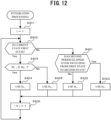
- FIG. 12 is a flowchart for explaining the integration processing of Embodiment 2.
- the integrator 150 determines whether the first cumulative altitude H 1,i in the i th clock cycle is greater than or equal to the second cumulative altitude H 2,i (step S403).
- the integrator 150 determines that the first cumulative altitude in the i th clock cycle is greater than or equal to the second cumulative altitude H 2,i (step S403; Yes). Meanwhile, when the integrator 150 determines that the first cumulative altitude in the i th clock cycle is less than or equal to the second cumulative altitude H 2,i (step S403; No), the integrator 150 uses the second cumulative altitude H 2,i (step S405).
- step S402 the integrator 150 determines that the current state is the second state (step S402; No)
- the integrator 150 determines whether the first second period has elapsed after switching from the first state to the second state (step S421).
- the integrator 150 determines that the first second period has not elapsed after switching from the first state to the second state (step S421; No).
- the integrator 150 uses the first cumulative altitude (step S422). Specifically, when the state determiner 140 determines that the current state has transitioned from the first state to the second state, the integrator 150 uses the first cumulative altitude up to when the first second period elapses.
- the integrator 150 determines that the first second period has elapsed after switching from the first state to the second state (step S421; Yes), the integrator 150 uses the second cumulative altitude H 2,i (step S423).
- step S406 the integrator 150 increments the clock cycle number i (step S406), and executes the processing of step S402.
- step S421 instead of determining whether the first second period has elapsed after switching from the first state to the second state, the integrator 150 determines whether a predetermined period other than the first second period has elapsed.
- the integrator 150 uses the first cumulative altitude until the second period elapses after switching from the first state to the second state. Due to this configuration, it is possible to eliminate the time lag from after switching from the first state to the second state until the first ascend/descend difference value is calculated, and a more correct estimated value of the current altitude can be provided to the user.
- the first calculation processing and the second calculation processing are executed in parallel but, in this case, for example, the value of the first cumulative altitude may increase in situations in which the noise is great, and the difference between the first cumulative altitude H 1,i and the second cumulative altitude H 2,i may increase.
- the integrator 150 interrupts the calculation by the first calculator 120.
Landscapes
- Physics & Mathematics (AREA)
- Engineering & Computer Science (AREA)
- General Physics & Mathematics (AREA)
- Radar, Positioning & Navigation (AREA)
- Remote Sensing (AREA)
- Electric Clocks (AREA)
- Measuring Fluid Pressure (AREA)
Abstract
Description
- The present disclosure relates generally to a cumulative altitude calculation device, a cumulative altitude calculation method, and a program.
- As described in Unexamined
Japanese Patent Application Publication No. 2001-289632 - The portable altimeter disclosed in the publication described above is determined to be in a moving state when an amount of altitude change is great, and in a stationary state when the amount of altitude change is small and, when in the moving state, adds the altitude difference value and updates the cumulative altitude to estimate the altitude of the current location.
- A cumulative altitude calculation device of one aspect of the present disclosure includes an atmospheric pressure data acquirer that acquires atmospheric pressure data from an atmospheric pressure sensor; a first calculator that calculates a first cumulative altitude from the acquired atmospheric pressure data; a second calculator that calculates a second cumulative altitude from the acquired atmospheric pressure data; a state determiner that determines, from the acquired atmospheric pressure data, whether a current state is a first state or a second state; and an integrator that derives, in accordance with the determined current state and based on the first cumulative altitude and the second cumulative altitude, a cumulative altitude.
- Further features of the present invention will become apparent from the following description of exemplary embodiments (with reference to the attached drawings).
- A more complete understanding of this application can be obtained when the following detailed description is considered in conjunction with the following drawings, in which:
-
FIG. 1 is a drawing illustrating the hardware configuration of a wristwatch according to some embodiments; -
FIG. 2A is a drawing illustrating an example of changes over time of an atmospheric pressure value in a first state; -
FIG. 2B is a drawing illustrating an example of changes over time of the atmospheric pressure value in a second state; -
FIG. 3 is a drawing illustrating the functional configuration of a cumulative altitude calculation device according to some embodiments; -
FIG. 4 is a flowchart illustrating cumulative altitude calculation processing according to some embodiments; -
FIG. 5 is a drawing illustrating a first altitude change table; -
FIG. 6 is a drawing illustrating a second altitude change table; -
FIG. 7 is a flowchart illustrating first calculation processing according to some embodiments; -
FIG. 8 is a flowchart illustrating continuous altitude change calculation processing according to some embodiments; -
FIG. 9 is a flowchart illustrating second calculation processing according to some embodiments; -
FIG. 10 is a flowchart illustrating state determination processing according to some embodiments; -
FIG. 11 is a flowchart illustrating integration processing according toEmbodiment 1; and -
FIG. 12 is a flowchart illustrating integration processing according to Embodiment 2. - Hereinafter, a
wristwatch 1 and a cumulativealtitude calculation device 100 according to embodiments of the present disclosure are described in detail while referencing the drawings. However, the following embodiments are presented for the purpose of explanation and should not be construed as limiting the scope of the invention of the present disclosure. Therefore, embodiments in which some elements or all elements of these embodiments are replaced with equivalent elements by one skilled in the art can also be employed, and such embodiments are also included within the scope of the present disclosure. - A
wristwatch 1 according toEmbodiment 1 includes an atmospheric pressure sensor. Thewristwatch 1 estimates an elevation of a current location from acquired atmospheric pressure data and provides the estimated elevation of the current location to a user by displaying the estimated elevation on a display. As illustrated inFIG. 1 , thewristwatch 1 includes aCPU 10, aRAM 20, aROM 30, anatmospheric pressure sensor 40, an A/D conversion circuit 50, anoscillation circuit 60, afrequency dividing circuit 70, aninput device 80, and adisplay device 90. These components are connected to each other via a non-illustrated bus. Additionally, thewristwatch 1 includes a non-illustrated wristband and the like. - A cumulative
altitude calculation device 100 is a device that is realized by theCPU 10 and the like of thewristwatch 1. The cumulativealtitude calculation device 100 converts the acquired atmospheric pressure data to altitude data, and calculates the altitude of the current location. - The
CPU 10 is a central processing unit (CPU) that carries out the overall control of thewristwatch 1. TheCPU 10 executes a program stored in theROM 30 to realize the various functions of the cumulativealtitude calculation device 100. - The
RAM 20 is random access memory (RAM) into which the program is loaded from theROM 30, and is used as the working area of theCPU 10. Additionally, an altitude change table 21, in which the altitude data that is converted from the atmospheric pressure data is stored, is retained in theRAM 20. TheROM 30 is read-only memory (ROM) that stores programs required for theCPU 10 to operate, and various types of data to be used in processing. - The
atmospheric pressure sensor 40 is an atmospheric pressure sensor such as a piezoresistive barometer or the like, and measures an atmospheric pressure value in accordance with instructions from theCPU 10. In accordance with instructions from theCPU 10, the A/D conversion circuit 50 converts the atmospheric pressure value measured by theatmospheric pressure sensor 40 to digital data, and sends the converted digital data to theCPU 10. - The
oscillation circuit 60 and thefrequency dividing circuit 70 are components for supplying a clock signal having a constant clock frequency to theCPU 10. This clock signal is used to measure the time by counting a number of rises of a clock pulse by software processing executed by theCPU 10. - The
input device 80 is a switch or the like that receives commands from the user. Thedisplay device 90 may be a liquid crystal display, an organic electro luminescence (EL) display, or the like, or a capacitive touch panel or the like in which a touch pad, namely theinput device 80, is integrated. - The cumulative
altitude calculation device 100 realized by theCPU 10 and the like of thewristwatch 1 acquires the atmospheric pressure value measured by theatmospheric pressure sensor 40, and smooths the acquired atmospheric pressure value with an intensity corresponding to an amount of noise included in the changes over time of the atmospheric pressure value. For example, as illustrated inFIG. 2A , in a case in which atmospheric pressure data that changes gradually is obtained, the cumulativealtitude calculation device 100 smooths the atmospheric pressure data with a small intensity, Conversely, as illustrated inFIG. 2B , in a case in which atmospheric pressure data with a large amount of noise is obtained, the cumulativealtitude calculation device 100 smooths the atmospheric pressure data with a large intensity. Then, the cumulativealtitude calculation device 100 estimates the altitude of the current location on the basis of the smoothed atmospheric pressure data. - Here, the phrase "the intensity of the smoothing is small" means that the cutoff frequency in the low-pass filter is high, and the phrase "the intensity of the smoothing is large" means that the cutoff frequency is low.
- As illustrated in
FIG. 3 , the cumulativealtitude calculation device 100 includes an atmospheric pressure data acquirer 110 that acquires the atmospheric pressure data from theatmospheric pressure sensor 40, afirst calculator 120 that calculates a cumulative altitude from the atmospheric pressure data smoothed with the small intensity, asecond calculator 130 that calculates the cumulative altitude from the atmospheric pressure data smoothed with the large intensity, a state determiner 140 that determines a current noise state, and anintegrator 150 that uses the cumulative altitude corresponding to the noise state. - The atmospheric pressure data acquirer 110 includes the
CPU 10, the A/D conversion circuit 50, and the like, and acquires the atmospheric pressure data from theatmospheric pressure sensor 40. - The
first calculator 120 calculates a first cumulative altitude from the atmospheric pressure data acquired from theatmospheric pressure sensor 40. The term "cumulative altitude" refers to an altitude obtained by sequentially adding, to an elevation of a reference location, an altitude difference value calculated every predetermined period. - The
first calculator 120 includes afirst smoothing filter 121 that smooths the atmospheric pressure data with a first intensity, a first ascend/descend determiner 122 that determines an ascend/descend direction in a first period every predetermined cycle, and a firstcumulative altitude calculator 123 that calculates an ascend/descend difference value in the predetermined cycle and calculates the first cumulative altitude on the basis of the ascend/descend direction and the ascend/descend difference value. Thefirst smoothing filter 121 is a desired low-pass filter or the like. The first period is a period for calculating the ascend/descend direction every predetermined cycle, such as one clock, in order for thefirst calculator 120 to calculate the first cumulative altitude from the atmospheric pressure data. - The
second calculator 130 calculates a second cumulative altitude from the atmospheric pressure data acquired from theatmospheric pressure sensor 40. Thesecond calculator 130 includes asecond smoothing filter 131 that smooths the atmospheric pressure data with a second intensity, a second ascend/descend determiner 132 that determines the ascend/descend direction in a second period every predetermined cycle, and a secondcumulative altitude calculator 133 that calculates the ascend/descend difference value in the predetermined cycle and calculates the second cumulative altitude on the basis of the ascend/descend direction and the ascend/descend difference value. Thesecond smoothing filter 131 is a desired low-pass filter or the like. The second period is a period for calculating the ascend/descend direction every predetermined cycle in order for thesecond calculator 130 to calculate the second cumulative altitude from the atmospheric pressure data. Here, the second intensity is greater than the first intensity, and the second period is greater than the first period. - The state determiner 140 determines, from the atmospheric pressure data acquired from the
atmospheric pressure sensor 40, whether the current state is a first state or a second state. Here, the first state is a state in which the amount of noise included in the changes over time of the atmospheric pressure value is small, and the second state is a state in which the amount of noise is great. When the amount of noise included in the atmospheric pressure data is less than a predetermined reference, thestate determiner 140 determines that the current state is the first state, and when the amount of noise included in the atmospheric pressure data is greater than the predetermined reference, thestate determiner 140 determines that the current state is the second state. - The
integrator 150 derives the cumulative altitude in accordance with the state determined by thestate determiner 140, on the basis of the first cumulative altitude and the second cumulative altitude. -
FIG. 4 is a flowchart for explaining cumulative altitude calculation processing executed by the cumulativealtitude calculation device 100. The cumulative altitude calculation processing is processing for estimating the altitude of the current location by calculating, from the atmospheric pressure data acquired from theatmospheric pressure sensor 40, the cumulative altitude up to the current location. - The cumulative altitude calculation processing starts when the user operates the
input device 80 of thewristwatch 1 to input the elevation of the current location (or the ascend/descend altitude up to that location) H0. When the cumulative altitude calculation processing starts, the cumulativealtitude calculation device 100 firstly stores an initial state in the altitude change table 21 retained in theRAM 20. Specifically, the cumulativealtitude calculation device 100 sets an atmospheric pressure value p0, an elevation H0, and the like from when the clock cycle number i = 0 and the elevation H0 is input, such as illustrated in the 1st row of a first altitude change table 21j illustrated inFIG. 5 . Additionally, the cumulativealtitude calculation device 100 sets the atmospheric pressure value p0, the elevation H0, and the like from when the clock cycle number i = 0 and the elevation H0 is input, such as illustrated in the 1st row of a second altitude change table 21k illustrated inFIG. 6 . Moreover, the atmospheric pressure value p0 is substituted into the i = 0th atmospheric pressure value p1,0 after smoothing with the first smoothingfilter 121, and the i = 0th atmospheric pressure value p2,0 after smoothing with thesecond smoothing filter 131. - Returning to
FIG. 4 , next, first calculation processing (step S100), second calculation processing (step S200), state determination processing (step S300), and integration processing (step S400) are each started. These processings end when, for example, the user operates theinput device 80 and enters a command into the cumulativealtitude calculation device 100 for stopping the cumulative altitude calculation processing. -
FIG. 7 is a flowchart for explaining the first calculation processing that starts when the cumulative altitude calculation processing illustrated inFIG. 4 starts. The first calculation processing is processing that is executed by thefirst calculator 120, and in which the first cumulative altitude is calculated from the atmospheric pressure data. The atmospheric pressure data is acquired from theatmospheric pressure sensor 40 every clock cycle of the clock signal supplied from theoscillation circuit 60 and thefrequency dividing circuit 70. Additionally, thefirst calculator 120 calculates the first cumulative altitude in the first period every predetermined cycle, such as the clock cycle or the like. The first period is a cycle that is an integer multiple of the clock cycle and, here, the clock cycle is 1 second (1 Hz), and the first period is 10 seconds. - When the first calculation processing starts, the first calculation processing assumes a stand-by state until one of the conditions described later is satisfied (step S101). When the
first calculator 120 acquires the atmospheric pressure data from the atmosphericpressure data acquirer 110, the clock cycle number i is incremented (step S102). Then, thefirst calculator 120 stores the atmospheric pressure value pi that is the ith atmospheric pressure data in the first altitude change table 21j (step S103). - Next, the
first calculator 120 smooths the acquired atmospheric pressure data with the first smoothing filter 121 (step S104). Thereafter, thefirst calculator 120 stores the smoothed atmospheric pressure data p1,i in the first altitude change table 21j retained in the RAM 20 (step S105). Then, the processing of step S101 is executed. - Next, when the atmospheric pressure data p1,i that has been filtered by the first smoothing
filter 121 is stored in the first altitude change table 21j, thefirst calculator 120 determines whether the clock cycle number i of the filtered atmospheric pressure data p1,i is greater than or equal to 10 (sec), which is the first period (step S106). When thefirst calculator 120 determines that the clock cycle number i is greater than or equal to 10 (step S106; Yes), the firstcumulative altitude calculator 123 calculates an atmospheric pressure difference p1,i - p1,i-1, which is a difference value between the ith filtered atmospheric pressure value p1,i and the (i-1)th filtered atmospheric pressure value p1,i-1 (step S107). Meanwhile, when thefirst calculator 120 determines that i is less than 10 (step S106; No), the processing of step S101 is executed. - Returning to step S107, the first
cumulative altitude calculator 123 converts, by a known function, the atmospheric pressures p1,i and p1,i-1 to altitudes respectively corresponding thereto and, then, calculates, as the difference value between the altitudes, an ascend/descend difference value h1,i (step S108). - Next, the first
cumulative altitude calculator 123 determines whether the absolute value of the ith ascend/descend difference value h1,i is greater than a first threshold (step S109). When the firstcumulative altitude calculator 123 determines that the absolute value of the ith ascend/descend difference value h1,i is greater than the first threshold (step S109; Yes), the firstcumulative altitude calculator 123 uses the ith ascend/descend difference value h1,i to calculate an ith first cumulative altitude H1,i = H1,i-1+h1,i (step S110). - Meanwhile, when the first
cumulative altitude calculator 123 determines that the absolute value of the ith ascend/descend difference value h1,i is less than the first threshold (step S109; No), step S110 is skipped and the ascend/descend difference value h1,i is not added. - Next, the first ascend/descend
determiner 122 determines the ith ascend/descend direction (step 5111). The first ascend/descenddeterminer 122 determines that the ascend/descend direction is a flat ground direction when the value of the ascend/descend difference value h1,i is 0, an ascend direction when the value of the ascend/descend difference value h1,i is positive, and a descend direction when the value of the ascend/descend difference value h1,i is negative. In the first altitude change table 21j ofFIG. 5 , the symbol "↑" is stored when the ascend/descend direction is the ascend direction, the symbol "↓" is stored when the ascend/descend direction is the descend direction, and the symbol "→" is stored when the ascend/descend direction is the flat ground direction. - Here, when, in step S109, the first ascend/descend
determiner 122 determines that the absolute value of the ascend/descend difference value is less than the first threshold, the first ascend/descenddeterminer 122 may determine that the ascend/descend direction is the flat ground direction. Additionally, for the periods in which the clock cycle number i is less than the first period, namely the period less than i = 9, the symbol "→", which indicates the flat ground direction, may be stored as an initial value. - Returning to
FIG. 7 , next, thefirst calculator 120 executes continuous altitude change calculation processing (step S130). In the continuous altitude change calculation processing, when the first ascend/descenddeterminer 122 determines that the ascend/descend direction is continuously the ascend direction or the descend direction, the firstcumulative altitude calculator 123 adds together the ascend/descend difference value h1,i of the intervals in which the ascend/descend direction is determined to continuously be the ascend direction or the descend direction, and retains the result as the continuous altitude change. When the first ascend/descenddeterminer 122 determines that the ascend/descend direction has changed from the ascend direction to the descend direction or from the descend direction to the ascend direction, the firstcumulative altitude calculator 123 resets the continuous altitude change. Moreover, in cases in which thestate determiner 140 determines that the current state is the second state, theintegrator 150 uses the first cumulative altitude H1,i when the continuous altitude change exceeds a predetermined threshold. - Furthermore, in the continuous altitude change calculation processing, when the intervals in which the first ascend/descend
determiner 122 determines that the ascend/descend direction is continuously the flat ground direction exceed a predetermined threshold, the firstcumulative altitude calculator 123 resets the continuous altitude change. -
FIG. 8 is a flowchart for explaining the continuous altitude change calculation processing executed when, in the first calculation processing, thefirst calculator 120 calculates the first cumulative altitude H1,i. - When the continuous altitude change calculation processing starts, the first ascend/descend
determiner 122 determines whether there is an ascend/descend direction change in the ith clock cycle (step S 131). When the first ascend/descenddeterminer 122 determines that, for example, the ascend/descend direction in the (i-1)th clock cycle is the flat ground direction (→), but the ascend/descend direction in the ith clock cycle is the ascend direction (↑) or the descend direction (↓), the firstcumulative altitude calculator 123 resets the continuous altitude change in order to start the counting of the continuous altitude change (step S132). At this time, the ascend/descend difference value h1,i is set as an initial value in the continuous altitude change. - When the first ascend/descend
determiner 122 determines that, for example, the ascend/descend direction in the (i-1)th clock cycle is the ascend direction (↑), and the ascend/descend direction in the ith clock cycle is the ascend direction (↑), or the ascend/descend direction in the (i-1)th clock cycle is the descend direction (↓), and the ascend/descend direction in the ith clock cycle is the descend direction (↓), the firstcumulative altitude calculator 123 updates the continuous altitude change by adding the ascend/descend difference value h1,i (step S133). - When the first ascend/descend
determiner 122 determines that, for example, the ascend/descend direction in the (i-1)th clock cycle is the ascend direction (↑), but the ascend/descend direction in the ith clock cycle is the descend direction (↓), or the ascend/descend direction in the (i-1)th clock cycle is the descend direction (↓), but the ascend/descend direction in the ith clock cycle is the ascend direction (↑), the firstcumulative altitude calculator 123 resets the continuous altitude change (step S134). - When the first ascend/descend
determiner 122 determines that, for example, the ascend/descend direction in the (i-1)th clock cycle is the flat ground direction (→), and the ascend/descend direction in the ith clock cycle is the flat ground direction (→), or the ascend/descend direction in the (i-1)th clock cycle is the ascend direction (↑), but the ascend/descend direction in the ith clock cycle is the flat ground direction (→), or the ascend/descend direction in the (i-1)th clock cycle is the descend direction (↓), but the ascend/descend direction in the ith clock cycle is the flat ground direction (→), the first ascend/descenddeterminer 122 determines whether a period Tf in which the ascend/descend direction is the flat ground direction is greater than or equal to a predetermined period γ (step S135). - When the first ascend/descend
determiner 122 determines that the period Tf in which the ascend/descend direction is the flat ground direction is greater than or equal to the predetermined period γ (step S135; Yes), the firstcumulative altitude calculator 123 resets the continuous altitude change (step S136). Meanwhile, when the first ascend/descenddeterminer 122 determines that the period Tf in which the ascend/descend direction is the flat ground direction is not greater than or equal to the predetermined period γ (step S135; No), the firstcumulative altitude calculator 123 maintains the continuous altitude change (step S137). - Thereafter, the processing proceeds to "A" of
FIG. 8 , and then step S101 illustrated inFIG. 7 is executed. Note that, the set, updated, or maintained continuous altitude change is retained in theRAM 20. - Next, in step S101, when the
first calculator 120 determines that another condition is satisfied, thefirst calculator 120 executes other processing corresponding to that condition (step S112). Thereafter, the processing of step S101 is executed. - When the processing progresses in this manner, values are sequentially stored in the first altitude change table 21j, as illustrated in
FIG. 5 . -
FIG. 9 is a flowchart for explaining the second calculation processing that starts when the cumulative altitude calculation processing illustrated inFIG. 4 starts. The second calculation processing is processing that is executed by thesecond calculator 130, and in which the second cumulative altitude is calculated from the atmospheric pressure data. Thesecond calculator 130 calculates the second cumulative altitude in the second period every predetermined cycle such as the clock cycle or the like. The second period is a period that is an integer multiple of the clock cycle, and is greater than the first period. Here, the clock cycle is 1 second (1 Hz), and the second period is 50 seconds. - When the second calculation processing starts, the second calculation processing assumes a stand-by state until one of the conditions described later is satisfied (step S201). When the
second calculator 130 acquires the atmospheric pressure data from the atmosphericpressure data acquirer 110, the clock cycle number i is incremented (step S202). Then, thesecond calculator 130 stores, in the second altitude change table 21k, the atmospheric pressure value pi that is the ith atmospheric pressure data (step S203). - Next, the
second calculator 130 smooths the acquired atmospheric pressure data with the second smoothing filter 131 (step S204). Thereafter, thesecond calculator 130 stores the smoothed atmospheric pressure data p2,i in the second altitude change table 21k retained in the RAM 20 (step S205). - Next, when the atmospheric pressure data p2,i that has been filtered by the
second smoothing filter 131 is stored in the second altitude change table 21k, thesecond calculator 130 determines whether the clock cycle number i of the filtered atmospheric pressure data p2,i is greater than or equal to 50 (sec), which is the second period (step S206). When thesecond calculator 130 determines that the clock cycle number i is greater than or equal to 50 (step S206; Yes), the secondcumulative altitude calculator 133 calculates an atmospheric pressure difference p2,i - p2,i-1, which is a difference value between the ith filtered atmospheric pressure value p2,i and the (i-1)th filtered atmospheric pressure value p2,i-1 (step S207). Meanwhile, when thesecond calculator 130 determines that i is less than 50 (step S206; No), the processing of step S201 is executed. - Returning to step S207, the second
cumulative altitude calculator 133 converts, by a known function, the atmospheric pressures p2,i and p2,i-1 to an ascend/descend difference value h2,i (step S208). - Next, the second
cumulative altitude calculator 133 determines whether the absolute value of the ith ascend/descend difference value h2,i is greater than a second threshold (step S209). When the secondcumulative altitude calculator 133 determines that the absolute value of the ith ascend/descend difference value h2,i is greater than the second threshold (step S209; Yes), the secondcumulative altitude calculator 133 uses the ith ascend/descend difference value h2,i to calculate an ith second cumulative altitude H2,i = H2,i-1+h2,i (step S210). - Meanwhile, when the second
cumulative altitude calculator 133 determines that the absolute value of the ith ascend/descend difference value h2,i is less than the second threshold (step S209; No), step S210 is skipped and the ascend/descend difference value h2,i is not added. - Next, the second ascend/descend
determiner 132 determines the ith ascend/descend direction (step S211). The method for determining the ascend/descend direction is the same as that used by the first ascend/descenddeterminer 122. Thereafter, the processing of step S201 is executed. - Next, in step S201, when the
second calculator 130 determines that another condition is satisfied, thesecond calculator 130 executes other processing corresponding to that condition (step S215). Thereafter, the processing of step S201 is executed. - When the processing progresses in this manner, values are sequentially stored in the second altitude change table 21k, as illustrated in
FIG. 6 . -
FIG. 10 is a flowchart for explaining the state determination processing that starts when the cumulative altitude calculation processing illustrated inFIG. 4 starts. The state determination processing is processing that is executed by thestate determiner 140. In the state determination processing, thestate determiner 140 determines, from the atmospheric pressure data, if the current state is the first state or the second state. Thestate determiner 140 determines the current state every 1 second, which is the clock cycle. - When the state determination processing starts, the
state determiner 140 sets the clock cycle number i to i = 1 (step S301). Then, thestate determiner 140 determines whether the current state is the first state (step S302). Note that, the first state may be set in the first clock cycle. Here, since it is the first clock cycle, an assumption is made that thestate determiner 140 determines that the current state is the first state (step S302; Yes). - Next, the
state determiner 140 determines whether an ascend/descend switching frequency F1 is greater than or equal to a predetermined value α (step S303). The ascend/descend switching frequency F1 is the number of times per unit time that the ascend/descend direction of the first altitude change table 21j illustrated inFIG. 5 switches. In a predetermined period up to the clock cycle number i, thestate determiner 140 calculates the ascend/descend switching frequency F1, and determines whether F1 is greater than or equal to the predetermined value α. For example, the determination of step S303 may be made on the basis of the ascend/descend switching frequency F1 in the first period, namely, a period of the past 10 seconds, as the predetermined period. - When the
state determiner 140 determines that the ascend/descend switching frequency F1 is greater than or equal to the predetermined value α (step S303; Yes), thestate determiner 140 determines that the current state in the i = 1th clock cycle is switched to the second state (step S304). Meanwhile, when thestate determiner 140 determines that the ascend/descend switching frequency F1 is less than or equal to the predetermined value α (step S304; No), thestate determiner 140 determines that the current state continues to be the first state (step S305). - Then, the
state determiner 140 retains the determined current state in the RAM 20 (step S306), and increments the clock cycle number i (step S307). Thereafter, the processing of step S302 is executed. - Next, when, in step S302, the
state determiner 140 determines that the current state is the second state (step S302; No), thestate determiner 140 determines whether the ascend/descend switching frequency F1 is less than or equal to a predetermined value β different than α (step S308). In the predetermined period up to the clock cycle number i, thestate determiner 140 calculates the ascend/descend switching frequency F1 and determines whether F1 is less than or equal to the predetermined value β. Note that, even when the current state is the second state, the reason that the ascend/descend switching frequency F1 calculated from the ascend/descend direction of the first altitude change table 21j is used is because the first intensity related to the intensity of the smoothing is smaller than the second intensity, and noise more similar to the actual noise can be picked up. Of course, it is possible to use an ascend/descend switching frequency calculated from the ascend/descend direction of the second altitude change table 21k. Moreover, α and β may be identical values. - When the
state determiner 140 determines that the ascend/descend switching frequency F1 is less than or equal to the predetermined value β (step S308; Yes), thestate determiner 140 determines that the current state in the i = 1th clock cycle is switched to the first state (step S309). Meanwhile, when thestate determiner 140 determines that the ascend/descend switching frequency F1 is greater than or equal to the predetermined value β (step S308; No), thestate determiner 140 determines that the current state continues to be the second state (step S310). Then, the processing of step S306 is executed and the processing proceeds as described above. -
FIG. 11 is a flowchart for explaining the integration processing that starts when the cumulative altitude calculation processing illustrated inFIG. 4 starts. The integration processing is processing that is executed by theintegrator 150. In the integration processing, a cumulative altitude is derived on the basis of the first cumulative altitude and the second cumulative altitude, in accordance with whether the current state is the first state or the second state. - When the integration processing starts, the
integrator 150 sets the clock cycle number i to i = 1 (step S401). Then, theintegrator 150 determines whether the current state is the first state (step S402). Note that, the first state may be set in the first clock cycle. Here, since it is the first clock cycle, an assumption is made that theintegrator 150 determines that the current state is the first state (step S402; Yes). - Next, the
integrator 150 determines whether the first cumulative altitude H1,i in the ith clock cycle is greater than or equal to the second cumulative altitude H2,i (step S403). - When the
integrator 150 determines that the first cumulative altitude H1,i in the ith clock cycle is greater than or equal to the second cumulative altitude H2,i (step S403; Yes), theintegrator 150 uses the first cumulative altitude H1,i (step S404). Meanwhile, when theintegrator 150 determines that the first cumulative altitude H1,i in the ith clock cycle is less than or equal to the second cumulative altitude H2,i (step S403; No), theintegrator 150 uses the second cumulative altitude H2,i (step S405). - Meanwhile, when, in step S402, the
integrator 150 determines that the current state is the second state (step S402; No), theintegrator 150 determines whether the continuous altitude change is greater than or equal to a predetermined value δ (step S431). When theintegrator 150 determines that the continuous altitude change is greater than or equal to the predetermined value δ (step S431; Yes), theintegrator 150 uses the first cumulative altitude H1,i (step S432). Meanwhile, when theintegrator 150 determines that the continuous altitude change is less than or equal to the predetermined value δ (step S431; No), theintegrator 150 uses the second cumulative altitude H2,i (step S433). Then, the processing of step S406 is executed and the same processing as inEmbodiment 1 is executed. - Specifically, when the
state determiner 140 determines that the current state is the first state, theintegrator 150 uses the greater of the first cumulative altitude H1,i and the second cumulative altitude H2,i. Conversely, when thestate determiner 140 determines that the current state is the second state, theintegrator 150 uses the first cumulative altitude H1,i or the second cumulative altitude H2,i in accordance with the magnitude of the continuous altitude change. Then, the clock cycle number i is incremented (step S406), and the processing of step S402 is executed. - As described above, in the first state, the
integrator 150 uses the greater cumulative altitude of the first cumulative altitude H1,i and the second cumulative altitude H2,i. Due to such a configuration, it is possible to salvage cases such as when the user is, in reality, gradually ascending a slope but, in the calculations by thefirst calculator 120, the ascend/descend difference value is canceled out due to the up and down of the arm swing of the user that does not exceed the first threshold. Of course, a configuration is possible in which the first cumulative altitude H1,i is used in the first state, and the second cumulative altitude H2,i is used in the second state. - According to
Embodiment 1 described above, the cumulativealtitude calculation device 100 smooths the atmospheric pressure data with two types of smoothing filters that have different intensities, and estimates the cumulative altitude of the current location by using one of the two types of smoothing filters in accordance with the amount of noise included in the atmospheric pressure data. For example, with the portable altimeter described in the publication mentioned above, altitude greater than actual may be added due to the portable altimeter being subjected to an external factor such as strong wind or arm swing when worn on an arm and, conversely, altitude may not be added when the altitude change is gradual. In contrast, according toEmbodiment 1, in cases in which subjected to an external factor such as strong wind or arm swing, atmospheric pressure data that is smoothed using high intensity can be used and, as a result, the altitude of the current location can be accurately calculated. - According to
Embodiment 1, a configuration is used in which the continuous altitude change is calculated, and the first cumulative altitude H1,i is used when the continuous altitude change is greater than or equal to the predetermined value, even when in the second state. Due to this configuration, the cumulative altitude can be more correctly estimated in situations in which noise is great such as when running up or down stairs, for example. That is, even when there is a large amount of noise and a determination is made that the current state is switched to the second state, in a case in which there is more actual altitude change due to sudden ascending or descending than the atmospheric pressure change due to the noise, it is possible to more accurately estimate the altitude of the current location by using the first cumulative altitude H1,i that is thought to be a value closer to the actual altitude. - Furthermore, according to
Embodiment 1, a configuration is used in which the continuous altitude change is maintained without resetting when the period Tf in which the ascend/descend direction is the flat ground direction is shorter than the predetermined period. Due to this configuration, even when, for example, a determination is made that the current location is a temporary flat ground such as a landing of a staircase, the continuous altitude change is maintained and, as such, even when in the second state, the first cumulative altitude H1,i is used if the predetermined condition is satisfied. As a result, the altitude of the current location can be accurately estimated. - Next, Embodiment 2 of the present disclosure is described. In Embodiment 2, constituents and processings identical to those of
Embodiment 1 are denoted with the same reference numerals. InEmbodiment 1, a configuration is used in which, in accordance with the current state, for the period in which it is that state, one of the cumulative altitudes is always used. In the second state in which the amount of noise is great, the second period for calculating the ascend/descend difference value is a period for calculating the ascend/descend difference value from the atmospheric pressure data that is smoothed with great intensity and, as such, a comparatively large period is necessary. As such, there is a problem in that there is a time lag until the ascend/descend difference value is calculated and, during that time lag, the user cannot be provided with the estimated value of the current altitude. In Embodiment 2, a configuration is used in which the first cumulative altitude H1,i is used for a brief period after switching from the first state to the second state. - In Embodiment 2, among the four processings that start when the cumulative altitude calculation processing illustrated in
FIG. 4 starts, the first calculation processing (step S 100), the second calculation processing (step S200), and the state determination processing (step S300) are the same as inEmbodiment 1. -
FIG. 12 is a flowchart for explaining the integration processing of Embodiment 2. When the integration processing starts, theintegrator 150 sets the clock cycle number i to i = 1 (step S401). Then, theintegrator 150 determines whether the current state is the first state (step S402). Here, an assumption is made that theintegrator 150 determines that the current state is the first state (step S402; Yes). - Next, the
integrator 150 determines whether the first cumulative altitude H1,i in the ith clock cycle is greater than or equal to the second cumulative altitude H2,i (step S403). - When the
integrator 150 determines that the first cumulative altitude in the ith clock cycle is greater than or equal to the second cumulative altitude H2,i (step S403; Yes), theintegrator 150 uses the first cumulative altitude H1,i (step S404). Meanwhile, when theintegrator 150 determines that the first cumulative altitude in the ith clock cycle is less than or equal to the second cumulative altitude H2,i (step S403; No), theintegrator 150 uses the second cumulative altitude H2,i (step S405). - However, when, in step S402, the
integrator 150 determines that the current state is the second state (step S402; No), theintegrator 150 determines whether the first second period has elapsed after switching from the first state to the second state (step S421). - When the
integrator 150 determines that the first second period has not elapsed after switching from the first state to the second state (step S421; No), theintegrator 150 uses the first cumulative altitude (step S422). Specifically, when thestate determiner 140 determines that the current state has transitioned from the first state to the second state, theintegrator 150 uses the first cumulative altitude up to when the first second period elapses. - Meanwhile, when the
integrator 150 determines that the first second period has elapsed after switching from the first state to the second state (step S421; Yes), theintegrator 150 uses the second cumulative altitude H2,i (step S423). - Then, the
integrator 150 increments the clock cycle number i (step S406), and executes the processing of step S402. - Note that a configuration is possible in which, in step S421, instead of determining whether the first second period has elapsed after switching from the first state to the second state, the
integrator 150 determines whether a predetermined period other than the first second period has elapsed. - According to Embodiment 2 described above, the
integrator 150 uses the first cumulative altitude until the second period elapses after switching from the first state to the second state. Due to this configuration, it is possible to eliminate the time lag from after switching from the first state to the second state until the first ascend/descend difference value is calculated, and a more correct estimated value of the current altitude can be provided to the user. - In
Embodiments 1 and 2 described above, the first calculation processing and the second calculation processing are executed in parallel but, in this case, for example, the value of the first cumulative altitude may increase in situations in which the noise is great, and the difference between the first cumulative altitude H1,i and the second cumulative altitude H2,i may increase. To address this, a configuration is possible in which, when thestate determiner 140 determines that the current state is the second state, theintegrator 150 interrupts the calculation by thefirst calculator 120. In this case, a configuration is possible in which, when a determination is made that the second cumulative altitude H2,i calculated by thesecond calculator 130 is the same as the first cumulative altitude H1,i or greater than the first cumulative altitude H1,i calculated by thefirst calculator 120, calculation by thefirst calculator 120 is restarted. - While the present invention has been described with reference to exemplary embodiments, it is to be understood that the invention is not limited to the disclosed exemplary embodiments. The scope of the following claims is to be accorded the broadest interpretation so as to encompass all such modifications and equivalent structures and functions.
Claims (19)
- A cumulative altitude calculation device (100), comprising:an atmospheric pressure sensor (40);a memory (20, 30); andone or more processors (10), whereinthe one or more processors (10) executes a following processing in accordance with instructions stored in the memory (20, 30):acquiring atmospheric pressure data from the atmospheric pressure sensor (40),calculating a first cumulative altitude from the acquired atmospheric pressure data,calculating a second cumulative altitude from the acquired atmospheric pressure data,determining, from the acquired atmospheric pressure data, whether a current state is a first state or a second state, andderiving, in accordance with the determined current state and based on the first cumulative altitude and the second cumulative altitude, a cumulative altitude.
- The cumulative altitude calculation device (100) according to claim 1, whereinthe calculating of the first cumulative altitude includes smoothing the acquired atmospheric pressure data using a first smoothing filter (121) that smooths using a first intensity,the calculating of the second cumulative altitude includes smoothing the acquired atmospheric pressure data using a second smoothing filter (131) that smooths using a second intensity greater than the first intensity, andthe determining of the current state includes determining that the current state is the first state in a case in which noise included in the acquired atmospheric pressure data is less than a predetermined reference and determining that the current state is the second state in a case in which the noise included in the acquired atmospheric pressure data is greater than the predetermined reference.
- The cumulative altitude calculation device (100) according to claim 2, whereinthe calculating of the first cumulative altitude further includesdetermining, from the atmospheric pressure data smoothed by the first smoothing filter (121), an ascend/descend direction in a first period for every predetermined cycle, andcalculating an ascend/descend difference value in the predetermined cycle and calculating, based on the determined ascend/descend direction and the calculated ascend/descend difference value, the first cumulative altitude, andthe calculating of the second cumulative altitude further includesdetermining, from the atmospheric pressure data smoothed by the second smoothing filter (131), the ascend/descend direction in a second period greater than the first period for every predetermined cycle, andcalculating the ascend/descend difference value in the predetermined cycle and calculating, based on the determined ascend/descend direction and the calculated ascend/descend difference value, the second cumulative altitude.
- The cumulative altitude calculation device (100) according to claim 3, whereinin a case in which the ascend/descend difference value in the predetermined cycle is greater than a first threshold, the calculating of the first cumulative altitude includes calculating the first cumulative altitude using the ascend/descend difference value in the predetermined cycle, andin a case in which the ascend/descend difference value in the predetermined cycle is greater than a second threshold smaller than the first threshold, the calculating of the second cumulative altitude includes calculating the second cumulative altitude using the ascend/descend difference value in the predetermined cycle.
- The cumulative altitude calculation device (100) according to any one of claims 1 to 4, whereinin a case in which, in the determining of the current state, the current state is determined to be the first state, the deriving of the cumulative altitude includes using, as the cumulative altitude, whichever is greater of the first cumulative altitude and the second cumulative altitude, andin a case in which, in the determining of the current state, the current state is determined to be the second state, the deriving of the cumulative altitude includes using the second cumulative altitude as the cumulative altitude.
- The cumulative altitude calculation device (100) according to claim 3 or 4, wherein in a case in which, in the determining of the current state, a determination is made of transitioning from the first state to the second state, the deriving of the cumulative altitude includes using the first cumulative altitude as the cumulative altitude until the second period elapses after switching from the first state to the second state.
- The cumulative altitude calculation device (100) according to claim 3 or 4, whereinin a case in which, in the determining of the ascend/descend direction in the first period, a determination is continuously made that the ascend/descend direction is an ascend direction or a descend direction, the calculating of the first cumulative altitude includes adding together the ascend/descend difference value of intervals in which the ascend/descend direction is continuously determined as the ascend direction or the descend direction, and retaining a result as the continuous altitude change,in a case in which, in the determining of the ascend/descend direction in the first period, a determination is made that the ascend/descend direction changes from the ascend direction to the descend direction or from the descend direction to the ascend direction, the calculating of the first cumulative altitude includes resetting the continuous altitude change, andin a case in which, in the determining of the current state, a determination is made that the current state is the second state, in a case in which, in the deriving of the cumulative altitude, the continuous altitude change exceeds a predetermined threshold, the first cumulative altitude is used as the cumulative altitude.
- The cumulative altitude calculation device (100) according to claim 7, wherein in a case in which, in the determining of the ascend/descend direction in the first period, the intervals in which the ascend/descend direction is continuously determined to be a flat ground direction exceeds a predetermined threshold, the calculating of the first cumulative altitude includes resetting the continuous altitude change.
- The cumulative altitude calculation device (100) according to any one of claims 1 to 5, wherein in a case in which, in the determining of the current state, the current state is determined to be the second state, in the deriving of the cumulative altitude, calculation in the calculating of the first cumulative altitude is interrupted and, in a case in which a determination is made that a second cumulative altitude in the calculating of the second cumulative altitude is equal to or greater than a first cumulative altitude in the calculating of the first cumulative altitude, restarting the calculation in the calculating of the first cumulative altitude.
- A cumulative altitude calculation method executed by a cumulative altitude calculation device (100) including an atmospheric pressure sensor (40), the method comprising:acquiring atmospheric pressure data from the atmospheric pressure sensor (40);calculating a first cumulative altitude from the acquired atmospheric pressure data;calculating a second cumulative altitude from the acquired atmospheric pressure data;determining, from the acquired atmospheric pressure data, whether a current state is a first state or a second state; andderiving, in accordance with the determined current state and based on the first cumulative altitude and the second cumulative altitude, a cumulative altitude.
- The cumulative altitude calculation method according to claim 10, whereinthe calculating of the first cumulative altitude includes smoothing the acquired atmospheric pressure data using a first smoothing filter (121) that smooths using a first intensity,the calculating of the second cumulative altitude includes smoothing the acquired atmospheric pressure data using a second smoothing filter (131) that smooths using a second intensity greater than the first intensity, andthe determining of the current state includes determining that the current state is the first state in a case in which noise included in the acquired atmospheric pressure data is less than a predetermined reference and determining that the current state is the second state in a case in which the noise included in the acquired atmospheric pressure data is greater than the predetermined reference.
- The cumulative altitude calculation method according to claim 11, whereinthe calculating of the first cumulative altitude further includesdetermining, from the atmospheric pressure data smoothed by the first smoothing filter (121), an ascend/descend direction in a first period for every predetermined cycle, andcalculating an ascend/descend difference value in the predetermined cycle and calculating, based on the determined ascend/descend direction and the calculated ascend/descend difference value, the first cumulative altitude, andthe calculating of the second cumulative altitude further includesdetermining, from the atmospheric pressure data smoothed by the second smoothing filter (131), the ascend/descend direction in a second period greater than the first period for every predetermined cycle, andcalculating the ascend/descend difference value in the predetermined cycle and calculating, based on the determined ascend/descend direction and the calculated ascend/descend difference value, the second cumulative altitude.
- The cumulative altitude calculation method according to any one of claims 10 to 12, whereinin a case in which, in the determining of the current state, the current state is determined to be the first state, the deriving of the cumulative altitude includes using, as the cumulative altitude, whichever is greater of the first cumulative altitude and the second cumulative altitude, andin a case in which, in the determining of the current state, the current state is determined to be the second state, the deriving of the cumulative altitude includes using the second cumulative altitude as the cumulative altitude.
- The cumulative altitude calculation method according to any one of claims 10 to 13, wherein in a case in which, in the determining of the current state, the current state is determined to be the second state, in the deriving of the cumulative altitude, calculation in the calculating of the first cumulative altitude is interrupted and, in a case in which a determination is made that a second cumulative altitude in the calculating of the second cumulative altitude is equal to or greater than a first cumulative altitude in the calculating of the first cumulative altitude, restarting the calculation in the calculating of the first cumulative altitude.
- A program executable by one or more processors (10) in a cumulative altitude calculation device (100) including an atmospheric pressure sensor (40),
the program causing the one or more processors (10) to perform:an acquisition of atmospheric pressure data from the atmospheric pressure sensor (40),a calculation of the first cumulative altitude form the acquired atmospheric pressure data,a calculation of a second cumulative altitude from the acquired atmospheric pressure data,a determination, from the acquired atmospheric pressure data, whether a current state is a first state or a second state, anda derivation, in accordance with the determined current state and based on the first cumulative altitude and the second cumulative altitude, a cumulative altitude. - The program according to claim 15, whereinthe calculation of the first cumulative altitude includes smoothing of the acquired atmospheric pressure data using a first smoothing filter (121) that smooths using a first intensity,the calculation of the second cumulative altitude includes smoothing of the acquired atmospheric pressure data using a second smoothing filter (131) that smooths using a second intensity greater than the first intensity, andthe determination of the current state includes a determination that the current state is the first state in a case in which noise included in the acquired atmospheric pressure data is less than a predetermined reference and a determination that the current state is the second state in a case in which the noise included in the acquired atmospheric pressure data is greater than the predetermined reference.
- The program according to claim 16, whereinthe calculation of the first cumulative altitude further includesa determination, from the atmospheric pressure data smoothed by the first smoothing filter (121), of an ascend/descend direction in a first period for every predetermined cycle, anda calculation of an ascend/descend difference value in the predetermined cycle and a calculation, based on the determined ascend/descend direction and the calculated ascend/descend difference value, of the first cumulative altitude, andthe calculation of the second cumulative altitude further includesa determination, from the atmospheric pressure data smoothed by the second smoothing filter (131), of the ascend/descend direction in a second period greater than the first period for every predetermined cycle, anda calculation of the ascend/descend difference value in the predetermined cycle and a calculation, based on the determined ascend/descend direction and the calculated ascend/descend difference value, of the second cumulative altitude.
- The program according to any one of claims 15 to 17, wherein,in a case in which, in the determination of the current state, the current state is determined to be the first state, the derivation of the cumulative altitude includes adoption, as the cumulative altitude, whichever is greater of the first cumulative altitude and the second cumulative altitude, andin a case in which, in the determination of the current state, the current state is determined to be the second state, the derivation of the cumulative altitude includes adoption of the second cumulative altitude as the cumulative altitude.
- The program according to any one of claims 15 to 18, wherein in a case in which, in the determination of the current state, the current state is determined to be the second state, in the derivation of the cumulative altitude, calculation in the calculation of the first cumulative altitude is interrupted and, in a case in which a determination is made that a second cumulative altitude in the calculation of the second cumulative altitude is equal to or greater than a first cumulative altitude in the calculation of the first cumulative altitude, the calculation in the calculating of the first cumulative altitude is restarted.
Applications Claiming Priority (1)
| Application Number | Priority Date | Filing Date | Title |
|---|---|---|---|
| JP2023037008A JP2024127666A (en) | 2023-03-09 | 2023-03-09 | Accumulative altitude calculation device, cumulative altitude calculation method, and program |
Publications (1)
| Publication Number | Publication Date |
|---|---|
| EP4459226A1 true EP4459226A1 (en) | 2024-11-06 |
Family
ID=90368614
Family Applications (1)
| Application Number | Title | Priority Date | Filing Date |
|---|---|---|---|
| EP24161654.9A Pending EP4459226A1 (en) | 2023-03-09 | 2024-03-06 | Cumulative altitude calculation device, cumulative altitude calculation method, and program |
Country Status (4)
| Country | Link |
|---|---|
| US (1) | US20240302165A1 (en) |
| EP (1) | EP4459226A1 (en) |
| JP (1) | JP2024127666A (en) |
| CN (1) | CN118623839A (en) |
Citations (3)
| Publication number | Priority date | Publication date | Assignee | Title |
|---|---|---|---|---|
| US4694694A (en) * | 1986-01-06 | 1987-09-22 | Vertical Instruments, Inc. | Solid state accumulating altimeter |
| JP2001289632A (en) | 2000-01-31 | 2001-10-19 | Seiko Instruments Inc | Portable altimeter and altitude operating method |
| US10036637B2 (en) * | 2015-08-03 | 2018-07-31 | Seiko Epson Corporation | Electronic device and information notification method |
-
2023
- 2023-03-09 JP JP2023037008A patent/JP2024127666A/en active Pending
-
2024
- 2024-02-09 US US18/437,257 patent/US20240302165A1/en active Pending
- 2024-03-05 CN CN202410245368.8A patent/CN118623839A/en active Pending
- 2024-03-06 EP EP24161654.9A patent/EP4459226A1/en active Pending
Patent Citations (3)
| Publication number | Priority date | Publication date | Assignee | Title |
|---|---|---|---|---|
| US4694694A (en) * | 1986-01-06 | 1987-09-22 | Vertical Instruments, Inc. | Solid state accumulating altimeter |
| JP2001289632A (en) | 2000-01-31 | 2001-10-19 | Seiko Instruments Inc | Portable altimeter and altitude operating method |
| US10036637B2 (en) * | 2015-08-03 | 2018-07-31 | Seiko Epson Corporation | Electronic device and information notification method |
Also Published As
| Publication number | Publication date |
|---|---|
| JP2024127666A (en) | 2024-09-20 |
| US20240302165A1 (en) | 2024-09-12 |
| CN118623839A (en) | 2024-09-10 |
Similar Documents
| Publication | Publication Date | Title |
|---|---|---|
| JP3854047B2 (en) | Portable altimeter and advanced calculation method | |
| JP4877395B2 (en) | Stride estimation method and stride estimation apparatus | |
| US9330202B2 (en) | Exercise detection apparatus and control method for exercise detection apparatus | |
| US20170003406A1 (en) | Seismic sensor and threshold adjusting method | |
| EP1770368A1 (en) | Pedometer device and step detection method using an algorithm for self-adaptative computation of acceleration thresholds | |
| EP4459226A1 (en) | Cumulative altitude calculation device, cumulative altitude calculation method, and program | |
| JP2016109632A (en) | Information processing device, control method thereof, program, and storage medium | |
| JPWO2014196188A1 (en) | Method for adjusting physical quantity sensor and physical quantity sensor | |
| WO2018047376A1 (en) | Remaining battery capacity estimation device, remaining battery capacity estimation method, and program | |
| US20160255422A1 (en) | Electronic device and method | |
| CN113693565A (en) | Wearable device and wearing detection method thereof | |
| CN113904395A (en) | Charging control device, secondary battery, electronic apparatus, and control method | |
| US9354708B2 (en) | Information display device, information display method, and storage medium | |
| US9192065B2 (en) | Electrical device, control method, and program | |
| JP2017192563A (en) | Activity meter and exercise amount calculation device | |
| US20150168141A1 (en) | Electronic device, measurement data processing method, and measurement data processing program | |
| TWI596822B (en) | Liquid lead battery state detection method and liquid lead battery charge control method | |
| JP2016125988A (en) | Handheld terminal device and calibration method | |
| JP5621899B2 (en) | Electronics | |
| JP5522338B2 (en) | Situation judging device, situation judging system, method and program thereof | |
| US20230013855A1 (en) | Touch detecting apparatus | |
| EP3296841A1 (en) | Electronic apparatus, detection method, and detection program | |
| JP2005283340A (en) | Pedometer | |
| WO2021038748A1 (en) | Estimation device, estimation method, and program | |
| JP6632271B2 (en) | Portable altimeter |
Legal Events
| Date | Code | Title | Description |
|---|---|---|---|
| PUAI | Public reference made under article 153(3) epc to a published international application that has entered the european phase |
Free format text: ORIGINAL CODE: 0009012 |
|
| STAA | Information on the status of an ep patent application or granted ep patent |
Free format text: STATUS: REQUEST FOR EXAMINATION WAS MADE |
|
| 17P | Request for examination filed |
Effective date: 20240306 |
|
| AK | Designated contracting states |
Kind code of ref document: A1 Designated state(s): AL AT BE BG CH CY CZ DE DK EE ES FI FR GB GR HR HU IE IS IT LI LT LU LV MC ME MK MT NL NO PL PT RO RS SE SI SK SM TR |
|
| GRAP | Despatch of communication of intention to grant a patent |
Free format text: ORIGINAL CODE: EPIDOSNIGR1 |
|
| STAA | Information on the status of an ep patent application or granted ep patent |
Free format text: STATUS: GRANT OF PATENT IS INTENDED |
|
| RIC1 | Information provided on ipc code assigned before grant |
Ipc: G01C 5/06 20060101AFI20251208BHEP |
|
| INTG | Intention to grant announced |
Effective date: 20260112 |