EP4458996A1 - Method for obtaining li, ni and co from discarded lithium ion batteries - Google Patents
Method for obtaining li, ni and co from discarded lithium ion batteries Download PDFInfo
- Publication number
- EP4458996A1 EP4458996A1 EP22915260.8A EP22915260A EP4458996A1 EP 4458996 A1 EP4458996 A1 EP 4458996A1 EP 22915260 A EP22915260 A EP 22915260A EP 4458996 A1 EP4458996 A1 EP 4458996A1
- Authority
- EP
- European Patent Office
- Prior art keywords
- water
- lithium ion
- black mass
- cobalt
- nickel
- Prior art date
- Legal status (The legal status is an assumption and is not a legal conclusion. Google has not performed a legal analysis and makes no representation as to the accuracy of the status listed.)
- Pending
Links
Images



Classifications
-
- H—ELECTRICITY
- H01—ELECTRIC ELEMENTS
- H01M—PROCESSES OR MEANS, e.g. BATTERIES, FOR THE DIRECT CONVERSION OF CHEMICAL ENERGY INTO ELECTRICAL ENERGY
- H01M10/00—Secondary cells; Manufacture thereof
- H01M10/05—Accumulators with non-aqueous electrolyte
- H01M10/052—Li-accumulators
- H01M10/0525—Rocking-chair batteries, i.e. batteries with lithium insertion or intercalation in both electrodes; Lithium-ion batteries
-
- C—CHEMISTRY; METALLURGY
- C22—METALLURGY; FERROUS OR NON-FERROUS ALLOYS; TREATMENT OF ALLOYS OR NON-FERROUS METALS
- C22B—PRODUCTION AND REFINING OF METALS; PRETREATMENT OF RAW MATERIALS
- C22B1/00—Preliminary treatment of ores or scrap
- C22B1/005—Preliminary treatment of scrap
-
- C—CHEMISTRY; METALLURGY
- C22—METALLURGY; FERROUS OR NON-FERROUS ALLOYS; TREATMENT OF ALLOYS OR NON-FERROUS METALS
- C22B—PRODUCTION AND REFINING OF METALS; PRETREATMENT OF RAW MATERIALS
- C22B23/00—Obtaining nickel or cobalt
-
- C—CHEMISTRY; METALLURGY
- C22—METALLURGY; FERROUS OR NON-FERROUS ALLOYS; TREATMENT OF ALLOYS OR NON-FERROUS METALS
- C22B—PRODUCTION AND REFINING OF METALS; PRETREATMENT OF RAW MATERIALS
- C22B26/00—Obtaining alkali, alkaline earth metals or magnesium
- C22B26/10—Obtaining alkali metals
- C22B26/12—Obtaining lithium
-
- C—CHEMISTRY; METALLURGY
- C22—METALLURGY; FERROUS OR NON-FERROUS ALLOYS; TREATMENT OF ALLOYS OR NON-FERROUS METALS
- C22B—PRODUCTION AND REFINING OF METALS; PRETREATMENT OF RAW MATERIALS
- C22B3/00—Extraction of metal compounds from ores or concentrates by wet processes
- C22B3/20—Treatment or purification of solutions, e.g. obtained by leaching
- C22B3/22—Treatment or purification of solutions, e.g. obtained by leaching by physical processes, e.g. by filtration, by magnetic means, or by thermal decomposition
-
- C—CHEMISTRY; METALLURGY
- C22—METALLURGY; FERROUS OR NON-FERROUS ALLOYS; TREATMENT OF ALLOYS OR NON-FERROUS METALS
- C22B—PRODUCTION AND REFINING OF METALS; PRETREATMENT OF RAW MATERIALS
- C22B5/00—General methods of reducing to metals
- C22B5/02—Dry methods smelting of sulfides or formation of mattes
- C22B5/10—Dry methods smelting of sulfides or formation of mattes by solid carbonaceous reducing agents
-
- C—CHEMISTRY; METALLURGY
- C22—METALLURGY; FERROUS OR NON-FERROUS ALLOYS; TREATMENT OF ALLOYS OR NON-FERROUS METALS
- C22B—PRODUCTION AND REFINING OF METALS; PRETREATMENT OF RAW MATERIALS
- C22B7/00—Working up raw materials other than ores, e.g. scrap, to produce non-ferrous metals and compounds thereof; Methods of a general interest or applied to the winning of more than two metals
- C22B7/001—Dry processes
-
- C—CHEMISTRY; METALLURGY
- C22—METALLURGY; FERROUS OR NON-FERROUS ALLOYS; TREATMENT OF ALLOYS OR NON-FERROUS METALS
- C22B—PRODUCTION AND REFINING OF METALS; PRETREATMENT OF RAW MATERIALS
- C22B7/00—Working up raw materials other than ores, e.g. scrap, to produce non-ferrous metals and compounds thereof; Methods of a general interest or applied to the winning of more than two metals
- C22B7/005—Separation by a physical processing technique only, e.g. by mechanical breaking
-
- C—CHEMISTRY; METALLURGY
- C22—METALLURGY; FERROUS OR NON-FERROUS ALLOYS; TREATMENT OF ALLOYS OR NON-FERROUS METALS
- C22B—PRODUCTION AND REFINING OF METALS; PRETREATMENT OF RAW MATERIALS
- C22B7/00—Working up raw materials other than ores, e.g. scrap, to produce non-ferrous metals and compounds thereof; Methods of a general interest or applied to the winning of more than two metals
- C22B7/006—Wet processes
- C22B7/007—Wet processes by acid leaching
-
- H—ELECTRICITY
- H01—ELECTRIC ELEMENTS
- H01M—PROCESSES OR MEANS, e.g. BATTERIES, FOR THE DIRECT CONVERSION OF CHEMICAL ENERGY INTO ELECTRICAL ENERGY
- H01M10/00—Secondary cells; Manufacture thereof
- H01M10/54—Reclaiming serviceable parts of waste accumulators
-
- H—ELECTRICITY
- H01—ELECTRIC ELEMENTS
- H01M—PROCESSES OR MEANS, e.g. BATTERIES, FOR THE DIRECT CONVERSION OF CHEMICAL ENERGY INTO ELECTRICAL ENERGY
- H01M4/00—Electrodes
- H01M4/02—Electrodes composed of, or comprising, active material
- H01M4/13—Electrodes for accumulators with non-aqueous electrolyte, e.g. for lithium-accumulators; Processes of manufacture thereof
- H01M4/131—Electrodes based on mixed oxides or hydroxides, or on mixtures of oxides or hydroxides, e.g. LiCoOx
-
- H—ELECTRICITY
- H01—ELECTRIC ELEMENTS
- H01M—PROCESSES OR MEANS, e.g. BATTERIES, FOR THE DIRECT CONVERSION OF CHEMICAL ENERGY INTO ELECTRICAL ENERGY
- H01M4/00—Electrodes
- H01M4/02—Electrodes composed of, or comprising, active material
- H01M4/36—Selection of substances as active materials, active masses, active liquids
- H01M4/48—Selection of substances as active materials, active masses, active liquids of inorganic oxides or hydroxides
- H01M4/52—Selection of substances as active materials, active masses, active liquids of inorganic oxides or hydroxides of nickel, cobalt or iron
- H01M4/525—Selection of substances as active materials, active masses, active liquids of inorganic oxides or hydroxides of nickel, cobalt or iron of mixed oxides or hydroxides containing iron, cobalt or nickel for inserting or intercalating light metals, e.g. LiNiO2, LiCoO2 or LiCoOxFy
-
- Y—GENERAL TAGGING OF NEW TECHNOLOGICAL DEVELOPMENTS; GENERAL TAGGING OF CROSS-SECTIONAL TECHNOLOGIES SPANNING OVER SEVERAL SECTIONS OF THE IPC; TECHNICAL SUBJECTS COVERED BY FORMER USPC CROSS-REFERENCE ART COLLECTIONS [XRACs] AND DIGESTS
- Y02—TECHNOLOGIES OR APPLICATIONS FOR MITIGATION OR ADAPTATION AGAINST CLIMATE CHANGE
- Y02P—CLIMATE CHANGE MITIGATION TECHNOLOGIES IN THE PRODUCTION OR PROCESSING OF GOODS
- Y02P10/00—Technologies related to metal processing
- Y02P10/20—Recycling
-
- Y—GENERAL TAGGING OF NEW TECHNOLOGICAL DEVELOPMENTS; GENERAL TAGGING OF CROSS-SECTIONAL TECHNOLOGIES SPANNING OVER SEVERAL SECTIONS OF THE IPC; TECHNICAL SUBJECTS COVERED BY FORMER USPC CROSS-REFERENCE ART COLLECTIONS [XRACs] AND DIGESTS
- Y02—TECHNOLOGIES OR APPLICATIONS FOR MITIGATION OR ADAPTATION AGAINST CLIMATE CHANGE
- Y02W—CLIMATE CHANGE MITIGATION TECHNOLOGIES RELATED TO WASTEWATER TREATMENT OR WASTE MANAGEMENT
- Y02W30/00—Technologies for solid waste management
- Y02W30/50—Reuse, recycling or recovery technologies
-
- Y—GENERAL TAGGING OF NEW TECHNOLOGICAL DEVELOPMENTS; GENERAL TAGGING OF CROSS-SECTIONAL TECHNOLOGIES SPANNING OVER SEVERAL SECTIONS OF THE IPC; TECHNICAL SUBJECTS COVERED BY FORMER USPC CROSS-REFERENCE ART COLLECTIONS [XRACs] AND DIGESTS
- Y02—TECHNOLOGIES OR APPLICATIONS FOR MITIGATION OR ADAPTATION AGAINST CLIMATE CHANGE
- Y02W—CLIMATE CHANGE MITIGATION TECHNOLOGIES RELATED TO WASTEWATER TREATMENT OR WASTE MANAGEMENT
- Y02W30/00—Technologies for solid waste management
- Y02W30/50—Reuse, recycling or recovery technologies
- Y02W30/84—Recycling of batteries or fuel cells
Definitions
- the present invention relates to a method for obtaining lithium Li, nickel Ni and cobalt Co from discarded lithium ion batteries, which comprises a step of carbothermic reduction and a step of magnetic separation.
- the present invention is therefore of interest to producers of lithium ion batteries, specifically to process the waste generated by said batteries and to obtain valuable metals.
- lithium ion batteries pose a special threat, since they contain a high percentage of dangerous heavy metals, therefore, the recovery of said metals is key to preserving natural resources and the environment.
- the chemistry used to extract the different metals from discarded lithium ion batteries fundamentally depends on the composition of the cathodes and anodes of said lithium ion batteries.
- Methods for recovering valuable metals from discarded lithium ion batteries can be found in the literature ( Pengcheng Liu et al. Journal of Thermal Analysis and Calorimetry Volume 136, pages 1323-1332 (2019 ), CN111996377A , CN112079369A and CN104611566B ), however, the purity of the metals obtained and the yield of said methods are low.
- the present invention relates to a method for obtaining valuable metals from discarded lithium ion batteries which comprises a step of carbothermic reduction and a step of magnetic separation.
- the main advantage of the method of the present invention is the production of the metals nickel Ni, cobalt Co and lithium Li with a purity greater than 98% and resulting in a metal production of up to 98% for nickel Ni, up to 92% for cobalt Co and greater than 99% for lithium Li.
- the present invention relates to a method for obtaining lithium Li, nickel Ni and cobalt Co from discarded lithium ion batteries, characterised in that it comprises the following steps:
- Step (a) of the method relates to the production of a first black mass from a discarded lithium ion battery.
- step (a) of the method of the present invention is
- the active material of the cathode of the discarded lithium ion battery is selected from LiCoO 2 , LiFePO 4 and LiNi x Co y Al 1-x-y O 2 , in other words, discarded lithium ion batteries the cathode of which does not comprise manganese Mn.
- Step (b) of the method relates to washing the first black mass obtained in step (a) with water to remove the electrolyte and drying, to obtain a second black mass.
- the proportion of first black mass in step (b) ranges between 10 g and 30 g per litre of water.
- step (c) the second black mass obtained in step (b) is reduced with a reducing agent selected from coke and carbon black, wherein said reduction is carried out at a temperature of between 650 °C and 750 °C for a period of time between 1 h and 2 h under an inert atmosphere and where the proportion of the reducing agent ranges between 50 g and 250 g for each kg of second black mass.
- a reducing agent selected from coke and carbon black
- step (c) is carried out under "inert atmosphere", in other words, in the presence of a stream of nitrogen or argon.
- step (d) of the method of the present invention the cold product obtained in step (c) is washed with water to obtain
- the proportion of water in step (d) ranges between 10 litres and 50 litres for each kg of cold product obtained in step (c).
- step (e) the water is removed from the aqueous solution obtained in step (d) by evaporation in a rotary evaporator, preferably at a temperature of between 40 °C and 50 °C and a pressure of between 35 mmHg (4666.28 Pa) and 45 mmHg (5999.51 Pa) to obtain lithium carbonate Li 2 CO 3 .
- step (f) graphite and other non-magnetic impurities are removed from the insoluble magnetic solid obtained in step (e) by magnetic separation, to obtain a magnetic mixture of nickel Ni and cobalt Co.
- This step (f) of magnetic separation is an advantage since only the magnetic compounds or phases such as the mixture of nickel Ni and cobalt Co are separated from graphite and other non-magnetic impurities such as manganese Mn (antiferromagnetic) effectively, resulting in high purities (greater than 98%) and high yields (up to 98% for nickel Ni, up to 92% for cobalt Co and greater than 99% for lithium Li.).
- the carbothermic reduction reaction was carried out in a homogeneous mixture of black mass of different origin and composition, and carbon black or coke as reducing agents, using different proportions of these under an inert atmosphere (nitrogen or argon stream)
- the temperature of the carbothermic reduction process was between 650 °C and 750 °C for a period of time between 1 h and 2 h, wherein the proportion of the reducing agent ranges between 50 g and 250 g for each kg of black mass.
- the process was carried out in a horizontal tubular oven with temperature and reaction time control.
- the cold product obtained in the step of carbothermic reduction is leached with water where the proportion of water ranges between 10-50 litres for each kg of product.
- the final mixture is filtered to separate the liquid phase from the insoluble solid.
- the water-insoluble residue obtained is dried in an oven at a temperature of 80 °C for 12 hours.
- Figure 1 presents a diagram of the method carried out for recovering metals.
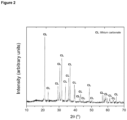
- Figure 2 shows an X-ray diffraction pattern for the final product obtained after the carbothermic reduction and aqueous leaching process. All diffraction maxima can be indexed to a Li 2 CO 3 phase (JCPDS 83-1454), demonstrating the purity of the product obtained.
- Figure 3 shows the micrograph obtained by means of scanning electron microscopy for the Li 2 CO 3 sample, where agglomerates of particles with an approximately rounded morphology are observed. Therefore, the lithium from the black mass was recovered and separated as Li 2 CO 3 using carbothermic reduction, and the subsequent leaching with water of the materials obtained after the carbothermic reduction.
- Figure 4 shows the X-ray diffraction pattern of the resulting insoluble product after aqueous leaching.
- metals in their elementary form, Ni (JCPDS 89-7128) and Co (JCPDS 89-4307) and metal oxides of nickel (NiO (JCPDS 78-423)) and cobalt (CoO (JCPDS 78-431) were recorded. No diffraction maxima related to the initial phase were detected.
- SEM scanning electron microscopy
- the magnetic character of the solid obtained was analysed by means of the corresponding measurements of the magnetisation of the material against the applied magnetic field.
- Figure 6 shows the hysteresis loop obtained for the metal mixture.
- the magnetisation curve is S-shaped, corresponding to a soft ferromagnetic material.
- the magnetisation at saturation for the metal mixture from the black mass 1 studied (MN-1_RI) is 36.2 emu/g, demonstrating the strong magnetic character of the solid.
- Figure 7 shows an X-ray diffraction pattern for the final product obtained. It can be seen that all the diffraction maxima can be indexed to a Li 2 CO 3 phase (JCPDS 83-1454), demonstrating the purity of the product obtained.
- Figure 8 shows the micrograph obtained by means of scanning electron microscopy for the Li 2 CO 3 sample, where agglomerates of particles with an approximately rounded morphology are observed. Therefore, the lithium from the black masses was recovered and separated as Li 2 CO 3 using carbothermic reduction, and subsequent water leaching of the roasting materials.
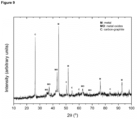
- Figure 9 shows the X-ray diffraction pattern for the solid resulting from aqueous leaching.
- metals in their elementary form, Ni (JCPDS 89-7128) and Co (JCPDS 89-4307) and metal oxides of nickel (NiO (JCPDS 78-423)) and cobalt (CoO (JCPDS 78-431) were recorded. No diffraction maxima related to the initial phase were detected.
- the magnetic character of the solid obtained was analysed by means of the corresponding measurements of the magnetisation of the material against the applied magnetic field.
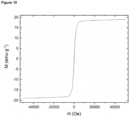
- Figure 10 shows the hysteresis loop obtained for the metal mixture.
- the magnetisation curve is S-shaped, corresponding to a soft ferromagnetic material.
- the magnetisation at saturation for the metal mixture from the black mass 2 studied (MN-2_RI) is 18.7 emu/g, demonstrating the strong magnetic character of the solid.
Landscapes
- Chemical & Material Sciences (AREA)
- Engineering & Computer Science (AREA)
- Materials Engineering (AREA)
- Manufacturing & Machinery (AREA)
- Mechanical Engineering (AREA)
- Metallurgy (AREA)
- Organic Chemistry (AREA)
- Geology (AREA)
- General Life Sciences & Earth Sciences (AREA)
- Environmental & Geological Engineering (AREA)
- Life Sciences & Earth Sciences (AREA)
- Electrochemistry (AREA)
- Chemical Kinetics & Catalysis (AREA)
- General Chemical & Material Sciences (AREA)
- Geochemistry & Mineralogy (AREA)
- Inorganic Chemistry (AREA)
- Manufacture And Refinement Of Metals (AREA)
- Inorganic Compounds Of Heavy Metals (AREA)
Abstract
Description
- The present invention relates to a method for obtaining lithium Li, nickel Ni and cobalt Co from discarded lithium ion batteries, which comprises a step of carbothermic reduction and a step of magnetic separation.
- The present invention is therefore of interest to producers of lithium ion batteries, specifically to process the waste generated by said batteries and to obtain valuable metals.
- Batteries power many electronic devices, such as mobile phones, laptops and digital cameras, as well as electric and hybrid cars. However, every year, tons of spent or discarded batteries are generated, posing a threat to people's health and the environment.
- lithium ion batteries pose a special threat, since they contain a high percentage of dangerous heavy metals, therefore, the recovery of said metals is key to preserving natural resources and the environment.
- The chemistry used to extract the different metals from discarded lithium ion batteries fundamentally depends on the composition of the cathodes and anodes of said lithium ion batteries. Methods for recovering valuable metals from discarded lithium ion batteries can be found in the literature (Pengcheng Liu et al. Journal of Thermal Analysis and Calorimetry Volume 136, pages 1323-1332 (2019 ),
CN111996377A ,CN112079369A andCN104611566B ), however, the purity of the metals obtained and the yield of said methods are low. - Therefore, it is necessary to develop new methods to obtain high performance in the recovery of valuable metals from the different types of lithium ion batteries that result in high purity valuable metals, in other words, with sufficient quality to be reused, for example, in the production of new batteries.
- The present invention relates to a method for obtaining valuable metals from discarded lithium ion batteries which comprises a step of carbothermic reduction and a step of magnetic separation. The main advantage of the method of the present invention is the production of the metals nickel Ni, cobalt Co and lithium Li with a purity greater than 98% and resulting in a metal production of up to 98% for nickel Ni, up to 92% for cobalt Co and greater than 99% for lithium Li.
- In a first aspect, the present invention relates to a method for obtaining lithium Li, nickel Ni and cobalt Co from discarded lithium ion batteries, characterised in that it comprises the following steps:
- a) dismantling a discarded lithium ion battery by separating the anode and cathode mixture from the aluminium Al casing and copper Cu connectors, and crushing the anode and cathode mixture to obtain a first black mass;
- b) washing the first black mass obtained in step (a) with water to eliminate the electrolyte, and drying to obtain a second black mass;
- c) reducing the second black mass obtained in step (b) with a reducing agent selected from coke and carbon black, wherein said reduction is carried out at a temperature of between 650 °C and 750 °C for a period of time between 1 h and 2 h and under an inert atmosphere;
- d) washing the cold product obtained in step (c) with water to obtain
- a water-insoluble magnetic solid comprising graphite, nickel Ni and cobalt Co, and
- an aqueous solution comprising lithium Li;
- e) removing water from the aqueous solution obtained in step (d) by evaporation in a rotary evaporator at a temperature of between 40 °C and 50 °C and a pressure of between 4666.28 Pa and 5999.51 Pa to obtain carbonate lithium LiCO3; and f) removing graphite and other non-magnetic impurities from the insoluble magnetic solid obtained in step (e) by magnetic separation to obtain a magnetic mixture of nickel Ni and cobalt Co.
- Step (a) of the method relates to the production of a first black mass from a discarded lithium ion battery.
- In step (a) of the method of the present invention:
- a discarded lithium ion battery is dismantled by separating the anode and cathode mixture from the aluminium Al casing and the copper Cu connectors and
- the anode and cathode mixture is crushed,
- Preferably the active material of the cathode of the discarded lithium ion battery is selected from LiCoO2, LiFePO4 and LiNixCoyAl1-x-yO2, in other words, discarded lithium ion batteries the cathode of which does not comprise manganese Mn.
- Step (b) of the method relates to washing the first black mass obtained in step (a) with water to remove the electrolyte and drying, to obtain a second black mass. Preferably the proportion of first black mass in step (b) ranges between 10 g and 30 g per litre of water.
- In step (c) the second black mass obtained in step (b) is reduced with a reducing agent selected from coke and carbon black, wherein said reduction is carried out at a temperature of between 650 °C and 750 °C for a period of time between 1 h and 2 h under an inert atmosphere and where the proportion of the reducing agent ranges between 50 g and 250 g for each kg of second black mass.
- Under these conditions, two phases are formed, one magnetic and the other non-magnetic, wherein the valuable metals of interest are found in the magnetic phase.
- In the present invention, step (c) is carried out under "inert atmosphere", in other words, in the presence of a stream of nitrogen or argon.
- In step (d) of the method of the present invention, the cold product obtained in step (c) is washed with water to obtain
- a water-insoluble magnetic solid comprising graphite, nickel Ni and cobalt Co,
- and an aqueous solution comprising lithium Li.
- Preferably the proportion of water in step (d) ranges between 10 litres and 50 litres for each kg of cold product obtained in step (c).
- In step (e) the water is removed from the aqueous solution obtained in step (d) by evaporation in a rotary evaporator, preferably at a temperature of between 40 °C and 50 °C and a pressure of between 35 mmHg (4666.28 Pa) and 45 mmHg (5999.51 Pa) to obtain lithium carbonate Li2CO3.
- In the last step of the method, step (f), graphite and other non-magnetic impurities are removed from the insoluble magnetic solid obtained in step (e) by magnetic separation, to obtain a magnetic mixture of nickel Ni and cobalt Co.
- This step (f) of magnetic separation is an advantage since only the magnetic compounds or phases such as the mixture of nickel Ni and cobalt Co are separated from graphite and other non-magnetic impurities such as manganese Mn (antiferromagnetic) effectively, resulting in high purities (greater than 98%) and high yields (up to 98% for nickel Ni, up to 92% for cobalt Co and greater than 99% for lithium Li.).
- Throughout the description and the claims, the word "comprises" and its variants do not intend to exclude other technical features, additives, components or steps. For those skilled in the art, other objects, advantages and features of the invention may be partially deduced from both the description and the embodiment of the invention. The following examples and figures are provided by way of illustration and are not intended to limit the present invention.
-
-
Figure 1 . Diagram of the method followed for recovering metals. -
Figure 2 . X-ray diffraction profile of the solid residue obtained after removing the washing water from the residue. -
Figure 3 . SEM image of the solid obtained after removing the washing water from the residue. -
Figure 4 . Diffraction profile of the resulting insoluble product after aqueous leaching. -
Figure 5 . SEM image of the resulting insoluble product after aqueous leaching. -
Figure 6 . Hysteresis cycle at room temperature of the metal mixture obtained from MN-1. -
Figure 7 . X-ray diffraction profile of the solid residue obtained after removing the washing water from the residue. -
Figure 8 . SEM image of the solid obtained after removing the washing water from the residue. -
Figure 9 . Diffraction profile of the resulting insoluble product after aqueous leaching. -
Figure 10 . Hysteresis cycle at room temperature of the metal mixture obtained from MN-1. - The recovery of metals in lithium ion batteries has been studied through a carbothermic reduction process using different black starting masses.
- The carbothermic reduction reaction was carried out in a homogeneous mixture of black mass of different origin and composition, and carbon black or coke as reducing agents, using different proportions of these under an inert atmosphere (nitrogen or argon stream)
- The temperature of the carbothermic reduction process was between 650 °C and 750 °C for a period of time between 1 h and 2 h, wherein the proportion of the reducing agent ranges between 50 g and 250 g for each kg of black mass. The process was carried out in a horizontal tubular oven with temperature and reaction time control.
- The cold product obtained in the step of carbothermic reduction is leached with water where the proportion of water ranges between 10-50 litres for each kg of product. The final mixture is filtered to separate the liquid phase from the insoluble solid.
- After leaching, water is removed from the solution obtained to obtain lithium carbonate. The process was carried out by evaporation in a rotary evaporator at 40 °C and 35 mmHg of negative pressure (4666.28 Pa).
- The water-insoluble residue obtained is dried in an oven at a temperature of 80 °C for 12 hours.
-
Figure 1 presents a diagram of the method carried out for recovering metals. - Next, the results obtained in the treatment of two black starting masses obtained from different lithium ion batteries with different compositions are described.
- The composition of the starting black mass is presented in Table 1.
Table 1. Elementary composition of the initial black mass (MN-1): Element % by weight Ni 34 Co 5 Mn 0 Cu 2 Li 4 C* 33 -
Figure 2 shows an X-ray diffraction pattern for the final product obtained after the carbothermic reduction and aqueous leaching process. All diffraction maxima can be indexed to a Li2CO3 phase (JCPDS 83-1454), demonstrating the purity of the product obtained. -
Figure 3 shows the micrograph obtained by means of scanning electron microscopy for the Li2CO3 sample, where agglomerates of particles with an approximately rounded morphology are observed. Therefore, the lithium from the black mass was recovered and separated as Li2CO3 using carbothermic reduction, and the subsequent leaching with water of the materials obtained after the carbothermic reduction. -
Figure 4 shows the X-ray diffraction pattern of the resulting insoluble product after aqueous leaching. Several reflections attributable to carbon-graphite, metals (in their elementary form, Ni (JCPDS 89-7128) and Co (JCPDS 89-4307) and metal oxides of nickel (NiO (JCPDS 78-423)) and cobalt (CoO (JCPDS 78-431)) were recorded. No diffraction maxima related to the initial phase were detected. - The scanning electron microscopy (SEM) image of the metal mixture obtained is shown in
Figure 5 . Spherical particles can be observed, which can be attributed to the carbon-graphite phase. Furthermore, particles with non-regular morphology can also be seen, which corresponds to the mixture of metals. - The magnetic character of the solid obtained was analysed by means of the corresponding measurements of the magnetisation of the material against the applied magnetic field.
Figure 6 shows the hysteresis loop obtained for the metal mixture. The magnetisation curve is S-shaped, corresponding to a soft ferromagnetic material. The magnetisation at saturation for the metal mixture from theblack mass 1 studied (MN-1_RI) is 36.2 emu/g, demonstrating the strong magnetic character of the solid. - Table 2 summarises the recoveries of the different metals expressed in %.
Table 2. Metal recovery percentages: Recovered metal % recovery Ni 98 Co 74 Li >99 - The composition of the starting black mass is presented in Table 3.
Table 3. Elementary composition of the initial black mass (MN-2): Element % by weight Ni 27 Co 4 Mn 0 Cu 1 Li 5 -
Figure 7 shows an X-ray diffraction pattern for the final product obtained. It can be seen that all the diffraction maxima can be indexed to a Li2CO3 phase (JCPDS 83-1454), demonstrating the purity of the product obtained. -
Figure 8 shows the micrograph obtained by means of scanning electron microscopy for the Li2CO3 sample, where agglomerates of particles with an approximately rounded morphology are observed. Therefore, the lithium from the black masses was recovered and separated as Li2CO3 using carbothermic reduction, and subsequent water leaching of the roasting materials. -
Figure 9 shows the X-ray diffraction pattern for the solid resulting from aqueous leaching. Several reflections attributable to carbon-graphite, metals (in their elementary form, Ni (JCPDS 89-7128) and Co (JCPDS 89-4307) and metal oxides of nickel (NiO (JCPDS 78-423)) and cobalt (CoO (JCPDS 78-431)) were recorded. No diffraction maxima related to the initial phase were detected. - The magnetic character of the solid obtained was analysed by means of the corresponding measurements of the magnetisation of the material against the applied magnetic field.
Figure 10 shows the hysteresis loop obtained for the metal mixture. The magnetisation curve is S-shaped, corresponding to a soft ferromagnetic material. The magnetisation at saturation for the metal mixture from the black mass 2 studied (MN-2_RI) is 18.7 emu/g, demonstrating the strong magnetic character of the solid. - Table 4 summarises the recoveries of the different metals expressed in %.
Table 4. Metal recovery percentages: Recovered metal % recovery Ni 98 Co 92 Li >99
Claims (5)
- A method for obtaining lithium Li, nickel Ni and cobalt Co from discarded lithium ion batteries characterised in that it comprises the following steps:a) dismantling a discarded lithium ion battery by separating the anode and cathode mixture from the aluminium Al casing and copper Cu connectors, and crushing the anode and cathode mixture to obtain a first black mass comprising nickel Ni, cobalt Co, lithium Li and graphite;b) washing the first black mass obtained in step (a) with water to eliminate the electrolyte, and drying, to obtain a second black mass;c) reducing the second black mass obtained in step (b) with a reducing agent selected from coke and carbon black, wherein said reduction is carried out at a temperature of between 650 °C and 750 °C for a period of time between 1 h and 2 h and under an inert atmosphere;d) washing the cold product obtained in step (c) with water to obtain• a water-insoluble magnetic solid comprising graphite, nickel Ni and cobalt Co, and• an aqueous solution comprising Li;e) removing water from the aqueous solution obtained in step (d) by evaporation in a rotary evaporator at a temperature of between 40 °C and 50 °C and a pressure of between 4666.28 Pa and 5999.51 Pa to obtain carbonate lithium LiCO3; and f) removing graphite and other non-magnetic impurities from the insoluble magnetic solid obtained in step (e) by magnetic separation to obtain a magnetic mixture of nickel Ni and cobalt Co.
- The method according to claim 1, wherein the cathode of the lithium ion battery comprises an active material selected from LiCoO2, LiFePO4 and LiNixCoyAl1-x-yO2.
- The method according to any of claims 1 or 2, wherein the proportion of first black mass in step (b) ranges between 10 g and 30 g per litre of water.
- The method according to any of claims 1 to 3, wherein the proportion of the reducing agent in step (c) ranges between 50 g and 250 g for each kg of second black mass.
- The method according to any of claims 1 to 4, wherein the proportion of water in step (d) ranges between 10 litres and 50 litres for each kg of cold product obtained in step (c).
Applications Claiming Priority (2)
| Application Number | Priority Date | Filing Date | Title |
|---|---|---|---|
| ES202131237A ES2945487A1 (en) | 2021-12-31 | 2021-12-31 | Procedure for obtaining Li, Ni and Co from discarded lithium ion batteries |
| PCT/ES2022/070833 WO2023126557A1 (en) | 2021-12-31 | 2022-12-23 | Method for obtaining li, ni and co from discarded lithium ion batteries |
Publications (2)
| Publication Number | Publication Date |
|---|---|
| EP4458996A1 true EP4458996A1 (en) | 2024-11-06 |
| EP4458996A4 EP4458996A4 (en) | 2025-10-15 |
Family
ID=86948591
Family Applications (1)
| Application Number | Title | Priority Date | Filing Date |
|---|---|---|---|
| EP22915260.8A Pending EP4458996A4 (en) | 2021-12-31 | 2022-12-23 | Process for recovering lithium, nickel, and cobalt from discarded lithium-ion batteries |
Country Status (3)
| Country | Link |
|---|---|
| EP (1) | EP4458996A4 (en) |
| ES (1) | ES2945487A1 (en) |
| WO (1) | WO2023126557A1 (en) |
Family Cites Families (10)
| Publication number | Priority date | Publication date | Assignee | Title |
|---|---|---|---|---|
| CN104611566B (en) | 2014-12-29 | 2017-02-22 | 长沙矿冶研究院有限责任公司 | Method for recycling valuable metals in waste lithium ion batteries |
| CN107196007B (en) * | 2017-05-27 | 2020-08-14 | 南京博驰新能源股份有限公司 | Lithium battery recycling method |
| CN110165324B (en) * | 2019-06-24 | 2021-07-16 | 中国科学院青海盐湖研究所 | Method and system for recovering positive electrode from waste lithium battery and regenerating and repairing positive electrode |
| CN111118294A (en) * | 2020-01-15 | 2020-05-08 | 北京矿冶科技集团有限公司 | Method for recycling valuable metals from waste lithium ion battery materials step by step |
| IL273457A (en) * | 2020-03-19 | 2021-09-30 | Yeda Res & Dev | Method for recovery of valuable metals from spent lithium ion batteries |
| CN111996377A (en) | 2020-08-13 | 2020-11-27 | 衢州华友资源再生科技有限公司 | Method for recovering nickel, cobalt and manganese metal from lithium extracted from waste batteries |
| CN112079369B (en) | 2020-09-21 | 2022-08-09 | 矿冶科技集团有限公司 | Method for preferentially extracting lithium and cooperatively recovering manganese from waste lithium ion battery |
| CN112680598A (en) * | 2020-12-15 | 2021-04-20 | 中南大学 | Method for low-cost clean treatment of waste lithium ion battery anode material |
| CN113549765A (en) * | 2021-07-16 | 2021-10-26 | 重庆大学 | Method for efficiently recycling waste lithium batteries by using pyrolytic coke through dry method |
| CN113582153A (en) * | 2021-09-30 | 2021-11-02 | 中南大学 | Waste lithium iron phosphate cathode material for repairing and regenerating and repairing and regenerating method thereof |
-
2021
- 2021-12-31 ES ES202131237A patent/ES2945487A1/en not_active Withdrawn
-
2022
- 2022-12-23 WO PCT/ES2022/070833 patent/WO2023126557A1/en not_active Ceased
- 2022-12-23 EP EP22915260.8A patent/EP4458996A4/en active Pending
Also Published As
| Publication number | Publication date |
|---|---|
| WO2023126557A1 (en) | 2023-07-06 |
| ES2945487A1 (en) | 2023-07-03 |
| EP4458996A4 (en) | 2025-10-15 |
Similar Documents
| Publication | Publication Date | Title |
|---|---|---|
| CN111206148B (en) | Method for recycling and preparing ternary cathode material by using waste ternary lithium battery | |
| KR102132120B1 (en) | A recycling method for the spent lithium ion secondary battery using carbon dioxide | |
| CN111430832B (en) | A full resource recovery method for waste ternary lithium-ion batteries without discharge pretreatment | |
| CN107196007B (en) | Lithium battery recycling method | |
| US8835026B2 (en) | Recovery and synthesis method for metaloxidic cathodic active material for lithium ion secondary battery | |
| US12522514B2 (en) | Method for producing mixed metal salt | |
| CN106834703B (en) | A kind of leaching method of positive electrode active material of waste lithium ion battery | |
| KR102689694B1 (en) | Reuse method of active material of positive electrode scrap | |
| EP2627791A2 (en) | Method for recovering valuable metals from lithium secondary battery wastes | |
| KR102324910B1 (en) | Manufacturing method of precursor raw material from disposed cathode material of lithium secondary battery | |
| KR20220034687A (en) | Method for recovering cathode material | |
| JP2023152896A (en) | Method of preparing high-purity lithium carbonate through reduction calcining of waste cathode material | |
| CN112111650A (en) | Method for recovering valuable metals of waste lithium ion batteries by selective reduction | |
| KR20190065882A (en) | Method of recovery of valuable metals from scrap containing cathode materials of lithium ion battery | |
| JP2010229534A (en) | Method for separating and recovering nickel and lithium | |
| CN114759159B (en) | Preparation method of high-activity lithium ferrite, high-activity lithium ferrite anode and battery | |
| JP2023518880A (en) | Reuse of batteries by reduction and carbonylation | |
| CN116282000B (en) | Method for recycling waste battery graphite carbon slag and co-producing regenerated graphite active material | |
| CN113186410A (en) | Method for recovering valuable metal lithium from waste lithium ion battery anode material | |
| CN114477240A (en) | A kind of preparation method of battery grade lithium hydroxide | |
| CN113122725A (en) | Method for improving metal recovery rate and purity of waste lithium battery | |
| CN114256527A (en) | A method for removing impurities and separating positive and negative electrodes from mixed materials of waste lithium ion batteries | |
| EP4458996A1 (en) | Method for obtaining li, ni and co from discarded lithium ion batteries | |
| JPH08115752A (en) | Method for recovering active ingredient from nickel-hydrogen storage alloy secondary battery | |
| CN117737438A (en) | Fe of waste lithium-containing positive electrode active material 7 S 8 Auxiliary alkaline leaching lithium and recovery and regeneration method |
Legal Events
| Date | Code | Title | Description |
|---|---|---|---|
| STAA | Information on the status of an ep patent application or granted ep patent |
Free format text: STATUS: THE INTERNATIONAL PUBLICATION HAS BEEN MADE |
|
| PUAI | Public reference made under article 153(3) epc to a published international application that has entered the european phase |
Free format text: ORIGINAL CODE: 0009012 |
|
| STAA | Information on the status of an ep patent application or granted ep patent |
Free format text: STATUS: REQUEST FOR EXAMINATION WAS MADE |
|
| 17P | Request for examination filed |
Effective date: 20240709 |
|
| AK | Designated contracting states |
Kind code of ref document: A1 Designated state(s): AL AT BE BG CH CY CZ DE DK EE ES FI FR GB GR HR HU IE IS IT LI LT LU LV MC ME MK MT NL NO PL PT RO RS SE SI SK SM TR |
|
| DAV | Request for validation of the european patent (deleted) | ||
| DAX | Request for extension of the european patent (deleted) | ||
| A4 | Supplementary search report drawn up and despatched |
Effective date: 20250911 |
|
| RIC1 | Information provided on ipc code assigned before grant |
Ipc: C22B 7/00 20060101AFI20250905BHEP Ipc: C22B 23/00 20060101ALI20250905BHEP Ipc: C22B 26/12 20060101ALI20250905BHEP Ipc: H01M 10/54 20060101ALI20250905BHEP Ipc: H01M 10/0525 20100101ALI20250905BHEP Ipc: H01M 4/131 20100101ALI20250905BHEP Ipc: C22B 5/10 20060101ALI20250905BHEP Ipc: C22B 3/22 20060101ALI20250905BHEP Ipc: C22B 1/00 20060101ALN20250905BHEP Ipc: H01M 4/525 20100101ALN20250905BHEP |