EP4458993A1 - Steel plate and method for manufacturing same - Google Patents
Steel plate and method for manufacturing same Download PDFInfo
- Publication number
- EP4458993A1 EP4458993A1 EP23759577.2A EP23759577A EP4458993A1 EP 4458993 A1 EP4458993 A1 EP 4458993A1 EP 23759577 A EP23759577 A EP 23759577A EP 4458993 A1 EP4458993 A1 EP 4458993A1
- Authority
- EP
- European Patent Office
- Prior art keywords
- steel plate
- less
- content
- hardness
- temperature
- Prior art date
- Legal status (The legal status is an assumption and is not a legal conclusion. Google has not performed a legal analysis and makes no representation as to the accuracy of the status listed.)
- Pending
Links
Classifications
-
- C—CHEMISTRY; METALLURGY
- C21—METALLURGY OF IRON
- C21D—MODIFYING THE PHYSICAL STRUCTURE OF FERROUS METALS; GENERAL DEVICES FOR HEAT TREATMENT OF FERROUS OR NON-FERROUS METALS OR ALLOYS; MAKING METAL MALLEABLE, e.g. BY DECARBURISATION OR TEMPERING
- C21D9/00—Heat treatment, e.g. annealing, hardening, quenching or tempering, adapted for particular articles; Furnaces therefor
- C21D9/46—Heat treatment, e.g. annealing, hardening, quenching or tempering, adapted for particular articles; Furnaces therefor for sheet metals
-
- C—CHEMISTRY; METALLURGY
- C21—METALLURGY OF IRON
- C21D—MODIFYING THE PHYSICAL STRUCTURE OF FERROUS METALS; GENERAL DEVICES FOR HEAT TREATMENT OF FERROUS OR NON-FERROUS METALS OR ALLOYS; MAKING METAL MALLEABLE, e.g. BY DECARBURISATION OR TEMPERING
- C21D8/00—Modifying the physical properties of ferrous metals or ferrous alloys by deformation combined with, or followed by, heat treatment
- C21D8/02—Modifying the physical properties of ferrous metals or ferrous alloys by deformation combined with, or followed by, heat treatment during manufacturing of plates or strips
- C21D8/0221—Modifying the physical properties of ferrous metals or ferrous alloys by deformation combined with, or followed by, heat treatment during manufacturing of plates or strips characterised by the working steps
- C21D8/0226—Hot rolling
-
- C—CHEMISTRY; METALLURGY
- C21—METALLURGY OF IRON
- C21D—MODIFYING THE PHYSICAL STRUCTURE OF FERROUS METALS; GENERAL DEVICES FOR HEAT TREATMENT OF FERROUS OR NON-FERROUS METALS OR ALLOYS; MAKING METAL MALLEABLE, e.g. BY DECARBURISATION OR TEMPERING
- C21D1/00—General methods or devices for heat treatment, e.g. annealing, hardening, quenching or tempering
- C21D1/18—Hardening; Quenching with or without subsequent tempering
- C21D1/185—Hardening; Quenching with or without subsequent tempering from an intercritical temperature
-
- C—CHEMISTRY; METALLURGY
- C21—METALLURGY OF IRON
- C21D—MODIFYING THE PHYSICAL STRUCTURE OF FERROUS METALS; GENERAL DEVICES FOR HEAT TREATMENT OF FERROUS OR NON-FERROUS METALS OR ALLOYS; MAKING METAL MALLEABLE, e.g. BY DECARBURISATION OR TEMPERING
- C21D1/00—General methods or devices for heat treatment, e.g. annealing, hardening, quenching or tempering
- C21D1/18—Hardening; Quenching with or without subsequent tempering
- C21D1/25—Hardening, combined with annealing between 300 degrees Celsius and 600 degrees Celsius, i.e. heat refining ("Vergüten")
-
- C—CHEMISTRY; METALLURGY
- C21—METALLURGY OF IRON
- C21D—MODIFYING THE PHYSICAL STRUCTURE OF FERROUS METALS; GENERAL DEVICES FOR HEAT TREATMENT OF FERROUS OR NON-FERROUS METALS OR ALLOYS; MAKING METAL MALLEABLE, e.g. BY DECARBURISATION OR TEMPERING
- C21D6/00—Heat treatment of ferrous alloys
- C21D6/005—Heat treatment of ferrous alloys containing Mn
-
- C—CHEMISTRY; METALLURGY
- C21—METALLURGY OF IRON
- C21D—MODIFYING THE PHYSICAL STRUCTURE OF FERROUS METALS; GENERAL DEVICES FOR HEAT TREATMENT OF FERROUS OR NON-FERROUS METALS OR ALLOYS; MAKING METAL MALLEABLE, e.g. BY DECARBURISATION OR TEMPERING
- C21D6/00—Heat treatment of ferrous alloys
- C21D6/008—Heat treatment of ferrous alloys containing Si
-
- C—CHEMISTRY; METALLURGY
- C21—METALLURGY OF IRON
- C21D—MODIFYING THE PHYSICAL STRUCTURE OF FERROUS METALS; GENERAL DEVICES FOR HEAT TREATMENT OF FERROUS OR NON-FERROUS METALS OR ALLOYS; MAKING METAL MALLEABLE, e.g. BY DECARBURISATION OR TEMPERING
- C21D8/00—Modifying the physical properties of ferrous metals or ferrous alloys by deformation combined with, or followed by, heat treatment
- C21D8/02—Modifying the physical properties of ferrous metals or ferrous alloys by deformation combined with, or followed by, heat treatment during manufacturing of plates or strips
-
- C—CHEMISTRY; METALLURGY
- C21—METALLURGY OF IRON
- C21D—MODIFYING THE PHYSICAL STRUCTURE OF FERROUS METALS; GENERAL DEVICES FOR HEAT TREATMENT OF FERROUS OR NON-FERROUS METALS OR ALLOYS; MAKING METAL MALLEABLE, e.g. BY DECARBURISATION OR TEMPERING
- C21D8/00—Modifying the physical properties of ferrous metals or ferrous alloys by deformation combined with, or followed by, heat treatment
- C21D8/02—Modifying the physical properties of ferrous metals or ferrous alloys by deformation combined with, or followed by, heat treatment during manufacturing of plates or strips
- C21D8/0247—Modifying the physical properties of ferrous metals or ferrous alloys by deformation combined with, or followed by, heat treatment during manufacturing of plates or strips characterised by the heat treatment
- C21D8/0263—Modifying the physical properties of ferrous metals or ferrous alloys by deformation combined with, or followed by, heat treatment during manufacturing of plates or strips characterised by the heat treatment following hot rolling
-
- C—CHEMISTRY; METALLURGY
- C22—METALLURGY; FERROUS OR NON-FERROUS ALLOYS; TREATMENT OF ALLOYS OR NON-FERROUS METALS
- C22C—ALLOYS
- C22C38/00—Ferrous alloys, e.g. steel alloys
- C22C38/001—Ferrous alloys, e.g. steel alloys containing N
-
- C—CHEMISTRY; METALLURGY
- C22—METALLURGY; FERROUS OR NON-FERROUS ALLOYS; TREATMENT OF ALLOYS OR NON-FERROUS METALS
- C22C—ALLOYS
- C22C38/00—Ferrous alloys, e.g. steel alloys
- C22C38/002—Ferrous alloys, e.g. steel alloys containing In, Mg, or other elements not provided for in one single group C22C38/001 - C22C38/60
-
- C—CHEMISTRY; METALLURGY
- C22—METALLURGY; FERROUS OR NON-FERROUS ALLOYS; TREATMENT OF ALLOYS OR NON-FERROUS METALS
- C22C—ALLOYS
- C22C38/00—Ferrous alloys, e.g. steel alloys
- C22C38/004—Very low carbon steels, i.e. having a carbon content of less than 0,01%
-
- C—CHEMISTRY; METALLURGY
- C22—METALLURGY; FERROUS OR NON-FERROUS ALLOYS; TREATMENT OF ALLOYS OR NON-FERROUS METALS
- C22C—ALLOYS
- C22C38/00—Ferrous alloys, e.g. steel alloys
- C22C38/02—Ferrous alloys, e.g. steel alloys containing silicon
-
- C—CHEMISTRY; METALLURGY
- C22—METALLURGY; FERROUS OR NON-FERROUS ALLOYS; TREATMENT OF ALLOYS OR NON-FERROUS METALS
- C22C—ALLOYS
- C22C38/00—Ferrous alloys, e.g. steel alloys
- C22C38/04—Ferrous alloys, e.g. steel alloys containing manganese
-
- C—CHEMISTRY; METALLURGY
- C22—METALLURGY; FERROUS OR NON-FERROUS ALLOYS; TREATMENT OF ALLOYS OR NON-FERROUS METALS
- C22C—ALLOYS
- C22C38/00—Ferrous alloys, e.g. steel alloys
- C22C38/06—Ferrous alloys, e.g. steel alloys containing aluminium
-
- C—CHEMISTRY; METALLURGY
- C22—METALLURGY; FERROUS OR NON-FERROUS ALLOYS; TREATMENT OF ALLOYS OR NON-FERROUS METALS
- C22C—ALLOYS
- C22C38/00—Ferrous alloys, e.g. steel alloys
- C22C38/18—Ferrous alloys, e.g. steel alloys containing chromium
- C22C38/40—Ferrous alloys, e.g. steel alloys containing chromium with nickel
- C22C38/58—Ferrous alloys, e.g. steel alloys containing chromium with nickel with more than 1.5% by weight of manganese
-
- C—CHEMISTRY; METALLURGY
- C21—METALLURGY OF IRON
- C21D—MODIFYING THE PHYSICAL STRUCTURE OF FERROUS METALS; GENERAL DEVICES FOR HEAT TREATMENT OF FERROUS OR NON-FERROUS METALS OR ALLOYS; MAKING METAL MALLEABLE, e.g. BY DECARBURISATION OR TEMPERING
- C21D2211/00—Microstructure comprising significant phases
- C21D2211/001—Austenite
-
- C—CHEMISTRY; METALLURGY
- C21—METALLURGY OF IRON
- C21D—MODIFYING THE PHYSICAL STRUCTURE OF FERROUS METALS; GENERAL DEVICES FOR HEAT TREATMENT OF FERROUS OR NON-FERROUS METALS OR ALLOYS; MAKING METAL MALLEABLE, e.g. BY DECARBURISATION OR TEMPERING
- C21D2211/00—Microstructure comprising significant phases
- C21D2211/002—Bainite
-
- C—CHEMISTRY; METALLURGY
- C21—METALLURGY OF IRON
- C21D—MODIFYING THE PHYSICAL STRUCTURE OF FERROUS METALS; GENERAL DEVICES FOR HEAT TREATMENT OF FERROUS OR NON-FERROUS METALS OR ALLOYS; MAKING METAL MALLEABLE, e.g. BY DECARBURISATION OR TEMPERING
- C21D2211/00—Microstructure comprising significant phases
- C21D2211/008—Martensite
-
- C—CHEMISTRY; METALLURGY
- C22—METALLURGY; FERROUS OR NON-FERROUS ALLOYS; TREATMENT OF ALLOYS OR NON-FERROUS METALS
- C22C—ALLOYS
- C22C38/00—Ferrous alloys, e.g. steel alloys
- C22C38/005—Ferrous alloys, e.g. steel alloys containing rare earths, i.e. Sc, Y, Lanthanides
-
- C—CHEMISTRY; METALLURGY
- C22—METALLURGY; FERROUS OR NON-FERROUS ALLOYS; TREATMENT OF ALLOYS OR NON-FERROUS METALS
- C22C—ALLOYS
- C22C38/00—Ferrous alloys, e.g. steel alloys
- C22C38/008—Ferrous alloys, e.g. steel alloys containing tin
-
- C—CHEMISTRY; METALLURGY
- C22—METALLURGY; FERROUS OR NON-FERROUS ALLOYS; TREATMENT OF ALLOYS OR NON-FERROUS METALS
- C22C—ALLOYS
- C22C38/00—Ferrous alloys, e.g. steel alloys
- C22C38/08—Ferrous alloys, e.g. steel alloys containing nickel
-
- C—CHEMISTRY; METALLURGY
- C22—METALLURGY; FERROUS OR NON-FERROUS ALLOYS; TREATMENT OF ALLOYS OR NON-FERROUS METALS
- C22C—ALLOYS
- C22C38/00—Ferrous alloys, e.g. steel alloys
- C22C38/12—Ferrous alloys, e.g. steel alloys containing tungsten, tantalum, molybdenum, vanadium, or niobium
-
- C—CHEMISTRY; METALLURGY
- C22—METALLURGY; FERROUS OR NON-FERROUS ALLOYS; TREATMENT OF ALLOYS OR NON-FERROUS METALS
- C22C—ALLOYS
- C22C38/00—Ferrous alloys, e.g. steel alloys
- C22C38/14—Ferrous alloys, e.g. steel alloys containing titanium or zirconium
-
- C—CHEMISTRY; METALLURGY
- C22—METALLURGY; FERROUS OR NON-FERROUS ALLOYS; TREATMENT OF ALLOYS OR NON-FERROUS METALS
- C22C—ALLOYS
- C22C38/00—Ferrous alloys, e.g. steel alloys
- C22C38/16—Ferrous alloys, e.g. steel alloys containing copper
-
- C—CHEMISTRY; METALLURGY
- C22—METALLURGY; FERROUS OR NON-FERROUS ALLOYS; TREATMENT OF ALLOYS OR NON-FERROUS METALS
- C22C—ALLOYS
- C22C38/00—Ferrous alloys, e.g. steel alloys
- C22C38/18—Ferrous alloys, e.g. steel alloys containing chromium
- C22C38/20—Ferrous alloys, e.g. steel alloys containing chromium with copper
-
- C—CHEMISTRY; METALLURGY
- C22—METALLURGY; FERROUS OR NON-FERROUS ALLOYS; TREATMENT OF ALLOYS OR NON-FERROUS METALS
- C22C—ALLOYS
- C22C38/00—Ferrous alloys, e.g. steel alloys
- C22C38/18—Ferrous alloys, e.g. steel alloys containing chromium
- C22C38/28—Ferrous alloys, e.g. steel alloys containing chromium with titanium or zirconium
-
- C—CHEMISTRY; METALLURGY
- C22—METALLURGY; FERROUS OR NON-FERROUS ALLOYS; TREATMENT OF ALLOYS OR NON-FERROUS METALS
- C22C—ALLOYS
- C22C38/00—Ferrous alloys, e.g. steel alloys
- C22C38/18—Ferrous alloys, e.g. steel alloys containing chromium
- C22C38/38—Ferrous alloys, e.g. steel alloys containing chromium with more than 1.5% by weight of manganese
-
- C—CHEMISTRY; METALLURGY
- C22—METALLURGY; FERROUS OR NON-FERROUS ALLOYS; TREATMENT OF ALLOYS OR NON-FERROUS METALS
- C22C—ALLOYS
- C22C38/00—Ferrous alloys, e.g. steel alloys
- C22C38/18—Ferrous alloys, e.g. steel alloys containing chromium
- C22C38/40—Ferrous alloys, e.g. steel alloys containing chromium with nickel
- C22C38/42—Ferrous alloys, e.g. steel alloys containing chromium with nickel with copper
-
- C—CHEMISTRY; METALLURGY
- C22—METALLURGY; FERROUS OR NON-FERROUS ALLOYS; TREATMENT OF ALLOYS OR NON-FERROUS METALS
- C22C—ALLOYS
- C22C38/00—Ferrous alloys, e.g. steel alloys
- C22C38/18—Ferrous alloys, e.g. steel alloys containing chromium
- C22C38/40—Ferrous alloys, e.g. steel alloys containing chromium with nickel
- C22C38/44—Ferrous alloys, e.g. steel alloys containing chromium with nickel with molybdenum or tungsten
-
- C—CHEMISTRY; METALLURGY
- C22—METALLURGY; FERROUS OR NON-FERROUS ALLOYS; TREATMENT OF ALLOYS OR NON-FERROUS METALS
- C22C—ALLOYS
- C22C38/00—Ferrous alloys, e.g. steel alloys
- C22C38/18—Ferrous alloys, e.g. steel alloys containing chromium
- C22C38/40—Ferrous alloys, e.g. steel alloys containing chromium with nickel
- C22C38/46—Ferrous alloys, e.g. steel alloys containing chromium with nickel with vanadium
-
- C—CHEMISTRY; METALLURGY
- C22—METALLURGY; FERROUS OR NON-FERROUS ALLOYS; TREATMENT OF ALLOYS OR NON-FERROUS METALS
- C22C—ALLOYS
- C22C38/00—Ferrous alloys, e.g. steel alloys
- C22C38/18—Ferrous alloys, e.g. steel alloys containing chromium
- C22C38/40—Ferrous alloys, e.g. steel alloys containing chromium with nickel
- C22C38/48—Ferrous alloys, e.g. steel alloys containing chromium with nickel with niobium or tantalum
-
- C—CHEMISTRY; METALLURGY
- C22—METALLURGY; FERROUS OR NON-FERROUS ALLOYS; TREATMENT OF ALLOYS OR NON-FERROUS METALS
- C22C—ALLOYS
- C22C38/00—Ferrous alloys, e.g. steel alloys
- C22C38/18—Ferrous alloys, e.g. steel alloys containing chromium
- C22C38/40—Ferrous alloys, e.g. steel alloys containing chromium with nickel
- C22C38/50—Ferrous alloys, e.g. steel alloys containing chromium with nickel with titanium or zirconium
-
- C—CHEMISTRY; METALLURGY
- C22—METALLURGY; FERROUS OR NON-FERROUS ALLOYS; TREATMENT OF ALLOYS OR NON-FERROUS METALS
- C22C—ALLOYS
- C22C38/00—Ferrous alloys, e.g. steel alloys
- C22C38/18—Ferrous alloys, e.g. steel alloys containing chromium
- C22C38/40—Ferrous alloys, e.g. steel alloys containing chromium with nickel
- C22C38/52—Ferrous alloys, e.g. steel alloys containing chromium with nickel with cobalt
-
- C—CHEMISTRY; METALLURGY
- C22—METALLURGY; FERROUS OR NON-FERROUS ALLOYS; TREATMENT OF ALLOYS OR NON-FERROUS METALS
- C22C—ALLOYS
- C22C38/00—Ferrous alloys, e.g. steel alloys
- C22C38/18—Ferrous alloys, e.g. steel alloys containing chromium
- C22C38/40—Ferrous alloys, e.g. steel alloys containing chromium with nickel
- C22C38/54—Ferrous alloys, e.g. steel alloys containing chromium with nickel with boron
-
- C—CHEMISTRY; METALLURGY
- C22—METALLURGY; FERROUS OR NON-FERROUS ALLOYS; TREATMENT OF ALLOYS OR NON-FERROUS METALS
- C22C—ALLOYS
- C22C38/00—Ferrous alloys, e.g. steel alloys
- C22C38/60—Ferrous alloys, e.g. steel alloys containing lead, selenium, tellurium, or antimony, or more than 0.04% by weight of sulfur
Definitions
- the present disclosure relates to a high strength steel plate that has excellent toughness and corrosion resistance, in particular a high strength steel plate for low temperature applications that has excellent low-temperature toughness and liquid ammonia stress corrosion cracking resistance, suitable for structural parts such as tanks used at low temperatures and in liquid ammonia environments, and a method of producing same.
- tanks may carry liquid ammonia as well as liquefied petroleum gas (LPG).
- LPG liquefied petroleum gas
- liquid ammonia as a hydrogen carrier and liquid ammonia fuel has led to larger tanks for transporting and storing liquefied ammonia.
- Liquid ammonia is known to cause stress corrosion cracking (hereinafter also referred to as ammonia SCC) in carbon steel pipes, storage tanks, tank cars, line pipes, and the like that handle liquid ammonia. For this reason, for steel materials used in liquid ammonia environments, steel materials having low ammonia SCC susceptibility have been applied, and engineering measures have been taken to suppress ammonia SCC.
- SCC stress corrosion cracking
- occurrence of ammonia SCC is known to be correlated with the strength of the material.
- stress corrosion cracking due to ammonia may be avoided by controlling yield stress (YS) to 440 MPa or less.
- yield stress from the perspective of increasing tank size and reducing the amount of steel material used, in recent years there has been an increasing demand for higher strength steel plates.
- liquefied gases such as LPG and liquid ammonia are transported and stored at low temperatures, and therefore steel plates used for storage tanks for such liquefied gases are required to have excellent low-temperature toughness.
- Patent Literature 1 and 2 Technologies for meeting the low-temperature toughness and defined strength ranges required for liquefied gas storage tanks such as those mentioned above are described in Patent Literature (PTL) 1 and 2. According to the technologies described therein, high low-temperature toughness and defined strength properties are achieved by heat treatment applied multiple times to a steel plate cooled after hot rolling or by heat treatment applied multiple times to a steel plate water cooled after hot rolling.
- TMCP thermo-mechanical control process
- on-line induction heater an on-line induction heater.
- TMCP thermo-mechanical control process
- the inventors discovered that the following could effectively obtain SCC resistance in a liquid ammonia environment and eliminate costly multiple heat treatments: causing elements such as C, Si, Mn, and Al to be included in a steel plate in defined amounts; controlling the metallic microstructure of the steel plate so that a volume fraction of bainitic microstructure at a 0.5 mm position from the surface of the steel plate is 90 % or more; and controlling hardness so that, at a 0.5 mm position from the surface of the steel plate, average hardness is 230HV0.1 or less and hardness variation is 30HV0.1 or less, a maximum value of hardness in the thickness direction is at a position 1.0 mm or more and 1/4 or less of the thickness of the steel plate from the surface of the steel plate, and hardness variation in the thickness direction is 70HV1 or
- a steel plate having toughness at low temperatures that is, excellent anti-crash property and ammonia SCC resistance at low temperatures, and high strength suitable for structural parts such as tanks used at low temperatures and in liquid ammonia environments, can be provided by an inexpensive process.
- % representing the content of a component (element) means “mass%” unless otherwise specified.
- composition (chemical composition) of a steel plate.
- C is the most effective element for increasing the strength of the steel plate produced by cooling according to the present disclosure.
- C content is specified as 0.010 % or more.
- the C content is preferably 0.013 % or more.
- the C content exceeding 0.200 % leads to deterioration of toughness and weldability of the steel plate. Therefore, the C content is specified as 0.200 % or less.
- the C content is preferably 0.170 % or less.
- Si is added for deoxidation.
- Si content is specified as 0.01 % or more. Further, 0.03 % or more is preferred.
- the Si content exceeding 0.50 % leads to deterioration of toughness and weldability of the steel plate. Therefore, the Si content is specified as 0.50 % or less. Further, from the viewpoint of toughness and weldability, the Si content is preferably 0.40 % or less.
- Mn is an element that acts to increase hardenability of steel and is one of the key elements that need to be added to meet high strength requirements as in the present disclosure. To obtain this effect, Mn content is specified as 0.50 % or more. Further, from the viewpoint of producing at lower cost by reducing content of other alloying elements, the Mn content is preferably 0.70 % or more. However, the Mn content exceeding 2.50 % decreases weldability and toughness of the steel plate, and also excessively increases alloy cost. The Mn content is therefore specified as 2.50 % or less. Further, from the viewpoint of suppressing a decrease in toughness and weldability, the Mn content is preferably 2.30 % or less.
- Al acts as a deoxidizer. To obtain this effect, Al content is specified as 0.010 % or more. However, the Al content exceeding 0.060 % increases oxide-based inclusions, decreases cleanliness, and decreases toughness. The Al content is therefore specified as 0.060 % or less. Further, from the viewpoint of further preventing toughness degradation, the Al content is preferably 0.050 % or less.
- N contributes to microstructure refinement and improves toughness of the steel plate.
- N content is specified as 0.0010 % or more.
- the content is preferably 0.0020 % or more.
- the N content exceeding 0.0100 % instead leads to a reduction in toughness.
- the N content is therefore specified as 0.0100 % or less.
- the N content is preferably 0.0080 % or less.
- N can combine with Ti, when present, and precipitate as TiN.
- P has adverse effects such as decreasing toughness and weldability due to segregation at grain boundaries. Accordingly, P content is desirably as low as possible, but 0.020 % or less is allowable. A lower limit of the P content is not particularly limited and may be 0 %. However, in industrial terms, P is an element that can typically remain in steel, and therefore the lower limit may be greater than 0 %. Further, excessive reduction leads to higher refining costs, and therefore from a cost perspective, the P content is preferably 0.0005 % or more.
- S is an element that exists in steel as sulfide inclusions such as MnS and has adverse effects such as decreasing toughness of the steel plate by becoming an initiation point for fractures. Accordingly, S content is desirably as low as possible, but 0.0100 % or less is allowable. A lower limit of the S content is not particularly limited and may be 0 %. However, in industrial terms, typically, S is an element that may remain in steel, and therefore the lower limit may be greater than 0 %. Further, excessive reduction leads to higher refining costs, and therefore from a cost perspective, the S content is preferably 0.0005 % or more.
- O is an element that forms oxides and has adverse effects such as becoming an initiation point for fractures and reducing toughness of the steel plate, and is therefore limited to 0.0100 % or less.
- O content is preferably 0.0050 % or less.
- the O content is more preferably 0.0030 % or less.
- a lower limit of the O content is not particularly limited and may be 0 %.
- O is an element that may remain in steel, and therefore the lower limit may be greater than 0 %.
- the O content is preferably 0.0010 % or more.
- the balance other than the above components is Fe and inevitable impurity.
- the chemical composition may contain the elements listed below as required.
- Cu, Ni, Cr, Sn, Sb, Mo, and W are elements that improve strength and ammonia SCC resistance, and one or more of these elements may be included.
- Cu content is 0.01 % or more
- Ni content is 0.01 % or more
- Cr content is 0.01 % or more
- Sn is contained
- Sn content is 0.01 % or more
- Sb is contained
- Sb content is 0.01 % or more
- Mo Mo content is 0.01 % or more
- W content is 0.01 % or more.
- excessive Ni content leads to deterioration of weldability and higher alloy cost.
- the Cu content is 0.50 % or less
- the Ni content is 2.00 % or less
- the Cr content is 1.00 % or less
- the Sn content is 0.50 % or less
- the Sb content is 0.50 % or less
- the Mo content is 0.50 % or less
- the W content is 1.00 % or less.
- the Cu content is 0.40 % or less
- the Ni content is 1.50 % or less
- the Cr content is 0.80 % or less
- the Sn content is 0.40 % or less
- the Sb content is 0.40 % or less
- the Mo content is 0.40 % or less
- the W content is 0.80 % or less.
- V 0.01 % to 1.00 %
- V is an element that has an effect of improving strength of the steel plate and may be added.
- V content is preferably 0.01 % or more.
- the V content exceeding 1.00 % leads to deterioration in weldability and higher alloy cost. Accordingly, when V is added, the V content is preferably 1.00 % or less.
- the lower limit of the V content is more preferably 0.05 %.
- the upper limit of the V content is more preferably 0.50 %.
- Ti is an element that has a strong tendency to form nitrides, acting to fix N and reduce solute N, and may be added. Further, Ti can improve toughness of the base metal and welded portion. To obtain these effects, when Ti is added, Ti content is preferably 0.005 % or more. Further, 0.007 % or more is more preferred. However, the Ti content exceeding 0.100 % instead reduces toughness. Accordingly, when Ti is added, the Ti content is preferably 0.100 % or less. Further, the Ti content is more preferably 0.090 % or less.
- Co is an element that has an effect of improving strength of the steel plate and may be added.
- Co content is preferably 0.01 % or more.
- the Co content exceeding 1.00 % leads to deterioration in weldability and higher alloy cost. Accordingly, when Co is added, the Co content is preferably 1.00 % or less.
- the lower limit of the Co content is more preferably 0.05 %.
- the upper limit of the Co content is more preferably 0.50 %.
- Nb is an element that has an effect of reducing prior austenite grain size and improving toughness by precipitating as carbonitride.
- Nb content is preferably 0.005 % or more. Further, 0.007 % or more is more preferred.
- the Nb content exceeding 0.100 % leads to a large amount of NbC precipitates and a reduction in toughness. Accordingly, when Nb is added, the Nb content is preferably 0.100 % or less. Further, 0.060 % or less is more preferred.
- B is an element that has an effect of significantly improving hardenability even with an addition of a trace amount. That is, strength of the steel plate can be improved.
- B content is preferably 0.0001 % or more. However, the B content exceeding 0.0100 % decreases weldability. Accordingly, when B is added, the B content is preferably 0.0100 % or less.
- the lower limit of the B content is more preferably 0.0010 %.
- the upper limit of the B content is more preferably 0.0030 %.
- Ca is an element that combines with S and has an effect of inhibiting the formation of MnS and the like that extend long in the rolling direction. That is, the addition of Ca can provide morphological control on sulfide inclusions so that the sulfide inclusions may have a spherical shape, improving toughness of a welded portion and the like.
- Ca content is preferably 0.0005 % or more.
- the Ca content exceeding 0.0200 % decreases cleanliness of steel. A decrease in cleanliness leads to a decrease in toughness. Accordingly, when Ca is added, the Ca content is preferably 0.0200 % or less.
- the lower limit of the Ca content is more preferably 0.0020 %.
- the upper limit of the Ca content is more preferably 0.0100 %.
- Mg is an element that combines with S and has an effect of inhibiting the formation of MnS and the like that extend long in the rolling direction. That is, the addition of Mg can provide morphological control on sulfide inclusions so that the sulfide inclusions may have a spherical shape, improving toughness of a welded portion and the like.
- Mg content is preferably 0.0005 % or more.
- the Mg content exceeding 0.0200 % decreases cleanliness of steel. A decrease in cleanliness leads to a decrease in toughness. Accordingly, when Mg is added, the Mg content is preferably 0.0200 % or less.
- the lower limit of the Mg content is more preferably 0.0020 %.
- the upper limit of the Mg content is more preferably 0.0100 %.
- Rare earth metals as with Ca and Mg, are elements that combine with S and have an effect of inhibiting the formation of MnS and the like that extend long in the rolling direction. That is, the addition of REM can provide morphological control on sulfide inclusions so that the sulfide inclusions may have a spherical shape, improving toughness of a welded portion and the like.
- REM content when REM is added, REM content is preferably 0.0005 % or more.
- the REM content exceeding 0.0200 % decreases cleanliness of steel. A decrease in cleanliness leads to a decrease in toughness. Accordingly, when REM is added, the REM content is preferably 0.0200 % or less.
- the lower limit of the REM content is more preferably 0.0020 %.
- the upper limit of the REM content is more preferably 0.0100 %.
- the steel plate according to the present disclosure has hardness properties such that, at a 0.5 mm depth position from the surface of the steel plate (hereinafter also referred to as a 0.5 mm position), average hardness is 230HV0.1 or less and hardness variation is 30HV0.1 or less, a maximum value of hardness in the thickness direction is at a position 1.0 mm or more and 1/4 or less of the thickness of the steel plate from the surface of the steel plate, and hardness variation in the thickness direction is 70HV1 or less.
- the steel plate has a metallic microstructure where, at the 0.5 mm position, a volume fraction of bainitic microstructure (hereinafter also referred to simply as bainite) is 90 % or more.
- a volume fraction of bainitic microstructure hereinafter also referred to simply as bainite
- the average hardness at the 0.5 mm position is 230HV0.1 or less and the hardness variation is 30HV0.1 or less.
- a lower limit of average hardness at the 0.5 mm position is not particularly limited. The lower limit of average hardness at the 0.5 mm position is preferably about 130HV0.1. A lower limit of hardness variation at the 0.5 mm position may be 0HV0.1. Industrially, the lower limit of hardness variation is about 10HV
- the average hardness can be calculated by measuring Vickers hardness at multiple locations (for example, 100 points) at the 0.5 mm position. Further, the hardness variation means the standard deviation of the Vickers hardness measured to obtain the average hardness.
- Maximum hardness value in thickness direction is 1.0 mm or more and 1/4 plate thickness or less from surface of steel plate
- the hardness of only a surface layer can be reduced while maintaining the hardness of the majority of the steel plate. Accordingly, excellent ammonia SCC resistance properties can be secured while maintaining the strength of the steel plate.
- the maximum value of hardness (Vickers hardness (HV1)) in the thickness direction of the steel plate is specified to be 1.0 mm or more and 1/4 of plate thickness or less from the surface of the steel plate.
- the hardness variation in the thickness direction is specified as 70HV1 or less.
- the variation is calculated by measuring Vickers hardness (HV1) in the thickness direction at a pitch of 0.5 mm and determining the difference between maximum and minimum values.
- the microstructure at the 0.5 mm position is required to have a bainite volume fraction of 90 % or more.
- the surface layer when hard phases such as martensitic microstructure, martensite austenite constituent (MA) microstructure, and the like are formed, the surface layer hardness increases, increasing the hardness variation within the steel plate and hindering material homogeneity. That is, when the volume fraction of bainite is less than 90 %, the volume fraction of other microstructure, namely ferrite, martensite austenite constituent microstructure, martensitic microstructure, pearlitic microstructure, and austenitic microstructure increases, and sufficient strength or ammonia SCC resistance is not obtained.
- bainite includes bainitic ferrite or microstructure referred to as granular ferrite, which transforms during or after accelerated cooling, contributing to transformation strengthening, and tempered microstructure thereof.
- Residual microstructure which accounts for 10 % or less by volume fraction, may include ferrite, pearlitic microstructure and austenitic microstructure, as well as martensitic microstructure.
- the fraction of each microstructure in the residual microstructure need not be particularly limited.
- the residual microstructure is preferably pearlitic microstructure.
- volume fraction of each metallic microstructure can be measured by a method described in the EXAMPLES section below.
- the method of production according to the present disclosure is to heat and hot roll steel material having the same chemical composition as that described above for the steel plate, followed by accelerated cooling, and then reheating.
- the following explains the reasons for limiting the production conditions of the steel plate.
- the conditions for producing the steel material need not be particularly limited.
- molten steel having the chemical composition described above is preferably melted by a known melting method such as a converter and a known casting method such as continuous casting is preferably used to make steel material such as slabs of defined dimensions. Further, there is no problem in making a slab or other steel material having defined dimensions by ingot casting and blooming.
- the steel material thus obtained is either hot rolled directly without cooling or reheated before hot rolling.
- Hot rolling is performed with the rolling finish temperature at the Ar 3 transformation temperature or more, followed by accelerated cooling from the cooling start temperature at the Ar 3 transformation temperature or more under defined conditions, followed by reheating under defined conditions.
- the heating temperature of the steel material is not particularly limited, but when the heating temperature is too low, deformation resistance may increase, increasing the load on the hot rolling mill and making hot rolling difficult. On the other hand, at temperatures exceeding 1300 °C, oxidation becomes more significant, oxidation losses increase, and the risk of a decrease in throughput yield increases. For such reasons, the heating temperature is preferably 950 °C or more and 1300 °C or less.
- hot rolling is started after heating steel material to the temperature described above, and the hot rolling finishes at the Ar 3 transformation temperature or more.
- the rolling finish temperature is less than the Ar 3 transformation temperature, ferrite is formed, which hinders material homogeneity in the surface layer of the steel plate and increases hardness variation, resulting in deterioration of ammonia SCC resistance. Further, formed ferrite will be affected by machining, and therefore toughness deteriorates. Further, the load on the hot rolling mill increases.
- the rolling finish temperature in the hot rolling is the Ar 3 transformation temperature or more.
- the rolling finish temperature is the Ar 3 transformation temperature + 10 °C or more.
- the rolling finish temperature exceeding 950 °C risks coarsening the microstructure and deteriorating toughness, and therefore the rolling finish temperature is preferably 950 °C or less.
- Ar 3 transformation temperature (°C) 910 - 310 ⁇ C - 80 ⁇ Mn - 20 ⁇ Cu - 15 ⁇ Cr - 55 ⁇ Ni - 80 ⁇ Mo
- each element indicates the content (mass%) of the element in the steel.
- cooling start temperature that is the Ar 3 transformation temperature or more.
- the cooling rate being large results in coexistence of ferrite with martensitic microstructure or bainite that have large strength differences from ferrite, resulting in insufficient strength and toughness deterioration, as well as deterioration of ammonia SCC resistance.
- the cooling start temperature is therefore the Ar 3 transformation temperature or more.
- Accelerated cooling at a cooling rate of 20 °C/s or more at the 1/4 plate thickness position is an essential process for obtaining a high-strength and high-toughness steel plate, and cooling at a high cooling rate provides a strength increasing effect by transformation strengthening. Accordingly, to obtain the effect, the cooling rate at the 1/4 plate thickness position during the accelerated cooling according to the present disclosure is specified as 20 °C/s or more. However, the cooling rate exceeding 120 °C/s causes the volume fraction of martensite to become too large and toughness to decrease. Accordingly, the cooling rate at the 1/4 plate thickness position of the steel plate is specified as 120 °C/s or less.
- the cooling rate can be increased by active cooling operations such as water cooling and the like, and can be controlled by performing the cooling operations intermittently (by setting a period of time when the cooling operations are stopped), as appropriate.
- the temperature at the 1/4 plate thickness position is difficult to physically measure directly.
- the temperature distribution in a thickness cross-section, in particular at the 1/4 plate thickness position can be determined in real time by performing a differential calculation using a process computer, for example, based on the surface temperature at the start of cooling and the surface temperature at the target cooling stop, as measured by a radiation thermometer.
- the defined accelerated cooling is performed to a cooling stop temperature set anywhere in the range from 200 °C to 600 °C. This allows ferrite and bainite to be brought to defined volume fractions at the mid-thickness part, thereby improving strength and toughness.
- the cooling stop temperature is specified to be in the range from 200 °C to 600 °C. Further, the cooling stop temperature according to the present disclosure is the temperature at the 1/4 plate thickness position of the steel plate.
- reheating after the accelerated cooling is required. Accelerated cooling of a thick steel plate results in a faster cooling rate in the surface layer of the steel plate and lower temperatures in the surface layer of the steel plate compared to the interior of the steel plate. Therefore, the surface layer of the steel plate is prone to the formation of hard microstructure such as martensite, which may degrade ammonia SCC resistance. Therefore, according to the present disclosure, in order to reduce the hardness of the surface layer, the surface layer of the steel plate is reheated after the accelerated cooling. Preferably, reheating is performed immediately after the accelerated cooling.
- the reheating temperature at the 0.5 mm position from the surface is less than 400 °C, the reduction in hardness is not sufficient, while when the temperature exceeds 680 °C, the overall strength of the steel plate is reduced, making obtaining the defined strength difficult.
- the end-point temperature at the 0.5 mm position from the surface is specified to be in the range from 400 °C to 680 °C.
- the end-point temperature at the 1/4 plate thickness position exceeds 500 °C during reheating, a decrease in strength and deterioration of toughness occurs. Accordingly, the end-point temperature at the 1/4 plate thickness position at the time of the reheating is specified to be 500 °C or less.
- Induction heating is the preferred means of the reheating after the accelerated cooling.
- high-frequency induction heating is preferably used so that heating is concentrated on the surface layer of the steel plate.
- cooling may be performed as appropriate.
- cooling after the reheating is not particularly limited, there may be concerns about toughness degradation due to coagulated and coarsened carbide in a steel plate exceeding 40 mm in thickness due to slow cooling rates. In such a case, cooling by water cooling or mist may be performed after the reheating treatment.
- the steel plate having the chemical composition, hardness properties, and metallic microstructure according to the present invention is obtainable.
- the steel plate obtained has excellent strength properties and toughness, and has excellent ammonia SCC resistance.
- excellent strength properties are defined as yield stress YS (yield point YP when present, otherwise 0.2 % proof stress ⁇ 0.2): 450 MPa or more, tensile strength (TS): 570 MPa or more, and uniform elongation (uEl): 10 % or more.
- excellent toughness is defined as vTrs of -30 °C or less in accordance with Japanese Industrial Standard JIS Z 2241.
- a steel plate having these properties is the steel plate having excellent ammonia SCC resistance according to the present disclosure.
- Steels having the chemical compositions listed in Table 1 (steel sample IDs A to AI, the balance of each being Fe and inevitable impurity) were made into slabs by a continuous casting method, and hot rolling, accelerated cooling, and reheating were performed in this order under the conditions listed in Table 2 to obtain steel plates (No. 1 to No. 50) each having a thickness of 30 mm.
- the obtained steel plates were each subjected to measurement of the microstructure proportion of the metallic microstructure at the 0.5 mm position from the surface of the steel plate, evaluation of hardness properties, evaluation of strength properties and toughness, and evaluation of ammonia SCC resistance. Test methods were as follows. Further, results are listed in Table 2.
- Samples were taken from each steel plate so that the 0.5 mm position was the observation plane.
- the samples were then mirror polished and nital etched, and a scanning electron microscope (SEM) was used to capture images of a 10 mm ⁇ 10 mm area at a magnification of 500 ⁇ to 3000 ⁇ .
- SEM scanning electron microscope
- the captured images were then analyzed using an image interpretation device to obtain the surface fraction of the microstructure (microstructure proportion of the metallic microstructure).
- the surface fraction corresponds to the volume fraction, and therefore the surface fraction is considered to be the volume fraction for the present disclosure.
- microstructures were distinguished as follows.
- polygonal ferrite was distinguished as ferrite, and microstructures having elongated, lath-shape ferrite and containing carbides having a circle equivalent diameter of 0.05 ⁇ m or more were distinguished as bainite (B in Table 2).
- HV0.1 Vickers hardness
- Vickers hardness (HV1) was measured in the thickness direction, and the position of the maximum value in the thickness direction (distance from the surface) was measured. Further, the difference between the maximum value and minimum value of Vickers hardness (HV1) in such measurements was calculated and used as the hardness variation in the thickness direction.
- V-notch test pieces according to JIS Z 2202 were taken so the rolling direction was the longitudinal direction of the test pieces, and Charpy impact tests were conducted according to JIS Z 2242 to measure vTrs (fracture appearance transition temperature).
- vTrs fracture appearance transition temperature
- Ammonia SCC resistance was evaluated by accelerated testing, in which a 4-point bend test was performed in a test solution and constant potential anodic electrolysis was used to accelerate corrosion.
- the chemical compositions of No. 40 to No. 50 were outside the scope of the present disclosure, and therefore at least one of yield stress YS, tensile strength TS, toughness at low temperatures, or ammonia SCC resistance was poor.
- the chemical composition of the steel may be considered to be the chemical composition of the steel plate.
Landscapes
- Chemical & Material Sciences (AREA)
- Engineering & Computer Science (AREA)
- Mechanical Engineering (AREA)
- Materials Engineering (AREA)
- Metallurgy (AREA)
- Organic Chemistry (AREA)
- Physics & Mathematics (AREA)
- Thermal Sciences (AREA)
- Crystallography & Structural Chemistry (AREA)
- Heat Treatment Of Steel (AREA)
- Filling Or Discharging Of Gas Storage Vessels (AREA)
- Pressure Vessels And Lids Thereof (AREA)
Abstract
Description
- The present disclosure relates to a high strength steel plate that has excellent toughness and corrosion resistance, in particular a high strength steel plate for low temperature applications that has excellent low-temperature toughness and liquid ammonia stress corrosion cracking resistance, suitable for structural parts such as tanks used at low temperatures and in liquid ammonia environments, and a method of producing same.
- With the increase in energy demand in recent years, liquefied gas is being increasingly transported by energy transport ships. For efficient operation of energy transport ships, tanks may carry liquid ammonia as well as liquefied petroleum gas (LPG).
- Recently, the use of such liquid ammonia as a hydrogen carrier and liquid ammonia fuel has led to larger tanks for transporting and storing liquefied ammonia.
- Liquid ammonia is known to cause stress corrosion cracking (hereinafter also referred to as ammonia SCC) in carbon steel pipes, storage tanks, tank cars, line pipes, and the like that handle liquid ammonia. For this reason, for steel materials used in liquid ammonia environments, steel materials having low ammonia SCC susceptibility have been applied, and engineering measures have been taken to suppress ammonia SCC.
- For example, occurrence of ammonia SCC is known to be correlated with the strength of the material. When using carbon steel, stress corrosion cracking due to ammonia may be avoided by controlling yield stress (YS) to 440 MPa or less. On the other hand, from the perspective of increasing tank size and reducing the amount of steel material used, in recent years there has been an increasing demand for higher strength steel plates.
- Further, liquefied gases such as LPG and liquid ammonia are transported and stored at low temperatures, and therefore steel plates used for storage tanks for such liquefied gases are required to have excellent low-temperature toughness.
- Technologies for meeting the low-temperature toughness and defined strength ranges required for liquefied gas storage tanks such as those mentioned above are described in Patent Literature (PTL) 1 and 2. According to the technologies described therein, high low-temperature toughness and defined strength properties are achieved by heat treatment applied multiple times to a steel plate cooled after hot rolling or by heat treatment applied multiple times to a steel plate water cooled after hot rolling.
-
- PTL 1:
JP H10-140235 A - PTL 2:
JP H10-168516 A - However, the methods described in PTL 1 and 2 require multiple heat treatments and therefore have an economic problem in that the cost of the equipment and energy required for these treatments is high.
- It would be helpful to solve the technical problem described above and to provide a high strength steel plate that has excellent ammonia SCC resistance and low-temperature toughness for use in storage tanks and the like used to contain liquefied gas in energy transport ships, and a method of producing same.
- In order to achieve the above, the inventors have conducted extensive studies into various factors affecting low-temperature toughness and strength properties of steel plates using a thermo-mechanical control process (TMCP) and an on-line induction heater. As a result, the inventors discovered that the following could effectively obtain SCC resistance in a liquid ammonia environment and eliminate costly multiple heat treatments: causing elements such as C, Si, Mn, and Al to be included in a steel plate in defined amounts; controlling the metallic microstructure of the steel plate so that a volume fraction of bainitic microstructure at a 0.5 mm position from the surface of the steel plate is 90 % or more; and controlling hardness so that, at a 0.5 mm position from the surface of the steel plate, average hardness is 230HV0.1 or less and hardness variation is 30HV0.1 or less, a maximum value of hardness in the thickness direction is at a position 1.0 mm or more and 1/4 or less of the thickness of the steel plate from the surface of the steel plate, and hardness variation in the thickness direction is 70HV1 or less.
- That is, the present disclosure is based on the above discoveries, and the following is a summary of the present disclosure.
- 1. A steel plate comprising a chemical composition containing (consisting of), in mass%,
- C: 0.010 % to 0.200 %,
- Si: 0.01 % to 0.50 %,
- Mn: 0.50 % to 2.50 %,
- Al: 0.010 % to 0.060 %,
- N: 0.0010 % or more and 0.0100 % or less,
- P: 0.020 % or less,
- S: 0.0100 % or less, and
- O: 0.0100 % or less,
- with the balance being Fe and inevitable impurity, wherein,
- at a 0.5 mm depth position from the surface of the steel plate, average hardness is 230HV0.1 or less and hardness variation is 30HV0.1 or less, a maximum value of hardness in the thickness direction is at a position 1.0 mm or more and 1/4 or less of the thickness of the steel plate from the surface of the steel plate, and hardness variation in the thickness direction is 70HV1 or less, and
- the steel plate has a metallic microstructure where, at a 0.5 mm depth position from the surface of the steel plate, a volume fraction of bainitic microstructure is 90 % or more.
- 2. The steel plate according to 1, above, wherein the chemical composition further contains, in mass%, at least one selected from the group consisting of
- Cu: 0.01 % to 0.50 %,
- Ni: 0.01 % to 2.00 %,
- Cr: 0.01 % to 1.00 %,
- Sn: 0.01 % to 0.50 %,
- Sb: 0.01 % to 0.50 %,
- Mo: 0.01 % to 0.50 % and,
- W: 0.01 % to 1.00 %.
- 3. The steel plate according to 1 or 2, above, wherein the chemical composition further contains, in mass%, at least one selected from the group consisting of
- V: 0.01 % to 1.00 %,
- Ti: 0.005 % to 0.100 %,
- Co: 0.01 % to 1.00 %,
- Nb: 0.005 % to 0.100 %,
- B: 0.0001 % to 0.0100 %,
- Ca: 0.0005 % to 0.0200 %,
- Mg: 0.0005 % to 0.0200 %, and
- REM: 0.0005 % to 0.0200 %.
- 4. A method of producing a steel plate, the method applied to a steel material comprising a chemical composition containing (consisting of), in mass%,
- C: 0.010 % to 0.200 %,
- Si: 0.01 % to 0.50 %,
- Mn: 0.50 % to 2.50 %,
- Al: 0.010 % to 0.060 %,
- N: 0.0010 % or more and 0.0100 % or less,
- P: 0.020 % or less,
- S: 0.0100 % or less, and
- O: 0.0100 % or less,
- with the balance being Fe and inevitable impurity, the method comprising:
- hot rolling with a rolling finish temperature that is Ar3 transformation temperature or more; followed by accelerated cooling from a cooling start temperature that is the Ar3 transformation temperature or more; followed by reheating, wherein,
- in the accelerated cooling, cooling stop temperature is in a range from 200 °C to 600 °C and cooling rate at a 1/4 plate thickness position is 20 °C/s to 120 °C/s, and
- the reheating is performed until end-point temperature at a 0.5 mm depth position from the surface of the steel plate is in a range from 400 °C to 680 °C, with end-point temperature at a 1/4 plate thickness position being 500 °C or less.
- 5. The method of producing a steel plate according to 4, above, wherein the chemical composition of the steel material further contains, in mass%, at least one selected from the group consisting of
- Cu: 0.01 % to 0.50 %,
- Ni: 0.01 % to 2.00 %,
- Cr: 0.01 % to 1.00 %,
- Sn: 0.01 % to 0.50 %,
- Sb: 0.01 % to 0.50 %,
- Mo: 0.01 % to 0.50 % and,
- W: 0.01 % to 1.00 %.
- 6. The method of producing a steel plate according to 4 or 5, above, wherein the chemical composition of the steel material further contains, in mass%, at least one selected from the group consisting of
- V: 0.01 % to 1.00 %,
- Ti: 0.005 % to 0.100 %,
- Co: 0.01 % to 1.00 %,
- Nb: 0.005 % to 0.100 %,
- B: 0.0001 % to 0.0100 %,
- Ca: 0.0005 % to 0.0200 %,
- Mg: 0.0005 % to 0.0200 %, and
- REM: 0.0005 % to 0.0200 %.
- According to the present disclosure, a steel plate having toughness at low temperatures, that is, excellent anti-crash property and ammonia SCC resistance at low temperatures, and high strength suitable for structural parts such as tanks used at low temperatures and in liquid ammonia environments, can be provided by an inexpensive process.
- The following is a description of an embodiment of the present disclosure. Hereinafter, "%" representing the content of a component (element) means "mass%" unless otherwise specified.
- The following describes composition (chemical composition) of a steel plate.
- C is the most effective element for increasing the strength of the steel plate produced by cooling according to the present disclosure. To obtain this effect, C content is specified as 0.010 % or more. Further, from the viewpoint of production at lower cost by reducing content of other alloying elements, the C content is preferably 0.013 % or more. However, the C content exceeding 0.200 % leads to deterioration of toughness and weldability of the steel plate. Therefore, the C content is specified as 0.200 % or less. Further, from the viewpoint of toughness and weldability, the C content is preferably 0.170 % or less.
- Si is added for deoxidation. To obtain this effect, Si content is specified as 0.01 % or more. Further, 0.03 % or more is preferred. However, the Si content exceeding 0.50 % leads to deterioration of toughness and weldability of the steel plate. Therefore, the Si content is specified as 0.50 % or less. Further, from the viewpoint of toughness and weldability, the Si content is preferably 0.40 % or less.
- Mn is an element that acts to increase hardenability of steel and is one of the key elements that need to be added to meet high strength requirements as in the present disclosure. To obtain this effect, Mn content is specified as 0.50 % or more. Further, from the viewpoint of producing at lower cost by reducing content of other alloying elements, the Mn content is preferably 0.70 % or more. However, the Mn content exceeding 2.50 % decreases weldability and toughness of the steel plate, and also excessively increases alloy cost. The Mn content is therefore specified as 2.50 % or less. Further, from the viewpoint of suppressing a decrease in toughness and weldability, the Mn content is preferably 2.30 % or less.
- Al acts as a deoxidizer. To obtain this effect, Al content is specified as 0.010 % or more. However, the Al content exceeding 0.060 % increases oxide-based inclusions, decreases cleanliness, and decreases toughness. The Al content is therefore specified as 0.060 % or less. Further, from the viewpoint of further preventing toughness degradation, the Al content is preferably 0.050 % or less.
- N contributes to microstructure refinement and improves toughness of the steel plate. To obtain these effects, N content is specified as 0.0010 % or more. The content is preferably 0.0020 % or more. However, the N content exceeding 0.0100 % instead leads to a reduction in toughness. The N content is therefore specified as 0.0100 % or less. Further, from the viewpoint of further suppressing a decrease in toughness and weldability, the N content is preferably 0.0080 % or less. N can combine with Ti, when present, and precipitate as TiN.
- P has adverse effects such as decreasing toughness and weldability due to segregation at grain boundaries. Accordingly, P content is desirably as low as possible, but 0.020 % or less is allowable. A lower limit of the P content is not particularly limited and may be 0 %. However, in industrial terms, P is an element that can typically remain in steel, and therefore the lower limit may be greater than 0 %. Further, excessive reduction leads to higher refining costs, and therefore from a cost perspective, the P content is preferably 0.0005 % or more.
- S is an element that exists in steel as sulfide inclusions such as MnS and has adverse effects such as decreasing toughness of the steel plate by becoming an initiation point for fractures. Accordingly, S content is desirably as low as possible, but 0.0100 % or less is allowable. A lower limit of the S content is not particularly limited and may be 0 %. However, in industrial terms, typically, S is an element that may remain in steel, and therefore the lower limit may be greater than 0 %. Further, excessive reduction leads to higher refining costs, and therefore from a cost perspective, the S content is preferably 0.0005 % or more.
- O is an element that forms oxides and has adverse effects such as becoming an initiation point for fractures and reducing toughness of the steel plate, and is therefore limited to 0.0100 % or less. O content is preferably 0.0050 % or less. The O content is more preferably 0.0030 % or less. A lower limit of the O content is not particularly limited and may be 0 %. However, in industrial terms, typically, O is an element that may remain in steel, and therefore the lower limit may be greater than 0 %. Further, excessive reduction leads to higher refining costs, and therefore from a cost perspective, the O content is preferably 0.0010 % or more.
- In the chemical composition of the steel plate, the balance other than the above components is Fe and inevitable impurity. However, the chemical composition may contain the elements listed below as required.
- At least one selected from the group consisting of Cu: 0.01 % to 0.50 %, Ni: 0.01 % to 2.00 %, Cr: 0.01 % to 1.00 %, Sn: 0.01 % to 0.50 %, Sb: 0.01 % to 0.50 %, Mo: 0.01 % to 0.50 %, and W: 0.01 % to 1.00 %
- Cu, Ni, Cr, Sn, Sb, Mo, and W are elements that improve strength and ammonia SCC resistance, and one or more of these elements may be included. To achieve these effects, it is preferable that when Cu is contained, Cu content is 0.01 % or more, when Ni is contained, Ni content is 0.01 % or more, when Cr is contained, Cr content is 0.01 % or more, when Sn is contained, Sn content is 0.01 % or more, when Sb is contained, Sb content is 0.01 % or more, when Mo is contained, Mo content is 0.01 % or more, and when W is contained, W content is 0.01 % or more. However, excessive Ni content leads to deterioration of weldability and higher alloy cost. Further, excessive Cu, Cr, Sn, Sb, Mo, and W degrade weldability and toughness, and are detrimental in view of alloy cost. Accordingly, it is preferable that the Cu content is 0.50 % or less, the Ni content is 2.00 % or less, the Cr content is 1.00 % or less, the Sn content is 0.50 % or less, the Sb content is 0.50 % or less, the Mo content is 0.50 % or less, and the W content is 1.00 % or less. More preferably, the Cu content is 0.40 % or less, the Ni content is 1.50 % or less, the Cr content is 0.80 % or less, the Sn content is 0.40 % or less, the Sb content is 0.40 % or less, the Mo content is 0.40 % or less, and the W content is 0.80 % or less.
- V is an element that has an effect of improving strength of the steel plate and may be added. To obtain this effect, when V is added, V content is preferably 0.01 % or more. However, the V content exceeding 1.00 % leads to deterioration in weldability and higher alloy cost. Accordingly, when V is added, the V content is preferably 1.00 % or less. The lower limit of the V content is more preferably 0.05 %. The upper limit of the V content is more preferably 0.50 %.
- Ti is an element that has a strong tendency to form nitrides, acting to fix N and reduce solute N, and may be added. Further, Ti can improve toughness of the base metal and welded portion. To obtain these effects, when Ti is added, Ti content is preferably 0.005 % or more. Further, 0.007 % or more is more preferred. However, the Ti content exceeding 0.100 % instead reduces toughness. Accordingly, when Ti is added, the Ti content is preferably 0.100 % or less. Further, the Ti content is more preferably 0.090 % or less.
- Co is an element that has an effect of improving strength of the steel plate and may be added. To obtain this effect, when Co is added, Co content is preferably 0.01 % or more. However, the Co content exceeding 1.00 % leads to deterioration in weldability and higher alloy cost. Accordingly, when Co is added, the Co content is preferably 1.00 % or less. The lower limit of the Co content is more preferably 0.05 %. The upper limit of the Co content is more preferably 0.50 %.
- Nb is an element that has an effect of reducing prior austenite grain size and improving toughness by precipitating as carbonitride. To obtain this effect, when Nb is added, Nb content is preferably 0.005 % or more. Further, 0.007 % or more is more preferred. However, the Nb content exceeding 0.100 % leads to a large amount of NbC precipitates and a reduction in toughness. Accordingly, when Nb is added, the Nb content is preferably 0.100 % or less. Further, 0.060 % or less is more preferred.
- B is an element that has an effect of significantly improving hardenability even with an addition of a trace amount. That is, strength of the steel plate can be improved. To achieve this effect, when B is added, B content is preferably 0.0001 % or more. However, the B content exceeding 0.0100 % decreases weldability. Accordingly, when B is added, the B content is preferably 0.0100 % or less. The lower limit of the B content is more preferably 0.0010 %. The upper limit of the B content is more preferably 0.0030 %.
- Ca is an element that combines with S and has an effect of inhibiting the formation of MnS and the like that extend long in the rolling direction. That is, the addition of Ca can provide morphological control on sulfide inclusions so that the sulfide inclusions may have a spherical shape, improving toughness of a welded portion and the like. To obtain this effect, when Ca is added, Ca content is preferably 0.0005 % or more. However, the Ca content exceeding 0.0200 % decreases cleanliness of steel. A decrease in cleanliness leads to a decrease in toughness. Accordingly, when Ca is added, the Ca content is preferably 0.0200 % or less. The lower limit of the Ca content is more preferably 0.0020 %. The upper limit of the Ca content is more preferably 0.0100 %.
- Mg, like Ca, is an element that combines with S and has an effect of inhibiting the formation of MnS and the like that extend long in the rolling direction. That is, the addition of Mg can provide morphological control on sulfide inclusions so that the sulfide inclusions may have a spherical shape, improving toughness of a welded portion and the like. To obtain this effect, when Mg is added, Mg content is preferably 0.0005 % or more. However, the Mg content exceeding 0.0200 % decreases cleanliness of steel. A decrease in cleanliness leads to a decrease in toughness. Accordingly, when Mg is added, the Mg content is preferably 0.0200 % or less. The lower limit of the Mg content is more preferably 0.0020 %. The upper limit of the Mg content is more preferably 0.0100 %.
- Rare earth metals (REM), as with Ca and Mg, are elements that combine with S and have an effect of inhibiting the formation of MnS and the like that extend long in the rolling direction. That is, the addition of REM can provide morphological control on sulfide inclusions so that the sulfide inclusions may have a spherical shape, improving toughness of a welded portion and the like. To obtain this effect, when REM is added, REM content is preferably 0.0005 % or more. However, the REM content exceeding 0.0200 % decreases cleanliness of steel. A decrease in cleanliness leads to a decrease in toughness. Accordingly, when REM is added, the REM content is preferably 0.0200 % or less. The lower limit of the REM content is more preferably 0.0020 %. The upper limit of the REM content is more preferably 0.0100 %.
- In addition to having the chemical composition described above, the steel plate according to the present disclosure has hardness properties such that, at a 0.5 mm depth position from the surface of the steel plate (hereinafter also referred to as a 0.5 mm position), average hardness is 230HV0.1 or less and hardness variation is 30HV0.1 or less, a maximum value of hardness in the thickness direction is at a position 1.0 mm or more and 1/4 or less of the thickness of the steel plate from the surface of the steel plate, and hardness variation in the thickness direction is 70HV1 or less.
- Further, the steel plate has a metallic microstructure where, at the 0.5 mm position, a volume fraction of bainitic microstructure (hereinafter also referred to simply as bainite) is 90 % or more.
- The reasons for limiting the hardness properties and metallic microstructure of the steel plate as described above are explained below.
- At the 0.5 mm position, the average hardness is 230HV0.1 or less and the hardness variation is 30HV0.1 or less. The presence of a high hardness region in the outermost surface layer of the steel plate, specifically at the 0.5 mm position from the surface of the steel plate, promotes stress corrosion cracking in a liquid ammonia environment. Further, when localized regions of high hardness are present, stress concentration occurs when stress is applied to the steel plate and stress corrosion cracking is promoted. Therefore, in the steel plate of the present disclosure, the average hardness at the 0.5 mm position is 230HV0.1 or less and the hardness variation is adjusted to 30HV0.1 or less, in order to secure excellent ammonia SCC resistance. A lower limit of average hardness at the 0.5 mm position is not particularly limited. The lower limit of average hardness at the 0.5 mm position is preferably about 130HV0.1. A lower limit of hardness variation at the 0.5 mm position may be 0HV0.1. Industrially, the lower limit of hardness variation is about 10HV0.1.
- Here, the average hardness can be calculated by measuring Vickers hardness at multiple locations (for example, 100 points) at the 0.5 mm position. Further, the hardness variation means the standard deviation of the Vickers hardness measured to obtain the average hardness.
- When the maximum hardness of the steel plate is positioned some distance from the surface, the hardness of only a surface layer can be reduced while maintaining the hardness of the majority of the steel plate. Accordingly, excellent ammonia SCC resistance properties can be secured while maintaining the strength of the steel plate.
- Specifically, when the maximum value is less than 1.0 mm from the surface of the steel plate, hardness at the 0.5 mm position cannot be sufficiently reduced. On the other hand, when the maximum value is more than 1/4 of the plate thickness from the surface of the steel plate, the steel plate cannot be sufficiently strong. Accordingly, the maximum value of hardness (Vickers hardness (HV1)) in the thickness direction of the steel plate is specified to be 1.0 mm or more and 1/4 of plate thickness or less from the surface of the steel plate.
- When the hardness variation in the thickness direction is large, not only is uniform elongation of the steel plate reduced, but the residual stress due to internal stress introduced by accelerated cooling is increased, which may degrade ammonia SCC resistance. Accordingly, the hardness variation in the thickness direction is specified as 70HV1 or less.
- The variation is calculated by measuring Vickers hardness (HV1) in the thickness direction at a pitch of 0.5 mm and determining the difference between maximum and minimum values.
- To satisfy strength properties and ammonia SCC resistance, the microstructure at the 0.5 mm position is required to have a bainite volume fraction of 90 % or more. In the surface layer, when hard phases such as martensitic microstructure, martensite austenite constituent (MA) microstructure, and the like are formed, the surface layer hardness increases, increasing the hardness variation within the steel plate and hindering material homogeneity. That is, when the volume fraction of bainite is less than 90 %, the volume fraction of other microstructure, namely ferrite, martensite austenite constituent microstructure, martensitic microstructure, pearlitic microstructure, and austenitic microstructure increases, and sufficient strength or ammonia SCC resistance is not obtained.
- Here, bainite includes bainitic ferrite or microstructure referred to as granular ferrite, which transforms during or after accelerated cooling, contributing to transformation strengthening, and tempered microstructure thereof.
- Residual microstructure, which accounts for 10 % or less by volume fraction, may include ferrite, pearlitic microstructure and austenitic microstructure, as well as martensitic microstructure. The fraction of each microstructure in the residual microstructure need not be particularly limited. The residual microstructure is preferably pearlitic microstructure.
- The volume fraction of each metallic microstructure can be measured by a method described in the EXAMPLES section below.
- The method of production according to the present disclosure is to heat and hot roll steel material having the same chemical composition as that described above for the steel plate, followed by accelerated cooling, and then reheating. The following explains the reasons for limiting the production conditions of the steel plate.
- First, the conditions for producing the steel material need not be particularly limited. For example, molten steel having the chemical composition described above is preferably melted by a known melting method such as a converter and a known casting method such as continuous casting is preferably used to make steel material such as slabs of defined dimensions. Further, there is no problem in making a slab or other steel material having defined dimensions by ingot casting and blooming.
- The steel material thus obtained is either hot rolled directly without cooling or reheated before hot rolling. Hot rolling is performed with the rolling finish temperature at the Ar3 transformation temperature or more, followed by accelerated cooling from the cooling start temperature at the Ar3 transformation temperature or more under defined conditions, followed by reheating under defined conditions.
- The heating temperature of the steel material is not particularly limited, but when the heating temperature is too low, deformation resistance may increase, increasing the load on the hot rolling mill and making hot rolling difficult. On the other hand, at temperatures exceeding 1300 °C, oxidation becomes more significant, oxidation losses increase, and the risk of a decrease in throughput yield increases. For such reasons, the heating temperature is preferably 950 °C or more and 1300 °C or less.
- According to the present disclosure, hot rolling is started after heating steel material to the temperature described above, and the hot rolling finishes at the Ar3 transformation temperature or more.
- When the rolling finish temperature is less than the Ar3 transformation temperature, ferrite is formed, which hinders material homogeneity in the surface layer of the steel plate and increases hardness variation, resulting in deterioration of ammonia SCC resistance. Further, formed ferrite will be affected by machining, and therefore toughness deteriorates. Further, the load on the hot rolling mill increases.
- Accordingly, the rolling finish temperature in the hot rolling is the Ar3 transformation temperature or more. Preferably, the rolling finish temperature is the Ar3 transformation temperature + 10 °C or more. However, the rolling finish temperature exceeding 950 °C risks coarsening the microstructure and deteriorating toughness, and therefore the rolling finish temperature is preferably 950 °C or less.
- Here, the Ar3 transformation temperature (°C) is obtainable by the following expression.
Ar3 (°C) = 910 - 310 × C - 80 × Mn - 20 × Cu - 15 × Cr - 55 × Ni - 80 × Mo - Here, each element indicates the content (mass%) of the element in the steel.
- Next, accelerated cooling is performed on the steel plate after the hot rolling to cool from the cooling start temperature that is the Ar3 transformation temperature or more. When the cooling start temperature is less than the Ar3 transformation temperature, excessive ferrite forms. The cooling rate being large results in coexistence of ferrite with martensitic microstructure or bainite that have large strength differences from ferrite, resulting in insufficient strength and toughness deterioration, as well as deterioration of ammonia SCC resistance. The cooling start temperature is therefore the Ar3 transformation temperature or more.
- Accelerated cooling at a cooling rate of 20 °C/s or more at the 1/4 plate thickness position is an essential process for obtaining a high-strength and high-toughness steel plate, and cooling at a high cooling rate provides a strength increasing effect by transformation strengthening. Accordingly, to obtain the effect, the cooling rate at the 1/4 plate thickness position during the accelerated cooling according to the present disclosure is specified as 20 °C/s or more. However, the cooling rate exceeding 120 °C/s causes the volume fraction of martensite to become too large and toughness to decrease. Accordingly, the cooling rate at the 1/4 plate thickness position of the steel plate is specified as 120 °C/s or less.
- The cooling rate can be increased by active cooling operations such as water cooling and the like, and can be controlled by performing the cooling operations intermittently (by setting a period of time when the cooling operations are stopped), as appropriate. The temperature at the 1/4 plate thickness position is difficult to physically measure directly. However, the temperature distribution in a thickness cross-section, in particular at the 1/4 plate thickness position, can be determined in real time by performing a differential calculation using a process computer, for example, based on the surface temperature at the start of cooling and the surface temperature at the target cooling stop, as measured by a radiation thermometer.
- According to the present disclosure, after the hot rolling finishes, the defined accelerated cooling is performed to a cooling stop temperature set anywhere in the range from 200 °C to 600 °C. This allows ferrite and bainite to be brought to defined volume fractions at the mid-thickness part, thereby improving strength and toughness.
- Here, when the cooling stop temperature is less than 200 °C, a volume fraction of martensite austenite constituent microstructure becomes too large, resulting in a decrease in toughness. On the other hand, when the cooling stop temperature exceeds 600 °C, excessive ferrite and pearlite microstructures are formed, resulting in insufficient strength and leading to toughness deterioration. Accordingly, the cooling stop temperature is specified to be in the range from 200 °C to 600 °C. Further, the cooling stop temperature according to the present disclosure is the temperature at the 1/4 plate thickness position of the steel plate.
- According to the present disclosure, reheating after the accelerated cooling is required. Accelerated cooling of a thick steel plate results in a faster cooling rate in the surface layer of the steel plate and lower temperatures in the surface layer of the steel plate compared to the interior of the steel plate. Therefore, the surface layer of the steel plate is prone to the formation of hard microstructure such as martensite, which may degrade ammonia SCC resistance. Therefore, according to the present disclosure, in order to reduce the hardness of the surface layer, the surface layer of the steel plate is reheated after the accelerated cooling. Preferably, reheating is performed immediately after the accelerated cooling.
- When the reheating temperature at the 0.5 mm position from the surface is less than 400 °C, the reduction in hardness is not sufficient, while when the temperature exceeds 680 °C, the overall strength of the steel plate is reduced, making obtaining the defined strength difficult.
- Accordingly, when reheating after the accelerated cooling, the end-point temperature at the 0.5 mm position from the surface is specified to be in the range from 400 °C to 680 °C.
- When the end-point temperature at the 1/4 plate thickness position exceeds 500 °C during reheating, a decrease in strength and deterioration of toughness occurs. Accordingly, the end-point temperature at the 1/4 plate thickness position at the time of the reheating is specified to be 500 °C or less.
- Induction heating is the preferred means of the reheating after the accelerated cooling. In particular, high-frequency induction heating is preferably used so that heating is concentrated on the surface layer of the steel plate. After the reheating, cooling may be performed as appropriate. Although cooling after the reheating is not particularly limited, there may be concerns about toughness degradation due to coagulated and coarsened carbide in a steel plate exceeding 40 mm in thickness due to slow cooling rates. In such a case, cooling by water cooling or mist may be performed after the reheating treatment.
- By producing the steel material having the chemical composition described above and according to the production conditions described above, the steel plate having the chemical composition, hardness properties, and metallic microstructure according to the present invention is obtainable. The steel plate obtained has excellent strength properties and toughness, and has excellent ammonia SCC resistance. Here, excellent strength properties are defined as yield stress YS (yield point YP when present, otherwise 0.2 % proof stress σ0.2): 450 MPa or more, tensile strength (TS): 570 MPa or more, and uniform elongation (uEl): 10 % or more. Further, excellent toughness is defined as vTrs of -30 °C or less in accordance with Japanese Industrial Standard JIS Z 2241. A steel plate having these properties is the steel plate having excellent ammonia SCC resistance according to the present disclosure.
- In the method of production according to the present disclosure, anything not described herein may be a conventional method.
- Steels having the chemical compositions listed in Table 1 (steel sample IDs A to AI, the balance of each being Fe and inevitable impurity) were made into slabs by a continuous casting method, and hot rolling, accelerated cooling, and reheating were performed in this order under the conditions listed in Table 2 to obtain steel plates (No. 1 to No. 50) each having a thickness of 30 mm. The obtained steel plates were each subjected to measurement of the microstructure proportion of the metallic microstructure at the 0.5 mm position from the surface of the steel plate, evaluation of hardness properties, evaluation of strength properties and toughness, and evaluation of ammonia SCC resistance. Test methods were as follows. Further, results are listed in Table 2.
- Samples were taken from each steel plate so that the 0.5 mm position was the observation plane. The samples were then mirror polished and nital etched, and a scanning electron microscope (SEM) was used to capture images of a 10 mm × 10 mm area at a magnification of 500× to 3000×. The captured images were then analyzed using an image interpretation device to obtain the surface fraction of the microstructure (microstructure proportion of the metallic microstructure). When microstructure anisotropy is small, the surface fraction corresponds to the volume fraction, and therefore the surface fraction is considered to be the volume fraction for the present disclosure.
- For the present Examples, when calculating fractions of the metallic microstructure of the samples, the microstructures were distinguished as follows.
- In the images captured, polygonal ferrite was distinguished as ferrite, and microstructures having elongated, lath-shape ferrite and containing carbides having a circle equivalent diameter of 0.05 µm or more were distinguished as bainite (B in Table 2).
- For a cross-section perpendicular to the rolling direction of each steel plate, Vickers hardness (HV0.1) was measured at 100 points at the 0.5 mm position in accordance with JIS Z 2244, and the average value thereof was obtained. Further, the standard deviation of the Vickers hardness of the 100 points was determined, and used as the hardness variation at the 0.5 mm position. Here, HV0.1 was used instead of HV10, which is typically used for measuring the hardness of steel plates, because the indentation is smaller when measuring at HV0.1, which makes it possible to obtain hardness information closer to the surface and that is more sensitive to microstructure.
- Further, Vickers hardness (HV1) was measured in the thickness direction, and the position of the maximum value in the thickness direction (distance from the surface) was measured. Further, the difference between the maximum value and minimum value of Vickers hardness (HV1) in such measurements was calculated and used as the hardness variation in the thickness direction.
- From the full thickness of each steel plate, a 1B test piece according to JIS Z 2201 was taken so the direction perpendicular to the rolling direction was the longitudinal direction of the test piece, and tensile tests were conducted as described in JIS Z 2241 to measure yield stress YS (yield point YP when present, otherwise 0.2 % proof stress σ0.2), tensile strength (TS), and uniform elongation (uEl). Steel plates having a yield stress of 450 MPa or more, tensile strength of 570 MPa or more, and uniform elongation of 10 % or more were evaluated as having excellent strength properties.
- From a position ground down 1 mm from the surface side of each steel plate, V-notch test pieces according to JIS Z 2202 were taken so the rolling direction was the longitudinal direction of the test pieces, and Charpy impact tests were conducted according to JIS Z 2242 to measure vTrs (fracture appearance transition temperature). A steel plate having a vTrs of -30 °C or less was evaluated as having excellent toughness.
- Ammonia SCC resistance was evaluated by accelerated testing, in which a 4-point bend test was performed in a test solution and constant potential anodic electrolysis was used to accelerate corrosion.
- Specifically, the following procedure was used:
For each steel plate, a 5 mm thick × 15 mm × 115 mm test piece was taken from the surface and subjected to ultrasonic degreasing in acetone for 5 min and stress equivalent to the yield stress of each steel plate by 4-point bending. The test piece subjected to the 4-point bending was placed in a test cell, which was filled with a solution of 12.5 g ammonium carbamate mixed with 1 L liquid ammonia, and then a potentiostat was used to apply a voltage of +2.0 V vs Pt to the test piece immersed at room temperature (25 °C). After 168 h of immersion, when no crack was observed, ammonia SCC resistance was judged to be "Good", and when a crack was observed, ammonia SCC resistance was judged to be "Poor".
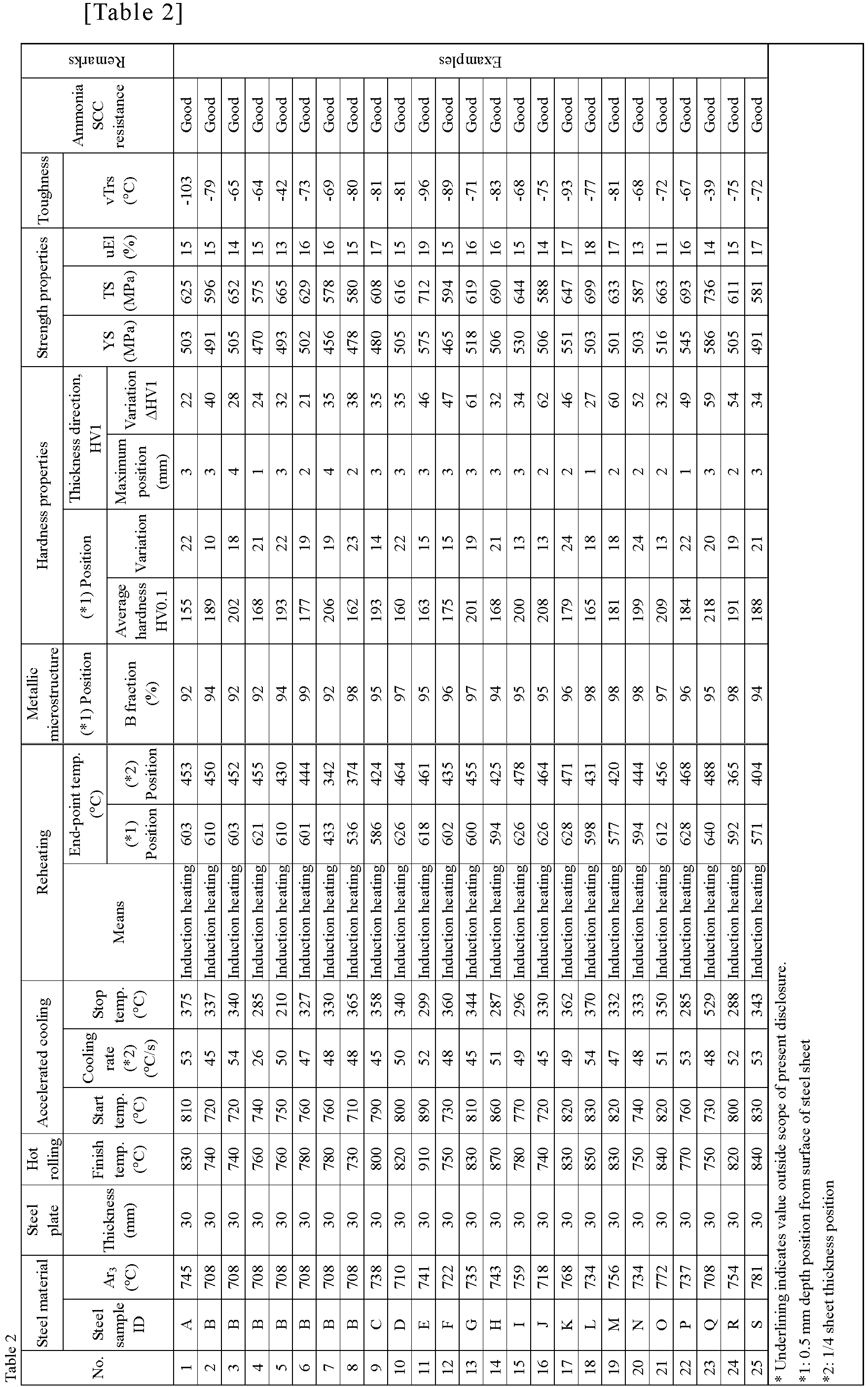

- As can be seen in Table 1 and Table 2, for the Examples, all obtained steel plates had a yield stress YS of 450 MPa or more, a tensile strength TS of 570 MPa or more, uniform elongation of 10 % or more, vTrs of -30 °C or less, excellent toughness at low temperature, and excellent ammonia SCC resistance.
- In contrast, although the chemical compositions of No. 31 to No. 39 were within the scope of the present disclosure, the method of production was in each case outside the scope of the present disclosure, and therefore the desired metallic microstructure and/or hardness properties were not obtained. As a result, at least one of yield stress YS, tensile strength TS, toughness at low temperatures, or ammonia SCC resistance was poor.
- Further, the chemical compositions of No. 40 to No. 50 were outside the scope of the present disclosure, and therefore at least one of yield stress YS, tensile strength TS, toughness at low temperatures, or ammonia SCC resistance was poor. Hereinafter, the chemical composition of the steel may be considered to be the chemical composition of the steel plate.
Claims (6)
- A steel plate comprising a chemical composition containing, in mass%,C: 0.010 % to 0.200 %,Si: 0.01 % to 0.50 %,Mn: 0.50 % to 2.50 %,Al: 0.010 % to 0.060 %,N: 0.0010 % or more and 0.0100 % or less,P: 0.020 % or less,S: 0.0100 % or less, andO: 0.0100 % or less,with the balance being Fe and inevitable impurity, wherein,at a 0.5 mm depth position from the surface of the steel plate, average hardness is 230HV0.1 or less and hardness variation is 30HV0.1 or less, a maximum value of hardness in the thickness direction is at a position 1.0 mm or more and 1/4 or less of the thickness of the steel plate from the surface of the steel plate, and hardness variation in the thickness direction is 70HV1 or less, andthe steel plate has a metallic microstructure where, at a 0.5 mm depth position from the surface of the steel plate, a volume fraction of bainitic microstructure is 90 % or more.
- The steel plate according to claim 1, wherein the chemical composition further contains, in mass%, at least one selected from the group consisting ofCu: 0.01 % to 0.50 %,Ni: 0.01 % to 2.00 %,Cr: 0.01 % to 1.00 %,Sn: 0.01 % to 0.50 %,Sb: 0.01 % to 0.50 %,Mo: 0.01 % to 0.50 % and,W: 0.01 % to 1.00 %.
- The steel plate according to claim 1 or 2, wherein the chemical composition further contains, in mass%, at least one selected from the group consisting ofV: 0.01 % to 1.00 %,Ti: 0.005 % to 0.100 %,Co: 0.01 % to 1.00 %,Nb: 0.005 % to 0.100 %,B: 0.0001 % to 0.0100 %,Ca: 0.0005 % to 0.0200 %,Mg: 0.0005 % to 0.0200 %, andREM: 0.0005 % to 0.0200 %.
- A method of producing a steel plate, the method applied to a steel material comprising a chemical composition containing, in mass%,C: 0.010 % to 0.200 %,Si: 0.01 % to 0.50 %,Mn: 0.50 % to 2.50 %,Al: 0.010 % to 0.060 %,N: 0.0010 % or more and 0.0100 % or less,P: 0.020 % or less,S: 0.0100 % or less, andO: 0.0100 % or less,with the balance being Fe and inevitable impurity, the method comprising:hot rolling with a rolling finish temperature that is Ar3 transformation temperature or more; followed by accelerated cooling from a cooling start temperature that is the Ar3 transformation temperature or more; followed by reheating, wherein,in the accelerated cooling, cooling stop temperature is in a range from 200 °C to 600 °C and cooling rate at a 1/4 plate thickness position is 20 °C/s to 120 °C/s, andthe reheating is performed until end-point temperature at a 0.5 mm depth position from the surface of the steel plate is in a range from 400 °C to 680 °C, with end-point temperature at a 1/4 plate thickness position being 500 °C or less.
- The method of producing a steel plate according to claim 4, wherein the chemical composition of the steel material further contains, in mass%, at least one selected from the group consisting ofCu: 0.01 % to 0.50 %,Ni: 0.01 % to 2.00 %,Cr: 0.01 % to 1.00 %,Sn: 0.01 % to 0.50 %,Sb: 0.01 % to 0.50 %,Mo: 0.01 % to 0.50 % and,W: 0.01 % to 1.00 %.
- The method of producing a steel plate according to claim 4 or 5, wherein the chemical composition of the steel material further contains, in mass%, at least one selected from the group consisting ofV: 0.01 % to 1.00 %,Ti: 0.005 % to 0.100 %,Co: 0.01 % to 1.00 %,Nb: 0.005 % to 0.100 %,B: 0.0001 % to 0.0100 %,Ca: 0.0005 % to 0.0200 %,Mg: 0.0005 % to 0.0200 %, andREM: 0.0005 % to 0.0200 %.
Applications Claiming Priority (2)
| Application Number | Priority Date | Filing Date | Title |
|---|---|---|---|
| JP2022027290 | 2022-02-24 | ||
| PCT/JP2023/002491 WO2023162571A1 (en) | 2022-02-24 | 2023-01-26 | Steel plate and method for manufacturing same |
Publications (2)
| Publication Number | Publication Date |
|---|---|
| EP4458993A1 true EP4458993A1 (en) | 2024-11-06 |
| EP4458993A4 EP4458993A4 (en) | 2025-11-12 |
Family
ID=87765500
Family Applications (1)
| Application Number | Title | Priority Date | Filing Date |
|---|---|---|---|
| EP23759577.2A Pending EP4458993A4 (en) | 2022-02-24 | 2023-01-26 | Steel plate and method for manufacturing same |
Country Status (8)
| Country | Link |
|---|---|
| US (1) | US20250115972A1 (en) |
| EP (1) | EP4458993A4 (en) |
| JP (1) | JP7601218B2 (en) |
| KR (1) | KR20240124991A (en) |
| CN (1) | CN118647744A (en) |
| AU (1) | AU2023223720B2 (en) |
| TW (1) | TWI826257B (en) |
| WO (1) | WO2023162571A1 (en) |
Families Citing this family (3)
| Publication number | Priority date | Publication date | Assignee | Title |
|---|---|---|---|---|
| CN117305702A (en) * | 2023-09-21 | 2023-12-29 | 南京钢铁股份有限公司 | A kind of multi-phase structure FH40-HD50 high ductility ship plate steel and its preparation method |
| JP7853636B1 (en) * | 2025-01-17 | 2026-04-30 | 日本製鉄株式会社 | Steel plates, ammonia tanks, and line pipes |
| CN120818747B (en) * | 2025-09-17 | 2025-11-18 | 鞍钢股份有限公司 | 350 MPa-level low-yield-ratio impact-resistant steel for parts, manufacturing method and carburization treatment method for parts |
Family Cites Families (16)
| Publication number | Priority date | Publication date | Assignee | Title |
|---|---|---|---|---|
| JP3802626B2 (en) | 1996-11-12 | 2006-07-26 | 新日本製鐵株式会社 | Method for producing low yield ratio high strength steel with excellent weldability and low temperature toughness |
| JP3848415B2 (en) | 1996-12-11 | 2006-11-22 | 新日本製鐵株式会社 | Method for producing low yield ratio high strength steel with excellent weldability and low temperature toughness |
| JP4605117B2 (en) * | 2006-07-25 | 2011-01-05 | 住友金属工業株式会社 | Steel used for tanks for LPG / ammonia carrier |
| JP5900303B2 (en) * | 2011-12-09 | 2016-04-06 | Jfeスチール株式会社 | High-strength steel sheet for sour-resistant pipes with excellent material uniformity in the steel sheet and its manufacturing method |
| CN107532253B (en) * | 2015-03-31 | 2019-06-21 | 杰富意钢铁株式会社 | High-strength/high-toughness steel sheet and method for producing the same |
| KR20190129097A (en) * | 2017-03-30 | 2019-11-19 | 제이에프이 스틸 가부시키가이샤 | High strength steel sheet for internal sour line pipe, manufacturing method thereof and high strength steel pipe using high strength steel sheet for internal sour line pipe |
| KR20190129957A (en) * | 2017-03-30 | 2019-11-20 | 제이에프이 스틸 가부시키가이샤 | High strength steel sheet for internal sour line pipe, manufacturing method thereof and high strength steel pipe using high strength steel sheet for internal sour line pipe |
| KR102507715B1 (en) * | 2018-08-22 | 2023-03-07 | 제이에프이 스틸 가부시키가이샤 | High-strength steel sheet and manufacturing method thereof |
| WO2020067210A1 (en) * | 2018-09-28 | 2020-04-02 | Jfeスチール株式会社 | High-strength steel sheet for sour-resistant line pipe, method for producing same, and high-strength steel pipe using high-strength steel sheet for sour-resistant line pipe |
| JP6825748B2 (en) * | 2018-09-28 | 2021-02-03 | Jfeスチール株式会社 | High-strength steel sheet for sour-resistant pipe and its manufacturing method, and high-strength steel pipe using high-strength steel sheet for sour-resistant pipe |
| CN112313351B (en) * | 2018-10-17 | 2022-10-28 | 日本制铁株式会社 | Steel sheet and method for producing steel sheet |
| US12351896B2 (en) * | 2018-12-26 | 2025-07-08 | Jfe Steel Corporation | Steel material for high-pressure hydrogen gas environment, steel structure for high-pressure hydrogen gas environment, and methods for producing steel material for high-pressure hydrogen gas environment |
| KR102658163B1 (en) * | 2019-03-22 | 2024-04-19 | 닛폰세이테츠 가부시키가이샤 | High-strength steel plate and its manufacturing method |
| JP7226102B2 (en) * | 2019-05-29 | 2023-02-21 | Jfeスチール株式会社 | Manufacturing method of welded steel pipe for sour resistant line pipe |
| JP7215332B2 (en) * | 2019-05-29 | 2023-01-31 | Jfeスチール株式会社 | Manufacturing method of welded steel pipe for sour resistant line pipe |
| JP7147960B2 (en) * | 2019-11-27 | 2022-10-05 | Jfeスチール株式会社 | Steel plate and its manufacturing method |
-
2023
- 2023-01-26 JP JP2023523653A patent/JP7601218B2/en active Active
- 2023-01-26 EP EP23759577.2A patent/EP4458993A4/en active Pending
- 2023-01-26 US US18/836,002 patent/US20250115972A1/en active Pending
- 2023-01-26 WO PCT/JP2023/002491 patent/WO2023162571A1/en not_active Ceased
- 2023-01-26 CN CN202380020301.8A patent/CN118647744A/en active Pending
- 2023-01-26 KR KR1020247023941A patent/KR20240124991A/en active Pending
- 2023-01-26 AU AU2023223720A patent/AU2023223720B2/en active Active
- 2023-02-10 TW TW112104809A patent/TWI826257B/en active
Also Published As
| Publication number | Publication date |
|---|---|
| JPWO2023162571A1 (en) | 2023-08-31 |
| EP4458993A4 (en) | 2025-11-12 |
| KR20240124991A (en) | 2024-08-19 |
| CN118647744A (en) | 2024-09-13 |
| AU2023223720A1 (en) | 2024-06-20 |
| TW202336240A (en) | 2023-09-16 |
| AU2023223720B2 (en) | 2025-09-18 |
| JP7601218B2 (en) | 2024-12-17 |
| US20250115972A1 (en) | 2025-04-10 |
| TWI826257B (en) | 2023-12-11 |
| WO2023162571A1 (en) | 2023-08-31 |
Similar Documents
| Publication | Publication Date | Title |
|---|---|---|
| EP2728030B1 (en) | Thick-walled high-strength seamless steel pipe with excellent sour resistance for pipe for pipeline, and process for producing same | |
| EP3467135B1 (en) | Thin steel sheet, and production method therefor | |
| EP3214197B1 (en) | High-strength steel sheet and method for manufacturing same | |
| JP7541123B2 (en) | Cold rolled, annealed and tempered steel sheet and its manufacturing method | |
| JP7541122B2 (en) | Cold rolled annealed steel sheet and its manufacturing method | |
| KR20190077470A (en) | High Mn steel sheet and manufacturing method thereof | |
| EP3550049A1 (en) | Nickel-containing steel for low temperatures and tank for low temperatures | |
| JP7601218B2 (en) | Steel plate and its manufacturing method | |
| JP2025084855A (en) | Cold rolled annealed steel sheet and its manufacturing method | |
| KR20230004733A (en) | Cold-rolled annealed steel sheet and its manufacturing method | |
| KR20220162180A (en) | Cold-rolled annealed steel sheet and its manufacturing method | |
| CN115698344A (en) | Cold-rolled and double-annealed steel sheets | |
| EP2740813B1 (en) | Hot-dip galvanized steel sheet and method for manufacturing the same | |
| EP4477769A1 (en) | Steel sheet and method for producing same | |
| TWI836897B (en) | Steel plate and its manufacturing method | |
| EP3269836B1 (en) | High-strength cold-rolled steel sheet and method for manufacturing same | |
| JP7622839B2 (en) | Steel plate and its manufacturing method | |
| US20260110066A1 (en) | Clad steel plate and method of producing same | |
| JP2025082820A (en) | Steel sheet with excellent resistance to ammonia stress corrosion cracking and method for producing the same | |
| WO2026053867A1 (en) | Seamless steel pipe and method for manufacturing same | |
| BR112022021133B1 (en) | Cold-rolled steel sheet, resistance spot welded, and pressure-hardened and tempered steel part. |
Legal Events
| Date | Code | Title | Description |
|---|---|---|---|
| STAA | Information on the status of an ep patent application or granted ep patent |
Free format text: STATUS: THE INTERNATIONAL PUBLICATION HAS BEEN MADE |
|
| PUAI | Public reference made under article 153(3) epc to a published international application that has entered the european phase |
Free format text: ORIGINAL CODE: 0009012 |
|
| STAA | Information on the status of an ep patent application or granted ep patent |
Free format text: STATUS: REQUEST FOR EXAMINATION WAS MADE |
|
| 17P | Request for examination filed |
Effective date: 20240729 |
|
| AK | Designated contracting states |
Kind code of ref document: A1 Designated state(s): AL AT BE BG CH CY CZ DE DK EE ES FI FR GB GR HR HU IE IS IT LI LT LU LV MC ME MK MT NL NO PL PT RO RS SE SI SK SM TR |
|
| DAV | Request for validation of the european patent (deleted) | ||
| DAX | Request for extension of the european patent (deleted) | ||
| A4 | Supplementary search report drawn up and despatched |
Effective date: 20251010 |
|
| RIC1 | Information provided on ipc code assigned before grant |
Ipc: C21D 8/02 20060101AFI20251006BHEP Ipc: C22C 38/00 20060101ALI20251006BHEP Ipc: C22C 38/06 20060101ALI20251006BHEP Ipc: C22C 38/60 20060101ALI20251006BHEP Ipc: C21D 1/18 20060101ALI20251006BHEP Ipc: C21D 1/25 20060101ALI20251006BHEP |