EP4458929A1 - Method of producing syngas from an input material - Google Patents
Method of producing syngas from an input material Download PDFInfo
- Publication number
- EP4458929A1 EP4458929A1 EP23020202.0A EP23020202A EP4458929A1 EP 4458929 A1 EP4458929 A1 EP 4458929A1 EP 23020202 A EP23020202 A EP 23020202A EP 4458929 A1 EP4458929 A1 EP 4458929A1
- Authority
- EP
- European Patent Office
- Prior art keywords
- washing liquid
- syngas
- washing
- ammonia
- scrubber
- Prior art date
- Legal status (The legal status is an assumption and is not a legal conclusion. Google has not performed a legal analysis and makes no representation as to the accuracy of the status listed.)
- Pending
Links
Images
Classifications
-
- C—CHEMISTRY; METALLURGY
- C10—PETROLEUM, GAS OR COKE INDUSTRIES; TECHNICAL GASES CONTAINING CARBON MONOXIDE; FUELS; LUBRICANTS; PEAT
- C10K—PURIFYING OR MODIFYING THE CHEMICAL COMPOSITION OF COMBUSTIBLE GASES CONTAINING CARBON MONOXIDE
- C10K1/00—Purifying combustible gases containing carbon monoxide
- C10K1/04—Purifying combustible gases containing carbon monoxide by cooling to condense non-gaseous materials
- C10K1/046—Reducing the tar content
-
- B—PERFORMING OPERATIONS; TRANSPORTING
- B01—PHYSICAL OR CHEMICAL PROCESSES OR APPARATUS IN GENERAL
- B01D—SEPARATION
- B01D53/00—Separation of gases or vapours; Recovering vapours of volatile solvents from gases; Chemical or biological purification of waste gases, e.g. engine exhaust gases, smoke, fumes, flue gases, aerosols
- B01D53/14—Separation of gases or vapours; Recovering vapours of volatile solvents from gases; Chemical or biological purification of waste gases, e.g. engine exhaust gases, smoke, fumes, flue gases, aerosols by absorption
-
- C—CHEMISTRY; METALLURGY
- C01—INORGANIC CHEMISTRY
- C01B—NON-METALLIC ELEMENTS; COMPOUNDS THEREOF; METALLOIDS OR COMPOUNDS THEREOF NOT COVERED BY SUBCLASS C01C
- C01B3/00—Hydrogen; Gaseous mixtures containing hydrogen; Separation of hydrogen from mixtures containing it; Purification of hydrogen; Reversible storage of hydrogen
- C01B3/50—Separation of hydrogen or hydrogen-containing gases from gaseous mixtures, e.g. purification
- C01B3/52—Separation of hydrogen or hydrogen-containing gases from gaseous mixtures, e.g. purification by contacting with liquids; Regeneration of used liquids
-
- C—CHEMISTRY; METALLURGY
- C04—CEMENTS; CONCRETE; ARTIFICIAL STONE; CERAMICS; REFRACTORIES
- C04B—LIME, MAGNESIA; SLAG; CEMENTS; COMPOSITIONS THEREOF, e.g. MORTARS, CONCRETE OR LIKE BUILDING MATERIALS; ARTIFICIAL STONE; CERAMICS; REFRACTORIES; TREATMENT OF NATURAL STONE
- C04B7/00—Hydraulic cements
- C04B7/36—Manufacture of hydraulic cements in general
- C04B7/43—Heat treatment, e.g. precalcining, burning, melting; Cooling
- C04B7/44—Burning; Melting
- C04B7/4407—Treatment or selection of the fuel therefor, e.g. use of hazardous waste as secondary fuel ; Use of particular energy sources, e.g. waste hot gases from other processes
- C04B7/4446—Treatment or selection of the fuel therefor, e.g. use of hazardous waste as secondary fuel ; Use of particular energy sources, e.g. waste hot gases from other processes the fuel being treated in a separate gasifying or decomposing chamber, e.g. a separate combustion chamber
-
- C—CHEMISTRY; METALLURGY
- C10—PETROLEUM, GAS OR COKE INDUSTRIES; TECHNICAL GASES CONTAINING CARBON MONOXIDE; FUELS; LUBRICANTS; PEAT
- C10J—PRODUCTION OF PRODUCER GAS, WATER-GAS, SYNTHESIS GAS FROM SOLID CARBONACEOUS MATERIAL, OR MIXTURES CONTAINING THESE GASES; CARBURETTING AIR OR OTHER GASES
- C10J3/00—Production of combustible gases containing carbon monoxide from solid carbonaceous fuels
-
- C—CHEMISTRY; METALLURGY
- C10—PETROLEUM, GAS OR COKE INDUSTRIES; TECHNICAL GASES CONTAINING CARBON MONOXIDE; FUELS; LUBRICANTS; PEAT
- C10K—PURIFYING OR MODIFYING THE CHEMICAL COMPOSITION OF COMBUSTIBLE GASES CONTAINING CARBON MONOXIDE
- C10K1/00—Purifying combustible gases containing carbon monoxide
- C10K1/001—Purifying combustible gases containing carbon monoxide working-up the condensates
-
- C—CHEMISTRY; METALLURGY
- C10—PETROLEUM, GAS OR COKE INDUSTRIES; TECHNICAL GASES CONTAINING CARBON MONOXIDE; FUELS; LUBRICANTS; PEAT
- C10K—PURIFYING OR MODIFYING THE CHEMICAL COMPOSITION OF COMBUSTIBLE GASES CONTAINING CARBON MONOXIDE
- C10K1/00—Purifying combustible gases containing carbon monoxide
- C10K1/04—Purifying combustible gases containing carbon monoxide by cooling to condense non-gaseous materials
- C10K1/06—Purifying combustible gases containing carbon monoxide by cooling to condense non-gaseous materials combined with spraying with water
-
- C—CHEMISTRY; METALLURGY
- C10—PETROLEUM, GAS OR COKE INDUSTRIES; TECHNICAL GASES CONTAINING CARBON MONOXIDE; FUELS; LUBRICANTS; PEAT
- C10K—PURIFYING OR MODIFYING THE CHEMICAL COMPOSITION OF COMBUSTIBLE GASES CONTAINING CARBON MONOXIDE
- C10K1/00—Purifying combustible gases containing carbon monoxide
- C10K1/08—Purifying combustible gases containing carbon monoxide by washing with liquids; Reviving the used wash liquors
-
- C—CHEMISTRY; METALLURGY
- C10—PETROLEUM, GAS OR COKE INDUSTRIES; TECHNICAL GASES CONTAINING CARBON MONOXIDE; FUELS; LUBRICANTS; PEAT
- C10K—PURIFYING OR MODIFYING THE CHEMICAL COMPOSITION OF COMBUSTIBLE GASES CONTAINING CARBON MONOXIDE
- C10K1/00—Purifying combustible gases containing carbon monoxide
- C10K1/08—Purifying combustible gases containing carbon monoxide by washing with liquids; Reviving the used wash liquors
- C10K1/10—Purifying combustible gases containing carbon monoxide by washing with liquids; Reviving the used wash liquors with aqueous liquids
-
- C—CHEMISTRY; METALLURGY
- C10—PETROLEUM, GAS OR COKE INDUSTRIES; TECHNICAL GASES CONTAINING CARBON MONOXIDE; FUELS; LUBRICANTS; PEAT
- C10K—PURIFYING OR MODIFYING THE CHEMICAL COMPOSITION OF COMBUSTIBLE GASES CONTAINING CARBON MONOXIDE
- C10K1/00—Purifying combustible gases containing carbon monoxide
- C10K1/08—Purifying combustible gases containing carbon monoxide by washing with liquids; Reviving the used wash liquors
- C10K1/10—Purifying combustible gases containing carbon monoxide by washing with liquids; Reviving the used wash liquors with aqueous liquids
- C10K1/102—Purifying combustible gases containing carbon monoxide by washing with liquids; Reviving the used wash liquors with aqueous liquids containing free acid
-
- C—CHEMISTRY; METALLURGY
- C01—INORGANIC CHEMISTRY
- C01B—NON-METALLIC ELEMENTS; COMPOUNDS THEREOF; METALLOIDS OR COMPOUNDS THEREOF NOT COVERED BY SUBCLASS C01C
- C01B2203/00—Integrated processes for the production of hydrogen or synthesis gas
- C01B2203/14—Details of the flowsheet
- C01B2203/146—At least two purification steps in series
-
- C—CHEMISTRY; METALLURGY
- C01—INORGANIC CHEMISTRY
- C01C—AMMONIA; CYANOGEN; COMPOUNDS THEREOF
- C01C1/00—Ammonia; Compounds thereof
- C01C1/24—Sulfates of ammonium
- C01C1/242—Preparation from ammonia and sulfuric acid or sulfur trioxide
-
- C—CHEMISTRY; METALLURGY
- C10—PETROLEUM, GAS OR COKE INDUSTRIES; TECHNICAL GASES CONTAINING CARBON MONOXIDE; FUELS; LUBRICANTS; PEAT
- C10J—PRODUCTION OF PRODUCER GAS, WATER-GAS, SYNTHESIS GAS FROM SOLID CARBONACEOUS MATERIAL, OR MIXTURES CONTAINING THESE GASES; CARBURETTING AIR OR OTHER GASES
- C10J2300/00—Details of gasification processes
- C10J2300/09—Details of the feed, e.g. feeding of spent catalyst, inert gas or halogens
- C10J2300/0913—Carbonaceous raw material
- C10J2300/0946—Waste, e.g. MSW, tires, glass, tar sand, peat, paper, lignite, oil shale
-
- C—CHEMISTRY; METALLURGY
- C10—PETROLEUM, GAS OR COKE INDUSTRIES; TECHNICAL GASES CONTAINING CARBON MONOXIDE; FUELS; LUBRICANTS; PEAT
- C10J—PRODUCTION OF PRODUCER GAS, WATER-GAS, SYNTHESIS GAS FROM SOLID CARBONACEOUS MATERIAL, OR MIXTURES CONTAINING THESE GASES; CARBURETTING AIR OR OTHER GASES
- C10J2300/00—Details of gasification processes
- C10J2300/09—Details of the feed, e.g. feeding of spent catalyst, inert gas or halogens
- C10J2300/0953—Gasifying agents
- C10J2300/0973—Water
- C10J2300/0976—Water as steam
-
- C—CHEMISTRY; METALLURGY
- C10—PETROLEUM, GAS OR COKE INDUSTRIES; TECHNICAL GASES CONTAINING CARBON MONOXIDE; FUELS; LUBRICANTS; PEAT
- C10J—PRODUCTION OF PRODUCER GAS, WATER-GAS, SYNTHESIS GAS FROM SOLID CARBONACEOUS MATERIAL, OR MIXTURES CONTAINING THESE GASES; CARBURETTING AIR OR OTHER GASES
- C10J2300/00—Details of gasification processes
- C10J2300/16—Integration of gasification processes with another plant or parts within the plant
Definitions
- the invention refers to a method of producing syngas from an input material.
- Syngas or synthesis gas
- Syngas is a mixture of hydrogen and carbon monoxide. Syngas is combustible and can be used as a fuel or input in various applications.
- Such methods comprise a first wet scrubbing step for removing tar from the syngas and a second wet scrubbing step for removing ammonia from the syngas, wherein the first scrubbing step comprises feeding the syngas through a washing column of a first scrubber in the presence of a first washing liquid containing one or two solvents and subjecting the first washing liquid to a separating step in a separator downstream of the washing column for separating tar from the first washing liquid.
- a method has been described in EP 3293159 B1 .
- the purified syngas may be used as fuel for the production of Portland clinker.
- the instant invention aims at providing an improved method of removing contaminants from syngas in order to make it suitable for being used as a fuel in the production of Portland clinker.
- the invention provides a method of producing syngas from an input material, comprising gasifying the input material in a gasifier to obtain syngas and removing contaminants from the syngas, comprising a first wet scrubbing step for removing tar from the syngas and a second wet scrubbing step for removing ammonia from the syngas, wherein the first scrubbing step comprises feeding the syngas through a washing column of a first scrubber in the presence of a first washing liquid containing at least one, such as one or two, solvent and subjecting the first washing liquid to a separating step in a separator downstream of the washing column for separating tar from the first washing liquid, wherein a neutralizing agent is added to the first washing liquid in order to neutralize halogens contained in the syngas and obtain a sodium salt dissolving in the first washing liquid, i.e.
- the halogen contained in the syngas is in the form of hydrogen halides and sodium hydroxide is used as the neutralizing agent, the resulting sodium salts being sodium fluoride, sodium chloride, sodium bromide or sodium iodide.
- the invention provides an efficient way of removing halogens, in particular hydrogen chloride, from the syngas, thereby preventing the contamination of Portland clinker with such halogens when using the syngas as a fuel in a cement kiln.
- halogens are removed from the syngas in the form of sodium salts that precipitate into one of the solvents in the first washing liquid and can be extracted from the process in the form of a brine.
- NH 3 (ammonia) is also partially precipitated into the solvent containing the salts.
- ammonia constitutes an unwanted byproduct in the first wet scrubbing step and the dedicated step for removing ammonia is the second wet scrubbing step
- Ammonia is a volatile compound that can readily evaporate when heated, and it has a relatively high vapor pressure at room temperature. Therefore, if ammonia is present in the first washing liquid being evaporated, it can potentially vaporize and be carried along with the steam that is produced by the evaporator.
- the concentration of ammonia in the steam may depend on various factors, such as the concentration of ammonia in the liquid as well as the temperature and pressure of the evaporator.
- the steam loaded with ammonia is preferably introduced into the gasifier.
- the addition of steam into the gasifier has the effect of changing the composition of the syngas produced by the gasifier, by altering the gasification reactions and shifting the equilibrium of the gasification reactions.
- the addition of steam can increase the production of hydrogen and carbon monoxide in the syngas, while decreasing the production of carbon dioxide.
- the addition of steam loaded with ammonia results in the accumulation of ammonia in the syngas.
- the ph value of the first washing liquid in the first washing column influences the amount of ammonia contained in the steam produced by the evaporator.
- the ph value of the first washing liquid withdrawn from the separator is adjusted to > 8.
- Ammonia exists in aqueous solutions in the form of ammonium ions (NH 4 + ) and ammonia gas (NH 3 ), with the relative proportion of each species depending on the pH of the solution. At lower pH values, more of the ammonia will exist in the ammonium ion form, which is less volatile and less likely to vaporize and be carried along with the steam. At higher pH values, more of the ammonia will exist in the ammonia gas form, which is more volatile and more likely to vaporize and be carried along with the steam.
- the pH of the first washing liquid is relatively high, such as > 8, preferably > 9, more of the ammonia in the first washing liquid may exist in the ammonia gas form and be carried along with the steam produced by the evaporator.
- the first and the second wet scrubbing step are carried out in a first scrubber and in second scrubber, respectively.
- the scrubbing step comprises feeding the syngas through a washing column of the scrubber in the presence of washing liquids.
- a typical configuration of the scrubbing step comprises feeding the syngas into the bottom of the washing column, which may be a tall cylindrical vessel packed with a material that provides a large surface area for contact between the syngas and the washing liquids. Washing liquids, typically water or a water-based solution or emulsion, is fed into the top of the column and flows downward over the packing material.
- the syngas As the syngas rises through the column, it comes into contact with the washing liquids and various chemical reactions and physical processes occur, depending on the specific contaminants being removed and the properties of the syngas and washing liquids.
- the contaminants are typically removed from the washing liquids in a separator downstream of the washing column using various treatment methods, such as decantation, chemical precipitation or filtration.
- the cleaned syngas exits the top of the washing column.
- first wet scrubbing step one or two solvents are used to constitute the first washing liquid in order to remove tar from the syngas.
- Tar can be removed from syngas by condensing it into a liquid or solid phase, wherein the solvent embodies the tar into the washing liquid so that a tar loaded first washing liquid is withdrawn from the washing column, which is subjected to a separating step in a separator.
- the separator is for separating tar and the first washing liquid itself, wherein the separator may preferably be designed as an oil/water separator.
- Rapeseed methyl ester is used as one of the solvents.
- Rapeseed methyl ester has been found to have favorable solvent properties, including high solvency power, low toxicity, and biodegradability.
- the first washing liquid may be recirculated to the inlet of the first scrubber.
- the first scrubbing step preferably comprises circulating the first washing liquid in a first washing circuit, wherein said step of circulating the first washing liquid comprises feeding the first washing liquid into the first scrubber via an inlet, withdrawing a partial flow of the first washing liquid from the separator and recirculating the first washing liquid to the inlet.
- the step of recirculating the first washing liquid to the inlet comprises cooling the first washing liquid. This ensures that the temperature level required for the condensation of tar is reached.
- fresh washing liquid or a component thereof preferably water
- the neutralizing agent is added to the first washing liquid or the component thereof together with the fresh washing liquid.
- fresh washing liquid or the component thereof may be added to the first washing liquid between the separator and the evaporator.
- the sodium salt brine obtained by the first wet scrubbing step may be disposed of as industrial waste water and, e.g., discharged to a public treatment plant.
- the brine contains NaOH + ions, NH 4 + ions and halogen- ions, e.g. Cl - ions.
- the brine may contain contaminants, such as HgS and PAH, which may preferably be removed from the brine before being discharged.
- PAH stands for polycyclic aromatic hydrocarbons, which are a group of organic compounds that contain two or more fused aromatic rings. PAHs can be produced as byproducts of incomplete combustion, and are often found in the condensate of syngas scrubbers as a result of their presence in the syngas feedstock. PAHs are considered to be environmental pollutants and potential human health hazards due to their toxicity and carcinogenic properties. They can be persistent in the environment and can accumulate in soils, sediments, and living organisms, including humans. PAHs may preferably be removed from the brine by means of filtration.
- HgS (mercury sulfide) deposits can potentially occur in the condensate of a syngas scrubber, because mercury is often present in syngas as a trace impurity.
- mercury in the syngas may form a solid compound, typically HgS, which can accumulate in various parts of the scrubber, including the condensate.
- HgS deposits can form as a result of the reaction between dissolved mercury and sulfur compounds in the condensate, such as sulfates or sulfites.
- HgS may preferably be removed from the brine by means of filtration.
- a preferred embodiment provides that it comprises circulating a second washing liquid in a second washing circuit, wherein said step of circulating the second washing liquid comprises feeding the second washing liquid into a second scrubber via an inlet, precipitating ammonia into the second washing liquid, withdrawing the second washing loaded with ammonia from the second scrubber and recirculating the second washing liquid to the inlet, wherein a partial flow of the second washing liquid loaded with ammonia is branched off from the second washing circuit via a junction and fresh washing liquid is added to the second washing liquid downstream of the junction.
- the second scrubbing step comprises adding H 2 SO 4 to the second washing liquid and withdrawing the second washing liquid containing ammonia sulfate from the second scrubber.
- Adding sulfuric acid can be useful in a scrubber for separating ammonia from syngas for the following reason.
- Ammonia is a basic gas, and it can be reacted with sulfuric acid to form ammonium sulfate, which is a salt that can be easily dissolved in and thus extracted with the washing liquid.
- This reaction can be written as: 2NH 3 + H 2 SO 4 ⁇ (NH 4 ) 2 SO 4 dissolved in water as NH 4 + and SO 4 2-
- the ammonia in the syngas can be converted into a salt that can be easily removed, which can help improve the efficiency of the separation process.
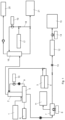
- Fig. 1 shows a bock diagram of a first embodiment of the method of the invention
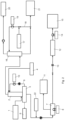
- Fig. 2 shows a bock diagram of a second embodiment of the method of the invention.
- syngas 1 is led through a washing column of a first scrubber 2 by feeding the syngas into the bottom of the washing column containing a packing material, in which the syngas is contacted with a first washing liquid.
- the first washing liquid is a water-based solution containing RME, which is fed into the top of the washing column and flows downward over the packing material.
- fresh water 3 together with sodium hydroxide 4 is fed into the washing column of the first scrubber 2.
- the sodium hydroxide 5 acts as a neutralizing agent, which results in that hydrogen halides contained in the syngas react with the neutralizing agent to obtain inorganic sodium salts that are dissolved in the first washing liquid.
- tar and water vapor contained in the syngas condense into the first washing liquid and contaminants, including ammonia, PAHs and HgS dissolve and/or precipitate into the first washing liquid, which is collected in an oil/water separator 5.
- tar is separated from the first washing liquid and removed as a tar emulsion 6.
- a partial amount of the first washing liquid is removed from the separator 5 as an aqueous stream and fed into an evaporator 7, the heat input of which is denoted by 8.
- the remaining amount of the first washing liquid is recirculated into the washing column of the first scrubber 2 via a recirculation line 9, which comprises a cooler 10, in order to cool the washing liquid before being introduced into the first scrubber 2.
- the evaporator 7 serves to produce wet steam and to remove ammonia from the aqueous stream. If the pH value of the aqueous stream is above 8, a substantial part of the ammonia contained in the aqueous stream will be released from the evaporator 7 in the steam 11.
- the steam 11 loaded with ammonia may be introduced into the gasifier (not shown), in which the syngas 1 is produced.
- the remaining amount of the aqueous stream is now a concentrated brine containing the sodium salts and is withdrawn from the evaporator 7 in liquid form and fed to a filter 12 after relieving the pressure at 13.
- the treatment step 12 serves to remove HgS and PAHs from the brine.
- the final brine 15 is collected in the form of water containing NaOH + ions, NH 4 + ions, F - ions, Br - ions, I - ions and Cl - ions.
- the partly purified syngas is withdrawn from the top of the first scrubber 2 and is fed through a second scrubber 16, in which ammonia is removed from the syngas.
- Water 17 is used as the second washing liquid in the second scrubber 16.
- H 2 SO 4 may be added to the second washing liquid, in order to improve the efficiency of the process of separating ammonia from the syngas.
- the second washing liquid that is removed from the second scrubber 16 is recirculated to the washing liquid inlet of the second scrubber 16 via the recirculation line 18, after having been cooled in a cooler 19. Maximizing the cooling of the recirculated second washing liquid will improve the capturing of ammonia and result in a particularly dry syngas 20.
- the remaining amount of the second washing liquid that is not recirculated is collected at 21 in the form of water containing up to 20-25 vol.-% ammonia. In case H 2 SO 4 is added to the second washing liquid, ammonia sulfate is obtained.
- the extracted ammonia solution may subsequently be used as reagent for the reduction of NOx emissions of the cement production line.
- Fig. 2 shows a process which largely corresponds to the process illustrated in Fig. 1 , except that fresh water is added to the process at 22, i.e. to the brine upstream of the evaporator 7, instead of being added to the input of the first scrubber 2.
Landscapes
- Chemical & Material Sciences (AREA)
- Engineering & Computer Science (AREA)
- Combustion & Propulsion (AREA)
- Organic Chemistry (AREA)
- Oil, Petroleum & Natural Gas (AREA)
- Chemical Kinetics & Catalysis (AREA)
- General Chemical & Material Sciences (AREA)
- Ceramic Engineering (AREA)
- Analytical Chemistry (AREA)
- Inorganic Chemistry (AREA)
- Physics & Mathematics (AREA)
- Thermal Sciences (AREA)
- Materials Engineering (AREA)
- Structural Engineering (AREA)
- Industrial Gases (AREA)
- Treating Waste Gases (AREA)
Abstract
Description
- The invention refers to a method of producing syngas from an input material.
- Syngas, or synthesis gas, is a mixture of hydrogen and carbon monoxide. Syngas is combustible and can be used as a fuel or input in various applications.
- Various methods of producing syngas from biomass or other material have been proposed in order to obtain a carbon neutral fuel, one method being the gasification of biomass or other material. Depending on the composition of the input material, gasification of such material may result in high amounts of contaminants in the syngas, which limits the use of the syngas as a fuel or input stream.
- Therefore, methods of purifying syngas have been proposed in order to remove contaminants from the syngas. Such methods comprise a first wet scrubbing step for removing tar from the syngas and a second wet scrubbing step for removing ammonia from the syngas, wherein the first scrubbing step comprises feeding the syngas through a washing column of a first scrubber in the presence of a first washing liquid containing one or two solvents and subjecting the first washing liquid to a separating step in a separator downstream of the washing column for separating tar from the first washing liquid. Such a method has been described in
EP 3293159 B1 . The purified syngas may be used as fuel for the production of Portland clinker. - However, the process described in
EP 3293159 B1 has the following disadvantages. High amounts of halogens, particularly chlorides, are often introduced by the input material used in the gasification process, which ultimately become part of the Portland clinker and cement products. Further, ammonia is generated and leads to an increase of NOx emissions. Both these issues are problematic for the cement industry, as standards limit the amount of chlorides in Portland cements used in construction, and ammonia emissions are detrimental to the environment. - Therefore, the instant invention aims at providing an improved method of removing contaminants from syngas in order to make it suitable for being used as a fuel in the production of Portland clinker.
- To solve this object, the invention provides a method of producing syngas from an input material, comprising gasifying the input material in a gasifier to obtain syngas and removing contaminants from the syngas, comprising a first wet scrubbing step for removing tar from the syngas and a second wet scrubbing step for removing ammonia from the syngas, wherein the first scrubbing step comprises feeding the syngas through a washing column of a first scrubber in the presence of a first washing liquid containing at least one, such as one or two, solvent and subjecting the first washing liquid to a separating step in a separator downstream of the washing column for separating tar from the first washing liquid, wherein a neutralizing agent is added to the first washing liquid in order to neutralize halogens contained in the syngas and obtain a sodium salt dissolving in the first washing liquid, i.e. in one of the solvents of the first washing liquids, and wherein a partial amount of ammonia contained in the syngas is precipitated into the first washing liquid and a remaining amount of ammonia contained in the syngas is removed from the syngas in the second wet scrubbing step.
- Preferably, the halogen contained in the syngas is in the form of hydrogen halides and sodium hydroxide is used as the neutralizing agent, the resulting sodium salts being sodium fluoride, sodium chloride, sodium bromide or sodium iodide.
- Thus, the invention provides an efficient way of removing halogens, in particular hydrogen chloride, from the syngas, thereby preventing the contamination of Portland clinker with such halogens when using the syngas as a fuel in a cement kiln.
- In the first wet scrubbing step, halogens are removed from the syngas in the form of sodium salts that precipitate into one of the solvents in the first washing liquid and can be extracted from the process in the form of a brine.
- As an unwanted byproduct, NH3 (ammonia) is also partially precipitated into the solvent containing the salts. However, since ammonia constitutes an unwanted byproduct in the first wet scrubbing step and the dedicated step for removing ammonia is the second wet scrubbing step, it is desirable to remove the ammonia from that part of the first washing liquid. According to a preferred embodiment, this is accomplished by feeding the first washing liquid at least partially withdrawn from the separator containing ammonia and sodium salts through an evaporator, in which a partial amount of the washing liquid is evaporated to obtain steam loaded with ammonia, and a remaining amount of the first washing liquid containing the sodium salts is withdrawn from the evaporator in liquid form.
- Ammonia is a volatile compound that can readily evaporate when heated, and it has a relatively high vapor pressure at room temperature. Therefore, if ammonia is present in the first washing liquid being evaporated, it can potentially vaporize and be carried along with the steam that is produced by the evaporator.
- The concentration of ammonia in the steam may depend on various factors, such as the concentration of ammonia in the liquid as well as the temperature and pressure of the evaporator.
- Further, it is desirable to recirculate the ammonia into the process, in order to maximize the amount of ammonia that can be removed from the syngas in the second wet scrubbing step. For this purpose, the steam loaded with ammonia is preferably introduced into the gasifier. The addition of steam into the gasifier has the effect of changing the composition of the syngas produced by the gasifier, by altering the gasification reactions and shifting the equilibrium of the gasification reactions. For example, the addition of steam can increase the production of hydrogen and carbon monoxide in the syngas, while decreasing the production of carbon dioxide. On the other hand, the addition of steam loaded with ammonia results in the accumulation of ammonia in the syngas.
- It was found that the ph value of the first washing liquid in the first washing column influences the amount of ammonia contained in the steam produced by the evaporator. Preferably, the ph value of the first washing liquid withdrawn from the separator is adjusted to > 8. Ammonia exists in aqueous solutions in the form of ammonium ions (NH4 +) and ammonia gas (NH3), with the relative proportion of each species depending on the pH of the solution. At lower pH values, more of the ammonia will exist in the ammonium ion form, which is less volatile and less likely to vaporize and be carried along with the steam. At higher pH values, more of the ammonia will exist in the ammonia gas form, which is more volatile and more likely to vaporize and be carried along with the steam.
- Therefore, if the pH of the first washing liquid is relatively high, such as > 8, preferably > 9, more of the ammonia in the first washing liquid may exist in the ammonia gas form and be carried along with the steam produced by the evaporator.
- The first and the second wet scrubbing step are carried out in a first scrubber and in second scrubber, respectively. The scrubbing step comprises feeding the syngas through a washing column of the scrubber in the presence of washing liquids. A typical configuration of the scrubbing step comprises feeding the syngas into the bottom of the washing column, which may be a tall cylindrical vessel packed with a material that provides a large surface area for contact between the syngas and the washing liquids. Washing liquids, typically water or a water-based solution or emulsion, is fed into the top of the column and flows downward over the packing material. As the syngas rises through the column, it comes into contact with the washing liquids and various chemical reactions and physical processes occur, depending on the specific contaminants being removed and the properties of the syngas and washing liquids. The contaminants are typically removed from the washing liquids in a separator downstream of the washing column using various treatment methods, such as decantation, chemical precipitation or filtration. The cleaned syngas exits the top of the washing column.
- In the first wet scrubbing step, one or two solvents are used to constitute the first washing liquid in order to remove tar from the syngas. Tar can be removed from syngas by condensing it into a liquid or solid phase, wherein the solvent embodies the tar into the washing liquid so that a tar loaded first washing liquid is withdrawn from the washing column, which is subjected to a separating step in a separator. The separator is for separating tar and the first washing liquid itself, wherein the separator may preferably be designed as an oil/water separator.
- Preferably, rapeseed methyl ester is used as one of the solvents. Rapeseed methyl ester (RME) has been found to have favorable solvent properties, including high solvency power, low toxicity, and biodegradability.
- After having been freed from tar and other contaminants, the first washing liquid may be recirculated to the inlet of the first scrubber. For this purpose, the first scrubbing step preferably comprises circulating the first washing liquid in a first washing circuit, wherein said step of circulating the first washing liquid comprises feeding the first washing liquid into the first scrubber via an inlet, withdrawing a partial flow of the first washing liquid from the separator and recirculating the first washing liquid to the inlet.
- Preferably, the step of recirculating the first washing liquid to the inlet comprises cooling the first washing liquid. This ensures that the temperature level required for the condensation of tar is reached.
- In order to compensate for the loss of fluid caused by the withdrawal of part of the first washing liquid as sodium salt brine, fresh washing liquid or a component thereof, preferably water, is preferably added to the first washing circuit. Preferably, the neutralizing agent is added to the first washing liquid or the component thereof together with the fresh washing liquid.
- Alternatively, fresh washing liquid or the component thereof may be added to the first washing liquid between the separator and the evaporator.
- The sodium salt brine obtained by the first wet scrubbing step may be disposed of as industrial waste water and, e.g., discharged to a public treatment plant. In the case of using sodium hydroxide as the neutralizing agent, the brine contains NaOH+ ions, NH4 + ions and halogen- ions, e.g. Cl- ions. Further, the brine may contain contaminants, such as HgS and PAH, which may preferably be removed from the brine before being discharged.
- PAH stands for polycyclic aromatic hydrocarbons, which are a group of organic compounds that contain two or more fused aromatic rings. PAHs can be produced as byproducts of incomplete combustion, and are often found in the condensate of syngas scrubbers as a result of their presence in the syngas feedstock. PAHs are considered to be environmental pollutants and potential human health hazards due to their toxicity and carcinogenic properties. They can be persistent in the environment and can accumulate in soils, sediments, and living organisms, including humans. PAHs may preferably be removed from the brine by means of filtration.
- HgS (mercury sulfide) deposits can potentially occur in the condensate of a syngas scrubber, because mercury is often present in syngas as a trace impurity. During the scrubbing process, mercury in the syngas may form a solid compound, typically HgS, which can accumulate in various parts of the scrubber, including the condensate. In the condensate, the HgS deposits can form as a result of the reaction between dissolved mercury and sulfur compounds in the condensate, such as sulfates or sulfites. HgS may preferably be removed from the brine by means of filtration.
- Turning now to the second scrubbing step, a preferred embodiment provides that it comprises circulating a second washing liquid in a second washing circuit, wherein said step of circulating the second washing liquid comprises feeding the second washing liquid into a second scrubber via an inlet, precipitating ammonia into the second washing liquid, withdrawing the second washing loaded with ammonia from the second scrubber and recirculating the second washing liquid to the inlet, wherein a partial flow of the second washing liquid loaded with ammonia is branched off from the second washing circuit via a junction and fresh washing liquid is added to the second washing liquid downstream of the junction.
- Preferably, the second scrubbing step comprises adding H2SO4 to the second washing liquid and withdrawing the second washing liquid containing ammonia sulfate from the second scrubber. Adding sulfuric acid can be useful in a scrubber for separating ammonia from syngas for the following reason. Ammonia is a basic gas, and it can be reacted with sulfuric acid to form ammonium sulfate, which is a salt that can be easily dissolved in and thus extracted with the washing liquid. This reaction can be written as:
2NH3 + H2SO4 → (NH4)2 SO4
dissolved in water as NH4 + and SO4 2- - By adding sulfuric acid to the scrubber, the ammonia in the syngas can be converted into a salt that can be easily removed, which can help improve the efficiency of the separation process.
- In the following, the invention is described in more detail with reference to exemplary embodiments shown in the figures. Therein,
Fig. 1 shows a bock diagram of a first embodiment of the method of the invention andFig. 2 shows a bock diagram of a second embodiment of the method of the invention. - In
Fig. 1 syngas 1 is led through a washing column of afirst scrubber 2 by feeding the syngas into the bottom of the washing column containing a packing material, in which the syngas is contacted with a first washing liquid. The first washing liquid is a water-based solution containing RME, which is fed into the top of the washing column and flows downward over the packing material. Further,fresh water 3 together withsodium hydroxide 4 is fed into the washing column of thefirst scrubber 2. Thesodium hydroxide 5 acts as a neutralizing agent, which results in that hydrogen halides contained in the syngas react with the neutralizing agent to obtain inorganic sodium salts that are dissolved in the first washing liquid. As the syngas rises through the column, tar and water vapor contained in the syngas condense into the first washing liquid and contaminants, including ammonia, PAHs and HgS dissolve and/or precipitate into the first washing liquid, which is collected in an oil/water separator 5. In theseparator 5 tar is separated from the first washing liquid and removed as atar emulsion 6. - A partial amount of the first washing liquid is removed from the
separator 5 as an aqueous stream and fed into anevaporator 7, the heat input of which is denoted by 8. The remaining amount of the first washing liquid is recirculated into the washing column of thefirst scrubber 2 via arecirculation line 9, which comprises a cooler 10, in order to cool the washing liquid before being introduced into thefirst scrubber 2. Theevaporator 7 serves to produce wet steam and to remove ammonia from the aqueous stream. If the pH value of the aqueous stream is above 8, a substantial part of the ammonia contained in the aqueous stream will be released from theevaporator 7 in thesteam 11. Thesteam 11 loaded with ammonia may be introduced into the gasifier (not shown), in which thesyngas 1 is produced. The remaining amount of the aqueous stream is now a concentrated brine containing the sodium salts and is withdrawn from theevaporator 7 in liquid form and fed to afilter 12 after relieving the pressure at 13. Thetreatment step 12 serves to remove HgS and PAHs from the brine. After a cooling step in a cooler 14, thefinal brine 15 is collected in the form of water containing NaOH+ ions, NH4 + ions, F- ions, Br- ions, I- ions and Cl- ions. - The partly purified syngas is withdrawn from the top of the
first scrubber 2 and is fed through asecond scrubber 16, in which ammonia is removed from the syngas.Water 17 is used as the second washing liquid in thesecond scrubber 16. Optionally, H2SO4 may be added to the second washing liquid, in order to improve the efficiency of the process of separating ammonia from the syngas. - The second washing liquid that is removed from the
second scrubber 16 is recirculated to the washing liquid inlet of thesecond scrubber 16 via therecirculation line 18, after having been cooled in a cooler 19. Maximizing the cooling of the recirculated second washing liquid will improve the capturing of ammonia and result in a particularlydry syngas 20. The remaining amount of the second washing liquid that is not recirculated is collected at 21 in the form of water containing up to 20-25 vol.-% ammonia. In case H2SO4 is added to the second washing liquid, ammonia sulfate is obtained. The extracted ammonia solution may subsequently be used as reagent for the reduction of NOx emissions of the cement production line. -
Fig. 2 shows a process which largely corresponds to the process illustrated inFig. 1 , except that fresh water is added to the process at 22, i.e. to the brine upstream of theevaporator 7, instead of being added to the input of thefirst scrubber 2.
Claims (15)
- A method of producing syngas from an input material, comprising gasifying the input material in a gasifier to obtain syngas and removing contaminants from the syngas, comprising a first wet scrubbing step for removing tar from the syngas and a second wet scrubbing step for removing ammonia from the syngas, wherein the first scrubbing step comprises feeding the syngas through a washing column of a first scrubber (2) in the presence of a first washing liquid containing at least one solvent and subjecting the first washing liquid to a separating step in a separator (5) downstream of the washing column for separating tar from the first washing liquid, wherein a neutralizing agent (4) is added to the first washing liquid in order to neutralize halogens contained in the syngas and obtain a sodium salt dissolving in the first washing liquid, and wherein a partial amount of ammonia contained in the syngas is precipitated into the first washing liquid and a remaining amount of ammonia contained in the syngas is removed from the syngas in the second wet scrubbing step.
- Method according to claim 1, wherein the halogens are present as hydrogen halides and sodium hydroxide is used as the neutralizing agent (4).
- Method according to claim 1 or 2, wherein rapeseed methyl ester and water are used as the solvents of the first washing liquid.
- Method according to claim 1, 2 or 3, wherein the first washing liquid, containing ammonia and sodium salts, is at least partially withdrawn from the separator (7) and is fed through an evaporator (7), in which a partial amount of the washing liquid is evaporated to obtain steam (11) loaded with ammonia, and a remaining amount of the first washing liquid containing the sodium salts is withdrawn from the evaporator (7) in liquid form.
- Method according to claim 4, wherein the steam loaded with ammonia is introduced into the gasifier.
- Method according to any one of claims 1 to 5, wherein the ph value of the first washing liquid withdrawn from the separator (7) is adjusted to > 8.
- Method according to any one of claims 1 to 6, wherein the first scrubbing step comprises circulating the first washing liquid in a first washing circuit, wherein said step of circulating the first washing liquid comprises feeding the first washing liquid into the first scrubber (2) via an inlet, withdrawing a partial flow of the first washing liquid from the separator (5) and recirculating the first washing liquid to the inlet.
- Method according to claim 7, wherein the step of recirculating the first washing liquid to the inlet comprises cooling the first washing liquid.
- Method according to claim 7 or 8, wherein fresh washing liquid or a component thereof, preferably water, is added to the first washing circuit.
- Method according to claim 9, wherein the neutralizing agent (4) is added to the first washing liquid together with the fresh washing liquid (3) or the component thereof.
- Method according to any one of claims 1 to 8, wherein fresh washing liquid (22) or a component thereof, preferably water, is added to the first washing liquid between the separator (5) and the evaporator (7).
- Method according to any one of claims 1 to 11, wherein the second scrubbing step comprises circulating a second washing liquid in a second washing circuit, wherein said step of circulating the second washing liquid comprises feeding the second washing liquid into a second scrubber (16) via an inlet, precipitating ammonia into the second washing liquid, withdrawing the second washing loaded with ammonia from the second scrubber (16) and recirculating the second washing liquid to the inlet, wherein a partial flow of the second washing liquid loaded with ammonia is branched off from the second washing circuit via a junction and fresh washing liquid (17) or a component thereof is added to the second washing liquid downstream of the junction.
- Method according to any one of claims 1 to 12, wherein the second scrubbing step comprises adding H2SO4 to the second washing liquid and withdrawing the second washing liquid containing ammonia sulfate from the second scrubber (16).
- Method according to any one of claims 1 to 13, wherein water is used as a component of said first washing liquid and/or said second washing liquid.
- Method according to any one of claims 12 to 14, wherein the second washing liquid loaded with ammonia is used for the reduction of NOx emissions of a cement production line.
Priority Applications (4)
| Application Number | Priority Date | Filing Date | Title |
|---|---|---|---|
| EP23020202.0A EP4458929A1 (en) | 2023-05-02 | 2023-05-02 | Method of producing syngas from an input material |
| PCT/IB2024/054035 WO2024228092A1 (en) | 2023-05-02 | 2024-04-25 | Method of producing syngas from an input material |
| CONC2025/0015153A CO2025015153A2 (en) | 2023-05-02 | 2025-10-29 | Synthesis gas production process from an introduced material |
| MX2025012998A MX2025012998A (en) | 2023-05-02 | 2025-10-30 | Method of producing syngas from an input material |
Applications Claiming Priority (1)
| Application Number | Priority Date | Filing Date | Title |
|---|---|---|---|
| EP23020202.0A EP4458929A1 (en) | 2023-05-02 | 2023-05-02 | Method of producing syngas from an input material |
Publications (1)
| Publication Number | Publication Date |
|---|---|
| EP4458929A1 true EP4458929A1 (en) | 2024-11-06 |
Family
ID=86328276
Family Applications (1)
| Application Number | Title | Priority Date | Filing Date |
|---|---|---|---|
| EP23020202.0A Pending EP4458929A1 (en) | 2023-05-02 | 2023-05-02 | Method of producing syngas from an input material |
Country Status (4)
| Country | Link |
|---|---|
| EP (1) | EP4458929A1 (en) |
| CO (1) | CO2025015153A2 (en) |
| MX (1) | MX2025012998A (en) |
| WO (1) | WO2024228092A1 (en) |
Citations (3)
| Publication number | Priority date | Publication date | Assignee | Title |
|---|---|---|---|---|
| US3369869A (en) * | 1964-02-27 | 1968-02-20 | Inventa Ag | Process for recovering ammonia from ammonia-containing gas by means of sulfuric acid |
| US10087121B2 (en) * | 2008-04-21 | 2018-10-02 | Karen Sue Kelly | Production of hydrocarbon liquids |
| EP3293159B1 (en) | 2016-09-09 | 2019-05-15 | Baumit Beteiligungen GmbH | Method for firing of lime or cement with synthesis gas |
-
2023
- 2023-05-02 EP EP23020202.0A patent/EP4458929A1/en active Pending
-
2024
- 2024-04-25 WO PCT/IB2024/054035 patent/WO2024228092A1/en not_active Ceased
-
2025
- 2025-10-29 CO CONC2025/0015153A patent/CO2025015153A2/en unknown
- 2025-10-30 MX MX2025012998A patent/MX2025012998A/en unknown
Patent Citations (3)
| Publication number | Priority date | Publication date | Assignee | Title |
|---|---|---|---|---|
| US3369869A (en) * | 1964-02-27 | 1968-02-20 | Inventa Ag | Process for recovering ammonia from ammonia-containing gas by means of sulfuric acid |
| US10087121B2 (en) * | 2008-04-21 | 2018-10-02 | Karen Sue Kelly | Production of hydrocarbon liquids |
| EP3293159B1 (en) | 2016-09-09 | 2019-05-15 | Baumit Beteiligungen GmbH | Method for firing of lime or cement with synthesis gas |
Non-Patent Citations (1)
| Title |
|---|
| WOOLCOCK PATRICK J ET AL: "A review of cleaning technologies for biomass-derived syngas", BIOMASS AND BIOENERGY, PERGAMON, AMSTERDAM, NL, vol. 52, 30 March 2013 (2013-03-30), pages 54 - 84, XP028593232, ISSN: 0961-9534, DOI: 10.1016/J.BIOMBIOE.2013.02.036 * |
Also Published As
| Publication number | Publication date |
|---|---|
| WO2024228092A1 (en) | 2024-11-07 |
| CO2025015153A2 (en) | 2025-11-19 |
| MX2025012998A (en) | 2025-12-01 |
Similar Documents
| Publication | Publication Date | Title |
|---|---|---|
| RU2453509C1 (en) | Method of extracting ammonia and apparatus for realising said method | |
| RU2438761C2 (en) | Method and system for complex dry and wet cleaning of combustion gas | |
| CA2659286A1 (en) | Process for scrubbing ammonia from acid gases comprising ammonia and hydrogen sulfide | |
| KR102147166B1 (en) | Regenerative recovery of sulfur dioxide from effluent gases | |
| DK2734283T3 (en) | PROCESS FOR REMOVING IMPURITIES FROM flue gas condensate | |
| US8778037B2 (en) | Process of scrubbing volatiles from evaporator water vapor | |
| JPH04277074A (en) | Method for treating aqueous solution containing hydrogen sulfide, hydrogen cyanide and ammonia | |
| EA016697B1 (en) | Functional fluid and a process for the preparation of the functional fluid | |
| AU2016382880B2 (en) | Sulfur dioxide scrubbing system and process for producing potassium products | |
| KR20010049512A (en) | Carbon dioxide recovery from an oxygen containing mixture | |
| JP2012517451A (en) | Method and apparatus for purifying methanol | |
| CN1013642B (en) | Method of scrubbing pollutants from exhaust gas streams | |
| CN102503031A (en) | Treatment technique of coking desulfurization liquid waste | |
| AU2013239292B2 (en) | System and process for reclaiming single and mixed amine solvents | |
| KR102927057B1 (en) | Purification process of sodium sulfate residue | |
| CN102858430B (en) | Process for the removal of heat stable salts from acid gas absorbents | |
| JPS61502540A (en) | A method of dividing the water produced in the coking process into a small fraction with high salt concentration and a large fraction with low salt concentration. | |
| EP3208237A1 (en) | Sulfur dioxide scrubbing system and process for producing potassium products | |
| WO2017034999A1 (en) | Complexation and removal of mercury from flue gas desulfurization systems | |
| WO2024228092A1 (en) | Method of producing syngas from an input material | |
| EP0208156A1 (en) | Process and apparatus for the final elimination of harmful substances contained in waste gases of incinerators | |
| JP4969872B2 (en) | Sodium chloride production system | |
| WO2012126599A1 (en) | Method for obtaining purified halides from carbon carriers that contain halogen | |
| CN114191929A (en) | Chemical tail gas treatment process | |
| AU2014221190B2 (en) | Process of scrubbing volatiles from evaporator water vapor |
Legal Events
| Date | Code | Title | Description |
|---|---|---|---|
| PUAI | Public reference made under article 153(3) epc to a published international application that has entered the european phase |
Free format text: ORIGINAL CODE: 0009012 |
|
| STAA | Information on the status of an ep patent application or granted ep patent |
Free format text: STATUS: THE APPLICATION HAS BEEN PUBLISHED |
|
| AK | Designated contracting states |
Kind code of ref document: A1 Designated state(s): AL AT BE BG CH CY CZ DE DK EE ES FI FR GB GR HR HU IE IS IT LI LT LU LV MC ME MK MT NL NO PL PT RO RS SE SI SK SM TR |
|
| STAA | Information on the status of an ep patent application or granted ep patent |
Free format text: STATUS: REQUEST FOR EXAMINATION WAS MADE |
|
| 17P | Request for examination filed |
Effective date: 20250506 |
|
| P01 | Opt-out of the competence of the unified patent court (upc) registered |
Free format text: CASE NUMBER: UPC_APP_5971_4458929/2025 Effective date: 20250904 |